

Information on writing grants, preparing an annual budget, and planning for financial sustainability.
mloewenstein
Community work often comes with significant financial pressures. Organizations may have ambitious goals while struggling to sustain existing programs. Staff may be underpaid, workloads may be difficult to sustain, necessary programs may be reduced because resources are limited, and some organizations may face uncertainty about whether they can continue operating.
Sound familiar? The question in this section is: How can organizations reduce these risks? And, if financial instability is already affecting your organization, what can you do to strengthen its long-term sustainability?
Securing and sustaining financial resources is not a process reserved for specialists. Staff members, board members, volunteers, community partners, and others can learn to participate in resource development. With planning, appropriate skills, relationships, and sustained effort, organizations can build a stronger financial foundation for their work.
However, financial sustainability rarely happens effectively without planning. "If we need it, it will come" is not a reliable strategy. Organizations sometimes begin important work with the intention of figuring out the funding later, only to encounter financial strain, difficult choices, or unsustainable commitments.
In this section, we'll look at the basics of planning for the financial sustainability of your organization. We'll discuss what financial sustainability means, why it matters, and how to plan for it. Finally, we'll close with some practical lessons from people with experience doing this work.
What is a plan for financial sustainability?
A financial sustainability plan is a tool for helping an organization or initiative - and, more importantly, the goals and community priorities it supports - remain viable over the long term.
A financial sustainability plan is not just about raising money. Funding will probably be an important part of the plan, and organizations may obtain resources through donations, grants, public funding, fees for services, contracts, or other sources.
But money is not the whole story. A financial sustainability plan can also identify other resources, such as in-kind support, volunteers, shared staff or facilities, partnerships, donated equipment, technical assistance, or opportunities for another organization to assume responsibility for an activity or program when that makes sense.
A simple rule to go by: If a resource helps sustain your organization or its work, and you otherwise would have had to pay for it, it may be appropriate to include that resource in your financial sustainability plan.
Like other organizational plans, a financial sustainability plan includes objectives, strategies, responsibilities, timelines, and action steps for securing and sustaining resources. These elements should be made as concrete as possible.
For example, a partial list of what your plan will probably include:
- A list of the resources, activities, and needs required to carry out the work
- The amount or level of resources required to sustain each item
- Current resources
- Additional resources required
- Potential funders, partners, supporters, or other resource sources
- The amount or type of support that may be requested from each source
- How support will be requested, by whom, and when
Your plan should consider both short- and long-term sustainability. It may address what your organization needs six months from now as well as where you hope the organization and its work will be several years in the future.
It is also important to remember what a financial sustainability plan is not. Financial sustainability supports your mission; it is not the mission itself. The purpose of securing resources is to make it possible to continue doing meaningful work.
Planning for financial sustainability is therefore one part of sustaining your organization, initiative, or community work as a whole. It can help create the stability needed to focus on priorities such as improving health, strengthening neighborhoods, supporting education, advancing equity, building community connections, or pursuing other organizational goals.
Pay careful attention to finances, but keep funding decisions connected to your organization's mission, values, community commitments, and intended impact.
Why should you complete a plan for financial sustainability?
Developing a financial sustainability plan takes time and effort, particularly for organizations whose staff and volunteers are already managing substantial responsibilities. A clear plan, however, can help reduce uncertainty and make resource development more intentional.
By developing such a plan, your financial position may become more secure, which can support:
- Greater focus on your mission. With more stable resources, staff and volunteers can spend more time on the organization's purpose and less time responding to immediate financial crises.
- Stronger organizational capacity and stability. Adequate resources can help an organization hire enough qualified staff, provide fair compensation, invest in training and professional development, maintain necessary infrastructure, and carry out its work effectively.
- Easier transitions. A sustainability plan can help an organization prepare for changes when a grant ends, a contract changes, costs increase, or another source of support becomes unavailable.
- Meeting funding or organizational requirements. Some funders require a financial sustainability plan as a condition of support. Having an existing plan can help an organization respond more effectively to such requirements.
When should you develop a plan for financial sustainability?
It's never too early to begin planning. If your work requires resources and is intended to continue over time, financial sustainability should be considered from the beginning rather than only after funding becomes uncertain.
Organizations that have been operating successfully for some time should also review their sustainability plans periodically. An annual review, or another schedule appropriate to the organization, can help determine whether assumptions, costs, funding sources, and priorities have changed.
If your organization's financial condition is already unstable or moving in an unsustainable direction, a more comprehensive review of the plan may be necessary.
How do you plan for financial sustainability?
Every organization is different, and its financial sustainability strategy should reflect its mission, community, scale, resources, structure, and circumstances. For many organizations, however, a process like the following can provide a useful starting point. Adapt it to fit your needs.
Before developing your plan, think carefully about what financial sustainability actually requires. If an initial grant was for $100,000, for example, don't automatically assume you need another $100,000 the following year. Review what the funding accomplished, what the community and organization need now, and whether activities should continue in the same form. Some programs may need to expand, some may need to change, and some may be more appropriately sustained by a partner organization.
Also consider how different funding strategies may affect your organization, its accessibility, and its relationships with the community. For example, could a high membership fee create financial barriers to participation? Could a new facility or funding model unintentionally make some community members feel that the organization is less accessible to them? Could requirements attached to funding conflict with your mission, community priorities, or organizational values?
The lesson is to think broadly about both resources and consequences from the beginning. With that in mind, let's look at a step-by-step approach to developing a financial sustainability plan.
Decide who will develop the plan
If you have developed a financial sustainability committee, that group may take primary responsibility for the plan. If not, consider creating a committee or temporary working group. Board members, staff members, and people with financial or fundraising knowledge may be important participants. Depending on the organization, it may also be helpful to include people with direct knowledge of programs, participants, community priorities, and partnerships. Shared leadership can make the planning process stronger and reduce dependence on one person.
Let people know what you are doing
Keep relevant staff members, board members, funders, partners, and others affected by the plan informed about the process. They may have information, concerns, ideas, or opportunities that the planning group has not considered.
Open communication can also strengthen trust and reduce uncertainty. Financial decisions often affect programs, staffing, partnerships, and community commitments, so people should understand what is being considered, why decisions may be necessary, and how they can contribute relevant information or feedback.
Conduct an internal financial review
Identify the resources, obligations, revenue, and expenses your organization currently has. You need to understand your current financial position before deciding where you are going. Consider:
- How much money and other financial resources you currently have
- How much revenue you reasonably expect in the coming year and, where possible, in later years
- Where those resources come from
- How resources are currently allocated among programs, staffing, operations, and other needs
- What debts or other financial obligations the organization has
Much of this information may already be available in your annual budget or other financial records. Review those materials and make sure the information is current and understood by the people developing the sustainability plan. If your organization does not yet have a written budget, developing one should be an early priority.
Determine how much money you need
This step builds on the financial review. Consider what resources are necessary to sustain the organization's essential work and what adjustments might be possible if funding were reduced. The purpose is not simply to cut costs, but to understand what is necessary to maintain responsible operations and protect the most important elements of your mission.
This step has two parts: identifying activities that are essential to your mission and estimating the full cost of those activities, along with the organization's general operating costs.
What you are currently doing
Make a list of what your group is currently doing that is:
- Essential to your mission and community commitments
- Appropriate for your organization to carry out
What is essential may not always be obvious, and people involved in the work may reasonably have different perspectives. For example, if an organization is working to reduce pregnancies among adolescents, it might consider whether an after-school program that provides supportive activities, mentoring, relationships, and connections to resources is an essential part of that strategy.
Decisions about what is essential should be made thoughtfully and, where appropriate, with input from staff members, participants, partners, and community members affected by the work. Labeling something "non-essential" for purposes of calculating a minimum operating budget does not necessarily mean that it should be eliminated. The goal is to understand the minimum resources needed to sustain the organization's most central responsibilities.
The second question - whether an activity is something your organization itself should carry out - is equally important. Some activities may be essential to achieving a community goal but may be more effectively or sustainably provided through a partnership with another organization that already has relevant expertise, infrastructure, or relationships.
For example, a neighborhood revitalization coalition may identify access to employment opportunities as an important priority. Rather than creating and operating its own job training program, the coalition might partner with a community college, workforce development organization, or youth employment program that already has relevant expertise and infrastructure. The coalition can still help shape the effort so that training reflects residents' goals, local employment opportunities, and barriers to participation.
Before completing your list of essential activities, make sure it reflects what the organization truly needs to sustain its mission and commitments. Additional activities can be added or expanded as resources become available.
What each of these things costs
Estimate the full cost of continuing these activities. Include program expenses as well as staffing costs, compensation, benefits where applicable, training, accessibility needs, technology, evaluation, and other resources required to carry out the work responsibly.
Organizations also have costs that are not tied to one particular program, such as rent, utilities, insurance, technology, communications, accounting, administration, and other shared operating expenses. Include these costs when estimating the resources required for sustainability.
Decide how much money and other resources you want
After determining the minimum resources needed for core operations, consider what additional resources would allow the organization to strengthen or expand its work.
Think about your long-term goals. If adequate resources were available, what could the organization do differently or more effectively? What community priorities could it address? What investments would strengthen quality, accessibility, equity, staffing, partnerships, or infrastructure?
Seek ideas beyond the financial planning group. Talk with staff members, participants, community members, partners, board or advisory members, and others with relevant knowledge about where they believe the organization should go and what resources would support that direction.
Even without adding new programs, the organization may need resources for technology, equipment, accessibility improvements, staffing, professional development, evaluation, communications, facilities, or other organizational needs. Include these resource priorities as well.
Make these goals concrete. What resources would be required? Would you need additional staff, staff with specialized training, new technology, expanded facilities, transportation support, interpretation, or another form of capacity? Estimate the cost and timing of each priority over a realistic planning period.
Compare the amounts set out in the previous three steps
Compare your current resources, minimum operating needs, and longer-term resource goals. How large are the gaps? What financial and other resources would be needed over the next several years to maintain essential work and pursue priority goals?
Set objectives
Using the information you have gathered, decide which funding and resource objectives are realistic and appropriate to pursue.
If your organization already has most of the resources required for its goals, objectives may focus on maintaining those resources, strengthening reserves, replacing expiring funding, or making selected investments.
If there is a large gap between current resources and your longer-term goals, prioritize rather than spending so much time on fundraising that the organization's core work suffers. Consider which goals are most important, feasible, and aligned with community priorities at this stage.
From these choices, establish specific short- and long-term financial objectives. A short-term objective might involve securing funding for two additional positions. Longer-term objectives might include developing an operating reserve, endowment, multi-year funding relationships, or more stable facilities.
Consider the available possibilities
Brainstorm potential funding and resource strategies.
What are different ways to obtain resources that make sense for your organization?
- Sharing positions, facilities, equipment, or other resources with partner organizations
- Becoming a line item in an existing public or organizational budget
- Integrating activities or services into organizations with compatible missions
- Applying for grants
- Using existing personnel and organizational resources more effectively
- Soliciting in-kind support
- Conducting fundraising activities
- Using third-party reimbursement or other appropriate funding mechanisms
- Developing an equitable fee-for-service structure when appropriate
- Securing public funding or tax-supported revenue
- Developing endowments, planned giving, or other long-term giving arrangements
- Establishing membership fees or dues while considering affordability and access
- Developing a business or earned-income plan
- Developing a mission-aligned earned-income or social enterprise strategy when appropriate
- Transitioning appropriate programs or activities to partner organizations that can sustain them
Another way to look at it: Finding resources through partnerships
Many of the strategies above can be pursued directly by your organization. Community organizations also frequently work with public agencies, schools, businesses, funders, coalitions, and other partners toward shared goals. Different organizations may have access to different funding streams, facilities, staff expertise, relationships, or other resources that can support collaborative work.
For example, a community violence-prevention initiative may partner with public agencies, schools, health organizations, neighborhood groups, or other organizations that have access to funding or resources the initiative itself cannot obtain. A school district or health agency may also have resources related to substance use prevention or youth well-being. Any shared funding arrangement should have clear roles, expectations, accountability, and agreement about how resources will support the shared purpose.
What partnership possibilities exist in your community?
Decide which funding possibilities you will follow up on
Now, consider which possibilities make the most sense for your organization. Questions that might help shape your decision include:
- Which approaches are feasible with our current capacity?
- Which possibilities have a reasonable likelihood of success?
- Which approaches fit the skills, interests, and strengths of the people involved?
- How might each funding strategy affect what we do, whom we serve, and how we operate?
- Which approaches are most consistent with our mission, values, community commitments, and long-term goals?
Strategize how to secure the resources you need
Who will you need to work with to implement your funding strategies? What shared goals or interests could support a partnership? What value does the proposed work create for the community, for partners, and for potential funders?
Funders and donors make decisions based on many factors, including mission, community priorities, expected impact, evidence, relationships, public benefit, organizational capacity, and their own funding strategies. Understanding those priorities can help you identify where genuine alignment exists.
The goal is not to reshape your organization simply to satisfy a potential donor. Instead, understand what funders support, communicate clearly how your work aligns where it genuinely does, and avoid funding arrangements that would compromise your mission, community accountability, ethics, or organizational priorities.
Foundations and other funders usually provide guidelines explaining their priorities, eligibility requirements, timelines, and application procedures. Read and follow those guidelines carefully. Understanding funder expectations can help you decide what to request, how to frame the request accurately, and whether the funding opportunity is a good fit in the first place.
Develop a timeline
The timeline should identify the actions to be taken, when they should occur, and who is responsible for carrying them out.
Develop a draft of your plan
This draft should incorporate the information you have compiled so far, including:
- Your current financial situation, including your annual budget
- Your short- and long-term financial goals
- The broad strategies you will use to pursue those goals
- A timeline with specific actions and responsibilities
- A one-page executive summary at the beginning of the document summarizing the major points
- The executive summary should provide a concise overview of the organization's current financial position, goals, strategies, and major actions so readers can understand the plan before reviewing the details.
Incorporate feedback on your plan
Once you have a draft, invite feedback from groups with relevant knowledge or a stake in the plan. Depending on your organization, these may include:
- Staff members
- Board members
- Participants, people using services, or community members affected by the work
- Community partners and leaders
- Current funders and other relevant resource partners
Feedback can strengthen the plan by identifying unrealistic assumptions, overlooked needs, unintended consequences, or additional opportunities. People who will be responsible for implementing or affected by the plan may also have information that the planning group does not.
Meaningful involvement can also strengthen understanding and shared investment in the plan. When people have opportunities to contribute to decisions that affect their work or community, they are more likely to understand how those decisions were made and how they can participate in implementation.
When asking people to review financial information, explain the numbers clearly and provide enough context to interpret them. A large organizational budget, for example, may include salaries, benefits, facilities, insurance, program costs, technology, transportation, contracted services, grants to partners, and many other expenses. Staff members may reasonably have questions about compensation or proposed program reductions, and those questions should be addressed transparently rather than dismissed as misunderstandings.
Similarly, debt or a projected deficit should be explained in context so that people understand the organization's actual financial position, risks, and plans. After stakeholders have had an opportunity to comment, the planning group should review the feedback, revise the plan where appropriate, and communicate how significant concerns or suggestions were addressed.
Implement your plan
Once the plan has been reviewed and revised, begin carrying out the agreed-upon actions and responsibilities.
Monitor and evaluate your progress
Implementation is not the end of financial sustainability planning. Continue monitoring revenue, expenses, funding risks, progress toward objectives, organizational capacity, and changes in community or program needs. Adjust the plan when circumstances change or when strategies are not producing the intended results.
Remember: planning is ongoing. Financial sustainability plans should evolve along with the organization, its community, available resources, and the environment in which it works. Resource development is no exception.
Tips from the field
Financial sustainability can be challenging. The following lessons can help organizations approach the work more intentionally:
- Build and maintain relationships, stay informed about community and funding developments, and participate in relevant networks.
- Identify someone, or a small team, responsible for monitoring potential funding and partnership opportunities and sharing relevant information with the organization.
- If resources allow, consider hiring or contracting with an experienced grant writer or resource-development professional. If that is not possible, seek review and guidance from someone with relevant grant-writing and subject-matter experience.
- If your organization does not yet have the legal or administrative structure required to receive certain grants, an established tax-exempt organization may sometimes serve as a fiscal sponsor or lead agency, depending on the circumstances.
- If you enter such an arrangement, establish roles, responsibilities, decision-making authority, financial procedures, administrative costs, reporting requirements, and benefits to each organization in advance.
- Funding opportunities often have short timelines. Maintaining relationships with potential funders and partners and having well-developed program ideas, budgets, and action plans can help your organization respond when appropriate opportunities arise.
- Build appropriate relationships with elected officials and policymakers so they understand the community issue, relevant evidence, and the importance of the work.
- Diversify funding and other resources so the organization is not overly dependent on a single source of support.
- Maintain continuity in your mission, values, relationships, and commitments while remaining willing to adapt strategies as community priorities, evidence, staffing, and circumstances change. Avoid making the organization's sustainability dependent on one person, one funder, or one way of doing the work.
Some of these tips have been adapted from The Spirit of Coalition Building.
In Summary
Developing a financial sustainability plan takes time and ongoing attention, but it is an important part of sustaining an organization or initiative. A strong plan connects financial decisions to mission, community priorities, staffing needs, organizational capacity, partnerships, and long-term goals.
Financial sustainability is not simply about raising as much money as possible. It involves understanding what resources are needed, identifying diverse and mission-aligned ways to obtain them, making informed choices about priorities, involving people affected by those choices, and regularly adjusting the plan as conditions change. Done well, financial planning can give an organization greater stability and allow more attention to remain focused on the work and community outcomes that resources are meant to support.
Contributor
Jenette Nagy
Resources
Online Resources
Coalition building tip sheets from Tom Wolff offer tips on how to get started on building a coalition across sectors.
StrongNonprofits.org provides best-practice guidance and hands-on tools to help you understand and manage your non-profit’s financial health. The site offers helpful resources in the areas of financial planning, operations, monitoring, and governance.
Print Resources
Berkowitz, W., & Wolff, T. (1999). The spirit of coalition building. Washington, DC: American Public Health Association.
Brice, H. (1987). Financial and strategic management for nonprofit organizations. Englewood Cliffs, NJ: Prentice-Hall, Inc.
Brinckerhoff, P. (1996). Financial empowerment: More money for more mission. Dillon, CO: Alpine Guild.
Herman, R. (Ed.). (1994).The Jossey-Bass handbook of nonprofit leadership and management. San Francisco, CA: Jossey-Bass.
What is a plan for financial sustainability?
___A plan for financial sustainability is a tool used to help the organization or initiative and its goals thrive over the long term
What are the advantages of a plan for financial sustainability?
___Financial security
___An increased focus on your real work
___Becoming more competitive in your field
___Easier transitions
___Following guidelines
How should you plan for financial sustainability?
___Develop your plan early and revise it often
___Decide who will develop the plan
___Let everyone know what you are doing
___Conduct an internal audit
___Determine how much money you need
___Decide how much money you want
___Compare how much money you have, need, and want
___Set objectives
___Consider the available possibilities
___Decide which funding possibilities you will follow up on
___Strategize how to get what you want
___Develop a timeline
___Develop a draft of your plan
___Incorporate feedback on your plan
___Implement your plan
___Continuously monitor and evaluate your progress
Example 1: Interview with Tom Wolff
Tom Wolff, former director of AHEC/Community Partners in Amherst, MA, is considered a national expert on community coalitions. Here, he discusses his ideas on how a coalition can be sustainable over the long term.
"Generally, people think about sustainability at the point at which their grant is a year from ending, at best, often three months. And they say, 'What we need now is to replace the 1.2 million, hundred twenty thousand, forty thousand dollars,' - whatever it is their grant was. They say financial sustainability is replacing that money and continuing to do what we're doing. That's the general thinking, and it's erroneous. It really is a status quo way of thinking of sustainability.
"You have to ask yourself, what have we been doing, what is worth maintaining, and how do we maintain that. One of the ways of doing that is by institutionalizing the effort. That is, you do a curriculum on domestic violence prevention and after your first year of doing it, the schools, the YMCA, or the shelter pick it up. They find a way to get a state grant or something but they keep doing it and so you've institutionalized it into some more formal part of the community. This is the most successful way of doing it, 'cause it means it will keep going.
"The second way to be sustainable is you create policy change. They recently did a policy in the courts in Massachusetts that requires all divorcing couples to go through a course on the impact on kids before you divorce. So, if you had been doing a prevention program on trying to limit the negative effects of divorce on children, you get the courts to make this mandate. You've now created a policy that will institutionalize this program.
"The third way to be sustainable is really to turn to the community and to strengthen the community in their capacity to solve the problems. This is the idealistic community development approach. I think it's the hardest and longest term, but I think it's a goal that's worth achieving.
"But generally, when people talk about sustainability, they're not thinking about any of those three. They're thinking about incorporating, getting the cash, and continuing to do what they are doing using the money. All this has a place, but only has it after you've asked yourself some questions about the other three.
"The way you should develop sustainable coalitions is when you get your funding, think about what your goals are, and how you're going to sustain your work.
You think at the beginning of a coalition what is that you're trying to do and how would you sustain the pieces of what you're trying to do over time. You don't think about it just in terms of money."
Example 2: Example internal audit sheet
This is the example of an internal audit for a teen pregnancy prevention project in the Midwest. The group had been awarded a four year grant and had obtained significant commitments from the community for funding over the next five years. This is the audit their group came up with, based on their action plan and expected expenses.
Thanks to Chris Hampton, Jacquie Fisher, and Adrienne Paine-Andrews for their work on the development of this example.
Internal Audit Sheet
| Year 1 | Year 2 | Year 3 | Year 4 | Year 5 | |
| Amount of Funding | |||||
| Funding from Source 1: Foundation Grant | $77,750 | $77,750 | $77,750 | $77,750 | grant ends |
| Funding from Source 2: Health Department | $21,125 | $21,000 | $20,500 | $20,125 | $20,000 |
| Funding from Source 3: Community organization | $18,125 | $18,000 | $18,500 | $18,500 | $18,500 |
| Funding from Source 4: School District | $15,625 | $16,700 | $17,950 | $17,105 | $18,310 |
| Funding from Source 5: Area churches | $4,250 | $4,200 | $4,500 | $4,000 | $4,000 |
| Total of funding from all sources | $136,875 | $137,650 | $139,200 | $137,480 | $60,810 |
| Amount of expenses | |||||
| Staff #1: Project Director, 100% | $37,500 | $38,000 | $38,000 | $39,000 | $39,500 |
| Staff #2: Administrative Assistant, 50% | $11,250 | $11,500 | $11,500 | $12,000 | $12,250 |
| Staff #3: Outreach Coordinator, 75% | $25,000 | $25,300 | $25,300 | $25,900 | $26,200 |
| Staff #4: Outreach Coordinator, 75% | $25,000 | $25,300 | $25,300 | $25,900 | $26,200 |
| Staff #5: | -- | -- | -- | -- | -- |
| Total Personnel Costs: | $98,750 | $100,100 | $100,100 | $102,800 | $104,150 |
| Program #1: Graduate Teacher training | $22,875 | $22,875 | $22,875 | $22,875 | $22,875 |
| Program #2: Baby Wait a While high school program | -- | -- | $1,500 | $1,500 | $1,500 |
| Program #3: | -- | -- | -- | ||
| Total Program Costs: | $22,875 | $22,875 | $24,375 | $24,375 | $24,375 |
| Travel | $2,500 | $2,500 | $2,225 | $2,225 | $2,225 |
| Equipment | $2,000 | $1,000 | $500 | $500 | $500 |
| Supplies | $2,000 | $2,500 | $2500 | $2,500 | $2,500 |
| Printing | $2,000 | $2,000 | $2,125 | $2,125 | $2,125 |
| Media/publicity | $3,000 | $3,000 | $3,250 | $3,250 | $3,250 |
| Phone/fax | $1,000 | $1,000 | $1,125 | $1,250 | $1,250 |
| Postage | $500 | $500 | $750 | $750 | $750 |
| Miscellaneous | $2,250 | $2,000 | $2,000 | $2,000 | $2,000 |
| Rent/housing | n/a | n/a | n/a | n/a | n/a |
| Utilities | n/a | n/a | n/a | n/a | n/a |
| Amount paid on debt | n/a | n/a | n/a | n/a | n/a |
| Total of all expenses: | $136,875 | $137,475 | $138,950 | $141,775 | $143, 125 |
| Expected deficit or surplus: | 0 | + $175 | +$250 | -$4,295 | -$82,315 |
Example 3: Example Timeline
Nashua Literacy Coalition Timeline for Developing Funding Possibilities
| Goal | Action Steps to Meet Objective | By whom | By when |
|
Renew current grant |
Write a new proposal that takes into account the foundation's new emphasis on community collaboration | Jeannie, Marcelo, Robin, with input from area churches, schools, shelters, the library, and Head Start | 12/2013 |
| Edit proposal | Board of Directors | 2/2014 | |
| Develop a fee-for-service tutoring program for high school students who will be taking standardized tests | Look into the legal consequences of a fee-for-service program | Leslie (a lawyer on the Board) | 8/2013 |
| Decide fee scale, logistics | Rashma, Jeannie | 9/2013 | |
| Train literacy tutors for this type of tutoring | Robin | 10/2013 | |
| Market program at area schools | Tanisha | 11/2013 and continuing | |
| Work with other organizations in town to do some of the literacy work | Meet with heads of area organizations to suggest the idea | Jeannie | 10/2013 |
| Train staff and volunteers of interested groups as tutors for literacy | Robin | 11/2013 and continuing | |
| Ask city to pay for base costs as part of annual budget | Meet with council members, discuss possibilities | Jeannie with help from the Board | 3/2014 |
Examplel 4: Executive Summary
Daleton Crisis Assistance Center:
Plan for Financial Sustainability - Executive Summary
Current situation
The Daleton Crisis Assistance Center (DCAC), now in it's twelfth year, currently has an annual budget of $260,000. That amount can be broken down as follows:
- $100,000 comes from the local University
- $50,000 comes from the United Way
- $50,000 from a grant from the Dinkerston Foundation
- $25,000 from a grant from the Cuassa Foundation
- $25,000 (total) from area churches
- $10,000 (approximately) from our annual membership drive
Expenses for the center are as follows:
- $168,750 for staff costs (5 full time staff, 3 part time)
- $24,000 for rent and utilities
- $30,000 office/miscellaneous (e.g., equipment, travel, supplies, publicity, communications )
- $30,000 program costs (Community Crisis Readiness Program, Picking up the Pieces Family Support Program, Daleton Area Community Resources Directory)
For this year, the Center has a slight ($7,250) surplus.
Projected situation
Our situation remains relatively strong, with all of our money expected to continue at the same level for the next two years. However, in January 2001 the Dinkerston grant will end, and the Cuassa grant will end in August 2001. The Cuassa grant is nonrefundable.
Staff has made clear the fact that additional support is necessary, with a particular need for a director of volunteers. The Center also has two goals that will require additional funding: the purchase of a facility, and a fund to offer financial assistance for families or individuals struck by crises.
Recommendations
The recommendations of this report are as follows:
- Set a goal to double the amount raised in the membership drive in the upcoming year, and increase the amount by 15% in each of the subsequent two years. Use this money for a down payment on a facility.
- Consider implementing a sliding scale fee-for-service for the Picking up the Pieces Family Support Program
- Search for additional grants; reapply for the Dinkerston grant following the recommendations of our program officer
Tool 1: Internal audit sheet
Use this sheet to do an internal audit for your organization as described in Step 3 of this section. Depending on the size of your organization, you may need to add additional pages, or further separate some of the categories. On the other hand, many of the costs listed will not be applicable to smaller groups.
To use this sheet, do the following:
- List the funding you have (or for future years, anticipate having) from each source in the appropriate box.
- Add up the funding from each source for every year. Write these totals in the box marked Total of funding from all sources.
- Go to the second half of the table, Amount of expenses. Write in all of your current and anticipated expenses for each year. The cells in grey should be totaled in the white cells above them. For example, the cost of each staff member should be written out individually, and the total of all of the staff costs should be added in Total Personnel Costs. A similar process should take place for Total Program Costs.
- Add up the expenses for each year. Do NOT include the grey cells in this figure, as they will be added in under the subtotals for personnel and program costs. Write these figures in the Total of all expenses for each year.
- Subtract the amount in Total of all expenses from the Total of funding from all sources for each year. If you have a positive number, you have a real or projected budget surplus - your organization has extra money, and is in the black. If the number you have found for a given year is negative, you have a real or projected deficit for that year - you are in the red, and will need to find additional resources.
- Confusing? See Examples for a filled out version of this table.
Internal Audit Sheet
| Year 1 | Year 2 | Year 3 | Year 4 | Year 5 | |
| Amount of Funding | |||||
| Funding from Source 1: | |||||
| Funding from Source 2: | |||||
| Funding from Source 3: | |||||
| Funding from Source 4: | |||||
| Funding from Source 5: | |||||
| Total from all funding sources: | |||||
| Amount of expenses | |||||
| Staff #1(list title and %FTE): | |||||
| Staff #2: | |||||
| Staff #3: | |||||
| Staff #4: | |||||
| Staff #5: | |||||
| *Total Personnel Costs: | |||||
| Program #1: | |||||
| Program #2: | |||||
| Program #3: | |||||
| **Total Program Costs: | |||||
| Travel | |||||
| Equipment | |||||
| Supplies | |||||
| Printing | |||||
| Media/publicity | |||||
| Phone/fax | |||||
| Postage | |||||
| Miscellaneous | |||||
| Rent/housing | |||||
| Utilities | |||||
| Amount paid on debt | |||||
| Total of all expenses: | |||||
* For personnel costs, include salary and the cost of fringe benefits. FTE = full time employment
** Remember to take personnel costs out of program costs, as they are listed separately.
Tool 2: What donors want from you
What follows is a list of desires that are typical of many groups of donors, such as government agencies, foundations, and individual donors. By knowing what members want, you will be able to target your marketing to their desires.
All of these suggestions should be taken as a starting point. Just as different nonprofit organizations want very different things, different donors will have their individual desires as well. It's your job to figure out what they are, and how your organization can best fulfill them.
Government agencies (federal, state, city, or county)
- A carefully defined set of services, provided by a carefully defined set of people, in a set period, often in a set manner, with no audit exceptions, and with all paper work in on time.
- Generally, government representatives want you to know regulations cold.
- You should meet all of their regulatory and bureaucratic wants.
- You might also design specific materials (such as reports or brochures) using needs and keywords of government. They should emphasize outcomes, quality, and certification levels.
Members
- Clear, tangible benefits that they actually receive.
- Updates on what the organization is doing.
Foundations
- Innovative projects that meet their criteria
- A demonstration of strong community support
- Self-sustainability within approximately three years
- Usually, they want general information, such as your mission, history, and goals.
- Letters of endorsement from community leaders or collaborators can be helpful
We should note here that foundations are a slightly different case than other potential donors. Many times, they are located across the country, and each may be unique in its desires and goals. Talk to program officers of foundations if you can, and ask what they like to see most and least in applications. Read the foundation press and consider getting help from an experienced, successful grant writer.
United Ways
- Guidelines for funding met precisely.
United Ways are an excellent source of funding for many small community organizations. If your United Way does needs assessments, make sure that you participate so that your service area needs are included.
Donors
- To support a program.
- To support an endowment.
- Some want to be visibly thanked for your contribution; many others don't. Ask.
Donors, both individual and corporate, have wants that vary widely. Organizations should learn who is most likely to donate, and focus energies on these potential donors.
Users who pay fees
- High quality and value for their money. Note that we say value, not low prices. Many people who pay fees won't balk at a high price tag if they feel they are getting a lot out of it. For example, a group of tourists may willingly pay ten or twenty dollars to tour a historical site if they have heard that it is particularly beautiful, or that the guide is exceptionally charming.
While this list gives many of the more common ways for a nonprofit organization to raise money, it isn't meant to be a complete list. Does your group have other potential means of funding? What are they?
From Peter Brinckerhoff's Financial Empowerment: More Money for More Mission. Used with permission.
Tool 3: Timeline
For each financial goal, use a separate cell to write out the action steps that need to occur, who will do them, and by when. This chart can then be used as a reminder for what you still need to do.
Timeline for Financial Sustainability Plan
| Goal | Action Steps to meet the objective | By whom | By when | Completed? |
Tool 4: Developing a strategic funding plan
Innovation Network, Inc. is a 501(c)(3) nonprofit organization founded in 1993 to meet the critical information and evaluation needs of nonprofit and public organizations. InnoNet's mission is to help agencies better plan, executive and evaluate their structures, organizations, and services. Their web page will walk you through an interactive page to help you develop a strategic funding plan. The service is free, but you will need to register.
-
What's the connection between business and community development?
-
What's a business plan?
-
Why should you make a business plan?
-
When should you make a business plan?
-
How do you make a business plan?
What's the connection between business and community development?
Although your primary goal may be improving community well-being rather than generating profit, business and earned-income activities can sometimes support community work. Nonprofit organizations and community initiatives need resources to sustain their missions, and selling appropriate products or services may be one part of a broader financial sustainability strategy.
Earned-income activities usually involve providing products, services, or both in exchange for payment. Examples include:
| Products | Services |
| Books, guides, or educational materials | Childcare |
| Arts, crafts, or locally made goods | Food delivery or food-access services |
| Seeds, plants, or flowers | Gardening, landscaping, or yard services |
| Greeting cards or other printed products | Housing, workspace, or facility rentals |
| Clothing or organization-branded merchandise | Recreational, educational, or community programs |
But is it ethical for a community or nonprofit organization to sell products and services?
It can be, when the activity is honest, transparent, fair, mission-aligned, and designed to provide genuine value. Products and services should be accurately described, appropriately priced, accessible to the people they are intended to serve, and delivered as promised.
Earned-income activities may also advance an organization's mission directly. For example, an organization might provide useful training, childcare, educational materials, recreation, food services, or other offerings that meet community needs while generating revenue to help sustain the work.
At the same time, organizations should consider whether a business activity could create barriers to access, shift attention away from the mission, compete unnecessarily with community partners, or place new demands on staff and organizational capacity.
And is it legal?
In many situations, nonprofit organizations may generate earned revenue and may end a year with a financial surplus. However, business activities must comply with applicable federal, state, and local laws, tax requirements, organizational documents, licenses, and regulations. Requirements may vary depending on the type of organization and the relationship between the business activity and its mission, so organizations should obtain appropriate legal, tax, or accounting guidance when needed.
Does this mean every nonprofit or community organization should develop business activities?
No. Earned income is only one possible sustainability strategy. Other sources may include grants, fundraising, membership dues, public funding, contracts, donations, and in-kind support. The decision to develop an earned-income activity should reflect your financial needs, organizational capacity, community priorities, mission, available alternatives, and realistic prospects for success.
Planning for overall financial sustainability requires a broader financial strategy. If earned-income or business activities are part of that strategy, a business plan can help you assess and organize them.
What is a business plan?
A business plan is a written document that explains what product or service you intend to provide, whom it is intended for, how the activity will operate, what resources it requires, how it will generate revenue, what risks it faces, and why you believe it can be financially and operationally sustainable. The plan should be supported by relevant evidence, financial information, community or market research, and realistic assumptions.
Why should you have a business plan?
- Developing a written plan can clarify your thinking, assumptions, priorities, and responsibilities.
- A clear business plan can increase confidence among staff, board members, community partners, funders, lenders, and other potential supporters.
- A business plan can help identify opportunities, costs, risks, capacity needs, and potential problems before substantial resources are committed.
- A plan can help determine whether a proposed business activity is financially viable, mission-aligned, equitable, and appropriate for the community or market it is intended to serve.
When should you make a business plan?
- When you are seriously considering starting an earned-income or business activity
- When you need greater clarity about costs, operations, staffing, customers or users, risks, and expected revenue
- When you want expert, community, customer, or partner feedback on the details of your idea
- When you are seeking grants, gifts, loans, investment, supplies, facilities, partnerships, or other forms of support
- When you need to determine whether an existing business activity should continue, expand, change, or end
How should I make a business plan?
We'll cover three main elements:
- What should the plan contain?
- How should the plan be written?
- How should the plan be presented?
What Should the Plan Contain?
Business plans vary in length and format depending on the organization, audience, activity, and purpose. Most plans, however, include several common components. Adapt them to your situation rather than treating one format as mandatory.
Cover page
Include the title of the plan, organization name, date, and relevant contact information, such as a phone number, email address, website, and mailing address when appropriate. The title should clearly identify the activity or purpose of the plan.
Table of contents
For a longer plan, include a table of contents with clear section headings and page numbers or digital links. Make the document easy to navigate whether it is read in print or electronically.
Executive summary
The executive summary is often one of the most important parts of the plan. It is usually written after the rest of the plan and provides a concise overview of the proposed activity, the need or opportunity it addresses, whom it will serve, how it will operate, expected financial results, major risks, and what support or decision is being requested.
If your executive summary is effectively written, it will:
- Communicate your organization's vision and purpose for the activity
- Establish your organization's credibility and relevant experience
- Describe the product or service and how it will be provided or sold
- Explain the need, demand, or opportunity the product or service addresses
- Summarize major implementation steps
- Give the reader enough information to understand the plan and decide whether to review the details
- If funding is being requested, state the amount or type of support needed and explain how it will be used
Description of your organization
This section should explain who you are and why your organization is positioned to carry out the plan. It may include:
- What your organization does
- Where it operates and the communities or markets it serves
- How long it has been operating
- Its mission, goals, and objectives
- Relevant accomplishments and experience
- Current funding or other resources relevant to the plan
- Experience providing or selling similar products or services
- What distinguishes your organization, including relationships, expertise, community knowledge, accessibility, or other strengths relevant to the activity
Description of your management and implementation capacity
If you are seeking outside support, describe the people and structures responsible for carrying out the plan. Briefly identify key staff members, officers, project leads, board members, advisors, or partners and explain the experience or qualifications relevant to the activity.
This section should demonstrate that the organization has, or has a realistic plan to develop, the leadership, staffing, partnerships, financial systems, and operational capacity needed to carry out the proposal responsibly.
Description of your product or service
Describe clearly what you intend to provide. What is the product or service? What needs or opportunities does it address? What features, benefits, accessibility considerations, or limitations should customers or users understand?
Use clear examples. If the offering is a physical product, photographs, drawings, samples, or product information may be useful. If permits, licenses, certifications, accessibility standards, safety requirements, or other regulations apply, identify them.
Explain the value the product or service provides. When appropriate, include evidence of previous demand, customer or participant feedback, testimonials used with permission, pilot results, or relevant research.
Information about your market and community
Your reader will want to understand who is likely to use or purchase the product or service, what evidence supports that expectation, and how you plan to reach those people.
This may be one of the most detailed sections of the plan. Consider the following:
- Your market means the customers or users you intend to reach. How many potential customers or users are there? Where are they located? What needs, preferences, circumstances, or characteristics are relevant to the offering? Are there barriers involving affordability, transportation, language, disability access, technology, or other factors? Your projections should be based on realistic evidence that enough people are likely to use or purchase the offering to support the level of revenue you expect.
- Your market research documents why you believe people will use or purchase the product or service. Relevant evidence might include data on comparable offerings, surveys, interviews, focus groups, community assessments, pilot programs, sales data, user testing, or feedback on prototypes. Where the activity directly affects community members, include their perspectives rather than relying only on assumptions about what they want.
- Your marketing and outreach plan explains how people will learn about and access the offering. Options might include a physical location, partner organizations, community events, email, websites, social media, online marketplaces, digital advertising, print materials, referrals, phone or text communication, or other channels appropriate to your audience. Consider accessibility, language, digital access, cost, and trust when choosing communication channels. Include alternative strategies in case one approach does not work as expected.
Information about comparable providers, competition, and collaboration
Most products or services already have alternatives. Other businesses, nonprofits, public agencies, informal community networks, or organizations may offer similar or related services.
Describe relevant alternatives and comparable providers. Rather than assuming your offering must be "better" than everyone else's, explain what distinguishes it, what need or gap it addresses, what value it provides, and why there is sufficient demand or community benefit to justify the activity. Also consider whether collaboration, referral, shared services, or partnership with existing providers would serve the community better than unnecessary duplication.
Details of your operating plan
Explain how the product or service will actually be produced, acquired, delivered, managed, and supported.
An operating plan should answer questions such as:
- What are the major production or service-delivery processes?
- Who will carry them out, and where?
- What staffing, contractor, volunteer, or partner capacity is needed?
- Is the offering currently operating, being piloted, or still in development?
- What equipment, technology, or other infrastructure is required?
- Is a specific physical or digital location required?
- How will supplies, inventory, scheduling, vendors, and other operational needs be managed?
- What laws, licenses, permits, safety requirements, accessibility requirements, or other regulations apply?
- What staffing, workforce, compensation, maintenance, and training considerations need to be addressed?
- How will products or services reach customers or users?
- How will quality be monitored and improved?
- What contingency plans exist if costs rise, suppliers fail, demand changes, staffing becomes unavailable, or other problems occur?
- How will customer or user satisfaction, accessibility, and experience be assessed?
- Would a process map, workflow diagram, or other visual help explain operations?
You may not be able to answer every question immediately. Identifying unanswered questions is itself useful because it shows what needs additional research, testing, planning, or consultation before the activity begins.
Financial information
This section should show whether the activity can generate enough revenue and other support to cover its costs and contribute appropriately to the organization's financial goals.
Relevant financial information may include:
- Historical revenue and expense data for the product or service, if available
- Revenue projections for several future periods
- Projected costs over the same periods, including staffing, benefits, materials, facilities, technology, marketing, accessibility, administration, and other relevant expenses
- The assumptions behind your revenue and cost projections
- Cash on hand and other assets available to support startup or ongoing operations
- Additional funding or financing needed to begin or sustain the activity
- The point at which revenue is expected to cover operating costs, when applicable
- Major financial risks and how the organization plans to respond if revenue or costs differ from projections
If you are seeking a loan or other financing, explain how the funds will be used, what revenue or other resources will support repayment, and what assumptions underlie the repayment plan.
Common financial documents may include a balance sheet, income statement or forecast, cash-flow projection, startup budget, and other schedules appropriate to the activity. Use the formats that best help readers understand the financial condition and projections of the proposed business activity.
Timelines
Include a timeline showing major action steps, responsibilities, decision points, and expected completion dates. A clear timeline helps both internal planners and potential supporters understand how the activity will move from planning to implementation.
Appendices
Supporting information that would interrupt the flow of the main plan can be placed in appendices. Examples might include staff qualifications, letters of support, detailed market research, survey results, permits, technical specifications, financial schedules, partnership agreements, photographs, or other relevant documentation.
These are common business-plan components. Adapt them to the scale and purpose of your activity, then focus on presenting the information clearly and accessibly.
How should the plan be written?
Your plan should be clear, concise, accurate, evidence-informed, honest, and appropriate to its intended audience.
Common problems in business plans include:
- The writing is unclear or difficult to understand.
- The plan is unnecessarily long or does not distinguish key information from supporting detail.
- The organization or layout is difficult to follow, or useful visuals and explanations are missing.
- The executive summary is missing or does not accurately summarize the plan.
- The plan uses excessive technical jargon or does not clearly explain why the product or service is useful.
- The plan does not adequately explain whether the organization has the capacity and qualifications to carry it out.
- The intended market or users are poorly defined, or relevant market and community research is missing.
- Comparable providers, competitors, collaborators, or alternatives are not discussed.
- Financial information or assumptions are unclear, incomplete, or unrealistic.
- The plan does not clearly explain the value of the activity or why a funder, lender, partner, customer, or other supporter should participate.
- The plan does not address important risks, accessibility considerations, community impacts, or possible unintended consequences.
Review these issues before finalizing your plan.
How should the plan be presented?
Your plan should be professional, accessible, easy to navigate, and appropriate to how your intended audience will receive and review it.
Consider the following:
- Provide the plan in the format requested by the intended audience, whether that is a digital document, online application, presentation, printed copy, or another format.
- Use enough detail to support informed review without making the document longer than necessary. Length should reflect the complexity of the proposed activity and the expectations of the intended audience rather than an arbitrary page count.
- Use headings, tables, charts, graphics, and other visual elements when they improve understanding. Make sure digital and visual materials are accessible.
- For digital plans, use clear navigation, readable formatting, accessible document structure, descriptive links, and appropriate file formats. For printed plans, use clear organization and durable presentation appropriate to the audience.
- Have several people review the plan for accuracy, clarity, accessibility, consistency, and errors before it is submitted or distributed.
A professional presentation should support the content rather than distract from it. Clear writing, accurate information, accessible formatting, realistic financial assumptions, and evidence of community or market understanding are more important than elaborate design.
Contributor
Bill Berkowitz
Resources
Online Resources
Service Corps of Retired Executives (SCORE) has more than 500 chapters nationwide, provides free counseling, workshops, and seminars for small businesses. SCORE is sponsored by the Small Business Administration.
StrongNonprofits.org provides best-practice guidance and hands-on tools to help you understand and manage your non-profit’s financial health. The site offers helpful resources in the areas of financial planning, operations, monitoring, and governance.
Print Resources
Bangs, D., Jr. (1995). The business planning guide: Creating a plan for success in your own business. (7th ed.). Chicago, IL: Upstart Publishing Company, Inc.
This book also includes many sample business plans, sample documents, and a very comprehensive listing of more specialized references. Upstart Publishing is itself one of the leading small business publishers in the U.S.; to request its catalog, call 1-800-235-8866.
Mancuso, J. (1983). How to prepare and present a business plan. Englewood Cliffs, NJ: Prentice-Hall.
Massachusetts Office of Business Development (no date). Guide to writing a business plan. Boston, MA: Massachusetts Office of Business Development.
One Ashburton Place, Boston, MA 02108
1-800-5-CAPITAL
What is a business plan?
___A business plan is a written document that describes in detail what kind of business you intend to operate, how you intend to operate it, and why you believe you will succeed
___You understand that it is legal for a nonprofit group to make a profit
___You understand there are other ways to ensure your financial sustainability
Why should you have a business plan?
___To clarify your own thinking
___To raise confidence among group members
___To raise confidence among potential outside backers
When should you make a business plan?
___When you are seriously thinking about embarking on a business venture
___When you need clarity on the business details
___When you want expert feedback or advice on the specifics of your ideas
___When you need to attract outside help
How do you make a business plan?
___Include the following in your business plan:
- A cover page
- A table of contents
- An executive summary
- A description of your organization
- A description of your management
- A description of your product or service
- Information about your market
- Information about your competition
- Details of your operating plan
- Financial information
- Timelines
- Appendices
___Write the plan simply, clearly, honestly, and to the point
___Avoid common pitfalls such as:
- The writing is unclear
- The plan is too long
- The layout is poor and/or illogical
- An executive summary is omitted
- There is too much technical jargon
- There is insufficient detail
- The market is not defined, or a marketing plan is missing
- No mention or sketchy mention is made of the competition
- The financial information given is not straightforward
- The reader is given no compelling reason to invest in the plan
___Package the plan professionally by ensuring that it is:
- Printed it on high-quality paper
- Approximately 20 pages
- Printed in color with tasteful graphics
- Bound according to the standards of your readers
- Totally error-free
Tool 1: Sample Balance Sheet
If you have a real business idea in mind, try filling out this form (possibly with some small adaptations) for your proposed product or service. What conclusions do you draw?
| Current Year | Forecasted periods | |
| Assets | $ | $ |
| Current Assets | ||
| Cash (Note) | ||
| Inventory (Note) | ||
| Prepaid Expenses | ||
| Total current assets | ||
| Property equipment (Note) | ||
| Equipment | ||
| Office furniture and fixtures | ||
| Leasehold improvements | ||
| Less - accumulated depreciation and amortization | ||
| Other assets: | ||
| Organization costs, net of accumulated amortization (Note) | ||
| Liabilities and stockholders' equity | ||
| Current liabilities | ||
| Current portion of long-term obligations | ||
| Accounts payable (Note) | ||
| Accrued expenses | ||
| Federal and state income taxes payable | ||
| Total current liabilities | ||
| Long term obligations (Note) | ||
| Stockholders' equity | ||
| Common stock, no par value | ||
| Authorized - shares | ||
| Issued and outstanding - shares | ||
| Retained earnings (accumulated deficit) |
A business plan should include at a minimum the current year's financial results and a forecasted financial statement which includes significant forecast assumptions. The forecasted financial statements should be presented for a minimum of three years with five years preferred. The forecast should be presented monthly for year one, quarterly or monthly for year two, and annually for all subsequent forecasted periods.
Practical note: Total liabilities and stockholders' equity should equal total assets.
Tool 2: Sample forecasted statements of income and retained earnings
| Current Year | Forecasted periods | |
| Revenue (Note) | $ | $ |
| Cost of sales (Note) | ||
| Salaries and wages | ||
| Payroll taxes and fringe benefits | ||
| Product costs | ||
| Rent expense | ||
| Equipment lease | ||
| Utilities | ||
| Depreciation and amortization | ||
| Total operating expenses | ||
| Gross margin (deficit) | ||
| Selling, general, and administrative expenses (Note): | ||
| Advertising | ||
| Administrative | ||
| Salaries and wages | ||
| Payroll taxes and fringe benefits | ||
| Commissions | ||
| Insurance | ||
| Depreciation and amortization | ||
| Total selling, general, and administrative | ||
| Income from operations | ||
| Other (income) expenses | ||
| Interest expense | ||
| Interest income | ||
| Total other (income) expense | ||
| Income before provision for income taxes | ||
| Provision for income taxes (Note): | ||
| Current federal and state income taxes | ||
| Net income (loss) | ||
| Retained earnings, beginning of period | ||
| Retained earnings, end of period |
Practical note: Ending retained earning should agree with the ending retained earnings number on the balance sheet.
-
What's the connection between business and community development?
-
What's a business plan?
-
Why should you make a business plan?
-
When should you make a business plan?
-
How do you make a business plan?
What's the connection between business and community development?
Although your primary goal may be improving community well-being rather than generating profit, business and earned-income activities can sometimes support community work. Nonprofit organizations and community initiatives need resources to sustain their missions, and selling appropriate products or services may be one part of a broader financial sustainability strategy.
Earned-income activities usually involve providing products, services, or both in exchange for payment. Examples include:
| Products | Services |
| Books, guides, or educational materials | Childcare |
| Arts, crafts, or locally made goods | Food delivery or food-access services |
| Seeds, plants, or flowers | Gardening, landscaping, or yard services |
| Greeting cards or other printed products | Housing, workspace, or facility rentals |
| Clothing or organization-branded merchandise | Recreational, educational, or community programs |
But is it ethical for a community or nonprofit organization to sell products and services?
It can be, when the activity is honest, transparent, fair, mission-aligned, and designed to provide genuine value. Products and services should be accurately described, appropriately priced, accessible to the people they are intended to serve, and delivered as promised.
Earned-income activities may also advance an organization's mission directly. For example, an organization might provide useful training, childcare, educational materials, recreation, food services, or other offerings that meet community needs while generating revenue to help sustain the work.
At the same time, organizations should consider whether a business activity could create barriers to access, shift attention away from the mission, compete unnecessarily with community partners, or place new demands on staff and organizational capacity.
And is it legal?
In many situations, nonprofit organizations may generate earned revenue and may end a year with a financial surplus. However, business activities must comply with applicable federal, state, and local laws, tax requirements, organizational documents, licenses, and regulations. Requirements may vary depending on the type of organization and the relationship between the business activity and its mission, so organizations should obtain appropriate legal, tax, or accounting guidance when needed.
Does this mean every nonprofit or community organization should develop business activities?
No. Earned income is only one possible sustainability strategy. Other sources may include grants, fundraising, membership dues, public funding, contracts, donations, and in-kind support. The decision to develop an earned-income activity should reflect your financial needs, organizational capacity, community priorities, mission, available alternatives, and realistic prospects for success.
Planning for overall financial sustainability requires a broader financial strategy. If earned-income or business activities are part of that strategy, a business plan can help you assess and organize them.
What is a business plan?
A business plan is a written document that explains what product or service you intend to provide, whom it is intended for, how the activity will operate, what resources it requires, how it will generate revenue, what risks it faces, and why you believe it can be financially and operationally sustainable. The plan should be supported by relevant evidence, financial information, community or market research, and realistic assumptions.
Why should you have a business plan?
- Developing a written plan can clarify your thinking, assumptions, priorities, and responsibilities.
- A clear business plan can increase confidence among staff, board members, community partners, funders, lenders, and other potential supporters.
- A business plan can help identify opportunities, costs, risks, capacity needs, and potential problems before substantial resources are committed.
- A plan can help determine whether a proposed business activity is financially viable, mission-aligned, equitable, and appropriate for the community or market it is intended to serve.
When should you make a business plan?
- When you are seriously considering starting an earned-income or business activity
- When you need greater clarity about costs, operations, staffing, customers or users, risks, and expected revenue
- When you want expert, community, customer, or partner feedback on the details of your idea
- When you are seeking grants, gifts, loans, investment, supplies, facilities, partnerships, or other forms of support
- When you need to determine whether an existing business activity should continue, expand, change, or end
How should I make a business plan?
We'll cover three main elements:
- What should the plan contain?
- How should the plan be written?
- How should the plan be presented?
What Should the Plan Contain?
Business plans vary in length and format depending on the organization, audience, activity, and purpose. Most plans, however, include several common components. Adapt them to your situation rather than treating one format as mandatory.
Cover page
Include the title of the plan, organization name, date, and relevant contact information, such as a phone number, email address, website, and mailing address when appropriate. The title should clearly identify the activity or purpose of the plan.
Table of contents
For a longer plan, include a table of contents with clear section headings and page numbers or digital links. Make the document easy to navigate whether it is read in print or electronically.
Executive summary
The executive summary is often one of the most important parts of the plan. It is usually written after the rest of the plan and provides a concise overview of the proposed activity, the need or opportunity it addresses, whom it will serve, how it will operate, expected financial results, major risks, and what support or decision is being requested.
If your executive summary is effectively written, it will:
- Communicate your organization's vision and purpose for the activity
- Establish your organization's credibility and relevant experience
- Describe the product or service and how it will be provided or sold
- Explain the need, demand, or opportunity the product or service addresses
- Summarize major implementation steps
- Give the reader enough information to understand the plan and decide whether to review the details
- If funding is being requested, state the amount or type of support needed and explain how it will be used
Description of your organization
This section should explain who you are and why your organization is positioned to carry out the plan. It may include:
- What your organization does
- Where it operates and the communities or markets it serves
- How long it has been operating
- Its mission, goals, and objectives
- Relevant accomplishments and experience
- Current funding or other resources relevant to the plan
- Experience providing or selling similar products or services
- What distinguishes your organization, including relationships, expertise, community knowledge, accessibility, or other strengths relevant to the activity
Description of your management and implementation capacity
If you are seeking outside support, describe the people and structures responsible for carrying out the plan. Briefly identify key staff members, officers, project leads, board members, advisors, or partners and explain the experience or qualifications relevant to the activity.
This section should demonstrate that the organization has, or has a realistic plan to develop, the leadership, staffing, partnerships, financial systems, and operational capacity needed to carry out the proposal responsibly.
Description of your product or service
Describe clearly what you intend to provide. What is the product or service? What needs or opportunities does it address? What features, benefits, accessibility considerations, or limitations should customers or users understand?
Use clear examples. If the offering is a physical product, photographs, drawings, samples, or product information may be useful. If permits, licenses, certifications, accessibility standards, safety requirements, or other regulations apply, identify them.
Explain the value the product or service provides. When appropriate, include evidence of previous demand, customer or participant feedback, testimonials used with permission, pilot results, or relevant research.
Information about your market and community
Your reader will want to understand who is likely to use or purchase the product or service, what evidence supports that expectation, and how you plan to reach those people.
This may be one of the most detailed sections of the plan. Consider the following:
- Your market means the customers or users you intend to reach. How many potential customers or users are there? Where are they located? What needs, preferences, circumstances, or characteristics are relevant to the offering? Are there barriers involving affordability, transportation, language, disability access, technology, or other factors? Your projections should be based on realistic evidence that enough people are likely to use or purchase the offering to support the level of revenue you expect.
- Your market research documents why you believe people will use or purchase the product or service. Relevant evidence might include data on comparable offerings, surveys, interviews, focus groups, community assessments, pilot programs, sales data, user testing, or feedback on prototypes. Where the activity directly affects community members, include their perspectives rather than relying only on assumptions about what they want.
- Your marketing and outreach plan explains how people will learn about and access the offering. Options might include a physical location, partner organizations, community events, email, websites, social media, online marketplaces, digital advertising, print materials, referrals, phone or text communication, or other channels appropriate to your audience. Consider accessibility, language, digital access, cost, and trust when choosing communication channels. Include alternative strategies in case one approach does not work as expected.
Information about comparable providers, competition, and collaboration
Most products or services already have alternatives. Other businesses, nonprofits, public agencies, informal community networks, or organizations may offer similar or related services.
Describe relevant alternatives and comparable providers. Rather than assuming your offering must be "better" than everyone else's, explain what distinguishes it, what need or gap it addresses, what value it provides, and why there is sufficient demand or community benefit to justify the activity. Also consider whether collaboration, referral, shared services, or partnership with existing providers would serve the community better than unnecessary duplication.
Details of your operating plan
Explain how the product or service will actually be produced, acquired, delivered, managed, and supported.
An operating plan should answer questions such as:
- What are the major production or service-delivery processes?
- Who will carry them out, and where?
- What staffing, contractor, volunteer, or partner capacity is needed?
- Is the offering currently operating, being piloted, or still in development?
- What equipment, technology, or other infrastructure is required?
- Is a specific physical or digital location required?
- How will supplies, inventory, scheduling, vendors, and other operational needs be managed?
- What laws, licenses, permits, safety requirements, accessibility requirements, or other regulations apply?
- What staffing, workforce, compensation, maintenance, and training considerations need to be addressed?
- How will products or services reach customers or users?
- How will quality be monitored and improved?
- What contingency plans exist if costs rise, suppliers fail, demand changes, staffing becomes unavailable, or other problems occur?
- How will customer or user satisfaction, accessibility, and experience be assessed?
- Would a process map, workflow diagram, or other visual help explain operations?
You may not be able to answer every question immediately. Identifying unanswered questions is itself useful because it shows what needs additional research, testing, planning, or consultation before the activity begins.
Financial information
This section should show whether the activity can generate enough revenue and other support to cover its costs and contribute appropriately to the organization's financial goals.
Relevant financial information may include:
- Historical revenue and expense data for the product or service, if available
- Revenue projections for several future periods
- Projected costs over the same periods, including staffing, benefits, materials, facilities, technology, marketing, accessibility, administration, and other relevant expenses
- The assumptions behind your revenue and cost projections
- Cash on hand and other assets available to support startup or ongoing operations
- Additional funding or financing needed to begin or sustain the activity
- The point at which revenue is expected to cover operating costs, when applicable
- Major financial risks and how the organization plans to respond if revenue or costs differ from projections
If you are seeking a loan or other financing, explain how the funds will be used, what revenue or other resources will support repayment, and what assumptions underlie the repayment plan.
Common financial documents may include a balance sheet, income statement or forecast, cash-flow projection, startup budget, and other schedules appropriate to the activity. Use the formats that best help readers understand the financial condition and projections of the proposed business activity.
Timelines
Include a timeline showing major action steps, responsibilities, decision points, and expected completion dates. A clear timeline helps both internal planners and potential supporters understand how the activity will move from planning to implementation.
Appendices
Supporting information that would interrupt the flow of the main plan can be placed in appendices. Examples might include staff qualifications, letters of support, detailed market research, survey results, permits, technical specifications, financial schedules, partnership agreements, photographs, or other relevant documentation.
These are common business-plan components. Adapt them to the scale and purpose of your activity, then focus on presenting the information clearly and accessibly.
How should the plan be written?
Your plan should be clear, concise, accurate, evidence-informed, honest, and appropriate to its intended audience.
Common problems in business plans include:
- The writing is unclear or difficult to understand.
- The plan is unnecessarily long or does not distinguish key information from supporting detail.
- The organization or layout is difficult to follow, or useful visuals and explanations are missing.
- The executive summary is missing or does not accurately summarize the plan.
- The plan uses excessive technical jargon or does not clearly explain why the product or service is useful.
- The plan does not adequately explain whether the organization has the capacity and qualifications to carry it out.
- The intended market or users are poorly defined, or relevant market and community research is missing.
- Comparable providers, competitors, collaborators, or alternatives are not discussed.
- Financial information or assumptions are unclear, incomplete, or unrealistic.
- The plan does not clearly explain the value of the activity or why a funder, lender, partner, customer, or other supporter should participate.
- The plan does not address important risks, accessibility considerations, community impacts, or possible unintended consequences.
Review these issues before finalizing your plan.
How should the plan be presented?
Your plan should be professional, accessible, easy to navigate, and appropriate to how your intended audience will receive and review it.
Consider the following:
- Provide the plan in the format requested by the intended audience, whether that is a digital document, online application, presentation, printed copy, or another format.
- Use enough detail to support informed review without making the document longer than necessary. Length should reflect the complexity of the proposed activity and the expectations of the intended audience rather than an arbitrary page count.
- Use headings, tables, charts, graphics, and other visual elements when they improve understanding. Make sure digital and visual materials are accessible.
- For digital plans, use clear navigation, readable formatting, accessible document structure, descriptive links, and appropriate file formats. For printed plans, use clear organization and durable presentation appropriate to the audience.
- Have several people review the plan for accuracy, clarity, accessibility, consistency, and errors before it is submitted or distributed.
A professional presentation should support the content rather than distract from it. Clear writing, accurate information, accessible formatting, realistic financial assumptions, and evidence of community or market understanding are more important than elaborate design.
Contributor
Jenette Nagy
Resources
Online Resources
StrongNonprofits.org provides best-practice guidance and hands-on tools to help you understand and manage your non-profit’s financial health. The site offers helpful resources in the areas of financial planning, operations, monitoring, and governance.
Print Resources
Kotler, P., & Andreasen, A. (1987). Strategic marketing for nonprofit organizations. Englewood Cliffs, NJ: Prentice-Hall.
___You understand that a financial sustainability committee is a group that helps you raise money or obtain goods for your project
___You understand the advantages of developing such a committee
___You realize it is never too early to start thinking about sustainability
___You understand when you should and shouldn't develop a financial sustainability committee
___You have brainstormed possible committee members
___You have decided how large you would like the committee to be
___You have recruited members
___You have set a date for the first meeting
___You have taken care of the logistics for the first meeting
___You have held the first meeting
___You have congratulated yourself!
___You are continuing to hold regular meetings
___You understand how to maintain a financial sustainability committee
Example: Timeline for Staff and Financial Sustainability Committee
This is an example of a timeline for the formation of a financial sustainability committee. The Tools part of the section has a blank form you can download and use for your own organization.
By February 1, 2014, project staff will identify individuals who will serve on the Financial Sustainability Committee.
By April 1, 2014, the Director will recruit members for the committee and schedule the first meeting.
By the first meeting of the Financial Sustainability Committee, the administrative assistant will locate or develop materials that will be used to facilitate the meeting.
By June 1, 2014, the Director will hold the first meeting of the committee.
By September 1, 2014, members of the committee will have identified organizations/individuals to approach and determined the amount that will be requested of each. The committee will begin to contact these organizations/individuals.
By December 1, 2014, committee members will have contacted all organizations and individuals identified as potential contributors.
Tool 1: Timeline Form
You can use the following form to record the growth and accomplishments of your own Financial Sustainability Committee.
Timeline Form
| By _____________, project staff will identify individuals who should serve on the Financial Sustainability Committee. |
Potential committee members:
|
| By _____________, the Director will recruit members for the committee and schedule the first meeting. |
Final list of committee members:
|
| By the first meeting of the Financial Sustainability Committee, the administrative assistant will locate or develop materials that will be used to facilitate the meeting. |
What materials need to be located or developed?
By when:__________________ Check when done:__________ |
| By _________________, the Director will hold the first meeting of the committee. |
Reminders sent out (Y/N)?_____ When? ___________ |
| By _______________, members of the committee will have identified organizations /individuals to approach and determined the amount that will be requested of each. The committee will begin to contact these organizations/individuals. | |
| By ________________, committee members will have contacted all organizations and individuals identified as potential contributors |
Potential contributors contacted? Y/N ____ When:____________________________ |
| Once potential contributors have been contacted, the financial coordinator will develop a forecasting budget reflecting the areas in which resources have been obtained. | Date completed:_______________ |
Tool 2: Donor Request Form
Copies of this form can be given to members of the Financial Sustainability Committee to keep track of donations requested. One member of the group may want to group the information from all of these sheets into one large master document. Such a document can be used to help track requested donations and responses over the life of the organization.
Donor Request Form
|
Donor |
Requested donation |
Date Requested | Response |
Thank-you note sent |
Comments and Follow-up |
-
Do you really want to apply for a grant?
-
What are grants?
-
Why should you apply for grants?
-
When should you apply for grants?
-
How should you apply for grants?
Do you really want to apply for a grant?
Grants can provide important resources for work your organization might otherwise be unable to undertake. They can support staff, programs, equipment, evaluation, partnerships, and other activities that advance community priorities.
Grants also require significant time and effort. First, you need to identify funding opportunities that fit your mission and proposed work. Then you need to prepare an application that meets the funder's requirements and clearly explains what you hope to accomplish. Grant programs are often competitive, and even strong proposals may not be funded because available resources are limited.
The good news is that grant development is a skill that can be learned and strengthened over time. One important area is proposal writing itself. Many resources can guide you through proposal development, budgeting, evaluation planning, and other parts of the application process, including materials listed in the Resources for this section.
Another important area is everything that surrounds the writing: assessing whether the opportunity fits your mission, researching the funder, engaging community members and partners, gathering evidence, developing a realistic budget, coordinating contributors, and planning for implementation and sustainability.
With a thoughtful approach, you can:
- Make sure your grant-seeking strategy supports your organizational goals and community commitments
- Clarify your strategy, readiness, and reasons for applying before investing substantial time in a proposal
- Understand how funder priorities, available resources, relationships, community context, and other factors may affect funding decisions in addition to the quality of the proposal itself
- Strengthen the quality, fit, and competitiveness of your proposals
What are grants?
For our purposes, grants are financial or in-kind awards provided to an organization, group, or sometimes an individual to support specific work. Grant funding might support a community program, initiative, research project, capacity-building effort, equipment purchase, planning process, or another defined purpose.
This section focuses primarily on financial grants to groups and organizations carrying out community work.
Why should you apply for grants?
Grants can make it possible to undertake work that an organization could not reasonably support from its existing budget. Community projects require staff time, facilities, equipment, technology, evaluation, outreach, accessibility supports, transportation, supplies, and many other resources. Grants can provide some or all of those resources.
Grants can be valuable, but they are not always necessary or appropriate:
- Some community work can be accomplished with relatively few financial resources. Convening a meeting, organizing residents, sharing information, advocating for policy change, or coordinating existing resources may sometimes require more relationships and organizing capacity than new funding.
- Funding also creates responsibilities. Someone must manage the money, maintain records, follow grant conditions, document expenditures, report progress, and remain accountable to both the funder and the community. New funding may also change staff roles, workloads, decision-making, partnerships, or expectations, so those effects should be considered in advance.
Grants are also only one source of financial support. A strong sustainability strategy may include public funding, donations, contracts, earned revenue, partnerships, in-kind resources, membership support, and other funding sources. Avoid making the organization's future dependent on a single grant whenever possible.
When should you apply for grants?
- When you want to start, strengthen, or expand work that requires additional financial resources
- When those costs cannot reasonably be covered through your current budget or other available resources
- When you identify a funder whose priorities and grant program genuinely align with the work you want to undertake
- When your organization meets the funder's eligibility and application requirements
- When you have the time, information, partnerships, and organizational capacity needed to prepare a strong proposal and, if funded, carry out the work responsibly
What about writing a grant proposal mainly because funding is available?
Funding opportunities sometimes introduce organizations to approaches they had not previously considered. The important question is whether the opportunity genuinely fits the organization's mission and community priorities.
- Suppose your group provides after-school programs for children and young people and is looking for additional funding. A local foundation funds community organizations but is particularly interested in programs involving older adults. One possibility might be an intergenerational program in which older adults and young people participate together. Should you develop such a program?
- Probably not if the main reason is simply to improve your chances of receiving funding. But the idea may be worth exploring if young people, older adults, staff, families, and community partners see genuine value in the program and it fits your organization's mission and capacity. Funding opportunities can inspire useful ideas, but they should not replace community priorities or cause the organization to change direction primarily to satisfy a funder.
Consider carefully whether the benefits of the funding opportunity justify any new requirements, responsibilities, restrictions, or changes it would bring to your organization and community.
How should you apply for grants?
Be clear about your reasons for applying
Before beginning an application, consider the larger picture. Why are you seeking this particular grant, and how would it support your mission and community priorities?
Ask yourself questions such as:
- What are our long-term program and community goals?
- Could we accomplish the same goals effectively through existing resources, partnerships, or another funding strategy?
- What exactly would the grant support?
- Are we considering this opportunity primarily because funding happens to be available?
- Is a grant the most appropriate way to support this work?
- Are there other financial or in-kind resources that may be more sustainable or flexible?
- Does the opportunity fit our mission, values, community commitments, capacity, and realistic prospects for success?
- Can we devote enough time and attention to prepare a high-quality proposal and carry out the work if funded?
If you are part of an organization or coalition, involve the appropriate people in this decision. Depending on the proposal, that may include staff, board members, partners, participants, community members, and others with knowledge of the proposed work. Their input can help determine whether grantseeking is the right next step.
Know the types of support available
Before pursuing a grant, consider other forms of financial and in-kind support that may be available. These might include government funding, contracts, individual donations, business support, earned income, partnerships, shared resources, membership support, or contributions of space, equipment, expertise, or staff time.
Focus on the type of support you want
After reviewing your options, you may decide that another strategy fits your work better. Or you may decide that a grant is the right approach. Either way, making the decision deliberately can help you move forward with greater clarity.
Search the field
Common sources of grant funding include:
- Federal, state, local, tribal, and other public agencies
- Businesses and corporate giving programs
- Private, family, community, and other foundations and philanthropic organizations
Application requirements differ considerably among funders. Government grant programs may require detailed forms, certifications, budgets, registrations, performance measures, and other documentation. Foundations and corporate giving programs may use different formats and review processes. Follow the instructions provided for each specific opportunity.
This section emphasizes foundation grantseeking because many community organizations seek foundation support and because several of the same basic principles - understanding fit, following guidelines, presenting evidence, building appropriate relationships, and describing realistic outcomes - also apply to other funding sources.
There are many potential funders, so finding the right opportunities usually requires research.
Useful approaches include:
- Use grant and philanthropy databases and directories. Resources such as Foundation Directory and other searchable grant databases can help identify funders by geographic area, issue, population, type of support, and other criteria. Public and university libraries may also provide access to subscription databases or grant-research assistance.
- Ask librarians, nonprofit support organizations, community foundations, colleagues, and other knowledgeable partners about additional resources. Regional nonprofit associations and philanthropy networks may also provide training or information about funding opportunities.
- Follow philanthropy and nonprofit-sector news. Sources such as the Chronicle of Philanthropy, funder newsletters, nonprofit associations, government grant alerts, and other sector publications can help you stay informed about funding trends and opportunities.
- Use funders' websites and online application systems. Most funders provide information about priorities, eligibility, previous grants, application requirements, deadlines, contact procedures, and application materials online.
Narrow the field
Your research may identify many possible funders. Applying to all of them is usually neither practical nor strategic. Narrow the list by looking carefully at fit.
- Check the issues and communities the funder supports. Does your work fit its stated priorities?
- Check the type of support available. Some funders support startup costs, general operations, capacity building, capital needs, advocacy, research, or specific programs, while others do not.
- Check typical and maximum grant amounts. Make sure the request you are considering is realistic for that funder. A larger project may require support from several sources.
- Check geographic eligibility and priorities. Some funders work only in particular cities, regions, states, countries, or communities.
- Review previous grants when information is available. Past awards can help you understand the funder's interests, typical grant size, and the kinds of organizations it has supported.
A methodical review can help you focus limited time on opportunities with the strongest alignment.
Investigate your leading prospects
Before preparing an application, learn as much as reasonably possible about the funder. Review its mission, current priorities, eligibility criteria, application process, deadlines, typical award amounts, previous grants, geographic focus, and any restrictions.
Start with the funder's website and application materials. Annual reports, grants lists, public tax filings where applicable, grant databases, webinars, frequently asked questions, and other public information may also provide useful context.
This research can save considerable time. An organization whose name sounds relevant to your issue may in fact fund a very different type of work. Confirm fit before investing significant effort in an application.
Know the guidelines - they can vary
Each funder establishes its own priorities and application requirements, and those requirements can vary substantially.
Some funders begin with a short letter of inquiry or concept note and invite selected applicants to submit full proposals. Others request a complete application at the outset. Requirements may include organizational information, budgets, evaluation plans, partnerships, financial records, demographic information, letters of support, or other documentation.
Read the current guidelines for the specific opportunity rather than assuming that requirements from another funder or an earlier funding cycle still apply.
Follow the guidelines
Follow the funder's instructions carefully.
If the application requests a two-page concept paper, stay within that limit. If documentation of tax-exempt or other legal status is required, provide it. Meet deadlines and submit materials using the required format or application system.
If your circumstances do not fit a requirement exactly, contact the funder when appropriate or explain the situation in the place the application provides for additional context. Do not ignore application requirements without a clear reason.
Ask questions when needed
If the guidelines do not answer an important question, contact the funder using its preferred communication method. Some funders welcome questions by email or phone; others offer webinars, office hours, technical-assistance sessions, or formal question-and-answer processes.
Review available materials first so that your question addresses something genuinely unclear. Respect staff time and follow any instructions about when or how applicants should contact the funder.
Appropriate contact can sometimes clarify whether the opportunity fits your work and may provide useful information about the application process. The goal should be understanding and alignment, not gaining an advantage through personal access.
Consider a conversation with the funding source
Some funders allow or encourage prospective applicants to discuss ideas before submitting a proposal. These conversations may occur in person, by phone, virtually, during office hours, or through another format.
If the funder's guidelines permit this, a conversation can help clarify whether your proposed work fits its priorities, what questions you should address, and whether applying is a good use of your organization's time.
Not all funders have the capacity to meet individually with applicants, and declining a meeting does not necessarily indicate lack of interest. Follow the process the funder provides.
Use appropriate introductions and relationships
Professional and community relationships can sometimes help an organization learn about a funder or make an appropriate introduction. This may be especially useful for organizations that are newer to grantseeking or unfamiliar with a particular funding network.
If a trusted colleague, partner, or community connection genuinely knows both your organization and a funder, they may be able to introduce you or provide context about your work. Such introductions should be accurate and transparent and should not substitute for eligibility, a strong proposal, or meaningful alignment with the funder's priorities.
Organizations without well-connected networks should still be able to pursue grant opportunities through the funder's established application and outreach processes.
Build community support and participation
Funders often want evidence that proposed work responds to real community priorities and has meaningful support from people and organizations affected by the issue. The strongest evidence is not simply a collection of endorsements obtained for an application, but genuine community involvement in identifying priorities, shaping the approach, and deciding how the work should proceed.
Some proposed efforts may already have strong support. Other ideas may be new, unfamiliar, or viewed differently by different parts of the community. Avoid assuming that an entire community holds one opinion. Engage people with different perspectives and pay particular attention to those most directly affected by the proposed work.
One useful approach is to share a draft concept or outline and invite feedback before the proposal is finalized.
This can:
- Help determine whether the proposed work reflects community priorities and experiences
- Create opportunities for community members and partners to become meaningfully involved
- Identify partners that may be willing to document genuine commitments or roles when letters of support or partnership agreements are appropriate
- Provide constructive feedback that can strengthen, change, or occasionally challenge the proposed idea
Form a working group
Grant planning usually benefits from more than one perspective. A working group can bring together program knowledge, community experience, financial information, evaluation expertise, partnership perspectives, and other knowledge that one writer may not have.
Depending on the proposal, include staff members, partners, participants, community members, financial or evaluation staff, and others with relevant knowledge. People most directly affected by the proposed work can provide particularly important insight into whether the proposal reflects community priorities and realities.
The group does not need to write every sentence collectively. One person may coordinate or draft the proposal while group members contribute information, develop sections, review assumptions, check accuracy, and comment on drafts.
Get knowledgeable review
Before submitting the proposal, consider asking knowledgeable people to review it. Useful reviewers might include someone with subject-matter expertise, lived or community experience related to the issue, grant-development experience, evaluation expertise, financial knowledge, or familiarity with the type of funder involved.
Expertise may already exist within your organization or partnerships. When outside review is useful, make sure reviewers understand the purpose of the proposal and any confidentiality requirements.
Learn from funded examples
Reviewing successful proposals can help you understand how strong applications organize information, present evidence, explain outcomes, construct budgets, and respond to funder requirements.
Look for examples that have been publicly shared by funders, nonprofit support organizations, universities, government agencies, or previous applicants. You may also ask a funded organization whether it is willing to share all or part of an application, recognizing that it may decline because of confidentiality, capacity, proprietary information, or other concerns.
Use examples as learning tools, not templates to copy. Pay attention to structure, clarity, level of detail, evidence, budgets, and how the proposal responds to the specific funder's priorities. Your own proposal should accurately reflect your organization, community, and proposed work.
Learn from an unsuccessful proposal
Grant funding is competitive, and many strong proposals are not funded. A declined application does not necessarily mean the idea or proposal was poor. Funders may have limited resources, receive many strong applications, change priorities, seek a particular balance in their grant portfolio, or make choices among proposals that all have merit.
When a proposal is not funded, review what you can learn from the experience. Some funders provide reviewer comments or allow applicants to request feedback; others do not have the capacity or policy to do so.
If feedback is available, approach the conversation as an opportunity to learn. Questions such as "Are there areas we could strengthen if we apply again?" or "Was there a particular issue of fit or clarity we should understand?" are more useful than challenging the funding decision.
Consider the feedback alongside your own assessment and the perspectives of community members, staff, and partners. Not every funder recommendation will be appropriate for your organization, and you should not change your mission or community commitments merely to improve the chances of future funding.
If the opportunity remains a good fit, you may decide to revise and apply again. If not, use what you learned to strengthen future proposals to other appropriate funders.
And if your proposal is funded, celebrate the accomplishment - then make sure you have the systems, partnerships, staffing, financial controls, community accountability, and evaluation processes needed to carry out the work as promised.
Contributor
Bill Berkowitz
Resources
Online Resources
The Grantsmanship Center conducts grantsmanship trainings, as well as earned income strategies for nonprofits.
Foundation Directory Online is an online funding research tool, developed by the Foundation Center, a national nonprofit service organization founded over 50 years ago to help open U.S. foundations to public view. The website does require you to purchase a subscription plan to access its services, but it offers five different plans to cater to organizations of all sizes and financial levels.
The Office of Partnerships and Grant Services offers guidance on creating partnerships for grant purposes
Print Resources
The Chronicle of Philanthropy, 1255 23rd Street, NW, Washington, DC 20037, (800) 347-6969 for subscriptions. For the prospective grant-writer, this is probably the most useful single periodical in the field. Also check out its listings and advertisements for references to additional grant sources.
The Foundation Center, 79 Fifth Avenue, New York, NY 10003, (800) 424-9836. A national clearinghouse for information on foundations.
The Foundation Directory, published about every two years by the Foundation Center, describes the grant-making activities of most major American foundations, and is available in most libraries.
The Grantsmanship Center, P.O. Box 17220, Los Angeles, CA 90017, (800) 421-9512. This center offers nationwide training programs and an excellent set of reprints.
The Grantsmanship Center Magazine, a very useful quarterly newsletter, presently free by requesting it on your organizational letterhead.
You understand when to apply for a grant:
___You want to start a new project or expand an existing one
___You know of a granting agency that makes awards for the costs you envision
___You know that you meet the eligibility standards
___You have the time and energy necessary for the grant-writing process
___You understand when not to apply for a grant:
- When you can do excellent work with little or no money
- When money can be a drawback
- Other ways to get money
Steps for applying for grants:
___You are clear about your reason for applying
___You know the types of support available
___You are focusing on the type of support you want
___You have searched the field
___You have narrowed the field
___You have investigated your leading prospects
___You know the guidelines
___You have followed the guidelines
___You have asked questions, as needed
___You have considered a meeting with the funding source
___You have asked others to make contacts for you
___You have built community support
___You have formed a working group
___You have gotten expert advice
___You used a successful model
___You have learned from rejection
Example 1: Getting initial support
Ray Shonholtz, the founder of an innovative organization called Community Boards, describes how he got initial community support for his work. Community Boards involves training citizens in dispute resolution on a neighborhood level. At the time Ray started, this was a very unfamiliar idea:
"When I started Community Boards, I knew that it was an unusual idea, particularly to funders and to political people. My first effort was to build credibility for the idea by associating it with people of some standing in the criminal justice community -- which meant people in the bar association, the district attorney's office, et cetera -- to at least say it was an interesting idea, worth experimenting with.
"So I wrote a concept paper, made 50 copies of it, distributed them to the legal community and to some community organizations. And then asked some friends of mine around the city to put me on the agenda for community organization meetings, public defender office meetings. And I started making contacts with all them, not for them to endorse it -- I never asked anybody to endorse it -- but merely to give it conceptual credence.
"The advantage of that is that you avoid anybody critiquing it too early, and kind of have all the benefits of getting what you really want, which is some green light like "This idea interests me," signed, "The Prosecutor." Since I didn't ask for more, I didn't get more; but those kind of support positions grew to be extremely useful with funders.
"Before any services were delivered, I also built a board of directors of name people -- some community people, but also a nice balance of lawyers and judges, very friendly to the idea. Then, in the funding proposals, I would show the support we had received from these different organizations, and leverage that with the funders. I'd say, "Look at the range of interests in this unique idea." So I became relatively skillful at educating the funding base.
"And I was a credible person: teaching at the law school, being an Associate Professor of Criminal Law, putting it on law school stationery, circulating the idea around. That added to the credibility of it, because stature, name, connections, I think have a lot to do with whether an idea gets some hearing or is quickly dismissed. I spent a lot of time around the politics of the idea, so that nobody came out opposing it. There were some people who were skeptical, but then I would only ask for conceptual support, for trying it -- not in the sense it was a meritorious idea, but one that ought to be given some chance.
"Well, there are very few people who won't give you that, you know. So I had very little if any opposition in the early days. It was very important to build a conceptual constituency within the local community for it."
Example 2: Approaching foundations
Ray describes how he approached foundations, and in particular how he used one funder to network with another. Eventually his work became funded by more than a dozen different foundations.
"I also learned foundations fund people first and ideas second. The foundation wants to know that the person they're funding isn't a kook. Regardless of what the idea is, they want to know that the person has a reasonable chance of delivering it, or at least making a reasonable effort to attempt to deliver it, especially if it's a very risky idea. So credibility becomes the first and primary issue for most sophisticated foundations. Who you are and who supports you will be the first determining factor of whether a foundation gives you money.
"My process with the funders was always to see the executive director of the foundation, not a program officer. It's to use one funder to network with other funders. So if one person in the funding community felt strongly about it, I would ask her or him who else this should go to, and could I use their name in the letter; or better yet, would they make a call for me indicating that I was going to call so-and-so. And invariably they'd say yes to one or the other of those openings.
"The issue with foundations is getting through the door. Once you're through the door, you have to be your own salesperson. But you need a door-opener. Somebody has to be the bridge, help you over the bridge, that's been my experience. So if I wanted to deal with the Ford Foundation, I'd need somebody who knew the Ford Foundation and who would say, "Hey, this program you should look at, and I'll let so-and-so know you're going to call." And that of course is a time-honored approach; I don 't think there's anything unique about it.
"But the funding community responds well to that, because they get so many requests, and most of them don't have the staff to screen -- see, they all operate on the principle of people first, ideas second. That might be simplistic, but I think it's generally true. That increases the importance of somebody to take you through the door."
(Both examples from an interview with Ray Shonholtz in Bill Berkowitz, Local Heroes, Lexington Books, Lexington, MA, 1987.)
Example 3: Collaboration, Not Competition: Thrive Allen County's Capacity Building Initiatives
Rural organizations face many challenges in applying for grants, including few major foundations located in or familiar with rural areas and the perception that a smaller population area means a smaller impact. But one nonprofit in Kansas is showing just how mighty a rural organization can be. Since 2019, Thrive Allen County has brought over $28 million into the county for a wide variety of projects, including public transportation, grocery stores, hiking trails, and much more.
In Thrive Allen County's early years, the executive director at the time decided to expand the organization's funding from local sources and start applying for state, regional, federal, and other funding sources. Expanding funding sources helped the nonprofit build capacity and avoid local budget cuts or changes in their early funding sources.
Thrive Allen County's grant writers “usually bring in more money for the community than they do for the organization,” Regehr said. The grant writing team helps governmental agencies and civic and nonprofit organizations apply for funding. “It's not just Thrive doing the work,” she added. “We're also working to empower all of them to do the work as well.”
In addition to Kansas, Thrive Allen County has worked with rural communities in California, Louisiana, Missouri, Nebraska, New York, Nebraska, and Oklahoma. “We are energized by working with other organizations in other communities,” Regehr said. “It is not just people learning from us; it's us learning from them. There are so many cool things that are being done across the nation.”
Thrive Allen County has even distributed funds to other organizations. During the COVID-19 pandemic, Thrive Allen County was asked by the county to distribute $2.4 million in SPARK funding, or Kansas's use of American Rescue Plan dollars. The money had to be spent in six months. Thrive Allen County met with people from different community sectors to create an advisory group and develop grant programs to distribute the money.
Tool: Tips for Successful Grant-Writing from Foundation Officials
We've collected some quotes from actual foundation officials regarding the grant -writing process. So here are some tips, straight from the source, that can guide you as you proceed:
Do your initial research
"Call first and ask for a copy of our report, which describes previous grants, so people get a sense of what the amounts are and what kinds of organizations we've been supporting."
Check the guidelines
"Do your homework, not just in finding out how to apply, but in making the match between your needs and our needs. Although we have a broad giving program, it's very clear in our annual report what we are most interested in and what's important to us."
"Read our guidelines. We have a number of printed materials relating to our programs. Study our past history, and then contact us with a specific request based on their understanding of our guidelines."
Ask, if you have good questions
"I respect people who aren't afraid to get on the phone and call me to talk about ideas. I invite that, as long as they've done their homework and know what we're about. If there's a sense that there's something there, and there's any room for them to come within our guidelines, and the idea sounds plausible, I'm probably going to encourage them to proceed with a small concept paper and then a proposal. We take it one step at a time."
Don't call just for the sake of calling
"I detest people calling up and saying "Can we send you a proposal?" The answer is "yes"; that's what we're in business for. But then they always want you to have lunch, show you around, tell you their whole story. I can't do it. There aren't enough days in the year."
Sensible middle ground
"If they have done the research, it may not be necessary to call. But I'm very willing to talk with people about what they are interested in having us support and if it's feasible."
Build community support
"One thing I find compelling is some indication of community support or involvement in programs we are being asked to fund. I would encourage anyone who has newspaper articles about the importance of the organization or a special program, or unsolicited letters of praise, to send us copies of those."
(Source: Interviews in Massachusetts Foundation Examiner.)
Tool: Potential Funders (by Category)
Funding resources on this page are categorized first by region of the world, and then by categories when appropriate. If you know of additional funding sources that should be added to this list, feel free to email them to us at toolbox@ku.edu.
Global
Foundations
- Council on Foundations. Provides tools to over 2,000 grantmaking foundations and giving organizations that are members of the Council on Foundations worldwide.
Grantwriting/Grantseeking (International)
- International Funding. A listing of international, regional, and country-specific directories. Provides information on how to write grants, training courses etc.
- International Human Rights Funders Group. Although the International Human Rights Funders Group (IHRFG) does not make grants, the site provides information about funders that do. You can search by geography, issue, type of support etc.
- Nonprofit Expert. Provides a list of international grants accommodating a wide range of interests, also provides various other resources as well.
- Grants to Non-U.S. Organizations. The Foundation Center provides some useful links and resources for international grants, including proposal writing, tools and resources, training courses etc.
Philanthropy (International)
- Philanthropy Australia. Philanthropy Australia is the national membership organization for grantmaking trusts and foundations. The site contains a gateway to community foundations, and links to research and information, workshops and training, fact sheets, and more, you must become a member before you can use their resources.
- International Philanthropy. This Site is devoted to online resources in the field of international Philanthropy which includes updates on the latest news within the field and a resource directory.
- The National Endowment for Democracy. Database that contains over 100 Philanthropic organizations that provide funding, fellowship and awards for those in the area of international democratic development.
- Worldwide Initiatives for Grantmaker Support. Dedicated to philanthropy and culture of giving, they provide mutual learning, support and knowledge sharing.
- Peace and Security Funders Group. Provides information on effective grantmaking strategies related to international peace and security. There is a cost for membership, see website for details.
Health
- Global Fund to Fight AIDS, TB and Malaria. Committed to saving lives all around the world through providing medicine to fight HIV/AIDS/ Tuberculosis and Malaria.
- Fogarty International Center. Research grants, training grants, fellowships and other opportunities related to global health.
Poverty
- Worldwide Initiatives for Grantmaker Support. Dedicated to philanthropy and culture of giving, they provide mutual learning, support and knowledge sharing.
- Global Development Network. Funding opportunities for development researchers and research institutes in low and middle income countries.
Research
- Grant Agency of the Czech Republic. An independent institution established to promote progress in scientific and technological development in the Czech Republic.
- Global Fund for Women. International network committed to equality and social justice for women by making grants to support women’s groups around the world.
Regional Sources of Funding – United States and North America
- The Foundation Center. Maintains a comprehensive database on U.S grantmakers and their grants. Access to free resources through five regional Libraries, has network of over 400 funding information centers.
- Grants.Gov This website, run by the U.S. government, is a central storehouse for information on over 1,000 grant programs. It provides access to approximately $500 billion in annual awards.
- Minnesota Council on Foundations. Provides grantmaking and grantseeking resources, requires a membership fee.
- The Grantsmanship Center. This site covers all aspects of the United States, and provides grantmaking foundations by state, community etc.; you must pay a membership fee in order to use this resource, check website for complete details.
- Cottonwood Foundation. This foundation focuses its funding on committed grass roots organizations that rely on volunteer efforts.
Agriculture
- International Agriculture Grants. A directory of selected international grants, exchanges, fellowships, and collaborative research opportunities in agriculture.
- International Forestry Grants. A Guide to Grants, Fellowships, and Scholarships in International Forestry and Natural Resources.
- United States Department of Agriculture. Contains information on research as well as tips on grantwriting and updated information on RFA’s (Request for Applicants).
Environmental
- Environmental Grantmakers Association. Helps member organizations become effective environmental grantmakers through information sharing and collaboration and networking.
- Grantmakers without Borders. Dedicated to increasing funding internationally specifically for international social justice, and environmental sustainability.
- Environmental Protection Agency. Contains various types of research and information related to the environment that can aid in the grantmaking process.
- Echoing Green. Provides seed money to social entrepreneurs who want to make a positive social change.
Grantwriting/Grantseeking
- Fundsnet. A compilation of grantwriting and fundraising services at no cost; includes various categories of interest.
- The Grantsmanship Center. Conducts grantsmanship trainings, as well as earned income strategies for nonprofits.
- How to Get Money Out of Donor Organizations. These detailed guidelines can assist you in getting your project funded by international donors.
- Appalachian Regional Commission. Provides a list of online resources by topic ranging from community planning to funding. Each year ARC provides funding for several hundred projects throughout the Appalachian Region.
- National Service Resources. Provides general grant resources as well as grant opportunities by category.
Health
- Grantmakers in Health. Grantmakers in Health (GIH) is a nonprofit, educational organization dedicated to helping foundations and corporate giving programs improve the health of all people, you must become a member in order to get full access to information.
Philanthropy
- Minnesota Council on Foundations. Provides grantmaking and grantseeking resources, requires a membership fee.
Poverty
- Administration for Children and Families. Responsible for federal programs that promote the economic and social well-being of families, children, individuals, and communities.
Women’s Health and Development
- Funding Sources for Gender-Equality and Women-focused Projects. Access to free downloads of materials, information on gender and development, great resource on implementing programs for gender development, mainstreaming gender equality concerns, and the information can aid in the grantwriting process.
Regional Sources of Funding – Africa Africa
- World Bank's Africa Program. The World Bank is a vital source of financial and technical assistance to developing countries around the world. This site provides data and research, news, publications etc. about the countries they are aiding.
- Kabissa: Space for Change In Africa. Online community for African civil society, designed to empower African organizations and their allies to showcase, connect and learn. It has a network of over 1200 organizations working to improve communities in Africa.
Regional Sources of Funding – Canada
- Canadian Grants. The site of Big Online, a fee-based subscription service of available funding sources in North America with an emphasis on Canada.
- Canadian Sources of Funding. Links to online databases and directories of funding agencies and foundations of interest to Canadian individuals and organizations.
Regional Sources of Funding – Europe
- European Commission. Provides the latest news of EU affairs, links to policies, direct links to key information services which may aid in the decision making process.
- Welcome Europe. A search engine for European grants and loans. You'll also find EU funding news, calls for tenders, and other information, this site does require a membership fee. The membership fee ranges in price.
Regional Sources of Funding – Russia
NIS Funding Opportunities & Exchange Programs. Programs that involve work or travel with scholars and students in Russia and the NIS.
Regional Sources of Funding – Southeast Asia
- Japan Foundation Center. Contains a lengthy list of links to Japanese Grant-Making Foundations as well as additional background information on history and trends, assets, and features of grant programs.
- Philippine Foundation Center. Contains databases on donors, NGOs, and foundations, as well as a publications database and other relevant links.
-
What is a grant?
-
Why is it worthwhile to write a grant proposal?
-
Who can write a grant proposal?
-
What are the standard components of a grant proposal?
-
How do you prepare a strong grant proposal?
Has your community identified an important health or community priority and a promising strategy for addressing it, but lacks the resources needed to move forward? A grant may provide funding, strengthen organizational capacity, and support community-led action.
Whether you are preparing your first proposal or returning to grant writing after some time away, this section can help you organize the process. The discussion focuses primarily on public-sector grants, but many of the principles also apply to foundation and other grant opportunities.
What is a grant?
A grant is financial or other support provided to an organization, group, or individual for an approved purpose. A grant proposal is the written or electronic application used to request that support and explain what the applicant proposes to accomplish.
Grants are not the same as contracts. A grant generally supports activities consistent with an approved purpose while allowing the recipient some responsibility for how the work is carried out within the funder's requirements. A contract is a legally binding agreement in which an organization or individual provides specified goods or services under defined terms. Always review the specific requirements of the funding opportunity.
Grant funding is available from public and private sources. Public grants may be offered by federal, state, tribal, territorial, or local government agencies. Private grants may come from foundations, corporations, community foundations, philanthropic organizations, or other funders.
Public funding priorities change over time as laws, budgets, community conditions, and policy priorities change. For that reason, use current funding announcements and official application materials rather than relying on older examples when determining what programs are currently supported.
Why is it worthwhile to write a grant proposal?
You may decide to pursue a grant for several reasons:
- You want to begin a new project that responds to an identified community priority, need, or opportunity.
- You want to strengthen or expand an existing project and the additional costs cannot reasonably be covered within your current budget.
- You have identified a funder whose priorities align with the program, initiative, or community work you want to support.
- Your organization meets the eligibility requirements for the funding opportunity.
- You have the staff time, partnerships, information, and other capacity needed to develop a strong proposal and carry out the project if funded.
- You have been invited to apply for funding.
Before investing substantial time in an application, make sure the opportunity is genuinely aligned with your mission, community priorities, organizational capacity, and long-term plans.
Where can you find funding opportunities?
Most grant research and application processes now take place online. For federal opportunities, Grants.gov provides a central location for organizations to search for funding opportunities, review eligibility and application requirements, subscribe to updates, and submit applications. Individual federal, state, tribal, territorial, and local agencies may also publish opportunities through their own funding portals.
Foundation and philanthropic opportunities can be researched through funder websites, Candid and other grant databases, community foundations, nonprofit resource centers, philanthropy networks, professional associations, and organizations working in related fields.
Useful sources may include:
- Grants.gov and the websites of relevant federal agencies
- State, tribal, territorial, county, and local government funding portals
- Candid and other current foundation and philanthropy research tools
- Community foundations and regional philanthropic organizations
- Nonprofit associations and technical-assistance organizations
- Professional associations, issue-specific networks, and newsletters
- Colleagues and community partners with relevant grant-development experience
Always verify opportunities through the funder's official materials. Be cautious about services that charge unnecessary fees, guarantee grant awards, or request sensitive financial information without a legitimate application process.
What is a typical proposal timeline?
Grant applications vary greatly in length and complexity. Some require only a brief concept paper, while others involve extensive narratives, budgets, work plans, evaluation measures, organizational documents, partner commitments, and electronic forms.
Deadlines can also vary considerably. Begin planning as early as possible so there is enough time to involve community members and partners, develop the project and budget, obtain required approvals, gather supporting documents, complete registrations, review the application, and resolve technical submission issues before the deadline.
Who can write a grant proposal?
Grant writing can be learned. Start by reading the funding announcement and application instructions carefully. Create a checklist of required components, eligibility requirements, deadlines, submission instructions, page or character limits, file formats, required registrations, and attachments.
A strong proposal is often a collaborative effort. One person may coordinate the writing, while staff members, community partners, participants, evaluators, finance staff, and others contribute information or review sections relevant to their expertise.
You do not need a particular academic degree to write an effective proposal. Clear writing matters, but so do a strong project design, accurate evidence, meaningful community participation, realistic goals, a credible evaluation plan, and a budget that reflects the actual resources needed.
Have at least one person who was not the primary writer review the proposal for clarity, consistency, accessibility, accuracy, and compliance with the funder's requirements.
What are the standard components of a grant proposal?
Funding opportunities vary, so always follow the specific instructions provided by the funder. Many proposals, however, contain some version of the following elements:
- Cover letter, title page, executive summary, or abstract
- Statement of community context, priorities, and need
- Project description, including goals, objectives, methods, activities, and timeline
- Evaluation and learning plan
- Budget request and budget justification
- Applicant qualifications and organizational capacity
- Sustainability or continuation plan, when required
- Appendices and required supporting documents
Cover letter, title page, and abstract
Follow the funder's instructions about whether a cover letter, title page, letter of intent, executive summary, or abstract is required and how each should be submitted.
A cover letter, when requested, might:
- Briefly describe the organization's interest in and capacity to carry out the proposed project
- Clearly communicate the purpose and significance of the request
- Summarize the proposed project
- Identify an appropriate contact person
Clear, accurate writing communicates professionalism, but writing style alone should not be treated as evidence of an organization's ability to carry out community work. Review the proposal carefully for errors because clarity helps reviewers understand your ideas and reduces the possibility of confusion.
A title page may include:
- Project title
- Applicant organization
- Relevant contact information
- Funder or funding opportunity
- Proposed project period
- Total amount requested
Some funders first request a letter of intent or concept paper. These shorter documents usually summarize the issue or opportunity, proposed strategy, expected results, organization, partnerships, and funding request. Follow the specific length and content requirements provided.
An abstract or executive summary generally provides a concise overview of the community context and need, project goals, key activities, expected outcomes, evaluation approach, partnerships, and organizational capacity.
Statement of Community Context, Priorities, and Need
This section explains why the proposed work matters. A strong statement combines reliable data with community knowledge and lived experience and avoids portraying communities only through deficits or problems.
Your statement should:
- Document the issue, condition, opportunity, or unmet need using relevant quantitative and qualitative evidence
- Describe relevant social, economic, environmental, organizational, policy, and structural conditions
- Identify community strengths, assets, relationships, and resources that the proposed work can build on
- Describe previous or existing approaches and what has been learned from them
- Explain how people most directly affected by the issue helped identify the priority or shape the proposed response
Use current, reliable data whenever possible. Depending on the issue, sources may include the U.S. Census Bureau and American Community Survey, public health surveillance systems, education or labor data, state and local government sources, administrative records, peer-reviewed research, community assessments, and other credible datasets.
Compare local data with appropriate benchmarks when doing so adds useful context. Avoid using comparisons simply to make a community appear deficient. Explain what the numbers mean and, where possible, disaggregate data thoughtfully to identify inequities without stereotyping groups.
If existing data do not answer important questions, consider gathering additional information through interviews, listening sessions, focus groups, surveys, observation, or other participatory methods. Follow appropriate privacy, consent, accessibility, compensation, and ethical practices.
For example, if residents and students have raised concerns about pedestrian safety around schools after significant neighborhood growth, combine available crash, traffic, infrastructure, and transportation data with the experiences of students, families, school staff, residents, people with disabilities, and others who use the area. This creates a fuller picture than relying on intuition alone.
Your proposal may build on existing work, adapt an evidence-informed approach, develop something new, or combine several strategies. Innovation can be useful, but novelty by itself is not a substitute for evidence, community fit, feasibility, or collaboration.
Tips for presenting data
- Use comparisons when they add meaningful context, such as trends over time, differences among geographic areas, or differences among populations that are relevant to the issue
- Choose a chart type appropriate to the data rather than using a particular format by default
- Use line charts when showing change over time is the main purpose
- Use bar charts when comparing categories or groups
- Use accurate, descriptive titles and identify the period represented by the data
- Clearly label axes and units of measure
- Include legends or other explanations when needed
- Make charts accessible by using readable labels, sufficient contrast, alternative text where appropriate, and patterns or direct labels rather than relying only on color
- Do not divide people into demographic categories unless those categories are relevant to the analysis and supported by the available data
Project Description
The project description explains how the proposed work will be carried out. It should connect directly to the priorities and evidence described earlier and provide enough detail for reviewers and future project staff to understand the approach.
The project description commonly includes:
- Goals and objectives
- Methods and activities
- A timeline, work plan, or implementation schedule
- Roles of staff, participants, community partners, and other collaborators
- Accessibility, equity, and participation considerations relevant to implementation
Goals and Objectives
Goals are broad statements describing the longer-term change or condition the project seeks to support. Objectives identify specific results, activities, or milestones that can be assessed over a defined period.
Well-written objectives are generally:
- Specific. They clearly identify what is expected to change or be completed, for whom or where, and within what period.
- Measurable. Progress can be assessed with appropriate quantitative or qualitative information.
- Achievable. They are realistic given the time, resources, evidence, partnerships, and conditions involved.
- Relevant. They connect clearly to the organization's mission and community priorities.
- Time-bound. They specify when progress or completion will be assessed.
- Meaningful. They address outcomes or activities that matter to the people and communities involved.
Less specific objective: "Gather feedback from people using prenatal care about barriers to receiving care early in pregnancy."
More specific objective: "During the first project year, invite at least 100 people who recently received prenatal care through Medicaid or private insurance to provide voluntary feedback about factors that supported or limited access to care during the first trimester."
Participation in surveys, interviews, or other data collection should be voluntary where applicable, and the proposal should address informed consent, privacy, accessibility, language access, and appropriate compensation or other support for participants.
Process and outcome objectives
A process objective describes an activity or implementation milestone. An outcome objective describes a change the project seeks to support.
Example process objective: "During the first project year, provide evidence-informed heart-health information through at least 20 community and clinical outreach locations."
Example outcome objective: "By the end of the three-year project period, reduce the prevalence of uncontrolled high blood pressure among participating adults by an agreed-upon amount from baseline."
Methods
The methods section describes how the project will accomplish its objectives. Explain the sequence of activities, who will carry them out, who will participate, how partners will be involved, and how accessibility and community input will be incorporated.
For educational or outreach materials, for example, consider:
- Whether an existing evidence-informed resource can be adapted rather than creating something new
- Who should participate in developing or reviewing the material, including subject-matter experts and intended users
- Whether translation, interpretation, plain-language versions, alternative formats, or other accessibility supports are needed
- How materials will be produced, distributed, promoted, and updated
- Which settings, organizations, networks, and communication channels will effectively reach the people the project is intended to serve
- How implementation and reach will be documented without creating unnecessary burden
Make clear how activities connect to one another and to the objectives. A work plan, logic model, flowchart, or Gantt chart may help show timing, dependencies, responsibilities, and milestones when appropriate.
Evaluation and Learning Plan
The evaluation plan explains how you will assess implementation, outcomes, equity, participant experience, and other relevant aspects of the project. It should describe what information will be collected, from whom, how, when, and how findings will be analyzed and used.
Evaluation can help your organization:
- Clarify what success or meaningful progress looks like
- Learn what is working, for whom, under what conditions, and what should be adjusted
- Understand the resources required for different activities and outcomes
- Meet funder reporting and accountability requirements
- Share learning with participants, partners, and the broader community
From a funder's perspective, evaluation can help demonstrate:
- Whether agreed-upon activities and objectives were achieved
- Whether resources were used as proposed
- What outcomes, lessons, and value resulted from the investment
Process evaluation examines how the project was implemented. Outcome evaluation examines changes associated with the project. Many projects use both.
Avoid claiming that observed changes were caused by your project unless the evaluation design supports that conclusion. Community outcomes are usually influenced by many programs, policies, environmental conditions, social factors, and other changes occurring at the same time.
Design evaluation methods that are proportionate to the project and feasible with available resources. When collecting information from people, address informed consent, privacy, confidentiality, accessibility, compensation where appropriate, data security, and responsible use of findings.
Budget Request and Budget Justification
The budget should reflect the actual resources required to carry out the activities described in the proposal. Every significant budget item should connect clearly to the project design.
Common budget categories may include:
- Salaries and wages
- Payroll taxes and required employment costs
- Benefits
- Indirect or administrative costs, when allowable
- In-kind contributions or cost sharing, when applicable
- Facilities and utilities
- Equipment, technology, and supplies
- Communications, printing, postage, and digital services
- Travel and transportation
- Interpretation, translation, accessibility, and accommodations
- Participant compensation, childcare or dependent-care support, meals, transportation, or other supports needed for equitable participation
- Evaluation and data-management costs
Staffing may be expressed in full-time equivalents (FTEs) or another format required by the funder. Use current and realistic compensation estimates and include appropriate benefits and employment costs.
Indirect costs help cover shared organizational expenses necessary to support a project, such as administration, facilities, information technology, finance, human resources, and other infrastructure. Follow the funder's rules concerning indirect-cost rates.
In-kind contributions are non-cash resources contributed to the project, such as staff time, space, equipment, or professional services. Document them accurately and follow the funder's requirements for valuation and allowable cost sharing.
The budget justification should explain:
- Why each significant cost is necessary
- How the amount was calculated
- How the expense connects to project activities
- Any assumptions used to estimate salaries, travel, supplies, contracts, participant support, or other costs
When preparing the budget:
- Stay within the funder's allowable funding range
- Make sure amounts are consistent across the narrative, budget, justification, and required forms
- For multi-year proposals, use reasonable assumptions about compensation adjustments, inflation, and changing costs
- Ask people with relevant experience to review estimates for activities your organization has not previously carried out
For example, suppose you plan to conduct three focus groups with parents facing economic barriers whose young children have significant health or support needs. A realistic and equitable budget might consider:
- Community outreach and recruitment
- Appropriate compensation or honoraria for participants' time and expertise
- Transportation or remote-participation support
- Childcare or dependent-care support
- Food and beverages when appropriate
- A trained facilitator or qualitative researcher
- Interpretation, translation, or bilingual facilitation
- Accessibility accommodations
- Recording, transcription, qualitative analysis, and secure data management
Applicant Qualifications and Organizational Capacity
Use this section to explain why your organization and partners are well positioned to carry out the proposed work. Rather than simply arguing that you are better than other applicants, demonstrate relevant experience, relationships, expertise, community trust, infrastructure, and capacity.
Include information such as:
- Your organization's mission, history, and relevant experience
- Relevant strengths, accomplishments, community relationships, and lessons learned
- Partnerships and resources that will contribute to implementation
- How participants or people most affected by the issue will contribute to planning, implementation, governance, or evaluation
- Financial, administrative, evaluation, data, and operational systems needed to manage the award responsibly
Future Funding Plans / Plans for Sustainability
Some funders ask how important activities or outcomes will continue after the grant period. Sustainability does not necessarily mean that a project must eventually generate enough revenue to support itself completely.
Sustainability may involve maintaining the most valuable activities, embedding practices within existing organizations, securing public or philanthropic support, strengthening community ownership, developing partnerships, transitioning responsibilities, integrating services into ongoing systems, or identifying other resources.
Consider questions such as:
- Which elements of the project should continue after the grant, and why?
- Could activities be integrated into existing organizational or public systems?
- Could additional grants, contracts, public funding, donations, or partnerships support continuation?
- Are earned-income strategies or fees appropriate without creating barriers to access?
- What knowledge, skills, relationships, or infrastructure will remain after the grant?
- How will community partners and participants be involved in decisions about continuation?
Avoid promising sustainability that is unrealistic. Explain what you reasonably expect to continue, what resources will be required, and what actions you will take during the grant period to strengthen long-term viability.
Appendices
Appendices contain supporting materials requested or permitted by the funder. Include only materials that are relevant and allowable.
Examples may include:
- Communications, outreach, or dissemination plans
- Organizational or project staffing charts
- Work plans or timelines
- Evaluation tools or data-collection instruments
- Relevant educational, outreach, or program materials
- Biosketches, resumes, or curricula vitae for key personnel when requested
- Letters of commitment, participation, or support
Letters from partner organizations should accurately describe the partner's role, commitment, resources, and relationship to the project. Generic endorsement letters are usually less useful than letters that clearly explain what the partner has agreed to do.
If you help draft a letter for a partner, make sure the partner reviews, approves, and signs the final version and that it accurately represents its commitments.
How do you prepare a strong grant proposal?
Grant programs are often competitive, and many strong proposals cannot be funded because resources are limited. The goal is to submit a proposal that is responsive to the funding announcement, grounded in evidence and community priorities, feasible, well organized, and clear about what the requested resources will accomplish.
An unsuccessful application does not necessarily mean the proposed work lacks value. When feedback is available, use it to strengthen future proposals while continuing to assess whether the funder's priorities remain aligned with your mission and community commitments.
Characteristics of Strong Proposals
- Follow all application instructions and eligibility requirements
- Organize information clearly so reviewers can easily understand how the sections connect
- Use reliable quantitative and qualitative evidence to explain community context, priorities, strengths, and needs
- Clearly explain how the proposed work aligns with the funding opportunity without distorting organizational or community priorities
- Use evidence-informed, culturally responsive, accessible, and feasible strategies
- Establish ambitious but realistic goals and objectives
- Use measurable or otherwise assessable objectives that reflect meaningful progress
- Include an evaluation and learning plan appropriate to the project's scope, resources, and intended outcomes
- Demonstrate meaningful participation by people and communities affected by the proposed work
- Include a realistic budget that supports fair compensation, accessibility, participation, implementation, and evaluation
- Explain the applicant's and partners' relevant experience, relationships, capacity, and responsibilities
Common Proposal Weaknesses
- Failing to follow the funder's current application, formatting, attachment, submission, or deadline requirements
- Writing that is unclear, inconsistent, overly technical, or difficult to navigate
- Insufficient relevant experience or an unclear plan for obtaining the partnerships or expertise needed to carry out the work
- Limited meaningful participation from people and communities affected by the project
- A proposal that is too broad, unfocused, or disconnected from the available resources
- An approach that does not fit the community context, evidence, priorities, or people the project is intended to reach
- An unrealistic implementation timeline
- An evaluation plan that does not match the project's objectives or available capacity
- An unrealistic or insufficiently explained budget
- An unclear continuation or sustainability strategy when one is relevant or required
- Proposal sections that contradict one another or do not clearly connect activities, objectives, evaluation, staffing, and budget
In Summary
A grant provides financial or other support for approved work, while a grant proposal explains why the work matters, what will be done, who will be involved, what resources are needed, and how progress and results will be assessed.
Grant proposals can require substantial time and coordination. Read the funding announcement carefully, organize requirements early, and involve people with the knowledge needed to design a credible proposal. This may include staff, participants, community members, partners, finance staff, evaluators, and subject-matter experts.
Common proposal components include:
- Cover letter, title page, executive summary, or abstract
- Statement of community context, priorities, and need
- Project description, goals, objectives, methods, and timeline
- Evaluation and learning plan
- Budget request and justification
- Applicant qualifications and organizational capacity
- Sustainability or continuation plan
- Appropriate supporting materials and partner documentation
Strong proposals are not simply persuasive documents. They are accurate plans for work that is relevant, feasible, appropriately resourced, accountable, and responsive to the people and communities involved. The strongest application is one that fits both the funder's requirements and the organization's mission without allowing the pursuit of funding to displace community priorities.
Contributor
Sarah Pfau
Resources
Online Resources
Guidelines for grant writing from the Catalog of Federal Domestic Assistance address preparation for and writing of a grant.
The Foundation Center provides an online directory of grantmakers (by subscription), philanthropy news, and other information relevant to finding resources for community programs.
The Grantsmanship Center provides information about federal, state, community and international funders.
The Internet Nonprofit Center publishes the Nonprofit FAQ, a resource of information provided by participants in online discussions about nonprofits and their work. Grants and grant writing are just one of the categories. You can join the nonprofit discussion list through the site or go to Nonprofit Info Page.
Non-Profit Expert.com provides fundraising and grant writing information.
Ohio Literacy Resource center provides links to grant writing information and funding information on the Internet.
Philanthropy Journal Online is an electronic publication of the Philanthropy Journal of North Carolina. Its searchable site offers news on fundraising, volunteers, foundations, and more.
Print Resources
Coley, S. & Scheinberg, C. (1990). Proposal Writing. Sage Publications, Inc., Newbury Park, CA.
Hall-Ellis, S. et al, (edited) by Hoffman, F. (1999). Grantsmanship for Small Libraries and School Media Centers. Libraries Unlimited, Englewood, CO.
Are you ready to write a successful grant proposal?
___You know what a grant is, and that funding comes from both private and public sectors
___You have reviewed recommendations for developing each standard section of a grant proposal, and determined how to clearly present information in a way that will elicit a positive response from grant reviewers
___You have conducted an efficient online search of supporting data for your needs / problem statement
___You have reviewed recommendations for presenting data in your grant proposal
___You have prepared a line item budget and its accompanying budget justification text
___You have written process and outcome objectives that are specific, measurable, achievable, relevant, timed, and challenging
___You have linked your budget request and your evaluation plan to proposed activities
___You have prepared a structured time line of activities using a GANTT chart
___You have identified feasible possibilities for how your proposed program can become self-sustainable
Congratulations! You now have the skills and tools you need to write a winning grant proposal!
Tool 1: Example Timeline Chart
The sample timeline chart below has been filled in to demonstrate how you can summarize the detailed information about program implementation. Below this chart is an empty table that you can copy and paste. You can use it as a template and modify it for your own objectives and activities.

Tool 2: Blank Timeline Chart
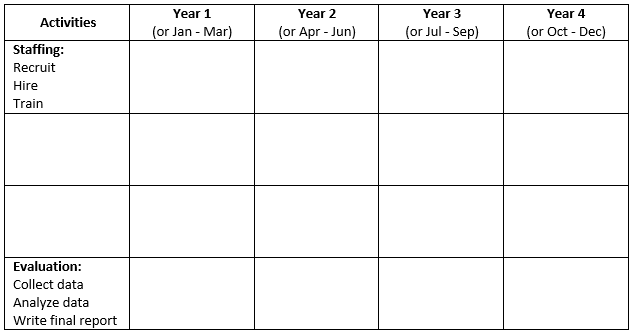
Tool 3: Checklist for Following Funders' Guidelines
When applying for a grant, it is important to follow the funders’ specific guidelines exactly. Here’s a general checklist you may wish to use:
|
_____ |
Be sure to format and organize the grant headings exactly the way the Request for Proposal (RFP) requests. Answer all the questions in the order listed, and use the headings, subheadings, and numbers provided. Be sure to submit the number of copies the grantmaker requests.
|
|
_____ |
Include a cover letter to introduce your organization and your request, and to make a strategic link between your proposal and the funder's mission and grant making interests.
|
|
_____ |
Grant proposals should be typed and look professional. Make sure the grant is easily readable (e.g., the font size is not too small).
|
|
_____ |
Keep an electronic copy of the proposal for future reference. This can be adapted or modified for future proposals.
|
|
_____ |
Find out if you need to register to submit an application. Contact the funder to let them know you are applying, or set up a profile before submitting a grant (e.g., a federal grant needs a DUNS number). If any of these steps are required, make sure you complete them well in advance of the grant’s due date. If you contact the grantmaking agency, be sure to state not only your name, but also the group you are with.
|
|
_____ |
Find out if the grant needs a letter of intent (LOI), and submit one by the due date if required.
|
|
_____ |
Determine if you need letters of support or if you need potential partners to sign an MOU (Memorandum of Understanding).
|
|
_____ |
Pay attention to how reviewers are going to score various aspects of the grant, and give higher priority (proposal length, etc.) to areas that are more heavily weighted.
|
|
_____ |
When writing the grant, use bold or italics for emphasis of key points.
|
|
_____ |
Note that it is fairly common to need to include the following in the Appendices: proof of non-profit status, staffing overview or organizational chart (including board, staff, and volunteer involvement), and an audited income or expense statement.
|
|
_____ |
Once the grant is written, review it for clarity and consistency. Although grant applications are often a team effort, the final grant application should have one voice. It should read as if it were written with the consistent language of one writer.
|
|
_____ |
Be sure to make a strong case for the overall significance of the proposal and prospects for success. (State WHY this project should be done: a) at all, b) in this community, c) at this time, and d) by this organization.
|
|
_____ |
Be sure to ask questions of the funder, if needed – but read the application well and think before asking. If your organization is granted funding, there will likely be periodic reporting requirements to the funding agency.
|
EXAMPLE 1: COLLABORATION, NOT COMPETITION: THRIVE ALLEN COUNTY'S CAPACITY BUILDING INITIATIVES
Rural organizations face many challenges in applying for grants, including few major foundations located in or familiar with rural areas and the perception that a smaller population area means a smaller impact. But one nonprofit in Kansas is showing just how mighty a rural organization can be. Since 2019, Thrive Allen County has brought over $28 million into the county for a wide variety of projects, including public transportation, grocery stores, hiking trails, and much more.
In Thrive Allen County's early years, the executive director at the time decided to expand the organization's funding from local sources and start applying for state, regional, federal, and other funding sources. Expanding funding sources helped the nonprofit build capacity and avoid local budget cuts or changes in their early funding sources.
Thrive Allen County's grant writers “usually bring in more money for the community than they do for the organization,” Regehr said. The grant writing team helps governmental agencies and civic and nonprofit organizations apply for funding. “It's not just Thrive doing the work,” she added. “We're also working to empower all of them to do the work as well.”
In addition to Kansas, Thrive Allen County has worked with rural communities in California, Louisiana, Missouri, Nebraska, New York, Nebraska, and Oklahoma. “We are energized by working with other organizations in other communities,” Regehr said. “It is not just people learning from us; it's us learning from them. There are so many cool things that are being done across the nation.”
Thrive Allen County has even distributed funds to other organizations. During the COVID-19 pandemic, Thrive Allen County was asked by the county to distribute $2.4 million in SPARK funding, or Kansas's use of American Rescue Plan dollars. The money had to be spent in six months. Thrive Allen County met with people from different community sectors to create an advisory group and develop grant programs to distribute the money.
-
What are the elements of an annual budget?
-
Why should you prepare an annual budget?
-
Some practical considerations
-
Planning and gathering information to create a budget
-
Putting it all together: Creating and working with a budget document
What are the elements of an annual budget?
Creating an annual budget can feel challenging, especially if you are unfamiliar with accounting and financial terminology. A budget becomes easier to work with when it is understood as a planning tool: it translates the organization's priorities, expected resources, responsibilities, and financial assumptions into numbers for a defined period of time.
Accurate and up-to-date budgets help organizations plan responsibly, monitor their financial position, communicate with boards and funders, and make informed decisions as circumstances change. How detailed the budget needs to be will depend on the size and complexity of the organization, its programs, funding sources, reporting requirements, and financial systems.
At a minimum, an annual budget generally includes:
- Projected expenses. Estimate what the organization expects to spend during the coming fiscal year, organized into meaningful categories such as personnel, program costs, facilities, technology, transportation, insurance, accessibility, professional services, and administration.
A fiscal year is the 12-month period an organization uses for budgeting and financial reporting. It may or may not match the calendar year. Choose and maintain the fiscal year appropriate to your organization's legal, accounting, governance, and funding requirements. Prepare and approve the annual budget before the new fiscal year begins whenever possible.
- Projected revenue and other support. Estimate the resources you reasonably expect to receive during the coming fiscal year, broken down by source. Depending on the organization, these may include grants, contracts, individual contributions, foundation support, public funding, membership dues, earned revenue, investment income, sponsorships, and in-kind resources.
- Restrictions and relationships between revenue and expenses. Some funding can be used only for specific programs, positions, populations, activities, or cost categories. Build these restrictions into the budget and financial system so the organization can understand which resources are available for which purposes.
- Cash-flow considerations. A balanced annual budget does not necessarily mean cash will be available when bills are due. Consider the timing of grant payments, reimbursements, fundraising revenue, payroll, contracts, and other major receipts and expenses.
- Updates based on actual results. A budget begins with assumptions. Throughout the year, compare the budget with actual revenue and expenses, investigate significant differences, update forecasts where appropriate, and communicate meaningful changes to organizational leadership and the board.
Why should you prepare an annual budget?
- It connects financial decisions with organizational goals. Developing the budget requires the organization to identify what work it intends to prioritize and what resources are required to carry it out.
- It provides a realistic picture of available resources and gaps. A budget helps show what the organization can responsibly support, what requires additional resources, and where tradeoffs may be necessary.
- It supports proactive financial planning. Identifying gaps before the year begins creates more time to pursue additional funding, revise plans, build partnerships, or adjust expenses thoughtfully.
- It provides information required by boards, funders, partners, lenders, and regulators. Budget information may be required in grant applications, contracts, financial reports, governance processes, and other organizational documents.
- It creates a basis for discussing financial priorities and tradeoffs. Staff, board members, and others involved in governance can use the budget to understand how resources support the organization's mission.
- It helps reduce financial surprises and strengthen financial oversight.
- It supports accountability. Comparing actual results with the approved budget helps leaders understand where assumptions were accurate, where conditions changed, and where corrective action may be needed.
Some practical considerations
Budget development and financial management require knowledge and time, and responsibility should not automatically fall to one person. Depending on the organization, the process may involve an executive director, finance staff, program leaders, bookkeeper, accountant, treasurer, chief financial officer, board finance committee, or other people with appropriate knowledge.
Smaller organizations that do not have financial staff may seek support from nonprofit associations, community foundations, accountants, pro bono professional networks, universities, fiscal sponsors, or shared-service arrangements with other organizations. Whatever approach is used, organizational leaders and the board should still understand the budget well enough to carry out their oversight responsibilities.
Obtain professional accounting, tax, legal, or audit guidance when necessary. Requirements vary according to the organization's legal status, location, funding, contracts, size, and other circumstances.
Planning and gathering information to create a budget
The preliminaries: What resources will you need next fiscal year?
Budgeting should begin with organizational priorities rather than simply copying last year's numbers. Consider the work the organization intends to carry out, what it has learned, what conditions have changed, and what resources are needed to fulfill its mission responsibly.
Consider questions such as:
- Which programs, activities, and organizational functions are most important to advancing the mission and responding to community priorities?
- What staffing capacity is required to carry out that work effectively and sustainably?
- What compensation, employee benefits, contractor costs, training, and other workforce investments are required?
- What facilities, supplies, technology, communications, insurance, transportation, accessibility supports, security, professional services, and other resources are required?
- What costs are likely to increase because of inflation, compensation adjustments, insurance changes, contracts, program growth, or other known factors?
- What investments would help reduce risk or strengthen long-term organizational capacity?
Estimating expenses: What will it cost?
Step 1: Develop realistic forecasting assumptions
Begin with reliable information such as current contracts, payroll records, vendor quotes, historical spending, known rate changes, program plans, and other available evidence.
Where exact amounts are not known, develop reasonable estimates and document the assumptions behind them. Consider several scenarios when costs are particularly uncertain rather than relying on one arbitrary number.
Prudent forecasting means using evidence, documented assumptions, and reasonable caution when projecting both expenses and revenue. Avoid overstating likely revenue or understating known costs simply to make the budget appear balanced.
A reasonable contingency may be appropriate for uncertain or unexpected costs, but avoid using a large "miscellaneous" category that makes it difficult to understand what the organization actually expects to spend.
Step 2: Estimate the organization's core operating expenses
These may include:
- Salaries and wages
- Payroll taxes, employee benefits, leave, insurance, retirement contributions, and other employment costs
- Rent, mortgage, coworking, or other facility costs
- Utilities
- Communications services
- Internet, software, cloud services, cybersecurity, website hosting, and other technology costs
- Insurance
- Accounting, payroll, legal, human resources, data security, and other administrative services
Step 3: Estimate the costs of carrying out programs and activities
- Program and office supplies, educational materials, software, subscriptions, and other consumable resources
- Equipment and technology, including purchase or lease costs, maintenance, repairs, replacement, licensing, and service agreements
- Participant compensation or stipends, childcare or dependent-care support, interpretation, translation, transportation, and other resources needed for equitable participation
- Evaluation, communications, outreach, training, and professional-development expenses
Funders may classify expenses differently and may limit certain administrative or indirect costs. Use each funder's current definitions and rules rather than assuming that the same percentage or classification applies to every grant.
Step 4: Include other financial obligations and necessary costs
- Debt payments and other financial obligations
- Consulting, accounting, bookkeeping, legal, evaluation, audit or financial-review services, and contracted services from other organizations
- Printing, design, and production costs
- Transportation and travel for staff, participants, and volunteers, including appropriate vehicle costs
- Mailing, shipping, and delivery
Financial reviews and audits: Do not assume that every nonprofit is required by the IRS to obtain an annual independent audit. Audit, review, compilation, and other financial-reporting requirements may depend on state law, federal-award expenditures, funder or lender requirements, contracts, governing documents, or board policy. Determine which requirements apply to your organization and budget accordingly.
Step 5: Identify additional priorities and strategic investments
After identifying core costs, list investments that are desirable but may depend on additional resources. These could include new positions, expanded programs, compensation improvements, new technology, accessibility improvements, professional development, equipment replacement, facility improvements, or reserve contributions.
Step 6: Add the projected expenses
The result is the amount you estimate the organization would spend during the coming fiscal year under the assumptions in your plan.
Estimating revenue and other support
Use historical information when it is relevant, but do not assume that last year's revenue will automatically continue. Review current grant periods, contracts, donor trends, fundraising performance, membership, earned revenue, and other known conditions.
Step 1: List committed or reasonably predictable funding
This may include grants and contracts already awarded, recurring government support, foundation grants, recurring contributions, or other resources with a strong basis for inclusion in the forecast.
Distinguish between funds that are committed, reasonably expected, and aspirational or still being pursued. This helps leaders understand the level of uncertainty in the budget.
Step 2: Estimate fundraising revenue
Fundraising may include individual giving, major gifts, events, peer-to-peer campaigns, direct mail, online fundraising, sponsorships, workplace giving, planned giving, or other approaches. Base projections on realistic participation, historical results, fundraising costs, and current strategy.
Step 3: Estimate earned revenue
Include fees for services, consulting, training, publications, merchandise, facility use, or other mission-aligned earned-income activities when applicable. Consider affordability and whether fees could create barriers to access.
Step 4: Estimate membership revenue
If your organization charges membership dues or fees, estimate revenue using realistic assumptions about membership levels and collection rates.
Step 5: Estimate sales or other earned-income activities
Include projected revenue from products or other business activities where appropriate, along with the expenses required to generate that revenue.
Step 6: Estimate rental or shared-space revenue
If the organization rents or sublets space, include reasonable estimates based on current agreements or realistic occupancy assumptions.
Step 7: Estimate investment and interest income
Include interest, investment income, or endowment distributions using assumptions consistent with the organization's investment and spending policies. Avoid treating uncertain market gains as guaranteed operating revenue.
Step 8: Add other expected sources
Include other revenue or support that is reasonably expected and clearly identify significant restrictions.
Step 9: Add all projected revenue and support
Compare this total with projected expenses, but also consider timing, restrictions, and uncertainty. Two budgets with the same total revenue may have very different levels of financial risk.
Putting it all together: Creating and working with a budget document
Analyzing and adjusting the budget
Step 1: Organize the information in a useful format
Most organizations use accounting software, spreadsheets, or other financial-management systems that allow expenses and revenue to be organized by program, funding source, department, grant, restriction, and other dimensions.
A useful budget should make it possible to see not only total revenue and expenses, but also which resources are restricted and whether sufficient flexible funding exists to support shared organizational costs.
| Expense Category | Public Grant | Foundation Support | Unrestricted Contributions | Service Revenue | Total |
| Personnel | 90,000 | 30,000 | 20,000 | 10,000 | 150,000 |
| Employee benefits and payroll costs | 22,000 | 8,000 | 5,000 | 3,000 | 38,000 |
| Program supplies and participant support | 18,000 | 10,000 | 4,000 | 2,000 | 34,000 |
| Technology and communications | 5,000 | 3,000 | 6,000 | 1,000 | 15,000 |
| Facilities and utilities | 12,000 | 6,000 | 14,000 | 3,000 | 35,000 |
| Insurance and professional services | 4,000 | 2,000 | 7,000 | 0 | 13,000 |
| Total | 151,000 | 59,000 | 56,000 | 19,000 | 285,000 |
A format like this can help an organization see whether restricted funding is assigned to allowable expenses and whether sufficient unrestricted resources are available for shared costs that program-specific grants may not fully cover.
Step 2: Compare projected expenses with projected revenue and support
- If planned revenue and support approximately equal planned expenses, the organization has a balanced operating budget.
- If planned revenue exceeds planned expenses, the organization has a budgeted operating surplus. Depending on restrictions and cash flow, this may support operating reserves, strategic investments, debt reduction, future programs, compensation improvements, or other board-approved purposes.
- If planned expenses exceed planned revenue, the organization has a budgeted deficit. Determine whether the deficit is intentional and supported by available reserves or whether additional revenue, spending changes, or other action is required.
A nonprofit does not necessarily need to budget to exactly zero every year. Building reasonable operating reserves and occasionally budgeting for strategic use of reserves can both be appropriate when supported by clear policies and organizational circumstances.
Step 3: Make sure resources can actually be used as planned
Review restrictions, grant periods, allowable costs, indirect-cost rules, cash timing, match requirements, and other conditions attached to funding.
If there is a mismatch:
- Ask the funder whether a budget modification or reallocation is permitted when appropriate
- Allocate legitimate shared costs across programs using a consistent and supportable methodology
- Reconsider timing, scope, or priorities if resources do not support the planned work
- Seek flexible or unrestricted funding where restricted grants leave essential organizational costs unsupported
The organization's mission, values, community commitments, and strategic priorities should guide funding decisions. Avoid creating or reshaping programs simply because money is available when doing so would pull the organization away from its purpose.
Step 4: Plan responsibly for a budgeted surplus
A projected surplus is not necessarily immediately available cash. Consider when revenue will actually be received, whether any funds are restricted, and what obligations remain outstanding.
Possible uses of unrestricted surplus may include:
- Building or replenishing operating reserves under a board-approved reserve policy
- Improving compensation, benefits, workplace conditions, staffing capacity, or professional development when the organization can reasonably sustain those commitments
- Replacing deferred equipment or technology
- Investing in a new or expanded program after considering its long-term resource requirements
- Making appropriate capital investments
- Supporting partnerships or shared infrastructure with other organizations
- Reducing debt or other financial risk
Investment of organizational funds should follow applicable law, board-approved financial and investment policies, liquidity needs, risk tolerance, donor restrictions, and appropriate professional guidance.
Step 5: Respond thoughtfully to a projected deficit
A deficit deserves attention, but the goal should not simply be to cut until the numbers balance. Understand why the deficit exists, whether it is temporary or structural, how much unrestricted cash or reserves are available, and what effect different choices would have on staff, participants, programs, and the organization's long-term health.
Possible responses include:
- Using board-designated reserves when that use is consistent with the organization's reserve policy and long-term financial position
- Pursuing additional grants, contributions, contracts, earned revenue, or other realistic sources of support
- Sharing services, facilities, purchasing, personnel, or other infrastructure with partner organizations where doing so improves efficiency without reducing quality or accountability
- Reducing or redesigning lower-priority expenses
- Delaying or scaling back activities that are not essential or that can be postponed responsibly
- Revisiting contracts, purchasing practices, insurance, technology, facilities, and other recurring expenses
- Adjusting program scope or timing when the organization cannot responsibly support the original plan
A thoughtful approach to budget reductions
Begin with mission, legal obligations, contractual requirements, safety, accessibility, and the effects on people. Review discretionary or lower-priority spending before making changes that substantially affect staff compensation, benefits, employment, or essential services.
- Identify expenses that can be reduced, delayed, renegotiated, or redesigned without undermining essential work.
- Consider the consequences of reductions for program quality, equity, accessibility, staff workload, and community commitments.
- If workforce changes become necessary, follow applicable employment law, contracts, personnel policies, funder requirements, and organizational values. Communicate clearly and avoid assuming that reductions in hours, benefits, or positions are cost-free solutions; they can affect retention, workload, morale, and service quality.
Borrowing may be another option in some circumstances, but debt creates future obligations. Consider repayment capacity, interest and fees, cash-flow effects, restrictions, board authorization, and professional financial advice before borrowing.
Creating an actual budget document
The budget should be understandable to the people responsible for reviewing, approving, monitoring, and implementing it. Different audiences may need different levels of detail.
A high-level board budget might show projected expenses by major category and projected revenue by source, while staff and finance committees may use more detailed program, department, grant, and account-level reports.
| Projected Expenses | Amount |
| Personnel | $150,000 |
| Benefits and payroll costs | $38,000 |
| Program supplies and participant support | $34,000 |
| Technology and communications | $15,000 |
| Facilities and utilities | $35,000 |
| Insurance and professional services | $13,000 |
| Total Projected Expenses | $285,000 |
| Projected Revenue and Support | Amount |
| Public grants and contracts | $151,000 |
| Foundation support | $59,000 |
| Unrestricted contributions and memberships | $56,000 |
| Earned revenue | $19,000 |
| Total Projected Revenue and Support | $285,000 |
A budget narrative can provide additional explanation for assumptions, staffing, major costs, restricted funding, and other items that may not be obvious from the numbers alone.
Working with your budget
The approved budget should be monitored throughout the fiscal year. Many organizations review financial results monthly, although the appropriate schedule depends on the organization's size, complexity, cash position, and governance practices.
Compare actual revenue and expenses with the budget and calculate meaningful variances. Investigate significant differences and update the forecast when new information becomes available.
Budget monitoring should be considered alongside cash-flow reports, balance-sheet information, grant restrictions, fundraising progress, reserves, outstanding obligations, and other indicators of financial health.
Your budget and related financial reports should help you:
- Identify funding gaps, financial risks, and areas where assumptions have changed
- Decide what actions may be needed in response
- Track resources responsibly, comply with restrictions, and avoid unplanned overspending
- Understand whether staffing and program commitments remain financially sustainable
- Provide clear information to the board, funders, staff, and other appropriate stakeholders
In Summary
An annual budget translates an organization's priorities and plans into a financial framework for the coming fiscal year. A strong budgeting process estimates expenses and revenue realistically, identifies restrictions and uncertainty, considers cash flow, and gives organizational leaders and the board information they can use to make informed decisions.
The budget should not be treated as a document that is prepared once and then ignored. Compare budgeted amounts with actual results regularly, understand significant differences, update forecasts as circumstances change, and connect financial decisions with the organization's mission, community commitments, workforce, and long-term sustainability.
Financially healthy organizations also look beyond whether the annual budget mathematically balances. Consider liquidity, reserves, funding concentration, restricted versus unrestricted resources, long-term commitments, program quality, fair compensation, organizational risk, and whether available resources are sufficient to carry out the work responsibly.
Glossary
Accounting: A system for recording, classifying, summarizing, reporting, and interpreting an organization's financial transactions and position.
Audit: An independent examination of financial information performed under applicable professional standards. Different types of audits and financial reviews exist, and whether one is required depends on applicable laws, funding, contracts, organizational circumstances, and other requirements.
Balanced Budget: A budget in which projected revenue and other support approximately equal projected expenses. An organization may also intentionally budget for a surplus or for a planned use of unrestricted reserves when appropriate.
Budget Deficit: A situation in which projected expenses exceed projected revenue and other support.
Budget Surplus: A situation in which projected revenue and other support exceed projected expenses.
Budget-to-Actual Variance: The difference between the amount budgeted for a category and the amount actually received or spent during the same period.
Cash Flow: The timing and movement of cash into and out of an organization. An organization can have a balanced annual budget and still experience a cash shortage if revenue arrives after expenses must be paid.
Prudent Forecasting: Developing realistic financial projections using available evidence, documented assumptions, uncertainty ranges, and appropriate contingency or scenario planning.
CPA: Certified Public Accountant, a licensed accounting professional who may provide audit, tax, accounting, advisory, or other financial services depending on the engagement and applicable requirements.
Fiscal Year: The 12-month period an organization uses for budgeting, accounting, reporting, and closing its books.
Fund Accounting: Accounting practices used to track resources according to restrictions, grants, contracts, programs, or other requirements so an organization can demonstrate that funds are used appropriately.
Line Item: A defined revenue or expense category within a budget.
Line-Item Budget: A budget organized by specific revenue and expense categories. Funders may also approve budgets that limit how much funding can be used within particular categories.
Operating Reserve: Unrestricted funds set aside to help an organization manage unexpected expenses, revenue delays, emergencies, or other financial needs in accordance with an established reserve policy.
Projected Expenses: The costs an organization reasonably expects to incur during the budget period.
Projected Revenue and Support: The grants, contracts, contributions, earned revenue, membership income, investment income, and other resources an organization reasonably expects to receive during the budget period.
Restricted Funds: Resources whose use is limited by a donor, grant, contract, law, or other applicable requirement.
Spreadsheet: A tabular tool used to organize, calculate, and analyze financial information. Modern budget spreadsheets may track revenue and expenses by funding source, program, department, restriction, period, and other dimensions and may be used alongside accounting or financial-management software.
Contributor
Phil Rabinowitz
Resources
Online Resources
Alliance for Nonprofit Management is reasonably useful, and has a section which gives the answers to many frequently asked questions (FAQs) about non-profit finances.
Idealist links to services, resources, etc. for non-profits. Lots of good stuff here on budgeting and other issues.
Management Assistance Program for Non-Profits provides some useful books and resources.
The Non-Profit Genie links to resources for non-profits -- a good site, although not always easy to navigate.
Non-Profit Resource Center provides links to resources for non-profits.
StrongNonprofits.org provides best-practice guidance and hands-on tools to help you understand and manage your non-profit’s financial health. The site offers helpful resources in the areas of financial planning, operations, monitoring, and governance.
___You know the elements of an annual budget
___You know why you should prepare an annual budget
___You are prepared for the amount of time and effort spent on your budget to bear some relation to the size of your budget
___You have determined what you will need to spend money on in the next year, using these six steps to estimate your expenses:
- Develop ways of estimating expenses
- List yearly expense totals for absolute necessities
- List estimated expenses for things needed to conduct the activities of the organization
- List estimated expenses for miscellaneous costs
- List estimated expenses for items you aren't sure you can afford, but would like to obtain if possible
- Add up all of your expense items
___You understand how to estimate your organization's income, following these nine steps:
- List all actual figures or estimates of amounts you can expect from your known funding sources
- Estimate the amount you'll raise in the next fiscal year from fundraising
- Estimate the amount you'll take in for fees or services you provide
- Estimate the amount you will receive from yearly membership dues or fees
- Estimate the amount you will receive from items you may sell, such as pins, T-shirts, books, blood pressure cuffs, etc.
- Estimate the income from any spaces you sublet or rent to others
- Estimate the income you will receive from any investments, endowment income, annuities, or interest income (e.g., from a certificate of deposit, or from a Money Market or checking account)
- List and estimate the amounts from any other sources that are expected to bring in some income
- Add up all the income items you have listed to determine your total projected income for the fiscal year
___The five steps of analyzing and adjusting your budget have been followed:
- Laying out your figures in a useful format
- Comparing total expenses to your total income
- Knowing what to do if your budget is balanced
- Knowing what to do if you have a surplus
- Knowing what to do if you have a deficit
___If necessary, you have ideas on how to trim your budget
___You understand how to create a budget document
___You know how to work with your budget, including when and how to review and/or revise it
-
Why does your organization need a financial management plan?
-
What does everyday financial management include?
-
How do you create a financial management plan?
-
What issues are involved in being tax-exempt?
-
How do you handle cash flow?
-
What are some day-to-day financial management issues?
-
What are some investment issues?
Organizations need reliable financial systems in order to carry out their missions, pay staff and vendors, comply with funding requirements, manage risk, and make informed decisions about the future.
Effective financial management generally requires:
- A realistic and current budget
- Appropriate banking, payment, and purchasing systems
- Reliable accounting and recordkeeping
- Clear authorization and internal-control procedures
- Systems for paying bills, receiving revenue, and managing payroll
- Cash-flow forecasting and sufficient liquidity to meet obligations
- Procedures for managing grants, contracts, restricted funds, and reporting requirements
- Appropriate cybersecurity, privacy, document-retention, and backup practices
- Clear financial oversight by organizational leadership and the governing board
Why does your organization need a financial management plan?
Even very small organizations need some way to track money coming in and going out, maintain appropriate records, protect organizational resources, and meet financial obligations. The complexity of the system should reflect the size, activities, legal structure, funding, and risks of the organization.
A financial management plan can:
- Help the organization fulfill its mission. Reliable finances make it possible to sustain programs, staff, partnerships, and other work.
- Support effective use of resources. Good financial information helps leaders determine whether money is being used efficiently and in ways consistent with organizational priorities.
- Strengthen control over finances and cash flow. Leaders can identify problems earlier and respond before they become crises.
- Support reliable relationships with employees, vendors, partners, lenders, and funders. Meeting financial obligations and communicating early when problems arise builds trust.
- Strengthen credibility and accountability. Boards, funders, donors, partners, and community members should be able to trust that organizational resources are managed responsibly.
- Save time. Clear procedures and reliable records reduce the time spent locating missing information, correcting errors, or reconstructing transactions.
- Support better decisions. Accurate financial information helps leaders understand what the organization can afford, what risks it faces, and where additional resources may be needed.
What does everyday financial management include?
Financial management is not primarily about advanced mathematics. It is about creating reliable systems, using accurate information, establishing appropriate controls, and making sound decisions.
Financial responsibilities may be carried out by an executive director, finance staff, bookkeeper, accountant, chief financial officer, board treasurer, finance committee, fiscal sponsor, or some combination of these roles. Even when financial work is delegated, organizational leaders and board members should understand the organization's financial position and know what questions to ask.
Useful systems may include:
- An accounting and bookkeeping system that records transactions accurately and produces useful financial reports
- A banking and treasury system that addresses liquidity, fees, security, authorized users, deposit insurance, and access to funds
- A payment and purchasing system defining who can authorize, approve, initiate, and review expenditures
- A controlled process for low-dollar purchases, whether through petty cash, purchasing cards, reimbursement, or another method
- A payroll system that provides accurate and timely compensation and handles applicable taxes, deductions, employee benefits, and reporting
- Accounts-payable and accounts-receivable systems
- A grants and contracts management system for tracking restrictions, budgets, deliverables, reimbursement, reporting, and compliance
- A cash-flow management system
- Financial security and internal controls, including appropriate separation of duties, approvals, account access, reconciliations, and fraud-prevention measures
Cash flow refers to when money actually becomes available and when payments must actually be made. An organization may have substantial grants, contracts, pledges, or receivables on paper and still face a cash shortage if those funds have not yet been received.
Organizations also need to make decisions such as:
- What accounting or financial-management system will we use?
- Which bank accounts and financial institutions meet our needs?
- Who can authorize purchases, electronic payments, transfers, contracts, reimbursements, and other transactions?
- What approval thresholds and separation-of-duties controls should apply?
- How will compensation, employee benefits, leave, and employment classifications be handled consistently with applicable law and organizational policy?
- What purchasing and vendor-selection processes will we use?
- How will grants, contracts, restricted funds, and cost allocations be tracked?
- How will the organization respond to a cash-flow shortage?
- How will financial information be reviewed by leadership and the governing board?
The goal is to create controls strong enough to protect the organization without making routine work unnecessarily difficult. Financial caution and organizational innovation do not have to be opposites. A strong system helps leaders understand which risks are reasonable and which may threaten the organization.
How do you create a financial management plan?
Every organization needs financial-management practices appropriate to its size and circumstances. A small volunteer-led initiative may need a relatively simple system, while an organization managing payroll, grants, contracts, restricted funds, and multiple programs will need substantially more structure.
Accounting
Accounting systems should provide accurate and timely information about revenue, expenses, assets, liabilities, cash, restrictions, grants, and the organization's overall financial position.
Work with an accountant, bookkeeper, or other qualified financial professional when necessary. Community Tool Box guidance can help organizations understand the questions involved, but it is not a substitute for professional accounting, legal, or tax advice.
Organizations may use cash-basis, modified cash-basis, or accrual accounting depending on their circumstances and reporting requirements.
Cash-basis accounting generally records revenue when cash is received and expenses when they are paid.
Accrual-basis accounting generally recognizes revenue when it is earned and expenses when obligations are incurred, providing a broader view of amounts receivable and payable.
The appropriate accounting method depends on organizational needs, legal and tax requirements, funder requirements, and applicable accounting standards. Seek professional guidance when selecting or changing accounting methods.
Communication between financial staff and program or organizational staff is essential. Program staff need financial information they can understand, while accounting staff need timely and accurate information about purchases, contracts, payroll, grants, program activity, and other transactions.
Banking
Choose financial institutions based on the organization's actual needs. Relevant considerations may include:
- Fees and interest rates
- Deposit insurance and management of balances that exceed insured limits
- Online banking and electronic payment capabilities
- Fraud-prevention and account-security tools
- ACH, wire, check, debit-card, and purchasing-card controls
- Positive-pay or similar fraud-prevention services
- Payroll and direct-deposit capabilities
- Lines of credit or other appropriate financing
- Customer service and accessibility
- The institution's community relationships and lending practices, when these are relevant to the organization's mission and values
Do not assume that opening several accounts at the same financial institution automatically increases deposit-insurance protection. Review current deposit-insurance rules and structure organizational accounts appropriately.
Authorization and internal controls
Clearly establish who has authority to approve budgets, authorize spending, sign contracts, initiate payments, approve payroll, transfer funds, and access banking systems.
Governing boards generally provide financial oversight and approve major policies and budgets, while staff leaders usually manage approved day-to-day operations within delegated authority. The exact arrangement should be documented and appropriate to the organization's size and governance structure.
Whenever feasible, separate important financial responsibilities. For example, the same person should not independently authorize a purchase, initiate payment, reconcile the bank account, and review the transaction without another level of oversight.
Organizations may establish transaction thresholds requiring additional approval for significant expenditures. Approval rules should apply to electronic transactions as well as checks.
Organizational debit cards, purchasing cards, banking credentials, and payment accounts should be limited to authorized users. Use individual credentials rather than shared passwords whenever possible, enable multi-factor authentication, document cardholders and limits, and review activity regularly.
Petty cash and low-dollar purchasing
Some organizations still use petty cash, while others rely on purchasing cards, reimbursements, digital payments, or other methods for small expenses.
Whatever system is used, establish limits, authorized users, documentation requirements, approval procedures, and reconciliation. Small transactions still need appropriate records.
Payroll
Payroll is often one of an organization's largest expenses and carries significant legal, tax, and administrative responsibilities.
Organizations should establish clear procedures for:
- Pay periods and payroll schedules
- Employee classifications and timekeeping
- Salaried and hourly compensation
- Overtime and other wage requirements where applicable
- Employee benefits and leave
- Payroll taxes and withholding
- Direct deposit and other payment methods
- Required payroll and year-end reporting
- Secure retention of payroll and personnel records
Definitions of full-time and part-time work and eligibility for particular benefits depend on applicable law, benefit plans, and organizational policy. Avoid relying on a single informal number of weekly hours for all purposes.
Organizations may manage payroll internally or use a payroll provider, accountant, professional employer organization, or other service. Even when payroll is outsourced, the organization remains responsible for providing accurate information, reviewing payroll, protecting employee data, and ensuring obligations are met.
Payables and receivables
Accounts payable are amounts the organization owes for goods or services already received or other obligations already incurred.
Accounts receivable are amounts owed to the organization, such as unpaid invoices, reimbursement claims, contract payments, or other earned revenue.
Establish procedures addressing:
- Who reviews and approves invoices
- Who initiates and authorizes payment
- How purchases are approved before commitments are made
- How invoices, receipts, purchase records, and contracts are retained
- When customers, partners, or funders are invoiced
- How grant or contract reimbursement requests are submitted
- How overdue receivables are monitored and followed up
Purchase orders or electronic purchasing workflows can provide useful documentation and approval controls, particularly for organizations with significant purchasing activity.
Grants and contracts management
Grants and contracts may include requirements concerning allowable costs, budgets, reporting, performance, procurement, documentation, cost sharing, indirect costs, payment schedules, and other conditions.
Do not assume that every grant provides money in advance or that every contract reimburses costs after they have been incurred. Payment structures vary substantially. Review the specific award or contract terms.
Track revenue and expenses for each significant grant or contract within the accounting system so the organization can demonstrate how resources were used and whether spending remains consistent with the approved budget and terms.
A separate bank account for every grant is usually unnecessary unless the award, law, banking arrangement, or other requirement specifically calls for one. Modern accounting systems can typically track grants, programs, departments, restrictions, and funding sources through separate classes, projects, funds, or account codes while using shared organizational bank accounts.
When changes to an approved grant or contract are needed, determine whether prior approval is required and obtain authorization in the form required by the funder before making changes that require approval.
What issues are involved in being tax-exempt?
Nonprofit status and tax-exempt status are related but are not the same thing. Nonprofit organizational status is generally created under state law. Federal tax exemption is governed by federal law, and most organizations seeking recognition of exemption must separately apply to the Internal Revenue Service unless an exception applies.
State and local tax treatment also varies. Federal recognition does not automatically mean an organization is exempt from every state or local income, sales, property, or other tax. Determine which exemptions, registrations, renewals, filings, and documentation requirements apply where your organization operates.
Organizations should pay attention to requirements such as:
- Applying for federal recognition of tax-exempt status when required
- Maintaining appropriate state nonprofit registrations and charitable-solicitation registrations
- Applying separately for available state or local tax exemptions where necessary
- Using appropriate exemption documentation for qualifying purchases
- Filing the appropriate Form 990-series annual return or notice when required
- Filing applicable state and local reports
- Maintaining payroll-tax compliance
- Reviewing whether unrelated business or other activities create additional tax obligations
Annual federal filing requirements vary by type and size of organization. Some organizations file Form 990, Form 990-EZ, or Form 990-PF, while certain smaller organizations may be eligible to file Form 990-N. Some organizations are excepted from particular filing requirements. Use current IRS guidance to determine which filing applies.
Do not assume that all nonprofits must undergo an annual independent financial-statement audit. Audit, review, compilation, and other financial-reporting requirements may arise from state law, federal awards, funder or lender requirements, contracts, governing documents, or board policy. Determine which requirements apply to your organization and obtain professional guidance when necessary.
How do you handle cash flow?
Cash flow is the timing of money entering and leaving the organization. An organization can have a balanced budget or substantial receivables and still be unable to meet payroll or other obligations if cash has not arrived when needed.
Causes of cash-flow problems
Common causes include:
- Delayed grant, contract, reimbursement, or government payments
- Slow invoicing or reimbursement requests
- Large expenses occurring before related revenue is received
- Seasonal fundraising patterns
- Uncollected accounts receivable
- Unexpected expenses
- Rapid organizational or program growth
- Restricted funding that cannot be used for current obligations
- A structural operating deficit rather than a temporary timing problem
Distinguishing a temporary cash-flow problem from an underlying financial deficit is important. Borrowing may help address a timing mismatch, but it does not solve a long-term shortage of revenue.
Ways to address cash-flow problems
- Prepare a rolling cash-flow forecast. Estimate expected cash receipts and payments by month or, when necessary, by week.
- Maintain an appropriate operating reserve. Reserves can help organizations manage revenue delays and unexpected expenses.
- Invoice and request reimbursement promptly. Know the documentation and approval requirements before payments are needed.
- Discuss payment timing with funders or contracting organizations. When permitted, explore advances, revised payment schedules, more frequent reimbursement, or other arrangements.
- Maintain communication with vendors and other creditors. If payment may be late, discuss the situation before the due date and obtain agreement about revised terms whenever possible.
- Establish access to responsible short-term financing before a crisis. A line of credit or other financing may be useful when repayment capacity is clear and borrowing is consistent with organizational policy.
- Monitor restricted and unrestricted cash separately. Cash may be in the bank but unavailable for a particular obligation because of donor or grant restrictions.
When cash is insufficient to pay every obligation on time, do not rely on an informal rule that one creditor can simply be delayed because it is more likely to tolerate late payment. Consider legal obligations, payroll and payroll taxes, contractual requirements, critical services, consequences for employees and vendors, and any negotiated payment arrangements. Seek professional guidance when the organization's ability to meet its obligations becomes uncertain.
Credit cards may provide payment flexibility, but they can also carry significant interest, fees, and risk. Review card terms, establish organizational controls, and avoid using revolving credit as a substitute for a sustainable cash-flow strategy.
What are some day-to-day financial management issues?
Once systems are established, financial management depends on consistent use. Reliable software does not help if transactions are not entered, accounts are not reconciled, approvals are bypassed, or reports are not reviewed.
Trusted professional relationships with vendors, funders, financial institutions, partners, and others can make communication and problem-solving easier. At the same time, purchasing and financial decisions should follow transparent organizational policies rather than depend solely on personal relationships.
Purchasing goods and services
Consider overall value rather than simply selecting the lowest price.
Relevant considerations include:
- Price and total cost of ownership
- Product or service quality
- Accessibility
- Reliability and customer support
- Data privacy and cybersecurity
- Maintenance and replacement costs
- Shipping and delivery
- Contract terms and cancellation provisions
- Vendor reputation and financial stability
- Applicable procurement requirements
- Mission-related considerations when they are appropriate and consistent with organizational policy
Organizations may also reduce costs through cooperative purchasing, shared services, group contracts, joint technology platforms, shared facilities, or other collaborations.
Online purchasing can simplify comparison shopping, but organizations should also consider vendor security, counterfeit or unsupported products, licensing, warranty terms, subscription renewal practices, and whether organizational purchasing policies are being followed.
Working with funders
Grant and contract terms should be followed carefully. When circumstances change, however, some funders permit budget revisions, extensions, revised payment schedules, scope adjustments, or other amendments.
Do not assume that a change will be approved. Review the award terms and communicate with the appropriate funder representative before making changes that require prior approval. Document significant approvals and amendments in writing.
Maintaining financial systems
Areas requiring ongoing attention include:
- Transaction entry and reconciliation. Enter financial activity promptly and reconcile bank, credit-card, investment, payroll, and other accounts on a regular schedule.
- Access controls and cybersecurity. Limit financial-system access to authorized users, use strong authentication, review permissions regularly, and protect sensitive financial and employee information.
- Backups and recovery. Maintain secure backups and test procedures for recovering critical accounting and financial records.
- Payables and receivables. Pay approved obligations, issue invoices, pursue reimbursements, and follow up on overdue receivables consistently.
- Payroll and payroll taxes. Maintain accurate payroll data and comply with applicable withholding, reporting, wage, benefit, unemployment, workers' compensation, and other requirements.
- Grant and contract compliance. Track expenditures, deliverables, reporting deadlines, modifications, and restrictions.
- Tax and financial-reporting requirements. Complete applicable federal, state, local, audit, review, and other reporting requirements according to their current deadlines.
- Document retention. Maintain invoices, receipts, approvals, contracts, payroll records, grant documentation, board records, and other financial documents according to organizational policy and applicable requirements.
Financial systems should be reviewed periodically to determine whether controls remain appropriate as the organization changes. Growth, new funding sources, staffing changes, new technology, remote work, and new payment methods can all create new risks or require different procedures.
What are some investment issues?
An organization with funds beyond its immediate operating and liquidity needs may consider holding some of those resources in interest-bearing deposit accounts or other investments.
Investment decisions should begin with the purpose of the funds. Operating cash, emergency reserves, board-designated reserves, restricted funds, endowments, and long-term capital funds may have very different time horizons and risk tolerances.
Consider factors such as:
- How soon the funds may be needed
- Liquidity
- Preservation of principal
- Investment risk and volatility
- Expected return
- Fees
- Donor or grant restrictions
- Deposit-insurance limits
- Applicable laws and fiduciary responsibilities
- The organization's board-approved reserve and investment policies
Checking accounts, savings accounts, money market deposit accounts, certificates of deposit, Treasury securities, and other relatively liquid instruments may be appropriate for funds that must remain accessible, depending on the organization's needs and policies.
Organizations with long-term reserves or endowments may use diversified investment portfolios when appropriate. Decisions about stocks, bonds, pooled investment funds, and other assets should reflect the organization's time horizon, risk tolerance, liquidity needs, restrictions, governance responsibilities, and professional investment advice rather than a general rule that one type of investment is appropriate or inappropriate for all nonprofits.
If organizational deposits approach or exceed applicable deposit-insurance limits at one institution, review how the accounts are structured and consider appropriate treasury-management strategies.
Capital investments
A capital investment involves committing significant organizational resources to an asset expected to provide value over an extended period. Examples might include a building, land, vehicles, major technology systems, or specialized equipment.
Before purchasing real estate or another major asset, consider:
- Purchase and financing costs
- Maintenance and repairs
- Insurance
- Accessibility and renovation needs
- Utilities and operating costs
- Property-tax treatment under applicable state and local law
- Liquidity and debt-service effects
- Whether ownership or leasing better fits the organization's mission and long-term plans
- Risks associated with future organizational growth, contraction, or relocation
Real estate may become an organizational asset and may sometimes produce rental income, but ownership also creates long-term costs and responsibilities. Analyze the full financial implications rather than assuming that purchasing property will automatically reduce costs.
In Summary
Effective financial management combines reliable systems, appropriate internal controls, timely information, and thoughtful decision-making. Organizations need ways to manage accounting, banking, purchasing, payroll, payables and receivables, grants and contracts, cash flow, financial reporting, and organizational resources.
These systems should be proportionate to the organization's size and complexity and should evolve as programs, staffing, technology, funding, and financial risks change. Organizational leaders and boards should understand the financial position of the organization even when accounting or financial tasks are delegated to specialists.
Strong financial management is not an end in itself. Its purpose is to protect organizational resources, strengthen accountability and sustainability, support staff and partners, and make it possible for the organization to carry out its commitments to the people and communities connected to its mission.
Resources
Online Resources
The Alliance for Nonprofit Management provides answers to FAQ's about financial management and other issues, as well as links to other nonprofit management sites, and membership possibilities.
Free Management Library is from the Management Assistance Project for Nonprofits and provides indexed access to information on a huge number of management topics, including nonprofit financial management and accounting, cash flow, budgeting, audits, etc. It also provides a free on-line 12-course nonprofit management program.
Guidestar Nonprofit links to many organizations, resources, etc. for nonprofits.
StrongNonprofits.org provides best-practice guidance and hands-on tools to help you understand and manage your non-profit’s financial health. The site offers helpful resources in the areas of financial planning, operations, monitoring, and governance.
Have you included the following systems in your management plan?
___Accounting
___Banking
___Money-handling
___Petty cash
___Payroll
___Payables and receivables
___Grants management
___Handling cash flow issues
Have you included the following decisions in your management plan?
___Computerizing your accounting
___Types of bank accounts
___What constitutes full-time employment
___Which bills and obligations to settle first
___Determining your elegibility for tax-exempt status
Have you determined a plan for handling cash flow?
___Anticipate when cash flow problems may occur
___Set your priorities beforehand
___Develop a cash flow contingency plan based on your priorities and the situation of your organization
Have you considered the following management and investment issues?
___Day-to-day money handling
___Shopping for goods and services
___Negotiating with funders
___Maintaining systems
___Investing in a Certificate of Deposit
___Investing in a Money Market Account
Tool: Spreadsheets
A spreadsheet is a way to display a budget or the finances of an organization in a way that makes it clear how much money can be and/or has been spent for each line item from each funding source. In its simplest terms, a spreadsheet is a grid with a list of funding sources along its top edge and a list of expense categories running down its left-hand edge, so that each vertical column represents a funding source , and each horizontal row represents an expense category. Where each column and row meet (this meeting place is called a cell), there should be a number representing the amount of money from that particular funding source (the column) that goes to that particular expense category (the row).
While you can make a spreadsheet either by hand or by computer, the advantage to a computer spreadsheet is that it allows you to put formulas in particular cells to total up a column or row, or to otherwise make sure that the number in that cell reflects a change elsewhere. In the spreadsheet below, for instance, each of the cells in the "Totals" row at the bottom automatically adds all the figures in its column, so that if you enter a new number in one of the cells in that column, the total at the bottom will change automatically. The same is true for the cells in the "Totals" column on the right, with the difference that those cells are set up to total their rows. In the "Fringe" row, each cell - except for the "Total" ones - is set to figure 25% of the total salaries in its column, because you already know that fringe benefits are 25% of salary.
Consolidated United Conglomerated Community Health Program
| United Way | Department of Health | County | Raffle | Totals | |
| Coordinator Salary | 2,000 | 22,000 | 5,000 | 1,000 | 30,000 |
| Aide Salary | 5,000 | 8,000 | 4,000 | 1,500 | 18,500 |
| Fringe | 1,750 | 7,500 | 2,250 | 625 | 12,125 |
| Rent | 750 | 5,500 | 2,000 | 125 | 8,375 |
| Insurance | 0 | 1,500 | 0 | 0 | 1,500 |
| Office Supplies | 500 | 1,200 | 275 | 0 | 1,975 |
| Program Materials | 0 | 1,300 | 475 | 0 | 1,775 |
| Totals | 10,000 | 47,000 | 14,000 | 14,000 | 74,250 |
Because the cells change their totals automatically when new figures are introduced , a computer spreadsheet makes it easy to test out different ways of spending money , and to see immediately how much you can afford to spend in particular categories.
-
What is accounting?
-
How is nonprofit accounting different from accounting for for-profit organizations?
-
What is an accounting system?
-
When should you develop an accounting system for your organization?
-
Why should you do accounting for your organization?
-
How do you do accounting for nonprofit groups?
Community organizations often devote substantial attention to securing the financial resources needed to carry out their work. An equally important question is how to manage, document, protect, and understand the resources the organization already has.
Reliable accounting and financial-reporting practices are essential to organizational sustainability. They help organizations understand their financial position, meet legal and funder requirements, protect resources, maintain appropriate internal controls, and make informed decisions about programs, staffing, partnerships, and future commitments.
In this section, we'll provide an overview of accounting and its role in community organizations. We'll also discuss accounting systems, financial reporting, audits and other forms of external financial review, professional accounting support, accounting technology, and the basic processes organizations use to maintain reliable financial information.
This section is intended to provide a general foundation for understanding nonprofit accounting. It is not a substitute for professional accounting, audit, tax, or legal advice. Requirements vary according to an organization's legal structure, size, funding sources, activities, location, and other circumstances. Work with qualified professionals when specialized guidance is needed.
What is accounting?
Accounting is a system for recording, classifying, summarizing, analyzing, and reporting financial information about an organization. Accounting helps leaders understand where resources come from, how they are used, what the organization owns and owes, what restrictions apply to particular resources, and how the organization's financial position changes over time.
Accounting is related to, but broader than, bookkeeping. Bookkeeping generally refers to recording financial transactions and maintaining supporting records. Accounting includes those records but also includes activities such as financial reporting, reconciliations, analysis, budgeting support, grant and fund tracking, internal controls, and interpretation of financial information.
An accountant or other qualified financial professional may help an organization design its accounting system, prepare financial statements, interpret financial information, meet tax and reporting requirements, establish internal controls, and address complex accounting issues.
Accounting standards
Organizations should determine which accounting and financial-reporting standards apply to them. In the United States, the Financial Accounting Standards Board (FASB) establishes generally accepted accounting principles for nongovernmental entities, including nongovernmental nonprofit organizations. Accounting guidance specifically relevant to nonprofit entities is included in the FASB Accounting Standards Codification, including Topic 958, Not-for-Profit Entities.
The Governmental Accounting Standards Board (GASB) establishes accounting and financial-reporting standards for state and local governmental entities. Receiving government funding by itself does not necessarily make a nongovernmental nonprofit organization subject to GASB accounting standards.
Organizations may also have accounting and reporting requirements established by government awards, contracts, lenders, foundations, state regulators, accrediting organizations, or other entities. A qualified accountant can help determine which standards and requirements apply.
Special topic in accounting: What is an audit?
An audit is an independent examination of financial statements and related information performed under applicable professional auditing standards. The purpose of a financial statement audit is to allow an independent auditor to express an opinion about whether the financial statements are presented fairly, in all material respects, in accordance with the applicable financial-reporting framework.
Audited nonprofit financial statements commonly include:
- A statement of financial position
- A statement of activities
- A statement of cash flows
- Information about expenses by their nature and function, presented in the financial statements or notes as applicable
- Notes explaining significant accounting policies, restrictions, commitments, contingencies, investments, leases, contributions, grants, and other relevant matters
- The independent auditor's report
Depending on the engagement and the organization's funding, an audit may also involve consideration of internal controls or compliance with particular laws, regulations, grants, contracts, or federal award requirements.
Not every nonprofit organization is required to obtain an annual financial-statement audit. Requirements may arise from state law, federal awards, grant or contract terms, lender requirements, organizational bylaws, board policy, or other circumstances.
Organizations that expend federal awards above the threshold established under the federal Uniform Guidance may be required to obtain a Single Audit or, when permitted, a program-specific audit. Because federal thresholds and requirements can change, organizations receiving substantial federal awards should review the current Uniform Guidance and obtain appropriate professional advice.
Tax-exempt organizations may also have federal and state filing requirements that are separate from audit requirements. Depending on the organization, federal reporting may include Form 990, Form 990-EZ, Form 990-N, Form 990-PF, and applicable schedules. Schedule A, for example, applies to organizations required to provide information about public charity status and public support; it is not simply a universal attachment for every tax-exempt organization.
An organization may choose to obtain an audit even when one is not legally required.
Reasons may include:
- A funder, lender, partner, or governing board requests audited financial statements
- The organization has grown significantly or its financial transactions have become more complex
- The board wants additional independent assurance regarding the organization's financial statements
- The organization wants to strengthen financial reporting and internal controls
- Significant financial concerns or irregularities have occurred and independent review is appropriate
Other CPA services may include a review or a compilation. These provide different levels of service and assurance from an audit. A review provides limited assurance based primarily on inquiry and analytical procedures. A compilation involves presenting financial information supplied by management in financial-statement form and does not provide assurance on the financial statements.
Work with a qualified CPA or other appropriate professional to determine which service fits your organization's legal requirements, funding requirements, governance needs, and resources.
How is nonprofit accounting different from accounting for for-profit organizations?
Many accounting principles apply to both nonprofit and for-profit organizations. Both need reliable transaction records, internal controls, financial statements, cash-flow management, appropriate tax reporting, and accurate information for decision-making.
Nonprofit accounting, however, also reflects the organization's mission, donor restrictions, grants, contributions, and accountability for resources that may be limited to particular purposes.
Financial challenges should be addressed through responsible planning rather than assuming that staff members will work without pay, defer compensation, or absorb unsustainable workloads to keep an organization operating. Organizations facing financial stress may need to examine revenue, expenses, reserves, staffing, program scope, financing, partnerships, and other options while considering legal obligations and effects on staff and community commitments.
Some areas especially important in nonprofit accounting include:
- Accounting for contributions and grants. Nonprofits may receive contributions, grants, donated assets, and other forms of support that require specialized accounting. Current FASB guidance for nonprofit entities addresses issues such as donor restrictions and whether contributions are conditional or unconditional.
- Donor restrictions. Financial statements for nongovernmental nonprofit organizations generally distinguish between net assets with donor restrictions and net assets without donor restrictions.
- Grant and contract accounting. Organizations may need to distinguish among contributions, exchange transactions, government contracts, and other arrangements and track the requirements associated with each.
- Contributed nonfinancial assets and services. Certain donated goods, professional services, facilities, and other nonfinancial contributions may require accounting or disclosure under applicable standards.
- Capital assets and depreciation. Buildings, vehicles, technology, equipment, and other long-lived assets may be capitalized and depreciated over their estimated useful lives according to applicable accounting policies and standards.
- Functional expense reporting. Nonprofit organizations may need to report expenses both by their nature - such as salaries, rent, supplies, and professional services - and by function, such as program services, management and general activities, and fundraising.
Cash-basis and accrual-basis accounting
Organizations may encounter several accounting methods.
Cash-basis accounting generally records revenue when cash is received and expenses when cash is paid.
Accrual-basis accounting generally recognizes revenue when it is earned or otherwise recognizable under applicable accounting guidance and records expenses when obligations are incurred, regardless of when cash is received or paid.
Some smaller organizations may maintain internal records using a cash or modified-cash approach. Financial statements intended to comply with generally accepted accounting principles, however, need to follow the applicable GAAP requirements. Organizations should select accounting methods with guidance from a qualified accountant and based on their reporting, tax, funder, and management needs.
Regardless of accounting method, organizations must also monitor actual cash. An organization can appear financially healthy on an accrual basis while still experiencing a shortage of cash available to meet immediate obligations.
What is an accounting system?
An accounting system includes the records, technology, policies, controls, processes, and people used to capture financial transactions and produce reliable financial information.
The goals of the accounting system are to ensure that transactions are authorized, documented, recorded accurately, classified appropriately, protected from loss or misuse, reconciled, and reported in a timely way.
Components of an accounting system
- Chart of accounts. The chart of accounts is the organized list of accounts used to classify financial activity.
- Common categories include assets, liabilities, net assets, revenue and support, and expenses.
- An organization may also use dimensions such as program, department, grant, funding source, location, restriction, or project so that financial information can be analyzed in several ways.
- General ledger. The general ledger contains the organization's financial transactions organized by account and forms the foundation for financial reporting. Modern accounting systems generally update ledger information automatically as approved transactions are entered.
- Subledgers and transaction records. Organizations may maintain detailed records for accounts payable, accounts receivable, payroll, fixed assets, grants, contributions, purchasing, credit cards, and other areas. These records should reconcile with the general ledger.
- Bank and payment records. Bank statements, electronic payments, checks, credit-card transactions, deposits, and other cash activity should be recorded and reconciled regularly.
- Supporting documentation. Invoices, receipts, contracts, grant agreements, donor documentation, timesheets, payroll information, approvals, reimbursement records, and other evidence should be retained according to organizational policy and applicable requirements.
- Accounting policies and procedures. Written procedures explain how financial responsibilities are handled, including purchasing, payments, deposits, payroll, reimbursements, grants, restricted funds, journal entries, reconciliations, financial reporting, record retention, cybersecurity, and approval authority.
- Internal controls. Controls help reduce errors, misuse, fraud, and unauthorized transactions. Examples include separation of duties, approval thresholds, bank reconciliations, restricted system permissions, documentation requirements, multi-factor authentication, and review by people independent of the original transaction when feasible.
Small organizations may use simpler systems than large organizations, but simplicity should not mean incomplete records or lack of oversight. Even a small organization should know how much money it has, where resources came from, what restrictions apply, what it owes, what others owe it, and whether transactions are properly documented and authorized.
When should you develop an accounting system for your organization?
Develop basic financial controls and accounting records as soon as your organization begins receiving, spending, or managing money.
The system can grow with the organization. A small volunteer-led group may begin with a relatively simple accounting platform and a limited chart of accounts. As the organization adds employees, grants, contracts, programs, restricted contributions, credit cards, property, or other financial complexity, the accounting system should evolve accordingly.
It is usually easier to establish appropriate procedures early than to reconstruct financial records later.
Periodically reassess whether the accounting system still meets the organization's needs. Growth, remote work, new funding requirements, new programs, increased transaction volume, cybersecurity risks, staffing changes, or expansion into new locations may require different technology, controls, or expertise.
Why should you do accounting for your organization?
Reliable accounting can help your organization:
- Meet applicable legal, tax, accounting, grant, contract, and regulatory requirements
- Provide staff, board members, funders, donors, partners, and other appropriate stakeholders with useful financial information
- Understand the organization's financial position and operating results
- Track restricted and unrestricted resources appropriately
- Monitor programs, grants, contracts, and departments
- Prepare realistic budgets and forecasts
- Manage cash flow and avoid committing resources the organization does not have
- Identify financial risks and unusual transactions
- Strengthen internal controls and accountability
- Support strategic and operational decision-making
- Demonstrate responsible stewardship of organizational resources
How do you do accounting for nonprofit groups?
For purposes of this section, three areas deserve particular attention:
- Obtaining appropriate accounting expertise
- Choosing and maintaining an accounting system
- Carrying out and reviewing the accounting process
Obtaining accounting expertise
Decide who will handle routine bookkeeping, higher-level accounting, financial reporting, tax filings, and other financial responsibilities. These responsibilities may be divided among employees, contractors, accounting firms, volunteers, board members, or shared-service providers depending on the organization's size and resources.
A very small organization may be able to handle routine bookkeeping internally with periodic professional review. Organizations with payroll, significant grants or contracts, complex restrictions, substantial assets, or external financial-reporting requirements will often need greater professional accounting expertise.
Look for professionals who understand nonprofit accounting and the types of funding your organization receives. Experience with grants, restricted contributions, federal awards, indirect costs, functional expenses, payroll, Form 990 reporting, and nonprofit governance may be particularly important.
Pro bono or volunteer professional assistance can be valuable, particularly for technical advice, board service, training, or short-term projects. However, organizations should not assume that essential ongoing accounting work will or should be provided free of charge. Include adequate financial-management capacity in organizational budgets whenever possible.
When looking for accounting support, consider:
- Professional qualifications and licensing where relevant
- Experience with nonprofit organizations
- Experience with your organization's funding sources
- Knowledge of current accounting and tax requirements
- Availability and responsiveness
- Cost and scope of services
- Ability to explain financial information clearly to non-accountants
- Independence requirements if the professional will provide audit or other assurance services
Choosing accounting software
Most organizations use digital accounting systems, whether locally installed or cloud-based. Accounting technology can improve efficiency, accuracy, reporting, collaboration, and recordkeeping, but software cannot compensate for weak financial procedures or inaccurate information.
Begin by identifying the functions your organization actually needs.
Questions to consider include:
- Can the system track programs, grants, contracts, departments, projects, and donor restrictions at the level we need?
- Can it produce the financial statements and management reports required by leadership, the board, funders, auditors, and regulators?
- Does it integrate appropriately with payroll, fundraising, banking, expense-management, accounts-payable, budgeting, and other systems?
- Does it provide user roles, approval workflows, audit trails, and separation-of-duties controls?
- Does it support multi-factor authentication and other appropriate security controls?
- How are backups, disaster recovery, encryption, and data privacy handled?
- Can access be limited appropriately for staff, board members, accountants, contractors, and auditors?
- Can data be exported in usable formats if the organization changes systems?
- Does the system scale with expected organizational growth?
- Is the interface accessible and reasonably easy for staff to use?
- What are the implementation, subscription, training, integration, support, and migration costs?
- What customer support and training are available?
Some nonprofit-specific accounting systems provide specialized grant, fund, restriction, and nonprofit-reporting features. Other organizations may successfully use broader accounting platforms configured to track nonprofit activities appropriately. Discuss your requirements with an accountant and with people who will actually use the system.
Before selecting a system, consider requesting a demonstration or trial and testing typical tasks such as recording restricted revenue, entering expenses, allocating costs, reconciling bank accounts, generating grant reports, preparing financial statements, and correcting transactions.
Carrying out the accounting process
The exact workflow depends on the organization and its accounting system, but the process generally includes:
- Conducting and authorizing financial transactions
- Collecting appropriate supporting documentation
- Determining how transactions should be classified
- Recording transactions in the accounting system
- Posting activity to the general ledger and appropriate program, grant, fund, or project records
- Reconciling bank accounts, credit cards, receivables, payables, payroll, and other accounts
- Reviewing transactions and making properly documented adjusting entries when necessary
- Closing accounting periods on a regular schedule
- Preparing financial statements and management reports
- Comparing actual results with budgets and forecasts
- Reviewing reports with organizational leadership and the governing board
- Maintaining appropriate records for taxes, grants, contracts, audits, and other reporting requirements
Good accounting also requires regular review. Bank accounts should be reconciled promptly, unusual transactions should be investigated, restricted resources should be monitored, and financial reports should be reviewed by people who understand both the numbers and the organization's activities.
The board should receive understandable financial information often enough to perform meaningful oversight. Program staff should receive financial information relevant to the programs and grants they manage. Financial staff, in turn, need accurate and timely program information so accounting records reflect what actually occurred.
In Summary
Accounting provides the financial information an organization needs to manage resources responsibly, comply with requirements, monitor its financial position, and make informed decisions. It includes more than recording transactions: accounting also involves classification, reconciliation, financial reporting, analysis, internal controls, grant and restriction tracking, and communication among financial staff, organizational leaders, program staff, and the governing board.
The complexity of an accounting system should reflect the complexity of the organization. Even a small community group should maintain reliable records and basic controls, while organizations with employees, grants, contracts, restricted funds, multiple programs, or substantial assets may need more sophisticated systems and professional expertise.
Accounting standards, tax rules, audit requirements, software, and financial practices change over time. Review your systems periodically, use current authoritative guidance, obtain qualified professional assistance when needed, and make sure financial procedures continue to support the organization's mission and accountability to the people and communities connected to its work.
Contributor
Jenette Nagy
Chris Hampton
Resources
Online Resources
Accountants for the Public Interest is a national nonprofit organization whose mission is to encourage accountants to volunteer their time and expertise to nonprofits, small businesses, and individuals who need, but cannot afford, professional accounting services.
American Institute of Certified Public Accountants is a national professional association for CPAs in the United States, divided by state for access to local leaders.
Clearinghouse for Volunteer Accounting Services is an organization that matches accountants with community organizations. Volunteers share their skills with California's not-for-profit organizations through two programs, the Technical Assistance Program and the Board Member Placement Program.
Donald R. Frey and Company Inc., although a commercial site, offers some very helpful explanations and advice concerning fund accounting software programs.
Financial Accounting Standards Board (FASB) establishes and improves standards of financial accounting and reporting for the guidance and education of the public, including issuers, auditors, and users of financial information.
InvestorWords provides over 5,000 definitions and 15,000 links between related terms; a very helpful and comprehensive financial glossary.
StrongNonprofits.org provides best-practice guidance and hands-on tools to help you understand and manage your non-profit’s financial health. The site offers helpful resources in the areas of financial planning, operations, monitoring, and governance.
Print Resources
Finkler, S. (1992). Finance and accounting for nonfinancial managers. Englewood Cliffs, NJ: Prentice Hall.
Garner, C. (1991). Accounting and budgeting in public and nonprofit organizations. San Francisco: Jossey-Bass.
___You know accounting is a system for providing financial information about an organization
___You understand the differences between accounting and bookkeeping
___You can name the components of an audit
___You can list major differences between for-profit and not-for-profit accounting
___You know the components of an accounting system
___You understand when and why you should develop an accounting system
___You have a plan for finding an accountant, choosing software, and beginning your accounting process
Tool: Glossary of accounting terms
Essential Accounting Terms for Not-for-Profit Organizations
- A-133 audit - an audit required for not-for-profits that receive $25,000 or more in federal funding during a fiscal year.
- Accounting - a system for providing financial information about a business or other type of organization.
- Accounting procedures manual - a record of the policies and procedures for handling financial transactions.
- Accounting system - accounting records (checkbooks, journals, ledgers, spreadsheets , etc.) and processes and procedures assigned to staff, volunteers, and/or outside professionals.
- Accrual-basis accounting - accounting procedure that reports income when it is earned and expenses when they are incurred.
- Asset - something with economic value owned by an organization.
- Auditing - the testing of an organization's accounts for accuracy and completeness by people who had no part in their preparation.
- Bookkeeping - the practice of recording business accounts and transactions.
- Cash-basis accounting - accounting procedure that records revenue when the cash is received, and records expenses when they are paid.
- Cash disbursement journal - a chronological record of checks that are written, categorized using the chart of accounts.
- Cash receipts journal - a chronological record of all deposits that are made, categorized using the chart of accounts.
- Chart of accounts - a list of each item that the accounting system tracks.
- Compilation - a report prepared by an accountant organizing financial data supplied by the organization into standard financial reporting formats; does not include a review of the numbers for accuracy or analysis.
- Depreciation schedule - a schedule of the decline in value of certain items the group owns.
- Financial Accounting Standards Board (FASB) - The professional quasi-regulatory organization with primary responsibility for determination of financial reporting standards in the United States. The Securities and Exchange Commission has the power to override FASB standards.
- Fund accounting - a ledger, fund, department and project-tracking system for not -for-profit organizations. Fund accounting includes batch posting for all transactions , with safeguards that prevent the user from quitting posting unless debits and credits balance. Posts to previous, current, or future periods in the current fiscal year . Tracks funds from sources/donors, and maintains budgets and balances for both departments and departmental projects. Produces fund statements, revenue expense statements , budgets, and fund and project listings.
- General journal - a record of all transactions that do not pass through the checkbook , including non-cash transactions (such as depreciation) and corrections to previous journal entries.
- General ledger - a book of final entry summarizing all of a company's financial transactions.
- Generally accepted accounting principles (GAAP) - established accounting rules in the United States administered by the Financial Accounting Standards Board (FASB ) and Governmental Accounting Standards Board. They are largely delineated by Statements of Financial Accounting Standards.
- Governmental Accounting Standards Board (GASB) - organized by the Financial Accounting Foundation, GASB establishes standards of financial accounting and reporting for state and local governmental entities.
- Journals (books of original entry) - used to systematically record all accounting transactions before they are entered into the general ledger.
- Liability - a financial debt or potential loss.
- New assets/worth - the assets of an organization minus its liabilities.
- Opinion - the view of an independent Certified Public Accountant on how fairly the agency's financial statements represent its financial position and whether they comply with generally accepted accounting principles. An opinion is issued on completion of an audit.
- Revenue/sales - total amount generated or collected from goods and services an organization provides.
- Review - similar to an audit but more limited; a review conducts some analysis but does not undertake the extensive testing required for an audit.
-
What does it mean to be nonprofit and tax-exempt?
-
What are the advantages of nonprofit and tax-exempt status?
-
What are the disadvantages of nonprofit and tax-exempt status?
-
When should you consider applying for nonprofit and tax-exempt status?
-
When might you decide not to apply yet?
-
How do you establish a nonprofit organization?
-
How do you apply for federal tax-exempt status?
-
A last word on getting help
Community organizations operate within legal and regulatory systems. As an organization develops, it may need to decide what legal structure best supports its mission, how responsibilities and liabilities will be managed, whether federal tax-exempt recognition is appropriate, and what ongoing governance, tax, reporting, and fundraising requirements will apply.
Common questions include:
- What legal structures are available, and which one fits our organization?
- What does it mean to operate as a nonprofit organization?
- Can a nonprofit organization generate revenue or end the year with a financial surplus?
- Is nonprofit status the same as tax-exempt status?
- Should we seek federal recognition under section 501(c)(3) or another section of the Internal Revenue Code?
- What federal, state, and local tax requirements will still apply?
- Would forming a separate organization make sense, or could fiscal sponsorship or another arrangement better support the work?
This section provides a general overview of nonprofit organizational status and federal tax-exempt recognition in the United States. It discusses some advantages and responsibilities of establishing a separate nonprofit organization, factors to consider when deciding whether to apply, and the basic steps involved.
Laws, tax rules, filing requirements, and fees change over time and vary by jurisdiction and type of organization. This section does not substitute for legal, tax, or accounting advice. Use current information from the IRS and appropriate state and local agencies, and consult qualified professionals when necessary.
What does it mean to be nonprofit and tax-exempt?
Are nonprofit and tax-exempt statuses the same?
No. They are related, but they refer to different legal concepts.
An organization is generally formed under the law of a state, tribal government, or other applicable jurisdiction. Federal tax-exempt recognition is governed by the Internal Revenue Code and administered by the Internal Revenue Service.
Creating a nonprofit organization under state law does not automatically make the organization exempt from federal income tax, and federal tax-exempt recognition does not automatically provide exemption from every state or local tax.
Nonprofit organizational status
A nonprofit organization exists to pursue a purpose rather than to distribute profits to owners or shareholders. A nonprofit may charge fees, sell products and services, receive investment income, and generate more revenue than expenses in a particular year.
What distinguishes a nonprofit is not that it must avoid generating a financial surplus. Rather, its net earnings and assets generally must be used in ways consistent with its organizational purposes and applicable law instead of being distributed for the private benefit of owners.
Organizations may take several legal forms. Depending on applicable state law and federal tax requirements, these may include:
- Nonprofit corporations
- Unincorporated associations
- Trusts
- In some circumstances, limited liability companies structured to satisfy applicable tax-exemption requirements
The best form depends on the organization's activities, governance, liability concerns, funding plans, tax classification, and applicable state law.
Incorporation
Incorporation is a common choice for community organizations that expect to operate over time, enter contracts, employ staff, receive significant funding, own property, or take responsibility for substantial programs.
State law generally governs how a nonprofit corporation is created and operated. Requirements commonly include filing articles of incorporation or another organizing document and establishing appropriate governance procedures, such as bylaws, directors, and officers.
Incorporation may provide some separation between the organization's legal obligations and the personal assets of directors, officers, members, or other individuals. However, incorporation does not eliminate every possibility of personal liability.
Individuals may still face personal responsibility in circumstances involving their own wrongful conduct, certain employment or tax obligations, breaches of fiduciary duty, guarantees, or other matters governed by applicable law. Appropriate insurance, including directors and officers liability coverage when needed, may provide additional protection.
Unincorporated associations and trusts
An unincorporated association may provide a formal structure without creating a nonprofit corporation. State law determines how such organizations are created and what legal protections and obligations apply.
A trust may also qualify for federal tax-exempt recognition when properly organized and operated, although a trust structure may be more appropriate for some purposes than others.
Organizations should obtain legal advice when choosing among these structures because questions of governance, ownership of property, contracting authority, liability, dissolution, and tax treatment can differ substantially.
Informal community groups
Not every community effort needs to create a separate legal organization. Neighborhood groups, coalitions, mutual-aid efforts, advocacy campaigns, and other initiatives may sometimes operate effectively without incorporating.
However, an informal group may eventually need a more formal structure if it wants to employ staff, enter contracts, own significant assets, receive particular grants, manage substantial funds, or obtain federal tax-exempt recognition.
Federal tax-exempt status
The Internal Revenue Code includes several classifications of tax-exempt organizations. One of the most common for charitable community organizations is section 501(c)(3).
Organizations recognized under section 501(c)(3) must be organized and operated for qualifying exempt purposes, such as charitable, educational, religious, scientific, or other purposes recognized by federal law.
Recognition under section 501(c)(3) generally exempts qualifying income from federal income tax, although some activities may still create tax obligations. Organizations may also be subject to employment taxes, unrelated business income tax, excise taxes, and other federal, state, or local taxes depending on their activities.
Contributions to qualifying 501(c)(3) organizations generally may be deductible as charitable contributions by donors, subject to applicable federal tax rules.
Advocacy, lobbying, and political campaign activity
Advocacy and lobbying are not the same as political campaign intervention.
A 501(c)(3) organization may engage in some lobbying related to legislation. However, lobbying cannot exceed the limits applicable to the organization. Eligible public charities may also choose to measure lobbying expenditures under the section 501(h) expenditure test.
A 501(c)(3) organization is prohibited from participating or intervening in a political campaign on behalf of, or in opposition to, a candidate for elective public office.
Nonpartisan voter education, public policy education, voter registration, candidate forums, and related civic-engagement activities may be permitted when conducted in accordance with applicable rules.
Other tax-exempt classifications have different rules. For example, a qualifying 501(c)(4) social-welfare organization may engage substantially in lobbying that furthers its exempt purposes and may engage in some political campaign activity, but campaign activity cannot become its primary activity. Contributions to most 501(c)(4) organizations generally are not deductible as charitable contributions.
Organizations expecting substantial lobbying, electoral, or other advocacy activity should obtain legal or tax guidance before deciding which organizational and tax structure best fits their work.
Applying for federal recognition
Most organizations seeking recognition under section 501(c)(3) apply using Form 1023 or, when eligible, the streamlined Form 1023-EZ.
Organizations seeking recognition under section 501(c)(4) use Form 1024-A. Many organizations seeking recognition under other sections of 501(c) use Form 1024.
These exemption applications are submitted electronically through Pay.gov, and current user fees apply.
When the IRS approves an application, it issues a determination letter describing the organization's recognized tax-exempt status and other relevant information.
Organizations that may not be required to file Form 1023
Some organizations that otherwise satisfy section 501(c)(3) requirements are excepted from the requirement to file Form 1023 or Form 1023-EZ for recognition of exemption.
Examples include:
- Churches, certain church-related organizations, and conventions or associations of churches
- Certain organizations, other than private foundations, whose gross receipts are normally not more than the amount established by federal law
- Qualifying subordinate organizations covered under an appropriate group exemption arrangement
Some organizations that are not required to apply may choose to do so in order to obtain an IRS determination letter and appear in IRS records of recognized tax-exempt organizations.
Fiscal sponsorship
Creating a new tax-exempt organization is not always necessary. A project may instead operate under a formal fiscal sponsorship arrangement with an existing nonprofit organization whose mission is compatible with the proposed work.
Under fiscal sponsorship, the sponsor generally assumes defined legal and financial responsibility for charitable funds and activities associated with the sponsored project. Contributions intended for the project are generally made to the fiscal sponsor, which must maintain appropriate control and oversight of the charitable funds.
Fiscal sponsorship arrangements vary considerably. A written agreement should clarify responsibilities such as:
- Financial oversight and accounting
- Ownership and control of funds
- Grant and donor administration
- Employment or contractor relationships
- Insurance and risk management
- Intellectual property
- Administrative fees
- Decision-making authority
- Reporting requirements
- Procedures for ending or changing the sponsorship relationship
Fiscal sponsorship can be useful for new, temporary, experimental, or relatively small projects and for groups that want to focus on the work rather than immediately creating a separate organization. It also carries responsibilities and tradeoffs, so both the project and sponsor should understand the arrangement clearly.
State and local tax exemptions
Federal tax-exempt recognition does not automatically provide exemption from all state and local taxes.
Depending on the jurisdiction and the organization's activities, separate exemptions or registrations may be required for state income or franchise tax, sales and use tax, property tax, charitable solicitation, and other matters.
Requirements vary significantly. Consult the appropriate state revenue, taxation, charity-registration, property-tax, and corporate-filing authorities rather than assuming that one state office handles every issue.
What are the advantages of nonprofit and tax-exempt status?
The advantages depend on the organization's structure, activities, and tax classification.
Possible advantages of forming a nonprofit corporation include:
- Establishing a separate legal entity that can enter contracts, employ staff, receive funding, and hold assets
- Providing continuity beyond the participation of particular founders or members
- Establishing formal governance and accountability structures
- Limiting personal liability in many circumstances, subject to applicable law
- Making it easier to establish banking, insurance, contracting, and other organizational relationships
- Creating an eligible organizational structure from which federal tax-exempt recognition may be pursued
Possible advantages of 501(c)(3) recognition include:
- Federal income-tax exemption for qualifying activities and income
- Eligibility to receive tax-deductible charitable contributions, subject to applicable law
- Eligibility for grants and other funding opportunities that require or prefer recognized charitable status
- Greater ability to receive and manage charitable funds directly rather than through a fiscal sponsor
- Eligibility for certain state, local, postal, or other benefits when applicable
- An established legal and governance structure that may strengthen continuity and accountability
These advantages should not be overstated. Not every grant requires 501(c)(3) status, and governmental entities, tribal entities, fiscally sponsored projects, schools, or other eligible organizations may also qualify for particular funding opportunities.
What are the disadvantages of nonprofit and tax-exempt status?
Creating and maintaining a nonprofit and tax-exempt organization also involves responsibilities and costs.
- Ongoing governance and compliance. Organizations may need to maintain a governing board, follow bylaws and state corporate requirements, keep appropriate records, make required disclosures, and file federal, state, and local reports.
- Startup and continuing costs. Incorporation, federal exemption applications, professional assistance, registrations, insurance, accounting, annual reports, fundraising compliance, and other responsibilities may involve fees and staff time.
- Federal annual filing requirements. Many tax-exempt organizations must file an applicable Form 990-series return or notice. Requirements vary according to classification, size, and other circumstances.
- Restrictions on private benefit. Organizational earnings and assets cannot be operated for the improper benefit of insiders or other private interests.
- Rules governing lobbying and political activity. A 501(c)(3) may conduct limited lobbying but may not intervene in candidate campaigns.
- Possible tax on unrelated business activity. Tax-exempt organizations may owe federal income tax on certain income from regularly carried-on businesses that are not substantially related to their exempt purposes, subject to exclusions and exceptions.
- Public disclosure. Certain exemption applications and annual federal information returns are generally available to the public.
- Less flexibility than an informal project. Creating a separate organization can add governance, administrative, financial, and legal obligations that may not be necessary for a small or short-term initiative.
When should you consider applying for nonprofit and tax-exempt status?
Establishing a separate nonprofit organization may make sense when the structure supports the work better than available alternatives.
Consider factors such as:
- The organization has a clear charitable or community-focused mission and expects to operate for the foreseeable future
- A separate legal entity would help the organization employ staff, enter contracts, own assets, obtain insurance, or manage substantial funds
- The organization expects to seek grants or charitable contributions for which recognized tax-exempt status would be useful or required
- There is a committed governing body capable of fulfilling legal, financial, and fiduciary responsibilities
- The organization has or can develop the administrative capacity necessary for accounting, tax filings, governance, fundraising compliance, insurance, and other ongoing requirements
- A separate organization fills a meaningful need rather than unnecessarily duplicating the work of an existing organization
- Available fiscal sponsorship, partnership, or coalition arrangements would not meet the project's long-term needs as effectively
An organization does not need to establish a long record of accomplishments before considering incorporation. What matters more is whether creating a separate legal entity is appropriate to the mission, planned activities, governance, resources, risks, and expected duration of the work.
When might you decide not to apply yet?
Forming a separate nonprofit organization may not be the best option when:
- The project is temporary, experimental, or its long-term future is uncertain
- The work can be carried out effectively without creating another legal entity
- An existing organization could appropriately house the program or initiative
- A qualified fiscal sponsor can provide the necessary financial and administrative infrastructure
- The group does not yet have people willing and able to carry out governance and compliance responsibilities
- Available resources would be better directed toward the work itself rather than maintaining a separate entity
- A coalition, partnership, association, or other structure better fits the purpose
Consider both the advantages of independence and the costs of creating another organization. In some communities, strengthening an existing organization or sharing infrastructure may be more effective than creating a new nonprofit.
Timing of a 501(c)(3) application
Timing can affect the effective date of federal exemption.
In general, when an organization files a qualifying Form 1023 or Form 1023-EZ within the period established by IRS rules after legal formation and the application is approved, recognition may be effective from the organization's formation date. Filing later may result in a later effective date unless the organization qualifies for relief under applicable rules.
Because these timing rules have technical requirements, consult the current Form 1023 or Form 1023-EZ instructions rather than relying on an older summary.
How do you establish a nonprofit organization?
Procedures vary by state and organizational form. A general process may include:
- Clarify the organization's mission, activities, governance needs, and long-term plans
- Determine whether forming a separate legal entity is preferable to fiscal sponsorship, partnership, or another arrangement
- Obtain legal and tax advice when appropriate
- Select an organizational form permitted under applicable law
- Choose the jurisdiction in which the organization should be formed based on where it operates and its actual legal and organizational circumstances
- Select and check the availability of the organization's legal name
- Prepare and file the required organizing documents
- Include provisions needed for the intended federal tax classification, such as appropriate charitable-purpose and dissolution provisions when seeking 501(c)(3) recognition
- Adopt bylaws or other governance policies
- Appoint or elect the governing board and officers as required
- Obtain an Employer Identification Number when needed
- Establish banking, accounting, insurance, recordkeeping, and internal-control systems
- Understand ongoing corporate, charitable-solicitation, employment, tax, and reporting requirements
State filing agencies and requirements differ, so use current information from the jurisdiction in which the organization will be formed.
How do you apply for federal tax-exempt status?
The application depends on the section of the Internal Revenue Code under which the organization is seeking recognition.
For many charitable organizations seeking 501(c)(3) recognition:
- Confirm that the organization's legal form and organizing documents satisfy applicable requirements
- Obtain an Employer Identification Number if needed
- Determine whether the organization is required to apply or qualifies for an exception from the application requirement
- Determine whether the organization is eligible to use Form 1023-EZ or must use Form 1023
- Prepare required information about the organization's purposes, activities, governance, finances, compensation, fundraising, and other matters
- Submit the application electronically through Pay.gov
- Pay the current IRS user fee
- Respond promptly if the IRS requests additional information
- Retain the determination letter and application records
- Understand ongoing federal, state, and local compliance requirements
Organizations seeking other classifications should use the current IRS guidance for the appropriate application. For example, Form 1024-A applies to organizations seeking recognition under section 501(c)(4), while Form 1024 applies to many other organizations seeking recognition under section 501(a).
Receiving recognition is not the end of compliance. Tax-exempt organizations must continue to operate consistently with the requirements of their exemption and meet applicable filing, disclosure, governance, employment, fundraising, and tax obligations.
A last word on getting help
Nonprofit formation and tax-exemption questions can involve corporate law, federal tax law, state charitable-solicitation requirements, employment law, accounting, governance, insurance, intellectual property, and other areas. Professional help can therefore be valuable.
Possible sources of assistance include:
- Attorneys and accountants with nonprofit experience
- Nonprofit legal clinics and law-school clinics
- State and local bar-association referral or pro bono programs
- Community foundations and nonprofit-support organizations
- Professional associations for accountants and attorneys
- Fiscal sponsors and nonprofit capacity-building organizations
- Qualified professionals willing to provide reduced-fee or pro bono assistance
When choosing professional help, look for experience relevant to nonprofit organizations and to the specific legal or tax issues involved. Free assistance can be valuable, but affordability should not be the only consideration; inaccurate legal or tax advice can create substantial problems later.
In Summary
Nonprofit organizational status and federal tax-exempt recognition are related but distinct. State or other applicable law generally governs formation of the legal organization, while federal tax exemption is governed by the Internal Revenue Code and administered by the IRS.
Creating a separate nonprofit and seeking tax-exempt recognition can provide important benefits, including continuity, the ability to manage charitable resources directly, eligibility for certain grants, and the ability of qualifying organizations to receive tax-deductible charitable contributions. These benefits come with ongoing responsibilities involving governance, accounting, reporting, public disclosure, fundraising, employment, and compliance.
A separate nonprofit organization is not always necessary. Fiscal sponsorship, partnerships, coalitions, or operation within an existing organization may sometimes support community work more effectively and with less administrative burden.
Before choosing a structure, consider the organization's mission, activities, expected duration, governance capacity, funding strategy, advocacy plans, liability risks, community relationships, and administrative resources. Use current federal and state guidance and obtain qualified legal, accounting, or tax assistance when needed.
Resources
Online Resources
The American Bar Association Network has links to inexpensive legal help in your area.
The Checklist to Become a 501 c(3) Non-Profit Organization details the 15-steps to help your coalition become a non-profit organization.
The IRS's How to apply to be tax exempt page provides all the information you would need, as well as forms to download.
StrongNonprofits.org provides best-practice guidance and hands-on tools to help you understand and manage your non-profit’s financial health. The site offers helpful resources in the areas of financial planning, operations, monitoring, and governance.
The Tides Center and The Tides Foundation is dedicated to the promotion of non-profit organizations.
U.S. Postal Service Publication 417 provides information on determining if you qualify for reduced postal rates (and if so, how to get them).
Print Resources
Colombo, J., & Hall, M. (1995). The charitable tax-exemption. Boulder, CO: Westview Press.
Galvin, W. (1996). Organizing a non-profit corporation. [Brochure]. Boston, MA: Commonwealth of Massachusetts.
Hopkins, B. (1989). Starting and managing a nonprofit organization. New York, NY: John Wiley & Sons.
John Snow, Inc. Creating partnerships that work: A developmental manual for Ryan White title II HIV Health Care Consortia. Boston.
Overton, G. (Ed.) (1993). Guidebook for directors of nonprofit corporations. Chicago, IL: American Bar Association, Section of Business Law.
___You understand the importance of legal counsel when applying for nonprofit status and tax-exemption
___You understand that nonprofit status is granted by the state, while the federal government grants IRS tax-exemption
___You know the three types of federally recognized nonprofit organizations are a corporation, an unincorporated organization, and a trust
___You understand that becoming a corporation is the most common choice for community organizations, because it is well understood, promotes continuity, and limits personal liability
___You know that 501(c)(3) is the "charitable tax-exemption"
___You understand that it allows exemption from federal corporate and income taxes, and that it allows solicitation of tax-deductible contributions
___You know there are a total of 26 different exemptions for different purposes
___You understand that there are three ways to become tax-exempt: application, automatic recognition, and using a fiscal conduit
___You understand the advantages of nonprofit status
___You understand the advantages of federal tax-exemption
___You understand the disadvantages of nonprofit and tax-exempt status
___You understand when you should (and when you shouldn't) consider applying for such status
___You understand how to apply for nonprofit status
___You understand how to apply for federal tax-exemption
___You know where to find inexpensive assistance
Example 1: Filing for 501(c)(3) status by the Lawrence (KS) Partnership for Children and Youth
Sydney Karr is the executive director of Lawrence Partnership for Children and Youth in Lawrence, Kansas. Her group, a non-profit corporation, applied for charitable exemption from federal taxes. "The 501(c)(3) status does a couple of things for you ," Sydney said. "The first thing is that it saves you money because you don't have to pay state income tax or federal income tax. The second thing is that it allows you to solicit more donations (because donors don't have to pay taxes for charitable contributions). To many donors that makes a big difference." Sydney also points out that a 501(c)(3) status can be beneficial in terms of purchasing insurance for the corporation, and in terms of state and their unemployment compensation. "Legally, you are a different kind of entity," she said. And that difference can bring benefits to your organization.
Sydney started her application using an example of another organization who had applied, so that her organization would have a sample of the way they should answer questions. "My accountant has alerted me that when you send this paperwork in," Sydney said, "the federal government will send back questions. It could be a series of questions, and quite often they send you a second series of questions and then you answer those . About the third time you send them something, they send you a letter saying you got it." That is standard practice, according to Sydney's accountant. No matter how thoroughly you fill out the paperwork, or how well you think you've done it, they will always have questions for you. And it's not a matter that they're not going to grant you the status, it's just that they always have questions, Sydney said.
So is it necessary to have both an accountant and a lawyer working on your application? Not necessarily, but in Sydney's experience, she got some legal advice from her lawyer, and then worked closely with her accountant. Her attorney, who works for free, said that if he just sent an example from his files from another organization to Sydney, she probably wouldn't have to come back to him for other questions. "It really is my intention to go ahead and do all of the paperwork myself," Sydney said . "But in the meantime, I was talking with our accountant, because he's the person who really knows both the federal and the state regulations, and he has really kind of pointed out to me the need for the 501(c)(3) status."
Getting 501(c)(3) status can help your organizations in more ways then one. Sydney offers an example about when her organization was trying to get directors and officers liability insurance. That's a way to insure the members of the board of directors against personal liability for the decisions that they make on behalf of the corporation , referring to director's and officer's liability in medical or treatment settings. "For instance, if a client or a patient says that he was harmed as a result of what this not-for-profit corporation did, then he could sue the corporation and each individual member of the board of directors," Sydney said. "The board of directors could actually have their own money at stake. I was trying to check into what the cost would be and get some quotes on the insurance. And one of the insurance companies that I was trying to get the quote from would not even give it to us until we had proof of our 501(c)(3) status. That was kind of an interesting kind of sideline that came up."
And that was not the only one. Sydney remembers when her organization was dealing with the state of Kansas on unemployment compensation insurance. Even though Sydney's corporation is a very small one with only three employees, the board decided that they would like to insure any members of the staff against being unemployed, having that state benefit available to them. "In trying to buy into that, and pay into the unemployment compensation fund, I just learned that we have to have 501(c)(3) papers pending at the very least," Sydney said. She ended up not needing the directors and officers liability, because they are not seeing patients.
"One of the things that is very confusing to people," Sydney remarked, "is the fact that when you say you're tax exempt, many vendors believe that means that you don't pay sales tax. I believe there are a few states where this is not the case, but in Kansas and in many states, just because you are tax exempt from income taxes and have that 501(c)(3) status, it does not exempt you from sales taxes." This can be tricky, because some business may set your business up as sales tax exempt, and then they will come back and ask you for your proof of sales tax exemption, when you might hot even had known they had you down as such. That's happened to Sydney. "I just discovered that a bill [that] was $50 and the amount owing was $50." And I said "that's not right, there's no taxes there." And they said "well, you're a non-profit." We know we are, but we pay sales taxes."
Sydney has experienced some hassles in filing her organization forms. She said that, when dealing with a lengthy federal form like the 501(c)(3) application, you may not know what it is they're asking for in each blank, and it might be helpful to look at an example of someone else and the way they've filled it out. Some of the regulations are very specific, and learning exactly what they are asking for before you submit the application can save an organization many headaches.
Example 2: Creating Affirm Youth, a nonprofit organization serving gay youth in Greenville, South Carolina
Recounted by Paul Evensen
I didn't have "start a nonprofit organization" on my list of things to do in life, and I don't think that is why any of us tackle something so overwhelming and challenging . What happens is that you become either very angry or very sad about what is going on in your community. Then, you get excited about what you could do to change things, and you end up half way into it before you know it.
I was compelled by the stories of several young people in my community who had been thrown out of their homes as teenagers because their parents discovered they were gay. The driving question became, "How can we keep families together and gay teens connected to school, churches and their community?" Part of the answer was to start a non-profit organization dedicated to crisis intervention, advocacy, and support.
I spoke with at least a hundred people including pastors, teachers, counselors, leaders in the gay community, parents, and representatives from the whole spectrum of social service agencies. I shared my ideas and solutions and asked for their feedback and suggestions for next steps and who else I should talk to. Most importantly, I asked for their personal commitment.
Through this process I found a fellow "preacher" who could see my vision and was willing to take a primary role in helping bring it about. It turns out he was a preacher in real life and he eventually became the full-time director of the agency . I also found those willing to shoulder key leadership roles on the board. We held a public meeting and announced the new organization, the name, logo, mission, the newly formed board, and the director to a very surprised community.
From there, it was a team effort to put a fund-raising plan together, to further develop the board, to create appropriate services, and to begin outreach.
I would offer several lessons to anyone trying to create a nonprofit:
- Get legal help early. Preferably, find a volunteer with experience in both nonprofit administration and the subject area your group deals with.
- Network quickly and nationally. Go to a national meeting of similar agencies and ask, ask, ask and ask again for what you need. This is where I found free legal help, as well as mentors from neighboring states and cities who could offer invaluable advice.
- It is not about you. It is about the issues and needs that draw us to common action. Many will want to make it about people, personalities, and politics. To counter this always focus on ideas and vision, and surround yourself with key people who do the same.
- Involve new young leaders. The work is very often not about the needs your organization is going to meet. Rather it is about giving the community a chance to learn and act. This includes new opportunities for young leaders to gain skills and experience. Give them a chance and pair them up with a mentor. They'll be running your organization after you're long gone.
Extending yourself to others is the heart of service. Seeing families changed because of work you've done will give your soul immeasurable rewards and an amazing energy to do more.
Example 3: A Sample Letter of Determination from the IRS
What follows is the text of an actual letter of determination. Special thanks to the United Way of Douglas County, Kansas, for furnishing and allowing the printing of this letter.
Internal Revenue Service
Department of the Treasury
1100 Commerce St.
Dallas, TX 75242
Person to contact: First read Tax Examiner
Telephone Number: (214) 767-1870
Refer Reply to: EP/EO:SBP:495ODAL
Date: May 07, 1986
United Way of Douglas County, Inc.
PO Box 116
Lawrence, KS 66044
Gentlemen:
Our records show that UNITED WAY OF DOUGLAS COUNTY, INC is exempt from Federal Income Tax under section 501(c)(3) of the Internal Revenue Code. This exemption was granted AUGUST 1973 and remains in full force and effect. Contributions to your organization are deductible in the manner and to the extent provided by section 170 of the Code.
We have classified your organization as one that is not a private foundation within the meaning of section 509(a) of the Internal Revenue Code because you are an organization described in section 170(b)(1)(A)(vi).
If we may be of further assistance, please contact the person whose name and telephone number are shown above.
Sincerely yours,
Theresa Nelms
FIRST READ TAX EXAMINER
-
What is a Finance Committee?
-
Why do you need a Finance Committee?
-
Who should be involved in a Finance Committee?
-
How do you create and use a Finance Committee?
Every nonprofit organization that receives or spends money needs reliable financial systems and appropriate oversight. Financial problems can result from intentional misconduct, but they can also arise from weak internal controls, inadequate recordkeeping, misunderstandings of grant or contract requirements, unrealistic budgets, cybersecurity incidents, or simple errors that are not identified quickly.
Good financial oversight helps an organization protect its resources, fulfill legal and contractual obligations, support its mission, and maintain the trust of staff, participants, funders, donors, partners, and the broader community.
One common way for a governing board to carry out more detailed financial oversight is through a Finance Committee. This section discusses what a Finance Committee does, why an organization may need one, who might serve on it, and how to establish and maintain it effectively.
What is a Finance Committee?
Note: Not every organization has a formal board committee structure. A small grassroots or volunteer-led organization may instead use a treasurer, financial advisory group, fiscal sponsor, or qualified outside advisor. Even a very small organization should establish appropriate financial oversight, internal controls, and accountability once it begins receiving or spending funds.
A Finance Committee is generally a committee of the governing board that works with organizational leadership and financial staff to provide financial oversight. Its exact role depends on the organization's size, bylaws, staffing, legal requirements, funding, and complexity.
The committee may be chaired by the board treasurer and may include other board members with relevant knowledge or a willingness to develop financial literacy. Depending on state law, the bylaws, and the committee's authority, qualified non-board advisors may also participate.
The board retains ultimate fiduciary responsibility for the organization. A Finance Committee can perform more detailed review and make recommendations, but establishing a committee does not eliminate the responsibility of the full board to understand the organization's financial condition and make informed decisions.
A standing committee is an ongoing committee established to carry out recurring board responsibilities. An ad hoc committee or task force is formed for a specific, time-limited purpose and generally ends when that work is complete.
Responsibilities of a Finance Committee
Responsibilities should be clearly defined in a board-approved committee charter or other governing document. Depending on the organization, a Finance Committee may:
Oversee financial planning and performance
- Review the proposed annual budget and recommend it to the full board for approval
- Monitor budget-to-actual results and significant variances throughout the year
- Review financial forecasts, cash flow, reserves, liquidity, debt, and other indicators of financial health
- Monitor whether sufficient resources are available to carry out organizational priorities
- Consider longer-term financial sustainability and significant financial risks
Monitor compliance and stewardship of resources
- Monitor whether restricted funds, grants, contracts, and other resources are being used consistently with applicable requirements
- Review significant financial policies and recommend updates when needed
- Support appropriate internal controls governing purchasing, payments, banking, payroll, reimbursements, credit cards, electronic transfers, investments, and access to financial systems
- Monitor compliance with applicable federal, state, local, grant, contract, and organizational reporting requirements
- Ensure that the organization follows current IRS charitable-contribution substantiation and disclosure requirements when acknowledging donations
Identify financial risks and emerging problems
The committee should pay attention to conditions such as:
- Revenue falling below projections
- Expenses increasing significantly above budget
- Cash-flow shortages
- Excessive dependence on one funding source
- Uncollected receivables or delayed reimbursements
- Unexpected debt or other financial obligations
- Weak or outdated internal controls
- Significant budget variances that are not adequately explained
- Cybersecurity or payment-fraud risks
- Transactions or relationships that create actual or potential conflicts of interest
Identifying a problem does not necessarily mean wrongdoing has occurred. The committee should distinguish among errors, inadequate procedures, changing financial conditions, policy violations, and suspected misconduct and respond appropriately to each.
Support reliable financial reporting
The committee can help ensure that the board receives accurate, understandable, and timely financial information. Depending on the organization's needs, reports might include:
- Statement of financial position
- Statement of activities
- Cash-flow information
- Budget-to-actual reports
- Grant, program, department, or project reports
- Reserve and liquidity information
- Debt and investment reports
- Financial forecasts and scenario analyses
Committee members should help the full board understand what the numbers mean rather than merely forwarding financial statements without explanation.
Respond to suspected financial misconduct or control failures
Organizations should have written procedures for reporting, investigating, and escalating suspected financial misconduct, fraud, conflicts of interest, or significant control failures.
The Finance Committee may have a role in those procedures, but it should not improvise a response after a serious allegation occurs. The organization should establish in advance:
- How concerns can be reported, including options when senior leadership is involved
- Who has authority to investigate
- When legal counsel, auditors, insurers, funders, regulators, or law-enforcement authorities should be consulted
- How records and evidence will be preserved
- How confidentiality will be handled
- How people who raise concerns in good faith will be protected from retaliation consistent with applicable law and organizational policy
Serious suspected misconduct should be handled promptly, objectively, and according to appropriate legal and professional guidance.
Audit and external financial-review responsibilities
Not every nonprofit is required to obtain an independent financial-statement audit each year. Audit, review, compilation, or other external financial-review requirements may arise from state law, federal awards, grants, contracts, lenders, governing documents, or board policy.
Determine which requirements apply to your organization and budget for the appropriate service.
If the organization undergoes an independent audit, the board should also consider whether audit oversight belongs with the Finance Committee or with a separate Audit Committee or audit task force. Separating audit oversight from ongoing financial management can strengthen independence, particularly in larger or more complex organizations.
Audit-related responsibilities may include:
- Recommending selection or appointment of the independent auditor
- Reviewing the auditor's independence and potential conflicts of interest
- Understanding the scope and timing of the engagement
- Ensuring that staff provide complete and accurate records requested by the auditor
- Meeting directly with the auditor to discuss findings
- Reviewing recommendations concerning internal controls, accounting, compliance, or financial reporting
- Monitoring management's response to significant findings
- Helping the full board understand the audit report
- Evaluating the audit process and recommending whether the auditor should be reappointed
Independent auditors should have a direct avenue of communication with the board or committee responsible for audit oversight rather than being required to communicate solely through organizational management.
Evaluate financial systems and capacity
The committee may periodically review whether the organization has adequate financial staffing, accounting systems, internal controls, policies, and expertise.
This might include reviewing:
- Staffing and division of financial responsibilities
- Accounting and payroll systems
- Cybersecurity and financial-system access
- Banking and treasury arrangements
- Procurement and reimbursement procedures
- Grant and contract management
- Financial reporting and forecasting
- Document retention and backup procedures
Depending on the committee's charter, it may also participate in defining qualifications for senior financial positions or provide input on the performance of financial leadership. Routine personnel supervision generally remains a management responsibility unless the board has specifically assigned a different role.
Keep financial decisions aligned with mission and strategy
Financial oversight is not only about preventing errors. The committee can also help the board understand whether financial decisions support the organization's mission, strategic priorities, workforce, community commitments, and long-term sustainability.
For example, the committee might identify situations in which:
- Resources are increasingly directed toward activities that are not central to organizational priorities
- A funding opportunity would create obligations or mission drift that outweigh its benefits
- Staffing or compensation is financially unsustainable
- Essential infrastructure has been chronically underfunded
- Short-term savings could create larger long-term risks
Report to the full board
Finance Committee reports should help every board member understand the organization's financial condition and important decisions or risks.
The committee should explain significant issues in clear language, identify trends and uncertainties, and distinguish between matters requiring board action and those being handled by staff within existing authority.
Why do you need a Finance Committee?
Not every board needs a separate Finance Committee, but organizations with significant or complex financial activity often benefit from one.
- To support the board's fiduciary responsibilities. The committee can conduct detailed financial review and help the full board fulfill its duty of financial oversight.
- To strengthen internal controls and risk management. Regular review can identify weaknesses before they lead to larger problems.
- To improve financial planning. The committee can help connect budgets, forecasts, reserves, and financial strategy with the organization's mission and long-term plans.
- To identify intentional or unintentional financial mismanagement. Effective oversight can identify errors, inadequate systems, noncompliance, conflicts of interest, fraud, or other financial risks.
- To protect against actual or potential conflicts of interest. A written conflict-of-interest process can help ensure that decisions are made in the organization's best interests.
- To strengthen the full board's financial literacy. Committee members can help explain financial reports, assumptions, risks, and trends so that all board members can participate meaningfully in financial decisions.
- To provide knowledgeable advice to leadership. Financial expertise can help the organization assess cash flow, borrowing, reserves, investments, capital expenditures, funding changes, and other complex decisions.
- To support appropriate external financial review. The committee can help ensure that audits or other independent financial engagements are properly planned, understood, and followed up on.
Fiduciary duties
Board members generally have fiduciary duties commonly described as the duties of care, loyalty, and obedience. The exact legal standards vary by jurisdiction, but these principles provide a useful framework for responsible governance.
- Duty of care: Board members should act with appropriate attention, preparation, and judgment and should obtain the information needed to make informed decisions.
- Duty of loyalty: Board members should put the organization's interests ahead of conflicting personal or financial interests.
- Duty of obedience: Board members should ensure that the organization remains consistent with its mission, governing documents, and applicable law.
A Finance Committee can support these responsibilities, but the full board should not treat the committee as a substitute for its own oversight.
Conflicts of interest
A conflict of interest exists when a person's financial, family, employment, business, or other interests could interfere with, or reasonably appear to interfere with, their ability to make an impartial decision for the organization.
Organizations should maintain a written conflict-of-interest policy that addresses disclosure, review, recusal, voting, documentation, and related-party transactions.
Depending on the circumstances and applicable law, a relationship involving a board member or related person may not automatically be prohibited. However, the organization should use an independent process, obtain appropriate information about comparability and fairness, document the decision, and ensure that people with conflicts do not improperly influence the outcome.
Who should be involved in a Finance Committee?
A strong committee combines financial knowledge with an understanding of the organization's mission, programs, risks, and community responsibilities.
Not every member needs to be a CPA or financial professional. Financial expertise is valuable, but a committee composed entirely of specialists may overlook important programmatic or community implications of financial decisions.
Potential members may include:
- The board treasurer
- Board members with experience in accounting, budgeting, banking, investments, business operations, risk management, insurance, law, or nonprofit management
- Board members who understand organizational programs and can connect financial decisions to mission and community impact
- People with experience serving on nonprofit finance, audit, or investment committees
- Members who may not yet have extensive financial experience but are willing to develop financial literacy and ask clear, practical questions
Non-board advisors may also contribute useful expertise when permitted by law and organizational governing documents. Clarify whether they are voting committee members, nonvoting advisors, or participants serving another defined role.
Do not recruit someone merely because they have wealth, status, or the ability to make a large donation. Committee membership should be based on the knowledge, independence, perspective, judgment, availability, and commitment needed to perform the committee's work.
Community knowledge is also valuable. Depending on the organization, the committee may benefit from perspectives of people familiar with its programs, community context, accessibility responsibilities, workforce, or the experiences of people who participate in or are affected by its work.
Qualities to consider
- Integrity. Members should be trustworthy and willing to address difficult financial questions.
- Independence. Members should be able to exercise judgment without inappropriate pressure from management, donors, other board members, or outside interests.
- Mission understanding. Financial decisions should be evaluated in the context of the organization's purpose and responsibilities.
- Financial literacy. Members should either understand or be willing to learn basic nonprofit financial statements, budgets, grants, contracts, cash flow, reserves, and internal controls.
- Curiosity. Members should be willing to ask questions when information is unclear or assumptions do not make sense.
- Commitment. Members should have enough time to prepare for meetings, review reports, participate in training, and follow through on responsibilities.
- Respect for confidentiality. Committee members may receive sensitive financial, personnel, legal, donor, or contractual information and should handle it appropriately.
How do you create and use a Finance Committee?
Decide what you want the committee to do
Begin by defining the committee's scope. Finance Committees should generally provide governance-level oversight rather than manage routine accounting or approve every ordinary transaction.
Staff ordinarily carry out day-to-day financial operations within board-approved budgets, policies, and delegated authority. The committee reviews whether systems are working, whether the organization is on track financially, and whether significant issues require board attention.
Organizations with little or no professional financial staff may need more hands-on assistance, but the board should distinguish clearly between governance responsibilities and staff or volunteer management responsibilities.
Consider how audit oversight will be handled
If the organization undergoes an independent audit, decide whether the Finance Committee will oversee the audit or whether a separate Audit Committee or audit task force would provide greater independence.
Factors to consider include:
- Organizational size and financial complexity
- State legal requirements
- The size and composition of the board
- Auditor-independence considerations
- Whether Finance Committee members participate heavily in management of financial activities they would later be reviewing
Choose members based on the committee's responsibilities
The mix of expertise should reflect the work the committee actually performs. For example, an organization with significant debt, real estate, federal grants, an endowment, or complex investments may need different expertise from a small organization funded mainly through local contributions.
Review potential conflicts before appointment and require regular conflict-of-interest disclosures.
Establish a written committee charter
A committee charter should describe:
- Purpose and scope
- Responsibilities and authority
- Relationship to the full board
- Relationship to the executive director and financial staff
- Membership requirements
- Committee leadership
- Terms and rotation when applicable
- Meeting frequency
- Reporting requirements
- Conflict-of-interest procedures
- Confidentiality expectations
- Escalation procedures for significant financial concerns
- Whether and how non-board advisors may participate
Avoid setting an arbitrary monthly meeting requirement if the organization's needs do not justify it. Some committees may meet monthly during budgeting or financial stress and less frequently at other times. The important point is that meetings occur often enough for meaningful oversight.
Provide orientation and ongoing training
New members should receive enough orientation to understand both the organization's finances and the committee's responsibilities.
Training may include:
- The organization's budget, financial statements, accounting system, and financial policies
- How to read nonprofit financial statements
- Budget-to-actual analysis
- Cash-flow forecasting, reserves, debt, and liquidity
- Current grants, contracts, contributions, endowments, and other major funding sources
- Donor restrictions and grant compliance
- Internal controls and fraud prevention
- Cybersecurity and payment-fraud risks
- Conflict-of-interest requirements
- Fiduciary duties and applicable nonprofit law
- Audit and external financial-review processes
- Committee policies, reporting responsibilities, and escalation procedures
Financial practices, laws, risks, and technology change, so training should not be limited to a member's first year.
Decide what information the committee will review
The committee should receive information early enough to identify issues and act on them.
Depending on the organization, regular materials may include:
- Statement of financial position
- Statement of activities
- Budget-to-actual reports
- Cash-flow forecasts
- Accounts receivable and payable information
- Grant and contract financial reports
- Reserve and investment reports
- Debt information
- Fundraising and revenue projections
- Significant contracts or capital commitments
- Internal-control or cybersecurity concerns
- Audit, review, or regulatory findings when applicable
Committee members should have access to supporting information when they need it to investigate an unusual item, while respecting confidentiality and appropriate access controls.
Establish clear reporting and escalation procedures
Decide how the committee will report to the full board and what issues require immediate notification rather than waiting for the next regular board meeting.
Reports should communicate:
- Current financial position
- Significant budget variances
- Cash-flow and liquidity concerns
- Important financial risks
- Matters requiring board decisions
- Significant compliance or internal-control concerns
- Major audit or external-review findings
Establish a process for situations in which the concern involves the executive director, board chair, treasurer, or another person who would ordinarily receive the report.
Maintain independence and evaluate the committee's effectiveness
Finance Committees can lose effectiveness if members become too accustomed to unexplained variances, weak controls, or longstanding practices that no one questions. Members should maintain constructive relationships with staff while preserving their independent oversight role.
Periodically evaluate:
- Whether the committee is receiving the right information
- Whether members understand that information
- Whether major risks and financial trends are identified early
- Whether recommendations are followed up on
- Whether membership provides the needed expertise and perspectives
- Whether rotation or recruitment of new members would be helpful
- Whether the committee's charter still reflects the organization's needs
- Whether a separate Audit or Investment Committee has become appropriate
In Summary
A Finance Committee can help a nonprofit governing board carry out responsible financial oversight by reviewing budgets and financial reports, monitoring risk and cash flow, strengthening internal controls, supporting compliance, and helping the full board understand the organization's financial position.
The committee does not replace either professional financial staff or the responsibilities of the full board. Staff generally manage day-to-day financial operations, while the committee provides governance-level review, asks questions, identifies risks, and makes recommendations. The full board retains responsibility for major financial and governance decisions.
Effective Finance Committees include members with relevant financial knowledge as well as people who understand the organization's mission and operations. Members should demonstrate integrity, independence, financial literacy or a willingness to develop it, sound judgment, and an ability to communicate financial information clearly.
A strong committee should operate under a written charter, use clear conflict-of-interest and escalation procedures, receive appropriate financial information regularly, participate in ongoing training, and periodically evaluate its own effectiveness. Organizations that undergo independent audits should also consider whether separate audit oversight would strengthen independence and accountability.
Ultimately, the purpose of financial oversight is not simply to prevent misconduct. It is to help the organization use its resources responsibly, manage risk, remain financially sustainable, and direct its resources toward the mission and communities it exists to serve.
Contributor
Phil Rabinowitz
Resources
Online Resources
BoardSource is a good resource for nonprofit board management and provides information on legal obligations of board members, among other things.
The Internet Nonprofit Center provides answers to Frequently Asked Questions about nonprofit boards and board management.
The library of the Management Assistance Program for Nonprofits provides information and links on nonprofit boards including responsibilities and liability.
StrongNonprofits.org provides best-practice guidance and hands-on tools to help you understand and manage your non-profit’s financial health. The site offers helpful resources in the areas of financial planning, operations, monitoring, and governance.
What is a Finance Committee?
___You use a standing committee, which may include both members and non-members of your board, to oversee your organization's financial operation.
Why do you need a Finance Committee?
You establish a Finance Committee because:
___A Finance Committee helps a board fulfill its fiduciary responsibility.
___A Finance Committee can protect the organization from legal challenges and liability.
___An alert and informed committee should be able to catch both intentional and unintentional mismanagement of funds.
___A Finance Committee can protect the organization from actual or apparent conflict of interest.
___A Finance Committee acts as the board's eyes and ears in the financial operation.
___A Finance Committee can act as an advisory panel to the financial operation.
___A Finance Committee can evaluate both the financial operation and the people in charge of it from a position of knowledge.
___A Finance Committee can be helpful in the hiring of fiscal staff or a new director.
___A Finance Committee can make the audit easier.
___A Finance Committee can interpret the audit for the rest of the board.
___A Finance Committee can be helpful in recommending the hiring, retention, or firing of potential or current auditors.
Who should be involved in a Finance Committee?
___You recruit board members who have a financial background, and who want to serve on the committee - CPA's, lawyers, financial analysts, bankers, etc.
___You recruit non-board members who would be valuable to the committee and with whom your board can benefit by establishing relations.
___You recruit board members who are financially less sophisticated, and who might therefore represent the board at large, and ask the kinds of questions they might ask.
___You recruit people who, by their known integrity and community standing, can lend credibility to the committee.
-
What is a micro-grants program?
-
Why might you want to establish a micro-grants program?
-
When should you establish a micro-grants program?
-
How do you establish a micro-grants program?
What is a micro-grants program?
Micro-grants are relatively small grants awarded to community groups, informal groups, neighborhood organizations, emerging organizations, or other eligible applicants for focused community projects or activities.
Micro-grants are often designed to reduce some of the barriers associated with larger grant programs. Applications may be shorter, reporting requirements may be simpler, and organizations without extensive fundraising or grant-writing experience may be able to participate.
A defining strength of many micro-grant programs is that the projects are community-led. Rather than having the sponsoring organization decide exactly what should happen, community members and groups identify priorities, propose approaches, and carry out the work themselves.
Some micro-grant programs use a competitive selection process, while others use participatory, geographic, rotating, or other approaches. Whatever process is used, the criteria and decision-making procedures should be transparent, equitable, and appropriate to the program's goals.
Micro-grants can help support community ideas, strengthen local leadership, build relationships, test new approaches, and direct resources toward groups that may have limited access to traditional funding.
Why establish micro-grants programs?
A micro-grants program requires money, staff or volunteer capacity, administration, and follow-up. Before starting one, consider whether small grants are an effective way to advance your organization's mission and community priorities.
Potential benefits include:
- Supporting community-led ideas. Community members often have knowledge, relationships, and ideas that larger institutions may overlook. Small grants can provide resources for putting those ideas into action.
- Expanding access to funding. Micro-grants can reach informal groups, neighborhood organizations, mutual-aid efforts, parent and caregiver groups, youth groups, cultural organizations, disability-led groups, faith and spiritual communities, and other groups that may be underserved by traditional grantmaking.
- Reducing administrative barriers. Smaller organizations or informal community groups may not have federal tax-exempt status, dedicated grant-writing staff, extensive financial systems, or an established fiscal sponsor. A thoughtfully designed micro-grant program can make funding accessible without imposing requirements that are disproportionate to the size of the award.
- Supporting smaller and emerging organizations. Smaller award amounts may be particularly useful for groups that need modest resources to test an idea, hold an event, purchase supplies, compensate community contributors, or carry out a focused activity.
- Recognizing the real costs of community work. Micro-grants can support supplies, space, transportation, childcare or dependent-care support, interpretation, accessibility, technology, communications, participant compensation, stipends, and reasonable staff or contractor time when those expenses are necessary for the work. Programs should not assume that community members must donate substantial unpaid labor in order to qualify.
- Building new partnerships. Small grants can connect neighborhood groups, community organizations, public institutions, businesses, schools, funders, and other partners around shared goals.
- Strengthening community relationships and participation. Funding community-generated projects can increase involvement and create new relationships between sponsoring organizations and community groups.
- Learning from small-scale experimentation. Micro-grants can give communities opportunities to test approaches before committing larger amounts of money or institutional resources.
Micro-grants should not be viewed simply as a way to obtain more community work for less money. Their value comes from supporting local ideas, reducing funding barriers, strengthening relationships, and directing resources toward community-led action.
When should you establish a micro-grants program?
Consider establishing a micro-grants program when your organization has resources that can appropriately be used for community-led projects and the capacity to administer the program fairly.
A micro-grants program may be especially useful when:
- You want to increase the involvement and decision-making power of grassroots groups and community members
- Community members have already identified promising ideas, priorities, or opportunities
- Traditional grant programs create barriers for smaller, informal, or emerging groups
- You want to strengthen relationships between larger institutions and community-led organizations
- A relatively small amount of flexible funding could make a meaningful difference
- You want to support experimentation, innovation, community organizing, relationship-building, or short-term projects
- You have sufficient administrative capacity to distribute funds, provide assistance, track spending appropriately, and support grantees
Before creating the program, confirm that the funding source permits regranting or subawards if the money originated from another grant, contract, or restricted source. Also determine what legal, tax, financial, insurance, or reporting requirements apply to the sponsoring organization and potential grantees.
How do you establish micro-grants programs?
Make the decision
Begin by deciding whether a micro-grants program is the best use of the resources available.
Review your organization's budget, funding restrictions, administrative capacity, community priorities, and other possible uses of the funds.
Ask:
- How much funding can we responsibly allocate?
- How many grants do we hope to make?
- What grant sizes would be meaningful for the projects we want to support?
- What administrative and technical-assistance costs will the program require?
- Are the funds flexible enough to support the kinds of community expenses applicants are likely to have?
Avoid choosing an arbitrary starting amount simply because another program used it. Appropriate funding levels vary by community, purpose, project type, local costs, and available resources.
Establish your purpose
Be clear about what you hope the program will accomplish.
Consider:
- What community priorities is the program intended to support?
- Who should have access to the funding?
- Are there groups that have historically had less access to grants or institutional resources?
- What types of activities or outcomes are most important?
- Do you want primarily to support new ideas, strengthen existing work, build leadership, increase participation, address inequities, or accomplish another goal?
Involve community members in answering these questions whenever possible, particularly people from the communities the program is intended to support.
Develop program and review committees
Depending on the size of the program, you may want separate planning and review functions.
- A planning or steering group can develop guidelines, conduct outreach, provide applicant assistance, receive applications, administer awards, support grantees, and evaluate the program.
- A review group can assess applications and make or recommend funding decisions.
The review group should include people with relevant community knowledge and perspectives. Consider whether people from communities likely to apply should be represented in the decision-making process.
Establish conflict-of-interest rules before applications are reviewed. Reviewers should disclose relationships with applicants and follow clear procedures for recusal when necessary.
Fairness does not require every reviewer to know nothing about applicants. In community grantmaking, local knowledge may be valuable. What matters is that relationships and potential biases are identified, managed consistently, and documented.
Establish micro-grant guidelines
Guidelines should be clear, concise, accessible, and proportionate to the size of the award.
Guidelines should usually explain:
- The purpose of the program
- Who is eligible to apply
- Geographic or community eligibility, if applicable
- Eligible and ineligible activities
- Any priority areas
- Minimum and maximum grant amounts
- Allowable and unallowable expenses
- Whether individuals, informal groups, nonprofit organizations, fiscally sponsored projects, or other applicants may apply
- Whether matching funds or other contributions are required
- The review criteria and decision-making process
- The application deadline and anticipated decision date
- The project period
- Payment procedures
- Reporting or reflection requirements
- How to request accessibility accommodations or application assistance
- Contact information for questions
Keep requirements proportionate. A small grant should not require the same application, financial systems, insurance, or reporting burden as a large institutional grant unless there is a clear reason.
Decide what expenses will be eligible
Allowable expenses should reflect the purpose of the program rather than assumptions about what community work should cost.
Depending on the program, eligible expenses might include:
- Supplies and materials
- Printing, communications, and outreach
- Space or facility costs
- Equipment appropriate to the project
- Transportation
- Childcare or dependent-care support
- Interpretation and translation
- Accessibility accommodations
- Food when appropriate to the activity
- Participant compensation, stipends, or honoraria
- Reasonable staff or contractor time
- Technology or digital-access costs
- Permits, insurance, or other necessary project costs
If particular costs are prohibited because of restrictions on the sponsoring funds, explain those restrictions clearly.
Decide how and when funds will be paid
Payment practices can determine whether a micro-grant program is genuinely accessible.
Requiring applicants to spend their own money and wait for reimbursement may exclude community groups and individuals that do not have enough cash on hand to cover project costs.
Consider approaches such as:
- Full payment at the beginning of the project
- An initial advance followed by one or more later payments
- Direct purchasing by the sponsoring organization when appropriate
- Reimbursement only for applicants that have agreed to and can reasonably manage that arrangement
Use a written grant agreement or memorandum of understanding that explains the award amount, project period, allowable uses, payment schedule, documentation requirements, reporting expectations, changes that require approval, and procedures if the project cannot be completed as planned.
Develop a micro-grant application
Keep the application as simple as possible while collecting the information needed to make a fair decision.
Do not measure the quality of a community idea by the applicant's ability to write formal grant language.
Applications may be written, online, oral, video or audio-based, or offered in several formats if your program can support them fairly and securely.
Questions might include:
- Name of the applicant or group
- Preferred contact information
- Organizational affiliation or fiscal sponsor, if applicable
- What would you like to do?
- Why is this important to your community?
- Who has been involved in developing the idea?
- What steps will you take?
- What changes, benefits, or results do you hope to see?
- How much funding are you requesting?
- How will the requested funds be used?
- How will you know whether the activity was useful or successful?
- What support or accommodations would help you carry out the project?
Ask only for information you actually need. Extensive organizational histories, references, formal letters of support, financial statements, or sustainability plans may be unnecessary for very small awards.
If continuation is relevant, ask whether there are parts of the work, relationships, knowledge, or benefits that the applicant hopes will continue beyond the grant. Do not assume every short-term project should become permanent.
Provide applicant support
Some applicants may be unfamiliar with grant applications or may face language, disability, technology, literacy, transportation, scheduling, or administrative barriers.
Offer reasonable technical assistance such as:
- Information sessions
- Office hours
- Plain-language instructions
- Translated materials
- Interpretation
- Accessible application formats
- Assistance developing a simple budget
- Phone, virtual, or in-person application support
- Oral application options when feasible
Make assistance available consistently so that applicants with existing relationships to the sponsoring organization do not receive an unfair advantage.
Announce and communicate the availability of grants
Use communication channels that are likely to reach the communities you hope will apply rather than relying only on your organization's usual networks.
Outreach may include:
- Community organizations and neighborhood groups
- Schools, libraries, colleges, and community centers
- Faith and spiritual communities
- Cultural and disability organizations
- Local businesses
- Community health and human service organizations
- Community media
- Email lists and newsletters
- Websites and social media
- Text or messaging networks
- Flyers and printed materials
- Trusted community leaders and existing community networks
Pay attention to who is not hearing about the opportunity. Broad outreach is especially important if the program is intended to expand access beyond organizations that already have relationships with the funder.
Review the applications
Review applications using criteria established before the review begins.
Anonymized review may reduce some forms of bias when it is practical, but it is not always possible or desirable in community grantmaking, where local knowledge and relationships may be relevant. Whatever approach is used, reviewers should follow consistent conflict-of-interest and bias-management procedures.
Consider criteria such as:
- Alignment with the purpose of the micro-grants program
- Community relevance
- Meaningful involvement of people affected by the proposed work
- Feasibility
- Accessibility and inclusion
- Potential community benefit
- Appropriate and realistic use of funds
- Strength of the proposed approach
- Whether the funding would expand access to resources or support groups that have historically received less institutional funding
Avoid placing too much emphasis on polished writing, formal organizational infrastructure, or conventional grant experience when those skills are not central to carrying out the project.
Rate applications and make funding decisions
A scoring rubric can help reviewers apply criteria consistently, but scores should support rather than replace thoughtful judgment.
Before reviewing applications, discuss how scores will be interpreted, how disagreements will be handled, how conflicts of interest will be managed, and whether the program is trying to achieve any broader goals such as geographic distribution, support for first-time applicants, or equitable distribution of resources.
Document funding decisions and the reasons for them. If possible, offer concise and constructive feedback to applicants who are not selected, particularly if they may apply again.
Notify applicants and recognize funded projects
Notify all applicants of the decision promptly and respectfully.
Public recognition may be useful, but it should not be mandatory. Ask funded groups whether they want their names, photographs, project descriptions, or other information shared publicly.
A community event, website feature, newsletter, social media post, or media story may help increase awareness of funded projects when grantees want that visibility.
Do not require recipients to attend an in-person event as a condition of receiving funds unless attendance serves a necessary program purpose and reasonable accessibility and participation alternatives are available.
Support and oversee the projects
Once funding has been awarded, establish an appropriate level of contact with each grantee.
The sponsoring organization may provide:
- Technical assistance
- Problem-solving support
- Connections to partners or resources
- Help understanding grant requirements
- Opportunities for grantees to learn from one another
Oversight should be proportionate to the size and risk of the award. Small grants generally should not be burdened with the same monitoring requirements as large institutional grants.
Projects may also need to adapt. If conditions change, create a straightforward process for grantees to request reasonable changes to activities, budgets, or timelines.
Receive a final reflection, report, or deliverable
Decide in advance what information you need at the end of the project.
Depending on the size and purpose of the grant, this might be:
- A short written report
- A conversation or interview
- A community presentation
- Photographs or other documentation shared with permission
- A completed product or resource
- A brief accounting of how funds were used
- A reflection on what worked, what changed, and what the group learned
Keep reporting requirements proportionate to the grant amount. The value of a $1,000 award can quickly be undermined if the recipient must devote excessive unpaid time to complex reporting.
Evaluate the micro-grants program
Evaluate not only the projects themselves but also the grantmaking process.
Ask:
- Did the grants support meaningful community priorities?
- Who applied, and who did not?
- Were some communities or groups unintentionally excluded?
- Was the application accessible and proportionate?
- Were funding decisions fair and understandable?
- Did grantees have enough flexibility to respond to changing circumstances?
- Were grant amounts sufficient for the proposed work?
- Did reporting and monitoring requirements create unnecessary burden?
- What benefits, relationships, learning, or community changes resulted?
- What did applicants and grantees think about the process?
- What should be changed before the next round?
Include feedback from applicants and grantees rather than evaluating the program only from the sponsoring organization's perspective.
Repeat or adapt the grant cycle
If the program is useful and resources remain available, revise the process based on what you learned and begin another funding round.
There is no single ideal timeline. Some programs may make grants once each year, while others may use quarterly, rolling, or multiple funding cycles.
The timeline should provide enough time for outreach, accessible application support, review, conflict-of-interest procedures, payment processing, and communication with applicants without making community groups wait unnecessarily for relatively small awards.
One possible cycle might include:
- Phase One: Announce the opportunity and conduct outreach
- Phase Two: Provide applicant assistance and receive applications
- Phase Three: Review applications and make funding decisions
- Phase Four: Notify applicants, complete agreements, and distribute funds
- Project period: Provide proportionate support and oversight
- Closeout: Gather final reflections or documentation and evaluate the grantmaking process
In Summary
Micro-grants can provide flexible, accessible resources for community-led projects that might not qualify for or pursue traditional institutional funding. They can support local ideas, strengthen relationships, expand access to resources, build leadership, and allow communities to test or carry out focused projects.
Effective micro-grant programs should be designed with the same care given to larger grantmaking programs while keeping requirements proportionate to the size of the awards.
This means using clear and equitable eligibility and review criteria, reducing unnecessary application barriers, compensating real project costs when appropriate, providing accessible technical assistance, managing conflicts of interest, distributing funds in ways that do not exclude groups with limited cash reserves, and keeping reporting requirements reasonable.
Community members should not simply be recipients of the program. Whenever possible, they should help shape its priorities, review processes, accessibility, and evaluation.
The goal is not simply to stretch a small amount of money as far as possible. It is to place useful resources in the hands of people and groups with community knowledge, relationships, and ideas and to create a funding process that respects their time, expertise, and leadership.
Contributor
Eric Wadud
Resources
Print Resources
Community Anti-Drug Coalitions of America (n.d.), CADCA Strategizer #8: Coalition micro-grant programs, Alexandria, VA.
Forster-Cox, S. C., Wiese, W. H., & MacLean, T. A. (1996). Health promotion mini-grants: grassroots implementation in New Mexico. American journal of health promotion: AJHP, 10(3), 183-184.
Jacob Arriola, K. R., Hermstad, A., St. Clair Flemming, S., Honeycutt, S., Carvalho, M. L., Cherry, S. T., ... & Kegler, M. C. (2016). Promoting policy and environmental change in faith-based organizations: outcome evaluation of a mini-grants program. Health promotion practice, 17(1), 146-155.
Moore J.B., Brinkley J., Morris S.F., Oniffrey T.M., Kolbe M.B. (2016). Effectiveness of Community-Based Minigrants to Increase Physical Activity and Decrease Sedentary Time in Youth. Journal of Public Health Management and Practice, 22(4), 370-380.
Moore J.B., Heboyan V., Oniffrey T.M., Brinkley J., Andrews S.M., Kolbe M.B. (2017) Cost-effectiveness of Community-Based Minigrants to Increase Physical Activity in Youth. Journal of Public Health Management and Practice, 23(4), 364-369.
Paine, A., Francisco, V., Fawcett, S. (1994). Assessing community health concerns and implementing a micro-grant program for self-help initiatives. American Journal of Public Health, 84,316-318.
Porter, C. M., McCrackin, P. G., & Naschold, F. (2016). Minigrants for Community Health: A Randomized Controlled Trial of Their Impact on Family Food Gardening. Journal of Public Health Management and Practice, 22(4), 379-386.
Riessman, R. (1993). Putting it together: The safe roads success story. Newbury Park, CA: Sage Publications.
Wolff, T. (1997). Coalitions and micro-grant programs. Amherst, MA. AHEC/Community Partners
___You and your organization have decided to establish a mini-grants program
___You have decided on your purpose and your goals for the program
___You know whom you want to reach and what your desired outcome is
___You have developed a planning committee and a review committee
___The guidelines that are developed are as simple as possible
___These guidelines reflect the best interests of your organization and the community
___You have developed a mini-grant application form
___The application is relatively short, but it contains the key questions
___The availability of the grants has been announced and publicized
___When the applications were received, they were reviewed by the committee
___A score was given to each application using a rating sheet
___You have awarded the grant to the best suited applicant
___After the grants have been given out, the monitoring committee has helped to keep the projects on course
___You have received a final report or product by the target date that was originally set
___You have evaluated how well the program went, making changes when necessary
___You are prepared to repeat the grant cycle
Example 1: Implementing a Mini-Grant Program for Self-Help Initiatives
After conducting a health concerns survey and forming a local health concerns coalition, The United Way of Douglas County was awarded $10,000 from the Kansas Health Foundation to administer a mini-grants program and disperse the funds.
This mini-grants program awarded grants to both informal and formal organizations addressing stated community health concerns, in the areas of health promotion and disease prevention particularly in the areas of cardiovascular disease, cancer, substance use, and maternal/infant care.
Special attention was given to those applications proposing self-help projects, those with significant involvement by community members experiencing the health problem (e.g., an adolescent pregnancy program led by Teen-age mothers), and projects that encouraged collaboration between community members and organizations.
For example, one mini grant was awarded to a program called "1st Step Nutrition" which was a nutrition program for women recovering from drug abuse. Another mini-grant was awarded to a group developing a "Youth Yellow Pages" which was book of resources for youth in the community. A third mini-grant was awarded to a group developing a video for breast cancer prevention.
These programs then went on to implement their projects, and, eventually, reported the results of their projects to the Douglas county United Way mini-grant program staff.
Example 2: Latino Health for All Minigrant Process
This minigrant proposal was developed to provide resources needed to implement the Coalition's priority strategies with 3 main objectives: to increase healthy nutrition, physical activity, and access to health services. Read more.
Tool 1: Sample mini-grant guidelines
A sample guidelines section for preparing mini-grant proposals.
Introduction
The purpose of the Health Action Minigrants Program is to support community groups' efforts to take action to prevent disease and promote health in Douglas County. These intentionally small grants (typical grants are approximately $1000) are designed to stimulate grassroots involvement in health promotion.
The Health Action Minigrants program is funded by a Kansas Health Foundation grant to the United Way of Douglas County. The Kansas Health Foundation is an independent nonprofit organization with the mission of improving the quality of health in Kansas . Grants will be awarded through the United Way of Douglas County.
The Health Action Minigrants Program is part of the Kansas Health Foundation's Kansas Initiative. The Kansas Initiative will provide support to community groups , such as coalitions and task forces, that are attempting to change policies, programs , personal competencies, or resources relevant to local health concerns. Consistent with the broader Kansas Initiative, the Health Action Minigrants Program will award grants in the following health areas: the prevention of cardiovascular disease, cancer , adolescent pregnancy, substance use, and maternal and child illnesses.
Eligible organizations
The Health Action Minigrants Program awards grants to projects or programs within Douglas County. The Program will consider proposals from groups, agencies, and organizations whose interests are consistent with the goals of the Program. The Program will not consider grant proposals for retroactive funding of projects already completed.
Types of projects eligible
The Health Action Minigrants Program will award grants for attempts to prevent the following health problems:
- Cardiovascular disease
- Cancer
- Adolescent pregnancy
- Substance use
- Maternal and child illness
Eligible projects are those that attempt to change or develop new policies, programs , personal competence, or resources related to specified areas of local health concerns .
Types of projects preferred
Projects with significant involvement by community members who are affected by the health problem are given priority. For example, a project focusing on prevention of adolescent pregnancy should involve current or former teen mothers, or youth at risk for pregnancy. Projects in which 50% or more of the applicants are affected by the health problem will be given preference over those with less substantial involvement by the target population. Projects that encourage collaboration among community members and organizations are also given priority.
Types of projects not eligible
The following projects are not eligible: a) direct subsidy of care for the medically indigent; b) direct subsidy of existing services by community organizations; c) projects identified with political parties of any kind; d) projects sponsored by a for profit organization; e) organizations that practice discrimination of any kind; f) general contributions to capital campaigns; g) operating deficits or retirement of debt; h ) endowment programs; and i) construction projects or real estate acquisitions.
Application procedure
Applicants should complete and submit a mini-grant proposal. The proposal requests detailed information about the need for the project, its goals, plan of action, and a budget. The proposal should be accompanied by letters of support and resumes of applicants. Use a copy of the attached mini-grant proposal form for each project submitted for approval. Should the proposal be reviewed favorably, a memorandum of agreement which provides clarification or more information about the proposed project may be requested.
Review process and evaluation criteria
Submissions will be reviewed by designated representatives of the Kansas Health Foundation. Applicants will be contacted if further information is needed.
The following criteria will be used to evaluate proposals:
- Significance - How well do the goals address local health concerns? How clearly are the goals and objectives stated? Are people most at risk targeted? How many people will benefit?
- Action plan - How well defined is the action plan? How closely tied is the action plan with the stated goals? Are the actions designed to change behavior? Are community members who are affected by the health problem involved in the development of goals, objectives, and plans of action? Does the action plan involve collaboration among community members?
- Likelihood of success - How feasible is the project in terms of time, budget requests , and available resources?
Please mail completed applications to:
Health Action Mini-grants Program
United Way of Douglas County
P.O. Box 116
Lawrence, KS 66044
Tool 2: Sample mini-grant application
A sample mini-grant application, including an action planning form.
Applicant Information
Applicant Name & Title:
Organization:
Address:
Phone Number:
Project Title:
Contact Person:
Project goal
List the broad goal(s) of the proposed project:
Project objectives
List the specific objectives for the project. List the specific changes in policies, programs, personal competence, or resources that will result from this project. Specific aims should refer to outcomes or changes in the community that can reduce risk of the health problem.
Relevance to health concerns
Describe how the identified problem is relevant to Kansas Health Foundation Goals:
Self help/consumer involvement
Indicate how targeted health consumers (those affected by the health problem) are involved in setting goals, objectives, plans of action, and program implementation. Describe the people that will be affected by the project and where the project will take place.
Project action plan
List the steps needed to complete the project. Complete the Action Plan at the end of the application.
Project evaluation and maintenance
Describe how you will monitor progress to identify what works and what needs improvement. Indicate how continuation of the program will be secured after the grant.
Significance
Indicate how the project is important and innovative. Indicate how the target population's risk to the health problem is reduced as a result of the proposed project. Note how the community's capacity to meet the health goal is improved.
Budget
Briefly describe expected project costs.
- Personnel (existing):
- Personnel (new):
- Operating Expenses: (e.g. printing, telephone, postage, materials)
- Other Expenses (please identify)
- Budget Total:
- Other sources of funding for this project (list source and amount)
- Other Resources Total
Budget justification
Provide an explanation for why each type of expense is needed .
- Personnel (existing):
- Personnel (new):
- Operating Expenses (e.g. printing, telephone, postage, materials)
- Other expenses:
| Specific Objectives | Action | Date | Target | Actors | Location | Intended Outcome |
Tool 3: Reviewer Rating Sheet
A sample sheet to help review committee members evaluation of applications you receive.
Instructions to the reviewer: Please rate each application on each of the four criteria below. For each criterion, assign a maximum of 25 points.
Then add all four ratings together, to arrive at the total point score.
- Creativity: How creative is the proposal?
- Feasibility: How feasible is the project in terms of time, budget, and available resources?
- Significance: How well do the goals address local health concerns? Are people most at risk targeted? How clearly are the goals and objectives stated? How many people will benefit?
- Action Plan: How well defined is the action plan? How closely tied is the action plan to the stated goals? Are the actions designed to change behavior? Are community members who are affected by the health problem involved in the development of goals , objectives, and plans of action?\
| Application # |
Creativity |
Feasibility |
Significance |
Action Plan |
Total |
Tool 4: Memorandum of Agreement (MOA)
A sample letter of agreement for applicants to sign before they are given their grant award.
This is an example of an Agreement between a mini-grant applicant and Project Freedom , the mini-grant sponsor. In this case, the applicant is asked to sign and submit a copy of the Agreement before the application is actually reviewed.
- I will give Project Freedom a report of how the project went and what was accomplished no later than June 1, 20___.
- I will return any money that I did not spend to Project Freedom by June 1, 20___ .
- I will spend the money I get only on things I said I would in my budget. If I need to make changes, I will contact Project Freedom first.
- This money is not being used to replace, or free up for other use, funds which are presently being used for substance use prevention.
- I will let Project Freedom staff or mini-grant volunteers check up on my program any time they wish to see how it's going and how I'm spending my money.
- If my program is youth focused, I will ask youths to be involved in making decisions about the project.
- I will get the best photographs I can of my project and I will return the disposable camera that Project Freedom will give me. I understand that the photographs belong to Project Freedom and that they will be used to show others the benefits of the mini-grants program. I will tell Project Freedom if someone in my project does not want his or her picture used.
- I will tell others that my project is being funded by Project Freedom's mini -grant program and I will put this on any written materials I develop for the project .
- If I am part of an organization, then my signature indicate that I'm the one who has the right to enter into contracts with others for my organization.
- I will let you check my background to see that all this information I've provided is true.
Please Sign Here:_________________________ Date:_____________
Thanks for your application!
If you are funded, we wish you great success!
If you are not funded, don't give up. Talk to someone at Project Freedom about your ideas and try again next year. We want to work with you!