Community Tool Box Community Tool Box

Chapter 42. Getting Grants and Financial Resources | Community Tool Box

Chapter 42. Getting Grants and Financial Resources
mloewenstein Thu, 12/13/2012 - 09:54
Section 1. Developing a Plan for Financial Sustainability
mloewenstein Thu, 12/13/2012 - 09:54
Main Section
mloewenstein Thu, 12/13/2012 - 09:56

Sometimes, it seems like community work has a high price tag, and no one wants to foot the bill. There is so much change we want to see happen, but our finances are in such a sorry state that we're just trying to maintain what we've done so far. Staff is underpaid, overworked, and burning out; necessary programs are dropped or scaled back because there's no money; and closing the organization's doors is a constant fear in the back of everyone's mind. This goes on for years for many nonprofit groups; for others, the doors really do slam shut.

Sound familiar? Our question in this section is, how can this be avoided? Or, if this is the reality your group is faced with, how can it be changed?

Earning money - and as staff of nonprofit organizations, we do earn every grant dollar or other bit of funding we obtain - isn't a mystical process. It's not something that can only be understood by a chosen few. It's a process almost anyone can do. And with enough time and effort, it's a process that can be richly rewarding.

However, it's something that can't done well haphazardly. "If we need it, it will come," isn't a safe philosophy for members of community groups to live by. Many groups will say, "This is really important. Let's do it, and worry about the money later." Later, unfortunately, ends up meaning headaches and frustration, and being in the red.

In this section, we'll look at the basics of planning for the financial sustainability of your organization. We'll discuss what it means, why do it, and how to do it. Finally, we'll close the section with some tips from the field from folks who have been doing this work for a long time.

What is a plan for financial sustainability?

So what do we mean by a plan for financial sustainability? Simply put, such a plan is a tool used to help the organization or initiative - and more importantly, its goals - thrive. And allow it to continue thriving over the long term.

Although it might seem otherwise, a plan for financial sustainability is not just about getting money. Now, part of your plan might well be to raise some dollars. In fact, it probably will be an important part. You may raise money through donations, grants, user fees, or all of the above, to name a few examples.

But that's not the whole story. A financial sustainability plan will also include other types of resources you might obtain, such as in-kind support, volunteer staff, or shared resources from other organizations. It may even include convincing another organization to take on a project you started.

A simple rule to go by: If it helps keep your organization or its work going, and if it's something you would have had to pay for if it hadn't been a donation, then developing it fully will be part of your financial sustainability plan.

Like any other type of plan, a plan for financial sustainability includes objectives, strategies, and action steps to get and keep these resources. All of this should be made very concrete as part of your plan.

For example, a partial list of what your plan will probably include:

  • A list of all items and needs of the project
  • The amount required to sustain each item
  • Current resources
  • Required resources
  • Potential matching and funding organizations or individuals, and
  • Amount that will be requested from each organization, individual or funding source
  • How it will be requested (and by whom, and when)

Your plan will also look at all of these things on a long and short term basis. That is, it will help you to consider your finances for six months from now, but it will also ask you to consider where you would like your organization to be in, say, six years.

Before we move on, a last important note here is what your financial sustainability plan is not. It's not the reason you are in business - it's not why you get up in the morning. If you had wanted your focus to be money, you would have gone into banking or something similar.

Planning for financial sustainability, then, is just one part of your overall plan for institutionalization. It lets you concentrate on your real purpose, whether that purpose is helping children live healthier lives or helping adults on their spiritual path. It allows you to "do more mission," in the words of author Peter Brinckerhoff.

So, while it's important to take care of the money, don't allow yourself to get so caught up in it that you forget what you are really trying to do.

Why should you complete a plan for financial sustainability?

One thing a plan for financial sustainability will take, if done right, is time. It's a long process. At least in the short term, it will take quite a bit of effort on the part of project staff. What are the advantages of taking that time and effort when you already feel overwhelmed?

By developing such a plan, your finances should become more secure, which means:

  • An increased focus on your real work. You can do more of what you set out to do, because your focus can be on the mission, not just on day-to-day survival.
  • Becoming more competitive in your field. For example, more money allows you to hire more and better staff, which, again, allows you to do more to obtain your mission.
  • Easier transitions. A plan can assist your organization in successful transition when current funding is depleted or dries up.
  • Following guidelines. Sometimes, you don't have a choice. For example, some funders require the development of a plan for financial sustainability as a condition of their grants. By having a plan already developed, you start a step ahead.

When should you develop a plan for financial sustainability?

The short answer is: it's never too early to start planning. If you need money, and you plan to be around for the long haul, you should do this from the start. Planning should take place as soon as the project begins.

Even if your organization has been around for a while and is going strong, it still makes sense to periodically dust off your plan and make sure it is still viable. Such a "check-up" might occur on a yearly basis.

On the other hand, if your organization isn't where you want it to be financially and the organization doesn't appear to be headed in the right direction, it might be time for a complete overhaul.

How do you plan for financial sustainability?

Every organization is unique, and each will have its own way of doing things. Planning for financial sustainability is certainly no different. For most groups, however, a process like the following can be very helpful. Try it on for size, and modify it to fit your own needs.

However, before you get started on your plan, it's important to think about what you really need and want in terms of financial sustainability. Ask yourself, "Because our initial grant was for $100,000, do we need to have another $100,000 for next year?" Think creatively about what you have done and will do. Just because the program ran last year, is it worth doing again next year? Should your organization or group continue to do it, or should you try and get a different agency to take on a program?

Also, think about what taking money or earning money in different ways will say about your organization. Funding in and of itself does not guarantee success or failure - poor groups may flourish, and rich ones may falter. The way funding decisions are carried out, however, can make very different organizations. For example, if your group has a high membership fee, will those who can't afford to pay it find your group elitist? If your group has a lot of money and a beautiful facility, will some of the people you are trying to help feel uncomfortable using your services?

The lesson here? Think broadly about your funding needs from the start. With that in mind, let's look at a step-by-step method for how to develop a financial sustainability plan.

Decide who will develop the plan

If you have developed a financial sustainability committee, as suggested in the previous section, these are the folks to do the work. If you don't have such a committee in place, you might consider forming one, or at least a temporary working group. Board members are often key members of this type of committee. Developing a plan is easier, more enjoyable, and more effective with shared leadership.

Let everyone know what you are doing

Let staff, Board members, and your funders know what's going on. There are two reasons for this. First, they might have some excellent suggestions your working group wouldn't have considered. If so, your plan will be even more effective than it would have otherwise.

Second, it helps build an atmosphere of trust and mutual respect. There aren't unanswered questions, rumors in the office, or feelings of being "left out of the loop." Open communication is a very important part of any organization. Especially where money is concerned, people get antsy. Putting your cards on the table can take care of problems before they occur.

Conduct an internal audit

That is, find out what resources and expenses your organization has right now. You can't decide where you are going if you don't know where you are now. You need to know:

  • How much money you currently have
  • How much money you expect to have in the coming year, two years, etc.
  • Where it is from
  • What you do with it - how much money goes to programs, staff, etc.
  • How much debt you have

You probably already have this information in your annual budget. If so, now is the time to dust it off. Make sure that all of the information is correct, and that everyone working on your financial sustainability plan understands it. If you have money coming in but haven't taken the time to write out a budget, now is the time to do so. If your project or initiative doesn't yet have any funding, of course, you can simply go on to the next step.

Determine how much money you need

This is really very similar to doing an internal audit, and you will probably use a lot of the same information. The difference is this step really asks you to think about what can be cut from what you are doing; if you absolutely needed to tighten your belt, what could you afford to lose? What would a bare-bones budget look like?

This step breaks down into two parts: listing what you are currently doing that is essential to your mission, and then looking at what each of these things costs, as well as at your general organization costs.

What you are currently doing

Make a list of what your group is doing now that is:

  • Essential to your mission
  • Something that your organization should be doing

The first of these points is more obvious, although there may be some disagreement as to what is essential to the mission. For example, if your group is trying to reduce teen pregnancy, is an after-school club (to keeps busy during "unsupervised" time between three and six) essential?

Decisions on what is essential will mean different things to different groups - there's not a set formula for making them. Because of this, an idea of what is necessary should be made as a group, with everyone working on the plan giving their input. It should also be clear to members that even if something a group is doing is decided to be "non-essential" to the mission, that doesn't mean it will necessarily be cut. What you are doing is trying to get an absolute base cost for your group's work.

The second of these two points - are these activities your group should be doing - is an important step that's often forgotten by community groups. Some of your activities may be very important to reaching your goals. At the same time, however, maybe they are activities that should really be done by someone else.

For example, if your group is a coalition trying to revitalize the neighborhood you live in, an important part of your project will probably be to develop a job training program to make neighborhood residents more "marketable" to employers. However, should coalition staff itself run such a program? It might make more sense, for example, for the coalition to partner with the local community college or a "jobs for young adults" program who already have a structure for this training, as well as a lot of experience in doing it.

Before you make your list of "essentials," then, be sure you have pared it what really is the minimum. You can always add to what you are doing, as money becomes available, but this list will give you something to start from.

What each of these things costs

Now, figure out how much it costs to continue doing these activities. Consider both programmatic and staff costs as you figure out this base amount. Again, this part will be very similar to your annual budget.

Along with program costs, there are also expenses that are independent of programs you are doing. Costs such as office rental, utilities, and the organization's newsletter are three examples of bills that need to be paid that are not necessarily associated with any one of your programs. Be sure to add these in as well.

Decide how much money you want

This step is the opposite of step four. There, we suggested you figure a bottom dollar amount you could live with. Now, we ask you to go to the opposite extreme, and come up with a top dollar amount you would like to have.

In short, this is where you get to dream. Think about your long-term goals - what do you really want to do? If money weren't a problem, what would you like to see happen?

In this step, you will want to go outside of your planning group to get ideas. Talk with other staff members and clients for their ideas of where they would like the group to go - what they would like to see occur. The group as a whole, or members of the coordinating council, might make initial recommendations on which of these ideas are worth pursuing.

Also, even if your organization didn't add any new work or programs, chances are there are still things you would like to find money for - a copier, a full-time administrative assistant, a computer. Be sure to add these items for the organization to your wish list as well.

Next, make those dreams more concrete. What it will take (in terms of resources) to accomplish these goals? Will you need more staff, and/or better trained staff? A new building? Write down a list of what you would need over what period to make your vision happen. Then, next to each item, write down an estimate of what that would cost. Break the list down into first year costs, second year, etc. You might want to write this down over a five year period of time, or even longer.

Compare the amounts set out in the previous three steps

How far are you from your goals? On an annual basis, how much money will you need in the next five years to reach all of the goals you have set out?

Set objectives

Now, look at the information in front of you and decide how much funding it may make sense to go after at this point.

If your organization already has all of the money it needs (or is very close) this step might be very easy. You might set objectives to earn every dollar that you came up with a use for in your ideal situation.

On the other hand, however, if there is a huge gap between how much money you have and the ideal amount, you may want to make choices, so that all of your time isn't spent doing fundraising. In this case, you might look at which goals it makes most sense for you to pursue right now.

From these choices, you can set specific funding objectives, both short and long term. For example, a short term objective might be increased funding next year for two more positions; more long-term funding goals might include the development of an endowment, or buying (instead of renting) office space.

Consider the available possibilities

Brainstorm available funding possibilities.

What are different ways to obtain resources that make sense to your organization?

  • Leveraging shared positions and resources
  • Becoming a line item in an existing budget
  • Incorporating activities and services in organizations with a similar mission
  • Applying for grants
  • Using existing personnel resources
  • Soliciting in-kind support
  • Fundraisers
  • Using third-party funding
  • Developing a fee-for-service structure
  • Acquiring tax revenues
  • Securing endowments and giving arrangements
  • Establishing membership fees and dues
  • Developing a business plan
  • Creating a for-profit corporation to help pay for the nonprofit side
  • Have programs be "picked up" by other organizations

Another way to look at it: Finding funding from partners

Most of the possibilities listed above are things your organization can do on its own to try and raise money. However, most community groups work with other community agencies to reach common goals. And different groups have different resources available that might be shared. A good bet, then, is to work with other groups in your community to see how things can best get done, and what resources they can obtain for your group.

For example, if you are doing a violence prevention program, the police department may be able to get money your group is not eligible for directly. However, they might share those resources with you to get the job done. The local school district may have money available for substance use prevention programs, and so on.

What possibilities exist in your community?

Decide which funding possibilities you will follow up on

Now, consider which of these possibilities make the most sense for your organization. Questions that might help shape your decision include:

  • What will be easiest for us to do?
  • What possibilities hold the highest likelihood of success?
  • What would we enjoy doing?
  • How would any of these funding strategies change what we do?
  • What is most in keeping with our mission?

Strategize how to get what you want

Who will you need to work with to implement your funding strategies? What would make them want to help you? What can you do for them?

Sometimes, we'll complain that everyone just wants to know, "What's in it for me?" Those of us working in the nonprofit sector often have the idea that there shouldn't need to be anything in it for them - that donors should simply give from the goodness of their hearts.

When you think about it, though, that attitude might be a little naive. All of us have reasons for the things that we do, or we simply wouldn't do them. Those reasons may be simple - to make us feel better, to avoid negative consequences, or just out of habit. But however simple they might be, those reasons do exist. When planning for financial sustainability, we can't afford to expect potential donors to be any different. Many want recognition; others want to spread their values or interests in the community; other might simply want to feel good about what they are doing.

Find out what potential donors want and how you can give it to them. For example, foundations often say they are most upset to receive applications from people who have clearly not read their guidelines. Knowing this, you can be sure to follow granters' guidelines to the letter.

By knowing what potential donors want, you will have a better idea of know what you will ask for, know how to ask for it, and understand what you can offer in return. See Tool #2 at the end of this section for ideas of what potential donors might want and how your group can give it to them.

Develop a timeline

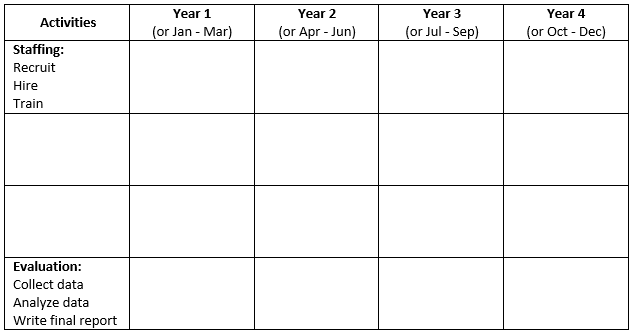
The timeline should indicate the various actions to be taken, when they should occur, and who should do them.

Develop a draft of your plan

This draft should incorporate all of the information you have compiled so far, including:

  • Your current financial situation, including you annual budget
  • Your long and short term financial goals
  • The broad strategies you will use to carry out those goals
  • The timeline with specific actions
  • A one page "executive summary" at the beginning of the document summarizing your work
  • An executive summary is used for many types of business plans. It serves as a "cheat sheet" for anyone who is reviewing what you have done, and gets the facts out front so people don't get lost in the detail. It should be simple and concise.

Incorporate feedback on your plan

Document in hand, you're ready to get some opinions on what you have done. Key groups to have review the plan include:

  • Staff members
  • Board members
  • Clients
  • Key community leaders
  • Current funders

Representatives from all of these groups can comment on the plan and make suggestions for improvement. Getting feedback at this point can be very helpful for at least two reasons. First, suggestions may be made that will make you plan stronger than it would have been otherwise. For example, something you have suggested might be impossible, and one of the reviewers might pick that out; or reviewers may have suggestions to build on your ideas.

Also, by allowing those who will be involved in implementing the plan the chance to modify it, it becomes theirs. Generally speaking, people are more willing to work on something that they created or at least believe in.

When asking folks to look at the plan, however, be sure to explain what the numbers mean. Misunderstanding financial information can lead to frustration and anger among people who are looking at it. For example, if a staff member earns $22,000 a year and sees that the annual budget is $500,000, (s)he may become very unhappy with his /her salary is (s)he doesn't understand where the rest of that money goes. Likewise, a program coordinator may be very angry about proposed cuts in her program if she doesn't have a full understanding of why they are necessary. On the flip side of the coin, if your organization carries a lot of debt, members may be led to think you are at the verge of financial collapse, and that they should be dusting off their résumés, even if that isn't the case.

The lesson here? Make sure those who are reading your plan have a full understanding of what it means. After everyone has had the opportunity to comment on the draft, the original working group can incorporate the suggestions as they see fit.

Implement your plan

With the revised plan in front of you, it's time to go do the work that has been decided on!

Monitor and evaluate your progress

When pieces of your plan have been implemented, however, you're still not done. As long as you are still in business, there is evaluation to do, monitoring of your progress, and tweaking or flat out changing things so everything works better.

Remember: planning never stops. It is ongoing, changes with the organization, and will need to be constantly revisited. This is true for all of our work in the nonprofit field. Earning money is no different.

Tips from the field

Financial sustainability is an uphill battle, and the challenge to get to the top can be one of the biggest frustrations we face in our work. Below, we have gathered a list of tips from people who have been through this process.

  • It always helps to network, to keep informed about what's going on, and to develop connections with others.
  • It helps to have someone in your organization who will take on the task of scouting and tracking those opportunities that might be available to you.
  • If you can possibly afford it, you might consider hiring someone to do the work of writing grants for you. This can be worth the expense if your grant-writer is good, and especially if he or she is willing to work at least partly on commission. One next best alternative: find a sympathetic local professional with background both in grant-writing and in your content area to review your proposal for form and content; follow his or her advice.
  • You can often find some other like-minded tax-exempt group or organization to make a formal grant application for you, if tax-exemption is needed and you are not tax-exempt yourself. That same group, often called a lead agency, may also manage grant funds received.
  • If you do enter a similar arrangement, be sure and work out the relationship beforehand. Everyone's roles and responsibilities should be made very clear, as should what advantages both groups will receive from the arrangement.
  • Successful fund-raising also depends upon your being in the right place at the right time, over and above the actual merits of you proposal. And funding deadlines are often short. These are even more reasons to stay connected with possible funding sources, and to have ideas and action plans developed so that you can be ready to move quickly when the right opportunity comes your way.
  • Get to know your local politicians (legislators) well enough so that they return your calls, and make sure that they and other politicians understand your issue and its importance.
  • Diversify your funding, so you aren't completely dependent on any one form of support.
  • Continuity is important. Stick to your mission, keep doing what you're doing. It's helpful to have consistent people, consistently going out doing the same consistent thing. People know what you're all about, and it helps create the local base of support discussed in the last bullet point.

Some of these tips have been adapted from The Spirit of Coalition Building.

In Summary

Developing a plan for financial sustainability, as with any plan, takes a lot of work to be done right. It's intricately linked with the idea of institutionalizing your organization and its programs as a whole. By creating an effective financial plan, members of your organization will be able to do more to make your vision a reality and have your mission accomplished.

Contributor

Jenette Nagy

Resources

Online Resources

Coalition building tip sheets from Tom Wolff offer tips on how to get started on building a coalition across sectors.

StrongNonprofits.org provides best-practice guidance and hands-on tools to help you understand and manage your non-profit’s financial health. The site offers helpful resources in the areas of financial planning, operations, monitoring, and governance.

Print Resources

Berkowitz, W., & Wolff, T. (1999). The spirit of coalition building. Washington, DC: American Public Health Association.

Brice, H. (1987). Financial and strategic management for nonprofit organizations. Englewood Cliffs, NJ: Prentice-Hall, Inc.

Brinckerhoff, P. (1996). Financial empowerment: More money for more mission. Dillon, CO: Alpine Guild.

Herman, R. (Ed.). (1994).The Jossey-Bass handbook of nonprofit leadership and management. San Francisco, CA: Jossey-Bass.

Examples
mloewenstein Thu, 12/13/2012 - 09:56

Example 1: Interview with Tom Wolff

Tom Wolff, former director of AHEC/Community Partners in Amherst, MA, is considered a national expert on community coalitions. Here, he discusses his ideas on how a coalition can be sustainable over the long term.

"Generally, people think about sustainability at the point at which their grant is a year from ending, at best, often three months. And they say, 'What we need now is to replace the 1.2 million, hundred twenty thousand, forty thousand dollars,' - whatever it is their grant was. They say financial sustainability is replacing that money and continuing to do what we're doing. That's the general thinking, and it's erroneous. It really is a status quo way of thinking of sustainability.

"You have to ask yourself, what have we been doing, what is worth maintaining, and how do we maintain that. One of the ways of doing that is by institutionalizing the effort. That is, you do a curriculum on domestic violence prevention and after your first year of doing it, the schools, the YMCA, or the shelter pick it up. They find a way to get a state grant or something but they keep doing it and so you've institutionalized it into some more formal part of the community. This is the most successful way of doing it, 'cause it means it will keep going.

"The second way to be sustainable is you create policy change. They recently did a policy in the courts in Massachusetts that requires all divorcing couples to go through a course on the impact on kids before you divorce. So, if you had been doing a prevention program on trying to limit the negative effects of divorce on children, you get the courts to make this mandate. You've now created a policy that will institutionalize this program.

"The third way to be sustainable is really to turn to the community and to strengthen the community in their capacity to solve the problems. This is the idealistic community development approach. I think it's the hardest and longest term, but I think it's a goal that's worth achieving.

"But generally, when people talk about sustainability, they're not thinking about any of those three. They're thinking about incorporating, getting the cash, and continuing to do what they are doing using the money. All this has a place, but only has it after you've asked yourself some questions about the other three.

"The way you should develop sustainable coalitions is when you get your funding, think about what your goals are, and how you're going to sustain your work.

You think at the beginning of a coalition what is that you're trying to do and how would you sustain the pieces of what you're trying to do over time. You don't think about it just in terms of money."

Example 2: Example internal audit sheet

This is the example of an internal audit for a teen pregnancy prevention project in the Midwest. The group had been awarded a four year grant and had obtained significant commitments from the community for funding over the next five years. This is the audit their group came up with, based on their action plan and expected expenses.

Thanks to Chris Hampton, Jacquie Fisher, and Adrienne Paine-Andrews for their work on the development of this example.

 Internal Audit Sheet

  Year 1 Year 2 Year 3 Year 4 Year 5
Amount of Funding
Funding from Source 1: Foundation Grant $77,750 $77,750 $77,750 $77,750  grant ends
Funding from Source 2: Health Department $21,125 $21,000 $20,500 $20,125 $20,000
Funding from Source 3: Community organization $18,125 $18,000 $18,500 $18,500 $18,500
Funding from Source 4: School District $15,625 $16,700 $17,950 $17,105 $18,310
Funding from Source 5: Area churches $4,250 $4,200 $4,500 $4,000 $4,000
Total of funding from all sources $136,875 $137,650 $139,200 $137,480 $60,810
Amount of expenses
Staff #1: Project Director, 100% $37,500 $38,000 $38,000 $39,000 $39,500
Staff #2: Administrative Assistant, 50% $11,250 $11,500 $11,500 $12,000 $12,250
Staff #3: Outreach Coordinator, 75% $25,000 $25,300 $25,300 $25,900 $26,200
Staff #4: Outreach Coordinator, 75% $25,000 $25,300 $25,300 $25,900 $26,200
Staff #5:  --  -- -- -- --
Total Personnel Costs: $98,750 $100,100 $100,100 $102,800 $104,150
Program #1: Graduate Teacher training $22,875 $22,875 $22,875 $22,875 $22,875
Program #2: Baby Wait a While high school program  -- -- $1,500 $1,500 $1,500
Program #3:  -- --  --    
Total Program Costs: $22,875 $22,875 $24,375 $24,375 $24,375
Travel $2,500 $2,500 $2,225 $2,225 $2,225
Equipment $2,000 $1,000 $500 $500 $500
Supplies $2,000 $2,500 $2500 $2,500 $2,500
Printing $2,000 $2,000 $2,125 $2,125 $2,125
Media/publicity $3,000 $3,000 $3,250 $3,250 $3,250
Phone/fax $1,000 $1,000 $1,125 $1,250 $1,250
Postage $500 $500 $750 $750 $750
Miscellaneous $2,250 $2,000 $2,000 $2,000 $2,000
Rent/housing n/a n/a n/a n/a n/a
Utilities n/a n/a n/a n/a n/a
Amount paid on debt n/a n/a n/a n/a n/a
Total of all expenses: $136,875 $137,475 $138,950 $141,775 $143, 125
Expected deficit or surplus: 0 + $175 +$250 -$4,295 -$82,315

Example 3: Example Timeline

Nashua Literacy Coalition Timeline for Developing Funding Possibilities 

Goal Action Steps to Meet Objective By whom By when

Renew current grant
(current grant ends 6/2014)

Write a new proposal that takes into account the foundation's new emphasis on community collaboration Jeannie, Marcelo, Robin, with input from area churches, schools, shelters, the library, and Head Start 12/2013
  Edit proposal Board of Directors 2/2014
Develop a fee-for-service tutoring program for high school students who will be taking standardized tests Look into the legal consequences of a fee-for-service program Leslie (a lawyer on the Board) 8/2013
  Decide fee scale, logistics Rashma, Jeannie 9/2013
  Train literacy tutors for this type of tutoring Robin 10/2013
  Market program at area schools Tanisha 11/2013 and continuing
Work with other organizations in town to do some of the literacy work Meet with heads of area organizations to suggest the idea Jeannie 10/2013
  Train staff and volunteers of interested groups as tutors for literacy Robin 11/2013 and continuing
Ask city to pay for base costs as part of annual budget Meet with council members, discuss possibilities Jeannie with help from the Board 3/2014

Examplel 4: Executive Summary

Daleton Crisis Assistance Center:

Plan for Financial Sustainability - Executive Summary

Current situation

The Daleton Crisis Assistance Center (DCAC), now in it's twelfth year, currently has an annual budget of $260,000. That amount can be broken down as follows:

  • $100,000 comes from the local University
  • $50,000 comes from the United Way
  • $50,000 from a grant from the Dinkerston Foundation
  • $25,000 from a grant from the Cuassa Foundation
  • $25,000 (total) from area churches
  • $10,000 (approximately) from our annual membership drive

Expenses for the center are as follows:

  • $168,750 for staff costs (5 full time staff, 3 part time)
  • $24,000 for rent and utilities
  • $30,000 office/miscellaneous (e.g., equipment, travel, supplies, publicity, communications )
  • $30,000 program costs (Community Crisis Readiness Program, Picking up the Pieces Family Support Program, Daleton Area Community Resources Directory)

For this year, the Center has a slight ($7,250) surplus.

Projected situation

Our situation remains relatively strong, with all of our money expected to continue at the same level for the next two years. However, in January 2001 the Dinkerston grant will end, and the Cuassa grant will end in August 2001. The Cuassa grant is nonrefundable.

Staff has made clear the fact that additional support is necessary, with a particular need for a director of volunteers. The Center also has two goals that will require additional funding: the purchase of a facility, and a fund to offer financial assistance for families or individuals struck by crises.

Recommendations

The recommendations of this report are as follows:

  • Set a goal to double the amount raised in the membership drive in the upcoming year, and increase the amount by 15% in each of the subsequent two years. Use this money for a down payment on a facility.
  • Consider implementing a sliding scale fee-for-service for the Picking up the Pieces Family Support Program
  • Search for additional grants; reapply for the Dinkerston grant following the recommendations of our program officer
Tools
mloewenstein Wed, 02/20/2013 - 13:42

Tool 1: Internal audit sheet

Use this sheet to do an internal audit for your organization as described in Step 3 of this section. Depending on the size of your organization, you may need to add additional pages, or further separate some of the categories. On the other hand, many of the costs listed will not be applicable to smaller groups.

To use this sheet, do the following:

  1. List the funding you have (or for future years, anticipate having) from each source in the appropriate box.
  2. Add up the funding from each source for every year. Write these totals in the box marked Total of funding from all sources.
  3. Go to the second half of the table, Amount of expenses. Write in all of your current and anticipated expenses for each year. The cells in grey should be totaled in the white cells above them. For example, the cost of each staff member should be written out individually, and the total of all of the staff costs should be added in Total Personnel Costs. A similar process should take place for Total Program Costs.
  4. Add up the expenses for each year. Do NOT include the grey cells in this figure, as they will be added in under the subtotals for personnel and program costs. Write these figures in the Total of all expenses for each year.
  5. Subtract the amount in Total of all expenses from the Total of funding from all sources for each year. If you have a positive number, you have a real or projected budget surplus - your organization has extra money, and is in the black. If the number you have found for a given year is negative, you have a real or projected deficit for that year - you are in the red, and will need to find additional resources.
  6. Confusing? See Examples for a filled out version of this table.

Internal Audit Sheet

  Year 1 Year 2 Year 3 Year 4 Year 5
Amount of Funding
Funding from Source 1:          
Funding from Source 2:          
Funding from Source 3:          
Funding from Source 4:          
Funding from Source 5:          
Total from all funding sources:          
Amount of expenses
Staff #1(list title and %FTE):          
Staff #2:          
Staff #3:          
Staff #4:          
Staff #5:          
*Total Personnel Costs:          
Program #1:          
Program #2:          
Program #3:          
**Total Program Costs:          
Travel          
Equipment          
Supplies          
Printing          
Media/publicity          
Phone/fax          
Postage          
Miscellaneous          
Rent/housing          
Utilities          
Amount paid on debt          
Total of all expenses:          

* For personnel costs, include salary and the cost of fringe benefits. FTE = full time employment
** Remember to take personnel costs out of program costs, as they are listed separately.

Tool 2: What donors want from you

What follows is a list of desires that are typical of many groups of donors, such as government agencies, foundations, and individual donors. By knowing what members want, you will be able to target your marketing to their desires.

All of these suggestions should be taken as a starting point. Just as different nonprofit organizations want very different things, different donors will have their individual desires as well. It's your job to figure out what they are, and how your organization can best fulfill them.

Government agencies (federal, state, city, or county)

  • A carefully defined set of services, provided by a carefully defined set of people, in a set period, often in a set manner, with no audit exceptions, and with all paper work in on time.
  • Generally, government representatives want you to know regulations cold.
  • You should meet all of their regulatory and bureaucratic wants.
  • You might also design specific materials (such as reports or brochures) using needs and keywords of government. They should emphasize outcomes, quality, and certification levels.

Members

  • Clear, tangible benefits that they actually receive.
  • Updates on what the organization is doing.

Foundations

  • Innovative projects that meet their criteria
  • A demonstration of strong community support
  • Self-sustainability within approximately three years
  • Usually, they want general information, such as your mission, history, and goals.
  • Letters of endorsement from community leaders or collaborators can be helpful

We should note here that foundations are a slightly different case than other potential donors. Many times, they are located across the country, and each may be unique in its desires and goals. Talk to program officers of foundations if you can, and ask what they like to see most and least in applications. Read the foundation press and consider getting help from an experienced, successful grant writer.

United Ways

  • Guidelines for funding met precisely.

United Ways are an excellent source of funding for many small community organizations. If your United Way does needs assessments, make sure that you participate so that your service area needs are included.

Donors

  • To support a program.
  • To support an endowment.
  • Some want to be visibly thanked for your contribution; many others don't. Ask.

Donors, both individual and corporate, have wants that vary widely. Organizations should learn who is most likely to donate, and focus energies on these potential donors.

Users who pay fees

  • High quality and value for their money. Note that we say value, not low prices. Many people who pay fees won't balk at a high price tag if they feel they are getting a lot out of it. For example, a group of tourists may willingly pay ten or twenty dollars to tour a historical site if they have heard that it is particularly beautiful, or that the guide is exceptionally charming.

While this list gives many of the more common ways for a nonprofit organization to raise money, it isn't meant to be a complete list. Does your group have other potential means of funding? What are they?

From Peter Brinckerhoff's Financial Empowerment: More Money for More Mission. Used with permission.

Tool 3: Timeline

For each financial goal, use a separate cell to write out the action steps that need to occur, who will do them, and by when. This chart can then be used as a reminder for what you still need to do.

Timeline for Financial Sustainability Plan

Goal Action Steps to meet the objective By whom By when Completed?


Tool 4: Developing a strategic funding plan

Innovation Network, Inc. is a 501(c)(3) nonprofit organization founded in 1993 to meet the critical information and evaluation needs of nonprofit and public organizations. InnoNet's mission is to help agencies better plan, executive and evaluate their structures, organizations, and services. Their web page will walk you through an interactive page to help you develop a strategic funding plan. The service is free, but you will need to register.

Checklist
mloewenstein Thu, 12/13/2012 - 09:57

What is a plan for financial sustainability?

___A plan for financial sustainability is a tool used to help the organization or initiative and its goals thrive over the long term

What are the advantages of a plan for financial sustainability?

___Financial security

___An increased focus on your real work

___Becoming more competitive in your field

___Easier transitions

___Following guidelines

How should you plan for financial sustainability?

___Develop your plan early and revise it often

___Decide who will develop the plan

___Let everyone know what you are doing

___Conduct an internal audit

___Determine how much money you need

___Decide how much money you want

___Compare how much money you have, need, and want

___Set objectives

___Consider the available possibilities

___Decide which funding possibilities you will follow up on

___Strategize how to get what you want

___Develop a timeline

___Develop a draft of your plan

___Incorporate feedback on your plan

___Implement your plan

___Continuously monitor and evaluate your progress

PowerPoint
mloewenstein Thu, 12/13/2012 - 09:58
File Upload
A PowerPoint presentation summarizing the major points in the section.
Section 3. Developing a Committee to Help with Financial Sustainability
mloewenstein Thu, 12/13/2012 - 10:02
Main Section
mloewenstein Thu, 12/13/2012 - 10:03
  • What is a financial sustainability committee?

  • Why should you develop a financial sustainability committee?

  • When should you develop a financial sustainability committee?

  • When shouldn't you develop a financial sustainability committee?

  • How do you develop a financial sustainability committee?

  • Maintaining a financial sustainability committee

Most of us, in our personal lives, have experienced the headache of trying to pay our bills when the checkbook is dry, or making that small paycheck go a long way. We wonder how we will pay for Kim's braces and a new transmission; and we try to decide if we should cash in a CD or just eat spaghetti all month.

Financial difficulties, unfortunately, are often part of our organizational lives as well. If your group is like many community organizations, finding the money to reach your goals is a constant struggle. Do we cut staff or programs? What will we do when the grant ends? Where else can we get support?

Fortunately, at work, at least, you don't have to be alone dealing with your financial woes. Others are there who can take care of the money, so that other members of the organization can breathe easier and focus on the work they were hired to do, such as increase immunizations, fight the death penalty, or clean the environment. The people who can help manage your finances may be on the Board of Directors, hired grant writers, or - our suggestion - members of your financial sustainability committee.

What is a financial sustainability committee?

What do we mean by a financial sustainability committee? In simplest terms, it is a group that helps you raise money or obtain goods for your project. Generally, such a group is made up of people in your community that have, or can get money or goods. People who have experience dealing with legal or financial issues, such as lawyers and accountants, may also be members. That's because they can help you with the many legal issues that can affect you financially, such as becoming tax exempt.

"Wait a second," you might think, "these people are already represented on our Board of Directors." If so, fantastic - you probably don't need to form another committee. Or the financial sustainability committee you create might be a subgroup of the Board. These possibilities are especially likely for smaller organizations.

Why should you develop a financial sustainability committee?

Although for some organizations such a committee may be unnecessary, for many organizations, it can be a very good idea.

A financial sustainability committee can:

  • Help get resources to help your organization survive - and thrive
  • Ease the transition from one source of funding to another, such as at the end of a grant period
  • Help find money or goods from many different sources - a financial committee that has members with many connections will help lead to a diverse funding base for your organization, which is one of the most effective ways to ensure sustainability.
  • Meet some funders' requirements - sometimes, the existence of a committee for financial sustainability is a requirement for receiving a grant.
  • Allow members of your group to focus their time and energy on the jobs they were hired for. Too often, members of organization spend so much time trying to find resources for the organization they are unable to spend time doing what they were hired to do. A community mobilizer may spend all of his time mobilizing the community around the need for money to keep the organization going, instead of the real issue of child hunger. for example. By having a committee of experts taking care of the finances, you allow the mobilizer to do what he knows best, not something he (potentially) knows little about.

When should you develop a financial sustainability committee?

So, when is the right time to develop a financial sustainability committee? Ideally, the committee should be formed during the first year of your project.

Remember: It's never too early to start thinking about sustainability. Many groups start thinking about it when their grant is almost out - and find themselves out of luck as well.

For established groups, other good times to form a financial sustainability committee include:

  • When future funding is uncertain for your organization
  • When your group does not have all the resources it needs to carry out desired activities

When shouldn't you develop a financial sustainability committee?

Despite all of the advantages, there are times when forming such a committee isn't necessarily a good idea, times when your "person power" can be better used elsewhere, such as:

  • When your organization has a guaranteed, continuous influx of resources
  • When the resources coming in to your organization cover all desired goals
  • When your organization was developed as a short-term organization, and has no plans to remain active in the future
  • When members of the Board of Directors are already doing the work that would be done by a financial sustainability committee

How do you develop a financial sustainability committee?

So, if you have decided that now is the time - that you're going to create a financial sustainability committee - how do you do it? The following steps will take you through the process.

Brainstorm possible committee members

First, think about the people in your community who might be helpful:

  • Who has access to resources, or knows how to get that access?

For example, bankers, lawyers, the Chamber of Commerce, and business owners probably know how to get money in your community. You may already have people representing these groups on your Board or staff, or as members of your coalition. If not, who among these groups might be interested in your project and think your goals are important? Write down a list of the possibilities.

  • Who knows about the laws that might affect you? Are there lawyers, judges, accountants, or elected officials in your community you believe might be sympathetic to your cause? Write them down!
  • What parts of the community are not represented on your list? Your committee should be made up of people from different agencies or organizations, such as businesses, health organizations, and the local United Way. Having a diverse membership on your committee will help you ensure that your organization gathers resources from the widest variety of sources possible.

Determine how large you would like the committee to be

Is there an approximate size that might be ideal for your group? There is no absolute "right" size; for some groups, a committee of five will work well; other groups may have 20 members. A lot will depend on the size, purpose, and goals of your organization. It will also depend on who the members of your committee are, and what they resources they can bring (if you have one person you know will raise a million dollars a year, then there's your committee!).

Recruit members

Think about who among your staff, family, or friends knows the people on your list. Ask them to invite the people on your list to be part of your committee. Using personal or professional connections is one of the best ways to involve people.

If there are people in town who you would like to be on the committee with whom you don't have any connections, don't give up! You can still ask for help - after all, you have nothing to lose! The request should be made by the organization director or by a member of your organization who is powerful in the community. For example, if a state representative serves on your Board of Directors, don't hesitate to ask her to make the request.

If, while brainstorming, you have come up with many more potential members than necessary (and you should - some people will always decline your invitation), you might consider asking people in tiers. That is, ask the people you want most first, then others. Let people know that you are interested in their ideas, and that this does not have to take a lot of time.

Set a date for the first meeting

Let people know where and when the meeting will take place with a postcard or phone call. If more than a week or two passes before the meeting takes place, you might send out a reminder!

Take care of the logistics for the first meeting

Make sure the room where you will be meeting is open (don't forget the key!), accessible, and has the equipment you need, such as a projector.

Consider the tone the meeting will set. Remember, you will be asking these people to go raise money for you - that's a pretty large request. How do you want to handle these relationships?

One example is a director of a teen pregnancy prevention project in the Midwest, who opted to treat the members of her financial sustainability committee more as friends than as business associates. Their meetings were held as luncheons, and although business was discussed and material was presented professionally, she made an effort to keep the luncheons casual, friendly, and enjoyable. The result? The group worked well and productively together, opening doors and obtaining resources the project never could have gotten otherwise. It's always a good idea to have a plan for how the first meeting, and the committee interactions overall, will be conducted, because everyone else will be taking their cues from you!

Additionally, you'll probably want to have the following materials ready to give committee members:

  • General organizational information (e.g., the group's history and membership information)
  • Your goals and successes
  • Why the project should be maintained
  • Your operating budget
  • A list of current and former funders and donations with contact persons, phone numbers and addresses
  • Other information you find relevant
  • Any marketing materials you have created, such as posters or brochures. This is important because it lets committee members know what materials they have to work with right now.

These materials help people on your committee know what your project is about, what you have done, why it is important, and what your needs are. They can use this information when getting money and in-kind donations for your organization. You might even want to have all of these materials together in a folder that your committee members can take with them and refer to on an as-needed basis. If you have more than five pages, consider color-coding the sheets for easy access.

For example, financial information might go on green paper, general organization information on blue, and marketing on yellow.

Hold the first meeting

You may want to have the following items on the agenda:

  • Introductions of committee members and project staff
  • A description of the project
  • A description of the project's needs
  • An explanation of what you would like members to do, which might mean:
    • Asking everyone to think about the types of resources available in the community and how they can be used
    • Asking everyone to think about different ways of getting money and in-kind donations from different parts of the community
    • Putting all the ideas into a plan and decide who will do what by when
  • A discussion of how often and when the committee will meet. The committee should meet regularly, but not so often that the time commitment becomes overwhelming. Many such groups will meet every other month.
  • A discussion of training for those who will be asking for resources, if any such training has been planned. Although members of the committee are usually chosen for their expertise in such matters, this is often not the case for staff members who might also be active in obtaining resources. If your staff will be given specific training on how to approach donors, let members of the committee know about it. This can serve to reinforce the methods you would encourage them to use, as well as to help keep communication clear throughout the group.
  • Task assignment. Give each person something to do before the next meeting! It's very important to maintain momentum at this point, and to be sure that members don't go home and forget what was discussed. The best way to do this is to give them something tangible to do to keep them focused.

For example, you might ask each of them to call or speak with three potential donors before the next meeting.

Congratulate yourself for completing the first meeting!

You've accomplished a lot of good work already. Now, it's time for follow through. Begin to carry out any actions the committee has planned.

Continue holding regular meetings

At each meeting:

  • Discuss each member's successes and challenges getting money or goods for the project or organization
  • Distribute a list of all the contributions you get, including goods such as equipment or supplies
  • Continue to discuss other things the project needs and ways to get them

Maintaining a financial sustainability committee

Keeping the energy up after things get going can be hard to do, but these tips can help:

  • Hold meetings on a regular basis, such as every other month. This helps keep everyone on track and updated about the project. Also, remind members of upcoming meeting dates. One coalition coordinator we know sends out the next meeting time with the minutes from the last meeting. She then sends a Day-Glo postcard as a reminder a week before the meeting. Then, she follows up again with a phone call from her administrative assistant the day before! Although she doesn't really enjoy having to constantly remind members, she's found that this is what works best for her organization.
  • Ask members to talk about what they have done for the project during committee meetings. This helps make sure that they will do something before the meeting so they have something to talk about. You might want to hand out a donor request form such as the one found in Tools, so members will have all of the important information in front of themselves at meetings.
  • Thank members when they help get money or goods for the project, and thank them for their effort when things don't pan out. It's human nature to want to feel valued - always let your volunteers know you appreciate what they are doing. Remember, too, to thank people publicly, not just in private.
  • Send a thank you note to the people who give the project money or goods. This will help encourage them to give even more, and make your financial committee that much more effective.

In Summary

Many of us are hesitant to form yet another committee and ask community or organization members for more of their time. It's particularly difficult for many of us to ask for money or help in getting it. Always remember, though, that you're not asking for you, you're asking on behalf of a cause you believe in. By forming a financial sustainability committee, you develop a group of professionals who believe in your group and who can save you a lot of time and energy by handling the monetary challenges. And by working carefully with these experts, your organization could continue working for a long time to come.

Contributor

Jenette Nagy

Resources

Online Resources

StrongNonprofits.org provides best-practice guidance and hands-on tools to help you understand and manage your non-profit’s financial health. The site offers helpful resources in the areas of financial planning, operations, monitoring, and governance.

Print Resources

Kotler, P., & Andreasen, A. (1987). Strategic marketing for nonprofit organizations. Englewood Cliffs, NJ:  Prentice-Hall.

Examples
mloewenstein Thu, 12/13/2012 - 10:04

Example: Timeline for Staff and Financial Sustainability Committee

This is an example of a timeline for the formation of a financial sustainability committee. The Tools part of the section has a blank form you can download and use for your own organization.

By February 1, 2014, project staff will identify individuals who will serve on the Financial Sustainability Committee.

By April 1, 2014, the Director will recruit members for the committee and schedule the first meeting.

By the first meeting of the Financial Sustainability Committee, the administrative assistant will locate or develop materials that will be used to facilitate the meeting.

By June 1, 2014, the Director will hold the first meeting of the committee.

By September 1, 2014, members of the committee will have identified organizations/individuals to approach and determined the amount that will be requested of each. The committee will begin to contact these organizations/individuals.

By December 1, 2014, committee members will have contacted all organizations and individuals identified as potential contributors.

Tools
mloewenstein Wed, 06/26/2013 - 16:20

Tool 1: Timeline Form

You can use the following form to record the growth and accomplishments of your own Financial Sustainability Committee.

Timeline Form

By _____________, project staff will identify individuals who should serve on the Financial Sustainability Committee.

Potential committee members:


By _____________, the Director will recruit members for the committee and schedule the first meeting.

Final list of committee members:


By the first meeting of the Financial Sustainability Committee, the administrative assistant will locate or develop materials that will be used to facilitate the meeting.

What materials need to be located or developed?


By when:__________________

Check when done:__________

By _________________, the Director will hold the first meeting of the committee.

Reminders sent out (Y/N)?_____

When? ___________

By _______________, members of the committee will have identified organizations /individuals to approach and determined the amount that will be requested of each. The committee will begin to contact these organizations/individuals.  
By ________________, committee members will have contacted all organizations and individuals identified as potential contributors

Potential contributors contacted? Y/N ____

When:____________________________

Once potential contributors have been contacted, the financial coordinator will develop a forecasting budget reflecting the areas in which resources have been obtained.  Date completed:_______________

Tool 2: Donor Request Form 

Copies of this form can be given to members of the Financial Sustainability Committee to keep track of donations requested. One member of the group may want to group the information from all of these sheets into one large master document. Such a document can be used to help track requested donations and responses over the life of the organization.

Donor Request Form

Donor
(Name, phone #, etc.)

Requested donation
(Amount/Type)

Date Requested Response

Thank-you note sent
(Yes/No)

Comments and Follow-up


Checklist
mloewenstein Thu, 12/13/2012 - 10:05

___You understand that a financial sustainability committee is a group that helps you raise money or obtain goods for your project

___You understand the advantages of developing such a committee

___You realize it is never too early to start thinking about sustainability

___You understand when you should and shouldn't develop a financial sustainability committee

___You have brainstormed possible committee members

___You have decided how large you would like the committee to be

___You have recruited members

___You have set a date for the first meeting

___You have taken care of the logistics for the first meeting

___You have held the first meeting

___You have congratulated yourself!

___You are continuing to hold regular meetings

___You understand how to maintain a financial sustainability committee

PowerPoint
mloewenstein Thu, 12/13/2012 - 10:05
File Upload
A PowerPoint presentation summarizing the major points in the section.
Section 4. Applying for a Grant: The General Approach
mloewenstein Thu, 12/13/2012 - 10:06
Main Section
mloewenstein Thu, 12/13/2012 - 10:07
  • Do you really want to apply for a grant?

  • What are grants?

  • Why should you apply for grants?

  • When should you apply for grants?

  • How should you apply for grants?

Do you really want to apply for a grant?

Grants are wonderful, most of us think -- and much of the time they really are. People give you money to do just what you want to do, maybe what you've always longed to do. How many times does that happen in life?

But most of the time, grants aren't easy to get. First, you have to find the right grant source. Secondly, you have to write the grant proposal. Both take time and energy, often intense labor; and your labors are not always rewarded, because grants are competitive. This isn't surprising; many others want grants for the same reasons you do.

Now, the good news: grant-writing is learnable. You can learn how to do it, and to do it well. Two main sets of skills are involved. One is writing the grant itself – and there are many excellent resources that will lead you through the process, step-by-step, with plenty of details, some of which are included in the Resources for this section.

The other skill area involves activities that accompany the actual grant-writing. Many of these deal with preparation. Some others parallel the writing itself. All of them fall under the heading of "general approach"; and while this heading is loose, its contents are vital.

With the right approach, you can:

  • See how your grant-writing plans fit with your organizational goals
  • Get in the right frame of mind before writing
  • Appreciate the role of social and political factors (over and above proposal content) in the grant review process
  • Increase your overall rate of proposal-writing success

What are grants?

For our purposes, grants mean dollar awards to your group or organization to carry out a community project you have proposed. In real life, grant awards are sometimes given in resources other than cash (e.g., travel expenses, time off the job). And occasionally, especially for research, grants are made to individuals as well as groups.

But our emphasis here will be on cash awards to groups for community projects.

Why should you apply for grants?

In a sentence: grants enable you to do work you might never do otherwise. Community projects take time. Unless you are wealthy, you cannot pay staff salaries -- or your own salary -- from your own pocket. And few of us are able to buy expensive equipment, or cover a year's worth of office expenses, without outside help. So in many situations, grants are desirable; in some, they are essential.

Many situations, but not all:

  • There are times when you can do excellent community work with very little money, or no money at all. Organizing a meeting, holding a social event, getting local policies changed -- these and similar community actions are either cost-free, or come with very modest price tags.
  • There are also times when money can become an actual drawback. Someone has to figure out how to spend it, make the payments, keep the records, and be accountable for it. Also, when you have money, your own members may compete for it; the all-volunteer, let's-everyone-pitch-in spirit of the project may be impeded.

And although grants are an excellent way to generate money, they are not the only one. They might belong in your financial planning, but your financial plan should also include other sources of income. A grant might be your guest of honor; but don't you want others to come to your party?

When should you apply for grants?

  • When you want to start a new project, or expand an existing project, and financial costs are involved
  • When these costs cannot be covered in your current budget
  • When you know of a granting agency that makes awards to pay for the types of costs you envision
  • When you know that you meet the eligibility standards for such awards
  • When you are able to commit the needed time and energy to the grant-writing process

What about writing a grant proposal because the money is available?

These situations happen all the time. Here's an example:

  • Suppose your group provides after-school programs for kids. You are looking for more after-school money. A local foundation funds community groups like yours, but its main interest is the elderly. To increase your award chances, you could design a program where senior citizens become involved in your after-school programs. Should you do it?
  • In general: "No", if it means twisting your program priorities; and "certainly not", if you're not interested in senior citizens. "Maybe," if the intergenerational program meets your organization's needs, and if it's really a good idea you just never thought of. In other words, you want to find a balance between staying true to your mission, yet not neglecting opportunities that come your way.

It's not always an easy choice, so consider carefully whether the benefits of extra funding from this grant will outweigh any drawbacks from requirements attached to the funding.

How should you apply for grants?

Be clear about your reasons for applying

Before you begin, take a step back, and look at the larger picture. Why are you thinking about applying for a grant?

Ask yourself these questions, and check your answers:

  • What are my true long-term program goals here?
  • Can I do the same work as well, or almost as well, without grant money?
  • What will I actually use the dollars for?
  • Am I planning to apply simply because grant funds are potentially available?
  • Is a grant the only way (or the best way) to do what I want to do?
  • Are there other (and perhaps better) ways of getting the money I need?
  • Am I clear on my realistic chances of success?
  • Am I prepared to put in the work to produce a top-quality grant proposal?

If you are part of a group, a group discussion and decision should be involved here. Your group's careful and honest answers to these questions will help shape your next steps, which might or might not involve grant-writing.

Know the types of support available

We have already listed some other options to consider for your financial plan, and you can probably brainstorm several additional ideas on your own. So before you pursue a grant, make sure you know the other options available to you.

Focus on the type of support you want

After consideration, perhaps your thinking about funding will change, or you'll decide to support your work some other way. But perhaps you'll decide that you want to write a grant proposal after all. Good! Now you can move more confidently into the next preparation stage.

Search the field

There are three main sources for grant funding:

  • The government - often federal, sometimes state, and occasionally local
  • Private businesses and corporations
  • Foundations, which distribute many millions of dollars per year to community groups and organizations similar to yours

Proposal-writing details are somewhat different from source to source. Government grants in particular tend to require more paperwork and more filling out of pre-established application forms. There are also special techniques and procedures for securing government grants (and also government contracts), the details of which can be found with the application materials.

Our emphasis will be on foundation grants, for two reasons. First, because foundations are where grassroots groups interested in grants are often most likely to turn. And second, because the principles of grant-writing for foundations generally apply to other grant sources as well.

But there are many thousands of foundations. How can you find the ones most suitable for you? It usually takes research. But there are many good resources to make your search easier.

Here's a list to help you get started:

  • One standard print source is the Foundation Directory, available in most hometown libraries. This gives good capsule descriptions of the grant-writing activities of the great majority of U.S. foundations, arranged by state, with cross-references by type.
  • Your reference librarian may also point you to smaller directories for your state, and/or to more specialized directories for your particular field. But if your reference librarian comes up short, ask some knowledgeable colleagues about where to start looking; then follow their leads. (Many major metropolitan areas also have regional foundation libraries open to the public; check to see if there is one in your area.)
  • The Chronicle of Philanthropy, a biweekly newspaper, is the best single source for staying up to date on foundation activities nationally, especially for activities of larger foundations. Each issue lists grants made by many larger foundations, and upcoming application deadlines; the Chronicle also includes general articles on grant -writing and fund-raising which provide excellent background.
  • And of course, the Internet has made the search process much easier in recent years. Most foundations now have all of the details and application materials for their grants available from their websites. It's a good idea to start with some of the fundamental resources such as the Foundation Directory to help point you in the right direction, and then you can expand and enhance your search online.

Narrow the field

Your research might turn up dozens of foundations that could potentially support your cause. That's good - but you are probably not going to apply to all of them. It's time to narrow the field further through some additional research.

  • Check the fields in which grants are offered. Are you sure the foundation makes grants in your particular area?
  • Check the purpose of grants offered. You may want start-up, or "seed" money. But some foundations emphasize other types of grants, such as those for ongoing support.
  • Check the size of grants offered. You may be looking for $25,000, but the maximum award size of a promising foundation might be $10,000. (It's possible, though, to apply to more than one foundation at a time.)
  • Check the locations where grants are offered. Are you sure the foundation covers your geographic area? Some have geographic preferences, as well as restrictions; and other things being equal, you are often better off applying to a foundation close to home.

Through this checking and rechecking, you can narrow the field to a smaller number of leading candidates. It's a gradual process -- much like looking for work, or applying to school. But being methodical here will pay off; and now you are ready to do some further investigation of your leading prospects.

Investigate your leading prospects

Before you even consider applying to a foundation or granting agency, learn as much as you can about it. If you were applying for a job you really wanted, wouldn't you want to find out as much as you could about your potential employer? Here, you are making a different type of application, but the same reasoning applies.

How can you find out? The simplest way is to call the foundation itself, and ask for information. Almost all foundations which accept public applications will send you basic application guidelines. If the foundation has a separate application form, that will be included as well. Many foundations will also include an Annual Report and/or Grants List, which will tell you more about the foundation's goals and organization, whom it has made recent grants to, and in what amounts.

Doing your homework can save you a lot of time and trouble in the long run. Your group's issue may be neighborhood safety, and you may have had the Safe Homes Foundation in mind as your number one prospect; but on making an inquiry you find out that Safe Homes funds only projects related to endangered species. It's better to learn such things sooner than later, so that time isn't wasted on both sides.

In researching a foundation, start with its website. Most foundations post information about what they fund, how best to contact them, grant guidelines, and how to apply – often including application forms if they use them – on their websites. Many expect, and some specifically ask for, electronic application. Like many other things, applying for a grant has changed with the growth of the web

Know the guidelines (they can vary)

Each foundation and granting agency does business in a slightly different way. This is perfectly justifiable - it's their money. So the guidelines often vary.

Some foundations will ask for a short one- or two-page letter describing your proposal, and nothing else to begin with. (The foundation will read these letters, screen out inappropriate inquiries, and request more information if it wants to know more.) Others prefer to get the whole application up front. Some first want to know your credentials; others are primarily interested in your ideas. Some want detailed budgets; for others, money talk comes later.

The guidelines will tell you what the rules are 99% of the time.

Follow the guidelines

Now that you know what the guidelines are, follow them.

If the foundation asks for an initial two-page letter, don't send 20. If they want proof of your tax-exempt status, be sure to include it. If their application deadline is June 1, don't wait till summer. If your case is an exception, this should be described in your application, most commonly in your cover letter. But don't handicap yourself at the start; why shoot yourself in the foot before you've started walking down the road?

Guidelines can sometimes be stretched, and very occasionally broken. But if you choose not to follow the foundation's guidelines, you should have very compelling reasons for doing so, and make sure they are well explained.

Ask questions, if needed (but think before asking)

Even though foundation guidelines are usually clear, you may still have a question. Some point may not be covered by the guidelines, or you may not be sure about a point. In those cases, it's perfectly okay to call and ask. Most foundations will have someone on staff to respond to calls like yours. And most foundations expect to receive such calls.

Think before calling, though. A call (or other contact) generally means you will need to identify yourself. Since first impressions count, you want to present yourself in the best possible light. So be sure you don't ask questions that are covered and italicized in the guidelines, Page One.

However, if you have a good reason do so, there are advantages to making a personal contact. First, the foundation staff person may also volunteer some information not explicitly in the guidelines, which can help you. Also, in the course of conversation, you can ask other questions or check on other guidelines to make sure you are on the right track. This leads us right into the next point:

Consider a meeting with the funding source

Sometimes, it's also possible to set up a meeting with a foundation staff person to explore your idea before a proposal is written or delivered. Suppose that your issue is adult education, and that the Lifelong Learning Foundation seems to be right up your alley. But you're not sure whether your particular approach is something that Lifelong Learning would seriously consider. So you call and ask if you might visit to discuss it.

Here, especially, foundations vary. Some discourage such meetings; they simply don't have enough time available. Others are more open to them. If you see value in a pre-application meeting, and if the guidelines don't tell you otherwise, consider making the request. If you do get a meeting, you can get your questions answered, which will either help you improve your application, or prevent you from wasting your time. You will also have made a personal contact, and perhaps gotten some tips along the way.

If you can't get a face-to-face meeting, you may at least be able to get guidance over the telephone. And even if you can't get that, you've lost little by trying.

Have others make contacts for you

One variation of the above idea: You don't have to initiate a personal contact yourself; perhaps someone else could do it for you. This is especially true if you are a new player on the grant-writing scene; or if you know few people in the foundation world; or if you don't have much of a track record, or if you are promoting an untested idea.

Perhaps you have a friend (especially a well-connected friend) or know another well-connected person who knows a program officer at a local foundation. It's perfectly acceptable for your contacts to call up their foundation contacts and say, "These people I know are going to be calling you about their idea to do X. I think it's an interesting idea, and they are good people. I think you should meet them."

Build community support

Most organizations that make grants will want to know that your ideas have community support. This is because a usual part of the funder's mission is to serve the community. So if you can build community support before you start, that can be a big point in your favor.

How to build it? Sometimes the support will be there already, and you'll know it. Sometimes the whole community will be behind you from the get-go, waiting for you (or someone else) to step in. Other times, you'll need to ask for support, and be forthright about asking. At other times still, especially when you have a new or unfamiliar idea, community support may need to be actively cultivated.

A good way to build support for new ideas is to circulate the outlines of your ideas, as a rough draft, or "concept paper," and ask for feedback.

This serves four distinct purposes:

  • It validates (or, occasionally fails to validate) community interest in the idea
  • It gets some others actively interested
  • It makes it easier to get formal letters of support in a full-scale application, if they are needed
  • It provides useful corrective feedback about your idea itself - others may think of points you hadn't thought about before

Form a working group

Most of the time, you'll want to gather the input of others in planning your grant application. Even if they aren't experts, those others may have attractive content ideas, good strategic thoughts, and often bits of specialized knowledge which one person alone will rarely have. And even if they lack any of these things, a group can give you the support you need to get the job done.

So form a working group, to talk about what should go into the application and how it should be presented. This will usually be a short-term group; it needn't meet more than a few times, unless it's a very large application. The group might not do the actual writing – "writing by committee" is not usually preferred. But the group's original input will be important; group members can divide up the information-gathering, legwork, and possibly drafting; and the group comments on the first (and later) draft can be valuable too.

Get expert advice

When you do have a proposal draft, perhaps you know of an expert (or experts) in the field who might be willing to review your draft and give advice. "Expert" here could mean either an expert in your grant content area, whatever that may be; or it could mean someone particularly knowledgeable about how foundations work, perhaps even about your chosen foundation in particular.

Sometimes expertise may lie within your group or organization itself; if so, call upon it. But otherwise, it's often a good idea to look for expertise from the outside. This is especially true if you are relatively new to grant-writing. Why not get an expert opinion before you send in the final application?

Use a successful model

Artists use models; it makes their job easier. And if you were building something, from a bird house to a summer cabin, you'd almost always want to have a successful model nearby, (or at least a diagram), so that you could see how it was done and refer to it as needed.

The same applies to writing a grant. If you can get hold of a winning application, particularly one that was funded by your chosen foundation, you are ahead of the game.

How can you do it? It might be easier than you think. If you have a list of grants previously made by that foundation, you can call up one of the awardees, and politely ask to see a proposal copy. (They've gotten their award; you won't be competing with them -- so what can they lose?) The next best alternative is to find a winning example on a related topic that was selected by your foundation. If you can't do that, plenty of sources have at least partial examples of successful grant applications.

What did they say, and how did they say it? How was the application organized and packaged? How much detail and documentation, and what kind, went into each section? These are some points you can learn from examples. A model is not meant to be followed too closely, and certainly not copied word for word. But it can certainly be one useful reference point when you're not sure how to proceed.

Learn from rejection

Most grant applications are not funded; yours may not be either. That's the cold reality of the grant-making world.

If you go ahead with your proposal, you certainly want to be optimistic and to give it your very best shot. But even though you have done all your homework and covered all the bases, even though you may truly have a terrific proposal in all possible respects, you may not get that hoped-for phone call or award letter. The reasons may have little to do with your proposal at all; the foundation may have only a very limited amount of money to give; another application may have come closer to a foundation priority; political considerations may have intervened; you may have asked for too much money; or the foundation reviewers may simply have made a mistake.

But you can learn from rejection. If your application is rejected, you certainly have the right to find out why. If that is not made clear in your rejection letter, it is perfectly reasonable and generally desirable to call the foundation and get more feedback.

This is true as long as you take the proper tone, which is not "Why didn't you fund my brilliant proposal?" but rather, "What could we have done to make our proposal better?" The latter approach is not only more professional, but also more in your interest. Why? Because no one likes to feel criticized or put on the defensive. Because you probably want to keep the door open to later applications, which means you want a good working relationship. And because the foundation, when properly approached, will in fact be more willing to give you helpful advice which you might use in subsequent applications, whether to that foundation or not.

If your application was a good one, the foundation might even encourage you to make revisions and apply again. Even if it doesn't, you can gain from a rejection experience. "If it doesn't kill you, it makes you stronger." Well, not always. But in this case, maybe so.

Of course, you may not be rejected at all. That wonderful phone call or letter may really come. If so, congratulations! Now it's time to make great things happen!

Contributor

Bill Berkowitz

Resources

Online Resources

The Grantsmanship Center conducts grantsmanship trainings, as well as earned income strategies for nonprofits.

Foundation Directory Online is an online funding research tool, developed by the Foundation Center, a national nonprofit service organization founded over 50 years ago to help open U.S. foundations to public view. The website does require you to purchase a subscription plan to access its services, but it offers five different plans to cater to organizations of all sizes and financial levels.

The Office of Partnerships and Grant Services offers guidance on creating partnerships for grant purposes

Print Resources

The Chronicle of Philanthropy, 1255 23rd Street, NW, Washington, DC 20037, (800) 347-6969 for subscriptions. For the prospective grant-writer, this is probably the most useful single periodical in the field. Also check out its listings and advertisements for references to additional grant sources.

The Foundation Center, 79 Fifth Avenue, New York, NY 10003, (800) 424-9836. A national clearinghouse for information on foundations.

The Foundation Directory, published about every two years by the Foundation Center, describes the grant-making activities of most major American foundations, and is available in most libraries.

The Grantsmanship Center, P.O. Box 17220, Los Angeles, CA 90017, (800) 421-9512. This center offers nationwide training programs and an excellent set of reprints.

The Grantsmanship Center Magazine, a very useful quarterly newsletter, presently free by requesting it on your organizational letterhead.


Examples
mloewenstein Thu, 12/13/2012 - 10:08

Example 1: Getting initial support

Ray Shonholtz, the founder of an innovative organization called Community Boards, describes how he got initial community support for his work. Community Boards involves training citizens in dispute resolution on a neighborhood level. At the time Ray started, this was a very unfamiliar idea:

"When I started Community Boards, I knew that it was an unusual idea, particularly to funders and to political people. My first effort was to build credibility for the idea by associating it with people of some standing in the criminal justice community -- which meant people in the bar association, the district attorney's office, et cetera -- to at least say it was an interesting idea, worth experimenting with.

"So I wrote a concept paper, made 50 copies of it, distributed them to the legal community and to some community organizations. And then asked some friends of mine around the city to put me on the agenda for community organization meetings, public defender office meetings. And I started making contacts with all them, not for them to endorse it -- I never asked anybody to endorse it -- but merely to give it conceptual credence.

"The advantage of that is that you avoid anybody critiquing it too early, and kind of have all the benefits of getting what you really want, which is some green light like "This idea interests me," signed, "The Prosecutor." Since I didn't ask for more, I didn't get more; but those kind of support positions grew to be extremely useful with funders.

"Before any services were delivered, I also built a board of directors of name people -- some community people, but also a nice balance of lawyers and judges, very friendly to the idea. Then, in the funding proposals, I would show the support we had received from these different organizations, and leverage that with the funders. I'd say, "Look at the range of interests in this unique idea." So I became relatively skillful at educating the funding base.

"And I was a credible person: teaching at the law school, being an Associate Professor of Criminal Law, putting it on law school stationery, circulating the idea around. That added to the credibility of it, because stature, name, connections, I think have a lot to do with whether an idea gets some hearing or is quickly dismissed. I spent a lot of time around the politics of the idea, so that nobody came out opposing it. There were some people who were skeptical, but then I would only ask for conceptual support, for trying it -- not in the sense it was a meritorious idea, but one that ought to be given some chance.

"Well, there are very few people who won't give you that, you know. So I had very little if any opposition in the early days. It was very important to build a conceptual constituency within the local community for it."

Example 2: Approaching foundations

Ray describes how he approached foundations, and in particular how he used one funder to network with another. Eventually his work became funded by more than a dozen different foundations.

"I also learned foundations fund people first and ideas second. The foundation wants to know that the person they're funding isn't a kook. Regardless of what the idea is, they want to know that the person has a reasonable chance of delivering it, or at least making a reasonable effort to attempt to deliver it, especially if it's a very risky idea. So credibility becomes the first and primary issue for most sophisticated foundations. Who you are and who supports you will be the first determining factor of whether a foundation gives you money.

"My process with the funders was always to see the executive director of the foundation, not a program officer. It's to use one funder to network with other funders. So if one person in the funding community felt strongly about it, I would ask her or him who else this should go to, and could I use their name in the letter; or better yet, would they make a call for me indicating that I was going to call so-and-so. And invariably they'd say yes to one or the other of those openings.

"The issue with foundations is getting through the door. Once you're through the door, you have to be your own salesperson. But you need a door-opener. Somebody has to be the bridge, help you over the bridge, that's been my experience. So if I wanted to deal with the Ford Foundation, I'd need somebody who knew the Ford Foundation and who would say, "Hey, this program you should look at, and I'll let so-and-so know you're going to call." And that of course is a time-honored approach; I don 't think there's anything unique about it.

"But the funding community responds well to that, because they get so many requests, and most of them don't have the staff to screen -- see, they all operate on the principle of people first, ideas second. That might be simplistic, but I think it's generally true. That increases the importance of somebody to take you through the door."

(Both examples from an interview with Ray Shonholtz in Bill Berkowitz, Local Heroes, Lexington Books, Lexington, MA, 1987.)

Example 3: Collaboration, Not Competition: Thrive Allen County's Capacity Building Initiatives

Rural organizations face many challenges in applying for grants, including few major foundations located in or familiar with rural areas and the perception that a smaller population area means a smaller impact. But one nonprofit in Kansas is showing just how mighty a rural organization can be. Since 2019, Thrive Allen County has brought over $28 million into the county for a wide variety of projects, including public transportation, grocery stores, hiking trails, and much more.

In Thrive Allen County's early years, the executive director at the time decided to expand the organization's funding from local sources and start applying for state, regional, federal, and other funding sources. Expanding funding sources helped the nonprofit build capacity and avoid local budget cuts or changes in their early funding sources.

Thrive Allen County's grant writers “usually bring in more money for the community than they do for the organization,” Regehr said. The grant writing team helps governmental agencies and civic and nonprofit organizations apply for funding. “It's not just Thrive doing the work,” she added. “We're also working to empower all of them to do the work as well.”

In addition to Kansas, Thrive Allen County has worked with rural communities in California, Louisiana, Missouri, Nebraska, New York, Nebraska, and Oklahoma. “We are energized by working with other organizations in other communities,” Regehr said. “It is not just people learning from us; it's us learning from them. There are so many cool things that are being done across the nation.”

Thrive Allen County has even distributed funds to other organizations. During the COVID-19 pandemic, Thrive Allen County was asked by the county to distribute $2.4 million in SPARK funding, or Kansas's use of American Rescue Plan dollars. The money had to be spent in six months. Thrive Allen County met with people from different community sectors to create an advisory group and develop grant programs to distribute the money.

To read more about the success of Thrive Allen County, you can click this link to the full article on the Rural Health Information Hub website.

Tools
mloewenstein Thu, 06/27/2013 - 10:35

Tool: Tips for Successful Grant-Writing from Foundation Officials

We've collected some quotes from actual foundation officials regarding the grant -writing process. So here are some tips, straight from the source, that can guide you as you proceed:

Do your initial research

"Call first and ask for a copy of our report, which describes previous grants, so people get a sense of what the amounts are and what kinds of organizations we've been supporting."

Check the guidelines

"Do your homework, not just in finding out how to apply, but in making the match between your needs and our needs. Although we have a broad giving program, it's very clear in our annual report what we are most interested in and what's important to us."

"Read our guidelines. We have a number of printed materials relating to our programs. Study our past history, and then contact us with a specific request based on their understanding of our guidelines."

Ask, if you have good questions

"I respect people who aren't afraid to get on the phone and call me to talk about ideas. I invite that, as long as they've done their homework and know what we're about. If there's a sense that there's something there, and there's any room for them to come within our guidelines, and the idea sounds plausible, I'm probably going to encourage them to proceed with a small concept paper and then a proposal. We take it one step at a time."

Don't call just for the sake of calling

"I detest people calling up and saying "Can we send you a proposal?" The answer is "yes"; that's what we're in business for. But then they always want you to have lunch, show you around, tell you their whole story. I can't do it. There aren't enough days in the year."

Sensible middle ground

"If they have done the research, it may not be necessary to call. But I'm very willing to talk with people about what they are interested in having us support and if it's feasible."

Build community support

"One thing I find compelling is some indication of community support or involvement in programs we are being asked to fund. I would encourage anyone who has newspaper articles about the importance of the organization or a special program, or unsolicited letters of praise, to send us copies of those."

(Source: Interviews in Massachusetts Foundation Examiner.)


Tool: Potential Funders (by Category)

Funding resources on this page are categorized first by region of the world, and then by categories when appropriate. If you know of additional funding sources that should be added to this list, feel free to email them to us at toolbox@ku.edu.

Global

Foundations

  • Council on Foundations. Provides tools to over 2,000 grantmaking foundations and giving organizations that are members of the Council on Foundations worldwide.

Grantwriting/Grantseeking (International)

  • International Funding. A listing of international, regional, and country-specific directories. Provides information on how to write grants, training courses etc.
  • International Human Rights Funders Group. Although the International Human Rights Funders Group (IHRFG) does not make grants, the site provides information about funders that do. You can search by geography, issue, type of support etc.
  • Nonprofit Expert. Provides a list of international grants accommodating a wide range of interests, also provides various other resources as well.
  • Grants to Non-U.S. Organizations. The Foundation Center provides some useful links and resources for international grants, including proposal writing, tools and resources, training courses etc.

Philanthropy (International)

  • Philanthropy Australia. Philanthropy Australia is the national membership organization for grantmaking trusts and foundations. The site contains a gateway to community foundations, and links to research and information, workshops and training, fact sheets, and more, you must become a member before you can use their resources.
  • International Philanthropy. This Site is devoted to online resources in the field of international Philanthropy which includes updates on the latest news within the field and a resource directory.
  • The National Endowment for Democracy. Database that contains over 100 Philanthropic organizations that provide funding, fellowship and awards for those in the area of international democratic development.
  • Worldwide Initiatives for Grantmaker Support. Dedicated to philanthropy and culture of giving, they provide mutual learning, support and knowledge sharing.
  • Peace and Security Funders Group. Provides information on effective grantmaking strategies related to international peace and security. There is a cost for membership, see website for details.

Health

  • Global Fund to Fight AIDS, TB and Malaria. Committed to saving lives all around the world through providing medicine to fight HIV/AIDS/ Tuberculosis and Malaria.
  • Fogarty International Center. Research grants, training grants, fellowships and other opportunities related to global health.

Poverty

  • Worldwide Initiatives for Grantmaker Support. Dedicated to philanthropy and culture of giving, they provide mutual learning, support and knowledge sharing.
  • Global Development Network. Funding opportunities for development researchers and research institutes in low and middle income countries.

Research

  • Grant Agency of the Czech Republic. An independent institution established to promote progress in scientific and technological development in the Czech Republic.
  • Global Fund for Women. International network committed to equality and social justice for women by making grants to support women’s groups around the world.

Regional Sources of Funding – United States and North America

  • The Foundation Center. Maintains a comprehensive database on U.S grantmakers and their grants. Access to free resources through five regional Libraries, has network of over 400 funding information centers.
  • Grants.Gov This website, run by the U.S. government, is a central storehouse for information on over 1,000 grant programs. It provides access to approximately $500 billion in annual awards.
  • Minnesota Council on Foundations. Provides grantmaking and grantseeking resources, requires a membership fee.
  • The Grantsmanship Center. This site covers all aspects of the United States, and provides grantmaking foundations by state, community etc.; you must pay a membership fee in order to use this resource, check website for complete details.
  • Cottonwood Foundation. This foundation focuses its funding on committed grass roots organizations that rely on volunteer efforts.

Agriculture

  • International Agriculture Grants. A directory of selected international grants, exchanges, fellowships, and collaborative research opportunities in agriculture.
  • International Forestry Grants. A Guide to Grants, Fellowships, and Scholarships in International Forestry and Natural Resources.
  • United States Department of Agriculture. Contains information on research as well as tips on grantwriting and updated information on RFA’s (Request for Applicants).

Environmental

  • Environmental Grantmakers Association. Helps member organizations become effective environmental grantmakers through information sharing and collaboration and networking.
  • Grantmakers without Borders. Dedicated to increasing funding internationally specifically for international social justice, and environmental sustainability.
  • Environmental Protection Agency. Contains various types of research and information related to the environment that can aid in the grantmaking process.
  • Echoing Green. Provides seed money to social entrepreneurs who want to make a positive social change.

Grantwriting/Grantseeking

  • Fundsnet. A compilation of grantwriting and fundraising services at no cost; includes various categories of interest.
  • The Grantsmanship Center. Conducts grantsmanship trainings, as well as earned income strategies for nonprofits.
  • How to Get Money Out of Donor Organizations. These detailed guidelines can assist you in getting your project funded by international donors.
  • Appalachian Regional Commission. Provides a list of online resources by topic ranging from community planning to funding. Each year ARC provides funding for several hundred projects throughout the Appalachian Region.
  • National Service Resources. Provides general grant resources as well as grant opportunities by category.

Health

  • Grantmakers in Health. Grantmakers in Health (GIH) is a nonprofit, educational organization dedicated to helping foundations and corporate giving programs improve the health of all people, you must become a member in order to get full access to information.

Philanthropy

  • Minnesota Council on Foundations. Provides grantmaking and grantseeking resources, requires a membership fee.

Poverty

  • Administration for Children and Families. Responsible for federal programs that promote the economic and social well-being of families, children, individuals, and communities.

Women’s Health and Development

  • Funding Sources for Gender-Equality and Women-focused Projects. Access to free downloads of materials, information on gender and development, great resource on implementing programs for gender development, mainstreaming gender equality concerns, and the information can aid in the grantwriting process.

Regional Sources of Funding – Africa Africa

  • World Bank's Africa Program. The World Bank is a vital source of financial and technical assistance to developing countries around the world. This site provides data and research, news, publications etc. about the countries they are aiding.
  • Kabissa: Space for Change In Africa. Online community for African civil society, designed to empower African organizations and their allies to showcase, connect and learn. It has a network of over 1200 organizations working to improve communities in Africa.

Regional Sources of Funding – Canada

  • Canadian Grants. The site of Big Online, a fee-based subscription service of available funding sources in North America with an emphasis on Canada.
  • Canadian Sources of Funding. Links to online databases and directories of funding agencies and foundations of interest to Canadian individuals and organizations.

Regional Sources of Funding – Europe

  • European Commission. Provides the latest news of EU affairs, links to policies, direct links to key information services which may aid in the decision making process.
  • Welcome Europe. A search engine for European grants and loans. You'll also find EU funding news, calls for tenders, and other information, this site does require a membership fee. The membership fee ranges in price.

Regional Sources of Funding – Russia

NIS Funding Opportunities & Exchange Programs. Programs that involve work or travel with scholars and students in Russia and the NIS.

Regional Sources of Funding – Southeast Asia

  • Japan Foundation Center. Contains a lengthy list of links to Japanese Grant-Making Foundations as well as additional background information on history and trends, assets, and features of grant programs.
  • Philippine Foundation Center. Contains databases on donors, NGOs, and foundations, as well as a publications database and other relevant links.


Checklist
mloewenstein Thu, 12/13/2012 - 10:08

You understand when to apply for a grant:

___You want to start a new project or expand an existing one

___You know of a granting agency that makes awards for the costs you envision

___You know that you meet the eligibility standards

___You have the time and energy necessary for the grant-writing process

___You understand when not to apply for a grant:

  • When you can do excellent work with little or no money
  • When money can be a drawback
  • Other ways to get money

Steps for applying for grants:

___You are clear about your reason for applying

___You know the types of support available

___You are focusing on the type of support you want

___You have searched the field

___You have narrowed the field

___You have investigated your leading prospects

___You know the guidelines

___You have followed the guidelines

___You have asked questions, as needed

___You have considered a meeting with the funding source

___You have asked others to make contacts for you

___You have built community support

___You have formed a working group

___You have gotten expert advice

___You used a successful model

___You have learned from rejection

PowerPoint
mloewenstein Thu, 12/13/2012 - 10:09
File Upload
A PowerPoint presentation summarizing the major points in the section.
Section 5. Writing a Grant
mloewenstein Thu, 12/13/2012 - 10:10
Main Section
mloewenstein Thu, 12/13/2012 - 10:10
  • What is a grant?

  • Why is it worthwhile to write a grant proposal?

  • Who can write a grant proposal?

  • What are the standard components of a grant proposal?

  • How do you prepare a winning grant proposal?

Has your community identified a health problem and a strategy for addressing it, but reached a roadblock to action because of inadequate funding? A grant can provide that much-needed funding and enhance the community's capacity for change.

Whether you have never contemplated writing a grant proposal and feel intimidated about how to begin, or you have written grant proposals in the past but feel a bit rusty and want to enhance your capacity, this is the tool for you! This discussion primarily covers how to apply for grants available through the public sector, but many of the strategies can be applied to foundation grant proposals as well.

What is a grant?

A grant is a sum of money given to an agency or individual to address a problem or need in the community. The written document that one prepares as a means of requesting or applying for this money (funding) is a grant proposal.

Grants are not synonymous with contracts. Organizations or individuals can use grants to accomplish their stated purposes, objectives, within their own policies and guidelines. Contracts are legally binding, and represent an arrangement in which contracting agencies (federal or state government, for example) buy services from organizations or individuals in order to fulfill obligations or responsibilities.

Grant funding is available via both the public and private sectors. In the public sector, money is raised via taxes and other government revenue, and then allocated through legislation to address social issues.

For example, in 1996, the U.S. Congress established an abstinence education program as part of welfare reform legislation. Congress pledged $50 million annually for five years to state administrative agencies, which were then given autonomy to determine programmatic priorities and award community - level funding to entities such as community organizations, local health departments, and faith based organizations.

In the private sector, businesses (e.g., corporations and foundations) and even individuals choose which social issues to address and offer grant awards based on their special interests or research priorities.

Why is it worthwhile to write a grant proposal?

There may be many reasons as to why you want or need to write a grant proposal:

  • You want to start a new project (for example, you have identified a need in your community, and documented that no support services or related programs exist to address the need).
  • You want to expand an existing project and costs cannot be covered in your current budget (for example, you have a program that serves families living at 150% of the Federal Poverty Level, but you want to expand it to serve families living at 200% of the Federal Poverty Level, thereby increasing enrollment numbers and the need for staffing, supplies, etc.).
  • You know of a granting agency that makes awards to pay for the program or initiative that you envision for the need or problem that you have identified.
  • You know that you meet the eligibility standards for awards available via grants (for example, some grant awards are limited to educational institutions).
  • You are able to commit the time, energy, and other resources needed for the grant-writing process.
  • You have been invited to apply for a grant award.

But there are still a couple of things you might want to consider before you get started.

Where can you find Calls for Proposals, Requests for Proposals, Requests for Applications, Notices of Funding Availability, or Program Announcements?

An important note: While all of the suggestions below for finding potential grant sources are still good ones, there have been some changes since this section was originally written. A great deal more information is now available online, and many public funders actually require electronic, rather than paper, submission of grant proposals. The first place to look, generally, is online, using Google to search for something like “grant for [the area in which you’re looking for funding].” An advantage here, in addition to speed and the fact that you’re likely to find several potential funders, is that the websites you find will usually contain a great deal of background information about the funder, names of contact people, clear guidelines for eligibility and proposal writing, and a large amount of other useful information. Searching for grants and submitting proposals online is now probably the best – and preferred – way of finding possible grants.

  • The Federal Register is a legal newspaper published daily by the U.S. National Archives and Records Administration. It is a great resource for listings of RFPs, RFAs, and Program Announcements.
  • State Contracts Registers. While sometimes a little more difficult to locate online, state contracts registers include RFAs for contracts available with government agencies. In a search engine, try entering: "[state name] contracts register". If that search does not yield results, you may need to access funding opportunities more indirectly by going to state government agency home pages.
  • The Foundation Center provides an online directory of grant makers, philanthropic news, and other information relevant to finding resources for community programs. The online directory of grants available requires a $9.99 one-month subscription fee for access to thousands of grant opportunities for researchers, students, artists, and other individuals.
  • Websites for individual government agencies and foundations
  • Special regional centers with walk-in libraries such as Associated Grantmakers, with offices in major U.S. cities
  • Notices in a specialized newsletter within your field

And, if the aforementioned resources still don't yield what you are looking for, you can always ask around. Talk with colleagues locally and nationally and with other people you know who have grant writing experience.

What is a typical proposal timeline?

A grant proposal is often a labor-intensive undertaking that requires a commitment of resources devoted to producing a document as long as 15 - 50 pages or more in a relatively short period of time. When a Request for Proposals is released by an agency, the deadline for proposal submission is often as little as one month away. So be prepared to work hard on the development of a grant proposal, keeping in mind that the hard work is finite – only a few weeks – for potentially multiple years of funding to address your identified problem or need.

Who can write a grant proposal?

You can! Do not be intimidated by Request for Proposal (RFP) rules and instructions. Simply read the RFP carefully. You might want to make a plan to stay organized. Highlight key or essential elements (such as the deadline for submission, mailing address, number of copies to be submitted, etc.) as you read through the RFP. You might also find a one-page checklist of all required items within an RFP. If you are intimidated by the writing element, solicit the help of a colleague or someone collaborating in your effort to secure funding. You can also contact the agency soliciting grant proposals and request some samples of previously funded proposals.

You do not need an English degree to put together an effective proposal. While grammar, spelling, and cohesion are certainly important elements of a well-written proposal, substantive elements (such as identifying the need for funding for your topic or population of interest) are ones in which you can be creative in how you present the information. In fact, innovative or creative approaches can enhance a grant proposal's likelihood of success!

At the same time, because readers often have to wade through a large number of proposals, a well-written one often can receive more attention and even a higher rating. If there are no good writers within your organization, find someone who is willing to edit your proposal and turn it into elegant prose. Readers will thank you, and you may well be rewarded for your extra effort.

What are the standard components of a grant proposal?

While some Requests for Proposals may include unique requirements that you must read carefully and follow, many grant proposals follow a similar structure. The most common eight elements are listed below.

The discussion that follows will give you guidelines, one element at a time.

  • Cover letter, title page, and abstract
  • Statement of the Problem / Needs Statement
  • Project Description (goals and objectives and methods / activities)
  • Evaluation Plan
  • Budget Request and Budget Justification
  • Applicant Qualifications
  • Future Funding Plans / Plans for Sustainability
  • Appendices

Cover letter, title page, and abstract

Instructions for the cover letter and title page will be included with the RFP. The cover letter should be on agency stationery and signed by the appropriate organizational official.

The cover letter – usually limited to one page – should:

  • Describe the agency's interest and capacity to successfully implement the proposed project
  • Have an upbeat tone that makes it stand out in a positive way
  • Summarize the project
  • Designate a contact person for any questions about the project

Once again, a well-written letter is likely to get you extra points in the reader’s mind. Make absolutely certain that all your spelling and grammar is correct. There’s often an assumption on the part of the reader or the agency – and it’s often true – that if you don’t take care in writing your cover letter and proposal, you won’t take care running your program, either.

Typical title page contents include:

  • Project title
  • Name of the agency submitting the grant
  • Agency address
  • Name of the prospective funder
  • Beginning and ending project dates
  • The total amount requested

Some RFPs may require a letter of intent that precedes the submission of a grant proposal. These can be challenging to write, as they are basically an abstract of the proposal. Therefore, it is helpful to have a clear purpose, identified need, and some idea as to your strategy for addressing that need ahead of time. You should really have those things in mind anyway as you conduct research for RFPs so you can identify which agency missions and grant opportunities match your interests.

An abstract is related to, but different from, the letter of intent. The abstract includes a summary of the statement of the problem / need, overarching goals of the proposed project (but not the detailed objectives), a summary of the methods that will be used to implement and evaluate the project, and a final paragraph describing your group's or agency's capacity (expertise and resources) for carrying out the proposed project. An RFP may include a limitation on the number of pages that an abstract can be, but a good rule of thumb is no more than two pages.

Statement of the Problem / Needs Statement

The needs statement may be one of the most powerful components of your grant proposal. This is where you really grab the reviewer's attention and make your case for the need for funding. So, do your homework before writing this section. Know your community (e.g., demographic and socioeconomic characteristics within the population), the extent of the problem, and whether or not any previous or existing efforts have targeted the same problem.

Your problem or needs statement should accomplish the following:

  • Document the problem you want to address (use text, statistics, and graphs / charts)
  • Describe the causes of the problem or the circumstances creating the need
  • Identify approaches or solutions attempted to date, based on a review of the literature when possible

Use existing data sources when possible to document the problem. For instance, you might consider using census data for your county, or other existing sources for your area that provide indicators of the behaviors or outcomes you are addressing. If you locate existing county level data, it is also good to research comparable data at the state and local levels, because your argument that the current situation in your area is a problem will be more effective if you present it in relative terms.

For example, instead of stating, "Only 10% of sexually active adolescents in Troubled County report using a condom in the past three months," re-framing the information in relation to state and national data can have a bigger impact: "Only 10% of sexually active adolescents in Troubled County report using a condom in the past three months, while the rate is 15% at the state level and 25% at the national level."

The Internet is an efficient way to research existing state and federal data for you to compare with your local level data, allowing  you to:

  • Locate census data (data collected every ten years, most recently in 2000, from over 115 million housing units across the U.S., including geographic, demographic, and socioeconomic information) from the U.S. Census Bureau
  • Research numerous state and national statistics about women, infants, children, adolescents, and children with special health care needs at the Title V Information System website of the federal Maternal and Child Health Bureau, Health Resources and Services Administration.
  • Access the full range of Federal Government statistical information available to the public, with links to 70 federal data sources at FedStats.

If you cannot locate existing local data for your needs / problem statement, you may need to conduct qualitative research (telephone interviews, focus groups, or self-administered surveys).

For example, your community may have experienced a lot of growth in population and housing developments in the past five years. With that growth, traffic flow near schools would increase and become more dangerous. In this situation, you might have an intuitive awareness of a need for more cross walks for students / pedestrians, but you do not have a concrete source of data to substantiate this need. Therefore, you can interview school administrators, parents, subdivision residents, and students as a means of documenting the problem.

Finally, as you research the approaches or solutions that have been implemented to date, think about whether your grant proposal will be building upon existing efforts, introducing a unique strategy, or some combination of both. Some reviewers may be searching for that fresh, innovative approach to a problem that has been well documented but not yet addressed effectively.

There is no right or wrong way to present the information within the standard grant proposal sections as long as it is in a logical order that is easy to read. Just remember that your grant proposal is your first opportunity to effectively communicate the need for funding for your special interest or population to a specific foundation or other agency, so make it count. You want to keep the reviewer interested enough to read on and learn more about your important ideas.

If the addition of tables or graphs will make your needs statement more persuasive, definitely include them. Here are some things to consider as you prepare graphic illustrations of your data:

Tips for Presenting Data:

  • Use comparative statistics whenever possible (e.g., county vs. state vs. federal, or multiple age groups or ethnicities)
  • When determining which type of chart or graph to make, do not use a pie chart if you have more than three or four categories of data
  • Use line graphs to show a long-term trend in data
  • Use bar charts to depict differences, especially when you are comparing only two categories of data (e.g., only two race/ethnicity categories, male versus female, county versus state)
  • Include a chart title that accurately yet succinctly describes the image, and include the year(s) from which the data came
  • Always clearly label the y (vertical) and x (horizontal) axes of your charts, and identify the units of measure (e.g., rate versus count)
  • Provide a legend to explain data categories, data ranges or intervals, color-coding, etc.

Figure 1: Example Pie Chart

Image of a pie chart, entitled, “Figure 1: Example Pie Chart.” The header reads, “Percent choosing ‘yes’ for ‘Need better cancer screening resources’ (by target group), 1/1/2013 – 6/27/2013, N=57.” The pie chart has three colored sections with the following tags in a legend below it: “89% Patients; 4% Health care providers; 7% Patients.”

Figure 2: Example Bar Chart

Image of a bar chart, entitled, “Figure 2: Example Bar Chart.” The header reads, “Services Provided and Community Changes by setting/sector, 6/1/2012 – 12/31/2103.” The chart shows scores for two settings/sectors. For Community Changes, a score of 1 is shown for both Primary care offices and the State health department. For Services Provided, a score of 7 is shown for Primary care offices, and a score of 1 is shown for the State health department.

Project Description

Once you have captured the attention of the reviewers by clearly and effectively documenting the need for funding, you get to present the details of how you plan to implement your program. This section of your proposal should guide the reviewer step by step through all activities needed to accomplish your goal(s) in a way that will continue to engage the reviewer's interest and excitement. Furthermore, you will refer to it time and time again over the course of program implementation. Even if program staff changes over time, the project description should provide a road map for anyone to understand and follow.

The project description includes three main pieces of information:

  • Goals and objectives
  • Methods or activities for addressing the identified problem or need
  • A time line chart for the completion of each activity

Goals and Objectives

Goals and Objectives are a very important piece of your grant proposal. Goals are broad statements with a long-term, ideal outcome in mind. Most proposals do not have more than three goals.

Example Goal: "Eliminate disparity among Medicaid enrollees' and privately insured consumers' use of prenatal care in Fertile County."

For each goal, you might develop numerous, corresponding objectives. Objectives are specific statements that will indicate to the reviewer exactly how you plan to achieve your goals. The best objectives have several characteristics in common.

Well-written objectives are:

  • Specific. That is, they tell how much (e.g., 40 %) of what is to be achieved (e.g., what behavior of whom or what outcome) by when (e.g., by 2014).
  • Measurable. Information concerning the objective can be collected, detected, or obtained from records (at least potentially).
  • Achievable. Not only are the objectives themselves possible, it is likely that your organization will be able to pull them off.
  • Relevant to the mission. Your organization has a clear understanding of how these objectives fit in with the overall vision and mission of the group.
  • Timed. Your organization has developed a timeline (a portion of which is made clear in the objectives) by which they will be achieved.
  • Challenging. They stretch the group to set its aims on significant improvements that are important to members of the community.

Do not be discouraged if you find it difficult to write objectives that meet each and every one of the criteria listed above. Like most things in life, writing objectives becomes easier the more you practice!

Building on the example goal of eliminating disparity among Medicaid enrollees' and privately insured consumers' use of prenatal care in Fertile County, below are two examples of how a related objective might be written.

Insufficient Example Objective: "Survey Medicaid enrollees and privately insured clients about why they do or do not access prenatal care services early in pregnancy."

The example above is insufficient because:

  • It is not measurable or specific
  • It is not timed

Better Sample Objective: "By June 2014, survey 50 postpartum Medicaid enrollees and 50 privately insured clients prior to discharge from the hospital regarding why they did or did not access prenatal care services in the first trimester of pregnancy."

Let's break down the sample above and determine why it is a better objective:

  • It is specific - 50 postpartum Medicaid enrollees and 50 privately insured clients will be surveyed prior to discharge from the hospital.
  • It is measurable - information can be collected because it will be collected in person (unless patients do not give their consent to participate).
  • It is achievable - 100 women is probably a realistic number of people to interview.
  • It is relevant - relevant to the mission within the sample goal of eliminating disparities in use of prenatal care
  • It is timed - all surveys will be completed by June 2014.

Once you feel comfortable drafting objectives, you should determine whether or not they are "process" versus "outcome" objectives.

A process objective measures the accomplishment of tasks completed as part of the implementation of a program.

Example Process Objective: "By June 2014, distribute 500 copies of the patient education pamphlet, 'Heart Disease Prevention' to men between the ages of 30 and 50 in Coronary County."

An outcome objective measures long term results or impact of a program. Using the same scenario in the process objective example above, an outcome objective might be:

Example Outcome Objective: "By June 2014, decrease the number of men between the ages of 30 and 50 with high blood pressure in Coronary County by 5% from the 2010 rate of 40%."

Methods

You will have a sense of clarity and specificity after drafting your proposal objectives. The next step in the proposal writing process will be to break down each objective into a series of activities needed to achieve it. The methods section describes in detail how you propose to carry out your goals and objectives over the course of a project.

Let's continue using the Coronary County example. You have a process objective for distributing 500 copies of the patient education pamphlet, "Heart Disease Prevention" to men between the ages of 30 and 50 in Coronary County. In the Methods section, you need to show reviewers that you have carefully considered the steps necessary for planning and implementing this objective.

Activities and other details to discuss might include:

  • Will you be using an existing pamphlet? If yes, briefly describe it, the credibility of the organization that developed it, and include a copy in your appendices.
  • Do you need to develop the pamphlet? If yes, discuss who will be involved. An advisory board? Special committee? Consultants? Include their CVs in the appendices.
  • Will the pamphlet be translated for bi-lingual distribution?
  • How will you print, copy, and market the pamphlet (if applicable)?
  • How will you reach your target population? Via physicians' offices? If yes, include a discussion about how you plan to solicit and involve local physicians in your effort. If no, describe all venues for distribution (Libraries? Grocery stores? Health clubs? Barber shops?).
  • How will you document how many pamphlets have been distributed, and which staff will be responsible for that?

When writing the methods section, be sure to:

  • Keep the sequential order of tasks in mind
  • Make sure that the activities described are cohesive so reviewers see that you know how all pieces of the puzzle fit into the "big picture"
  • Include a flow chart of the sequence of events - if applicable to your situation - in addition to a time line chart, which is usually required

Figure 3: Example Time Line Chart

A commonly used tool is the time line chart (GANTT chart). This chart is used to present a detailed list of all activities and their projected date of completion. Activities are usually listed in sequential order.

Image of a timeline chart, entitled, “Figure 3: Example Time Line Chart,” which depicts a table with a header row across the top and left margins, followed by four rows and columns after that. The header row is labeled from left to right: “Activities; “Year 1 (or Jan – Mar); Year 2 (or Apr – June); Year 3 (or Jul – Sep); Year 4 (or Oct – Dec).” Under the activities column, the four rows below it are labeled: “Staffing: Recruit, Hire, Train; Workshop Development: Secure site, Develop agenda, Invite speakers, Prepare materials; Develop printed materials: Hire graphics consultant, Develop logo, Design brochure, Print brochure; Evaluation: Collect data, Analyze data, Write final report.” In each of the proceeding columns and rows are progress bars, showing advancement in a given month or year.

 You may be applying for only a one-year grant, in which case your time line columns could be representative of quarterly progress versus years, as shown in the column headers in Figure 3 above.

Tips for filling in a timeline chart:

  • Try to anticipate every activity an objective might entail and estimate at which point in the program's time frame the activity will be completed
  • Understand that the timeline is meant to be used for planning purposes and may be revised over time. For example, some activities will be dependent upon the completion of prior activities. One cannot train staff members until the staff is hired; if the hiring process takes four months versus two, the training timeline will also need to be adjusted.
  • It is fine to show multiple items with the same completion date
  • Remember that all activities in the timeline will shape your budget request

Evaluation Plan

The purpose of the evaluation plan is to show how you will measure the completion or success of process and outcome objectives. Be sure that your plan includes details about how information will be collected and analyzed. Also describe how and when evaluation findings will be shared with the funder.

How and why is a program evaluation plan useful in a grant proposal?

From your perspective:

  • The evaluation plan may help you clarify objectives so they are measurable
  • Evaluation helps you continually refine or revise program approaches in future years of funding
  • Evaluation data provide information about the relative costs and effort for tasks so activity and budget adjustments can be made in future years of funding
  • Evaluation plans are usually required, and will be worth a specified number of points in the rating system when the proposal is reviewed

From the funder's perspective:

  • The funder will be able to clearly see whether or not objectives have been met
  • The funder will be able to determine whether funds were used appropriately
  • The funder will be able to assess whether or not the program's benefits (e.g., outcomes) justify the cost of implementation

There are two main types of evaluation: process and outcome. Your project will dictate which type of evaluation you use. Most likely, you will use a combination of both approaches depending on the types of objectives you draft. Process evaluation assesses the implementation of a program, emphasizing activities to be completed (for example, "distribute 500 copies of a flyer"). Outcome evaluation assesses the short or long-term impact of a program.

Example Process Evaluation: "By June 2004, distribute 500 copies of the patient education pamphlet, "Heart Disease Prevention" to men between the ages of 30 and 50 in Coronary County."

This objective might be evaluated as

  • Not accomplished
  • Partially accomplished (e.g., only 200 copies were distributed)
  • Accomplished
  • Exceeded (maybe 600 copies were distributed)

Documentation of this objective should be straightforward, but it is surprising how difficult it can be to get health care facilities and staff to adopt a new data collection form or task and assure that those who interact with patients are recording data consistently and correctly. So, as part of your evaluation plan, you would need to design a system that would yield appropriate documentation of the distribution of the pamphlets. Remember, too, that the system needs to be "user friendly" so staff will use and follow it.

Now, let's look at how you might evaluate an Outcome Objective.

Example Outcome Evaluation: "By June 2006, decrease the number of men between the ages of 30 and 50 in Coronary County with high blood pressure by 5% from the 2003 rate of 40%."

The most important thing to remember about outcome measures with this structure is that you should already have baseline data – current statistics that describe the percentage of men between the ages of 30 - 50 with high blood pressure living in Coronary County. This is important for two reasons:

  • The fact that you are including the objective in your proposal means that you should have data to back up the need to address it. The data would be most appropriately described in the Statement of Problem / Need.
  • When you evaluate the impact of your program, you will re-measure (or research statistics in an existing surveillance system) the percentage of men between the ages of 30 - 50 with high blood pressure living in Coronary County, in order to compare pre- and post-program high blood pressure statistics.

Let's assume that you assess the percentage of 30-50 year old men with high blood pressure before you implement your program, then three years later. You find a 4% decrease after three years. Can you automatically attribute that decrease to your program? If only it were that easy! Other factors such as competing programs may have been solely responsible for the percentage change, or may have indirectly enhanced the impact of your program.

For example, let's say a different community-based organization in Coronary County received a grant in the same year that you did. The other program targeted men ages 20 - 40 with education about the importance of daily cardiovascular exercise. 50% of the men exposed to that intervention adopted a regimen of 20 minutes of cardiovascular exercise three times per week. Those same men are part of your evaluation sample three years after you implement your program.

One purpose of your evaluation would be to determine whether or not the percentage of men ages 30 - 50 with high blood pressure decreased because you educated men about ways to prevent heart disease, or because half of the men who participated in another program adopted a regular exercise regimen.

Evaluations can be complex, time-intensive aspects of a program. Unless you can afford to budget for an evaluation consultant, design the evaluation plan within the strengths and limitations of program and staff resources.

Budget Request and Budget Justification

Once you have drafted the detailed information for your goals and objectives, methods, and evaluation plan, you will have the foundation for your budget request. You will now need to assign corresponding dollar amounts to staff positions and activities.

Common budget line items for the Budget Request include (details for each are provided below):

  • Staff salaries
  • Taxes
  • Fringe benefits
  • Indirect costs
  • In kind items
  • Rent and utilities
  • Equipment and supplies
  • Postage
  • Travel

Staff salaries

Staff salaries are listed in a budget as FTEs, or "Full Time Equivalents." A person working a 40-hour week will be listed at 1.00 FTE, and the actual amount for salary requested in the budget will be 100% of the proposed salary for that position. A person working 20 hours a week will be listed at .5 FTE, and the actual amount for salary requested in the budget will be 50% of the proposed salary for that position.

Staff Position Full Time Salary FTE Year One Budget Request
Project Director $55,000 1.0 $55,000
Project Assistant $35,000 1.0 $35,000
Administrative Assistant $25,000 .5 $12,500

Fringe benefits

Fringe benefits may include half an employee's social security and Medicare payments (public agencies are exempt) and voluntary benefits such as medical, dental, disability, life insurance, and retirement plans. These are generally calculated as a percentage of staff salaries.

Indirect costs

Otherwise known as overhead, indirect costs are defined as an attempt to compensate the organization for the cost of housing a project. Indirect costs may or may not be provided by your funding agency. They are often allocated as a fixed percentage of your direct costs.

In-kind items

An in-kind line item will not add any costs to the project because it is paid for or absorbed by the agency applying for the grant. In kind services might include paying for rent (perhaps a separate grant within the agency already covers this, so the agency can afford to not request rent as a line item of the budget in the new grant proposal). Or, perhaps clerical / administrative staff are shared across multiple grants in-house, so a proportion of an administrative staff person's time will be listed as "in kind" in the budget line items.

In the Budget Justification, be sure to clearly describe the need for each line item total requested. In one or two sentences per budget line item, show the reviewer exactly how you arrived at the total for an item.

Example Budget Justification for a travel line item of $2115: The Project Director will present project findings at a total of three national conferences in year two of the project. Airfare will average $400 per trip; hotels will average $100 per night; and the per diem (allowance for meals) will be $35. For three trips averaging three days and two nights each, the total request for travel is $2115 [$1200 airfare, $315 food, and $600 hotel].

Some tips to consider when making your budget:

  • Make sure that your budget does not exceed the maximum amount stated in the request for proposal (RFP)
  • Make sure that the numbers in the proposal narrative and budget justification text match those in the line item budget
  • If you are required to submit budget projections for multiple years, remember to include a cost of living raise in staff salaries and allow for inflation among supplies, utilities, etc.
  • If you are inexperienced with a proposed activity (such as conducting focus groups), talk with someone who has done this to gain insight as to how much to budget for. You may learn about costs that you did not anticipate. It is better to discover those before you submit your grant proposal than after you are working within a set budget that could require that you reduce the total number of activities or exclude some altogether.

For example, say you have proposed to conduct three focus groups with low-income parents of children with special health care needs (ages 0 - 3) in your county over the next 6 months. Here are some things you might need to consider as you calculate your budget request:

  • How will you solicit participation in the focus groups? What printing, outreach, or marketing costs will you incur?
  • How many parents will participate in each focus group?
  • Will parents need assistance with transportation to the focus group site?
  • Will you offer an incentive (e.g., money or on-site child care during the sessions) for focus group participation?
  • Will you serve food / beverages during the focus group session?
  • Will you moderate focus groups, or pay a professional social researcher?
  • Will you need a bi-lingual moderator? If yes, will this be an additional expense or do you have existing staff resources?
  • Who will record / transcribe the focus groups? Will you need to pay for this service?

Of course, this list is not exhaustive, but you can see how one proposed activity has many planning and implementation details tied to it. And each detail potentially increases the amount of money that you need to request in your line item budget.

Applicant Qualifications

Use this section of your proposal to convince the reviewers why you should be funded rather than someone else. You may be requesting funding for a problem or need that is already well documented. While reviewers may need no convincing that the issue is important, timely, etc., they have a limited amount of funds to award. What makes your qualifications and your approach or strategy better than the competitor's?

You should onclude the following information in this section of the proposal:

  • Describe your agency's (or your) mission, history, and existing experience.
  • Emphasize agency strengths and current contributions to the field or community in the topic area for which you are requesting funding.
  • Highlight links to community collaborators and other resources. Obtain letters of support (or letters of participation) for the proposal appendices from the same collaborators you mention in this section.

Future Funding Plans / Plans for Sustainability

Federal or state agencies often want to see a long-term plan for the self-sustainability of a project. The reasons for this vary. Maybe funding at the federal or state level will only be available for a couple of years. Maybe funding for a special interest will only be available until elections bring in new legislators with different fiscal and policy priorities. Some programs require a match of funding from the beginning. For example, for every four dollars awarded, a grantee (you) may be required to contribute matching funds of two dollars. Funders will want to know how grantees' matching funds will be provided and sustained.

Some initiatives will need to be in place for years to come if they are to have a long-term impact on outcomes such as health status indicators.

For example, you cannot expect to get 25% of smokers to quit smoking within a two-year grant cycle, but perhaps after a decade of persistent programming, smoking rates will drop substantially. Therefore, if a foundation or other agency can only afford to fund this particular issue for two years, it may want to know how you plan to continue tobacco use prevention efforts in your community over the long term.

While you cannot guarantee that your proposed program will be self-sustainable, it is important to make your best case for sustainability and describe a plan.

Some things to consider:

  • Will you be able to charge a fee for services provided?
  • Can you market and sell any materials developed via the proposed funding?
  • Will you institute membership dues (when applicable)?
  • Can you develop new grants or contracts for funding?

If the answers to these questions are "yes", discuss the strategy and time line for establishing the revenue-generating component of the project. As a rule of thumb, most projects rely entirely on the funding source in year one, as this is the year that planning and implementation activities are accomplished. But by year two, you may be able to include some revenue-generating activities in your time line.

Appendices

Appendices are supplemental materials that do not belong in the body of the proposal, but nevertheless are important pieces of information, such as:

  • A marketing or dissemination plan schematic
  • A project staffing flow chart
  • A time line chart of proposed activities (you might include this in the body of the proposal instead of or in addition to here)
  • An evaluation instrument (e.g., a survey that will be used)
  • Any existing educational or printed materials to be used
  • Biosketches or curriculum vitae of key project personnel, including Advisory Board members and any consultants already identified
  • Letters of support and/or participation

One-page letters of support / participation should be submitted on official letterhead from each agency that you have proposed as a collaborator. Letters should be signed by an Executive Director or Chief Executive Officer of the collaborating or supporting agency. You may want to draft the letters for each collaborator (in fact, they may request that you do this), but make sure that each letter is unique to your working relationship and shared interests. Highlight the significance of the proposed collaborative relationship in the context of proposal goals and objectives. Also summarize your and your collaborating agency's capacity and strengths for addressing the problem or need identified in the proposal.

How do you prepare a winning grant proposal?

In these times of shrinking state budgets, the numbers of grant proposals submitted far outweigh the number of grants available. Organizational and community leaders seeking funding for special interests or populations must therefore prepare grant proposals that are superior to their competitors'. Still, you should keep in mind that even if you and/or your collaborators prepare the best proposal possible, it might not be accepted. Do not be discouraged. One source notes that 50% of proposals funded are resubmissions that were denied the first time.

So, once you have identified a need or problem within your community, done your homework and documented the problem, and presented a credible and persuasive strategy for addressing the need or problem, what else can you do to ensure that your grant proposal is "top notch"? Listed below are some things to consider as you complete the final, comprehensive review of your draft proposal.

"Star Proposals": What Features Shine in the Eyes of the Reviewers?

  • Following all directions
  • Well-organized proposal sections that are integrated and easy to comprehend (for example, a clear table of contents, nice layout and graphics, etc.)
  • Well researched and documented statement of the problem (provide narrative and statistical detail, and reinforce the message with graphs or charts to persuade the reviewer)
  • Statement of the problem or need in a way that explicitly addresses the funder's priorities
  • Creative or innovative strategies for addressing the need / problem
  • Feasible goals and objectives (e.g., "Decrease by 2% the number of adolescents ages 15-17 who report cigarette smoking over two years" as opposed to, "Decrease by 50% the number of adolescents ages 15-17 who report cigarette smoking over two years")
  • Measurable objectives (e.g., "Implement a five minute provider-patient education protocol for heart disease prevention for primary care visits among men ages 30 - 50 in Coronary County from January 2004 - January 2005" as opposed to, "Educate men in Coronary County about the risk of heart disease")
  • A sound evaluation plan. Have you shown that you have the capacity to access primary data [data that you collect via interviews, surveys, or focus groups] or secondary data [existing data such as census data]? Have you clearly indicated whether or not you will be evaluating implementation versus short- versus long-term outcomes, or all three? Have you allocated a proportion of the budget line items for evaluation?

"Snoozers and Losers": Why Grant Reviewers Need A LOT of Coffee

  • Not following directions. Pay attention to funder criteria regarding margins, text spacing, and single- versus double-sided pages, bound versus stapled, etc.
  • Spelling and grammatical errors. Spell check is a great tool, but it shouldn't be a substitute for checking your work yourself, and having someone else read through it to make sure that not only are all words correctly spelled and correctly used, (e.g., there versus their), but that your writing is concise, with clear transitions and good organization. Once again, if there’s no one in your organization who can write or edit well enough to make sure that the proposal is grammatical and well-organized, find someone who can to help you.  It’s important enough to take some pains to get it right.
  • No previous experience with work in the area of the identified need / problem
  • Lack of community involvement in the planning process
  • Overall lack of focus - maybe the proposed intervention is too broad for the issue at hand
  • Inappropriate strategy given the problem or target population
  • Unrealistic timeline for accomplishing proposed activities
  • Weak evaluation plan
  • Unrealistic budget, or one that does not clearly justify how the requested funding will be spent
  • Lack of potential for the program to become self-sustainable (when applicable)
  • Poor organization throughout the proposal. Make sure that all sections are cohesive and complementary.

In Summary

A grant is a sum of money given to an agency or individual to address a problem or need in the community. The written document that one prepares as a means of requesting or applying for this money (funding) is a grant proposal.

A grant proposal is a labor-intensive undertaking that requires a commitment of resources devoted to producing a long document in a relatively short period of time.

Read RFP rules and instructions carefully. Make a plan to stay organized, noting essential pieces of information (such as the deadline for submission, mailing address, number of copies to be submitted, etc.).

If you are intimidated by the writing element or do not want to manage it alone, solicit the help of a colleague or someone collaborating in your effort to secure funding. If you write as part of a team, assign tasks and sections of the proposal.

Common elements in a grant proposal:

  • Cover letter, title page, and abstract
  • Statement of the Problem / Needs Statement
  • Project Description (goals and objectives and methods / activities)
  • Evaluation Plan
  • Budget Request and Budget Justification
  • Applicant Qualifications
  • Future Funding Plans / Plans for Sustainability

Appendices, which often include:

  • A marketing or dissemination plan schematic
  • A project staffing flow chart
  • A time line chart of proposed activities
  • An evaluation instrument (e.g., a survey that will be used)
  • Any existing educational or printed materials to be used
  • Biosketches or curriculum vitae of key project personnel, including Advisory Board members and any consultants already identified
  • Letters of Support / Participation

Features of a strong proposal that enhance the likelihood of funding:

  • Well organized proposal sections
  • Well researched and documented statement of the problem
  • Creative or innovative strategies for addressing the need / problem
  • Feasible goals and objectives
  • Measurable objectives
  • A sound evaluation plan

Contributor

Sarah Pfau

Resources

Online Resources

Guidelines for grant writing from the Catalog of Federal Domestic Assistance address preparation for and writing of a grant.

The Foundation Center provides an online directory of grantmakers (by subscription), philanthropy news, and other information relevant to finding resources for community programs.

The Grantsmanship Center provides information about federal, state, community and international funders.

The Internet Nonprofit Center publishes the Nonprofit FAQ, a resource of information provided by participants in online discussions about nonprofits and their work. Grants and grant writing are just one of the categories. You can join the nonprofit discussion list through the site or go to Nonprofit Info Page.

Non-Profit Expert.com provides fundraising and grant writing information.

Ohio Literacy Resource center provides links to grant writing information and funding information on the Internet.

Philanthropy Journal Online is an electronic publication of the Philanthropy Journal of North Carolina. Its searchable site offers news on fundraising, volunteers, foundations, and more.

Print Resources

Coley, S. & Scheinberg, C. (1990). Proposal Writing. Sage Publications, Inc., Newbury Park, CA.

Hall-Ellis, S. et al, (edited) by Hoffman, F. (1999). Grantsmanship for Small Libraries and School Media Centers. Libraries Unlimited, Englewood, CO.

Tools
mloewenstein Wed, 07/03/2013 - 11:17

Tool 1: Example Timeline Chart

The sample timeline chart below has been filled in to demonstrate how you can summarize the detailed information about program implementation. Below this chart is an empty table that you can copy and paste. You can use it as a template and modify it for your own objectives and activities.


Tool 2: Blank Timeline Chart


Tool 3: Checklist for Following Funders' Guidelines


When applying for a grant, it is important to follow the funders’ specific guidelines exactly. Here’s a general checklist you may wish to use:


_____

Be sure to format and organize the grant headings exactly the way the Request for Proposal (RFP) requests. Answer all the questions in the order listed, and use the headings, subheadings, and numbers provided. Be sure to submit the number of copies the grantmaker requests.


_____


Include a cover letter to introduce your organization and your request, and to make a strategic link between your proposal and the funder's mission and grant making interests.


_____


Grant proposals should be typed and look professional. Make sure the grant is easily readable (e.g., the font size is not too small).


_____


Keep an electronic copy of the proposal for future reference. This can be adapted or modified for future proposals.


_____


Find out if you need to register to submit an application. Contact the funder to let them know you are applying, or set up a profile before submitting a grant (e.g., a federal grant needs a DUNS number). If any of these steps are required, make sure you complete them well in advance of the grant’s due date. If you contact the grantmaking agency, be sure to state not only your name, but also the group you are with.


_____


Find out if the grant needs a letter of intent (LOI), and submit one by the due date if required.


_____


Determine if you need letters of support or if you need potential partners to sign an MOU (Memorandum of Understanding).


_____


Pay attention to how reviewers are going to score various aspects of the grant, and give higher priority (proposal length, etc.) to areas that are more heavily weighted.


_____


When writing the grant, use bold or italics for emphasis of key points.


_____


Note that it is fairly common to need to include the following in the Appendices: proof of non-profit status, staffing overview or organizational chart (including board, staff, and volunteer involvement), and an audited income or expense statement.


_____


Once the grant is written, review it for clarity and consistency. Although grant applications are often a team effort, the final grant application should have one voice. It should read as if it were written with the consistent language of one writer.


_____


Be sure to make a strong case for the overall significance of the proposal and prospects for success. (State WHY this project should be done: a) at all, b) in this community, c) at this time, and d) by this organization.


_____


Be sure to ask questions of the funder, if needed – but read the application well and think before asking.

If your organization is granted funding, there will likely be periodic reporting requirements to the funding agency.


File Upload
This is an example of a timeline chart for program implementation.
This is a timeline chart for program implementation that has been left blank for users to fill in according to their needs.
Checklist
mloewenstein Thu, 12/13/2012 - 10:10

Are you ready to write a successful grant proposal?

___You know what a grant is, and that funding comes from both private and public sectors

___You have reviewed recommendations for developing each standard section of a grant proposal, and determined how to clearly present information in a way that will elicit a positive response from grant reviewers

___You have conducted an efficient online search of supporting data for your needs / problem statement

___You have reviewed recommendations for presenting data in your grant proposal

___You have prepared a line item budget and its accompanying budget justification text

___You have written process and outcome objectives that are specific, measurable, achievable, relevant, timed, and challenging

___You have linked your budget request and your evaluation plan to proposed activities

___You have prepared a structured time line of activities using a GANTT chart

___You have identified feasible possibilities for how your proposed program can become self-sustainable

Congratulations! You now have the skills and tools you need to write a winning grant proposal!

Examples
afoster Tue, 05/28/2024 - 11:26

EXAMPLE 1: COLLABORATION, NOT COMPETITION: THRIVE ALLEN COUNTY'S CAPACITY BUILDING INITIATIVES

Rural organizations face many challenges in applying for grants, including few major foundations located in or familiar with rural areas and the perception that a smaller population area means a smaller impact. But one nonprofit in Kansas is showing just how mighty a rural organization can be. Since 2019, Thrive Allen County has brought over $28 million into the county for a wide variety of projects, including public transportation, grocery stores, hiking trails, and much more.

In Thrive Allen County's early years, the executive director at the time decided to expand the organization's funding from local sources and start applying for state, regional, federal, and other funding sources. Expanding funding sources helped the nonprofit build capacity and avoid local budget cuts or changes in their early funding sources.

Thrive Allen County's grant writers “usually bring in more money for the community than they do for the organization,” Regehr said. The grant writing team helps governmental agencies and civic and nonprofit organizations apply for funding. “It's not just Thrive doing the work,” she added. “We're also working to empower all of them to do the work as well.”

In addition to Kansas, Thrive Allen County has worked with rural communities in California, Louisiana, Missouri, Nebraska, New York, Nebraska, and Oklahoma. “We are energized by working with other organizations in other communities,” Regehr said. “It is not just people learning from us; it's us learning from them. There are so many cool things that are being done across the nation.”

Thrive Allen County has even distributed funds to other organizations. During the COVID-19 pandemic, Thrive Allen County was asked by the county to distribute $2.4 million in SPARK funding, or Kansas's use of American Rescue Plan dollars. The money had to be spent in six months. Thrive Allen County met with people from different community sectors to create an advisory group and develop grant programs to distribute the money.

To read more about the success of Thrive Allen County, you can click this link to the full article on the Rural Health Information Hub website.

PowerPoint
mloewenstein Thu, 12/13/2012 - 10:22
File Upload
A PowerPoint presentation summarizing the major points in the section.
Section 2. Creating a Business Plan
mloewenstein Thu, 12/13/2012 - 09:59
Main Section
mloewenstein Thu, 12/13/2012 - 09:59
  • What's the connection between business and community development?

  • What's a business plan?

  • Why should you make a business plan?

  • When should you make a business plan?

  • How do you make a business plan?

What's the connection between business and community development?

Although your primary goal is improving the community rather than making a profit, "business" can still be important to your work. Even non-profit organizations need resources to sustain their work, and business operations can be a good way to acquire those necessary resources.

Your business operations usually involve things you sell. Those "things" can be products - actual goods - or they can be services. Below are some examples of each.

Products Services
Books, or booklets Child care
Crafts (homemade) Food delivery (from supermarkets)
Flower seeds, or flowers Gardening/landscaping, yardwork
Greeting cards Housing, or space rentals
T-shirts Recreational programs/camps

But is it ethical for us to sell products and services?

Yes, if it is done honestly, openly, and fairly. What is sold should be of high quality and good value,fairly advertised and delivered as stated.

And selling products and services can be more than ethically permissible. It can be the ethically responsible thing to do if you are selling something that people need, and that will actually help them.

And is it legal?

Yes, in a great number of cases. Here's a key fact:

A nonprofit group can make a profit. Of course, the selling of products and services must comply with local laws and regulations. It's up to you to know what those laws and regulations are where you live.

Does this mean all nonprofit groups should go into business?

No, not necessarily. There are other ways to pay expenses and to ensure your financial sustainability. Among them are grants, fund-raisers, membership dues, and in-kind support. Your decision about going into business should depend upon what funding you need, what you have on hand, what funding options are available to you, and what your prospects for success are in each case.

To plan for your overall financial sustainability requires an overall financial plan, and if business operations are part of what sustains you, then you will also need a business plan.

What is a business plan?

A business plan is a written document that describes in detail what kind of business you intend to operate, how you intend to operate it, and why you believe it will succeed. It is backed with logical, factual and financial documentation.

Why should you have a business plan?

  • Setting your thoughts down on paper, and forming a plan, will clarify your own thinking
  • Your business plan will raise confidence in your business ventures among members of your own group and among potential outside backers
  • A business plan will increase your likelihood of business success

When should you make a business plan?

  • When you are seriously thinking about embarking on a particular business venture
  • When you need clarity on the details
  • When you want expert feedback or advice on the specifics of your ideas
  • When you need to attract outside grants, gifts, loans, supplies, other materials or moral support

How should I make a business plan?

We'll cover three main elements:

  • What should the plan contain?
  • How should the plan be written?
  • How should the plan be packaged?

What Should the Plan Contain?

Successful business plans vary in format, but all contain some basic components. Don't hesitate to adapt them to your own situation, but try to stay fairly close to the mark.

Cover page

This should include a title, your organization name, and accessible contact information (phone/fax/e-mail). The title should reflect the nature of your plan, and it should be phrased for maximum appeal to your intended audience. You want to capture audience attention and interest right from the beginning.

Table of contents

List each section of your plan, with appropriate page numbers.Tabs attached to the first page of each section can make it easier for the reader to find a specific section. This table should be a maximum of one page.

Executive summary

This summary is usually the most important section of your plan. It should not be more than two pages long, and normally should be written last. Your executive summary will be a condensed version of your entire business plan. A reader of the executive summary should be able to understand what your business purpose is, what your plan contains, what your organization wants, and why it wants it.

If your executive summary is effectively written, it will:

  • Communicate your organization's vision of the future
  • Establish your organization's credibility
  • Describe your product or service, and how it will be sold
  • Explain and document the need for your product or service
  • Inform the reader of key steps you plan to take
  • Make the reader want to read the entire plan
  • If money is being asked for: Request an appropriate amount of money, and present a defensible case for such a request

Description of your organization Or, in other words, "Who are you?" This should include:

  • What your organization does
  • Where it is located
  • How long it has been in operation
  • Its goals and objectives
  • What it has accomplished
  • What financial support (if any) it receives at the moment
  • What specific background it has in selling products or services
  • What is distinctive about your organization that sets it apart from everybody else

Description of your management

If you are looking for outside support, this will be a vital element of your plan, because potential supporters will be investing in your organization's management and its ability to perform. Briefly describe your key officers and staff, including their qualifications relevant to this plan. If you have a board of directors, advisory board, or other professional or technical advisors, they can be listed here too.

This section of your plan, together with the previous one describing your organization, is the equivalent of your organizational resume. It should convince potential supporters that the current leadership can carry out the plan.

Description of your product or service

Here's where you describe the product or service you want to sell. What exactly is it? What are the "product specifications?" Give the details, but don't overload the reader with technical jargon.

Try to present some clear examples. If it's a physical product, try to include photographs, drawings, or brochures. If there are any special permits or licenses that you need, or regulations you must comply with, cite these too.

Point out any particular beneficial features your product might have. And if you can document previous customer support, provide endorsements, or cite experts who recommend its use, such testimonials should certainly be included.

Information about your market

Your reader will want to know what your market is, what research you have done to determine that market, and how you plan to reach that market.

This will frequently be your most detailed section, because it spells out precisely how you intend to carry out your business plan. So let's take the above points in order:

  • Your market means who your customers are. How many potential customers are there? Are they likely to grow in number; if so, why? What distinguishing characteristics do they have, demographic or otherwise? Where are they located? Your plan should answer these questions concretely. What you want to show here is that there are enough customers for your product or service to justify the sales levels you are projecting. (Those sales levels will be detailed later, but can be previewed here.) If there is a particular part of the market you want to capture, say so.
  • Your market research means documenting why you believe your potential customers will become actual buyers. Here you need evidence. For example, what do you really know about the habits of your market? Have you gathered data on sales off similar products? Have you observed consumers, or done a survey, or conducted interviews? And have you tested out some prototype designs, and measured consumer reaction? This is the type of evidence we mean.
  • Your market plan means how you plan to reach your intended market. How can customers find your product or service? Where will it be sold - in stores (which ones?); by advertisements (where? when? how often?); at special events; by mail; by local or toll-free phone line; over the Internet; or through some combination of the above? Will there be discounts, contests, free samples, or tie-ins with other local happenings? Are there contingency plans, in case one marketing strategy fails?

Information about your competition

It's rare that a totally new product or service comes onto the scene; often, your product or service has been sold before, and there may even be others nearby who are selling it now.

Your plan should profile these competitors, briefly describing what they provide. Then, if you can, you should give reasons why your product or service is superior to your competition's. If you can't justifiably claim superiority, then at minimum you should document that there is enough customer demand for a new competitor on the scene - that is, you.

Details of your operating plan

Somewhere along the line, your product will have to be manufactured or acquired; if it's a service, someone will need to provide it. Your operating plan describes just how this will be done.

An operating plan should answer the following questions:

  • What is the production process?
  • Who produces it, and where?
  • How many employees are needed?
  • Is production occurring right now, or are matters simply in the "research and development" stage?
  • Is production machinery involved?
  • Is there a specific production location?
  • How will production be scheduled? (If you acquire the product from somewhere else - coffee mugs, for example - who are your suppliers, and what are the precise supply arrangements?)
  • What about outside production regulations?
  • What about labor and maintenance considerations?
  • How will items get to the customers?
  • What about quality control?
  • What contingencies exist in case things go wrong?
  • How will customer satisfaction be assessed and assured?
  • Is there a flow chart that summarizes and diagrams your operational steps?

If you can't answer all of these questions right away, it will stimulate you to think about the questions, and come up with your best responses.

Financial information

This is where you present the actual financial information to show how you will make a profit selling your product or service.

The specifics here include:

  • Historical data from selling the product or service (if such data exist)
  • Projections of how much income you will take in from selling your product or service; this is done for several different points of time in the future
  • Projected sales costs, broken down by category, and covering the same multiple points in time as your income projections. (Your total projected income minus total projected costs will yield your projected profits for each time point.)
  • Financial assumptions which underlie and justify your projections
  • Cash on hand, and other assets available
  • Additional cash needed, if any, to put the business into operation at your desired level

If you are seeking a loan, this last item of course requires special attention. You need to demonstrate precisely what the loaned funds will be used for, justify your ability to repay them, and suggest and how and when they will be repaid.

There are two common forms used in presenting financial information, which respond to the points above. These are a Balance Sheet and an Income Forecast, and blank samples of each are provided under Tools.

Timelines

You should have a timeline or chart that specifies each action step in your plan and when it will be completed.Creating a timeline is an excellent planning discipline and can be persuasive to potential supporters.

Appendices

Lastly, you may have other supporting information to present which strengthens your business plan, but which does not fit easily into the main text. Such information can be placed in an appendix to your plan. Examples here could include more specifics of management qualifications, letters of endorsement, or details of your market research. What other information might apply to your own situation?

These are your basic business plan ingredients. Now let's move on to how the plan should be written, and then presented.

How should the plan be written?

Your plan should be written simply, clearly, persuasively, honestly, and to the point.

Adapted from "Guide to Writing a Business Plan" here are some of the most common writing mistakes:

  • The writing is unclear. It's difficult to understand.
  • The plan is too long. The writer does not get to the point, support it with facts, and move on.
  • The layout is poor, and/or illogical. Illustrations, product descriptions, and graphs are missing.
  • An executive summary is omitted.
  • There is too much technical jargon. The writer does not clearly demonstrate what the benefits are and why someone would want to use the product or service
  • There is insufficient detail on the qualifications of the proposers to implement the plan.
  • The market is not defined. And/or: Market research is not cited. And/or: A marketing plan is missing.
  • No mention, or sketchy mention, is made of the market competition.
  • The financial information given is not straightforward.
  • The reader is given no compelling reason to invest in the plan, or to otherwise support it.

Remember these pitfalls before putting your plan onto paper!

How should the plan be packaged?

Your reader will see your plan before reading it, and will form an impression without having scanned a single page.

Make sure your plan looks professional. To be specific:

  • It should be printed on high-quality paper, by a high-quality printer.
  • As a guideline, its overall length should be about 20 pages, plus-or-minus ten. (Sometimes a shortened version of the plan can be created for other promotional purposes.)
  • Color printing, when thoughtfully employed, can give you an edge; so can tasteful presentation graphics.
  • The completed plan should be bound according to the standards of your readers. Seek the advice of your local print shop - or get hold of some comparable finished plans.
  • Have several people read over the plan before it is printed to make sure it's totally error-free.

To enhance your persuasive content and your clear writing, your plan should have an attractive and professional appearance, without being unnecessarily flashy.

Contributor

Bill Berkowitz

Resources

Online Resources

Service Corps of Retired Executives (SCORE) has more than 500 chapters nationwide, provides free counseling, workshops, and seminars for small businesses. SCORE is sponsored by the Small Business Administration.

StrongNonprofits.org provides best-practice guidance and hands-on tools to help you understand and manage your non-profit’s financial health. The site offers helpful resources in the areas of financial planning, operations, monitoring, and governance.

Print Resources

Bangs, D., Jr. (1995). The business planning guide: Creating a plan for success in your own business. (7th ed.). Chicago, IL: Upstart Publishing Company, Inc.
This book also includes many sample business plans, sample documents, and a very comprehensive listing of more specialized references. Upstart Publishing is itself one of the leading small business publishers in the U.S.; to request its catalog, call 1-800-235-8866.

Mancuso, J. (1983). How to prepare and present a business plan. Englewood Cliffs, NJ: Prentice-Hall.

Massachusetts Office of Business Development (no date). Guide to writing a business plan. Boston, MA: Massachusetts Office of Business Development.
One Ashburton Place, Boston, MA 02108
1-800-5-CAPITAL

Tools
mloewenstein Thu, 02/28/2013 - 15:30

Tool 1: Sample Balance Sheet

If you have a real business idea in mind, try filling out this form (possibly with some small adaptations) for your proposed product or service. What conclusions do you draw?

  Current Year Forecasted periods
Assets $ $
Current Assets    
Cash (Note)    
Inventory (Note)    
Prepaid Expenses    
Total current assets    
Property equipment (Note)    
Equipment    
Office furniture and fixtures    
Leasehold improvements    
Less - accumulated depreciation and amortization    
Other assets:    
Organization costs, net of accumulated amortization (Note)    
Liabilities and stockholders' equity    
Current liabilities    
Current portion of long-term obligations    
Accounts payable (Note)    
Accrued expenses    
Federal and state income taxes payable    
Total current liabilities    
Long term obligations (Note)    
Stockholders' equity    
Common stock, no par value    
Authorized - shares    
Issued and outstanding - shares    
Retained earnings (accumulated deficit)    

A business plan should include at a minimum the current year's financial results and a forecasted financial statement which includes significant forecast assumptions. The forecasted financial statements should be presented for a minimum of three years with five years preferred. The forecast should be presented monthly for year one, quarterly or monthly for year two, and annually for all subsequent forecasted periods.

Practical note: Total liabilities and stockholders' equity should equal total assets.

Tool 2: Sample forecasted statements of income and retained earnings

  Current Year Forecasted periods
Revenue (Note) $ $
Cost of sales (Note)    
Salaries and wages    
Payroll taxes and fringe benefits    
Product costs    
Rent expense    
Equipment lease    
Utilities    
Depreciation and amortization    
Total operating expenses    
Gross margin (deficit)    
Selling, general, and administrative expenses (Note):    
Advertising    
Administrative    
Salaries and wages    
Payroll taxes and fringe benefits    
Commissions    
Insurance    
Depreciation and amortization    
Total selling, general, and administrative    
Income from operations    
Other (income) expenses    
Interest expense    
Interest income    
Total other (income) expense    
Income before provision for income taxes    
Provision for income taxes (Note):    
Current federal and state income taxes    
Net income (loss)    
Retained earnings, beginning of period    
Retained earnings, end of period    

Practical note: Ending retained earning should agree with the ending retained earnings number on the balance sheet.

Checklist
mloewenstein Thu, 12/13/2012 - 10:00

What is a business plan?

___A business plan is a written document that describes in detail what kind of business you intend to operate, how you intend to operate it, and why you believe you will succeed

___You understand that it is legal for a nonprofit group to make a profit

___You understand there are other ways to ensure your financial sustainability

Why should you have a business plan?

___To clarify your own thinking

___To raise confidence among group members

___To raise confidence among potential outside backers

When should you make a business plan?

___When you are seriously thinking about embarking on a business venture

___When you need clarity on the business details

___When you want expert feedback or advice on the specifics of your ideas

___When you need to attract outside help

How do you make a business plan?

___Include the following in your business plan:

  • A cover page
  • A table of contents
  • An executive summary
  • A description of your organization
  • A description of your management
  • A description of your product or service
  • Information about your market
  • Information about your competition
  • Details of your operating plan
  • Financial information
  • Timelines
  • Appendices

___Write the plan simply, clearly, honestly, and to the point

___Avoid common pitfalls such as:

  • The writing is unclear
  • The plan is too long
  • The layout is poor and/or illogical
  • An executive summary is omitted
  • There is too much technical jargon
  • There is insufficient detail
  • The market is not defined, or a marketing plan is missing
  • No mention or sketchy mention is made of the competition
  • The financial information given is not straightforward
  • The reader is given no compelling reason to invest in the plan

___Package the plan professionally by ensuring that it is:

  • Printed it on high-quality paper
  • Approximately 20 pages
  • Printed in color with tasteful graphics
  • Bound according to the standards of your readers
  • Totally error-free
PowerPoint
mloewenstein Thu, 12/13/2012 - 10:01
File Upload
A PowerPoint presentation summarizing the major points in the section.
https://ctb.ku.edu/en/table-of-contents/finances/grants-and-financial-resources
CC BY-NC-SA 4.0
© 1994-2026 The University of Kansas. All Rights Reserved.