Community Tool Box

Chapter 7. Encouraging Involvement in Community Work | Community Tool Box

Chapter 7. Encouraging Involvement in Community Work
mloewenstein Tue, 12/11/2012 - 11:09
Section 1. Developing a Plan for Increasing Participation in Community Action
mloewenstein Tue, 12/11/2012 - 11:17
Main Section
mloewenstein Tue, 12/11/2012 - 11:18

Image of a group of diverse people in a huddle, with their hands reaching together in the center of the group.


So you want to attract some members into your club or organization? Why? Are you sick and tired of trying to do everything yourself? Did someone remind you that two heads are better than one? It may not really matter why you've decided to try to attract more members. What matters is that you have a plan.

Developing a plan for recruiting members will make your life much easier. This section will show you how.

What is a plan for increasing participation in community action?

Planning is a way to organize actions that will hopefully lead to the fulfillment of a goal. In this case, your goal is increasing participation to meet the purposes of your organization. How? By providing clear directions and your approach to following them, in other words, giving a method to your madness.

Developing a plan for recruiting members will cause you to ask yourself some fundamental questions. These questions are essential to just about any recruitment effort, and your answers will be the building blocks for your recruitment plan. They are:

  • Why do you want or need members?
  • How many members do you need?
  • What kind of members do you need?
  • Who is going to find and get the new members?
  • Where are the new members?
  • When is a good time to look for new members?
  • How should you approach potential members?
  • What happens if you get a yes, a maybe, or a no?
  • What are some obstacles you may encounter? And how do you get around them?

Example:  An organization in need of increasing participation in community action

My neighborhood organization wants to clean up the area around an abandoned building in our neighborhood. We hope to remove the blight and potentially lower the amount of crime in the area, but we don't know how to find the people. We are very busy and have never done this before.

Also, this may just be the beginning. We want to grow our organization large enough to clean up the whole city. Wouldn't that be amazing? But that would certainly take more members than we recruit ourselves. Maybe we should build a coalition or partnership. Then we'd have the staff and volunteer capacity we need. But how can we do that?

Here's the key point: Regardless of whether we are trying to recruit members who speak for themselves or members who speak for entire organizations, it would help to have a plan to find people and bring them together. Answering the questions above will save us time in the long run and increase the chances of accomplishing goals we set for ourselves.

Why should you develop a plan for increasing participation in community action?

  • To make accomplishing your goals easier.
  • To help you get from point A (an organization in need of members, or a coalition in need of member organizations) to point B (an organization with the members it needs or a coalition with the members it needs). Your organization or alliance will almost certainly always need fresh members.
  • To make your search for new members more efficient and effective. A plan is essential because it focuses on steps you will need to take to achieve your ultimate goal of recruiting members. The planning stage is the time to decide what actions the organization will take to achieve its goal.

Most of the time, organizers looking for membership would have better luck recruiting potential members if they sat down and planned what they would do to achieve their goals, rather than just jumping right in. A planned effort will almost always be superior to an unplanned, disorganized attempt.

Writing things down is very important to the planning process because you don't want to waste time going over questions you have already answered. Writing down the answers will save precious time.

How do you develop a plan for increasing participation in community action?

Let's come back to the fundamental questions mentioned above and go through them one at a time.

Why do you want or need members?

It is not only enough to want members for your organization. You must think of why you want them. You must ask yourself, "Why am I looking for new members in the first place?" Your organization may be looking for members who speak for other organizations or themselves.

Your organization may need members of a partnership or coalition who:

  • Represent the local government, the local school systems, religious organizations, youth organizations, businesses, other human service organizations, older adults, the police, parent groups, colleges and universities, etc.
  • Can coordinate the efforts of the organizations they represent to achieve shared goals (for example, a city-wide event in which several organizations carry out different city beautification tasks)
  • Can rally support for issues in the best interests of your organization and those of the organizations your coalition members represent

Your organization may need individual members to:

  • Hand out flyers
  • Help out on a specific project (for example, helping to clean the lot around an abandoned building)
  • Help organize and recruit other members
  • Give general support to the organization
  • Do many, many other things

You must have something in mind. Otherwise, you wouldn't have decided you need more members to begin with. Think… Then write it down!

How many members do you need?

Once you have listed the reasons you are looking to get new members into your group, you should have a pretty good idea of how many individual members and coalition members you will need to recruit.

For example:  Starting a plan for increasing participation in community action

Let's think about the abandoned building example. How many people do we need to clean up the area? It's a big yard, and it is very messy. We'd like to get it done in one day, so the best guess is that it will take at least 15 people.

There are five diehard members of my organization, and a few others around the neighborhood have offered their help if something came up. Well, now we have something.

So we know that we need to get ten more people to commit to this project. Of course, we'd love to get ten new long-term members, but for now, we just need ten more people to help clean the area.

Okay, now we know why we want new members, and we know that we need at least ten more. Wow! We're already starting to have a plan. Okay, now, let's think big. Let's go back to the city-wide beautification effort.

If our organization gets all the people we need to clean up the area that sparked our beautification efforts, we will still need members representing other organizations in our coalition. We need to have members who can coordinate the actions of their organizations so that the whole city will become beautiful.

Even thinking big is simple. What's next?

What kind of members do you need?

It's not usually a good idea to put people into categories, but in this case, determining what kind of members the organization needs will be helpful.

Organizations need many different kinds of members. As mentioned earlier, this can be especially important when deciding whether your organization is trying to build individual membership or trying to make a coalition through recruiting members who speak for organizations.

Some members may speak for organizations or whole groups of people, and some may not. Some members will be leaders, and some will not.

Members of organizations function at different levels. Some show up more frequently than others; some are more committed than others; some have other things going on in their lives that will take priority over the organization. We can use all these types of members and members with many different kinds of skills.

Members who speak for whole groups of people are especially helpful because, through their membership, your organization will gain access to people who may help out at different levels.

Organizations will often be looking to recruit members with varied skills. However, sometimes a project will come up in which specific skills are needed.

If there is a specific skill your organization is looking for to help achieve your goals, your organization or coalition may wish to recruit members who speak for organizations with some talent in those areas.

As for developing a plan for recruiting members, you must decide what kind of members you are looking for. Then it will be easier to focus your search.

Who is going to find and get them?

Well, who have you got? If it is you alone, you certainly have your work cut out for you. But even if you have a small army of recruiters, you will probably still have your work cut out for you. It's a big task. By now, you should know who you are looking for, whether they speak for themselves or organizations, and how many people you need.

Determining who finds and gets the new members is essential to your planning. You and your helpers can plan the approaches you will use to get the people you need.

Don't be shy about delegating responsibility. If you have people available to help you recruit, make those people as useful as possible. Assign recruitment tasks to different people. Don't just tell all of your people to go out there and get members. That will most definitely waste your time and possibly that of potential members too.

Getting back to the clean-up example, we may have decided that there are some people with some specific talents or assets that could help us in our clean-up, and in the neighborhood organization in general.

Divide up the recruiting task. We know that we need some neighbors with yard tools, and someone with a pick-up truck would certainly be helpful.

Make sure you break up the recruiting. Tom, with the pick-up truck, will not be happy if all five members of the group ask him to help out. After all, you want to ask for help, but not to be too pushy. Also, your organization may seem very disorganized if nobody seems to know what anyone else is doing.

So figure out who will be recruiting whom.

And in the case of the city-wide beautification initiative, your organization may wish to seek members who speak for organizations that have special skills or assets that will help achieve your goals. For example, a hardware store, a gardening association, an art club, and a florist may be incredibly helpful.

Where are new members to be found?

Truthfully, everywhere. But now, you can target where you look. Try making a list of places where the type of people and organizations you are looking for might be.

Example: You are looking to build a new clubhouse for some neighborhood children, and nobody in your organization is good at building. What skills would be handy in a new member? Building skills, of course.

Now that you have this information, use it. Find out where people with building skills may be, and go there and ask for help. Check the yellow pages for hardware stores, construction unions, and contractors in your community. Think about other clubs, agencies, and organizations in your community where people with building skills may go.

Example: Let's think big again. Perhaps your organization started out wishing to build a clubhouse for a group of neighborhood children. Then, everyone became so enthusiastic about the project that your organization decided to form a coalition to promote youth club activities.

Now you may not only wish to recruit members with building skills, but also members who speak for organizations, unions, community services, and local and corporate businesses that may want to become involved. After all, your organization would probably like all the help it can get.

Don't forget. You won't know who wants to get involved unless you ask.

So figure out who your organization would like as members. Then...

Make a list and write it down!

When is a good time to look for new members?

Well, how about now? Any organization should always be looking for new members. Sure, some times are better than others. It is easier to recruit members when the organization is rallying around a particular project or issue. Find a hook (something to attract people to your specific project, cause, or problem). Hooks are useful.

But there are also many important times for an organization to look for new members or a coalition to look for new member organizations. Some of them include when you are:

  • Taking on a new initiative
  • Wanting to become more powerful in the community
  • Starting a publicity/fund-raising campaign
  • Replacing former members

If your organization does not have a specific need for new members but is just waiting for a good issue or event to help you start a recruitment drive, certain topics often draw attention and support. These include:

  • Children
  • Fairness
  • Health
  • Safety
  • Jobs

Are any of these issues related to your project? What others can you think of?

For your plan, you must decide when you will start actively looking for new members. Developing a timeline will prove to be helpful—set goals.

You may also need to know how soon you need your new members. You might have a big event coming up, such as a fundraiser, that you will need more members for. In that case, you might want to create a timeline with your plan of action.

For example, our group needs to have 30 new members before putting on our annual dance in January. It is September now. So, we'll try to recruit at least 15 new members by mid-October. It makes sense for us to aim a little on the high side, so we'll be okay even if we fall short. Our group met together and created the following timeline:

September October November December
Develop a recruiting plan Set goals to recruit member organizations or representatives. Meet with representatives of member organizations Continue looking for support. The more, the merrier!
Begin recruiting members or organizations for a coalition. The goal is to have recruited 15 members by mid-month We will meet to keep new members' interest Continue meeting and recruiting. Remember, our goal is 30. But don't stop there!  
If we are having trouble, review tactics. Keep recruiting    


Remember to develop your plan for recruiting members before you start doing the work. You don't want to spend time switching from tactic to tactic trying to achieve your goals. Be sure to organize your search for new members. Don't forget to make a plan and write it down.

How should you approach potential members?

Ahh, the approach. Let's imagine that although our group feels very strongly about our project (in this case, cleaning up the messy area), it may not sound as appealing to others. Getting new people involved with the project or group sounds about as easy as, say, meeting a life-long partner at a bar.

It's crucial to design an approach carefully. Look at this example:

"Hey, do you want to come out Sunday to pick up trash and scrub graffiti off walls with some people you barely know?"

Not likely to get a very favorable response. Maybe this one is a little better:

"Hello, you live in our neighborhood, don't you? I've seen you around a bit. Well, you know the messy area around the old Spooky House that makes our neighborhood look like a parking lot after a flea market? A group of us are going to get together Sunday to clean it up, and then we're having a potluck at Shawn Barge's house."

It may be a good idea to personalize your metaphors if you know the person you're trying to recruit. For example, for a sports fan:

"...It makes our neighborhood look like the parking lot of a football stadium on after the game."

Remember, when you are trying to convince people to help out that they need to feel they will get something out of it too: satisfaction, new skills, personal fulfillment, et cetera. You want to make potential members feel as though cleaning up the yard will benefit them because they live in that neighborhood too.

Coalitions that wish to attract member organizations should be careful to give the organizations they are trying to recruit compelling reasons to join. Organizations will not want to become involved with a disorganized, inefficient effort.

What to do if you get a yes, a maybe, or a no.

Suppose you get a yes. Great! By now, you should certainly know why you've recruited this person in the first place. Just make sure you can tell the new member or organization what is needed when.

A maybe is pretty good too. A "maybe" shows you that this person or organization is not entirely without interest in the cause. Keep in touch with those who say "maybe." Maybe they will be interested in joining at a later date or becoming involved in a different capacity.

A no...well, you can't win them all. You should also try to distinguish a "no" from a "not right now." You may have asked at the wrong time; after all, you don't know everything in everyone's lives. If you didn't get the door shut in your face, you might want to try again later. You never know when someone may have a change of heart.

Whatever someone says, don't be caught by surprise. Think ahead to what you will say next.

Obstacles

Anticipate obstacles that may occur. Things don't usually run perfectly, and anything can (and sometimes does) happen. Be prepared to overcome possible barriers. A hurdler doesn't worry about tripping over hurdles; they hurdle them. You must be ready to also.

Contributor

Rob Kramer

Resources

Online Resources

Community Building Institute at Xavier University features success stories that focus on volunteer involvement in building community.

The Community Engagement Framework is a resource by the New York City Department of Health and Mental Hygiene. The simple flexible framework offers a way to standardize and refine community engagement efforts across organizations.

The Community Engagement Toolkit from the Collective Impact Forum is a comprehensive resource designed to help organizations and leaders engage communities in a purposeful, transparent, and strategic manner.

Idealist, a project of Action without Borders, posts volunteer opportunities around the globe. Topical discussion boards include a volunteering focus.

Independent Sector is a national leadership forum that encourages philanthropy, volunteering, not-for-profit initiative, and citizen action that help us better serve people and communities.

The International Association for Volunteers offers training and information to encourage and strengthen volunteering worldwide.

A ladder of citizen participation is an article that begins by asking what is citizen participation and what is its relationship to the social imperatives of our time?

The Lead Local organization focuses on building community power to drive structural changes and promote health equity, providing research, resources, and practical strategies to support communities in transforming local systems and conditions. Their Leading Locally: A Community Power-Building Approach to Structural Change report (pdf) explores how community power-building efforts across 16 diverse places in the United States can drive structural changes to advance equity, emphasizing strategies like grassroots organizing, policy advocacy, and coalition building to transform local conditions and systems. Their Story of Place: Community Power and Healthy Communities report (pdf) discusses how building community power can transform systems to advance health equity, emphasizing the role of local context, structural reforms, and inclusive decision-making to shape healthier communities.

The United Nations Volunteers Program supports human development globally by promoting volunteerism and mobilizing volunteers.

Volunteer Match is a nonprofit, online service that helps interested volunteers get involved with community service organizations throughout the United States.

Why Community Power is Fundamental to Advancing Racial and Health Equity is the first commentary in a three-part series from Lead Local that explores how community power building can drive health and racial equity more effectively than traditional engagement. It details practical examples of power-building campaigns and emphasizes the crucial role of external actors (e.g. researchers) in supporting these movements.

Print Resource

Homan, M. (1994). Promoting community change: Making it happen in the real world. Pacific Grove, CA: Brooks/Cole Publishing Company.

Checklist
mloewenstein Tue, 12/11/2012 - 11:20

___You understand that a plan is a way to organize actions that will hopefully lead to the fulfillment of a goal by providing direction and an approach to follow

You understand why you should develop a plan:

___To make your life easier

___To help you map out how to get from point A to point B

___To make your search for new members more efficient and effective

___You know why you want or need members

___You know how many members you need

___You know what kind of members you need

___You know who is going to find the new members

___You know where to find the new members

___You know when it is a good time to look for new members

___You know how to approach new members

___You know what to do if you get a yes, a maybe, or a no

___You know how to get around common obstacles

Tools
jkeuwo Tue, 06/23/2026 - 10:59

Tool 1: Tools for Working Groups

The Tools for Working Groups is a generalized resource from the Collective Impact Forum. It is a practical toolkit designed to support working groups as they form and organize, set strategic direction, develop implementation plans, and identify and track measurement indicators. 

Key tools:

  • Working Group Member Responsibilities
  • Meeting Planning and Execution Steps
  • Meeting Agenda and Notes Template
  • Meeting Debrief Template
  • Co-chairs' Roles and Planning Template
  • Action Planning Template
  • Instructions for Developing Indicators
Examples
mloewenstein Tue, 12/11/2012 - 11:19

Example: Questions to consider when recruiting members

Once I took on the challenge of starting a student organization. I had several goals to accomplish, so I asked myself the important questions:

Why do I want or need members?

I knew I needed members because it is hard for an organization to exist without members. Second, the university had specific membership requirements for a club to be recognized and eligible for funding.

How many members do I need?

In this case it wasn't necessary for me to decide how many members I needed, because the university told me the answer to that question was ten.

What kind of members do I need?

Easy, I needed students interested in what my club was about.

Who is going to find and get them?

Since the student organization was my own idea, I realized that I would be responsible for recruiting the members--at least the first "core" members (the people who would become leaders with me). Once there were a few of us, we could all try to recruit others.

Where are new members to be found?

Since I was trying to find students at a university, I did not need to look very far. I found that putting up flyers that gave out my e-mail address proved to be very helpful.

When is a good time to look for new members?

I began looking for members soon after I decided to start the club. I decided to coordinate my efforts with an event that was happening at the university that spring.

How should I approach potential members?

I decided to put up flyers with my name, telephone number, e-mail address, information about the club, and an advertisement for the event that was going to take place.

What happens if I get a yes, maybe, or no?

I was ready with information to give anyone who answered "yes" or "maybe." Fortunately, I was blessed with "yes" several times. A few of the "yes" respondents later assumed leadership roles in the club.

What are some obstacles I may encounter?

I was ready for anything, but mainly the possibility that nobody would call or e-mail, and then I would have to take more aggressive recruiting measures. Fortunately, a few people e-mailed and called, and our group was born.

Contributor

Rob Kramer

PowerPoint
Anonymous (not verified) Tue, 12/11/2012 - 11:20

A PowerPoint presentation summarizing the major points in the section.

Section 2. Promoting Participation Among Diverse Groups
mloewenstein Tue, 12/11/2012 - 11:21
Main Section
mloewenstein Tue, 12/11/2012 - 11:22

Photo of divers group of people sitting against a white brick wall.


Groucho Marx once said, "I'd never join any organization that would invite me to be a member." Well, we'd want Groucho in our organization, and (if he were alive) we think we might get him to join. That's because we want members from all sectors of the community. And that's what this section is about.

What does it mean to identify potential participants among diverse groups?

Who are the potential members of your group or organization? The answer is, "just about everyone." There are very few people in your community who could never be members, which is a helpful and eye-opening point to keep in mind. More than that: just about everyone actually could become a member, if you really wanted them, and if you worked hard enough to get them to join.

Of course, you (probably) don't want everyone in the community to join, for even ambitious people like you have their limits. You probably want to keep your group to a manageable size. At the same time, it's a good idea to keep your eyes open to all parts of the community for potential members.

This section will help explain why. Next, it will show you how to identify the different sectors of a community, and then to begin preparing a wide and diverse list of potential members -- real people who could support you and who could work for your cause.


Why identify potential participants among diverse groups?

  • Because if you can bring those different types of members into your group, it will be more representative of the full community; your group will stand to gain broader community support
  • Because with a multi-sector membership, more different opinions will probably be expressed and discussed; that means better decisions may get made
  • Because a diverse, multi-sector membership is usually also a larger membership -- you will then have more talent, and also more varied kinds of talent, at your disposal
  • Because the contacts and connections made in a diverse, multi-sector group lead to new community relationships. And these relationships can spark new community initiatives that might never have otherwise existed.

When do you identify potential participants?

Anytime. But it's an especially good time when you are:

  • Starting a membership drive
  • Running a campaign
  • Wanting to broaden your membership base

Membership has no seasons; you can think about membership 365 days a year. The best time to do it might be now.

How do you identify potential participants?

It's is a very simple process. It has just two steps:

  • Know the different sectors of the community
  • Identify and list key potential members within each sector

There is an assumption here, though -- namely, that after you have located your potential members, you will go after them, and work to recruit them to your cause. To identify such members, and then stop there, is of little value; you need to bring them on board. Identifying your members is just part of the process. The strategies and techniques of reaching out to potential members, once you have found them, are covered in the next sections of this chapter, Writing Letters to Potential Members and Making Personal Contact with Potential Members.

What are the different sectors of a community?

The sectors of a community are its basic component parts. Just about anything that exists has such components. Living beings have organs and cells; nations have towns and cities; galaxies have stars. In a community, the basic component parts are often called sectors.

Think of sectors as pieces of the pie. Here's one way to slice them.

Social institutions

These institutions are large and powerful social structures which guide and control much of the community's life. In any community, these are likely to include:

  • Schools, especially public schools, local colleges and universities, and possibly private and parochial schools
  • Churches, which may also include organizations and groups within the churches -- and across all churches, as in interfaith or ecumenical groups
  • Businesses, particularly large employers, and/or profitable businesses, acting singly or through collective groups such as the chamber of commerce
  • Media, including local newspapers, local radio and TV stations, local cable television, and other community-wide print publications
  • Government - town or city; in some cases county government as well

These are five key sectors (or, five large pie-slices). Should some of them, or even all of them, be represented in your group? Possibly so. The downsides seem small. The upsides are that they can give your group additional range and power. This is an issue for your group to consider carefully. At the very least, your potential members should be listed from among these key sectors; then you can decide how much you want to pursue each one. There may be other social institutions that you consider important. Add them to this list.

Other common organizations

There are other key organizations, or smaller sectors, that are common to most communities as well. They probably exist in yours. Here are a few:

  • Clinics
  • Childcare centers
  • Ethnic clubs or associations
  • Hobby groups
  • Hospitals
  • Housing authorities and housing groups
  • Libraries
  • Neighborhood groups
  • Parent-teacher organizations
  • Professional associations
  • Professional schools
  • Recreational groups
  • Religious groups
  • Service associations (the Rotary, etc.)
  • Social service agencies
  • Veterans groups

Specialized groups

There may also be one or more specialized groups in or near your community that can help your cause. That precise group will depend on your own group's purpose.

For example, suppose that:

Your group is interested in: Then a good group to contact might be:
Adolescent recreation

Recreation departments

Coaches (current and retired)

Professional sports teams

Local health clubs and gyms

Wildlife conservation

Conservation commissions

School biology departments

Hunting and fishing license providers

Outdoor stores

Mental health

Mental health centers

Mental health associations

Provider associations

Consumer associations, such as the Alliance for the Mentally Ill

 Some specialized groups may not be very visible in your community, and hard to track down. But if you keep tracking, you will find them. Your effort should be repaid.

Individual community members

Finally, there may be individual community members you know, or someone else knows, who might be interested in what you are doing, and whom you might like to recruit.

These are the basic sectors or component parts of most communities. And this is useful general knowledge. But of course, you want not just general categories, but specific names. So how do you go about lining up names to go with the categories you choose?

How can I find these names?

How do you find specific names? You know some now. Unless you are a newcomer, you'll know many names and sources already, and these are valuable contacts. You needn't start from scratch. But once your memory has run dry, most communities have plenty of sources to choose among.

The precise sources that make most sense for you to use will depend on the purpose of your group, the size of your community, and the time you have available. But basically, all you need is to start assembling those sources you choose, and get ready to go through them. Here are some examples:

  • All towns have a yellow pages, an excellent source. It's not a bad idea at all simply to leaf through each page, from Accounting to Zoning if need be. This will trigger ideas. Some good general stopping points: the main institutions listed above -- churches, schools, newspapers, for example--as well as associations, clubs, social service organizations. Also note categories in your special area of interest. These could be bankers, if your group could be looking for a loan; printers, if you might do brochures; lawyers, if you might need legal advice. Note also that many phone books also list local services in a special section up front.
  • Many communities publish their own town guides, with listings similar to the Yellow Pages, but just for one community. Sometimes these are sold in stores. Other times, they may be available in the public library, or town hall, or through groups such as the League of Women Voters. Large cities may also have their own neighborhood guides, published by city government or sometimes neighborhood associations. Check around.
  • Some communities have their own lists of social agencies; one agency often takes the lead in putting it out. That organization can vary, but one good place to start checking is the United Way. You may also be able to locate specialized mini-directories, dealing with services in one topic area, such as substance use. Sometimes there are directories in different languages, too. It's worth a look.
  • Some communities also have their own lists of town organizations or clubs (as vs. agencies). The range here is wide. These can be formal or informal, up-to-the-moment or totally out-of-date. A good place to start looking is your public library -- a friendly and knowledgeable reference librarian can help you a lot (maybe they are a potential member, too!).

Then there are specialized lists of certain kinds of people.

  • Lists of voters, for example; both registered voters, and actual voters in local elections (available from town hall)
  • Lists of parents with school-age children (available from the school department, in theory; it's often public record)
  • Lists of everyone in your neighborhood or town, by street -- i.e., town census lists (available from your town clerk's office or local library)
  • Lists of people in specialized occupations, such as physical therapists, or electricians, or architects (available from the nearest professional society chapter headquarters or from state boards of registration)

* Maybe the best single print source of all is your local newspaper. This is largely because information printed in directories gets out of date quickly, and the waiting period between directories can easily be a year or more. Newspapers, though, are current, easily available, and inexpensive. They also have one more big point in their favor; they print information that directories don't have.

That is, the newspaper will tell you about real estate transactions (here are potential new members, moving in), or Pop Warner football tryouts, or the next meeting of the Mothers of Twins club, or Arts Council news, or a new minister in town -- in short, the full spectrum of what is going on in the community.

All of this is grist for the mill. Much of that grist may be useless to you, at least right now; yet if you search carefully through the newspaper, the chances are you will find some nuggets every week.

So there are plenty of sources. But before leaving this section, let's briefly mention two more obvious yet very important ones, as important as any we've noted:

  • There are contact lists that you can borrow from or trade with other people, who have made up their own lists before. Why reinvent the wheel?
  • And, of course, you can ask your friends and colleagues. You can say, "Who would be a good person to...?" or "Who would I call if I wanted to...?". Don't hesitate to ask. They might know. And even better, sometimes they might be able to make the call. They can help you when it's time to get that potential member on your side.

Making Your Contact List

Now that you have your sources lined up, your next step is to look through each source, and take notes. More specifically, take down (at least) the names, addresses and phone numbers of all those individuals and groups who might be potential members of your organization.

In a way, the task is very simple -- it's just writing down names. But it will take time to do it right. So set aside that time, and strive for accuracy and completeness. Here are some tips on how to make the work go most effectively:

  • Be generous. Take down more names than you may need. If in doubt, write it out. You can always whittle down your list later.
  • Cast a wide net. You never know who will be interested in your group; at the beginning, it's best not to prejudge. Will the American Legion be interested in your senior center? Maybe not, or even probably not, but give the Legion a chance to decide.
  • Get details later. Sometimes, you may have the name of a group, but not the key individuals within the group -- the director, for example, or the president. That 's okay, for now. Record the name, address, and phone as before. Later on, you can call or ask around to get the names and titles of your key contact people.
  • Computer skills help. If you or a colleague have good computer skills and can key in your names so that they wind up in alphabetical order (or broken out by other categories), that's a true advantage. But, truth be told, unless you are dealing with thousands of people, computers aren't necessary. A very humble 3" x 5" or 4" x 6" index card file can generate pretty much the same results, for a likely cash outlay of under $5, file box included. The card file has advantages too -- you can carry it with you, make marks on it, and rearrange it anytime you want.
  • Read your newspaper: If your community has a local newspaper, subscribe to it. At least make sure to read copies when each issue appears. But you want to do more than simply read the paper -- you want a pair of scissors nearby, so that you can clip items that relate to potential members of your group. If you are serious about membership, you may well find at least one or two potential new individuals or group members in each issue. You can keep those clippings in different file folders, without drowning in paper.
  • Prioritize your list. When you have collected all your names, put them in rough priority order. Your priorities should be based upon how much you desire that person (or group they represent) to become a member of your organization. What skills or talents do you need for your group? What can this particular member contribute? The answers to these questions will take careful consideration.

One way of prioritizing is to divide names into "A," "B," and "C" lists, with "A" being top priority, and of a size roughly equal to the number of new names you want. For example, suppose you have 300 names on your total list. You want 50 new members. Compose an "A" group of size = 50, and contact them first.

Keep in mind that names will change, so your list will need to be updated every so often. Putting together a good list of potential members will take time. In fact, it's easy to underestimate the amount of time it will take. Don't. And try not to get impatient if it takes more time than you think.

But it's also easy to underestimate the value of a good list once you have it. Your work will pay off. When you are ready to start recruiting your members, all your contact information will be right in front of you -- there'll be nothing more to look up. All you'll need to do is to write the letter, or make the phone call, (and record the results), not that either of those is always easy.

Your contact list will have other values, too. You can also use it for mailings, to publicize what you are doing. Or, possibly, at some point for fund-raising. Or perhaps to lend to or trade with other groups, to help them, and build your credit with them if you're so inclined. If you've got a good list, and others know about it, they may beat a path to your door. Make sure your doorbell is working!

Next Steps

Of course, a list is just a list. Those listed are potential members; they may have never heard of you. They are certainly not yet flesh-and-blood members who are going to show up at meetings and do some work in-between. To make them real members, you have to contact them.

Making contact with potential members is not a casual affair. Such contact is a form of courtship. Like most successful courtships, it requires thought and planning. To learn more about how best to make the contact, and make it successful, and bridge the gap from potential to active membership, is the topic of the next two sections.

Resources

Online Resources

Chapter 8: Respect for Diversity in the "Introduction to Community Psychology" explains cultural humility as an approach to diversity, the dimensions of diversity, the complexity of identity, and important cultural considerations.

Diverse Partners in Planning and Decision Making. By Louise Parker and Drew Betz, Washington State University. Extension.

Driving Private Investment Toward Health Equity - Driving policy decisions with equitable community engagement can effectively guide and incentivize private investment in health equity.

Equitable Policy Processes for Multisector Health Efforts - Building a shared future of community prosperity requires a shared responsibility to ensure that all people and communities are treated fairly.

Reaching Out to Diverse Populations: Opportunities and Challenges. For psychologists, from the American Psychological Association (APA).

Working with Diverse Cultures. A fact sheet on diversity from the Ohio State University Extension.

Checklist
mloewenstein Tue, 12/11/2012 - 11:22

___You are clear why you are looking for new members now

___You are sure this a good time to look for new members

___You can you identify potential participants in all of the possible sectors mentioned in this section

___You have checked the yellow pages, town guides, WWW, and other sources mentioned in this section

___You have asked your colleagues and friends

___You have listed three new names

___You have prioritized your list

Examples
pschneider Tue, 08/06/2019 - 14:21

Example #1: In Decatur and Beyond, It All Starts with a Conversation

“Addressing diversity issues in your community can be difficult and complex.  Many look to Decatur, Georgia as an example of inclusion, diversity & citizen engagement.  The city routinely  engages many different sectors of the community in addressing challenges, ranging from affordable housing to race equity issues to community police relations – going beyond the traditional public comment or public hearing to true and ongoing dialogue with many different sectors of the community.  It all started with a conversation – a conversation that has economic, racial, age, gender and religiously diverse representation, and that is reflective of the composition of the community itself.”

Jon Abercrombie, Senior Associate for Everyday Democracy, says, “we all recognize the need to keep dialogues active, inclusive, racially and economically diverse, and driven toward action and progressive change.”

Everyday Democracy is a local group that provides opportunities to unite people together to talk about current issues using what they call a “study circle.” These conversations have been able to “address a serious funding and sustainability issue” in the public schools. Additionally, they have created more conversations on topics like “improving affordable housing, building trusting relationships while addressing racial equity with police…and working on a plan to remove a confederate memorial on the public square.”

Decatur has seen tremendous success in asking the local community members to aid in finding solutions to their local problems. They have seen over 1,000 residents come together in various forms to present their ideas and solutions in how to make their community better. 

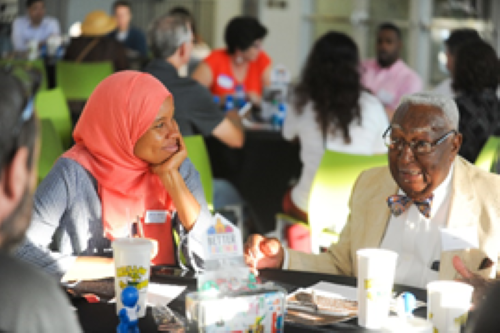
Community members speaking with each other around tables.


Example #2: H.E.A.T. Report Solutions: NBC Community Development Corporation - Wyandotte County, Kansas


PowerPoint
Anonymous (not verified) Tue, 12/11/2012 - 11:23

A PowerPoint presentation summarizing the major points in the section.

Section 3. Methods of Contacting Potential Participants
mloewenstein Tue, 12/11/2012 - 11:23
Main Section
mloewenstein Tue, 12/11/2012 - 11:24
  • Why is it important to contact potential members?

  • What are the methods for contacting potential members?

  • What method should you use to contact potential members?

It's now time for you to reach out to potential members --to put your contact list into action (for how to develop a contact list, see Identifying Potential Members in all Sectors of the Community). Now you should be able to take all the names you have patiently and systematically accumulated from the different sectors of the community and to start making some actual membership contacts.

Are you ready? You may be as ready as you're ever going to be. We're just about to start. But first, a little background.

Why is it important to contact potential participants?

It's important to contact new members simply because they are usually not going to walk through the door, or show up uninvited, though that can happen. Normally, they're not going to come to you. You'll have to go to them. To put it plainly, most new members for your group or organization will need to be recruited. The main question in this section is "How should I recruit them?"

Actually, there are two separate questions here. One deals with the method of your contact. That is, what form, or approach, should you use to contact and recruit new members? And the other deals with the content of your contact. That is, what points should your message convey? Let's take up these two questions in turn.

What are the methods for contacting potential members?

When you contact members, there are at least three basic methods to choose from:

  • You can meet them face-to-face
  • You can call them on the phone
  • You can write them a letter

There are other methods, too -- you could send a fax, or an e-mail message. You could send a fact sheet, flyer, or brochure. But for now, we'll focus on the three main methods above.

What method should you use to contact potential members?

There are advantages to each method, and some drawbacks too. Here's what we mean:

Face-to-face contact

Our experience is that personal contact works best. Research findings back this up. The more personal the contact, the greater your likelihood of success. A face-to-face meeting is more likely to be successful than a phone call, and a phone call is more likely to be productive than a letter.

Does this mean you should make face-to-face contact in every single case? Not necessarily. This is because:

  • Personal contact, especially face-to-face contact, takes time. Suppose you want to have a meeting: it takes time to set up the meeting (assuming you are arranging one in advance), it takes time to travel to the meeting, and it takes time to meet. You may simply not have that time to give for each potential member.
  • Personal contact is not always possible. The person you want to meet may not be available to see you, or frankly not be interested in seeing you. This is especially true if your potential member has a highly-visible or important position, and if your group has low visibility in the community or is unknown to your target.
  • Personal contact may be less necessary when you are asking your target person to do something small --to agree to be listed as a sponsor, for example, or to make a small contribution. These are "passive" forms of membership, rather than "active" ones. The smaller the request, or the less involving it is, the less intensive the contact need be.

Telephone contact

The telephone is quick and easy. You can dial seven digits in under five seconds. You (and your prospective member) don't have to travel --you can sit right where you are. You can engage in two-way dialogue, just as in a face-to-face meeting. You can listen and respond to emotional tone, not just verbal content, by sensing changes in voice pitch and inflection. And you can get your business done promptly.

These are all major advantages. But:

  • It may be hard to reach your target person. In many settings, the chances of your connecting on the first try are small. When you call, your potential member is likely to be-- "in a meeting...," "out to lunch...," "on another line...," "away from the desk...," "out of the office...," "on vacation....," or "just stepped out from a moment...." This is a modern fact of life. So the caller must be prepared for one or more rounds of missed connections and possible mild mutual annoyance before contact is made.
  • When you do connect, the target person may not be giving the same attention and consideration to your call as in a face-to-face meeting. They may be unprepared to listen, or distracted by other events in home or office (a project deadline; a baby crying). Sometimes --another fact of life-- you could get put on hold, as other calls come in.
  • A phone call usually can't build as strong a connection as a face-to-face meeting. Membership comes from connections made, and connection-building takes time. Meetings allow that time; phone calls usually don't. Some nonverbal information --facial expression, body language --is also lost over the phone, which can further limit relationship development.

Contact by letter

Letter and print contacts, on the other hand, have distinct advantages. While a good membership recruitment letter takes time to write, it can sometimes express what you want to say better than speech (because you have taken the time to write it). And once the letter is written, the basic content can be used again and again. You can generate a lot of letters in little time. And from the recipient's point of view, the letter can be read at leisure, and kept on file for future reference.

On the other hand:

  • Even the best letters are not as personal as a phone call or meeting.
  • There's no two-way dialogue.
  • There's less opportunity to respond to individual concerns, and to develop a relationship
  • And (the shocking truth) some letters are never opened at all.

So each of these contact methods has positive and negative features. Okay, but how do you resolve the issue? You want to get going. What method should you choose in your situation right now?

We'd like to provide an all-purpose answer. But in fact, we don't believe there is one. Instead, the answer to the question depends on your situation.

Factors in your decision

While face-to-face contact is generally best, other things equal, but other things aren't always equal. But here are some situations when you really might want to put the effort into personal contact, and in meeting face-to-face:

  • When you have a small number of people to recruit
  • When you have a large number of people to recruit them (You needn't be doing this job alone.)
  • When you have the time available to make the contacts
  • When the person you are recruiting would be an especially important member for your group
  • When the person you are recruiting is a particularly influential member in the community
  • When the person you are recruiting doesn't know you or your group very well

A phone contact might be the best choice in these cases:

  • When the prospective member is unavailable (or unlikely to be available) for a meeting
  • When the prospective member is relatively easy to reach by phone
  • When you and the prospective member are already acquainted
  • When the request being made is relatively simple
  • When you are personally comfortable speaking to others over the phone

And, as an alternative to the phone, here's when a letter might be strongly considered:

  • When you have a relatively large number of members to recruit
  • When you are the only person available to do the job
  • When your own time (and your group's time) is very limited
  • When it is less important who in particular the new members are
  • When the prospective member is already familiar with you or your group
  • When you have developed (or are given) an excellent mailing list

Let's try a few examples to illustrate these principles, with some proposed recommendations:

Example Recommendations
Your group wants local legislation passed. A city councilor is on your side Here is an influential member. Meet the councilor in person.
You want 50 residents to join you at a neighborhood meeting. They shouldn't be too hard to reach. Call them at home in the evening (you could also leaflet their doors).
You need 200 new members in the next few months, each of whom will send a check. Anybody's check is welcome. Find a good mailing list. Start with a letter.
You want to create an Advisory Board for a local health clinic. What do you think?

What about the specifics of your own situation now? What method choice would work best for you?

Combining different methods

At this point, we have good news (we hope). It is possible to combine these different methods of contact together. For instance, you can...

  • Call, then write
  • Call, then set up a meeting
  • Write, then call
  • Write, then set up a meeting

And, to expand the point, you can add a third stage as well. That is, you can call after you have sent a letter, or write after you have met. In other words,

  • Call, write, call, or
  • Call, meet, write

Many other variations are possible, but these are enough for now (we don't want things to get too complicated).

In many cases, combining methods is a good idea. The health clinic advisory board example above is an excellent case in point. It's an important task; it's worth taking the time. So, your own time permitting, you want to call (or write) prospective members, and set up a meeting; or (as a less intensive alternative) write, then call. In either case, you could follow up with another call or letter.

A precise discussion of the exact sequence of events takes us beyond the scope of this module. But the main point, though, is that it's possible and often desirable to combine different methods when you are asking members to join your group. Each method can support and build upon the strengths of the other. In many situations, using a well-thought-out combination of methods may be worth your time and trouble.

Adjusting your method to fit the situation

We'll wind up this section with more helpful news. You don't have to stick to a single method all the time. Your strategy can vary: you can use one contact method for some people, and another method for others. The saying goes, "Different strokes for different folks." It's the truth.

So a bank president might best be approached in a scheduled meeting, face-to-face. A minister might be found only by phone, Sunday afternoons, after the sermon. Someone who's on the road a lot might pay special attention to the mail (unless you want to try recruiting by cell phone), while a shopkeeper might be most available then and there, in the store. All these people are available, but more easily in particular ways. If you are interested in Prospect X, your task as recruiter is to ask yourself, "How can I best get hold of this particular person?"

Taking advantage of chance

Before we conclude, there's one more contact approach to list. It needs to be mentioned, even though it's not exactly a "method." We'll call it "chance. "

You might run into a potential member at the post office, or at the football game. You might see that same bank president picking up the newspaper, or at church. If it's not out of place to approach them --and maybe it's not --then take advantage of those chance opportunities. In unplanned encounters, when people are not in a hurry, many people will show their natural and helpful selves. And they may be more receptive to what you want to tell them.

Good community work means being prepared to take advantage of every opportunity presented to you, whether by chance or by design.

In Summary

Meetings, phone calls, and letters can be seen as just part of an overall membership strategy, with each to be used as needed. If several good methods exist, why limit yourself to just one?

But once you've made your choice or choices, how do you carry them out? That's the topic of our next two sections!

Contributor

Bill Berkowitz

Resources

Print Resources 

Altman, D., Balcazar, F., Fawcett, S., Seekins, T., & Young, J.(1994). Public health advocacy: Creating community change to improve health. Palo Alto, CA: Stanford Center for Research in Disease Prevention.

Bobo, K., Kendall, J., & Max, S. (1991). Organizing for social change: A manual for activists in the 1990s. Minneapolis, MN: Midwest Academy.

Checklist
mloewenstein Tue, 12/11/2012 - 11:27

If you are considering face-to-face contact, is it because:

___You want to reach a small number of people

___You have the available time

___The people you're recruiting are especially important

If you are considering phone contact, is it because:

___The prospective members are unavailable for meeting but are available by phone

___You already know the people

___The request is relatively simple

If you are considering a letter, is it because:

___You have a large number of people to recruit

___You're the only person available

___Your time is limited

___It's less important who you recruit

___You have an excellent mailing list

Writing your letter:

___Use design and content to get the reader's attention

___Personalize the letter

___State reason for writing at the beginning of the letter

___Give a good reason for becoming a member

___Request is clear, specific, limited, immediate, and doable

___Tell the person how to fulfill the request

___Thank the person

___Carefully proofread the letter

Examples
mloewenstein Tue, 12/11/2012 - 11:27

Example 1: The Face-to-Face Interview

After many years of a hostile and unavailable superintendent of schools, the school board chose a new superintendent, Jim Brown. He was new to the area, but was experienced and enthusiastic about his new responsibilities. The Project Free Anti Drug Coalition which I directed had been around for a while and we wanted to connect with the new superintendent. I was excited about the possibilities for new programs and collaboration, but realized that, being new to the job, the superintendent would be very busy; and I didn't want to push the new superintendent too hard, too soon. After all, this was a potentially very important ally to the coalition. I sent a letter with a packet of information about Project Free and indicated that I would follow up with a phone call in two weeks. Two weeks passed, enough time for the superintendent to catch up with his mail and start to settle in to his new position. I called the superintendent, and briefly refreshed him about the coalition. We then scheduled an appointment to meet the following week and discuss coalition activities more formally. I now had a brief opportunity to learn about what coalition activities the superintendent may be supportive of, and which he may be less so. When the meeting occurred the next week, I was prepared to answer his questions and address his concerns, and, consequently, gain his support for present and future endeavors.

Example 2: Phone calls

A statewide healthy communities coalition meets on a monthly basis. It has had its first two or three meetings and the steering committee is not exactly committed or stable. I recognized the problem, and decided the problem could be corrected by getting some periodic guidance by an expert in planning and operations. Luckily, I knew of just the right person, a vice president of the largest medical center in the state. So, I made several attempts to set up an appointment for the expert to come and help us out. Twice the vice president was out of town on business trips, and the third time, an appointment was made, and then canceled at the last minute because the vice president had to attend a family dinner. Frustrated, but not ready to give up, I decided to schedule a telephone conference the next week. The vice president happily agreed, and the resulting guidance we received from the call helped us get our monthly meetings back on track.

Example 3: Letter Writing

In order to get a large number of people to show up at our first community meeting, our newly formed coalition, The Great Plains Heart Health Coalition, decided to conduct a letter writing campaign. After all, we only have a few members and so we didn't have the time or money to telephone hundreds of people, or personally visit potential recruits. The other coalition leaders and I spent a few days developing a letter that introduced the coalition, and invited everyone to attend the first meeting the following month. The letter was sent out, and a fair number of people to attend the meeting. After hearing the presentation, a number of attendees agreed to join the coalition. A couple of years later, the coalition decided to go statewide. Luckily, we had the old recruitment letter on file, and, with some minor revisions, we mailed the letter out again, with equal success.

Contributor

Bill Berkowitz

PowerPoint
Anonymous (not verified) Tue, 12/11/2012 - 11:28

A PowerPoint presentation summarizing the major points in the section.

Section 4. Writing Letters to Potential Participants
mloewenstein Tue, 12/11/2012 - 11:29
Main Section
mloewenstein Tue, 12/11/2012 - 11:31
  • What is writing a letter to potential participants?

  • Why should you write a letter to a potential participant?

  • When should you write a letter to a potential participant?

  • How should you write the letter to a potential participant?

  • How do you get the reader's attention?

  • Should you use e-mail to send your letters?

What is writing a letter to a potential participants?

We believe that it's best to make personal contact when you can. The more personal the contact, the greater your chances of success. This is especially true when the potential member knows, likes, and trusts the person doing the contacting.

But letters definitely still have their place. The printed word has not yet gone out of style. Many people genuinely like opening their mail; and for many of us, a personally addressed letter, with a personal greeting and message, is a pleasure to receive. In addition, a good letter can be strongly influential, often more so than a mediocre meeting. Letters can also be kept and referenced. And certainly, letters can reach a lot of people at a small cost.

So suppose you have chosen to take pen (or keyboard) in hand and to write a letter to a potential member. This section will show you how to make your letter most effective.

A letter to a potential member is a written communication used to recruit new members for your group or organization. It may vary in format from a general form letter to a more personal handwritten note. Usually it is mailed: but it can also be printed in a newsletter or local newspaper, or even sent by e-mail.

Why should you write a letter to a potential participant?

Because, as with any membership contact method, your hope is:

  • To recruit new members into your group or organization (the main goal)
  • To raise awareness of your group and the issues that are important to it
  • To ask for specific assistance on specific programs or projects
  • To give potential members a written overview of your organization that explains its purpose, highlights common interests, and suggests areas of possible involvement

When should you write a letter to a potential participant?

You should consider writing just about anytime you are trying to increase your membership size or your community recognition, or when you need more organizational help. But especially:

  • When you do not know the potential member well enough to make a personal contact
  • When it is difficult to reach the potential member on the phone
  • When you want to convey some detailed information about your organization that is too lengthy or complex for a phone call or meeting (this can go in a fact sheet or brochure, which the potential member can keep on file).

A letter can also be used in connection with a personal meeting. Letters and face -to-face meetings can work together. So write a letter:

  • When you want to have a personal meeting, and think that sending a letter will help you get that meeting
  • When you want to follow up after a personal meeting, with a thank-you; or with further information; or to confirm agreements made; or to reach agreements in the first place

How should you write the letter to a potential participant?

Before you begin, two important preliminary steps:

  • You should have a good list of potential members
  • You should have set aside the time to do the writing. It can take time to do it right!

Now, before we get to the heart of the matter, let's remind ourselves that there are different kinds of letter-writing situations:

  • Sometimes you will be writing a letter to a friend. Sometimes it will be to a colleague, or to an acquaintance. And sometimes, you will be writing to a stranger, someone you don't know at all.
  • In some cases, the letter might be your only membership contact method; it will stand alone. In other cases, the letter will be connected to a meeting, and will be sent either before the meeting, or after it -or, possibly, both before and after

Depending on which situation is true for you, the content, style, and tone of your letter will vary. Naturally, you will write to a friend differently than to the Superintendent of Schools.

But all letter-writing situations have one big factor in common. In all situations, your task is to write a persuasive letter, designed to convince the recipient to join and be part of your outstanding group or organization. To do this well, you want to use persuasive skills. There's nothing wrong with that. If you have a good cause (and it is good -otherwise you wouldn't be part of it), you have a perfect right, and maybe even a responsibility, to attract others to it.

All of us do have persuasive skills. Virtually all of us have written letters asking someone to do something. So it's not as if you've never written a persuasive letter before. But you can get better at it by following some simple guidelines.

How do you get the reader's attention?

The busier your reader is (or the less your reader reads) the more important this point becomes. Attention comes first. If you don't get attention, the reader isn't going to read the letter in the first place, or even open it. So how do you grab the reader's attention?

Design

Consider using: A distinctive envelope or stationary. High-quality stationery, which may be worth the extra few pennies. A logo, especially a familiar logo, so that the reader knows the sender. Color, now that color printers are more affordable. A slightly larger-than-average type size (for example, 13-point, as vs. 12-point or less). A distinctive typeface, as long as it is attractive and easy to read. All of this can be done without being overdramatic, or offending the reader's taste.

Content

The first sentence is probably the most important sentence in your letter. So can you write an eye-catching sentence, one that is going to stick in your reader's mind? Go for it, if you can. Your communication is like a resume, or like an advertisement for yourself and your organization. But in this day and age, the writer has less time to make an impression. Do you think your reader is going to read your letter slowly and carefully, savoring every single word? No; they are going to scan it quickly, if at all. The hard truth is the life expectancy of a poorly written letter is about five seconds. That's why we have wastebaskets, and people to empty them.

Personalize the letter.

  • Use your contacts. Say, if you can, "Y (a mutual friend) suggested that I might write to you, because...." This personal touch, if it's legitimate, often works well ; we'll pay attention, out of respect for our friend. But even if Y doesn't exist, you can:
  • Give the person's name in the salutation (as in, "Dear Patricia," or "Dear Ms. Prospect," as vs. "Dear Friend"). This is easy enough to do on your computer, even if you are writing a lot of letters. It's worth the time.
  • Use a handwritten signature. Sign your own name.
  • Stick a handwritten postscript at the end, or a hand-written lead-in on the top. Or add a personalized remark, on a post-it note or some other device. This might reinforce your interest, or add reasons for joining.
  • Hand-address the envelope

Do whatever it takes to get across that the reader is an important person, deserving of personal communication, for the reader alone, and that you know this, and have taken the extra care to ensure it. Now that you've got your reader's attention, your next task is to keep it.

Give the reason you are writing right at the beginning.

Get right to the point. If this were a detective novel, you might hold the reader in suspense. But now your reader is probably at the office, with less time for mystery. Get to it. Save the theatrics. Most readers will appreciate it.

And what is your reason for writing? Your basic reason is to encourage X (X, meaning either gender) to become a member of your organization, in one way or another. There may be variations in how you say this; but membership is almost always the bottom line, and stating it should come close to the top.

Give your reader good reasons to become a member.

These reasons should be presented through X's eyes, as best you can see through them. What are the benefits for X? Why is it in X's interest to work with you, or even keep reading further? Important: You need to be clear on those reasons before putting finger to keyboard.

There is a common list of benefits -reasons for joining -that applies in most cases. In your communication, you should be able to choose one, and usually more, from the list below:

  • The chance to address an important problem which concerns X or X's organization
  • The chance to help others that X is concerned with
  • The chance to meet people through your group that can benefit X
  • The chance to learn about new sources of funding for X's organization
  • The chance to stay current about what is going on in X's field
  • The chance to stay current about what is going on in X's community
  • The chance to meet new people
  • The chance to improve one's socioeconomic status
  • The chance to strengthen one's self-worth or esteem
  • The chance to be part of a pleasant social group, and have fun

If you cite these reasons well, X may think, "I am a lucky person to have gotten this letter." That's exactly what we want.

Now here's a tip for all letter-writers, to make life much easier: The benefits you list will not change much from setting to setting. This is because benefits are keyed to human motives, and human motives are fairly constant and uniform. Still, there may also be specific benefits that apply to your particular organization. What are they? Don't hide them. Set them right out, very concretely.

In your letter, you can include a few sentences about your organization, and about the issues that it is dealing with. But don't include too much detail in the letter itself; it's not likely to get absorbed, and it may take away from the letter's overall strength. Instead, put your detailed information in a brochure, fact sheet, or flyer that will accompany and supplement the letter, and which also can be duplicated for others to read.

Make a request.

What is it you want X to do? You don't just want good will from your letter. You want action. So let X know what action you want them to take. Is it to come to a meeting of your group? To sign up as a formal member? To get involved in some specific project? To send money? To support you in some other way? Or is your letter more of a preliminary contact, one which seeks a meeting, or which is a prelude to a call?

Be thoughtful in advance about what you are requesting. Of course, you can shoot for the moon, but the moon is far away. Instead, successful requests tend to have common characteristics:

  • They are clear. X knows what is being requested.
  • They are specific. X is asked to perform a particular act.
  • They are limited. Lifetime commitments are mainly for marriage.
  • They are immediate. They ask for something X can do right now, or very soon, rather than in the indefinite future.
  • They are doable. X can comply with your request without a large expense of time, energy, money, or other resources. The request is feasible. Its cost is low, or at least affordable. X says, "I can handle it," or "I can do this much."

Examples:

Instead of: "Become a member of our organization"

Try: "Come to the meeting next Wednesday at 7:00."

Instead of: "Help us in our campaign."

Try: "Spend an hour making calls before Election Day."

Instead of: "Distribute flyers around town."

Try: "Distribute 50 flyers on your block."

Be clear about how the recipient can fulfill the request.

What is the next step to take? Again, make this very specific. By this time, X may be sympathetic and willing. Let's hope so! Now, make it easy for X to act.

  • If it's a matter of returning a form, enclose the form with an addressed envelope.
  • If it's a matter of coming to a meeting, make sure the time and place are prominent.
  • If there's a deadline, state the day and date.
  • And have you included your address, phone/fax, and best time to call?

Express your appreciation.

Thank X for considering your request, and for X's anticipated support. Do this in a natural way; say what you feel. You can also strengthen your appreciation by personalizing it at the end of the letter. There's no need to overdo it.

But if there are any rules of social behavior, they are:

  • We like to be appreciated
  • We never grow tired of being appreciated
  • Showing appreciation increases support

Much of social life follows from this simple wisdom. You should be appreciative; someone is helping you out, and showing appreciation here is the right thing to do.

Proofread your letter.

For many recipients, spelling, grammatical, and factual errors will lower your credibility and take away from the impact of your letter. You've come this far; finish things up in good form.

Sign your letter. Mail it today.

The persuasive principles above don't have to be included in exact order, by -the-numbers; but your letter (or e-mail) will be stronger if they appear somewhere. This is because basic principles of persuasion do exist; they apply almost universally; and they work. We've given the principles; your task is to use them.

There's a large bonus, to make things a lot simpler: the same basic principles generally apply to face-to-face and telephone communication, as well as to letters.

But for now, let's see how these letter-writing principles might work in practice, by showing several examples. See Examples.

Should you use e-mail to send your letters?

Doing so has several advantages:

  • It is much faster than normal mail. This also makes it possible for the recipient of your letter to respond, via e-mail, much more quickly
  • It saves the trouble of addressing an envelope, buying a stamp, and mailing your letter
  • The letter is much less likely to get lost on the receiver's desk

Note, however, that e-mail also has disadvantages:

  • For some recipients, it has less stature than a formal letter. It may carry less weight, and seem less impressive
  • If the recipient does not read e-mail regularly, your time savings are lost
  • It may be gone forever with one tap of the delete key -- and gone from your recipient's mind as well

Of course, your e-mail can be supplemented by other recruitment techniques. But if you are thinking about using e-mail to recruit potential members, take special care to make sure that your message stands out.

Do the same persuasive principles apply when sending e-mail? Yes, they do. Maybe even more so, if you want to ensure that your e-mail message stands out from all others.

Contributor

Bill Berkowitz

Resources

Print Resources

Altman, D., Balcazar, F., Fawcett, S., Seekins, T., & Young, J. (1994). Public health advocacy: Creating community change to improve health. Palo Alto, CA: Stanford Center for Research in Disease Prevention.

Bobo, K., Kendall, J., & Max, S. (1991). Organizing for social change: A manual for activists in the 1990s. Minneapolis, MN: Midwest Academy.

Homan, Mark. (1994). Promoting community change: making it happen in the real world. Pacific Groove, CA: Brooks / Cole Publishing Company.

Checklist
mloewenstein Tue, 12/11/2012 - 11:32

Why are you writing a letter?

___To recruit

___To raise awareness

___To ask for specific assistance

___Other

To be covered in the letter:

___You have tried to get the reader's attention in design and content

___You have personalized the letter

___The reason for writing is stated at the beginning of the letter

___You have given the reader a good reason for becoming a member

___Your request is clear, specific, limited, immediate and doable

___You have you told the person how to fulfill the request

___You thanked them

___You have carefully proofread the letter

Examples
mloewenstein Tue, 12/11/2012 - 11:31

Example: Letter to a potential member


Ripley Volunteer Center

For further information
call Jim Miller at
706-456-9900
July 2, 2008


Dear Sandra,

The Ripley Volunteer Center is looking for volunteers! Lending a hand not only fosters community well-being, but is sure to be a rewarding experience. We are seeking a variety of individuals – we’re looking for all ages, professions, and interests. We can find volunteer placements that will suit your skills and fit into your busy schedule.

Many community service organizations require volunteer assistance over the summer months and on into the fall. There are many ways you can lend a hand. Here are a few of the programs currently looking for volunteers:

The Metropolitan Heart Foundation requires volunteers to assist in their community awareness committee on preventive medicine. Activities would include visiting schools and contacting organizations to give information on heart film programs.

An experienced baker is needed to make cookies, cakes, pastries and other baked goods for the residents of a psychiatric boarding home. The hours are flexible, and bus fare and expenses will be provided.

Volunteers, age 15 and over, are needed to work in a residential center for handicapped teenagers, one day or evening per week. Opportunities include assisting staff in program planning, establishing small group or one-to-one relationships, and leading recreation and community awareness activities.

These are just a few of the opportunities available to help make a difference. Drop by or give us a call and let us know how you can help. Thank you for taking the time to consider these exciting opportunities. Your future help will be greatly appreciated, and, like many current volunteers, you will find the volunteer experience to be a rewarding one.

For further information on available volunteer opportunities, contact The Volunteer Center at 456-1122, 8-5, Monday-Friday.


Sincerely,

Jim Miller, Volunteer Recruitment Director

PowerPoint
Anonymous (not verified) Tue, 12/11/2012 - 11:32

A PowerPoint presentation summarizing the major points in the section.

Section 5. Making Personal Contact with Potential Participants
mloewenstein Tue, 12/11/2012 - 11:33
Main Section
mloewenstein Tue, 12/11/2012 - 11:33
  • How to make a good impression

  • What to do before the meetings

  • What to do at the meetings

  • Unscheduled meetings

  • Making contact by phone

  • Dealing with rejection

As we've noted previously, the single most effective way to recruit potential members is to meet them face-to-face. (Though in many situations, phone calls and letters may sometimes be a better or additional choice).

But suppose you choose to set up a face-to-face meeting; the meeting time approaches, and there you are. What do you do? How should you use that meeting time most productively? How can you best bring that person into your organization?

How to make a good impression

Much of the answer is very simple. We even hesitate to write it down. But here it is: You want to make a good impression. Research shows that people form impressions quickly, that those impressions stick, and that they guide our behavior. If you are going to make an impression in any case, it might as well be the best one possible.

So you want to smile, make eye contact, show social graces. You want to dress for the success of the occasion. And you want to display all the good manners you were taught by the time you reached junior high. This is so obvious, and so fundamental, yet it's not always followed. So we hope you'll understand if we remind you just this once.

You can use the best technique in the world, but it won't help if you show up late with a spot on your shirt!

But the focus of this section is not on basic manners, rather more on nuts-and -bolts guidance for meeting members in person. There are indeed techniques you can and should use before and at a scheduled meeting. And not just at meetings. Generally speaking, they also apply to situations when you are recruiting over the phone, or at unscheduled meetings, door-to-door. Some special considerations for door-to-door and telephone contacts do exist, and we'll mention them toward the end of this section.

What to do before the meeting

Do some homework about your target person. What do you know? And what can you find out? What is their background, their work position, their special interests? What have you observed, or what can you learn about their personal style, or way of doing business? The more you know in advance about your potential members, the better you will be able to present your case so that it will meet their needs, and in a manner they can easily hear and appreciate.

Think about the meeting ahead of time if it's a scheduled meeting. Visualize what will go on. Visualize how you see the other person responding --what they might say, and what you might say in response. Also visualize the outcome of the meeting: What outcome do you want? What do you want to walk away with? Then visualize yourself walking away with that outcome in hand.

Much evidence in all walks of life-- in sporting events, in stage performances, in just about any social encounter--suggests that visualization, visualizing your desired outcome, can help you achieve your desired result. Try it for yourself. It's free, it's easy, you can do it anytime, you will get better at it with practice; and, it works.

What to do at the meeting

A Helpful Note: In this section, our focus is primarily on meeting people one-at -a-time, as individuals. But it's also very possible to meet people in groups -- you could make a presentation at another organization, for example, or you could give a public talk, or take the lead and invite your own group to meet a location of your choosing. The same basic principles apply.

Thank your prospective member for being there, for taking the time to meet with you.

This should be done sincerely. Sure, they might get something out of this meeting, and that's largely why they're there. But they might also be attending because you asked them. They didn't have to come. Their coming may at least in part be out of respect to you and what you believe in.

Expressing thanks is also practical. It reinforces their behavior of showing up and meeting with you. Indirectly, it reinforces their interest in your cause. Appreciation builds support.

Start with small talk.

There might be times where you wouldn't waste a moment, and got right down to business from the first hello. But those instances are rare. We can be businesslike without being all business, all the time. We are human too.

What small talk? Anything of mutual interest--and it's best if you know in advance what those mutual interests are. Weather, sports, mutual acquaintances, a recent community event, something in the news. Something you will both agree on, and not something where you would disagree, which is the last thing you want right now. You want to start by building some common ground, and that's what small talk does.

How much small talk? Let the other person guide you. They will do so by nonverbal signals --a shift in the seat, a change in expression, a look at a watch, or maybe by a direct statement. Follow that lead.

In other words, small talk isn't necessarily small; it's done for a reason. It builds a relationship between those who are speaking. Your relationship now may make a difference, later on. In recruiting members, as in life, relationships make the world go around.

Still in all, also be aware of the time you have set aside for the meeting. That way, you can pace yourself and accomplish what you would like to do by meeting's end, before time runs out on you. You don't want to let things go on too long before you get to the main event, the main reason why you are there.

State the purpose of the meeting, from your point of view.

Tell the prospective member what your role is, why you made the contact, and what you would like to discuss in this meeting. Be direct and honest and concise. Put your agenda right on the table.

This is a time to present your key points in summary form. You don't want to give a long lecture at this point--because the target person may well not be interested, and also because what you want now is dialogue. But do bring along any fact sheets /brochures/supplementary materials/reports with you, and give them to the prospective member as you talk, or at the end. That will fill in most of the detail. If the prospective member person has specific questions, they will know enough to ask you.

State what you are looking for from the meeting.

Be explicit.

Do you want the potential member:

  • To come to one of your meetings?
  • To serve on a board, or advisory board?
  • To undertake a specific task (alone, or with a task group of yours)?
  • To write a check?
  • To make some other kind of gift, or donate an in-kind service?
  • To recruit others to your organization, by acting as intermediary?
  • To get involved in some combination of the above?
  • Something else?

If there is one specific thing you want, don't hesitate to ask for it directly. But, it may be that you want no one specific thing. You are hoping instead that the prospective member will contribute or participate in any of several possible ways. In that case, you might say something like: "Here are several ways you might be able to help us. Which of these might make sense for you?" In other words, you give the potential member some options. You offer a menu ("menu technique"), with several different "courses" to choose among.

State the benefits that fulfilling your request will have for your target person.

Why should the target person want to or be willing to do what you are asking? Speaking directly, what's in it for them? You should be aware of those benefits in advance, and be able to present them without being asked. A reminder: To do this well, you should know something about the person you are meeting with, and plan your thoughts ahead of time.

What are these benefits? In brief, they include:

  • Helping others
  • Gaining information
  • Meeting people
  • Solving a problem
  • Being included
  • Improving status
  • Having fun
  • Making money

Sometimes, depending on the situation, you may want to state some benefits before asking for what you want. The order of these two can vary. In your presentation, it's also possible to weave the two together, in a way that's custom-tailored to your prospective member. At this point, it's hard to be more specific. With some practice, you'll have a better idea of how to go about it.

Listen to what your prospective member has to say.

Give them some space and time to respond. They will raise some of their main concerns, without much help from you. When you listen, listen very carefully to those concerns.

Sometimes other people may not state their true concerns directly, out of politeness to you, or discomfort for them, or both. You may wish to probe a little and draw them out, and encourage them to get their real reactions out in the open. That will be helpful both to them and you.

Of course, you should have a good idea of what those concerns might be before you go into the meeting. And you should also have a good idea of how you might respond to them if they are spoken aloud. In other words, you want to be able to anticipate and to counter most possible objections. And to do this well, you have to be able to listen well.

Examples: Concerns, and possible replies

The respondent may be concerned about time commitment:

"I don't know if I have the time to do this."
"I understand. The time commitment usually runs about three hours a month. Is that something you might be able to try?" (If not, have another alternative in mind.)

Or ability to commit to a certain length of time:

"A year from now, who knows where I'll be."
"If you could give us a year, that would be great."

Or availability at the meeting time or day:

"Thursday afternoons are sometimes a bad time for me."
"We're planning to review the meeting time. How about Wednesdays?"

Or ability or skill to do the job:

"I've never done anything like this before."
"Nobody has, before they started. But it's not really hard to do. And we'll give you all the help you need."

Or the mission and purpose of your organization itself:

"I support a lot of what you do. But a few of your goals bother me a little. "
"Which ones? Can I explain to you what we have in mind...?"

These are all common concerns, whether mentioned explicitly or not. Are there others we haven't included? And what do you think of the sample replies above? True, they are short, and not very detailed. How would you improve upon them?

In listening and responding to concerns, it may help to have some fallback or alternative position in mind. So that if the target person is not willing or able at this time to commit to A, they could be offered B, or C, or D, or perhaps a smaller-size version of A. The underlying question is: "What can you commit to?" This is a variation of the "menu technique" presented earlier --you make your direct request (your "house special"); and if the customer doesn't order, you suggest another item, or perhaps a smaller-size portion.

Review what you have agreed on.

This will ensure that any agreements or commitments you have discussed are made clear and explicit.

When you state them, you can ask the other person something like, "Does that sound right?" or "Is that OK for you?". This allows them to correct you if needed, and also to verbally confirm to what has been agreed to once again. Verbal agreement strengthens commitment.

You then want to bring the meeting to a specific conclusion and not let things carry on too long, past your agreed-upon time. Don't wear out your welcome. Even if you have not been as successful as you would have liked, the chances are good you will have other opportunities.

Let your prospect know what the next steps are going to be.

It might be "We'll make sure you know about the next meeting." Or "We'll be sending you a card in the mail." Or "Someone will call you and give you the details."

These follow-up steps should (again) be clear and explicit, so that the prospect will know precisely what will happen next, and when --and will not be surprised or taken aback by any follow-up contacts that might occur.

Thank the prospective member.

Thank the person both for time given, and for any commitments made to you and your cause. Show your appreciation. Once again, you want to reinforce any favorable action taken. (This is also a good time to give them any literature or supplementary material to take with them, and/or to pass out to others.)

If there is time, a bit more small talk may end the meeting.

The bonds get cemented.

Follow up on what you said you were going to do from your end.

Most of the time, the prospective member has met you close to halfway. The remaining part of the responsibility is yours.

Unscheduled meetings

The above suggestions apply especially to face-to-face meetings with a prospective member (or group) when the meeting has been scheduled or prearranged. But sometimes you will want to, or need to, make personal contact with prospective members by other means --by going door-to-door for example, or by calling on the phone.

What adjustments should you make in such situations? What special considerations, if any, are called for?

Wait, though: If a scheduled meeting is possible, why would anyone want to recruit door-to-door in the first place?

For several possible reasons:

  • Your goal may be to contact everyone in a certain limited geographical area, such as a small neighborhood, or a political precinct. Going from door to door helps ensure that goal.
  • You might be part of a town-wide campaign, where every resident in the town will be contacted. Other workers will be also ringing doorbells, in different parts of town. Here, you have your own territory.
  • Your aim is to get one-time support --such as a vote, a petition signature, or a contribution. Since you may not be seeking long-term membership or long-term commitment, there's less need to schedule formal meetings.
  • Your emphasis might be on breadth of support, more than depth. You might want the raw numbers. Since doorstep encounters almost always take less time, going door to door in such cases is likely to be more efficient.

These are all good reasons. But it's important not to minimize the challenge the door-to-door recruiter faces. You must approach strangers (or relative strangers ), without warning, possibly at inconvenient times, and ask them to give up some time and/or money, and/or to take some action on behalf of your cause, about which they may know little or nothing. Door-to-door recruiters definitely don't have their work cut out for them. It's not a day at the beach.

Yet while these challenges are real, they can be minimized. A doorbell ringer with the right preparation and the right attitude can win many new supporters, interest other potential supporters, significantly advance one's cause, and actually have a good time getting to meet some new and interesting people. Don't forget these positives !

Here are some short-form, telegraphic tips for door-to-door recruiting, supplementing and building upon the previous material on scheduled meetings. These tips can make your job easier, more successful, and hopefully more enjoyable as well:

Before

  • Know your territory. This is the basic salesperson's rule, and here it applies to you. The rule in short is that the more you know about your territory, the more effective you will be. Your territory in this case is a neighborhood; learn as much about it as you can. Read about it. Ask around. Walk around, before you even start. You will then feel more comfortable dealing with others, and others will feel more comfortable dealing with you.
  • Plan your destinations in advance. First, what is your exact territory, and what are its boundaries? Next, do you want to knock on every single door, or just a sample, or just at certain kinds of residences? For example, suppose you want to speak only to women; that's easy enough. Or suppose your goal is to contact renters, rather than homeowners; here you might prepare by contacting rental agents and assessors --offices, itemizing apartment buildings, and constructing a list that you can verify at each door stop.
  • Plan your walking route, house by house. Sketch it out. Find good detailed maps (check with your local planning department), and take them with you.
  • Give yourself a target for how many doors you want to cover in your time allotted. (This will give you a goal to shoot for, and also help prevent you from stopping too long at any one address.)
  • Leave some printed material describing your cause by each door in advance of your visit, if possible. Mention that you will be stopping by on a particular day or days. In that way, recipients will have a chance both to familiarize themselves with the issue, and will also be less likely to be distrustful when you do appear.
  • Plan in advance for different situations you may encounter. Suppose you're on the doorstep, ready to listen. But just for instance, what will you do if (a) no one answers the bell (will you call again?); (b) someone answers who does not fall into your desired category (e.g., a child, who says: "Mom and Dad won't be back till later"); (c) someone answers, and invites you in (will you step inside?)
  • Avoid certain hours: early morning; late in the evening; dinnertime; daytime's, if you think your target person will be out working. The best times are often between dinner and dark, or on Saturdays. But supplement these guidelines with common sense, blended together with your knowledge of the neighborhood and its customs.
  • Dress to the norms of the neighborhood, or perhaps one notch above. Neatly and cleanly, of course. But in a T-shirt neighborhood, business clothes are unnecessary and may be counterproductive --even though ripped jeans and grungy sweatshirts will almost never be your attire of choice.

During

When you are at the doorstep, and poised to ring the bell, the general point is to build your credibility and trustworthiness from the very beginning. And this means, in most cases:

  • Begin by introducing yourself, by full name. If you live in the neighborhood, say so, and say specifically where. If you have a common acquaintance or friend, and especially if that person suggested you might stop by, mention (and possibly highlight) that fact. By doing so, you are both reducing possible initial suspicion and also building potential bonds of similarity.
  • State what group you are representing, if any, and a very brief reason for your visit.
  • Verify the name of whomever you are speaking to, if you don't know it already.
  • Ask if your target persons might have "just a minute." This is courteous, and (if they say yes) yields a mild commitment to listen. Wait for some acknowledgment. If they say they don't have time, or very strongly imply it, you may ask if there's a more convenient time when you could return. Your visit should normally not take much more than a minute or two, if you speak to your topic and are well prepared. People's time is valuable. So is yours.
  • State the reason for your visit in a little more detail. In doing so, it will help to know how familiar your target person is with your issue. If the target person knows the issue, you can get right to the point. If not, you may want to give some very brief background. Plan what you will say in either case. If you can sense how familiar they are before your visit, so much the better. It will save time. If you're not sure, you can ask.
  • Look for similarities or common points of reference between you and the target person; point them out, or imply them --for similarity increases persuasiveness. (For instance, "I think my daughter graduated in the same year as your son.") See also if you can ask some questions that the other person can say "yes" to --for earlier agreement increases later persuasiveness as well. (For instance, "Do you remember that big accident down the street near here?" ["Sure."] "That was terrible, wasn't it?" ["Yes, it was awful."])
  • State the action you hope the other person might take. It could be a signature on a petition, a vote, attendance at a meeting, a purchase, a contribution, the willingness to contact other residents, or a promise to do any one or more of those things. The action you desire will vary, but you want to be clear on your specific request in advance.
  • State the benefits of taking that action. Why should they do it? What will be the benefits to the recipient? What will they get out of it? (See Point # 5, under Scheduled Meetings.)
  • If the target person agrees, follow up directly (present the petition, make the sale, get the check....).
    • If someone hesitates, reinforce your appeal with another benefit, or repeat the same benefit, or combine the two together.
    • If someone declines, or hesitates further, suggest a more limited form of action. They may not sign the petition; would they accept some literature and agree to read it? If they can't contribute now, would they accept a pledge form? If they can't come to a meeting this week, could we send a reminder card about the next one?
    • If someone says no, and you are convinced they mean it, thank the person for their time, and move right on. In most cases, it's not worth the effort to try to convince a person who holds a differing perspective on the spot. You have too many other people to visit.
  • Allow some space in your conversation, usually toward the end, to solicit your target persons' own ideas. They may have a way of contributing or helping that you hadn't thought of before; but you won't know unless you ask. And, perhaps they can point you to other neighbors who might be interested, or who could also help out ; they probably know better than you do. Listen carefully here; capitalize on any offers of assistance.
  • Thank the person. (Everyone likes to be thanked.) They have listened to you. They deserve your sincere appreciation. And, of course, follow up, as mentioned before. Make sure you get their phone number before you leave, if you don't already know it.
  • Keep a record of your contact. After you leave, but before you move on to the next house, take a moment to record the important details. Whom did you speak to? What was their response? What further action is called for? Write this information down. We forget all too easily, and the written record may come in handy time and again.
  • Smile, and be friendly, without being insincere. Though it's sometimes easier said than done, try to make each conversation a pleasant social encounter. This is a benefit to the target person --and also to you. As you converse you want to be in a good mood. If you communicate that you are tired and bored or anything less than enthusiastic and committed to, can you guess what the effects are likely to be?

If this seems like a long list, well, it is. But it gets a lot easier with a little practice. And to make it easier still, all of this can and should be done in your own language, and in your own style. True, language and style will need to be adjusted to your own setting, because every situation and every target person is different. It will always help to respond to what the other person is telling you, both verbally and non-verbally. A door-knocker is not only a persuasive presenter, but also a very skilled listener, and an expert improviser!

These same basic tips can be adapted to many other unscheduled meetings, in addition to door-to-door --street-corner encounters, for example, or unplanned meetings in public places. It's not that every chance meeting should be turned into a recruitment presentation --the time is not always right, and, just possibly, there might be better things to talk about. But sometimes the time is right; you should be prepared to use the opportunity.

Does this mean you should always travel with business cards in your pocket, or brochures in a shoulder bag? Here, we're just raising the question. What is you answer?

Making contact by phone

Other things equal, it's almost always preferable to meet prospective members face - to-face. But in community work, other things aren't always equal. There are tradeoffs. And in some cases, you may decide that it is preferable to contact prospective members by phone.

Why?

The key advantage of using the phone is that you can potentially cover much more ground in a much shorter time. A scheduled meeting might take half an hour; a house call might take five minutes; but a phone call might take two minutes or less. These figures are very approximate, but if you can make ten or more phone calls in the same time as one sit-down meeting, could that, at least sometimes, be a better way to go? (There's also e-mail, even group e-mail, but for our purposes this is not "personal contact.")

When?

  • Many of the reasons given for door-to-door contact also apply here:
  • When you are looking for one-time support
  • When your emphasis is on "quantity" of support rather than "quality"
  • Phone contact also can work well when your message is simple and uncomplicated.
  • And phone contact might also be preferred when you already know the person you are contacting, and know that person well --a face-to-face meeting then might be less necessary or not necessary at all.
  • Finally, phone contact can be used in conjunction with, or as a supplement to, face-to-face contact. You can follow up a face-to-face meeting with a phone call. Or, alternatively, you can use the phone call both to schedule a face-to-face meeting and to set the tone for what is to follow. Or you can do both.

How?

What special tips apply here, beyond what's already been stated?

  • For phone calls in particular, plan your approach in advance. This is precisely because phone calls are less personal; and because many people are not eager to talk on the phone with strangers; and also because your intent might be more easily mis-perceived (e.g., "What is this person trying to sell me?"). For all these reasons, being persuasive over the phone with a stranger is generally harder than being persuasive face-to -face. A carefully planned approach then becomes that much more important.
  • Specifically, it may help you to write out an actual phone script for what you will say. Practice that script out loud, until you are comfortable with it. When you make your actual calls, you can use that script as a guideline. This does not mean you literally recite the script over the phone (listeners can tell when this is happening; they are rarely impressed.) But you can use the script as the basis for your remarks. As you get more experience, you can revise your overall script, and gradually let go of it entirely. And you can adjust your words more easily to what you hear on the other end of the phone.
  • But it's not just what you say, it's the way that you say it. Your phone voice makes a big difference. Your listeners must make judgments on relatively limited information; they can't look you in the eye, nor can they see your charming smile. What they can and do judge is your voice --its clarity, its resonance, its naturalness, its warmth. To bring this point home, try making a recording, and listening to yourself, even if it's just the greeting on your own answering machine. Pause and reflect: Would you be persuaded by that voice? How could it be made more persuasive? Then, make the needed adjustments.
  • When you make calls, test the results of your approach. Keep records of contacts and outcomes, and evaluate those outcomes. If your approach is not doing the job for you, then you might want to change what you say or how you say it. Do you have enough understanding of your target persons' background and experience? Are you providing the right benefits and the right reasons why they should become a member?

With phone calls, as in door-to-door contact, you need to prepare for a wide variety of possible events. Suppose, for example:

  • You reach a disconnected number
  • The phone rings, but no one answers
  • The person you want to reach is unlisted
  • You reach an answering machine
  • The person you want to reach is not at home
  • The person you want to reach is at home, but unable (or unwilling?) to come to the phone
  • The person asks you to call back another time
  • The person cuts you off and hangs up

How will you respond in each case? There are no hard-and-fast rules for every situation. Our point is rather that you should think about these possibilities in advance, and have a good idea for how you will respond to each one of them.

  • What to do when you reach an answering machine (and you will reach many of them ) deserves special attention. Two general questions to resolve here: (a) Should you leave a message on the machine, or is it better to call again and hope for a live contact? (b) If you do call again, how many call-backs should you make before you stop trying? Once again, no set answers; but you should make decisions that best fit your own setting.
  • Finally, a tip from professional telemarketers: The longer the target person stays on the phone, the greater the likelihood they will comply with your request. The corollary is that you must engage your target person right from your first words, so that you can keep the conversation going without being cut off. Perhaps this principle will work for you --but keep in mind that the longer you do talk with one person, the fewer total calls you will be able to make in the time you have available. So some kind of balance is probably called for.

Dealing with rejection

Despite your best efforts, not everyone is going to be persuaded to support your cause. Especially when you contact others door-to-door or by phone, many people will simply say no, and mean it, for a wide variety of reasons. Some people will be impolite; a few will be downright unpleasant. Your percentage of successes may be lower than you thought. Some days it may be so low that you are on the verge of becoming discouraged.

But don't be discouraged. Gaining even a few good new members can easily justify your time spent. Winning those new members to your cause often takes time; it usually doesn't happen all at once. What's more, people who may seem indifferent to you now may come around a few months or even longer down the road, just because of the seeds you planted on that first contact, which seemed so unproductive back then. And as for those people who are impolite or rude or worse, don't take it personally. They may just be having a bad day, or a run of bad days. We all do. If we can feel kindly toward them regardless, we may deepen our own character, even if we don't win converts.

In Summary

Making personal contact with potential members is not always easy. To be as successful as you would like takes time and skill, both patience and persistence, both assertiveness and sensitivity. It calls fully upon the best qualities you have to offer.

But the compensating rewards are well worth it. When people do join and get excited about the work, when they start to assume positions of leadership, when your organization gains victories and strengthens community life -- all in large part due to your efforts -- you can take deserved and long-lasting satisfaction in a job well done.

Contributor

Bill Berkowitz

Resources

Print Resources

Brown, M. (1994). How to recruit people to your organization. Cambridge, MA: Brown, Michael J. (Available from author at 54-C Trowbridge Street, Cambridge, MA 02138)

Ellis, J. (1996). The volunteer recruitment book. (2nd ed.) Philadelphia: Energize, Inc.

Kahn, S. (1982). Organizing. New York, NY: McGraw-Hill. (See especially Chapter 6.)

Leonard, Libby, Bill Ariano, & Eileen Ryan (1981). Strengthening volunteer initiative: A neighborhood self-help curriculum. Washington, DC: National Center for Urban Ethnic Affairs. (See especially the section on Door-knocking.) [Available from the Center at P.O. Box 20, Cardinal Station, Washington, DC 20064.]

Checklist
mloewenstein Tue, 12/11/2012 - 11:34

___You understand what it means to make personal contact with potential members

___You understand how to make a good impression

You understand what to do before the meeting:

___You did homework about your target person

___You thought about the meeting ahead of time

You understand what to do at the meeting:

___You know you should thank prospective members for being there

___You know you should start with small talk

___You know how to state the purpose of the meeting

___You know you should state the benefits of your request for your target person

___You know you should pause and listen to what your prospective member has to say

___You know when to start winding up the meeting

___You know you should state the follow-up steps

___You know how to end the meeting

___You know how to conduct door-to-door meetings

___You have done prior survey of your territory

___You planned a strategy

___You know what to do during the door-to-door meetings

___You are aware of the techniques involved with making contact by phone

Contributor

Bill Berkowitz

PowerPoint
Anonymous (not verified) Tue, 12/11/2012 - 11:34

A PowerPoint presentation summarizing the major points in the section.

Section 6. Involving Key Influentials in the Initiative
mloewenstein Tue, 12/11/2012 - 11:35
Main Section
mloewenstein Tue, 12/11/2012 - 11:36
  • What do we mean by influential people?

  • Why involve influential people?

  • How do you identify and meet the influential people in a community?

  • When do you involve influential people?

  • How do you involve influential people?

So much of what we do in community work involves attempts to influence people --to continue healthy behaviors, to stop (or at least cut down on) unhealthy behaviors, to volunteer their time or make a financial donation, to attend our events and fundraisers, and so on. When someone has influence, they have some level of ability to sway or induce people into doing what they want them to do. Influence is something we're always trying to gain.

Luckily for us, we can often find people who already have this strange and wonderful quality and use their influence to our own advantage. Every community, no matter what size it is or how long it's been around, has its influential people --elected officials, business people, religious leaders, or just ordinary community members--who have a lot of influence when it comes to what decisions get made and how things happen.

What do we mean by influential people?

These are the people in your community whose opinions are respected, whose insights are valued, and whose support is almost always needed to make any big changes. Generally, they're regarded as having a finger on the pulse of the community, able to express the point of view of the public (or some significant portion of the public) and usually having some influence over community opinion.

An influential person may be a formal leader, such as a city commissioner or a well-respected minister, but may also be someone whom people in the community look up to and respect, like the owner of a well-loved local restaurant or a young mother whose activism has earned the trust of the people in her neighborhood. As you might imagine, there are many benefits having people like these supporting your initiative.

Why involve influential people?

So what are the advantages of involving influential people?

  • Influential people may be able to let you know what concerns are held by people in the community.
  • Influential people may be able to let you know how the community will react to your initiative.
  • Influential people may have access to community history you're unaware of that might affect the course of your initiative.
  • Influential people may be able to garner participation in and acceptance and support for your initiative in the community.
  • Influential people may lend some credibility to your cause by being associated with you and your group.
  • Influential people may help you work out specific problems you're having in the community.
  • Influential people may be able to convince people who might otherwise be against your group to support it.
  • Influential people may have access to resources like people, space, equipment, etc. that you might otherwise have difficulty getting.

How do you identify and meet the influential people in a community?

Some key people are obvious. Particular political figures--state representatives, mayors, etc.--become key figures as a direct result of their positions. Other politicians--town councilors, for instance--may be more or less influential, depending upon their constituency and their political savvy. Sometimes it's the politician's aide, rather than the politician themself, who makes important decisions and really has an effect on public opinion. And what about community activists, or members of the business and financial community? How do you tell the players from the bystanders? And how do you get to know the players?

There are certain people in any community--some of whom may be influential themselves--who are likely to know just where the power and influence lies. Among these are, in no particular order:

  • Directors of human service and government agencies
  • Legislative aides
  • Grassroots activists
  • Religious leaders
  • Business leaders and people active in service clubs (Kiwanis, Rotary, Lions, etc.) or the Chamber of Commerce, who are usually members of the business and financial sector
  • United Way directors and Board members
  • Older adult activists

The crucial element at all stages of this process is personal contact. That means that if you hope to involve influential people, you and other members of your organization need to be active in different sectors of the community, meeting as many people as possible. As you make contacts, particularly among those in the categories above, you should be asking them "Who else should I be talking to?" Most people are eager to be helpful, and will bend over backwards to demonstrate their knowledge of the community and to help you identify and meet the appropriate people. And it's personal contact with influential people themselves that will ultimately get you their support.

Once you've begun to identify key individuals, how do you meet them? Often, community contacts are the answer. "So-and-so suggested that you were particularly important for me to talk to," is generally enough to get someone to meet with you. Lawmakers--state legislators, local elected officials--are public servants, and usually willing to meet, or have their aides meet, with constituents or those who represent them and their interests. These lawmakers generally have local offices, staffed by aides who may actually be the people you want to get to know, and scheduling an appointment is almost always possible. (Whether you can meet with the lawmaker themself is at least partially a matter of the community: it's much easier to get an appointment with the mayor of a town of 15,000 than with the mayor of a city of 500,000, for example. But a meeting with a trusted aide can often be just as useful, and the aide can get you a meeting with the mayor if that seems necessary.)

The best way to meet influential community leaders--ministers, activists, "natural leaders"--is through other people or through direct recruitment. People tend to trust those they meet through their friends (another reason why being active in the community and meeting as many people as possible are important), and they are almost always flattered to be told that their support will be particularly helpful.

In the final analysis, meeting and involving influential people depends on personal contact and on convincing them to buy into your issue.

When do you involve influential people?

This depends largely on how involved you want influential people to be, but for most purposes you should get them involved early and often. The earlier they are involved, the more sense of personal investment they will have in your organization or initiative and the more fiercely they will fight for your issues and needs.

If your initiative is already well under way, however, don't worry. It's never too late to get influential people involved in your work. No matter at what point you bring influential people into the picture, they can make a positive difference for your work.

Some particularly appropriate points to encourage involvement are:

Special events

This can include things like a day of events celebrating or emphasizing your issue; a fund-raising event, such as a foot race, a party, or a golf tournament; a trip to the State House: all these can be excellent times to involve key people. In some cases (buttonholing legislators on a State House trip, for instance) they might advocate directly for your cause. In others--e.g., participating in a money-raising golf tournament--their mere presence and their contact with others in their peer group might have more impact than what they actually say. In any case, special events are a good time to ask for help from influential people.

Critical points for your organization or issue

These are the times when a lot is at stake, and when influential people can be extremely helpful. They can advocate with legislators, help inform the community of the problem, defend your organization from attack, rally community support, and, sometimes, actually produce funds to stave off a financial crisis.

Concentrated campaigns, either for public awareness of the issue, or for funds

Here's where your influential friends' influence comes into play. Depending on their sector of the community, they can help lend credibility to your message or organization, help to get the message out to parts of the community you might otherwise have difficulty reaching, and convince their friends that you're a worthy recipient of their contributions.

How do you involve influential people?

Consider who the influential people are that you'd like to get on board

Think about the influential people who are already involved or who have shown themselves to be supportive of your work. Brainstorm about ways you can get them more involved as well as ways you can make connections with influential people you haven't yet met.

One thing you can do in figuring out who influential people are is to use the "snowball" technique. This simply means asking the people you know who are influential people to suggest other influential people in the community with whom you might consider connecting.

Some influential people might include:

  • Local agency board members
  • Local law enforcement
  • Religious leaders
  • Local government and political figures
  • School administrators, teachers, PTA members, school board members (including school folks is especially advisable if your priority population includes youth or your issue involves education)
  • People involved in political campaigns
  • Directors or staffers of health and human services agencies
  • Local media representatives
  • Local business people--goodwill, opportunities for name recognition, and product promotion, exposure to other business people in the community.

Determine their interests and how you can appeal to those interests

Find out what's important to these folks. Later on, you can use this information in persuading them to get involved in your organization or coalition.

The simplest way is by asking them what's important to them, of course. You might also want to pay close attention to what other types of organizations and coalitions these people have been involved in. For example, if you are working on a coalition that wants to bring a more culturally diverse curriculum into the schools, you might look at influential people who have supported similar causes, such as multicultural organizations, the local chapter of the American Civil Liberties Union, or the leaders of local African American churches. Or you can just take a stab in the dark and hope that your work will appeal to them--and if you can show that your cause is really a good one, you may well be able to do that.

Find ways of relating your goals and activities to what's important to those who hold influence. Appealing to their particular vested interests can be done by showing them how your program can help them accomplish their own goals. Can parallels be drawn between what your organization or coalition does and what's important to the key influential? What sort of "sales pitch" can you use to draw this person into your organization? Some brainstorming can help you come up with common goals between your program and the potential supporter. Coming up with a list of common goals can help you make your "pitch," but you will also need to clearly outline what sort of support you need and make sure that what you're asking for is unambiguous.

Another important strategy in enlisting influential people is to educate them as much as possible about your issue, and to establish yourself as an expert who can be helpful to them. If they see you as someone they can come to for reliable information, they're far more likely to be helpful to you. The same is true for policymakers, who might be the same people, or who might be legislative committee staffers, scholars, or members of think tanks or policy organizations.

If necessary, you can use your own constituents as a pressure group to enlist the support of lawmakers. It's amazing how supportive a legislator or local official can become when 10 or 15 -- or 100 -- people from their district phone or show up in their office with a message about "what the voters want."

Business people and bankers are generally willing to meet and to be helpful, but they have to have a compelling reason. How will your issue affect their business or the future of the community? What will it mean to them and their families, especially if they live in the community where their business or institution is located?

Contact the influential community members and ask for their participation

This can be as simple as making a phone call, in cases where you already know the person, or it might involve meeting someone for a working lunch, sending a formal written invitation to become involved, or wangling an introduction out of people you know who are familiar with the influential person. Generally, more formal methods of contacting people are better when you don't know them as well, or when you're asking for a big favor. Whatever method you choose, be prepared to persuade that person.

Be ready to explain or answer questions about any of the following:

  • How that person can become involved
  • What level of involvement they can expect to have
  • Why getting involved in your coalition or organization would fit with the individual's own personal goals and ideals
  • When they can expect to get started --this should be as soon as possible; if you wait too long before having the individual start they may become uninterested or frustrated

Explain the many ways in which they can become involved

There are a number of possible ways that these key people can support your organization or your cause. For example,

  • They can become members of your Board of Directors or of an advisory board
  • They can act as spokespersons for the organization in particular situations
  • They can help raise money
  • They can perform specific tasks for the organization free of charge --legal work, accounting, etc.
  • They can act as liaisons to particular sectors of the community where they have influence--the Hispanic/Latino population, the business community, people in public housing, etc.
  • They can advocate with local and state government for funding or support
  • They can lend their names to and help organize events around your issue

Maintain their involvement

There are many ways this can be done, but first and foremost you must show your appreciation to any key influential who takes the time to get involved with your work. Giving public recognition to your supporters is important. Chapter 41: Rewarding Accomplishments has a lot of suggestions on how to show your appreciation to those who give your organization support.

Here are some other general tips on attracting--and keeping--support:

  • Be helpful to others! That way, later on, you can collect on those favors by asking for support.
  • Be sure to give supporters lots of feedback about their efforts. This helps them know how they are being most helpful and ways that they can improve.
  • Most of all, impress them with by showing how good your cause is and how effective your program is in helping that cause. This means showing that your program is needed and effective. Influential people are often busy people, so if they're going to take the time to get involved with your work, they will want to see results. Strategies include letting supporters see that the people the program serves are pleased with the results, being as involved in high-level decision making (e.g., lobbying, campaigning for sympathetic legislators, participating in hearings where rules affecting your group are being considered, etc.) as possible.

In Summary

Influential people can provide an immense boost to the work we do in improving our communities. The simple fact is: to make real changes, we need to involve the people with the power. By understanding who they are and how to include them in our efforts, we greatly improve the chance that our work will succeed. And that puts us on the road to becoming influential people ourselves--the kind people come to when they want to get things done.

Contributor

Bill Berkowitz

Jerry Schultz

Resources

Print Resources

Brown, M. (1994). How to Recruit People to Your Organization. Cambridge, MA: Brown, M.

Homan, M. (1994). Promoting Community Change: Making it happen in the real world. Pacific Grove, CA: Brooks/Cole.

Checklist
mloewenstein Tue, 12/11/2012 - 11:38

___You can identify potential influential people in your community. Some examples are:

  • Director of human service or government agency
  • Legislative aides
  • Grassroots activists
  • Religious leaders
  • Business or financial leaders
  • People involved in service clubs
  • Local law enforcement
  • Religious leaders
  • Local media representatives

___You want to get influential people involved because you have a special event coming up, this is a critical point for your organization, or you want their help with a concentrated campaign.

___You realize that it is never too soon or too late to get people involved.

___You have met the influential person(s) you want to get involved possibly through community contacts or with meetings.

___You have determined the interests of the people you want to get involved and how you can appeal to those interests.

___You have contacted and asked for their participation, explaining the following:

  • How they can become involved
  • The level of involvement they can expect
  • Why they should be involved
  • When they can expect to get started

___You have taken steps to maintain their involvement.

Examples
mloewenstein Tue, 12/11/2012 - 11:37

Example: Working Together to Promote Adult Literacy

An adult literacy program had several volunteers who worked for a firm that designed and published booklets on health and psychological topics designed for populations that might have low reading levels, such as welfare recipients and teens at risk.

Through those volunteers, the director of the program was asked to give a United Way presentation to employees of the publishing firm. Through this presentation, he met the firm's owners, a married couple who were both leaders of the local business community, and particularly oriented toward community service. As a result of the director's relationship with them, they became supporters of the literacy program in several ways, including donating phones and phone costs for an annual three-day fundraising phone-a-thon.

The relationship also yielded important benefits to the publishing firm, through their asking students in the literacy program to provide feedback on their booklets. This arrangement was a great learning opportunity for students; it was also a way for them to function as experts and to gain confidence while they provided truly valuable information to the publishing firm. This two-way relationship lasted for many years, and the publishing firm remained an ardent supporter of both the organization and literacy even after the owners themselves retired.

Contributor

Bill Berkowitz

Jerry Schultz

PowerPoint
Anonymous (not verified) Tue, 12/11/2012 - 11:38

A PowerPoint presentation summarizing the major points in the section.

Section 7. Engaging People Most Affected by the Problem
mloewenstein Tue, 12/11/2012 - 11:39
Main Section
mloewenstein Tue, 12/11/2012 - 11:39


Pennie Foster-Fishman, Michigan State University Community Psychology Professor Emeritus, delivers a keynote at the Saigh Symposium in St. Louis, Missouri. She speaks to the importance of gaining perspectives from community members – especially those being served.


Social or community problems are problems that by their very definition concern a large number of people. Unfortunately, those who are socially and economically powerful, such as government officials, interest groups, or community leaders often define these problems - and their solutions. While everyone is indirectly affected by social problems, those who are directly experiencing the problem are often left out of the processes of identifying what the problem really is.

Why engage people affected by problems?

Let's say that you have a rock in your shoe. No one other than you can know exactly how that rock feels. Others may have read about rocks, seen rocks, or even had a similar experience with a pebble caught in a sandal. However, you are the expert on this particular situation because you are experiencing it.

The same concept applies to social and community problems. People who directly experience a problem have a much different outlook on their needs than does a politician who has only read about the problem in the newspaper or a helping professional who once wrote a college paper on the problem.

There are two important ways to engage people affected by a problem in helping to solve the problem. First, you can listen to them so that you have a better understanding of the causes of the problem, the barriers they have to managing or preventing the problem, and their ideas for solving the problem. Second, they can become engaged through participation in the initiative or program that is being developed by helping empower them to tackle the problems they confront. It's always better for people to participate, but if those affected by the problem don't wish to, listening to them is a good way to start building rapport with them.

How can people affected by the problem get engaged?

People can get engaged in many ways--here are just a few:

  • Get engaged in planning processes like creating goals or defining the problem
  • Donate money or help out with a fundraising effort
  • Volunteer to staff the office, answer phones, put together mass mailings, or make phone calls
  • Doing research, writing grant proposals, or handling correspondence
  • Attend public events like rallies, community hearings, or fundraising events
  • Serve on committees that focus on specific problems or activities
  • Take leadership roles in a community partnership

When examining a problem, perspectives from all types of people and sectors of the community are necessary. For instance, a mother of a pregnant adolescent has different needs and ideas than does her daughter, even though the issue of adolescent pregnancy affects both of them. Unfortunately, people who directly experience the problem are often ignored, or if they are included it is in minor ways.

Who should you ask to participate?

People affected by the issue may differ in many ways, including socioeconomic background, race, ethnicity, culture, age, gender identity, sexual orientation, religion, disability status, and other lived experiences. It is important to create opportunities for meaningful participation that reflect the diversity of those impacted. Some of the most important participants are people with direct experience of the issue. For example, if you are working on a youth suicide prevention initiative, it is important to engage young people as partners in the effort. You should also include individuals who have been personally affected by youth suicide, such as family members, friends, and young people with lived experience of a suicide attempt. Take intentional steps to engage people and communities whose voices are often overlooked, marginalized, or excluded from decision-making processes. This may include people from historically underrepresented groups, people experiencing economic hardship, people with disabilities, rural residents, immigrants and refugees, or others who face barriers to participation. It may not always be easy for people affected by an issue to participate, particularly when the issue carries stigma, involves trauma, or raises safety, legal, or privacy concerns. In some cases, the challenges associated with the issue itself can create barriers to participation. To support meaningful engagement, consider reducing logistical barriers, building trust, creating welcoming spaces, and offering multiple ways for people to contribute their perspectives.

There are a few things you can do to bring people who are affected by a problem into the problem-solving effort. These will help whether you wait to recruit them to participate in listening sessions and committee work, or to help empower them to get more engaged in organizing and advocacy. Here are a few ideas to help you:

  • Every community is different, so familiarize yourself with your community by asking where do people work? Socialize? Volunteer? Receive services? Shop? Access information? Attend school or church?
  • Sometimes people are already engaged in civic groups such as agency boards, advisory committees, neighborhood councils, local community organizations, social movements, and neighborhood improvement associations.
  • You can find out what exists in your community by contacting the mayor's office, the city manager, the chamber of commerce, engaged city officials, information and referral agencies, leaders in nonprofit agencies such as the United Way, YMCA, YWCA, and the Salvation Army.
  • Public hearings and meetings can also be effective ways to reach people who aren't engaged in any groups. Advertise creatively to reach the priority populations and remember to hold the meetings at convenient times and locations. Plan carefully so that the meetings are not too large to be effective--as a rule, groups of more than 20 persons may lose effectiveness.
  • Listening sessions are a bit different from public hearings and meetings in that they are expressly designed to allow community members to be heard about the issues and problems that are important to them. Conducting a public forum or listening session is a good way to let the public know that you do indeed care about their views and ideas, and can be useful in encouraging them to get further engaged.

What are some potential obstacles to participation?

It is easy to blame low levels of participation on apathy and lack of motivation, especially if you're getting frustrated in your efforts to encourage participation. You may find yourself getting so discouraged that you start to think that parents don't care about their family's health, or that teenagers don't want to stop the violence in school and on the streets. In reality, however, there are often things that prevent their engagement, such as lack of transportation or childcare.

Some of the people you're hoping to engage may need to learn some basics about doing this kind of work. They may need to learn to attend to what goes on, to take notes so they'll remember what was discussed, to understand and resolve conflicts (rather than either trying to ignore them, or taking them personally), to make themselves heard without sidetracking the meeting, etc. Some of us have learned these skills through training or work and take them for granted, but a lot of folks may not have had that sort of training and they can easily become frustrated and disappear from your organization. Some ways of helping them move past this are to hook them up with mentors in the group; to have some sort of training dealing with those issues (ideally for everyone, not just them); or to try to find a role for them that they understand is important, and that they can fulfill well while learning the other skills they need, etc.

Before trying to engage people ask yourself what obstacles could possibly inhibit participation of those affected by the problem.

  • Preconceptions and attitudes within your organization: Do you have a positive attitude or do you find yourself thinking things like, "I won't ever be able to get working parents engaged in this initiative because they're always too busy to get engaged in anything?" A pessimistic attitude will almost always show, no matter how much you try to mask it. If people see that you aren't excited or optimistic about their engagement, then they probably won't invest very much of themselves. Give people the benefit of the doubt and expect the best.
  • Inadequate community communication: People may simply be unaware of opportunities to be engaged in the community. Try contacting groups working on similar issues to your own to find out how they get people engaged. Find ways to get the word out to the community that you're looking for people to join in your effort.
  • Limited experience: People may avoid becoming engaged simply because they haven't ever had experience with collective action, and therefore are unfamiliar with what will be expected of them, how they can make a difference, or whether they will be welcome. For many people, participating in an unfamiliar way, such as attending a neighborhood meeting, may cause anxiety. Be very clear with people about what they can expect to have happen at meetings, what they can expect their role to be in the organization, and what will be expected of them if they get engaged. Make sure people know you are approachable should they have any questions, and make sure that you are always friendly and clear when answering those questions.
  • History of being underrepresented: Sometimes people affected by the problem have been ignored or they have tried to participate in the past but they were allowed to do only token work. Few leaders and organizers may have actually listened to them seriously or actively engaged them in the planning, organizing, deciding, and evaluating processes. If people have come to expect that they will be ignored, they will be less likely to even attempt to get engaged.
  • Resistant leaders: Perhaps the people who are affected by a problem see their leaders as resistant to their getting engaged. Are the leaders willing to rethink their agendas according to community input? Are the leaders able to listen and follow through with what they've heard? For community members to remain engaged, it is important for them to feel that what they say is worthwhile.
  • Sense of limited influence or agency: The complexity of politics intimidates community members, preventing them from getting engaged. The many levels of government make it difficult for anyone to know where to begin, whom to approach, and how to be influential. Awareness and education regarding these processes will help individuals gain the self-confidence to begin. People may be scared to speak up because they might not understand everything that's going on and they're afraid they'll look foolish.
  • Lack of time: Organizing convenient times for people to meet is key since they often have tight schedules. Take into consideration when the population you are reaching is available so that they will be able to participate. For example, if you want a lot of people who work the night shift to get engaged, you will need to have times available that don't coincide with their work hours. Additionally, meetings and events should not last longer than is necessary so that people don't feel like their time is wasted.
  • Lack of transportation: If possible, provide transportation to those who don't have the money or access to vehicles. Meeting places also need to be as close and familiar as possible to the participants, such as in schools or libraries. If there is public transportation near your meeting location, be sure to tell people where it can be found.
  • Lack of childcare: Not being able to find reliable childcare or having to pay for a babysitter can be big barriers for parents who would otherwise get engaged. Consider ways in which childcare can be made available. For instance, you can provide childcare at the meeting site, or have parents who are engaged set up a pool to take turns providing care.
  • Overcommitted leaders or community members: If those engaged try to do more than is realistic, then others who don't have the time or ability to work as much on the issue may leave. Pace yourself and make realistic demands of yourself and others.
  • Too many engaged: Smaller groups tend to get more done quickly. Utilize more groups with fewer people so that each individual may be heard and feel important instead of overlooked.
  • Poor organization of existing action groups: If there are existing groups that are taking action on the issue at hand, organize their efforts and resources so that time and energy are not duplicated. If the groups themselves are poorly organized and utilized, assist them in reorganizing or joining other groups.
  • History of unproductive meetings: Past experiences with unproductive meetings make people cynical about the effectiveness of meetings in general. Find ways to let them know why you believe the meeting will be helpful and why each person is an important part.

Remember: Examine barriers with an open mind and creatively think of ways to overcome them.

How do you motivate community members to become and remain engaged?

Know your audience

There are several ways in which to motivate others to become and remain engaged. Motivation begins within the individual, so it only makes sense to focus on the uniqueness of each person. Help people to realize that what they have to offer is important and appreciated, and that by becoming engaged they can benefit in ways that are significant to them.

You need to be familiar with what life is like for the groups you want to attract to work on your initiative. How do their physical, social, cultural, economic, and political environments affect their participation and your response? By trying to imagine what it would be like to be other people, you may understand them better and have an easier time working together as a team.

Recognize strengths

Every individual has unique talents, skills, cultural heritage, experiences, beliefs, and values. Because of those qualities, each person tends to learn different things from the experience of getting engaged in community issues. While it is important for each person to contribute, it is equally important to recognize, appreciate, and utilize their strengths. This will enable participants to see the ways in which their participation is helpful and important.

In addition to recognizing the strengths of individuals, you should also recognize the strengths of a particular community. For example, if you are working to get members of the Asian-American community in your town engaged, you should consider what strengths the Asian-American community possesses. How do they already organize to get things done? They may already have effective systems in place that you can use. Political organizing may be unfamiliar to them, but you might be able to relate it to something they know and feel comfortable with--like, for example, organizing a big cultural event or church fundraiser.

Recognize needs

Individuals have different reasons for becoming engaged. Those reasons often coincide with or respond to basic needs that they want to fulfill. Some of those needs include:

  • The need to improve or maintain self-esteem
  • The need to feel that one's contribution is genuinely useful and helpful
  • The need to have a sense of having influence with an issue
  • The need to have some level of control of self and environment
  • The need for friendship
  • The need to be recognized for one's efforts

Support other interests of these groups

If you expect people to give you support, you should reciprocate. In other words, don't expect them to support your initiative unless you're willing to support them as well. For example, if you are hoping to get the African American community more engaged in your initiative, be prepared to lend your voice to their causes. Speak out publicly against racism in your community, have your organization be visible at African American community events, and prove yourself and your organization to be an ally. Attending an occasional rally or fundraiser may not seem relevant to your organization's purpose--but if it's relevant to the interests and concerns of the people you want to reach, then it's relevant to you.

Recognize that groups are made up of individuals

Community members who take an active role in community issues develop skills and knowledge that they need to participate effectively. More important however, they have self-confidence. Believing that they can make a difference leads to a willingness to participate. As you appeal to community members for their participation, remember that each individual is a powerful resource and convey that belief to them. Even when addressing groups, recognize that groups consist of individuals who are all different despite their common bonds.

Ask people individually for their participation

A 1990 Gallup Poll showed that the main reason that has kept most people who are interested in volunteering from doing so is that nobody ever asked them! By inviting people individually, you let them know that they aren't just faceless numbers in part of a mass appeal. When people interact on a personal level, especially between friends or neighbors, engagement appears less intimidating and distant.

You can ask people to get engaged directly yourself, or you can get employers to invite their employees and co-workers, teachers to ask their students and families, friends to ask their friends, neighbors to ask their neighbors and so forth. Personal phone calls or letters are more effective than general advertisements.

Match individual talents, skills, knowledge, and experience with the group's needs

Not only will the group be stronger as a result, but people will remain engaged because they see themselves as being useful. For example, ask someone with an outgoing personality to speak publicly and a quiet person who enjoys writing to keep written records of what takes place.

Make participants feel welcome by listening to them and taking them seriously

When new people arrive for their first meeting or activity, be sure to welcome them, thank them for coming, and solicit their opinions and suggestions. Work at bringing them into the discussion. Try to get them engaged in small projects that will spark their interest. And most important, listen to what they have to say.

Active listening will prevent alienating certain people. It also helps you to empathize with and understand different perspectives and opinions. Active listening skills include clarifying things that don't make sense, summarizing what is presented, and allowing the participants to finish without interruptions.

Seven Tips for Active Listening

  1. Give your undivided attention. Look at the person, and suspend other things you are doing. Put down the newspaper, turn off the cell phone, look at the person who's speaking, and listen intently.
  2. Listen not only to the words, but the feeling content. A large part of human communication is nonverbal. It includes the tone of voice, gestures, body language, and inflections. They often reveal unspoken messages--such as anger, irritation, sadness, or fear--that can be far more important than the words used. Be sensitive to them.
  3. Be sincerely interested in what the other person is talking about. Remember that you can always learn something from anyone, and that you are doing service by really listening.
  4. Restate what the person said. This is a way of letting the person know that you understood not only the words but also the intent of the speaker. This is very important especially when there is conflict or when the other party is hostile. Your instinct may be to answer the allegation immediately, but this only creates further tension and distance.
  5. Ask clarifying questions once in a while. This will let the other person know that you are actively listening and that you are really interested in what they are saying.
  6. Be aware of your own feelings and strong opinions. When we are not aware of our own feelings and strong opinions, we tend to express our immediate reactions when we're listening. Such reactions may cut off effective communication. For example, someone may be stating a religious view you disagree with. Your initial impulse may be to express your disagreement, which may only start an argument. Be aware then that when you disagree, this may not be the time to say so.
  7. If you feel you really must state your views, say them only after you have listened. Let the speaker finish first, and if you feel it is helpful, then relate your own experience.

Show appreciation for each person's contributions

Recognition is essential for people to feel wanted, helpful, and important. You can show appreciation through certificates of appreciation, recognition parties or banquets, special attention to participants in newsletters, newspapers, or other media resources, thank you letters or postcards, and personal phone calls or conversations thanking and recognizing those engaged.

Know yourself

It is equally as important to understand yourself because you are continually influencing and shaping the process of helping those most affected by a problem to become engaged. Ask yourself:

  • What motivates me?
  • Why am I participating?
  • What do I want to achieve?
  • How will I react to different people and situations?
  • How committed am I?
  • How much am I willing to do?

Remain organized

When people walk into a disorganized or unclear situation they generally walk away. Hence, to keep people motivated you need to help them be organized as well as be organized yourself. Good leaders help participants feel more secure and confident. If the leader understands what is going on and what needs to occur, then the leader can effectively delegate responsibilities and include all participants effectively.

Define and clarify the plans, goals, and purposes of the group early on

People need to have a sense of direction with something to look forward to in order to get and stay engaged. Working towards common goals gives people a special bond, enabling them to work together as a team and making them care more deeply about the work they're doing. Come up with clear plans and realistic goals.

It's also important to come up with a practical, achievable timeline. If people see nothing happening--or if they feel too rushed--they will lose interest in being engaged, so know how to pace yourself. Creating a timeline allows you to see what is complete and what still needs work, in addition to giving everyone a clear idea of a realistic pace. Periodically remind group members of their goals and their timeline in order to keep them focused and inspired.

Establish good communication within the group and among different groups

Different groups in the community are more likely to share resources and help each other accomplish established goals if they communicate effectively with each other. Keeping people within the group as well as other groups informed will help them work to meet common needs and avoid duplicating work.

Use meeting time wisely

People value their time. Any time people get engaged in an issue, they are committing personal time, but sometimes they also sacrifice work time or time spent with family and friends to become engaged. When people show up for a meeting, they rightfully expect to have their time used wisely. If a meeting drags on or accomplishes little, they may not attend other meetings or events because they feel as if it is a waste of their valuable time. Know how to run effective and efficient meetings, and keep them as short as possible.

Example:

Yuka's organizational meetings for volunteers at the local battered women's hotline were thorough, but they tended to run long. Yuka believed it was important to cover every agenda item on the monthly meetings, and all volunteers were required to attend. More and more volunteers were dropping out, and Yuka didn't know why.

One day at the grocery store, Yuka ran into a volunteer who had quit. They chatted politely for a while, and then Yuka decided to just ask what had made the former volunteer leave. "Well," said the former volunteer, "I just couldn't go to the meetings anymore; I never knew when the meeting would be over and I just couldn't afford to have a babysitter for more than a couple of hours. And since you can't be a volunteer if you don't go to the meetings, I had to give it up."

Yuka realized that many of the volunteers were young mothers, and many were single and/or living on fixed incomes. She changed the meetings, honing her facilitation skills and setting a strict time limit--meetings ended after one hour no matter what--and volunteers were now allowed to miss one meeting every six months. She also got together a few volunteers to provide childcare during the meetings. Yuka soon saw a big increase in the number of mothers who were able to become volunteers.

Above all, keep a positive attitude

Attitudes are contagious, so if you have a poor attitude, the people you're trying to get engaged will pick up on that. If you show a positive attitude about your work, others will be more likely to feel hopeful and more able to accept and learn from challenges.

In Summary

Attracting people who are directly affected by the problem to be engaged is handled, in many ways, like attracting anyone else to your cause, although it may be a bit more difficult and take more effort on your part. Still, having people who are directly experiencing whatever it is your organization deals with is worthwhile. These are the people who know the problem most intimately, who deal with it day to day, and who will be able to make a more in-depth, meaningful, and personal contribution to your organization's discussions and planning. Do whatever you can to get these people engaged and you'll be glad you did.

Contributor

Chris Hampton

Eric Wadud

Phil Rabinowitz

Resources

Online Resources

Day for Prevention Video 1 - Community Partnerships and Coalition Building. This features a coalition that includes youth in decision-making – critical for an initiative meant to benefit youth.

Dot Nary: Holding events that welcome all is a column from the Lawrence Times that addresses disenfranchised groups, such as people with disabilities and chronic conditions, whose needs for accommodation to participate at the tables are often overlooked, misunderstood or, worse, ignored.

Driving Private Investment Toward Health Equity- Driving policy decisions with equitable community engagement can effectively guide and incentivize private investment in health equity.

Equitable Policy Processes for Multisector Health Efforts - Building a shared future of community prosperity requires a shared responsibility to ensure that all people and communities are treated fairly.

Healthy Neighborhoods Study, based in Boston, is the largest resident-driven, participatory action research project in the US about neighborhood change processes, like gentrification and climate change, and their impact on health.

Including People with Lived Experience is a resource that highlights the importance of thoughtfully and authentically including people with lived experience (PWLE) in health and social services work. It emphasizes that true engagement requires collaboration, fair compensation, and power-sharing to ensure that insights shape research and program outcomes.

Interview: Bringing an Anti-Racist Approach to Collective Impact from the Stanford Social Innovation Review. Two collective impact leaders, Zea Malawa of Expecting Justice, and Miya Cain of FSG, discuss using the framework to achieve social change and how to put anti-racism at the center of cross-sector collaborations.

The Lead Local organization focuses on building community power to drive structural changes and promote health equity, providing research, resources, and practical strategies to support communities in transforming local systems and conditions. Their Leading Locally: A Community Power-Building Approach to Structural Change report (pdf) explores how community power-building efforts across 16 diverse places in the United States can drive structural changes to advance equity, emphasizing strategies like grassroots organizing, policy advocacy, and coalition building to transform local conditions and systems. Their Story of Place: Community Power and Healthy Communities report (pdf) discusses how building community power can transform systems to advance health equity, emphasizing the role of local context, structural reforms, and inclusive decision-making to shape healthier communities.

Mitchell Besser: Mothers helping mothers fight HIV (YouTube) is a video from TEDTalks. In sub-Saharan Africa, HIV infections are more prevalent and doctors scarcer than anywhere else in the world. With a lack of medical professionals, Mitchell Besser enlisted the help of his patients to create mothers2mothers -- an extraordinary network of HIV-positive women whose support for each other is changing and saving lives.

The Principles of Trustworthiness Toolkit from the AAMC Center for Health Justice is a practical resource that helps health systems, academic institutions, and community partners build accountable, humble, and lasting relationships with communities through ten core principles and actionable guidance.

The Spectrum of Community Engagement to Ownership (pdf) from Justice-Involved and Emerging Adult Populations Initiative (JEAP) outlines the developmental phases and processes to achieve community ownership.

Transformational Community Engagement to Advance Health Equity is a report with case studies from the Robert Wood Johnson Foundation.

What Evaluators Mean When They Talk About ‘Lived Experience’ from Community Science.

What if the poor were part of city planning? is a TED talk by urban planner Smruti Jukur Johari that discusses how working with poor communities during city planning, instead of around them, is effective.

Why Community Power is Fundamental to Advancing Racial and Health Equity is the first commentary in a three-part series from Lead Local that explores how community power building can drive health and racial equity more effectively than traditional engagement. It details practical examples of power-building campaigns and emphasizes the crucial role of external actors (e.g. researchers) in supporting these movements.

Print Resources

Dunn, D. (1977). Community guide: Community involvement series. Tucson, Arizona: The University of Arizona.

Checklist
mloewenstein Tue, 12/11/2012 - 11:44

___You understand why it's important to get people affected by a problem engaged

___You understand that you can get people affected by a problem engaged by listening to them

___You understand that you can get people affected by a problem engaged by helping empower them to tackle the problems they confront

___You understand that those affected by the problem or issue may vary greatly in social class, gender, race, ethnicity, sexual orientation, age, religion, or culture

___You have familiarized yourself with your community

___You have a good idea about how people are already engaged in civic groups

___You have found out what exists in your community by contacting the mayor's office, the city manager, the chamber of commerce, engaged city officials, information and referral agencies, and leaders in non-profit agencies

___You have used public hearings and meetings to reach people who aren't engaged in any groups

___You have used listening sessions to invite people to be heard about the issues and problems that are important to them

___You understand some of the obstacles that prevent people affected by a problem from getting engaged

___You have asked yourself whether the following obstacles could possibly inhibit participation of those affected by the problem:

  • Preconceptions and attitudes within your organization
  • Inadequate community communication
  • Limited experience
  • History of being ignored
  • Resistant leaders
  • Sense of powerlessness
  • Lack of time
  • Lack of transportation
  • Lack of child care
  • Overcommitted leaders or citizens
  • Too many engaged
  • Poor organization of existing action groups
  • History of unproductive meetings

___You have motivated citizens to become and remain engaged because you:

  • Know your audience
  • Recognize people's strengths
  • Recognize people's needs
  • Support the other interests of these groups
  • Recognize that groups are made up of individuals
  • Ask people individually for their participation
  • Match individual talents, skills, knowledge, and experience with the group's needs
  • Make participants feel welcome by listening to them and taking them seriously
  • Developed good active listening skills
  • Show appreciation for each person's contributions
  • Know yourself, and understand what motivates you and why you are participating
  • Remain organized
  • Defined and clarified the plans, goals, and purposes of the group early on
  • Establish good communication within the group and among different groups
  • Use meeting time wisely
  • Keep a positive attitude at all times
Tools
mgrove Fri, 10/17/2025 - 10:43

Tool 1: Engaging People with Lived Experience Toolkit

The Engaging People with Lived Experience Toolkit was created by the People with Lived Experience Workgroup and Community Champions from the 100 Million Healthier Lives initiative. This resource helps organizations work closely with people who have direct experience with important community issues. It offers practical ways to encourage collaboration, focusing on inclusive leadership, co-design, and mutual support. The toolkit guides organizations through six main steps, helping them value different perspectives and build strong teams that can create lasting change.

Examples
mloewenstein Tue, 12/11/2012 - 11:43

Example #1: What if the poor were part of city planning? - Smruti Jukur Johari

Almost a billion people worldwide live in informal communities and slums, often without basic infrastructure like clean water, toilets or adequate roads. Urban planner Smruti Jukur Johari breaks down myths about these communities and shares examples of simple, common-sense solutions that arise when governments and architects work together with the residents -- instead of around them.

Example #2: Interview with Phil Rabinowitz

Phil Rabinowitz is the chair of the public policy committee and a board member of the Massachusetts Coalition for Adult Education (MCAE). He spoke with the Community Tool Box about his experiences in getting people affected by a problem engaged in its solution.

"The U.S. Department of Education had a team traveling to several cities around the country to collect testimony about the refunding of the Adult Education Act, which is the major federal source of money for adult literacy, English as a Second or Other Language (ESOL), and Adult Basic Education (ABE). When we at the MCAE heard they were coming to Boston, we decided to put on a proper show, especially since we'd heard that the turnout in other places had been pathetic--as few as 3 or 4 people testifying in some places. Since there were only about 8 stops, we felt these kinds of numbers were inexcusable.

"We fired up the communication network to alert programs around New England, and, in addition, I wrote up an information sheet for students. I aimed it at about 4th grade level so that most could read it, but tried to word it so that it didn't talk down to anyone. It explained what the meeting was about, how it would affect us in Massachusetts if the Act wasn't refunded, exactly how much of the state funding was dependent on federal spending, etc. One assumption behind this information sheet was that people couldn't be effective advocates unless they understood exactly what they were advocating for.

"The meeting was scheduled to last for a morning, with an optional afternoon session in case there were more people waiting. Two hundred showed up to testify, most of them students, and the students were by far the most articulate and powerful, talking about how their lives had changed as a result of the opportunity to learn to read or to speak English.

"People talked about feeling like less than nothing, and thinking they were the only ones in the world who couldn't read and write well, or who didn't have a high school diploma. They talked about their own kids turning their school performance around when they realized how serious their parents were about education. Some displayed transcripts of the college courses they had taken since graduating from an adult ed. program. Students came in buses from Maine and New Hampshire, leaving at three in the morning and not getting home till after midnight, because they wanted to tell their stories.

"The Department of Education people were blown away. They stayed two extra days so they could hear everyone who wanted to testify, and later wrote to the state administrator about how impressed they were with what they had seen and heard, and how much it had swayed their opinions. They were tremendously respectful to the students who testified and to those who came to support them, and some of the stories had them in tears. All in all, a terrific example of what can happen when you get participants engaged in advocacy.

"Another time, a group of students in my program who were on welfare were tremendously concerned about what Massachusetts welfare reform would do to their chances for completing the program and continuing with their education. The proposal called for welfare recipients to receive benefits for two years and then they'd be taken off, never to be put back on again. They would have to work 20 hours--either paid or volunteer--to stay on even for the two years, and there was no support for education or training.

"On their own initiative, the students met and drafted a list of questions about the reform regulations: Where was child care going to come from for those who did community service? Wouldn't it make more sense for the administration to support education and training if they wanted people to be self-supporting after they got off welfare? Why were welfare recipients themselves not engaged in the planning of reform? And so on.

"They took 100 copies of these questions to a public meeting and made a presentation to a group including a couple of state senators and the head of the Department of Transitional Assistance (a position that corresponds with the state commissioner of welfare in most states). Nothing much, except lots of local support, came of all this, but the group of women engaged went on to other things. The experience served to show them that they had a right to be listened to, and the feedback they got from others at the meeting confirmed that what they had to say was intelligent and necessary. I've never felt prouder of a group of people."

Example #3: Creating Healthy Neighborhoods through Member Engagement

In New York City, there are an estimated 3 million people who live in a food desert, “an area with limited access to affordable and nutritious foods, particularly in a low-income area” (USDA). The majority of those directly affected are people of color.

In 2013 South Bronx, New York held a “day-long community conversation at the Food, Faith, and Health Disparities Summit to decide which actions could make their neighborhoods healthier.” There were 150 community members in attendance who were elderly, people of color, and those living in poor communities. All of these individuals are people who are directly affected by the lack of nutritious food sources in their community. 

The summit was planned by New York Faith & Justice, Faith leaders for Environmental Justice, and Riverside Church; all of them concerned about food and health disparities in NYC. They went into it without solutions ready to implement, but instead listened to the community members with open ears and collectively came up with a plan on how to make improvements.

Community members are being asked to vote for those who support “creating food policy that includes everyone.” These organizations are giving community members a chance to change their own neighborhoods, and empowering them to take a stand for the health of their friends and family.

Learn more about community-led civic engagement at Everyday Democracy.

Example #4: Defining and Unpacking the Social Determinants of Health and Health Equity–A Culture of Health Webinar

Image of two women of color gardening, along with the title of the webinar.

The National Academy of Medicine (NAM) held the first webinar in its Culture of Health Webinar Series on November 29, 2018. The National Academies report Communities in Action: Pathways to Health Equity identified nine social determinants of health and how these determinants impact our health and the health of our communities. It features an example involving people most affected by the problem (such as promotoras de salud, those who have received nutrition assistance, youth). The report also defines health equity as the state in which everyone has the opportunity to attain full health potential and no one is disadvantaged from achieving this potential because of social position or any other socially defined circumstance. Read more.


Example #5: State Examples of Medicaid Community Engagement Strategies: Two Case Studies

Cover of document.

Lessons learned from COVID-19 outreach and an increased understanding of the importance of community engagement in designing successful health initiatives has led several states to strengthen their community engagement efforts. The case studies in this issue brief from State Health & Value Strategies describe community engagement efforts by Medicaid programs in Virginia and Colorado. Both states engage members in councils designed to improve processes and outcomes in each state’s Medicaid program.

Download the Case Studies here (pdf).

Example #6: How Built for Zero collaborative efforts are engaging those with lived experience in homelessness:

Collective Impact Forum | Podcast on Spotify

The Collective Impact Forum's September 18th, 2023 podcast covers how complex issues such as homelessness can feel unsolvable or intractable, but that through a commitment to a collective approach and strategies, communities can end homelessness.

Speaking with Community Solutions' (a nonprofit that is dedicated to ending homelessness) president Rosanne Haggerty, the program Built for Zero is discussed, which is a program network of more than 100 cities and counties working to ensure that homelessness can be rare or brief in their regions.

Contributor

Chris Hampton

Eric Wadud

Phil Rabinowitz

PowerPoint
Anonymous (not verified) Tue, 12/11/2012 - 11:44

A PowerPoint presentation summarizing the major points in the section.

Section 8. Identifying and Analyzing Stakeholders and Their Interests
mloewenstein Tue, 12/11/2012 - 11:45
Main Section
mloewenstein Tue, 12/11/2012 - 11:46


Photo of people standing in a peace sign shaped pie chart

The Community Tool Box is a big fan of participatory process.  That means involving as many as possible of those who are affected by or have an interest in any project, initiative, intervention, or effort.  We believe strongly that, in most cases, involving all of these folks will lead to a better process, greater community support and buy-in, more ideas on the table, a better understanding of the community context, and, ultimately, a more effective effort.  In order to conduct a participatory process and gain all the advantages it brings, you have to figure out who the stakeholders are, which of them need to be involved at what level, and what issues they may bring with them.  The same is equally true whether you’re building support for a new or ongoing effort, even if the process that led up to it wasn’t strictly participatory.

What do we mean by stakeholders and their interests?

Stakeholders are those who may be affected by or have an effect on an effort.  They may also include people who have a strong interest in the effort for academic, philosophical, or political reasons, even though they and their families, friends, and associates are not directly affected by it.

One way to characterize stakeholders is by their relationship to the effort in question.

  • Primary stakeholders are the people or groups that stand to be directly affected, either positively or negatively, by an effort or the actions of an agency, institution, or organization.  In some cases, there are primary stakeholders on both sides of the equation: a regulation that benefits one group may have a negative effect on another.  A rent control policy, for example, benefits tenants, but may hurt landlords.
  • Secondary stakeholders are people or groups that are indirectly affected, either positively or negatively, by an effort or the actions of an agency, institution, or organization.  A program to reduce domestic violence, for instance, could have a positive effect on emergency room personnel by reducing the number of cases they see.  It might require more training for police to help them handle domestic violence calls in a different way.  Both of these groups would be secondary stakeholders.
  • Key stakeholders, who might belong to either or neither of the first two groups, are those who can have a positive or negative effect on an effort, or who are important within or to an organization, agency, or institution engaged in an effort.  The director of an organization might be an obvious key stakeholder, but so might the line staff – those who work directly with participants – who carry out the work of the effort.  If they don’t believe in what they’re doing or don’t do it well, it might as well not have begun.  Other examples of key stakeholders might be funders, elected or appointed government officials, heads of businesses, or clergy and other community figures who wield a significant amount of influence.

While an interest in an effort or organization could be just that – intellectually, academically, philosophically, or politically motivated attention – stakeholders are generally said to have an interest in an effort or organization based on whether they can affect or be affected by it.  The more they stand to benefit or lose by it, the stronger their interest is likely to be.  The more heavily involved they are in the effort or organization, the stronger their interest as well.

Stakeholders’ interests can be many and varied. A few of the more common:

  • Economics. An employment training program might improve economic prospects for people with lower incomes, for example.  Zoning regulations may also have economic consequences for various groups.
  • Social change. An effort to improve racial harmony could alter the social climate for members of both the underrepresented racial or ethnic group and the majority.
  • Work. Involving workers in decision-making can enhance work life and make people more satisfied with their jobs.
  • Time. Flexible work hours, relief programs for caregivers, parental leave, and other efforts that provide people with time for leisure or taking care of the business of life can relieve stress and increase productivity.
  • Environment. Protection of open space, conservation of resources, attention to climate change, and other environmental efforts can add to everyday life.  These can also be seen as harmful to business and private ownership.
  • Physical health. Free or sliding-scale medical facilities and other similar programs provide a clear benefit for people with lower incomes and can improve community health.
  • Safety and security. Neighborhood watch or patrol programs, better policing in high-crime neighborhoods, work safety initiatives – all of these and many other efforts can improve safety for specific populations or for the community as a whole.
  • Mental health. Community mental health centers and adult day services can be extremely important not only to people with mental health issues, but also to their families and to the community as a whole.

As we’ll discuss in more depth further on, both the nature and the intensity of stakeholder interests are important to understand.

Why identify and analyze stakeholders and their interests?

The most important reason for identifying and understanding stakeholders is that it allows you to recruit them as part of the effort.  The Community Tool Box believes that, in most cases, a participatory effort that involves representation of as many stakeholders as possible has a number of important advantages:

  • It puts more ideas on the table than would be the case if the development and implementation of the effort were confined to a single organization or to a small group of like-minded people.
  • It includes varied perspectives from all sectors and elements of the community affected, thus giving a clearer picture of the community context and potential pitfalls and assets.
  • It gains buy-in and support for the effort from all stakeholders by making them an integral part of its development, planning, implementation, and evaluation.  It becomes their effort, and they’ll do their best to make it work.
  • It’s fair to everyone. All stakeholders can have a say in the development of an effort that may seriously affect them.
  • It saves you from being blindsided by concerns you didn’t know about. If everyone has a seat at the table, concerns can be aired and resolved before they become stumbling blocks.  Even if they can’t be resolved, they won’t come as surprises that derail the effort just when you thought everything was going well.
  • It strengthens your position if there’s opposition. Having all stakeholders on board makes a huge difference in terms of political and moral clout.
  • It creates bridging social capital for the community. Social capital is the web of acquaintances, friendships, family ties, favors, obligations, and other social currency that can be used to cement relationships and strengthen community.  Bridging social capital, which creates connections among diverse groups that might not otherwise interact, is perhaps the most valuable kind. It makes possible a community without barriers of class or economics, where people from all walks of life can know and value one another.  A participatory process, often including everyone from people receiving public assistance to bank officers and physicians, can help to create just this sort of situation.
  • It increases the credibility of your organization. Involving and attending to the concerns of all stakeholders establishes your organization as fair, ethical, and transparent, and makes it more likely that others will work with you in other circumstances.
  • It increases the chances for the success of your effort. For all of the above reasons, identifying stakeholders and responding to their concerns makes it far more likely that your effort will have both the community support it needs and the appropriate focus to be effective.

Who are potential stakeholders?

As we discussed, there are primary and secondary stakeholders, as well as key stakeholders who may or may not fall into one of the other two categories.  Let’s examine possible stakeholders using that framework.

Primary stakeholders

Beneficiaries or targets of the effort

Beneficiaries are those who stand to gain something – services, skills, money, goods, social connection, etc. – as a direct result of the effort.  Targets are those who may or may not stand to gain personally, or whose actions represent a benefit to a particular (usually experiencing systemic barriers) population or to the community as a whole.

Some examples are:

  • A particular population – a racial or ethnic group, a socio-economic group, residents of a housing project, etc.
  • Residents of a particular geographic area – a neighborhood, a town, a rural area.
  • People experiencing or at risk for a particular problem or condition – homelessness, lack of basic skills, unemployment, diabetes.
  • People involved or participants in a particular organization or institution – students at a school, youth involved in the justice system, people receiving public assistance.
  • People whose behavior the effort aims to change – youth involved in delinquent behavior, smokers, people who engage in sex without adequate protection against pregnancy or STIs, people who don’t exercise.
  • Policy makers and agencies that are the targets of advocacy efforts.

Secondary Stakeholders

Those directly involved with or responsible for beneficiaries or targets of the effort

These might include individuals and organizations that live with, are close to, or care for the people in question, and those that offer services directly to them. Among these you might find:

  • Parents, spouses, siblings, children, other family members, significant others, friends.
  • Schools and their employees – teachers, counselors, aides, etc.
  • Doctors and other medical professionals, particularly primary care providers.
  • Social workers and psychotherapists.
  • Health and human service organizations and their line staff – youth workers, public assistance case workers, etc.
  • Community volunteers in various capacities, from drivers to volunteer instructors in training programs to those who staff food pantries and soup kitchens.

Those whose jobs or lives might be affected by the process or results of the effort

Some of these individuals and groups overlap with those in the previous category.

  • Police and other law or regulation enforcement agencies.  New approaches to violence prevention, dealing with substance use disorder or domestic violence, or other similar changes may require training and the practice of new skills on the part of members of these agencies.
  • Emergency room personnel, teachers, and others who are legally bound to report possible child maltreatment and neglect or other similar situations.
  • Landlords. Landlords’ legal rights and responsibilities may be altered by laws brought about by campaigns to stop discrimination in housing or to strengthen tenants’ rights.
  • Contractors and developers. Open-space laws, zoning regulations, and other requirements, as well as incentives, may affect how, where, and what contractors and developers choose to build.
  • Employers. A workplace safety initiative or strengthened workplace safety regulations, health insurance requirements, and other mandates may affect employers’ costs. Those that hire and make a commitment to workers from populations experiencing increased risk may also have to institute worker assistance programs (personal and drug/alcohol counseling, for example, as well as basic skills and other training).
  • Ordinary community members whose lives, jobs, or routines might be affected by an effort or policy change, such as the location of a shelter for people experiencing homelessness in the neighborhood or changes in zoning regulations.

Key stakeholders

Government officials and policy makers

These are the people who can devise, pass, and enforce laws and regulations that may either fulfill the goals of your effort or directly cancel them out.

  • Legislators. Federal and state or provincial representatives, senators, members of parliament, etc. who introduce and pass laws and generally control public budgets at the federal and state or provincial levels.
  • Governors, mayors, city/town councilors, selectmen, etc. The executives that carry out laws, administer budgets, and generally run the show can contribute greatly to the success – or failure – of an effort.
  • Local board members.  Boards of health, planning, zoning, etc., through their power to issue permits and regulations, can be crucial allies and people who hold differing perspectives and may pose significant challenges.
  • State/federal agencies.  Government agencies often devise and issue regulations and reporting requirements, and can sometimes make or break an effort by how they choose to regulate and how vigorously they enforce their regulations.
  • Policy makers.  These people or groups often have no official power – they may be “advisers” to those with real power – but their opinions and ideas are often followed closely.  If they’re on your side, that’s a big plus.

Those who can influence others

  • The media
  • People in positions that convey influence. Clergy members, doctors, CEOs, and college presidents are all examples of people in this group.
  • Community leaders – people that others listen to. These might be people who are respected because of their position of leadership in a particular population, or may be longtime or lifelong residents who have earned the community’s trust over years of integrity and community service.

Those with an interest in the outcome of an effort

Some individuals and groups may not be affected by or involved in an effort, but may nonetheless care enough about it that they are willing to work to influence its outcome.  Many of them may have a following or a natural constituency – business people, for instance – and may therefore have a fair amount of clout.

  • Business. The business community usually will recognize its interest in any effort that will provide it with more and better workers, or make it easier and more likely to make a profit.  By the same token, it is likely to oppose efforts that it sees as costing it money or imposing regulations on it.
  • Advocates.  Advocates may be active on either or both sides of the issue you’re concerned with.
  • Community activists. Organizations and individuals who have a philosophical or political interest in the issue or population that an effort involves may organize to support the effort or to defeat it.
  • People with academic or research interests related to a priority issue or population. Their work may have convinced them of the need for an intervention or initiative, or they may simply be sympathetic to the goals of the effort and understand them better than most.
  • Funders.  Funders and potential funders are obvious key stakeholders, in that, in many cases, without their support, the effort won’t be possible.
  • Community at large. When widespread community support is needed, the community as a whole may be the key stakeholder.

When should you identify stakeholders and their interests?

Regardless of the purpose of your effort, identifying stakeholders and their interests should be among the first, if not the very first, of the items on your agenda. It’s generally the fairest course you can take, and the one that is most likely to keep your effort out of trouble.

  • If you want to involve stakeholders in a participatory process, the reasons are obvious. They should be part of every phase of the work, so that they can both contribute and take ownership.Their knowledge of the community and understanding of its needs can prove invaluable in helping you to avoid mistakes in your approach and in the people you choose to involve.
  • If your intent is a participatory action research project, stakeholders should be included in any assessment and pre-planning activities as well as planning and implementation. That way, they’ll understand the research process and project much more clearly, and can add to them.
  • If you want your process to be regarded as transparent, stakeholder involvement from the beginning is absolutely necessary. The community will only believe in an open process if it’s truly open.
  • If your effort involves changes that will affect people in different ways, it’s important that they be involved early so that any concerns or barriers show up early and can be addressed.
  • In situations where there are legal implications, such as the building of a development, involving stakeholders from the beginning is both fair and can help stave off the possibility of lawsuits down the road.

In short, in most cases, the earlier in the process stakeholders can be involved, the better.

How do you identify and analyze stakeholders and their interests?

The first step in identifying and addressing stakeholder interests is, not surprisingly, identifying the stakeholders. We’ve discussed in general terms the categories that stakeholders might fall into, but the list is different for each community and each effort.  It’s an important part of your job to determine who all your stakeholders are, and to try to involve them in a way that advances your goals.

Once you’ve identified stakeholders, the next task is to understand their interests. Some will have an investment in carrying the effort forward, but others may be equally intent on preventing it from happening or making sure it’s unsuccessful.  Stakeholder analysis (also called stakeholder mapping) will help you decide which stakeholders might have the most influence over the success or failure of your effort, which might be your most important supporters, and which might be the most important people who hold differing perspectives.  Once you have that information, you can make plans for dealing with stakeholders with different interests and different levels of influence.

Identifying stakeholders

In identifying stakeholders, it’s important to think beyond the obvious. Beneficiaries, policy makers, etc. are easy to identify, whereas indirect effects – and, as a result, secondary stakeholders – are sometimes harder to see.  A push for new regulations on a particular industry, for instance, might entail greatly increased paperwork or the purchase of new machinery on the part of that industry’s suppliers.  Traffic restrictions to control speeding in residential neighborhoods may affect commuters that use public transportation.  Try to think of as many ways as possible that your effort might bring benefits or problems to people not directly in its path.

Given that, there are a number of ways to identify stakeholders. Often, the use of more than one will yield the best results.

  • Brainstorm. Get together with people in your organization, officials, and others already involved in or informed about the effort and start calling out categories and names.  Part of the point of brainstorming is to come out with anything that comes to mind, even if it seems silly.  On reflection, the silly ideas can turn out to be among the best, so be as far-ranging as you can.  After 10 or 15 minutes, stop and discuss each suggestion, perhaps identifying each as a primary, secondary, and/or key stakeholder.
  • Collect categories and names from informants in the community (if they’re not available to be part of a brainstorming session), particularly members of a population or residents of a geographic area of concern.
  • Consult with organizations that either are or have been involved in similar efforts, or that work with the population or in the area of concern.
  • Get more ideas from stakeholders as you identify them.
  • If appropriate, advertise.  You can use some combination of the media – often free, through various community service arrangements – community meetings, community and organizational newsletters, social media, targeted emails, announcements by leaders at meetings and religious gatherings, and word of mouth to get the word out.  You may find people who consider themselves stakeholders whom you haven’t thought about.

Discovering and understanding stakeholder interests

As we’ve mentioned several times, stakeholder interests may vary.  Some stakeholders’ interests may be best served by carrying the effort forward, others’ by stopping or weakening it.  Even among stakeholders from the same group, there may be conflicting concerns.  Some of the many ways that stakeholder interests may manifest themselves:

  • Potential beneficiaries may be wildly supportive of an effort, seeing it as an opportunity or the pathway to a better life… or they may be ambivalent or resentful toward it.  The effort or intervention may be embarrassing to them (e.g., adult literacy) or may seem burdensome.  They may not understand it, or they may not see the benefit that will come from it.  They may be afraid to try something new, on the assumption that they’ll fail, or will end up worse off than they are.  They may be distrustful of any people or organizations engaged in such an effort, and feel they’re being looked down on.
  • Some stakeholders may have economic concerns.  Sometimes these concerns are merely selfish or greedy – as in the case of a corporation with billions in annual profits unwilling to spend a small part of that money to stop its factories from polluting – but in most cases, they are legitimate.

A classic case is that of the conflict between open space preservation and the opportunity to sell land for development. Farmers and other rural residents often have almost no other assets but their land. If, by selling it, they can become instant millionaires and live comfortably in retirement after working very hard for very little all their lives, why should they be expected to pass up that opportunity in favor of open space preservation?

In some U.S. states, farmland has been preserved by the state’s paying farmers the development value of their land (or something close) in return for a legal agreement to always keep the land in cultivation or open space. Conservation easements – agreements never to develop the land, no matter how many owners it goes through – sometimes are negotiated on the same basis.

  • Economic concerns may also work in favor of an effort. An initiative to build one or more community clinics can provide construction jobs, orders for medical equipment, jobs for medical professionals and paraprofessionals, and economic advantages for the community. It might be backed, therefore, by unions, equipment manufacturers, professional associations, and local government, largely for economic reasons.
  • Business people may have concerns about such things as universal health care or regulation. While these may be good for the larger society, they may actually hurt some businesses. Especially for very small business, where a slight change in profits may mean not a drop in share price, but the inability to sustain one’s livelihood, this is a big issue. Businesses may have economic concerns in the opposite direction as well. Violence prevention might bode well for businesses in areas that people are hesitant to frequent because of the threat of violence, and it might also reduce the risk of losses and physical harm to the business owners themselves. Thus their positive interest in an effective violence prevention effort.
  • Organizations, agencies, and institutions may have a financial stake in an effort because of funding concerns. Their ability to be funded for conducting activities related to the effort may mean the difference between laying off and keeping staff members, or even between survival and closing the doors.
  • Efforts that concern issues that are controversial for cultural reasons, such as abortion and gay marriage, may be enthusiastically supported by some segments of the community and fiercely opposed by others. While such hot-button issues may not be resolvable, it’s important to understand the positions of stakeholders on both sides.
  • Ideological as well as cultural differences may also drive stakeholder interests. Those who believe that government shouldn’t be seen as the source of anything but the most basic services that people obviously can’t provide for themselves – the military, roads, police, public education – might oppose government-funded programs to help people experiencing poverty, maintain public health, or provide other services that others deem necessary for the well-being of the community.
  • Legislators and policy makers may be concerned with public perceptions that they’re wasting public money by funding a particular effort. (On the other hand, they can be convinced to spend the money by the perception that an effort is one the public is greatly in favor of, or one that will return more than is being spent.)
  • The jobs of organization staff members engaged in carrying out an effort can be drastically changed by the necessity to learn new methods, increases in paperwork, or any number of other requirements. Depending on the situation, they may be more than willing to take on these responsibilities, may have ideas about how they can be made less burdensome, or may resent and dislike them.

Mandates that don’t directly affect various professionals may affect them indirectly. The jobs of police, teachers, therapists, medical personnel, and others can be changed by changes in laws, regulations, or policy. Increased or decreased emphasis on enforcement or treatment for drug-related offenses can place new obligations on police and others, even if they haven’t been involved in deciding on the changes. Reporting requirements for child maltreatment and neglect, domestic violence, and other types of crimes may affect the work of teachers, doctors, nurses, therapists, and others.

  • Family concerns may enter into stakeholder interests as well. Parents in many places can now be reported for child maltreatment for applying punishments like spankings with a brush or belt that their own parents may have used as a matter of course. Without discussing the rights or wrongs of the issue, it’s important to understand that some people will see this as protecting children and others as interfering with parental rights.

You don’t have to – and in fact shouldn’t – guess what stakeholder interests are. Ask them what’s important to them. If there are stakeholders that aren’t willing to be involved, try to talk to them anyway. If that isn’t possible, try to find out their concerns from others who are likely to know. Most stakeholders will be more than willing to tell you how they feel about a potential or ongoing effort, what their concerns are, and what needs to be done or to change to address those concerns.

Stakeholder analysis/stakeholder mapping

Let’s suppose, then, that you’ve identified all the stakeholders, and that you understand each of their concerns.  Now what?  They all have to understand what you want to do, you have to respond to their concerns in some way – at least by acknowledging them, whether you can satisfy them or not – and you have to find a way to move forward with as much support from stakeholders as you can muster.

Stakeholder analysis (stakeholder mapping) is a way of determining who among stakeholders can have the most positive or negative influence on an effort, who is likely to be most affected by the effort, and how you should work with stakeholders with different levels of interest and influence.

Most methods of stakeholder analysis or mapping divide stakeholders into one of four groups, each occupying one space in a four-space grid:

A matrix diagram consisting of four quadrants, each designated by varying levels of influence and interest. The upper left quadrant is shaded green and labeled 'High Influence, Low Interest (Latents)'. The upper right quadrant is gold and labeled 'High Influence, High Interest (Promoters)'. The lower left quadrant is purple and designated 'Low Influence, Low Interest (Apathetics)'. The lower right quadrant is red and designated 'Low Influence, High Interest (Defenders)'. Arrows extend outward from the center to represent increasing levels of influence (from left to right) and interest (from bottom to top).

As you can see, low to high influence over the effort runs along a line from the bottom to the top of the grid, and low to high interest in the effort runs along a line from left to right. Both influence and interest can be either positive or negative, depending on the perspectives of the stakeholders in question. The lines describing them are continuous, meaning that people can have any degree of interest from none to as high as possible, including any of the points in between.

The people we’ve described as “key stakeholders” would generally appear in the upper right quadrant.

The purpose of this kind of diagram is to help you understand what kind of influence each stakeholder has on your organization and/or the process and potential success of the effort. That knowledge in turn can help you decide how to manage stakeholders – how to marshal the help of those that support you, how to involve those who could be helpful, and how to convert – or at least neutralize – those who may start out feeling negative.

An assumption that most proponents of this analysis technique seem to make is that the stakeholders most important to the success of your effort are in the upper right section of the grid, and those least important are in the lower left. The names in parentheses are another way to define the same stakeholder characteristics in terms of how they relate to the effort.

  • Promoters have both great interest in the effort and the power to help make it successful (or to derail it).
  • Defenders have a vested interest and can voice their support in the community, but have little actual power to influence the effort in any way.
  • Latents have no particular interest or involvement in the effort, but have the power to influence it greatly if they become interested.
  • Apathetics have little interest and little power, and may not even know the effort exists.

The World Bank, which is responsible for this characterization, couches it in generally positive terms, assuming that those in the upper right will promote the effort. In fact, they could be either promoters or staunch people who hold differing perspectives, and the same – with different degrees of power and interest – goes for the other three sections of the grid. In many cases, there will be people in both camps in each quadrant, and among the tasks of the organization(s) conducting the effort are to turn negative influential stakeholders to positive, and to move as many current and potential supporters as possible closer to the top right of the chart.

Interest here means one or both of two things: (1) that the individual, organization, or group is interested intellectually or philosophically in the effort; and/or (2) they or it are affected by it. The level of interest, in this second sense, corresponds to how great the effect is. A person receiving public assistance who stands to receive increased benefits, childcare, and employment training from a back-to-work program, for example, has a greater interest in the effort than someone who simply thinks the program is a good idea, but has no intention of being involved in it in any way.

Influence can be interpreted in several ways:

  • An individual or group can wield official power in some way – as a government official or agency, for example.
  • As an administrator, board member, or funder, an individual or group has some power over the organization conducting the effort.
  • Another possibility is influence as a “community leader” – a college president, hospital CEO, clergy member, bank president, etc. These people are often listened to as a result of their positions in the community, and may hold one or more actual or honorary positions that give them even more influence: chair of the United Way campaign, officer of one or more corporate or nonprofit boards, etc.
  • Key stakeholders are often connected to large networks, and thus can both reach and sway many community members. Such connections can be through work, family, long generations or years of residency, membership in many clubs and organizations, or former official status.
  • Great influence can be exercised by people (or, occasionally, organizations) that are simply respected in the community for their intelligence, integrity, concern for others and the common good, and objectivity.
  • Some people and organizations exercise influence through economics. The largest employer in a community can exert considerable control over its workforce, for example, or even over the community as a whole, using a combination of threats and rewards.

Influence and interest can be either internal or external to the organization or the community. Most of the descriptions above pertain to external influence and interest, but they could be internal as well. Organizations and institutions as well as communities have official and unofficial leaders, people in positions that confer power or influence, people with large networks, etc. In addition, those who actually carry out the effort – usually staff people in an organization – can have a great deal of control over whether an effort is conducted as intended, and therefore over its effectiveness.

Stakeholder management

Stakeholder analysis is only useful if it’s used. Stakeholder management is where analysis and practice meet. It allows you to use the analysis to help gain support and buy-in for your effort. Although, as we’ll see, it can be quite helpful in health and community work, the stakeholder analysis model we’re using comes out of business, and is largely meant to help people make sure to get the power on their side for any project they attempt. Community-based and community-focused organizations and institutions may be more likely to have other purposes in mind when the issue of stakeholder management arises.

A big question here is whether the whole concept of stakeholder management is in fact directly opposed to the idea of participatory process, where everyone has a voice. In practice, we all try to manage people constantly, from attempting to convince a skeptical three-year-old that broccoli tastes good to motivating students and employees to do their best.

If management turns into manipulation, without any respect for the other person or organization involved, it’s definitely not in the spirit of participation. Persuasion, negotiation, education, and other methods of managing stakeholders that acknowledge their concerns, however, do not violate that spirit, and are often a necessary part of making a participatory process work.

The first step in stakeholder management is to understand clearly where each stakeholder lies in the grid. Someone that has both a major interest in and considerable power over the organization and/or the effort – a funder, for example, or a leader of a population of concern – would go in the upper right-hand corner of the upper right quadrant. Stakeholders with neither power nor interest would go in the lower left-hand corner of the lower left quadrant. Those with a reasonable amount of power and interest would go in the middle of the upper-right quadrant, etc. Eventually, the grid will be filled in with the names of stakeholders occupying various places in each of the quadrants, corresponding to their levels of power and interest.

The next step is to decide who needs the most attention. In general, the business people who use this model would say that you should expend most of your energy on the people who can be most helpful, i.e., those with the most power. Powerful people with the highest interest are most important, followed by those with power and less interest. Those in the lower right quadrant – high interest, less power – come next, with those with low interest and low power coming last.

Another way to look at stakeholder management – and remember that all the people and groups we’re talking about here are stakeholders, those who can affect and are affected by the effort in question – is that the most important stakeholders are those most dramatically affected. Some of those, at least before the effort begins, may be in the lower left quadrant of the grid. They may be too involved in trying to survive – either financially or physically – from day to day to think about an effort to change their situation.

So…your stakeholder management depends on what your purpose is in involving stakeholders. If your purpose is to marshal support for the effort or policy change, then each group – each quadrant of the grid – calls for one kind of attention. If your purpose is primarily participatory, then each quadrant calls for another kind of attention.

Stakeholder management for marshaling support for the effort, especially for advocacy or policy change:

  • The promoters – the high influence/high interest folks – are the most important here. They’re the ones who can really make the effort go, and they care about and are invested in the issue. If they’re positive, they need to be cultivated and involved. Find jobs for them (not just tasks) that they’ll enjoy, and that contribute substantively to the effort, so they can feel responsible for part of what’s going on. Pay attention to their opinions, and accede to them where it’s appropriate. If their ideas aren’t acted on, make sure they know why, and why an alternative seems like the better course. As much as possible, make them integral parts of the team.

When people who could be promoters are negative, the major task is to convert them. If you can’t, they may become the most influential people working against your effort, which could make it impossible to succeed. Thus, they need to be treated as potential allies, and their concerns should be addressed to the extent possible without compromising the effort.

  • The latents – high influence/low interest. These are people and organizations largely unaffected by the effort that could potentially be extremely helpful, if they could be convinced that the effort is important either to their own self-interest or to the greater good. You have to approach and inform them, and to keep contact with them over time. Offer them opportunities to weigh in on issues relating to the effort, and demonstrate to them how the effort will have a positive effect on issues and populations they’re concerned with. If you can shift them over to the promoter category, you’ve gained valuable allies.

Once again, there’s the possibility that these folks could be negative and oppositional. If that’s the case, it might be best not to stir a sleeping dragon. If they’re not particularly affected by or concerned about the effort, even if they disapprove of it, the chances are that they’ll simply leave it and you alone, and it might be best that way. If they begin to voice opposition, then your first attempt might be at conversion or neutralization, rather than battle. If that doesn’t work, then you might have to fight.

  • The defenders – low influence/high interest. In the business model, since these people and organizations can’t help you much, you can simply keep them informed and not worry too much about involving them further. In health and community building, however, they can often provide the volunteer time and skills that an effort – particularly an advocacy initiative – needs to survive. These are often the foot soldiers who stuff envelopes, make phone calls, and otherwise make an initiative possible. They are also often among those most affected by an effort, and thus have good reason to work hard for or against it, depending on how it affects them.
  • The apathetics – those with low interest and low influence. These people and organizations simply don’t care about your effort one way or the other. They may be stakeholders only through their membership in a group or their position in the community; the effort may in fact have little or no impact on them. As a result, they need little or no management. Keep them sporadically informed by newsletter or some similar device, and don’t offend them, and they won’t bother you or get in the way.

While this formulation is no more compelling than other similar ones, it has the advantage of giving a label to each quadrant. We’ll use these labels in the rest of the section for convenience.

Stakeholder management for developing a participatory process or including marginalized populations:

The model of stakeholder management described above isn’t applicable only to business. Organizations must cultivate supporters in support of any effort. Deciding whom to cultivate by analyzing how much they can help is a standard part of health and community service work, as well as of advocacy. If your purpose is primarily to create a participatory process, however, you’ll try to create an effort that takes all perspectives into consideration, hashes out differences, and makes participants its owners. Stakeholder management in that situation means trying to attract representatives of all stakeholders, and treating them all as equals and colleagues, while at the same time leveling the field as much as possible by providing training and support to those who need it.

The four-cell grid is still useful here, but the attention given to those in each quadrant will be different from that in the other model. Here, the largest amount of attention may go to the people in the two lower quadrants, since those with little power often have less experience in such areas as meeting and planning, and less confidence in their ability to engage in them. They’ll definitely need information about what they’re being invited to do, and they might need training, mentoring, and/or other support in doing it.

A successful participatory process may require that the people in the upper right quadrant – the promoters – understand and buy into the process fully. They can then help to bring stakeholders in the other positions on board, and to encourage them to participate in planning, implementing, and evaluating the effort. That means working with the promoters to explain the concept of participation fully and to convince them that pulling all stakeholders in is the best way to accomplish your – and their – goals. They might also serve as mentors or partners to those who are not used to having seats at the table.

Obviously, not all stakeholders in the lower two quadrants are low-income, unused to managing things, or lacking in educational and organizational skills. Some simply don’t see themselves as much affected by the effort. Others may have no influence in this particular situation, though they may have a great deal in other circumstances.

Very often, however, those who do lack skills and experience find themselves in those two lower quadrants. When that’s the case, they may need training and other support in order to participate fully. That may be one aspect of stakeholder management, and it may help to move them into positions of more influence and teach them how to exercise it.

The tasks of converting the negative or skeptical still exist in this situation, as does the need to create interest among the latents – those stakeholders who could be helpful, but don’t have a strong investment in the effort. Often, the stories of those who have or will benefit from the effort can be effective motivators for people who might otherwise be indifferent. Such stories are particularly powerful if the listeners know the people involved, but never suspected the difficulties they face.

If the latents become involved, their influence can help to greatly strengthen the effort. The more people, groups, institutions, and organizations with influence that are involved, the greater the chances are for success. The task with latents is to convince them that they are true stakeholders, and that the effort will benefit them either directly or indirectly. If it’s not direct, the benefit in question may be as removed from them as increasing the community’s tax base by making more people employable, or creating a more just community by eliminating discrimination.

Bringing people and organizations into the process and moving them toward the upper right quadrant of the stakeholder grid generally demands that you keep them involved and informed by:

  • Treating them with respect
  • Providing whatever information, training, mentoring, and/or other support they need to stay involved
  • Finding tasks or jobs for them to do that catch their interest and use their talents
  • Maintaining their enthusiasm with praise, celebrations, small tokens of appreciation, and continual reminders of the effort’s accomplishments
  • Engaging them in decision-making
  • Employing them in the conception, planning, implementation, and evaluation of the effort from its beginning
  • In the case of those who start with little power or influence, helping them learn how to gain and exercise influence by working together and developing their personal, critical thinking, and political skills

Evaluation of the stakeholder process

As with anything else you do, it’s important to monitor and evaluate how well stakeholders have been identified, understood, and involved in the course of your effort. It’s obviously best to involve stakeholders from the very beginning, but it’s never too late to learn from what you’ve done so that you can improve your work. Evaluation of the stakeholder process should be an integral part of the overall evaluation of the effort, and stakeholders themselves should be involved in developing that evaluation. They can best tell you what did and didn’t work to pull them in and keep them engaged.

Here are some evaluation questions you might consider:

  • What could you have done to better identify stakeholders?
  • Which strategies worked best to involve different populations and groups?
  • How successful were you in keeping people involved?
  • Did you provide any training or other support? Was it helpful? How could it have been improved?
  • Did your stakeholder analysis and management efforts have the desired effect? Were they helpful?
  • Did stakeholder involvement improve the work, effectiveness, and/or political and community support of the effort?

The answers to these and similar questions could both help you improve the current effort and make a big difference the next time – and there will be a next time – you involve stakeholders.

Keeping at it to keep stakeholders involved

That brings us to the final piece of working with stakeholders. As with any other community building activity, you have to keep at it indefinitely, or at least as long as the effort goes on. New stakeholders may need to be brought in as time goes on. Old ones may cease to be actual stakeholders, but may retain an interest in the effort and may therefore continue to be included. You have to maintain stakeholders’ and supporters’ motivation, keep them informed, and/or continue to find meaningful work for them to do if you want to keep them involved and active. Understanding and engaging stakeholders can be tremendously helpful to your effort, but only if it results in their ownership of it and long-term commitment to it. And that depends on your continuing attention.

In Summary

Stakeholders of an effort are those who have a vested interest in it, either as those who develop and conduct it, or as those whom it affects directly or indirectly. Identifying and involving stakeholders can be a large part of ensuring the effort’s success.  In order to gain stakeholder participation and support, it’s important to understand not only who potential stakeholders are, but the nature of their interest in the effort.  With that understanding, you’ll be able to invite their involvement, address their concerns, and demonstrate how the effort will benefit them.

Managing stakeholders – keeping them involved and supportive – can be made easier by stakeholder analysis, a method of determining their levels of interest in and influence over the effort.  Once you have that information, you can then decide on the appropriate approach for each individual and group.  Depending on your goals for the effort, you may either focus on those with the most interest and influence, or on those who are most affected by the effort.

As with any community building activity, work with stakeholders has to continue for the long term in order to attain the level of participation and support you need for a successful effort.

Contributor

Phil Rabinowitz

Resources

Online Resources

Mind Tools - Stakeholder Analysis: Winning Support for Your Projects is a business-oriented method, but can be applied elsewhere as well.

Reference for Business - Stakeholders is an article on stakeholder perspective from Reference for Business, Encyclopedia of Business, 2nd ed.  Business oriented.

World Bank - Stakeholders provides perspective on stakeholder analysis.

Checklist
mloewenstein Tue, 12/11/2012 - 11:46

What do we mean by stakeholders and their interests?

___Stakeholders are those who may be affected by or have an effect on an effort

___They may also include those interested for academic, political, or philosophical reasons

___They can be divided into primary, secondary, and key stakeholders

___Their interests depend on how they affect or are affected by the effort, and can span a broad range of categories

Why identify and analyze stakeholders and their interests?

___It puts more ideas on the table

___It includes varied perspectives from all sectors and elements of the community affected

___It gains buy-in and support for the effort from all stakeholders

___It’s fair to everyone.

___It saves you from being blindsided by concerns you didn’t know about

___It strengthens your position if there’s opposition

___It creates bridging social capital for the community

___It increases the credibility of your organization

___It increases the chances of success for your effort

Who are potential stakeholders?

Primary stakeholders

___Beneficiaries or targets of the effort

Secondary stakeholders

___Those directly involved with or responsible for beneficiaries or targets of the effort

___Those whose jobs or lives might be affected by the process or results of the effort

Key stakeholders

___Government officials and policy makers

___Those who can influence others

___Those with an interest in the outcome of an effort

When should you identify stakeholders?

___In general, stakeholders and their interests should be identified and involved/addressed as early as possible in the process of the development of the effort

How do you identify and analyze stakeholders and their interests?

___Identify stakeholders by:

  • Brainstorming
  • Collecting categories and names from informants in the community
  • Consulting with organizations that either are or have been involved in similar efforts, or that work with the population or in the area of concern
  • Getting more ideas from stakeholders as you identify them
  • If appropriate, advertising

___Discover and try to understand stakeholder interests by asking them what’s important to them

___Apply stakeholder analysis/stakeholder mapping

  • Promoters have both great interest in the effort and the power to help make it successful (or to derail it)
  • Defenders have a vested interest and can voice their support in the community, but have little actual power to influence the effort in any way
  • Latents have no particular interest or involvement in the effort, but have the power to influence it greatly if they become interested
  • Apathetics have little interest and little power, and may not even know the effort exists

___Manage stakeholders according to whether your goals for that management are community support and advocacy (usually connected to policy change) or a participatory process and empowerment of a population meant to benefit from the effort

_ Keep stakeholders involved and informed by:

  • Treating them with respect
  • Providing whatever information, training, mentoring, and/or other support they need to stay involved
  • Finding tasks or jobs for them to do that catch their interest and use their talents
  • Maintaining their enthusiasm with praise, celebrations, small tokens of appreciation, and continual reminders of the effort’s accomplishments
  • Engaging them in decision-making
  • Employing them in the conception, planning, implementation, and evaluation of the effort from its beginning
  • In the case of those who start with little power or influence, helping them learn how to gain and exercise influence by working together and developing their personal, critical thinking, and political skills

___Evaluate the stakeholder analysis / management process.

  • What could you have done to better identify stakeholders?
  • Which strategies worked best to involve different populations and groups?
  • How successful were you in keeping people involved?
  • Did you provide any training or other support?  Was it helpful?  How could it have been improved?
  • Did your stakeholder analysis and management efforts have the desired effect?  Were they helpful?
  • Did stakeholder involvement improve the work, effectiveness, and/or political and community support of the effort?

___Keep at it for the long term to maintain stakeholder involvement

  • Maintain stakeholders’ and supporters’ motivation, keep them informed, and continue to find meaningful work for them to do
  • New stakeholders may need to be brought in as time goes on
  • Although some people may cease to be actual stakeholders, they may retain an interest in the effort and you should therefore continue to include them
  • Understanding and engaging stakeholders can be tremendously helpful to your effort, but only if it results in their ownership of it and long-term commitment to it.  And that depends on your continuing attention.
Example
mgrove Thu, 12/11/2025 - 10:09

Example 1#

PowerPoint
Anonymous (not verified) Tue, 12/11/2012 - 11:47

A PowerPoint presentation summarizing the major points in the section.

https://ctb.ku.edu/en/table-of-contents/participation/encouraging-involvement
CC BY-NC-SA 4.0
© 1994-2026 The University of Kansas. All Rights Reserved.