Chapter 9. Developing an Organizational Structure for the Initiative | Community Tool Box
Chapter 9. Developing an Organizational Structure for the Initiative
mloewenstein
Section 1. Organizational Structure: An Overview
mloewenstein
Main Section
mloewenstein
What is organizational structure?
Why should you develop a structure for your organization?
When should you develop a structure for your organization?
What is organizational structure?
By structure, we mean the framework around which the group is organized, the underpinnings which keep the coalition functioning. It's the operating manual that tells members how the organization is put together and how it works. More specifically, structure describes how members are accepted, how leadership is chosen, and how decisions are made.
Why should you develop a structure for your organization?
Structure gives members clear guidelines for how to proceed. A clearly-established structure gives the group a means to maintain order and resolve disagreements.
Structure binds members together. It gives meaning and identity to the people who join the group, as well as to the group itself.
Structure in any organization is inevitable -- an organization, by definition, implies a structure. Your group is going to have some structure whether it chooses to or not. It might as well be the structure which best matches up with what kind of organization you have, what kind of people are in it, and what you see yourself doing.
When should you develop a structure for your organization?
It is important to deal with structure early in the organization's development. Structural development can occur in proportion to other work the organization is doing, so that it does not crowd out that work. And it can occur in parallel with, at the same time as, your organization's growing accomplishments, so they take place in tandem, side by side. This means that you should think about structure from the beginning of your organization's life. As your group grows and changes, so should your thinking on the group's structure.
Elements of Structure
While the need for structure is clear, the best structure for a particular coalition is harder to determine. The best structure for any organization will depend upon who its members are, what the setting is, and how far the organization has come in its development.
Regardless of what type of structure your organization decides upon, three elements will always be there. They are inherent in the very idea of an organizational structure.
They are:
Some kind of governance
Rules by which the organization operates
A distribution of work
Governance
The first element of structure is governance - some person or group has to make the decisions within the organization.
Rules by which the organization operates
Another important part of structure is having rules by which the organization operates. Many of these rules may be explicitly stated, while others may be implicit and unstated, though not necessarily any less powerful.
Distribution of work
Inherent in any organizational structure also is a distribution of work. The distribution can be formal or informal, temporary or enduring, but every organization will have some type of division of labor.
There are four tasks that are key to any group:
Envisioning desired changes. The group needs someone who looks at the world in a slightly different way and believes they can make others look at things from the same point of view.
Transforming the community. The group needs people who will go out and do the work that has been envisioned.
Planning for integration. Someone needs to take the vision and figure out how to accomplish it by breaking it up into strategies and goals.
Supporting the efforts of those working to promote change. The group needs support from the community to raise money for the organization, champion the initiative in the state legislature, and ensure that they continue working towards their vision.
Common Roles
Every group is different, and so each will have slightly different terms for the roles individuals play in their organization, but below are some common terms, along with definitions and their typical functions.
An initial steering committee is the group of people who get things started. Often, this group will create plans for funding, and organizational and board development. It may also generate by-laws, and then dissolve. If they continue to meet after approximately the first six months, we might say they have metamorphosed into a coordinating council.
A coordinating council (also referred to as a coordinating committee, executive committee, and executive council), modifies broad, organization-wide objectives and strategies in response to input from individuals or committees.
Often, one person will take the place of the coordinating council, or may serve as its head. Such a person may be known as the Executive Director, Project Coordinator, Program Director, or President. They sometimes have a paid position, and may coordinate, manage, inspire, supervise, and support the work of other members of the organization.
Task forces are made up of members who work together around broad objectives. Task forces integrate the ideas set forward with the community work being done.
For example, from the director of a coalition to reduce violence in a medium-sized city: "Currently, we have three operational task forces. Members of each have an ongoing dialogue with members of the coordinating council, and also with their action committees. The oldest was formed with the goal of eliminating domestic violence about fifteen years ago, when a local woman was killed by her husband. Then, after several outbreaks of violence in the schools a few years back, our group offered to help, and a second task force sprung up around reducing youth violence. We've just started a third, with the goal of increasing gun safety.
"All of it is interrelated, and all of it applies to our mission of increasing the safety of residents of South Haven, as well as that of our visitors. But each task force is contributing to that mission in vastly different ways, with different objectives, and using different strategies. 'Cause, you know, the strategies you use to stop a ninth grader from bringing a gun to school just aren't the same as the ones you use to stop a 40-year-old man on unemployment from beating his wife."
Action committees bring about specific changes in programs, policies, and practices in the sectors in which they work.
For example, the task force on domestic violence mentioned above has the following action committees:
A government and law enforcement committee. Members include police officers, lawyers, a judge, and a state representative. Currently, they are trying to pass laws with stronger penalties for those convicted of domestic violence, especially repeat offenders. They are also training officers to be better able to spot a harmful relationship, and better able to inform a person who has experienced domestic violence of their options.
A social services committee. Members (who include representatives from most of the service agencies in town) work to assure that staff members know where to send someone for the resources they need. They are also trying to increase the number of trained volunteer counselors who work at the domestic violence shelter.
A media committee. Members include local journalists, writers, and graphic designers. They keep the project and the issue in the public's minds as much as possible with editorials, articles and news clips of events, as well as advertisements and public service announcements.
Support committees are groups that help ensure that action committees or other individuals will have the resources and opportunities necessary to realize their vision. Financial and media committees are examples of committees formed to help support or facilitate your work.
Community trustees, also known as the board of trustees or as the board of directors, provide overall support, advice, and resources to members of the action groups. They are often either people who are directly affected by the issue or have stature in the community. That way, they are able to make contacts, network with other community leaders, and generally remove or weaken barriers to meeting organizational objectives.
Grantmakers are another part of the picture. Grantmakers exist on an international, national, state, and local level and may be private companies and foundations, or local, county, state, or federal government organizations (for example, block grants given by the city would fall into this category).
Support organizations (not to be confused with the support committees listed above) are groups that can give your organization the technical assistance it needs.
Partner organizations are other groups working on some of the same issues as your organization.
Although this list is pretty extensive, your organization may only use two or three of the above mentioned roles, especially at the beginning. It's not uncommon for a group to start with a steering committee, ask others to serve as board members, and then recruit volunteers who will serve as members of action committees. In this broad spectrum of possibilities, consider: Where does your organization fit in? Where do you want to be?
Examples of Structure
So how can all of these pieces be put together? Again, the form a community group takes should be based on what it does, and not the other way around. The structures given are simply meant to serve as examples that have been found to be effective for some community-based organizations; they can and should be adapted and modified for your own group's purposes.
A relatively complex structure
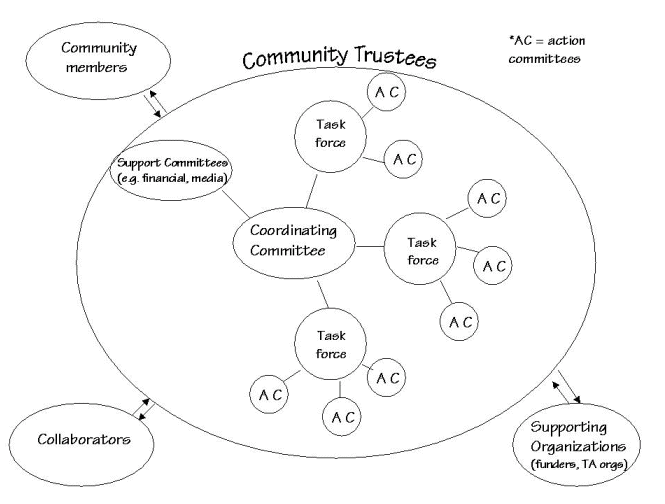
Example - The Ste. Genevieve's Children's Coalition
The Ste. Genevieve's Children's Coalition is a relatively large community-based group. They have a coordinating council, a media committee, and three task forces, dealing with adolescent pregnancy, immunization, and child hunger. Each of the task forces has action committees as well. For example, the adolescent pregnancy reduction task force has a schools committee that focuses on keeping adolescent parents in school and modifying the human sexuality curriculum. A health organizations committee focuses on increasing access and use of the youth clinic. The media committee works to keep children's issues in the news, and includes professionals from the local television stations, radio stations, newspaper, and a marketing professional. The coordinating council is composed of the executive director, her assistant, the media committee chair, and the chairs of each of the three task forces. A board of directors has been invaluable in helping keep the coalition financially viable.
In diagram form, a complex organization might look like this:
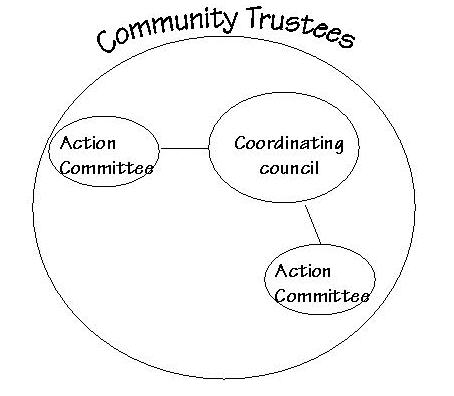
And in diagram form:
As smaller size means fewer people, these groups are usually less complex, as they have less need for a formal hierarchy and instead have governance that is consensus-based. A diagram of such a small group might look something like this, with each of the circles representing an individual member:
What type of structure should you choose?
First, decide upon the formality your organization will have. The following table, adapted from The Spirit of Coalition Building can help you make this first decision.
Conditions favoring more or less formality in organizational structures
Condition
A looser, less formal, less rule bound structure would be favored when...
A tighter, more formal, more rule-bound structure would be favored when...
Stage of organization development
The organization is just starting
The organization is in later stages of development
Prior relationships among members
Many such relationships already exist
Few such relationships already exist
Prior member experience in working together
Many such experiences have occurred
Few such experiences have occurred
Member motivation to be part of the organization
Motivation is high
Motivation is low
Number of organization tasks or issues (broadness of purpose)
There is a single task or issue
There are multiple tasks or issues
Organization size
The organization is small
The organization is large
Organization leadership
The leadership is experienced
The leadership is inexperienced
Urgency for action
There is no particular urgency to take action now
There is strong urgency to take action now
Organizational structure is something that is best decided upon internally, through a process of critical thinking and discussion by members of the group.
In your discussions, your answers to the following list of questions may guide your decisions.
What is your common purpose? How broad is it? Groups with broader purposes often have more complicated structures, complete with many layers and parts, than do groups with more narrow purposes.
Is your group advocacy oriented or service oriented? Service organizations use "top down," one-person-in-charge structure much more often than do advocacy based groups.
Is your organization more centralized (e.g., through the work of a specific agency ) or decentralized (e.g., different neighborhoods working independently on the same problem)? A decentralized group might find a "top-down" structure inappropriate, as such a group often has several peers working together on an issue.
How large is your organization? How large do you envision it becoming? A very small organization may wish to remain relatively informal, while a community-wide group might require a more formal structure. A related question, with similar consequences, is:
How large is the community in which you work?
How old is your organization? How long do you envision it lasting? A group formed to resolve a single issue might not need a formal structure at all, while an organization with long-term goals may want something more concrete, with clearer divisional responsibilities and authority.
Is the organization entirely volunteer, or are there (or will there be) paid staff? How many? An organization with many paid staff members may find it more necessary to have people "in charge," as there are generally more rules and responsibilities for paid staff members, and thus, there must be more supervision in carrying out these roles.
Should yours be a new organization, or part of an existing structure? Do you really need to form a new structure, or would it be better to work within existing structures? Sometimes, your goals may be better met if you are part of (or linked with) another organization.
In Summary
Structure is what ensures that your organization will function smoothly and as you intended. You should think about structure early in the development of your organization, but be aware that the type that fits best may change as your organization grows.
Contributor
Jenette Nagy
Resources
Online Resources
How to Develop an Organization Structure, by Tara Duggan, Demand Media, is an informational article on how to develop organization structure with a short step-by-step analysis.
This Collective Action Webinar: Collaborative Governance video, presented by Sylvia Cheuy of the Collective Impact & Community Engagement at the Tamarack Institute, offers an overview of collaborative governance principles and practical strategies for planning and sustaining backbone support.
Print Resources
Berkowitz, W., & Wolff, T. (1999). The spirit of coalition building. Washington, DC: American Public Health Association.
Unterman, I. & Davis, R. (1984). Strategic management of not-for-profit organizations: From survival to success. New York, NY: Praeger.
Checklist
mloewenstein
___You have met with other members of the organization to discuss the best structure for your organization
___You have chosen the relative formality your organization will have
___You have chosen your organization's structure, based on your understanding that:
Structure is the framework around which the group is organized
Structure gives members clear guidelines for how to proceed
Structure binds members together
Structure in any organization is inevitable
Structure should occur in proportion and parallel with other work the organization is doing
You understand that:
___Three elements of structure are
Some kind of governance
Rules by which the organization operates
Distribution of work
___Four tasks are inherent to community work:
Envisioning desired changes
Transforming the community
Planning for integration
Supporting the efforts of those working to promote change
___You've established necessary committees or subgroups based on your understanding of common roles in community organizations. These roles can be linked together for small, medium, and larger groups
A steering committee is the group of people who get things started
A coordinating council modifies broad, organization-wide objectives and strategies in response to input from individuals or committees
The executive director often takes the place of or serves at the head of the coordinating council
Task forces are made up of members who work together around broad objectives
Action committees are formed by larger organizations to bring about the changes sought by the organization
Support committees are groups that help ensure that action committees or other individuals will have the resources and opportunities necessary to realize their vision
Community trustees provide overall support, advice, and resources to organization members
Grantmakers can be public or private. They offer financial support to organizations
Support organizations are groups that offer technical assistance
Partner organizations work on the same issues as your organization
Examples
mloewenstein
Example: Interview with Brian Dawson, Community Consultant for the Ellis County, KS Community Partnership
CTB: Talk a little about the structural development of a group you have worked with.
Brian Dawson: When I worked in Mitchell County, KS, we were trying to construct a coalition to address substance use issues. There had been a lot of abuse and accidents. People were finally speaking out, saying "enough was enough." There had been a lot of denial from the community. They were not admitting they had a problem until it got to a certain level. A few attempts at addressing the problem were made.
I worked with the community members that were passionate about getting something done. We developed a steering committee. This group became the motivational force behind the developing coalition. These people had a real degree of personal interest and they started working through grass roots efforts to incorporate and recruit people to get involved. Attempts at including key leaders in the community to become part of the coalition were made.
From there, they developed an advisory board that would review information and consider how the group should act and what approach they should take. They wound up applying for a 501(c)(3) status, so they could apply for grant opportunities, funding, and operate under a not-for-profit status. They continually went back to their goals and missions and reevaluated to make sure they were doing what they intended to do, which was impact the problems of substance use.
Over a period of time they had to change or at least keep trying to encourage new people to get on board. You have to keep people interested and dedicated. Just because an accident has occurred doesn't mean you can relax. Prevention needs to be long term and continually working to improve the community.
CTB: Did you find it difficult to get other leaders involved in the organization?
Brian Dawson: That's a complex question. Yes and no. If they've got an interest in (the issue ) or if they have a political tie, the key leaders may become involved. If the community really wants someone to get involved they do have an influence in numbers. It's important to have people involved that can make change happen such as your mayor, county attorney, a judge, or somebody that's going to give you some leverage for policy changes. You need to have some people that are going to be able to make changes in that community or in your area. Otherwise, you're going to have a tough, uphill battle. So try and approach key leaders, educate them on your efforts, and get them involved at some level so that they can help you out.
CTB: You were talking about using leverage to convince them to join. What kind leverage does a new coalition have?
Statistical information is valuable to persuade attitudes and involvement. The voice of the masses can persuade a political or elected official to join the group, especially if it will help them politically to be involved. The coalition needs to do their homework to best represent the case for support. You've got to have a selling point. And you've got to have the information and the personal touch there that's going to get people involved. Otherwise, you might be just spinning your wheels.
Also, it's important to have a clear vision and mission statement on what your coalition is all about. Coalition members need to be in agreement of the vision and goals. It's okay to have different opinions, but the group on the whole has to want the same outcome.
CTB: Do you think it's more important to have key leaders as members of your initial steering committee, or are they people you want for your board later on?
Brian Dawson: It's not so important, I don't think, to have key leaders on the committee that gets everything started. But once you are established, it's important to have key leaders on the board to give it some weight. If the issues are important for the community, key leaders are typically going to be on the board or have some kind of connection. They wouldn't be in those positions if they weren't there working for the benefit of the community.
A key leader is someone who can influence individuals in your community's schools, government, law enforcement, social services, etc. A key leader's involvement is essential in providing credibility, accessing resources, removing barriers and supporting community prevention efforts.
CTB: Do you have any advice for others working on organizational structure?
Brian Dawson: Really think about what you want to accomplish, develop a vision, and try to develop from there. It's helpful to have an advisory board to steer the coalition, legal counsel is helpful (maybe an attorney can get on the coalition board), by-laws, mission statements, and a consensus from the group to reach certain goals. Define success for your coalition so you will be able to monitor your efforts. You can develop subcommittees to work on the grassroots efforts of recruiting people and funding.
Section 2. Creating and Gathering a Group to Guide Your Initiative
mloewenstein
Main Section
mloewenstein
Adolescent violence, HIV infection, adult literacy, or any situation in your town that has reached a point where you've decided something has to be done are all times when you might have to create and gather a group to guide your initiative. You know you can't be effective all by yourself, so you want to try to put together a group to look at the problem, come up with some ideas about what can be done about it, and then create and implement an action plan to move forward.
But what would that group look like? Who would its members be, and where would you find them? How would it function? What would it actually do? This section will help you think about how to actually form such a group that can start and oversee an initiative designed to meet a community need.
Why would you want to create and gather a group to guide your initiative?
Assembling a group to guide the organization or initiative in its beginning stages has some distinct advantages over trying to do the same thing as an individual:
It lends credibility and community support to the effort. Especially if the group is diverse, and represents a number of different organizations, interests, and parts of the community, it essentially gives the community a sense of ownership of the organization or initiative. This makes it much more likely that it will continue to have the community's enthusiastic support, even long after the group has been disbanded.
It allows more ideas to come into play. Two heads are often better than one, and ten are better than two, although sometimes harder to reconcile. While it can be a lot of work to sort out the different ideas of many group members, the consensus you come to is likely to be more interesting and effective than what you could have developed alone.
It affords an opportunity to educate the community about the issue. Everyone 's in favor of adult literacy, for instance, but very few - including staff people of health and human service agencies - understand how many adults need literacy services. As members of an oversight group for a community literacy initiative, however, they 'll have the opportunity to learn a great deal about the issue and the actual potential for addressing it. And they'll spread the word as they learn.
It gives new organizations and initiatives the benefit of others' experience. Even if the oversight group is largely made up of individuals from the community rather than agencies and organizations, many of those people may have founded their own businesses, started other organizations, been on community Boards, etc. Both these individuals and those who work for other organizations will have valuable knowledge and experience that can save your organization or initiative enormous amounts of time and trouble.
It provides a base for membership, fundraising, and other support. Each of the people in the group will know literally hundreds of others - far more than you would have any chance of contacting on your own - and many of those others will be only too willing to help if only they are asked. The networking possibilities are endless.
It provides personal support to its members and to the people who started the initiative in the first place. This kind of support can be extremely important when things look bleak... and they will, at least occasionally, in any community initiative.
When starting a new organization, you'll often find that the people involved don 't know each other well enough yet to really know who might make the best leaders. Yet there is still a lot of work to be done in laying the groundwork for this new entity. Forming a group is a way to get some of these important things done before figuring out what the ultimate governing structure will be:
Deciding the initial direction of the organization
Forming a vision and mission for the organization
Determining and recruiting potential partners
Creating an action plan
Choosing people to head individual committees and be in charge of specific tasks
A group is also useful when your organization has started working on many tasks, but doesn't yet have - or will never have - a staff. The group may act as a substitute for an individual coordinator or director, either of an organization or initiative, or of an event or particular area of an organization's functioning.
What kinds of groups might foster the development of an initiative?
This question really has two sets of answers. The first depends on whether the group is one of individuals or a coalition of organizations; and the second involves the different ways such groups can function. Let's start by examining whether, for your particular purposes, you're more likely to put together a group of individuals or one of organizations.
Ways groups can be formed
Organizations and initiatives get started in a number of ways, and the nature of the groups that guide them is usually determined by how they originate.
One person sees a problem in her community and decides to do something about it. In this instance, the group assembled is often a group of individuals - typically friends or acquaintances of the initiator - who either have some personal reason to be concerned, or are simply community-minded and interested in the issue.
When her teen-age son was beaten up on the way home from school, a woman in a small town decided that adolescent violence needed to be dealt with. She put up posters, made phone calls, and gathered 35 parents and adolescents at an initial meeting to discuss the issue. Out of this first meeting grew a community initiative that involved both parents and adolescents in discussions, workshops, and theater performances. With help from a local agency, the group got a grant, and continues - successfully - to try to reduce adolescent violence in the town.
An organization, community institution (a church, for instance), or local government agency takes the lead in tackling a community issue. In this kind of situation, the group formed is likely to be a coalition with a mixed membership of representatives of organizations and individuals representing only themselves.
An organization decides to write a proposal for available funding to deal with an issue that requires a group response. The group assembled in a case like this is generally by definition a coalition of other groups, but may include individuals from the community as well.
A community action agency responded to a request for proposals (RFP) from the state Department of Education for a community effort to serve families experiencing increased risk of children under four. A stipulation of the RFP was that the proposal be agreed upon by a coordinating body for the effort. A group representing community health and human service agencies, parents, schools, and others was assembled by the community action agency, and, when the proposal was successful, became the oversight body for the initiative.
A coalition that already exists identifies a problem and resolves to address it. Here, the coalition is the group that begins the process. It may remain the group that spearheads the initiative, or, as in this example, it may spin off a group that ultimately takes charge.
The North Quabbin Community Coalition in central Massachusetts is made up of representatives of health and human service agencies, the Chamber of Commerce, the police, the schools, local politicians, and other interested community members. Appalled by the high incidence of child sexual maltreatment in the area, the Coalition formed a Child Sexual Assault Task Force which launched a community initiative to try to change the situation. The initiative in turn grew into an organization that provides parenting training and children's activities, and has become a permanent fixture in the community.
While both organizations and individuals have their own priorities and interests, organizational rules and politics add other elements into the mix. A group of organizations needs to function differently than a group of individuals does, because it has to take everyone's organizational issues into account. The simple matter of whether or not people are on the clock when they attend group meetings can affect how the group operates, as can the concerns of Boards, the requirements of different organizations' funders, and the organizations' mission statements. All that has to be considered when you look at how the group might function.
Ways your group can function
Groups that oversee initiatives go by a number of names which are often used interchangeably. As a result, the descriptions below may not fit your own experience. These names, nonetheless, imply different ways of operating, and it would make sense to think about what might work best in your situation.
Steering committee
A steering committee, as the name implies, steers the organization or initiative at the beginning. The committee develops action plans, considers the political and other implications of what the organization or initiative is doing, and may develop vision and mission statements and organizational structure, and create plans for funding and Board development. As is explained in Section 1 of this chapter, however, steering committees, at least in the definition used in the Tool Box, are meant to dissolve once the initial work is done. If they continue to meet after the first six months or so, then they have become a coordinating council.
Coordinating council
A coordinating council often does many of the same things as a steering committee, but also coordinates the organization's or initiative's activity. It essentially takes the place of a director or program coordinator, modifying broad, organization-wide objectives and strategies in response to input from individuals or committees. If the organization or initiative stages a public demonstration, for instance, the members of the coordinating council would be the ones running around making sure that everyone knew where they were supposed to be when, that the media was informed and courted, that the portable toilets were in place, etc. If you think of an organization as a wheel, the coordinating council is the hub holding everything together. The hub collects and directs the energy from the spokes - and without it, the wheel would fall apart.
Advisory or supporting committee (or council or board)
An advisory committee may have no real power at all, but may guide the organization or initiative through its members' knowledge of the community and the issue, and may lend its members' prestige to the cause when necessary. It may help to develop a vision and mission for the organization, but will probably not be the determining body in that effort. Advisory committees often exist in situations where the initiative is really the work of one charismatic or visionary individual who needs help and support, but doesn't particularly want guidance.
Board of Directors
In this instance, the group will function as the governing (but probably not coordinating) body for the organization. A board of directors usually works with staff to set policy for and oversee the functioning of an organization.
Other possibilities
There are numerous other forms that a group might take. A core group, for instance, might assemble a larger group that ultimately takes one of the forms listed above. An executive committee might make decisions for a larger group, and thus effectively guide the initiative. There is no one right way to start a community initiative or organization.
If you're hoping to hire staff eventually, a steering committee might work best for you, since it won't need to guide the organization for very long. If you're starting a community initiative or coalition that probably won't ever have staff, a coordinating council might make more sense, since it will provide continuity as well as the capacity to form and direct the group from the beginning. A Board of Directors is most appropriate for an organization that already has a sense of itself. The main consideration is what will be most effective for the organization or initiative you're starting.
As you decide what kind of group will serve your organization or initiative best, you need to consider the needs and priorities of the organizations and individuals involved; the degree of involvement you're asking for; the amount of time group members will need to put in; and what the group is actually going to do. These factors will be discussed further in the course of this section.
When in the process should the group be formed?
The group, if it is to be most useful, should be formed as early in the process as possible. You want it in place, for instance, so its members can participate in developing a vision and mission. You're far less likely to find support - and far less likely to form an effective organization or initiative - if you present a potential oversight group with an already-formed organization or initiative. Furthermore, it's much harder to change your ideas, even if it becomes obvious that they're unworkable, once you have them set in a plan. Recruiting a group at the beginning will help avoid this kind of issue.
Another reason for recruiting your group early is that it allows your organization or initiative to hit the ground running once your plan is in place. As mentioned above, the group can act as coordinator either until you hire staff (which, depending upon where funding enters into the equation, may be a while), or - in the case of many community initiatives which operate without staff - permanently.
Who should be involved, and where do you find them?
For your group, you'll want enough people to get everything done, but not so many as to make things too complicated. Those numbers can vary tremendously - there are effective groups of 10 or fewer, and of as many as 30 or more. Here are a few general guidelines about the type of people to involve:
People who are enthusiastic about the issue and who have the time and energy to invest in making it successful
It's important to involve people who will be able to regularly attend meetings and be involved. For some types of bodies, such as advisory councils, this may be less important, but for the work done by steering committees and coordinating councils you'll want people who are willing to roll up their sleeves and jump in.
A good cross-section of the community in terms of race, socioeconomic status, etc.
Members of the specific priority community
Other obvious stakeholders in the issue. If your initiative is meant to reduce substance use, for instance, you may want to include the police in your group, since they're the ones who often deal with the problem on the street.
Recognized leaders in the community can add clout and credibility to your cause
Newer, up-and-coming leaders and people who hold no titles but are well respected in the community can also be very helpful
Unless they gave the issue a bad name, be sure to consult and perhaps involve people who've had experience with your cause in this community in the past
In situations like this, you have to do your history homework. If you're trying to start an organization to offer services to people experiencing homelessness, for instance, it's vital to know what has been attempted along these lines in the past, and what the result was. If the experience left a bad taste in people's mouths, you're going to have a much tougher time. You need to know that, and to counter it as best you can. If the people who were involved in the past attempt are respected for what they did, then they should be involved in what you're doing. If the community thinks that they made a mess of the whole thing, or that they're dishonest, their participation will make your effort look like more of the same. Those who don't learn history are condemned to repeat it.
Try to get some youth involved; they often have a fresh perspective on things and tons of infectious energy.
Be sure that at least one person on board is a good writer, and that they, or at least one other member, have had some experience with funding proposals; they will be instrumental in writing early grant proposals, press releases, and so on.
It's crucial to be aware that some people you want to include may have less experience being members of groups, and of this type of group than others. Although 'meeting skills' may seem basic, not everyone has the same background, and some people may never have been exposed to that type of situation. Thus, some participants may sit silent, confused by the flow of the meeting, unable to contribute, and feeling foolish; or they may speak or act in ways or at times others deem inappropriate. People without meeting skills need support and encouragement in what is often for them an intimidating situation. One answer may be to pair all team members, so that those who need support will have a mentor. Another possibility is to start the process with a training for everyone in group dynamics and meeting skills, so that no one is singled out and the ground rules are clear for all.
Where can you find these folks? Consider these possibilities to look for steering committee or coordinating council members:
Local colleges or universities, schools, and libraries
Local government officials and agencies
Economic development organizations
Civic organizations
Social and sports clubs and community centers, especially in neighborhoods you particularly want to reach
Chamber of Commerce and other business organizations
Social service agencies
Youth groups and organizations
Churches and other organizations in the faith community
Flyers in laundromats, markets, etc. that cater to the priority population or to others you specifically want to reach
As you begin your search - or perhaps even before - you'll meet, or realize you know, people who will introduce you to others who will introduce you to others. Networking is, in reality, probably the way you'll find most of your group.
What should your steering committee or coordinating council do?
Now that you've formed a group to oversee the creation and operation of your new organization or initiative, what will it actually do? In fact, there's an enormous amount of work to do in getting something new off the ground, and, depending upon how things play out, this group may do most of it. A not-necessarily-exhaustive list might include:
Form a vision and mission for the organization. This is the first step in any process of this sort. It defines what it is the organization or initiative exists to address, and what its philosophical, political, and ethical base consists of. You can't go anywhere until you've hashed those things out, and it's worth the time it takes. (And it will take time: how much depends to some extent on how diverse the group is.) This will probably be the most important task this group takes on.
Decide the initial direction of the organization. What's the organization or initiative about? The fact that you have a vision and a mission statement doesn't mean you know exactly what to do to carry them out. The direction of the organization is the way you'll address the issue, and there may be many choices. One of the most important is whether to create an organization that will run intervention programs of some sort for a priority population, or whether to concentrate on advocacy, public education, linkage, or some other effort that addresses the issue, but doesn't offer direct service to those affected.
Create an action plan. After deciding what your organization or initiative is going to do, the next step is to determine how to do it. The first action plan may not actually lay out how the organization will operate, but rather how to get it started. If you're going to operate an intervention program, you need funding, staff, space, equipment, etc. If you're going to concentrate on advocacy, you may need only volunteers and communication capability, or your group may already be ready to go. In either case, you're going to need a plan for what to do next.
Although it may seem early to consider this, during planning is the time to start thinking about whether your group is going to be a permanent part of the initiative, or if it's going to disband at some point when a different permanent structure is in place. The decision of whether to dissolve the group or to keep it running the organization depends upon the financial, political, and personal realities of the situation, the dedication of the oversight group, and the actual needs of the organization or initiative and of the community. Many groups begin with the assumption that they 'll dissolve, and in fact this decision - whatever it is - should be part of the action plan. It avoids a great deal of potential trouble if the group makes the decision early in the process.
Find partners for the organization. If the founding group is a coalition of organizations, this task may have already been accomplished. If not, let the networking begin!
Establish and oversee sub-committees (budget, planning, organizational, marketing, etc.) if that seems necessary to carry out the tasks of the group.
Hire staff, if that's part of the plan.
Plan and coordinate the activities of the organization or initiative, if hiring staff isn't part of the plan.
Whether or not to hire staff is obviously a crucial decision for an organization or initiative. The reality of nitty-gritty issues like money and the availability of people's time will enter into the decision, as will the question of what tasks really need to be accomplished. If the group is purely an advocacy organization, for instance, it may be able to operate quite effectively with just the efforts - probably considerable - of the oversight group. If it's trying to deliver services, it may need some staff and some sort of at least part-time regular coordination.
Apply for grants and seek other funding for seed money for the organization or initiative. (This may be the job of staff after they're hired, or the group may take it on itself.)
Put together a Board for the organization or initiative. This task may also devolve upon staff if there is a staff. It also implies that the oversight group will disband at the point that a Board exists.
In Summary
It often makes sense, in founding a new organization or initiative, to put together (if one doesn't already exist), a group to oversee its development and at least its initial operation. It's important to select, early in the process, a group that includes the important stakeholders and key supporters and is representative of the diversity of the community. That group's involvement in the creation of the organization and in planning what it will do can greatly increase its chances of success.
Leuci, M. (1997). Getting started: Forming a steering committee. Missouri Express resource guides.
Checklist
mloewenstein
Why should you form a group?
___Support of a cause
___More ideas
___Community involvement
___Personal support
When should you form a group?
___As early in the process as possible
What kind of people should you include in your group?
___Enthusiastic people
___Young
___Natural leaders
___Regular attendees of meetings
___Good writers
___Experienced people
What should your steering committee or coordinating council do?
___Create the mission and vision statements of the group
___Create a plan a action
___Create organizational structures
___Choose leaders for tasks
___Designate Board of Directors duties
___Designate advisory support committee duties
Examples
mloewenstein
Example: Northeast Coalition Steering Committee
Harry Schwartz is a consultant to the steering committee for the Northeast Coalition, a coalition that has been started to improve and develop the Northeast neighborhood of Kansas City, Kansas. Schwartz has been helping them organize the coalition and steering committee and undertake their first activities.
The steering committee came about following a report that suggested that the neighborhood should be represented by an umbrella group that would advocate for the needs of local citizens and groups. In the next few months, the steering committee will be transformed into a board.
"What we have right now is a very loose association," Schwartz says of the steering committee. "The committee is now made up of representatives of groups in the neighborhood...each member of the committee represents a different group. It's casual, informal, and loose. There's not even a chair, and things are decided without votes but a consensus."
When the coalition becomes legally incorporated, Schwartz says, "they will have to have a board, officers, and bylaws... Right now, it's just some people getting together every few weeks to discuss an issue, except they have a very specific agenda. It's worked, but it's been just informal without any officers or votes or things like that."
The Local Initiatives Support Corporation, one of the groups that released the abovementioned report, called a meeting to which all the groups that they could find in the neighborhood were invited. "About sixty people came, and we broke up into five subgroups. These are people that are already active representing groups. They all had some base in the community. The discussion revolved around what should priorities be for action in the northeast, and people took notes. We got a pretty good agenda for what people were concerned about. Many people didn't know each other, and we mixed them up so we would minimize friends. There were two people from the same group; they were at different tables. So we got a pretty good mix of people. Many of them didn?t know each other before that. And, then, after spending about an hour together, we asked each table to put forth two people for the steering committee, and that's how we got the committee."
Schwartz says the committee members have worked together well so far, and that everyone agreed the process was fair. "We got a very good mix of people from different groups. We've had subsequent general meetings, and people have felt that the committee has been very representative, fair, and inclusive and has talked about the major issues... No one has said, 'You didn't include me,' because the general meetings are open. So the process up to now has been well endorsed, and we hope to continue in that way."
General meetings of the Northeast Coalition steering committee are held every three months and are anyone who wants to come. "Generally, we've had about 55 or 60 people at each meeting probably representing twenty-five to thirty groups," Schwartz says. "There seems to be a lot of agreement as to what the priorities should be for action in the northeast," he adds. The steering committee is focusing on economic development, housing, and "what people generally refer to as communication, which mean a lot of things - finding out the availability of information on all the groups, groups working together, being able to help each other." The group also wants to focus on the needs of younger people, including jobs, school improvements, and safe after-school activities.
According to Schwartz, the following are qualities to look for in a steering committee member:
People who have experience in the neighborhood or area being covered, either as a resident or a businessperson or someone who works for an agency there
People who have had a leadership experience before in local groups
People who are committed to taking the steering committee as a serious responsibility
People who are familiar with local issues
People who are articulate
People who are able to work in a collaborative spirit
People with a sense of vision and imagination for the neighborhood or area
People who are mature and well-seasoned
People with a variety of different points of view - you don't want everybody representing the same types of interests
Tools
mgrove
Tool 1: Steering Committee and Working Group Member Roles
Section 3. Developing Multisector Task Forces or Action Committees for the Initiative
mloewenstein
Main Section
mloewenstein
Creating a task force or an action committee can be an effective way for your initiative to address a specific problem. Such a body needs to be directed specifically toward acting on that problem, and to involve all of the different sectors of the community that are affecting it or affected by it. In this section, we'll discuss what task forces and action committees might look like, what they do, and how to put them together and use them to shape your initiative.
What is a multisector task force or action committee?
A task force or action committee (also sometimes called an ad hoc committee from the Latin meaning "for this purpose") is a group assembled to address a specific problem or accomplish a specific goal. That problem or goal can take at least two different forms:
It might be related to dealing with a specific community issue - affordable housing, child maltreatment, early detection and treatment of breast cancer.
It might stem from a need of the larger group. A coalition might need a smaller group to focus on advocacy, for instance, or to draft a set of bylaws.
A multisector task force or action committee is drawn from all sectors of the community affected by or involved in the problem or goal that is the group 's focus. In the Peterson Community example, for instance, the task force leaders tried to include representatives of every group they could think of that had anything to do with the problem of adolescent prescription drug misuse.
Task forces and action committees, as you might assume from their names, are action -oriented. Their specific purpose is to do something. Depending upon the issue they address, their initial goals may be very specific (find community shelter space for at least 15 families experiencing homelessness; draft a timeline for a community economic development effort) or more general (address the problem of youth violence). In either case, however, their purpose is to come up with real results.
In general, these groups are not meant to be permanent. They either disband when their task is done, or they become another kind of group. As will be discussed in more detail later, a task force might spin off a new community intervention, for instance. While that venture would continue the work of the task force, it might not involve any of the first group's members, and would have a different purpose and structure.
A task force or action committee is usually part of a larger initiative - a community coalition of some sort, a local or other government committee, etc. It may be one of several such groups spawned by the initiative, each aimed at a different issue or goal. It may operate independently, or may have to gain approval from the larger group before taking any action.
The North Quabbin Community Coalition, in north central Massachusetts, regularly maintains several task forces working on specific community issues. Some former and current task forces include Information and Referral, Child Sexual Assault, Homelessness, and Youth-Community Relations.
Why would you form a multisector task force or action committee?
There are really two questions here, each of which we'll consider separately:
Why would you form a task force or action committee?
Why should a task force or action committee be a multisector group?
Why form a task force or action committee?
There are a number of reasons why you might want to form a task force or action committee, rather than addressing the issue at hand within the larger group.
Task forces or action committees can make it possible for their parent groups to zero in on the areas that need the most, or immediate, attention, while still addressing their other concerns.
A task force or action committee can focus in on the specific issue, rather than being pulled in a number of directions, as the larger group may be.
In general, a small group can operate more efficiently than a large one to get things done.
Task forces and action committees give people a chance to concentrate on their major areas of interest, and to contribute more effectively to the work of the larger group.
Task forces and action committees can pull in members who may not be interested in the larger group to work on just the particular issue they are interested in. The community thus benefits from their talents and expertise even though they aren't members of the larger group.
Why should a task force or action committee be multisector?
Including people from as many sectors of the community as possible is almost always both more ethical and more effective than excluding them. This is particularly true when assembling task forces or action committees that are aimed at accomplishing specific goals in a community.
Advantages of a multisector task force or action committee
Community action usually requires the support, and often the participation, of all stakeholders if it's to be successful.
"Stakeholders" is a term used throughout the Tool Box. It refers to those who are directly affected or have some other interest in a particular issue. The stakeholders in a discussion of discrimination in housing, for instance, include not only the members of underrepresented groups that experience discrimination, but also anti-discrimination enforcement agencies, housing authorities, realtors and their employees, landlords, the police (who may get the first call on a discrimination complaint), legal service agencies, and even homeowners in a particular neighborhood (who may have strong feelings - and not necessarily much information - about including or excluding people from underrepresented groups, and what that will mean for their property values).
Involvement of all stakeholders in planning and carrying out any action means that they'll take ownership of those plans and actions. They'll be much more concerned about making sure that the action is successful because it's theirs, rather than something imposed on them by "experts" or some other authority.
Involvement of many sectors of the community brings with it the information and insights that those different sectors have into the issue. More information and insight lead to better planning and more chance of successful action.
The perspectives of various sectors on community history and personalities can help the group to a real understanding of the issue, including the vital small things that might be otherwise ignored. (Whether or not two individuals get along well may determine whether a given plan is workable, for example. Neighborhood people, who are familiar with the personalities involved, are more apt to know that sort of thing than, say, health professionals.)
Involving many sectors in the task force or action committee will generate community cooperation and support for the action taken.
Multisector participation benefits the larger initiative and the community as well, because it brings together individuals and groups who might not, under other circumstances, have much contact, or who might distrust one another. In the work of the task force or action committee, they have the opportunity to learn about one another, and develop mutual trust and respect.
Finally, it's simply fair and reasonable to involve people in decisions which affect their lives. Those decisions are likely to address the issue more realistically, and to take into account the legitimate needs of the groups affected, if those groups are involved in planning and implementing them.
Possible disadvantages of a multisector group
Although there are many compelling reasons for forming multisector groups, there are potential difficulties with them as well. Even if you understand the history and current situation of your community before you start to assemble such a group, there are still problems you may run into.
There may be enmity and distrust among segments of the community that are normally at odds, or who have little contact. Some of these may be obvious - racial or ethnic tensions, intergenerational conflict - but some may not, or may be one-sided. People with lower incomes may distrust members of more affluent groups, for instance, even if the latter have good intentions and are trying to be open and welcoming. Politicians who are genuinely concerned with solving the problem may nonetheless be objects of suspicion. Academics may scorn business people, or vice-versa. These areas of conflict have to be resolved if the group is to function well.
There may be deep-seated disagreement about how to handle the issue. Police may see the answer to a drug problem as more rigorous enforcement, while medical professionals see it as one of treatment, and human service providers as one of addressing the underlying causes - poverty, hopelessness, unemployment, child maltreatment, education, etc.
The simple answer in a situation like this would seem to be "all of the above." If you strengthen enforcement, mandate treatment, and address the underlying causes, you'll make some headway. While that is probably true, you should also consider here the availability of resources and loss of focus.
In order to address enforcement, treatment, and underlying causes all at once, you'll need money and personnel time from a number of different sources. In addition, if you try to focus on all three areas (and each is a tall order even by itself), you risk diluting and scattering your efforts to the point where you can't be effective at anything. Task forces or action committees usually are most successful when their goals are clear, well-defined, and well-focused.
All of that leaves your group with having to somehow reconcile different views of the world and of the issue at hand. It's not impossible, given good will on all hands...but it's not easy, either. It takes good leadership, something we'll look at later in this section.
Different individuals or groups may have very different levels of commitment to the work of the task force or action committee. This can lead to problems in a relatively small group where everyone depends on everyone else to carry out assignments.
There may be differences in levels of sophistication, education, and "group skills" among members of the group from different sectors of the community. In order to ensure that everyone's capacities are tapped, some folks may need support, encouragement, and mentoring or training in order to feel comfortable participating.
This situation can either be seen as a potential problem or as a potential advantage, because, while it obviously can act to the detriment of the group if not handled well, it also provides the opportunity to develop leadership from within the community.
When would you form a multisector task force or action committee?
Some issues can be addressed within the context of a larger initiative, or by simply finding more resources for existing organizations or services. When can a multisector task force or action committee best address an issue? Here are some possibilities:
When the initiative as a whole identifies a specific issue, within its larger mission, that needs to be attended to. This might, as described earlier, be a community problem, such as substance use, or it might be an internal need of the initiative - advocacy, recruitment of new members, etc. In either case, the issue is important for the initiative to address, but too specific for the whole group to work on.
When new information points out something in the community that can't be ignored.
The North Quabbin Community Coalition referred to earlier found, in the late 1980s, that one town in the region, with a population of just over 10,000, had the third highest number of child sexual assault cases for Massachusetts communities. It was clear that action needed to be taken as quickly as possible, and the Coalition immediately formed a Child Sexual Assault Task Force, which included the police, all the relevant human service and state child protective agencies, parents, the schools, the local hospital and community health center, the YMCA, and other interested parties.
When an existing task force or action committee realizes its work can't be completed without addressing another area related to its own focus.
A Child Sexual Assault Task Force like that above, for instance, may find that a huge percentage of child sexual assault cases are alcohol-related (as the North Quabbin Task Force in fact found). The initiative might then, at the Task Force's urging, form another task force to address harmful alcohol use in the community.
When a difficult situation or critical action by an external entity makes attention to a particular issue suddenly more important. If the state cuts health funding for your community, for instance, your initiative might want to form an advocacy task force to mobilize a local effort to get it restored.
When a group within a larger initiative sees an issue that it particularly wants to concentrate on. If the driving force for the task force or action committee comes from many of its potential members, it is likely that they will be focused and hard-working, and that their efforts will be effective.
There can be a problem here if the issue is not one that particularly needs attention. The energy of those in the self-propelled task force or action committee is then diverted from more important concerns. Leaders of the larger group might try - diplomatically - to turn the task force in a more appropriate direction.
Who might be part of a multisector task force or action committee?
The short answer to who might join a multisector task force or action committee is just about anyone. Here are some considerations when you're recruiting:
Seek members who aren't part of the larger group that the task force or action committee is part of. The only criteria for membership are their interest in the issue, and their willingness to work on it. You can recruit friends and neighbors, program participants, politicians - anyone who can help.
Look for stakeholders and other interested parties. Stakeholders might include:
Those directly affected by the issue
Priority populations
Those who work with those directly affected
Those responsible for the issue in the community. If the issue involves the law, for instance, as in the case of substance use disorder, the police and court personnel would be appropriate task force members
Those affected indirectly or secondarily. Businesses are affected by low literacy rates in a community, for instance, because they can't find workers with the skills they need
Interested community members may have no specific stake in the issue, but may see it as a community problem, and therefore something they should be concerned about
Look for people who can be helpful to the effort. These folks may not be stakeholders, but may be able to offer support and credibility, as well as resources.
Some possibilities:
Business leaders.
Clergy and other leaders of the faith community
Local or state officials
People who may hold no official position, but who have high standing in the community
People with access to money or other resources
People with access to power
People with access to the priority population
Look to engage people from different sectors. Some examples of different community sectors include:
Youth
Older adults
Business community
Media
Schools
Youth-serving organizations
Law enforcement agencies
Religious or fraternal organizations
Civic and volunteer groups
Healthcare professionals
State, local, or tribal governmental agencies
Community organizations
Ultimately, a cross section of the community on your task force or action committee means more access to different sectors of the community, more credibility among those sectors, more and better information, and more chance of community support and eventual success.
How do you develop a multisector task force or action committee?
If you do decide that you need a task force or action committee to work on an issue for your initiative, what do you do next? In order to put a group together and get it working, there are a number of steps you should take. These steps are essentially the same as those a larger group might take in defining its goals and actions.
Define the relationship of your task force or action committee to the larger group
How are you going to operate within the context of the initiative? There is a broad range of options here, from complete independence to having to check back before taking any step at all.
Three common models:
The task force or action committee operates independently. In this situation, the larger group delegates authority for the issue in question to the task force that's working on it. It may come back to the initiative for help, support, or resources, or to report on its progress, but the decisions about how to proceed are its own.
The task force operates fairly independently, but reports back to the larger group on a regular basis. It doesn't need approval to do most things, but can 't commit the initiative to anything, or act in its name, without an official okay.
The task force needs permission to take any action steps at all. Operating this way, it would probably formulate a plan and get it approved by the larger group. Then, it would have to check with the larger group only if the plan changed.
Decide beforehand exactly what the task force can do on its own, what it needs approval for, and who can give that official okay. In the case of a coalition, for instance, permission might come from the coordinator, a steering committee, an executive board, or a vote of the whole membership.
Once a decision is made about how task forces will operate, that decision will usually hold for all future task forces and action committees of the initiative as well, unless there's a need for something different in a particular circumstance.
In general, the more independent the task force, the more effective it is likely to be, since there may be times when it needs to move quickly. But, at the same time, the more informed the larger group is, the more likely it is to be supportive and available for help when needed. One reasonable way to incorporate both independence and the involvement of the larger group is to create a mechanism for checking back with the group that still allows for speed when necessary. This might mean clearing action with one or two people, or with a small executive committee.
Find the right people to lead your task force or action committee
The person(s) you choose need(s) two characteristics:
Have, or be able to establish, credibility with all sectors of the population that you need to draw from. (This may mean that the person is an outsider, or a neutral party with no connection to any specific group; or maybe simply someone who's known throughout the community for fairness and integrity, or liked by everyone.)
Be a good facilitator, who can deal with conflict and keep group members on track and all headed in the same direction.
Given these attributes, some potential leaders might be:
The coalition or initiative coordinator
The person(s) most concerned with, or with the most credibility on the issue
The person(s) who can best articulate the task ahead and see the process for accomplishing it
A group representing several sectors of the community
The task force or action committee may be led collaboratively by all its members (you'll still need a facilitator, but that person may change from meeting to meeting)
Identify individuals or groups whose participation your task force can't do without
The questions to ask here are:
Who are the actual stakeholders in this issue?
Who are the policymakers, powerbrokers, and others whose permission, support, or membership is necessary to get anything done?
Who will actually carry out any changes or reforms that your task force succeeds in establishing?
Make an actual list, with both individual names and - if you can't identify an individual - names of groups or sectors of the community who need to be involved. Ask other members of the initiative, contacts in the community, and anyone else you know to help you identify specific people to contact wherever you can.
There are some people whose direct participation is crucial. But there are others who would be ideal as well, even though they may not be absolutely necessary to success. Remember the list above of people who can be helpful.
Use your list and your contacts to get in touch with people. Many may be people already involved with the initiative, but many may not. Where you have an individual listed as the best representative of a particular group or segment of the community, it might help to have second and third choices from that group as well. In addition, people who may not be able to become members themselves will have ideas about others who would be good additions to your task force. Don't hesitate to ask them for names.
The best method of recruiting people is always personally. An ideal is for the first contact to be from someone the person already knows, but a "cold call" - a personal visit or phone call made to someone you don't know - is still better than an e-mail or a letter.
Gather the group and define its purpose
The issue is already a given, but how are you going to approach it, and what are you going to do about it? Some task forces or action committees are convened to study an issue, others to affect it indirectly, still others to take immediate and direct action. Members need to decide what they're going to do. One model for achieving this assumes that the task force works together as a group to plan its course of action:
The model below assumes also that someone acts as facilitator to guide the group through the process. It is aimed at a group whose purpose is to address a community issue - youth violence, homelessness, etc. A task force or action committee that has a very specific purpose, such as drafting bylaws, won't need to go through this whole process.
Define the problem or issue clearly.
Envision the ideal solution - what do you want things to look like or be like when your work is done?
Start with the solution and work backward. What things need to happen to get from where you are now to the solution you've envisioned?
Map out benchmarks - achievements along the way - between where you are now and where you want to be.
Brainstorm or otherwise determine ways to reach each benchmark from the one before, and to reach your final goal.
Identify whether your plan means that other issues have to be addressed as well (not necessarily by this group), or whether other people must be included, and decide how to deal with those realities.
Identify the resources you'll need to get to each benchmark, and decide - realistically - how much you can obtain. Adjust your actual goals accordingly.
Draft a plan based on what you've come up with. It should include a timeline for when you expect to reach each benchmark, and when you expect to reach your final goal.
Always be aware that a plan like this is a guideline. Everything always takes longer than you expect or want it to. The purpose here is to give yourself and the initiative some idea of what you're doing and how long it might take. Not only your timeline, but your plan itself will change. If it's a good plan to begin with, its major elements may survive reality, but much will be different by the time you reach your goal. The flexibility to adjust to changes in circumstances and to things you didn't anticipate or know about should be part of any plan.
Present your plan to the larger group. Even if you have the latitude to act independently, it will help to hear what others think. It will also help both you and the initiative as a whole if everyone knows what's happening, especially if you need help from other task forces or members of the initiative.
At this point, you've actually developed your task force or action committee, and set it on its way. Your work has hardly begun, however. There are still a number of steps before you're ready to hang up your task force hat for good. We'll discuss them briefly.
Implement your plan
Take action to reach your benchmarks and your ultimate goal.
Evaluate and adjust your plan and your actions
As mentioned in the box above, no plan is perfect. That is why it is important to evaluate plans, programs, and processes regularly. These evaluations give you a chance to see what's working well, what needs to be changed, and what assumptions are in error or outdated. Most important, evaluation makes it possible to adjust and improve what you're doing.
Celebrate successes along the way
Celebrate reaching benchmarks with parties or formal ceremonies. Give awards to task force members, community volunteers, and anyone else who deserves them. Advertise your successes to your colleagues, and use the media to tell the community about them.
Celebration keeps people going, and reminds them why they're putting in all that time. It creates way stations so that the road to success doesn't seem all that long. It makes people feel good about themselves and what they're doing, and reminds the community that you're there.
Find a way to institutionalize whatever is necessary to continue to address the issue
Task forces and action committees usually disband once they've accomplished their purposes. But public health and community issues have a habit of never being "resolved." As long as you keep working at addressing them, you can keep things flowing smoothly. But once you turn your back, there are those issues again, just waiting for you to leave so they can surface.
There are a some ways that a task force or action committee can make sure that its issues continue to be addressed:
The task force's work may be spun off into a new program or agency
For example, the North Quabbin's Child Sexual Assault Task Force eventually spawned Valuing Our Children, an independent organization that conducts various programs for children and adolescents, offers parenting classes and other support services for parents, and runs family activities to encourage parents and their children to have fun together.
The implementation of the task force's plans or goals may be taken over by an existing agency
The initiative as a whole may assume oversight of the task force's work, and institutionalize it in the community
Reaching your goal is only the first part of your task force's job. Only when the strategies for maintaining that goal have become institutionalized is your job done.
In Summary
Your initiative may need to develop multisector task forces or action committees to focus in on specific community issues or particular needs of the initiative itself. A task force or action committee is a group intended to take action; multisector refers to the group's membership, which is drawn from all sectors of the community, or all sectors that are concerned with the issue at hand.
Multisector task forces or action committees help a larger initiative focus in on specific issues, and do something about them. They can be more efficient than the larger group, and can let people concentrate on the issues that interest them. The fact that their membership is drawn from many segments of the community gives their work and that of the initiative credibility among various groups, gives those groups ownership of their plans and actions, gains their support, and leaves them feeling that they've been justifiably involved in dealing with issues that are important to them.
Multisector task forces and action committees are particularly useful when issues reach crisis proportions, or are heading in that direction; when new information identifies a hitherto unrecognized problem in the community; when an outside entity precipitates a crisis through its actions; or when a group sees a particular issue it wants to tackle. Membership, besides bridging cultural, class, ethnic, and other community boundaries, usually should include representatives of all stakeholders to the issue, people with access to policy making, and others in the community who are interested in and can be helpful to the effort.
The process of developing a multisector task force or action committee should include:
Defining the relationship of the task force and the larger initiative
Choosing good leadership
Listing potential members
Recruiting members
Convening the group and articulating its purpose
Once the groundwork is done, the work of the task force encompasses:
Implementing the action plan
Evaluating and adjusting the plan and the work
Celebrating successes at every step
Institutionalizing the work of the task force before it disbands
Only after the last step can the task force or action committee be considered finally successful.
Contributor
Phil Rabinowitz
Resources
Online Resources
Children and Youth Task Force in Disasters: Guidelines for Development, by Administration for Children and Families, Office of Human Services Emergency Preparedness and Response, is a 2013 report with details on how to form a task force, focusing here on response to a major storm (Superstorm Sandy) that affected the Northeast United States in 2012. These guidelines are intended for emergency management, human services, and public health professionals to support a coordinated, integrated, and effective approach to children’s needs in emergency preparedness, response, and recovery.
Creating Political Action Committees (PACs) for Smokefree Air, by Americans for Nonsmokers’ Rights, is an example of creating a political action committee, along with a step-by-step process, as well as a development checklist. The PAC, as referred, would apply primarily at a national or state level, though the specific suggestions here generalize across many issues.
Forming a Corporate Political Action Committee, by Ronald M. Jacobs, Lawrence H. Norton, and Janice M. Ryan, provides an overview of PACs and summarizes the process and the steps through which a corporation can establish a connected PAC.
Multi-Cluster/Sector Initial Rapid Assessment (MIRA), by Inter-Agency Standing Committee (IASC) 2012, is a 20-page manual “designed to identify strategic humanitarian priorities during the first weeks following an emergency,” together with an additional five annexes [appendices] providing supporting information. The emphasis here is on large-scale global responses.
This Collective Action Webinar: Collaborative Governance video, presented by Sylvia Cheuy of the Collective Impact & Community Engagement at the Tamarack Institute, offers an overview of collaborative governance principles and practical strategies for planning and sustaining backbone support.
Checklist
mloewenstein
What is a multisector task force or action committee?
___You know that a multisector task force or action committee is a subgroup of a larger initiative assembled from a cross-section of the initiative or community to address a specific problem or to accomplish a specific goal
Why would you form a multisector task force or action committee?
___Task forces or action committees can allow a larger group to zero in on the areas that need the most, or immediate, attention
___A task force or action committee can focus in on the specific issue, rather than being pulled in a number of directions, as the larger group may be
___In general, a small group can operate more efficiently than a large one to get things done
___Task forces and action committees give people a chance to concentrate on their major areas of interest, and to contribute more effectively to the work of the larger group
___Task forces and action committees can pull in members who may not be interested in the larger group to work on just the particular issue they are interested in
You make your group multisector because:
___Community action usually requires the support, and often the participation, of all stakeholders if it's to be successful
___Involvement of all stakeholders in planning and carrying out any action means that they'll take ownership of those plans and actions
___Involvement of many sectors of the community brings with it the information and insights that those different sectors have into the issue
___The perspectives of various sectors on community history and personalities can help the group to a real understanding of the issue
___Involving many sectors in the task force or action committee will generate community cooperation and support for the action taken
___Multisector participation benefits the larger initiative and the community as well, because it brings together individuals and groups who might not, under other circumstances, have much contact, or who might distrust one another
___It's simply fair and reasonable to involve people in decisions which affect their lives
You know the possible disadvantages of such groups:
___There may be enmity and distrust among segments of the community that are normally at odds, or who have little contact
___There may be deep-seated disagreement about how to handle the issue
___Different individuals or groups may have very different levels of commitment to the work of the task force or action committee
___There may be differences in levels of sophistication, education, and "group skills" among members of the group from different sectors of the community
When would you form a multisector task force or action committee?
___When the initiative as a whole identifies a specific issue, within its larger mission, that needs to be attended to
___When new information points out something in the community that can't be ignored
___When an existing task force or action committee realizes its work can't be completed without addressing another area related to its own focus
___When a difficult situation or critical action by an external entity makes attention to a particular issue suddenly more important
___When a group within a larger initiative sees an issue that it particularly wants to concentrate on
Who might be part of a multisector task force or action committee?
___You seek members who aren't part of the larger group that the task force or action committee is part of
___You look for stakeholders and other interested parties
___You look for people who can be helpful to the effort
How do you develop a multisector task force or action committee?
___You define the relationship of your task force or action committee to the larger group
___You find the right people to lead your task force or action committee
___You identify individuals or groups whose participation your task force can't do without
___You recruit members for your task force or action committee
___You gather the group and define its purpose
Define the problem or issue clearly
Envision the ideal solution - what do you want things to look like or be like when your work is done?
Start with the solution and work backward
Map out benchmarks - achievements along the way - between where you are now and where you want to get to
Brainstorm or otherwise determine ways to reach each benchmark from the one before, and to reach your final goal
Identify whether your plan means that other issues have to be addressed as well
Identify the resources you'll need to get to each benchmark, and decide - realistically - how much you can obtain
Draft a plan based on what you've come up with
Present your plan to the larger group
___You implement your plan
___You evaluate and adjust your plan and your actions
___You celebrate successes along the way
___You find a way to institutionalize whatever is necessary to continue to address the issue
Section 4. Developing an Ongoing Board of Directors
mloewenstein
Main Section
mloewenstein
What is a Board of Directors?
Why do you need a Board of Directors?
How does a Board actually work?
How do you go about putting a Board together?
How does the Board get started?
Now that you have an organization, you might decide that you need a Board of Directors. While many organizations choose to use other kinds of governing bodies (see the discussion about other types of Boards below) a Board can strengthen your organization in many ways: perform some of the tasks of the organization, support your work in the community, convince others that you know what you're doing, contribute particular skills and talents, advise the organization on legal or other matters, and help with fundraising, to mention a few. A Board is also usually necessary if you want to gain nonprofit status and get public funding.
At the same time, membership on a Board gives many people the opportunity to volunteer for a cause they believe in, and to use their skills or prominence in satisfying ways. So you have something to offer by asking people to serve on your Board, as well as something to gain.
This section will give you information about what a Board of Directors is, and about some different kinds of Boards. It will explore why many organizations can benefit from Boards, and what Boards actually do and how they work. Finally, it will offer advice on how to recruit Board members for different circumstances, and will bring you as far as the first Board meeting.
What is a Board of Directors?
A Board of Directors is the governing body of an organization. It decides on policy, and makes sure that the organization's policies are carried out.
For instance, a Board may decide that its organization won't accept money from funders whose practices it disagrees with. The Board may then monitor contributions to make sure that it's not taking money from those funders.
The Board oversees the financial operation of the organization through its Treasurer. It is responsible for any mistakes, bad judgment, or illegal financial activity. If the organization's Accountant tries to cook the books, the Board should catch her!
The Board hires, fires, and supervises the Director (if there is one), and oversees the operations of the organization. It usually doesn't interfere in day-to-day decisions, but it might work with the Director or ask them to do something specific to correct a problem or deal with an issue. It might also fire the Director if it thinks that they are doing a bad job, is doing something illegal, can't get along with the staff, or isn't supporting the goals of the organization.
The Board makes sure that the mission and philosophy of the organization are maintained. This is one of the most important things a Board can do. It is the watchdog that keeps the organization moving forward toward its goals, and protects the ideals that moved you to do all this in the first place.
The Board is legally responsible for all the actions of the organization. If the organization does anything illegal, owes money, or is sued, the Board is the responsible party.
Many organizations indemnify their Board members. This means that in most cases, the Board members cannot be sued or prosecuted as individuals for the actions of the organization. If the Board members knowingly commit or allow illegal acts, of course, all bets are off.
In some cases, the Board may do some or all of the work of the organization. This might happen if:
There is no paid staff, or not enough money for adequate staff to do everything necessary to run the organization. Board members then become the (volunteer) staff of the organization, and do whatever needs to be done to accomplish the organization's goals.
The organization is a volunteer organization, where paid staff's job is to organize, and the Board and other volunteers actually carry out the mission.
The organization reserves some tasks specifically for the Board in order to keep Board members directly connected to its operations.
Other types of boards or governing bodies:
Not all Boards have as much power as those I've just described. Some may not actually be called Boards of Directors at all, but may be referred to as Steering Committees, Advisory Boards or Committees, or Core Groups. Not every group needs a Board of Directors. A short-term initiative, for instance, that expects to disband after a few months when a particular goal is accomplished, probably has no reason to form a Board, though it might need some sort of governing body--perhaps a Steering Committee to guide its actions. Other organizations may simply not want a traditional Board of Directors, but may want to try another model.
A Steering Committee may be appointed or elected, but is often open to any member of the organization who is interested in helping it to run. It usually makes recommendations about a particular action or about the direction in which the organization should go, rather than setting policy. If the Steering Committee oversteps these bounds, the organization may dissolve it, or otherwise limit its authority. Coalitions, which may be organizations made up of several other organizations, often have Steering Committees.
An Advisory Committee is just that, a group that advises the organization. It may do many of the same things as a Board of Directors, but it doesn't set policy or oversee the Director, operation, or finances.
An advisory committee for a program in a school system was made up of parents, teachers, and administrators. Its job was to work with teachers to come up with ideas for the program, to represent the community in the discussion of those ideas, and to help find the community resources to help the program run. It had no real control over the program, but it was listened to, although not 100% of the time. That's how most advisory committees work.
Another possibility is creating a Board of Directors that reflects the philosophy and structure of a collaborative program or initiative. Rather than remaining separate from staff and members, this kind of Board might...
Share Board work with them
Participate with them in deciding on policy, rather than being in charge of it
Share power with them
Include, or be largely made up of, those whom the organization serves
This type of Board would be most likely in an organization that operates as a collective or collaborative, or in which staff empowerment is extremely important.
Why do you need a Board of Directors?
Funding, traditional structure and nonprofit status
One of the most important reasons to develop a Board is that most funders want to deal with organizations that have traditional structures. They simply won't give money to an organization without a Board. By the same token, many funders--especially local, state, or federal government bodies--won't even talk to an organization without nonprofit status. And you generally can't get nonprofit status without a Board of Directors.
Nonprofit status is granted by both the state and federal governments. Being a non-profit organization means, among other things, that you don't have to pay taxes on the organization's income (although you do have to pay payroll taxes for regular employees.)
Although the organization can take in more money than it spends, no one can take that
money home as profit. It has to go back into the organization in some way.
Nonprofit status also means that your organization can't lobby more than a certain amount, and that it can't support a particular political candidate or party. And if too much income goes for salaries or bonuses--if the organization's Director makes $250,000 a year, say--the government tends to get suspicious.
Gaining connections with the community
A carefully chosen Board can give an organization visibility and connections in the community, and can marshal community resources and support for the activities of the organization. If it's made up of people from all parts of the community--different income groups, ages, parts of town, jobs, races, etc.--the Board can also help the organization understand what the community really wants and needs. When a lot of people in the community know someone connected with an organization, they're much more likely to think well of it, and give it their support.
Building organizational credibility
Often the hardest thing for a grassroots organization to do is to convince the community that it is a legitimate group that knows what it's doing. Having a Board that includes respected members of the community--whether because of their jobs or community standing (bankers, city councilors, clergy, etc.) or simply because of their personal qualities--can go a long way toward gaining respect for an organization.
A community coalition had as a founding member a veteran who had been shot down as a fighter pilot in Vietnam. When he got home, the whole town watched for agonizing months as he learned, through obvious pain, to walk and function despite severe disabling injuries that were supposed to confine him to a wheelchair for life. He was an ordinary guy without wealth or position, but he had credibility in that town. His membership extended that credibility to the coalition.
Attracting good people to your organization and your cause
While people may not always be willing simply to volunteer for an organization, they often can be persuaded to serve on a Board, because being asked is a mark of respect. Being invited to join a Board is flattering, and indicates that someone thinks your opinion is important. It's harder to resist volunteering in that situation, and an organization may be able to attract terrific Board members who might not otherwise be willing to work with it.
Using board members' talents and skills
Does your organization need legal advice? Accounting? Someone who'll always be honest about what the community is likely to think about an idea? People who know health issues? Education? Community organization? Your Board can be a source of all of these and more. Many professionals serve on Boards particularly to provide their services to an organization they believe in. Local people may have a better perspective on what will fly in the community than program staff, who might live elsewhere. A Board is a collection of talents, knowledge, and skills that an organization can draw on.
Maintaining organizational balance
Sometimes a particular individual or small group can dominate the workings of an organization. Even if they are generally intelligent, well-meaning, and right most of the time (perhaps especially if they are), people who dominate can poison a program. If the staff and the community feel that their ideas are ignored, then achieving your goals may be a casualty. A Board can help, through its supervision of the Director and oversight of the program, to assure that some balance is maintained. It's a bit like the federal government, where the President, Congress, and the courts all control and are controlled by one another.
A word of warning: There are many horror stories about organizations where the Board struggles with the Director for control. Most of these stories are true: unfortunately, it's all too common. It's tremendously important that the roles of the Board and the Director are clearly defined, so that everyone knows who's in charge of what. It's also tremendously important that the Board President and the Director both understand the possibility of conflict, and try to make sure that they're working together instead of against each other. Directors of organizations are usually strong people, and good Boards are also made up of strong people. If they're all working together, the organization can be tremendously strong. If they're fighting over who gets to call the shots, you might as well pack up your cleats and go home, because there's not going to be any game until everyone's playing by the same rules.
Safeguarding the mission
Staff members, and even Directors, come and go. They don't always completely understand the mission and philosophy of the organization when they come; it takes them a while to learn; and then they take that knowledge with them when they go. The Board can act as an institutional memory to make sure that the mission and goals of the organization are not neglected, and continue to be pursued. It can be the link, through its records and the longevity of some of its members, to those who founded the organization and to its original purpose.
How does a Board actually work?
The procedures of the Board are usually covered in a set of by-laws, which are the rules governing the workings of the Board and the organization. By-laws are usually written by a Board committee and revised from time to time as the needs of the organization change, or some by-laws prove unworkable.
Meetings
First of all, a Board of Directors meets on a regular schedule, usually not more often than once a month, or less often than two or three times a year.
Board meetings can often be long, and sometimes really dull. One way to make them more interesting--and to make the whole experience more pleasant for Board members and anyone else who attends--is to meet in places where everyone can be comfortable. This means comfortable furniture, comfortable surroundings...in other words, not someplace institutional. Meeting at members' homes works for some Boards. One organization's Director hosted Board meetings and cooked dinner for everyone each month. While that seems above and beyond the call of duty, having food at meetings changes the way people relate to one another, and can make it much easier for the Board members to get along and work well together. Food is comforting and comfortable in itself. If you can't have the meeting in a really comfortable place, at least make sure you feed 'em.
Officers
Boards generally elect officers to run the Board and its meetings. Usually there are four positions:
A President or Chair who runs Board meetings; works closely with the Director to help the organization run smoothly and accomplish its purpose; and deals with issues, problems, or policy concerns on the Board, often with help from other officers or Board members.
A Vice-President or Vice Chair (or more than one) who acts as backup for the President, and may have specific areas of their own to oversee as well. In many community-based organizations, it is understood that the Vice-President will be the next President.
A Secretary or Clerk who takes minutes at Board meetings, keeps records and files of the activity of the Board, sends out minutes and agendas for the next meeting, and is in charge of communication both with Board members and with outsiders who communicate with the Board. The Secretary is also responsible for making sure that every action of the Board is documented properly. If a question arises about a particular vote, for example, the Secretary should have a record of the exact wording of what was voted on, the date on which the vote took place, and the number of people in favor and against. Things like this can be important in legal issues, or in resolving conflict.
A Treasurer who is legally responsible for the finances of the organization. This person is often a lawyer, an accountant, or a banker, and works closely with the staff member who handles the organization's finances. In small organizations, the Treasurer may be that person.
These four officers, sometimes joined by Committee Chairs or other Board members, often make up an Executive Committee which plans meetings, handles matters that come up between meetings, and guides the work of the Board.
Committees
Most Boards form committees to accomplish both the regular work of the Board and other specific tasks, and appoint Board members as chairpersons and members of particular committees.
Generally, people will volunteer for committees they want to be on. Sometimes, however, this ends up with some committees being really large and others being really small. One way to deal with this is to limit the size of committees and make membership first-come-first-served. Another is to try to match members with particular committees according to their skills and personalities, and then to ask them personally to serve on the appropriate committee. Still others are to establish limited terms for committee members, so they know that they won't be on a committee forever if they don't want to; to regard every committee as a time-limited operation that will dissolve as soon as its very specific goals are met; or to assign people to committees by lot, or by appointment by the Chair. Most committees will end up with about the right number, but every Board seems to have at least one committee that no one wants to be on. It's an ongoing struggle.
There are two basic kinds of committees:
1. Standing Committees are ongoing and oversee the regular operations of the organization.
Some common examples:
A Finance Committee which keeps track of the money situation of the organization, and is often chaired by the Treasurer.
An Executive Committee, usually made up of officers and committee chairs, which sets agendas for Board meetings and acts for the organization when the full Board isn't available. It's generally chaired by the President.
A Fundraising Committee which coordinates events, mailings, appeals, etc., aimed at raising money for the organization.
Public Relations, Political Action, Community Health, or Public Policy are other possible examples of standing committees, depending upon the purpose of the organization. Each Board decides what its standing committees will be.
2. Ad Hoc (Latin for, roughly, "to this purpose") Committees are formed to accomplish a specific task, and then disbanded when the job is done. A good example would be a committee to run a particular fund-raising event, like a carnival. When the event is over, the committee might make a final report, and then go out of existence.
Board Tasks
In addition to serving as officers or on committees, Board members usually help to plan, organize, and attend organization events; represent the organization in the community; and/or sit on other Boards or committees as representatives of the organization.
How do you go about putting a board together?
So you've decided to have a Board. Now what? Obviously, you need to find some people to serve on it. But you don't want just anybody. How do you decide who you want, and then how do you recruit them and get them to agree to be members of your Board?
It's important to think first about what kind of Board you want, and then try to find people who will do well on that kind of Board. Many great people may not be the best members for your type of Board, or may find that they don't want to serve on that type of Board. You have to be clear about what you want, and then work to find a good match.
What kind of board do you want?
Boards may have several different purposes. Some are of one particular type, but many--perhaps most--are a combination of two or more types.
Working Board
A Working Board helps with the actual functioning of the organization, usually through the efforts of its committees. Members of a working Board should be willing
To attend Board meetings regularly
To join committees, attend committee meetings, and do their share of the work of those committees
To offer opinions, advice, etc., and participate in the running of the Board
Board for Credibility
A Board which exists largely for credibility helps to show people in the community that the organization is legitimate and knows what it's doing. Board members are chosen more for who they are than for their skills or their willingness to work.
Members of this kind of Board should be:
People who are well known and respected in the community as a whole or in specific parts of the community. These are often people with social connections or respected positions (doctors, bankers, hospital administrators, town officers, clergy, etc.), or simply people whom others in the community look up to. (Remember the wounded veteran who was a founding member of the coalition.)
Willing to have their names used in connection with the organization--on stationery, for instance.
Willing to attend specific organizational events or other public functions on behalf of the organization when asked.
Willing to speak to the press or perform other public relations duties as representatives of the organization.
It may not matter if some members don't attend Board meetings on a regular basis, if they lend their names to the organization.
Board with relevant experience
A Board may be assembled to take advantage of the direct benefits to the organization of members' talents or training.
An accountant might act as Treasurer and help with the books and finances
A lawyer might serve as the organization's attorney and legal consultant--for free
A reporter or radio personality might help with public relations
People with specialized knowledge that relates to the organization's mission can make the organization much more effective (health professionals for a public health initiative, for instance)
People who are the beneficiaries of the organization's mission can often help identify the best ways to achieve goals
Fundraising Board
A Fundraising Board exists to bring money into the organization, through both members' own contributions and their fundraising efforts in the community.
Some members should have connections to wealthy people in the community or other sources of funds, and should be willing to use those connections for the benefit of the organization
It will help if some members are themselves wealthy; they should expect to make large contributions to the organization. These Board members lead by example.
Members should be willing to make public presentations on behalf of the organization, and to participate in other public relations efforts that lead to funding
Members should be willing to participate in fundraising events and campaigns
Members should be willing to ask their friends and acquaintances for contributions
Boad to safeguard the organization's mission
A Board's job may be to safeguard the mission and philosophy of the organization.
In this situation, the most important qualification for Board members is that they clearly understand and support the mission and philosophy of the organization. Other qualifications are simply less important.
Understanding and supporting the mission and philosophy is perhaps the most important single qualification for all Board members, regardless of why you want them. No matter how important some people may seem to you, if they don't truly grasp and champion your mission, they won't last long on the Board, and their experience could leave them with a bad impression they might spread to the community. Be honest about what you stand for, and make sure potential Board members understand what they're getting into, perhaps to the point of giving every potential Board member a written statement of the philosophy and goals of the organization. Some will get away, but the ones you catch will be far more valuable.
What do you expect your Board's relationship to the organization to be?
Once you've decided on the kind of Board you're aiming for, you need to look at its relationship to everyone else in the organization. Will it be a governing body, like a traditional Board? Will it be an advisory Board? Will it be a democratic collaboration with staff and others? The answers to these questions are important, because Board members will have to be willing to act and function in particular ways in each case. Do potential members have set ideas about what a Board does that differ from the way the organization works? Can they see the Board as anything other than "the Boss?" (This is only an issue if the Board is not meant to be the Boss.) Do they understand that the advice of an advisory Board is not always followed? You need to know how people feel about these issues before you invite them to serve on your Board.
How big do you want your Board to be?
The ideal size of your Board will depend on what kind of work it's going to do. If your Board members aren't expected to make all the meetings or spend a lot of time serving on committees, then size may not be a concern. A Board whose purpose is community credibility might be more effective if it is large (20 or more), so that you'll have lots of people to call on as representatives of the organization. If the skills and talents of the members are the issue, then the size of the Board could be determined by what skills you particularly need.
If you have a working Board, there are two approaches you can take:
Keep it small (15 or fewer), with everyone willing to put in a set amount of work, and then limit the work you take on to what members can accomplish in the time they have
Make it large (20 or more), especially if there are lots of committees, so that there are plenty of people to share the work, and no one gets burned out
In general, you're probably better off with a relatively small group that's willing to work hard--particularly if the organization is small--rather than trying to coordinate a larger group and motivate everyone to contribute. A large group can work well, but you need strong committee chairs who are willing to reach out to members, and all must be very clear from the beginning that they are expected to put in a certain amount of work if they're on the Board.
Some really important points:
Whatever the size and purpose of your Board, the most important things to think about are:
Try to match Board members to the jobs you want them to do. Make sure they know what those jobs are before they join, that they want to do those jobs, and that they have the time and ability to do them.
Try to match Board members to one another. This doesn't mean that they should all be the same--the more diversity of all kinds on the Board, the better. But it does mean that they need to be tolerant of others' opinions, styles, and differences, that they are able to get along with people in general, that they are willing to work at communication, and that they are willing to participate in a group to accomplish a common purpose.
Make certain that Board members buy into the basic principles of the organization: the mission, the philosophy behind it, and anything else that's important.
Be as absolutely straightforward as you can about everything: the amount of work, the real philosophy of the organization--the stuff that's behind what you say in public, and what you're asking people to do. It's far better for someone to respect your honesty and choose not to be on the Board, rather than to accept, and feel later that they have been deceived.
How do you find people who match your vision for the board and get them to join?
Where to look:
To find Board members, it's best to start with people you know and work outward. People who are not interested in being Board members may be happy to give you names of others who might be interested.
Some groups to start with:
Current friends, acquaintances, and supporters of the organization
High-profile people (legislators, media people, celebrities, etc.) who have commented publicly and positively about the organization's issue
People who have a vested interest in the issue (teachers for a literacy initiative, for example)
Members or staff of organizations which are natural allies (hospitals, AIDS education groups, or mental health centers for a health initiative)
People who may benefit if the organization achieves its goals (individuals experiencing homelessness or housing instability for an affordable housing program)
Talking to potential Board members:
Coming up with a list of names is only the first step. Now you have to find out if they're the right people for your Board, and they have to decide whether your Board is right for them. The first conversation with a Board candidate is a lot like a first date: each of you is trying to decide whether this relationship has any potential, and whether you want to see the other person again.
Some guidelines for a first conversation:
Tell them why you're considering them for the Board, and what role you hope they'll play. Try to make them feel (as they should) that they're highly valued.
Tell them as much as they can digest about the organization, so they have a clear idea of what they're getting into. Be as honest as possible; describe weaknesses as well as strengths. For some people, helping to correct weaknesses is a strong reason to join a Board.
Find out what the candidates want out of the relationship, as well as telling them what you want. What do they think they can contribute? What would make them feel useful?
Answer all their questions completely.
Try to get answers to your questions about their fit with the Board, their willingness to work with a diverse group, etc.
Be sure to find out about their availability. Do they have enough time to be Board members? When can they meet, and when can't they?
Issues to consider in choosing Board members:
Do you want all Board members to agree? You lose a lot if everyone thinks alike, but if they don't, the Board has to be able to handle differences of opinion without falling apart.
Are you willing to risk having two or more people on the Board who may be individually valuable, but don't get along with each other?
How will you handle differences in class and education? What kind of support and training will you provide for those who don't have a lot of experience working in groups, let alone serving on Boards? How will you make sure that they feel comfortable presenting their opinions, and that their voices will be heard when they do?
How will you tell someone that they're not right for the Board?
A mechanism for choosing Board members:
A common method of selecting potential and actual Board members is to appoint a Nominating Committee. This committee is charged with finding and interviewing people in the community who would be good Board members for the organization. Usually, the Nominating Committee reports back to the full Board about the interviews, and may recommend a list of people for acceptance. The Board then votes to accept or reject interested candidates, or may choose to meet some or all of them before making a decision. The Nominating Committee generally also has the task of informing those candidates who have been rejected.
One way to reject people gently but honestly is to focus on whether they'd be happy on the Board. If you can truthfully say that you think they wouldn't--especially if you can give a non-threatening reason (I don't think you'd be able to support a lot of our positions), then it's easier for both you and them. Talking about their fit with the ideals, the purpose, the work of the Board is also a way to approach this issue without attacking people as human beings.
Someone who has been rejected as a Board member may be able to help the organization in other ways. A Nominating Committee or other recruiter should always look for a place where such a person can fit in, and feel valuable to the organization.
Board members may also be elected from among the membership of the organization, or proposed by current Board members. On some Boards, a member who is leaving is expected to find their replacement. In almost every case but general election, however, the Board still approves or rejects candidates for membership.
How does the board get started?
Once the Board has been chosen, it has to meet and get organized. It doesn't yet have by-laws or officers, so someone--probably you--is going to have to do some organizing to get everyone in the same place at the same time.
It is usually helpful if the first meeting is on neutral ground: the organization's office, if it has one, or a room in a public building (libraries often provide space for meetings, for instance). As mentioned above, food and drink can make things more comfortable.
It is customary to ask a Board member to chair the first meeting until a President or Chair is chosen, and another to take minutes. This temporary Chair can, with you and perhaps one or two other Board members, draft an agenda for the first meeting.
The agenda should include:
Introductions all around
A report from the Director, if there is one, about the state of the organization
Discussion of Board structure, including officers and standing committees
Discussion of the organization's goals, and of the tasks necessary to meet those goals
Preliminary discussion of other committees needed to address those tasks
The election of officers, particularly a permanent Chair or President
The appointment, at least temporarily, of committee chairs
Assignment of members to committees
Election of officers, appointment of committee chairs, and assignment to committees could wait until the second meeting, when Board members have more knowledge of one another. If it is put off, however, the first meeting should include setting of part of the agenda for the next meeting, with election of officers, appointment of committee chairs, and assignment of members to committees at the top of the list. Board members interested in offices or particular committees should have an opportunity during or directly after the first meeting to make their preferences known.
A Board meeting schedule
Anything else of importance to the organization
Board members should leave the meeting feeling that the Board has a clear structure, and that they got a lot done. If members can leave the first meeting with a sense of accomplishment and purpose, the Board will be off to a great start.
In Summary
You've just gotten a quick look at how--and why--to put together a Board of Directors. A well-functioning Board can be a tremendous asset to an organization. On a practical level, it provides the necessary structure for outside funding and nonprofit status. On an operational level, it helps to support the Director, staff, and/or volunteers in difficult circumstances, and assists with the running of the organization and with fundraising.
In that role, a Board can ground an organization in the real world: "We can't afford to do that right now," are words that Directors hate to hear, but they have saved many programs from disaster.
A good Board helps lend credibility and legitimacy to the organization in the eyes of the community. And perhaps most important, a Board is itself part of the community, and thus connects its organization to the community as well. Without that connection, what is a community-based organization, after all?
Resources
Online Resources
The Board Cafe is an electronic newsletter for members of nonprofit boards of directors.
Boardsource is a large site, with catalog and on-line ordering, lots of links, resources of various kinds, FAQ?s, etc.
The Minnesota Council of Nonprofits provides lots of resources, including a model of Responsibilities and Position Descriptions for Nonprofit Board Members.
Nonprofit G.E.N.I.E. (Support Centers of America) links to topics of interest to nonprofits, including Board management.
Nonprofit Board Resource Catalog. Available from the National Center for Nonprofit Boards, Suite 510, 2000 L St., Washington, DC 20036-4907. Telephone 800-883-6262 or 202-452-6262, Email: ncnb@ncnb.org, Order online at www.ncnb.org
Roth, S. (August, 1998). How does you Board measure up? Grassroots Funding Journal, vol. 17.
Stoesz, E. & Raber, C. (1994). Doing good better! How to be an effective board member of a nonprofit organization. Intercourse, PA: Good Books.
Wood, M. (1995). Nonprofit Boards and leadership: Cases on governance, change, and board-staff dynamics. San Francisco: Jossey-Bass..
Checklist
mloewenstein
___You have decided that a Board of Directors can strengthen your organization in one or more of the following ways:
Perform tasks of the organization
Support
Convince others
Contribute skills
Advise
Help with fundraising
___You are aware of the fact that it is usually necessary to have a Board in order to receive nonprofit status or public funding
___You have decided on the type of Board that is best for your organization:
Traditional
Steering committee
Advisory committee
Board of Directors that reflects the philosophy and structure of a collaborative program
___You have decided on the reasons why your organization needs a Board of Directors:
Funding, traditional structure, and nonprofit status
Gaining connections with the community
Building organizational credibility
Attracting good people to your organization and your cause
Using board members' talents and skills
Maintaining organizational balance
Safeguarding the mission
___You have decided that you need a Board of Directors
___You have decided on the purpose of the Board you want:
A working Board that helps with the actual functioning of the organization
A Board that exists largely for credibility
A Board that takes advantage of the direct benefits to the organization of members' talents or training
A fundraising Board to bring money into the organization
A Board to safeguard the mission and philosophy of the organization
___The Board's relationship to the organization has been determined
___You have decided on the appropriate size of your Board of Directors
___The Board members have been matched to the jobs you want them to do and to the other members of the Board
___The Board members buy into the basic principles of the organization
___The actual Board members have been selected
___The initial meeting has been held on neutral ground
___Introductions have been made
___You have given a report of the state of the organization
___There is a discussion of the organization's goals and of the tasks necessary to meet those goals
___There has been a preliminary discussion of the other committees needed
___The officers have been elected:
President or Chair
Vice-President or Vice Chair
Secretary or Clerk
Treasurer
___Committee chairs have been appointed if only temporarily
Section 5. Welcoming and Training New Members to a Board of Directors
mloewenstein
Main Section
mloewenstein
Why is it important to welcome and train new Board members?
When should you welcome and train new Board members?
How do you welcome and train an effective Board of Directors?
Special topic #1: Ongoing training of Board members
Special topic #2: Board members who need extra help
Nonprofit Boards are anything but static. New members join, old ones leave; even older ones return. People change ideas and views as they learn, talk, and grow more experienced. An effective Board is a dynamic, fluid group that brings new ideas to further a cause that they are passionate about.
Of course, all of this isn't always a smooth trip. And one of the bumps in the road can be working with new members. Having new members -- fresh blood -- is critical to the ongoing success of most Boards. But without the proper training, these members can be frustrated and ineffective -- they may even choose to leave -- making your Board as a whole much less than it could or should have been.
With the proper training, however, new Board members are sometimes the factors that make an average Board good, and make a good Board exceptional. Our goal in this section is to help you do that, and to change that "bump in the road" to a launch pad from which your organization will soar.
Are you ready to fly?
Why is it important to welcome and train new Board members?
A lot of this is probably intuitive. But let's recap, to ensure it's at the forefront of our thinking as we begin.
A proper welcome and training will help new members:
Take on their roles in the organization both quickly and comfortably
Feel more connected to one another
Feel more connected to the organization
Better understand their role on the Board -- why they were asked to join, and what is expected of them as members
Operate from the same "script" -- that is, to understand the vision, mission, and their roles in the organization in the same way
Feel more motivated to do a better job
When should you welcome and train new Board members?
It depends on your organization, how often you meet, and how often new members join the Board. Many Boards find that holding an official orientation session once a year, either before a regular meeting or during the organization's annual retreat, makes most sense. If your group has a certain time of year in which it recruits new members, it makes sense to hold this meeting immediately after new members have been recruited.
Recruitment can also take place both more casually and more often than the way we are focusing on in this section. For example, in some cases "orientation" might be a dinner or meeting with just the Board President and a welcome as a brief agenda item during a regular meeting; and/or orientation might take place informally with a mentor for the new member.
This more casual approach makes most sense when:
The organization is local and/or very small
The new Board member already knows most of the existing Board members
The new member is already very familiar with the organization's work
For that type of Board member, there's almost never a bad time to welcome them to the Board family -- this informal orientation can occur as needed with very little fanfare.
For example, a small, all-volunteer crisis-counseling center in the Midwest routinely asks two of its volunteer counselors to sit on its Board. Since the Board and volunteers routinely celebrate holidays and accomplishments together at parties organized by the center's director, the volunteers have generally already met the other Board members in a laid back circumstance, and they are clearly familiar with the organization's mission and work. In this case, a full-blown orientation session is probably not necessary.
If training Board members for your organization happens in a similar set of circumstances, you might want to "pick and choose" from among the more detailed ideas presented in this section for a less formal orientation and training session for your Board members. It's also true that all of the information is given in a framework of a single session. In reality, much of what follows can and often does occur in a much less formal atmosphere. Again, we suggest that you use these ideas as a framework, and use ideas as they make sense to you.
How do you welcome and train an effective Board of Directors?
There are three major steps in setting up such a session: advance preparation, the welcoming and training session itself, and follow-up. Let's look at these ideas one by one.
Before the welcoming and training session:
Decide who should attend
Will it be mainly new members, or will you include the entire Board? Especially if the session coincides with a retreat, this might be a good time for all Board members to refresh their ideas of what the Board is and what it will do.) Also, decide if paid staff will be present. If new members haven't yet met staff members, and it's logistically possible, it's probably a good idea. If not, be sure to find a different time for the new member(s) to meet staff and at least some of the organization's volunteers.
Decide who will facilitate the meeting
This might be a "no-brainer ;" very often the facilitator role falls to the Board chair and/or the chief executive. However, there are other possibilities as well. One is to bring in someone from the outside - an organizational developer or other consultant. You wouldn't necessarily want to do this every time, but it might be useful if you have a slew of new Board members coming on at one time. Another possibility is to have one or more staff members run an orientation. This idea often works out really well. If you're a participant-centered organization, it may make sense to have a participant or group of participants facilitate at least part of the meeting.
Send out information for attendees to look over before the meeting
All attendees should receive:
Notice of the meeting, along with all of the relevant logistical information (when, where, hotels to stay at if the meeting isn't local for everyone, and so on). If a) the meeting is particularly important (e.g., an annual retreat), or b) your Board meets rarely (e.g., quarterly), this information should be received at least a month before the upcoming meeting or retreat.
A reminder, often in the form of a postcard, to arrive a week before the meeting.
A proposed agenda for the upcoming meeting.
A list or notice of anything you want members to bring to the meeting. (For example, "Be sure to bring your Board manual, as we'll be reviewing it and passing out supplements!")
A tentative list of whom will be at the meeting, with an explanation of who they are. (For example, "Toumani Chiabete is a social worker at Shawnee County Mental Health Center and is one of our new Board members... Theresa Welsko has been our exceptionally capable administrative assistant for the past seven years... Melissa is one of our clients, who has served on our Board for the past year and a half.).
Contact information, such as addresses/phone/e-mail contact for all Board members.
New members should receive:
A lot of information, (well before the meeting so they will have time to read it), including:
A Board manual, if one exists (see Examples for topics it might include )
Minutes of previous meetings
Articles, both negative and positive, that have been written about the organization
Materials developed about the organization and its programs (brochures, press kits)
Can you overwhelm a new Board member with material?
Possibly. But generally speaking, it's far better to give a Board member (new or old) too much information, rather than not enough. It's critical that Board members are well informed about what's going on with the organization, the issue the organization stands for, and the nonprofit sector as a whole. So go ahead, send out that information. At worst they won't read all of it; at best, Board members may be far more informed than you had even hoped for!
The welcoming and training session itself:
Give everyone name tags and make sure everyone has a chance to meet everyone else
If it is simply a regular meeting time (as opposed, say, to a two-day retreat), you might consider a "social hour" either before or after the meeting itself to let people have a chance to get to know one another. This doesn't have to be formal -- you might offer to buy the first round if folks want to join you for drinks after the meeting.
If people haven't met, they should be introduced -- and if you can swing it, you might want to let them know something they have in common to help break the ice. ("Christen, let me introduce you to Thurman -- he's the only person I've ever met who likes soccer more than you do."
Remember: One of the major reasons people join Boards is to meet other people. The easier and more enjoyable you can make that, the happier (and more effective) your Board is likely to be.
Explain (or review) major topics which concern the Board
This might include:
The Board Manual
The mission, vision and values of the organization
An overview of the organization's history
Roles and responsibilities of the Board and the staff, including time expected or normal time commitments
An administrative calendar which schedules important Board activities
An organizational chart, including the list of current and planned committees
Information about how the Board conducts its meetings -- what kinds of rules do you use to make sure that things get done?
How formal is your Board?
A great many Boards use Robert's Rules of Order to keep the meeting running smoothly and efficiently; if yours doesn't and is frustrated with its meeting process, you might consider trying it out. It really depends on how formal your Board is and how into procedure you want to get. Robert's Rules are logical, and they aren't a bad set of guidelines for running a meeting; but they're also very detailed and nitpicky. For example, anyone who wants to be obstructionist can have a field day if they know the ins and outs of the rules. Obviously, you're not going to intentionally appoint contrarians to your Board, but they do turn up anyway.
In addition, running a Board by Robert's Rules can be really intimidating to those who aren't familiar with them and with procedure in general, such as program participants who have become Board members.
Especially in a grass roots, inclusive organization, you may be better off either using a modified version of Robert's Rules, or creating your own guidelines or group norms. You'll certainly want to have motions recorded accurately in the minutes, for instance, and want the chair to have the capacity to keep the meeting under control while still allowing for free discussion and giving everyone a chance to be heard. But the bottom line is, if you don't want to use Robert's Rules, make sure you find or develop a set of rules that do work for you.
Ensure adequate time for questions and answers
Also make sure that new members know who they should contact with questions and concerns on different topics in the future.
One idea that is used by many organizations is pairing new Board members with a "buddy," -- a current Board member who is willing to help orient the new member, and answer questions that they may have.
Make sure to involve new members immediately
Don't let them go home without any homework! Instead, involve them in relevant committees or on projects that interest them at the first meeting. As with almost anything in life, strike while the iron is hot, and get people involved while energy is high. Becoming immediately immersed in the group's work will also solidify members' ideas of what the organization is all about.
After the welcoming and training session:
Send out minutes that detail what was said
Make sure to emphasize any what agreements that were made or actions that will come out of the meeting. (For example, "Alpa has agreed to contact the different banks in our area and ask for their financial support for our upcoming fundraiser.") Make sure that these minutes are sent out promptly -- within a week of the meeting. Minutes from a meeting three months ago have lost much of their power to prompt people to follow up on their commitments.
Send out an evaluation form for all Board members
Ask for their opinions of how they thought the orientation and training session went. Again, this should go out promptly (possibly with the minutes). You might also consider giving it to members at the end of the session. Giving it to them at the meeting can be advantageous because ideas and thoughts are still going to be fresh in their minds. What's more, you're sure to get a better return rate! On the other hand, having them mail them to you allows people to send you ideas once they have had a chance to reflect on what happened at the meeting. Both ideas hold merit; it's up to you to decide what is best for your organization.
For new members, follow up with a phone call to see how things went and what questions remain
The person who calls can also make sure that the meeting schedule of the committee(s) they signed up for will work for them, that they feel comfortable with what they've committed to do, and can fill them in more on the details of the specific work they've volunteered for.
Special topic#1: Ongoing training of Board members
Of course, once you finish the original training session, your work has really just begun. Board training can (and should!) continue as long as your Board is functioning. Not only does this help your Board become stronger, it also provides a chance for Board members to continue their education.
There are several ways to approach continuous Board training. One is to schedule regular training sessions several times a year - maybe 3 or 4. What kind of training will go on at those sessions might depend on what the issues are that year, or on who's available at the scheduled times to do a workshop, presentation, etc. Thus, everyone on the Board knows when trainings are going to be, and can schedule around them accordingly.
Another way to do it is as needed. A problem comes up, Board members say "we need help here,"and you arrange, or go look for someone to provide, training on the issue at hand.
A third possibility is to organize trainings around predetermined topics each year (Board responsibilities, tax-exempt issues, conflict of interest, etc.), keeping them broad enough that they don't repeat, but making sure everyone in the organization gets enough information and insight to understand the issues and react appropriately when they come up.
Finally, trainings don't always need to happen in the flesh -- a lot of smaller things your organization does can contribute to ongoing learning. For example:
A special newsletter can be developed for the Board
Board members can receive copies of the organization's general newsletter
Generic tip sheets on Board development can be sent to all members for review
Develop a listserv or an interactive website exclusively for Board members
These ideas are certainly easier to carry out (in many ways) than live Board trainings, and might have their place in your organization.
For trainings done together, one key point is to attract the largest number of Board members to trainings. One possibility is to include a brief training - perhaps half an hour - at each Board meeting, so that it is seen as a regular part of the business of the Board.
Another issue is how to conduct trainings. They definitely don't all have to be the same. You can bring in people to conduct some of the training, and you might do others internally, depending upon the resources and expertise available, and the form you want sessions to take.
For example, training sessions can be self-generated and -conducted, using discussion and peer supervision to address issues. They can also conducted by program participants or staff members, depending on the topic. An accountant on the Board could do a training on tax issues, a lawyer on legal responsibility, a doctor on health issues, etc.
Some possibilities for training topics:
Board responsibilities and legal issues (liability, conflict of interest, etc.)
More on legal issues (indemnification, tax issues, lawsuits)
Discussion of the organization's vision, mission, philosophy, etc. - where they came from, what's the foundation (theoretical, political, or otherwise), etc.
The actual work of the organization - program or other activities: what do people actually do every day, in their interactions with priority population and others?
The Board's relationship to the organization
How Boards work
How to be a productive Board member
Financial issues - how the organization's finances work, where the money comes from, current status, etc.
How to argue productively in meetings
Interpersonal relations/conflict resolution
Problem solving
Strategic planning - why you'd want to and how to do it
Needs, concerns, demographics, etc. of the priority population
Fundraising
PR
Relations with the community
Relations with staff
Staff compensation and benefits
Program evaluation
Special topic # 2: Board members who need extra help
Sometimes, you will have new Board members who may need more than a simple orientation. This is especially true if your organization asks participants or other people with less formal education to be Board members.
From the former director of a Massachusetts-based literacy organization:
The Literacy Project Board always included students, and they always had trouble figuring out what they were doing there, how the Board worked, what was expected of them, etc. Most of them had not only never been on a Board before, they had never been part of a deliberative body of any kind before - no committee, no PTA...nothing. The result was they had no idea what was going on, and were often too diffident to say so. They would nod their heads, speak when spoken to, and generally feel lost and stupid. They also often felt caught between two worlds because of their position. Most students saw the Board as part of another world: it was the body that ran the organization, and was made up of "important" people (actually most of them were human service types and teachers, but one person's "important..."). Thus a student on the Board took on an aura that she didn't necessarily want.
The point is that all of this needs to be addressed if you have participants or other people with lower incomes or less formal education on the Board, and it isn't easy. Even after we figured out what was going on and tried to deal with it, we found it really hard to devise orientation and training that spoke to the problem in a way that students could respond to. We were still trying when I left, although we had made some progress.
It's important that your organization thinks about these issues if you have similar people coming onto the Board. Other, similar issues may come up if new members join who:
Don't speak English as their first language
Are the first or only woman/person from an underrepresented group/young person on the Board
Are simply very shy by nature
Certainly, there are no easy answers to questions like these. However, it's important that these issues aren't ignored, and that they don't come as a complete surprise to organizations that are trying to be inclusive.
In Summary
We've described what represents a fairly formal look at Board training. Many Boards, certainly, are much less structured and conventional than we've talked about here. So when you're developing your game plan for training, make sure it's just as loose, informal, and light-hearted as your organization. A well-defined, well-run training will go miles in making your Board's work outstanding -- but leavening it with a few laughs will help to make the Board itself a wonderful creation to be a part of.
Contributor
Jenette Nagy
Phil Rabinowitz
Resources
Online Resources
The Board Cafe is an electronic newsletter for members of nonprofit boards of directors.
Boardsource is a large site, with catalog and on-line ordering, lots of links, resources of various kinds, FAQs, etc.
The Minnesota Council of Nonprofits provides lots of resources, including a model of Responsibilities and Position Descriptions for Nonprofit Board Members.
Nonprofit G.E.N.I.E. (Support Centers of America) links to topics of interest to nonprofits, including Board management.
Nonprofit Board Resource Catalog. Available from the National Center for Nonprofit Boards, Suite 510, 2000 L St., Washington, DC 20036-4907. Telephone 800-883-6262 or 202-452-6262, Email:ncnb@ncnb.org, Order online at www.ncnb.org.
Roth, S. (August, 1998). How does you Board measure up? Grassroots Funding Journal, vol. 17.
Stoesz, E. and Raber, C. (1994). Doing good better! How to be an effective board member of a nonprofit organization. Intercourse, PA: Good Books.
Wood, M. (1995). Nonprofit Boards and leadership: Cases on governance, change, and board-staff dynamics. San Francisco: Jossey-Bass.
Checklist
mloewenstein
Before the welcoming and training session:
___You have decided who should attend
___You have decided who will facilitate the meeting
___You have sent out information for attendees to look over before the meeting
You have made sure new members will receive:
___A Board manual
___Minutes of previous meetings
___Articles
___Materials developed about the organization and its programs
The welcoming and training session itself:
___You have given everyone nametags
___You made sure everyone has a chance to meet everyone else
___You explained major topics which concern the Board
___You have ensured adequate time for questions and answers
___You made sure new members get involved immediately
After the welcoming and training session:
___You sent out minutes that detail what was said
___You have send out an evaluation form
___You have called the new members
You have made sure that new members are able to:
___Take on their roles in the organization both quickly and comfortably
___Feel more connected to one another
___Feel more connected to the organization
___Better understand their role on the Board -- why they were asked to join, and what is expected of them as members
___Operate from the same "script" -- that is, to understand the vision, mission, and their roles in the organization in the same way
___Feel more motivated to do a better job
Examples
mloewenstein
Example: Sample Topics for a Board of Directors Manual
A manual of relevant Board materials should be provided to each Board member. This manual greatly helps to orient and train new Board members, and ensure efficient organization and access to these materials.
While certainly not required for all manuals, you should consider whether the following topics are relevant for your Board of Directors manual:
Strategic Plan Information (Vision, Mission, Values, Issues, Goals, Strategies, Work Plans)
Work Plans (for each Board Committee)
Board Roster
Board Member Biographies
Board Organization
Background Information
Code of Conduct
Committee List
Membership Policies (if the organization is a membership agency)
Policy Statement
List of Current Members
Chief Executive
Job Description
Evaluation Process
Performance Criteria
Finances
Fiscal Policies
Internal Control Policies (Accounting Procedures)
Most Recent Overall Financial Statement
Budget Narrative
Income and Expense Statement
Personnel Policies
Accounting Controls
Collections for Accounts Past Due
Conference Room / Meetings
Dress Code
During Chief Executive's Absence
In Case of Fire
Key Forms
Kitchen Area
Large Mailings and Copy Lists
Office Forms
Office Supplies
Other Reimbursements
Performance Appraisal
Receptionist/Program Assistance Advance Notice
Snow Days
Special Recognitions
Telephone Coverage
Time Tracking
Tracking In-Kind Donations
Tracking Volunteer Hours
Travel Reimbursements
Vacations
Organization and Services
Staff Code of Conduct
Diversity Plan
Organization Chart
Job Descriptions
Salary Scales
Summary of Benefits
Staff Address List
Staff Information Form
Descriptions of Programs/Services
Program / Plan Results
Service Objectives
Income Objectives
General Information About Boards
(any concise materials about Board roles, responsibilities, etc.)
Contributor
Carter McNamara
Tools
mloewenstein
Tool: Evaluation Worksheet
Evaluation Form
Today's meeting:
Today's Date:
What did you like best about today's meeting?
What did you not like about today's meeting?
What information did you want or need that you didn't learn today?
What information did you receive that you thought wasn't especially helpful?
What additional comments or suggestions do you have for the next orientation and training session?
Thank you for spending the time to fill out this evaluation. We look forward to working with you at future meetings!
Section 6. Maintaining a Board of Directors
mloewenstein
Main Section
mloewenstein
Boards are everywhere. If you're reading this Tool Box section, you're probably on a Board, or you are at least aware of some direct influence Boards have on your life. (Maybe you're a member of an organization whose Board members you help choose.)
But even when we're not aware of it, Boards affect our lives in many ways. The schools our children go to, the bank we ask for a loan, the organization that shelters people experiencing homelessness -- all generally have Boards, or some similar ruling body, that decide the criteria for who they will help, and in what ways they will help them.
And yet, Boards get tired. Board members get tired, or left out of the loop, or frustrated with the ineffectiveness of the Board they serve on. Boards make poor decisions or no decisions at all. Old members leave; new ones replace them, sometimes with an inadequate or incorrect understanding of how the Board works.
The question we will attempt to answer in the following pages is, "How can we make sure that doesn't happen?" We will lay out some tried and true methods for maintaining an effective Board over the lifetime of an organization.
We'll start by briefly defining a Board of Directors, then move on to some of the reasons (some obvious, some less so) to maintain a strong Board. From there, we 'll go to the meat and potatoes of the section, and talk about specific things you can do to maintain a Board. As we do in other Tool Box sections, we'll round out the section with resources you might want to check out, as well as an interview with a current Board president and her thoughts on the matter.
Ready? Let's go!
What is a Board of Directors?
A Board of Directors is many things. It is often a watchdog; a cheerleader; a manager; a planner, and a communicator, all at the same time. The Board of an organization is the group that is above all responsible for making sure that the organization's mission continues to be carried out, and that the organization never strays very far from its true focus. It's also, generally speaking, the entity that's legally responsible for the organization.
Of course, there are many types of governing bodies. Some organizations call the group that governs them a Steering Committee, an Executive Committee, a planning group, Trustees, or something else. However, the material in this section should apply to most any governing body with whom your organization works.
Why should you maintain a strong Board?
Maintaining a Board is an ongoing task, and it's not always an easy one. All of us have seen Boards as they wax and wane, becoming more or less effective as the years progress. Sometimes, they can cause real problems for the organization they wish to serve. Developing a system with specific procedures to maintain a strong Board of Directors, regardless of the personalities on that Board at any given moment, has many advantages:
It ensures that the mission of the organization will continue to be well-understood by those who are in a position to further it
It helps to pave a smoother relationship between paid staff members and the Board
It helps to keep the Board from getting into legal problems; and helps to extricate it if it does
It paves the way for easier fundraising for the organization
It helps ensure a steady supply of new (and motivated and effective) Board members, the lifeblood of most nonprofit and small community organizations
How do you maintain an effective Board of Directors?
Develop a system to assist Board members in understanding the Board and their roles on it
At a minimum, this includes:
Making sure Board members have a clear, written understanding of the way things are and why. This generally includes giving members copies of the constitution or bylaws of the organization, its policies, and minutes of Board meetings. One simple, helpful way to do this is to provide all of this in a Board member manual that's designed in a loose-leaf notebook. That way, pages can easily be added or replaced.
Furnishing clear job descriptions for members. When new members come on board, they should know exactly what they've signed on for before they say yes. This includes time commitment, what kind of fundraising they will be expected to do, and so on. Sometimes a new member may be asked to sign off on a brief statement of roles and responsibilities before formally joining the Board, to make sure that she is clear on what's involved.
Whatever way your organization might choose to do it, this material should serve as an orientation for new members, over and above any more formal or oral orientation they might receive later on.
You might also consider giving some of this information out before a member is formally invited to join the Board, to help them understand exactly what they are getting themselves into. It can also give them an out if there is a mismatch between what is expected and what the potential Board member can deliver.
Design a process for welcoming, training, and mentoring new members
It is important that once members join the Board, your organization has clear guidelines for helping them understand and fulfill their role.
Maintain a healthy, effective relationship with paid staff
There are several good ways to do this, including:
Inviting staff members (and even interested volunteers) to meetings. In many or even most organizations, the Executive Director or key staff person attends Board meetings as a matter of course. However, it's often worthwhile for staff members to attend meetings as well. In some organizations, staff and volunteers give regular presentations at Board meetings. These can serve to update Board members on the immediate needs, progress, and opportunities available to the organization.
Making sure the staff is getting the support they need. Board members should regularly ask the Executive Director what would be helpful in getting things done. They can also ask other staff members, who might be less willing to approach the Board. And finally, visit the organization, with an eye towards what else could help things be more comfortable, more efficient, and just all around nicer for the people working in and helped by the organization every day.
Creating other opportunities for the Board to better understand the work done by staff members. For example, Board members might tour the organization's facilities during normal working hours; or they might help staff a booth at a local festival.
Of course, all of this isn't a one-sided event. The Executive Director, in particular, is often informally or formally responsible for maintaining a healthy and effective relationship with the Board. Both sides need to do their part to ensure the best association possible.
Hold effective meetings
All of us have been frustrated by unproductive meetings, as well as pleasantly surprised by how well a different meeting went. Holding effective meetings is an art that is critical to effective Board maintenance.
Some guidelines:
Have set, understood rules to give structure to meetings. For example, many Board members swear by Robert's Rules of Order. Having these rules allow you to keep members on task without creating hard feelings.
Of course, not all Boards follow Robert's, and some deliberately choose not to. They may see those rules as too formal and limiting. They may develop their own operating procedures, procedures that work for them. But for any Board, the key point is to have set, understood rules.
Try an unconventional place to meet as part of "stealth board education." If you're on the Board of a performing arts organization, why not meet on stage once a year? If you're on the board of an independent school, try holding a meeting in the science lab or the school library. A food bank? Try having a meeting in the middle of the warehouse.
Make sure members (especially new members) have the opportunity to get to know one another. After all, that's one of the main reasons we all joined the boards we did! Name tags can be helpful when there are new members present, and snacks before or after every meeting are always appreciated. You might even ask the meeting chair to add to one of the agendas that you'll be buying the first round of drinks for Board members who join you after the meeting!
Work with the executive director to put together a readable, relevant, interesting Board packet that goes out to Board members at least a week ahead of the meeting.
Bring in experts to lead discussions on different topics.
Finally, make sure everyone says something during the meeting. If you're chairing, invite quiet board members to speak by asking them directly for their opinions on the topic at hand, or through encouragement in a private conversation. You can also encourage others to speak without putting direct pressure on them by saying something like, "Any other thoughts on this?" (Looking around the room) "Sylvester? Natasha?"
Be sure to find a balance between bigger issues and the day-to-day work of the organization. Take time to report on the institution's work. (This is often done by the Executive Director or other staff members.) It's easy to forget and fall into the habit of only dealing with "bigger" issues - that's important, but you need to stay grounded.
On the other hand, the opposite situation may also occur -- Board members' time gets taken up with the nitty-gritty stuff, and the larger issues go unaddressed. The Board must find a balance between dealing with the immediate and concrete, and the longer-term and more general. Sometimes this can't be done well in a given meeting, or even in meetings in general, so some of it can and perhaps should be done "off line" in smaller task groups.
Maintain a sensible work level for Board members
The idea here is that each Board member should have something to do; this should be part of the up-front expectation. If there is nothing for a Board member to do, they're less likely to feel effective, to stay committed, and to stick around. Of course, if there is too much to do, the Board member is also likely to look for an exit. It's a question of balance, of finding something for each member to do, but not too much. Trying to maintain this balance can be a staff responsibility, the responsibility of the Chair of the Board or other officers, or it can be jointly shared.
Develop a policy for dealing with urgent (and not so urgent) matters between meetings
This is the "between the lines" work -- the work that goes on between meetings, which often makes up much or even most of the organization's work. This includes committee and task group work, informal contacts, and so on. There are many different ways to do this. A couple of popular ways to help do so often include:
Phone trees -- these are especially helpful for small, local Boards
Communication by e-mail can be a lifesaver for larger groups that are spread out geographically
Having a designated "point person" who distributes information to everyone
Developing a small internal newsletter to be sent out to Board members regularly or as needed
Sometimes these are staff responsibility, other times that of the Chair or an Executive committee -- but in any case, it's important to have such policies.
On many Boards, the Executive Committee -- usually the officers, often joined by committee chairs -- handles any between-meeting emergencies or crises. When something arises that calls for a Board vote, however, the Board should have a procedure for contacting and polling members that satisfies any legal requirements and conforms to the organization's bylaws. All Board members should be aware of this procedure -- through the Board handbook or other Board information -- and it should be spelled out in the bylaws as well, so that any votes taken between meetings will be legitimate.
Define terms of membership
Developing terms of membership is a broad topic, under which your Board will need to answer a short list of questions of what's best for your group. These questions include:
How will you choose your officers?
Every Board will do this differently; try to find a system that works for you. One Board we know elects its presidents for three years: one year as president-elect, a second year as president, and a third year as the outgoing president. Other Boards have formal policies, or informal understandings, where the vice-chair one year becomes the chair the next time around. In both instances, these policies help the Board maintain a strong sense of continuity of leadership.
Will your Board be staggered?
As for the larger Board, the terms can be of uniform length, but staggered so that a constant percent of Board members complete their terms in a given year. (Half, if it's a two-year term.) This system can help maintain a healthy duality of experience and fresh ideas.
Probably the most common way of staggering terms is by using three groups and three-year terms.This way, there are never fewer than 2/3 experienced members on the Board. Obviously, this makes no sense for a small Board say, fewer than about 12. But for Boards larger than that, it can really help with both continuity and effectiveness.
With a brand new Board, this can be set up by giving members different lengths of terms. For example, half the members might be given two-year terms, and the other half one-year terms. This sets up the staggered process; it can be done by lot.
Will your Board have term limits?
All Boards have the additional choice of whether members and officers who have completed their terms can run again, or whether it wishes to impose term limits.
How will you ensure a diverse membership?
Whatever type of organization your Board represents, it will be important to ensure that Board membership remains diverse. This diversity can and generally should represent a wide continuum: racial, geographic, religious, socioeconomic, and so on. It's especially important that the Board continuously represents the people it tries to help.
It's important to remember, though, that in some cases you might want people on your Board who have no or very little experience dealing with this type of group. These people may very well need special or extra training for program participants or others. They may feel (rightly, in many cases) that they have no idea what's going on, and don't see how they can contribute. Sometimes they have difficulty reading and understanding Board communications minutes, plans, etc. They need not only training, but a lot of support --perhaps a mentor from among the other Board members -- in order to learn how to function on the Board and give it the advantage of their experience and point of view.
Some Boards have a Nominating Committee (either formal or informal) whose charge it is to be on the lookout for new Board members, with various predetermined skills and appropriate diversity. The Nominating Committee may also have the responsibility of contacting prospective Board members in advance and sounding them out.
The general idea here is always to have potential new members in the pipeline. The leadership ought to be thinking in multiple time periods -- present and future, and maybe also past -- and to be doing so in parallel.
Be aware of state and national laws that will affect the Board and the organization
Depending on where you are and what you are doing, there are many different laws that will determine, at least in part, what you can or cannot do. One example is personal liability of Board members -- can individual Board members be sued for something the Board or organization does? In at least some places, the answer is yes. Or if your organization decides to raise money by selling raffle tickets (or cookbooks or brownies or T-shirts or anything else), how do you, as an officially designated 501(c)(3) organization, deal with that? And so on.
It's often a very good idea to have a lawyer or someone else who is very familiar with nonprofit law as a Board member to help answer these questions.
One thing is certain: you want to know the rules before you play the game. It is always the Board's responsibility to keep staff abreast of laws and regulations, not the other way around.
Develop and maintain a conflict-of-interest policy
This should be a standard part of a packet given to new members. All Board members and executive staff should review the policy when they start their roles with the organization. It is also common practice to sign a paper that acknowledges that they have read and will comply with the policy.
Organize an annual retreat
This can be informal or formal; it may just be an annual, longer-than-usual meeting with the purpose of planning for the year ahead. It's important to have a regular block of time set aside for looking at the "big picture."
At these retreats, ask the Board to decide the year's agenda. Also, offer Board members the opportunity to say what organizational programs or community issues they would like to learn more about over the coming year, and add these items to the agendas of upcoming meetings.
Finally, this time can and should also be a time for members to evaluate (at least informally) the Board's work over the past year, and what changes they believe should occur in the coming year. Evaluation of what's already happened should always be the first step in planning ahead.
Have regular (if infrequent) formal evaluations
Along with the more casual evaluations we suggest be built into annual retreats, we suggest a formal evaluation every two to four years. This can be a good time to discuss how things are going both among the Board (are our meetings as effective as they could be?) as well as with the organization the Board serves. These evaluations can also be a time to look at the organization's by-laws, and make sure they are still in keeping with the organizations needs, or if they should be modified.
A Board is more likely to be maintained if it is getting something done (which in turn depends on structure, leadership, etc.) But the social relationships, and the good feelings that come from them, are at least as important. People will come to Board meetings, and work hard for the Board, when they feel they are being valued and that they like the others who are there -- when they are doing something that is both productive and fun.
In Summary
It's easy for many of us to be very task-oriented: to want to start something, see it through to completion, congratulate ourselves, and move on. Unfortunately, Board maintenance isn't like that: it's constant work (and constant fun); but in any case, the job's not done until the Board dissolves.
Because of this, however, it offers continuous opportunities for growth and learning. And by maintaining an effective Board, you are well on your way to a highly effective organization that really is able to reach your goals.
The Board Cafe is an electronic newsletter for members of nonprofit boards of directors.
The Minnesota Council for Nonprofits has lots of resources, including a model of Responsibilities and Position Descriptions for Nonprofit Board Members.
Nonprofit G.E.N.I.E.(Support Centers of America) links to topics of interest to nonprofits, including Board management.
Training Guides and Videos for Community Boards by Pregnancy Postpartum Parenting Engagement Resource Center (PERC) provides meaningful information about understanding and being engaged in the research processes.
Print Resources
Carver, J., (1990). Boards that make a difference. San Francisco: Jossey-Bass.
Carver, J. (1997). Boards that make a difference: A new design for leadership in nonprofit and public organizations. San Francisco: Jossey-Bass.
Houle, C. (1997). Governing boards. San Francisco: Jossey-Bass.
Nonprofit Board Resource Catalog. Available from the National Center for Nonprofit Boards, Suite 510, 2000 L St.,Washington, DC 20036-4907 ; Telephone 800-883-6262 or 202-452-6262 ; Email:ncnb@ncnb.org; Online at http://www.ncnb.org
Roth, S. (August, 1998). "How does your Board measure up?" Grassroots Funding Journal, vol. 17.
Stoesz, E. & Raber, C. (1994). Doing good better! How to be an effective board member of a nonprofit organization. Intercourse, PA: Good Books.
Wood, M. (1995). Nonprofit Boards and leadership: Cases on governance, change, and board-staff dynamics. San Francisco: Jossey-Bass.
Checklist
mloewenstein
___You understand what a Board of Directors is, what are its functions and how it works
___You have developed a system to assist Board members in understanding the Board and their roles on it
___You have designed a process for welcoming, training, and mentoring new members
___You have made sure your relationship with your staff is healthy and effective
___You have made plans for having effective meetings in the future
___You gave the Board members a sensible work level
___You have developed a policy for dealing with urgent matters between meetings
___You have defined the terms for the membership
___You are aware of state and national laws that will affect the Board and the organization
___You have developed a conflict-of-interest policy and maintained it
___You organized an annual retreat
___You plan to have formal evaluations regularly
___You celebrated all of your accomplishments with the Board
Examples
mloewenstein
Example: Interview with Margaret Schmidt
Margaret "CeCe" Schmidt is the past president of the American Society for Clinical Laboratory Science, the oldest organization of laboratory professionals in the country. We thank Dr. Schmidt for sharing her time and expertise.
CTB: Talk a little about the setup of your Board.
Dr. Schmidt: Our Board is 15 members total; they are all volunteers. The continental and non-continental United States are divided into 10 sections called regions. Each one of those 10 sections has a regional director, and their composite states are their responsibility. Then each of those directors is one of the 15 people on the Board together with the four officers. There is also a student representative on the Board. Regional directors are three years in term, officers are basically three years in term, [and the] student is one year.
The meetings are four a year: one by conference call, three face-to-face. The office staff in Washington, D.C. handles the databank, so it's a typical volunteer professional association setup. Our by-laws are governed by Robert's Rules of Order. So, all order of business has to be in reference to and according to Robert's Rules. Most of the volunteers on the Board are aware of that, however... they basically depend on the officers and the executive vice-president to keep them on the clean and straight with respect to handling business.
And as far as what make [Boards] work, it is directly related to the talent or lack of same that you have on the Board. Probably the worst failure of Boards is understanding the judiciary financial and legal responsibility of the officers. So you have a personnel role, you have a financial role, you have a legal and a liable role, and those are things that people...don't think about that when they get elected. So, there is a very strong need for a good Board orientation.
In experience with Board meetings, the biggest tangle you can get into are those revolving around contentious issues. Under those circumstances your strongest suit is your ability to keep the conversation flowing, keep the tempers at a minimum, and get real business transacted as opposed to having people get on their soapbox.
CTB: How do you do that?
Dr. Schmidt: You do that by following Robert's Rules and just pulling it down on their heads when you have to when you hear the conversation going into a 360. You also do it by setting time limits. You do it by setting number of times people can speak on the issue. You do it by a lot of politicking before you ever get to the Board meeting, because you need to know what is the range of emotion on a given subject. It gets out of hand very, very quickly otherwise and goes circular on you.
Alternately, then, you have to let it spin. As the chair, you have no vote except to break a tie, and your role is to keep a process moving, not to take part. It's very hard to keep your mouth shut, particularly if you have a strong feeling one way or the other. If you do need to speak, then you need to turn the meeting chairmanship over to somebody else and go below your line and speak and then take back up. So, a certain amount of orderliness is really critical. Having a firm agenda before you go into the meeting is critical, because if it's not on the agenda, you do not have to allow it in. So that's another maneuver that you can use to keep contentious subject matter out when it's not ready to be discussed or it has no role in the meeting.
CTB: What do you do in between meetings?
Dr. Schmidt: In between meetings we drive each other crazy by e-mail, because a lot of the 'What do we do about this?' 'Who do we need to get to do that?' is constant interplay between our organization, and we have report people to go to meetings, send people here, work with projects, work with the industry and the vendors in the laboratory arena. That's constantly done between the officers and the whole Board electronically. So it's really saved our muffins with respect to the dollars in calls and post-its, and it's immediate feedback. We changed the by-laws about three or four years ago to allow for electronic voting.
It's fairly smooth as long as people do what they're expected to do. That's the trick.
CTB: What happens when they don't?
Dr. Schmidt: When they don't, well, then there are all those sorts of possibilities from the very minimal which would be to urge them to please report and try to embarrass them into doing what they're supposed to do...right up to sanction and expulsion, and that's very clear in the by-laws and the standard operating procedures and policies. We've not had to do that, although there have been moments where we came close.
CTB: What advice can you give to new Board members?
Dr. Schmidt: Get organized. Do your homework before you get there. Read what it is you're supposed to read, talk with the people you're supposed to talk to, and be prepared to present pro/con right there in succinct terms so we don't go into a flipping 360. If the report's in the agenda book, all accurate, thorough, complete, presenting all the signs necessary, the discussion is there, and we've read them before we get there, the Board meeting could be 20 minutes long, theoretically. And there have been some of our meetings that have been very short because they were well done. But the whole organization depends on whether all 15 people (in our case) arrive ready to do it and ready to answer and ask the appropriate questions. If that doesn't happen, it's an absolute sloppy zoo.
Tools
jkeuwo
Tool: Key Points for Facilitating Community Boards of People with Lived Experiences
Section 7. Writing Bylaws
mloewenstein
Main Section
mloewenstein
Thoroughly written bylaws help organizations know how to handle new situations or issues that may arise. Bylaws can save time trying to work out organizational complications, help define your mission or goals, and keep things running smoothly. In this section, we'll look at what bylaws are, when they should be written, how to write them, and how to use them to keep your group on track.
What are bylaws?
Bylaws are the written rules that control the internal affairs of an organization. Bylaws generally define things like the group's official name, purpose, requirements for membership, officers' titles and responsibilities, how offices are to be assigned, how meetings should be conducted, and how often meetings will be held.
Bylaws also govern the way the group must function as well as the roles and responsibilities of its officers. They are essential in helping an organization map out its purpose and the practical day-to-day details of how it will go about its business. Bylaws serve as the legal guidelines of the organization, and the organization could be challenged in court for its actions if it violates them. For nonprofits, at least, they often have to be filed with the Secretary of State of the state in which you're incorporated or registered.
Bylaws are also sometimes mistakenly called standard operating procedures or policies and procedures, but those are really different things, as they tend to govern day -to-day operations and don't have the force of law, which bylaws do.
Why should an organization have bylaws?
Having bylaws can be helpful to almost any type of organization, regardless of size or purpose. Determining exactly how your organization is going to operate and putting that down on paper can help keep things running smoothly, provide the answers to tough questions (like what to do about a difficult officer), save enormous amounts of time and deliberation, help you define your mission, or structure the organization to correspond to that mission.
Having bylaws is necessary if your organization wants to apply for nonprofit status.
Having bylaws helps keep your organization focused on its intended purpose by specifically defining that purpose.
When should bylaws be written?
If your organization doesn't yet have bylaws, here are a few situations in which creating bylaws may be helpful:
When you need clarification on how officers are elected, the organization's purpose, or other basic matters relating to how your group operates
When your organization is undergoing a change in its purpose or the way it is run
When you want to apply for nonprofit status
Some groups develop bylaws right at the start, but that is not always necessary, and should only be done if there is a clear need. It is often helpful to get started doing the work and then develop bylaws as needed.
How do you write bylaws?
Before you begin, think a bit about whether you really need bylaws and what purpose they will serve for your organization. For nonprofit organizations, bylaws are actually a legal document that the organization is responsible for upholding. For organizations that provide direct service, bylaws usually don't apply to the organization as a whole; instead, they might delineate the board's powers as opposed to those of the Director. Towns work the same way: there are bylaws that specify what people can and can't do (just like state laws), but the various boards often have their own bylaws. So take some time to think about what the bylaws are for - the board? The organization as a whole? Once you have a good idea of the purpose of your bylaws, you can proceed with writing them.
Gather examples of the bylaws of similar organizations for reference
Seeing how other groups like yours have written their bylaws will be immensely helpful. Getting examples from several different groups will let you see a good range of styles and ideas. You shouldn't just copy another group's bylaws and then stick your organization's name in here and there, but other groups' bylaws can make a good rough guide.
Decide by whom and how the bylaws will be written and approved
Will it be your board of directors, your officers, your steering committee, or some combination of these groups? Will you approve portions of the bylaws by consensus, or will each part have to be agreed upon unanimously? Before you start, know how you're going to make these decisions, and then choose one person to be in charge of writing up the first draft and making additional changes. If the bylaws are going to be long or complex, you might divide up the writing tasks, with each of two or more people writing particular sections.
Write a first draft of your bylaws
The group that will approve the bylaws should meet at least once to come up with a rough outline for the writer before writing begins. Depending on how much you already know about how your organization is going to operate, the first draft may be easy for one person to complete on their own or it may require you to meet as a group and work together. This is not the time to get into lengthy discussions about the particulars of the bylaws; instead, you should put together enough generally agreed-upon information for the writer to compose a first draft, and leave the specifics for later discussion.
When writing your first draft, you may find that filling in a general bylaws outline (such as the one included in Tools at the end of this section) is much easier than writing it from scratch. You can leave blanks on specific things you're not sure about; those can easily be filled in when you meet again as a group.
Below is a list of items that typically appear in bylaws. You may decide to alter this somewhat for your own purposes, so keep in mind that your bylaws don't necessarily have to be arranged in this order or include all of these components, and you may decide to add components of your own.
Article I. Name and purpose of the organization.
There should be no doubt as to the official name of your organization. If there are other names used to refer to your group (shortened versions that are easier to say in casual conversation, for example), you might mention here that your group is also known as these names. The name of the organization is usually indicated in bylaws with the words, "This organization shall be known as" or "The official name of this organization is" as seen in the example below.
Clearly defining your group's purpose helps you keep your focus. Will the primary purpose be service, social, political, or something else? Is the organization focused on a single issue, a set of issues, a geographic area, or a specific population?
Section 1. The elected officers of the Faculty Senate shall be the Chair, Chair-Elect, Secretary, and Publicity Officer, each elected annually from the Senate membership. The Chair shall appoint a Parliamentarian and such other officers as shall be deemed desirable.
Section 2. The officers shall be elected as follows:
On or before the regularly-scheduled April meeting of the Senate, the Chair shall appoint a Nominating Committee comprised of seven Senators. The Nominating Committee shall accept nominations and recommendations from members of the Senate, shall determine whether nominees will consent to serve if elected, and shall prepare a slate of candidates with at least one nominee for each position. Members of the Senate shall be advised of such slate of candidates with at least one nominee for each position. Members of the Senate shall be advised of such slate of candidates at least one week prior to the regularly-scheduled May meeting.
This explains what the members' rights are, what their limitations are, and what, if any, requirements there are for membership (if membership is open to anyone, say so!). It should also clearly state any required fees, attendance requirements, and any circumstances in which membership can be revoked. If you are going to allow honorary memberships, the particulars about that should be included here as well.
Example:
From the bylaws of the University of Virginia's College at Wise Student Government Association:
ARTICLE II: Membership
Section 1: All persons enrolled for six or more semester hours at The University of Virginia's College at Wise are considered members of the Student Government Association during the time of their enrollment and shall be entitled to all the rights and privileges thereof.
Article III. Officers and decision-making.
In this section of your bylaws, you should explain:
Governing structure: The pecking order in your organization; who reports to whom in terms of the overall governing structure. The bylaws will explain that the Director is hired and overseen by the Board, for instance, but won't set out who other staff members report to or what their duties are: that's the province of the Director and the day-to-day operation of the organization.
Officers: Official offices of the group, with their correct titles and required duties specifically outlined, and how long their terms should run.
Procedures for filling and vacating offices: If an office is to be elected, who votes on it and how; if an office is to be appointed, who makes the appointment. Also, what must happen in order to remove someone from office.
Committees: What, if any, standing committees (committees that are ongoing) there will be, how special committees (committees that only exist for the duration of completing a specific task or project) will be formed, how committee chairs will be chosen, and how members will be appointed to those committees.
Decisions: How decisions are to be made and how many members and/or officers are required for quorum (the number that must be present for official business to take place).
Amendments: How changes to the bylaws should be made. Usually it requires previous notice (for example, telling members at two consecutive meetings that a bylaw amendment will be voted on at the third meeting, or sending out a postcard to all members telling them that a bylaw amendment will be voted on and when) and a two-thirds majority vote.
There are numerous other areas your bylaws might cover, depending on the nature of your organization. Some common ones include standing (i.e., permanent) and other committees, conflict of interest, indemnification of officers (this means that officers and board members can't be held personally liable for the debts of the organization, or prosecuted for illegal organizational activities, unless they were caused by the illegal actions of one or more particular officers), the specific duties of the board as opposed to those of the director or CEO -- the list can go on. Try to think about all the structures that have to do with governing the organization. The more nearly complete your bylaws are, and the better they reflect the actual character and workings of the organization, the more useful they'll be.
Article IV. General, special, and annual meetings.
This part of your bylaws should explain how often meetings are to be held. This doesn't have to be very specific, but it should be clear whether the organization will meet on a regular basis or if it will meet only as needed. The bylaws should explain who has the authority to call meetings and how notice of upcoming meetings must be given to members. You should also describe your meeting procedures (i.e. whether you're going to use Robert's Rules of Order, the prerogatives of the Chair, who gets the floor and how, etc.)
Special meetings should also be covered in this section of the bylaws. Special meetings are sometimes restricted to the board or the officers. This section should explain how special meetings are to be arranged, who has the authority to call a special meeting, what sort of business may be conducted at a special meeting, and who may attend.
Finally, if your organization will be having an annual meeting of any sort, the specifics of how that will work should be included in this part of the bylaws. Annual reports should be covered here as well - when they'll be delivered, what they'll include, who prepares them, etc.
Section 1. Regular Meetings. The Annual Meeting of the members of the Guild shall be held on the first Monday in May in each year in the County of Los Angeles, at such hour and place as the Board may designate, for the purpose of electing Directors and Officers, considering reports of the affairs of this Guild and transacting such business as may be properly brought before the meeting. If, in the opinion of the Board of Directors, the Annual Meeting can not be conveniently held on the first Monday of May, it shall be empowered to call said Meeting on a Monday during either the month of May or the month of June of the same year.
Section 2. Special Meetings. Special meetings of the members of the Guild shall be held whenever called by the Board of Directors, and such special meetings shall also be held within thirty days after being so requested in writing by at least 20% of the members in good standing, which request shall specify the purpose of such meeting and shall be addressed to the Secretary of the Guild. If upon receipt of any such request the Secretary shall fail to call and give notice of a special meeting, the members requesting shall have the right to fix a time and place for such meeting and give notice thereof in the manner hereinafter specified.
Section 3. Notice Of Meetings. Notice of the time and place of meetings of the members, whether regular meetings or special meetings, shall be sent to each member of the Guild not less than seven, nor more than fourteen days before the date of said meeting. All such notices shall be addressed to the members at the last address registered with the Guild, and shall be given by personal delivery, telegraph or mail, telegraph or postage charges prepaid.
Section 4. Adjourned Meetings And Notice Thereof. Any members' meetings, regular or special, may be adjourned from time to time by a vote of the majority of the members present, in person or in proxy, and when any members' meeting is so adjourned no notice of adjournment need be given unless the adjournment shall be for a period in excess of thirty (30) days.
Article V. Board of Directors.
If your organization has a board, this section should describe what its role is in the group, how many people will be on the board, how long a board member's term will run, how often the board will meet, and how board members will be appointed or selected. It should also designate how many board members must be present for quorum, and how members can be removed from the board.
Example:
From the bylaws of the Federation of American Women's Clubs Overseas
ARTICLE V: Board of Directors
Section 1: Number, selection. The Board of Directors shall consist of the elected officers of the Corporation and the Secretary.
Section 2: Qualifications. At the time of election, all elected Directors must be American members of Regular or Associate member clubs.
Section 3: Vacancies. Any vacancy occurring among the Directors between Biennial Conferences shall be filled in the following manner:
a. The office of President shall be assumed by an elected officer only, in the order of First, Second and Third Vice-Presidents. b. In the absence or resignation of a Vice-President, the President shall appoint a replacement with the approval of the Board of Directors. c. The Assistant Treasurer shall assume the duties of the Treasurer in her absence or resignation. d. The appointment of a Secretary and an Assistant Treasurer pro tempore is left to the discretion of the acting President.
Section 4: Powers.
a. The Corporation shall be governed by the Board of Directors. b. The Board of Directors shall have full charge of the property and business of the Corporation, with full power and authority to manage and conduct same, subject to the instructions of the Council. c. The Board of Directors shall have the power to remove Officers and Directors for cause, pursuant to the instructions of the Council.
Section 5: Meetings. There shall be at least one meeting of the Board of Directors annually.
Section 6: Quorum. Two-thirds of the members of the Board of Directors present or represented by proxy shall constitute a quorum at a Board meeting.
Section 7: Resignations. All resignations shall be made in writing and addressed to the President.
After you have completed your draft of the bylaws, send copies to all the people who will be involved in the process of approving them. If possible, get copies to them in advance of your meeting so they'll have a chance to go over them carefully before meeting.
Meet as a group to discuss the proposed bylaws
Get copies of the proposed bylaws out to the group that's going to edit or go over them well in advance of the meeting so they'll have time to reflect and can have their questions, issues, prospective changes, or concerns ready. This will not only save time, but it will also make it much more likely that errors or ill-considered bylaws will be caught, and that the final version will mirror what everyone really wants.
Get together and go over the bylaws together. You may find this really calls for one person taking charge and reading off the bylaws for approval, or if you have a smaller or more casual group you may take turns reading the articles and sections aloud. Go over each article and section individually for approval, and do so carefully. It may seem tedious, but your bylaws are very important and should be handled with attention to detail.
This is also the time you should consider whether your bylaws are fair and democratic. Do they distribute the power in your organization in a fair way? Do they allow members enough of a voice in how the organization is run?
Take note and discuss any changes, voting when necessary. Depending on how long and how complicated your bylaws are, this may take more than one meeting. When you've worked through and made all the changes, adjourn to have the final draft made.
Complete and approve the final draft
Again, make sure that people get copies ahead of time. If the whole membership has to vote on the bylaws, you need to figure out how that's going to happen, especially if the membership is large. You may find it easiest to send them out a letter explaining the history of the bylaws (who wrote them, what the process was, etc.) and an approve /disapprove form to send back. If you do it this way, there should be a last date to receive the votes, and tallies will be made based on either the whole membership or the number of votes received. Another option would be to designate a meeting at which the bylaws will be voted on and give the membership written notice about the meeting in advance.
Make all the agreed-upon changes to the bylaws and meet again to go over the final draft. When everyone is satisfied that the changes have been made correctly and the bylaws are as they should be, you should vote to approve bylaws. The date that the final draft was approved should appear at the bottom of the bylaws in all future copies.
Be sure copies are given to anyone who needs them
All officers, members of your board, and committee chairs should be given copies of the bylaws. Also, you should either send copies to all members, or have copies easily available to those who want them.
Use your bylaws!
So now your new bylaws are in effect - that's wonderful! But they're not worth much if you don't actually use them. If your organization has a parliamentarian - an officer or a consultant who advises the officers and board on parliamentary procedure and generally makes sure that meetings are run smoothly and according to your bylaws - then they can help remind people whenever the organization, one of its officers, a board member, or a regular member is doing something contrary to your bylaws.
Otherwise, you will just have to make sure that your officers make an effort to keep the bylaws in mind when doing your organization's business. Be sure that a copy of the bylaws is handy any time that official organization business is being conducted. If there is ever any question about how exactly you should proceed, don't hesitate to consult the bylaws. And if you come upon a situation you didn't think of when writing your bylaws, consider dealing with that in the final step of the bylaw process, which we'll talk about next.
Review and amend your bylaws periodically
Getting together as a group from time to time to go over your bylaws and, if necessary, amend them will insure that your board, officers, and members remain familiar with the bylaws. It also will allow you to gauge whether your bylaws accurately reflect the direction of the organization, whether changes need to be made in the light of events since the bylaws were written, or if any clarifications need to be made.
Bylaw amendments can be suggested at any time, either by anyone, if that's the way you prefer it, or by a group of people (if you use this method, be sure to specify how many people must propose the change), or by any board member whatever specifications work best for your organization. Not matter what, there should be room for those kinds of suggestions whenever there's an issue.
In Summary
Bylaws can be easy to write and even easier to change if you are well-organized and have a good plan in place for how to go about it. By following a simple outline, just about anyone can write bylaws for a new or existing organization, and having bylaws in place will help eliminate confusion and encourage consistency in the ways your organization is supposed to go about the things you have to do to reach your goals.
Example 2: Model Bylaws for a Community Health Committee
This model is drawn from Mid-Michigan District Health Dept., Michigan, 1989.
Article I. Name
The name of this committee shall be ___________ County Community Health Committee.
Article II. Purpose and Goals
The overall mission of the committee is to assist the Board of Health by advising the Board regarding the health problems of _______________ County and thus assist the Board in its responsibility to undertake "community assessment." The Committee will promote the prevention of premature death, disability, and illness by developing a ___________ County community health plan for recommendation to the Board. The role of the Board of Health is to support the Committee by providing the resources needed by the Committee to undertake the work, and by facilitating the planning process. The following is a proposed objectives statement.
The mission of the Committee is to assist the Board of Health by:
Developing a community health plan that includes health problems identification, problem analysis incorporating the identification of risk factors, direct contributing factors, and indirect contributing factors.
Proposing actions to remedy indirect contributing factors, remove associated barriers to such remedies, and obtain resources that can contribute to the remedies.
Establishing priorities for all identified health problems.
Identifying department/organization work teams that should coordinate efforts with respect to each health problem.
Drafting and presenting to the Board the recommended health plan.
Promoting and supporting the importance of reducing the health problems to the Board and the community.
Developing and maintaining good communications with the board via monthly reports to the Board by the Health Officer and periodic reports from the Executive Committee of the Health Committee.
Article. III. Members
Section 1. Number. The Committee shall consist of no less than 12 members and no more than 28. A vacancy shall not prevent the Committee from conducting business.
Section 2. Appointment and removal. Initial members of the committee shall be appointed by the Board of Health. Future members and/or members to fill vacancies of the Committee shall be appointed by the Committee. The Committee shall have the right to remove Committee members for good cause shown after notice and a hearing before the Committee as a whole. A two-thirds (2/3) majority is required for removal. Automatic removal results in a calendar year. Recommendations for membership will be accepted from any source.
Section 3. Term. Committee members shall serve for staggered three (3) year terms. This does not preclude any member from being reappointed.
Section 4. Compensation. All members of the Committee shall serve without compensation.
Section 5. Voting. Each member or his/her Committee-approved proxy shall be entitled to one vote on each matter submitted to a vote of the Committee. Members shall nominate proxies to the Committee for consideration and vote.
Section 6. Staff members. Staff and coordination will be provided by the health department.
Section 7. Volunteer status. Committee members and proxies serve on a volunteer basis to the Board of Health.
Section 8. Board of Health representative. The Health Officer or his/her designated representative of the Board of Health.
Article IV. Meetings
Section 1. Regular Meetings. Regular meetings of the Committee shall be held on a monthly or as-needed basis.
Section 2. Special Meetings. Special meetings of the Committee may be held on call of the Board of Health, the Chairperson of the Committee, or by any three (3) members of the Committee.
Section 3. Notice of Meeting. Written notice stating the date and hour of each meeting shall be delivered or mailed to each member not less than five days before each meeting. Announcement of meetings will be made through the local media.
Section 4. Quorum. A quorum for the purpose of holding a meeting shall consist of not less than six (6) Committee members.
Section 5. Manner of Acting. A quorum present, the act of a majority of the members present shall constitute the action of the entire Committee, except as may be otherwise provided in these Bylaws.
Section 6. Parliamentary Procedure. Robert's Rules of Order is adopted.
Article V. Officers
The officers of the Committee shall consist of the following and such other officers as the Committee may from time to time designate and appoint:
a) Chairperson
b) Vice-Chairperson
c) Recording Secretary
d) Executive Committee
The Chairperson shall preside at all meetings of the Committee. In the absence of the Chairperson, the Vice-Chairperson shall preside. The Recording Secretary shall supervise and present minutes at each meeting.
Article VI. Committees
Section 1. Subcommittees may be appointed specializing in concerns relative to children, adolescents, adults, seniors, or subject matter.
Section 2. The Executive Committee shall report to/meet with the Board of Health periodically to report Committee efforts to the Board and to plan development/revision status.
Article VII. Task Force
Task forces may be appointed as needed to accomplish specific short-term objectives.
Article VIII. Books and Records
The Committee shall keep minutes of all proceedings of the Committee and such other books and records as may be required for the proper conduct of its business and affairs.
Article IX. Amendments
These Bylaws may be amended at any regular or special meeting of the Committee. Written notice of the proposed Bylaw change shall be mailed or delivered to each member at least five (5) days prior to the date of the meeting. The Board of Health must approve changes in the Bylaws. Bylaw changes require a two-thirds (2/3) majority vote of the Committee members present.
Tools
mloewenstein
Tool: Sample Bylaws
This is a general, "fill-in-the-blank" set of bylaws. You may wish to use this as a general outline for your own bylaws.
Bylaws of _____________________________________________________
Article I: Name and Purpose.
Section 1: The name of the organization shall be _______________________________
Section 2: (Name of organization) is organized for the purpose of ___________________
Section 1: In order to become a member of (name of organization), potential members must meet the following requirements: __________________________________________________________________________________________________________________________________
Section 2: Members of (name of organization) have the following rights and responsibilities: __________________________________________________________________________________________________________________________________
Article III. Officers and decision-making.
Section 1: The governing structure of (name of organization) is as follows:
Section 2: Officers' titles and main duties are as follows:
a. President:
__________________________________________________________________________________________________________________________
b. Vice President:
__________________________________________________________________________________________________________________________
c. _________________:
__________________________________________________________________________________________________________________________
d. _________________:
__________________________________________________________________________________________________________________________
Section 3: Procedures for filling and vacating offices. An officer shall be dropped for excess absences from his or her office if he or she has _____ unexcused absences from meetings in a year. An officer may also be removed under the following circumstances:
__________________________________________________________________________________________________________________________________
a. Decisions are to be made as follows:
__________________________________________________________________________________________________________________________
b. At least ______% of the total membership must be present in order to have a quorum.
c. Amendments to the bylaws must be made as follows:
__________________________________________________________________________________________________________________________
Article IV. General, special, and annual meetings.
Section 1: Regular meetings are to be held as follows:
__________________________________________________________________________________________________________________________________
Meetings may be called by the following people: _________________________________________________________________
For meetings, notice __________________ (in writing, via phone, via email) of at least
____________ (days/weeks/months) must be given to members.
Section 2: Special meetings may be called by ______________________________ (who has authority to call them) under the following circumstances: _______________________
Section 3: Annual meeting: The date of the annual meeting shall be set by _______ and notice ________ (in writing, via phone, via email) of at least______ (days/weeks/months) will be given to members for the annual meeting.
Article V. Board of Directors
Section 1: Board size and role. The board shall have up to ___ and not fewer than
___ members. The board is responsible for____________________________________
__________________________________________________________________________________________________________________________________
Section 2: The Board shall meet at least ____ (frequency), at an agreed upon time and place.
Section 3: Elections and terms. Board members will be chosen by ____________________
__________________________________________________________________________________________________________________________________
All board members shall serve _____ (month/year) terms, but ____ (are/are not) eligible for re-election.
Section 4: Quorum. At least _____% of the board members must be present before board business may be conducted.
Section 5: Resignations and Termination. Resignations from the board must be in writing
and must be given to ____________ (whom). A board member shall be dropped for
excess absences from the board if he or she has _____ unexcused absences from board
meetings in a year. An board member may also be removed under the following circumstances:
__________________________________________________________________________________________________________________________________
Section 6: Special meetings. Special meetings of the board may be called under the following circumstances:
__________________________________________________________________________________________________________________________________
These bylaws were approved at a meeting of the ___________________ (board of directors, officers, general membership) on ____________________(date).
Section 8. Including Youth on Your Board, Commission, or Committee
mloewenstein
Main Section
mloewenstein
Parts of this section were adapted from “The Power of an Untapped Resource: Exploring Youth Representation on Your Board or Committee,” by Hans Bernard, published and edited by the Association of Alaska School Boards’ Initiative for Community Engagement, and the Alaska Department of Health and Social Services.
The board of the Coalition for Youth was at a loss. After a year of planning and another of offering a variety of programs, the Coalition had reached a total of 21 adolescents – a tiny percentage of the overall teen population of the area, and fewer than 10% of those the Coalition expected to draw in. In a lively meeting, the director of the Teen Outreach Program pointed out that there was not a single youth on the board, nor had youth been consulted in the course of the planning process.
“I’ve brought this up before,” she said, “and been dismissed as too much of an idealist. But our program has always had adolescents on our board as full members, and they’ve been responsible and valuable. They know more about what children are thinking and what they need than any of us do, and they should have seats on this board.”
The other board members were forced to admit that what they’d been doing hadn’t been working to attract youth to programs that were meant to decrease youth violence, encourage adolescents to stay in school, and help them to develop and work toward higher goals for themselves. Given few alternatives, board members agreed to explore inviting youth onto the board. But which youth? And what would they do on the board once they joined?
Whether out of necessity, like the Coalition, or whether for reasons of philosophy, logic, and/or simple fairness, many boards, commissions, and committees choose to include youth among their membership. This section will help you explore that possibility, looking at what it means, what it entails, and how to make it happen.
The video below features a coalition that includes youth in decision-making – critical for an initiative meant to benefit youth.
What do we mean by including youth on your board or committee?
Including youth on boards, commissions, or committees means recruiting young people – almost always adolescents – to serve as members or representatives on those bodies. The youth are often, though not always, drawn either from the population served by the board’s parent organization, agency, institution, or initiative, or from the community on which it focuses. You might want to include them in order to gain a different perspective on the issues you’re concerned with, to provide a voice for youth on your board in order to gain more youth buy-in for your programs or goals, to demonstrate your commitment to youth leadership and your belief in young people’s ability to accept and discharge responsibility, or simply because you believe all sectors of the community should be represented on the board of an entity such as yours.
For the purposes of this section and this topic, the “youth” we refer to are 13-18-year-olds. In most cases, it’s wise to consider young people between 15 and 18 for board membership, since adolescents usually don’t yet have the level of maturity or the experience to handle the situation. There are exceptions to this rule – one is used as an example later in the section – but, in general, it makes a good deal of sense both for the board and for the adolescent in question, who can find themself in a difficult spot if they’re handed a responsibility they’re not ready for.
That’s the general explanation.There are also some specifics that will help in thinking about the material in the rest of the section.
Let’s start with some definitions:
A nonprofit board, or board of directors, is the formal governing body of almost all incorporated (and some unincorporated) nonprofit organizations, initiatives, or institutions, and many public bodies as well. Boards have specific responsibilities for the mission, finances, and governing of the organization. These are laid out in the organization’s bylaws and, in some cases, specified by law. The Board usually makes decisions about or oversees hiring and firing the Director, the directions the organization might move in, how to respond to crises and other unusual situations, finances, and legal and other matters that concern the organization as a whole. Most boards of community-based organizations and educational and charitable institutions also help to raise money, and to represent the organization in the community.
An organization or initiative may have a somewhat less formal governing body, often called a steering committee. Steering committees function similarly to boards, but may be open to anyone who wants to join, or – depending on the structure of the organization – may not have the kinds of legal responsibilities that a board does.
A commission is generally a government body that has charge of a particular area of functioning. Many communities have a Parks Commission, for example, that oversees the establishment, location, design, use, and upkeep of public parks. Commissions are usually appointed by a public official (a mayor, for instance), but are sometimes elected.
A commission may also be the name given to a group appointed, almost always by a government official or body, to study and report on an event or issue. U.S. presidents regularly appoint commissions to examine such areas as poverty, response to natural and human-made disasters, civil rights, and other pressing matters. These commissions may include members from all political points of view, and mirror, at least somewhat, the racial, ethnic, cultural, gender, and geographic diversity of the country.
A committee is usually a part of a larger organization or initiative, and is formed to deal with a specific issue or area of functioning. A board or commission is likely to have a number of committees dealing with specific issues, as well as finances, personnel matters, public relations, and other general concerns of the parent body. In some cases, freestanding groups are also called committees. These are generally groups formed to address or oppose a particular issue, and sometimes are similar to boards and commissions. Task forces and similar bodies are halfway between: they usually are part of larger groups (although not always), and they generally are formed to address particular issues.
In order to make this section easier to read, we’ll refer from here on just to boards, except in cases where the items we’re discussing play out differently for boards, commissions, and committees. Otherwise, “board” really refers to all three types of bodies.
There are at least three ways in which youth might be included on boards. What is best for your organization or body will depend on the laws it must follow, its purposes for including youth, and a number of other factors we’ll touch on in the course of the section.
Including youth as full board members
Young people are recruited to join the board, fulfill the same general functions, vote on the same issues, and bear the same responsibilities as adult board members. They may be expected to help the board understand issues from a youth viewpoint (just as business people might be expected to help the board understand issues from a business viewpoint), but they’re treated as equals and full board members in every way. They can be elected to board offices, chair committees, and vote on any issue that comes up that doesn’t represent a conflict of interest, just as any other board member can.
Before you invite youth to join your board as full members, make sure there’s nothing in your bylaws that keeps you from appointing them. If the bylaws include no age restrictions, then you can nominate and elect young people to your board. If the bylaws state an age restriction, you’ll have to change them (by a vote of the board, in most cases) before you can seat teen members.
There may also be a legal problem here. For full membership on many elective boards and commissions – most local school boards, for example – members must, by law, be of voting age. This requirement may also apply to membership on boards and commissions that oversee government bodies or operations. In such a case, youth could not be incorporated into a board as full members. Laws vary from locality to locality, from state to state, and from country to country, so you may have to check to find out what’s possible for your board.
In Anchorage, Alaska, a 14-year-old sits as a full member on the Parks and Recreation Commission. Appointed by the mayor as a result of an impressive public presentation she made, she has been accepted and mentored by the rest of the Commission, and is treated as an equal. She takes her responsibility seriously, and makes sure that she reads and understands all the materials that relate to meetings and decisions, and stays up to date on issues that the Commission must address. It takes both equal treatment on the part of board members and equal work and effort on the part of the young member for a youth to be a full member of a board.
Including youth as board members, but with some restrictions
Depending upon what your board deals with, or upon how ready most current adult board members are to welcome youth to the board, you might limit youth membership in some ways. They might not, for instance, be considered for board offices or committee chairmanships, or they might not be allowed to vote on certain issues.
Including youth in an advisory capacity
This role may be appropriate for youth in cases where, for legal or other reasons, you can’t include them as full voting members. Exactly what it entails depends on how you interpret “advisory.” Some of the possibilities include:
Non-voting board membership. This is often referred to as “youth representation,” or something similar. Youth act as board members in most ways, but they can’t vote or be officers or committee chairs. They can discuss issues, make recommendations, propose actions, etc. They sit with the rest of the board at meetings, and are treated as equals except in the matter of voting.
Advisory board membership. Youth sit on an advisory board, but are not included as members of the governing board.
Limited participation. Youth might be allowed to participate only in certain discussions, or only when asked. In some cases, they might not sit with the board.
Observer role. In this role, young people would be non-participants, and would be present only as a check on the accountability of the board, to protect youth interests, and to carry news of board proceedings and decisions back to their constituency.
Including youth as members on board committees, but not on the full board
Similarly, you can include youth in commissions appointed to study or address a particular issue over a limited time period. In these situations, the choices for involving youth are essentially the same as for board membership. Youth may be granted full membership, including voting power and the potential to be elected or appointed to positions of authority (chair, vice-chair, etc.) They may be granted limited membership, or employed in an advisory role or as observers.
In the case of a commission, they may take part in research and be listed as authors on a final report or participate in developing and delivering recommendations, or they may have very little or no say in what the commission ultimately presents.
Real inclusion is just that. If there are legal or other restrictions that the board has no control over, that can’t be helped. Youth can nonetheless be given the broadest role possible under the circumstances. In general, if you decide that you want and need youth participation in your effort, limiting it more than necessary generally will gain you little, and may cost you much.
Limiting participation can lead – usually accurately – to charges of tokenism. That means using a youth member simply as a symbol of how broad-minded your board and its parent body are, without actually giving youth in general any say in what goes on. That’s disrespectful not only of the youth member, but of the young people she represents, and devalues their opinions and abilities. It deprives the board of the energy and new ideas that youth can bring to it, and makes it look hypocritical or – worse – contemptuous or afraid of the ideas that youth members might express. It would be better not to invite youth to participate at all than to insult them with condescension.
Your board should discuss the issue of youth membership earnestly, and commit to welcoming youth to the board or committee to the extent possible before you decide to invite youth members to join. Only then will you and they both get the full benefit of their participation.
If your organization, institution, or initiative is attempting to attract and/or serve youth in the community, the last thing you want is to be viewed as yet another bunch of hypocritical, clueless adults who try to gain youth support through insincere and self-serving actions. Young people are even more alert than most adults to being slighted or conned. If you’re trying to pretend you take them seriously without actually doing so, they’ll know it immediately, and you won’t find them receptive.
Why include youth on boards, committees, and other similar bodies?
It sounds like it might take some work with your board to get it to the point where it will accept youth members. Why make the effort? There are a large number of good reasons, both philosophical and practical, but there are challenges as well.
Benefits of youth board membership
Your board can gain insight into the youth perspective on issues and on its actions.
No one person can speak for all those they represent, and one or two young board members can’t claim to know what every teen in the community thinks and feels about something. They can give their own perspective, however, and relay the feelings of those of their peers they’ve spoken to. They’re far more likely to have a window on the general attitudes of community adolescents than most adult board members are, and their information can help the board in making important strategic decisions about issues that affect youth or about involving them.
Youth can bring new and creative ideas.
The inexperience of adolescents can be a minus, but it can also be a plus. Because they come at problems and issues without a lot of preconceptions, youth may be able to look at them in new ways and with new ideas. They are often better at “thinking out of the box” than adults are, because their box is so much less well-defined – they’re not as strongly influenced by what they “know.”
Youth can inject new life into your board.
Young people are idealistic and energetic, and their freshness can bring passion and direction to a board that’s gone stale, or that has ceased to be (or never has been) excited or innovative.
Board membership can make youth more conscious of and knowledgeable about community issues and the larger factors that affect their – and others’ – lives.
By including youth on your board you’re helping to build community capacity for the future.
Youth board membership makes your group more inclusive and participatory.
Having a mix of ages, genders, backgrounds, etc. that reflects the whole community often leads to better decisions, grounded more strongly in reality, than does having a less diverse group making decisions that have consequences for the whole community.
Having adolescent board members is more likely to convince community youth to participate in your organization or support your positions
If youth know that they’re honestly represented and that their concerns are considered, they’re much more apt to buy into and support your decisions than if decisions are made for them without their input.
By including youth on your board, you’re making a statement to the community about their importance and about their ability to contribute.
Particularly if you’re an organization that serves youth and/or addresses youth issues, it’s important to let the community know that you believe in young people. By inviting them to join your board and giving them responsibility, you’re demonstrating your integrity, and showing that you’re not just paying lip service to the idea of youth capacity.
As a result of their interactions with youth board members, adults on the board may develop more positive attitudes toward young people.
Seeing adolescents performing well when they’re given responsibility will make these board members, who may have been skeptical initially, stronger advocates for youth in the community.
An actual example from a slightly different context:
Dave, a local Lions Club officer engaged in helping to set up a summer fair and carnival at the high school, looked down the street and saw a group of youth approaching in full Goth regalia – piercings, all-black clothes, leather dog collars, spiked and dyed hair. His reaction was “Here comes trouble,” but they paid for their admission, and there was no reasonable excuse for keeping them out.
Later in the afternoon, a thunderstorm arose suddenly, with pelting rain and violent winds. Tent supports began to give way, and Dave, who was in charge of the event, rushed to try to control the damage. If the big tents broke loose, people could be injured or worse. As he struggled with a tent, he realized that he had help. All the Goth teenagers had immediately sprung into action to help, tying down tents, calming frightened fairgoers, and generally taking charge of the situation. Let Dave tell the rest:
“I thought to myself, how stupid was I? If I’d tried to keep those children out, anything could have happened. I judged them without knowing them, and I realized I do that all the time. It’s just plain wrong. I’ll never do that again, and I tell this story every time I get the chance, so other people won’t do it either.”
You can increase the credibility of your group, both among youth and in the community in general, by acting on your principles.
If you’re a grassroots organization or initiative, having a diverse board that includes youth membership is likely to be consistent with your philosophy.
That kind of consistency is extremely important, especially if inclusiveness or youth empowerment are among your goals.
You’re encouraging youth leadership and developing the next generation of community leaders.
Challenges to youth board membership
It’s clear that there can be great benefits to inviting young people to join your board. As with many benefits, however, there may be accompanying challenges as well. Most can be overcome, but it’s important for a board to understand what it might need to deal with in the interests of gaining a youth voice.
Youth may need help with meeting skills. As with some adult board members, youth may not have experience with meeting etiquette, rules of order, how to follow the flow of discussion, etc. They may need time, training, and perhaps mentors to bring them up to speed.
Most youth simply don’t have the background of knowledge and experience that most adult board members do. This can work as both an advantage and a disadvantage. On the minus side, they may come in with biases or assumptions that are not based on fact (this can also be true of adult board members, but it’s somewhat more likely with adolescents), and may not start with the educational background and knowledge to understand some discussions that adult board members take for granted.
Young people may be hesitant about speaking out. Sometimes youth may need lots of encouragement before they’re comfortable enough to speak up and feel that their opinions are valued when they do.
Adolescents – even those that are generally quite mature – can be impulsive. They may express their emotion, disagreement, or anger in ways that most adults wouldn’t in a board setting. Adult board members may need to be patient and understanding of the needs of youth members, and youth members may have to learn both to understand when their actions are inappropriate, and to control their impulses.
Incorporating youth members takes time. Board meetings may be less efficient and take longer until the youth members learn the meeting skills and gain the background of knowledge and judgment that will make them true peers. With some, that will not take long at all – perhaps a meeting or two. Others may take longer, and adult board members may have to be patient.
Adult board members may have to change their assumptions about what youth are capable of. That can take time, and may lead to conflict along the way. It may be hard for some adult board members to take youth members seriously, and that can delay or derail those youth members being able to contribute to the extent that they’re able. On the other hand, if those attitudes change, those adults could become advocates for youth abilities in the community, and pave the way for youth taking responsibility in other circumstances as well.
While young people may be better advocates for the organization or initiative with other youth, they may have less credibility in the community with adults. None of these drawbacks are fatal, not all (or any) will necessarily apply to any given board, and resolving them can lead to positive outcomes above and beyond the advantages that youth board members bring.
When is a good time to add youth members or representatives?
As in so many Tool Box sections, the first answer to the “When...?” question is any time the need or desire arises. That’s usually not much help, however, and there are, in fact, a number of times when it’s particularly appropriate or necessary to add youth members to your board.
When you’re starting a new organization or initiative
This is especially true – but not limited to – organizations and initiatives that addresses youth and youth issues.
This will show your intent to take youth seriously, whether your effort is directly aimed at them or not, and will make it much easier over the long term to mobilize their energy and support.
By including them from the beginning, you can also help young board members better understand your group’s overall strategy and tactics, and keep them focused on the long term. Youth, in their passion, often make political errors by wanting to speak truth to power too loudly and in ways that are guaranteed to cause resistance rather than the possibility of collaboration. If they’re part of a larger planning effort, they’re more likely to understand the reasons for being somewhat less confrontational. On the other hand, if confrontation is the appropriate stance, having youth on your side can be a huge plus.
When youth are not responding well to a program or initiative aimed at them. They may see it as an effort by adults to make decisions for them, or to force them into molds or modes of behavior that they don’t like. If they’re made part of the process, they’re more likely to take the program seriously and support it.
It’s always better to engage youth from the start of any effort; but if that’s not possible, involve them sooner, rather than later or not at all!
When youth board members are a condition of funding. If this is the case, it’s important to integrate them fully, and not recruit them just to fill a chair to satisfy the funder’s expectations.
When you need the youth perspective. You may realize that you’re missing important information or understanding about the youth population your organization or initiative is aiming at. Including adolescents on your board may be one way to fill that knowledge vacuum.
When you want to demonstrate – to youth, to the community, and/or to your board – that you believe in the abilities of youth to take responsibility if they’re given the opportunity. One of the best ways to demonstrate that your commitment to this principle is sincere is to invite youth to help govern your organization, institution, or initiative.
When you want to empower a youth constituency. If a goal of your work is helping youth find and use their voice to influence the community and create positive change, you have to be consistent about giving them opportunities to do that in every sphere available. Not only including them on your board, but also encouraging their ideas and initiative are ways you can both show that you’re serious about involving them and give them a chance to learn and rehearse the kinds of roles you hope they’ll play in the larger community.
When you want to prepare youth to take community leadership positions. Young board members learn both the meeting skills referred to earlier and the strategic thinking and planning ability needed to take and effectively discharge leadership positions in the community, both in the near term and over the rest of their lives.
When members of the board request it. Board members may, whether for philosophical or practical reasons, or both, see a need to incorporate youth voices. It’s important to make sure that their vision extends to truly integrating young board members, involving them in decision- and policy-making, governance, and all the other activities of the board. Otherwise, youth membership will be mere window-dressing.
Who should be involved in including youth on boards and committees?
There are really two questions here. The first is “What kinds of organizations, institutions, and initiatives might include youth on their boards?” The second is “Whom should you recruit as youth board members?” We’ll look at each of these in turn.
Organizations, institutions, and initiatives that might include youth on their boards
These might extend across many sectors of society. There are limits, of course. Most corporations would probably feel no need for youth board members, and it’s likely that neither they nor young people in general would benefit from such membership. Boards that are concerned with highly technical matters that demand specialized knowledge and educational background are another exception, as are those that call for a great deal of life experience. Nonetheless, there are many efforts and institutions that occupy important positions in the society that could greatly benefit both themselves and youth by including adolescents on their boards. Among them:
Recreational programs (teen centers, skate parks, sports leagues and programs)
Prevention programs targeting risk behaviors (i.e., delinquency, violence, tobacco and substance use, suicide, adolescent pregnancy and STI prevention efforts)
Service providers to youth experiencing homelessness or increased risk
Service learning and youth community service programs
Community or larger-focused efforts that include youth as one of several targets or constituencies
Community building efforts or organizations
Health promotion or healthy community initiatives
Health providers – hospitals, clinics, mental health centers
Anti-poverty, anti-crime, or similar broad efforts
Human service organizations
State and local government agencies concerned with youth (legal restrictions may limit youth to a representative or advisory role on these boards)
Employment boards
Young people who might be recruited as board members
Some boards may take it as obvious that the adolescents who should be sought are those who do well in school, demonstrate their maturity in a number of ways, are active in the community, etc., and that’s often true. On many boards, these are exactly the youth that are needed, and that will prove the board’s wisdom in drafting them.
That’s not the whole story, however. Some boards, particularly those of organizations that deal with youth experiencing increased risk, may want to recruit participants, both to encourage responsibility and leadership, and to demonstrate that these adolescents, regardless of personal problems or troubled circumstances, are capable of responsibility and leadership. The range, therefore, of potential candidates is relatively wide, excluding only those who are so antisocial or psychologically or intellectually disabled that they could not be expected to function in a board setting. Some possible board members:
Those who are already active in sports, scouting, church groups, etc.
This generally encompasses the “good” children we just described, the ones that everyone likes and that will probably develop into well-adjusted, well-liked, financially and personally successful adults.
Youth with first-hand knowledge of the issues and population you’re concerned with.
Current or former gang members
Runaways or emancipated minors
Youth who’ve been involved with the courts
Youth with direct or close secondhand (through relatives or close friends) experience of the issue the organization deals with or with street life in general.
Successful graduates of substance use programs
Youth who have, or are working to, overcome academic difficulties or learning disabilities
Youth who have experienced harm or have struggled with dysfunctional family situations
Youth currently or formerly in foster care
Adoptees
Youth whose families have experienced homelessness
Recipients of your services, participants in your program, or potential beneficiaries of your initiative
Youth who want to be involved, and/or who volunteer.
These children often make wonderful board members because of their strong interest, but be careful to ensure that they’re not already over-committed.
Youth with real leadership potential.
This category may include many of the active youth described above. But it also includes many (although by no means all) of the troublemakers who are respected by their peers for their ability to stand up for themselves and their beliefs, to argue with teachers and other authority figures, and to resist conforming. Some of these adolescents may end up wearing suits and sitting in corporate or law offices, but others may become the poets, artists, and trailblazing scientists who will lead the world in new directions. Don’t ignore them because a lot of adults find them difficult. If you can channel their energy and give them something to care about, they might amaze you.
How do you engage youth on boards and committees?
So...you’re convinced that inviting one or more young people to join your board might be a good idea. Now what? How do you go about making it happen?
What follows is a set of suggested guidelines. It may not be the best for every situation, but –as with anything in the Community Tool Box – you’re invited to adapt and adjust it to fit your needs. It should give you a fair start on inviting young people to join your board and making their membership successful for all concerned.
Decide whether you want youth members or representatives on your board
Not all boards can benefit by having youth membership, nor can all boards offer any benefit to young board members. We discussed earlier many of the reasons why you might want youth on your board.
Some reasons why you might not:
Membership on your board requires specialized knowledge or a particular capacity (e.g., access to major donors) that youth aren’t likely to have.
The majority of the board is firmly opposed to the idea. It may be something you can do later, but it’s probably not a good idea right now.
The great bulk of the board’s business is technical, essentially boring, and a youth member would add or receive little except her presence.
The only reason you want a youth presence is to say you have it. If the teen member is only a symbol, you’re indulging in tokenism, which, as we’ve explained, is bad for both the young member and for the board.
Be sure that it makes sense both for you and for any adolescents you might recruit as members for them to join your board. If it doesn’t, no one will gain anything from the experience, and it may cause serious problems.
Determine the niche you expect the young member(s) to fill
In other words, why do you want to bring them onto the board? There are probably several reasons, and no two or more of the following possibilities are mutually exclusive.
To provide a youth perspective
To provide a voice for young people who will be affected by the board’s decisions
To bring a deeper understanding of the youth-related issues you’re considering
To increase your credibility with youth and the community
To bring fresh ideas to the discussion
To play a particular role
Recruiting youth
Modeling youth empowerment
Spearheading and/or acting as spokesperson for a particular event, activity, or program
Helping to train other adolescents
Explaining the organization’s or initiative’s policies, programs, mission, etc. to other youth
Helping with public relations as the “youth face” of the organization
To train as future community leaders. That means finding out how boards and organizations work, and learning the meeting, facilitation, listening, diplomatic, and other skills necessary to be engaged and active in the community, and to take on leadership when appropriate.
Every board member should know what their role is. It should be something they’re willing and able to do well, and should reflect their talents, capacities, and preferences as much as possible. Whatever the role, it should be – for youth as well as adult members – in addition to decision-making and other regular board functions.
Assess the readiness of your board to incorporate youth members
Readiness is not only a matter of attitude, but also of flexibility. You might want to ask yourself and the board some questions.
What’s the attitude of board members toward youth? Do they see young people as capable of fulfilling responsibilities in general, and of taking on board tasks and responsibilities in particular? Can they treat youth as peers without condescension?
Is the board willing to spend the time it will take to get youth members up to speed? Can they be patient as the adolescents learn how to function on a board, and will they supply information and support to make the process easier? Are they willing to sacrifice some meeting efficiency in the service of letting young members get comfortable and make mistakes?
Will board members be comfortable with meeting youth needs – having food and drink at meetings (something the Tool Box already recommends for almost all meetings of any kind), helping to provide transportation, adjusting meeting times to accommodate school and activity schedules?
Prepare as a board to accept youth members
There are some things you can do to make the transition easier for everyone.
Discuss what’s going to happen, looking at any possibilities you can come up with. Be clear and honest about any adjustments board members may need to make, and about what they can expect to gain in return. The more information people have, and the fewer surprises they’re confronted with, the more comfortable the change will be.
At the same time, work out ways to keep changes to a minimum, so the board’s routine will be disrupted as little as possible.
Make any bylaw changes necessary to include youth members – age requirements, number of board members, etc. If you don’t already know, find out whether there are any legal restrictions on including youth as full board members, and decide how you’ll handle membership if there are.
Discuss how you’ll train and support the new board members. What kind of training will they need, and who will provide it? Now is the time to decide whether you’ll use mentoring, and to get commitments from as many board members as are needed. (One per youth member should be fine, meaning that you only need one or two volunteers.)
Discuss how you will evaluate the experience to assure it’s working and meaningful for the board, organization and youth themselves.
Recruit youth board members
Decide how many youth you want to recruit. It’s often a good idea to make sure that there’s more than one, so that a single teen member doesn’t feel isolated. That could make it harder to integrate youth members into the board, but if other members make the effort to approach and include them, that shouldn’t be a huge obstacle.
Ask current board members for names of adolescents they know who might be good candidates.
Make presentations and send notices to students and faculty at schools, youth groups, human service organizations, and others with contact with area youth.
Talk to youth who are already active in the community, or involved as leaders in youth activities.
Seek out youth who draw (positive) attention by their public actions. (Remember how the mayor of Anchorage found a young Parks and Recreation Commission member.)
Perhaps one of the most important characteristics to look for in any new board member, youth or not, is whether she fits in well with the rest of the board. It’s much easier to get work done when everyone gets along and shares at least some elements of a world view. If you’re all in unspoken agreement about the use of humor, the amount of work that needs to be done and your willingness to do it, the way you relate to other people, etc., it’s likely the board will be a good experience both for you and the new member.
As we’ve already mentioned, be careful not to look only at the “good children.” What may at first seem an unlikely candidate may turn out to be someone who thinks extremely well, who’s serious about the issue, and who has simply been waiting for the right challenge to get him moving forward. The rewards of finding a youth like that are great, both for him and for the board.
Contact potential youth board members personally. This might be done by the Nominating Committee, by the Chair, or by a board member who has contact with the youth in question.
As with any potential board members, limit the number of adolescents you decide to contact. If there are two places on the board, it makes sense to narrow the field to five or six before you actually start inviting people to become candidates. That avoids spending a huge amount of time in meetings, and eliminates disappointment for all but a small number of possible board members.
Meet with the potential board member (and with her parents, if that’s appropriate; an option is to meet with them separately.) Explain the organization or initiative and the board, including what the time commitment might be; answer her questions; and discuss whether she’d like to be considered for membership, if that’s appropriate.
If it seems obvious that the youth and your board aren’t a good fit, now is probably the time to discuss it. The teen may not have the time, or may have little interest in the issues the board is concerned with. If that’s the case, it’s a waste of time for both her and you to pursue membership further.
Make your choices from among the available candidates. Use the same procedure you use to choose other board members. For many boards, that involves a nominating committee finding and interviewing candidates, and making recommendations which are then voted on by the full board. Whatever process you use, it might make sense to invite prospective members to attend meetings before choices are made, so that everyone can meet them and determine whether they and the board are a good fit.
In order to bring them into line with other board members’ terms of service, and to facilitate training (as well as to avoid singling them out), youth members should probably be recruited for and join the board on the same schedule as other board members.
Different boards have, of course, different ways of choosing members. Alaska ICE suggests that a board might ask youth to apply, but that seems inappropriate if they’re being invited to be full board members, unless all potential members must apply. It might make sense, however, if the adolescents are applying to be the youth representative on a school committee or similar body. You’ll have to make that kind of decision based on your own situation.
If prospective youth board members are meant to represent a specific constituency or population, candidates (or actual board members) might be chosen by their peers. This could be particularly important if the population in question is a hard-to-reach one: gang members, children experiencing increased risk of not completing school, members of an underrepresented group that experiences discrimination (e.g., Untouchables in India), or children with a language barrier. The board could either accept those chosen by their peers as members, or, using the board’s regular process, select from among those chosen as candidates.
New youth board members should obviously receive whatever training any new board member gets. In addition, there are some areas that other board members may not need that youth members can benefit from.
Meeting skills. Listening skills, when it’s appropriate to speak, board rules (Robert’s Rules of Order, for example, which many boards use), how votes work, homework, etc.
For some youth, a big part of this type of training may simply be encouragement to speak when they have something to say. Some young people – by no means all – may feel that they simply haven’t the means to contribute, and may be intimidated by what they perceive as the amount of knowledge and expertise residing in the adults around them. As they offer opinions and are listened to seriously, they’ll realize that their ideas are worthwhile, but they have to offer those opinions for that to happen.
Organizational and board history. New youth members should get copies of the vision, mission, policies, and any other printed material it’s important for the board to have, and be walked through them (as should any new board member.)
Board culture – dress, how meetings flow, whether and how board members socialize with one another, both on and outside the board.
Any necessary information about the issue, politics, etc. that they might not have, including previous issues the board has dealt with.
Communication process – how to contact other members, and when that’s appropriate; how they themselves will be contacted.
Vision, mission, and guiding principles of the organization or commission.
Board policies for confidentiality, dealing with the media, ethics, etc.
If relevant, understanding funding/contracting procedures; becoming familiar with current grants and contracts.
Depending on your philosophy of board membership, many new adult members may need this type of training, too. If that’s the case – or perhaps even if it’s not – you can avoid singling youth members out by simply providing the training for all new board members, not just youth.
This training doesn’t have to be overwhelming – no one picks up everything on the first hearing in any case – but it should be thorough enough to give new members the confidence to take part in discussion without feeling that they’re about to make fools of themselves. They’ll probably be hesitant at first anyway, as most people are in new situations. They should know that it’s all right to hang back for the first two or three meetings until they understand how things work, and get a better sense of the flow and content of the board’s operation.
Support youth board members
Youth may need some support, both in participating on the board and in getting to and from board and committee meetings. Some things boards can do to help:
Establish a formal or informal mentor program. Mentors act as resources for young members, providing information, shepherding them through new processes, and introducing them to other board members and people they should know.
As with training, adult board members may also need mentoring. Some boards assign each new board member a mentor as a matter of course. If you use a mentoring program for youth members, try to match personalities. Mentoring will be much more effective if the people involved get along.
Don’t forget that mentors may need training and support as well. Mentoring training could become part of your regular board training, and would give experienced youth board members a chance to act as mentors.
Welcome youth board members. Individual board members should seek out youth members and establish relationships, just as they would with any new board member. Include them in board and outside functions. For youth, this is doubly important, because it clearly sends the message that they’re being treated as equals, which will make it easier for them to feel comfortable and to participate.
Help youth members understand and participate in the functioning of the board. All members should work to make sure that youth members know the background of what’s being discussed, and should try to make them comfortable, so they can participate without self-consciousness.
If a youth member makes a serious mistake or does something that he doesn’t realize is inappropriate or counterproductive, don’t jump on it in public. Rather, speak to him about it in private, explaining exactly why it was a problem. Emphasize that everyone can make those kinds of mistakes, and suggest ways to avoid them in the future. The tone should always be supportive, and based on the assumption that the error wasn’t intentional, and that the youth wants to learn how to work well with the rest of the board.
Help youth members arrange transportation to and from meetings. Often, they can ride with other board members who live in the same area.
Be willing to rearrange board schedules to make it possible for youth to attend meetings. Obviously, this won’t work if it makes it impossible for others to attend. One criterion for youth membership might be whether candidates’ schedules mesh reasonably well with those of the board.
Starting in the recruitment process, the board or committee chair can inform parents about why the board is recruiting their teenager, what her responsibilities will be, and what to expect as a result.
Employ youth board members
Young members should be given the same responsibilities as other board members. They should be asked to join one or more committees where they can use their skills and knowledge. As they become more comfortable with board work, and if they have the willingness and ability, they might be asked to co-chair or chair a committee, or to become a board officer. Their opportunities for responsibility should increase as their capacity increases.
Not all adult board members have the desire or the ability to be committee or board officers, and there’s no reason that all youth will, either. You have to judge each individual separately. One concern with youth, however, is to make sure that those who can take on increased responsibility also have the time. Competent children are often over-scheduled, and it may be harder for them to say no than it is for adults in the same circumstances.
Youth members might be given assignments based on their talents or specialized knowledge. They might, for example, be able to acquaint the board with new ways to use technology, or to develop a technology plan for the organization. They might be critical to devising a communication plan to reach youth in the community. Through networks that other board members don’t have access to, they may be able to establish contact with hard-to-reach populations, youth and otherwise. (A young member who also volunteers at a soup kitchen, for example, may be able to reach people who are homeless much more easily than anyone else on the board.)
Make sure that you and everyone else on your board/committee takes youth board members seriously. Once they’ve gotten up to speed on the basics, they should be regarded in the same way as any other board member, not as “the kid.” The chair or another board member should take board members to task (in private) if they don’t follow this practice.
By the same token, adolescents need to be held accountable to the same extent as any other board member. They need to attend meetings regularly, to do the board work they agree to, and to contribute according to their ability. If they aren’t able or willing to discharge their responsibility, they should be treated as other members would be. You should find out why; they should, if it’s possible, be offered assistance and an opportunity to change the situation; and if that doesn’t happen, they should be asked to resign. Equality, if it means anything, should work both ways.
Get feedback from both youth members and others about their experience on the board. This could be done in a survey, in face-to-face interviews, or in discussion. A full-board discussion at the end of the process would probably help to get agreement on changes and adjustments that need to made.
Feedback from youth:
Were they made to feel comfortable and welcome?
Were they treated as equals?
What did they initially hope to get or accomplish by being on the board? Were those hopes fulfilled?
Did they feel they were able to contribute? In what ways?
What have they learned?
What have been the biggest challenges? Could some of them have been prevented? How?
What was most helpful?
What would they change to improve the experience?
How would they rate their overall experience?
What would they suggest to future youth members and to the board to make youth membership easier and more rewarding for everyone concerned?
Feedback from other board members:
What was their initial attitude toward including youth on the board? If their attitude now is different, why?
What did they hope the board would accomplish by including youth? Were those hopes fulfilled?
How did they see young members’ contributions? Did they add something the board would have lacked otherwise? If so, what?
What did they learn from having young people on the board?
What were the biggest challenges?
What was most helpful?
What would they change to improve the experience?
How would they rate the experience of including youth on the board?
What advice would they give to adult and youth board members in the future?
Incorporate what you’ve learned from evaluation, and continue to include youth on your board
Use what you’ve found out from your evaluation to change whatever needs changing to make including youth a more positive experience all around Improving your recruitment, using young people’s talents better, building more on personal relationships, providing better support – whatever you can do to make the transition to productive board membership will bring a big payoff to both you and the youth who become part of your board. The best indication of success is that, by the end of a year or so, the teen members of your board are simply viewed – by themselves and everyone else – as board members. If that’s the case, you’ll know that both you and they have done your jobs well.
In Summary
For many nonprofit and public boards of directors, commissions, and committees, especially those concerned with or directly serving youth, including youth members can be extremely valuable. By the same token, there are many young people whose idealism and desire to be of service, as well as their competence and willingness to assume responsibility, make them ideal board members. Combine these considerations with the advantages of multi-sector, diverse, and participatory community groups, and it would seem that including youth is an opportunity that many, if not most boards, commissions, and committees can’t afford to pass up.
Boards offer youth responsibility, leadership training, and the opportunity to make a significant contribution to the community. Adolescents, in turn, can bring boards enthusiasm, energy, fresh ideas, and a realistic perspective on community youth and youth-related issues. Particularly for boards that deal with young people, incorporating youth members is a win-win situation.
Youth on Board: Why and How to Involve Young People in Organizational Decision-Making is a booklet produced in collaboration with BoardSource as a quick reference on involving young people in decision-making. Great for providing introductory information to boards and committees to help them decide if this is the right route for their organization.
Youth-led Participatory Action Research is an innovative approach to positive youth and community development based in social justice principles in which young people are trained to conduct systematic research to improve their lives, their communities, and the institutions intended to serve them.
Print Resources
Hans, B. (2000). The Power of an Untapped Resource: Exploring Youth Representation on Your Board or Committee. (edited) Alaska ICE, the Initiative for Community Engagement of the Association of Alaska School Boards and the Alaska Department of Health and Social Services: Anchorage, 2000. Also available in pdf form from the Association of Alaska School Boards website.
Checklist
mloewenstein
What do we mean by including youth on your board or committee?
___Including youth on boards, commissions, or committees means recruiting young people to serve as members or representatives on those bodies
___A Board of Directors is the formal governing body of almost all incorporated (and some unincorporated) non-profit organizations, initiatives, or institutions, and many public bodies as well
___A committee is a part of a larger organization or initiative, is formed to deal with a specific issue or area of functioning, or a freestanding body usually meant to address or oppose a particular issue
___A commission is a government body that has charge of a particular area of functioning, or a group appointed by government to study or oversee an event or issue
___Youth may be included on boards, commissions, or committees with full membership, with limited membership, in an advisory capacity, or as members of board committees, but not the full board
Why include youth on boards, committees, and other similar bodies?
___Your board can gain insight into the youth perspective on issues and on its actions
___Youth can bring new and creative ideas
___Youth can inject new life into your board
___Board membership can make youth more conscious of and knowledgeable about community issues and the larger factors that affect their – and others’ – lives
___Youth board membership makes your group more inclusive and participatory
___Having teen board members is more likely to convince community youth to participate in your organization or support your positions
___By including youth on your board, you’re making a statement to the community about their importance and about their ability to contribute
___As a result of their interactions with youth board members, adults on the board may develop more positive attitudes toward young people
___You can increase the credibility of your group, both among youth and in the community in general, by acting on your principles
___If you’re a grassroots organization or initiative, having a diverse board that includes youth membership is likely to be consistent with your philosophy
___You’re encouraging youth leadership and developing the next generation of community leaders
Challenges to including youth on boards:
___Youth may need help with meeting skills
___Most youth simply don’t have the background of knowledge and experience that most adult board members do
___Young people may be hesitant about speaking out, and may need lots of encouragement before they’re comfortable enough to feel that their opinions are valued
___Adolescents – even those that are generally quite mature – can be impulsive
___Incorporating youth members takes time
___Adult board members may have to change their assumptions about what youth are capable of
___While youths may be better advocates for the organization or initiative with other youth, they may have less credibility in the community with adults, especially those who are more conservative
When is a good time to add youth members or representatives?
___When you’re starting a new organization or initiative, especially – but not limited to – one that addresses youth and youth issues
___When youth are not responding well to a program or initiative aimed at them
___When youth board members are a condition of funding
___When you need the youth perspective
___When you want to demonstrate – to youth, to the community, and/or to your board – that you believe in the abilities of youth to take responsibility if they’re given the opportunity
___When you want to empower a youth constituency
___When you want to prepare youth to take community leadership positions
___When members of the board request it
Who should be involved in including youth on boards and committees?
Recreational programs (teen centers, skate parks, sports leagues and programs)
Prevention programs targeting risk behaviors (i.e., delinquency, violence, tobacco and substance use, suicide, teen pregnancy and STI prevention efforts)
Service providers to homeless and other at-risk youth
Service learning and youth community service programs
___Community or larger-focused efforts that include youth as one of several targets or constituencies
Community building efforts or organizations
Health promotion or healthy community initiatives
Health providers – hospitals, clinics, mental health centers
Anti-poverty, anti-crime, or similar broad efforts
Human service organizations
State and local government agencies concerned with youth. (Legal restrictions may limit youth to a representative or advisory role on these boards.)
Employment boards
Young people who might be recruited as board members
___Those who are already active in sports, scouting, church groups, etc.
___Youth with first-hand knowledge of the issues and population you’re concerned with
Current or former gang members
Runaways or emancipated minors who live or have lived on the street
Youth who’ve been involved with the courts
Youth with direct or close secondhand (through relatives or close friends) experience of the issue the organization deals with or with street life in general
Successful graduates of substance use programs
Youth who have, or are working to, overcome academic difficulties or learning disabilities
Youth who have been abused or have struggled with dysfunctional family situations
Youth currently or formerly in foster care
Adoptees
Youth whose families have been homeless
Recipients of your services, participants in your program, or potential beneficiaries of your initiative
___Youth who want to be involved, and/or who volunteer
___Youth with real leadership potential, including some who might be seen as “troublemakers”
How do you engage youth on boards and committees?
___Decide whether you want youth members or representatives on your board
___Determine the niche you expect the young member(s) to fill
___Assess the readiness of your board to incorporate youth members
___Prepare as a board to accept youth members
___Recruit youth board members
___Train new youth board members
___Support youth board members
___Employ youth board members
___Monitor and evaluate the experience
___Incorporate what you’ve learned from evaluation, and continue to include youth on your board
Examples
pschneider
Example #1: Boston Student Advisory Council (BSAC)
The Boston Student Advisory Council (BSAC) is a citywide body of elected student leaders representing most BPS high schools. BSAC organizers work to identify and address pertinent student issues, thereby putting students at the center of the decisions that affect them the most. BSAC acts as the student union of the district, leading organizing efforts, forging relationships with district and city-leaders, impacting policy change, and transforming school culture across the board.
Example #2: The Power of an Untapped Resource
Exploring Youth Representation on Your Board or Committee. This booklet was created by an Alaskan student for any board that is interested in expanding the representation of their board, “growing their own” board members for tomorrow and/or empowering the youth in their community. From Native corporation boards, youth serving organizations and faith groups, state and local advisory councils, to the state school boards association, Alaskans are witnessing a trend – Alaskans are committed to working with youth.
Example #3: Children’s Mercy Teen Advisory Boards
Photo credit: Children's Mercy, Kansas City.
Children’s Mercy started the Teen Advisory Board with the goal of improving Children's Mercy for all patients - especially teens.
The purpose of TAB:
To provide Children's Mercy with a patient advisory board representing various ages, backgrounds and communities.
To give an opportunity for a representative group of patients to express concerns, ideas and suggestions.
To have Children's Mercy staff listen and support the TAB.
To give teen ideas to the Children's Mercy Hospital's Executive Vice President and Co-Chief Operating Officer.
Example #4: Defining and Unpacking the Social Determinants of Health and Health Equity–A Culture of Health Webinar
The National Academy of Medicine (NAM) held the first webinar in its Culture of Health Webinar Series on November 29, 2018. The National Academies report Communities in Action: Pathways to Health Equity identified nine social determinants of health and how these determinants impact our health and the health of our communities. It features an example of actively engaging and supporting youth in advocacy efforts. The report also defines health equity as the state in which everyone has the opportunity to attain full health potential and no one is disadvantaged from achieving this potential because of social position or any other socially defined circumstance. Read more.
Section 9. Understanding and Writing Contracts and Memoranda of Agreement
mloewenstein
Main Section
mloewenstein
What are contracts and memoranda of agreement?
When might you use each document?
How do you read and understand a contract or memorandum of agreement?
How do you draft a contract or memorandum of agreement?
As you collaborate with other groups, employ consultants, or hire organizations to provide services to you or your priority population, you will often find it useful to "get it in writing". This section will help you to read, understand, and draft contracts and memorandas of agreement, the two kinds of documents that most organizations require in their relationships with others.
What are contracts and memoranda of agreement?
The greatest difference between a contract and a memorandum of agreement is that a contract is a legal document and is enforceable in court, whereas a memorandum of agreement is neither. We'll briefly examine each in turn, and look as well at places where the differences between them blur.
Contract
As stated above, a contract is a legal document. In its simplest terms, it is a statement of an agreement between or among two or more parties that involves an "exchange of value." There may be money involved, or there may be an exchange of goods, services, space, or some other commodity. If there's an agreement to provide something in return for something else, it's considered a contract.
In legal terms, a contract isn't enforceable without consideration, i.e. without something being offered in exchange for something else. In addition, the terms of the contract have to be clear enough so that a court can enforce it. If a contract says that one organization will pay another for "collaboration and support " on a program, that may not be specific enough to be enforceable. The court would have to have some proof that both parties knew exactly what "collaboration and support " actually referred to in order to enforce the terms of the contract.
A contract may or may not be written, although a written contract is both clearer and much more easily enforceable than a verbal one, since a written document makes it easier to prove that a contract agreement exists. It doesn't have to be labeled a contract, if it's clear that both parties intend it to be a formal document, and there's consideration involved. It can be extremely simple, as long as the intent is clear. (For the sum of $500.00, Fred Smith will paint the outside of John Jones 's barn, including all trim, window sashes, doors, and window and door frames and surrounds, with two coats of red paint.)
In health, human service, and community work, subcontracts are common. A subcontract is a contract used when an organization or individual that already has a contract to provide services or goods hires another to do some of the work under that contract. An organization that has a contract to conduct a comprehensive employment training program, for instance, might subcontract with an adult literacy program to provide basic skills to participants, or with a vocational school to provide certain kinds of job training.
Memorandum of agreement
A memorandum of agreement is not a legal document, and is not enforceable in court. In most cases, by calling a document a memorandum of agreement, the signers are showing that they don't intend to try to enforce its terms.
In health and community work, memoranda of agreement are usually used to clarify and/or specify the terms of a cooperative or collaborative arrangement involving two or more organizations. They may have to do, for example, with sharing space, with working together toward common goals, with each organization contributing something toward a common effort, or with agreements to serve on one another's boards.
The purpose of a memorandum of agreement might be to indicate good will on the part of both parties, or to help them keep track of what they've agreed on. The agreement may help to clarify the relationship between two organizations, and to make clear which services in the community each is responsible for.
Sometimes funders, in trying to promote collaboration, require memoranda of agreement with particular agencies or organizations to be submitted with funding proposals . These agreements, typically, state the commitment of the signer to work with the organization applying for funding in a specific way - referring participants, taking referrals, or serving on an advisory board, for example.
Gray areas
Although these definitions seem reasonably clear, there are a number of situations where the picture gets murky. If a memorandum of agreement involves an exchange for a sum of money, for instance, it will nearly always be considered a contract under the law. In addition, there are two other legal conditions under which a memorandum of agreement, or no formal agreement at all, can be treated as a contract.
If one party takes a loss - in money, community standing, etc. - because the other agreed and then failed to do something, the first party may be able to sue .
Two organizations might sign a memorandum of agreement to collaborate on a program . One of them, on the basis of their agreement, spends grant money to set up the program, and then the other - without whose participation the program can't be run - backs out. The first organization may then be required to pay back the grant money, because it was spent on a program that never took place. In that case, even though there was no contract or exchange involved in the original agreement, the second organization might be forced by law to pay the first organization back...or it might not. It would depend on circumstances and the judge's opinion - that's why it's a gray area.
If a particular exchange has become customary, whether or not there's actually a contract covering it, a contract may be assumed to exist.
A participant has been cleaning the offices of a nonprofit health clinic every month for over a year, and getting paid a regular amount - let's say $100.00 each time - for doing so. Then, out of the blue, one month he cleans the office, and the clinic director refuses to pay, saying she didn't ask him to clean. Under the law, he could probably argue that the clinic had created a custom of paying him for this service, and that a contract was implied by this custom. If the judge agreed, the clinic would have to pay him the $100.00 for the cleaning he had already done. (They wouldn't have to continue with his services, but they'd have to let him know that they didn't want him to clean anymore.)
When might you use each document?
There are times and circumstances when it's appropriate to use a contract, and others when a memorandum of agreement makes more sense.
Use a contract or subcontract:
Whenever money is involved
Even if the amount is small, it's important to have a contract, rather than a memorandum of agreement or no document at all. It's a reasonable guess that more professional partnerships, collaborations, and other organizational and individual relationships are ruined by money issues than by the next ten causes combined. The reason is often either that the parties have different interpretations of what is expected, or that one party simply ignores an understanding between the two that the other thought was cast in stone.
A contract shows:
That the agreement is important.
Exactly what everyone's expectations and responsibilities are.
That there is a serious - and legal - obligation for all parties to fulfill the terms of the contract.
That there is no leeway in what happens to the money. (If there is, that should be written into the contract as well.)
Some health and community service examples of contracts and subcontracts involving money:
A funding agency contracts with an organization to provide a specific amount of a specific kind of service, either for a set total fee, or for a set fee per unit of service. (A unit could be an hour or other amount of time; each individual person served; a particular procedure, such as a blood pressure screening or a vocational aptitude test; a place in a program; etc.)
A lead agency - i.e. an agency that receives a grant or contract directly from the funder - may subcontract with another organization to provide goods or services under the terms of a grant or contract awarded to the lead agency.
An organization with a subcontract may in turn subcontract part of its work to yet another organization.
One organization may simply hire another to provide services or goods, with no outside funding involved.
Organizations may enter into a contract - a lease, for instance - where the commodity involved is the use of space, or the use of a name, trademark, or some other intangible item.
An organization may hire an individual as a contractor to provide specific services .
Organizations may enter into a contract governing the sharing of staff, if each is paying part of a staff member's time.
Situations involving a non-money exchange
Even if no money changes hands, it may be important to have a contract when two organizations are working closely together, and the success of their efforts depends on an exchange working smoothly. If each is performing service for the other's participants, for instance, or if one is using space in return for services, a contract can help assure that each organization fulfills its obligations.
In general, if the success of an effort is riding on this type of collaboration, and on each party fulfilling its responsibilities properly, a contract is probably in order. Remember, however, that a contract is only enforceable if it involves a clearly-defined exchange.
Use a memorandum of agreement:
To define a relationship between organizations that agree to do something jointly, or to provide something other than goods or services.
Some examples of things organizations might agree to:
To provide members for each other's boards of directors.
To refer participants to each other.
To engage in or contribute to a particular activity, such as a comprehensive community assessment.
To use the services of a particular organization if those services are needed (e.g., if a participant in your youth leadership program needs a vocational assessment, you'll send them to the local community economic development program to get it, rather than somewhere else.)
To provide support (referrals, publicity, materials, etc.) for a new or ongoing program or initiative.
To agree to affiliate in a particular way
This may encompass some of the activities described above, but may also entail a more formal agreement to combine some elements of your organizations, or to work together in specific ways.
For example, if one organization, at the request of a funder, agreed to act as the money pass-through for another organization that hadn't yet received its federal tax-exempt classification. The first organization would simply request money from the funder at appropriate intervals and hand it over to the second. In this type of situation, it is wise to draft and sign a memorandum of agreement describing exactly how this arrangement would work.
To agree to share something
This may be space or equipment, or may cover the long-term loan of furniture or equipment.
To agree to work together in specific ways, or to collaborate if the opportunity arises
Service providers might agree to engage in shared training or staff development, for example, or to look for mutual funding opportunities.
For example, a diverse group of organizations, including a women's crisis center, a senior services organization, an adult literacy program, a community-run theater, a family-planning program, and a youth services provider came together to look for funding opportunities that might involve two or more of them. Their purposes were to generate creative programs, and to find new and different sources of funding for all the organizations. They drafted a memorandum of agreement detailing their relationship, and describing how they would search for joint funding and how joint funding might work in different circumstances.
How do you read and understand a contract or memorandum of agreement?
It's at least as likely that your organization will be on the receiving end of a contract, or be asked to sign an already-drafted memorandum of agreement, as that you'll write one. Before we discuss how to draft one of these documents, we'll look at how to read one.
Reading a contract
Most of the contracts that nonprofit organizations are asked to sign come from funders. You've probably had no input whatsoever into a funder's contract. If the funder is a branch of government or a public institution, the contract is probably standard, long, in very small print, and full of legal language ("legalese" is the term often used for this lawyers' version of English). You may be intimidated at first, but if you follow a few simple rules, you can make sure that signing a contract won't make you sorry later.
Read every word carefully.
Your parents probably told you never to sign anything without reading it, and they were right. Don't assume it's all just jargon, or that you know what's there because you and the funder have talked about it. Never, ever sign anything that you haven't read and understood completely.
Especially in the kind of long, small-print, standard contract mentioned above, there are often important conditions buried in odd places. Many public funders require that you keep any records having to do with the contract for a certain length of time, usually five years. Under the terms of the contract, they can ask for those records at any time during that period, and if you can't produce them - particularly if you can't prove that you spent the money the way you said you did - you may be required to return the funds! It's important to be sure you understand all the terms of the contract, not just those that apply specifically to the services you'll deliver.
As you read, make sure you understand each point or condition before going on to the next. Take notes on each point in your own words, so you'll have a clear and understandable outline of exactly what you're committing to if you sign.
Don't be frightened or put off by legal language.
It may look like gibberish, but most of it is in fact understandable if you slow down and look at it carefully . Most funders' and large organizations' or institutions' contracts are dense, but the points they make and the conditions they set often aren't that complicated.
Become familiar with standard clauses and phrasing that you're likely to see in a number of contracts.
The person or organization receiving the contract - i.e . you - is usually referred to as the contractor, for instance. That definition may or may not be presented at the beginning of the document. You'll find that certain clauses - those describing how either side can withdraw from the contract with proper notice, for example - come up in many of the contracts you see. All contracts from state agencies may have some of the same clauses in them (that requirement to keep your records for five years, for instance). The more familiar you get with these standard conditions, the easier it gets to read a contract.
If you have any trouble understanding any part of a contract, ask for clarification or help.
The funder should be able to explain clearly anything you don't understand . If the funder is not helpful, or if you'd rather get a second opinion, find a lawyer, a veteran director of an organization, or someone else with knowledge and experience to go over the contract with you and explain whatever you don't understand. (That 's one reason why many nonprofits and community-based organizations have lawyers on their boards.)
Be sure you agree with, or at least can live with, all the conditions of the contract before you sign it.
As you read a contract, you should continually be asking yourself the following questions:
Are all the conditions possible for your organization - i.e. can you carry them out as described in the contract? Can you do it in the time specified, for instance?
Is anything in the contract dangerous to the functioning or the life of your organization? Will it cost you money you don't have? Does it put you in conflict with the principles of your organization, or require you to use a method you don 't believe in?
Are the resources specified in the contract - funding or otherwise - adequate for you to be able to do the work? Is compensation adequate to pay for everything you have to do? If you have to spend the money first, then submit a bill to be reimbursed, can you handle the cash flow?
Are there protections written in for you, as well as for the funder, in the case of disagreement, or charges of violating the contract?
Are the restrictions and regulations, if there are any, reasonable and not disruptive to the overall operation of your organization? Are there limits on whom you can serve, for instance, that would make other parts of your work difficult?
Is anything in the contract different from what you've been told previously?
If you have questions or problems about one or more points, don't be afraid to raise them before you sign.
Most contracts are negotiable, at least to some extent . If there's something that won't work for your organization, or that seems unfair or unnecessarily limiting, suggest an alternative that will work for you. Your organization is being offered the contract because the funder thinks you can do a good job. It 's reasonable to do everything you can to make sure that the funder's right.
Reading a memorandum of agreement
A memorandum of agreement generally looks different from a contract. It's probably not full of legalese, it's likely to be shorter, and it usually contains few, if any, conditions that aren't directly related to the agreement itself. As a result, it's often easier to read and understand than a contract.
Another major difference is that you may have input into a memorandum of agreement. It depends on the situation. If a funder asks applicants to include memoranda of agreement with other organizations with a proposal, for instance, the funder may also have a form or actual wording for that memorandum. If, on the other hand, you're entering into a previously-discussed agreement with another organization, you've probably worked out most of the details jointly already.
Although a memorandum of agreement may not be legally enforceable, it is a promise on the part of both parties to collaborate or otherwise work together in some way. It should be taken just as seriously as a contract, regardless of its legal standing. For that reason, just as with a contract, you need to be sure you understand and agree to all its terms before you sign it.
The guidelines for reading a memorandum of agreement are similar in many respects to those for a contract:
Read every word carefully.
No matter how good your relationship is with the other organization(s) involved, make sure you understand exactly what you're agreeing to.
If you have any trouble understanding any part of the agreement, ask for clarification or help.
As with a contract, ask the other party to explain anything that's not clear to you. If you're still not satisfied that you understand clearly, or if you're suspicious in any way, find a lawyer or other knowledgeable person you trust to help you.
Be sure you agree with, or at least can live with, all the conditions of the memorandum of agreement before you sign it.
As you read the document, you should continually be asking yourself the following questions:
Are all the points reasonable?
If you discussed the agreement previously, does it reflect what you expected and what you've already agreed to?
Does the document address the situation or issue involved in a way you support ?
Are any parties to the agreement - including you - promising anything they can 't deliver?
Is everything in the agreement feasible - can you do it with the resources available, for instance, and within the necessary time frame?
Are you being asked to agree to something that's damaging to your organization or against its principles?
If you disagree with any of the terms of the agreement, or have questions or problems with it, raise them before you sign.
Now's the time to negotiate if there 's anything you want to change.
How do you draft a contract or memorandum of agreement?
We've looked at what you need to know about contracts and memoranda of agreement if you're the contractor or if you're signing on. What if you're the funder or employer, or if you're the organization asking others to enter into a memorandum of agreement? In those cases, you'll need to know how to draft the document, and to make sure that it says exactly what you want it to.
What follows applies in general to relatively small organizations that aren't using lawyers to draft contracts. (Larger organizations - educational institutions, state agencies, foundations, etc. - if they require contracts, almost always have a standardized form for them, written by the organization's lawyer or legal department, in legalese, protecting them from anything and everything, including acts of God. If you have the legal help available, you may want to do the same.)
The Tool Box is assuming here that most smaller organizations, whether they're drafting contracts or agreements, will have discussed the terms already with the contractor(s) or signer(s), and that there will be no surprises for anyone in the final document. This type of open, collaborative process makes life easier for everyone, and increases the chances that the terms of the contract or agreement will be fulfilled.
Contracts
Drafting a contract is essentially a logical, step-by-step process. You don't necessarily need a lawyer, and the contract doesn't have to be written in legal language: it just needs to be absolutely clear. Try to write in plain English, and to be as specific as you can about absolutely everything that you expect.
As a general rule, you won't go wrong by being too detailed. The trick is not to restrict the activity so much that no innovation or flexibility is possible. The contract shouldn't be seen as an opportunity to micromanage, but should at the same time be specific enough so that all parties do what they're supposed to do, and that each side has some recourse if there's a problem.
If you don't think you're logical enough or a good enough writer to draft a contract properly, find someone else in your organization to work with you - a board member who's a lawyer, perhaps, or someone who's had more experience with contracts than you have. It's worth the trouble to come up with a document that says what it means and covers all the possibilities.
Explain who the parties to the contract are, and the time period that the contract covers.
Use the legal names of the organizations, businesses, or individuals involved.
Example:
"In this document, the Portersburgh Youth Development Initiative contracts with the Portersburgh Youth Center, Inc. to provide the following services in the period July 1, 2001 to June 30, 2002 (Fiscal Year 2002):..."
Make sure to include everyone and every organization with whom you're contracting directly. If you know that a contractor is going to subcontract all or part of its work, that doesn't go here. It's between the contractor and subcontractor. (You might make an exception if you specifically want the contractor itself to do the work, or are only willing to accept certain subcontractors.)
Explain the arrangement as specifically as possible on both sides.
Include what the scope of services, products, or other exchange is, who is to be involved, how it is to be accomplished, when it is to be done (the time frame for the contract), and where it will take place, if that is relevant. Set out exactly what the contractor is expected to do . If there's a service involved, for instance, the description of services should include, where appropriate:
Exactly what the services are, including any particular methods or features that are expected to be used
The priority population
The minimum and/or maximum number of people to be served, if appropriate
The staff-to-participant ratio
How often, for how long each time, over what period of time, and when the services will be delivered
For example:
"Provision of leadership development training for no fewer than 30 young people ages 14–20 experiencing increased risk per calendar year. This training will include, but not be limited to, early -evening courses (using attached curricula) in problem-solving, conflict resolution and mediation, and interpersonal communication. Each course will be limited to no more than ten (10) participants per instructor, and will encompass at least six (6 ) two (2)-hour periods of instruction, discussion, and practical application (12 hours altogether). In addition, training will include, for each trainee, a minimum fifteen (15) hour supervised practicum, in one of the course areas of the trainee's choice, after completion of all coursework."
Other areas might be included if they're important to you, or some of those included could be left out if they're up to the contractor. Recruitment strategies are left out of the example in the box above, for instance, on the assumption that the contractor will find 30 participants in its own way. If the times of the courses were dependent on when participants were available, you wouldn't write specific times into the contract, but you might include that times would depend upon participants' schedules.
If there's money involved, explain the details of payment.
These details will probably include:
The total amount of payment in the contract - either an exact amount, or a range, with a maximum.
How payment is determined - a lump sum, or so much per unit (per hour, per person, per treatment, etc.), or payments for each program milestone, etc.
How the contractor may request payment. Possibilities include all at once; monthly or quarterly; or as reimbursement for money spent.
How the request for payment is documented. In some cases, you may want a form specifying what has already been spent, or exact documentation of spending (receipts for purchase of materials or equipment, tally of hours of service, etc.)
The reporting obligations of the contractor - documentation of spending, financial reports, copies of its annual audit, a final report on the grant at the end of the year, etc.
Your obligations as funder - timely payments, for instance.
Exactly what money can be used for, and the conditions under which the use of the funding can change - negotiations, approval of a change of direction, budget change requests, etc.
Explain any other obligations of each party.
There may be any number of other obligations that you or the contractor care about.
Some common contract obligations include:
Acknowledgment of the funder or the contractor in any publication by the other about the work
Acknowledgment of the funding source in any public communication by the contractor about the funded activity
Demand for, or limitations on, the use of either party's official name or logo
The publication rights of any results arising from the funded activity
The ownership of particular methods, products, or findings resulting from the funded activity
The timeliness of particular activities (starting participant recruitment early enough to start the program by a certain date, for instance)
Staff composition (people from underrepresented groups, speakers of particular languages, etc.)
Political neutrality
The use of particular space, or a particular kind of space
Responsibility for public relations and advertising
Explain how the contractor's performance will be evaluated.
The standard for success might be the number of people served, specific results (none of the youth served in trouble with the police while enrolled in the program), delivering the promised goods on time and undamaged, etc. If evaluation is important, it should be written into the contract, along with who will perform it. (Will you pay for an outside evaluator? Is a self-evaluation acceptable?)
For example:
Performance will be considered satisfactory if:
Services are delivered for at least 46 weeks in the fiscal year.
At least 25 youth, of the 30 proposed, are actually served.
At least 20 complete all coursework, with average attendance rates of 75% or better.
At least 16 complete a supervised practicum.
Explain the consequences if either party fails to deliver on what it has agreed to.
In general, unsatisfactory performance in itself, assuming that the contractor put in a good faith effort to fulfill the terms of the contract, is not a failure to deliver. You may choose not to fund that person or organization again, but if it did the work, you probably won't refuse to pay.
But what if it didn't do the work, or didn't do the work in the agreed-upon time frame? What if it spent the money on something else, or simply failed to follow through on some or all of the program it promised? By the same token, what if it did the work, and then you didn't have the money to pay?
Contracts have to be clear about what happens in these kinds of situations.That way, everyone knows beforehand what the consequences are, and - if the worst happens, and you end up in court - the law will be clear as well.
For example:
"If the contractor fails to conduct the program, or spends the money in ways not agreed upon, it may be required to return any money paid to it for this service, or to return that portion of the funds spent in unapproved ways."
(The "may" in the sentence above is intentional. It gives the funder some leeway in deciding whether to force the return of the money, or to negotiate some other option with the contractor.)
Explain the conditions under which the contract can be ended ("terminated" is the official term) by either side.
Most contracts contain a clause explaining that either side can decide to terminate the contract without specific cause with a certain amount of notice, usually 30 days. In addition, there are often conditions under which one side or the other can terminate the contract immediately, or almost immediately, for specific reasons. These usually include non-performance of the terms of the contract, misspending the money, inability or failure to pay on the part of the funder, and similar circumstances that would prevent the fulfillment of the agreement.
Termination clauses also may include an explanation of what happens to any remaining money if the contract is cut short early. Depending upon the circumstances, the funder might ask that all money be returned (if the money seems to have been misspent, for instance), or that only the unspent portion of the money be returned.
For example:
"Either party may terminate this contract on thirty (30) days' notice without specific cause.
"The contract may be terminated by [name of funder] on three (3) days' notice for the following reasons:
Failure of the contractor to perform the services or deliver the goods called for in the contract
Illegal or unacceptable activity [such as discrimination] on the part of the contractor
Misuse of contract funds
Inability of the parties to negotiate a mutually acceptable resolution to a dispute over the terms of the contract or the conduct of the activity specified in the contract
"The contract may be terminated by [name of contractor] on three (3) days' notice for the following reasons:
Non-payment of contract funds
A substantive change in the contract scope of work, making it impossible or extremely difficult for the contractor to carry out the contracted activity as specified
Inability of the parties to negotiate a mutually acceptable resolution to a dispute over the terms of the contract or the conduct of the activity specified in the contract"
The "inability to negotiate a resolution" clause here could be tricky. How long do you have to try to negotiate before you throw in the towel? And to what lengths do you have to go before you've made a good-faith effort? Do you have to call in an outside mediator, for instance? These kinds of questions make the need for complete clarity all the more obvious.
Explain the conditions under which the contract can be changed ("amended" is the technical term in this case).
This may be as small an issue as changing a budget item (which you may already have a procedure for in the contract - see above), or as large as changing the whole substance of the activity the contract covers. In general, such changes should require the agreement of both parties, and some negotiation should probably be built in.
Some changes can be built into the contract. If you trust the contractor as an expert in the area in which it works, you might specify that it can determine the best course of action to complete the terms of the contract, and that it can change that course if it sees some reason that its original plan isn't likely to succeed . You might allow a contractor to spend money in whatever way it sees fit, as long as the money is dedicated to the activity of the contract.
In general, however, any major changes in the contract need to be discussed and approved by both parties, and the contract needs to be rewritten to reflect those changes. Otherwise, you might end up with something far different from what you wanted and expected when you first drafted the document.
When you've finished, show the contract to others to ensure its accuracy.
It's particularly important to include those who were involved in initial discussions with the contractor - to see if it says what you intend it to, and if it covers clearly all the specifics that you want to address.
Give the contract to the contractor, and be prepared to negotiate some parts of it.
Negotiations aren't negative: they're meant to assure that all parties are satisfied with the contract that they eventually sign, and that the contract activity will take place the way they all want it to. Remember also that, even after the contract is signed, it can be changed if both parties agree.
Memoranda of agreement
Since it's not a legal document, and usually doesn't involve money or another exchange, a memorandum of agreement allows a bit more leeway than a contract. On the other hand, the more specific you can be, the better, for a number of reasons:
The more everything is spelled out, the less confusion about what you're agreeing to.
Being specific helps to avoid misunderstandings, which can escalate into bad feelings and enmity where there was originally trust and collaboration.
Clarity in an agreement provides an outline for your work or activity. You can use the memorandum of agreement to guide you in what you actually have to do.
A clear agreement reflects the clarity of everyone's expectations. If you can draft a clear and specific memorandum of agreement that everyone accepts, your enterprise will probably succeed, because all the participants are in harmony.
Drafting a memorandum of agreement, then, is much like drafting a contract, with the exception that the terms of the agreement will probably have been discussed by all the parties beforehand. Most memoranda of agreement are no more than attempts to state clearly in writing what the parties have already worked out and agreed to in meetings. Where that's not the case, the parties will usually discuss the already -drafted memorandum and work out any differences before it's signed.
A memorandum of agreement, as explained earlier, isn't a legal document and won't stand up in court. You can't use it - except morally - to hold another organization to what it's promised. But you can use it as a guide, a reminder, a spur to action.
The Tool Box recommends that you approach drafting it in just the same way you approach drafting a contract. This reduces misunderstanding or unintended breach of the agreement, and makes everyone feel secure that they haven't promised anything that will harm their organization, or that will subject them to expectations they haven't previously known about.
In Summary
When you need to "get it in writing," the options are usually a contract or a memorandum of agreement.
A contract is a legal document, enforceable in court, that governs a relationship involving "consideration" - an exchange of money or some other commodity for goods, services, or something else of value. A subcontract is a contract between a contractor (an organization or individual directly paid or funded to perform a service or deliver a product) and another organization or individual the contractor pays to provide part of the service or product in question.
A memorandum of agreement is not legally enforceable, but describes the terms of an agreement between or among two or more parties to cooperate or collaborate in some way. These agreements don't involve an exchange - if they did, they'd be contracts .
A contract or subcontract should be used in any relationship involving an exchange, particularly one involving money. A memorandum of agreement is more appropriate in situations relating to organizations collaborating on a service, agreeing to refer participants to one another, offering mutual support, or engaging in an activity together.
In reading a contract, try to follow these guidelines:
Read the whole document carefully
Don't be put off or frightened by legal language
Learn the standard phrases and conditions you're likely to find in a number of contracts, particularly those from public funders
If you don't understand something, ask for clarification from the writer of the contract, and/or check with a lawyer or other knowledgeable person you trust to make sure you know what you're signing
Be sure that the terms of the contract are acceptable to you, and don't involve promising something you can't do, or threaten damage to your organization
Negotiate any questionable points before you sign
The guidelines for reading a memorandum of agreement are essentially the same. These are usually not written in legal language, and may be quite simple, so reading and understanding them may be much easier. Even though it's not a legal document, a memorandum of agreement is a promise, and should be treated by signers in the same way as a contract: you should consider yourself bound by it, and, if you sign it, you should make every effort to carry out its terms.
The touchstone for drafting a good contract or memorandum of agreement is absolute clarity about everything the document covers. In the case of a contract, that means describing exactly the who, what, how, when, and where of the exchange, as well as:
The specifics of payment
Any other obligations or conditions attached to any party
Evaluation of the contractor
Termination of the contract by any party for cause or without cause
Anything else that's important to either party
If the contract is to stand up in court, its expectations have to be clear enough to be enforced. (It's a good idea to work out the contract details with the contractor, if that's possible. That way, it's much more likely that the contract terms will be both feasible and acceptable, and the chances that the result will be exactly what's desired are much higher.)
Drafting a memorandum, as with reading one, is usually a lot simpler than drafting a contract. The Tool Box recommends, however, that you approach the process in the same way, aiming for as much clarity and specificity as possible. That way, there will be no misunderstandings or bad feeling about what the agreement includes. This result is even more probable if you and other parties to the agreement draft it together.
If you can follow these guidelines, your contracts or memoranda of agreement - whether you're the one who's writing them or the one signing on - have an excellent chance of achieving the results you hope for.
Contributor
Phil Rabinowitz
Resources
Online Resources
Cornell University Law School and Government provides an overview of and links to statutes and information on, respectively, civil and government contracts, from Cornell Law School.
Legaldocs provides a number of free documents - including a general contract - and allows you to preview all other documents free of charge. Categories of interest include partnerships, business docs, and employment.
Print Resources
Fisher, R. (1991). Getting to Yes. Boston: Houghton Mifflin.
Checklist
mloewenstein
What are contracts and memoranda of agreement?
___You know that a contract or subcontract is a legal document that sets out the terms of an exchange of value.
___You know that a memorandum of agreement is not a legal document, and that it describes a previously agreed upon arrangement for cooperation, collaboration, mutual support, or the like among individuals or organizations.
When might you use each document?
___You use a contract or subcontract whenever money is involved, or where there 's some other exchange of one commodity for another.
___You use a memorandum of agreement to clarify the relationships between or among two or more cooperating or collaborating individuals or organizations.
How do you read and understand a contract?
___You read every word of the document carefully.
___You don't allow yourself to be intimidated by legal language.
___You familiarize yourself with standard phrases and clauses that you might see in a number of contracts.
___You get an explanation - from the writer of the contract and/or from an attorney or other person whose advice you trust - if there's something you don't understand or have questions about.
___You make sure that the terms of the contract are acceptable by asking yourself:
Whether everything in it is feasible.
Whether all the conditions are possible for your organization.
Whether anything in the contract is dangerous to the functioning or the life of your organization.
Whether the resources specified in the contract - funding or otherwise - are adequate for you to be able to do the work.
Whether there are protections written in for you, as well as for the funder, in the case of disagreement, or charges of violating the contract.
Whether the restrictions and regulations, if there are any, are reasonable and not disruptive to the overall operation of your organization.
Whether anything in the contract is different from what you've been told previously.
___You negotiate about the points that you want to change before you sign the contract.
How do you read and understand a memorandum of agreement?
___You read every word carefully.
___You get help in understanding anything that isn't clear.
___You make sure the terms of a memorandum of agreement are acceptable by asking yourself:
Whether all the points are reasonable.
Whether it reflects what you expected and what you've already agreed to.
Whether the document addresses the situation or issue involved in a way you support.
Whether any parties to the agreement - including you - are promising anything they can't deliver.
Whether everything in the agreement is feasible - doable with the resources available, for instance, and within the necessary time frame.
Whether you are being asked to agree to something that's damaging to your organization or against its principles.
___You negotiate about any points you want to change before you sign the agreement.
___You treat the memorandum of agreement as a promise that needs to be honored just as if it were a contract.
How do you draft a contract?
___You make both the language and the content of the contract as clear and specific as possible.
___You explain who the parties to the contract are, and the time period that the contract covers.
___You explain, as specifically as possible, what the scope of services, products, or other exchange is on both sides; who is to be involved; how it is to be accomplished; when it is to be done (the time frame for the contract); and where it will take place, if that is relevant.
___If there's money involved, you explain the details of payment.
___You explain any other obligations of each party.
___You explain how the contractor's performance will be evaluated.
___You explain the consequences if either party fails to deliver on what it has agreed to.
___You explain the conditions under which the contract can be ended by either side.
___You explain the conditions under which the contract can be changed.
___When you've finished, you show the contract to others - particularly those who were involved in initial discussions with the contractor - to see if it says what you intend it to, and if it covers clearly all the specifics that you want to address.
___You give the contract to the contractor, and are prepared to negotiate some parts of it.
How do you draft a memorandum of agreement?
___You work out the agreement beforehand with the other signees, so there are no surprises.
___You make both the language and the content of the agreement as clear and specific as possible.
___You draft a memorandum of agreement in the same way, and with the same care, that you would draft a contract.