

Information about developing a strategic plan and organizational structure, recruiting and training staff and volunteers, and providing technical assistance.
mloewenstein

VMOSA (Vision, Mission, Objectives, Strategies, and Action Plans) is a practical planning process used to help community groups define a vision and develop practical ways to enact change. VMOSA helps your organization set and achieve short term goals while keeping sight of your long term vision. Implementing this planning process into your group's efforts supports developing a clear mission, building consensus, and grounding your group's dreams. This section explores how and when to implement VMOSA into your organization's planning process.
What is VMOSA?
One way to make that journey is through strategic planning, the process by which a group defines its own "VMOSA;" that is, its Vision, Mission, Objectives, Strategies, and Action Plans. VMOSA is a practical planning process that can be used by any community organization or initiative. This comprehensive planning tool can help your organization by providing a blueprint for moving from dreams to actions to positive outcomes for your community.
In this section, we will give a general overview of the process, and touch briefly on each of the individual parts. In Examples, we'll show you how an initiative to prevent adolescent pregnancy used the VMOSA process effectively. Then, in Tools, we offer you a possible agenda for a planning retreat, should your organization decide to use this process. Finally, the remaining sections in this chapter will walk you through the steps needed to fully develop each portion of the process.
Why should your organization use VMOSA?
Why should your organization use this planning process? There are many good reasons, including all of the following:
- The VMOSA process grounds your dreams. It makes good ideas possible by laying out what needs to happen in order to achieve your vision.
- By creating this process in a group effort (taking care to involve both people affected by the problem and those with the abilities to change it), it allows your organization to build consensus around your focus and the necessary steps your organization should take.
- The process gives you an opportunity to develop your vision and mission together with those in the community who will be affected by what you do. That means that your work is much more likely to address the community’s real needs and desires, rather than what you think they might be. It also means community ownership of the vision and mission, putting everyone on the same page and greatly increasing the chances that any effort will be successful.
- VMOSA allows your organization to focus on your short-term goals while keeping sight of your long-term vision and mission.
When should you use VMOSA?
So, when should you use this strategic planning process? Of course, it always makes sense for your organization to have the direction and order it gives you, but there are some times it makes particularly good sense to use this process. These times include:
- When you are starting a new organization.
- When your organization is starting a new initiative or large project, or is going to begin work in a new direction.
- When your group is moving into a new phase of an ongoing effort.
- When you are trying to invigorate an older initiative that has lost its focus or momentum.
- When you’re applying for new funding or to a new funder. It’s important under these circumstances to clarify your vision and mission so that any funding you seek supports what your organization actually stands for. Otherwise, you can wind up with strings attached to the money that require you to take a direction not in keeping with your organization’s real purpose or philosophy.
Let's look briefly at each of the individual ingredients important in this process. Then, in the next few sections we'll look at each of these in a more in-depth manner, and explain how to go about developing each step of the planning process.
Vision (the dream)
Your vision communicates what your organization believes are the ideal conditions for your community – how things would look if the issue important to you were perfectly addressed. This utopian dream is generally described by one or more phrases or vision statements, which are brief proclamations that convey the community's dreams for the future. By developing a vision statement, your organization makes the beliefs and governing principles of your organization clear to the greater community (as well as to your own staff, participants, and volunteers).
There are certain characteristics that most vision statements have in common. In general, vision statements should be:
- Understood and shared by members of the community
- Broad enough to encompass a variety of local perspectives
- Inspiring and uplifting to everyone involved in your effort
- Easy to communicate - for example, they should be short enough to fit on a T-shirt
Here are a few vision statements which meet the above criteria:
- Healthy children
- Safe streets, safe neighborhoods
- Every house a home
- Education for all
- Peace on earth
Mission (the what and why)
Developing mission statements are the next step in the action planning process. An organization's mission statement describes what the group is going to do, and why it's going to do that. Mission statements are similar to vision statements, but they're more concrete, and they are definitely more "action-oriented" than vision statements. The mission might refer to a problem, such as an inadequate housing, or a goal, such as providing access to health care for everyone. And, while they don't go into a lot of detail, they start to hint - very broadly - at how your organization might go about fixing the problems it has noted. Some general guiding principles about mission statements are that they are:
- Concise. Although not as short a phrase as a vision statement, a mission statement should still get its point across in one sentence.
- Outcome-oriented. Mission statements explain the overarching outcomes your organization is working to achieve.
- Inclusive. While mission statements do make statements about your group's overarching goals, it's very important that they do so very broadly. Good mission statements are not limiting in the strategies or sectors of the community that may become involved in the project.
The following mission statements are examples that meet the above criteria.
- "To promote child health and development through a comprehensive family and community initiative."
- "To create a thriving African American community through development of jobs, education, housing, and cultural pride.
- "To develop a safe and healthy neighborhood through collaborative planning, community action, and policy advocacy."
While vision and mission statements themselves should be short, it often makes sense for an organization to include its deeply held beliefs or philosophy, which may in fact define both its work and the organization itself. One way to do this without sacrificing the directness of the vision and mission statements is to include guiding principles as an addition to the statements. These can lay out the beliefs of the organization while keeping its vision and mission statements short and to the point.
Objectives (how much of what will be accomplished by when)
Once an organization has developed its mission statement, its next step is to develop the specific objectives that are focused on achieving that mission. Objectives refer to specific measurable results for the initiative's broad goals. An organization's objectives generally lay out how much of what will be accomplished by when. For example, one of several objectives for a community initiative to promote care and caring for older adults might be: "By 2025 (by when), to increase by 20% (how much) those older adults reporting that they are in daily contact with someone who cares about them (of what)."
There are three basic types of objectives. They are:
- Behavioral objectives. These objectives look at changing the behaviors of people (what they are doing and saying) and the products (or results) of their behaviors. For example, a neighborhood improvement group might develop an objective around having an increased amount of home repair taking place (the behavior) or of improved housing (the result).
- Community-level outcome objectives. These are related to behavioral outcome objectives, but are more focused more on a community level instead of an individual level. For example, the same group might suggest increasing the percentage of decent affordable housing in the community as a community-level outcome objective.
- Process objectives. These are the objectives that refer to the implementation of activities necessary to achieve other objectives. For example, the group might adopt a comprehensive plan for improving neighborhood housing.
It's important to understand that these different types of objectives aren't mutually exclusive. Most groups will develop objectives in all three categories. Examples of objectives include:
- By December 2030, to increase by 30% parent engagement (i.e., talking, playing, reading) with children under 2 years of age. (Behavioral objective)
- By 2025, to have made a 40% increase in youth graduating from high school. (Community -level outcome objective)
- By the year 2026, increase by 30% the percentage of families that own their home. (Community-level outcome objective)
- By December of this year, implement the volunteer training program for all volunteers. (Process objective)
Strategies (the how)
The next step in the process of VMOSA is developing your strategies. Strategies explain how the initiative will reach its objectives. Generally, organizations will have a wide variety of strategies that include people from all of the different parts, or sectors, of the community. These strategies range from the very broad, which encompass people and resources from many different parts of the community, to the very specific, which aim at carefully defined areas.
Examples of broad strategies include:
- A child health program might use social marketing to promote adult involvement with children
- An adolescent pregnancy initiative might decide to increase access to contraceptives in the community
- An urban revitalization project might enhance the artistic life of the community by encouraging artists to perform in the area
Five types of specific strategies can help guide most interventions. They are:
- Providing information and enhancing skills (e.g., offer skills training in conflict management)
- Enhancing services and support (e.g., start a mentoring programs for youth experiencing increased risk)
- Modify access, barriers, and opportunities (such as offering scholarships to students who would be otherwise unable to attend college)
- Change the consequences of efforts (e.g., provide incentives for community members to volunteer)
- Modify policies (e.g., change business policies to allow parents and guardians and volunteers to spend more time with young children)
Action plan (what change will happen; who will do what by when to make it happen)
Finally, an organization's action plan describes in great detail exactly how strategies will be implemented to accomplish the objectives developed earlier in this process. The plan refers to: a) specific (community and systems) changes to be sought, and b) the specific action steps necessary to bring about changes in all of the relevant sectors, or parts, of the community.
The key aspects of the intervention or (community and systems) changes to be sought are outlined in the action plan. For example, in a program whose mission is to increase youth interest in politics, one of the strategies might be to teach students about the electoral system. Some of the action steps, then, might be to develop age-appropriate materials for students, to hold mock elections for candidates in local schools, and to include some teaching time in the curriculum.
Action steps are developed for each component of the intervention or (community and systems) changes to be sought. These include:
- Action step(s): What will happen
- Person(s) responsible: Who will do what
- Date to be completed: Timing of each action step
- Resources required: Resources and support (both what is needed and what's available )
- Barriers or resistance, and a plan to overcome them!
- Collaborators: Who else should know about this action
Here are two examples of action steps, graphed out so you can easily follow the flow:
| Action Step | Person(s) Responsible | Date to be Completed | Resources Required | Potential Barriers or Resistance | Collaborators |
|
Terry McNeil (from marketing firm) | April 2026 | $15,000 (remaining donated) | None anticipated | Members of the business action group |
|
Maria Suarez (from business action group) | September 2028 | 5 hours; 2 hour proposal prep; 3 hours for meeting and transportation | Corporation: may see this as expensive; must convince them of benefit of the plan for the corporation | Members of the business action group and the school action group |
Of course, once you have finished designing the strategic plan or "VMOSA" for your organization, you are just beginning in this work. Your action plan will need to be tried and tested and revised, then tried and tested and revised again. You'll need to obtain feedback from community members, and add and subtract elements of your plan based on that feedback.
In Summary
Everyone has a dream. But the most successful individuals - and community organizations - take that dream and find a way to make it happen. VMOSA helps groups do just that. This strategic planning process helps community groups define their dream, set their goals, define ways to meet those goals, and finally, develop practical ways bring about needed changes.
In this section, you've gained a general understanding of the strategic planning process. If you believe your organization might benefit from using this process, we invite you to move on to the next sections of this chapter, which explain in some depth how to design and develop your own strategic plan.
Contributor
Jenette Nagy
Stephen B. Fawcett
Resources
Online Resources
Concerns Report Handbook: Planning for Community Health
The Free Management Library presents a thorough guide to strategic and action planning, plus links to online discussion groups.
Preventing Adolescent Pregnancy: An Action Planning Guide for Community-Based Initiatives
Preventing Adolescent Substance Abuse: An Action Planning Guide for Community-Based Initiatives
Preventing Child Abuse and Neglect: An Action Planning Guide for Community-Based Initiatives
Preventing Youth Violence: An Action Planning Guide for Community-Based Initiatives
Promoting Child Well-Being: An Action Planning Guide for Community-Based Initiatives
Promoting Health for All: Improving Access and Eliminating Disparities in Community Health
Promoting Healthy Living and Preventing Chronic Disease: An Action Planning Guide for Communities
Reducing Risk for Chronic Disease: An Action Planning Guide for Community-Based Initiatives
Strategice Plan information page from Implementation Matters.
The Strategic Planning Process outlines 8 steps to developing a customized strategic plan for a coalition.
Work Group Evaluation Handbook
Your Action Planning Guide for Promoting Full Community Participation Among People with Disabilities, a resource for independent living centers and other community-based initiatives, from the KU Research & Training Center on Independent Living and the KU Center for Community Health and Development.
Youth Development: An Action Planning Guide for Community-Based Initiatives
Print Resources
Barry, B. (1982). Strategic planning workbook for non-profit organizations. St. Paul, MN: Amherst H. Wilder Foundation.
Bryson, J. (1988). Strategic planning for public and nonprofit organizations: A guide to strengthening and sustaining organizational achievement. San Francisco: Jossey-Bass Publishers.
Coover, V., et al. (1985). Resource manual for a living revolution: a handbook of skills & tools for social change activists. Philadelphia: New Society Publisher.
Fawcett, S., Paine, A., Francisco, V., Richter, K.., Lewis, R., Williams, E., Harris, K., Winter-Green, K., in collaboration with Bradley, B. & Copple, J. (1992). Preventing adolescent substance abuse: an action planning guide for community -based initiatives. Lawrence, KS: Work Group on Health Promotion and Community Development, University of Kansas.
Fawcett, S., Schultz, J., Francisco, V., Cyprus, J., Collie, V., Carson, V., & Bremby, R. (2001). Promoting urban neighborhood development: An action planning guide for improving housing, jobs, education, safety and health, and human development. Lawrence, KS: Work Group on Health Promotion and Community Development.
Halfon, N., Inkelas, M., Rice, T., Sutherland, C., Tullis, E., & Uyeda, K. (2004). Building State Early Childhood Comprehensive Systems. Volume 6: A Strategic Planning Guide for State-Level Early Childhood Systems-Building Initiatives: From Resources to Results for Young Children and Their Families. Los Angeles: UCLA Center for Healthier Children, Families, and Communities.
Kansas Health Foundation. VMOSA: An approach to strategic planning. Wichita, KS: Kansas Health Foundation.
Lord, R. (1989). The non-profit problem solver: a management guide. New York, NY: Praeger Publishers.
Murray, E., & Richardson, P. (2002). Fast Forward: Organizational Changes in 100 Days. New York, NY: Oxford University Press.
Olenick, J., & Olenick, R. (1991). A non-profit organization operating manual: planning for survival and growth. New York, NY: Foundation Center.
Stonich, P. J. (1982). Implementing strategy: making strategy happen. Cambridge: Ballinger Publishing Company.
Unterman, I., & Davis, R. (1984). Strategic management of not-for-profit organizations. New York, NY: CBS Educational and Professional Publishing.
Watson-Thompson, J., Fawcett, S.B., & Schultz, J. (2008). Differential effects of strategic planning on community change in two urban neighborhood coalitions. American Journal of Community Psychology, 42, 25-38.
Wolff, T. (1990). Managing a non-profit organization. New York, NY: Prentice Hall Press.
Wolff, T. (2010). The Power of Collaborative Solutions: Six Principles and Effective Tools for Building Healthy Communities. San Francisco: Jossey-Bass.
Example 1: Live Well Boone County
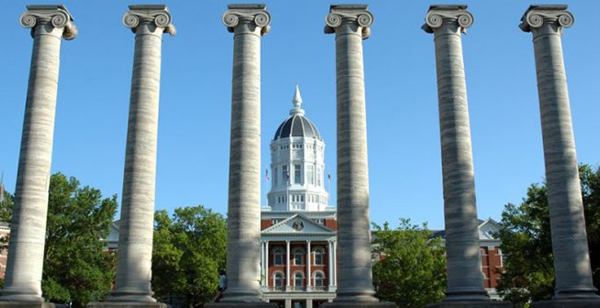
In early 2013, the Columbia/Boone County Department of Public Health and Human Services embarked on a comprehensive process to identify the health needs of the Boone County, Missouri community. The process included both an extensive review of community data, as well as a gathering of input from a variety of stakeholders, community members, and public health partners through the six-phase Mobilizing for Action through Planning and Partnerships (MAPP) model, created by the National Association of County and City Health Officials (NACCHO) and the Centers for Disease Control and Prevention (CDC) Public Health Program Practice Office.
The quantitative and qualitative data led to the development of the department’s Community Health Assessment (CHA) and the subsequent Community Health Improvement Plan (CHIP) Live Well Boone County, taking information from the CHA and turning it into actionable steps to improve the health of Boone County.
Read more from Community Commons here.
Example 2: Equity and Social Justice Strategic Plan
The six-year Equity and Social Justice Strategic Plan represents a critical opportunity for King County to do ground-breaking work:
- Applying a theory of change that fundamentally shifts the county away from policies and practices that react to problems and crises toward investments that address the root causes of inequities, ultimately leading to better quality of life and greater prosperity in all of their communities.
- Balancing a bold vision with actionable and measurable objectives.
- Allowing for innovation and adaptability across King County government to help them be dynamic and culturally responsive, moving towards the goal of being racially justice internally and in the community.
Their Equity and Social Justice strategies as One King County are to invest upstream and where needs are greatest, in employees and in community partnerships. And they will do this with accountable and transparent leadership.
Tool 1: Action Planning Template
This is a downloadable, editable template you are welcome to adapt and use for your group’s purposes. There is a space for noting the overall goal area, SMART+C objectives, strategies, and related action steps for implementation.
Keep the updated action plan accessible to the group, with regular reviews during coalition meetings to keep action items moving forward.
Action Planning Template
Download the Action Planning Template (docx)
|
Goal: |
|
|
Overall goal statement: |
|
|
Overall objective(s): Note: Use SMART+C formatting |
|
|
Priority focus areas: |
|
|
Focus Area 1: |
|
|
|
|
Objective(s): |
|
|
|
|
Strategy 1: |
|
|
|
|
Action to be taken: |
Person(s) responsible: |
By when: |
Resources needed: |
|
|
|
|
|
|
|
|
|
|
|
|
|
|
|
|
|
|
|
|
|
Strategy 2: |
|
|
|
|
Action to be taken: |
Person(s) responsible: |
By when: |
Resources needed: |
|
|
|
|
|
|
|
|
|
|
|
|
|
|
|
|
|
|
|
|
|
Strategy 3: |
|
|
|
|
Action to be taken: |
Person(s) responsible: |
By when: |
Resources needed: |
|
|
|
|
|
|
|
|
|
|
|
|
|
|
|
|
|
|
|
|
|
Focus Area 2: |
|
|
|
|
Objective(s): |
|
|
|
|
Strategy 1: |
|
|
|
|
Action to be taken: |
Person(s) responsible: |
By when: |
Resources needed: |
|
|
|
|
|
|
|
|
|
|
|
|
|
|
|
|
|
|
|
|
|
Strategy 2: |
|
|
|
|
Action to be taken: |
Person(s) responsible: |
By when: |
Resources needed: |
|
|
|
|
|
|
|
|
|
|
|
|
|
|
|
|
|
|
|
|
|
Strategy 3: |
|
|
|
|
Action to be taken: |
Person(s) responsible: |
By when: |
Resources needed: |
|
|
|
|
|
|
|
|
|
|
|
|
|
|
|
|
|
|
|
|
|
Focus Area 3: |
|
|
|
|
Objective(s): |
|
|
|
|
Strategy 1: |
|
|
|
|
Action to be taken: |
Person(s) responsible: |
By when: |
Resources needed: |
|
|
|
|
|
|
|
|
|
|
|
|
|
|
|
|
|
|
|
|
|
Strategy 2: |
|
|
|
|
Action to be taken: |
Person(s) responsible: |
By when: |
Resources needed: |
|
|
|
|
|
|
|
|
|
|
|
|
|
|
|
|
|
|
|
|
|
Strategy 3: |
|
|
|
|
Action to be taken: |
Person(s) responsible: |
By when: |
Resources needed: |
|
|
|
|
|
|
|
|
|
|
|
|
|
|
|
|
|
|
|
|
Tool 2: Action Planning Guides from the KU Center for Community Health and Development
Community and Public Health Action Planning Guides
- Reducing Risk for Chronic Disease
- Promoting Health for All: Improving Access and Eliminating Disparities in Community Health
- Promoting Healthy Living and Preventing Chronic Disease
- Your Action Planning Guide for Promoting Full Community Participation Among People with Disabilities
Child and Youth Health and Development Action Planning Guides
- Preventing Adolescent Substance Abuse
- Preventing Adolescent Pregnancy
- Preventing Youth Violence
- Preventing Child Abuse and Neglect
- Youth Development
- Promoting Child Well-Being
Community Development and Capacity Building Action Planning Guides
- Promoting Urban Neighborhood Development: Improving Housing, Jobs, Education, Safety and Health, and Human Development
- Work Group Evaluation Handbook
- Concerns Report Handbook: Planning for Community Health
An Example Outline Using Two Half-Day Working Sessions
Action Planning Workshop Outline: Two Half-Day Working Sessions
Overall Process: An effective action planning session allows a diverse group of participants to:
- Clarify common purpose - Through listening, gathering and reviewing data, and building a shared vision and mission.
- Generate and critique options - Through consideration of risk and protective factors, broad and specific strategies, and the community's framework for action, it identifies particular changes in communities and systems (i.e., new or modified programs, policies, and practices) to be sought to achieve the mission.
- Obtain consensus about community and systems changes to be sought - Through ballot voting about the importance and feasibility of proposed changes, or by having participants use "dots" to register preferences for changes to be sought.
- Decide how to proceed as a group - Through open discussion, the group identifies action steps (i.e., who will do what by when) to bring about the identified changes.
Background Work Before the Session/Workshop:
- Those developing the workshop should review the VMOSA process
- Hold listening sessions with a variety of people including those most affected
- Document the issues or problems, including data on the challenges of the issue your organization is facing
Session/Day One (1/2 Day)
8:30: Continental Breakfast
9:00: Welcome and Introductions
9:20: Overview of the Action Planning Process
9:30: VMOSA: What is VMOSA (Vision, Mission, Objectives, Strategies, Action Plans)?
9:45: Vision: Promoting Neighborhood Development (Creating your own community's vision)
10:15: Mission: What are we trying to accomplish and why? (Stating your mission).
10:45: Objectives: How much of what will we accomplish by when? (Creating your objectives).
11:15: Strategies: How will we get there? (Identifying a set of broad and specific strategies).
12:15: Questions/ Wrap Up:Group Summarizes Accomplishments of Session/Day One
12:30: Adjourn
Product of Session/Day One:
A new (or renewed) statement of the group's Vision, Mission, Objectives, and Strategies. (These may require review or approval by a broader group.)
Homework Before Session/Day Two:
Review the "Inventory of Potential Community and Systems Changes for Promoting Neighborhood Development." Bring recommended changes to be sought: a) by specific strategy (i.e., providing information and enhancing skills, modifying access, barriers, and opportunities, enhancing services and support, changing consequences, and modifying policies) and b) by community sector (e.g., Community Organizations, Faith Communities, Government).
Day/Session Two (1/2 Day)
9:00: Review of Session/Day One and Overview of Session/Day Two
9:15: Identifying Targets and Agents of Changes: Who should benefit? Who can contribute?
9:30: Identifying Community and Systems Changes: By Strategy (work in small groups of 6-8 organized by strategy)
10:15: Small Group Reports
10:45: Identifying Community and Systems Changes: By Sector (work in small groups of 6-8 organized by sector)
11:15: Small Group Reports
11:45: Building consensus on community and systems changes to be sought (e.g., using dots, voting)
12:15: Next Steps:
- Building Consensus/Seeking Approval from the larger group (if appropriate)
- Identifying Action Steps for each change to be sought (who will do what by when)
- Plan for Documenting Progress and Promoting Celebration and Renewal
12:45: Questions/ Wrap Up - Group Summarizes Accomplishments of Session/Day Two
1:00: Adjourn
Product of Session/Day Two:
A set of community and systems changes (i.e., new or modified programs, policies and practices to be sought in each relevant sector of the community (e.g., Community Organizations, Faith Communities, Government).
Tool 3: The GTE Toolkit (Getting To Equity In Obesity Prevention)
This toolkit from the Council on Black Health addresses the need to include an equity component in the planning and implementation of policy, systems, and environmental change approaches (PSE) undertaken to curb adverse trends in obesity and related health consequences.
PSE approaches focus on circumstances that make it possible or easier for people in a given set of circumstances to adopt and maintain healthy behaviors. PSE approaches can work together with approaches that work directly with individuals.
The toolkit is based on the Getting to Equity in Obesity Prevention Framework (GTE) for planning and evaluating equity-focused PSE change approaches that support:
- Food acquisition and healthy eating
- Active living and meeting physical activity guidelines
- Prevention and management of obesity and related health risks
To learn more about this amazing set of tools, click this link to go to the GTE Toolkit website.
Tool 4: Responding to Threats and Challenges Planning Tool
Responding to Threats and Challenges Planning Tool is a resource developed by the Collective Impact Forum to help organizations equip themselves to face rising threats. The tool provides a structured approach to identifying risks, addressing their impact, and developing strategies for mitigation.
Tool 5: The Scenario Planning Toolkit
The Scenario Planning Toolkit is a resource created by The Bridgespan Group to help nonprofit organizations navigate periods of uncertainty. Whether it's a global pandemic or an election year, scenario planning helps guide strategic decision-making while keeping the organization's mission at the forefront.
Contributor
Jenette Nagy
Stephen B. Fawcett
You have defined your group's:
___Vision (the dream)
___Mission (what and why)
___Objectives (how much of what by whom)
___Strategies (how)
___Action plans (who will do what by when)
___You understand when to use VMOSA, the strategic planning process

Creating your organization's vision and mission statements are the first two steps in the VMOSA action planning process. Developing a vision and mission statement is crucial to the success of community initiatives. These statements explain your group's aspirations in a concise manner, help your organization focus on what is really important, and provide a basis for developing other aspects of your strategic plan. This section provides a guide for developing and implementing your organization's vision and mission statements.
What is a vision statement?
Your vision is your dream. It's what your organization believes are the ideal conditions for your community; that is, how things would look if the issue important to you were completely, perfectly addressed. It might be a world without war, or a community in which all people are treated as equals, regardless of gender or racial background.
Whatever your organization's dream is, it may be well articulated by one or more vision statements, which are short phrases or sentences that convey your community's hopes for the future. By developing a vision statement or statements, your organization clarifies the beliefs and governing principles of your organization, first for yourselves, and then for the greater community.
There are certain characteristics that most vision statements have in common. In general, vision statements should be:
- Understood and shared by members of the community
- Broad enough to include a diverse variety of local perspectives
- Inspiring and uplifting to everyone involved in your effort
- Easy to communicate - for example, they are generally short enough to fit on a T-shirt
Here are some examples of vision statements that meet the above criteria:
- A community where all individuals and families achieve their human potential.
- CALCASA envisions a world free from sexual violence.
- A future where tobacco is a thing of the past. (Truth Initiative)
- A world without Alzheimer’s Disease. (Alzheimer’s Association)
- The United States is a humane community in which all animals are treated with respect and kindness. (ASPCA)
- A world where everyone has a decent place to live. (Habitat for Humanity)
What is a mission statement?
The next step of the action planning process is to ground your vision in practical terms. This is where developing a mission statement comes in. An organization's mission statement describes what the group is going to do and why it's going to do that. An example is "Promoting care and caring at the end of life through coalitions and advocacy."
Mission statements are similar to vision statements, in that they, too, look at the big picture. However, they're more concrete, and they are definitely more "action-oriented" than vision statements. Your vision statement should inspire people to dream; your mission statement should inspire them to action.
The mission statement might refer to a problem, such as an inadequate housing, or a goal, such as providing universal access to health care. And, while they don't go into a lot of detail, they hint - very broadly - at how your organization might fix these problems or reach these goals. Some general guiding principles about mission statements are that they are:
- Concise. While not as short as vision statements, mission statements generally still get their point across in one sentence.
- Outcome-oriented. Mission statements explain the fundamental outcomes your organization is working to achieve.
- Inclusive. While mission statements do make statements about your group's key goals, it's very important that they do so very broadly. Good mission statements are not limiting in the strategies or sectors of the community that may become involved in the project.
The following examples should help you understand what we mean by effective mission statements.
- Promoting community health and development by connecting people, ideas and resources. (Community Tool Box)
- The California Coalition Against Sexual Assault (CALCASA) provides leadership, vision and resources to rape crisis centers, individuals and other entities committed to ending sexual violence.
- Our mission is to eliminate Alzheimer's disease through the advancement of research; to provide and enhance care and support for all affected; and to reduce the risk of dementia through the promotion of brain health. (Alzheimer’s Association)
- The mission of the ASPCA, as stated by Henry Bergh in 1866, is "to provide effective means for the prevention of cruelty to animals throughout the United States”.
- Seeking to put God’s love into action, Habitat for Humanity brings people together to build homes, communities and hope.
Why should you create vision and mission statements?
Why is it important that your organization develops vision and mission statements like those above? First of all, these statements can help your organization focus on what is really important. Although your organization knows what you are trying to do to improve your community, it's easy to lose sight of this when dealing with day-to-day organizational hassles. Your vision and mission statements remind members what is important.
Second, your vision and mission statements give other individuals and organizations a snapshot view of what your group is and what it wants to accomplish. When your vision and mission statements are easily visible (for example, if they are on the letterhead of your stationery), people learn about your organization without having to work hard for the information. Then, those with common interests can take the time necessary to learn more. This efficiency is very helpful when you are recruiting other people and organizations to join your effort.
Finally, vision and mission statements focus members on their common purpose . Not only do the statements themselves serve as a constant reminder of what is important to your organization, the process of developing them allows people to see the organization as "theirs”. Creating these statements builds motivation as members will believe in something more completely if they had a hand in developing it.
Having a clear and compelling vision statement has other advantages, such as:
- Drawing people to common work
- Giving hope for a better future
- Inspiring community members to realize their dreams through positive, effective action
- Providing a basis for developing the other aspects of your action planning process: your mission, objectives, strategies, and action plans
Having a clear and compelling mission statement also has more advantages, such as:
- Converting the broad dreams of your vision into more specific, action-oriented terms
- Explaining your goals to interested parties in a clear and concise manner
- Enhancing your organization's image as being competent and professional, thus reassuring funding sources that their investment was (or would be!) a smart choice
How do you create vision and mission statements?
Now having a better understanding of vision and mission statements, your organization has the tools to develop your unique statements. If your group has already developed vision and mission statements, you might wish to look at them in light of the criteria we discussed above. If members of your organization feel your current statements could be improved, this process can be easily used to modify them. Let’s begin.
Learn what is important to people in your community
As developing your vision and mission statements is the first step in creating your action plan, it is especially important that these first steps are well grounded in community beliefs and values. Awareness of the important issues in your community is critical for the development of a strong, effective, and enduring action group.
Therefore, one of the first steps you should take when developing the vision and mission of your organization is to define the issue(s) that matter most to people in your community. How do you go about doing so?
There are many different ways you can gather this information, including:
Conducting "public forums" or "listening sessions" with members of the community to gather ideas, thoughts, and opinions about how they would like to see the community transformed.
In public forums or listening sessions, people gather from throughout the community to talk about what is important to them. These meetings are usually led by facilitators, who guide a discussion of what people perceive to be the community's strengths and problems, and what people wish the community was like. Someone typically records these meetings, and a transcript of what is said provides a basis for subsequent planning.
Holding focus groups with the people interested in addressing the issue(s), including community leaders, people most affected by the issues, businesses, church leaders, teachers, etc.
Focus groups are similar to public forums and listening sessions, but they are smaller and more intimate. Generally speaking, they are comprised of small groups of people with similar backgrounds, so they will feel comfortable talking openly about what concerns them. For example, the group members are generally about the same age, are of the same ethnic group, or have another common identity and/or experience. Focus groups function like public forums, and also use facilitators and recorders to focus and document discussion.
Your organization may hold focus groups with several different groups of people to get the most holistic view of the issue at hand. For example, if your organization is involved in child health, you might have one focus group with health care providers, another with parents or children, and still another with teachers. Once you have a rough mission statement, you might again hold a focus group for feedback.
Obtaining interviews with people in leadership and service positions, including such individuals as local politicians, school administrators, hospital and social service agency staff, about what problems or needs they believe exist in your community.
Often, these individuals will have both facts and experiences to back up their perspectives. If so, this data can be used later if and when you apply for funding, or when you request community support to address the issues. More information on this topic can be found in Chapter 3, Section 12: Conducting Interviews.
It’s important to realize that these different ways of gathering information from your community are not mutually exclusive. In fact, if you have the resources, it is recommended to do all of the above: to have some time for the community at large to respond, then spend more time in focus groups with the people you believe might contribute greatly to (or be most affected by) some of the issues brought up in the public forum. And finally, some one-on-one time with community leaders can strengthen your knowledge and purpose; remember, there are community members who have been wrestling with the same issues you are now looking at for a long time. Take advantage of that experience so you don’t waste time on something that’s already been done.
Decide what to ask
No matter if you are talking to one person or a crowd, your purpose is the same: to learn what matters in your community. Here's a list of questions you might use to focus your discussions with community members. These questions may be used for individual interviews, focus groups, public forums, or in any other way you choose to gather information.
- What is your dream/vision for our community?
- What would you like to see change?
- What kind of community (or program, policy, school, neighborhood, etc.) do we want to create?
- What do you see as the community's (or school's, neighborhood's, etc.) major issues or problems?
- What do you see as the community's major strengths and assets?
- What do you think should be the purpose of this organization (or effort)?
- Why should these issues be addressed?
- What would success look like?
When your organization is gathering input, the facilitator should encourage everyone to share their most idealistic, hopeful, and positive ideas. Don't worry right now about what's practical and what's not - this can be narrowed down later. Encourage everyone to be bold and participate, and to remember that you are trying to articulate a vision of a better community.
Decide on the general focus of your organization
Once members of your organization have heard what the community has to say, it's time to decide the general focus of your organization or initiative. First of all, what topic is most important to your organization and your community? For example, will you tackle urban development or public health issues? Racism or economic opportunity?
A second question to answer is at what level will your organization work. Will your organization begin only in one school, or in one neighborhood, or in your city? Or will your initiative's focus be broader, working on a state, national, or even international level?
These are questions for which there are no easy answers. Your organization will need to consider lessons learned from the community and decide through thoughtful discussion the best direction for your organization. We suggest you open this discussion up to everyone in your organization to obtain the best results.
However, if your organization is receiving grant money or major funding from a particular agency, the grant maker may specify what the general goal of your group should be. For example, if your group accepts a grant to reduce child hunger, at least part of its mission will be devoted to this purpose. Even in these circumstances, however, the community should determine the ultimate vision and mission that will best advance what matters to local people.
Develop your vision and mission statements
Now that your organization has a clearer understanding of what the group will do and why, you are in a prime position to develop the statements that will capture your ideas.
As you are looking at potential statements, remember to keep them broad and enduring. Vision and mission statements wide in scope allow for a sense of continuity with a community's history, traditions, and broad purposes. Additionally, vision and mission statements that are built to last will guide efforts both today and tomorrow.
Vision Statements
First of all, remind members of your organization that it often takes several vision statements to fully capture the dreams of those involved in a community improvement effort. You don't need - or even want - just one "perfect" phrase. Encourage people to suggest all of their ideas and write them down, possibly on poster paper at the front of the room, so people can be further inspired by the ideas of others. As you do this, remind the group of:
- What you have learned from your discussions with community members
- What your organization has decided will be your focus
- What you learned about vision statements at the beginning of this section
If you have a hard time getting started, you might wish to check out some of the vision statements in this section's Examples. You might ask yourself how well they meet the above suggestions.
After you have brainstormed a list of suggestions, your group can discuss critically the different ideas. Oftentimes, some of the vision statements will jump out at you - someone will suggest it, and people will just instantly think, "That's it!"
If it’s more complicated than that, you should ask yourselves the following questions:
- Will it draw people to common work?
- Does it give hope for a better future?
- Will it inspire community members to realize their dreams through positive, effective action?
- Does it provide a basis for developing the other aspects of your action planning process?
A final caution: try not to get caught up in having a certain number of vision statements for your organization. Whether you ultimately end up with two vision statements or ten, what is most important is that the statements together provide a holistic view of your organization’s vision.
Mission Statements
The process of writing your mission statement is similar to developing your vision statements. The same brainstorming process can help you develop possibilities for your mission statement. Remember, though, that unlike vision statements, you will want to develop a single mission statement for your work. After brainstorming possible statements, you will want to answer questions for each one:
- Does it describe what your organization will do and why it will do it?
- Is it concise (one sentence)?
- Is it outcome oriented?
- Is it inclusive of the goals and people who may become involved in the organization?
Together, your organization can decide on a statement that best meets these criteria.
Obtain consensus on your vision and mission statements
Once members of your organization have developed your vision and mission statements, your next step might be to learn what other community members think of them before you use the statements regularly.
To do this, you could talk to the same community leaders or focus group members you spoke to originally. First of all, this can help you ensure that they don't find the statements offensive in any way. For example, an initiative that wants to include young men more fully in its adolescent pregnancy prevention project might have "Young men in Asheville are the best informed" as one of their vision statements. But taken out of context, some people community members might believe this statement means young men are given better information or education than young women, thus offending another group of people.
Second, you will want to ensure that community members agree that the statements together capture the spirit of what they believe and desire. Your organization might find it has omitted something very important by mistake.
Decide how you will use your vision and mission statements
Finally, it's important to remember that while developing the statements is a huge step for your organization worth celebration, there is more work to be done. Next, you have to decide how to use these statements. Otherwise, all of your hard work would lead to nothing. The point is to get the message across.
There are many ways in which your organization may choose to spread its vision and mission statements. To name just a few examples, you might:
- Add them to your letterhead or stationery
- Use them on your website
- Give away T-shirts, or bookmarks, or other small gifts with them
- Add them to your press kit
- Use them when you give interviews
- Display them on the cover of your annual report
...and so on. Again, this is a step that will use all of your creativity.
In Summary
Developing effective vision and mission statements are two of the most important tasks your organization will tackle because almost everything else you do is affected by these statements. We hope that this section has allowed you to feel more confident in your group's ability to create successful and inspiring vision and mission statements. Remember, think broadly and boldly! Good luck!
Contributor
Jenette Nagy
Stephen B. Fawcett
Resources
Online Resources
Coalition Vision, Mission, and Goals defines SWOT Analysis, coalition vision and mission statements, and goals and strategies.
Print Resources
Barry, B. (1982). Strategic planning workbook for non-profit organizations. St. Paul, MN: Amherst H. Wilder Foundation.
Bryson, J. (1988). Strategic planning for public and nonprofit organizations: A guide to strengthening and sustaining organizational achievement. San Francisco: Jossey-Bass Publishers.
Coover, V., et al. (1985). Resource manual for a living revolution: a handbook of skills & tools for social change activists. Philadelphia: New Society Publisher.
Fawcett, S., Paine, A., Francisco, V., Richter, K. P., Lewis, R., Williams, E., Harris, K., Winter, K., in collaboration with Bradley, B. & Copple, J. (1992). Preventing adolescent substance abuse: an action planning guide for community -based initiatives. Lawrence, KS: Work Group on Health Promotion and Community Development, University of Kansas.
Fawcett, S., Paine, A., Francisco, V., Richter, K., Lewis, R., Harris, K., Williams, E., & Fischer, J., in collaboration with Vincent, M., & Johnson, C. (1992). Preventing adolescent pregnancy: an action planning guide for community-based initiatives. Lawrence, KS: Work Group on Health Promotion and Community Development, University of Kansas.
Kansas Health Foundation. VMOSA: An approach to strategic planning. Wichita, KS: Kansas Health Foundation.
Lord, R. (1989). The non-profit problem solver: A management guide. New York, NY: Praeger Publishers.
Olenick, J., & Olenick, R. (1991). A non-profit organization operating manual: planning for survival and growth. New York, NY: Foundation Center.
Stonich, P. (1982). Implementing strategy: making strategy happen. Cambridge: Ballinger Publishing Company.
Unterman, I., & Davis, R. (1984). Strategic management of not-for-profit organizations. New York, NY: CBS Educational and Professional Publishing.
Wolff, T. (1990). Managing a non-profit organization. New York, NY: Prentice Hall Press.
Organizations
American Planning Association
1776 Massachusetts Ave., N.W.
Washington, DC 20036
(202) 872-0611
FAX: (202) 872-0643
Example: A coalition identifies new members
A community coalition has formed a new task force on transportation to respond to the needs of a rural community to get clients to appointments, parents to schools, employees to their jobs and to generally help isolated individuals and families get around more.
At the first meeting of the task force, the coalition coordinator, the head of the council on aging, two interested parents and someone from the literacy center show up. For a while they ponder how they are going to get more people to the task force and then they brainstorm a list. They think of all the individuals who are concerned about the problem and in so doing add the VNA, the school counselors, free meals programs, and others. They begin to think about who could help solve the problem and they think about all the people in the community who actually have vehicles. This includes the mental health center, the council on aging, the programs for the developmentally disabledand the schools in the public sector and the private sector, the local taxi and bus companies.
All the names are placed up on the list. Then they turn to the coalition coordinator and say, "Why don't you give them a call?" She in turn says, "No, let's go though the list and see which one of us knows any of these people or who else knows them and let's invite them to the next meeting."
Following that strategy, they double their membership by the next meeting.
Contributor
Jenette Nagy
Stephen B. Fawcett
___You have shared your understanding of vision and mission statements with members of your organization
___You understand what is important to people in your community
___You have decided on the general focus (topic and scope) of your organization
___You have developed your vision and mission statements
___You have obtained consensus on your vision and mission statements
___You have decided how to use your vision and mission statements
Tool: Developing a Vision and Mission Statement
To obtain results, we need to articulate the outcomes we desire.
This section focuses on developing specific objectives that will help make your vision and mission a reality.
What are objectives?
Objectives are the specific measurable results of the initiative. Objectives specify how much of what will be accomplished by when. For example, one of several objectives for a community initiative to promote care and caring for older adults might be: "By 2024 (by when), to increase by 20% (how much) older adults reporting that they are in daily contact with someone who cares about them (of what)."
There are three basic types of objectives. They are:
- Process objectives. These are the objectives that provide the groundwork or implementation necessary to achieve your other objectives. For example, the group might adopt a comprehensive plan for improving neighborhood housing. In this case, adoption of the plan itself is the objective.
- Behavioral objectives. These objectives look at changing the behaviors of people (what they are doing and saying) and the products (or results) of their behaviors. For example, a neighborhood improvement group might develop an objective for having an increased amount of home repair taking place (the behavior) and fewer houses with broken or boarded-up windows (the result).
- Community-level outcome objectives. These are often the product or result of behavior change in many people. They are focused on change at the community level instead of an individual level. For example, the same neighborhood group might have an objective of increasing the percentage of people living in the community with adequate housing as a community-level outcome objective.
It's important to understand that these different types of objectives aren't mutually exclusive. Most groups will develop objectives in all three categories.
Objectives should be S.M.A.R.T. + C.:
- Specific. That is, they tell how much (e.g., 10%) of what is to be achieved (e.g., what behavior of whom or what outcome) by when (e.g., by 2025)?
- Measurable. Information concerning the objective can be collected, detected, or obtained.
- Achievable. It is feasible to pull them off.
- Relevant to the mission. Your organization has a clear understanding of how these objectives fit in with the overall vision and mission of the group.
- Timed. Your organization has developed a timeline (a portion of which is made clear in the objectives) by which they will be achieved.
- Challenging. They stretch the group to set its aims on significant improvements that are important to members of the community.
Why should you create objectives?
There are many good reasons to develop objectives for your initiative. They include:
- Having benchmarks to show progress.
- Completed objectives can serve as a marker to show members of your organization, funders, and the greater community what your initiative has accomplished.
- Creating objectives helps your organization keep focused on initiatives most likely to have an impact.
- Keeping members of the organization working toward the same long-term goals.
When should you create objectives?
Your community organization should create objectives when:
- Your organization has developed (or revamped) its vision and mission statements, and is ready to take the next step in the planning process.
- Your organization's focus has changed or expanded. For example, perhaps your organization's mission relates to care and caring at the end of life. You have recently been made aware of new resources, however, to positively affect the lives of those deeply affected by the death of a loved one. If your organization were to apply for this new grant, it would clearly expand upon your current work, and would require objectives as you developed your action plan.
- The organization wants to address a community issue or problem, create a service, or make a community change that requires:
- Several years to complete. For example, your child health organization might hope to increase the percentage of students who finish high school - a task that may take several years to complete.
- A change in behavior of large numbers of people. For example, your organization may be trying to reduce risks for cardiovascular diseases, and one of your objectives may be to increase the number of adults who engage in physical activity in your community.
- A multi-faceted approach. For example, with a problem as complex as substance use, your organization may have to worry about tackling related issues, such as access to drugs, available drug rehabilitation services, legal consequences for drug use, etc., as well as reducing the prevalence (how often or how much) of drug use.
How do you create objectives?
So once your organization has decided that it does wish to develop objectives, how do you go about doing so? Let's look at the process that will help you to define and refine objectives for your organization.
Define or reaffirm your vision and mission statements
The first thing you will need to do is review the vision and mission statements your organization has developed. Before you determine your objectives, you should have a "big picture" that they fit into.
Determine the changes to be made
The crux of writing realistic objectives is learning what changes need to happen in order to fulfill your mission.
There are many ways to do this, including:
- Research what experts in your field believe to be the best ways to solve the problem. For many community issues, researchers have developed useful ideas of what needs to occur to see real progress. This information may be available through local libraries, the Internet, state and national agencies, national nonprofit groups, and university research groups.
- Discuss with local experts what needs to occur. Some of the people with whom you may wish to talk include:
- Other members of your organization
- Local experts, such as members of other, similar organizations who have a great deal of experience with the issue you are trying to change
- Agents of change, or the people in a position to contribute to the solution. Agents of change might include teachers, business leaders, church leaders, local politicians, community members, and members of the media.
- Targets of change, the people who experience the problem or issue on a day-to-day basis and those people whose actions contribute to the problem. Changing their behavior will become the heart of your objectives.
- Discuss the logistical requirements of your own organization to successfully address community needs. At the same time your organization is looking at what needs to happen in the community to solve the issue important to you, you should also consider what your organization requires to get that done. Do you need an action plan? Additional funding? More staff, or more training for additional staff? This information is necessary to develop the process objectives we talked about earlier in this section.
At this point in the planning process, you don't need hard and fast answers to the above questions. What you should develop as part of this step is a general list of what needs to occur to make the changes you want to see.
For example, perhaps your group has decided upon the following mission: "To reduce risk for cardiovascular diseases through a community-wide initiative." At this point in your research (without getting into specifics), your organization might have decided that your objectives will be based on the following general goals:
- Begin smoking cessation programs
- Begin smoking prevention programs
- Bring about an increase in aerobic exercise
- Decrease the amount of obesity
- Encourage healthier diets
- Increase preventative medicine (for example, more checkups for earlier detection of disease; better understanding of warning signs and symptoms)
- Increase the scientific understanding of your own organization regarding the causes and pathophysiology of cardiovascular disease
- Strengthen your organization's ties with national organizations committed to the same goals as your organization
Collect baseline data on the issues to be addressed
As soon as your organization has a general idea of what it wants to accomplish, the next step is to develop baseline data on the issue to be addressed. Baseline data are the facts and figures that tell you how big the problem is; it gives specific figures about the extent to which it exists in your community.
Baseline data can indicate the incidence (new cases) of a problem in the community. For example, "Malott County has an adolescent pregnancy rate of 12.3 pregnancies for every thousand adolescent girls." Such data can also reveal the prevalence (existing cases) of the problem. For example, "In Jefferson County, 35% of adolescents reported that they did not use contraceptives during the last time they had sex."
Baseline data may also measure community attitudes towards a problem. For example, "65% of the residents of Malott County do not consider adolescent pregnancy to be an important problem for the community."
Why collect baseline data?
This information is important because baseline data provides your organization with the numbers; the starting points against which you can measure how much progress you have made. Not only is this information helpful when originally asking for financial (or other) assistance, it can help you show what your organization has done later in its lifetime.
So, early in your organization's life, you can prove to funders that there really is a very significant problem in your community that needs to be addressed ("Malott County's adolescent pregnancy rate is the highest in the state of Georgia.") Then, when asked later in the life of your community initiative, "What have you done?" you will be able to answer, "Since our coalition was formed, Malott County has seen pregnancy among adolescents drop by 35%." If you don't collect (or obtain) the baseline information, you can't prove how much you have done.
How do you collect this information?
There are two basic ways to collect baseline data:
- You can collect your own baseline data for the information related to your specific issues. Ways to gather this information include the use of surveys, questionnaires, and personal interviews.
- You can use information that has already been collected. Public libraries, city government, social service agencies, local schools, or city health departments may already have the statistics that you want, especially if another organization has already done work on a similar issue in your community.
Decide what is realistic for your organization to accomplish
Once you know what you want to do, as well as exactly how big the problem is, it's time to figure out how much you believe your organization can accomplish. Do you have the resources to affect all of the goals you looked at in Step Two? And to what extent will you be able to achieve them?
These questions are difficult ones to answer. It's hard for a new organization to know what it can reasonably expect to get done. For example, if you are trying to increase rates of childhood immunization, will your organization be able to increase it by 5% in three years, or by 20% in one year? How do you make these decisions?
Unfortunately, there are no easy answers. Your organization will need to take a good look at its resources, as well as talk to experts who have a sense of what is not only possible, but likely. For example, you might ask members of organizations who have done similar things, or researchers in your topic area what they believe makes sense.
Remember, you are attempting to set objectives that are both achievable and challenging. It's hard to hit just the right note of balance between these two qualities, and you may not always get it just right. Research and experience, however, should help you come closer and closer to this goal.
Set the objectives for your organization or initiative
With all of this information in mind, your organization is ready to set some short-term goals or objectives that are feasible but demanding. Remember, objectives refer to specific measurable results. These changes in behavior, outcome, and process must be able to be tracked and measured in such a way to show that a change has occurred.
A caution: Oftentimes, the objectives of a community initiative or organization are set or influenced by the primary funding agency. Regardless of outside influences, each community initiative must decide what problems it is going to take on and what objectives would define success for their organization.
Your organization's list of objectives should do all of the following:
- Include all three types of objectives: objectives that measure behavior change, community outcomes, and those that measure important parts of the planning process.
- Include specific objectives that tell how much of what will occur by when. For example, "By 2025, rates of adolescent pregnancy among 12-17 year old girls will decrease by 30%."
- They should include all of the "SMART + C Criteria." As we discussed earlier in this section, this means that they should be, Specific, Measurable, Achievable, Relevant, Timed, and Challenging.
Let's look at one more example of some objectives; these goals come from an organization focusing on preventing adolescent substance use.
Objectives developed by an adolescent substance use prevention initiative
By the year 2024, the use of tobacco among 12-17 year olds will be reduced by 40%.
By the year 2024, the use of alcohol among 12-17 year olds will be reduced by 50%.
By the year 2024, the use of marijuana among 12-17 year olds will be reduced by 70%.
By the year 2024, the use of cocaine among 12-17 year olds will be reduced by 80%.
Review the objectives your organization has created
Before you finalize your objectives, it makes sense for members of your organization to review them one more time, and possibly, ask people outside of your organization to review them as well. You might ask members of your organization who were not involved in the development process to review your work. You may also wish to get the thoughts of local experts, targets and agents of change, and/or of people doing similar work in other communities to review what you have developed. You can ask reviewers to comment on:
- Do your objectives each meet the criteria of "SMART+ C"?
- Is your list of objectives complete? That is, are there important objectives that are missing?
- Are your objectives appropriate? Are any of your objectives controversial? If so, your organization needs to decide if it is ready to handle the storm that may arise. For example, a program that is trying to reduce the spread of AIDS in its community may decide sterile syringes for people who use drugs is an objective they wish to strive for; but it may very well cause difficulties for that organization. That's not to say the organization shouldn't make that an objective, but they should do so with a clear understanding of the consequences.
Use your objectives to define your organization's strategies
Finally, once you have your objectives, you are ready for the next step: developing the strategies that will make them possible. Once your objectives are finished, and satisfactory to members of the organization and important people outside of your group, you are ready to move on to developing successful strategies.
In Summary
Developing objectives is a critical step in the planning process. The next section covers how to develop strategies to achieve the objectives you have set.
Contributor
Jenette Nagy
Stephen B. Fawcett
Resources
Online Resources
Chapter 16: Behavioral Community Approaches in the "Introduction to Community Psychology" outlines how large, complicated problems can be broken down into smaller ones, the importance of studying and bringing about change in observable behaviors, and how behavioral approaches are used in Community Psychology.
SMART Objectives is a Public Health & Quality Improvement tool from the Minnesota Department of Health.
Print Resources
Barry, B. (1982). Strategic planning workbook for non-profit organizations. St. Paul, MN: Amherst H. Wilder Foundation.
Bryson, J. (1988). Strategic planning for public and nonprofit organizations: A guide to strengthening and sustaining organizational achievement. San Francisco: Jossey-Bass Publishers.
Coover, V., et al. (1985). Resource manual for a living revolution: a handbook of skills & tools for social change activists. Philadelphia: New Society Publisher.
Fawcett, S., Paine, A., Francisco, V., Richter, K. P., Lewis, R., Williams, E., Harris, K., Winter, K., in collaboration with Bradley, B. & Copple, J. (1992). Preventing adolescent substance abuse: an action planning guide for community -based initiatives. Lawrence, KS: Work Group on Health Promotion and Community Development, University of Kansas.
Fawcett, S., Paine, A., Francisco, V., Richter, K., Lewis, R., Harris, K., Williams, E., & Fischer, J., in collaboration with Vincent, M., & Johnson, C. (1992). Preventing adolescent pregnancy: an action planning guide for community-based initiatives. Lawrence, KS: Work Group on Health Promotion and Community Development, University of Kansas.
Kansas Health Foundation. VMOSA: An approach to strategic planning. Wichita, KS: Kansas Health Foundation.
Lord, R. (1989). The non-profit problem solver: A management guide. New York, NY: Praeger Publishers.
Olenick, J., & Olenick, R. (1991). A non-profit organization operating manual: planning for survival and growth. New York, NY: Foundation Center.
Stonich, P. (1982). Implementing strategy: making strategy happen. Cambridge: Ballinger Publishing Company.
Unterman, I., & Davis, R. (1984). Strategic management of not-for-profit organizations. New York, NY: CBS Educational and Professional Publishing.
Wolff, T. (1990). Managing a non-profit organization. New York, NY: Prentice Hall Press.
Organizations
American Planning Association
1776 Massachusetts Ave., N.W.
Washington, DC 20036
(202) 872-0611
FAX: (202) 872-0643
Example: The Reducing the Risks (RTR) Coalition's development of objectives to reduce teen pregnancy
The RTR Coalition decided that its main targets of change would be young people (girls and boys), parents and guardians, and members of the community at large.
Some of the agents of change who could assist with the project included:
- Peers
- Teachers at the local junior high and high schools
- Church leaders and youth group directors
- The mayor
- The directors of local youth groups, such as the Boys and Girls Club and the city youth center
Members of the RTR Coalition reviewed their vision and mission statements, discussed changes they wanted to see made, baseline data, and what they felt was realistic for their group to achieve. After working through all of these steps, they sat down to write a list of objectives.
A partial listing of their ideas included:
- By the year 2010, 90% of our community will agree with the statement, "It is very important that our community effectively address the problem of teen pregnancy."
- By the year 2012, the reported level of sexual abstinence and postponement of initial sexual intercourse among 12-17 year olds will be increased by 20%.
- By the year 2012, the reported use of contraceptives among adolescents 12-17 years old who choose to be sexually active will increase by 33%.
- By the year 2014, the estimated rate of sexually transmitted diseases (STD's) among 12-17 year olds will be reduced by 40%.
- By the year 2015, the estimated pregnancy rate among 12-17 year olds will be reduced by 25%.
Things to note about the RTR objectives:
- They include what specific changes in whose behavior (and which community-level outcomes) should occur.
- They include by when the objective should be met.
- They include how much of the desired change should occur.
- They are relevant to the mission; that is, they refer to the issues that are directly related to teen pregnancy (contraceptive use, STD rate, etc.).
- They are challenging; they will stretch the community to go beyond what it is doing.
Contributor
Jenette Nagy
Stephen B. Fawcett
___Your organization understands what objectives are, and when you should develop them
___Your organization understands that objectives should be "SMART +C"
___You have defined and reaffirmed your vision and mission statements
___You have determined the changes to be made
___You have collected baseline data on the issues to be addressed
___You have decided what is realistic for your organization to accomplish
___You have set objectives for the organization or initiative
___You have reviewed the objectives your organization has created
Tool: Developing Objectives and Strategies
-
What is a strategy?
-
What are the criteria for developing a good strategy?
-
Why develop strategies?
-
When should you develop strategies for your initiative?
-
How do you develop strategies?

What is a strategy?
A strategy is a way of describing how you are going to get things done. It is less specific than an action plan (which tells the who-what-when); instead, it tries to broadly answer the question, "How do we get there from here?" (Do we want to take the train? Fly? Walk?)
A good strategy will take into account existing barriers and resources (people, money, power, materials, etc.). It will also stay with the overall vision, mission, and objectives of the initiative. Often, an initiative will use many different strategies--providing information, enhancing support, removing barriers, providing resources, etc.--to achieve its goals.
Objectives outline the aims of an initiative--what success would look like in achieving the vision and mission. By contrast, strategies suggest paths to take (and how to move along) on the road to success. That is, strategies help you determine how you will realize your vision and objectives through the nitty-gritty world of action.
What are the criteria for developing a good strategy?
Strategies for your community initiative should meet several criteria.
Does the strategy:
- Give overall direction? A strategy, such as enhancing experience and skill or increasing resources and opportunities, should point out the overall path without dictating a particular narrow approach (e.g., using a specific skills training program).
- Fit resources and opportunities? A good strategy takes advantage of current resources and assets, such as people's willingness to act or a tradition of self-help and community pride. It also embraces new opportunities such as an emerging public concern for neighborhood safety or parallel economic development efforts in the business community.
- Minimize resistance and barriers? When initiatives set out to accomplish important things, resistance (even opposition) is inevitable. However, strategies need not provide a reason for people opposing the initiative to challenge it. Good strategies attract allies and deter people opposing the initiative.
- Reach those affected? To address the issue or problem, strategies must connect the intervention with those who it should benefit. For example, if the mission of the initiative is to get people into decent jobs, do the strategies (providing education and skills training, creating job opportunities, etc.) reach those currently unemployed?
- Advance the mission? Taken together, are strategies likely to make a difference on the mission and objectives? If the aim is to reduce a problem such as unemployment, are the strategies enough to make a difference on rates of employment? If the aim is to prevent a problem, such as substance use, have factors contributing to risk (and protection) been changed sufficiently to reduce use of alcohol, tobacco, and other drugs?
Why develop strategies?
Developing strategies is really a way to focus your efforts and figure out how you're going to get things done. By doing so, you can achieve the following advantages:
- Taking advantage of resources and emerging opportunities
- Responding effectively to resistance and barriers
- A more efficient use of time, energy, and resources
When should you develop strategies for your initiative?
Developing strategies is the fourth step in the VMOSA (Vision, Mission, Objectives, Strategies, and Action Plans) process outlined at the beginning of this chapter. Developing strategies is the essential step between figuring out your objectives and making the changes to reach them. Strategies should always be formed in advance of taking action, not deciding how to do something after you have done it. Without a clear idea of the how, your group's actions may waste time and effort and fail to take advantage of emerging opportunities. Strategies should also be updated periodically to meet the needs of a changing environment, including new opportunities and emerging opposition to the group's efforts.
How do you develop strategies?
Once again, let's refer back to our friends at the fictional Reducing the Risk (RTR) Coalition that hopes to reduce the risk of adolescent pregnancy in its community. We'll walk through the process of developing strategies with this group so as to better explain the who, what, and why of strategies.
As with the process you went through to write your vision and mission statements and to set your objectives, developing strategies involves brainstorming and talking to community members.
Organize a brainstorming meeting with members of your organization and members of the community
Remember, people will work best in a relaxed and welcoming environment. You can help achieve this by:
- Making meetings a place where all members feel that their ideas are listened to and valued, and where constructive criticism may be openly voiced. To help meet these goals, you might post some "ground rules" so people feel free to express themselves. Ground rules might include:
- One person speaks at a time
- No interrupting each other
- Everyone's ideas are respected
- Bringing fans or heaters (if needed) so people will be comfortable.
- Asking members to escort each other home or to their cars, the subway, or the bus stop if the meeting runs late.
- Providing refreshments. Never underestimate the power of homemade food, drinks, and other treats.
The RTR Coalition held brainstorming sessions among organization members. They invited local adolescents, parents, teachers, counselors, church members, and other community leaders to participate in listening sessions. These were used to help develop strategies to reduce the risk of adolescent pregnancy. Homemade cookies, fruit, and coffee helped make participants feel welcome.
Review (identify) the targets and agents of change for your initiative
- Your targets of change include all of the people who experience (or are experiencing increased risk for) this issue or problem addressed by your initiative. Remember to be inclusive; that is, include everyone who is affected by the problem or issue or whose action or inaction contributes to it. For example, a coalition such the RTR Coalition would want to include all adolescents as potential targets of change, not just adolescents who appear to experience increased risk, and parents, peers, and teachers whose actions or inactions might make a difference.
- Your agents of change include everyone who is in a position to help contribute to the solution. With the RTR Coalition, examples of agents of change might include adolescent, teachers, guidance counselors, parents of adolescent, lawmakers, and others.
Review your vision, mission, and objectives to keep you on the right track
It is helpful to review your mission, vision, and objectives to ensure that your strategies are all aligned with the goals expressed in your previous work.
Work together to brainstorm the best strategies for your initiative
The following list of questions can be a guide for deciding on the most beneficial strategies for your group:
- What resources and assets exist that can be used to help achieve the vision and mission? How can they be used best?
- What obstacles or resistance exist that could make it difficult to achieve your vision and mission? How can you minimize or get around them?
- What are potential agents of change willing to do to serve the mission?
- Do you want to reduce the existing problem, or does it make more sense to try to prevent (or reduce risk for) problems before they start? For example, if you are trying to reduce adolescent sexual activity, you might consider gearing some of your strategies to younger children, for whom sex is not yet a personal issue; or, to promote academic success, to work with younger children who still have full potential for learning and school success.
- How will your potential strategies decrease the risk for experiencing the problem (e.g., adolescent girls experiencing pressure for sex from older men)? How will the strategies increase protective factors (e.g., support from peers; access to contraceptives)?
- What potential strategies will affect the whole population and problem? For example, connecting youth with caring adults might be good for virtually all youth, regardless of income or past experience with the problem. Also, just one strategy, affecting just one part of the community such as schools or youth organizations, often isn't enough to improve the situation. Make sure that your strategies affect the problem or issue as a whole.
- What potential strategies reach those experiencing increased risk for the problem? For example, early screenings might help focus on those experiencing higher risk for heart disease or cancer; past academic failure or history of drug use, for identifying with whom support and other intervention efforts might be focused.
Let's look at the strategies proposed by the members of the RTR Coalition to prevent adolescent pregnancy.
Example: The strategies of the RTR Coalition
We will pursue the following strategies to reach each of our objectives:
- Assist local churches in implementing parent-child awareness sessions (for example, a series of talks might be given discussing how to talk to your preteen about sex);
- Include comprehensive sex education in the curriculum of students from kindergarten through grade twelve, including information on abstinence, sexual decision-making skills, and family planning / contraception at age-appropriate times;
- Incorporate options for teacher-led and peer support programs in the schools;
- Survey and report on student knowledge, attitudes, and behavior related to sexual issues;
- Increase access to contraception;
- Organize a school/community action group to create supervised after-school activities, mentor programs, etc.
Things to note about the RTR strategies:
- They give overall direction (without dictating specifics, such as the particular sexuality education curricula to be used).
- They fit local resources, including a variety of the available agents of change (in this case, peers, parents and guardians, clergy, and teachers).
- Some of the strategies try to change existing situations (such as increased access to contraception); others are geared to stop the problem of adolescent pregnancy before it starts (for example, assisting local churches to improve early parent-child communication).
- The strategies involve many different parts of the community, including churches and other groups from whom opposition to some strategies (such as access to contraceptives) might be expected.
- The strategies try to decrease some of the probable risk factors for adolescent pregnancy (lack of information, lack of access to contraceptives, peer pressure), and at the same time, they try to increase some of the possible protective factors (increased parent-child communication, church involvement, education, opportunities for a better future).
Check your proposed strategies for completeness, accuracy, and whether they contribute to the vision, mission, and objectives
Contributor
Jenette Nagy
Stephen B. Fawcett
Resources
Online Resource
Tom Wolff / AHEC/Community Partners. (1993). Coalition building tip sheets [Resource Sheets]. Amherst, MA
Concerns Report Handbook: Planning for Community Health
Preventing Adolescent Pregnancy: An Action Planning Guide for Community-Based Initiatives
Preventing Adolescent Substance Abuse: An Action Planning Guide for Community-Based Initiatives
Preventing Child Abuse and Neglect: An Action Planning Guide for Community-Based Initiatives
Preventing Youth Violence: An Action Planning Guide for Community-Based Initiatives
Promoting Child Well-Being: An Action Planning Guide for Community-Based Initiatives
Promoting Health for All: Improving Access and Eliminating Disparities in Community Health
Promoting Healthy Living and Preventing Chronic Disease: An Action Planning Guide for Communities
Reducing Risk for Chronic Disease: An Action Planning Guide for Community-Based Initiatives
Work Group Evaluation Handbook
Youth Development: An Action Planning Guide for Community-Based Initiatives
Print Resources
Berkowitz, W. (1982). Community impact: creating grassroots change in hard times. Cambridge: Schenkman.
Brown, C. (1984). The art of coalition building: a guide for community leaders. The American Jewish Committee.
Fawcett, S., Francisco, V., Paine, A., Fisher, J., Lewis, R., Williams, E., Richter, K.., Harris, K.., & Berkley, J., with assistance from Oxley, L., Graham, A., & Amawi, L. (1994). Preventing youth violence: an action planning guide. Lawrence, KS: Work Group on Health Promotion and Community Development, University of Kansas.
Fawcett, S.., Harris, K., Paine- A., Richter, K., Lewis, R., Francisco, V., Arbaje, A., Davis, A., Cheng, H. in collaboration with Johnston, J. (1995). Reducing risk for chronic disease: an action planning guide for community-based initiatives. Lawrence, KS: Work Group on Health Promotion and Community Development, University of Kansas.
Hawkins, J., & Catalano, R., et al. (1992). Communities that care. San Francisco, CA.
National Highway Traffic Safety Administration (1996). Strategic execution plan (DOT HS 808-377).
Example 1: Promoting healthy diets and physical activity among children and youth
Here are selected strategies for changes in elementary, middle, and high schools to reduce dietary risk for chronic disease (from the Center for Community Health and Development's Reducing Risk for Chronic Disease: An Action Planning Guide):
- Integrate health and nutrition activities into existing student organizations
- Enact and enforce state nutritional guidelines for school lunch programs and daycare services
- Monitor and provide feedback on nutritional quality of foods available in cafeterias, concession stands, and vending machines
- Place point-of-purchase information about healthy choices in cafeterias and vending machines
- Make available healthy snacks in vending machines, concession stands, and cafeterias
- Implement age-appropriate health and nutrition curricula
Example 2: Preventing youth violence
Here are selected strategies for changes in the criminal justice system to reduce youth violence (from the Center for Community Health and Development's Preventing Youth Violence: An Action Planning Guide):
- Communicate information about levels of violence and gang-related activity through the media
- Establish reward programs for tips leading to arrests for illegal weapons sales
- Establish a "silent witness hotline" for reporting incidents of violence
- Establish neighborhood watch programs
- Provide awards to police and citizens who contribute to the prevention of youth violence
- Establish crisis intervention teams to deal with domestic disputes
- Community education in monitoring violence and gang-related activity
- Remove "crack" houses in affected neighborhoods
Example 3: Promoting highway safety
Selected strategies for encouraging states and communities to promote adherence to traffic laws follow (from the National Highway Traffic Safety Administration's Strategic Execution Plan):
- Award demonstration grants to states and communities for traffic safety initiatives, particularly involving alcohol, speed and safety belts.
- Promote and distribute Campaign Safe and Sober materials. Collaborate with national organizations to implement traffic safety and enforcement programs.
- Provide technical assistance, training and educational materials to law enforcement, prosecutors, judges and community activities.
Example 4: Equity and Social Justice Strategic Plan
The six-year Equity and Social Justice Strategic Plan represents a critical opportunity for King County to do ground-breaking work:
- Applying a theory of change that fundamentally shifts the county away from policies and practices that react to problems and crises toward investments that address the root causes of inequities, ultimately leading to better quality of life and greater prosperity in all of their communities.
- Balancing a bold vision with actionable and measurable objectives.
- Allowing for innovation and adaptability across King County government to help them be dynamic and culturally responsive, moving towards the goal of being racially justice internally and in the community.
Their Equity and Social Justice strategies as One King County are to invest upstream and where needs are greatest, in employees and in community partnerships. And they will do this with accountable and transparent leadership.
Contributor
Jenette Nagy
Stephen B. Fawcett
Develop successful strategies:
___You can form a planning group to develop strategies
Find potential members:
___Community leaders
___Members of other local organizations
___Those affected by the issue or problem
___Representatives of local ethnic and cultural groups
Create a supportive environment:
___A safe and comfortable building, neighborhood site
___Create an open forum for all to participate
Determine/review targets and agents of change:
___Be inclusive of those experiences, at risk for, and contributing to the issue
___Determine risk and protective factors affecting the issue
___Review vision, mission, and objectives
Brainstorm the best strategies:
___Determine potential obstacles
___Strategize to get around obstacles
___Identify how agents of change will help
___Decide when strategies will affect targets of change
___Determine if you will work on repairing or preventing problems
___Ensure strategies decrease risk factors, and increase protective factors
___Make sure strategies will address entire problem or issue
Do the strategies meet the criteria?
___Give overall direction
___Fit resources and opportunities
___Minimize resistance and barriers
___Reach those affected
___Advance the mission
Tool 1: Developing Objectives and Strategies
Download a worksheet in MS Word here.
Tool 2: Co-Impact's Worksheet: Crafting Your Strategy for Change
The Co-Impact's Worksheet: Crafting Your Strategy for Change is a practical toolkit that helps organizations and initiatives build a clear, actionable plan for systems change. It walks users through a step-by-step process that covers:
- Defining the problem
- Identifying people-level outcomes
- Mapping system components
- Conducting a political economy analysis
- Setting system-level outcomes
- Developing a strategy for change
- Testing critical assumptions
- Aligning organizational practices
- Creating a dashboard
Developing an action plan can help changemakers turn their visions into reality, and increase efficiency and accountability within an organization. An action plan describes the way your organization will meet its objectives through detailed action steps that describe how and when these steps will be taken. This section provides a guide for developing and utilizing your group's action plan.
What is an action plan?
In some ways, an action plan is a "heroic" act: it helps us turn our dreams into a reality. An action plan is a way to make sure your organization's vision is made concrete. It describes the way your group will use its strategies to meet its objectives. An action plan consists of a number of action steps or changes to be brought about in your community.
Each action step or change to be sought should include the following information:
- What actions or changes will occur
- Who will carry out these changes
- By when they will take place, and for how long
- What resources (i.e., money, staff) are needed to carry out these changes
- Communication (who should know what?)
What are the criteria for a good action plan?
The action plan for your initiative should meet several criteria.
Is the action plan:
- Complete? Does it list all the action steps or changes to be sought in all relevant parts of the community (e.g., schools, business, government, faith community)?
- Clear? Is it apparent who will do what by when?
- Current? Does the action plan reflect the current work? Does it anticipate newly emerging opportunities and barriers?
Why should you develop an action plan?
There is an inspirational adage that says, "People don't plan to fail. Instead they fail to plan." Because you certainly don't want to fail, it makes sense to take all of the steps necessary to ensure success, including developing an action plan.
There are lots of good reasons to work out the details of your organization's work in an action plan, including:
- To lend credibility to your organization. An action plan shows members of the community (including grantmakers) that your organization is well ordered and dedicated to getting things done.
- To be sure you don't overlook any of the details
- To understand what is and isn't possible for your organization to do
- For efficiency: to save time, energy, and resources in the long run
- For accountability: To increase the chances that people will do what needs to be done
When should you create an action plan?
Ideally, an action plan should be developed within the first six months to one year of the start of an organization. It is developed after you have determined the vision, mission, objectives, and strategies of your group. If you develop an action plan when you are ready to start getting things done, it will give you a blueprint for running your organization or initiative.
Remember, though, that an action plan is always a work in progress. It is not something you can write, lock in your file drawers, and forget about. Keep it visible. Display it prominently. As your organization changes and grows, you will want to continually (usually monthly) revise your action plan to fit the changing needs of your group and community.
How to write an action plan
Determine what people and sectors of the community should be changed and involved in finding solutions
If you have been using the VMOSA (Vision, Mission, Objectives, Strategies, Action Plans) model, you might have already done this, when you were deciding upon your group's objectives. Again, try to be inclusive. Most of the health and development issues that community partnerships deal with are community-wide, and thus need a community-wide solution. Possible sectors include the media, the business community, religious organizations, schools, youth organizations, social service organizations, health organizations, and others.
Some members of the community you might consider asking to join the action planning group include:
- Influential people from all the parts of the community affected by your initiative (e.g., from churches and synagogues, the school system, law enforcement, etc.)
- People who are directly involved in the problem (e.g., local high school students and their parents might be involved in planning a coalition trying to reduce adolescent substance use)
- Members of grassroots organizations
- Members of the various ethnic and cultural groups in your community
- People you know who are interested in the problem or issue
- Newcomers or young people in the community who are not yet involved
Let's consider some of the people who were involved with the planning group for the fictional Reducing the Risks (RTR) Coalition that hopes to reduce the rate of adolescent pregnancy. Some of the members of this planning group included teachers at the local high school, local adolescents and their parents, members of the clergy, counselors and school nurses, staff of the county health department, and members of youth organizations, service agencies, and other organizations that focus on youth issues.
Convene a planning group in your community to design your action plan. This might be the same group of people who worked with you to decide your group's strategies and objectives. If you are organizing a new group of people, try to make your planning committee as diverse and inclusive as possible. Your group should look like the people most affected by the problem or issue.
Once everyone is present, go over your organization's:
- Vision
- Mission
- Objectives
- Strategies
- Targets and agents of change (e.g., youth, parents and guardians, clergy)
- Proposed changes for each sector of the community (e.g., schools, faith community, service organizations, health organizations, government)
Develop an action plan composed of action steps that address all proposed changes. The plan should be complete, clear, and current. Additionally, the action plan should include information and ideas you have already gathered while brainstorming about your objectives and your strategies. What are the steps you must take to carry out your objectives while still fulfilling your vision and mission? Now it's time for all of the VMOSA components to come together. While the plan might address general goals you want to see accomplished, the action steps will help you determine the specific actions you will take to help make your vision a reality. Here are some guidelines to follow to write action steps.
Members of the community initiative will want to determine:
- What action or change will occur
- Who will carry it out
- When it will take place, and for how long
- What resources (i.e., money, staff) are needed to carry out the change
- Communication (who should know what)
Example: RTR Coalition's Action Step (a sample)
One community change sought by this coalition to prevent adolescent pregnancy was to increase publicity about contraception and unwanted pregnancy at the local high school.
- What action or change will occur: Hanging posters, displays, and other information about contraception and the facts about unwanted pregnancy in the hallways of the local high school. The posters and other information will become a permanent part of the high school. Posters and information will be regularly changed as new materials become available.
- Who will carry it out: A sub-committee comprised of parents and guardians, teachers, students, and coalition members will be responsible for maintaining the displays. The coalition as a whole will work towards finding funding to purchase the materials. Maria and Alex of the schools action group will be responsible for researching and ordering the materials.
- By when will it take place, and for how long: The coalition will try to have posters hanging and displays visible within six weeks of deciding on the action step (2/19/2013).
- What resources are needed to carry out the step: The coalition will approach the school district to request funding for the project. Otherwise, the group will seek funding from other sources such as foundations and local businesses to finance the program.
- Communication about the action step. The school principal and leadership of the Parent-Teacher Organization (PTO) should be given information about this planned change.
Things to note about this portion of the RTR action plan:
- It appears complete. Although this step seems fully developed, we would need to review the entire action plan to see whether all community and system changes that should be sought are included.
- It is clear. We know who will do what by when.
- It seems current. We would need to know more about other current work (and new opportunities and barriers) to judge whether this portion of the action plan is up-to-date.
Review your completed action plan carefully to check for completeness. Make sure that each proposed change will help accomplish your group's mission. Also, be sure that the action plan taken as a whole will help you complete your mission; that is, make sure you aren't leaving anything out.
Follow through. One hard part (figuring out what to do) is finished. Now take your plan and run with it! Remember the 80-20 rule: successful efforts are 80% follow through on planned actions and 20% planning for success.
Keep everyone informed about what's going on. Communicate to everyone involved how their input was incorporated. No one likes to feel like their wit and wisdom has been ignored.
Keep track of what (and how well) you've done. Always keep track of what the group has actually done. If the community change (a new program or policy) took significant time or resources, it's also a good idea to evaluate what you have done, either formally or informally.
Keep several questions in mind for both yourself and others:
- Are we doing what we said we'd do?
- Are we doing it well?
- Is what we are doing advancing the mission?
You can address these questions informally (ask yourself, chat with friends and other people), as well as formally, through surveys and other evaluation methods.
Celebrate a job well done! Celebrate your accomplishments; you and those you work with deserve it. Celebration helps keep everyone excited and interested in the work they are doing.
After you've written your action plan: Getting members to do what they said they would
Every community organization has undoubtedly had this happen: you plan and you assign tasks to get everything you've planned to do accomplished. Everyone agrees (maybe they even offer) to do certain tasks, and you all leave with a great feeling of accomplishment. The problem? At the next meeting, nothing has been done. Besides tearing out your hair, what can you do?
Fortunately, there are several things you can try. It's particularly tricky in the case of volunteers, because you don't want to lean too hard on someone who is donating their time and energy to begin with. Still, you can make it easier for members to get things done (and harder to avoid work) without acting like the mean neighbor down the street. Some of these gentle reminders include:
- Regular phone calls from staff members or dedicated volunteers asking others how they are doing with their tasks. This should be a supportive call, not a "are you doing what you're supposed to" call. The person calling can offer emotional support "how are you doing?" as well as see if the group member needs any other assistance. A friendly call such as this can be seen as helpful, give the member the sense that they are a very important part of the group, and serve as a great reminder to do what they said they would do.
- Distributing the action plan in writing to all members, with names attached to specific tasks. (Additionally, this can be a great time to ask for feedback before the plan becomes "official.")
- Making sure timelines (with due dates) are complete, clear and current.
- At regular group meetings, such as committee meetings or board meetings, ask members to report on accomplishing the tasks they have set out to do. Consider making this a regular part of the meeting.
- Celebrate the accomplishment of tasks. It's important that getting something done actually means something, and is recognized by the group as a whole.
Follow up on the action plan regularly. You are asking members to be accountable, and to get things done on a regular basis. If they have agreed, you should help them fulfill their commitment as best you can.
Resources
Online Resources
The Ruckus Society offers an Action Planning Manual that discusses strategies for nonviolent direct action.
Preventing Adolescent Substance Abuse: An Action Planning Guide for Community-Based Initiatives
Preventing Youth Violence: An Action Planning Guide for Community-Based Initiatives
Preventing Adolescent Pregnancy: An Action Planning Guide for Community-Based Initiatives
Promoting Child Well-Being: An Action Planning Guide for Community-Based Initiatives
Preventing Child Abuse and Neglect: An Action Planning Guide for Community-Based Initiatives
Reducing Risk for Chronic Disease: An Action Planning Guide for Community-Based Initiatives
Print Resources
Barry, B. (1984). Strategic planning workbook for nonprofit organizations. St. Paul: MN: Amherst H. Wilder Foundation.
Berkowitz, W. (1982). Community impact: creating grassroots change in hard times. Cambridge, MA: Schenkman Publishing.
Bryson, J. (1988). Strategic planning for public and nonprofit organizations: A guide to strengthening and sustaining organizational achievement. San Francisco: Jossey-Bass Publishers.
Fawcett, S., Paine, A., Francisco, V., Richter, K., Lewis, R., Williams, E., Harris, K., Winter, K., in collaboration with Bradley, B. & Copple, J. (1992). Preventing adolescent substance abuse: an action planning guide for community-based initiatives. Lawrence, KS: Work Group on Health Promotion and Community Development, University of Kansas.
Fawcett, S., Claassen, L., Thurman, T., Whitney, H., & Cheng, H. (1996). Preventing child abuse and neglect: an action planning guide for building a caring community. Lawrence, KS: Work Group on Health Promotion and Community Development, University of Kansas.
Kansas Health Foundation. VMOSA: An approach to strategic planning. Wichita, KS: Kansas Health Foundation.
Lord, R. (1989). The nonprofit problem solver. New York, NY: Praeger.
Olenick, A. & Olenick, P. (1991). A nonprofit organization manual. New York, NY: The Foundation Center.
Unterman, I., & Davis, R. (1984). Strategic management of not-for-profit organizations. New York, NY: CBS Educational and Professional Publishing.
Wolf, T. (1990). Managing a nonprofit organization. New York, NY: Prentice Hall.
Watson-Thompson, J., Fawcett, S., & Schultz, J. (2008). Differential effects of strategic planning on community change in two urban neighborhood coalitions. American Journal of Community Psychology, 42, 25-38.
Example: Forward through Ferguson Action Plan

Forward through Ferguson's Action Plan lays out the three Action Strategies that guide the organization’s work for the next three years as it works to achieve a racially equitable St. Louis by the year 2039, which will mark the 25th anniversary of the death of Michael Brown.
When the Ferguson Commission delivered their report to the region they named it “Forward Through Ferguson: A Path to Racial Equity.” The Commission wove together data and resident experiences into a sweeping community policy document that linked a specific traumatic event to regional racial inequity. They urged them to face inequitable reality. Only through confronting their trauma would they have the opportunity to move forward.
The Commission also endowed them with a compass aligned to their true north: Racial Equity—a future St. Louis where race no longer predicts life outcomes.
Contributor
Jenette Nagy
Stephen B. Fawcett
Tool 1: Action Planning Template
This is a downloadable, editable template you are welcome to adapt and use for your group’s purposes. There is a space for noting the overall goal area, SMART+C objectives, strategies, and related action steps for implementation.
Keep the updated action plan accessible to the group, with regular reviews during coalition meetings to keep action items moving forward.
Action Planning Template
Download the Action Planning Template (docx)
|
Goal: |
|
|
Overall goal statement: |
|
|
Overall objective(s): Note: Use SMART+C formatting |
|
|
Priority focus areas: |
|
|
Focus Area 1: |
|
|
|
|
Objective(s): |
|
|
|
|
Strategy 1: |
|
|
|
|
Action to be taken: |
Person(s) responsible: |
By when: |
Resources needed: |
|
|
|
|
|
|
|
|
|
|
|
|
|
|
|
|
|
|
|
|
|
Strategy 2: |
|
|
|
|
Action to be taken: |
Person(s) responsible: |
By when: |
Resources needed: |
|
|
|
|
|
|
|
|
|
|
|
|
|
|
|
|
|
|
|
|
|
Strategy 3: |
|
|
|
|
Action to be taken: |
Person(s) responsible: |
By when: |
Resources needed: |
|
|
|
|
|
|
|
|
|
|
|
|
|
|
|
|
|
|
|
|
|
Focus Area 2: |
|
|
|
|
Objective(s): |
|
|
|
|
Strategy 1: |
|
|
|
|
Action to be taken: |
Person(s) responsible: |
By when: |
Resources needed: |
|
|
|
|
|
|
|
|
|
|
|
|
|
|
|
|
|
|
|
|
|
Strategy 2: |
|
|
|
|
Action to be taken: |
Person(s) responsible: |
By when: |
Resources needed: |
|
|
|
|
|
|
|
|
|
|
|
|
|
|
|
|
|
|
|
|
|
Strategy 3: |
|
|
|
|
Action to be taken: |
Person(s) responsible: |
By when: |
Resources needed: |
|
|
|
|
|
|
|
|
|
|
|
|
|
|
|
|
|
|
|
|
|
Focus Area 3: |
|
|
|
|
Objective(s): |
|
|
|
|
Strategy 1: |
|
|
|
|
Action to be taken: |
Person(s) responsible: |
By when: |
Resources needed: |
|
|
|
|
|
|
|
|
|
|
|
|
|
|
|
|
|
|
|
|
|
Strategy 2: |
|
|
|
|
Action to be taken: |
Person(s) responsible: |
By when: |
Resources needed: |
|
|
|
|
|
|
|
|
|
|
|
|
|
|
|
|
|
|
|
|
|
Strategy 3: |
|
|
|
|
Action to be taken: |
Person(s) responsible: |
By when: |
Resources needed: |
|
|
|
|
|
|
|
|
|
|
|
|
|
|
|
|
|
|
|
|
Tool 2: Tips for Action Planning
What is an action plan?
An action plan is an opportunity to turn your dreams for your community or initiative into a reality. It is also an opportunity to make your organization's vision concrete. An action plan outlines the strategies and action steps your organization will use to meet its goals and objectives.
Why develop an action plan?
Developing an action plan is a critical first step toward ensuring project success. An action plan may lend credibility to your organization and its initiative, increase efficiency, and provide accountability. In addition, the action plan provides a tool for mobilizing the community or group and encouraging members to share responsibility for solving the problems and improving the situation you have decided to change.
Who develops the action plan?
You can invite these people to help prepare an action plan:
- Influential people from all groups affected
- People directly involved in the problem or issue
- Members of grassroots organizations
- Members of ethnic and cultural groups of the community
- Different sectors of the community: media/business community/religious groups/schools/youth organizations/social service organizations/health organizations
How do I develop an action plan?
First, clarify your charge. Is it to work to reduce adolescent pregnancy in your community? Or are you working to increase the rate of home ownership? Your goal will provide the backbone of your action plan.
Your action plan should include the strategies you plan to use and the action steps you will take to achieve your goals and objectives. It should also identify a role for each sector of the community or group involved in your effort.
For each action step or change to be accomplished, list the following, with a due date for each:
- What actions or changes will occur-by when?
- Who will carry it out-by when (or for how long)?
- What resources are needed-by when?
- Communication (who should know what)-and when?
Tool 3: A Successful Planning Process
Adapted from an Action Planning Guide for Community-Based Initiatives, the University of Kansas Center for Community Health and Development
Be inclusive
Good planning is active and inclusive. Seek out key players with diverse viewpoints on the problem or issue. Once a diverse group of important players is at the table, it is important to get them to communicate with each other. Effective leaders often call on silent members during pauses in the discussion. They convey the value of each person's voice on the issues. Occasionally, it may be necessary to discourage an overly enthusiastic member from talking too much or dominating meetings. Leaders may do so by thanking them for their comments and indicating the importance of hearing from other members of the group.
Manage conflict
If the group is effective in attracting diverse views, conflict among members may result. Group facilitators can recognize differences, perhaps noting the diverse experiences that give rise to divergent views. To resolve conflicts, leaders may attempt to elevate the discussion to a higher level on which there may be a basis for agreement. By reminding the group that we all share the vision of a healthy community, leaders can help members find common ground.
Use brainstorming rules
Group facilitators must avoid making judgments about ideas and suggestions. Brainstorming rules apply. All ideas must be heard and noted without criticism.
Be efficient
Planning meetings must be efficient, starting and ending on time. It is helpful to have an agenda or to build a consensus at the beginning of the meeting about what will be accomplished and in what time frame.
Communicate products of planning
Planning will result in a useful product. Try to structure every planning session so that it results in a product, such as a list of issues or ideas. Show off the product at the end of planning meetings, distributing copies of the products of planning to all members.
Provide support and encouragement
Finally, it is important to provide support and encouragement throughout the process of planning. Good planning takes time; it usually requires months to produce a detailed plan of action. Acknowledge the contributions of all participants, especially key leaders. Let the group know when it is doing a good job. Positive feedback feels good, particularly to those who are used to being criticized for their work.
Tool 4: Action Planning Guides from the KU Center for Community Health and Development
Community and Public Health Action Planning Guides
- Reducing Risk for Chronic Disease
- Promoting Health for All: Improving Access and Eliminating Disparities in Community Health
- Promoting Healthy Living and Preventing Chronic Disease
Child and Youth Health and Development Action Planning Guides
- Preventing Adolescent Substance Abuse
- Preventing Adolescent Pregnancy
- Preventing Youth Violence
- Preventing Child Abuse and Neglect
- Youth Development
- Promoting Child Well-Being
Community Development and Capacity Building Action Planning Guides
- Promoting Urban Neighborhood Development: Improving Housing, Jobs, Education, Safety and Health, and Human Development
- Work Group Evaluation Handbook
- Concerns Report Handbook: Planning for Community Health
Tool 5: Action Planning Guide
Download Your Action Planning Guide for Promoting Full Community Participation Among People with Disabilities (pdf), a resource for independent living centers and other community-based initiatives, developed by the Research and Training Center for Indiependent Living and the Center for Community Health and Development at the University of Kansas.
Contributor
Jenette Nagy
Stephen B. Fawcett
Getting started:
___You can determine what people and sectors of the community should be involved in finding solutions
___You have convened a planning group in your community to design the action plan
Invite these people to help prepare an action plan:
___Influential people from all groups affected
___People directly involved in the problem or issue
___Members of grassroots organizations
___Members of ethnic and cultural groups of the community
___Different sectors of the community: media/business community/religious groups/schools/youth organizations/social service organizations/health organizations
Be sure you are able to:
___Review vision, mission, objectives, strategies, targets and agents of change, community sectors to be involved
___Develop action plan with steps for all changes to be sought
___Review action plan: Is it complete, clear, current?
___Follow through
___Keep members informed about progress
___Keep track of what (and how well) you've done
___Celebrate accomplishments
Tips for successful planning meetings:
___Be inclusive
___Create a safe, comfortable environment
___Prepare for possible conflict
___Be efficient
___Record what happens
___Communicate the products of planning (distribute the plan after review by the group)
___Support and encourage group members
For each action or change to be accomplished, list:
___What action or change will occur?
___Who will carry it out?
___By when (for how long)?
___What resources are needed?
___Communication: who should know what?
Does the action plan meet the criteria?
___Complete
___Clear
___Current
To finish up:
___Review your completed action plan carefully
___Follow through!
___Keep everyone informed about what's going on
___Keep track of what (and how well) we've done
Keep members accountable:
___Regular phone call check-ins
___Reports on progress at meetings
___Celebrate accomplishments
-
What does it mean to obtain feedback from your constituents?
-
Why should you obtain feedback from constituents?
-
When should you obtain feedback from constituents?
-
How to ask yourself the right questions
-
Obtaining formal feedback: conducting a survey

Obtaining feedback from your community is vital to understand what the community truly needs and how it perceives your organization. This section explores how to obtain formal and informal feedback from members within your community so that your group may improve its program.
What does it mean to obtain feedback from constituents?
By obtaining feedback, we simply mean asking questions to determine something you want to know. Most often, feedback is sought to determine how well people feel your organization is doing, and also how important they believe the goals of your agency are. Feedback may be obtained in a number of ways, some as simple as having a casual conversation or reading articles and editorials in the paper. Formal feedback--data that you can measure--is usually obtained through one of the following methods:
- Personal interviews
- Phone surveys
- Written surveys or questionnaires
The term constituents, as we use it here, may refer to a variety of people, including those who are affected (directly or indirectly) by your agency's work, elected officials, members of your coalition, journalists, community leaders, and others.
Why should you obtain feedback from constituents?
- To understand how your organization is perceived
- To get a better understanding of what the community really needs
- To help prioritize tasks
- To generate renewed excitement and interest in your program
- To have the information ready for future use (such as grant proposals and questions from the press)
- To increase community awareness of who you are and what you do
- And overall, to improve your program
When should you obtain feedback from constituents?
You should try to obtain informal feedback as an ongoing, continuous process. Formal feedback may be done at differing times, including:
- As part of the planning process when you start your initiative
- Any time you start (or are considering starting) a new program
- At the end of a certain program sponsored by your group, such as a two-day workshop discussing the risk factors for alcohol use disorder, or a summer bicycle helmet for young people program
- Periodically throughout the life of your initiative (perhaps once a year or every two years)
However, you should always be sure you know how you will actually use the information you obtain. Nothing is more frustrating to your participants than to give feedback that is not used.
How to obtain feedback from constituents
Ask yourself the right questions
What do you want to know?
Some information that you could gather just won't be used, and so it's simply not worth the staff time to gather it. For example, perhaps you have received a grant to reduce adolescent pregnancy in your community. Whether or not the community perceives adolescent pregnancy as a problem may be less important to you than other issues, because the program is going to be implemented either way. In such a case, it might make sense for your group to use your resources in a different way, such as to determine what specific needs regarding adolescent pregnancy need to be addressed.
Who has already done this?
Check to see if someone, such as researchers or another agency, has already done a survey in your community asking the same questions that you would like answered. Your coalition is undoubtedly busy enough; don't try to reinvent the wheel.
Who do you want to ask?
Decide whom you would like to survey. There are a variety of people you might decide to question, depending on what you would like to find out.
Possible respondents might include:
- The targets of change, or those whose actions you would like to change
- The people most affected by the problem you are addressing
- Professionals in your area
- Local administrators (directors, coordinators, principals, etc.)
- Possible or current funders for your program
- Elected officials
- Journalists
- Researchers and field experts
- Members of your coalition
Further, decide if you want to obtain your information in a closed manner (surveying a select group of people) or in an open manner (anyone who is willing to pick up a pencil or open their mouths for a few minutes). Be careful not to ask administrators to tell you the needs of those most affected; rather, ask those who are most affected themselves.
How many people would you like to ask?
If you are only surveying the active members of a small coalition (say, less than 50 members), you might try to survey everyone. If you would like to learn about the feelings of the adolescents in your coalition with regards to substance use disorder, however, you might find it unfeasible to survey every adolescent, and instead randomly choose a smaller, more workable group to question.
How do you want to ask people?
This may be done in a variety of ways, including:
- Listen to the opinions of people you know, researchers at planning agencies, people who work in the same or a similar field, and anyone else you can think of
- Suggestion boxes
- Noting chance meetings or comments in a log
- Feedback forms on publications such as brochures or on an agency newsletter
- Comment logs by the phone
- Designated "critique times at meetings"
- A formal survey: either by personal interviews, a phone survey, or a written survey
Good tips:
- Keep it secret. Always try to provide instructions that minimize any possibility of bias. For example, don't discuss what you hope to learn, what you believe to be true, or what earlier surveys have told you when you are writing the instructions. When possible, allow surveys to be anonymous.
- Keep your eyes and ears open. Be responsive to all possible means of obtaining data, such as learning what has been said at public protests, what complaints have been lodged or actions taken, etc.
- Make the best of it. If the response you get from constituents isn't what you hoped for--for example, if they respond that what your coalition is doing isn't really important--reassess what you are doing, and brainstorm ideas of what else you might do to sway public opinion.
Obtaining formal feedback: Conducting a survey
You've decided to take the plunge and go all out with a formal survey. But where do you start? How do you format your work and frame your questions? There are volumes upon volumes of information suggesting how you might do this, but please consider the following information as a starting point when putting together your survey.
Decide how you would like to conduct your survey
First, should it be written or oral?
There are several advantages and disadvantages of each that you should take into account:
- An oral survey (in person, on the phone) is often less formal, and may be easier to initiate and conduct. However, the body language or tone of the interviewer may affect the respondent's answers, and of course, anonymity is not an option for spoken interviews. Further, responses from an oral interview are more likely to be vague and rambling, taking up valuable time as well as being difficult to chart.
- A written survey may be formal and exact, and thus in the long run more efficient. However, it may be more difficult to convince people to respond to a mailed written survey than to respond orally, despite the real amount of time involved. Just think: if someone called and asked you to answer a few questions, you'd probably say yes, unless you were really pressed for time. However, if you got the same list of questions in the mail, you might think about answering them, and then forget, or misplace the letter, or just throw it away.) To get around this barrier, consider giving a survey to a "captive audience," such as a group at a meeting or in a class.
Decide how to format your questions
They may be written using open or closed questions:
- Closed questions allow the respondent to answer from a menu of different choices. This menu might be as simple as responding to a yes/no question. It also might take the form of several words (for example, "Which of the following seems to be the biggest health concern in our community?"), or a rating scale ("On a scale of one to five, with five being most important, how would you rate the importance of stopping merchants from selling alcohol to minors?"). A rating scale is often a simple yet very effective way to learn the feelings of the people taking the survey. Five point scales (between one and five) and seven point scales are often the norm when doing a survey in this manner.
- Open questions allow the respondent to answer questions in their own words, without prompts from the survey. An example of an open question would be, "What do you think is the most important health concern facing our community, and why do you think so?" The advantage of using open questions is that you are able to get deeper, more thoughtful answers than from closed questions. However, open questions may also lead to vague answers that are hard to interpret and use.
- To get the best of both worlds, you might consider using a survey with closed questions that leaves room for additional comments.
To the extent that it is possible, remove all possibility of bias from your survey
This includes:
- When possible, don't require (or even ask for) the names of the respondents
- Avoid discussing any expectations you might have for this survey
- Don't discuss previous survey results
Don't forget your manners
If your mother was going to respond to this survey, what would she want to see? Be sure to thank respondents ahead of time, let them know how you will use any information that you gather, and thank them again afterwards.
Make it easy
The less respondents are directly involved in your project, the less likely they are to be willing to take a lot of time filling out a survey or discussing an issue. Keep your survey as short as possible while still getting the information that you want to know. A good rule of thumb is simply, don't ask questions you're not going to use.
Make it easier
If you are mailing your survey, make it easy to return. Always include a self-addressed stamped envelope.
Keep your cool
Don't be frustrated if only a small number of mailed surveys are returned to you; in fact, you should probably expect this. A "normal" return rate might only be about half of the surveys that you send out are actually completed.
Contributor
Jenette Nagy
Resources
Online Resources
The Consumer Complaints Toolkit guides advocates to understand the consumer complaints process, help consumers file complaints with relevant state agencies, and engage in state-based advocacy to improve the complaints process.
Print Resources
Barry, B. (1986). Strategic planning workbook for nonprofit organizations. St. Paul, MN: Amherst H. Wilder Foundation.
Berkowitz, W. (1982). Community impact: creating grassroots change in hard times. Cambridge, MA: Schenkman Publishing.
Bryson, J. (1991). Getting started on strategic planning: what it's all about and how it can strengthen public and nonprofit organizations. Audiotape. Jossey-Bass Publishers.
Cox, F., et al., (eds.). (1984). Tactics and techniques of community practice. Itasca, IL: Peacock.
Fawcett, S., Paine, A., Francisco, V., Richter, K., Lewis, R., Harris, K., Williams, E., & Fischer, J., in collaboration with Vincent, M. & Johnson, C. (1992). Preventing adolescent pregnancy: an action planning guide for community-based initiatives. Lawrence, KS: Work Group on Health Promotion and Community Development, University of Kansas.
Fawcett, S. (1993). Social validity: a note on methodology. Journal of Applied Behavior Analysis, 24, 235-239.
Lord, R. (1989). The nonprofit problem solver. New York, NY: Praeger.
Olenick, A., & Olenick, P. (1991). A nonprofit organization manual. New York, NY: The Foundation Center.
Unterman, I., & Davis, R. (1984). Strategic management of not-for-profit organizations. New York, NY: CBS Educational and Professional Publishing.
___You know what it means to obtain feedback from constituents
___You decided whether to use formal or informal feedback
If using formal feedback:
___You have decided whether to use personal interviews, phone surveys, written surveys and questionnaires
___You have determined how to obtain feedback from constituents
___You know what I want to know
___You know who has already done this
___You know who I want to ask
___You decided if you want to obtain information in an open or closed manner
___You know how many people you would like to ask
___You know how you want to ask people
___You have decided how you'd like to conduct your survey: written or oral
___You have decided on the format of your questions: open or closed
___You have removed all possibility of bias from your survey
___You know you should thank respondents ahead of time, let them know how you'll use any information that you gather, and thank them again afterwards
___You understand you shouldn't ask questions you're not going to use
___Remember to enclose a self-addressed stamped envelope
___Don't be frustrated if only a small number of mailed surveys are returned
-
What is an action step?
-
Why should you identify action steps?
-
When should you determine action steps?
-
How do you identify action steps?
Identifying action steps from your action plan is essential for acheiving your organization's goals. Determining action steps helps your group members find practical ways to reach your group's objectives and focus on the details necessary to succeed. This section provides a guide for developing action steps in order to increase the efficiency of your organization.
What is an action step?
An action step refers to the specific efforts that are made to reach the goals your agency has set. Action steps are the exact details of your action plan. They should be concrete and comprehensive, and each action step should explain:
- What will occur
- How much, or to what extent, these actions will occur
- Who will carry out these actions
- When these actions will take place, and for how long
- What resources (such as money and staff) are needed to carry out the proposed actions
Taken together, your defined action steps comprise your group's action plan.
Why should you identify action steps?
Anticipating the future makes us feel in control, right? That's the major reason why identifying action steps is important. You can get prepared for what your next step should be. Other reasons are:
- To concentrate on the details that must occur to succeed in your mission
- To decide on workable ways to reach your goals
- To allow a large number of people to think in a structured way about the future of your coalition
- To save time, energy, and resources in the long run: a well structured, thought -out action plan will make things much easier for you
When should you determine action steps?
You should determine your action steps after you have decided what changes you want to occur. You probably do this anyway, at least on a casual level; you decide what changes you want to see occur, and then you decide how to go about making them. These "hows" are your action steps.
Ideally, they will be thoughtfully, officially decided upon early in the life of your organization, and then updated every year or two as your group grows and changes. Even if your organization has been around for a while, though, and doesn't have defined action steps yet, it's never too late to decide on them, since we hope you're going to be around for a long time!
How do you identify action steps?
Determine what your group, as a whole and individually, is really good at. Are you great at fund raising? Do you have a member who happens to write for the local paper? Brainstorm all the possible strengths of your group, no matter how off the wall they might seem. (You never know when an award-winning tuba player will be just what you need!)
Brainstorm different, specific ways that these strengths can be used to carry out the changes that you have decided upon.
For example, if your organization is trying to bring about increased access to contraceptives for area youth, you might send your best politician to area drug stores to ask to pharmacists to provide contraception in a confidential way. Then, ask the graphic artist in your group to design a card with the names of the pharmacies that will do so.
Consider the possible barriers to implementing your proposed changes, and possible ways to remove these barriers. Some questions you might ask yourselves include:
- Do we have enough money to carry out your proposed action steps? (Are there any grants we can apply for?)
- Do we have enough staff and volunteer capacity? (Can we recruit more volunteers?)
- Do we have enough time to carry out these changes?
- Are these action steps things people can get excited about?
- What kind of opposition can we expect if we put our plan into effect? Are there ways to get around it?
For instance, in the example given above dealing with contraceptives, pharmacists might be worried that their name next to the slogan, "Get your condoms here!" might hurt their business. A card that just had the names and phone numbers of your agency and of their establishments, however, might calm these fears and give the pharmacies some free, welcome publicity.
Brainstorm different ways (your action steps) to go about implementing the proposed changes in each sector that you have chosen. Be sure to have someone take good notes! Again, make sure each action step includes:
- What will occur
- How much, or to what extent, these actions will occur
- Who will carry out these changes
- When these changes will take place, and for how long
- What resources (such as money and staff) are needed to carry out these changes
Example: The RTR Coalition
One action step might include increasing publicity about contraception and unwanted pregnancy at the local high school.
- What action or change will occur: Hanging posters, displays, and other information about contraception and the facts about unwanted pregnancy in the hallways of the local high school.
- How much, or to what extent, this action will occur: The posters and other information will become a permanent part of the high school. Posters and information will be regularly changed as new materials become available.
- Who will carry it out: A sub-committee comprised of parents, teachers, students, and coalition members will be responsible for maintaining the displays. The coalition as a whole will work towards finding funding to purchase the materials. Several coalition members will be responsible for researching and ordering the materials.
- When will it take place, and for how long: The coalition will try to have posters hanging and displays visible within six months of implementing the action step.
- What resources are needed to carry out the step: The coalition will try to approach the school district to request funding for the project. Otherwise, the coalition will seek funding from other sources such as foundations to finance the program. To make the process as clear as possible, members of the coalition should account for each point of each action step. Then, with written goals in hand, you will have the concrete steps you need to take in order to implement your plan.
Determine a final list of action steps for each community sector from the ideas that came from your brainstorming. Try to determine lists that are feasible, effective, and comprehensive.
Example:
Some strategies for preventing child maltreatment and neglect (from the Center for Community Health and Development's Preventing Child Abuse and Neglect: An Action Planning Guide for Building a Caring Community), listed by community sector:
Changes in the schools:
- Provide training on anger management and stress reduction techniques for parents.
- Require classes in prevention of child maltreatment and neglect for renewal of teacher certification and for school nurses.
- Provide space and supervision on school facilities for weekend, after-school, and vacation activities for children.
Changes in health organizations:
- Provide health care credits for parents who participate in child maltreatment and neglect workshops.
- Provide training for health professionals on screening for maltreatment and neglect.
- Develop specific and comprehensive policies regarding mandatory reporting.
Changes in businesses and work sites:
- Offer workshops on stress relief and anger management to employees.
- Offer training on parenting skills, including prenatal and infant care.
- Provide flexible work schedule to accommodate parents' schedules.
Changes in government and social services:
- Provide tax incentives to parents who participate in child maltreatment prevention activities, such as classes on parenting skills
- Develop comprehensive laws regarding perpetrators of child maltreatment and neglect
- Increase protection for all people who have experienced domestic violence through specific policies and access to shelters.
Changes in community organizations:
- Provide a community board that lists job openings, childcare, and important community dates and events.
- Provide help in obtaining public or legal assistance for families in need.
- Increase the number of agencies and organizations that conduct parenting classes.
Changes in religious organizations:
- Create a network among ministers to discuss strategies for preventing maltreatment and neglect.
- Provide counseling and follow-up with people who feel at risk of harming a loved one.
- Distribute inserts for church bulletins on the prevention of child maltreatment and neglect.
Pat yourself on the back for getting all your planning done, take a deep breath, and go do what you've said you are going to!
Resources
Online Resources
Bridging the Word Gap: Action Planning Guide
Concerns Report Handbook: Planning for Community Health
Preventing Adolescent Pregnancy: An Action Planning Guide for Community-Based Initiatives
Preventing Adolescent Substance Abuse: An Action Planning Guide for Community-Based Initiatives
Preventing Child Abuse and Neglect: An Action Planning Guide for Community-Based Initiatives
Preventing Youth Violence: An Action Planning Guide for Community-Based Initiatives
Promoting Child Well-Being: An Action Planning Guide for Community-Based Initiatives
Promoting Health for All: Improving Access and Eliminating Disparities in Community Health
Promoting Healthy Living and Preventing Chronic Disease: An Action Planning Guide for Communities
Reducing Risk for Chronic Disease: An Action Planning Guide for Community-Based Initiatives
Work Group Evaluation Handbook
Youth Development: An Action Planning Guide for Community-Based Initiatives
Organizations:
Kansas Association of Nonprofit Organizations
P.O. Box 780227
400 North Woodlawn, Suite 212
Wichita, KS 67278-0227
(316) 685-3790
Fax (316) 686-1133
Center for Creative Leadership
P.O. Box 26300
Greensboro, N.C. 27438-6300
(919) 288-3999
Print Resources
Barry, B. (1984). Strategic planning workbook for nonprofit organizations. St. Paul, MN: Amherst H. Wilder Foundation.
Berkowitz, W. (1982). Community impact: creating grassroots change in hard times. Cambridge, MA: Schenkman Publishing.
Bryson, J. (1991). Getting started on strategic planning: what it's all about and how it can strengthen public and nonprofit organizations. Audiotape. Jossey-Bass Publishers.
Fawcett, S., Paine, A., Francisco, V., Richter, K., Lewis, R., Harris, K., Williams, E., & Fischer, J. L., in collaboration with Vincent, M. L. & Johnson, C. G. (1992). Preventing adolescent pregnancy: an action planning guide for community-based initiatives. Lawrence, KS: Work Group on Health Promotion and Community Development, University of Kansas.
Fawcett, S., Claassen, L., Thurman, T., Whitney, H., & Cheng, H. (1996). Preventing child abuse and neglect: an action planning guide for building a caring community. Lawrence, KS: Work Group on Health Promotion and Community Development, University of Kansas.
Lord, R. (1989). The nonprofit problem solver. New York, NY: Praeger.
Olenick, A., & Olenick, P. (1991). A nonprofit organization manual. New York, NY: The Foundation Center.
Unterman, I., & Davis, R. (1984). Strategic management of not-for-profit organizations. New York, NY: CBS Educational and Professional Publishing.
Wolf, T. (1990). Managing a nonprofit organization. New York, NY: Prentice Hall.
Tool 1: Action Steps for Identified Changes
Use this form to identify the changes you want to accomplish and which steps you might take to accomplish it.
Community Focus Area: _________________
Community Change to be Sought: ________________________________________________________
Collaborating Organization(s)/Group(s):_______________________ Community Sector: _____________________
Action Steps
| Action Steps | By Whom | By When | Resources and Support Available / Needed |
Potential Barriers or Resistance | Communication Plan for Implementation |
| What needs to be done? | Who will take actions? | By what date will the action be done? | What financial, human, political, and other resources are needed? Which are already available? | What individuals and organizations might resist? How? |
What individuals and organizations should be informed about these actions? |
|
|
Tool 2: Action Planning Guides from the KU Center for Community Health and Development
Community and Public Health Action Planning Guides
- Reducing Risk for Chronic Disease
- Promoting Health for All: Improving Access and Eliminating Disparities in Community Health
- Promoting Healthy Living and Preventing Chronic Disease
- Your Action Planning Guide for Promoting Full Community Participation Among People with Disabilities
Child and Youth Health and Development Action Planning Guides
- Bridging the Word Gap Community Action Planning Guide
- Preventing Adolescent Substance Use
- Preventing Adolescent Pregnancy
- Preventing Youth Violence
- Preventing Child Abuse and Neglect
- Youth Development
- Promoting Child Well-Being
Community Development and Capacity Building Action Planning Guides
Contributor
Jenette Nagy
___You know what action steps are
___You understand why you should identify action steps
___You know when you should identify action steps
___You know how to identify action steps
___Determine what your group, as a whole and individually, is really good at
___Brainstorm different, specific ways that these strengths can be used to carry out the changes that you have decided upon
___Consider the possible barriers to implementing your proposed changes
___Consider possible ways to remove these barriers
___With all of the above information in mind, brainstorm different ways to go about implementing the proposed changes in each sector that you have chosen
___Make sure each action step includes:
- What will occur
- How much, or to what extent, these actions will occur
- Who will carry out these changes
- When these changes will take place, and for how long
- What resources (such as money and staff) are needed to carry out these changes
___Determine a final list of action steps for each community sector from the ideas that came from your brainstorming
___Pat yourself on the back for getting all your planning done, take a deep breath, and go do what you've said you are going to!
-
What is organizational structure?
-
Why should you develop a structure for your organization?
-
When should you develop a structure for your organization?

What is organizational structure?
By structure, we mean the framework around which the group is organized, the underpinnings which keep the coalition functioning. It's the operating manual that tells members how the organization is put together and how it works. More specifically, structure describes how members are accepted, how leadership is chosen, and how decisions are made.
Why should you develop a structure for your organization?
- Structure gives members clear guidelines for how to proceed. A clearly-established structure gives the group a means to maintain order and resolve disagreements.
- Structure binds members together. It gives meaning and identity to the people who join the group, as well as to the group itself.
- Structure in any organization is inevitable -- an organization, by definition, implies a structure. Your group is going to have some structure whether it chooses to or not. It might as well be the structure which best matches up with what kind of organization you have, what kind of people are in it, and what you see yourself doing.
When should you develop a structure for your organization?
It is important to deal with structure early in the organization's development. Structural development can occur in proportion to other work the organization is doing, so that it does not crowd out that work. And it can occur in parallel with, at the same time as, your organization's growing accomplishments, so they take place in tandem, side by side. This means that you should think about structure from the beginning of your organization's life. As your group grows and changes, so should your thinking on the group's structure.
Elements of Structure
While the need for structure is clear, the best structure for a particular coalition is harder to determine. The best structure for any organization will depend upon who its members are, what the setting is, and how far the organization has come in its development.
Regardless of what type of structure your organization decides upon, three elements will always be there. They are inherent in the very idea of an organizational structure.
They are:
- Some kind of governance
- Rules by which the organization operates
- A distribution of work
Governance
The first element of structure is governance - some person or group has to make the decisions within the organization.
Rules by which the organization operates
Another important part of structure is having rules by which the organization operates. Many of these rules may be explicitly stated, while others may be implicit and unstated, though not necessarily any less powerful.
Distribution of work
Inherent in any organizational structure also is a distribution of work. The distribution can be formal or informal, temporary or enduring, but every organization will have some type of division of labor.
There are four tasks that are key to any group:
- Envisioning desired changes. The group needs someone who looks at the world in a slightly different way and believes they can make others look at things from the same point of view.
- Transforming the community. The group needs people who will go out and do the work that has been envisioned.
- Planning for integration. Someone needs to take the vision and figure out how to accomplish it by breaking it up into strategies and goals.
- Supporting the efforts of those working to promote change. The group needs support from the community to raise money for the organization, champion the initiative in the state legislature, and ensure that they continue working towards their vision.
Common Roles
Every group is different, and so each will have slightly different terms for the roles individuals play in their organization, but below are some common terms, along with definitions and their typical functions.
- An initial steering committee is the group of people who get things started. Often, this group will create plans for funding, and organizational and board development. It may also generate by-laws, and then dissolve. If they continue to meet after approximately the first six months, we might say they have metamorphosed into a coordinating council.
- A coordinating council (also referred to as a coordinating committee, executive committee, and executive council), modifies broad, organization-wide objectives and strategies in response to input from individuals or committees.
- Often, one person will take the place of the coordinating council, or may serve as its head. Such a person may be known as the Executive Director, Project Coordinator, Program Director, or President. They sometimes have a paid position, and may coordinate, manage, inspire, supervise, and support the work of other members of the organization.
- Task forces are made up of members who work together around broad objectives. Task forces integrate the ideas set forward with the community work being done.
For example, from the director of a coalition to reduce violence in a medium-sized city: "Currently, we have three operational task forces. Members of each have an ongoing dialogue with members of the coordinating council, and also with their action committees. The oldest was formed with the goal of eliminating domestic violence about fifteen years ago, when a local woman was killed by her husband. Then, after several outbreaks of violence in the schools a few years back, our group offered to help, and a second task force sprung up around reducing youth violence. We've just started a third, with the goal of increasing gun safety.
"All of it is interrelated, and all of it applies to our mission of increasing the safety of residents of South Haven, as well as that of our visitors. But each task force is contributing to that mission in vastly different ways, with different objectives, and using different strategies. 'Cause, you know, the strategies you use to stop a ninth grader from bringing a gun to school just aren't the same as the ones you use to stop a 40-year-old man on unemployment from beating his wife."
- Action committees bring about specific changes in programs, policies, and practices in the sectors in which they work.
For example, the task force on domestic violence mentioned above has the following action committees:
- A government and law enforcement committee. Members include police officers, lawyers, a judge, and a state representative. Currently, they are trying to pass laws with stronger penalties for those convicted of domestic violence, especially repeat offenders. They are also training officers to be better able to spot a harmful relationship, and better able to inform a person who has experienced domestic violence of their options.
- A social services committee. Members (who include representatives from most of the service agencies in town) work to assure that staff members know where to send someone for the resources they need. They are also trying to increase the number of trained volunteer counselors who work at the domestic violence shelter.
- A media committee. Members include local journalists, writers, and graphic designers. They keep the project and the issue in the public's minds as much as possible with editorials, articles and news clips of events, as well as advertisements and public service announcements.
- Support committees are groups that help ensure that action committees or other individuals will have the resources and opportunities necessary to realize their vision. Financial and media committees are examples of committees formed to help support or facilitate your work.
- Community trustees, also known as the board of trustees or as the board of directors, provide overall support, advice, and resources to members of the action groups. They are often either people who are directly affected by the issue or have stature in the community. That way, they are able to make contacts, network with other community leaders, and generally remove or weaken barriers to meeting organizational objectives.
- Grantmakers are another part of the picture. Grantmakers exist on an international, national, state, and local level and may be private companies and foundations, or local, county, state, or federal government organizations (for example, block grants given by the city would fall into this category).
- Support organizations (not to be confused with the support committees listed above) are groups that can give your organization the technical assistance it needs.
- Partner organizations are other groups working on some of the same issues as your organization.
Although this list is pretty extensive, your organization may only use two or three of the above mentioned roles, especially at the beginning. It's not uncommon for a group to start with a steering committee, ask others to serve as board members, and then recruit volunteers who will serve as members of action committees. In this broad spectrum of possibilities, consider: Where does your organization fit in? Where do you want to be?
Examples of Structure
So how can all of these pieces be put together? Again, the form a community group takes should be based on what it does, and not the other way around. The structures given are simply meant to serve as examples that have been found to be effective for some community-based organizations; they can and should be adapted and modified for your own group's purposes.
A relatively complex structure
Example - The Ste. Genevieve's Children's Coalition
The Ste. Genevieve's Children's Coalition is a relatively large community-based group. They have a coordinating council, a media committee, and three task forces, dealing with adolescent pregnancy, immunization, and child hunger. Each of the task forces has action committees as well. For example, the adolescent pregnancy reduction task force has a schools committee that focuses on keeping adolescent parents in school and modifying the human sexuality curriculum. A health organizations committee focuses on increasing access and use of the youth clinic. The media committee works to keep children's issues in the news, and includes professionals from the local television stations, radio stations, newspaper, and a marketing professional. The coordinating council is composed of the executive director, her assistant, the media committee chair, and the chairs of each of the three task forces. A board of directors has been invaluable in helping keep the coalition financially viable.
In diagram form, a complex organization might look like this:
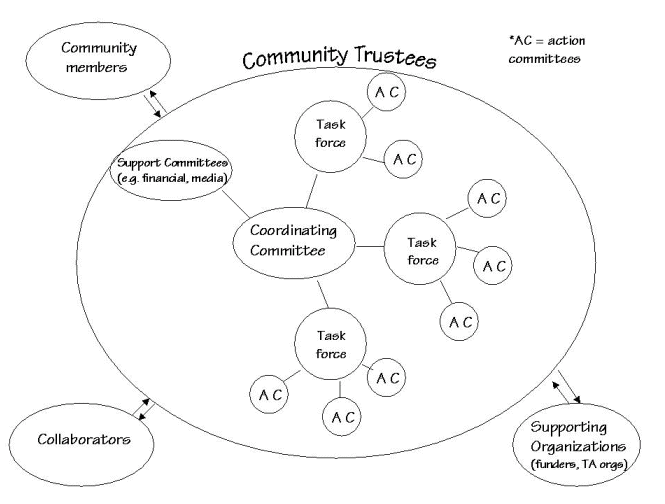
And in diagram form:
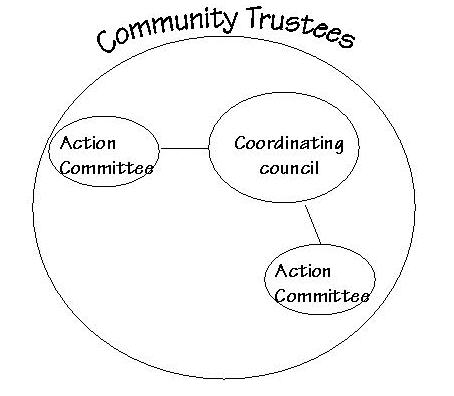
As smaller size means fewer people, these groups are usually less complex, as they have less need for a formal hierarchy and instead have governance that is consensus-based. A diagram of such a small group might look something like this, with each of the circles representing an individual member:

What type of structure should you choose?
First, decide upon the formality your organization will have. The following table, adapted from The Spirit of Coalition Building can help you make this first decision.
| Conditions favoring more or less formality in organizational structures | ||
| Condition | A looser, less formal, less rule bound structure would be favored when... | A tighter, more formal, more rule-bound structure would be favored when... |
| Stage of organization development | The organization is just starting | The organization is in later stages of development |
| Prior relationships among members | Many such relationships already exist | Few such relationships already exist |
| Prior member experience in working together | Many such experiences have occurred | Few such experiences have occurred |
| Member motivation to be part of the organization | Motivation is high | Motivation is low |
| Number of organization tasks or issues (broadness of purpose) | There is a single task or issue | There are multiple tasks or issues |
| Organization size | The organization is small | The organization is large |
| Organization leadership | The leadership is experienced | The leadership is inexperienced |
| Urgency for action | There is no particular urgency to take action now | There is strong urgency to take action now |
Organizational structure is something that is best decided upon internally, through a process of critical thinking and discussion by members of the group.
In your discussions, your answers to the following list of questions may guide your decisions.
- What is your common purpose? How broad is it? Groups with broader purposes often have more complicated structures, complete with many layers and parts, than do groups with more narrow purposes.
- Is your group advocacy oriented or service oriented? Service organizations use "top down," one-person-in-charge structure much more often than do advocacy based groups.
- Is your organization more centralized (e.g., through the work of a specific agency ) or decentralized (e.g., different neighborhoods working independently on the same problem)? A decentralized group might find a "top-down" structure inappropriate, as such a group often has several peers working together on an issue.
- How large is your organization? How large do you envision it becoming? A very small organization may wish to remain relatively informal, while a community-wide group might require a more formal structure. A related question, with similar consequences, is:
- How large is the community in which you work?
- How old is your organization? How long do you envision it lasting? A group formed to resolve a single issue might not need a formal structure at all, while an organization with long-term goals may want something more concrete, with clearer divisional responsibilities and authority.
- Is the organization entirely volunteer, or are there (or will there be) paid staff? How many? An organization with many paid staff members may find it more necessary to have people "in charge," as there are generally more rules and responsibilities for paid staff members, and thus, there must be more supervision in carrying out these roles.
- Should yours be a new organization, or part of an existing structure? Do you really need to form a new structure, or would it be better to work within existing structures? Sometimes, your goals may be better met if you are part of (or linked with) another organization.
In Summary
Structure is what ensures that your organization will function smoothly and as you intended. You should think about structure early in the development of your organization, but be aware that the type that fits best may change as your organization grows.
Contributor
Jenette Nagy
Resources
Online Resources
How to Develop an Organization Structure, by Tara Duggan, Demand Media, is an informational article on how to develop organization structure with a short step-by-step analysis.
It's All About the Base: A Guide to Building a Grassroots Organizing Program from Community Catalyst.
This Collective Action Webinar: Collaborative Governance video, presented by Sylvia Cheuy of the Collective Impact & Community Engagement at the Tamarack Institute, offers an overview of collaborative governance principles and practical strategies for planning and sustaining backbone support.
Print Resources
Berkowitz, W., & Wolff, T. (1999). The spirit of coalition building. Washington, DC: American Public Health Association.
Unterman, I. & Davis, R. (1984). Strategic management of not-for-profit organizations: From survival to success. New York, NY: Praeger.
Example: Interview with Brian Dawson, Community Consultant for the Ellis County, KS Community Partnership
CTB: Talk a little about the structural development of a group you have worked with.
Brian Dawson: When I worked in Mitchell County, KS, we were trying to construct a coalition to address substance use issues. There had been a lot of abuse and accidents. People were finally speaking out, saying "enough was enough." There had been a lot of denial from the community. They were not admitting they had a problem until it got to a certain level. A few attempts at addressing the problem were made.
I worked with the community members that were passionate about getting something done. We developed a steering committee. This group became the motivational force behind the developing coalition. These people had a real degree of personal interest and they started working through grass roots efforts to incorporate and recruit people to get involved. Attempts at including key leaders in the community to become part of the coalition were made.
From there, they developed an advisory board that would review information and consider how the group should act and what approach they should take. They wound up applying for a 501(c)(3) status, so they could apply for grant opportunities, funding, and operate under a not-for-profit status. They continually went back to their goals and missions and reevaluated to make sure they were doing what they intended to do, which was impact the problems of substance use.
Over a period of time they had to change or at least keep trying to encourage new people to get on board. You have to keep people interested and dedicated. Just because an accident has occurred doesn't mean you can relax. Prevention needs to be long term and continually working to improve the community.
CTB: Did you find it difficult to get other leaders involved in the organization?
Brian Dawson: That's a complex question. Yes and no. If they've got an interest in (the issue ) or if they have a political tie, the key leaders may become involved. If the community really wants someone to get involved they do have an influence in numbers. It's important to have people involved that can make change happen such as your mayor, county attorney, a judge, or somebody that's going to give you some leverage for policy changes. You need to have some people that are going to be able to make changes in that community or in your area. Otherwise, you're going to have a tough, uphill battle. So try and approach key leaders, educate them on your efforts, and get them involved at some level so that they can help you out.
CTB: You were talking about using leverage to convince them to join. What kind leverage does a new coalition have?
Statistical information is valuable to persuade attitudes and involvement. The voice of the masses can persuade a political or elected official to join the group, especially if it will help them politically to be involved. The coalition needs to do their homework to best represent the case for support. You've got to have a selling point. And you've got to have the information and the personal touch there that's going to get people involved. Otherwise, you might be just spinning your wheels.
Also, it's important to have a clear vision and mission statement on what your coalition is all about. Coalition members need to be in agreement of the vision and goals. It's okay to have different opinions, but the group on the whole has to want the same outcome.
CTB: Do you think it's more important to have key leaders as members of your initial steering committee, or are they people you want for your board later on?
Brian Dawson: It's not so important, I don't think, to have key leaders on the committee that gets everything started. But once you are established, it's important to have key leaders on the board to give it some weight. If the issues are important for the community, key leaders are typically going to be on the board or have some kind of connection. They wouldn't be in those positions if they weren't there working for the benefit of the community.
A key leader is someone who can influence individuals in your community's schools, government, law enforcement, social services, etc. A key leader's involvement is essential in providing credibility, accessing resources, removing barriers and supporting community prevention efforts.
CTB: Do you have any advice for others working on organizational structure?
Brian Dawson: Really think about what you want to accomplish, develop a vision, and try to develop from there. It's helpful to have an advisory board to steer the coalition, legal counsel is helpful (maybe an attorney can get on the coalition board), by-laws, mission statements, and a consensus from the group to reach certain goals. Define success for your coalition so you will be able to monitor your efforts. You can develop subcommittees to work on the grassroots efforts of recruiting people and funding.
___You have met with other members of the organization to discuss the best structure for your organization
___You have chosen the relative formality your organization will have
___You have chosen your organization's structure, based on your understanding that:
- Structure is the framework around which the group is organized
- Structure gives members clear guidelines for how to proceed
- Structure binds members together
- Structure in any organization is inevitable
- Structure should occur in proportion and parallel with other work the organization is doing
You understand that:
___Three elements of structure are
- Some kind of governance
- Rules by which the organization operates
- Distribution of work
___Four tasks are inherent to community work:
- Envisioning desired changes
- Transforming the community
- Planning for integration
- Supporting the efforts of those working to promote change
___You've established necessary committees or subgroups based on your understanding of common roles in community organizations. These roles can be linked together for small, medium, and larger groups
- A steering committee is the group of people who get things started
- A coordinating council modifies broad, organization-wide objectives and strategies in response to input from individuals or committees
- The executive director often takes the place of or serves at the head of the coordinating council
- Task forces are made up of members who work together around broad objectives
- Action committees are formed by larger organizations to bring about the changes sought by the organization
- Support committees are groups that help ensure that action committees or other individuals will have the resources and opportunities necessary to realize their vision
- Community trustees provide overall support, advice, and resources to organization members
- Grantmakers can be public or private. They offer financial support to organizations
- Support organizations are groups that offer technical assistance
- Partner organizations work on the same issues as your organization
Adolescent violence, HIV infection, adult literacy, or any situation in your town that has reached a point where you've decided something has to be done are all times when you might have to create and gather a group to guide your initiative. You know you can't be effective all by yourself, so you want to try to put together a group to look at the problem, come up with some ideas about what can be done about it, and then create and implement an action plan to move forward.
But what would that group look like? Who would its members be, and where would you find them? How would it function? What would it actually do? This section will help you think about how to actually form such a group that can start and oversee an initiative designed to meet a community need.
Why would you want to create and gather a group to guide your initiative?
Assembling a group to guide the organization or initiative in its beginning stages has some distinct advantages over trying to do the same thing as an individual:
- It lends credibility and community support to the effort. Especially if the group is diverse, and represents a number of different organizations, interests, and parts of the community, it essentially gives the community a sense of ownership of the organization or initiative. This makes it much more likely that it will continue to have the community's enthusiastic support, even long after the group has been disbanded.
- It allows more ideas to come into play. Two heads are often better than one, and ten are better than two, although sometimes harder to reconcile. While it can be a lot of work to sort out the different ideas of many group members, the consensus you come to is likely to be more interesting and effective than what you could have developed alone.
- It affords an opportunity to educate the community about the issue. Everyone 's in favor of adult literacy, for instance, but very few - including staff people of health and human service agencies - understand how many adults need literacy services. As members of an oversight group for a community literacy initiative, however, they 'll have the opportunity to learn a great deal about the issue and the actual potential for addressing it. And they'll spread the word as they learn.
- It gives new organizations and initiatives the benefit of others' experience. Even if the oversight group is largely made up of individuals from the community rather than agencies and organizations, many of those people may have founded their own businesses, started other organizations, been on community Boards, etc. Both these individuals and those who work for other organizations will have valuable knowledge and experience that can save your organization or initiative enormous amounts of time and trouble.
- It provides a base for membership, fundraising, and other support. Each of the people in the group will know literally hundreds of others - far more than you would have any chance of contacting on your own - and many of those others will be only too willing to help if only they are asked. The networking possibilities are endless.
- It provides personal support to its members and to the people who started the initiative in the first place. This kind of support can be extremely important when things look bleak... and they will, at least occasionally, in any community initiative.
When starting a new organization, you'll often find that the people involved don 't know each other well enough yet to really know who might make the best leaders. Yet there is still a lot of work to be done in laying the groundwork for this new entity. Forming a group is a way to get some of these important things done before figuring out what the ultimate governing structure will be:
- Deciding the initial direction of the organization
- Forming a vision and mission for the organization
- Determining and recruiting potential partners
- Creating an action plan
- Choosing people to head individual committees and be in charge of specific tasks
A group is also useful when your organization has started working on many tasks, but doesn't yet have - or will never have - a staff. The group may act as a substitute for an individual coordinator or director, either of an organization or initiative, or of an event or particular area of an organization's functioning.
What kinds of groups might foster the development of an initiative?
This question really has two sets of answers. The first depends on whether the group is one of individuals or a coalition of organizations; and the second involves the different ways such groups can function. Let's start by examining whether, for your particular purposes, you're more likely to put together a group of individuals or one of organizations.
Ways groups can be formed
Organizations and initiatives get started in a number of ways, and the nature of the groups that guide them is usually determined by how they originate.
One person sees a problem in her community and decides to do something about it. In this instance, the group assembled is often a group of individuals - typically friends or acquaintances of the initiator - who either have some personal reason to be concerned, or are simply community-minded and interested in the issue.
When her teen-age son was beaten up on the way home from school, a woman in a small town decided that adolescent violence needed to be dealt with. She put up posters, made phone calls, and gathered 35 parents and adolescents at an initial meeting to discuss the issue. Out of this first meeting grew a community initiative that involved both parents and adolescents in discussions, workshops, and theater performances. With help from a local agency, the group got a grant, and continues - successfully - to try to reduce adolescent violence in the town.
An organization, community institution (a church, for instance), or local government agency takes the lead in tackling a community issue. In this kind of situation, the group formed is likely to be a coalition with a mixed membership of representatives of organizations and individuals representing only themselves.
An organization decides to write a proposal for available funding to deal with an issue that requires a group response. The group assembled in a case like this is generally by definition a coalition of other groups, but may include individuals from the community as well.
A community action agency responded to a request for proposals (RFP) from the state Department of Education for a community effort to serve families experiencing increased risk of children under four. A stipulation of the RFP was that the proposal be agreed upon by a coordinating body for the effort. A group representing community health and human service agencies, parents, schools, and others was assembled by the community action agency, and, when the proposal was successful, became the oversight body for the initiative.
A coalition that already exists identifies a problem and resolves to address it. Here, the coalition is the group that begins the process. It may remain the group that spearheads the initiative, or, as in this example, it may spin off a group that ultimately takes charge.
The North Quabbin Community Coalition in central Massachusetts is made up of representatives of health and human service agencies, the Chamber of Commerce, the police, the schools, local politicians, and other interested community members. Appalled by the high incidence of child sexual maltreatment in the area, the Coalition formed a Child Sexual Assault Task Force which launched a community initiative to try to change the situation. The initiative in turn grew into an organization that provides parenting training and children's activities, and has become a permanent fixture in the community.
While both organizations and individuals have their own priorities and interests, organizational rules and politics add other elements into the mix. A group of organizations needs to function differently than a group of individuals does, because it has to take everyone's organizational issues into account. The simple matter of whether or not people are on the clock when they attend group meetings can affect how the group operates, as can the concerns of Boards, the requirements of different organizations' funders, and the organizations' mission statements. All that has to be considered when you look at how the group might function.
Ways your group can function
Groups that oversee initiatives go by a number of names which are often used interchangeably. As a result, the descriptions below may not fit your own experience. These names, nonetheless, imply different ways of operating, and it would make sense to think about what might work best in your situation.
Steering committee
A steering committee, as the name implies, steers the organization or initiative at the beginning. The committee develops action plans, considers the political and other implications of what the organization or initiative is doing, and may develop vision and mission statements and organizational structure, and create plans for funding and Board development. As is explained in Section 1 of this chapter, however, steering committees, at least in the definition used in the Tool Box, are meant to dissolve once the initial work is done. If they continue to meet after the first six months or so, then they have become a coordinating council.
Coordinating council
A coordinating council often does many of the same things as a steering committee, but also coordinates the organization's or initiative's activity. It essentially takes the place of a director or program coordinator, modifying broad, organization-wide objectives and strategies in response to input from individuals or committees. If the organization or initiative stages a public demonstration, for instance, the members of the coordinating council would be the ones running around making sure that everyone knew where they were supposed to be when, that the media was informed and courted, that the portable toilets were in place, etc. If you think of an organization as a wheel, the coordinating council is the hub holding everything together. The hub collects and directs the energy from the spokes - and without it, the wheel would fall apart.
Advisory or supporting committee (or council or board)
An advisory committee may have no real power at all, but may guide the organization or initiative through its members' knowledge of the community and the issue, and may lend its members' prestige to the cause when necessary. It may help to develop a vision and mission for the organization, but will probably not be the determining body in that effort. Advisory committees often exist in situations where the initiative is really the work of one charismatic or visionary individual who needs help and support, but doesn't particularly want guidance.
Board of Directors
In this instance, the group will function as the governing (but probably not coordinating) body for the organization. A board of directors usually works with staff to set policy for and oversee the functioning of an organization.
Other possibilities
There are numerous other forms that a group might take. A core group, for instance, might assemble a larger group that ultimately takes one of the forms listed above. An executive committee might make decisions for a larger group, and thus effectively guide the initiative. There is no one right way to start a community initiative or organization.
If you're hoping to hire staff eventually, a steering committee might work best for you, since it won't need to guide the organization for very long. If you're starting a community initiative or coalition that probably won't ever have staff, a coordinating council might make more sense, since it will provide continuity as well as the capacity to form and direct the group from the beginning. A Board of Directors is most appropriate for an organization that already has a sense of itself. The main consideration is what will be most effective for the organization or initiative you're starting.
As you decide what kind of group will serve your organization or initiative best, you need to consider the needs and priorities of the organizations and individuals involved; the degree of involvement you're asking for; the amount of time group members will need to put in; and what the group is actually going to do. These factors will be discussed further in the course of this section.
When in the process should the group be formed?
The group, if it is to be most useful, should be formed as early in the process as possible. You want it in place, for instance, so its members can participate in developing a vision and mission. You're far less likely to find support - and far less likely to form an effective organization or initiative - if you present a potential oversight group with an already-formed organization or initiative. Furthermore, it's much harder to change your ideas, even if it becomes obvious that they're unworkable, once you have them set in a plan. Recruiting a group at the beginning will help avoid this kind of issue.
Another reason for recruiting your group early is that it allows your organization or initiative to hit the ground running once your plan is in place. As mentioned above, the group can act as coordinator either until you hire staff (which, depending upon where funding enters into the equation, may be a while), or - in the case of many community initiatives which operate without staff - permanently.
Who should be involved, and where do you find them?
For your group, you'll want enough people to get everything done, but not so many as to make things too complicated. Those numbers can vary tremendously - there are effective groups of 10 or fewer, and of as many as 30 or more. Here are a few general guidelines about the type of people to involve:
- People who are enthusiastic about the issue and who have the time and energy to invest in making it successful
- It's important to involve people who will be able to regularly attend meetings and be involved. For some types of bodies, such as advisory councils, this may be less important, but for the work done by steering committees and coordinating councils you'll want people who are willing to roll up their sleeves and jump in.
- A good cross-section of the community in terms of race, socioeconomic status, etc.
- Members of the specific priority community
- Other obvious stakeholders in the issue. If your initiative is meant to reduce substance use, for instance, you may want to include the police in your group, since they're the ones who often deal with the problem on the street.
- Recognized leaders in the community can add clout and credibility to your cause
- Newer, up-and-coming leaders and people who hold no titles but are well respected in the community can also be very helpful
- Unless they gave the issue a bad name, be sure to consult and perhaps involve people who've had experience with your cause in this community in the past
In situations like this, you have to do your history homework. If you're trying to start an organization to offer services to people experiencing homelessness, for instance, it's vital to know what has been attempted along these lines in the past, and what the result was. If the experience left a bad taste in people's mouths, you're going to have a much tougher time. You need to know that, and to counter it as best you can. If the people who were involved in the past attempt are respected for what they did, then they should be involved in what you're doing. If the community thinks that they made a mess of the whole thing, or that they're dishonest, their participation will make your effort look like more of the same. Those who don't learn history are condemned to repeat it.
- Try to get some youth involved; they often have a fresh perspective on things and tons of infectious energy.
- Be sure that at least one person on board is a good writer, and that they, or at least one other member, have had some experience with funding proposals; they will be instrumental in writing early grant proposals, press releases, and so on.
It's crucial to be aware that some people you want to include may have less experience being members of groups, and of this type of group than others. Although 'meeting skills' may seem basic, not everyone has the same background, and some people may never have been exposed to that type of situation. Thus, some participants may sit silent, confused by the flow of the meeting, unable to contribute, and feeling foolish; or they may speak or act in ways or at times others deem inappropriate. People without meeting skills need support and encouragement in what is often for them an intimidating situation. One answer may be to pair all team members, so that those who need support will have a mentor. Another possibility is to start the process with a training for everyone in group dynamics and meeting skills, so that no one is singled out and the ground rules are clear for all.
Where can you find these folks? Consider these possibilities to look for steering committee or coordinating council members:
- Local colleges or universities, schools, and libraries
- Local government officials and agencies
- Economic development organizations
- Civic organizations
- Social and sports clubs and community centers, especially in neighborhoods you particularly want to reach
- Chamber of Commerce and other business organizations
- Social service agencies
- Youth groups and organizations
- Churches and other organizations in the faith community
- Flyers in laundromats, markets, etc. that cater to the priority population or to others you specifically want to reach
As you begin your search - or perhaps even before - you'll meet, or realize you know, people who will introduce you to others who will introduce you to others. Networking is, in reality, probably the way you'll find most of your group.
What should your steering committee or coordinating council do?
Now that you've formed a group to oversee the creation and operation of your new organization or initiative, what will it actually do? In fact, there's an enormous amount of work to do in getting something new off the ground, and, depending upon how things play out, this group may do most of it. A not-necessarily-exhaustive list might include:
- Form a vision and mission for the organization. This is the first step in any process of this sort. It defines what it is the organization or initiative exists to address, and what its philosophical, political, and ethical base consists of. You can't go anywhere until you've hashed those things out, and it's worth the time it takes. (And it will take time: how much depends to some extent on how diverse the group is.) This will probably be the most important task this group takes on.
- Decide the initial direction of the organization. What's the organization or initiative about? The fact that you have a vision and a mission statement doesn't mean you know exactly what to do to carry them out. The direction of the organization is the way you'll address the issue, and there may be many choices. One of the most important is whether to create an organization that will run intervention programs of some sort for a priority population, or whether to concentrate on advocacy, public education, linkage, or some other effort that addresses the issue, but doesn't offer direct service to those affected.
- Create an action plan. After deciding what your organization or initiative is going to do, the next step is to determine how to do it. The first action plan may not actually lay out how the organization will operate, but rather how to get it started. If you're going to operate an intervention program, you need funding, staff, space, equipment, etc. If you're going to concentrate on advocacy, you may need only volunteers and communication capability, or your group may already be ready to go. In either case, you're going to need a plan for what to do next.
Although it may seem early to consider this, during planning is the time to start thinking about whether your group is going to be a permanent part of the initiative, or if it's going to disband at some point when a different permanent structure is in place. The decision of whether to dissolve the group or to keep it running the organization depends upon the financial, political, and personal realities of the situation, the dedication of the oversight group, and the actual needs of the organization or initiative and of the community. Many groups begin with the assumption that they 'll dissolve, and in fact this decision - whatever it is - should be part of the action plan. It avoids a great deal of potential trouble if the group makes the decision early in the process.
- Find partners for the organization. If the founding group is a coalition of organizations, this task may have already been accomplished. If not, let the networking begin!
- Establish and oversee sub-committees (budget, planning, organizational, marketing, etc.) if that seems necessary to carry out the tasks of the group.
- Hire staff, if that's part of the plan.
- Plan and coordinate the activities of the organization or initiative, if hiring staff isn't part of the plan.
Whether or not to hire staff is obviously a crucial decision for an organization or initiative. The reality of nitty-gritty issues like money and the availability of people's time will enter into the decision, as will the question of what tasks really need to be accomplished. If the group is purely an advocacy organization, for instance, it may be able to operate quite effectively with just the efforts - probably considerable - of the oversight group. If it's trying to deliver services, it may need some staff and some sort of at least part-time regular coordination.
- Apply for grants and seek other funding for seed money for the organization or initiative. (This may be the job of staff after they're hired, or the group may take it on itself.)
- Put together a Board for the organization or initiative. This task may also devolve upon staff if there is a staff. It also implies that the oversight group will disband at the point that a Board exists.
In Summary
It often makes sense, in founding a new organization or initiative, to put together (if one doesn't already exist), a group to oversee its development and at least its initial operation. It's important to select, early in the process, a group that includes the important stakeholders and key supporters and is representative of the diversity of the community. That group's involvement in the creation of the organization and in planning what it will do can greatly increase its chances of success.
Contributor
Chris Hampton
Phil Rabinowitz
Resources
Online Resource
Some ideas about organizing from Citizens for Local Democracy.
Print Resource
Leuci, M. (1997). Getting started: Forming a steering committee. Missouri Express resource guides.
Example: Northeast Coalition Steering Committee
Harry Schwartz is a consultant to the steering committee for the Northeast Coalition, a coalition that has been started to improve and develop the Northeast neighborhood of Kansas City, Kansas. Schwartz has been helping them organize the coalition and steering committee and undertake their first activities.
The steering committee came about following a report that suggested that the neighborhood should be represented by an umbrella group that would advocate for the needs of local citizens and groups. In the next few months, the steering committee will be transformed into a board.
"What we have right now is a very loose association," Schwartz says of the steering committee. "The committee is now made up of representatives of groups in the neighborhood...each member of the committee represents a different group. It's casual, informal, and loose. There's not even a chair, and things are decided without votes but a consensus."
When the coalition becomes legally incorporated, Schwartz says, "they will have to have a board, officers, and bylaws... Right now, it's just some people getting together every few weeks to discuss an issue, except they have a very specific agenda. It's worked, but it's been just informal without any officers or votes or things like that."
The Local Initiatives Support Corporation, one of the groups that released the abovementioned report, called a meeting to which all the groups that they could find in the neighborhood were invited. "About sixty people came, and we broke up into five subgroups. These are people that are already active representing groups. They all had some base in the community. The discussion revolved around what should priorities be for action in the northeast, and people took notes. We got a pretty good agenda for what people were concerned about. Many people didn't know each other, and we mixed them up so we would minimize friends. There were two people from the same group; they were at different tables. So we got a pretty good mix of people. Many of them didn?t know each other before that. And, then, after spending about an hour together, we asked each table to put forth two people for the steering committee, and that's how we got the committee."
Schwartz says the committee members have worked together well so far, and that everyone agreed the process was fair. "We got a very good mix of people from different groups. We've had subsequent general meetings, and people have felt that the committee has been very representative, fair, and inclusive and has talked about the major issues... No one has said, 'You didn't include me,' because the general meetings are open. So the process up to now has been well endorsed, and we hope to continue in that way."
General meetings of the Northeast Coalition steering committee are held every three months and are anyone who wants to come. "Generally, we've had about 55 or 60 people at each meeting probably representing twenty-five to thirty groups," Schwartz says. "There seems to be a lot of agreement as to what the priorities should be for action in the northeast," he adds. The steering committee is focusing on economic development, housing, and "what people generally refer to as communication, which mean a lot of things - finding out the availability of information on all the groups, groups working together, being able to help each other." The group also wants to focus on the needs of younger people, including jobs, school improvements, and safe after-school activities.
According to Schwartz, the following are qualities to look for in a steering committee member:
- People who have experience in the neighborhood or area being covered, either as a resident or a businessperson or someone who works for an agency there
- People who have had a leadership experience before in local groups
- People who are committed to taking the steering committee as a serious responsibility
- People who are familiar with local issues
- People who are articulate
- People who are able to work in a collaborative spirit
- People with a sense of vision and imagination for the neighborhood or area
- People who are mature and well-seasoned
- People with a variety of different points of view - you don't want everybody representing the same types of interests
Why should you form a group?
___Support of a cause
___More ideas
___Community involvement
___Personal support
When should you form a group?
___As early in the process as possible
What kind of people should you include in your group?
___Enthusiastic people
___Young
___Natural leaders
___Regular attendees of meetings
___Good writers
___Experienced people
What should your steering committee or coordinating council do?
___Create the mission and vision statements of the group
___Create a plan a action
___Create organizational structures
___Choose leaders for tasks
___Designate Board of Directors duties
___Designate advisory support committee duties
Tool 1: Steering Committee and Working Group Member Roles
The Collective Impact Forum outlines the key responsibilities of the Steering Committee and Working Group members.
To view the full memo, visit the Steering Committee and Working Group Roles - Collective Impact Forum.
Creating a task force or an action committee can be an effective way for your initiative to address a specific problem. Such a body needs to be directed specifically toward acting on that problem, and to involve all of the different sectors of the community that are affecting it or affected by it. In this section, we'll discuss what task forces and action committees might look like, what they do, and how to put them together and use them to shape your initiative.
What is a multisector task force or action committee?
A task force or action committee (also sometimes called an ad hoc committee from the Latin meaning "for this purpose") is a group assembled to address a specific problem or accomplish a specific goal. That problem or goal can take at least two different forms:
- It might be related to dealing with a specific community issue - affordable housing, child maltreatment, early detection and treatment of breast cancer.
- It might stem from a need of the larger group. A coalition might need a smaller group to focus on advocacy, for instance, or to draft a set of bylaws.
A multisector task force or action committee is drawn from all sectors of the community affected by or involved in the problem or goal that is the group 's focus. In the Peterson Community example, for instance, the task force leaders tried to include representatives of every group they could think of that had anything to do with the problem of adolescent prescription drug misuse.
Task forces and action committees, as you might assume from their names, are action -oriented. Their specific purpose is to do something. Depending upon the issue they address, their initial goals may be very specific (find community shelter space for at least 15 families experiencing homelessness; draft a timeline for a community economic development effort) or more general (address the problem of youth violence). In either case, however, their purpose is to come up with real results.
In general, these groups are not meant to be permanent. They either disband when their task is done, or they become another kind of group. As will be discussed in more detail later, a task force might spin off a new community intervention, for instance. While that venture would continue the work of the task force, it might not involve any of the first group's members, and would have a different purpose and structure.
A task force or action committee is usually part of a larger initiative - a community coalition of some sort, a local or other government committee, etc. It may be one of several such groups spawned by the initiative, each aimed at a different issue or goal. It may operate independently, or may have to gain approval from the larger group before taking any action.
The North Quabbin Community Coalition, in north central Massachusetts, regularly maintains several task forces working on specific community issues. Some former and current task forces include Information and Referral, Child Sexual Assault, Homelessness, and Youth-Community Relations.
Why would you form a multisector task force or action committee?
There are really two questions here, each of which we'll consider separately:
- Why would you form a task force or action committee?
- Why should a task force or action committee be a multisector group?
Why form a task force or action committee?
There are a number of reasons why you might want to form a task force or action committee, rather than addressing the issue at hand within the larger group.
- Task forces or action committees can make it possible for their parent groups to zero in on the areas that need the most, or immediate, attention, while still addressing their other concerns.
- A task force or action committee can focus in on the specific issue, rather than being pulled in a number of directions, as the larger group may be.
- In general, a small group can operate more efficiently than a large one to get things done.
- Task forces and action committees give people a chance to concentrate on their major areas of interest, and to contribute more effectively to the work of the larger group.
- Task forces and action committees can pull in members who may not be interested in the larger group to work on just the particular issue they are interested in. The community thus benefits from their talents and expertise even though they aren't members of the larger group.
Why should a task force or action committee be multisector?
Including people from as many sectors of the community as possible is almost always both more ethical and more effective than excluding them. This is particularly true when assembling task forces or action committees that are aimed at accomplishing specific goals in a community.
Advantages of a multisector task force or action committee
- Community action usually requires the support, and often the participation, of all stakeholders if it's to be successful.
"Stakeholders" is a term used throughout the Tool Box. It refers to those who are directly affected or have some other interest in a particular issue. The stakeholders in a discussion of discrimination in housing, for instance, include not only the members of underrepresented groups that experience discrimination, but also anti-discrimination enforcement agencies, housing authorities, realtors and their employees, landlords, the police (who may get the first call on a discrimination complaint), legal service agencies, and even homeowners in a particular neighborhood (who may have strong feelings - and not necessarily much information - about including or excluding people from underrepresented groups, and what that will mean for their property values).
- Involvement of all stakeholders in planning and carrying out any action means that they'll take ownership of those plans and actions. They'll be much more concerned about making sure that the action is successful because it's theirs, rather than something imposed on them by "experts" or some other authority.
- Involvement of many sectors of the community brings with it the information and insights that those different sectors have into the issue. More information and insight lead to better planning and more chance of successful action.
- The perspectives of various sectors on community history and personalities can help the group to a real understanding of the issue, including the vital small things that might be otherwise ignored. (Whether or not two individuals get along well may determine whether a given plan is workable, for example. Neighborhood people, who are familiar with the personalities involved, are more apt to know that sort of thing than, say, health professionals.)
- Involving many sectors in the task force or action committee will generate community cooperation and support for the action taken.
- Multisector participation benefits the larger initiative and the community as well, because it brings together individuals and groups who might not, under other circumstances, have much contact, or who might distrust one another. In the work of the task force or action committee, they have the opportunity to learn about one another, and develop mutual trust and respect.
- Finally, it's simply fair and reasonable to involve people in decisions which affect their lives. Those decisions are likely to address the issue more realistically, and to take into account the legitimate needs of the groups affected, if those groups are involved in planning and implementing them.
Possible disadvantages of a multisector group
Although there are many compelling reasons for forming multisector groups, there are potential difficulties with them as well. Even if you understand the history and current situation of your community before you start to assemble such a group, there are still problems you may run into.
- There may be enmity and distrust among segments of the community that are normally at odds, or who have little contact. Some of these may be obvious - racial or ethnic tensions, intergenerational conflict - but some may not, or may be one-sided. People with lower incomes may distrust members of more affluent groups, for instance, even if the latter have good intentions and are trying to be open and welcoming. Politicians who are genuinely concerned with solving the problem may nonetheless be objects of suspicion. Academics may scorn business people, or vice-versa. These areas of conflict have to be resolved if the group is to function well.
- There may be deep-seated disagreement about how to handle the issue. Police may see the answer to a drug problem as more rigorous enforcement, while medical professionals see it as one of treatment, and human service providers as one of addressing the underlying causes - poverty, hopelessness, unemployment, child maltreatment, education, etc.
The simple answer in a situation like this would seem to be "all of the above." If you strengthen enforcement, mandate treatment, and address the underlying causes, you'll make some headway. While that is probably true, you should also consider here the availability of resources and loss of focus.
In order to address enforcement, treatment, and underlying causes all at once, you'll need money and personnel time from a number of different sources. In addition, if you try to focus on all three areas (and each is a tall order even by itself), you risk diluting and scattering your efforts to the point where you can't be effective at anything. Task forces or action committees usually are most successful when their goals are clear, well-defined, and well-focused.
All of that leaves your group with having to somehow reconcile different views of the world and of the issue at hand. It's not impossible, given good will on all hands...but it's not easy, either. It takes good leadership, something we'll look at later in this section.
- Different individuals or groups may have very different levels of commitment to the work of the task force or action committee. This can lead to problems in a relatively small group where everyone depends on everyone else to carry out assignments.
- There may be differences in levels of sophistication, education, and "group skills" among members of the group from different sectors of the community. In order to ensure that everyone's capacities are tapped, some folks may need support, encouragement, and mentoring or training in order to feel comfortable participating.
This situation can either be seen as a potential problem or as a potential advantage, because, while it obviously can act to the detriment of the group if not handled well, it also provides the opportunity to develop leadership from within the community.
When would you form a multisector task force or action committee?
Some issues can be addressed within the context of a larger initiative, or by simply finding more resources for existing organizations or services. When can a multisector task force or action committee best address an issue? Here are some possibilities:
- When the initiative as a whole identifies a specific issue, within its larger mission, that needs to be attended to. This might, as described earlier, be a community problem, such as substance use, or it might be an internal need of the initiative - advocacy, recruitment of new members, etc. In either case, the issue is important for the initiative to address, but too specific for the whole group to work on.
- When new information points out something in the community that can't be ignored.
The North Quabbin Community Coalition referred to earlier found, in the late 1980s, that one town in the region, with a population of just over 10,000, had the third highest number of child sexual assault cases for Massachusetts communities. It was clear that action needed to be taken as quickly as possible, and the Coalition immediately formed a Child Sexual Assault Task Force, which included the police, all the relevant human service and state child protective agencies, parents, the schools, the local hospital and community health center, the YMCA, and other interested parties.
- When an existing task force or action committee realizes its work can't be completed without addressing another area related to its own focus.
A Child Sexual Assault Task Force like that above, for instance, may find that a huge percentage of child sexual assault cases are alcohol-related (as the North Quabbin Task Force in fact found). The initiative might then, at the Task Force's urging, form another task force to address harmful alcohol use in the community.
- When a difficult situation or critical action by an external entity makes attention to a particular issue suddenly more important. If the state cuts health funding for your community, for instance, your initiative might want to form an advocacy task force to mobilize a local effort to get it restored.
- When a group within a larger initiative sees an issue that it particularly wants to concentrate on. If the driving force for the task force or action committee comes from many of its potential members, it is likely that they will be focused and hard-working, and that their efforts will be effective.
There can be a problem here if the issue is not one that particularly needs attention. The energy of those in the self-propelled task force or action committee is then diverted from more important concerns. Leaders of the larger group might try - diplomatically - to turn the task force in a more appropriate direction.
Who might be part of a multisector task force or action committee?
The short answer to who might join a multisector task force or action committee is just about anyone. Here are some considerations when you're recruiting:
Seek members who aren't part of the larger group that the task force or action committee is part of. The only criteria for membership are their interest in the issue, and their willingness to work on it. You can recruit friends and neighbors, program participants, politicians - anyone who can help.
Look for stakeholders and other interested parties. Stakeholders might include:
- Those directly affected by the issue
- Priority populations
- Those who work with those directly affected
- Those responsible for the issue in the community. If the issue involves the law, for instance, as in the case of substance use disorder, the police and court personnel would be appropriate task force members
- Those affected indirectly or secondarily. Businesses are affected by low literacy rates in a community, for instance, because they can't find workers with the skills they need
- Interested community members may have no specific stake in the issue, but may see it as a community problem, and therefore something they should be concerned about
Look for people who can be helpful to the effort. These folks may not be stakeholders, but may be able to offer support and credibility, as well as resources.
Some possibilities:
- Business leaders.
- Clergy and other leaders of the faith community
- Local or state officials
- People who may hold no official position, but who have high standing in the community
- People with access to money or other resources
- People with access to power
- People with access to the priority population
Look to engage people from different sectors. Some examples of different community sectors include:
- Youth
- Older adults
- Business community
- Media
- Schools
- Youth-serving organizations
- Law enforcement agencies
- Religious or fraternal organizations
- Civic and volunteer groups
- Healthcare professionals
- State, local, or tribal governmental agencies
- Community organizations
Ultimately, a cross section of the community on your task force or action committee means more access to different sectors of the community, more credibility among those sectors, more and better information, and more chance of community support and eventual success.
How do you develop a multisector task force or action committee?
If you do decide that you need a task force or action committee to work on an issue for your initiative, what do you do next? In order to put a group together and get it working, there are a number of steps you should take. These steps are essentially the same as those a larger group might take in defining its goals and actions.
Define the relationship of your task force or action committee to the larger group
How are you going to operate within the context of the initiative? There is a broad range of options here, from complete independence to having to check back before taking any step at all.
Three common models:
- The task force or action committee operates independently. In this situation, the larger group delegates authority for the issue in question to the task force that's working on it. It may come back to the initiative for help, support, or resources, or to report on its progress, but the decisions about how to proceed are its own.
- The task force operates fairly independently, but reports back to the larger group on a regular basis. It doesn't need approval to do most things, but can 't commit the initiative to anything, or act in its name, without an official okay.
- The task force needs permission to take any action steps at all. Operating this way, it would probably formulate a plan and get it approved by the larger group. Then, it would have to check with the larger group only if the plan changed.
Decide beforehand exactly what the task force can do on its own, what it needs approval for, and who can give that official okay. In the case of a coalition, for instance, permission might come from the coordinator, a steering committee, an executive board, or a vote of the whole membership.
Once a decision is made about how task forces will operate, that decision will usually hold for all future task forces and action committees of the initiative as well, unless there's a need for something different in a particular circumstance.
In general, the more independent the task force, the more effective it is likely to be, since there may be times when it needs to move quickly. But, at the same time, the more informed the larger group is, the more likely it is to be supportive and available for help when needed. One reasonable way to incorporate both independence and the involvement of the larger group is to create a mechanism for checking back with the group that still allows for speed when necessary. This might mean clearing action with one or two people, or with a small executive committee.
Find the right people to lead your task force or action committee
The person(s) you choose need(s) two characteristics:
- Have, or be able to establish, credibility with all sectors of the population that you need to draw from. (This may mean that the person is an outsider, or a neutral party with no connection to any specific group; or maybe simply someone who's known throughout the community for fairness and integrity, or liked by everyone.)
- Be a good facilitator, who can deal with conflict and keep group members on track and all headed in the same direction.
Given these attributes, some potential leaders might be:
- The coalition or initiative coordinator
- The person(s) most concerned with, or with the most credibility on the issue
- The person(s) who can best articulate the task ahead and see the process for accomplishing it
- A group representing several sectors of the community
- The task force or action committee may be led collaboratively by all its members (you'll still need a facilitator, but that person may change from meeting to meeting)
Identify individuals or groups whose participation your task force can't do without
The questions to ask here are:
- Who are the actual stakeholders in this issue?
- Who are the policymakers, powerbrokers, and others whose permission, support, or membership is necessary to get anything done?
- Who will actually carry out any changes or reforms that your task force succeeds in establishing?
Make an actual list, with both individual names and - if you can't identify an individual - names of groups or sectors of the community who need to be involved. Ask other members of the initiative, contacts in the community, and anyone else you know to help you identify specific people to contact wherever you can.
There are some people whose direct participation is crucial. But there are others who would be ideal as well, even though they may not be absolutely necessary to success. Remember the list above of people who can be helpful.
Recruit members for your task force or action committee
Use your list and your contacts to get in touch with people. Many may be people already involved with the initiative, but many may not. Where you have an individual listed as the best representative of a particular group or segment of the community, it might help to have second and third choices from that group as well. In addition, people who may not be able to become members themselves will have ideas about others who would be good additions to your task force. Don't hesitate to ask them for names.
The best method of recruiting people is always personally. An ideal is for the first contact to be from someone the person already knows, but a "cold call" - a personal visit or phone call made to someone you don't know - is still better than an e-mail or a letter.
Gather the group and define its purpose
The issue is already a given, but how are you going to approach it, and what are you going to do about it? Some task forces or action committees are convened to study an issue, others to affect it indirectly, still others to take immediate and direct action. Members need to decide what they're going to do. One model for achieving this assumes that the task force works together as a group to plan its course of action:
The model below assumes also that someone acts as facilitator to guide the group through the process. It is aimed at a group whose purpose is to address a community issue - youth violence, homelessness, etc. A task force or action committee that has a very specific purpose, such as drafting bylaws, won't need to go through this whole process.
- Define the problem or issue clearly.
- Envision the ideal solution - what do you want things to look like or be like when your work is done?
- Start with the solution and work backward. What things need to happen to get from where you are now to the solution you've envisioned?
- Map out benchmarks - achievements along the way - between where you are now and where you want to be.
- Brainstorm or otherwise determine ways to reach each benchmark from the one before, and to reach your final goal.
- Identify whether your plan means that other issues have to be addressed as well (not necessarily by this group), or whether other people must be included, and decide how to deal with those realities.
- Identify the resources you'll need to get to each benchmark, and decide - realistically - how much you can obtain. Adjust your actual goals accordingly.
- Draft a plan based on what you've come up with. It should include a timeline for when you expect to reach each benchmark, and when you expect to reach your final goal.
Always be aware that a plan like this is a guideline. Everything always takes longer than you expect or want it to. The purpose here is to give yourself and the initiative some idea of what you're doing and how long it might take. Not only your timeline, but your plan itself will change. If it's a good plan to begin with, its major elements may survive reality, but much will be different by the time you reach your goal. The flexibility to adjust to changes in circumstances and to things you didn't anticipate or know about should be part of any plan.
- Present your plan to the larger group. Even if you have the latitude to act independently, it will help to hear what others think. It will also help both you and the initiative as a whole if everyone knows what's happening, especially if you need help from other task forces or members of the initiative.
At this point, you've actually developed your task force or action committee, and set it on its way. Your work has hardly begun, however. There are still a number of steps before you're ready to hang up your task force hat for good. We'll discuss them briefly.
Implement your plan
Take action to reach your benchmarks and your ultimate goal.
Evaluate and adjust your plan and your actions
As mentioned in the box above, no plan is perfect. That is why it is important to evaluate plans, programs, and processes regularly. These evaluations give you a chance to see what's working well, what needs to be changed, and what assumptions are in error or outdated. Most important, evaluation makes it possible to adjust and improve what you're doing.
Celebrate successes along the way
Celebrate reaching benchmarks with parties or formal ceremonies. Give awards to task force members, community volunteers, and anyone else who deserves them. Advertise your successes to your colleagues, and use the media to tell the community about them.
Celebration keeps people going, and reminds them why they're putting in all that time. It creates way stations so that the road to success doesn't seem all that long. It makes people feel good about themselves and what they're doing, and reminds the community that you're there.
Find a way to institutionalize whatever is necessary to continue to address the issue
Task forces and action committees usually disband once they've accomplished their purposes. But public health and community issues have a habit of never being "resolved." As long as you keep working at addressing them, you can keep things flowing smoothly. But once you turn your back, there are those issues again, just waiting for you to leave so they can surface.
There are a some ways that a task force or action committee can make sure that its issues continue to be addressed:
- The task force's work may be spun off into a new program or agency
For example, the North Quabbin's Child Sexual Assault Task Force eventually spawned Valuing Our Children, an independent organization that conducts various programs for children and adolescents, offers parenting classes and other support services for parents, and runs family activities to encourage parents and their children to have fun together.
- The implementation of the task force's plans or goals may be taken over by an existing agency
- The initiative as a whole may assume oversight of the task force's work, and institutionalize it in the community
Reaching your goal is only the first part of your task force's job. Only when the strategies for maintaining that goal have become institutionalized is your job done.
In Summary
Your initiative may need to develop multisector task forces or action committees to focus in on specific community issues or particular needs of the initiative itself. A task force or action committee is a group intended to take action; multisector refers to the group's membership, which is drawn from all sectors of the community, or all sectors that are concerned with the issue at hand.
Multisector task forces or action committees help a larger initiative focus in on specific issues, and do something about them. They can be more efficient than the larger group, and can let people concentrate on the issues that interest them. The fact that their membership is drawn from many segments of the community gives their work and that of the initiative credibility among various groups, gives those groups ownership of their plans and actions, gains their support, and leaves them feeling that they've been justifiably involved in dealing with issues that are important to them.
Multisector task forces and action committees are particularly useful when issues reach crisis proportions, or are heading in that direction; when new information identifies a hitherto unrecognized problem in the community; when an outside entity precipitates a crisis through its actions; or when a group sees a particular issue it wants to tackle. Membership, besides bridging cultural, class, ethnic, and other community boundaries, usually should include representatives of all stakeholders to the issue, people with access to policy making, and others in the community who are interested in and can be helpful to the effort.
The process of developing a multisector task force or action committee should include:
- Defining the relationship of the task force and the larger initiative
- Choosing good leadership
- Listing potential members
- Recruiting members
- Convening the group and articulating its purpose
Once the groundwork is done, the work of the task force encompasses:
- Implementing the action plan
- Evaluating and adjusting the plan and the work
- Celebrating successes at every step
- Institutionalizing the work of the task force before it disbands
Only after the last step can the task force or action committee be considered finally successful.
Contributor
Phil Rabinowitz
Resources
Online Resources
Children and Youth Task Force in Disasters: Guidelines for Development, by Administration for Children and Families, Office of Human Services Emergency Preparedness and Response, is a 2013 report with details on how to form a task force, focusing here on response to a major storm (Superstorm Sandy) that affected the Northeast United States in 2012. These guidelines are intended for emergency management, human services, and public health professionals to support a coordinated, integrated, and effective approach to children’s needs in emergency preparedness, response, and recovery.
Creating Political Action Committees (PACs) for Smokefree Air, by Americans for Nonsmokers’ Rights, is an example of creating a political action committee, along with a step-by-step process, as well as a development checklist. The PAC, as referred, would apply primarily at a national or state level, though the specific suggestions here generalize across many issues.
Forming a Corporate Political Action Committee, by Ronald M. Jacobs, Lawrence H. Norton, and Janice M. Ryan, provides an overview of PACs and summarizes the process and the steps through which a corporation can establish a connected PAC.
Multi-Cluster/Sector Initial Rapid Assessment (MIRA), by Inter-Agency Standing Committee (IASC) 2012, is a 20-page manual “designed to identify strategic humanitarian priorities during the first weeks following an emergency,” together with an additional five annexes [appendices] providing supporting information. The emphasis here is on large-scale global responses.
The Multi-Sector Task Force: A National Response to Violence Against Children is a United Nations report focusing on violence against children in Tanzania but also illustrating how a multi-sector task force can be formed and how it can operate in practice.
This Collective Action Webinar: Collaborative Governance video, presented by Sylvia Cheuy of the Collective Impact & Community Engagement at the Tamarack Institute, offers an overview of collaborative governance principles and practical strategies for planning and sustaining backbone support.
What is a multisector task force or action committee?
___You know that a multisector task force or action committee is a subgroup of a larger initiative assembled from a cross-section of the initiative or community to address a specific problem or to accomplish a specific goal
Why would you form a multisector task force or action committee?
___Task forces or action committees can allow a larger group to zero in on the areas that need the most, or immediate, attention
___A task force or action committee can focus in on the specific issue, rather than being pulled in a number of directions, as the larger group may be
___In general, a small group can operate more efficiently than a large one to get things done
___Task forces and action committees give people a chance to concentrate on their major areas of interest, and to contribute more effectively to the work of the larger group
___Task forces and action committees can pull in members who may not be interested in the larger group to work on just the particular issue they are interested in
You make your group multisector because:
___Community action usually requires the support, and often the participation, of all stakeholders if it's to be successful
___Involvement of all stakeholders in planning and carrying out any action means that they'll take ownership of those plans and actions
___Involvement of many sectors of the community brings with it the information and insights that those different sectors have into the issue
___The perspectives of various sectors on community history and personalities can help the group to a real understanding of the issue
___Involving many sectors in the task force or action committee will generate community cooperation and support for the action taken
___Multisector participation benefits the larger initiative and the community as well, because it brings together individuals and groups who might not, under other circumstances, have much contact, or who might distrust one another
___It's simply fair and reasonable to involve people in decisions which affect their lives
You know the possible disadvantages of such groups:
___There may be enmity and distrust among segments of the community that are normally at odds, or who have little contact
___There may be deep-seated disagreement about how to handle the issue
___Different individuals or groups may have very different levels of commitment to the work of the task force or action committee
___There may be differences in levels of sophistication, education, and "group skills" among members of the group from different sectors of the community
When would you form a multisector task force or action committee?
___When the initiative as a whole identifies a specific issue, within its larger mission, that needs to be attended to
___When new information points out something in the community that can't be ignored
___When an existing task force or action committee realizes its work can't be completed without addressing another area related to its own focus
___When a difficult situation or critical action by an external entity makes attention to a particular issue suddenly more important
___When a group within a larger initiative sees an issue that it particularly wants to concentrate on
Who might be part of a multisector task force or action committee?
___You seek members who aren't part of the larger group that the task force or action committee is part of
___You look for stakeholders and other interested parties
___You look for people who can be helpful to the effort
How do you develop a multisector task force or action committee?
___You define the relationship of your task force or action committee to the larger group
___You find the right people to lead your task force or action committee
___You identify individuals or groups whose participation your task force can't do without
___You recruit members for your task force or action committee
___You gather the group and define its purpose
- Define the problem or issue clearly
- Envision the ideal solution - what do you want things to look like or be like when your work is done?
- Start with the solution and work backward
- Map out benchmarks - achievements along the way - between where you are now and where you want to get to
- Brainstorm or otherwise determine ways to reach each benchmark from the one before, and to reach your final goal
- Identify whether your plan means that other issues have to be addressed as well
- Identify the resources you'll need to get to each benchmark, and decide - realistically - how much you can obtain
- Draft a plan based on what you've come up with
- Present your plan to the larger group
___You implement your plan
___You evaluate and adjust your plan and your actions
___You celebrate successes along the way
___You find a way to institutionalize whatever is necessary to continue to address the issue
-
What is a Board of Directors?
-
Why do you need a Board of Directors?
-
How does a Board actually work?
-
How do you go about putting a Board together?
-
How does the Board get started?
Now that you have an organization, you might decide that you need a Board of Directors. While many organizations choose to use other kinds of governing bodies (see the discussion about other types of Boards below) a Board can strengthen your organization in many ways: perform some of the tasks of the organization, support your work in the community, convince others that you know what you're doing, contribute particular skills and talents, advise the organization on legal or other matters, and help with fundraising, to mention a few. A Board is also usually necessary if you want to gain nonprofit status and get public funding.
At the same time, membership on a Board gives many people the opportunity to volunteer for a cause they believe in, and to use their skills or prominence in satisfying ways. So you have something to offer by asking people to serve on your Board, as well as something to gain.
This section will give you information about what a Board of Directors is, and about some different kinds of Boards. It will explore why many organizations can benefit from Boards, and what Boards actually do and how they work. Finally, it will offer advice on how to recruit Board members for different circumstances, and will bring you as far as the first Board meeting.
What is a Board of Directors?
A Board of Directors is the governing body of an organization. It decides on policy, and makes sure that the organization's policies are carried out.
For instance, a Board may decide that its organization won't accept money from funders whose practices it disagrees with. The Board may then monitor contributions to make sure that it's not taking money from those funders.
- The Board oversees the financial operation of the organization through its Treasurer. It is responsible for any mistakes, bad judgment, or illegal financial activity. If the organization's Accountant tries to cook the books, the Board should catch her!
- The Board hires, fires, and supervises the Director (if there is one), and oversees the operations of the organization. It usually doesn't interfere in day-to-day decisions, but it might work with the Director or ask them to do something specific to correct a problem or deal with an issue. It might also fire the Director if it thinks that they are doing a bad job, is doing something illegal, can't get along with the staff, or isn't supporting the goals of the organization.
- The Board makes sure that the mission and philosophy of the organization are maintained. This is one of the most important things a Board can do. It is the watchdog that keeps the organization moving forward toward its goals, and protects the ideals that moved you to do all this in the first place.
- The Board is legally responsible for all the actions of the organization. If the organization does anything illegal, owes money, or is sued, the Board is the responsible party.
Many organizations indemnify their Board members. This means that in most cases, the Board members cannot be sued or prosecuted as individuals for the actions of the organization. If the Board members knowingly commit or allow illegal acts, of course, all bets are off.
- In some cases, the Board may do some or all of the work of the organization. This might happen if:
- There is no paid staff, or not enough money for adequate staff to do everything necessary to run the organization. Board members then become the (volunteer) staff of the organization, and do whatever needs to be done to accomplish the organization's goals.
- The organization is a volunteer organization, where paid staff's job is to organize, and the Board and other volunteers actually carry out the mission.
- The organization reserves some tasks specifically for the Board in order to keep Board members directly connected to its operations.
Other types of boards or governing bodies:
Not all Boards have as much power as those I've just described. Some may not actually be called Boards of Directors at all, but may be referred to as Steering Committees, Advisory Boards or Committees, or Core Groups. Not every group needs a Board of Directors. A short-term initiative, for instance, that expects to disband after a few months when a particular goal is accomplished, probably has no reason to form a Board, though it might need some sort of governing body--perhaps a Steering Committee to guide its actions. Other organizations may simply not want a traditional Board of Directors, but may want to try another model.
A Steering Committee may be appointed or elected, but is often open to any member of the organization who is interested in helping it to run. It usually makes recommendations about a particular action or about the direction in which the organization should go, rather than setting policy. If the Steering Committee oversteps these bounds, the organization may dissolve it, or otherwise limit its authority. Coalitions, which may be organizations made up of several other organizations, often have Steering Committees.
An Advisory Committee is just that, a group that advises the organization. It may do many of the same things as a Board of Directors, but it doesn't set policy or oversee the Director, operation, or finances.
An advisory committee for a program in a school system was made up of parents, teachers, and administrators. Its job was to work with teachers to come up with ideas for the program, to represent the community in the discussion of those ideas, and to help find the community resources to help the program run. It had no real control over the program, but it was listened to, although not 100% of the time. That's how most advisory committees work.
Another possibility is creating a Board of Directors that reflects the philosophy and structure of a collaborative program or initiative. Rather than remaining separate from staff and members, this kind of Board might...
- Share Board work with them
- Participate with them in deciding on policy, rather than being in charge of it
- Share power with them
- Include, or be largely made up of, those whom the organization serves
This type of Board would be most likely in an organization that operates as a collective or collaborative, or in which staff empowerment is extremely important.
Why do you need a Board of Directors?
Funding, traditional structure and nonprofit status
One of the most important reasons to develop a Board is that most funders want to deal with organizations that have traditional structures. They simply won't give money to an organization without a Board. By the same token, many funders--especially local, state, or federal government bodies--won't even talk to an organization without nonprofit status. And you generally can't get nonprofit status without a Board of Directors.
Nonprofit status is granted by both the state and federal governments. Being a non-profit organization means, among other things, that you don't have to pay taxes on the organization's income (although you do have to pay payroll taxes for regular employees.)
Although the organization can take in more money than it spends, no one can take that
money home as profit. It has to go back into the organization in some way.
Nonprofit status also means that your organization can't lobby more than a certain amount, and that it can't support a particular political candidate or party. And if too much income goes for salaries or bonuses--if the organization's Director makes $250,000 a year, say--the government tends to get suspicious.
Gaining connections with the community
A carefully chosen Board can give an organization visibility and connections in the community, and can marshal community resources and support for the activities of the organization. If it's made up of people from all parts of the community--different income groups, ages, parts of town, jobs, races, etc.--the Board can also help the organization understand what the community really wants and needs. When a lot of people in the community know someone connected with an organization, they're much more likely to think well of it, and give it their support.
Building organizational credibility
Often the hardest thing for a grassroots organization to do is to convince the community that it is a legitimate group that knows what it's doing. Having a Board that includes respected members of the community--whether because of their jobs or community standing (bankers, city councilors, clergy, etc.) or simply because of their personal qualities--can go a long way toward gaining respect for an organization.
A community coalition had as a founding member a veteran who had been shot down as a fighter pilot in Vietnam. When he got home, the whole town watched for agonizing months as he learned, through obvious pain, to walk and function despite severe disabling injuries that were supposed to confine him to a wheelchair for life. He was an ordinary guy without wealth or position, but he had credibility in that town. His membership extended that credibility to the coalition.
Attracting good people to your organization and your cause
While people may not always be willing simply to volunteer for an organization, they often can be persuaded to serve on a Board, because being asked is a mark of respect. Being invited to join a Board is flattering, and indicates that someone thinks your opinion is important. It's harder to resist volunteering in that situation, and an organization may be able to attract terrific Board members who might not otherwise be willing to work with it.
Using board members' talents and skills
Does your organization need legal advice? Accounting? Someone who'll always be honest about what the community is likely to think about an idea? People who know health issues? Education? Community organization? Your Board can be a source of all of these and more. Many professionals serve on Boards particularly to provide their services to an organization they believe in. Local people may have a better perspective on what will fly in the community than program staff, who might live elsewhere. A Board is a collection of talents, knowledge, and skills that an organization can draw on.
Maintaining organizational balance
Sometimes a particular individual or small group can dominate the workings of an organization. Even if they are generally intelligent, well-meaning, and right most of the time (perhaps especially if they are), people who dominate can poison a program. If the staff and the community feel that their ideas are ignored, then achieving your goals may be a casualty. A Board can help, through its supervision of the Director and oversight of the program, to assure that some balance is maintained. It's a bit like the federal government, where the President, Congress, and the courts all control and are controlled by one another.
A word of warning: There are many horror stories about organizations where the Board struggles with the Director for control. Most of these stories are true: unfortunately, it's all too common. It's tremendously important that the roles of the Board and the Director are clearly defined, so that everyone knows who's in charge of what. It's also tremendously important that the Board President and the Director both understand the possibility of conflict, and try to make sure that they're working together instead of against each other. Directors of organizations are usually strong people, and good Boards are also made up of strong people. If they're all working together, the organization can be tremendously strong. If they're fighting over who gets to call the shots, you might as well pack up your cleats and go home, because there's not going to be any game until everyone's playing by the same rules.
Safeguarding the mission
Staff members, and even Directors, come and go. They don't always completely understand the mission and philosophy of the organization when they come; it takes them a while to learn; and then they take that knowledge with them when they go. The Board can act as an institutional memory to make sure that the mission and goals of the organization are not neglected, and continue to be pursued. It can be the link, through its records and the longevity of some of its members, to those who founded the organization and to its original purpose.
How does a Board actually work?
The procedures of the Board are usually covered in a set of by-laws, which are the rules governing the workings of the Board and the organization. By-laws are usually written by a Board committee and revised from time to time as the needs of the organization change, or some by-laws prove unworkable.
Meetings
First of all, a Board of Directors meets on a regular schedule, usually not more often than once a month, or less often than two or three times a year.
Board meetings can often be long, and sometimes really dull. One way to make them more interesting--and to make the whole experience more pleasant for Board members and anyone else who attends--is to meet in places where everyone can be comfortable. This means comfortable furniture, comfortable surroundings...in other words, not someplace institutional. Meeting at members' homes works for some Boards. One organization's Director hosted Board meetings and cooked dinner for everyone each month. While that seems above and beyond the call of duty, having food at meetings changes the way people relate to one another, and can make it much easier for the Board members to get along and work well together. Food is comforting and comfortable in itself. If you can't have the meeting in a really comfortable place, at least make sure you feed 'em.
Officers
Boards generally elect officers to run the Board and its meetings. Usually there are four positions:
- A President or Chair who runs Board meetings; works closely with the Director to help the organization run smoothly and accomplish its purpose; and deals with issues, problems, or policy concerns on the Board, often with help from other officers or Board members.
- A Vice-President or Vice Chair (or more than one) who acts as backup for the President, and may have specific areas of their own to oversee as well. In many community-based organizations, it is understood that the Vice-President will be the next President.
- A Secretary or Clerk who takes minutes at Board meetings, keeps records and files of the activity of the Board, sends out minutes and agendas for the next meeting, and is in charge of communication both with Board members and with outsiders who communicate with the Board. The Secretary is also responsible for making sure that every action of the Board is documented properly. If a question arises about a particular vote, for example, the Secretary should have a record of the exact wording of what was voted on, the date on which the vote took place, and the number of people in favor and against. Things like this can be important in legal issues, or in resolving conflict.
- A Treasurer who is legally responsible for the finances of the organization. This person is often a lawyer, an accountant, or a banker, and works closely with the staff member who handles the organization's finances. In small organizations, the Treasurer may be that person.
These four officers, sometimes joined by Committee Chairs or other Board members, often make up an Executive Committee which plans meetings, handles matters that come up between meetings, and guides the work of the Board.
Committees
Most Boards form committees to accomplish both the regular work of the Board and other specific tasks, and appoint Board members as chairpersons and members of particular committees.
Generally, people will volunteer for committees they want to be on. Sometimes, however, this ends up with some committees being really large and others being really small. One way to deal with this is to limit the size of committees and make membership first-come-first-served. Another is to try to match members with particular committees according to their skills and personalities, and then to ask them personally to serve on the appropriate committee. Still others are to establish limited terms for committee members, so they know that they won't be on a committee forever if they don't want to; to regard every committee as a time-limited operation that will dissolve as soon as its very specific goals are met; or to assign people to committees by lot, or by appointment by the Chair. Most committees will end up with about the right number, but every Board seems to have at least one committee that no one wants to be on. It's an ongoing struggle.
There are two basic kinds of committees:
1. Standing Committees are ongoing and oversee the regular operations of the organization.
Some common examples:
- A Finance Committee which keeps track of the money situation of the organization, and is often chaired by the Treasurer.
- An Executive Committee, usually made up of officers and committee chairs, which sets agendas for Board meetings and acts for the organization when the full Board isn't available. It's generally chaired by the President.
- A Fundraising Committee which coordinates events, mailings, appeals, etc., aimed at raising money for the organization.
- Public Relations, Political Action, Community Health, or Public Policy are other possible examples of standing committees, depending upon the purpose of the organization. Each Board decides what its standing committees will be.
2. Ad Hoc (Latin for, roughly, "to this purpose") Committees are formed to accomplish a specific task, and then disbanded when the job is done. A good example would be a committee to run a particular fund-raising event, like a carnival. When the event is over, the committee might make a final report, and then go out of existence.
Board Tasks
In addition to serving as officers or on committees, Board members usually help to plan, organize, and attend organization events; represent the organization in the community; and/or sit on other Boards or committees as representatives of the organization.
How do you go about putting a board together?
So you've decided to have a Board. Now what? Obviously, you need to find some people to serve on it. But you don't want just anybody. How do you decide who you want, and then how do you recruit them and get them to agree to be members of your Board?
It's important to think first about what kind of Board you want, and then try to find people who will do well on that kind of Board. Many great people may not be the best members for your type of Board, or may find that they don't want to serve on that type of Board. You have to be clear about what you want, and then work to find a good match.
What kind of board do you want?
Boards may have several different purposes. Some are of one particular type, but many--perhaps most--are a combination of two or more types.
Working Board
A Working Board helps with the actual functioning of the organization, usually through the efforts of its committees. Members of a working Board should be willing
- To attend Board meetings regularly
- To join committees, attend committee meetings, and do their share of the work of those committees
- To offer opinions, advice, etc., and participate in the running of the Board
Board for Credibility
A Board which exists largely for credibility helps to show people in the community that the organization is legitimate and knows what it's doing. Board members are chosen more for who they are than for their skills or their willingness to work.
Members of this kind of Board should be:
- People who are well known and respected in the community as a whole or in specific parts of the community. These are often people with social connections or respected positions (doctors, bankers, hospital administrators, town officers, clergy, etc.), or simply people whom others in the community look up to. (Remember the wounded veteran who was a founding member of the coalition.)
- Willing to have their names used in connection with the organization--on stationery, for instance.
- Willing to attend specific organizational events or other public functions on behalf of the organization when asked.
- Willing to speak to the press or perform other public relations duties as representatives of the organization.
It may not matter if some members don't attend Board meetings on a regular basis, if they lend their names to the organization.
Board with relevant experience
A Board may be assembled to take advantage of the direct benefits to the organization of members' talents or training.
- An accountant might act as Treasurer and help with the books and finances
- A lawyer might serve as the organization's attorney and legal consultant--for free
- A reporter or radio personality might help with public relations
- People with specialized knowledge that relates to the organization's mission can make the organization much more effective (health professionals for a public health initiative, for instance)
- People who are the beneficiaries of the organization's mission can often help identify the best ways to achieve goals
Fundraising Board
A Fundraising Board exists to bring money into the organization, through both members' own contributions and their fundraising efforts in the community.
- Some members should have connections to wealthy people in the community or other sources of funds, and should be willing to use those connections for the benefit of the organization
- It will help if some members are themselves wealthy; they should expect to make large contributions to the organization. These Board members lead by example.
- Members should be willing to make public presentations on behalf of the organization, and to participate in other public relations efforts that lead to funding
- Members should be willing to participate in fundraising events and campaigns
- Members should be willing to ask their friends and acquaintances for contributions
Boad to safeguard the organization's mission
A Board's job may be to safeguard the mission and philosophy of the organization.
In this situation, the most important qualification for Board members is that they clearly understand and support the mission and philosophy of the organization. Other qualifications are simply less important.
Understanding and supporting the mission and philosophy is perhaps the most important single qualification for all Board members, regardless of why you want them. No matter how important some people may seem to you, if they don't truly grasp and champion your mission, they won't last long on the Board, and their experience could leave them with a bad impression they might spread to the community. Be honest about what you stand for, and make sure potential Board members understand what they're getting into, perhaps to the point of giving every potential Board member a written statement of the philosophy and goals of the organization. Some will get away, but the ones you catch will be far more valuable.
What do you expect your Board's relationship to the organization to be?
Once you've decided on the kind of Board you're aiming for, you need to look at its relationship to everyone else in the organization. Will it be a governing body, like a traditional Board? Will it be an advisory Board? Will it be a democratic collaboration with staff and others? The answers to these questions are important, because Board members will have to be willing to act and function in particular ways in each case. Do potential members have set ideas about what a Board does that differ from the way the organization works? Can they see the Board as anything other than "the Boss?" (This is only an issue if the Board is not meant to be the Boss.) Do they understand that the advice of an advisory Board is not always followed? You need to know how people feel about these issues before you invite them to serve on your Board.
How big do you want your Board to be?
The ideal size of your Board will depend on what kind of work it's going to do. If your Board members aren't expected to make all the meetings or spend a lot of time serving on committees, then size may not be a concern. A Board whose purpose is community credibility might be more effective if it is large (20 or more), so that you'll have lots of people to call on as representatives of the organization. If the skills and talents of the members are the issue, then the size of the Board could be determined by what skills you particularly need.
If you have a working Board, there are two approaches you can take:
- Keep it small (15 or fewer), with everyone willing to put in a set amount of work, and then limit the work you take on to what members can accomplish in the time they have
- Make it large (20 or more), especially if there are lots of committees, so that there are plenty of people to share the work, and no one gets burned out
In general, you're probably better off with a relatively small group that's willing to work hard--particularly if the organization is small--rather than trying to coordinate a larger group and motivate everyone to contribute. A large group can work well, but you need strong committee chairs who are willing to reach out to members, and all must be very clear from the beginning that they are expected to put in a certain amount of work if they're on the Board.
Some really important points:
Whatever the size and purpose of your Board, the most important things to think about are:
- Try to match Board members to the jobs you want them to do. Make sure they know what those jobs are before they join, that they want to do those jobs, and that they have the time and ability to do them.
- Try to match Board members to one another. This doesn't mean that they should all be the same--the more diversity of all kinds on the Board, the better. But it does mean that they need to be tolerant of others' opinions, styles, and differences, that they are able to get along with people in general, that they are willing to work at communication, and that they are willing to participate in a group to accomplish a common purpose.
- Make certain that Board members buy into the basic principles of the organization: the mission, the philosophy behind it, and anything else that's important.
- Be as absolutely straightforward as you can about everything: the amount of work, the real philosophy of the organization--the stuff that's behind what you say in public, and what you're asking people to do. It's far better for someone to respect your honesty and choose not to be on the Board, rather than to accept, and feel later that they have been deceived.
How do you find people who match your vision for the board and get them to join?
Where to look:
To find Board members, it's best to start with people you know and work outward. People who are not interested in being Board members may be happy to give you names of others who might be interested.
Some groups to start with:
- Current friends, acquaintances, and supporters of the organization
- High-profile people (legislators, media people, celebrities, etc.) who have commented publicly and positively about the organization's issue
- People who have a vested interest in the issue (teachers for a literacy initiative, for example)
- Members or staff of organizations which are natural allies (hospitals, AIDS education groups, or mental health centers for a health initiative)
- People who may benefit if the organization achieves its goals (individuals experiencing homelessness or housing instability for an affordable housing program)
Talking to potential Board members:
Coming up with a list of names is only the first step. Now you have to find out if they're the right people for your Board, and they have to decide whether your Board is right for them. The first conversation with a Board candidate is a lot like a first date: each of you is trying to decide whether this relationship has any potential, and whether you want to see the other person again.
Some guidelines for a first conversation:
- Tell them why you're considering them for the Board, and what role you hope they'll play. Try to make them feel (as they should) that they're highly valued.
- Tell them as much as they can digest about the organization, so they have a clear idea of what they're getting into. Be as honest as possible; describe weaknesses as well as strengths. For some people, helping to correct weaknesses is a strong reason to join a Board.
- Find out what the candidates want out of the relationship, as well as telling them what you want. What do they think they can contribute? What would make them feel useful?
- Answer all their questions completely.
- Try to get answers to your questions about their fit with the Board, their willingness to work with a diverse group, etc.
- Be sure to find out about their availability. Do they have enough time to be Board members? When can they meet, and when can't they?
Issues to consider in choosing Board members:
- Do you want all Board members to agree? You lose a lot if everyone thinks alike, but if they don't, the Board has to be able to handle differences of opinion without falling apart.
- Are you willing to risk having two or more people on the Board who may be individually valuable, but don't get along with each other?
- How will you handle differences in class and education? What kind of support and training will you provide for those who don't have a lot of experience working in groups, let alone serving on Boards? How will you make sure that they feel comfortable presenting their opinions, and that their voices will be heard when they do?
- How will you tell someone that they're not right for the Board?
A mechanism for choosing Board members:
A common method of selecting potential and actual Board members is to appoint a Nominating Committee. This committee is charged with finding and interviewing people in the community who would be good Board members for the organization. Usually, the Nominating Committee reports back to the full Board about the interviews, and may recommend a list of people for acceptance. The Board then votes to accept or reject interested candidates, or may choose to meet some or all of them before making a decision. The Nominating Committee generally also has the task of informing those candidates who have been rejected.
One way to reject people gently but honestly is to focus on whether they'd be happy on the Board. If you can truthfully say that you think they wouldn't--especially if you can give a non-threatening reason (I don't think you'd be able to support a lot of our positions), then it's easier for both you and them. Talking about their fit with the ideals, the purpose, the work of the Board is also a way to approach this issue without attacking people as human beings.
Someone who has been rejected as a Board member may be able to help the organization in other ways. A Nominating Committee or other recruiter should always look for a place where such a person can fit in, and feel valuable to the organization.
Board members may also be elected from among the membership of the organization, or proposed by current Board members. On some Boards, a member who is leaving is expected to find their replacement. In almost every case but general election, however, the Board still approves or rejects candidates for membership.
How does the board get started?
Once the Board has been chosen, it has to meet and get organized. It doesn't yet have by-laws or officers, so someone--probably you--is going to have to do some organizing to get everyone in the same place at the same time.
It is usually helpful if the first meeting is on neutral ground: the organization's office, if it has one, or a room in a public building (libraries often provide space for meetings, for instance). As mentioned above, food and drink can make things more comfortable.
It is customary to ask a Board member to chair the first meeting until a President or Chair is chosen, and another to take minutes. This temporary Chair can, with you and perhaps one or two other Board members, draft an agenda for the first meeting.
The agenda should include:
- Introductions all around
- A report from the Director, if there is one, about the state of the organization
- Discussion of Board structure, including officers and standing committees
- Discussion of the organization's goals, and of the tasks necessary to meet those goals
- Preliminary discussion of other committees needed to address those tasks
- The election of officers, particularly a permanent Chair or President
- The appointment, at least temporarily, of committee chairs
- Assignment of members to committees
Election of officers, appointment of committee chairs, and assignment to committees could wait until the second meeting, when Board members have more knowledge of one another. If it is put off, however, the first meeting should include setting of part of the agenda for the next meeting, with election of officers, appointment of committee chairs, and assignment of members to committees at the top of the list. Board members interested in offices or particular committees should have an opportunity during or directly after the first meeting to make their preferences known.
- A Board meeting schedule
- Anything else of importance to the organization
Board members should leave the meeting feeling that the Board has a clear structure, and that they got a lot done. If members can leave the first meeting with a sense of accomplishment and purpose, the Board will be off to a great start.
In Summary
You've just gotten a quick look at how--and why--to put together a Board of Directors. A well-functioning Board can be a tremendous asset to an organization. On a practical level, it provides the necessary structure for outside funding and nonprofit status. On an operational level, it helps to support the Director, staff, and/or volunteers in difficult circumstances, and assists with the running of the organization and with fundraising.
In that role, a Board can ground an organization in the real world: "We can't afford to do that right now," are words that Directors hate to hear, but they have saved many programs from disaster.
A good Board helps lend credibility and legitimacy to the organization in the eyes of the community. And perhaps most important, a Board is itself part of the community, and thus connects its organization to the community as well. Without that connection, what is a community-based organization, after all?
Resources
Online Resources
The Board Cafe is an electronic newsletter for members of nonprofit boards of directors.
Boardsource is a large site, with catalog and on-line ordering, lots of links, resources of various kinds, FAQ?s, etc.
The Minnesota Council of Nonprofits provides lots of resources, including a model of Responsibilities and Position Descriptions for Nonprofit Board Members.
Nonprofit G.E.N.I.E. (Support Centers of America) links to topics of interest to nonprofits, including Board management.
Board information from the American Society of Corporate Secretaries and NCNP.
Print Resources
Carver, J. (1990). Boards that make a difference. San Francisco: Jossey-Bass.
Houle, C. (1997). Governing boards. San Francisco: Jossey-Bass.
Marinelle, F. (July-August, 1998). Encouraging visionary board leadership. Nonprofit world, vol 16.
Nonprofit Board Resource Catalog. Available from the National Center for Nonprofit Boards, Suite 510, 2000 L St., Washington, DC 20036-4907. Telephone 800-883-6262 or 202-452-6262, Email: ncnb@ncnb.org, Order online at www.ncnb.org
Roth, S. (August, 1998). How does you Board measure up? Grassroots Funding Journal, vol. 17.
Stoesz, E. & Raber, C. (1994). Doing good better! How to be an effective board member of a nonprofit organization. Intercourse, PA: Good Books.
Wood, M. (1995). Nonprofit Boards and leadership: Cases on governance, change, and board-staff dynamics. San Francisco: Jossey-Bass..
___You have decided that a Board of Directors can strengthen your organization in one or more of the following ways:
- Perform tasks of the organization
- Support
- Convince others
- Contribute skills
- Advise
- Help with fundraising
___You are aware of the fact that it is usually necessary to have a Board in order to receive nonprofit status or public funding
___You have decided on the type of Board that is best for your organization:
- Traditional
- Steering committee
- Advisory committee
- Board of Directors that reflects the philosophy and structure of a collaborative program
___You have decided on the reasons why your organization needs a Board of Directors:
- Funding, traditional structure, and nonprofit status
- Gaining connections with the community
- Building organizational credibility
- Attracting good people to your organization and your cause
- Using board members' talents and skills
- Maintaining organizational balance
- Safeguarding the mission
___You have decided that you need a Board of Directors
___You have decided on the purpose of the Board you want:
- A working Board that helps with the actual functioning of the organization
- A Board that exists largely for credibility
- A Board that takes advantage of the direct benefits to the organization of members' talents or training
- A fundraising Board to bring money into the organization
- A Board to safeguard the mission and philosophy of the organization
___The Board's relationship to the organization has been determined
___You have decided on the appropriate size of your Board of Directors
___The Board members have been matched to the jobs you want them to do and to the other members of the Board
___The Board members buy into the basic principles of the organization
___The actual Board members have been selected
___The initial meeting has been held on neutral ground
___Introductions have been made
___You have given a report of the state of the organization
___There is a discussion of the organization's goals and of the tasks necessary to meet those goals
___There has been a preliminary discussion of the other committees needed
___The officers have been elected:
- President or Chair
- Vice-President or Vice Chair
- Secretary or Clerk
- Treasurer
___Committee chairs have been appointed if only temporarily
___Members have been assigned to committees
___A Board meeting schedule has been determined
-
Why is it important to welcome and train new Board members?
-
When should you welcome and train new Board members?
-
How do you welcome and train an effective Board of Directors?
-
Special topic #1: Ongoing training of Board members
-
Special topic #2: Board members who need extra help
Nonprofit Boards are anything but static. New members join, old ones leave; even older ones return. People change ideas and views as they learn, talk, and grow more experienced. An effective Board is a dynamic, fluid group that brings new ideas to further a cause that they are passionate about.
Of course, all of this isn't always a smooth trip. And one of the bumps in the road can be working with new members. Having new members -- fresh blood -- is critical to the ongoing success of most Boards. But without the proper training, these members can be frustrated and ineffective -- they may even choose to leave -- making your Board as a whole much less than it could or should have been.
With the proper training, however, new Board members are sometimes the factors that make an average Board good, and make a good Board exceptional. Our goal in this section is to help you do that, and to change that "bump in the road" to a launch pad from which your organization will soar.
Are you ready to fly?
Why is it important to welcome and train new Board members?
A lot of this is probably intuitive. But let's recap, to ensure it's at the forefront of our thinking as we begin.
A proper welcome and training will help new members:
- Take on their roles in the organization both quickly and comfortably
- Feel more connected to one another
- Feel more connected to the organization
- Better understand their role on the Board -- why they were asked to join, and what is expected of them as members
- Operate from the same "script" -- that is, to understand the vision, mission, and their roles in the organization in the same way
- Feel more motivated to do a better job
When should you welcome and train new Board members?
It depends on your organization, how often you meet, and how often new members join the Board. Many Boards find that holding an official orientation session once a year, either before a regular meeting or during the organization's annual retreat, makes most sense. If your group has a certain time of year in which it recruits new members, it makes sense to hold this meeting immediately after new members have been recruited.
Recruitment can also take place both more casually and more often than the way we are focusing on in this section. For example, in some cases "orientation" might be a dinner or meeting with just the Board President and a welcome as a brief agenda item during a regular meeting; and/or orientation might take place informally with a mentor for the new member.
This more casual approach makes most sense when:
- The organization is local and/or very small
- The new Board member already knows most of the existing Board members
- The new member is already very familiar with the organization's work
For that type of Board member, there's almost never a bad time to welcome them to the Board family -- this informal orientation can occur as needed with very little fanfare.
For example, a small, all-volunteer crisis-counseling center in the Midwest routinely asks two of its volunteer counselors to sit on its Board. Since the Board and volunteers routinely celebrate holidays and accomplishments together at parties organized by the center's director, the volunteers have generally already met the other Board members in a laid back circumstance, and they are clearly familiar with the organization's mission and work. In this case, a full-blown orientation session is probably not necessary.
If training Board members for your organization happens in a similar set of circumstances, you might want to "pick and choose" from among the more detailed ideas presented in this section for a less formal orientation and training session for your Board members. It's also true that all of the information is given in a framework of a single session. In reality, much of what follows can and often does occur in a much less formal atmosphere. Again, we suggest that you use these ideas as a framework, and use ideas as they make sense to you.
How do you welcome and train an effective Board of Directors?
There are three major steps in setting up such a session: advance preparation, the welcoming and training session itself, and follow-up. Let's look at these ideas one by one.
Before the welcoming and training session:
Decide who should attend
Will it be mainly new members, or will you include the entire Board? Especially if the session coincides with a retreat, this might be a good time for all Board members to refresh their ideas of what the Board is and what it will do.) Also, decide if paid staff will be present. If new members haven't yet met staff members, and it's logistically possible, it's probably a good idea. If not, be sure to find a different time for the new member(s) to meet staff and at least some of the organization's volunteers.
Decide who will facilitate the meeting
This might be a "no-brainer ;" very often the facilitator role falls to the Board chair and/or the chief executive. However, there are other possibilities as well. One is to bring in someone from the outside - an organizational developer or other consultant. You wouldn't necessarily want to do this every time, but it might be useful if you have a slew of new Board members coming on at one time. Another possibility is to have one or more staff members run an orientation. This idea often works out really well. If you're a participant-centered organization, it may make sense to have a participant or group of participants facilitate at least part of the meeting.
Send out information for attendees to look over before the meeting
All attendees should receive:
- Notice of the meeting, along with all of the relevant logistical information (when, where, hotels to stay at if the meeting isn't local for everyone, and so on). If a) the meeting is particularly important (e.g., an annual retreat), or b) your Board meets rarely (e.g., quarterly), this information should be received at least a month before the upcoming meeting or retreat.
- A reminder, often in the form of a postcard, to arrive a week before the meeting.
- A proposed agenda for the upcoming meeting.
- A list or notice of anything you want members to bring to the meeting. (For example, "Be sure to bring your Board manual, as we'll be reviewing it and passing out supplements!")
- A tentative list of whom will be at the meeting, with an explanation of who they are. (For example, "Toumani Chiabete is a social worker at Shawnee County Mental Health Center and is one of our new Board members... Theresa Welsko has been our exceptionally capable administrative assistant for the past seven years... Melissa is one of our clients, who has served on our Board for the past year and a half.).
- Contact information, such as addresses/phone/e-mail contact for all Board members.
New members should receive:
A lot of information, (well before the meeting so they will have time to read it), including:
- A Board manual, if one exists (see Examples for topics it might include )
- Minutes of previous meetings
- Articles, both negative and positive, that have been written about the organization
- Materials developed about the organization and its programs (brochures, press kits)
Can you overwhelm a new Board member with material?
Possibly. But generally speaking, it's far better to give a Board member (new or old) too much information, rather than not enough. It's critical that Board members are well informed about what's going on with the organization, the issue the organization stands for, and the nonprofit sector as a whole. So go ahead, send out that information. At worst they won't read all of it; at best, Board members may be far more informed than you had even hoped for!
The welcoming and training session itself:
Give everyone name tags and make sure everyone has a chance to meet everyone else
If it is simply a regular meeting time (as opposed, say, to a two-day retreat), you might consider a "social hour" either before or after the meeting itself to let people have a chance to get to know one another. This doesn't have to be formal -- you might offer to buy the first round if folks want to join you for drinks after the meeting.
If people haven't met, they should be introduced -- and if you can swing it, you might want to let them know something they have in common to help break the ice. ("Christen, let me introduce you to Thurman -- he's the only person I've ever met who likes soccer more than you do."
Remember: One of the major reasons people join Boards is to meet other people. The easier and more enjoyable you can make that, the happier (and more effective) your Board is likely to be.
Explain (or review) major topics which concern the Board
This might include:
- The Board Manual
- The mission, vision and values of the organization
- An overview of the organization's history
- Roles and responsibilities of the Board and the staff, including time expected or normal time commitments
- An administrative calendar which schedules important Board activities
- An organizational chart, including the list of current and planned committees
- Information about how the Board conducts its meetings -- what kinds of rules do you use to make sure that things get done?
How formal is your Board?
A great many Boards use Robert's Rules of Order to keep the meeting running smoothly and efficiently; if yours doesn't and is frustrated with its meeting process, you might consider trying it out. It really depends on how formal your Board is and how into procedure you want to get. Robert's Rules are logical, and they aren't a bad set of guidelines for running a meeting; but they're also very detailed and nitpicky. For example, anyone who wants to be obstructionist can have a field day if they know the ins and outs of the rules. Obviously, you're not going to intentionally appoint contrarians to your Board, but they do turn up anyway.
In addition, running a Board by Robert's Rules can be really intimidating to those who aren't familiar with them and with procedure in general, such as program participants who have become Board members.
Especially in a grass roots, inclusive organization, you may be better off either using a modified version of Robert's Rules, or creating your own guidelines or group norms. You'll certainly want to have motions recorded accurately in the minutes, for instance, and want the chair to have the capacity to keep the meeting under control while still allowing for free discussion and giving everyone a chance to be heard. But the bottom line is, if you don't want to use Robert's Rules, make sure you find or develop a set of rules that do work for you.
Ensure adequate time for questions and answers
Also make sure that new members know who they should contact with questions and concerns on different topics in the future.
One idea that is used by many organizations is pairing new Board members with a "buddy," -- a current Board member who is willing to help orient the new member, and answer questions that they may have.
Make sure to involve new members immediately
Don't let them go home without any homework! Instead, involve them in relevant committees or on projects that interest them at the first meeting. As with almost anything in life, strike while the iron is hot, and get people involved while energy is high. Becoming immediately immersed in the group's work will also solidify members' ideas of what the organization is all about.
After the welcoming and training session:
Send out minutes that detail what was said
Make sure to emphasize any what agreements that were made or actions that will come out of the meeting. (For example, "Alpa has agreed to contact the different banks in our area and ask for their financial support for our upcoming fundraiser.") Make sure that these minutes are sent out promptly -- within a week of the meeting. Minutes from a meeting three months ago have lost much of their power to prompt people to follow up on their commitments.
Send out an evaluation form for all Board members
Ask for their opinions of how they thought the orientation and training session went. Again, this should go out promptly (possibly with the minutes). You might also consider giving it to members at the end of the session. Giving it to them at the meeting can be advantageous because ideas and thoughts are still going to be fresh in their minds. What's more, you're sure to get a better return rate! On the other hand, having them mail them to you allows people to send you ideas once they have had a chance to reflect on what happened at the meeting. Both ideas hold merit; it's up to you to decide what is best for your organization.
For new members, follow up with a phone call to see how things went and what questions remain
The person who calls can also make sure that the meeting schedule of the committee(s) they signed up for will work for them, that they feel comfortable with what they've committed to do, and can fill them in more on the details of the specific work they've volunteered for.
Special topic#1: Ongoing training of Board members
Of course, once you finish the original training session, your work has really just begun. Board training can (and should!) continue as long as your Board is functioning. Not only does this help your Board become stronger, it also provides a chance for Board members to continue their education.
There are several ways to approach continuous Board training. One is to schedule regular training sessions several times a year - maybe 3 or 4. What kind of training will go on at those sessions might depend on what the issues are that year, or on who's available at the scheduled times to do a workshop, presentation, etc. Thus, everyone on the Board knows when trainings are going to be, and can schedule around them accordingly.
Another way to do it is as needed. A problem comes up, Board members say "we need help here,"and you arrange, or go look for someone to provide, training on the issue at hand.
A third possibility is to organize trainings around predetermined topics each year (Board responsibilities, tax-exempt issues, conflict of interest, etc.), keeping them broad enough that they don't repeat, but making sure everyone in the organization gets enough information and insight to understand the issues and react appropriately when they come up.
Finally, trainings don't always need to happen in the flesh -- a lot of smaller things your organization does can contribute to ongoing learning. For example:
- A special newsletter can be developed for the Board
- Board members can receive copies of the organization's general newsletter
- Generic tip sheets on Board development can be sent to all members for review
- Develop a listserv or an interactive website exclusively for Board members
These ideas are certainly easier to carry out (in many ways) than live Board trainings, and might have their place in your organization.
For trainings done together, one key point is to attract the largest number of Board members to trainings. One possibility is to include a brief training - perhaps half an hour - at each Board meeting, so that it is seen as a regular part of the business of the Board.
Another issue is how to conduct trainings. They definitely don't all have to be the same. You can bring in people to conduct some of the training, and you might do others internally, depending upon the resources and expertise available, and the form you want sessions to take.
For example, training sessions can be self-generated and -conducted, using discussion and peer supervision to address issues. They can also conducted by program participants or staff members, depending on the topic. An accountant on the Board could do a training on tax issues, a lawyer on legal responsibility, a doctor on health issues, etc.
Some possibilities for training topics:
- Board responsibilities and legal issues (liability, conflict of interest, etc.)
- More on legal issues (indemnification, tax issues, lawsuits)
- Discussion of the organization's vision, mission, philosophy, etc. - where they came from, what's the foundation (theoretical, political, or otherwise), etc.
- The actual work of the organization - program or other activities: what do people actually do every day, in their interactions with priority population and others?
- The Board's relationship to the organization
- How Boards work
- How to be a productive Board member
- Financial issues - how the organization's finances work, where the money comes from, current status, etc.
- How to argue productively in meetings
- Interpersonal relations/conflict resolution
- Problem solving
- Strategic planning - why you'd want to and how to do it
- Needs, concerns, demographics, etc. of the priority population
- Fundraising
- PR
- Relations with the community
- Relations with staff
- Staff compensation and benefits
- Program evaluation
Special topic # 2: Board members who need extra help
Sometimes, you will have new Board members who may need more than a simple orientation. This is especially true if your organization asks participants or other people with less formal education to be Board members.
From the former director of a Massachusetts-based literacy organization:
The Literacy Project Board always included students, and they always had trouble figuring out what they were doing there, how the Board worked, what was expected of them, etc. Most of them had not only never been on a Board before, they had never been part of a deliberative body of any kind before - no committee, no PTA...nothing. The result was they had no idea what was going on, and were often too diffident to say so. They would nod their heads, speak when spoken to, and generally feel lost and stupid. They also often felt caught between two worlds because of their position. Most students saw the Board as part of another world: it was the body that ran the organization, and was made up of "important" people (actually most of them were human service types and teachers, but one person's "important..."). Thus a student on the Board took on an aura that she didn't necessarily want.
The point is that all of this needs to be addressed if you have participants or other people with lower incomes or less formal education on the Board, and it isn't easy. Even after we figured out what was going on and tried to deal with it, we found it really hard to devise orientation and training that spoke to the problem in a way that students could respond to. We were still trying when I left, although we had made some progress.
It's important that your organization thinks about these issues if you have similar people coming onto the Board. Other, similar issues may come up if new members join who:
- Don't speak English as their first language
- Are the first or only woman/person from an underrepresented group/young person on the Board
- Are simply very shy by nature
Certainly, there are no easy answers to questions like these. However, it's important that these issues aren't ignored, and that they don't come as a complete surprise to organizations that are trying to be inclusive.
In Summary
We've described what represents a fairly formal look at Board training. Many Boards, certainly, are much less structured and conventional than we've talked about here. So when you're developing your game plan for training, make sure it's just as loose, informal, and light-hearted as your organization. A well-defined, well-run training will go miles in making your Board's work outstanding -- but leavening it with a few laughs will help to make the Board itself a wonderful creation to be a part of.
Contributor
Jenette Nagy
Phil Rabinowitz
Resources
Online Resources
The Board Cafe is an electronic newsletter for members of nonprofit boards of directors.
Boardsource is a large site, with catalog and on-line ordering, lots of links, resources of various kinds, FAQs, etc.
The Minnesota Council of Nonprofits provides lots of resources, including a model of Responsibilities and Position Descriptions for Nonprofit Board Members.
Nonprofit G.E.N.I.E. (Support Centers of America) links to topics of interest to nonprofits, including Board management.
Board information from the American Society of Corporate Secretaries and NCNP.
Print Resources
Carver, J., (1990). Boards that make a difference. San Francisco: Jossey-Bass.
Houle, C. (1997). Governing boards. San Francisco: Jossey-Bass.
Marinelle, F. (July-August, 1998). Encouraging visionary board leadership. Nonprofit world, vol 16.
Nonprofit Board Resource Catalog. Available from the National Center for Nonprofit Boards, Suite 510, 2000 L St., Washington, DC 20036-4907. Telephone 800-883-6262 or 202-452-6262, Email: ncnb@ncnb.org, Order online at www.ncnb.org.
Roth, S. (August, 1998). How does you Board measure up? Grassroots Funding Journal, vol. 17.
Stoesz, E. and Raber, C. (1994). Doing good better! How to be an effective board member of a nonprofit organization. Intercourse, PA: Good Books.
Wood, M. (1995). Nonprofit Boards and leadership: Cases on governance, change, and board-staff dynamics. San Francisco: Jossey-Bass.
Example: Sample Topics for a Board of Directors Manual
A manual of relevant Board materials should be provided to each Board member. This manual greatly helps to orient and train new Board members, and ensure efficient organization and access to these materials.
While certainly not required for all manuals, you should consider whether the following topics are relevant for your Board of Directors manual:
- Strategic Plan Information (Vision, Mission, Values, Issues, Goals, Strategies, Work Plans)
- Work Plans (for each Board Committee)
- Board Roster
- Board Member Biographies
- Board Organization
- Background Information
- Code of Conduct
- Committee List
- Membership Policies (if the organization is a membership agency)
- Policy Statement
- List of Current Members
- Chief Executive
- Job Description
- Evaluation Process
- Performance Criteria
- Finances
- Fiscal Policies
- Internal Control Policies (Accounting Procedures)
- Most Recent Overall Financial Statement
- Budget Narrative
- Income and Expense Statement
- Personnel Policies
- Accounting Controls
- Collections for Accounts Past Due
- Conference Room / Meetings
- Dress Code
- During Chief Executive's Absence
- In Case of Fire
- Key Forms
- Kitchen Area
- Large Mailings and Copy Lists
- Office Forms
- Office Supplies
- Other Reimbursements
- Performance Appraisal
- Receptionist/Program Assistance Advance Notice
- Snow Days
- Special Recognitions
- Telephone Coverage
- Time Tracking
- Tracking In-Kind Donations
- Tracking Volunteer Hours
- Travel Reimbursements
- Vacations
- Organization and Services
- Staff Code of Conduct
- Diversity Plan
- Organization Chart
- Job Descriptions
- Salary Scales
- Summary of Benefits
- Staff Address List
- Staff Information Form
- Descriptions of Programs/Services
- Program / Plan Results
- Service Objectives
- Income Objectives
- General Information About Boards
- (any concise materials about Board roles, responsibilities, etc.)
Contributor
Carter McNamara
Tool: Evaluation Worksheet
Evaluation Form
Today's meeting:
Today's Date:
What did you like best about today's meeting?
What did you not like about today's meeting?
What information did you want or need that you didn't learn today?
What information did you receive that you thought wasn't especially helpful?
What additional comments or suggestions do you have for the next orientation and training session?
Thank you for spending the time to fill out this evaluation. We look forward to working with you at future meetings!
Before the welcoming and training session:
___You have decided who should attend
___You have decided who will facilitate the meeting
___You have sent out information for attendees to look over before the meeting
You have made sure new members will receive:
___A Board manual
___Minutes of previous meetings
___Articles
___Materials developed about the organization and its programs
The welcoming and training session itself:
___You have given everyone nametags
___You made sure everyone has a chance to meet everyone else
___You explained major topics which concern the Board
___You have ensured adequate time for questions and answers
___You made sure new members get involved immediately
After the welcoming and training session:
___You sent out minutes that detail what was said
___You have send out an evaluation form
___You have called the new members
You have made sure that new members are able to:
___Take on their roles in the organization both quickly and comfortably
___Feel more connected to one another
___Feel more connected to the organization
___Better understand their role on the Board -- why they were asked to join, and what is expected of them as members
___Operate from the same "script" -- that is, to understand the vision, mission, and their roles in the organization in the same way
___Feel more motivated to do a better job
Boards are everywhere. If you're reading this Tool Box section, you're probably on a Board, or you are at least aware of some direct influence Boards have on your life. (Maybe you're a member of an organization whose Board members you help choose.)
But even when we're not aware of it, Boards affect our lives in many ways. The schools our children go to, the bank we ask for a loan, the organization that shelters people experiencing homelessness -- all generally have Boards, or some similar ruling body, that decide the criteria for who they will help, and in what ways they will help them.
And yet, Boards get tired. Board members get tired, or left out of the loop, or frustrated with the ineffectiveness of the Board they serve on. Boards make poor decisions or no decisions at all. Old members leave; new ones replace them, sometimes with an inadequate or incorrect understanding of how the Board works.
The question we will attempt to answer in the following pages is, "How can we make sure that doesn't happen?" We will lay out some tried and true methods for maintaining an effective Board over the lifetime of an organization.
We'll start by briefly defining a Board of Directors, then move on to some of the reasons (some obvious, some less so) to maintain a strong Board. From there, we 'll go to the meat and potatoes of the section, and talk about specific things you can do to maintain a Board. As we do in other Tool Box sections, we'll round out the section with resources you might want to check out, as well as an interview with a current Board president and her thoughts on the matter.
Ready? Let's go!
What is a Board of Directors?
A Board of Directors is many things. It is often a watchdog; a cheerleader; a manager; a planner, and a communicator, all at the same time. The Board of an organization is the group that is above all responsible for making sure that the organization's mission continues to be carried out, and that the organization never strays very far from its true focus. It's also, generally speaking, the entity that's legally responsible for the organization.
Of course, there are many types of governing bodies. Some organizations call the group that governs them a Steering Committee, an Executive Committee, a planning group, Trustees, or something else. However, the material in this section should apply to most any governing body with whom your organization works.
Why should you maintain a strong Board?
Maintaining a Board is an ongoing task, and it's not always an easy one. All of us have seen Boards as they wax and wane, becoming more or less effective as the years progress. Sometimes, they can cause real problems for the organization they wish to serve. Developing a system with specific procedures to maintain a strong Board of Directors, regardless of the personalities on that Board at any given moment, has many advantages:
- It ensures that the mission of the organization will continue to be well-understood by those who are in a position to further it
- It helps to pave a smoother relationship between paid staff members and the Board
- It helps to keep the Board from getting into legal problems; and helps to extricate it if it does
- It paves the way for easier fundraising for the organization
- It helps ensure a steady supply of new (and motivated and effective) Board members, the lifeblood of most nonprofit and small community organizations
How do you maintain an effective Board of Directors?
Develop a system to assist Board members in understanding the Board and their roles on it
At a minimum, this includes:
- Making sure Board members have a clear, written understanding of the way things are and why. This generally includes giving members copies of the constitution or bylaws of the organization, its policies, and minutes of Board meetings. One simple, helpful way to do this is to provide all of this in a Board member manual that's designed in a loose-leaf notebook. That way, pages can easily be added or replaced.
- Furnishing clear job descriptions for members. When new members come on board, they should know exactly what they've signed on for before they say yes. This includes time commitment, what kind of fundraising they will be expected to do, and so on. Sometimes a new member may be asked to sign off on a brief statement of roles and responsibilities before formally joining the Board, to make sure that she is clear on what's involved.
Whatever way your organization might choose to do it, this material should serve as an orientation for new members, over and above any more formal or oral orientation they might receive later on.
You might also consider giving some of this information out before a member is formally invited to join the Board, to help them understand exactly what they are getting themselves into. It can also give them an out if there is a mismatch between what is expected and what the potential Board member can deliver.
Design a process for welcoming, training, and mentoring new members
It is important that once members join the Board, your organization has clear guidelines for helping them understand and fulfill their role.
Maintain a healthy, effective relationship with paid staff
There are several good ways to do this, including:
- Inviting staff members (and even interested volunteers) to meetings. In many or even most organizations, the Executive Director or key staff person attends Board meetings as a matter of course. However, it's often worthwhile for staff members to attend meetings as well. In some organizations, staff and volunteers give regular presentations at Board meetings. These can serve to update Board members on the immediate needs, progress, and opportunities available to the organization.
- Making sure the staff is getting the support they need. Board members should regularly ask the Executive Director what would be helpful in getting things done. They can also ask other staff members, who might be less willing to approach the Board. And finally, visit the organization, with an eye towards what else could help things be more comfortable, more efficient, and just all around nicer for the people working in and helped by the organization every day.
- Creating other opportunities for the Board to better understand the work done by staff members. For example, Board members might tour the organization's facilities during normal working hours; or they might help staff a booth at a local festival.
Of course, all of this isn't a one-sided event. The Executive Director, in particular, is often informally or formally responsible for maintaining a healthy and effective relationship with the Board. Both sides need to do their part to ensure the best association possible.
Hold effective meetings
All of us have been frustrated by unproductive meetings, as well as pleasantly surprised by how well a different meeting went. Holding effective meetings is an art that is critical to effective Board maintenance.
Some guidelines:
- Have set, understood rules to give structure to meetings. For example, many Board members swear by Robert's Rules of Order. Having these rules allow you to keep members on task without creating hard feelings.
Of course, not all Boards follow Robert's, and some deliberately choose not to. They may see those rules as too formal and limiting. They may develop their own operating procedures, procedures that work for them. But for any Board, the key point is to have set, understood rules.
The following suggestions come from The Board Cafe:
- Try an unconventional place to meet as part of "stealth board education." If you're on the Board of a performing arts organization, why not meet on stage once a year? If you're on the board of an independent school, try holding a meeting in the science lab or the school library. A food bank? Try having a meeting in the middle of the warehouse.
- Make sure members (especially new members) have the opportunity to get to know one another. After all, that's one of the main reasons we all joined the boards we did! Name tags can be helpful when there are new members present, and snacks before or after every meeting are always appreciated. You might even ask the meeting chair to add to one of the agendas that you'll be buying the first round of drinks for Board members who join you after the meeting!
- Work with the executive director to put together a readable, relevant, interesting Board packet that goes out to Board members at least a week ahead of the meeting.
- Bring in experts to lead discussions on different topics.
- Finally, make sure everyone says something during the meeting. If you're chairing, invite quiet board members to speak by asking them directly for their opinions on the topic at hand, or through encouragement in a private conversation. You can also encourage others to speak without putting direct pressure on them by saying something like, "Any other thoughts on this?" (Looking around the room) "Sylvester? Natasha?"
- Be sure to find a balance between bigger issues and the day-to-day work of the organization. Take time to report on the institution's work. (This is often done by the Executive Director or other staff members.) It's easy to forget and fall into the habit of only dealing with "bigger" issues - that's important, but you need to stay grounded.
On the other hand, the opposite situation may also occur -- Board members' time gets taken up with the nitty-gritty stuff, and the larger issues go unaddressed. The Board must find a balance between dealing with the immediate and concrete, and the longer-term and more general. Sometimes this can't be done well in a given meeting, or even in meetings in general, so some of it can and perhaps should be done "off line" in smaller task groups.
Maintain a sensible work level for Board members
The idea here is that each Board member should have something to do; this should be part of the up-front expectation. If there is nothing for a Board member to do, they're less likely to feel effective, to stay committed, and to stick around. Of course, if there is too much to do, the Board member is also likely to look for an exit. It's a question of balance, of finding something for each member to do, but not too much. Trying to maintain this balance can be a staff responsibility, the responsibility of the Chair of the Board or other officers, or it can be jointly shared.
Develop a policy for dealing with urgent (and not so urgent) matters between meetings
This is the "between the lines" work -- the work that goes on between meetings, which often makes up much or even most of the organization's work. This includes committee and task group work, informal contacts, and so on. There are many different ways to do this. A couple of popular ways to help do so often include:
- Phone trees -- these are especially helpful for small, local Boards
- Communication by e-mail can be a lifesaver for larger groups that are spread out geographically
- Having a designated "point person" who distributes information to everyone
- Developing a small internal newsletter to be sent out to Board members regularly or as needed
Sometimes these are staff responsibility, other times that of the Chair or an Executive committee -- but in any case, it's important to have such policies.
On many Boards, the Executive Committee -- usually the officers, often joined by committee chairs -- handles any between-meeting emergencies or crises. When something arises that calls for a Board vote, however, the Board should have a procedure for contacting and polling members that satisfies any legal requirements and conforms to the organization's bylaws. All Board members should be aware of this procedure -- through the Board handbook or other Board information -- and it should be spelled out in the bylaws as well, so that any votes taken between meetings will be legitimate.
Define terms of membership
Developing terms of membership is a broad topic, under which your Board will need to answer a short list of questions of what's best for your group. These questions include:
How will you choose your officers?
Every Board will do this differently; try to find a system that works for you. One Board we know elects its presidents for three years: one year as president-elect, a second year as president, and a third year as the outgoing president. Other Boards have formal policies, or informal understandings, where the vice-chair one year becomes the chair the next time around. In both instances, these policies help the Board maintain a strong sense of continuity of leadership.
Will your Board be staggered?
As for the larger Board, the terms can be of uniform length, but staggered so that a constant percent of Board members complete their terms in a given year. (Half, if it's a two-year term.) This system can help maintain a healthy duality of experience and fresh ideas.
Probably the most common way of staggering terms is by using three groups and three-year terms.This way, there are never fewer than 2/3 experienced members on the Board. Obviously, this makes no sense for a small Board say, fewer than about 12. But for Boards larger than that, it can really help with both continuity and effectiveness.
With a brand new Board, this can be set up by giving members different lengths of terms. For example, half the members might be given two-year terms, and the other half one-year terms. This sets up the staggered process; it can be done by lot.
Will your Board have term limits?
All Boards have the additional choice of whether members and officers who have completed their terms can run again, or whether it wishes to impose term limits.
How will you ensure a diverse membership?
Whatever type of organization your Board represents, it will be important to ensure that Board membership remains diverse. This diversity can and generally should represent a wide continuum: racial, geographic, religious, socioeconomic, and so on. It's especially important that the Board continuously represents the people it tries to help.
It's important to remember, though, that in some cases you might want people on your Board who have no or very little experience dealing with this type of group. These people may very well need special or extra training for program participants or others. They may feel (rightly, in many cases) that they have no idea what's going on, and don't see how they can contribute. Sometimes they have difficulty reading and understanding Board communications minutes, plans, etc. They need not only training, but a lot of support --perhaps a mentor from among the other Board members -- in order to learn how to function on the Board and give it the advantage of their experience and point of view.
Some Boards have a Nominating Committee (either formal or informal) whose charge it is to be on the lookout for new Board members, with various predetermined skills and appropriate diversity. The Nominating Committee may also have the responsibility of contacting prospective Board members in advance and sounding them out.
The general idea here is always to have potential new members in the pipeline. The leadership ought to be thinking in multiple time periods -- present and future, and maybe also past -- and to be doing so in parallel.
Be aware of state and national laws that will affect the Board and the organization
Depending on where you are and what you are doing, there are many different laws that will determine, at least in part, what you can or cannot do. One example is personal liability of Board members -- can individual Board members be sued for something the Board or organization does? In at least some places, the answer is yes. Or if your organization decides to raise money by selling raffle tickets (or cookbooks or brownies or T-shirts or anything else), how do you, as an officially designated 501(c)(3) organization, deal with that? And so on.
It's often a very good idea to have a lawyer or someone else who is very familiar with nonprofit law as a Board member to help answer these questions.
One thing is certain: you want to know the rules before you play the game. It is always the Board's responsibility to keep staff abreast of laws and regulations, not the other way around.
Develop and maintain a conflict-of-interest policy
This should be a standard part of a packet given to new members. All Board members and executive staff should review the policy when they start their roles with the organization. It is also common practice to sign a paper that acknowledges that they have read and will comply with the policy.
Organize an annual retreat
This can be informal or formal; it may just be an annual, longer-than-usual meeting with the purpose of planning for the year ahead. It's important to have a regular block of time set aside for looking at the "big picture."
At these retreats, ask the Board to decide the year's agenda. Also, offer Board members the opportunity to say what organizational programs or community issues they would like to learn more about over the coming year, and add these items to the agendas of upcoming meetings.
Finally, this time can and should also be a time for members to evaluate (at least informally) the Board's work over the past year, and what changes they believe should occur in the coming year. Evaluation of what's already happened should always be the first step in planning ahead.
Have regular (if infrequent) formal evaluations
Along with the more casual evaluations we suggest be built into annual retreats, we suggest a formal evaluation every two to four years. This can be a good time to discuss how things are going both among the Board (are our meetings as effective as they could be?) as well as with the organization the Board serves. These evaluations can also be a time to look at the organization's by-laws, and make sure they are still in keeping with the organizations needs, or if they should be modified.
Celebrate your accomplishments!
A Board is more likely to be maintained if it is getting something done (which in turn depends on structure, leadership, etc.) But the social relationships, and the good feelings that come from them, are at least as important. People will come to Board meetings, and work hard for the Board, when they feel they are being valued and that they like the others who are there -- when they are doing something that is both productive and fun.
In Summary
It's easy for many of us to be very task-oriented: to want to start something, see it through to completion, congratulate ourselves, and move on. Unfortunately, Board maintenance isn't like that: it's constant work (and constant fun); but in any case, the job's not done until the Board dissolves.
Because of this, however, it offers continuous opportunities for growth and learning. And by maintaining an effective Board, you are well on your way to a highly effective organization that really is able to reach your goals.
Contributor
Jenette Nagy
Phil Rabinowitz
Resources
Online Resources
American Society of Corporate Secretaries and NCNP
The Board Cafe is an electronic newsletter for members of nonprofit boards of directors.
The Minnesota Council for Nonprofits has lots of resources, including a model of Responsibilities and Position Descriptions for Nonprofit Board Members.
The National Center for Nonprofit Boards provides lots of links, resources of various kinds, FAQ's, etc.
Nonprofit G.E.N.I.E. (Support Centers of America) links to topics of interest to nonprofits, including Board management.
Training Guides and Videos for Community Boards by Pregnancy Postpartum Parenting Engagement Resource Center (PERC) provides meaningful information about understanding and being engaged in the research processes.
Print Resources
Carver, J., (1990). Boards that make a difference. San Francisco: Jossey-Bass.
Carver, J. (1997). Boards that make a difference: A new design for leadership in nonprofit and public organizations. San Francisco: Jossey-Bass.
Houle, C. (1997). Governing boards. San Francisco: Jossey-Bass.
Marinelle, F. (July-August, 1998). Encouraging visionary board leadership. Nonprofit world, vol 16.
Nonprofit Board Resource Catalog. Available from the National Center for Nonprofit Boards, Suite 510, 2000 L St.,Washington, DC 20036-4907 ; Telephone 800-883-6262 or 202-452-6262 ; Email: ncnb@ncnb.org; Online at http://www.ncnb.org
Roth, S. (August, 1998). "How does your Board measure up?" Grassroots Funding Journal, vol. 17.
Stoesz, E. & Raber, C. (1994). Doing good better! How to be an effective board member of a nonprofit organization. Intercourse, PA: Good Books.
Wood, M. (1995). Nonprofit Boards and leadership: Cases on governance, change, and board-staff dynamics. San Francisco: Jossey-Bass.
Example: Interview with Margaret Schmidt
Margaret "CeCe" Schmidt is the past president of the American Society for Clinical Laboratory Science, the oldest organization of laboratory professionals in the country. We thank Dr. Schmidt for sharing her time and expertise.
CTB: Talk a little about the setup of your Board.
Dr. Schmidt: Our Board is 15 members total; they are all volunteers. The continental and non-continental United States are divided into 10 sections called regions. Each one of those 10 sections has a regional director, and their composite states are their responsibility. Then each of those directors is one of the 15 people on the Board together with the four officers. There is also a student representative on the Board. Regional directors are three years in term, officers are basically three years in term, [and the] student is one year.
The meetings are four a year: one by conference call, three face-to-face. The office staff in Washington, D.C. handles the databank, so it's a typical volunteer professional association setup. Our by-laws are governed by Robert's Rules of Order. So, all order of business has to be in reference to and according to Robert's Rules. Most of the volunteers on the Board are aware of that, however... they basically depend on the officers and the executive vice-president to keep them on the clean and straight with respect to handling business.
And as far as what make [Boards] work, it is directly related to the talent or lack of same that you have on the Board. Probably the worst failure of Boards is understanding the judiciary financial and legal responsibility of the officers. So you have a personnel role, you have a financial role, you have a legal and a liable role, and those are things that people...don't think about that when they get elected. So, there is a very strong need for a good Board orientation.
In experience with Board meetings, the biggest tangle you can get into are those revolving around contentious issues. Under those circumstances your strongest suit is your ability to keep the conversation flowing, keep the tempers at a minimum, and get real business transacted as opposed to having people get on their soapbox.
CTB: How do you do that?
Dr. Schmidt: You do that by following Robert's Rules and just pulling it down on their heads when you have to when you hear the conversation going into a 360. You also do it by setting time limits. You do it by setting number of times people can speak on the issue. You do it by a lot of politicking before you ever get to the Board meeting, because you need to know what is the range of emotion on a given subject. It gets out of hand very, very quickly otherwise and goes circular on you.
Alternately, then, you have to let it spin. As the chair, you have no vote except to break a tie, and your role is to keep a process moving, not to take part. It's very hard to keep your mouth shut, particularly if you have a strong feeling one way or the other. If you do need to speak, then you need to turn the meeting chairmanship over to somebody else and go below your line and speak and then take back up. So, a certain amount of orderliness is really critical. Having a firm agenda before you go into the meeting is critical, because if it's not on the agenda, you do not have to allow it in. So that's another maneuver that you can use to keep contentious subject matter out when it's not ready to be discussed or it has no role in the meeting.
CTB: What do you do in between meetings?
Dr. Schmidt: In between meetings we drive each other crazy by e-mail, because a lot of the 'What do we do about this?' 'Who do we need to get to do that?' is constant interplay between our organization, and we have report people to go to meetings, send people here, work with projects, work with the industry and the vendors in the laboratory arena. That's constantly done between the officers and the whole Board electronically. So it's really saved our muffins with respect to the dollars in calls and post-its, and it's immediate feedback. We changed the by-laws about three or four years ago to allow for electronic voting.
It's fairly smooth as long as people do what they're expected to do. That's the trick.
CTB: What happens when they don't?
Dr. Schmidt: When they don't, well, then there are all those sorts of possibilities from the very minimal which would be to urge them to please report and try to embarrass them into doing what they're supposed to do...right up to sanction and expulsion, and that's very clear in the by-laws and the standard operating procedures and policies. We've not had to do that, although there have been moments where we came close.
CTB: What advice can you give to new Board members?
Dr. Schmidt: Get organized. Do your homework before you get there. Read what it is you're supposed to read, talk with the people you're supposed to talk to, and be prepared to present pro/con right there in succinct terms so we don't go into a flipping 360. If the report's in the agenda book, all accurate, thorough, complete, presenting all the signs necessary, the discussion is there, and we've read them before we get there, the Board meeting could be 20 minutes long, theoretically. And there have been some of our meetings that have been very short because they were well done. But the whole organization depends on whether all 15 people (in our case) arrive ready to do it and ready to answer and ask the appropriate questions. If that doesn't happen, it's an absolute sloppy zoo.
___You understand what a Board of Directors is, what are its functions and how it works
___You have developed a system to assist Board members in understanding the Board and their roles on it
___You have designed a process for welcoming, training, and mentoring new members
___You have made sure your relationship with your staff is healthy and effective
___You have made plans for having effective meetings in the future
___You gave the Board members a sensible work level
___You have developed a policy for dealing with urgent matters between meetings
___You have defined the terms for the membership
___You are aware of state and national laws that will affect the Board and the organization
___You have developed a conflict-of-interest policy and maintained it
___You organized an annual retreat
___You plan to have formal evaluations regularly
___You celebrated all of your accomplishments with the Board
Tool: Key Points for Facilitating Community Boards of People with Lived Experiences
The Justice-Involved and Emerging Adult Populations Initiative (JEAP) highlights key points on how to be a facilitator in environments where people have lived experiences in this Tipsheet: Key Points For Facilitating Community Boards (PDF).
Thoroughly written bylaws help organizations know how to handle new situations or issues that may arise. Bylaws can save time trying to work out organizational complications, help define your mission or goals, and keep things running smoothly. In this section, we'll look at what bylaws are, when they should be written, how to write them, and how to use them to keep your group on track.
What are bylaws?
Bylaws are the written rules that control the internal affairs of an organization. Bylaws generally define things like the group's official name, purpose, requirements for membership, officers' titles and responsibilities, how offices are to be assigned, how meetings should be conducted, and how often meetings will be held.
Bylaws also govern the way the group must function as well as the roles and responsibilities of its officers. They are essential in helping an organization map out its purpose and the practical day-to-day details of how it will go about its business. Bylaws serve as the legal guidelines of the organization, and the organization could be challenged in court for its actions if it violates them. For nonprofits, at least, they often have to be filed with the Secretary of State of the state in which you're incorporated or registered.
Bylaws are also sometimes mistakenly called standard operating procedures or policies and procedures, but those are really different things, as they tend to govern day -to-day operations and don't have the force of law, which bylaws do.
Why should an organization have bylaws?
Having bylaws can be helpful to almost any type of organization, regardless of size or purpose. Determining exactly how your organization is going to operate and putting that down on paper can help keep things running smoothly, provide the answers to tough questions (like what to do about a difficult officer), save enormous amounts of time and deliberation, help you define your mission, or structure the organization to correspond to that mission.
Having bylaws is necessary if your organization wants to apply for nonprofit status.
Having bylaws helps keep your organization focused on its intended purpose by specifically defining that purpose.
When should bylaws be written?
If your organization doesn't yet have bylaws, here are a few situations in which creating bylaws may be helpful:
- When you need clarification on how officers are elected, the organization's purpose, or other basic matters relating to how your group operates
- When your organization is undergoing a change in its purpose or the way it is run
- When you want to apply for nonprofit status
Some groups develop bylaws right at the start, but that is not always necessary, and should only be done if there is a clear need. It is often helpful to get started doing the work and then develop bylaws as needed.
How do you write bylaws?
Before you begin, think a bit about whether you really need bylaws and what purpose they will serve for your organization. For nonprofit organizations, bylaws are actually a legal document that the organization is responsible for upholding. For organizations that provide direct service, bylaws usually don't apply to the organization as a whole; instead, they might delineate the board's powers as opposed to those of the Director. Towns work the same way: there are bylaws that specify what people can and can't do (just like state laws), but the various boards often have their own bylaws. So take some time to think about what the bylaws are for - the board? The organization as a whole? Once you have a good idea of the purpose of your bylaws, you can proceed with writing them.
Gather examples of the bylaws of similar organizations for reference
Seeing how other groups like yours have written their bylaws will be immensely helpful. Getting examples from several different groups will let you see a good range of styles and ideas. You shouldn't just copy another group's bylaws and then stick your organization's name in here and there, but other groups' bylaws can make a good rough guide.
Decide by whom and how the bylaws will be written and approved
Will it be your board of directors, your officers, your steering committee, or some combination of these groups? Will you approve portions of the bylaws by consensus, or will each part have to be agreed upon unanimously? Before you start, know how you're going to make these decisions, and then choose one person to be in charge of writing up the first draft and making additional changes. If the bylaws are going to be long or complex, you might divide up the writing tasks, with each of two or more people writing particular sections.
Write a first draft of your bylaws
The group that will approve the bylaws should meet at least once to come up with a rough outline for the writer before writing begins. Depending on how much you already know about how your organization is going to operate, the first draft may be easy for one person to complete on their own or it may require you to meet as a group and work together. This is not the time to get into lengthy discussions about the particulars of the bylaws; instead, you should put together enough generally agreed-upon information for the writer to compose a first draft, and leave the specifics for later discussion.
When writing your first draft, you may find that filling in a general bylaws outline (such as the one included in Tools at the end of this section) is much easier than writing it from scratch. You can leave blanks on specific things you're not sure about; those can easily be filled in when you meet again as a group.
Below is a list of items that typically appear in bylaws. You may decide to alter this somewhat for your own purposes, so keep in mind that your bylaws don't necessarily have to be arranged in this order or include all of these components, and you may decide to add components of your own.
Article I. Name and purpose of the organization.
There should be no doubt as to the official name of your organization. If there are other names used to refer to your group (shortened versions that are easier to say in casual conversation, for example), you might mention here that your group is also known as these names. The name of the organization is usually indicated in bylaws with the words, "This organization shall be known as" or "The official name of this organization is" as seen in the example below.
Clearly defining your group's purpose helps you keep your focus. Will the primary purpose be service, social, political, or something else? Is the organization focused on a single issue, a set of issues, a geographic area, or a specific population?
Example:
From the bylaws of the Baylor University Faculty Senate:
Article I. Officers, Elections, and Duties.
Section 1. The elected officers of the Faculty Senate shall be the Chair, Chair-Elect, Secretary, and Publicity Officer, each elected annually from the Senate membership. The Chair shall appoint a Parliamentarian and such other officers as shall be deemed desirable.
Section 2. The officers shall be elected as follows:
On or before the regularly-scheduled April meeting of the Senate, the Chair shall appoint a Nominating Committee comprised of seven Senators. The Nominating Committee shall accept nominations and recommendations from members of the Senate, shall determine whether nominees will consent to serve if elected, and shall prepare a slate of candidates with at least one nominee for each position. Members of the Senate shall be advised of such slate of candidates with at least one nominee for each position. Members of the Senate shall be advised of such slate of candidates at least one week prior to the regularly-scheduled May meeting.
This may also be a good place to include your vision and mission statements.
Article II. Membership.
This explains what the members' rights are, what their limitations are, and what, if any, requirements there are for membership (if membership is open to anyone, say so!). It should also clearly state any required fees, attendance requirements, and any circumstances in which membership can be revoked. If you are going to allow honorary memberships, the particulars about that should be included here as well.
Example:
From the bylaws of the University of Virginia's College at Wise Student Government Association:
ARTICLE II: Membership
Section 1: All persons enrolled for six or more semester hours at The University of Virginia's College at Wise are considered members of the Student Government Association during the time of their enrollment and shall be entitled to all the rights and privileges thereof.
Article III. Officers and decision-making.
In this section of your bylaws, you should explain:
- Governing structure: The pecking order in your organization; who reports to whom in terms of the overall governing structure. The bylaws will explain that the Director is hired and overseen by the Board, for instance, but won't set out who other staff members report to or what their duties are: that's the province of the Director and the day-to-day operation of the organization.
- Officers: Official offices of the group, with their correct titles and required duties specifically outlined, and how long their terms should run.
- Procedures for filling and vacating offices: If an office is to be elected, who votes on it and how; if an office is to be appointed, who makes the appointment. Also, what must happen in order to remove someone from office.
- Committees: What, if any, standing committees (committees that are ongoing) there will be, how special committees (committees that only exist for the duration of completing a specific task or project) will be formed, how committee chairs will be chosen, and how members will be appointed to those committees.
- Decisions: How decisions are to be made and how many members and/or officers are required for quorum (the number that must be present for official business to take place).
- Amendments: How changes to the bylaws should be made. Usually it requires previous notice (for example, telling members at two consecutive meetings that a bylaw amendment will be voted on at the third meeting, or sending out a postcard to all members telling them that a bylaw amendment will be voted on and when) and a two-thirds majority vote.
There are numerous other areas your bylaws might cover, depending on the nature of your organization. Some common ones include standing (i.e., permanent) and other committees, conflict of interest, indemnification of officers (this means that officers and board members can't be held personally liable for the debts of the organization, or prosecuted for illegal organizational activities, unless they were caused by the illegal actions of one or more particular officers), the specific duties of the board as opposed to those of the director or CEO -- the list can go on. Try to think about all the structures that have to do with governing the organization. The more nearly complete your bylaws are, and the better they reflect the actual character and workings of the organization, the more useful they'll be.
Article IV. General, special, and annual meetings.
This part of your bylaws should explain how often meetings are to be held. This doesn't have to be very specific, but it should be clear whether the organization will meet on a regular basis or if it will meet only as needed. The bylaws should explain who has the authority to call meetings and how notice of upcoming meetings must be given to members. You should also describe your meeting procedures (i.e. whether you're going to use Robert's Rules of Order, the prerogatives of the Chair, who gets the floor and how, etc.)
Special meetings should also be covered in this section of the bylaws. Special meetings are sometimes restricted to the board or the officers. This section should explain how special meetings are to be arranged, who has the authority to call a special meeting, what sort of business may be conducted at a special meeting, and who may attend.
Finally, if your organization will be having an annual meeting of any sort, the specifics of how that will work should be included in this part of the bylaws. Annual reports should be covered here as well - when they'll be delivered, what they'll include, who prepares them, etc.
Example:
From the bylaws of the Producers Guild of America
ARTICLE IV: Meetings of Members
Section 1. Regular Meetings. The Annual Meeting of the members of the Guild shall be held on the first Monday in May in each year in the County of Los Angeles, at such hour and place as the Board may designate, for the purpose of electing Directors and Officers, considering reports of the affairs of this Guild and transacting such business as may be properly brought before the meeting. If, in the opinion of the Board of Directors, the Annual Meeting can not be conveniently held on the first Monday of May, it shall be empowered to call said Meeting on a Monday during either the month of May or the month of June of the same year.
Section 2. Special Meetings. Special meetings of the members of the Guild shall be held whenever called by the Board of Directors, and such special meetings shall also be held within thirty days after being so requested in writing by at least 20% of the members in good standing, which request shall specify the purpose of such meeting and shall be addressed to the Secretary of the Guild. If upon receipt of any such request the Secretary shall fail to call and give notice of a special meeting, the members requesting shall have the right to fix a time and place for such meeting and give notice thereof in the manner hereinafter specified.
Section 3. Notice Of Meetings. Notice of the time and place of meetings of the members, whether regular meetings or special meetings, shall be sent to each member of the Guild not less than seven, nor more than fourteen days before the date of said meeting. All such notices shall be addressed to the members at the last address registered with the Guild, and shall be given by personal delivery, telegraph or mail, telegraph or postage charges prepaid.
Section 4. Adjourned Meetings And Notice Thereof. Any members' meetings, regular or special, may be adjourned from time to time by a vote of the majority of the members present, in person or in proxy, and when any members' meeting is so adjourned no notice of adjournment need be given unless the adjournment shall be for a period in excess of thirty (30) days.
Article V. Board of Directors.
If your organization has a board, this section should describe what its role is in the group, how many people will be on the board, how long a board member's term will run, how often the board will meet, and how board members will be appointed or selected. It should also designate how many board members must be present for quorum, and how members can be removed from the board.
Example:
From the bylaws of the Federation of American Women's Clubs Overseas
ARTICLE V: Board of Directors
Section 1: Number, selection. The Board of Directors shall consist of the elected officers of the Corporation and the Secretary.
Section 2: Qualifications. At the time of election, all elected Directors must be American members of Regular or Associate member clubs.
Section 3: Vacancies. Any vacancy occurring among the Directors between Biennial Conferences shall be filled in the following manner:
a. The office of President shall be assumed by an elected officer only, in the order of First, Second and Third Vice-Presidents.
b. In the absence or resignation of a Vice-President, the President shall appoint a replacement with the approval of the Board of Directors.
c. The Assistant Treasurer shall assume the duties of the Treasurer in her absence or resignation.
d. The appointment of a Secretary and an Assistant Treasurer pro tempore is left to the discretion of the acting President.Section 4: Powers.
a. The Corporation shall be governed by the Board of Directors.
b. The Board of Directors shall have full charge of the property and business of the Corporation, with full power and authority to manage and conduct same, subject to the instructions of the Council.
c. The Board of Directors shall have the power to remove Officers and Directors for cause, pursuant to the instructions of the Council.Section 5: Meetings. There shall be at least one meeting of the Board of Directors annually.
Section 6: Quorum. Two-thirds of the members of the Board of Directors present or represented by proxy shall constitute a quorum at a Board meeting.
Section 7: Resignations. All resignations shall be made in writing and addressed to the President.
After you have completed your draft of the bylaws, send copies to all the people who will be involved in the process of approving them. If possible, get copies to them in advance of your meeting so they'll have a chance to go over them carefully before meeting.
Meet as a group to discuss the proposed bylaws
Get copies of the proposed bylaws out to the group that's going to edit or go over them well in advance of the meeting so they'll have time to reflect and can have their questions, issues, prospective changes, or concerns ready. This will not only save time, but it will also make it much more likely that errors or ill-considered bylaws will be caught, and that the final version will mirror what everyone really wants.
Get together and go over the bylaws together. You may find this really calls for one person taking charge and reading off the bylaws for approval, or if you have a smaller or more casual group you may take turns reading the articles and sections aloud. Go over each article and section individually for approval, and do so carefully. It may seem tedious, but your bylaws are very important and should be handled with attention to detail.
This is also the time you should consider whether your bylaws are fair and democratic. Do they distribute the power in your organization in a fair way? Do they allow members enough of a voice in how the organization is run?
Take note and discuss any changes, voting when necessary. Depending on how long and how complicated your bylaws are, this may take more than one meeting. When you've worked through and made all the changes, adjourn to have the final draft made.
Complete and approve the final draft
Again, make sure that people get copies ahead of time. If the whole membership has to vote on the bylaws, you need to figure out how that's going to happen, especially if the membership is large. You may find it easiest to send them out a letter explaining the history of the bylaws (who wrote them, what the process was, etc.) and an approve /disapprove form to send back. If you do it this way, there should be a last date to receive the votes, and tallies will be made based on either the whole membership or the number of votes received. Another option would be to designate a meeting at which the bylaws will be voted on and give the membership written notice about the meeting in advance.
Make all the agreed-upon changes to the bylaws and meet again to go over the final draft. When everyone is satisfied that the changes have been made correctly and the bylaws are as they should be, you should vote to approve bylaws. The date that the final draft was approved should appear at the bottom of the bylaws in all future copies.
Be sure copies are given to anyone who needs them
All officers, members of your board, and committee chairs should be given copies of the bylaws. Also, you should either send copies to all members, or have copies easily available to those who want them.
Use your bylaws!
So now your new bylaws are in effect - that's wonderful! But they're not worth much if you don't actually use them. If your organization has a parliamentarian - an officer or a consultant who advises the officers and board on parliamentary procedure and generally makes sure that meetings are run smoothly and according to your bylaws - then they can help remind people whenever the organization, one of its officers, a board member, or a regular member is doing something contrary to your bylaws.
Otherwise, you will just have to make sure that your officers make an effort to keep the bylaws in mind when doing your organization's business. Be sure that a copy of the bylaws is handy any time that official organization business is being conducted. If there is ever any question about how exactly you should proceed, don't hesitate to consult the bylaws. And if you come upon a situation you didn't think of when writing your bylaws, consider dealing with that in the final step of the bylaw process, which we'll talk about next.
Review and amend your bylaws periodically
Getting together as a group from time to time to go over your bylaws and, if necessary, amend them will insure that your board, officers, and members remain familiar with the bylaws. It also will allow you to gauge whether your bylaws accurately reflect the direction of the organization, whether changes need to be made in the light of events since the bylaws were written, or if any clarifications need to be made.
Bylaw amendments can be suggested at any time, either by anyone, if that's the way you prefer it, or by a group of people (if you use this method, be sure to specify how many people must propose the change), or by any board member whatever specifications work best for your organization. Not matter what, there should be room for those kinds of suggestions whenever there's an issue.
In Summary
Bylaws can be easy to write and even easier to change if you are well-organized and have a good plan in place for how to go about it. By following a simple outline, just about anyone can write bylaws for a new or existing organization, and having bylaws in place will help eliminate confusion and encourage consistency in the ways your organization is supposed to go about the things you have to do to reach your goals.
Contributor
Chris Hampton
Resources
Online Resources
Parliamentary Internet newsletter, written by Robert McConnell, this newsletter provides information about many different aspects of bylaws.
Written documents for community groups: Bylaws and standard operating procedures written by Joe Heimlich and Sereana Dresbach and published in Business Briefs, Vol. 1 in 1998, provides guidelines for creating bylaws.
Example 1: Links to Organizational Bylaws
The following links will take you to web pages that feature the bylaws of many different types of organizations.
Green Party of San Diego County
South Carolina Police Chiefs Association
Oak Hill Association of Neighborhoods
Example 2: Model Bylaws for a Community Health Committee
This model is drawn from Mid-Michigan District Health Dept., Michigan, 1989.
Article I. Name
The name of this committee shall be ___________ County Community Health Committee.
Article II. Purpose and Goals
The overall mission of the committee is to assist the Board of Health by advising the Board regarding the health problems of _______________ County and thus assist the Board in its responsibility to undertake "community assessment." The Committee will promote the prevention of premature death, disability, and illness by developing a ___________ County community health plan for recommendation to the Board. The role of the Board of Health is to support the Committee by providing the resources needed by the Committee to undertake the work, and by facilitating the planning process. The following is a proposed objectives statement.
The mission of the Committee is to assist the Board of Health by:
- Developing a community health plan that includes health problems identification, problem analysis incorporating the identification of risk factors, direct contributing factors, and indirect contributing factors.
- Proposing actions to remedy indirect contributing factors, remove associated barriers to such remedies, and obtain resources that can contribute to the remedies.
- Establishing priorities for all identified health problems.
- Identifying department/organization work teams that should coordinate efforts with respect to each health problem.
- Drafting and presenting to the Board the recommended health plan.
- Promoting and supporting the importance of reducing the health problems to the Board and the community.
- Developing and maintaining good communications with the board via monthly reports to the Board by the Health Officer and periodic reports from the Executive Committee of the Health Committee.
Article. III. Members
Section 1. Number. The Committee shall consist of no less than 12 members and no more than 28. A vacancy shall not prevent the Committee from conducting business.
Section 2. Appointment and removal. Initial members of the committee shall be appointed by the Board of Health. Future members and/or members to fill vacancies of the Committee shall be appointed by the Committee. The Committee shall have the right to remove Committee members for good cause shown after notice and a hearing before the Committee as a whole. A two-thirds (2/3) majority is required for removal. Automatic removal results in a calendar year. Recommendations for membership will be accepted from any source.
Section 3. Term. Committee members shall serve for staggered three (3) year terms. This does not preclude any member from being reappointed.
Section 4. Compensation. All members of the Committee shall serve without compensation.
Section 5. Voting. Each member or his/her Committee-approved proxy shall be entitled to one vote on each matter submitted to a vote of the Committee. Members shall nominate proxies to the Committee for consideration and vote.
Section 6. Staff members. Staff and coordination will be provided by the health department.
Section 7. Volunteer status. Committee members and proxies serve on a volunteer basis to the Board of Health.
Section 8. Board of Health representative. The Health Officer or his/her designated representative of the Board of Health.
Article IV. Meetings
Section 1. Regular Meetings. Regular meetings of the Committee shall be held on a monthly or as-needed basis.
Section 2. Special Meetings. Special meetings of the Committee may be held on call of the Board of Health, the Chairperson of the Committee, or by any three (3) members of the Committee.
Section 3. Notice of Meeting. Written notice stating the date and hour of each meeting shall be delivered or mailed to each member not less than five days before each meeting. Announcement of meetings will be made through the local media.
Section 4. Quorum. A quorum for the purpose of holding a meeting shall consist of not less than six (6) Committee members.
Section 5. Manner of Acting. A quorum present, the act of a majority of the members present shall constitute the action of the entire Committee, except as may be otherwise provided in these Bylaws.
Section 6. Parliamentary Procedure. Robert's Rules of Order is adopted.
Article V. Officers
The officers of the Committee shall consist of the following and such other officers as the Committee may from time to time designate and appoint:
a) Chairperson
b) Vice-Chairperson
c) Recording Secretary
d) Executive Committee
The Chairperson shall preside at all meetings of the Committee. In the absence of the Chairperson, the Vice-Chairperson shall preside. The Recording Secretary shall supervise and present minutes at each meeting.
Article VI. Committees
Section 1. Subcommittees may be appointed specializing in concerns relative to children, adolescents, adults, seniors, or subject matter.
Section 2. The Executive Committee shall report to/meet with the Board of Health periodically to report Committee efforts to the Board and to plan development/revision status.
Article VII. Task Force
Task forces may be appointed as needed to accomplish specific short-term objectives.
Article VIII. Books and Records
The Committee shall keep minutes of all proceedings of the Committee and such other books and records as may be required for the proper conduct of its business and affairs.
Article IX. Amendments
These Bylaws may be amended at any regular or special meeting of the Committee. Written notice of the proposed Bylaw change shall be mailed or delivered to each member at least five (5) days prior to the date of the meeting. The Board of Health must approve changes in the Bylaws. Bylaw changes require a two-thirds (2/3) majority vote of the Committee members present.
Tool: Sample Bylaws
This is a general, "fill-in-the-blank" set of bylaws. You may wish to use this as a general outline for your own bylaws.
Bylaws of _____________________________________________________
Article I: Name and Purpose.
Section 1: The name of the organization shall be _______________________________
Section 2: (Name of organization) is organized for the purpose of ___________________
_________________________________________________________________
Article II. Membership.
Section 1: In order to become a member of (name of organization), potential members must meet the following requirements: __________________________________________________________________________________________________________________________________
Section 2: Members of (name of organization) have the following rights and responsibilities: __________________________________________________________________________________________________________________________________
Article III. Officers and decision-making.
Section 1: The governing structure of (name of organization) is as follows:
__________________________________________________________________________________________________________________________________
Section 2: Officers' titles and main duties are as follows:
a. President:
__________________________________________________________________________________________________________________________
b. Vice President:
__________________________________________________________________________________________________________________________
c. _________________:
__________________________________________________________________________________________________________________________
d. _________________:
__________________________________________________________________________________________________________________________
Section 3: Procedures for filling and vacating offices. An officer shall be dropped for excess absences from his or her office if he or she has _____ unexcused absences from meetings in a year. An officer may also be removed under the following circumstances:
__________________________________________________________________________________________________________________________________
Section 4: Committees:
__________________________________________________________________________________________________________________________________
Section 5: Decisions
a. Decisions are to be made as follows:
__________________________________________________________________________________________________________________________
b. At least ______% of the total membership must be present in order to have a quorum.
c. Amendments to the bylaws must be made as follows:
__________________________________________________________________________________________________________________________
Article IV. General, special, and annual meetings.
Section 1: Regular meetings are to be held as follows:
__________________________________________________________________________________________________________________________________
Meetings may be called by the following people: _________________________________________________________________
For meetings, notice __________________ (in writing, via phone, via email) of at least
____________ (days/weeks/months) must be given to members.
Section 2: Special meetings may be called by ______________________________ (who has authority to call them) under the following circumstances: _______________________
Section 3: Annual meeting: The date of the annual meeting shall be set by _______ and notice ________ (in writing, via phone, via email) of at least______ (days/weeks/months) will be given to members for the annual meeting.
Article V. Board of Directors
Section 1: Board size and role. The board shall have up to ___ and not fewer than
___ members. The board is responsible for____________________________________
__________________________________________________________________________________________________________________________________
Section 2: The Board shall meet at least ____ (frequency), at an agreed upon time and place.
Section 3: Elections and terms. Board members will be chosen by ____________________
__________________________________________________________________________________________________________________________________
All board members shall serve _____ (month/year) terms, but ____ (are/are not) eligible for re-election.
Section 4: Quorum. At least _____% of the board members must be present before board business may be conducted.
Section 5: Resignations and Termination. Resignations from the board must be in writing
and must be given to ____________ (whom). A board member shall be dropped for
excess absences from the board if he or she has _____ unexcused absences from board
meetings in a year. An board member may also be removed under the following circumstances:
__________________________________________________________________________________________________________________________________
Section 6: Special meetings. Special meetings of the board may be called under the following circumstances:
__________________________________________________________________________________________________________________________________
These bylaws were approved at a meeting of the ___________________ (board of directors, officers, general membership) on ____________________(date).
Before making your bylaws draft:
___You have gathered examples of the bylaws of similar organizations for reference
While writing your bylaws draft:
___You have named and decided on the purpose of your organization
___The stated requirements for your organization's membership have been established
___In your draft you have stated and explained:
- Governing Structure
- Officers
- Procedures
- Committees
- Decisions
- Amendments
___You have decided how often meetings will be held
___You described the role of the Board of Directors if your organization has one
After completion of bylaws draft:
___You have given copies to the people involved in the approval process
___You have met as a group to discuss the proposed bylaws
Upon completion and approval of final draft:
___You've sent copies of the bylaws to anyone who needs them
___You have put the bylaws into effect through your officers
___You have made plans to review and amend the bylaws

Parts of this section were adapted from “The Power of an Untapped Resource: Exploring Youth Representation on Your Board or Committee,” by Hans Bernard, published and edited by the Association of Alaska School Boards’ Initiative for Community Engagement, and the Alaska Department of Health and Social Services.
The board of the Coalition for Youth was at a loss. After a year of planning and another of offering a variety of programs, the Coalition had reached a total of 21 adolescents – a tiny percentage of the overall teen population of the area, and fewer than 10% of those the Coalition expected to draw in. In a lively meeting, the director of the Teen Outreach Program pointed out that there was not a single youth on the board, nor had youth been consulted in the course of the planning process.
“I’ve brought this up before,” she said, “and been dismissed as too much of an idealist. But our program has always had adolescents on our board as full members, and they’ve been responsible and valuable. They know more about what children are thinking and what they need than any of us do, and they should have seats on this board.”
The other board members were forced to admit that what they’d been doing hadn’t been working to attract youth to programs that were meant to decrease youth violence, encourage adolescents to stay in school, and help them to develop and work toward higher goals for themselves. Given few alternatives, board members agreed to explore inviting youth onto the board. But which youth? And what would they do on the board once they joined?
Whether out of necessity, like the Coalition, or whether for reasons of philosophy, logic, and/or simple fairness, many boards, commissions, and committees choose to include youth among their membership. This section will help you explore that possibility, looking at what it means, what it entails, and how to make it happen.
The video below features a coalition that includes youth in decision-making – critical for an initiative meant to benefit youth.
What do we mean by including youth on your board or committee?
Including youth on boards, commissions, or committees means recruiting young people – almost always adolescents – to serve as members or representatives on those bodies. The youth are often, though not always, drawn either from the population served by the board’s parent organization, agency, institution, or initiative, or from the community on which it focuses. You might want to include them in order to gain a different perspective on the issues you’re concerned with, to provide a voice for youth on your board in order to gain more youth buy-in for your programs or goals, to demonstrate your commitment to youth leadership and your belief in young people’s ability to accept and discharge responsibility, or simply because you believe all sectors of the community should be represented on the board of an entity such as yours.
For the purposes of this section and this topic, the “youth” we refer to are 13-18-year-olds. In most cases, it’s wise to consider young people between 15 and 18 for board membership, since adolescents usually don’t yet have the level of maturity or the experience to handle the situation. There are exceptions to this rule – one is used as an example later in the section – but, in general, it makes a good deal of sense both for the board and for the adolescent in question, who can find themself in a difficult spot if they’re handed a responsibility they’re not ready for.
That’s the general explanation.There are also some specifics that will help in thinking about the material in the rest of the section.
Let’s start with some definitions:
A nonprofit board, or board of directors, is the formal governing body of almost all incorporated (and some unincorporated) nonprofit organizations, initiatives, or institutions, and many public bodies as well. Boards have specific responsibilities for the mission, finances, and governing of the organization. These are laid out in the organization’s bylaws and, in some cases, specified by law. The Board usually makes decisions about or oversees hiring and firing the Director, the directions the organization might move in, how to respond to crises and other unusual situations, finances, and legal and other matters that concern the organization as a whole. Most boards of community-based organizations and educational and charitable institutions also help to raise money, and to represent the organization in the community.
An organization or initiative may have a somewhat less formal governing body, often called a steering committee. Steering committees function similarly to boards, but may be open to anyone who wants to join, or – depending on the structure of the organization – may not have the kinds of legal responsibilities that a board does.
A commission is generally a government body that has charge of a particular area of functioning. Many communities have a Parks Commission, for example, that oversees the establishment, location, design, use, and upkeep of public parks. Commissions are usually appointed by a public official (a mayor, for instance), but are sometimes elected.
A commission may also be the name given to a group appointed, almost always by a government official or body, to study and report on an event or issue. U.S. presidents regularly appoint commissions to examine such areas as poverty, response to natural and human-made disasters, civil rights, and other pressing matters. These commissions may include members from all political points of view, and mirror, at least somewhat, the racial, ethnic, cultural, gender, and geographic diversity of the country.
A committee is usually a part of a larger organization or initiative, and is formed to deal with a specific issue or area of functioning. A board or commission is likely to have a number of committees dealing with specific issues, as well as finances, personnel matters, public relations, and other general concerns of the parent body. In some cases, freestanding groups are also called committees. These are generally groups formed to address or oppose a particular issue, and sometimes are similar to boards and commissions. Task forces and similar bodies are halfway between: they usually are part of larger groups (although not always), and they generally are formed to address particular issues.
In order to make this section easier to read, we’ll refer from here on just to boards, except in cases where the items we’re discussing play out differently for boards, commissions, and committees. Otherwise, “board” really refers to all three types of bodies.
There are at least three ways in which youth might be included on boards. What is best for your organization or body will depend on the laws it must follow, its purposes for including youth, and a number of other factors we’ll touch on in the course of the section.
Including youth as full board members
Young people are recruited to join the board, fulfill the same general functions, vote on the same issues, and bear the same responsibilities as adult board members. They may be expected to help the board understand issues from a youth viewpoint (just as business people might be expected to help the board understand issues from a business viewpoint), but they’re treated as equals and full board members in every way. They can be elected to board offices, chair committees, and vote on any issue that comes up that doesn’t represent a conflict of interest, just as any other board member can.
Before you invite youth to join your board as full members, make sure there’s nothing in your bylaws that keeps you from appointing them. If the bylaws include no age restrictions, then you can nominate and elect young people to your board. If the bylaws state an age restriction, you’ll have to change them (by a vote of the board, in most cases) before you can seat teen members.
There may also be a legal problem here. For full membership on many elective boards and commissions – most local school boards, for example – members must, by law, be of voting age. This requirement may also apply to membership on boards and commissions that oversee government bodies or operations. In such a case, youth could not be incorporated into a board as full members. Laws vary from locality to locality, from state to state, and from country to country, so you may have to check to find out what’s possible for your board.
In Anchorage, Alaska, a 14-year-old sits as a full member on the Parks and Recreation Commission. Appointed by the mayor as a result of an impressive public presentation she made, she has been accepted and mentored by the rest of the Commission, and is treated as an equal. She takes her responsibility seriously, and makes sure that she reads and understands all the materials that relate to meetings and decisions, and stays up to date on issues that the Commission must address. It takes both equal treatment on the part of board members and equal work and effort on the part of the young member for a youth to be a full member of a board.
Including youth as board members, but with some restrictions
Depending upon what your board deals with, or upon how ready most current adult board members are to welcome youth to the board, you might limit youth membership in some ways. They might not, for instance, be considered for board offices or committee chairmanships, or they might not be allowed to vote on certain issues.
Including youth in an advisory capacity
This role may be appropriate for youth in cases where, for legal or other reasons, you can’t include them as full voting members. Exactly what it entails depends on how you interpret “advisory.” Some of the possibilities include:
- Non-voting board membership. This is often referred to as “youth representation,” or something similar. Youth act as board members in most ways, but they can’t vote or be officers or committee chairs. They can discuss issues, make recommendations, propose actions, etc. They sit with the rest of the board at meetings, and are treated as equals except in the matter of voting.
- Advisory board membership. Youth sit on an advisory board, but are not included as members of the governing board.
- Limited participation. Youth might be allowed to participate only in certain discussions, or only when asked. In some cases, they might not sit with the board.
- Observer role. In this role, young people would be non-participants, and would be present only as a check on the accountability of the board, to protect youth interests, and to carry news of board proceedings and decisions back to their constituency.
Including youth as members on board committees, but not on the full board
Similarly, you can include youth in commissions appointed to study or address a particular issue over a limited time period. In these situations, the choices for involving youth are essentially the same as for board membership. Youth may be granted full membership, including voting power and the potential to be elected or appointed to positions of authority (chair, vice-chair, etc.) They may be granted limited membership, or employed in an advisory role or as observers.
In the case of a commission, they may take part in research and be listed as authors on a final report or participate in developing and delivering recommendations, or they may have very little or no say in what the commission ultimately presents.
Real inclusion is just that. If there are legal or other restrictions that the board has no control over, that can’t be helped. Youth can nonetheless be given the broadest role possible under the circumstances. In general, if you decide that you want and need youth participation in your effort, limiting it more than necessary generally will gain you little, and may cost you much.
Limiting participation can lead – usually accurately – to charges of tokenism. That means using a youth member simply as a symbol of how broad-minded your board and its parent body are, without actually giving youth in general any say in what goes on. That’s disrespectful not only of the youth member, but of the young people she represents, and devalues their opinions and abilities. It deprives the board of the energy and new ideas that youth can bring to it, and makes it look hypocritical or – worse – contemptuous or afraid of the ideas that youth members might express. It would be better not to invite youth to participate at all than to insult them with condescension.
Your board should discuss the issue of youth membership earnestly, and commit to welcoming youth to the board or committee to the extent possible before you decide to invite youth members to join. Only then will you and they both get the full benefit of their participation.
If your organization, institution, or initiative is attempting to attract and/or serve youth in the community, the last thing you want is to be viewed as yet another bunch of hypocritical, clueless adults who try to gain youth support through insincere and self-serving actions. Young people are even more alert than most adults to being slighted or conned. If you’re trying to pretend you take them seriously without actually doing so, they’ll know it immediately, and you won’t find them receptive.
Why include youth on boards, committees, and other similar bodies?
It sounds like it might take some work with your board to get it to the point where it will accept youth members. Why make the effort? There are a large number of good reasons, both philosophical and practical, but there are challenges as well.
Benefits of youth board membership
Your board can gain insight into the youth perspective on issues and on its actions.
No one person can speak for all those they represent, and one or two young board members can’t claim to know what every teen in the community thinks and feels about something. They can give their own perspective, however, and relay the feelings of those of their peers they’ve spoken to. They’re far more likely to have a window on the general attitudes of community adolescents than most adult board members are, and their information can help the board in making important strategic decisions about issues that affect youth or about involving them.
Youth can bring new and creative ideas.
The inexperience of adolescents can be a minus, but it can also be a plus. Because they come at problems and issues without a lot of preconceptions, youth may be able to look at them in new ways and with new ideas. They are often better at “thinking out of the box” than adults are, because their box is so much less well-defined – they’re not as strongly influenced by what they “know.”
Youth can inject new life into your board.
Young people are idealistic and energetic, and their freshness can bring passion and direction to a board that’s gone stale, or that has ceased to be (or never has been) excited or innovative.
Board membership can make youth more conscious of and knowledgeable about community issues and the larger factors that affect their – and others’ – lives.
By including youth on your board you’re helping to build community capacity for the future.
Youth board membership makes your group more inclusive and participatory.
Having a mix of ages, genders, backgrounds, etc. that reflects the whole community often leads to better decisions, grounded more strongly in reality, than does having a less diverse group making decisions that have consequences for the whole community.
Having adolescent board members is more likely to convince community youth to participate in your organization or support your positions
If youth know that they’re honestly represented and that their concerns are considered, they’re much more apt to buy into and support your decisions than if decisions are made for them without their input.
By including youth on your board, you’re making a statement to the community about their importance and about their ability to contribute.
Particularly if you’re an organization that serves youth and/or addresses youth issues, it’s important to let the community know that you believe in young people. By inviting them to join your board and giving them responsibility, you’re demonstrating your integrity, and showing that you’re not just paying lip service to the idea of youth capacity.
As a result of their interactions with youth board members, adults on the board may develop more positive attitudes toward young people.
Seeing adolescents performing well when they’re given responsibility will make these board members, who may have been skeptical initially, stronger advocates for youth in the community.
An actual example from a slightly different context:
Dave, a local Lions Club officer engaged in helping to set up a summer fair and carnival at the high school, looked down the street and saw a group of youth approaching in full Goth regalia – piercings, all-black clothes, leather dog collars, spiked and dyed hair. His reaction was “Here comes trouble,” but they paid for their admission, and there was no reasonable excuse for keeping them out.
Later in the afternoon, a thunderstorm arose suddenly, with pelting rain and violent winds. Tent supports began to give way, and Dave, who was in charge of the event, rushed to try to control the damage. If the big tents broke loose, people could be injured or worse. As he struggled with a tent, he realized that he had help. All the Goth teenagers had immediately sprung into action to help, tying down tents, calming frightened fairgoers, and generally taking charge of the situation. Let Dave tell the rest:
“I thought to myself, how stupid was I? If I’d tried to keep those children out, anything could have happened. I judged them without knowing them, and I realized I do that all the time. It’s just plain wrong. I’ll never do that again, and I tell this story every time I get the chance, so other people won’t do it either.”
You can increase the credibility of your group, both among youth and in the community in general, by acting on your principles.
If you’re a grassroots organization or initiative, having a diverse board that includes youth membership is likely to be consistent with your philosophy.
That kind of consistency is extremely important, especially if inclusiveness or youth empowerment are among your goals.
You’re encouraging youth leadership and developing the next generation of community leaders.
Challenges to youth board membership
It’s clear that there can be great benefits to inviting young people to join your board. As with many benefits, however, there may be accompanying challenges as well. Most can be overcome, but it’s important for a board to understand what it might need to deal with in the interests of gaining a youth voice.
Youth may need help with meeting skills. As with some adult board members, youth may not have experience with meeting etiquette, rules of order, how to follow the flow of discussion, etc. They may need time, training, and perhaps mentors to bring them up to speed.
Most youth simply don’t have the background of knowledge and experience that most adult board members do. This can work as both an advantage and a disadvantage. On the minus side, they may come in with biases or assumptions that are not based on fact (this can also be true of adult board members, but it’s somewhat more likely with adolescents), and may not start with the educational background and knowledge to understand some discussions that adult board members take for granted.
Young people may be hesitant about speaking out. Sometimes youth may need lots of encouragement before they’re comfortable enough to speak up and feel that their opinions are valued when they do.
Adolescents – even those that are generally quite mature – can be impulsive. They may express their emotion, disagreement, or anger in ways that most adults wouldn’t in a board setting. Adult board members may need to be patient and understanding of the needs of youth members, and youth members may have to learn both to understand when their actions are inappropriate, and to control their impulses.
Incorporating youth members takes time. Board meetings may be less efficient and take longer until the youth members learn the meeting skills and gain the background of knowledge and judgment that will make them true peers. With some, that will not take long at all – perhaps a meeting or two. Others may take longer, and adult board members may have to be patient.
Adult board members may have to change their assumptions about what youth are capable of. That can take time, and may lead to conflict along the way. It may be hard for some adult board members to take youth members seriously, and that can delay or derail those youth members being able to contribute to the extent that they’re able. On the other hand, if those attitudes change, those adults could become advocates for youth abilities in the community, and pave the way for youth taking responsibility in other circumstances as well.
While young people may be better advocates for the organization or initiative with other youth, they may have less credibility in the community with adults. None of these drawbacks are fatal, not all (or any) will necessarily apply to any given board, and resolving them can lead to positive outcomes above and beyond the advantages that youth board members bring.
When is a good time to add youth members or representatives?
As in so many Tool Box sections, the first answer to the “When...?” question is any time the need or desire arises. That’s usually not much help, however, and there are, in fact, a number of times when it’s particularly appropriate or necessary to add youth members to your board.
When you’re starting a new organization or initiative
This is especially true – but not limited to – organizations and initiatives that addresses youth and youth issues.
This will show your intent to take youth seriously, whether your effort is directly aimed at them or not, and will make it much easier over the long term to mobilize their energy and support.
By including them from the beginning, you can also help young board members better understand your group’s overall strategy and tactics, and keep them focused on the long term. Youth, in their passion, often make political errors by wanting to speak truth to power too loudly and in ways that are guaranteed to cause resistance rather than the possibility of collaboration. If they’re part of a larger planning effort, they’re more likely to understand the reasons for being somewhat less confrontational. On the other hand, if confrontation is the appropriate stance, having youth on your side can be a huge plus.
When youth are not responding well to a program or initiative aimed at them. They may see it as an effort by adults to make decisions for them, or to force them into molds or modes of behavior that they don’t like. If they’re made part of the process, they’re more likely to take the program seriously and support it.
It’s always better to engage youth from the start of any effort; but if that’s not possible, involve them sooner, rather than later or not at all!
When youth board members are a condition of funding. If this is the case, it’s important to integrate them fully, and not recruit them just to fill a chair to satisfy the funder’s expectations.
When you need the youth perspective. You may realize that you’re missing important information or understanding about the youth population your organization or initiative is aiming at. Including adolescents on your board may be one way to fill that knowledge vacuum.
When you want to demonstrate – to youth, to the community, and/or to your board – that you believe in the abilities of youth to take responsibility if they’re given the opportunity. One of the best ways to demonstrate that your commitment to this principle is sincere is to invite youth to help govern your organization, institution, or initiative.
When you want to empower a youth constituency. If a goal of your work is helping youth find and use their voice to influence the community and create positive change, you have to be consistent about giving them opportunities to do that in every sphere available. Not only including them on your board, but also encouraging their ideas and initiative are ways you can both show that you’re serious about involving them and give them a chance to learn and rehearse the kinds of roles you hope they’ll play in the larger community.
When you want to prepare youth to take community leadership positions. Young board members learn both the meeting skills referred to earlier and the strategic thinking and planning ability needed to take and effectively discharge leadership positions in the community, both in the near term and over the rest of their lives.
When members of the board request it. Board members may, whether for philosophical or practical reasons, or both, see a need to incorporate youth voices. It’s important to make sure that their vision extends to truly integrating young board members, involving them in decision- and policy-making, governance, and all the other activities of the board. Otherwise, youth membership will be mere window-dressing.
Who should be involved in including youth on boards and committees?
There are really two questions here. The first is “What kinds of organizations, institutions, and initiatives might include youth on their boards?” The second is “Whom should you recruit as youth board members?” We’ll look at each of these in turn.
Organizations, institutions, and initiatives that might include youth on their boards
These might extend across many sectors of society. There are limits, of course. Most corporations would probably feel no need for youth board members, and it’s likely that neither they nor young people in general would benefit from such membership. Boards that are concerned with highly technical matters that demand specialized knowledge and educational background are another exception, as are those that call for a great deal of life experience. Nonetheless, there are many efforts and institutions that occupy important positions in the society that could greatly benefit both themselves and youth by including adolescents on their boards. Among them:
Educational efforts
- Local and state school boards
- Colleges and universities
- Private, alternative, and charter schools
- Adult literacy programs (many serve out-of-school youth)
Youth-oriented or youth-focused efforts
- Peer counseling and peer tutoring programs
- Recreational programs (teen centers, skate parks, sports leagues and programs)
- Prevention programs targeting risk behaviors (i.e., delinquency, violence, tobacco and substance use, suicide, adolescent pregnancy and STI prevention efforts)
- Service providers to youth experiencing homelessness or increased risk
- Service learning and youth community service programs
Community or larger-focused efforts that include youth as one of several targets or constituencies
- Community building efforts or organizations
- Health promotion or healthy community initiatives
- Health providers – hospitals, clinics, mental health centers
- Anti-poverty, anti-crime, or similar broad efforts
- Human service organizations
- State and local government agencies concerned with youth (legal restrictions may limit youth to a representative or advisory role on these boards)
- Employment boards
Young people who might be recruited as board members
Some boards may take it as obvious that the adolescents who should be sought are those who do well in school, demonstrate their maturity in a number of ways, are active in the community, etc., and that’s often true. On many boards, these are exactly the youth that are needed, and that will prove the board’s wisdom in drafting them.
That’s not the whole story, however. Some boards, particularly those of organizations that deal with youth experiencing increased risk, may want to recruit participants, both to encourage responsibility and leadership, and to demonstrate that these adolescents, regardless of personal problems or troubled circumstances, are capable of responsibility and leadership. The range, therefore, of potential candidates is relatively wide, excluding only those who are so antisocial or psychologically or intellectually disabled that they could not be expected to function in a board setting. Some possible board members:
Those who are already active in sports, scouting, church groups, etc.
This generally encompasses the “good” children we just described, the ones that everyone likes and that will probably develop into well-adjusted, well-liked, financially and personally successful adults.
Youth with first-hand knowledge of the issues and population you’re concerned with.
- Current or former gang members
- Runaways or emancipated minors
- Youth who’ve been involved with the courts
- Youth with direct or close secondhand (through relatives or close friends) experience of the issue the organization deals with or with street life in general.
- Successful graduates of substance use programs
- Youth who have, or are working to, overcome academic difficulties or learning disabilities
- Youth who have experienced harm or have struggled with dysfunctional family situations
- Youth currently or formerly in foster care
- Adoptees
- Youth whose families have experienced homelessness
- Recipients of your services, participants in your program, or potential beneficiaries of your initiative
Youth who want to be involved, and/or who volunteer.
These children often make wonderful board members because of their strong interest, but be careful to ensure that they’re not already over-committed.
Youth with real leadership potential.
This category may include many of the active youth described above. But it also includes many (although by no means all) of the troublemakers who are respected by their peers for their ability to stand up for themselves and their beliefs, to argue with teachers and other authority figures, and to resist conforming. Some of these adolescents may end up wearing suits and sitting in corporate or law offices, but others may become the poets, artists, and trailblazing scientists who will lead the world in new directions. Don’t ignore them because a lot of adults find them difficult. If you can channel their energy and give them something to care about, they might amaze you.
How do you engage youth on boards and committees?
So...you’re convinced that inviting one or more young people to join your board might be a good idea. Now what? How do you go about making it happen?
What follows is a set of suggested guidelines. It may not be the best for every situation, but –as with anything in the Community Tool Box – you’re invited to adapt and adjust it to fit your needs. It should give you a fair start on inviting young people to join your board and making their membership successful for all concerned.
Decide whether you want youth members or representatives on your board
Not all boards can benefit by having youth membership, nor can all boards offer any benefit to young board members. We discussed earlier many of the reasons why you might want youth on your board.
Some reasons why you might not:
- Membership on your board requires specialized knowledge or a particular capacity (e.g., access to major donors) that youth aren’t likely to have.
- The majority of the board is firmly opposed to the idea. It may be something you can do later, but it’s probably not a good idea right now.
- The great bulk of the board’s business is technical, essentially boring, and a youth member would add or receive little except her presence.
- The only reason you want a youth presence is to say you have it. If the teen member is only a symbol, you’re indulging in tokenism, which, as we’ve explained, is bad for both the young member and for the board.
Be sure that it makes sense both for you and for any adolescents you might recruit as members for them to join your board. If it doesn’t, no one will gain anything from the experience, and it may cause serious problems.
Determine the niche you expect the young member(s) to fill
In other words, why do you want to bring them onto the board? There are probably several reasons, and no two or more of the following possibilities are mutually exclusive.
- To provide a youth perspective
- To provide a voice for young people who will be affected by the board’s decisions
- To bring a deeper understanding of the youth-related issues you’re considering
- To increase your credibility with youth and the community
- To bring fresh ideas to the discussion
- To play a particular role
- Recruiting youth
- Modeling youth empowerment
- Spearheading and/or acting as spokesperson for a particular event, activity, or program
- Helping to train other adolescents
- Explaining the organization’s or initiative’s policies, programs, mission, etc. to other youth
- Helping with public relations as the “youth face” of the organization
- To train as future community leaders. That means finding out how boards and organizations work, and learning the meeting, facilitation, listening, diplomatic, and other skills necessary to be engaged and active in the community, and to take on leadership when appropriate.
Every board member should know what their role is. It should be something they’re willing and able to do well, and should reflect their talents, capacities, and preferences as much as possible. Whatever the role, it should be – for youth as well as adult members – in addition to decision-making and other regular board functions.
Assess the readiness of your board to incorporate youth members
Readiness is not only a matter of attitude, but also of flexibility. You might want to ask yourself and the board some questions.
- What’s the attitude of board members toward youth? Do they see young people as capable of fulfilling responsibilities in general, and of taking on board tasks and responsibilities in particular? Can they treat youth as peers without condescension?
- Is the board willing to spend the time it will take to get youth members up to speed? Can they be patient as the adolescents learn how to function on a board, and will they supply information and support to make the process easier? Are they willing to sacrifice some meeting efficiency in the service of letting young members get comfortable and make mistakes?
- Will board members be comfortable with meeting youth needs – having food and drink at meetings (something the Tool Box already recommends for almost all meetings of any kind), helping to provide transportation, adjusting meeting times to accommodate school and activity schedules?
Prepare as a board to accept youth members
There are some things you can do to make the transition easier for everyone.
- Discuss what’s going to happen, looking at any possibilities you can come up with. Be clear and honest about any adjustments board members may need to make, and about what they can expect to gain in return. The more information people have, and the fewer surprises they’re confronted with, the more comfortable the change will be.
- At the same time, work out ways to keep changes to a minimum, so the board’s routine will be disrupted as little as possible.
- Make any bylaw changes necessary to include youth members – age requirements, number of board members, etc. If you don’t already know, find out whether there are any legal restrictions on including youth as full board members, and decide how you’ll handle membership if there are.
- Discuss how you’ll train and support the new board members. What kind of training will they need, and who will provide it? Now is the time to decide whether you’ll use mentoring, and to get commitments from as many board members as are needed. (One per youth member should be fine, meaning that you only need one or two volunteers.)
- Discuss how you will evaluate the experience to assure it’s working and meaningful for the board, organization and youth themselves.
Recruit youth board members
- Decide how many youth you want to recruit. It’s often a good idea to make sure that there’s more than one, so that a single teen member doesn’t feel isolated. That could make it harder to integrate youth members into the board, but if other members make the effort to approach and include them, that shouldn’t be a huge obstacle.
- Find prospective board members. In many ways, this is no different from finding and recruiting adult board members.
- Ask current board members for names of adolescents they know who might be good candidates.
- Make presentations and send notices to students and faculty at schools, youth groups, human service organizations, and others with contact with area youth.
- Talk to youth who are already active in the community, or involved as leaders in youth activities.
- Seek out youth who draw (positive) attention by their public actions. (Remember how the mayor of Anchorage found a young Parks and Recreation Commission member.)
Perhaps one of the most important characteristics to look for in any new board member, youth or not, is whether she fits in well with the rest of the board. It’s much easier to get work done when everyone gets along and shares at least some elements of a world view. If you’re all in unspoken agreement about the use of humor, the amount of work that needs to be done and your willingness to do it, the way you relate to other people, etc., it’s likely the board will be a good experience both for you and the new member.
As we’ve already mentioned, be careful not to look only at the “good children.” What may at first seem an unlikely candidate may turn out to be someone who thinks extremely well, who’s serious about the issue, and who has simply been waiting for the right challenge to get him moving forward. The rewards of finding a youth like that are great, both for him and for the board.
- Contact potential youth board members personally. This might be done by the Nominating Committee, by the Chair, or by a board member who has contact with the youth in question.
As with any potential board members, limit the number of adolescents you decide to contact. If there are two places on the board, it makes sense to narrow the field to five or six before you actually start inviting people to become candidates. That avoids spending a huge amount of time in meetings, and eliminates disappointment for all but a small number of possible board members.
- Meet with the potential board member (and with her parents, if that’s appropriate; an option is to meet with them separately.) Explain the organization or initiative and the board, including what the time commitment might be; answer her questions; and discuss whether she’d like to be considered for membership, if that’s appropriate.
If it seems obvious that the youth and your board aren’t a good fit, now is probably the time to discuss it. The teen may not have the time, or may have little interest in the issues the board is concerned with. If that’s the case, it’s a waste of time for both her and you to pursue membership further.
- Make your choices from among the available candidates. Use the same procedure you use to choose other board members. For many boards, that involves a nominating committee finding and interviewing candidates, and making recommendations which are then voted on by the full board. Whatever process you use, it might make sense to invite prospective members to attend meetings before choices are made, so that everyone can meet them and determine whether they and the board are a good fit.
In order to bring them into line with other board members’ terms of service, and to facilitate training (as well as to avoid singling them out), youth members should probably be recruited for and join the board on the same schedule as other board members.
Different boards have, of course, different ways of choosing members. Alaska ICE suggests that a board might ask youth to apply, but that seems inappropriate if they’re being invited to be full board members, unless all potential members must apply. It might make sense, however, if the adolescents are applying to be the youth representative on a school committee or similar body. You’ll have to make that kind of decision based on your own situation.
If prospective youth board members are meant to represent a specific constituency or population, candidates (or actual board members) might be chosen by their peers. This could be particularly important if the population in question is a hard-to-reach one: gang members, children experiencing increased risk of not completing school, members of an underrepresented group that experiences discrimination (e.g., Untouchables in India), or children with a language barrier. The board could either accept those chosen by their peers as members, or, using the board’s regular process, select from among those chosen as candidates.
Train new youth board members
New youth board members should obviously receive whatever training any new board member gets. In addition, there are some areas that other board members may not need that youth members can benefit from.
- Meeting skills. Listening skills, when it’s appropriate to speak, board rules (Robert’s Rules of Order, for example, which many boards use), how votes work, homework, etc.
For some youth, a big part of this type of training may simply be encouragement to speak when they have something to say. Some young people – by no means all – may feel that they simply haven’t the means to contribute, and may be intimidated by what they perceive as the amount of knowledge and expertise residing in the adults around them. As they offer opinions and are listened to seriously, they’ll realize that their ideas are worthwhile, but they have to offer those opinions for that to happen.
- Handling and using disagreement and conflict.
- Organizational and board history. New youth members should get copies of the vision, mission, policies, and any other printed material it’s important for the board to have, and be walked through them (as should any new board member.)
- Board culture – dress, how meetings flow, whether and how board members socialize with one another, both on and outside the board.
- Any necessary information about the issue, politics, etc. that they might not have, including previous issues the board has dealt with.
- Communication process – how to contact other members, and when that’s appropriate; how they themselves will be contacted.
- Vision, mission, and guiding principles of the organization or commission.
- Overview of organizational finances and budget.
- Any legal issues they might encounter.
- Board policies for confidentiality, dealing with the media, ethics, etc.
- If relevant, understanding funding/contracting procedures; becoming familiar with current grants and contracts.
Depending on your philosophy of board membership, many new adult members may need this type of training, too. If that’s the case – or perhaps even if it’s not – you can avoid singling youth members out by simply providing the training for all new board members, not just youth.
This training doesn’t have to be overwhelming – no one picks up everything on the first hearing in any case – but it should be thorough enough to give new members the confidence to take part in discussion without feeling that they’re about to make fools of themselves. They’ll probably be hesitant at first anyway, as most people are in new situations. They should know that it’s all right to hang back for the first two or three meetings until they understand how things work, and get a better sense of the flow and content of the board’s operation.
Support youth board members
Youth may need some support, both in participating on the board and in getting to and from board and committee meetings. Some things boards can do to help:
- Establish a formal or informal mentor program. Mentors act as resources for young members, providing information, shepherding them through new processes, and introducing them to other board members and people they should know.
As with training, adult board members may also need mentoring. Some boards assign each new board member a mentor as a matter of course. If you use a mentoring program for youth members, try to match personalities. Mentoring will be much more effective if the people involved get along.
Don’t forget that mentors may need training and support as well. Mentoring training could become part of your regular board training, and would give experienced youth board members a chance to act as mentors.
- Welcome youth board members. Individual board members should seek out youth members and establish relationships, just as they would with any new board member. Include them in board and outside functions. For youth, this is doubly important, because it clearly sends the message that they’re being treated as equals, which will make it easier for them to feel comfortable and to participate.
- Help youth members understand and participate in the functioning of the board. All members should work to make sure that youth members know the background of what’s being discussed, and should try to make them comfortable, so they can participate without self-consciousness.
If a youth member makes a serious mistake or does something that he doesn’t realize is inappropriate or counterproductive, don’t jump on it in public. Rather, speak to him about it in private, explaining exactly why it was a problem. Emphasize that everyone can make those kinds of mistakes, and suggest ways to avoid them in the future. The tone should always be supportive, and based on the assumption that the error wasn’t intentional, and that the youth wants to learn how to work well with the rest of the board.
- Help youth members arrange transportation to and from meetings. Often, they can ride with other board members who live in the same area.
- Be willing to rearrange board schedules to make it possible for youth to attend meetings. Obviously, this won’t work if it makes it impossible for others to attend. One criterion for youth membership might be whether candidates’ schedules mesh reasonably well with those of the board.
- Starting in the recruitment process, the board or committee chair can inform parents about why the board is recruiting their teenager, what her responsibilities will be, and what to expect as a result.
Employ youth board members
Young members should be given the same responsibilities as other board members. They should be asked to join one or more committees where they can use their skills and knowledge. As they become more comfortable with board work, and if they have the willingness and ability, they might be asked to co-chair or chair a committee, or to become a board officer. Their opportunities for responsibility should increase as their capacity increases.
Not all adult board members have the desire or the ability to be committee or board officers, and there’s no reason that all youth will, either. You have to judge each individual separately. One concern with youth, however, is to make sure that those who can take on increased responsibility also have the time. Competent children are often over-scheduled, and it may be harder for them to say no than it is for adults in the same circumstances.
Youth members might be given assignments based on their talents or specialized knowledge. They might, for example, be able to acquaint the board with new ways to use technology, or to develop a technology plan for the organization. They might be critical to devising a communication plan to reach youth in the community. Through networks that other board members don’t have access to, they may be able to establish contact with hard-to-reach populations, youth and otherwise. (A young member who also volunteers at a soup kitchen, for example, may be able to reach people who are homeless much more easily than anyone else on the board.)
Make sure that you and everyone else on your board/committee takes youth board members seriously. Once they’ve gotten up to speed on the basics, they should be regarded in the same way as any other board member, not as “the kid.” The chair or another board member should take board members to task (in private) if they don’t follow this practice.
By the same token, adolescents need to be held accountable to the same extent as any other board member. They need to attend meetings regularly, to do the board work they agree to, and to contribute according to their ability. If they aren’t able or willing to discharge their responsibility, they should be treated as other members would be. You should find out why; they should, if it’s possible, be offered assistance and an opportunity to change the situation; and if that doesn’t happen, they should be asked to resign. Equality, if it means anything, should work both ways.
Monitor and evaluate the experience
Get feedback from both youth members and others about their experience on the board. This could be done in a survey, in face-to-face interviews, or in discussion. A full-board discussion at the end of the process would probably help to get agreement on changes and adjustments that need to made.
Feedback from youth:
- Were they made to feel comfortable and welcome?
- Were they treated as equals?
- What did they initially hope to get or accomplish by being on the board? Were those hopes fulfilled?
- Did they feel they were able to contribute? In what ways?
- What have they learned?
- What have been the biggest challenges? Could some of them have been prevented? How?
- What was most helpful?
- What would they change to improve the experience?
- How would they rate their overall experience?
- What would they suggest to future youth members and to the board to make youth membership easier and more rewarding for everyone concerned?
Feedback from other board members:
- What was their initial attitude toward including youth on the board? If their attitude now is different, why?
- What did they hope the board would accomplish by including youth? Were those hopes fulfilled?
- How did they see young members’ contributions? Did they add something the board would have lacked otherwise? If so, what?
- What did they learn from having young people on the board?
- What were the biggest challenges?
- What was most helpful?
- What would they change to improve the experience?
- How would they rate the experience of including youth on the board?
- What advice would they give to adult and youth board members in the future?
Incorporate what you’ve learned from evaluation, and continue to include youth on your board
Use what you’ve found out from your evaluation to change whatever needs changing to make including youth a more positive experience all around Improving your recruitment, using young people’s talents better, building more on personal relationships, providing better support – whatever you can do to make the transition to productive board membership will bring a big payoff to both you and the youth who become part of your board. The best indication of success is that, by the end of a year or so, the teen members of your board are simply viewed – by themselves and everyone else – as board members. If that’s the case, you’ll know that both you and they have done your jobs well.
In Summary
For many nonprofit and public boards of directors, commissions, and committees, especially those concerned with or directly serving youth, including youth members can be extremely valuable. By the same token, there are many young people whose idealism and desire to be of service, as well as their competence and willingness to assume responsibility, make them ideal board members. Combine these considerations with the advantages of multi-sector, diverse, and participatory community groups, and it would seem that including youth is an opportunity that many, if not most boards, commissions, and committees can’t afford to pass up.
Boards offer youth responsibility, leadership training, and the opportunity to make a significant contribution to the community. Adolescents, in turn, can bring boards enthusiasm, energy, fresh ideas, and a realistic perspective on community youth and youth-related issues. Particularly for boards that deal with young people, incorporating youth members is a win-win situation.
Contributor
Phil Rabinowitz
Resources
Online Resources
The Association of Alaska School Boards (AASB).
Featured in the AEA365 Blog, Creativity Beyond the Norm: Engaging, Sharing Power and Elevating Youth Voices Through Games and Art-Based Focus Groups by Emely Medina-Rodriguez shares creative and interactive ways to connect with young people, creating space for them to share their experiences, shape conversations, and play a meaningful role in community change.
Alaska ICE, the Initiative for Community Engagement. An initiative of AASB, AlaskaICE works to include youth in the civic life of Alaska communities.
Best Practice Guide for Youth Engagement and Coalition Development from Tri-County Health Department is a useful resource with steps and recommendations to consider when considering engaging youth.
Building Authentic Youth-Adult Partnerships: Lessons in Intergenerational Collaboration from the Annie E. Casey Foundation conversation with Casey Senior Associate Traci Broady.
Youth on Board: Why and How to Involve Young People in Organizational Decision-Making is a booklet produced in collaboration with BoardSource as a quick reference on involving young people in decision-making. Great for providing introductory information to boards and committees to help them decide if this is the right route for their organization.
Youth-led Participatory Action Research is an innovative approach to positive youth and community development based in social justice principles in which young people are trained to conduct systematic research to improve their lives, their communities, and the institutions intended to serve them.
Print Resources
Hans, B. (2000). The Power of an Untapped Resource: Exploring Youth Representation on Your Board or Committee. (edited) Alaska ICE, the Initiative for Community Engagement of the Association of Alaska School Boards and the Alaska Department of Health and Social Services: Anchorage, 2000. Also available in pdf form from the Association of Alaska School Boards website.
What do we mean by including youth on your board or committee?
___Including youth on boards, commissions, or committees means recruiting young people to serve as members or representatives on those bodies
___A Board of Directors is the formal governing body of almost all incorporated (and some unincorporated) non-profit organizations, initiatives, or institutions, and many public bodies as well
___A committee is a part of a larger organization or initiative, is formed to deal with a specific issue or area of functioning, or a freestanding body usually meant to address or oppose a particular issue
___A commission is a government body that has charge of a particular area of functioning, or a group appointed by government to study or oversee an event or issue
___Youth may be included on boards, commissions, or committees with full membership, with limited membership, in an advisory capacity, or as members of board committees, but not the full board
Why include youth on boards, committees, and other similar bodies?
___Your board can gain insight into the youth perspective on issues and on its actions
___Youth can bring new and creative ideas
___Youth can inject new life into your board
___Board membership can make youth more conscious of and knowledgeable about community issues and the larger factors that affect their – and others’ – lives
___Youth board membership makes your group more inclusive and participatory
___Having teen board members is more likely to convince community youth to participate in your organization or support your positions
___By including youth on your board, you’re making a statement to the community about their importance and about their ability to contribute
___As a result of their interactions with youth board members, adults on the board may develop more positive attitudes toward young people
___You can increase the credibility of your group, both among youth and in the community in general, by acting on your principles
___If you’re a grassroots organization or initiative, having a diverse board that includes youth membership is likely to be consistent with your philosophy
___You’re encouraging youth leadership and developing the next generation of community leaders
Challenges to including youth on boards:
___Youth may need help with meeting skills
___Most youth simply don’t have the background of knowledge and experience that most adult board members do
___Young people may be hesitant about speaking out, and may need lots of encouragement before they’re comfortable enough to feel that their opinions are valued
___Adolescents – even those that are generally quite mature – can be impulsive
___Incorporating youth members takes time
___Adult board members may have to change their assumptions about what youth are capable of
___While youths may be better advocates for the organization or initiative with other youth, they may have less credibility in the community with adults, especially those who are more conservative
When is a good time to add youth members or representatives?
___When you’re starting a new organization or initiative, especially – but not limited to – one that addresses youth and youth issues
___When youth are not responding well to a program or initiative aimed at them
___When youth board members are a condition of funding
___When you need the youth perspective
___When you want to demonstrate – to youth, to the community, and/or to your board – that you believe in the abilities of youth to take responsibility if they’re given the opportunity
___When you want to empower a youth constituency
___When you want to prepare youth to take community leadership positions
___When members of the board request it
Who should be involved in including youth on boards and committees?
___Educational efforts
- Local and state school boards
- Colleges and universities
- Private, alternative, and charter schools
- Adult literacy programs (many serve out-of-school youth)
___Youth-oriented or youth-focused efforts
- Peer counseling and peer tutoring programs
- Recreational programs (teen centers, skate parks, sports leagues and programs)
- Prevention programs targeting risk behaviors (i.e., delinquency, violence, tobacco and substance use, suicide, teen pregnancy and STI prevention efforts)
- Service providers to homeless and other at-risk youth
- Service learning and youth community service programs
___Community or larger-focused efforts that include youth as one of several targets or constituencies
- Community building efforts or organizations
- Health promotion or healthy community initiatives
- Health providers – hospitals, clinics, mental health centers
- Anti-poverty, anti-crime, or similar broad efforts
- Human service organizations
- State and local government agencies concerned with youth. (Legal restrictions may limit youth to a representative or advisory role on these boards.)
- Employment boards
Young people who might be recruited as board members
___Those who are already active in sports, scouting, church groups, etc.
___Youth with first-hand knowledge of the issues and population you’re concerned with
- Current or former gang members
- Runaways or emancipated minors who live or have lived on the street
- Youth who’ve been involved with the courts
- Youth with direct or close secondhand (through relatives or close friends) experience of the issue the organization deals with or with street life in general
- Successful graduates of substance use programs
- Youth who have, or are working to, overcome academic difficulties or learning disabilities
- Youth who have been abused or have struggled with dysfunctional family situations
- Youth currently or formerly in foster care
- Adoptees
- Youth whose families have been homeless
- Recipients of your services, participants in your program, or potential beneficiaries of your initiative
___Youth who want to be involved, and/or who volunteer
___Youth with real leadership potential, including some who might be seen as “troublemakers”
How do you engage youth on boards and committees?
___Decide whether you want youth members or representatives on your board
___Determine the niche you expect the young member(s) to fill
___Assess the readiness of your board to incorporate youth members
___Prepare as a board to accept youth members
___Recruit youth board members
___Train new youth board members
___Support youth board members
___Employ youth board members
___Monitor and evaluate the experience
___Incorporate what you’ve learned from evaluation, and continue to include youth on your board
Example #1: Boston Student Advisory Council (BSAC)

The Boston Student Advisory Council (BSAC) is a citywide body of elected student leaders representing most BPS high schools. BSAC organizers work to identify and address pertinent student issues, thereby putting students at the center of the decisions that affect them the most. BSAC acts as the student union of the district, leading organizing efforts, forging relationships with district and city-leaders, impacting policy change, and transforming school culture across the board.
Example #2: The Power of an Untapped Resource
Exploring Youth Representation on Your Board or Committee. This booklet was created by an Alaskan student for any board that is interested in expanding the representation of their board, “growing their own” board members for tomorrow and/or empowering the youth in their community. From Native corporation boards, youth serving organizations and faith groups, state and local advisory councils, to the state school boards association, Alaskans are witnessing a trend – Alaskans are committed to working with youth.
Example #3: Children’s Mercy Teen Advisory Boards

Photo credit: Children's Mercy, Kansas City.
Children’s Mercy started the Teen Advisory Board with the goal of improving Children's Mercy for all patients - especially teens.
The purpose of TAB:
- To provide Children's Mercy with a patient advisory board representing various ages, backgrounds and communities.
- To give an opportunity for a representative group of patients to express concerns, ideas and suggestions.
- To have Children's Mercy staff listen and support the TAB.
- To give teen ideas to the Children's Mercy Hospital's Executive Vice President and Co-Chief Operating Officer.
Learn about accomplishments of the Teen Advisory Board. View the bylaws.
Example #4: Defining and Unpacking the Social Determinants of Health and Health Equity–A Culture of Health Webinar

The National Academy of Medicine (NAM) held the first webinar in its Culture of Health Webinar Series on November 29, 2018. The National Academies report Communities in Action: Pathways to Health Equity identified nine social determinants of health and how these determinants impact our health and the health of our communities. It features an example of actively engaging and supporting youth in advocacy efforts. The report also defines health equity as the state in which everyone has the opportunity to attain full health potential and no one is disadvantaged from achieving this potential because of social position or any other socially defined circumstance. Read more.
-
What are contracts and memoranda of agreement?
-
When might you use each document?
-
How do you read and understand a contract or memorandum of agreement?
-
How do you draft a contract or memorandum of agreement?
As you collaborate with other groups, employ consultants, or hire organizations to provide services to you or your priority population, you will often find it useful to "get it in writing". This section will help you to read, understand, and draft contracts and memorandas of agreement, the two kinds of documents that most organizations require in their relationships with others.
What are contracts and memoranda of agreement?
The greatest difference between a contract and a memorandum of agreement is that a contract is a legal document and is enforceable in court, whereas a memorandum of agreement is neither. We'll briefly examine each in turn, and look as well at places where the differences between them blur.
Contract
As stated above, a contract is a legal document. In its simplest terms, it is a statement of an agreement between or among two or more parties that involves an "exchange of value." There may be money involved, or there may be an exchange of goods, services, space, or some other commodity. If there's an agreement to provide something in return for something else, it's considered a contract.
In legal terms, a contract isn't enforceable without consideration, i.e. without something being offered in exchange for something else. In addition, the terms of the contract have to be clear enough so that a court can enforce it. If a contract says that one organization will pay another for "collaboration and support " on a program, that may not be specific enough to be enforceable. The court would have to have some proof that both parties knew exactly what "collaboration and support " actually referred to in order to enforce the terms of the contract.
A contract may or may not be written, although a written contract is both clearer and much more easily enforceable than a verbal one, since a written document makes it easier to prove that a contract agreement exists. It doesn't have to be labeled a contract, if it's clear that both parties intend it to be a formal document, and there's consideration involved. It can be extremely simple, as long as the intent is clear. (For the sum of $500.00, Fred Smith will paint the outside of John Jones 's barn, including all trim, window sashes, doors, and window and door frames and surrounds, with two coats of red paint.)
In health, human service, and community work, subcontracts are common. A subcontract is a contract used when an organization or individual that already has a contract to provide services or goods hires another to do some of the work under that contract. An organization that has a contract to conduct a comprehensive employment training program, for instance, might subcontract with an adult literacy program to provide basic skills to participants, or with a vocational school to provide certain kinds of job training.
Memorandum of agreement
A memorandum of agreement is not a legal document, and is not enforceable in court. In most cases, by calling a document a memorandum of agreement, the signers are showing that they don't intend to try to enforce its terms.
In health and community work, memoranda of agreement are usually used to clarify and/or specify the terms of a cooperative or collaborative arrangement involving two or more organizations. They may have to do, for example, with sharing space, with working together toward common goals, with each organization contributing something toward a common effort, or with agreements to serve on one another's boards.
The purpose of a memorandum of agreement might be to indicate good will on the part of both parties, or to help them keep track of what they've agreed on. The agreement may help to clarify the relationship between two organizations, and to make clear which services in the community each is responsible for.
Sometimes funders, in trying to promote collaboration, require memoranda of agreement with particular agencies or organizations to be submitted with funding proposals . These agreements, typically, state the commitment of the signer to work with the organization applying for funding in a specific way - referring participants, taking referrals, or serving on an advisory board, for example.
Gray areas
Although these definitions seem reasonably clear, there are a number of situations where the picture gets murky. If a memorandum of agreement involves an exchange for a sum of money, for instance, it will nearly always be considered a contract under the law. In addition, there are two other legal conditions under which a memorandum of agreement, or no formal agreement at all, can be treated as a contract.
- If one party takes a loss - in money, community standing, etc. - because the other agreed and then failed to do something, the first party may be able to sue .
Two organizations might sign a memorandum of agreement to collaborate on a program . One of them, on the basis of their agreement, spends grant money to set up the program, and then the other - without whose participation the program can't be run - backs out. The first organization may then be required to pay back the grant money, because it was spent on a program that never took place. In that case, even though there was no contract or exchange involved in the original agreement, the second organization might be forced by law to pay the first organization back...or it might not. It would depend on circumstances and the judge's opinion - that's why it's a gray area.
- If a particular exchange has become customary, whether or not there's actually a contract covering it, a contract may be assumed to exist.
A participant has been cleaning the offices of a nonprofit health clinic every month for over a year, and getting paid a regular amount - let's say $100.00 each time - for doing so. Then, out of the blue, one month he cleans the office, and the clinic director refuses to pay, saying she didn't ask him to clean. Under the law, he could probably argue that the clinic had created a custom of paying him for this service, and that a contract was implied by this custom. If the judge agreed, the clinic would have to pay him the $100.00 for the cleaning he had already done. (They wouldn't have to continue with his services, but they'd have to let him know that they didn't want him to clean anymore.)
When might you use each document?
There are times and circumstances when it's appropriate to use a contract, and others when a memorandum of agreement makes more sense.
Use a contract or subcontract:
Whenever money is involved
Even if the amount is small, it's important to have a contract, rather than a memorandum of agreement or no document at all. It's a reasonable guess that more professional partnerships, collaborations, and other organizational and individual relationships are ruined by money issues than by the next ten causes combined. The reason is often either that the parties have different interpretations of what is expected, or that one party simply ignores an understanding between the two that the other thought was cast in stone.
A contract shows:
- That the agreement is important.
- Exactly what everyone's expectations and responsibilities are.
- That there is a serious - and legal - obligation for all parties to fulfill the terms of the contract.
- That there is no leeway in what happens to the money. (If there is, that should be written into the contract as well.)
Some health and community service examples of contracts and subcontracts involving money:
- A funding agency contracts with an organization to provide a specific amount of a specific kind of service, either for a set total fee, or for a set fee per unit of service. (A unit could be an hour or other amount of time; each individual person served; a particular procedure, such as a blood pressure screening or a vocational aptitude test; a place in a program; etc.)
- A lead agency - i.e. an agency that receives a grant or contract directly from the funder - may subcontract with another organization to provide goods or services under the terms of a grant or contract awarded to the lead agency.
- An organization with a subcontract may in turn subcontract part of its work to yet another organization.
- One organization may simply hire another to provide services or goods, with no outside funding involved.
- Organizations may enter into a contract - a lease, for instance - where the commodity involved is the use of space, or the use of a name, trademark, or some other intangible item.
- An organization may hire an individual as a contractor to provide specific services .
- Organizations may enter into a contract governing the sharing of staff, if each is paying part of a staff member's time.
Situations involving a non-money exchange
Even if no money changes hands, it may be important to have a contract when two organizations are working closely together, and the success of their efforts depends on an exchange working smoothly. If each is performing service for the other's participants, for instance, or if one is using space in return for services, a contract can help assure that each organization fulfills its obligations.
In general, if the success of an effort is riding on this type of collaboration, and on each party fulfilling its responsibilities properly, a contract is probably in order. Remember, however, that a contract is only enforceable if it involves a clearly-defined exchange.
Use a memorandum of agreement:
To define a relationship between organizations that agree to do something jointly, or to provide something other than goods or services.
Some examples of things organizations might agree to:
- To provide members for each other's boards of directors.
- To refer participants to each other.
- To engage in or contribute to a particular activity, such as a comprehensive community assessment.
- To use the services of a particular organization if those services are needed (e.g., if a participant in your youth leadership program needs a vocational assessment, you'll send them to the local community economic development program to get it, rather than somewhere else.)
- To provide support (referrals, publicity, materials, etc.) for a new or ongoing program or initiative.
To agree to affiliate in a particular way
This may encompass some of the activities described above, but may also entail a more formal agreement to combine some elements of your organizations, or to work together in specific ways.
For example, if one organization, at the request of a funder, agreed to act as the money pass-through for another organization that hadn't yet received its federal tax-exempt classification. The first organization would simply request money from the funder at appropriate intervals and hand it over to the second. In this type of situation, it is wise to draft and sign a memorandum of agreement describing exactly how this arrangement would work.
To agree to share something
This may be space or equipment, or may cover the long-term loan of furniture or equipment.
To agree to work together in specific ways, or to collaborate if the opportunity arises
Service providers might agree to engage in shared training or staff development, for example, or to look for mutual funding opportunities.
For example, a diverse group of organizations, including a women's crisis center, a senior services organization, an adult literacy program, a community-run theater, a family-planning program, and a youth services provider came together to look for funding opportunities that might involve two or more of them. Their purposes were to generate creative programs, and to find new and different sources of funding for all the organizations. They drafted a memorandum of agreement detailing their relationship, and describing how they would search for joint funding and how joint funding might work in different circumstances.
How do you read and understand a contract or memorandum of agreement?
It's at least as likely that your organization will be on the receiving end of a contract, or be asked to sign an already-drafted memorandum of agreement, as that you'll write one. Before we discuss how to draft one of these documents, we'll look at how to read one.
Reading a contract
Most of the contracts that nonprofit organizations are asked to sign come from funders. You've probably had no input whatsoever into a funder's contract. If the funder is a branch of government or a public institution, the contract is probably standard, long, in very small print, and full of legal language ("legalese" is the term often used for this lawyers' version of English). You may be intimidated at first, but if you follow a few simple rules, you can make sure that signing a contract won't make you sorry later.
Read every word carefully.
Your parents probably told you never to sign anything without reading it, and they were right. Don't assume it's all just jargon, or that you know what's there because you and the funder have talked about it. Never, ever sign anything that you haven't read and understood completely.
Especially in the kind of long, small-print, standard contract mentioned above, there are often important conditions buried in odd places. Many public funders require that you keep any records having to do with the contract for a certain length of time, usually five years. Under the terms of the contract, they can ask for those records at any time during that period, and if you can't produce them - particularly if you can't prove that you spent the money the way you said you did - you may be required to return the funds! It's important to be sure you understand all the terms of the contract, not just those that apply specifically to the services you'll deliver.
As you read, make sure you understand each point or condition before going on to the next. Take notes on each point in your own words, so you'll have a clear and understandable outline of exactly what you're committing to if you sign.
Don't be frightened or put off by legal language.
It may look like gibberish, but most of it is in fact understandable if you slow down and look at it carefully . Most funders' and large organizations' or institutions' contracts are dense, but the points they make and the conditions they set often aren't that complicated.
Become familiar with standard clauses and phrasing that you're likely to see in a number of contracts.
The person or organization receiving the contract - i.e . you - is usually referred to as the contractor, for instance. That definition may or may not be presented at the beginning of the document. You'll find that certain clauses - those describing how either side can withdraw from the contract with proper notice, for example - come up in many of the contracts you see. All contracts from state agencies may have some of the same clauses in them (that requirement to keep your records for five years, for instance). The more familiar you get with these standard conditions, the easier it gets to read a contract.
If you have any trouble understanding any part of a contract, ask for clarification or help.
The funder should be able to explain clearly anything you don't understand . If the funder is not helpful, or if you'd rather get a second opinion, find a lawyer, a veteran director of an organization, or someone else with knowledge and experience to go over the contract with you and explain whatever you don't understand. (That 's one reason why many nonprofits and community-based organizations have lawyers on their boards.)
Be sure you agree with, or at least can live with, all the conditions of the contract before you sign it.
As you read a contract, you should continually be asking yourself the following questions:
- Are all the conditions possible for your organization - i.e. can you carry them out as described in the contract? Can you do it in the time specified, for instance?
- Is anything in the contract dangerous to the functioning or the life of your organization? Will it cost you money you don't have? Does it put you in conflict with the principles of your organization, or require you to use a method you don 't believe in?
- Are the resources specified in the contract - funding or otherwise - adequate for you to be able to do the work? Is compensation adequate to pay for everything you have to do? If you have to spend the money first, then submit a bill to be reimbursed, can you handle the cash flow?
- Are there protections written in for you, as well as for the funder, in the case of disagreement, or charges of violating the contract?
- Are the restrictions and regulations, if there are any, reasonable and not disruptive to the overall operation of your organization? Are there limits on whom you can serve, for instance, that would make other parts of your work difficult?
- Is anything in the contract different from what you've been told previously?
If you have questions or problems about one or more points, don't be afraid to raise them before you sign.
Most contracts are negotiable, at least to some extent . If there's something that won't work for your organization, or that seems unfair or unnecessarily limiting, suggest an alternative that will work for you. Your organization is being offered the contract because the funder thinks you can do a good job. It 's reasonable to do everything you can to make sure that the funder's right.
Reading a memorandum of agreement
A memorandum of agreement generally looks different from a contract. It's probably not full of legalese, it's likely to be shorter, and it usually contains few, if any, conditions that aren't directly related to the agreement itself. As a result, it's often easier to read and understand than a contract.
Another major difference is that you may have input into a memorandum of agreement. It depends on the situation. If a funder asks applicants to include memoranda of agreement with other organizations with a proposal, for instance, the funder may also have a form or actual wording for that memorandum. If, on the other hand, you're entering into a previously-discussed agreement with another organization, you've probably worked out most of the details jointly already.
Although a memorandum of agreement may not be legally enforceable, it is a promise on the part of both parties to collaborate or otherwise work together in some way. It should be taken just as seriously as a contract, regardless of its legal standing. For that reason, just as with a contract, you need to be sure you understand and agree to all its terms before you sign it.
The guidelines for reading a memorandum of agreement are similar in many respects to those for a contract:
Read every word carefully.
No matter how good your relationship is with the other organization(s) involved, make sure you understand exactly what you're agreeing to.
If you have any trouble understanding any part of the agreement, ask for clarification or help.
As with a contract, ask the other party to explain anything that's not clear to you. If you're still not satisfied that you understand clearly, or if you're suspicious in any way, find a lawyer or other knowledgeable person you trust to help you.
Be sure you agree with, or at least can live with, all the conditions of the memorandum of agreement before you sign it.
As you read the document, you should continually be asking yourself the following questions:
- Are all the points reasonable?
- If you discussed the agreement previously, does it reflect what you expected and what you've already agreed to?
- Does the document address the situation or issue involved in a way you support ?
- Are any parties to the agreement - including you - promising anything they can 't deliver?
- Is everything in the agreement feasible - can you do it with the resources available, for instance, and within the necessary time frame?
- Are you being asked to agree to something that's damaging to your organization or against its principles?
If you disagree with any of the terms of the agreement, or have questions or problems with it, raise them before you sign.
Now's the time to negotiate if there 's anything you want to change.
How do you draft a contract or memorandum of agreement?
We've looked at what you need to know about contracts and memoranda of agreement if you're the contractor or if you're signing on. What if you're the funder or employer, or if you're the organization asking others to enter into a memorandum of agreement? In those cases, you'll need to know how to draft the document, and to make sure that it says exactly what you want it to.
What follows applies in general to relatively small organizations that aren't using lawyers to draft contracts. (Larger organizations - educational institutions, state agencies, foundations, etc. - if they require contracts, almost always have a standardized form for them, written by the organization's lawyer or legal department, in legalese, protecting them from anything and everything, including acts of God. If you have the legal help available, you may want to do the same.)
The Tool Box is assuming here that most smaller organizations, whether they're drafting contracts or agreements, will have discussed the terms already with the contractor(s) or signer(s), and that there will be no surprises for anyone in the final document. This type of open, collaborative process makes life easier for everyone, and increases the chances that the terms of the contract or agreement will be fulfilled.
Contracts
Drafting a contract is essentially a logical, step-by-step process. You don't necessarily need a lawyer, and the contract doesn't have to be written in legal language: it just needs to be absolutely clear. Try to write in plain English, and to be as specific as you can about absolutely everything that you expect.
As a general rule, you won't go wrong by being too detailed. The trick is not to restrict the activity so much that no innovation or flexibility is possible. The contract shouldn't be seen as an opportunity to micromanage, but should at the same time be specific enough so that all parties do what they're supposed to do, and that each side has some recourse if there's a problem.
If you don't think you're logical enough or a good enough writer to draft a contract properly, find someone else in your organization to work with you - a board member who's a lawyer, perhaps, or someone who's had more experience with contracts than you have. It's worth the trouble to come up with a document that says what it means and covers all the possibilities.
Explain who the parties to the contract are, and the time period that the contract covers.
Use the legal names of the organizations, businesses, or individuals involved.
Example:
"In this document, the Portersburgh Youth Development Initiative contracts with the Portersburgh Youth Center, Inc. to provide the following services in the period July 1, 2001 to June 30, 2002 (Fiscal Year 2002):..."
Make sure to include everyone and every organization with whom you're contracting directly. If you know that a contractor is going to subcontract all or part of its work, that doesn't go here. It's between the contractor and subcontractor. (You might make an exception if you specifically want the contractor itself to do the work, or are only willing to accept certain subcontractors.)
Explain the arrangement as specifically as possible on both sides.
Include what the scope of services, products, or other exchange is, who is to be involved, how it is to be accomplished, when it is to be done (the time frame for the contract), and where it will take place, if that is relevant. Set out exactly what the contractor is expected to do . If there's a service involved, for instance, the description of services should include, where appropriate:
- Exactly what the services are, including any particular methods or features that are expected to be used
- The priority population
- The minimum and/or maximum number of people to be served, if appropriate
- The staff-to-participant ratio
- How often, for how long each time, over what period of time, and when the services will be delivered
For example:
"Provision of leadership development training for no fewer than 30 young people ages 14–20 experiencing increased risk per calendar year. This training will include, but not be limited to, early -evening courses (using attached curricula) in problem-solving, conflict resolution and mediation, and interpersonal communication. Each course will be limited to no more than ten (10) participants per instructor, and will encompass at least six (6 ) two (2)-hour periods of instruction, discussion, and practical application (12 hours altogether). In addition, training will include, for each trainee, a minimum fifteen (15) hour supervised practicum, in one of the course areas of the trainee's choice, after completion of all coursework."
Other areas might be included if they're important to you, or some of those included could be left out if they're up to the contractor. Recruitment strategies are left out of the example in the box above, for instance, on the assumption that the contractor will find 30 participants in its own way. If the times of the courses were dependent on when participants were available, you wouldn't write specific times into the contract, but you might include that times would depend upon participants' schedules.
If there's money involved, explain the details of payment.
These details will probably include:
- The total amount of payment in the contract - either an exact amount, or a range, with a maximum.
- How payment is determined - a lump sum, or so much per unit (per hour, per person, per treatment, etc.), or payments for each program milestone, etc.
- How the contractor may request payment. Possibilities include all at once; monthly or quarterly; or as reimbursement for money spent.
- How the request for payment is documented. In some cases, you may want a form specifying what has already been spent, or exact documentation of spending (receipts for purchase of materials or equipment, tally of hours of service, etc.)
- The reporting obligations of the contractor - documentation of spending, financial reports, copies of its annual audit, a final report on the grant at the end of the year, etc.
- Your obligations as funder - timely payments, for instance.
- Exactly what money can be used for, and the conditions under which the use of the funding can change - negotiations, approval of a change of direction, budget change requests, etc.
Explain any other obligations of each party.
There may be any number of other obligations that you or the contractor care about.
Some common contract obligations include:
- Acknowledgment of the funder or the contractor in any publication by the other about the work
- Acknowledgment of the funding source in any public communication by the contractor about the funded activity
- Demand for, or limitations on, the use of either party's official name or logo
- The publication rights of any results arising from the funded activity
- The ownership of particular methods, products, or findings resulting from the funded activity
- The timeliness of particular activities (starting participant recruitment early enough to start the program by a certain date, for instance)
- Staff composition (people from underrepresented groups, speakers of particular languages, etc.)
- Political neutrality
- The use of particular space, or a particular kind of space
- Responsibility for public relations and advertising
Explain how the contractor's performance will be evaluated.
The standard for success might be the number of people served, specific results (none of the youth served in trouble with the police while enrolled in the program), delivering the promised goods on time and undamaged, etc. If evaluation is important, it should be written into the contract, along with who will perform it. (Will you pay for an outside evaluator? Is a self-evaluation acceptable?)
For example:
Performance will be considered satisfactory if:
- Services are delivered for at least 46 weeks in the fiscal year.
- At least 25 youth, of the 30 proposed, are actually served.
- At least 20 complete all coursework, with average attendance rates of 75% or better.
- At least 16 complete a supervised practicum.
Explain the consequences if either party fails to deliver on what it has agreed to.
In general, unsatisfactory performance in itself, assuming that the contractor put in a good faith effort to fulfill the terms of the contract, is not a failure to deliver. You may choose not to fund that person or organization again, but if it did the work, you probably won't refuse to pay.
But what if it didn't do the work, or didn't do the work in the agreed-upon time frame? What if it spent the money on something else, or simply failed to follow through on some or all of the program it promised? By the same token, what if it did the work, and then you didn't have the money to pay?
Contracts have to be clear about what happens in these kinds of situations.That way, everyone knows beforehand what the consequences are, and - if the worst happens, and you end up in court - the law will be clear as well.
For example:
"If the contractor fails to conduct the program, or spends the money in ways not agreed upon, it may be required to return any money paid to it for this service, or to return that portion of the funds spent in unapproved ways."
(The "may" in the sentence above is intentional. It gives the funder some leeway in deciding whether to force the return of the money, or to negotiate some other option with the contractor.)
Explain the conditions under which the contract can be ended ("terminated" is the official term) by either side.
Most contracts contain a clause explaining that either side can decide to terminate the contract without specific cause with a certain amount of notice, usually 30 days. In addition, there are often conditions under which one side or the other can terminate the contract immediately, or almost immediately, for specific reasons. These usually include non-performance of the terms of the contract, misspending the money, inability or failure to pay on the part of the funder, and similar circumstances that would prevent the fulfillment of the agreement.
Termination clauses also may include an explanation of what happens to any remaining money if the contract is cut short early. Depending upon the circumstances, the funder might ask that all money be returned (if the money seems to have been misspent, for instance), or that only the unspent portion of the money be returned.
For example:
"Either party may terminate this contract on thirty (30) days' notice without specific cause.
"The contract may be terminated by [name of funder] on three (3) days' notice for the following reasons:
- Failure of the contractor to perform the services or deliver the goods called for in the contract
- Illegal or unacceptable activity [such as discrimination] on the part of the contractor
- Misuse of contract funds
- Inability of the parties to negotiate a mutually acceptable resolution to a dispute over the terms of the contract or the conduct of the activity specified in the contract
"The contract may be terminated by [name of contractor] on three (3) days' notice for the following reasons:
- Non-payment of contract funds
- A substantive change in the contract scope of work, making it impossible or extremely difficult for the contractor to carry out the contracted activity as specified
- Inability of the parties to negotiate a mutually acceptable resolution to a dispute over the terms of the contract or the conduct of the activity specified in the contract"
The "inability to negotiate a resolution" clause here could be tricky. How long do you have to try to negotiate before you throw in the towel? And to what lengths do you have to go before you've made a good-faith effort? Do you have to call in an outside mediator, for instance? These kinds of questions make the need for complete clarity all the more obvious.
Explain the conditions under which the contract can be changed ("amended" is the technical term in this case).
This may be as small an issue as changing a budget item (which you may already have a procedure for in the contract - see above), or as large as changing the whole substance of the activity the contract covers. In general, such changes should require the agreement of both parties, and some negotiation should probably be built in.
Some changes can be built into the contract. If you trust the contractor as an expert in the area in which it works, you might specify that it can determine the best course of action to complete the terms of the contract, and that it can change that course if it sees some reason that its original plan isn't likely to succeed . You might allow a contractor to spend money in whatever way it sees fit, as long as the money is dedicated to the activity of the contract.
In general, however, any major changes in the contract need to be discussed and approved by both parties, and the contract needs to be rewritten to reflect those changes. Otherwise, you might end up with something far different from what you wanted and expected when you first drafted the document.
When you've finished, show the contract to others to ensure its accuracy.
It's particularly important to include those who were involved in initial discussions with the contractor - to see if it says what you intend it to, and if it covers clearly all the specifics that you want to address.
Give the contract to the contractor, and be prepared to negotiate some parts of it.
Negotiations aren't negative: they're meant to assure that all parties are satisfied with the contract that they eventually sign, and that the contract activity will take place the way they all want it to. Remember also that, even after the contract is signed, it can be changed if both parties agree.
Memoranda of agreement
Since it's not a legal document, and usually doesn't involve money or another exchange, a memorandum of agreement allows a bit more leeway than a contract. On the other hand, the more specific you can be, the better, for a number of reasons:
- The more everything is spelled out, the less confusion about what you're agreeing to.
- Being specific helps to avoid misunderstandings, which can escalate into bad feelings and enmity where there was originally trust and collaboration.
- Clarity in an agreement provides an outline for your work or activity. You can use the memorandum of agreement to guide you in what you actually have to do.
- A clear agreement reflects the clarity of everyone's expectations. If you can draft a clear and specific memorandum of agreement that everyone accepts, your enterprise will probably succeed, because all the participants are in harmony.
Drafting a memorandum of agreement, then, is much like drafting a contract, with the exception that the terms of the agreement will probably have been discussed by all the parties beforehand. Most memoranda of agreement are no more than attempts to state clearly in writing what the parties have already worked out and agreed to in meetings. Where that's not the case, the parties will usually discuss the already -drafted memorandum and work out any differences before it's signed.
A memorandum of agreement, as explained earlier, isn't a legal document and won't stand up in court. You can't use it - except morally - to hold another organization to what it's promised. But you can use it as a guide, a reminder, a spur to action.
The Tool Box recommends that you approach drafting it in just the same way you approach drafting a contract. This reduces misunderstanding or unintended breach of the agreement, and makes everyone feel secure that they haven't promised anything that will harm their organization, or that will subject them to expectations they haven't previously known about.
In Summary
When you need to "get it in writing," the options are usually a contract or a memorandum of agreement.
A contract is a legal document, enforceable in court, that governs a relationship involving "consideration" - an exchange of money or some other commodity for goods, services, or something else of value. A subcontract is a contract between a contractor (an organization or individual directly paid or funded to perform a service or deliver a product) and another organization or individual the contractor pays to provide part of the service or product in question.
A memorandum of agreement is not legally enforceable, but describes the terms of an agreement between or among two or more parties to cooperate or collaborate in some way. These agreements don't involve an exchange - if they did, they'd be contracts .
A contract or subcontract should be used in any relationship involving an exchange, particularly one involving money. A memorandum of agreement is more appropriate in situations relating to organizations collaborating on a service, agreeing to refer participants to one another, offering mutual support, or engaging in an activity together.
In reading a contract, try to follow these guidelines:
- Read the whole document carefully
- Don't be put off or frightened by legal language
- Learn the standard phrases and conditions you're likely to find in a number of contracts, particularly those from public funders
- If you don't understand something, ask for clarification from the writer of the contract, and/or check with a lawyer or other knowledgeable person you trust to make sure you know what you're signing
- Be sure that the terms of the contract are acceptable to you, and don't involve promising something you can't do, or threaten damage to your organization
- Negotiate any questionable points before you sign
The guidelines for reading a memorandum of agreement are essentially the same. These are usually not written in legal language, and may be quite simple, so reading and understanding them may be much easier. Even though it's not a legal document, a memorandum of agreement is a promise, and should be treated by signers in the same way as a contract: you should consider yourself bound by it, and, if you sign it, you should make every effort to carry out its terms.
The touchstone for drafting a good contract or memorandum of agreement is absolute clarity about everything the document covers. In the case of a contract, that means describing exactly the who, what, how, when, and where of the exchange, as well as:
- The specifics of payment
- Any other obligations or conditions attached to any party
- Evaluation of the contractor
- Termination of the contract by any party for cause or without cause
- Anything else that's important to either party
If the contract is to stand up in court, its expectations have to be clear enough to be enforced. (It's a good idea to work out the contract details with the contractor, if that's possible. That way, it's much more likely that the contract terms will be both feasible and acceptable, and the chances that the result will be exactly what's desired are much higher.)
Drafting a memorandum, as with reading one, is usually a lot simpler than drafting a contract. The Tool Box recommends, however, that you approach the process in the same way, aiming for as much clarity and specificity as possible. That way, there will be no misunderstandings or bad feeling about what the agreement includes. This result is even more probable if you and other parties to the agreement draft it together.
If you can follow these guidelines, your contracts or memoranda of agreement - whether you're the one who's writing them or the one signing on - have an excellent chance of achieving the results you hope for.
Contributor
Phil Rabinowitz
Resources
Online Resources
Cornell University Law School and Government provides an overview of and links to statutes and information on, respectively, civil and government contracts, from Cornell Law School.
The Contract and Organizations Research Institute at the University of Missouri provides, among other things, a library of actual contracts available on line, most from large organizations. Good practice reading legal language and understanding contract form.
The Graphic Artists Guild, although specifically aimed at graphic artists, does provide some good general information under the Letter of Agreement section.
Legaldocs provides a number of free documents - including a general contract - and allows you to preview all other documents free of charge. Categories of interest include partnerships, business docs, and employment.
Print Resources
Fisher, R. (1991). Getting to Yes. Boston: Houghton Mifflin.
What are contracts and memoranda of agreement?
___You know that a contract or subcontract is a legal document that sets out the terms of an exchange of value.
___You know that a memorandum of agreement is not a legal document, and that it describes a previously agreed upon arrangement for cooperation, collaboration, mutual support, or the like among individuals or organizations.
When might you use each document?
___You use a contract or subcontract whenever money is involved, or where there 's some other exchange of one commodity for another.
___You use a memorandum of agreement to clarify the relationships between or among two or more cooperating or collaborating individuals or organizations.
How do you read and understand a contract?
___You read every word of the document carefully.
___You don't allow yourself to be intimidated by legal language.
___You familiarize yourself with standard phrases and clauses that you might see in a number of contracts.
___You get an explanation - from the writer of the contract and/or from an attorney or other person whose advice you trust - if there's something you don't understand or have questions about.
___You make sure that the terms of the contract are acceptable by asking yourself:
- Whether everything in it is feasible.
- Whether all the conditions are possible for your organization.
- Whether anything in the contract is dangerous to the functioning or the life of your organization.
- Whether the resources specified in the contract - funding or otherwise - are adequate for you to be able to do the work.
- Whether there are protections written in for you, as well as for the funder, in the case of disagreement, or charges of violating the contract.
- Whether the restrictions and regulations, if there are any, are reasonable and not disruptive to the overall operation of your organization.
- Whether anything in the contract is different from what you've been told previously.
___You negotiate about the points that you want to change before you sign the contract.
How do you read and understand a memorandum of agreement?
___You read every word carefully.
___You get help in understanding anything that isn't clear.
___You make sure the terms of a memorandum of agreement are acceptable by asking yourself:
- Whether all the points are reasonable.
- Whether it reflects what you expected and what you've already agreed to.
- Whether the document addresses the situation or issue involved in a way you support.
- Whether any parties to the agreement - including you - are promising anything they can't deliver.
- Whether everything in the agreement is feasible - doable with the resources available, for instance, and within the necessary time frame.
- Whether you are being asked to agree to something that's damaging to your organization or against its principles.
___You negotiate about any points you want to change before you sign the agreement.
___You treat the memorandum of agreement as a promise that needs to be honored just as if it were a contract.
How do you draft a contract?
___You make both the language and the content of the contract as clear and specific as possible.
___You explain who the parties to the contract are, and the time period that the contract covers.
___You explain, as specifically as possible, what the scope of services, products, or other exchange is on both sides; who is to be involved; how it is to be accomplished; when it is to be done (the time frame for the contract); and where it will take place, if that is relevant.
___If there's money involved, you explain the details of payment.
___You explain any other obligations of each party.
___You explain how the contractor's performance will be evaluated.
___You explain the consequences if either party fails to deliver on what it has agreed to.
___You explain the conditions under which the contract can be ended by either side.
___You explain the conditions under which the contract can be changed.
___When you've finished, you show the contract to others - particularly those who were involved in initial discussions with the contractor - to see if it says what you intend it to, and if it covers clearly all the specifics that you want to address.
___You give the contract to the contractor, and are prepared to negotiate some parts of it.
How do you draft a memorandum of agreement?
___You work out the agreement beforehand with the other signees, so there are no surprises.
___You make both the language and the content of the agreement as clear and specific as possible.
___You draft a memorandum of agreement in the same way, and with the same care, that you would draft a contract.
-
Why should you develop guidelines for hiring, orientation, and training?
-
How do you develop guidelines for hiring staff?
-
How do you develop orientation and training guidelines?
Hiring the right people and training them properly are the most effective ways to ensure the success of your organization. In this section, you will learn how to develop guidelines for the hiring and training process, while later sections in this chapter discuss how to use those guidelines to design a position and hire and train the best person to fill it.
Why should you develop guidelines for hiring, orientation, and training?
Why do you need to establish guidelines for hiring, orienting, and training staff? Why can't you just hire people and get going, and encourage them to learn on the job? There are a number of reasons why it's important to think carefully about what you're doing before you hire and train staff.
- The ways people are hired and trained constitute their first impressions of the organization, and will contribute to how they feel about it over the long term, and to how good a job they do.
- Developing guidelines will make you think about your plan and philosophy for the organization. Your hiring and training guidelines should reflect what you want the organization to be.
An organization that sees itself as democratic or dedicated to empowerment might run a hiring process that gives applicants a chance to act naturally and show their true strengths, rather than to have to respond to pressure or intimidation. It might also involve members of the priority population, other staff, etc. in the actual hiring, in order to reflect its inclusive philosophy.
- Having a clear set of guidelines to follow simply makes the hiring and training processes -- which are often time-consuming and difficult -- much easier and less stressful for all concerned.
- It's important to have clear guidelines to show funders, potential employees, the community, etc. Developing guidelines accomplishes two purposes: it shows you've done your homework, and that you're a serious organization; and it protects you in case of an accusation of discrimination or a lawsuit by a rejected applicant.
- Life is full of surprises, not all of them pleasant. The better prepared you are, the fewer surprises you'll encounter, and the easier your life and that of your organization will be. Staff hiring and training are two of the easier things in life to prepare for.
- Most important, good hiring guidelines make it more likely that you'll be able to find and hire the right person for the job; and good orientation and training guidelines will help them do the job as well as they can, and enjoy it more as well.
How do you develop guidelines for hiring staff?
In developing guidelines of any sort for an organization, the first question that needs to be asked is who will work on them. As with so much else, the answer should reflect how the organization sees itself, although it will also depend on its stage of life. (Hiring staff for the first time, at the startup of an organization, is somewhat different from filling ongoing positions that have gone vacant, or hiring for a new position in an established organization.) Will participants be involved? Other staff? Board members? The community? Or will the guidelines be the work of one person?
In practice, an activity like developing guidelines usually isn't accomplished by committee. One person might take on the task of writing a first draft, and then a number of others will discuss it and make suggestions, until there's a version that everyone's happy with. The real question here is how inclusive you want to be about who gets to make suggestions.
There also may be external factors that affect what the organization can do. Is there a union involved, for instance, with its own guidelines? You may be, or may choose to be, subject to Affirmative Action/Equal Opportunity guidelines, or to the guidelines of the Americans with Disabilities Act. Sometimes a funder, particularly one distributing public money, will dictate some hiring conditions, or even push for hiring a particular person. You have to take all of this into account as you 're making decisions.
Once you've determined who's going to work on the guidelines, that person or group needs to consider a number of issues.
- What kind of people do you want as staff members? You may have a number of criteria, and those may involve the applicants? skills, their personal qualities, their commitment to or passion for your issue, and/or their demographic characteristics (you may be looking for someone who will blend in with the priority population, or you may be trying to attain a certain level of staff diversity).
Something to consider carefully here is whether it's more important that the person has specific skills or experience, or that they are a certain type of person -- one who can fit well into the organization, or who will be accepted by the priority population, for instance. If you're looking for someone to provide treatment to adolescents with sexually transmitted infections (STIs), that person must have certain skills and knowledge. But it may be equally important to your organization that that person has particular interpersonal skills or personal qualities as well; and sometimes these may be more important than a body of knowledge which can be picked up as they learn the job. It 's often a tough choice to make, but it helps to know what you're looking for.
- What can you afford? Will positions be full time or part time? Will there be benefits of some sort, particularly health, and do people get some portion of them regardless of how many hours they work? Are you willing to pay more for someone you really want, or for specific skills or experience?
- What will the hiring process look like? You need to consider who (not individuals, but segments of the organization and/or the larger community ) will be involved, and at what points in the process. Who screens applications, who does interviewing, etc.? Other major issues in hiring are:
- The drafting of job descriptions and selection criteria. Who will be involved in coming up with a final job description and in deciding what standards will be used for deciding who best can carry it out?
- The format of the application and interview process. What kind of impression do you want to make on applicants, and how does that fit with your organization's view of itself?
- The timeline. When does the hiring have to be finished, and have you allowed enough lead time for that to happen? (You can always rush things, but the results might not please you in the long run.)
- Where are you going to find candidates? What kind of advertising of the job will you do, and where? And what do you need to include in the advertising in order to be legal (AA/EEO, for instance)?
- How many good candidates do you want to interview, and how will you decide who gets an interview? Who will read and make decisions on application materials? How many levels of this kind of screening do you want to do?
At both the screening -- i.e. reading application materials -- and the interview stages, it is really important that there be clear criteria and a clear procedure for choosing or not choosing particular applicants. These can be highly formal -- scoring systems and the like -- or based on the more informal needs of the organization, but they must be explainable, applied consistently to everyone, and non-discriminatory. Unsuccessful applicants can be very unpleasant, and can even sue, if they feel they have been discriminated against because of their gender, age, race, etc. As long as you can explain why you made the choices you did, and back up your explanation with the standards that everyone used to make their decisions, you're likely to be safe.
- How many stages of interviews do you want to do? One? Two? How much time will interviewers have to spend on this process, and do they have that time?
- How will you actually choose and notify the successful candidate? What's your procedure if they don't accept?
- How will you inform the other applicants once you've hired somebody?
- Will there be a contract or some other form of agreement with the new staff person? Will there be a probationary period? If so, how long will it be, and how will it (or the staff member, if they don't work out) be terminated?
- How will the hiring process be evaluated, and how will new ideas for improving it be incorporated into the guidelines?
If your guidelines touch on all the above questions, you'll have laid out the general shape of the hiring process for your organization. That process, if you've thought carefully as you've developed the guidelines, should demonstrate the kind of organization you want to be, and should be consistent with your mission, philosophy, and goals.
How do you develop orientation and training guidelines?
There are really three areas of training that effective organizations pay attention to. Orientation is aimed specifically at new staff members, and is meant to help them become familiar and comfortable with the organization. What is normally called training helps new staff people do their jobs better by focusing on the particular skills and knowledge needed for the position, and on how this particular organization applies them. Finally, there is professional development: education and training which goes on throughout a person's working life, and serves to help them continually improve at what they do. An organization that cares about the quality of its staff 's work will provide, or help staff members gain access to, all three types of training.
Orientation.
New staff members, regardless of their experience and skills, need timely and time-limited orientation to their positions and to the organization itself -- how it operates, who the other staff members are, what it considers normal, etc. Areas that need to be covered in orientation include the following:
- The structure and general functioning of the organization -- which positions cover which areas, the role of the Board, who supervises whom, communication channels, organizational policies and procedures, any specific rules or regulations the organization or staff might be subject to, etc.
- The philosophy and mission of the organization. How does the organization see its role in the community and the world? What does it actually want to accomplish?
The stated goal of the organization may not be its ultimate goal. Providing preventive health information or adult literacy services, for instance, may be only a step toward increasing the political sophistication and power of a particular group of people or a community. The real mission of an environmental initiative may be profound social change, rather than just the defeat of a proposal for a particular toxic waste dump. It's important that the staff of an organization understand and share its real sense of mission.
- The structure and general functioning of the position. What exactly is the staff member expected to do, especially those things in addition to the obvious duties that go with the job title? What exactly are the benefits that go with the position? What kinds of resources do they have access to in order to do their job?
- The role of supervision. How, and from whom, do they get supervision? When do they have to check with someone before they do things, and when can they act on their own? Who will they supervise, and what is the role of supervision in this particular organization?
There are at least two ways of looking at supervision. One consists essentially of the supervisor as watchdog, making sure that the staff member does their job right, and follows the rules of the organization. Too often, this has been the model followed in education, the one that generates horror stories of teachers being fired because their skirts were too short, or because they were critical of an assigned text.
The other view of supervision sees it as a mentoring relationship, aimed at improving performance through constructive feedback, suggestions, and discussion of situations. This is the model used most often in counseling and psychology, and more frequently now in education, medicine, and other areas. It is, in the writer's opinion, far more effective and useful than the other, and more likely to lead to real improvement in performance.
- The people the new staff person will be working with, including other staff of the organization, staff from other organizations, and people in the community.
- The day-to-day routine of the organization and of the site where the staff person will be working -- where everything is; who to ask for what; the guidelines for the use of computers, copiers, and other office equipment; who answers which phones; when lunch and payday are; where to park; how to use health and other benefits; etc. This area would also include instruction in security procedures, the use of office equipment, software, phone and fax systems, etc.
- The organizational culture -- how people treat one another, and what kind of work behavior is considered "normal."
In some organizations, for instance, everyone is expected to work long hours without complaint; in others, everyone takes frequent breaks for conversation. In some, the hierarchy is observed strictly enough that administrators and line staff don't eat lunch together; in others, no distinctions are made, and friendships (and status ) span job categories and responsibilities. The issue is not that one culture is more effective than another -- sometimes two that look completely different can produce similar results--but that fitting into the culture is usually necessary, both for a staff member to be happy and successful in the organization, and for their job to be done well from the organization's point of view.
- Understanding of and familiarity with the population the organization serves.
- Understanding of and familiarity with the community and context within which the organization operates -- local supporters and detractors, local politics, funders, other organizations, etc.
Training.
Regardless of their previous background, any new staff member needs to be able to employ their skills in the specific ways required by their new position and by the organization. They also may need to learn new skills related to what they already know, since the demands of the position may be somewhat different from what he's done in the past. The organization's training guidelines need to take into account what it is about the position that is different in this organization than in others, and just what a particular new staff member is likely to need to learn.
There may be other issues here as well. The organization may expect participants to be treated in certain ways. Organizational vocabulary may be different than in other places. (Many organizations refer to participants as "clients," for example, while others consider that term disrespectful.) While some issues of this kind may be covered in orientation, others may be specific to the actual practice of the staff member's job, and may not come up until they are actually doing the work. The purpose of training, after all, is to ensure that every staff member performs their responsibilities as well as possible.
Professional development.
Many people and organizations believe that education is not a thing you get, but a process that continues throughout life. Effective organizations believe that training is an educational process that continues throughout one's working life, and that the more staff members can learn that relates to their work, and the more skills they can acquire, the more innovative and competent they will be. As a result, they encourage staff members to continue their training far beyond the basics that the organizations supply.
They may offer continuing in-service courses and workshops, and/or they may offer release time or financial support for external courses, conferences, and other learning experiences. Some organizations require that staff members spend a minimum number of hours a year in professional development; others leave it up to the individual, but provide some kind of support. The goal in all cases is to make sure that everyone in the organization is constantly learning, a circumstance that makes it possible to continually reexamine and refine the organization's practices, and to make an effective organization even more so.
Many organizations work with staff members to design an individual professional development program for each one. The employee might draft their own plan, or it might be a joint endeavor. If the organization offers substantial financial support (paying for college courses, for instance), such a program might incorporate a formal or informal contract, stating the individual's professional development goals for the year, and an annual review of some sort to see whether goals were met and to plan the next year's program.
In forming guidelines for orientation, training, and professional development, there are some general questions that need to be considered.
Who will actually conduct the training in each area?
Will it be in-house (i.e. conducted by staff of the organization)? Are there other possibilities (e.g., people from other organizations, from local colleges or universities, hired professional trainers or consultants)?
If it's in-house, will the position's supervisor be involved? The Director? If it's external, might it include college courses or professional development opportunities provided by the state or funders?
In Massachusetts, the Adult Basic Education system has its own professional development arm, which offers courses -- at several locations around the state -- for new teachers in adult education programs, as well as ongoing professional development seminars, workshops, courses, and learning circles for teachers, counselors, and administrators. Courses are free to all staff members, because they are funded by the state Department of Education, supplemented by federal funding which requires each state to have a similar state resource center for adult education practitioners.
When in the staff person's tenure will orientation and training take place, and how long will they last?
Will orientation happen in the first week? The first month? The first two days? It's important that it happen early, certainly, so that the new staff member can hit the ground running.
How about training? Will it start immediately, or will you wait until the person has actually begun their job, and has some first-hand experience to build on? How much training will be standard, regardless of the staff member's previous experience, and how much will be tailored to the individual? By when should training be completed? A month? Three months? A year?
What forms will training in each area take?
A training program might encompass a mix of formal and informal styles and methods.
Formal training could include:
- Direct instruction, in a classroom or other setting, where someone passes on information, procedures, etc. through lectures, slides, or other "standard" methods
- Planned tours of facilities, neighborhoods, other organizations, etc.
- Reading materials to be digested on one's own, and/or directed research
- Apprenticeship: observing and working with one or more experienced staff for an initial period
- Attendance at regular meetings, seminars, workshops, etc.
- Learning circles (formal learning or research as part of a group of peers which sets its own agenda and requirements)
- Direct supervisory feedback on workI
Informal methods of training:
- Conversations and informal meetings with the Director, supervisor, other staff, participants, community members, staff from other organizations, etc.
- Learning on the job
- Keeping a personal journal to reflect on
- Visiting other staff and other organizations
As with other aspects of the organization, the shape of the training should reflect the organization's philosophy. If the organization sees itself as one that encourages people to learn from experience, then the training should emphasize, or at least include, experiential learning. If learning is seen as a collaborative process, then the training should be a collaborative process. This isn't just fluff: the organization is ultimately more effective at accomplishing its mission if it spreads that mission through everything it does.
What materials need to be prepared for the training?
Some necessary printed matter, whether self-produced or purchased, might include a staff handbook or brochure (description of the organization, philosophy/mission statement, policies and procedures, salary and benefit schedules, antidiscrimination policy, etc.); information about the community; information about the initiative or organizational issue -- statistics, demographics, arguments and counterarguments, economic information; information from one's predecessor; and academic or other material pertaining to the issue or to necessary skills.
How, and by whom, will the training be evaluated?
How will you know whether training was effective, and whether it was seen as helpful by the trainees? The trainee, the trainer, and the organization (probably in the person of the trainee's supervisor) are all possible evaluators. Getting feedback from all three is likely to give the most accurate picture.
The method of evaluation could vary from the use of a standard, multiple-choice form to face-to-face discussion to a longer, open-ended written evaluation. The method you use depends on the needs of the organization and the form of the training.
How will the evaluation be used?
Evaluation is futile unless it is actually paid attention to and used to refine the training process. Each set of evaluations can provide information to incorporate into the next training cycle.
In Summary
Hiring the right people and training them well are the most important things you can do to ensure that your organization is effective. Establishing clear guidelines for hiring and training is a way to help your organization get the hiring and training right every time. If you can develop guidelines that reflect the character of your organization, are consistent with its philosophy and mission, and speak directly to the organization's needs, you're well on your way to a great staff and organizational success.
Contributor
Phil Rabinowitz
You understand why you should develop guidelines for hiring, orientation, and training:
___The ways people are hired and trained constitute their first impressions of the organization.
___It will make you think about your plan and philosophy for the organization.
___It makes the hiring and training processes easier and less stressful.
___It's important to have them to show funders, potential employees, and the community.
___It helps to be better prepared for "surprises" that may occur.
___Guidelines make it more likely you will be able to find and hire the right person for the job, and that he or she will do it well.
You know how to develop these guidelines:
___You have decided who will develop the guidelines.
___You know the kind of employee you want, what the hiring process will look like, and what you can afford.
___You understand what orientation, training, and professional development all entail, and the differences between them.
For training:
___You know who will conduct the training in each area.
___You know when and for how long the orientation and trainings will take.
___You know what forms of training will take place.
___You know what materials need to be prepared for the training.
___You know how, and by whom, the training will be evaluated.
___You know how the evaluation will be used.
Job descriptions and selection criteria help organizations and job applicants understand what is expected from a person in a specific position, and help to determine whether an applicant is a good fit for that position. This section provides a guide for preparing job descriptions and selection criteria that accurately reflect what your organization needs in a position and that will attract the right person to fill it.
Why it's important to carefully develop a job description and selection criteria before you advertise a position
There are a number of reasons why having clear job descriptions and selection criteria are necessary.
- They define the position for the organization, for potential applicants, and legally. If there's any question about whether a staff member is actually doing their job, or being asked to perform duties that have nothing to do with their position, the job description should clarify the situation. It should also make it clear who's ultimately responsible for specific tasks or areas.
If someone's not doing their job, the job description can become an important tool in helping them to improve. Being able to refer to a list of specific duties and responsibilities makes it easier for a supervisor to get across just where and how a staff member isn't meeting standards, and to discuss what they could do to change that situation.
By the same token, if they're not responding at all, the job description gives the organization a standard to use in documenting the staff member's failure to carry out the duties and responsibilities of their position, and, if necessary, to fire them for non-performance.
- They give potential job applicants a sense of whether they should apply for the job. The clearer you can be about the requirements, duties, and responsibilities of the job and what kind of person you're looking for, and the better you can represent these in your advertising for the job, the less time you'll have to spend reading applications from inappropriate candidates.
- The act of developing job descriptions and selection criteria forces you to clarify your thinking about the position, the kind of person you want for it, and the organization itself. Organizations often have to include job descriptions in proposals for new programs or positions. Sometimes, the act of composing the job description changes the whole course of the proposal, as people realize that they can use a position in ways they hadn't considered, or that what they had originally conceived was, in fact, unworkable. A job description can sometimes serve to define a whole program.
- Having a clear job description and selection criteria will help you write the copy to advertise the position, and will make the interviewers' task easier as well. If interviewers have a clear understanding of the tasks of the position, they can be much clearer about how to find out whether an interviewee can perform those tasks.
- Most important, a clear job description and selection criteria make it more likely that you'll hire the best person for the job. If you know exactly the person you're looking for, and have a distinct picture of what you want them to do, you're much more likely to find her than if you're simply hoping someone good will turn up.
Preparing a job description
While job descriptions and selection criteria are closely linked, it may make sense to work on the job description first, since that will help you decide what at least some of your selection criteria should be. A job description that includes administering medical treatment is unlikely to suggest hiring someone with a background only in heavy construction, for instance. On the other hand, there may be criteria that are important for any position you hire -- sense of humor, respect for the priority population, commitment to social change -- which, stated or unstated, may be as important to you as the particular skills the staff person will need. We'll discuss this issue further later in the section.
There are really three parts to the task of preparing a job description:
- Choosing the job title.
- Developing a list, often bulleted or numbered, of specific duties and responsibilities that the position requires.
- Composing a capsule description of the position, including what it's meant to accomplish, requirements other than specific tasks (e.g., hours per week and expected schedule, whether weekend or evening work is required, necessary travel, etc.), and who the position supervises and reports to. This section may include wage or salary and benefit information as well.
Choosing a job title
It may sound like a small thing, but, in fact, the title you pick for the position can be very important in several ways. First, it can serve to define the job clearly, both for the staff member and for others who deal with them. The choice of title may also have a lot to do with the way the person in the position is regarded in the community.
A Director of Development may be more effective in the community -- getting phone calls returned, making appointments, being invited to sit on committees and boards -- than a Fund-Raiser or Grantwriter, even though all three titles may refer to exactly the same job. By the same token, an Associate or Assistant Director may command more respect than a Director of Development, an Executive Director more than a Director. The perception attached to a particular title carries over to the person bearing that title.
A better title -- one that implies more responsibility or authority -- can attract better candidates, even though the pay may be no different from that of a position with a "lesser" title. One of the reasons for this is that a job title can not only boost self-esteem, but it can also be helpful when a person applies for their next job, making it easier to get a more responsible position.
A job title, then, serves to define the position and to define the place of its holder, both in the organization and in the community. As a result, its choice demands some serious thought. For the sake of example, let's go through the process of developing a job description for a position that we've decided to call Community Health Educator.
Developing a list of specific duties and responsibilities
There are really two steps to generating a list of specific duties and responsibilities. The first is to define the basic elements of the position (i.e., what it is you actually want the person to be able to do, or know, or be good at in order to do their job well. The second is to then identify the specific activities -- all the specific activities -- that the job requires. Let's take our hypothetical job, Community Health Educator, and look at the development of a list of duties and responsibilities for it.
Basic elements of the position
What do you want this person to do and know and be good at? Some of these things are skills related to the job title, which may be learned through education and training or through experience (perhaps in previous positions, perhaps otherwise). Others are skills required by the job which may not be implied in the job title, and some -- personality traits and characteristics -- may not be learned at all.
For a Community Health Educator, the specific skills learned from education and training might be:
- Teaching and facilitation skills, including a knowledge of appropriate teaching materials for the priority population
- Counseling skills
- General knowledge of community health issues
- Understanding of the medical/scientific causes and treatment of particular health problems -- AIDS, sexually transmitted infections (STIs), tuberculosis, substance use, lack of prenatal care, malnutrition, various forms of mental illness, tobacco-related illnesses, etc.
- Knowledge of the native language of a priority population with limited English proficiency. In this hypothetical case, we'll assume Spanish.
(Obviously, not all of these would be necessary for every position, and some might need skills not on this list.)
The skills acquired by experience that you might want a Community Health Educator to have include:
- Outreach skills
- Understanding of the community
- Understanding of the priority population
- Knowing the workings of the health bureaucracy -- HMOs, hospitals, state and federal agencies -- and how to negotiate them
- Understanding the social causes and potential solutions to particular health problems
- Familiarity with referral possibilities and procedures
Finally, there are the non-specific skills, traits, and abilities, some learned and some innate, that are required by the job:
- Clerical and organizational skills -- filing, record-keeping, doing paperwork accurately and on time, etc.
- Computer literacy
- Good written and verbal communication skills
- Self-presentation -- knowing how to act, dress, and communicate with different groups
- Interpersonal ability -- getting along with and being accepted by the priority population, the community, and colleagues; dealing with conflict well; and maintaining a sense of humor
Specific activities required for the position
Now it's time to come up with everything the person in this position will be expected to do. Remember that the list should include absolutely everything, whether it relates directly to the job title or not. For our Community Health Educator, the list might look like this:
- Develops and offers presentations, in the appropriate language (English or Spanish) and using appropriate materials, on general and specific public health issues -- including (but not necessarily limited to) HIV/AIDS, sexually transmitted infections (STIs), substance use, stress, nutrition, breast and other types of cancer, and tuberculosis -- to the priority population, community groups, populations experiencing increased risk, other professionals, and the general public.
- Conducts outreach to groups experiencing increased risk, particularly in the priority population.
- Counsels individuals on treatment of health and substance use disorders, and makes appropriate referrals.
- Distributes and resupplies written and/or audio-visual information on public health issues to all sites of the organization, other agencies, businesses, and other highly visible sites in the community.
- Recruits, trains, and supervises small groups of the priority population as providers of preventive and other health education in their communities.
- Testifies at public and legislative hearings on the need for health care, the health problems of the community, and other related issues.
- Runs an annual Community Health Fair in June.
- Establishes and maintains contact with the local community of health and human service professionals.
- Meets regularly with other staff of the organization to develop strategies for serving the community.
- Spends at least 50 hours per year engaged in professional development activities.
- Maintains up-to-date computer database of contacts and presentations, including the number of contact hours per week.
- Completes all paperwork required for the position in the prescribed time.
- Attends weekly staff meetings.
- Attends bimonthly supervision sessions with the Program Director.
- Serves on the Board's Public Health Committee, and attends full Board meetings upon request.
- Answers office phones two hours per week.
- Performs any other duties as required by the Executive Director.
This is a long list, but remember that these are all the activities you think this person will need to perform in this position. They may not do all of them at any one time. A year may go by without some of them being done, depending on the needs of the community and of the organization, but they're all part of their job, and they may need to practice any or all of them at a given time.
Some of these duties -- staff meetings, supervision, answering office phones, perhaps committee service -- are not unique to this position, but are required of everyone in the organization. Others -- outreach, maintaining contacts in the community, distributing health literature, paperwork -- are ongoing, and happen in the daily course of the job. And notice the last one: that's a catch-all, in case anything comes up that no one thought of, or in case the organization somehow changes before job descriptions can be readjusted.
Writing the capsule description
Now that we have a job title and have come up with a list of activities and responsibilities to go with it, it's time to tackle the capsule description. This will be a two-or -three sentence description of the job and its purpose, as well as any other major responsibilities it entails. The capsule description also includes some of the nitty-gritty information about the position (hours per week, schedule requirements, flexibility or lack thereof, salary or hourly wage, benefits, etc.), and specifies who supervises it. The capsule description thus gives an overview of the position and makes clear where it falls in the organization and what its logistics are.
Here's a try at a capsule description of our Community Health Educator position.
The Community Health Educator acts as the bridge between the organization and the community on issues relating to public and individual health. They, in addition to presenting health issues and education to the public in a variety of ways, counsels and makes referrals in matters of individual health care, and also recruits and trains members of the community to act as resources for health information.
The Community Health Educator reports to the Program Director. This is a full-time position (40 hours per week), and includes some evening and weekend hours. Scheduling is flexible within limits. Competitive salary and benefit package.
Whether or not to include the actual salary or wages and benefits in the job description is a decision that's up to each organization. If there's an official salary range for a position, it's often included. If the salary is particularly low, or if it's going to depend on who gets hired, it may not be. A particular salary range may attract some people and put off others. A high salary may indicate to some people that the position requires more work or responsibility than they want to take on, or that the organization is too "establishment." A low salary, on the other hand, may simply not be livable for people with families or other responsibilities. What you choose to do will depend on your circumstances.
The job description is complete, but there are still some important questions left to ask:
- Does this job description make sense? Do all the functions of this position hang together?
- Does it describe a job that can be done well by one person in the time they're given to work at it (i.e. are there unreasonable expectations)?
- Does the organization have the resources to support the position (the time of other staff members, enough money to pay a salary consistent with what's required, materials, space, etc.)?
- Is the schedule reasonable?
- Was the supervisor for this position chosen for logical reasons based on how the organization operates, rather than merely for convenience or to massage someone's ego?
- Does the supervisor actually have the time and expertise to supervise this position?
- Will the position accomplish what the organization designed it to?
If you can comfortably answer "yes" to all of these questions, you've done a great job, and you can use your job description with confidence, both for recruiting applicants and for defining the position once you've hired someone. If some of your answers are "no" or "I'm not sure," then go back and deal with those issues right now, before you start the hiring process. The amount of time you spend now will only be a tiny fraction of the time those "no's" will cost you later, and won't even be in the same universe when it comes to the amount of hassle you'll save. Work with it until you know it's right -- you won't be sorry.
Developing selection criteria
Selection criteria for a position will generally fall under four headings: education and other formal credentials; job-specific skills and knowledge; non-job-specific skills and knowledge; and personal attributes and traits. And once you have a job description to work from, it should be a piece of cake to develop selection criteria, right? Well...yes and no. First of all, selection criteria aren't exactly the same as qualifications.
Qualifications are the credentials and experience that are stated as preferred or required for whomever you hire for the position. Generally, they'll go into your advertising, so that potential applicants will know whether they're eligible for the job or not, and they're the standard you'll use in screening applications. To some extent, especially if you have public funding, you're legally bound to them, and you could be challenged, or even sued for discrimination if you hire someone who doesn't have them over someone who does. (A lot of this depends on circumstance, and you're reasonably safe if you're not discriminating and can defend your choice. A lawsuit, however, even one you win, costs an organization time and money, both of which might be in short supply.)
But selection criteria might not be limited to qualifications. Your organization might want a particular kind of person as a staff member -- someone who's warm and engaging, for instance, or who will treat participants and everyone else with respect, or who just seems astute in certain ways. Or you might prefer someone who comes out of a particular background, or whose politics mesh with those of the organization and its staff members, or whose personal style fits in with those of the rest of the staff.
These criteria aren't even always conscious...but they should be. It's important to analyze and understand what your unspoken criteria are as well as your spoken ones, so that you can be clear about why you're hiring who you're hiring, rather than talking about "hunches" or "feelings" when you're arguing for your choice.
In developing qualifications, there are two ways to go: you can be as specific as possible, because you feel you know exactly what a person will need to do the job well; or you can be as general as possible, hoping to attract someone who may not look exactly right on paper, but who will in fact be exactly right once they get into the position. There are advantages and disadvantages to both approaches, and there's also a way to hedge your bets.
Qualifications can be either "required" or "preferred." If they're required, then no one without them will apply, and you're legally bound to them if you're operating under those kinds of restrictions (public education, many government agencies, and other publicly funded organizations are usually subject to such regulations). If they're preferred, then you have a lot of discretion about whether someone actually needs them or not. You can require some qualifications and prefer others. If you use "preferred" for at least some qualifications, you may have to read through more applications, but you may also find a gem where you least expect it.
Education and other formal credentials
How important are educational and other formal credentials to performing the duties in this job description or to the standing of the position? Do you simply require all your staff to have college or advanced degrees? For some positions, these kinds of questions have obvious answers: if you're looking for a doctor or a nurse or a lawyer, they'll need not only specific degrees but other certifications -- such as passing the Bar Exam -- in order to legally do the job at all. A psychologist or social worker needs certain academic and other credentials in order to be reimbursed for their work by insurance companies. But how about a teacher in a community-run school or an adult education program? Or a job counselor in an employment training agency? What does the person actually need, and are you possibly depriving your organization of someone really wonderful by requiring certain degrees? (Here's where "preferred" can be really useful.)
On the other hand, how will this person be viewed in the community? Who will they have to deal with as a colleague, as an advisor or consultant, or as a supervisor? Is it important for their credibility that she have academic credentials that match or exceed those of others in the community or in her field? If so, then those credentials must be required.
Our Community Health Educator, for instance, probably needs a degree in Education, Counseling, Public Health, Social Work, or something similar. Why does she need it? She's being asked to testify before legislative committees, to network with colleagues in the community, to make community and other presentations. She may not need the degree in order to do these things well, but she definitely needs it for credibility in these and other situations. Hiring someone without a degree in an appropriate area would be doing that person a disservice in this case, because it would put her at an immediate disadvantage in a number of situations.
Job-specific skills and knowledge
These are the skills and knowledge directly related to the performance of the job you're hiring for. A doctor needs to know about various diseases and medical conditions, anatomy, physiology, pharmacology, etc., and to be able to stitch up a wound, take blood pressure accurately, and give an injection in order to treat patients; a mason has to know the proportions of sand, water, and lime in different mixtures of mortar used for different purposes, and to be able to lay a straight and level line of brick or stone in order to build a wall. The fact that they both need to be able to do some basic math is not specific to either of their jobs, even though they couldn't do those jobs without it.
If you've done your job, you have a job description that should tell you just what the skills and knowledge are that the person you're hiring will need. Let's look at our Community Health Educator again, and determine what job-specific skills and knowledge they need.
According to the list of duties and responsibilities we developed for the position, the major part of the job revolves around teaching and counseling skills, particularly on health issues. The ideal candidate, then, would probably have some teaching experience, some counseling experience, and a knowledge of health issues, in addition to their degree in a related area, if you've decided upon that.
So which of these criteria will you require, which will you prefer, and which will you ignore? Unfortunately, you usually have to deal with the difference between "ideal" and "actual." If you can find a person with all these qualifications, and that person is who you want, that's great. But, in reality, it's more likely that you'll find a person you really like who has only some of these particular credentials.
The question you have to resolve here is what's most important to you. If the person you want has no health experience, for instance, are you willing to train them or get them trained in that area in return for the other assets -- perhaps personality traits, perhaps exemplary teaching skills -- they bring to the job? What skills or experience would you absolutely require regardless of how much you liked them in every other way? Teaching expertise? A welcoming personality? Knowledge of the workings of the health care system? It depends on the perspective of your organization, on what you believe can be easily learned in a relatively short time, and on what you regard as most important for this person to accomplish.
When money for health education became available statewide from a tax on tobacco products, an adult literacy program received funding to run a health education program for its students and the community. The coordinator chosen for the program was already a staff member of the organization. While she had no direct experience in health education, she was an excellent teacher, had a great personal interest in health, and was highly organized. Within six months, she had become so well-versed in health-related issues and so knowledgeable about particular areas -- smoking cessation, stress reduction, breast cancer, and others -- that health professionals in the community were coming to her for advice. She created a program that was recognized as one of the best in the state, even though she'd had no previous direct experience or education in the health field.
Non-job-specific skills and knowledge
Just as both the doctor and the mason need basic math skills, everyone needs skills and knowledge that aren't intrinsically related to their job title, but are required to do the job.
Some examples of these include...
- Familiarity with the priority community, or with similar communities
- Experience in a related, but not directly related, area of work
- Knowledge of a particular language
- Understanding of particular systems and how to negotiate them -- state bureaucracy, private foundations, health care delivery, public schools -- or of systems in general
- Excellent writing and/or public speaking skills
- Understanding of a particular philosophy that your organization follows: Jungian psychology, participatory education, Marxist economics, etc.
- Knowledge of public relations
- Familiarity with computers or other technology, or with particular software
- Clerical skills
- Organizational skills
The Community Health Educator, for instance, would have to have good communication skills (for public presentations, testimony, networking, and outreach), clerical skills, a high degree of organization (paperwork, record-keeping, juggling a lot of different responsibilities), and computer literacy (maintaining a database). She would also need an understanding of the state and/or local health bureaucracy, familiarity with the priority or similar communities, and, according to her job description, fluency in Spanish.
Some of these skills may not be included in job descriptions or selection criteria, because it's assumed that anyone of a certain educational or occupational level will have them. It's dangerous to make that kind of assumption, however; if you don't ask for what you want, there's a good chance you won't get it. Be direct about what the position demands, and you're more likely to hire someone who can handle it.
Personal attributes and traits
There are a number of characteristics which are neither learned nor acquired by experience, but are nonetheless important for success in particular positions. There are others you might expect from anyone in your organization, which reflect your organizational character and the things you believe in. Some of these may not fall in the area of qualifications, but many do. These could include...
- Initiative: the ability to get started and work independently when necessary, and to come up with ideas and carry them out.
- The ability to get along with a wide range of people, including other staff and community members, and to communicate respect to everyone.
- A sense of humor.
- Patience.
- A neat and well-groomed appearance. (In some positions, this could be a negative rather than a positive.)
- Passion for the organization's cause or issue.
- Particular characteristics of birth or physique. (Does the position require heavy lifting? Dance therapy?)
- Particular racial or ethnic characteristics, gender, or residence.. You'd be unlikely to hire a man as a sexual violence counselor for survivors of domestic violence, for example; or you might want to hire someone from the community you're prioritizing in order to increase your program's credibility in that community.
- Possession of one's own transportation, and willingness to use it on the job.
- Willingness to travel, work odd hours, etc..
Our Community Health Educator's qualifications would probably include initiative -- especially if she's expected to start the program from scratch -- and the ability to get along with people. But it's in this category of criteria that those unspoken standards come into play. The applicant's personality may have a lot to do with whether she gets hired or not, even though that's not directly stated. How she dresses may be important -- not messily, but not too well, either, so that she doesn't put off or intimidate the people with lower incomes with whom she's working. And there's that intuitive flash that individuals or hiring committees sometimes get that says "hire this person" or "don't touch this applicant with a ten-foot pole." That's why it's important to be conscious of all your criteria.
What criteria you should use -- both publicly and privately -- depends on what's most important to you. If a sense of humor is essential, then say so. If it would be nice, but there's already a long list ahead of it, let it go. What are the real preferences of the organization?
- Does the organization value certain personal attributes over knowledge and/or experience?
- Does it value certain kinds of experience more than others? (Some organizations will go out of their way to hire people who've been in the Peace Corps, for instance, because they feel that the experience leaves people with skills and attitudes that lead to great competence in community work.)
- Does it assume that one body of knowledge -- understanding of the causes and treatment of specific health conditions, for example -- can be picked up more easily than another -- e.g., understanding of low income or ethnic communities? Or vice versa?
- Does it have a philosophical commitment to hiring people with certain backgrounds or disabilities, or to diversity in general?
The answers to all of these questions will affect how selection criteria are chosen and applied and how job applicants are rated in an organization's hiring process. Ultimately, the selection criteria should...
- Be manageable: there shouldn't be so many that they'll severely limit the number of people who can apply, nor so few that they don't leave you with any way to judge applicants.
- Conform to whatever legal standards to which you are subject.
- Look like the profile of someone who could do a great job in the position, and whom you'd want to work with.
In Summary
Preparing a job description and choosing selection criteria -- both spoken and unspoken -- carefully and consciously are important elements in hiring, especially for a new position. The work you do on these preliminary tasks will help you define the position clearly and make the whole hiring process easier. But most important, it will make it far more likely that you'll hire exactly the right person for the job; and that's the whole point of the hiring process.
Contributor
Phil Rabinowitz
Resources
Online Resources
EMS. A consulting firm for educational institutions. Good sample job description.
Ohio State University. Instructions and example - writing job descriptions for small businesses.
___You understand that a job description explains, in general terms, what the job is about, specifies who supervises the position, lays out the tasks the person is expected to perform, and provides the standard by which an employee can be evaluated .
___You understand that selection criteria is a list of skills, personal attributes, credentials, and other characteristics that a person needs to do a particular job in a particular organization.
You understand why it's important to develop a job description and selection criteria before you advertise a position:
___They define the position for the organization, for potential applicants, and legally.
___They give potential job applicants a sense of whether they should apply for the job.
___The act of developing job descriptions and selection criteria forces you to clarify your thinking about the position, the kind of person you want for it, and the organization itself.
___Having a clear job description and selection criteria will help you write the copy to advertise the position, and will make the interviewers' task easier as well .
___A clear job description and selection criteria make it more likely that you'll hire the best person for the job.
You understand that there are three parts to the task of preparing a job description:
___Choosing the job title.
___Developing a list of specific duties and responsibilities that the position requires.
___Composing a capsule description of the position.
___You understand that a better job title can attract better candidates and serves to define the position and to define the place of its holder both in the organization and in the community.
You understand that a list of specific duties and responsibilities includes:
___Basic elements of the position, job-related skills and personality traits, skills acquired through experience, and non-specific skills, traits, and abilities.
___Specific activities required for the position.
___You understand that the capsule description is a two or three sentence description of the job and its purpose, as well as any other major responsibilities the job entails.
___You understand that selection criteria may include education and other formal credentials, job-specific skills and knowledge, non-job-specific skills and knowledge, and personality attributes and traits.
Why is advertising important?
It's Sunday afternoon, and you've settled in for a long bout with the help wanted ads in the Valley Falls Distorter, the local paper. You're interested in some sort of community work, and you'd particularly like to be able to use your social work training. As you run your eye down the columns, you turn up some ads that you might be interested in responding to.
Help Wanted: Staff for hum. serv. org. Some wkends.
Apply to Distorter, Box 291, by April 5.Terrific Opportunity in Community Development. Leadership training for community youth in a collaborative organization devoted to social justice. Flexible schedule, room for creativity. Full-time, benefits, salary negotiable. Background in education, social work, or related field and experience with adolescents preferred. EEO/AA. Send cover letter and resume to Opportunities for Area Youth, 401 Harmony St., Valley Falls, by April 5.
Caseworker. MSW (LICSW), full time, to manage clients' interactions with benefit system. Some supervisory/administrative responsibilities. Min. 3 yrs experience dealing with population with lower incomes required. Excellent wage and benefit package, starting at $17.45/hr. EEO/AA. Apply with resume only to Director, HRC, 22 Main St., Valley Falls.
Which ad do you find most interesting? Most informative? The chances are that you'd write off the first one immediately: it doesn't tell you anything, and the organization obviously tried to spend as little as possible in running it.
The other two both briefly describe the jobs they're advertising, and each tells you a good bit about its organization as well. HRC implies that it sees itself as a professional organization -- it's requiring both a Master's degree and licensed social worker status -- and that it has at least a somewhat hierarchical structure ("supervisory/administrative responsibilities"). It sees the people it serves as "clients" who need to be "managed." It also tells you that it pays reasonably well, and that there are probably automatic raises at regular intervals ("starting at..."). It specifies both the required qualifications for the position and what it wants as application materials, and lets you know who you're sending them to.
Opportunities for Area Youth, on the other hand, has a catchy title, and implies that it's a grassroots organization ("devoted to social justice"), and that it sees its priority population as capable of community leadership. It seems to have a non-hierarchical, or at least less top-down structure ("collaborative"), and to value staff ideas ("room for creativity") and staff autonomy ("flexible hours"). By the same token, the "negotiable" salary may be fairly low, not unusual for a grassroots organization. This organization also is specific about what kind of application to send and who to send it to, but "prefers" its qualifications, meaning that it's willing to be at least somewhat flexible about them.
You can see from your reaction to these ads and from what you've been able to learn from them that it's important to think carefully about how you advertise for a position. There are a number of reasons, in addition to your need to convey information, that advertising a job isn't as simple as it might seem.
- An ad for a position is often the first impression a potential staff member will get of your organization. Somewhere out there is the perfect person for your job, and your advertising has to sell the organization to them. If the ad's muddled, unclear, or disorganized, applicants may think your organization is all those as well. If the ad doesn't give a good sense of what the position and the organization are about, they won't know what to think, or may gain an impression that's inaccurate. If the ad is specific, precise, and includes all the information the applicant needs, their sense of your organization will probably be accurate...and positive.
- Advertising that's carefully written and distributed can attract those you want to apply, and discourage those whom you don't want. The two ads above are written to attract different types of people. Those who don't like to work in a top-down environment, and who would prefer to have more say in their work, are more apt to gravitate toward Opportunities for Area Youth. Those who'd prefer a more traditional workplace, and who'd rather have an exact picture of where responsibilities lie and of what decisions they'll have to make, will probably be more comfortable at HRC. And the ads give, or at least hint at, that information.
- Advertising has legal implications for many organizations, especially those with public funding. Many public agencies (and many private foundations, for that matter) require certain language or certain characteristics in any advertising for positions that their money is funding. The EEO/AA (Equal Economic Opportunity/Affirmative Action) in the ads above indicates that the organizations are actively trying to attract and hire applicants from underrepresented groups, for instance; many states require that commitment from anyone they fund. The requirements listed in job advertising can have legal implications for some organizations as well, leaving the organization open to a lawsuit for discrimination if it doesn't honor them.
- In order to apply for a job, the ideal applicant has to know about it. Where and when you place your job advertising -- paid and unpaid -- can have a great effect on whether you find the right person for the job.
What do you have to take into consideration for the ad?
- Cost. How much can you spend on paid advertising in newspapers, TV, radio, or professional journals? Or, from another perspective, how important is this position, and how much are you willing to spend to get the right person to fill it? How much you spend will have an effect on
- How long (in words) and how large (in size on the page and type size) the ad is
- How many days or weeks the ad will run
- Where the ad will run. TV is the most expensive medium, with radio next and newspapers the least expensive of the "Big Three." By the same token, big-city or large-circulation newspapers are generally more expensive than smaller local news organs.
For most grassroots organizations, paid advertising has traditionally been limited to newspapers, since broadcast media are generally too expensive, and professional journals often don't reach the right group of people. Rarely, a sympathetic radio or TV station may run a help-wanted ad as a PSA (Public Service Announcement), which is free. The Internet, however, is increasingly becoming a place where people look for job postings. If you have a website or access to one, you'll probably want to post your position there, as well as in other media. In addition, there are listservs, bulletin boards, and Internet job-posting sites that people looking for jobs check regularly. Some of these are free to employers and others charge a fee, but they have the advantage of reaching a very large number of potential job applicants for a minimum outlay.
- Of the issues affected by cost, which is most important to you? The length and/or size of the ad, the length of time it will run, the medium, or the market it will appear in? Once you decide which factor is most important, the others will fall into place.
- Does any information or particular wording have to be included in the ad, either by law or because of particular funders? If a funder is bound, legally or by its own standards, to particular hiring practices, it will bind you to those practices as well. Many funders require "EEO/AA," for instance, and/or language like "People from underrepresented groups and women are encouraged to apply."
- Remember that you can be legally challenged if you don't follow your own requirements, at least if that's possible (if you require a Master's degree, but no one who applies has one, you're off the hook). If you choose to hire someone who is, on paper, demonstrably less qualified by your requirements than another applicant, you have to have a clear explanation why, and it has to involve criteria and standards that were applied to everyone you interviewed. Remember also that lawsuits are expensive and time-consuming even if you win: a discrimination suit, no matter how trumped up, can derail your whole organization or initiative. If you want flexibility, "prefer" your qualifications, rather than "requiring" them.
What are the different forms of job advertising?
What absolutely has to be in any ad or posting you write? That varies from ad to ad, from medium to medium, and from organization to organization, but it usually includes most of the following, often only in a word or two for each item:
- A catchy title or headline
- A brief description, often only two or three words ("community health educator").
- Basic qualifications
- Full or part-time status
- Job location
- Starting date
- Either actual salary and benefits, or a phrase like "competitive salary and benefits."
- How to apply, and application deadline
Other things you decide to include depend on how you want to influence who will apply. You might want to provide some indication of the organization's focus or philosophy, if that's either a selling point or an identifier for applicants of whether or not they'd like to work with you. (Words like "collaborative," "democratic," or "grass roots" will attract some people and scare off others.) You might also include information about odd schedules or demands -- weekend or evening hours, retreats, etc. -- or particularly attractive features of the position, such as professional development or opportunity for advancement.
If you can give a clear idea of the actual character of the organization, you're more apt to attract people who are sympathetic to your point of view. It's also a good idea to be as clear as you can in a very small space about what the job is really like, so applicants will know what they're getting into, and you won't be wasting your own and their time. Choosing your words carefully will pay off in the long run.
An important issue to consider in writing an ad or posting is what you want the application procedure to be. A very common set of application requirements includes a cover letter (sometimes "detailing qualifications" or something similar, sometimes unspecified), a current resume, and the names of three references.
The cover letter will give a sense of whether the applicant can write well and of how carefully they have prepared their application. The resume will actually tell you what they have done, and how recently. And the references can be used -- either before or while they are under active consideration for the position -- to check on their experience and on how well they did their job and got along with colleagues and the community in other situations. (Some organizations ask for letters of recommendation with the application, but it is generally more useful to get names of references and to talk directly to them -- usually by phone -- in order to get the answers to specific questions, and a better impression of how this applicant might match up with this particular position.) Other required application materials might include a writing sample, college transcripts, a solution to a particular problem ("Prepare a lesson plan to impress upon sexually active adolescents the importance of safer sex."), or examples of past work.
For newspaper ads, abbreviating as many words as possible can keep costs down for ads that charge by the line or by the column inch. You can also do some weeding out of applicants this way, since certain abbreviations will be recognizable to those who are knowledgeable in a particular area, but not to those who aren't.
Most newspaper help-wanted ads charge by the line or by the "column inch," a space one column wide and one inch long. The number of characters in a line or column inch varies from paper to paper and from type size to type size, but newspapers will tell you what they are, and how much each costs. The more you abbreviate, the shorter your ad and the lower your costs. However, abbreviation also makes an ad less catchy and attractive. One way to decide what's best for you is to look at comparable ads in the papers you're going to use; that will give you a sense of what your ad will look like, and of whether what you're considering is acceptable.
A job posting that is mailed, e-mailed, posted on the Internet, or otherwise distributed to applicants and sources of referral without major cost, can be longer and more detailed, and may even include the whole job description as a separate page. You can, and should, take advantage of being able to use more space to try to make the organization and the position as attractive as possible to the people you want.
Writing an ad for radio or TV can be challenging, since the time will probably be very short (30 seconds or less), and you have to catch people's attention quickly and then hold it long enough so they know what you're talking about. Although radio or TV stations often will work with you on the writing and recording of ads, most applicants won't expect to find help wantads in those media, and they may not be worth your while.
How do you place job ads to attract candidates?
You can advertise a job by doing just that -- paying to take out an ad in a newspaper or other medium -- or you can also use other, often free, ways of distributing the information. Some possible ways of getting the word out to potential applicants are:
- Newspapers, both regional and local.
- Local broadcast media outlets (radio and TV).
- Mailings to other agencies and to the local office of the State Employment Agency, asking them to post the information that the job is available. Such mailings might include not just an ad, but a full or abbreviated job description and more information about the job. (The same is true for most of the other free postings on this list.)
- Internal job posting.
- Online job postings on your own and other organizations' websites, on large job search sites such as Monster.com, and on job search sites solely for nonprofits (idealist.org, jobscoop.org, etc.)
If someone in your organization is interested in the job, you might want to do an internal search first. In that case, the internal posting and interviews should happen before you start advertising in the community; in an internal search, applicants would only be competing against others from within the organization. Often, a job search is simply open, and anyone, whether from inside or outside of the organization, can apply. If the intent is to hire the person from within the organization all along, an open search is unfair to everyone concerned, and the organization should simply do an internal search.
- Direct invitations to apply issued -- either by mail, e-mail, phone, or face -to-face -- to people you think might be good candidates.
- Word of mouth through people who might know appropriate candidates.
- E-mail to a house e-mail list or listserv.
- Your own or other appropriate websites.
- Mailing to a house mailing list.
- Newsletters or bulletins put out by your own or other organizations.
- Conferences or other meetings of people from similar organizations.
- Postings in the community.
- Job fairs.
Where you place or post ads should reflect the type of person you're looking for. If you want someone from the local community, then your advertising should be concentrated in that community. If you'd like to attract a staff member from a particular ethnic or racial group, then your advertising should include areas where there are large communities of people from that group. If you want to reach a larger pool of applicants than the local community can provide, you might need to advertise in big-city media, or in a newspaper, station, or professional journal that covers the region or the country.
Once you've decided where to place your ads and postings, you have to grapple with the question of when and for how long paid ads should run. Cost obviously becomes a factor here. The longer a newspaper ad runs, for instance, the more people will be exposed to it, especially if its run includes one or more Sunday publications. Sunday papers often have larger-than-average help wanted sections, sections that most job-seekers make it their business to read. Thus, if you can't afford too much time, a Sunday posting may give you more value for your money. On the other hand, Sunday ads are more expensive, and you can often get an attractive break on a several -day or week-long rate.
A final time question is that of how long applicants should be given to respond after the last ad has run. Generally, a requirement that submissions be postmarked one to two weeks after the last appearance of the ad is about average. That gives people who saw the ad on its last day enough time to get their application materials together and mail them in time.
In Summary
The wording of your job ad or posting and where you place it can have a great deal of effect on whether or not you find the person you're looking for. If you pay careful attention to writing the ad and to placing it where the people who are likely to be the best candidates for your position will see it, you should be able to attract applicants who will fit in with your organization and do an excellent job.
Contributor
Phil Rabinowitz
Resources
Online Resources
Advice to jobseekers that can be taken as advice to employers as well.
Job posting site for employers and job-seekers.
Hundreds of links to job-search and job-posting sites.
A major job search site for both employers and job-seekers. A place to post positions.
You understand why it is important to be careful when advertising your position:
___It is often the first impression a potential staff member will get of your organization.
___Advertising that is carefully written and distributed can attract those you want to apply, and discourage those whom you don't want.
___Advertising has legal implications for many organizations, especially those with public funding.
___In order to apply for a job, the ideal applicant has to know about it.
___You understand that practical considerations for writing and placing an ad include cost, what is most important to you, necessary information, and the necessity of following your own requirements.
You understand that a job ad or posting usually includes:
___A catchy title or headline
___A brief description
___Basic qualifications
___Full or part-time status
___Job location
___Starting date
___Actual salary and benefits, or a phrase like, "competitive salary and benefits"
___How to apply and an application deadline
___You have considered all of the different ways of posting or advertising the job.
-
How do you prepare for a job interview?
-
How do you conduct an interview?
-
What do you do after the interview?
The way you conduct an interview for a position is important and takes thought and preparation. The interview will most likely be the applicant's first in-person exposure to your organization and often sets the tone for what the job itself will be like. Preparing well for the interview will also increase your chances of getting the information you need to make the right hiring choices. This section discusses how to prepare for the interviewing process, conduct an interview, and follow up with candidates afterwards.
How do you prepare for a job interview?
We might as well admit it: this author has some definite prejudices about how the interviewing and hiring process should happen. As a result, the rest of this section assumes the following:
- The same people should screen every application (i.e. all members of a hiring committee should read all applications), conduct the interviews, and make the hiring decision. This is philosophically consistent with the ideals of most grassroots and community-based organizations, and makes for a cleaner process.
- All interviewers must be present for all interviews if they're going to participate in the hiring decision.
- All interviews should be face-to-face. If this isn't possible for some legitimate reason, then at least the first interview should be. You can learn a great deal more about someone from their physical presence than simply from their voice on a phone. If a second series of interviews must be held by phone, it is best that all interviewers have actually met the applicants first.
It's important to state that there are many other ways to conduct a hiring process. Many organizations, if they conduct two rounds of interviews, use a different group of interviewers for the second. Many include more people in the screening process, or have different groups screen and interview. This writer believes that the process works best when the above assumptions apply, but there are other choices.
Choosing interviewers
The first question to be addressed in starting the hiring process is that of who will do the screening, interviews, and hiring. While an individual, especially in a small organization, might have the specific responsibility of hiring and firing, it's usually still a good idea to make the process a group effort, for several reasons:
- A group will give you a number of perspectives on the applicants, especially if the group includes community members and/or participants in the program or initiative.
- A group can significantly reduce the possibility of individual preferences or prejudices contaminating the hiring process.
- A group makes for livelier interview possibilities because it can generate a mix of questions and interests.
- A group is more likely to reflect all the people represented by a grassroots or community-based organization or initiative.
- If you're a democratic organization, a group interview is absolutely necessary to demonstrate that to applicants..
Given these reasons, it's generally wise to try to choose a representative group, including the position's supervisor (and/or the Director, if they're specifically responsible for hiring); at least one staff member; and at least one participant or beneficiary of the organization or initiative. It's probably desirable to keep the group to four or fewer, since a larger number can be seen as intimidating, and is difficult to schedule.
The next issue to resolve is whether everyone in the group should have an equal voice, or whether the Director or someone else should have either a stronger say or the final say on hiring. That should probably depend on two things: the values and philosophy of the organization, and whether one person has, in their job description, the sole responsibility for hiring new staff. If the organization sees itself as democratic or collaborative, then everyone should have an equal voice. If the Director, on the other hand, is to be held solely responsible for hiring, it's unfair not to give them the control that goes with that responsibility. (It's a lot like "no taxation without representation.")
Choosing applicants to interview
The materials that applicants send you in response to your advertising are what you will use to choose which of them to interview. That means that your hiring committee will have to read through all the applications and make some decisions about them. How will you do that?
There is really a great deal of art and intuition involved in reading applications well. You have to learn to read between the lines: What's the reason for that three-year gap in the resume? Why has no job lasted longer than a year? He spent three years in the Peace Corps -- that's a plus, and so forth. Especially for those on the committee who may never have done this before, it might be a good idea, before applications are read (or perhaps even using some of the actual applications as examples), to have a discussion about what to look for and how to read an application. If this is new for everyone, perhaps someone from another organization who's had experience in hiring could help.
There are two approaches to scoring or rank-ordering applications: formal and informal. If you take a formal approach, you'll do something like assigning points to each category you required or preferred in your advertising. Applicants aren't considered at all if they're lacking any of the advertised required qualifications (bachelor's degree, at least one year of experience in a related field, etc.). People receive up to a certain number of points for each criterion they meet (the better their qualifications, the more points). You can also add points for such things as living in the priority community, particular kinds or amounts of personal or work experience, etc.. Cover letters can also be scored, according to how well they're written, how much care was taken with them, and how well they're presented.
Even people with learning disabilities -- which probably won't affect how good a job they can do -- can ask friends or family to proofread their cover letters, or can find other ways to make them as nearly perfect as possible. The question is whether they care enough to do it. Cover letters that are one or two lines long, or badly typed and misspelled, indicate that the applicant didn't care enough to check them over, and probably either doesn't care much about this position, or would do just as shoddy a job if they came to work for you.
If applications are scored formally, then either (1) the scores are added up, and interviewees are selected by starting at the highest total score (calculated by adding all committee members' scores together) and working down to whatever number you've decided to interview, or (2) the scores are used only as a starting point, and the interviewers then hash out in discussion who they want to interview.
If you use an informal approach, it's likely that you'll simply work out your choices in discussion also, but without a scoring system as a guide. In reality, if you score formally, most people adjust their scores so that the candidates they favor score highest, anyway. The real work usually gets done in discussion.
No matter how you score, it's important to take notes on each application, so that you can remember what it was you liked or disliked about a particular individual, and also so that you'll have a record of what criteria you applied in case you're ever challenged legally.
Other decisions to make
- How many people will you interview? How much time do you have to devote to this process? How many good candidates do you have? Most organizations start with a target number they would like to interview, on average about five or six, and narrow their field to that number or expand based on the quality of the applications.
- How many levels of interviewing do you plan to do? Will there be a second interview of the two or three best? Or even a (rare) third interview? It depends on the initial number of candidates, on the importance of the position (you might be more inclined to do multiple interviews when choosing an Executive Director than when choosing a data-entry specialist), on whether you're torn between two or more applicants, and on whether you feel you got enough good information from the first interview. In reality, if you feel you have a good sense of the applicants after the first interview, a second is unlikely to change anyone's mind.
A second interview can often be extremely helpful if its form is different from the first. For example, applicants may be asked to do something (like teach a lesson), to prepare "homework" (a curriculum or fund-raising plan), or to discuss and try to solve a problem, either individually or in a group. Such a situation can highlight areas of competence or of weakness that weren't obvious in the initial interview.
- How long will each interview be? If you're asking questions and providing information, 45 minutes to an hour is probably about what you'll need. If you're interviewing for a key position, or if you're asking applicants to also perform a task, you may need more time. It's generally unwise to schedule less. If a candidate is clearly unqualified, or clearly the wrong person, it's usually possible to cut the interview short without seeming rude or dismissive.
- What questions will you ask of all candidates? Both to be able to compare candidates and to protect yourself legally, it's a good idea to generate a list of four to seven questions that you'll ask everyone. (You can ask other questions, too, tailored to each person -- their background, their answers to other questions, your conversation, etc..)
It's often most revealing to ask a mix of formal questions related to the position (What do you think you can bring to this job?) and informal questions aimed at getting the applicant to talk about themself and their philosophy and reasons for pursuing the position (What brought you to this area and this kind of work?). One Director always asked potential staff people the same question: "Who are you?" Although many people hated the question, he felt that the way they chose to answer told him more about them and about whether they were suited for the position than anything else.
It's crucial to ask open-ended questions, questions which take some thought and can't be answered "yes" or "no." Use "What did you like or dislike about teaching four-year-olds?" not "Did you like teaching four-year-olds?" You'll get a lot more information that way, especially from people who are quiet or nervous.
- What questions should you not ask? Anything that could be construed as discriminatory, such as the racial or ethnic background of a candidate, whether a woman is planning to have children, or how someone copes with a disability, is off limits unless the answer is directly related to the performance of the job. (A paraplegic applying for a job as a firefighter can be fairly asked how they'll climb a ladder. In most instances, however, a person's childbearing plans are their own business, regardless of the nature of the job.)
- How will you schedule the interviews? This can often be one of the hardest parts of the process because of the necessity of coordinating the schedules of such a large number of people, all of whom have other responsibilities. The main choice here is between scheduling the interviews in as short a time as possible (all on one day or two successive days), or spreading them out over a longer period. Spreading them out will probably be easier logistically, but will mean a longer time until you can hire someone, more times that interviewers have to be brought together, and the possibility of losing a good candidate to another job while the process is being completed.
How do you conduct an interview?
The interview actually has two purposes. The first, obviously, is to give you a chance to meet and get first-hand information about the applicants for the position. The second is to give the applicants a chance to understand and form an opinion of your organization. Therefore, as you plan your interview you need to keep two questions in mind:
- How can you get the most accurate impression of each candidate?
- What kind of impression of the organization do you want to leave with those who are interviewed?
The answers to these questions are actually often connected through the structure of the interview and the approach interviewers take to applicants. How do you want candidates to feel in the interview? Comfortable? Under stress? Uptight? Relaxed? Intimidated? What kind of atmosphere do you want to create?
Establishing an atmosphere
Unless the job is one that calls for constant quick thinking and a rational response to high stress situations -- an Emergency Medical Technician, for instance -- and the main purpose of the interview is to see how the applicants can perform under those conditions, there is usually little to be gained by trying to rattle an interviewee. Just as, in the old story, the sun is able to make a person take off their coat by beaming warmth on them after the wind fails to blow the coat off, a warm and comfortable atmosphere is more likely to encourage someone to reveal themself than one in which they feel they must marshal their defenses.
By the same token, an interview that leaves an applicant feeling as if they've just had a good conversation with friends is also apt to leave them with a good feeling about the organization. The interview may be the basis on which someone decides whether or not to take the job you offer, or may be the basis of an unsuccessful candidate's later positive or negative reports to others about the organization. The more comfortable you can make people feel, the better information you'll get, and the better they'll think you are as an organization.
Creating a comfortable situation involves thinking about both the physical and the social environment of the interview. We've already mentioned keeping interviewer numbers to four or fewer. The room chosen (a formal conference room with a large table? A small office? Someone's living room?), the way furniture is set up, who sits where -- all of this and more contribute to both the physical and social level of comfort. Every space has its own implications, making people feel more or less welcome and more or less at home.
A table or desk between the interviewers and the applicant creates a barrier, an "us and them" statement, while a circle of chairs in a room implies commonality and equality. Comfortable chairs and couches invite comfortable conversation; physical discomfort and psychological discomfort tend to go together. If certain people get the comfortable (or the higher) chairs and certain others don't, that sends a message about relative status. Sharing food and drink -- "breaking bread together" -- is a symbol of acceptance in nearly every culture, and breaks down barriers very quickly.
The interviewers' dress may also be a factor in applicants' comfort. If all the interviewers are in jeans and T-shirts, it may make someone who's dressed up feel out of place. By the same token, a room full of expensive suits is intimidating to almost everyone. It's probably best to dress as you would for work. A group in which some people wear suits and some wear jeans and T-shirts -- and everyone treats everyone else with the same level of respect -- may actually be best at putting people at ease.
The social environment is also determined by the tone and pace of the interview. Very few people are comfortable when others are aggressively firing questions at them one after another. Body language communicates volumes as well. Are most people in the room sitting in relaxed positions? Are they attentive? Are they smiling, or at least neutral, or do they look angry or hostile or nervous? Paying attention to these kinds of details will help you to create the environment you want in your interview.
Nuts and bolts
In general, interviews will include, in some order, introductions of all participants, information for the candidate, questions for the candidate, and questions from the candidate to the committee. There are some specifics we haven't touched on that you'll want to consider.
- How will you rate applicants' interview performance? For all the same reasons that you rated applications in order to decide which people to interview, it's helpful to rate interviews as well. While it's hard to design an objective rating system for a conversation, you can think about things you'd particularly like to hear (and will give points for), things you'd particularly not like to hear (and will subtract points for), personal qualities you'd like (relaxed, thoughtful, humorous, down-to-earth, etc.), and whatever else your team sees as important. It doesn't matter how -- or perhaps even whether -- you assign point values, but having everyone aware of the same issues will make it possible to consider all applicants on the same plane.
As with scoring applications, it might make sense to have a training session before the interviews, particularly for those for whom hiring is a totally new experience. Taking notes or making an effort to remember important features of an interview may not be obvious strategies for someone who's never been an interviewer before. Framing open-ended questions may take some practice as well.
- Who will do what in each interview? It's important to decide before each interview who's going to facilitate -- offer greetings, introductions, and explanations; give the basic talk about the organization; keep track of time; move the interview to the next stage; etc.. The questions themselves may be asked by different people, and everyone should feel free to ask follow-up questions or other questions specific to a particular person. (How did you end up living in British Columbia, when you grew up in Tierra del Fuego?) Depending on the group, the facilitator may change from one interview to the next, or even from one part of the interview to the next. The way this is done conveys an impression as well as the other details we have discussed.
- What information will you give to all the candidates? In general, the things you probably want to convey are:
- An understanding of what the organization's or initiative's goals and purposes are, and what it actually does or intends to do.
- Exactly what the position entails. You might want to give each candidate a job description in addition to discussing the position.
- A sense of the community and/or the context of the organization or initiative.
- The organizational structure, and where the position fits into that structure.
- Specifics of hours, salary, benefits, starting date, etc..
- What happens next in the hiring process, and when and how you'll contact applicants to let them know about your decision.
- Will there be any other aspect to the interview besides conversation? Will you take candidates on a tour of the community? Will they meet with people other than the interview team? Will you ask them to demonstrate their competency at something? It depends on how much you think it's important for them to know at this stage, and on whether there are any specific things you want to know about what they can do.
There are other forms an interview can take. A Head Start program, for instance, staged a group interview for a teaching position. Five candidates for two positions sat down with five interviewers, two of whom were Head Start parents, one the program director, one a staff member, and one a board member of the program's parent organization. In the course of the interview, it became apparent that the woman most had thought they would hire -- an experienced kindergarten teacher -- was horribly patronizing to the Head Start parents, while two candidates with advanced degrees in education who had seemed overqualified (and had almost been rejected outright for that reason) were relaxed, warm, and treated everyone in the room similarly. Ultimately, because the group situation revealed differences that might not have been apparent in individual interviews, the two "overqualified" candidates were hired.
Don't be afraid to try something different if you think it will work for your organization, but think carefully about why you're doing it, and what you expect to gain by it.
What do you do after the interview?
Once the interviews themselves have been completed, you'll have to choose the person to whom you're going to offer the position. Even if you have a rating system, regardless of how good it is, you're probably going to have to argue a decision out among the interviewers. In some cases, almost everyone will agree on one or two choices; in others, four or five interviewers will have four or five different ideas about whom to hire. The discussion, conducted in reference to either a rating system or a set of issues you've all agreed are important, should give everyone a chance to state and support their opinions, and arrive at a common, mutually-accepted conclusion. If there's a real quandary or disagreement about which of two people to hire, two ways to resolve the issue are to check references, which might give you a different perspective on one or both candidates, and/or to schedule another interview, especially one with a different format from that of the first. (You might interview both candidates together, for instance, or ask them to perform some task.)
Research seems to show that if a group chooses immediately after the interviews end, it's more likely to pick the last person interviewed. If it waits a while -- a day, for instance -- it's more likely to choose someone from an earlier interview. This doesn't necessarily mean that you have to wait a day or more to choose, but that you'd do well to be aware of this tendency and to take it into account as you deliberate.
In addition to agreeing on a first choice candidate, you should rank-order all the others you'd be willing to hire, in case your first choice turns you down, which is not uncommon. (In any field of six candidates, there will almost inevitably be at least one whom no one is willing to hire, and at least one or two about whom everyone is enthusiastic.) Then, you can offer the job to the number two person on the list and, if they refuse it, to the number three, etc., until someone you all approve of accepts.
Once you settle on a first choice, you have to notify that person and the other applicants. There's a logical order to this part of the hiring process, and, if you do it right, you can make friends even of those you reject.
- If you have asked for references, now is the time to check them. (If you haven't, you should ask for and check them now.) Most applicants will only list references who will give them outstanding recommendations, but it's important to check, anyway. Checking references by phone or in person will usually give you the best sense of the person and their fitness for the position. If there are any surprises, it's better to get them now than after you've hired someone. If your organization does CORI checks (state investigations to see whether someone has a criminal record) or something similar, this is also the time to begin them.
- Assuming references are satisfactory, call your first choice and offer them the position. Typically, they'll want some time to think about it -- a day or two, usually. It's appropriate to try to respect the need for time, but also to ask for a reasonable deadline, since the hopes of both the other candidates and the organization are dependent on this person's decision. No one else should be notified until their decision is made. If they refuse the position, the next person on the list should be called immediately.
It can happen that, after an interview process, the hiring committee either finds no one it's willing to hire, or that none of the committee's choices is willing to take the job. In this situation, you can either look deeper into the pool of applicants (i.e., interview some of the people who almost made the cut to be interviewed) or decide to readvertise the position and go through the whole process again. It's usually worth it to readvertise, even though it means a lot of effort and a much longer time until you can fill the position.
Because the people who do the work of your organization are the most important element in its success or failure, it's absolutely vital that you hire the best that you can, and it always pays to take the extra time and effort to find them.
- As soon as a candidate accepts, all other interviewees should be called personally by a member of the interview team and told that the position has been offered to someone else who has accepted it. It's important to be honest -- but tactful -- if people ask why they weren't chosen. (Often the answer is easy: the other person was more experienced in the field, for example. If you found the person obnoxious, it may be harder to say something both truthful and supportive, but it is important that you try.) It's also important to tell someone if they were in fact a good candidate who might have been hired under other circumstances; such a person should be encouraged to apply for another position with the organization if the opportunity arises. An organization can make many friends this way, and can sometimes end up with good staff members as well.
- An individually-addressed form letter should go out to everyone who applied but wasn't interviewed, explaining that the position has been filled. The letter should stress the quality of the applicant pool, the difficult choices the committee had to make, etc.. Even a rejection letter can leave a good taste in people's mouths if it's done well. (These letters could actually go out much earlier if you're sure that you won't go into this pool if you find no one else in your initial search.)
- The person who took the job should be sent an official letter stating the terms of employment (salary, benefits, hours and schedule, job description, probationary period if any, start date, etc.), and a contract to sign if that's something your organization uses. This letter can be discussed in the acceptance call, so that your new staff member knows it's coming.
It's been a long process, and has taken a lot of time and the contributions of many people, but you've hired someone you really like, and are confident that they'll do a great job for you. The effort was worth it. Congratulations!
In Summary
If you think carefully about the nature of the interviews you conduct with candidates for a position, you should be able to find someone who's a great match for both the position and the organization. In addition, you can make friends for the organization by your handling of the process and your treatment of unsuccessful applicants.
Contributor
Phil Rabinowitz
Resources
Online Resource
The Theory Behind Life Themes. Webzine article about a way of looking at interviewing. Part of Fast Company, a business webzine, homepage: Fast Company.
You understand why the interview process needs to be considered carefully:
___The interview will be, for most applicants, their first face-to-face exposure to the organization.
___The interview often sets the tone for what the job itself will be like.
___The form of the interview will have a great deal to do with what you actually find out about the applicants.
Before the interview:
___You have chosen interviewers.
___You have decided how many people to interview.
___You have decided how many levels of interviewing you plan to do.
___You have decided how long each interview will be.
___You have decided what questions you will ask of all candidates.
___You know what questions you should not ask.
___You have chosen applicants to interview.
___You know how you will schedule the interviews.
___You have worked to establish a comfortable atmosphere.
___You have decided how you will rate applicants' interview performance.
___You have decided who will do what in each interview.
___You have decided what information you will give to all candidates.
___You have decided if there will be any other aspect to the interview besides conversation.
After the interview:
___You have checked references.
___Call your first choice and offer her the position.
___After a candidate accepts, call other interviewees and tell them the position has been offered to someone else.
___Send an individually-addressed form letter out to those who applied but weren't interviewed, explaining the position has been filled.
___Send a letter to the person who took the job stating the terms of employment and (possibly) a contract to sign.
-
What are personnel policies?
-
What are general policies?
-
Why are hiring and employment status procedures important?
-
What are everyday policies and procedures?
Congratulations! If you have gotten this far you have the headache of developing personnel policies; that means you have an organization.
By now you know that the most important asset an organization can have is the people who work or volunteer for it. Personnel policies are of the utmost importance to keep the organization running smoothly and the morale of the workers high.
What are personnel policies?
Personnel policies define the treatment, rights, obligations, and relations of people in an organization. They are the blueprints by which the organization runs--the rules and procedures that protect workers (and the organization) from experiencing harm, put them in control of their jobs, and keep them from making errors that will hurt the organization or one another. It may be hard work to devise a set of policies, but when situations arise that need answers, you'll see how helpful they are.
What do personnel policies include?
Personnel policies may differ significantly from organization to organization, but they must contain instructions and rules for dealing with issues and overcoming obstacles that may present themselves both during normal working days and under extraordinary circumstances. They touch on relationships (staff/staff, staff/administration, etc.), expectations (hours worked, schedules, what defines the work of a position), and ways of doing things (who gets to use what equipment when, how to arrange a sick day) that affect employees' lives and the running of the organization.
What do personnel policies look like?
Personnel policies should be written in clear, understandable language, so that everyone knows exactly what they mean and as little as possible is left open to interpretation. In many organizations, employees are either given their own copy, or are encouraged to read the policies in some easily available form (e.g., online at the organization's website, printed and kept in an easily accessible location). It is extremely important that everyone in the organization be reasonably familiar with these policies, and that they always be readily available to any employee.
Organizations often generate handbooks which include personnel policies that employees are given when they join. These handbooks usually outline the history and mission of the organization, the actual policies and the reasoning behind them, and how the policies will be administered. Supplemental policies may develop as the need arises. For example, many companies have recently added policies regarding Internet usage.
If you're developing policies for a new organization, it makes sense to involve whatever staff members are already on board, so that policies grow out of the ways people would prefer to operate. If your organization has been going for some time and is just getting around to creating a formal structure, it's important to look at the processes that have already been developed. Some may need to be drastically changed, but many may be just fine as they are, and only need to be recorded to become part of a rational and well-conceived personnel policy.
In writing personnel -- or any -- policies, it is important to consider the philosophy and mission of your organization. Personnel policies should be consistent with your beliefs and mission: it only makes sense that the way you treat staff should reflect the way you want participants to be treated. If you think carefully about this issue when developing organizational policy, you're that much more likely to succeed in your mission.
There are essentially three types of personnel policies that you will need to develop for your organization.
- General Policies have to do with the basic structure, philosophy, and rules of the organization. They deal with issues ranging from equal opportunity in hiring and advancement to conflicts of interest, sexual harassment, alcohol in the workplace, and Internet usage.
- Hiring and Employment Status Policies involve the worker's employment relationship with the organization -- hiring, firing, and everything in between. Here is where pay scale, title, promotions, and performance reviews are laid out. These policies also cover benefits, employees' rights, and reasons for termination.
- Everyday Procedural Policies deal with issues that affect the everyday life of the worker (or volunteer), and the day to day operation of the organization. They generally include the hours employees are required to be at work, how workers should dress, when they get paid, and issues of security, as well as guidelines for how things are done in the organization.
What are general policies?
General policies include a general, variety of things that affect the working environment and structure of an organization.
These may address:
- Equal Employment Opportunity is a policy designed to protect the worker from unfair employment discrimination based on their personal characteristics (gender, race, age, disability, sexual orientation, etc.). It usually declares that workers are not to be discriminated against (i.e. denied a position, a promotion, or a raise; unfairly criticized or given an unfair negative evaluation; paid less than another worker in similar circumstances and with similar background, experience, and seniority; etc.) under any circumstances, often specifying as many as possible of the conditions which are covered under this declaration. It also outlines the recourse a worker has if they feel they have experienced discrimination.
- Anti-Harassment Policy protects the worker from being exposed to a hostile working environment. This policy generally outlines what the organization considers to be appropriate and inappropriate behavior and what it considers sexual or other (racial, personal, etc.) harassment. It should explain the procedures for reporting harassment, the courses of action to be taken by both accuser and accused, and the way the organization will deal with the problem. The policy should also cover appeals and other recourse if one of the parties feels unfairly treated in the resolution process.
- Alcohol and Drugs in the Workplace may seem to imply obvious policy, but, in fact, an organization should state specifically what substance use, if any, it will tolerate during working hours or on its property. Clarity from the outset about organizational rules and the consequences of breaking them can save a lot of trouble later. Some organizations may even have rules about what employees can do outside of work. A drug treatment program, for instance, may require employees to be completely drug free: violations -- under any circumstances -- might lead to immediate dismissal.
- The Use of Computers and Other Electronic Equipment has become a major issue in many workplaces. Organizations now find it necessary to develop policy determining what can be stored on an employee's computer (Games? Access codes? E-mail?), time and destination guidelines for Internet usage, etc.. Lack of these guidelines can lead not only to wasted work time (there are some very addictive games out there), but to intolerable working conditions or even sexual or other harassment charges sparked by an employee's downloading and distributing of pornographic or extremist material.
- Contracts and Agreements Policy covers the protocol for entering into contracts and agreements using the organization's name. There should be a procedure employees must follow to be authorized to act legally for the organization, and there should be policies governing who can get that authorization, and under what circumstances. This policy should also cover less formal agreements -- joint events with other agencies, donations of goods or services, etc..
Related to this policy are rules about what employees can do or say when they're seen as representing the organization. An organization's funding or reputation may depend on its remaining politically neutral, or on not taking sides in a local controversy. Organizations, therefore, may ask their employees not to speak out about such issues in newspaper interviews about their jobs, or not to take action at public events which they attend as part of their work.
- Confidentiality is often vital in health and human service work. It is absolutely necessary that the employee know what she can and cannot divulge about the organization and its participants or beneficiaries. Confidentiality policies may cover password access and usage, access to particular computer and paper files, what information about participants is confidential, and which employees -- and who else (participants themselves, other agencies, etc.) -- can have access to which information and how they get it. In many cases, such as in publicly-funded research projects, agencies or organizations are required to file state and federal documents outlining their confidentiality policies.
In some circumstances, confidentiality becomes especially sticky, because certain people -- health care professionals, psychologists and psychotherapists, law enforcement agents, teachers and childcare workers, and others -- can be "mandated reporters." They may be legally obligated to report particular situations (evidence of child maltreatment, for instance, or murder confessions) even though their relationships with clients are usually considered privileged, or confidential. In cases where an organization's employees fall into this category, it is especially important that confidentiality policy be carefully written, so that everyone, including the people those employees serve, knows exactly what the ethical and legal boundaries are.
- Conflicts of Interest arise when someone finds themself representing both sides of an issue, or when their position makes it possible for them to advance their own interests. A board member of an organization who is paid for services by that organization may be in conflict of interest, for instance. A staff member who serves on an oversight committee that certifies her employer might likewise be in conflict. Organizational policy should clearly spell out what constitutes conflict of interest and how to avoid it.
If someone finds themself in a conflict of interest situation, it doesn't necessarily mean that they have done, or intend to do, anything wrong or illegal. It is the possibility -- the appearance of self-benefit -- that matters here. Conflict of interest is why judges withdraw from casesthat involve people they know or have a business connection with. The withdrawal doesn't necessarily mean that the judge can't be neutral in this case; it means they can't look neutral.
- Political Activities at Work may be forbidden in an organization (see Contracts and Agreements Policy above), may lead to conflict of interest, or may simply be part of what people in your organization do. This policy should specify what sort of political activity -- lobbying, campaigning, advocacy, expressing opinions, etc. -- will be tolerated in the workplace and as part of the job. (Trying to convince participants, through the activities of a program, to vote a certain way, for instance, might be totally inconsistent with the goals of one organization and fine in another.)
- Safety is obviously an important concern in any workplace, for reasons ranging from human concern for employees to the costs of lost work time and liability suits. Safety policies should aim at maintaining a safe workplace for everyone. They may include such varied issues as the use of machinery, how late an employee can stay in the building alone, and behavior with program participants (A female therapist working with male sex offenders may want to make sure that they're not alone in the building with them, for instance). Policies should include back-up systems, contingency plans, and protocols for dealing with occasions when the system breaks down, or when mishaps occur in spite of it.
- Smoking, although it fits within safety and drugs in the workplace, generally needs its own policy because people feel so strongly about it. Are you going to declare your working environment a smoking or a smoke-free zone? Of course, if you choose to make it smoke-free you should also address if, when, and where employees can smoke on breaks. Policy here might also address incentives for quitting, which could lower organizational and individual health costs.
- Grievance Procedures are important for nearly all personnel policies. These are the procedures by which employees can make complaints if they think they have been subject to discrimination, harassment, unfair labor practices, or other problems in the workplace. Your organization might want to have a general form of grievance procedures for all circumstances, with specifics built into the appropriate sections of the personnel policy. An employee might have to do something a little different to file a grievance about a safety violation than about a harassment problem, but the same person (assuming they're not named or involved -- there needs to be a backup in case that happens) might be designated to handle all grievances and start the appropriate process to resolve the situation.
- How Employees are Expected to Relate to the Priority Population and the Community is another reflection of the mission and philosophy of the organization. If an organization sees itself as "empowering" or "collaborative" or "democratic," it may want to be sure that staff members treat everyone with a high level of respect, and may encourage -- or at least not discourage -- friendships between staff members and participants. If an organization sees itself as "professional" or enforces particular laws and regulations, it may discourage familiarity between staff and participants, and may foster treatment that is distant and "objective." For many organizations on both sides of this philosophical and service divide, the character of these relationships is extremely important. If your organization has a strong philosophical bias about how employees should relate to others outside the organization -- including other organizations -- it should be written into your personnel policy.
What are hiring and employment status policies, and why are they important?
These policies govern the relationship between the employee and the organization, and outline how each must treat the other. Ideally, they protect both employees and organizations from harm and from damage to their reputations. They also make clear exactly what the expectations of the organization are and serve in many ways to define how the organization views itself and its attitude toward work and the workplace.
Here is where it's perhaps most important that policy mirror the philosophy, goals, and mission of the organization. The way organizations treat employees -- indeed, whether employees see themselves as working for an organization, or see themselves as participating in or owning it -- has everything to do with how well they are likely to accomplish their ends. Many grassroots and community-based organizations define themselves as open, democratic, or collaborative; they blur the lines between those who run and those who benefit from programs, between employers and workers. Large differentials in pay among staff members, or between line staff and administrators, make it hard to sustain a democratic or collaborative ideal; large differentials in power and status make it even harder.
If empowerment or some variant is the stated purpose of the organization, that empowerment should extend to employees as well as to the priority population, if the organization expects to achieve its goals. It is in its hiring and employment policies that an organization supports or gives the lie to its egalitarian values.
Some of the most common and important hiring and employment status policies cover:
- Hiring procedures and orientation
- Title and pay
- Benefits, deductions, and travel
- Personnel files
- Performance reviews
- Promotions
- Work-related problems
- Reasons for termination
Hiring Procedures & Orientation
First impressions are extremely important in how an employee will view their job, and in how they are likely to approach it in the long run. Both hiring procedures -- how a successful applicant is contacted, offered the job, welcomed, etc. -- and orientation -- what's covered, how much time a new employee is given to adjust, who's involved -- are tremendously influential in forming that first impression. If the person feels that they're being treated well, that the organization is glad to have them, and that it and the people in it are concerned that she have the information and background to do a good job, it's likely that they'll respond by trying hard to live up to expectations and to treat others as well as they treat them.
It may make sense to have a probationary period at the beginning of an employee's tenure. For the first one or three or six months, the employee -- as well as the organization -- is on probation. If the person and the job don't fit, or if it just doesn't seem to be working, the employee can leave or be asked to leave without any legal or other implications. Many organizations build in such a probationary period; if you decide to, it should be part of your personnel policy.
Title and Pay
Title and pay are generally very important issues. Recognition and earning money are the two main reasons most people work, after all. While titles are often arbitrary -- they don't always reflect the nature or the amount of work a person does -- they may correspond to pay scales or affect future employment, and thus take on more importance. Sometimes an organization with limited funds may give a prestigious title to make up for an inability to pay a high salary. In any case, both should be clear from the outset. The title should correspond as closely as possible to the actual work of the position, and to the amount of status in the organization or in the community that the employee needs to do their job (See Chapter 10, Section 2: Preparing Job Descriptions and Selection Criteria). If the organization operates that way, each title should have a pay range that makes sense in relation to the pay of all employees. There should be some rational method of determining where a particular employee should start on that pay scale, based on such criteria as their past experience, credentials, and reputation. And there should be guidelines for title changes and pay increases.
Benefits
It should be clear what benefits an employee is entitled to: they should be spelled out for each position in the organization.
- Medical and dental: If the organization provides a plan for either or both medical and dental coverage, it may not necessarily pay all of the costs. How much an employee pays and how much the organization pays for any plans offered, exactly what is covered, and what the employee gets or doesn't if they don't participate in the plan, should be specified. (Most plans have their own information packets for each employee, so that policy needn't describe the plan itself.)
- Long- and short-term disability: These benefits often go along with medical/dental, and the same guidelines apply: spell out who pays how much, what do benefits cover and for how long, etc..
- Travel reimbursement: An organization may choose to reimburse employees for all or part of their work-related travel. This usually does not include travel from home to work, but does include travel between workplace sites, travel to meetings and conferences, etc.. Travel reimbursement can be either a direct refund of money spent (the price of an airline ticket to a conference, based on the presentation of a receipt, for instance) or a standard per-mile cost for driving (the state of Massachusetts, for example, currently reimburses for driving at $0.31 a mile). It may include all expenses (conference fees, hotel and food costs, and mileage reimbursement ) or only some of them. Sometimes there are different rules for in-state and out-of-state travel. If you reimburse people for travel, be consistent, and treat everybody in the organization equally.
- Vacation: How much do people get? Does it increase with time in the job? Can it be taken at any time, or are there restrictions? How soon after beginning work can vacation time be taken? What must employees do to arrange vacation time?
- Family and personal leave: How much do people get? Is it paid or unpaid? Under what circumstances can it be taken?
- Retirement plans (e.g., 401K)
- Life Insurance
Deductions
Payment on some benefits may be pre-tax, which affects the amount of money a person is effectively being taxed on. For example an organization may take the money for health insurance or a train pass out of an employee's gross salary, at the same time providing a benefit and reducing the amount of the employee's taxable income.
Personnel Files
These are the records that most organizations, for both legal and internal reasons, keep of everyone who works for them. A personnel file may begin with a potential employee's resume and cover letter and continue on through a twenty-year career. It might include reports of regular performance reviews, citations of particularly good work, news articles, records of instances of poor judgment or failure to do a job properly -- anything, in other words, that relates to the employee's work life. Personnel files are often used for determining promotions and pay raises, for documenting inadequate or inappropriate performance so an employee can be terminated if necessary, or for building a record of good performance that the employee can bring with them to their next job. Personnel files also provide tax, personal, and emergency contact information.
Your personnel policy should state what goes into an employee's personnel file, who (including the employee themself) has access to each file, and how it will be used.
Performance Reviews
The reasons for reviewing an employee's performance may seem obvious; however, the reasons for and the frequency of reviews should be part of your personnel policy. Policies regarding reviews might make clear:
- Who does the reviewing.
- The standards or criteria used for reviewing the employee's performance (Their job description? Some other objective standard? The work of others in similar jobs? Evaluations by participants or colleagues or supervisors? All or some of the above? Whether reviews are oral or written.)
- The actual form that reviews will take. (Many organizations ask employees to write a self-evaluation to begin the process, for instance, and then focus on their own sense of their strengths and weaknesses. Others may involve observations by supervisors or other methods.)
- How often reviews occur.
- The consequences of a positive or negative performance review on an employee's job and advancement opportunities.
Employee Rights/Workplace Conditions
Laws in many states, as well as some federal laws, describe certain rights accorded to employees in at least some organizations. These may include the right to a hearing before being fired; the right to appeal an administrative decision; the right not to be fired for their political or other views; etc.. If employees belong to a union, their contracts may also address these types of issues. Many states and the federal government also have laws about what physical or psychological conditions people can be subjected to in the workplace -- unhealthy environments of many kinds may be illegal. Whether the rights and conditions your organization supports are governed by the legal system or simply by the organization's good will, they should be spelled out in your personnel policy, along with the procedures to complain about their not being maintained.
Promotions
If your organization has room for advancement, it's important to think about and set down exactly what the process for advancement is.
- Is there a ladder (i.e., a logical progression of advancement through the organization)?
- How does one advance? (Is it a matter of time? Performance? Experience?)
- How will it affect the employee's pay rate? Title?
Work-Related Problems
These are probably some of the most eagerly read pages in any personnel policy manual. Work-related problems can run the gamut from the interpersonal (two employees who are unable to get along, for instance) to the personal (deep depression that affects job performance) to the logistical (the loss of important files). What are the organization's responses to these issues? The interpersonal could be handled through in-house mediation, perhaps, but it's important that workers know whom to approach about the problem (and who the backup is if the designated mediator is the problem). For personal problems, is there an employee assistance program, or at least some support for getting help? For the logistical, how will you develop systems to avoid the situation and/or provide organizational help for the employee so they don't continue to have the problem? All of these types of questions -- and any others you can envision: use your imagination, because nothing you dream up will be more outlandish than things that actually happen in workplaces every day -- need to be dealt with, at least in a general way.
Reasons for Termination
It is unfortunate, but occasionally you hire the wrong person, or hire the right person at the wrong time in their life. Firing someone is very difficult and traumatic for both parties involved. It is only fair that employees know if the organization is dissatisfied with their work, and have both help and time to try to improve. It is also only fair, after a certain point, when the employee's efforts have been unsuccessful or haven't been made at all, that the organization be able to terminate that employee and hire someone who will be able to do the job.
Your personnel policy should spell out the reasons for which employees can be terminated, the steps that will be taken before termination becomes a reality, the necessary time span, the required documentation (sometimes this is specified by law), and the people who will be involved. Policy should also cover what happens when an employee is terminated: Is there a severance package? Is there an appeal procedure? What if the employee wants to sue? Anticipating these issues will go a long way toward making a painful process as reasonable as possible.
Some circumstances -- a felony conviction, or stealing from the organization, for example -- might be grounds for immediate dismissal. In most other cases, the steps to be taken might include warning conferences with the employee over a specific period of time, or stating the problem and attempting to set up support and other systems to correct it. If, after a set number of warnings, efforts to help on the part of the organization, and the passing of a set amount of time, the situation has not improved significantly, the employee would then be terminated.
What are everyday policies and procedures?
These are the policies that structure day-to-day life -- how things are done in your particular organization. They control work schedules, dress codes, how and when people get paid -- many of the things that can actually make or break the work experience. None of them alone may seem like a big deal, but, taken together, they can make the difference between a pleasant, productive work environment, and a depressing, unproductive one. For that reason, all of these policies need to be thought through carefully.
Work hours and flexibility of schedule
Some organizations set a very strict work schedule or require certain numbers of hours; others simply ask that employees do their jobs and leave the rest up to them. Whatever your organizational environment, it should be plainly described, so there are no misunderstandings about what's expected.
- How many sick days, paid holidays, vacation days, and personal leave days do employees get? Do they have to work for a certain length of time before they're eligible?
- What is the policy for taking time off? Some places are very relaxed and allow people to take their time as they need or want it. In other places, vacation or leave time has to be arranged beforehand. Are people expected to find someone to cover for them while they're gone, or will the organization arrange that? How will taking time affect each person's job?
- Can an employee work at home at least some of the time?
- Can workers vary their schedules (e.g., work four ten-hour days as opposed to five eight-hour days, or work any 40 hours in a given week), or are they set?
- Is there comp time? (Compensatory, or "comp" time is taken as time off to "pay back" hours worked over and above what the employee is paid for or expected to work.) If it is allowed, can it be taken at will, or only under certain circumstances? By when must it be used?
Overtime
Many people (police officers, for example) work with the expectations of supplementing their income with a lot of overtime pay, and families of some workers wouldn't eat without it.
- Who is eligible for overtime? Salaried employees? Non-salaried employees? Is it determined weekly (i.e., after 40 hours), or daily (i.e., after eight hours in a day), or by the day of the week (Sundays and holidays)?
- Are employees required or coerced into working overtime?
- Is there a limit to how much overtime a worker can work?
- How does one obtain overtime?
Payday
How will people get their checks, and when? Is payday absolutely fixed? (If someone is going on vacation, for instance, can they get their check a day early?) Can checks be sent to employees' homes or other addresses at their request? Is direct deposit at any local banks an option? Do employees have choices about how often they get paid (weekly, biweekly, monthly)? What must be withheld from their checks, and can they manipulate that amount (e.g., by claiming more or fewer dependents)?
Style of Dress
Does the organization have a dress code? Appropriate attire for one organization may be inappropriate for another. A street outreach worker wouldn't have much credibility with adolescents experiencing homelessness if they dressed in a suit and tie. By the same token, a Washington lobbyist in jeans and a t-shirt wouldn't be taken very seriously. If staff members are expected to dress -- or not to dress -- in certain ways, that should be spelled out. (Jeans might be okay, but not shorts, for instance.) In general, the more grassroots the organization, the less of a dress code it is likely to have.
Security
The need for security will vary with the organization, but there are certain things that will always need protection: cash, employees' handbags, and other valuables; confidential information (publicly-funded programs are often required to keep certain files in locked and/or fireproof cabinets); door keys and other means of access to the organization's offices, especially if they're located in a high-crime area; and staff members themselves, who may be experiencing increased risk of crimes such as mugging or sexual assault, especially if they work alone after dark. Recently, technological security has been added to these concerns, in the form of computer access codes, passwords, and the like. The key to policy in this area is to avoid problems before they arise by anticipating what can go wrong and developing systems to prevent it.
- Devise rules for the organization's and employee's valuables that minimize the chance they'll be stolen (or even seen). These can include having a locked place to put them, storing them out of sight, never leaving them unattended, etc..
- Policy for confidential and other valuable information of all kinds (see above) should specify where it's stored, how it's protected, and who is allowed access to it.
- Access to space can also be regulated by the distribution of keys, alarm codes, etc., and by guidelines about who can be allowed in what spaces when.
- Staff members can be protected by "buddy plans," procedures governing working or leaving alone at certain hours, and -- most important, but often ignored -- by making sure everyone is aware of potential dangers, so they can take their own reasonable precautions.
- Technology security depends on not storing security information where it can be found by any bright 10-year-old hacker, using care in determining how widely security codes and passwords are distributed, and, again, making employees aware of potential problems so they can think about what they're doing to prevent them.
Paperwork
Last but not least: if anything requires filling out paperwork, make sure it is clear which forms need to be filled out by whom, for what, to be given to whom, and how far in advance.
In Summary
Personnel policies govern the ways in which staff members interact with an organization and with one another. They protect both workers and the organization, and set the tone for what it's like to work in a particular place. How well personnel policies are written can make or break the work experience for everyone involved. The clearer those policies are, the more closely they are tied to the philosophy and mission of the organization, the more carefully they are drawn, and the more directly they address the situations they are meant to govern, the more effective they will be.
Contributor
Rob Kramer
Phil Rabinowitz
Resources
Print Resources
Health and Addictions Research, Inc. (January 1999). Personnel Policies. Boston, MA. Unpublished organizational handbook.
Hubbartt, W. S. (1993). Personnel policy handbook: How to develop a manual that works. New York, NY: McGraw Hill.
___You know that personnel policies define the treatment, rights, obligations, and relations of people in an organization.
___Your personnel policies include instructions and rules for dealing with issues and overcoming obstacles to a successful work environment.
___You will write personnel policies in clear, understandable language.
___Your personnel policies are consistent with the beliefs and mission of the organization.
___Your general policies deal with the basic structure, philosophies, and rules of the organization.
___Your organization includes all elements of the worker's employment relationship in hiring and employment status policies.
___You understand that everyday procedural policies include all the issues that surround daily operation for employees and volunteers.
-
What is a staff orientation program?
-
Why run a staff orientation program?
-
What are the elements of a staff orientation program?
-
How do you conduct a staff orientation program?
Imagine starting a new job in a community-based organization in a new area. You accept the position, show up for work on the agreed-upon day, and the director shows you your space, welcomes you to the organization...and leaves. That's it - your introduction to your new position. You're on your own to learn all the ins and outs of the job and the organization - who your co-workers are, who does what, what the pitfalls of your position are, where to eat lunch...all of it.
Do you think you'd be likely to be able to do your best work - or any work, really - in the first few weeks or months? More important, how would you feel about working for this organization? Would you have confidence that these folks had things under control, that they'd thought out what they were doing?
Fortunately, most organizations don't operate this way. New staff members are generally given at least some idea of what they're supposed to do, introduced to other staff, shown around, and made to feel welcome. Most organizations find it useful to conduct a short informal orientation, or - if they have the resources - a longer, more formal one, for all new staff, so that they'll learn much of what they need to know to do their jobs before they actually start working. Yours can do the same.
What is a staff orientation program?
The word "orientation" literally means being turned toward the east, i.e. getting the basic information that tells you where you are and how to get where you want to go. Orientation to a new job should give a staff member the basic information about the organization, their position, the priority population, and the community, so they, too, can understand how to get where they want to goo. All or most of an orientation, therefore, should best take place before the job starts.
In reality, however, many organizations find it hard to schedule orientations right away, and new staff members may flounder for several days or weeks before they get any official introduction to the organization. It's worth it to make time for an orientation when it's needed - before and while the new staff member actually begins working. Conducting an orientation at the right time makes more sense not only for the staff member, but for the organization as well. You'll save much more time in the long run, through the staff person knowing what they're supposed to do and how to navigate in the organization, than you'll save by putting it off.
Staff orientation programs may look either formal or informal, may be as short as a day or may continue through a month or more, may or may not include some training.
The organization should think out beforehand what a staff orientation for that organization should look like.
- What's important for staff to know?
- Does the organization have unique features that are especially necessary for staff members to understand?
- What's different about the priority population?
- Who are the important people, within and outside the organization, for this staff person to meet?
- What impression of the organization do you want new staff members to walk away with?
None of the answers to these questions should be left to chance; they have to be included in the orientation.
The point here is that a staff orientation program is more than simply telling people a few things about the organization. It's a coherent, planned introduction that combines information, experiences, and a transmission of the values and culture of the organization (more on this later), all of which are aimed at giving new staff members the foundation they need to do their jobs and to integrate themselves into the organization and the community as easily as possible.
Why conduct a staff orientation program?
An orientation for new staff can be a boon to both those staff members and the organization. Some specific advantages to such a program include:
- It allows new staff members to hit the ground running. If they have a clear understanding of the organization, their positions, and the community, they can jump into their jobs immediately and start to make a difference.
- It instills new staff with confidence in both their own ability to be effective - because they know they have the information and contacts they need - and the organization which has had the foresight to provide them with that background, and made them feel a part of the operation.
- It improves the possibility - through facilitating a good start and providing appropriate background - that people will do a good job over the long term...and stay longer with the organization.
- It makes life easier for others in the organization, by eliminating the need for new staff members to ask them constantly for information and advice.
- It enfolds the new staff member into an existing social structure, thereby helping them to feel comfortable and to bond with others, and at the same time helping to improve the organizational climate (the way the organization "feels" to those who work in and have contact with it).
- It formally welcomes new staff to the organization, and makes them feel that they have support for doing a good job.
- By familiarizing new staff members with the organizational culture (see below ), it increases the chances that they will fit well into the organization, and absorb and become part of that culture.
- By making staff knowledgeable and better-prepared, it builds the organization 's reputation in the community, leading to community support and better services.
A well-conceived and well-run orientation can thus address all the factors - logistical, professional, social, and philosophical - that can help a staff member fit into the organization and do the best job they can.
What are the elements of a staff orientation program?
A note: The folks at the Community Tool Box are aware that most small - and many larger -- organizations don't have the time or resources for a formal orientation. An orientation may encompass a look at the organizational manual, a few introductions, or even less. What follows is a picture of the ideal: what you actually do will depend on your resources and the demands of your situation.
The main point here is that the more information and comfort you can provide to a new staff member at the beginning, the better. If your organization's current orientation consists of "Come on in and look around, and we'll put you to work," you might think about what you can do to make a new person a bit more at home. You don't have to run a full-day orientation to do that.
So you're convinced - a staff orientation program is a great thing, and can really benefit your organization. Now you're faced with the question of what such a program should consist of. Orientation to just about any position needs to include introductions to the organization, the priority population, the community, and the position itself. The following are some elements that might be included in each of these introductions.
Much of the material suggested below can be conveyed in numerous ways - in person through conversation or discussion, in a workshop, through an activity, in printed form (either as a hard copy or on a website), etc. Since the effectiveness of various methods of presentation varies from person to person, the ideal is probably to try to communicate information in different ways - some face-to-face, some independent reading, some observation, for instance.
Introduction to the organization
History.
Even if the organization is brand new, it has a history: the conditions that made it necessary, how it was started and by whom, how it garnered support, and how it got to the point of hiring staff. If the organization has been around for a while, its history includes, in addition, those who have worked in it, its accomplishments, its past challenges and how it overcame them (or didn't), changes in direction, etc.
You may want to do some thoughtful editing here, both for length and for content. A new staff member doesn't need to know every minute of the organization's history to get the picture, and they don't necessarily have to know every negative or stupid thing the organization or its employees have ever done. At the same time, the history shouldn't be sanitized: if you've gone through tough times, that's part of the character of the organization, and employees should know about it.
All of this is important to understanding the organization as it currently exists. Equally important, it gives new staff members access to the references to people and events that are part of the common language of the organization, and that allow one to be an "insider".
Mission.
Your organization has - or should have - a mission statement, and new staff members should have a copy of it and be given a chance to discuss it and digest what it means. They should also understand clearly what the real mission of the organization is if it's not stated directly in the mission statement.
The mission statement may explain what the organization does, but not necessarily what it stands for (or vice-versa, but that usually comes under the heading of organizational problems). What it does may be community health promotion or adult literacy, for example, but its real goals may be social change or economic development. If your mission includes an unstated agenda, it's crucial that new staff members understand that from the beginning.
Organizational philosophy.
Often tied in with its mission, an organization's philosophy guides its structure; the roles of various people within it; the way it treats its employees, volunteers, participants, and colleagues; the methods it uses in whatever programs or services it provides; and its ethics.
In an ideal world, an organization's philosophy is a conscious choice, arrived at through careful thought by its founders, or through discussion and compromise by a larger group. In reality, many, perhaps most, organizations express philosophical foundations that are simply assumed or that have developed unexamined over time. If you haven't thought out or examined your organizational philosophy, this might be a good time to do so.
If your work is to succeed, your philosophy should be consistent with the goals of your organization. An organization that strives to help a community become more democratic, or to empower a priority population experiencing systemic exclusion, is likely to find itself running in circles if it treats its own staff members in ways it wouldn't treat members of the priority population, for instance, or places a high value on job status. Philosophical consistency is a necessary foundation for an organization comfortable with itself and equipped to do its work effectively.
Methods or strategies.
While some organizations leave it up to staff members to decide how they'll do their jobs, others have set ways of accomplishing their goals. A particular drug treatment program may advocate an individual approach for all participants, while another may rely only on therapeutic groups. One adult literacy program may use phonics exclusively, a second only as one of a broad range of techniques. An organization's choice of methods may be based on research, past successful (or even unsuccessful) experience, experimentation, intuition, conventional wisdom, philosophy, inertia, or some combination.
If your organization employs a particular method or technique, it's important that new staff members understand both what the method itself is, and that they are expected to use it. Learning to use the method itself should be part of staff training, but at least a brief explanation of it and the reasons for its required use should be included in an orientation.
People.
An organization is actually no more than the people who do its work and give it life. Perhaps the most important task of a new staff member is to become familiar with those people and to understand what each of them does. To the extent possible (depending upon the size of the organization, whether people are full-time, etc.), new staff members should meet individually with the following:
- Administrators. In small grassroots and community-based organizations, where there is often little distinction made between administrators and line staff (those who work directly with the priority population and do the specific work of the organization), it's usually important to get to know everyone well. In addition, administrators generally have a broad perspective on the organization that is important for a new staff member to be aware of.
- Line staff. An opportunity to find out how veteran staff members do the work of the organization, and, for new line staff, to learn with whom they share the most philosophically, and whom they're most comfortable approaching for help and advice.
- Support staff. Receptionists, maintenance people, technology coordinators, etc. often are the glue that holds organizations together. Many have close relationships with participants as well as with other staff, and may orchestrate the logistics of the organization as well. Knowing them well and understanding and respecting what they do can be key to the quality of anyone's life in an organization.
It's also necessary for new staff to understand whom to approach with specific problems. Who functions as the ADA (Americans with Disabilities Act) coordinator, for instance? Who handles affirmative action? Is there a union, and, if so, who are the officers? Who administers the benefits program? Who's in charge of payroll?
Organizational structure.
Organizational structure includes several components:
- Structure of responsibility. Who reports to whom, who's responsible for what areas of the organization's work, who makes things happen.
- Decision-making structure. Who participates in what decisions; when various people can act independently and when they need to check with someone else; who shares in hiring, grievance, conflict resolution, and other decisions.
- Governance structure. Role, structure, and membership of the Board; actual powers of the director and other administrators; parts that others - line staff, participants, community - play in the governance of the organization.
- Physical/geographical structure. Depending upon the size and geography of the organization, anything from where people's desks are located in the (one and only) office to where various sites are located in different towns and what happens at each.
Logistics and day-to-day routine.
This area covers the "rules" of the workplace, and the small pieces of knowledge that make it possible for everyone to function in the course of a day (much or most of this information might be conveyed in print that new staff members can read on their own):
- Equipment. The availability and location of copiers, computers, phone systems, CD and DVD players, VCRs, etc., and instructions for and restrictions on their use (e.g., participants get computer priority during times when programs are in session).
- Materials and supplies. Where everything is kept; the routine for ordering; how you get access to what you need; petty cash.
- Time issues. Expected work hours; payday; arrival, lunch, and quitting time; extra work times (Board meetings, community meetings, etc.)
- Benefits. How to take a vacation, personal leave or sick day; how to use health insurance; comp time; travel reimbursements; etc.
- Office routine. Who opens and closes the workspace, where restroom keys are, who answers which phones, security procedures.
- Quality of life. Good places to eat lunch, where to park, soda machines, spring water, coffee, food rotation for staff meeting.
Supervision.
There are two facets of supervision that new staff members need to know about: the basic information about who supervises whom (including whom the new staff member supervises, and who supervises them), how often, and in what areas of practice; and the more complex issue of the organization's attitude toward supervision.
There are at least two ways of looking at supervision. One consists essentially of the supervisor as watchdog, making sure that the staff member does their job right, and follows the rules of the organization. Too often, this has been the model followed in education, the one that generates horror stories of teachers being fired because their skirts were too short, or because they were critical of an assigned text.
The other view of supervision sees it as a mentoring relationship, aimed at improving performance through constructive feedback, suggestions, and discussion of situations. This is the model used most often in counseling and psychology, and more frequently now in education, medicine, and other areas. It is, in the writer's opinion, far more effective and useful than the other, and more likely to lead to real improvement in performance.
Policies and procedures.
It's important to have a clear set of policies and procedures that explain and govern the various tasks and relationships necessary to keep the organization running. You may even have a handbook that lays out the ways in which the organization operates and explains how to file a grievance, how to deal with a personal conflict, how to handle a participant complaint, hiring and firing issues, etc. Even if you have a handbook, however, it's a good idea to call new staff members' attention to important issues as part of their orientation. Then, at the very least, if they find themselves in difficult situations, they'll know that there are policies that cover them.
Organizational culture.
Every organization has its own culture, developed over its life. The culture is the result of the organization's history and of the thinking and behavior of its founders and former and current staff. It may change a small amount with each departure from and new addition to the staff, but is generally fairly stable, and includes not only standards for behavior, but the in-jokes and references that everyone in the organization is expected to know and respond to.
If your organization is new, you and those you hire are forming its culture even as you read this. You can just let that happen, or you can discuss the issue and make some choices about what sort of culture the organization wants, and what would reflect the character it wants to have. How it treats both staff and participants, the formality or informality of its style, its openness, even its furniture (Does it choose to spend its money on expensive furniture or on its mission?) - all can reflect and shape its culture.
Some of the areas governed by organizational culture that new staff members should be aware of:
- Dress. Every organization has a dress code, whether formalized or not. If everyone wears jeans, the one person who dresses up will stand out, just as someone wearing jeans will stand out in a workplace full of suits. The dress code may be that there is no code - everyone dresses as they please. Whatever the formalized or unspoken dress code is in your organization, new staff members should be aware of it.
- Work expectations. Everyone may get paid for 40 hours a week, but some organizations expect staff to work much more than that as a matter of course. Others are far more relaxed - you can go home when your day's work is done, regardless of what time that is. Still others expect 40 hours a week or more, but allow enormous flexibility as to when those hours are put in.
- Smoking. Is smoking OK in the building? Outside? In the next town? Many organizations feel extremely strongly about this issue.
- Food. Is food in the office OK? Expected? Are you expected to bring in food to share on a regular basis (even if this is unstated)? Can you eat at your desk, or in the course of a program? Can participants eat during programs? Are there specific food and drink rules (no food near the computers, for example)?
- Children. Can staff or participants bring children to the workplace if necessary? Never? Only in emergencies? On a regular basis?
- Work relationships. How do people treat one another? Is there an effort to treat everyone equally? Is there a family atmosphere, or is everything kept formal? Do real friendships develop? Do staff members see each other outside of work? Do these friendships sometimes transcend position (i.e. the director or a Board member becoming close friends with a support staff person or a participant)? What about language? Gender relations?
Understanding the organizational culture will help a new staff member become "one of the bunch" more quickly, and reduce the uncertainty (and the stress) of a new situation. It will make their transition into the organization and the work easier.
Introduction to the priority population
If the organization's work is targeted to a particular group, new staff members should learn as much about this group as possible in orientation.
Identification.
Toward whose benefit is the work of the organization directed? The answer to that may have to do with the income, race or ethnicity, age, gender, native language, place of residence, basic skill or education level, disability, physical or mental health, homelessness, immigration status, workplace, unemployment, or almost any other characteristic of a particular group of people. The priority population may also be a whole community.
Demographics.
How many of these folks are there in the community? Where do they live? Where do they work? What's their level of education? How many of them speak English? (A lot of this information can be gleaned from census data or town reports. You may or may not want to get that detailed in an orientation.)
The best way to begin to understand the priority population, of course, is to meet and talk with as many of its individual members as possible. New staff should be introduced to program participants, leaders of the population that the organization works with, knowledgeable older adults , etc., and encouraged to get to know them as people.
Characteristics and culture.
If they are culturally distinct (e.g. immigrants from the Cape Verde Islands), what are the defining elements of their culture? What do they eat, wear, believe, hold dear? What are their families typically like? Are they, as a group, demonstrative or undemonstrative, hospitable or suspicious, tolerant or intolerant of differences? Do they all speak the same (non-English) language? (In Boston's Chinatown, for instance, where once virtually everyone spoke Cantonese, now you can hear several Chinese dialects, Vietnamese, and Thai, among other languages). Do they have particular social taboos or imperatives?
It is often the small things that define a culture for those who belong to it. In France, when greeting a crowd of friends, you have to kiss everyone on both cheeks. You can't just wave to the ten people on the other side of the room - you must go over there and greet them formally. If you don't, you're a hopeless social failure. Understanding and participating in the small rituals can mean the difference between acceptance and ridicule.
Strengths and needs.
Why are they the priority population, and what are their specific strengths, needs and issues? Is the organization trying to address all or only some of these? How did it choose, or did the priority population itself do the choosing?
Interaction between the organization and the priority population.
How are members of the priority population best approached? What seems to work well with them - what kinds of programs and initiatives do they respond to? Who are the key individuals in the target community? How does one establish credibility and build trust in that community?
The more new staff members know or can learn about the priority population before they start work, the less likely they are to make costly mistakes.
Introduction to the community at large
Unless they live in the community in which they'll be working, a new staff member needs to know a number of things about it.
"Community" can be interpreted in different ways by an organization. It may mean the town in which the organization is located. But it can also mean an urban neighborhood, a rural area that encompasses several towns or villages, a particular cultural or social group, a housing project...almost anything that defines a group of people as having something in common. It is the community as your organization interprets it that you should be considering here.
Demographics.
The size, diversity (and what groups constitute that diversity ), average income, average education level, etc.
Economics.
Types of business and industry, major employers, types of housing, nature of different areas (higher-income vs. lower-income parts of town, e.g.), level of employment. In general, what's the community's socioeconomic status?
General characteristics.
What are the schools like? How much crime is there? What issues do people care about? Who do elected officials tend to be? Is the community largely liberal, largely conservative, or somewhere in between? Is it socially tolerant? Do people from different groups mix, or do they stay separate, even if relations among them are good?
Institutions.
What do the power structure and the governing bodies look like - and are they the same? What are the important institutions in the community (hospitals, banks, major businesses, etc.)? What are the faith communities? How powerful are the various media, and what are their biases?
Organizational relationships.
Who in the community does the organization know well and/or work with, among both individuals and other organizations and agencies?
Introduction to the position
You may have had the experience of starting a new job with very little knowledge of the job itself, and with the expectation that you'd simply figure out what it was you were supposed to do. If so, you understand clearly why new staff members need more than that if they're going to be effective. Some basic information would include:
- What the job actually looks like day to day. The job description is a start here, but there's also the question of what the person in that position actually does. What will an average day look like...or is there no such thing as an average day? What are the real activities that the new staff member will find themself engaging in? How much of their day will be occupied with meetings, with working directly with participants, with community outreach, and/or with paperwork? It's only fair that they should know what to expect.
- Unstated job requirements. It may not be in the job description, but staff members may be expected to pick up and deliver participants, intercede with public assistance workers or the court system, act as counselors, or perform other functions. If anything outside the job description is expected, new staff members should be aware of it.
- Trial period. Is there a trial period - a period during which either the individual or the organization can end the employment without any bad feeling or negative reports? Many organizations write a three- or six-month trial period into any staff contract. If there is a trial period, the new staff member should be aware of the criteria on which they'll be evaluated at the end of it.
- Regular evaluation. Many organizations evaluate staff performance regularly (usually annually). If you have a regular performance evaluation, the orientation should specify how often evaluations are conducted, what form they take, what the grounds for evaluation are, what is done with the final evaluation, how it is used in the organization, and who has access to it.
- Expectations. We've already mentioned unstated job requirements, but there may be other expectations that have to do with the organizational culture. How many hours are staff members really expected to work? Does staff get reimbursed for work-related travel (other than commuting)? What's the policy on personal phone calls, or on weekend events in the community that the organization is involved in? Are staff members expected to engage in community fundraising? Is there comp time?
Compensatory time, or comp time, is time taken off from work to make up for unpaid overtime. Many organizations can't afford to pay for overtime, but do offer comp time.
How do you actually conduct a staff orientation program?
Actually conducting a staff orientation, in addition to planning out the topics to be covered, takes some consideration of a number of issues. First, however, you need to think through what the orientation is really meant to do.
Decide at whom your orientation is aimed. Are you going to orient everyone in the organization, or only some people? Will there be different orientations for different positions? Once you're clear on your audience, the rest will follow logically.
Is it a group or individual orientation? If you're a new organization, or if you've just gotten a new pot of money, you may be hiring several people at once. A group orientation offers some advantages over an individual one: new staff members can discuss issues among themselves, some may ask important questions that others in the group wouldn't have thought about, and you can plan group activities - role plays, for instance - that might help people understand their jobs and the organization better. Another advantage of a group is that the focus of the orientation is less likely to get lost in the day-to-day work of the organization if there's a group to consider.
All of this raises the question of whether you should wait until you have a group of new and relatively new employees before you conduct an orientation. Despite the advantages of a group orientation, putting off an orientation is usually a bad idea. The new staff member needs the support and knowledge at the beginning. By the time you get around to it, they may have already learned much of what they need to know. They may also be frustrated that they had to do it on their own, and had to endure the stress of not understanding the organization, and not knowing what they were supposed to do. By waiting, you'll have lost the point of the orientation.
Clarify what you want to accomplish. Is the orientation meant simply to introduce the new staff member to others in the organization, or do you hope that it will equip them to start right in on their job? What are your goals here? Answering that question will help you reach your next decision.
Decide on the content of the orientation. Knowing whom you're orienting and to what purpose should give you the basis for determining how much of the content laid out above you want to include. Will you go through the personnel policies? Will you take the new staff member to visit other sites or other organizations? Are there observations or activities that need to be included?
Start by laying out the specific content areas that need to be covered. Then, for each of them, you may be able to see what would be the best format and method to cover that area, and who would be the best person to present it.
Decide whether the orientation will be group or individual. To some extent, this will be determined for you by your situation. If you've just hired one new staff member and you're not planning to hire others in the foreseeable future, then an individual orientation is in the cards. If you're new or are overhauling your organization, you may be hiring several people at once, and a group orientation probably makes more sense. If you're constantly recruiting volunteer staff, you may want to run group orientations on a regular basis - perhaps every other month, or three or four times a year.
Choose your format and methods. The format of your orientation is the medium through which material is presented. You could present it face-to-face, post it to a website and ask people to read it or download it from there, give them information in print, involve them in activities, send them off on their own to talk to and/or observe staff of your or other organizations, ask them to watch a video or listen to an audiotape, or combine any number of these and other formats. Varying the format is one way to keep the orientation interesting and fresh.
Methods are the techniques you choose to present the content of your orientation. As is probably clear from the previous parts of this section, you have a range of possibilities in deciding what to actually do in an orientation. The whole thing can be conceived of, for instance, as a straight presentation of information...which will probably be dry and boring, and most of which the new staff member will forget as soon as it's over. It generally makes more sense to think in other ways:
- Practice participatory planning and implementation. In addition to veteran staff, participants, and others, ask new staff members themselves to help plan out the orientation. What are they most anxious about, or what do they consider most important to find out? What or whom in the organization would they like to learn about first? How do they think they could do that most effectively? By involving them directly in the planning and presentation, you'll pull new staff members in and give them ownership of the orientation process. They'll then be far more likely to try to get as much as possible out of it.
Another advantage to running a participatory orientation is that, if you're a grassroots group, it probably reflects your organizational philosophy, thus reinforcing it in the minds of new staff.
- Think active. There is certainly room for straightforward presentation of material, but most people learn best - and are most interested - when they're doing something. That "something" may be as simple as being engaged in discussion or as complex as acting in a role play or guiding a group problem-solving activity. Varying presentation styles and keeping people active will hold their interest and cement their learning.
- Take or send new staff members on field trips. The best way to understand a community is to walk, or, in the case of rural areas, to drive through it. The best way to find out what other organizations are doing is to visit them, talk to their staffs, and observe their work. Whether in the company of a knowledgeable guide - a member of the priority population, for instance - or alone, new staff members should get out and see for themselves what's going on in the world they'll be working in.
- Encourage as much personal contact as possible. Other people - staff of your and other organizations, participants, members of the priority population, folks in the community - offer the best information, as well as the potential friendships and good working relationships that both ease the transition into a new job and continue to make the job pleasant when it's no longer new.
- Remember that different people learn differently. Some people take in information best by seeing, others by hearing, still others by touching and manipulating. Some tend to look at the big picture, others at the details; some prefer a step-by-step approach, others a more diverse and intuitive one. It's important, especially in a group orientation, to be aware of presenting material in different ways. Not only does this raise interest levels, but it's also more likely to speak to the diversity of learning styles in a group. Possibilities include:
- Conversation and discussion: Personal contact helps learning for many.
- Observation: Seeing the actual practice of what you've talked about or learned.
- Text: Reading printed theory, policies, or other material.
- Computer-based learning: On a website (your own, the Tool Box, or some other) or through some other channel (by e-mail, or on a professional list-serv or chat group).
- Lecture or blackboard/newsprint presentation.
- Multimedia: Video and audiotapes, computer, etc.
- Direct experience: Role plays, practice with feedback.
- Journals: Writing about orientation learning and experience may set them in the mind.
- Involve as many current staff, Board, participants, volunteers, and administrators as possible. The diversity of people will not only help to increase the scope and effectiveness of the orientation and the knowledge base of new staff members, but will also make them feel that they know people in the organization, and contribute to their comfort as they start work.
- Practice what you preach. If your organization uses specific teaching or presentation methods with participants, or advocates certain ways of approaching people, those methods should be reflected in the way you conduct your orientation.
Decide who will conduct the orientation. In the ideal world, the orientation would be conducted by the person or people who know the most about the areas covered. In reality, most organizations don't have the resources to make this happen.
In small organizations, orientation may be conducted by one person -- probably the director or the new staff member's supervisor. In a larger organization, many people may be involved, each presenting information about their particular job or responsibilities. In either case, a new staff member should meet with all other staff, either individually or in small groups, both to get to know them and to understand what they do and how they fit into the organization as a whole.
If the orientation is conducted by a number of people, it is still important that one person oversee the process, acting as the main contact for the new staff person and making sure that they get appropriate information, complete assigned tasks, have no trouble arranging meetings, and get their questions answered.
Decide on the length of the orientation. Knowing the content and your goals, you should be able to estimate how much time you'll need to run the orientation you want to. You may run an informal orientation (some conversation, introductions to other staff, some reading to do), which may take up part of the first day, or be spread out over a few days. Another possibility is a formal orientation (i.e. a carefully-structured series of presentations, activities, meetings, etc.), each part of which lasts a set amount of time. Or you may choose to designate an orientation period at the beginning of a staff member's employment, during which they may be working, but may also be involved in orientation-related activities. In the former cases, orientation might last only a few hours or a day or two. In the latter, it could last a week or a month, or even several months, and would probably include initial training.
- Formal orientation. If you run a formal orientation of only a few hours or a day, it will probably involve the direct presentation of a lot of information. You may ask a variety of veteran staff members, participants, or others to take part in the presentation, and/or you may ask new staff members to seek out and talk to certain people on their own time. Training will be separate from orientation in this case, although it may immediately follow it.
- Orientation period. An orientation period may last as little as a few days or a week, or as much as three or four months. If it's short, it could be pure orientation time, during which the staff member does nothing else, or it could fit in around a work schedule. During this time, the new staff member will get some direct information, and also spend a good deal of time meeting with other staff members, Board members, participants, people from other organizations, and others who can cast light on their job and its context. They might also observe or shadow other staff members, read relevant material, be trained in necessary areas, become familiar with the community or target area, etc. In any case, the orientation is their job, or part of it, for this period.
If you designate an orientation period that encompasses staff members' first few weeks or months of work, it still makes sense to ensure that they get the important information and introductions they need before they actually begin work. Then the rest - organizational history, for instance - can be passed on over time as they learn their jobs and settle into the organization.
An advantage of a long orientation period is that it gives people the time to absorb what, in most organizations, is actually a considerable amount of information. If it's all handed to a new staff member at once, they'll forget at least some of it before they turn around, and only have to relearn it anyway.
As is true for most of the material in this and many other sections of the Community Tool Box, the above refers to an ideal world, one in which there are the time and resources for a proper orientation period to take place. In reality, especially in a small grass roots or community-based organization, the position has probably been empty for longer than it was supposed to be, other staff have been working overtime to do the job until someone could be hired, the new staff member is going to have to start work the instant they appears, and no one in the organization has time to spare to actually run an orientation.
Even if your organization can't devote much time solely to orientation, however, it's absolutely crucial to regard at least the first week or two as an orientation period, and to support a new staff member by providing information, helping them to make contact with other people inside and outside the organization, and introducing them to the community. It will make all the difference in the long run, both in the quality of their work and their attitude toward the organization.
When an organization hired a new Associate Director, she had to start instantly on a grant proposal that was due only days after she began work. The Executive Director worked with her on the proposal, and made sure she spent some time every day getting to know other staff members. He took her to every meeting he had for the first six weeks or so of her employment, so she could meet people from other agencies and the community, and understand the issues that the meetings addressed or exposed. In daily conversations, he tried to tell her everything he could about the organization that wasn't obvious or available from printed material. As a result, she was able to write a successful proposal, and to slide seamlessly into the job. She ultimately became a key figure in the development of the organization.
Evaluate your orientation each time you run it. Evaluation will help you make your orientation more effective, which, in turn, will make your staff more effective. An evaluation should include feedback from those evaluated, and can be built right into the orientation itself. A final piece of the process might be reflection on what has taken place, and some ideas about what was missing, what was particularly helpful, and what could have been done better.
You might also consider asking staff members to reevaluate their orientation after they've been on the job for a while. At the end of the orientation, they may not yet know what's most or least helpful, and what they'll use or not use. They might have a better perspective on those issues in three or six months.
Create some sort of marker for the end of the orientation or orientation period. A small party, an official welcome to the staff, the presentation of keys...something that puts an official end to the orientation. This kind of closure - and it doesn 't have to be tremendously formal - can help to facilitate the transition from "new " to "regular" staff member.
In Summary
An orientation at the very beginning of their employment is an important tool in helping new staff members understand and adjust to the organization and their jobs, and to become effective as soon as possible. It also gives new staff members the chance to meet their colleagues and to start the process of becoming integrated into the organization.
Orientations should include introductions to the organization, the priority population, the community, and the job itself, as well as an evaluation and something to mark the transition to "regular employee." If you can run a timely orientation for new staff members that includes these elements, as well as whatever else you and they feel they need to know to do their jobs well, you'll probably have done much to forge a long-term relationship between them and the organization.
If you've never run an orientation for new staff - or if you're a new organization - now is a good time to create one. If you've been running orientations for years, you might reexamine yours, and see how it could be improved to better serve your organization and its new staff. An orientation that does its job can improve both the effectiveness of your organization and the quality of life for new staff members.
Contributor
Phil Rabinowitz
Resources
Online Resources
Note: With the exception of the Ron Kaufman article, these websites demonstrate different forms of orientation and different ways to use the internet as a tool for or supplement to a new staff orientation. They aren't meant as models, but simply as examples.
Help New Employees Start Off Right. An article by Ron Kaufman, a Singapore-based consultant, about new staff orientation in a business context. Containing some useful information about orientation, this seems to be one of few internet-available articles on this topic, and is reproduced in numerous places on the Web. This particular version is courtesy of the Colchester (VT) Business Network.
The University of North Carolina Medical Center uses its website to publish an outline of the new nursing staff orientation, with information on forms that need to be completed, and information regarding various policies, requirements and reminders.
___You understand what a staff orientation program is.
___You know why you should have a staff orientation program and what it will accomplish.
Before the staff orientation program:
- You know how to conduct a staff orientation program and have:
- Decided at whom your orientation is aimed
- Clarified what you want to accomplish
- Decided on the content of the orientation
- Decided whether the orientation will be group or individual
- Chosen your format and methods
- Decided who will conduct the orientation
- Decided the length of the orientation
- Evaluated your orientation each time you run it
- Created some sort of marker for the end of the orientation or orientation period
In the staff orientation program
___You have addressed the logistical, professional, social and philosophical factors to orient new staff members
___Your orientation program helps new staff members to fit into the organization and do the best job they can.
___You have included an introduction to the organization's:
- History
- Mission
- Organizational philosophy
- Methods or strategies
- People
- Organizational structure
- Logistics and day-to-day routine
- Supervision
- Policies and procedures
- Organizational culture
___You have an introduction to the target population and community if your organization is targeted to a particular group.
___You have introduced staff members to their position by stating:
- What the job actually looks like day to day
- Unstated job requirements
- Trial period
- Regular evaluation
- Expectations
Training programs support new staff as they learn the ropes of their position and help veteran staff stay updated in their field. It is important to develop a training program that meets the needs of both staff members and the organization, and keeps the organization growing and changing for the better. This section will help you think about how to plan and run a training program for all the people in your organization.
What is a training program?
For starters, a good training program is just that -- an actual program, which looks at training as not just a one-time event. What makes a training program different from an orientation program is that it covers a much broader area.
Orientation is an introduction to the organization, the job, the priority population, and the community. Even if it goes on through the first few months of employment, it is only an introduction, meant to get a staff member used to their new job.
Training is directly related to the skills, knowledge, and strategies necessary to do a particular job. It can include teaching staff members new skills, exposing them to unfamiliar ideas, giving them the chance to practice and get feedback on particular techniques or styles of working with people, or simply encouraging them to discuss their work with one another. And it can, and should, be ongoing throughout a staff member's employment.
What is included in a training program?
As with much of the Community Tool Box, what follows here is an ideal. Most small grassroots and community-based groups probably don't have the resources to do everything, or perhaps even most of the things, on this list. You can do something, however. The literacy program the author ran for several years used the talents of its own staff members for a lot of its ongoing training, for instance, and took advantage of opportunities to partner with other organizations as well.
A comprehensive training program might include the following:
- Training for new staff who've never done this particular work before.
- Training for new staff who may be experienced in the work of the position, but not in the particular method or style which your organization uses.
An adult literacy program that had pioneered a particular method of using whole language reading instruction for adults often hired people who had taught reading before, but in different ways. Whole language theory and practice were therefore the subject of much of their initial training, as well as of ongoing staff development.
- Staff development: ongoing training for all staff.
- Professional development. While this term is often used interchangeably with staff development, we've chosen to define it as leading either to specific new knowledge, or to the next level of expertise. Professional development might encompass several possibilities:
- College or graduate courses.
- Attendance at conferences.
- Study circles: groups of professionals who meet regularly to discuss readings and/or members' writing and research on topics of mutual interest. A study circle may have a facilitator to help guide reading and discussions, or members may take turns acting as facilitator.
- Field-generated courses or workshops: courses or workshops that grow out of the needs of practitioners, who find people to teach them.
- Institutes: Courses run by non-academic institutions, often involving observation and hands-on practice instead of or in addition to lectures, discussion, and reading.
Both staff and professional development require a certain amount of organizational support. At the very least, ongoing training and professional development need to be viewed as part of every staff member's job, and a certain amount of paid time should be devoted to them. Other types of organizational support can include:
- Payment of some or all tuition for academic courses (usually limited to a specific amount of money or coursework per semester).
- Registration fees and travel reimbursement for conferences or institutes up to a certain amount.
- Release time (paid release from one's job during work hours) for specific training activities.
Finally, a training program should apply to everyone in the organization, from administrators to line staff to support staff. All need, and should have the chance, to become continually better at what they do, improving both their own and the organization 's effectiveness.
Why run a training program?
A training program looks like it might involve a fair amount of work and cost some money. Does your organization really need one? The answer is yes, for a number of reasons.
For new staff, there's what seems an obvious answer: a training program is necessary so they can start their jobs with some idea of what they're supposed to do and how to do it. But there are a number of other ways in which a training program can help new staff members:
- It shows them that the organization is serious about what it does, and therefore encourages them to be serious about it, too.
- It makes them feel that the organization is supportive of them.
- Having the proper training boosts their confidence in their ability to do their jobs.
- A training program can help to convince new staff members of the value of the organization's philosophy and methods.
- It enlists them as "regulars" in the organization by giving them a vocabulary and way of looking at their work similar to those of others in the organization.
- It shortens the time needed for them to become competent at their jobs.
- It reduces their need to ask other staff for advice or information, and thus increases their independence and decreases the drain on other staff members.
- It greatly diminishes the chance that they'll make mistakes that cost the organization in prestige, public relations, credibility, lawsuits, or money.
For veteran staff, a training program also has numerous benefits:
- It helps them to become continually more competent at what they do.
- It increases their knowledge of the field by introducing them to the latest research and theory, and can expose them to new ideas which ultimately may improve their own effectiveness and that of the organization.
- By keeping them from becoming bored and stale, it helps them to maintain interest in and enthusiasm for their work.
- It can expose them to other practitioners with different -- and perhaps better -- methods.
- It gives them one more reason to stay with the organization.
- It keeps the organization as a whole dynamic: thinking, growing, and changing. A dynamic organization is almost always a healthy and effective one.
In short, a good ongoing training program for all staff increases organizational effectiveness and keeps it increasing, rather than allowing the organization to stagnate.
When should you run a training program?
Training for new staff should clearly be conducted as soon as possible after they're hired. The ideal is that it be part of their orientation -- if the orientation period is long or comprehensive enough -- or that it at least starts before they begin work, so they'll know what they're doing. But a well-planned training program should run all throughout the life of the organization.
Staff development should be scheduled regularly, as part of the normal operation of the organization. Probably, at minimum, everyone in the organization should have the opportunity for some ongoing training at least once a month. Some organizations may conduct or sponsor ongoing training much more often, sometimes as part of a weekly or biweekly staff meeting. Such training opportunities could be as low-key as a half-hour presentation at a staff meeting, or as formal as a presentation or workshop by a nationally known expert in the field, depending upon the organization's resources.
Many state or federal grants and contracts require and fund staff development, and union contracts sometimes include paid staff or professional development time.
Professional development opportunities may be more difficult, because they generally require money. Most small organizations simply don't have the resources to pay for staff members' college or graduate courses, and may not even be able to afford conference fees. While some staff members may be more than willing to pay for their own conferences or courses, it would be unfair to require everyone to do so. A compromise might be to ask staff members to take advantage of at least one professional development opportunity per year. Some of those opportunities - study circles, for instance - are free or almost free, and can be arranged by staff members themselves, or by the organization.
Who should be in charge of the training program?
This question really refers to two different aspects of running a training program. The first is that of who actually controls the program ( i.e. who determines the subject matter, frequency, and form of the training). The second is that of who conducts the training itself. The two may be, but need not be, the same person or group.
There is actually a third facet to running a program as well: coordination. Someone has to be responsible for scheduling, communication, finding outside presenters if necessary, etc.. The question of who coordinates in this way may or may not be less loaded than the others. A member of the support staff might, in fact, coordinate training as part of their job, or the director might insist that they be the training coordinator. However your organization does it -- and having the responsibility rotate among staff members is a possible answer -- it's absolutely crucial to have effective coordination, usually invested in a single person. Without it, a training program will get lost in loose ends and unfinished business.
Control of the training
There are a number of choices for who or what controls a training program:
- The director, program director, another administrator, or training coordinator, with or without input from other staff members. In a large organization, there might even be a training coordinator for each department, or for each group of services.
- Organizational policy: the subject matter, form, and frequency of training may be specified by the organization itself, either in the bylaws or in personnel policy.
- A particular staff member or group of staff members.
- All staff collectively (including administrators and support staff).
- Staff and other interested parties, such as participants, who may have knowledge of the training needs of the organization.
- An outside facilitator or organization.
Federal adult literacy funding mandates that each state have, in effect, a staff development resource. In Massachusetts, the Department of Education supports SABES (the System for Adult Basic Education Support). This organization provides free staff development for staff members of all Department of Education-funded adult literacy programs. The five regional SABES centers periodically survey administrators and line staff in the programs in their regions, and organize workshops, courses, and study circles in the areas of most interest to practitioners. SABES also conducts regular trainings for staff members new to adult literacy.
While many adult education programs conduct internal training in addition to whatever SABES activities their staff members attend, many others rely totally, or at least partially, on SABES for their staff development and training.
- A combination of some or all of these.
Yet another possibility is joining with other organizations with similar needs to conduct joint trainings. Especially where none of the organizations alone has the staff or financial resources to conduct a full-fledged training program, this can be a great way to provide high-quality staff and professional development.
Even if the organizations have different specific purposes, the trainings could cover areas in common. Trainings on substance use, domestic violence, or youth issues, for instance, could be relevant to many community organizations besides those particularly working on those issues. Training in counseling skills or conflict resolution would be useful to almost anyone.
Such joint training can also be made available to the public. This can educate people about the issues and gain support for the organizations in the community. Please see Examples #1 and # 2 for some successful joint training ventures.
As is stated many times elsewhere in the Community Tool Box, it is extremely important for organizations to live their beliefs. Effective organizations usually have a consistent view of how they treat people, whether those people are members of their own staffs, of the priority population, or of the larger community. Toward this end, an organization should ask itself some important questions before deciding who should control its training.
- What are the political implications of your choice? If the director determines the course of training, even with the input of other staff members, that says something specific about the distribution of power in the organization. The same is true if the control of training is a joint responsibility of all staff.
- How important is it that training in your organization be participatory? What is the organization's stake in doing things in an inclusive and democratic way?
- How does the control of training reflect the organizational philosophy? If the organization tries to foster a collaborative atmosphere, then training should be viewed as a collaborative effort as well. If the organization seeks to empower its priority population, it's important that it also empower staff. An empowered staff would have at least some control over its own training.
- How distinctive does the training need to be? Does the organization use a self-developed or very unusual method, and has it developed a specific course of training as a result? If that is the case, how much room is there for flexibility and the introduction of other issues and ideas?
- Are many or all staff members already knowledgeable in the field, or are they one-sided in their knowledge (i.e. are most familiar with only one of several possible methods for doing what they do)?
In general, staff members are far more likely to actually use what they get from a training program if they have at least some control over it. It makes sense, for instance, for those actually working in the field to determine what they need to do better, or what they need to know more about in order to do their jobs well. A training program imposed from above becomes simply a chore, another boring meeting to go to.
A model that often works well is one where staff members take turns being responsible for staff development sessions. Staff members collectively determine their training needs, and then divide up the responsibility for providing training in the areas selected.
Some staff people may have the expertise -- or want to do the research to develop it -- to conduct trainings themselves. Others may know or find appropriate outside presenters or materials (a video on the topic, for instance). Still others may use their turns to present ideas or methods that they have learned about or used elsewhere, or to discuss issues they care about. The important thing is that those who are to be trained make the final decisions on what the training will be about.
Conducting the training
In many ways, deciding who will conduct the training is simpler than deciding who will control it. Possibilities are a program or training director, other staff members, outside presenters (including participants and other community members) or organizations, or some combination.
There is also the possibility here, perhaps with the exception of initial training, of individual staff members planning and carrying out their own programs. See the material below on training contracts for one way this can be accomplished.
Again, there are questions an organization should ask itself here:
- Who has the expertise? The answer to this question will probably vary from topic to topic. Some or most training might be conducted in-house by staff members with the right background and experience. At other times, an outside source might be necessary.
- Is it important to involve the community -- either members of the priority population or people from the community at large?
- Do you need special training that no one on staff is competent to provide?
- What, if anything, can you afford to pay for training?
How do you actually develop and run a training program?
There are four major considerations in developing and running a training program. In the order you need to look at them, they are:
- Planning
- Methods
- Logistics
- Evaluation
We'll examine each of these in turn.
Planning
General rules for planning a staff training program
- Involve staff members in the planning and implementation of training programs. Whether they are in direct control of the training or not, the people who do the work are in the best position to figure out what at least some of their needs are. Even new staff can participate in planning in this way. What are they most nervous about? In what areas do they feel least prepared or least competent? The answers to these questions can help to structure a useful and effective initial training.
For both new and veteran staff, there is always the tension between what they know they need and what they don't know they need. If you can foster the understanding that exposure to new ideas and techniques is an important part of any staff member's growth, then exposure to such can become an accepted and valued part of your staff training program.
In addition, staff participation in planning and conducting a training program gives staff members ownership of that program, making it far more likely that they will take it seriously and benefit from it.
- Respond to staff members' needs. If they're involved in the planning of training, make sure that involvement isn't just nominal, but leads to specific workshops, sessions, etc.. Some things you can do to ensure that needs are met:
- Cover the topics that staff members identify as important. This doesn't mean you can't add to these topics, but simply that the ones they identify should be addressed. If, for some reason, this isn't practical, that should be discussed and a rationale presented for what will be covered. (Some organizations identify topics by doing an annual -- or more frequent -- staff training needs assessment.)
- Try to arrange the training in the forms and situations staff members most want: study circles, particular presenters, etc.. Just as important, don't set up situations that staff members particularly dislike -- if everyone expresses distaste for lecture-style presentations, don't plan any.
- Find materials that address the issues appropriately and interestingly.
- Schedule training around staff member's needs. For new staff, that means as soon as they report for work, so that they can get the foundation they need. For staff development, it means several things:
- Schedule at times convenient for as many people as possible.
- Schedule well in advance so that you can get the presenters you want, assemble materials for staff to examine beforehand, get readings together, etc..
- Build in enough flexibility or unscheduled time to address real issues that come up in the work when they need to be addressed.
Remember that you're planning a program
A training program is more than just a series of unrelated workshops. It should reflect a way of looking at what your organization does, as well as the needs of the staff. Some organizations plan training a year at a time, choosing to focus on one or a small number of topics, and scheduling discussions or presentations months in advance. Others see a training program as a progression as staff members build their skills and knowledge from the initial training throughout their time in the organization. Still others see a program as covering the areas that staff members need to do their jobs well, which often means responding to immediate concerns (We're getting a lot of participants who are using heroin. How do we deal with that?).
All of these are legitimate ways of looking at a staff training program, and there are others as well. What's necessary is that your staff training plan end up with a program that has some reason behind its structure. An unrelated series of presentations or activities might have some value, but it will benefit neither the staff nor the organization as much as a training program that forms a coherent whole.
Decide what areas your staff training should cover
Obviously, the decision here will depend on the work of the organization and the expressed needs of staff members, but it will also vary with the philosophy and intent of the organization. Some organizations may want a training program to address issues that aren't -- or don't seem to be -- directly related to their stated goals.
If an organization whose stated goal is job training believes that work readiness is dependent on individual development, it might therefore include information on psychological development in its training program. Organizations concerned with empowerment might include training on how the organization expects staff members to interact with and treat participants. Less introspective organizations are more likely to focus training only on job skills -- vaccinating children, teaching literacy, understanding federal regulations.
That said, there are some general areas that most training programs should address
- Specific job skills and information. Any training, especially initial training, should cover the particular skills and information people need to do their jobs. Teaching techniques, federal regulations, and new medical information might all be training topics for one organization or another.
In some cases, of course, people in your group have been hired specifically because they already had most of the skills and information they needed. (You don't have to teach an RN how to take blood pressure, for instance.) Training should take that into account, and focus on upgrading skills, or on information that's new or specific to the organization.
- Skills unique to your organization. If you have self-developed or unusual ways of doing things, it's obviously important that staff members understand both how to use these methods and why your organization uses them.
- New techniques, developments, theories, policies, laws, etc., in your field.
- Other areas that staff members need to be familiar with, over and above their job skills, in order to do their jobs well (strategies to deal with someone experiencing suicidal thoughts, for instance, or to resolve conflicts). Into this category falls most training in such areas as interpersonal skills, cultural sensitivity, and diversity.
- Specific issues of importance to the organization. Depending upon the nature of the work and of the priority population, some possibilities here could be domestic violence, HIV transmission, welfare reform, ADA (the Americans with Disabilities Act), the economics of particular neighborhoods or regions, trends in federal funding, etc.. These issues might not be related directly to the goals of the organization, but may have great impact on its work because of their effect on participants.
Determine how much training your staff needs, and when it should happen
- Initial training. How long should training for new staff last? When are you going to need it (i.e., do you know when you're likely to be hiring)?
- Staff development. How much staff development should each staff member engage in during a year? How often should it take place, or does that matter?
- Professional development. Should there be an organizational standard for the amount of professional development a staff member should be involved in each year? If so, should there be any time considerations placed on that standard (i.e., professional development has to be completed by a certain time each year)?
Some organizations approach all these questions through the use of an individual training contract with each staff member. In this case, each person in the organization -- often in consultation with supervisors, other staff, etc. -- plans their own training program for the year. A program may include courses, workshops, conferences, study circles, observations at other organizations, research, self-directed reading, etc. -- in other words, any activity that will enhance their skills or knowledge.
Once the program is finalized, the organization and the staff member sign a contract, with the staff member agreeing to participate in the activities named, and the organization agreeing to provide specific support (a certain amount of tuition for a course, release time for observation visits, etc.). The staff member may be required to check in with a supervisor or mentor a certain number of times during the year, or the contract may simply be reviewed at the end of the year.
This method has the advantage of constructing a program for each staff member that should speak directly to their needs. It has the disadvantage of staff members going off in different directions, and not necessarily informing one another of what they've learned. An organization might compromise by running its own, somewhat shortened, training program in addition to negotiating training contracts with each individual, and/or to end the year with a seminar in which each person shares what they've learned.
Methods
There are some general guidelines to keep in mind when considering what methods to use in a staff training program.
- If the training is meant to teach a method or technique, it should be conducted using the method or technique in question. If you're trying to teach group facilitation skills, for instance, then you -- or whoever is conducting the training -- should be demonstrating those skills in the presentation itself.
- Similarly, training methods should be consistent with the mission and philosophy of the organization. If the organization is collaborative, for instance, then the training program should assume that everyone has some relevant knowledge and experience to contribute. The training should be viewed as a collaborative effort, rather than as an authority offering some of their knowledge to others who are unfamiliar with the material.
- Vary presentation methods to keep people interested and excited. This is true whether training is in-house or is largely conducted by outside presenters. Among the many methods available are:
- Discussion/study circles
- Group activities: small-group problem-solving, collaborative projects, etc.
- Multimedia: audio-visual presentations (videos, audio, projectors), use of computers and the internet, etc.
- Physical activities: movement, manipulation of materials
- Individual problem-solving
- Role plays and simulation, including interactive theater
- Journals or other writing activities
- Arts activities: creating pictures, structures, poems, etc., either as individuals or in groups
- Individual or group research
- Readings
- Lecture
You may notice that lecture, which is probably the most common method of presentation, is listed last here. The reason is that studies have shown that lecture is the least effective method of learning for most people. For most subject matter, group learning and/or hands-on involvement are usually more effective: the give-and-take of a group discussion, even if the group is only two, is far more helpful to most people than listening to someone tell them something, and actually practicing the activity is even more powerful.
Discussion is interactive: it gives people the chance to wrestle with ideas, to translate those ideas into their own terms, and to make them their own. The same is true of several of the other methods listed above, particularly the use of physical activities, role plays, and the arts.
- Be aware of different learning styles. There are many descriptions of different learning styles, but all come down to two issues: how people take in information; and how they organize and use it. Although most people can use a range of different styles when they need to, everyone seems to have a style that they prefer, and which they can use best.
A common way of looking at cognitive style is to divide an area into four. Each of the two lines - one vertical and one horizontal - that divide it into four squares (see diagram) represents a way of handling information. Although different theories use different names for the styles they discuss, most actually describe the same possibilities.
In most cases, one line forms a progression from sequential (in logical order, already fitting together) to random or intuitive (a piece here and a piece there, with their fitting together coming as a mental "click into place" at some point). The other line forms a progression from "chunking" information (seeing the big picture, often referred to as "abstract") to dealing with information as a group of separate details ("concrete").
An individual's cognitive style is defined as the area into which they fall when scored on a questionnaire designed to see both where they fall on the line between sequential and intuitive, and where on the line between abstract and concrete. The diagram below gives a picture of the four areas.
Thus, someone might be described as "abstract-random" or "abstract-sequential." Each description brings with it a particular preference for interpreting the world. It's often said, for instance, that engineers are concrete-sequential: they deal in concrete issues, and they want everything in logical order. If issues aren't concrete and sequential, then they try to make them that way.
Teaching to as many different learning styles as possible helps everyone develop their ability to use a variety of strategies. Different kinds of problems demand different kinds of solutions, and the more easily a person can switch styles when necessary, the better learner and problem-solver they'll be. In the long run, it's one of the best ways to make sure that everyone learns what they need to.
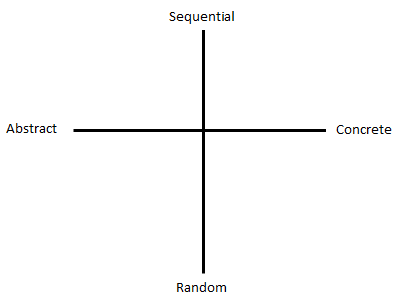
You may notice that lecture, which is probably the most common method of presentation, is listed last here. The reason is that studies have shown that lecture is the least effective method of learning for most people. For most subject matter, group learning and/or hands-on involvement are usually more effective: the give-and-take of a group discussion, even if the group is only two, is far more helpful to most people than listening to someone tell them something, and actually practicing the activity is even more powerful.
Discussion is interactive: it gives people the chance to wrestle with ideas, to translate those ideas into their own terms, and to make them their own. The same is true of several of the other methods listed above, particularly the use of physical activities, role plays, and the arts.
You can address different styles by planning either individual activities or a series of activities that include several of these ways of presenting information:
There are various ways to approach this issue. Asking people to draw pictures or to act out something often engages "right-brain" functions; asking people to make a list or to create a statistical profile prompts "left-brain" learning. One of the reasons that role plays and the like are often such powerful learning tools is that, through the use of feedback after the experience, they engage both, and help people to integrate them. Thus, when they've learned something in that way, they both "know" it intuitively and understand it intellectually.
- Use visual - through the eyes (slides, video); auditory - through the ears (audio, lecture); and kinesthetic - through movement and touch (games, things to build with, etc.); and similar methods of presenting information.
- Provide opportunities for people to work in large groups, small groups, pairs, and alone, since some people learn best in each of these situations.
- Pay attention to "right brain-left brain" differences. Although this common description can be misleading (these activities are not actually dichotically divided into right and left sides of the brain), the differences to note here are between the emotional/intuitive/artistic (right brain) and the logical/sequential /mathematical (left brain) ways of thinking. Some people respond more to ideas in sequence, for instance, and others to ideas connected to anecdotes or to literature.
There are various ways to approach this issue. Asking people to draw pictures or to act out something often engages "right-brain" functions; asking people to make a list or to create a statistical profile prompts "left-brain" learning. One of the reasons that role plays and the like are often such powerful learning tools is that, through the use of feedback after the experience, they engage both, and help people to integrate them. Thus, when they've learned something in that way, they both "know" it intuitively and understand it intellectually.
- Try to address both the big picture -- an overall view of the ideas or techniques you're introducing, and how they fit into your organization and the field -- and the smaller details that make up that big picture.
- Use humor, games, and other fun activities as much as possible. Virtually everyone learns more, and more quickly, when they are having fun than when they feel bored or under pressure.
- Especially if there are skills or techniques to learn, try to design activities with as much opportunity for feedback as possible.
Feedback - a constructive critical response - is one of the most important tools available for training of any sort. Having a chance to practice a skill or explore an idea with feedback from observers or other participants can be a tremendously powerful learning experience. (This experience can be even more meaningful when the practice is in a real-life situation under the supervision of a veteran staff member or supervisor, as in the case of practice teaching.)
To use feedback well, it's important to understand that it has a serious effect on people at whom it's aimed. If you're not careful, it can be devastating. A few guiding principles can help you employ feedback in a way that's almost always helpful:
- Feedback should be positive first. Remember that, in most cases, the person it's directed at is often doing something they're still a beginner at. Find something good to say before you address problem areas.
- Feedback should be clear and concrete. Rather than "You didn't do that well," try "You seemed to have some difficulty when X happened. What were you thinking/feeling there? What might you have done to make things go differently?" or "What if you had tried A instead of B in that situation? What do you think might have happened?"
- Feedback should be directed toward mastery of the activity, not toward criticism of the person. "You really stank that up" is not helpful. Approaching feedback as a joint problem-solving activity is much more so. Responses like those in number 2 above both involve the person in problem-solving and indicate support for their learning.
- Feedback should actually be useful to the trainee in a real situation. It should help them understand the situation more clearly, and give them some tools to use when that situation arises again.
- There are many ways to provide feedback besides third-person observation.
- Video or audio recording the trainee provides a record of the activity, which they can then react to alone or with others.
- Video or audio recording someone else -- a veteran staff member, perhaps -- doing the same thing the trainee was recorded doing can furnish them with another model.
One advantage of these strategies is that you can repeat parts of the activity as many times as necessary in order to analyze what's happening and to understand what went right or wrong in those particular instances.
- Giving feedback can be just as powerful a learning experience as getting it. Just as the best way to learn something is to teach it, the best way to understand the dynamics of a situation may sometimes be to watch it and comment, rather than to be directly involved in it. It's crucial, therefore, that everyone have the chance to provide feedback as well as to receive it.
Logistics
The logistics -- the nitty-gritty of arranging everything so that the training can take place -- may not be the most exciting part of a training, but it's absolutely crucial. How well you take care of the details may have a lot to do with the success of your training program, so you have to start thinking about them early. For most organizations, the important issues will be location, setup, and materials.
- Location. Do you want -- or do you have -- to hold training or staff development sessions at your workplace, or would it be better to go elsewhere? Other possibilities include people's houses; (free) institutional space (a library or college, for instance); rented space; space loaned by another organization; outdoors; or rented conference space, which may be far from home and very different from the normal work environment.
Your organization's resources -- probably not huge -- will go a long way toward determining whether you can rent space or not. Your organization's philosophy and style may help to determine whether you want to rent space or you would rather spend the money directly on the work you do.
Time and the amount of space needed can also be determining factors. If your staff development takes place during staff meeting time, for instance, then it's almost undoubtedly going to be in your workplace. If you're planning activities that involve a lot of physical movement, you'll need more space than you will just for chairs.
- Setup. How are you going to set up the space? How formal or informal do you want it to be? Do you want comfortable furniture? Chairs in rows, or in a circle? Tables or desks to write on? Blackboards? These questions might influence your choice of location as well.
In addition, you need to consider trainees' comfort. Does your space have enough light, natural or otherwise? (Remember that fluorescent lights buzz, a noise that some people don't mind or don't hear, and that others can't stand.) Is there enough air circulation? (Rooms without adequate ventilation put people to sleep.) How's the temperature? (If you're too hot or too cold, it's hard to concentrate.)
Food changes the dynamics of any situation, making it friendlier and more relaxed. Do you want to include food, and, if so, will the organization provide it, or will people share the cost or take turns?
In general, creating an informal atmosphere is more conducive to discussion and to learning. The best learning comes out of thrashing out ideas among people, and that kind of interchange is more likely in an informal environment. Such an arrangement also creates less of a distance between the facilitator and participants in a training session. The partnership encouraged by informality leads to more ownership of the training by participants and more effective learning.
- Materials. Training materials will, of course, be dependent on the nature of your training and the methods you choose. No matter what you do, however, there will almost undoubtedly be a fair amount of text and other paper that needs to be distributed (although it may also be posted to be downloaded from a website or computer network), and other materials needed for particular training sessions. These have to be available at the right times, and that's probably the responsibility of the coordinator.
Having materials ready when they're needed can be a big job. It may mean getting many pages copied; typing text into a website; making overheads, videos, or CD-ROMs (as well as finding the hardware to display them); creating Power Point presentations; assembling enough art materials for everyone to use; etc.. It may even mean putting together or writing a training manual, which might include some of these materials.
The planning you've done becomes crucial here. The more lead time the coordinator has to get materials ready, the more likely they are to be there when they're required, and the more flexible the training program, as a whole, will be able to be.
Publicity may or may not be a fourth issue here. It depends on the size of your organization (if you have a staff of 20 or fewer, informing everyone of a training opportunity isn't difficult, although you still have to do it), and, probably more importantly, on whether the training will be open to other organizations or to the public. If you're advertising it publicly, you'll need to follow some general rules for getting your message out:
- Use as many different outlets as possible (fliers and posters; advertisements, articles, and press releases in print and broadcast media; direct mail or e-mail; community bulletin boards; etc.).
- Use language that's easily understood by your target audience (including languages other than English when appropriate).
- Put your message where your target audience will see or hear it -- in their neighborhoods, in stores they patronize, on radio stations they listen to, etc..
Evaluation
Like all your work, your training program should be dynamic, constantly changing to improve its effectiveness and meet the evolving needs of the organization. The way you assure this dynamism is through regular, careful examination and evaluation of what you're doing and how you do it.
There are some obvious ways to determine the effectiveness of your training program.
-
Feedback from staff members, both on individual sessions and on the training program as a whole. Obtaining honest feedback could be difficult if the level of trust in the organization isn't high. (Lack of trust is another problem, but not for this section. Both group discussions and individual conversations are the best ways to get real information. They allow for give and take, and give people a chance to polish their thoughts as they hear those of others.
You can also ask people to fill out a survey (anonymous or not). This may be somewhat less revealing, but it may also give you accurate feedback on how helpful and interesting your training is. (Please see Tool #1 for a sample survey on training.)
The important questions are whether staff members feel that the training program, in general, was useful, and how it can be improved. Can they point to specific training that has had a practical effect? Do they use any of the ideas or techniques they learned or were exposed to? Are they more open to innovation in their work than before? Has training improved their confidence or their feeling of competency? Does the training feel supportive? Would they consider the time spent on it a valuable part of their jobs? What areas of concern weren't covered? What would they like to see added or dumped in the future?
- Feedback from participants, priority populations, community members, etc., about the competence of the organization in the areas that the training program addressed. Have there been changes in the ways things are done or changes in the effectiveness of the organization? Have there been changes in the way the organization is perceived?
-
Observation and supervision of staff members in job situations. How easily did new staff members adapt to the techniques, ideas, and attitudes presented in initial training? Is there improvement, or a drive toward improvement, in the work of veteran staff? Have any of the ideas proposed in training been adopted in practice, and how well are they working? Do supervisors see differences in people 's attitudes, methods, or competency? Do staff members discuss training issues with supervisors and with one another?
The goal of both initial and ongoing training is to help staff members become more effective at what they do. For various organizations, that may mean being more creative or more innovative, serving more people, having more success with current participants, involving more people from the community, or having greater political impact. Whatever your goals for staff effectiveness, you'll be many steps closer to reaching them if you have a well-planned and well-executed training program.
In Summary
A good staff training program is just that -- a program, with a structure and logic to it that make sense for your organization. It should continue throughout the life of the organization and include initial training for new staff, staff development (ongoing training for all staff), and professional development (the opportunity to gain new knowledge or skills, or to move to the next level of expertise).
Creating such a program involves planning that includes the people to be trained, and looks at both what kind of shape the training program should take and what areas it should cover. The development of a training program also requires thinking about methods (how the training will be presented), logistics (where and when training will be held, what's necessary to make it all go well, etc.), and evaluation (how you'll find out what was valuable and what was not, and what you should do to improve the program over time).
Developing a training program that meets the needs of both staff members and the organization, and keeps the organization growing and changing for the better, is a big job. But, the benefits to be gained will far outweigh the effort.
Contributor
Phil Rabinowitz
Resources
Online Resources
Cognitive/learning styles
Difference Is Not Deficiency Research on differences in cognitive style suggests minority students could contribute far more than they do now if given the chance. An interview with James Vasquez from In Context, the journal of the Context Institute.
Links for educational staff development.
Staff development in schools from the perspective of the Kansas Department of Education.
A synopsis of learning and teaching styles by Dr. Richard Felder of North Carolina State University. It includes a self-graded learning style assessment with explanation.
LdPride Information and links on learning styles and multiple intelligences.
Professional Learning Association, the national staff development professional organization for K-12 education.
SABES, the Massachusetts Adult Basic Education staff development support system. Excerpts from the Integrated Staff and Program Development Handbook, a staff development model for adult literacy education in Massachusetts.
Staff Development and Change Process: Cut from the Same Cloth Issues...About Change, vol. 4, no. 2, 1994. An article on the connection between staff development and change from the website of the Southwest Educational Development Laboratory.
Staff Development (pdf), by Jocelyn A. Butler. Close-up #12 in the School Improvement Research Series. From Northwest Regional Educational Laboratory
SNOW Adapting teaching to learning styles (audial/visual/tactile) as well as assessment of teaching style and teaching style inventory.
Note: The examples that follow are from the experience of the editor of this section, and come from Lowell, Massachusetts, an old mill town with the mills long gone, a depressed economy, and a tremendously diverse population.
Example # 1: The Greater Lowell Mental Health Training Consortium (GLMHTC)
There were a number of mental health-related agencies in town, and a lot of mental health issues for them to deal with. Although there were individual working relationships across organizations, the organizations themselves each operated in its own orbit. There was no conflict, but no cooperation, either, and no incentive or structure for it.
Someone -- it's not clear who -- proposed that the group get together to talk about common training programs. We were all pretty small and poorly funded, and the training we did ranged from not very much down to none. So, that first meeting was pretty well attended -- not surprising, since most people will come to one meeting of almost anything.
More surprising was the fact that, through good leadership (and the fact that the leader had the time to devote to the project), the group stayed together. After doing a training needs assessment of the member agencies, it planned and held a variety of community-wide mental health training events. There were at least three or four, and all were well-attended. There was a reasonable fee for some of them, to make sure the group didn't lose money, and people got continuing education credits for attending.
The group went so far as to give itself a long-winded name, the Greater Lowell Mental Health Training Consortium, or GLMHTC. As a result, people working in the member agencies got to know one another better. GLMHTC published a directory of its 30 or so members, with a description of each organization's services. And it formed a working Board of Directors, which met monthly. It had fairly big plans.
As it happens, those plans never materialized. The group lasted for about three years, and then unraveled. Some of its work folded into institutes sponsored by the local university. But, in reality, jobs change and people move on; such is life. Any group like this one would have needed continued strong leadership to survive. That is hard to come by.
But I count this experience as a success, not a failure. It was good while it lasted, and it shows what can be done. Groups like this can happen if the need is strong enough and if the leadership is there. The power to create excellent community-wide training programs lies within ourselves, if we are motivated enough to utilize it.
Example #2: The Battered Women's Shelter
Our agency was involved in a lot of community outreach, and we also wanted to create more visibility for ourselves at the same time. How could we do this? Well, one way was to sponsor training programs that could attract a lot of people. But you had to have the right topic.
The right topic then in our community was domestic violence. There were incidents reported in the papers. Services for battered women in our region were just getting off the ground. In our community, though, we had no services at all. We thought we could help make them happen.
What we did was invite the organizers of a battered women's shelter in another community -- 25 miles away -- to come up and talk with us. They agreed. We publicized this event widely in the community, with the pitch that seating was limited for this important event; we asked for an R.S.V.P. from those wanting to attend, somewhat ironically, since hardly anyone had attended any of our training events before.
To our genuine surprise -- you could say shock -- we got about 100 replies. We could barely fit everyone in the room. The training event itself was a terrific success, but more than that, it prompted the development of an informal group to plan for a battered women's shelter in our own community. We learned that a well -planned training event can have impacts extending far beyond the training itself. Maybe that should sometimes be a goal.
This local group applied for a small grant to get a shelter up and running. The grant was awarded. Six months later, the shelter opened. It's been open now for more than 20 years, and at this point is one of the best-established social service agencies in the city. But it wouldn't have happened -- or at least it wouldn't have happened as easily or as soon -- without that initial training event.
Example #3: The Literacy Project's Staff Development Program
The Literacy Project (TLP) is a western Massachusetts adult literacy program that I worked in and directed for several years. It presents not a model to imitate, but rather a fairly typical example of the evolution of staff development in a small organization without a lot of money.
The Literacy Project really sponsored two strands of staff development. The organization had always allowed release time -- at the staff member's discretion -- for conferences, workshops, and other ongoing education and training. Later, as the organization's finances became healthier, TLP allowed each staff member a certain amount of funding and travel reimbursement for these ventures. That strand continued -- in later years, with some coordination -- throughout the life of the organization.
Internal staff development was always an issue for the organization, but, for the first few years, there was no real plan or schedule. Staff development offerings came as the need arose, or as a particular training opportunity became available. When the staff of 4 grew in one year to 13, and expanded to four widely separated sites, we realized that -- among many others -- the staff development issue was one that had to be addressed.
The director talked to each staff member individually about her priorities for training, and then made up a list that he circulated to everyone. At a weekly staff meeting, the staff decided on the areas they wanted to cover in the next three or four months. They also decided that staff development should be institutionalized: regular sessions would take place every other week, alternating with staff meetings.
It was left to the director to arrange and coordinate staff development. He envisioned it as staff members teaching one another, and, in fact, conducted the first few sessions himself, at staff request. Over time, people grew bored with the format, and less willing to take responsibility for preparing sessions. At that point, it became clear that the staff development program needed to be renegotiated.
The possibilities were expanded to include simple sharing of experience (not to be sneered at as a component of a staff development program, especially in an organization where staff members worked in four very distinct and different communities), and some multi-session activities on issues important to particular staff members. These included such topics as diversity, mediation, and learning and other disabilities.
The staff also experimented with a different staff development schedule, attempting to incorporate an hour of staff development activity into each weekly staff meeting. This quickly became an issue, because regular staff meeting concerns too often encroached on staff development time. A satisfactory staff development program continued to prove elusive.
Over time, some guidelines developed that moved our organization closer to the goal. Staff members decided to meet every other week without the director, in order to make sure that staff development time was just that. Several staff members collaborated with one another and with folks from other programs on participatory research projects, on the design of assessment tools, and on learner-generated curriculum. Individuals found intensive training in areas that interested them -- learning disabilities, for instance. A study circle, including the director as well as line staff, developed around learner issues and the participatory classroom.
Ultimately, the staff decided on a format similar to that of the writing groups that many of them conducted with learners. They decided on priorities for the next several months, and each took on some coordination responsibilities for a particular topic or session. Every other week, staff members met, discussed what they were doing, shared concerns, and presented papers, lessons, or activities they had agreed to prepare. Out of this grew many conference presentations and invitations from other groups, as well as significant amounts of curriculum and classroom activities.
All in all, the staff development program at TLP was never perfect, or even totally adequate to the needs of the people involved. It did, however, accomplish its real purposes, which were to expose all staff members to a range of different ideas; to make sure that everyone shared what they were doing in the classroom; to develop individuals' expertise in particular areas and their skills in working with learners; and to keep the program developing and changing in positive ways. In my last two years there, no fewer than six TLP staff members -- out of a teaching staff of eight -- were in demand as presenters and experts in the field.
Contributor
Phil Rabinowitz
___You understand that staff training is learning directly related to the skills, knowledge, and strategies necessary to do a particular job.
___You know what is included in a training program.
- Training for new staff who have never done this particular work before.
- Training for new staff who are experienced in the work of the position.
- Staff development
- Professional development
___You understand that staff development is ongoing training for all staff.
___You understand that professional development is training to increase particular knowledge or to gain the next level of expertise in a position.
___ You understand why to run a training program for new staff.
- It shows them that the organization is serious about what it is.
- It makes them feel that the organization is supportive of them.
- Have proper training boosts their confidence.
- It enlists them as "regulars" in the organization.
- It shortens the time it takes them to become competent at their jobs.
- It reduces their need to ask other staff members for advice or information.
- It diminishes the chances that they'll make mistakes that cost the organization.
___You understand why to run a training program for veteran staff.
- It helps them to become continually more competent at what they do.
- It introduces them to the latest research and theory.
- It helps them to maintain interest in and enthusiasm for their work.
- It can expose them to other practitioners with different, and perhaps better, methods.
- It gives them one more reason to stay with the organization.
- It keeps the organization dynamic and healthy.
___You understand that training for new staff should be conducted as soon as possible after hiring, and ideally as part of new staff orientation.
___You understand that training for veteran staff should happen on a regular basis throughout the life of the organization.
___You understand the steps for developing and running a training program:
- Planning
- Methods
- Logistics
- Evaluation
Tool #1: A Sample Training Evaluation Survey
Please circle one number as a response for each question below.
1=Strongly Disagree, 2=Disagree, 3=Neutral or Don't Know, 4=Agree, 5=Strongly Agree
| 1. | I found this training helpful | 1 | 2 | 3 | 4 | 5 |
| 2. | I will use at least some of what I learned. | 1 | 2 | 3 | 4 | 5 |
| 3. | I see how this training applies to my work. | 1 | 2 | 3 | 4 | 5 |
| 4. | I understood the material well. | 1 | 2 | 3 | 4 | 5 |
| 5. | I want to know more about this topic. | 1 | 2 | 3 | 4 | 5 |
| 6. | I'd like more trainings like this. | 1 | 2 | 3 | 4 | 5 |
Please explain what changes, if any, you might make in your work as a result of this training.
- What specific action will you take as a result of this training?
- What did you particularly like about this training?
- What would you have done differently?
- Are there related topics you'd like training in?

The time energy and resources that volunteers offer are critical to the success of most nonprofit groups, and the jobs done by volunteers are as varied as the people who do them. This section of the Toolbox provides a guide for developing a program to involve volunteers in your organization.
Why should you engage volunteers?
Maybe you're not sold on the merits of volunteers, at least for your organization. "Volunteers are too much trouble," you might think; "they're not reliable; it takes too long to train them, and once you do, they just leave. Also, we're liable for their actions--that's a problem that we just don't need right now. It's easier to do our work with paid staff."
Despite these challenges, however, consider some of the different advantages of using volunteers as part of a thoughtfully developed plan.
- Volunteers save money. This obvious advantage of volunteers can be a lifesaver for some organizations. The "dollar value" of volunteer time in 1997 was $13.74 per hour. Many organizations, such as the Red Cross, function almost entirely on volunteer labor--and by doing so, they can to do a lot of very good work without a lot of money.
- Volunteers bring needed skills. Many volunteers have specialized knowledge such as computer programming, advertising, or conflict mediation that your organization occasionally needs, but not often enough to hire someone to do the work full-time. A volunteer who donates their skills on an "as-needed" basis can be the perfect complement to your office staff.
- Volunteers bring renewed energy and excitement. Even the most dedicated people can get burnt out working on the same thing when they are doing it 40 (or more) hours a week. Volunteers can bring a fresh perspective and enthusiasm for the work. This can help revitalize staff, and may help move projects in exciting new directions.
- Volunteers increase community ownership. The more community members are involved in your project, the easier it will be to gain support for your work. Also, by using volunteers from throughout the community, you can be sure that your goals are "in tune" with what the community wants, and not just what organization members think they want.
Simply put--involving volunteers helps you do (and do well)-- what you set out to do.
Why should you plan?
Why should you plan the involvement of your volunteers? As with anything else your organization does, planning your volunteer program will help it run more smoothly and easily. Additionally, a well-developed plan helps stop potential problems before they start. That way, you can have all of the advantages of volunteer help without most of the headaches.
For example, above we talked about some of the problems of having volunteers, such as liability, a lack of reliability, and a tendency of volunteers to not stay long with a given organization. By planning, you can take these problems into account: the organization might take out insurance against liability; consequences of being unreliable can be decided upon and written down to be given to volunteers; and ways to keep good volunteers can be discussed and put into practice.
Who should develop the plan?
Your organization's plan for volunteer involvement will touch many people, so it's often best to include many voices when designing it. Some of the key players might include:
- Organizational leaders, such as the director or key board members.
- Staff members. These are the people who know best what work needs to be done, so their involvement is vital. Also, by involving staff members in the planning process, you help alleviate fears that volunteer workers might replace them.
- Prospective volunteers. If your organization already has volunteers, or you know whom you would like to recruit, ask them to help develop the plan. That way, your plan is sure to be developed in the volunteers best interest, as well as in the interest of agency staff.
For example, a prospective volunteer might say that they would love to work at your agency --but only if there is childcare available during the training sessions, because their spouse or partner works when the training is scheduled to take place. Without her suggestions, staff members of the organization might not have thought about the need for childcare, and could have lost several very good volunteers.
- If your organization doesn't already have one, you might consider appointing a volunteer coordinator or director. This person, who often reports to the director, may be a staff member, or could be a volunteer themself.
Typical tasks of a volunteer coordinator:
- Recruits volunteers
- Communicates with different departments and program coordinators to find out what needs to be done and how much volunteer time is needed to do it
- Educates staff on the roles and responsibilities of volunteers
- Interviews and screens potential volunteers
- Takes charge of volunteer orientation and training
- Expresses volunteer opinions and ideas to other staff members, and facilitates collaboration between volunteers and paid staff members
Smaller organizations, groups which need fewer volunteers, or those whose future is uncertain may find that a volunteer coordinator is unnecessary for their purposes. For them, the duties usually assumed by the coordinator can be split among other members of the organization in ways that make sense for the organization.
How do you plan the involvement of volunteers?
First of all, use the principles of strategic planning. Strategic planning is a process of determining how to get from "here" (where we are now) to "there" (where things ought to be).But planning for the involvement of volunteers will have important steps of its own. These steps are listed below. These are especially applicable for organizations having the resources and need for a comprehensive program for volunteer involvement. Smaller organizations, or organizations that rely less heavily on the use of volunteers, may want to adapt the plan suggested below, or might simply pick the parts which make most sense for their organization.
Essential steps of an effective volunteer program:
- Have reasons and a rationale for wanting volunteers
- Develop job descriptions
- Recruit volunteers
- Screen potential volunteers
- Conduct orientation of volunteers
- Train volunteers
- Supervise volunteers
- Retain volunteers
- Evaluate volunteers
- Recognize efforts and achievements
Let's go through these one by one.
Have a rationale and reasons for wanting volunteers.
You may have several reasons for wanting volunteers in general, and other reasons for asking for the help of specific people. It's important that you can articulate these; you might even want to write them down. When a potential volunteer asks, "Why do you need volunteers?" or "Why do you need me?" you should have answers ready.
These are two different questions, and should be thought about separately. First, what is your rationale for your organization having volunteers in general? To increase the quality or amount of services you provide? To increase community involvement? There are many good reasons for welcoming new volunteers into your agency; which are true for you?
Some examples of different rationales include:
- "We think community involvement is really important to helping us stay on track."
- "We want every child in our community to have caring adults to talk to, and we're a long way from that goal."
- "Volunteers can help us reach our goal of financial independence."
- "We believe that by using volunteers, we can establish a network of tutors who can significantly reduce the rate of limited literacy in our city."
- "Our organization wants to become financially independent, and none of us have the first idea of how to do it."
Your rationale doesn't need to be terribly specific, and it isn't meant to be unchangeable. As your organization grows and develops, so will your need and reasons for having volunteers.
Along with the general rationale behind your program, you need a good idea of what you want volunteers to do. What skills are needed? Do you just need people to help clean up the park after the local arts festival, or do you need people with specific talents, such as experience with newsletter layout, or public speaking skills? If you don't have distinct reasons for having volunteers, your program may reflect that. Volunteers may feel unneeded--and eventually, they may feel like leaving.
Develop job descriptions.
Now that your organization has decided exactly why it wants volunteers, you may want to write a formal job description. This is unnecessary for some tasks, especially those that are one-time events, such as passing out water to runners at your annual 10K run. But for more involved jobs that are longer term, a written description is an excellent way to explain the details to potential volunteers. It also shows that your office is professional and well-organized --the type of place where people want to work. Also, this is a good way for you to think even more clearly about how many volunteers you need and what you need them for.
A volunteer job description, much like the description of a paid job, should include the following:
- Title
- Rationale/Purpose
- Nature of job/Responsibilities
- Qualifications
- Time requirement
- Proposed starting date (and, if applicable, end date)
- Boundaries: Authority invested in position, reporting relationships/supervision
- Benefits
Recruit volunteers.
The next step in the process is to find the people you need--and convince them that they need you, too.
Recruitment is covered in the next section of this chapter, so we won't go into too much detail on it now. The two main components of recruiting, however, are worth mentioning here.
First, find out what potential volunteers want. What do they want to do? What things will make it easier for them to do that? What will make your agency more attractive? One excellent way to find this information is to conduct a needs assessment with potential volunteers.
Susan Ellis, an expert in the field of volunteer management, offers some advice. She writes, "Divorce, single parenthood, and caregiving to aging parents are only a few factors to which successful volunteer programs will adapt. Volunteer opportunities that respect people's limited time, welcome children to come along, and meet the social needs of adults to make new friends of both sexes (not to mention safer ways to meet a potential date!) will be the ones that attract today's volunteers."
Second, find ways to tell potential volunteers how volunteering for your agency can give them what they want. Recruiting can take place in many different ways: volunteers can tell their friends about the organization; you can have informational meetings; ads can be placed in the local paper; and there are many, many other possibilities. It's up to your organization to choose the recruitment tactic (or tactics) that make most sense for your program, budget, and needs.
Screen potential volunteers.
A well-run recruitment effort should dig up many people offering their services to your organization. That's terrific, it's just what your organization needs. But some of these people may not be appropriate for your agency, or for the job they offer to do.
Why not? Well, some of them may not be suited for the job they apply for, and others may actually pose a threat to your agency. Additionally, as with paid staff members, your organization is legally responsible for what volunteers do while they are on the job. Organizations (and, in some states, individual executives and board members) are responsible for the actions committed by their volunteers while working.
What does this mean? Well, if a volunteer is going to the store to get paper for the newsletter, runs a red light, and hits someone, they may be personally liable for the accident. However, the person they hit could choose to sue the organization they work for as well, hoping that the organization is richer than the individual.
Here's another example: if a volunteer has a history of sexually harming children, you don't want them to run the childcare center at your clinic. First of all, the children may be at risk. And as with the situation above, the parents of any child who is harmed at your clinic may choose to sue the organization for allowing such a person to work with children--even if you didn't know about their history. In this case, too, most states have laws that forbid a person with a history of child sexual harm to work with children--and again, even if you didn't know the person's history, you would still be breaking the law.
Screening volunteers is a good way to minimize these risks. For example, if the position involves a lot of driving, you might want to ask about a candidate's driving record. If it turns out they have had several speeding tickets in the last year, you might decide that a different job would be more appropriate.
Different agencies choose to screen volunteers in different ways. How you choose to screen your volunteers is especially dependent on what the volunteer will be doing, how much responsibility they will have, and the duration for which the volunteer will be working. Some of the most common screening tools include:
- A written application
- An interview with organization staff members and/or volunteers
- Letters of reference
- Essay questions can tell you more about the person as well. These may be part of the written application form, or may be offered individually. Some typical examples include, "Why do you want to work for our agency?" and "What are the values that guide what you do?"
Essay questions can also be tailored to the job a volunteer will be doing. For example, a crisis counseling hotline essay question might be, "What would you tell someone who calls and says that her boyfriend never listens to her, and doesn't seem to care about her feelings?"
- Criminal checks, which are done through the police department, are called for in some cases, such as when the volunteer will be working with children.
- Some organizations ask that the volunteer sign a work agreement, usually with the director of the organization or the volunteer's supervisor, which lays out what the volunteer will and will not do.
Conduct orientation of volunteers.
When you have chosen volunteers from your pool of candidates, the next thing to do is explain to the new volunteers the basics of the organization, its philosophy, and what they will be doing. For larger volunteer programs, those that require extensive training, or those that will include a long time commitment with the agency, this often takes the form of a formal orientation session. These generally lasts for an hour or two and includes a tour of the facilities, and introduction to important staff members. Volunteers are often given copies of written materials (for example, a volunteer training manual, or brochures describing the group's work).
Less formally, someone in the agency might introduce a new volunteer to others in the office, show them around, get them started working, and offer to answer questions as they arise.
Train volunteers.
More complex tasks may require extensive training of volunteers. For example, Headquarters, a crisis-counseling center in Lawrence, Kansas, requires over 100 hours of training before volunteers speak with clients. Other types of programs, too, might have long training programs before volunteers actually go into the field.
Supervise volunteers.
Even though volunteers aren't on the payroll, you won 't want to leave them to their own devices, without any sort of supervision and direction. Many people look on their volunteer experience as a time to learn, and gently delivered constructive comments can help the volunteer to grow. Further, what your volunteers do will certainly reflect back on your organization as a whole, so it's important that someone (the volunteer coordinator, if you have one, or perhaps the director in a smaller organization) keeps tabs on what people are doing.
Retain volunteers.
Once you have excellent people working with you, you want to keep them. Just having a well-run program will go a long way to keeping volunteers--people like to feel they are involved with something useful, and not that they are wasting their time in an ineffective organization.
There are also more specific things that the group can do to make sure that volunteers want to stick around. These include:
- Paying special attention to the jobs that volunteers are given. The volunteers-- tasks should include challenges that build on skills the volunteer already has while allowing them to learn even more. For example, if a volunteer is artistic, you might ask them to help design the agency brochure. That way, they can use their talent as an artist, and they also have the chance to learn about layout.
- When trying to match jobs with volunteers, it might be a good idea to have a database that has the names of all of the organization's volunteers, their availability, and their interests. That way, when a specific job comes up, you can see who might be available and interested in doing it, before going outside of your organization.
It's important, however, not to give a volunteer more work (or more challenging work) than they can realistically take on. The volunteer and their supervisor should talk together honestly about how much they can sensibly hope to accomplish while still feeling they are getting the challenge or satisfaction they desire. This is a delicate balance, and one that both the volunteer and their supervisor should think about thoroughly.
- Recognizing and thanking volunteers is also very important in convincing people to stay. This is talked about more in #10 below.
Evaluate your program.
In a comprehensive volunteer program, you should evaluate how well volunteers are doing. This includes how well they are meeting their goals, as well as how well their work is helping to fulfill the agency mission. Often, volunteers (like paid staff) are evaluated every six months or year.
An important part of the process is self-evaluation by the volunteer. How well do they feel they are doing? What would help them work more effectively? Are there other programs or projects at the organization that they would like to take part in? A self-evaluation is often forgotten by supervisors, but is often enormously helpful in increasing volunteer productivity.
How do you fire a volunteer?
Sometimes, a volunteer simply isn't working out the way you hoped. Often, people are wary of firing someone, especially when that person isn't paid. But when someone isn't doing the job they agreed to, you need to take action. Often, you can come to an understanding of why things aren't working out, change those conditions, and the volunteer can turn into a fantastic resource in that position.
But sometimes, our best efforts fail, and you need to take a person off of the job they are doing. How do you do that? Different things may be appropriate, depending on the reason you need to let them go. Be simple and honest. You might say:
- "I think we have a job better suited to your talents than the one you are doing now."
- "I'm afraid your actions aren't in keeping with the agency's philosophy. You might be happier volunteering somewhere else."
- "We've found someone better suited to the job you're doing."
- "We no longer need your help on this project."
- "I'm sorry, we need to let you go."
Recognize efforts and achievements.
This is one of the most important things you can do for your volunteers. It's always important to recognize the work of your employees, and this is especially true for volunteers, who don't, after all, receive monetary compensation for what they do. Everyone wants their efforts to be noticed! If someone feels important to the organization, too, it's much more likely that they will remain an active member.
You can recognize the work of your volunteers in many different ways. Some of the more common possibilities include:
- Awards (e.g., plaques and certificates)--these can be agency awards, or you might nominate your volunteers for other awards, such as those which are city or statewide competitions.
- Celebrations, such as lunches or award dinners.
- Media attention--you might have a "volunteer of the month" whom you write about in the organization's newsletter, or you might submit a story about an outstanding volunteer to the local newspaper or television station. Many local newspapers have regular columns celebrating the accomplishments of community volunteers.
- A personal touch. Greet volunteers by name--people appreciate being remembered.
- Gratitude. Don't forget to smile and say thank you--and say it often!
- Sometimes, you might ask an outstanding volunteer to take on more responsibility, or even offer them a paid position with the agency.
In Summary
Volunteering can be a tremendously rewarding experience, both for the individual who offers their time and for the organization to which they give it. Many people are willing to help out, if they feel that their contributions will be well used and useful. By developing a plan of action for involving volunteers, you will be better able to tap into this rich resource.
Contributor
Jenette Nagy
Resources
Online Resources
Community Building Institute at Xavier University features success stories that focus on volunteer involvement in building community.
Idealist, a project of Action without Borders, posts volunteer opportunities around the globe. Topical discussion boards include a volunteering focus.
Independent Sector is a national leadership forum, working to encourage philanthropy, volunteering, not-for-profit initiative and citizen action that help us better serve people and communities.
The International Association for Volunteers offers training and information to encourage and strengthen volunteering worldwide.
Network for Good helps nonprofit organizations reach new audiences through Internet strategies. You can recruit volunteers online using a volunteer match database.
Service Leader offers guidance on all aspects of managing volunteers, as well as advice on becoming a volunteer. A virtual (online) volunteering link is also offered.
The United Nations Volunteers Program supports human development globally by promoting volunteerism and mobilizing volunteers.
VolunteerMatch is a nonprofit, online service that helps interested volunteers get involved with community service organizations throughout the United States..
Print Resources
Ellis, S., & Noyes, K. (1990). By the people: A history of Americans as volunteers. (Rev. ed.). San Francisco, CA: Jossey-Bass.
Herman, R. (Ed.). (1994). The Jossey-Bass handbook of nonprofit leadership and management. San Francisco, CA: Jossey-Bass.
Morrison, E. (1994). Leadership skills: Developing volunteers for organizational success. Tucson, AZ: Fisher Books.
Example 1: United Nations Recognizes Volunteer Efforts with Online Awards
The United Nations Volunteers (UNV) programme contributes to peace and development through volunteerism worldwide.
The award recognizes the important contributions UN Online Volunteers are making to the work of the UN, NGOs and governments, and demonstrates how active citizens engage in addressing global challenges.

“Being on this year’s jury for the award has been an eye-opener for me. I read so many inspiring stories of how UN Online Volunteers are engaging in the Sustainable Development Goals through the Internet – volunteering their skills, time and commitment from wherever they are to seek to end poverty, reduce inequality, and help keeping people safe. On this International Day of Happiness, the winners of the 2017 Online Volunteering Award demonstrate how volunteering is a vehicle for innovative change and contributes to a more inclusive, equitable and balanced approach to sustainable development, happiness and the well-being of all peoples.”
-Executive Coordinator, Olivier Adam
The United Nations Volunteers (UNV) is a website-based volunteer program. It connects local needs to worldwide volunteers who have the resources and talents to meet those needs. The website empowers those who have a voice and dreams to put them to great use. Many new programs have been implemented thanks to the knowledge and power of local people.
A main task any volunteer-based organization has is to keep volunteers engaged. This is a great example of recognizing the hard work and achievements of the volunteers. Awards and recognition help the volunteers to feel seen and appreciated. The UNV names the team and the members within the team and gives them credit for what they created. Honoring the volunteers online not only provides public acknowledgment of the volunteers’ work, but also allows others to see their innovations.
Example 2: Volunteer recognition and retention
Johanna Woodchild of the Greenville County Chapter of the American Red Cross in South Carolina knows the importance of recognizing volunteer service. She works with more than a thousand volunteers, and celebration is a year round business for her. From Christmas drop-ins to recognition dinners, Johanna is always organizing ways to thank volunteers and allow them to meet, have refreshments, and keep in touch with each other.
One way for Johanna to recognize her volunteers is to offer recognition ceremonies. That is what Johanna was doing when we talked to her. She was expecting a couple hundred people to show up the annual business meeting and recognition dinner. "We invite all of our volunteers, and there are several steps that go along leading up to this. In the past, we've had pretty interesting entertainment, and we encourage the volunteers to bring their families. It's a volunteer committee who selects what were going to do and what the menu is and so on. This year they decided to dispense with outside entertainment and have a huge icebreaker game, because they think we are too isolated in our services and need to meet Red Cross volunteers that work in other areas of service. We don't have very many expenses regarding the place (they had it in gyms churches, cafeterias), or the food (donations), or the preparation of the food. The teen volunteers serve the food. Most of our expense comes in the awards. I believe we spent twelve hundred dollars last year. Some of them are large framed certificates, and we give quite a few plaques.
"We have so many really dedicated and hard-working volunteers. For any of them to be singled out as being the epitome of what a Red Cross volunteer should be is something that means a lot to them," Johanna said. "I talked with two volunteers recently about their awards, each of them had won the Outstanding Male Volunteer of the Year Award. One of the gentlemen has his plaque on his wall in such a place that as soon as you open the door to his apartment that is the first thing you see. The other gentleman, who is a retired businessman who has served on many boards, is involved with us through a Learn to Swim program. He centered his plaque over his living room couch. So, the award itself is very prestigious, and it's a very high honor."
To recognize her volunteers, the chapter gives away various types of awards; competitive awards, top male and the top female volunteer; diversified service volunteer, and new outstanding volunteers. Awards to organizations and companies are also given. The number of awards varies from eight to 50. "We give pins, year pins, (five, ten, fifteen twenty) to volunteers who have been with us those numbers of years. This year, I was just going over the list, we have 66 people who have been active volunteers for five years. That's always the largest category but it's never been that large before. We give award recognition for people who have given the most hours in disaster services. Last year's winner was 1,452 hours. Armed Forces volunteers are also given certificates in recognition of hours of service given. We're retaining people better, and that's real encouraging."
Recognition goes beyond her organization's frontiers, Johanna said. "It's an ongoing process, and we nominate them for awards outside of Red Cross. For example, the Jefferson Award is a big award that is given to five people in about a three or four county area and in the past five years we've had three winners. In the past two years our youth volunteer has been the winner of the Youth Volunteer of the Year Award, given by Volunteer Greenville (an arm of the United Way) and the J.C. Penny Co."
Johanna understands that recognizing and thanking volunteers is one of the most important ways to keep them. "One of the big things is the awards," said she. "We try to get people recognized in newspapers and on TV. Every time there's a disaster that's away from here, one that is a national level disaster, the local TV stations come over and films our national level volunteers as they drive away in the emergency response vehicle. That's neat, to see us on the news. People feel valued. We also have a newsletter that comes out four times a year. It's very folksy and it highlights volunteers and tries to educate the volunteers about what the different areas do. We"re trying to build a family, so we all need to know who each other are, and what we are doing."
Example 2: Mock job description
HEALTHY MOTHERS, HEALTHY BABIES PROJECT
VOLUNTEER JOB DESCRIPTION
Title: Garden coordinator/teacher
Purpose: Start and take responsibility for agency garden; teach mothers about gardening
Responsibilities:
- Teach weekly class on advantages and "how-tos" of gardening to new and expectant mothers
- Coordinate the planting and upkeep of a demonstration garden at the agency
Qualifications: A green thumb; gardening experience; comfortable talking in front of people
Time requirement: Class is two hours a week; additional time in the garden (variable, depending how much help you get)
Proposed starting date: May 15
Proposed ending date: Mid-September (approximate; after harvest time)
Boundaries: n/a
Benefits:
- A share of vegetables grown
- Use of agency tools, seeds, and other supplies
- Volunteers are granted complimentary membership at the YMCA
- The knowledge that you can help mothers and their young children lead healthier lives
Tool 1: Application Form
The following form can be filled out by new volunteers and signed by both the volunteer and his or her supervisor when the volunteer begins working.
(Adapted from Leadership skills: Developing volunteers for organizational success.)
APPLICATION FORM
Agency Name__________________________________________ Date______________
Volunteer Information
Name:_________________________________ Social Security Number:_____________
Address: _______________________________ Date of Birth: ____________ Sex: ____
Home phone: ________________________ Work phone: ________________________
Organization represented (if applicable): ______________________________________
Current occupation: _______________________________________________________
Previous volunteer experience: ______________________________________________
Applicable professional experience: __________________________________________
Applicable educational experience: ___________________________________________
Particular interests or hobbies: _______________________________________________
Why would you like to volunteer here?________________________________________
_____________________________________________________________________
What type of service would you prefer? _______________________________________
Please indicate the days of the week and hours you could serve:
Day: _____________________ From: ___________________ To: _________________
Day: _____________________ From: ___________________ To: _________________
Day: _____________________ From: ___________________ To: _________________
Day: _____________________ From: ___________________ To: _________________
Time limit commitment: ___________________________________________________
Do you have a current driver's license? # _____________ Chauffeur's? # ____________
Do you have transportation? ______________ Could you furnish it for others? ________
Do you have minimum automobile insurance required by law? _____________________
In case of emergency, please notify: __________________________________________
Address: _________________________________________ Phone: ________________
For office use only:
Interviewed by:____________________________ Date: __________________________
Comments:
Tool 2: Blank Job Description
VOLUNTEER JOB DESCRIPTION
Oganization:_______________________________________________________
Title:
Purpose:
Responsibilities:
Qualifications:
Time requirement:
Proposed starting date:
Proposed ending date:
Boundaries:
Benefits:
___You understand the advantages of volunteers:
- They save money
- They bring needed skills
- They bring renewed energy and excitement
- They increase community ownership
___You understand that a plan for volunteer involvement will help the program run more smoothly
___You have involved organizational leaders, staff members, and prospective volunteers in the planning process
___You have considered the advantages of a volunteer coordinator/director
___You have reasons and a rationale for wanting volunteers
___You have developed job descriptions
___You have recruited volunteers
___You have screened potential volunteers
___You have conducted an orientation for volunteers
___You have trained your volunteers
___You understand how to supervise volunteers effectively, and do so
___You understand how to retain volunteers
___You have evaluated volunteer efforts
___You continuously recognize volunteer effort and achievements

What does it mean to recruit volunteers for your organization?
Recruiting volunteers means asking people to work in your organization without pay. You can recruit them formally (asking them to fill out application forms, offering them a job title, etc.) or informally (by asking your sister to help build an agency float, for instance), or anything in between.
You might need volunteers for a specific task at a specific time, or in a much more general role, for any help they can give. Recruitment does not have any set time limits -- you might recruit for a certain event, for a certain block of time such as six months, or for an indefinite period. It is helpful to seek volunteers who reflect the diversity found in the community, and who have ties with other community groups or agencies.
Although volunteers work without pay, they do it to receive something – no one does things for no reason. Some reasons that people might be willing to volunteer include:
- Someone asked them. Most people respond when someone tells them they’re needed.
- They care deeply about the issues your organization addresses, and/or about social change.
- They have personal experience of the effects of your organization’s issues, and want to do something about them. Former gang members, for example, might want to be involved in an effort to reduce and prevent youth violence.
- They are motivated by their view of the world – because of religion, ethics, politics, philosophy, etc. – to try to improve the quality of life in their communities.
- They seek the external recognition and internal good feeling that may come with volunteering.
- They feel a need to pay back society for help or opportunities that were extended to them. Successful people who grew up experiencing poverty in neighborhoods with underrepresented populations often return to those or similar neighborhoods as volunteers with youth, to try to reach children or adolescents who might have the same potential they had.
- They have untapped skills that they can use by volunteering with your organization.
- They want experience and/or training in your field of work. They might want to try out the work to see if it’s a career possibility, or they might want the experience as a credential for another kind of job.
- They actively enjoy the kind of work that their volunteering entails: it’s fun for them.
- They enjoy the social situation, and value the contacts with other volunteers, participants, and staff members. This is often true for people who don’t work outside the home, and don’t have the daily social contact that such work brings with it – older adults, stay-at-home parents, etc.
- It makes them feel needed and useful.
Recruitment, as the military will be the first to explain, is a sales job. Unlike military recruiting, however, volunteer recruiting offers no guarantee that someone will stick as a volunteer just because they’ve signed up. Your sales job has to accurately point out the advantages of volunteering with your organization, so that people will not only be eager when they begin, but will stay enthusiastic and continue to volunteer for a long time.
Why might you recruit volunteers?
- To give your organization the power to do more work
- To reduce the burden on paid staff members
- To give your group a larger, more diverse membership
- To increase awareness and understanding of your organization through your recruiting as well as through the work the volunteers do
- To get as much done as possible within the confines of your budget
- To act together to achieve a shared purpose
When should you recruit volunteers?
Anytime is a good time to recruit volunteers, but you might step up your efforts when:
- You have upcoming products, events, etc., with which you will need special assistance.
- You are expanding your organization's services.
- Your staff has become smaller or is not able to handle the amount of work you do.
- You are holding an annual "volunteer drive."
- During National Volunteer Week or any official national day/week that corresponds to your organization mission (e.g., a coalition that works to reduce tobacco usage might increase volunteer efforts before the Great American Smokeout).
- You need volunteers to staff a booth at a fair, hand out leaflets at a demonstration, help on a school field trip, etc.
How to recruit volunteers: Some basic steps
Research sources of potential volunteers in your community
Determine the makeup of your community, and its community sectors. Some community sectors include schools, churches, neighborhoods, businesses, service organizations and clubs, youth groups, older adult groups, media, grassroots groups, etc. Having a thorough understanding of the sectors in your area will help you to be aware of who is available as a volunteer in your community. It is essential if you wish to focus your recruiting on a specific population.
Learn who is interested in volunteering in your community, and who might be interested specifically in volunteering for your program. Determine:
- Why current volunteers volunteer (both for your organization and for others)
- What motivates them
- How they were recruited
- What their demographics (age, gender, income, etc.) are
You might do this by simply asking current or potential local volunteers, or by looking for information from local and national studies on volunteers. Check with local researchers or a local volunteer center to see what data are available on volunteers in your community.
Plan and implement your recruitment strategy
Think about potential volunteers as consumers. There are a lot of ways motivated individuals can give their time and talents in any particular community. Decide what your agency offers that is special and might draw in potential members. This step might include implementing a recruitment strategy. Your strategy might include:
- Defining priority groups to recruit
- Defining particular people within each priority group
- Defining a specific strategy to recruit both the priority groups and the individuals within the groups
- Implementing the strategy
- Evaluating the strategy
Finding volunteers
When looking for potential volunteers, brainstorm different ways to reach the greatest number of people. Some ways to find potential volunteers might include:
- Hold an annual appeal for volunteers that is modeled after traditional fund-raising drives.
- Set up booths at local art fairs, carnivals, etc.
- Write letters to the editor in the local newspaper, or ask if you could write a guest column.
- Broadcast a PSA on a local radio or television station.
- Use personal contact with current volunteers and staff. (This is the primary way people become involved in volunteer activities).
- Ask current volunteers to participate in a presentation to another group that they are involved with (e.g., the Rotary Club, a church singles group, the health class at a volunteer's high school).
- Ask for help from existing volunteer agencies, local scout groups, the National Honor Society, or other bodies at least part of whose mission is community service.
In addition, consider posting notices at:
- Laundromats
- Grocery stores
- High schools
- University dorms, student unions, cafeterias, and academic buildings
- Houses of worship
- Recreation centers and sports clubs
- Community centers
- Performing arts centers
- Post offices
- Drug stores
- Doctors’ offices, hospitals, and health clinics
- Libraries
Remember that both everyday experience and well-documented research suggest that the best way to recruit a potential volunteer is to make personal contact. Ideally the contact should be:
- Face-to-face (a phone call is second best with a personal letter falling third)
- With someone the volunteer knows, likes, and respects
It is usually helpful to make a very specific request with a smaller request as back-up when the first option is not possible. (If you can’t volunteer regularly, can we call on you to help when we have a mailing to get out?) A follow-up call or letter can be very helpful for those who are uncertain.
If people are uncertain, you may not want to push them too hard unless you feel strongly that they’d make good volunteers, and are simply nervous about the prospect. It’s not good for the volunteer or your organization if you talk them into something that they really don’t have enough time for, or that – as they’ve told you – they really aren’t good at or don’t want to do. A potential volunteer may really care about your work, and may be a terrific person, but if they don’t have the time, energy, or talent for the volunteer job you’re suggesting, it’s better for everyone if they don’t accept it.
Convincing potential volunteers to become active volunteers
Once you’ve made contact with potential volunteers, and they’ve shown some interest, you have to “complete the sale” by convincing them that volunteering with your organization will be a good decision for them. Some things you can do toward that end:
- Invite potential volunteers to meet staff members and other volunteers and get a real "feel" for the organization.
- Invite volunteers to observe and/or try out the volunteer job they’re interested in, with help from a staff member or experienced volunteer.
- Write a letter to potential volunteers – either a general letter, if you are recruiting a large number of people, or a warm, personalized note. Both types of communication should explain what your organization does, why you need help, and why you need their help in particular.
- Be flexible in scheduling, so that volunteers can work the hours that are most convenient for them, can work when their friends are working, and/or can work with particular staff members or participants.
- Show that you take volunteers seriously. Ask volunteers to sign a contract to work for a specified amount of time and to find replacements for themselves if they can’t make a scheduled volunteer commitment. Provide coordination and supervision for volunteers, so that they can improve their skills and performance. Emphasize how important their contribution is to the organization.
As we’ve discussed, people need reasons to volunteer. Some ways to give them those reasons include:
- If you can, show that volunteering with your organization offers both tangible and intangible rewards. You may, for instance, be able to offer both a professional credential and internal fulfillment. (“We’ll train and certify you as a trained community mediator, and you’ll have the satisfaction of providing a real community service – helping people learn how to resolve conflicts peacefully and equitably.”)
- Pick specific volunteers for specific jobs that you know they’ll like and be good at.
- Offer volunteers their choice of jobs, or, let the volunteers create their own job descriptions.
- Offer both initial and ongoing training and supervision.
- Provide opportunities for volunteers to assume leadership roles in particular projects or situations, and encourage and help them to expand their skills.
- Ask current volunteers to describe the benefits and satisfaction they get from volunteering, and compile their responses to give to potential volunteers.
- Include volunteers in any social activities – lunches, lunchtime card games, after-work gatherings, etc. – that occur when they’re volunteering.
- Hold Volunteer Appreciation celebrations, and give volunteers small gifts for completion of each contracted period of service (often a year, but it’s up to the individual organization.)
Building a diverse group of volunteers
A diverse group of volunteers can broaden the range of opinions and ideas to which your organization has access. They bring knowledge of the cultures and circumstances of the population groups they come from, so that your organization will have a better understanding of those groups, and be better able to relate to them. Furthermore, they enrich the organization with their perspectives and the variety of their experiences and backgrounds. A diverse group of volunteers also makes possible heightened cultural sensitivity within the organization, and allows for the kinds of interchanges that make it possible for people with very different backgrounds to understand, respect, and cherish one another’s differences as well as their similarities.
By encouraging diversity in your organization, you also increase its appeal; different ethnic and racial populations are much more likely to respond if they believe that your group has members who share a similar heritage.
Recruiting members of specific populations
- In promotional materials, conversations, etc., explain how your organization's goals are in keeping with the interests and beliefs of a particular potential volunteer's background and beliefs.
- Highlight the achievements of volunteers from different cultural groups in your local newspaper.
- Do what you can to make your organization accessible for people for whom English is an additional language. For example, if your organization is in an area with a large Hispanic/Latino community, consider writing brochures, newsletters, etc., in Spanish, and hiring Spanish- speaking staff (or actively recruit Spanish-speaking volunteers!)
- Actively recruit a diverse paid staff.
- Make your agency an appropriate, comfortable place for potential volunteers to "check out."
- Offer opportunities for families to volunteer together.
Possible barriers to be aware of when recruiting from specific populations:
- Many potential volunteers may speak English as an additional language or not at all.
- Many potential volunteers whose socioeconomic status is lower might like to volunteer, but are unable to afford related expenses, such as travel costs and childcare.
- Potential volunteers from some ethnic groups, such as African Americans and Hispanic/Latino people, are often particularly sensitive to screening, particularly if they perceive the screening process to be a means of excluding them. If your agency does use an extensive screening process, make sure it is used both fairly and flexibly, and explain the meaning of each step of the procedure.
- Some of the things your agency does might seem strange to some ethnic groups, and will need additional explanation. For example, it may seem alien to some groups of potential volunteers to volunteer outside of their own church or faith.
- Some organizations or meetings may be located in places that are not accessible to people who use wheelchairs, and assistance may not be available for volunteers who are blind, deaf, or hard of hearing.
In Summary
Volunteers may be the backbone of your organization, or they may simply make it possible to do an extra mailing or get the office clean. Whatever the situation, it’s important to take them seriously, recruit them as if you were recruiting paid staff, and treat them as an integral part of your organization. If you think carefully about what you want volunteers to do, explain accurately what the job entails, and provide some reasons for their wanting to volunteer, you’ll have no problem finding good people to help you, and to spread the word about your organization – and its volunteer opportunities – to the community.
Contributor
Jenette Nagy
Resources
Print Resources and Videos
Bock, K. (1990). Volunteers: The hands, head, and heart of a shepherd's center. Retirement Research Foundation.
Fisher, C., & Cole, M. (1993). Leadership and management of volunteer programs. San Francisco: Jossey-Bass.
Furano, K., Roaf, P., Styles, M, & Branch, A., (1993). Big Brothers/Big Sisters: A study of program practices. Philadelphia, PA: Public/Private Ventures.
McCurley, S., & Vineyard, S. (1988). 101 tips for volunteer recruitment. Downers Grove, IL: Heritage Arts.
Roaf, P., Tierney, J., & Hunte, D., (1994). Big Brothers/ Big Sisters: A study of volunteer recruitment and screening. Philadelphia, PA: Public/Private Ventures.
Schindler R., & Lippitt, R. (1974). The volunteer community. Fairfax, VA: NTL Learning Resources.
Vineyard, S. Basic volunteer management training packet. Heritage Arts, phone (708) 964-1194 fax (708) 964-7338.
Wilson, M. Recruiting and interviewing volunteers. Video and Audio Cassettes. Volunteer Management Associates. To order, call (800) 944-1470; for inquiries, call (303) 447-0558.
Monthly, Bimonthly, or Quarterly Publications
Citizen Participation and Voluntary Abstracts
Association for Research on Nonprofit Organizations
And Voluntary Action (ARNOVA)
Route 2, Box 696
Pullman, WA 99163
(509) 332-3417
Staff Leader
Aspen Publishers
7201 McKinney Circle
P.O. Box 990
Frederick, MD
(800) 638-8437
Grapevine
1807 Prairie Avenue
Downers Grove, IL 60515
Phone: (708) 964-1194
Fax: (708) 964-7338
A free catalog, "Volunteer Marketplace," is available on request.
The Journal of Volunteer Administration
Association for Volunteer Administration
P.O. Box 4584
Boulder, CO 80306
(303) 541-0238
Organizations
Kansas Association of Nonprofit Organizations
P.O. Box 780227
400 North Woodlawn, Suite 212
Wichita, KS 67278-0227
(316) 685-3790
fax (316) 686-1133
Association for Volunteer Administration
P.O. Box 4584
Boulder, CO 80306
(303) 541-0238
Center for Creative Leadership
P.O. Box 26300
Greensboro, NC 27438-6300
(919) 288-3999
National Training and Information Center
810 N. Milwaukee Avenue
Chicago, IL
Tool 1: Tips for Recruiting, Retaining, and Recognizing Volunteers
Research sources of potential volunteers in your community
Don't forget schools, churches, neighborhood groups, businesses, service organizations and clubs, youth groups, senior groups, media and grassroots groups.
Define target groups to recruit
Ask current members why they volunteered, what continues to motivate them, and how they were recruited as you begin to map out your recruitment strategy.
Get your message out there
Never underestimate the power of simply letting people know that you need their help. Try holding an annual appeal for volunteers, set up booths at local fairs, write letters to the editor, and ask current volunteers to make an appeal on your behalf to local civic clubs. Also consider posting notices at all the places community members regularly visit (grocery stores, post offices, the public library, etc.).
Encourage diversity
Remember that promoting diversity within your organization will broaden the range of opinions and ideas to which your organization has access. Try highlighting the achievements of volunteers from different cultural groups in your local newspaper, offer families opportunities to volunteer together, and actively recruit a diverse paid staff.
Welcome volunteers into your organization
Taking time up-front to make sure that volunteers feel genuinely welcome is the first step toward keeping them involved. Try pairing volunteers with paid staff. Encourage paid staff to take the time to answer volunteers' questions and get to know the person.
Challenge volunteers
Brainstorm about the possible tasks volunteers could perform within your organization. Listen to volunteers' interests and assess their abilities. Then provide volunteers with opportunities that meet them where they are. Volunteers who feel successful and have an opportunity to stretch their abilities are more likely to hang around and to serve the organization well. With this approach, everybody wins!
Appreciate and respect volunteers
Remember that volunteers are giving generously of their most precious resource-their time. Communicate your appreciation and respect by inviting volunteers to be part of the decision-making process when appropriate and honoring the constraints on their time.
Celebrate!
Make sure that your organization recognizes the invaluable work of volunteers by acknowledging the important contributions they make. Try an annual awards luncheon, feature volunteers in your organization's newsletter, or partner with the media to highlight the work of local community members in the newspaper on or television.
Tool 2: Volunteer application form
FITCHBURG SAFE & HEALTHY NEIGHBORHOOD COALITION
Building Safer Neighborhoods: A Cooperative Response
"Offer To Help"
Name: ____________________________________________________________
__________________________________________________________________
Address: __________________________________________________________
_________________________________________________________
Phone Number -Home: _____________________Work: ____________________
I would like to continue to be involved in the issue(s) of:
( ) Violence in the Community
( ) Violence in the Schools
( ) Violence in the Family
( ) I would like to be involved in my neighborhood
-Thank You-
Tool 3: 101 ways to give recognition to volunteers
by Vern Lake, Minnesota Department of Public Welfare
Smile • Put up a volunteer suggestion box • Treat to a soda • Reimburse assignment related expenses • Ask for a report • Send a birthday card • Arrange for discounts • Give service stripes • Maintain a coffee bar • Plan annual ceremonial occasions • Invite to a staff meeting • Recognize personal needs and problems • Accommodate personal needs and problems • Be pleasant • Be of use in an emergency situation • Provide a baby-sitter • Post an Honor Roll in the reception area • Respect their wishes • Give informal teas • Keep challenging them • Send a Thanksgiving card to the volunteer's family • Provide a nursery • Say "Good morning" • Greet by name • Provide good pre-service training • Help develop self-confidence • Award plaques to sponsoring groups • Take time to explain • Be verbal • Motivate agency VIPs to converse with them • Hold rap sessions • Give additional responsibility • Afford participation in team planning • Respect sensitivities • Enable to grow on the job • Send newsworthy information to the media • Have wine and cheese tasting parties • Ask client-patient to evaluate their work-service • Say "Good afternoon" • Create pleasant surroundings • Welcome to staff coffee breaks • Enlist to train other volunteers • Have a public reception • Take time to talk • Defend against hostile or negative staff • Make good plans • Commend to supervisory staff • Send a valentine • Make thorough pre-arrangements • Persuade "personnel" to equate volunteer experience with work experience • Admit to partnership with paid staff • Recommend to prospective employer • Provide scholarships to volunteer conferences or workshops • Offer advocacy roles • Utilize them as consultants • Write them thank you notes • Invite participation in policy formation • Surprise with coffee and cake • Celebrate outstanding projects and achievements • Nominate for volunteer awards • Have a "Presidents Day" for new presidents of sponsoring groups • Carefully match volunteer with job • Praise them to their friends • Provide substantive in-service training • Provide useful tools in good working conditions • Say "Good night" • Plan staff and volunteer social events • Be a real person • Rent billboard space for public laudation • Accept their individuality • Identify age groups • Provide opportunities for conference and evaluation • Maintain meaningful life • Send impromptu fun cards • Plan occasional extravaganzas • Instigate client-planned surprises • Utilize purchased newspaper space • Promote a "Volunteer of the Month" program • Send a letter of appreciation to employer • Plan a recognition edition of the agency newsletter • Color code name tags to indicate particular achievements (hours, years, unit, etc.) • Send commendatory letters to prominent public figures • Say "We missed you" • Praise the sponsoring group or club • Promote staff smiles • Facilitate personal maturation • Distinguish between group and individuals in the group • Maintain safe working conditions • Adequately orientate • Award special citations for extraordinary achievements • Fully indoctrinate regarding the agency • Send Christmas cards • Be familiar with details of assignments • Conduct community-wide cooperative, interagency recognition events • Plan a theater party • Attend sports events • Have a picnic • Say "Thank you" • Smile
Tool 4: If you want my loyalty, interest, and best efforts, remember that:
By President J. Donald Philip, Hillsdale College, Hillsdale, Michigan
- I need a sense of belonging, a feeling that I'm honestly needed for my total self, not just for my hands, not because I take orders well.
- I need to have some sense of sharing in planning our objectives. My need will be satisfied only when I feel that my ideas have had a fair hearing.
- I need to feel that the goals and objectives are within reach, and that they make sense to me.
- I need to feel that what I'm doing has real purpose or contributes to human welfare; that its values extends even beyond my personal gain, or hours.
- I need to share in making the rules by which, together, we shall live and work toward our goals.
- I need to know in some clear detail just what is expected of me: not only my detailed task, but where I have the opportunity to make personal and final decisions.
- I need to have some responsibilities that challenge, that are within the range of my abilities and interest, and that contribute toward reaching my assigned goal, and that cover all goals.
- I need to see that progress is being made toward the goals we have set.
- I need to be kept informed. What I'm not up on, I may be down on. (Keeping me informed is one way to give me status as an individual.)
- I need to have confidence in my superiors, confidence based upon assurance of consistent fair treatment, on recognition when it is due, and trust that loyalty will bring increased security.
- In brief, it really doesn't matter how much sense my part in this organization makes to you. I must feel that the whole deal makes sense to me. I would add, hopefully, the whole deal makes sense to everyone involved: the client, staff, volunteer and you.
___You understand what it means to recruit volunteers for your organization
___You understand why you should recruit volunteers
___You know when you should recruit volunteers
___You are familiar with the basic steps to recruit volunteers
___You researched sources for potential volunteers in your community
___You planned and implemented your recruiting strategy
___You found volunteers
___You convinced potential volunteers to become active volunteers
___You understand the challenges and benefits of recruiting volunteers from varied cultural and ethnic groups
___You understand why you should recruit people from different groups to be volunteers
___You know the ways to recruit members of specific populations

If your group is like many others, you depend on your volunteers for many things. Their jobs may range from doing the agency taxes to taking care of children, or from licking stamps to running career fairs. Whatever jobs they do, however, one thing is almost always true: your organization needs volunteer help to function effectively.
We've discussed how to recruit new volunteers, but once you've got them in the door, your work has only just begun. Your volunteers need to be received like guests and shown around the organization. You need to carefully explain what's happening (and what might happen), because if the coast looks dark and unwelcoming, the new recruit might turn around and walk right back out that door.
To help welcome new volunteers into the organization, some groups hold orientation programs to start new volunteers on the path of becoming seasoned veterans.
What is an orientation program?
First, let's think for a moment of what we mean by orientation. Even though we might not think of it this way, orientation truly starts at our initial contact with the new volunteer.
When you speak to a prospective volunteer over the phone, or when you meet that person for an interview, orientation has already begun. You are giving your recruit a sense of what your organization is all about. More than that, you are communicating something crucial about:
- The way your organization does business
- Your attitudes toward the outside world
- Your seriousness of purpose
- Your sense of humor
- Your general expectations about the content of the job
- Your general expectations about the way in which the job should be performed
You communicate much of the information in this initial orientation non-verbally, and you may not even be aware that you're doing it. But this "informal" orientation is important because your recruit's first impression of you and your organization will be based on it. Scientific research exists that suggests first impressions are formed very quickly, and that once established, those impressions are hard to get rid of.
You probably wish to supplement this implicit orientation with more explicit and formal instruction in which you will systematically communicate certain general information about your organization and the job. That formal instruction is what we mean by an orientation program, and that is the focus of this section.
We will discuss why your organization should hold an orientation program, how to design and present orientations that make the most sense in your circumstances, and finally, how to evaluate what you've done.
Before we go any further, an important distinction to make is that an orientation program is not the same as a training program. A training program, as discussed in the next section, goes into great detail about how to do a specific job--information that is usually over and above what you're trying to get across in an orientation session.
For example, a program in which volunteers tutor people for literacy might have a training program with several different sessions. These sessions could explain how to best teach people to read and give an overview of phonetics and adult learning.
An orientation program, on the other hand, would take place before this training. It would tell new volunteers how long the program has been in existence, where they will be doing the tutoring, who they will be tutoring, what is expected of them, the benefits they can expect to receive, et cetera. It should not, however, teach them how to teach.
Why should you have orientation programs?
What are some of the advantages of a structured orientation program?
- Imparting knowledge. The orientation program will help new volunteers learn about your organization and its mission and goals, and it may instruct the volunteer on policies and procedures in your organization.
- Increasing confidence. An orientation program can make future volunteers more comfortable and confident in their work by helping the volunteer better understand what the agency does, and may help them see the purpose of what they are doing.
- For example, Vaiju, a second grade teacher, signs up to help collect donations for a local community task force a bit hesitantly, as she is not used to asking for donations. However, after the orientation session, she understands that the donations she will be collecting will help make sure some local children will have enough clothes to keep them warm in the winter months ahead. After understanding the goal and her part in it, she sets aside some of her usual reserve, and becomes an excellent champion for the cause.
- Increasing enthusiasm. Volunteer orientation is an important part of maintaining the motivation and enthusiasm that caused people to want to help to begin with. A positive orientation session affirms people's decisions to work for your organization. It reminds them that what they are doing is worthwhile, and shows them that your organization is the place to help.
- Avoiding future problems. By explaining important information from the start, you save time and energy that would be spent on questions, misunderstandings, and misconceptions.
What kind of orientation should you give?
Orientation programs, as defined above, vary widely in terms of length, structure, method of delivery, and amount of detail. They can range from one-on-one casual conversation in the corridor, to highly structured classroom sessions in large groups lasting several days. So which to choose? Some criteria in making decisions about your orientation program:
- The number of people who need to be oriented right now
- The number of people available to do the orienting (and their available time and expertise)
- The complexity of the job to be performed
- The prior experience of the new volunteer in performing that job or a similar one
- The presence (or absence) of an orientation program that someone else may already have established
Larger organizations, or those that have many volunteers, will generally have a more formal orientation program. This might take place over an hour or two and is often a requirement for becoming a volunteer. It might take place during the recruitment phase of your volunteer program, or on the volunteer's first day on the job.
Smaller groups who employ volunteers on one-time assignments, such as helping cook at the annual fundraising chili feed, may orient new volunteers individually. In these cases, the volunteer director or another member of the organization may simply show the new volunteer around, and (for simpler tasks) show them what they'll be doing.
This section will talk primarily about larger, more official orientation programs. Many of the ideas that follow, however, can be easily adapted to smaller, less formal situations.
How do you run orientation programs?
Again, this will depend on your organization's needs. But here are some things to consider in coming up with a solution that meets your group's needs.
Decide what you want to accomplish with your orientation program. When new volunteers leave after you have completed the orientation, what should they know? What should they be prepared to do? It sometimes helps to write down these goals. Then, you can plan how you are going to reach them.
Decide how large and formal you want the orientation to be. Will you recruit many volunteers together, or only one or two at a time? Will new volunteers have to come at a specific time for the orientation program, or will it be a part of the their first day? How much time and how many resources do you want to devote on the program?
There are no set answers to these questions. It's up to your organization to answer them in ways that make the most sense in your circumstances.
Decide who will be responsible for the orientation of new volunteers. The responsibility for orientation may fall to the volunteer coordinator (if you have one), it can be split between two or more people, or different individuals can take on the task at different times. However, if you are planning on having a more formal orientation program, or one that will probably be repeated, it often makes sense to have one person in charge of the orientation. That way you can be sure that the orientation program is consistent and that new volunteers hear the same things. Also, it's human nature to get better at things the more we do them. Practice may not always make perfect, but it certainly helps!
Get the word out. A brilliant and well-executed plan won't do much good if you don't have an audience. Posters might help, and postcards sent out as a reminder of the orientation session can be very helpful for busy people who might have forgotten to write the date on their calendar.
Arrange the logistics of the situation, especially when you're hosting a more formal orientation session. Will the meeting room be free when you need it? Do you have enough copies of the volunteer manual for everyone who is supposed to come, plus a few extras? Enough chairs? Is the meeting area accessible for people with disabilities? The devil is in the details, so try not to get caught unaware!
Be sure you have taken care of everyone's physical comfort when they arrive. Is the room too cold? Too hot? Do they need something to drink, and do they know where the bathrooms are? If people are physically uncomfortable, they will have a hard time listening to you and participating in the discussion and activities. And when they are uncomfortable, most people become less open to new ideas, both of their own and those of other people.
Even if you can't do much, you'll probably find that there are some basic comforts everyone will find important, and you will want to take care of them before the meeting. Some possibilities include:
- Soft lighting
- Comfortable chairs
- Access to restrooms
- Making sure the temperature is comfortable for everyone
- Taking breaks when the orientation goes on too long
- Refreshments (at an absolute minimum, you'll want to be sure there is water available)
Set people at ease. Often, orientation sessions are made up of people who don 't know each other, and they may be a bit shy about really getting involved in the discussion or asking questions--even important questions that everyone needs to hear the answers to.
Icebreaking activities can be used to alleviate this tension, and the person in charge of the orientation program may choose to use one if the participants are uncomfortable.
Cover the information you have decided is important for the orientation session. Evaluate what you have done.
What information should you cover during an orientation session?
A lot of different things might be appropriate, depending on the size, goals, and functions of your organization.
Some of the items that are more commonly discussed include:
- A description of your organization's programs, the community you serve, and your organization's relationships in the community.
- The structure of your organization, including an introduction to key staff members and an explanation of their roles.
- What is expected of the volunteers, including a general overview of the jobs they will be doing.
- A brief history of your organization. Help them understand your organization's mission, policies and main goals, as well as how the volunteer can contribute.
- An explanation of your organization's policies, rules, and procedures.
- A tour of the facilities. Make sure you show the volunteer offices, phones, rest rooms, parking, et cetera.
- The volunteer training schedule, if one exists.
- The volunteer evaluation and performance review system.
- Volunteer benefits. These may be tangible, such as free membership in a nearby gym or free coffee and doughnuts for breakfast. But the job also has more abstract benefits, such as personal growth or the opportunity to obtain new skills. For example, a group helping to build housing for people with lower incomes may teach volunteers the basics of construction--a skill they will be able to use throughout their lives. A mentoring relationship might give the mentor the satisfaction of having helped a young person succeed in school, or having opened their protégé's eyes to new life possibilities.
- Emergency procedures, such as where to go in case of a storm, where to find the first aid kit, and related information, should always be explained.
An orientation session should be a time to make new volunteers feel welcome and part of the group. Any orientation, formal or otherwise, should close with a sincere expression of appreciation and welcome.
Written materials for new volunteers
It is often helpful to have some orientation materials in writing. These can range from a one-page tip sheet to a full-length orientation manual. The more complex the job and orientation, the more complex the material should be. (One variation of this, in large organizations, is to include one or more instructional videos, describing the organization and how it works.)
Some organizations have orientation manuals (sometimes called personnel manuals or policy manuals) which are given to new recruits, or at least made available to them. If your organization is large or formal, such as an established agency, school,or church, you might consider developing something comparable. Such development can take place over time, with new policies or other information being added gradually, possibly in a loose-leaf binder format. Loose-leaf binders are particularly good because new information can be inserted in its proper place and outdated information removed.
Warning: Written orientation materials should supplement, not replace, in-person orientation. More personalized orientation can deal with topics that printed materials do not address. It can also communicate which points in the written material are just there for the record, and those which really need to be followed to the letter. Most importantly, of course, talking with someone can answer questions and allay any fears the new volunteer might have.
Information that might be covered in a volunteer manual:
- Copies of publications such as brochures, articles, et cetera, that have been written or produced by the organization
- Staff and volunteer directory
- A list of the Board of Directors
- Record keeping forms and paperwork
- Reimbursement policy
- Termination procedure
- Dress code
- Scheduling changes
- Insurance (if necessary)
- Grievance procedure
- Definitions of technical terms and jargon used by your organization
- Information on client rights, confidentiality, legal restrictions, etc.
- Volunteer promotion opportunities
- Use of agency facilities, equipment, and services
- A written copy of information discussed during the orientation
Evaluating your orientation
At the end of your orientation session, you want to know how well it went and if new volunteers learned what you hoped they would. Give yourself some credit for taking the time to orient new members--but remember that the fact that you are providing orientation does not necessarily mean it is valuable to them.
An evaluation component should normally be built into any orientation you deliver. It can be as simple as asking newly oriented members to rate the clarity and value (or other aspects) of the orientation, either right after the orientation, and/or at some time in the future. Evaluation could also involve observations of orientation sessions by other staff, or measurement of some aspect of job performance directly related to the orientation. For an example evaluation form, see the Tools at the end of this section. The next and last step once your evaluation data has been collected, is to use it in practice. Use what you've learned from orientation feedback to strengthen your orientation program, and make it the best program possible.
Orientation is ongoing
Your organization will experience the natural process of change over time, which means that volunteers will need to be kept aware of changes in the organization. The larger and more hierarchical your organization, the more this is true.
In other words, orientation is an ongoing process. It does not end with an orientation session, but rather in a real way it continues as long as a member is part of your group. How can this ongoing orientation best take place? As before, this will depend on the nature of your particular group, and especially on its size. Here are some options open to you:
Developing an orientation manual (see above), and making it someone's job to update it regularly.
Holding "general staff" meetings on a periodic basis for everyone in the organization regardless of function. Use these meetings to present new policies, procedures, developments, and to answer questions. This is also a good place to get useful feedback from your volunteers.
Distributing an organizational newsletter, which can accomplish some of these same purposes via print. Remember that none of this is in any way a substitute for clear day-to-day communication with your volunteers. But these more formal structures can be used to supplement that communication, and to provide added insurance that all your volunteers are "on the same page."
In Summary
Community organizations often depend on a constant influx of new volunteers to survive and thrive as they try to obtain their goals. To do so, however, it is important that your new volunteers understand that you really are welcoming them with open arms. By skillfully managing orientation programs, you are effectively institutionalizing that welcome and making sure that everyone who wants to help will understand what they are doing and why they do it. Ultimately, you are showing your volunteers how important their help is to the organization. Making sure they understand their positive impact on the organization is one of the best ways to make sure that the volunteers you orient today remain dedicated volunteers in the months and years to come.
Contributor
Jenette Nagy
Bill Berkowitz
Eric Wadud
Resources
Online Resources
Creating an Orientation Manual for Volunteers was developed in Canada by The Volunteer Centre Society of Camrose and District.
A Guidebook for Working with Volunteers, by the U.S. Fish & Wildlife Service, provides a step-by-step look at the mechanics of initiating and running a volunteer program. Techniques, alternatives, and samples are offered for use and adaptation.
Independent Sector is a national leadership forum, that encourages philanthropy, volunteering, not-for-profit initiatives and citizen action that help us better serve people and communities.
Volunteers of America is one of the nation's largest and most comprehensive charitable non-profit human services organizations. Founded in 1896, today Volunteers of America is active in more than 220 cities and towns in 37 states. Our community-based affiliates offer programs that serve those most in need, including abused and neglected children, homeless individuals and families, the frail elderly, youth at risk, people with developmental and physical disabilities and chronic mental illness, and ex-offenders returning to society, among many others.
Print Resources
Furano K., et al, (1993). Big Brother/Big Sister: A study of program practices. Philadelphia, PA: Public/Private Ventures.
Haines, M. (1977). Volunteers: How to find them? How to keep them! Vancouver, BC: The Vancouver Volunteer Centre.
Herman, R., & Associates. (1994). The Jossey-Bass handbook of nonprofit leadership and management. San Francisco, CA: Jossey-Bass.
McCurley, S. (1986). 101 Ideas for volunteer programs. Downers Grove, IL: Heritage Arts.
Morrison, E. (1994). Leadership skills: Developing volunteers for organizational success. Tuscon, AZ: Fisher Books.
Roaf, P., et al, (1994). Big Brother/Big Sister: A study of volunteer recruitment and screening. Philadelphia, PA: Public/Private Ventures.
Example: Sample Table of Contents from a volunteer training manual
Peace by Peace: Reducing youth violence--a little at a time
Volunteer information manual
| Letter from the President | 1 |
| Peace by Peace mission and vision statements | 3 |
| Current programs and activities | 4 |
| Past accomplishments | 8 |
| Record keeping forms (examples) | 12 |
| Directory of partner programs | 15 |
| Volunteer and staff directory | 18 |
| Board of Directors | 22 |
| Grievance procedure | 25 |
| Termination procedures | 26 |
| Definitions | 28 |
| Information from Orientation session | 30 |
Tool 1: Orientation evaluation form
This form can be given to new volunteers at the end of the orientation session to determine how well the session went from the volunteer's perspective.
Volunteer Orientation Session Evaluation Form
You do NOT need to put your name on this form.
Date of orientation session:
Facilitator/Orientation leader:
What are 3 things you learned about the organization from this session?
What did you like about most about today's orientation?
What did you like least about today's orientation?
What would you recommend for future orientation sessions?
What additional information would you like us to know?
___You know what an orientation program is
___You know what you can communicate during an orientation session.
___You know why you should have orientation programs
___You know what kind of orientation should you give
___You understand how to run orientation programs
___You know what information you should cover during an orientation session
___You know about written material for new volunteers
___You know how to evaluate your orientation
___You understand that orientation is an ongoing process

Many volunteers are charged with complicated tasks that take a lot of understanding and knowledge to do properly. Sometimes, your organization will get lucky and someone with perfect training will show up and be ready to offer their talents for just what you need: an accountant offers their services to help with payroll; a social worker offers to talk with people who have just lost their homes in a terrible flood.
Unfortunately, this is not always the case, nor is it even often the case. Many times, well-meaning people will offer to help your organization, but are lacking many of the skills you need most. A person comes in to be a mentor, but has no experience with young people. People sign up to help and support people who have experienced sexual violence after a "Take Back the Night," march, but have little idea of what that entails. In situations like these, when you need many people with the same skills, your group might want to have some sort of formal training program. Because, while enthusiasm for your cause is fantastic, it needs to be gathered and focused to truly meet your organization 's objectives.
Does this mean you will always need to have training programs when you use volunteers? Absolutely not! There is a lot of good work that can be done with minimal or no training. Selling drinks at a concession stand, running the nursery at the annual meeting, and helping to clean up the church grounds after the annual bazaar are times when volunteer help can be used with very little training required.
This section, then, isn't really geared towards those types of volunteer efforts. While such volunteers probably will need some type of orientation, as discussed in the last section, formal training isn't really going to be necessary for their purposes.
This section has been written for organizations in which at least some of the volunteers do work that requires more extensive training. Examples of these kinds of volunteers include peer and crisis counselors, volunteer health workers and teachers. If your group has volunteers like these, let's continue.
In this section, we will discuss the advantages of a formal training session, decide who should conduct the training, and explore different ways to train volunteers. We'll also include a discussion of the principles of adult learning, to help ensure that people are really getting what you hoped out of the training sessions.
Why should your organization have training programs for volunteers?
Sometimes your organization doesn't really have a choice; volunteer training is an absolute necessity. To be a lifeguard, for example, a volunteer will have to be trained in CPR.
But, for many groups, the decision whether or not to have a training program is not so clear-cut.
Some of the issues to consider when deciding whether or not to have a training program include:
- Training helps new volunteers get to know the people, the program, and the job quickly and efficiently.
- Training your volunteers establishes that there is a minimum competency that all volunteers are expected to obtain.
- Many volunteers see training as a benefit of being part of an organization. Training teaches them skills that may be helpful to them elsewhere, and may even help them get a paying job.
- Training publicly acknowledges a necessary level of proficiency. By training your volunteers, you are making the statement that the organization is professional and capable of doing important work and doing it well.
- Some organizations use training as a "weeding out" technique, making sure that volunteers who have signed up will be likely to live up to their commitments.
Who should train new volunteers?
Once your organization has decided that it wants an official training program for volunteers, you should next decide who should run it. Of course, this will depend greatly on your situation: how many volunteers need to be trained, how much training they need, and the resources you are able to put towards training, to mention just a few of the variables. So it will be up to you, or another member of your organization, to decide what makes the most sense.
Some organizations have a director of training as a member of the staff. This makes particular sense for organizations that do trainings year round for moderate-sized or large groups of people. An organization may also have someone on staff for whom one of their duties is to coordinate new volunteer trainings.
If your organization has a volunteer coordinator or director, they will almost always play a role in training sessions, and may take charge of the trainings in smaller organizations.
Other volunteers are often an integral part of training, although they rarely run the programs. In smaller organizations, the entire training might take place by one volunteer shadowing another for a few days; for larger, more formal trainings, volunteers can give trainees an important perspective on "what it's really like."
Incorporating volunteers into training programs has benefits for the volunteer trainers as well as for the organization and trainees. As training director Lisa Rasor puts it, "We encourage experienced volunteers to be trainers because that's one way for them to refresh their skills and to feel more connected to the agency -- to have more of a stake in what's going on."
If no one in the group excels at the task for which you are training volunteers, you might even want to go outside of the group to find someone to run the training. This could be someone you hire on an ad hoc basis -- or would they be willing to offer their services for free?
How do you develop training programs?
As with any other plan you will develop, there are certain steps to developing a training program.
Decide what you want to teach volunteers
Why are you training volunteers? When new volunteers finish training, what should they know? And just as importantly, what do they want to know? Both the trainer and the trainees will have goals for the training program; it's important that the trainer develop a training program that focuses on both of these. It might even help the person doing the training to write these goals down. If the trainer doesn't have clear ideas of what volunteers should leave knowing, chances are the volunteers will leave the training session pretty confused.
Typically, a training session will try to impart four things to new volunteers:
- What to do: What is expected of them as new volunteers? What will their responsibilities be?
- How to do it: It's one thing to tell someone to "pour cement for the porch," but if you don't explain how to do it, things will likely be very messy indeed. Explaining how volunteers can best accomplish their tasks is the crux of training, and will probably take up the largest chunk of time.
- What not to do: Are there certain things volunteers are not allowed to do? For example, should they not talk about clients, for the sake of confidentiality? Are there situations in which they should automatically call for staff backup? Training should make a volunteer's (and the agency's) limits very, very clear.
- What to do in an emergency: if the volunteers had an orientation before training began, they will have already heard this information, but it's worth going over again. The location of the first aid kit (and possibly some first aid techniques as well) should be known by everyone, as well as what to do in a fire or a severe storm.
Decide how you will teach them
What kind of training program do you want to give new volunteers? Simpler possibilities are good for smaller organizations, simpler tasks, and groups that don't have the resources for a full training program. Two such possibilities are the use of the "buddy system" and shadowing. In the "buddy system," a new volunteer works with an experienced person at first, and the experienced person answers questions and makes suggestions. Shadowing is very similar, but the new volunteer is more passive, and watches more than they take action at the beginning.
For a larger group of people, more challenging work, and groups with sufficient resources, a more extensive training plan is often more appropriate. This may take a few hours, a few months, or anywhere in between. The amount of material to be covered and the resources available should be your guide.
[Note: The following steps are specific to a larger, more formal training plan. Smaller training programs may be able to adapt them to their needs.]
Write a budget for your training
Trainings can be done fairly inexpensively, but they are rarely free. Typical expenses include equipment or room rental, trainer fees, staff time, food and beverages, and supplies.
Decide what materials you would like to use that will fit into your budget
You may find videos, workbooks, recorded material, web pages, or other materials helpful. Depending on the type of training you are doing, you should be able to find helpful materials from national clearinghouses, organizations similar to yours, or other sources.
Get the word out
Send a note out to new volunteers reminding them of the times and places of training sessions. Also, be clear about how much time training will take. If your training is particularly long, ask for written or oral confirmation that they will be able to make all (or most) of the training sessions.
Make sure all of the logistics have been worked out before each training session
That is, that the room is empty and prepared; there are enough chairs; the speakers know what time to show up, and similar details.
Pay attention to the physical comfort of trainees
This is the first thing you should do when people arrive. Is the room too cold? Too hot? Do they need something to drink? Do they know where the bathrooms are? If people are physically uncomfortable, they will have a hard time listening to you and participating in the discussion and activities.
Set people at ease
When trainings begin, people may be shy about getting involved in the discussion or about asking questions. Understand this nervousness and try to find ways to reduce it. A comfortable learning environment can help put people at ease (it's hard to be really uncomfortable on a soft sofa, for example), as can icebreakers.
Start training!
Once you have completed your preparations and are certain that the participants will be relatively comfortable, it's time to get to work! Before you write up your lesson plans, however, it can be helpful to understand how adults learn best. Understanding certain ideas and techniques, sometimes called "principles of adult learning," can help in developing a highly effective training program.
Principles of adult learning
Adults must feel a need to learn. It's important that they understand the relevance of what is being taught to what they will be doing. For example, if the trainer is explaining group dynamics to a group of people who will be health educators in local clinics, they will probably have a better audience if the trainees know they will be talking to groups, and not just doing one-on-one counseling. If trainees understand that, the information automatically becomes useful, not just another lecture they need to sit through before they can get to the "real work."
Allow adults to share their previous experiences and relate them to the present situation. Everyone likes to feel that they have something to bring to the discussion; by relating past experiences to the current topic, your trainees will not only feel that they have something to add, but will also have a better understanding of the subject being discussed. It's no longer academic to them -- it's something they have experienced, something they know.
People learn better when lessons are centered around solving problems. Instead of a lecture, presenting a problem and helping trainees find the answer is a much more effective way of teaching. People like to puzzle things out and by presenting a problem, you ask people to think, not just passively accept what they are told.
Training should be interactive. You should lecture very little when training adult volunteers, and you should supplement your lectures with other methods as much as possible. Studies show that we retain only 20% of what we hear in a lecture setting, so consider incorporating discussions, observations, role-playing, demonstrations, and writing into your training program.
Balance support with challenging the learner. This is a delicate balance, which will come more naturally with experience. Try to convey to the trainee -- through words of encouragement, written policies, or other methods -- that they will always have the support necessary to do the job well. At the same time, however, challenge the volunteer to take on more complicated tasks as confidence and understanding grow.
Urge volunteers to use their creativity. Encourage suggestions, ideas, and improvements that the trainees might come up with, both to improve the training and to improve the program or organization as a whole. Since most trainees are probably new to the organization, they will certainly see things differently than people who have been there a while. Be sure to take advantage of their enthusiasm and fresh points of view!
Remember that people aren't the same. People learn in different ways, and may respond better to different approaches. The trainer should pay attention to how people are responding and try to modify the training accordingly.
Develop lesson plans
Now that you understand the principles of adult learning, it's time to write lesson plans. These are very helpful in keeping you on task, keeping an eye on the time, and making sure you cover everything you have intended to cover. A lesson plan may cover several hours of training time: if your training has been broken up into several (or many) different time slots, each one may have an individual lesson plan. A shorter training may only need one lesson plan; if your training is taking place over a large chunk of time (for example, at a weekend retreat), different ideas may be separated into different lesson plans, much like a grade school teacher might do for their different classes.
Individual lesson plans should state:
- The learning objectives (i.e., the intended result of the lesson). For example, "At the end of this lesson, trainees will be comfortable talking about condoms in front of a small group of peers, and will know current slang terms for them."
- The time allotted for each activity. Although there are no absolutes, this is usually fairly short -- typically under an hour. That way, trainees don't have time to get bored and are kept on their toes by constantly changing activities.
- A detailed explanation of each activity.
- Ways to evaluate trainee understanding. For example, a quiz at the end of the lesson, asking trainees to do something based on what they learned.
- A list of resources needed to carry out the activities (e.g., markers, workbooks).
Evaluate trainees
Evaluation is a very important last step in your training program. By doing a simple evaluation, you will be able to learn what trainees learned and understood from the training. Some possibilities for evaluation include:
- Field testing. Give them the chance to demonstrate what they have learned under careful supervision
- Small group evaluation. Gather trainees to talk together about what they gained from the training
- Pre-test/post-test score comparison. The same test is given to trainees when they enter and when they finish training. This is particularly helpful when you want trainees to get a lot of facts out of the training session, and it can also be useful when you are uncertain of the knowledge trainees originally bring to the classroom. For example, a group training to become HIV educators might come to a training session with widely different levels of knowledge about HIV. A pre-test/post-test allows the trainer to understand what trainees already know (and modify the training program accordingly), and also how much they learn during the sessions.
Keep in mind that evaluation is a two-way street. Trainees should have the chance to give you feedback as well. At the end of the training (or possibly, at the end of specific lessons), you should give trainees the chance to give you specific and anonymous feedback. Then, you should be sure to incorporate this feedback in to future trainings, to make sure that your organization is constantly improving, that your volunteers are as well-prepared as possible, and that they will remain happy and productive at your organization. A blank form that trainees can use to give feedback can be found in the Tools at the end of this section.
Celebrate the end of training, but remember that training should be ongoing
Especially if the training has been long or very challenging, you might want to celebrate the successful completion of training. Some groups even give awards such as certificates of achievement or gift certificates to further recognize the occasion.
After the certificates have been passed out and the crumbs swept up, however, training is still not over. Training often continues for as long as the volunteers work at your organization. Annual retreats, classes, or conferences may all serve to refresh and enhance a volunteer's knowledge. Sometimes, these trainings are mandated to renew certification (as in First Aid certification). They may also be given sporadically, as new information or techniques become available.
The important point to remember is that volunteers, like paid staff, can benefit from additional training as they continue at their jobs. And, by giving additional training, you show volunteers how valuable they are to your organization. Training offers the chance to grow and change within the organization; volunteers don't need to leave the group to find new challenges.
In Summary
Teaching new volunteers the skills they need to function effectively as part of your organization can be difficult work. By creating a training plan, however, you can cut down on potential headaches while making sure volunteers have the most comprehensive, effective learning experience possible. And, in the long run, your work will pay off in the form of skillful volunteers who really are making the goals and dreams of your agency happen.
Contributor
Jenette Nagy
Resources
Online Resources
Developing Accredited Training for Volunteers is from Volunteer Now in Northern Ireland and is a useful guide to developing a well-structured training for volunteers.
Independent Sector is a national leadership forum that encourages philanthropy, volunteering, not-for-profit initiative, and citizen action that help us better serve people and communities.
Volunteers of America is one of the nation's largest and most comprehensive charitable non-profit human services organizations. Founded in 1896, today Volunteers of America is active in more than 220 cities and towns in 37 states. Our community-based affiliates offer programs that serve those most in need, including abused and neglected children, homeless individuals and families, the elderly, youth at risk, people with developmental and physical disabilities and chronic mental illness, and ex-offenders returning to society, among many others. Each year, more than 1.4 million people are served by Volunteers of America.
Volunteer Manual and Training Curriculum for Adolescent Sexual and Reproductive Health Counseling/Education is from Volunteer Now.
Print Resources
Ellis, S., & Noyes, K. (1990). By the people: A history of Americans as volunteers. (Rev. ed.). San Francisco, CA: Jossey-Bass.
Furano K., et al, (1993). Big Brother/Big Sister: A study of program practices. Philadelphia, PA: Public/Private Ventures.
Herman, R. (Ed.). (1994). The Jossey-Bass handbook of nonprofit leadership and management. San Francisco, CA: Jossey-Bass.
Morrison, E. (1994). Leadership skills: Developing volunteers for organizational success. Tucson, AZ: Fisher Books.
Roaf, P., et al, (1994). Big Brother/Big Sister: A study of volunteer recruitment and screening. Philadelphia, PA: Public/Private Ventures.
Example 1: Counseling training program
Lisa Rasor is the former volunteer training coordinator at Headquarters Counseling Center in Lawrence, Kansas. Headquarters is a nonprofit, 24-hour crisis counseling and community information telephone and walk-in center. All counselors at the center are volunteers, and the center does three 100-hour trainings per year.
My name is Lisa Rasor. I'm the outgoing training director at Headquarters Counseling Center. I've been a training director for two years, and before that I was a volunteer. I have been a volunteer counselor and volunteer trainer since 1988. So, for the past ten years, I've been involved with Headquarters Training.
All of our volunteers first go through a screening process where they attend an informational meeting to learn more about the agency and the types of services we provide. Then, if they're still interested in volunteering, they sign up for a volunteer interview. This is like a job interview but more informal. The prospective volunteer will also fill out an application that is pretty much unlike any other. Prospective volunteers [write] about their experiences and values, so it's a way for us to get to know them better, and to see what kinds of experiences they have had.
The interviewers, who are usually experienced volunteers, will review the applications. There will be a 30--60 minute interview of the prospective volunteer, and then all of the interviewers get together and select applicants who will be in the next training group. Usually we don't have to turn away a lot of people. A lot of times, after the informational meeting and reading over the application, the prospective volunteer will say, "This is way too much time," or, "This is not for me," and so they'll screen themselves out. What we're looking for is someone who is interested in learning and who is able to learn basic counseling and communication skills.
[We are looking for volunteers] who are at a stable time in their lives. If they're overwhelmed with school, work, or family obligations, or they just moved here and they're still settling in, or if they've recently been very, very depressed or suicidal themselves, maybe it's not a good time right then for them to be a volunteer [at Headquarters]. We're not saying that [they could never volunteer], but right now things are overwhelming or too recent to really get involved in an intensive training program. We don't want training to overwhelm someone.
After the group is selected, all of the group members are invited to become volunteers. We'll start with a group of between fifteen and twenty-five people. There are fifteen five-hour training sessions, and each session builds on the previous one. Plus, they do readings from the handbook, and weekly 3.5 hour observation shifts.
The first session is devoted mainly to getting to know each other, a more detailed explanation of the training program, and what they'll need to do. [We work on] getting comfortable and making a group out of fifteen strangers. We do that with various group-building exercises. Then everybody signs an agreement to keep the information learned in training and from the center confidential.
I think it's important that every single training session has no wasted time. We don't want people sitting around feeling like their time is being wasted. I plan every session out basically to the minute. At 4:00 we begin, we start "check in" which we do every week. Basically it's how people are doing, how are they feeling, what 's been going on in their lives. We do "check in" from 4:00 to 4:30. 4:30 to 5:00 is when we talk about what happened on their observation shifts the previous week. Then, there's a ten-minute break to sign up for the next observation shift from 5:00 to 5:10, and it continues like that. It really is planned out. It is an intensive learning experience, and we're immersing people in it each session.
Each session is set up to meet certain goals, and, for the most part, I think we succeed. The overall goal [is] having the trainees feel comfortable and competent with the skills and the information to work counseling shifts at Headquarters. We are looking for a certain competency of skills, and we will work extra with somebody to achieve that level. We want people who use our services to [find that] basically whoever answers the phone is going to be competent, caring, and helpful.
I would say [the best part of training] is seeing the changes that people go through when they participate in the program. Not radical personality changes, just the opening up of people's worlds, and seeing the connections people make with each other. I've seen lifelong friendships develop in training. The one thing we all have in common from the beginning is that we're in training to because we want to help in some way. Starting from that commonality, we're creating community among these people.
Example 2: Sample lesson plan
A blank version of this form can be found in Tools.
STD/AIDS Peer Educator Training Program
Lesson 3: Familiarity with condoms
Learning Objectives
At the end of this lesson, trainees will:
- Know how to correctly use a condom
- Be comfortable using and discussing condoms
Demonstration
The trainer will demonstrate the correct manner in which to use a condom. (S)he should encourage questions from the audience.
- 10-15 minutes
- Will need condoms and model penis or banana
Condom race
Trainees are broken into two teams. Team members break into pairs; one person of the team must properly put a condom on the model and take it off, while the other explains what (s)he is doing. If the pair makes a mistake, they must do it again. The team that finishes first wins. This exercise also serves as an evaluation of whether or not trainees learned the important parts of condom usage.
- 20-25 minutes, depending on number of participants
- Will need enough condoms for each pairs, plus a few extras
- Will need 2 model penises/bananas; possibly a prize for winning team (condoms, red ribbon pins)
Discussion
The trainer should facilitate a discussion of what just took place. People's feelings (e.g., embarrassment, nervousness) when demonstrating the condom should discussed, and the trainer should underline the fact that the condom is simply a method of preventative medicine, and should be no more embarrassing to purchase or discuss than any other kind of medicine.
- 30-45 minutes
- Chairs should be placed in a circle, so all participants may look at each other
Homework
The trainer should ask that before the next session, all the trainees should demonstrate condom usage to a friend or family member to become more comfortable.
- Will need condoms for all trainees
Tool 1: "Icebreaker" activities
This activity was suggested by Lisa Rasor, Former Director of Volunteer Training at Headquarters Counseling Center, Lawrence, KS
Forced choice exercise
In this exercise, the facilitator puts signs in three different parts of the room. The facilitator will ask the trainees if they would consider themselves a listener, a talker, or a doer. Those are the only three choices, so it's a forced decision -- you have to choose one of those areas. Sometimes, trainees might say, "Well I can be any of those." But, they still have to choose just one possibility.
The groups that gather in the different areas will talk about why they chose that area over the other ones. The participants may be surprised to find that they have much in common with the other trainees.
Additional forced choice questions include:
- Do you consider yourself compassionate, just, or philosophical?
- Are you a realist, an optimist, or a dreamer?
- Are you punctual, serious, or spontaneous?
- Do you consider yourself adventurous, creative, or idealistic?
Tool 2: Lesson plan form
This form can be copied and filled out with your own lesson plans. A completed version can be found under Examples.
Lesson ___________________________________:
Date:
Learning Objectives
At the end of this lesson, trainees will:
Information and activities:
- Activity
- Explanation
- Time
- Materials needed
Tool 3: Trainee evaluation form
Trainee Evaluation Form
In the interest of anonymity, we ask that you do NOT put your name on this form.
Training Session Title:
Session Presenter/Facilitator:
Date:
On a scale of 1--5, with 5 being most useful, how useful did you find this information?
1 2 3 4 5
On a scale of 1--5, with 5 being excellent, how well presented was this session?
1 2 3 4 5
What did you like most about this training session?
What did you like least about this training session?
What would you change about the training session?
___You understand why your organization should have training programs for volunteers
___You know who should train new volunteers
___You know how to develop training programs
___Decide what you want to teach volunteers
___Decide how you will teach them in the training
___Write a budget for your training
___Decide what materials you would like to use for the training
___Get the word out about the training
___Consider the logistics of the training
___Pay attention to physical comfort during the training
___Set people at ease during the training
___Develop lesson plans for the training
___Evaluate trainees
___Celebrate the end of training
___You know the principles of adult learning
___You understand that training is an ongoing process
-
What types of trainings exist?
-
What do you train people to do?
-
Why should you design a training session?
-
Who should design your training session?
Training occurs in many different ways in our organizations every day. It can include learning on almost any subject in almost any way. Our focus in this section will be on training sessions in which people are learning together. We'll deal with trainings of all lengths, from a quick two-hour computer training session to one that takes place over several weeks .
In the next few pages, we'll walk you through all of the early steps in designing a training session. We'll start with a better look at what training is, why you might want to create a training session, and who might be the best group of people to design it. Finally, we'll offer help in developing the content and goals of your training session.
In general, this section will help you design the content of your training session -- a process done in the weeks and months prior to your training session. The next section will take you through the logistics of the delivery of the session itself -- what you do in the two or three days prior to the training , during the training itself, and as follow-up.
A note of caution: Designing a training session is hard work, and if it's done well, it can be extremely rewarding. Before you get started, however, make sure there isn't already a training format in existence that your organization could borrow from or use wholesale. For example, the American Red Cross has mapped out session formats for its training sessions, such as First Aid or becoming an HIV educator. Additionally, if you don't find a format that fits your needs exactly, consider adapting one in a way that will work for you. Our point is that organizing and running a first-class training session is enough work. You don't need to reinvent the wheel.
Because of the broadness of both this section and the next, we encourage you to pick and choose from the ideas we talk about in the coming pages, instead of using every idea as is. That way, you'll be sure to design a training session that is ideal for your organization's needs.
What types of training exist?
As we said above, there are a lot of different types of training methods out there. Some of the most common ways that people learn include:
- Training courses and workshops;
- Courses taught by universities and other organizations;
- Distance learning;
- Internships;
- On-the-job training;
- Orientation sessions;
- Peer-based methods;
- Self-directed learning;
- Tutorials; and
- Large professional conferences, conventions, and retreats.
What do you train people to do?
As we said above, trainings occur on almost every topic you can think of. But for the needs of nonprofit groups, these trainings can be loosely grouped into two categories : general training sessions and mission-specific training sessions.
First, your organization might want to run (or take part in) a training which covers general topics. These are the topics that will be useful regardless of your organization's mission. These same topics are regularly covered by organizations in the for-profit world. Some topics for which trainings commonly occur are:
- Communication
- Computer skills
- Diversity
- Ethics
- Human relations
- Safety
- Sexual harassment
- Self-defense
Additionally, you might also choose to conduct trainings on things that are specific to your organization. Examples of this include:
- A crisis-counseling center might have trainings on how to counsel specific groups such as children, people experiencing suicidal thoughts, or people who have experienced harm;
- The resources to which your group might direct its clients;
- An HIV service center might develop trainings on how to understand and work with different insurance carriers; or
- A recovery residence for people with substance use disorders might design a training on facilitating support groups.
There are probably almost as many training topics as there are nonprofit organizations. What's important is to recognize what trainings your group wants to develop.
Why should you design a training session?
The bottom line is, most organizations design training sessions when they see a need, be it for information or skills, that is not being filled. Unless you see a need for a new training design, your organization is probably just not going to take the time and effort needed to create and implement a new program.
Now, members of your organizations might see a need for such a training session in many places. First of all, the need might exist within your organization. For example, the director of a group might see a need for a course in personal safety, especially if your organization is based in an area where a lot of violence occurs. Or, a group whose members volunteer to be legal advocates for children who have experienced harm will need to train and educate newcomers.
Training might also be a need you have noticed in certain groups. For example, an advocacy group for people with physical disabilities might be frustrated with the medical care their clients receive, and offer to conduct training sessions to help health care providers better understand their specific accessibility and health care needs.
Finally, training might also be a need you have noticed in the larger community. For example, an organization might offer money management skills or literacy courses to people with lower levels of education.
When your organization does decide to design and run a training session, however, members will often notice that doing so has several more advantages. Other reasons to design a session include:
- To develop an individualized training that will best suit your organization's needs. That is, you might want to design a training session when existing formats just don't cut the mustard in terms of addressing your organization's particular concerns. Designing your own training can help center your session around your own unique goals.
- To pass on the experience and expertise of members of your organization. After your group has been working on something for a long time, you know the tricks of the trade -- what needs to be done, where you can cut corners, and what looks good in books but never really works. Developing (and sharing!) a training session based on what works helps let other people in on your secret.
- To give staff members or volunteers experience in training design. This can be a good way to help people improve their confidence in what they know and can do. Involving young people or people who have historically been excluded from the system can be particularly rewarding.
- To offer staff and volunteers additional opportunities for professional growth . Designing and offering trainings to your staff and volunteers is a good way to keep them learning and interested. Not only will members of your organization be better trained and more effective, they'll also be more likely to stay.
Who should design your training session?
Generally speaking, you will want a fair-sized working group to develop your training .While there is probably a limit of how many people should be involved to keep things streamlined and moving full speed ahead, you'll want about six or seven people for a mid-sized training. This number will logically be bigger for more detailed, larger trainings, and smaller for more focused events. In any case, the best mix, if you can get it, is a group that includes:
- Experts. This includes experts in the topic in which you are training people, and if possible, an expert in training or adult learning as well.
- Future learners. These are the people who can help keep you grounded, and let you know if your plans are likely to be way over the audience's head, insultingly simple, culturally inappropriate, or not useful for some other reason. It's important, however, to choose future learners very carefully, especially if they are younger or with less formal education than other members of the training design team. Especially when this is the case, try to choose people who are outgoing and not easily cowed by older people or people with more formal education. You don't want good ideas or suggestions left unheard because the person is too shy or embarrassed to mention them.
- Future teachers. By involving future teachers, you ensure that they are comfortable with the material they will be teaching. It is also likely that they will have many other helpful suggestions, especially if they already have experience in formal or informal education.
Designing a training session:
Learn about the people you will be training.
The first thing you need to do is to decide who your audience is. This doesn't just mean their names, or the title of the general group you'll be training, although that's a good start. If you know your audience will be a group of adolescents, you will already have a pathway you'll start down that will be different from the path you'd take to teach the same information to, say, a group of middle-aged business people.
However, just knowing the title of the group isn't enough. For example, saying, "This training is geared towards immigrants," helps, but you'll need more information . This is especially true if you or other members of the design team don't know very much about immigrants, or you don't know from what part of the world they are coming .
The bottom line is, the more you know about your audience, the better you'll be able to teach them. If possible, try to at least learn answers to the following questions about your intended audience.
- Who are you going to train? This means names, if possible, or at least the specific group (young people, people with disabilities, teachers, and so on) with whom you're planning on working. Sometimes you may not know the answer to this, but be equipped with a good guess. For example, you might be planning a class on gardening to which you welcome the entire community, but experience has taught you that when you teach similar classes, you tend to have a group of educated middle-class women.
- What is their background? This will include education, religion, political beliefs -- in short, anything that tells you a little about who these people are.
- What pre-training will they need? If there is knowledge (or certification) people need before they come, that should be made very clear when promoting the course. If you plan to train a group of people you know to be responsible (such as the staff and volunteers you work with regularly, or people who have already gone through other trainings with you), you might have the option of giving them reading or assignments before the training starts. However, in general you should be a bit wary of this option. Even the most responsible people can get busy or forgetful.
- Will some people need more training than others? One of the most challenging aspects of designing a training program occurs when you have an audience with vastly different needs. For example, you might be designing a training to teach people to teach others to read and write, and have in your audience a high school student, a high school teacher, a retired secretary, a priest, and an advertising executive. Each of these people will have different needs. In extreme cases, you might consider having several training sessions. When differences are less pronounced, you might consider sending out some information for participants to read, so that they will all at least have the same minimum baseline of knowledge when they arrive. (That's remembering, of course, our cautionary note from above, that they may or may not read it at all.)
- How do they see you? This question, in particular, can be very touchy. Especially if the trainer comes from a different background (ethnic or class group, for example), there might be a lot of preconceived notions on both sides of the fence. Members of some groups or populations, for example, might feel that they shouldn't speak up or talk about their ideas. They might even feel that they shouldn't have ideas of their own. They might also feel that what the trainer says doesn't really apply to them or to members of their community. While there's not an easy answer on how to deal with this point, a good start is to be aware of it, and sensitive to it, as you are developing your training.
Determine the needs of your priority audience.
Now that you know a little bit about your audience, you need to find out a little bit about what they need. By "need," we actually mean two different things. First, what information or skills do learners need to know? For example, if your group is training college students to be safer sexual practices peer educators, you might decide that students will need to know some basic facts about birth control, STIs, basic communication skills, and where they can go (or send other young people) to get more information. But how much do your incoming trainers know already? What will need to be part of the curriculum?
Second, what are your audience's logistic needs? That is, what needs to happen for them to walk through the door in the first place? If you are teaching a literacy class, do you need to have a babysitter available? Will people be more likely to show up if they'll get a voucher for free groceries or a movie?
Obviously, the answers to these questions will be very different for different organizations at different times. Many of the questions, however, will remain the same. Below is a starter list of questions that members of your design group will want to have answered before they start designing the training. But remember, this list is just a start. Members might want to brainstorm at the very beginning of their work to decide what else they need to know.
- How complex is the training that is needed?
- How much time do learners have to learn the new knowledge and skills?
- Are your potential learners ready for the training you're thinking about? For example, you wouldn't start a basic literacy class reading Shakespeare. Will the students have the background needed to understand what you want to teach, or will "pre-teaching" be necessary for some or all of them?
- What are learner's learning preferences and styles? A terrific number of books and articles have been written on adult learning. See Resources for some good examples you might check out.
- What incentives do people have to come? To pay attention?
- Can/should people earn CEUs? If so, how will your organization go about setting that up?
Continuing Education Units (CEUs) are a way to offer proof or legitimacy to learning done by professionals outside of a traditional college course. Many careers require that professionals obtain a certain number of CEUs annually, so offering CEUs for taking part in your training session can be a real boon for attendees, and a boost for your attendance.
Your organization can become certified to offer CEUs for all of its trainings, or , more easily, for a single event. The International Association for Continuing Education and Training is responsible for arranging certifications.
A downside to offering CEUs is that doing so isn't free; fairly hefty fees are involved. Because of this, another option your group might consider is to team with an organization that is certified to offer CEUs, such as a university, to offer the units.
Once you know the questions to ask, however, there's still the problem of getting your questions answered. There are many different ways to learn the needs of your priority audience. Some of the more common ways of doing so include:
- Just asking people individually. This option is likely to work best if your training is for a small, known group, such as staff members.
- Giving a pre-test to learn what people already know. This is a particularly good way to assess people's knowledge of the topic before hand. If you are running an ongoing training, for example, you might give students pre-tests on upcoming topics, and design or modify those sessions accordingly.
- Developing a needs assessment survey, especially if you want to offer education to the community at large
- Running focus groups. This is a good start if you will be working with specific parts of the population, e.g., Native Americans or young men.
Consider the scope of your organization's needs and resources.
In an ideal world, your organization might want to teach the entire town how to give basic life support, or you might want to train 500 people a year to be counselors and advocates for children who have experienced harm. The problem is, the amount of time and resources we have available are rarely ideal. So, your organization will have to take a hard look at what's available, and maybe make some tough choices. Questions your design group should consider include:
- How much money is available to pay for the training?
- How much will the training cost?
- What resources are necessary? (Books, rooms, papers, markers, exercises, videos , facilities, trainers...the list can go on and on.)
- What resources do you have available?
- How much time can you allot to this training session? Time spent on designing a training session is time spent away from other tasks you might need to get done. Some organizations that have regular training sessions hire a staff member whose sole job is to design and run trainings. If this is more than your organization can do, you might consider allotting a percentage of one person's or several people's time to take care of the training logistics.
If you find that, as hard as you try, you just don't have the resources you will need, you'll have three options:
- Scale back the training to something smaller and more manageable.
- Team with another organization or organizations to run the training.
- Pass (at least temporarily) on designing and developing a training session.
Teaming up with other organizations is an excellent option for many organizations in this situation.
Develop specific objectives for the training.
Even if the stubject you are covering seems very vague or intuitive, you'll still want to have a concrete way to measure what participants learn. For example, you might be giving a seminar on "Diversity in the Workplace," with an overall goal of making employees more sensitive to cultural issues. That's a broad goal, so your aim should be to come up with a way to measure it specifically. When you are developing your objectives, remember that they should be:
- Specific -- Objectives should be clear-cut and to the point, without leaving a lot of room for ambiguity.
Good: "Participants should leave today's session with an understanding that much of what we consider everyday language is actually offensive to members of many different ethnic groups."
Not so good: "Participants should think about what they are saying."
- Measurable -- This can be more difficult, but it can be very helpful to develop objectives that you can measure in some way. This accomplishes two different things: first of all, achieving these objectives help both trainers and trainees leaves the session with a better feeling of accomplishment. Second, it's also a good way to be able to use your training results in future grant applications or on other documents where your organization needs to be able to quantify what you have done.
Good: "By the end of today's session, participants will be able to list ten common terms or phrases and explain why they are offensive to members of different ethnic groups."
Not so good: "Participants will know that a lot of everyday phrases may be offensive to others."
- Attainable -- World peace won't happen overnight. Try to think in terms of what can realistically be accomplished in the time you have. Particularly if this is the first training session your organization has developed, you might try to obtain some relatively simple objectives. Unrealistic objectives will leave everyone involved frustrated. It's important to set yourself up for success.
Good: "Participants will try to be more thoughtful in their actions and speech towards members of other ethnic groups."
Not so good: "Members of the session who are now active leaders of the KKK will see the error in their ways and join the NAACP."
Develop the content of your training session.
Now that you've decided on your goals and objectives, you need to find a way to achieve them. The pathway to get there will be through the content of your training session, i.e., the materials and other resources you will use. There are three different ways to gather this information:
- Use materials already in existence.
- Develop your own training material.
- Use a hybrid approach. Meaning, you use what's already there when you can and when it fits, and you create your own when you existing materials just won't cut it.
Let's look at these options one by one.
Using material already in existence:
There's a lot of material out there -- books, videos, exercises, and so on. Many organizations are willing to let you use their material free of charge, as long as you give them proper credit and don't profit from their use. (The Community Tool Box is a great example of such a source!) Many other organizations offer their material at a reduced price for officially-designated nonprofit organizations, and you might be able to obtain donations from other companies or individuals. When doing your research, be sure to check into each organization's policy on use of their materials.
Obviously, this will be more complicated if your organization will in any way profit from the courses you will be teaching. (And by profit, we don't mean charging to cover the costs of the material; that's fair game.) If you are going to charge for your trainings, this becomes much more complicated. We recommend asking legal counsel for their opinion if you have any questions about the legality of the material you want to use.
Develop your own training material:
If members of your design team have the interest and background to do so, developing your own training materials becomes a realistic option. As with any other material that you would want to use, be sure to consider the education and sophistication of your learners when you are developing it. For example, if you are writing a work book, consider the level at which you are writing. The trick is in keeping it simple without offending your audience. Remember, weekly news magazines are usually written at about an eighth grade level. Even with a fairly educated audience, you probably won't want to go too far beyond that. Many word processing programs allow you to check grade level on what you write. And even better way to check your material is to test it out by asking other people or some potential students to look at it and give you feedback.
Beyond making your content readable, try to make it interesting. Pictures, stories, videos, games, and puzzles can teach the same information as a page of text in black and white. However, they're also often a lot more interesting, which means your learners will probably remember a lot more than they would otherwise. Different methods to train people that you might use as part of your training session include:
- Lectures
- Role play
- Slides
- Flip chart
- Panel discussions
- Brainstorming
- Case studies
- Dramatization
- Games
- Stories and fables
- Videos
A couple of other practical tips for developing your content include:
- Generally speaking, keep it practical. You may wish to involve some theory in your materials, but use too much and you risk losing your audience.
- Use breaks and energizers if the session lasts for more than about 90 minutes.
- Highlight the important points. You may choose to have your trainees walk away from the training with volumes of information, and that's fine. But without guidance, even the most avid learner will get lost. Consider prefaces such as, "If you are going to read just one chapter in this book, it should be . . ." Or, even better, develop a one page summary keying in on the important points from the day's session that learners can refer to again and again.
Decide on a format for your training.
Now that you have your goals and content, it's time to put the pieces together in a schedule. What will happen first, second, third, and so on. How much time will you spend on each individual activity? If none of the members of your training group have ever done a given activity, try to find someone from outside the group who has, who can give you a realistic view of how long it will take to cover the material. Give your training presentation a trial run. Practice doesn't make perfect, but it certainly improves!
There are also a couple of other points you will need to consider. First, be sure to schedule plenty of time for questions. Also, you might have a "filler" activity available that can be easily added into the schedule at any time, in case a given activity won't work at the last minute, such as the VCR dies or a speaker isn't available. Things like this happen all the time. Be prepared!
Finally, decide if you want to send a copy of the schedule to participants ahead of time, so they will know what to expect when they arrive. Sometimes you might want to use an element of surprise in your training to make it more vivid or exciting. Perhpas you're worried that a very long training schedule will overwhelm participants with nothing there to walk them through it. Generally speaking, sending a copy out is a thoughtful, helpful thing to do.
Decide who should run the training and what training they will need.
Trainings are run by either staff or volunteers from the organization, or by someone from outside of the group. The outsider is usually an expert, either in the field they in which they will be training or in facilitation in general.
Should the training be done by someone involved with the organization? Maybe so. The design group should discuss:
- Do you have someone on staff (or a volunteer) who is an expert in this field?
- Are they willing to organize this training session?
- Will this training take them away from their normal tasks to an extent that is not acceptable, for whatever reason?
- How much money does your organization have budgeted for trainings?
- If you spend the money on outside assistance, where will you get the money? Will something else suffer because of it? Is that acceptable?
- If this is going to be a "regular" training, would an outside consultant be willing to teach a member of the organization to do it? (E.g., train the trainer.)
Other individual factors will work into the equation as well. It's up to the group to weigh the pros and cons and decide what's best for the organization.
Regardless of who the group chooses to run the training, there's no replacement for experience. Experience can mean many different things. For example, if it's a training you know your organization will be giving again and again, you might choose a facilitator who you know will be able to do the training on a repeated basis. Also, another good idea might be to have someone who has already gone through the training assist in the facilitation. Not only do they understand what the training is all about, they also know first-hand how it feels to be a trainee.
Ask people not involved in the development of the training to critique it.
We all get proud of thehard work we have done. Unfortunately, sometimes the closer we get to a project, the less we really see it. That's why it's important to have a fresh set of eyes look at your work. Try to get the same types of people who developed the training to critique it, but, as often as possible, use people who don't have anything directly invested in it. For example, you might ask the director of another nonprofit group to take a look at it, or someone at the local college who specializes in the development of educational materials. And whoever you ask, make sure you stress that you want an honest critique -- that you're not just asking for kudos.
Recruit participants.
If your training is going to be in house (just for staff and/ or volunteers), this step is pretty easy. Just send a memo, tell people in the hallway, or write it up in your newsletter. On the other hand, if you want to do a larger training -- for the community at large, or for members of a specific community -- then you will have to consider the issue of recruitment as well.
Develop a way to assess your training.
While you're in the planning stages is the right time to start thinking about how you will evaluate the session and how it went. Some simple ways to do so include:
- Participant evaluations, to be filled out at the end of the training.
- Pre- and post- tests of key points can be given to see how much participants have learned. This is also useful for future trainings, because the pre-tests will let you know what your audience knows coming in, and so you'll be able to better understand what to focus on in future work.
- The development of a group project at the end of a training session is a good way to see if participants can put what they learned to practical use.
Celebrate your hard work!
When you've gotten this far, you're already half way through a difficult task. Give yourself a pat on the back, take a deep breath, and get ready to plunge into the development side of training sessions.
In Summary:
Designing a training session is a lot of hard work for everyone involved. However, it can also be one of the most rewarding things your organization does, because you get to see immediately the changes you have made and what people have learned. Oftentimes, too, that training will have a domino effect and eventually reach people you hadn't even thought of. Designing an outstanding training and using all of the wisdom and skils your group has earned is time well spent.
Contributor
Jenette Nagy
Resources
Online Resources
Energize, Inc. - leaders of volunteers with tools and wisdom to ensure every ounce of volunteer effort makes a difference. Find books, articles, free resources, and an innovative online training plan.
The Free Management Library - an outstanding resource with information on a wide variety of topics for nonprofit professionals .
The Points of Light Foundation offers a wide variety of training opportunities for nonprofit groups across the nation.
Learningwire - a bi-weekly newsletter for people in the training and personal development industry.
Listservs
Print Resources
Brookfield, D. (1991). Understanding and facilitating adult learning: A Comprehensive Analysis of Principles and Effective Practices. San Francisco: Jossey-Bass.
Gaines R., & Robinson, J. (1989). Training for impact: How to link training to business needs and measure the results. San Francisco: Jossey-Bass .
Knowles, M. (1998). The adult learner: A neglected species. Gulf Publishing Company.
Powers, B. (1989). Instructor Excellence: Mastering the delivery of training . San Francisco: Jossey Bass.
Quinlivan, D., & Renner, P. (1994). In search of solutions: 60 ways to guide your problem-solving group. San Diego, CA: Pfieffer and Company.
Silberman, M., & Lawson, K. (1995). 101 ways to make training interactive. San Francisco: Jossey-Bass.
Vineyard, S. (1990). The great trainer's guide: How to train (almost) anyone to do (almost) anything. Downers Grove, IL: Heritage Arts Publishing.
Tool #1: Worksheet for comparing needs and resources
Can your organization afford to run a training session on its own? Fill out the following worksheet to help you decide.
| Needs | Cost of needs | Resources |
| A training facilitator |
Staff or volunteer (Y/N): Amount of money available to pay someone: |
|
| Others to help run the training (How many people are needed?) | Staff or volunteers available (Y/N): | |
| A place to hold the training |
Space available free of charge (Y/N): Amount of money available to rent space: |
|
| Resources (books, videos, etc) |
Resources available (Y/N)? Staff or volunteer who can develop them (Y/N)? Amount of money available to purchase/make resources: |
|
| Equipment needs: |
Availability (Y/N): Amount of money available to purchase resources: |
|
| Other needs: |
Availability (Y/N): Amount of money available: |
|
| Total financial needs: |
Amount available: |
___You have already chosen which type of training you will use.
___You decided on what the training will accomplish.
- General
- Organization-specific
___You have designed your training session to:
___Develop an individualized training that will best suit your organization's needs.
___Pass on the experience and expertise of members of your organization.
___Give staff members or volunteers experience in training design.
___Offer staff and volunteers additional opportunities for professional growth.
___You have used experts, future learners, and future teachers to design your training session.
Designing the Training
___You learned about the people you will be training.
___You understand the needs of your target audience.
___You have considered the scope of your organization's needs and resources.
___You understand the specific objectives for the training.
___You developed the content of your training session.
___You decided on a format for your training.
___You decided who should run the training.
___You have asked people not involved in the development of the training outline to critique it.
___You recruited participants.
___You developed a way to assess your training.
___You have celebrated your hard work.
-
What are the advantages of holding a training session?
-
When should you host a training session?
-
How do you deliver a training session?
When a training session runs well, most people come out thinking, "Wow, I learned a lot about X," or, "Great! Now I can do Y." On the flip side, however, is what people think about when a training goes badly: "That speaker was awful." "I never got to ask any of my questions." "This training really didn't fit my needs." "I ended up showing up 45 minutes late because I didn't understand the directions -- how embarrassing."
In the last Tool Box section, we talked about how you design a training, both its content and its presentation. However, when you have that down, you only have the battle half won. There is still a lot more work to be done -- important work that can be a smooth and seamless backdrop for your training, or work that can turn into a nightmare for trainers and trainees alike if it's done poorly. This work is all the pieces that go into the delivery of a training session.
In this section, we're going to step onto that more practical ground and map out the logistics of running a training session. We'll start with a look at the advantages to your organization of holding a training session. Then, we'll look at when might be the perfect time for your organization to hold such a training. Finally, we'll come to the training delivery itself: what you do in the days preceding the training session, during the session itself, and finally, as follow up in the days after the session.
What are the advantages of holding a training session?
Generally speaking, your organization will hold a training session for one basic reason: to get information and skills to people who need them. However, there are a lot of other "extra" advantages to delivering a training session. Some of them include:
- Improve organizational morale. Holding a training session can brighten spirits in your organization by increasing the satisfaction employees and/or volunteers feel with their work. Learning to run a training can be a terrific confidence builder for people who don't have a lot of experience in managing group projects. One reason that this is true is because the results of running a training session are so tangible -- organizers can watch people learn and gain confidence with their skills. Also, if attendees fill out evaluation forms at the end, organizers have almost immediate feedback on their strengths and weaknesses.
- Holding training sessions can make your organization more effective. This can happen in several ways. First, if the training (at least in part) is for staff or volunteers involved with your organization, you'll see immediate benefit as they get better at what they do. If the training also includes other community members who are not directly involved with your organization, the attendees will learn more about your cause and your organization -- and they might even decide to sign on as volunteers! Finally, a good teacher (or facilitator) always learns from their students. So if the trainer or trainers has/have an ongoing relationship with the organization (for example, if they are employees, or if they always run trainings for your group), they might very well learn things they can use to help the organization in other ways. So, delivering a training session truly can be a situation where everyone wins.
- Increase community awareness. Finally, your training can be directed (at least in part) towards the general public. This can help increase awareness of your organization and your cause -- a definite side benefit that can occur as you try to increase community members' competence on a given subject.
Let's look at how all of these advantages might occur together. For example, let's say that your organization is working to reduce the incidence of heart disease in your community. One of your actions is to host "heart healthy" cooking classes, demonstrating healthy recipes to people who have had heart problems and their families. In doing the class, you ask one of your newest employees to co-facilitate the class, helping them to hone their presentation and organizational skills. During the class, members learn new, healthier recipes, and they also learn healthy variations of old favorites. The facilitators also talk a little about the organization's purpose and upcoming events, and several class members decide it would be fun to help out at a community walk/run the organization is putting on in a few months. Finally, towards the end of the class, everyone brings in some of their favorite healthy recipes to share among themselves and for the facilitators to use at future trainings.
When should you host a training session?
Even with all of the good things your group can gain from running a training session, your organization probably still won't want to do them every day. So how do you decide when to take the time and resources away from other projects to run a training?
The simple answer is that it depends on the type of training you are planning as well as the needs of your organization. Consider the following types of training, and the situations in which they might be useful:
- Regular, repeated trainings. If your organization is planning to run trainings on topics that everyone involved with the organization needs to understand, then trainings might be best scheduled to occur on a regular schedule, such as biannually or quarterly, as new members join the organization. For example, a crisis counseling center that is staffed entirely by volunteers might decide to accept new volunteer counselors two or three times a year, and run training sessions at those times.
- Regular, topical training sessions. An organization may choose to have regular, ongoing training sessions on different topics to keep staff and volunteers interested, educated, and up to date on the organization and its work. For example, a adolescent pregnancy prevention project might try to run quarterly training sessions on topics that will be important to its members and also to different segments of the community. The group might decide to give trainings on topics that they themselves are currently contending with, or maybe on topics that have recently been talked about in the news, and in which there exists a good deal of interest. For example, their classes one year might include, "Preventing second pregnancies among adolescents," "Working with the faith community," "Contraception for adolescents: What messages are we sending our children (and what do they hear)?" and "It's not just a woman thing: Reaching out to young men."
- Trainings done occasionally on an "as needed" basis. An organization might also not have any set training schedule, but be prepared to present occasional trainings on topics as they become an issue in each community. For example, in a community where several high school students have recently died by suicide, a youth organization might put together a series of educational sessions for adolescents and parents on recognizing the signs of depression and understanding how to get their children or friends the counseling they need.
- Trainings that "piggyback" onto other events. Sometimes, it makes sense to run training sessions when interest in your issue is likely to be high. For example, your organization might use Mothers' Day to kick off your new parent skills classes; or you might offer short trainings on nutrition at a local health fair.
- Trainings done to fulfill professional requirements. Many professions require a certain number of continuing education units, or CEUs, to retain licensure. Your group might choose to offer these units in conjunction with any of the types of training listed above, depending on your target audience. This topic is discussed in more depth in the previous Tool Box section.
Along with the needs presented above, there are other things your organization will need to consider when deciding if right now is the right time to hold a training session. These things will include:
- Does your organization have the time to deliver a training session?
- Do you have the resources to do so (financial resources, experienced trainers, et cetera)?
- Does the training you are considering fit with your organization's mission?
- Is there another organization that already runs a similar training, or that is considering doing so?
- Is there a need in your community for the training you want to provide?
Looking over these options, it might be very clear to you what type of training your organization wants to run, and when would be a smart time to run it; or you might not be very sure of what you want. In either case, our suggestion is to sit down with the group of people who is considering delivering the training session. (An ideal group would include members of the staff, a Board member or two, and if possible, an experienced trainer.) In your meeting, talk about what kind of trainings you have in mind, the list of questions above, and any additional concerns people have about organizing such a session.
How do you deliver a training session?
Delivering a training session really has three major parts -- what you do before, during, and after the session. Let's look at each part one by one.
Before the training session:
A lot of what you do before the training happens in the weeks or even months before the training occurs. Even if you are using a training outline developed elsewhere (for example, if you are using a Red Cross format to educate volunteers as HIV educators ), many of the same points will still apply. To recap very briefly, some of your group's key steps will include:
- Determine your organization's specific training needs.
- Clarify the goals of the training session.
- Decide who will run the session.
- Develop (or choose, or modify) the training outline you will use for the training session.
- Recruit trainees for the session.
If you haven't gone through these steps already, now is probably a good time to refer back to the last section.
Then, when you're up to speed on those pieces, you're ready to focus on game day, or on the run-up just before it.
There's not an absolute "right" time to start on figuring out the logistics -- a last minute training might be offered very casually to interested learners with very little notice; a year in advance isn't too soon to start on a very large, professional training. But for most moderate sized trainings run by community groups, a month or two ahead of time is probably a good time to start preparing.
The first thing you'll need to consider is how much you have to spend, and where you want to spend it.
Secure space for the training session.
This step will be very important if you will be renting or borrowing a place to hold the training, as opposed to using your own facility. But even if you're planning on holding the session at your office, you should still consider carefully all of the following issues. Your group may decide that it's actually better, in the long run, to spend the money and rent a place that is more appropriate, if it turns out there are some very big disadvantages to your home base.
Issues to consider:
- Is it accessible? This includes how user-friendly the building is for people with physical disabilities, and also how easy to get to is the building site itself. For example, is the training site many miles from where your students live? If members of your audience take the bus or subway, is it on the route? If you're having Sunday evening classes, will transportation still be available?
- What facilities are available? Is there a bathroom? How about vending machines? These are an especially welcome perk if the training will go on for more than an hour or two.
- What will parking be like? Are there enough places for your estimated audience? Is it free and safe?
- How is the lighting in the space you're looking at? Is it too bright or too dingy?
- Is there adequate ventilation? Are there windows? Although windows aren't a necessity, they can certainly help brighten a room.
- Do you have access to the temperature controls? On a similar note, if you're planning for some or all of the training to occur outside, do you have a rainy day back-up plan?
- What kind of seating is available? This includes how many seats there are, how comfortable they are, and how flexible they are. Can the seats be moved around? And can tables appear/disappear if you do/don't want them?
- How much does the space cost to rent? Is that figure all-inclusive? How does that number compare to your budget?
- Is equipment available? Is everything you will need, such as televisions/VCRs, AV equipment, et cetera, on hand? If not, do you own it, or can you rent it? How much will that add to the cost of the facility?
- Is food available? Are there kitchen facilities, or at least restaurants nearby? Also, check to be sure that the space you are looking at allows food and drink to be brought in.
- Are there equipment hookups for things you might want to bring in? Enough outlets? If you will want to connect to the Internet, are there phone jacks you'll be able to use?
- Is there technical support available? This includes for the equipment, of course, but also for little things like someone to let you in. You don't want to plan a session, and then not be able to get in because the person with the key isn't around.
- Will childcare be available on site? If not, will this hurt attendance?
- Finally, what is the general feel of the space; does it just feel good to be there? If you don't feel personally comfortable there (especially if you're the trainer ), and if you have a choice, don't take it.
Prepare materials for the session.
Make sure to purchase and/or duplicate any necessary materials. It's probably a good idea to have a list that you can check before you go to the training site. Also, check to see if you will be able to photocopy things on site; if not, you might want to learn where the closest copier is.
Expert tip: Some professional trainers will have a prepacked bag full of training supplies and extras -- pens, markers, clips, tape, post-its, stuff for making signs, spare bulbs, name tags, generic sign-in sheets and evaluation forms, certificates, aspirin -- that they can take with them on very short notice. If you plan on doing trainings as a not-infrequent part of your professional life, you might consider developing a similar bag of your own.
Make sure everyone knows when and where the training will be.
If the training will include people who don't come to the organization's headquarters every day (ie, volunteers, or community members you have recruited especially for this meeting), be sure to send a reminder out to arrive one week before the meeting. A postcard can be a great way to do this; if your group is small enough and/or you have the staff and volunteer capacity, you might also consider phone calls. Also, be sure to send out clear directions, with maps, to arrive well before the meeting takes place.
Send "homework" to training participants.
If you want people to have done any reading or other homework for the meeting, it's probably a good idea to send that out even earlier -- about two weeks beforehand, if possible. And even with no homework, it's nice to send out some materials around then, to welcome participants in advance, to give them a sense of what's going to happen, to set the tone, and to psych them up.
One idea is to ask people to fill out a paper with questions they would like answered during the training. The questions can be mailed back early to allow the trainer to prepare (be sure to include a self-addressed stamped envelope), or they can be given to the trainer at the beginning of the training session.
Have the trainer themself do "homework."
A good trainer knows that adequate preparation is key. This includes understanding the content to be delivered, a plan for the pace of the session, and learning as much about your audience in advance as you can, in order to gear your presentation to them and their needs and styles. Some trainers also like to visualize the training: how it should run, how events will unfold, and anticipate obstacles and possible glitches to be able to counter them in your presentation, and/or through making appropriate physical arrangements.
During the training session:
Arrive early to set up shop.
The trainer(s) will probably want to get there at least half an hour early. Things to check include:
- Is the room set up the way you want?
- Are signs in place?
- Food accounted for?
- Coffee perking?
- Test the equipment; does it work today, as vs. last week?
- If you're collecting money at the door, do you have a cash box, receipts, and change?
Be ready to greet people when they arrive.
Make sure someone is ready to welcome folks as they walk in. Some welcoming and /or a registration table are often appropriate; generally speaking, the larger the training, the more formal the welcome. Also, if you have materials to pass out, now is the time to do it.
If appropriate, make sure everyone knows everyone else.
If you have under about 30 people, it's possible (and often preferable) to introduce everyone. As your numbers get larger than that, introductions may be too time consuming and overwhelming. A good alternative for a larger crowd is the use of nametags or badges, (badges are for a more formal training).
Set (share) the agenda.
This program could be given out as part of the packet at the beginning, with other materials. Alternatively, it could be posted on newsprint, or even written in chalk. Wherever it is written the leader/trainer will probably want to review the agenda at the very beginning, including any particular goals for the day, desired outcomes, and/or decisions that need to be made. They will probably also want to go over any important logistical points as well, such as:
- Bathroom locations
- Food availability
- Telephones
- Asking those with cellphones and beepers to turn them off, or switch them to "vibrate "
Set ground rules.
These may be set in advance, or the trainer may wish to ask the audience to help set them. Some commonly used ground rules include:
- No interrupting others.
- Setting a "choice point" for asking questions (ie, deciding if the trainer will take questions at any time, at prearranged intervals, or only at the very end).
- Setting a limit on the amount of time for which each person may speak, if this is likely to be necessary.
- Keep interactions respectful, even if participants are feeling frustrated or hurt. Avoid put-downs, name calling, etc.
- Everyone participates in the training
- Try to avoid side conversations.
The trainer or group can develop other ground rules that are appropriate as necessary.
Make sure everyone has the chance to talk and ask questions, as appropriate.
This will depend heavily on the type of training you are doing. Some trainings are really didactic, and trainees are best advised to listen, take notes, and learn. Even in these trainings, however, there should be room for some questions, if not necessarily discussions across the room. Other trainings are less formal, and encouraging discussions may be one of the points of the training.
Another factor to take into consideration is the size of the training. If you've got 100 people in the room, not everyone is going to talk -- but again, even in this situation, people should generally be given the chance to do so. It's especially important in larger trainings to make sure participants will have some way to contact the trainer at a later date, in case time or shyness kept them from asking all the questions they had.
Stick to the schedule, as much as possible.
If you have only a certain pre-determined amount of time to spend on each part of your training, try to remain within the limits you have allotted yourself for each part of the training. Of course, things come up -- issues that need to be dealt with. But generally speaking, try to remain more or less on course. It can be very frustrating for participants if important parts of the program are cut or shortened without just cause, or if trainings run late, which can cause other problems for the trainees.
One idea you might consider is having a later activity that you are willing to cut, if that becomes necessary. That way, if trainees are having an outstanding conversation, the trainer won't necessarily have to cut a good thing short. Conversely, you might also have an extra activity that you can insert at any time, in case things run quickly, or if one part of the training has to be canceled at the last minute.
A lot more could be said here about how to run an effective session, but much of this is already well-covered in other parts of the Community Tool Box.
Follow-up: After the session is over:
Ask participants/leaders to evaluate the session. This might be done verbally, but is more commonly done with anonymous evaluation forms. However you do it, though, it's almost always a good idea to seek honest feedback from participants to see what they liked and didn't like about the session, and what they would change in the future. See Tools for a form that you can adapt and use.
Other ways to evaluate the session include using pre- and post-tests, or organizing a group project to see if people can integrate what they have learned.
Outline next steps for participants. Make sure the training participants not only have the information they need, but that they also know how to use it. Even more than that, you want to make sure that folks have a structure or institutional pathway in place to make it more likely that they will go out and practice what they have learned. This may not be in the trainer's direct control, especially if they come from outside of the organization. But even then, the trainer can make recommendations for institutionalizing the training content -- recommendations that might even be followed!
A health educator in the southeast has this to say, "There's a story -- I don't know where it's from, I heard it at an HIV Educators workshop put on by the Red Cross. Anyway, it's the story of a group of birds who go to school to learn to fly. Well, these birds sit through their lectures, watch simulations, and practice their technique. And when it's all over, they are praised for their attention and excellent questions, and they all receive certificates of accomplishment from their instructor. So what do they do? Well, they all just waddle on home, certificates tucked safely beneath their wings."
Leave the room neat and tidy.
This is especially true if you've borrowed the space or had it donated; but in any case, be sure to do your part here. You may want to come back some day!
Follow up, as appropriate.
This can mean different things for different organizations, but typically follow -ups will consist of doing the following things:
- Send thank you notes to donors, co-trainers, volunteers, et cetera.
- Send minutes out to participants, along with any other materials that were promised during the session.
- Enter participants' names in a database to be notified for upcoming trainings and events.
- Have a debriefing session with everyone who ran the session to talk about what they learned, what didn't work, and so on.
- Make modifications to the existing training outline for future sessions based on this experience.
Celebrate!
Especially if the training is long -- if it takes place over several weeks or months -- some token of accomplishment is often appreciated by those who have gone through the training. Many longer trainings have certificates of achievement passed out to those who have successfully completed the training.
In Summary:
In this section, we're really talking about all of the behind the scenes activity that makes a training session work. If trainers and planners have done their job well, participants probably won't remember the details of how things were put together -- they'll just remember the people they met and the things they learned. And in the end, that's really what it's all about.
Contributor
Jenette Nagy
Resources
Online Resources
Energize, Inc. A self-proclaimed website "for leaders of volunteers." Browse the site to find plenty of useful information, including some that is pertinent to training.
The Free Management Library. An outstanding resource with information on a wide variety of topics for nonprofit professionals.
The Points of Light Foundation. Offers a wide variety of training opportunities for nonprofit groups across the nation.
Listservs
Learningwire. A bi-weekly newsletter for people in the training and personal development industry.
Print Resources
Gaines R., & Robinson, J. (1989). Training for impact: How to link training to business needs and measure the results. San Francisco: Jossey-Bass.
Powers, B. (1989). Instructor Excellence: Mastering the delivery of training. San Francisco: Jossey Bass.
Quinlivan, D., & Renner, P. (1994). In search of solutions: 60 ways to guide your problem-solving group. San Diego, CA: Pfieffer and Company.
Vineyard, S. (1990). The great trainer's guide: How to train (almost) anyone to do (almost) anything. Downers Grove, IL: Heritage Arts Publishing.
Evaluation Form
Event:
Date:
1 = Awful. I wouldn't do this again.
2 = Not very good. Definitely needs work.
3 = Average. I've been to/seen better, but I've sat through worse.
4 = Good. I definitely learned something.
5 = Outstanding. This was fantastic! Can I come again?
On a scale of 1-5 (see the key above), how relevant was today's session to your needs?
| 1 | 2 | 3 | 4 | 5 |
On a scale of 1-5 (see the key above), how would you rate today's trainer?
| 1 | 2 | 3 | 4 | 5 |
On a scale of 1-5 (see the key above), how would you rate today's session?
| 1 | 2 | 3 | 4 | 5 |
What did you like best about today's session?
What did you like least?
Please use this space to make additional comments.
___You have designed your intervention to:
- Improve organizational morale
- Make your organization more effective
- Increase community awareness
___You understand that when deciding when to host a training session, you have taken into consideration the type of training
Before the training session
___You have already set a budget.
___You reserved a space for the training session.
___You made sure materials for the session are prepared
___You made sure everyone knows when and where the training will be
___You sent "homework" to training participants.
___You also gave the trainer himself some "homework."
During the training session
___You arrived early to set up shop.
___You are ready to greet people when they arrive.
___You understand that if appropriate, everyone should know everyone else.
___You have set the agenda.
___You have set ground rules.
___You made sure everyone has the chance to talk and ask questions
___You have stuck to the schedule, as much as possible.
After the session is over
___You have asked participants/leaders to evaluate the session
___You outlined next steps for participants
___You made sure the room was left neat and tidy
___You followed up, as appropriate
___You have celebrated!
You've probably been a participant in a number of workshops. You may have been at a folk festival where a famous performer held a guitar workshop and demonstrated some of his techniques. You may have been at a conference where there were workshops on surfing the internet, or on selling to reluctant customers. There are workshops on subjects ranging from cake decorating to treating schizophrenia, all of which are limited in time, meant to teach practical skills or techniques or ideas, and conducted by people like you.
Now it's your turn to conduct a workshop. You may be training staff or volunteers for a new organization, presenting at a conference, or trying to show the world this terrific new method your organization has developed. Whatever the case, you're going to have to entertain, educate, and edify a group of people you've probably never met before. That may sound frightening, but running a workshop is really very much like anything else: if you prepare well, stay relaxed, and respect the participants, it'll go fine.
What is a workshop?
There are probably as many answers to this question as there are workshops and workshop presenters but, in general, a workshop is a single, short (although short may mean anything from 45 minutes to two full days) educational program designed to teach or introduce to participants practical skills, techniques, or ideas which they can then use in their work or their daily lives. Most workshops have several features in common:
- They're generally small, usually from 6 to 15 participants, allowing everyone some personal attention and the chance to be heard.
- They're often designed for people who are working together, or working in the same field.
- They're conducted by people who have real experience in the subject under discussion.
A presentation doesn't have to be limited to one person. Co-leaders or co-facilitators are not only common, but can greatly expand the possibilities of a given workshop, and can make everyone's job easier. Each co-leader might be responsible for particular parts of the workshop, or all may work together throughout, depending upon the structure and purpose. In any case, finding one or more co-leaders or co-facilitators is always an option if you're planning a workshop.
- They're often participatory, i.e. participants are active, both in that they influence the direction of the workshop and also in that they have a chance to practice the techniques, skills, etc. that are under discussion.
- They're informal; there's a good deal of discussion in addition to participation, rather than just a teacher presenting material to be absorbed by attentive students.
- They're time limited, often to a single session, although some may involve multiple sessions over a period of time (e.g. once a week for four weeks, or two full-day sessions over a weekend).
- They're self-contained. Although a workshop may end with handouts and suggestions for further reading or study for those who are interested, the presentation is generally meant to stand on its own, unlike a course, which depends on large amounts of reading and other projects (papers, presentations) in addition to classroom activities.
Why would you give a workshop?
Why choose a workshop, when you could use some other method like a study circle, a course, on-the-job training, etc.? Because there are a number of different ways to teach people things, and because people learn things in different ways, a workshop has some advantages (and some disadvantages, too, most notably the lack of time it provides) over these other methods that make it a good choice in certain circumstances.
- A workshop provides a way to create an intensive educational experience in a short amount of time, when the time for a more comprehensive effort may not be available. Participants may be working, they may be too far apart to gather together regularly, or may simply be unwilling to commit large amounts of time. A workshop can introduce a new concept, spurring participants to investigate it further on their own, or can demonstrate and encourage the practice of actual methods.
- It's a great way to teach hands-on skills because it offers participants a chance to try out new methods and fail in a safe situation. Failure is often the best teacher, and failure in this instance doesn't carry a cost. At the same time, feedback, from both the presenter and peers in the group, helps a participant understand what she can do to avoid failure in a real situation.
- A workshop is a way for someone to pass on to colleagues ideas and methods that he has developed or finds important. Teaching a graduate course may not be possible, but he may be able to reach large numbers of people by conducting workshops in various situations.
- Especially for people who work together, a workshop can help to create a sense of community or common purpose among its participants.
When would you want to conduct a workshop?
A workshop, as explained above, is valuable in certain circumstances. When do those circumstances arise, and when might you choose to conduct a workshop over other methods of education or training? There are a number of situations in which a workshop would be the best choice:
- The beginning of something new. If your organization is adopting a new method, or your community initiative is taking a new track, there are often new pieces of information or ways of functioning that people must learn. A workshop, or series of workshops, is a way to introduce these in a short time and get people ready for the change.
- The initial training of staff or volunteers. Workshops are often a good way to train new staff members or volunteers in the philosophy, methods, and functioning of your organization, or in techniques they'll need to do their jobs.
- The in-service or ongoing training of staff or volunteers. Workshops in different issues, techniques, etc. are a good way to keep staff and volunteers fresh and thinking about what they're doing.
- Staff development. Workshops are often used as a way of honing professional skills and learning about new developments in the field.
- The demonstration of a new concept. If someone in an organization has been exposed to a particularly exciting new idea or technique, he may want to conduct a workshop on it for his colleagues, or the organization may want to bring in someone to do so.
- The explanation of something to the public. An organization may conduct a public workshop on its issue, in order to make sure that people are informed about its cause or about what it is doing. An adult literacy program may hold a workshop on illiteracy in its local area, for instance, or a shelter might hold one on the causes and consequences of homelessness.
- The availability of a knowledgeable presenter. If you have particular expertise in a subject, you may be asked to present a workshop to staff or members of another organization, to the public, at a conference, etc. Well-known people in a given field are often invited (and paid) to travel long distances to present workshops.
How do you conduct a workshop?
Even if you've never done it before, you can conduct a good workshop by paying attention to all the phases of the process. There are three phases to conducting a workshop: planning, preparation, and implementation (actually doing it). In addition, once you're done, it's important to follow up with participants to get feedback on the workshop, so you can improve it the next time. We'll look at each of these phases separately.
Planning
Once you know what your topic will be, planning a workshop ultimately means figuring out what you want to do to guide participants through the experience, and what you hope they'll learn from it. In order to do that, you have to consider a number of factors:
Consider your topic. The first element of planning a workshop is to know what you're talking about. No matter how interactive and participatory your workshop will be, you still have to have a good command of what you're presenting. Do your homework, so that you're confident you can deal with most questions and issues that might come up. That doesn't mean you have to know absolutely everything about the topic, but that you have to know a reasonable amount about it, and understand it well enough so that you can help participants fit it into the context of their own jobs and lives.
Consider your audience. Your audience, the people who will actually be part of the workshop, is probably the most important piece of the puzzle here. Understanding them and their needs will do more than anything else to help you decide what to do and how to do it.
- What do they already know? If you expect most of the participants to be familiar with certain background material, or to have had certain kinds of experiences, that will greatly affect how and to what extent you choose to present material.
You can sometimes do some research here. If you're presenting for a particular group or organization, you may be able to find out either from your contact person or from participants themselves who your audience will be, where they're starting from, what their experience has been, and what they want from the workshop. Asking about the audience is part of what a careful presenter is expected to do.
In other circumstances at a large conference, for instance, there may be no way to anticipate how much knowledge participants have. In this case, it may make sense to prepare a range of materials and activities, and then begin the workshop by asking people what they know about the topic. By doing that, you can gear your workshop to most participants' needs, and be sure you're neither going over anyone's head nor putting anyone to sleep.
- Is this material out of their field? Knowing the context of participants ' experience can help you understand how to present material.
- What is their field? People in some fields may be expected to be more verbal or introspective or outgoing than those in others. You're more likely to find a group of social workers willing to discuss their emotions than you are a group of construction workers, for instance. It also might take more creativity to bring the construction workers to an understanding of why this kind of discussion might be a good idea. It's important to find ways of presenting material that both makes sense to the participants in this particular workshop, and doesn't pull them too far out of their context.
In reality, any group can either be very quiet or very volatile, extremely apathetic or extremely responsive, or (most likely) somewhere in between. It depends to a great extent on one or two individuals who set the tone, whether or not the group is one whose members all know one another. What kind of group you have has a lot to do with what kind of workshop will be successful. If the group is very quiet, for instance, discussion may be deadly, but activities based on movement may work well. If the group is argumentative, you may be able to take advantage of that by splitting people up into small groups and having them hash out made-up problems on the topic. Understanding that you can't predict will help you to plan for several different possibilities.
- Do they know one another and/or work together? If so, you can perhaps dispense with introductions (it depends on how well they know one another), and can plan a workshop that speaks to common concerns.
- Will they come in with a particular attitude toward the workshop? They will if you're offering material that flies in the face of what they think they know is true. Are you introducing a new concept or method that conflicts with what they've already been doing or with their previous training? If so, the first thing you have to address may be their hostility or skepticism. On the other hand, they might also be biased in your favor if you're offering what seems to be a solution for a difficult problem.
This is not to imply that intentionally challenging people's beliefs in a workshop is a bad idea. Assuming you can do it without being disrespectful, like telling them they're stupid, this kind of workshop is often the most powerful, and results in the most significant learning for participants. Most people find change and new ideas uncomfortable to deal with, but are stimulated by them as well. If you can present something new so that participants will consider it, you've more than done your job.
- Under what circumstances are they attending this workshop? Did they choose it from among several possibilities (as at a conference)? Did they request it? Is it a requirement of their job, or to fulfill requirements for certification, licensure, or some other credential? Is it part of their job (training, retraining, or staff development, for example)? Is it to learn something they absolutely need to know to do their job properly? Each of these reasons implies a different attitude, a different level of interest and commitment, and a different approach on the part of the presenter.
Consider the workshop size. If the group is an ideal size for most purposes (about 8-12) you can arrange activities that involve participants as individuals, in small groups (2-4), and in the whole group. If the group is larger than about 15, you'll probably want to split it up for many activities. If it's smaller than 7 or 8, you might be better off having the whole group work together for most of the workshop.
The reason 8-12 is an ideal size is that it's small enough so that everyone has an opportunity to have his questions answered and to get some individual attention from the presenter, but still large enough to generate some lively discussion. If the group is larger than 15, the voices of some people, usually those who are quieter, tend to get lost; if it's smaller than 6-8, there may not be enough opinions, questions, and ideas flying around.
Consider the time available. Workshops can run from as little as an hour or less to as much as a day or even longer. It 's important that your goals for the workshop match the time available. This means not only planning out your presentation to fill the time appropriately, but also matching the amount of material you'll cover to the time available. Especially if it's all new to participants, they'll need lots of time for clarification, questions, etc. in order to understand it.
A general rule about time is that you should try to block out the time for each part of the workshop in advance. Rehearse different parts to see how long they'll take, or how long you want them to take (e.g., if you're going to ask people to write about something, try it yourself and see how long it takes you). You'll seldom be 100% accurate, but you can come close, and you'll then have an outline of the workshop and a reasonable sense of what you might expect to do in the time you have.
Short workshop: 45-90 minutes. A workshop this short is even shorter than it seems. People may be late by between five and fifteen minutes, and you'll lose more time if you're distributing materials, using equipment, etc. That means you'll have to ruthlessly pare the material you want to present down to what's actually important. Although it's always wise to overprepare (see Preparation, below), the reality is that you seldom get to everything you expect to do. A workshop of this length is probably best used as a means of introducing and discussing a new concept or an issue of concern. It makes little sense to try to teach a specific skill unless it's very limited. If it can be learned in five or ten minutes, and practiced in the same amount of time, it's worth a try. If it's any more complicated than that, you need a longer workshop.
If a particular skill or technique or method is really important for participants to learn in order to do their jobs, or - especially - if its incorrect use will have serious consequences (as in the case of many emergency medical procedures), it is probably unwise to present it in a workshop this short. That could lead to participants believing they know more about the topic than they actually do, and causing real harm as a result. Use your common sense and be guided by what's really possible.
Medium-length workshop: 90 minutes to 3 hours. At this length, a workshop can begin to address ideas and concepts in some depth, and teach some skills. Some considerations about a medium-length workshop:
Vary activities. This type of workshop is more than long enough for participants to get bored or overwhelmed. Two or three consecutive hours of a talking head can send many people out the door screaming for fresh air. Breaking up the time by involving participants in a number of different kinds of activities is far more conducive to their learning than asking them to sit still and do one thing for the whole time.
Attention span: Studies have shown that most people start to lose concentration after 20 minutes to half an hour. By the end of an hour, their level of attention has fallen by more than 50% (and in some cases by a great deal more than that). Attention can be renewed by changing activities, changing topic, changing methods of presentation, etc. Even the short pause in the workshop caused by moving from one activity to another is enough to refresh people and keep them interested.
Vary the seriousness of the material. Interspersing activities and ideas that are fun or humorous with others that are more serious can not only keep participants awake and on their toes, but can aid learning as well.
Plan a break. This will speak to the attention-span issue and allow participants a chance to get coffee, go to the bathroom, etc. without disturbing the flow of the workshop. But also be aware that breaks always take longer than planned. Add another five or ten minutes onto the time that you ask people to take? you can be sure that by the time everyone wanders back into the room and settles down, they'll have spent at least that much extra time.
Even a long workshop isn't as long as you think, carefully reflect on the amount of material you can present adequately in this length of time, and on the amount that people can actually absorb. You might use the time to present a relatively small amount of material in a number of different ways, so that participants will leave with a clear understanding of it. Or, you might select what people really need to know about your topic and concentrate on that, trying to give them enough so that, even if they don't fully comprehend it, they will be intrigued enough to follow up on their own and learn more.
In addition to considering how much is appropriate for the amount of time you have, think about how much you know about the topic. Sometimes, the most successful workshops are conducted by presenters who know only slightly more than the participants. In those circumstances, presenters aren't as apt to try to fit in too much or get too technical. Remember how long it really took you to learn this stuff, and to become comfortable with it: it may have been months, or even years, before you understood it completely. Try to recall your introduction to the topic and what you really absorbed, then plan your workshop.
Participants need time to talk and connect with one another. The opportunity to get to know others and to exchange ideas is one of the main values of a workshop for many people, and shouldn't be shortchanged.
Long workshop: over 3 hours. A long workshop has some drawbacks, but it does allow you to present material in some depth and to conduct a number of activities. Six concentrated hours of work a day is about as much as most people can deal with. Be sure to allow for plenty of breaks, both because of the need to stretch and use the bathroom, and because of attention span. Some thoughts about long workshops:
- You can go into more detail on specific issues. Here's where you have the opportunity to follow group interest, to explore ideas that are relevant to participants' particular situations, or simply to present ideas in greater depth.
- You can allow longer blocks of time for activities and single topics. It's important, however, to be aware of the need for breaking up long segments of the workshop. You have to be aware if participants' eyes start to glaze over, and be prepared to switch quickly to something else (particularly something active and fun) if that happens.
- You can allow more time to practice new skills and more time for discussion about activities. Perhaps the greatest advantage of a long workshop is that it can allow participants the time to reflect, both individually and with others, which is a crucial part of the learning process.
- You can allot more time to and follow up on participants' questions. (It can be tempting, on the other hand, to get into a conversation with one participant about her interesting question while the rest of the group goes to sleep. Be careful to guard against that tendency.)
- You can present both the context and the specifics of the topic (e.g. characteristics of the HIV-infected population and techniques of community AIDS prevention).
- You can provide or encourage food and drink. It helps keep people alert, sets a relaxed and friendly tone, and sustains interest over the long haul by eliminating the need to think about being hungry or thirsty.
- It's harder to estimate how long workshop segments will take in a long workshop because presenters tend to let activities go on if they're going well (after all, there's plenty of time), and often find that they can't get to much of what they planned. You need to decide whether you want to stick to your plan and, thus, limit activities to approximately the time you planned for them, or to go with the flow, and let things go on longer if participants seem to find them important. Neither of these options is the "right" or "wrong" way: it depends on the needs of the group and the presenter. Checking in with the group is usually a good way to decide which way to go.
Consider the purpose of the workshop. Workshops are given for many purposes, and each implies some specific methods of presentation and other details. Some common purposes and their implications:
- Teaching participants a skill which they then might have to use or will use in the future (a first aid workshop for child care workers, for instance). This kind of workshop will generally be light on talk and heavy on activity. If people are going to use what they're learning, it's obviously important for them to practice it, and that is probably what you'll want the workshop to focus on.
- Giving participants a chance to practice and receive feedback on techniques and concepts they already know. Again, the emphasis here is likely to be on action, on actually doing whatever is under discussion and getting advice and reflection on their performance from the presenter and others in the group.
- Enhancing participants' current knowledge of concepts, techniques, and methods (new research, improvement of techniques, etc.). A new technique will have to be practiced; a fresh take on a familiar concept might involve only discussion.
- Teaching participants a new concept that they can then apply to their work (for instance, a workshop for street outreach workers about how gangs act as substitute families for their members). The presentation here might be more discussion oriented, since people will need to assimilate the new ideas and talk out how they connect to and might affect what they do.
- Familiarizing people with material important for, but not directly connected to, their jobs (Americans with Disabilities Act [ADA] regulations, for instance, or privacy laws). A workshop of this type will probably involve direct presentation of information, with perhaps some problem solving practice and discussion (Person X comes to your organization with this issue; how do you handle it?) It may end up as a question and answer session, partially because laws and regulations are often confusing, and partially because they cause so much anxiety.
- Providing, or helping to provide, a job-related credential for advancement or initial employment, for instance or for some certification or licensure. This category could include anything from CPR instruction to cultural sensitivity training, and thus might include any number of activities or methods of presentation.
- Using a workshop as a way of helping participants feel comfortable with one another and/or their situation. Often used in college orientations or in employment-related team building, workshops of this type usually consist of a large number of rapid-fire activities, often eliciting laughter or cooperative problem solving, or both. Any talk is usually beneficial to understanding the activities and their effects on participants.
- Introducing people to a way of looking at the world, either as an adjunct to their jobs or volunteer situations, or as public education (a workshop on theories of moral development, for example). This kind of workshop can allow for tremendously varied activities: direct teaching, discussion of hypothetical situations, trying to solve moral dilemmas, role playing, etc. In general, the more different ways people can experience the concept, the more likely they are to understand it.
Consider your presentation. The style of your presentation both your personal style and the actual methods of presentation you employ will do much to determine the effectiveness of your workshop. Some of this will depend on your own personality and experiences, but there are some general guidelines that can be useful:
- Facilitation. Workshop presenters are often referred to as facilitators. A facilitator (from Latin facile, which means "easy") is someone who smooths the way for others. She's not a leader, exactly, or an authority figure, but more of a guide: someone who walks beside you and helps you figure out which way to go. In general, facilitation is more useful in a workshop than "instructing." It's called a workshop because participants generally get a chance to do something, to actually interact on their own terms with what's being presented. A facilitator can help make it easier for them to have that experience, where an instructor might be more apt to tell them about the experience, or to structure it for them.
The author's prejudice is undoubtedly apparent here. Virtually all good teaching is really facilitation, at least to some extent. In order to learn anything, and especially to learn it at the deepest level, one has to experience it, wrestle with it, reflect on it, live with it. A good facilitator makes it possible for each participant to relate to new learning in his own way and sort it out for himself, rather than telling him what he's supposed to think or how to approach a concept. Participants are far more likely to stay tuned in throughout the workshop if you act as a facilitator and if you're personally accessible.
This is not to say that there's never a place for leadership in teaching, as long as it doesn't dominate the workshop. If the presenter is a "star" in her field, participants may in fact want to hear what she has to say, more than to be facilitated.
- Consistency of presentation and the workshop's theme. Your method and style of presentation should, to the largest extent possible, mirror the topic. If you're conducting a workshop on experiential education, for example, it should be experiential, not a lecture. A workshop on ADA regulations should be held in a physically accessible space and demonstrate sensitivity to the concerns of the disabled. A technique being introduced should be practiced in presentation as well as in activities. In a well-presented workshop, participants learn as much from methods and style of presentation as they do from workshop contents.
- Direct involvement of participants. Workshops are much more effective and enjoyable if they involve participants in activities, discussion, and interaction with others, than if they merely shower people with information. There are many opportunities for practicing skills, small and large group discussions, reporting out of discussions, problem solving as individuals and as small and large groups, etc. that will give everyone in the group an opportunity to take an active role.
- Variation of methods and activities. As mentioned several times, varying methods of presentation and activities will help keep people focused, will speak to different participants' learning styles, and will make the workshop more interesting and fun for the presenter as well as for participants. Some possibilities to consider:
- Include some sort of hands-on activity where people can be physically active.
- Include both group and individual activities.
- Activities should be entertaining and interactive. Avoid being a "talking head" as much as possible.
- Include various kinds of audio-visual material, such as video, motiongraphics, and audio recordings
- Include innovative ways of presenting material directly: a play, an interactive skit, a song, a cartoon, etc.
- Always include practice of a particular technique or method that's being presented, even if only for a short time, to give participants the chance to see what it feels like.
The more creative you can get here, the better. Activities in which participants work with physical objects are often great learning tools. There are the obvious ones (workshops for teachers include lots of "manipulatives," objects to demonstrate concepts with), but there are an infinite number of options. The author attended a terrific workshop on multiple intelligences that involved small groups designing and building villages out of legos and other blocks. Think as outrageously as you can.
- Things to take home. Make sure participants get print copies of any overheads or slides that contain important information, as well as some summary of the main point(s) of the workshop, and anything else you think might be important. It will help them to remember later what the workshop was about, and will assist them in passing the ideas on to others.
- Reflection time. Reflection is the key to learning. If part of the style of your presentation is to ask participants to reflect on or discuss each activity, you 'll help them learn in two ways: by giving them the time to reflect on the activity and talk about it with others in the group, and by demonstrating how important it is to reflect on what you've done and learned.
- Time to talk to, socialize with, and get to know the other participants. Much of the value of a workshop is in the experience of forming a community of learners. The shared experience can lead to professional collaboration and can enrich the learning that goes on.
Preparation
Now that your planning is done, you need to prepare for the workshop. Planning is about the delivery of the workshop itself; preparation is about logistics, making sure you have the actual stuff and time you need to make the workshop a success. That means both putting together whatever materials you'll be using and getting whatever information is necessary for you to do the best job you can.
Find out about the space you'll be using, if possible. If the space is your own, you can choose the room or place that would be best and set it up beforehand. If you're being assigned space in another facility, you may be able to request a particular type or size of room, or may be able to get it set up in a certain way (chairs in a circle, comfortable furniture, etc.). You need to think about how you'll use the space: Will people need to move around a lot? Will there be bulky equipment to move around? Do you need a screen or a blackboard or whiteboard? The more you can learn about the space and the more you can set it up for your needs before participants arrive, the smoother your presentation will go.
If the role you intend to assume is that of facilitator rather than authority figure, you'll want to make the space as welcoming and informal as possible. Sometimes that simply can't be done; a school classroom with desks bolted to the floor (yes, they still exist, although there aren't many of them) isn't particularly flexible, for instance. But where you can, arranging chairs in a circle or similar configuration, where everyone can see everyone else and there's no head of the table, can do a lot to set a tone as soon as people walk in.
Bring everything you need. Don't assume any of it will be there unless you've specifically arranged for it (see no. 3 below). Even then you can't be sure.
- If you're going to ask people to write something, or if they might want to take notes, make sure you bring enough pencils and paper for everyone.
- Make and collate at least twice as many copies as you think you'll need of any printed material you want to hand out.
- Bring easels, newsprint, and markers for recording ideas, questions, comments, or for documenting what goes on in small groups.
- If you're making overheads, lists, an agenda, etc., do it well beforehand, not the night before your presentation.
- If you have to take it all somewhere (i.e. if your presentation is anywhere but in your own space) put it in your car the night before. Make and use a checklist to be sure you don't forget anything.
Don't forget about food, coffee, etc., if you're providing them or having them provided. You either need to arrange beforehand to have what you need in the room when you get there, or your coffeemaker, coffee, creamer, paper cups, etc. should be in your back seat along with everything else the night before. (Get the doughnuts fresh in the morning.)
Arrange well beforehand for any equipment you'll need (overhead projector, VCR and monitor, computer, etc.) or plan to bring it yourself. (If you're bringing it, make sure you have a backup in case the one you're planning on isn't working.) Make your arrangements well beforehand (in writing as well as verbally, if possible ), and check a day or two before the workshop to see that everything is in order. Get there early enough to check on it on the day of the workshop. Assume that if anything can go wrong, it will, and that, even if it's not your responsibility, you'll have to fix it anyway.
Make materials and hand-outs as attractive and interesting as possible so that participants will return to them.
- Use color where you can.
- Easy-to-read charts and graphs are useful for a lot of people (although not everyone), as are pictures.
- If it's appropriate, organize printed material so that it's easy to read and digest. Outline form, bullets, and the use of color or pictures can all be helpful here.
- Try to keep the amount of material you hand out under control, unless it's a situation where people really need and want a lot of information (state regulations, for instance, which they may need as a reference over time). It can be helpful to print different handouts on different colors of paper so that both you and participants can easily keep track of them ("Turn to the blue sheet?").
- Actual "things" people can take home (AIDS ribbons, miniature model breasts for practicing self-examination) can serve to keep the learning of the workshop in their consciousness.
Be overprepared. If you think a block of the workshop will probably last 30 minutes, be ready with at least an hour's worth of material for it. In some groups, you may only use what you thought would take 15 minutes; in others, you may use all of it and wish you had more. It's far better to be overprepared than underprepared: the longer the workshop, the more important this becomes.
Without knowing the individual participants beforehand, and often even then, you can't really make accurate assumptions about time or the reactions of the group. If they're already a group (a program staff, for example), they'll already have their own leaders, assumptions, and norms, and those will determine to some extent how they'll react (verbal or nonverbal, engaged or unengaged, etc.) If they're a random group, leaders may emerge, but also may not. As discussed earlier, why they're there, what their background and training are, and simply who they are as individuals will determine how they respond to your presentation. With some groups, no one may speak for the first hour or more, or at all. With others, you may have difficulty getting a word in after the first five minutes. No matter how many times you've presented a particular workshop, it's best to be prepared for anything.
Make up an evaluation form that people can fill out quickly at the end of the workshop, but that covers the areas you really want to know about. (Many conferences prepare evaluation forms for each workshop, in which case you don't have to.) The standard for this sort of thing is usually a multiple choice form that either asks participants to rate each area from 1 to 5, or to check off one of 5 choices ranging from "strongly agree " to "strongly disagree." Some areas you might want to cover include:
- The clarity of your presentation.
- The usefulness of each of the various kinds of activities you included, especially in the context of the participants' jobs or lives.
- How interesting and relevant the content was to participants.
- Your command of the material (i.e. how well you knew your stuff).
- How well the workshop kept people's interest.
- How well you were able to set and sustain a comfortable tone.
- General comments, if any.
There may be other specific questions you have about your particular workshop. Just be sure to keep it short enough so that people will actually fill it out.
Finally, get a good night's sleep the night before and allow yourself plenty of time to get where you're going, so you don't feel rushed and frazzled. If the workshop is far from home, and you have the option of staying somewhere near it the night before, take it. If you have the time to relax before the workshop, you'll be more relaxed in the course of it as well.
Implementation
Planning and preparation are done. You're incredibly organized; you have all your handouts color-coded and arranged in the order you want to distribute them; you have activities planned down to the second, with plenty of extras if they don't fill the time completely; you have the room arranged so it will welcome participants and work for the activities you have planned. Now all you have to do is actually pull it off.
A workshop, especially a longer one, has distinct phases. There is the introduction, which covers the time from when the first participant walks into the room to when the first topic-related activity begins; the substance of the workshop includes the presentation and activities; and closure involves review, reflection, evaluation, and ending. We'll discuss each of these, with some ideas about how to make them go smoothly.
Introduction
This part of the workshop will let people know what their experience is going to be like. By the time the workshop actually starts, participants often have a strong inkling about whether they're going to like it or not. Thus, it's important to set a positive tone and to make people feel comfortable and interested; to give them some familiarity with you and with one another; and to make sure that they know what 's coming in the rest of the workshop.
Setting the tone. There are some steps you can take to make participants comfortable as soon as they walk in, and to establish the workshop as a community of learners.
- The space. We've already discussed setting up the room so that people face one another, so that there's no obvious place of authority, and so that the environment is as comfortable physically and psychologically as possible.
- Music. Depending upon the nature of the workshop, you might consider having music playing as participants enter, either to establish calm or to generate energy. Music also tells people that this is likely to be a relatively informal experience. (The concern here, of course, is that people's tastes in music vary widely. Music that you play as a calming influence may set some participants' teeth on edge. Music you play to generate energy may just annoy some people. It's a risk you take, unless you know the group well.)
- Greeting. As participants enter the room, a process which may cover 15 minutes or more, there is a period when, often, no one quite knows what to do. The presenter may smile and nod as people come in, but the workshop hasn't started yet, and "there isn't anything to talk about." One way to eliminate this awkwardness is to introduce yourself to people as they come in, hand them materials and an evaluation form, and ask them about their backgrounds, or about why they're interested in the workshop. New arrivals can be pulled into the conversation as they come in so that no one feels shut out. By the time everyone is in the room and the workshop is about to start, participants will be talking to one another and to you, and the awkwardness will have given way to conviviality.
There may be circumstances under which you might not want to make people comfortable. At a conference, a workshop called "Separate Tables" divided participants up as they came in, with the majority asked to sit on the floor. A small number were seated at an elegantly appointed table and served an appetizing meal. The others about 20? were given a loaf of bread and told to divide it up. The workshop continued in this vein, with the floor sitters eventually protesting their treatment. The point, of course, was to call attention to the lack of comfort that most of the world's population experiences every day, as compared to the position of those in the developed West.
Personal introductions. Especially if your workshop involves a lot of hands-on and group activities, it will go better if people are comfortable with one another. If you've started a conversation as they walked in, many participants may already have talked to others that they didn't know, but it still makes sense to introduce yourself and everyone else.
You might start by introducing yourself with a (very brief) explanation of why you're conducting this workshop (experience you've had, your familiarity with the topic, etc.). This shouldn't take more than a minute or so. Then, you might use a technique or game to introduce the members of the group to one another (you can also take part in this activity, if you think it will be helpful to your purpose).
Agenda and plan for the session. It's helpful to either hand out, or to have visible in the room, and to go over with participants, an agenda for the workshop. If the workshop will be interrupted by meals, breaks, etc., a plan for the session or day would be helpful, as well. Previewing the agenda and asking for feedback on it ("Can we spend more time on actually using the materials?") serves several purposes:
- It includes participants in the management of the session, rather than making them passive receptors of information.
- It gives participants a sense of anticipation, so they're interested in what comes next.
- It lets participants know what will happen when lunch is (at 12:30, for example) and eliminates a certain edge of antsiness and anxiety that they often have when they don't know the plan.
This is also the time to ask people for their expectations for the workshop, which can be recorded on newsprint or in some other way, and reviewed at the end of the session. If most participants' expectations are significantly different from the presenter's, there may be room for some adjustment at this point as well.
If it's necessary for participants to reveal details of their personal lives, for instance, or if the topic of the workshop is particularly controversial, after previewing the agenda would be the time to ask the group to develop ground rules for the session. A few simple norms, such as keeping disagreement away from the personal and respecting confidentiality can make all the difference in participants' willingness to engage with others, and with the ideas under discussion.
Substance of the workshop
This is the real meat of what you're doing, the reason why you showed up this morning. What you actually do depends on your own planning, of course, but there are some general guidelines, some of which have already been mentioned, that can make your workshop more effective and enjoyable.
- Keep track of time. This doesn't mean that you should be a slave to your agenda, but rather that you should be aware when you're deviating from it. In a lot of instances, it might make sense to ask the group how they'd like to use their time: "We're running way over on this activity. Is that OK with you, or are there other things that are more important to you that we should get to?" If you think what's happening is really important and shouldn't be interrupted, don't be afraid to say so.
Giving time markers every once in a while ("In 20 minutes, we'll be stopping for lunch") can keep participants going ("I'm hungry, but I can certainly wait 20 minutes"). It will also help you be aware of where you are in the session so that you can, in fact, get people to lunch on time (this may be a major concern, depending upon the facility where the workshop is being held) and conclude the activities with enough to time to close out the session properly.
- Match the presentation to the content and philosophy of the workshop. As discussed earlier in this section, participants learn both from the content and the style, as well as the methods of your presentation. It's tough to convince teachers to encourage student participation by lecturing to them. If you believe in what you're presenting, you should be demonstrating that by practicing it. People are much more liable to understand and accept what you're trying to convey if it's obvious you believe in and use it all the time.
- Try to present material in a number of different ways. This variation is important for two reasons: First, it helps to keep participants involved. There are many studies showing that human beings are intrinsically interested in and respond positively to variety, and it makes sense to take advantage of that trait. Second, variation speaks to differences in learning styles, and thus makes it more likely that everyone in the workshop will be able to grasp the material.
Although researchers have come up with a number of models for the ways in which people absorb information, none would disagree that individuals differ in their preferred methods of learning. Some people take in new information better through their eyes, others through their ears, others through their fingers (i.e. by doing things with their hands). Some people like to deal with the details of an idea, others with the overall concept. Some learners are systematic and logical, others are intuitive leapers. Still other differences include individual vs. group learning, and fast processors vs. slow and thoughtful ones. Varying activities in a workshop lecture /slide presentation, group problem-solving, building models, etc. can speak to at least most of the learning styles of participants, and create a more nearly complete learning experience for everyone.
- Try to be, and to make your activities, entertaining. Humor is an extremely important tool, even when your topic is not humorous at all. (The TV show MASH, about Korean War surgeons who dealt with horrible deaths every day, illustrated how black humor could help to keep people sane in an intolerable situation.) It can not only set a tone that makes learning more fun, but can serve to underscore important points as well.
A college geology instructor on a field trip with his students pointed out a formation and stated, "This is called a pluck." Then, tripping lightly over to a dead crow on the ground, he pulled out a feather, and said, "This, too, is called a pluck." No one in the class ever forgot what the geological term "pluck" meant.
- Be enthusiastic. If you really believe in what you're presenting, show it; it will help make participants more enthusiastic as well, and can have a huge effect on the success of your workshop.
- Encourage participants to relate the workshop content to their reality. How can they use these ideas or methods in their jobs, or in their lives? How would their colleagues react? They need a chance to think about and discuss these questions. You might ask everyone to make a commitment to use something they've learned in the workshop at least once, or to apply new concepts to a particular facet of their work or home life. The real questions that both presenters and participants should be asking themselves about the topic of a workshop are"How does it fit into the world?" and "How can it be used?"
- Allow ample time for reflection and discussion in all activities. People often need to think and talk through their experiences or new information in order to understand them. It's also important that participants have a chance to be heard about what they think and what they've learned. If they can share it aloud, it gains more importance and legitimacy for them. Even if the workshop content has been understood, it hasn't really been learned until it's been assimilated into the learner's understanding of the world. Reflection provides the vehicle for this assimilation.
Closure
In the final phase of the workshop, you'll need to wrap things up and give participants a chance to react to what they've just been through. You may want to go through some formal activity for this purpose, or you may want to just throw out some questions and listen to what people have to say.
- Sum up and review agenda. Restate the major points that the workshop covered and revisit the agenda to identify any areas you didn't get to. Depending upon their importance, the group's interest, and actual possibilities, you could hand out or offer to send people material or a bibliography on those areas, or to hold another workshop to cover what you missed
- Revisit expectations. Take a look at that list of expectations from the beginning of the workshop. Were people's initial expectations appropriate, and were they met? If not, where were the gaps?
- Give participants a chance to sum up. This could be as simple as asking "What did you think?" or it could involve a more structured exercise. (One possibility: go around the room and ask everyone to state one thing she liked about the workshop or learned from it, and one thing she would have changed about it.) It's important to give participants a way to summarize for themselves the value, or lack of value, of the workshop for them.
- Ask for feedback on the ideas, techniques, methods, etc. that you presented. Pay attention to participants' challenges and concerns about the material. It may be totally new to them, and may fly in the face of everything they've learned so far. They'll need time to digest it. Don't get defensive if they don't agree with everything or anything you've been promoting. You may have doubts about some of the material, too, and it's OK to say so. The purpose of a workshop is learning, and that rarely comes without some internal conflict.
If you can find a way to record all this review, summing up, and feedback, it will prove extremely helpful to you in developing other workshops, or in revising the one you just conducted. An audio recorder is one possibility. Newsprint or something similar is another.
- Collect evaluation forms. Make sure you get one from everybody, it should take less than a minute to fill out, unless people have complex comments (the best kind, because they give the most specific feedback).
Follow-up
After the workshop is over, there are still a few loose ends to tie up.
- If you agreed to send anything to participants (materials, bibliographies, etc.) you should do it as soon as possible, both so that you don't forget, and so the material is still fresh in people's minds when they get it.
- If you have notes on the summation and feedback, you might want to type them up and send them to participants also, if they would be helpful to their understanding of the workshop.
- Go through the evaluations and your feedback notes soon after the workshop, so that it's still fresh in your mind. What do most people think you might have done differently? What areas seemed particularly strong or particularly weak? This is the moment to think about what you'll change the next time you conduct a workshop, and there should be a next time. Start planning now!
In Summary
In order to conduct an effective and successful workshop, you need to address its planning, preparation, and implementation. As you plan, consider the workshop's audience, its size, its length, its purpose, and your presentation options. Preparation includes logistics (managing the physical items involved, materials, equipment, etc.), and preparing psychologically as well. Finally, the implementation of the workshop includes attending to all three of its phases: introduction, substance, and closure. And don't forget to follow up, both by fulfilling any promises and using feedback to redesign or change parts of the workshop so that your next one will be even better.
Resources
Print Resources
Bobo, K., Jackie K., & Steve M. (1991). Organizing for Social Change: A Manual for Activists in the 1990s. Cabin John, MD: Seven Locks Press. Chapter on "Designing and Leading a Workshop," pp. 124-131.
Coover, V., Ellen D., Charles E., & Moore C.(1977). Resource Manual for a Living Revolution. Philadelphia: New Society Press. Chapter on workshops, pp. 161 ff.
The following items contain exercises and New Games that might be helpful.
Bag of Tricks (quarterly). Available from Karl Rohnke, P.O. Box 100, Hamilton, MA 01936.
The Bottomless Bag Again. Dubuque, IA: Kendall Hunt Publishing Co., 1991.
Funn Stuff, vols. I, II, and III. Dubuque, IA: Kendall Hunt Publishing Co., 1996 (vols. I and II) and 1998 (vol. III).
Le Fevre, Dale N. More New Games.
The New Games Foundation. New Games for the Whole Family.
Rohnke, Karl. Silver Bullets. Dubuque, IA: Kendall Hunt Publishing Co., 1984.
A workshop should be:
___participatory
___informal
___time limited
___self-contained
Planning Considerations
___consider your topic
___consider your audience
___consider the size of the workshop
___consider the time
___consider the purpose
___consider a presentation
Helpful preparation
___find out about usable space to conduct the workshop
___don't assume: bring anything that you think that you'll need
___make any materials attractive
___be prepared
___make an evaluation form for workshop members to fill out
-
Why organize a conference?
-
Who might organize a conference?
-
When should you organize a conference?
-
How do you organize a conference?
Conferences are used to bring together people with common interests and discuss issues and ideas relating to a specific topic. Conferences can be held on almost any topic, come in many sizes, and can be run by any number of organizations. In order to be successful, a conference requires intensive time, planning, and resources. This section of the Toolbox describes what a conference is, why and when you might want to organize one, who might do so, and how to go about it successfully.
What is a conference?
A conference is a gathering of people with a common interest or background, with the purposes of allowing them to meet one another and to learn about and discuss issues, ideas and work that focus on a topic of mutual concern. The Latin roots of the word “conference” mean, literally, “Bring together.” A conference brings together people and ideas. In the cases of health and community work, conferences often have the goal of generating or working toward solutions to problems or broader social change.
Conferences may be held in places other than the workplaces and neighborhoods of their participants, so that the people attending can focus on the topic at hand without distractions. Some conferences are even held in another area of the country or the world.
A conference may also be held online, or something similar. Teleconferences bring people together through live video feeds, allowing people to discuss issues, hear presentations, network, and otherwise do many of the things they might do at a conference, without leaving their homes or offices. Similar situations can be set up using the Internet, projectors, and web cams and microphones.
The structure and contents of conferences can vary greatly, but a typical framework would include one or more presentations of work and/or ideas about a given topic. These presentations may take the form of lectures, slide shows or films, workshops, panel discussions, and/or interactive experiences. In addition, many conferences include posters or graphic or multimedia exhibits that participants can view independently.
Informal local conferences – like that organized by the Peterson Women’s Health Collaborative in the example at the beginning of the section – may sometimes consist entirely of discussion, but usually include some presentation of ideas or practice, at least as a springboard. Frequently, the format of a grassroots conference is similar to that of a professional one, but less formal. (Such conferences are often held outdoors, for instance, where weather permits.)
A conference may last a few hours or several days. It may be a one-time event, or a regular (usually annual) fixture on participants’ schedules. It may be held at the YMCA down the street, or in a hotel in Paris or Barcelona or San Francisco. It may also be one of several types:
Academic conferences. Most academic conferences are centered around a single subject, and sometimes on a single topic within that subject. The format usually involves graduate students and academics presenting their research, work, and theories, and defending, expanding, or changing them in response to questions, criticism, and other feedback from colleagues. Generally annual, these conferences are often sponsored by the professional organization of the discipline involved, and may be held in a different city each year. A major focus of academic conferences, besides the exchange of ideas, is networking, which, in academia as elsewhere, is a key to collaboration, funding, employment, and other professional benefits.
Professional association conferences. These are similar to academic conferences in some ways, but presentations tend to be focused more on practical issues, both having to do with the actual work participants do, and with regulations, funding, and other forces that affect the profession. Professional associations in the U.S. may exist at state, national, and, sometimes, international levels, and each of these levels may hold a yearly conference.
Both of these types of conferences may also be used to conduct organization or association business – election of officers, approval of bylaw changes, annual meetings, etc. – and to present awards and honors.
Training conferences. A training conference may be run by a professional association, but is at least as likely to be conducted by an industry or industry organization, a state or federal agency, or a local coalition or initiative. As might be expected, its purpose is training, and so it might include workshops on methods and techniques, information on new regulations, or simply an exchange of experience and methods among people from a number of different organizations. Another possibility for nonprofits is a conference run by a manufacturer or supplier to teach participants how to use products their organizations have purchased.
Issue- or problem-related conferences. These might be convened by almost any association, organization, institution, or community group to focus on a particular concern. Such conferences range from “Education Summits” called by the President of the U.S. and attended by politicians, school superintendents from large cities, and eminent thinkers (but often no teachers or students), to local-coalition-sponsored events focusing on child maltreatment in the community. The purpose here may be to inform and energize people about the issue, to create a critical mass of concern about it, or to develop strategies for approaching it. Depending on the issue’s importance and the enthusiasm of the participants, this kind of conference can turn into an annual event.
Why organize a conference?
There are a number of reasons you might organize a conference, some practical, some idealistic, some political, and some with elements of all three.
- There’s an issue that needs examining. The example of childhood asthma at the beginning of this section fits into this category. Organizing a conference may both respond to and help to emphasize the urgency of dealing with the issue.
- The field needs a conference. There are several possible reasons for this:
- The field may be a new one, and still lack a clear identity. A conference could bring together the people who are building it, and help to define it.
- The field may not be cohesive. People in it may not know one another, may disagree on methods or other issues, or may simply not realize how many others have similar interests. A conference could bring them together and create networks that would expand and improve the work.
- There may be new research findings, work, ideas, methods or information (new regulations, etc.) that need to be shared.
- People may need to be energized, and to know they’re not alone. The field may be reeling from budget cuts or revelations of illegal or unethical practice on the parts of some. A conference may serve to refocus energy, provide a forum for solving some of the problems that have come to light, and simply give participants a chance to demonstrate mutual support.
- Your organization or group wants to start an annual gathering. You think that an issue, a field, a community, or a particular group of people is important enough that it needs to have an annual conference focused on it.
- There’s a crisis or opportunity that should be addressed. A conference may deal with a huge drop or a huge increase in funding for the field, for instance, or with the fact that a standard practice has been shown to be ineffective or dangerous.
Opportunities here might include an opportunity to advance knowledge or practical application in the field. A hot issue may bring funding to study or try certain things, for instance, or may attract new participants or funders.
- You may want to establish the legitimacy of the field. Especially if your work has only existed for a few years – or less – you may want a conference to confirm that there are large numbers of people engaged in it; that most of them have respectable credentials; and that the field is not out on the crazy fringe, but has a solid intellectual and philosophical foundation.
- Feedback from the field or the community may demand it. People may clearly express their desire for training, networking, or other benefits that a conference can provide.
- A funder may demand it. Some of the funding for an organization or coalition may come earmarked for a conference, or organizing a conference may be a condition of funding for your work.
- You may want to enlist people to advance the field, either through their work or through advocacy. A conference can provide instruction and motivation to that end.
- It’s a matter of prestige, credibility, or credentials for you or your organization. For academics, for instance, the act of organizing a conference itself may bring prestige. The fact that you can gather people from your discipline – or, better yet, from a variety of disciplines – establishes you as an important person in your field. The same may be true for a community organization, a hospital or clinic, a coalition, or any number of other organizations or institutions. Organizing a conference can establish you as a voice of reason or a leading authority in the field, which, in turn, can bring funding and requests for collaboration that can improve your work.
- It’s part of your job. Some staff and board positions in professional associations, government agencies, coalitions, foundations, or educational institutions come with the organizing and running of an annual conference as part of their job description.
Who should organize a conference?
We’ve said that many different kinds of organizations, groups, and institutions might find themselves in the position of organizing a conference. Some of the more common examples are:
- Professional associations and organizations. These might include associations that represent:
- Academic disciplines (economics, education)
- Licensed or certified professions (psychology, social work, nursing, law)
- Special interest groups within professions (environmental law, family therapy)
- Line workers within professions (home health aides, independent living advisors)
- Government agencies. Government agencies at many levels run conferences for their own employees, usually for purposes of training and information-sharing. They may also run conferences as funders – bidders’ conferences to help potential funding applicants understand a bidding process, for instance, or conferences to explain new regulations or other important information to funded groups.
- Coalitions. Whether at the local, state, or national level, coalitions often find that conferences are good vehicles for highlighting and strategizing about issues, planning for the future, or motivating advocacy.
- Individual organizations. A local organization such as a mental health center, a hospital, or a parenting adolescents program may host a conference focused on its issue, or on a community-wide problem that concerns it and other organizations and agencies as well. A statewide or national organization may organize a conference for its own members.
A community mediation program found that it was having difficulty mediating family cases involving adolescents, and that there was very little in the literature that addressed such cases. The program decided to host a conference for area mediators and mediation programs to discuss the issue, and to try to find or develop some strategies for success in these mediations.
- Educational institutions, or departments or groups within them. In addition to academic conferences, educational institutions may host conferences that grow out of their work. A high school that pioneered heterogeneous (mixed ability-level) grouping in classes, for instance, held a conference to introduce the concept to high school teachers around the state, and followed it up with training conferences to help other schools learn how to apply the concept in the classroom.
- Advocacy or community activist groups. These groups may hold conferences to publicize or to educate the public about their issues, or to train advocates or activists.
- A group with a stake or interest in the subject of the conference. A community group– the community health educator trainees described at the beginning of this section, for example – might organize a conference around an issue that affects and is important to them.
When should you organize a conference?
- When you want to educate the field, a particular group, or the public about an issue. You might organize a legislative conference to which you invite lawmakers, experts in the field, and practitioners to discuss a policy issue. A local coalition might convene a conference centered on a local issue, and invite people from all sectors of the community to learn and strategize about it.
- When you want to gather people with expertise to tackle an issue that needs to be addressed, or to work on a problem.
- When new work in the field needs to be publicized. A conference is sometimes the best way to get the word out.
- When you want to energize or re-energize people about their work. Having the chance to discuss the work with others in the same circumstances, and to remember why they’re doing it are powerful encouragements to keep going.
- Annually, to bring the field, profession, coalition, or interest group together to learn, network, celebrate successes, and work through challenges. Annual conferences serve a variety of purposes, not the least of which is to define the group and to create solidarity.
How do you organize a conference?
With conferences, as with so many other things, the devil is in the details. In some ways, organizing a successful conference is mostly about the details – how it’s publicized, how people register, how you choose the location, how you communicate with the people running the space, and on and on. We’ll try here to keep the description of handling the details under control by putting as much as possible in the “Tools” that accompany this section.
There are obvious differences between organizing a small local conference, attended mostly by people you already know and have contact with, and organizing a state- or nation-wide conference that attracts hundreds of people, most of whom don’t know the organizers or one another. There are also, however, some general guidelines that work for both. We’ll try to set out those guidelines, and to make distinctions where necessary between larger and smaller conferences.
It should be said here that a conference, even a small one, requires a lot of work. You have to start, as we explain below, months, or even a year or more ahead (for a large conference) in order to make sure that space and everything else are in place by the time you need them. For that reason, the first decision you have to make is whether you want to organize a conference. Ask yourself:
- Do we have the resources – financial, personal, and otherwise – to do this?
- Do we have the time and energy to do this?
- Are there others – individuals or organizations – who should, and would be willing to do this instead?
- Are there other ways to better achieve the goals we have for this conference?
If the answers to all these questions point in the direction of organizing a conference, then go to it! If you’re not sure, think carefully about whether it would be a good idea for you or not.
Once you’ve decided to go ahead, a way to help keep all the details under control is to make lists for yourself. Having a checklist of the necessary tasks for each part of the work you have to do – facility, presenters, etc. – with appropriate dates by which tasks need to be finished, will make your life infinitely easier, greatly reduce the chance for errors and forgetfulness (not to mention your stress), and increase the efficiency of your operation.
A final point to keep in mind as you read the rest of this section: the more work you can delegate, the better. Both the coordinator and the committee have too much to do to spend their time discussing menus or the number of chairs needed. Subcommittees, individual sub-coordinators, or volunteers can take on those tasks and do them well. Try not to burn anyone out – your conference will be far more successful if the organizers find the most of the work enjoyable and doable.
Organizing a conference involves several phases:
- Creating an organizing structure – putting together the group of people who are going to organize and run the conference, and planning the ways they’ll work together.
You might call this group and its function the “infrastructure” of the conference. An infrastructure is the internal structure that supports everything else. In the case of a city, for instance, it consists of the building and maintenance of the roads, sewers, electricity system, waterworks, and other basic services, and of the people who do that building and maintenance. In the case of a conference, it’s the organizing group and the systems its members use to work together.
- Planning the conference.
- Publicizing the conference and recruiting and registering participants.
- Running the conference.
- Evaluating the conference and the conference-organizing process.
Creating an organizing structure
- Put together a team or committee that will be in charge. Most conferences benefit from having a group of people in charge. A group means that decisions are considered from more than one perspective, that there are a variety of ideas to draw from, and that there are more hands to do the work. Although this group generally doesn’t replace an individual coordinator (see below), the two work closely together (the coordinator often comes from, or is at least an automatic member of, the organizing group.) It should be made up of people who have the time, energy, ability, and desire to do the job.
If it’s not possible for the previous coordinator or committee chair to serve on the committee, you might at least try to consult with them. A good idea would be to prepare, after the conference, a how-to-run-a-conference guide that can be passed on from year to year. That would be a huge benefit to the organization, and would eliminate many of the pitfalls and mistakes that plague conference organizers.
The organizing team or committee often comes from the board of the sponsoring organization. In the case of organizations that put on annual conferences, the organizing committee may be a standing committee of the board, and meet year round. It may also include the coordinator or committee chair of the previous conference. Where the conference is small, local, and a single event, the organizing team is more likely to be a group representative of several sectors of the community, or at least of the community the conference is aimed at (e.g., health and community workers). Conference committees are often split up into subcommittees, as suggested above, each handling specific parts of the conference; this arrangement generally makes for more efficiency, and keeps everyone from becoming overloaded with tasks.
- Appoint a coordinator. While the organizing team plans the conference (usually in collaboration with the coordinator), the coordinator carries out the team’s decisions, and serves as the first line of communication with suppliers, participants, presenters, the site providers, exhibitors, and others outside the planning and oversight group. For many annual conferences, the coordinator is automatically the person in a particular job – the organization’s director or assistant director, for instance, or the chair of the Conference Committee. In other cases, it may be a volunteer, or a staff or board member who has experience or enthusiasm for the task. When there’s no one available from within, some organizations may hire an event planner.
Event planners are professionals who specialize in – surprise! – planning events. They may not know about your particular issue or field, but they do know how to organize large numbers of people, negotiate with facilities, book rooms, and identify and take care of all the details that can easily go unnoticed until they surface to create crises. Their services generally don’t come cheap, but if you’re running a large conference and don’t have any idea how to go about it (and you have the funds), hiring an event planner to coordinate it may be a good strategy.
Whatever the circumstances, it’s almost always a good idea to have a single coordinator – or, in some circumstances, two co-coordinators – as the focal point for a conference. Being the coordinator doesn’t mean doing all the work, but rather being the one person who knows what’s going on with every area of the event’s planning and execution. This makes for a much more efficient operation, and also simplifies communication and accountability.
Another element of infrastructure is a communication system. Unless the conference coordinator and everyone who works with them, including the organizing team, are all located in the same place – i.e., the same building – communication is an issue. It can even be an issue when the coordinator and everyone working to put together the conference works on the same floor. Where the committee may be scattered among several cities (not unusual in the case of a large professional association, for instance), communication becomes vital.
E-mail is an obvious answer, but there are times when voice contact and/or discussion are absolutely necessary. There have to be provisions for regular meetings (by conference call if people are widely scattered), and ways in which everyone can be reached quickly if there’s an emergency or an immediate judgment to be made. There also must be provisions for how and by whom final decisions are made if not everyone can be reached. The important point is that a good communication plan is invaluable.
Planning the conference
Any planning process will work better if it has a clear and reasonable timeline. Each step in the process should have a deadline that allows for time to correct mistakes, deal with the unforeseen, and still get the task completed in time to do whatever else depends on it. Time is always the most precious commodity in planning, and there is never enough of it. The better your estimate of how much time you’ll need, the more likely it is that you won’t be pulling your hair out as the deadline approaches…or after it’s passed.
The following steps will help you and your organizing committee to plan your conference:
- Agree on the purpose of the conference. There are a large number of possible reasons for a conference, and many conferences combine two or more. Some of the most common are:
- Training
- Networking
- Cheerleading (helping participants feel good about what they and the field do)
- Passing on information (new developments, issues to watch, regulations, etc.)
- Improving practice
- Advocacy
- Highlighting an issue
- Problem-solving
- Decision-making and planning (e.g., setting the direction for an initiative or a field)
- Kicking off a new initiative or a new direction
- Identify your target audience. To some extent, the target audience is dictated by the nature of both the conference and the sponsoring organization. But many conference organizers are interested in attracting more than just their “normal” participants. Some examples of groups from which conference attendees may be drawn:
- Members of or people interested in a certain profession or discipline
- People with a particular political agenda (pro-choice advocates, gun-control opponents)
- People involved in a specific community (or broader) issue
- People concerned with a specific population
- People from a specific population
- Public officials (may be at any or all levels)
- People from organizations funded by particular sources
- Members of the sponsoring organization
- People from a particular sector of the community
- Residents of a particular community
- The general public
This is the time to determine whether and how to involve your intended audience in conference planning. That means somehow – through surveys, telephone sampling, focus groups, informal conversation, or some other method – getting feedback from them about what they want and need. It may also mean putting together a participatory planning group representing various parts of that intended audience. If your focus is on training, for instance, you might want to know in what areas people feel training would be most helpful. Adjusting your plan to the needs of potential participants should mean a well-attended and useful conference.
- Set a length and date for the conference. How long the conference will be depends on what needs to get done; what most potential participants can afford, in time and money; and what the sponsoring organization can afford, and has the capacity, to do. What an organization can do may depend on the availability of grants, support from a parent organization, donations, etc..
In the case of many national or international organizations, the annual conference is scheduled for several days as a matter of course, at least partially because most people have to travel long distances to get to it, and often piggyback vacations onto it. For a small local conference, where everyone will go home at night, length will probably depend more on how much time participants can afford to spend, how long the space is available, and what the program is.
The conference date should be set in order to avoid conflict with other events that affect the intended audience, or with the realities of their work. (You wouldn’t plan a school administrators’ conference for September, for instance, which is probably the busiest time of year for these folks.) The conference should also not conflict with events of national interest (e.g., a national election or the Super Bowl) or that would affect family obligations (standard public school vacations, or the Thanksgiving or Christmas holidays).
Annual conferences are usually scheduled at or close to the same time every year, so that participants can plan around them. Some conferences vary their schedules depending on where the conference will be held, choosing times that people will want to come to the conference location (fall in New England, January in Miami), or times when the weather is less likely to pose problems (don’t plan on Alaska in February).
- Plan the format. Here’s the meat of the conference, as far as those attending are concerned. What’s actually going to happen? Your job here is not to plan the content of each session of the conference (presenters do that, although the committee may approve presentations), but to set the overall theme and structure.
We’ll try here to discuss what might happen at both large and small conferences, but it’s difficult to draw an exact line between the two. For some organizations, a showing of 200 might be huge, for others hugely disappointing. For the purposes of this section, we’ll draw the line at 150, since it isn’t unusual for a local coalition or organization to attract that many people to a well-planned and well-advertised one-day event. We understand, however, that some conferences of that size may take place in hotels, last for several days, and involve multiple workshops. The issue here is not only the number of people you expect, but the nature of the conference itself. Is it formal or informal? Narrowly or broadly focused? Does it attract people from a wide area, or from a single community? Are there 3 sessions or 130? Is it held in a conference venue or in the local YMCA? These questions are at least as important as the number of attendees.
An often-used general format for a large conference, and one that many smaller conferences follow as well, begins with a keynote address – a speech or presentation, usually by a well-known or inspirational speaker, that is meant to introduce the theme of the conference, kindle attendees’ enthusiasm, and/or make them think.
Following the keynote speaker, and for most of the rest of the conference, the day might be divided into as few as two to as many as six shorter sessions (and sometimes evening sessions as well), often with several choices for each session, where the real content of the conference is presented. Each day may include lunch as part of the conference fee (although some local conferences may be brown-bag, especially if they charge no fee), and some or all days may also include dinner. Meals may include a speaker, awards, or organizational business, or simply be social occasions.
Finally, many conferences end with a wrap-up or final speaker, in order to send people home thinking about the issue, and feeling that they had a coherent experience. This is hardly the only structure for a conference, only a typical one. We’ll mention others as the section goes on. So…
- Will you have one or more keynote speakers, or other full-conference activities? These might include plenary sessions (gatherings of all conference participants), films, music, demonstrations, a wrap-up session, etc..
If you want a keynote speaker, you have to choose someone appropriate and convince them to come. That means, if this person is any kind of celebrity – even just within your field – getting to that person as much as a year or more before the conference, so that they'll have the time free. It may also mean offering both expenses – reimbursement for travel, lodging, and food – and frequently an honorarium (payment) as well. Choosing the keynote speaker may be a joint task of the organizing team and the coordinator, but tracking this person down and negotiating (and going to Plan B when they are unable or unwilling to come) falls to the coordinator.
You also should negotiate with a keynote speaker – especially if you’re paying them – both what you’d like them to talk about, and what, if anything, you expect of them besides their speech. Should they be available to mingle with participants throughout the conference or for a day, be a panel member, eat at least one meal with participants, run a session? These sorts of questions should be worked out beforehand, so neither the speaker nor the committee will be surprised by the other’s expectations.
Some conferences may be small enough that the idea of a keynote speaker or a plenary session seems foolish. That doesn't mean, however, that they can’t attract well-known experts in the field to join the conference as speakers, presenters, and/or participants. These people may welcome the chance to get to know local folks and discuss real issues. You risk nothing by inviting them, and you may be surprised at who accepts.
What other kinds of sessions will you have? Some possibilities:
- Lectures or similar presentations – informative sessions presenting practical or theoretical ideas or methods relevant to the work. These may include elements of other kinds of sessions, but essentially consist of subject matter flowing in one direction. A variant here is a poster session: posters with graphic and text explanations of a presenter’s work can be viewed independently by participants. At a scheduled time during the conference, each poster presenter gives a short talk on their poster and answers questions about it.
- Workshops – teaching of methods, techniques, or other skills or related activities (e.g., relaxation response as a way to relax during breaks from a stressful job).
- Important factual information – new regulations, political/advocacy issues, state of the field, etc..
- Threads or strands – a series of sessions that all relate to one topic (depression, working with Hispanic populations, advocacy, program administration, etc.).
- Interactive – hands-on sessions where participants are just that: participants in discussion, activities, simulations, role plays, etc..
At adult education conferences in New Hampshire and Massachusetts, theater groups of Adult Basic Education staff and learners act out situations in learners’ lives, 1and then interact – in character – with the audience to involve them in examining the situations.
- Show and tell – sessions where participants share what they’re doing in their work.
Sessions of various kinds generally last from 45 minutes to three hours, depending on how the conference is scheduled. Participants may have as many as 15 or 20 choices for each session at a large conference.
Unfortunately, these choices don’t drop out of the air. Someone – the coordinator and the organizing team – has to find people who are interested (and interesting) to put on the various sessions. For a local conference, that may mean contacting appropriate people, posting notices at various organizations and agencies, or choosing the people you want beforehand, and then persuading them to accept. For a large and broader conference, it’s much more likely that you’ll send out a call for presenters with your pre-conference registration materials (or even before), advertise for presenters in one or more professional journals and/or on the Internet, put the word out through everyone you know, and blanket other organizations, universities, hospitals, etc., to recruit the presenters.
- Will you have several choices (“breakout groups”) for each session, or will they be limited to one or two strands? The key here is probably the actual size of the conference. Many types of presentations are ineffective if there are too many people involved.
- Will you offer professional development or continuing education credits for specific workshops, all workshops attended, or for the conference as a whole? Many professions require members to take a certain number of continuing education credits per year in order to maintain their certification or licensure. Conferences may provide some of those credits – how many depends on discussions with the licensing organization.
- Will there be exhibitors? Often, businesses that produce or sell materials relevant to the topic or the participants of a conference will pay a fee – and may contribute to the conference in some other way as well – in return for being allowed to set up displays and introduce (and sell) their wares to attendees. Typical examples are textbook and software companies at education-related conferences and drug companies at health conferences. Exhibitors are usually only interested in large conferences where they’re likely to be exposed to hundreds of conference-goers.
- Will there be field trips? These are visits to such places as clinics, community service programs, public housing projects, natural areas of environmental interest, etc.. Field trips may last a full day (or even more than one day in some cases), and take participants to observe and experience places and programs related to the purpose of the sponsoring group and/or the topic of the conference.
- Will there be organizational business transacted? Many conferences double as the sponsoring organization’s annual meeting, and include the election of board and officers, awards and honors ceremonies, yearly financial reports, and votes on such organizational matters as bylaw changes.
- Will there be entertainment scheduled? Some conferences include dinner dances or evening entertainment – live music or a film, for instance. Large conferences, especially those that change locations every year, often schedule trips to local events and attractions.
Some conferences provide, and others sell promotional materials – hats, t-shirts, key rings, small backpacks, etc. – often provided by exhibitors and imprinted with the conference logo or the name and logo of the sponsoring organization.
A question for the organizer of a small conference is whether to “break out” into several sessions, or simply to stay together for the whole time. The answer really depends on what you want to accomplish, as well as on the number of participants.
There are many possibilities. Even some relatively large conferences may keep everyone together, but schedule activities in which people form smaller groups to work on problems or discuss issues, then come back together to share their results or responses. Others may keep the group intact throughout the day so that everyone can hear or participate in the same presentations and activities. Small conferences may take advantage of the size of the group to program activities that would normally take place only in a break-out session. You can be as creative or as conventional as you want – a small conference may sacrifice variety, but gain from the types of activities it can offer and the amount of mixing among participants.
Whether you choose to break out or not depends on a number of factors: the number of ideas you want to present; the extent to which you’d like to have everyone at the conference exposed to the same set of ideas; the number of people attending (a lecture with an audience of several hundred is less dynamic than a discussion among a group of 15); how much discussion you want; whether there are activities (role plays, for instance) that will work best in small groups; etc..
- Address conference logistics. Logistics are the nuts and bolts of a conference that make it possible: where it will be, how you’ll find presenters, what it will cost, how you’ll get people from place to place, who’ll run the slide show, etc.. This is the part where the conference organizers earn their keep.
- Geographical location. This refers to the actual city or area where the conference will be held. For a conference that centers on a particular city or community, this decision boils down to one of space (see below). For an annual conference that changes location every year, or for a statewide or national (or international) conference, however, the choice is not so simple. You have to consider what people can afford, how far they may be willing to travel, and where they’re willing to go. There’s also the question of whether you’re seeking an exciting place to visit (Rome), or a place without anything that would distract from the work of the conference (a retreat center in rural Canada).
- Conference site. First, how much space do you need? A large conference with multiple break-out sessions will need a number of rooms that will accommodate groups of 10 to 40 or so, and some that will hold more. A conference that keeps all participants together can do with one large – or not-so-large, depending on the number of participants – hall or auditorium. Do you want rooms that are set up like most classrooms – everyone facing front for a lecture – or rooms that can be adapted to many styles of seating – circular, small groups, around a table, etc.? Do you need lots of open space for people to mill around? Do you need a room large enough for all participants to fit into at once? Do you want informal space where people can sit comfortably and talk? Do you want outdoor space as well? What about space for meals? Do you want to be in a hotel, where people can stay the night? Do you want to be in a space where you don’t have to worry about disturbing or being disturbed by anyone else? These and similar questions are the ones you should be asking to determine where you might want to hold your conference.
Many large conferences are held in hotels, which, incidentally, do a good deal of their business by running conferences. Most hotels have large ballrooms and a number of smaller meeting rooms which serve as conference facilities. The hotel will provide the catering for any meals and snacks, and will also hold an agreed-upon number of guest rooms at a special conference rate for conference participants. Some hotels also furnish audio-visual equipment, sound systems, and whatever other electronic gear is needed. Obviously, none of these services are free, but the attraction of having them all under one roof is a powerful one, as is the fact that these hotels host conferences continually, and their staffs are accustomed to working with conference organizers and helping to smooth the way.
Other possibilities for a large conference may be conference or convention centers, which are often very near several large hotels that will reserve blocks of rooms at conference rates; retreat centers, which are usually less comfortable lodging than hotels, but often in striking natural settings; or community facilities, which are generally no-frills, but cheap or free, and often in neighborhoods where the focus of a health or community service conference can be plainly observed.
Conference sites charge fees for their space and for each of the services they provide. Conference organizers, unless they have a regular agreement with a site, may solicit bids from a number of possibilities. The coordinator and some or all of the team may visit some or all of the bidders to see the facility and discuss how it can best serve the conference. They then choose the site that seems to best serve their needs (not necessarily always the cheapest one).
Small local conferences often are able to find donated space or use space belonging to the sponsoring organization or to an organization with which one of the committee is affiliated. Retreat centers, particularly, are sometimes willing to donate or charge a small fee for space as a community service, as may libraries, community centers, town halls, or similar facilities.
If you’re using donated space, or if there’s a very strict limit to how much you can spend on a site, then the size of your conference may be limited by the amount of space you have. That information should be sent out with pre-conference registration materials (space is limited – first come, first served), and registration should be shut off when the limit is reached.
In general, if you meet anyplace other than a hotel, conference center, or retreat center (and sometimes at those facilities as well), you’ll have to provide for any AV equipment, lodging, food, and other extras yourself. Remember also that space needs to be accessible and to have adequate restroom facilities – including accessible ones – for the number of attendees.
- Food. As explained above, if you hold your conference in a conference facility, it will probably take care of the catering. (In general, for a large formal conference, participants sign up and pay for the meals they want as part of their conference registration.) A conference in a hotel or conference center will usually provide continental breakfast and lunch each day of the conference, and may include one or more dinners (often a “banquet” or awards dinner). At another type of site, you might hire a caterer to provide food, or organizers and volunteers might prepare it themselves. An informal, one-day conference might be brown-bag (i.e., bring your own lunch) or provide a simple meal (pizza or sandwiches). Another possibility is a midmorning and/or midafternoon beverage and snack break. Bottled water or coffee is often available throughout the day. If a conference is grant-funded, meals and snacks may be free to participants.
- Lodging. If attendees, speakers, or presenters are coming from a distance, they may need a place to stay. Hotel-based conferences usually provide rooms at special rates (participants are virtually always expected to pay for their own hotel rooms), while lodging at retreat centers may be included in conference registration. Often, lodging is offered at several hotels. Participants at grassroots conferences might stay in local people’s homes, in hostels, or in vacant dorms for little or no charge, or might camp. Conference organizers often agree to pay lodging expenses or to provide a home stay for a keynote speaker and/or other “special guests.”
- Fees. If the conference is local, and has few or no expenses, then it might be free to participants, as might a conference that is funded by a grant or contract. Most large, multi-day conferences charge fees to cover costs, which include materials, mailings, space and equipment rental, catering, expenses and/or payments for keynote speakers and other presenters, copying and printing, etc.. Some conferences are money-makers, and charge fees that are large enough to pay for the conference and support the sponsoring organization as well. Members of a sponsoring organization and those who register before a certain date often get reduced rates. Fees may range from as little as $25 or $30 for a one-day local conference to several hundred dollars for a multi-day national event. Grassroots conferences may charge fees on a sliding scale, to encourage diverse participation, and seldom charge more than will cover the actual costs of the conference.
- Signage. You’ll need signs pointing the way to various conference rooms, exhibitors, meals, rest rooms, and other points of interest in the conference site, as well as to official conference tables or booths – for registration, information, advocacy, etc.. Those tables or booths will also need identifying signs, and there should be signs directing participants to each presentation. The signs might be supplemented by maps of the conference site posted in prominent places (especially at corridor intersections and gathering places). In addition, a conference bulletin board in a central location could be used to advise participants of time or room changes, emergency phone numbers, lost-and-found, etc.. It could also have space for “conference personals” (Hi, Brad – Arrived late last night, would love to see you. Lunch Friday? Call me. Jim)
- Identification. People will need signs, too. Conference staff, volunteers, technical assistants, and other “officials” should have name badges that stand out (a different color, perhaps) and that identify them as people to approach with questions. All participants should have badges that give their names and work affiliations, so that everyone knows who everyone else is. (Badges can be pre-printed or supplied as blanks that participants fill in themselves. In either case, they can go into the conference packet.)
- Safety and security. A hotel or other conference site will usually employ on-site security and people with emergency medical training. Even if this is the case, conference staff should have a first-aid kit with essentials: band-aids, aspirin, aspirin substitute, antacids, etc. At a local conference held at a community site, you’ll want to make sure that participants and presenters know whether and where they can safely store outer clothing and other personal effects, and you may also want to ensure that you have an EMT, nurse, or other medical professional or paraprofessional available in case of emergency.
Coordination and troubleshooting. As we discussed above, the coordinator should be the point person in dealing with the conference site, or with caterers, suppliers, presenters, entertainers, exhibitors, participants, and anyone else. It generally falls to them to negotiate with the hotel or other site, to discuss payment and any other benefits with exhibitors, and to handle participants’ problems, complaints, or specific accessibility or accommodation needs. They also generally work out the details of mutually acceptable contracts with sites and others.
Most hotels and conference centers have standard contracts and standard procedures that they use for all conferences. Those contracts can be adjusted for a specific conference with specific needs. It’s the coordinator’s responsibility – with the help and oversight of the organizing team – to make sure that everything possible is covered in the contract, and that prices for any special services are reasonable.
There should also be contracts with anyone else – other than participants – who’s paid for providing services or who is paying fees to the conference organizers (exhibitors, for instance). That includes any keynote speakers and/or other presenters who are being reimbursed for expenses or paid a fee, caterers, exhibitors, equipment suppliers, etc. For a large conference, absolutely everything should be in writing. (See Appendix #1 For more on negotiating contracts.)
For a local, one-day event, there may be no need for contracts. Donated space, free or sponsor-funded pizza, and local presenters may eliminate the need for any formality. If there’s a caterer, or you’re paying for a site, contracts are necessary, no matter how well you know the other party.
Publicizing the conference, registering participants, and recruiting presenters
Publicity and recruitment. Some conferences draw entirely on members of the sponsoring organization, and so publicity may be limited to the sending of calls for presenters and of pre-conference registration materials to members; in some cases, this all may be taken care of by simply posting the information on a website. But for conferences that are single or first-in-a-series events, rather than part of an annual series, or for annual conferences that seek to attract a broad audience, publicity is often necessary. In addition to mailing to a list of interested people and posting conference information on the Internet, other strategies include:
- Print advertising, particularly in journals, newsletters, and other print media read by your intended audience or published by the sponsoring organization.
- Posters and/or other announcements sent to organizations and institutions concerned with the conference topic or theme.
- Stories, interviews, and/or press releases in the local, statewide, or national media.
- General communication to an e-mail list.
- Blogs.
- Announcements sent to opinion leaders in the field or the community.
- Word of mouth (most effective, obviously, on the local level, but also effective in much larger circles, especially through the Internet.)
Pre-conference registration. It makes sense for almost any conference, no matter how small or informal, to have a pre-conference registration procedure for participants. That gives the organizers an estimate of how many people will attend (so they can provide the right amount of food and materials, and estimate the number and size of sessions and the amount of space they need), and it gives participants a solid date to plan for. If the conference is short – a day or less – and free, the registration may be a very simple “I will attend” return card, or even a phone call or e-mail.
In addition to the registration form, pre-conference materials should include as much information about the conference as is available: the schedule of workshops, if you have it firmed up; the keynote speaker(s); any special events, such as an awards dinner, annual meeting, or banquet; field trips; and entertainment or other social/fun events.
If the conference has a fee, participants are generally expected to send it in with their registration. Registration forms should be sent out early – several months before the conference. Registration forms are also usually posted to an organization or conference website, and participants can register for many conferences online. If possible, there should be some automated procedure for letting people know that their registration forms have been received. (Please see Tool # 1 for sample registration forms.)
Recruitment of presenters. Many conference presenters come from the same pool as conference participants – people in the field or members of the sponsoring organization. Calls for presenters, therefore, often go out to the same people as pre-conference registration information and, like pre-registration, can usually be done on line.
In addition, you may have particular people in mind, especially potential keynote speakers, whom you will contact personally, or make sure to send presenter information to. Anyone being offered something over and above what most presenters receive – expenses, an honorarium, an award – should be contacted personally.
The presentations for academic and some other conferences may be scholarly papers. In general, either the papers themselves or their topic and general outline must be submitted to and accepted by a panel of experts or conference organizers. For other conferences, organizers usually require only a title and brief description of the proposed presentation.
Running the conference
Now that the groundwork is laid, the conference itself has to take place. For a large conference, that means taking care of logistics beforehand; handling registration each day in such a way that it’s not unpleasant for anyone; responding to participants’ and presenters’ problems and needs; and making sure that everyone provides feedback so that you can evaluate the conference later.
A note here about conference staff – coordinator, committee members, and any volunteers, support staff, or others involved: Conference staff should be identified by colored badges, ribbons, or some other distinguishing tag, and should be visible and available throughout the conference to answer questions and address problems. The more quickly participants, representatives of the facility, presenters, and others can find these folks, the better. And the better-briefed staff people are – the more easily they can answer questions and solve problems – the more smoothly the conference will go, and the better participants’ experience will be.
Logistics just before and during the conference. There are a number of scheduling and similar tasks that must be attended to in order to make things flow smoothly:
- Scheduling the right presenters for the right rooms at the right times.
- Scheduling sessions so that participants can follow topical threads (i.e., making sure that sessions on the same topic aren’t scheduled at the same time, or located so that getting from one to the next is difficult).
- Appointing a “host” for each session, who will introduce the presenter, make sure equipment is in place, keep track of time, hand out printed materials, and distribute and collect evaluation forms. The host should also put out and retrieve a sign-up sheet for continuing education credit, if the conference offers it.
- Working with the site to make sure that adequate space is available for meals, breaks, and other conference events.
- Placing exhibitors, coffee, handouts, and anything else in appropriate places (where they don’t contribute to blocking traffic, are accessible and easy to find, etc.).
- Finding the best places, in terms of traffic flow, visibility, and accessibility, for registration, information, and emergency services.
- Arranging for, or informing participants and presenters beforehand about, conference parking, or the lack thereof.
- Printing or copying material for participant packets, evaluation forms, etc.
- Recruiting and organizing volunteers to staff check-in and information tables, direct people to sessions, hand out important information, etc..
Suburban and rural conference sites usually have ample free parking. Urban sites may charge for parking, may have arrangements with parking garages blocks away, or may have no parking at all. If numerous people are driving to the conference, it’s important to either make arrangements for parking (perhaps in a local parking garage at a reduced fee), or to at least inform conference-goers of the situation.
Conference registration/check-in. People who have pre-registered (the vast majority of participants) should have conference packets waiting for them. (See Tool #3 for contents of a typical conference packet.) Registration tables should be set up so that checking in and receiving packets is as quick and easy as possible – perhaps several lines set up alphabetically. There should always be someone at the registration station – the coordinator, or one of their assistants – who can answer just about any question.
There should also be a clear procedure for walk-in registrations – what to do with conference fees, when to stop accepting walk-ins (because the facility is at capacity, for instance, or you’ve reached the limit of extra meal preparation), letting walk-in participants know which presentations are full, etc..
Care and feeding of speakers and presenters. If there are keynote speakers or honored guests – politicians, celebrities, big names in the field – someone should be assigned to make sure that they have what they need, get to the right places at the right times, understand what’s expected of them, get meals, get introduced to people, etc.. At a small local conference, this is less important, since mixing will occur naturally. At a large conference, however, organizers should make sure that these folks – especially if they’ve made room in their schedules to be there, or have agreed not to charge a fee – have a good experience, and leave with a positive feeling about the conference and the sponsoring organization.
At a conference where most presenters are from the sponsoring organization, or are not paid, they may have their conference and meal fees waived for the day they present, as an inducement for people to consider conducting a session.
Crisis management. The failure of one or more presenters – or, even worse, a keynote speaker that everyone’s been looking forward to hearing – to show up. A weather emergency that makes it impossible for most people to get to the conference. A computer error that leaves many participants without the hotel rooms they thought they’d reserved. Any of these and any number of other crises can arise in the course of a conference.
It’s impossible to have a contingency plan for everything that might happen, but it is possible to try, and to anticipate the most common problems – it’s not unusual at a large conference for at least one presenter to fail to appear, for instance – and to have a Plan B if they arise. It’s also crucial to know who’s going to deal with crises as they come up. It’s generally the coordinator, but they should have a backup as well.
Be sure you have a plan for medical emergencies (and a first-aid kit, with band-aids, aspirin, and other basic supplies) and for other possible extreme situations. Know where all the fire exits are, and develop a plan for getting people out of the building quickly and calmly. All conference staff should know exactly what to do in these situations. You should also be prepared to deal with participants or presenters who are angry or irrational – everyone on staff should know who will take on that job, and how to reach them quickly. (Conference staff, as well as site representatives, can use cell phones or walkie-talkies to communicate, and having such a communication network can lower the stress level immensely, especially in crisis situations.)
Evaluation forms. In most cases, you will want to evaluate the conference (see below), so you need some way of finding out what people thought of it. At a small conference, it may be possible to end the day with one or more short group evaluation sessions, and to get the information directly from participants’ mouths. More common, however, is to hand out simple evaluation forms for each session, and one for the overall conference experience (see Tool #4 for sample evaluation forms.) These forms might also ask participants to identify committees or issues they would be interested in working on in future conferences. The “host” for each session is responsible for making sure that there is time at the end of the session for participants to fill out the evaluation forms, and for collecting them and depositing them at a central point.
The host for each session may be given a box with evaluation forms, any handouts that the presenter has provided beforehand, a continuing education sign-up sheet, and whatever else may be needed for the session. The box is checked out, and then checked in again when it’s returned with the sign-up sheet and filled-out evaluations.
To help with the collection of overall evaluations, conferences sometimes offer a premium – from a small conference memento to something as substantial as a t-shirt to a chance to be entered in a prize drawing (often for an item contributed by one of the exhibitors) – to everyone turning in a form.
Clean-up and packing of materials and equipment supplied by the organizers. At the end of the conference, there’s still work to do.
If the contract with the site doesn’t include clean-up in the site provider’s responsibilities (it will for a hotel or conference center), then the organizing team and volunteers have to make sure the place is clean before they leave. Even when clean-up isn’t an issue, organizers have to make sure that they have all forms and other stray materials, any equipment that they supplied themselves, and anything else that needs to go back to the sponsoring organization. It is also often necessary to establish a lost and found box, and to notify participants about lost items that now reside with the organizers, so that their owners can retrieve them.
Follow-up. The other major piece of work still left at this point is to follow up on any loose ends. If a plenary (whole-conference) session ended with an agreement to do something, it needs to be initiated. Continuing education certificates have to be issued, if that wasn’t done during the conference itself. Anyone who helped with the conference, from keynote speakers to key presenters to site representatives to volunteers, should be formally thanked in writing. The coordinator and organizers have to settle up with the site or suppliers financially. (Payment for any extra meals, for instance, is generally left till after the conference, so that the actual number can be established.) Regardless of how great it might have been, the conference isn’t over until all the follow-up tasks are done.
Evaluation
In evaluating a conference, there are several areas that need to be examined.
Individual presentations. Was the presentation relevant to the topic of the conference? Was it clear and understandable to those attending? Did the method of presentation mirror the content, and did it add to or subtract from the effectiveness of the presentation? Did people enjoy and learn from it? Should the presenter be invited to another conference? You should be able to answer these questions if you’ve either interviewed participants or devised good evaluation forms and collected enough of them.
These questions are less of an issue for an academic conference, where the goal is to have people present their work and ideas for others to wrestle with and discuss. The skill of the presenter may have a great deal to do with how convincing he is, but has very little to do with any decisions about whether he should be invited to another conference. That has more to do with the quality of his work and ideas. The only exception might be if his ideas are simply offensive or ridiculous – racist, homophobic, denying the existence of the planet Jupiter, etc.. And even ideas that seem offensive need to be taken seriously if they are based on facts that can be proven.
The overall experience. Once again, if you’ve done your work at the conference itself, either by getting direct spoken feedback or by devising good evaluation forms and collecting them from most participants, you should be able to answer the important questions: Did the conference provide a variety of experiences related to the topic? Did participants get what they hoped to, and what they needed? Were there enough opportunities for networking and socializing? Were the sessions generally interesting, helpful, and relevant? Did the conference seem well-organized? Did it flow smoothly? What did participants like best? What would they have done differently?
The site and its services (if you held the conference at a hotel, conference center, retreat center, or similar site). Here, the questions are for the coordinator and others who interacted directly with the site, as well as for participants. Was the site easy to deal with? Was the site liaison available and helpful? Did the site provide what it said it would? Did it go beyond the terms of the contract to help make the conference successful? How did it handle errors and problems? Was the food decent and reasonably healthful, and was it delivered on time? What other services did the site provide, and of what quality were they? What did the site provide as a matter of course at no extra charge (water? paper and pens? coffee?) Was the site easy to find and to get to? Were there enough conference rooms, and were they large enough for their purpose and comfortable (neither too warm nor too cold, furnished with reasonably comfortable chairs, tables where needed, etc.)? Was the cost reasonable, compared to other possibilities?
Performance of the coordinator, team, conference staff, and volunteers. This should not be a performance review (especially if this was a first or one-shot conference), but rather an examination of what went right, what should happen differently, and how good the systems were. A good bit of this part of the evaluation needs to be done by the people whose performance is being evaluated. Some of the important questions:
Were everyone’s assigned tasks clear and well-defined, so that people knew what was expected of them, and there was no overlap except where there needed to be? How well did everyone work together? Was there good communication among all the people involved? Did everyone know who to ask when they had a question? Did everyone know who was in charge of what? Were tasks accomplished in a reasonable amount of time? Did the coordinator know to whom to turn when they needed assistance?
The organizing process. There is much overlap between this and the previous part of the evaluation. Here, you need to examine:
- Whether there were enough people, both in the initial stages and during the conference, to do everything that needed to be done.
- Whether there was enough lead time.
- The planning process. Did it include enough input from everyone who should have been included? Did it have a structure that made planning relatively easy? Did it result in a plan that was easy to follow? Did it result in a successful conference?
- Whether the initial estimates – of numbers of participants, costs, etc. – were reasonably accurate.
- What went particularly well.
- What needs to be changed, and how.
Once the evaluation has been completed, and you’ve decided how to make improvements, you’re ready to organize your next conference. But first, take some time to put your feet up and relax now that this one’s over.
In Summary
Conferences come in many shapes and sizes, but all need to be organized. While small and large, local and farther-reaching conferences have different needs, there are some organizing guidelines that work for most. Just about any sort of conference needs a framework of people and systems to build it on. Any conference needs to be planned – its location, space, timing, content, and form have to be determined. Any conference needs to inform its intended audience of its existence, and convince that audience – or enough of them – to attend. Any conference has to attract interesting presenters, whether they’re from the next office down the hall or from the far reaches of the world. Any conference has to be run well if participants are to have a good experience. And a conference should be followed up and evaluated as well, so that the next one will be better.
Regardless of whether it’s aimed at an immediate problem, improvement in practice, networking, or advocacy, a conference should excite participants, and leave them wanting more – more ideas, more contact with others with the same concerns, more change, more ways of doing their work. A good conference has the ability to put into motion currents that can have great influence on an issue or a field. It’s worth the effort to organize it well.
Contributor
Phil Rabinowitz
Resources
Online Resources
Conference Planning Guide from the U.S. Department of Justice Office for Victims of Crime.
Conference Planning Guide from the Student Environmental Action Coalition.
How to Organize a Conference: Step by Step Manual, by the International Association of Political Science Students, is a manual that can be used as general guidelines for organizers. It’s an overview of all the steps that need to be taken when organizing an event while you implement your own thinking as well as ideas.
Organizing a Conference from the Post-graduate Online Research Training site of the University of London. This is particularly oriented toward organizing an academic conference, but a good bit of the information is applicable to other types of conferences as well.
Tool # 1: Negotiating Contracts with Sites, Suppliers, and Exhibitors
It’s important to proceed on the assumption that everything is negotiable until you’re told otherwise. It’s not unusual in all kinds of circumstances for suppliers or contractors or renters to give discounts for bulk (i.e., the more you buy or rent, the lower the cost per item), for certainty (knowing that they can sell or rent at least a given number of items), for timeliness (knowing a set number of days or weeks or months beforehand how many items you will take), for the sake of getting repeat business (in order to host or serve your conference again this year, or to guarantee that you’ll work with them again next year), or to get your business for the first time.
Sites
If your conference is at a hotel or similar site, there will be a number of areas to be negotiated.
- Reserved hotel rooms. First, you’ll need to determine how many rooms you think you’ll need. In general, the more rooms you want reserved, the better the rate you should be able to bargain for. Hotels want to have as many rooms occupied as possible, and are willing to offer reduced prices in return for guarantees of occupancy.
- The key word here is “guarantees,” however. Most hotels’ standard contracts include charges for rooms that aren’t taken after a certain date. (Those charges are removed if the rooms are eventually booked by conference attendees.) You might negotiate both the rates you’ll pay for unbooked rooms and the cutoff dates after which the rooms are free to be given to non-conference guests. In general, if the rooms are taken by others, you won’t be obligated to pay for them, since the hotel will have lost nothing by holding them for the conference. You might be able to agree with the hotel that once it reaches a certain point of occupancy during the conference (say 75%), regardless of whether rooms are occupied by conference participants or by others, you’ll have no obligation to pay for unbooked rooms or cancellations.
- Space. Will the site absolutely guarantee you the use of the spaces you want for the times and dates you want them? Does that include specific non-traditional spaces (swimming pool or workout room for a physical therapy conference, for instance)? Are there restrictions on the use of outdoor space? Are there specific places where people can relax and talk? What are the arrangements for dealing with a larger-than-expected number of people on a given day? Will the site set up rooms in particular ways (chairs in a circle, chairs stacked at the edges, conference table, small tables) as requested?
- Food. The hotel will know how much they need per person for such things as breakfast and lunch buffets, and will have standard prices per person as well. Again, there may be better rates for larger groups, or there may not – even standard prices may be negotiable if they want your business. Some points of negotiation:
- The minimum number of meals you’ll pay for, the number of extra meals you can expect for the same price if there are more people than you expect, and what you’ll pay for extras above that.
- Exactly what you’ll get for what you’re paying (you may be able to get something fancier than the standard sandwich fixings, for instance, but it may cost more).
- What kinds of arrangements you can make for special needs – vegetarian and vegan meals, kosher and halal meals, meals with no wheat or no nuts or nut-based oils or sauces (some people are so allergic to peanuts, for instance, that they can go into shock even in an enclosed space where other people are eating peanuts).
- What kinds of substitutions you may be able to make.
- At what times and where food will be served.
- Whether there will be some things – coffee, snacks – available all day.
- What will be available, if anything, in each session room.
- How many people can be accommodated at a time in each room where food is being served.
- Traffic flow for any buffets (How many lines will there be, for instance? Nothing throws conference timing off – and annoys participants – more than block-long lines for food.).
You should try to cover everything you can think of, so that there will be absolutely no surprises during the conference. You should also know the individual you should contact if you have a problem, and make sure that she will be on site during the whole of your conference, so that problems can be reported and cleared up immediately.
- Computers, audio-visual and other equipment. Will the site supply these, or will you have to supply your own? In either case, will the site supply power cords and assistance with connections and set-up, or is that completely the conference’s responsibility? If the site does supply the equipment, does it also supply people to run it if necessary? Does it supply technical assistance and maintenance throughout the conference? Is the site responsible for equipment damage? (i.e., if a participant trips on a power cord and pulls down a projector, breaking it, whose insurance pays? If it’s yours, you have to make sure that you have the proper coverage.)
- Materials. What will the site provide? Easels? Newsprint? Markers? Pens/pencils and paper? Whiteboards?
- Other services. Can the site supply such services as copying at competitive rates? Will it move furniture, rearrange spaces, post signage, and perform other such functions during the course of the conference as part of the contract? What kind of troubleshooting will it do, and who is the individual responsible on site? (Again, you want to make sure there is a specific person to contact on site when something goes wrong.)
Contractors and suppliers
The list here could be very short or very long, depending on the nature and size of the conference and what kind of site you’re dealing with. Caterers, computer software or hardware suppliers, equipment rental companies, general rental firms (for furniture, tents, dishes, etc.) – all of these and others might be negotiated with.
Caterers
The questions and arrangements for caterers would be very similar to those for food prepared by a site, but there are other considerations involved as well:
- What kinds of facilities are available at the site for food preparation? If they’re inadequate or nonexistent, the caterers may have to bring already-prepared food with them, which may involve extra equipment (hot boxes, microwaves, etc.) that you’ll need to supply – probably through rental – or pay extra for, if the caterers bring their own.
- How much time will be involved in food preparation, serving, and cleanup? You may be able to negotiate a set rate for the whole conference, but if not, the caterers will charge for their time as well as for the food.
- Caterers are less likely to have set buffet menus or dinner menus than conference facilities. You’ll have to choose the food you want, and pay accordingly (and just as in a restaurant, steak is more expensive than chicken salad).
- Will the caterer supply tables and chairs, dishes, silverware, tablecloths, etc., or will all that have to be rented separately?
Computer and electronic equipment rental
Again, the questions to resolve are similar to those you’d negotiate with a conference facility, but there are some others as well.
- Will the rental agency deliver and pick up the equipment, or do you have to do it?
- Will there be a technical advisor on site to connect, troubleshoot, maintain, and, if necessary, run equipment?
- Does the rental include everything necessary to set up the equipment (power cords and strips, extensions, all peripherals, etc.)?
- Is the equipment insured by the renter, or are you responsible for theft or damage?
- Is there a guarantee that you’ll get exactly what you ask for – the brand, the software, the size, etc., that you specified?
- Is there a discount if you rent more than a certain number of items (or can you negotiate one)?
General rental
As with everything else here, assume that you can negotiate on any of these points (although not necessarily that you’ll be able to get what you want).
- Will the rental agency deliver and pick up for the price of rental (this is especially relevant if the rented item is large – a tent for an outdoor event, for instance).
- Is there an extra charge if delivery is more than a certain number of miles away?
- Will the rental agency set up large items – there’s that tent again – at no extra charge?
- What is the set-up charge, if there is one?
- Is there a discount – or can you negotiate one – if you rent a certain number of items, or if your total bill exceeds a certain amount?
- Whose insurance is responsible for breakage or damage?
- Can you change, without a penalty, the number of items rented shortly before the delivery?
Exhibitors
Exhibitors are the commercial enterprises – textbook publishers, drug companies, medical equipment manufacturers, software developers, etc. – who will pay for the privilege of exhibiting and selling their wares at your conference. You might charge the same set fee for each exhibitor, and give each the same amount of space; or you might charge by the size of the space. (You can charge a certain amount per square foot, for instance, or a certain amount for each space of a given size, with exhibitors having the option of taking two or three spaces together to make one larger one.) Some other areas you might negotiate with exhibitors:
- How aggressive they’re allowed to be. They might be limited to distributing catalogues and other information, for instance, rather than actually selling items.
- Whether they can have free samples, catalogues, or other items included in registration packets (and whether they pay extra for that).
- What kinds of demonstrations they can put up. A film or video on a large screen may detract from the displays of other exhibitors, and make it difficult to convince them to attend another conference put on by the same organizers.
- Whether you or the facility will set up tables and other necessities for them, or whether they’re responsible for those themselves.
- Whether they can buy meals and hotel rooms at the conference rate (there’s no reason why not), and attend conference sessions.
- Whether they’ll offer anything over and above their fees to the conference. Often, an exhibitor will sponsor a cocktail hour, continental breakfast, a seminar, a speaker, or some other event or part of the conference, in return for recognition and the good will and advertising it brings.
- If they’re presenting a session, do they get presenter privileges, if there are any?
- What are the set-up and take-down times?
Another possible contract here might be with a corporate sponsor. A corporation or corporate foundation that has an interest in your work, or that is willing to subsidize a conference simply for the good will and advertising they can gain, might be willing to pay for some aspect of the conference, or even to underwrite a major part of it. Some good possibilities are meal sponsorship – those continental breakfasts – or coffee breaks (perhaps a coffee processor or supplier), or an honorarium and expenses for a well-known keynote speaker.
You should have contracts with all of these facilities and people, unless your conference is so small and local that it’s just not necessary. Please see Chapter 9, Section 9, Understanding and Writing Contracts and Memoranda of Agreement, for information on drafting contracts.
Tool # 2: Sample Registration Forms
Registration forms can be used for a number of purposes. If they’re sent out far enough ahead, for instance, they may include a short questionnaire about presentation topics registrants would like to see. They may include membership forms (if you join, you can partake of the reduced conference fees for members of the sponsoring organization), or ask participants to make choices for each session (if all the presentations have already been scheduled).
In general, you’ll need participants’ names and contact information (address, phone/fax, e-mail), the days they plan to attend, and the meals they want (and if you’re offering meals, whether you’re charging for them or not). If your conference has a number of presentations meeting at the same time, and if you’ve already booked them, you’ll want to know who’s planning to attend what, so that you can put presentations into the right sized rooms. Below are a sample registration form for a large, multi-session conference with simultaneous presentations, and one for a small local conference. (These forms assume that you’ve included conference information, descriptions of presentations and field trips, information about the conference location, directions, etc..)
A large conference might ask for lower fees from students, may have scholarships for those unable to afford the fees, and/or may make special arrangements for low-income community people to attend the conference free of charge or nearly so.
1. For a large, multi-session conference:
Name______________________________________________
Address_____________________________________________
Phone: Work __________________ Home _________________
Fax_______________________ E-mail____________________
Organization_________________________________________
Register before March 10, 20__, and subtract $25.00 from your total.
Days attending:
Members Non-members
Monday welcome and plenary session ____$ 25.00 ____$ 35.00
Tuesday ____ 110.00 ____ 125.00
Wednesday ____ 110.00 ____ 125.00
Thursday ____ 110.00 ____ 125.00
Whole conference ____ 300.00 ____ 385.00
Total enclosed for conference: $ ____ $ ____
You may want to add a membership form for your organization here. If the annual membership fee is less than, or not much more than $85.00, people can join and essentially come out even on the conference. If you’re trying to boost membership, this is one way to approach it.
Meals: (Continental breakfast on Tuesday, Wednesday, and Thursday compliments of XYZ Corporation)
Monday welcoming dinner (circle preference) ____$20.00
Chicken Vegetarian Beef
Tuesday lunch ____$10.00
Wednesday lunch ____$10.00
Thursday lunch ____$10.00
Wednesday awards dinner (circle preference) ____$20.00
Chicken Vegetarian Fish Beef
Special diet requirements_______________________________
Total enclosed for meals: $________
Field trips:
Trip to Program X (includes lunch), Tuesday ____$ 25.00
Trip to Facility Y (includes lunch and dinner), Tuesday ____$ 45.00
Trip to Conservation Area C (includes two lunches, dinner, and
breakfast, as well as overnight lodging), Thursday/Friday ____$150.00
Total enclosed for field trips: $_________
Fun trips and events:
Baseball game (includes lunch and admission), Tuesday ____$ 35.00
Evening at Symphony (includes dinner and admission), Wednesday ____ 75.00
City tour, Tuesday, Wednesday, or Thursday ____ 20.00
Theater evening (includes late dinner and admission), Wednesday ____ 75.00
Total for fun trips and events: $_________
Grand Total (all conference expenses): $_________
Method of payment:
Check made out to sponsoring organization enclosed______
Visa__, Mastercard__, or Amex__: Card number__________________ Exp. date_____
Organizational voucher #___________________________
Contact us at 123-456-7890, or go to our website, amazingconference.org for further information.
Here is where you’d add a page with the line-up of sessions for people to check off their choices, if you’re including that as part of pre-conference registration.
If the conference is at a hotel, or if you’ve made arrangements with one or more hotels to hold rooms for conference participants at special rates, you’d probably include a separate form for lodging here as well. The form and payment might go back to you, or they might go directly to the hotel (the preferable choice, since it means less work for the conference organizers). Another alternative is for participants to contact the hotel directly and identify themselves by a code number or simply by stating that they are attending the conference.
For a small local conference:
Name_______________________________________________
Address_____________________________________________
Phone: Work __________________ Home _________________
Fax____________________ E-mail_______________________
Organization_________________________________________
Conference fee: $25.00 (Please make checks out to [sponsoring organization])
Check enclosed___
I will pay at the door___
Conference fee includes lunch. Vegetarian and vegan options will be available. If you have other dietary needs, please let us know here______________________________.
Please return this form by March 10, 2005. Call 123-456-7890 to arrange car pooling or to get more information. You can also check our website, smallorganization.org, where we’ll be posting more conference details.
Unless you’re scheduling multiple choices for sessions, this is probably all you need. If space is limited, the form should say that. If the fee is low, there’s probably no point in taking anything off for early registration. Letting potential participants know that “Space is limited” will probably be enough to get people registering early.
Tool # 3: Sample “Call for Presenters” Form
Call for Presenters for the Powell State Health Alliance Annual Conference
Powell State 2005 “Health Access for All”
May 4, 5, 6, and 7, 20__
The Powell State Health Alliance Annual Conference regularly draws over 800 people to Powell Hall in the state capital. This year’s conference focuses on the challenges and opportunities afforded by the effort to provide every individual and family in the state with high-quality health care, regardless of their ability to pay. The Conference Committee is seeking presentations in three areas:
- Programs that work: Profiles of health care programs at the community, state, and national levels that actually provide affordable health care to everyone, particularly those who lack health insurance and who customarily only seek health care in dire circumstances.
- Thinking outside the box: Unconventional ideas for delivering health care to underserved populations.
- What we can do: Information about successful advocacy efforts, how to conduct an advocacy effort, capacity-building for advocacy, etc..
The Coalition is particularly interested in presentations that involve participants in discussion, role plays, and activities, and in presentations that are based in real-world experiences. Most conference participants will be health professionals and paraprofessionals, community activists, human service workers who serve disadvantaged populations, and interested citizens. Proposals are due by Feb. 1, 2005.
Name of principal presenter________________________________________________
Address________________________________________________________________
Phone_____________________ Fax________________ E-mail___________________
Other presenter(s)________________________________________________________
______________________________________________________________________
Brief biographical information (two or three sentences) for each presenter:
Presenter 1:__________________________________________________________
____________________________________________________________________
____________________________________________________________________
Presenter 2:__________________________________________________________
____________________________________________________________________
____________________________________________________________________
Other presenters:______________________________________________________
_____________________________________________________________________
______________________________________________________________________
______________________________________________________________________
_____________________________________________________________________
______________________________________________________________________
Please summarize your proposed presentation below in 100 words or less.
Title__________________________________________________________________
Summary:
Preferred day of presentation:
Preferred time (morning or afternoon):
A maximum of two presenters may attend the conference and receive meals without fee on the day of the presentation. Exceptions may be made where presenters are from disadvantaged populations. Please contact the conference organizers at 123-456-7890 for more information.
Return this form to the Powell State Health Alliance, 24 Main St., #304, Powellville, Anystate 01234. You can also submit it by fax (123-456-7899) or fill it out on-line at
Tool # 4: Contents of a typical conference registration packet
Conference packets should be handed to people as they check in. Many conferences, if the funds are available, print the conference name and date, and the name of the sponsoring organization on the outside of the folder or binder the packet comes in.
Packet contents for a large conference:
- General welcome – perhaps words from the organization president.
- Conference schedule, including the time and place of each presentation (often laid out in grid form so that participants can see which presentations are being given at the same time), meal, and special event.
- Identification badge.
- Descriptions of each presentation, with short biographies of the presenters.
- Descriptions of field trips, with sign-up information, times, and dates.
- Descriptions of fun trips and events, with sign-up information, times, and dates.
- Brief information about people receiving awards
- Organizational business – proposed bylaw changes, slate of officers, new and continuing board members, etc..
- Map of the conference facility.
The above pieces are sometimes printed in a single conference booklet, so that the information is easily available in one place.
- Tickets for meals and any special events the individual participant has signed up for
- Any information or bulletins the organization wants to distribute to all conference-goers
MCAE, the Mass. Coalition for Adult Education, often includes advocacy information in its conference packets, for example, as well as articles on topics of interest (technology in adult basic education, new studies on learning disabilities), and information or position papers on issues of concern to the field (adult education teacher certification, ADA regulations).
- Pencil or pen and blank paper
- Evaluation forms for each presentation and for the conference as a whole.
- General and sightseeing information about the conference location
- Street and road maps of the area
- Lists of tourist sites, restaurants, nightclubs, theaters, music venues, etc.
- A list of conference participants, with their work affiliations
While the above inclusions are for a typical large-conference packet, many might be just as relevant to a small local conference. Local information and maps would obviously not be necessary, and the conference facility probably wouldn’t be big enough to require a map, for instance. But reprints or copies of articles might certainly be useful, as would a schedule of the conference day, and a pencil and blank paper.
Tool # 5: Sample evaluation forms
1. Presentation evaluation form.
Name (optional)__________________________________________________________
Name of Workshop________________________________________________________
Presenter________________________________________________________________
Please circle the number that best represents your response.
1=Strongly Disagree, 2=Disagree, 3=Neutral or Don't Know, 4=Agree, 5=Strongly Agree
1. The presenter knew the material well. 1 2 3 4 5
2. The presentation was clear and well-organized. 1 2 3 4 5
3. Materials were appropriate and helpful. 1 2 3 4 5
4. Questions were welcomed and addressed. 1 2 3 4 5
5. Activities were relevant and useful. 1 2 3 4 5
6. The quality of this presentation was high. 1 2 3 4 5
7. I would attend another presentation by this presenter. 1 2 3 4 5
Comments:_____________________________________________________________
_______________________________________________________________________
_______________________________________________________________________
_______________________________________________________________________
_______________________________________________________________________
_______________________________________________________________________
_______________________________________________________________________
_______________________________________________________________________
_______________________________________________________________________
2. Conference evaluation form.
Name (optional)__________________________________________________________
Please circle the number that best represents your response.
1=Strongly Negative, 2=Negative, 3=Neutral, 4=Positive, 5=Strongly Positive
Please rate the following:
1. The overall quality of this conference. 1 2 3 4 5
2. The usefulness of the conference topic. 1 2 3 4 5
3. The overall quality of presentations. 1 2 3 4 5
4. The conference facility. 1 2 3 4 5
5. The level of organization. 1 2 3 4 5
6. The choices of keynote and other speakers.1 2 3 4 5
7. The quality and serving of meals. 1 2 3 4 5
8. The amount of networking and social time. 1 2 3 4 5
9. (If applicable) The quality of field trips. 1 2 3 4 5
10. (If applicable) The quality of fun trips and events. 1 2 3 4 5
11. The helpfulness and competence of conference staff. 1 2 3 4 5
11. What did you like best or find most useful about the conference?
_____________________________________________________________
_____________________________________________________________
_____________________________________________________________
12. What did you like least about the conference? _____________________
______________________________________________________________
______________________________________________________________
_______________________________________________________________
13. What changes would you make to improve the conference?
_______________________________________________________________
_______________________________________________________________
_______________________________________________________________
Other comments:
________________________________________________________________
________________________________________________________________
________________________________________________________________
________________________________________________________________
________________________________________________________________
What is a conference?
___A conference is a gathering of people with a common interest or background, with the purpose of allowing them to meet one another and to learn about and discuss issues, ideas, and work that focus on a topic of mutual concern.
__You are aware of the different types of conferences:
___Academic
___Professional association
___Training
___Issue- or problem-related
Why organize a conference?
You organize a conference because:
___There’s an issue that needs examining.
___The field needs a conference.
___Your organization or group wants to start an annual gathering.
___There’s a crisis or opportunity that should be addressed.
___You want to establish the legitimacy of the field.
___Feedback from the field or the community demands it.
___A funder requires it.
___You want to enlist people to advance the field, either through their work or through advocacy.
___It’s a matter of prestige, credibility, or credentials for you or your organization.
___It’s part of your job.
Who might organize a conference?
___Professional associations and organizations.
___Government agencies.
___Coalitions.
___Individual organizations.
___Educational institutions.
___Advocacy or community activist groups.
___A group with a stake or interest in the subject of the conference.
When should you organize a conference?
___When you want to educate the field, a particular group, or the public about an issue.
___When you want to gather people with expertise to address an issue that needs to be addressed, or to work on a problem.
___When new work in the field needs to be publicized.
___When you want to energize or reenergize people about their work.
___Annually, to bring the field, profession, coalition, or interest group together to learn, network, celebrate successes, and work through challenges.
How do you organize a conference?
You create an infrastructure by:
___Choosing an organizing team or committee.
___Appointing a coordinator.
___Setting up a communication system.
You plan the conference by
___Agreeing on the purpose of the conference.
___Identifying your target audience.
___Setting a length and date for the conference.
___Planning the content of the conference.
___Addressing logistics.
___Clarifying coordination and troubleshooting.
___You publicize the conference.
___You register participants.
___You recruit presenters.
___You run the conference.
___You evaluate the conference.
Imagine being able to attend a conference with other people from around the state, the country, or the world who do work similar to yours. Just think – community developers from South America, health workers who strive to eliminate disease and malnutrition in Africa and Asia, mediators who promote peaceful solutions of problems in the Middle East, street workers who try to prevent violence in cities around North America – discussing what they do, sharing strategies for successful community development, and helping one another to do the best work possible.
As we addressed in the last section on organizing a conference, the problem is finding a time and place where all those people could gather at a reasonable expense. They’d all have to fly in from different directions and probably spend several days. They’d have to be fed and housed, and many of them would probably need at least some financial help to attend.
Nonetheless, it can happen. Businesses, schools, and, more and more, health and human service workers and community builders hold meetings like that every day. They’re teleconferencing – communicating with one another over an electronic network. In this section, we’ll look at teleconferencing: what it is, how it works, and how you might be able to use it in your work.
What is a teleconference?
A teleconference is a meeting of three or more people who are separated by distance, using electronic communication. The participants might be in the same city, or could be thousands of miles apart, in different countries on different continents. They may interact with one another, or the conference might be one-way – a lecture or presentation that a number of people can attend at the same time from different places. Sometimes, there are only three or four people involved, sometimes 25 or 30, sometimes hundreds. Teleconferencing is a way of bringing a group of people together from different locations without having to travel long distances.
The three most common types of teleconference are conference calls (voice only), videoconferences (voice and video), and web-based conferences. The last of these can incorporate voice and/or video; can include viewing computer files, such as spreadsheets, documents, pictures, and PowerPoint presentations; and can use the resources of the Internet.
Conference calls. Depending on how many people are involved and the purpose of the conference, these may be conference calls like the ones that many Tool Box users have probably been involved in. The Community Tool Box team, for example, members of which are separated by over 1200 miles, meets regularly by conference call.
A conference call is simply a phone call with more than two participants. It usually requires no special equipment besides a telephone, although speaker phones can be used if there is more than one person at a site.
If the call involves a relatively small number of people – there are usually seven or eight participants in Community Tool Box calls, for instance – it is conducted just like a normal conversation or meeting, except that the speakers can’t see one another. If, however, as is sometimes the case, the call involves from perhaps 25 to hundreds of people, there has to be some control on who speaks when. Otherwise, with so many trying to break in when they had something to say, the result would be chaos.
Thus, a small conference call requires only the use of equipment to put all the callers together. A large one may require somewhat more complex and sophisticated equipment and services. We’ll discuss all of this in more detail later in the section.
Video conferences. A video conference is one in which two or more groups of people, each at a location equipped for videoconferencing, can see one another and interact, or view a presentation (which, in turn, may originate from yet another location) and, in some cases, respond to it. The equipment used here has, until recently, consisted of videocameras and microphones tied to a live TV feed, creating a need for satellite dishes and other transmission equipment, and for specialized technical assistance. As a further result, this technology meant that only particular places set up for transmission could be used as locations for conferences, thus requiring people either to travel to get to a site, or to go to some trouble and expense to set up a more local site.
As of this writing (2008), this technology, though not the format, has largely been replaced by…
Computer-based conferences. These are, or can be, similar to videoconferences in that groups of people – or a large number of widely separated individuals, for that matter – can have audio and visual contact. They are different in that video transmission takes place over high-speed Internet lines, and requires some basic – and largely programmable – equipment and appropriate software.
Because most conferences take place in “real time” – i.e., the images and sound are transmitted as they happen – dial-up Internet connections can be too slow to allow someone to follow the flow of presentation or discussion. This is an issue in some rural areas in North America, and in other parts of the world as well.
There are two ways to conduct a video conference of this type. One is to rely on computers for video and data transmission, while the audio comes through speaker phones via a conference call. The other is to use high-speed Internet lines for audio transmission as well, through VoIP technology (digitized telephone messages that are transmitted over the Internet).
In either case, computer-based conferencing allows the transmission of sound, pictures and files all at once, so that participants can see and hear one another, and can see and discuss documents, charts, and presentations as if they were all in the same room. (Most systems incorporate a split screen, on which you can see the other participants at a distant location, and a small monitor image of your own location.) It also makes it possible in some instances for participants to join the conference from anywhere, as long as they have computers, some inexpensive peripherals (webcams and microphones) and high-speed Internet connections.
Computer teleconference equipment is available in many forms. Some allow people to join a conference from a single PC, and require relatively little equipment and fairly simple software. Other possibilities range from equipment for small groups in small rooms (a monitor, camera, and microphone(s)), to systems for larger groups which may include built-in projectors and screens, multiple cameras and microphones, document readers, and sophisticated bridging devices to connect different types of transmissions. In addition, various types of add-on equipment (voice-activated cameras, for instance, that automatically focus on whoever’s speaking) can upgrade simpler systems. In other words, it’s possible to include almost any kind of information and use almost any format that you could in a in-person conference or meeting – as well as incorporating elements that wouldn’t be possible face-to-face – if the resources are available.
In either of the first two types of conference, the audio or video transmission can be accompanied by material on a website, or by electronic files of various sorts sent to participants’ computers. A relatively common method of videoconferencing, in fact, is to get the video over high-speed Internet lines, and the audio by conference call.
These are by no means the only ways that teleconferencing can be conducted. Instant messaging (IM) is used in many situations, for instance, and presentations, whether audio-, video-, or web-based, may be stored for later viewing or listening.
The amount of interaction that takes place during a teleconference depends on the format, the number of people or groups involved, and the purpose of the conference. A long-distance discussion or planning meeting would probably allow everyone to talk and listen in ways similar to an in-person session. A teleconference run for professional training, however, might consist only of a one-way transmission of a presentation, with discussion limited to members of a group of participants gathered in the same room or limited to an online chat. On the other hand, a teleconference might also include a question period, with participants from far-flung locations sharing their questions and thoughts with all.
A conference call with, say, 50 or more participants might be set up so that all participants could hear the principal speaker(s), but so that an operator would have to connect a specific line in order for the person on that line to be heard by the whole conference. There are numerous websites, many included in the Resources area of this section, that will tell you more about the technology possibilities.
As you can probably gather from the information above, there are really two levels to organizing many teleconferences, especially large ones. The first is the initiator level, organizing the conference as a whole – determining or suggesting the topic, requiring or inviting participation, arranging for the transmission from the source (which includes finding and using the right equipment and/or software), securing speakers or furnishing a facilitator, setting the format, etc. The second is the hosting level, setting up and hosting the secondary sites from which many conference participants will be taking part – finding a proper space (one that not only has enough room, but one that already is, or can be, equipped with the technology to handle the conference), publicizing the conference, registering participants, arranging logistics, and facilitation of your site’s part in discussion or questions. We’ll deal with this two-sided coin in more detail when we take on how to organize a teleconference.
Why would you organize a teleconference?
The obvious reason to organize a teleconference is to gather a group of people who might otherwise have to travel long distances and spend large amounts of time to meet in person. Businesses use teleconferencing for a variety of reasons, including to make meeting attendance easier for busy people; to introduce new policies, procedures, and products; to reduce global footprint; to conduct regular meetings and/or trainings of a staff whose members may be based in different states or countries, thus saving both the time and money that would otherwise be spent on travel; to bring geographically separated decision-makers into strategy sessions in crises or opportunities where quick decision-making is necessary; or to meet with and/or inform customers or suppliers in a variety of locations.
Health and community workers may organize teleconferences for somewhat similar reasons:
- Professional development. Often teleconferences can serve as vehicles for ongoing professional training. In this case, most of the teleconference may consist of a presentation. The conference format also allows for questions and comments from participants, which may lead the presenter to pursue fruitful topics that weren’t on the original agenda.
Many state agencies – library commissions, departments of education, departments of health, etc. – use teleconferences for the professional development of staff members of organizations that they fund, especially in situations where certification requirements demand a certain number of hours of ongoing training each year.
- Collaboration on countywide, statewide, or national programs or initiatives.
Teleconferences for this purpose may be organized by county, state, or national government agencies for funded programs, by foundations or other funders, or by the collaborating organizations or individuals themselves. The goal may be discussion of the work, a staff meeting over distance, planning, or any of the other activities that collaborators might engage in if they were physically able to meet in person. The teleconference can make collaboration over a large geographic area possible.
- Education and distance learning. In classrooms, teleconferencing can be used to connect students in different schools, or even different countries, can provide virtual field trips, and can make possible student projects that require the help of instructors with particular expertise. In sparsely populated rural areas, students can engage in distance learning, attending school classes by video or computer. They interact with the instructor and one another, and are thus able to ask and answer questions and engage in discussion.
While online universities are another form of distance learning, their courses usually don’t take place in real time. Individuals work on their own schedules, and interaction is by e-mail or online forum, so that these courses aren’t examples of teleconference use.
- Idea sharing. Organizations from around the state or country may use a teleconference to pass on practices that have worked for them and get new ideas for their work. The same might be true for specific groups of health and community workers – job developers, social workers, critical-care nurses, etc.
- The communication of rules, regulations, expectations, etc. Funding agencies might use teleconferencing to make sure that all funded programs know about particular regulations or procedures, or about potential or actual changes. Bidders’ conferences – where organizations interested in applying for funding can receive information and ask questions about a Request For Proposals (RFP) – might also be conducted wholly or partly by teleconference.
- Medical consultation. Increasingly, medical professionals and patients may consult with faraway specialists or interdisciplinary teams of physicians through video- or web-based teleconferencing. Rural health centers and clinics in low- and middle-income countries – often staffed only by a single physician or nurse practitioner – can thus have access to a level of diagnostic help usually found only in well-staffed hospitals in sophisticated urban centers.
- Establishment of connections among participants. Teleconferencing can allow participants in programs in different localities to share experience and ideas, collaborate on community-based participatory research (and widen the applicability of their research by including two or more communities), and take an active role in overseeing the services they get.
- Extension of the reach of an important speaker, awards ceremony, annual meeting, etc. An important event whose audience would otherwise be limited by time, expense, or the size of the available space can be transmitted to any number of people through electronic communication.
- Advocacy. In statewide and national advocacy efforts, teleconferencing may be a necessary alternative to in-person meetings, not only because of the reduction in travel expense and time, but also because of the necessity of making decisions quickly. If a vote is about to take place, or a policy decision about to be made, you may not have the luxury of waiting a day to decide what to do. A teleconference can make all the difference in a time-pressure situation.
When would you organize a teleconference?
Teleconferences in general are organized when participants are separated by distance or circumstance.
- When travel is not possible because of conditions, time, and/or expense. Working with colleagues internationally, for instance, might provide good reason for a teleconference, rather than trying to get people together for a meeting. Several social workers, counselors, and mediators might need to meet about a family they’re all working with, but might have other appointments that allow them only time for a conference call, rather than a trip across town.
- When you want to involve a very large number of people. Teleconferencing is perhaps the easiest way to get a large group of people together if they’re separated from one another by long distances.
- When regular, reasonably frequent, meetings must be held among people in widespread locations. The Community Tool Box team conference-call staff meetings, referred to above, are a good example of this situation.
- When computer files that need to be viewed and/or manipulated by a number of people as the conference goes on are integral to the purpose of the conference. In a case like this, it sometimes makes sense to employ teleconference methods even when participants are in the same city.
A conference like this may take place over a local area network (LAN), i.e., a set of networked computers within the same office, government agency, or organization. Organizing such a conference is much simpler than organizing one that involves large numbers of people in several different locations, but the intent is the same.
- When an immediate decision has to be made. You may not have time to travel. A conference call or something similar can give you the time you need.
Who should organize a teleconference?
There are really two ways to look at who organizes a teleconference. One is from the perspective of the group that initiates the conference; the other is from the perspective of a group that hosts a site for or participates in the conference. Both ends need to be organized, but the type and level of organizing may be different in each case, depending upon the nature of the conference and who the participants are.
In health and community work, the most likely initiators of a teleconference might be:
- Funders
- State agencies
- Hospitals or other centers of training and practice
- Colleges and universities
- State or national professional associations
- Lead agencies in collaborations that span several communities
- Professional consultants or suppliers that have been hired by one of the above entities to provide training, evaluation, equipment or software and instruction in its use, or other services to organizations or individuals engaged in health and community work.
These are the groups and organizations that, in general, have the most interest in bringing together health and community organizations or individual workers from across a wide area to discuss issues, receive training, hear about and discuss new developments or efforts in the field, learn about the latest regulations and laws, etc.
The most likely site hosts or participants:
- Local community organizations
- Local branches of state agencies
- Clinics or hospitals
- Schools, colleges, and universities
- Local chapters of professional associations
A funder, such as a foundation, a state agency, a large training hospital, a college or university, or a professional association may have on staff, or regularly hire as a consultant, an event planner, part of whose job would be to organize teleconferences. If not, the task may fall to a particular administrative or support staff person – perhaps the one who coordinates relationships with the organizations and individuals being required or invited to participate.
At the host-site level, organizing is often taken on by an administrator at the host site – a local library director, for instance, or a school principal or assistant principal – or by the person who coordinates the program or activity that the teleconference relates to – the staff development coordinator, for instance, or the director of nursing. Larger institutions or organizations may have a technology coordinator, as many businesses do, who takes charge of teleconferences.
How do you organize a teleconference?
In some ways, organizing a teleconference is similar to organizing a conference (see the previous section of this chapter), but the inclusion of technology makes the process easier in some ways and harder in others. As we’ve already mentioned, organizing also varies depending on whether you’re doing it at the initiator level or the host-site level. We’ll take you through a step-by-step process for organizing a teleconference, taking into account the differences between being an initiator of a conference and hosting a site for one.
Determine the purpose and topic(s) of the teleconference. If the conference is one of a regular series – staff meetings, staff/professional development, ongoing training – you might want to ask participants what they want or need. Before a conference-call staff meeting, for instance, the facilitator might, by e-mail, ask for agenda items, or circulate a proposed agenda for additions or changes. Coordinators of training teleconferences might solicit – again, probably by e-mail – topics for upcoming sessions.
Even in situations where the teleconference is initiated and required by a funder or oversight agency, that body might get the best results by asking participants to set the topic. If the purpose, for instance, is to improve practice in the field, those doing the work will know what areas most need improvement.
In other circumstances – a bidders’ conference, an introduction to new regulations -- the initiator might be the obvious choice to decide on the agenda.
Identify your audience. While the first step is largely up to initiators, here there is a role for site coordinators as well.
Initiators have to decide the categories of people that will be required or invited to participate in the teleconference. A training conference for nurses might include:
- All RN’s in a given geographical area (county, state, Northeast Region, etc.)
- Nurses from a given specialty (psychiatric, critical care, ER)
- Nurses employed by a specific medical group (a large HMO or hospital group, for example)
- Nurses in any of the above categories with fewer than three years of experience
- Nurses working in particular cultural communities
- Nurses about to undertake work with a relief agency
As you can imagine, this list could go on for quite a while. Just as often, it’s not particular individuals, but particular organizations – those funded by one state agency, for instance – that are the targets of a teleconference. It’s up to the initiator to make the choice, depending upon the purpose and content of the conference.
Once the initiator has decided on the general characteristics of the audience, the host site may have to sort out exactly who from that group should get an invitation. Especially if space is limited, the host site may place restrictions on eligibility for the conference, accepting only people in certain positions in an organization, for instance, or only people with certain credentials.
This issue also relates to situations where people in certain jobs need a number of Continuing Education Units (CEU’s) each year in order to keep or qualify for a professional credential. If the teleconference will count toward that number, the host site might give first priority to people needing CEU’s.
Choose the technology for the teleconference. As the initiator, your choice of technology may be limited by what you know is available to host sites, or to the transmission equipment you have available. It’s more likely, for instance, that a government agency would have access to sophisticated teleconference equipment than that a small grassroots organization would. The grassroots organization might be limited to a no-frills conference call for a relatively small group, while the government agency might have the capacity to organize a web-based teleconference involving hundreds at numerous sites around the state or country.
The options here are many and varied.
Conference calls, except for the most complicated, can generally be conducted with equipment that’s inexpensive, available, and easily used throughout high-income countries, i.e., standard telephones and/or speaker phones. These calls can be arranged through phone companies and teleconference providers, and their cost varies depending on the features you desire. As noted earlier, your provider can have the call administered by an operator, who controls which lines are open. There are generally limits on the size of a standard conference, but they can increase for higher fees. Other features can be added, such as conference-specific or free call-in phone numbers, audio feeds, or higher security. Some conference call equipment can be purchased and used in the buyer’s own phone system.
Teleconference equipment, as explained earlier, can be relatively simple and geared to individual PC’s, or much more sophisticated. The cost can range from a couple of hundred dollars for a single PC (and several hundred to a few thousand for software to run the whole system) to hundreds of thousands of dollars. Even that high cost might be justified if teleconferencing is an integral part of a large organization’s functioning, and saves even more money on travel every year (more likely in business than in health and community work, but there may be exceptions in fields like international development.)
Teleconferencing equipment may also be rented on a one-time or by-the-month basis, or leased for the longer term. Whether to buy or rent is a matter of analyzing how necessary the equipment is, how much it will be used, repair costs, whether you’ll need to hire someone to maintain and operate it, etc.
The other issue to consider here is that of internal networks. Many organizations have all their computers networked in a LAN (Local Area Network), which, under certain circumstances, may extend its reach to as much as 200 kilometers (about 125 miles). There are also private WANs (Wide Area Networks) that operate over phone lines or by satellite, and whose reach is limited only by the capacity of the carrying medium. (The Internet is a WAN.) A teleconference can easily be held over a network – within a university, for instance, or in a state library system – if one is available to all necessary participants.
There is a wealth of information on the Internet about these issues (see Resources for a few sites), but probably the best way to decide what’s best for you is to talk with knowledgeable people. That may mean conversations with two or three providers, and/or discussion with colleagues who have had experience with a number of systems. If you decide to buy equipment or a software subscription, try it out first, in the space where you’re planning to use it, to make sure it’s appropriate for your purposes.
The teleconference initiator has to determine the best affordable medium for the conference taking in mind what is easily available to the intended audience. For many in health and community development work, considerations may stop at cost: the best medium may simply be the least expensive. For others, there may be decisions about equipment, such as whether to conduct a completely computer-based video conference, or to run the audio as a simple point-to-point phone call, using speaker phones (if there are only two or three sites).
For their part, the hosts have to make sure that they have the necessary equipment on site and properly installed, so that they can receive and send back whatever is necessary.
Organize host sites. Depending on the nature of the teleconference, you may need one or more host sites. (Host sites will be unnecessary in the case of a conference call where people can call in from anywhere, or a videoconference over individual PC’s.) These sites may need no special equipment beyond telephones or a speaker phone, or may need such things as multiple PC’s, large monitors, LCD projectors, cameras and microphones, or document readers. Host sites may also need comfortable chairs and writing surfaces for a group of people.
Some initiators may have “automatic” host sites available. The state Department of Education can use appropriately equipped schools, the state library system can use local libraries, and so on. If the initiator is a funder, funded organizations with the proper set-up may volunteer to host, or may collaborate with another local organization – a library, for instance – to provide a host site. If the teleconference is simply a meeting between or among two or more widely separated sites of the same organization or collaboration, the initiator may be the main office or lead agency, and the host sites will be the other offices or organizations involved.
It’s important for both the initiator and host sites to have some idea of the number of people that can participate, both in total and at each site, in order to have the necessary facilities and equipment available, and to understand what kind of interaction will be possible.
Choose a date and time for the conference. As in planning any meeting or gathering, timing is important – and often difficult – if you want to make sure that all the necessary individuals and groups are involved. The teleconference shouldn’t conflict with other events or important dates (legal holidays and school vacations, graduations, Election Day, religious holidays, cultural celebrations), or with other professional commitments. It should generally be scheduled during regular working hours. Conferring with intended participants beforehand is one way to pick a date and time that is likely to work for most people.
Arrange the teleconference with the appropriate service provider, if necessary. Unless you already own all the appropriate hardware and software and need no external technical assistance, you’ll have to rely on a provider to make the connections among sites, to sell or rent you the appropriate equipment, or to help you run it. Once you know the details of the conference – when it will be, what kind of transmission it will be, approximately how many people at how many sites it will involve, and what you want to transmit – it should be relatively easy to work out the logistics and price with a provider.
Arrange for technical coordination at both the initiation point and the host sites. In the case of a conference call, the on-site technology is simple, and the technical coordination will be the job of the provider. With videoconferencing involving individuals with PC’s in a number of different places, the technical coordination has to take place at the initiation point. In the case of multiple sites using more complex equipment – projectors, larger cameras, etc. – each site should have a technical coordinator. This person doesn’t have to be a technical professional, but should be someone who understands the technology and can trouble-shoot if there’s a problem.
Get the word out – publicize the teleconference. This may just be a matter of sending internal memos or e-mails to let people know when the conference is scheduled for, its purpose, and at whom it’s directed. If the teleconference is, for instance, a voluntary training workshop offered by a state oversight agency (Department of Public Health, Department of Education, Division of Employment and Training, etc.) to practitioners from all around the state, it should be advertised widely, so that as many people as possible will take advantage of it.
Posters, e-mails, personal communication to offices and community based organizations where potential participants work, and announcements and handouts at meetings of the field or of supervisors can all help to publicize a teleconference. A mass mailing to a targeted list is also a good method, especially if there’s a need for registration, either for the teleconference itself or for CEU credits. Postings on the initiator’s website are also
If the teleconference is mandatory or necessary for the intended participants, the participants should be contacted directly by the initiator. If the conference is mandatory or necessary for particular groups –organizations funded by the initiator, for instance – it should be announced through whatever channel the initiator normally communicates with those groups. A bidders’ teleconference, for example, can be announced in the RFP, with any inquiry about the RFP, and to all currently funded entities.
Sign ‘em up – recruit and register participants. In cases where this is necessary – trainings and other presentations offered to a large population, for example – it’s generally the responsibility of both the initiator and the host sites to recruit and register participants, and to cut off registration when a site has reached capacity (which may be determined either by the physical size of the site or the availability of equipment). Registration forms can be sent directly to potential participants, distributed to organizations, agencies, and institutions where those participants work, or posted on a website. You might also offer registration by phone or e-mail.
In cases like this, someone at the initiation point should have coordinating responsibilities for the teleconference, and will know when a particular host site can take no more participants, and where places are left. Coordination will make the whole process much smoother, and avoid most of the chaos that’s waiting to complicate almost any activity that involves a large number of people.
Part of the registration process should be to register participants who want them for available CEU’s. People should know how many CEU’s they’ll get for the teleconference, and if there are any other requirements in order to get them (returning another form, writing a short paper, etc.) In most cases, host sites should have CEU certificates to hand out to those who’ve registered for them and attended.
Prepare the sites. This step covers both technical and physical preparation. In the case of the former, it’s necessary to ensure that all the appropriate technical equipment is either already present and properly hooked up, or to arrange for its installation in time for the teleconference. In the latter case, you’ll need to consider both the number of people, and the nature of the conference.
In situations where the teleconference involves a number of individuals joining a conference call or participating in a conference on their laptops, the only preparation is on the initiator’s end, and that’s often only making sure that the appropriate hookups have been established. The information here assumes two or more sites, with a group at each.
Preparation applies to both the initiation point and host sites. If a presentation is originating from one site, that site will have to be set up so that the presenter and any presentation aids (whiteboard, charts and graphs, video or audio clips, etc.) are visible and audible. If the presentation is interactive, the presenter should easily be able to see and hear the audience at distant sites.
At host sites (including the initiation point), you’ll want to attend to typical hospitality, including room arrangements, materials, food and drinks, and restroom facilities.
Welcome participants and do the paperwork. Host sites should make sure that all participants know where and when it is, how to get there, where to park, and where to go in the building once they get there.
As people arrive, they should get any materials they need (as well as name tags, if appropriate), and either be checked off on a preregistration list or be recorded as attending, along with their affiliation. Anyone who wants CEU’s should be identified now, if they haven’t already been. If there are evaluation forms or other paperwork for participants to complete, they should receive it as they come in.
Hold the teleconference. Here’s where technical coordinators often earn their pay. There can be problems with equipment or transmission, especially in situations where originating or hosting a teleconference is a first-time or relatively rare occurrence. Having someone on hand who can troubleshoot on these occasions can mean the difference between success and disappointment. Even if you have to hire a technical coordinator for the day, it’s worth it for the security; if you need the help, it’s priceless.
During the teleconference:
- Depending on the number of participants, consider having each participant introduce themself.
- If interaction during the teleconference is desired, consider calling on people to elicit responses from quieter participants.
- If an online platform is being used, you may ask the participants to document their ideas or share thoughts using the “chat” function of the platform. Online chats can usually be saved to help document the conversation.
- If collaboration between participants is desired after the teleconference ends, it may be helpful to provide an online collaborative space such as a Wiki where participants can communicate and even collaborate on working documents.
Evaluate the teleconference. If the teleconference is a training or other presentation, you’ll want feedback on its content and quality – its clarity, usefulness, relevance to the reality of participants’ work, the presenter’s style, etc. Regardless of what kind of teleconference you conduct, however, it’s important to evaluate it in other ways as well. Some possible evaluation questions for participants:
- Did the teleconference accomplish its purpose?
- Was it as effective as a in-person interaction? Were important elements or details lost or gained by the use of electronic communication?
- How comfortable were participants with the technology, and with using this method of communication?
- How well was it organized? What worked particularly well, and what could be changed?
- Did not being able to see people in a conference call meeting change the dynamic? For better, worse, or neither?
- Did the time and travel saved outweigh any negative aspects of the teleconference?
- Would people like to continue/participate again?
How you gather this information may vary, depending on the type of teleconference. If there are groups gathering at host sites, for instance, you might hand out forms with appropriate questions, in which case participants might have the option of choosing not to identify themselves on the form. Where a teleconference involves numerous individuals, each at their own site, forms can e-mailed or sent via an online survey.
Keep in mind that the point of anonymous evaluation is that people will often feel freer to be honest if they don’t have to identify themselves.
The teleconference initiators should also answer the above questions, as well as others related to the process, including:
- Did the teleconference go as planned, as far as time, participation, and results?
- Did the technology work as it was supposed to? What, if any, were the frustrations attached to technical matters?
- Were technical coordinators able to deal with any problems that came up? Do technical coordinators need specialized training to trouble-shoot this technology, or is a general knowledge of the working of computers and software enough?
- How difficult was it to arrange and schedule the conference?
- Was the provider’s service satisfactory? Did the provider make the process easy, or cause problems?
- Would you continue to conduct/conduct another teleconference?
Follow-up. Follow up on any assignments or activities that participants were to engage in. Make sure people have completed their assignments, received their CEU’s, sent in evaluation forms, etc. You should also be sure to return any borrowed or rented equipment on time.
Analyze the costs, benefits, usefulness, and effectiveness of this teleconference for your purposes. Make whatever changes you can afford in teleconference procedure, format, technology, or use based on evaluation results. And finally, schedule your next teleconference.
In Summary
When a number of people who need to communicate with one another are separated by distance, one way for them to get together is by teleconference. A teleconference is the transmission by electronic means of audio and/or visual contact, as well as any other material – images, documents, music, PowerPoint presentations – that can be digitized and sent over phone or computer network lines.
Organizing a teleconference can be similar to organizing a conference, in that it may take planning, choosing and setting up sites, registering participants, and evaluating the process and content when you’re done. It adds the issue of technology, but eliminates the sometimes nightmarish logistics of getting large numbers of people to a single place at a given time, and managing them once they’re there.
Health and community workers can use teleconferencing for a number of purposes, particularly training, long-distance coordination and collaboration, and advocacy. You may find that teleconferencing is an efficient and reasonable way to accomplish your purposes, and that organizing a teleconference is a small price to pay for the savings in money, time, and global resources.
Resources
Online Resources
Allconferencing. conference call supplier. Information on how the process works.
Buyerzone. Information on how audio conferencing systems work, and how to choose one.
Glance. An easy-to-use screen sharing tool useful for web conferencing.
GotoMeeting. A web conferencing tool.
Telespan. Information on various systems and how they work.
Survey Monkey. A simple way to create online surveys.
An old guide to organizing a videoconference from the University of Missouri Extension. The technology assumptions are largely out of date, but there’s good information on organization of a presentation or training videoconference.
Web Conferencing: Information. Information on web conferencing.
What is a teleconference?
___A teleconference is a meeting of three or more people who are separated by distance, using electronic communication.
___Teleconferences may include one, or some combination, of three types of communication: audio, video, and data (documents, images, computer files, etc.)
Why would you organize a teleconference?
___Professional development.
___Collaboration on countywide, statewide, or national programs or initiatives.
___Education and distance learning.
___Idea sharing.
___The communication of rules, regulations, expectations, etc.
___Consultation with experts.
___Establishment of connections among participants.
___Extension of the reach of an important speaker, awards ceremony, annual meeting, etc.
___Advocacy.
___Meetings among colleagues separated by distance.
When would you organize a teleconference?
___When travel is not feasible because of conditions, time, and/or expense.
___When you want to involve a very large number of people.
___When regular, reasonably frequent, meetings must be held among people in widespread locations.
___When computer files that need to be viewed and/or manipulated by a number of people as the conference goes on are integral to the purpose of the conference.
___When an immediate decision has to be made and people need to be convened in a timely manner.
Who should organize a teleconference?
Initiators might include:
___Funders
___State agencies
___Hospitals or other centers of training and practice
___Colleges and universities
___State or national professional associations
___Lead agencies in collaborations that span several communities
___Professional consultants or suppliers that have been hired by one of the above entities to provide training, evaluation, equipment or software and instruction in its use, or other services to organizations or individuals engaged in health and community work.
Hosts might include:
___Local community organizations
___Local branches of state agencies
___Clinics or hospitals
___Schools, colleges, and universities
___Local chapters of professional associations
How do you organize a teleconference?
___Determine the purpose and topic of the conference.
___Identify your audience.
___Choose the technology.
___Organize host sites.
___Choose a date and time.
___Make arrangements with a service provider.
___Arrange for technical coordination at both the initiation point and host sites.
___Publicize the conference.
___Recruit and register participants.
___Prepare the sites.
___Welcome participants and do the paperwork.
___Hold the teleconference, encouraging participation and online chat as appropriate.
___Evaluate the teleconference.
___Follow up.
-
What is a retreat?
-
Why organize a retreat for your organization or initiative?
-
When is the best time to organize a retreat?
-
Where should your retreat be held?
-
How do you plan a retreat?
What is a retreat?
A retreat is a type of group getaway in which the members of that group take time to form bonds with one another, contemplate their purpose and motives, and work on one or more specific goals.
People often mistake any group planning or training meeting for a retreat. Retreats are not supposed to be held at your office or any of the usual places your organization or initiative may use for meetings. Retreats often involve an overnight stay and are usually held at a campground or retreat center where your members can take some time to enjoy nature, talk with one another, think about your organization or initiative, and have fun. Some unstructured time should be set aside in the retreat schedule to allow members to do their own thing, think, and relax.
Why organize a retreat for your organization or initiative?
Retreats can be useful for your staff, members, volunteers, or board of directors. Some of the benefits of retreats are that they can:
- Eliminate the outside distractions of your usual daily setting
- Build enthusiasm and commitment among your staff or members
- Cultivate an unceremonious, casual, unpressured mood
- Create a sense of shared experience and bonding to help people better work together
- Set aside some uninterrupted time to solve key problems
- Allow you to step back and re-examine goals, objectives, and activities.
When is the best time to organize a retreat?
Anytime is a good time for a retreat. Retreats can be a great way for a new organization or initiative to start doing strategic planning. They can also help organizations that have been around for a while to re-energize and refocus.
Retreats can also be used to get a group back on track after a rough patch. For example, if your initiative has just reorganized its board after several resignations, a retreat may be just what you need to bring new board members into the fold and come up with a unified plan for the future. Another example: if your organization has recently gone through a period of internal conflict, a retreat can serve to clear the air, work out your differences, and regroup.
Lest we sound too gloom-and-doom, it's important to point out that retreats can be used at more positive times in an organization's history as well. Say you've just found out that your initiative has received a huge and unexpected grant for the next year--a retreat could be used to both celebrate your good fortune and plan out how to most effectively use your windfall.
Whatever your organization is facing, a retreat may be just what you need to make things better or maintain things that are going well already.
When should you NOT have a retreat?
Of course, a retreat may not always be the best idea. When would be the wrong time to plan a retreat?
- When you need to work on an individual's problems. ("Bob is always late to work, his grant proposals are never being accepted, and he tells racist jokes to members of the press. Let's have a retreat to work on this!" Nope!)
- When having one will tax your organization too much financially. ("We have $500,000 in debts, we can't afford to make copies, and we just lost our grant. Let's have a retreat to figure out how to raise more money!" You're going to pay for this how?)
- When your organization has several big problems. ("Our office manager just disappeared along with all the ledgers and a big chunk of the payroll fund, the development director and the volunteer coordinator aren't speaking to each other, our roof is leaking, and some guy from 60 Minutes keeps trying to ambush our director in the parking lot. Let's have a retreat!" You need a lot more than just a retreat to handle this stuff.) While you might have a retreat for one or two big problems, you should probably take a different approach if there's more going on than that.
Where should your retreat be held?
Your retreat can be held at some place as simple and inexpensive as a public park or campground, or it can be held at an elaborate and luxurious resort. If the retreat is for a fairly small group, you might even have it at the private home of someone you know. All that really matters is that it be someplace peaceful away from your usual setting. The rest depends on factors like your budget, how long you want the retreat to be, and what sort of spaces are available in your area.
How do you plan a retreat?
The key to planning a retreat is to give yourself plenty of time. While various retreat experts have many opinions on when you should begin planning a retreat, a general rule is that unless the retreat is going to be something done on a really small scale, you need about two to four months to plan the entire thing. You may, however, have to reserve a site earlier than that. Here's a step-by-step guide to planning your retreat; feel free to adjust this suggested schedule to your own needs.
4 months ahead of time:
Set goals for your retreat:
First and foremost, you should know what you want to accomplish with this retreat. Is this a planning retreat? Is it for staff training? Is it for mending fences after a period of conflict in your organization? Is it simply meant to re-energize your board or staff? Figure out exactly why you want to have this retreat and then set some more specific objectives.
Possible goals for a retreat could include one or more of the following:
- Team building/unity
- Learning
- Communication
- Planning/strategizing
- Socializing
- Problem solving
- Training/orientation
- Re-examining your goals and objectives
Start looking into retreat facilities.
If you're having your retreat at a campground, resort, hotel, or retreat facility, start calling around and asking places to send you brochures or other information on their facilities and prices. Talk to other groups like yours who have recently held retreats to get their recommendations on facilities.
Also, consider free or inexpensive sites--for example, college campuses will often donate space to human service organizations, and state parks are often free or charge very small fees.
Decide who will attend.
Will this retreat be for a particular part of the staff or the entire staff? Is it a retreat for the board? Will you include volunteers? Knowing the goals of the retreat will help you decide who can best contribute to reaching those goals, and this should help you decide who should participate in the retreat.
Start looking into possible presenters or consultants.
This is yet another thing that depends on the scale of your retreat; it also depends on the retreat's goals. Sometimes it's a good idea to bring in someone who isn't a part of your organization--for example, if the aim of the retreat is to end a conflict, having an impartial party step in to mediate may be the best way to handle it. Good facilitators and popular speakers are often booked a year or more ahead, so if you know who you want you should go ahead and check on their availability as early as possible.
3 months ahead of time:
Decide how long the retreat will be.
Once you have decided on your retreat goals, consider how long it might take to accomplish those goals. Unless it will be a very short retreat, you should be sure it's long enough to have some fun group activities as well as some free time in the schedule. Will it last for an afternoon? Two days and a night? An entire weekend?
Pick a date (or dates) for your retreat.
When deciding on a date, it's important to choose one that the people you want to attend are likely to be able to fit into their schedules. For example, make sure your date doesn't coincide with religious holidays. You might find that a weekend is best. If most of the people you want to come to the retreat aren't available on weekends, then a weekday retreat would be better. Be aware of things that are going on in the lives of your potential retreat participants--don't schedule your board retreat for the same weekend as a board member's wedding, for example.
Make a preliminary budget.
While you don't necessarily have to nail everything down right now, you need to have an approximate idea of how much you can afford to spend and on what you'll be spending it. Come up with a rough budget for things like site fees, accommodations, meals, transportation, recreation, speaker or consultant fees, photocopying, audiovisual aids, and so on.
Assign planning duties.
Depending on the scale of your retreat, you may decide to have just a handful of people handling organizational tasks. If it's fairly small, one person may very well be able to handle the entire thing. However, if it's a large-scale retreat, you may wish to delegate planning duties to a few individuals, or you might even decide to form committees. Whatever the case may be, decide now who will be in charge of what and get that person or those people started on those duties.
Carefully think through what kinds of activities you're planning. Interactive, participatory activities are far more likely to build group spirit and a sense of mission than lectures, not to mention doing more to keep people awake. Mixing things up can help keep people fresh; try doing different things in the course of a session like interspersing individual, small group, and large group, etc. with socializing and quiet time. The longer the retreat, the more important this becomes.
Other things you should think about with regard to your planned activities:
Do they fit with the philosophy and mission of your organization?
Are they inclusive of everyone attending the retreat?
Come up with a rough schedule.
This is the time for you to make some decisions about what sort of activities will be planned, when each of those activities will be held, and how much time will be set aside for each. Sketch out a rough schedule, starting with some sort of icebreaker if most people don't know each other well, or a team building group activity if people do know each other. Be sure to include lots of breaks and free, unstructured time in your schedule.
Reserve a site.
Choosing a good site may be the most important step in planning your retreat. It's a good idea to choose one--and only one--member of your group to be the contact person with the facility. This avoids any confusion ("I thought you confirmed our reservation?" "No, I thought you did it!!").
Below are a few questions to ask yourself when selecting a retreat site.
Questions when choosing a site:
- What kind of accommodations do we want? Dorm rooms, cabins, hotel?
- Do we want to cook for ourselves or have meals provided? If we cook for ourselves, are kitchen facilities available and is there an extra charge?
- Are the facilities accessible to people with disabilities?
- If camping, do we want bathrooms or outdoor showers?
- What level of quality can we afford in our meals?
- How many meeting rooms do we need?
- Do we mind sharing a facility with other groups, if necessary?
- Is there any extra charge for use of meeting facilities?
- Do we need to provide your own audiovisual equipment, or can the facility do it?
- What sort of recreational opportunities are available?
- If camping in cabins, are linens available or do we have to bring our own?
Before making a final decision, try to talk with other groups that have used that facility if you haven't already. Ask them about the quality of the facilities, the service, and the hospitality. Facilities should be willing to give you references to former customers.
If possible, have several date options that would work for your group in case the facility you really want isn't available on a particular date. Be sure to find out specifically what is and what isn't included in their charges. If you're not a nonprofit organization, be sure to ask how much tax they charge in order to come up with a realistic figure for your budget. Get a written contract--with the price on it--signed by your group representative and the camp representative. Most retreat facilities expect a non-refundable deposit of 10 to 15 percent.
Depending on what kind of facility or site you'll be using, you may have to do this step earlier than 3 months before the retreat. When in doubt, call around and ask facilities how much lead time they need for a reservation, or reserve a tentative date that you can change later on.
2 months ahead of time:
Finalize the retreat schedule.
This may seem like a long time in advance to have a final schedule, but finishing that part of your planning up now will help you finish all the other details in plenty of time. Again, be sure to include some free time. You might want to have some organized activities planned during free time for those who are interested--like a group volleyball game or a nature hike--but don't make these activities required.
Find out about the needs of your consultant, if you're using one.
If any presenters you're bringing in from outside the organization have any specific needs, now is the time to find out what they are. Do they need audiovisual equipment or do they have any specific requests about how the room is set up?
If this is a large scale retreat, send out invitations or notices.
Of course, if your retreat is only for five or ten staff members, you can just give out the info to each person individually. However, if you are holding a retreat for a fairly large number of people, you will want to send out written information to them all. Doing it this far ahead of time gives people plenty of time to plan the retreat into their schedules and make any arrangements necessary for them to be able to attend.
Make any final decisions about accessibility.
Do you need to schedule a sign language or foreign language interpreter? Do you need to make large-print handouts for participants who have visual impairments? Are there any further special arrangements to be made with the facility with regards to service animals or wheelchair access? Now is the time to finalize any plans regarding these things.
If providing transportation, make arrangements.
Chartering buses, organizing carpools, and so on should be done at this point. Again, be sure to consider any specific accessibility needs for people with disabilities in your transportation arrangements.
1 - 2 weeks ahead of time:
By now, you will have done almost all your planning!
- Check with retreat site to see that all arrangements have been made
- Round up any needed equipment or supplies (nametags, slide projectors, etc.).
- Make final arrangements for meals if you have to bring your own
- Do any needed photocopying (agendas, worksheets for group activities, etc.).
Day before:
- Go over your agenda one last time and make sure you've got everything ready.
- If you used committees, check with committee heads for last minute problems
- Most importantly, relax and get some rest! You want to be clear-headed and energetic when the retreat begins tomorrow.
At the end of the retreat:
Evaluate the retreat.
It's important to find out how satisfied participants were with the retreat and how well you were able to meet the goals you set for it. It's best to set aside some time in the schedule at the end specifically for evaluation. This way, you're not only gathering information on how participants felt about the retreat; you're also giving the participants a chance to understand what they've just been through (this is especially important if the retreat involved any emotionally intense issues).
Depending on the scale of the retreat itself and how much depth of information you want from participants, you may simply distribute a short evaluation questionnaire, or you might split people up into small groups and have them engage in a discussion.
Some questions to ask:
- Did you meet your objectives for the retreat?
- How did you feel about the facilities?
- How did you feel about (specific activity)?
- What did you like or not like about (specific activity)?
- What parts of the retreat do you think will be most useful to you in advancing your organization or initiative's cause?
- Why?
- What parts of the retreat were least helpful to you? Why?
- Was there a good balance between free and structured time?
Clean up afterwards.
If your retreat was held at a campground, public park, or anyplace else where facility staff doesn't handle clean-up, be sure that you and your staff have cleaned up the entire area
If the facility you used worked out well and your retreat is going to be an annual thing, go ahead and reserve it for next time.
Forming a relationship with a good facility can be mutually beneficial for your organization and the facility. Of course, if you find a good facility and stick with it every year, it saves you the trouble of shopping around for a place to hold your retreat, but that's not the only reason to consider using the same facility every time. Getting to know the staff at a facility and giving them your business repeatedly makes them more likely to go out of their way to accommodate any special requests you might have and offer you discounts or special packages.
In Summary
Whatever reason you have for planning a retreat for your organization or initiative, the key to a successful retreat is to plan carefully, and plan well ahead of time. Since a retreat is supposed to help you step back and take a refreshing, new look at your work, it's important to go about it in a way that doesn't stress you out or drain your resources. Retreats that are thrown together at the last minute rarely accomplish what they're meant to, and advance planning can keep you from becoming overwhelmed and overworked with the details.
Contributor
Chris Hampton
Resources
Online Resources
Jumonville Christian Camp, Conference & Retreat Center. (1998). Planning your retreat: One Step at a Time.
National Lutheran Outdoors Ministry Association. (1998). Retreat planning countdown.
Retreat Planning Guide by Student Organization Officer Transition Guide, Old Dominion University, Office of Student Activities and Leadership.
Successful Retreats That Get Results, by Mary Abbajay, offers a comprehensive overview for guiding and planning a retreat.
Print Resources
Catholic Youth Foundation (1999). Retreats and lock-ins.
Doxey, J., & Sugarman, P. (1999).To Retreat or Not to Retreat, an Important Question. Birmingham, AL: The Nonprofit Resource Center of Alabama.
Eddie, D., & Kethley, A. (1994). Keys to successful board-staff retreat. Nonprofit World, Vol. 12, No. 6. 23-28.
Howe, F. (1997). The board member's guide to strategic planning. San Francisco: Jossey-Bass Publishers.
Example #1: Interview with Donna Jenson
Donna Jenson is an independent organizational development consultant in Montague, Massachusetts. Before becoming a consultant, she spent 15 years working with three different grassroots organizations, putting together boards and staff and being involved in every aspect of getting a new organization off the ground.
CTB: Could you tell me just a bit about what kind of retreat services you provide?
Jenson: By and large I do retreats in conjunction with consulting to an organization--From time to time I'll come in for a one-shot deal and facilitate whatever process they're wanting to go through, but most of the retreats I do are part of an on-going consult that I'm doing.
The purpose for the retreat often has to do with anything from major crises that happen to the organization--for example, say the founder is leaving after 15 years; what does that mean for the organization, or other examples might be an organization that's growing and needing to think about how they're going to meet the growth spurt that they're in, or losing a major part of their funding and having to regroup around that. And I do retreats if there's major conflict with in the organization and people need a carefully thought-out process to deal with the conflict and with their different feelings and perspectives, what's going on.
CTB: Can you tell me a bit about how you go about designing a retreat when you have a specific task like that?
Jenson: Well, I learned early on in my career that you have to have people with different perspectives and roles within the organization involved in the planning to make sure you cover the spectrum of perspectives. Planning a retreat with just one person in an organization is usually deadly. And I think there are some things you should make sure you do at the retreat no matter what the process, no matter what the content is, so that every retreat starts out with someone in the organization setting the context. Why we're here and what we want to accomplish today, and why it's so important that we're all involved.
Another thing I always do is have everyone introduce themselves and I throw in a light-hearted question, something like, "What's something about yourself that this group might not know?" I have people speak in their introductions so that there's a little bit of bonding that goes on and people getting to know each other and getting a chance to talk at the very beginning in a non-threatening way.
CTB: So, even when you're working with a group that knows each other well you just try to bring up something that causes them to think about each other in a new way?
Jenson: Always, absolutely. I just think it's important that everybody gets a chance to speak at the very beginning. The other thing I do at the very beginning is build a set of group guidelines for the retreat. And that's just sort of the rules of the road--what do we want to do in how we work with each other? The first one is always full attention to whoever's speaking and I do a little lecture about how important attention is and then I get the group to formulate their guidelines. Some groups have 15 and some can't come up with two--the guidelines can get very, very nit-picky or they can be extremely general, like let's make sure we start on time and end on time. Then I get everyone to agree to follow the guidelines and help each other stay on track so I don't become the policeman.
The other thing I give them is what I call the parking lot, which is a big sheet of paper for anything that's not on their agenda that comes up during the retreat. We put those things on the parking lot and then at the end of the retreat they figure out when and how they're going to deal with that issue. Believe me, all these little things have been due to 20 years of not having them, or learning from experience.
CTB: You told me about some things that you see as essential parts of them, but can you give me sort of a general definition of a retreat?
Jenson: Well, ideally it means finding a site that is conducive for relaxed introspection, and often it's a time that you communicate with one another on levels you usually don't. In other words, you're not just talking about the week's work plan, or day-to-day things; a retreat is more in-depth. For example, talking about your mission is definitely something you don't do every day; that's very typical content for a retreat because it takes more reflection, more debate, those kinds of things that don't necessary happen at your average board meeting or staff meeting.
CTB: Pretty much everything I've read suggests that for it to be a retreat you need to get out of your usual environment.
Jenson: That's a pretty good rule of thumb, to be as they say in the field "off -site" you change the tenor of the process. It just does something to get away from where ever it is you normally work together, so I'd probably put that in the definition--an off-site experience with a group of people who are working together, to engage in more in-depth analysis and process.
CTB: I know with most retreats there are of course very directed tasks that you're working on, and I know that often people include some optional activities, like a block of time where people can be doing something fun or they can just be taking time to themselves. What are some optional activities that you might suggest people do?
Jenson: It's interesting--I think some of the most important retreat work happens in those optional activities... Times like that are often when answers what you just couldn't figure out during the plenary session come to your mind. So I think those kinds of activities are important and a group can't have enough of them. I think there should be some free time in all retreats, with whatever the environment allows you to do. If I can get groups to do things like badminton or volleyball, it's just so wonderful, although it's very rare that I can get them to do that.
One activity I've found to be very restorative and useful is writing. I try to really encourage people to do some journal writing or free-association writing, especially around difficult things that are going on, whether it's a conflict in the organization, a problem that people can't seem to solve, or lack of communication in the organization. I try to find a really great question or bounce-off point for people to write from, then I encourage them to go find a spot in a place that's away from everyone else and write anywhere from ten minutes to half-an-hour. Then I have people get in pairs to read to one another what they have written, because in the larger group people have a hard time reading for whatever reason--maybe the content of they wrote or they're embarrassed or they're worried about their grammar. Free-writing is a very good process for non-task-oriented activity; it gets people's creative juices rolling.
CTB: How far ahead of time do you suggest people start planning a retreat?
Jenson: Well, it depends on, um, how much prep time the people in the group need to prepare for the retreat. I would say at least six weeks. Again, it's so arbitrary. It depends on how much work has to be done. Quite frankly, I wish every organization had a two-day retreat every year and a mini-retreat every six months. That would just be wonderful, but it's not always easy to convince a group to take that much time. Still, I think every board should have a retreat every year, and every organization's staff should have its own retreat just to have that reflective time where they can solve some problems that keep coming up every staff meeting but they don't have time to solve them. So at least six weeks and, um, you know, it might even take 3 months, but it depends on the retreat.
CTB: Is there anything about retreats that you think is important to include that I missed?
Jenson: Oh, a couple of things. One is another thing I do with every retreat no matter what it's about. The very last thing I do is have an evaluation of the retreat, and I do this with the whole group. I don't do little sheets of paper; I put up newsprint, and every person needs to say two things: what worked about this retreat or was the highlight, and what could have been done differently. It's a wonderful way to sort of close the retreat so that everybody says something just like they do at the very beginning. It's also a way that people can give closure to it so they don't get to the office Tuesday afternoon and say, "You know, we should have done this or that." It closes the circle of the activity. So that's in every retreat I do, I don't stop without an evaluation.
Also, I think small group work is important. The minute you get over five or eight people, it becomes necessary. And you should vary the way in which people are grouped--to not only meet in one same circle the whole time, but to break it up where people are talking in pairs or three-ways or small work groups is really important. And I think every retreat needs to have a goal, even if it's just "We're going to rest." Then at the end of the retreat there should be some acknowledgment of how much, if any, of the goal we were able to accomplish.
Example #2: Interview with Craig Garland
Craig Garland is the director of Rolling Ridge, a conference and retreat center in North Andover, Massachusetts.
CTB: Can you tell me about the retreat services you provide?
Garland: Rolling Ridge provides overnight accommodations, guest feeding space, and a variety of different rooms, and full food service, as well as big outdoor grounds where folks can relax.
CTB: When people call you up and say, "we want to have a retreat," do you do the planning for them? Or do you work with them to help them figure out how to do it?
Garland: Typically, folks bring their programs to us and actually run the program. We just host it; we let them do their own registrations, they have to provide deposits by a certain date. Then we just check on their needs and try to make available everything we can so that the program is a success.
CTB: How do you personally define a retreat?
Garland: A retreat could actually be defined I think a few different ways depending on whether it's for an individual, for a group, or for a church. Retreats typically are a time when groups can get away from the hassles of their life and get to the place where they can have a new perspective and then look at ideas in a new and fresh way and learn and relax. It should feel like a beneficial time. Typically retreats are something somebody goes on out of choice, not something they're required to go to.
CTB: What sort of activities do you see as important to include when you're organizing a retreat?
Garland: There certainly needs to be time for real focus where folks can look at the issues they are discussing and spend some time on them. But, at the same time, you do that too long in a day and I think people start to lose perspective and get tired and so you really need to break it up and have some release time. That release time may be fellowship, it could be outdoor activities, it could be games, it could be an excursion, something of that nature.
CTB: How far ahead of time should groups start planning when they decide to have a retreat?
Garland: With today's economy where it is and the fact that a number of retreat centers have disappeared over the last few years, I really think people should start planning at least a year and a half in advance. I would strongly suggest that they plan their concept and then if they're set on a specific site for a retreat they really ought to work with that site to find a date. The group that picks a date first and then tries to plan is going to end up falling into whatever happens to be available, and it may limit the possibilities of the retreat.
CTB: Do you have any recommendations for bringing in outside folks to do programs at a retreat?
Garland: I think something that's really important is to find somebody who can provide that facilitation who knows something about your organization but doesn't have close enough ties that they're going to make decisions or try to figure out what the solution may be before they even work with the people. I think you also really need to have somebody from your group who's going to be leader for the event, even if you have a facilitator from outside. If you dump a group of people into a retreat setting with a facilitator and just hope for success, there tends not to be the continuity that you may need the program to really have it come out. Whereas if the group leader has the activities planned around the facilitators, it can really bring a group together.
Also, when you chose a site for a retreat you're going to want to decide what your goals are. If your retreat is focusing on a personal reflection or spiritual growth, you may want a setting that'll allow people some quiet time away where they can either spread out or find a quiet place to themselves. If your retreat is really about pulling a group together because they have a huge task in front of them in the coming years then you really want a place that brings a group together in a living setting. If you were to take folks to a hotel, then everyone's got a TV in their room. They're going to disappear in the evenings, and people keep their isolation, they keep their limitations. It's better to go to a setting where possibly there aren't TV's in the rooms or there are activities that draw people into a common area where they can continue to react and reflect on what they've learned during the day and grow from that. I think that's really important.
CTB: Is there anything you're thinking really should also be mentioned when talking about retreats?
Garland: One of the interesting things I've discovered is that with many of the events that in the health care industry or the state health departments or whoever may come in, people are required to come to them. And that sets up a whole different dynamic to the way the group interacts, and you really need to be careful that you set that up. Members really should know what to expect--when they're expected to be there and why they're expected to be there. If you include them and make them feel like they're a part of it they're much more likely to participate. It's just a way to get out of the normal ho-hum repeated work that you don't accomplish much at a retreat. With that in mind typically in church retreats people come because there's some excitement generated around the program that they're coming for. But I've discovered that despite excitement everyone's so overwhelmed with so many opportunities to do different things in their lives that once they're committed to coming, we really need to get their deposit as soon as possible (if they're paying one) so that they're committed to coming to the event. And we have to make sure that the resources are on hand so that they can pull it off.
CTB: Can you tell me a bit about the facility itself?
Garland: Sure. Rolling Ridge is a turn-of-the-century mansion that was built for an individual back in 1917. It's nestled into an affluent residential community in North Andover right there on a peninsula in the town reservoir. The grounds are about half forested, half field. It's got walking paths and outdoor activities and the landscapes are actually designed by Fletcher Field who was a student of Manning. The building itself was built at the family's home and was converted in 1948 when the Methodist Church bought it to convert it into a retreat center. The rooms themselves tend to vary, with anywhere from 3 to 4 beds per room, sharing a bath with another bedroom or a bath off of the hall. And then there are some rooms that are more dormitory style, and we do have a couple of private rooms. We serve 60 adults or 80 youths. We've got 80 physical beds, but some we don't find appropriate for adults.
Example #3: Interview with Sally Niermann
Sally Niermann is a freelance retreat consultant who organizes women's church retreats for groups in Wichita, Kansas.
CTB: Can you tell me a little bit about what kind of retreats you organize?
Niermann: Well, the ones that I've done have been religious retreats. I've done them mostly because I really enjoy teaching and how I got started was that a group of women from one of the Lutheran churches in the area asked me if I would be willing to just take a Saturday and work with them on really how to manage their time. I felt that it was really necessary, that the women needed to get in touch with who they were, where they were going with their lives, what their priorities were.
CTB: What do you see as the purpose of a retreat? And how do you define a retreat?
Niermann: A retreat is simply getting away from what you do everyday on a regular basis. One reason why I think the retreats (I've done) have been so successful is that we go out to the Spiritual Life Center, which is owned by the Roman Catholic Church, and we simply pay a flat fee. We don't have to worry about food, we don't have to worry about dishes, none of that kind of stuff - so what we can end up doing for the weekend is just tune in to ourselves and to the spiritual side of life. Whatever we do outside of that retreat--if you're a mother, if you are a single career woman, if you are a married woman with a career, whatever--you still have to know what you need besides all of these things. With a retreat, you get yourself away from all the nitty-gritty stuff. There's somebody else taking care of all that stuff, so that you have time to relax, you have time to think about different things besides whether the washing needs to be done, or if you have to get to the grocery store, or if you have to get to school, or you have to meet a deadline. There are no deadlines, you simply take a chunk of time and you use it to enrich yourself emotionally and spiritually. It's a very high trust environment because you only have to spill as much as you choose to spill. It's not a touchy-feely thing; it's just helping you simply get in touch with all of you, the whole person of you. If you have any religious beliefs at all then a retreat is a time for you to get back into touch with what you believe or what you don't believe.
CTB: So when you're having other types of retreats, say a staff retreat for an organization; it's still kind of the same basic thing--you're taking some time to remember what your purpose is.
Niermann: Exactly, getting away from the clutter of everyday existence. (The facility we use is) a quiet place where you can go to walk if you want to be by yourself, there is a library, there is a chapel, there are places where if you choose to be with a group of people you can do that, but at the same time you can also have a great deal of private time on your own, if this is what you need. But there are also organized activities during free time--a bible study and group discussion--if you wish to partake in those, but you don't have to.
CTB: That leads to the next question I was going to ask, what sort of activities should you plan for in organizing a retreat?
Niermann: Well, for the last two years we have had suggested reading material ahead of time. The main thrust for our retreat this year is the whole business of hurt, anger and forgiveness. So we have some books that the women are going to read before the retreat so that they can have a discussion on them. We always have structured time for bible study. At one of our retreats, we had an hour of yoga. That worked well, since yoga is something you can do to your ability--you can go the full way or you can do just a little bit of it.
I think that retreats are about helping people get centered again, so if there needs to be suggested or required reading material, there also needs to be also free time where people can sleep, take a walk, sit and talk with somebody, whatever--there has to be free time too. A retreat should never be an attempt to make people think a certain way or change their minds to your liking. A retreat is simply to help you to know your own mind.
CTB: It sounds like you really shouldn't go into a retreat thinking, "I'm going to come out of this with x, y, and z results"?
Niermann: No, I don't think you can. You might come out of it knowing yourself better than when you went in, or you might come out of it with some new insights on your organization, though.
CTB: That really answers all the questions I had. Is there anything specifically about retreats that you want to add?
Niermann: I think probably to make a retreat successful, you need to make it a hundred percent worry-free. If you can stay somewhere where you don't have to worry about feeding people or cleaning up after, that kind of thing, that probably has more to do with making the retreat a success. Because when you have to worry about things like taking care of the breakfast, things can get stressful really fast. Somebody doesn't come that said they were going to come, so then you've got to double up the work, or you use paper plates and then somebody gets offended because they think paper plates are ecologically unacceptable, but you can't take the time to do the dishes--the food preparation and cleaning up afterwards can become a major pain.
CTB: So you try to find retreat facilities that provide it?
Niermann: Yes, I think that if its possible you try to get retreat facilities where you don't have to sweat the food preparation stuff, I think the food stuff ends up being the hardest and the most complicated to deal with. I don't think that the participants can really concentrate when their attention is really being divided by this kind of thing.
Contributor
Chris Hampton
__You understand what a retreat is, as well as its purpose.
__You know why to organize a retreat:
- Eliminate outside distractions
- Build enthusiasm and commitment among your staff
- Cultivate a casual, unpressured mood
- Create a sense of shared experience and bonding
- Set aside uninterrupted time for problem solving
- Allow time to step back and re-examine goals and objectives
__You know when (and when not) to organize a retreat.
__You've considered where to hold your retreat.
- Four months ahead of time
__Set goals for your retreat.
__Start looking into facilities.
__Decide who will attend.
__Start looking into possible presenters/consultants.
- Three months ahead of time:
__Decide how long the retreat will be.
__Pick a date (or dates) for your retreat.
__Assign planning duties.
__Come up with a rough schedule.
__Reserve a site.
- Two months ahead of time:
__Finalize the retreat schedule.
__Find out about your consultant's needs, if applicable.
__Send out invitations and notices, if applicable.
__Make any final decisions about accessibility.
__Make transportation arrangements, if applicable.
- One to two weeks ahead of time:
__Check with retreat site to finalize arrangements
__Round up equipment/supplies
__Make final meal arrangements, if applicable.
__Do any needed photocopying.
- One day before:
__Go over agenda a final time.
__Check with committee heads, if applicable.
__Relax!
- After the retreat:
__Evaluate the retreat.
- Were objectives met?
- How were the facilities?
- Which parts of the retreat were the most useful in advancing your organization's cause?
- Which parts were the least useful?
- Was your time balanced well?
__Clean up afterwards.
__Reserve facilities for next retreat, if applicable.
-
What is a consultant?
-
Why might you seek a consultant?
-
When might you seek a consultant?
-
Whom might you ask to be a consultant?
-
How do you choose a consultant?
Community-based and nonprofit organizations often need the help or the perspective of someone from the outside. Consultants are individuals that an organization may enlist the service of due to their expertise and objectivity to an issue or situation. In this section, we discuss what a consultant does, why and when you might want to use one's services, and how to go about choosing the right consultant for the job and for your organization.
What is a consultant?
A consultant is an individual (or, sometimes, a group or organization) that brings experience and expertise about an issue or process to an initiative, organization, group, institution, government entity, or community.
Although, in general, we’re discussing a formal arrangement of some sort, whether paid or not, consulting can cover a lot of different situations. You may ask for information informally – the name of a good paper supplier, for instance – and that could be considered consulting of a sort, as could a conversation over a drink after work with your counterpart in another organization. You might consult with a professional colleague, a mentor, a friend, or a group of people in circumstances similar to yours. The differences between these situations and a formal arrangement – besides the question of pay – are in your perceptions of what’s going on and the length of time involved.
Let’s examine briefly what a consultant might be able to offer you:
Knowledge relating to an issue. As the terms “experience” and “expertise” imply, there are different kinds of knowledge a consultant may bring to bear on an issue:
- Theoretical knowledge gained from study and/or experimentation. If someone has an academic specialization in a particular field, and/or is familiar with the theory and research that relates to it (and has perhaps done some research of their own), they’re likely to have a real understanding of the issue from a theory standpoint.
Colleges and universities are under-utilized by community groups as consulting resources. Their willingness varies, as does that of individual faculty members, but in general they are willing to serve, and to serve for free more often than not, when they have useful knowledge to share. Sometimes they want to serve, and are just waiting to be asked. It helps the university’s image in the community; it can sometimes help a faculty member get tenure points; and it provides useful hands-on experience for students. Some community groups may feel intimidated by universities, or may simply not know what’s out there. But the advice here is to get past those barriers, establish some relationships, and consider asking locally for what you need.
- Practical knowledge gained from experience. This is knowledge that comes from working with the issue in the community. Reading about homelessness is different from working every day in a shelter for people experiencing homelessness, or conducting outreach to people experiencing homelessness under the bridges or in the parks where they sleep.
The ideal is to have both theoretical and practical knowledge, and many providers of health and community services do. By the same token, many academics conduct research that involves either running actual programs, or collaborating with existing services in the community. Thus, they, too, may gain a combination of the theoretical and the practical.
Too many academics lack the practical knowledge that could inform their theory, however, and too many practitioners lack the familiarity with theory that could inform their work. One reason you might seek a consultant is to bridge this gap – i.e., either to provide some theory to help guide the work of a direct-service organization, or to bring practical knowledge (or the opportunity for practice) to students or researchers.
- Firsthand knowledge of a priority community. You may be looking for someone familiar with a community as a whole, or with a deep understanding of a particular ethnic, racial, religious, socio-economic, or other cultural group. You’d want someone who knows its language, traditions, and customs; its leaders; its history; and its internal workings – who can work with whom, which individuals or families like and dislike one another, how they’ve confronted issues in the past, etc..
- Expertise in using a particular method or approach, such as street outreach or family literacy.
- New ideas based on theory or practice, or on a combination of the two. A potential consultant may have developed and/or tested out a promising new approach or technique, based on theory or their own experience. You might hire such a person to teach you how to use it.
Knowledge of a process. Like that of an issue, knowledge of a process may come from either theory or practice, or both, although at least some practical knowledge is usually important here. Some processes that consultants typically address are:
- Assessing community, organizational, or other assets, needs, or preferences. Community assessment, for example, might encompass what to look for in the community, how to determine what needs and assets are, whom to involve, how the process should be carried out, etc..
- Strategic planning for an organization or initiative. A strategic plan involves generating a vision and mission for the group, setting long- and short-range goals aimed at realizing the vision, creating action plans to achieve those goals, and evaluating your process and progress.
- Planning an intervention or initiative. In this circumstance, you’re creating an action plan for a specific effort as part of a larger strategic plan. At whom does the effort need to be aimed? What should its intended outcomes be? Who should carry it out? What structures and/or methods might it use? Where might resources for it be found? These are only some of the questions that need to be answered in creating this type of plan.
- Implementation of a strategic plan, an intervention, or an initiative. Carrying out a plan requires not only competence at specific activities – anything from public relations to particular methods of dealing with youth experiencing increased risk – but also dealing with the community, relating to funders, managing money, etc..
- Starting an organization. Even if you have the financial resources in hand (a rare circumstance), starting an organization entails working with the community, hiring and properly training the right people, involving participants and other community members, and making sure everyone knows the organization exists and what it does – in other words, a complex set of activities. If this is a first-time experience, a consultant can be a huge help.
- Organizational development. The process of keeping an organization moving forward and dynamic – constantly changing for the better – requires attention to staff relationships, burn-out, and staff development, as well as constant reflection on and evaluation of the organization’s work, the role of the board or other governing body, organizational vision, etc..
- Personnel issues and interpersonal relationships within an organization or other group, among organizations or groups, or between an organization or group and those it serves or targets. An understanding of how people relate to one another individually and in groups, and how groups develop (and fall apart) – often referred to as “group process” – may be necessary to keep an organization, initiative, or coalition on the right track.
Expertise in a specific area. Consultants are often asked to perform a specific function for an organization or group, or to advise in a narrow, clearly-defined area. Some possibilities are:
- Advocacy. This most often means working for recognition or resources with legislators or government agencies, foundations, or the public. The advocacy may be for a particular population, for a particular cause, or for a particular organization or field.
- Negotiation, contractual relationships, and other business matters. Here, a consultant might actually take part in an activity (conducting negotiations, for example) on behalf of an organization or group, or might simply be an advisor.
- Grantwriting. A grantwriting consultant would generally be expected to write a grant proposal, with direction from the entity applying for the funding.
- Facilitation. A consultant might be asked to facilitate meetings – either on a regular basis or for specific occasions or processes – or to facilitate a whole process.
- Community relations, outreach, and PR. While community relations – establishing and maintaining positive working relationships with other organizations or groups, institutions, key individuals, and the general public – is best done by the organization or group itself, a consultant can help to identify important contacts and to plan a community relations effort. Public relations – media stories, advertising, publicity, etc. – may be largely a matter of composing and placing messages, and is often entrusted to a consultant with media or publicity experience and contacts.
- Evaluation. Evaluation – carefully examining both the process and the results of your work against some measurable standards – may involve statistical procedures, unusual or well-defined interview techniques, trained observation, or other professional skills. Even if the evaluation is a relatively simple one, many funders require that it be conducted by someone other than the entity being evaluated in order to ensure that it’s not slanted.
- Professional or technical training and knowledge. These would include such areas as law, medicine, computer skills (including website design and maintenance), accounting, familiarity with specialized equipment, and the like.
Objectivity. Sometimes, an organization needs someone with no stake in its history or operation to analyze its workings or to help it through a difficult period. A consultant, particularly one with an understanding of organizational development, can bring perceptions uncolored by personal investment or by unwillingness to change the way things have always been done.
Before we leave “What is a consultant?” we should discuss the issue of payment. Consultants come in different forms. There are consulting firms, some of them huge and international, that charge enormous fees plus expenses for the work they do, but will work anywhere, and often have great expertise and resources to offer. Smaller firms and individual consultants may charge what seems like a large amount per hour (anywhere from fifty or seventy-five to several hundred dollars), but tend to be local and charge no expenses, and may only be available for a short time. Some may be willing to help a grassroots or community-based organization pro bono – i.e., free – or at a reduced fee. Consulting help may also be available from colleagues in other organizations or from academics (remember those universities just waiting to be asked), often either free or for barter.
Something to bear in mind when considering consultant fees is that individual consultants receive no benefits and pay 100% of their own payroll taxes. If you add up what you spend hourly on an employee (including benefits and payroll taxes), and then figure in the consultant’s expertise, you may find that the consultant’s fee is not as large as it seems.
Why might you seek a consultant?
So why exactly might you need a consultant? Some of the most common reasons:
- To solve a problem you haven’t so far been able to solve on your own. Perhaps you’re unable to figure out why all your efforts to involve the Black community in your work have gone nowhere. What do you do about a real or potential ethical conflict involving a Board member? These kinds of problems – as well as untold others – may be a reason to look for a consultant.
- To facilitate a process. Organizational transition (as described in the first example in this section), strategic planning, and incorporating or merging with another organization are all instances where a process might be enhanced by an external facilitator.
The key word here is “external.” Often, an organizational process or problem is difficult to handle from the inside. Too many of the people involved have too much invested in their position, their turf, or their ideas to look at the situation objectively, or to come up with a compromise that would solve the problem. It can take someone with no connection to the organization to look at the situation rationally and lead the organization to a solution.
There may be other tasks that would benefit from being carried out by someone outside the organization as well. Investigations, for instance – of a possible financial irregularity or of a charge brought against the organization by a participant – might best be accomplished by an unbiased third party.
- To bring specific knowledge or theory to your work. That hydrochemist in the example at the beginning of this section brought scientific knowledge to an environmental group. An educational or human service agency might need help from a psychologist or sociologist to understand how best to work with a specific group of people.
- To lend skills your organization doesn’t have. Several of these have already been mentioned. Some typical consultant jobs:
- Advocacy and/or lobbying.
- Public relations.
- Grantwriting.
- Fundraising (planning and running events, campaigns, etc., as opposed to writing grants).
- Recruiting candidates for important staff or board positions and/or helping with the hiring process.
- Staff development and training. These might include both general topics (diversity issues, conflict resolution, interpersonal skills) and particular methods or procedures.
- Organizational development. A consultant might help an organization examine its processes and functioning, and work with it to change or improve parts of its structure and/or operations. Consulting on organizational development could include facilitating strategic planning, evaluation, social marketing research, and other similar activities.
- Financial management.
- Negotiation and other business-related skills.
- Computer networking and/or website development.
- To carry out a specific, usually time-limited, task. A consultant might be used to plan a special event, research and write an organizational history, overhaul the organization’s financial books, find and install a phone or computer system, create organization-specific software or a website, run a one-time-only workshop – anything the organization needs and lacks the capacity to do itself.
- To mediate a dispute or a difficult situation. This might mean mediation between organizations or groups, mediation between individuals or groups within a single organization, mediation of a labor dispute, or any other kind of conflict resolution that can’t be accomplished by the parties themselves.
- To bring a fresh, unbiased perspective to your organization. A consultant with no organizational “baggage” – no personal stake in methods, procedures, structure, etc. – may be able to pinpoint difficulties and suggest new and more effective ways of handling them.
When might you seek a consultant?
The short answer to this question is, of course, when you need (and can afford) one, but there are certain times when a consultant’s help might be especially useful. Among these:
- When you’re about to start something new. This may be a whole new organization or initiative, a new program within your organization, a new project – anything you’re attempting for the first time. If you don’t have, or have access to, the experience of having done this before, a consultant may be able to help you avoid pitfalls and take the actions necessary to make the effort successful.
- When you’re in a transition period. An organization may be changing directors, growing rapidly (or downsizing), reorganizing or changing direction, or merging with another organization. A consultant – acting either as facilitator or advisor – may be able to make the transition easier by helping people deal with changes in relationships, develop ways to cope with new situations, and find their places in a new environment.
- When there’s a serious problem. The impulse here, for organizations as well as individuals, is to assume (a) that the problem is not as serious as it appears, and (b) that you can deal with it on your own. While one or both of these assumptions may often be true, there are times when bringing in someone with no investment in the situation and with conflict-resolution and other skills can lead to a positive conclusion that might not have been reached otherwise.
- When there’s a clear need for more organizational structure, but you don’t know how to go about planning for and implementing it. There are consultants who do nothing but work with organizations on developing and implementing policies and procedures, management plans, and similar structural features. It’s a common need, and one that a consultant can help with.
- When you don’t have the in-house capacity to perform a necessary task or process. These tasks could range from doing your taxes (even if you’re a tax-exempt American organization, you have to file a Form 990 with the IRS) to creating GIS (Geographic Information Systems) maps to writing a grant to planning and running a celebration or fund-raising event to providing scientific background for an environmental or health organization.
- When you need an outside evaluator. A funding entity may require that you hire a consultant to evaluate the program it’s funding (and may include or require money to do so in the grant). You may not have the time or the capacity to conduct your own program evaluation, or you may want the level of legitimacy that a positive outside evaluation can bestow. Or you may simply want as objective a view as possible of what you’re doing, so that you can feel confident about whatever changes you make as a result.
Whom might you ask to be a consultant?
A professional consultant. This might be, as mentioned earlier, either a firm or an individual. Professional consultants often offer help in such areas as organizational development, program or process evaluation, community assessment, market research (Is there a need for the service you want to provide? How can you increase participation?), etc.. These firms and individuals usually have highly developed skills in these broad areas, but may or may not have specific skills in your field or intimate knowledge of your community.
Academics and researchers. These folks are most likely to help with applying theory to your practice, providing specific background on science or other academic disciplines, or suggesting ways of approaching practice in your field. They may also be helpful with planning and evaluation.
Current or former directors or staff of organizations that work in the area you’re concerned with. They may be in the same field as your organization, or may have specific expertise in such areas as working with people with disabilities or legislative advocacy.
Former public officials. People who’ve been in government often use their experience and contacts to work as advocates or lobbyists. They may also have developed their knowledge of particular areas during their government service, and then may employ that knowledge as consultants in those areas.
People with specific professional skills. These are usually professionals whose regular jobs require those skills. They may consult as a sideline, or they may simply be asked to consult in a given circumstance. You might even find them through a book or article they’ve written, or a media item about them. Some typical examples include:
- Lawyers
- Accountants
- Mediators
- Physicians
- Psychologists and psychiatrists
- Scientists
- Educators
- Architects
- Artists
- Computer programmers and website designers
People affected by the issue you’re dealing with. Asking people involved with an issue to consult on methods of dealing with it can serve two purposes: it can give you better information about what is really needed; and it can serve as part of an intervention as well, building self-image and helping people understand that they can make a difference in solving problems that plague them.
A youth violence prevention effort, for example, might ask residents of a neighborhood experiencing high levels of crime for help in developing strategies for making the commitment of crimes more difficult: where lighting could be placed, what kinds of activities might draw adolescents away from situations where violence may occur, etc. Former, or even current, gang members might be asked to help outreach workers understand and contact gangs, and to consult with them on how to encourage peacekeeping.
People from, or with a deep understanding of, a certain culture or population. You might need such a consultant to help you avoid being offensive or culturally insensitive, to help you understand how to reach and attract members of the group in question, to translate for you, etc.
How do you choose a consultant?
In general, the material under this heading applies to formal, paid consulting arrangements. Much consulting in the real world may be a lot less formal – calling up a friend, having lunch with a colleague, e-mailing a professor you know at the university – but that’s not what we’re specifically concerned with here. Choosing those people is usually easy: you know them, know what they’re good at, and trust them to give you good advice or to be helpful. It’s the folks you don’t know – professional consultants or experts in particular fields – that we’re talking about choosing in this section.
Even though most consultants’ tasks are fairly specific and time-limited, choosing a consultant is sometimes similar to choosing an employee. You have to decide that you need a consultant; define the task you want them to accomplish; decide what skills and experience are necessary to complete that task; think about the personal traits and working style that would mesh well with your organization. You may have to recruit, interview, and choose among candidates, and you should evaluate the work when it’s done. We’ll examine each of these steps in turn.
Decide whether you actually need a consultant at all. At this point in the process, if you haven’t already done so, you might ask yourself whether you actually need a consultant for the task at hand. Not every situation or organization requires consulting services. Do you have other options here? Do the resources exist within your organization or group to accomplish your goals on your own? If you haven’t already considered these questions seriously and carefully, now is the time, before you’ve committed too much time and energy to the process of choosing a consultant.
Define the task you want the consultant to tackle. Some consulting jobs are clear-cut: the consultant is hired to do something specific – write a computer program, plan and run an event, facilitate a hiring process – and they’re finished when it’s done. Other tasks are muddier; the consultant is hired to help the organization reflect on its work, or to assess the organization’s state and suggest changes – improve staff communication, change the organizational climate – and may have no clear timeline. In either case, the more clearly you can explain what you want, the more likely you are to get it.
In a case where the task is quite specific, lay out exactly what you want, and the time frame within which it should be completed. (“The consultant will work with the Website Committee to develop ideas for an organizational website, and will then, in collaboration with the committee, design, put online, and debug the website. The planning will start when the consultant is hired, and the website is expected to be launched by October 31.”)
Where the task is less clear and specific, it can often be defined by the desired outcome. You have to make sure that the outcome itself is clearly defined, however. If you want to improve communication within the organization, for instance, what exactly would that look like? Are there objective measures (e.g., everyone having direct e-mail access to everyone else)? Would you like to see more people eating lunch together? Better attendance or more participation at staff meetings? More cooperation among staff members with different jobs? Different ways of doing the work growing out of increased communication?
Without a clear definition of the task and its results – as well as a time frame, if that’s appropriate, and some agreement about payment – you’re being unfair to both the consultant and yourself.
Determine what skills and experience the consultant must have to accomplish your goals. There are several considerations here:
- Should they have a specific educational background? That hydrochemist in one of the introductory examples certainly needed one, and that background would lend them credibility if they had to testify in court or at an environmental quality hearing.
- Does they need specific training? A consultant working to expose and repair damaged relationships among staff members might be required to have training in conflict resolution, mediation, and/or counseling.
- Does they need certain interpersonal skills? Different people communicate differently. Especially if a consultant is working with members of all sectors of an organization or community, they must be able to understand, and be understood by, all of them.
- Do they need particular experience? Is it important that they have experience in your field or a related one? Would you prefer that they had previously done the specific task that you’re asking them to accomplish? Should they have worked with nonprofits (or communities or schools or…) before?
Consider what kind of working style and personality will fit with your organization. If you’re a group that places a premium on involving everyone in decision-making, for example, you’ll probably do better with a consultant who operates the same way. If the organization is generally easygoing and uses humor as a tension-breaker and communication tool, it probably wouldn’t be well-served by a consultant who’s extremely task-oriented and for whom humor is frivolous and unimportant.
As with a potential employee, it’s important to think about the fit of a consultant with your organization and its people. If staff members and participants don’t feel comfortable with the person and their style, they’re less likely to be cooperative, and the consultant is less likely to be effective. Often, consultants who are effective with health and community service organizations, particularly community-based ones, are those who are respectful of and can communicate well with a broad range of people. Though they may be experts in their fields, they don’t present themselves in that way, but rather solicit – and use – the knowledge and opinions of others.
Decide how much you can afford. This consulting position may be part of, or funded by, a grant of a specific amount. In that case, determining what you can spend is easy. If you’re spending unrestricted funds, there are two things to consider: what you can afford to spend, and what you can’t afford not to spend. If the consultant’s assignment is vital to the organization – writing a large and crucial grant proposal, for instance, or guiding the choice of a new Executive Director – it may make sense to pay more if the outlay assures top quality work.
Recruit candidates. Once you’ve decided on the characteristics you want in a consultant, the next step is to look for a candidate who has them. In practice, consultants are often hired informally. They may be people with whom the organization has worked directly or indirectly (the director or a board member has had experience with the consultant in a community context, for example), who have a good reputation in the community, or who are personally acquainted with the director or others in the organization. They may have worked with a colleague, who has given a positive recommendation.
In these cases, the organization knows what it’s getting. As long as it also knows what it needs, that’s a plus. If you’re hiring a consultant in this way, then recruitment isn’t an issue. If, however, you don’t know the person you want, recruitment is a key part of the search.
When there’s no one specific in mind, the hiring process may still be relatively informal, but be broader-reaching. You might use networks to find likely candidates, posting the job at other organizations and in appropriate places on the Internet (your own website, craigslist, other organizations’ websites, etc.), conferring with colleagues and others about possible consultants, and perhaps encouraging applications from people you’ve heard good things about.
If you’re new in the community, or if the consultant job in question is crucial to the organization – or simply because you want to be as thorough as possible – you might use a formal recruiting procedure similar to that for a permanent employee. In that instance, you’d advertise the position in newspapers, professional journals or newsletters, on the Internet (both on the websites referred to above and on Internet job search sites), and at other agencies – so that you’ll have a choice of good candidates.
Screen applications, interview candidates, and make your choice. The whole process of screening applications and interviewing candidates is described in detail in
- Assembling a hiring team of perhaps four to six people, with representatives of everyone in the organization who will work with the consultant or be affected by their work.
- Having the team read and rate – either formally or informally – the applications, based on the qualifications and personal characteristics you’ve decided you want. (This step may include training some or all of the team in analyzing applications.)
- Choosing, in discussion, the number of candidates you’ve agreed to interview (usually up to six or so).
- Scheduling interviews, taking everyone’s availability into account.
- Agreeing on a small number (four or five) of questions you’ll ask each candidate, so that you’ll have a standard of comparison.
- Agreeing on an interview format (Who will facilitate, when you will question the candidate, when they will have the chance to ask their questions, what you want to say about the organization, how the room will be set up, how long the interview will be, etc.).
- Conducting the interviews.
In an interview, you may want to ask a potential consultant what they might do in a situation similar to the one they’re going to be in. That will give you a sense of how they think about the issue, and whether they’re likely both to be good at what you want them to do, and to fit well with your organization.
- Prioritizing, through discussion and mutual agreement, the people you’re willing to hire (your first, second, third, etc., choices).
- Offering the job first to your first choice, and not contacting anyone else until you get their answer. Then, if they refuse, repeating the procedure with your other choices in order until someone accepts.
It’s extremely important to talk to the references a potential consultant has listed before offering them a job. Sometimes they have surprising things to say, and it’s better to be surprised by them than by the consultant’s behavior or lack of follow-through after they've been hired. By the same token, they may have wonderful things to say, and confirm your feeling that you’ve picked the best person for the task. Either way, check them before you hire.
- As soon as a satisfactory candidate accepts, calling all other interviewees personally, thanking them for applying and coming in to interview, saying positive and encouraging things (“It was a difficult choice, and you were someone we seriously considered.”), and being honest if they ask why they weren’t chosen.
- Coming to terms with the consultant you’ve chosen – in writing – about the work that will be done, the terms of payment, any report or other material to be produced (and to whom it will belong), the timeline (if there is one), and anything else pertaining to the work or to how you’ll work together. It’s also important, both in and in addition to a written contract, to make sure that everyone’s understanding of and expectations about the work are clear and in agreement before you start. Beginning the work with the same assumptions will go a long way toward ensuring that you and the consultant are both pleased with the results.
Evaluate the consultant’s work and its results. As we stress in every other part of the Community Tool Box, your work is never really done. The consultant and those in your organization who’ve worked with them should evaluate both how well they did their work with you, and what the results of that work were for the organization. This evaluation accomplishes several purposes:
- It gives the consultant important feedback on their style and effectiveness. If it’s positive, it provides them with a reference to use in finding other projects.
- It tells you what went well and what didn’t, and whether you should choose this or a similar consultant again.
- It lets you analyze what changed as a result of the consultant’s work, and how that affected your organization.
- It gives you a base for further work on your own, and lets you know how much still needs to be done. It provides a direction for the organization to move in.
If you’re lucky, you’re in the position of being able to choose someone you already know, who you’re sure, from previous experience, will do a good job. Otherwise, choosing a consultant can seem like a time-consuming and difficult task…and it may be. The results, however, if you do it right, are more than worth the effort. You’ll get a consultant who can do exactly the job your organization needs, and your organization will improve as a result.
In Summary
A consultant can bring specific skills, specialized knowledge, the ability to conduct a process, and/or a fresh and unbiased perspective to the work of an organization or group. They can provide what the organization itself cannot, and can work for just the length of time needed to accomplish their task. Their services may even be available free, if they’re a friend of the organization, or if they’re willing to offer services pro bono to nonprofit or community-based groups.
Choosing a consultant entails defining the task you want them to do, deciding on the qualifications and personal characteristics they should bring to it, setting a price you can afford, recruiting candidates (unless you already know exactly who you want), and going through a hiring process, if necessary. If you conduct the process well, you’re likely to wind up with someone who can really help your organization.
Resources
Online Resources
A note on online resources: searching “choosing a consultant” on Google or similar search engines yields not only fairly general responses like those below, but also very specific ones. You can find information on choosing consultants for nearly any activity in any field. If you know your specific need, you might search for websites that help you find a consultant in the exact area you’re looking for.
A checklist for choosing consultants from the Association of Consultants to Nonprofits.
More advice on choosing a consultant from Carr Communications of Rolla, Missouri.
Choosing a Consultant: Agriculture Business Strategies. General advice on choosing a consultant from the Canadian Ministry of Agriculture.
Nonprofit Consultants: How to Choose Them, How to Use Them demystifies the process with “10 Steps for Nonprofit Organizations to Identify and Access Management Assistance.” This guide is from the Center for Nonprofit Management in Southern California.
Questions to answer when choosing a consultant, from Nonprofit Management Solutions, a consulting firm.
Working with Consultants: Principles and Practices for Nonprofit Excellence, by the Montana Nonprofit Association, provides organizations with some basic tips for hiring, interviewing, and engaging with consultants to ensure the experience is productive and worthwhile.
What is a consultant?
___A consultant is an individual (or, sometimes, a group or organization) that brings experience and expertise about an issue or process to an initiative, organization, group, government entity, or community.
A consultant may provide:
___Knowledge of an issue.
___Knowledge of a process.
___Specific skills.
___Objectivity.
Why might you seek a consultant?
___To solve a problem you can’t solve on your own.
___To facilitate a process.
___To bring specific knowledge or theory to your work.
___To borrow skills your organization doesn’t have.
___To carry out a specific, often time-limited task.
___To mediate a dispute or a difficult situation.
___To bring a fresh, unbiased perspective to the organization.
When might you seek a consultant?
___When you’re about to start something new.
___When you’re in a transition period.
___When there’s a serious problem.
___When there’s a need for more organizational structure, but you don’t know how to go about planning for or implementing it.
___When you don’t have the in-house capacity to perform a necessary task or process.
___When you need an outside evaluator.
Whom might you ask to be a consultant?
___Professional consultants
___Academics and researchers
___Former public officials
___Current or former staff or directors of organizations that deal with your issue
___People with specific professional skills
___People affected by the issue you’re working with
___People with specific cultural expertise
How do you choose a consultant?
___Define clearly what you want done.
___Determine the skills and knowledge the consultant will need to do the job.
___Determine the personal characteristics the consultant will need to work well with your organization.
___Determine what you can afford.
___Recruit candidates.
___Screen, interview, and choose among applicants.
___Evaluate the consultant’s work and its results.
Due to your work within the community, you may be asked to serve as a consultant for an organization or community group. This is an opportunity to increase awareness about your group or cause, create working relationships with other organizations in your area, and serve your community in a way other that you normally do. In this section, we will discuss what a consultant, does, and when and why you might want to be one.
What is a consultant?
Note: This section is meant as a companion to Choosing a Consultant. As a result, much of the material covered in that section – for instance, “What is a consultant?” – is only referred to or briefly summarized here. Please refer to the previous section for more detailed information about consultants and what they do. As suggested there, it may be helpful to read both sections, regardless of whether you’re planning to select or serve as a consultant.
In the U.S., at least, the word “consultant” conjures up some very specific images: either the highly-paid person who is hired to improve or evaluate a business or organization; or the full-time employee who is termed a “consultant” so that their employer can avoid providing them with benefits.
In this section, we use neither of these definitions. For our purposes, a consultant is an individual (or, occasionally, a group or organization) that provides experience and expertise about an issue or process – sometimes for a fee, but often as a public service – to an initiative, organization, group, government entity, or community to further its development or goals. Let’s examine briefly what you might be able to offer as a consultant.
Knowledge relating to an issue.
As the terms “experience” and “expertise” imply, there are different kinds of knowledge a consultant may bring to bear on an issue:
- Theoretical knowledge gained from study and/or experiment.
- Practical knowledge gained from experience.
- Firsthand knowledge of a priority community.
- Expertise in using a particular method or approach, such as street outreach or family literacy.
- New ideas based on theory and/or practice.
Knowledge of a process.
Some processes that consultants typically address:
- Assessing community, organizational, or other assets, needs, or preferences.
- Strategic planning for an organization or initiative.
- Planning an intervention or initiative.
- Implementation of a strategic plan, intervention, or initiative.
- Starting an organization.
- Organizational development.
- Personnel issues and interpersonal relationships within an organization or other group, among organizations or groups, or between an organization or group and those it serves or aims at.
Expertise in specific areas.
Consultants are often asked to perform a specific function for an organization or group, or to advise in a narrow, clearly-defined area. Some possibilities:
- Advocacy
- Negotiation, contractual relationships, and other business matters
- Grantwriting
- Facilitation
- Community relations and PR
- Evaluation
Objectivity.
Sometimes, an organization needs someone with no stake in its history or operation to analyze its workings or to help it through a difficult period. A consultant, particularly one with an understanding of organizational development, can bring perceptions uncolored by personal investment or by unwillingness to change the way things have always been done.
Affirmation and support.
An organization hiring a consultant does so to fulfill some need, otherwise they wouldn’t have hired the consultant in the first place. That need involves some content, skill or task, but it may also may have to do with the organization’s gaining validation, reassurance that its goals, purpose, and actions are legitimate and praiseworthy. Consultants can and do provide this kind of feedback when it’s merited, and it can help the organization immeasurably.
A distinction should probably be made here between advising and consulting. When you ask a colleague who’s the best paper supplier in the area, call the director of another organization to ask for her opinion about solving a specific personnel problem, or simply sit down to talk over your situation with someone who’s had similar experience, you’re taking advantage of advising. You’ve probably acted as an advisor as well, perhaps helping a friend think through the complexities of a job change, or giving another organization a fundraising idea. Advising is an informal, unpaid relationship, generally between friends or colleagues. It’s usually short-term – often a single conversation – although you may call on a particular advisor many times over a long period to help you in different situations.
Consulting, on the other hand, is a formal relationship, usually (although not always) paid. It generally lasts either a set amount of time or until the consultant completes a specific task. Consultants are hired because of their expertise, while advisors might simply be friends or have a particular piece of knowledge (that paper supplier) that’s useful. The differences are generally in the length and formality of the relationship, whether or not money exchanges hands, and the level of knowledge, experience, and/or skill the advisor or consultant needs to carry out the task at hand.
Why might you serve as a consultant?
So…because of your knowledge, expertise, or other abilities, you’ve been asked to consult with an organization or community. Should you do it? Consulting can be time-consuming and frustrating: people may resent your presence, and there’s no guarantee that anyone will do what you advise, or follow the path you’ve helped to facilitate. There’s also the chance that it will cut into your everyday work.
At the same time, consulting can provide an opportunity to push health and community work in a more productive direction, or to ensure that services are provided to those who need them. It can also be personally gratifying and fulfilling, and might be financially rewarding as well.
The whole question of pay is a complicated one here. Many people make their livings as consultants to nonprofits. They conduct courses or training, present workshops, speak at conferences and retreats, and assist with organizational management and development. Some confer on funding possibilities and write grant proposals. Others help with contract negotiations – both internal and external – mediate disputes, or plan and run events.
All of these are among the many areas on which you might be asked to consult. Whether you charge, and how much, may depend on how important the issue is to you and your organization or community, and what you expect to gain from consulting. If your main purpose is to see a new initiative or service put into place, you might well choose to offer your services for free or nearly so. By the same token, if your organization stands to profit from your consulting – in prestige, credibility, recognition, and support – then doing it without pay might be a sound investment.
If you or your organization can’t otherwise afford the time you’ll spend, or see consulting as a money-generating activity, payment becomes an issue. That imposes limits on whom you’ll work with, since many nonprofits and community-based groups and organizations, especially those just starting up, have no money to spend on consulting. You’ll simply have to weigh the various factors involved, and decide – if there’s no immediate offer – whether or not you’ll ask to be paid.
If you consult with another organization or group for free or for a relatively small amount of money, it gives you the option of refusing to work with a group, or negotiating some other arrangement if it sets out conditions that you don’t agree with, or asks you to do something you feel is ineffective or wrongheaded. If you’re being paid well, you’re more apt to feel obligated to accept what the organization wants, even if you disagree with it. On the other hand, it’s only fair that you be compensated reasonably for the work you do.
You may be faced with some hard choices, especially if you choose, for philosophical reasons, to consult for an organization that has little money. Some consultants make decisions about payment on a case-by-case basis; others simply state their fees and work for those who will pay them. Many do at least occasional pro bono (free, in the public interest) work. How you decide to handle payment will depend on your individual circumstances, philosophy, and needs.
Each situation has its own set of advantages and disadvantages, but there are a number of reasons that you might decide to serve as a consultant:
It is not unusual for a director or employee of an organization to act as a (paid) consultant on their own. It is also not unusual for an organization to raise funds by selling the expertise of its staff. In this type of situation, the staff member is paid for consulting at a predetermined rate (usually their regular salary, but sometimes at a higher rate) by their organization, while the organization receives a larger sum as a consultant fee. In such a circumstance, the staff member should have consultant duties written into their job description from the beginning, and should agree to the arrangement.
- To facilitate a particular intervention or initiative. You believe that the work is important to people’s lives, and you think you have the ability to help make it happen.
- To benefit or have a positive impact on a population you serve or are concerned with. If the work you’re being asked to consult on will have a direct impact on the folks you’re concerned with, you might be more inclined to take on the task.
- To nurture an organization that will provide a needed service to the community. Your consulting might help to establish a new program or organization, or strengthen a current one, that addresses a gap in services, and that will be an asset to the community for the long term.
- To cement relationships with other organizations, and encourage collaboration rather than competition among health, human service, and community workers. You might act as facilitator of a coalition, or as a broker of collaborative grants or other collaborative activities. Alternatively, you might be asked to mediate between organizations that have a dispute or disagreement. Consulting in these ways can not only result in better relations among the organizations in question, but can also improve your relationship with those organizations as well.
- To gain recognition and credibility for yourself or your organization, or establish yourself or it as an “expert” in the field. Your being asked to consult probably means that you and your organization are already recognized as leaders in the community. Consulting can bring more of that recognition, as well as community support and publicity for your work. In addition, your reputation as an expert may ultimately lead to increased opportunities for your work and for funding.
- To earn needed money for your organization. Paid consulting is one way that many nonprofits generate funds to funnel back into the work of the organization.
It is not unusual for a director or employee of an organization to act as a (paid) consultant on their own. It is also not unusual for an organization to raise funds by selling the expertise of its staff. In this type of situation, the staff member is paid for consulting at a predetermined rate (usually their regular salary, but sometimes at a higher rate) by their organization, while the organization receives a larger sum as a consultant fee. In such a circumstance, the staff member should have consultant duties written into their job description from the beginning, and should agree to the arrangement.
- To help solve a longstanding community problem. You may have the expertise or organizational skills to help the community tackle a problem that has so far been unaddressed or unsolved.
- To advance a good cause. It may not be your major interest, but it’s worth supporting, and you have the opportunity to help.
- To help a friend. A good friend or colleague may need your expertise or skills to help get a project off the ground, or to turn their organization around. This is actually one of the more common reasons that community workers serve as consultants.
- To foster long-term social change. In any of the above situations, you may have the opportunity to change the way the community deals with an issue or issues in general, the way it thinks about itself, the ways in which individuals and groups relate to one another, or other factors that can profoundly influence the community’s future direction.
When might you serve as a consultant?
What are the times when you might be asked to consult with another organization or community group? There are of course as many answers to that question as there are groups, but there are some typical situations when consultants might be needed.
- At the beginning of something new. This might be the conception and start-up of a new community-based organization or coalition, the planning for a new intervention, the beginning of a new initiative, or a new direction being taken by an existing group. Whatever the circumstances, if you have experience in the area people are heading into, they may ask you for help.
- When an organization or group is having a problem. A coalition that’s having difficulty attracting and keeping members, a service agency that’s trying to improve its effectiveness, an advocacy group whose message is falling flat – these and numerous other organizations and groups might look for help when things aren’t going well.
- When the community sets out to tackle an issue you’ve been working on. You or your organization may be the logical source of expertise here.
- When you see an opportunity to help, and believe you have the knowledge, expertise, and skills to do so. You may be able to see things that people within an organization or community initiative can’t, and offer your insights to help the group improve its work. Or you may be concerned that a service or initiative important to the community isn’t getting off the ground, and volunteer your assistance.
- When your acting as a consultant would clearly benefit the population you care about, or add to the credibility and reputation of your organization. Consulting to an organization or initiative that will bring more services to the group you’re concerned with can make the work of your organization more effective. Serving as a consultant can also spread the word about your organization, and make it easier to find support and funding. Since your expertise will help the group you’re consulting for, it’s a win-win situation.
- When you’re asked. An organization, group, or community may have a need that it feels you can fill. Not only is it flattering to be chosen in this way, but it may be an opportunity to perform an important service.
Who might serve as a consultant?
As is obvious from what we’ve discussed so far, consulting covers a broad range of tasks, and consultants are chosen from a broad range of situations. Is yours one of them? Some of the most common in health, human services, and community work include:
- Current or former program directors or other staffers who have direct experience with an issue, with a population, or with organizational design, development, and management. Successful firsthand experience is probably the most valuable asset a consultant can have, because it can help them identify not only what to do, but – even more important – what not to do.
- Current or former local or state officials, legislators, and others who’ve dealt with issues from the policy standpoint. In general, these people are most effective as consultants on advocacy. In some instances, however, through experience with legislation or community efforts, officials have become expert on particular issues.
- Community activists. In the course of their work, activists often learn more about an issue than anyone else. Because they’re actually part of the community, they may have a better understanding of the overall situation, of opposition, and of the factors influencing an effort. In addition, activists bring their passion to the table, which can often be helpful in keeping focus on the issue and staying with the task when things look bleak.
- Advocates. People who’ve become advocates for a particular cause or population usually have to become experts. Part of a typical advocacy strategy is to establish yourself as the fountain of all knowledge about your subject, and you can’t do that without actually knowing a great deal. In addition, advocates know about – no surprise – advocacy, and may be asked to consult in that area as well.
- Members of the priority community or population. These folks are a tremendous resource in a number of ways. They understand best the culture and needs of their own group, for instance, and can keep an intervention or initiative from repeating past mistakes or making new ones. They also can help assess whether particular methods are appropriate or effective, and what alternatives might be more so.
For many years, the Channing Bete Corporation designed and produced pamphlets about community health topics – substance use, heart health, domestic violence, etc. They asked a group of adult literacy learners to consult with them on whether a number of new pamphlets were written at a level accessible to most people, and whether the material in them was accurate and relevant to their lives. The learners prepared a report with their feedback, which was used the to change some of the wording and content in that set of publications, and learners were compensated for their time.
- Academics – including students – who work on a particular issue or process. Graduate students or professors who’ve been studying a particular population or issue may have important insights about how to address it, or know about approaches that have been successful in other places. Their research skills are often useful in areas such as assessment and evaluation as well.
A business school professor assigns groups of students in his non-profit management class to work with nonprofits on management and strategic plans. The students gain experience with real-world problems and situations, and the organizations receive the benefit of learning about the latest ideas in non-profit management.
- People with organizational and process skills – counselors, mediators, social workers, psychologists, etc. These professionals may have knowledge about dealing with certain situations, be able to run meetings or conduct groups, or help with interpersonal problems within an organization or group. They may also be asked to train staff members or volunteers in these or other areas, or to consult on hiring or other organizational issues.
This is by no means a complete list of possibilities. We might also include those with specific technical skills – computer networking, GIS mapping, etc. – and professional consultants who make their living assisting organizations in organizational or staff development, training, financial management, and numerous other areas.
How do you serve as a consultant?
Acting as a consultant is, as you might expect, very different either from being in charge of a group or from being an employee. On the one hand, you have very little actual authority, if any: whoever you’re consulting for can choose to ignore your advice, or to refuse to cooperate with a process you try to establish or facilitate. On the other hand, you have a great deal more freedom than an employee would have, and can always choose to withdraw if the situation becomes too frustrating. (Withdrawing, of course, becomes more complicated if you’re being paid.)
You also have the opportunity to negotiate about any and all aspects of your arrangement. That should happen at the beginning – as part of the drafting of your contract, if you have one (see box below). You can and should negotiate and adjust whatever is necessary in order to make it possible for you to do the best job you can, maintain your ethics and your philosophy, and create the greatest comfort possible for both you and whomever you’re serving as a consultant.
To be a successful consultant to an organization, group, or community takes planning and sensitivity, as well as a good understanding of the context in which you’ll be operating. There’s a lot that needs to be done before you actually get down to the work you’ve been asked to do…but that preparation is part of the work you’ve been asked to do. Without it, you’re not likely to be successful.
Every consulting opportunity is different, and the actual work depends on the nature of the opportunity. You’ve been, or will be, asked to consult because that actual work is what you’re good at. What we’ll look at here is how to lay the groundwork for doing that work successfully. Each step of that groundwork requires both some information-gathering and some action on your part.
The first two of these actions – defining your role and defining your relationship with those who ask you to consult – are important enough that they are often laid out as part of a contract, if you’re getting paid. Most consultants operate on a contract basis if there’s money involved, with the contract stating the amount of pay, the time period in which the work is to be completed, and the specific task(s) to be carried out. The contract can also serve to define roles, relationships, and other characteristics of the arrangement, so there’s no doubt and no misunderstanding later. If there’s no money involved, the two parties might still draft a memorandum of agreement to define and guide the consultant’s work.
If there’s money or some other consideration – barter for services, or something similar – changing hands, the negotiation around your role and relationship will probably take place as part of the discussion about your contract.
Define your role
What exactly are you being asked to do? As we’ve discussed, there are a variety of roles available, and it’s important to establish at the outset which of these is the expectation of whoever has asked you to consult. In addition, an employer may specify certain tasks or actions that aren’t necessarily part of the overall consultant role you’ll be playing, but which still are part of the job you’ve agreed to. Some typical roles, one or more of which you may be asked to take on, are:
Advisor. You will probably have no official say in what goes on, but can suggest possibilities. You may work with a group as a whole, or with one or more individuals who pass your suggestions on to the group (or choose not to, as the case may be.) The advisor role may be more or less permanent, and may range from consultation on a close-to-daily basis to once a year or less. This may be a public or behind-the-scenes relationship.
Public is better, simply because a behind-the-scenes arrangement, if it becomes known, leaves everyone open to the charge of private deals, underhanded scheming, foisting plans off on the unsuspecting group, and the like. If your role is out in the open, and everyone knows about it, the process is much better off.
A special case of the advisor role is that of mentor. This may be an informal relationship, but can be important nonetheless. Sometimes, an experienced health or community service person might act as a sounding board or advisor for a new organization, for a new director or other administrator, or for a member or members of an organization. Mentoring can range from simple encouragement to suggestions about methods of operation or service delivery to the teaching of technical skills.
Facilitator. A facilitator is not a decision-maker, but rather one who impartially conducts a process. This may range from simply running one or more meetings to facilitating the whole process of planning, implementing, and evaluating a new intervention or community initiative. In this role, you are usually prevented by your impartiality from taking a position, but you may be able to structure the process, and thus have considerable influence.
Organizations and other groups may ask facilitators to take on different tasks.
- Facilitating an initial meeting, or facilitating meetings in general.
Tom Wolff, one of the Community Tool Box team, acted for years as facilitator for the meetings of the North Quabbin Community Coalition in central Massachusetts, a group that he had helped to establish.
- Carrying out an agenda that the group has already determined. They may already have chosen a structure and a process, and are asking you to use your group-leading skills to carry them out. This could include facilitating a retreat, a planning or visioning process, or a board development session.
- Setting up and conducting a process to help the group achieve a goal, make a decision, resolve a dispute, etc.
- Helping the group decide on a process, and then conducting that process.
- Facilitating a limited, specific process that may be a part of a larger whole or an end in itself. Many organizations use facilitators to handle transition when a leader leaves or the organization restructures, for instance. In this situation, the facilitator works with the organization to determine what and who might best meet its needs – what kind of director it might need, what kind of person might be that kind of director, and where the organization should concentrate its search to find such a person. The organization then uses the information and insights gained from the process in hiring the new director.
Expert. Here, your value lies in your knowledge – theoretical or practical, or, more typically, both – of a particular issue, method, or field. A new or newly expanded organization might ask the director or financial officer of a more established organization to help it create a financial management system, for instance, or might ask for help in solving a personnel issue or developing personnel policies. A community anti-violence initiative might call in a researcher whose field is youth violence prevention, or the director of a successful community violence prevention program to help it develop an action plan. This category might also cover friend-of-the-court written testimony, or expert witness service.
As a close-to-home example, the University of Kansas Center for Community Health and Development, the home of the Community Tool Box, is often asked to act as a consultant on evaluation, one of its particular areas of expertise.
Specialist. A specialist has knowledge, but also the skills to perform specific tasks. They might set up a computer network for an organization, for example, or place stories they have written in the media. One of the most common specialist roles is that of grant writer; the author, for instance, as a consultant to a community college, did the groundwork and wrote a successful funding proposal for an ESOL (English as a Second or Other Language) program.
Trainer. Another common task for consultants is training staff members, volunteers, or others in a specific skill or process. This type of consulting may include training in a technique or method, supplying information helpful to working with or understanding a particular population, education in new theories or research, or training in a process such as conflict resolution. Consulting as a trainer could range from a one-shot motivational presentation that might last an hour to a days- or weeks-long course.
- You’ll be much more effective as a consultant if you and the folks you’re working with understand from the outset exactly what your role will be. They may want you to take on more than one, and that can be perfectly reasonable, as long as it’s understood beforehand, and you can prepare for it.
- Equally important is your own clarity about what roles you’re willing and able to take on. If you’re being asked to do something you know you’re not good at or aren’t willing to do, then you shouldn’t do it. If you think the role you’re being asked to take on is the wrong one for what the group hopes to achieve, then you should be willing to suggest alternatives. And you should be willing to refuse to consult if you feel that the situation is set up for failure or frustration, and to explain why you’re refusing. All of this ties in with the next step in your groundwork:
Define your relationship
A key point I’d make here – and here is perhaps the most important point I can offer for this section – is that the most important factor in determining the success of a consulting arrangement is the consulting relationship. But “relationship” means something broader that what’s outlined below. It means the degree of comfort and trust both parties have with each other. In other words, a good consultative relationship should be, and needs to be, a good human relationship.
If the consultant is a bona fide expert, but is somewhat aloof in manner, or is not entirely reliable, or is not readily available, or does not seem to show caring for the well-being of the organization or its clients, then the consulting relationship is less likely to be strong, and the consultant’s guidance, even if completely on-target, is less likely to be followed. The consultant relationship is first and foremost a human relationship, and that human connection needs to be made and maintained throughout.
Will you be working for the folks who’ve asked you to consult, or with them? In other words, do you have any say in what you’ll do or how you’ll do it? In general, consulting works best when a group works with a consultant, taking advantage of their knowledge and skills while at the same time keeping its own goals in mind.
The best way to avoid problems brought on by a misunderstanding of or disagreement about your relationship with the group that’s asked you for help is to discuss the issue at the very beginning. If you have a clear sense of what you want the relationship to be, and of what your limits are, it’s best to state that, and to work from there. If the group has sought you out, the chances are that you’re in agreement, or can reach a mutually acceptable compromise.
Some other questions to consider when thinking about relationships:
- Does your role define the relationship, and are you in agreement about what that role implies? If you’re being asked, for instance, to be a trainer, do you know whether there is a specific method of training or specific content that you are expected to include? Who is in charge of determining these things?
This is important in a number of ways. If the relationship isn’t a collaborative one, you may be asked to use methods or include content that you see as unproductive or disagree with. You may decide that you don’t want to be in a situation where someone else dictates to you what will happen, rather than your working it out together. That’s why you should know what the shape of your relationship will be before you agree to consult.
- Are you working with the organization or group as a whole, or just with the director or a small group or the board? Who has decided to ask you to consult? To whom are you responsible?
Issues that can arise here include resistance to your proposals or facilitation from those who haven’t been consulted (see directly below), and an incomplete picture of the organization that doesn’t include the viewpoints of many of the people who’ll be expected to carry out whatever you help the director or board to decide upon.
- Has your presence been imposed on the group, or has there been general agreement that your help was needed? Will there be resistance or resentment from some of the people you’re expected to work with? Will they be skeptical about your ability, and/or about what you’re doing?
This situation is clearly not ideal, but it’s not impossible. You need to clear the air before you go any further. With the help and cooperation of those who brought you on, you can talk to those who are suspicious or hostile, determine what the problems are, and do your best to solve them together. If it’s clear that you’ll get no cooperation, even after doing your best to ameliorate the situation, you may decide not to work with this group at all.
Once you’ve defined your role and relationship, get it in writing. There should be a written contract or agreement that states clearly what you’re being asked to do, what support (if any) the organization will provide for that work, to whom you’ll report, etc. The agreement should also include any products that are expected to come out of your work (a report, a curriculum, a videotape, etc.) and to whom they will belong. It should cover timelines and deadlines, if any, and what and how you’ll be paid, if that’s a consideration. In other words, it should spell out as clearly as possible exactly what you’re agreeing to do and what the organization is agreeing to in order to make that happen.
Especially if you’re consulting as a favor, or offering your services free because you believe in what the organization or group is doing, it may seem that a formal agreement is overkill. In fact, the opposite is true. Having an agreement that specifies the details of the consulting arrangement can prevent misunderstandings (and thereby make the work more effective) and later resentment and hard feelings (thus enhancing harmony in the community.) A written agreement may be crucial to your success as a consultant.
- Part of the relationship may also have to do with the consultant’s availability. Is the consultant primarily expected to come to scheduled group meetings or one-on-one appointments, or are they also expected to be available on-call, possibly even nights and weekends? This issue may not be always be relevant, but sometimes it is, and when it is, the degree and extent of availability may need to be clarified.
Do your homework
While defining your role and relationship are necessary, it’s also necessary to remember that the reason for consulting is to help the organization or group achieve what it wants to achieve. That means gathering some background information. How much depends on what kind of consulting you’ll be doing. Running one or two meetings might not need a great deal; but if you’re facilitating a strategic planning process, you’ll want to find out as much as possible.
Learn as much as you can (time may be a factor here) about the organization or group you’re consulting with. Here, you might want both to do some reading (reports, organizational history, old and current newsletters, etc.) and talk with a representative sample of people both inside and outside the organization. Some information you might concern yourself with:
- History. What has been the history of the organization or group in the community? Is it new? If it has been around for a while, how is it viewed? Has it dealt with this issue or process before? How? How successfully? What have been its successes and weaknesses? Is it still doing what it was originally founded to do?
- Personalities, personal relationships, and turf issues. Who are the people you will be working with, and what are they like? Do they get along with one another? How are they viewed by the community? Are there personal conflicts that have an impact on the work of the organization? Are there turf issues, and how do they play out?
Turf issues arise when people feel insecure and believe they have to defend their "turf," their own little piece of the organization. That can translate into their hoarding information or materials, or becoming jealous of or hostile to anyone else who tries to do any of what they do, even in attempts to help them. Defending turf can poison the atmosphere of an organization, ruin the relationships among staff, and make it harder for the organization to do its work. The more secure everyone feels, the less likely turf issues are to arise.
- Vision and mission. What exactly does the organization see itself as working toward? Does it have a vision? Is there a mission statement? Does the work of the organization reflect these? (And does everyone in the organization know what they are and agree with them?)
- Organizational culture and philosophy. What are the expectations for relations among people in the group, including beneficiaries of its work? Are adult participants treated as equals, or as “clients,” who are somehow less intelligent or competent than other people? Is there a hierarchy among staff members, or among staff and board? Does the culture encourage passion for the work, or is it just a job? Does the organization see itself as working toward social change, as empowering its staff and participants, as doing work that has a clear benefit for society as a whole?
- Structure. Who is responsible for what? Are there layers of managers and staff, or is everyone essentially on the same plane? Is there a “chain of command” that’s seen as such? Who makes decisions? How flexible are positions? How flexible are policies and procedures? (Perhaps a better question for many community-based organizations is “Are there policies and procedures?”) Is there a board, and what is its role?
- Priorities. What does the group care about? What are its main goals? (These may not be the same as its vision and mission would have you believe.) If it lost part of its funding, what would it choose to give up, and what would it choose to continue?
- Funding and resources. What are the group’s major funding sources? How much funding is available, and how secure is it? How many people contribute to the work of the group, and what kinds of training and expertise do they have? What does the group have the capacity to do?
Learn about the community. Because the community provides the context of the group you’re consulting for, it’s important to understand as much about it as you can. If it’s the same community you work in, you may have most or all of the information you need. If not, there are a number of aspects of the community that might be important:
- History. What’s the community’s history with the group you’re working with, and with the issue or population in question, if there is one? What is the general history of the community, and how does it affect the community as it exists now?
- Personalities. Who are the people in the community who command the most respect, and to whom others listen? Are there groups of people – an ethnic group, the Chamber of Commerce, an informal business consortium, the clergy – who wield a great deal of influence? Which individuals are allied with which others, and which don’t get along? How are people literally related, through marriage and blood, and what are the implications of those family ties?
Although many of these questions are most easily answered in a small community, even large cities are essentially collections of small communities. In a large city, therefore, the community may mean a particular neighborhood, a public housing complex, a geographical area, an ethnic group – whatever makes sense in relation to the work of the group you’re consulting for.
- Culture. While culture often refers to the practices and beliefs of an immigrant or religious group, it may also be based on class, on the community’s history and environment (people in rural areas are much more likely than city dwellers to own guns, for instance, and to be hunters), or on local conditions. Understanding not only what is accepted and rejected in the culture, but also why, can be extremely helpful.
- Politics. Who holds the power in the community? Are they easy to deal with, and sympathetic to the work of the group? How do community politics work, and how do they fit in with what the group is hoping to do?
- Economics. What are the economic strengths and weaknesses of the community? What are major sources of community income? Who controls the money, or its sources? How great are the gaps between wealthy and community members with lower incomes? Are poverty and economic insecurity (possible loss of jobs or major industries) serious problems for the community?
Learn about the issue(s) the group is involved with, even if that’s not your major focus as a consultant. You may have been asked to facilitate a planning process or an evaluation, for example, but it’s important to know as much as possible about the issue, and about how it fits into the process you’re guiding.
Use your communication, interpersonal, and organizing skills
As a consultant, you want to be understood, to present ideas, questions, and suggestions in ways most likely to be heard by those with whom you’re working, and to make people comfortable enough to enjoy working with you. In addition, it will be helpful to put things in a format that makes it easy to act, and indicates progress toward goals. Some ways to achieve these ends:
- Be as clear as possible. This means making yourself clear in any communication, whether about an observation, an idea, the process, or your relationship with those you’re working with (and making sure that you understand them clearly as well). It also means being as clear as possible about what exactly the group actually hopes to gain from your help, which may be unstated in your contract or initial agreement.
- Ask lots of questions…about everything. And take careful note of the answers.
- Once you have adequate information, make a plan for your work, inform others of it, and work through it deliberately, along with those you’re serving.
- Be respectful of everyone, regardless of their status.
- Don’t be too quick to provide “the answer.” Try to make problem-solving an inclusive process. This might include not making pronouncements about what should be done (unless you’re asked directly, and even then it’s not always necessary). You can advance advice through observation (“This is what I see…”), for instance, or through defining the problem and eliciting suggestions (“Given that situation, what should we do about it?”), or through providing a number of options for discussion, based on what you’ve heard and observed.
- Ask for feedback frequently, accept it graciously, consider it carefully, and act on it when appropriate.
- Create markers of your and the group’s progress, and share them with the group.
- Be positive. Maintaining a positive attitude will not only keep you going, but will buoy up the group you’re working with, and get them thinking positively as well.
Tailor your guidance to the group and the situation
The point of clarifying and learning as much as possible beforehand is to do the best job you can. That entails taking all you’ve learned into account, and coming up with strategies that apply to the group you’re working with. You have to tailor your advice or activity to this group and the community. That means conferring constantly with those you’re consulting for, to make sure that what you’re proposing or doing makes sense for them. Some considerations to keep in mind:
- Adjust your style, your suggestions, your guidance, etc. to what people will accept. Regardless of how sure you are of your ideas, if they’re not philosophically consistent with those of the people you’re working with, they won’t accept them. You have to start where they are, not where you are. This doesn’t mean you can’t give your honest opinion if you’re asked for it, but you should be prepared for it to be rejected if the group is simply not ready to accept it.
- Take the group’s unique circumstances into account. Something that worked beautifully in your organization or another that you know about may not work at all for this group. Available resources, community or staff attitudes, organizational history, personality clashes, local politics – all these and many other factors may work to alter the group’s situation and make a seemingly obvious strategy unworkable.
- Examine the issue at hand in relation to the particular group, organization, or community you’re working with. Whom does it affect, and how? How do people view it – as vitally important, or as something minor? The answers to these and similar questions will vary with the group and community, and should influence how you approach the issue or shape an initiative or intervention.
You may have a method, a standard process, a particular set of knowledge, etc., that you consider absolute. It’s not, even though it may be accurate or correct. An organization can only do what it is capable of doing. The Community Tool Box, for instance, recommends the use of participatory process wherever possible, on the (we believe correct) assumption that such a process will garner better information, participation, and planning, and, consequently, better results. If an organization is simply not philosophically in tune with participatory process, however, and there’s not time to do the groundwork to get it to that point, then you may have to settle for something less. You may be able to have stakeholders consulted, for instance, but not directly involved in planning. If you push too hard or too fast, either the results will be disappointing, or the group or community will resist and your whole purpose may go out the window.
- Pay attention to the potential consequences of any advice, action, process, etc. that you propose. Try to think particularly carefully about unintended consequences, especially those that might have a negative effect that offsets their positive results. Unintended consequences can sometimes be glaring. A gang violence prevention program that doesn’t include the proper groundwork or a clear understanding of the social and psychological background of the youth involved can actually lead to an escalation, rather than a reduction, of violence, for instance.
At the same time, unintended consequences may be subtle. A particular action might change the community’s perception of an organization, for example. Even if the change in perception isn’t negative, if it’s inaccurate, it can hurt the organization over the long term. The organization might find itself ignored when a chance to address its major issue comes up, for example, or it may be seen as doing far less than it actually does.
Unintended consequences, while sometimes positive, are harmful about as often. It is a good idea to remove children from homes where children experience serious harm, for instance; but a system that keeps these children shuttling from one foster home to another throughout their childhood and adolescence can be more emotionally damaging to them than staying in their families might have been.
- Be flexible. This is actually the lesson to be learned from the previous four considerations. Every situation is different, and you have to respond to the reality of each, rather than to some ideal. A group may not be able to do everything you think is necessary, or may not be ready to use your fantastic method. You can try to move them in that direction, but you also have to realize that you probably won’t be able to move them all the way in the time you have. You have to be flexible, and adapt your consulting to what’s possible and best for those you’re working with.
- Keep your eye on the long term. You may be asked to consult in the short term, or about something that may seem to have only short-term consequences. The truth is that almost everything has long-term consequences as well, and a good consultant looks for these. If you’re facilitating a hiring process, for example, your job may be done when a director is hired, or even when a process for hiring is developed. The organization doing the hiring will have to live with its consequences, good or bad, for a much longer time – probably long after that director is gone. Always try to look beyond the immediate goals to the effects your work might have on the group or community a long way down the road.
- Institutionalize your work. The very nature of a consultant relationship is that you will leave, but the organization or community will remain. If you are able to help initiate positive change in an organization or community, it’s also important to institutionalize that change, so that it will continue for the long term. Your work is only done when it is taken over by those for whom you’ve consulted.
For that reason, an important part of your job is doing your best to see that what you have recommended stays in place. A good way to accomplish this end is to recommend and help to implement an organizational structure that does just that. Such a structure can take many forms – a new committee, or new by-laws, or an annual review meeting are all possibilities. Without such a structure, the motivation to sustain the agreed-upon recommendations may erode, or the actual memory of those recommendations may gradually fade.
In other words, part of the consultant’s work is often to ensure the development and continuation of an appropriate institutional structure – to ensure, in other words, that the adopted recommendations are institutionalized.
In Summary
Because of your work in the community – or your reputation outside of it – you may be called upon to serve as a consultant to an organization, a community group, or the community at large. This can be an opportunity to steer a group or the community toward desirable social change, to gain prestige for your organization or cause, to make money to funnel back into your work, or to try out new ideas. It’s also a chance to help the community in a way other than the work you normally do.
Consulting entails getting to know the group you’re working with well enough to be truly helpful, and putting aside your preconceptions about what exactly needs to be done in a given situation. Define what the group or community wants you to do, determine how you’ll relate to them in doing it, start where they are, and look toward long-term benefits for them. If you can’t find common ground, you may want to say no to the offer to consult. If you accept it, your primary goal should be to help the group or community on its own terms, and to do the best job you can to help that group or community achieve its goals.
Contributor
Phil Rabinowitz
Resources
Online Resources
Interaction Institute for Social Change
The Nonprofit Center at La Salle University. A good example of an academic consulting group, connected to a university (in this case, the LaSalle School of Business Management), and providing consulting services to nonprofits on planning, financial management and administration, fundraising, etc.
Public/Private Ventures is a national nonprofit organization whose mission is to improve the effectiveness of social policies, programs and community initiatives, especially as they affect youth and young adults. In carrying out this mission, P/PV works with philanthropies, the public and business sectors, and nonprofit organizations. (From the P/PV website.)
Print Resources
Bellman, G. (2001). The Consultant’s Calling: Bringing Who You Are to What You Do. San Francisco: Jossey-Bass Publishers.
Sherson, H., Ted N., & Paul F. (1997). The Complete Guide to Consulting Success. Chicago: Dearborn Trade Publishers.
What is a consultant?
___A consultant is an individual (or, occasionally, a group or organization) that brings experience and expertise about an issue or process to an initiative, organization, group, government entity, or community.
___A consultant might have knowledge relating to an issue (theoretical, experiential, or both), knowledge of a process (usually both theoretical and experiential), or a specific skill.
Why might you serve as a consultant?
You might serve as a consultant…
___To facilitate a particular intervention or initiative.
___To benefit or have a positive impact on a population you serve or are concerned with.
___To nurture an organization that will provide a needed service to the community.
___To cement relationships with other organizations, and encourage collaboration rather than competition among health, human service, and community workers.
___To gain recognition and credibility for your organization, or establish it as an “expert” in the field.
___To earn needed money for your organization.
___To help solve a longstanding community problem.
Who might serve as a consultant?
___Current or former program directors or other staffers who have direct experience with an issue, with a population, or with organizational design, development, and management.
___Current or former local or state officials, legislators, and others who’ve dealt with issues from the policy standpoint.
___Community activists.
___Advocates.
___Members of the target community or population.
___Academics – including students – who work on a particular issue or process.
___People with organizational and process skills – counselors, mediators, social workers, psychologists, etc.
When might you serve as a consultant?
You might be asked to serve as a consultant…
___At the beginning of something new.
___When an organization or group is having a problem.
___When the community sets out to tackle an issue you’ve been working on.
___When you see an opportunity to help, and believe you have the knowledge, expertise, and skills to do so.
___When your acting as a consultant would clearly benefit the population you care about, or add to the credibility and reputation of your organization.
___When you’re asked.
How do you serve as a consultant?
___You define your role as
- Advisor
- Facilitator
- Expert Specialist
- Trainer
___You define your relationship with the group you’re working with.
___You do your homework, learning all you can about:
- The organization or group you’re working with
- The community
- The issue at hand
___You tailor your guidance or work to the organization or community you’re working with.
- Adjust your style, your suggestions, your guidance, etc. to what people will accept.
- Take the group’s unique circumstances into account.
- Examine the issue at hand in relation to the particular group, organization, or community you’re working with.
- Pay attention to the potential consequences of any advice, action, process, etc. that you propose.
- Be flexible.
- Keep your eye on the long term.
- Institutionalize your work.