Community Tool Box

Chapter 13. Orienting Ideas in Leadership | Community Tool Box

Chapter 13. Orienting Ideas in Leadership
mloewenstein Tue, 12/11/2012 - 14:48
Section 1. Developing a Plan for Building Leadership
mloewenstein Tue, 12/11/2012 - 14:49
Main Section
mloewenstein Tue, 12/11/2012 - 14:49
  • Why do you need a plan for building leadership?

  • When do you develop a plan for building leadership?

  • How do you develop a plan to build leadership?

In working to improve our communities, leadership is our most important resource. It is the engine that pulls the train.

If you are involved in any group or organization, you will need to develop leadership in order to accomplish anything of significance.

Why? Because it is leaders who make things happen. It is leaders who have a vision, take initiative, influence people, make proposals, organize logistics, solve problems, follow-up, and - most of all - take responsibility.

The complex problems we have in our communities will require many people who are willing and able to lend an active hand and work together to solve them. Whether you want to create more jobs in your community, stop child maltreatment, improve tenants' rights, or accomplish any other community goal, you will need many leaders working together. The old model of one leader on top, with many followers at the bottom, isn't workable anymore.

That is why leadership development should be a central activity for any leader.

You can develop a team of leaders around you. Leadership doesn't have to be a lonely business. You can train people to competently share your responsibilities, vision, and commitment.

In this chapter, we will focus on many aspects of leadership development. In this first section, we will talk about how to develop an overall leadership plan for your group or organization. We will also give you some practical ideas for how you, as a leader of your organization, can train others to lead.

Why do you need a plan for building leadership?

So, why do you need a plan in order to develop a team of leaders? As with any endeavor, a plan will get you where you want to go. It doesn't have to be complicated or technical. Here is an example of a part of an organization's leadership plan:

Bakersville Arts Council: Leadership Plan for Volunteers
Goal Leadership Development Activities Timeline
Volunteers should learn skills in giving speeches about Bakersville's historic sites Training given by Amy Nakamura, Outside Trainer This Month
All volunteers will learn how to recruit other volunteers Training given by Troy Bray, Volunteer Coordinator Next Month
Increase ability to work as a leadership team Schedule volunteer group planning meetings This Year

As you can see, a simple leadership plan is just a list of leadership development goals, with a timeline and some actions for accomplishing the goals. You and potential leaders can put one together after some discussion.

In general, it’s a good idea, for several reasons, to involve the people you hope to train as leaders in planning their leadership development.

First, it lets them know that you value them, respect their potential, and think they would be good leaders, which can help them believe in their own possibilities.

Second, it models the kind of inclusive leadership that good leaders practice. Perhaps the most powerful lessons leaders learn come from watching the behavior and actions of leaders they respect. If you want someone to learn a leadership skill, you should be practicing that skill yourself and be making sure that other leaders in your organization or initiative do so as well.

Third, the people you’re training may have a better grasp on what they need than you do. If they’re included in planning their training, it’s more likely that the training will be appropriate.

Finally, it’s a mark of respect and fairness to include potential leaders in decisions that have a bearing on their work and perhaps on their lives.

When do you develop a plan for building leadership?

You do it at the very beginning. But if you haven't done it already, the best time to do it is now. The sooner you start thinking about how many leaders you want and with what skills, the sooner you can begin to move toward your goals. In fact, you can put aside an hour or so a week to think about building leadership in your organization.

You may feel that you don't have time to think about developing leaders. It may feel impossible to step back from the minute-to-minute crises that confront you in order to think about something that sounds like a frill. However, taking the time to think about leadership may be the key to helping you prevent many of these same crises. It is time well spent.

Leadership development is an ongoing project. Every person, no matter how much they already know and how well they already function as a leader, needs to continue learning and growing in order to meet the ever growing challenges around her.

How do you develop a plan to build leadership?

Envision your leadership team

Whether you are part of a small or large group or organization, it is useful to envision your ideal leadership team. Answering the questions below can help.

  • How many leaders do you want on your team?
  • What kinds of skills will they have?
  • Will your leadership team reflect the community which your organization serves or works in?
  • How will your leadership team support each other and you?
  • How will your leaders be committed to the goals of your organization?

Questions like “How many leaders do you want?” can be limiting if you make too many assumptions about them. The ideal in most organizations is that an individual or small group has overall leadership responsibilities, but that many people take leadership roles in different situations. You may have a picture of your ideal leadership team, but that doesn’t mean that others – perhaps all staff members – shouldn’t get leadership training as well. You may find untapped potential, or may be preparing people for the one time they need to step up and take charge.

Set leadership development goals for your group or organization

To start, think about the group you have right now, and compare it to what you envision your ideal leadership team to be. What are the strengths of your group, and how do they fit in with your vision? What are its difficulties? Comparing your vision to the reality of your group, you can determine the areas for which your group as a whole can use leadership development. Do people need to increase their awareness of diversity issues? Do they need help in working together as a team?

Once you've identified these areas of need, choose specific goals to address those areas. For example, if everyone needs to improve facilitation skills, figure out a list of priorities for who needs to learn what kind of facilitation skills. Then set up a training that will help you reach your goals.

Below is one example of a part of an organization's leadership plan for its staff and volunteers. The organization, Sunnyside Metro Food Pantry, has five staff members and eight volunteers.

Leadership plan for all staff and volunteers of Sunnyside Metro Food Pantry
Goal Leadership Development Activities Timeline
Support staff will learn basic e-mail and Internet skills Training given by Jerome, Operations Manager This Month
Mobilizers will learn how to lead effective meetings Training given by Jasmine, Program Director Next Month
Increase ability to work as a team among all staff members Have group rotate leadership in community development projects; Executive Director, Carmine, will teach people how to support each other's leadership This Year
Increase diversity awareness among all program leadership and staff Ongoing diversity awareness program; bring in an outside facilitator Meet monthly throughout this year

 Your organization may have a very different plan than the one shown above. It isn't crucial what the plan looks like physically -- sketching it out on the back of a napkin may be just fine. The point is, if you think ahead and plan your goals, actions, and timelines, you will be more likely to get the kind of leadership team you want.

Pick your methods

There are different methods for developing leaders. Here are some of them:

Sharing your thinking about what you are doing and why you are doing it can be an invaluable learning experience to someone you are training.

Modeling good leadership

The most important thing you can do to develop leaders is to demonstrate what a good leader looks and acts like. If you have good leadership skills, the chances are that staff members or volunteers will be aware of and copy them. If you’re not a good leader, potential leaders will also probably copy your behavior, and your teaching of good leadership skills may not help much.

Teaching as you lead

You can teach people about almost anything you are doing -- as you are doing it. If you are handling a delicate negotiation, seize the opportunity to teach someone about the art of negotiating. Bring along your assistant or another person who is ready to learn. When you have a moment alone together, tell your assistant what you are thinking about the negotiation. What is your strategy? What else do you consider? What are your hunches?

Sharing your thinking about what you are doing and why you are doing it can be an invaluable learning experience to someone you are training.

Mentoring

Mentoring means you take someone under your wing and teach them one-on-one over a period of time. It includes teaching people as you lead, as described above, but it is a bigger and more significant process. When you mentor someone, you make a commitment to them. You help them become a leader by teaching them what you've learned and by encouraging them as they take on new challenges.

For example, you might sit down and listen to someone you are mentoring after they try to lead a focus group for the first time. Listening can really help them think through their experiences so they are ready for the next challenge.

Your confidence in another person and commitment to them as a developing leader is one of the most effective ways to help them become a leader. It is also an important contribution, because you are helping to develop a person who has the potential to be leading for years to come.

Exchange programs 

Sometimes it helps to do a leadership exchange with another group or organization. You can trade staff or volunteers for a period of time, so each group gets to learn how another group works. People can learn skills that aren't available in their own organization. Even a visit to another organization can give people a picture of new possibilities.

Orientations

Whenever a new person becomes part of your organization, whether as a staff person, volunteer, or member, an orientation is important to help them get on-board quickly. People want to feel that they are doing a good job, and they need the information and training in order to do their jobs well. Giving people the help they need early on is a worthwhile investment of your group or organization's time. If people are left on their own when they first begin, they can often feel left-out or resentful.

Make sure the new person gets:

  • The training they need to get the job done
  • A history of the organization
  • A chance to learn about the mission, policies, and procedures of the organization
  • An understanding of what help is available and how to get it
  • A chance to meet people in the organization
  • A warm welcome

Workshops and training sessions 

Workshops can help your whole group move forward on key issues. Perhaps your group needs a workshop on decision-making, fundraising, or creating an action plan. Having a workshop that addresses key issues can set the organization on the right track. If the workshop solves a long-term problem, it also has the potential of lifting morale and renewing commitment.

Retreats

Retreats can be excellent for revitalizing or refocusing groups or organizations. A retreat can help a group identify new goals or plan new strategies. A retreat can also be used when the organization is poised to take a new direction and when everyone must understand the coming changes in order to make the change successful.

Retreats can help people recommit to the mission of the organization. They can also help people remember the importance of their relationships to each other as they work together.

To insure the success of a retreat you should:

  • Check with the group to verify that this is something they want to do
  • Get a commitment from members to attend
  • Set the date well in advance, so that people will be able to come
  • Find a comfortable and accessible retreat location--preferably away from your regular workplace
  • Have clear goals
  • Be realistic about what can be accomplished in the period of time allotted
  • As much as possible, get input in planning the retreat from participants
  • Make sure there is active participation
  • Make sure people have enough time to connect
  • Make sure the facilitators are competent

Leadership groups 

Leaders need ongoing development too. Leaders need relationships with other leaders to help them keep growing and get through the difficulties they face. As leaders, we sometimes feel isolated in our jobs; we need others to listen to our thinking, and we need to listen to others' ideas.

To do this, you can set up a peer leadership group. Invite leaders from other organizations to meet every other week or once a month. In these meetings you can talk about your experiences of being a leader, both the rewards and the difficulties.

Leadership groups can also be valuable for a group of leaders inside your organization. If you regularly convene a group in which people can support one another's individual leadership, that can help them focus on their work and keep growing.

Now that we've examined some different leadership development activities, lets see how to develop a leadership plan for individuals in your group or organization.

Set leadership development goals for individuals

In addition to developing a leadership plan for your organization as a whole, it is useful to develop a leadership plan for each person in your organization. But first, let's look at how your view of leadership can affect how people grow as leaders.

Expecting people to act like leaders 

If you expect people to act like leaders, they are much more likely to do so.

Leadership is an activity in which everyone can participate at some level. Everyone has a point of view that is valuable. Everyone has talents to share. When we think about whom to train for leadership, it's easy to overlook people who don't fit our stereotypical image of a leader.

For example, we often don't consider quiet or shy individuals to be potential leaders. Many of us also make inaccurate assumptions about an individual's leadership potential based on the cultural, racial, gender, or income groups that a person belongs to.

Of course, in reality, potential leaders come in every imaginable size, shape, and background. There are leadership riches all around us. Your expectations can go a long way in helping people stretch their perceptions of themselves and what they can accomplish.

In the words of John Gardner in his book On Leadership: "Most men and women go through their lives using no more than a fraction -- usually a rather small fraction -- of the potentialities within them. The reservoir of unused human talent and energy is vast, and learning to tap that reservoir more effectively is one of the exciting tasks ahead for humankind".

What individual leadership skills do you need in your group or organization?

Do you need someone to be able to take charge of a fundraiser? Do you need a person who can recruit volunteers? To develop a leadership plan for individuals, first list the leadership skills you need in your organization. Then, think about which individuals would be best suited to learn those skills.

In matching people to needed skills you should consider:

  • Who already has many of the skills needed for this position?
  • Who will be able to successfully handle the leadership responsibilities?
  • Who would be interested in and excited by this challenge?
  • Is there someone who will grow and blossom in this position?

Investing in each person

Each person needs to be supported to grow as a leader. Your encouragement and support will help people feel enthusiastic and hopeful about their work and about their group or organization.

In order to grow strong and sturdy leaders, you will need to give them some tending, thought, and care. This doesn't have to take a lot of time. You just have to get in the habit of thinking about each person.

You can meet with each person periodically to talk about their leadership development goals. Ask them to brainstorm ways in which they would like to make contributions in their workplace or community. Ask them what leadership skills they would like to learn. You may not be able to supply all the training or opportunities they want; however, you may determine ways to challenge them which will keep them engaged in their volunteer position or job, and perhaps keep them from leaving your organization.

You can also challenge people to try things they may not be able to imagine themselves. People often need lots of persistent encouragement to lead; many, many people in our society have been discouraged from seeing themselves as having important ideas, taking action, or making a contribution to others.

Writing the individual leadership plan

So now it's time to sit down with the folks in your group or organization and write individual leadership plans with them.

Leadership Plan for Keisha, staff person at Sunnyside Metro Food Pantry
Goal Leadership Development Activity Timeline
Learn how to run a small donor campaign Have Lisa teach them one-on-one Next month
Develop more confidence as a leader Give them opportunities to lead staff meetings Next six months


As you can see, writing down a plan for leadership development is not a complicated endeavor. However, the plan will keep everyone moving towards the goals of both the individuals and of your organization.

Recruiting new people to lead

Recruiting new members and volunteers is a key element of leadership development. It should be part of your leadership development plan. Why? Here are a few reasons.

First, new members are your next generation of leaders. People always leave groups or organizations for a variety of reasons. They move to another city, or take a demanding new job, or their interests simply change.

Therefore, you need new people who are ready and willing to take the lead. Otherwise, the loss of one or two active leaders can seriously hurt a group or organization.

Second, bringing new people into an organization keeps new ideas coming in and keeps your group vital. New people will test your assumptions and challenge you to think about your ideas afresh.

Third, bringing new people into your organization is the foundation of community building. The more people you have working for your cause, the more powerful you will be.

When you recruit a new member or volunteer, give them a job that brings them into the center of the organization as soon as possible. That way they will feel welcome and needed. Ask them what they think about organizational issues.

Develop yourself as a leader

Remember, you are in this picture, too. You will need leadership development in order to continue to grow. The more you succeed at leading, the more difficult challenges will come your way. People will see you as a resource and they will bring you harder and harder problems to solve.

So, draw up a leadership development plan for yourself. Get additional training when you need it; go to conferences that address issues that concern you; and form relationships with other leaders who can give you a hand when you need it. Paying attention to your own leadership development will not only make you a better leader, but will also make your organization a better organization, as well.

In Summary

"It takes a village to raise a child," is popular African proverb. By the same token, it takes an organization to raise a leader. Developing leadership is a serious endeavor, but it's worth the time and effort because leaders are valuable. Look at some of the great leaders in history - Martin Luther King, Jr., Susan B. Anthony, and Mahatma Gandhi. If we had many more of their kind, functioning at their abilities, what would the world be like?

Contributor

Marya Axner

Resources

Online Resources

The Biography of John Gardner and John W. Gardner Center provide information and links related to a great teacher of leadership.

Building Leaderful Organizations: Succession Planning for Nonprofits, by Tim Wolfred, seeks to continue detoxifying the topic of nonprofit succession planning so that executives, boards, staff, and funders can take up these activities without unnecessary fear or concern. Second, it hopes to provide nonprofit boards and executive directors a framework for their own succession planning activities.

The Greenleaf Center for Servant-Leadership provides resources for understanding the principles and practices of servant leadership.

The Leadership Challenge is a learning community with discussion forums that incorporate activities to analyze your own leadership experiences and style.

The Leadership Learning Community is a national organization of people who run, fund, study, and provide service to leadership development programs. "Knowledge Pools" and Learning Circles are offered in addition to resources.

Nonprofit Leadership Development: What’s Your “Plan A” for Growing Future Leaders? by Kirk Kramer and Preeta Nayak of the Bridespan Group.

CIO Magazine has a helpful article on Total Leadership.

Print Resources

Axner, M. (1993). The community leadership project curriculum. Pomfret, CT: The Topsfield Foundation.

Gardner, J. (1990). On leadership. New York, NY: The Free Press.

Jackins, H. (1987). The enjoyment of leadership. Seattle, WA: Rational Island Publishers.

Kahn, S. (1991). Organizing: A guide for grassroots leaders. Annapolis JCT, MD: NASW Press.

Checklist
mloewenstein Tue, 12/11/2012 - 14:50

___You have identified the number and types of leaders needed for your team.

___You have identified desired skills.

___The leadership team reflects the community in which your organization serves or works.

___The leadership team knows how to support each other and you.

___The leaders are committed to the goals of your organization.

___You have identified the strengths of your group.

___You have identified the difficulties of your group.

___You have identified the areas for your group as whole can use leadership training.

___You have identified the added skills that will move your organization ahead most quickly.

___You have identified skills that are not already present in your organization.

___You have identified individuals ready to learn the needed leadership skills.

___You have identified individuals interested in learning the needed leadership skills.

___You have chosen the appropriate leadership development method for each goal.

___You have decided who will be responsible for training.

___You have chosen a date by which each goal will be accomplished.

___You have determined how long will it take to achieve each leadership development goal

___You have made sure that your organization has the resources to achieve these goals.

___You have made sure your timelines are realistic.

Examples
mloewenstein Tue, 12/11/2012 - 14:49

Ideal Leadership Team

Here is what one organization came up with when members tried to envision their ideal leadership team.

Ideal Leadership Team for Bakersville Arts Council
How many leaders do you want on your team?

An overall leader, someone in charge of fundraising, someone in charge of media relations, someone in charge of programming, and someone in charge of recruiting, training, and overseeing staff and volunteers.

What kinds of skills will they have?

Great organizational skills, good communication skills, computer skills (we'd like to start our own web page), a strong understanding of and appreciation for the fine arts.

Will your leadership team reflect the community in which your organization serves or works?

Bakersville has large Asian-American and Italian -- American communities; we would like them to be represented.

How will your leadership team support each other and you?

Weekly meetings to keep each other up to date, including "debriefing" time for each member of the leadership team. The overall leader will formally evaluate the others every six months/year. Finally, we'll try to get together more casually (perhaps for lunch) at least once a month.

How will your leaders be committed to the goals of your organization?

Each of our leaders must have a firm belief in the importance of enhancing the arts in Bakersville, as well as a sense of community. Together, we will define our goals in concrete terms, and form an action plan detailing how each of us (and those we work with) can work together to reach those goals.


Contributor

Marya Axner

PowerPoint
Anonymous (not verified) Tue, 12/11/2012 - 14:50

A Power Point presentation summarizing the major points in the section.

Section 2. Servant Leadership: Accepting and Maintaining the Call of Service
mloewenstein Tue, 12/11/2012 - 14:51
Main Section
mloewenstein Tue, 12/11/2012 - 14:51

Blurry image of crowd with the text: The test of leadership is not to put greatness into humanity, but to elicit it, for the greatness is already there. - James Buchanan


  • What are the qualities of the servant leader?

  • How do you become a servant leader?

  • How do you find inspiration?

Note: The idea of servant leadership comes from the pioneering work of Robert K. Greenleaf.

Let's face it, leadership has a bad rap. From sex scandals to embezzlement, from the power hungry monster to the inept bureaucrat, many people have a difficult time putting faith in their leaders, and working with them efficiently to reach shared goals.

And yet, there are people leading for what we might call the "right" reasons; people who use leadership as a means to help others, instead of as a way to gain personal power. These people come to leadership because they want to be to serve others better.

How is that? In their service, they have found that they can do the most good by accepting the responsibilities and possibilities of leadership. We call these people who become leaders out of a desire to serve more effectively servant leaders.

In the next few pages, we will explore some of the ideas of servant leadership. Next, we'll look briefly at how someone becomes a servant leader. Finally, we'll discuss an equally important topic--how the servant leader can maintain their desire to serve over the long run.

What are the qualities of the servant leader?

Many of the other sections in this chapter of the Tool Box have discussed different qualities of leadership, such as influencing others, decision-making, and identifying needs. All of these qualities are true of servant leaders as well. But the term servant leader asks for something more; a different mindset, perhaps. It is truly a unique take on the idea of leadership.

What follows is a list of some of the most important qualities of servant leadership. Some of the following ideas and actions are unique to servant leadership. Others, while they may be found in all types of leadership, are simply emphasized more strongly by servant leaders.

The servant leader believes themself "first among equals."This idea is at the very core of servant leadership. A servant leader does not consider themself above those they lead. Rather, he is primus inter pares from Latin, meaning "first among equals." That is, they see those they lead as peers to teach and to learn from. He is willing to lead others in order to reach an agreed upon goal, but he doesn't believe that being the leader makes him better than others.

Because of this, the servant leader is a consummate team builder. She will draw on the strengths of followers, and be a follower herself when appropriate. Such a leader doesn't lead by decree or dictate. Instead, he or she leads by allowing everyone to do what they do well. In this sense, she might be like the ringmaster at the circus--directing people to their proper position, then stepping out of the spotlight and letting them shine.

This idea is hardly new--in fact, it was captured several thousand years ago in the following verses adapted from the Tao Te Ching:

The reason why rivers and seas receive the homage of a hundred mountain streams is that they keep below them. Thus they are able to reign over all the mountain streams. So the sage, wishing to be above others, stays below them; wishing to be before them, the sage stays behind them. Thus, though the sage be above others, they do not feel the weight; though the sage be before others, they do not count it as an injury.

Like the sage, the servant leader's style of leadership might well be called unassuming. And this style of guidance--where people, as equals, are able to voice their concerns and work to their potential--is not a heavy weight on followers. Instead, the servant leader shares burdens and benefits equally with these peers. Everyone involved benefits.

The servant leader uses power honestly. A servant leader uses leadership and power legitimately, for the good of the people they serve. She sees leadership as a means to obtain the general good, not as a desired personal end.

For those of us watching people in power, the difference is very clear. We don't look up to the loan shark who uses his muscle and brags of his brawn, nor to the politician who uses slick talk and brags of his skill. We look up to the Mother Theresa's of the world; the Nelson Mandela's They are servant leaders who have filled their positions with integrity.

Robert Greenleaf, in his essay The Servant as Leader, puts it this way: "It begins with the natural feeling that one wants to serve, to serve first. Then conscious choice brings one to aspire to lead. The difference manifests itself in the care taken by the servant--first to make sure that other people's highest priority needs are being served."

Do our leaders always succeed in this arena? Hardly. They may fall from this--and we, as servant leaders, may fall from it as well. We're human. Nonetheless, it is an ideal we look up to in our public institutions and in our leaders. And by continuing to try, we may inspire our followers to a life of service as well.

The servant leader understands the importance of day-to-day details. When we think of great leadership, many of us think about what may be termed, "The Great Talk." We think about Martin Luther King's dream; we think about what we can do for our country. We think about fire and brimstone, or slogans from revolutionaries.

And yet, the truth of the matter is these speeches make up a very small portion leadership, and their need is even smaller for a servant leader. Being a servant leader is more about the one-on-one discussions and in taking care of the every day details.

Exercise:

Think about a group of people you have worked with or witnessed that was particularly effective. Things got done and done well, and members truly seemed to enjoy their work. Who was the leader, officially or unofficially? What did they do? What was their style of management?

The servant leader listens to and cares for their constituents. Servant leaders are willing to take the time to listen to what others have to say. In fact, they are more than willing--they actively seek out the opinions and ideas of these followers. This is of top importance to the servant leader.

And from this listening, a relationship of mutual respect can grow. Listening is innate to the servant leader--caring about others is a part of who they are. They can use that skill and learn from their followers; they aren't only teachers.

The servant leader helps people get what they want. The servant leader cares about people; and so she will naturally find out what they want, and help them to get it.

Sometimes, however, a servant leader seems to want something very different than her constituents. What happens then?

Often the greater goal may be the same, but people will have different ideas in mind of how to get it. For example, a servant leader may want to meet diplomatically with leaders of the opposition in a case of environmental pollution, while others in the group want to confront them.

When faced with this type of situation, a servant leader tries to phrase things in the proper terms, or put them in the right light to help people see things their way. You catch more flies with honey than with vinegar, goes the old adage; an effective leader explains and discusses things in a manner so that common goals are clear, or the advantages of doing things a certain way become obvious.

Wait a minute, you might say. This is all starting to sound a little bit negative--all of this talk of selling things, and putting them in the right light. Does a good leader, then, essentially dupe their followers?

Not at all. Remember, we said at the beginning that the servant leader must lead honestly, for the right reason(s). But if you speak English, and want to hold a discussion with someone from Brazil, you would have to change the way you speak to them. You would need to learn Portuguese. Then, you could go ahead and have a good talk.

While most cases aren't that extreme, the message is clear: a servant leader knows--and uses--the language of their constituents. Take the following example:

The leader of a adolescent pregnancy prevention program wanted the support of the local Catholic priest. However, he knew he probably wouldn't get very far by discussing the program's "condom sense" campaign. Instead, he and the priest talked about their common work. They both promote abstinence, and both of them have a strong desire that young people's lives are as full and healthy as possible. In leaving the discussion, they agreed to work on several projects together, and the priest agreed not to loudly oppose other work by the group that he did not agree with. In the end, a great alliance was formed.

The lesson? Start where people are. Before we go on, it's important to note here that the servant leader is not closed minded. He will do his best to convince others to see things his way; that much is true. However, as we have said, the servant leader listens and learns from his constituents. He is open to improvement. So, if he is convinced that the other is right, he will gracefully accede to the other's suggestion.

The servant leader stretches their constituents. While, as we saw in the last point that the servant leader starts where people are, he doesn't stop there. Instead, the servant leader helps others see the potential that exists. This can be personally (I know you can finish a marathon), as well as in the community (can you just imagine what this neighborhood would look like with fresh paint and some trees?). A servant leader helps people to do things they didn't know they could. She sits down with her constituents to set goals that are both feasible and challenging.

The servant leader inspires others to service. Finally, a servant leader knows she can't do it all alone--and frankly, she wouldn't want to if she could. A servant leader wants to work with and for others. To do so, then, the leader must be able to inspire those she serves to serve others.

How does the servant leader inspire people? The methods he uses to inspire people to serve aren't necessarily any different from methods used by any leader to inspire others to do anything--or really, by anyone who inspires people. The desire of a servant leader to help others may be inspirational in itself, but people may be inspired by many, many different things.

We might answer this question, then, by looking briefly at inspiration in general. We can start on a personal level. What causes us to jump out of our seat when a speaker is talking; that convinces us to send money to a child we'll never meet ? What is this fountain of inspiration? What do we need to do?

Exercise:

Before you go on, write down a list of five leaders you either know personally or know about--five people whom you admire tremendously. Why do they grab you as they do? What do they do? How do they do it? What do you like about them? Do they all have the same style of leadership? If not, how do they differ?

Chances are the five people whose names you have in front of you are very different. One might be quiet, another brash. One might yell, another question. One might love publicity, another have a healthy distaste for (or distrust of) the media. Perhaps you have someone on the list that you have never even seen, but something he wrote sent chills of excitement running down your spine.

In any case, the folks you have in front of you are probably quite different. That's true among leaders in general, and even among servant leaders. If you look closely, however, some qualities might occur again and again. A partial list of qualities that inspire include:

  • Honesty
  • Awareness
  • Empathy
  • Passion
  • Ability to overcome obstacles, especially obstacles that followers have grappled with
  • A sense of joyfulness

A servant leader adapts to fit the situation. If your house is on fire, you don't want the firefighter to say, "Now what do you think would be the most optimal use of time and direction at the present moment?" Rather, you probably want to hear, "The ladder is right there, and we're going to get you and the kids out of here."

On the other hand, if you are at work discussing a major change in your organization, "What do you think we should do?" becomes an appropriate question. In fact, you might become pretty angry if you aren't asked.

To inspire, then, a servant leader gauges each situation and responds to each individually. When appropriate, she will pass over the reins to someone whose leadership style is more appropriate to the situation--she works with people's strengths. A good leader understands when she is not necessarily the best person for the job; she knows her strengths as well as her weaknesses, and can gracefully pass on opportunities best suited to other individuals.

How do you become a servant leader?

As you can see, becoming a servant leader is more a state of mind than a set of directions. So unlike many of the other sections in the Tool Box, becoming a servant leader does not follow a step by step process. (First, you become honest. Second, you care about people...). However, there are things that the servant leader does, rather than simply believes. You can work on these skills to keep the servant part of servant leader fresh in your mind. Many of these are discussed in detail in other sections, and so we will simply mention them here. They include:

  • Listening to others
  • Involving others
  • Promoting teamwork rather than individual decision making
  • Enhance problem-solving skills

How do you find inspiration?

The servant leader, as we have discussed, is someone who wants to help others first--and thus, by definition, take care of themself second. However, maybe that is sometimes a problem. Perhaps, as a leader, you feel you are losing your edge. You want to help people--or at least you used to. But you're wearing down. You're getting tired. The problem you took on seems larger than ever, and the only thing larger is the pile on your desk. You don't remember the last time you saw your spouse. You want to hand over the reigns. You don't want to serve, you want to be spoiled for a while. You want to run off to Jamaica, and not ever, ever return.

Sound familiar? And if so, what can be done about it? What inspires--or reinspires--the servant leader? Where do we get the energy, the excitement, and the persistence to enthrall others and lead them to be active champions of our cause? What moves us to move others?

For the leader on the road to burn out--or for someone who wants to stay away from that path altogether--it's not always easy to remain inspired, and full of excitement about the cause. And yet, it may be the most important thing you can do. Burning out and giving up is all too real a possibility. Think of it this way--if you allow yourself to burn out, a light has gone, robbing your cause of a powerful weapon.

A good leader, then--a strong, in-it-for-the-long-run leader--takes care of themself along with helping others. It's easy for many of us to get caught up in our work, and not consider our own needs. Or, if we do take care of ourselves, we do so haphazardly, when levels of frustration are high and the floodgates finally burst.

To avoid that, then, the servant leader thinks about their needs on a continuous basis. They take care of themself before disaster strikes.

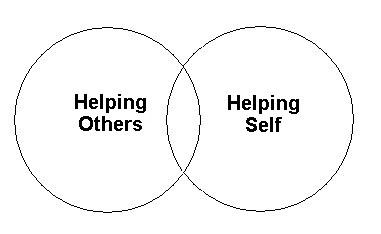
This sounds contradictory, you might say; I just read that the servant leader serves first. True. But a leader must get something out of her work, and she must acknowledge that gain, or the path to giving up becomes very short. Both elements must be there. Think about two overlapping circles:

Image depicting two overlapping circles, labeled Helping Others and Helping Self.

One of these circles represents the servant leader's desire to help others; the other represents her need to help herself. Ideally, a servant leader should find herself doing both of these things, in a place where these circles overlap.

So what are some things that the leader can do to remain inspired and excited about their work? Answers are as individual as every leader is. However, consider these possibilities, which have worked for many leaders. Might any of them work for you?

  • Take time for you. You may think you don't have time for a vacation, or for an afternoon off: but can you really afford not to? You need time to regroup, and to replenish your well. There are many ways you can do this. It could be in daily meditation or on a jog, or by taking a day to do something you love. It could be almost anything: going to a play or enjoying a picnic; taking a pottery class or watching a football game. Whatever you do, it should be something just for you that you will enjoy and find renewing. And it should have nothing to do with work.
  • Read -- and not simply news and your work. Read novels, biographies, or anything else you enjoy. One constant among many of our historical leaders is how much they read. Reading inspires creativity and helps you to see the "big picture" more clearly. By doing so, you make associations you wouldn't have otherwise. In short, it helps you keep all of life in your consciousness.
  • Have others to sustain you. We've all heard the phrase, "It's lonely at the top." That can be true for servant leaders, too. In fact, when you get right down to it, it can be lonely wherever you are in the pile. All of us need people who can help us and who support us in our challenges and our joys.

For servant leaders, it is important that we choose these people well. That's because unfortunately, if we don't consciously choose these people, we often hoist our needs on the wrong people.

We might get a lot of this support from people in our personal lives: spouses, family members, and friends. Sometimes, however, it's helpful to get support from people within your field, who have dealt with some of the same challenges and excitements as you have. Two ways to have such relationships are:

  • Having a mentor. We are always learning; hopefully, our education never ends. By standing on the shoulders of those who came before us, our view is much broader. Thus, maintaining a mentoring relationship can be an excellent way you to help you continue growing professionally.
  • Developing strong peer relationships.Talking with other leaders, especially in your field, can be very helpful. This is one way in which professional meetings and conferences can be useful. By speaking to other leaders, you start understanding that other people have the exact same problems you are dealing with. It can help you realize you are not alone.

Exercise:

Think of someone whose leadership you admire or who you admire professionally in other ways. Preferably, choose someone who has been working in their field for many years. Ask them where they receive their support. When they are frustrated, who do they turn to? Are there similar possibilities or people in your own life? Would the same forms of support work for you?

  • Challenge yourself. When the "old routine" doesn't work for you any longer, find new mountains to climb. Challenge yourself with new directions and possibilities. This could be by starting a new program, forming a new collaboration, or revamping an existing project. Anything that will get your excitement flowing again can work; the possibilities are boundless.
  • Look at the whole picture. That is to say, remember the whole forest, and don't let yourself get hung up in the trees. Sometimes, we can get hung up in the daily frustrations of our work. That's when it's time to remind ourselves of our broader vision, whether it is an end to child maltreatment, a thriving neighborhood, or a world without prejudice. In doing so, we may be more willing to see these frustrations as small obstacles we are willing to hurdle, instead of impossible mountains that aren't worth our efforts.
  • Celebrate the small wins. World peace, for example, is a lofty goal. It's not one you or even your organization will achieve alone. In fact, it may never be completely achieved, but many of us feel it's still worth striving for. So when you do accomplish a piece of that peace, celebrate your accomplishment. 

In Summary

The servant leader sees leadership much in the same way a carpenter sees a hammer. A hammer is a tool -- and a very important tool at that. It can be used build; to create; to realize a dream. And with one wrong hit, a very painful thumb.

Leadership, too, allows one to develop dreams. It opens doors and allows opportunities to be realized. However, it's something to be careful with. For like the hammer, mistakes can be costly. Worse yet, leadership, like that hammer, can be used to destroy instead of create; to hurt people instead of help them. And without paying proper attention to ourselves, it can destroy the leader as well.

The wise servant, then, is as careful with this power as she would be with that hammer, always trying to make sure to hit the nail on the head.

Contributor

Jenette Nagy

Resources

Online Resources

Becoming a Servant Leader: Do You Have What It Takes? by John E. Barbuto and Daniel W. Wheeler, is a NebGuide that introduces servant leadership; the 11 dimensions that typically characterize a servant leader, including inherent traits and learned skills; and several practical ways to develop skills necessary for this leadership style.

Building Leadership from Within: Effective Succession Planning in Three Basic Steps by Susan deGranpre, June Juliano and David Pease.

Greenleaf Center for Servant Leadership provides resources for understanding the principles and practices of servant leadership.

The Heartland Center for Leadership Development

Print Resources

Covey, S. (1992). Principle-centered leadership. New York, NY: Simon and Schuster.

Greenleaf, R. K. (1976). Servant leadership: A journey into the nature of legitimate power and greatness. New York, NY: Paulist Press.

Murphy, Frederick. (Ed.) (2013). Community Engagement, Organization, and Development for Public Health Practice. New York: Springer.

Checklist
mloewenstein Tue, 12/11/2012 - 14:52

___You are ready to accept and maintain the call of service

___You developed the qualities of the servant leader

___You see yourself as first among equals

___You use power honestly

___You know the importance of day-to-day details

___You care for your constituents

___You help people get what they want

___You reach your constituents

___You try to inspire others

___You adapt to fit situations

___You listen to others

___You involve others

___You promote teamwork

___You enhance problem-solving skills

___You know how to find inspiration

___You know that helping other is part of helping self

Examples
mloewenstein Tue, 12/11/2012 - 14:52

Example 1: Interview with Ann Liprie-Spence, Director, Servant Leadership Center of the Southwest, McMurry University (Abilene, TX)

Ms. Liprie-Spence is the Director of the Servant Leadership Center of the Southwest at McMurry University in Abilene, Texas. Here, she talks about their program and the meaning of servant-leadership.

McMurry is so special; it's a small [Methodist] liberal arts college. We have about 1400 students. It's hard to say what makes us unique. If you're here, you can feel it. It's a very caring atmosphere.

[A professor] said, "We've got to find some way to build our niche, because we are a very special place." He came back from a conference that had some information on servant leadership. This [was] in 1990. We devised a program in Servant Leadership, sought funding and then got our program under way.

One large component of our program is the course, "Concepts and Techniques in Servant Leadership." For the first two years, the class was free and students were encouraged to take it by invitation. After the grant ended, students were given the opportunity to enroll in the course. The last three years, enrollment has just soared.

What we do in the course is use the philosophy of Robert K. Greenleaf. We try to instill in our students [the idea] that the best leaders are those that serve others. By leading them, you're also serving them, and all of their concerns should be taken into consideration when you make decisions. We try to instill throughout the semester that everything you do is for the greater good of others. I think sometimes in society, the examples of leadership that some students see are examples where people have gained prestige and power because of more selfish purposes.

What we do on Mondays is lecture on the principles of leadership. We look at topics such as conflict resolution, team building, and time management. A second session each week is a small group seminar/discussion led by upper class students who have been specially trained in the servant leadership concept and in group dynamics.

One of the things we do the first day of class is ask them to list the characteristics of a servant. Then, we ask them to list the characteristics of a leader. Very seldom is there anything that is the same. Then we start trying to talk about what it means. To some people that term is a turn-off until they really understand it. You don't want these macho guys being called a servant leader--What would their friends think!--until they really understand what it means.

At the beginning of the semester I get eight agencies to come on campus, they talk about their agency, and we have a specific project lined up with each. The students pick a team that they're going to work with by picking an agency.

[So] their team is based on the fact that they all wanted to work with Abilene State School or with Habitat for Humanity or whatever. Then on their own each individual must give 30 hours to that project. They have to keep a journal. What we think is most important [is that] they reflect on what they learn in that project on a daily basis. Whenever they go out and they look at what they learned in class, can they relate those things? Did any of those issues come up?

They go through a training session where they're given a broad view of the agency. Then, the students look for need and for areas where they can be of value and of service to that agency. They make proposals; they take them back to the agency. If the proposals are approved then they have to find the means to carry them out using all the leadership principles [they have learned].

We want them to realize that need to go out there and make a difference, look for things to change and try to propose changes. Look for ways to do things rather than just walk in and say, "What do you have for me to do today?" or, "We want to see what we can do. Suggest ideas ways we can make things better, things that we might do that you hadn't thought about."

Some of their ideas have been shot down. We tell them welcome to the real world, that problem creates an opportunity for you to get back together and create another idea. So I can't tell you it's always roses. Their ideas are not always met with, "This is a wonderful idea, get started, what can we do for you." Sometimes they're told, "It's great but you're on your own. We don't have any resources. "

After they [finish] the class I send students a letter inviting them to be part of what we call the servant leadership mentors. So they get to extend their leadership beyond the class. The mentors go out and interview agencies because they know what it's like to be a team member. If the mentors say this project won't work, we don't do it. Part of the idea behind servant leadership is listening to others. I'd be less than honest with them if I say come with me and I ignored what they had to say. They learn by doing.

We've got a saying that we put in our co-curricular transcripts. It says: We believe in demonstrating our commitment to human potential by adding spiritual values, leadership and service to human kind. We've created a program believed to be unique in college setting: McMurry University Servant Leadership Program.

Here's what we tell the students is most important. We say the program is designed to equip our students with a firm moral and ethical foundation, one which they can make sense of the dilemmas they will face. Ones from which they can become leaders who give something back to the world.

The year before last on our campus alone faculty, staff and students gave 24,000 hours in one year of community service. That's on a campus of 1,400 students. I think a lot of it extends from once they see [this approach] as a way of life. They actually go out there and experience it and see how good it makes them feel. That's comment I get all the time, "I never knew how good it would make me feel, to truly live a life as a servant leader."

Example 2: Interview with Nancy Larner, Program Director at the Greenleaf Center for Servant-Leadership.

Nancy Larner is Program Director at the Greenleaf Center for Servant-Leadership. Here, she talks about the organization and their philosophy

The Greenleaf Center is [an international] non-profit organization. We are interested in trying to foster more caring and humane organizations. We work with health care, higher education systems, religious organizations, for profit/non-profit organizations--basically the whole gamut. We don't try to focus in one area--we try to reach out to everybody.

Our logo is the Mobius strip. The whole idea behind the Mobius strip and how it signifies servant-leadership is that there is not a beginning or an end. It all flows together--leading lends itself to serving, serving lends itself to leading. Servant-leadership is a hyphenated word because leading and serving are on equal levels.

Servant leadership is really a practical philosophy. It supports people who wish to serve first, and then lead as a way of expanding service to individuals and institutions. And it's not necessarily people who are in a position of power. Anybody can lead in the servant-leadership philosophy. What it takes is a lot integrity, trust, caring, and also some vulnerability. That is, you aren't the only one making the decisions. It's not about having all the answers. Servant leadership encourages a lot of collaboration, trust, listening and the ethical use of power.

It's kind of like [in jazz] where it's somebody else's turn to play their instrument and do an improv, or if somebody has an idea on how to take the music a little bit further. You let them go. They might not be the leader of the band but they've got a great idea and they're going with it. It's very subtle. It's hard to say exactly when you step down as leader and let someone else take over.

Robert Greenleaf is the gentleman who wrote about this philosophy back in the 1960s. His whole idea was that you take people where they spend the most time, whether it's in a religious institution or at work or whatever, and you teach or try to foster these basic principles. His hopes were that these would transfer into community at large so that you do create or you try to create a more caring and humane society.

Some people really get it from reading the material [written by Greenleaf]. Saying "Oh my goodness, this is how I've been feeling all of my life and I didn't know that there are people and organizations out here that really foster this sort of leadership." In some ways, that's a transformation, in the sense that you really feel like there's hope out there, that organizations can be run in a more humane way.

Are there things people can do to become servant-leaders or to become better servant-leaders?

People look for the bullet points or the ten step program to become servant leaders. And the fact of the matter is it's just working on your people skills. It's not so much OK, I need to do X,Y, and Z and then I'm a servant leader. It is more honing skills like empathy and listening, and trying to work with consensus and persuasion rather than coercion. I think that everybody can be a servant leader if they choose to.

If someone came up to you and said, "I would like to start using the principles of servant-leadership in my work or personal life." What advice would you give them?

Begin to be just a little more caring and supportive of your colleagues, perhaps by showing interest in their lives outside of work, or, if somebody comes to you and they're really bogged down with work, maybe you help them out a little bit. People start to feel a sense of empathy and trust, and maybe they will then treat their co-workers in the same manner. Servant-leadership can begin anywhere at any time. The choice is up to the individual.

Contributor

Jenette Nagy

Tools
mloewenstein Mon, 09/30/2013 - 12:29

Tool 1: Personal Plan for Learning and Serving

The Personal Plan for Learning and Serving is a dynamic, living document to guide learning and service. Completing this guide can help you discern what matters to you, what your particular gifts are and to what ends they can be directed, and how to enhance your abilities to use them in serving others. As part of an ongoing process of reflection, it can and should be reviewed and revised periodically.

Tool 2: Active listening

As we come to understand ourselves and our relationships with others better, we rediscover that "communication is not just saying words; it is creating true understanding." Active listening is an important skill in that process. Chances are that those who influence us most are powerful listeners. Whether instinctively or through practice, they have developed the skill of empathy. Special thanks goes to the Center for Rural Studies for granting us permission to use this activity.

Use the directions that follow to practice some of these basic active listening skills:

  • Attending Skills (verbal and non-verbal)
  • Questions, Reflections, Summarization
  • Skills of Self-expression: "1-2-3 Pattern"
  • Practice Session on Effective Confrontation

The group should be divided into subgroups of three. There will be three roles in each subgroup: speaker, listener, and observer. Everyone will take each role once in this practice, so divide into your subgroup and decide who is going to take which role first.

Directions:

Objective - The point of the practice session is to give each person the opportunity to learn how to use verbal and non-verbal minimal encouragers and become a better listener.

To the speaker - Your task is to talk about something that is important to you: your job, your family, a decision, or a question. The practice will be more helpful if you talk about something you really care about, although role-playing is possible. You may find yourself in the midst of discussing something important when the allotted time runs out. If this happens, you could make an agreement with the person listening to carry on later, after work or during a break.

To the listener - Your task is to practice the skills of the session: eye contact, body language, silences, and verbal minimal encouragers. Don't panic! Just concentrate on following the speaker's train of thought. Try to limit your responses to the skills discussed in this session.

To the observer - Your task is to observe the listener's verbal and non-verbal skills. Observe and count only as many behaviors (eye contact, body posture, verbal minimal encouragers, topic jumps) as you can manage and still be relatively accurate.

Procedure:

The first speaker will talk with the listener for three or four minutes. The listener will then discuss the listening experience with the two other members of the subgroup. (To the listener: What was comfortable? What was difficult? Did you stay with the speaker?) Then the speaker will share his or her feelings about the listener's listening. (To the speaker: Did you feel listened to? Was it helpful? Did the listener have any habits you found distracting?) The observer will then share observations. This sharing process should take about three or four minutes.

Now everyone change places. Have the listener become the speaker, the speaker the observer, and the observer the listener. Go through the five minutes of talking and listening and five minutes of exchanging remarks twice more so that each person takes each role once. The entire practice session should take about 25 minutes.

When you are finished, form a large group. Your facilitator will help you share your practice experiences. How are these skills relevant to your work? Where else would they be useful? Go around the group, so that the participants have a chance to share at least one thing they have learned about themselves in this practice session.

The following exercises discuss the principles of leadership and conflict resolution. They look at time management and team building. They are situational-type exercises to let people evaluate what to do in the presented situations.

Tool 3: Team building

Create a situation based on a school board meeting. Chose random names for the characters. In this fictitious case, one of the leading employees in the school district called a meeting about a particular change they wanted to make. The change is controversial and is causing a bit of conflict in the community. Some opposed the change and some thought it was a good idea. So, the meeting is scheduled to see how folks feel about the proposed change. All the parents came to the meeting but the individual who called the meeting was late. That created hostility right off, coupled with the conflict that was already in the air. When this individual walked in, he was rattled to start with because he was late and knew he would meet a hostile audience, and the night didn't go very well. Create a script on the addressed issues, how the parents treated those issues and how the school representative treated those issues.

Divide the group into two sides. One representing the school district, the other representing the parents. This will help look at it from both perspectives. Bring the groups back into a larger group and discuss the conflict resolution process. Talk about how the conflict could have been solved better.

Here are some questions to help the discussion:

  • What did your group think?
  • What suggestions did you make?
  • You know what were some of the issues here?
  • What are some of the things that you think could have been done differently and why?
  • What would have been a better approach?
  • What could that official have done as a leader?
  • How could he have done things that would have resolved some conflicts?
  • How could he have made everybody feel a little bit better when they got there?
  • What would you do in a situation like that?
  • What might a servant-leader have done?
  • Did that individual act like as a servant-leader?
  • How the individual could have handled the situation better?

Tool 4: Tower of Babel

This exercise is called the Tower of Babel, and it's a case on communication. It gets participants excited and helps them learn the importance of including others. Gather a small group and distribute sheets containing different roles. The participants cannot look or talk to anybody else. Each role sheet has very specific instructions such as "all you can do is speak Spanish," "all you can do is be sarcastic and negative." You know that everyone has a different role, but the students don't know what the others' roles are. One of them gets a role that says, "you are the leader. You must communicate to your group without talking that they have to build the tallest tower they can that will support a book on top of it when they finish. They can't talk and they can't write, unless specified in their role sheet. They have to find some way to communicate and there are all different dynamics going on. One of them is being really sarcastic, another one is being really positive, the other one can only babble, another one only speaks French, another one is blind, another one is paraplegic. See if the leader tries to include everybody.

When the activity is completed, talk about it in the group. Sometimes the group that had the least communication will have the smallest, sloppiest tower. These are exaggerated handicaps but everybody has strengths and weaknesses and if you're communicating you need to find ways to let everybody participate and consider everybody's thoughts and ideas. Stress the importance of getting everyone's input because they may have some very important things to say and great ideas. Stress the importance of inclusion. Talk about some of the problems that they had with communication. Did they even realize that that was a problem?

PowerPoint
Anonymous (not verified) Tue, 12/11/2012 - 14:53

A Power Point presentation summarizing the major points in the section.

Section 3. Styles of Leadership
mloewenstein Tue, 12/11/2012 - 14:53
Main Section
mloewenstein Tue, 12/11/2012 - 14:54
  • What is leadership style?

  • Why pay attention to leadership style?

  • What are some conceptions and methods of leadership?

  • What are some ways of looking at leadership style and what are their effects on an organization?

  • How do you determine what is an appropriate style?

  • How do you choose and develop a leadership style?

Leadership styles are the ways in which a leader views leaderships and performs it in order to accomplish their goals. This chapter provides a guide for understanding what different styles look like, which ones are more and less effective, and how you can develop or change your style to come closer to the ideal you aspire to.

What is leadership style?

According to John Gardner, in On Leadership, "Leadership is the process of persuasion or example by which an individual (or leadership team) induces a group to pursue objectives held by the leader or shared by the leader and their followers." If we accept that definition, then leadership style is the way in which that process is carried out.

Leaders' styles encompass how they relate to others within and outside the organization, how they view themselves and their position, and - to a very large extent - whether or not they are successful as leaders. If a task needs to be accomplished, how does a particular leader set out to get it done? If an emergency arises, how does a leader handle it? If the organization needs the support of the community, how does a leader go about mobilizing it? All of these depend on leadership style.

Much of the material in this section looks at individual leaders, but leadership can be invested in a team, or in several teams, or in different people at different times. Many - perhaps most - organizations have several levels of leadership, and thus many leaders. Regardless of the actual form of leadership, however, leadership style is an issue. Whether you're the leader of a large organization or a member of a small group that practices collective leadership, the way that leadership plays out will have a great deal to do with the effectiveness and influence of your work.

Why pay attention to leadership style?

The style of an organization's leadership is reflected in both the nature of that organization and its relationships with the community. If a leader is suspicious and jealous of power, others in the organization are likely to behave similarly, in dealing with both colleagues and the community. If a leader is collaborative and open, this behavior is likely to encourage the same attitudes among staff members, and to work collaboratively with other organizations.

In many ways, the style of its leader defines an organization. If the organization is to be faithful to its philosophy and mission, its leader's style must be consistent with them. An autocratic leader in a democratic organization can create chaos. A leader concerned only with the bottom line in an organization built on the importance of human values may undermine the purpose of its work. For that reason, being conscious of both your own style as a leader and those of others you hire as leaders can be crucial in keeping your organization on the right track.

We've all known and seen different types of leaders. (We'll look more closely at some specific styles later in this section.) One of the enduring images of the 20th century is that of hundreds of thousands of Germans wildly cheering their Fuhrer in Leni Riefenstahl's brilliant and terrifying 1930's Nazi propaganda film "Triumph of the Will." Franklin Roosevelt comforted a nation paralyzed by economic depression by explaining that "We have nothing to fear but fear itself." John Kennedy electrified a generation with his exhortation to "Ask not what your country can do for you; ask what you can do for your country."

All of these are representations - for various purposes - of great motivational leaders working their magic through their speeches. Our concept of leadership tends to linger on such examples, but there are other kinds of leaders as well. Gandhi sitting and spinning in a dusty Indian courtyard; John Lewis and other Freedom Riders being brutally beaten in Mississippi; Vaclav Havel refusing to take revenge on the former Communist bureaucrats of Czechoslovakia; Nelson Mandela sitting in prison on Robben Island - these also are pictures of leadership.

Conceptions of leadership

The leadership style of an organization may be concerned with less dramatic issues than these examples, but it nonetheless has profound effects on the people within that organization, and on everything the organization does. Styles have to do with a leader's - and organization's - ideas of what leadership is and does. Possible conceptions include:

  • Exercising power. Leadership is a matter of pursuing one's own ends. Asserting power over others is an end in itself, and symbolizes one's position as a leader.
  • Gaining and exercising the privileges of high status. Leadership is about getting to the top, and being recognized as having the highest status.
  • Being the boss. Leadership is overseeing the work of the organization by telling everyone what to do when, and rewarding or punishing as appropriate.
  • Task orientation. Leadership is getting the job done - that's all that matters.
  • Taking care of people. Leadership is looking out for those you lead, and making sure they get what they need.
  • Empowerment. Leadership is helping those you lead gain power and become leaders.

Taking these last two together, we might add a conception whereby one aspect of leadership is the fostering of personal (and professional) growth in others.

  • Providing moral leadership. The leader, by force of character and their own high standards, creates expectations and pulls others up to her level.
  • Providing and working toward a vision. Leadership is the ability to envision a goal, and to motivate others to work with you toward that goal.

Methods of leadership

In many, or perhaps most, organizations, more than one of these conceptions may define leadership. Each implies particular ways of leading, and leaders may use a number of different methods.

  • Pure exercise of power. "My way or the highway." If you don't do what the leader demands, no matter how unreasonable, you're gone. The leader's decisions are not open to question or discussion, and no one else gets to make decisions.
  • Political scheming. The leader plays people off against one another, creates factions within the organization, cultivates "allies" and isolates "enemies," and builds up (through favors or overlooking poor performance) personal debt which can be cashed in when needed, in order to manipulate people and events as they wish.

A school superintendent bragged to voters about how little was spent on the school system, and then explained to teachers how they couldn't have raises because the community was too cheap to invest in education. He set principals at odds with one another and with teachers, played favorites among system administrators, postured in public, did his best to charm particular school committee members, and generally kept everyone off balance. He did it so well that, for most of his long term of employment, almost no one noticed that he exercised no educational leadership whatsoever, and that the schools deteriorated both physically and educationally under his administration.

  • Using relationships. The leader develops strong positive relationships with all or most of the people in the organization, and uses these relationships to steer people in particular directions. People do what they're asked because of their relationships with the leader, rather than for reasons connected to the tasks themselves.
  • Setting an example. The leader may or may not demand or request particular behavior or actions, but she will demonstrate them, and expect or imply that others will follow.

In Sicily, a young archeologist was the dig supervisor, given the task of negotiating with and organizing local workmen for a dig. The workmen, most of them nearly twice the supervisor's age, saw the job as an opportunity to make some money without doing much work (and had been given to understand as much by the local mafioso who recruited them).

The supervisor surprised them by speaking their dialect, and by treating them with respect. But the biggest surprise was that, after explaining carefully what needed to be done and how, he didn't stand over them or tell each person what to do. Instead, he simply turned away and went to work. The older men, impressed and embarrassed, started to work as well. They were surprised once more when they realized that the young archeologist was willing to do any job, no matter how hard or dirty, and that - although they were farmers, accustomed to labor - they couldn't outwork him no matter how they tried. Contrary to their original expectations, they worked hard for the time they were employed...without the supervisor ever giving orders.

  • Persuasion. The leader convinces people through argument, reasoning, selling techniques, or other persuasive methods that what the leader wants is, in fact, the best course, or in line with what they want to do.
  • Sharing power. Some leaders choose to exercise at least some leadership through the other stakeholders in the organization. In this situation they may give up some personal power in return for what they see as more ownership of decisions, goals, and the organization itself by those involved in the decision-making process.
  • Charisma. Some leaders are charismatic enough to simply pull others along by the power of their personalities alone. They may, in fact, advocate and accomplish wonderful things, but they do it through people's loyalty to and awe of them.

Alexander the Great was only 18 when he succeeded his murdered father as King of Macedonia, and only 32 when he died, but he was able in the short time in between to conquer much of the known world. His personal magnetism was such that his soldiers - who knew him well, and fought beside him - thought him immortal, and followed him for years through battle after battle, and through one unknown country after another. As he lay dying, his whole army - 50,000 men - filed past to say goodbye personally to the leader they loved and revered. That's charisma.

  • Involving followers in the goal. The leader gets others to buy into her vision for the organization, and to make it their own. She may accomplish this through charisma, through the force of her own belief in the power and rightness of the vision, or through the nature of the vision itself.

Various combinations of these and other methods.

The combination of the leader's and organization's conception of leadership and the leader's way of leading does much to define leadership style. In addition, the characteristics of the leadership are almost always reflected in the relationships within and among the staff, participants, Board, and others related to the organization, as well as in its policies, procedures, and program. We'll return to this idea in more detail when we examine specific styles later in this section.

There are also other factors that come into play in defining leadership style. In some organizations, for instance, leaders are expected to shake things up, and to foster and support change. In others, they are expected to sustain the status quo. In some, they are expected to be proactive, and assertive; in others, more passive. All of these elements - concepts of leadership, methods of leading, attitude toward change, assertiveness - combine with personalities and individual experience in different ways to create different styles of leaders.

There are a number of theories about leadership style, many involving a continuum - two opposite styles with a number of intermediate stops between them. We'll try here to present four styles that summarize many of the existing theories, and to show how they interact with another, all-embracing way of looking at leadership style.

Some ways of looking at leadership style, and their effects on an organization

There are a number of theories about leadership style, many involving a continuum - two opposite styles with a number of intermediate stops between them. We'll try here to present four styles that summarize many of the existing theories, and to show how they interact with another, all-embracing way of looking at leadership style.

Four leadership styles:

Keep in mind that each of the styles below is a stereotype that actually fits very few real people. Each is meant to outline the characteristics of a style in very simple and one-sided terms. Hardly anyone actually sees or exercises leadership as inflexibly as laid out here. Most leaders combine some of the characteristics of two or more of these styles, and have other characteristics that don't match any of those below. You can find many descriptions of other leadership styles as well. What this list really provides is some useful ways to think about your own and others ' leadership.

It's also important to remember that people can be either effective or ineffective in any of these categories. An autocratic leader might simply, through his behavior, serve to strengthen the very forces that he's trying to squash. A managerial leader may be an excellent or a terrible manager. Adopting a certain style doesn't necessarily imply carrying it off well.

There are also some styles that are by their nature less effective than others. One which appears in the literature, for instance, is laissez-faire, which means letting things happen as they might, and providing neither vision nor direction nor structure. This may work for a short time in an organization that has already devised successful ways of working, but it won't suit even the best organization over a long period of time, and will be disastrous in an organization that needs direction and structure.

1. Autocratic. Autocratic leaders insist on doing it all themselves. They have all the power, make all the decisions, and don't often tell anyone else about what they're doing. If you work for an autocratic leader, your job is usually to do what you're told.

An autocratic leader often maintains his authority by force, intimidation, threats, reward and punishment, or position. Although he may or may not have a clear vision, and may or may not be steering the organization in the right direction, he's not concerned with whether anyone else agrees with what he's doing or not.

Autocratic leadership allows quick decision-making, and eliminates arguments over how and why things get done. At the same time, however, it may reduce the likelihood of getting a range of different ideas from different people, and can treat people badly, or as if they don't matter. If, as is often true, the leader is concerned with his own power and status, he'll be looking over his shoulder, and moving to squelch any opposition to him or his ideas and decisions. Innovation or the use of others' ideas is only permissible if it's part of the leader's plan.

Effects on the organization. Autocratic leaders often leave fear and mistrust in their wake. Others in the organization tend to copy their protection of their position, and their distrust of others' ideas and motives. Often, autocratically -led organizations are not particularly supportive of personal relationships, but much more keyed to chain-of-command. Everyone has her own sphere, and protects it at all costs. Communication tends to go in only one direction - up - as a result of which rumor can become the standard way of spreading news in the organization.

At its best (and there are decent autocratic leaders - see the box directly below ), autocratic leadership provides a stable and secure work environment and decisive, effective leadership. All too often, however, it can sacrifice initiative, new ideas, and the individual and group development of staff members for the predictability of a highly structured, hierarchical environment where everyone knows exactly what he's supposed to do, and follows orders without question.

Although the above paints a pretty bleak picture, many autocratic leaders are not hated and feared, but rather esteemed, and even loved. It depends on their own personalities - like anyone else, they can be nice people, or highly charismatic, or even willing to listen to and act on others' ideas - on the organization itself (in the military, most soldiers want someone firmly in charge), on the quality of their decisions, and on the needs of the people they lead. If they're generally decent and not abusive, make good decisions for the organization, and fulfill the parent-figure or authority -figure image that most people in the organization are looking for, they can be both effective and well-respected.

2. Managerial. The leader who sees herself as a manager is concerned primarily with the running of the organization. Where it's going is not at issue, as long as it gets there in good shape. She may pay attention to relationships with and among staff members, but only in the service of keeping things running smoothly. Depending upon the nature and stability of the organization, her main focus may be on funding, on strengthening the organization's systems and infrastructure (policies, positions, equipment, etc.), or on making sure day-to-day operations go well (including making sure that everyone is doing what he's supposed to).

If she's efficient, a managerial leader will generally be on top of what's happening in the organization. Depending on the size of the organization and her management level, she'll have control of the budget, know the policies and procedures manual inside out, be aware of who's doing his job efficiently and who's not, and deal with issues quickly and firmly as they come up. What she won't do is steer the organization. Vision isn't her business; maintaining the organization is.

Effects on the organization. In general, a well-managed organization, regardless of its leadership style, is a reasonably pleasant place to work. Staff members don 't have to worry about ambiguity, or about whether they'll get paid. As long as oversight is relatively civil - no screaming at people, no setting staff members against one another - things go along on an even keel. Good managers even try to foster friendly relationships with and among staff, because they make the organization work better.

On the other hand, good management without a clear vision creates an organization with no sense of purpose. The organization may simply act to support the status quo, doing what it has always done in order to keep things running smoothly. That attitude neither fosters passion in staff members, nor takes account of the changing needs (and they do change) of the priority population or the community. The organization may do what it does efficiently and well...but what it does may not be what it should be doing, and it won't be examining that possibility any time soon.

Obviously, the leader of any organization - as well as any other administrator - has to be a manager at least some of the time. Many are in fact excellent managers, and keep the organization running smoothly on a number of levels. The issue here is the style that person adopts as a leader. If she sees management as her primary purpose, she's a managerial leader, and will have a very different slant on leadership than if her style is essentially democratic, for instance.

3 Democratic. A democratic leader understands that there is no organization without its people. He looks at his and others' positions in terms of responsibilities rather than status, and often consults in decision-making. While he solicits, values, and takes into account others' opinions, however, he sees the ultimate responsibility for decision-making as his own. He accepts that authority also means the buck stops with him. Although he sees the organization as a cooperative venture, he knows that he ultimately has to face the consequences of his decisions alone.

Democratic leadership invites the participation of staff members and others, not only in decision-making, but in shaping the organization's vision. It allows everyone to express opinions about how things should be done, and where the organization should go. By bringing in everyone's ideas, it enriches the organization's possibilities. But it still leaves the final decisions about what to do with those ideas in the hands of a single person.

Some models of democratic leadership might put the responsibility in the hands of a small group - a management team or executive committee - rather than an individual.

Effects on the organization. Democratic leadership, with its emphasis on equal status, can encourage friendships and good relationships throughout the organization. (In more hierarchical organizations, clerical staff and administrators are unlikely to socialize, for instance; in a democratically-led organization, such socialization often happens.) It helps people feel valued when their opinions are solicited, and even more so if those opinions are incorporated into a final decision or policy.

What a democratic leadership doesn't necessarily do - although it can - is establish staff ownership of the organization and its goals. Although everyone may be asked for ideas or opinions, not all of those are used or incorporated in the workings of the organization. If there is no real discussion of ideas, with a resulting general agreement, a sense of ownership is unlikely. Thus, democratic leadership may have some of the drawbacks of autocratic leadership - a lack of buy-in - without the advantages of quick and clear decision-making that comes with the elimination of consultation.

4. Collaborative. A collaborative leader tries to involve everyone in the organization in leadership. She is truly first among equals, in that she may initiate discussion, pinpoint problems or issues that need to be addressed, and keep track of the organization as a whole, rather than of one particular job. But decisions are made through a collaborative process of discussion, and some form of either majority or consensus agreement. Toward that end, a collaborative leader tries to foster trust and teamwork among the staff as a whole.

A collaborative leader has to let go of the need for control or power or status if she is to be effective. Her goal is to foster the collaborative process, and to empower the group - whether the staff and others involved in an organization, or the individuals and organizations participating in a community initiative - to control the vision and the workings of the organization. She must trust that, if people have all the relevant information, they'll make good decisions...and she must make sure that they have that information, and provide the facilitation that assures those good decisions.

Effects on the organization. Collaborative leadership comes as close as possible to ensuring that members of the organization buy into its vision and decisions, since they are directly involved in creating them. It comes closest to the goal of servant leadership explored in the previous section, and it also comes closest to reflecting the concepts of equality and empowerment included in the philosophy and mission of so many grassroots and community-based organizations. It thus removes much of the distrust that often exists between line staff and administrators.

David Chrislip and Carl E. Larson, in Collaborative Leadership - How Citizens and Civic Leaders Can Make a Difference, equate collaborative leadership not only with servant leadership, but with transformational (see below) and facilitative leadership as well. They identify four characteristics of the collaborative leader:

  • Inspiring commitment and action. The collaborative leader helps people develop the vision and passion to start and maintain the work.
  • Leading as a peer problem solver. The collaborative leader facilitates problem solving by modeling and teaching a process, and by helping others bring their experience and ideas to bear.
  • Building broad-based involvement. The collaborative leader invites everyone concerned into an inclusive process.
  • Sustaining hope and participation. Reaching goals may take a long time. The collaborative leader both helps the group set interim goals so it can see progress, and, by example and in other ways, helps to maintain the passion and commitment to keep going when there's no end in sight.

Collaborative leaders also generally foster close relationships among staff members, making for more communication and cross-fertilization in their work, and leading to more effective ways to accomplish the organization's goals.

On the down side, management can be neglected in favor of building a collaborative organization. Even more to the point, collaborative decision-making can be excruciating. Depending upon the group, ideas can be talked to death, and insignificant disagreements about insignificant areas of policy can take hours to resolve.

Collaborative decision-making can be democratic - based on a majority vote after discussion - or dependent on arriving at consensus, with a range of possibilities in between. Consensus decision-making is particularly difficult, in that it requires everyone to agree before a decision can be made. A single determined individual can derail the process indefinitely. Even at its best, a consensus process can take inordinate amounts of time, and try the patience of all involved. It's not impossible to employ, but it takes real commitment to the ideal of consensus, and enormous patience. In practice, true consensus decision-making is most often used in collective organizations, which are significantly different from collaborative ones, and often involve everyone in leadership.

Styles of leadership

A different view, popularized by James MacGregor Burns, contrasts two styles of leadership: transactional and transformational.

Transactional leadership, as its name implies, views leadership as based on transactions between leader and followers. The leader sees human relations as a series of transactions. Thus rewards, punishments, reciprocity, exchanges (economic, emotional, physical) and other such "transactions" are the basis of leadership. In simplest terms, I lead this organization by paying you and telling you what you need to do; you respond by doing what you need to do efficiently and well, and the organization will prosper.

Transformational leadership looks at leadership differently. It sees a true leader as one who can distill the values and hopes and needs of followers into a vision, and then encourage and empower followers to pursue that vision. A transactional leader thinks of improvement or development as doing the same thing better: an organization that reaches more people, a company that makes more money. A transformational leader thinks about changing the world, even if only on a small scale.

Combining the two views of leadership style

These two ways of looking at leadership style are not mutually exclusive: in fact, it's easier to look at leadership in the context of both. Assuming, as almost all leadership theorists do, that transformational is either better than, or a necessary addition to, transactional leadership, what elements go into creating a transformational leader? What styles are transformational leaders likely to employ, and how?

Elements of transformational leadership

The transformational leader conceives of leadership as helping people to create a common vision and then to pursue that vision until it's realized. She elicits that vision from the needs and aspirations of others, gives it form, and sets it up as a goal to strive for. The vision is not hers: it is a shared vision that each person sees as his own.

Martin Luther King's overwhelming "I Have A Dream" speech derived its power not only from the beauty of his oratory, but from the fact that it crystallized the feelings of all those community members, of all races, who believed that racism was a great wrong. In that speech, King spoke with the voices of the hundreds of thousands who stood before the Lincoln Memorial, and of millions of others who shared in his vision. That speech remains as the defining moment of the Civil Rights struggle, and defined King - who had already proved his mettle in Birmingham and elsewhere - as a transformational leader.

The conception behind transformational leadership is thus providing and working toward a vision, but also has elements of empowerment, of taking care of people, and even of task orientation. The job of the transformational leader is not simply to provide inspiration and then disappear. It is to be there, day after day, convincing people that the vision is reachable, renewing their commitment, priming their enthusiasm. Transformational leaders work harder than anyone else, and, in the words of a spiritual, "keep their eyes on the prize".

The methods that transformational leaders might use to reach their goals can vary. They'll virtually always include involving followers in the goal, as well as charisma, which comes, if not from personal characteristics, from the ability to put a mutual vision into words, and to move a group toward the realization of that vision. Transformational leaders may also use sharing power, setting an example, and/or persuasion to help move a group toward its goal.

What style does all that imply? The managerial style is perhaps least appropriate to transformational leadership, since it pays no attention to vision. The autocratic pays little attention to the ideas of others, and is not generally congenial to the transformational leader. On the other hand, there was Hitler, who tapped into the deepest emotions of those he led, and voiced them in a frightening but highly effective way. There is no guarantee that a transformational leader will work for the betterment of humanity, although he may couch his vision in those terms. The intersection of the transformational and the autocratic is not impossible, but it usually has, at best, mixed results.

Fidel Castro initiated and has maintained desperately-needed land, education, health, and other reforms in Cuba, for which he is still revered by much of the island's population. He also eliminated any vestige of political freedom, imprisoned and executed dissenters and political opponents, and was at least partially responsible for destroying much of Cuba's economic base in the name of ideological purity. As with the four styles described earlier, there is no guarantee that either a transactional or transformational leader will be an effective one.

The democratic and collaborative styles are both better possibilities for transformational leadership. Both allow for input from everyone, and both encourage participation in the realization of long-term goals. It can be difficult for a highly motivated, charismatic leader to operate in the collaborative mode, but it can also be tremendously satisfying. There is an argument to be made that, because of the high degree of ownership of the vision in a collaboratively-run organization, the collaborative style could be the most successful for transformational leadership. As noted above, David Chrislip and Carl Larson actually see collaborative and transformational leadership as essentially the same.

How do you determine what is an appropriate style?

All that said, it is probably true that any leader, even a highly collaborative one, uses a range of different styles at different times - even, perhaps, in the course of a single day. Decisions have to be made, major and minor crises have to be met, situations and conflicts have to be resolved, often right at the moment. It is important to realize that different styles may be appropriate at different times, and for different purposes.

In an emergency, no one would suggest sitting down and making a group decision about what to do. There has to be decisive action, and one person has to take it as soon as possible. As long as it's clear who that person is, there should be no question about the philosophical issues involved. By the same token, it's counter -productive to make decisions about how people should do their jobs without at least consulting those people about what might work best. Good leaders usually have a style that they consciously use most of the time, but they're not rigid. They change as necessary to deal with whatever comes up.

There are at least two other factors that have to be considered when choosing a leadership style. The first is that leadership style - at least at the beginning - must, to at least some extent, be consistent with what people in the organization expect. You can try to change their expectations and perceptions of how an organization should be run - that's part of leadership - but you have to start by meeting them at least halfway, or you'll never get close enough to talk about it.

If you're trying to turn a system that's been autocratic into a collaborative one, you have to accept that most people in the system not only won't welcome the change, and that some won't even understand what you're suggesting. You also have to accept that they've probably developed their own methods of getting around the rigidity of the system that they'll continue to use, even if the system is no longer rigid. It can take a long time just to get your ideas across, and longer to help people overcome their suspicions and break old habits. A few may never be able to. You need patience, and the willingness to act occasionally in ways you'd rather not.

In the second story at the beginning of this section, the school principal was on the side of the angels: he was trying to be a collaborative, transformational leader who would inspire and support teachers to become the best educators they could, and who would make the school into a model of excellence, learning for all, and collegiality. The problem was that the teachers expected something entirely different. They wanted someone to tell them what to do, and then leave them alone to do it. They saw the principal's plans as just another way to trick them into doing things they didn't want to do, and to get them to work longer hours. The more he tried to explain how what he was asking was for their benefit, the more they resisted - they'd heard that line before.

If he had started where the teachers were, the principal might have been able to be more successful. That would have meant his "running" the school as his predecessor had, and introducing reforms slowly over a long period. Suggestions to receptive teachers might have started the process; professional development could have helped it along. He might have used incentives of some sort to encourage teachers to try new things, rather than assuming they would be happy to be more independent and creative. Paying attention to the expectations of the staff might have paid off for the principal in the long run.

Finally, your style needs to be consistent with the goals, mission, and philosophy of your organization. As mentioned earlier - and in numerous places elsewhere in the Community Tool Box - an organization cannot remain faithful to its mission if its internal structure is at odds with its guiding principles. An organization dedicated to empowerment of the priority population, for instance, must empower its staff as well. For most grassroots and community-based organizations, this consistency would mean using some variation of a democratic or collaborative style.

How do you choose and develop a leadership style?

What kind of leader do you want to be? Perhaps even more important, how would you be most effective as a leader? What kind of leadership style would be of the most benefit to your organization, and would allow you to be the best leader you could be? The leadership styles described in this section aren't the only ways to look at leadership. As we've already discussed, most real leaders use a combination of styles, and there are others that haven't really been touched on here.

It's possible that Alexander the Great was a born leader, but how much are you like Alexander the Great? Be honest now...it's doubtful, isn't it? Just about all leaders, even great leaders, have to learn how to lead, and have to develop their skills over a period of time. You can do the same, especially if you have a clear idea of what you think leadership is about, and if you have good models to learn from. Here are a few things you can do to choose and develop your own effective leadership style:

Start with yourself.

Use what you know about your own personality, and about how you've exercised leadership in the past. Neither of these has to determine what you choose now - people can change, especially if they believe that what they've done before was ineffective or inconsistent with their values - but it's important to be honest with yourself about who you are. That honesty has two aspects.

First, be clear with yourself about what your natural tendencies and talents are. If you want to be a collaborative leader, but you tend to tell people what to do, you have to admit that and think about ways to change it. If you want to be a directive leader, but you have trouble making decisions, you need to deal with that issue. Not everyone can be charismatic, but almost everyone can learn to distill and communicate a vision that reflects the hopes and needs of a group. Knowing who you are is the first step toward both choosing a style and understanding what you'll have to do to adopt it.

Being truly honest with yourself is a difficult task. For most of us, it may take some time with a counselor or a trusted friend, or the willingness to hear feedback from colleagues, co-workers, and/or family members. It also takes an honest self -assessment, which can mean stripping away defenses and facing insecurities.

Some questions you might ask yourself to start:

  • How great is my need to be in control? (When you're in a car, are you uncomfortable if you're not driving, assuming the driver is competent? Would you let someone else order for you in a restaurant? If you were teaching a class, would it be a lecture? Would you follow tangents that were interesting to class members? Is there a right way to do most everything? If your answers to these questions are yes, no, yes, no, and yes, you probably have a pretty high need to be in control of things.)
  • How willing am I to trust others to do their jobs? (Are you uncomfortable delegating work, so that you just try to do it yourself? Do you tell people exactly how to do things, even when they have experience doing them? Do you think supervisors should spend a lot of their time checking the work of those they supervise? "Yes" answers to these questions could mean that you don't have much confidence in others.)
  • How patient am I? (If someone is having trouble doing something, do you just do it for them? Do you interrupt with your comments before others are finished speaking? Do you want the discussion to end because you want to start doing something? If all these are the case, patience may not be your greatest virtue.)
  • How organized am I? (Can you almost always find whatever you need without having to search for it? Is your desk clean? Are your files alphabetized and orderly? Are your books alphabetized? Do you have a place for nearly everything? Is your appointment book readable by anyone but you? Are you always on time, and hardly ever miss appointments?)
  • How good are my people skills? (Are you comfortable with other people? Do people seem to comfortable with you? When you're with others, do you spend most of your time talking? Listening? About even? Do people seek you out for help or advice? Do you consider yourself a good judge of people, and has that been borne out by your experience? Do you try to consider others' needs and feelings in any decision?)

These few questions are obviously just a beginning, but they should help you think about some important leadership issues. If you have a high need for control, for instance, it doesn't mean you can't be a collaborative leader, but it does mean that you'll have to learn some new behavior, and perhaps a whole new way of looking at things. If you're not well-organized, it doesn't mean you can't be a good manager, but you'll have to find strategies to keep you on top of everything.

Second, acknowledge and be true to your beliefs. If you have a real philosophical commitment to a particular leadership style, it will probably be easier for you to change your behavior to match that style than to live with knowing you're betraying your principles.

Think about the needs of the organization or initiative.

A community coalition almost has to have collaborative leadership, or it will fall apart amid turf issues and accusations of discrimination. An organization that responds to situations where it has to act quickly - an emergency medical team, for example - may need more decisive and directive leadership. Some groups may have an impassioned vision, but don't have the practical skills - financial management, scheduling, etc. - to achieve it.

You can adapt most styles to most situations, but don't neglect the real needs of the organization in your calculations. You may need to practice a different style at the beginning from the one that you want to assume over the long term, in order to solve problems in the organization, or to get people on board. In the example at the beginning of this section, for instance, the school principal might have had more success if he had started by making very little change and moved more slowly into the role and philosophy he wanted.

Observe and learn from other leaders.

Think about how leaders you've worked for or with exercised leadership. What were their styles, and were they effective? How did they handle different kinds of situations? How did what they did make you and others feel? Try to watch others in action, and talk to them about how they see what they do. What do you like about how they operate? What don't you like? What can you incorporate into your own style?

Find a mentor. If there's a leader whom you particularly admire, and that person is accessible (Nelson Mandela might have trouble fitting you in), talk with her about leadership issues - about how she perceives what she's doing, how she'd handle particular situations and why, etc. Most people, especially if they're good leaders and conscious of what they do and why, welcome the opportunity to help others develop their own leadership skills.

Use the research on leadership.

There are lots of resources available on leaders and on both the theory and practice of leadership. Many are included at the end of this section, and there are hosts of others you can find yourself. They 'll give you a lot more ideas about leadership styles, and help you refine your own thinking about what leadership is and what kind of leader you'd like to be.

Believe in what you're doing.

If you've thought it through carefully, and believe in the way you practice leadership, that will be projected to others. If you believe in yourself, they'll believe in you, too.

Be prepared to change.

Although this may seem at odds with some of the above, it is probably the most important element to good leadership. No matter how well you're doing, it's not perfect - it never is, and never will be. Be prepared to find for yourself or hear from others the negative as well as the positive, to consider it carefully and objectively, and to make corrections if necessary. That way, you can not only become a good leader, but continue to be one.

In Summary

Leadership style is the way in which a leader accomplishes their purposes. It can have profound effects on an organization and its staff members, and can determine whether the organization is effective or not.

Leadership style depends on the leader's and organization's conception of what leadership is, and on the leader's choice of leadership methods. Depending how those fit together, a leader might adopt one of a variety styles, each reflected in the way the organization operates and the way its staff members relate to one another. Some (very stereotyped) possibilities:

  • Autocratic - totally in control, making all decisions themself
  • Managerial - concerned with the smooth operation, rather than the goals and effectiveness, of the organization
  • Democratic - consulting with others, encouraging equality within the organization, but making final decisions themself
  • Collaborative - sharing leadership, involving others in all major decisions, spreading ownership of the organization.

Another way of looking at leadership is to categorize it as either transactional (based on transactions such as pay in return for work) or transformational (based on enlisting people in pursuit of a vision voiced by the leader, but based on their own needs and aspirations, which aims at real change). Combining this view with that based on the four styles makes it easier to understand how leaders operate and make decisions. It also makes clear that different styles may be appropriate for different purposes, and that most leaders shift back and forth among several in the course of a day, even if there is one that characterizes them.

You can choose and develop leadership styles and skills by assessing your own tendencies and talents; understanding the needs of the organization or initiative; observing others leaders and finding a mentor; believing in yourself, and being prepared to change.

Contributor

Phil Rabinowitz

Resources

Online Resources

The Center for Creative Leadership

The Center for Strategic Management

Chapter 10: Empowerment in the "Introduction to Community Psychology" addressed the different levels of empowerment, how to contribute to power redistribution, and ways to take action to make changes in communities.

Connective Leadership and Achieving Styles

Emerging Leader

The Greenleaf Center for Servant-Leadership

Idea Bridge

The Leadership Challenge

Leadership styles and problem solving - deBono's Six Hats

The Pew Civic Entrepreneur Initiative

Power and Leadership Practices by the Superintendent: What Do They Mean to Leaders and Followers?

Spokes: Resources for Non-profits

Style of Management and Leadership

Transformational Leadership

Print Resources

Bass, B. (1995). Leadership and Performance Beyond Expectations. New York, NY: Free Press.

Burns, J. (1985). Leadership. New York, NY: Harper Collins.

Chrislip, D. & Carl E.  (1995). Collaborative Leadership - How Citizens and Civic Leaders Can Make a Difference. San Francisco: Jossey Bass Publishers.

Gardner, H. (1996).  Leading Minds: An Anatomy of Leadership. New York, NY: Basic Books.

Gardener, H. (1998).  Extraordinary Minds. New York, NY: Basic Books, 

Gardner, J. (1993). On Leadership. New York, NY: Free Press.

Greenleaf, R. (1983).  Servant Leadership: A Journey into the Nature of Legitimate Power and Greatness. Mahwah, NJ: Paulist Press, 

Macchiavelli, N. (1998). The Prince. Chicago: University of Chicago Press.

Wheatley, M.  (2001). Leadership and the New Science: Discovering Order in a Chaotic World. Barrett-Koehler Publishing.


Checklist
mloewenstein Tue, 12/11/2012 - 14:54

What is leadership style?

___You understand that a leader's style is the way in which she carries out the process of convincing people to pursue particular goals, and to keep them at that task until the goals have been reached.

Why pay attention to leadership style?

___You know that its leader's style usually sets the tone for an organization.

___You know that the style of an organization's leader needs to be consistent with the organization's philosophy and mission if both the leader and the organization are to be effective.

Conceptions and methods of leadership.

___You're familiar with the following conceptions of leadership:

  • Exercising power.
  • Gaining and exercising the privileges of high status.
  • Being the boss.
  • Task orientation.
  • Taking care of people.
  • Empowerment.
  • Providing moral leadership.

___You're familiar with the following methods of leadership:

  • Pure exercise of power.
  • Political scheming.
  • Using relationships.
  • Setting an example.
  • Persuasion.
  • Sharing power.
  • Charisma.
  • Involving followers in the goal.
  • Various combinations of these and other methods.

___You understand that a leader's conception(s) of leadership and his preferred method(s) of leading do much to create his leadership style.

Some ways of looking at leadership styles and their effects on an organization

___You can recognize four leadership styles and their effects on an organization :

  • Autocratic
  • Managerial
  • Democratic
  • Collaborative

___You understand the difference between transactional and transformational leadership .

___You understand that a transactional or transformational stance can interact with any leadership style.

How do you determine what is an appropriate style?

___You know that different styles are appropriate at different times and in different circumstances.

___You know that a style, to be effective, has to be consistent with the expectations of people in the organization, at least initially.

___You know that a style needs to be consistent with the goals, mission, and philosophy of the organization.

How do you choose and develop a leadership style?

___You start with yourself.

___You think about the needs of the organization or initiative.

___You observe and learn from other leaders.

___You use the research on leadership.

___You believe in what you're doing.

___You are prepared to change.

PowerPoint
Anonymous (not verified) Tue, 12/11/2012 - 14:55

A Power Point presentation summarizing the major points in the section.

Section 4. Building Teams: Broadening the Base for Leadership
mloewenstein Tue, 12/11/2012 - 14:55
Main Section
mloewenstein Tue, 12/11/2012 - 14:56
  • What are teams and team building?

  • What are the advantages and disadvantages of teams?

  • When should you build teams?

  • What makes a good team?

  • How do you build a team?


In sports, some teams win simply because they have the best players. However, other teams with equally good players regularly finish far from the top, and some teams with only average players nonetheless become champions. Part of the secret is teamwork: no matter how good the individual players are, if they don't operate as a unit, they won't win as many games.

What's true in sports can be true in community work as well. Successful community leaders often have good teams behind them. In many situations, teams can accomplish what individuals can't.

Working on a successful team is an important learning experience for future leaders. It demonstrates that not everything can be done by one person, and shows them what it takes to create a team. A leader who's been part of a good team will be able to build good teams because they know what they look and feel like.

One of the most important tasks of leadership, in fact, is being able to put together a good team and to support its members in doing their best. This section will provide a guide for assembling and building teams that can help your organization or initiative be effective


What are teams and team building?

What is a team?

The answer to this question isn't as obvious as it might seem. Everyone knows what a team is: a group of people working together toward a common goal, right? Well, yes and no. A team is a group with a common goal, but lots of groups have a common goal. And a team works together, but lots of groups work together. The members of the United States Congress work together toward a common goal (making the laws that are best for the country), but each member has her own private interests and beliefs -- her own agenda. The Congress is no more a team than is a soccer "team" of six-year-olds, each of whom plays as if he's the only person on the field.

A team is a group of people with a commitment to one another, to the team, to a high level of achievement, to a common goal, and to a common vision. They understand that team success depends on the work of every member.

A good team functions as a single organism. Not only do members work together toward a common goal, but they complement and support one another so that their work seems effortless. Compare that soccer team of six-year-olds and their individual agendas with the Brazilian national team in its heyday. Everyone seemed to know not only what all his teammates were doing, but what they were going to do. Passes always hit their mark, as if there were some sort of mysterious force among team members that directed their kicks. Obviously, their "magic" was the result of endless practice, but it was also the result of a shared passion for accomplishment and a shared vision of just that effortless, automatic play that made all other teams look clumsy.

So a team has a shared interest in accomplishment and a shared vision, both of which are different from a shared goal. The need for accomplishment provides a driving force. The vision provides not only a goal, but directions and a compass for reaching it. It keeps everyone moving in the same direction, at the same speed, working together to create as little friction and as efficient a journey as possible.

One of the ways that teams reduce friction is through their members' commitment to working as a team. They're willing to give up most of their need for individual recognition for success in reaching the goal. It's the accomplishments of the team as a whole that become important, and members of good teams hold themselves and one another accountable.

When it's working well, a team is more like a single individual doing a lot of things at once than it is a conglomeration of single individuals, each doing their own thing. The whole becomes greater than the sum of its parts: the team can accomplish more as a team than all its individual members could achieve if each were working alone.

What is team building?

So how do you create that kind of team, a group of individuals that functions as a single unit, even if each has a different task? There are really two ways to look at team building. The first is putting together a team from scratch for a specific purpose. That purpose may be for the short term (e.g., running a fundraising campaign with a limited scope ) or much more momentous and lengthy (starting and staffing a long-term initiative meant to change the community permanently).

Members of teams need three kinds of skills: technical or functional (i.e., the expertise in the field that they and the team are working in); problem-solving; and interpersonal. The ideal would be to find individuals who embody all these skills, but the reality is you'll probably have to choose some people specifically for each of these strengths. All are obviously important. Effectively accomplishing the tasks of the team requires technical and functional skills; approaching those tasks in a reasonable way calls for a high level of problem-solving skills; and keeping the work of the team from being derailed by internal conflict, jealousy, or other similar issues demands a great deal of sensitivity and interpersonal skill.

In addition to looking for skills, you have to find the right people for the right jobs on the team, and assemble a group that fits together well. Judging how people will fit in with one another is a matter, to some extent, of following hunches, listening to what your instincts tell you about personalities and the ways people present themselves, the kinds of words they use, their body language, etc. These are often as important as their backgrounds and training for determining whether they would be good additions to a particular team.

Jon Katzenbach and Douglas Smith, in The Wisdom of Teams, specifically advise choosing people for their skills, rather than for their personalities. For an industrial production team, this may well be sound advice, but community work requires a different mindset. Personality, both as it relates to team "fit" and to the contact of team members with others in the organization and in the community, is in fact extremely important.

So much of the success of community work relies on relationships -- with participants, with colleagues, with officials, with the community at large -- that personality and personal style cannot be ignored here. Hiring someone who's uncomfortable with the priority population, for instance, can be disastrous to the work of an organization. Choosing a team member who can't get along with her teammates, or who disagrees with them on philosophical issues or on the importance of the team's goal, can be equally troublesome. It's absolutely vital to be keenly aware of the ways in which people will affect other team members and the community when choosing a team.

In some ways, assembling a team from scratch is easier than the second type of team building, which requires turning that group you've just hired or an already-existing group into a real team that works well together. In the case of an already-existing group, you have few choices about who's going to be a member. There may be long-standing antagonism or conflict between some of the people involved, or some may be difficult personalities to deal with. If people weren't chosen to fit together in the first place, they may or may not fit together well now.

Building a team in this second sense takes strong leadership and a vision that the team can buy into. In addition to trying to help team members learn to work together as a unit, you have to find ways to build commitment to the idea of a team and to the team itself, as well as to meeting the challenge the team has been given. Sometimes, an existing group is already a team, or almost a team. They may already share a vision, and have some idea about how to realize it. If that's not true, however, it can take a lot of time and effort to make it true, and you have to be willing to be patient.

What are the advantages and disadvantages of teams?

Putting together a team of skilled people may be the best choice for accomplishing a particular task . . . or it may not. Like most other ways of addressing tasks, teams have advantages and disadvantages. Some of their strong points include:

  • A team broadens what individuals can do. Team members gain from the fact that being part of a group makes it possible to do things they couldn't necessarily do alone. A good team supports and enhances the skills and learning of its members, and brings out the best in them. Humans are, after all, social animals, and, as a species, we've worked in teams for a long time. Try killing and butchering a mammoth single-handedly.
  • Several heads mean a wider range of ideas. Teams can be more imaginative than individuals, and come at things from a larger number of perspectives.
  • Teams can have a greater array of talents and skills than can be found in a single individual. That obviously increases both their effectiveness and the variety of what they can address.
  • Team members learn new skills from their colleagues. This increases their own range, and also constantly broadens the team's capabilities.
  • Teamwork is more efficient than a number of individuals working solo . The members of a good team know how to assign tasks to the appropriate people, and how to coordinate what they're doing for the maximum effect.
  • Teamwork provides relief when someone is having a problem. There is always backup and help available, and the stress is less because you're not the only one doing the job.
  • By the same token, the fact that each member knows they're responsible to others works to make them more effective. No one wants to let others down, or to be seen as the weak link. When a team is working well, all its members are aware of their parts in the overall mission, and try to make sure that others' work isn't wasted because of them.
  • A team member has more ownership of what they're doing. She's involved in the planning of the team's actions, and she can see how her job fits into the larger purpose of the team and the organization. She doesn't feel like she's working in a vacuum.
  • Good teams can build leaders. They give everyone a chance to show what they can do, and to exercise leadership when that's appropriate.
  • A shared vision keeps everyone moving forward.

That's a pretty impressive array of strengths, but there are weaknesses as well.

  • Team decision-making takes longer than individual decision-making, and can be a great deal more difficult.
  • Depending upon the task or problem, team effort can be wasted effort. Some things can be more easily dealt with by individuals.
  • The team's success may hang on the work of the weakest or least effective team member.
  • Once a team gets rolling in a particular direction, even if it's the wrong direction, it develops momentum. It may be harder for a team than for an individual to get back on a better track.
  • Especially at the beginning when members are still getting familiar with one another, the work of teams can bog down in interpersonal issues, resentments, and blame.
  • On the other hand, once team members are bonded and committed to one another and the team, they may be reluctant to tell others when their work is unsatisfactory or to point out that the team isn't getting anywhere.
  • Individuals on the team may lose motivation because of the lack of individual recognition for the value of their work. The balance between team effort and individual recognition is a delicate one.

A question that could be asked here is "Why build teams, as opposed to groups?" The answer is that a group is simply a number of people assembled to work toward a goal. Its members may have very little connection to one another, may care little or nothing about actually accomplishing the goal, and may have no interest in the goal itself or its implications. A group may provide some of the advantages ascribed to teams above, but that's not a given. It is a given that it won't have a common vision, and that it probably will have most of the disadvantages that teams can have.

A group becomes a team when it has created a commonly-held vision, developed a sense of itself as a team, dedicated itself to the quality of its accomplishment, embraced mutual accountability, and become invested in its goal and purpose. A team becomes a "high-performance team," in Katzenbach and Smith's view, with the addition of the commitment of members to one another's personal growth and success. And it is that commitment that can create some of the greatest benefits a team can offer.

When should you build teams?

Social psychologists have looked at the differences between the ways people perform when there are others around and when there aren't. From these observations have come some general guidelines for when a team is likely to be more effective than an individual. Some of the most important are:

  • The people in the team, in general, have the skills to tackle the task at hand.
  • The task requires the complementary skills of a number of people.
  • The task specifically requires several people (moving a piano, for instance).
  • The success of the task is not based on the performance of the weakest team member.
  • Team members have experience working in teams.
  • The perceived importance of the task is high.
  • Group commitment to the task is high.

Not all of these conditions need to be obtained for a team to be a good choice, but some should. The more of them that are present, the more likely that a team will be successful.

By the same token, the negatives of these guidelines (e.g, people in general don't have the skills to handle the task) indicate that a team is not likely to be an effective way to deal with the task at hand. In addition to those negatives, teams are unlikely to be necessary or successful when one expert member alone is capable of handling the task, and/or when there is an immediate deadline.

Given those guidelines, a team can be used in almost any situation that requires the work of several people. There are, however, some particular times when teams might work especially well.

  • Creating a strategic plan for addressing community issues. A participatory approach to planning would involve building a community team to develop a strategic plan.
  • Starting up a new organization or initiative. You might form a community team to plan for a new entity.
  • Starting a new program or intervention within an organization or initiative. A community team might plan or begin to implement a new intervention.
  • Starting a coalition. Once again, a community team might be helpful in getting a new coalition planned and going.
  • Planning and carrying out a community assessment. A diverse team to plan, communicate with the community, gather and analyze information, and report on findings would make for an accurate and efficient assessment.
  • Evaluating an organization, initiative, or intervention. Evaluation is often best accomplished by a team of evaluators who bring different perspectives to the process.
  • Spearheading an advocacy campaign with a specific goal. Here, a team to handle communication, outreach to the community, and contact with legislators and other policy makers could make all the difference.
  • Running a fundraising event or campaign. Whether you're putting on a tag sale to finance a new printer, or trying to raise $50,000 to support your initiative, a good team can spread the work around, and make success more probable.
  • Staffing and running an organization or initiative. Staff members might be organized into teams with each team having responsibility for some area of the work of the entity. Another possibility here, especially in smaller organizations, is that the whole staff functions as a single team, working toward a shared vision.
  • Engaging in ongoing advocacy. A team approach might make advocacy more effective, especially if team members represent different elements of the population.
  • Performing a particular function within a community program or initiative. Many health and human service organizations form teams to address specific issues or populations. A health clinic might have a physician, a social worker, a nurse -midwife, one or two physician's assistants or nurse practitioners, and some RNs all working together as a team to assess and treat families. Mental health centers often take a team approach, with a case manager and several therapists serving a number of people. Childcare providers, teachers (especially in middle schools, where the team approach is standard), street outreach workers, and others often also work in this way.
  • Changing the community over the long term. Community organizing and community development are long-term processes. They're often difficult and frustrating, and they rely on the dedication of those engaged in the work. A team approach not only makes more activity possible, it keeps everyone involved aware of what everyone else is doing. This means that the team can be more efficient and not duplicate services, and that it has the ability to change what it's doing as new information comes in. Mutual support can also add to a team's effectiveness and staying power over the long haul.

What makes a good team?

Every good team is not the same, but really good ones often have a number of similar characteristics. In their book, Organizing Genius: The Secrets of Creative Collaboration (Reading, MA: Addison-Wesley Publishing Company, Inc., 1997), Warren Bennis and Patricia Ward Biederman looked at six famous groups, including the Manhattan Project team, to understand the factors that foster creative collaboration. Here are their 15 "Take Home Lessons" (pp. 196-218) about "Great Groups" (thanks to Steve Fawcett). A "Great Group" is Bennis and Biederman's version of Katzenbach and Smith 's "high-performance team":

  • Greatness starts with superb people. Those who see things differently, have a knack for finding interesting and important problems, have skill in problem solving, see connections, and are "deep generalists" with broad interests and multiple frames of reference.
  • Great Groups and great leaders create each other. The best leaders create and maintain situations in which others can make a difference.
  • Every Great Group has a strong leader. Leaders might act as "pragmatic dreamers" with original but attainable visions, as "curators" who recognize and select for excellence in others, as coordinators of volunteer associations around "great projects," or as "conductors" who understand the work and what it takes to produce it.

Bennis and Biederman base their conclusions on the six teams they studied. In other cases, successful teams have functioned well with collaborative leadership of various sorts. It is probably fair to say that some sort of leadership is necessary, and it may be that a single strong leader is the most effective embodiment of that leadership.

  • Leaders of Great Groups love talent and know where to find it. Talented people smell out places full of promise and energy where the future is being made. Leaders help connect groups to networks of people, ideas, and resources that enhance the group's work. More diverse networks increase the chances that new connections will be made. Participants know that their inclusion in the group is a sign of excellence.
  • Great Groups are full of talented people who can work together. Members accept their responsibilities to share information and advance the work. They tolerate personal idiosyncrasies, and try to be good colleagues who advance the common purpose.
  • Great Groups think they are on a mission from God. Members believe that they are doing something vital. The work is more a crusade than a job. A powerful vision helps them see losses as sacrifice. Their clear, collective purpose makes everything they do seem meaningful and valuable. Members of older generations tell newer ones what they are doing and why, and how new members can contribute.
  • Every Great Group is an island, but an island with a bridge to the mainland. People trying to change the world need to be isolated from it, free from its distractions, yet able to tap into its resources. The work should be intense and fun.
  • Great Groups see themselves as winning underdogs. They are feisty. They are Davids slinging fresh ideas at Goliath. They see themselves as wily opponents in the face of bigger competitors.
  • Great Groups always have an enemy. They are involved in a "War on Drugs" or a "War on Poverty." This raises the stakes of the competition, helping the group rally and define itself.
  • People in Great Groups have blinders on. They have a passion for the task at hand. They are unusually devoted to the work.
  • Great Groups are optimistic, not realistic. They are talented people who believe that they will accomplish great things together. The difficulty of the task adds to its joy.
  • In Great Groups the right person has the right job. Talented people are allowed to do the work they are best suited to doing.
  • The leaders of Great Groups give them what they need and free them from the rest. Leaders help bring in a "worthy challenge," a task that enables people to use their talents fully. They provide the tools needed for the work, and help share information and ideas by convening weekly colloquia in which problems and dilemmas are addressed and new ideas are explored. They help members manage stress, model and support a climate of civility, and protect the group from the broader institution and environment.
  • Great Groups ship. They are places of action, not merely think tanks. They do hands-on work that delivers products and services by deadlines.
  • Great work is its own reward. They are engaged in solving hard, meaningful problems. The work matters to people -- to those served and to those doing it

How do you build a team?

Building a good team involves a great deal more than simply choosing members. That's only the first step, and you may not even have the chance to do that if you're working with an already-existing group. Developing and communicating a vision, planning the team's mission to match the vision, working out how people will function together, and then fine-tuning it over time are only some of the other elements of team building.

The following are guidelines, and are not meant to be a step-by-step guide to team building. Some elements of the process may get worked out over time in the course of the team's activities. Others may reach critical points and be dealt with then. Each team is unique, and there is no single formula for success or excellence.

Choosing team members

The factors below are stated as if one person will be choosing the team. Often, this is the case, but perhaps equally often, teams choose their own members, or team members participate in choosing the rest of the team as they come on board. This is, in many ways, ideal, as long as everyone understands what's important for the task and has at least a basic understanding of how a team needs to fit together.

Whether you're hiring new staff people especially for a team, or choosing from among the existing staff members of an organization, there are a number of factors to consider.

  • Start with the best people you can find. No team is any better than its members, and finding the best people for the jobs at hand is tremendously important. "Best " doesn't always simply mean someone who can do the work better than anyone else, however. Someone may be a terrific practitioner, but difficult to work with, or jealous of others' successes. It may make more sense to choose someone who's only second best (although still very good) at the work, but better at being a member of a team.
  • Choose team members so they'll have a good fit. The issue of fit was mentioned earlier, and it can't be overstressed. In order for team members to fit together well, they must connect on a number of levels.
    • Personality. People don't necessarily need to become best friends, but they need at least to respect, and, better yet, to like one another. They're going to be spending a lot of time together: it's far more conducive to the team's success if time spent together is seen as pleasant. In addition, the more people like and respect one another, the more they'll communicate, and the more loyalty they'll feel to the team and its work. Both of these conditions add to the effectiveness of the team. As team members are chosen, therefore, it's essential to consider whether each person is likely to get along well with the others, and what she'll add to or take away from the personality of the team.
    • World view. Especially in health, human service, and community work, it's important that the overall goals of everyone involved be similar. If some team members see participant empowerment as paramount, and others see participants as annoying and obstructive, there will be friction. Not only will team members disagree and perhaps work against one another, but the whole purpose of the team's work will be weakened. It's vital, therefore, that the basic vision of the team's purpose be shared. In choosing team members, people's attitudes and general world views need to play a large role.
    • Work ethic. Team members don't have to be workaholics, but they need to have similar work ethics and similar conceptions of what doing a good job means. If that 's the case, then no one will get upset because he's doing more work than others, or because one person isn't pulling his weight.
    • Ability to use disagreement and conflict well. Team members need to be able to disagree positively, and to use their disagreements and differences about the work to come up with better solutions. They have to be willing to voice those disagreements, because disagreement is often a wellspring for good ideas. At the same time, they have to be able to remove such disagreements from the personal, and look at them as problems to be solved with creativity and mutual respect.
  • Look for members with a diversity of backgrounds and perspectives. It seems obvious that the more different frames of reference that can be brought to bear on an issue or a community, the better. Teams that are diverse in a number of ways -- background, training, culture, etc. -- bring a range of skills and perspectives to the work they do. Choosing team members with an eye for what they bring to the mix can create a more dynamic and creative group.
  • Look for members with a commitment to the concept of working as a team. Teamwork often requires that people put aside their individual interests in order to accomplish the team's goals. Team members need to understand just what it means to work as part of a team. They have to be willing to compromise -- especially when they know they 're right -- and to maintain a team atmosphere of civility and mutual respect. More to the point, they have to check their egos at the door if the team is to work well.
  • Look for team members committed the team's guiding vision. The vision may be one that's jointly developed (see below), or it may already exist before the team is formed. In either case, belief in it and a willingness to strive toward its realization are a large part of what will make a team successful in the long run. Anyone you choose needs to have the passion needed to make that kind of commitment, and the sense of the world that will allow commitment to the team's particular vision.
  • Find people with a sense of humor. The work of community-based and grassroots organizations and initiatives is always hard, often frustrating, and seldom pays well, if at all. People need a sense of humor and fun attitude to maintain their enthusiasm, and to deal with the disappointments or failures that are an inevitable part of even the most successful efforts. The gallows humor that some people find appalling in health and human service situations is often just as necessary to the smooth functioning of the organization as the competence and devotion of the staff in the work they do.

In the TV series "MASH," doctors and nurses in a Korean War field hospital faced horrendous conditions and the agony of horribly-wounded patients. Humor was their way of keeping themselves sane. If they hadn't been able to joke about their situation, it would have been unbearable for both them and the viewers.

Building the team

Once a group of team members is assembled (whether by hiring, by choosing from among the staff of an existing organization, or by taking an existing group) has to be turned into an actual team. The less care taken in assembling the group, the more difficult this task will be. All of what follows applies both to teams chosen carefully for specific purposes and to preexisting groups that must become teams. Some of the points, however, (working out personal issues, or making the team concept clear) are particularly relevant for those groups not as carefully selected.

  • Start with the vision. As mentioned several times above, a team needs a vision to be passionate about. ("Great Groups think they are on a mission from God.") This vision can be developed in a number of ways:
    • It may be the vision of a strong and creative leader. A transformative leader has a vision that draws others with it.
    • It may simply be putting flesh on the bones of what the team is already doing. Changing the form of the work of an organization to a team approach, for instance, may not involve a change in vision, but simply a clearer statement of, or a new commitment to, what has already been the organization's goal and purpose.
    • It may be a group vision. One way to start building the team is to get it to develop its guiding vision. For a team where the leadership is collaborative, the vision almost has to come out of a group process. Where there is a designated leader, she can simply join the group in developing the vision, so it will be hers also.
    • It may come out of an organization-wide or community-wide strategic planning process. The vision may speak directly to the needs of the community or of the priority population.

Regardless of how the vision is arrived at, the team needs to buy into it if it is going to be successful. That means either the vision has to be consistent with what team members are already committed to, or that they have to be part of its development.

  • Build team bonds. At the outset, it's often useful to build cohesiveness through some type of bonding activity appropriate to the nature of the group (e.g., You wouldn't take a team of older adults on a rigorous wilderness experience.) Some possibilities:
    • A retreat. A full-day or several-day meeting in a place where team members can get to know one another and develop their commitment to the team and its purpose.
    • Specific bonding activities. Activities where success is only possible through teamwork. Where it's physically possible, Outward Bound-type activities like rock climbing, mountain hikes, or cooperative games can serve these ends. Group problem-solving, perhaps centered on the team's task, is another possibility. Laughter is an important element here, as well as the chance to work together.
    • Socializing. Preparing and eating meals together, doing some enjoyable activity such as a picnic, making music, going to a play, etc. with or without families, can create ties among team members.
    • Creating team traditions. Eating lunch together, a regular lunchtime or after work card game, fake "awards," or a continually passed-on e-mail story that everyone contributes to can help cement the team.
  • Make sure that the concept of a team is absolutely clear, and that everyone understands what that means for themselves.
  • Involve the team in jointly planning how it will function and what the team and each of its members will do. The more control team members have over their work, the more likely they are to do it well.
  • Address personal issues. (This may be an ongoing necessity. It should start at the formation of the team in order to try to resolve issues as early as possible.) Any personal issues that get in the way of the smooth functioning of the team need to be confronted and resolved at the beginning. Some of these can be worked out privately with a single person, while others may need the whole group's attention. Some common issues to address:
    • Conflicts or other issues between or among members of the group. You can't necessarily make people like each other. But you can insist that they face and resolve conflicts, that they be civil, and that they not let their antagonism get in the way of the work of the team.
    • A need for individual recognition. Individuals may put themselves forward constantly (correctly or incorrectly) as the originators of ideas, the solvers of problems, the driving force behind team successes, etc. There are times when this is appropriate, but if it's constant, it can destroy the cohesiveness of the team.
    • An inability to compromise or let go of ideas. Flexibility is a prime characteristic of a good team member. It's important to put ideas on the table, but it's also important to understand when to let go of them, or to incorporate some aspects of them into someone else's conception for the sake of progress.
    • Lack of commitment to the work. In order for a team to function well, every member has to believe in what they're doing, and do their job as well as they can. If folks aren't committed to the work, that simply won't happen.

Problems arising from these kinds of issues can be the hardest to solve, but if they're left to fester, they can destroy a team.

  • Establish team norms. Teams should be in agreement about the ways members treat one another and how issues are resolved. The team standards should be generated by the team as a whole, and hashed out so that everyone sees them as fair and reasonable.
    • Areas that might be covered include:
      • Civility. Even in the heat of argument, there should be general agreement that name-calling, personal attacks, threats, and the like are off limits. Discussion can be heated, but shouldn't threaten the glue that holds the team together.
      • Conflict resolution. There should be clear avenues for dealing with conflict that minimize the possibility of leaving it unresolved, or of it resulting in permanent splits between or among team members.
      • Communication. Team members need easy and direct access to one another, and also need to pass information around quickly and efficiently, so that no one is left out of the loop. Establishing systems to maintain this level of communication is an important piece of team formation.
      • Responsibilities. Team members already know their job responsibilities, but they also need to understand their personal responsibilities for maintaining the team. Someone having a problem with another team member's behavior, for instance, should be responsible for bringing it up in the appropriate way, rather than waiting for the other to change, or for someone else to notice and take care of it.Other similar responsibilities might include helping to keep everyone focused on the task, offering help when others are struggling, calling attention to problems in the work or among team members, etc.
      • Importance of the team and the mission. It can't be forced, but it adds greatly to team effectiveness if one of the norms is that the collective goal comes first, and if everyone on the team buys into it. If that can be established, the team is almost sure to be successful.
  • Hash out the logistics of working as a team. How does a team work best? Your team needs to establish how it can do its best work. Who's going to be responsible for what? (Remember that a good team assigns its members the tasks at which they're most competent.) What kind of meeting, conference, and consultation schedules can you establish to make sure that everyone always knows everything they need to know? How can you keep team thinking and decision-making dynamic, i.e. able and ready to change a course of action or an idea when needed? All of these and many other questions must be addressed in order for the team to work smoothly and well.

One possible way to approach some of these issues is to confer with other successful teams, either within or outside of your organization. They may be able to help you avoid some of the mistakes that they made, and to guide you to some questions you may not have thought of asking.

  • Start the team with a task that is both doable and requires teamwork to accomplish. As in spring training for baseball, this will give people a chance to practice working as a team on something relatively simple. Starting with a success will help cement the team, and give it a positive outlook upon which to base its work.
  • On a regular basis, go back over both successes and failures to understand what happened and learn for the future. It's important to look at errors and failures as chances for learning, not occasions for blame.

A story is told about Tom Watson, founder and original CEO of IBM. An executive had made an error costing the firm $30,000.00, at the time a considerable sum of money. Watson called him in and grilled him about how the error had been made and what he'd learned from what he'd done. The executive, sure he was simply being toyed with, finally burst out, "Why don't you just fire me and get it over with?" Watson, genuinely surprised, answered, "Fire you? We've just spent $30,000.00 training you."

  • Provide both individual and team support. Make sure that everyone has what they need to do their job. Pay attention to team members' personal needs as well. They'll work better if they don't have other things gnawing at them. If they need flexibility because of the needs of small children or older adults, make sure they have it. If it will help the team to have food or amusement, or just space available for breaks, see what you can do about accommodating it. If people need resources such as a library, access to particular Internet sites, etc., try to provide it for them. If someone needs an afternoon off, make sure they take it. In other words, do everything you can to make people happy, comfortable, and functional. It will pay dividends in quality of work life and quality of work for everyone.
  • Give people something extra for working as a team. You can pay people more . . . if you have the money to. More likely, you can offer them more flexibility, more power over their jobs, a better chance at successfully achieving their shared vision, better working conditions and quality of working life. Whatever it is, offer something to let people know you appreciate what they're doing.
  • Reward accomplishments like crazy. Reward the whole team for successes, and reward individuals for particularly good work. You may want to institute a system whereby team members recommend their colleagues for recognition. Use praise unsparingly, and criticism only when it's absolutely necessary, and your team will accomplish wonders.

In Summary

A team is more than just a group of people working together toward a common goal. It's a group that functions as a single unit, working toward a powerful shared vision of accomplishment. In situations where teams are called for, a team that works well can accomplish more than all of its individual members working alone, because each member's work supports and complements the others'.

Building a team involves both choosing the members (if you have that option), and forging those individuals into a working unit. That involves thinking about how people fit together, and helping them to establish group and individual bonds.

Team building also requires looking at the characteristics of good teams. It means providing or generating with the team at the outset a vision that everyone can be passionate about. The next step is clearly defining the concept of a team, and making sure everyone knows how they fit into that concept. Once that's in place, the team needs to plan jointly how it will function (who will do what, how everyone will communicate effectively, what the team's norms will be). Any personal issues need to be addressed at the beginning and resolved as quickly as possible.

Teams need to examine their work and understand the reasons for successes and failures, so they can continue to improve and develop. Teams need recognition for their accomplishments, so they'll know their work is appreciated. If you can build a team of good people using these guidelines, the achievement of your goals is practically in the bag.

Contributor

Phil Rabinowitz

Resources

Online Resources

Note: These first two sites are oriented to the corporate world, but include ideas, resources, links, etc. that can be valuable to health, human service, and community work as well.

Building Healthy and Effective Nonprofit Leadership Teams by Leslie Bonner. This report includes key findings, recommended “remedies” and it also provides self-diagnostic tool that nonprofit organizations can use as a first step in building healthier and more effective leadership team.

Team Bonding

Triaxia Partners

Print Resources

Baron,  A. R., & Donn B. (1997). Social Psychology (8th edition). Needham Heights, MA: Allyn and Bacon.

Bennis, W., & Ward, B. (1997). Organizing Genius: The Secrets of Creative Collaboration. (Pp. 196-218, "Take Home Lessons"). Reading, MA: Addison -Wesley Publishing Co.

James, G. (1996). Success Secrets from Silicon Valley: How to Make Your Teams More Effective. New York, NY: Times Books (Random House).  

Katzenbach, R., & Douglas, K. (1993). The Wisdom of Teams: Creating the High - Performance Organization. Boston: Harvard Business School Press.

Kidder, T. (1995).  The Soul of a New Machine. New York, NY: Avon.

Checklist
mloewenstein Tue, 12/11/2012 - 14:56

___You know that a team is a group of people with a commitment to one another, to the team, to a high level of achievement, to a common goal, and to a common vision.

___You know that team members need three kinds of skills:

  • Technical
  • Problem-solving
  • Interpersonal

___You pay attention to how people fit together.

What are the advantages and disadvantages of teams?

___You know that advantages include:

  • A team broadens what individuals can do.
  • Several heads mean a wider range of ideas.
  • Teams can have a greater array of talents and skills than can be found in a single individual.
  • Team members learn new skills from their colleagues.
  • Teamwork is more efficient than a number of individuals working singly.
  • Teamwork provides relief when someone's having a problem.
  • The fact that each member knows he's responsible to others works to make him more effective.
  • A team member has more ownership of what she's doing.
  • Good teams can build leaders.
  • A shared vision keeps everyone moving forward.

___You know that disadvantages include:

  • Team decision-making takes longer than individual decision-making.
  • Depending on the task or problem, team effort can be wasted effort.
  • The team's success may hang on the work of the weakest or least effective team member.
  • Once a team gets rolling in a particular direction, even if it's the wrong direction, it develops momentum.
  • The work of teams can bog down in interpersonal issues, resentments, and blame.
  • Once team members are bonded and committed to one another, they may be reluctant to tell others when their work is unsatisfactory, or to point out that the team isn't getting anywhere.
  • Individuals on the team may lose motivation because of the lack of recognition for the value of their work.

When should you build a team?

___You know the guidelines for when a team is more effective than individuals working alone:

  • People have the skills to tackle the task at hand.
  • The task requires the complementary skills of a number of people.
  • The task specifically requires several people.
  • The success of the task is not based on the performance of the weakest team member.
  • Team members have experience working in teams.
  • The perceived importance of the task is high.
  • Group commitment to the task is high.

___You recognize times when teams might work well:

  • Creating a strategic plan for addressing community issues.
  • Starting up a new organization or initiative.
  • Starting a new program or intervention within an organization or initiative.
  • Starting a coalition.
  • Planning and carrying out a community assessment.
  • Evaluating an organization, initiative, or intervention.
  • Spearheading an advocacy campaign with a specific goal.
  • Running a fundraising event or campaign.
  • Staffing and running an organization or initiative.
  • Engaging in ongoing advocacy.
  • Performing a particular function within a community program or initiative.
  • Changing the community over the long term.

What makes a good team?

___You're familiar with the Rules for Great Groups from Bennis and Biederman:

  • Greatness starts with superb people.
  • Great Groups and great leaders create each other.
  • Every Great Group has a strong leader.
  • Leaders of Great Groups love talent and know where to find it.
  • Great Groups are full of talented people who can work together.
  • Great Groups think they are on a mission from God.
  • Every Great Group is an island -- but an island with a bridge to the mainland.
  • Great Groups see themselves as winning underdogs.
  • Great Groups always have an enemy.
  • People in Great Groups usually have blinders on.
  • Great Groups are optimistic, not realistic.
  • In Great Groups, the right person has the right job.
  • The leaders of Great Groups give them what they need and free them from the rest.
  • Great Groups ship (deliver real tangible results).
  • Great work is its own reward.

How do you build groups?

Choosing a team:

___You start with the best people you can find.

___You choose team members so they'll have a good fit.

___You look for members with a diversity of backgrounds and perspectives.

___You look for members with a commitment to the concept of working as a team.

___You look for team members committed to the team's guiding vision.

___You find people with a sense of humor.

Building a team:

___You start with the vision.

___You build team bonds.

___You make sure the concept of a team is absolutely clear.

___You involve the team in jointly planning how it will function, and what the team and each of its members will do.

___You address personal issues.

___You establish team norms.

___You hash out the logistics of working as a team.

___You start the team with a task that is both doable and requires teamwork to accomplish.

___On a regular basis, you go back over both successes and failures to understand what happened and learn for the future.

___You provide both individual and team support.

___You give people something extra for working as a team.

___You reward accomplishments like crazy.

Examples
mgrove Thu, 10/16/2025 - 14:00

Example #1: Building leadership within historically marginalized populations

A group of women at a leadership conference.

In Finney County, Kansas, where over half the population is Latinx, women and people of color have historically been underrepresented in local leadership, with decisions often made by a small, non-diverse group. To promote community decision-making that reflects everyone’s needs, LiveWell Finney County focused on expanding leadership opportunities and gender equity, especially for Latinx women.
With support from the Kansas Health Foundation, LiveWell hosted an on-site Latinx leadership training in Finney County. They worked with Tyson plant leadership to make it possible for shift workers to attend, and further removed barriers by providing childcare and food for attendees and their families. Recruitment was supported by local promotoras and trusted community partners to ensure strong community participation.
 

PowerPoint
Anonymous (not verified) Tue, 12/11/2012 - 14:57

A Power Point presentation summarizing the major points in the section.

Section 5. Developing a Community Leadership Corps: A Model for Service-Learning
mloewenstein Tue, 12/11/2012 - 15:06
Main Section
mloewenstein Tue, 12/11/2012 - 15:06
  • What is service-learning?

  • What is a community leadership corps?

  • Why develop a community leadership corps?

  • When is a good time to develop a community leadership corps?

  • Who should be involved in developing a community leadership corps?

  • How do you go about developing a community leadership corps?

What is service-learning?

Service-learning is an educational method that emphasizes learning through community service. You're likely to find as many different ways of organizing service-learning experiences as there are people who believe in it, but the following characteristics are generally accepted as being parts of the concept of service-learning:

  • Students or youth participate in carefully organized community service placements.
  • They receive some sort of orientation or training.
  • Placements are coordinated by your organization, along with an educational institution, community service program or organization, and other groups in the community.
  • Students or youth usually earn some sort of class credit or are paid for their service.
  • Having the students or youth report on their experiences--through journals, group discussions, and other methods--is an important component that helps them learn from their corps experiences.

Service-learning can be carried out in a wide variety of ways. For example, a church leader could set up an arrangement with the local school district in which youth are recruited to work at a shelter for people experiencing homelessness, or a high school could set up a program in which students in the accelerated English classes could help out with an adult literacy program. In this section we will describe a service-learning project that may serve as a model for you. We call it the community leadership corps.

What is a community leadership corps?

A community leadership corps connects students with organizations or initiatives in their communities. Corps participants work for the organizations or initiatives for a pre-determined period of time -- often over a summer break -- and are given the opportunity to do hands-on community health and development work in communities in which they may have a sense of investment (often their hometowns). Most of these are set up as short-term arrangements, but the relationships between student, community organization, and corps coordinators can last much longer (see our example), as hosts and corps members develop working relationships and friendships.

Here at the KU Center for Community Health and Development, we have had our own community leadership corps for several years. The Kansas Community Leadership Corps is a 2-month summer field experience for 10 KU students in creating healthy communities in Kansas. The project recruits, trains, places, and supports students with local community-based organizations and support organizations, such as Kansas Regional Prevention Centers and neighborhood associations. During their placements, corps members communicate with one another through weekly Internet chat room meetings and forums, and they use technical assistance resources available through the Community Tool Box.

Why develop a community leadership corps?

There are many reasons why you might want to think about developing a community leadership corps. A community leadership corps can do many things:

  • Provide a relevant, significant, "real world" educational experience for students who participate
  • Teach positive values, leadership, citizenship, and personal responsibility
  • Invite and encourage students to become active members of their own communities
  • Teach job skills and prepare students for life after school
  • Contribute your outreach efforts to local community, the state, and beyond
  • Increase school-community collaboration and partnerships
  • Help with community education
  • Contribute many hours of service to people in need, nonprofit agencies, private sector companies, and governmental agencies
  • Give students a greater understanding of the issues in their communities, and equip them to make intelligent decisions about those issues in their later careers and civic lives.

When is a good time to develop a community leadership corps?

While you can set up service-learning opportunities any time, a community leadership corps may be most useful for you after your organization has created its strategic plan and developed relationships with strategic partners. You can use these partners as host groups for the corps members and the corps members can give your partners a boost in carrying out strategic activities: a perfect win-win situation.

Who should be involved in developing a community leadership corps?

For a community leadership corps to work, it is crucial to have strong, well-established partnerships in place. At the very least, you will need to have partnerships between the institution or organization that recruits and supports the students or youth and the individual organizations where they will be placed. At the other end of the spectrum, a partnership may be a full-scale community collaboration in which schools, agencies, community members, youth, city government, and businesses all work together to design and implement a system-wide service learning initiative.

How do you go about developing a community leadership corps?

If possible, secure resources and support.

A community leadership corps doesn't require a lot of resources or funds, although having them really enhances the effort. At the least, it will take some of your time to develop the relationships between your organization, sources of youthful talent such as churches or schools, and the host organizations where the corps members will be placed. You will also need to provide some training (but that may only be an afternoon orientation) and provide some support to both the corps members and the host organizations as needed.

On the other hand, when it comes to giving resources to support youth development, community businesses and civic groups often find a community leadership corps attractive. A local civic group or the host organization itself may be willing to provide support: perhaps an honorarium, or a minimum wage salary for the corps member during the placement could be arranged. Regional foundations may find this an interesting project as well. The KU leadership corps was supported by a grant from a state agency and our corps members were placed in communities across the state. A community leadership corps benefits not only the youth and host organization, but can help your organization or partnership reach its goals, too. Given these benfits, it might be well worth the effort to raise the resources.

Identify host organizations and any additional partners.

The first step is to find organizations that will host a corps member. This should start simply, with inquiries to a handful of organizations you know. The KU program, for example, connected students with regional prevention centers throughout the state. (The Center for Community Health and Development had worked previously with many of them, knew their need for more people, and wanted to support theirefforts.) Ideally, these would be organizations with which you've already established some sort of working relationship, but you may well find that the offer of setting up an organization with a community leadership corps volunteer is a great way to begin a relationship between your office or organization and theirs.

Other partners will be the organizations where potential corps members can be found, such as educational institutions or churches.

Approach your potential host organizations and any other potential partners with your proposal. This approach might take the form of a simple phone call, if you know people in the organization well, or it might involve a more formal written proposal. Explain what sort of arrangement you'd like to enter into, and the responsibilities that each of you would take on to make it work. Once the corps is established you may find that organizations come to you requesting the opportunity to host a corps member.

A worksheet to help you identify potential partners appears in Tools at the end of this section.

Identify host organization needs.

The next step is for your and the host organization to develop a list of goals or activities the community leadership corps volunteers can help with. What short-term projects do they have that a student volunteer might be able to help with during a leadership corps placement? Are there any ongoing projects with which students might be able to get some hands-on experience? Are there any projects the host organization has always wanted to take on, but has never had the staff to attempt them (and could such projects be conducted by student volunteers)?

Make sure the host organizations remain realistic in terms of the corps members’ abilities and how much time they will have to complete their tasks. Giving students too little to do (e.g., merely answering phones and copying ) doesn't afford them the experience they need to truly learn from their corps placement; giving them too much (e.g., managing a large or complex project without much guidance) can be overwhelming and frustrating. You and the host organization should carefully work through – in more than one conversation – what kinds of help they need, what kinds of opportunities they can offer, and what kinds of support they can provide.

If a host organization is at a loss for ideas for projects for its corps participant (s), you may need to assist it with some suggestions. You might also come up with things for students to do based on their own backgrounds and experiences after they've been placed; we will offer some suggestions for this later on in this section.

Recruit students.

Finding students to participate in your community leadership corps depends largely on the scale of your efforts. If you only seek a few students, you can simply talk to professors or teachers in the appropriate departments or subjects (for example, public health, civics, social work, psychology) and ask them to recommend students they think would be good candidates for the leadership corps. For example, if you are recruiting from a high school, then classes for gifted students, school counselors, or service clubs may be places to recruit from. If your corps is going to be larger in scale, you may decide to advertise or use other methods of getting the word out. The Kansas Community Leadership Corps, which places about 10 students each summer, recruits its students through flyers, word of mouth, and classified advertisements.

Be careful not to focus only on the best students, especially in a high school program. Look also for students who may not be high achievers or involved in extracurricular activities, but who might benefit greatly from the being given responsibility and asked to do something meaningful. A great deal of human potential is wasted because it’s never recognized. Don’t fall into the trap of creating a program only for those who are already successful. The opportunity for community service may bring out the unseen talents and potential of those who’ve already been written off by school and society. Don’t waste the chance to let them shine.

That said, be careful not to set anyone up for failure, either. Make sure that all volunteers, and especially those who haven’t shown the work ethic and persistence they might need as corps members, get the support and encouragement they need, and aren’t handed tasks they can’t accomplish. Look for students that you think can be successful if they’re given that support and encouragement, even if they haven’t been successful in a school context.

Having an application form for students to complete makes the entire process equitable by having all potential participants submit the same information. It provides a means by which you can judge the applicants' readiness for this type of intensive field experience. The Kansas Community Leadership Corps requires each applicant to fill out a form, write an essay on building healthy communities, and submit a college transcript, a resume, and two letters of reference.

After application materials are collected, select the students who best possess the qualities you see as important for work in your leadership corps. Here at KU, we look for students who are academically solid and have demonstrated experience or interest in community service. You may find that other characteristics are important to you, depending on your goals and the goals of your corps partners.

Identify student interests.

You will want to personally interview all corps applicants to further assess their qualifications and potential, as well as to determine their interests. Their interests are often related to experiences they have had in other community or volunteer activities, but you will want to learn more about their values, as well as their personal and career goals and how they might fit with the opportunities available with your host partners. This information should help you screen the applicants. Experience, commitment, and capacity are criteria you might use in the selection process.

If you’re including students who have potential, but may not have yet shown the level of commitment and capacity described here, you’ll have to think about recruitment in a different way.

Have students shown commitment in other areas of their lives? (You don’t learn skateboard tricks without an enormous amount of commitment, for example, even if you show no commitment to finishing your homework. A dedicated skateboarder has the commitment and capacity you’re looking for, although they may not apply it to school activities.) Could responsibility change the student’s perspective on themself and the world? Might the service experience help them understand their own potential and cause them to change their priorities? These are the kinds of questions you should ask if you’re recruiting students who may seem, in some ways, to be unlikely prospects for a community service corps.

Now that you've decided which students will be involved with your community leadership corps, it's time to start figuring out where their placements will be. The first part of this is identifying the students' interests.

Part of this can be discerned from the student's application essay and interview; you can learn more about what sort of work the students may wish to do by talking with them about their personal goals, issues they care about, and in what communities they'd like to do their corps work.

When you put this information together, be sure to make a note in each student's file of their individual interests. This will help you make good placements later on. Your task is to match applicant interest with host organization need. If you’re recruiting high school students who haven’t taken on responsibility before, you’ll have to think carefully about which organizations can provide the kind of support they need, and can allow them to grow into the job.

You should also think about matching student personalities with organizational cultures. A student who has little patience for authority probably won’t do well in a hierarchical organization, whereas a more democratic one might not only be comfortable for them, but might also help them understand that authority is not always unnecessary or power-oriented.

Train students.

How you train your corps members -- and how much training you give them -- depends on how much time and funding you have, who they are, and what kinds of placements they’re likely to go into. One way to give college students some academic background in community development is to have them take some related college courses before doing their corps placements. Kansas Community Leadership Corps participants usually take such classes as "Building Healthy Communities", "Community Leadership", or "Community Health and Development" the semester before their corps placement.

Kansas Community Leadership Corps members also take part in a two-day orientation institute after their placements have been determined, but before they go into the field.

Some of the topics covered in the Kansas Community Leadership Corps orientation include:

  • Corps roles and responsibilities
  • Service and leadership
  • Building healthy communities
  • Models for community change
  • Group discussion about skills and tasks
  • Group exercises for getting to know your community, facilitation skills and leadership, and strategic planning and planning interventions
  • Community evaluation

Some other areas that might be covered in a training might be interpersonal skills (particularly treating everyone with respect and establishing relationships with people from other cultures or backgrounds); conflict resolution skills; and basic facts about the living conditions of people experiencing poverty, particular diseases or medical conditions, political situations, and other real-world issues they might encounter.

The amount and level of training depends on the type of corps applicants (e.g., college students, high school students, church youth). You will need to gauge the amount of training they need to prepare them for the placement. The training you provide should be broad and general in nature. Training and support for the specific activities (e.g., web page design, developing a directory of services, coordinating a public event) during the placement is the responsibility of the host group. You will need to motivate as well as allay fears. Some leadership training can also be an important component here. Part E of the Community Tool Box is devoted to Leadership, Management, and Group Facilitation and may be useful to you in this.

Match students with host organizations.

Aim for a "win/win" arrangement--one that is beneficial for the student as well as the host organization. In matching students with their host organizations, there are several factors to keep in mind:

  • Each student's experiences, goals, and interests
  • The goals of the host organizations
  • Location of host organization (we try to match students with organizations in their hometowns or other communities in which they feel personally invested); keep in mind that transportation may be an issue for youth.

There are many ways you can creatively match student interests and background with an appropriate host organization. For example, a student who has worked on a campus committee that does entertainment programming could be matched with a host organization that hopes to have them organize a benefit concert, or a pre-vet student might work with the county humane society to set up a pet therapy program in local nursing homes.

Here are a few examples of things that Kansas Community Leadership Corps (KCLC ) participants have done during their placements:

  • Melinda Carden, who was a KCLC participant in the summer of 1999, was interested in working with Latino communities as well as the aging. One of the things she did as part of her placement with the Wyandotte County Regional Prevention Center was to develop (including writing and translating) Spanish language training materials for foster grandparents in the Hispanic community of Wyandotte County.
  • Christina Harms participated in the summer of 1998. Before her KCLC placement she had volunteered with various agencies and organizations that help people experiencing homelessness, and she had also been involved in peer sexual health education. During her placement with the Regional Prevention Center of Wichita/Sedgwick County, Christina worked with youth experiencing homelessness in Wichita to promote HIV awareness and reduce drug use.
  • Ameshia Tubbs, who participated in the KCLC during the summer of 1999, was involved in several student organizations at KU that centered around African American issues and culture, and she was also very involved in her church. In her placement with Big Brothers/Big Sisters of Douglas County, she worked on recruiting mentors from local churches and also prepared a report on recruiting people from diverse ethnic and cultural groups.

Once matches are made, a good way to help the corps member and host create a successful experience is to have them work together to negotiate and write up a service-learning agreement that lays out the responsibilities of each. This way, everyone is clear on what is expected of them before the work begins. It helps them clarify their goals, plan the steps to reach them, determine the level of support needed, and describe how each of them will tell whether they've succeeded. You can find a template for one of these agreements in the Tools at the end of this section.

Monitor, support, and supervise students during their placements.

Even with agreements signed in advance, it's important to monitor corps participants during their work in the field. All volunteers – and especially high school and college students, who may not have a great deal of work or life experience – need support and supervision. The ideal is regular (perhaps wekly or every other week) individual or group meetings with a supervisor from your institution (usually the person who coordinates the program from your end). Here, they can describe their experience, lay out problems to work on, receive feedback, and get praise and support for their effort and their progress toward their goals.

Supervision here doesn’t mean someone looking over students’ shoulders waiting for them to make mistakes, but rather feedback and the opportunity to think through their work, examine what they’ve done, and determine how they might better handle difficult situations or people. It’s a time to talk through problems both with the work itself and with the people they work with. The goal is to improve performance, not to find fault. If it’s done properly, supervision should be immensely helpful for those supervised. It should be enjoyable and satisfying enough that they look forward to it.

The KU program reviews progress halfway through the summer, revisiting the agreements to see how well the goals of the corps members and the host organizations are being met and how best to support both hosts and volunteers. We also stay in regular contact with representatives of the host organizations to make sure they are pleased with their corps participants’—work, and we try to make at least one site visit. The more corps members are clustered in a single town – as they would be if the program consuisted of high school students – the easier it is to make site visits and meet regularly with students.

Allow students, hosts, and sponsors to reflect on the experience.

One of the benefits to corps members is the learning they gain from the experience. In order for that learning to take place, there has to be thoughtful reflection on the experience, reflection that takes place in serenity, not in the heat of the moment. In addition to the weekly or biweekly supervision sessions described above, you can support reflective learning in a number of ways:

E-mail, Web-based forums, and chat rooms or instant messaging can be easy ways to contact supervisors or other students for support, advice, or help thinking through problems in between meetings.

Journals kept daily, provide a record of students’ work while it’s still fresh in their minds, and help them both reconstruct events and their reactions to them, and to think about how they might have done things differently. These journals could be turned in at intervals for feedback from supervisors and as a record of the work, and could also serve as a base for supervision by providing topics to discuss.

Online or print information, of which the Community Tool Box is a perfect example, can also be extremely helpful when particular issues arise or particular problems need to be solved.

Celebrate!

This may seem like a step you could possibly skip, but we feel it's vital. Having a celebration of some sort allows all the partners in your leadership corps -- host organizations, students, community leaders, educators, and others -- to come together to recognize the students for their hard work and the host organizations for giving the students this learning opportunity.

Your celebration might take the form of a big party or an awards banquet (which is what the Kansas Community Leadership Corps does), or you may come up with your own unique way to applaud everyone's efforts. However you decide to do it, this is a celebration of community effort.

Example: Kansas Community Leadership Corps Recognition Dinner

The Kansas Community Leadership Corps held its second annual recognition dinner in the fall of 1999 at the Eldridge Hotel, a charming and historic old hotel in downtown Lawrence.

The evening opened with a welcome and introductions from Jerry Schultz, the director of the corps, and then everyone enjoyed dinner together. After the meal there were remarks given by Reginald Robinson, the chair of the KU Public Service Taskforce, and Andrew O'Donovan, the commissioner of the Kansas Office of Prevention. Representatives of the host organizations each took a few minutes to honor their corps members. This part of the evening meant the most to the corps members, as these representatives of the host organizations had developed the closest relationships with the participants.

The evening concluded with presentations from corps members about the work they did during their placements and what they learned from their experiences.

Here are a few examples of some of the things students did as part of their placements:

  • Emily Williams, who was placed with Safe Streets, organized?Night Out?, a community -wide event that brought together neighborhoods, law enforcement, and city services in Topeka.
  • Erica Swanholm, who was placed with Rosedale Development Associates, organized a neighborhood beautification project.
  • Fermin Santos, who was placed with the Regional Prevention Center of Johnson, Miami, and Leavenworth Counties, developed a media literacy course on alcohol and tobacco.
  • Kristen Elliott, who was placed with the Social Norms Media Campaign, conducted focus groups to develop media messages to prevent binge drinking.

Parents were also on hand to watch their sons and daughters receive their certificates of achievement. Host organizations also received certificates of recognition for their support of corps members.

In Summary:

Using service-learning is a great way to positively impact your community while teaching future leaders the skills they'll need to continue the effort to build healthy communities. The most powerful learning experiences occur when ideas are put into practice. The corps members return from their placements matured and tempered by their experiences. If you decide to start a community leadership corps, we're sure you'll find it to be rewarding for yourself, the host organizations that get involved, and the participants.

Contributor

Chris Hampton

Jerry Schultz

Resources

Online Resources

Community colleges and service learning. American Association of Community Colleges. (1995).

Encore Leadership Corps: Promising Practices from Year One by the University of Maine Center on Aging. 

Teen Leadership Corps, an example syllabus.

Print Resources

Crews, R. (1995). The University of Colorado at Boulder service-learning handbook. Boulder, CO: The University of Colorado--Boulder Student Employment and Service -Learning Center.

Whitaker, U. (1989). Assessing learning: Standards, principles and procedures. Philadelphia, PA: Council for Adult and Experiential Learning.

Checklist
mloewenstein Tue, 12/11/2012 - 15:07

What is service-learning?

___Service-learning is an educational method that emphasizes learning through community service

What is a community leadership corps?

___A community leadership corps connects students with an organization or initiative in his or her community

Why develop a community leadership corps?

___Provide educational experience for students

___Teach positive values, leadership, citizenship, and personal responsibility

___Encourage students to become active community members

___Teach job skills to students

___Contribute your outreach efforts to local community, the state, and beyond

___Increase school-community collaboration

___Help with community education

___Contribute many hours of service to people in need, non-profit agencies, private sector companies, and governmental agencies

When is a good time to develop a community leadership corps?

___A community leadership corps may be most useful for you after your organization has created its strategic plan and developed relationships with strategic partners

Who should be involved in developing a community leadership corps?

___The institution or organization that recruits and supports the students or youth

___The individual organizations where the students or youth will be placed

How do you go about developing a community leadership corps?

___If possible, secure resources and support

___Identify host organizations and any additional partners

___Identify host organization needs

___Recruit students

___Identify student interests

___Train students

___Match students with host organizations

___Monitor and support students during their placements

___Allow students, hosts, and sponsors to reflect on the experience

___Celebrate!

Examples
mloewenstein Tue, 12/11/2012 - 15:07

Example #1: A Corps Participant's Weekly Journal Entry

Each participant writes an entry for his or her Critical Reflection Journal. Each week's entry is prepared before the end of the week (1-2 double-spaced typed pages total). A journal entry consists of weekly comments on an idea important for building healthy communities, overall reflections on problems or challenges in carrying out the work, and overall how insights from the ideas could be used to improve your efforts to build healthy communities.

A copy of each journal entry has to be faxed or emailed to the director by the end of each week. Each journal entry is reviewed by the director and returned the following week. Participants are encouraged to use a loose leaf binder to store journal entries for the summer.

The following is an excerpt from one participant's journal.

Through my second week at the initiative, I have discovered that each of the tasks, or activities, performed by the staff members, as well as myself, is a small building block through which wide and encompassing visions are established. I began the week completing the county substance use report. The work was very involved, and at many times seemed tedious, but I have begun to see the value of this very time consuming process. These substance use reports were composed of carefully selected data from a huge bulk of information, gathered through surveys and compiled into thick, heavy, notebooks. Each of the county notebooks contained a wealth of information, including an enormous amount of statistics that could be extremely useful in defining and analyzing community problems, yet they were so very cumbersome.

The staff members of the initiative were quite familiar with the facts presented within the notebooks and the areas of concern pertaining to substance use within the community, yet the task of distributing this data was nearly impossible. The initiative needed something that would simplify the process of informing a mass number of people about the significant facts pertaining to youth within the community. These substance use reports, which I spent so many hours forming, would be used in many group meetings and discussions, programs, and grant requests. The single sheet of paper would help to educate and influence, while proceeding toward an action plan to better the situations defined through the data.

Besides the extensive work with the substance use reports, I attended and recorded the city prevention coalition meeting that was held in a conference room of the initiative. The coalition is formed of representatives from various prevention organizations, such as county regional prevention centers, MADD, and court services. I was impressed with the proficiency and involvement of the meeting. All of the individuals present were very informative, flexible, and committed. Each representative volunteered services and was engaged within the coalition's goals and task at hand. At this particular meeting, the organization of a workshop pertaining to methamphetamines was intensively discussed.

Towards the end of the week, I was asked to observe an educational program taught by Barbara, one of the initiative's staff members, at the county juvenile detention center. The class focused on the harmful effects of alcohol. I was amazed at the behavior of many of the, youth whom attended the class, as I was admirable of Barbara's patience and collected manner in which she spoke. Although there were many guards within the room, the juveniles often blurted out inappropriate comments or personal testimonies, made fun of others who asked questions, or simply ignored Barbara altogether. However, I watched with appreciation as Barbara tried to help change the views of many of these individuals. They will never make any improvement if they are not exposed to the harmful consequences of their behavior as well as to the healthy alternatives to these behaviors. These youth are still quite young and can definitely turn their lives around. It may be an extremely difficult change in direction, yet there is a tremendous amount of hope and possibility that they will each progress.

Lastly, I was also invited to attend a town meeting in Anytown. This was very beneficial to me, as I am not quite familiar with small towns and the order in which they are run and organized. I found the issues discussed and the opinions of the attendees very interesting. Even though Anytown is a much smaller community than I am used to, I found that they are faced with many of the same problems, such as substance use and poor communication between adults and youth. However, the methods suggested to improve these situations were somewhat different from that which might work within larger communities. I found that because all communities are different, there is no best way to approach a problem. Each issue should be viewed and addressed as contextual.

Example #2: Interview with Wendy Wilson

Wendy Wilson is the Director of Rosedale Development Associates (RDA). She has been working with RDA for eight years. RDA served as a host organization for the Kansas Community Leadership Corps in the summer of 1999. RDA is a neighborhood revitalization organization in the Kansas City, Kansas metro area.

CTB: What interested you in becoming a host organization for the Kansas Community Leadership Corps?

Wilson: We need all the hearts we can get to help us do what we are trying to do in this community which is to improve the community and make it more livable-- safe from crime, economically viable, helping people fix their homes, those kind of things. So, any opportunity I have to have someone else involved, I'm going to reach out for that. And also it was an opportunity to mentor and develop other people to do the work that we do which is important. There's nothing that tells people how to do it, you just have to jump in and do it.

CTB: So it gives you an opportunity to learn how to do the work hands on. Could you tell me about your Leadership Corps member and what she did during her placement with your organization?

Wilson: Her name was Erica Swanholm. And the same day that I got the call about Erica coming here, I also got a call from the Board of Public Utilities here locally and they were going to make a grant to us to have a summer youth employment program. We, we're pretty much a two-person office: myself and then a staff secretary. And my fear was how in the world are we going to get this done, how are we going to manage this program, this is not something we had planned. And we had to get this program up and running within two weeks. And so I said, "Erica, have I got a deal for you" and turned it over to her. So she ran that program very, very well. We did interviews with youth, we found job placements for youth and their parents that were in their area of interest if we could. We ended up being able to pay twenty-two youth and then another thirty youth were tutored over the summer. So we impacted fifty-two youth.

CTB: Was the tutoring some sort of apprenticeship or actual tutoring?

Wilson: No, like school. They taught math and other subjects. They were young kids. Some of the students that we hired worked in a program where they tutor younger children in reading and math, those kind of things. We had Erica come in and fill out an application form; she also met with the employers... Most of these youths were from fourteen to sixteen, and we had a couple that were eighteen. And some of them worked in area businesses, like a veterinary hospital and a printer.

CTB: How did you advertise?

Wilson: We had no time to really advertise. What we did was call up some people that I knew had been active with youth projects in our community and had them put the word out for us to the youth in the area, and that was great. We had plenty of youth, we had a diverse group. We ended up sharing some of our money with the neighboring community which is Argentine. Our youth were African-American, Hispanic, Latino, and Anglo-American. We didn't plan it that way, but our community is diverse enough and communication is diverse enough we ended up that way.

So it was a wonderful program. Erica did the payment scale, made sure they got their paycheck legally, figured out their timesheets, dealt with their employers and with the students. We also had a couple of sessions where all the students got together and talked about issues of drug and alcohol usage and avoidance and other issues that they wanted to talk about.

CTB: Was it modeled after any other program?

Wilson: Nope. It was out of my head. But we thought it would be good for the kids in getting them ready to be active members of the workforce down the road. Erica also organized a Paint a Barrel project. We had decided before she came an to do an Adopt a Barrel where neighbors adopt a fifty-five gallon trash barrel, put it out in a high traffic area, and they're responsible for changing the bags out when it's full and putting it in the back.

We had families who wanted to adopt the barrels but we didn't have the actual barrels yet--so Erica also organized that and then the playground across from our office. We had I think it was twenty-six youths that came, some with parents, on a Saturday morning to do artwork on the trash barrels. Erica also brought in an artist from Manny Rhodes Center, which is a local non-for-profit group, and the artist worked with some of the kids. She went to the library and got books for the kids to get some ideas about what they wanted to do. We went and bought the materials because I had some money for that. And the kids had a wonderful time. There was paint everywhere, but they had a wonderful time and it really developed a sense of pride. Now the barrels are out in the community--it was a sense of kind of bringing them in and now when they go by the barrels they painted they see they're a part of our community--instead of doing an art project that you can just go home and hang on the wall, this is something that's now out in the community.

CTB: You definitely make an investment in the aesthetics of the community if you have a piece of it that you can see.

Wilson: Erica also worked with a student who couldn't figure out what she wanted to do, but she had considered writing. So Erica worked with her to develop a youth newsletter that we've since had published. And was distributed through the local schools.

CTB: What benefits does your organization receive as a host for the Kansas Community Leadership Corps?

Wilson: Well, it would have been very difficult for us to have summer youth employment. I really don't know how we would have done that program without someone from Kansas Community Leadership Corps.

CTB: So will it be continued next summer?

Wilson: Well, this was the first time (for the summer job program). But it was so successful with us and other groups they did it with that they are making it year -round starting in January, although I think the focus still will be summer. And they've increased the monies a little bit. So we would love to have another volunteer from the leadership corps' It was wonderful having her here. She still is in contact with the President of my board and the community police officer here. I think we made a long-term relationship here. And we did a lot of things. It isn't a large agency--it's a very small, very intimate group of people and she got to see all the people from the community that would walk in and need help.

CTB: What advice would you have for someone who works with an organization similar to yours who is thinking about getting involved in hosting a leadership corps participant?

Wilson: What advice would I have for them? Do it. I mean, it was such a wonderful experience. Erica is really bright, and very mature. She just took it over with little direction, was very creative. It was wonderful.

CTB: I think it's a great opportunity for everybody involved. You really get a chance to benefit from the help of apprenticing somebody to get involved in the work first hand.

Wilson: Erica was struggling with what she wants to do in graduate school. She had three or four areas, so I set up interviews with her, several, in those areas. She met with the Dean of the School of Social Welfare at KU, she met with the city administrator here and she talked with to another gentleman who is in urban planning. And so she got to sit down with them and talk to them about what those jobs entail are the areas she was thinking of going into, and I think she also got a good idea of what sort of thing she doesn't want to do as well.

Example #3: Interview with Vicki Collie

Vicki Collie was a participant in the Kansas Community Leadership Corps in the summer of 1998.

CTB: What interested you in participating in the Kansas Community Leadership Corps?

Collie: I think that my interest was rooted in the fact that I always wanted to work in an RPC--since high school. That's what I was going to school to do: to work in a regional prevention center.

CTB:What organization did you work with and what did you do there?

Collie: I worked at the Johnson, Miami, and Leavenworth Regional Prevention Centers and I did many different things. One of the things I did was I designed a resource manual that was distributed around 54 sites in Johnson County.

Another thing was when the secretary of Health and Human Services designed a program called Girl Power that was being being implemented in Johnson County. The neat thing about Girl Power is that every community can use it any way they want. And Johnson County had decided to do an essay contest, and so I designed a day-planner that could be distributed that was designed to reinforce girls' abilities and accentuate the strengths of being a girl.

I went to the juvenile detention center every other Thursday and observed the discussions that went all around drug and alcohol abuse prevention there, and I was a model for the Kansas Anti-Tobacco Coalition on one of their billboard campaigns.

CTB: Nice!

Collie: Yeah, so, I think that was a pretty unique experience for the leadership corps. (Laughs).

CTB: What sort of skills did you learn or improve on during your placement?

Collie: I learned a lot about community interventions. I don't think I had the knowledge of how vastly a community can work together. And I learned a lot, I mean a lot, about alcohol and drug abuse prevention, which is exactly what I wanted to learn. I learned about risk factors and protective factors and then also strength -based practices.

CTB: Was the community mobilized on its own or did you do a lot with mobilizing the community or building on the foundation?

Collie: Actually, I forgot to tell you one of the things I did. I worked with Merriam, Kansas. They had a coalition there that was really unique. About 3 years before I started working there they had a shooting that killed two kids at the swimming pool, and they were kids from the inner-city part of Kansas City, and the whole community pretty much detested kids after that. It was very strange; they were not trusting at all! So there was this coalition that the RPC was helping lead that was working to promote good relationships between the adults and children. So I worked with that coalition a little and we did do some mobilization in terms of trying to get different events that would bring adults and be trans-generational events. So, that's what I did, and it was really nice to see the community come together on that one.

CTB: Do you think the relations between the adults and kids have improved?

Collie: I think so, yeah, you could see definite changes. One of the things we did was we hosted painting parties. For example, we painted a house that was going to be used by developmentally-disabled people in Merriam and then the house of an elderly gentlemen who couldn't do it himself and stood to get fined by the city if he didn't paint his house.

CTB: That's wonderful!

Collie: It was really nice to see parents and their children and other parents and other children working together on that project--then one of the things that we wanted to do was have a pool party, and the pool was exactly where the shooting happened.

CTB: That must have been really high emotion.

Collie: Right. It almost didn't get passed because there were just too many concerns of safety issues and our country has seen more shootings of this sort and everything. Anyway, it got passed, which was a really big achievement because it said a lot about how the community is beginning to restore its faith in the youth.

CTB:What do you see as the benefits your host organization received for taking part in the corps?

Collie: I think that they had extra people power for one, and I think they also liked getting a different point of view--I was 18 at the time. I think I carried a different perspective, and I think that in teaching me they developed a sort of critical consciousness of what they were doing. The whole point of the resource manual and the reason why I designed it was because they kept telling me how in Johnson County they had the money to do tons of different programs, but they couldn't get the people to come to them. The knowledge wasn't getting out. So the idea of the resource manual was to take the information on all the programs that were available to the people--put in waiting rooms and employee break rooms and so on.

CTB: Is there anything that you'd like to add?

Collie: Hmm... I think that one of the things that I really valued about the leadership corps is that I got to meet some amazing professionals that were very influential in my understanding of community development and drug and alcohol abuse prevention. It was completely invaluable to me. I really enjoyed myself, and I learned so much !

Example #4: Kansas Community Leadership Corps 1999 Recognition Dinner Program

Kansas Community Leadership Corps

Recognition Dinner

7:00 p.m.

Tuesday, October 5, 1999

The Eldridge Hotel

Lawrence, KS


Engaging future generations of leaders in creating healthy communities in Kansas


7:00 p.m.

Welcome and introductions - Jerry Schultz, Ph.D., Director


7:10 p.m.

Dinner


7:30 p.m.

Speaker Presentations

Reginald Robinson, Counsel to the Chancellor and Chair of the Public Service Taskforce at the University of Kansas

Andrew O'Donovan, Commissioner, Kansas Office for the Advancement of Prevention

7:50 p.m.

Recognition of Corps members by Host organizations

8:00 p.m.

Kansas Community Leadership Corps Presentations and Recognition Ceremony

Melinda Carden

From Lenexa, KS. Worked with the Wyandotte County Regional Prevention Center

Brooke Draper

From St. Francis, KS. Worked with the Regional Prevention Center of Northwest Kansas.

Kristen Elliott

From Westchester, IL. Worked with the Social Norms Media Campaign.

Amanda Langley

From Salina, KS. Worked with Kansas Action for Children, Inc.

Lori Legg

From Olathe, KS. Worked with the Regional Prevention Center of Johnson, Miami, and Leavenworth Counties.

Larisa Roemisch

From Andover, KS. Worked with Kansas Family Partnership, Inc.

Fermin Santos

From Shawnee, KS. Worked with the Regional Prevention Center of Johnson, Miami, and Leavenworth Counties.

Erica Swanholm

From Stilwell, KS. Worked with Rosedale Development Associates.

Ameshia Tubbs

From Lawrence, KS. Worked with Big Brothers, Big Sisters of Douglas County.

Emily Williams

From Milford, IA. Worked with Safe Streets

*Melinda Carden, Kristen Elliott, and Erica Swanholm participated in the Corps, but are currently not at the University.

8:45 p.m.

Conclusion

Our Thanks to...

Host Community Organizations:

Liz Baehner: Johnson, Leavenworth, & Miami Counties

Jannette Berkley-Patton, Social Norms Media Campaign

Sue Evans: RPC of Northwest Kansas

Mary Beth Karlin: Big Brothers, Big Sisters of Douglas County

Linda Stewart: RPC of Wyandotte County

Michelle Voth: Kansas Family partnerships, Inc.

Dodie Wellshear Johnson: Kansas Action for Children

Wendy Wilson: Rosedale Development Associates

Sally Zellers: Safe Streets

Executive Advisory Board:

Judge John Barker

Debbie Castell

Andrew O'Donovan

Corelia "Cokie" Diggs

Clay Edmands

Elaine Johannes

Harriet Lange

James Tangeman

Michelle Voth

Technical Assistance:

Preston Caprez

Elayne Cinalli

Judy Donovan

Duane Dyer

Barbara Gibson

Mike Lowther

Patty Martin

Suzanne Woods

The Kansas Community Leadership Corps is sponsored by the Center for Community Health and Development​ at the University of Kansas, and is funded through a grant from Alcohol and Drug Abuse Services of Kansas.


Our thanks to everyone who helped make this year's Kansas Community Leadership Corps project a success.


Contributor

Chris Hampton

Jerry Schultz

PowerPoint
Anonymous (not verified) Tue, 12/11/2012 - 15:07

A Power Point presentation summarizing the major points in the section.

Section 6. Recognizing the Challenges of Leadership
mloewenstein Tue, 12/11/2012 - 15:08
Main Section
mloewenstein Tue, 12/11/2012 - 15:09
  • What do we mean by the challenges of leadership?

  • When are the challenges of leadership most obvious?

  • What are some of the specific challenges that many leaders face, and how can you cope with them?

Leadership constantly presents challenges to a leader and their abilities. These challenges are an incitation to rise to another level, to test yourself and improve in the process, and to show that you can accomplish something that may seem difficult or even impossible. This section describes the kinds of challenges a leader faces, and suggests some ways in which leaders can weather and benefit from them.

What do we mean by the challenges of leadership?

Being a leader is in itself a challenge. The challenges of leadership are really of three kinds: external, coming from people and situations; internal, stemming from within the leader themself; and those arising from the nature of the leadership role.

External challenges

It's almost impossible to imagine a situation where a leader doesn't have to cope with external challenges. In an organization, such issues as lack of funding and other resources, opposition from forces in the community, and interpersonal problems within the organization often rear their heads. Social, economic, and political forces in the larger world can affect the organization as well. To some extent, the measure of any leader is how well they can deal with the constant succession of crises and minor annoyances that threaten the mission of their group. If they are able to solve problems, take advantage of opportunities, and resolve conflict with an air of calm and a minimum of fuss, most of the external issues are hardly noticeable to anyone else.

If the leader doesn't handle external challenges well, the organization probably won't, either. We've all seen examples of this, in organizations where everyone, from the director to the custodian, has a constantly worried look, and news is passed in whispers. When people feel that leaders are stressed or unsure, they themselves become stressed or unsure as well, and the emphasis of the group moves from its mission to the current worrisome situation. The work of the group suffers.

Internal challenges

While leadership presents to each of us the opportunity to demonstrate the best of what we are, it also exposes our limitations. In many cases, good leaders have to overcome those limitations in order to transmit and follow their vision. Fear, lack of confidence, insecurity, impatience, intolerance (all can act as barriers to leadership. At the same time, acknowledging and overcoming them can turn a mediocre leader into a great one.

It's often very difficult for people, especially those who see themselves as leaders, to admit that they might have personality traits or personal characteristics that interfere with their ability to reach their goals. Part of good leadership is learning to accept the reality of those traits, and working to change them so they don't get in the way.

Sometimes, what seems to be an advantage may present a challenge as well. A leader who's extremely decisive may alienate followers by never consulting them, or by consistently ignoring their advice. A leader who's terrific at developing relationships with others in the organization may be unable to tell someone when she's not doing her job. Some characteristics can be double-edged swords, positive in some circumstances and negative in others. The real challenge is in knowing the difference, and adapting your behavior accordingly.

Challenges arising from leadership itself

Real leadership makes great demands on people. As a leader, you are responsible for your group's vision and mission, for upholding a standard, often for being the group's representative to the rest of the world and its protector as well. These responsibilities might be shared, but in most organizations, one person takes the largest part of the burden.

In addition to its responsibilities, leadership brings such challenges as motivating people - often without seeming to do so - and keeping them from stagnating when they're doing well. Leaders also have to motivate themselves, and not just to seem, but actually to be, enthusiastic about what they're doing. They have to be aware of serving their group and its members and all that that entails. In other words, they have to be leaders all the time.

When are the challenges of leadership most obvious?

One obvious - and correct - answer to this question is "all the time," but in fact some times are more likely than others. Leadership is usually the most difficult when the situation is changing or unstable. When a grassroots group is doing well - gathering allies, getting its message across, attracting funding - no one much notices what the director does; but when something unexpected happens, she's expected to take care of it, often in a very public way.

Some particular times when challenges may arise:

  • When something new is about to start. When you're beginning a new intervention, trying something different in a program that's been running for a while, stepping up to another stage in your initiative, or hiring a new leader, no one is quite sure what's going to happen. Systems and relationships can break down, and it's often a matter of leadership as to whether the new situation is successful or not.
  • When something is about to end. Often at the end of a school year, a particular project or initiative, a training period - anytime when something is coming to an end and things are, by definition, about to change - times get difficult. That may be because of a big push to get finished, or because it's tough to tell what's coming next, or because a close-knit group is splitting up. Whatever the reason, it often takes leadership skills to make sure that the project ends successfully, and everyone moves on to the next phase, whatever that is.
  • When times are tough. If there's not enough funding, or an organization or group is being publicly criticized, for instance, its leader usually has to try to solve the problem in some way: find money, reduce expenses, defuse the attacks. Leaders are tested when times are difficult.
  • During transitions. There are many ways in which a group can be in transition. It may go - because of a grant or because of other circumstances - from a loosely organized, grassroots collective to a much more formally structured organization. It might grow quickly...even too quickly. It might be losing some key people, or changing leaders. One of the most difficult tasks a leader faces is trying to keep a group stable through a period of change.

One community-based organization faced all of the above circumstances at once. The organization had gone from a staff of three - the founders - to a staff of ten in less than a year, as a result of a drastic expansion in its operations. During that year, it had also changed its structure, from a corporation owned by the three founders to one owned by a Board of Directors. As if that weren't enough, at the end of the year, the director - one of the original three - became extremely ill and resigned, and another of the founders took over as director. It was up to him to pull the staff together, learn how to work in the new system, manage a larger and more complicated budget, deal with everyone's feelings about losing one of the founders, and at the same time establish himself as the leader of the organization.

The challenges of leadership are ongoing and occur daily. Knowing when the greatest challenges are likely to arise, however, can prepare you to meet them successfully.

What are some of the specific challenges that many leaders face, and how can you cope with them?

As we discussed above, there are challenges that come from external sources (other people, situations), from internal sources (within the leader themself), and from the circumstances of leadership. We'll examine each of these categories, and consider some strategies for addressing them.

External challenges

The world surprises us at every turn, throwing up barriers where the way seems clear, and revealing broad highways where there seemed to be only brick walls. Both kinds of surprises - sometimes the positive more than the negative - present opportunities for exercising leadership, with all the challenges they entail. Some common situations that call for leaders to use their resources include:

  • Public criticism, especially uninformed criticism, of your group or mission.
  • Flare-ups of others' interpersonal issues, either within the group or outside it.
  • Crises, which could be tied to finances, program, politics, public relations (scandals), legal concerns (lawsuits), even spiritual issues (loss of enthusiasm, low morale).
  • Disasters. These are different from crises, in that, in a crisis, something important (usually negative, but not always) seems to be happening, and you're trying to control the situation. In a disaster, the worst has already happened, and you're trying to deal with that in some way.
  • Opposition and/or hostility from powerful forces (business groups, local government, an influential organization, etc.)
  • A financial or political windfall. Sometimes an unexpected benefit can be harder to handle than a calamity.
  • Collaboration with another group or organization may call upon a leader to define clearly the boundaries within which they can operate, and to balance the needs of their own group with those of the collaborative initiative as a whole.

This is by no means a comprehensive list, and most Tool Box users will be able to think of many other possibilities from their own experience. It's clear, however, that leaders are often tested by external events and people. What are some of the general strategies they can use to cope with these and other external - and therefore often unpredictable and uncontrollable - circumstances?

How to cope with external challenges

Be proactive.

Regardless of the situation, it's important for leaders to do something. Waiting is occasionally the right strategy, but even when it is, it makes a group nervous to see its leader apparently not exercising some control.

At the beginning of his first term, in the depths of the Depression, Franklin Roosevelt created government agencies and programs, took steps to control the economy, and generally looked like he was in charge. Not everything he tried worked, but the overall - and accurate - impression people got was that he was trying to control an awful situation, and they took comfort from that. Throughout his long presidency, Roosevelt continued to be proactive, and history has largely proven the wisdom and effectiveness of his strategy.

Be creative.

Try to think "outside the box," i.e. in unexpected but effective ways. If disaster has struck (you've just lost a major source of funding, perhaps ), how can you turn what looks like the end of the world into a new beginning? Can you change the way the organization operates to deal with the loss? Can you use the fact that you're about to lose services to gain community and political support? Is this an opportunity to diversify your funding? Can you expand your horizons and your reach through collaboration? Don't just look at the obvious, but consider a situation from all perspectives, and search for unusual ways to make things work.

An important piece of information, one that's often quoted in community work, but which can't be overstated: the Chinese character for "crisis" combines the characters for "danger" and "opportunity."

Face conflict squarely.

This doesn't mean come out fighting, but rather identify and acknowledge the conflict, and work to resolve it. This is true both for conflict within your group, and conflict between the group and others outside it. Far too many people, leaders included, act as if conflict doesn't exist, because they find it difficult or frightening to deal with. As a result, it only grows worse, and by the time it erupts, it may be nearly impossible to resolve. If it's faced early, nearly any conflict can be resolved in a way that is beneficial for everyone involved. It's a function of leadership to have the courage to name the conflict and work on it.

If there's a philosophical difference among the staff of an organization, for instance, it's important that it be acknowledged and discussed. If that's done in a matter-of-fact way, without any finger-pointing or accusations about lack of political correctness or philosophical purity - before it gets to the point where people are angry with one another - it can lead to an exchange of ideas instead of insults and rancor. The mix of ideas in the organization can become richer, everyone can feel that their point of view is taken seriously, and the whole staff can benefit.

Always look for common ground.

If there's opposition to what you're doing, it may only be to one specific part of it, or may be based on misunderstanding. There are few groups or individuals who don't have some common interests. If you can find those, you may have a basis for solving problems and making it possible for people to work together.

Retain your objectivity.

If you're mediating a conflict within the organization, don't take sides, even if you think you know one side is right. That will come out if you mediate objectively and well.If you're faced with detractors or opposition, don't automatically assume they're villains. What are their concerns, and why do they disagree with what you're doing? Don't get sucked into a fight unless there's really no alternative. Even rabid opposition can often be overcome through a combination of respect, political pressure, and creative problem solving.

When you do feel you have to fight, pick your battles carefully. Make sure you have the resources - money, political and other allies, volunteer help, whatever you need - to sustain conflict. Battles can advance your cause, or they can kill your initiative once and for all. Don't get into a fight you have no chance to win.

Look for opportunities to collaborate.

This is important both within and outside your group or organization. Within the group, involve as many people as possible in decisions, and make sure they have control over what they do. The more they own their jobs and the organization, the more enthusiastic they'll be, the more effective the organization will be, and the more effective you'll be as a leader.

Outside the organization, try to forge ties with other organizations and groups. Let them know what you're doing, get and give support, and work with them to the extent you can. Make common cause with other groups that have similar interests. In numbers, there is strength, and you'll be stronger as an alliance of groups than any one of you could be individually.

As is stated often in the Community Tool Box, it's important that any collaboration you enter into be consistent with your mission and philosophy. Being part of a community coalition that includes organizations and groups with very different goals and philosophies is usually not a problem. You can work together on issues on which you agree, and choose not to where you disagree. But entering into a contract or collaborative grant arrangement with an organization whose philosophy is very different from yours can be disastrous.

Internal challenges

Leaders are human. That's hardly news, but it means that they come with all the same problems and failings as everyone else. One of the greatest challenges of leadership is facing your own personal issues, and making sure they don't prevent you from exercising leadership. Acknowledging the attitudes and tendencies that get in your way, and working to overcome them, is absolutely necessary if you're to become an effective leader. Among the most common personal traits that good leaders have to overcome or keep in check are:

  • Insecurity. Many people feel, at least some of the time, that they're not up to the tasks they face. They may even believe that they're fooling people with their air of competence, when they know they're really not very capable at all. Insecurity of that sort keeps them from being proactive, from following their vision, from feeling like leaders. It can be crippling to both a leader and their group or organization.
  • Defensiveness. Also born of insecurity, defensiveness shows up most often as an inability to take criticism (other people might catch on to the fact that you're as incompetent as you know you are), and continuing hostility to anyone, even an ally, who voices it. Defensiveness often also includes a stubborn resistance to change ideas, plans, or assumptions, even if they've been shown to be ineffective.

The administrator of a state agency constantly voiced his commitment to listening to the opinions and judgments of those in the field. To his credit, he often consulted with providers about new directions or new initiatives that the agency was planning. When the advice from the field was negative, however, he invariably ignored it, and got angry if anyone suggested that he was not really being collaborative if he only listened to advice when it confirmed his plans or beliefs. He behaved the same way with his subordinates in the agency, often to the point of screaming at people when they disagreed with him.

The result was that, far from providers feeling included, they felt shut out and cheated by the administrator's actions. He instituted a number of regulations and reforms that didn't work because of his inability to listen to negative feedback, and his relationships with those in the field deteriorated drastically. He continued to tout his willingness to ask for opinions and advice from providers, but was never able either to accept disagreement, or to accept the suggestion that he was anything but completely open and collaborative.

  • Lack of decisiveness. Sometimes it's hard to make a decision. You never know till later - and sometimes not even then - whether you made the right decision. Maybe if you had a few more facts... The reality is that leaders are called on to make decisions all the time, often with very little time to consider them. It is important to have as much information as possible, but at some point, you just have to make the decision and live with it. Some decisions are reversible, and some are not, but in either case, it's important to learn to make a decision when necessary and understand that living with the consequences is part of being a leader.

Harry Truman made the decision to drop the A-bomb on Hiroshima, and then went to bed and slept all night. Regardless of what you think about the decision - the human costs were staggering, and historians still dispute whether it saved lives in the long run by eliminating the need for an Allied invasion of Japan - Truman's response to it is instructive. He struggled with the decision itself...but once he made it, he accepted that it was done, and there was no point in agonizing further.

  • Inability to be direct when there's a problem. Many people want so badly to be liked, or are so afraid of hurting others, that they find it difficult to say anything negative. They may be reluctant to tell someone they're not doing their job adequately, for instance, or to address an interpersonal problem. Unfortunately, by letting these things go, they only make them worse, which makes them still harder to address. It's essential to learn when firmness is necessary, and to learn how to exercise it.
  • Inability to be objective. Neither looking at situations through rose-colored glasses nor being always on the edge of hysteria is conducive to effective leadership. Just as objectivity is important in dealing with external issues, it's important to monitor your own objectivity in general. There's a difference between being an optimistic individual and being unable to see disaster looming because it's too painful to contemplate. By the same token, seeing the possible negatives in an apparently positive situation is not the same as being paralyzed by the assumption that calamity lurks around every corner. The inability to accurately identify the positive and negative in any situation and react appropriately can create serious problems.
  • Impatience - with others and with situations. It may seem, given the importance of decisiveness and firmness, that patience is not a virtue a leader needs. In fact, it is perhaps the most important trait to develop. Situations do not resolve themselves instantly, and anyone who's ever been involved in an organization knows that Rule #1 is that everything takes longer than you think it will. People in unfamiliar situations need a while to orient themselves. Leaders who are impatient may make rash decisions, may alienate staff members or volunteers or allies, and can often make situations worse rather than better. It's hard to be patient, but it's worth the effort.

In addition to character traits that can get in a leader's way, there are the effects of health and personal crises. The director of a health care organization who was being treated for liver cancer decided to resign because she felt she needed to put all her energy into recovery, and couldn't do justice to her leadership position. The director of a community-based organization continued to work while his wife was being treated for cancer, but found himself making serious mistakes in a variety of situations. Divorce, deaths, personal financial reverses - in short, any of the same personal issues that anyone else might have to face - can beset any leader at any time. It's important to understand that those kinds of crises will probably have an effect on your leadership, unless you're extremely good at separating the different areas of your life.

Again, this list is far from complete, but it includes many of the most common stumbling blocks that leaders throw in front of themselves. Fortunately, there are some strategies that can be used to identify and remove those stumbling blocks, or at least cut them down so you can jump over them more easily.

Coping with internal challenges

Listen.

Listen to people's responses to your ideas, plans, and opinions. Listen more than you talk. Listen to a broad range of people, not just to those who agree with you. Probe to find out why they think or feel the way they do. Assume that everyone has something important to say. If you hear the same things from a number of different and diverse sources, you should at least consider the possibility that they're accurate. If they're about things you do that you can change, you might give it a try.

Ask for 360-degree feedback...and use it.

This is feedback (people's views of you) from everyone around you - staff, volunteers, Board, participants, people from other organizations or groups yours works with - anyone you work with in any way. As with listening, if you hear the same thing from a lot of different sources, it's probably true. Act on it. All the feedback in the world won't do you any good unless you do something with it.

Look at what's going on around you.

Are you the center of controversy and chaos? Or do calm and good feeling seem to reside wherever you do? The chances are that the answer lies somewhere in between these extremes, but it probably should be closer to the calm and good feeling side. Even if you're involved in a battle with the forces of evil, you can foster calm in yourself and those you work with. At the same time, your group could be on top of the world, and you and your colleagues could still be climbing the walls if that's the kind of atmosphere you create.

Another question to ask is whether the people you work with are happy and enthusiastic. If you're meeting their needs, the chances are they will be. If you're insensitive and impatient, if you play favorites, if you're disengaged from them and from the cause, or if you're downright nasty, they'll probably wish they were somewhere else. Taking a look around will tell you a lot about what - and how - you're doing as a leader.

Reach out for help in facing internal challenges.

Most of us find it difficult to change entirely on our own. A psychotherapist, a good friend, a perceptive colleague, or a trusted clergy member might be able to help you gain perspective on issues that you find hard to face. Many people find meditation or some form of self-discovery helpful in understanding themselves and in getting through change. Don't feel you have to do it all on your own.

The difficulty here is that, if you're defensive, you're likely to be defensive about being defensive. If you're insecure, you may well be insecure about finding help - there's always the chance that you'll find out that your insecurity is well-founded.

One of the greatest challenges of leadership is shouldering the responsibility it confers. Part of that responsibility is the responsibility to deal with those aspects of yourself that can keep you from being an effective leader. That's not easy, but the rewards are great.

Challenges stemming from the nature of the leadership role

A leadership position brings with it unique demands. Leaders can be looked on as authority figures, as saviors, as fixers of things that are broken, as spiritual guides, as mentors, as models, as inspirers, as teachers...in short, they may be seen however others choose to see them. This in itself carries a set of challenges, in addition to those posed by what all leaders indeed have to do in order to keep things going. Some of the issues that leaders have to cope with specifically because they're leaders are:

  • Keeping an eye on, and communicating, the vision. As the guardian of a group's vision, it's up to the leader to remind everyone of what that vision is, to keep it in mind in everything the group or organization does, to protect it from funders or others who would try to change it...and to make sure it does change, if necessary, with changes in circumstances, the needs of the priority population, or the available information. That means not being distracted from the bigger picture by day-to-day issues (even as those issues are addressed and resolved). It also means not substituting another, lesser goal (getting enough funding to start a specific program, for instance) that may be contrary to the true vision of the organization.
  • Keeping the everyday under control while you continue to pursue the vision. You can't maintain the vision without making sure that there's paper in the printer, that you understand the legal implications of an action you plan to take, that people know what they're supposed to be doing on a given day, that there's enough cash in the bank to meet payroll, and that there's someone there to answer the phone, to pay the bills, and to look for funding. These aren't necessarily all things a leader has to do themself (although there are certainly organizations where that's what happens), but they're responsible for making sure they get done, and that things run smoothly. No matter how transformative they are, no leader can accomplish much if the infrastructure doesn't work.
  • Setting an example. If you want others in the group to show mutual respect, to work hard, to embrace the vision and mission of the organization, to include everyone in their thinking and decisions, you have to start by doing those things yourself, and behaving in the ways you want others to behave. A leader who yells at people, consults no one, and assumes their word is law will intentionally or unintentionally train everyone else in the group to be the same way. A leader who acts collaboratively and inclusively will create an organization that functions similarly.
  • Maintaining effectiveness over time. One of the hardest lessons of leadership is that you're never done. No matter how well things go, no matter how successful your group or organization or initiative is - unless it's aimed at accomplishing a very specific, time-limited goal - you have to keep at it forever. Even if you get a bill passed or manage to get money for your cause included in the state budget, you have to work to maintain your gains. If you're running a community intervention, you have to recruit participants, refine your methods, do community outreach, raise funds...indefinitely. Maintaining effectiveness is a matter both of monitoring what you do and working to improve it, and of keeping up enthusiasm for the work within the group. It's part of the leader's role to maintain their own enthusiasm and drive, and to communicate and transfer them to others.
  • Avoiding burnout. This is a challenge not only for leaders, because a burned out leader can affect the workings of a whole organization. Leader burnout is a product of being overwhelmed by the workload, the frustrations, the stress, and the time demands of the position, multiplied by the number of years spent in it. It can reach a point where the leader no longer cares about the vision, the work of the group, or anything but when they can go home. By that point, the rest of the group is likely to be struggling, feeling rudderless and uncertain. It's crucial that leaders learn to recognize the signs of burnout and - depending on where they are in their lives and a number of other factors - either find ways to renew their commitment or leave.

Perhaps even more threatening than burnout is "burn-down" - the loss of passion and intensity that can come with familiarity and long service. You may still care about what you're doing, but the enthusiasm just isn't there anymore. In many ways, this condition may be even harder to deal with than burnout. At least if you're burned out, it's obvious: if you're burned down, especially if it's happened over a long period, neither you nor others may have realized it.

  • Finding support. Cliches often become cliches because they're true. It is lonely at the top, largely because a good leader tries to make things go smoothly enough that others aren't aware of the amount of work they're doing. The leader may have no one to share their concerns with, and may have to find their own satisfaction, because others don't recognize the amount and nature of their contribution. The buck may stop with them, but where then do they unburden themself? As mentioned earlier, leaders are human. They need support and comfort as much as anyone else, and it's important that they find it.

Coping with challenges stemming from the nature of the leadership role

So how can you continue to be a leader and also continue to be a functioning human being? There are things you can do to retain both your sanity and your competency.

Create mechanisms to revisit your vision.

Hold occasional meetings and at-least-yearly retreats to discuss vision and renew commitment. These will serve both to review the vision to see if it still resonates (and to rework it if necessary), and to renew your and others' purpose and pursuit of it. They'll help to remind you of why you're doing this in the first place, give you an opportunity to work on group solidarity, and - ideally - leave you feeling refreshed and ready to carry on.

Share the burden.

Surround yourself with good people who share your vision. If you can find others who are competent and committed to whom you can delegate some of the tasks of leadership, it will both remove pressure from you, and make your group stronger. One of the greatest mistakes a leader can make is to be threatened by others' abilities. In fact, sharing responsibility with capable people makes all of you more effective, and strengthens your leadership.

Having competent people to depend on also means that you can develop systems and know they'll work. Organizational maintenance becomes much easier, and you have more time to devote to the actual pursuit of your vision.

Find an individual or group with whom you can discuss the realities of leadership.

In many communities, some heads of organizations meet on a regular basis to talk about the difficulties and rewards of their situations with others who truly understand. Some such arrangement can be a valuable hedge against burnout, and can also help you gain insight into how you function as a leader. It can introduce you to alternative ways of doing things, as well as giving you a chance to vent, and to realize you're not alone.

Make sure you have personal time.

The founder and director of a prominent think tank once went seven years without a day off - including Sundays. That's 2,557 straight days of work. (That includes two leap year days, for those of you doing the math.) Even if that doesn't cause burnout, it's not good for your creativity or your understanding of the world. Everything becomes work or related to work: the world holds no other reality, and leadership becomes all you do.

In order to maintain perspective and to keep yourself fresh, you need to take time away from being a leader, and away from your organization or initiative. It's important to have an activity that gets you away from your daily concerns, and to take days off from time to time. Some people meditate every day, others play music regularly, others participate in sports or fitness activities. Your getaway doesn't have to be an everyday thing, but it should be something you love and look forward to, and it should be frequent and regular. It may be as simple as taking a walk with your kids for an hour every evening - whatever it is that relaxes your mind and feeds your soul. Rather than detracting from your effectiveness, your time off will increase it.

A program director at a community college negotiated a month off every summer when he wouldn't be on call, or even reachable, no matter what happened. He and his family would go away, not telling the college where, and he would do his best to forget about work for that month. He came back recharged, often with new ideas, and ready to get on with the year.

Depending upon how you approach it, leadership can be a hard and lonely road, or an exciting and collaborative trip to a new place. The more, and more useful, strategies you can find to cope with its challenges, the better leader you'll be.

In Summary

Leadership poses a host of challenges. They come in three categories: external (from people and situations); internal (from within the leader themself); and stemming from the circumstance of being a leader. They often arise in periods of instability or change, such when a program or period of work is beginning or ending, or when a group or organization is in transition. Some are concrete and limited - dealing with a particular situation, for instance - but many are more abstract and ongoing, such as keeping your group focused on its vision over the long term.

For each category of challenge, there are strategies that can help leaders cope. For the external, these include:

  • Be proactive
  • Be creative
  • Face conflict squarely
  • Look for common ground
  • Be objective
  • Be collaborative

For internal challenges, some strategies are:

  • Listen
  • 360-degree feedback
  • Look at what's going on around you

Finally, strategies for coping with those challenges that stem directly from the circumstance of leadership:

  • Create mechanisms to review the vision
  • Share the burden
  • Find mutual support with those who share your experience
  • Take time for yourself

If you can employ some or all of these strategies to cope with the challenges that leadership brings, you're likely to be an effective and successful leader.

Contributor

Phil Rabinowitz

Resources

Online Resource

The Center for Creative Leadership

The Center for Strategic Management

The Connective Leadership Institute

The Challenges Leaders Face Around the World: More Similar than Different is a white paper from the Center for Creative Leadership by William A. Gentry, Regina H. Eckert, Sarah A. Stawiski and Sophia Zhao.

Emerging Leader

Emerging Leadership in Nonprofit Organizations: Myths, Meaning and Motivations by the Leadership Academy of the Center for Creative Leadership.

Idea Bridge

Leadership styles and problem solving - deBono's Six Hats

Strategic CaseMaking in a World That Won’t Stand Still emphasizes effective social change requires not just raising voices but making stronger, more adaptive arguments that resonate with shifting public sentiment. It calls for strategic "casemaking," blending bold leadership, coalition-building, and tailored messaging to create a compelling vision for a just and thriving future.

Transformational Leadership

Print Resources

Burns, J. (1995). Leadership. New York, NY: Harper Collins.

Gardner, H. (1996). Leading Minds: An Anatomy of Leadership. New York, NY: Basic Books.

Gardner, H., & Howard G. (1998). Extraordinary Minds. New York, NY: Basic Books. 

Gardner, J. (1993). On Leadership. New York, NY: Free Press.

Greenleaf, R. (1983). Servant Leadership: A Journey into the Nature of Legitimate Power and Greatness. Mahwah, NJ: Paulist Press.

Machiavelli, N. (1998). The Prince. Chicago: University of Chicago Press.


Checklist
mloewenstein Tue, 12/11/2012 - 15:09

___You look for the challenges of leadership in external forces (people, situations, politics, etc.)

___You look for the challenges of leadership within yourself (insecurity, defensiveness, indecisiveness, impatience, intolerance, lack of objectivity).

___You look for the challenges of leadership in the circumstances of being a leader (communicating the vision, managing day-to-day, setting an example, avoiding burnout, etc.)

To cope with the external challenges of leadership, you:

___Are proactive

___Are creative

___Face conflict squarely

___Look for common ground

___Remain objective

___Are collaborative

To cope with the internal challenges of leadership you:

___Listen

___Invite 360-degree feedback

___Look at what's going on around you

To cope with the challenges that arise from the position of leadership itself, you:

___Create mechanisms to review the vision

___Share the burden

___Find mutual support with those who share your experience

___Take time for yourself

PowerPoint
Anonymous (not verified) Tue, 12/11/2012 - 15:10

A Power Point presentation summarizing the major points in the section.

Section 7. Encouraging Leadership Development Across the Life Span
mloewenstein Tue, 12/11/2012 - 15:11
Main Section
mloewenstein Tue, 12/11/2012 - 15:11

There are many opportunities for leadership and the development of leadership capacity in a person's life. Some become leaders early -- eighth grade class president, general instigator of neighborhood games and mischief, captain of the high school basketball team. A few of these may continue on to become the movers and shakers of their generation , but many may never take leadership positions or act as leaders again. Others develop into leadership more slowly, taking what we might consider the "normal" route: higher education, a succession of increasingly responsible jobs and experiences, ending in a formal leadership position (vice president or CEO of a company, director of a health or human service organization, school principal.)

Many people are late bloomers, finding themselves as leaders much later in life , perhaps even in old age. A large number never assume leadership at all, except perhaps briefly in informal situations (choosing teams for softball, finding the path when everyone's lost in the woods, coming up with the solution that saves the contract ). Some are put in leadership positions (teacher, coach), but vary in how well they carry out their charge. The variations are endless, just as the variations in individuals are endless.

Good leaders are always needed. They make things happen on every level from families to national governments. While some people may have more leadership potential than others, very few can develop as leaders without experience and support. This section discusses how leadership can be encouraged at different periods in people's lives.

Who are potential leaders?

If you've been reading Chapter 13 all the way through, you're probably tired by now of hearing that very few people are born leaders...but it's true. Most leaders become so by learning how to lead, often painfully and over a long period of time. Many don't even think of themselves as leaders, but simply do what seems right, and others follow. Many others only lead in specific situations, or only very few times in their lives.

A great number of people, probably the vast majority, never become leaders at all. A life of obedience to authority, a need to conform, fear of risk, or a wish to avoid responsibility may cut some off from the possibility of leadership. Others may simply never see the opportunity, may feel they don't have the skills, or may be quiet and shy and not see themselves as "the leader type."

This section assumes that nearly everyone is capable of being a leader at some time and place in their life. That doesn't mean that everyone will assume a leadership position, but merely that the possibility is there. Potential leaders are everywhere, although their moment may not come for a long time. For that reason, it makes sense to assume that everyone needs to develop leadership skills, as well as the confidence and ability to use them when that moment comes.

At the same time, it's important to look for those who have "natural" leadership skills: good communicators, initiators (or instigators), reasonable risk takers, serious listeners, people who see beyond the immediate horizon. These folks are especially in need of cultivation, because many of them will be thrust into leadership positions whether or not they want to be. They need to be ready.

Why look for and encourage potential leaders?

Almost everything significant that happens in the world starts with a leader or a group of leaders who care enough about something to organize and get others moving toward a goal. The goal may or may not be admirable -- Martin Luther King galvanized the Civil Rights Movement; Hitler was a genius at mobilizing Germans to the wrong ends -- but it is unlikely to be realized without a leader to steer others toward it.

Not all leaders are needed for lofty goals, however. Sometimes a person with the right combination of characteristics is in the right place at the right time: to short-circuit panic and help people find their way out of a burning building, for instance, or to buoy up spirits or find the right strategy in the midst of an exhausting and frustrating advocacy campaign. There are times when 30 seconds of leadership is just as important as the months or years that we usually picture.

During the War of 1812, an American invasion of Canada was stymied in a few minutes by one ordinary man. At the battle of Queenston Heights in Ontario, the defending British commander, General Brock, was killed early in the fighting. The British line wavered, but a local militia officer, a young lawyer named McDonald, rallied the troops with a fiery speech and led them forward. Although McDonald, too, fell in the battle, the Americans were defeated because of his action. Had it not been for him, and his half hour or less of leadership, history might be considerably different.

Nor does leadership have to be dramatic. A respected high school athlete may lead his friends by his example of not drinking or of doing his homework and asking good questions in class. A senior citizen, by convincing her friends to form a walking group, may lengthen and improve all their lives. Someone who writes two or three well-reasoned letters to the Editor may start to be seen as a community spokesperson .

Communities, advocacy efforts, and grassroots and community-based organizations need these people, just as the larger society needs the Martin Luther Kings. They make positive growth and change possible, and improve the quality of life for everyone. But they don't come out of nowhere: the right people are much more likely to step up as leaders when they've had some experiences that make them feel they're capable.

Leadership development across the life span

It's never too early to start helping people understand leadership and their own potential for it. Any time -- both any time in a person's life, and any particular experience or situation -- is an appropriate time to address and encourage leadership development. An individual's personal and cognitive (thinking) development, however, have a lot to do with what kinds of experiences will be significant for them. As you consider leadership development at different ages and stages of people's lives , it's important to think about what's appropriate both to what they can understand and where they are in their lives' journeys.

In this part of the section, we'll discuss leadership at different stages of people's lives and look at some ways to encourage leadership development at each of those stages.

Childhood

Among young children, there is often competition for leadership -- to be a team captain (and get to pick the other players), to be first to do something, to walk at the head of the line. For children, however, leadership usually means little but privilege or attention, without any accompanying responsibility. (There are those for whom this concept extends into adulthood.) Nonetheless, you can still work on leadership skills with young children, using examples and experiences that are appropriate to the development of their logical, interpersonal, and moral reasoning.

Opportunities for encouraging leadership development

  • Sports and games. For pre-teen children, leadership possibilities often arise in sports and games. Some children seem to know instinctively how to lead, while others, who may be more talented, are concerned only with their own performance and with gaining recognition for it. By praising the child who runs over to offer encouragement to the goalie who's just been scored on, and who takes responsibility for her own shortcomings and works to correct them -- or by suggesting she'd be a good captain -- we can begin to make clear what kind of behavior defines a leader.
  • School, camp, and other institutional situations. In school, camp, or other situations where projects and meetings are the norm, we can give each child the opportunity to lead a different activity or gathering. As children get older, they may be able to assume more and more of the responsibilities of such leadership, such as actually planning the activity, or helping to set the agenda for a meeting.
  • Community projects. Encouraging children to take on community projects, or to try to correct problems in appropriate ways, is another way of fostering leadership development. Children can take leadership roles in projects as diverse as cleaning up a vacant lot and conducting a community advocacy campaign.

Two Massachusetts 11-year-olds initiated and successfully carried out a campaign to eliminate smoking in town buildings and restaurants. They wrote and circulated a petition, rallied supporters, and ultimately brought their request to the City Council, which passed a smoking ban. The two girls were quoted in the paper as saying that they didn't think what they'd accomplished was any big deal : they'd simply seen an issue that was important to them, and done something about it.

In all of these cases, it's important to help children learn to plan so that they have a chance of success. We can also point out much of the process and the idea of good leadership, emphasizing some of its characteristics as they come up: service, responsibility , listening, setting an example, including everyone, trying to help everyone do their best, sharing power, keeping everyone moving toward the goal, etc.

We can also leave children alone to work out solutions to their own problems a lot of the time. Constantly being bailed out by adults is not conducive to the development of leadership abilities. Perhaps most important, we can demonstrate good leadership in dealings with young children, by treating them with respect and acknowledging their abilities while still providing a structure in which they can operate safely .

Adolescents

Working with adolescents is complicated. Most are still children trapped in adult bodies. They're totally confused about which world they ought to be in (although they think they know), and the fact that they're often treated like children but expected to behave like adults does little to help resolve the issue. They're herd animals who insist, in unison, that they're totally different from one another, even as they struggle not to be seen as different by their peers. They're tremendously self-centered, and they sleep too much. Despite -- or because of -- all this, they have some wonderful characteristics that make this a prime time of life for leadership development.

  • They're idealistic. The concept of fairness, although not always clearly understood , is uppermost in their minds, and they're usually ready to go to the mat for what they care about. While this can be frustrating to the adults around them, it is, in fact, an admirable trait, and one that can be used to help them learn to think as leaders.
  • They're tireless. Try to keep up with 16-year-olds doing anything. They have boundless energy when they're engaged.
  • They're enthusiastic. If they find the right thing to get involved in, they'll give it their all, and pull in their friends as well.
  • They don't have enough experience to assume they can't do something. This may sound presumptuous, but it's not meant to be. Starting with the assumption that you can succeed at something is half the battle. There are certainly children who've already been beaten down to the point where they don't see themselves as capable of much of anything, but there are many more who just don't see that as a problem.
  • They work cheap. What most adolescents crave are other adolescents and food. If you provide those, you can keep them interested.

Given these characteristics, how can you introduce adolescents to leadership?

Opportunities for encouraging leadership development

  • Athletics. Athletic teams provide an outlet for some, but by adolescence, athletic ability becomes much more necessary for leadership in this area. For those who are talented, sports can provide a way to demonstrate and test leadership.

Since athletics is often what people think of when they envision springboards for adolescent leadership development, it is worth some attention here. It is a platitude that sports creates leaders. It is also a platitude that sports creates -- or attracts -- and encourages insensitive, hard-drinking, sexist, intolerant bullies. Both stereotypes have some truth to them. Much depends on the atmosphere created by coaches and communities .

If the leadership that adolescent athletes see is based on core values -- hard work, respect, tolerance, honesty, doing one's best -- and if it is clear that the "jock" stereotype of behavior is unacceptable, the adolescents are likely to absorb those core values. If the leadership they see -- from coaches, team captains, parents, and others -- is based on winning at any cost, on their unacceptable behavior, being ignored because they're athletes, and on being macho (regardless of their gender), then those are the values they are likely to absorb.

The positive lessons of athletics -- working hard to attain a goal, always putting out your best effort, learning that you can accomplish more than you expected, teamwork, appreciation of others' abilities -- can, and do, contribute to leadership development in all genders. There are abusive coaches and communities with questionable values in both men's and women's sports. It is up to parents and others who have close contact with adolescents, and to communities, to ensure that sports do provide opportunities for the development of good leaders. It takes a village to raise a child, and to help that child learn to become a leader.

For the vast majority of adolescents who aren't athletically gifted, there are many other outlets for leadership development.

  • Music and theater. Musical and theater organizations, within and out of school, can help adolescents overcome shyness and learn communication and technical skills, and even give them opportunities to write, direct, stage, or design performances. Music and theater, whether you're involved as a performer, a technician, or as part of the stage crew also breed an intense sense of teamwork and community, and an understanding of how everyone's contribution fits into the success of the whole.
  • Youth groups and clubs. Church and community youth groups and clubs connected to community organizations and schools provide another avenue for leadership development. Depending upon the purpose of the organization, they can teach adolescents how to run meetings, reach consensus, accomplish tasks collectively and individually, and reach goals. Organization-run retreats and group-building experiences enable adolescents to step into leadership roles, and to learn the importance of planning, collaboration , encouraging others, keeping everyone moving toward a goal, and other elements of good leadership.
  • Involvement in community and political issues. Among the most powerful experiences for adolescents are those in which they can have some effect on the larger world . They may organize to try to bring about something important to them, such as the building of a skate park, or the lifting of a curfew. Involvement in community volunteer efforts -- to clean up vacant lots in the neighborhood, to canvass for a political candidate or a cause, to provide services for older adults with disabilities, to participate in a violence prevention initiative -- put adolescents in close contact with caring adults, make them feel -- rightly -- that they're doing something substantive for the community, and give them the opportunity to take leadership positions.

In Flint, Michigan, adolescents at risk helped create and run a successful community garden program. In Santa Barbara, California, current and former gang members who have agreed to forgo violence receive a $50,000 grant for community development. In the program’s first year, participants chose to use their grant dollars to provide food for younger children in the community, helping ensure they did not go hungry. Adolescents can surprise you when given the chance.

  • Challenging outdoor activity. Outward Bound and other similar programs can build confidence and provide numerous opportunities for developing leadership skills. They help adolescents understand the necessity of both teamwork and self-reliance, give them responsibility, and also give non-athletes a chance to shine in physical pursuits. They demonstrate to adolescents that they can exceed what they thought were their limits, improve their confidence and self-control, and help them learn to deal with adversity, all of which are vital to good leadership.

Scouting, under a cloud because of its exclusion of gay people, has traditionally provided adolescents of all genders with chances to earn and exercise leadership. Many local councils have disavowed or challenged the national position, however. These are modeling ethical leadership, while continuing to provide adolescents with the traditional scouting experiences in leadership development.

College students and other young adults

Young adults of college age and beyond (approximately 18-25) still have much of the idealism and enthusiasm of adolescents. Because of both their physical and emotional development and their increased experience and freedom, however, they generally have better judgment and a somewhat more realistic understanding of how the world works . Many are ready to, and do, take on real leadership positions at this time.

Ironically, while young adults probably occupy the bulk of entry-level positions in human services, they also make up one of the most resistant groups among priority populations. Often concerned with jobs, sorting out their adult identities, relationships, and parenting, they seem to have little time or inclination to participate in community interventions or initiatives. For young adults in this position, this may be a time to step temporarily off the track: leadership development or actual leadership opportunities may simply hold no attraction for them at this point.

Opportunities for encouraging leadership development

  • Entrepreneurship. During the technology boom of the late '90s, particularly, many people as young as 20 started their own companies while still in college (or left college to do so). The Internet portal Yahoo, for instance, was started by a group of undergraduates. Young adults have also functioned as social entrepreneurs, starting or guiding community interventions and organizations.
  • Politics. In the '60s, college students, some of whom gained national prominence while still in their adolescents, provided much of the staff and volunteer capacity and leadership of both the Civil Rights and the anti-Vietnam War movements, as well as Gene McCarthy's 1968 presidential campaign. Some, like John Lewis and Tom Hayden, went on to continued national prominence in later life. Young adults run for elective office as well - one local school committee, for instance, has elected at least two members at 21 in the past two decades.
  • Service learning. Many colleges have traditionally sponsored voluntary community service organizations staffed by students, and continue to do so. In addition, service learning - students receiving instruction in, and credit for, providing community service, or having to fulfill a community service requirement to graduate - has become a fixture on numerous campuses. In addition to introducing students to a part of the real world they may have been unaware of, these programs, often student-run, provide a variety of leadership possibilities.

I participated in college in a student-run, volunteer social service organization, which operated a variety of programs for priority populations ranging from children experiencing systemic barriers to incarcerated people to older adults. After becoming a team leader in a student-founded settlement house, I eventually, as a college senior, founded and ran an educational program for young children. The experience was by far the most educational and important of my college years, both steering me to my life's work and demonstrating to me many of the rewards and difficulties of leadership.

  • Employment. Many young adults and college students enter on career paths at this time of their lives. First jobs, summer jobs, or cooperative education jobs may acquaint them with particular career paths and give them their first taste of leadership. Work study jobs at school may evolve into supervisory positions over time. Those who don't attend college may find themselves cast as group leaders, supervisors, or even employers when they are hardly out of their adolescence. The high-tech industry still regularly offers (often high-paid) leadership positions to people just out of college.
  • Government-sponsored service programs. Peace Corps, VISTA, and AmeriCorps positions have placed large numbers of young adults in situations where they have had to learn and exercise leadership. The result of being thrust into an unfamiliar culture -- often without a real grasp of the language -- with, more often than not, an amorphous mission, can be the development of impressive self-reliance and leadership skills.

Many human service agencies, faced with the choice of two equally qualified applicants, one of whom served in the Peace Corps, will almost always take the former Peace Corps volunteer. They know they'll be self-starting, adaptable, able to relate well to just about anyone, and cheerful about the often adverse conditions that accompany community human service work.

  • Nonprofit and non-governmental organizations. College students and other young adults form much of the support and do much of the legwork for such organizations as the Public Interest Research Group (PIRG) and Amnesty International. This work can afford supervisory opportunities and expose young adults to the dedication and styles of the leaders of these types of organizations.

A number of people who've gone on to prominence as policymakers and advocates for progressive causes in the U.S., for instance, began their careers as members of Nader's Raiders, college students and young adults who spent short periods of time working as researchers and operatives for Ralph Nader. These young people uncovered government and corporate misdoing, investigated consumer complaints and issues, and made it possible for Nader to be, for a period, the nation's ombudsman and watchdog . The opportunities for leadership development for the Raiders were enormous, and many grasped them and never looked back.

Parents and other adults through midlife (25-50)

This is the time of life when people most often assume leadership. Both men and women generally seem to experience a drive, at about age 30, to get their lives in order and to pursue long-term goals. In their mid-30s, people of all genders seek independence, often starting their own businesses, or changing their lives to be more consistent with their visions of themselves. At midlife, generally in the 40s or early 50s, many people change their focus. Those who have been work-oriented may slow down and pursue other interests or spend more time with their families. Those whose lives have been consumed with relationships, whether raising children or in other ways, may reach out into the larger world.

These are generative years, the time when people are most likely to start to create -- through raising children, through their work, through their contributions to the community, or a combination -- the legacy they will leave in the world. It is a period when people are most willing and eager to take on leadership positions, and most ripe for the development of good leadership.

Many older people in this age group and the ones following act as mentors to younger colleagues or friends. This relationship can occur in almost any situation, from an older worker helping a younger one learn their job, to a CEO of a large corporation advising the person she sees as her eventual successor. The mentor role can be an important one in community activism or development, with those who have been engaged for years advising and supporting newcomers. More experienced people in this situation can help to moderate and channel the enthusiasm of those with a lot of passion and somewhat less grasp of when to be passionate and when to take a lower-key attitude.

Opportunities for encouraging leadership development

  • Community activism. Finding a local issue that members of a community or a priority population feel passionately about is a way to get them involved in leadership development opportunities and in actually taking on leadership.
  • Organizations and associations. Churches, sports or other activity-based groups, service clubs (Lions, Kiwanis, Rotary, etc.), and work-related organizations all provide the opportunity for people from all walks of life to take leadership positions, from team captain to chair of the entertainment committee. Professional associations and unions also recruit leaders from among their ranks, and often provide people with their first experience of leadership.

Some people are seen as community leaders simply by their positions, whether they choose to be leaders or not. Clergy often find themselves in this situation, as do certain members of the business community (who they are may vary from community to community), some community officials (police and fire chiefs, for instance), school and college administrators, and directors of some health or human service agencies or organizations (hospital administrators, e.g.).

  • Parenting. Perhaps the most unrecognized leadership position, because it's so common, is that of the parent. Parents are leaders -- and mentors -- whether they want to be or not. What they model and teach is what their children will learn, and probably carry into the rest of their lives. Good parents are likely to be the children of good parents, just as parents who harm their children have often experienced harm from their own parents. It is ironic that the most widespread and important leadership role in the society is seldom acknowledged as such.
  • Parenting-related experiences. Parenting often leads to other opportunities for leadership. The desire to help their children in school may lead people to the PTA or School Committee. They may see the need for a community playground or other facility, and go about getting it built. Or they may take the lead in trying to prevent community violence or substance use.
  • Volunteering. Many adults at this stage volunteer in community programs as literacy tutors, mediators, mentors to children and youth experiencing increased risk, soup-kitchen workers, soccer coaches, etc. Many others volunteer in community and national initiatives and political campaigns, or on nonprofit boards or community advisory committees. These volunteer positions can become leadership opportunities (board chair, for example) or even permanent positions (program director).
  • Local politics. In small communities, particularly, political office is a volunteer or near-volunteer position. As a result, it is often seen as more accessible than in a community where it carries considerable financial reward and prestige. Election to a town board, a school committee, or a city council may be an adult's first experience of leadership.

Elder statespersons (50-65)

While not substantially different from the members of the previous group, and while fitting into many of the same leadership and leadership development circumstances, people in this age group have lots of experience and expertise. They may command a good deal of respect in their community by this time in their lives, and thus qualify as leaders simply because they've been around long enough. They are often very willing to take leadership positions in the community. Their children are often older or gone, and they may, thus, have more time for community service.

This group is referred to here as elder statespersons because, while they're not retired or elders, most have accumulated some wisdom. They're often less concerned with the way they appear to others than with actually dealing with issues in effective ways. They may also have a good deal of influence among those who know them, and may thus be able to help sway the balance of opinion.

Folks at this age, whether members of priority populations or the community at large, are likely to have had some experience of leadership in their lives, often similar to that of the previous group.

Opportunities for encouraging leadership development

  • Employment. Members of this group often have leadership positions at work, if only because of seniority. They've been around long enough to have demonstrated their ability and have been promoted.
  • Organizations and associations. Many have belonged to some organization long enough to have become an officer at some point.
  • Volunteering and community service. The boards of community-based and grassroots organizations are often filled with people from this group. Their volunteer work tends to be in this vein, although they may volunteer to work in community programs and interventions as well.
  • Local politics. They may have already been elected to office, or have been outspoken on a community issue. As a result, they may be more willing to take on political leadership again, unless their experience has been totally negative. In addition , because of their knowledge of the community and of practical matters, they may make up a majority on town boards and committees.

Retired people and older adults

Many retired and older people remain deeply involved in community life. They have more time than other groups, and they want to fill it with something meaningful. Those who've spent their lives immersed in work and family may discover, sometimes for the first time, community-centered interests. As volunteers, as mentors, as part -time workers in agencies and community-based organizations, and in numerous other ways, they continue to serve their fellow community members.

Older adults in general are an untapped resource in too many communities. Even those who are physically frail are often intellectually acute, and have much to offer. In priority populations, it is often seniors who have the clearest sense of community history and who know where the bodies are buried. They can be the most important individuals to a community intervention or initiative in helping it to avoid the pitfalls of the past and to embrace methods and directions that are likely to be effective.

Opportunities for encouraging leadership development

Numerous opportunities for leadership and leadership development exist for this group.

  • Community service. Community boards and committees offer many older people an outlet for their talents
  • Advocacy. Advocacy organizations sometimes find an unexpected resource in older adults who have the interest and passion - and the time - to work on issues they may have long been concerned with.
  • Local politics. Again, time is often the issue here. People who are retired may be more willing than others - especially in small communities where elective office is essentially a volunteer job -- to serve on town boards or as elected officials .
  • Volunteering. Many retired and older people volunteer in community agencies and for such organizations as Meals on Wheels. They participate in Foster Grandparent programs, providing relationships with caring adults for children experiencing increased risk. In addition , they join organizations such as RSVP (Retired Senior Volunteer Program) and SCORE (Service Corps Of Retired Executives), which offer retired people the chance to pass on their accumulated knowledge and offer community-based and other nonprofit organizations both program-level volunteer time and free consultation with experts in business, accounting, law, and other fields.

Some general guidelines for encouraging leadership development across the life span

How do you get people at any age involved in leadership? There are a few basic rules:

Ask them.

Many people would never consider the possibility of volunteering, much less assuming leadership, unless it's suggested to them. The best way to make them aware that they could be helpful is to ask them. Leadership might be part of your initial request, or it might grow out of another role. Follow up on your request to make sure that someone who's interested actually gets involved.

Start where people are.

Provide opportunities at the level at which people feel comfortable. Someone who has never before even spoken up at a meeting is unlikely to be willing to lead an advocacy effort. If secretary of the bowling league is what someone is ready for, then that's a good first step. Once they're comfortable in that position, they may be convinced to go on to something broader.

Provide real-world opportunities.

The most powerful leadership experiences are those that have an impact on people's lives and the lives of those around them. Being involved, simply as a participant, in a successful effort to support a syringe services program to stop HIV transmission among people who use heroin, or to stop the development of a wilderness area, can be a powerful spur toward taking leadership in similar efforts.

Challenge people with reachable goals.

It's far better to begin by succeeding at something small than by failing at something huge. Small successes are not always easy to come by, either, especially for those who've never tackled them before. Challenges should be real, but not so great that they can't be overcome.

Provide training.

Don't ask anyone to assume a leadership role without helping them gain enough of the skills to discharge that role successfully. Among the areas in which people might need training:

  • Communication skills
  • Planning
  • Group facilitation
  • Problem solving
  • Conflict resolution
  • Coalition building

Especially for members of a priority population who may have never had leadership experience, and who may not have had the common middle-class experience of sitting on committees or participating in meetings, training is crucial. People need the right tools for the job.

Build on success.

Continue to provide leadership opportunities with increasing levels of responsibility as people become ready for them.

Provide peer support.

A mechanism by which leaders - especially those who are in leadership positions for the first time - can receive support from others who understand their situation can keep enthusiasm high and prevent discouragement and burnout over the long term.

Where possible, provide an institutional structure for leadership development opportunities.

Some examples are college community service offices, volunteer clearinghouses, and the community service programs of some Chambers of Commerce. These structures should afford not only recruitment, but training, placement of volunteers in appropriate situations, a support network, and the possibility of increasing responsibility.

Provide models of effective leadership.

Participatory, respectful, and visionary leadership are not intuitive for most people: they have to be learned, ideally through experiencing them. If potential leaders have been exposed to examples of the kind of leadership that both works and empowers others, they are far more likely to learn to practice it.

In Summary:

The possibility of leadership and leadership development experiences exists for people throughout their lives. In childhood, adolescence, college and young adulthood, parenting and adulthood, the midlife "elder statesman" years, and beyond, there are opportunities for virtually everyone to exercise leadership of some sort, particularly community leadership. Encouraging people to take leadership positions of any sort, and providing some training to help make their leadership more successful, can bring them to leadership in community efforts.

Contributor

Phil Rabinowitz

Resources

Online Resources

Giving and Volunteering, a survey by the Independent Sector on contributions of money and time to charitable institutions (1999).

Website of Leadership Development -- articles on leadership development.

The Pew Partnership's publication "Ready, Willing, and Able."

Print Resources

Levinson, D. (1978). et al. Seasons of a Man's Life. New York, NY: Ballantine Books. 

Sheehy, G. (1977) Passages. New York, NY: Bantam Books. 

Volunteer Leadership magazine, published by the Points of Light Foundation, 1400 I Street NW, Washington, DC 20005.


Checklist
mloewenstein Tue, 12/11/2012 - 15:12

Who are potential leaders?

You know that:

___Leadership skills are learned.

___Nearly everyone is capable of being a leader at some time and place in her life.

___People with “natural leadership skills” – good communicators, initiators, risk takers, etc. – particularly need to be ready to be thrust into leadership.

Why look for potential leaders?

___You know that the right people are much more likely to emerge as leaders when they’ve had some experiences that make them feel capable.

Leadership development across the life span

___You’re aware of leadership development opportunities for children:

  • Sports and games
  • School, camp, and other institutional situations
  • Community projects
  • Letting children solve many of their own problems without adult intervention
  • Modeling good leadership by treating children with respect while providing a structure in which they can operate safely

___You’re aware of leadership development opportunities for adolescents:

  • Athletics
  • Music and theater
  • Youth groups and clubs
  • Involvement in community and political issues
  • Challenging outdoor activity

___You’re aware of leadership development opportunities for college students and other young adults:

  • Entrepreneurship
  • Politics
  • Service learning
  • Employment
  • Government-sponsored service programs
  • Non-profit and non-governmental organizations

___You’re aware of leadership development opportunities for parents and other adults:

  • Community activism
  • Organizations and associations
  • Parenting
  • Parenting-related experiences
  • Volunteering
  • Local politics

___You’re aware of leadership development opportunities for “elder statespersons”:

  • Employment
  • Organizations and associations
  • Volunteering and community service
  • Local politics

___You’re aware of leadership development opportunities for retired persons and seniors:

  • Community service
  • Advocacy
  • Local politics
  • Volunteering

Some general guideline for encouraging leadership development across the life span

___You ask people to take leadership positions

___You provide real-world opportunities

___You challenge people with reachable goals

___You provide training

___You build on success

___You provide peer support

___You provide an institutional structure for leadership development opportunities

___You provide models of effective leadership

Examples
pschneider Fri, 01/13/2023 - 10:37

Example: Tireless 'Ms. Jessie' Cultivates Next Generation of Neighborhood Leaders

Photo of Jessie Jefferson.

Jessie Jefferson, 79, is developing a new generation of neighborhood leaders as a consultant and community organizer for a host of neighborhoods: Town Fork Creek, Oak Park, Vineyard, South Roundtop, Seven Oaks, Blue Valley, McCoy, Washington Wheatley, and Independence Plaza.

And she fights for them, arguing for commitments from city department heads and council members to carve out financial support for these neighborhood associations so they can do the work of preserving and growing community power. Read more.

PowerPoint
Anonymous (not verified) Tue, 12/11/2012 - 15:12

A Power Point presentation summarizing the major points in the section.

Section 8. Ethical Leadership
mloewenstein Tue, 12/11/2012 - 15:13
Main Section
mloewenstein Tue, 12/11/2012 - 15:13
  • What is ethical leadership?

  • Why practice ethical leadership?

  • When and by whom should ethical leadership be practiced?

  • How do you practice ethical leadership?

  • Specific components of ethical leadership

Consider a dilemma: You’re the director of a community-based human services organization that includes sites in several towns. A state budget crisis is threatening to reduce your funding by 30%. The head of the state funding agency suggests to you that you simply close down a site. That means both laying off dedicated staff members and denying services to a community and a group of people that has come to rely on you. Perhaps more important, it means deciding among several communities, to all of which you’ve made a commitment. How do you handle the situation?

Or think about this: You get wind from a contact at a foundation about a grant possibility that would be perfect for a collaboration with another organization. At the same time, you realize that your organization could probably successfully apply alone, and end up with a much larger amount of money than if you applied with a partner. In that case, the service you’d provide would be somewhat narrower, but still helpful to the people you work with, and the funding would help with your administrative expenses. On the other hand, the other organization, with which you have a good working relationship, is in financial difficulty, and a grant like this would do a great deal to help it survive. What will you do?

These are ethical questions. Leaders of organizations, initiatives, and institutions – not to mention politicians – face them nearly every day, and have to make decisions. The decisions they make, as well as the ways by which they make those decisions, determine whether or not they are ethical leaders. Whether you direct a small organization, are in charge of a group in a larger organization, head a large agency or institution, or simply sometimes take an informal leadership role in your daily life, the issue of ethical leadership is one you can’t avoid. This section is about ethical leadership: what it is, why it’s important, and how to practice it.

What do we mean by ethical leadership?

We can’t really discuss ethical leadership without looking first at ethics. Ask 100 people – or 100 philosophers, for that matter – what they mean by ethics, and you might get 100 different answers. The struggle to define ethical behavior probably goes back to prehistory, and serves as a cornerstone of both ancient Greek philosophy and most major world religions.

Ethical behavior, in its simplest terms, is knowing and doing what is right. The difficulty is in defining “right.” Different individuals, different cultures, and different religions define it in different ways. The accepted treatment of women and attitudes toward slavery in different cultures and at different times in history provide prime examples of how what’s “right” can vary.

Many people would define ethics and morality as identical, but it is helpful to view them somewhat differently. Ethics are based on a set of social norms and/or logically coherent philosophical principles; morality is based on a (usually broader) set of beliefs, religious and cultural values, and other principles which may or may not be logically coherent. Morality can, however, form the basis for an ethical system.

John Rawls, one of the most important ethical philosophers of the 20th century, makes a distinction between comprehensive moral systems, such as religions, which cover not only behavior, but such issues as humanity’s place in the universe, and less comprehensive systems, which cover the political, social, and/or economic spheres. Ethical leadership, at least for the purposes of this section, falls into the second category.

Even the meaning of “ethics” is open to interpretation. Some of the different ways that the term is defined:

  • Situational ethics. What’s right depends on the context of the situation. What’s right in one situation may be wrong in another.
  • Cultural relativism. Whatever a culture deems right is ethical for that culture. No one has any right to judge the ethics of another culture except on its own terms.
  • Professional ethics. Many professions – law, medicine, and psychotherapy are perhaps the most familiar, but the list is long and varied – have their own specific codes of ethics, which all members of those professions are expected to follow. Members of those professions are considered ethical in their practice if they adhere to the code of their profession.
  • Value-based ethics. The assumption here is that everyone has a set of values they live by. A person is behaving ethically if their behavior matches their values.
  • Rule-based ethics. If you follow the rules – of your organization, your peer group, your culture, your religion, etc. – you’re behaving ethically.

None of the conceptions in this list is perfect, but these last two, in particular, have a glaring problem: not all value systems or rules reflect what is right, by most people’s definition. In the 1980’s, for instance, many people considered the ideas in Robert Ringer’s 1977 book, Looking Out for #1 – which explains human behavior in terms of selfishness and self-preservation – to be an excellent foundation for a value system of self-centeredness. In a more extreme case, Hitler’s value system, which many Germans adopted in the 20th century, glorified “Aryan” supremacy, and resulted in the murders of millions of people.

Although the law is a set of rules, simply acting legally is not necessarily the same as acting ethically. Many actions that are in themselves not illegal – using other people emotionally, treating your employees as disposable objects – are nonetheless unethical by most standards. By the same token, breaking an unjust law – sitting in at a segregated lunch counter, for instance – could be supremely ethical.

  • Ethics based on fairness. Ethical behavior consists in making sure everyone is treated fairly.
  • Ethics based on a set of coherent, generally-accepted principles. These are meant to be principles that most rational people can accept: honesty, justice, fairness, avoiding harm to others, taking responsibility for your actions, putting the greater good ahead of your own interests, etc..

There are problems with each of these conceptions, the main one for most of them still being the issue we started with: exactly what is right, and who defines it? At the same time, most of these ideas of ethics have their strong points as well, and those ideas can perhaps be incorporated into an ethical framework that isn’t so easily set out, but covers a broad range of situations.

The author’s attempt at a definition of ethical behavior, based on what seems to be the general thinking on the subject, is this:

Ethical behavior reflects a value system that grows out of a coherent view of the world, based on equity, justice, the needs and rights of others as well as oneself, a sense of obligation to others and to the society, and the legitimate needs and standards of the society.

This is hardly meant to be a perfect definition. Just what constitutes the legitimate needs and standards of society, for instance, has been argued over for centuries, and is constantly changing as societies evolve.

So, given that even the definition of ethics can be unclear, how do you ensure that your decisions and actions are ethical? Again, there seem to be as many answers to this question as there are people willing to answer it. One good set of answers comes from the West Virginia University Extension, in a course for volunteer leaders devised by Patricia Pinnell and Shirley Eagan. It takes the form of four questions to ask yourself about any decision or action you take:

  • Kid on Your Shoulder: Would you do it if your kids were watching?
  • Front Page of the Newspaper: Would you like to see it published on page 1 of your local newspaper?
  • Golden Rule: Would you be happy being on the receiving end of the decision or action? (i.e., “Treat others as you would like them to treat you.”)
  • Rule of universality: Would it be okay if everyone did it?

If you can honestly answer “yes” to all or most of these questions, then it’s likely that your decision or action is truly ethical.

Ethical leadership

Ethical leadership really has two elements. First, ethical leaders must act and make decisions ethically, as must ethical people in general. But, secondly, ethical leaders must also lead ethically – in the ways they treat people in everyday interaction, in their attitudes, in the ways they encourage, and in the directions in which they steer their organizations or institutions or initiatives.

Ethical leadership is both visible and invisible. The visible part is in the way the leader works with and treats others, in their behavior in public, in their statements and their actions. The invisible aspects of ethical leadership lie in the leader’s character, in their decision-making process, in their mindset, in the set of values and principles on which they draw, and in their courage to make ethical decisions in tough situations.

Ethical leaders are ethical all the time, not just when someone’s looking; and they’re ethical over time, proving again and again that ethics are an integral part of the intellectual and philosophical framework they use to understand and relate to the world.

Some important components of ethical leadership (we’ll discuss these more later under “How do you practice ethical leadership?”):

  • The ability to put aside your ego and personal interests for the sake of the cause you support, the organization you lead, the needs of the people you serve, and/or the greater good of the community or the world.
  • The willingness to encourage and take seriously feedback, opinions different from your own, and challenges to your ideas and proposed actions.
  • The encouragement of leadership in others.
  • Making the consideration and discussion of ethics and ethical questions and issues part of the culture of the group, organization, or initiative.
  • Maintaining and expanding the competence that you owe those who trust you to lead the organization in the right direction and by the best and most effective methods.
  • Accepting responsibility and being accountable.
  • Perhaps most important, understanding the power of leadership and using it well – sharing it as much as possible, never misusing it, and exercising it only when it will benefit the individuals or organization you work with, the community, or the society.

Why practice ethical leadership?

Most people would probably agree that leaders ought to be ethical (although there might be a lot of disagreement about what that means), but there are a number of good reasons why ethical leadership makes sense.

  • Ethical leadership models ethical behavior to the organization and the community. Leaders are role models. If you want your organization or initiative – and those who work in it – to behave ethically, then it’s up to you to model ethical behavior. A leader – and an organization – that has a reputation for ethical behavior can provide a model for other organizations and the community, as well.
  • Ethical leadership builds trust. Leadership – except leadership gained and maintained through the use of force and intimidation – is based on trust. People will follow an ethical leader because they know they can trust them to do the right thing as they see it.
  • Ethical leadership brings credibility and respect, both for you and the organization. If you’ve established yourself as an ethical leader, individuals and groups within and outside the organization, will respect you and your organization for your integrity.
  • Ethical leadership can lead to collaboration. Other organizations will be much more willing to collaborate with you if they know that you’ll always deal with them ethically.
  • Ethical leadership creates a good climate within the organization. If everyone in the organization knows that power will be shared and not misused, that they’ll be dealt with respectfully and straightforwardly, that they’ll have the power to do their jobs, and that the organization as a whole will operate ethically in the community, they’re likely to feel more secure, to work well together, and to be dedicated to the organization and its work.
  • If you have opposition, or are strongly supporting a position, ethical leadership allows you to occupy the moral high ground. This is especially important if your opposition is ethical as well. You can look very small in comparison if your ethical standards are not up to theirs, discrediting your cause and alienating your allies.
  • Ethical leadership is simply the right way to go. Everyone has an obligation to themselves, to their organization, to the community, and to society to develop a coherent ethical system that seeks to make the world a better place. Leaders, for the reasons already stated, and because of the responsibilities of leadership, have a particular obligation in this respect.
  • Ethical leadership affords self-respect. Because you know that you consistently consider the ethics of your decisions, actions, and interactions, you can sleep at night and face yourself in the morning without questioning your own integrity.

When and by whom should ethical leadership be practiced?

The general pattern of most Tool Box sections includes these “when?” and “who?” questions. In this case, they are easily answered. Ethical leadership should be practiced all the time by anyone in a leadership position – whether that position is formal or informal, intentional or unintentional. There are no times when it’s more appropriate than others, nor are there people for whom it is more appropriate than for others.

There are definitely times when ethical leadership is more difficult than not – when there are hard choices to make, or when the right choice is clear but unpleasant (confronting a nice person who’s simply not doing their job, and making everyone else’s harder as a result, for example, or acting against your own self-interest). In fact, the difficult times are when ethical leadership is most important, because the stakes are high.

The stakes in ethical leadership may also vary widely, depending on the level and responsibilities of the leadership in question. Few directors of community-based organizations find themselves faced with the kinds of life-and-death decisions that may be experienced by national leaders, for instance. Yet their decisions can still have serious ethical and human consequences, even though those consequences may play out in a more limited sphere.

Ethical leadership is part – although by no means all – of the definition of good leadership. Being an ethical leader is a full-time job – it isn’t something you can put on and off at will. You either are or you aren’t, and if you are, you have to try to be one all the time.

How do you practice ethical leadership?

While this section generally refers to leaders as if they were the people at the head of organizations, initiatives, and communities, the Tool Box recognizes that anyone might take on a leadership role at any time. The question of ethical leadership isn’t only to be considered by people with official leadership titles – Director, Coordinator, Chair, etc.. The general guidelines for ethical leadership, with only a little adjustment, could double as general guidelines for ethical living. Putting the greater good above your own personal interests, for instance, is one of the ways that most societies and cultures define heroism. Thus, this section isn’t only for those who are designated as leaders: it’s for everyone.

Just as most people aren’t born leaders, but learn to be so through experience and hard work, people – even highly ethical people – learn to practice ethical leadership over time. Here, we’ll present some general guidelines for ethical leadership, and then look more specifically at what being an ethical leader entails.

Ethical leadership requires a clear and coherent ethical framework that the leader can draw on in making decisions and taking action.

A coherent ethical framework or philosophy doesn’t pop into your head overnight. It develops over time through your experience, your background, what you’ve been taught, and the actions of role models. In other words, your ethical framework is built from everything that’s gone into making you who you are.

That doesn’t mean that your personal history has to include a lot of instruction in ethics, or even role models who demonstrated highly ethical behavior. For some people, ethical standards arise in opposition to what they’ve seen and experienced. For others, they grow out of cultural or religious teaching, or out of academic learning in such areas as philosophy, history, psychology, or literature. For most of us, an ethical framework probably incorporates a combination of several of these factors, and others as well.

An ethical structure is necessary because it provides a guideline for making ethical choices. Its content – the actual standards that each of us holds themself to – may vary from person to person and, to some extent, from situation to situation. What’s important is that having an ethical framework provides you with a basis for making difficult ethical decisions, rather than leaving you to struggle with each separate decision in a vacuum. It’s like the difference between building a house from a set of plans, and building it from guesswork, one piece of wood at a time.

Many situations or problems just don’t allow for simple solutions, or even satisfactory ones. The first situation at the beginning of this section – close down a site to keep a program functioning at a high level in the face of budget cuts – is one in which people are likely to be hurt no matter what decision is made. A coherent ethical framework may not present you with a clear decision, but it will tell you what factors you must consider, and help you sort out which are more important. That process may still leave you with an array of choices, none of which seems totally acceptable. Ultimately, hard decisions are made not by ethical structures, but by people, who bring their ethical standards and their human feelings – as well as the opinions of others – into the mix.

Three necessary characteristics of a useful ethical framework are:

  • Internal consistency. Each of its principles should fit with all the others, rather than contradicting any of them.
  • Proactivity. It should tell you what to do, not what not to do.
  • Dynamism. It should be constantly reexamined and readjusted as your ethical thinking evolves.

Having such a foundation doesn’t make you an ethical leader, but it helps your development as an ethical person, a necessary characteristic for an ethical leader.

Your ethical framework should agree with that of the ethical framework, vision, and mission of the organization or initiative.

If you don’t buy into the ethical stance of the organization, you shouldn’t take the job in the first place. An organization that is dedicated to collaborative decision-making and equal status as an ethical principle, for instance, can’t be ethically led by someone who truly believes their ethical duty is to make decisions for everyone.

An exception here is when you’ve been hired to change the ethical framework and/or the culture of the organization. This might happen if a previous director proved to be highly unethical – misusing funds, treating staff members harmfully or with disrespect – and a major shift in the organizational climate is called for. In that case, you’re expected to model and import a different set of ethical standards and assumptions, in order to restore the integrity of the organization.

An implication for ethical leadership here is that the vision and mission of the organization must be uppermost in any decision-making. An ethical leader does nothing to compromise the philosophy or the vision and mission of the organization. You should not, for example, accept funding that would require the organization to do something contrary to its best interests or ethical standards (e.g., use methods that it believes are ineffective or harmful).

An interesting ethical question arises when an organization is offered money by a funder whose philosophy or world view is contrary to that of the organization (a corporate foundation whose parent corporation has an anti-gay stance, for instance, or mistreats its workers in some way). One way of looking at this situation is that it’s simply unethical to take money from such a source. Another is that, as long as the funder doesn’t require you to endorse or act on its unethical stance or behavior, it’s better that the money goes to your organization than to one that does in fact support the funder’s philosophy. Some would see this as taking money under false pretenses, others as using it well. The “right” answer here really depends on the ethical standards of the organization.

Ethics should be a topic of discussion.

Just as an ethical framework must be constantly reexamined, both the ethics of an organization and the ethics of everyone in it should be regularly discussed by all concerned. Everyone’s ethical assumptions, including the leader’s, should be open to questioning, and everyone should be willing to hear that questioning without defensiveness and to consider it seriously. Only by serious discussion of ethical questions, and being willing to examine your own ethical assumptions can you continue to develop your ethical understanding. It was mentioned above that an ethical framework grows out of all you learn and experience. If you extend that statement to its logical conclusion, it follows that your ethical framework continues to grow as you continue to learn and have experiences, and that process – if you’re consciously examining ethical questions – goes on throughout life.

Ethics should be out in the open.

You should be able and willing to explain your ethical framework and your ethical decisions, and to stand by them (unless you’re convinced by someone else’s argument that they’re wrong or lacking in some way). Furthermore, you have a responsibility to stand up for what you believe in, not just to talk about it.

Ethical thought must be connected to action.

The best intentions in the world mean nothing if they remain intentions. Just holding an ethical viewpoint or philosophy doesn’t constitute ethical leadership. That viewpoint or philosophy must be translated into action, in both general and specific instances (i.e. in the way you treat people and steer the organization over time, as well as in the individual decisions you make).

Ethical leadership is a shared process.

Everyone in an organization or community should have the chance to exercise it – and to follow through with exercising it – when appropriate. That may be a matter of questioning a decision or action, of initiating one, of being a role model in a given situation, or of upholding the integrity of the organization.

Remember that, as a leader, you’re a role model whether you choose to be or not. People will take their cues about the way the organization should be, about organizational culture, and about what constitutes ethical behavior, from you. Remember that, and act accordingly. (That means paying attention not only to what you say and do, but to the appearance of it: regardless of the reality, you shouldn’t do anything that looks or could be interpreted as unethical.)

As an ethical leader, you should encourage others to take leadership roles, and mentor them when they do. This fosters the development of ethical leaders within the organization or community, which improves its functioning and gives it more resources when a problem or crisis arises. In addition, it trains a new group of leaders who can assume more responsibility as time goes on – thus relieving pressure on you – and take over leadership when you move on to something else.

Specific components of ethical leadership

Put the good of the organization and the general good before your own interests and ego.

One of the true tests of ethical leadership is making the decision that’s best for the organization even when it’s not in the leader’s self-interest to do so. (An organization’s director might cut their own salary in lean times, for instance, or, less drastically, expand others’ decision-making power at the expense of their own.)

It can sometimes be hard to distinguish the good of the organization from the good of the leader. A director taking on a new task might seem important for the organization, but might be counter-productive if it leaves them without enough time to carry out other necessary tasks, or leads to burn-out. Leaders, especially in small, community-based organizations, sometimes have to be careful not to sacrifice themselves beyond the point of usefulness.

In some ways, putting the greater good before your own can be thought of as the definition of ethical leadership, since it underlies so many of the other components. Leaders who sacrifice themselves for a cause or for others are often seen as heroic, but you don’t have to die in battle or go to prison – or fast as Gandhi and Cesar Chavez did – to qualify as an ethical leader. You simply have to be willing to put your ego and self-interest aside, and do what’s best for the organization or those for whom you’re responsible.

Encourage the discussion of ethics in general and of the ethical choices involved in specific situations and decisions as an ongoing feature of the organizational culture.

Everyone in the organization should be accustomed to analyzing the ethical implications of a given decision or action, and deciding whether and how those implications should influence their approach.

Institutionalize ways for people to question your authority.

Unless the goal of your organization is pure profit, warfare, or world conquest – and perhaps even then – the chances are that autocratic leadership will be bad for you (you won’t get the feedback and information you need to become more effective and make good decisions), bad for those you lead (many will be unhappy and resentful, and may intentionally or unintentionally become less effective as a result), and bad for the organization (much of the input and creativity of staff other than you will be lost, and lack of ownership of decisions and philosophy on their part could lead to a less successful organization and lots of turnover.) All should have some share in decision-making – at least in areas that affect them directly – and should have at least enough power to do their jobs well without interference.

A word – actually more than a word – here about power and its uses:

Erich Fromm, in Escape from Freedom (New York: Henry Holt [Holt Rhinehart and Winston], 1941, 1969) distinguishes between power over and power to. Power over is the ability to control other human beings, and to use them to achieve one’s own ends. Power to is the capacity to accomplish one’s goals without needing power over others. (That doesn’t necessarily mean without needing help, but it does mean that that help isn’t forced.)

Power over involves some degree of force and/or intimidation, whether physical, psychological, economic, social, political, or a combination thereof. In an organization or a community, the exercise of such power can lead to enormous negative consequences – the need to continue indefinitely the application of force or intimidation at the cost of other goals (and often at the cost of the leader’s humanity), and, among followers, resentment and rebellion, turf- and self-protection, lack of concern for others or for the work, a power vacuum when the leader is absent, etc.. (Fromm describes the human taste for this kind of power as psychological cannibalism.)

Power to implies none of this. In the context of ethical leadership, it can be seen as both the personal power – i.e. the internal resources of knowledge and self-knowledge, learned skills, talent, determination, work ethic, empathy, interpersonal skills, etc. – and the ability to marshal other resources – i.e., assistance from others, adequate time, funding, etc. – that enable you to get things done. Gaining and exercising this kind of power takes working at personal development (interpersonal skills, self-knowledge and understanding, empathy, an ever-expanding world view, unselfishness, objectivity) and being willing to share power.

Ethical leaders are concerned with power to: in fact, that’s the only kind of power they see. Any authority is only legitimate insofar as it makes it possible to accomplish goals. Power isn’t, or shouldn’t be, a means of gaining status or of advancing your self-interest, or – worst of all – of proving you’re stronger or better than others. It’s a means to accomplish positive goals that are meant to benefit a large number of people, not only the leader themself.

As a result, ethical leaders encourage and mentor others to lead, and share power when it’s appropriate, on the assumption that such sharing will speed the development of new leadership and increase the possibility of success. Power is a positive force in their philosophy, to be used for the accomplishment of goals that lead to healthier communities and better quality of life, rather than to more power for themselves, self-aggrandizement, or the advancement of their own self-interest. Using power properly and well – sharing it and never misusing it – is a basic feature of ethical leadership.

Don’t take yourself too seriously.

In addition to the serious business of understanding and making ethical choices, ethical leadership encompasses maintaining your perspective and a sense of humor. Leaders are human, and need to remain so. Once you start protecting your leadership turf too vigorously, your effectiveness – as well as your claim to ethical behavior – is likely to diminish.

Consider the consequences to others of your decisions, and look for ways to minimize harm.

Rushworth Kidder (How Good People Make Tough Choices) New York: William Morrow, 1995) describes a moral dilemma as the choice, not between right and wrong, but between two rights. Trying to decide what’s more important in a situation where something is gained at a loss to something else that may seem equally worthy is a real challenge for ethical leadership.

Two rights may sometimes also seem to be two wrongs. Laying off a staff member in order to maintain services in another area can be viewed as benefiting some participants by cutting back personnel in other areas or as harming the staff member and other participants. The same applies if you make the opposite decision, and cut back services – some people seem to benefit, some are harmed. Decisions like this require the application of your ethical framework, as well as a dose of human sensitivity. There’s no good solution here, short of finding more funding, but there may be one that’s less bad than the alternatives.

Treat everyone with fairness, honesty, and respect all the time.

This seems almost too obvious to include here, but it’s one of the most important pieces of ethical leadership. The way you’re viewed – and who you actually are – can be judged by how you treat others, regardless of how society views them. “All men are created equal” doesn’t mean that everyone’s the same, or has equal potential and talents, but it does mean that everyone’s of equal worth, and deserves to be treated so.

Treat other organizations in the same way you treat other people – with fairness, honesty, and respect.

That means being open in all your dealings, informing other groups of what you’re doing that may affect them, being a good and reliable collaborator, etc.. If you’re known as someone who’s always honest and fair, that reputation will attach itself to your organization as well, and other organizations will want to work with you.

Collaborate inside and outside the organization.

Collaboration brings more possibilities and more ideas into whatever you do, builds bonds among organizations and among people within an organization, spreads power and responsibility so that more voices are heard and stress is reduced, and increases opportunities for funding and creative programming. Collaboration also establishes you as someone who’s willing to share power and resources, and who’s more concerned with doing a good job and providing the best services possible than with protecting turf and authority.

While collaboration is often desirable, we don’t mean to imply that you have an obligation to collaborate in every situation – especially when it would bring no benefit to your group or organization, or would involve other entities with which you would prefer not to work. When collaboration can be mutually beneficial, when it can lead to better outcomes for the people you work with, or a more powerful alliance for your cause, or when it can afford gains to all the collaborating groups, it’s generally the way to go. Refusing to collaborate simply because of turf issues or reluctance to admit that another organization might be able to do a good job is not generally the stance of an ethical leader.

Communicate.

Set up and maintain communication channels with and among all those you work with. If everyone knows that you’ll let them know what you’re considering, as well as any important information you have that they don’t, it will increase their trust in you, and make rumor, innuendo, suspicion, and resentment far less likely.

Work to become increasingly interpersonally competent.

Depending upon where you’re starting from and what’s necessary, this might include:

  • Improving your understanding of nonverbal communication – body language, facial expression, tone and pitch of voice, etc..
  • Using nonverbal communication to indicate attention and respect (or other attitudes when appropriate).
  • Maintaining or improving active listening skills.
  • Striving for clarity in all communication, spoken and written, so that there are no misunderstandings.
  • Learning how you’re perceived by others and other groups, and using that learning to adjust your behavior if necessary.
  • Increasing empathy.
  • Constantly striving for a better understanding of interpersonal relationships.
  • Constantly striving for a better understanding of yourself.

Try to become culturally sensitive and culturally competent.

Learn about and become comfortable with the diverse cultures in the community, and get to know individuals from those cultures. Other efforts here might include:

  • Learning, or improving your grasp of, the language of the population with which you work.
  • Learning about the traditions, behavioral and communication norms, and history of the cultural groups in the community.
  • Joining in ethnic and other celebrations and rituals.
  • Making an effort to hire people from various cultures.
  • Learning how to deal with cultural traditions that are at odds with the majority culture, and the dislocation that can mean for some immigrant groups.
  • Identifying and establishing a working relationship with other organizations that serve the same populations you work with, for purposes of both cross-referral and consultation.

Work to be inclusive.

That means working with – and being willing to hire – people from all ethnicities, races, classes, cultures, sexual orientations, etc.. It also means using diversity creatively, by encouraging people to learn about and value one another’s traditions and views, and to be willing to discuss them openly when there’s conflict or disagreement.

Take your leadership responsibility seriously, and be accountable for fulfilling it.

One director of a community-based organization included as part of their job description “Catch the flak and pass on the praise.” As a leader, you are responsible for what happens under your leadership. Just as you hold others accountable for doing their jobs and for their errors in judgment, you have to hold yourself – and allow others to hold you – accountable as well. As an ethical leader, you should build accountability into your position, whether it’s formal or informal, and be prepared to deal straightforwardly with the consequences of your decisions and actions.

Taking responsibility and working to correct mistakes and improve unacceptable performance are part of a leader’s job, as is making sure that the organization’s dealings with everyone are ethical. Blaming others – even though others may have made the mistakes or failed to do their jobs in specific situations – doesn’t remove the leader’s overall responsibility for making sure that those things don’t happen, and simply makes them look like a coward.

That’s the reason that a jury convicted the Chairman and CEO of Enron, Ken Lay and Jeffrey Skilling, regardless of their defense that they didn’t know about the illegal accounting that inflated the company’s standing. Even if that were true, they should have known – it was their responsibility, and the jury held them accountable.

Constantly strive to increase your competence.

People depend on leaders to be competent: it’s the reason for the trust that is placed in them, the reason for their leadership in the first place. It’s your responsibility as an ethical leader to maintain and increase your competence, so that you can continue to steer the organization in the right direction, and those you lead can continue to trust your leadership.

Part of that responsibility is recognizing and admitting what you’re not good at, and either getting better at it, or delegating it to someone who is good at it. (Few CEOs would think of handling the financial management of their companies; that’s why they hire financial officers.) Another aspect of competence is not taking on responsibilities you can’t handle, or tasks you don’t have the time or resources to do.

Maintaining and increasing competence can be accomplished in many ways. Continuing education (actual courses, either at an educational institution or online), attendance at conferences and workshops, professional reading, regular meetings with others in similar positions to discuss leadership issues, keeping a journal of lessons learned on the job, acquiring knowledge and ideas from a variety of people – all these and other methods can be used to help you become a more effective leader.

Don’t outstay your usefulness.

Organizations, particularly community-based organizations, need to grow and change as they mature. Ethical leaders recognize when they’ve done all they can, or when the organization simply needs someone else at the helm if it’s to continue to develop.

“Founder’s disease” is the name given to the all-too-familiar refusal of a leader to recognize that the organization they founded needs to grow beyond their influence. Many such leaders, thinking mistakenly that the organization or initiative they started can’t function without them, believe they’re nurturing their baby when, in fact, they’re stifling it. Organizations and other groups, like children, need to take on more and more responsibility for themselves as they mature. Just as parents who can’t let go keep their children from growing up (or face rejection as the children struggle for independence), leaders who can’t let go damage their organizations.

Never stop reexamining your ethics and your leadership.

As we’ve pointed out several times in this section, ethical leadership doesn’t end – it’s practiced all the time and over time. Cincinnatus, a 5th Century B.C. Roman, was called from plowing his field and made dictator in order to save a Roman army in danger of defeat. Quickly defeating the enemy, he gave up his dictatorship after only 16 days and went back to his farm...but he remained a leader regardless, simply because people saw him as one. He was so much regarded as a leader, in fact, that, according to the Roman writer Livy, he was called upon again to be dictator 20 years later, when he was over 80.

Ethical leadership doesn’t end, and neither should your effort to continue to explore and practice ethical leadership.

In Summary

Leadership is a privilege and a responsibility that demands a good deal from those who practice it, whether formally or informally. High on that list of demands is the need to be ethical, both in personal life and in leadership. Because leaders are role models whether they choose to be or not, they set the tone for the ethical stance of their individual followers, of the organization or group they lead, and, to some extent, of the larger community.

Ethical leadership requires from the leader a coherent ethical framework that will guide their decisions and actions all the time, not only in specific situations. Among the most important of the characteristics that define an ethical leader are openness and honesty; the willingness to make the discussion of ethical issues and decisions a regular part of the organizational or group conversation and culture; the urge to mentor others to lead; the drive to maintain and increase competence; the capacity to accept and seriously consider feedback, both positive and negative; the ability to put aside personal interest and ego in the interest of the cause or organization; the appropriate use of power, which is never misused or turned toward the leader’s own ends; and consciousness of the human beings behind the labels of “opponent,” “ally,” “staff member,” “participant,” etc..

Finally, and perhaps most important, an ethical leader never stops reexamining their own ethical assumptions and what it means to be an ethical leader. Like so many other important tasks, maintaining ethical leadership is ongoing; like only a few others, it can last a lifetime.

Contributor

Phil Rabinowitz

Resources

Online Resources

Brochure for student organizations at the University of Nebraska at Omaha.

Community Policing

Center for Ethical Leadership,a non-profit corporation based in Seattle. Consulting, training, etc., for nonprofits, schools, government, business, etc..

Center for Ethical Leadership at the LBJ School of Public Affairs at the University of Texas at Austin.

“Ethical Leadership in Turbulent Times”, Darden School of Business, University of Virginia. A Powerpoint presentation summarizing several styles of leadership.

A Bridge Paper of the Business Roundtable Institute for Corporate Ethics, “Developing Ethical Leadership,” R. Edward Freeman and Lisa Stewart.

ERIC Digest 107, June 1996: “Ethical Leadership,” by Larry Lashway, on ethical leadership in schools.

Exploring Ethical Leadership. Instruction for volunteer leaders in ethical leadership from the West Virginia University Extension Service, developed by Patricia Pinnell and Shirley Eagan.

Workforce, a management journal. Five Standards of Leadership Practiced by Ethical Leaders, Editor’s Choice article on ethical leadership of companies.

Print Resources

Community Links, Ph. VIII, No. 3, Issue 12, Summer 2000.

Fromm, E., Holt H., Holt, R., & Wiston. (1941, 1969). Escape from Freedom. New York, NY.

Kidder, R. (1995). How Good People Make Tough Choices. New York, NY: William Morrow.

Lucas N. Global Leadership: A Turn of the Kaleidoscope. Chapter 4 of Concepts, Challenges, and Realities of Leadership: An International Perspective.

MacGregor, B., Sorenson, G., & Matusak L. (edited) Selected Proceedings from the Salzburg Seminar on International Leadership. 

Rawls, J. (1971). A Theory of Justice. Cambridge, Massachusetts: Belknap Press of Harvard University Press.

 “What Exactly Does Ethical Leadership Mean These Days?” An interview with John Hawkins, Leadership Edge, a leadership consulting firm.

Checklist
mloewenstein Tue, 12/11/2012 - 15:14

What is ethical leadership?

___Ethical leadership involves both acting and leading ethically over time all the time.

Why practice ethical leadership?

___Ethical leadership models ethical behavior to the organization and the community..

___Ethical leadership builds trust.

___Ethical leadership brings credibility and respect, both for you and the organization.

___Ethical leadership can lead to collaboration.

___Ethical leadership creates a good climate within the organization.

___If you have opposition, or are strongly supporting a position, ethical leadership allows you to occupy the moral high ground.

___Ethical leadership is simply the right way to go.

___Ethical leadership affords self-respect.

When and by whom should ethical leadership be practiced?

___Ethical leadership should be practiced all the time by anyone in a formal or informal leadership position.

How do you practice ethical leadership?

General guidelines:

___Ethical leadership requires a clear and coherent ethical framework that the leader can draw on in making decisions and taking action.

___Your ethical framework should agree with that of the ethical framework, vision, and mission of the organization or initiative.

___Ethics should be a topic of discussion.

___Ethics should be out in the open.

___Ethical thought must be connected to action.

___Ethical leadership is a shared process.

Specific components

___Put the good of the organization and the general good before your own interests and ego.

___Encourage the discussion of ethics in general and of the ethical choices involved in specific situations and decisions as an ongoing feature of the organizational culture.

___Institutionalize ways for people to question your authority.

___Don’t take yourself too seriously.

___Consider the consequences to others of your decisions, and look for ways to minimize harm.

___Treat everyone with fairness, honesty, and respect all the time.

___Treat other organizations in the same way you treat other people – with fairness, honesty, and respect.

___Collaborate inside and outside the organization.

___Communicate.

___Work to become increasingly culturally and interpersonally competent.

___Take cultural sensitivity and cultural competence seriously.

___Work to be inclusive.

___Take your leadership responsibility seriously, and be accountable for fulfilling it.

___Constantly strive to increase your competence.

___Don’t outstay your usefulness.

___Never stop reexamining your ethics and your leadership.

PowerPoint
Anonymous (not verified) Tue, 12/11/2012 - 15:14

A Power Point presentation summarizing the major points in the section.

Section 11. Collaborative Leadership
mloewenstein Tue, 12/11/2012 - 15:15
Main Section
mloewenstein Tue, 12/11/2012 - 15:16

A collaboration among several groups and individuals is often needed to address a complex issue, and collaboration requires collaborative leadership. Collaborative leadership means maintaining a process that includes everyone involved in an issue or organization. A process that depends on collaborative problem solving and decision making. In this section, we will explore collaborative leadership, why it is useful, and how to practice in effectively.

What is collaborative leadership?

Collaborative leadership is really defined by a process, rather than by what leaders do. It has much in common with both servant leadership and transformational leadership. It starts, according to David Chrislip and Carl Larson, in Collaborative Leadership, from the premise that "...if you bring the appropriate people together in constructive ways with good information, they will create authentic visions and strategies for addressing the shared concerns of the organization or community."

Collaborative leadership can be employed in almost any situation, and indeed is practiced in some businesses with great success, but is seen more often in community coalitions and initiatives, in community-based health and human service organizations, or in alternative education. People often find it particularly useful in situations where "no one is in charge," where there are issues or problems so complex that no one person or entity has either the information or the power to change them. (This does't mean that no one has responsibility, but rather that sharing responsibility for the issue is necessary in order to arrive at a successful resolution of it.)

While it can be practiced in a number of ways, good collaborative leadership is almost always characterized by some specific traits. Among the most important:

  • Collaborative problem-solving and decision-making. It's not the leader's job to decide what to do and then tell the group. Rather, the group considers the problem, decides what to do, and counts on the leader to help them focus their effort.
  • Open process. The leader - or some other interested party, like Putnam's mayor - doesn't just start with his goals in mind and steer the group in that direction. Collaborative leadership means that the process of decision-making is truly collaborative, and has no set end-point when it begins. The end result is worked out among all the participants: that's collaboration.
  • Leadership of the process, rather than the group. The purpose of collaborative leadership is to help the collaborative process work, rather than to lead the people involved toward something - to a particular decision, for instance, or in a particular direction.

There are some differences between collaborative leadership within an organization and collaborative leadership among organizations. In the first case, a leader may have to spend much of her time initially trying to coax people to take leadership roles in certain circumstances, or even to participate in collaborative decision-making. In the second instance, a leader's biggest task may be to keep everyone from trying to lead in different directions all at once.

There are really two ways to define collaborative leadership. In this section, we will focus on the first of these situations, though the orienting principles are the same in both cases.

  • Collaborative leadership: leadership of a collaborative effort. This definition refers to taking a leadership role in a coalition, organization, or other enterprise where everyone is on an equal footing and working together to solve a problem, create something new, or run an organization or initiative. The leader is not in control of the group, but has responsibility for guiding and coordinating the process by which the group decides upon and carries out actions to accomplish its goals.
  • Leading collaboratively: leadership as a collaborative effort. In this case - usually in an organizational rather than a coalition or community setting - leadership may shift, by group decision, from one person to another as different talents or abilities are called for, or (more often) leadership is permanently shared by all, or several, members of the group. Here, there is no one leader: the group functions as a true collaborative, and guides itself.

Why practice collaborative leadership?

A coalition or other collaboration will nearly always function best with collaborative leadership. Most other organizations and enterprises may function without collaborative leadership, but there are benefits that collaborative leadership can confer even in situations where there are other possible choices.

Advantages of collaborative leadership include:

  • Buy-in. Collaborative leadership encourages ownership of the enterprise, whether it's a coalition, an organization, a business, or a community project. By involving everyone in decision making and problem solving, it makes what people are doing theirs, rather than something imposed on them by someone else. The sense of ownership builds commitment to the common purpose.
  • More involvement in implementation. Members of a collaborative group are more likely to be willing to take responsibility for implementing the group's action plan, because they were part of developing it.
  • Trust building. Collaborative leadership, by its use of an open process and its encouragement of discussion and dialogue, builds trust among those involved in the enterprise.
  • Elimination of turf issues. Similarly, collaborative leadership can help to address turf issues through establishing mutual trust, making sure everyone's concerns are heard, and helping organizations, factions, or individuals find common ground and work together.

Turf issues arise when individuals or organizations feel someone else is invading their "turf," their professional or philosophical or personal territory. In a community, this can mean competition among organizations for prestige, credibility with a target population, or - worst of all - funding, and can result in organizations that should be natural allies working against one another. In an organization, it can mean individuals asserting "ownership" of information, the use of equipment, or administrative procedures, and can cause disastrous splits among staff and ineffective and inefficient operation.

  • Access to more and better information and ideas. When all involved in an issue are party to addressing it, they bring with them a wealth of information, as well as a variety of perspectives. As a result, the solutions they arrive at are likely to be better than those developed in a vacuum, or by only a small number of people.
  • Better opportunity for substantive results. The combination of ownership of the process and its results, trust, real collaboration, and better planning yields real success in the real world. In looking at successful community development efforts, Chrislip and Larson found that nearly all were characterized by collaborative leadership.
  • Generation of new leadership. Collaborative leadership helps to train new leaders from within the group, thus assuring continuity and commitment to the issues the group is addressing.
  • Community or organizational empowerment. The inclusion of all stakeholders - anyone with an interest or involvement in an issue or organization - in problem-solving and decision-making not only prepares potential leaders, but leads to people taking more responsibility and caring more about what they do. It leads to better functioning in every sphere.
  • Fundamental change for the better in the ways communities and organizations operate. Collaborative leadership breeds more collaborative leadership and more collaboration, leading to a different way of looking at solving problems. This in turn brings more willingness to find common ground and common cause with others, more willingness to tackle new issues, and more effective and wide-reaching solutions.

For all its advantages, there are disadvantages that go with collaborative leadership as well. It can be frustrating, and there's no guarantee that it will work with a particular group.

The major difficulties with collaborative leadership include:

  • It's time-consuming. Collaboration takes time, and decision-making that involves a large number of people and organizations may seem to proceed glacially - very slowly, and with a great deal of friction.
  • It demands the ability to face conflict directly and mediate it to a resolution acceptable to everyone. Collaborative leadership is not a job for people who like everything calm and who would prefer that no one ever raise her voice.
  • It may mean trying to overcome resistance to the whole idea of collaborative leadership. Many people, particularly in organizations, would prefer a leader to tell them exactly what they need to do, so they know they're doing the right thing. Being asked to share leadership just makes them resentful, and leaves them feeling that the leader isn't doing her job. Selling the concept may be the hardest part of the job.

    At the beginning of Chapter 13, Section 3: Styles of Leadership, there is a true story of a high school principal who tried for several years to be a collaborative leader. His overtures were roundly rejected by a majority of the school's faculty, who preferred to do what they had always done, and to know exactly what the rules were. He eventually left the school, having succeeded only marginally in convincing teachers to become more collaborative, and to take more control of their teaching.

  • It can lead to groups taking what seems to you to be the wrong path. As a collaborative leader, you have to be able to let go of your own ideas and biases, and maintain a process that will guide the group to its own goals, strategy, and action plans.
  • It demands that leaders subordinate their egos. You're not the boss in this situation, and furthermore, you may not get any credit if the group is successful.

    Whether or not these last two possibilities actually play out depends on the situation. In an organization, the opinions and status of a collaborative leader might still carry more weight than those of other staff members, regardless of how hard he tries to eliminate any hierarchy. In a coalition or community-wide collaboration, even though there may be more and more varied participants, it may be easier for the leader to be seen as a peer.

When is collaborative leadership appropriate?

Collaborative leadership is not always the best solution for a particular group. In the military, for instance, particularly in a combat situation, collaborative leadership would be fatal: while the group carefully worked out its plans, it would be overrun. There are numerous other situations - often related to how quickly decisions have to be made and how decisively people have to act - where collaborative leadership wouldn't work well. Time is clearly a factor, as is the ability of a group to gather and digest information, its level of experience and judgment (you wouldn't put pre-schoolers in charge of their own safety, for instance), its freedom to act, etc.

So how do you know when to employ collaborative leadership? Here are some possibilities to consider:

  • When the timing is right. Good timing is often necessary for collaborative leadership to succeed. When circumstances conspire to bring a situation to a crisis point, that can break down barriers and convince otherwise-reluctant stakeholders that they need to collaborate. By the same token, when things are going well, there may be the time, the funding, and the common will to take on a new collaborative effort.
  • When problems are serious and complex, and both affect and require attention from a number of individuals and groups. This is the kind of situation, referred to earlier, when no one is in charge. It's impossible for any one individual or group to solve the problem by tackling it alone. At the same time, the seriousness and complexity of the problem mean that it's in the self-interest of the individuals and groups involved to put turf issues and the like aside, and to collaborate on dealing with it.
  • When there are a number of diverse stakeholders, or stakeholders with varied interests. In order for these stakeholders to work together, collaborative leadership is needed to build trust - both among stakeholders and in the process - and to make sure that everyone's agenda is heard and honestly considered.
  • When other attempts at solutions haven't worked. Individual organizations or officials may have tried to deal with an issue and failed, or a coalition may have faltered because of internal conflict and/or inability to generate effective action.
  • When an issue affects a whole organization or a whole community. If everyone's affected, everyone needs a voice. Collaborative leadership can provide the opportunity for all to be heard and involved.
  • When inclusiveness and empowerment are goals of the process from the beginning. A coalition that has set out, for instance, to broaden political participation throughout the community would do well to operate with collaborative leadership and a collaborative process. Such a structure would give it credibility among those it's trying to reach, and would also provide that target population with the opportunity to develop its own voice, and to increase its ability to participate fully.

Who are collaborative leaders?

While no one walks around with a name tag saying "Hi, I'm a collaborative leader," potential and actual collaborative leaders are everywhere in a community or organization. They may be independent consultants hired for their facilitation skills, or they may emerge from unexpected places - the corner office of a powerful business, for instance, or a three-room apartment in a public housing complex. Regardless of who they are or where they come from, collaborative leaders usually have some characteristics in common.

Collaborative leaders are - or quickly become - trusted and respected by all the groups and individuals they have to deal with.

Depending on the circumstances, this may mean that they're viewed as neutral, unconnected to any of the interests involved in the collaboration, or having no prior history with any group, and therefore unbiased. Or it may mean that they have a solid reputation for fairness and integrity. It almost always means that, while they may stand to gain from the success of the collaboration, they have nothing personal to gain from their leadership position.

Collaborative leaders relate to diverse groups and individuals with respect and ease.

The necessity of approaching everyone with openness and without condescension, and of being trusted by people of diverse backgrounds and experience, make this quality a great asset for a collaborative leader.

Collaborative leaders have good facilitation skills.

Because they have to deal with whatever comes up in the collaborative process, collaborative leaders have to be skilled at facilitating more than meetings. Facilitation skills include:

  • A tolerance for and understanding of how to use conflict.
  • The ability to involve everyone and make sure all voices are heard.
  • The capacity to restate arguments, ideas, or issues so that everyone's clear on them. This includes the gift for reframing debate to disarm or enlist as allies many who might otherwise be opponents.
  • An understanding of group process.

The words "group process" often conjure up graduate school courses and psycho-social models of how a group works. Some people may not have this educational or professional background, but have an intrinsic understanding of what's happening in a group, and of how to intervene to address whatever needs to be addressed. If that's the case, groups quickly learn to trust their judgment.

  • An ability to see the big picture. A good facilitator can both view the process that the group is going through, and consider and act on it in light of what's needed to realize the group's goals.

Collaborative leaders are catalysts.

They bring the right people together at the right time to make things happen, and continue to sustain the process that will lead the collaborative to success.

Collaborative leaders nurture new leadership within the collaboration and the community.

Rather than trying to protect their leadership positions, good collaborative leaders encourage potential leaders. They provide opportunities for them to hone their leadership skills, and afford mentoring and support. Collaborative leaders know that new leadership is the life breath of a collaboration.

Collaborative leaders have a commitment to the collaborative process and to finding real solutions to problems.

Good collaborative leaders have to believe in the process, and to champion and maintain it, often in the face of strong opposition. At the same time, they have to keep everyone moving toward the group's goals, even when it feels like nothing's happening.

Collaborative leaders keep the focus on what's best for the group, organization, or community as a whole.

Just as the leader has to be willing to let go of his ego or specific concerns, he tries to help group members learn to do the same, and to focus on solutions that address the broadest, rather than the narrowest, interests.

How do you practice collaborative leadership?

There are a number of elements that need to be mentioned in any discussion of the practice of collaborative leadership: leadership of the process; understanding of the context of leadership in a particular situation; the role of motivator; flexibility and persistence; and the importance, already referred to more than once, of the leader's willingness to put aside her own ego. We'll look at each of these elements in turn.

Lead the process, not the people.

As a collaborative leader, your most important task is not to make sure that the group comes up with the "right" ideas or plans, or to produce single-handedly the vision or goals that it needs to follow. Your main job is to establish, maintain, and safeguard the collaborative process that allows everyone to participate fully in the group's work. In order to fill your role well, there are a number of things you need to do:

Help the group set norms - for meetings, communication, and general operation - that it can live by, and that encourage respect, participation, and trust.

Norms may be stated or unstated, depending on the group and its needs, but in general, the more explicit they are, the better. They can range from, say, the formality of Robert's Rules of Order as a structure for meetings, to the arrangement of seating (chairs in a circle - often an unstated norm), to the responsibilities of particular subgroups or individuals, to guidelines for discussion (no interruption until someone's thought is finished, no name-calling, etc.)

Assure that everyone gets heard.

That means not just letting people speak in meetings, but actively soliciting the opinions of those who haven't spoken, and recording and reviewing with the group everyone's concerns and ideas as you discuss possibilities. Between meetings, it means communicating any news and developments to people on a regular basis and giving them a chance to respond, and making sure they communicate with one another.

Encourage and model inclusiveness.

As a collaborative leader, you have an obligation to invite participation from all segments of the community or organization, to welcome new participants and make sure they meet others (and to encourage other members to do the same), to include them in discussion and subgroups, to help them gain whatever skills they need to participate fully, etc. Perhaps most important, you should be instrumental in creating an atmosphere where all these things happen automatically, without your intervention.

Help people make real connections with one another.

In order to develop trust, especially in those who might formerly have been seen as competitors or enemies, people need time to get to know one another. It's up to the collaborative leader (as well as others) to make sure they get it, in an atmosphere that's safe and open. The leader must exhibit trust as well as encouraging it

As is probably obvious here, the collaborative leader must set an example by practicing what she preaches. To a large extent, the group will become what the leader models, and therefore, she must model what she wants the group to become. Modeling all the functions on this list will help a leader to institutionalize the collaborative process.

Mediate conflicts and disputes.

In any group, conflict is almost inevitable. Trying to ignore it and hoping it will go away is probably the absolute worst way to handle it. In collaborative groups, especially, it needs to be faced head-on and not only resolved, but used constructively, to build trust and further the work of the group. Creative dispute resolution is a vital function of collaborative leadership.

Help the group create and use mechanisms for soliciting ideas.

Suggesting and teaching, if necessary, such techniques as brainstorming; introducing research or other relevant ideas from outside the group; gaining the help of knowledgeable non-members (university faculty or graduate students, for instance) - these are some of the ways that a collaborative leader can assist the group to examine complex issues and come up with potential solutions.

Maintain collaborative problem-solving and decision-making.

The leader must guard against an individual, organization, or small group running away with the process. In many circumstances, it's not only reasonable but necessary to ask a small group to come up with suggestions or plans. But the larger group should instruct them to do so in the first place, and their results should come back to the larger group for discussion and approval.

Push the group toward effectiveness by:

  • Urging it to come to decisions after there's been enough discussion.
  • Helping it to devise appropriate action plans.
  • Making sure that people take and honor responsibility for implementing action plans in a timely and competent way.
  • Holding people accountable to their implementation (and other) responsibilities.
  • Reminding the group to evaluate, adjust, and reevaluate both plans and their implementation, based on results.

Help the group choose initial projects that are doable, in order to build confidence and demonstrate collaborative success.

It's important that the collaborative leader do all she can to encourage the group to take on tasks that can be accomplished with the available time and resources. Initial success will both motivate the group and give it legitimacy.

Help the group identify and obtain the necessary resources to do the work.

Insist on and protect an open process, one that has no expected outcome when it starts, no predetermined decisions demanding only the group's rubber stamp. The process should belong to the group from the very beginning.

Keep the group focused on what's best for the organization, collaborative, or community as a whole, rather than on individual interests.

Know the leadership context

The context of leadership - all the elements that affect what a leader may have to face and what will be required of him - is unique to each situation. As a collaborative leader, you need to understand your particular situation fully, so that you're not caught by surprise by a development that you could have anticipated

The community. Important factors here are:

  • The current circumstances. What are the issues that the coalition or organization is responding to, and why are they issues?
  • History. What brought the community to this point? What is its history of trying to deal with the current issues? Are there roadblocks that might be thrown up as a result of what happened in the past?
  • The stakeholders and other interested parties. What are their relationships to the issues? Perhaps more important, what are their relationships to one another? How might those relationships help or hinder the effort?
  • Community attitudes. Are there things you need to know about how most people in the community view particular issues, or about what they'll respond to and what they won't accept?

The nature of the problem. The nature of the problem can be considered in two ways. The first is problem type. Chrislip and Larson, following Ronald Heifetz and Riley Sinder, put problems in three categories:

  • Type I is an obvious, clearly-defined problem with an equally obvious, clearly-defined solution that can be exercised by an expert. (The remedy for a broken window is to replace the glass, which can be done by anyone who knows how to glaze windows.)
  • Type II is a clearly-defined problem, but one whose solution requires both an expert and effort on the part of those affected as well. (If your windows are always broken because you keep hitting baseballs into them during backyard games, they not only need glazing, but you need to take your games farther away from your windows.)
  • Type III problems have neither a clear definition nor a clear solution. (All the windows in the neighborhood are continually broken, and no one knows why.)

Barriers to collaboration. Collaborative leaders are often confronted with situations or factors that work against collaboration. It's important to anticipate the most common of these, and to be aware of some ways to eliminate them.

  • If people don't know how to work together, teach them. A community development effort in Newark, NJ, brought in a consulting firm to facilitate group building and to teach collaborative problem-solving and other techniques.
  • If there are turf issues, emphasize the benefits to everyone of collaboration. Show people that they're better off collaborating, and the chances are that they will.
  • If there's unfortunate community history, either among organizations and individuals, or with the issue itself, mediate disputes; point out the differences between now and then; point out the differences between collaboration and groups working separately; and structure the situation so that groups and individuals can interact and make connections.
  • If professionals or some other elite seem to be dominating the collaboration, work with that group to emphasize the importance of inclusiveness, while modeling it yourself. At the same time, provide support and, if necessary, training for others so that they feel more comfortable participating. Structure face-to-face situations (meetings, workshops, etc.) to equalize input from everyone.
  • If there are poor links to the community, forge new ones. Bring people together through introductions and events. Encourage organizations and groups to reach out with active solicitation of help and advice, publicity, public education, and events.
  • If there is little organizational capacity, find resources to hire a coordinator, or tap the collaboration's internal resources for one. Create, with the collaboration as a whole, structures that address this issue.
  • If there seems to be no funding available, look for unusual sources, as well as looking within the collaboration for ideas. At the same time, work on projects that are significant, but require little or no funding to complete.

    As is mentioned in many places in the Tool Box, resist applying for or accepting funding that isn't directly relevant to what the collaboration wants or needs to do, and that isn't consistent with the goals, mission, and philosophy of the group. Selling your principles will cause far more problems than the money will solve.

The group's capacity for change. Organizations, groups, and communities vary greatly in their acceptance of change in general and in their openness to particular kinds of change. It's important to start where the group is, rather than at some point which most members may see as radical or impossible. Knowing how ready a group is to try something new can mean the difference between a highly successful collaboration and a group that breaks up with recriminations and a certainty that collaboration doesn't work.

Motivate, motivate, motivate
Keeping the collaboration or organization enthusiastic and eager to continue its work is a significant part of the collaborative leader's role. Being upbeat, even when things look bleak, keeping the group focused on the future and on the larger picture, and identifying and celebrating even the small successes all act to strengthen commitment and guard against discouragement and burn-out.

At the same time, the leader has to ensure that there continue to be reason for optimism and successes to celebrate by being realistic. It's also part of her job to act as a reality check, and keep the group from taking on more than it can accomplish. Success is usually incremental, step by step. In guiding those steps, and making sure that the group doesn't try to run before it can walk, the collaborative leader not only safeguards the group's effectiveness, but provides motivation as well.

Be flexible; be unyielding -

Be flexible in:

  • Trying out new ideas, and ideas from unusual or unlikely sources
  • Changing course when the situation demands it
  • Letting go of something that's not working
  • Creating opportunities for more participation
  • Protecting the integrity of the open, collaborative process
  • Inclusiveness
  • Keeping the group on track
  • Advocating for what's in the best interests of the organization or community as a whole

Be unyielding in:

Check your ego at the door
As a good collaborative leader, you have to let go of your own ego, and forget about taking credit or being seen as a hero. The role calls for contributing to problem-solving and decisions, but only as a member of the group. The group has to go through its own process, and you, as leader, have to accept the decision it comes to.

This doesn't mean you can't argue for a different position, or that you can't refuse to participate in something you consider unethical. It's important, and is in fact your duty, to model reason and integrity. But while you shouldn't budge on integrity, your reasoning may be faulty, or may simply fail to convince others. If you make your argument forcefully, and people don't buy it, integrity dictates that you respect the process and go along with what's decided.

If you're absolutely certain that the group's plan is suicidal, you can, of course, refuse to participate. But you can't force a collaborative enterprise into a path it's not willing to take.

In addition, you have to encourage ideas from all quarters, and encourage new leadership from within the group. Often, you may step aside while others assume leadership on particular issues. In some situations, it may be best for you to step aside permanently, and cede leadership entirely. The ability to do that may be the true mark of a collaborative leader.

In Summary

Collaborative leadership is the leadership of a process, rather than of people. It means maintaining a process that allows for the inclusion of all stakeholders involved in an issue or organization or community effort; that depends on collaborative problem-solving and decision-making; and that is open and open-ended, with no foreordained conclusions. It is particularly valuable in situations where "no one is in charge," where the size and complexity of problems make it impossible for any individual or organization alone to effect change.

Collaborative leadership encourages ownership of the collaborative enterprise, builds trust and minimizes turf issues, allows for more and better information, leads to better and more effective solutions, encourages new leadership from within the collaboration, empowers the group or community, and can change the way a whole community operates. It can also take inordinate amounts of time, and requires that leaders deal with conflict and resistance to the collaborative process, bite their tongues as the group moves in directions they don't agree with, and subordinate their egos to the process of the group.

In general, the advantages far outweigh the disadvantages, but not in every situation. The best times for collaborative leadership are when the timing is right; when complex and serious problems arise; when stakeholders are characterized by diversity and/or a variety of interests; when other solutions haven't worked; when an issue affects a whole organization or community; or when empowerment is a goal of the process from the beginning.

While collaborative leaders may come from anywhere, they usually have in common community credibility; the ability to relate comfortably to everyone in the community; good facilitation skills; the ability to be catalysts; a commitment to the collaborative process; and a commitment to the common good, rather than to narrow interests.

To be a good collaborative leader, you have to lead, maintain, and safeguard the collaborative process; understand and use the leadership context (the community and the nature of the problem you're facing); be a motivator with a firm footing in reality; be flexible in your dealings with people and inflexible in your defense of the inclusiveness, openness, and collaborative nature of the process; and leave your ego needs at home. If you can do all that, the chances are good that your collaborative effort will succeed.

Contributor

Phil Rabinowitz

Resources

Online Resources

Chapter 10: Empowerment in the "Introduction to Community Psychology" addressed the different levels of empowerment, how to contribute to power redistribution, and ways to take action to make changes in communities.

Critical Issues in Leadership from the North Central Regional Educational Laboratory (NCREL).

Print Resources

Bryson, M., & Crosby, B. (1992).  Leadership for the Common Good: Tackling Public Problems in a Shared-Power World. San Francisco: Jossey-Bass Publishers.

Chrislip, D., & Carl, E. (1994). Collaborative Leadership: How Citizens and Civic Leaders Can Make a Difference. San Francisco: Jossey-Bass Publishers.

Herman, D. (ed.) (1994). The Jossey-Bass Handbook of Nonprofit Leadership and Management. San Francisco: Jossey-Bass Publishers. 

Siefer, H. Leadership Ensemble: Lessons in Collaborative Management from the World's Only Conductorless Orchestra, Times Books/Henry Holt, 2001. A book detailing the collaborative leadership style of the Orpheus Chamber Orchestra, which rehearses and performs without a conductor. Includes Orpheus's eight guidelines for collaborative leadership.


Checklist
mloewenstein Tue, 12/11/2012 - 15:16

What is collaborative leadership?

You know that important characteristics of collaborative leadership are:

___Insistence on collaborative problem-solving and decision-making.

___Maintenance of an open process.

___Leadership of a process, rather than of people.

Why practice collaborative leadership?

You know that advantages of collaborative leadership include:

___Buy-in.

___More involvement in implementation.

___Trust building.

___Elimination of turf issues.

___Access to more and better information and ideas.

___Better opportunity for substantive results..

___Generation of new leadership.

___Community or organizational empowerment.

___Fundamental change for the better in the ways communities and organizations operate.

You recognize some disadvantages of collaborative leadership:

___It's time-consuming.

___It demands the ability to face conflict directly

___It may mean trying to overcome resistance to the whole idea of collaborative leadership.

___It can lead to groups taking what seems to you to be the wrong path.

___It demands that leaders subordinate their egos.

When is collaborative leadership appropriate?

You practice collaborative leadership when:

___Problems are serious and complex, and both affect and require attention from a number of individuals and groups.

___There are a number of diverse stakeholders, or stakeholders with varied interests.

___Other attempts at solutions haven't worked.

___An issue affects a whole organization or a whole community.

___Inclusiveness and empowerment are goals of the process from the beginning.

Who are real and potential collaborative leaders?

You recognize collaborative leaders as people who:

___Have community credibility.

___Relate respectfully and easily to all groups in the community.

___Have good facilitation skills.

___Can act as catalysts for the collaborative process.

___Nurture new leadership.

___Have a commitment to the collaborative, open process.

___Focus on the good of the organization, collaborative or community as a whole.

How do you practice collaborative leadership?

You lead the process:

___You help the group set norms that it can live by, and that encourage respect, participation, and trust.

___You assure that everyone gets heard.

___You encourage and model inclusiveness.

___You help people make real connections with one another.

___You mediate conflicts and disputes.

___You help the group create and use mechanisms for soliciting ideas.

___You maintain collaborative problem-solving and decision-making.

___You push the group toward effectiveness by:

___You help the group choose initial projects that are doable, in order to build confidence and demonstrate collaborative success.

___You help the group identify and obtain the necessary resources to do the work.

___You insist on and protect an open process,

___You keep the group focused on what's best for the organization, collaborative, or community as a whole, rather than on individual interests.

You recognize and use the leadership context:

___You know (or learn about) the community:

  • Its history (including its history with the current issue).
  • Its people and organizations and their relationships with one another.
  • Its current situation.

___You understand the nature of the problem, including factors unique to the community.

___You understand potential barriers to collaboration, and how to overcome them.

___You know how open people are to change, and where you have to start in order to be successful.

___You motivate the group and keep them focused on the goals.

___You are realistic about what the group can take on at any given time.

___You are flexible in your dealings with people and ideas.

___You are inflexible in your protection of the inclusive, open, collaborative process.

___You forego the need to satisfy your ego.

___You encourage new ideas from others.

___You encourage new leadership from within the group.

___You step aside, temporarily or permanently, when appropriate.

Examples
pschneider Fri, 01/13/2023 - 15:17

Example: Remembering the Work of Broderick Crawford, 1961-2022

Photo of Broderick Crawford in a park.​

Broderick Crawford, the executive director of the NBC (New Bethel Church) Community Development Corp., sees possibilities in deterioration. He envisions children biking to the playground, perhaps to play pickup basketball, and families who can enjoy the outdoors in safety.

The NBC Community Development Corp. is one part of a multifaceted coalition that includes Healthy Communities Wyandotte, Community Health Council of Wyandotte County, FreeWheels for Kids, UG Parks and Recreation, the University of Kansas School of Architecture, the Latino Health for All Coalition and other organizations that are working to improve the health of Wyandotte Countians. Read more.

PowerPoint
Anonymous (not verified) Tue, 12/11/2012 - 15:17

A Power Point presentation summarizing the major points in the section.

https://ctb.ku.edu/en/table-of-contents/leadership/leadership-ideas
CC BY-NC-SA 4.0
© 1994-2026 The University of Kansas. All Rights Reserved.