

Information about analyzing community problems to design, choose, and adapt interventions for different cultures and communities.
mloewenstein
-
What is a problem?
-
Why is a group process particularly important?
-
What is the problem-solving process?
"We must try to trust one another. Stay and cooperate." - Jomo Kenyatta, (1891 - 1978), former president of the Republic of Kenya
Imagine for a moment that your coalition's mission is to encourage development in a downtown neighborhood that has historically experienced economic hardship. Your first goal is to recruit members, but you find a lack of interest among area residents. So you work for months to convince people to join, and meet with some modest success. Then, at your first all-coalition meeting, you find that members don't want to work together. The students you have recruited don't trust the police officers who have shown up; the police officers, in turn, pay no attention to the students; and an argument has broken out in one corner of the room between a few conservative Christians and LGBTQ+ rights advocates. Your head is in your hands. You are halfway through your grant, and it seems that you haven't made any headway whatsoever towards your stated goal. What are you going to do now?
Problems are a fact of life at home, at play, and at work. Unfortunately, problems aren't always isolated cases. They tend to be like onions - you peel away one problem only to find another, and then another, and you can't solve the problem you were first interested in until you solve a variety of related problems. For example, you can't increase safety at a crosswalk until you hire more crossing guards. And nobody will apply for the job until you can increase the salary.
In short, we will always be confronted with problems, so the importance of problem solving can't be overstated. That's why this chapter of the Tool Box is focused wholly on the subject. Because most of us labor in groups or coalitions that are working together on an issue, we will focus primarily on the group problem-solving process.
What is a problem?
So, what's a problem? How would you define one? We usually define a problem fairly negatively: a problem is a hassle, it's a pain in the neck. This is often true, but more generally, a problem can be considered the difference between what is, and what might or should be. And believe it or not, problems have their advantages, too. What are some of the good things about problems?
- Most problems are solvable (or partially solvable, or at least improvable). We can do something about them. The task may seem overwhelming (it surely did when David fought Goliath, or when women’s suffrage activists worked to give women the right to vote), but it's not hopeless. Our optimistic assumption is that we can change the world.
- Problems are opportunities to make some good things happen. If it weren't for problems, what would be our motivation to create change?
- Problems are also challenges. They call upon the best of our abilities, and ask us to go beyond what we thought we could do. They make life interesting, and, at least sometimes, fun. Without problems, life could be pretty boring.
You don't agree? Think of all of the games based on problem solving. Chess is thousands of years old and is still as popular as ever, based on the number of books you might find on it at your local bookstore. The Rubik's Cube was a national rage some years back. True, the stakes may be very different between a chess game and finding a way to connect with local young people. But both can present a challenge that stretches us in the same ways.
With all this in mind, what is "problem solving?" A good definition can be found in Lead on! The complete handbook for group leaders. The authors define problem solving as "an individual or collaborative process composed of two different skills: (1) to analyze a situation accurately, and (2) to make a good decision based on that analysis."
Why is a group process particularly important?
Why are we focusing on a collaborative process in this chapter? Well, for several reasons. You probably already do a lot of individual problem solving, and there's a good deal of merit in that. But many of the problems and challenges we face as members of our organizations affect everyone in the group. It makes sense then, that everyone is part of the solution. And, as the saying goes, two heads are better than one - so just imagine what can be accomplished with a room full of dedicated people!
Now, let's change the emphasis for a moment. Why are we focusing on a collaborative process in this chapter? Maybe your group is used to doing things haphazardly on an as-absolutely-necessary basis. Why should you take more time (already a precious commodity among most groups) to go through a lengthy process?
- Effective group processes enhance a group's ability to solve problems and make decisions. When working with more than just a couple of people, solving a problem with a set process becomes more manageable.
- It increases the group's efficiency and productivity.
- It increases the group's participation - more people tend to be involved, and, as a result,
- It increases group satisfaction. This means, among other things, that the group is more likely to want to take on other problems. And when they do so, they'll be better placed to solve them.
What is the problem-solving process?
Like any other process, there are many different tasks that need to be done to properly solve problems. And again, like any other process, skipping some of the steps will make the job more difficult in the long run. Here is a brief explanation of each of the steps, to be discussed in more detail in the following sections:
- Running effective meetings - Since your work will be in a group, the first thing you need to understand is how to hold a good meeting. You may have the problem-solving process down pat, but that won't make any difference if nobody shows up at your meeting, or if no one pays attention to what goes on.
- Developing facilitation skills - Strong facilitation skills go hand in hand with running an effective meeting. A good facilitator helps diffuse explosive emotions, makes sure everyone's voice is heard, and steers the group towards the best decisions.
- Developing recorder skills - Again, these skills are part of running an effective meeting. A good recorder works hand in hand with the facilitator, and together, they make sure that not only are everyone's opinions heard, they are also seen, remembered, and followed up on. Having a good recorder is one of the most important parts of setting up an effective meeting.
- Defining and analyzing the problem - This is the core of the problem solving process. Sometimes, the real problem isn't originally apparent.
- Generating and choosing solutions
- Putting your solution into practice - If you have followed the process carefully, you'll be surprised at how easy implementing it actually is!
In Summary:
As we said before, the world is full of problems, and some of them look pretty challenging, to say the least. But the rewards are great. Solutions that are well thought out and carefully implemented can work. How much can you do?
Contributor
Jenette Nagy
Catie Heaven
Resources
Print Resources
Avery, M., Auvine, B., Streibel, B., & Weiss, L. (1981). A handbook for consensus decision making: Building united judgement. Madison, WI: Center for Conflict Resolution.
Dale, D., & Mitiguy, N. Planning, for a change: A citizen's guide to creative planning and program development.
Dashiell, K.A. (1990). Managing meetings for collaboration and consensus Honolulu, HI: Neighborhood Justice Center of Honolulu, Inc.
Interaction Associates, Inc. (1987). Facilitator institute handbook. San Francisco, CA: Author.
Lawson, L., Donant, F., & Lawson, J. (1982). Lead on! The complete handbook for group leaders. San Luis Obispo, CA: Impact Publishers.
Meacham, W. (1980). Human development training manual. Austin, TX: Human Development Training.
Morrison, E.(1994). Leadership skills: Developing volunteers for organizational success. Tucson, AZ: Fisher Books.
About problems.
___Problems are usually seen as negative.
___Advantages problems may bring:
- Most problems are solvable (or partially solvable, or at least improvable).
- Problems are opportunities to make some good things happen and to create change.
- Problems call upon the best of our abilities, and ask us to go beyond what we thought we could do.
Why is a group problem-solving process important?
___Effective group processes enhance a group's ability to solve problems and make decisions. When working with more than just a couple of people, solving a problem with a set process becomes more manageable.
___It increases the group's efficiency and productivity.
___It increases the group's participation - more people tend to be involved, and, as a result,
___It increases group satisfaction. This means, among other things, that the group is more likely to want to take on other problems. And when they do so, they'll be better placed to solve them.
What is the problem-solving process?
___Run effective meetings.
___Develop facilitation skills.
___Develop recorder skills.
___Define and analyze the problem.
___Generate and choose solutions.
___Put your solution into practice.
Tool #1: Problem analysis sheet
The following page gives you room to analyze the problem or issue you want your group to address. This information can then be used when you go to step 7 in the "how-to's": Set goals and objectives.
Problem Analysis Sheet
| What factors put people at risk for (or protect them against) the problem or concern? | |
| Whose behavior (or lack of behavior) caused the problem? | |
| Whose behavior (or lack of behavior) maintains the problem? | |
| For whom is the situation a problem? | |
| What are the negative consequences for those directly affected? | |
| What are the negative consequences for the community? | |
| Who, if anyone, benefits from things being the way they are now? | |
| How do they benefit? | |
| Who should share the responsibility for solving the problem? | |
| What behaviors need to change to consider the problem "solved"? | |
| What conditions need to change to address the issue or problem? | |
| How much change is necessary? | |
| At what level(s) should the problem be addressed? | |
| Will you be able to make changes at the level(s) identified? |
Tool #2: Components and Elements Background Table
Use this table to look holistically at the intervention you will develop.
| Enhancing Support | Providing Information and Skills Training | |
| Problem/ Issue to be Addressed | ||
| Risk/ Protective Factors | ||
| Targets of Change | ||
| Agents of Change | ||
| Components | ||
| Elements | ||
| Mode/ Context of Delivery |
Tool # 3: Table of Components and Elements
You can fill in this table to look at all of the components and elements that will be done as a part of your intervention. By filling this out, you can see if there are any gaps in your plan that need to be filled in. (For example, if your plan doesn't have any elements related to providing information and skills training, that gap will be very apparent on this table.)
| Providing Information and Skills Training | Enhancing Support and Resources | Modifying Opportunities and Barriers | Monitoring and feedback | |
| Components | ||||
| Elements |
Tool # 4: Determining if interventions done by others are appropriate for your purpose and situation
Use this table to help you determine if a particular intervention you know about is right for your purpose and situation.
| What is the intervention? | |
| Is it appropriate for our purpose? | |
| Is it effective? | |
| Is it replaceable? | |
| Is it simple? | |
| Is it practical? | |
| Is it compatible to our situation? |
Additional comments:
-
What is critical thinking?
-
Why is critical thinking important?
-
Who can (and should) learn to think critically?
-
How do you help people learn to think critically?
Suppose an elected official makes a speech in which they say, "The government doesn't need to be involved in cleaning up pollution from manufacturing. Business can take care of this more efficiently." What's your reaction?
There are a lot of questions you can be asking here, some of which you may already know the answers to. First, what are the assumptions behind this person's statement? How do they view the job of government, for instance? What's their attitude toward business? Do they believe pollution is a real threat to the environment?
Next, you might want to consider the official's biases. What party does this politician belong to, and what's that party's position on pollution regulation? What state are they from -- one with a lot of industry that contributes to acid rain and other pollution? What's their voting record on environmental issues? Are they receiving contributions from major polluters? Do they live in a place that's seriously affected by pollution? What do they know about the science involved? (What do you know about the science involved?) Does he have any knowledge or expertise in this area at all?
Finally, you might want answers to some questions about the context of the statement. What's the record of private industry over the last 10 years in cleaning up its own pollution without government intervention, for instance? What does pollution look like now, as compared to before the government regulated it? For that matter, when did government regulation start? What effect did it have? Perhaps even more important, who will benefit if these ideas are accepted? Who will lose? What will the result be if things are changed in the direction this politician suggests? Are those results good for the country?
If you ask the kinds of questions suggested here when you see new information, or consider a situation or a problem or an issue, you're using critical thinking. Critical thinking is tremendously important in health, human service, and community work because it allows you to understand the actual issues involved, and to come up with an approach that is likely to address them effectively.
What is critical thinking?
There are many definitions of critical thinking. Some see it as a particular way of handling information. Others look at it as a specific set of skills and abilities. People interested in political and social change see it as challenging and providing alternatives to the generally accepted beliefs and values of the power structure. They're all right to an extent: critical thinking is all of these things, and more.
Critical thinking is the process of examining, analyzing, questioning, and challenging situations, issues, and information of all kinds. We use it when we raise questions about:
- Survey results
- Theories
- Personal comments
- Media stories
- Our own personal relationships
- History
- Scientific research
- Political statements
- And (especially) conventional wisdom, general assumptions, and the pronouncements of authority
Critical thinking is an important tool in solving community problems and in developing interventions or initiatives in health, human services, and community development.
Elements of critical thinking
There are a number of ways to look at the process of critical thinking. Brookfield presents several, with this one being perhaps the simplest.
- Problem/goal identification: What is the real issue here?
- Diagnosis: Given all the information we have, what's the best way to deal with this issue?
- Exploration: How do we do what we decided on, and who will make it happen?
- Action: Do it!
- Reflection: Did it work? If so, how can it work better? If not, what went wrong, and how can we fix it? What have we learned here that might be valuable in the future?
Reflection leads you to the consideration of another problem or goal, and the cycle begins again.
Critical thinking involves being thrown into the questioning mode by an event or idea that conflicts with your understanding of the world and makes you uncomfortable. If you allow yourself to respond to the discomfort -- that's partially an issue of personal development -- you'll try to figure out where it comes from, and to come up with other ways to understand the situation. Ultimately, if you persist, you'll have a new perspective on the event itself, and will have broken through to a more critical understanding.
Goals of critical thinking
- Truth: to separate what is true from what is false, or partially true, or incomplete, or slanted, or based on false premises, or assumed to be true because "everyone says so."
- Context: to consider the context and history of issues, problems, or situations.
- Assumptions: to understand the assumptions and purposes behind information or situations.
- Alternatives: to create ways of approaching problems, issues, and situations that address the real, rather than assumed or imagined, factors that underlie or directly cause them -- even when those factors turn out to be different from what you expected.
The word "critical" here means approaching everything as if you were a critic -- questioning it, analyzing it, putting it in context, looking at its origins. The aim is to understand it on its deepest level. "Everything" includes yourself: thinking critically includes identifying, admitting, and examining your own assumptions and prejudices, and understanding how they change your reactions to and your interpretation of information. It also means being willing to change your ideas and conclusions -- and actions -- if an objective view shows that they're wrong or ineffective.
This last point is important. In health, human service, and community work, the main goal of thinking critically is almost always to settle on an action that will have some desired effect. Critical examination of the situation and the available information could lead to anything from further study to organizing a strike, but it should lead to something. Once you've applied critical thinking to an issue, so that you understand what's likely to work, you have to take action to change the situation.
Why is critical thinking important?
Without thinking critically, you're only looking at the surface of things. When you come across a politician's statement in the media, do you accept it at face value? Do you accept some people's statements and not others'? The chances are you exercise at least some judgment, based on what you know about the particular person, and whether you generally agree with them or not.
Knowing whether or not you agree with someone is not necessarily the same as critical thinking, however. Your reaction may be based on emotion ("I hate that guy!"), or on the fact that this elected official supports programs that are in your interest, even though they may not be in the best interests of everyone else. What's important about critical thinking is that it helps you to sort out what's accurate and what's not, and to give you a solid, factual base for solving problems or addressing issues.
Specific reasons for the importance of critical thinking:
- It identifies bias. Critical thinking identifies both the bias in what it looks at (its object), and the biases you yourself bring to it. If you can address these honestly, and adjust your thinking accordingly, you'll be able to see the object in light of the way it's slanted, and to understand your own biases in your reaction to it.
A bias is not necessarily bad: it is simply a preferred way of looking at things. You can be racially biased, but you can also be biased toward looking at all humans as one family. You can be biased toward a liberal or conservative political point of view, or toward or against tolerance. Regardless of whether most of us would consider a particular bias good or bad, not seeing it can limit how we resolve a problem or issue.
- It's oriented toward the problem, issue, or situation that you're addressing. Critical thinking focuses on analyzing and understanding its object. It eliminates, to the extent possible, emotional reactions, except where they become part of an approach or solution.
It's just about impossible to eliminate emotions, or to divorce them from your own deeply-held assumptions and beliefs. You can, however, try to understand that they're present, and to analyze your own emotional reactions and those of others in the situation.
There are different kinds of emotional reactions. If all the evidence points to something being true, your emotional reaction that it's not true isn't helpful, no matter how badly you want to believe it. On the other hand, if a proposed solution involves harming a particular group of people "for the good of the majority", an emotional reaction that says "we can't let this happen" may be necessary to change the situation so that its benefits can be realized without harm to anyone. Emotions that allow you to deny reality generally produce undesirable results; emotions that encourage you to explore alternatives based on principles of fairness and justice can produce very desirable results.
- It gives you the whole picture. Critical thinking never considers anything in a vacuum. Its object has a history, a source, a context. Thinking critically allows you to bring these into play, thus getting more than just the outline of what you're examining, and making a realistic and effective solution to a problem more likely.
- It brings in other necessary factors. Some of the things that affect the object of critical thought -- previous situations, personal histories, general assumptions about an issue -- may need to be examined themselves. Critical thinking identifies them and questions them as well.
During the mid-90's debate in the United States over welfare reform, much fuss was made over the amount of federal money spent on welfare. Few people realized, however, that the whole entitlement program accounted for less than 2% of the annual federal budget. During the height of the debate, Americans surveyed estimated the amount of their taxes going to welfare at as much as 60%. Had they examined the general assumptions they were using, they might have thought differently about the issue.
- It considers both the simplicity and complexity of its object. A situation or issue may have a seemingly simple explanation or resolution, but it may rest on a complex combination of factors. Thinking critically unravels the relationships among these, and determines what level of complexity needs to be dealt with in order to reach a desired conclusion.
- It gives you the most nearly accurate view of reality. The whole point of critical thinking is to construct the most objective view available. 100% objectivity may not be possible, but the closer you can get, the better.
- Most important, for all the above reasons, it is most likely to help you get the results you want. The closer you are to dealing with things as they really are, the more likely you are to be able to address a problem or issue with some hope of success.
In more general terms, the real value of critical thinking is that it's been at the root of all human progress. The first ancestor of humans who said to themself, "We've always made bone tools, but they break awfully easily. I bet we could make tools out of something else. What if I tried this rock?" was using critical thinking. So were most of the social, artistic, and technological groundbreakers who followed. You'd be hard pressed to find an advance in almost any area of humanity's development that didn't start with someone looking at the way things were and saying "It doesn't have to be that way. What if we looked at it from another angle?"
Who can (and should) learn to think critically?
The answer here is everyone, from children to older adults. Even small children can learn about such things as cause and effect -- a specific event having a specific result -- through a combination of their own experimentation and experience and of being introduced to more complex ideas by others.
Accepted wisdom, perhaps dispensed by a teacher or other authority figure, is, however, often the opposite of critical thinking, which relies on questioning. In many schools, for example, critical thinkers are, if not punished, stifled because of their "disruptive " need to question (and thereby challenge authority). Interestingly enough, the more a school costs -- whether it's a well-funded public school in an affluent community, or an expensive private school -- the more apt it is to encourage and teach critical thinking. Such schools see themselves, and are seen by their students' parents, as trainers of leaders...and leaders need to know how to think.
Many adults exercise critical thinking as a matter of course. Many more know how, but for various reasons -- fear, perceived self-interest, deeply held prejudices or unexamined beliefs -- choose not to. Still more, perhaps a majority, are capable of learning to think critically, but haven't been taught or exposed to the experiences that would have allowed them to learn on their own.
It is this last group that is both most in need of, and most receptive to, learning to think critically. It often includes people with less formal education and lower incomes who see themselves as having limited influence or agency. Once they grasp the concept of critical thought, it can change their whole view of the world. Often, the experience of being involved in a community initiative or intervention provides the spur for that learning.
Critical thinking requires the capacity for abstract thought. This is the ability to think about what's not there -- to foresee future consequences and possibilities, to think about your own thinking, to imagine scenarios that haven't yet existed. Most people are capable of learning to think in this way, if given the encouragement and opportunity.
How do you help people learn to think critically?
Learning to think critically is more often than not a long process. Many people have to learn to think abstractly -- itself a long process -- before they can really apply the principles of critical thinking. Even those who already have that ability are often slowed, or even stopped, by the developmental and psychological -- and sometimes the actual -- consequences of what they're being asked to do. Often, it takes a crisis of some sort, or a series of negative experiences to motivate people to be willing to think in a different way.
Even then, developing the capacity for critical thinking doesn't necessarily make things better. It can alter family relationships, change attitudes toward work and community issues, and bring discord into a life where none was recognized before. Learning it takes courage.
The point of all this is that, although there's a series of what we believe are effective how-to steps laid out in this section, teaching critical thinking is not magic. The reason we keep using the words "develop" and "process" is that critical thinking, if it takes root, develops over time. Don't be frustrated if many people don't seem to get it immediately: they won't.
Helping others learn to think critically can take place in a classroom -- it's essentially what higher education is all about -- but it's probably even more common in other situations. Community interventions of all kinds provide opportunities for learning, both because participants are usually involved over a period of time, and because they are often experiencing difficulties that make it clear to them that their world view isn't adequate to solve the problems they face. Many are ready to change, and welcome the chance to challenge the way things are and learn new ways of thinking.
By the same token, learning to think critically can be a frightening process. It leads you to question ideas that you may have taken for granted all your life, and to challenge authority figures whom you may have held in awe. It may push you to tackle problems you thought were insoluble. It's the intellectual equivalent of bungee jumping: once you've leaped off the bridge, there's no going back, and you have to trust that the cord will hold you.
As a result, facilitating critical thinking -- whether formally or informally -- requires more than just a knowledge of the process. It demands that you be supportive, encouraging, and honest, and that you act as role model, constantly demonstrating the process as you discuss it.
There are really three aspects of helping people develop critical thinking: how to be a facilitator for the process; how to help people develop the "critical stance," the mindset that leads them to apply critical thinking all the time; and how to help people learn to apply critical thinking to dealing with community problems and issues.
How to be a critical thinking facilitator
Stephen Brookfield has developed a 10-point guideline for facilitators of critical thinking that focuses both on the learner and the facilitator themself.
- Affirm learners' self-worth. Critical thinking is an intellectual exercise, but it is also a matter of confidence and courage. Learners need to have the self -esteem to believe that authority figures or established beliefs could be wrong, and to challenge them. Facilitators need to encourage that self-esteem by confirming that learners' opinions matter and are worthy of respect, that they themselves have and deserve a voice.
- Listen attentively to learners. Repeat back their words and ideas, so they know they've been heard. What they say can reveal hidden conflicts and assumptions that can then be questioned.
- Show your support for critical thinking efforts. Reward learners for challenging assumptions, even when they're your own.
- Reflect and mirror learners' ideas and actions. That will help to identify assumptions and biases they may not be aware of.
- Motivate people to think critically, but help them to understand when it's appropriate to voice critical ideas and when it's not. The wrong word to the boss could get a learner fired, for example. It's important that they understand the possible consequences of talking about their conclusions before they do it.
- Regularly evaluate progress with learners. Critical thinking involves reflection as well as action, and part of that reflection should be on the process itself.
- Help learners create networks of support. These can include both other learners and others in the community who are learning to or who already practice and support critical thinking.
- Be a critical teacher. Model the critical thinking process in everything you do (particularly, if you're a teacher, in the way you teach), encourage learners to challenge your assumptions and ideas, and challenge them yourself.
- Make people aware of how they learn critical thinking. Discuss learning and thinking styles, intrinsic and extrinsic motivation, learning methods, the role of previous experience, etc. The more conscious you can make people of their preferred ways of learning, the easier it will be for them to understand how they're approaching ideas and situations and to adjust if necessary.
- Model critical thinking. Approach ideas and situations critically and, to the extent possible, explain your thinking so learners can see the process you've used to arrive at your conclusions.
How to encourage the critical stance
Developing the critical stance -- the generalized ability and disposition to apply critical thinking to whatever you encounter -- is a crucial element in teaching critical thinking. It includes recognizing assumptions -- your own and others' -- applying that recognition to questioning information and situations, and considering their context.
Recognize assumptions. Each of us has a set of assumptions -- ideas or attitudes or "facts" we take for granted -- that underlies our thinking. Only when you're willing to look at these assumptions and realize how they color your conclusions can you examine situations, problems, or issues objectively.
Assumptions are based on a number of factors -- physical, environmental, psychological, and experiential -- that we automatically, and often unconsciously, bring to bear on anything we think about. One of the first steps in encouraging the critical stance is to try to make these factors conscious. Besides direct discussion, role plays, discussions of hypothetical or relatively non-threatening real situations, and self -revelation on the facilitator's part ("Some of my own assumptions are...") can all be ways to help people think about the preconceptions they bring to any situation.
Sources of assumptions are numerous and overlapping, but the most important are:
- Senses. The impact of the senses is so elemental that we sometimes react to it without realizing we're doing so. You may respond to a person based on smells you're barely aware of, for instance.
- Experience. Each of us has a unique set of experiences, and they influence our responses to what we encounter. Ultimately, as critical thinkers, we have to understand both how past experience might limit our thinking in a situation, and how we can use it to see things more clearly.
- Values. Values are deeply held beliefs -- often learned from families, schools, and peers -- about how the world should be. These "givens" may be difficult even to recognize, let alone reject. It further complicates matters that values usually concern the core issues of our lives: personal and sexual relationships, morality, gender and social roles, race, social class, and the organization of society, to name just a few.
- Emotion. Recognizing our emotional reactions is vital to keeping them from influencing our conclusions. Anger at people who perpetrate child maltreatment may get in the way of our understanding the issue clearly, for example. We can't control whether emotions come up, but we can understand how we react to them.
- Self interest. Whether we like it or not, each of us sometimes injects what is best for ourselves into our decisions. We have to be aware when self interest gets in the way of reason, or of looking at the other interests in the situation.
- Culture. The culture we grew up in, the culture we've adopted, the predominant culture in the society -- all have their effects on us, and push us into thinking in particular ways. Understanding how culture acts upon our and others' thinking makes it possible to look at a problem or issue in a different light.
- History. Community history, the history of our organization or initiative, and our own history in dealing with particular problems and issues will all have an impact on the way we think about the current situation.
- Religion. Our own religious backgrounds -- whether we still practice religion or not -- may be more powerful than we realize in influencing our thinking.
- Biases. Very few of us, regardless of what we'd like to believe, are free of racial or ethnic prejudices of some sort, or of political, moral, and other biases that can come into play here.
- Prior knowledge. What we know about a problem or issue, from personal experience, from secondhand accounts, or from theory, shapes our responses to it. We have to be sure, however, that what we "know" is in fact true, and relevant to the issue at hand.
- Conventional wisdom. All of us have a large store of information "everybody knows" that we apply to new situations and problems. Unfortunately, the fact that everybody knows it doesn't make it right. Conventional wisdom is often too conventional: it usually reflects the simplest way of looking at things. We may need to step outside the conventions to look for new solutions.
This is often the case when people complain that "common sense" makes the solution to a problem obvious. Many people believe, for instance, that it is "common sense " that sex education courses for adolescents encourage them to have sex. The statistics show that, in fact, adolescents with adequate sexual information tend to be less sexually active than their uninformed counterparts.
Examine information for accuracy, assumptions, biases, or specific interests. Helping learners discuss and come up with the kinds of questions that they need to subject information to is probably the best way to facilitate here. Using current examples -- comparing various newspaper and TV news stories, for instance, to see what different aspects are emphasized, or to see how all ignore the same issues -- can also be a powerful way of demonstrating what needs to be asked. Some basic questions are:
- What's the source of the information? Knowing where information originates can tell you a lot about what it's meant to make you believe.
- Does the source generally produce accurate information?
- What are the source's assumptions about the problem or issue? Does the source have a particular interest or belong to a particular group that will allow you to understand what it believes about the issue the information refers to?
- Does the source have biases or purposes that would lead it to slant information in a particular way, or to lie outright? Politicians and political campaigns often "spin" information so that it seems to favor them and their positions. People in the community may do the same, or may "know" things that don't happen to be true.
- Does anyone in particular stand to benefit or lose if the information is accepted or rejected? To whose advantage is it if the information is taken at face value?
- Is the information complete? Are there important pieces missing? Does it tell you everything you need to know? Is it based on enough data to be accurate?
Making sure you have all the information can make a huge difference. Your information might be that a certain approach to this same issue worked well in a similar community. What you might not know or think to ask, however, is whether there's a reason that the same approach wouldn't work in this community. If you investigated, you might find it had been tried and failed for reasons that would doom it again. You'd need all the information before you could reasonably address the issue.
- Is the information logically consistent? Does it make sense? Do arguments actually prove what they pretend to prove? Learning how to sort out logical and powerful arguments from inconsistent or meaningless ones is perhaps the hardest task for learners. Some helpful strategies here might include mock debates, where participants have to devise arguments for the side they disagree with; analysis of TV news programs, particularly those like "Meet the Press," where political figures defend their positions; and after-the-fact discussions of community or personal situations.
Just about anyone can come up with an example that "proves" a particular point: There's a woman down the block who cheats on welfare, so it's obvious that most people receiving public assistance cheat. You can't trust members of that ethnic group, because one of them stole my wallet.
Neither of these examples "proves" anything, because it's based on only one instance, and there's no logical reason to assume it holds for a larger group. A former president was particularly fond of these kinds of "proofs", and as a result often proposed simplistic solutions to complex social problems. Without information that's logically consistent and at least close to complete, you can't draw conclusions that will help you effectively address an issue.
- Is the information clear? Do you understand what you're seeing?
- Is the information relevant to the current situation? Information may be accurate, complete, logically consistent, powerful...and useless, because it has nothing to do with what you're trying to deal with.
An HIV prevention initiative, for instance, may find that a particular neighborhood has a large number of gay residents. However, if the HIV-positive rate in the gay community is nearly nonexistent, and the real HIV problem in town is among people who inject substances, the location of the gay community is irrelevant information.
- Most important, is the information true? Outright lies and made-up "facts" are not uncommon in politics, community work, and other situations. Knowing the source and its interests, understanding the situation, and being sensibly skeptical can help to protect learners from acting on false information.
Consider the context of the information, problem, or issue. Examining context, in most instances, is easier to approach than the other elements of the critical stance. It involves more concrete and "objective" information, and, at least in the case of community issues, it is often information that learners already know.
Facilitating techniques might include brainstorming to identify context elements; discussing how context issues affected real situations that learners are familiar with; and asking small groups of learners to make up their own examples. The real task is making sure that they include as many different factors as possible. Some areas to be examined in considering a community issue, for instance, are:
- The nature of the community. A big city is likely to present different solutions to a problem than a small town, and both differ from a suburb or a rural area. Understanding the resources, challenges, and peculiarities of a community is important to addressing its issues.
- The social situation. A community may be divided among several mutually hostile ethnic or political groups, or among groups that simply have different ideas about how things should be done. There may be class, race, or other issues to deal with.
- Individuals. Individuals can strongly influence the workings of a community, often in ways that aren't immediately apparent. People can spread or squelch rumors, create harmony or dissension, lead others toward constructive solutions or toward disorganization and ineffectiveness.
- Cultures. Cultures -- which can be based on ethnic ties, religion, class, or other factors (think of the jocks, preppies, punks, skaters, and other groups in a high school)-- can create alliances or divisions, and heavily influence how different groups see an issue and its implications.
- Physical environment. A trash-filled, crumbling urban neighborhood can breed despair and fear. Changing the face of that neighborhood may do a great deal to change the situation of people who live there as well, giving them hope and pride of ownership, as well as diminishing violence and crime by increasing light and accessibility. The role of the physical environment is one that has to be examined in any community issue.
- History. It's crucial to examine the history of a problem or issue, as well as efforts to deal with it. The perfect solution you just came up with may have already ended in disaster five years ago. The person you depend on to explain the situation may have been prominent on one side of a huge conflict, and their presence may alienate anyone who was on the other. Bad feelings over real or perceived slights or dishonesty can persist for decades, and if you don't know about them, they can suddenly rise up, seemingly out of nowhere. Not only getting the history, but getting it from a number of different perspectives, is necessary to success in dealing with any problem or issue.
A group trying to bring public transportation to a rural area started by arranging a meeting between the select boards of the towns involved and the local regional transit authority. What the group didn't know was that, several years before, a small nonprofit transportation company -- the chair of whose board was a revered local figure -- had been put out of business through some shady dealings by the regional transit authority. As a result, the towns refused to deal with the transit authority, even though it was now under completely new -- and ethical -- management.
- The interests involved. If there is a conflict, what are the needs and aims of the various factions? Who stands to gain, and who stands to lose? What are the best interests of the community -- or can you determine that at all?
Facilitating problem solving using critical thinking
Actually using critical thinking to solve problems and address issues is, of course, the reason for learning it. Brookfield suggests one problem-solving sequence that can be used in many situations involving community issues. Once people have learned the critical stance, they can apply its principles using this sequence.
Identify the assumptions behind the problem. By asking people to clarify their statements, and by probing for specifics, you can help them look at what is behind their thinking. Some clarifications that you can ask for, accompanied by some of the questions you might ask:
There are actually two sets of assumptions that are important here. One is the set of assumptions that each of us brings to any problem or information, those described above under "How to encourage the critical stance." The other is the set of assumptions about the particular problem -- what the situation is, what the problem consists of, what a solution would look like, and how to achieve that solution.
In fact, those two sets of assumptions are inseparable, and both need to be considered. The emphasis in what follows is on the second set of assumptions, that which refers to the problem itself. One of the assumptions of the Tool Box, however, is that you'll deal with both in a real situation.
- The current situation. What exactly do you mean when you say things are bad? What things? How are they bad? What would be happening if they were good?
- The problem itself. Can you describe another situation in which the same problem existed? What was happening then? Can you describe a situation in which things were good, and the problem didn't exist? What was happening then? What are the differences here?
- Potential solutions to the problem. If we were able to solve this problem, what would that look like? What would be happening? Who would be involved?
- Actions that would lead to the solution. How would what you're suggesting lead to a solution? What exactly would happen?
Challenge those assumptions. Once you've clarified the assumptions, everyone needs to question them.
- The current situation. Are you sure that everything is bad? Are there good aspects to the situation? What about it specifically do you think is bad? Could that be interpreted in another way? Who might interpret it differently? Why? Are we even looking at the right aspects of the situation? Are we missing something important?
- The problem itself. What exactly is the problem we're talking about? Are you sure that's really the problem? Could the problem be defined in another (this other) way? What's the actual concern here?
- Potential solutions to the problem. What are the actual results we need here? (If we're trying to reduce the adolescent pregnancy rate in the community, for instance, are we aiming to provide a particular number of adolescents with information about birth control? With condoms and other birth control devices? Or are we aiming at an actual reduction in the adolescent pregnancy rate within a particular period...say, two years?)
- Actions that would lead to the solution. Would what you're proposing actually accomplish what you expect it to? Would it really make a difference even if it did?
Imagine alternatives to what you started with. There are a number of ways you can construct different ways to deal with the problem. Two are:
- Brainstorming. Everyone comes up with every alternative they can think of, no matter how silly it seems at the time. After all the ideas have been recorded, the group goes through them, and sorts out what seems worth pursuing. Sometimes the ideas that seem totally silly at first turn out to be the most valuable, which is why it's important to encourage people to blurt out whatever they think of.
- Starting with the ideal endpoint. Determine what everything would look like if the ideal solution were achieved, then work backward from there to understand what you'd have to do to get there.
In dealing with adolescent pregnancy again, for instance, the ideal might be a community in which there were no adolescent pregnancies because all youth clearly understood the physical and emotional consequences of having sex; had adequate sexual information and access to birth control; and felt valued and empowered enough to respect one another and to maintain control over their own bodies. You might determine that that situation would require that there be sex education available through a variety of sources; that condom dispensers should be placed in various public places, and that pharmacies and convenience stores display birth control devices in ways attractive to adolescents; that every teen needed to have at least one caring adult in their life; and that the community valued youth and their contributions.
In order for those things to happen, there might need to be a community education process, mechanisms for youth to become more integrated into the community as contributing members, as well as a group of adult volunteers who would act as mentors and friends to youth who had no positive relationships with adults. In order for those things to happen, you'd need to identify adolescents who had no positive adult role models...etc. If you followed all of this through to its end, you'd have a picture of the ideal solution to the problem and a road map telling you how to get there.
Critique the alternatives. Develop criteria on which you can judge the alternative solutions you've come up with. Some possibilities:
- Costs
- Benefits
- Effectiveness
- Feasibility
- Consistency with community needs
- Consistency with the values of the group
- Inclusiveness
Once you've selected criteria, another critical thinking exercise is to decide which are most important. In a particular situation, cost might have to be the most important factor. In another, you may be able to weight costs, benefits, and effectiveness together. In others, other criteria may be weighted more heavily.
Finally, apply the criteria to the alternatives you've come up with, and decide which is most likely to achieve the results you want.
Reframe the problem and solution. At this point, learners have come up with a solution. The point of reframing is to look at the problem in the light of all the work they've done. They've perhaps discovered that it was different from what they first thought, or that they needed to view it differently. Reframing solidifies that mindset, and ensures that they approach the problem as they've found it to be in actuality, rather than as they initially saw it.
- The current situation. Start by restating the current situation, as you understand it after critical analysis, in the clearest and most specific terms possible.
- The problem itself. Restate the actual problem as you now understand it.
- Potential solutions to the problem. Explain what changes a solution would bring about, and what things would be like with the problem solved.
- Actions that would lead to the solution. Lay out the alternative you've arrived at.
By and large, people learn critical thinking best when they're approaching real problems that affect their lives in real ways. That's one reason why community interventions and initiatives provide fertile ground for the development of critical thinking.
In Summary
Critical thinking is a vital skill in health, human service, and community work. It is the process of questioning, examining, and analyzing situations, issues, problems, people (in hiring decisions, for instance) and information of all kinds -- survey results, theories, personal comments, media stories, history, scientific research, political statements, etc.-- from every possible angle. This will give you a view that's as nearly objective as possible, making it more likely that you'll be able to interpret information accurately and resolve problems and issues effectively.
Teaching critical thinking, whether formally or informally, requires a supportive and encouraging presence, and a willingness to both model and be the subject of critical analysis. It entails teaching the critical stance -- how to recognize and analyze your own and others' assumptions, question information, and examine the context of any information, situation, problem, or issue. Finally, it requires helping people to apply the critical stance to a problem and learn how to come up with a solution that is effective because it addresses the real issues involved. Once learners can do that, they're well on their way to successfully addressing the concerns of their communities.
Contributor
Phil Rabinowitz
Resources
Online Resources
Critical Thinking Across the Curriculum. Internal and external resources on critical thinking from Longview Community College, Lee's Summit, MO.
The Foundation for Critical Thinking. Articles, references, links, lesson plans, etc. School and college oriented, but lots of good general material.
Print Resources
Brookfield, Stephen D. (1991). Developing Critical Thinkers, Reprint Edition, San Francisco, CA: Jossey-Bass, Inc.
Brookfield, Stephen D. (2012). Teaching for Critical Thinking, San Francisco, CA: John Wiley & Sons, Inc.
What is critical thinking?
___You know that critical thinking is the process of examining, analyzing, questioning, and challenging situations, issues and information of all kinds.
___You know the elements of critical thinking:
- Problem/goal identification
- Diagnosis
- Exploration
- Action
- Reflection
- Repeat the process
___You know the goals of critical thinking:
- Finding the truth
- Considering the context
- Understanding assumptions
- Creating alternative approaches
Why is critical thinking important?
You understand that:
___It identifies bias
___It's oriented toward the problem, issue, or situation that you're addressing
___It brings in other necessary factors
___It considers both the simplicity and the complexity of its object
___It gives you the most nearly accurate view of reality
___It is most likely to get you the results you want
Who can (and should) learn to think critically?
___You know that most people can and should learn to think critically
___You know that the many adults who have the capacity for critical thinking, but who haven't been taught and lack the experiences to learn on their own are both most in need of, and most receptive to, learning critical thinking.
How to help others learn to think critically
___You know that learning critical thinking is an irreversible, often frightening process that requires support.
___You understand how to be a facilitator of critical thinking:
- Affirm learners' self-worth
- Listen attentively to learners
- Show your support for critical thinking efforts
- Reflect and mirror learners' ideas and actions
- Motivate people to think critically, but help them to understand when it's appropriate to voice critical ideas and when it's not.
- Regularly evaluate progress with learners
- Be a critical teacher
- Make people aware of how they learn critical thinking
- Model critical thinking
___You know how to encourage the critical stance (i.e. applying critical thinking to whatever you encounter):
- Help learners recognize and examine their own assumptions
- Examine information for accuracy, assumptions, biases, or specific interests
- Consider the context of what you're looking at
___You know how to facilitate problem solving using critical thinking
- Identify the assumptions behind the problem
- Challenge those assumptions
- Imagine alternatives to what you started with
- Critique those alternatives
- Reframe the problem and solution
Tool #1: Two Conceptions of Cognitive Development
There are a number of ways to look at cognitive development, i.e. the development of thinking. Perhaps the most familiar is the conception of Jean Piaget, a Swiss philosopher, who looked at the development of his own children to try to understand the development of the intellect in general. From his sample of three, he saw a pattern of development that had, in its simplest terms, three stages:
- Preoperational: Piaget used the word "operations" to refer to the logical structures of thinking. At the preoperational stage, logical structures really aren't much of a factor except in the most fundamental ways. The light comes on when you flip the switch simply because it does. There's very little, if any, understanding of cause and effect, or of the consequences of any but the simplest actions.
A defining moment in my own life came when I was three. I was coasting down an incline on my tricycle, and realized that I was about to hit some bushes. I turned right...down a flight of stairs I knew full well was there. It just hadn't occurred to me that my action would have a consequence in the future, even the future that was only two or three seconds ahead.
- Concrete operations: At this stage, people can understand what they can take in through the evidence of their senses (things that are "concrete" enough to touch or see). Thus, addition and subtraction are easy -- you can manipulate objects to see how they work -- but algebra, which involves "unknowns" is harder. You can't see the unknowns, so they're a great deal more difficult to understand.
A professor of cognitive psychology used to tell his classes this story: "When the channel changer knob fell off my TV set, the channel had to be changed with a pair of pliers. Without the numbers on the channel changer, I could never find the stations. One day when I was struggling with the thing, my eight-year-old daughter asked what was wrong. I said,'I can't find Channel Four.' My daughter went over and picked up the knob, pointed to the number, and said'There's Channel Four.' That's concrete operations."
- Formal operations: At this highest stage (which has a number of more narrowly defined substages within it), people are capable of abstract thought. This is often defined as the ability to think about thinking. It includes bringing ideas or events that aren't present or obvious to bear on a particular issue; being able to project consequences into the future; predicting what others might do, even if it's very different from what you might do; envisioning several possible outcomes from the same action; etc.
A couple of older-children examples of formal operations:
A sixth-grade class in the '50's was told that English newspapers were seldom longer than eight pages, and were printed on thin paper. The teacher asked why this was the case. Two of the children understood immediately that the answer had to do with a fact they had learned the week before: that England had cut down most of its forests. They realized that its relatively few trees were much too valuable to be used for making paper.
A nine-year-old was asked to explain why Earth was a sphere. After a few seconds of thought, he was able to explain that, since gravity pulls equally in all directions, the shape that would be formed by gravity pulling space debris and dust together from a central point would be a sphere. Every point on a ball, if it's perfectly spherical, is exactly the same distance from the center.
Since he observed, for many years, only his own children, Piaget assumed that their development was typical. He therefore assigned preoperational thinking to very early childhood; concrete operations to the elementary school years, about ages 6 to 11 or 12; and the start of formal operations to puberty or early adolescence.
As it happens, there are great variations in development, depending to a large extent upon an individual's experiences and stimulation, and probably upon brain development as well. A large number -- perhaps a majority -- of adults still function at concrete operations in at least some areas.
And that's another issue: even people who spend much of their cognitive lives at the highest levels of thought -- theoretical physicists, for instance -- probably don't use formal operations all the time. Certain issues, such as dealing with their parents, may present emotional barriers to thinking in critical or logical ways. In reality, few of us are able to turn the full force of our intellect on everything we encounter.
Piaget saw cognitive development as a process of increasing differentiation (understanding how things, people, events, ideas, etc. differ from one another) and increasing integration (understanding the connections among all those different things, people, etc.) The mechanism of that process is set off by a person coming into contact with something that doesn't match his view of reality.
Someone in this situation has two options: he can ignore the new phenomenon, and simply continue seeing the world as he always has; or he can try to make sense of the world in a different way in light of the new reality he has seen. It may take many encounters with reality to start a change in perception, especially if cognitive development means leaving behind some basic belief. Some people simply are unable ever to see anything that doesn't agree with their preconceptions.
Although textbooks tend to present this material as if changes happened abruptly, in fact change is going on all the time. People's thinking may get more sophisticated in some areas, but not others, which brings us to another theory of cognitive development.
Howard Gardner sees Piaget as looking at only one part of cognitive functioning. Gardner finds eight aspects of intelligence, rather than just one:
- Logical-mathematical (what he believes Piaget was examining)
- Verbal (speaking and writing ability, learning languages, etc.)
- Interpersonal (relations with others)
- Intrapersonal (understanding of self)
- Spatial (ability to see, understand, and use spatial relationships, including talent for painting and the other visual arts)
- Kinesthetic (physical and athletic ability)
- Music
- Environmental (Being able to recognize patterns in one's environment)
According to Gardner, each of these aspects is separate from the others. Different aspects develop at different rates in different people, so that some who are far advanced in, for instance, music at an early age, may still have very little interpersonal capacity. This is one way of explaining those theoretical physicists we mentioned earlier: some of their intelligence's are highly developed, while others are not.
For the most part, at least in the past century, schools and the society at large have valued the logical/mathematical and verbal abilities, while paying little attention to the others. If Gardner is right, his theory has major implications for education, as he himself has written. We should be stimulating children in all areas, so that they can become adults who are competent in every aspect of intelligence.
-
The nature of problems
-
Clarifying the problem
-
Deciding to solve the problem
-
Analyzing the problem
We've all had our share of problems - more than enough, if you come right down to it. So it's easy to think that this section, on defining and analyzing the problem, is unnecessary. "I know what the problem is," you think. "I just don't know what to do about it."
Not so fast! A poorly defined problem - or a problem whose nuances you don't completely understand - is much more difficult to solve than a problem you have clearly defined and analyzed. The way a problem is worded and understood has a huge impact on the number, quality, and type of proposed solutions.
In this section, we'll begin with the basics, focusing primarily on four things. First, we'll consider the nature of problems in general, and then, more specifically, on clarifying and defining the problem you are working on. Then, we'll talk about whether or not you really want to solve the problem, or whether you are better off leaving it alone. Finally, we'll talk about how to do an in-depth analysis of the problem.
The nature of problems
So, what is a problem? It can be a lot of things. We know in our gut when there is a problem, whether or not we can easily put it into words. Maybe you feel uncomfortable in a given place, but you're not sure why. A problem might be just the feeling that something is wrong and should be corrected. You might feel some sense of distress, or of injustice.
Stated most simply, a problem is the difference between what is, and what might or should be. "No child should go to bed hungry, but one-quarter of all children do in this country," is a clear, potent problem statement. Another example might be, "Communication in our office is not very clear." In this instance, the explanation of "what might or should be" is simply alluded to.
As these problems illustrate, some problems are more serious than others; the problem of child hunger is a much more severe problem than the fact that the new youth center has no exercise equipment, although both are problems that can and should be addressed. Generally, problems that affect groups of people - children, adolescent mothers, people with mental health conditions, people experiencing poverty - can at least be addressed and in many cases lessened using the process outlined in this Chapter.
Although your organization may have chosen to tackle a seemingly insurmountable problem, the process you will use to solve it is not complex. It does, however, take time, both to formulate and to fully analyze the problem. Most people underestimate the work they need to do here and the time they'll need to spend. But this is the legwork, the foundation on which you'll lay effective solutions. This isn't the time to take shortcuts.
Three basic concepts make up the core of this chapter: clarifying, deciding, and analyzing. Let's look at each in turn.
Clarifying the problem
If you are having a problem-solving meeting, then you already understand that something isn't quite right - or maybe it's bigger than that; you understand that something is very, very wrong. This is your beginning, and of course, it makes most sense to...
- Start with what you know. When group members walk through the door at the beginning of the meeting, what do they think about the situation? There are a variety of different ways to garner this information. People can be asked in advance to write down what they know about the problem. Or the facilitator can lead a brainstorming session to try to bring out the greatest number of ideas. Remember that a good facilitator will draw out everyone's opinions, not only those of the more vocal participants.
- Decide what information is missing. Information is the key to effective decision making. If you are fighting child hunger, do you know which children are hungry? When are they hungry - all the time, or especially at the end of the month, when the money has run out? If that's the case, your problem statement might be, "Children in our community are often hungry at the end of the month because their parents' paychecks are used up too early."
Compare this problem statement on child hunger to the one given in "The nature of problems" above. How might solutions for the two problems be different?
- Gather information on the problem. You might collect any of several types of information available. Most commonly, what you hear or read will fall into one of the following categories:
- Facts (15% of the children in our community don't get enough to eat.)
- Inference (A significant percentage of children in our community are probably malnourished/significantly underweight.)
- Speculation (Many of the hungry children probably live in neighborhoods with more limited economic resources in town.)
- Opinion (I think the reason children go hungry is because their parents spend all of their money on cigarettes.)
When you are gathering information, you will probably hear all four types of information, and all can be important. Speculation and opinion can be especially important in gauging public opinion. If public opinion on your issue is based on faulty assumptions, part of your solution strategy will probably include some sort of informational campaign.
For example, perhaps your coalition is campaigning against the death penalty, and you find that most people incorrectly believe that the death penalty deters violent crime. As part of your campaign, therefore, you will probably want to make it clear to the public that it simply isn't true.
Where and how do you find this information? It depends on what you want to know. You can review surveys, interviews, the library and the internet.
- Define the problem. With the information in front of you, you're ready to write down a "problem statement" - a comprehensive definition of the problem. Before you do, remember two general principles:
- Define the problem in terms of needs, and not solutions. If you define the problem in terms of possible solutions, you're closing the door to other, possibly more effective solutions. "Violent crime in our neighborhood is unacceptably high," offers space for many more possible solutions than, "We need more police patrols," or, "More community members should have guns to protect themselves."
- Define the problem as one everyone shares; avoid assigning blame for the problem. This is particularly important if different people (or groups) with a history of bad relations need to be working together to solve the problem. Teachers may be frustrated with high truancy rates, but blaming students uniquely for problems at school is sure to alienate students from helping to solve the problem.
You can define the problem in several ways; The facilitator can write a problem statement on the board, and everyone can give feedback on it, until the statement has developed into something everyone is pleased with, or you can accept someone else's definition of the problem, or use it as a starting point, modifying it to fit your needs.
After you have defined the problem, ask if everyone understands the terminology being used. Define the key terms of your problem statement, even if you think everyone understands them.
The Hispanic Health Coalition, has come up with the problem statement "Adolescent pregnancy is a problem in our community." That seems pretty clear, doesn't it? But let's examine the word "community" for a moment. You may have one person who defines community as "the city you live in," a second who defines it as, "this neighborhood" and a third who considers "our community" to mean Hispanics.
Deciding to solve the problem
At this point, you have already spent a fair amount of time on the problem at hand, and naturally, you want to see it taken care of. Before you go any further, however, it's important to look critically at the problem and decide if you really want to focus your efforts on it. You might decide that right now isn't the best time to try to fix it. Maybe your coalition has been weakened by bad press, and chance of success right now is slim. Or perhaps solving the problem right now would force you to neglect another important agency goal. Or perhaps this problem would be more appropriately handled by another existing agency or organization.
You and your group need to make a conscious choice that you really do want to attack the problem. Many different factors should be a part of your decision. These include:
Importance. In judging the importance of the issue, keep in mind the feasibility. Even if you have decided that the problem really is important, and worth solving, will you be able to solve it, or at least significantly improve the situation? The bottom line: Decide if the good you can do will be worth the effort it takes. Are you the best people to solve the problem? Is someone else better suited to the task?
For example, perhaps your organization is interested in youth issues, and you have recently come to understand that adolescents aren't participating in community events mostly because they don't know about them. A monthly newsletter, given out at the high schools, could take care of this fairly easily.
Unfortunately, you don't have much publishing equipment. You do have an old computer and a desktop printer, and you could type something up, but it's really not your forte.
A better solution might be to work to find writing, design and/or printing professionals who would donate their time and/or equipment to create a newsletter that is more exciting, and that students would be more likely to want to read.
Negative impacts. If you do succeed in bringing about the solution you are working on, what are the possible consequences? If you succeed in having safety measures implemented at a local factory, how much will it cost? Where will the factory get that money? Will they cut salaries, or lay off some of their workers?
Even if there are some unwanted results, you may well decide that the benefits outweigh the negatives. As when you're taking medication, you'll put up with the side effects to cure the disease. But be sure you go into the process with your eyes open to the real costs of solving the problem at hand.
Choosing among problems
You might have many obstacles you'd like to see removed. In fact, it's probably a pretty rare community group that doesn't have a laundry list of problems they would like to resolve, given enough time and resources. So how do you decide which to start with?
A simple suggestion might be to list all of the problems you are facing, and whether or not they meet the criteria listed above (importance, feasibility, et cetera). It's hard to assign numerical values for something like this, because for each situation, one of the criteria may strongly outweigh the others. However, just having all of the information in front of the group can help the actual decision making a much easier task.
Analyzing the problem
Now that the group has defined the problem and agreed that they want to work towards a solution, it's time to thoroughly analyze the problem. You started to do this when you gathered information to define the problem, but now, it's time to pay more attention to details and make sure everyone fully understands the problem.
Answer all of the question words.
The facilitator can take group members through a process of understanding every aspect of the problem by answering the "question words" - what, why, who, when, and how much. This process might include the following types of questions:
What is the problem? You already have your problem statement, so this part is more or less done. But it's important to review your work at this point.
Why does the problem exist? There should be agreement among meeting participants as to why the problem exists to begin with. If there isn't, consider trying one of the following techniques.
- The "but why" technique. This simple exercise can be done easily with a large group, or even on your own. Write the problem statement, and ask participants, "Why does this problem exist?" Write down the answer given, and ask, "But why does (the answer) occur?"
"Children often fall asleep in class,"
But why?
"Because they have no energy."
But why?
"Because they don't eat breakfast."
But why?
Continue down the line until participants can comfortably agree on the root cause of the problem. Agreement is essential here; if people don't even agree about the source of the problem, an effective solution may well be out of reach.
- "Force field analysis." The "but why" technique asks you to dig deep to find the cause of the problem. With force field analysis, you will be looking more broadly at the issue and the forces surrounding it.
- Start with the definition you penned above.
- Draw a line down the center of the paper. Or, if you are working with a large group of people who cannot easily see what you are writing, use two pieces.
- On the top of one sheet/side, write "Restraining Forces."
- On the other sheet/side, write, "Driving Forces."
- Under "Restraining Forces," list all of the reasons you can think of that keep the situation the same; why the status quo is the way it is. As with all brainstorming sessions, this should be a "free for all;" no idea is too "far out" to be suggested and written down.
- In the same manner, under "Driving Forces," list all of the forces that are pushing the situation to change.
- When all of the ideas have been written down, group members can edit them as they see fit and compile a list of the important factors that are causing the situation.
Clearly, these two exercises are meant for different times. The "but why" technique is most effective when the facilitator (or the group as a whole) decides that the problem hasn't been looked at deeply enough and that the group's understanding is somewhat superficial. The force field analysis, on the other hand, can be used when people are worried that important elements of the problem haven't been noticed -- that you're not looking at the whole picture.
Who is causing the problem, and who is affected by it? A simple brainstorming session is an excellent way to determine this.
When did the problem first occur, or when did it become significant? Is this a new problem or an old one? Knowing this can give you added understanding of why the problem is occurring now. Also, the longer a problem has existed, the more entrenched it has become, and the more difficult it will be to solve. People often get used to things the way they are and resist change, even when it's a change for the better.
How much, or to what extent, is this problem occurring? How many people are affected by the problem? How significant is it? Here, you should revisit the questions on importance you looked at when you were defining the problem. This serves as a brief refresher and gives you a complete analysis from which you can work.
If time permits, you might want to summarize your analysis on a single sheet of paper for participants before moving on to generating solutions, the next step in the process. That way, members will have something to refer back to during later stages in the work.
Also, after you have finished this analysis, the facilitator should ask for agreement from the group. Have people's perceptions of the problem changed significantly? At this point, check back and make sure that everyone still wants to work together to solve the problem.
In Summary
The first step in any effective problem-solving process may be the most important. Take your time to develop a critical definition, and let this definition, and the analysis that follows, guide you through the process. You're now ready to go on to generating and choosing solutions, which are the next steps in the problem-solving process, and the focus of the following section.
Contributor
Jenette Nagy
Resources
Online Resources
Detroit’s Legacy of Housing Inequity Has Caused Long-Term Health Impacts − These Policies Can Help Mitigate That Harm. This article examines the long-lasting health impacts of housing inequity in Detroit, highlighting how discriminatory housing policies have contributed to poor health outcomes for residents. It also suggests policy solutions, including equitable housing reforms and community investments, to mitigate these harms and improve public health.
Print Resources
Avery, M., Auvine, B., Streibel, B., & Weiss, L. (1981). A handbook for consensus decision making: Building united judgement. Cambridge, MA: Center for Conflict Resolution.
Dale, D., & Mitiguy, N. Planning, for a change: A citizen's guide to creative planning and program development.
Dashiell, K. (1990). Managing meetings for collaboration and consensus. Honolulu, HI: Neighborhood Justice Center of Honolulu, Inc.
Interaction Associates (1987). Facilitator institute. San Francisco, CA: Author.
Lawson, L., Donant, F., & Lawson, J. (1982). Lead on! The complete handbook for group leaders. San Luis Obispo, CA: Impact Publishers.
Meacham, W. (1980). Human development training manual. Austin, TX: Human Development Training.
Morrison, E. (1994). Leadership skills: Developing volunteers for organizational success. Tucson, AZ: Fisher Books.
You understand the nature of problems:
___They may be defined as the difference between what is and what might or should be.
___They may occur within or outside of the group.
___They occur at different levels of severity.
You have clarified the problem:
___You have started with what you know.
___You have decided what is missing.
___You have gathered information on the problem.
___You have defined the problem.
You have decided to solve the problem:
___It is important.
___It is feasible.
___You are the best people to solve the problem.
___You have weighed the negative impacts.
___You have chosen among possible problems.
You have analyzed the problem:
___You know what the problem is.
___You know why the problem exists.
___You know who is causing the problem.
___You know when the problem first occurred or became significant.
___You know how much, or to what extent, the problem is occurring.
Choosing which problem to solve
A small, rural substance use prevention group is trying to decide where to focus their youth related efforts. In the following chart, the group compared two problems to see which one is more important to the group.
|
Problem 1: Many underage teens smoke cigarettes or chew tobacco |
Problem 2: Many teenagers use illegal drugs (marijuana, cocaine, et cetera) |
|
|
How frequently does the problem occur? |
Very Frequently | Frequently |
|
How many people are affected? |
Most area high school students have smoked at least once; a significant percentage smoke regularly |
In our rural community, few illicit drugs are available; this is a fairly small number |
|
For what amount of time are they affected? |
Regular smokers, often for life |
Often life-long consequences |
|
How severe is the effect? |
Relatively severe |
Can be tremendously severe |
|
How important do group members perceive the problem to be? |
Very Important | Less Important |
|
How important is the problem perceived to be by others? |
Less important; smoking and chewing are widely accepted here |
Very Important |
|
How likely is it that we can solve/significantly improve the problem? |
Very Likely | Possible, but difficult |
|
Are there any negative impacts? |
None | None |
Which problem will the coalition choose? That remains to be seen; this chart won't give a magic answer. But by using this or a similar device, it's easy to see all of the different aspects of the problem, and the group is now better equipped to make an informed choice.
Contributor
Jenette Nagy
Tool 1: Deciding on a problem statement
This exercise is adapted from an exercise on developing vision statements created by Lori Alvarado, DCCCA Center, Lawrence, KS. This activity works best in groups with less that 40 people.
- Ask everyone present at the meeting to write down his/her definition of the problem.
- Ask people to pair off and share their problem statements with each other. Together, the pair can create a new problem statement, incorporating ideas from both.
- Ask pairs to join together in groups of four, and again merge the statements into one.
- Continue joining the groups in larger and larger groups until everyone is together again, and you have one agreed upon statement.
Tool 2: Choosing which problem to solve
The following table can be used or adapted to help you decide which problem you want to try to solve if you have several on your plate at the same time. By answering each question, you can get a clearer idea of all of the aspects of solving a problem, and should be able to choose more easily and effectively. For a completed example of this chart, see the Examples section above.
| Problem 1 | Problem 2 | |
| How frequently does the problem occur? | ||
| How many people are affected? | ||
| For what amount of time are they affected? | ||
| How severe is the effect? | ||
| How important do group members perceive the problem to be? | ||
| How important is the problem perceived to be by others? | ||
| How likely is it that we can solve/significantly improve the problem? | ||
| Are there any negative impacts? |
What are "root causes?"
Root causes are the basic reasons behind the problem or issue you are seeing in the community. Trying to figure out why the problem has developed is an essential part of the "problem solving process" in order to guarantee the right responses and also to help community members "own" the problems.
What is the "but why?" technique?
The "But why?" technique is one method used to identify underlying causes of a community issue. These underlying factors are called "root causes."
The "But why?" technique examines a problem by asking questions to find out what caused it. Each time an answer is given, a follow-up "But why?" is asked.
For example, if you say that too many people in communities with limited economic resources have problems with alcohol use disorder, you should ask yourself "but why?" Once you come up with an answer to that question, probe the answer with another "but why?" question, until you reach the root of the problem, the root cause.
Why should you identify root causes?
Identifying genuine solutions to a problem means knowing what the real causes of the problem are. Taking action without identifying what factors contribute to the problem can result in misdirected efforts, and that wastes time and resources. However, by thoroughly studying the cause of the problem, you can build ownership, that is, by experiencing the problem you will understand it better, and be motivated to deal with it.
The "But why?" technique can be used to discover basic or "root" causes either in individuals or broader social systems:
- It can be used to find which individual factors could provide targets of change for your cause, such as levels of knowledge, awareness, attitudes, and behavior.
- Do people need more knowledge about nutrition?
- Do children need to learn refusal skills to avoid smoking?
- Do adolescents need to learn how to use contraceptives?
- It can explore social causes. For example, it could help us determine why a certain neighborhood seems to have a higher rate of a specific problem. These social causes divide into three main sub-groups:
- Cultural factors, such as customs, beliefs, and values;
- Economic factors, such as money, land, and resources;
- Political factors, such as decision-making power.
- It can uncover multiple solutions for a certain problem and allow the user to see alternatives that they might not have seen before. It increases the chances of choosing the right solution, because many aspects of the problem are explored during the "But why?" exercise.
When should you identify root causes?
- Whenever you are faced with addressing a challenging community problem. Of course, the "But why?" technique is not always your best bet and should not be used 100% of the time. It's extremely efficient to find a variety of solutions and is a quick and inexpensive technique that can be done by anyone, at any time, anywhere. For some issues, however, you should use more sophisticated methods, such as surveys, interviews and data collecting.
- When there is support for a "solution" that does not seem to get at the real causes of the problem. For example, if there is hunger in community, let's distribute free turkey at Thanksgiving.
- When there is ignorance or denial of why a community problem exists.
How does the "but why" technique work?
Technique Guide
Here's how it works. A group examines a community problem by asking what caused it. Each time someone gives an answer, the "asker" continues to probe, mostly by asking "But why?" or "How could that have been prevented." Example:
Too many (too few) people are ________.
Q: But why?
A. Because...Q: But why?
A. Because...Q: Could that have been prevented?
A. YesQ: How?
Q: But why?
A. Because...Q. But why?
A. Because...Q But why?
(and so forth)
- First, invite people who are both affected by the problem and are in a position to contribute to the solution to brainstorm possible causes. The more representative the working group is, the more likely it is for the root causes to be uncovered.
- The working group should then examine a community problem, such as substance use or violence, by asking what caused it. Each time someone gives an answer, the group asks, "But why?" Here's an example:
A child has an infected foot.
Q: But why?
A. She stepped on broken glass while walking.Q: Could that have been prevented?
A. Yes.Q: How?
A. She could have been wearing shoes.Q: But why doesn't the child have shoes?
A. Because the family can't afford shoes.Q. But why?
A. The father or mother has no job.Q. But why?
(and so forth)
In this example, the "But why?" analysis leads to at least two very different conclusions. The criterion for choice between them is to look into the environment of each one. Many solutions may apply to your problem, so it's up to you to find the one that fits it better. The "But why?" analysis by itself doesn't lead automatically to the best solution. It just points out many paths you may take.
Contributor
Christine Lopez
Resources
Print Resources
Altman, D., Balcazar, F., Fawcett, S., Seekins, T., & Young, J. (1994). Public health advocacy: Creating community change to improve health. Palo Alto, CA: Stanford Center for Research in Disease Prevention.
Sholtes, P.R. (1988). The team handbook. Madison, WI: Joiner Associates Inc.
___You understand what root causes are
___You understand what the "but why?" technique is
___You understand why you should identify root causes
___You know when you should identify root causes
___You understand how the "but why?" technique works
___You know how to decide among the options you're left with from the "but why?" technique
___You know how to apply the "but why?" technique
"But why?" in Latin America
David Werner, a community health organizer in Latin America, used the "But why?" technique to get to the more fundamental, underlying causes of widespread ill health of villagers in Western Mexico:
"...(At first) I did not look far beyond the immediate causes of ill health. As I saw it, worms and diarrhea were caused by poor hygiene and contaminated water. Malnutrition was mainly caused by scarcity of food in a remote, mountainous area where drought, floods and violent winds made farming difficult and harvest uncertain.
Little by little, I became aware that many of their losses -- of children, or of land or of hope -- not only have immediate physical causes, but also underlying social causes. There is a photograph of a very thin little boy in the arms of his malnourished mother. The boy eventually died of hunger. The family was -- and still is -- very poor. Each year the father had to borrow maize from one of the big landholders in the area. For every liter of maize borrowed at planting time, he had to pay back three liters at harvest time. With these high interest rates, the family went into further debt. No matter how hard the father worked, each year more of his harvest went to pay what he owed to the landholder." - D. Werner, Helping Health Workers Learn, Front-7
The "But why?" method is not explicit in this story, but by asking "But why?" questions, Werner could help people analyze their problems, and prevent waste of tactics and resources. Using the "But why?" technique, he could see beyond the most obvious causes for the problems he was trying to eliminate. For instance, he learned that malnutrition may have more causes than simply lack of food.
Contributor
Christine Lopez
Tool 1: Discussion Guide for Identifying Root Causes
A note to all readers/participants: This exercise is designed to help practice identifying underlying factors that are behind a community problem. We are calling these underlying factors "root causes." To identify "root causes," we will be using a technique called "But Why?"
Goal: To analyze a community problem by trying to determine its most fundamental reason, or "root causes."
Task 1: Select one member of your group to act as the "asker." This Person will be the one asking the "But why?" questions.
Task 2: Chose a issue to examine, a specific problem. Once the specific problem is identified and described, your "asker" will guide you in identifying what your group considers to be the "root causes" of that problem. The identification of root causes should be made by answering the "But why?" questions.
Task 3: After you have identified some key root causes for your priority problem, discuss what approaches might be undertaken to remove or counteract those root causes.
Possible Approach: _____________________________________________________
Possible Approach: _____________________________________________________
Possible Approach: _____________________________________________________
At this point, you should look at all possible approaches and select the one that fits your problem better, the one that is the best solution.
"Our children have dramatically different life chances depending on where they were born. In Japan or Sweden they can expect to live more than 80 years; in Brazil, 72 years; India, 63 years; and in one of several African countries, fewer than 50 years. And within countries, the differences in life chances are dramatic and are seen worldwide. The poorest of the poor have high levels of illness and premature mortality. But poor health is not confined to those worst off. In countries at all levels of income, health and illness follow a social gradient: the lower the socioeconomic position, the worse the health.
It does not have to be this way and it is not right that it should be like this. Where systematic differences in health are judged to be avoidable by reasonable action they are, quite simply, unfair. It is this that we label health inequity. Putting right these inequities – the huge and remediable differences in health between and within countries – is a matter of social justice.
Reducing health inequities is...an ethical imperative. Social injustice is killing people on a grand scale." -excerpt from the 2008 World Health Organization Commission on Social Determinants of Health Final Report Executive Summary (PDF)
What are social determinants of health and development?
“Social determinants” refer to broader social factors, such as income inequality or social exclusion, that lead to or influence health and development outcomes. In Section 4 of this chapter, for instance, a development worker in Mexico tells of realizing that one of the major causes of malnutrition in the area where he was working was not that there simply wasn’t enough food. Sharecropping farmers were able to grow enough to feed their families, but had to borrow seed from the landowner to plant their crops. The terms of the loan were that, for every liter of maize borrowed at planting time, three liters had to be repaid from the harvest. With this high interest rate, farmers experiencing economic hardship went deeper and deeper into debt, and had to use more of their crop each year to pay the landowner. Without power, group solidarity, and influence, the farmers were unable to create conditions that assured the health and well-being of their families.
There is a great deal of research on the social determinants of health. Most of it points to three overarching factors:
- Income inequality. Once a country has reached the point of development where most deaths come not from infectious diseases (tuberculosis, dysentery, cholera, malaria, flu, pneumonia, etc.), but from chronic diseases (heart disease, diabetes, cancer), the economic and social equality within the society is a greater determinant of death rates and average lifespan than the country’s position with regard to others. The United States, for instance, lags behind Japan, Sweden, Canada, and many other less affluent countries in the life expectancy of its community members. The difference seems to be the size of the gap between the most and least affluent segments of the society.
- Social connectedness. Many studies indicate that “belonging” – whether to a large extended family, a network of friends, a social or volunteer organization, or a faith community – is related to longer life and better health, as well as to community participation.
- Sense of personal or collective efficacy. This refers to people’s sense of control over their lives. People with a higher sense or stronger history of efficacy tend to live longer, maintain better health, and participate more vigorously in civic life.
Many of the social determinants listed below are specific forms of or contributors to these three categories. At a community level, it may be difficult to influence income inequality directly, but a non-governmental or community-based organization may be able to approach it through addressing a particular issue. A small organization may be able to have more effect on social connectedness and the sense of efficacy, since collective action can influence both social ties and the experience of changing communities and systems.
The World Health Organization, in its publication The Solid Facts, recognizes the need to break these factors down into more manageable pieces. It lists ten factors that affect health and life expectancy, and advocates addressing each within a comprehensive program of social protection that addresses all of them within a society. These ten factors are:
- The social gradient (extent of equity or the difference in wealth and opportunity between those with the most and those with the least)
- Stress
- Early life experience
- Social exclusion (the opposite of social connectedness)
- Work
- Unemployment
- Social support
- Addiction
- Food
- Transport
The factors listed below are, in most cases, more specific than the three broader determinants discussed above. In addressing social determinants, however, keep in mind these broader factors, and gear programs and policies toward influencing them at whatever level you can, given the resources and scope of your organization.
The social determinants of a particular community health or development issue may be unique to a particular community or group, or may be part of the larger society. People from different immigrant cultures, different social classes, or with different levels of education might experience the same issue very differently because of different social factors.
There are three major ways in which social determinants may affect specific populations. These can also be viewed as levers – points of intervention – that can be used to address those social determinants and lessen their effects.
1. Differences in exposure. Certain population groups, because of economics, geography, or other factors, may be more likely than others to encounter particular health risks. People in poverty, for example, are likely to be exposed to higher levels of stress, economic uncertainty, and unhealthy conditions than their wealthier people in their country.
A specific example: in low- and middle-income countries, rural villages experiencing poverty may get all their water – for drinking, washing, waste disposal, and other uses – from a single, above-ground source, such as a lake or stream. In that case, the villagers are far more apt to be exposed to water-borne diseases and pollutants than wealthier neighbors who can afford to buy bottled water or drill a well.
2. Differences in vulnerability. Because of their poverty, their exposure to stress and uncertainty, or other factors, those same population groups might find themselves more vulnerable than others to health problems. The inability to pay for regular health care or medical treatment increases the possibility of chronic illness. In the example of the village above, poor nutrition, as a result of poverty, could increase villagers’ vulnerability to water-borne disease, as would the inability to organize to finance a village well.
3. Differences in consequences. Differences in wealth, social standing, connectedness, and other factors can lead to very different outcomes where health issues are concerned. For a middle- or upper-class family in many countries, a minor health problem – missing a few days of work, paying a modest sum for treatment – might be just an annoyance. For a family experiencing poverty, it might be the difference between a roof over their heads and homelessness, or between children attending school and dropping out to go to work. Discrimination, high stress levels, employment conditions, and other factors can result in disparities in health and health care among different groups.
There are a number of social factors to address to improve conditions for health and development. Some of the more common factors to be addressed are:
Economic factors.
The unemployment rate, for example, has a great influence on such issues as domestic violence, substance use, depression, or physical illness. Economic inequality affects people’s stress levels, exposure to violence and toxins, educational prospects, access to services, high-risk behavior, and mortality rates.
Social inclusion.
Social connectedness and the cohesion of the community have been shown to have a direct relationship to good health and lower mortality rates. These factors can also encourage civic participation in changing conditions that affect group goals.
Education.
More education means not only better jobs and more affluence, but also a greater sense of control over one’s life. People with more education have more choices in health, housing, careers, and other areas that affect the quality of their lives.
Racial or ethnic bias.
Social exclusion can be the result of prejudice, which results in different access to health care, education, or other services.
Social norms of acceptance of particular behaviors or practices.
Smoking, or even harmful alcohol use, may be an accepted part of the culture of a community. In that case, many more people will adopt it than in a community where it is frowned upon.
Cultural factors.
There are many elements of culture that might have a bearing on social inclusion, efficacy, and income inequality.
- Gender roles in different cultures may lead to differences in opportunities for men and women, and to disparities in nutrition, health, education, and life opportunities for their children as well.
- Food preferences in different cultures may have profound health effects. For centuries, for instance, the Japanese ate a diet consisting largely of rice, vegetables, and fish, and, at least partly as a result, experienced fewer heart health problems than the meat-and-potato eaters in the United States.
In many cases, people only one generation removed from rural poverty – as typified by many Eastern European immigrants to the U.S. in the early 20th century – may eat more fat because being able to eat fatty foods, such as meat, symbolizes wealth in peasant cultures. Many turn-of-the-20th-century immigrants to the U. S. – the grandparents of contemporary Americans – thought fat children were healthy children, because fat children clearly get enough to eat, as opposed to going hungry. Starvation was a real danger in the time and place of their childhoods.
- Religion can have profound effects on both health and development issues.
- Attitudes toward mainstream culture can influence everything from medical care to whether or not high school students can attend dances. This, in turn, affects the type and amount of health care received, the sense of connectedness within a community, and many other factors.
- Language barriers can cut people off from health care and other services, make it difficult for them to find and keep decent jobs, and affect their children’s education.
The influence of mass media.
The media, particularly television, can send powerful messages about community health and development. In the 1950s in the U.S., smoking was portrayed in movies, magazines, and TV as glamorous and sophisticated. Now, there are no TV ads for cigarettes, virtually no one in the movies smokes, and anti-smoking messages are everywhere. These conditions both reflect and are partially responsible for the fact that fewer than 25% of adults in the U.S. now smoke.
The media can help or hinder other efforts to improve health (through programming that shows people exercising as a matter of course, for instance, or that shows the same people eating fatty fast food or drinking too much). They can also, similarly, encourage or discourage tolerance for others, push a political agenda, or condone or condemn such behavior as solving disputes with violence and engaging in sex without adequate protection against pregnancy or STIs.
Politics.
It is probably fair to say that all community issues are political to some degree. If a factory is poisoning town wells with its effluent, for example, local officials are faced with the choice of not dealing with the actual cause of the problem (the dumping of waste) and endangering community members’ health, or addressing the dumping and endangering community members’ jobs. Politicians with larger constituencies, using poll data, may pander to what they perceive as people’s selfishness and prejudice, passing legislation or instituting policies that discriminate against one group or another, or fly in the face of the public interest. Even honest differences of political opinion – over whether the government should be responsible for providing social services or not, for instance – can have enormous consequences in the community.
Living conditions.
Run-down or inadequate housing, dangerous streets, noise, and blighted neighborhoods all have their effects on those who experience them every day, as do manicured landscapes and calm environments. The stress of living in a difficult situation carries over into many other areas of life.
Geography.
Location may have a great deal to do with whether people receive services or not. In low- and middle-income countries, children from isolated villages in the mountains or on the seacoast may have no opportunity for school or medical care, for instance. In the U.S., as mentioned earlier, access to medical care and other services may depend on the availability of transportation. In urban areas, that access may have a lot to do with the neighborhood in which the services are located: another gang’s turf or a neighborhood perceived as hostile may be as effective in denying services as if they didn’t exist at all.
Why address social determinants of health and development?
Reasons for addressing the social determinants of an issue include:
If you want to solve or prevent a problem for the long term, you have to deal with its root causes.
If you address the root causes, you’re more likely to successfully address the issue for the short term as well. To cure a disease, you have to treat more than the symptoms – but you usually have to treat the symptoms, too. Dealing with social determinants will not only resolve the issue over the long term, but will make alleviating the current effects of the issue possible also.
To eliminate cholera, one of the most important steps is to provide people with clean drinking water. During the London cholera epidemic of 1854, John Snow, a physician, mapped the houses where the disease struck. He learned that many of the stricken were drawing water from a pump that tapped a filthy part of the Thames River, because conventional wisdom said it was better than the piped water also available to them – which actually came from a cleaner area. He was able to close the pump and substitute piped for pumped water, almost immediately ending the outbreak. Snow’s insights about the social determinants of cholera, along with the later work of others, eventually helped to eliminate the disease as a threat in most of the developed world. But they also served to stop the 1854 epidemic.
Who should address social determinants of community health and development?
The Community Tool Box advocates for participatory approaches to planning and, in this case, for a participatory approach to analysis and intervention as well. The presence of members of the groups affected by the issue will ensure that everyone knows its full context and history, as well as what various segments of the community might be willing and unwilling to do about it. Those who should be involved include:
- Those directly affected by, or experiencing increased risk for, a particular health condition or community development issue.
- Policy makers, legislators, officials, or others who can affect the issue.
- Human services staff, administrators, and others (such as police officers, teachers, and coalition members) who are responsible for dealing with the issue at hand.
- Respected local figures, including advocates, clergy, and others in the community to whom people turn for support.
- Members of groups that may be asked to change or sacrifice or take action in order to address the issue. Employers, landlords and other property owners, health and human service workers, police, and teachers all might fall into this category.
When should you address social determinants of community health and development?
You should always look at the social factors that play a role in community issues, but there are some times when analysis of those factors is particularly important.
- When it’s clear that simply focusing on the issue isn’t enough. As cities have found again and again, all the enforcement in the world won’t really stop youth violence. There has to be a change in the culture that creates that violence.
In the late 1960s, Philadelphia was a city of gangs. One night in 1969 in North Philadelphia, there were five shootings in a one-square-block area. The neighborhood was crawling with police who were apparently powerless to stop the string of attempted revenge killings (“attempted” only because only three of the shootings were fatal). What eventually succeeded, a couple of years later, was a peacemaking effort that involved the gang leaders and that addressed the social issues that lay behind the existence of gangs and violence in the neighborhood: the isolation and alienation of black youth from the society at large, the lack of jobs, and the irrelevance of school to young people whose main concern was getting home alive. Gang members formed entrepreneurial businesses – making films, developing clothing lines – and school became relevant because education was necessary to run a business successfully. Community violence lessened as truces were signed and hope for a reasonable life grew.
- When you’re advocating for legislation, policy change, or funding to address a community issue. The legislation, policy, or funding – and therefore your advocacy – should address the underlying causes of the problem you’re trying to solve, as well as its symptoms. Otherwise, you’ll be dealing with the symptoms forever.
- When you’re trying to demonstrate that fundamental change is needed. Change is difficult for everyone. Trying to get a whole community to change its attitudes and/or behavior is even more difficult. Being able to explain clearly how the changes are related to positive results can make things easier.
- When you’re looking for long-term solutions to long-term problems. Long-term solutions are impossible without taking into account the root causes of the problems you want to solve. Analyzing the social determinants of those problems makes it possible to address them, and come to real, permanent solutions.
- When your focus is on community wellness and prevention. Whether you’re trying to guard against a disease or debilitating condition, or trying to create a healthy community, you have to look at the issue as a whole in order to be successful. You can’t lower your blood pressure, for instance, without adjusting your diet, exercise, stress levels, and daily activities, all of which may be governed, to some extent, by social as well as personal factors. By the same token, you can’t alter racial tensions in a community without somehow addressing all the history that led to those tensions, the preconceptions and misconceptions on both sides, personal experiences, the attitudes of community officials and police, the racial prejudice endemic in the society, etc.
How do you address social determinants of community health and development?
Now that you’re convinced that addressing the social factors that cause or influence community health and development issues is important, how do you go about doing so? There are really two parts to addressing social determinants. The first is identifying how various social factors affect the issue you’re concerned with, and the second is developing and implementing an action plan based on an understanding of how, and from what angle, to approach them successfully in order to change the way the issue plays out in the community and, ultimately, resolve the problem.
Identifying social determinants
The issue you’re dealing with may be obvious, but it’s likely that all of its social determinants are not. There may be local customs that seem so obvious to the folks you’re working with that they don’t consider them worth mentioning, even though they may control a great deal of the community’s functioning. If they’re unique to that community or region, and you’re not a native, you’ll have to learn about them if you have any hope of changing conditions. In other cases, social factors may have to be traced through several layers of the society before you reach the point where they originate and can be influenced. The way to find out about these and other social determinants is to do a community assessment.
Assess the community to find the social determinants of your issue. The purpose of community assessment is largely to assess the community for needs and assets, but the strategies it proposes are equally useful in searching for social determinants of health and development.
- Start by talking to people:
- Community leaders
- Members of the group most affected by the issue
- Government officials
- Staff and volunteers of non-governmental health and community development organizations (NGO’s)
- Community activists and organizers
- Anyone who has a stake in the issue you are trying to address
If there are conflicting factions or “sides” involved in the issue, it’s important to hear from all of them. Even if you’re clear about who’s in the right, or about what needs to happen in order for the issue to be resolved, understanding all points of view can tell you a great deal about the social factors that underlie the situation in the community.
You can hear what people have to say in various ways:
- Individual interviews
- Group interviews
- Focus groups
- Community meetings
- Informal conversations
- Listening and observation at gatherings held for other purposes
- Learning as much as you can about community history. Social determinants of health and development often run deep and go back generations.
The Battle of Montaperti was fought between the Italian cities of Florence and Siena, then independent republics, in 1260. In the 21st century, a sports contest between the two, whether on the high school or professional level, often spurs a cry of “Remember Montaperti” by the Sienese – the victors 750 years ago.
Apply critical thinking principles to analyze the results of the assessment. Very briefly, these include:
- Make sure your information is accurate.
- Consider the reliability of your sources.
- Examine and challenge your own and others’ assumptions and biases.
- Identify the interests being served or ignored.
- Ask the right questions. This could also be considered a principle of critical thinking, and dovetails with the “But why?” technique. Some of the questions you might want to ask are:
- Whom does the issue affect?
- What do those affected have in common? Class? Race or ethnicity? Gender? Physical characteristics? Geographical origin or location? Behavior or personal practices? Lifestyle? Education? Employment? Personal history? Culture? Interests? Other characteristics?
- What is the history of the issue in the community? When did it become an issue? What else was happening at the time, both in the community and in the society at large?
- Who stands to gain, and who stands to lose – socially, economically, or politically – if nothing changes?
- Who stands to gain, and who stands to lose if changes are made? Is there a win-win option, where everyone benefits?
- Who has the power to create change in this situation? What are reasons they may or may not do so?
- Where is the issue centered, geographically and socially?
- Are there economic aspects to the issue? What would it cost to change the situation or to leave it as it is, and who would bear the cost in either case?
The “But why?” technique is actually quite simple. Once you have the answer to an initial question, you follow up the answer with “But why?” The answer to that question gets another “But why?” until you get as far as you can go. At that point, you have an answer that identifies the root of the problem, and therefore implies a solution.
Addressing social determinants
As we’ve discussed, most social determinants come down to:
- Economic inequality
- Social connectedness
- A sense of efficacy
The lower people’s economic levels, the less connected they are to others – through family, social groups and organizations, faith communities, etc.; the less convinced they are of their ability to control their situations and their lives, the greater the likelihood that they’ll experience more health problems than those in the society who fare better in those categories.
And as we’ve also discussed, particular individuals or populations are most likely to be disproportionately affected by health problems because of:
- Differences between them and others in the society in the level of their exposure to those problems.
- Differences in their vulnerability to those problems.
- Differences in the consequences to them of those problems.
These characteristics feed each other in a cycle of poverty and limited influence or agency. An effective intervention has to break that cycle by understanding the social determinants behind it and changing them and the conditions that they cause in a truly profound way.
You can develop interventions that can reduce people’s exposure to, their vulnerability to, and their consequences from health problems, and that can also encourage gains in economic equality, social connectedness, and efficacy. By doing so, you can help people not only improve their health and that of their children, but move up the ladder of economic and social status, thus cementing their gains, and securing them for the next generation.
This may seem like an impossible task. How can you change a society? It’s hard for governments and even harder for most NGOs and community-based organizations, given the limits on their resources. Major social change often takes not a single type of intervention, but an all-out assault on a number of social factors over a long period of time. Unless you’re a high government official, or have access to unlimited funds, you’re probably not planning anything that broad . . . and you don’t have to.
Rather than trying to concentrate on the huge issues, you can intervene in the environmental and policy conditions that reflect social determinants and that can more easily affect differences in exposure, vulnerability, and consequences. In the process of addressing these types of issues, the folks you’re concerned with can learn much of what they need to change their position in society.
Environmental here refers not just to the natural environment, but to the total environment of the people in question. That includes the built environment – buildings, roads, power sources, farms, etc. – as well as the social environment – culture, social rules and norms, government, business, education, economics, etc.. The term “environment” here encompasses all the natural and human physical, social, economic, and political structures that surround people’s lives.
Environmental and policy conditions include:
- Knowledge and skills. Individual and group knowledge and experience affect the availability of resources for supporting health and well-being. A villager who understands how to advocate with the government for clean drinking water, for instance, can greatly enhance the health prospects of their community.
Helping people gain knowledge and skills can be an intervention in itself, or be part of a broader intervention that nonetheless provides participants with tools to safeguard or improve their health and their lives. Some community development programs, for example, include literacy classes as part of the support they provide. With literacy, participants gain skills that allow them to continue and expand the community development activities they’ve begun, or to get jobs that will better serve them and their families. Literacy also gives people who’ve historically had limited power a means to power over their lives by helping them understand the forces working on them (not to mention the terms of contracts and other papers to which they’re asked to agree), and take action on their own behalf.
Providing knowledge of specific health issues and practices can have a dramatic effect on the health of a community. Safer sexual practices, for instance, can cut down on the incidence of HIV infection, and information about the treatment of infant diarrhea can drastically reduce infant mortality.
In both these examples, addressing a specific issue serves to address efficacy, and, in the case of literacy training, economic inequality as well. Depending on how programs are structured, most can also address social connectedness, either by bringing a community or population group together to work on an issue, or by creating a community among those involved (in literacy classes, for example.)
- Support within and between groups. Emotional support from family and friends, such as for the stress of difficult work or family situations, helps us cope with situations that cannot be easily changed. Links with other groups, such as faith communities or non-governmental organizations (NGOs), can provide access to goods and services. Just as important, joining with other groups to work for increased resources and better health conditions can permanently improve the quality of community life.
Again, an intervention to connect people or groups with others may stand alone, or may be integrated into a larger concept. A government agency might encourage groups to combine across ethnic or geographic lines in order to receive funding or training for health and community development projects. In a situation where the government is perceived as withholding support, a group of villages without access to health care, for instance, might come together to petition the government for a centrally located health clinic that would be easily reachable for all of them. Groups like this represent the most fundamental kind of community organizing, which brings groups and communities together to advocate for their interests and to take control of what happens to them.
- Barriers to, access to, and opportunities for resources and services. Some social groups, such as women or people from underrepresented ethnic groups, face discrimination and other barriers in gaining access to education, jobs, and basic services. The quality and availability of even basic education and health services are unfairly distributed among social groups.
In cases where education, jobs, services, and other necessities are unequally distributed, the appropriate action may be to organize the community, as above, to demand equal treatment; to use the court system to try to gain access and opportunity; or to attempt to address the issue locally, using available community assets and the initiative of local people. If the initiative comes from the government, it might create programs that remove or address barriers to opportunities and services, such as discrimination, unaffordable expense, geographic isolation, lack of transportation, limited literacy, and lack of job skills.
- Consequences of Actions. Research has long shown that people are more apt to take or continue action if it rewards them with goods, peer approval, pleasure, status, satisfaction, or the desired results than if it punishes them with high costs, disapproval, misery, loss of status, dissatisfaction, or frustration. If gaining access to health care or to healthy goods or practices is difficult, slow, and tedious, and often ends in failure, it won’t be long before people stop trying.
A possible remedy here is, as above, to improve access and break down barriers to access to goods and services, thus making the attempt to obtain them less frustrating and more likely to be repeated. Strategies might include providing transportation to and from existing services or distribution points, locating new services closer to where they’re needed, or lessening bureaucratic requirements. If the intervention involves action by participants, actions should be planned in small steps, so that people can easily experience success, at least at the beginning. A series of small successes is more likely to develop a sense of efficacy and keep people moving ahead than a grand failure.
- Exposure to or protection from hazards. Contact with environmental hazards – polluted water, toxic substances or dangerous practices in the workplace, endemic diseases such as malaria, widespread violence – increase risk for disease or injury. By the same token, actions taken to reduce or eliminate those hazards – drilling a new well, instituting protective workplace safety procedures, disease eradication campaigns, negotiating a peace treaty – work to make disease or injury less probable.
An intervention to decrease or prevent exposure to hazards can take any one of several forms. A self-help program to dig a well or use filters to obtain clean water, channel sewage, grow food without pesticides or chemical fertilizers, eliminate VOCs (volatile organic compounds, often-toxic chemicals – used in glues, dyes, paint, and solvents – that vaporize at room temperature and can affect the health of many people) in a building, or clean up a neighborhood can not only improve health conditions, but increase participants’ sense of efficacy as well.
A different approach might involve advocacy for government assistance or services – drilling a well, installing a sewer system, establishing a health clinic, instituting public transportation, etc. – or to pass or prevent laws that affect exposure to health risks. These actions would speak to both social connectedness (community organizing brings communities or groups together to apply pressure and advocate effectively) and participants’ sense of efficacy.
A third possibility that also addresses both social connectedness and efficacy might involve an initiative to change the behavior of – or prosecute – a corporation or other party responsible for pollution, unsafe workplace practices, illegal dumping, shoddy and dangerous construction, selling harmful products, or other potential hazards.
- Policies. Policies that affect community health and development may be formal or informal, and may be those of governmental or non-governmental bodies (e.g., corporations, institutions, foundations, professional associations). They may relate to the provision of goods and services (e.g., clean water, adequate food, health care, education, housing) or to regulations and their enforcement (e.g., environmental and drug laws, welfare rules, trade regulations, non-discrimination laws in employment and education.) Public policies often mirror a community’s or society’s norms (the unspoken rules of “how things should be”), and, as a result, are often a direct reflection of social determinants.
Changing or instituting policy is generally a matter of advocacy. It’s important because policies can, and do, affect all three of the differences – in exposure, vulnerability, and consequences – that create less healthy conditions for populations experiencing increased risk.
An initiative aimed at policy change can start at any level. It may begin with government, with the realization by legislators, other elected or appointed officials, or an agency that some sizeable group of community members is in danger of, or already suffering from, disparities in health. It may begin with an NGO or grassroots organization that works with (or is composed of) that group. Or it may begin with the people themselves, who have simply come to the end of their patience with their situation.
Policy change is often difficult, but, in the long run, it can be the most effective means of improving health and development outcomes, because it can lead to real social change. The ideal intervention would be one that either originates with, or involves those who will benefit from the change in question, since that gives them control over what happens to them.
Several principles, assumptions, and values help guide collaborative action to create conditions that promote health and development. These include:
- Priority issues and strategies for collaborative action are best determined by people most affected by the concern. This can enhance community efficacy and empowerment, and is also most likely to address the issues most important to those involved.
- Since health and development outcomes are caused by multiple and interrelated factors at multiple levels, single interventions are likely to be insufficient. This suggests the importance of comprehensive interventions that address environmental and policy conditions at all levels.
Multi-pronged, multi-faceted interventions are the ideal, and are, in general, necessary to create real and permanent social change. The reality for small organizations, however, is that such interventions may not be possible, because of limited resources and geographic and/or political isolation. There are at least two ways to deal with this reality: One is to form a coalition, pulling in other organizations – including national and international NGOs and even the government where possible – to mount a collaborative effort on many fronts. The second is to develop a long-range strategic plan that takes as its base the saying of the Chinese philosopher Lao Tzu, “The longest journey begins with a single step.” That involves starting with a single issue in order to tackle something manageable and achieve a success that will energize and empower those affected. Then you can go on to the next issue and the next, always maintaining and consolidating gains as you go. In this way, you can end up with an effort that addresses the full range of social determinants, without exceeding your capacity at the beginning. It may take a while, but your chances of creating real change are better if you take it step by step, as long as you don’t lose sight of the goal.
- Collaborative efforts must bring about change in multiple sectors and systems. (This requires leadership to engage groups with different interests, such as those in business or education, to share resources and responsibilities in common purpose.
Again, depending on your resources, even a coalition or other collaborative body might have to take this one step at a time.
- The aim of support organizations is to build capacity so that local people can take action over time and across issues.
Capacity-building involves helping local people gain the skills and knowledge – and establish or strengthen the community organizations and institutions – necessary to allow them to take action and control their own fate. That may entail direct training, using resources like the Community Tool Box, and a certain amount of “on-the-job training”. There’s no substitute for experience in health and community development, although having some background before you’re thrown into it is certainly helpful.
At some point – earlier is usually better than later, and from the beginning is often best – local people have to be directly involved in planning and carrying out strategies for improving their situation. Taking on responsibility and leadership positions builds both a sense of efficacy and connectedness in the local population, and also puts their future where it belongs – in their own hands.
- Health and development efforts should involve collaborative partners as catalysts for change. (Partners must convene conversations that lead to addressing the issue, broker relationships, and develop resources for those doing the work of changing communities and systems.)
Partners can be NGOs or community health or development organizations, government agencies, corporations, academic institutions, faith communities – any party that is generally respected, has some clout, and can function as an honest broker.
As is perhaps obvious from the discussion directly above, an important goal of addressing social determinants is strengthening the ability of the community to sustain the changes that an intervention brings about. If a population is malnourished, giving them food is only a temporary solution: helping them to develop self-sufficient and sustainable farming practices, or training them for necessary and available work, on the other hand, can be permanent ones.
Another important goal is to take on tasks that can actually be accomplished. A local entrepreneur, owner of a large and flourishing tire business, a real estate development firm, and several other successful ventures, was asked how he got to the position he was in. His answer was simple: “Crawl, walk, run.” He started small, with something he knew he could handle. When he succeeded at that, he used it as a base to take on something a bit more challenging, consolidated his gains again when he succeeded at that, and just kept going.
Social change often works the same way. Success breeds success, and you’re far more likely to be successful if you attempt something that’s challenging but doable. Once you accomplish it, you have a foundation from which to address the next issue, or the next level of issues. Communities never lack the most important resource – people, and their intelligence and determination – but they may lack the material resources that allow them to attempt overall social change – change that entails addressing several social factors and levels of power – all at once. They can do it, however, if they take it one step at a time.
The last bit of how-to in this section will be familiar to regular Tool Box users. You have to keep taking that one step at a time again and again and again for as far into the future as you want your community to exist. Addressing social determinants of health and development isn’t a one-time thing. People have to maintain their gains and their healthy practices, and teach the next generation what they’ve learned about creating a healthy community, so that it will continue to be one.
In Summary
“Social determinants” of health and development issues are the social factors that determine or influence the issues. Most fall into the three categories of economic inequality, social connectedness, and sense of efficacy. By understanding and addressing these social factors, you can increase your chances of resolving issues over the long term by getting at their root causes.
It makes sense to use a participatory approach to analyze and address social determinants of health and development issues. By including those who know the history and context of the issue, and by subjecting it to analysis from many minds and perspectives, you’re more likely to arrive at a thorough understanding of it. This kind of analysis is especially effective when it’s clear that simply putting a Band-Aid on the symptoms of the issue isn’t enough, and that you have to employ a long-term strategy in order to address it effectively. Such a strategy may incorporate advocacy for a change in law or policy and leadership training, as well as community-based actions.
A community assessment will help you understand what the social determinants are in a particular case. By asking the right questions to determine community reality – Who is affected and how? What are the patterns in who is affected, who is opposed to action, what are the interests at stake? What are the costs of action and inaction, and who will pay them? – and talking to those affected and others who may already know what the social determinants are in the situation, you can create a complete picture of the issue.
Using that picture, you can address the social factors in order to reduce the population’s exposure to, vulnerability to, and consequences from the issue at hand. The best approach is usually through environmental and policy conditions, rather than through attempting to change social factors – which can be far-reaching and ingrained in the culture of the society – all at once. Work toward incremental, sustainable change, help local people learn the skills to take over and continue the effort themselves, and make sure the effort continues indefinitely, and you’ll ultimately be successful in developing a healthy community.
Contributor
Stephen Fawcett
Phil Rabinowitz
Resources
Online Resources
ACTION: SDH
The aim of this tool from the World Health Organization is to provide public health, and other practitioners on the social determinants of health, with a one-stop portal. ACTION:SDH houses knowledge on the social determinants according to the five social determinants of health action areas identified in the 2011 World Conference on Social Determinants of Health. It also provides a platform for discussion of action on the social determinants of health.
There are currently three main features to the tool:
- embedded web-pages pages on SDH knowledge relevant to the five action areas for SDH that were identified in the Rio Declaration;
- discussion forums that can be used to share tacit knowledge from practice - either by invitation only, or open to all members;
- a document repository that initially is housing selected WHO materials on SDH - documents are classified as Examples (case studies), Tools & Resources, and E-library.
Actively Addressing Systemic Racism Using a Behavioral Community Approach - a journal article from Behavior and Social Issues.
Advancing Health Equity: A Guide to Language, Narrative and Concepts is a free pdf guide from the American Medical Association.
Assessing Meaningful Community Engagement is a 2022 article appearing on the National Academy of Medicine website.
California Mortality and the Healthy Places Index is a 2024 Healthy Places Index study that highlights that improving community conditions such as housing, transportation, and environmental quality could prevent up to 24% of deaths annually in California, including 72% of COVID-19 fatalities. The findings underscore the need to address systemic inequities and integrate social determinants of health into public health strategies.
Can Hospitals Heal America's Communities? from Democracy Collaborative illuminates the possibilities of hospitals and health systems healing America’s communities and explores how “all in for mission” is the emerging healthcare model.
CDC Health Disparities and Inequalities Report (PDF): Health disparities are differences in health outcomes between groups that reflect social inequalities. Despite progress over the past 20 years in reducing this problem, racial/ethnic, economic, and other social disparities in health still exist and need to be addressed. This report is the first in a periodic series examining health disparities in the United States.
CDC's Health Equity Page features a number of articles, while the CDC's Health Equity Library and Research Guide provides further resources for researching health equity.
Chapter 13: Stress and Coping in the "Introduction to Community Psychology" details stress, its different forms, coping, coping strategies and styles, and how individuals and communities become resilient.
Closing the Gap in a Generation
2008 World Health Organization Commission on Social Determinants of Health Final Report Executive Summary
Closing the Gap: Policy into Practice on Social Determinants of Health
This discussion paper for the 2011 World Conference on Social Determinants of Health shares experiences on how to address the challenges posed by health inequities and to mobilize commitment to the urgent implementation of feasible actions on social determinants in all countries. The paper lays out the key components that all countries need to integrate in their own context in implementing a social determinants approach, and was used at the World Conference to consider these themes and show how, in all contexts, it is possible to put policy into practice on social determinants of health to improve health, reduce health inequities, and promote development.
The Community Engagement Framework is a resource by the New York City Department of Health and Mental Hygiene. The simple flexible framework offers a way to standardize and refine community engagement efforts across organizations.
BALLE's field guide, The Future of Health is Local, gives health care providers actionable tools and examples on how to align the non-clinical assets of their organizations – such as procurement, employment, and investment – with local economic development strategies to improve human health and revitalize local communities.
The Global Health Politics Podcast, Season 3, Episode 5, features Monica Wang discussing The Collective Cure, a community-driven approach to addressing health inequities through collective action, relationship-building, and systems change.
Health and Well-Being for All Meeting-in-a-Box from the CDC Foundation is an innovative and compelling way to explore the potential root causes of illness—the social determinants of health—with health and health care professionals at all stages of professional development. It provides everything needed to explore the determinants underlying health problems faced by patients and communities. This hands-on tool simulates a 6-step process for leading change to improve the community’s health.
HealthEquityGuide.org is a website with a set of strategic practices that health departments can apply to more meaningfully and comprehensively advance health equity.
Health Equity Animated: Equity vs. Equality from the Center for Prevention in Minnesota explores the difference between the needs of various communities, and how addressing those specific needs requires specific solutions.
This ColorCode “Housing Is Health Care” podcast delves into how housing — and today’s housing crisis — intersects with health. It also explores how racial discrimination has played a part in causing this crisis, as well as present-day housing segregation on Long Island.
This Local Health Department Organization Self-Assessment for Addressing Health Inequities Toolkit and Guide to Implementation from the Bay Area Regional Heath Inequities Initiative
Michael Marmot and the Social Determinants of Health is a video from the American Public Health Association outlining key considerations in addressing the social determinants of health to ensure social justice.
This downloadable National Sexual Violence Resource Center pdf covers the history of the movement to end sexual violence
No Justice, No Peace of Mind and Body: The Health Impacts of Housing Insecurity for Black Women from The Nonprofit Quarterly.
Pew Charitable Trusts provides an article regarding holistic approaches made by partnerships to promote healthy birth outcomes.
PrevenTN, a project of the Tennessee Coalition to End Domestic and Sexual Violence, provides several resources and toolkits for those looking to work to end domestic and sexual violence
Roots of Health Inequity is an online learning platform designed to explore the social determinants of health and strategies for addressing race and health inequities. It provides interactive modules, case studies, and resources to support structural and systematic change in communities.
Social Determinants of Health in Rural Communities Toolkit by the Rural Health Information Hub organizes evidence-based models and resources to support the implementation of programs that address the social determinants of health (SDOH) in rural communities across the United States.
Social Determinants of Health (SDOH) Training Plan from the TRAIN Learning Network provides over a dozen hours of training over the foundational concepts and their applications to various issues.
Tackling social determinants of health through community-based initiatives
An article by M. Assai, S. Siddiqi, and S. Watts, provided by the British Medical Journal. Also available in PDF format. Also available in print in BMJ, vol. 333, 21 October, 2006.
Targeted Universalism by the Othering & Belonging Institute at UC Berkeley explores a policy framework that sets universal goals for social well-being while implementing targeted strategies to address disparities among different groups.
7 Things Advocates Should Know When Communicating about Health Equity
Berkeley Media Studies Group blog about using the media strategically to advance policies that improve health.
Seven Vital Conditions for Health and Well-Being is a useful framework for conceptualizing holistic well-being and the conditions that give rise to it, as well as identifying levers for community change and improvement.
Social Determinants and HIV/AIDS is a short discussion of the social determinants of health and their relationship to HIV treatment and prevention, from the British Columbia, Canada, Ministry of Health Services.
Social Determinants of Health and Older Adults covers new resources made available by health.gov specifically focusing on the health of older adults.
The Solid Facts is a booklet about the social determinants of health, edited by Richard Wilkinson and Michael Marmot, from the International Centre for Health and Society at the University College of London.
The Sustainable Development Goals Guide is a preliminary guide on how to "get started" with implementing the Sustainable Development Goals.
Transformational Community Engagement to Advance Health Equity is a report with case studies from the Robert Wood Johnson Foundation.
What is Healthy Equity? This three-minute motion graphic video explains how social, economic, and environmental conditions can create health inequities and how these inequities can affect health disparities.
What is Privilege? A video from BFMP at Buzzfeed.
Print Resources
Bonnefoy, J.,Morgan, A., Kelly, M.,Butt, J., Bergman, V., With Tugwell, P., Robinson,V., Exworthy, M., Mackenbach, J., Popay, J., Pope, C., Narayan, T., Myer, L., Simpson, S., Houweling, T., & Jadue, L,. Constructing the evidence base on the social determinants of health: A guide.
Collie-Akers, V., Landry, S., Ehule, N.J. et al. Enhancing the Capacity of Local Health Departments to Address Birth Equity: The Institute for Equity in Birth Outcomes. Matern Child Health J 25, 1010–1018 (2021). https://doi.org/10.1007/s10995-021-03135-1
Health in an Unequal World. Harveian Lecture by Michael Marmet. The Lancet, vol. 368, Dec. 9, 2006.
Landry, S., Collie-Akers, V., Foster, K. et al. Assessing the Development of Collective Impact Initiatives Addressing Maternal and Child Health. Matern Child Health J 24, 405–411 (2020). https://doi.org/10.1007/s10995-020-02894-7
Undertaken as work for the Measurement and Evidence Knowledge Network (MEKN) established as part of the WHO Commission on Social Determinants of Health, and run by the Universidad de Desarollo, Chile. November, 2007.
What are social determinants of community health and development?
___Social determinants of community health and development issues are the social factors that determine and influence the issues.
___The three overarching factors are:
- Economic inequality
- Social connectedness
- Sense of efficacy
___The ways they most often play out are in:
- Differences in exposure
- Differences in vulnerability
- Differences in consequences for different populations
___More specific social determinants can include:
- Racial and ethnic bias
- Cultural differences
- Media influences
- Politics
- Living conditions
- Geography
Why address social determinants of community health and development?
___If you want to solve or prevent a problem for the long term, you have to deal with its root causes.
___If you address the root causes, you’re more likely to successfully address the issue for the short term as well.
___The social factors involved may have more resonance for those affected than the issue itself.
___It may be easier to approach an issue through its underlying social factors than to deal with it directly.
___Addressing the social determinants of community issues is crucial to understanding them fully, so that your strategy and tactics for dealing with them correspond to reality.
___Addressing social determinants presents a tremendous opportunity for learning and community leadership development.
Who should address social determinants of community health and development?
___Those affected by the issues (the targets of change).
___Those who can have an effect on the issues (the agents of change).
___Staff members from organizations that work directly with the target population and/or the issue.
___Respected community leaders and citizens.
___Those who will be asked to change, sacrifice, or take action in order to address the issue.
___Anyone else who has a stake in the issue.
When should you address social determinants of community health and development?
___When it’s clear that simply focusing on the issue isn’t enough.
___When you’re advocating for changes in laws, policies, or funding.
___When you’re seeking fundamental change.
___When you’re seeking a long-term solution to a long-term problem.
___When your focus is on community wellness and prevention.
How do you identify social determinants of community health and development?
___You assess the community.
___You ask people who know.
___You apply critical thinking principles to the issue.
___You ask the right questions.
How do you address social determinants of health and community development?
___You work to address larger social factors through environmental and policy conditions, including:
- Knowledge and skills
- Support within and between groups
- Modification of access to, barriers to, and opportunities for resources and services
- Consequences of actions
- Exposure to or protection from hazards
- Policy change
___You’re guided by these basic principles:
- People most affected should choose the issues and plan strategies for the work.
- True change in social determinants demands comprehensive interventions that address multiple and interrelated factors at multiple levels.
- Collaborative efforts should aim at bringing about change in multiple sectors and systems.
- Support organizations should build capacity in the community to control its own fate.
- Health and development efforts should involve collaborative partners as catalysts for change.
- Strategies should be self-sufficient and sustainable over the long term.
- Efforts should be aimed at goals that can be accomplished by the people in question with the resources at hand.
- Successes should be consolidated and maintained, so that new and greater challenges can be taken on.
- Efforts should continue indefinitely.
Example #1: Meet the Wonder Women of Indonesia
Rovina is one of hundreds of "wonder women" in Kopernik’s Wonder Women initiative that has empowered women to become clean energy micro-social-entrepreneurs, connecting life-changing solar lights, clean cookstoves, and water filters with last mile communities in some of Indonesia's poorest provinces.
More than 80 million people live without any electricity in Indonesia, and many more live with unreliable access to electricity.
Almost 100 million people rely on smoky, fuel-hungry three-stone fires for cooking.
And clean drinking water is often a costly luxury.
There is great demand for affordable, clean energy technologies, especially in the poorest provinces of eastern Indonesia, but geography and demography make energy access a huge challenge.
This is where Kopernik's Wonder Women Eastern Indonesia initiative comes in.
Equipping women with the skills and resources to become clean energy micro-social entrepreneurs is a viable, sustainable way of connecting these technologies with the people who need them the most.
Example #2: Community Health And Literacy Center: A Health, Literacy & Recreation Hub
The Community Health and Literacy Center, formed out of a collaboration between the Children’s Hospital of Philadelphia (CHOP) and the City as unexpected partners, worked together to bring a neglected neighborhood both improved access to health care and health, promoting recreation and literacy opportunities.
The center, which opened in the spring of 2016, is a first-of-its-kind hospital-city partnership. The project includes a CHOP pediatric clinic; a full-service community health center run by the city’s department of public health; a branch of the Free Library of Philadelphia; and a modern recreation center with a playground and green space, run by the city’s Department of Parks and Recreation. It offers welcoming outdoor space for the neighborhood and an indoor community meeting space. The location has excellent public transit access, with a subway stop on site. CHOP and the city are working to integrate services and programming as a way to have more of an impact on improving population health.

Contributed by Lia Thompson, University of Kansas, Community Tool Box Intern.
Example #3: Vita Health & Wellness District: Health at the Center of a Neighborhood Transformation
The Vita Health & Wellness District project was established through a partnership between the Stamford housing authority and Stamford hospital to revitalize an impoverished inner city area, in Stamford Connecticut, into a mixed-income community with expanded neighborhood services centered around a sustainable urban farm. Addressing the social determinants of health provide a framework for managing the neighborhood transformation in ways that would support and strengthen the existing community.
The Vita project is a great example of how a hospital can fulfill the Affordable Care Act’s mandate to engage its community by partnering to address the social determinants of health. The project also demonstrates how a forward-thinking community development organization can effectively partner with the health sector to pursue comprehensive community revitalization that could not have been achieved otherwise. These are still early days in what promises to be a fruitful and long-lasting partnership.
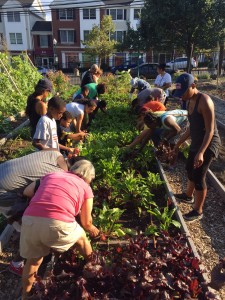
Read more about the Vita Health & Wellness District project on the Building Healthy Places Network blog.
Contributed by Lia Thompson, University of Kansas, Community Tool Box Intern.
Example #4: Rolling Hills Apartments: Weaving Together Opportunities for Healthier Lives for a Diverse Immigrant Community
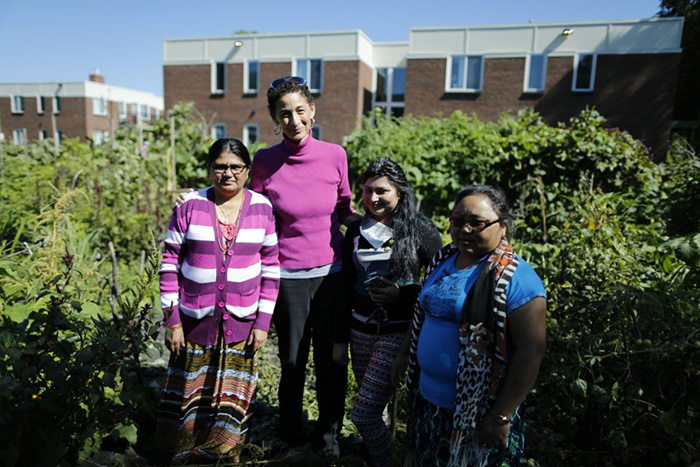
Twin Cities LISC, a local community development financial institution, has partnered with local organizations and city agencies to create quality affordable housing with improved healthcare access, including constructing a Federally Qualified Health Center. LISC also employed community health advocates to weave together the isolated health-related efforts in the neighborhood of focus into a cohesive health agenda. More specifically, they connect and help support existing efforts, identify and help address gaps, and facilitate the conversations and activities that sustain collaboration.
Learn how social determinants of health are being addressed to build healthier lives for immigrants in St. Paul, Minnesota in this Community Close-Up from the Building Healthy Places Network.
Contributed by Lia Thompson, University of Kansas, Community Tool Box Intern.
Example #5: Revitalizing People and Place with a Healthy Food Hub Origin

Following the devastation of Hurricane Katrina in New Orleans, the founders of what became Broad Community Connections (BCC) began to attend community meetings, and investigate with their fellow community members how to rebuild a city in disarray. These discussions highlighted many of the problems that many central New Orleans resident had faced even before the storm, including but not limited to economic disadvantage, community disinvestment, health disparities, and lack of access to many needed goods and services. BCC was designed to revitalize Broad Street, a commercial thoroughfare running through the heart of the city and to connect several of the central city neighborhoods.
Founded in 2008, BCC set its sights on improving health and improving economic vitality in the area. Ultimately, the ReFresh project provided a high-quality grocery store to a low-income food desert and created a multi-faceted hub to improve healthy food access and local food systems, foster community connectivity, support youth development, and anchor economic development.
Read more about the ReFresh project in New Orleans on the Building Healthy Places Network blog.
Contributed by Lia Thompson, University of Kansas, Community Tool Box Intern.
Example #6: Under One Roof: Health Care and Social Services in the Same Place
The Chicanos Por La Causa (CPLC) is the largest community development corporation based in Arizona. CPLC is committed to building stronger, healthier communities as a lead advocate, coalition builder, and direct service provider. CPLC helps more than 200,000 people through programs in four areas–housing, economic development, education, and health and human services. CPLC recognizes that the needs of the families it serves are complex as a family rarely approaches the CDC with only one need. As a result, CPLC sought to establish cross-sector partnerships that would more effectively and holistically meet the needs of families.
Read more about CPLC on Rooflines - The Shelterforce Blog, from the National Housing Institute.
Contributed by Lia Thompson, University of Kansas, Community Tool Box Intern.
Example #7: Boston Children’s Hospital Community Asthma Initiative
The Community Asthma Initiative (CAI), an initiative of Boston Children’s Hospital, began addressing health disparities in Boston neighborhoods impacted by asthma in 2005. CAI provides an enhanced model of care, which includes asthma education and home visits for families with children ages 2–18 living in the Greater Boston area that were previously treated in the Emergency Department (ED) or hospitalized as a result of asthma. CAI works with partners and coalitions to address asthma health disparities by implementing changes in policies at the local and state levels. As of June 2014 there were reductions in the number of children with ED visits, hospitalizations, missed school days, and missed work days for parents.
Read more about the Community Asthma Initiative from the National Forum on Hospitals, Health Systems & Population Health.
Contributed by Lia Thompson, University of Kansas, Community Tool Box Intern.
Example #8: It’s Not Just About the Buildings: How Community Development Organizations are Promoting Residents’ Mental Health

Around the country, housing and community development groups are increasingly stepping up to partner with residents to improve community well-being by proactively strengthening residents’ emotional and mental health. Read more.
Example #9: Pilot Project Directs Healthcare Resources to Rural Missouri

A pilot project has been announced that plans to improve health outcomes in rural Missouri communities. It’s a collaborative effort between the Missouri Department of Social Services and the MO HealthNet Division.
The Transformation of Rural Community Health (ToRCH) project focuses on addressing social care challenges that impact residents’ ability to maintain their health and manage chronic conditions.
“(It’s) a groundbreaking initiative that empowers and encourages rural communities to collaborate to address healthcare-related social needs among their Medicaid population, with a focus on driving better health outcomes,” said Robert Knodell, Missouri Department of Social Services Director.
One key focus of the project is to tackle social determinants of health that influence overall wellbeing – safe housing, transportation, access to healthy foods, and physical activity opportunities. The U.S. Department of Health and Human Services explained that these needs influence the conditions where people are born, grow, learn, work, play, worship, and age.
“For too long, our payment systems have failed to reward hospitals for efforts to address some of the root causes of poor health,” said Kirk Mathews, MHD Chief Transformation Officer, “The ToRCH program allows hospitals to receive payment for proactively addressing issues that contribute to poor health outcomes. Under this model, hospitals are empowered to truly be in the ‘healthcare’ business in addition to the ‘sick care’ business.”
Six rural hospitals were selected last June as part of the pilot project, in Salem, Clinton, Sedalia, Rolla, Bolivar, and Richmond. The funding allows them to act as community hubs.
Click here to read the full article at the MissouriNet website.
-
Before you start
-
Generating solutions
-
Evaluating solutions
-
Making a decision

It would be nice, when faced with a problem, to be able to immediately have the perfect solution pop into your head, recognize it as such, and be ready to go. Unfortunately, it's not always quite that easy. Even with a group of intelligent and dedicated people, it's not always easy to think of any solution to the problems facing the coalition, much less one that is effective and feasible. Just like anything else, it takes work -- some hard thinking, evaluating, and decision-making on the part of all members.
And that's what we'll focus on in this section. In the next few pages, we'll discuss setting the stage for an idea-generating session, as well as different methods you can use to come up with the most ideas possible. Then, when you have more ideas than you know what to do with, we'll talk about how to evaluate your solutions. Finally, we'll talk about the process of decision-making, and, in particular, how to gather a consensus.
Before you start
Previously, we talked about the importance of having a comfortable, well-lighted room to meet in. When holding a session to generate solutions to a problem, it is even more important that people are relaxed and at ease both mentally and physically. Why? Two reasons are particularly important:
- To promote creativity. Helping people think in different ways is always a challenging task. You are asking people to be creative and to use a part of their brain that they may not be accustomed to activating. Being creative can be difficult for many of us. Soft lighting, comfortable chairs, and even relaxing music can help innovative ideas flow.
- To promote open discussion. Most people are comfortable talking about facts or about other people's opinions. Sharing your own ideas, however, especially ideas that you haven't had time to think through, or that you think might be unacceptable to the group, can be much more daunting. No one wants to be laughed at or thought of as stupid because of the ideas that they have suggested. So, it's important that people have a fair amount of confidence, both in themselves and in the group, before you begin the process.
There are two key ingredients in making people comfortable: putting people at ease mentally and looking after their physical comfort.
To put people at ease mentally, they need to be comfortable talking with the group. If you began the process by defining and analyzing the problem, as we discussed in Section 5, group members should already have reached a certain level of comfort with each other, and the facilitator might decide that more team-building is unnecessary. This is especially true if group members have known each other and worked together for a while.
On the other hand, if some or all group members don't know each other well and seem to be a bit uncomfortable, you might want to take a few minutes to try a team-building exercise. It doesn't need to be complex, or even serious. In fact, something a bit nonsensical, such as asking everyone in the group to describe the most disgusting thing they ever ate, or to reveal what they would prefer to be reincarnated as, might be just the thing to loosen tension and help people feel more at ease with one another.
Paying attention to physical comfort of members is just as important. If your chair is too hard, or you're shivering in your sweater, or sunlight is glaring in your eyes, it's hard to focus on anything else. And when they are uncomfortable, most people become less open to new ideas.
Envision the place where you are most at ease and where you think most clearly. Where is it? Your living room? The beach? The library? What is it about that place that makes it so welcoming? What parts of that place can be transferred to your meeting area?
You probably won't be able to have your meeting in the place you find most comfortable. (Sometimes, though, you might! Why not hold a meeting at the beach?) And, of course, the same places won't be equally comfortable for all people. A meeting in the boss's office might be fine for them, but less comfortable for members of their staff.
What you can do, however, is try to introduce aspects of the place you're most comfortable into your meeting site. You could by providing music, or chocolate chip cookies, or posters on the wall. You're limited only by the imagination and preferences of members of the group.
And even if you can't do much, you'll probably find that there are some basic comforts everyone will find important, and you will want to take care of them before the meeting. Some possibilities include:
- Soft lighting
- Comfortable chairs
- Access to restrooms
- Making sure the temperature is comfortable for everyone
- Taking breaks when the meeting gets too long
- Refreshments (at an absolute minimum, you'll want to be sure there is water available)
- Making sure the building is accessible
Generating solutions
When the group is comfortable, you will be ready to work together to think up some possible solutions. Listed below are just a few of the many different ways to do so. Your group can try the one that members prefer; all should yield some good solutions.
- Simply go around the room and ask everyone to suggest ideas. No tricks, no gimmicks, but it works.
- Send a piece of paper around the room. People can write down their ideas, which can later be discussed without anyone knowing who suggested which idea.
- Idea writing. Idea writing is especially helpful to people who like to write. It also helps many people generate and comment on ideas in a short amount of time. Large groups should be divided into small groups of five or six. Each person writes a possible solution to the problem on their own pad of paper. Then each person puts their pad on a table in the middle of the group. Next, everyone takes someone else's pad and comments on the idea. People keep doing this until everyone in the group has commented on everyone else's idea. During or after the meeting, all the ideas are discussed or summarized in a report.
- Brainstorming. Brainstorming is a tried-and-true way to come up with ideas in a group. The method is simple: The problem is stated, and the recorder stands in front of a room with some newsprint or a blackboard. People in the group say whatever ideas pop into their minds. The recorder writes down all of the comments made.
Helpful hints to keep in mind when brainstorming include:
- Watch out for assumptions; every unnecessary assumption reduces the number of potential solutions. If your group is looking for entertainment for an upcoming celebration, for example, don't assume that there isn't talent within the group. You might have an outstanding singer who is just too shy to bring their talents up unasked.
- Simply giving instructions that people can or should be creative in the brainstorming session may help raise the number and quality of solutions created.
- No idea is too outlandish. The meeting recorder writes all the ideas down. Why? An idea that seems ridiculous on first hearing might turn out to be possible and even desirable. It may also be modified by other members of the group, and end up being the perfect solution to the problem.
A member of the coalition might suggest asking NBA players to mentor area youth. That might be impossible, but the idea sparks another member's imagination, and they suggest asking local college athletes to serve as mentors. Still another member suggests asking the coaches to sponsor youth who are having problems at home as scholarship students for their summer sports camps. Other suggestions come up as a result of these ideas, and after half an hour of brainstorming, the group has a long list of possibilities to choose from.
- Nobody should comment on how good or bad the ideas are; there should be no discussion about them at this time. Keep producing all kinds of ideas until everyone runs out of steam.
- Ideas can be "piggy-backed" or combined as people see connections during the process.
- The facilitator should keep the energy high and constantly ask for more and different ideas. This may even be done in the manner of an auctioneer, with constant chatter and a fast-paced discussion.
- If the group gets off the subject, the facilitator or recorder should gently remind them of why they are there.
- Discussion, analysis, and idea selection come later.
Variations on brainstorming:
- A period of individual brainstorming can precede the group activity. Each person generates their own ideas privately and later shares them with the group.
- If idea generating is done on a day after you defined and analyzed the problem, group members can be asked to generate solutions as "homework" between the two sessions.
Evaluating solutions
Hopefully, your work up to this point has produced many potential solutions. Now, it's time to decide which idea is best. There are many possible ways to do this. One approach includes doing the following three things for each idea:
- Judge each idea independently. List on separate pieces of paper:
- What you like about the idea
- What you don't like about the idea
- What the side effects might be
- Ask the following questions:
- Is it practical?
- Is it effective?
- Is it cost effective?
- Will it be easy to put into practice? There's a lot involved in this question. Related questions might include: Can it be done by group members, or will you need outside help? How much time will it take? Will anyone need to learn new skills?
- Will it be accepted by everyone involved? That is, by group members, those who will be affected, and those doing (and paying for) the work? How about the community as a whole?
- Is it consistent with other things done by the group?
Looking at the above questions, it's easy to see that the answers will often be fairly subjective. Spending $1000 on a project may not be much if you are working on a $300,000 grant, but may be quite a bit more for less well-funded groups. But going through the above questions should give you a pretty good idea of what will work for you.
- Modify the solution you are looking at if suggestions have come up that can improve it.
After looking carefully at each idea, and weighing the pros and cons of each, you're now ready to make your decision.
Making a decision
When it comes to how to make a decision, you can:
- Have someone decide, and then announce the decision to the group
- Gather input from individuals, and then have one person decide
- Gather input from the group, and then have one person decide
- Vote
- Try to build consensus among everyone at the meeting
All of these are feasible alternatives that may be chosen at different times. For the group problem-solving process, however, we strongly recommend the last option. Choosing by consensus - discussing and debating the possibilities until everyone comes to an agreement - is often the strongest of these ideas, because everyone is part of the solution. Members are much more likely to fully support a decision that they had a hand in creating.
That's not to say that it's always easy to build consensus. Sometimes, it might be; when the group has looked carefully at all of the options available to them, one might jump out as clearly being superior to the others. But, when the solution is not so evident, it can be quite a challenge to form an agreement, especially if people in your group have strong opinions one way or another.
The following tips are often helpful to keep in mind during the discussion:
- Avoid arguing blindly for your own opinions. It's easy to get so caught up in what you believe that you don't really hear what others are saying. Be sure to listen as carefully as you speak.
- Don't change your mind just to reach an agreement. If you aren't happy with a solution now, it's not likely it will please you much more when you are doing the work several months down the line.
- It's easy to think of this as an "all or none" situation: someone must win, and someone has to lose. That's not necessarily the case. If the group is locked between two different possibilities, see if a third will be more palatable for everyone involved.
- If people are becoming frustrated, or you are making no progress, then take a break. Have some coffee, work on something else for a few minutes, or adjourn for the day. Sometimes, just a short breather can give people a new perspective.
What if you can't reach an agreement?
If a thorough discussion doesn't seem to result in a decision on which everyone agrees, you have a couple of options. (Hint: The group can decide before you debate solutions what you will do if you can't agree on any of the proposals.)
- You can try one of the other decision-making possibilities mentioned above (nominate one person to make the final decision, vote, etc.).
- You can try what authors David Quinlivan-Hall and Peter Renner call the "nominal group technique." To do this, ask each participant to assign a number to every solution, with one being their favorite solution, two being their second favorite, and so on. The numbers are all added up, and the solution with the lowest value is the one chosen.
- In some cases, you might choose not to decide, or to defer the decision until the next meeting. Some ideas and opinions may change if people are allowed some time to mull them over.
Whatever you as a group decide to do, the facilitator should ask for feedback after the decision has been made. Questions might include, "Do you have any problems you would like to air?"; "Do you have any suggestions that might make this better?"; and, "Are you completely satisfied with the solution we have chosen?"
In Summary
Generating and choosing solutions within a group are two pretty tough tasks. You are asking people to think creatively, put aside their inhibitions, and come up with new ideas; then, you go a step further and ask them to use all of their political skills and negotiate a decision.
The good news is that when you've made it this far, you're almost home. In the next section of this chapter, Putting Your Solution into Practice, we'll talk about implementing all of your hard work. But, if you have been following the process, now is definitely the time to celebrate what you've already accomplished. You've come a long way!
Contributor
Jenette Nagy
Marya Axner
Resources
Print Resources
Avery, M., Auvine, B., Streibel, B.,& Weiss, L. (1981). Building united judgement: A handbook for consensus decision making. Madison, WI: Center for Conflict Resolution.
Dale, D., & Mitiguy, N. Planning, for a change: A citizen's guide to creative planning and program development
Dashiell, K. (1990). Managing meetings for collaboration and consensus. Honolulu, HI: Neighborhood Justice Center of Honolulu, Inc.
Interaction Associates, Inc. (1987). Facilitator institute handbook. San Francisco, CA: Author.
Lawson, L., Donant, F., &Lawson, J. (1982). Lead on! The complete handbook for group leaders. San Luis Obispo, CA: Impact Publishers.
Meacham, W. (1980). Human development training manual. Austin,TX: Human Development Training.
Moore, C. (1987). Group techniques for idea building. Newbury Park, CA: Sage.
Morrison, E. (1994). Leadership skills: Developing volunteers for organizational success. Tucson, AZ: Fisher Books.
___You understand that it's important to make people comfortable to stimulate creativity and to promote open discussion of ideas.
___You understand that you can make people comfortable both through team-building activities and by providing physical comfort.
You understand the different methods used to generate solutions:
___Simply go around the room and suggest ideas
___Send a piece of paper around the room
___Idea writing
___Brainstorming
You know how to evaluate solutions:
___You have judged each idea independently.
___You have determined whether each idea is practical, effective, cost-effective, easily put into practice, accepted by everyone involved, and consistent with other things done by the group.
___You have modified the solution where necessary.
You understand the different ways to make a decision:
___You can have one person decide, and announce the decision to the group.
___You can gather input from individuals, and then have one person decide.
___You can gather input from the group, and then decide.
___You can vote.
___You can try to build consensus among everyone at the meeting.
You know what to do if the discussion doesn't result in an agreement accepted by everyone:
___You can try one of the other decision-making possibilities listed above.
___You can try the nominal group technique.
___You can choose not to decide.
-
Why should you plan your action?
-
How do you plan your action?
-
How do you implement your solution?
-
Evaluating what's happened
-
What can go wrong, and what to do about it
Many of us have seen this happen: we've been involved in a meeting where a problem is brought up, discussed, argued about, and finally, sometimes painfully, resolved. A solution is proposed, everyone agrees that it is acceptable - and then it gets lost down the road of forgetfulness or apathy, or wherever it is that good ideas often end up.
In previous sections in this chapter, we have looked carefully at each part of the problem-solving process. Now, in this last section of the chapter, it's time to pull all of this together and complete the work you may have started some time ago. In this section, we'll discuss how to take your solution from the "great idea" stage through planning the details, implementing what you have done, and figuring out if the process was effective. We'll conclude with some possible solutions to glitches that might come up while you are working.
Why should you plan your action?
So why is it so important to plan the details of your solution? Simply put, careful planning allows you to more effectively solve the problem with which you are grappling by giving you the framework on which the solution will hang.
- Planning lets you be sure you have taken care of all of the details. After all of the work you have done, it can be a hassle, to say the very least, if a crucial detail has been forgotten --if nobody picked up a key to the dance hall you rented as part of a fundraiser, or you forget to pack dress shoes for your meeting in the Capitol with the governor.
- Planning helps you save time, energy, and resources in the long run. We can't say it too many times -- planning pays.
Some solutions don't require a lot of planning; you decide, then you act, and then you're done. That's more likely for an individual facing a problem, however, than it is for a group. An individual might decide, for example, that they need to improve their relationship with their supervisor, so they schedule an appointment to talk about their professional relationship. At the meeting, the two might discuss their individual views of how the relationship could improve, and agree to meet weekly to discuss the state of their project. In such a case, a written action plan would hardly be necessary.
With a group, however, the same problem is likely to be more complex. Consider the following situation:
Instead of two individuals, 20 people in an office are having problems working together. So they decide to do two things. They will hold a retreat to talk about their differences (there is too much for too many people to say, and too many hard feelings, to be covered during the meeting), and they will schedule a weekly meeting to keep communication clear and complete. Great, but where will the retreat take place? Who will lead it? Where will they get the money to pay for it?
And even the idea of meeting weekly is not without problems. Everyone in the office works a different schedule; some people can only work nights, others mornings, others weekends. When can they meet? Where can they meet? Should someone take notes? Who? What will be done with the notes after they are written?
Although the basic problem, communication, is the same, the greater number of people involved makes a written action plan much more of a necessity.
How do you plan your action?
So how do you go about planning your solution? The good news is that you've already had a lot of practice. By this point, even if your group started out as strangers, you've had time to get to know each other, become comfortable, and get familiar with the process in general. This level of comfort is going to help a lot to make the process proceed smoothly.
Planning your action simply involves asking the right questions, and writing down the answers in a logical form that everyone will read and understand.
First, however, you will want to brainstorm with the group to determine everything that needs to be done. Break down your solution into individual, doable parts, or "action steps."
In the fictional city of Bitam, the Coalition for the Hearing Impaired is particularly concerned with the low high school graduation rate of students who are deaf or hard of hearing. Although there is a sizable deaf population in town, there is not yet a school for the deaf or hard of hearing, and students are suffering. Upon careful consideration, group members decide to start a program at the school, Helping Hands. In it, top students will be paired with students who are deaf or hard of hearing to share their notes and act as peer tutors.
A few of the action steps that coalition members decided upon were:
- Discuss the program with the principal and school board members to gather their support
- Write a letter to students who are deaf or hard of hearing and their parents to inform them of the program
- Recruit students to work with their peers who are deaf or hard of hearing.
- With the help of the school guidance office, pinpoint the students in need of help
- Contact those students individually to become members of the program
When you have your own complete list of individual action steps in front of you, put every one of them through the same series of questions. Decide:
- How much, or to what extent, will the action occur? For example, if you are going to hang posters to advertise a program, how many will you need to be effective?
- Who will do the work? Will it be done by people at the meeting, or will you need to recruit others? How will that occur?
- When will the step take place? How soon? A deadline for action can help participants focus and will almost certainly mobilize them more effectively than an "open-ended " due date.
- What resources (money, time, et cetera) do you need? Where will you get them?
- What will you do if something goes wrong? What's the backup plan?
- Which step needs to happen first? Is there an order in which these actions should occur? Should things happen simultaneously? As soon as possible?
It's a good idea to write all of this down on a chart that can later be shared with the group.
If the problem you are working on is particularly large or complex, the group might decide to go through a longer action planning process, similar to what you might do to write a coalition's strategic plan.
How do you implement your solution?
Now, with your action steps in front of you, it's time to start the grunt work of implementing your plan! These are the last steps to take before you go to work:
- Make sure, as you have been doing throughout the problem-solving process, that everyone is clear and in agreement about what's been decided. The facilitator might go down the chart you have written and say, "Steve and Kate, you're going to design some possible logos and show them to us at the next meeting, right?" Ask people for verbal agreement to make sure you are all in agreement about the next steps.
At this point, the facilitator should say what they plan to do as well. Their follow up plan might be to send notes out to various group members reminding them when it is time for them to do the task they agreed to do.
- The facilitator should ask for questions. Did anything come up that anyone's not clear about? Are there any new issues? Any areas of confusion?
- Does everyone know how to contact other members if they need assistance or have questions about their assignments? Leaders in the group might want to make their phone numbers available, if they are not already.
- Set another meeting date. This is an essential part of follow through. The next meeting can serve as an update, if the problem is not entirely taken care of. It can also serve as a time for celebration -- look at all of the work you've done already!
Evaluating what's happened
When you finish a meeting, sweep away the crumbs, and go home, an experienced facilitator will usually have some sense of how the meeting went. Was it a good meeting? Were people fully involved? Certainly, one way to measure this is by what has been accomplished. Did you define the problem? Come up with a workable solution?
It's also important, however, to understand how meeting participants feel when they leave the meeting. Were they happy with the process? Did they have a chance to explain their ideas? If members leave a meeting disgruntled, it's highly likely that they won't be coming back to future meetings, and they may not follow up on agreed upon tasks.
The facilitator can reduce the likelihood of this by asking group members to fill out a written evaluation before they leave. It doesn't have to be long, or complex; a few simply questions might do the trick. It also helps if the response sheets are anonymous; people are more likely to give their true opinions of what has happened, particularly if that opinion is negative or critical. The facilitator can follow up on the critique with a letter mailed out to all participants.
Of course, there's another kind of evaluation to be done: you can evaluate how well your solution is working to solve the problem. Depending on the problem, this may or may not be necessary. For example, if you are working on office communication, a few weeks of meetings should tell you whether or not communication has improved without any scientific study. If you are working on solving a larger problem, however, such as adolescent pregnancy, you will probably want to determine if your group's actions are truly effective. (For example, has the adolescent pregnancy rate has decreased in your community?).
What can go wrong, and what to do about it
Into every life, some rain must fall -- and for community organizers, the deluge often happens on the day of the community picnic.
Even if the facilitator has led an enthusiastic, dedicated group flawlessly through the problem-solving process, glitches still occur when it comes to putting the plans into practice. Here are some of the most common ones, and what you can do if they occur.
If you have this problem...try one of these possible solutions
The wrong person volunteers for the job
- Suggest something else that person might be better suited for.
- Ask a second person to work with them on the project.
No one volunteers for the job
- Approach someone privately and ask them if they'd be willing to do it. This way, you don't put them on the spot in front of everyone.
- Reevaluate the necessity and overall worth of the task. Is there a reason no one has volunteered?
- Offer some sort of incentive (such as tickets to a concert) for doing the job.
Enthusiasm fails as members feel like the "real work" is done
- Hold a party celebrating your accomplishments and serving as a "kick off" for the next steps.
The solution is taking too much time
- Delegate duties to a greater number of people.
- Switch leadership, giving people a chance to try something different and bringing a fresh perspective to the tasks.
- Check to see if there are goals or jobs that can be eliminated or put off, allowing you to focus your energies on jobs that are more central to the solution.
The solution arouses community opposition
Stop and reevaluate what you are doing. There are several different paths you can choose here:
- You can use the opposition as a rallying point, roll up your sleeves, and fight the good fight.
- You can try to appease the opposition, either by further explanation of your project, by finding common ground, or by acquiescing on lesser points.
- You can decide this is not a battle you wish to fight right now, and either put off the solution or choose a different one.
A seemingly new and better opportunity arises
- Evaluate the pros and cons of changing to the new solution. What would you lose by switching midstream? What would you gain? If the pros outweigh the cons, go for it!
- If you are uncertain about the probable outcome, ask for feedback from experts, local leaders, and/or those affected by the problem. What do they think?
The solution doesn't seem to be working
Ask yourself and coalition members the following questions:
- Are you sure you have given it enough time?
- Why isn't it working?
- Can some parts of the plan be salvaged? Which ones? Could adapting the plan be enough to save it?
- If you do decide to eventually abandon it, reconsider some of the solutions you had earlier rejected. Do they make more sense in light of current information?
In Summary
Solving problems is one of the most challenging aspects of working effectively with a group. It's also one of the most rewarding. Operating together, groups can overcome obstacles individuals have found insurmountable. As Margaret Mead reminded us, "Never doubt that a small group of thoughtful, committed citizens can change the world; indeed, it is the only thing that ever has."
Contributor
Jenette Nagy
Chris Hampton
Resources
Print Resources
Avery, M., Auvine, B., Streibel, B., & Weiss, L. (1981). Building united judgement: A handbook for consensus decision making. Madison, WI: Center for Conflict Resolution.
Dale, D., & Mitiguy, N. Planning, for a change: A citizen's guide to creative planning and program development.
Dashiell, K.A. (1990). Managing meetings for collaboration and consensus. Honolulu, HI: Neighborhood Justice Center of Honolulu, Inc.
Interaction Associates (1987). Facilitator institute handbook. San Francisco, CA: Author.
Lawson, L., Donant, F., & Lawson, J. (1982). Lead on! The complete handbook for group leaders. San Luis Obispo, CA: Impact Publishers.
Meacham, W. (1980). Human development training manual. Austin, TX: Human Development Training.
Moore, C. (1987). Group techniques for idea building. Newbury Park, CA: Sage.
Morrison, E. (1994). Leadership skills: Developing volunteers for organizational success. Tucson, AZ: Fisher Books.
You understand why you should plan your action:
___To provide the framework on which your solution will hang.
___To be sure you have taken care of all the details.
___To save time, energy, and resources.
You have planned your action:
___You have broken down your solution into individual action steps.
___You have decided to what extent each action step will occur.
___You have decided who will do the work.
___You have decided when each action step will take place.
___You have decided what resources you will need and where you will get them.
___You have decided what you will do if something goes wrong.
___You know which steps need to happen first.
You have implemented your solution:
___You have made sure everyone is clear and in agreement about the process.
___The facilitator has asked for new questions.
___Everyone knows how to contact each other.
___You have set another meeting date.
You have evaluated what happened:
___You have evaluated the success of the meeting.
___You have evaluated the success of the solution.
You know what to do if something goes wrong:
___You know what to do if the wrong person volunteers for the job.
___You know what to do if no one volunteers for the job.
___You know what to do if enthusiasm fails.
___You know what to do if the solution is taking too much time.
___You know what to do if the solution arouses community opposition.
___You know what to do if a seemingly new and better opportunity arises.
___You know what to do if the solution doesn't seem to be working.
Tool #1: Action planning sheet
Use the following table to list each of your action steps in the first row, and answer the following questions for each.
| Action Step 1 | Action Step 2: | Action Step 3: | |
| How much, or to what extent, will this action occur? | |||
| Who will do it? | |||
| When will it take place? | |||
| What resources do we need? Where will we get them? | |||
| What is the backup plan? | |||
| In what order will these steps occur? Does it matter? |
Tool #2: Feedback form
At the end of the meeting, the facilitator and recorder can pass out the following sheets to be filled in anonymously by meeting participants.
Participant Feedback Form
Date of meeting:
Overall, how useful did you find the meeting?
What did you like best about the meeting?
What did you like least about the meeting?
Was the proper amount of time spent on each subject?
If not, which subjects took too long?
Which weren't given enough time?
What should be different about future meetings?
Additional comments:
We appreciate your help and feedback at and about today's meeting. The facilitator will address concerns brought up on these feedback sheets and send a letter to all participants in the next two weeks.
Adapted from "Conducting intervention research: The design and development process" by Stephen B. Fawcett et al.
You've put together a group of motivated, savvy people, who really want to make a difference in the community. Maybe you want to increase adults' physical activity and reduce risks for heart attacks; perhaps you want children to read more and do better in school. Whatever you want to do, the end is clear enough, but the means--ah, the means are giving you nightmares. How do you reach that goal your group has set for itself? What are the best things to do to achieve it?
Generally speaking, what you're thinking about is intervening in people's environments, making it easier and more rewarding for people to change their behaviors. In the case of encouraging people's physical activity, you might provide information about opportunities, increase access to opportunities, and enhance peer support. Different ways to do this are called, sensibly enough, interventions. Comprehensive interventions combine the various components needed to make a difference.
What is an intervention?
An intervention is a deliberate action or set of actions designed to create positive change. Interventions can take many forms, including programs, policies, practices, environmental changes, communication campaigns, or community initiatives.
What makes something an intervention is not its form, but its purpose: to influence behaviors, conditions, or systems in ways that improve outcomes for individuals, organizations, or communities. Effective interventions often go beyond encouraging people to change their behavior. They also address environmental, social, and structural factors that shape what people are able to do.
For example, a community may seek to prevent sexual violence. While public awareness messages can help increase understanding of the issue, research shows that lasting change often requires addressing the conditions that contribute to violence and support safety, respect, and accountability.
Interventions to prevent sexual violence might include:
- Improving street lighting, transportation options, and other environmental features that increase community safety.
- Providing safe ride programs or other transportation services so people can travel safely, especially at night.
- Offering education and skill-building programs that promote healthy relationships, consent, bystander intervention, and violence prevention.
- Supporting policies and organizational practices that strengthen accountability, improve reporting and response systems, and increase access to services for survivors.
- Engaging community members, schools, workplaces, and organizations in creating cultures that promote respect, equity, and safety.
In many cases, the most effective interventions combine multiple approaches, addressing both individual behaviors and the broader systems and environments that influence them. By creating supportive conditions for change, interventions can help communities achieve meaningful and lasting improvements in health, well-being, and quality of life.
Why should you develop interventions?
There are many strong advantages to using interventions as a means to achieve your goals. Some are very apparent; some possibly less so. Some of the more important of these advantages are:
- By designing and implementing interventions in a clear, systematic manner, you can improve the health and well-being of your community and its residents.
- Interventions promote understanding of the condition you are working on and its causes and solutions. Simply put, when you do something well, people notice, and the word slowly spreads. In fact, such an intervention can produce a domino effect, sparking others to understand the issue you are working on and to work on it themselves.
For example, a grade school principal in the Midwest was struck by the amount of unsupervised free time students had between three and six o'clock, when their parents got home from work. From visiting her own mother in a nursing home, she knew, too, of the loneliness felt by many residents of such homes. So she decided to try to lessen both problems by starting a "Caring Hearts" program. Students went to nursing homes to see older adults after school once or twice a week to visit, play games, and exchange stories.
Well, a reporter heard about the program, and did a feature article on it on the cover of the "Community Life" section of the local newspaper. The response was tremendous. Parents from all across town wanted their children involved, and similar programs were developed in several schools throughout the town.
- To do what you are already doing better. Finally, learning to design an intervention properly is important because you are probably doing it already. Most of us working to improve the health and well-being of members of our community design (or at least run) programs, or try to change policies such as local laws or school board regulations, or try to change the things some people regularly practice. By better understanding the theories behind choosing, designing, and developing an intervention, you will improve on the work you are currently doing.
When should you develop an intervention?
It makes sense to develop or redesign an intervention when:
- There is a community issue or problem that local people and organizations perceive as an unfilled need
- Your organization has the resources, ability, and desire to fill that need, and
- You have decided that your group is the appropriate one to accomplish it
The last of these three points deserves some explanation. There will always be things that your organization could do, that quite probably should be left to other organizations or individuals. For example, a volunteer crisis counseling center might find they have the ability to serve as a shelter for people needing a place to stay for a few nights. However, doing so would strain their resources and take staff and volunteers away from the primary mission of the agency.
In cases like this, where could does not equal should, your organization might want to think twice about developing a new intervention that will take away from the mission.
How do you develop an intervention?
So, people are mobilized, the coffee's hot, and you're ready to roll. Your group is ready to take on the issue--you want to design an intervention that will really improve conditions in the area. How do you start?
Decide what needs to happen
This could be a problem that needs to be solved, such as, "too many students are dropping out of school." However, it might be also a good thing, and you want to find a way to make more of it happen. For example, you might want to find a way to convince more adults to volunteer with school-aged children. At this point, you will probably want to define the problem broadly, as you will be learning more about it in the next few steps. Keep in mind these questions as you think about this:
- What behavior needs to change?
- Whose behavior needs to change?
- If people are going to change their behavior, what changes in the environment need to occur to make it happen? For example, if you want people to recycle, you'll have much better results if there is easy access to recycling bins.
- What specific changes should happen as a result of the intervention?
You don't need to have answers to all of these questions at this point. In fact, it's probably better to keep an open mind until you gather more information, including by talking with people who are affected (we'll get to that in the next few steps ). But thinking about these questions will help orient you and get you geared in the right direction.
Use a measurement system to gather information about the level of the problem
You will need to gather information about the level of the problem before you do anything to see if it is as serious as it seems, and to establish a standard for later improvement (or worsening).
Measurement instruments include:
- Direct observations of behavior. For example, you can watch whether merchants sell alcohol to people under the age of 21.
- Behavioral surveys. For example, the Youth Risk Behavior Survey of the U.S. Centers for Disease Control and Prevention asks questions about drug use, sexual activity without protection against pregnancy or STIs, and violence.
- Interviews with key people. For example, you might ask about changes in programs, policies, and practices that the group helped bring about.
- Review of archival or existing records. For example, we might look at records of the rate of adolescent pregnancy, unemployment, or children living in poverty.
The group might review the level of the problem over time to detect trends--is the problem getting better or worse? It also might gather comparison information-- how are we doing compared to other, similar communities?
Decide who the intervention should help
In a childhood immunization program, your interventions would be aimed at helping children. Likewise, in a program helping people to live independently, the intervention would try to help older adults or people with disabilities. Your intervention might not be focused on a specific population, but be for the entire community. For example, perhaps you are trying to increase the amount of policing to make local parks safer. This change of law enforcement policy would affect people throughout the community.
Usually, interventions will target the people who will directly benefit from the intervention, but this isn't always the case. For example, a program to try to increase the number of parents and guardians who bring in their children for immunizations on time would benefit the children most directly. However, interventions wouldn't target them, since children aren't the ones making the decision. Instead, the primary "targets of change" for your interventions might be parents and health care professionals.
Before we go on, some brief definitions may be helpful. Targets of change are those people whose behavior you are trying to change. As we saw above, these people may be--but are not always--the same people who will benefit directly from the intervention. They often include others, such as public officials, who have the power to make needed changes in the environment. Agents of change are those people who can help make change occur. Examples might be local residents, community leaders, and policy makers. The "movers and the shakers," they are the ones who can make things happen--and who you definitely want to contribute to the solution.
Involve potential clients or end users of the intervention
Once you have decided broadly what should happen and who it should happen with, you need to make sure you have involved the people affected. Even if you think you know what they want--ask anyway. For your intervention to be successful, you can't have too much feedback. Some of these folks will likely have a perspective on the issue you hadn't even thought of.
Also, by asking for their help, the program becomes theirs. For example, by giving teachers and parents input in designing a "school success" intervention, they take "ownership" for the program. They become proud of it--which means they won't only use it, they?ll also support it and tell their friends, and word will spread.
Again, for ideas on how to find and choose these people, the section mentioned above on targets and agents of change may be helpful.
Identify the issues or problems you will attempt to solve together
There are a lot of ways in which you can talk with people affected about the information that interests you. Some of the more common methods include:
- Informal personal contact - just talking with people, and seeing what they have to say
- Interviews
- Focus groups
- Community forums
- Concerns surveys
When you are talking to people, try and get at the real issue--the one that is the underlying reason for what's going on. It's often necessary to focus not on the problem itself, but on affecting the cause of the problem.
For example, if you want to reduce the number of people in your town who are homeless, you need to find out why so many people in your town lack decent shelter: Do they lack the proper skills to get jobs? Is there a large population of people with mental health conditions that isn't receiving the help it should? Your eventual intervention may address deeper causes, seeming to have little to do with reducing homelessness directly, although that remains the goal.
Analyze these problems or the issue to be addressed in the intervention
Using the information you gathered in step five, you need to decide on answers to some important questions. These will depend on your situation, but many of the following questions might be appropriate for your purpose:
- What factors put people experiencing increased risk for (or protect them against) the problem or concern?
- Whose behavior (or lack of behavior) caused the problem?
- Whose behavior (or lack of behavior) maintains the problem?
- For whom is the situation a problem?
- What are the negative consequences for those directly affected?
- What are the negative consequences for the community?
- Who, if anyone, benefits from things being the way they are now?
- How do they benefit?
- Who should share the responsibility for solving the problem?
- What behaviors need to change to consider the problem "solved"?
- What conditions need to change to address the issue or problem?
- How much change is necessary?
- At what level(s) should the problem be addressed? Is it something that should be addressed by individuals; by families working together; by local organizations or neighborhoods; or at the level of the city, town, or broader environment?
- Will you be able to make changes at the level(s) identified? This question includes technical capability, ensuring you have enough money to do it, and that it is going to be politically possible.
Set goals and objectives
When you have gotten this far, you are ready to set the broad goals and objectives of what the intervention will do. Remember, at this point you still have NOT decided what that intervention will be. This may seem a little backwards to your normal thinking--but we're starting from the finish line, and asking you to move backwards. Give it a try--we think it will work for you.
Specifically, you will want to answer the following questions as concretely as you can:
- What should the intervention accomplish? For example, your goal might be for most of the people experiencing homelessness who are able to hold jobs do so by the end of the intervention.
- What will success look like? If your intervention is successful, how will you know it? How will you explain to other people that the intervention has worked? What are the "benchmarks" or indicators that show you are moving in the right direction?
- Finally, what are the specific objectives you want to achieve? When you are writing down your objectives, be as specific as possible. State how much change you want to see happen in what behaviors and activities. By whom? By when?
- For example, you might say, "By 2010 (when), 80% of those currently experiencing homelessness (who) will be successfully employed at least part time (change sought)."
Learn what others have done
Now, armed with all of the information you have found so far, you are ready to start concentrating on the specific intervention itself. The easiest way to start this is by finding out what other people in your situation have done. Don't reinvent the wheel! There might be some "best practices"-- exceptional programs or policies--out there that are close to what you want to do. It's worth taking the time to try to find them.
Where do you look for promising approaches? There are a lot of possibilities, and how exhaustive your search will be will depend on the time and resources you have (not to mention how long it takes you to find something you like!) But some of the more common resources you might start with include:
- See what local examples are available. What has worked in your community? How about in nearby places? Can you figure out why it worked? If possible, talk to the people responsible for those approaches, and try to understand why and how they did what they did.
- Look for examples of what has been done in articles and studies in related fields. Sources might be professional journals, such as the American Journal of Public Health, or even occasionally, general news magazines. Also, look at interventions that have been done for related problems--perhaps they can be adapted for use by your group. Information and awareness events, for example, tend to be general in nature--you can do a similar event and change what it's for. A 5-K race might be planned, for example, to raise awareness of and money for breast cancer, to protest environmental destruction, and so on.
- National conferences. If you can, attending national meetings or conferences on the problem or issue you are trying to solve can give you excellent insight on some of the "best practices" that are out there.
Brainstorm ideas of your own
Take a sheet of paper and write down all of the possibilities you can think of. If you are deciding as a group, this could be done on poster paper attached to a wall, so everyone can see the possibilities-- this often works to help people come up with other ideas. Be creative!
Try to decide what interventions or parts of interventions have worked, and what might be applicable to your situation
What can your organization afford to do? And by afford, we mean financially, politically, time, and resource wise. For example, how much time can you put into this? Will the group lose stature in the community, or support from certain people, by doing a particular intervention?
When you are considering interventions done by others, look specifically for ones that are:
- Appropriate - Do they fit the group's purpose?
- Effective - Did they make a difference on behavior and outcome?
- Replicable - Are the details and results of what happened in the original intervention explained well enough to repeat what was done? Unfortunately, this isn't always the case--many people, when you talk to them, will say, "Oh! We just did it! "
- Simple - Is it clear enough for people in your group to do?
- Practical - Do we have the time and money to do this?
- Compatible with your situation - Does it fit local needs, resources, and values
Identify barriers and resistance you might come up against
What barriers and resistance might we face? How can they be overcome? Be prepared for whatever may come your way.
For example, a youth group to prevent substance use wanted to outlaw smoking on the high school campus by everyone, including the teachers and other staff members. However, they knew they would come up against resistance among teachers and staff members who smoked. How might they overcome that opposition?
Identify core components and elements of the intervention
Here is where we get to the nuts and bolts of designing an intervention.
First, decide the core components that will be used in the intervention. Much like broad strategies, these are the general things you will do as part of the intervention. They are the "big ideas" that can then be further broken down.
There are four classes of components to consider when designing your intervention:
- Providing information and skills training
- Enhancing support and resources
- Modifying access and barriers
- Monitoring and giving feedback
A comprehensive intervention will choose components for each of these four categories. For example, a youth mentoring program might choose the following components:
- For providing information and skills training, a component might be recruitment of youth and mentors
- For enhancing support and reinforcement, a component might be arranging celebrations among program participants
- For modifying access and barriers, a component might be making it easier to volunteer
- For monitoring and giving feedback, a component might be tracking the number of young people and volunteers involved
Next, decide the specific elements that compose each of the components. These elements are the distinct activities that will be done to implement the components.
For example, a comprehensive effort to prevent youth smoking might include public awareness and skills training, restricting tobacco advertising, and modifying access to tobacco products. For the component of trying to modify access, an element of this strategy might be to do 'stings' at convenience stores to see which merchants are selling tobacco illegally to adolescents. Another element might be to give stiffer penalties to adolescents who try to buy cigarettes, and to those merchants who sell.
Develop an action plan to carry out the intervention
When you are developing your action plan, you will want it to answer the following questions:
- What components and elements will be implemented?
- Who should implement what by when?
- What resources and support are needed? What are available?
- What potential barriers or resistance are expected? How will they be minimized?
- What individuals or organizations need to be informed? What do you need to tell them?
Pilot-test your intervention
None of us likes to fall flat on our face, but frankly, it's a lot easier when there aren't very many people there to watch us, and when there isn't a lot on the line. By testing your intervention on a small scale, you have the chance to work out the bugs and get back on your feet before the crowd comes in. When doing your pilot test, you need to do the following things:
- Decide how the intervention will be tested on a small scale
- Evaluate your results
- Pay particular attention to unintended consequences or side effects that you find when you evaluate your work
- Use feedback from those who tried the intervention to simplify and refine your plan
Implement your intervention
If you have followed all of the steps above, implementing your action plan will be easier. Go to it!
Constantly monitor and evaluate your work
When the wheels are turning and things seem to be under control, congratulations! You have successfully implemented your intervention! But of course, the work never ends. It's important to see if the intervention is working, and to "tweak" it and make changes as necessary.
In Summary
Designing an intervention, and doing it well, isn't necessarily an easy task. There are a lot of steps involved, and a lot of work to be done, if you are going to do it well. But by systematically going through the process, you are able to catch mistakes before they happen; you can stand on the shoulders of those who have done this work before you and learn from their successes and failures.
Contributor
Jenette Nagy
Stephen B. Fawcett
Resources
Online Resources
Community Health Advisor from the Robert Wood Johnson Foundation is a helpful online tool with detailed information about evidence-based polices and programs to reduce tobacco use and increase physical activity in communities.
The Society for Community Research and Action serves many different disciplines that are involved in strategies to improve communities. It hosts a general electronic discussion list as well as several by special interest.
The U.S. Dept. of Housing and Urban Development features "Success Stories" and gives ideas for ways to solve problems in your community.
The National Civic League provides a database of Success Stories.
The Pew Partnership for Civic Change offers several resources for promising solutions for building strong communities.
The World Health Organization provides information on many types of interventions around the world.
Print Resources
Fawcett, S., Suarez, Y. Balcazar, F., White, G., Paine, A., Blanchard, K., & Embree, M. (1994). Conducting intervention research: The design and development process. In J. Rothman & E. J. Thomas (Eds.), Intervention research: Design and development for human service. (pp. 25-54). New York, NY: Haworth Press.
___You understand that an intervention can be a program, a change in policy, or a practice that becomes popular
___You understand that interventions focus on people's behaviors, and how changes in the environment can support those behaviors
___You understand the advantages of developing interventions
___You understand when you should develop or redesign interventions
Developing the intervention:
___You have decided what needs to happen
___You have used a measurement system to gather information about the level of the problem
___You have decided whom the intervention needs to help
___You have involved potential clients or end users of the intervention
___With these clients, you have identified the issues or problems you will attempt to solve together
___You have analyzed these problems or the issue to be addressed in the intervention
___You have set goals and objectives
___You have learned what others have done
___You have brainstormed your own ideas
___You have tried to decide what interventions or parts of interventions have worked, and what might be applicable to your situation
___You have identified barriers and resistance you might come up against
___You have identified core components and elements of the intervention
___You have developed an action plan to carry out the intervention
___You have pilot-tested your intervention
___You have implemented your intervention
Example 1: "Caring Pairs" Components and Elements Background Table
| Problem/Issue to be Addressed | Pairing local children with adults in mutually helpful volunteer opportunities |
| Risk/Protective Factors | Opportunities to serve Stronger adult-youth relationships Stronger peer relationships Supervised alternative activities Stronger community support Social skills Improved academic performance Increased life options |
| Targets of Change | Corporations, faith institutions, schools, service organizations, adults, program staff, students, teachers, Federal and State agencies |
| Agents of Change | Advisory Board, School District Coordinators, program staff, current volunteers, school districts, YMCA, School District Coordinators, Students in kindergarten through twelfth grade |
| Components | Recruitment, matching, activities |
| Elements | Marketing, selection, background checks, activity assignment, orientation, training One-to-One Mentor Tutor Phone pal Career exploration Group After-school Facilitator Lunch reading group Church-school program Saturday activities Pregnant teen Support Group Basketball clinic Career Discovery Day |
| Mode/Context of Delivery | Media, businesses, faith institutions, nonprofit organizations, service organizations, government, schools, School District Coordinators, field trip locations |
Example 2: "Caring Pairs" Table of Components and Elements
| Providing Information and Enhancing Skills | Enhancing Support and resources | Modifying opportunities and barriers | Monitoring and Feedback | |
| Components | - Recruitment - Matching |
- Celebrations - Resource Sharing - Recognition |
- Provide opportunities to serve - Making it easier to volunteer |
- Tracking the number of youth and volunteers |
| Elements | - Promote awareness - Selection of volunteers - Background checks - Activity assignment - Orientation - Training |
- Monthly celebrations - Agency newsletter - Articles on volunteers in town newspaper |
- Change policies to allow flex time at work Opportunities: - Mentor - Tutor - Phone Pal - Career Exploration - After-school Facilitator - Lunch Reading Group - Church-School Program - Saturday activities - Pregnant teen Support Group - Basketball clinic - Career Discovery Day |
- How many hours are spent by volunteers and youth? - How many volunteers and youth are involved? |
Example 3: Teen Pregnancy Prevention Program Components and Elements Background Table
| Problem/Issue to be Addressed | Adolescent pregnancy is a serious problem in our community |
| Risk/Protective Factors | Knowledge of contraceptives, risks Access to contraceptives Skills Values and beliefs Problems at home (conflict, inconsistent rules from parents) Economic deprivation |
| Targets of Change | Adolescents, peers, parents and caregivers, teachers, service providers, business people, and elected and appointed officials |
| Agents of Change | Peers, parents and caregivers, teachers, service providers, religious leaders, business people, elected and appointed officials |
| Components | Sexuality education, develop community alliances, improve access to contraceptives, monitor rates of adolescent pregnancy, improve peer support, increase alternative activities |
| Elements | Offer graduate-level training for teachers in sexuality education Offer skills training for teens for the choice of avoiding unprotected sexual activity Use bulletin boards and the school newspaper to keep teens up-to-date on special events Begin a "brown bag" program for teens to buy contraceptives without others knowing what they are doing Start a support group to help teen mothers stay in school |
| Mode/Context of Delivery | Schools, media, businesses, faith institutions, service organizations |
Example 4: Teen Pregnancy Prevention Program Table of Components and Elements
| Providing Information and skills training | Enhancing support and resources | Modifying opportunities and barriers | Monitoring and Feedback | |
| Components | - Sexuality education | - Provide peer support - Provide support from influential others - Develop community alliances |
- Improve access to contraceptives | - Monitor rates of adolescent pregnancy |
| Elements | - Offer graduate-level training for teachers in sexuality education - Offer skills training to teens on avoiding unprotected sexual activity - Use bulletin boards and the school newspaper to keep teens up-to-date on special events |
- Start a support group to help teen mothers stay in school - Establish a mentoring program for at-risk youth to gain access to potential employers and job opportunities |
- Begin a "brown bag" program for teens to buy contraceptives without others knowing what they are doing - Contraception and information about its use will be made available at places where teens congregate |
- How many teens report abstaining from intercourse? - How many teens report the use of contraceptives if they do engage in sexual activity? - How many teens become pregnant? - Report the estimated pregnancy rate to the community on an annual basis |
Example 5: Neighborhood Revitalization Project Components and Elements Background Table
| Problem/Issue to be Addressed | We want to improve neighborhood life through better jobs, housing, and education. |
| Risk/Protective Factors | Economic deprivation Community disorganization Mobility Availability of illegal substances / weapons Skills training |
| Targets of Change | Business people, residents (including youth), elected and appointed officials, funders, higher education institutions |
| Agents of Change | Business people, residents (including youth), elected and appointed officials, funders, higher education institutions |
| Components | Job training, job availability, land reorganization, monitoring of joblessness, education and training |
| Elements | Develop adult literacy programs Expand affordable childcare Expand computer access for residents through local community organization Hold an annual job fair Provide loans to support small business development Clear land for new business Increase incentives to encourage rehabilitation of existing housing Increase clean up of yards, sidewalks, and vacant lots Build more low- and middle-income housing in the neighborhood |
| Mode/Context of Delivery | Businesses, housing authority, schools, media, faith institutions, service organizations |
Example 6: Neighborhood Revitalization Project Table of Components and Elements
| Providing information and skils training | Enhancing support and resources | Modifying opportunities and barriers | Monitoring and Feedback | |
| Components | - Increase job training - Provide information on job training - Increase general education |
- Provide support for new businesses - Provide financial support for home rehabilitation |
- Reduce barriers to going to work - Reorganize land use |
- Monitoring joblessness, education |
| Elements | - Develop adult literacy programs - Hold an annual job fair - Develop programs to help residents obtain their GED - Increase the number of computers in schools - Establish a summer internship program for high school students |
- Provide low interest loans to encourage rehabilitation of existing housing - Build more low- and middle-income h ousing in the neighborhood - Institute tax breaks for employers who relocate in the neighborhood |
- Expand affordable childcare - Expand computer access for residents through local community organizations - Provide loans to support small business development - Clear land for new business - Improve the public transportation system |
- What is the rate of unemployment for the neighborhood? - What percentage of high school freshmen graduate high school or obtain a GED? - What percentage of high school students receive further education? |
Tool 1: Problem analysis sheet
The following page gives you room to analyze the problem or issue you want your group to address. This information can then be used to help you set goals and objectives.
| What factors put people at risk for (or protect them against) the problem or concern? | |
| Whose behavior (or lack of behavior) caused the problem? | |
|
Whose behavior (or lack of behavior) maintains the problem? |
|
| For whom is the situation a problem? |
|
| What are the negative consequences for those directly affected? | |
| What are the negative consequences for the community? | |
| Who, if anyone, benefits from things being the way they are now? | |
| How do they benefit? | |
| Who should share the responsibility for solving the problem? | |
| What behaviors need to change to consider the problem "solved"? | |
| What conditions need to change to address the issue or problem? | |
| How much change is necessary? | |
| At what level(s) should the problem be addressed? | |
| Will you be able to make changes at the level(s) identified? |
Tool 2: Components and Elements Background Table
Use this table to look holistically at the intervention you will develop.
| Providing Information and Skills Training | Enhancing Support | |
| Problem/Issue to be Addressed |
|
|
| Risk/Protective Factors |
|
|
| Targets of Change |
|
|
| Agents of Change |
|
|
| Components |
|
|
| Elements |
|
|
| Mode/Context of Delivery |
|
Tool 3: Table of Components and Elements
| Providing Information and Skills Training | Enhancing Support and Resources | Modifying Opportunities and Barriers | Monitoring and Feedback | |
| Components |
|
|||
| Elements |
|
Tool 4: Determining if interventions done by others are appropriate for your purpose and situation
Use this table to help you determine if a particular intervention you know about is right for your purpose and situation.
| What is the intervention? |
|
| Is it appropriate for our purpose? |
|
| Is it effective? |
|
| Is it replaceable? |
|
| Is it simple? |
|
| Is it practical? |
|
| Is it compatible with our situation? |
|
| Additional domments: |
|
-
What is a participatory approach to planning?
-
What are the advantages of a participatory planning approach?
-
What are the disadvantages of a participatory planning approach?
-
What are the levels of participatory planning?
-
When is participatory planning appropriate?
-
When is participatory planning not appropriate?
-
Who should be involved in a participatory planning process?
-
What do you have to do to get a participatory planning process up and running?
Everyone who's ever worked in health or human services knows at least one horror story about an intervention that either went wrong or never worked for a minute. Often, when the story is told, it becomes clear that the well-intentioned professionals in charge had totally misunderstood or ignored some fundamental fact about the community or the priority population. Since they assumed they knew what was needed, they planned the whole thing themselves...and failed miserably.
For every horror story, however, there's a story about an intervention where everything went right. In many of these cases, you'll find that the priority population - and often the larger community as well - was included in the planning of the intervention from the beginning.
When an organization decides to take on a community intervention - whether a full -fledged service program or a one-time campaign to accomplish one specific goal - it can often increase its chance of success by using a participatory planning process. In this section, we'll explore what a participatory planning process is, why it's valuable, its potential advantages and disadvantages, and how to use it to plan an effective intervention - one where everything goes right.
What is a participatory approach to planning?
In its simplest terms, a participatory approach is one in which everyone who has a stake in the intervention has a voice, either in person or by representation. Staff of the organization that will run it, members of the priority population, community officials, interested community members, and people from involved agencies, schools, and other institutions all should be invited to the table. Everyone's participation should be welcomed and respected, and the process shouldn't be dominated by any individual or group, or by a single point of view.
That's the ideal. The reality may often be quite different. Some people might not want to be involved - they may feel it takes too much time, or they don't have the skills needed. Particular individuals or groups may feel left out and disrespected if they're not invited to participate. The planning process may be a rubber stamp for ideas that have already been developed. Some people's opinions may be listened to more carefully than those of others. In some of these situations, a participatory process can cause as many problems as never involving people at all.
The important thing to remember here is the word participatory. The use of that term implies not just that you'll ask for someone's opinion before you do what you were going to do anyway, but rather that each participant becomes an important contributor to the planning process.
A true participatory approach is one in which everyone's perspective is considered. That doesn't mean that people can't challenge others' assumptions, or argue about what the best strategy might be. It does mean, however, that everyone's thoughts are respected, and it isn't necessarily assumed that the professionals or the well -educated automatically know what's best. Everyone actually gets to participate in the planning process, and has some role in decision-making.
People with lower incomes and people from underrepresented groups have historically had fewer opportunities to influence some community and institutional decisions. Meaningful participation creates genuine opportunities for community members to contribute their knowledge, lived experience, ideas, and priorities.
Respectful participation also means engaging seriously with one another's perspectives. Participants should be able to ask questions, disagree, explore different ideas, and work toward shared understanding without assuming that any person's perspective should automatically be accepted or dismissed.
Participants may bring different levels of familiarity with planning processes or technical information. Providing accessible information, resources, and support can help everyone participate fully while recognizing community members' lived experience and local knowledge as valuable forms of expertise.
What are the advantages of a participatory planning approach?
- Participation carries with it feelings of ownership, and builds a strong base for the intervention in the community. If people are integral to the planning of a community intervention, then that intervention will be theirs. They have a stake in it not only as its beneficiaries or staff or sponsors, but as its originators. They'll do what they can to see their work succeed.
- It ensures that the intervention will have more credibility in all segments of the community because it was planned by a group representing all segments of the community. If people know that others with the same point of view and experience as theirs were instrumental in making the intervention happen, they'll assume that their interests were attended to.
- Bringing a broader range of people to the planning process provides access to a broader range of perspectives and ideas.
- A participatory planning approach avoids pitfalls caused by ignorance of the realities of the community or the priority population. If, for instance, Muslims are part of the planning process for an intervention in a community which includes many followers of Islam, they'll know that lunch meetings during Ramadan, the Islamic month of daytime fasting, are not likely to work. Long-time community members will know what has failed in the past, and why, and can keep the group from repeating past mistakes.
- It involves important players from the outset. If the intervention needs the support of a particular individual, or that of a particular agency or group, and they've been part of the planning from the beginning, their cooperation is assured.
- It can provide an opportunity for groups that have historically experienced exclusion to be heard, and teach the community that they have important things to say.
- It teaches skills which last far beyond the planning process, and can help to improve the community over the long term. People learn to run meetings, to analyze data, to construct strategic plans - in short, to become community resources and leaders.
- It can bring together and establish ties among community members who might normally have no contact. Such relationships - between people with lower incomes and business leaders, for instance - are not only supportive of the intervention, but may help to create long-term relationships and break down barriers in the community.
- A participatory planning process builds trust, both between your organization and the community and among the individuals involved. This trust can serve as a foundation for future community development and community action.
- A participatory planning process generally reflects the mission and goals of grassroots and community-based organizations. With its underpinnings of collaboration, inclusiveness, and empowerment, a participatory approach embodies the ideals that form the foundations of most grassroots and community-based organizations.
- It implies respect for everyone in the community, and thus sets a standard for community participation and empowerment that other organizations - and the community at large - may feel compelled to follow.
- Logically, a participatory planning approach should be effective. The fact that it includes the views and perspectives of everyone affected by the intervention should work to assure that all assets and needs are identified and addressed, and that unintended consequences are minimized.
- Finally, it does things the way they should be done. It respects everyone's intelligence, values everyone's ideas and experience, and affords everyone a measure of control. By empowering the community, and particularly the priority population, rather than just superimposing its own ideas on a social structure that already exists, your organization can give substance to its ideals. In the final analysis, some level of participatory approach is almost always the most ethical way to plan a community intervention.
What are the disadvantages of a participatory planning approach?
It's crucial to understand and anticipate these considerations, and to decide when and how a participatory planning approach can work in your situation.
- A participatory process takes longer. A diverse group always takes longer to make decisions and come to conclusions than does an individual or small group.
- Community members and people with professional or technical expertise may have different perspectives on priorities, needs, strengths, and potential solutions.
- Participants bring different forms of knowledge and experience to the planning process. Organizations can make technical information accessible while also recognizing community members' lived experience, cultural knowledge, and local expertise. Organizations may also need to deepen their understanding of community history, culture, relationships, and priorities. Shared learning can strengthen the planning process.
- One determined individual can wreck the whole process if they are not handled well. Someone who has a particular axe to grind, or who's convinced that only they know what's right for the community can make a participatory process very difficult. Handling this situation can take both tact and toughness.
- It may be difficult to assure that all the right people get to the table. Some key people may simply not want to participate. Factions in the community, a history of failed attempts at communication or at dealing with problems, ignorance of which groups or individuals are important, or just basic mistrust may complicate the task of creating a participatory planning process. Overcoming this barrier, however, can have profound positive consequences in the community over the long term.
- A participatory planning process takes patience and commitment on everyone's part. People have to maintain their commitment over time, remain civil while discussing issues about which they may have strong feelings, and be willing to compromise. A few misplaced words, or one or a small number of key people losing interest can upset the whole process.
While these disadvantages present potential or real challenges to the success of a participatory planning process, overcoming them may tremendously increase the possibility of designing and carrying out an effective community intervention.
What are the levels of participatory planning?
There are a number of ways to consider participatory planning. As demonstrated in the discussion above of advantages and disadvantages, this kind of process always presents, even at best, a trade-off between efficiency and inclusiveness. Time pressure, the needs of the community, the skills and experience of those participating, and the nature of the intervention, among other factors, all help to dictate the actual shape of the planning process.
So what are the possibilities? Just how participatory do you want to be? David Wilcox, in his excellent "Guide to Effective Participation," sets out the following as a model of the different possible levels of participation:
- Information - The least you can do is tell people what is planned.
- Consultation - You offer a number of options and listen to the feedback you get.
- Deciding together - You encourage others to provide some additional ideas and options, and join in deciding the best way forward.
- Acting together - Not only do different interests decide together what is best, but they form a partnership to carry it out.
- Supporting independent community initiatives - You help others do what they want - perhaps within a framework of grants, advice and support provided by the resource holder.
Each of these levels may be appropriate in different circumstances, or with different groups, although only at "deciding together" and above do they really begin to be fully participatory in the sense that the term is used in this section.
When is participatory planning appropriate?
Information-only may be appropriate when:
- The course of action has already been decided - by a funder, for instance
- You're simply reporting on something that's already in progress
- You're keeping people informed so that they'll have the information to be part of a participatory effort later
Consultation-only may be appropriate when:
- You want to evaluate or improve existing services
- There are limited options, and you're trying to choose among them
- There are technical reasons - again, perhaps because of a funder - why only certain people or groups can be officially involved in the planning process
But remember, if you consult with people in the community, you have to pay attention to what they tell you. If you're simply going to ignore their ideas and recommendations, you shouldn't consult at all. Being asked for an opinion and then ignored is much more insulting and infuriating than never being asked in the first place. At the very least, people deserve an explanation of why their advice isn't being followed.
Deciding together may be appropriate when:
- It's important that everyone feel ownership of the plan
- You want fresh ideas from as many sources as possible
- You can pull in people whom the intervention will directly affect
- There's a commitment to provide support through the process for those who need it
- There's enough time
In reality, as mentioned earlier, a planning process often is time-limited by proposal deadlines, the severity of the need (if adolescents are dying every day by gunfire, a violence prevention program needs to get under way quickly), the requirements of other partners or funders, etc. The trick is to balance participation and time restraints, and to try to use the highest level of participation possible under the circumstances.
Acting together may be appropriate when:
- The intervention will be more effective than if it were run by a single entity
- There is a funder's requirement for community oversight
- There is commitment to the development of a real partnership
- Everyone benefits from acting together
- One goal of the intervention is the eventual assumption of leadership or the learning of leadership skills by the priority population and/or others in the community
The word "partnership" implies a relationship of equals, where everyone has an equal voice, and where power and responsibility are equally shared. Forming such a relationship, even in circumstances where everyone truly desires it, is not a quick or easy task. It takes time, commitment both to the process and the end product (the partnership), and the willingness to air and work through disagreements and philosophical differences. If you're not willing to give yourself to the development of a real partnership, acting together may be only a future goal for your organization and its community.
Supporting local initiatives may be appropriate when:
- There is a commitment to community empowerment
- The community has the desire and at least some of the tools to start and run a successful intervention
- There is a commitment to provide training and support where needed
- Your organization can only provide support, or can only run an intervention for a short time
As you try to determine what level of participation is right for your situation, consider this: A participatory planning process has the potential to become a charade meant only to convince the community that a participatory process is going on.
An adult educator related a conversation with his father-in-law, who worked in a factory of one of the big Detroit automakers. The company had initiated Total Quality Management, and had reorganized the factory workers into teams. Each team included workers from each step in the car manufacturing process, and was meant to be responsible for the building of a whole car from start to finish. Furthermore, each team was supposed to be able to change its procedures to make them more efficient or easier, and thus to improve production through the knowledge and skill of team members.
Knowing that his father-in-law was a longtime union activist and socialist, the younger man said, "That must be great. The workers actually have some control over production." The father-in-law, however, quickly burst the bubble. "No, it's the same as it was before, except now they make us sit in meetings and tell them what we think before they ignore us. Nothing has changed. They're just going through the motions, so they can tell the public they're doing something different."
When is participatory planning not appropriate?
There are also some general guidelines for when a participatory planning process may not be appropriate at all, including:
- A grant may have to be written immediately, for instance, or a situation - youth violence, perhaps - may have reached such crisis proportions that it must be addressed immediately. In such a circumstance, it may be possible to do some participatory planning after the fact, either to adjust the intervention before it begins, or to plan its next phase.
- When a community is so brutally divided, it's impossible to get all - or even any - of the rival factions to the same table.
- When there's no way to provide proper support - facilitation, structure, etc. - for the process.
- When members of the priority population choose not to participate or face barriers that make participation difficult. Organizations should seek to understand those barriers, respect people's choices about involvement, and provide meaningful opportunities to participate when possible.
- When an intervention requires specialized technical knowledge, organizations may need to combine technical expertise with community members' lived experience, local knowledge, and perspectives to support informed decision-making.
- When involving all or most stakeholders simply isn't logistically possible, because of distance, time, or other issues.
- When funding constraints or funders' regulations don't allow it.
- When there is no trust between your organization and the community. This may be because the organization is new and unproven, or because of past history. In the latter circumstance, it is important to reestablish trust, but it may not be possible to do this before the intervention needs to be planned.
Who should be involved in a participatory planning process?
The ideal answer here is everyone who is affected by the proposed intervention, but that's seldom possible, or even desirable. You may be talking about thousands of people, too many for an effective planning process. In reality, there should be strong and effective representation for everyone involved, including:
Targets of Change
People and communities most directly affected include those who experience the issue, participate in the intervention, or are intended to benefit from it. Whenever possible, they should have meaningful opportunities to help identify priorities, shape strategies, and participate in decisions that affect them. That could be very specific (e.g. adolescent mothers, for a job training program aimed at adolescent parents) or very general (the community as a whole, for a smoking prevention and cessation initiative aimed at everyone in the community).
There are really two groups to be considered here:
- Members of the priority community, both those on whom the intervention is specifically focused, and others who share their culture, age, language, or other characteristics.
- People whom the priority community sees as significant opinion makers. They may be members of the priority population itself, or outsiders - clergy, advisors, former community members who now move in circles of power, politicians, etc. - whom people in the priority community trust and rely on.
Agents of Change
Agents of change are the people who make or influence policy or public opinion. These include actual policy makers, but also encompass people influential in the community at large, who can help or block an intervention by their support or opposition.
Policy makers
- Local elected or appointed officials
- State or federal elected or appointed officials who have influence in the community or over the issue at which the intervention is aimed.
If elected officials agree to be involved in your planning, they'll often send aides to represent them. This can be preferable to the officials themselves attending, since the aides often have a great deal of influence over their bosses, and are also more likely to have the time to participate fully.
- Local public agency heads (public assistance, e.g.) who actually administer policy in the community. If they're involved from the beginning, they may be able to bend rules or otherwise alter their procedures to smooth the way for the intervention.
- Local university professors or researchers who are viewed as experts on the issue in question.
Influential people in the community
- Members of the business community. Businesses and business leaders may contribute knowledge of local economic conditions, relationships, skills, resources, and perspectives that can strengthen an intervention. They may also be directly affected by issues involving workforce development, employee health, insurance, environmental conditions, and other community concerns. Their participation can broaden partnerships and may contribute resources that help sustain the effort over time.
- Clergy and the faith community. In many communities, clergy wield great influence, and many see involvement in community issues as part of their spiritual mission. Faith-based groups, because of their cohesiveness, their sense of purpose, and their moral standing, can be powerful forces in a community.
- Natural leaders, those whom others respect and listen to.
- The media, or others who have a public platform.
- Directors or staff of other organizations affected by the problem or issue. Many of these people may be highly respected or well known in the community.
A community intervention may involve a number of organizations, public agencies and services, and other groups. A community initiative to offer treatment to people with substance use disorders, for instance, could involve, among others:
- Schools
- Police
- Local hospitals, clinics, and health maintenance organizations
- Services for youth
- Mental health centers
- Private therapists
- Employers
- United Way
Interested members of the community
These might include parents, youth, or school personnel, for instance, for an intervention dealing with youth. Many older adults have the time, the desire, and the experience to be excellent community volunteers. People with a personal or professional interest in the issue may also want to participate - parents whose children have had substance use challenges, graduate students, retired teachers or doctors.
Members of the organization itself
Administrators and line staff, volunteers, current participants, board members, and supporters.
What do you need to do to get a participatory planning process up and running?
Recruit stakeholders
The obvious first step toward starting a participatory planning process is finding people to participate. Some of that relies simply on networking and old-fashioned legwork, but there's a logical process that accompanies it as well.
Identify the stakeholders
How do you define stakeholders? The list of possible participants earlier in this section is one place to start. Your intervention may not need all, or even many of these groups or individuals. To determine who should participate, the best question to ask is "Who will be directly affected by this intervention?"
Answers here will vary greatly, depending upon the nature of the intervention. If the taxpayers will be asked to pay for it directly - through property taxes, for instance, as they would be for many school programs - then both community officials and ordinary taxpayers should have some voice in it. If the police or other community employees are to be asked to take on extra duties or to cooperate in specific ways to make the intervention work, they should be included in the planning.
These should always include, at the very least, members of the organization's staff and Board and the priority population. In general, it also makes sense to include members of the community, especially if:
- The intervention needs community support or participation in order to succeed
- The intervention will affect the community as a whole
- The community is being asked to change in some way - its attitudes, behavior, assumptions, bylaws, etc.
Even if the community is not a specific stakeholder, it may make sense to involve community members in a planning process. Every intervention needs some level of community support in order to succeed. Community participation in planning will help to assure that support.
Get the word out
If your process is meant to be as inclusive as possible, then you should be using as many avenues as possible to inform the community about it - press releases, newspaper stories, fliers, posters, and public service announcements (PSA's) on radio and television, as well as community presentations, personal contact (either face-to-face or by phone), mailings, etc. If you're trying to inform only specific groups in the community, start with people in those groups you already know. They'll help to spread the word to their friends and acquaintances, who'll pass it on further still. They can also help you decide where to place other information so the target groups will be likely to encounter it.
Be sure that your message is simple and clear, and in the languages that the community speaks. That means both using plain, understandable English, and using other languages spoken by people in the community. Your message may need to be in both English and Spanish, for instance, or in a number of languages, in order to reach everyone.
Be sure also that your message appears in places where it will be seen or heard by those it's aimed at. Supermarkets, laundromats, cafes, radio and TV stations serving specific language communities, particular agencies, etc. may be good places to post your message.
Convene the planning process
Choose someone to convene the process
Regardless of what happens afterwards, someone needs to call people together and run a first meeting. If that person is identified with a particular group, then that group will probably be seen as in charge of the planning process. Depending upon the community, it could be important to think carefully about who should be in that position.
Sometimes it is best to find someone from outside the group - often an elected official or other respected figure - to run a first meeting. This type of choice both lends credibility to the intervention, and identifies it as a community effort, rather than that of a particular organization.
In a situation where a diverse core group has initiated the process, it may make sense for that group to convene a first meeting. The group's chair might then be the convener. In other cases - particularly where the organization will need a large amount of community support to make it work - it may make sense to present the intervention as the project of your organization. In those situations, a Board chair or director would be the logical choice to convene the planning process.
Hold an initial meeting
An initial meeting might be open to a very large number of people (the whole community, or all of the priority population, for instance) or to a smaller group (one representative from each of several agencies and organizations, a few selected members of the target group, etc.). The time, place, and tone of this meeting are all important in making sure that people will be willing to participate in it and in the process that follows. Some things you can do to help make it successful:
- Before the meeting, try to personally invite as many people as possible. People are much more likely to come if they know someone cares about their being there.
- Plan meeting times around the convenience of those attending, rather than the convenience of the organization. Evenings, weekends - even holding two or more meetings at different times - may make it possible for more people to participate.
- Hold the meeting in a place that's convenient and comfortable for everyone involved. If the community is divided into factions, choose a neutral place that everyone considers "safe." If there's no such problem, choose a place that's relatively easy to find and reach for everyone (on a bus line, plenty of parking, equally convenient to several neighborhoods, centrally located in a rural area, etc.)
- Provide some food and drink. The presence of food reduces formality and makes things more comfortable.
- Consider carefully who'll run the meeting. This choice may dictate how many people are willing to get involved in the process.
- If the community is multilingual, make sure to have translators present, or to present everything in multiple languages, so that everyone feels included.
- Plan activities so that everyone at the meeting has a chance to be heard, either in the larger group or in a smaller one. You asked people there to participate in a planning process: they should see from the very beginning that you were serious about that, and that their ideas will be taken seriously.
- By the end of the meeting, there should be a clear next step, and everyone should know what it is. Nothing can sidetrack a participatory planning process more quickly than generating enthusiasm and leaving it with no place to go.
A large meeting is not always the best way to convene a process. In some communities, or with some groups, several smaller meetings, or meetings with one or two or three individuals may be the way to start. A large meeting may be intimidating to particular individuals or groups: they may not attend, or they may be unwilling to speak if they do attend. As with any process, it's important to start where the participants feel comfortable, and to work from there.
Maintain the planning process
Once the planning process has started, it has to be maintained. Participants have to continue to be interested, support has to be provided when it's needed, conflicts have to be resolved, methods have to be devised to keep the process reasonably efficient, goals and deadlines have to be set, etc.
Choose someone to guide the planning process
Someone - realistically, it's usually the director or another administrator of the organization that will conduct the intervention, but it could be a Board chair, an outside facilitator, or a community member - has to monitor what's happening and make sure that nothing derails the planning. Finding the right person to fill this role is extremely important. They have to be able to communicate well with everyone involved, to see the big picture as well as the details, and to deal gracefully with both interpersonal and logistical problems. (That's why an outside facilitator is sometimes a good investment.)
Do you need an outside facilitator? In a situation where divisions are deep, or where no one available has the needed skills to keep the planning process on track, there may be a need for a neutral and experienced facilitator. A facilitator with no personal stake in the process or the community may be able to see - and defuse - the dynamics among the groups involved in the process. Their skills may be helpful in navigating challenging group dynamics, addressing conflict constructively, and supporting respectful communication across different experiences, identities, and perspectives. They may also be able to make what is by nature a sloppy process more efficient and effective.
Whether your planning will need an outside facilitator or not depends largely on the character of your community and the character of the relationships among its different elements. A good facilitator generally doesn't come cheap, so if you need one, you'll have to decide whether you can afford to hire her. But you'll also have to decide whether you can afford not to hire them, if you want to plan an intervention that works.
Decide who will issue final approval on a plan
If, as is often the case, the actual planning is done by a relatively small group, there is usually a mechanism to have the plan approved by some larger or governing body.
This body might take one of several forms:
- A meeting of all stakeholders
- A diverse group chosen to oversee the intervention
- A community meeting
- The Board of the organization
- A very small group - the director and Board chair, for instance, or even just one of them
Determine how long the planning process will go on
The planning you want to do might be for a single initiative or campaign, or might encompass years of collaboration on working with a large and diverse population. If the planning group is meant to continue, either to furnish oversight of the final plan, or to keep developing and changing the intervention as circumstances and the community's needs change, an ongoing participatory approach may be even more important to the intervention's success.
How well you maintain the process once it's begun is just as important to its success as how well you start it. Remember that the planning process itself is only a beginning.
In Summary
A participatory planning process - one in which all the stakeholders are involved - is often the most effective and inclusive way to plan a community intervention. A participatory process provides community ownership and support of the intervention; information about community history, politics, and past mistakes; and respect and a voice for everyone. It also takes time, care, mutual respect, and commitment.
In order to conduct such a process well, you have to carefully consider what level of participation is most appropriate under the circumstances. You also must identify the stakeholders, and make sure they all get to the table, using communication techniques designed to reach them.
Care must be taken in getting the process under way. The person and methods chosen to convene it can both send messages about your intentions, and have a great effect on which and how many participants you attract.
Finally, the process must be maintained over time, so that momentum will not be lost. If you can manage a planning process that meets all these requirements, the chances are that you will come up with a successful community intervention, one that truly works and meets the community's needs.
Contributor
Phil Rabinowitz
Resources
Online Resources
Chapter 18: Dissemination and Implementation in the "Introduction to Community Psychology" explains why “validated” and “effective” interventions are often never used, effective ways to put research findings to use in order to improve health, and advantages of participatory methods that provide more equitable engagement in the creation and use of scientific knowledge.
Increased Focus on "Participatory" Planning. Short articles on participation and its advantages.
Learning for Sustainability
Links and articles on participation and many other topics linked to community activism and development. A lot of material related to environmental issues, but plenty of general information and material on other areas as well. Check out the search engine at the top of the page, labeled "Select another area of interest." A great resource.
Mekonginfo, Regional Information System on Participatory Natural Resource Management
Effective Involvement of Ethnic Minorities in Participatory Planning (Experiences from Yunnan, China), by Dr. Hermann J. Tillmann. Analysis of a participatory planning initiative and some of the difficulties it faces.
Participatory Methods is a website that provides resources to generate ideas and action for inclusive development and social change.
What is a participatory planning approach?
___You know that a participatory planning approach means that all stakeholders' voices are heard and respected, and that everyone has some role in decision-making.
What are the advantages of a participatory planning approach?
___Participation carries with it feelings of ownership, and builds a strong base for the intervention in the community
___It ensures that the intervention will have more credibility in all segments of the community because it was planned by a group representing all segments of the community
___It brings a broader range of people to the planning process provides access to a broader range of perspectives and ideas
___Avoids pitfalls caused by ignorance of the realities of the community or the target population
___It involves important players from the outset
___It can provide an opportunity for often-disenfranchised groups to be heard
___It teaches skills which last far beyond the planning process,and can help to improve the community over the long term
___It can bring together and establish ties among community members who might normally have no contact
___It builds trust, both between your organization and the community and among the individuals involved
___It generally reflects the mission and goals of grass roots and community-based organizations
___It implies respect for everyone in the community
___It is generally effective
___It does things the way they should be done
What are the disadvantages of a participatory planning approach?
___A participatory process takes longer
___Members of the target population or the community may not agree with the "experts " about what is needed
___Lots of education may be needed, both for community members and the organization
___One determined individual can wreck the whole process if he's not handled well
___It may be difficult to assure that all the right people get to the table
___A participatory planning process takes patience and commitment on everyone's part
What are the levels of participatory planning?
___Information
___Consultation
___Deciding together
___Acting together
___Supporting local initiatives
When is participatory planning appropriate?
___Information-only may be appropriate when:
- The course of action has already been decided - by a funder, for instance
- You're simply reporting on something that's already in progress
- You're keeping people informed so that they'll have the information to be part of a participatory effort later
___Consultation-only may be appropriate when:
- You want to evaluate or improve existing services
- There are limited options, and you're trying to choose among them
- There are technical reasons - again, perhaps because of a funder - why only certain people or groups can be officially involved in the planning process
___Acting together may be appropriate when:
- The intervention will be more effective than if it were run by a single entity
- There is a funder's requirement for community oversight
- There is commitment to the development of a real partnership
- Everyone benefits from acting together
- One goal of the intervention is the eventual assumption of leadership or the learning of leadership skills by the target population and/or others in the community
___Supporting local initiatives may be appropriate when:
- There is a commitment to community empowerment.
- The community has the desire and at least some of the tools to start and run a successful intervention.
- There is a commitment to provide training and support where needed.
- Your organization can only provide support, or can only run an intervention for a short time.
When isn't participatory planning appropriate?
___When there's simply no time
___When a community is so brutally divided, it's impossible to get all - or even any - of the rival factions to the same table
___When there's no way to provide proper support - facilitation, structure, etc. - for the process
___When the target population is simply not interested in participating, and just wants the organization to take care of it
___When the intervention rests on technical knowledge of a kind that the target population and community members simply don't have
___When involving all or most stakeholders simply isn't logistically possible, because of distance, time, or other issues
___When funding constraints or funders' regulations don't allow it
___When there is no trust between your organization and the community
Who should be involved in a participatory planning process?
___Targets of change
- Members of the target community
- People whom the target community sees as significant opinion makers
___Agents of change
- Policy makers
- Influential people in the community
___Interested members of the community at large
___Members of the organization itself
What do you have to do to get a participatory planning process up and running?
___You've identified all the individuals and groups who need to be involved
___You've gotten the message about the planning process out to everyone who needs to be informed
___You've chosen someone to convene the process
___You've held an initial meeting, for which:
- You've personally invited as many people as possible
- You've planned meeting times around the convenience of those attending, rather than the convenience of the organization
- You've held the meeting in a place that's convenient and comfortable for everyone involved
- You've provided some food and drink
- You've considered carefully who'll run the meeting
- If the community is multilingual, you've made sure to have translators present, or to present everything in multiple languages, so that everyone feels included
- You've planned activities so that everyone at the meeting has a chance to be heard, either in the larger group or in a smaller one
- By the end of the meeting, there was a clear next step, and everyone knew what it was
___You've chosen someone to guide the planning process
___You've decided who will approve a final plan
___You've decided how long the planning process will go on
Example: Participatory Planning in The Literacy Project
In 1995, the Massachusetts Department of Education offered a three-year grant to communities to try to reach and serve the families of children aged three and under. Their idea was that, by providing services to families and children at risk, communities might be able to head off some of the problems these children might have later, when they got to school. The Request for Proposals (RFP) had a number of requirements, a major one being an oversight board that included people from all elements of the community that might be involved with families - schools and day care providers, hospitals and other health agencies, human service providers, parents, municipal government, etc.
The largely rural western Massachusetts county of Hampshire also contains several colleges and the main campus of the state university. At the urging of its Human Service Coordinator, Hampshire County decided to apply as a county, and got permission to do so. This decision made the application process much more complicated, because the Director and the agency convening the process had to contact and involve the appropriate people from 20 or so towns scattered over several hundred square miles.
Less than 10 days after the RFP came out, I, as director of an adult literacy program that operated in Hampshire County, sat at a meeting with several school principals and counselors; three doctors; two hospital administrators; three parents; the directors of a day care center, a mental health agency, a battered women's shelter, an agency that operated homeless shelters, a pregnant-and-parenting teen program, an information and referral service, and an anti-poverty agency; and representatives from the Department of Social Services, the county welfare office, the Office for Children, the Department of Developmental Services (DDS), and other state and local agencies; as well as the County Human Services Coordinator.
We spent two long but productive meetings thinking through and planning the grant proposal, which was then written by an administrator at the anti-poverty agency. Using ideas from nearly everyone in the group, the proposal, rather than concentrating on a specific program, envisioned an intervention that encompassed supporting parents in whatever ways they needed. It created a safety net for parents and children that stretched across the whole county, and included both specific and general services and activities. In short, it was an intervention designed for a whole county, rather than a single community, and one that recognized that the needs of parents in that county were varied and constantly changing.
Much to everyone's surprise, our proposal was one of only a small number funded across the state. Ours was the only proposal that aimed at more than a single community, but it had county-wide support, and everyone was committed to making it work. The group that had been assembled to write the proposal agreed to stay together and serve as the oversight board, and the information and referral center housed the program 's coordinator and served as a clearinghouse for issues related to the grant.
The grant program worked on two levels. On one level, it ran activities and programs in different areas of the county - often tied into the already-existing work of county agencies, schools, hospitals, and the like - geared to the needs of families with kids three and under. Some of the grant money was used for outreach to families, particularly those often underserved, to encourage their attendance. Activities and programs included a semi-annual vaccination celebration (a fair with clowns, refreshments, and entertainment at which kids could get both vaccinated and face-painted), and pre- and postnatal parenting classes at one of the hospitals.
The larger part of the grant, however, was directed toward meeting needs expressed directly by parents and providers, and toward creating and maintaining a flexible network of integrated services and support for families that could be activated when a need or a problem arose. A small amount of the grant was used, for instance, to run a "taxi service" of volunteer drivers who helped parents without transportation (remember, this is a rural area, where the nearest store or population center can be ten or more miles away) to get to appointments with the pediatrician or welfare office, to do shopping, or to pick up children from day care.
The board met officially four times a year, and small groups of it met far more often to work out the details of specific new or ongoing activities. More important, the organizations involved worked together far more and in a far more focused way to meet the needs of mutual participants, and to try to narrow in on issues pertaining to young children and their families.
A good example of how the grant worked at its best took place in my own adult literacy program. At one of the Hampshire County sites, a female learner had just had a baby, whom she often brought to class. The instructor, himself the father of two young children, was very concerned about the well-being of the child, who was being fed solids at two months, and who was often ignored for long periods of time. Ultimately, the instructor decided he had to intervene.
He had a conference with the mother, at which he explained that he was concerned for the child, and that he wanted her to get help if she was to continue to participate in the literacy program. Rather than simply leaving her on her own to find assistance, however, he was able to put her directly in touch with a pediatrician, a parenting program, WIC (child nutrition), transportation assistance, and other help, all of which he had arranged through connections set up by the grant. He accompanied her to some of the initial meetings, and "handed her off" to specific individuals who, he knew, would establish relationships with her and help her through the process of learning to take better care of herself and her child.
Far from being resentful, the woman welcomed the help, and the instructor almost immediately noticed a marked improvement in the way she dealt with her infant. Furthermore, both mother and child were now getting basic services - regular medical checkups, help with proper nutrition - that would go toward keeping them healthy over the long term. The lives of that mother and baby were, in some sense, saved by the safety net the grant had set in place. And the flexibility of that net had been made possible by the participatory planning process that had generated the original grant proposal.
The Department of Education had been profoundly dubious when Hampshire County had submitted a county-wide proposal, and had funded it, at least in part, just to see what would happen. The Hampshire County program was, in fact, one of the most successful in the state. The participation in the grant was real and ongoing, and - perhaps even more important - ultimately involved the people most concerned with the issue.
Although I continued, as director of my program to attend board meetings, I also made sure that the instructors who ran the Hampshire County sites of our program were involved, and that their voices were heard in planning and committee sessions. Other program directors did the same, so that by the time I left my program, two or three years later, most of the work of the grant program was being accomplished by community members and by the line staff of the organizations involved, rather than by administrators.
Contributor
Phil Rabinowitz
-
Who are the people and partners involved in community change?
-
Who are the people and communities most directly affected by the problem or issue?
-
Who can help contribute to improvement?
-
What do partners in change do?
-
How to identify people most directly affected and partners in change
Who are the people and partners involved in community change?
When doing work in your community, the first thing to decide is what issue or problem you want to address. Whether you are teaching children to read or trying to create safer neighborhoods, it's your group's reason for being; it's what you're all about.
You and your organization are not alone. There are people who can benefit from an initiative and people who can contribute knowledge, experience, resources, and support. We need to be clear about who should benefit--youth and parents, for example--and who can help address the issue or problem--including youth, parents and guardians, teachers, service providers, and others. Knowing who these people are is an important step.
In this section, we'll help you identify the people and communities your organization or initiative is trying to reach and involve, as well as the people, organizations, and institutions that can help contribute to positive change. We'll also consider what these partners can do and how you can develop a plan to make sure you have included everyone who can benefit, contribute, or offer important perspectives--and not just the most obvious participants.
Sounds simple, doesn't it? It can be. It's a question of being clear, complete, and making sure you look at every angle.
Who are the people and communities most directly affected by the problem or issue?
You're probably trying to change a certain behavior, condition, or outcome, such as reducing harmful substance use or creating decent jobs. Sometimes, the issue you are addressing is clear; other times, the root causes are less obvious. Children falling asleep in class, for example, might be affected by not having had breakfast rather than by a problem in the school itself. Limited access to food, in turn, may be connected to a family experiencing poverty, inadequate job opportunities, transportation barriers, or other conditions. Talking with people who experience the issue can help you gain a better understanding of what conditions and behaviors contribute to the problem or issue.
Like identifying the root causes of a problem, understanding who is most directly affected and who should be involved can be relatively simple or more complex.
Generally, people connected to the issue will fall into two broad categories:
- People who directly experience the problem or experience increased risk
- People whose actions, decisions, policies, or practices influence the problem or its possible solutions
Identifying who directly experiences an issue may sometimes be straightforward. If you are trying to increase immunization among children under two years of age in an urban community, for example, those children, along with their parents or guardians and health care providers, may be among the people most directly connected to the effort. People who inject drugs are important partners in HIV prevention efforts because they may experience increased risk of HIV transmission and can provide essential knowledge about effective prevention strategies.
Sometimes, however, the people most directly affected aren't the same people whose actions or decisions need to change. In the immunization example above, children under two years of age can't immunize themselves. Parents and guardians, health care providers, health systems, and others who influence access to vaccination may therefore also need to be involved. In this case, the effort should consider people whose actions, decisions, or practices influence the issue.
Examples of these people include:
- Peers
- Parents and caregivers
- Service providers
- Teachers
- Business owners and retailers (e.g., those who sell tobacco or alcohol)
- Elected and appointed officials
As you work on an initiative, you will want to consider both people who directly experience the issue and people who can influence the conditions connected to it. Often, people with lived experience can also be important leaders and partners in creating solutions.
For example, a community initiative to improve public transportation might use:
- A media campaign to increase public awareness of transportation challenges and engage people who would benefit from improved transportation
- A letter-writing campaign directed at public officials who have influence over resource allocations for improved transportation
Who can help contribute to improvement?
Next, you'll want to identify potential partners in change. Who can influence the people, policies, systems, and conditions connected to the problem or issue? These are individuals or groups who can contribute knowledge, relationships, resources, leadership, or decision-making authority to help address issues that matter to your community.
Sometimes, partners in change are members of the same groups as the people most directly affected. You might concentrate part of your "Healthy Eating" campaign on high school science and health teachers, for example, so that they can share nutrition information with their students. In this instance, teachers may both participate in changes themselves and help support broader improvements. Similarly, people with lived experience of gang involvement may contribute to efforts to reduce gang-related violence; peers may influence the academic achievement of other youth; and people who have experienced trauma or loss may help others with similar experiences cope with the effects.
Remember that successful community change depends heavily on relationships and collaboration. Ideally, people experiencing the issue are deeply engaged as partners in change. Success is more likely when people spend time together, build trust, care about each other, and recognize each other's contributions. Teachers may be more effective partners when they have the support of parents, just as parents may be more effective when their efforts are supported by teachers.
What do partners in change do?
Partners in change can contribute in a variety of ways. If they are working closely with someone who is directly affected by the issue, they may do the following:
- Establish a strong relationship with the person most affected. When people see someone as credible, trustworthy, and caring, they may feel more comfortable sharing their experiences, concerns, and ideas and working together toward change.
- Understand the issue or problem. In the classic novel To Kill a Mockingbird, Atticus Finch tells his young daughter she must walk around in other people's shoes if she really wants to understand them. A strong partner in change takes a similar approach. To support meaningful change, they need to understand the person's experiences, circumstances, strengths, and the conditions influencing the issue.
- Support informed choices and opportunities for change. Partners can help people understand available options, identify their own goals, and recognize opportunities and resources that may help them move toward those goals. A mentor, for example, might encourage a student by helping them recognize their strengths, explore educational opportunities, and develop a plan for what they want to pursue after high school.
- Help make change possible. Deciding to make a change is an important first step, but people may also need information, resources, encouragement, supportive policies, services, or other forms of assistance. Partners in change can help identify and provide the support needed to move from intention to action.
- Help sustain change. Meaningful change often takes time and ongoing support. Whether someone is returning to school, reducing or stopping substance use, beginning a new job, or pursuing another goal, supportive relationships and access to resources can help them continue making progress.
How do you identify people most directly affected and partners in change?
So, the next question is: How can you identify everyone who can benefit, contribute, and help? A first step is to answer the following questions. Just for your use, you might want to grab a piece of paper and write down your answers. Often, the act of writing something works as a brainstorming technique, and you'll come up with more ideas than you thought possible. You might do this with other members of your group and with people who experience the issue; the more perspectives you include, the stronger your understanding is likely to be.
- What is the problem or issue you are trying to address? What really contributes to it? As we mentioned above, you might want to talk with people who experience the issue or do research to better understand the root causes. You might also want to try the "But why" technique. This method examines a problem by asking what caused it. Each time an answer is given, a follow-up, "But why?" is asked.
- Who might resist the changes you want to make, and why? This is probably information you will want to use later, but it may be helpful to understand these perspectives from the beginning.
Now, you're ready to identify the people most directly affected and the partners who may contribute to change. As you did before, write down and brainstorm answers to the following questions. When you're done, review your answers and identify the people and groups who should be involved.
For people and communities most directly affected:
- Who is affected by the problem? Think carefully and go beyond the most obvious people. Consider who directly experiences the issue, whose decisions or circumstances influence it, and what broader conditions may be contributing. For example, if children are struggling in school, consider the perspectives of students, families, teachers, school leaders, community organizations, and public officials, as well as factors such as class size, transportation, access to resources, and opportunities for family engagement. Write down all of the answers that come up. You can always refine the list later.
- Who has been previously affected by the problem? Should they still be supported or involved? For example, if you are running an immunization program for children under two, ask whether there are older children who did not receive vaccinations when they were younger and could be reached now.
- Who are the peers of those affected? If you are focusing on youth violence, for example, you might include a broad range of young people in your action plan, not only those who have directly experienced or been involved in violence.
For partners in change:
- Who has the ability or authority to help bring about change?
- Who has the time, resources, knowledge, relationships, or desire to contribute to change?
- Who might be able to make a difference if your initiative engages them as a partner?
- Who has a relationship with the people most directly affected? Whom do community members trust? Who do they turn to for information, guidance, or support?
- Think about people who have lived experience with the issue. They may be some of the strongest partners in change. For example, a person in recovery from a substance use disorder may be able to provide meaningful peer support to someone who is working toward recovery. They can draw on lived experience, understand many of the challenges involved, and offer support without judgment.
For both:
- Have you thought about people from all parts of your community? Are there different community sectors (e.g., churches and faith communities; schools; businesses) that might become involved?
- Who does your organization particularly want to reach or work with? With whom do you think you can be particularly effective? What relationships or contacts do you already have that could help?
In Summary
Identifying the people and communities most directly affected by an issue and the partners who can contribute to change is an important step in your planning process. It helps put the work in context and reminds you that community change is a shared effort. People who experience an issue are not simply recipients of programs or services; they may also bring important knowledge, lived experience, leadership, relationships, and ideas for solutions. By involving people who can both benefit and contribute, your initiative can develop approaches that are more responsive to the community and more likely to create meaningful and lasting change.
Contributor
Marcelo Vilela
Jenette Nagy
Stephen B. Fawcett
Resources
Print Resources
Fawcett, S., et al. (1996). Preventing child abuse and neglect: An action planning guide for building a caring community. Lawrence, KS: Work Group on Health Promotion and Community Development, University of Kansas.
Green, L., & Kreuter, M. (1991). Health promotion planning. Mayfield Publishing Company.
Rogers, E. (1983). Diffusion of innovations (3rd Ed.). New York, NY: Freepress.
Watzlawick, P., et al. (1974). Change: Principles of problem formation and problem resolution. New York, NY: W. W. Norton & Co., Inc.
___You understand that targets of change are people who experience the problem or issue or are directly at risk and who contribute to the problem through their actions or inactions
___You understand that agents of change are those who can influence the people and conditions that contribute to the problem or issue
___You understand that targets and agents of change may be the same people
You know what agents of change do:
___They establish strong relationships with the people most affected
___They diagnose the issue or problem
___They convince the people experiencing the issue of the need for (and the possibility of) a change
___They help make that change happen
___They help maintain that change
You know how to identify targets and agents of change:
___You know the problem or issue you want to address
___You know who might resist the changes you want to make
For targets of change:
___You know who is affected by the problem
___You know who has previously been affected by the problem
___You know who the peers of those affected are
For agents of change:
___You know who has the power to bring about change
___You know who has the time, resources, and desire to bring about change
___You know who might be able to do it, if your organization can convince them
___You know who already has a relationship with your targets of change
___You have considered people who were (or are) targets
For both:
___You have thought about people from all parts of your community
___You have considered those your organization particularly wants to target or work with
Example: Targets and agents of change for child abuse prevention program
Below is a filled out example of a planning sheet that can be used to help determine the targets and agents of change for your initiative. In the Tools section, you'll find a blank copy you can print out and use for your organization.
| What behaviors and conditions contribute to the issue or problem? |
Who are the people who experience or contribute to the issue? (Targets of Change) |
Who are the people who can contribute to improvement? (Agents of Change) |
|
|
|
Tool: Planning Sheet
Fill out the following sheet as part of your planning process. You can use the information to decide who can benefit and contribute when you write or revise your action plan.
Planning Sheet: Connecting targets and agents of change
Community issue or problem: ____________________________________________________
| What behaviors and conditions contribute to the issue or problem? |
Who are the people who experience or contribute to the issue? (Targets of Change) |
Who are the people who can contribute to improvement? (Agents of Change) |
|
|
An outreach worker, hired to help establish an English language learning program in a community with a large Portuguese-speaking population, was having difficulty connecting with potential participants. Partially because of language differences and partially because he was new to the community, his early outreach efforts had limited success. He knew he needed help from people who already had trusted relationships within the community.
The outreach worker decided to contact leaders from two important community institutions: a local soccer club and a Catholic church. The director of the soccer club and the priest both recognized a need for English language learning opportunities and agreed to help organize an informational meeting.
The priest shared information about the program with members of the congregation and invited people to attend the meeting. The director of the soccer club personally invited community members who might be interested and introduced the outreach worker at the club, where he was able to talk informally with potential participants and learn more about their interests and needs.
By the time of the meeting, word had spread through the community, and the hall was full. More than 40 people signed up for classes, and many said they would share information with friends and family. When classes began several weeks later, they were well attended from the start.
This story is an example of working through community sectors – in this case, faith and cultural/recreational networks – to connect with people through trusted relationships. We'll briefly examine who should be involved in community change and then explore how community sectors can help you reach, engage, and collaborate with people throughout the community.
What do we mean by community sectors?
“Community sectors” can mean a number of different things. In some cases, it describes broad categories – the public and private sectors, for example, referring respectively to government-related organizations and those outside government. Sometimes, the term “community sector” refers to community-based organizations, institutions, and initiatives, as distinguished from those operated by state or national governments, large corporations, or international organizations.
In this section, when we refer to “community sectors,” we’re pointing to the various groups, institutions, networks, and areas of community life that people may be connected to through common social, political, economic, cultural, professional, or religious interests. In some cases, membership in a sector may be obvious or intentional (business owners as part of the “business sector,” for example). In others, people may not think of themselves in those terms (parents may not think of themselves as part of the “education sector”). Many individuals may belong to, or have contact with, several sectors.
So what are these sectors? We’d be hard pressed to name all the sectors that exist in every community, but there are numerous categories that are common across many communities:
- Health. This includes medical and mental health professionals (physicians, nurses, psychologists, therapists, physical therapists, etc.), pharmacists and pharmacies, hospitals and other inpatient facilities, clinics, complementary health practitioners, community health workers, and public health agencies and systems.
- Education. Public and private K-12 schools, early childhood programs, colleges and universities, school boards, school administrators, teachers, other educational staff, parents and caregivers, students, state boards of education, adult education programs, and English language learning programs.
- Law and justice. Local and state law enforcement agencies, courts, judges, probation and parole officers, prosecutors, public defenders, legal aid organizations, restorative justice programs, and other justice-system partners.
- Government. Regional, provincial, state, local, and tribal governments, agencies, departments, and officials, both elected and appointed.
- Business. This sector can range from self-employed workers and locally owned small businesses to large employers and multinational corporations with a local presence.
- Youth. Young people themselves and the organizations, programs, schools, clubs, mentors, and other adults who work directly with them. There may be considerable overlap with education, families, human services, culture, and sports and recreation.
- Families and caregivers. Whether families and caregivers are viewed as a separate community sector may depend on the issue. They may be particularly important in efforts involving children, young people, older adults, people with disabilities, or others who receive family or caregiving support.
- Media and communications. This may include newspapers, magazines, radio, television, online news organizations, podcasts, social media platforms, community newsletters, content creators, and other communication channels.
- Human services. This sector generally includes nonprofit, public, and volunteer organizations that provide services such as workforce development, food assistance, housing support, older adult services, adult education, disability services, immigrant and refugee support, advocacy, and other community resources.
- Faith communities. Places of worship, faith leaders, members, and religious or spiritually based organizations representing the traditions present in the community.
- Service and membership organizations. Local, national, and international service organizations, professional associations, fraternities and sororities, veterans’ organizations, social clubs, and other membership-based groups.
- Community advocacy and volunteer groups. These might focus on public policy, support for local institutions, economic development, neighborhood improvement, environmental issues, community events, or other priorities identified by community members.
- Arts and culture. This sector includes musicians, dancers, writers, actors, designers, visual artists, cultural organizations, theaters, museums, galleries, arts educators, production staff, and community members who participate in or support the arts.
- Housing and development. This sector may include public and nonprofit housing organizations, tenant organizations, housing advocates, property owners and managers, developers, planners, affordable housing providers, and others involved in residential and commercial development.
- Sports and recreation. This sector might include sports clubs, recreation departments, amateur and professional athletic organizations, public and private recreation facilities, gyms, coaches, personal trainers, recreation leaders, camp staff, athletes, spectators, and supporters.
- Environment and natural resources. This sector may include environmental organizations, conservation groups, land trusts, farmers, hunters and anglers, outdoor recreation groups, scientists, environmental justice organizations, Indigenous communities, natural-resource professionals, and businesses whose work depends on healthy ecosystems.
A conservation land trust is an organization that protects land for conservation, recreation, agriculture, habitat, or other community purposes. It may purchase land directly or work with landowners to establish conservation agreements that limit future development while allowing the land to remain privately owned.
- Agriculture and food systems. This sector can include small and large farms, ranchers, agricultural workers, cooperatives, food processors, distributors, farmers markets, community gardens, food businesses, agricultural organizations, and consumers.
There can be, as we’ve discussed, a large amount of overlap among sectors. Furthermore, the list above is far from complete: a given community may have additional sectors because of its particular history, economy, geography, or culture. A community whose economy is largely agricultural, for instance, may have distinct dairy, grain, fruit-growing, or livestock networks. A culturally and linguistically diverse community may also have organizations and networks connected to particular racial, ethnic, cultural, immigrant, refugee, or language communities.
Sectors exist because of common interests, relationships, experiences, identities, or responsibilities shared by their members. As a result, they can be useful for building relationships and connecting with people who may want to participate in or contribute to a community effort.
Who are the people and partners involved in community change?
People and communities most directly affected
People and communities most directly affected include those who experience an issue, are affected by related policies or conditions, or stand to benefit from an effort. They may also be important leaders, decision-makers, advocates, and partners in creating solutions.
In some cases, an effort may focus partly on individual behaviors – such as supporting people who want to stop smoking or helping people manage chronic health conditions. In other cases, the most important changes may involve organizations, policies, services, systems, or environmental conditions rather than individual behavior.
Examples of people or groups who may be directly affected include:
- People managing health conditions who may benefit from supportive services, accessible health care, healthy environments, or changes they choose to make in their daily routines.
- People who use products associated with health risks, such as tobacco or alcohol, and communities affected by how those products are marketed or sold.
- People with substance use disorders or people seeking recovery support.
- Young people affected by or involved in community violence.
- People seeking employment or experiencing barriers to employment.
- People seeking literacy, digital skills, workforce skills, or instruction in a community’s primary language.
- People who are incarcerated or returning to the community after incarceration.
- People experiencing homelessness or housing instability.
- Farmers and agricultural communities seeking environmentally and economically sustainable practices.
- Individuals, businesses, or industries whose practices contribute to pollution and who can help reduce environmental harm.
- Developers and housing partners who can contribute to affordable, accessible, and environmentally responsible development.
Developers may also be important partners when an effort seeks to change policies, incentives, regulations, or development practices to encourage community-responsive practices.
- Legislators and other policymakers, such as school boards, boards of health, and regulatory agencies, whose decisions can influence discrimination, food access, neighborhood investment, workplace safety, worker protections, education, transportation, housing, health, and other community conditions.
- Media and communications organizations, which can help explain issues, share community perspectives, and increase public awareness.
Other people and communities may benefit from changes without necessarily needing to change their own behavior. Examples include:
- People and families seeking affordable, stable housing
- Students attending schools with limited resources or inadequate facilities
- Individuals or communities affected by social, economic, or political discrimination
- People with disabilities
- Individuals or communities without reliable access to clean drinking water or sanitation
- Communities with limited access to health care
- People experiencing food insecurity or malnutrition
- People and communities exposed to environmental hazards or pollution
- Workers exposed to hazardous substances or unsafe workplace conditions
People most directly affected by an issue should not be viewed only as beneficiaries of an intervention. They may also have essential knowledge, lived experience, leadership, and ideas about solutions. Community efforts are often stronger when people most affected have meaningful opportunities to identify priorities, shape strategies, advocate for change, and participate in implementation and evaluation.
Partners in change
Partners in change are people, organizations, institutions, and networks that can help create positive change. They may contribute lived experience, relationships, decision-making authority, expertise, resources, advocacy, services, or community leadership.
In many cases, people most directly affected by an issue and partners in change are the same people. For example, residents affected by housing affordability may also be advocates, organizers, advisory-board members, or leaders working to change housing policy.
Partners in change may also include public officials, media organizations, families, educators, health professionals, businesses, community organizations, and others whose participation can strengthen an effort.
Some common partners in change include:
- Legislators and other public officials
- Media and communications organizations
- Health care professionals, community health workers, and health administrators
- Teachers, educators, and school counselors
- Parents, caregivers, and other family members
- Peers
- People whose lived experience provides valuable knowledge and credibility, such as people with experience in violence-prevention efforts, recovery from substance use disorders, homelessness, disability advocacy, or other community issues
- Business owners, employers, and organizational leaders
- Community leaders – including people with formal leadership roles and those who are trusted because of their experience, relationships, fairness, knowledge, or service to the community
Sometimes an entire sector may be important to involve. The health sector, for example, can be an important partner when efforts seek to improve health systems, public health policy, health equity, or other community conditions.
Why use community sectors to reach and engage people and partners?
Community sectors can help you connect with people through organizations, relationships, and networks they already know and trust. They can also help broaden participation and bring additional knowledge and resources into an effort. Some reasons for working through community sectors include:
- To connect with people who may face barriers to participation. Some people may have limited contact with formal organizations because of language, transportation, accessibility, past experiences, work schedules, immigration concerns, geographic isolation, or other barriers. Trusted community organizations, cultural groups, faith communities, neighborhood networks, and other partners may help create more accessible and comfortable ways to participate.
- To ensure representation from across the community. It is important to include people who will implement, experience, or be affected by an effort. Working through different community sectors can help bring a broader range of perspectives into planning, implementation, and evaluation.
- To build trust. Community sectors can connect your effort with trusted people and organizations. These relationships can provide a foundation for long-term collaboration and can also strengthen trust among sectors that may not have worked together before.
- To draw on knowledge from different parts of the community. People in different sectors may bring knowledge of community history, previous efforts, relationships, strengths, priorities, barriers, and potential areas of conflict. This knowledge can strengthen planning and implementation.
- To bring sectors together. Different sectors may have limited opportunities to communicate or collaborate. Bringing them into the same effort can help build relationships and lay the groundwork for future collaboration.
- To raise awareness of the issue throughout the community. Community sectors often have established ways of communicating with members and partners. These networks can help share accurate information and community perspectives.
- To build broad community support. When people and organizations from different sectors participate meaningfully in an effort, they can share information through their own networks, encourage others to participate, and strengthen community ownership.
How do you use community sectors to reach and engage people and partners?
Working through community sectors is often easier when you already have relationships in the sectors you hope to involve. If you don’t, this may be a good opportunity to begin building them. The following steps can help you identify and engage the people and partners who should be involved.
Determine whom you need to reach and engage
This first step is closely connected to your strategy. What changes are you hoping to support, and who should be involved in making them happen? If you’re starting an advocacy campaign, you may want to engage policymakers as well as people directly affected by the issue. If you’re providing a service, you’ll want to connect with potential participants and the people or organizations they trust. If you’re trying to increase public awareness, you may want to involve media and communications partners.
In many cases, you’ll need to engage several different individuals and groups. An advocacy effort might involve legislators as well as community members with lived experience of the issue. Their stories, knowledge, and perspectives can help policymakers and the broader public understand why change matters. In recruiting participants for a service, you might also work with educators, families, community organizations, faith communities, or others who already have trusted relationships with potential participants.
What do you mean by “reach and engage?”
Different efforts have different goals for communication and engagement. Among the most common are:
- Share information. You may simply want people to know about an issue, resource, opportunity, or service.
- Encourage a specific action, such as attending a meeting, completing a survey, contacting a public official, accessing a service, or participating in a community activity.
- Support healthier or safer choices. For example, a tobacco-prevention campaign might provide young people with information about nicotine addiction, industry marketing practices, health effects, and resources for quitting.
- Invite people to an event, such as a vaccination clinic, job fair, community forum, workshop, or advocacy event.
- Connect people with a service or resource, such as workforce development, mental health services, a domestic violence program, housing services, food assistance, adult education, or community arts programming.
- Invite volunteers or community partners to participate in events, programs, outreach, planning, or other activities.
- Build public support for an event, program, initiative, or policy proposal.
- Engage in advocacy or influence policy. This may involve meeting directly with policymakers, sharing community perspectives, building coalitions, using media, or mobilizing public participation.
Reaching and engaging people can therefore involve much more than simply spreading information. It may include relationship building, listening, personal invitations, community conversations, partnerships, and creating meaningful opportunities for participation.
Decide what sectors might need to be involved to reach the desired group(s)
You might have to do some research here. Remember the importance of the soccer club and church to the Portuguese-speaking community in the introduction to this section? What organizations, networks, institutions, or groups are important to the people you hope to engage? Whom do they trust? Where do they get information? Where do they already gather or participate?
One group might be best connected through faith communities, another through schools, neighborhood organizations, cultural organizations, social media networks, or trusted community leaders. Public officials may be reached through professional relationships, community organizations, constituents, advocacy groups, or other networks.
Other sectors that might help are those people interact with regularly – businesses, community organizations, media outlets, schools, health care providers, libraries, recreation programs, and others. If these partners can share your information or help facilitate participation through their regular activities, they may help broaden your reach.
Determine who in a given sector is the best contact, and establish that contact
Using community sectors effectively depends on understanding which people and organizations are trusted and credible within a particular community. The fact that an organization serves a population does not necessarily mean that everyone in that population trusts it. In many cases, individual staff members, community leaders, peer advocates, or other trusted messengers may have especially strong relationships.
This is where existing relationships can be valuable. If your current contact isn’t the best person to connect with the community you hope to engage, they may be able to suggest someone else and provide an introduction. If you don’t already have contacts, take time to begin building relationships.
Making contacts in various community sectors
Personal introductions can be helpful when building new relationships. If you don’t know anyone in a sector who can help you get started, ask colleagues, community members, participants, or partners whether they know someone who would be appropriate to contact.
If a personal introduction isn’t possible, reach out using the communication method that is most appropriate for the person or organization. This might be email, phone, social media, an online contact form, or an in-person conversation. Briefly introduce yourself, explain why you are reaching out, and be clear about what you hope to discuss.
If you have no connection at all, you may need to contact several people before finding the right person. Community directories, organizational websites, social media, local events, and recommendations from other partners can help identify potential contacts.
A good starting point is often someone who knows many of the people or organizations you hope to involve. Depending on the community and issue, that might be a community organizer, cultural organization leader, faith leader, neighborhood association representative, librarian, Chamber of Commerce staff member, health care professional, school staff member, or public official.
There is no single best communication method for every community or sector. Some people prefer email, others phone calls, text messages, social media, scheduled meetings, or in-person conversations. When possible, use the communication methods people themselves prefer and make it easy for them to respond.
Clarify what you’re asking for
Why do you want to connect with people? What are you asking them to do? These are questions most people will want answered when you contact them. Be prepared to briefly explain your organization or effort, what you hope to accomplish, why you believe their perspective or participation matters, and what you are asking from them.
Whatever the answers are, they should be clear, complete, and accurate. Be transparent about the time, responsibilities, decisions, or resources involved. People should be able to make an informed choice about whether and how they want to participate.
Be creative
There are many ways to use community sectors to connect with people. We’ve largely focused on relationship-based approaches through individuals and institutions, but communication can also be built into places and activities people already use. For example, pharmacies might share information about a community blood-pressure program, libraries might promote adult learning opportunities, or arts organizations might share information about a local initiative in their programs and newsletters.
Use media and communication channels people already use
Media and communications cut across nearly every community sector. Depending on whom you are trying to reach, you might use local news outlets, community newsletters, social media, podcasts, streaming platforms, text-message networks, radio, television, community websites, or other channels. The key is to use communication channels that the people you hope to engage actually use and trust.
Another important network is made up of people already involved in your effort as participants, partners, volunteers, advisors, or community leaders. Ask them whether they can help connect with others who may want to participate. People already engaged in an effort can often be effective ambassadors because they can describe their own experiences and explain why participation matters.
These relationships can help your effort grow through existing community networks while also strengthening connections across sectors.
Keep at it
Engaging the first few participants or partners doesn’t mean your work is done. Programs and services may need ongoing outreach to remain accessible and responsive to the community. Advocacy efforts often require long-term relationship building and sustained participation. Continue listening, communicating, inviting new perspectives, and strengthening partnerships throughout the life of the effort.
In Summary
Whether your goal is to share information, provide a service, run a program or initiative, improve environmental or social conditions, or pursue advocacy, you’ll need to connect with people and organizations throughout the community. One way to do that is through community sectors – the groups, institutions, networks, and areas of community life connected by common interests, responsibilities, relationships, identities, or purposes.
The business sector, health sector, education sector, government sector, faith communities, cultural organizations, community-based organizations, and many other sectors can all contribute different relationships, knowledge, perspectives, and resources.
In general, people are more likely to participate when information and invitations come through sources they know and trust. By building relationships across community sectors, listening to community members, and working with trusted partners, you can broaden participation, strengthen collaboration, and create community efforts that are more responsive, inclusive, and sustainable.
Contributor
Phil Rabinowitz
Resources
Online Resources
The Global Health Politics Podcast, Season 3, Episode 5, features Monica Wang discussing The Collective Cure, a community-driven approach to addressing health inequities through collective action, relationship-building, and systems change.
What do we mean by community sectors?
___Community sectors are the various groups that people in the larger community might be divided into for reasons of common social, political, economic, cultural, or religious interests
___Membership in sectors often overlaps
___Different communities may contain sectors specific to those types of communities
___Sectors that exist in many or most communities include:
- Health
- Education
- Law enforcement
- Government
- Business
- Youth
- Parents
- The media
- Human services
- Religion
- Service/fraternal organizations
- Community activist and volunteer groups
- Arts and culture
- Housing and development
- Sports and recreation
- The environment
- Agriculture
Who are the targets and agents of change?
___Targets of change are either those whose behavior you want to change or those who stand to benefit from the changes your effort aims to bring about
__ Primary targets of change are those whose behavior you’re trying to change directly
___Secondary targets of change are those who stand to benefit from changes in others’ behavior or in circumstances, rather than from changes in their own behavior
___Agents of change are those – policy makers, for example – who can help to bring change about
___Agents of change are often primary targets of change as well, especially in advocacy efforts
Why use community sectors to reach targets and agents of change?
___To reach hard-to-contact populations
___To ensure representation from all sectors of the community
___To build trust
___To take advantage of the knowledge of people in different sectors
___To bring sectors together
___To raise awareness of the issue throughout the community
___To gain widespread community support
How do you use community sectors to reach targets and agents of change?
___Determine whom you need to reach
___Decide what sectors might be needed to reach the desired group(s)
___Determine who in a given sector is the best contact, and establish that contact
___Clarify what you’re asking for
___Be creative
___Use the media to reach people through the channels they normally pay attention to
___Keep at it
-
What is a promising practice or intervention?
-
Where do you find out about existing promising practices or interventions?
-
How do you identify a true promising practice or intervention?
-
How do you choose the particular practice or intervention that's right for your community?
The West Perry Youth Initiative (WPYI) has completed a careful assessment of youth issues involving all sectors of the community. The findings were revealing: young people and other community members alike were concerned by the number of young people who brought weapons to school and by the number of violent incidents that many youth encountered. The initiative therefore identified youth violence prevention as the area it most needed to address.
So far, so good. But a problem identified is not the same as a problem solved. Everyone knows that you can't just wave a magic wand and make youth violence in the community disappear. It's a complex issue that involves young people, parents and caregivers, schools, law enforcement, community resources, community attitudes, access to weapons, and many other factors. The initiative and the community have to choose an intervention that will work.
One way to deal with this issue is to look at what other communities have done to try to prevent youth violence. But the question then becomes "How do we know that a particular model will have the effect we're looking for?" WPYI has some choices here:
- It could just do what most other communities are doing, without worrying about how well it works. (This may sound silly, but a surprising number of organizations in a variety of fields adopt this approach.)
- It could invent something from scratch. After all, there was a lot of community involvement in the assessment and planning process. Surely, if we put all those brains together, we can come up with some good ideas.
- It could look for some practices and interventions that are already being used elsewhere that seem to be successful in the ways that WPYI has in mind.
This chapter is about finding out what kinds of practices and interventions are possible, choosing what's appropriate for your purposes and your community, and adapting it to the particular needs, strengths, and character of your community and priority population. In this opening section of the chapter, we'll discuss how to tell whether a practice or intervention is one that has a chance of fulfilling your purposes.
What is a promising practice or intervention?
Promising practices and interventions are those that have the potential to effectively address the issues of concern in your community. They are usually (though not always, as we'll see) approaches that seem to have worked elsewhere, as judged by standards that make sense for your community and your issue.
What's the difference between a practice and an intervention?
A practice is a particular way of doing things. It may encompass a whole program or it may simply refer to a single method or approach. Vaccinating infants according to recommended schedules in order to provide appropriate protection against disease is an example of a practice. Another example might be using a low-barrier approach in an emergency shelter so that people experiencing homelessness can access safe shelter while staff maintain clear procedures for protecting the safety and well-being of everyone using the service.
An intervention is usually a whole program or initiative meant to achieve an overall result. In the first example above, for instance, the practice is vaccinating infants according to an appropriate schedule. The intervention used to support this practice might include outreach to parents and caregivers, convenient vaccination opportunities, reminder systems, transportation assistance, and coordination with other health care services.
In the shelter example, an intervention might include street outreach, access to safe overnight shelter, connections to permanent housing, behavioral health services, transportation, and other supports. Individual practices within that intervention would be chosen to promote both accessibility and safety.
Practices are the tools that interventions use to get the job done. Sometimes a whole intervention may also be considered a practice. An adult literacy or workforce development program, for instance, might be seen as one practice within a larger initiative addressing economic opportunity. A substance use treatment program with several components might be treated as a single practice if those components work together as an integrated model.
Untried practices and interventions
Promising practices and interventions may also be untried, but based on something solid. Sometimes, there is no model for what you want to do, or at least no satisfactory one. In that case, there are places to look for ideas.
- Theory. You may have read about a new idea, or may know an academic whose research is in the area you're concerned with. Trying out a practice or intervention grounded in theory is a way both to come up with a strategy that has a good chance of working and to test the theory as well.
Many years ago, a Harvard undergraduate took a psychology course from B.F. Skinner, the behavioral theorist. Skinner's work with pigeons had shown that positive reinforcement - i.e. rewarding a subject for certain actions - worked best when it was not regular. If you don't reward the pigeon every time, it's more likely to keep doing what you want it to, because it never knows when it will get the reward. If the reward is constant, the bird can make a choice: "I've had enough food for the moment; I don't think I'll peck right now."
The undergraduate spent the summer after the course as a camp counselor. He decided to try Skinner's theory with his group of nine-year-olds. If they went to sleep quietly on time, if they lined up for meals when asked, etc., he would give them candy...sometimes. Sure enough, by the end of the summer, he had the best-behaved group in camp. When he got back to Harvard in the fall, he went to see Skinner and described his experience. Skinner was excited, because this was the first time that variable reinforcement, as he called it, had been tested on humans. Here was an example of a promising practice growing out of theory.
- Past experience. You may have tried or seen something that worked well in a similar situation, or you may have evidence from what you've done before that certain methods are likely to work well under certain circumstances. That's a reasonable basis for action.
- Analysis of the problem, especially one that comes from a broad community discussion. If lots of people are involved in looking at the issue, including members of the priority population and the community at large, solutions are more likely to reflect real causes, community strengths, history, and cultural realities.
New practices and interventions have to start somewhere. Sometimes they start from entirely new ideas or new perceptions of an issue. You may be in a situation where that's appropriate. One caution, however: there are few ideas that are totally new. If you do have a new idea, check around and see if it or something similar has been tried before. If it has, you may be able to get some suggestions about how to make it work and how to avoid pitfalls.
Where do you find out about existing promising practices or interventions?
The discussion above, of course, brings up the question of where to look for promising practices and interventions. There are a number of possibilities, and the ideal is to use as many of them as you can. The best strategy for learning about promising practices and interventions is to find and contact directly the programs or initiatives using the practices or interventions you're interested in.
Some sources of information about promising practices and interventions:
Networking.
Talk to everyone you know. Directors and staff from other agencies, coalition members, community partners, and others may know about things happening locally, statewide, nationally, or internationally. They may be able to provide introductions, or at least information so that you can contact programs or initiatives and learn about what they're doing.
Online sources.
Online sources can provide access to research, program descriptions, evaluation reports, toolkits, databases, and examples of practices being used in other communities. Look for credible sources, consider the quality and date of the evidence, and, when possible, contact the organizations implementing practices you are interested in.
Libraries.
Public libraries are open to all. Colleges and universities may also provide community or alumni access to their collections. Much of the material referred to above may be available through libraries, and librarians can be extremely helpful in finding what you're looking for. They are skilled at identifying credible sources, locating research, and helping users navigate both print and digital information.
State and national advocacy and professional organizations.
These organizations often identify promising practices, publish journal articles, host conferences, and maintain online resource collections. You can contact the organization or explore its website to find out what's available.
International, state and federal agencies.
UNESCO, HUD, public health agencies, government departments, and other public institutions often publish promising practices, program evaluations, guidance, and examples from initiatives they fund. These resources may be available online or through agency publications.
Foundations and other private funders.
These funders may identify promising practices or describe projects they support. Many publish reports, evaluations, case studies, and project descriptions online.
Academia.
Local colleges and universities may have researchers studying the issue you're concerned with, or may know others who are. Graduate students and faculty may also be interested in working with community organizations through research projects, practicum experiences, evaluation work, or master's and doctoral projects. Start by contacting the university department most closely connected to the work you do - education, environmental science, psychology, public health, social work, urban planning, etc.
Word of mouth from the community.
Faith leaders, members of service organizations, business leaders, community organizers, and other community members may know through their networks about intervention models being used elsewhere. Members of the priority population may also know of programs or initiatives similar to the one you want to start and may be able to offer valuable perspectives on what has or has not worked.
How do you identify a true promising practice or intervention?
Once you've looked at a number of promising or "best" practices and talked to some people about their programs, how do you decide what really works, and what might work for you? First, you need to determine what the practices you've been looking at are effective for. Then, the question is what criteria do you use to identify promising practices and interventions. In other words, how do you know they actually work? Finally, what are some of the common elements of successful practices and interventions, elements that you can incorporate into whatever you decide to do?
Best practice for what?
Particular promising practices may or may not be relevant to your goals. Some organizations, agencies, or government departments identify practices according to how effectively they address a specific problem or condition. For example, a practice addressing child maltreatment might focus on identifying immediate safety concerns, protecting children from further harm, and responding appropriately when maltreatment occurs. These responses are essential, but by themselves they may not address all of the conditions that contribute to the problem.
Another type of promising practice focuses on prevention. In the case of child maltreatment, a preventive intervention might combine effective responses to current harm with family supports, accessible behavioral and mental health services, parenting resources, economic and social supports, community education, and other strategies that strengthen protective factors for children and families.
Finally, some promising practices focus on promoting positive behaviors, relationships, or community conditions. These approaches build strengths rather than focusing only on stopping harmful outcomes. For example, sexual health initiatives may promote consent, healthy relationships, condom use, STI prevention, and safer sexual practices. Similarly, many health initiatives emphasize creating conditions that support physical activity, nutritious food, stress management, social connection, and access to preventive care.
As you look for promising practices, be clear about what kind of approach you're interested in and have the resources to support. Are you addressing an immediate problem or condition? Are you focusing on prevention by addressing contributing factors before harm occurs? Or are you promoting strengths, protective factors, and conditions that support well-being? Many effective interventions combine elements of all three.
Focusing on one of these approaches does not mean ignoring the others. An intervention designed to prevent child maltreatment, for example, should also respond to current safety concerns and provide appropriate support for children and families who have already experienced harm.
There's another element to the question of what a promising practice is meant to do: what is the real problem or issue that your community needs to address?
Criteria for identifying promising practices and interventions
There are essentially two ways you can look at a practice or intervention: quantitatively and qualitatively.
The quantitative view uses numbers to analyze and understand the impact of particular practices or interventions on participants and communities. These numbers may be used in simple or complex ways. They could state the number of people served, the number who accomplished something specific, or changes in community-level outcomes. They can also be used in statistical analysis to draw more complex conclusions about the effects of a program.
If we look at a youth violence prevention program that's been running for two years, for instance, there may be several different kinds of numbers that tell us something. First, there are community-level indicators:
- Changes in the number or rate of violent injuries involving young people.
- Changes in reported weapon carrying or weapon-related incidents.
- Changes in school or community reports of fights, threats, or other violent incidents.
- Changes in how safe young people, families, educators, and other community members report feeling.
Then, there are program-level indicators:
- The number of young people participating in conflict-resolution, mentoring, leadership, or violence-prevention activities.
- The number of trained peer mediators or youth leaders.
- The number of conflicts addressed through mediation or other restorative approaches.
- The number of meaningful contacts between young people and program staff or mentors.
- The number of parents, caregivers, and community members participating in program activities.
Together, these measures can provide useful information about the reach of the program and changes occurring in the community.
Even simple numbers can provide useful information about how well a practice or intervention is working, but numbers should be interpreted carefully. Growth in participation may indicate that a program is valued and accessible, but participation alone does not prove that the program is accomplishing its goals.
Even with apparently straightforward numbers, there may be other circumstances you need to understand. Is the program providing stipends or other incentives for attendance, for instance? And, more important, what is the program actually accomplishing? Its goal may be workforce development, for example, but people may value the social connections in the classes as much as the training itself. Both experiences may matter, but evaluation should still examine whether participants are gaining the knowledge, skills, opportunities, or outcomes the program intended to support.
Quantitative analysis can provide an important indication of whether change has occurred as a result of a program. It is often what public funders and public officials request as evidence of effectiveness. At the same time, quantitative analysis by itself may not explain why an intervention succeeds, why people participate or leave, or how participants experience the program.
Take the case of an intervention that loses a large proportion of its participants every year. By the standards we've discussed, that might appear to mean it doesn't work. But the numbers alone don't tell us why people leave or what happens to those who remain.
Participants may leave for many reasons that have little to do with the quality of the intervention itself. Work schedules, transportation, caregiving responsibilities, housing instability, cost, accessibility, previous experiences with institutions, or a mismatch between the program and participants' goals can all affect participation. Talking with people who leave, as well as those who stay, can help identify barriers and opportunities for improvement.
Numbers don't always provide a full picture. For example, adult literacy learners may make meaningful progress that is not captured by rapid increases in standardized reading levels. Greater confidence using written information, completing forms independently, helping children with schoolwork, or using literacy skills at work may also be important outcomes. Quantitative and qualitative information together can provide a more complete understanding of progress.
Qualitative analysis looks at what actually happens when a particular practice or intervention is used. It may include interviews, observations, stories, focus groups, participant feedback, case studies, photographs, or detailed analysis of trends and experiences over time.
Qualitative analysis of a youth violence prevention program may help explain changes that numbers alone cannot show. Possible evidence might include:
- Young people say they feel safer at school or in their neighborhoods.
- Educators describe seeing students use conflict-resolution skills to work through disagreements.
- Peer mediators and youth leaders report that their roles are respected and valued.
- Families describe stronger communication among young people, schools, and community organizations.
- Community members describe stronger relationships and greater trust among groups working on violence prevention.
- Young people report having more trusted adults, mentors, and safe places to turn to when conflicts arise.
- Participants describe changes in attitudes toward violence, retaliation, and peaceful conflict resolution.
- More young people participate in positive community, recreational, cultural, or leadership activities.
- Young people, families, educators, and other community members describe meaningful benefits from the program.
The quantitative analysis of the program may show that there are fewer violent incidents and that more young people are participating in programs that build skills for preventing and resolving conflict. The qualitative analysis may show that broader changes are taking place in relationships, attitudes, trust, and the overall climate of the community. Using both quantitative and qualitative data can provide a more complete picture of whether and how the program is working.
The lesson here is that the combination of quantitative and qualitative analysis is what's likely to give you the best picture of reality and make it possible to identify a promising practice or intervention. That's not the end of the lesson, however. Let's go back to that program that seems to serve a small number of people extremely well. What can we learn from that example?
If we make the standards for a "best practice" too strict, we're apt to reject some possibilities that may have potential. Remember, things work differently in different places and in different circumstances. If your standards are "nothing but the Mercedes," you'll never buy that Subaru that can get you home in the snow while your Mercedes is spinning its wheels in the parking lot.
The American Psychological Association (APA) set out to find prevention programs that worked (collected in 14 Ounces of Prevention: A Casebook for Practitioners). The standards that the review committee decided on to choose the programs were so rigorous - requiring extensive quantitative data, follow-up, and documentation sufficient for replication - that they found only 14 programs, out of 300 submitted, that met their criteria.
Producing that kind of research evidence generally requires substantial funding and evaluation capacity, which many community programs do not have. Applying very strict criteria may therefore exclude promising programs that have valuable practices or lessons to offer.
When you look for promising practices and interventions, start by casting a wide net. Something that works only adequately in another community may work extremely well in yours with thoughtful adaptation. By the same token, something that works well someplace else may not be appropriate for you.
Another element of your search should be finding out what didn't work. You may have a terrific idea with a hidden flaw that has already been discovered elsewhere. Or there may have been an attempt to do something similar in your community before, with poor results because the approach did not fit local circumstances, culture, or priorities. Knowing your history can save you vast amounts of time, energy, and frustration. It's one of the most important criteria for assessing promising practices and interventions.
General characteristics of a successful program
One way to approach the search for promising practices and interventions is to look at the general elements of programs that seem to work. Lisbeth Schorr, in her book Common Purpose: Strengthening Families and Neighborhoods to Rebuild America (New York: Anchor Books, Doubleday, 1997), discusses what works in improving outcomes specifically for children and families. She identifies "Seven Attributes of Highly Effective Programs":
- Successful programs are comprehensive, flexible, responsive, and persevering. They address many aspects of an issue rather than a single one; they can, and do, change according to the needs and strengths of participants and the community; and they remain committed for as long as it takes to accomplish their purpose.
- Successful programs see children in the context of families. Children don't exist in a vacuum, and understanding their families, caregivers, relationships, and environments can be important to understanding their experiences and supporting positive outcomes.
- Successful programs understand families as parts of neighborhoods and communities. Families don't exist in a vacuum, either. Effective interventions consider the community conditions that affect families, draw on local strengths and knowledge, include people with community connections among staff and leadership, and help strengthen local leadership and capacity.
- Successful programs have a long-term preventive orientation, a clear mission, and continue to evolve over time. Successful programs address underlying causes rather than only responding to immediate symptoms, and realize that meaningful change may take years. They know what they're trying to accomplish, while remaining flexible about how they pursue that mission as new information, community priorities, and participant experiences emerge.
As Thomas Peters and Robert Waterman pointed out in In Search of Excellence, the key here is to be tight about your mission, but loose about how to achieve it. The mission itself - what you aim to accomplish in the long run - is non-negotiable. How you go about accomplishing it, however, should be flexible and responsive to the realities of the situation. It may change continually in response to new information, changes in the community, and the experiences of participants.
- Successful programs are managed by effective and committed individuals with clearly identifiable skills. Schorr identifies some of those skills as willingness to experiment and take risks, tolerate ambiguity, seek evidence of results, collaborate, and allow staff appropriate discretion.
Other skills that must be added here are the practical managerial skills that assure that bills are paid, that there's a reasonable budget in place and that it isn't exceeded, that funders receive the reports and other information they require, and that staff issues are dealt with quickly, fairly, and well. No matter how collaborative and community-based an organization is, someone still has to keep the organization functioning.
- Staffs of successful programs are trained and supported to provide high quality, responsive service. Just as participants and communities have to be considered in context, so do staff members of organizations. They need an organizational climate that supports their work and values ongoing learning and professional development.
- Successful programs operate in settings that encourage practitioners to build strong relationships based on mutual trust and respect. Strong programs treat participants with dignity, recognize their knowledge and lived experience, and avoid relationships that position staff as inherently more important or knowledgeable. Current and potential participants should feel welcomed, respected, and included as partners in the work.
In addition to Schorr's seven attributes, there are two more that might be added:
- Successful programs are collaborative both internally and externally. Internal collaboration refers to the inclusion of both staff and participants in the planning, implementation, and decision-making of the program. External collaboration means involving a broad range of agencies, officials, schools, community organizations, and others connected to the issue. This can make it easier to coordinate services and address the issue from multiple angles.
- Successful programs and their staffs generally have, both institutionally and individually, a set of relationships and core values that strengthen their sense of shared purpose, and give them confidence that disappointments and setbacks can be overcome. These values often manifest themselves as a passion for the work and for social justice, and translate into relationships with participants that support personal development, agency, and leadership.
All of these nine attributes might apply to a program of any sort: how do they help you sort out promising practices for what you want to accomplish? In fact, these general characteristics are some of the promising practices you need to pay the most attention to. They provide an overall structure for a program that works. How you decide to approach your specific issue should depend on the priorities and strengths of your community, what the priority population identifies as useful and appropriate, a participatory planning process, the talents and skills of your staff, and the resources available.
The nine attributes here paint a picture of a program that is responsive, flexible, equitable, collaborative, well-managed, effective, aware of context, supportive of staff members and their development, and committed for the long term to a clear mission. If you can adopt these general characteristics, the chances are your intervention will do well. To make it the best it can be, it's necessary to find - or create or adapt - the specific practices and/or interventions that are right for your community.
How do you choose the particular practice or intervention that's right for your community?
All of these steps assume community involvement, ideally in both planning and implementing an intervention.
- Conduct a community-based assessment and planning process to be sure that you're addressing the issues that are most appropriate and pressing for the community. If your intervention is to work, it has to address the real issues and priorities identified by the community. An assets and needs assessment and planning process will help you identify those issues and think about how to approach them most effectively.
- Decide whether you'll address the issue directly, or whether you'll try to change the conditions that contribute to it. It may be that working on underlying causes will be more successful than addressing the issue only at the individual level; and that could mean a totally different kind of intervention.
- Find (or create, if that's necessary) practices or interventions that have successfully addressed the issue in the way you want to address it. It's important to realize that not every successful program is successful in the way that you're interested in. If your focus is community empowerment, for instance, a highly centralized program that provides few opportunities for community participation may not be what you're looking for. If you want to address root causes, a program that focuses only on immediate symptoms may not be a good fit. Make sure that a practice or intervention matches both your immediate goals and the principles behind them.
- Determine what elements of a promising intervention will work in your community, and which ones need to be changed. In other words, adapt the intervention, or parts of it, so that it fits your community's needs, strengths, culture, and circumstances. Not all the pieces of an urban program will work in a rural area, for instance, where transportation, childcare, access to services, geography, and everyday life may be very different. The community and the priority population should have meaningful opportunities to shape an adopted practice or intervention and make it work for them. If no two communities are exactly alike, interventions may also need to look different while preserving the core elements that make them effective.
Everett Rogers, in his book Diffusion of Innovations (New York: Free Press, 1995), writes of the concept of "reinvention." Individuals and organizations, when adopting a new practice or idea, often make it their own by changing it - sometimes slightly, sometimes substantially - to meet their particular needs. These "reinvented" innovations may work better and be more likely to be sustained because they are better adapted to local circumstances and because the people using them have helped shape them.
- Implement the intervention, making adjustments as you go along. It's probably helpful to start out with the expectation that you'll have to make changes as you learn more about the fit between the practices you've adopted or created and the priority population. That attitude will make it easier to make those changes, and thus to become more effective over time.
- Evaluate your work and results regularly, understanding that no matter how well any intervention works, it can always be improved. It's important to examine your work and outcomes continually, whether formally or informally, so that you'll have more than intuition to tell you whether you're achieving your goals or not. It's perhaps even more important to keep the idea of a dynamic program always before you, so that no matter how well you're doing, you'll still be willing to try something new if it looks promising.
In the rest of this part of the section, we'll concentrate on finding and choosing the appropriate practice and intervention for your community.
Difficulties in finding practices or interventions you can use:
One possibility, of course, is finding the best program around and simply copying it exactly in your community. That should be fairly simple to do, shouldn't it? Actually, no... it's not. Copying - replication is the term that's most often used - doesn't always work well. Lisbeth Schorr, again, has some ideas on this subject:
- Excellent programs often don't travel well. You may know that some fine wines can't be sold far from where they're made, because the shaking they go through when they're being shipped changes their character. Community interventions can change character when they're transported, too.
- You can't necessarily take something that works in one community and expect it to work the same way in another, entirely different, community. An intervention's success depends on the needs, strengths, culture, and circumstances of its community. A successful intervention from elsewhere may need to be adapted to fit a new setting.
- Even where an intervention was tremendously effective, people may not be able to tell you exactly what they did. Some programs keep careful records of nearly everything; others keep almost none. Some programs are based on clear theoretical and philosophical foundations; others "just grew" out of their founders' experience and intuition. So you may not be able to replicate a program exactly simply because no one can tell you what "exactly" is.
- A successful intervention - especially one which is hard to describe - may depend largely on the talents, relationships, or experience of a particular individual or small group. Sometimes, such a program can't be reproduced exactly because those relationships and local circumstances are unique.
- Even if you can replicate it exactly, you can't expect people to accept and embrace a program if it's imposed upon them from above. They should have meaningful opportunities to participate in its planning, adaptation, and, where possible, implementation in order to develop shared ownership.
- No intervention or practice that involves people - either staff or participants - is perfect. People, organizations, and communities change over time, so even a strong program will probably need to adapt as circumstances, priorities, and participants change.
A successful adult literacy program found itself adapting continually as the circumstances and goals of its learners changed. Changes in the local economy, housing and employment conditions, immigration policy, community resources, and other factors affected who participated in the program. At different times, participants included young people who had left school before graduating, adults seeking employment, people with substance use disorders, people learning English, and survivors of domestic violence. Different participants brought different strengths, goals, experiences, and support needs. Staff members continually adjusted their educational methods, services, and relationships with learners in response.
- The difference between a successful and an unsuccessful intervention can be subtle. It may be as simple as the way a participant is greeted the first time they walk through the door, whether the space is welcoming and accessible, or whether people feel respected and included. Often, the subtleties aren't even part of the formal intervention itself. Small shifts in the economic climate, transportation access, public assistance requirements, or other conditions can affect participation in ways that may not be immediately obvious. As a result, replicating a successful program may be more complicated than it looks, no matter how well documented the program and its practices are.
- If you can't replicate an intervention's resources as well as its practices, you're probably headed for trouble. Programs that are asked to reproduce successful models with substantially fewer staff, funding, facilities, or other resources may have difficulty achieving the same results. Successful adaptation requires realistic expectations about the resources needed to support quality implementation.
Keys to success in replication
Just as there are difficulties in replicating successful programs, there are also some factors that will help replication work. They depend largely on characteristics of the original intervention (the first six of these are also from the work of Lisbeth Schorr):
- Ideas that are sound and well-developed through experience. Interventions that are solid, evidence-informed, and based on well-tested concepts are more likely to transfer successfully to other settings.
- Ideas that can be taught and can inspire local leadership. The ideas behind the intervention need to be understandable and practical, while also giving community members and organizations meaningful opportunities to shape, lead, and sustain the work.
- A sense of mission, of belonging to something larger. The program has to carry a vision that transcends the immediate project and connects people with a greater purpose. This goes back to the sense of passion for the work and for social justice mentioned earlier. A program may be easier to sustain when people see how their work contributes to larger community goals.
- Access to people who have successfully implemented the program. As emphasized from the beginning of this section, the best way to find out about a program is to consult the people who are actually carrying it out. They can give you the details that no one else can and help you understand the relational and contextual elements that may affect success.
- Supportive and thoughtful consultation. This consultation might come from colleagues in other organizations; funding organizations; members of the community and priority population; people with lived experience; or a consultant with relevant expertise.
- Technical assistance that recognizes there are new things to be discovered.
- Local involvement in initial planning for, finding and choosing, adapting, and implementing the intervention. This will help to develop local ownership, leadership, and stewardship of the intervention.
- Awareness on the part of funders that trying to replicate a program that's been successful elsewhere doesn't guarantee immediate success. Even strong models need time to be adapted to local conditions, cultures, and community priorities. Funders can support success by allowing organizations time to build relationships, learn, adapt, and improve.
- Adequate resources - people, money, supplies, and time - to achieve your goals. Match the scope of your intervention to the resources you actually have.
Elements of successful replications of effective programs
Just as there are factors in the programs themselves, there are also elements in the replication process that lead to successful replication. Some elements of successful replications:
- They combine the replication of the essence of a successful intervention with the adaptation of many of its components to a new setting or population. Every program needs to be adapted to its community, its specific priority population, the skills and concerns of staff members, local culture, available resources, and other conditions.
- They have had the continuous backing of an intermediary organization. This might be a local coalition, a grassroots group, a particular agency - some entity that could offer expertise, mobilize support, lend legitimacy and influence, and connect the intervention with appropriate local networks.
- They recognize the importance of systems and institutional context. They seek settings where the intervention is welcomed and where there is real commitment to its success.
- They recognize the importance of people. They understand that participants, community members, staff, and partners need to see value in the intervention and have meaningful opportunities to contribute to its success.
- They judge success by the outcomes for individuals and communities. What actually happens - whether participants meet their goals, whether community conditions improve, and whether the changes people hoped for occur - is the standard for whether these interventions consider themselves effective.
- They tackle, directly and strategically, the obstacles to large-scale change. Successful interventions look beyond the immediate issue to underlying causes and community conditions. Part of a successful youth violence prevention program, for instance, might focus on strengthening supportive relationships, creating safe opportunities for young people, supporting family and caregiver involvement, addressing access to weapons, improving community conditions, and developing effective responses to violence.
In Summary
Choosing a promising practice or intervention for your purposes may not be a simple matter. What works in another community may not work in yours, and it may be difficult to determine exactly how a particular successful intervention operates or which parts of it are essential.
There are, however, some general elements that good programs seem to have in common:
- Responsiveness
- Flexibility
- An equitable philosophy
- Commitment to collaboration
- Good management
- Effectiveness
- Awareness of the context of the issue and the priority population
- Commitment for the long term to a clear mission
In addition to these general characteristics, there are some factors that identify successful replications. They include the adaptation of program features to local needs, strengths, and cultures; backing by an intermediary organization; an understanding of the importance of community and human context; judging success by individual and community outcomes; adequate resources; meaningful community participation; and a focus on root causes.
The process of choosing may be difficult, but it doesn't have to be a guessing game. If you follow the guidelines in this section, examine the available evidence, and listen to community members - especially people most directly affected by the issue - you can choose and adapt practices that support meaningful and lasting community change.
Contributor
Phil Rabinowitz
Resources
Online Resources
A paper entitled "Best Practices for Comprehensive Tobacco Control Programs " from the Centers for Disease Control.
Best Practices for Human Settlements. UNCHS (Habitat) and the Together Foundation. A catalogue of good and best practices in a number of health, human service, and development areas.
CDC - Youth Violence: Best Practices of Youth Violence Prevention. A downloadable 216-page sourcebook on youth violence prevention from the Centers for Disease Control.
Chapter 11: Community Interventions in the "Introduction to Community Psychology" explains professionally-led versus grassroots interventions, what it means for a community intervention to be effective, why a community needs to be ready for an intervention, and the steps to implementing community interventions.
Community Health Advisor from the Robert Wood Johnson Foundation is a helpful online tool with detailed information about evidence-based polices and programs to reduce tobacco use and increase physical activity in communities.
Criteria for Choosing Promising Practices and Community Interventions. UNESCO database on indigenous knowledge.
HHS - Families & Children. Reports on best practices in various areas of service for children and families from the U.S. Dept. of Health and Human Services. This site is a gold mine, because rather than simply referencing programs, it gives a fairly detailed evaluation of best practices in each of several areas of child and family services.
National Civic League's Alliance for National Renewal. Providing resources to communities, including best practices.
Best practices in community health from the U.S. Dept. of Health and Human Services.
Print Resources
Monsey, B., Owen,G., Zierman, C., Lambert, L., & Hyman, V., (1995) What Works in Preventing Rural Violence. St. Paul, MN: Amherst H. Wilder Foundation.
Peters, J., & Robert, H., Waterman, Jr. (1982). In Search of Excellence. New York, NY: Harper and Rowe.
Price, H., Cowen, L., Lorion, P., & Ramos-McKay, J., (eds.) (1988). 14 Ounces of Prevention. Washington, DC: American Psychological Association.
Rogers, M. (1995). Diffusion of Innovations. New York, NY: Free Press,
Schorr, L. (1997). Common Purpose: Strengthening Families and Neighborhoods to Rebuild America. New York, NY: Anchor Books, Doubleday.
What is a promising practice or intervention?
___You know that a practice is a particular way of doing things.
___You know that an intervention is usually a whole program or initiative meant to achieve an overall result.
___You use theory, past experience, and/or analysis of the problem to help you create or judge untried practices and interventions.
Where do you find out about existing promising practices or interventions?
You use these sources to find out about existing promising practices or interventions:
___Networking.
___State and national advocacy and professional organizations.
___International, state and federal agencies.
___Foundations and other private funders.
___Academia.
___Libraries.
___The Internet.
___Word of mouth from the community.
How do you identify a true promising practice or intervention?
___You have decided whether you're searching for a best practice for treatment, prevention, or promotion.
___You know how to use both quantitative and qualitative data to judge promising practices and interventions.
You recognize the attributes of successful programs:
___Successful programs are comprehensive, flexible, responsive, and persevering.
___Successful programs see children in the context of families, and families as parts of neighborhoods and communities - in other words, they consider their work in context.
___Successful programs have a long-term preventive orientation, a clear mission, and continue to evolve over time.
___Successful programs are managed by competent and committed individuals with clearly identifiable skills.
___Staffs of successful programs are trained and supported to provide high quality, responsive service.
___Successful programs operate in settings that encourage practitioners to build strong relationships based on mutual trust and respect.
___Successful programs are collaborative both internally and externally.
___Successful programs and their staffs generally have, both institutionally and individually, a set of relationships and core values that strengthen their sense of shared purpose, and give them faith that disappointments and setbacks can be overcome.
How do you choose the practice or intervention that's right for your community?
You follow the basic steps to choosing a promising practice or intervention:
___You conduct a community-based assessment and planning process to be sure that you're addressing the issues that are most appropriate and pressing for the community.
___You decide whether you'll address the issue directly, or whether you'll try to change the conditions that make it possible.
___You find (or create, if that's necessary) practices or interventions that have successfully addressed the issue in the way you want to address it.
___You determine what elements of a promising intervention will work in your community, and which ones need to be changed.
___You implement the intervention, making adjustments as you go along.
___You evaluate your work and results regularly, understanding that no matter how well any intervention works, it can always be improved.
You pay attention to the difficulties in finding practices or interventions you can use:
___Excellent programs often don't travel well.
___You can't expect people to accept and embrace a program if it's imposed upon them from above.
___No intervention or practice that involves people - either staff or participants - is perfect.
___The difference between a successful and an unsuccessful intervention can be subtle.
___If you can't replicate an intervention's resources as well as its practices, you're probably headed for trouble.
You try to assure successful replication by:
___Choosing a program based on ideas that are sound and well-developed through experience.
___Choosing a program based on ideas that can be taught and can inspire local leadership.
___Choosing a program that conveys a sense of mission, of belonging to something larger.
___Making sure you have access to people who have successfully implemented the program.
___Making sure you have supportive and wise consultation.
___Making sure you have technical assistance that recognizes there are new things to be discovered.
___Including local involvement in initial planning for, finding and choosing, and implementing the intervention.
___Making sure funders know that trying to replicate a program that's been successful elsewhere doesn't guarantee success overnight, or even at all.
___Matching your goals to your available resources.
You structure the replication process for success by:
___Combining the replication of the essence of a successful intervention with the adaptation of many of its components to a new setting or population.
___Obtaining the continuous backing of an intermediary organization.
___Recognizing the importance of the systems and institutional context.
___Recognizing the importance of people.
___Judging success by the outcomes for individuals and communities.
___You tackle, directly and strategically, the obstacles to large-scale change.
Tool: A Self-Assessment to Help You Find and Choose Promising Practices
Starting the search
Answering these questions will help start your search for the best promising practice for your community.
- What is the broad area of interest (e.g., health promotion, independent living )?
- What specific problem are you working on (e.g., substance use, obesity)?
- What population will benefit from your effort (e.g., Hispanics, youth, rural groups)
- What type of intervention or community change (i.e., change in program, policy, or practice) are you seeking? Is it listed in your strategic plan?
- In what sector of the community will this take place (e.g., business, youth groups, churches)?
- Are you interested in a targeting an intervention at a high-risk group or a comprehensive approach, or both?
Choosing your approach
Answering these questions will help you choose the best promising practice for your community.
- Does the promising practice meet all of the criteria set by your search?
- Some programs can be complicated, which means an organization that can support the effort is needed. Are there organizations in your community that can support the effort? If not, can you create such an organization?
- What is the evidence that the promising practice will have some impact?
- Will you be able to replicate the practice? If not, how will you modify it for your community?
- What resources do you have or will you be able to generate to support the practice? Will a pared back version satisfy your needs?
- Is the practice compatible with your community's beliefs, attitudes and values (e.g., will your community support condom distribution)?
- Have you looked at different versions of the practice in the examples and stories provided in the Community Tool Box or in other resources? Have you contacted others who have implemented the practice?
- How will this promising practice work for you? What would make it a success for your community?
Have you ever wondered why some people in our communities have better outcomes than others? Why some children do well in school while other children - equally capable - face greater barriers? Why people in the same community may experience unequal health outcomes? Have you wanted to help change these outcomes?
There are many different and interrelated causes of problems and desired outcomes. If your organization can understand these causes, it can focus its intervention to better contribute to community improvement. This can help your organization and community work toward the conditions and outcomes you envision.
So, where do you begin in trying to make these changes? We believe one very good way to go about it is to consider the risk and protective factors that may contribute to a particular problem or desired outcome.
What are risk and protective factors? They are aspects of a person, group, environment, or life experience that make it more likely (risk factors) or less likely (protective factors) that people will experience a given problem or achieve a desired outcome. For example, smoking is a risk factor for cardiovascular disease. Regular physical activity can be a protective factor for cardiovascular health.
Risk and protective factors are key to figuring out how to address community health and development issues. It's a matter of taking a step back from the problem, looking at the behaviors, experiences, systems, and conditions that contribute to it, and then figuring out how those conditions can be changed or strengthened.
For example, in an effort to prevent harmful substance use, an approach that uses risk and protective factors to direct interventions might increase young people's access to positive activities, supportive adults and peers, accurate information, coping and decision-making skills, and environments that support healthy choices.
We suggest that you consider risk and protective factors as one of your early steps when you are writing or revising the strategic plan for your initiative.
In this section, you will learn more about risk and protective factors and their role in identifying the changes in your community that your organization wants to make. Specifically, we are going to look at:
- A more in-depth understanding of risk and protective factors
- When to look at the risk and protective factors for the issue that's important to you
- How to identify the specific risk and protective factors for your focus area
- How these factors can help your organization identify the people and communities who may benefit most and select strategies for making a difference
Ready? Then let's dive in!
What are risk and protective factors?
As we said above, risk and protective factors are aspects of a person or group, their environment, and their life experiences that make it more likely (risk factors) or less likely (protective factors) that people will develop a given problem or achieve a desired outcome. Risk factors increase likelihood; they do not determine what will happen to a particular person or community.
Often, risk and protective factors can be considered flip sides of the same coin. For example, a family history of alcohol use disorder may be a risk factor for developing problems related to alcohol. On the other hand, growing up in a family where parents and caregivers talk openly about alcohol, model healthy choices, and provide consistent support may be protective. Research suggests that the accumulation of risk factors can increase the likelihood of adverse outcomes in health, education, and development.
Another term used for protective factors is "assets." So-called "asset-based" approaches put the emphasis on strengths and resources that support positive outcomes. These assets may exist within individuals, families, organizations, neighborhoods, cultures, or broader community systems.
We generally group both risk and protective factors into two broad categories: those that occur in the environment, both socially and physically, and those that relate to individual characteristics and experiences. These categories interact with one another and should not be considered in isolation. Let's look at personal factors first.
Personal Factors
Personal factors are characteristics, knowledge, experiences, skills, and circumstances that differ among individuals. They include an individual's knowledge, skills, experience, history, health, and genetic makeup. Here is more specific information on the types of personal factors that may contribute to risk and protection:
Knowledge and Skill:
- Knowledge, including knowledge about available choices, possible consequences, and available resources
- Beliefs, such as ideas about the causes of problems or the consequences of choices
- Skills, including being able to navigate one's environment, communicate, make decisions, and set and accomplish goals
- Education and training, such as formal education, community-based learning, or specialized training
Experience and History
- Experience, such as experiences of care and support, maltreatment or neglect, overcoming barriers, or successfully attaining goals
- Cultural norms and practices, including values, traditions, and expectations that may influence behavior and well-being
- Social and structural position, including experiences of discrimination, exclusion, privilege, or access to opportunity
Biology/genetics
- Existing health, including current health status and health conditions
- Cognitive, mental health, and physical functioning, including disability-related factors and access needs
- Chronic health conditions, including needs for ongoing care, accommodations, or other supports
- Age and sex or gender, when these are relevant to the particular health or development issue
- Genetic predisposition or family history, such as a family history of diabetes, cardiovascular disease, or alcohol use disorder
Personal factors that affect risk and protection for cardiovascular diseases
Some of the factors that influence cardiovascular health include physical activity, nutrition, tobacco use, blood pressure, cholesterol, diabetes, and access to regular health care.
Protective factors may include not smoking, engaging in regular physical activity, receiving appropriate preventive care, and maintaining blood pressure, cholesterol, and blood glucose within healthy ranges with appropriate support and treatment.
These are examples of factors that operate partly at an individual level. As we'll see below, community conditions and access to resources can also strongly influence them.
Environmental Factors
Environmental factors are conditions that affect people within a community rather than being unique to one individual. The environment includes the conditions in which people live, learn, work, play, and interact - their households, neighborhoods, schools, workplaces, and larger communities. These may include aspects of the social environment, including relationships, social support, norms, policies, and community connections. They also include aspects of the physical environment, including access to resources, exposure to hazards, transportation, housing, and other living conditions. Environmental factors fall into the following categories:
Support and services
- Availability and continuity of social support and relationships, such as with family, friends, neighbors, mentors, and others
- Availability of appropriate services, including services that are accessible, responsive, and appropriate to community needs
- Availability of resources, including human, organizational, financial, and material resources
Access, barriers, and opportunities
- Physical access and barriers, including distance, transportation, accessibility, and physical access to services
- Communication access and barriers, including language access, interpreters, translation, accessible communication formats, and technology
- Competing requirements for participation, including work, caregiving, school, transportation, or other responsibilities that can make participation difficult
Consequences of efforts
- Social encouragement and discouragement, such as whether family, peers, institutions, or community norms support particular behaviors
- Incentives and disincentives, including monetary and material gain or loss and access to desired benefits
- Time costs and delays, including the time and effort required to take action, meet needs, and access services
Policies and living conditions
- Policies, such as those affecting access to benefits, enforcement of laws, workplace conditions, and eligibility for services
- Financial barriers and resources, including whether people have sufficient resources for needed goods and services and how resources are distributed
- Exposure to hazards, including toxic chemicals, air pollution, unsafe environments, or other environmental risks
- Living conditions, such as the availability and quality of housing, food, clothing, heating and cooling, transportation, and clean drinking water
- Economic hardship and inequities in resources and opportunity, including difficulty meeting basic needs and unequal access to income, services, and other resources
Environmental factors that affect risk and protection for cardiovascular diseases
Environmental factors that may influence cardiovascular health include access to affordable and nutritious food, opportunities and safe spaces for physical activity, access to preventive and culturally responsive health care, exposure to tobacco and air pollution, transportation, working conditions, and other features of the places where people live and work.
Protective factors can include reliable access to nutritious food, safe opportunities for physical activity, supportive social connections, smoke-free environments, and accessible, respectful, and culturally responsive health care.
General principles about risk and protective factors
Before going further, let's look briefly at some general principles about risk and protective factors. These apply across risk and protective factors and across personal, social, physical, and environmental conditions. Research has consistently shown us that:
- Many risk and protective factors are related to multiple community outcomes. That is, they may influence more than one community health and development concern. As such, they can give you a useful place to start in developing your own lists of risk and protective factors. For example, economic hardship and limited access to resources can affect health care access, educational opportunities, nutrition, housing, and other outcomes. On the other hand, a young person having a strong relationship with a caring adult can be an important protective factor across a number of health and development outcomes.
A note of caution: Although many factors are broad enough to cut across numerous community health and development concerns, there are still factors that are specific to particular issues. For example, as you read above, cardiovascular diseases have some related factors that are specific to cardiovascular health.
- Not all risk and protective factors are equally influential. Some factors may have a stronger relationship with a particular outcome than others. For example, peer substance use may be an important factor to consider in adolescent substance use prevention. It's important to consider the relative importance of each risk and protective factor because this will help you prioritize your actions later on.
- Risk and protective factors can accumulate and interact. Greater exposure to multiple risk factors may increase the likelihood of an adverse outcome, while multiple protective factors and assets may help support positive outcomes. For example, cardiovascular risk may be influenced by the combination of tobacco use, physical inactivity, blood pressure, cholesterol, nutrition, health care access, and other factors rather than by any single factor alone.
When do you want to learn about the risk and protective factors for your issue?
So, you believe risk and protective factors are important, but are unsure when your initiative should address them. The answer depends in great part on the stage of development of your group - how long you've been around, what you are doing now, your resources, and so on.
Generally speaking, the rule is the earlier, the better. If your organization is already up and running, you might want to look at risk and protective factors before you revise the strategic plan for your initiative. That's something you will probably want to review regularly as conditions, priorities, and available information change.
If you are planning a new initiative or if your organization is starting a new program - perhaps your Youth Coalition recently received a grant to reduce adolescent pregnancy - then the time to start is after you have developed your long-term goals, but before you've developed the road map, or "model of change," that will get you to them.
If your organization is using the "VMOSA" (Vision, Mission, Objectives, Strategies, and Action Plan) approach to planning, you will want to look at risk and protective factors after you've developed your vision and mission, but before you get to the more specific goals outlined in the objectives, and definitely before you develop your strategies. This is because risk and protective factors will sometimes influence your objectives, but they generally fit hand in glove with your strategies, as well as the desired community and system changes that implement those strategies. Let's look at a specific example.
The Lumberton Valley Healthy Children Coalition (LVHCC)
- Our vision is a community full of healthy, happy children.
Remember: Your vision is your dream; it's the way you believe things ought to be.
- Our mission is to promote child health and development through a comprehensive family and community initiative.
Remember: Your mission outlines what is going to be done by your organization and why it's going to happen.
This is the point at which the coalition may want to study risk and protective factors. The LVHCC found that strong relationships with parents, caregivers, and other supportive adults were protective factors for child health and development, while school disengagement was associated with poorer outcomes. Further study suggested that some students faced barriers such as limited academic support, language-access needs, and insufficient culturally and linguistically responsive resources. Altogether, the coalition identified a range of risk and protective factors for child health and well-being. These findings led the coalition to develop a number of objectives and strategies, including the examples below.
- Two of our several objectives are: 1) Within two years, increase meaningful parent, caregiver, and adult interaction with children under 2 years of age by 40%; and 2) Within four years, increase the percentage of young people graduating from high school by 25%.
Remember: Your objectives are specific, measurable results of the work done by your organization. They include the practical details, including how much of what will be accomplished by when.
- Two of our strategies for supporting children and young people in school include: 1) Involving caring adults in talking with or reading to young children; and 2) Increasing the number of bilingual or multilingual teachers and other language-access supports in area schools.
Remember: Your strategies explain how you are going to achieve your goals; they are broad ways to address the mission. Most organizations use multiple and complementary strategies, for example providing information and enhancing skills, improving access and reducing barriers, strengthening services and supports, and changing policies or environmental conditions.
How do you identify risk and protective factors and use them to select people, communities, and strategies for your intervention?
Once you have an understanding of risk and protective factors, as well as when you should include them in your planning, the time is right to identify the particular risk and protective factors that your organization will address. The following few pages offer one possible way to go about doing this.
Review data and information about candidate risk and protective factors for the issue your community is facing.
You can do this by either gathering data that is already available or compiling your own if what you need doesn't seem to have been collected. And of course, you can also combine these two options by using the general data that already exist and supplementing them with information gathered by your organization and community partners.
Let's look briefly at both of these options - gathering and compiling data - and how you might go about each of them.
Gathering available data.
If information is already available, use it. Data on risk and protective factors may already be available for many of the issues of importance to your community. This includes topics such as substance use, cardiovascular diseases, adolescent pregnancy, child maltreatment, access to health care, school success, and a host of other community problems or goals.
To find this information, you can start with ideas given in this section for both general and issue-specific risk and protective factors. From there, you can search credible online sources, check your local library, or contact state agencies, local health or education departments, community organizations, or universities.
If you already know the risk and protective factors for the problem or goal you are working on, you're halfway home. The next step is to find current, reliable data to understand which risk and protective factors are most important in your community and how local conditions compare with appropriate benchmarks.
Historical example: Percentage of Kansans with selected risk factors for cardiovascular diseases
The table below is retained as a historical example of how state and national data can be compared. For current planning, use the most recent reliable data available.
Kansas National Physical Inactivity 50% 56% Obesity 26% 24% Smoking 22% 23% Hypertension 21% 21% High Cholesterol 18% 18% Source: 1992 Behavior Risk Factor Surveillance System, Kansas Department of Health and Environment
Developing your own information.
Sometimes, however, there just isn't information available on the topic that you are researching. Or, you might have general information on risk and protective factors, but also want to know which specific factors are important in your community, how people experience them, or the extent to which they exist locally. Then, you'll need to use other methods to develop the information you need. Although they are discussed more fully in other sections of the Community Tool Box, let's touch here briefly on several possibilities.
- The "But why?" technique. This is a method often used to identify underlying factors that contribute to a community issue. The "But why?" technique examines a problem by asking what caused it. Each time an answer is given, a follow-up "But why?" is asked. For example:
Linda, a 17-year-old high school senior, is considering leaving school.
But why?Because she has been missing classes and is having difficulty keeping up with her schoolwork.
But why?Because she works many evenings and also helps care for younger family members.
But why?Because her family depends on both her income and caregiving, and they have limited access to affordable childcare and flexible work options.
But why? (and so forth...)
From the brainstorming done here, you might identify factors such as competing work and caregiving responsibilities, limited access to affordable childcare, and the need for more flexible educational or family supports. This technique is especially useful early on for developing possibilities that can then be explored through conversations with people affected, focus groups, surveys, or existing data.
Focus groups
Focus groups can also give you a better understanding of the issue. They are small-group discussions designed to gather participants' experiences, perspectives, and ideas. Depending on the purpose, a focus group may bring together people who share certain experiences or characteristics when doing so helps participants feel comfortable speaking openly. The composition of the group should be based on the questions you are asking rather than assumptions about who will or will not feel comfortable together.
For the Springfield Coalition on Access to Health Care, the facilitator of the focus group came prepared with the following list of questions to guide the discussion on risk and protective factors:
- Is health care available and accessible for everyone in our community? Why or why not?
- What barriers prevent people from receiving the health care they need?
- Which members of our community experience the greatest barriers to adequate health care?
- What strengths and resources help our community stay healthy? What does our community already do well to support health?
- Does our community adequately and respectfully meet the needs of people from different racial, ethnic, cultural, and language communities? People of different sexual orientations and gender identities? Young people and older adults? People without health insurance? People experiencing homelessness? People with disabilities?
One advantage of focus groups is that they can provide context, lived experience, and a deeper understanding of how people feel about an issue. Although a survey can provide systematic information about patterns across a larger group, focus groups can help explain what those patterns mean to community members and why they may exist.
Surveys
If you have the resources and would like to make your results more systematic, you can conduct a survey to find out which risk and protective factors are important in your community. It's possible that you will want to test some of the information you found using the "But why?" technique, compare local information with broader data, or develop or adapt a survey to address these topics.
You can take this one step farther by comparing survey results with those from another community. By comparing your results with a similar community, often called a comparison community, or with state or national data, you can get a better understanding of the risk and protective factors at play in your community. When making comparisons, be sure that the populations, time periods, measures, and circumstances are similar enough for the comparison to be meaningful.
Select risk and protective factors to be addressed by your comprehensive intervention.
Now that you have determined what the likely risk and protective factors for your issue are, the next step is to decide to what extent each of these factors should influence your strategic plan. There may be some factors on which you want to spend a great deal of time and resources, and others that you may not want to address directly, at least at the beginning. Two key questions can help you sort out how much weight you want to give to each risk and protective factor:
- Does it strongly influence the issue? Is a given risk or protective factor strongly associated with the outcome you hope to change, or is the relationship weaker? For example, peer substance use may be an important factor to consider in adolescent substance use prevention. The relative importance of a risk or protective factor can often be explored through existing research, local data, community experience, surveys, and other forms of evidence.
- How changeable is it? Most factors fall into one of three broad categories, or "degrees of changeability":
- Some risk and protective factors can be changed substantially. For example, high cholesterol may often be improved through changes in nutrition and physical activity and, when appropriate, medication and clinical care.
- Some risk and protective factors may be modified but not completely eliminated. An example might be access to alcohol or other substances among young people. Communities may be able to reduce access through policy, enforcement, retailer practices, education, family engagement, and other strategies, even if complete elimination is unrealistic.
- Finally, some factors cannot be changed directly. Family history and genetic predisposition, for example, may influence the likelihood of developing some health conditions, including alcohol use disorder. These factors should not be used to label people or assume an outcome is inevitable. Instead, they can help identify opportunities to strengthen protective factors, supportive relationships, prevention resources, and early access to appropriate services.
One way to decide which factors to prioritize is to consider those that appear to have a strong relationship with the outcome and that your organization or partnership has a realistic and equitable opportunity to influence.
By answering the two questions above, you can start to decide the appropriate mix of risk and protective factors that you want to address. The next step is to decide how many of these factors your initiative has the resources and partnerships to pursue effectively.
It is quite common for an organization to address a mixture of risk and protective factors. How extensive your list is may be determined in large part by the people, partnerships, time, funding, and other resources available. Most organizations will not be able to address every factor at once, and some factors will have a higher priority than others. You will therefore have to make thoughtful choices about priorities.
But remember: positive outcomes can be supported by strengthening multiple protective factors and community assets. If your organization cannot address all of the factors needed to make a meaningful difference, consider forming a partnership with other groups that can contribute complementary strengths and resources.
Once you have considered all of this, make a list of the risk and protective factors your initiative will try to change or strengthen. You will want to have this list handy as you move to the next step.
Use information about risk and protective factors to identify people and communities who may benefit most.
Once you have decided which risk and protective factors are important and potentially changeable, your next step is to identify the people and communities who may benefit most from your intervention. This may include people who experience greater exposure to particular risk factors, have less access to protective resources, or are affected by systems and conditions connected to the issue.
Be careful not to use risk information in ways that stigmatize people or imply that an outcome is inevitable. Risk and protective factors can help identify where resources, opportunities, policy changes, or additional support may be useful, but they should be considered alongside community strengths, lived experience, and the priorities identified by people most affected.
Other considerations include cost, reach, feasibility, equity, and the likely benefit of different approaches. These choices have ethical implications. People or communities with the greatest barriers should not automatically receive less attention simply because reaching or serving them may require additional resources.
If the intervention you are planning is fairly new and there isn't yet much evidence about how it will work in your community, you might begin with a well-defined pilot group while involving community members in planning and evaluation. A pilot can help you learn and improve before expanding the effort, but participants should not be selected simply because they make success easier to demonstrate.
The table below shows how candidate personal and environmental factors can be used to help identify people and communities who may benefit from the intervention.
Use the information about the types of risk and protective factors to select promising strategies or components for the comprehensive intervention.
At this point, you have decided what you want to change or strengthen - the specific risk and protective factors your organization has chosen. You have also identified who may benefit most and who should be involved. The next step is to organize all of this information to help you develop your initiative's strategies - how you are going to get things done.
The table below shows how risk and protective factors, the people and communities involved, and strategies are all interrelated.
WhatCandidate Risk and Protective Factors |
WhoPeople or Communities Who May Benefit |
HowStrategies for the Comprehensive Intervention |
|
| Personal |
Knowledge and skills
|
People who would benefit from additional information, education, training, or skill-building opportunities | Provide accessible information and opportunities to build knowledge and skills; engage participants and community partners in designing relevant approaches |
| Personal |
Experience and history
|
People who have experienced maltreatment, discrimination, exclusion, or other barriers to achieving their goals People whose social or cultural environments may include factors that increase or reduce risk |
Strengthen services, relationships, and support Expand opportunities and address barriers |
| Personal |
Biology and genetics
|
People living with health conditions or disabilities who may benefit from accessible services, accommodations, prevention, or other supports | Strengthen accessible services, supports, accommodations, and preventive resources |
| Environmental |
Support and services
|
People experiencing social isolation, unmet support needs, or limited access to appropriate services and resources | Strengthen services, relationships, resources, and support |
| Environmental |
Access, barriers, and opportunities
|
People facing barriers to services, participation, communication, transportation, accessibility, or opportunity | Improve access, reduce barriers, and expand opportunities |
| Environmental |
Consequences of efforts
|
People whose participation or choices are affected by social expectations, limited incentives or resources, work or caregiving responsibilities, time, or other competing demands | Adjust incentives, supports, expectations, and conditions to make desired actions more feasible |
| Environmental |
Policies and living conditions
|
People and communities experiencing economic hardship, inequitable access to resources, unsafe or unhealthy conditions, or disparities in outcomes | Modify policies, systems, resource allocation, and environmental conditions |
For a concrete example of the above, consider the following example from an organization working to improve quality of life in an urban neighborhood. It lays out just a few of the group's identified risk and protective factors, the people and partners connected to them, and possible strategies. After each risk or protective factor, its category from the table above is listed in parentheses.
| Risk and Protective Factors for a High Quality of Life in the Neighborhood | People, Communities, or Partners Involved | Strategies (Components of the Intervention) |
|
Limited incentives for businesses to invest in the neighborhood (Consequences - incentives/disincentives) |
Local residents, small and large business owners, economic development organizations, and public officials | Change incentives and conditions - consider targeted incentives, technical assistance, or other strategies that support businesses that meet community priorities and contribute to local economic opportunity |
|
Lead paint and other housing hazards (Policies and living conditions - exposure to environmental hazards) |
Residents of affected housing, property owners and managers, housing organizations, building inspectors, and public health agencies |
Modify policies and practices - enact and enforce appropriate housing safety requirements Work with residents, property owners, building inspectors, and health departments to identify and address housing hazards |
|
Community experience, leadership, and knowledge of overcoming barriers (Experience - protective factor/asset) |
Local residents, neighborhood leaders, and community organizations | Strengthen community leadership - support resident-led advocacy, leadership development, shared decision-making, and opportunities for community members to shape policies and neighborhood improvements |
In Summary
Having a solid understanding of risk and protective factors, along with the people and communities most affected by them, gives you an excellent base from which to develop strategies for your initiative. By reducing or changing important risk factors, strengthening protective factors and community assets, and addressing the systems and conditions that shape people's opportunities, your organization and its partners can work more effectively toward the outcomes the community has identified.
Contributor
Jenette Nagy
Stephen B. Fawcett
Resources
Online Resources
Chapter 12: Prevention and Promotion in the "Introduction to Community Psychology" describes historical perspectives on prevention and promotion, the different types of prevention, examples of risk and protective factors, and various aspects of prevention programs and evaluation.
Juvenile Justice and Delinquency Prevention from Find Youth Info discusses various types of risk and protective factors.
Preventing Gang Involvement from Find Youth Info discusses risk factors for gang involvement.
Research from Find Youth Info gives an overview of risk and protective factors.
Substance Abuse from Find Youth Info gives examples of risk and protective factors by developmental period.
Teen Dating Violence from Find Youth Info discusses the relationship between teen dating violence and community, family, peer, and invidudual risk factors.
Print Resources
Benson, P., Scales, P., Leffert, N., & Roehlkepartain, E. (1999). A Fragile Foundation: The State of Developmental Assets among American Youth. Minneapolis: Search Institute.
Dryfoos, J. (1990). Adolescents at risk. New York, NY: Oxford Press.
Fawcett, S., Carson, V., Collie, V., Bremby, R., & Raymer, K. (2000). Promoting Health for All: An Action Planning Guide for Improving Access and Eliminating Disparities in Community Health. Lawrence, KS: Work Group on Health Promotion and Community Development.
Gardner, S.., Green, P., & Marcus, C., (Eds.). (1994). Signs of effectiveness II: Preventing alcohol, tobacco, and other drug use: A risk factor/resiliency-based approach. Washington, DC: U.S. Department of Health and Human Services.
Green, L. (1992). Promoting comprehensive interventions. In Holder, H., & Howard, J. (Eds.), Community prevention of alcohol problems: Methodological issues. Westport, CT, and London: Praeger.
Hawkins, J. & Catalano, R. (1993). Communities that care. San Francisco, CA: Jossey Bass.
U.S. Department of Health and Human Services, National Center for Chronic Disease Prevention and Health Promotion, Work Group on Health Promotion and Community Development (1995). Evaluating community efforts to prevent cardiovascular disease. Atlanta, GA: Author.
___You have a good understanding of risk and protective factors, including the different categories of factors, what affects these factors, and when they should be addressed by your organization.
___You have gathered available data on risk and protective factors for the issue your community is facing.
You have decided what technique(s) will best help your information on local risk and protective factors:
___The "but why" technique
___Focus groups
___Surveys
___You have developed your own information on risk and protective factors, using the mean(s) you decided were most appropriate ("but why," focus groups, and/or surveys ).
___You have selected the risk and protective factors your intervention will address.
___You have used information about who is affected by multiple risk factors to select your "targets of change."
___You have used the information about risk and protective factors and targets of change to select promising strategies for the comprehensive intervention.
Example 1: Risk and protective factors that may be related to disparities in health outcomes associated with race and ethnicity
Here, risk and protective factors are separated into three broad categories by who is affected by, or can affect, that factor.
This example is adapted from Promoting Health for All: An Action Planning Guide for Improving Access and Eliminating Disparities in Community Health. See Resources for a full citation.
| Knowledge and skill (personal) | ||
| Consumers/Local Residents | Health Care Providers | Broader Agents/Allies |
|
|
|
| Experience and history (personal) | ||
| Consumers/Local Residents | Health Care Providers | Broader Agents/Allies |
|
|
|
| Biology/Genetics | ||
| Consumers/Local Residents | ||
|
||
| Support and services (environmental) | ||
| Consumer/Local Residents | Health Care Providers | Broader Agents/Allies |
|
|
|
| Access, barriers, and opportunities (environmental) | ||
| Consumer/Local Residents | Health Care Providers | Broader Agents/Allies |
|
|
|
| Consequences of efforts (environmental) | ||
| Consumer/Local Residents | Health Care Providers | Broader Agents/Allies |
|
|
|
| Policies and living conditions (environmental) | ||
| Consumer/Local Residents | Health Care Providers | Broader Agents/Allies |
|
|
|
Example 2: Substance use among young people
Information in this example comes from Drs. David Hawkins' and Richard Catalano's book Communities that Care. See Resources for a full citation.
Researchers David Hawkins and Richard Catalano have done extensive research on the risk and protective factors associated with substance use, particularly among young people in the United States. They determined that the risk and protective factors in the environment include all of the following. (Note that the heading itself gives the risk factor with the corresponding protective factor following in parentheses.)
- Economic deprivation (affluence)
Those who live in deteriorating neighborhoods with little or no hope of a better future are much more likely to abuse alcohol and other drugs than those who live in more affluent communities. - Community disorganization (organization)
There are more problems related to substance use in areas where there is little sense of community; where people don't feel as if they are part of a greater whole. - Transitions and mobility (stability)
The more young people move to new environments, the more likely they are to use drugs. These transitions can be as typical as changing from middle school to high school, but changes are more likely to increase risks when they are more significant, such as frequent moves to new cities or towns. - Availability of substances (lack of availability)
The easier it is for people to get a hold of illegal substances such as drugs, the more likely they are to use them. - Community norms saying it's "okay" to use drugs and alcohol (community views that say it's not okay)
An example of this might be students in a college town, where excessive drinking among younger students is seen as a type of rite of passage to adulthood and not as a public health problem.
Hawkins and Catalano also determined that some of the individual or personal risk and protective factors for substance use include the following things. Again, protective factors are in parentheses.
- Family history of drug abuse (family history of appropriate use or nonuse)
Children who have parents who are alcoholic or who abuse drugs are much more likely to have drug problems themselves. This is true for both girls and boys, but is a higher risk for boys, for whom a genetic link for alcoholism has been established. - Family management problems (family strengths)
These include a lack of clear expectations of what a child is supposed to do, a lack of someone to pay attention to what a child is doing, and inconsistent or overly harsh discipline. - Academic failure (academic success)
Children may fail in school for a variety of reasons, but it appears that just not succeeding increases the likelihood of substance use problems. - Antisocial behavior (strong, positive social skills)
This may include aggressive behavior among small children, misbehaving in school, skipping school, or getting into fights with other children. - Friends who use drugs (friends who don't approve of drugs)
This is one of the risk factors that has consistently predicted the use of drugs. Children whose friends use drugs are much more likely to do so than those whose peers don't use drugs, even if they don't generally experience other risk factors.
Some of the protective factors (this time, with the associated risk factors in parentheses) Hawkins and Catalano have found for substance use include:
- Bonding (lack of caring adults)
Research has consistently shown that close relationships with non-drug users are one of the cornerstones of keeping adolescents from experimenting with drugs. Young people who have adults who care about them, and who help strengthen their values or beliefs of what is strong, ethical behavior are likely to have a clear idea about what is right, and the strength to behave in an appropriate manner. - Skills (lack of competence)
Children need to have skills to feel like they are contributing members of their family. If children are given the chance to help out with responsibilities, and are also given adequate training for those responsibilities (for example, they are taught to cook dinner, or to help tend the family garden), they will feel useful and successful. They will be less likely to start abusing alcohol or other drugs in search of the positive recognition they aren't getting at home. - Healthy beliefs and clear standards (mixed messages)
Living in a community, attending a school, and being part of a family where beliefs and standards are clearly against the use of drugs is a strong protective factor against experimentation. On the other hand, if children receive mixed messages, this could become a risk factor. For example, the message to a child is clear when the family goes out to eat, and the waitress asks if the family would prefer the smoking or nonsmoking section. If mom says, "Non smoking, please, we worry about our children inhaling second hand smoke," the message against cigarettes is clear to the children, even if the reply wasn't directed to them. On the other hand, a father who instructs his children not to use alcohol over his fourth beer sends a message that is much less clear.
Example 3: Determination of which risk and protective factors to focus on for teen substance use
Members of a small anti-drug coalition in rural Mississippi wanted to decide which risk and protective factors they should address. Using the table below, several people sat down and discussed which risk and protective factors were both important and changeable. Then, they ranked what they had said. The smaller the number they used, the more important the risk or protective factor (or, the easier it was to change.)
This is what they found:
| Risk or protective factor | Importance | Changeability | Final value | ||
| Family history of drug abuse | 1 | + | 3 | = | 4 |
| Community norms saying it's "okay" to use drugs and alcohol | 1 | + | 1 | = | 2 |
| Transitions and mobility | 2 | + | 3 | = | 5 |
| Availability of substances | 1 | + | 2 | = | 3 |
When all of the information was in front of them, they realized that their choices were easier to make. Although they all agreed that a family history of drug abuse was a very important risk factor, they realized that, given their limited budget, there wasn't a whole lot they could do about that risk factor right now. Similarly, with the category "transitions and mobility," they all agreed it was at least somewhat important, but again, there wasn't a whole lot they could do. Besides, the community was relatively stable; there weren't a lot of people moving in and out, and so this factor seemed a little less important.
However, all of the members felt that changing community norms and lessening the availability of substances were important risk factors that they could do quite a bit about. They could talk to people, start media campaigns, and conduct "stings " on stores that were selling alcohol to people under 21. The members decided to concentrate on these two risk factors as part of their current strategic plan. They also decided to come together again and reevaluate their work in six months.
Example 4: Risk and Protective Factors for Sexual Violence Prevention
This infographic highlights the connections between risk and protective factors and social determinants of health at the various levels of the social ecology, and can be used to link sexual violence prevention with anti-oppression and related public health issues in order to create more effective change.
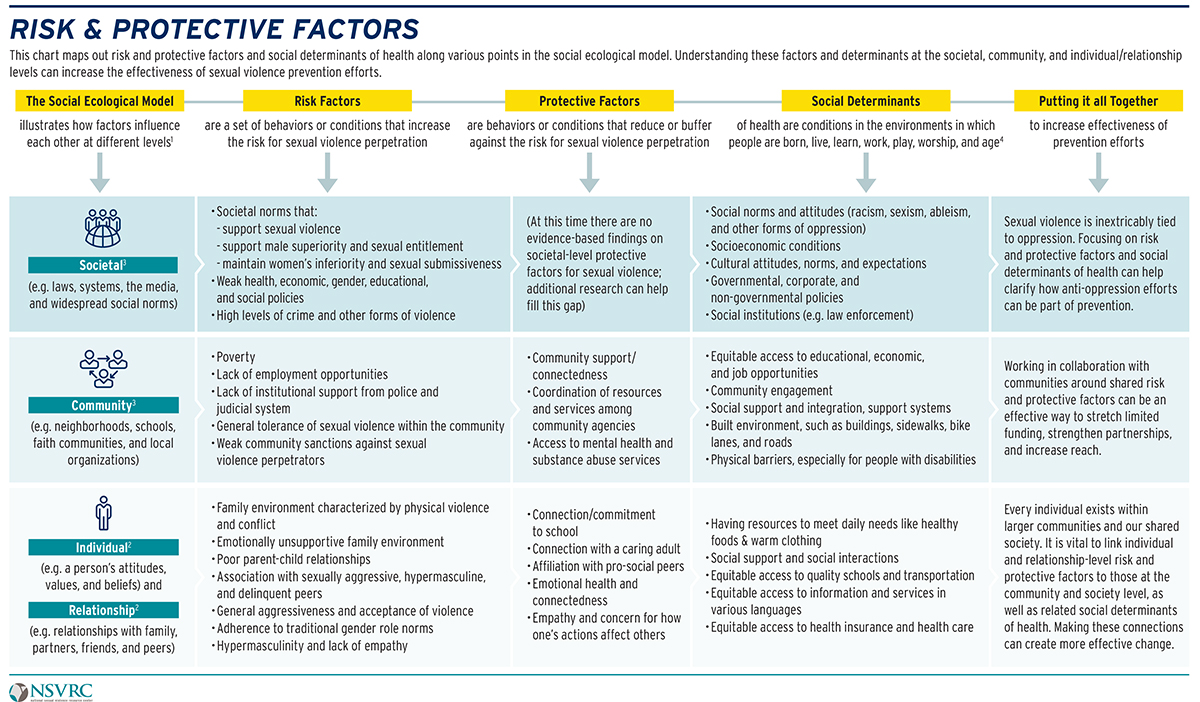
Contributor
Jenette Nagy
Stephen B. Fawcett
Tool 1: Determining which risk or protective factors to focus on
In the table below, list all of the risk and protective factors that you have determined in the first column. In the next column, rate the importance of the factor, with one "1" being very important, two "2" being moderately important, and three "3" being slightly important. Note that more than one factor can have the same number. Do the same in the column labeled "Changeability," with one "1" being completely changeable, two "2" being partially changeable, and three "3" for factors you are unable to change. Finally, in the last column, add up the numbers you have gotten in each row. The factor(s) which has/have the lowest final value is/are the risk and protective factors you should start with, those with the second lowest value should come second, and so on.
|
Risk or protective factor |
Importance |
|
Changeability |
|
Final value |
|
|
|
+ |
|
= |
|
|
|
|
+ |
|
= |
|
|
|
|
+ |
|
= |
|
| + | = | ||||
| + | = | ||||
| + | = | ||||
| + | = | ||||
|
|
|
+ |
|
= |
|
Tool 2: Understanding the factors that contribute to the problem
Contributor
Jenette Nagy
Stephen B. Fawcett
What is risk reduction? What are protective factors?
You know your group wants to work on preventing a particular health problem in your community. Many effective prevention efforts work both to reduce risk factors and strengthen protective factors. But what's risk reduction? And what are protective factors?
Risk reduction means identifying the factors and conditions that increase the likelihood of the problem you're trying to prevent and then working to reduce or change those factors. For example, if you're working to prevent lung cancer, reducing tobacco use and exposure to tobacco smoke may be important parts of your strategy.
Protective factors are strengths, resources, relationships, conditions, and experiences that can reduce risk or support positive outcomes. For instance, if you work with a coalition to reduce cardiovascular disease, protective factors might include access to nutritious food, opportunities for physical activity, supportive social relationships, and high-quality preventive health care. Protective factors can help reduce the effects of risk factors and create conditions that support health and well-being. To demonstrate this, let's look at an example adapted from the work of researchers Hawkins and Catalano on risk and protective factors.
Example: Risk and protective factors for substance use among young people
Risk factors:
- Economic hardship and limited access to resources
- Community instability or limited social connection
- Frequent transitions and mobility
- Availability of alcohol and other substances
- Community norms that normalize or encourage substance use
- Family history of substance use disorders or problematic substance use
- Limited family support, communication, or consistent expectations
- Academic difficulties or school disengagement
- Persistent behavioral challenges or involvement in harmful behavior
- Peers who use substances
Protective factors:
- Strong family, peer, school, and community connections
- Social, emotional, decision-making, and coping skills
- Clear and supportive expectations around substance use
- Stable employment and economic opportunity
- Availability of substance-free activities and opportunities for young people
- Supportive role models and mentors
By looking at the above lists, you should be able to identify several risk and protective factors that relate to one another. Clear and supportive expectations around substance use may help counter community norms that normalize substance use, for example. Strong relationships and community connections may also provide stability and support during periods of transition.
As you might have guessed by now, once you've figured out what the risk and protective factors are for the issue you're dealing with, the next step is to develop ways to reduce risk and strengthen protective factors. It's not enough simply to say, "Okay, we need to reduce sexual activity without adequate protection against STIs and unintended pregnancy among 18-to-24-year-olds." You'll need to develop strategies that address the factors contributing to that risk and specific tactics for carrying out those strategies.
Who should be involved in selection of risk reduction strategies?
Deciding on risk reduction strategies is something you shouldn't do completely on your own. While your organization may come up with some strong ideas, it's important to bring community members into the process, including people most affected by the issue and people who can contribute knowledge, relationships, resources, services, or decision-making authority. A community-wide approach works best in many cases.
Including members of the community in this process is advised because:
- It can help shape community norms and conditions that are connected to risk and protective factors. For example, HIV and STI prevention efforts may involve community members in promoting safer sexual practices, consent, access to condoms and testing, accurate health information, and supportive norms around sexual health.
- It creates a wider base of support for positive change. Involving people from a variety of groups, organizations, programs, and community networks can broaden participation and strengthen the effort.
- It can give you a better understanding of the strengths and resources available in the community. No single organization knows everything about community resources. Involving people from community organizations, government, social services, businesses, schools, health systems, neighborhood groups, and other sectors can help identify existing assets, relationships, and opportunities.
- It can help build broader community support for your initiative. When community members participate meaningfully in planning and decision-making, they are more likely to see the effort as something they helped shape and may share information and support through their own networks.
- It is more likely to support long-term change. Strategies developed through strong community partnerships can become integrated into organizations, relationships, policies, and community systems in ways that support sustainability.
Who are good people and groups to think about including?
- Local law enforcement and other public safety partners, when relevant
- Faith and spiritual leaders
- Local government officials and public agencies
- School administrators, teachers, students, parents and caregivers, school board members, and other education partners, especially when the effort involves young people
- Health and human service organizations
- Local media and communications organizations
- Young people, parents, caregivers, and families
- Local business owners, employers, and workers
- Community members representing a range of neighborhoods, backgrounds, experiences, and perspectives
You should also include people who are most directly affected by the issue in the process. Why is their participation important?
Including people most directly affected is important because:
- Meaningful participation can help establish and strengthen trust. Some communities have understandable reasons for mistrusting public health organizations or other institutions because of past or ongoing discrimination, exclusion, or mistreatment. Historical abuses such as the U.S. Public Health Service Syphilis Study at Tuskegee illustrate why transparency, accountability, respect, and meaningful community involvement are essential.
- People most affected by an issue bring essential strengths, knowledge, relationships, and lived experience. Community members often understand local conditions, barriers, assets, and possible solutions in ways that outside organizations may not. Their leadership can make an initiative more relevant and effective.
- It can give your group a better understanding of community priorities and what is likely to work. People with lived experience can identify barriers, strengths, unintended consequences, and opportunities that may not be apparent to planners or service providers.
- It can also increase community awareness of your organization and effort. Ongoing communication and participation can help community members understand what the initiative is doing and provide feedback as the work develops.
How to select risk reduction strategies
Now you have identified the risk and protective factors for your coalition, you have people together, and you're ready to start coming up with strategies and tactics. Where do you begin?
Take advantage of existing information.
First of all, you don't want to reinvent the wheel. There's a great deal of existing information that community health coalitions can use. Know your community's history. Has this initiative or something similar been tried here before? Even an effort that didn't achieve its goals may offer valuable lessons. Take advantage of existing knowledge on risk reduction and protective factors before developing strategies and tactics from scratch. Here are some ways you can do this:
Research to find out what other groups with missions similar to your own have done. A library search, credible online sources, research databases, program evaluations, and conversations with other organizations can yield a wealth of information. For example, a successful healthy food access program in another community might provide useful ideas for your own effort. Exchanging information with people doing similar work can benefit everyone involved.
Network, network, network. Get to know people who work with groups like yours. Conferences, workshops, professional networks, and community learning opportunities can connect you with people who have useful experience. Establish relationships with your peers so that you can exchange information, stories, lessons, and suggestions. Here are a few ways you can connect with people doing similar work:
- Attend conferences, workshops, webinars, and community learning events
- Get involved in regional and national coalitions or professional networks
- Join relevant email groups, online communities, professional associations, or other networks for people working on similar issues
A word of caution, however - don't assume that what has worked in other communities will necessarily work in your own. When you examine a possible strategy that has been used elsewhere, consider how well it fits your community's culture, laws, resources, priorities, history, and existing services. A syringe services program, for example, may require different outreach, partnerships, and implementation strategies in different communities.
Finally, conduct your own research and see what original strategies you can develop with community members and partners. A little ingenuity goes a long way. While many strong strategies can be adapted from other sources, don't be afraid to modify them when needed or develop new approaches based on local knowledge and experience.
Characteristics of effective risk reduction strategies
Here are some things that are usually present in an effective risk reduction strategy:
- First and foremost, an effective risk reduction strategy also works to strengthen protective factors. Focusing on strengths, resources, relationships, and supportive conditions can help avoid stigmatizing people based on risk factors or behaviors.
- The goals, methods to be used for data collection, evaluation, and feedback, and specific roles and duties of staff, volunteers, community partners, and other participants should be clearly defined. Outlining these things ahead of time can reduce confusion later in the process.
- The strategy approaches risk reduction in a way that's appropriate and responsive to the people and communities involved. Consider age, developmental stage, culture, language, accessibility, lived experience, community priorities, and the level and type of risk involved. For example, peer education can be effective with young people because peers may bring credibility, shared experience, and ways of communicating that complement information provided by adults and professionals.
- Many effective risk reduction strategies include early prevention and support. For example, providing people with access to nutritious food, health care, and other supports before and during pregnancy can promote healthy outcomes. Likewise, age-appropriate education about healthy relationships, consent, contraception, and STI prevention can help young people make informed decisions before problems arise.
- The strategy makes thoughtful and realistic use of available resources, including funding, staff time, partnerships, materials, facilities, and community capacity. If an approach cannot be sustained with available resources, consider adapting it or working with partners who can contribute additional support.
- If addressing more than one risk factor, it's usually helpful to use more than one strategy. Complex issues rarely have a single cause or solution. Domestic violence, for example, may be addressed through a combination of survivor-centered services, prevention education, economic and housing supports, programs that promote healthy relationships, accountability for people who cause harm, and policies and community norms that support safety and respect.
Questions to ask when evaluating prevention strategies you're considering:
- Does the strategy address important and well-supported risk factors?
- How will the strategy reduce risk and/or strengthen protective factors and community assets?
- Is the strategy likely to reach and meaningfully engage the people and communities it is intended to benefit?
- Is the strategy designed in a way that allows its implementation and effectiveness to be evaluated?
Common types of risk reduction strategies
Risk reduction strategies are often grouped into approaches that support individual behavior and approaches that change organizational, community, environmental, or policy conditions. Effective efforts often use both.
Strategies related to supporting individual behavior include:
- Incentives or disincentives - changing the costs, benefits, or supports associated with particular behaviors (for example, tobacco taxes that discourage tobacco use or free and low-cost cessation supports that make quitting more accessible)
- Increasing or reducing the time, effort, or other barriers associated with desired actions
- Providing support, such as peer education, coaching, counseling, navigation, or other forms of assistance
- Developing mentoring and supportive relationship programs
- Enhancing resources - raising funds, improving materials, strengthening connections with other programs and services, and increasing awareness of resources that are available
- Changing programs or services to reduce barriers and make them more accessible and responsive to the people using them
- Changing policies by creating, modifying, or ending policies as appropriate
- Providing information through approaches such as communication campaigns, community outreach, peer education, and counseling
- Modeling positive behaviors, relationships, or practices, including through peer education and mentoring
- Building skills through education, peer learning, coaching, counseling, practice, and other approaches
- Providing feedback on progress and opportunities for participants to reflect on and adjust their goals
Strategies related to organizational and community development include:
- Public awareness and communication campaigns, using tactics such as information campaigns, community outreach, peer education, and other appropriate communication methods
- Community assessment, learning, and monitoring
- Building coalitions and partnerships with other community groups
- Changing access to products and services, such as reducing youth access to tobacco products or expanding access to preventive health services
- Developing resources that strengthen family, peer, and community support
- Implementing and enforcing existing policies and laws fairly and consistently
- Advocacy and nonviolent civic action, including public education, community organizing, and other forms of collective participation
- Changing policies and laws through appropriate advocacy, outreach, public participation, and decision-making processes
Common tactics used in risk reduction
There are many tactics that can be used in risk reduction. Here are a few of the most common - but remember that the tactics you use should fit your goals, community, resources, and the people you hope to engage.
- Information and communication campaigns - This is one of the most commonly used tactics in risk reduction. Campaigns can help people understand health risks, protective factors, available resources, and actions they can take. Communication methods might include social media, websites, advertisements, posters, brochures, community newsletters, radio or television messages, speakers, text messaging, and informational hotlines.
- Street and place-based outreach - Outreach workers or peer outreach specialists connect directly with people in neighborhoods and other places where community members spend time. Activities might include conversations, canvassing, information tables, distributing supplies, harm-reduction resources, referrals, and connections to services. Consistent outreach can help build trust and make information and resources more accessible.
- Community outreach - Community outreach often takes place through workshops, presentations, listening sessions, community events, or other group settings. These activities can share information, build relationships, gather community input, and connect people with resources. They are often most effective when combined with other ongoing strategies.
- Peer education - Peer education involves people with shared experiences, identities, or community connections providing information, support, and opportunities for learning. Peer educators may bring credibility and lived experience that help make communication more relevant and accessible. They can participate in one-on-one conversations, group education, outreach, mentoring, navigation, or other activities.
- Risk reduction counseling - Risk reduction counseling is collaborative, nonjudgmental support for people who may experience increased risk. A counselor, peer specialist, health worker, or other trained person works with participants to understand their goals, identify risks and protective factors, explore realistic options, and develop skills and strategies that support safer and healthier choices. Counseling may take place one-on-one or in small groups.
- Direct action - Direct action refers to organized public actions intended to draw attention to an issue or advocate for change. Examples may include demonstrations, symbolic actions, public events, sit-ins, boycotts, or other forms of nonviolent civic participation. Because these tactics may attract significant public attention or involve legal, safety, and accessibility considerations, organizations should plan carefully and consider how the action fits within their broader goals and strategy. If using direct action tactics, think through the purpose, participants, safety, communication, and possible consequences in advance.
In Summary
This section provides an understanding of how you can design strategies and tactics to reduce risk and strengthen protective factors and community assets. Pay close attention to evidence and lessons from other communities, particularly those that share relevant characteristics with your own, while recognizing that strategies may need to be adapted to local strengths, priorities, resources, and circumstances. Community members - especially people most directly affected by the issue - should help shape those adaptations. You may find that a combination of locally developed ideas and approaches adapted from other sources works best for your community.
Contributor
Chris Hampton
Resources
Online Resources
Centers for Disease Control (1995). Health Education and Risk Reduction Activities. Guidelines for Health Education and Risk Reduction Activities
Print Resources
Fawcett, S., Paine, A., Francisco, V., Richter, K., Lewis, R., Williams, E., Harris, K., Winter, K., in collaboration with Bradley, B., & Copple, J. (1992). Preventing Adolescent Substance Abuse: An Action Planning Guide for Community-Based Initiatives. Lawrence, KS: University of Kansas.
Fawcett, S., Francisco, V., Paine, A., Fisher, J., Lewis, R., Williams, E., Richter, K., Harris, K., Berkley, J., with assistance from Oxley, L., Graham, A., & Amawi, L. (1994). Preventing Youth Violence: An Action Planning Guide for Community-Based Initiatives. Lawrence, KS: University of Kansas.
Fawcett, S., Harris, K., Paine, A., Richter, K., Lewis, R., Francisco, V., Arbaje, A., Davis, A., Cheng, H. in collaboration with Johnston, J. (1995). Reducing Risk for Chronic Disease: An Action Planning Guide for Community-Based Initiatives.Lawrence, KS: University of Kansas.
Hawkins, J., Miller, J., & Catalano, R. Jr., (1992). Communities That Care. San Francisco, CA: Jossey Bass.
You understand that:
___Risk reduction involves finding out what in your community leads to the problem you're trying to prevent and then working to cut down on those factors.
___Protective factors are those things that keep whatever it is you're trying to prevent from occurring.
___A strategy is a broad step in a plan to accomplish a specific goal.
___A tactic is a specific step you take to complete a strategy.
You understand the following reasons for including members of the community in the process of selecting risk reduction strategies:
___It can help change community norms and values, which are often tied to risk and protective factors.
___It creates a wider base of support for changing behavior.
___It can give you a better sense of what resources are available to you in the community.
___It can help galvanize public support for your initiative.
___It is more likely to lead to long-term changes.
You have considered including people from the following groups in the process of selecting risk reduction strategies:
___Local law enforcement
___Religious leaders
___Local government officials
___School administrators, teachers, PTA members, school board members
___Health and human services agencies
___Local media representatives
___Youth and parents
___Local businesspeople
___Members of the target population you serve
You understand the following reasons for including members of the target population in the process of selecting risk reduction strategies:
___Giving the target population a say helps establish trust
___Affected communities are often stronger and more resourceful than we give them credit for
___It can give your group a better understanding of what the community needs
___It can also increase community awareness of who you are and what you do
Selecting risk reduction strategies:
___Research to find out what other groups with missions similar to your own have done
___Attend conferences and workshops
___Get involved in regional and national coalitions
___Sign on to an email list for people who do the same type of work you do
___When you examine a possible strategy that has been used in another community, think about how it would work with your own community
___Conduct your own research and see what original strategies you can come up with on your own
You understand the following characteristics of an effective risk reduction strategy:
___The strategy works to increase protective factors
___The goals, methods to be used for data collection, evaluation, and feedback, and specific roles and duties of all staff, volunteers, and any other personnel are clearly defined
___The strategy approaches risk reduction in a manner appropriate to your target population
___The strategy employs early intervention
___The strategy makes the best possible use of available resources
___If addressing multiple risk factors, it's probably best to use multiple strategies
You've asked the following questions when evaluating prevention strategies you're considering:
___Does the strategy address known risk factors?
___How will the strategy reduce risk and/or increase protective factors?
___Is the strategy likely to reach your target population?
___Is the strategy set up in a way in which it can be evaluated?
You're familiar with risk reduction strategies related to changing individual behavior:
___incentives or disincentives
___increasing (or reducing) time and effort for target behaviors
___providing support
___arranging mentors
___enhancing resources
___changing environmental design to remove barriers or enhance accessibility
___changing policy (creating, modifying, or terminating)
___providing information
___modeling
___skills training
___providing feedback on progress
You're familiar with risk reduction strategies related to organizational and community development include:
___public awareness and media campaigns
___community assessment and monitoring
___coalition building
___modifying access to products and services
___integrating and coordinating local agencies and resources
___developing resources to enhance family and peer support
___enforcement of existing policies and laws
___advocacy and nonviolent protest
___changing policies and laws
You understand some of the common tactics used in risk reduction:
___Information campaigns
___Street outreach
___Community outreach
___Peer education
___Risk reduction counseling
___Direct action
Tool #1: Supporting Youth at Risk: A Policy Toolkit for Middle-Income Countries
From the introduction of the Policy Toolkit, published in 2008:
Today, there are 1.5 billion people between the ages of 12 and 24 worldwide, with 1.3 billion of them living in developing countries—making the young the largest segment of developing country population in recorded history. More important, young people constitute a disproportionately large part of the world’s poor. While they represent 50 percent of the developing country population, they represent nearly 60 percent of the poor in those countries.1 Young people can be a source of growth and development for their countries, but a subset of young people—those known as youth at risk—are a source of the inequality, poverty, exclusion, and much of the crime and violence that plagues every region in the world, thereby imposing enormous costs on themselves, their families, and society at large.
The World Bank has produced this Policy Toolkit in response to a growing demand from our government clients and partners for advice on how to create and implement effective policies for at-risk youth. We have highlighted 22 policies (six core policies, nine promising policies, and seven general policies) that have been effective in addressing the following five key risk areas for young people around the world:
- Youth unemployment, underemployment, and lack of formal sector employment
- Early school leaving
- Risky sexual behavior leading to early childbearing and HIV/AIDS
- Crime and violence
- Substance use
The objective of this Toolkit is to serve as a practical guide for policy makers in middle-income countries—as well as professionals working within the area of youth development—on how to develop and implement an effective policy portfolio to foster healthy and positive youth development.
Supporting Youth at Risk: A Policy Toolkit for Middle-Income Countries
-
What do we mean by "adaptation?"
-
What do we mean by "different cultures and communities?"
-
Why should you adapt interventions?
-
When should you adapt interventions?
-
An important question: Does an intervention always need to be adapted?
-
How should you adapt interventions?
-
Some special situations: "What should I do if...?"
What do we mean by "adaptation"?
Suppose you have conducted a community intervention and it is successful. Naturally, you might think about building upon your success and using the intervention elsewhere -- in a community or setting that may differ in culture, history, language, resources, geography, or other important ways.
For example, suppose you have organized a successful park clean-up, voter registration drive, or home-visiting program for older adults. The park becomes clean; voters are registered; and visits are being made. Now there's a chance to use a similar approach in another setting, with a different community. Will your success be repeated?
The key questions here are (1) whether that intervention will be successful elsewhere, and especially (2) how it can be made most relevant and effective in the new setting. The best answers are (1) "maybe," and (2) "with careful thinking, community involvement, and planning."
The basic idea is that interventions are not always one-size-fits-all. When the setting is different, they may need to be adapted. Adaptation means modifying an intervention so that it fits the strengths, priorities, culture, circumstances, and resources of the community while preserving the elements that make the intervention effective. That is the main focus of this Tool Box section.
What do we mean by "different cultures and communities?"
"Culture" is a broad term that can include shared values, beliefs, practices, traditions, languages, histories, relationships, identities, and ways of understanding and interacting with the world. Culture is not fixed, and people who share one identity or background may still differ greatly from one another.
Race and ethnicity can be important parts of cultural identity, but they should not be treated as if every racial or ethnic group has a single culture. People who identify as Black, Latino or Hispanic, Asian, Indigenous, White, or with another racial or ethnic identity may have many different cultural traditions, languages, histories, experiences, and perspectives within those broad categories.
Cultural differences can also be connected to age, gender, socioeconomic circumstances, religion or spirituality, region, sexual orientation, disability, immigration experience, profession, family background, neighborhood, or combinations of these and other factors. A potluck supper, blood-pressure screening, or immunization drive might be a terrific success in one setting while the same event could receive little participation in another. Differences in relationships, communication preferences, accessibility, history, trust, timing, location, and community priorities may all affect how well an intervention fits.
Why should you adapt interventions to fit different cultures and communities?
Possibly the most important reason you might want to adapt your intervention is because your intervention has worked already and you would like it to work well in another setting. A well-adapted intervention can:
- Show respect for a community's values, identities, strengths, and experiences
- Improve your ability to connect and build relationships with the community you hope to engage
- Increase the relevance and accessibility of your actions
- Reduce the possibility of unintended or unexpected consequences
- Increase meaningful involvement and participation from community members
- Increase community understanding and support for your program, even among people who do not participate directly
- Increase the chances that your intervention will achieve its intended outcomes
- Build trust, relationships, and collaboration that can support future community efforts
These are all excellent reasons to proceed, if the conditions are right.
When should you adapt interventions to fit different cultures and communities?
Here are six useful criteria:
- When you think you have a promising idea or intervention
- When the intervention has been tested or otherwise has evidence suggesting that it can be effective
- When you are interested in using the intervention in a different community or cultural setting
- When you have the needed time, funding, people, partnerships, and other resources to move forward
- When community members have expressed interest in the intervention or in addressing the issue it is designed to address
- When community members are willing to collaborate in determining whether and how the intervention should be adapted
An Important Question: Does An Intervention Always Need to Be Adapted?
No, not every single time. There are certainly cases where little or no adaptation is necessary. For example:
- A grant-writing specialist was asked to give a grant-writing workshop to a Spanish-speaking community group. The basic principles of grant writing were largely the same, although language access and locally relevant examples still needed to be considered.
- Another specialist gave a digital skills demonstration to a group of recently arrived immigrants from several countries. Participants wanted to learn specific skills. The basic technical content did not need major cultural adaptation, although the instructor still needed to consider language access, participants' previous experience with technology, accessibility, and the examples used during the training.
At other times, cultural and community differences do indeed matter:
- An HIV prevention organization wanted to provide prevention education in a local Spanish-speaking community. Large public meetings did not work well for many community members, but smaller gatherings in trusted neighborhood settings did. The organization worked with community members to hold charlas, or informal community conversations, in homes and other familiar settings. Adapting the setting and format made the information more accessible and the conversations more comfortable.
- In another community, organizers learned that participants valued relationship-building and informal conversation before beginning a formal meeting agenda. Rather than assuming that one meeting style would work everywhere, facilitators allowed time for participants to connect with one another before moving into structured discussion. The adaptation reflected what community members themselves said helped them participate effectively.
These examples involve cultural differences, but the same principle applies to differences in language, age, disability, geography, organizational culture, socioeconomic circumstances, and many other factors. Our general point is that it's difficult to know in advance how much adaptation will be necessary. Rather than making assumptions, learn from the people involved and be prepared to adapt when doing so improves relevance, access, participation, or effectiveness.
Just how should you proceed? The "how-to" heading which follows may be helpful.
How should you adapt interventions to fit different cultures and communities?
Here is one step-by-step approach you can use as a guide. If you are working within an organization, the same steps will apply to your organization as well.
- Ask yourself, honestly: "Is the intervention worth adapting?" It may be good; but is it good enough? Is there evidence that it is effective or promising? Is its potential value high enough to justify the effort and resources needed to adapt it? A sincere and thoughtful answer to this question before you start can save a lot of time and trouble later on.
- Suppose you decide the intervention is worth adapting. Does your organization have the commitment and capacity to do the adaptation well? Successful adaptation takes time, relationships, flexibility, resources, and a willingness to learn. Consider whether you and your organization are prepared to make that commitment.
- You may decide that adaptation should move forward. But here's another question: What should your role be? Your organization may have useful resources or expertise, but community members may be better positioned to lead or co-lead the adaptation. Sharing leadership can strengthen the intervention and help ensure that decisions reflect community knowledge, priorities, and experience. In some cases, your most useful role may be to provide support, technical assistance, funding, or other resources while community partners take the lead.
- Check your readiness. If you do have a role, are you ready to approach the work with cultural humility, openness, and a willingness to learn? You might want to ask yourself these questions:
- What are your own cultural values, assumptions, and experiences? How might they shape the way you understand the community or intervention?
- What experience do you have working with this community or with communities facing similar circumstances?
- What lessons can you draw from those experiences, and what assumptions should you avoid carrying into this work?
- Are you and your organization prepared to listen, share decision-making, respond to feedback, and change your approach when appropriate?
- Learn about community interest, strengths, resources, and conditions. Readiness is not simply something a community either has or lacks. Instead, consider:
- Are community members interested in the issue or intervention? What priorities have they identified?
- What strengths, leadership, relationships, knowledge, organizations, and other resources already exist in the community? What additional resources or supports may be needed?
- How might your organization's history, identity, reputation, or way of working affect the relationship? What can you do to build trust and accountability?
- Depending on your answers to these questions, you may be ready to go ahead. If so, make the commitment to approach the adaptation collaboratively and provide the time, relationships, and resources needed to do it well.
- Set specific objectives for the adapted intervention. What, specifically, do community members and partners want it to accomplish?
These may seem like a lot of steps to take and questions to ask before you get started. Perhaps they are. But they needn't take a very long time to accomplish. There is a good reason for considering them at the beginning: successful adaptation depends not only on changing the intervention, but also on examining assumptions, building relationships, understanding the local context, and deciding how leadership and decision-making will be shared.
All of these points are especially important when adapting interventions across cultures and communities. If you and your community partners decide that not much adaptation is needed, that's fine. If you decide that the intervention should be changed substantially or should not move forward at all, that's also useful information. Careful thought, collaboration, and preparation at the beginning can prevent wasted effort and strengthen the work that follows.
And now you are ready to move into the community-engagement and planning work. The next steps follow:
Learn about the community and context, especially if you don't already have strong relationships or knowledge of the community. Learn about relevant history, cultural practices, community strengths, institutions, languages, priorities, previous efforts, and current concerns. Avoid assuming that written research can tell you everything about a community; combine it with direct engagement and lived experience.
What kinds of questions should you ask?
Where can you begin finding information? Your local library and other reliable sources may provide:
- Census and demographic data
- Maps
- Government documents
- Local reports, assessments, and statistics
- Local news sources and archives
- Research, evaluations, and reports about similar interventions with communities that share relevant characteristics
Talk with people in the community. Talk with a variety of people if you can. These people can include:
- People with relevant lived experience, cultural knowledge, professional expertise, or research experience
- Trusted community members who understand local relationships, history, strengths, priorities, and concerns. These community connectors can help you understand whom else to involve and how to approach the work respectfully.
Who are these people, specifically? They could be:
- Local government officials and public agency staff
- Business owners, workers, and other business-sector partners
- Teachers, educators, or college and university faculty
- Researchers or evaluators
- People who have worked on similar issues or with similar communities
- Community members with lived experience, local knowledge, or trusted relationships, whether or not they hold a formal title
- Community-based organization staff and service providers
- Faith and spiritual leaders
- Local media and communications leaders
Note that each of these people can themselves be asked who else should be involved.
Talking with others may mean spending time one-on-one. Alternatively, you can also talk with others in a group. Listening sessions, focus groups, advisory groups, and community conversations can allow people to build on one another's perspectives, although some participants may prefer individual conversations.
Spend time building relationships in the community, especially if you haven't done so already. Attend public events, visit community organizations and gathering places when invited or appropriate, and take time to learn how people connect with one another. The goal is not simply to observe the community from the outside, but to build respectful relationships and better understand the setting through conversation and participation.
When you have learned more about the community and developed relationships, begin discussing the intervention idea with community members and potential partners. The people involved should include those who will be affected by the intervention as well as people with relevant knowledge, relationships, or responsibilities.
Rather than presenting a finished plan, invite discussion. You might say, "We've been considering this approach because it has worked in another setting. We'd like to understand whether it could be useful here, what would need to change, and whether there are better approaches we should consider." Be transparent about what is already decided, what is open to change, and what role community members can have in shaping the effort.
After you introduce the idea, ask for feedback and listen carefully. Do community members think the intervention addresses an important priority? What parts fit well? What parts don't? What changes should be made? What strengths or resources could the intervention build upon? What should happen next? Feedback should influence actual decisions rather than being requested simply as a formality.
If many community members and partners tell you that the intervention has little relevance, does not address their priorities, or is unlikely to work in the proposed form, pay attention. This may not be the right time, place, or approach. A different intervention -- possibly one developed or led by community members themselves -- may be more appropriate.
If there is sufficient community interest, then you may be ready to move ahead. The next step is to bring together community members and partners who will help shape and carry out the intervention. Some may be people you have spoken with before, and some should be people who will be directly affected by the intervention. If it's an adolescent pregnancy prevention program, for example, adolescents and young parents should be meaningfully involved alongside health professionals, families, educators, and other relevant partners.
In other words, at this stage, you want collaborators. You may want to bring these collaborators together into a working group, advisory group, steering committee, or another structure that fits the community. Whenever possible, people most affected by the issue should have meaningful influence over decisions rather than serving only in an advisory role.
At this point, you should begin planning and implementation, just as you would with any other intervention; those same basic procedures apply now as well. Your working group can decide what needs to be changed from the original intervention and what should remain. Together, members can agree upon a course of action, establish timelines, conduct pilot tests when appropriate, identify resources, and divide responsibilities. These steps are common to all interventions, whether or not they are adapted.
Some special situations: "What should I do if...?"
If conflicts arise?
If they do, don't be surprised. Conflict and disagreement are natural, especially when people or organizations do not have a history of working together. Relationships need to be formed, expectations clarified, and trust developed over time.
A useful guideline is not to suppress disagreement, but to create conditions in which it can be expressed openly and respectfully. Setting this tone at the beginning may help. Regular check-ins about both progress and the collaboration itself may help as well. Develop shared expectations for dealing with conflict so that disagreement can be addressed constructively rather than allowed to undermine the effort.
If people from different cultural backgrounds have difficulty understanding one another?
When people or organizations from different cultural backgrounds are working together for the first time, they may have different communication styles, expectations, experiences with institutions, or ways of approaching decisions. Structured opportunities for dialogue, cultural learning, and relationship building may help. Cultural humility is an ongoing process, so the goal should not be to teach participants a fixed set of assumptions about another group, but to strengthen their ability to listen, ask questions, recognize their own assumptions, and work respectfully across differences.
If materials need translation?
You may have materials in one language that you want to make available in another. Before translating, consider whether relevant materials already exist and have been developed or tested for the language community you hope to reach. Sometimes adapting existing materials will save time; in other situations, creating new materials with community members may produce something more relevant and useful.
If you do decide to translate, use qualified translators who understand the subject matter and, when possible, the language varieties and cultural context of the intended audience. Have translated materials reviewed by additional speakers from the community for clarity, meaning, accessibility, and tone. Back-translation or other quality-review methods may also be useful when accuracy is especially important.
If the adaptation involves several different cultural groups
Suppose you are adapting an intervention not just with one community, but with several different cultural or identity groups at the same time. This may occur in culturally diverse communities or in efforts that cross generations, languages, faith traditions, neighborhoods, or other groups.
Look for shared priorities while also recognizing meaningful differences. Communities may share goals such as safe and affordable housing, neighborhood safety, access to health care, or strong educational opportunities for children while having different experiences, barriers, strengths, or preferred strategies. Make sure the groups involved have meaningful opportunities to shape the intervention, ask for feedback throughout the process, and listen to what people say.
Many culturally diverse organizations and coalitions have successfully worked in this way. Community efforts that build relationships, trust, shared leadership, and progress across different cultures and identities can strengthen both the intervention itself and the community's capacity to work together in the future.
In Summary
These two closing statements sum up the key points of this section:
- First, work from an understanding of the experiences, priorities, strengths, and perspectives of the community involved. Don't assume that an intervention that worked elsewhere will automatically fit. Learn from community members, examine your own assumptions, build relationships, and adapt the intervention collaboratively. This takes cultural humility, flexibility, openness, and patience.
- Second, even with thoughtful planning and strong collaboration, success is not guaranteed. Resources may be limited, priorities may change, or the intervention may turn out not to be the right fit. But when adaptation is done collaboratively and respectfully, the result can be an intervention that is more relevant, accessible, and responsive to the community. The relationships, trust, and shared learning developed through that process can also strengthen future community efforts.
Contributor
Eric Wadud
Bill Berkowitz
Resources
Online Resources
Chapter 8: Respect for Diversity in the "Introduction to Community Psychology" explains cultural humility as an approach to diversity, the dimensions of diversity, the complexity of identity, and important cultural considerations.
Community Science analyzes the effectiveness of cultural adaptation in addressing issues in health disparities among communities
Print Resources
American Red Cross. (1987). Guidelines for Outreach to Minority Populations. The American National Red Cross.
Anner, J. (1995). Working Together: Building Successful Multicultural Movements. The Neighborhood Works, June/July.13-21.
Gonzalez, V. (1991). Health Promotion in Diverse Cultural Communities. Palo Alto, CA Health Promotion Resource Center, Stanford Center for Research in Disease Prevention.
Homan, M. (1994). Promoting community change: making it happen in the real world. Pacific Grove: CA. Brooks/Cole Publishing Company.
Pasick, R., et al.(1996). Similarities and Differences Across Cultures: Questions to Inform a Third Generation for Health Promotion Research. Health Education Quarterly, December. 142-161.
Rivera, F. (1992). Community Organizing in A Diverse Society. Neeham Heights, MA. Allyn & Bacon.
Sabogal, F., et al. (1996). Printed Health Education Materials for Diverse Communities, Health Education Quarterly, December. 123-41.
Singer, M. (1991). AIDS and U.S. Ethnic Minorities: The Crisis and Alternative Anthropological Responses. Hartford, CT. Hispanic Health Council.
US Department of Health and Human Services.(1994) Communications: Technical Assistance Bulletins:You can use communications principles to create culturally sensitive and effective prevention materials.
___You understand what it means to adapt interventions for different cultural traditions.
___You understand why you should adapt interventions.
___You understand when you should adapt interventions.
___You understand when you don't need to adapt an intervention.
___You understand how to adapt interventions to different cultural traditions:
___You have determined that the intervention is worth adapting.
___You have decided that you want to do the adaptation.
___You have decided that it is your role to direct the adaptation.
___You are culturally ready to take on the role.
___You have checked the readiness of your target group.
___You have made the commitment to do the adaptation.
___You have set specific objectives.
___You have done some research.
___You have talked to people in that cultural setting.
___You have spent some time in that cultural setting.
___You have proposed your intervention.
___You have asked for feedback.
___You have incorporated that feedback (or have a good reason why you didn't).
___You have found some people in that cultural community who will work together with you.
___You have planned and executed your intervention.
___You know what to do in the following situations:
___If conflicts arise
___If cultural groups really don't understand each other
___If materials need translation
___If the adaptation involves several different cultural groups
Questions to Consider in your Search for Information about the Community
Historical Issues
- What is the history of the community?
- What name or names do the cultural groups use to refer to themselves?
- What is the significance of the different names?
- What are the major differences between cultural groups in your target community, particularly across generational, educational, socio-economic and geographic lines?
- What have been the major historical events which describe the target group's experiences in the United States?
- What were and are the major conflicts between or among the cultural groups in the target community? What were the outcomes?
- What were and are the major conflicts within each group? What were the outcomes?
Economic and Political Issues
- What are the different socio-economic levels of groups within the community?
- What is the political status of each group in the community (e.g. undocumented, refugee, legal immigrant, citizen)?
- What are the different literacy levels within groups? Are they literate/illiterate in English and/or their own language?
- What are the different education levels within groups?
- How is their health status affected by their economic and political status? What are the predominant health problems?
- How often is medical care used by these different groups? What types of care?
- What are the organizations that successfully serve the different groups within the target community? Are they governmental, religious, community, social service, political or ethnic in nature?
Culture and Tradition-Specific Issues
- What are the values of the different groups in the community?
- How do various members of each cultural group define health and illness?
- What are some of the more common health beliefs and practices of community groups, both in general and with respect to specific problems?
- What are the predominant family structures within the community's cultural groups? Patriarchal, matriarchal, single parent household, extended families, etc.?
- What are some of the traditional roles of different family members in these cultural groups, particularly where health care is concerned?
- Who are the formal and informal leaders in the community, and what role do they have in the area of health promotion?
- How many languages and dialects are spoken?
- What are the formal and informal channels of communication within and between different groups?
Medical Orientation
- What are the group's general beliefs about the cause, prevention, diagnosis and treatment of disease?
- What are the group's attitudes towards "Western" medicine?
- In general, what has been the experience of different groups when trying to access the health care system?
- To what extent is there use of traditional medicine or healers?
- Where do people go for health information?
Diet
- What are traditional foods, and what role do they play in health, religion, and social activities?
- How has diet here in the U.S. changed over time as compared to in their country of origin?
- Is there access to foods that constitute traditional diet? Are there acceptable substitutes?
Religion
- What are the different religions practiced within the cultural groups in the community?
- How is practice of their religion influenced by their culture?
- What is the size of membership, and who are the members?
- Who are the religious leaders, and what is their role in the larger community?
- Are there conflicts among or within the various religious groups?
- What involvement do various religious groups have in the area of health education and promotion?
- Do religious beliefs conflict with the philosophy of health promotion? Can the beliefs be incorporated into your program?
Contributor
Eric Wadud
Bill Berkowitz
You run a community violence prevention program, working with young people who have experience with gangs or the justice system. The young people trust you, and sometimes share sensitive information with you. Law enforcement also knows about your work and may ask you for information about particular participants. What information are you obligated to share, and what are you obligated to keep confidential?
The right of a person to understand what happens to information they share in the course of a community intervention falls under the heading of ethics. A participant in a community program -- a health clinic, an adult literacy class, a youth leadership initiative -- has a right to certain expectations about how they and the information they share are treated. The community also has expectations about the reliability, competence, honesty, and accountability of programs that serve community members. In this section, we'll discuss some of those expectations and the ethical and legal responsibilities that may apply to your organization or initiative.
What do we mean by ethics?
Ethics refers to principles and standards that guide decisions about what is right, fair, responsible, and respectful. Although ethical decisions can vary depending on circumstances, cultures, professions, and laws, community interventions generally share several guiding principles:
Do no harm. Hippocrates put this principle into words more than 2,000 years ago, and it remains a fundamental ethical consideration.
Sometimes, doing no harm can mean reconsidering whether a particular community intervention should be started at all. As John McKnight argues in The Careless Society: Community and Its Counterfeits, well-intended services can sometimes overlook people's strengths, relationships, economic circumstances, or connection to community life. Before beginning an intervention, it may be helpful to ask questions such as:
- Could the proposed service have unintended negative effects for the people it is intended to support?
- How might this service interact with other programs, systems, or requirements already affecting participants?
- Could an approach that builds on people's strengths, capacities, and community assets be more effective than one focused primarily on needs or deficits?
- Could some of the resources proposed for the service be used more effectively through direct financial or material support?
- Would greater inclusion in community life be more beneficial than separating people into specialized services or settings?
- Respect people as ends, not means: Treat each person as an individual with dignity, rights, strengths, and goals -- not simply as a number in a political, social, organizational, or clinical calculation.
- Respect participants' ability to help determine what they need. Don't assume that professional staff or program planners necessarily know what's best for an individual or community. People with lived experience should have meaningful opportunities to shape decisions that affect them.
- Respect everyone's human, civil, and legal rights. This includes non-discrimination, accessibility, cultural responsiveness, privacy, autonomy, and equitable treatment.
- Seek outcomes that are fair and beneficial under the circumstances. You may not be able to meet every person's needs in every situation, but decisions should consider the well-being, rights, and perspectives of everyone affected.
This is a valuable guideline, but it can also be difficult to apply. Different people may have competing needs, values, rights, or interests, and there may be no outcome that benefits everyone equally. Ethical decision-making often requires weighing these considerations carefully, consulting the people affected, and being transparent about how decisions are made.
- Don't misuse your position or exploit a participant for personal advantage or power. This includes taking advantage of participants or others for political, social, sexual, professional, or financial gain.
- Don't attempt an intervention in areas in which you're not appropriately trained or competent. This principle goes along with "do no harm." Community organizations sometimes operate in settings with limited resources, but staff should recognize the limits of their expertise, seek appropriate supervision or consultation, make referrals when necessary, and avoid taking on responsibilities that create unreasonable risks for participants.
- Actively strive to improve, to the extent possible, the circumstances of participants and the community. This means providing effective and responsive services, listening to participants, strengthening community assets, and addressing underlying conditions that contribute to the issues the intervention is intended to address.
This last point raises a larger ethical question. If you are actively trying to contribute to positive change, how far does that responsibility extend? If other issues affecting the community fall outside your organization's mission, should you become involved? What if you don't fully understand the situation, or your involvement could create unintended harm? What if taking a public position could affect participants, staff, partnerships, or the sustainability of your intervention?
These are difficult questions, and there may not be one correct answer. What matters is recognizing that these tensions exist and developing thoughtful ways to consider them when they arise.
Why is ethical behavior important in community interventions?
In addition to being the right thing to do, consistent ethical behavior can strengthen your program. It can improve effectiveness, build trust and credibility in the community, support responsible leadership, and help your organization remain in good professional and legal standing.
- Program effectiveness. Consistent ethical behavior can contribute to a more effective program. Considering ethical principles in all aspects of a community intervention can lead to more respectful, responsive, and community-centered methods and can strengthen participation, relationships, and community support.
- Standing in the community. An organization with a reputation for ethical behavior is more likely to earn trust from participants, partners, and the broader community. That trust can make it easier to recruit staff, volunteers, Board members, partners, and participants and to build public and financial support.
- Ethical credibility and leadership. If your work is intended to promote social change, social justice, reduce suffering, foster human dignity, or provide needed services, your organization's actions should reflect those values. Ethical conduct helps ensure that your practices are consistent with your mission and strengthens your credibility when advocating for change.
-
Professional and legal issues. Many health, legal, education, mental health, social service, and other professionals involved in community interventions are governed by professional codes of ethics, certification requirements, licensing rules, and laws. Professional associations and licensing bodies may establish standards related to confidentiality, informed consent, professional boundaries, competence, recordkeeping, conflicts of interest, and other areas.
Serious violations of professional responsibilities can result in disciplinary action, suspension or loss of a professional license, employment consequences, civil liability, or, in some circumstances, criminal penalties.
People working in regulated professions are responsible for understanding the ethical standards, laws, organizational policies, and professional requirements that apply to their work.
Legal and ethical responsibilities frequently overlap, but they are not always identical. Organizations should have clear policies and access to appropriate professional or legal consultation when difficult questions arise.
Who is subject to a code of ethics in community interventions?
The short answer is that everyone who works in a community program or interacts with people in a professional or service role has ethical responsibilities. Some people are also subject to formal professional codes, licensing requirements, organizational policies, or legal obligations.
Here are some examples of people who may be expected to follow formal ethical or professional standards:
- Medical and health care professionals, such as physicians, nurses, emergency medical personnel, and other licensed or regulated health practitioners
- Mental health professionals, such as psychiatrists, psychologists, therapists, and counselors
- Social workers
- Clergy and other faith leaders
- Public officials
- Educators
- Youth workers
- People who work with children and young people, including child welfare professionals
- Lawyers and paralegals
- Mediators
- Administrators of community programs and sponsoring organizations
- Direct-service and support staff, such as home health aides and staff at residential programs or shelters
Depending on the jurisdiction and professional role, some of these people may be considered mandated reporters. Mandated reporters may be legally required to report suspected child abuse or neglect, and in some jurisdictions may have other reporting obligations. Because requirements vary, organizations and staff should understand the laws and policies that apply to their roles. We'll return to the implications of mandated reporting later in this section.
What are the ethical issues that need to be considered, and how do they play out in community interventions?
Ethical behavior in community interventions relates to the treatment of people, information, resources, and money, as well as to the actions of staff and organizations even when they are not dealing directly with participants. Not every issue below is governed by the same laws or professional codes in every setting, but all are important considerations for community programs.
Confidentiality
One of the most familiar ethical issues is the expectation that personal information shared by participants in the course of a community intervention or program -- including conversations, records, notes, assessments, test results, and other information -- will be handled responsibly and protected from inappropriate disclosure. Legal responsibilities vary by program, profession, type of information, and jurisdiction, so organizations should have clear confidentiality policies that reflect applicable law and professional standards.
Confidentiality protects participants' privacy and can help establish trust between participants and the program. Depending upon the program, the staff member's role, and applicable requirements, confidentiality may take several forms:
- Only staff members who need particular information for an appropriate program purpose have access to it, unless the participant has authorized broader disclosure. Paper and electronic records should be stored securely and protected from unauthorized access.
There may be circumstances in which confidentiality is limited by law, professional ethics, or program policy. Depending on the situation and jurisdiction, these may include mandated reporting requirements, serious concerns about imminent harm, certain court orders or legal processes, or information sharing authorized by the participant.
Staff should not have to make these decisions alone. Programs should establish clear confidentiality and recordkeeping policies, provide training, and identify who staff should consult when a difficult situation arises. When legal obligations are uncertain, the organization may need qualified legal or professional guidance.
Exceptions to confidentiality should be explained to participants at the beginning of their involvement in the program whenever possible. Participants should understand what information will be protected, what may be shared, with whom, and under what circumstances.
- Information may be confidential within a program but shared among appropriate staff members when necessary for consultation, supervision, coordination, or service delivery. Staff should share only the information needed for the purpose and follow applicable privacy requirements.
Educational records may also be subject to specific privacy protections. In the United States, for example, the Family Educational Rights and Privacy Act (FERPA) establishes rights and requirements related to many student education records. Programs connected to educational institutions should understand which privacy rules apply to them.
- Information may sometimes be shared with another program or organization when coordination is appropriate and the participant has given valid authorization, or when another lawful basis for sharing exists. Programs should clearly explain what information will be shared, with whom, for what purpose, and for how long the authorization applies.
- Funders may request information documenting services, participation, or outcomes. Programs should anticipate these requirements before making promises of confidentiality and should provide only the information that is necessary and permitted. Whenever possible, reports should use aggregate or appropriately de-identified information rather than personally identifiable participant records.
Privacy concerns may be especially important for participants whose immigration status, health information, legal involvement, sexual orientation or gender identity, experiences of violence, or other personal circumstances could place them at risk if disclosed. Organizations should be transparent about what information they collect, why they collect it, how it is stored, and when it might be shared.
- Some programs cannot offer complete confidentiality. Participation may be court-ordered, required by another agency, or subject to reporting requirements. In these circumstances, participants should still receive clear information about what will remain private and what may be disclosed.
In all circumstances, ethical treatment of participants requires transparency about confidentiality. People should receive understandable information about the program's privacy practices and any limits on confidentiality so they can make informed decisions whenever they have a choice about participation.
Consent
There are several forms of consent relevant to community interventions: consent to share records or information; informed consent for services, treatment, research, or program conditions; and questions about community participation and acceptance when an intervention is introduced into a neighborhood or community.
- Consent to sharing of information. When participant information is protected, sharing it with another organization or person generally requires an appropriate legal or ethical basis. When participant authorization is required, the person should understand what information will be shared, with whom, for what purpose, and for how long.
- Informed consent for services, treatment, research, or program conditions. Ethical practice requires that people receive understandable information about what they are being asked to participate in, what the potential benefits and risks are, what alternatives may exist, what is expected of them, and what rights they have. Participants should have meaningful opportunities to ask questions before making a decision.
In health care, informed consent generally involves discussing the recommended treatment or procedure, its purpose, potential risks and benefits, alternatives, and the option to decline when legally permitted. The specific requirements depend on the situation and applicable law.
In research, participants generally need clear information about the purpose of the study, what participation involves, how information will be used and protected, who may have access to the data, and whether participation is voluntary. Research involving human participants may also be subject to formal review and additional protections.
- Community involvement and acceptance. Ethical questions can arise when an organization wants to locate or operate a program in a neighborhood. For example, how should a community be involved when an organization plans to open supportive housing, a residential reentry program, a shelter serving people experiencing homelessness, or another service? Whose perspectives should be considered, and how should concerns be balanced against the rights and needs of people who will use the service?
In practice, it usually makes sense to communicate openly about what is planned, listen to concerns, provide accurate information, and involve community members where appropriate. At the same time, opposition to a needed service does not automatically mean the service should not exist. Ethical decision-making may require balancing neighborhood concerns with the rights, safety, dignity, and needs of the people the program is intended to serve.
These issues are seldom easy or clear-cut. Honest communication, meaningful engagement, attention to rights and equity, and a willingness to address legitimate concerns can help organizations navigate them.
Both confidentiality and consent bring up the broader issue of privacy. Digital technology, electronic records, online communication, data sharing, and increasingly interconnected information systems have created new opportunities and new risks. Organizations should think carefully about what information they collect, how long they retain it, who can access it, and how it is protected.
Disclosure
Like consent, disclosure in this context has more than one meaning.
- Disclosure to participants of the conditions of the program they're in -- including confidentiality policies and their limits, available services, program requirements, costs, time limits, grievance procedures, research activities, and other important conditions. Information should be provided in clear and accessible language so participants can understand what they are agreeing to and make informed choices whenever possible.
Many programs have grievance or complaint procedures for participants who believe they have been denied services unfairly, treated disrespectfully, or harmed through their involvement with a program. Participants should know that these procedures exist, understand how to use them, and have access to the information they need to raise concerns without fear of retaliation.
- Disclosure of participant information to other individuals or organizations. Programs should follow applicable confidentiality laws, professional standards, participant authorizations, and organizational policies. Any exceptions or limits to confidentiality should be communicated clearly when participants enter the program.
- Disclosure of conflicts of interest. Staff members, Board members, contractors, researchers, and organizations should disclose financial, professional, family, political, or other interests that could reasonably affect -- or appear to affect -- their judgment or decisions.
Laws, grant requirements, contracts, and organizational policies may require specific disclosures of conflicts of interest. Programs should understand these requirements and develop procedures for identifying, reporting, and managing potential conflicts.
Competence
By offering services of any kind, an organization is making a commitment to participants that it will make a responsible effort to provide the services it says it will provide. That includes ensuring that the people doing the work have appropriate knowledge, skills, training, supervision, and support.
No program or individual will succeed 100% of the time. Outcomes may be affected by many factors, including the fit of the intervention, accessibility, available resources, participants' goals and circumstances, broader social conditions, and the quality of implementation. A program should not automatically interpret limited participation or unsuccessful outcomes as evidence that participants are "resistant" or unwilling to change.
Competence means more than simply having appropriate credentials or prior experience. A competent organization recruits qualified staff, provides supervision and professional development, seeks participant feedback, evaluates its work, and responds when services appear ineffective or harmful. If staff members need additional training or support, the organization should provide it when possible. If someone cannot perform essential responsibilities safely and effectively even with appropriate support, the organization may need to change their responsibilities or employment.
There may also be professional and legal consequences when licensed or regulated service providers practice outside the limits of their competence or fail to meet required standards. Organizations should make sure staff understand the responsibilities and limits associated with their roles.
Conflict of interest.
A conflict of interest is a situation in which someone's personal, financial, professional, political, social, family, or other interests could improperly influence -- or appear to influence -- their judgment or actions. In community interventions, conflicts of interest can affect decisions about services, hiring, purchasing, funding, research, referrals, or relationships with participants.
Conflicts can also affect an organization, particularly where a Board of Directors or governing body is involved. For example, a Board member with a financial interest in a company being considered for a contract should disclose that interest and generally should not participate in the decision about awarding the contract.
A conflict of interest does not always mean that someone has acted unethically, but undisclosed or unmanaged conflicts can undermine trust and lead to unfair or biased decisions. Organizations should identify potential conflicts, disclose them appropriately, and manage or eliminate them when necessary.
If you find yourself in such a situation, the ethical response generally has two parts:
- Disclose the conflict to the appropriate person or body -- such as your employer, supervisor, Board, funder, participant, or other relevant party -- and discuss how it should be handled.
- Manage or eliminate the conflict. Depending on the situation, this might mean removing yourself from a decision, using an independent review process, transferring responsibilities, declining funding, ending a financial arrangement, or making another change that protects participants and the integrity of the organization.
Some examples of conflicts of interest and possible responses include:
- A program director considering the purchase of equipment from a company owned by a close family member. The director has both a personal and financial connection to the decision. The relationship should be disclosed, and the director should generally step away from the purchasing decision.
- A staff member considering a romantic or sexual relationship with an intern or person they supervise. The power difference creates significant ethical concerns and may violate organizational policy or professional standards. The appropriate response is to follow applicable policies and ethical rules, protect the person with less institutional power, and remove the conflict rather than relying on informal arrangements.
- A researcher accepting funding from a company that could benefit financially from a particular study outcome. The financial relationship should be disclosed and managed through appropriate safeguards, independent oversight, or another funding arrangement when necessary.
- A counselor or therapist providing professional services to a close family member, current partner, former partner, or other person with whom they have a significant personal relationship. Professional boundaries and objectivity may be compromised, so referral to another qualified provider is usually more appropriate.
- A youth program staff member assigned to work closely with a young person whose family has an ongoing personal conflict with that staff member. The program should consider whether another staff member can provide services more fairly and effectively.
- A health care professional referring patients to a practice in which they have a financial interest. The relationship should be disclosed and managed according to applicable professional standards, organizational policies, and laws.
Another type of conflict can arise when funding structures reward programs for particular participant outcomes in ways that unintentionally discourage them from serving people who face greater barriers or need additional support.
For example, an employment program might receive more funding when participants complete training and quickly obtain jobs. If funding depends too heavily on those outcomes, the organization may feel pressure to enroll people who are already most likely to succeed rather than people who could benefit substantially but may need more time, accommodations, or support.
This creates a conflict between financial sustainability and the program's responsibility to provide equitable access to services. Similar pressures can arise in education, health care, housing, behavioral health, and other areas.
Organizations can try to address these conflicts by negotiating funding expectations, documenting the resources required to serve people with different support needs, advocating for measures that recognize meaningful progress rather than only final outcomes, diversifying funding sources, and being transparent about the effects that funding structures may have on program decisions.
Grossly unethical behavior.
Some behaviors go far beyond ordinary ethical disagreements and involve serious violations of professional responsibilities, participant rights, organizational standards, or the law. Community programs should establish clear standards, reporting procedures, safeguards, and consequences for serious misconduct. Depending on the behavior, responses may include investigation, disciplinary action, termination, reporting to licensing or regulatory bodies, or referral to law enforcement.
Examples of serious ethical violations may include:
- Sexual or romantic relationships in professional situations where there is a significant power imbalance and where such relationships violate professional standards, organizational policy, or law.
- Exploiting participants financially, accepting bribes, or giving preferential access to services in exchange for money, gifts, favors, or personal benefits.
- Defrauding funders, such as billing for services that were never provided or falsifying records.
- Improperly denying necessary services because a person cannot pay when doing so violates professional, organizational, or legal obligations.
- Discriminating in service delivery on the basis of protected characteristics or otherwise treating people inequitably without a legitimate and lawful program reason.
Programs may sometimes be designed to serve a particular population because of a specific need or mission. Eligibility criteria themselves are not necessarily discriminatory, but they should have a legitimate purpose, be applied fairly, and comply with applicable civil rights and anti-discrimination requirements.
- Criminal or abusive conduct connected to the program, such as theft or misuse of program funds, abuse or exploitation of participants, falsification of records, or other serious misconduct.
General ethical responsibilities.
Ethical behavior for a community intervention is more than simply following professional codes and avoiding misconduct. It means actively trying to do what is fair, responsible, respectful, and beneficial for participants, staff members, funders, community partners, and the broader community. By working in the community, you take on a number of responsibilities:
Responsibility to funders. You are responsible for being financially accountable, using funds appropriately, meeting legitimate reporting requirements, and making a good-faith effort to carry out the work you agreed to do.
If a funder asks for something that conflicts with your organization's mission, ethical standards, participant rights, or commitments, address the issue before accepting the funding whenever possible. Be transparent about what your organization can and cannot agree to, and try to negotiate requirements that allow you to meet both your ethical responsibilities and the legitimate needs of the funder.
Responsibility to staff members. You are responsible for treating staff fairly; compensating them appropriately for their work; providing reasonable autonomy, supervision, and opportunities for professional development; and taking reasonable steps to protect their health and safety.
A community violence prevention outreach worker, for example, may need training related to neighborhood dynamics, conflict de-escalation, trauma-informed practice, confidentiality, personal safety, professional boundaries, and local resources. Staff should also receive clear information about job risks and the support available to them from the organization.
Responsibility to participants. You are responsible for making a continuing effort to provide effective, respectful, and responsive services. This means looking for better methods and ideas; listening to participant feedback; building on program strengths; identifying and correcting weaknesses; respecting participants' rights; and recognizing participants as people with knowledge, agency, strengths, and goals.
Questions about participant autonomy can be especially difficult when professionals believe they know what would be best for someone. Consider an adult with a mental health condition who is capable of making informed decisions and receives a medical procedure without having given informed consent. The violation of bodily autonomy is serious, but ethical questions may still arise about how an organization should respond if the person does not want to file a complaint or pursue action against the provider.
Situations like this involve several important principles at once: autonomy, informed consent, protection from harm, accountability, and respect for the person's own choices. Ethical decision-making should not assume that a disability or mental health condition eliminates a person's right to make decisions about their own life.
Respect also does not mean that participants may harm, threaten, harass, or discriminate against staff members or other participants without limits. Programs should develop clear, fair, and consistently applied expectations for behavior and procedures for responding to conflict, harassment, threats, discrimination, and safety concerns. People can be treated with dignity while still being held accountable for behavior that harms others.
Responsibility to the community. You are responsible for trying to understand community priorities, strengths, needs, and concerns; being responsive to community knowledge and perspectives; and using your intervention to contribute positively to community well-being without compromising essential ethical principles or participant rights.
The participatory nature of community interventions can itself raise ethical questions. Involving people most directly affected by an issue and the broader community in planning is generally both ethically and practically valuable. Community members bring lived experience, history, relationships, knowledge, and ideas that professional staff may not have.
Meaningful participation does not mean that everyone will always agree. Community members, service providers, researchers, funders, and other partners may have different interpretations of the issue or different ideas about what should be done. Ethical collaboration requires taking those perspectives seriously, explaining relevant evidence and constraints, being transparent about who has decision-making authority, and seeking shared solutions when possible.
The reality is that there aren't simple answers to many ethical questions. Clear principles and policies help, but organizations will still encounter situations in which legitimate values or responsibilities conflict. Ethical practice involves recognizing those tensions, consulting appropriate people, listening to those affected, documenting important decisions, and continually asking whether the organization's actions are consistent with its mission and responsibilities.
In Summary
Ethical considerations are extremely important in community interventions. A program that behaves unethically or allows serious ethical problems to go unaddressed risks harming participants, undermining its mission, damaging community trust, and reducing its effectiveness.
Because ethical issues are not always clear-cut, community programs should establish ethical guidelines, policies, and decision-making procedures before difficult situations arise. Clear expectations related to confidentiality, consent, disclosure, competence, professional boundaries, conflicts of interest, participant rights, staff responsibilities, and organizational accountability can help staff respond consistently and responsibly. Just as important, organizations should remain willing to learn from participants and community members and revise their practices when those practices do not live up to their ethical commitments.
Contributor
Phil Rabinowitz
Resources
Online resources
American Psychological Association. This site features a number of areas relevant to ethics, including the APA Ethics Code.
Applied Ethics Resources. This site features links to codes of professional ethics online.
Chapter 11: Community Interventions in the "Introduction to Community Psychology" explains professionally-led versus grassroots interventions, what it means for a community intervention to be effective, why a community needs to be ready for an intervention, and the steps to implementing community interventions.
Code of Ethics. The Code of Ethics of the National Association of Social Workers.
"Ethics and Conflict of Interest," an article by Michael McDonald of the University of British Columbia.
Massachusetts Medical Society. Privacy and confidentiality guidelines of the Massachusetts Medical Association. Also links to guidelines for and discussions of ethics issues.
Mental Health Patients Rights. Athealth.com is a large site with mental health information for both practitioners and consumers. This page is a series of items relating to mental health patients' rights.
Privacy And Confientiality. One counseling center's disclosure of privacy policy.
Print resource
Bok, S. (1999). Lying: Moral Choice in Public and Private Life. New York, NY: Vintage.
Fried, C. (1978). Right and Wrong. Cambridge, MA: Harvard University Press.
McKnight, J. (1985). The Careless Society: Community and Its Counterfeits. New York, NY: Basic Books.
Ram D. & Paul G. (1985). How Can I Help: Stories and Reflections on Service. New York, NY: Knopf.
Singer, P. (1193). Practical Ethics. Cambridge, England: Cambridge University Press.
___You know what ethics means
___You understand that ethical behavior is important in community interventions for:
- Program effectiveness
- Standing in the community
- Moral credibility and leadership
- Professional and legal issues
Ethical issues that need to be considered
___You have decided on the confidentiality level of your program participant's information
___You have informed your participants of this
___You asked for consent to share information if necessary
___You have used disclosure in situations where deemed necessary.
___Your organization is competent to accomplish its goals under reasonable circumstances.
___You have taken steps to eliminate conflict situations when they arise.
___You know how to prevent and deal with grossly unethical behavior from individuals and organizations.
___You know what your ethical responsibilities to your funders, staff members, participants and the community are.
-
What is a best practice?
-
Why promote the adoption and use of best practices?
-
When should you promote the adoption and use of best practices?
-
Who should be involved in promoting the adoption and use of best practices?
-
Where do you find best practices?
-
How do you promote the adoption and use of best practices?
The Parkville Heart Health Coalition was concerned. A community assessment showed that many elementary school children had limited opportunities for regular physical activity outside of school. Families and young people pointed to barriers that included limited access to safe recreation spaces, cost, transportation, and the amount of time spent on sedentary activities.
Research and community experience suggested that helping children find enjoyable forms of physical activity they can continue throughout life could support long-term health. Coalition members recognized this as a promising approach, but they also knew that success would require the participation of schools, families, young people, local officials, recreation organizations, and other community partners. How could they work together to determine whether the approach fit their community and, if so, put it into practice?
Best or promising practices can help you address community problems without having to start from scratch. If another community or organization has developed an approach with evidence of effectiveness, it makes sense to learn from it while also considering how well it fits your own community.
The first section of this chapter discussed how to recognize and choose promising practices for health and community development. Sometimes, however, those are only the preliminary steps. Once they're completed, there may remain the task of helping organizations and communities consider, adapt, adopt, and effectively use those practices. In this section, we explore how to do that, as well as what a "best practice" is and how to find one appropriate for your goals and circumstances.
What is a best practice?
A best practice may be a particular method, or it may be a whole program or intervention. "Best practice" status is sometimes conferred by a government body, professional association, research organization, funder, or other entity. In other cases, a practice gains recognition through research, evaluation, or consistent positive results in multiple settings. In general, a method or program considered a best practice is:
- Measurable. Its goals are clear enough that progress and outcomes can be assessed. A smoking cessation program, for instance, might examine how many participants reduce or stop tobacco use and how those outcomes change over time.
- Demonstrably effective. Evidence suggests that the method or program contributes meaningfully to the outcomes it is intended to achieve.
- Replicable or adaptable. The method or program is documented clearly enough that others can understand its essential components and use or adapt them in another setting.
Replication is always an issue. Even when a program is carefully documented, it's seldom possible or desirable to reproduce it exactly. Communities differ in size, culture, history, resources, relationships, policies, and other important ways. A program's success may also depend partly on the skills and relationships of the people who carry it out.
The practical question is therefore not simply whether you can copy a program exactly, but whether its essential elements can be implemented effectively in your setting while allowing appropriate adaptation. In that sense, adaptability may be an important part of whether a practice can be successfully replicated.
Best practices, in short, are methods or programs that have evidence of success in accomplishing particular goals and that may be usable or adaptable in other settings. The standards for choosing a best practice vary greatly depending upon who is doing the choosing. Some organizations use broad criteria, while others require extensive research and evaluation evidence.
Where the standards are relatively loose, programs designated as best practices may have limited evidence. Where the standards are extremely strict, valuable community programs may be overlooked because they lack the funding or evaluation capacity to produce extensive research. When considering a best practice, pay attention to who designated it as such, what evidence was used, which communities were included in that evidence, and how recently the practice was evaluated.
Keep in mind that "promising practices" -- approaches that may have less extensive evidence but show meaningful potential -- are also worth investigating. A promising practice may be especially useful when it fits your community's priorities, strengths, culture, goals, and circumstances.
Some other things to keep in mind when considering best practices:
- Fit with your community and the people involved. Does the method or program make sense given the realities, strengths, needs, languages, culture, and resources of your community? Can it be adapted appropriately?
A community health education program, for instance, may rely heavily on written English-language materials even though many community members use other languages or have different levels of literacy. The program might be adaptable through interpretation, translation, plain-language materials, visual communication, or other formats. In some cases, however, it may make more sense to choose an approach that already incorporates language access and accessible communication.
- Appropriateness to your goals. Does the practice actually address the outcomes you want to achieve? A practice that works well for one part of an issue may not address the underlying conditions you are most concerned about.
- Fit with the structure and philosophy of the organization or initiative that will use it. A highly centralized program, for example, may not fit well with an organization committed to shared decision-making and community leadership unless it can be meaningfully adapted.
- Availability of resources. Make certain you understand what a practice requires in funding, staffing, training, partnerships, facilities, technology, time, and other resources before committing to it.
- Cost-effectiveness and sustainability. A highly effective program may still be difficult to sustain if it requires resources far beyond what most communities can provide. A somewhat less intensive approach that produces strong outcomes with available resources may ultimately have greater reach and sustainability.
We have previously set out some general criteria for identifying best and promising practices and programs, based largely on the work of Lisbeth Schorr. According to those criteria, strong practices have all or many of these characteristics:
- They are comprehensive, addressing multiple aspects of an issue.
- They are flexible and responsive to participants, community priorities, and changing circumstances.
- They persevere, recognizing that meaningful community change often takes time.
- They understand people and issues in context -- including family, history, culture, community, systems, and environment.
- They address underlying causes and conditions in addition to immediate symptoms.
- They have and maintain a clear mission.
- They evolve over time as circumstances, evidence, and community priorities change.
- They are managed by people with appropriate knowledge, skills, and support.
- Their staff members are trained and supported to provide high-quality, responsive service.
- They foster strong relationships among staff, participants, and community partners based on mutual respect.
- They collaborate internally and externally.
- The organization and its staff share values that strengthen commitment, learning, accountability, and a common sense of purpose.
Why promote the adoption and use of best practices?
One answer to this question is straightforward: using a method or program supported by credible evidence can increase the likelihood that an effort will achieve its goals and benefit participants and the community. There are, however, additional reasons why using a best or promising practice can be advantageous.
- Using a recognized practice can help explain and justify the approach. Participants, community members, partners, and funders may reasonably want to know why a particular intervention was chosen. Evidence that the approach has worked elsewhere can provide useful support while still leaving room for local adaptation.
- Using recognized best practices can strengthen an organization's credibility. It shows that the organization has examined evidence and learned from the experience of others rather than relying only on assumptions or habit.
- Using best practices can strengthen funding proposals. Many funders want applicants to demonstrate that proposed approaches are informed by evidence or prior successful experience.
There can be a downside when funders require rigid use of a single designated practice. Such requirements may limit innovation, exclude strong community-developed approaches, or prevent necessary adaptation to local circumstances. Evidence should inform decisions without replacing community knowledge, professional judgment, or thoughtful adaptation.
- Using a documented practice can reduce some of the uncertainty involved in planning. Having a clearly described structure, theory, and implementation process gives organizations a useful starting point.
- People with experience implementing the practice may be available to provide guidance. They may be able to explain what worked, what challenges arose, which components were essential, and how the practice has been adapted in other settings.
- Best practices provide evidence that an approach can work under particular conditions. That does not guarantee success in every community, but it provides a stronger starting point than using an approach with no supporting evidence or experience.
When should you promote the adoption and use of best practices?
Promoting the consideration and use of best practices can be an ongoing activity, but some times are especially appropriate.
- Before a new intervention or program begins. It is often easier to incorporate an evidence-supported practice while a program is being designed than to add it after structures and routines are already established.
- When a serious community issue requires a stronger response. Rising rates of domestic violence, child maltreatment, infectious disease, housing instability, or other concerns may prompt organizations and community members to examine approaches that have shown results elsewhere.
- When what's being done isn't working well. If a current intervention is not producing desired outcomes, it may be time to examine alternative or additional approaches.
- When community members or participants request change. People most directly affected may identify gaps in current services or call attention to approaches that appear to work elsewhere.
- When funders or officials encourage or require evidence-supported practices. Make sure, however, that requirements still allow appropriate adaptation to local circumstances and meaningful community input.
Who should be involved in promoting the adoption and use of best practices?
When considering whether to adopt a best practice, it's valuable to involve people who will be affected by, participate in, implement, or support the intervention. If they help identify, examine, and adapt possible practices, they are more likely to understand the evidence, identify potential problems, and help shape an approach that fits the community.
- Practitioners -- health and human service professionals, community development workers, educators, outreach staff, and others who may implement the practice.
- People who will participate in, be affected by, or benefit from the practice, including people with relevant lived experience.
- People and organizations that may be indirectly affected. These might include public agencies, social workers, businesses, property owners, schools, health systems, neighborhood organizations, or others whose work or responsibilities could change as a result of the intervention.
- Interested community members. Broader community participation can contribute local knowledge, strengthen transparency, and build support.
- Local and, when appropriate, regional, state, tribal, or other public officials. Their involvement may be important when policies, public funding, or government systems are connected to implementation.
It may not be practical to involve every possible group in every decision. Still, meaningful representation from people most affected, people implementing the practice, and important community partners can improve both the quality of the decision and the likelihood that the practice will fit the community.
Where do you find best practices?
Be aware that much of what you find may fall into the category of "promising practices," or may simply be interesting approaches that others have tried. Don't dismiss these automatically. They may provide useful ideas, especially when combined with evidence, community knowledge, and careful evaluation.
To find best and promising practices, try:
- Online research. Search engines, research databases, government websites, university repositories, evidence clearinghouses, professional organizations, and program databases can provide research findings, evaluation reports, implementation guides, and descriptions of practices.
- Networking. Talk to colleagues, community partners, practitioners, researchers, and people with lived experience. They may know about practices that have worked elsewhere or connect you directly with organizations implementing them.
- Libraries. Public, academic, and specialized libraries can provide access to books, research databases, reports, journals, and professional guidance. Librarians can also help identify credible and relevant sources.
- State and national advocacy and professional organizations. These organizations may publish research, evidence reviews, implementation guidance, conference materials, or examples of successful programs.
Some professional organizations, foundations, governments, and networks also highlight innovative or evidence-supported programs through awards, showcases, learning collaboratives, or practice databases. These can be useful starting points, but review the criteria used to select the programs before treating them as established best practices.
- International, state, federal, tribal, and local agencies. Public agencies often publish evidence reviews, guidance, program evaluations, implementation resources, and descriptions of funded initiatives.
- Foundations and other private funders. Funders may publish evaluations, case studies, learning reports, and descriptions of projects they support.
- Colleges and universities. Researchers, faculty, students, extension programs, and research centers may be studying the issue you're concerned with or may know of relevant evidence and programs.
- Community knowledge and lived experience. Faith leaders, community organizations, service groups, businesses, advocates, participants, neighborhood leaders, and other community members may know about successful approaches that are not widely documented in academic or professional sources.
Using online sources to find best or promising practices
Online searching can provide access to an enormous amount of information, but finding reliable and relevant evidence requires more than simply entering a few words into a search engine. The goal is not only to find examples, but also to determine whether the source is credible, whether the evidence is current, and whether the practice has been used with communities or circumstances similar to yours.
General search engines can be useful starting points. Research databases, government websites, university repositories, professional associations, and evidence clearinghouses may be especially helpful when you need stronger evidence.
Google Scholar can help you locate research articles, reports, reviews, and other scholarly sources. You can also search databases available through libraries or universities. When possible, look beyond the first few search results and consider the quality, date, population, methods, and limitations of the evidence you find.
A few basic search strategies can make your search more useful:
- Be specific. Search for the issue, population or community, type of intervention, and outcome you're interested in. Instead of searching only for "child health best practices," for example, you might search for "school-based physical activity interventions elementary students" or another phrase that closely matches your question.
- Use several related terms. Different researchers and organizations may describe the same idea differently. Try terms such as "best practice," "promising practice," "evidence-based practice," "evidence-informed practice," "intervention," "program evaluation," or other issue-specific terms.
Quotation marks can still be useful when searching for an exact phrase. For example, searching for "youth violence prevention" may return results containing that specific phrase. You can also combine related concepts and try multiple variations of the same search.
- Try different words and phrases if you don't immediately find what you're looking for. The terminology used in research, government, and community practice may differ, so testing several search terms can help uncover useful information.
- Search in relevant languages. When researching programs used in multilingual communities or in other countries, valuable information may be available in languages other than English. Translation tools may help with initial review, but important materials should be interpreted carefully.
- Use organizations' internal search tools and resource collections. Once you find a credible agency, university, professional association, foundation, or evidence clearinghouse, explore its reports, databases, toolkits, and related resources.
You can find an up-to-date list of Databases of Best Practices on the Community Tool Box. It contains web-based resources for exploring promising approaches to community health and development, as well as resources organized by issue.
Online sources are extremely useful, but they are not the only source of knowledge. Some strong community programs may have limited online visibility or may not yet have been formally evaluated. Talking with practitioners, researchers, participants, and community members can help you identify approaches that would otherwise be missed.
How do you promote the adoption and use of best practices?
Once you've brought together community members, practitioners, and other partners to consider best practices, the next steps are to define what you're trying to accomplish, identify approaches that fit your goals and circumstances, compare the available evidence, and decide together what should be adopted or adapted. Even then, you're not finished: successful implementation requires training, resources, ongoing learning, and evaluation.
Define your issue, priorities, and goals clearly, so that you can determine exactly what kind of best practice you're seeking.
As mentioned above, not every best practice related to your issue is necessarily aimed at the same outcomes you're working toward. To make sure that you're choosing a practice that fits your goals, begin by defining what you want to address and what success would look like.
- Define your issue. What exactly is it you want to address? If it's a broad issue, are you addressing the whole thing or one part of it? If the issue is community violence, for instance, are you focusing broadly on community safety, youth violence, intimate partner violence, firearm injury, or another specific concern? The answer will affect which practices are most relevant.
- Define the outcomes you intend to achieve. The practice you choose should aim at the outcomes you're interested in. If you're working to prevent intimate partner violence, for example, you may want an approach that combines survivor support and safety, healthy relationship education, prevention with young people, community norms change, economic and housing supports, accountability for people who cause harm, and appropriate policy or system changes. A program focused only on responding after violence occurs might be effective at that task but may not accomplish your broader prevention goals.
This is also a place to consider philosophy and values. Two programs may seek similar outcomes while approaching participants very differently. Community health education, for example, might rely primarily on experts delivering information, or it might use participatory learning in which community members help shape the content and contribute their own knowledge. Choose practices that fit both your goals and the principles your organization and community want the intervention to reflect.
- Understand the people and communities involved. Who will participate in or be affected by the practice? What strengths, priorities, languages, cultures, experiences, access needs, and barriers should be considered? Involving people most affected can help determine whether a practice is likely to fit and what adaptations may be needed.
- Explore the context. Community history, geography, resources, systems, policies, relationships, transportation, housing, economic conditions, and other factors can influence whether a method or program will be effective.
This kind of analysis should help you identify practices that have produced outcomes similar to the ones you want and that appear compatible with your community's strengths, priorities, circumstances, and values.
Search for appropriate best practices.
Once you've defined what you're looking for, find several possible practices and compare them. Consider the quality of the evidence, who participated in the original programs, the settings in which they were tested, resources required, possible unintended effects, accessibility, cultural fit, and how much adaptation might be needed. Community members and people who would implement the practice should be involved in this review whenever possible.
While adaptation may be necessary, don't ignore what is already known about a practice. Some modifications may have been tested before, and some may weaken important parts of the intervention. Research, implementation guidance, practitioners with experience using the approach, and community knowledge can help distinguish between elements that should remain consistent and elements that can be adapted.
Promote thoughtful consideration and adoption of best practices.
Sometimes organizations or communities are already using an approach they value. Even when evidence suggests that another method may produce stronger outcomes, simply telling people that their current work should be replaced is unlikely to build trust or collaboration.
A participatory process can help people examine current results, review alternatives, understand the evidence, identify strengths worth preserving, and decide whether a new or adapted approach would improve the work.
- Share evidence and community findings openly. Explain why particular practices appear promising and how they relate to local priorities, while also inviting questions and concerns.
- Engage funders as partners in implementation. Funders may be able to support training, evaluation, adaptation, staffing, or other resources needed to implement a practice effectively.
- Connect local participants and practitioners with people who have experience using the practice. Practical conversations about implementation, challenges, adaptations, and results can help everyone evaluate whether the approach is a good fit.
When possible, seeing a program in operation can be especially useful. Site visits, virtual meetings, demonstrations, recorded presentations, implementation guides, and conversations with staff and participants can all help community partners understand what the practice looks like in real settings.
- Consider piloting or testing an approach before making a full transition. A limited pilot may allow the organization and community to compare approaches, identify needed adaptations, and learn whether the new practice actually improves outcomes in the local setting.
A pilot may also show that a practice labeled "best" elsewhere is not the best choice for your situation. Evidence from other settings is valuable, but local implementation and evaluation still matter. The goal is not to adopt a label; it's to use approaches that actually work well for the people and community involved.
Ensure that anyone involved in implementing a best practice receives the training needed to carry it out effectively.
People should understand the assumptions, principles, and theory behind the program or method, as well as the specific skills needed to implement it. Even a strong practice can fail if staff members are asked to carry it out without adequate training, supervision, materials, or opportunities to practice.
Implementation problems occur in many fields when organizations adopt a promising idea without investing in the people expected to carry it out. For example, a school might introduce a new evidence-supported instructional approach but provide teachers with only a brief orientation and little ongoing coaching. If the approach is implemented inconsistently or without understanding its key principles, poor results may reflect weak implementation rather than a flaw in the approach itself.
Training, coaching, supervision, opportunities for feedback, and time to develop competence can all make the difference between adopting a practice in name and implementing it effectively.
Those implementing a practice should also understand why it was chosen and have opportunities to raise concerns, suggest adaptations, and learn from implementation. Commitment is more likely when people understand the evidence, see how the practice supports community priorities, and have a meaningful role in making it work.
Provide those who'll implement best practices with the necessary support.
You can't expect to reproduce the results of a successful practice without considering the resources and conditions that helped make the original successful. Those resources can include:
- Funding. Trying to implement a program with substantially fewer resources than it requires may undermine quality and outcomes. Understand the essential costs before beginning, and consider whether the model can be sustained over time.
- People and staffing. Some programs depend heavily on volunteers, peer leaders, community health workers, mentors, or other participants. Consider whether people have the time and resources to take on these roles and whether compensation may be appropriate. Volunteers and staff also need training, support, and supervision.
- Space and accessibility. Consider whether program locations are physically accessible, reachable by transportation, welcoming, appropriately sized, and suitable for the people using them. Virtual or hybrid participation may also be appropriate in some settings.
- Time. New programs need time to establish relationships, train staff, learn from implementation, make adjustments, and evaluate results. Accountability is important, but so is allowing enough time for responsible learning and improvement.
- Community and institutional support. Staff, participants, and partners are more likely to succeed when community leaders, public officials, funders, organizations, and other partners understand the work and support the conditions needed for it to succeed.
Keep making the best better, and maintain the community's commitment to effective practice.
Finally, remember that adopting a best practice is not the end of the work. Even a well-supported practice can be improved, and changing community conditions may require new adaptations over time.
Best practices are only as good as their implementation. Continue examining whether the practice is reaching the people it is intended to reach, whether participants experience it as respectful and useful, whether intended outcomes are being achieved, and whether changes are needed.
Community initiatives often receive intense attention when an issue is especially visible, only to lose participation and resources when conditions begin to improve. That can make gains difficult to sustain. Successful efforts therefore plan not only for initial implementation but also for long-term leadership, relationships, funding, evaluation, and community participation.
Community priorities, evidence, and available approaches will continue to change. Keep learning about promising practices, evaluating what you're already doing, listening to participants and community members, and strengthening approaches that support meaningful and lasting improvements.
In Summary
One way to strengthen community health and development efforts is to identify and thoughtfully use best or promising practices -- methods or programs that have evidence of effectiveness and that can be implemented or adapted in other settings. This doesn't guarantee success. No intervention works equally well everywhere, and communities may already have locally developed approaches that are effective. Evidence is most useful when it is combined with community knowledge, lived experience, thoughtful adaptation, and ongoing evaluation.
Considering a best practice should be a collaborative process. People most affected by the issue, practitioners, community organizations, public officials, funders, researchers, and other relevant partners can help examine the evidence, decide whether an approach fits, identify adaptations, and determine what resources are necessary for implementation.
Once a practice is adopted, continue learning. Provide the training and resources necessary to implement it well, evaluate both outcomes and participant experiences, and make improvements as evidence and community circumstances change. Even a practice labeled "best" should remain open to learning and improvement.
Contributor
Phil Rabinowitz
Resources
Online Resources
The Colorado Dept. of Pubic Health and Environment. This site has a large listing of best practices in health, easily accessed by searching “best practices” on the site’s search engine.
Community-Problem-Solving. A list of links to sites that include best practices (including a link to the Community Tool Box).
The Guide to Community Preventive Services: the website of the Task Force on Community Preventive Services, appointed by the Director of the Centers for Disease Control. The Task Force is an independent body operating under the aegis of the Dept. of Health and Human Services. The website contains best practice information on a large number of prevention strategies.
World Bank Report (“Land Policies for Growth and Poverty Reduction”) on best practices for land use administration and policy.
MOST (UNESCO) Clearinghouse of Best Practices. Best practices in urban and community development.
The Promising Practices Network. Links to and comprehensive descriptions of proven (i.e., thoroughly researched and found to be effective) and promising programs in a variety of areas.
John J. Gunther Blue Ribbon Practices in Community Development. A listing and description of awardees for best practices among HUD (Dept. of Housing and Urban Development) fundees. From a sampling, some general characteristics of most programs seem to be cooperation and coordination of all involved entities, and the inclusion of participants (and actually listening to and acting on what they say.)
Best Practices Database. UNCHS (Habitat) and the Together Foundation. A catalogue of good and best practices in a number of health, human service, and development areas.
A paper entitled "Best Practices for Comprehensive Tobacco Control Programs" from the Centers for Disease Control.
Best practices in workforce development from the Employment Training Administration of the U.S. Dept. of Labor.
Best practices in state and local education from the U.S. Dept. of Education.
Best practices in community health from the U.S. Dept. of Health and Human Services.
Reports on best practices in various areas of service for children and families from the U.S. Dept. of Health and Human Services. This site is a gold mine, because rather than simply referencing programs, it gives a fairly detailed evaluation of best practices in each of several areas of child and family services.
Search the U.S. Council of Mayors best practices database.
The What Works Clearinghouse, a review of studies of educational programs from the U.S. Dept. of Education.
Youth Violence: Best Practices of Youth Violence Prevention. A downloadable 216-page sourcebook on youth violence prevention from the Centers for Disease Control.
What is a best practice?
A best practice is:
___Measurable
___Notably successful
___Replicable
___A good fit for your circumstances
Why promote the adoption and use of best practices?
___Using a recognized best practice makes it easier to justify the work.
___Using recognized best practices can bolster the credibility of an organization.
___Using best practices can make it easier to get funding.
___Using a best practice removes a lot of the guesswork from planning.
___The originators of the practice are known, and might be available to consult on how to best implement it.
___We know that best practices work.
When should you promote the adoption and use of best practices?
___When a new intervention or program is starting up.
___When what’s being done isn’t working.
___When there’s a serious community problem that has to be tackled.
___When the community demands it.
___When funders or officials demand it.
Who should be involved in promoting the adoption and use of best practices?
___Practitioners – health and human service workers, community developers, etc.
___Members of the population that will participate in or benefit from the best practices in question.
___Those who’ll be indirectly affected by the program.
___Interested community members.
___Local and, if appropriate, state officials.
Where do you find best practices?
___On the Internet.
___By networking.
___In libraries.
___Through national advocacy and professional organizations and their journals.
___Through international, state, and federal agencies.
___Through foundations and other funders.
___In academia.
___Through community word of mouth.
How do you promote the adoption and use of best practices?
___Define your issue, needs, and goals clearly, so that you can determine exactly what kind of best practice you’re seeking.
___Search for appropriate best practices.
You promote the use and implementation of best practices by:
___Mobilizing community opinion.
___Alerting funders to best practice possibilities.
___Bringing some of the people who originated or who use appropriate practices together with people in your community.
___Suggesting that, rather than substituting a best practice for what it is already doing, an organization or group simply add it, or try it out.
___Ensuring that anyone involved in trying to replicate a best practice is provided with the training to make it successful.
___Providing those who’ll implement best practices with the necessary support and resources.
___Continuing to make the best better, and maintaining the community’s commitment to best practices.