

Communications that promote interest and encourage involvement.
philsquare

Developing a communication plan can help focus your message and reach your intended audience. A plan can also make your communication methods more efficient and effective. This section looks at what a communication plan entails, how and when to create one, and how to use a communication plan to raise awareness about your issue or project.
What do we mean by communication?
Communication is the process of sharing ideas and information. For a grassroots initiative or community-based organization, that means conveying the nature of your organization, the issues it deals with, its goals, and its accomplishments to the community.
Communication can take many forms, including:
- Word of mouth
- News stories in print, broadcast, and digital media
- Press releases and press conferences
- Posters, brochures, and fliers
- Outreach and presentations to other health and community service providers, community groups, and organizations
- Special events and open houses that your organization holds
To communicate effectively, it helps to plan what you want your communication to accomplish and what you need to do to reach that goal.
What is a plan for communication?
Planning is a way to organize actions that will lead to the fulfillment of a goal.
Your goal, in this case, may be to raise awareness about your initiative and its potential long-term benefits to your community.
To develop a plan for communication, you have to consider some basic questions:
- Why do you want to communicate with the community? (What’s your purpose?)
- To whom do you want to communicate? (Who’s your audience?)
- What do you want to communicate? (What’s your message?)
- How do you want to communicate it? (What communication channels will you use?)
- Whom should you contact, and what should you do to use those channels? (How will you distribute your message?)
The answers to these questions constitute your action plan - what you need to do to communicate successfully with your audience. The remainder of your communication plan involves three steps:
- Implement your action plan. Design your message and distribute it to your intended audience.
- Evaluate your communication efforts and adjust your plan accordingly.
- Keep at it.
Communication is an ongoing activity for any organization that serves, depends upon, or is in any way connected with the community. The purpose, audience, message, and channels may change, but the need to maintain relationships with community members, partners, and media remains. As a result, an essential part of any communication plan is continuing to use and revise your plan, based on your experience, throughout the life of your organization.
Why should you develop a plan for communication?
- A plan will make it possible to direct your communication accurately. It gives you a structure to determine whom you need to reach and how.
- A plan can be long-term, helping you map out how to increase awareness of your organization and strengthen its reputation in the community over time.
- A plan can make your communication efforts more efficient, effective, and lasting.
- A plan can make the work easier. If you spend some time planning at the beginning of an effort, you can save time later because you have a clearer idea of what you should be doing at each point in the process.
When should you develop a plan for communication?
As soon as your organization begins planning its objectives and activities, you should also start planning ways to communicate them; successful communication is an ongoing process, not a one-time event.
Communication is useful at all points in your organization's development - it can help get the word out about a new organization, renew interest in a long-standing program, strengthen relationships with the community, or help attract new funding sources.
How do you develop a plan for communication?
Planning for communication is an eight-step process. The steps are:
- Identify the purpose of your communication
- Identify your audience
- Plan and design your message
- Consider your resources
- Plan for obstacles and emergencies
- Strategize how you will connect with the media and others who can help you spread your message
- Create an action plan
- Decide how you will evaluate your plan and adjust it, based on the results of carrying it out
1. Identify your purpose
What you might want to say depends on what you’re trying to accomplish with your communication strategy. You might be concerned with one or a combination of the following:
- Becoming known, or better known, in the community
- Educating the public about the issue your organization addresses
- Recruiting program participants or people who could benefit from or contribute to your programs
- Recruiting volunteers to help with your work
- Rallying supporters or the general public to action for your cause
- Announcing events
- Celebrating honors or accomplishments
- Raising money to fund your work
- Responding to arguments, inaccurate claims, or misrepresentations about your work
- Dealing with an organizational crisis that’s public knowledge - a staff member who commits a crime, for example, or a lawsuit involving the organization
2. Identify your audience
Who are you trying to reach? Knowing your audience makes it possible to plan your communication logically. You'll often need different messages, channels, and methods for different groups.
There are many different ways to think about your audience and the best ways to contact them. First, there’s the question of what group or groups you’ll focus on. You can consider people according to several characteristics:
- Demographics. Demographics are basic statistical information about populations, such as age, gender, race and ethnicity, income, education, and other characteristics.
- Geography. You might want to focus on a whole town or region, on one or more neighborhoods, or on people who live near a particular geographic or human-made feature.
- Employment. You may be interested in people in a particular line of work or in people who are unemployed or seeking work.
- Health. Your concern might be with people who are at increased risk for or living with a particular condition - high blood pressure, perhaps, or diabetes - or you might be directing a health promotion effort toward the whole community.
- Behavior. You may be directing your message to people who smoke, for example, or to young people involved in violence.
- Attitudes. Are you trying to change people’s minds, deepen their understanding, or encourage them to consider a different perspective?
Another aspect of the audience to consider is whether you should direct your communication to those whose behavior, knowledge, or conditions you hope to affect, or whether your communication needs to be indirect. Sometimes, to influence a population or decision, you may also need to reach people they trust or people who influence the relevant conditions - clergy, community leaders, policymakers, family members, employers, service providers, or others.
For instance, beginning in the 1970s, advocates challenged Nestlé's marketing of infant formula in low- and middle-income countries, where concerns included aggressive promotion, the cost of formula after free samples ended, and unsafe preparation when families lacked reliable access to clean water. Rather than focusing only on the company or health professionals, advocates also reached consumers around the world through a boycott of Nestlé products. The campaign helped bring international attention to infant-formula marketing practices and contributed to changes in industry standards and policy.
3. The message
When creating your message, consider content, mood, language, and design.
Content
In the course of a national adult literacy campaign in the 1980s, educators learned that TV ads that profiled proud, excited, successful adult learners attracted new learners to literacy programs. Ads that described the difficulties adults could experience because of limited access to reading, writing, and math skills attracted potential volunteers. Both ads were designed to make the same points - the importance of basic skills and the need for literacy efforts - but they spoke to different groups.
You should craft your message with your audience in mind; planning the content of your message is necessary to make it effective.
Mood
Consider what emotions you want to appeal to.
The mood of your message can strongly influence how people react to it. Messages that rely heavily on fear, guilt, shame, or anger can sometimes push people away or make them stop listening. At other times, those emotions may be part of how people already experience an issue and should not simply be ignored. The goal is to choose a tone that fits your purpose, audience, and evidence while treating the people involved with respect. Hope, possibility, shared values, and clear opportunities for action can often help people stay engaged.
Language
There are two aspects to language here. One is the actual language - English, Spanish, Korean, Arabic, American Sign Language, or others - that your intended audience uses. The other is the style of language you use - formal or informal, simple or complex, familiar or technical.
You can address language access by translating written materials into the languages used by the people you hope to reach and by providing qualified interpretation, captioning, or other communication supports for spoken, signed, or recorded messages when needed.
The second language issue is more complicated. If your message is too informal, your audience might feel you’re talking down to them or making an insincere attempt to sound like them. If your message is too formal or full of jargon, your audience might feel you’re not really talking to them at all. Use clear, respectful, straightforward language that expresses what you want to say in a way your intended audience can readily understand.
Channels of communication
What does your intended audience read, listen to, watch, use, attend, or participate in? You have to reach them by placing your message where they’ll see or hear it.
- Posters
- Fliers and brochures - These can be especially useful in places where the issue is already likely to be on people’s minds, such as health care settings for health issues or grocery stores for nutrition.
- Newsletters
- Promotional materials - Items such as caps, T-shirts, and mugs can serve as channels for a concise message or organization name.
- Comics, graphic stories, or other reading material - Material that is interesting and relevant to the intended audience can communicate a message through story, illustration, or other engaging formats.
- Websites, social media, video platforms, messaging apps, podcasts, and other digital channels
- Letters to the Editor
- News stories, columns, and reports
- Press releases and press conferences
- Presentations or presence at local events and local, regional, and national conferences, fairs, and other gatherings
- Community outreach
- Community or national events - The Great American Smokeout, National Literacy Day, a community “Take Back the Night” event against violence, and other community events can serve to convey a message and highlight an issue.
- Public demonstrations
- Word of mouth
- Music
- Exhibits and public art - The AIDS Memorial Quilt, with panels created in memory of people who died of AIDS-related causes, is a prominent example.
- Movies - Since the beginnings of the film industry, movies have carried messages about race, gender, adult literacy, sexual orientation, mental health, HIV and AIDS, and numerous other social issues.
- TV and streaming video - These can carry straightforward messages such as ads and Public Service Announcements (PSAs), as well as news, documentaries, and entertainment programs that deal with your issue or profile your organization.
- Theater and interactive theater - A play or skit, especially one created with people who have experienced what it illustrates, can be a powerful way to present an issue or underline the need for services or change.
Several interactive theater groups in New England have used performances based on real experiences of staff members and adult learners to invite audiences into conversations about adult literacy. By pausing the action and encouraging questions and discussion, these performances have helped challenge assumptions and bring information about adult literacy and learning into the community.
4. Resources
What do you have the money to do? Do you have the people, time, technology, and relationships to make it possible? If you’re going to spend money, what results are you hoping for, and are they worth the expense? How will your use of financial and human resources affect other priorities?
Your plan should include careful determinations of how much you can spend and how much staff and volunteer time it’s reasonable to use. You may also be able to share materials, air time, and other goods and services with individuals, businesses, other organizations, and institutions.
5. Anticipate obstacles and emergencies
Any number of things can happen in the course of a communication effort. Someone can forget to send a press release or leave out an important phone number, website, or e-mail address. A crucial word on your posters or in your brochure can be misspelled, a social media post can contain incorrect information, or a reporter might get an important fact wrong. More seriously, your organization may have to respond publicly to a crisis that threatens trust or credibility.
It’s important to try to anticipate these kinds of problems, and to create a plan to deal with them. Crisis planning should be part of any communication plan, so you’ll know what to do when a problem or crisis occurs. Crisis plans should include who is responsible for gathering accurate information, who can speak for the organization, how misinformation or errors will be corrected, how affected people will be informed, and when materials or messages need to be withdrawn or replaced. The plan should be flexible enough to respond to situations that cannot be predicted in advance.
6. Strategize how you’ll connect with the media and others to spread your message
Establishing productive relationships with individual media representatives and media outlets can be an important part of a communication plan, as is establishing relationships with trusted individuals and institutions in the community and among the people you’re trying to reach. Make genuine contacts, provide accurate and useful information, respect people's roles, and follow through to sustain relationships and keep communication channels open.
The individuals who can help spread your message can vary from formal community leaders - elected officials, leaders of local businesses, clergy, educators, and others - to community activists, neighborhood leaders, and other trusted community members. Institutions and organizations, such as colleges, hospitals, service clubs, faith communities, and other health and community organizations, may also have relationships with groups of people you hope to reach.
7. Create an action plan
Now the task is to put it all together into a plan that you can act on. By the time you reach this point, your plan is already done, for the most part. You know what your purpose is and whom you need to reach to accomplish it, what your message should contain and look like, what you can afford, what problems you might face, what channels can best be used to reach your intended audience, and how to gain access to those channels. Now it’s a matter of putting the details together - composing and designing your message or messages, making contact with the people who can help you, assigning responsibilities and timelines, and getting everything in place to start your communication effort. And finally, you'll evaluate your effort so that you can continue to make it better.
8. Evaluation
If you evaluate your communication plan in terms of both how well you carry it out and how well it works, you’ll be able to make changes to improve it. Look not only at how many people received or saw a message, but also at whether people understood it, whether it reached the audiences you intended to reach, whether it was accessible and respectful, and whether it contributed to the action or understanding you hoped for.
And there’s really a ninth step to developing a communication plan: as with just about every phase of health and community work, you have to keep up the effort, adjusting your plan and continuing to communicate with the community.
Resources
Online Resources
Communications Planning: Getting the Right Messages Across in the Right Way, by Mindtools.com, will help you through the preparation steps as well as create an audience-focused communication plan that is sure to get your message heard.
Creating a Communications Action Plan, from viaSport in British Columbia.
Developing a Communication Plan, by the Pell Institute and Pathways to College Network, is an excellent, simple resource providing information on how the communication plan should be designed as well as questions to be answered in order to develop a working and effective plan.
MED Communication Handbook. This 119-page PDF booklet was prepared by Pinnacle Public Relations for the European Territorial Cooperation MED Programme, 2007-2013.
Media Advocacy by Sandra A. Hoover
Narrative Change, Framing, and Communications is a guide to shifting narratives and using effective framing to advance health equity and social justice.
Newsworthy elements, from the Berkeley Media Studies Group, includes a checklist of questions by category to help you prepare and focus your story.
Planning Before You Communicate. This helpful tool developed by the Public Health Foundation will help you to address and organize essential factors of communications planning, execution, and evaluation. Doing this preparation work before you communicate will save you valuable time and resources when and where they are needed most.
Strategic Communications Planning
Worksheet: Crafting your media advocacy plan, from the Berkeley Media Studies Group, can help you identify key moments in the political process or opportunities — such as holidays, anniversaries or other key dates — far enough in advance that you can prepare and act effectively.
___You understand that communication is the transmission of ideas and information
___You know that developing a plan for communication:
- Makes it possible to target your communication accurately
- Helps you map out how to raise your profile and refine your image in the community
- Makes your communication efforts more efficient, effective, and lasting
- Makes everything easier by providing a plan for exactly what you should be doing at any point in the process
___You know that successful communication is an ongoing process that should begin as soon as your organization begins planning its objectives and activities and continue throughout the existence of your organization
___You know that there are eight steps to creating an effective communication plan:
- Identify the purpose of your communication
- Identify your audience
- Plan and design your message
- Consider your resources
- Plan for obstacles and emergencies
- Strategize how you'll connect with the media and others who can help you spread your message
- Create an action plan
- Decide how you'll evaluate your plan and adjust it, based on the results of carrying it out
Planning Before You Communicate
This tool, developed by the Public Health Foundation, will help you plan for good, consistent, clear, crisp communications both internally and externally. A comprehensive and strategic communications plan sets the foundation for staff to develop and execute communications effectively: to reach the target audience in the right place, at the right time, with the right message. This planning takes leadership, teamwork, internal collaboration and sharing, as well as continuous improvement. Doing this effectively will lead to coordination of team activities, allow for adept reaction and response to current events or crises, produce results, and maximize outcomes. This spreadsheet will help you to address and organize essential factors of communications planning, execution, and evaluation. Doing this preparation work before you communicate will save you valuable time and resources when and where they are needed most. For more information and to download the most recent Excel file: http://www.phf.org/resourcestools/Pages/Planning_Before_You_Communicate_Tool.aspx
Free Internet training sites
Michael has been working for his local telecommunications company for two years. Every week his company offers free classes in Internet training. The trainer is a very personable, intelligent woman. Those who have taken her classes have not only learned to use the Internet, but rather have also learned to love using it.
Michael's company is happy for those people who have learned to use the Internet from the courses; however, he and his bosses wonder why so few people have utilized these training resources. They decided that a plan for communication is needed.
The next week Michael hung flyers on neighborhood and citizen bulletin boards and called the leaders of neighborhood organizations in the city. He then called the newspaper and took the advertisement he had placed in the back of the newspaper and moved it to the community forum. The classes were advertised as a way to bring citizens, neighborhoods, and the larger community together. The ad encouraged members of neighborhood organizations and unaffiliated citizens to attend and learn.
-
What is persuasion as a natural process?
-
Why should you learn more about principles of persuasion?
-
What is involved in making a persuasive argument?
-
What are some principles of persuasion?
-
When do you use persuasion?
-
How do you use persuasion?
What is persuasion as a natural process?
Social scientists estimate that each of us is exposed to hundreds, if not thousands, of persuasive messages per day. Media messages play a large part, but aren't the whole story. The messages of daily interaction are equally important.
- A waiter at the restaurant asks, "Is there anything else I can get you?"
- A stranger at a party glances half a second too long.
- A telemarketer starts a pitch on the phone.
- A yard sale flyer catches your eye.
Every day we encounter these small-scale, usually low-stakes persuasive messages, designed to influence our attitudes and behaviors, even though we don't always label them as such. Some of those messages we deflect or ignore. Others get through and are successful, sometimes despite our own best intentions.
But it's not just others who are sending persuasive messages. We are, too. Many of us send out more such messages than we get back.
We persuade our partner to see this movie rather than that one, or our co-worker to knock off a few minutes early, or the service manager to get the oil change done by 3:00 because that's when we need the car. A large percentage of our communication is consciously or unconsciously designed to be persuasive -- that is, to be instrumental in getting something we want. One might say that communication, by its nature, is supposed to be persuasive.
If you are in a leadership position, a position of authority and responsibility, you probably send out more persuasive messages than most. In fact, it's your job to send out those messages. If you didn't, your influence would suffer. Your success as a leader, or as a community builder, is directly related to the appropriateness and the effectiveness of the persuasive messages you send out.
If all this is true, if persuasion is a natural and inevitable part of the communication process, we might choose to learn how to get better at it (and we can get better!). This section focuses on understanding principles of persuasion
Why should you learn more about principles of persuasion?
The reason it pays off to learn more about persuasion is that it will help you become more successful at achieving your goals. It's no more complicated than that. There's also an unstated assumption behind this reasoning: there are tested principles of persuasion that can be both learned and put to good use.
It's surely true that all of us already know something about persuasion and how to persuade others; some of us are already quite talented at it. In fact, it would be hard to become a fully functioning adult without knowing how to persuade others at least some of the time. Persuading and being persuaded is part of being a member of society. But, persuasion is also a learned skill. And, like any skill, one can improve with instruction and practice.
It is important to note that there are many long-lived debates regarding the ethics of using principles of persuasion.
At this point, our plan is first to present some tested principles of persuasion. Next, we'll suggest how you might use these and other principles to increase community interest in your topic, and to win people over, fairly and ethically, to your way of thinking. Finally, we'll give a few real-life cases, together with some comments on how a skilled persuader might respond.
Our principles of persuasion will apply to most forms of written communication, and will complement most other sections in this chapter on creating community interest in an issue. Those other sections will also introduce additional principles unique to the topics covered within them. Our general principles will also apply to most situations involving oral communication (face-to-face, over the phone, or over radio and television), and will therefore apply to many other Tool Box sections outside this chapter on those subjects. As you read further, it may help you to think of applications to both oral and written persuasion situations you may come across yourself.
Let's start with a basic outline of the principles of persuasion, and then go in to more detail later on in the section. Every persuasive communication situation involves the following: (a) a communicator , who uses (b) a format to deliver (c) a message to (d) an audience.
One caution before we continue: persuasion is a large, complex, and subtle subject. Since we have limited space, what follows summary and cannot possibly contain all the nuances of the principles of persuasion. For further detail, please consult the references given at the end of the section.
What is involved in making a persuasive argument?
The Communicator
A persuasive attempt is more likely to be effective when the communicator (the person communicating the message) is:
Credible, both in general and for the particular issue at hand. In other words, the person or audience receiving the communication must believe you. This trust can depend on the communicator's qualifications, and on their past performance.
When your doctor tells you that no bones were broken, and to take it easy for a few days, you believe that advice. The doctor is qualified (you have no doubt), and perhaps you have also come to trust similar advice in the past. If a fifth-grade child gave you the same message, you would probably be unconvinced. But the doctor is a credible communicator for you, and so you are persuaded.
Knowledgeable, on the particular matter at hand. Expertise makes one a more credible communicator, but that expertise must be perceived as relevant to the particular setting and the particular topic under consideration.
Your doctor may be credible and persuasive when it comes to your health care, but not much more credible than anyone else when it comes to choosing a new car. On the other hand, the refrigerator repair technician may know very little about cars or medicine, but when it comes to diagnosing and fixing your leaky refrigerator, that is their area of expertise. For refrigerators, he is a persuasive communicator.
Similar to the intended person or audience in background and values. Other things equal, people are more likely to be persuaded by those they see as similar to themselves in age, cultural background, and lifestyle, among other characteristics.
In local fund-raising campaigns, the person asking you for a donation is likely to be a friend or acquaintance. Politicians campaigning door-to-door will ring the bell with shirtsleeves rolled up. Advertisers marketing vitamin supplements will use attractive and healthy-looking older spokespersons, possibly just like you.
Credibility, knowledgeable, and similarity are interrelated -- that is, someone more similar to the intended audience may also seem more credible to them, and so on.
Exhibiting positive or influential nonverbal characteristics, which are seemingly irrelevant to the communication.
Other qualities equal, we are more likely to be persuaded by communicators who are physically attractive and who are neatly and appropriately dressed, and by communicators who smile, nod at the right places, and (in most Western cultures) make eye contact. These nonverbal qualities tend to raise our estimate of the communicator, and therefore of the message. We think to ourselves, "They seem like such a nice, sincere, and friendly person. I'm inclined to believe them." We might wish things were otherwise; but they aren't.
The Format
A persuasive message is more likely to be effective if it is:
Delivered face-to-face. Other things equal (once again), personal communication is generally more effective than less personal forms, in large part because it gets the audience's attention. It's also more difficult to reject an appeal from a credible communicator if that person is standing right in front of you. When face-to-face communication is not possible, person-to-person contact over the phone is probably the next best choice. Both are generally preferable to mailed or other written communications.
Face-to-face and telephone contact, however, are not always possible or feasible, and there are occasions when paper communication can help you to reach your communication goals. The great advantages of print communication are that it can reach more people, and do so with much less expense per person. Written communications are important and necessary in generating interest in an issue.
A tip for written communication: when written communications are mailed, there are factors known to increase the likelihood of a reply. These include:
- First class (and commemorative) stamps
- Use of color in paper and design
- Personalized content (for example, handwritten greetings or signatures)
- Hand-written or typed addressing, as compared to the use of mailing labels
- Perceptual contrast and novelty in the overall mailing package
The Message
A persuasive message is more likely to be effective if it:
Gets the audience's attention. Your audience has to physically hear (or see) the message before being persuaded by it. Otherwise, nothing else can happen. Attention to it must come first.
What attracts the audience's attention to your message? The same factors that attract attention to virtually any physical stimulus:
- Novelty
- Contrast with other stimuli (something that stands out)
- Surprise (something unanticipated or unexpected)
- Aesthetic qualities
- Color
- Size
- Volume
- Duration
These are basic attention-getting qualities used all the time by professional persuaders. While they won't guarantee that your message will be persuasive, they will increase the chances that your message will gain the attention of your audience, so that the content of your message will have a chance.
While these qualities can attract attention, one must use them carefully. Extreme use (too loud, too bright, overuse of novel characteristics) can actually repel your intended audience. For some audiences, the message must be culturally adapted in order to attract attention. A certain ethnic group may react positively to loud music and bright colors, a tactic that may not be effective in older adults, for example. Businesspeople may not tune in to a message containing images of adolescent celebrities or pop music.
Is repeated. Research strongly suggests that, in most cases, the more often a message is repeated, the more readily it is believed.
The first time you hear an unfamiliar argument (The school year should be 300 days long; Listening to techno music improves your concentration; We need to defend our country against terrorist attack), you may not be inclined to accept it. But the 20th time you hear it, especially if it comes from several different credible sources, its persuasive value tends to increase, over and above the merits of the argument itself. Skilled persuaders of all kinds know and utilize this strategy, even if their motives may sometimes be suspect.
Offers benefits or rewards to your intended audience. In short, people can be persuaded if there's something in it for them. They will get, or believe they will get, some benefit from buying in to the message or acting a certain way.
What kinds of benefits are used by persuaders? A short list would include:
- Physical safety
- Psychological security (self-esteem, confidence)
- Food or drink (free meal for participating in an event)
- Money or material goods (free key-chain or t-shirt for attending, money toward opening a savings account)
- Social approval, status, power, or authority (name in a program for donating to a cause, honorary title)
- Abstract attributes, such as helpfulness, fairness, or justice ("By acting this way, you are helping children in your neighborhood," "Your participation ensures that justice will be done.")
Of course, you won't be able to offer your audience all of these benefits, nor do you need to. Sometimes one benefit alone will suffice. And the benefit does not actually have to be directly provided; it can be promised, or even implied.
What benefits should you offer? This should depend on the audience you are addressing. A skilled persuader will know as much as possible about one's prospective audience in advance, so that benefits can be offered which meet their particular needs.
If you do this activity, your children will be healthier. Your neighbors will approve of you. Your tax rate will go down. You will look years younger. Our community will feel good about itself. New jobs will be created. You will learn a new money-making skill. These are all examples of benefits, which can, for the right people and under the right circumstances, be very persuasive.
Is paired with something else which is valued or rewarding. Your audience may not perceive much benefit in what you are supporting, or may simply not believe the benefit will occur. But, if your message is linked with something unquestionably rewarding, or someone unquestionably admired, both the benefit value and the persuasive impact will go up. The principle is one of simple pairing.
This is part of the reason why community events are often accompanied by refreshments; food and drink are rewarding. It's also part of the reason why attractive models are so commonly presented together with the persuader's message: "See that appealing professional person whose headache pain vanishes instantly by taking ________? Your headache can vanish in just the same way." (If you know or recognize the model, so much the better.)
Is shown to have low cost attached to it. Cost here means more than money; it can mean time, effort, or more subjective psychological expense. Costs can also involve risks, such as the risk that family members may disapprove, or that the desired action can backfire, leaving you in a worse situation than before.
So, in presenting a message, a persuader will want to minimize the projected costs as well as maximize the benefits: "It won't cost you a cent; there's absolutely no risk to you; it will take just a minute; try it in the privacy of your own home; unconditionally guaranteed." All of these are intended to reduce the perceived costs to the audience member. As before, the persuader will want to know the audience, so that they can be most aware of what they perceive as the possible costs, and how they can be minimized.
A message is more likely to be persuasive when it:
- Is endorsed by others in authority or of high status in the community and/or in your group.
- Suggests that a benefit offered is scarce, as in "we don't have many left," or "seats are going fast," or "first come, first served."
- Suggests that a benefit has a time limit or deadline, as in "this is a limited time offer," or "please let us know by the end of the week," or "applications must be received by September 1st."
- Is consistent with past behavior or expectations of the audience. People resist believing or acting in ways inconsistent with their previous beliefs or actions. But, if your message can be shown to fit with those prior beliefs or actions, to be a natural extension of them, that gives you a persuasive advantage.
- Appeals to the norms or your audience or your priority group. Every group has norms -- a set of behavioral and attitudinal standards, sometimes explicit, but often not. If your message appears to violate these group norms (of propriety, of custom, of written or unwritten rules), it will probably be rejected. If it goes well with those norms, acceptance is more likely.
- Uses the principle of reciprocity, suggesting, in effect, that the communicator (or someone else) has helped you in the past and now needs some help in return. Or, as a variation (either directly stated or implied), suggest that if you help out now, you can request and receive help at some later date.
The Audience
Finally, some audience principles. Some of these are related to principles expressed before, and can here be stated briefly, this time from the point of view of the receiver.
A persuasive attempt is more likely to be effective when the intended person or audience (the two terms here are used synonymously):
- Knows, likes, and respects the communicator (the communicator is credible).
- Already believes in the message.
- Is predisposed to act on behalf of their beliefs.
- Already has a history of acting (and acting successfully) on behalf of your cause.
- Is further motivated to act by benefits appealing specifically to them.
- Is capable of taking the desired action (the action is feasible).
- Has enough time and resources to take the desired action.
But note: The problem for persuaders is that your intended audience often does not know you, does not necessarily agree with you, and may know very little or nothing about the issue at all. Yet, these are often precisely the people you need to win over. To do so will require your using the principles of persuasion we have described.
Where do these principles come from?
A good deal of what we know about persuasion comes from ordinary life experience. Such experience has accumulated and has been written about over thousands of years. Aristotle, for one, wrote about persuasive techniques in the Rhetoric, (4th century B.C.), a book still very much worth reading.
Much of our formal knowledge about persuasion, however, comes from use of the scientific method, and, in particula,r from studies done by social psychologists in the last half of the 20th century. Most of their studies have involved experiments -- varying one factor at a time, and holding other factors constant, so that researchers could be sure that any differences were due to the one factor they varied.
Social-psychological research findings have supplemented daily life experience and have helped us to know more about principles of persuasion than we knew even a generation or two ago. While such findings are not the last word, nor the only word on the topic, they are considered the most definitive body of evidence by most modern scholars of the field.
How can you put these principles into practice?
How can this long list of principles (and it is only partial) best be translated into practice, and into your own persuasion situation?
To begin, every situation is different. The particular persuasion principles you should use will be determined by the nature of your particular circumstances. More specifically, they will be determined by your particular goal, by your particular audience, and by the persuasive resources you have at your disposal. For example, if you want someone to sign a petition, that may call for one type of persuasive approach, but, if you want the same person to volunteer for your cause, or to write a big check, that may require something else. Similarly, it will make a difference if you want to convince one sympathetic person instead of one hundred indifferent ones; or if your campaign budget is five figures, compared to two figures, or no figures at all.
Since each persuasion situation is truly different, it makes sense to understand each situation well and to analyze it carefully before you plunge in. Then you can plan your effort in advance; that is immeasurably important.
What are principles of persuasion?
While your specific persuasive tactics will almost always vary from occasion to occasion, there are, nevertheless, general guidelines that will apply to a very large number of persuasion situations, both written and oral. Below are some of them. Not every one will apply to your setting, nor is it necessary to use every one that does, but, more often than not, when these guidelines are used thoughtfully, your persuasive attempt is more likely to be successful:
Know your facts. Better yet, master your facts; have them at the tip of your tongue -- or at least in a notebook close by your side. Be able to document any claims you make in a level-headed, non-condescending, but also not-overly-humble way. You've researched the evidence; others should know what it says. This is key to being a credible communicator.
Know your audience. How many audience members are there? What kinds of people are they? What is their current opinion on the issue? What is the basis for their opinion? Where do they get their information? What are their own needs and interests? What arguments are most likely to persuade them?
Suppose, in one case, your audience was high school athletes; in another, hog farmers; in another, an evangelical church congregation; in another, your camping buddies. Yet, suppose the issue at hand was basically the same (healthy eating habits, for example). Wouldn't the particulars of your persuasive approach be different? Wouldn't your message be more effective if it were tailored for each particular priority group?
You don't have to persuade every single audience member, or even try. But, the more you know about your audience in advance of your persuasive attempt, the better you will be able to design effective arguments specifically for them. Saul Alinsky, the famous community organizer, was once quoted as saying, "Never go outside the experience of your people." We think he was right.
Express the similarities between you and your audience. Bring out your common values, beliefs, and experiences, because similarity between communicator and audience increases persuasiveness. A few broad examples:
- We all want our children to grow up in a safe community.
- I feel exactly as you do.
- I grew up the hard way, just like you people here.
The similarities you convey shouldn't be invented; they should be genuine, and stated sincerely.
Utilize opinion leaders. Even if you have mastered your facts and expressed your similarities, you may not be as credible a communicator as others who have more visibility or stature in your community. For most community issues, and probably for your issue too, one can identify opinion leaders -- people who are well-respected and/or well-liked where you live, and whose opinion is likely to matter to your intended audience.
These opinion leaders may be ministers, politicians, business executives, newspaper columnists, school principals, agency directors, club presidents, neighborhood activists, coaches, or others without specific titles. Whoever they are, they can sway your intended audience better than you can, so find out who they are for your issues. Try to win their support. (Of course, to do that, you are going to need to know your facts, and to use other principles of persuasion as well.)
Once opinion leaders are on your side, you can ask them for testimonials or endorsements. You can ask one opinion leader to influence another. Most importantly, you can ask them, quite directly, to influence their own constituencies. By doing so, you are using social leverage, a principle as powerful in the social world as mechanical levers are in the physical one.
Make a strong opening. The opening (of a speech, of a letter, of a brochure) is when audience attention is at its highest, and when its opinion is the most flexible. Use your opening to capture attention and shape opinion. In oral persuasion, a good first impression, including a nonverbal one, is essential. In both oral and written persuasion, a starting sentence or two outlining your main argument and stated with confidence will assuredly help. This is also a good place for humor, if you choose to use it. Humor can break down walls more easily than you would expect.
Get to the point. Perhaps not in the very first line, but very soon thereafter. It's a fast-paced world most people live in; your audience doesn't have time to waste. If you wait too long, you can lose people's attention, as well as your credibility. When you lose attention and credibility, few will be persuaded. Even if you are on target, don't fire away too long. Know when to stop. Make your main points concisely, sum things up, then get out of the way. This is one way of showing respect for your audience; they will appreciate it and you.
Offer a benefit (or a few) supporting your position. Maximize the benefits of your stance as best you can. The benefits should be customized to your audience -- that same audience that you have already studied. If your audience is most motivated by economic security, speak to dollars and cents. If they are most spurred by community pride, or crime in the streets, or (fill in the blank), speak to that.
In a nutshell, identify the benefits with the greatest appeal to your audience, and use them accordingly.
Minimize the costs
Inoculate your audience against counter-arguments they may hear from the other side or create for themselves. It's often best to anticipate and rebut opposing arguments in advance, unless you believe your audience will never hear other points of view, or there is very little possibility of resistance or opposition. For example:
- "People who hold differing perspectives will tell you this, that, and the other, but you and I know full well that..."
- "Now I know that you may be thinking such-and-such; I used to think the same way myself. But after a while, I came to realize that..."
Ask for an action step. In community work, it's often not enough that someone is persuaded by your argument; you also want them to act once the argument is presented to them. You want them to join a committee, or give money, or vote, or answer the survey, or do something else. Now is the best time to make that action request.
Researchers studying volunteering have asked people this question: "What led you to volunteer for (X)?" The response most commonly given is "Somebody asked me." In other words, people will help you if you ask.
Make the action step clear. What is it exactly that people are being asked to do? Yes, you want them to support you, but precisely how? Sure, you need their help -- but in what particular way? Make your action request unambiguous and specific.
Make the action step simple. The requested action usually should not require much expense -- of time, money, or psychic energy -- for the doer. (One significant exception is in personalized fund-raising campaigns with wealthier donors, when it's common to ask for the largest gift the donor can afford.)
A corollary is that the action step should be feasible. Sending in a coupon may be easily doable, but calling one's legislator may be difficult for those with no background in politics, and hosting a neighborhood coffee may pose problems for someone working the night shift.
Have a variety of action steps available. What is sometimes called an action menu. If the intended person hesitates to accept a larger portion, offer a smaller one. If someone cannot attend meetings, could they write a short letter, or drop a few leaflets on the block, or even just stay on the mailing list?
You might want to request the largest action first, which suggests that the different menu items need not all be displayed at the same time. But in any case, be sure to:
Obtain a commitment to take the step. If someone makes a commitment, effectively saying "Yes, I will do it," that increases the likelihood that the action step will indeed be taken.
Commitments tend to be more effective when they are made publicly, in the presence of others; the person making the commitment feels more accountable. But even private commitments -- especially if written, as in a pledge -- are usually better than no commitments at all. What's more, those making and fulfilling smaller commitments are more likely to make larger commitments later on, compared to those who have committed nothing. This supports the desirability of obtaining even modest commitments when you can.
Use models, in addition to opinion leaders. Models, in this sense, are people who have taken the desired action, have benefited from it, and are willing to say so publicly. An effective model need not be an opinion leader; they can be a family member, a co-worker, a neighbor down the street, or anyone else the intended person knows, likes, and respects. Models are peers working with you to influence your intended audience. If that model publicly performs the desired action, or says that they have gained from it, that is likely to have positive persuasive impact.
Repeat the message as necessary. Especially if the content of the message is unfamiliar or new. The idea is not to overkill, or to make a nuisance of oneself -- repetition can be overdone -- but to make sure that the message and the requested action have fully registered. Persuasion can take time. Your audience members may not be prepared to respond on the first, second, or third exposure; they may need to see or hear your message on many more occasions before it sinks in and they are ready to act. Repeat as needed, be patient, and make repetition your ally.
In the world of government, political consultants frequently employ a similar three-part strategy for winning local elections and campaigns: (a) focus on your likely voters; (b) give them your message; and (c) give it to them again.
Thank the intended person. "That's great! We really appreciate it!" Even if no commitment is made, thank the person for listening, and for the consideration given. Verbal approval, even a 'thank you' is reinforcing; it strengthens the likelihood that more commitments (both first-time commitments and subsequent ones) will be made and actions will be taken in the future.
Follow up. Ensure the committed action has in fact been taken. Did the voter show up at the polls? Was the check received? This can be done in a friendly and polite way: "Have you been able to...?"; "Did you have a chance to...?" For human beings, there is a natural distance between intention and action; your role here is to help bridge it. When the action has been taken, thank the intended person once again.
Keep the intended person informed. "Your support meant that a new program can be developed for youth in our community," "Because of you, we were able to feed three additional families this holiday season." People like to know that their actions have made a positive difference.
When applying these guidelines, here are three more thoughts to keep in mind:
- Persuasive technique helps, but it helps more when it's not applied mechanically, by the numbers. You don't want to get so caught up in technique that you shut off your own human nature.
Know good technique, and use it. But, unless the situation is very formal (a legal proceeding; a technical report), some expression of your natural self is likely to strengthen your position. Cool and remote perfection is neither expected nor desired.. Quite the contrary; in your audience's eyes, a certain amount of admitted imperfection, combined with sincerity of conviction and demonstration of natural feeling, will often count for more than dry persuasion technique.
- Keep aware of the humanity of the people with whom you are working. They are also humans, with strengths and flaws. In community persuasion situations, when you are relating to people you know and may have continuing relationships with, it's especially important to treat your priority group with caring and respect.
This doesn't mean you can't argue strongly, making full use of the principles we have described. But it does mean you should normally minimize disparaging comment or personal attack. Such approaches are pragmatically questionable, but particularly so on a local level. You may have to deal with the same people in your community again, and, if you have insulted them or alienated them or distanced them, they will be less likely to want to work together with you in another situation, even when you may agree with and need each other.
- Moral values may also come into play. Consider that people who may hold differing perspectives are also your neighbors. You might ask, "How would I feel if someone used these persuasive tactics on me?", and be guided accordingly. Never use persuasion to manipulate your audience without integrity.
In Summary
To reflect on the principles of persuasion, try visualizing a bridge on which your intended person or audience stands. The left side of the bridge represents no knowledge of or interest in your issue; the right side represents the desired action -- that is, your goal. Some intermediate markers along the bridge are attention, understanding, and intent.
Your intended person may be anywhere on the bridge. Your task as persuader is to move that person along the bridge toward your goal -- gradually if needed, but no slower than necessary. You may want to move them from no knowledge to attention, or from attention to understanding, or from understanding to intent, or from intent to action; whatever the case may be.
Using principles of persuasion effectively and with integrity can accomplish your goals to create and maintain healthy communities.
Contributor
Bill Berkowitz
Resources
Online Resources
3 Tips for Telling Stories That Move People to Action, from the Chronicle of Philanthropy, presents research on how to frame stories about social issues and trains advocates to create change based on that research.
Storytelling, from Frameworks Institute, is designed to help advocates distinguish between more and less effective ways of establishing a narrative that sets up policy thinking.
Print Resources
Berkowitz, B. (2000). Community and neighborhood organization. In J. Rappaport & E. Seidman (Eds.), Handbook of community psychology. New York, NY: Plenum.
Cialdini, R. (1993). Influence: Science and practice (3rd ed.). New York, NY : HarperCollins.
Karlins, M., & Abelson, H. (1970). Persuasion: How opinions and attitudes are changed. New York, NY: Springer.
Oskamp, S., & Schultz, P. (1998). Applied social psychology (2nd ed.). Upper Saddle River, NJ: Prentice-Hall.
Petty, R., & Wegener, D. (1998). Attitude change: Multiple roles for persuasion variables. In D. T. Gilbert, S. T. Fiske, & G. Lindzey (Eds.), Handbook of social psychology (4th ed., Vol. 1, pp. 323-390). New York, NY: McGraw-Hill.
Petty, R., Wegener, D., & Fabrigar, L. (1997). Attitudes and attitude change. Annual Review of Psychology, 48, 609-647.
Pratkanis, A., & Aronson, E. (1992). Age of propaganda: The everyday use and abuse of persuasion. New York, NY: W. H. Freeman.
You understand:
___Principles of persuasion
___Audience principles
___How to put these principles into practice
___Ethical persuasion
___Occasionally Asked Questions (OAQs)
Contributor
Bill Berkowitz
Example #1: Situation Application
Let's consider some persuasion situations taken from life, and offer some brief responses. The responses draw upon and build upon what you've read in this section. They are meant to be suggestive rather than definitive, and to provide the framework for a more complete analysis -- and also to get your own thoughts flowing.
I've never given a speech before, but now I have to speak for my group before a crowd of 100 people. I'm scared out of my boots. How can I possibly get through this?
You're not the first person in this situation, and you won't be the last. Here are a few tips: Know your audience. Speak to their needs. Make notes and use them. Practice your talk frequently, out loud, standing up. Visualize yourself at the event, giving a great presentation.
Depending on your audience, you can refer (but once or twice only) to your nervousness; use it to win them to your side. They will empathize (who hasn't been a bit nervous to speak in front of a group?) and remember that you are willing to stand up because you believe in what you are talking about. Let your belief and passion shine through and carry you forward. People may not always agree with what you say, but they will usually be affected by, and sometimes be swayed by, the energy and conviction of how you say it.
The speech is over; you've done it! Now, ask for feedback from people whose opinions you respect. Use it to improve next time.
I'm speaking [or writing] on behalf of X, but the people I'm speaking to are mostly opposed to X. Many of them actually hate X. They strongly favor Y. What can I do to win them over?
First, don't get caught by surprise; if you're going into the lion's den, know it in advance, and come prepared to deal with lions. Second, acknowledge your disagreements openly, calmly, and early on; show respect for the opinion-holders, if not also for the opinion itself. Third, keep your cool. Fourth, deal with the facts. Fifth, don't expect to convert your audience in one presentation; it won't happen.
But, sixth, look for areas where you and your audience agree, and for similarities between X and Y. This may require thought, but find those overlap areas and discuss them. Use those agreements as a wedge. Show how your beliefs follow from your common starting point. At the end, thank the audience for their attention, but leave by having planted some seeds of doubt. Later, find some way (through you or others) for those seeds to grow.
We've developed a training program on __________ [starting a new business? organizing a playgroup? home security?]. We've tested it; we know it's good. Now we want our members to come get trained. We've got a membership list of 200 people, and we've started to draft our letter. What should we say in our letter to get the best attendance?
First, check your premises: If the training is really valuable and important to you, are you sure you can't call all these people, or divide the calls among your core group? Calls plus mailings will work better than either one alone. Also, are you sure you want to limit yourself to your own members? Maybe the general public, or parts of it, would be interested, in which case you might want to use other media.
But, suppose you do a mailing. Here's a partial checklist:
- Use high quality stationery and envelopes. Handwrite the addresses. Apply relevant commemorative stamps. Use individual names for letters. Open with a strong first sentence that grabs attention and/or conveys a benefit your target audience wants. (Know your audience.) Consider accompanying the letter with a brochure or other material giving more detail. If you are mailing forms or registration materials and would like them sent back to you, include a stamped, addressed envelope for the return.
- Explain in the letter how the training will meet your members' (or the community's) needs and how it can be used. Emphasize the fun aspects of the training, if applicable. Show how your training is superior to possible competitors. Stress low cost and convenience. Use endorsers and testimonials as needed.
- Then tell readers exactly what you want them to do now (Call to reserve? Send a deposit? Tell, or bring, their friends? Simply show up?). Make it as easy as possible to respond. Repeat the key points at the end. Thank the reader.
- Review the draft and have others do so, too. Be prepared to revise several times until you've got it right. Hand-sign the letter.
- Follow up as needed. Measure your turnout; then evaluate and learn from your experience.
I'm working on an important health issue, but no one in the community seems to know much about it. It's relatively new, but it's potentially serious, if we don't take action soon.
Getting people to act on an unfamiliar issue about which they have little knowledge or personal investment takes time. Be prepared for a long-term effort. Plan your approach carefully and in advance. Marshal your facts. Think of a slogan or logo for your campaign that is catchy and easily remembered. Aim gradually to build a strong and active core group.
In this case, consider personalizing the situation, showing how inaction led to negative consequences for someone your target audience knows. Audio-visual aids may help, such as slides, graphs, or photographs blown up to large-scale proportions. There is also a possible place for controlled emotion or restrained dramatics in this situation.
Use opinion leaders to apply leverage. Use the media thoughtfully as well. Throughout your work, give people some small but specific actions they can take, consistent with what you know about them; at the beginning, this may be as little as staying on a mailing list.
Repeat your message. Keep repeating it. Finally, if the issue will be around for a while, you want to make sure you will be, too. So spread the responsibility. Develop new leadership. And pace yourself: take small, specific, continuous steps, but also keep working for the long haul.
Example #2: Persuasion Ethics
But is it ethical to persuade...? (And when should you be a persuader?)
What about the ethics of all this? Isn't persuasion vaguely unethical or, worse, manipulative? Is it really ethical for someone to use persuasive skills to encourage you to do something you might not want to do?
This is an important and often-debated question with a long history. We won't review that debate here, but we'll sum up our position by saying that, in our opinion, for people working to improve their communities, it is ethical to persuade most of the time.
It is ethical because of our assumption that what you want is socially desirable and has social value that transcends your personal welfare. We assume what you want others to do has a social benefit, both for those others and perhaps also for the larger community. To attempt to convince others of this is ethically proper; it is all the more proper to the extent you are right.
We can flip this argument around and suggest that if what you are arguing for has social value, you may have an actual obligation to persuade others. You may have not simply a right, but perhaps also a duty. What do you think?
What about the recipient of persuasion, who may seem defenseless against a well-trained persuader?
Our view is that, most of the time, it's the responsibility of the person being persuaded -- this means us -- to know that he or she may be exposed to persuasive attempts as a normal part of living. The persuader is not ethically obliged to inform the other that he or she is attempting to be persuasive. In addition, being a responsible adult in our society means to be able to reject or accept persuasive attempts as one sees fit. And it also means to be open to persuasive attempts, at least sometimes, and not just to resist them automatically at all costs.
There are exceptions. Persuasion is unethical if the recipient is not free to say no, or not free to leave the situation, or not free to avoid more persuasive messages. Persuasion is also unethical if the persuader makes threats against the welfare of another, or intimates that failure to comply will result in physical or psychological harm to the recipient or to someone the recipient cares about.
These examples are what we call coercive persuasion. In our view (and most others) they are unethical and out of bounds, especially for community builders.
Still, it is important to distinguish those coercive attempts from other persuasive attempts which may be forceful, clever, vigorous, and elaborate, yet also respectful, and which also permit the target person to say no and accept the answer..
Example #3: OAQs (Occasionally Asked Questions)
What about fear?
Generally speaking, the research evidence suggests that fear appeals, or persuasion by scaring people, tend not to be effective in changing behavior. There are exceptions, for example, when the target persons believe that the fear-producing event is likely to happen, that it will affect them personally, that it will be highly unpleasant, and that immediate and specific action can be taken to reduce the fear, then fear-producing tactics can be effective. But simply instilling fear in people by itself, when the above conditions are not present, does not seem to work very well.
What about humor?
Some places where humor may help: (a) at the beginning, to capture attention and to create a sense of similarity with the audience; (b) after a serious or technical part of your presentation, where the humor contrasts with what's happened before, and serves as a rest stop, or as comic relief; and (c) to lighten the weight of an action request, as in "When you hand in your pledge cards, you can write a zero on it if you want...or even a couple of them. Just make sure you've put some other number to the left of all those zeros." Be sure to know what kind of humor is appropriate for your audience and situation.
Some places where humor may not help: (a) when humor detracts from the underlying seriousness of your message; (b) when it distracts the audience from paying attention to what you are saying (they are so busy laughing); (c) when it undermines your own persuasive authority; and (d) when it is inappropriate for the occasion (a masters thesis, a police investigation, most instruction manuals).
What about emotion?
When emotion may be called for: (a) when you have genuine feelings about the issue; (b) when your audience is less receptive to factual argument; (c) when the emotion complements, but does not substitute for, the main message; (d) when you are willing to take some risk; and (e) when nothing else seems to have worked.
And when its less appropriate: (a) when your emotion (like humor above) diminishes your credibility; (b) when emotion is overused, overdramatic, or uncontrolled; and (c) when the emotion (again, as with humor) doesn't fit with the setting.
Generally speaking, emotion is better suited to oral rather than written persuasion. In oral communication, you are more likely to know your audience, and you can use its feedback to make immediate adjustments. You can't do that with written communication -- and you are far less likely to know who may eventually see a written document.
Humor and emotion should be used with caution. In persuasion situations, they resemble lighter fluid; they can start a fire rather easily; but without careful attention, that fire can spring out of control.
Press releases are an effective way to communicate information about upcoming events or important news. Press releases allow you or your organization to communicate directly with the community, show your perspective on events or recent developments, and gain publicity for your cause. In this section, we'll look at what a press release is, when to use a press release to communicate with the public, and how to create a press release that effectively communicates your message.
What is a press release?
The bare bones answer to this is: A press release is a brief written summary or update, alerting the local media about your group’s news and activities. However, we’ve found that press releases are much more exciting than that!
Press releases are similar to news articles in that they inform the public, but they’re usually prepared by people like you who are working in specialized fields, like community development or public health. You probably know by now that it can be difficult to tell the community what you’re doing, and what you’re about. A press release is one way for you to reach out and tell the community (for example) “Hey, we’re the Howardsville Healthcare Workers for Healthy Hispanic Children; and we’re trying to develop a scholarship fund to help Hispanic/Latino children from families facing economic barriers go to college.”
Like a news story, press releases are:
- Created either to preview an upcoming event or to inform the public about something that has already occurred
- Written in a clear, concise manner that easily and quickly conveys its message to the reader
- Written with the most current and pertinent information in the first two paragraphs
- Subject to editing for content and space or time requirements, depending on the media
Unlike a news story, press releases are not:
- Always a high priority for media producers to cover
- Written by professional journalists
In the following section we’ll give you some helpful tips for preparing your press release to help get your story out to the community.
Why do you need a press release?
Your press release will help your group in a number of ways. It can:
- Announce an event, schedule, study, campaign, workshop, or election of new leaders
- Tell people why you think this development is news
- Show your perspective on the development
- Increase the visibility of your leaders (if quoted in the release)
- Remind people of what your group does and how active in the community you are
- Allow you to highlight or summarize a report
Before you start thinking a press release is going to solve all your publicity woes, now is a good time to note that by itself, a press release isn’t going to get you a lot of media attention. The average reporter or editor gets more press releases than they could possibly use. Your press release should be just one part of your media campaign.
When should you prepare a press release?
You and your group should consider press releases only when you have news that you want the public to share, for example:
- News of upcoming public events
- Reports of recent public events
- Reports of organizational changes that may be of interest to the general public (i.e. a merger of two organizations; launching of a new adolescent chapter)
- Reports of awards, prizes, grants or publications connected with your cause
- Reports of hiring or promotions of staff members, particularly top managers
- Announcements of recruiting drives for volunteers
- Announcement of the start-up of your next season of classes, training sessions, services, etc.
If you have no hard news, you and your group could create some. For example, if a national organization announces facts that are relevant to your cause, you could make a good story by asking local experts for their reactions.
How do you prepare a press release?
So what do you need to write your press release? To start, you’ll need a computer on which to type your story and send it to the media. Almost all newspapers, as well as TV and radio stations – even the smallest ones – prefer to receive material electronically. That makes it easy for them to edit, and also means that they don’t have to do anything to set it up to go into print or be read on the air. (If you’re submitting to a website, you have no choice but to do it electronically.)
Next, you need to have a story to tell your community. The story should focus on what your group is currently doing or on a future event, not something you did last month.
There are some exceptions here. If you were at a conference and received an award, for instance, you’ll want to let the community know about it after you get back.
Here are some general guidelines for preparing press releases:
Make them read like news article – Study news articles in your local paper. News articles will have the five Ws and the H in their beginning paragraph. This is called the lead. These basic elements are:
- What happened
- Who did it
- Why it happened
- Where it happened
- When it happened
- How it happened
Maplewood area banks loaned less than $1 to people in the neighborhoods primarily made up of underrepresented racial and ethnic groups of Maplewood for every $5 they loaned to people in wealthier neighborhoods [what], according to a study released yesterday [when] at a press conference [how] held in front of a downtown bank [where] by the Maplewood Community Reinvestment Coalition [who].
The coalition called this lending pattern lamentable, saying it is why many of Maplewood neighborhoods with limited economic resources and underrepresented racial and ethnic groups have a much lower rate of home ownership [why].
Emphasize what makes your release important – What in your release is going to grab people’s attention? Why is it important to the community? Why should they care? Emphasize one or two of the basic elements above. For instance, if the mayor is going to speak on the issue at your event, it would be a good idea to emphasize the “who”. If your event is the first charity fund raiser at the new recreation center, the “where” would be emphasized.
Be as provocative as you can – Most media, especially in large cities, get tons of releases every week, so you want to make yours stand out. Find an eye-opening aspect to your release, or at least make sure your points are strongly emphasized. For example, perhaps pro-life and pro choice activist groups are working together on adolescent pregnancy prevention, or real estate groups and housing activists are working together on a housing initiative. In both these cases, the organizations involved might use their unusual situations to create press releases the media would snap up.
Make the headline and lead as clear as possible – They need to hook the reader quickly or the release will be skimmed over and forgotten.
Here’s how strong and clear leads can help you and weak leads can break you.
Strong: “Work Group for Community Development Reform releases study critical of housing and community development program.”
Weak: “Study says $4 billion community development program is failing.”
Strong: “Eastside Middle School teachers protest violence in the schools following release of shocking report.”
Weak: “Report released on school violence.”
The strong leads are more specific, refer to actions rather than events, and imply or describe a conflict. All of these elements are attention-grabbers. The more of them (and others – celebrity names, human interest) you can include in a headline, the more likely people are to read your release.
Make your release look professional – Credibility is very important in an editor’s decision as to read or pass over your release. Letterhead and formatting should look professional, and no typos!
The release should also have short, easily readable sentences and paragraphs, as news articles do.
Consider sending other materials with your release – If you already have contact with a reporter or editor, you may want to send a short cover letter reminding them of your previous conversation. Maybe you know this reporter has a personal interest in your issue. The key is to try and personalize the release so it gets the editor’s attention.
Format and technical guidelines for your press release
Here are some common formatting and technical guidelines we’ve gathered from experts in the field. There are a number of possible formats, but these are some of the more widely accepted.
A dateline – like in many newspaper articles (for instance “Washington, D.C., Oct 15”).
To double space or not to double space – it’s probably not necessary as most editing these days is done on computer, as long as your release is easy to read. Short paragraphs with a space between each and slightly wider than normal margins are helpful.
Your release should be relatively short – two or three pages, max. Keeping the release to one page does not necessarily improve readability, which is what you’re aiming for. Subheads are also useful to grab the reader’s attention.
While brevity doesn’t necessarily improve readability, it may nonetheless improve your chances of getting your release published, depending on the space needs of the paper in question. Many papers have limitations on the number of pages they can print, and therefore anything they publish has to be short enough to fit into their format. Others try to fill as much space as possible, and thus will be happy to publish longer pieces. It helps to know the constraints of the media outlets you’re approaching. (The same restrictions – or lack of them – might apply to broadcast media.)
Attachments – a summary of the key points can help the reporter write an article, if the paper decides that would be more appropriate than a press release for the story you have to tell.
Several full quotes should also be included – try to make the quotes sound like they were spoken, not written. For example, “The critical finding of the report is that many banks…” is not as effective as “This report shows that our banks are ignoring the needs of…”
Avoid using jargon or acronyms (such as “Section 8 subsidies,” CDC, GAO) – this can be difficult: as you grow accustomed to them you may not even realize you’re using them. Instead, spell out the names of any organizations that normally go by acronyms, for example, “NAACP” is the National Association for the Advancement of Colored People. You can certainly refer to them by the acronym later on in the story, but the first reference should always be by name.
Use active verbs rather than passive verbs to keep the reader interested in your story – Active verbs are words that show that someone or something takes an action, such as, “State delegates from the National Organization of Women marched on Capitol Hill today demanding better health care for single mothers.” In this sentence, marched is an active verb showing movement. Passive verbs show that someone or something is being acted upon: “Capitol Hill was besieged by unicyclists on Saturday.”
If you have to include numbers or statistics in your article, spell out numbers and percentages less than ten. Numbers or percentages above ten can be written as numerals.
When you quote someone you interviewed for your release, put the attribution – the name of the person you’re quoting – at the end of the quote.
“We've been especially pleased with the help and involvement of our parent-teacher organizations in collecting signatures for the petition,” Joyce Temple, director of Minneapolis Families against Violence
Double-check your sources – the people who gave you information you used in the release -- for accurate quotes, correct professional titles, and correctly spelled names.
Edit and re-edit your press release before you send it out to reporters.
Computers and people are imperfect, so it’s a good idea to follow up any distribution of a press release with a phone call to your contact to ensure your release hasn’t been lost or forgotten.
How do you get your press release out to the media?
The following are methods you may want to try to get your group covered by the media.
Mailing lists
Extensive mailing lists are the key to good media coverage. You may be able to get a media guide from your local public relations association which will list all media and appropriate reporters in the area. Organizations you work with may also be able to provide you with contacts.
Here are some important tips for mailing lists:
- Read newspapers and follow the radio and television news to decide who the most logical contacts would be for your release. Also, call the media, explain who you are and what your group is about, to find out who should get your releases.
- Develop personal contacts with sympathetic reporters (e.g. a journalist who specializes in women’s movement news if your organization deals with women’s issues) They will appreciate being kept posted, and may get you coverage even if they personally cannot cover your release. (See Chapter 34, Media Advocacy, for more on establishing personal relationships with people from the media.)
- Never send a release to more than one person at the same newspaper
The Daybook
The Associated Press and United Press International wire services both put out complete listings of upcoming events to all their television, radio and print media subscribers. You can telephone your release in without mailing a release, if necessary. You can do this as late as 12 hours before the event.
Timing
As with many things in life, timing is crucial when sending your press release. Three to five days in advance is usually the right amount of time to ensure the editors can put someone on your story. Mailing a release too early is just as bad as mailing it too late – it will be put aside and forgotten. At least if your story is last minute, you may be able to telephone it in. Deadlines do vary depending on the type of media, so be sure and check with them in advance.
In Summary
Because people aren’t perfect, telephone everyone to whom you sent releases to increase your chances of getting covered. Call your personal contacts and reporters you have worked with in the past in advance so they have more time to be free to cover you. When you follow up with the reporter, be sure to include any last minute news that was not added in your release.
Contributor
Eric Wadud
Resources
Online Resources
Press Release information page from Implementation Matters.
Tips on Preparing a Press Release is a simple yet useful resource from Journalists for Democracy & Human Rights (JDHR) that provides a step-by-step guide to preparing a press release.
Writing Great Online News Releases: How to release your news across the web to get the best results, geared toward creating online releases, from PR Web.
Print Resources
Aspen Reference Group. (1997). Community health education and promotion: A guide to program design and evaluation. (C. Schust, ed.) Gaithersburg, MD: Aspen Publishers, Inc.
Breitrose, P. (1993) Writing and sending press releases. Palo Alto, CA: Stanford University School of Medicine, Health Promotion Resource Center.
Center for Community Change. (1996). How to tell and sell your story, Washington, DC.
The Grantsmanship Center. (1979). Guide to public relations for nonprofit organizations and public agencies, Los Angeles, CA: Martinez, B.F.
League of Women Voters of the United States. (not date). Getting into print, Washington, DC.
Media Alliance Community Media Project. (1987). Media how to notebook. San Francisco, CA: Julia Rosenbaum.
Wallack, L. (1993). Media advocacy and public health. Newbury Park, CA: Sage Publications
___You understand what a press release is
___You know why you need a press release
___You know what press releases do
___You know when you should prepare a press release
___You know how to prepare a press release
___You know which information to include in a press release
___You understand the format and technical guidelines for a press release
___You know how to get your press release out to the media
___You know which methods to use to get your press release out
Contributor
Eric Wadud
Example #1: Sample Press Release
Key to Sample Press Release:
- Logo (preferably letterhead) or heading -- your organization's identity must be clear
- "FOR IMMEDIATE RELEASE" followed by the data you plan to send it, or "FOR RELEASE AFTER:" followed by the date
- The name of the person to contact in your organization for further information, followed with their daytime and nighttime telephone numbers
- The headline for the release -- be as succinct and informative as possible, but give it a headline that captures the meaning of the story
- Indent paragraphs five spaces
- Double space the body of the release, type on one side of the page only, and use wide margins.
- For a release running more than one page, use the word "-more-" at the bottom of each page; if it is the end of the release, use "-30-", "end" or "# # #". This is standard form for news releases -- we aren't sure why, but newspaper editors are!
- If your release does run more than a page, head each subsequent page with the page number and a shortened version of the headline.
|
Reach Out Counseling (A) 1628 W. 145th, Suite 403 Lawrence, KS 66048
FOR IMMEDIATE RELEASE February 11, 1997 (B) For further information contact: Judy Smith, Assistant Director 555-1313 office, home 903-9898 (C)
Reach Out Counseling Opens Peer Helping Center At Area High School (D ) (E)LAWRENCE, KS -- On Friday, February 14, Reach Out Counseling will open a peer helping center at Lawrence High School, giving teenagers a chance to talk with other young people about their problems. The peer counselors, Lawrence High School students trained to respond to common concerns of teenagers, will offer one -on-one counseling, assist in decision making, and provide professional referrals to young people in need of help. The peer helping center, which will be located in the northwest corner of the library and open on school days from 3:30 p.m. until 7:30 p.m., was the concept of Reach Out Director Martha Evans. (F) "Teenagers face tremendous pressure these days to grow up faster and faster," Evans said. "Their friends, boyfriends, girlfriends, or parents expect them to get good grades, to experiment drugs and alcohol, and to become sexually active. Having someone available to listen to them who understands is a valuable service we can give young people."
|
|
2-2-2 Reach Out Opens Peer Helping Center (H) The peer helping program was identified as a needed service at the high school in a survey distributed by Evans. All of the students filling out the survey indicated they felt pressure, ranging from mild to extreme, to achieve in school, to date, and to try alcohol and other drugs, Evans said. Nearly seventy percent of those students said they'd prefer to talk to someone close to or their same age rather than a parent, teacher, school counselor, or church leader. "Students can come in to talk about their boyfriends, girlfriends, or whatever," said Rebecca Rigler, Lawrence High School junior and peer counselor. "We're here to listen and to talk about what their feelings are, whatever's important to them." |
Contributor
Eric Wadud
-
What does it mean to arrange news and feature stories?
-
Why should you arrange news and feature stories?
-
How do you arrange news and feature stories?
Strategically arranging news and feature stories in local, regional, national, and digital media can significantly influence how effectively your message reaches the public. People encounter news through many different channels and often make quick decisions about which stories to read, watch, listen to, or share. Understanding these patterns can help you present information in a way that effectively raises awareness, generates support, or attracts public attention. This section looks at the differences between news and feature stories, which format may be most helpful to your cause, and how to arrange a story to communicate a message effectively.
What does it mean to arrange news and feature stories?
They say that when a dog bites a person, that's nothing new. But if a person bites a dog, that's news. Our communities produce a lot of news, and much of it never receives media coverage. But you don't have to bite a dog to attract attention. This section will help you identify what makes your work newsworthy, connect with media outlets, and increase the chances that your story will be covered.
You can use news stories and feature stories to highlight your initiative in the media. Before we go any further, let's establish the difference. Feature stories don't necessarily have to involve breaking news -- although they are often connected to current events. They usually allow more room for photographs, graphics, interviews, background, and personal stories, and are often longer and more detailed than standard news stories.
News stories, on the other hand, are generally more direct. They try to explain what happened quickly and accurately. A basic news story usually answers six questions: Who, What, When, Where, Why, and How. For example, the following is the lead (first paragraph) of a story. Can you identify those elements here?
"A professor at the University of Kansas, concerned about limited environmental awareness on campus, started a recycling campaign yesterday with help from students in the Ecology and Biology Department."
Who -- a professor at the University of Kansas
What -- started a recycling campaign
When -- yesterday
Where -- at the Ecology and Biology Department
Why -- concern about limited environmental awareness on campus
How -- with help from students
Feature stories are usually longer than hard-news stories, so the reporter can go more in depth about how things came to be the way they are. For example, you can have a hard-news story on a new alcohol use disorder program you're starting, or have a feature story that explores the experiences of participants, the purpose of your initiative, how it developed, and its plans for the future. When sharing personal experiences, make sure participants have given informed consent and that their dignity and privacy are protected. It's usually up to the editor or reporter to decide which format your story will take, but if you think your initiative would benefit more from a feature story than from a short news item, explain why.
What is news?
Usually, news focuses on verifiable events, facts, and developments, while background provides context and opinion expresses a point of view. Don't try to present an opinion as though it were objective news. If you feel strongly about something, or have strong opinions about a subject, write to the editor or write an opinion editorial (op-ed piece). If your perspective raises an important issue, a publication may also decide to report on it. For example, suppose you're organizing a local blood drive and it is receiving little or no coverage. It may be useful to write a letter or op-ed so that your community is informed about it. You may also want to prepare your own story or article and submit it to an appropriate outlet.
Don't be discouraged if reporters reject your idea at first or suggest a different angle. Sometimes a small adjustment can make the story more relevant to the outlet and its audience. A reporter may have no room for your story one week and suddenly contact you later because it connects with another development or deadline. Be patient, responsive, and realistic. If one contact consistently shows no interest, consider another reporter or outlet rather than repeatedly pressing the same person. Whatever you do, be professional and respectful; strong media relationships are built over time.
Why should you arrange news and feature stories?
Why do you want to get your initiative's story into the news? There are several good reasons. For example:
- To gain increased visibility. Earned media coverage can be a valuable way of getting advertisement without purchasing advertising space or time. People may learn about your activities through newspapers, television, radio, websites, newsletters, podcasts, social media, or other outlets. News coverage may also carry a different kind of credibility than paid publicity because an independent outlet has chosen to cover the story.
- To promote community awareness of your overall initiative. News stories are a vital part of the "conversation" on which communities thrive. By making sure your activities are well-represented in local and relevant media, you help your organization remain part of this conversation.
An example of how your initiative can benefit from a well-placed interview:
A local newspaper ran an interview with the director of The Literacy Project, an adult literacy project in Massachusetts. As a direct result, the organization heard from a number of potential students and volunteers, and also received a number of contributions. Eventually, with other stories in the paper, the organization was recognized as a community resource. The project also placed a number of adult literacy stories and an editorial into a large statewide newspaper. All this together contributed to an increase in state funding for the field.
- To attract attention -- and possibly funding or partnership -- from policymakers, funders, community leaders, organizations, and others who can support your work. Media coverage can help people understand what you do and how they might participate. Other initiatives may identify shared goals and join forces with you, an organization may decide to provide funding or other resources, or a public agency may want to work with you. A well-placed story can open doors to new relationships and opportunities.
How should you arrange news and feature stories?
So, what does arranging news and feature stories involve? Simply put, it includes helping reporters, editors, producers, and other media professionals understand why what you're doing matters to their audiences. Arranging news and feature stories involves contacting appropriate media outlets, building professional relationships with media contacts, and keeping them informed about relevant developments. It involves knowing the issue inside and out, understanding the communities involved, and being able to explain clearly why the story matters.
When should you arrange your news or feature story?
When is the best time to contact an editor, reporter, producer, host, or other media professional? Once you have the important details organized. Try not to contact the media until you can clearly explain what is happening, why it matters, who is involved, and when and where it will take place.
If your story is well timed, that's even better. Timing is very important when trying to arrange a news or feature story. Take advantage of relevant national observances, local events, seasonal activities, and developments already receiving public attention. You may try to arrange a story to coincide with an event, an initiative, or a special day or week related to your issue and your organization. For instance, an environmental organization might launch a new program around Earth Day. An HIV prevention organization might connect outreach with an appropriate HIV/AIDS awareness observance. Look for dates and events that genuinely connect with what you do and plan accordingly.
Who should you contact?
Reporters and other media professionals are always looking for useful and relevant stories. If what you do is unique, timely, locally important, or connected to a broader issue, it may be newsworthy. But don't give up if you're not involved in breaking news at the moment. Local outlets often look for stories that affect the communities they serve. In larger media markets, competition for coverage may be greater, so it is especially important to identify what is distinctive, timely, or meaningful about your story.
As a general rule, you want to contact the person who covers your issue or has a role in deciding whether the story will be pursued. Many outlets list reporters, editors, producers, or topic areas on their websites. You can also contact the media outlet directly and ask who covers the subject under which your story would fall.
Most of the time you'll be directed to the reporter or producer who might cover your story. It's hard to generalize how media professionals work because they vary greatly by outlet, role, deadline, and platform. Be polite, clear, responsive, and helpful when you are put in contact with someone. Be ready to answer questions and have relevant background information available. For instance, if your initiative is holding a fund-raising event, the reporter may want to know how much it will cost, how much money you hope to raise, how funds will be used, how similar events have gone in the past, what activities are planned, and how many people you expect.
But arranging your story is not only about contacting people. It's about contacting the right people and outlets. Consider which publication, station, website, newsletter, podcast, or other medium reaches the people most relevant to your issue. A specialized publication may have little interest in a story outside its subject area, while a health-focused publication may be interested in a community health initiative. When identifying media for your story, consider not only the size of the audience but also whether that audience includes the people you most need to reach.
How can you "sell" yourself?
Once you decide where you want your story to be published, aired, or posted, you have to be ready to explain why the story is worth covering -- to show the reporter that it matters to the people they serve. When presenting your story for potential publication, don't just make broad claims; provide evidence and examples. Show how the issue affects the community. If you are starting an initiative on disability rights, for example, provide relevant information about the issue, identify knowledgeable people who can be interviewed, suggest a possible angle for the story, and, where appropriate, connect the reporter with people who have relevant lived experience and have agreed to speak. Maybe your initiative is something new in town or reflects a larger trend -- don't just say that; show why.
While planning to pitch your story, "So what?" is a question that you must bear in mind at all times. Assume that people may be asking "So what?" while reading, watching, or listening to a story about your work. Give a sense of purpose to what you want published or aired. One of the best ways to answer that question is to explain clearly how the issue affects real people and communities.
Stories that fail to answer the "So what?" question are less likely to attract and hold attention. You don't want that to happen to your story, so keep yourself in constant check. Ask yourself whether you're being clear enough, why what you're doing matters, and whether your main point is coming across. If your story is about organizing an effort to contribute to a memorial fund, ask yourself why community members should care. Is it because of the purpose of the fund? Is it because it's a community effort? What is the human factor or community impact you are going to focus on?
Here are some other things that make what you're doing potentially newsworthy:
- Human interest -- People are often interested in the experiences, choices, challenges, and accomplishments of other people. A personal story can help readers understand a larger issue. When focusing on an individual's experience, make sure the person understands how their story may be used and has agreed to participate.
- Impact -- If what you're reporting affects people's lives, it may be newsworthy. It doesn't have to happen locally to matter locally. Stories about environmental conditions, public policy, health, economics, or other broader issues can be important when their effects reach your community.
- Proximity -- People are often especially interested in what happens close to them. Local stories are therefore likely to attract attention. At the same time, digital communication and increasing connections among communities mean that events in distant places may also have direct local relevance.
- Timeliness -- Generally speaking, the more current the news, the better. People want to know what is going on now. Of course, some important stories are not tied to breaking events; these may be especially well suited to feature coverage.
- Prominence -- Well-known people, places, organizations, and institutions often attract media attention. Their involvement can make a story more visible, although prominence is only one of many reasons a story may matter.
A very common way of getting your story out is to prepare a press release. A press release is a brief written summary or update alerting the media about your group's news and activities. In it, you should provide the basic information about your story, relevant background, and a way to contact you. However, writing a press release doesn't guarantee that your story will be picked up. Reporters receive many pitches and releases, so it can also be helpful to contact an appropriate reporter directly with a brief, personalized explanation of why the story may matter to their audience.
You can also consider holding a press conference to get your news out and give reporters an opportunity to ask questions. Press conferences are generally most useful when the information is timely, significant, and likely to interest several media outlets at once. Before arranging one, make sure a press conference is actually the best format for the information you need to share.
Visual elements can also strengthen a story. Suggest photographs, graphics, illustrations, video, or other visuals that can help explain what is happening. Features may benefit especially from strong visual material. If you provide photographs or video, make sure you have the necessary permission to share them and that the people pictured understand how the material may be used. Some outlets will prefer to produce their own visuals, while others may welcome high-quality material from community organizations. In either case, visuals should contribute meaningfully to the story rather than simply decorate it.
Finally, depending on the size of your group or initiative, you may not have time to handle all media outreach yourself. If resources allow, you might designate a staff member or volunteer with communications experience, work with a public relations professional, or seek other communications support. A communications professional can help you develop a media strategy, clarify your message, prepare materials, identify appropriate outlets, coordinate interviews, and tailor outreach for different audiences.
The art of being interviewed
Once you spark a reporter's interest in your story, it's likely that they will want to interview you. No two interviews are exactly alike. They depend on the reporter, the subject, the format, the deadline, and the kind of story being produced. Here, we'll give you some tips on what to do -- and what not to do -- during an interview with the media.
First, make sure that you know what you're talking about. Be helpful and clear. Decide on the key points you want to communicate and look for natural opportunities to make them. Be courteous and explain your initiative, its purpose, and what you hope people understand. You can clarify facts and provide context, but remember that the reporter ultimately decides how an independent news story will be framed and written.
Be prepared to answer likely questions about your event or initiative. The information you need to have ready includes:
- Dates and times
- Names of the people involved
- Your objective
- Costs or prices, when relevant
- Locations
- Contact information
It will also help if you have a couple of key points or concise statements prepared in advance. That way, if the reporter asks you to summarize your position or explain why the issue matters, you will be ready to respond clearly.
Here are some pointers for you to keep in mind before and during the interview:
- Prepare yourself for likely questions in advance. If appropriate, ask the reporter about the main topics they expect to cover.
- Be familiar with the topic of the interview.
- Present yourself in a way that is appropriate to the setting and comfortable for you.
- Don't be afraid to ask the interviewer to repeat or clarify a question.
- Respond professionally, even when a question feels challenging.
- Before wrapping up the interview, make sure your most important points have been expressed clearly. Ask whether the reporter needs any additional information.
- Watch and listen.
- Stay relaxed and be yourself while speaking thoughtfully.
- If you cite names, titles, organizations, statistics, or locations, get them right.
- Think about useful photographs, graphics, video, or other visual material.
- Try not to use unnecessary jargon; plain language is usually easier for broad audiences to understand.
- Prepare concise statements that communicate the points you most want people to understand, and use them when they fit naturally into the conversation.
- If you don't know the answer to a question, say so and offer to provide accurate information afterward if you can.
- Avoid stereotypes, assumptions, stigmatizing language, and biased generalizations.
- Be attentive to the entire interview. An important question or opportunity to clarify your message may arise unexpectedly.
The reporter may record the interview to improve accuracy, and recording practices can vary by outlet, setting, and applicable law. If you have questions about whether the interview is being recorded or how the recording will be used, ask before the interview begins. Whether or not you see a recorder, speak as though your comments may be quoted. Don't let the possibility of being recorded make you overly cautious or unnatural; focus on being accurate, clear, and thoughtful.
Remember that you want readers, viewers, or listeners to understand why the story matters. The simplest approaches are often the strongest. Keep your sentences reasonably concise, make your main point clear, and avoid unnecessary digressions.
A word of caution: Don't say anything in an interview that you would be unwilling to see quoted or reported publicly. Comments can be shortened or placed within a larger story, and casual remarks may receive more attention than you expected. Avoid defamatory, discriminatory, or otherwise harmful statements. If you want to discuss something under a different set of ground rules, such as "off the record," establish and confirm those terms with the reporter before sharing the information. When in doubt, assume that what you say may be used in the story.
What should you do if you're misquoted?
Reporters routinely edit interviews for length and clarity, and not every spoken sentence will appear exactly as it was said. If a shortened quotation still accurately reflects your meaning, a correction may not be necessary. However, if a quotation is substantially inaccurate, changes your meaning, or attributes words to you that you did not say, you should respond promptly and professionally. Treat everyone with respect, acknowledge any part of the misunderstanding that may have resulted from unclear communication on your side, and take steps to correct the error if needed. Depending on the circumstances, that might include contacting the reporter or editor, requesting a correction or clarification, writing a letter to the editor, or publicly restating your initiative's actual position.
What should you do after the story has run?
Your work isn't done after your story is published, posted, or aired. You'll want to maintain a professional relationship with the reporter or outlet you worked with, so send a brief thank-you message when appropriate. Keep a copy or link to the story for your records. In the future, keep appropriate media contacts updated on genuinely newsworthy developments and upcoming events without overwhelming them with unnecessary messages. A strong relationship may lead to follow-up coverage or make it easier to connect when another relevant story develops.
In Summary
Once your story is published, aired, posted, or shared, take time to think about what you learned. What worked well? What would make the process easier or more effective next time? Was there a better way to explain why the story mattered? Did you reach the people you hoped to reach? Can you build on the contacts and relationships you developed with the media? Hopefully, you now have a better sense of how media outreach works, what makes a story relevant, and how to focus attention on what matters most to your community. Then it's time to get ready for the next story.
Contributor
Marcelo Vilela
Resources
Online Resources
Newsworthy elements, from the Berkeley Media Studies Group, includes a checklist of questions by category to help you prepare and focus your story.
Newswriting Basics, by McGraw Hill, is a comprehensive guide introducing the concepts and formulas to writing a news story.
Worksheet: Crafting your media advocacy plan, from the Berkeley Media Studies Group, can help you identify key moments in the political process or opportunities — such as holidays, anniversaries or other key dates — far enough in advance that you can prepare and act effectively.
Print Resources
Anderson et al. (1994). The conversation of journalism: Communication, community, and news. Westport, CT: Praeger.
Bagnall, N. (1993). Newspaper Language. Oxford: Focal Press.
Dary, D. (1973). How to write news for broadcast and print media. Blue Ridge Summit, PA: G/L Tab Books.
Rich, C. (1997). Writing and reporting news: A coaching method. Wadsworth Publishing Company.
___You know what it means to arrange news and feature stories.
___You understand why you should arrange news and feature stories.
___You know when you should arrange news and feature stories.
___You know how to arrange news and feature stories.
___You know whom you should contact.
___You understand how you can "sell" yourself.
___You are familiar with the art of being interviewed.
___You know what to do after the story runs.
Contributor
Marcelo Vilela
Making press contacts and getting your story out
Christine Robinson is a prominent figure in the gay, lesbian, bisexual, and transgender community at the University of Kansas. She has been involved with many organizations and projects to fight prejudice and foster equality on and off campus. Through her work, Christine is regularly interviewed and is often quoted in the paper. She talked to us about her relationship with the media and about her techniques for arranging news and feature stories.
Christine said that the media both on campus and off campus have been wonderful in helping her reach her goals. She has established such a good long-term relationship with the media that her press releases almost always end up as a story in the paper.
"The media is an incredible resource for getting the word out about anything," Christine said. "If you have any issues that you're trying to educate the public about or if you want to do anything in terms of social change, you've got to get the word out, because things do not change often by individuals acting alone; they change by people working together in concert. The media is an incredible tool to get behind a movement or to have a policy changed.
"I've established long-term relationships with some press people and they know me and I know that when I send them something they will read it," she said. "So it's really important to cultivate personal relationships with certain press contacts at whatever papers you regularly send things to so that they will read it and take you seriously. Don't send out everything as a press release; be selective about what you want printed."
Christine said that the best time to submit a press release depends on what the issue is. "If it's just a newsworthy item, I will just send it out. Sometimes I will wait to send something out until the event is about to occur because I am afraid that people may forget about it. I always make sure there's contact information of the people directly involved, so if a reporter wants to write a story, they can contact the actors directly involved in it. I also send out my press releases on e-mail. However, you should also send them on faxes and hard copies when you have time. It's harder to forget something if it's not something they can delete on an e-mail. You've got to have a catchy subject on your e-mail. Don't put the exact subject giving away your message if you think that people will just delete it. You might want to put a vague title so that they at least open it up first and look at it. Packaging is everything."
Christine said that she tries to take advantage of what is going on in the community to time her opportunities to get a story out. "I can give you a specific example. Emporia State University's faculty senate voted on something to do with their nondiscrimination policy last Tuesday. I sent an e-mail message out a couple of days before saying that this was happening Tuesday and asking people to e-mail the faculty senate members and express their thoughts on the issue. You have to do whatever you can to get the people's interest. You have to convince them that they have to read this and it is important," she said. "Sometimes, you have to show your readers why an issue affects them. You can't let them read between the lines and make the connections, or have to make the connections for them or they won't get it often. You've got to let them know why they need to read that story! How does it affect them?"
Christine has built up her press contacts over time. "Often I will send a press release to a number of people at different papers, to a number of different writers and to whoever it is that starts responding to me regularly, then I give them the stories directly. I send them the stuff so they get the scoop on it. There's a mutually beneficial relationship there. If I'm writing for the queer community I'm going to write to every queer paper (I know). I get as many e-mail addresses as I can find to contact people and I build an e-mail list (and I named it "Press") so all I have to do is type in "press" and push return and it goes to that whole list. I want all of the press people to think they're getting the scoop, so I don't send them my press contacts as a public list. I send them a blind copy and keep a copy for myself. It's a little deceptive, but you create the impression that they're one of a few people who are getting the message and they don't know who the other contacts are.
"I like to do e-mail interviews rather because I can have control over my quotes and I always make a carbon copy for myself and then the reporter knows I've made a copy for myself."
Finding the right person to pitch your story is done by trial and error, Christine said. "Look up their homepage -- most places will have a homepage -- and certain reporters have certain beats and sometimes the homepage will tell you who is the person for that beat. So I try to contact that person by phone, by e-mail, by fax. If I don't get a response, I go higher up or I go to other reporters and I say "Hey, I've been trying to get in touch with this person about this story. Would you please make sure she gets this and does something with it?" And often that person will respond to you. So, if the person directly isn't responding, go around them. Get somebody else to do it. If it's somebody that I've never worked with before, I always try to get a commitment that I will have the quotes read back to me. But I'm usually able to respond to something off the cuff if I know about it. If I don't know something about the subject, I don't speak about it. I give them the name of who they need to talk to."
She said that sometimes she offers tips to reporters who are just covering the story, but don't really know much about the issues she's working with. "I tell them 'this is the most important point. Please, emphasize this.'"
Her relationship with the press is not problem-free, of course, but she learned ways to manage those problems. "I have learned to be defensive when it comes to (certain publications). Whenever I'm quoted, I make an agreement before with the person that they will call me and tell me exactly what quote they are going to use before they print it or I'm not going to talk to them. I have avoided some serious problems that way. But for misquotes that have been printed, I e-mail the person who misquoted (me) and I also e-mail the editor of the paper so that person gets a copy of it and puts pressure on the reporter. I say "you need to write a retraction because you changed this and it changed the context of what I was saying and this is inaccurate." I've never had a problem getting a retraction when there's a problem, but I try to avoid having to go through that.
"It is important to thank people for releasing the stuff that you send them, because it helps you to get the information out, they feel appreciated and they know they can come back to you for more information. Developing those relationships is very important."
Contributor
Marcelo Vilela
-
What are guest columns and editorials?
-
Why should you consider using guest columns and editorials?
-
When should you consider using guest columns and editorials?
-
Who is the audience for your guest column or editorial?
-
How can you prepare guest columns and editorials?
Writing a guest column or editorial for a newspaper, magazine, website, or other news outlet can be an effective way to raise awareness about a community issue, explain your position, or encourage people to take action. This section explains what guest columns and editorials are, helps you decide whether and how writing one can help your organization or cause, and takes you through the steps of preparing a guest column or editorial.
What are guest columns and editorials?
Guest columns and editorials are opinion pieces written by someone who isn't part of a publication's regular staff. They often appear in an Opinion or Editorial section and may also be called op-eds or guest essays. Length and format vary by publication. There often isn't much difference between a guest editorial and a guest column -- the terms may be used differently by different outlets, although a recurring piece by the same writer is more likely to be called a column.
Guest columns and editorials differ from regular columns and editorials in only a few ways:
- A regular editorial is an opinion piece representing the position of a publication's editorial board, a group that discusses issues and decides what the publication's official position will be. Editorials may run without naming an individual author and instead be attributed to the editorial board.
- A regular column is a recurring piece written by an individual author that generally reflects that writer's analysis, perspective, or opinion. Columns may appear in print, online, or in both formats.
Opinion columnists
Opinion writing can take many forms, including political analysis, cultural commentary, humor, community perspectives, and writing grounded in professional or lived experience. Looking at columns from a range of publications, writers, viewpoints, and time periods can help you understand the different styles available to opinion writers. The writers below are examples that have appeared in American opinion journalism.
- Ellen Goodman is a Pulitzer Prize winner whose columns have addressed family, politics, generation gaps, ethics, abortion, and the changing status of women.
- David S. Broder wrote news analysis and opinion commentary on national politics for the Washington Post.
- Nat Hentoff wrote commentary about free speech and other public issues for the Village Voice.
- Molly Ivins, the late columnist for the Fort Worth Star-Telegram, was a Pulitzer Prize finalist three times.
- William J. Raspberry, an urban affairs columnist for the Washington Post, won the Pulitzer Prize for commentary in 1994.
- Liz Balmaseda of the Miami Herald won the Pulitzer Prize for commentary in 1993 for her columns about life in Miami and issues relating to Cuban Americans and other immigrant communities.
- George F. Will has written commentary about national politics for the Washington Post and Newsweek.
- Dave Barry was for many years a humor columnist for the Miami Herald.
Why should you consider using guest columns and editorials?
Guest columns and editorials, if written well, can play an important role in informing and influencing public discussion, especially on current or contested issues in your community. Here are some of the reasons you might consider using a guest column or editorial as part of your strategy:
To explain your perspective and build informed support: If public opinion is against you or people are unfamiliar with your position, a clear and compelling guest piece can explain your reasoning, provide evidence, and invite readers to consider your point of view.
To explain your perspective on controversial issues: When you're working on a public initiative that is being hotly contested, a guest column or editorial can give you a chance to explain the reasoning and evidence behind your view and respond to questions or concerns.
To re-open public dialogue on issues that have fallen out of public attention: If your initiative is lagging and public interest has waned, you can use a guest column or editorial to remind people why the topic is still relevant, add new information to what people already know, and encourage renewed public discussion.
To respond to arguments or claims from people who hold differing perspectives: Guest columns and editorials can provide space to address disagreements directly and explain your position in your own words. Publications may also invite writers with differing perspectives to contribute pieces on the same issue so readers can consider more than one point of view.
When should you consider using guest columns and editorials?
Any time that you want to express an informed opinion on events and activities of concern to you as a community organizer, you might consider submitting a guest column or editorial. You can also time the appearance of your piece to increase its relevance:
Tie it to the start of an initiative, organization, or program: If you're just getting started, a local or relevant publication may give you an opportunity to introduce the initiative and explain what it is trying to accomplish.
Tie it to a season: Many issues can be connected to the time of year. For example, if winter is setting in, this might be a good time to appeal to the public for donations or support for an area shelter serving people experiencing homelessness. In the spring, a recycling education program might connect seasonal renewal with efforts to conserve resources.
Tie it to an upcoming or current event: Connecting your group or initiative to an event people are already thinking about can make your piece more timely and relevant. For example, if you work with an environmental group and a local election is coming up, you might write about the environmental issues at stake and the positions or records of candidates, using accurate and appropriately sourced information. Or, if you work with a physical activity program and want to address opportunities for community fitness, you might time your guest column or editorial to coincide with a city-wide sports or recreation event.
Tie it to an upcoming holiday or observance: Another idea might be to time your guest column or editorial to coincide with a relevant holiday or public observance, for example, Martin Luther King, Jr. Day if you work on civil rights issues, or an appropriate heart-health observance for a cardiovascular health initiative.
Who is the audience for your guest column or editorial?
Your intended audience will depend quite a bit on who reads, watches, listens to, or otherwise follows the outlet in which your guest column or editorial appears. A local newspaper or news website may reach a broad community audience, while magazines, newsletters, professional publications, community media, and specialized websites may reach more focused groups.
Things to learn about the audience of the publication you're going to write for include:
- Who the publication serves -- What communities, professions, neighborhoods, interests, or groups does the outlet primarily reach?
- Relevant life experiences and circumstances -- What experiences or circumstances may shape how readers encounter the issue? Avoid assuming that people will think alike simply because they share an age, gender, race, or other demographic characteristic.
- Where they live -- Keep in mind the communities the outlet serves. For example, if you're writing about shoreline preservation for an inland audience, explain how the issue connects with environmental, economic, recreational, or other concerns that may be relevant to them.
- Economic circumstances and access to resources -- Consider whether the actions you recommend are realistic and accessible for the people you hope to reach. For example, asking for financial donations may not be the most appropriate call to action for every audience.
- Accessibility and language needs -- Write clearly and avoid unnecessary complexity. Plain language can make a piece easier for many people to understand without talking down to readers.
- Knowledge or familiarity with the issue -- For example, if your guest column is appearing in a professional engineering publication, some specialized terminology may be appropriate that would need to be explained in a general community publication.
- Cultural and community context -- Consider whether history, language, community experience, or cultural context is relevant to the issue. Avoid assuming that racial, ethnic, cultural, or other groups automatically share the same views.
- Attitudes and community values -- What values, concerns, or questions are actually expressed within the audience? This can be particularly important if your issue is controversial or touches on personal, cultural, religious, or moral questions.
How do you prepare guest columns and editorials?
Find out in advance what the publication's policy is on guest editorials and columns.
Check the publication's website, submission page, or editorial office to find out its current guest editorial policy and formatting requirements.
You may need to explain why your perspective is relevant to the publication's audience and why the piece is timely or useful. Publications often receive more submissions than they can publish, so make your proposal clear, concise, and relevant.
Depending on the publication, you may submit the completed piece through an online form, email an editor, or send a brief pitch before submitting. Review processes and response times vary. Some publications may also require exclusivity, meaning that you agree not to submit or publish the piece elsewhere while it is under consideration or for a specified period.
Guest Column Pitch Letter
[Date]
Wendy O. Williams
Opinion Page Editor
The Brownville Bugle
123 Smith Street
Brownville, NY 12345Dear Ms. Williams:
Thank you for taking the time to explain your publication's policies and requirements for guest editorials.
I understand that the Bugle receives many submissions during a public controversy like the current discussion over access to condoms and other sexual health resources in school health clinics. I also understand why you may encourage some readers to submit shorter letters to the editor instead. I hope you will consider a guest editorial from our coalition because we believe our perspective would contribute useful information to the public discussion about adolescent health and pregnancy prevention.
Our perspective can help readers understand an important part of this complex and sensitive issue. Councilmember A. B. Stinence has raised several concerns about the Brownville Teen Pregnancy Prevention Coalition in public comments and media appearances. We would welcome an opportunity to respond to those concerns with accurate information and explain the reasoning behind our approach.
If the community is to have an informed public discussion of the issues being raised, we believe it would be helpful for readers to hear directly from our coalition. While we greatly appreciate the Bugle's news coverage of this issue, a guest editorial would give us space to explain our position clearly and in greater detail before voters consider related issues at the polls.
Again, thank you very much for your assistance and guidance. I hope you will consider our submission.
Sincerely,
Alicia Rodriguez
Director
Brownville Teen Pregnancy Prevention Coalition
Select a writer for the piece.
Choose someone who can speak credibly and authentically about the issue. Depending on the topic, that may be a community member with relevant lived experience, a subject-matter expert, an organizational leader, a partner, or another person with a meaningful connection to the issue. A well-known name may attract attention, but relevance, credibility, and authenticity are more important than status alone.
More importantly, find someone who can communicate clearly and persuasively. Others in your organization can help with research, editing, and feedback, but the named author should understand, support, and take responsibility for the final piece. Follow the publication's expectations regarding authorship and disclosure of contributors.
Know the format requirements for guest columns and editorials.
These requirements vary -- be sure to find out the requirements of the specific publication you're writing for. Follow its current instructions rather than assuming that every outlet uses the same format. Requirements may include:
A particular digital file type, submission form, or email format
A title and author name
A specified word limit
Information about the author, their role or organization, and any relevant affiliation or disclosure. For example:
Joe Schmoe
Director
Greater Whoville Citizens Against Smoking
GWCAS is a 200-member nonprofit organization dedicated to educating Whovillians about the health risks of smoking.
Start writing!
Decide on the main message of your piece and keep it in mind while you're writing. For example, your main message might be "Whoville residents should take part in the Great American Smokeout."
Start by stating the subject of the controversy or issue. Put it in simple terms, and be as clear as possible. For example, if the controversy is over an initiative to fund sex education in public schools, say so directly. "Here's what people are disagreeing over," you're saying. Then explain your perspective, the reasoning behind it, and the evidence that supports it.
Be persuasive! Use documented facts to support your case as much as possible, and make sure your arguments are clear, logical, and easy to follow. Distinguish facts from interpretation and opinion, and represent uncertainty honestly. If you're not very experienced with making evidence-based arguments, resources on communication, reasoning, and persuasive writing can help.
If there is vocal opposition, present a counter-argument that responds fairly to the position of people who hold differing perspectives. Represent their argument accurately before explaining why you disagree. Refute unsupported claims with evidence and avoid name-calling, personal attacks, or assumptions about other people's motives.
If possible, ask the reader to Do something -- register to vote, attend a meeting, contact a public official, participate in a public discussion, volunteer, or take another meaningful action. Make the request specific, realistic, and appropriate to the issue.
Review your work and get feedback.
Check carefully for errors first, then seek additional perspectives from people you trust, including people outside your group when appropriate. Ask whether your argument is clear, accurate, respectful, and understandable. When the issue directly affects particular communities, consider seeking feedback from people with relevant lived experience rather than speaking for them without their input. Use the feedback to improve the final version of your guest column or editorial.
Submit your piece for publication.
You're now ready to send it in. Double-check that you've met all submission and format guidelines and submit it before any deadline. If the publication accepts or publishes your piece, a brief thank-you to the appropriate editor may be a useful way to maintain a professional relationship.
Tips for writing:
- Be creative, but to the point. Don't get so involved in composing your piece that you forget to present information clearly and simply.
- Focus on relevant local or community connections when they help explain why the issue matters. You can include the experience of a local person, for instance, when they have agreed to share their story and the example accurately represents their experience.
- Stay focused -- deliver a clear message with credible evidence to support it.
- Opinion writing still requires accuracy. Factual assertions should be supported, and controversial claims should be grounded in credible evidence.
- Consider how your opinions fit the goals and values of your group.
- Don't use words or phrases that unnecessarily alienate your audience. Avoid loaded language that exaggerates disagreements, assigns motives without evidence, or reduces people to labels rather than addressing their ideas. This is particularly important when writing about contentious issues.
- Don't resort to name-calling. Use a professional tone, and be respectful even when disagreements are strong. This keeps the discussion focused on the substance of the issue and makes it easier for readers to consider your argument on its merits.
- Know when a light-hearted approach or humor is appropriate and when it isn't.
Things that can be used to make your writing more interesting:
- Startling or eye-opening facts, when they are accurate and appropriately sourced.
- Intriguing questions.
- Exploring common myths or misconceptions.
- Interesting or amusing anecdotes.
- Presenting new information on the subject -- use recent, credible research and evidence when it is relevant, especially if your topic is viewed as "old news."
- Everyday examples that show how an issue affects people's lives.
- Interesting comparisons.
- Real-life testimonials, shared with the person's knowledge and consent.
- Practical tips on what the reader can do to make a difference.
Following these guidelines can help you earn space in newspapers, magazines, community publications, news websites, newsletters, or other media outlets that can serve as platforms for raising the profile of your effort, responding to misinformation or competing arguments, and building informed support for your cause and your work. Once you write an editorial or column, you may be able to continue contributing from time to time. Building a credible relationship with relevant media outlets in this way can be valuable to your organization or initiative.
In Summary
Whether you're trying to influence public discussion on a controversial issue, raise awareness about a health or community concern, or encourage people to take action, guest columns and editorials can be effective ways to share your perspective with a broad or strategically relevant audience. When used in combination with other communication methods such as public service announcements, newsletters, websites, social media, brochures, advertising, fact sheets, community meetings, or direct outreach, guest columns and editorials can be an important part of a broader communication strategy to inform the public, build support, and encourage meaningful action.
Resources
Online Resources
Activity: Letter to the editor, from the Berkeley Media Studies Group, offers a sample letter to the editor format to help you organize your ideas.
Newswriting Basics, by McGraw Hill, is a comprehensive guide introducing the concepts and formulas to writing a news story.
Tips for writing effective letters to the editor, from the Berkeley Media Studies Group, offers guidelines for what makes a compelling letter, and how can advocates increase their chances of getting published.
Print Resources
Adler, E. W. (1991). Print that works: The first step-by-step guide that integrates writing, design, and marketing. Palo Alto, CA: Bull Publishing Company.
Brigham, N., Catalfio, M., & Cluster. D. (1991). How to do leaflets, newsletters, and newspapers. Detroit, MI: PEP Publishers.
National Education Goals Panel Members: 1993-94. (1994). Guide to getting out your message. 1994. Washington, DC: National Education Goals Panel.
Rosenbaum, J. (1987). Media how to notebook. (H. Leone, Ed.). San Francisco, CA : Media Alliance Community Media Project.
Weiner, L. (1989). Gaining access to media resources. Palo Alto, CA: Stanford University School of Medicine, Health Promotion Resource Center.
___You understand what guest columns and editorials are, and how they differ from regular columns and editorials.
___You understand that guest columns and editorials can bring more of the public over to your way of thinking.
___You understand that guest columns and editorials can show your side of controversial issues.
___You understand that guest columns and editorials can re-open public dialogue on issues that have fallen out of the public mind.
___You understand that guest columns and editorials can counter your opponents' arguments against your group or initiative.
___You understand that guest columns and editorials can be tied to the start of an initiative, organization, or program.
___You understand that guest columns and editorials can be tied to a season.
___You understand that guest columns and editorials can be tied to an upcoming or current event.
___You understand that guest columns and editorials can be tied to an upcoming holiday.
___You understand what sort of audiences you can target with a guest column or editorial.
___You have found out the publication's policy on guest editorials and columns and, if necessary, sent out a pitch letter.
___You have selected a writer for the piece.
___You know the format requirements for guest columns and editorials.
___You have decided on the main message of your piece and kept it in mind while writing.
___You have started off by stating the subject of the controversy or issue in simple terms, as clearly as possible.
___You have explained why your side of the disagreement is right.
___You have used documented facts to back up your case as much as possible.
___You have made sure your arguments are clear, logical, and easy to follow.
___If necessary, you have presented a counter-argument to your opponent's position.
___If possible, you have asked the reader to take some sort of action.
___You have checked your work carefully for errors.
___You have gotten additional, objective opinions from as many people as possible.
___You have used this feedback to come up with the final version of your guest column or editorial.
___You have submitted your piece for publication.
___You have followed up with a letter to the newspaper thanking them for letting you write your piece.
Contributor
Chris Hampton
Example #1: Interview with Kurt Thurmaier
Kurt Thurmaier is a community activist in Lawrence, Kansas. In the spring of 1997, Thurmaier was involved in the "Save Our Schools" campaign. One of the things he did while working with SOS was write a guest editorial in the Lawrence Daily Journal-World about the campaign. Thurmaier spoke with the Community Tool Box about how the guest editorial helped the SOS campaign.
CTB: Can you tell me a little bit about what the "Save Our Schools" campaign was about?
Thurmaier: Well, the Lawrence School Board had on its decision agenda the closure of four elementary schools in Eastern Lawrence, which is a less affluent side of town, and we organized a steering committee made up of representatives of each of the targeted schools and came up with a combined campaign to try and convince the school board not to close the schools. But immediately I saw this as running right into the spring school board elections, because they were talking in the fall, but the school board election [campaign] would start in January. And their vote was going to take place in January/February; just in time for the primary vote for the school board elections in the spring, and there were three seats open. So we started in a campaign mode to keep the schools open and to come up with information, etc; share information about what the superintendent was telling one school to make sure it was consistent with what they were saying to the other schools, and that kind of thing. And the organization was fairly fluid in terms of participation. Because I was the unofficial spokesperson, there was no actual head, so to speak, of the organization. There was the mouthpiece, and that was me.
CTB: How did the guest editorial come about?
Thurmaier: That was basically a case where we had outlined our issues. What we needed to do was present them in a cogent, coherent, concise format rather than piecemeal through lots and lots of letters to the editor. Which we were also doing as a way to show popular support, but what we needed to do was articulate our argument in a 1-2-3 point kind of format.
So I approached Ann Gardner, who is the Journal-World newspaper editor, and asked if we could do an op-ed piece. And she said, "Sure, but we have to give equal space for the school board's position." So she contacted the school board president and offered him the opportunity and he said yes. I wrote my spiel and he wrote his spiel, and she did not show us each other's pieces, so they weren't exactly point/counterpoint kind of things. But we were able to get twelve to fourteen column inches, which is a lot of space for a group to get free in a newspaper.
CTB: So what did you decide the main message in the editorial was going to be?
Thurmaier: Well, what we really needed to convince people of was that there was a community compact in Lawrence which says that East-siders [should] support West-siders and the need for their children to have schools, West-siders need to support East-siders in the need for their kids to have neighborhood schools, and that East-siders had voted rather consistently for education and for schools for people on the West side and it would break the social compact for them to turn around and now say, "Well, we can't afford our schools on the West side without closing your schools on the East side." And that if they broke that compact, this would be a very serious political problem for Lawrence for years and years to come. And that was the main message that I think was successfully conveyed. Certainly in the election.
CTB: Do you have a process that you go through to write this sort of thing?
Thurmaier: Well, if you've ever worked in a campaign, you know that the key to most campaigns is to have the candidate focus on three issues that are the reasons for that person to run for office. And we did the same thing in our "Save Our Schools" campaign. We basically kept reiterating the same messages over and over again: A ) there was a social compact; B) the school board or the school district administrator was way overestimating savings; and C) the harm to the children was going to be a lot more than people thought. Then a fourth thing started to emerge as an issue and became important, which was that the process stank. And that the way the school board had gone about targeting these schools was really bad. And so all I had to do was articulate those three or four points that we had been reiterating verbally and in pieces elsewhere into one statement.
CTB: How do you feel the guest editorial affected your work? Do you feel like it had a big impact?
Thurmaier: Well, it's hard to say, but I definitely think it was a useful thing to do, because it laid out the argument in a way that you can't do in a letter to the editor. It also confers more status -- a letter to the editor is just somebody's opinion, and they're often dismissed as just being from some rabble-rouser type of person. But if you can gain standing as a guest editorial, the stature of your comments somehow rises. You might not be William F. Buckley or Leonard Pitts, but you get yourself into that same kind of level that gives you much more authenticity than a letter to the editor. Which, of course, is why newspapers are probably reluctant to allow guest editorials as a rule.
When you can do a point-counterpoint, you have the chance to get your argument out there. Especially if you think your opponent's argument is pretty lame, this is an excellent venue, because you can let them put their lame argument out and then you look even better.
Example #2: Dot Nary: Holding events that welcome all
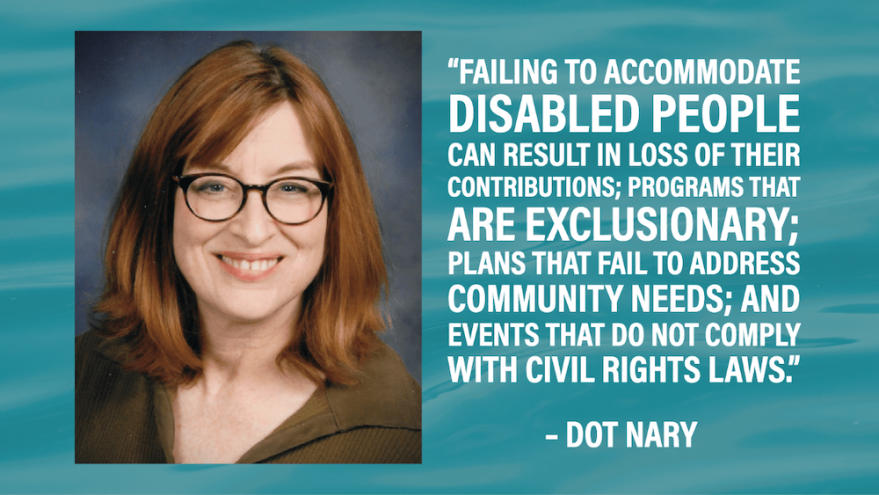
Dot Nary: Holding events that welcome all is an op-ed column from the Lawrence Times that addresses disenfranchised groups, such as people with disabilities and chronic conditions, whose needs for accommodation to participate at the tables are often overlooked, misunderstood or, worse, ignored. Read more.
Contributor
Chris Hampton
-
What is a public service announcement?
-
When should you consider using PSAs?
-
How do you write a PSA?
-
How do you produce a PSA?
-
How do you get your PSA on the air?
-
How can you tell if your PSA was effective?

"This is your brain. This is your brain on drugs. Any questions?"
"A mind is a terrible thing to waste."
"Friends don't let friends drive drunk."
"You could learn a lot from a dummy."
How many of these phrases ring a bell? These widely recognized slogans from national public service announcement campaigns by the Ad Council illustrate how memorable a short public-interest message can become.
While the examples above came from large national campaigns, your own organization's public service announcements (also known as PSAs) -- even if they're produced locally on a modest budget -- can be an effective and relatively inexpensive way to share a message with the public.
What is a public service announcement?
Public service announcements, or PSAs, are short public-interest messages distributed through radio, television, digital media, streaming platforms, social media, and other communication channels. For traditional broadcast use, PSAs may be provided as ready-to-air audio or video files, although some radio stations, especially community, public, or campus stations, may accept a script that an announcer can read on the air. PSAs can be produced simply, with one person delivering a message, or they can include music, interviews, animation, dramatic storytelling, graphics, and other audio or visual elements.
Broadcast radio and television stations licensed by the Federal Communications Commission (FCC) have responsibilities to operate in the public interest, but federal rules do not require stations to broadcast a particular number of PSAs or devote a fixed percentage of airtime to them. Whether a station accepts and airs a PSA generally depends on the station's policies, programming priorities, available time, and assessment of community needs. This makes it important to understand each outlet's requirements before submitting material.
Advantages of PSAs
- PSAs can be relatively inexpensive. If an outlet donates airtime or distribution, your main costs may be planning, production, and preparing the materials.
- Many outlets allow you to include a telephone number, website, text number, or other way for people to get more information or take action.
- PSAs can be effective at encouraging a clear action -- for example, attending an event, visiting a website, making an appointment, getting more information, or using a community service.
- PSAs can raise awareness of your issue, organization, program, or available resources.
Limitations of PSAs
- When PSAs depend on donated airtime or placement, you may have limited control over whether, when, or how often they are used. An outlet may have little available space or may schedule unpaid PSAs at times when fewer people are listening or watching.
- Competition among nonprofit organizations and public-interest campaigns for donated airtime or placement can be significant. You may not be able to count on receiving extensive exposure from unpaid PSA distribution alone.
- Some outlets may be reluctant to accept PSAs addressing issues involved in intense public debate, such as abortion policy, LGBTQ+ rights, gun policy, immigration, or other contested topics. Editorial and acceptance policies vary by outlet.
- Broadcast outlets may not provide detailed information about exactly when or how often an unpaid PSA was aired. Digital platforms may provide more audience and engagement data, depending on how the PSA is distributed.
- PSAs require planning and production, and they are rarely sufficient by themselves to produce major policy or community change. Consider them especially when you have a clear message or specific action you want people to take, and coordinate them with other communication and community-engagement activities.
When should you consider using PSAs?
Here are some guidelines for deciding when you might want to incorporate PSAs into your media campaign. Keep in mind that you don't necessarily have to meet all of these criteria -- this is simply a list of situations in which PSAs may be useful for your group:
- When your group is a nonprofit organization or is promoting a public-interest message
- When you have a specific announcement to make (for example, the time and place of a meeting or event).
- When you have a clear and easy-to-understand issue or message
- When you're requesting a specific and realistic action
- When you have identified outlets or communication channels that reach the people you hope to engage
- When you have access to the writing and production skills needed to produce a clear, credible message
- When you've previously used PSAs successfully or have reason to believe the format fits your audience
- When the PSA will be part of a larger communication or media campaign
How do you write a PSA?
Decide upon and clarify the purpose of your PSA. What are your goals here? What do you want to accomplish by distributing or airing a PSA? And, for that matter, why use a PSA instead of another communication method?
- Identify your intended audience. Who are you hoping to reach through your PSA? What do you know about their needs, priorities, communication preferences, and relationship to the issue? Whenever possible, learn this directly rather than relying on demographic assumptions.
- Identify the media outlets and communication channels that can best reach that audience. Consider traditional broadcast outlets as well as digital and community-based channels available in your geographic area or to the community you want to reach.
- Prioritize your media outlets. Find out where your intended audience actually gets information. A community may rely on local radio, television, social media, streaming audio, community newsletters, faith-based communication networks, or a combination of channels. Let evidence and community input guide your choices rather than assumptions about what a particular group prefers.
Also consider when and how your audience uses those channels. Some people may listen to radio during a morning commute, while others are more likely to encounter your message through streaming audio, social media, or evening television. You may have limited control over when an unpaid broadcast PSA runs, so focus on selecting appropriate outlets and maintaining professional communication with media contacts rather than depending on a specific time slot.
Approach your preferred media outlets. You will want to make a personal contact, when possible, with the person responsible for accepting or scheduling PSAs. Check the outlet's website or contact the organization to find out its requirements -- what formats it accepts, preferred length, submission process, deadlines, eligibility requirements, and other guidelines. See "How do you get your PSA on the air?" later in this section for more detailed information.
Write your PSA. The actual writing waits until this point because you first need to understand your audience, your communication channels, and their policies.
Key points to remember about the writing:
- Because you've only got a few seconds to reach your audience -- often 30 seconds or less -- the language should be simple and vivid. Take your time and make every word count. Make your message crystal clear.
- The message should have a clear "hook" -- an opening, image, question, statement, or sound that earns attention without misleading, frightening, or stigmatizing people. For example, a PSA about emergency preparedness might begin, "If severe weather reached your neighborhood tonight, would your household know what to do?"
- The PSA should usually request a specific action, such as visiting a website, attending an event, calling a number, making an appointment, or learning more. You ordinarily want listeners or viewers to know what they can do after encountering the PSA.
Getting ready to write your PSA:
Choose points to focus on. Don't overload the viewer or listener with too many different messages. List all the possible messages you'd like people to remember, and then decide on the one or two most important points. For example, if your group educates people about asthma, you might focus on recognizing common triggers and knowing where to find reliable information and support.
Brainstorm. This is also a good time to look at PSAs that others have produced for ideas. Get together with your colleagues to discuss ways you can illustrate the main point or points you've chosen. Whenever possible, include members of your intended audience as genuine partners in developing the message. For example, if your PSA is intended for Black youth, involve Black youth in deciding how the issue should be discussed, what matters to them, and what communication approaches feel authentic rather than assuming what will appeal to them.
Check your facts. It's extremely important for your PSA to be accurate. Any facts should be checked and verified before the PSA is distributed. Is the information current? Are statistics represented accurately and in context? If there are demonstrations included in the PSA, are they done clearly, safely, and correctly?
Identify a "hook". A hook is whatever you use to earn the listener's or viewer's attention. It can be humor, music, a compelling question, a surprising but accurate fact, a brief story, or an emotional appeal. Make sure the hook fits the audience and issue without relying on stereotypes. For example, don't assume that people will prefer a certain kind of music because of their ethnicity or cultural background; ask members of the intended audience what feels relevant and appropriate.
Now you're ready to write your script!
Basic guidelines for PSA format:
Many broadcast PSAs are produced in standard lengths such as 10, 15, 20, or 30 seconds, although requirements vary by outlet and platform. Before writing or producing your final version, check the exact length and technical specifications required by the outlet. Leave enough room for the message to be delivered clearly without rushing.
Length of PSA 10 seconds 15 seconds 20 seconds 30 seconds Approximate number of words 20-25 words 30-35 words 40-50 words 60-75 words
Prepare your script in a clear, readable digital format and follow the outlet's submission requirements. Some outlets may provide their own template or specifications.
Keep each version clearly labeled by length and format so that the outlet can easily identify the correct file or script.
The top of the script or accompanying submission information should generally identify:
- how long the PSA should be used, including relevant start or end dates if the message is time-sensitive
- length of the PSA
- what agency or group the PSA is for, and
- title of the PSA.
For video PSAs, a script or production document may separate visual directions from dialogue or narration. A storyboard or shot list can also be useful for showing how images, text, sound, and spoken language work together.
Avoid unnecessary abbreviations or other wording that could be confusing when read aloud. Include pronunciation guidance when names, places, or unfamiliar terms may be difficult to pronounce.
Follow the outlet's current conventions for indicating the end of a script or submission. Traditional media scripts sometimes use "###" to indicate that no additional material follows.
Your script can be sent as "live copy" -- a simple script ready to be read by an on-air announcer -- or as a prerecorded audio or video file. Requirements vary considerably by outlet, so find out what format is accepted before producing or submitting the PSA.
Below is an adapted example of a short live-copy PSA script for radio:
Sample radio PSA script -- live copy
Use: As scheduled
Time: 20 seconds
Agency: Community Health Coalition
Title: "Know Your Resources"Main Point: Everyone deserves access to reliable health information and support. Learn what resources are available in your community, ask questions, and share accurate information with the people you care about. Contact your local community health organization to learn more.
###
If you can get help from someone with radio, television, digital media, communications, or production experience, this is a good time to do so. They can review your work and offer suggestions. Because PSAs are short, a knowledgeable reviewer may be able to identify problems quickly.
Pretesting your script is always a good idea. Ask people from the intended audience to watch, listen to, or read the PSA and give candid feedback. Ask what they think the message means, what caught their attention, whether anything was confusing or alienating, and what action they would take after seeing or hearing it. Depending on the issue, you may also want feedback from people with subject-matter expertise or relevant lived experience. The process doesn't have to be large or highly formal. Even modest pretesting can reveal problems before the PSA is widely distributed.
Now you have a script that's ready to go! If you're only preparing live-copy scripts, you can skip the next part ("How do you produce a PSA?") and go directly on to "How do you get your PSA on the air?" If you're going to create a prerecorded audio or video file, read on!
How do you produce a PSA?
If you're planning on sending in a prerecorded PSA, decide whether you can produce it effectively yourself or whether outside help would improve the result. Affordable recording equipment, smartphones, and editing software have made basic production much more accessible, but the final product should still be clear, understandable, accurate, and technically appropriate for the platform where it will appear. Poor audio, unreadable text, distracting visuals, or inaccessible design can interfere with even a strong message.
You may be able to produce a strong PSA without paying a professional production company. Find out whether anyone in your group has broadcasting, video, audio, design, or digital-media experience. You can also approach area production companies, advertising or communications firms, community media organizations, and universities to see whether they can provide expertise, equipment, studio time, or other assistance. Students studying communications, film, journalism, design, or broadcasting may also be interested in gaining relevant experience.
If your resources allow, you can hire a professional producer, production company, communications consultant, or advertising agency. Some may offer reduced rates or donated services to nonprofit and community organizations, so ask about that possibility.
Tips for radio and audio:
- A professional announcer can help, but isn't essential. Community radio volunteers, voice performers, storytellers, organizational staff, or community members with relevant experience may all be effective. Choose voices that fit the message authentically rather than assuming people will respond best to someone simply because they appear to share a particular age or background.
- Audio audiences may be driving, working, exercising, studying, cleaning, or doing other activities while listening. Make the main point easy to follow even when people aren't giving the message their full attention.
- Use a clear opening that quickly establishes relevance. For example: "Do you know where your family would go during a severe-weather emergency? Make a plan before you need one."
Tips for television and video:
- Plan what viewers will see as well as what they will hear. Create a script, shot list, or storyboard that connects dialogue, narration, on-screen text, images, and other visual elements.
- Community theater groups, media programs, local colleges and universities, community organizations, and people with relevant lived experience may be useful sources of performers or collaborators. Make sure participants understand how the finished PSA will be used and have agreed to participate.
- Simple graphic-and-voiceover spots can be inexpensive and effective. Photographs, illustrations, captions, on-screen text, and basic motion graphics can communicate a message without requiring elaborate production.
- If you're producing a video spot yourself, create a storyboard or shot list before filming. A storyboard shows sketches or examples of individual shots and can help the production team determine how the piece will flow and what images, camera angles, text, and staging will be needed.
- Use effects only when they strengthen the message. Complicated visual or audio effects can add cost and distract from the information you want people to remember.
Local community media organizations, public-access television stations, libraries, schools, universities, or nonprofit media programs may be able to provide production facilities, training, equipment, or technical assistance. Digital production tools have also made it possible for organizations to create useful audio and video messages with relatively modest equipment.
Some local television, cable, community media, and digital outlets also offer community calendars, event listings, brief announcements, or other public-information formats. These may be good alternatives when a full PSA isn't necessary. Check with the outlet for current requirements.
Overall tips
If resources allow, consider producing more than one version so that audiences don't encounter exactly the same message repeatedly. You might vary the opening, examples, length, format, language, or messenger while keeping the core message consistent. Keep each PSA brief and focused on what you want the viewer or listener to understand or do. Invite performers, community partners, and people with relevant lived experience to give feedback on the script and production. Make sure captions, readable text, clear audio, transcripts, language access, and other accessibility considerations are addressed when appropriate. When information changes -- especially health, safety, legal, or service information -- update the PSA promptly and ask outlets to stop using outdated versions. Talk with everyone involved in production about payment, credit, consent, and use of their work, and put important agreements in writing before production begins.
How do you get your PSA on the air?
Different stations and media outlets have different policies for PSAs. Some accept scripts for announcers to read, while others want a fully produced audio or video file. Digital outlets may use their own submission systems or technical specifications. Find out ahead of time what each outlet requires -- never assume that one outlet's guidelines apply to another. Requirements may include file format, length, advance notice, eligibility, contact information, captioning, image dimensions, or documentation about your organization.
Radio
Radio can be an effective outlet for PSAs, particularly when a station's audience overlaps with the people you hope to reach. Once you're familiar with submission requirements, send your PSA according to the station's guidelines. This may include a brief email or cover message along with the script, audio files, background information, and any specific instructions the station requests.
Even if you've already spoken with your contact, include a clear written message with your submission. Mention relevant previous conversations, identify the files or materials you're providing, and include contact information in case the station has questions. Keep the message brief, professional, and appreciative.
PSA Submission Message
Anytown Teen Pregnancy Prevention Coalition
789 Walnut Drive, Suite 88 * Anytown, PA 12345 * (215) 555-5678[Date]
Mai-Lin Huang
Public Affairs Director
KPSA Radio
1234 Broadcast Lane
Anytown, PA 12345Dear Ms. Huang:
Thank you for explaining KPSA's policies and requirements for public service announcements. As discussed, I am submitting several ready-to-air PSAs for our adolescent parent support and education program:
- Five 10-second spots
- Three 15-second spots
- Three 30-second spots
- Two 60-second spots
The files are labeled by length, and copies of the scripts are included for reference. Please let me know if you need another format or any additional information.
Thank you again for your assistance and for considering these messages for KPSA's audience.
Sincerely,
Alicia Rodriguez
DirectorAnytown Teen Pregnancy Prevention Coalition
Attachments:
- PSA audio files
- PSA scripts
- Organization information, if requested
Keep copies of everything you submit and retain the final versions of all scripts and media files. If appropriate, follow up after a reasonable period according to the outlet's preferred communication method. Avoid repeated contact if the outlet has already declined the PSA or asked not to receive further follow-up.
Television
Getting an unpaid PSA shown on television can be competitive. Start by finding out who is responsible for public service announcements or community-affairs programming and what the station's current submission process requires. Depending on the station, the appropriate contact might work in community affairs, public affairs, programming, traffic, promotions, or another department.
Once you know the appropriate contact, follow the station's preferred submission process. That might involve email, an online portal, file transfer, or a conversation with station staff. Be prepared to provide a broadcast-ready copy of the PSA, the script or transcript, information about your organization or initiative, and documentation of nonprofit status if the station requests it.
Explain briefly how the PSA serves the community, who it is intended to reach, and what action or information it provides. You can also explain how the PSA fits into your broader communication campaign. Be gracious and professional, while recognizing that the station will make its own decisions about whether and when to air the message.
Once you've gotten approval for your PSA
After a radio or television station agrees to run your PSA, ask what information the station can provide about its expected schedule or placement. The person who approved the PSA may not be the same person who schedules it, and unpaid placements may change depending on programming needs.
If possible, listen to or watch for the PSA and check that the correct version is being used. Follow up with a brief thank-you message when appropriate. Maintaining a professional relationship can be useful for future community-information efforts.
Keep in mind that an unpaid PSA may not run exactly when originally expected. Broadcast schedules and programming needs can change.
How can you tell if your PSA was effective?
The best way to judge effectiveness is to connect the PSA with a specific, measurable objective. For example, if you're asking listeners to call a number, visit a webpage, send a text, scan a QR code, register for a service, or request information, you can compare activity before, during, and after the campaign. When possible, use a unique phone extension, web address, response code, or other tracking method so you can distinguish responses connected with the PSA from those generated by other outreach.
If you're promoting attendance at an event, you can measure attendance and ask participants how they heard about the event. If your goal is awareness rather than immediate action, surveys, interviews, website traffic, social-media engagement, or other feedback may help you understand whether people saw, heard, remembered, or understood the message.
Once the PSA is being distributed, you may also be able to use it to generate broader media attention, such as a news story about your work, an interview, a community discussion, or another opportunity to explain the issue in more depth. In this way, one communication effort can help create opportunities for additional outreach.
Finally, as noted before, pre-testing should help you figure out how effective a PSA may or may not be. Evaluation after release can then help you improve future messages and choose the communication approaches that work best for the communities you hope to reach.
Contributor
Chris Hampton
Resources
Online Resource
Family Health Institute (1997). Behavior change through mass communication.
How to Use Public Service Announcements, prepared by aspencsg.org.
How to Write a Public Service Announcement that is Worth Airing, Worth Hearing and Worth Writing, by Kansas Association of Broadcasters, contains helpful examples and is written in a friendly, conversational tone.
Tips for Creating a Public Service Announcement, by preventionlinks.org, includes information on graphics, and on how to make a storyboard.
Print Resources
Center for Substance Abuse Prevention (1993). You can increase your media coverage. In Technical assistance bulletin. Rockville, MD: National Clearinghouse for Alcohol and Drug Information.
Duncan, C., Rivlin, D., & Williams, M. (1990). An advocate's guide to the media. Washington, DC: Children's Defense Fund.
League of Women Voters of the U.S. (1978). Breaking into broadcasting. Washington, DC: League of Women Voters of the U.S.
New York State Department of Health. (1997). Writing public service announcements.
Pertschuk, M. & Wilbur, P. (1991). Media advocacy: Reframing public debate. Washington, DC: Benton Foundation.
___You have considered whether PSA's may be a good idea for your group and you meet some or all of the criteria for a group to use PSA's.
___You have decided upon and clarified the purpose of your PSA.
___You have targeted your audience.
___You have surveyed your media outlets to best reach that audience.
___You have prioritized your media outlets.
___You have approached your preferred media outlets.
___You have chosen points to focus on.
___You have brainstormed for ideas for the PSA.
___You have checked your facts.
___You have identified a "hook".
___You have written your PSA, following the basic guidelines for PSA format.
___You have gotten an outside professional or somebody who has radio/television experience to review your work for you and offer suggestions, if possible.
___You have pre-tested your script.
___If you're going to send in a produced PSA, you have decided whether you should produce it yourself or bring in outside help.
If you're producing the PSA yourself:
___You have found out if anyone in your group has broadcasting experience.
___You have approached area advertising agencies and production companies to see if any of them would donate personnel, studio time, or equipment for your PSA.
___You have considered tapping into broadcasting students at any area universities.
If you're paying a professional production or advertising company to produce your script:
___You have asked about getting a reduced rate for nonprofit agencies.
___You understand the basic tips for radio production.
___You understand the basic tips for television production.
___You understand the overall tips for PSA production.
___You understand how to get your PSA run.
___You have found out the day and time that your PSA will start playing.
___You have listened to or watched the station for the first airing to make sure your PSA is shown (and that it is shown correctly).
___You have followed up by sending a thank you note and, if you can, some small token of your gratitude.
___You understand that the best way to judge effectiveness is to request a specific action, and then to monitor the actions taken
___You have tried to use the PSA to get more extensive media coverage, such as a media story on your work, or being a guest on a panel show, or possibly being able to do a radio editorial or getting editorial reply time.
Contributor
Chris Hampton
Example #1: "Sample radio PSA script" script to be fully produced
Use: IMMEDIATE: TFN
Time: 30 seconds
Agency: Chicago AIDS Action Force
Title: "Friends"
Main Point: Heterosexual women should practice safer sex.
Sound Effects:
Busy coffee shop sounds (cups clinking, lively conversation, etc.), then you hear two chairs being moved and cups being set on the table. Fade background sounds a bit and:
Dialogue:
Woman #1 sighs and says:
Woman #1: Thanks for coming, Lisa. I didn't know who else to talk to.
Woman #2: Don't sweat it -- what's going on? You look like you've been crying.
Woman #1 pauses and then says in a lowered voice:
Woman #1: I just found out that Antony died last month -- of AIDS.
Woman #2, shocked
Woman #2: Oh my God -- Antony your old boyfriend??
(pause)
Woman #1: Yeah -- that Antony.
Woman #2, concerned:
Woman #2: Are you -- are you okay?
Woman #1: Well -- I'm not HIV positive. I always used a condom, and I got tested as soon as I found out.
Woman #2 lets out an exhalation of relief and says:
Woman #2: Oh, girl, I can't tell you how relieved I am to hear that.
Woman #1: I was relieved too. It's just still such a shock.
Woman #2: Need to talk about it?
Woman #1: Yeah. Yeah I do. Thanks.
Announcer voiceover
Announcer: Two out of every three new HIV cases among women are from heterosexual contact. Protect yourself. Call 1-800-342-AIDS for more information about safer sex and HIV.
Cue coffee shop sounds up briefly while showing slide with AIDS info number, then fade audio and video out.
###
Example #2: Sample television PSA script
Use: IMMEDIATE: TFN
Time: 30 seconds
Agency: Kansas City Immunize Now
Title: "Uncle Keenon"
Main Point: Infants should be immunized -- talk to your doctor about it.
Camera Description: Scene opens with Woman #1 and Man #1 sitting by a playground. Camera shows children playing, then moves over to the two adults sitting together on a park bench watching them. Sound of children's laughter in background.
Dialogue:
Woman #1 turns to Man #1, smiles, and speaks...
Woman #1: Just think, Keenon -- you and Tasha have this to look forward to before you know it!
Man #1 shakes his head and speaks...
Man #1: Yeah -- I can't believe we're going to be parents! It's great, but there's so much to worry about. I think about Rachel and Danny's little girl and how sick she's been...
Woman #1 looks sad and says to Man #2...
Woman #1: I know, it's been so sad seeing how much trouble they've had -- it's too bad they never had her immunized.
Man #1 looks surprised and says:
Man #1: But she's only a year old! I never even thought about immunization -- when are you supposed to get that done?
Woman #1 looks back at the kids and says...
Woman #1: Well, the first shots are done when the baby is about 2 months old -- then you have to go back 4 or 5 more times before the kid starts school. It's important to get them all done to be completely protected. If Rachel and Danny had only done that, their baby might not have had so many health problems.
Man #1 looks worried and says:
Man #1: Oh, man, I had no idea. I really need to find out more about all this stuff!
Woman #1 puts her hand on his arm and says:
Woman #1: It's okay. Your doctor or nurse will tell you when you need to come back
A little girl comes running from the playground and climbs into the man's lap.
Woman #1 smiles, tousles the child's hair, and says:
Woman #1: You and Tasha are already a great aunt and uncle, you know. Don't worry. You'll be wonderful parents.
Man #1 smiles at his niece and then looks at Woman #1 and says:
Man #1: Thanks, sis. Tasha has a checkup tomorrow, so we'll talk to the doctor then and find out more.
Fade to black, leaving only the sound of children playing under the voiceover, with the logo and phone number of your child immunization coalition shown onscreen.
Voiceover: Immunization for your kids. Talk to your doctor about it today.
###
Example #3: Gloucester at the Helm
Here's an example of how PSA's have been used by a prevention coalition in one medium-sized coastal fishing community (Gloucester, Massachusetts). In the example, note the use of local opinion leaders and role models, and also the use of community-based scenes of daily life, that viewers could easily relate to. Note too how non-traditional media outlets (in this case, movie theaters) can be used creatively to get the message across, as well as the use of multiple outlets for the same basic message.
"We've done about 20 public service announcements over 5 years, they've all been home made, shot in Gloucester, with Gloucester people. TV PSA's, on Gloucester cable. We've never used an actor. So inside the message is the fact that ordinary citizens are involved.
"So for example, we had a community conference on prevention, called "Gloucester at the Helm." We shot 3 public service announcements that were 28 seconds apiece. And what we did was we identified a number of community icons, matriarchs, patriarchs, and very well known people, and they're all in the film. So we have the matriarch of the Fishermen's Wives Association who is on the phone with one of the most well known fishermen in the community, who is also on the phone with a young person, who is on the phone with a well-known parent activist -- and they were all talking to each other.
"The fishermen were going to donate fish, the Sicilian Sons of Italy were going to bring traditional Italian food, the baker was going to donate the bread, and you really don't know what they're talking about until the very end, when they say, "I'll see you at the conference -- Gloucester at the Helm? Well, it was just so like Gloucester --that's what people do.
"We're also shooting another PSA, and we're transferring it to film, so it's going to be shown at a local theater where more parents go than anyplace else. The scene will be a mother and a daughter in a car, with a tremendous amount of silence between the two, a tremendous amount of tension -- you're going to know visually that something has happened of major importance between these two people. And it will end with a print message, "Prevention is communication: Please care enough to try."
"This image is also going to be on a billboard that a company is donating to us for a couple of months. It's also going to be on posters, book covers, and note cards. It will be interesting to see how all this works, but it is based on what we've been hearing for a long time."
Thanks to Phil Salzman, former Director of the Gloucester Prevention Network, for the example above.
Example #4: HIV: Un-Infected Does Not Equal Un-Affected
HIV: Un-Infected Does Not Equal Un-Affected is a series of eight 30-second AIDS prevention PSA's which focus on the unique emotional and psychological stresses facing HIV-negative gay men in coping with the epidemic. The series was independently produced for broadcast in San Francisco by San Francisco filmmaker David Weissman, with support from The Nathan Cummings Foundation, the San Francisco AIDS Foundation, the San Francisco Department of Public Health, the STOP AIDS Project, and the University of California at San Francisco AIDS Health Project.
Each PSA features a single character speaking directly to the camera about why it's important to stay uninfected. These spots are great examples of how good television PSA's don't have to be big-budget productions; instead, strong writing and acting are used to simply and effectively convey the message.
Example #5: GLAAD's Day of Compassion PSA's
Day of Compassion is an annual project of the Gay & Lesbian Alliance Against Defamation (GLAAD) and is co-sponsored by Until There's a Cure Foundation, the Names Project Foundation and Cable Positive, the cable industry's AIDS action organization. Every year since Day of Compassion began in 1993, network and cable television, print media, Internet providers and radio stations air special programming specifically geared toward educating and raising awareness about those living with HIV and AIDS, those working on research and advocacy fronts, and friends and families who have been touched by the disease.
Contributor
Chris Hampton
-
What is a press conference?
-
Why should you hold a press conference?
-
When should you hold a press conference?
-
How do you hold a press conference?
Holding a press conference can be an effective way to communicate timely, important information to multiple media outlets at once. A successful press conference can generate news about your issue or initiative, give journalists direct access to knowledgeable speakers, and increase public awareness. This section looks at the elements of planning a successful press conference, when to hold one, and how best to communicate with the media and the public.
What is a press conference?
You and your group members have probably seen press conferences on television, online, or through livestreams before or after a major local or national event. A speaker or group of speakers makes an announcement, provides information, and then responds to questions from reporters. So, you may already know what press conferences look like in general.
But what exactly is a press conference? A press conference is an organized media event designed to provide timely, newsworthy information and give journalists an opportunity to ask questions directly. It is especially useful when an announcement is significant, current, relevant to the public, and likely to interest several media outlets.
Imagine reporters from several media outlets coming to an event that you have organized, or joining it remotely. This can be exciting and can provide an important opportunity for your organization. If you've never done it before, holding a press conference can also feel intimidating. But the material in this section will guide you through the process and help you prepare.
Why should you hold a press conference?
Press releases, interviews, statements, and ongoing media relationships are excellent ways of communicating information. They are the bread and butter of media relations and often of a larger outreach effort. A press conference is an additional technique for occasions when several reporters may have questions or when the announcement benefits from being made publicly and interactively. More specifically, why hold a press conference? Because:
- You can provide more information and context than may fit in a press release.
- A press conference is interactive; you can answer questions from reporters, clarify information, and address points that may need additional explanation.
- You can announce an important development and explain its local and wider implications.
- You can correct significant inaccuracies or provide additional context if your group or issue has received misleading or incomplete coverage.
- You may generate earned media coverage across television, radio, newspapers, websites, newsletters, streaming platforms, social media, and other outlets without purchasing advertising.
- You can make several knowledgeable speakers, partners, or community representatives available to reporters at the same time, helping journalists gather information efficiently.
- A successful press conference can generate news and can also help your group recognize that its work and perspective are contributing to a broader public conversation.
When should you hold a press conference?
You and your organization could hold a press conference when there is important, timely information that several media outlets and members of the public may reasonably want to know about. In some cases, you may need to respond to fast-breaking news. For example, if an education funding bill were introduced in the state legislature, you might want to convene a press conference that same day to explain the bill's implications. In such cases, you may have little time for elaborate preparations, so accurate information, clearly identified speakers, and rapid digital communication with reporters become especially important.
Remember, you don't want to hold a press conference too often. It is a special communication tool and should be used when the news warrants bringing reporters together. Here are some cases when a press conference might be a good idea:
- When the event includes a person whose role, expertise, experience, or connection to the issue is genuinely relevant and whom several reporters may want to question.
- When you have a significant announcement to make, such as the launch of a major initiative, an important policy development, or a meaningful community achievement.
- When there is an emergency or crisis centered around your group or the issues it deals with and the public needs timely, accurate information.
- When several organizations or community partners are participating in an effort and their combined perspectives help explain the significance or breadth of the issue.
- When you want to respond to a related event; for example, when a national report relevant to your issue is released.
How do you hold a press conference?
Before the press conference:
As we've discussed, you may sometimes have to schedule a press conference on short notice. If you do have lead time, however, you and your group will want to begin planning far enough in advance to organize speakers, information, logistics, accessibility, and media outreach. A week or two may be useful for a planned event, while breaking news may require a much shorter timeline. The following steps should help you plan for your press conference:
Define the message.
Define the key message or messages that you and your group are trying to communicate to the community. Your goal may be to introduce or shed more light on an issue, announce a new program or event, respond to a news development or criticism of your effort, correct misinformation, or draw attention to an important achievement. Whatever the message, summarize it in three to five clear key points. If a date, time, address, website, phone number, or other specific information is part of the message -- if the purpose of the press conference is to announce an upcoming event, for example -- make sure it is communicated clearly and displayed prominently in your press materials. Double- or triple-check all factual information before the press conference begins.
Schedule the date and time.
You and your group will need to determine a date and time for the press conference and consider competing events, newsroom deadlines, local time zones, reporter availability, and the urgency of your announcement. If possible, check relevant media calendars or ask reporters or assignment desks about major conflicts. Here are some other tips for scheduling your press conference:
- Weekday mornings or early afternoons may work well for many newsrooms, and Tuesday through Thursday are often useful starting points for planned events. However, there is no single best day for every outlet or community. Base your decision on the local news cycle and the reporters you are trying to reach.
- Schedule the event early enough that reporters have time to gather information, conduct follow-up interviews, edit material, and meet their publication or broadcast deadlines. For digital outlets, deadlines may be continuous rather than tied to a single daily edition or newscast.
- Remember, you are competing with all the other news of the day, and breaking events may change reporters' plans at the last minute. Don't assume low attendance means that your issue lacks importance.
Pick the site.
Make sure you pick a location for the press conference that reporters, speakers, and participants can reach safely and reasonably. Consider transportation, parking, public transit, physical accessibility, and whether remote participation or livestreaming should be available. A site connected to the issue -- such as the state capitol building, city courthouse, community center, clinic, school, or another relevant location -- can provide useful context and visual interest. Other considerations include background noise, lighting, reliable electrical power, internet access, space for cameras and microphones, and any permissions or security arrangements that may be needed.
Select and train your participants.
At this stage of your planning process, choose participants who can contribute useful knowledge, experience, or perspective. They should understand the issue, be able to communicate clearly, and be prepared for questions from reporters. Depending on the topic, effective spokespeople might include organizational leaders, public officials, subject-matter experts, community partners, or people with relevant lived experience. People directly affected by an issue can provide essential context, but their participation should be voluntary and informed. Make sure they understand the public nature of the event, how their comments and images may be used, and any potential privacy or personal consequences of participating.
Here are a few tips for participants:
- Be clear and concise -- avoid unnecessary jargon, exaggerated rhetoric, or inflammatory language. Speak naturally rather than trying to eliminate every pause or hesitation.
- Assume the audience is intelligent -- explain unfamiliar information without sounding patronizing.
- Minimize distracting movements or objects when speaking, but focus more on communicating comfortably and authentically than on appearing perfectly polished.
- Present yourself in a way that is appropriate to the setting and comfortable for you.
- Always tell the truth. If you don't know the answer to a question, say so and offer to provide accurate information afterward when possible. Don't exaggerate, present unsupported figures, state opinions as facts, or make accusations you cannot substantiate.
In addition to the press conference participants, identify a moderator who understands the issue and can manage the event. They will convene the press conference, introduce the issue and participants, explain how questions will be handled, and direct questions to the appropriate speakers. The moderator should also be prepared to keep the discussion orderly and make sure reporters have a reasonable opportunity to ask questions.
If you and your group are new at this, you may want to watch or attend other press conferences to get a feeling for how they work. Even if you are experienced, a rehearsal can be useful. Speakers should prepare concise talking points covering the three to five key messages rather than trying to memorize a script word for word. Keep opening remarks brief enough to leave meaningful time for questions. During rehearsal, practice responding to difficult, skeptical, unexpected, or emotionally charged questions and identify which participant should respond to different topics.
For example, a suitable response to a question that falls outside the event's subject might be, "That's an important question, but it is outside the focus of today's announcement. Our focus today is on..." If the question is relevant but you don't know the answer, it's okay to call on another participant who may know, or tell the reporter that you will verify the information and follow up later.
Contact the media.
The first step in contacting the media is to create and maintain a current list of reporters, editors, producers, assignment desks, radio and television newsrooms, newspapers, digital news outlets, community publications, newsletters, and other media that cover your issue or community. Include reporters you have worked with before and journalists who have recently covered related topics. Focus on relevance rather than sending the same invitation indiscriminately to every outlet.
If your organization has worked with the media before, you may already have professional relationships with reporters and editors. If you haven't made those contacts, this is a good time to begin. Journalists are people doing demanding work on deadlines. If you can make human contact with those folks, provide accurate information, respond promptly, and make their work easier, you can build a relationship based on trust and usefulness.
You will also want to prepare a media advisory and distribute it far enough in advance to give reporters a reasonable opportunity to plan. For a scheduled press conference, this may be several days to a week in advance, depending on the outlet and event. For breaking news, much less notice may be possible. A media advisory should make the basics easy to find: what is happening, why it matters, who will speak, when and where it will take place, whether remote or livestream access is available, and whom reporters should contact with questions. For an example of a press advisory, see the Tools section.
Follow up with the media.
After distributing your media advisory, follow up selectively with the reporters or outlets most relevant to the story. Email, phone, or another method may be appropriate depending on the journalist's stated preferences. A brief reminder the day before or morning of the event may be useful, particularly when important details have changed. Avoid repeated follow-ups that add no new information or pressure reporters who have already declined.
Develop a press kit.
A press kit provides reporters with the information and materials they may need to understand and cover your issue or program. Today, press kits are often digital and may be shared through an online newsroom, webpage, cloud folder, email, or QR code, although printed copies may still be useful in some settings. Your press kit should contain relevant materials such as:
- A list of press conference participants, including their roles and relevant affiliations.
- A press release or written statement summarizing the announcement, key facts, your group's position when relevant, and useful quotations from participants (for more, see Preparing Press Releases).
- Background information about the issue, such as relevant statistics, historical background, program information, reports, or links to credible sources.
- High-quality photographs, graphics, charts, logos, or video that reporters have permission to use, along with appropriate captions, credits, and accessibility information.
- Short biographies or background information about participants when relevant.
- Links to relevant news coverage, reports, research, official documents, or other credible background sources that help reporters understand the issue.
Putting the kit together: Organize the materials so reporters can quickly find the most important information. For a digital press kit, use clear file names and a simple folder or webpage structure, place the press release or main statement prominently, and make sure links and downloadable files work before distributing them. If you provide printed materials, arrange them in the same clear order.
Prepare the room.
There are a number of things you can do to prepare the room you're holding the press conference in. Here are some tips:
- Check electrical outlets, internet access, microphones, speakers, lighting, livestream equipment, and any other technology you plan to use.
- Arrange the room so that all speakers can be seen and heard clearly, and use name cards or on-screen identifiers where helpful.
- Provide enough accessible seating and working space for reporters and their equipment, including cameras, microphones, laptops, and tripods.
- Display useful visuals as a backdrop or nearby -- such as charts, maps, posters, or organizational identification -- without making the setting unnecessarily promotional or distracting.
- Have a sign-in option for reporters who choose to provide their name, outlet, and contact information, while avoiding the collection of unnecessary personal information.
- Provide a podium, table, or other speaking setup if useful, and make sure microphones and sight lines work for all speakers.
- Provide water and, when appropriate, simple refreshments for speakers and attendees.
At the Press Conference:
When the big day finally arrives, there are a number of things you and your group can do to help your press conference run as smoothly as possible. We will go through these, step by step:
- Welcome members of the press as they arrive or join remotely and help them find the information, access, or technical support they need.
- Offer reporters access to the press kit and, when useful, invite them to provide their affiliation and contact information for follow-up materials.
- Position press conference participants so that they can be seen and heard clearly by reporters attending in person and, if applicable, by people joining or watching remotely.
- Note which media outlets are represented so you know whom to provide follow-up information to afterward. You may also want to make brief personal contact with reporters before or after the press conference when appropriate.
- Start approximately on time -- no later than a few minutes after the scheduled time unless circumstances require a delay.
- Record or livestream the event when useful, and let participants know how the recording will be used. Make transcripts, captions, or other accessible versions available when possible.
- Have the moderator welcome the press and introduce the issue, participants, and basic format for questions.
- Keep each participant's opening remarks brief and focused on the most important information, generally no more than a few minutes, so that reporters have adequate time to ask questions.
- After the presentations, the moderator should invite questions from the press and direct them to the appropriate participants. If remote reporters are participating, establish a clear way for them to submit or ask questions as well.
- Bring the formal conference to an end once the main questions have been addressed, rather than extending the event simply to fill a predetermined amount of time. Thank the participants and media for attending, and let reporters know whether speakers will remain available for brief follow-up interviews.
After the Press Conference
To the extent that you can, be available to reporters who need clarification, additional documents, quotations, photographs, or follow-up interviews. Building strong media relationships is less about making a personal impression than about being accurate, responsive, transparent, and useful. When journalists know that your organization provides dependable information and respects their work, they are more likely to contact you when they cover your issue in the future.
Review which relevant media outlets were not represented. Not everyone who intended to attend will be able to do so, particularly when breaking news changes newsroom priorities. You may want to email those reporters the press release and digital press kit, provide a recording or transcript of the event, or offer an interview with an appropriate press conference participant.
You might also review the press conference with others from your organization who attended. What went well? What could you have done better? Did reporters receive the information they needed? Were speakers prepared? Was the event accessible to the people you hoped to reach? How accurate was the resulting coverage? Use what you learn to improve the next press conference you hold.
Contributor
Eric Wadud
Resources
Online Resources
How to Hold a Press Conference, from the Western Organization of Resource Councils, is a comprehensive guide to help you prepare for a press conference. It includes 10 steps for a successful press conference as well as other related checklists (e.g., setting up a press conference).
Print Resources
Center for Community Change. (1996) How to tell and sell your story, Washington, DC.
League of Women Voters of the United States (1997) Getting into print. Washington, DC: League of Women Voters.
Martinez, B.F. (1979). Guide to public relations for nonprofit organizations and public agencies. The Grantsmanship Center. Los Angeles, CA.
Taplin, S. (1993) Holding press conferences: Why, when, and how. Palo Alto, CA: Stanford University School of Medicine, Health Promotion Resource Center.
Wallack, L.(1993) Media advocacy and public health. Newbury Park, CA: Sage
___You understand that a press conference is a tool designed to generate news -- in particular, hard news that can advance the cause of your organization.
You understand the following reasons you might want to hold a press conference:
___You can give more information than in a press release.
___At a press conference, you can answer questions the press may have.
___You can announce something unprecedented, which has significant local implications.
___You can set the record straight if your group received negative publicity.
___When many media representatives are present, it makes your conference seem really newsworthy.
___A successful media conference can not only generate news, but can also boost the morale of your own group.
You understand that you might want to call a press conference in the following cases:
___When the event includes a prominent individual to whom the media should have access.
___When you have significant announcements to make, such as opening a campaign or reporting a lobbying victory.
___When there is an emergency or crisis centered around your group or the issues it deals with.
___When a number of groups are participating in an action, and the show of support will emphasize that this action is news.
___When you want to react to a related event; for example, a national report relevant to your own issue is released.
Before the press conference, you have:
___Started planning at least a week or two before the press conference is to take place.
Planning steps -- you have:
___Defined the issue and key messages that you and your group are trying to get out to the community.
___Determined a date and time for the press conference, and made sure it doesn't conflict with other press events or media deadlines.
___Followed other tips for press conferences, such as scheduling the conference for a slower news day, scheduled your press conference is between 10:00 a.m. and 11:00 a.m.
___Picked a location for the press conference that has adequate parking, is not too far away for reporters to travel, and provides visual interest and relationship to each topic.
___Selected and trained participants who will be knowledgeable and articulate about the issue, who have high credibility, and, if possible, people from the community affected by the issue.
___Found a moderator who is experienced with the press and the issue. He or she will be in charge of convening the press conference by introducing the issue and participants. The moderator also answers questions or directs them to the appropriate participants.
___Attended at least one other press conference to get a feeling for what they are like.
___Conducted a dress rehearsal.
___Created a comprehensive mailing list of assignment editors at television stations, news directors at radio stations, and at major newspapers, and editors at weekly newspapers.
___Had a press advisory prepared and mailed about one week ahead of time to inform the media about the press conference.
___Followed up your press advisory after three days with phone contact to the major media outlets.
___Followed up a second time the morning of the press conference.
___Developed a press kit, if your group can afford it; or, if a press kit is beyond your budget, a press advisory.
___Checked the location of electrical outlets for microphones and lights in the room where the press conference will be held.
___Set up a table long enough to seat all your spokespeople, with name cards.
___Provided enough seating in the room for reporters and their supporting equipment.
___Displayed visuals as a backdrop to your speaker's table: charts, posters, etc.
___Set up a sign-in pad for attendance.
___Provided a podium for the moderator.
___Had coffee, tea, and water set up for the press conference.
Your press kit contains the following:
___A list of press conference participants.
___A press release, which should state your group's position on the issue, highlights the press conference, and a few quotes from participants.
___Background information about the issue.
___A few black & white glossy photographs.
___Short biographies of participants.
___Related news stories from prestigious national publications.
At the press conference:
___Welcome members of the press as they arrive.
___Have members of the press sign in, with their affiliation, and give each of them a press kit.
___Seat the press conference participants behind the table facing the seated reporters.
___Check the sign in pad to see which media outlets are represented. You may also want to make personal contact with major media representatives before or after the press conference.
___Start approximately on time--no later than 5 minutes after the scheduled time.
___Record the event, for your own records, and for possible media use.
___Have the moderator welcome the press, and introduce the issue and participants.
___Each participant should present for no more than 3-5 minutes, making his/her 3-5 key points.
___After all the presentations, the moderator should entertain any questions from the press, and direct questions to the appropriate participants.
___After about 45 minutes, bring the formal conference to an end. Thank the participants for presenting, and the media for attending.
After the press conference:
___You understand that not everyone may arrive, as your conference may be preempted by some late breaking news story elsewhere.
___You may want to hand deliver a press release and press packet to these people, send a recording, or, try to schedule an interview with a reporter and one of the press conference participants.
Sample Press Advisory
Community Task Force on Homes for Children
2170 Pacific Ave.
San Francisco, CA 94115
(415) 563-8109
For further information contact:
Jim Smith, Assistant Director
555-1313 office, home 903-9898
Press Advisory
Impact of Crack Epidemic on Foster Care
- In California the number of children in foster care increased by 28%, from 49,978 to 63,987, between 1995-1997 (Including status offenders and juveniles).*
- In the Bay Area, the average number of children in foster care increased 36%, from 6,843 to 9,271, between 1995-1997*
- In San Francisco 77% of children entering foster care today are doing so as a result of the crack epidemic.**
* Source: California Department of Social Services, Foster Care Information System
**Source: San Francisco Chronicle
To discuss the critical need for foster families exacerbated by the crack epidemic, child neglect and abuse, The Community Task Force on homes for Children invites you to a Press Conference:
DATE: Tuesday, April 15, 1997
TIME: 11:00 a.m.
PLACE: Children's Home Society, 3000 California Avenue, (415) 922-2803 (Marsha Adams)
PARTICIPANTS:
Joe Black, Chief, California Department of Social Services, Adoptions Branch
Dr. Kathy Young, Asst. Clinical Prof. of Pediatrics, UCSF and Attending Neonatologist, at UCSF and Mt. Zion
Helen Thompson, Alameda Department of Social Services, Asst. Agency Director
James King, Foster Parent, San Mateo
MODERATOR:
David Klein, Chair, The Community Task Force on Homes for Children
The purpose of this news conference is to alert the press to the foster care crisis in 1997. The press conference will include the statistical, medical, and social service aspects of the issue as well as the personal perspectives of foster parents.
Contributor
Eric Wadud
-
What is advertising?
-
Why would you pay to advertise?
-
When should you advertise?
-
How do you advertise?
Let's say that you're getting the word out about your initiative and its activities, but the word isn't getting out quickly enough or isn't reaching the people you most need to reach. You've already used public service announcements and other free or inexpensive communication methods that fit your goals. Perhaps now it's time to think about using paid advertising.
Can advertising work for you? If done with care and planning, it certainly can. Paid advertising can help community organizations reach specific audiences, increase awareness, encourage action, and reinforce broader communication efforts. Its effectiveness depends on the message, audience, medium, timing, budget, and how well the campaign is evaluated and adjusted.
Advertising has long been used in public health and community campaigns to encourage people to seek information, use services, change behaviors, or consider an issue in a new way. The media environment has changed substantially over time, but the basic lesson remains the same: well-planned advertising can be an effective health promotion and community communication tool.
What is advertising?
Paid advertising is the purchase of space, time, placement, or audience reach in order to distribute a message. Advertising may appear on radio or television, in newspapers and magazines, on websites and search engines, through social media and streaming services, in mobile apps, on billboards and public transportation, in newsletters, or through many other channels. While the specific formats continue to change, paid advertising generally gives you greater control over where, when, how often, and to whom your message is presented than most forms of unpaid publicity.
Broadcast and streaming advertising
Commercial radio and television outlets sell advertising time in standard lengths, often including short spots such as 15, 30, or 60 seconds. Streaming audio, video, podcasts, and connected television also offer paid advertising opportunities, with formats and pricing that vary by platform. Costs depend on factors such as audience size, timing, geographic reach, placement, frequency, and demand. Some outlets offer production services, while others expect advertisers to provide completed material that meets their technical requirements.
Print advertising
Newspapers, magazines, newsletters, community publications, and other print outlets sell advertising in various sizes and placements. Rates vary according to circulation, audience, location, publication frequency, size, and placement. Some publications offer discounts to nonprofit or community organizations. Many print publications also sell digital advertising through their websites, email newsletters, or other online products.
Print specifications vary by publication, but digital production has made it much easier to adapt the same basic design for multiple outlets and formats. Always check the current dimensions, file types, deadlines, and technical requirements for each publication before submitting an advertisement.
Digital and other media
Today, organizations have a wide range of advertising options beyond traditional broadcast and print. The best choice depends on whom you want to reach, where they get information, how much you can spend, and what action you want people to take. Possibilities include:
- Digital advertising: search ads, social media ads, website display ads, online video, streaming audio, podcast ads, sponsored newsletter placements, and other digital formats can reach broad or highly specific audiences. Digital advertising may also provide detailed information about impressions, clicks, conversions, and other measures of response.
- Outdoor advertising: billboards, posters, digital displays, and ads on or near public transportation can reach people in particular geographic areas. Check with local transportation agencies, property owners, or advertising companies about available placements and requirements.
- Signs, stickers, and other portable materials: these can help increase visibility when they fit the issue, audience, and setting. Consider where they will actually be seen and whether people are likely to keep, display, or use them.
- Mobile and location-based advertising: depending on the platform and your goals, paid messages can appear in mobile apps, mapping services, digital directories, or other services people use on their phones. Consider privacy, relevance, and accessibility when deciding whether this approach is appropriate.
- Place-based advertising: ads may appear in elevators, community centers, stores, clinics, transit stations, campuses, entertainment venues, or other locations where they can reach people in a relevant setting.
- Direct mail advertising can still be useful in local campaigns, especially when you have a reliable mailing list or want to reach a particular geographic area.
What About Freebies?
Before we delve too deeply into the subject of paid advertising, it is important to remember that you can often achieve some of the same goals through free, donated, or lower-cost communication opportunities.
Radio and television stations may choose to broadcast public service announcements, but they are not generally required to air a specific number of PSAs or devote a fixed amount of airtime to them. With PSAs, you usually have less control over whether, when, and how often your message airs, but there may be no charge for the airtime. Some outlets may also offer community calendars, donated placements, nonprofit rates, or other public-interest opportunities.
If you're hoping to advertise, you may be able to find an advertising agency, media professional, designer, or production company willing to provide pro bono or reduced-cost assistance. Another possibility is to get a local corporation, foundation, business, or other supporter to pay for your advertising.
Why would you pay to advertise?
Many of the reasons for using paid advertising are the same as reasons you might have for seeking other types of publicity: to increase awareness about your organization or initiative, broaden the number of people your message reaches, connect people with services, or encourage participation.
However, since advertising can be more expensive than other types of promotion, there are some additional reasons you may want to explore paid advertising:
- To further increase your organization's visibility by allowing people to encounter your name and message repeatedly across the media channels they use.
- To reach people you are not reaching adequately through less expensive means. If your message isn't reaching enough of the people for whom it is relevant, it may be worth investing in paid advertising.
- To have greater control over the content, design, timing, and placement of your message. With earned media, PSAs, and other donated promotion, another organization may control how or when information appears. Paid advertising gives you more ability to present the message in your own words and format.
- To have greater control over when and how often your message appears. Depending on the advertising platform, you may be able to choose dates, geographic areas, audience characteristics, publications, programs, websites, search terms, or other placement factors. For example, you might advertise an event shortly before registration closes or place a nutrition-awareness message in media related to health and community well-being.
- To respond to criticism, misinformation, or competing claims about your issue or initiative. Paid advertisements can help you clarify your position, present evidence, and respond to opposition. When discussing businesses, industries, public officials, organizations, or other people, make sure your claims are accurate, supported, and presented fairly.
What are some of the benefits of using paid advertising?
- Greater control over your message, design, placement, and call to action because you are purchasing the advertising.
- Greater ability to decide when an advertisement appears, how long a campaign runs, and how often people have an opportunity to encounter it.
- The ability to tailor an ad's content and placement to an intended audience using a specific message. A paid advertisement can tell a story, explain a situation, present useful information, or invite people to consider an issue or take action.
- The possibility of additional earned media or public discussion if an advertisement itself raises an important issue, presents compelling information, or becomes part of a larger community conversation.
- The opportunity to build long-term awareness and recognition through consistent, credible communication.
When should you advertise?
There are some steps you can take to decide whether this is a good time for you to advertise.
First, consider what you want to accomplish with your ad. Depending on your purpose, you might decide that a free or less expensive approach will work just as well. For example, paid advertising may not always be the most efficient way to solicit donations directly. Advertising may instead be useful for reinforcing a fundraising campaign, increasing attendance at an event, expanding awareness of a service, recruiting participants, or supporting a larger communication effort.
Next, consider whether you can afford to do enough advertising to accomplish what you want. One advertisement, particularly on a broad medium, may not reach enough people or provide enough repetition to have much effect. A smaller campaign using lower-cost or more precisely targeted placements may sometimes be more useful than one expensive placement. Compare costs, expected reach, frequency, audience relevance, and the action you hope people will take before deciding how to spend your budget.
Consider whether you can use your advertising to respond to criticism or misinformation --to clarify your position, show commitment to your issue, or correct misconceptions about your organization's mission. If you're working on a highly contested issue in your community, you might try advertising to respond to people who hold differing perspectives. However, you may also be able to find cheaper or free ways of doing this.
Consider whether you can use your ad to respond to current events by connecting your issue with something that is already receiving public attention. Make sure the connection is accurate and meaningful rather than simply taking advantage of a tragedy, crisis, or unrelated event for publicity.
Timing an ad to tie in to a current event.
Suppose new local data show a sharp increase in preventable injuries among children using a particular type of recreational equipment. A community safety coalition might use advertising while the issue is already receiving public attention to explain the risks, share practical prevention steps, and direct families to reliable safety resources.
Advertising can also be used to act quickly when an appropriate opportunity arises.
Using advertising to respond to an opportunity.
Suppose a community organization has been working for months to improve access to public transportation and the city is preparing to vote on a new transit plan. The organization might use paid advertising to explain how the proposal would affect residents, share relevant evidence, and encourage community members to attend a hearing or contact public officials before the vote.
Additional attention that results from a paid advertisement may become earned publicity. For example, an advertisement that raises an important community issue or presents new information may lead reporters to cover the topic. Earned media can extend the reach of an advertising campaign, but it should be viewed as a possible result rather than something you can guarantee or manufacture.
Consider whether you can use advertising to present complex or unfamiliar information in a more understandable and engaging way. Compare, contrast, visualize, and put information into context. Statistics may be easier to understand when they are accompanied by clear comparisons, graphics, examples, or explanations of what the numbers mean in people's everyday lives.
Making statistics meaningful with advertising
Suppose Rocio Mundoz has been put in charge of writing an advertisement about smoking-related illness. Instead of simply listing a large number without context, she might combine a current, verified statistic with a clear explanation of what it means for families and communities.
Whatever approach she chooses, any health claim or statistic should be current, accurately represented, and supported by reliable evidence.
Consider whether you can use your advertising to publicly thank your supporters, partners, volunteers, or community members. Recognition can show appreciation and demonstrate the range of people and organizations contributing to the work. Make sure anyone named, pictured, or quoted has agreed to be included.
As you can see, the potential uses for paid advertising are many and varied. Because advertising requires resources, use it intentionally and evaluate whether it is actually helping you reach your communication and community goals.
How do you advertise?
Decide whether to work with an agency.
First, give some thought to whether you want to work with an advertising agency, communications firm, media buyer, designer, digital marketing specialist, or public relations company on your campaign. Whether you choose outside help will depend on your budget, staff skills, campaign complexity, and how involved you want to be in the details. Professional assistance can add cost, but it may also save staff time and provide expertise in strategy, design, production, placement, accessibility, and evaluation. You may be able to find professionals willing to work pro bono or at a reduced nonprofit rate. Weigh your options.
Decide on your intended audience.
Think about who you want to reach, why the message is relevant to them, where they get information, and what may make it easier or harder for them to respond. Advertising agencies, communication professionals, media outlets, community partners, and members of the intended audience can all help you better understand how to reach people effectively. Use audience information carefully and avoid assuming that everyone who shares a demographic characteristic has the same beliefs, behaviors, or preferences.
Here are a few things to take into consideration:
- The needs, interests, priorities, and questions that are relevant to the people you hope to reach
- Life stage or age when it is genuinely relevant to the issue
- Place of residence and geographic access
- Economic circumstances and whether the action you're asking people to take is affordable or accessible
- Familiarity with the issue and the amount of explanation people may need
- Language, cultural context, accessibility needs, and relevant community experiences, without assuming that racial or ethnic groups think or behave alike
- Attitudes and community values that people have actually expressed about the issue
- How, when, and where people encounter information and which media channels they actually use
Decide what medium you should use.
You may decide to use one medium or a combination of several. Base that decision on your audience, campaign goal, budget, message, and evidence about where your intended audience actually gets information.
Radio and audio
- Radio, streaming audio, and podcast advertising can be useful for reaching people while they are driving, working, exercising, or doing other activities. A clear call to action -- such as visiting a simple website, attending an event, or calling for information -- can work especially well when it is easy to remember.
- Some radio stations and audio platforms offer production assistance, while others accept professionally or independently produced advertisements that meet their technical requirements.
- Check with the outlet's advertising department or platform documentation for current services, pricing, audience information, and technical requirements.
Television and video
- Television, connected television, streaming video, and online video can combine images, sound, text, and storytelling in powerful ways. They can also be more expensive to produce or place than some other formats, so consider whether video adds enough value to justify the cost.
- Some television stations, production companies, and digital platforms can help produce advertisements, while you may also provide completed video that meets the outlet's specifications.
- Check with the outlet or platform for details on services, pricing, audience reach, captioning, file specifications, deadlines, and other requirements.
- Newspapers, magazines, newsletters, community publications, and other print outlets may offer display advertising, classified advertising, sponsored sections, inserts, or other paid placements.
- Display ads combine text, design, images, and other visual elements and may appear throughout a publication.
- Classified advertising is usually simpler and more text-focused. Depending on the publication, it may be useful for job openings, services, meetings, housing, community announcements, or other specific needs.
- You may wish to choose specialty publications, faith-community publications, neighborhood newsletters, professional publications, or community organization newsletters to reach people with a particular interest or connection to the issue.
- Check with the publication's advertising department for current audience information, rates, deadlines, specifications, and available print and digital placements.
For any advertising medium, you'll also need to decide how often and when the ad should run. There is no single schedule that works for every campaign. Consider how much repetition is useful, how quickly people need to act, how much you can spend, and whether results suggest that the campaign should be continued, adjusted, or stopped.
For events:
- Begin advertising early enough for people to notice the event, make plans, register, arrange transportation or child care, or take other necessary steps.
- Increase reminders as the event approaches when appropriate, while avoiding so much repetition that people begin tuning out the message.
For recruitment:
- A concentrated campaign may be useful when recruitment occurs during a limited period. Test different placements, messages, and levels of repetition when possible, and direct resources toward the approaches that are producing meaningful responses.
Whatever media you decide on, find out the submission requirements ahead of time -- deadlines, file formats, sizes, lengths, accessibility requirements, approval processes, billing arrangements, and any restrictions on advertising content.
Come up with a budget.
This is a crucial step. You need to plan how much your advertisement -- whether it's a single placement or an entire campaign -- will cost. Things to include in your budget:
- The expense of audience research, message testing, or other preparation you may need before deciding how to proceed.
- The expense of writing, designing, recording, filming, editing, translating, captioning, or otherwise producing the ad.
- The expense of placing and running the advertisement. Ask whether media outlets or platforms offer nonprofit, community-service, grant-supported, donated, or discounted advertising opportunities. If you use an agency or media buyer, make sure you understand its fees and how media costs are calculated.
- Any donations, sponsorships, grants, in-kind services, or discounts that can help cover the cost of advertising. See the "What About Freebies?" box earlier in this section.
Produce your ad.
Now you're ready to make your actual advertisement -- or have an advertising agency, communications professional, designer, or production team do it. Producing your ad will share many of the same principles as producing a public service announcement or poster.
Give careful consideration to how you present your organization and the people or communities connected with the issue. Make sure the advertisement is accurate, clear, accessible, and consistent with your values. Use respectful imagery and language, represent people with dignity, and obtain appropriate consent for photographs, stories, testimonials, or quotations. Check spelling, grammar, names, dates, links, phone numbers, and other details. Factual and objective claims should be supported by appropriate evidence, especially when the advertisement addresses health, safety, financial, or other high-impact issues.
Know -- and meet -- the deadlines to get your ad placed when you want it to.
Now it's time to submit your ad to the media outlets or platforms where you want it to appear. At this point in the process, it's essential to meet their deadlines and technical requirements. Some advertising can be launched quickly, while other media require substantial lead time. Find out the requirements early rather than assuming that every outlet operates on the same schedule.
Deadlines vary widely. Broadcast ads may require advance review and technical approval. Newspapers and newsletters may have production deadlines days before publication, while magazines may require material weeks or months in advance. Digital advertising can sometimes launch much faster, but platforms may still require account setup, review, approval, or changes to ads that don't meet their policies.
Follow up!
Once your ad starts appearing, track its placement and evaluate how effectively it is helping you reach your goals. Depending on the campaign, useful measures might include calls, registrations, event attendance, website visits, inquiries, applications, donations, service use, survey responses, or other actions. Digital advertising may also provide information about reach, impressions, clicks, completed video views, or conversions. Look beyond numbers that simply show exposure and pay particular attention to whether the campaign is producing the meaningful outcomes you intended. Use what you learn to improve future advertising strategies.
In Summary
Publicizing your initiative or program is an important step in making sure that your services, opportunities, or message reach the people who may benefit from them or want to contribute to your work. Many free or less expensive communication methods exist, but sometimes paid advertising can help you reach people who are otherwise difficult to reach, control the timing and presentation of your message, or strengthen a larger campaign. With thoughtful planning, accurate and respectful messaging, careful budgeting, and ongoing evaluation, paid advertising can be a valuable part of promoting what your organization stands for.
Contributor
Chris Hampton
Resources
Online Resources
NGO Media Outreach: Using the Media as an Advocacy Tool is a very good resource produced by the Coalition for the International Criminal Court, September 2003.
Six Things Nonprofits Should Know About Facebook Ads, by Taryn Degnan, is an interesting and useful article that gives insights about nonprofits and Facebook advertising.
Wheeling Walks: A Community Campaign Using Paid Media to Encourage Walking Among Sedentary Older Adults. Preventative Medicine 35, 285-292. Reger B., Cooper, L., Booth-Butterfield, S., Smith, H., Bauman, A., Wootan, M., Middlestadt, S., Marcus, B. and Greer, F. (2002). This is a research study designed to investigate the role of paid media.
Print Resources
Ad Council (1998). Impact of public service advertising campaigns.
Adler, E. A. (1988). Placing newspaper ads. Palo Alto, CA: Health Promotion Resource Center.
Booth, M. & Associates. (1995). Promoting issues & ideas: A guide to public relations for nonprofit organizations. New York,NY: The Foundation Center.
Daniel, L. (1989) Print production: Dealing with vendors. Palo Alto, CA: Health Promotion Resource Center.
Floyd, E. and Wilson, L. (1994). Advertising from the desktop. Scottsdale, AZ: Ventana Press.
Television Bureau of Advertising & Bruskin/Goldring Research, Inc. (1995). 1995 media comparisons survey. Edison, NJ: Bruskin/Goldring Research, Inc.
___You understand that paid advertising represents the purchase of "air time" on a radio or television channel, or page space in a newspaper or magazine.
___You understand that advertising time is offered in standard blocks on all commercial television and radio stations, and that most radio and television stations offer production services.
___You understand that most newspapers and magazines measure ads in inches, and that print ad sizes are referred to in terms of the page layout.
___You are familiar with some of the less traditional media used for advertising.
___You understand the ways in which you can get free or cheap advertising.
___You understand the reasons for using paid advertising
___You have considered what you want to accomplish with your ad.
___You have considered whether you can afford to do enough advertising to accomplish what you want.
___You have considered whether you can use your advertising to react and respond to attacks.
___You have considered whether you can use your ad to respond to current events.
___You have considered whether you can use advertising to present dull, boring facts in a more interesting way.
___You have considered whether you can use your advertising to publicly thank your supporters.
___You have decided whether to work with an agency.
___You have decided on your target audience.
___You have decided what medium you should use.
___You have come up with a budget.
___You have produced your ad (or had it produced by someone else).
___You have met the deadlines to get your ad placed when you want it to.
___You have followed up by tracking your ad's appearance and trying to gauge how effective it's been.
Contributor
Chris Hampton
Glossary of advertising terminology
Here are some terms you may run across as you prepare a print advertisement:
Ad rep: Advertising representative
Bleed: In magazine advertising, this is when the art runs all the way to the edge of the page.
Blueline: In printing jobs, a photographic proof used to check how images are positioned and to show any problems encountered by the printer.
Body copy: The text portion of an ad, brochure, newsletter or flyer as distinguished from the headline, signature, or other isolated text element.
Body type: The typeface (font) you use for your text.
Camera-ready art: Your ad laid out and pasted up exactly as it will appear in print (also called a mechanical).
Circular advertising: Advertising that's printed out on a sheet of paper and mailed, handed out or stuffed in other printed materials, packages or shopping bags.
Closing date: The last day (or minute) a publication will accept your ad artwork for inclusion in a specific issue.
CMYK: An abbreviation for the colors cyan, magenta, yellow and black used in four-color separations.
Color separation: The process used to produce full-color ads. Color images are broken down into four parts -- cyan, magenta, yellow and black -- and each color is transferred onto a separate printing plate.
Concept: The idea or theme used to guide the advertiser in designing copy and visuals selected for an ad.
Copy: The advertising message, or text, including the headline, deck, subheads and body copy.
Deck: Text placed between the headline and the beginning of the body copy, usually in a type size smaller than the headline but larger than the body type.
Direct response: Advertising that solicits a direct sale or inquiry by announcing an address or a telephone number.
Display ad: Print media advertising that is set apart from the masses of small items in the classified ad section of a publication.
Display type: The large type in a headline, deck, or other attention-getting area.
Double trucks: Magazine ads in which two full-page ads face each other.
Drop-in ads: Newspaper and magazine ads used as fillers; usually just a name, logo, or slogan.
Duotone: The separation of a black-and-white photograph into black and a second color. This effect enriches the look of the photograph.
Fill: See Screen tint.
Flop: To make a mirror image of visuals such as photographs or clip art. Also called flip.
Frequency: The average number of times an audience sees your advertising message over a given period of time.
Gross Rating Point (GRP): Advertising exposures equal to 1 percent of the population of a market.
Gutter: The space formed by the inner page margins in a two-page spread: in other words, where the right margin of a left-hand page joins the left margin of a right-hand page.
Halftone: A reproduction process in which a screen transforms the tones of a photograph into dots of various sizes to prepare the photo for printing.
Hook: A word or phrase that grabs the reader, viewer, or listener's attention.
Insertion order: The set of instructions, including the publication date, ad size and requested placement on the page, that functions as a purchase order when placing an ad in a publication.
Kicker: A short text item that introduces an advertisement, usually set in smaller type and placed above the headline.
Landscape: The shape of an ad whose width is greater than its length (or height). See also Portrait.
Layout: The placement of ad elements --headline, visuals, body copy and signature-- to fit the size of the area the advertiser purchases.
Line art: A drawing or piece of artwork with no halftone screening.
Live action spot: Television advertisement or PSA in which live action provides the visual portion of the message. This can be expensive, so you may wish to opt for slide/announcer spots.
Live copy: A simple script that's ready to be read by a live on-air announcer
Logo: Usually, a small image, consisting of graphics and text, that represents a business. A logo provides a distinctive "signature" and helps to establish recognition of the advertiser's name and product.
Mask: To conform the shape of a photograph or illustration to another shape such as a circle or polygon.
Pantone Matching System (also called PMS): A system for specifying colors by number; used by print services and in color desktop publishing to ensure uniform color matching.
Portrait: Refers to the shape of an ad whose width is greater than its length (or height). The shape of an ad that is longer than it is wide. See also Landscape.
Preferred position: A requested location in a periodical. Most advertising media charge a higher rate for granting preferred positions.
Proof: A sample of a print ad exactly as it will appear in publication.
Rate card: A table listing available ad sizes based on variables such as size, number of times the ad appears, position on the page, and position in the newspaper.
Reach: Number of people exposed to an outdoor message.
Readership: The number of people who read a publication.
RGB: The colors red, green and blue, used by computer monitors to display the full spectrum of color.
Screen tint: In printing, the result of a solid color being broken up (screened) into dots to simulate a lighter color or shadow.
Signature: Your logo and tag line or slogan, usually placed at the bottom of an ad. Sometimes includes your address and phone number.
Slide/announcer spot: Television advertisement or PSA in which an announcer reads the script while 35-mm slides are used for the visual portion of the message. Cheaper to produce than live-action spots.
Slogan: A sentence or phrase used consistently to describe and sell a company's products or philosophy.
Spot color: A color not created by CMYK separations, usually specified by a Pantone swatch number.
Storyboard: A series of sketches or photos of each individual shot in a television piece. It helps the director figure out how the entire piece will flow and what sort of camera angles and staging need to be set up.
Subhead: A secondary-level heading used to organize body text. Sometimes called topic headline.
Twin-color process: A method of separating a four-color photograph into two Pantone colors supported by photo editing programs such as Photoshop.
Visual: A photograph, illustration, piece of clip art, or graph used to attract attention in an advertisement.
Contributor
Chris Hampton
-
What is a newsletter?
-
Why should you create a newsletter?
-
When should you create a newsletter?
-
How do you start a newsletter?
-
What are the steps in producing a newsletter?
-
How do you get others to contribute?
-
What else should you know about newsletters?
You're thinking about starting a newsletter, but you don't know where to begin, or how to decide what type is best for your organization. This section is for anyone -- directors, outreach staff, fund-raisers, communications staff, volunteers, and others -- who wants to learn how to create a useful newsletter for their group or coalition.
What is a newsletter?
A newsletter is a regularly distributed collection of information and ideas for a group of interested people. Newsletters may be printed, sent by email, published online, or distributed through a combination of formats. They vary considerably in length, cost, design, frequency, and content, from short email updates to more detailed print or digital publications.
Why should you create a newsletter?
- To keep your members up to date about what's going on.
- To keep the public informed as well.
- To educate readers about issues and ideas that concern your group.
- To build connection, shared purpose, and pride among your members.
- To spark new interest in, and increase recognition of, your organization.
- To offer a format for information exchange that doesn't yet exist in the community.
- To reduce the amount of meeting time spent simply sharing information.
- To announce meetings, events, opportunities, deadlines, and other important dates.
- To share meeting summaries, decisions, and action items in an accessible format.
When should you create a newsletter?
A newsletter may be started at any time during the life of a group or organization, especially when:
- You need to get a lot of information to a lot of people on a regular basis.
- You want to educate or inform the community on important issues.
- You want to attract new members or participants.
- You want to build a sense of common purpose, motivation, or connection among members.
- You want to get feedback from your members.
- You want to increase recognition of your organization and understanding of its work.
- You want to establish your organization as a credible, useful source of information.
These are all good reasons, but creating a useful newsletter and keeping it going takes time and effort. You should also consider how often you'll publish. Newsletters may be weekly, monthly, every other month, quarterly, or sent only when there is enough useful information to justify an issue. Your choice will depend on the needs of your audience, how much information you have to share, and the staff time and resources available. Consistency matters more than publishing more often than you can sustain. Are you ready to make this commitment? If you are, check out the "How to do it: starting questions" and "Next steps!" sections.
How do you start a newsletter?
Your group is unique. Your newsletter will be, too. There are many ways to produce a good newsletter. Before you start, here are some basic questions to ask yourself. When you answer them, you'll be better able to create a newsletter that suits you, your group, and the people you want to reach.
- What is the primary purpose of the newsletter?
- What are the other purposes?
- Who is the audience, and what information do they say is useful to them?
- How frequently do you want the newsletter to appear?
- Will it be delivered by email, online, in print, or in more than one format, and how many people do you expect to reach?
- How much will this cost?
- How much can you afford in money and staff or volunteer time?
- Who will design, format, and edit the newsletter?
- Who will write the articles and gather other content?
- How will you distribute the newsletter to its audience, and how will people subscribe, unsubscribe, or update their contact information when appropriate?
- How will you know if you have been successful?
What are the steps in producing a newsletter?
After answering the questions in the last section, there are some important next steps to take.
Decide whether you will produce the newsletter yourself or use outside help. This will depend on the time, money, technical skills, and communication needs you have available. You should also consider accessibility, the impression your newsletter will make on your audience, and how complicated the design and distribution process will be. Outside help doesn't have to cost a lot, but many organizations can produce an effective newsletter themselves with current publishing and email tools.
If you want to produce the newsletter yourself, make sure you have the necessary tools at your disposal:
- A computer or other device with reliable access to the tools you need for writing, editing, and publishing;
- Word-processing, email-newsletter, web-publishing, or page-design software appropriate to your chosen format;
- Access to image, graphics, accessibility, and proofreading tools as needed, and to a reliable printer if you are producing paper copies;
- A sense of humor and a lot of patience!
If you want to have the newsletter done by a professional:
- Get your designer, communications professional, email specialist, web developer, copy shop, or professional printer involved before going too far beyond the planning stage. Don't be afraid to talk to professionals; they may be willing to contribute services or offer them at a reduced rate.
- If you're producing a printed newsletter, a local print or copy shop can help with paper, finishing, folding, mailing, and other production needs.
- If you're producing an email or web newsletter, a designer or communications specialist can help you create templates that work well across different devices and screen sizes.
- Graphic designers can make the layout more attractive, accessible, and easier to understand, and can help visual information support rather than compete with the content.
- For print production, provide the printer with a finished digital file in the format and specifications they request.
- Confirm important details in advance, including cost, timeline, paper and color choices for print, or template, testing, distribution, and accessibility requirements for digital delivery.
Steps for all newsletters
- Decide what will be in the issue and how much of each will be included -- for example, articles, features, news notes, announcements, calls to action, and opinion pieces.
- Design the layout or digital template for the newsletter.
- Write the articles for the newsletter -- or have them written.
- Edit the articles -- for content, style, clarity, length, accuracy, and accessibility.
- Edit them again. Ask someone else to help with proofreading, check names, dates, links, phone numbers, and factual claims, and make sure the main points are understandable.
- If you are having your newsletter professionally printed, send the final approved file to the printer. If it is digital, prepare the final email, webpage, or other publishing format.
- Check the final version one last time. For digital newsletters, test links, images, mobile display, alt text, headings, and other accessibility features before sending or publishing.
- Email, publish, mail, post, or otherwise distribute the newsletter through the channels you selected.
- Get feedback about the issue. For digital newsletters, useful measures may also include subscriptions, link clicks, website visits, registrations, replies, or other actions connected with your goals.
- Take a little time to appreciate the finished issue, then use what you learned to make the next one even better!
How do you get others to contribute?
Remember, there is no need to be the Lone Ranger when it comes to writing articles or distributing information. Others can -- and should -- help you; it not only decreases your workload, but it also gives others in your group opportunities to contribute their knowledge, ideas, and perspectives and to develop a sense of shared ownership in the newsletter. Here are some tips for encouraging participation.
- Find other members to help plan the newsletter with you.
- Invite member articles, features, interviews, and columns; an occasional guest contributor can bring a useful new perspective.
- Ask for announcements and story ideas at group meetings, through email, shared documents, online forms, or other channels that are easy for contributors to use.
- Include task force, committee, or project summaries when they provide information readers need.
- Link to or summarize relevant news coverage of the coalition when appropriate.
- Adapt useful information from other materials when you have permission to do so, and give appropriate credit to the original source.
What else should you know about newsletters?
Now it's time to learn how to put the newsletter together to create an attractive, accessible, and informative final product. The following offers more specific information about design and layout basics, cost-saving tips, and production.
Words and graphics
The masthead is the title or identifying header of your newsletter.
- Keep the name of your newsletter short, clear, and memorable.
- Consider using your organization's logo or symbol as part of the masthead or header.
- Consider having a designer help develop the masthead or digital header, even if the rest is produced in-house. It is one of the first things readers will notice, so make it recognizable and easy to read.
The font is the style of typeface you use.
- Use clear, familiar typefaces for body text. No single category of font is best for every reader or format; readability depends on factors such as typeface, size, spacing, contrast, line length, screen quality, and the needs of your audience.
- Headings should be easy to distinguish from body text through size, weight, spacing, or another consistent visual difference.
- Whatever fonts you decide to use, be consistent. A small number of coordinated typefaces or styles will usually give your newsletter a cleaner, more professional appearance than using many different fonts.
- Use italics sparingly, especially for longer passages, because they can be harder for some readers to scan.
- Use comfortable line spacing and alignment. For most body text, especially online, left-aligned text is generally easier to scan than forcing every line to the same width.
The headline is the short title or introduction summarizing the main ideas of an article.
- Make headlines visually distinct from the article while maintaining sufficient contrast and consistency with the rest of the newsletter.
- Write headlines in a consistent style and make them informative enough that readers can quickly understand what each article is about.
The articles are the stories and text that explain the different events, issues, opportunities, and plans that are important to your group.
- Use plain language appropriate to your audience. Explain unfamiliar terms and avoid making the writing more complicated than the subject requires. Technical newsletters may appropriately use specialized language when readers are expected to understand it.
- Use a font size that is comfortable to read in the format you are using. Test printed text at its actual size and digital newsletters on both desktop and mobile devices.
- Choose topics that matter to your readers. Ask members and community partners what they want to know about rather than relying only on what staff assume will interest them.
- Ask yourself these two questions before you start writing: 1) who is my audience? and 2) what main ideas do I want them to understand or act on? Keeping the answers in mind should help guide your writing.
- Organize your ideas before you begin; consider making an outline.
- Avoid unnecessary jargon, complicated words, and lengthy sentences.
- Using relevant examples to support your ideas helps others understand you better.
- Always proofread your article for spelling and grammar errors as well as accuracy, clarity, tone, and overall understanding.
- Whenever possible, have another person look over it before you turn in your final draft.
Layout basics
- Design for the format readers will actually use. Printed newsletters may work well with multiple columns, while email and web newsletters often work better with a simple single-column layout that adapts to mobile screens.
- Break information into manageable sections so readers can scan the newsletter and quickly find what interests them.
- Don't be afraid of white space! It gives the reader a place to rest their eyes and helps separate ideas. A page or screen packed with text is generally harder to read than one with clear spacing.
- Look at the newsletter as a whole. Does the information feel balanced? Are the most important items easy to find? Does the design guide readers through the content without distracting them?
- Use graphics, illustrations, charts, or photographs when they add information or help break up text. Use images you have permission to publish, provide useful captions where needed, and include alternative text or other accessible descriptions for digital images.
- Keep the newsletter as long as it needs to be, but no longer. Readers are more likely to engage when information is well organized and focused. Consider linking to longer material online instead of putting everything into one issue.
- Use a consistent layout and visual identity so that the newsletter becomes familiar and easy for readers to navigate.
Production
Depending on your audience and budget, you may choose print, digital delivery, or both. A professionally printed newsletter can still be useful for audiences that prefer paper or have limited internet access, while email and web newsletters can reduce printing and postage costs and allow faster distribution. If you have the resources, professional design, printing, or digital communications support can help improve quality and accessibility. When working with a professional printer, consider the following:
- Involve the printer early enough to understand the options available. Talk about your goals, budget, quantity, schedule, mailing needs, and any accessibility or environmental considerations.
- Choose paper that supports readability and fits your budget and purpose. Recycled or responsibly sourced paper may be appropriate when it aligns with your organization's goals.
- Ask how color choices will affect both cost and readability. In some cases, limited color can keep costs down while still helping readers navigate the page.
- Ask about standard sizes, paper stocks, quantities, and production methods that can reduce costs without sacrificing usability.
- Learn the basic vocabulary and file requirements you need to communicate clearly with your printer.
- Listen carefully to the printer's advice; but remember, it's your newsletter, so the final decisions should reflect your goals, budget, and audience needs.
Cost saving tips
- Consider sponsorships or clearly identified advertising to help cover newsletter costs when that fits your organization's policies and values. Make sure readers can distinguish sponsored or paid material from your editorial content.
- If you distribute printed newsletters by mail, find out whether your organization qualifies for nonprofit mailing rates or other postal savings. Your postal service can provide current requirements.
- Consider other means of distributing your newsletter besides individual mailing. Email it to people who have chosen to receive it, publish it on your website, and place printed copies where they are useful and welcome -- for example, community centers, clinics, libraries, faith communities, schools, or other relevant locations. Be creative and consider how your audience prefers to receive information.
- Decide how often you really need the newsletter to go out. Does your organization have enough useful information to justify a monthly newsletter, or would every other month or quarterly work better? Don't publish more often simply because you originally planned to.
- Move through every step of the process carefully, and edit as you go along. Mistakes can cost money and credibility. Have another person take a final look before you print, publish, or send.
- Ask your printer, communications staff, community partners, or other newsletter editors how you can produce and distribute the newsletter more efficiently without reducing its usefulness or accessibility.
Contributor
Jenette Nagy
Resources
Online Resources
Creating a Community Newsletter: Start Small, prepared by First Nations Health Council. If this is your first venture into creating a community newsletter, this is a simple and brief but useful resource providing you with some tips on creating newsletters.
Creating a Neighborhood Newsletter, by the city of Iowa City, Iowa, is a comprehensive guide containing much detail, with examples.
Print Resources
Adler, E. (1991). Print that works. Palo Alto, CA: Bull Publishing Company.
Beach, M. (1993). Newsletter sourcebook. Cincinnati: North Light Books.
Brigham, N., et al. (1991). How to do leatflets, newsletters, and newspapers. 2d ed. Detroit: PEP Publishers.
The Clipper Creative Art Service, available from Dynamic Graphics, Inc., 6000 North Forest Park Drive, P.O. Box 1901, Peoria, IL 61614-9990
Editors Only: The Newsletter for Editoral Achievement, Editors Only Publications, P.O. Box 17108, Fountain Hills, AZ 85269-7108
Hudson, H. (1982). Publishing Newletters. New York, NY: Charles Scribner's Sons.
Lynders, J. (1993). Journal and Newsletter editing, Englewood, CO: Libraries Unlimited, Inc.
Swann, A. (1987). How to understand and use design and layout. Cincinnati: North Light Books.
Monthly, bimonthly, or quartely publications.
Newsletter Desing, The Newsletter Clearinghouse, 44 W. Market Street P.O. Box 311 Rhinebeck, N.J. 12572.
Personal Publishing, P.O. Box 3240, Harlan, IA 51537. (800) 727-6937.
Publish!, 501 Second Street, San Francisco, CA 94107.
Organizations
The National Association of Desktop Publishers, P.O. Box 1410, Boston, MA 02205.
Newsletter Design Critique Service, 1955 Pauline Boulevard, Suite 100-A, Ann Arbor, MI 48103.
This might be a good time to start a newsletter because:
___You need to get a lot of information to a lot of people on a regular basis.
___You want to educate or inform the community on important issues.
___You want to attract new members.
___You want to build a sense of common purpose, or motivation--or both -- among members.
___You want to get feedback from your members.
___You want to increase recognition for your organization or belief in its cause.
___You want the public to see you as a credible and significant group.
You have asked yourself the following questions:
___What is the primary purpose of the newsletter?
___What are the other purposes?
___Who is the audience?
___How frequently do you want the newsletter to appear?
___How many copies do you want to produce for each issue?
___How much will this cost?
___How much can you afford?
___Who will design and edit the newsletter?
___Who will write the articles?
___How will you distribute the newsletter to its audience?
___How will you know if you have been successful?
Before you start working on your newsletter:
___Decide whether you will publish the newsletter yourself or use professionals
If you want to produce the newsletter yourself, make sure you have the necessary tools at your disposal:
___A typewriter and access to a copier;
If you are using a computer:
___Software that includes a capacity for word processing, page design, and graphics;
___A high quality printer
If you are having the newsletter done by a professional:
___Get your copy shop, professional printer, or graphic artist involved before going beyond the planning stage. Don't be afraid to talk to professionals; they may be willing to contribute their services or offer them at a reduced rate.
___You might use a copy shop if you are cutting and pasting from typewritten material.
___Computers that make layout and printing easier can be found there, too.
___Graphic artists can make layout and printing more attractive and interesting, and help convey information better.
___You can take camera-ready copy (you do everything but print it) to a professional for final printing.
___Confirm every aspect of the printing process at this time, including cost, time, what color is to be used, grade of paper, etc.
Steps for all newsletters:
___Decide what will be in the issue and how much of each will be included -- for example, articles, features, news notes, and opinion pieces.
___Design the layout for the newsletter.
___Write the articles for the newsletter -- or have them written.
___Edit the articles -- for content, for style, and for space.
___Edit them again. Ask someone else to help you with proofreading.
___If you are having your newsletter professionally printed, take the final copy to the printer.
___Check the final copy one last time for any errors in printing or editing.
___Mail or otherwise distribute the newsletter.
___Get as much feedback as you can about the issue.
If you want to get others to contribute to your newsletter, try the following:
___Find some other members to help plan the newsletter with you.
___Invite member articles, features, and columns; an occasional guest columnist can add luster.
___Pass around a sheet for written announcements and story ideas at your group meetings.
___Replace minutes with task force summaries in the newsletter.
___Reprint news coverage of the coalition.
___Borrow from other materials people send to you.
Words and graphics
___You understand that the masthead is the title on the front page of every newsletter.
___Keep the name of your newsletter short and catchy.
___Consider using your organization's logo or symbol as part of the title.
___Consider having a professional design this part of the newsletter, even if the rest is done in-house.
___You understand that the font is the style of typeface you use.
___For the text of your articles, you're using serif fonts instead of sans serif fonts.
___For the headlines, you're using sans serif fonts.
___You're using fonts consistently and refraining from using many different fonts on a single page.
___You use italics sparingly -- words in italics are difficult to read.
___When you have two or more columns, you justify your type to make it more readable.
___You understand that the headline is the short title or introduction summarizing the main ideas of an article.
___Print headlines in the same color as the article for easier reading.
___Set them like sentences without periods (i.e., capitalize only the first letter of each word).
___You understand that the articles are the stories and text that explain the different events, issues and plans that are important to your group.
___Unless it's a technical newsletter, your articles are written at approximately an eighth-grade reading level.
___The font size in articles is at 10 to 12 points.
___Choose a topic that's interesting to you and that others might enjoy.
___You've asked yourself, "Who is my audience?"
___You've asked yourself, "What main ideas do I want them to understand? "
___Organize your ideas before you begin; consider making an outline.
___Avoid complicated words and lengthy sentences.
___Use examples to back up your ideas.
___Always proofread your article for spelling and grammar errors as well as overall understanding.
___Whenever possible, have another person look over it before you turn in your final draft.
Layout basics
___Use two to three columns per 8 1/2" x 11" page for easy reading.
___Limit each page to no more than three or four articles.
___Make effective use of white space.
___Examine the page at arms-length to check balance.
___Use graphics, clip art, or photographs to break up the text and give your newsletter a more polished appearance.
___Consider keeping your newsletter at six pages or under (four is often ideal).
___Consider using a consistent layout that will make your newsletter more familiar to your readers.
Production
___Involve the printer from the very beginning.
___Talk to the printer about every detail of your goals, your dreams, your budget, and your timeline.
___When choosing paper, stick with neutral colors such as white, tan, or light gray that are not jarring to the eye.
___Request a second "spot color" to add life to your newsletter without adding too much cost.
___Ask for the standard paper size that the print shop typically uses for other orders; it's usually the cheapest.
___Learn some of the vocabulary of printing so there will be no confusion when you speak with your printer.
___Listen carefully to the printer's advice, but remember, it's your newsletter, so it's up to you to make the final decisions.
Cost saving tips
___Consider selling "advertising" to help cover the cost of your newsletter.
___Determine if you qualify for non-profit status to lower your postage rates.
___Check into bulk mailing and bar codes.
___Consider other means of distributing your newsletter besides using the mail. Be creative!
___Decide how often you really need the newsletter to go out.
___Move through every step of the process of creating your newsletter carefully, and make sure to edit as you go along.
___Have another person take a final look with you.
___Ask your printer or other newsletter editors how your newsletter can be done for less.
The Northern Berkshire Community Coalition has been around for more than 20 years. Most of the copies are sent through email, which eliminates the cost (and effort) involved in preparing and mailing paper copies. In addition to other resources, you will see that the newsletters include photos, calendar events, and listings of people—work group members, staff, members of the board of directors, donors (along with appeals for donations), legislators—and of organizations, including agencies, churches, media outlets, and so on.
The Cleghorn Neighborhood Center, which serves a neighborhood of residents, sticks to hard copies because its newsletter can be distributed by hand at local sites. The newsletter, run off in color, includes many photos of local residents. The focus is on engaging the low-income Latino community surrounding the center, so the material is in both English and Spanish.
Holyoke Unites/Holyoke Se Une created a beautiful email-only format that they used for announcement of coming meetings and updates.
Contributor
Jenette Nagy
-
What are posters and flyers?
-
What are the advantages of posters and flyers?
-
How to create your poster or flyer
-
A few basic tips on poster design
-
Mistakes to avoid
Posters and flyers can be a remarkably effective way of getting your message out to the public. Whether you want to generate support for a project, raise awareness about an event, share available resources, or inform the public about a community issue, posters and flyers can help you communicate with community members. This section discusses how you can make and use posters and flyers as part of your organization's communications plan.
What are posters and flyers?
You probably already know what posters and flyers are: visual materials designed to communicate information quickly. Printed posters are often displayed in public or organizational spaces and may be produced in a range of sizes, while flyers are usually smaller and can be printed, emailed, posted online, shared through social media or messaging platforms, or distributed in other digital formats. Posters and flyers may combine words, photographs, illustrations, graphics, or other visual elements. They are usually informational in nature, but they can also encourage positive behaviors, connect people with resources, or draw people to an event or activity.
What are the advantages of posters and flyers
Posters and flyers can be displayed or shared in many different places. Locations where people naturally spend time and where posting is appropriate and permitted may be especially useful:
- schools and classrooms, when the material is appropriate for the students and setting
- examination and waiting rooms at dental and medical clinics
- buses, transit stations, or other public transportation settings
- community service organization offices
- community bulletin boards in markets, laundromats, libraries, and other gathering places
- windows or bulletin boards of local businesses that allow community postings
- other places where people are likely to have time to notice and read the message
A good poster can have staying power. You probably won't want to use the exact same content indefinitely, but using a coherent visual theme, recognizable design elements, or a consistent style can help people recognize your group's materials over time. The familiar Uncle Sam "I want you!" image, for example, shows how a distinctive design can remain recognizable long after it was first created.
Flyers can be distributed in many ways. Printed copies can be mailed, handed out, displayed at events, or placed in appropriate community locations. Digital versions can be emailed, posted on websites and social media, included in newsletters, shared through messaging platforms, or distributed through partner organizations.
Flyers can be inexpensive. You can create a simple flyer using widely available design or word-processing software and print only the copies you need. Digital distribution can reduce printing and mailing costs even further. The best distribution method depends on whom you are trying to reach and how those community members prefer to receive information.
Flyers can also support presentations and other outreach. A flyer can be displayed on a presentation screen, shared through a QR code or link, included in a slide presentation, or adapted into a social media graphic or other digital format.
How to create your poster or flyer
Decide on your communication objective.
While you may want to jump ahead and start working on a strong image or a catchy slogan, we can't emphasize enough how important it is to clearly identify your communication objective from the start. If you ignore this step, your campaign may not communicate what you intended. Take the time to define a communication objective first and foremost.
Ask "What event, service, resource, or benefit are we promoting?" or "What do we want people to understand, consider, or do?" This is the essence of your message. For example, your objective might be to explain a health risk, invite people to a community meeting, promote a prevention program, or connect residents with available services.
Examine what benefits or concerns are most relevant to your intended audience. If you're communicating about a health practice, for example, use current, credible health guidance and explain the benefits accurately and in context. Avoid oversimplifying evidence or using messages that may shame people whose circumstances, needs, or choices differ.
Use these answers to develop benefit statements -- clear reasons why the information or action may matter to your audience. Make sure that your statements are accurate and supported by credible information; otherwise, you risk undercutting your message with false, exaggerated, or misleading claims.
Decide on your intended audience.
This is essential. You will probably need to do some pretesting with that audience as well. This will help you decide how the entire message should be conveyed. Make sure your language, examples, images, and requested action are understandable and relevant. If a technical statement is too complicated, translate it into plain language without changing its meaning or overstating the evidence.
Develop your concept.
- Sketch out some ideas. Don't get caught up in making them look perfect at this point -- that comes much later. Experiment freely and let your imagination run.
- Look at what you have and play with other words. Puns, double meanings, and other types of word play can work well when they fit the subject and audience. Think about how the visual elements of the poster or flyer might reinforce the words as well.
- Let your mind make associations freely with the words, without criticizing yourself and without worrying about neatness. Get others involved with the brainstorming process, including people from the intended audience when possible. Keep in mind that whatever you develop needs to fit the space and format you have. For a detailed explanation, a brochure, webpage, fact sheet, or other format may work better than a poster.
- At this point it's a good time to toss ideas around with colleagues, community members, or others who understand the issue. If you know someone with graphic design experience, this is a good place to involve them. Also, look at what other organizations have done for ideas about what works -- and what doesn't.
- Leave it for a day or two and come back to it later if time allows. A little distance can help you see whether the idea is as clear and effective as it first seemed.
Consider what pictures or other graphics you might want to use (if any).
It's not absolutely essential that your poster or flyer have graphics. Generally, a strong visual may be especially useful for a poster because people often encounter posters quickly or from a distance. A flyer may have more room for explanation, but visuals can still help readers understand and navigate the information.
If you do decide to use a graphic, your choice of image is very important. Visuals often attract attention before people read the full text. Organizations such as Adbusters have long explored the relationship between images, advertising, and public messages. Whatever visual you use, it should support the communication objective rather than distract from it.
Some thoughts to consider about images you might use:
- People may respond positively to images that reflect experiences, settings, and communities that feel relevant to them. Use authentic and varied representation rather than assuming that everyone in a racial, ethnic, age, disability, gender, or other demographic group will identify with the same image. When possible, ask members of the intended audience what representation feels accurate and respectful.
- Well-known public figures or trusted community messengers can attract attention when their involvement is genuine and relevant. If you use someone's image or endorsement, make sure you have appropriate permission and that the person's role is represented accurately.
- Color can help attract attention and create visual organization. Use enough contrast to keep words and important information readable, including for people with low vision or color-vision differences.
- In most cases, the image should fit the message. You may have a clever idea about using a picture of a flower to promote smoking cessation, but the connection may not be clear unless people stop and read the poster. Think about what someone should understand from a quick glance and whether the image supports that understanding. Repeated use of a recognizable image can build familiarity, but make sure people are remembering the issue or action you intended rather than only the artwork.
Types of graphics:
Illustrations and graphic assets can save time and make good visual design possible even when your organization doesn't have an artist on staff. Many design programs and websites provide icons, illustrations, templates, and stock graphics under different licenses. Check the terms of use before including any asset, and give credit when required.
Photos can be extremely effective and no longer have to be expensive to produce. Smartphones and affordable cameras can produce useful images, and many stock-photo services, public-domain collections, and openly licensed resources are available. However, don't assume that an image can be reused simply because you found it online. Use photographs that your organization created, has permission or an appropriate license to use, or is otherwise legally permitted to reproduce. When identifiable people are pictured, also consider consent, privacy, and how the image represents them.
Original artwork can also be very effective. Someone within your organization or community may have artistic or design skills and may be interested in contributing. If you invite artists to submit work, be clear in advance about how the artwork will be used, whether payment or credit will be provided, and who will retain the rights to it.
Other graphics you might want to use include original lettering, abstract and background designs, graphs and charts, maps, icons, infographics, and other visual representations of information.
Write your headline and, if using any, text.
- The headline should be short, clear, connected to the reader's life or interests, and strong enough to earn attention without exaggerating or misleading.
- Make your case for the communication objective in the copy. Use accurate, compelling facts and clear reasons. It's usually better to have one or two strong statements than a long list that makes the main message difficult to find.
- Decide on what type of lettering to use. Here are a handful of tips:
- Remember, if this is a poster, it will need to be easily readable from a distance -- so large, clear lettering is usually best.
- Choose clear, familiar typefaces and test them at the size and distance at which people will actually read the material. Serif and sans serif typefaces can both be readable; factors such as size, spacing, line length, contrast, and overall design are more important than assuming one category is always better.
- Don't go too crazy with the fonts -- using one or two coordinated typefaces is usually enough. Too many different styles can make the design harder to follow.
- If you have a lot of copy, break it up with smaller subheadings, bullets, or clearly separated sections. This keeps the information from blending together and makes it easier to scan.
Lay out your final poster or flyer.
There are many different ways you can lay out your poster or flyer. Again, this is a good time to look at materials produced by other groups and to get suggestions and feedback from people who will actually encounter your message. Test both printed and digital versions when you expect the material to be used in more than one format.
Include your group's name, logo or other identifying information, and a clear way for people to learn more or take the next step. Depending on the format, this might be a phone number, website, email address, QR code, social media account, physical location, or combination of methods. If there is one action you especially want people to take, make that information prominent and easy to use.
If you're creating a simple informational flyer, it can be done plainly and effectively, as in the example below.
It’s almost here...The Neighborhood Hunt...will begin!
Are you ready to play?
Watch for details next week!
Sponsored by the Eastern Whoville Neighborhood Alliance
Questions? Call Rakim at 555-9876
Later in this section, you'll find some more tips on poster design and mistakes to avoid.
Circulate drafts and get feedback from others.
Be sure to have several other people -- including people from outside your group and, whenever possible, people from the intended audience -- look over your finished draft. Ask what they notice first, what they think the message means, whether anything is unclear or unwelcoming, and what they would do next. Use their feedback to help you decide on the final version.
Have it printed or prepare it for digital distribution.
It's possible to avoid, or at least reduce, the expense of paying a professional printer or designer. Find out whether anyone in your group or community has relevant skills or contacts. Approach area printers, designers, or communications professionals to see if any of them would donate services or offer reduced fees. For digital materials, test the final product on different screen sizes and make sure links, QR codes, images, and other interactive elements work correctly.
Distribute your final product.
This may seem like a no-brainer, but community groups sometimes put a great deal of effort and expense into creating materials without making a clear distribution plan. Decide how and where your poster or flyer will reach people before you begin production.
Make a list of the places, organizations, websites, email lists, social platforms, events, and other channels you want to use. For physical locations, find out whether permission is required and who is responsible for posting materials. Choose visible, appropriate locations without blocking other information or creating unnecessary clutter. Assign specific staff members or volunteers to handle distribution by a clear deadline and to remove outdated materials afterward when appropriate.
A method that many groups use for distributing flyers is to share a digital version with board members, volunteers, partner organizations, and other community contacts who can pass it along through appropriate networks. They might print copies for approved community locations, share the flyer through email or messaging groups, post it on social media, or send people directly to a webpage with additional information. Make it easy for partners to share the correct and most current version.
A few basic tips on poster design
- Simplicity is key -- try not to have too many different elements competing for the reader's or viewer's attention.
- Strong images and clear contrast can help attract attention, but make sure visual impact doesn't come at the expense of readability or accessibility.
- An unexpected or memorable image can help catch your audience's eye when it is relevant to the message.
- Your poster should be easy to read from the distance at which people will usually encounter it. Use strong contrast between text and background and test the actual design rather than relying only on particular color combinations.
- Color can influence attention, emphasis, and the overall tone of a design, but people's responses to colors vary across individuals and contexts. Use color intentionally, maintain sufficient contrast, and test your design with the intended audience when possible.
Mistakes to avoid
- Visual clutter -- avoid having so many competing elements that the message becomes difficult to understand. Someone should be able to look at the material briefly and get at least a general idea of what it's about.
- Unclear or easily misunderstood wording or images -- you want the audience to understand the basic idea quickly. Creative concepts can work well, but not if people have to solve a puzzle before they know what the poster is asking them to understand or do.
- Typos, incorrect information, broken links, or other errors -- as with any of your communication materials, strive for accuracy and professionalism.
- Images or production choices that distract from the message or make information difficult to read -- a poster doesn't have to be expensive to be effective. A simple, low-cost design can work very well when it is clear, accurate, accessible, and thoughtfully organized.
In Summary
Posters and flyers can be remarkably effective in getting your organization's message across. Start with a clear communication objective, create a focused message and strong visual design, test it with people from the intended audience, and distribute it through the places and channels where people are most likely to encounter it. Whether printed or digital, a simple and well-designed poster or flyer can help your organization reach people and encourage meaningful action.
Contributor
Chris Hampton
Resources
Online Resources
Adbusters is an organization working to change the way information flows, making it more democratic and less directed by corporate and other powerful interests.
Flyer/Poster Guidelines, by Three Rivers College, helps you keep track of the dos and don’ts when creating your own flyer/poster. It has a number of specific positive and negative layout examples.
Tips for creating posters, fliers, and stickers from the Rainforest Action Network
Vandelay Design Tutorials on poster design using Photoshop, for users of that program.
___You understand what posters and fliers are.
___You understand the advantages of posters and fliers.
___You have decided on your communication objective.
___You have decided on your target audience.
___You have developed your concept.
___You have considered what visual you want to use.
___You have written your headline and, if using any, text.
___You have laid out your final poster or flyer.
___You have circulated drafts and gotten feedback from others.
___You have had your poster or flyer printed or photocopied.
___You have distributed your final product.
Example #1: Smoke-Free Kids and Soccer Posters
"Smoke-Free Kids and Soccer" was a collaboration between the Department of Health and Human Services, the U.S. Women's National Team, and US Soccer, the governing body of American soccer. The program models the smoke-free lifestyle of the National Team members and encourages adolescent girls to participate in soccer to maintain physical fitness and resist pressures to smoke. Here are the posters that are being distributed as part of the campaign:

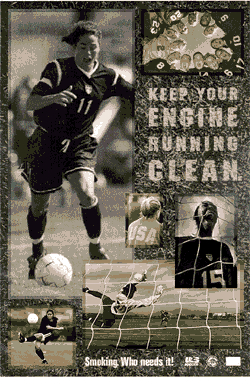
Example #2: HEBS Anti-Smoking Posters
The Health Education Board for Scotland is a national health education project in Scotland that distributes information on heart disease, cancer, drug and alcohol abuse, and other issues. These two anti-smoking posters are great examples of how to use a striking image to convey a point:

Photograph by Richard Mountney, used with the photographer's permission

Photograph by Nick Price, used with the photographer's permission
-
What is a creative promotion?
-
Why should you develop promotions?
-
What are some tips for creative thinking?
-
How do you plan an effective and creative promotion or promotional campaign?
-
What are some tips for following up on a promotion?
If planned and executed well, creative promotions can be an effective way to draw attention, generate support, encourage participation, or raise money for an issue. Promotions can be difficult to manage and may require a substantial commitment of time and resources. However, the benefits to your organization or cause can make a significant difference in community awareness, participation, and support. This section discusses when and how to develop creative promotions for a community initiative.
What is a creative promotion?
A creative promotion is one that draws attention to your organization or initiative, to the services you offer, to an event or campaign you're running, or to a particular issue or cause you support, and does it in a positive, memorable, and appropriate way.
People have probably tried to find creative ways to influence others for as long as communities have existed. On the well-preserved walls of the Roman cities of Pompeii and Herculaneum, buried by an eruption of Mt. Vesuvius in the first century A.D., advertisements and political messages can still be found. Political campaigns throughout history have also used slogans, songs, signs, buttons, and other memorable devices to gain attention and build support. Modern public relations, advertising, social media, and community outreach have added many more ways to present ideas creatively.
There are ads, catch phrases, slogans, images, and campaign themes that people remember long after first encountering them. "I like Ike," Nike's "Just Do It," and other well-known examples show how a short phrase, distinctive design, or memorable character can become closely associated with an organization or idea. The particular examples people recognize will vary by generation, community, and media experience.
There's a lot more to creative promotion than advertising slogans and memorable characters, however. People encounter logos, branded clothing, promotional items, social media posts, advertisements, event announcements, and other messages every day. Many blend into the background because people see so many of them. How can you generate new ways to help people recognize and become involved in what your organization or initiative does? How can you use familiar promotional methods in creative ways that fit your message? This section is meant to help you find answers to these questions.
In a sense this section is titled incorrectly. Any promotion you do should involve creativity, regardless of how familiar its form or intent is. An advertisement for an event you're running should be clear and memorable. A radio, video, social media, or other message promoting your services or issue should be engaging enough to earn and hold attention. With that understanding, the focus in this section will be on imaginative and effective ways to present your organization and your message -- ways that reflect your purposes and stick in people's minds.
Why should you develop promotions?
Promotion is common in advocacy organizations and initiatives that work to build support for a particular cause or behavior, but some grassroots and community-based organizations may feel that promotion is at odds with their mission. In reality, nonprofit and community organizations also need to communicate effectively so that people know what services, opportunities, resources, and activities they offer and how to participate. Creative promotion can support visibility, participation, fundraising, partnerships, and long-term sustainability.
Some specific reasons for developing truly creative promotions:
- They can spread your message and strengthen recognition of your organization. The more interesting, relevant, and distinctive the way in which your message is presented, the more likely people are to notice and remember it.
- They can build a positive image of your organization. If people find the presentation useful, engaging, moving, or enlightening rather than overwhelming or manipulative, they're more likely to think positively about your organization and its work.
- They can be tied to your message or mission in interesting ways. You could draw attention to a childcare center by displaying children's artwork with appropriate permission, for instance, or by sharing a recording or video created as part of a program when families and participants have agreed to its public use.
- They don't have to cost a lot of money. Part of your creativity can go into figuring out how promotions can be carried out with materials and skills already available to you, donated resources, community partnerships, or free and low-cost communication channels.
- They can bring in money for your organization, sometimes from new supporters or partners.
- They can bring in more members, volunteers, or supporters for your organization, including people who may not have encountered your work before.
- They can increase participation among the people your effort is intended to reach or benefit. The more people know about your organization and what it does, the easier it may be for them to decide whether its services, activities, or opportunities are useful to them.
- They can increase community support and strengthen your organization's relationships and visibility.
Be careful not to let creativity interfere either with the meaning of what you're trying to say or the connection to your organization or purpose. A promotion may be beautiful, funny, or memorable but still fail if people don't understand the message, don't know who created it, or remember the creative idea without remembering what it was meant to communicate. Creativity should strengthen the message rather than overshadow it.
What are some tips for creative thinking?
Unless you hire someone to develop your promotions, you're probably going to have to come up with at least some creative ideas yourselves. Just about every organization has people who can contribute useful ideas when given the opportunity, and creativity doesn't belong only to people with formal communications or design experience.
Thinking creatively is helped by giving people room to experiment. When people feel that every idea will immediately be judged, they may be reluctant to suggest anything unusual. Giving yourself and others permission to play with ideas, make unexpected connections, and generate possibilities before evaluating them can lead to ideas you might not otherwise have considered.
Even if you're a small organization without much money, there is the possibility that an advertising, design, communications, or public relations firm may provide some assistance pro bono or at a reduced nonprofit rate. Loosely translated, pro bono means "for the public good," and many professionals choose to contribute some time or expertise to community causes. Local colleges, independent designers, media professionals, volunteers, and partner organizations may also be sources of assistance. Finding innovative ways to get professional help counts as creativity, too.
Some ways to get people thinking and to pull out creative ideas:
Involve a range of people. Your organization's staff may be small, but it probably has friends, supporters, Board members, volunteers, participants, partners, and community connections. Invite people who can contribute different experiences and perspectives to throw around ways to get the word out. More people can bring more ideas to the table, and one person's suggestion may spark a useful connection for someone else.
Be inclusive. Formal education, professional title, age, gender, race, ethnicity, disability, or other personal characteristics do not determine who has creative ideas. Include staff, participants, community members, and others who are willing to work on the promotion or campaign. Make sure people most affected by the issue have meaningful opportunities to contribute rather than being included only after important decisions have already been made.
If the ideas aren't flowing -- or even if they are -- try some techniques to get at things you might not otherwise think of. Brainstorming, making lists, drawing pictures, mapping ideas, collecting examples, acting out scenarios, imagining how different people might encounter the message, or experimenting with different formats can all help individuals and groups come up with new thoughts and connections.
Brainstorming: Perhaps the most familiar of all ways of generating ideas in a group, brainstorming consists of people suggesting ideas as they come up while someone records them so everyone can see them. Ideas can be impractical, funny, unusual, or only partly formed during this stage. The goal is to generate possibilities before evaluating them. Once the flow of ideas slows down, the group can organize, combine, develop, and assess the suggestions. Even if the process doesn't immediately result in a final idea, it may lead to something useful later.
Look at what others have done. While you're trying to come up with something that will stand out because it's different, don't reject an idea simply because some version of it has already been used. It may not have been done in the way you'd like to do it, or may feel fresh when applied thoughtfully to your particular needs. Someone else's promotion may also inspire a completely different idea. Take inspiration without copying protected creative work or presenting someone else's idea as your own.
Try to think "outside the box". You often hear this phrase in connection with creativity, and in fact it's the kind of thinking that brainstorming and many other techniques are trying to encourage. It means stepping back from assumptions about how something has always been done and considering other ways to understand or approach the problem. Creative thinking often begins by asking, "What else could this look like?" or "What are we assuming that might not have to be true?"
How do you plan an effective and creative promotion or promotional campaign?
There are a number of elements to planning a creative promotion. The fact that you have a creative idea doesn't necessarily mean that it's appropriate for what you want to do. You need to consider what you want to say; whom you want to reach; what those people need or value; how much money and time you have to spend; the timing of your promotion; and whether the medium you choose and the promotion itself fit your message and the mission and philosophy of your organization.
There are a few elements of successful promotions that you might consider as you plan what you're going to do. These include:
- Novelty. Something unexpected or presented in a fresh way can earn attention more readily than a message people feel they have encountered many times before. Novelty works best when it still connects clearly to the issue.
- Vividness. Strong, relevant visual or auditory elements can make a message easier to notice and remember. That's one reason organizations use recognizable images, slogans, stories, sounds, and other distinctive elements.
- Repetition. People encounter many competing messages. Consistent repetition across appropriate settings can increase familiarity and recall, but repetition can also become annoying or ineffective when overused. Make sure the message remains accurate, relevant, and respectful.
- Providing genuine value to participants. People may be more willing to participate when an activity is useful, enjoyable, accessible, welcoming, or connected to something they value. Examples might include refreshments at a meeting, useful materials, recognition, transportation support, child care, or an enjoyable community activity. Benefits should support participation without pressuring or coercing people.
- Pairing the promotion with something people are already interested in -- such as food, entertainment, education, recreation, art, or a community event -- when the connection fits the purpose. (See "A Piece of the Pie" below.)
Choose your message
What exactly is the reason for this promotion? The nature of your message is an important piece of how you can best frame and deliver it.
- Are you trying to make sure that the public knows your organization exists?
- Are you letting people know about your services, resources, or opportunities?
- Are you trying to raise money?
- Are you trying to get the word out about a particular event you're sponsoring?
- Do you want to call attention to the larger issue your organization deals with?
- Are you trying to encourage the public to take a specific action, such as contacting a public official, attending a meeting, signing up for a program, or voting?
- Are you trying to encourage a particular behavior or make a healthier, safer, or more useful option easier to choose?
The ultimate effectiveness of your promotion will be judged on whether it accomplishes its purpose, not simply on how creative, artistic, or clever it is.
Identify your audience
Who are you trying to reach?
- The general public, or the community at large.
- People who may use, participate in, or benefit from your organization's programs or services.
- Potential volunteers, members, partners, or Board members.
- Policymakers or the media.
- Specific groups connected to your issue, such as health professionals, educators, social workers, neighborhood leaders, environmental groups, or others.
Once you've identified your intended audience, you can think about how to reach them most effectively. For instance,
- Are there language or accessibility needs to be addressed? In some cases, your intended audience may need or prefer information in a language other than English or in formats such as captions, large print, audio, plain language, or other accessible forms. In all cases, your language needs to be understandable, respectful, and clear.
- Where and how can your intended audience be reached? No matter how creative your promotion is, it's ineffective if people don't encounter it. What channels do the people you're trying to reach actually use? Possibilities include community events, local radio or television, websites, email, social media, messaging platforms, streaming services, newsletters, schools, faith communities, workplaces, professional publications, posters, partner organizations, or direct outreach. The answer can vary tremendously depending on whom you're trying to reach.
- What is likely to feel relevant and appropriate to your intended audience? Humor? The unexpected? A straightforward explanation? A personal story? It's important to understand how people may interpret your promotion and to learn from the audience directly rather than relying on stereotypes. What feels engaging, confusing, offensive, trustworthy, or memorable to them?
Consider your budget
Your budget enters into your promotion in two ways. First, it obviously affects how much you can spend and what kind of promotion you can attempt. Second, the amount you spend may influence how supporters and community members view your priorities. If a promotion appears unusually expensive for an organization with limited resources, people may reasonably ask whether the money could have been used more effectively elsewhere. The goal is not to spend the most money possible, but the right amount -- enough to make the promotion effective while remaining consistent with your organization's responsibilities and values.
Time your promotion
Is this promotion meant to last a long time, or is it aimed at a specific event or action? If you're trying to improve your organization's profile and name recognition in the community, you might want to consider a promotion that keeps your name visible over time. Clothing, reusable items, signs, a recognizable organizational vehicle, a recurring digital campaign, or another consistent visual identity might be possibilities, depending on what fits your mission and budget.
A childcare center in a small town used a van painted with scenes of children playing to pick up and drop off children in its program. The van quickly became recognizable in the community and served both as transportation and as a visible reminder of the center. When transportation vehicles carry children or other participants, however, branding and visibility should always be considered alongside safety, privacy, consent, and applicable transportation requirements.
If the promotion has a more specific purpose, a performance or some other one-time event might serve just as well. The timing of this event has to be thought through carefully, however, so it reaches the people you hope to engage and occurs close enough to the time when you want them to act that the next step is clear and practical.
Another way to extend a promotion over a longer period is to create an event or activity that recurs at regular intervals. For many organizations, that may mean an annual community event, fundraising effort, awareness activity, or other tradition associated with the organization. Such an event can call attention to the organization, strengthen community relationships, raise money, and increase awareness of an issue. Over time, people may come to recognize and anticipate it.
In the Pioneer Valley of western Massachusetts, a fall event called "A Piece of the Pie" brought restaurants together to contribute part of their proceeds to a local food bank. The name and structure of the promotion connected participation directly to the issue of hunger while also giving participating restaurants a visible role in supporting the community.
Promotions like this can create value for several participants at once: the organization receives support, businesses demonstrate community involvement, and residents have an easy way to contribute through activities they may already be planning to do.
If your promotion involves items for sale or give-away, think about how they connect to what you want people to remember.
- For adult literacy: Pens, bookmarks, notebooks, books of writings by learners, or other useful reading and writing materials.
- For child nutrition: Nutritious snacks appropriate to the setting, simple meal or snack ideas, or evidence-based information about nutrition and available food resources.
- For recycling: Recycling bins made from recycled materials, reusable containers, guides to local recycling options, composting information, or other practical tools.
- For a designated-driver or impaired-driving prevention campaign: Cards or digital resources with safe-ride information, transportation options, or other practical reminders about getting home safely.
- For an anti-violence or community-safety campaign: Materials connected with the event's message, such as lights, reflective materials, resource cards, or information about support services.
In general, as with "A Piece of the Pie," it makes sense to connect your promotion directly to the issue it's meant to affect. An event that highlights disability rights, for instance, should demonstrate those values through its own planning. Involve people with disabilities in identifying access needs, choose accessible venues and routes, provide accessible restrooms and seating, make information available in appropriate visual, audible, and digital formats, and arrange accommodations such as interpreters, captioning, or other supports when needed. Accessibility is not simply a matter of consistency; it is part of making participation genuinely possible and respectful.
How you conduct the promotion will influence people's reactions to your organization and its issues and will communicate a great deal about the organization's priorities and philosophy. An event may be inclusive, participatory, and informal, or it may be more formal and designed for a particular group of supporters. Either approach can be appropriate depending on the purpose, but it should align with your organization's values. If you want your organization to be seen as empowering and community-centered, for example, your promotion should create meaningful opportunities for participation and avoid unnecessary barriers related to cost, access, or status.
Another point to consider here is the organization's overall media and communications strategy. If you have strong professional relationships with particular media outlets, community partners, newsletters, websites, creators, or other communication networks, consider how they might appropriately support the promotion. Any formal agreements, sponsorships, or partnerships should also be taken into account. Strong media and community relationships can extend the reach of a promotion, but maintain transparency about sponsorships, partnerships, and paid placements.
What are some tips for following up on a promotion?
Once a promotion is over, there's a natural tendency to relax and assume that it worked because of the time and energy you put into it. Friends and colleagues may also be inclined to focus on the positives. The final step in a creative promotion, however, is to assess what actually happened and what you can learn from it.
Some questions you might ask after the promotion ends:
- Most important, did the promotion accomplish its purpose, and how well? If the purpose was to raise awareness, what evidence do you have that more people noticed or understood the issue? If the purpose was to raise money, how much did you raise compared with the cost of the promotion and other fundraising approaches? If the purpose was participation, how many people took part and who was reached? Use measures that match the goal rather than relying only on impressions.
- What could you have done better? Were there problems with quality, accessibility, timing, communication, logistics, or the usefulness of promotional materials?
- Should you try this, or something similar, again?
- If it's an event, should it become a regular part of what your organization does? Does it have the potential to become a useful tradition or something that people come to recognize?
- How was it perceived by the intended audience and by people directly affected by the issue? Did people understand why you did it? Did they find it useful, respectful, relevant, and accessible? Ask directly rather than relying only on informal "buzz."
- How well did it represent the organization -- its mission, issues, purpose, values, and philosophy?
- Did it generate useful media coverage, social sharing, community discussion, referrals, partnerships, or other additional attention? Was that attention accurate and helpful?
If the answers to most or all of these questions are positive, then you've run a successful creative promotion, and you might consider doing it or something similar again. If your reviews are mixed or negative, it's important to understand why. What didn't work? Did the promotion miss the intended audience, create barriers, confuse the message, or represent the issue differently than you intended? The answers are lessons learned and can help tremendously in planning your next effort.
Part of following up on a promotion is maintaining the relationships and interest it created. That doesn't necessarily mean launching another major promotion immediately. Instead, continue communicating useful information, thank participants and partners, follow through on commitments, share results when appropriate, and look for future opportunities to engage people. Consistent communication is usually more sustainable than relying on one memorable event to carry the message indefinitely.
In Summary
Developing creative promotions can be an important part of communicating your organization's purpose, work, issue, and message to the public or to a specific intended audience. A strong promotion can raise your profile, help people understand what you're about, encourage participation, and strengthen community relationships.
In order to develop creative promotions, it's important to
- Think creatively
- Be clear about why you're running this promotion
- Choose your message carefully
- Understand your intended audience and involve them when appropriate
- Think about the timing of your promotion
- Match the form and character of your promotion to the issues, mission, and values of your organization
- Follow up on your promotion to understand what worked, what didn't, and how to improve your next effort
If you can do all this, the chances are that your promotions will be both creative and effective and will accomplish what you want them to.
Contributor
Phil Rabinowitz
Resources
Online Resources
Creativity Unleashed Limited, a creativity consulting firm. Techniques for stimulating creativity, books, software, other resources.
Print Resources
Horowitz, S. Marketing Without Megabucks: How to Sell Anything on a Shoestring.
Moore, M. C. (1987). Group Techniques for Idea Building. Newbury Park, CA: Sage.
The reason for creative promotion:
___To get community involved
___To raise money
___It can be inexpensive
___To spread a specific message
How to come up with creative ideas:
___By using past examples
___Being open to a variety of suggestions
___Most importantly, get as many people involved as possible
State objectives clearly:
___Organization
___Money
___Commmunity
Identify target audience:
___Media
___General public
___Teens
___Volunteers
___Non-profit organizations
What have some real organizations done that's been successful? You've seen some examples above ("A Piece of the Pie," Bridge Over Troubled Waters, CASAE the Alien), and you undoubtedly know of some personally. Here are a few more that are creative, reflect the philosophies of the organizations that developed them, and have had the desired effect in the community.
Example #1: Progressive Story
The Literacy Project, an adult literacy provider, for several years ran an annual promotion that centered around a progressive story. The organization would recruit several prominent members of the community writers, college presidents, politicians, etc. as well as several adult learners, and ask each of them to write one installment of a story. The first piece would be written, passed on to the second person who would add her piece based on the first, then these two would be passed on to the third writer, and so on. No one wrote until they saw what those before them had written, and no one knew where the story would end up. The most difficult task fell to the last writer, who had to take what was by that point a whole story and put an end to it that tied it all up and made sense of it.
During the writing of the story, members of the organization's Board and staff created PSA's for it, largely advertising an event at which the story would be read by its authors, and at which local businesses provided goods and services which were auctioned off. A local newspaper ran "teasers" for the story short quotes from parts already written and eventually ran the whole story the day after the reading. The writing and the event were fun the stories were often very funny, and almost always decidedly odd emphasized that everyone's a writer, focused on literacy in an inclusive and participatory way, and raised a good deal of money. After the first year, large numbers of people looked forward to the story and to the event, and it came to be identified with the organization, and served it as a public relations tool.
Example #2: Writers' Consortium Book
This Wood Sang Out. The same organization, after being involved in the progressive story for two years, decided to make a closer connection to writers in the area. The organization published a call for short pieces of prose and poetry, aimed at both professional writers and at Literacy Project students. The Associate Director, with the help of a volunteer who was a published poet, assembled a panel of professional writers and adult learners to choose a set number of the submitted pieces to be part of a book. The eventual volume, titled This Wood Sang Out, designed by a professional working as a volunteer, printed at cost by a local printer, and distributed by local bookstores, contained writing from both professional writers and adult literacy students. It was inclusive, participatory, and totally in keeping with the philosophy and mission of The Literacy Project, and emphasized again that everyone is a writer. And the first printing of 1,500 copies sold out.
Example #3: Corporate Spelling Bee
The Boston Adult Literacy Fund, a consortium of representatives of business, non -profit organizations, and city government, runs an annual Spelling Bee to support literacy programs. The contestants are corporations, each of which pays an entrance fee to field a team. The winning team gets a prize, the losers pay into the BALF according to the number of their mistakes, and Boston literacy programs are the beneficiaries. Everyone gets great publicity, literacy is highlighted as an issue, and the event is fun as well.
Example #4: The Walk for Hunger
Walks for various causes have become cliches, but there was a first one. The Project Bread Walk for Hunger began in 1969 with a 20-mile course around Boston and its suburbs. Walkers obtained sponsors who would pay them a certain amount (typically one or two dollars) for every mile they walked, and the money would then go to support soup kitchens and emergency food distribution in the Boston area.
At the beginning, a few hundred people marched, and raised a few thousand dollars. Now, more than 20 years later, the Walk held on the first Sunday in May, in what is usually the nicest time of year, draws tens of thousands of walkers, and raises many millions of dollars each year. The event has become a tradition, with many walkers having completed it 10, 15, or even 20 years in a row. There is enormous media coverage, and the event draws attention to the issue of hunger for weeks before and after it. In addition, everyone who raises at least a certain amount gets a T-shirt free publicity for the Walk, for Project Bread, and for the issue of hunger throughout the year.
A twist on the Walk for Hunger and there are many is a marathon (run or walk) to benefit leukemia research. Each marathoner is paired with a leukemia patient, who also runs or walks, if he's physically able to, and provides support if he's not. Marathoners also find sponsors, and many send their sponsors ongoing reports of their training, the progress of their partners, and the marathon itself. The event raises a great deal of money every year.
Example #5: The Hunger Meal
A tradition that a number of organizations devoted to the alleviation of world hunger have adopted is a meal on a day designated as World Hunger Day. Diners all of whom pay the same amount per person are divided, at random upon their arrival, into three groups. One group receives a gourmet meal prepared by well-known local chefs. The second, much larger, group receives an ordinary, but nutritionally-balanced meal. And the third, largest, group receives a small bowl of rice, the equivalent of a whole day's food for more than half the world's population. The event points up the inequality of food distribution and the prevalence of hunger around the world, as well as the difficulty of sitting at the table with your bowl of rice while your neighbor feasts from a plate piled high with delicacies. The facts that all diners pay the same amount, and that their level of nutrition is chosen at random emphasize that all citizens of the world contribute to its prosperity through their labor, but that whether or not they will get enough to eat is often an accident of birth. As with the Walk for Hunger, there is always plenty of media coverage for this event, and stories for several weeks before and after keep the public focus on world hunger.
Example #6: Homeless Newspaper
Begun in New York, this idea has spread to several other cities as well. With some help from a community based organization, a group of homeless people who slept in Grand Central Station started writing and distributing their own newspaper. The paper was meant to change the perception of the homeless, give its distributors some income, and provide information to the public about the actual concerns of those who wrote its articles. It has been successful on all counts, and homeless people selling the paper on the street for a dollar have become a familiar sight in many cities around the country.
Example #7: Cop Cards
Originated in Portland, Maine, and used in Boston, among other places, these consist of a full deck of cards, each with a color photo of a police officer on the front. On the back (except for the K-9 officers, i.e. police dogs, which are generally favorites) is a message from the officer, geared to youth ("Stay in school; it will pay off in later life."). To get a card, a kid has to show up at the police station on a given day each week, when there's a brief activity or talk on some aspect of police work. When he's collected the whole set, the kid can turn the cards in for a serious prize a bike, for instance donated by local merchants. In the meantime, the kid has gotten to know the local police, ideally developed a rapport with some officers, and perhaps changed both his and the cops' perceptions about the relationships between youth and the police in the community.
Example #8: Fotonovella Shopping Bags
A health center in Worcester, Massachusetts has designed plastic shopping bags that are used at markets in neighborhoods with large Hispanic populations. The bilingual bags have fotonovella (comic strip) health messages in Spanish and English. They focus on such concerns of the community as responsible fatherhood ("Hey, Raul, let 's go shoot some hoop." "Later, man, I've got to take care of my kid."), and reach a large audience.
Example #9: Neighborhood Hunt
A Tool Box editor helped to organize a scavenger hunt in his neighborhood, where the objects to be found were information on historical markers, inscriptions on interesting buildings, and hunters were guided by a neighborhood map. The successful hunters ended up with a list of words, each letter numbered, that then could be used to decode a puzzle answer. The first correct answer to the puzzle won $100.
Posters went up around the neighborhood, then 900 flyers were distributed door -to-door. Over 100 people turned out, learned about the neighborhood, met one another, had a good time, and raised a few hundred dollars for a community newsletter. More important, the event helped to create a sense of community in an urban neighborhood.
Example #10: Cowley County’s Data Walk: Mobilizing Community Members to Improve Health
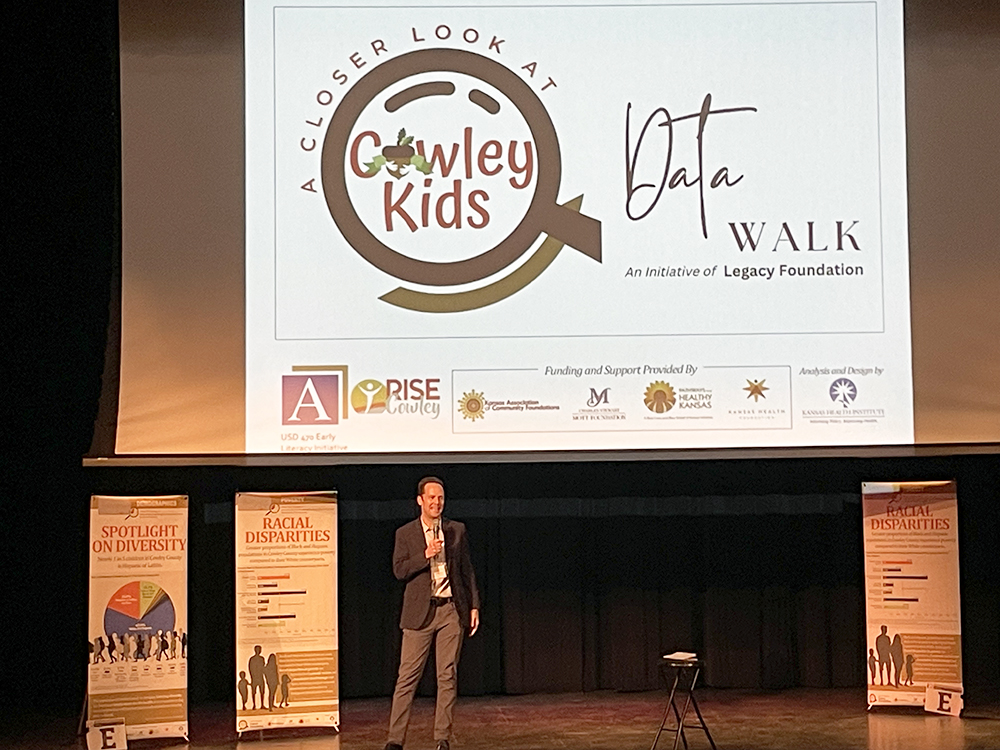
Improving health and well-being is a top priority for communities across Kansas. One innovative example of how Kansas counties can mobilize community members to improve health comes from Cowley County.
On November 29, 2022, Legacy, A Regional Community Foundation in Cowley County, in collaboration with RISE Cowley and USD 470 Early Literacy Initiative, hosted an innovative and groundbreaking Data Walk event to engage community partners, including frontline service providers, nonprofit directors, city/county/state officials, school district officials, private philanthropies and passionate community leaders, in a meaningful conversation about improving the health of children in their community.
Read more about Cowley County’s Data Walk, or learn more about organizing Data Walks by visiting: Data Walks: An Innovative Way to Share Data with Communities, a resource from the Urban Institute.
Example #11: Reading Summit Mobilizes Community Members Around Childhood Literacy

In Kansas, 7 in 10 4th graders read below a proficient level on National Assessment of Educational Progress (NAEP) standardized tests. To raise awareness and mobilize action toward improving childhood literacy in Kansas, a Reading Summit was held in Andover on June 11, 2024. Approximately 70 educators, community leaders, elected officials and other stakeholders attended the event, where they viewed and discussed seven data posters that spotlighted literacy in Kansas.
Many factors shape health, including education, economic status, employment and access to essential goods and services. Improving these factors often requires a multifaceted approach that begins with mobilizing the community to act. During the Reading Summit, participants met with other community members and offered new and challenging interpretations of the data as well as unique ideas to get at the root causes of difficulties with reading.
-
What is a brochure?
-
What purposes can a brochure serve?
-
Who is the intended audience for a brochure?
-
What can you do with brochures?
-
How do you plan to make a brochure?
-
How do you write and design your brochure?
It's often very useful to have a readily available publication that explains your organization's purpose, services, programs, or resources. One format that works well for delivering this information is a brochure. A brochure is concise and visually organized and, if well designed, can help people quickly understand what your organization does and how to learn more. This section looks at why and when to use a brochure, what sort of information to include, and how to design one that works well for your organization and intended audience.
What is a brochure?
A brochure is a concise informational publication used to explain an organization, service, program, event, or issue. Brochures may be printed, distributed digitally as downloadable or shareable documents, or provided in both formats. Printed brochures are often folded into panels, while digital brochures may use a similar design or a format better suited to screens.
What purposes can a brochure serve?
A brochure can explain your organization's purpose and services. Doing a presentation to a group that isn't familiar with your organization? Meeting with a potential funding agency? Speaking with prospective volunteers, participants, or community partners? For almost any situation in which you need to introduce your group to someone new, a brochure can be useful. It can summarize the basic facts about your organization -- what your mission is, what services or programs you provide, whom you serve, how you can be contacted, and how people can participate or learn more.
A brochure can answer frequently asked questions about your organization. If you're regularly answering questions like "How do I qualify to receive your services?" or "What do I do if I want to volunteer?" then consider making a brochure. Of course, a brochure will never stop people from asking all of those questions, but it can give them a quick and consistent way to find basic answers.
A brochure can offer more specific instructional how-to or health information. If there's a specific, step-by-step process that you want to explain, a brochure can be a useful way to convey that information. For example, you might create a brochure explaining food-safety practices, how to apply for a community program, how to prepare for an appointment, or how to recognize when and where to seek additional support. When providing health, safety, legal, financial, or other high-impact information, make sure the content is current, accurate, and based on credible sources.
A brochure tells the reader how they can find out more about your organization. When you're trying to get people interested in volunteering, making a contribution, using a service, attending an event, or taking another action, a brochure can provide a clear next step. You can include information on your group's purpose and history, but also make it easy for people to find the staff member, program, website, phone number, email address, QR code, or other resource that relates to their interests.
A brochure can educate people about a specific program or event. Are you planning a big annual fundraising event like a walk-a-thon or a concert? Does your group sponsor a speakers' bureau, peer support program, training series, or another special service? You can provide more detail about these programs or events in a brochure than you may have room for in a poster, advertisement, or short social media post.
Who is the intended audience for a brochure?
A brochure can be directed to a specific group or groups, or it can be made for a broad general audience. Think about the people who typically need information about your organization as well as people you'd like to engage more effectively, and consider whether one general brochure will work or whether different versions would better meet different needs. Some of the audiences you might want to create a brochure for include:
- Potential members or volunteers
- People who may use or benefit from your services
- Potential funders
- Potential community partners and supporters
- Journalists and other media professionals
- The general public
What can you do with brochures?
Brochures are an extremely flexible medium for getting information about your organization out to the public or to specific audiences. Printed and digital brochures can be used in different ways depending on how people are most likely to encounter the information. Here are a few of the things you can do with your brochures:
- Mail printed copies to people who request information or to appropriate mailing lists
- Attach or link to digital brochures in proposals, reports, emails, or presentations
- Leave printed copies with people after meetings, outreach visits, or service appointments when appropriate
- Include them in digital or printed press kits and presentation materials
- Use them as handouts or downloadable resources in classes, workshops, webinars, or trainings
- Share them with prospective employees, volunteers, members, or participants
- Make them available at meetings, fairs, conferences, seminars, community events, partner organizations, or relevant public locations
If you go to the trouble of making brochures for your group, make sure people can actually find and use them. Keep printed copies available where they are useful, provide an accessible digital version on your website when appropriate, and make it easy for staff and partners to share the current version.
How do you plan to make a brochure?
Gather ideas and examples. As with any communication material you plan to produce, it's a good idea to start by collecting examples of brochures you find effective. Look at both printed and digital examples. Become familiar with styles, graphics, organization, accessibility, and ways of wording information that might work for your own brochure. Use examples for inspiration rather than copying protected designs or content.
Brainstorm for your own project. First, consider what information the brochure should contain. Because a brochure is relatively concise, you may want to limit the information you try to include. You probably won't be able to include your organization's full history, mission, goals, financial information, every program, and a complete staff directory in one useful brochure. When considering what information to include, ask yourself:
- Who is the intended audience for the brochure, and what information is most useful to them?
- How big is your budget, how much time do you have, and will the brochure be printed, digital, or both?
Next, decide who in your project should be asked for input, who you'll need to make the brochure happen, and who you'll get feedback from on drafts. When the brochure is intended for a particular community or group of service users, include people with relevant experience in reviewing the content rather than relying only on internal staff assumptions.
Write an outline. This will give you the chance to decide how you want the brochure to be organized and what points you want to make. If you're working on a general informational brochure, make sure it clearly explains your organization's goals and purpose.
Arrange your topics in a logical sequence, fitting it to the general layout of the brochure. Think about what order you want the information to be presented in. For a printed brochure, it may help to sketch the panels or use a brochure template so you can see how information will appear when folded. For a digital brochure, think about how the content will flow on a screen and whether readers will be using phones, tablets, or computers.
How do you write and design your brochure?
General guidelines for writing
Above all, keep it simple! Write concisely and clearly. Here are some tips:
- Keep sentences reasonably short. Run-on or overly complicated sentences can be difficult for readers to follow.
- Avoid unnecessary jargon. Don't assume readers use the same terminology as people inside your organization. Explain technical terms when they are necessary and use plain language whenever possible.
- Avoid clichés when they add little meaning. Familiar phrases can sometimes work, but clear and specific wording is usually stronger.
- Avoid unnecessary repetition. A small amount of repetition can help emphasize important information, such as a phone number or registration deadline, but don't repeat the same idea simply to fill space.
- Use correct spelling and consistent language. Creative wording can be effective when it fits your audience and organization, but don't sacrifice clarity or credibility for a gimmick.
- Use direct, active language when it makes the message clearer. Passive voice isn't always wrong, but readers should be able to tell easily what action is needed and who is responsible for it.
Following these tips, develop a rough draft of the copy. Estimate how much space the text will require and then test it within the actual brochure layout. Design software and templates can help you see how text, headings, images, and white space fit together. Keep in mind that you may have to shorten or reorganize the text so that the final design remains clear and readable.
Tips on designing the brochure yourself
A common printed brochure has six panels, but brochures can take many forms. A digital brochure may not use panels at all. Whatever format you choose, consider carefully what information should appear first, what readers need next, and where the main call to action and contact information belong. The front cover or opening section will usually need a title, your organization's name, and possibly a logo or identifying image.
Here is a typical layout for a printed three-panel brochure. Please keep in mind that you don't necessarily have to lay yours out the same way; different folds, page sizes, or digital formats may work better for your needs.
Typical layout for a 3-panel brochure:
|
1 Contact Information (Flap) |
2 Organization Information or Mailing Area (back cover) |
3 Front Cover |
- Contact information: This often appears on the folded-in flap or back of a printed brochure, or near the end of a digital brochure. Include the contact methods most useful to your readers, such as a phone number, email address, website, physical location, social media account, or QR code. Avoid including unnecessary personal contact information.
- Mailing area: If you plan to mail the printed brochure without an envelope, one outside panel may need a return address and space for a mailing label or postal information. If the brochure will not be mailed this way, use the space for information that is more useful to readers.
- Front cover: This should usually contain your name, logo or other identifying information, and a clear title or message. Keep it from getting too crowded, but give readers enough information to understand what the brochure is about and why they might want to open or continue reading it.
- Programs, services, features, or benefits: This is often the main body of the brochure. Explain what your organization or program does, who it is intended to serve, what people can expect, and why the information may be relevant to them.
- Action: What can the reader do next? This could explain how to volunteer, donate, register, use a service, attend an event, contact your organization, request accommodations, or find more information. Make the action clear and practical.
- Elsewhere, if desired: Include a brief history of the organization, directions on how to access or use services, information about funding, eligibility, accessibility, staff, or other background that your intended audience actually needs.
While standard three-fold brochures are common, you can use nearly any format that works for your content and audience. A shorter card, booklet, one-page digital brochure, downloadable PDF, or other format may sometimes communicate the information more effectively.
After drafting the text, be sure to review and get feedback. Check for errors first, then seek additional perspectives, including from people outside your group and from members of the intended audience when possible. Ask whether the information is clear, useful, respectful, accessible, and easy to act on. Use their feedback to help you decide on the final version.
Now you're ready to prepare the brochure for printing, digital publication, or both!
Have it printed, photocopied, or prepared for digital distribution: It's possible to avoid or reduce the expense of professional production. Find out whether anyone in your group or community has printing, design, or digital publishing skills. Approach area printers or designers to see if any of them would donate services or offer reduced fees. For digital brochures, test the document on different devices, make sure links and QR codes work, use readable text and sufficient contrast, provide alternative text or accessible descriptions for meaningful images, and make sure the file is usable with common accessibility tools when possible.
Distribute your final product: This may seem like a no-brainer, but community groups sometimes put a great deal of effort and expense into creating brochures that people rarely receive or use. Make distribution part of your communications plan before you even start.
Form a committee, if necessary, and make a list of the places and channels where you want to distribute your brochures. This might include community organizations, clinics, libraries, schools, events, partner agencies, websites, email lists, online resource pages, presentations, or other settings appropriate to your audience. Find out whether permission is required to leave printed copies. Assign specific volunteers or staff members to keep brochures stocked, update digital links, remove outdated versions, and make sure people are always receiving current information.
In Summary
Creating a brochure can take careful work, but a brochure can be a valuable tool for explaining what your organization is about, answering questions, educating your audience, connecting people with services or resources, or promoting an event. By planning for your intended audience, using clear and accurate language, organizing information carefully, designing for accessibility, and distributing the brochure through appropriate print and digital channels, your organization can communicate efficiently with a wide variety of audiences.
Resources
Online Resources
Consumer Perspectives: Creating a Brochure for Families of Children with Special Health Care Needs in Your Community’s Immigrant and Underserved Populations, prepared by Massachusetts Consortium for Children with Special Health Care Needs. This information is based on the experience of the consortium, and is a good example of how to create a brochure for a specially targeted population.
How to Create an Effective Brochure, from the University of Nebraska – Lincoln Extension, Institute of Agriculture and Natural Resources, has several good illustrations that will help one create a professional eye-catching and valuable brochure.
How to Design a Simple Brochure by The Aspen Institute Community Strategies Group.
Print Resources
Adler, E. (1991). Developing and producing brochures. Palo Alto, CA: Health Promotion Resource Center.
Adler, E. (1991). Print that works: The first step-by-step guide that integrates writing, design, and marketing. Palo Alto, CA: Bull Publishing.
Aspen Reference Group. (1997). Community health education and promotion: A guide to program design and evaluation. (C. Schust, ed.) Gaithersburg, MD: Aspen Publishers, Inc.
Booth & Associates, M. (1995). Promoting issues and ideas: A guide to public relations for nonprofit organizations. New York, NY: The Foundation Center.
Brigham, N. (1992). How to do leaflets & brochures. Community change, Issue 12, Spring 1992.
Homan, M. S. (1994). Promoting community change: Making it happen in the real world. Pacific Grove, CA: Brooks/Cole Publishing Company.
___ You understand what a brochure is
___You understand the purposes a brochure can serve
___You understand who a brochure might target
___You understand some of the things you can do with brochures
___You have gathered ideas and examples for you brochure
___You have brainstormed for you own project
___You have written an outline for the brochure
___You have arranged your topics in a logical sequence, fitting it to the general layout of your brochure.
___You understand the general guidelines for writing a brochure
___You understand the tips for designing the brochure yourself.
___You have consideredwhether to use computerr or manual layout
___You have made a "dummy" for your brochure
___You have made a paste-up board for the dummy
___You have reviewed your work and gottten feedback from others.
-
What is a fact sheet?
-
Why would you make a fact sheet?
-
Who can you reach with fact sheets?
-
How do you make a fact sheet?
Getting accurate information out to the public about community health and other important issues can be done in a number of ways. One of the simplest things you can do is create a fact sheet about the issues you're working on and distribute it to the people who need the information.
What is a fact sheet?
A fact sheet is a concise print or digital resource that presents important facts about a specific issue. Fact sheets can be laid out in many different ways as long as they make the main information easy to find and understand. You can create one fact sheet with basic information, or a series of fact sheets addressing different parts of an issue.
Why would you make a fact sheet?
Fact sheets are relatively easy to make and easy to use. There's no need to come up with a catchy slogan, unless one is useful, or write a lengthy essay arguing your case. With a fact sheet, you can focus on the most important evidence, explain what it means, and make it easy for readers to find additional information or take an appropriate next step.
Fact sheets can often be produced fairly quickly. A straightforward fact sheet may be developed much faster than a more elaborate communication product such as a video, public service announcement, or major promotional campaign. However, don't let speed replace accuracy. Build in enough time to verify the information and review the final material.
Fact sheets can also be inexpensive. Digital fact sheets can be distributed through email, websites, social media, QR codes, or partner organizations at relatively little cost. Printed versions may involve printing, mailing, and staff or volunteer time, but they can still be a cost-effective way to share information.
Who can you reach with fact sheets?
Fact sheets can be distributed to the general public or developed for a more specific intended audience. They can be handed out at community events, public meetings, meetings of governing bodies such as city commissions, workshops, conferences, clinics, schools, or other places where the people you hope to reach gather. Digital versions can also be shared through websites, email, newsletters, social media, and other communication channels.
You can develop fact sheets for audiences such as:
- Civic organizations
- Business groups
- Grassroots and community organizations
- School boards
- Labor organizations
- Parent, family, and school groups
- Faith communities and organizations
- Journalists and other media professionals, including editors and reporters who cover your issue or initiative
- Health organizations
- Elected and appointed government officials, agencies, or governing bodies
- Grantmakers and other potential funders
How do you make a fact sheet?
Think about what message you want the facts to convey.
Do you want to help people understand a complicated issue? Correct misinformation? Provide reliable facts for community members, journalists, funders, or a government agency? Encourage an informed action? Think about the purpose of the fact sheet and what readers should understand or be able to do after reading it. If you're trying to build support for a public art project, for example, you might look for credible evidence about how public art affects community life, economic activity, neighborhood identity, or other outcomes relevant to your proposal.
Think about the audience for your fact sheet.
Ask yourself these questions:
- Who will you be giving or sending this fact sheet to?
- What information is most relevant and useful to this audience?
- What do you want readers to understand, consider, or do after reading it?
Different audiences may need different types or levels of information. Policymakers may need concise data about scope, cost, outcomes, and policy implications. Community members may want to know how the issue affects their daily lives and what resources or actions are available. Journalists may need both reliable data and examples that help explain the issue. Learn what the intended audience actually needs rather than assuming that everyone within a particular profession or group responds to information in the same way.
Find your facts.
Perhaps you already have a great deal of factual information and just need to sort through it to decide what to include. Maybe another coalition, government agency, research institution, or national organization has provided information that you need to evaluate for relevance to your community. If you don't have your facts gathered already, you'll need to do some research.
These are some possible sources:
- Original research reports, systematic reviews, and peer-reviewed publications
- Reputable newspapers, magazines, and other journalism, especially when they link to or identify the original evidence
- Published reports, minutes, proceedings, or papers from meetings and conferences
- Reports and publications from other community organizations
- National, state, and local organizations, research institutes, and professional associations
- Online searches that help you locate original reports, datasets, official websites, and research sources
- Government agencies, public datasets, administrative records, and other official sources
Verify, verify, verify!
This is extremely important. Check facts for accuracy, relevance, context, and timeliness. Use credible sources, trace claims back to their original source when possible, and make sure the evidence actually supports the statement you want to make.
Making sure the fact comes from a reputable source: Don't use a factual claim simply because it appears online or has been repeated by several people. Find out where the information originated, who produced it, what methods were used, and whether knowledgeable independent sources consider the evidence credible. Consider possible conflicts of interest, but don't assume that affiliation alone proves that information is wrong. When possible, compare the claim with another credible source or with the original research or public data.
The importance of using a reputable source
Using a source whose methods or credibility have been seriously challenged:
During a debate over changes to a local human rights code, opponents of protections based on sexual orientation cited statistics from researcher Paul Cameron. Cameron's work had been challenged by major professional organizations, and he had been dropped from membership in the American Psychological Association for violation of its ethical principles. The larger lesson is that a statistic should not be accepted simply because it appears to support your position. Examine the methods, professional standing, and broader evidence before relying on it.
Using stronger evidence:
In another example, advocates evaluating a firearm-safety ordinance cited a study that compared outcomes during defined periods before and after the ordinance. Because the analysis used clearly described data and methods, readers could examine the evidence rather than relying only on the advocates' interpretation. Whatever the issue, the strongest sources are those whose methods, data, limitations, and conclusions can be evaluated.
Making sure the fact is up-to-date: A figure may once have been accurate but no longer describe current conditions. Check the publication date, the period covered by the data, and whether a newer reliable source is available. In some cases, older data are useful for showing historical trends, but make that purpose clear rather than presenting them as current.
Narrow it down.
Go through all the factual information you've gathered and decide what is most important, relevant, and useful to readers. Then decide which facts you're going to include.
The facts you use should match the issue and population your fact sheet actually addresses. Let's say you work with an after-school college-preparation program for high school students from families with lower incomes. Your program doesn't serve students on the basis of race; eligibility is based on income. You might find statistics about college completion among a particular racial or ethnic group, but those figures would not necessarily describe the population your program is designed around. You would be better served by data about educational access or college outcomes associated with income if that is the central issue your program addresses. Use demographic information when it is actually relevant, and avoid treating race, ethnicity, income, or other characteristics as interchangeable explanations.
Decide how you want to lay your fact sheet out.
Just the facts! Fact sheets aren't meant to be lengthy reports. A single page may be ideal for many purposes, but the appropriate length depends on the topic, audience, and format. Whether the fact sheet is printed or digital, make it easy to scan. Use clear headings, bullets, white space, readable text, and graphics only when they help explain the information. For digital fact sheets, also consider accessible headings, meaningful link text, sufficient color contrast, alternative text for important images, and a format that works on common screen sizes.
Find a simple way of presenting your information. You might use a "who, what, when, where, why" layout, a bulleted list, frequently asked questions, a short table, or another structure appropriate to the topic. Put the most important information first and make any recommended action easy to find.
Cite your sources.
Your fact sheet will be more credible and useful if readers can tell where the information came from and, when practical, find the source themselves. Include enough information to identify the source, and use links or references when the fact sheet is digital.
Ways to cite sources
Using footnotes:
A factual statement appears here with a numbered source reference (1).
(1) Source: Agency or publication name, report title, and date when appropriate
Using parentheses:
A factual statement appears here (Agency or publication name, year).
Including the source in the wording of the fact:
According to [agency or publication], [fact or finding].
Explain what the facts mean.
Some facts are easy to understand on their own. Others need context. If you include a statistic that may not be immediately meaningful, take a sentence or two to explain what it measures, who is included, when the data were collected, and why it matters to the issue. Comparisons can help, but make sure they are genuinely comparable and don't exaggerate the significance of the finding.
Things to avoid:
- Don't make numbers harder than they need to be: Percentages, fractions, rates, and raw numbers can each be useful depending on the context. Choose the form that makes the information easiest to understand without losing important precision. For example, 66% can sometimes be explained as "about two-thirds," while other situations may require the exact percentage and the number of people it represents.
- Don't stretch the truth: Exaggerating makes you look dishonest and can mislead readers. If you round a figure, summarize a range, or simplify a complex finding, do so accurately and don't make the evidence sound stronger than it is.
- Don't rely on weak surveys or polls: Evaluate how respondents were selected, who was included or excluded, how questions were written, the sample size, weighting or adjustment methods, and whether the sample can reasonably represent the population being described. An online survey is not automatically unreliable, and a survey conducted by another method is not automatically representative. Self-selected or convenience polls should not be presented as though they represent an entire population without appropriate evidence.
- Don't be unnecessarily repetitive: Repetition can emphasize a central point, but a long list of nearly identical statistics may make the main message harder to see. A chart, trend, average, or carefully chosen comparison may communicate the pattern more clearly.
- Don't inundate the reader with too many facts: Select the facts that are most relevant to the purpose of the fact sheet. If the issue requires substantially more information, consider creating a series of fact sheets or linking to a longer report, webpage, or resource where readers can learn more.
In Summary
Fact sheets can be an easy and important way of getting accurate information out to the public quickly and efficiently. There's no single way to make a fact sheet. Choose a format that fits your topic and intended audience, focus on a clear main message, verify and cite your evidence, explain important numbers and context, make the information accessible and easy to scan, and give readers a clear way to learn more or take action when appropriate.
Contributor
Chris Hampton
Resources
Print Resource
Brigham, N., with Catalifo, M., & Cluster, D. (1991). How to do leaflets, newsletters, and newspapers. Detroit, MI: PEP Publishers.
___You understand that a fact sheet is a single sheet of paper listing important facts about the issue.
___You understand the reasons that you might want to make a fact sheet.
___You understand what types of people can be targeted with a fact sheet.
___You have thought about what message you want the facts to convey.
___You have thought about what audience your fact sheet will be aimed at.
___You have found your facts.
___You have verified your facts by making sure they come from reputable sources and are up-to-date.
___You have narrowed down the facts and decided which ones you're going to use.
___You have decided how you want to lay your fact sheet out.
___You have cited your sources.
___You have explained what the facts mean, if necessary.
___You have avoided overdoing percentages, stretching the truth, using unscientific surveys or polls, repetition, or inundating the reader with too many facts.
Example 1: Cowley County’s Data Walk: Mobilizing Community Members to Improve Health
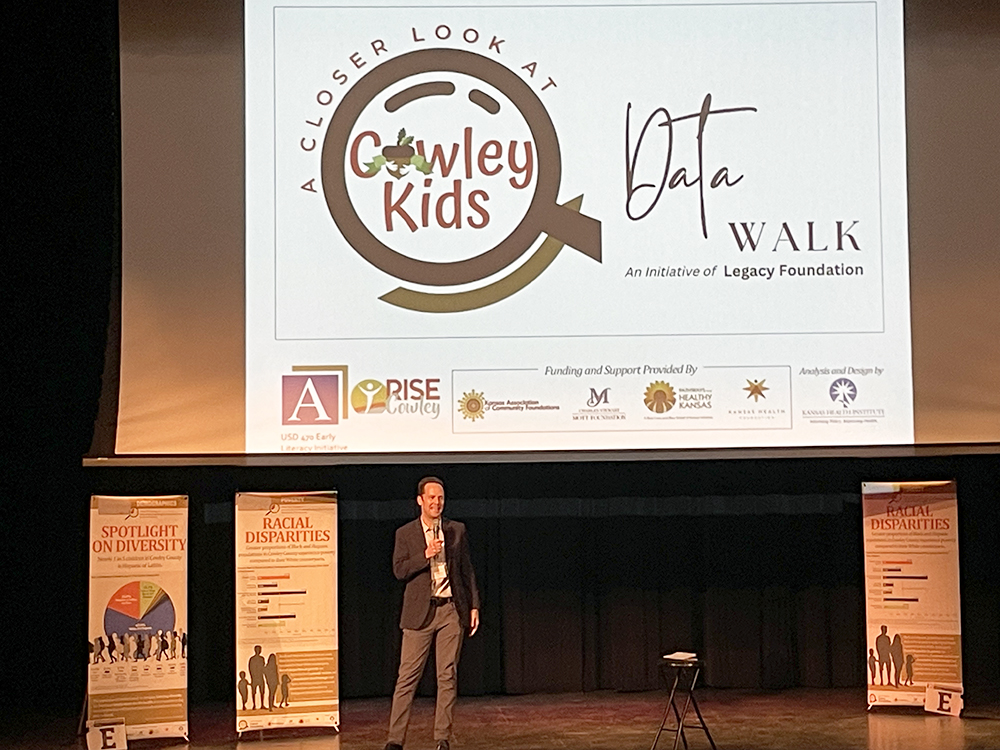
Improving health and well-being is a top priority for communities across Kansas. One innovative example of how Kansas counties can mobilize community members to improve health comes from Cowley County.
On November 29, 2022, Legacy, A Regional Community Foundation in Cowley County, in collaboration with RISE Cowley and USD 470 Early Literacy Initiative, hosted an innovative and groundbreaking Data Walk event to engage community partners, including frontline service providers, nonprofit directors, city/county/state officials, school district officials, private philanthropies and passionate community leaders, in a meaningful conversation about improving the health of children in their community.
Documents & Downloads
- CHILDCARE Childcare Access(opens in new tab),file type application/pdf
- DEMOGRAPHICS Spotlight on Diversity(opens in new tab),file type application/pdf
- EDUCATION Funding Adequacy(opens in new tab),file type application/pdf
- EDUCATION Graduation Gap(opens in new tab),file type application/pdf
- EDUCATION Mathematics(opens in new tab),file type application/pdf
- EDUCATION Reading(opens in new tab),file type application/pdf
- EDUCATION Student Needs(opens in new tab),file type application/pdf
- HOUSING Housing Affordability(opens in new tab),file type application/pdf
- HOUSING Lead Exposure(opens in new tab),file type application/pdf
- HUNGER Childhood Food Insecurity(opens in new tab),file type application/pdf
- MENTAL HEALTH Depression(opens in new tab),file type application/pdf
- MENTAL HEALTH Suicide(opens in new tab),file type application/pdf
- POVERTY Children in Poverty(opens in new tab),file type application/pdf
- POVERTY Racial Disparities(opens in new tab),file type application/pdf
- SOCIAL DEPRIVATION Concentrated Disadvantage(opens in new tab),file type application/pdf
- VAPING_E-CIGS Youth Vaping
Example 2: Lead poisoning and children fact sheet
|
Lead Poisoning: Could It Happen to Your Child? Facts from the Dash County Extension Service
What is lead? Lead is a natural metal. Historically, lead was used as a pigment in house paint , an additive to gasoline, and as a pesticide. Now lead is used in certain types of batteries, fishing weights, marine paint, bullets, and in the making of some plastics. What are the effects of lead poisoning? Young children are most vulnerable to the toxic effects of lead. Long-term exposure to even low levels of lead can cause irreversible learning difficulties, developmental disabilities, and delayed neurological and physical development. What are the symptoms of lead poisoning? Early symptoms of poisoning may include loss of appetite, fatigue, irritability, anemia, and abdominal pain. Because of the general nature of symptoms at this stage, lead poisoning is often not suspected. How can you protect your child from lead poisoning?
Where is lead found?
Where can I get more information? For local information, call the Dash County Extension Service at 555-0987 For general information call the National Lead Information Center 1-800-LEAD-FYI Information provided by the National Lead Information Center. |
Example 3: Drug Free Workplace Fact Sheets
The Substance Abuse and Mental Health Services Administration has several good examples of how to do a series of fact sheets on different related topics and aimed at different types of audiences. The Workplace Toolkit contains several fact sheets for employees (with such topics as "Components of a Drug-Free Workplace" and "Why You Should Care About Having A Drug-Free Workplace"), and fact sheets for employers (such as "Developing a Drug-Free Workplace Policy" to "Informing and Educating Your Employees").
Example 4: American Academy of Child & Adolescent Psychiatry "Facts for Families" series
The American Academy of Child & Adolescent Psychiatry developed this series of fact sheets to educate parents and families about psychiatric disorders affecting children and adolescents. This page lists 64 different fact sheets on topics ranging from autism, depression, sexual orientation, panic disorder, bedwetting, eating disorders, and teen suicide to children's psychological reactions to such things as divorce, death, television violence, and day care.
Example 5: National Coalition for the Homeless
The National Coalition for the Homeless provides a variety of fact sheets on different issues regarding homelessness. Topics range from basic facts, self-help programs available, crimes and violence against the homeless, health care, mental illness, education for the homeless, and lesson plans, among others.
-
What is a website?
-
Why should you consider creating a website for your organization?
-
When is a good time to create a website?
-
How do you create and use a website?
People increasingly rely on websites and other digital channels to find information, learn about services and events, and understand community issues. Because of this, creating and maintaining a useful website for your organization or initiative can greatly improve your ability to communicate with the public. This section discusses when and why to set up a website, how to create one, and how to help ensure that your website is effective, accessible, trustworthy, and easy to use.
What is a website?
A website is a collection of one or more connected web pages and other online content available through a web address. For example, the Community Tool Box is a website, while the document you're viewing right now is one of the many web pages available at this website. Some web pages are very short, with only a few lines of text, while others contain extensive information, images, forms, videos, interactive tools, or other resources.
Businesses, nonprofit organizations, educational institutions, government agencies, community groups, and individuals all use websites to distribute information and provide services. Websites vary widely in purpose, complexity, design, accessibility, and the amount of information they contain. Some organizations need only a simple site with basic information and contact details; others may need online registration, donations, resource libraries, multilingual information, searchable databases, or other functions.
Why should you consider creating a website for your organization?
There are many good reasons to consider creating a website. Here are a few, and you may find that you can think up even more on your own:
- Having a clear, current, professional website can strengthen your organization's credibility and make it easier for people to verify who you are, what you do, and how to contact you.
- Many people routinely look online first when searching for organizations, services, events, jobs, volunteer opportunities, and community information. A website gives them a dependable place to find information about your organization, although websites should complement rather than automatically replace other communication methods needed by people with different access or preferences.
- You can put a large amount of useful information on a website -- far more than can fit into a single brochure, advertisement, or public service announcement. You can include your website address or a QR code in brochures, advertisements, presentations, social media, and other communication materials to help people find additional information.
- Information on your website can be available at any time, allowing people to look for services, directions, eligibility information, event details, resources, or contact information when it is convenient for them.
- Your website can be part of an overall communications strategy and can help establish a clear, consistent public identity for your initiative or organization.
- The web can improve access for people who have difficulty obtaining information in person because of transportation, mobility, scheduling, geographic, health, or other barriers. It can also allow people to look for sensitive information more privately. At the same time, not everyone has reliable internet access or the same level of digital access, so important information may need to be available through other channels as well.
- A well-designed website can make it easier for people who are unfamiliar with your organization to explore your work on their own and decide whether your programs, resources, or opportunities are relevant to them.
- A website can help people discover your organization when they search online for services, programs, information, or organizations related to your work. Clear page titles, useful content, accurate location and contact information, and links from other credible organizations can all make your site easier to find.
- Corrections, additions, or revisions to your website can usually be made much faster than changes to printed materials. This is particularly useful for information such as schedules, eligibility requirements, phone numbers, application instructions, and event details that may change.
- Websites can make it easier for members, volunteers, supporters, and community members to take action by providing clear links to registration, volunteer opportunities, donations, public meetings, advocacy information, or other next steps.
- A website is an effective way to share information quickly when conditions are changing. For example, you can update information about an upcoming event, changing service hours, a public issue, an emergency, or a fundraising campaign without waiting for a new printed publication.
- A website can provide easy ways for people to contact your organization through email, phone, contact forms, service-request forms, or other appropriate methods.
When is a good time to create a website?
A website can be useful at almost any stage of an organization's development. Building one early can help establish a consistent source of public information from the beginning, while creating or improving a website later can strengthen communication for an established organization. The important question is not simply how quickly you can put a site online, but whether you can keep the information accurate, secure, accessible, and reasonably up to date.
If people are likely to search online for the services, programs, resources, or issues connected with your work, having a reliable web presence is especially useful. At the same time, a website should be part of a broader communication plan rather than the only way people can find or reach you.
How do you create and use a website?
Decide who will actually create the site, whether that's you, a member or volunteer of your agency or organization, or some outside party.
There are many ways to build and maintain a website. You might use a content-management system, a hosted website builder, a web developer or agency, an institutional web platform, or a custom site created with technologies such as HTML and CSS. The right option depends on your budget, technical needs, staff capacity, accessibility requirements, and the amount of control you need. Whatever approach you choose, make sure someone is clearly responsible for maintaining the site, updating information, managing access, responding to technical problems, and keeping important software and services current.
It may be tempting to let someone you know create a site under an account or web address that they personally control, but that can create long-term problems. Your organization should retain appropriate control over its domain name, hosting or publishing account, administrative credentials, content, and important files. If one individual leaves the organization or becomes unavailable, someone else should still be able to maintain or move the site. Establish ownership, access, responsibilities, and account-recovery procedures from the beginning.
Example: Putting Your Web Pages Up on Someone Else's Site
A good example of why an organization should maintain control of its own web presence is the experience of one local agency here in Lawrence, Kansas.
The organization agreed to let a university student make a web page for it on the student's personal site for a class project. It seemed like a good idea at the time -- the agency wouldn't have to expend much effort or expense, and the student would do the work. Unfortunately, after the semester was over, the student stopped updating the page but never removed it.
While the agency eventually went on to establish its own site, the student's old page stayed online and became increasingly outdated. People searching for the agency sometimes found the outdated information instead of the official site. The larger lesson still applies today: organizations should maintain control over their official domain, publishing accounts, and current public information.
So you see, it's very important to choose a reliable person, team, vendor, or platform if you're going to entrust website responsibilities to someone else. Smaller organizations or initiatives may be able to maintain a straightforward site themselves, while more complex sites may benefit from professional technical support.
You don't necessarily have to know HTML or CSS to manage a website. Modern content-management systems and website-building platforms can allow people to write, edit, upload images, create pages, and make routine updates through visual editing tools. Technical knowledge is still valuable, especially for troubleshooting, customization, accessibility, security, and more complex features, but organizations have many options that don't require building every page from code.
Decide roughly how much you can afford to spend.
The cost of creating and maintaining a website varies widely depending on the platform, domain registration, hosting, design, development, accessibility work, security, technical support, storage, online forms, payment processing, and other services you need. Some organizations can operate a simple website at relatively low cost, while complex sites require significant ongoing investment. Before selecting a platform or provider, estimate both startup and continuing costs and consider the staff time needed to keep the site current.
Select a web hosting service.
Many websites require a hosting service or platform that stores and delivers the site's content. In other cases, hosting is included as part of a website builder, content-management service, institutional platform, or other subscription. Your organization may also already have web services available through a university, government agency, parent organization, or other institution.
Search for hosting or website-building options that fit your needs and compare them carefully. Consider reliability, security, backups, accessibility, customer support, storage, performance, privacy, data ownership, ease of moving your content elsewhere, and whether the service supports the functions you expect to need.
Free or very inexpensive services can be useful for some small projects, but understand their limitations before committing to them. Some may restrict design, storage, features, custom domains, analytics, advertising, accessibility options, or control over your data. A low initial price may also increase later as you add necessary services.
The key thing to remember in selecting a hosting or website platform is shop around! Compare several options and ask questions about both current and future needs. A service that is easy to start with may not necessarily be the best option as your organization grows.
It's also a good idea to talk with comparable organizations about the systems they use, what works well for them, what problems they've encountered, and what ongoing staffing or technical support their sites require.
Decide whether you want to register a domain name.
A domain name is the human-readable name people use to reach a website. Look at the URL for this page. You'll see ctb.ku.edu at the beginning. This is part of the Community Tool Box's web address.
Domain names are managed through the Domain Name System and can be connected with websites and other internet services. Domains contain parts separated by dots and may end in extensions such as .org, .com, .edu, .gov, or many others. Some extensions have eligibility restrictions, while others are widely available. Choose a domain that is easy to recognize, type, remember, and clearly associate with your organization.
Domain registration generally involves an ongoing fee, which varies by registrar and domain extension. Your domain may be purchased separately or included with another web service. Make sure the domain is registered under an account the organization controls, that renewal information is current, and that more than one appropriate person can recover access if needed.
Decide what information you want to include on your website.
Your website can be fairly minimal if that meets your needs, or it can contain extensive information and interactive services. More content isn't automatically better. Prioritize information that helps people understand your organization and accomplish the tasks they came to the site to complete.
Basic information you should have on your website:
- Your group's mission and purpose. These should appear fairly prominently on the main page or be easy to reach from it. Good examples of how organizations have displayed their mission statements can be found at the site of Gilda's Club of Detroit and Covenant House of New Orleans. You may decide to go into further detail and list your organization's goals and objectives elsewhere on the site.
- Contact information. Make the organization's main contact methods easy to find. Depending on your work, this might include an organizational phone number, email address, physical or mailing address, service hours, contact form, or program-specific contacts. Avoid publishing unnecessary personal information about staff or volunteers. A good example of how to display your contact information can be found at the site of the Kid's Council in North Dakota.
- Information on your services or programs, including relevant eligibility requirements, costs if any, accessibility information, and how to apply, register, make an appointment, or find out more. A good example of this sort of page can be found at the site of San Francisco Suicide Prevention.
- "How you can help." Be sure to have information on how interested parties can volunteer or make donations. You might have an online volunteer application form, information about current opportunities, or another clear way for people to get involved.
- News/Calendar/Upcoming Events. Keep time-sensitive information current. Do you have an important fundraiser coming up? Make information about it available on your website. Do you sponsor regular meetings of support or discussion groups? Have current information about those available as well. An example of how to show your upcoming events can be seen at the site of the American Lung Association of Hawaii or the Hayti Heritage Center in Durham, North Carolina.
- Resources and links for further information. It's often useful to direct visitors to other credible sources where they can learn more about topics related to your organization's purpose. For example, if you are a local adolescent pregnancy prevention coalition, you could provide links to informational sites like the Alan Guttmacher Institute's adolescent pregnancy information page, to larger regional or national organizations like the National Campaign to Prevent Teen Pregnancy, or to online resource sites like the Resource Center for Adolescent Pregnancy Prevention. Review external links periodically so that you aren't directing people to outdated or unavailable information.
- Information on and links to your organization's sponsors, partners, and collaborators, when appropriate, like at the sites of the Peace Learning Center of Indianapolis and the Center for Rural Development in Somerset, Kentucky. This can show appreciation, help visitors understand your partnerships, and support transparency about significant funding or sponsorship relationships.
Other considerations for your site:
- A site map or strong navigation system can be helpful if your site is large or extensive. A site map lists or organizes important sections of the site so visitors and search systems can understand how content is structured. A good example of a site map can be found at the site for the Philadelphia Geriatric Center in Philadelphia, Pennsylvania.
- A Frequently Asked Questions page or section (also known as an FAQ). This is a place where you can answer questions people ask most often about your organization, activities, or services. A useful FAQ can save staff time and help visitors find answers quickly.
- A listing of your staff members, board members, or volunteers when that information is useful and appropriate, like the Pensacola, Florida chapter of Habitat for Humanity. Consider privacy and safety before publishing personal biographies, photographs, email addresses, or other identifying details.
- A feedback or contact section so people can ask questions, report problems, request information, or offer comments. You can use a contact form like the Chicago Asthma Consortium uses, or provide appropriate organizational contact information like the American Red Cross St. Louis Bi-State Chapter uses. If you collect information through online forms, collect only what you need and explain how submitted information will be handled.
- Important statistics about your membership, services, reach, or outcomes, such as the Junior League of Salt Lake City's statistics page. Make sure figures are accurate, current, understandable, and accompanied by enough context for readers to interpret them appropriately.
- A resource library section with informational materials related to your organization's focus or cause, such as the one at the site of the Platte River Endangered Species Partnership in Cheyenne, Wyoming. Organize resources so that people can search or browse them without having to work through an overwhelming list.
- Your organization's history. This includes how your group started, important milestones in your past, challenges and accomplishments along the way, and the general state of things now. This can be in the form of a narrative, like that of Headquarters Counseling Center in Lawrence, Kansas, or it can be presented as a timeline.
- An online gallery. This could include photos, artwork, videos, or personal experiences, like those at the site of the Joy Junction Homeless Shelter in Albuquerque, New Mexico. If your organization works with survivors of violence, children, people receiving services, or others whose privacy may be especially important, use their stories, artwork, images, or identifying information only with appropriate informed consent and safeguards. Consider whether anonymous or de-identified participation is more appropriate. An online gallery can help people understand the work while respecting the dignity and choices of those represented.
- A listing of job opportunities and openings with your project, like that at the site of the Heifer International in Little Rock, Arkansas.
- Action alerts with information on how people who visit your website can take action on an issue related to your organization. You can see some action alert pages at the People for the Ethical Treatment of Animals site. Clearly explain what action is being requested, provide accurate background information, and make participation voluntary.
- Privacy-conscious website analytics can help you understand which pages people visit, how they arrive at the site, what devices they use, and whether they complete important actions. Use analytics that are appropriate to your needs, interpret the numbers carefully, and consider privacy when deciding what visitor information to collect or retain.
As you can see from the above lists, there's almost no limit to what sort of information you can put on your website. That doesn't mean you should put everything online. Focus on information that serves your audience and organizational goals, keep important content current, and remove or archive information that is no longer useful.
If you're not sure what to include, start with the information people most need: who you are, what you do, how to access your services or activities, and how to contact you. You can add additional sections as you learn what visitors need and as your organization's capacity grows.
Work with your web hosting company and your webmaster to build the actual site.
Depending on how extensive you want your site to be, building it can be one of the longer parts of the process. You may work with a web developer, designer, communications staff member, content manager, vendor, or internal team. Stay involved enough to make sure the finished site accurately reflects your organization and that staff understand how routine updates will be handled after launch.
It is at this point in the process that you will make many decisions about the site's design, navigation, content, forms, images, and interactive features. Attractive design can help, but usability and accessibility should be built into the site from the beginning rather than added at the end. Use clear headings, keyboard-accessible controls, sufficient color contrast, descriptive link text, alternative text for meaningful images, captions or transcripts for relevant multimedia, understandable forms and error messages, and layouts that work at different screen sizes and levels of zoom. Following current web accessibility guidance can make your site easier to use for people with a wide range of disabilities and often improves usability for everyone.
Get feedback from others and make any necessary changes.
Once your site is available for testing, have people who aren't closely involved in building it try to use it and give you feedback on what works and what doesn't. It is especially helpful to include people similar to those you hope will use the site -- potential participants, volunteers, donors, community members, partners, media representatives, and people with disabilities or different access needs. Give them realistic tasks, such as finding service eligibility information, registering for an event, making a donation, or locating a phone number, and observe where they encounter difficulty.
Here are some questions you should take into consideration when looking for feedback on your site:
- Does your site load quickly and work reliably on common phones, tablets, computers, browsers, and internet connections? Large images, video, third-party scripts, and other features can slow pages down or consume substantial mobile data, so use them thoughtfully.
- Is information arranged in a logical, easy-to-find manner, and can people navigate the site using both a mouse or touchscreen and a keyboard?
- Is the site attractive, readable, accessible, and comfortable to use at different screen sizes and zoom levels?
- Does the information on the site make sense, and can visitors tell what to do next?
Publicize your site address.
- Announce your site through the communication channels your intended audiences already use, such as email newsletters, social media, messaging platforms, community networks, partner organizations, meetings, events, and other relevant channels.
- Help search engines discover and understand your site by publishing useful, accessible content; using clear page titles and headings; maintaining working internal links; and making important public pages available for indexing. Search tools and practices change, so use current guidance rather than relying on older directory-submission methods.
- Let relevant local community guides, resource directories, government agencies, partner organizations, and other trusted websites know about the site and ask whether they can include a link when appropriate.
- Let other groups and professionals in your area know about your site, particularly when it contains resources their audiences may find useful.
- Find out which agencies or organizations maintain community or social service directories and request that your current website information be included.
- Include your site's URL or an appropriate QR code in your regular media campaigns -- posters and flyers, press releases, public service announcements, paid advertisements, your organization's next print newsletter, email newsletters, presentations, and social media.
- Use accurate page titles, headings, descriptive text, and useful page descriptions where appropriate so people and search systems can understand what each page is about. Don't rely on lists of hidden or repeated keywords to improve search visibility; focus on clear, useful content that addresses what visitors are actually looking for.
- Consider paid search, social media, digital display, or other advertising when it fits your communications goals and budget. Paid promotion can help people find a particular service, event, campaign, or resource, but it should complement rather than substitute for useful website content and trusted community outreach.
In Summary
A website can be a vital part of communication for community initiatives, nonprofit organizations, and other groups, but simply having a site isn't enough. An effective website should provide accurate and useful information, work well on current devices, protect appropriate organizational and visitor information, be accessible to people with disabilities, and be maintained over time. Start with the needs of the people who will use the site, choose technology your organization can realistically support, test the site with real users, and connect it with the rest of your communication strategy.
Contributor
Chris Hampton
Resources
Online Resources
European Laboratory for Particle Physics (1998). A CERN invention you are familiar with: The world wide web.
Hurst, Mark. (1997). HTML basics in two minutes.
Hurst, Mark. (1997). What's a webmaster (and why is this important)?
Incite.org. (1998). Take action!: Ways for you to take action online.
An Introduction to Web Hosting. A comprehensive guide that covers the basics of the internet, websites, and creating your own website.
Johnson, K.E. (1998). If you build it, make them come. Presented at Hot Tips on Web Home Pages - Marketing to Reach New Clients. TECHSHOW 98, sponsored by the Law Practice Management Section of the American Bar Association, March 27, 1998.
Nua Internet Surveys. (1997). How many online?: U.S. and Canada
Nua Internet Surveys. (1997). How many online?
HTML and CSS Tutorials. A website for beginners that gives concise, step-by-step instructions on building web pages.
___You know and understand the many advantages of having a website for your organization.
___You understand that any time is a good time to create a website.
___You have decided who will create and maintain the site.
___You have decided roughly how much you can afford to spend.
___You have selected a web hosting service.
___You have decided whether you want to register a domain name.
___You have decided what information you want to include on your website.
___You have worked with your web hosting company and your webmaster to build the actual site.
___You have gotten feedback from others and made any necessary changes.
Example #1: "Sample radio PSA script" script to be fully produced
Use: IMMEDIATE: TFN
Time: 30 seconds
Agency: Chicago AIDS Action Force
Title: "Friends"
Main Point: Heterosexual women should practice safer sex.
Sound Effects:
Busy coffee shop sounds (cups clinking, lively conversation, etc.), then you hear two chairs being moved and cups being set on the table. Fade background sounds a bit and:
Dialogue:
Woman #1 sighs and says:
Woman #1: Thanks for coming, Lisa. I didn't know who else to talk to.
Woman #2: Don't sweat it -- what's going on? You look like you've been crying.
Woman #1 pauses and then says in a lowered voice:
Woman #1: I just found out that Antony died last month -- of AIDS.
Woman #2, shocked
Woman #2: Oh my God -- Antony your old boyfriend??
(pause)
Woman #1: Yeah -- that Antony.
Woman #2, concerned:
Woman #2: Are you -- are you okay?
Woman #1: Well -- I'm not HIV positive. I always used a condom, and I got tested as soon as I found out.
Woman #2 lets out an exhalation of relief and says:
Woman #2: Oh, girl, I can't tell you how relieved I am to hear that.
Woman #1: I was relieved too. It's just still such a shock.
Woman #2: Need to talk about it?
Woman #1: Yeah. Yeah I do. Thanks.
Announcer voiceover
Announcer: Two out of every three new HIV cases among women are from heterosexual contact. Protect yourself. Call 1-800-342-AIDS for more information about safer sex and HIV.
Cue coffee shop sounds up briefly while showing slide with AIDS info number, then fade audio and video out.
Example #2: Sample television PSA script
Use: IMMEDIATE: TFN
Time: 30 seconds
Agency: Kansas City Immunize Now
Title: "Uncle Keenon"
Main Point: Infants should be immunized -- talk to your doctor about it.
Camera Description: Scene opens with Woman #1 and Man #1 sitting by a playground. Camera shows children playing, then moves over to the two adults sitting together on a park bench watching them. Sound of children's laughter in background.
Dialogue:
Woman #1 turns to Man #1, smiles, and speaks...
Woman #1: Just think, Keenon -- you and Tasha have this to look forward to before you know it!
Man #1 shakes his head and speaks...
Man #1: Yeah -- I can't believe we're going to be parents! It's great, but there's so much to worry about. I think about Rachel and Danny's little girl and how sick she's been...
Woman #1 looks sad and says to Man #2...
Woman #1: I know, it's been so sad seeing how much trouble they've had -- it's too bad they never had her immunized.
Man #1 looks surprised and says:
Man #1: But she's only a year old! I never even thought about immunization -- when are you supposed to get that done?
Woman #1 looks back at the kids and says...
Woman #1: Well, the first shots are done when the baby is about 2 months old -- then you have to go back 4 or 5 more times before the kid starts school. It's important to get them all done to be completely protected. If Rachel and Danny had only done that, their baby might not have had so many health problems.
Man #1 looks worried and says:
Man #1: Oh, man, I had no idea. I really need to find out more about all this stuff!
Woman #1 puts her hand on his arm and says:
Woman #1: It's okay. Your doctor or nurse will tell you when you need to come back
A little girl comes running from the playground and climbs into the man's lap.
Woman #1 smiles, tousles the child's hair, and says:
Woman #1: You and Tasha are already a great aunt and uncle, you know. Don't worry. You'll be wonderful parents.
Man #1 smiles at his niece and then looks at Woman #1 and says:
Man #1: Thanks, sis. Tasha has a checkup tomorrow, so we'll talk to the doctor then and find out more.
Fade to black, leaving only the sound of children playing under the voiceover, with the logo and phone number of your child immunization coalition shown onscreen.
Voiceover: Immunization for your kids. Talk to your doctor about it today.
Example #3: Gloucester at the Helm
Here's an example of how PSA's have been used by a prevention coalition in one medium-sized coastal fishing community (Gloucester, Massachusetts). In the example, note the use of local opinion leaders and role models, and also the use of community-based scenes of daily life, that viewers could easily relate to. Note too how non-traditional media outlets (in this case, movie theaters) can be used creatively to get the message across, as well as the use of multiple outlets for the same basic message.
"We've done about 20 public service announcements over 5 years, they've all been home made, shot in Gloucester, with Gloucester people. TV PSA's, on Gloucester cable. We've never used an actor. So inside the message is the fact that ordinary citizens are involved.
"So for example, we had a community conference on prevention, called "Gloucester at the Helm." We shot 3 public service announcements that were 28 seconds apiece. And what we did was we identified a number of community icons, matriarchs, patriarchs, and very well known people, and they're all in the film. So we have the matriarch of the Fishermen's Wives Association who is on the phone with one of the most well known fishermen in the community, who is also on the phone with a young person, who is on the phone with a well-known parent activist -- and they were all talking to each other.
"The fishermen were going to donate fish, the Sicilian Sons of Italy were going to bring traditional Italian food, the baker was going to donate the bread, and you really don't know what they're talking about until the very end, when they say, "I'll see you at the conference -- Gloucester at the Helm? Well, it was just so like Gloucester --that's what people do.
"We're also shooting another PSA, and we're transferring it to film, so it's going to be shown at a local theater where more parents go than anyplace else. The scene will be a mother and a daughter in a car, with a tremendous amount of silence between the two, a tremendous amount of tension -- you're going to know visually that something has happened of major importance between these two people. And it will end with a print message, "Prevention is communication: Please care enough to try."
"This image is also going to be on a billboard that a company is donating to us for a couple of months. It's also going to be on posters, book covers, and note cards. It will be interesting to see how all this works, but it is based on what we've been hearing for a long time."
Thanks to Phil Salzman, former Director of the Gloucester Prevention Network, for the example above.
Example #4: HIV: Un-Infected Does Not Equal Un-Affected
HIV: Un-Infected Does Not Equal Un-Affected is a series of eight 30-second AIDS prevention PSA's which focus on the unique emotional and psychological stresses facing HIV-negative gay men in coping with the epidemic. The series was independently produced for broadcast in San Francisco by San Francisco filmmaker David Weissman, with support from The Nathan Cummings Foundation, the San Francisco AIDS Foundation, the San Francisco Department of Public Health, the STOP AIDS Project, and the University of California at San Francisco AIDS Health Project.
Each PSA features a single character speaking directly to the camera about why it's important to stay uninfected. These spots are great examples of how good television PSA's don't have to be big-budget productions; instead, strong writing and acting are used to simply and effectively convey the message.
Example #5: Girl Power! Radio PSA's
Girl Power! is a national public education campaign sponsored by the Department of Health and Human Services to help encourage and empower 9- to 14-year-old girls to make the most of their lives. Under the leadership of the Center for Substance Abuse Prevention (CSAP) at the Substance Abuse and Mental Health Services Administration (SAMHSA), the Girl Power! campaign was developed in consultation with the many health agencies that make up HHS and with national, state, and local organizations that serve girls.
Example #6: GLAAD's Day of Compassion PSA's
Day of Compassion is an annual project of the Gay & Lesbian Alliance Against Defamation (GLAAD ) and is co-sponsored by Until There's a Cure Foundation, the Names Project Foundation and Cable Positive, the cable industry's AIDS action organization. Every year since Day of Compassion began in 1993, network and cable television, print media, Internet providers and radio stations air special programming specifically geared toward educating and raising awareness about those living with HIV and AIDS, those working on research and advocacy fronts, and friends and families who have been touched by the disease.
Contributor
Chris Hampton
Tool #1: URL's for Internet terminology glossaries and dictionaries
Confused about all the lingo and techno-speak associated with all this Internet and WWW stuff? Check out some of these online glossaries and dictionaries:
Matisse's Glossary of Internet Terms
NetLingo Online Dictionary
NetDictionary
Glossary of Graphic Design and Web Page Design Terms
Tool #2: URL's for information on HTML and page design
When you're just starting out, these are some of the best sites on HTML basics :
- NCSA's Beginner's Guide to HTML
- HTML Tutorials for the Complete Idiot
- HTML and CSS Tutorials
- An Introduction to Web Hosting
Once you have the basics down, you might move on to these sites:
- WebProfession: The Official Ezine of the International Webmasters Association
- The HTML Writers Guild
- Bignose Bird
- Webmonkey
- DJ Quad's Ultimate HTML Site
Tool #3: URL's for information on web accessibility
- Web Directory: Designing Accessible Web Page
- Designing an Accessible World
- UCLA-DCP World Wide Web Accessibility Page
Tool #4: URL's for sites that have information on web hosting providers
The following sites are directories of web hosting services:
The following sites have information on free web hosting services that cater to nonprofit organizations:
Tool #5: URL's for information on adding your site to search engines
If you want your site to come up when people do web searches, you have to take into consideration the fact that there are a great many search engines out there . To reach the greatest number of potential visitors to your site, register with as many as you can. Be sure to update your entries as well, when necessary (e.g. your main URL changes or the name of your site or organization changes).
In addition to the above individual pages for registering your site with search engines, there are several companies that will register your site with multiple search engines for free:
Tool #6: URL's for information on what NOT to do with your site
Once you have the basics of HTML down and you've started building your site, how do you keep it from being ugly, unwieldy, and just downright unpleasant for people to visit? There are several sites and pages on what not to do with your website that can help you design a more attractive and user-friendly site.
Vincent Flanders--Web Pages That Suck
Top 10 Mistakes in Web Design
The Top 15 Mistakes of First Time Web Design
-
What is an email list?
-
Why should you consider using an email list?
-
When is a good time to use an email list?
-
How do you set up and use an email list?

Email remains an important part of how organizations communicate. Community groups can use email to send updates, coordinate activities, share resources, invite participation, raise funds, or support discussion among people with a shared interest. Email lists can be especially useful because they allow organizations to communicate with many people at once while giving subscribers a predictable way to receive information.
Email lists exist for thousands of topics and communities. Some are used mainly for organizational announcements or newsletters, while others support discussion among members. The tools used to operate these lists continue to change, but the basic idea remains the same: people choose to join a group and receive email related to a shared purpose.
What is an email list?
With your email client -- Gmail or Microsoft Outlook, for example -- you may already have experience sending messages to groups of people. An email list is different from simply placing many addresses in the "To" or "Cc" field of an ordinary email. A managed email list allows people to subscribe and unsubscribe, helps protect subscriber information, and provides tools for distributing messages consistently to a group.
An email list is a group of subscribers who receive messages through a shared list or communication system. Some lists are designed mainly for announcements from an organization, while others allow members to communicate with one another. Depending on the system, subscribers may be able to reply to the entire group, respond privately to the sender, receive messages individually, or receive several messages combined into a digest. Lists can range from a few participants to many thousands of subscribers.
Email lists are managed through mailing-list, newsletter, or group-communication software. These systems generally allow the list owner or administrator -- the person responsible for running the list -- to add or approve subscribers when appropriate, process unsubscribe requests, send or moderate messages, manage permissions, and adjust other settings. Some systems continue to use the term "listserv," although that term originally refers to a particular mailing-list technology.
Types of email lists
Announcements: An announcement-only list allows an organization or designated group of senders to distribute information to subscribers without opening every message to group discussion. This can be useful for newsletters, meeting reminders, service updates, action alerts, fundraising messages, event announcements, or other information people have chosen to receive. It can also reduce the volume of messages subscribers receive.
Announcement lists are now used by community organizations, advocacy groups, political campaigns, public agencies, schools, businesses, and many other groups. Messages often link to a website, registration form, donation page, public document, or other resource where subscribers can learn more or take action.
Moderated lists: With this type of list, a moderator or administrator reviews messages before they are distributed to the entire group. Moderation can help keep discussions relevant, reduce spam and harassment, protect privacy, and make sure participants follow the group's stated expectations. It also requires time and clear standards so that moderation decisions are consistent and understandable.
Unmoderated lists: In an unmoderated discussion list, authorized subscribers can generally send messages directly to the group without approval for each message. This allows for freer communication and may require less day-to-day review, but administrators should still establish expectations for respectful participation and be prepared to address spam, harassment, misinformation, privacy concerns, or repeated off-topic posting when necessary.
You might find it useful to establish more than one communication option for your organization: for example, an announcements-only list for people who want important updates and a separate discussion space for people who want to exchange ideas with one another. A discussion platform, online community, messaging service, or other tool may sometimes be better suited to active conversation than email alone.
Depending on the service you use, subscribers may also be able to choose how often they receive messages. Some systems offer digest options that combine several messages into one email, while others allow people to choose categories or types of communication they want to receive.
Where can you find out more?
Email-list and group-communication services change over time. Search for current mailing-list, newsletter, discussion-group, or community-email platforms and compare their features before choosing one. The resources below illustrate some services and directories that have been associated with email lists; check whether each resource remains available and suitable for your needs before relying on it.
- Tile.net List of Internet Discussion Groups
- CataList Email
- Google Groups
- Yahoo Groups
For lists that focus on topics related to community health and development, you can also look for current professional associations, universities, public-health organizations, coalitions, and community networks that host discussion groups or newsletters in your area of interest.
Why should you consider using an email list?
Email lists can serve many functions. They can serve as a way to:
- Quickly and inexpensively get information out to a large number of people: For example, you can send a reminder about tomorrow's meeting or an update on a project your initiative has been working on.
- Create a forum for discussion of ideas and issues: For example, you could use a discussion list to exchange fundraising ideas, share community resources, or seek feedback on a project.
- Encourage people interested in your cause to offer one another support and assistance: For example, members might share transportation options, resources, or information about an upcoming conference.
- Encourage civic or political action: For example, you can share accurate information about an upcoming public meeting or vote and explain how subscribers can contact appropriate public officials if they choose.
- Raise money for your organization or issue. Fundraising messages can explain the need, show how contributions will be used, and make it easy for subscribers who choose to give to do so.
- Learn more about subscribers' interests and priorities. You can invite feedback through replies, surveys, meetings, or other methods rather than assuming that email engagement alone tells you what people want.
...or just about anything else that fits the purpose of your list and the expectations subscribers were given when they joined.
When deciding whether to set up an email list, it's important to consider your intended audience. Email is widely used, but it isn't the best communication method for everyone. Some people have limited internet access, rely mainly on mobile devices, prefer text messages or other communication channels, have accessibility needs, or simply don't use email often. Consider how the people you hope to reach actually communicate and provide other options when important information should be available through more than one channel.
Email is now a routine communication method for many people around the world, but access, preferences, language, digital skills, and technology still vary. An email list works best when it is one part of a broader communication strategy rather than an assumption that every community member can or wants to be reached in the same way.
In this section, we're going to talk about how you can use email lists as an organizing and communication tool and how to set up an email list for your initiative.
When is a good time to use an email list?
An email list can be useful at many stages of an organization's work. Creating one early can help you communicate with people involved in your initiative, while a new list may also be useful for a particular campaign, project, program, event series, or community network. Before creating one, make sure you have a clear purpose, a plan for maintaining it, and a way for people to knowingly subscribe and easily stop receiving messages when they no longer want them.
How do you set up and use an email list?
Decide who will administer your email list -- whether that's you or another staff person, member, or volunteer of your agency or organization.
Your list owner or administrator -- the person responsible for running the list -- should understand your organization and be comfortable using the email or list-management system you choose. They don't necessarily need extensive technical experience, but they should understand the basic functions of the platform, know whom to contact when questions arise, and be able to represent the organization professionally. You may wish to add email-list responsibilities to a staff role or create an official volunteer responsibility for it. Organizations that rely heavily on email for organizing, fundraising, communications, or advocacy may assign the work to a communications professional or team.
Running an email list can take very little time when activity is low, but active lists may require regular attention. Someone should be responsible for reviewing problems, updating subscriber information when necessary, addressing moderation issues, responding to questions, handling inaccurate or outdated information, and making sure the list remains useful. Avoid making the entire system dependent on only one person's personal account or knowledge.
If you don't have one already, work with your list owner to select an organizational email or list-management service.
Your organization may already use an email, newsletter, collaboration, or group-management platform that can support a mailing list. If not, compare services based on what you actually need: announcement emails, discussion features, subscriber management, accessibility, moderation, scheduling, templates, reporting, privacy controls, integration with your website, or other functions.
Shop around and compare the cost, reliability, ease of use, support, subscriber limits, data-management practices, accessibility, administrative controls, and ability to export or move your subscriber list if you change services later. A platform that works for a small volunteer group may differ from one needed for a large organization sending frequent newsletters or fundraising messages.
It is very important that the email address, subscriber list, and administrative accounts used for organizational communications remain under appropriate organizational control rather than belonging only to one staff member or volunteer. Use organizational accounts when possible, keep account-recovery information current, and make sure more than one authorized person can regain access if the primary administrator leaves or becomes unavailable.
It's also a good idea to check with comparable organizations that use email lists to find out what services they use, what they like or dislike, and what amount of staff time is required to maintain their lists.
Decide which list management software or service to use.
There are many ways to manage an email list. Some organizations use dedicated mailing-list systems, some use newsletter or email-marketing platforms, and others use group-discussion or collaboration tools. Older mailing-list systems such as the examples below may still be encountered in some institutions, but choose your system based on your current needs and the support available to you:
Whatever system you use, read its current documentation rather than relying on instructions written for a different or older platform.
The most useful systems generally provide straightforward ways to manage subscriptions, remove or suppress addresses, moderate messages, choose who can send to the group, manage replies, send digests when appropriate, and maintain administrative access.
The Basics of Email Lists
Older mailing-list systems often used separate email addresses and text commands for subscription and administrative functions. Many current systems handle these tasks through web-based settings, subscription forms, links in messages, or administrative dashboards. The exact process varies by platform, so follow the current instructions for the system you choose.
At a minimum, make sure both subscribers and administrators know how to perform the most important tasks.
Listserv or another mailing-list system should provide ways:
- To subscribe or request membership in the list
- To unsubscribe easily
- To receive messages in a digest or lower-frequency format when the platform supports it
- To pause or reduce messages when the platform supports that option
- To resume messages
- To review or manage subscriber information when authorized
- To control whether senders receive copies of their own discussion posts
- To confirm whether a submitted message was successfully sent or scheduled
Other list-management systems should provide similar basic functions:
- A clear method for people to subscribe
- A clear method for people to unsubscribe
- Options for digest or reduced-frequency delivery when useful
- A way for subscribers to change their delivery preferences
- Administrative tools for reviewing subscribers and managing access appropriately
Note: Features vary from one system to another. Don't assume that a function available in one platform will work the same way in another.
Discussion and newsletter systems may also provide:
- Subscription forms that can be linked from your website
- Automated unsubscribe and preference links
- Temporary pauses or frequency controls
- Controls for resuming or changing delivery preferences
- Digest delivery or other ways of reducing message volume
- Tools for changing or canceling those delivery options
- Administrative tools for maintaining the subscriber list
- Confirmation, reporting, or other tools that help administrators verify that communications were sent successfully
There are also web-based services that automate newsletter and mailing-list functions. Some provide free tiers, while others charge based on features, number of subscribers, or volume of messages. Compare services carefully. Avoid platforms that add advertising, collect more subscriber information than you need, or make it difficult for people to unsubscribe or for your organization to move its own subscriber data.
Here are a few names that have been associated with web-based group or mailing-list services:
- Yahoo!
- TalkList
- Topica
Services and providers change, so look for current information rather than choosing a platform simply because it appears in an older directory or resource.
Whichever system you use, make sure the list administrator understands the basic functions needed to run it: adding or approving subscribers appropriately, processing unsubscribe requests, managing bounced or invalid addresses, moderating discussion when necessary, controlling who can send messages, protecting subscriber information, and maintaining administrative access.
Write a formal policy for your list.
Online discussions can become difficult when participants don't share the same expectations. Disagreements may become personal, discussions can drift far from the list's purpose, private information may be shared inappropriately, and spam or repeated promotional messages can overwhelm useful conversation. A clear written policy helps subscribers understand how the list is intended to work and gives moderators a consistent basis for responding when problems arise.
Your policy should explain:
- Basic directions for subscribing, changing preferences, and unsubscribing. Make these processes as easy to understand as possible.
- A mission statement or statement of purpose: This should explain what the list is for and what kinds of communication subscribers should expect.
- Rules for subscribers: Explain expectations for respectful communication, relevance to the list's subject, advertising or fundraising by subscribers, privacy, misinformation, harassment, discriminatory or threatening content, and any participation requirements. Keep the rules clear enough to enforce consistently and explain what may happen when they are repeatedly violated.
- If you've decided on an announcements-only list, a description of what sort of announcements subscribers can expect and who is authorized to send them.
- Contact information for your organization and for questions about the list. Include useful organizational contact methods without unnecessarily publishing personal addresses, phone numbers, or other private information.
There are other things you may also decide to include in your policy or in separate information provided to subscribers:
- Information on your services or programs, including relevant eligibility requirements and how to apply or find out more.
- Resources and links for further information: where people can go to learn more about topics related to your organization's purpose, including useful websites, organizations, publications, and other community resources.
- Frequently Asked Questions (also known as an FAQ). An FAQ provides answers to questions people ask most often about your organization, activities, services, or the email list itself.
Your policy should be easy for subscribers to find. Many list-management systems can automatically send a welcome message when someone subscribes. You may also want to display the policy on your organization's website. Review it periodically and update it when the purpose of the list, technology, or community needs change.
You should have a good idea of what you want your email list to be like before you write your policy. Looking at policies from comparable organizations can give you useful ideas, but make sure your final policy fits your own audience, purpose, and responsibilities.
Start letting people know about the email list.
- Announce the list through communication channels that are already relevant to your intended audience, such as existing email newsletters, partner organizations, community meetings, social media, messaging platforms, professional networks, and other appropriate discussion spaces.
- If you have a web page about your email list on your organization's site, make the purpose of the list, subscription process, privacy expectations, and unsubscribe process clear.
- If your list is specific to a particular geographic area, let relevant local directories, community organizations, service providers, and partner websites know about the list when appropriate.
- Let other groups and professionals in your area know about the list when its information is relevant to their work or communities.
- Include information about your email list in your regular media campaigns – posters and flyers, press releases, public service announcements, paid advertisements, your organization's next print newsletter, digital newsletters, presentations, events, and other appropriate communications.
As people begin subscribing and using the list, be sure that it is well-maintained and that adjustments are made to the policy as necessary.
Make subscribers feel welcome and keep the information distributed through the list relevant and useful. The administrator should respond to problems, keep subscriber information reasonably current, remove invalid addresses when necessary, and review discussion or announcements according to the policy you established. If discussion is allowed, moderation should support respectful participation without requiring everyone to agree. Explain moderation decisions when appropriate and apply the same standards consistently.
If your list is one where discussion is allowed, you will probably find that the tone and needs of the conversation change as membership grows or the issue develops. Review the list's structure and rules from time to time rather than assuming what worked at the beginning will always be sufficient.
Use the list for all sorts of things
We talked a bit earlier about some of the many uses for an email list. Now that your email list is up and running, you can start using it for some of these things:
- Action alerts with information on how your list subscribers can take action on an issue related to your organization.
The following is a fictional example of an action alert sent to a statewide disability-rights email list.
An email list action alert
Date: [Date]
From: Annie
Reply-To: My Organization's List
Subject: State accessibility bill scheduled for vote tomorrow
Dear ABLE-NY Members:
New York State Bill #123 -- the Access Bill -- is scheduled for a vote tomorrow.
The bill would fund a system allowing employees with disabilities in state districts one through four to file complaints with state accessibility offices when workplace restroom facilities do not meet applicable accessibility requirements.
Members from these districts have identified access to appropriate restroom facilities as an important workplace concern. If you support the bill and want to contact your representative before the vote, the district office numbers are listed below:
District 1 - Rep. Lisa Winkelstein, (123) 555-0987
District 2 - Rep. Alfred Presley, (123) 555-2345
District 3 - Rep. Patricia Martinez, (123) 555-8778
Thank you,
Annie B. Caldwell
ABLE-NY District 3
1234 West 9th St.
Anytown, NY 09876
Phone: (123) 555-4567
Fax: (123) 555-2968
Do's and Don'ts of Email Action Alerts:
DO:
- Keep the message short and focused on the action, deadline, and information people need to decide whether to participate.
- Include appropriate contact information for your organization.
- Include accurate, current contact information or official links for anyone or any office you're asking people to contact.
- Have someone else review the alert before you send it, particularly dates, names, links, phone numbers, factual claims, and the requested action.
DON'T...
- Assume that one contact method works for every public official or subscriber. Provide email, official contact forms, phone numbers, mailing information, or other appropriate options when available.
- Make the email difficult to read with unnecessary formatting, large images, tiny text, poor contrast, or designs that don't work well on mobile devices or with accessibility tools.
- Leave the subject line blank or use a vague or misleading one. Make the topic and urgency clear without exaggerating.
Awards that have been given to your organization or its members.
An email about an award
Date: [Date]
From: Annie
Reply-To: My Organization's List
Subject: ABLE-NY member receives advocacy award
Dear ABLE-NY Members:
We are pleased to share that ABLE-NY member Latisha Freeman will be recognized by the World Association of People with Disabilities for her activism and advocacy work at its annual awards event this September.
Latisha has been involved with ABLE-NY since it started three years ago and has contributed a great deal to our community. We're glad to see her work recognized and hope you'll join us in congratulating her.
Thank you,
Annie B. Caldwell
ABLE-NY District 3
Example: An email reminder about an upcoming meeting
Date: [Date]
From: Annie
Reply-To: My Organization's List
Subject: REMINDER: ABLE-NY monthly meeting this Saturday
Dear ABLE-NY Members:
This is a reminder that our monthly meeting will be held this Saturday at 2:00 p.m. in the Walnut Room of the Anytown Holiday Inn, located just outside Anytown at Exit #123 off Highway 7.
We will be forming the new fundraising-drive committee, so anyone interested in participating is invited to join us. Please let us know if you need accessibility information or another accommodation related to the meeting.
Hope to see you there!
Thank you,
Annie B. Caldwell
ABLE-NY District 3
A quick tip for sending emails about upcoming events or meetings: send the first message early enough for people to make plans, and then send a shorter reminder closer to the event when useful. Don't assume that everyone checks email every day, and avoid sending so many reminders that important messages begin to feel like clutter. For major events, consider using more than one communication channel.
In Summary
An email list can be a straightforward and relatively inexpensive way for your organization to communicate with members, supporters, partners, volunteers, service users, and other interested people. It works best when subscribers understand what they are signing up for, messages remain useful and accessible, privacy is respected, people can easily change their preferences or unsubscribe, and someone is clearly responsible for maintaining the list. Used thoughtfully and as part of a broader communication strategy, email lists can help community organizations share information, strengthen relationships, coordinate action, and support meaningful participation.
Contributor
Chris Hampton
Resources
Online Resources
CataList, the official catalogue of ListServ groups.
Email list policy of the Environmental and Land Use Law Section of the Florida Bar.
Google Groups and directory of Google groups.
ListServ – list hosting
Listproc – list hosting
Majordomo – list hosting.
Netiquette home page – courtesy rules for using e-mail and the web.
Topica – list hosting, including a Public Health lists page.
___You understand what an e-mail list is.
___You know the different types of e-mail list: announcement only, moderated list , and unmoderated list.
___You are able to choose the type of listserv that works best for your group or organization.
___You know where you to find information about how to create or join a listserv.
___You understand when you should use an e-mail list.
___You know how to set up an e-mail list.
-
What is "direct mail"?
-
Why should you use direct mail?
-
What goes into a direct-mail package?
-
How do you put together a direct-mail package?
-
How do you know if the mailing was effective?

Many of us receive promotional or fundraising mail at home every week. Some pieces are ignored or discarded, while others attract attention because they are timely, relevant, trustworthy, or connected to an organization or issue the recipient cares about. Well-designed and well-written direct mail sent to an appropriate audience can still be useful for recruiting participants, informing community members, strengthening relationships with supporters, and raising funds. Results vary widely, however, so organizations should test and evaluate their own campaigns rather than assuming a particular response rate.
Direct mail remains one communication strategy among many. This section will define "direct mail," explain why you might use it, describe how to produce mail that people can understand and act on, outline the steps involved in developing a direct-mail program, and explain how to evaluate its effectiveness.
What is "direct mail"?
"Direct mail" generally refers to printed communication sent directly to selected households, individuals, organizations, or geographic areas through the postal system. In the United States, organizations sending larger quantities of qualifying material may use USPS Marketing Mail. The particular postal category, preparation requirements, and rates depend on the size, weight, quantity, content, and other characteristics of the mailing, so check current U.S. Postal Service requirements before designing or sending a large campaign.
Direct mail is one form of direct marketing and outreach. Unlike broad communication channels that present the same message to a large general audience, direct mail can be sent to a defined group of recipients and can include a specific request, such as learning more, attending an event, volunteering, completing a survey, or making a contribution. It can also work alongside email, websites, social media, advertising, and other communication methods.
Direct mail can range from a personalized letter to a larger campaign in which many similar pieces are sent to a mailing list. Fundraising organizations may use direct mail to introduce themselves to prospective donors, maintain relationships with current or previous supporters, invite people to participate, and provide opportunities to contribute again. More personalized communication may be appropriate when developing deeper relationships with individual supporters.
Larger mailings may qualify for USPS Marketing Mail or nonprofit USPS Marketing Mail rates when they meet current Postal Service requirements. Organizations should confirm eligibility, quantity requirements, preparation standards, and delivery expectations with the USPS or an experienced mailing provider rather than relying on older mailing terminology or procedures.
Direct mail can be particularly useful when the intended audience prefers printed communication, when a physical piece is likely to remain visible for some time, when an organization needs to reach households in a particular geographic area, or when mail complements other forms of outreach. Its value depends on how well the mailing fits the audience, message, budget, and communication goal.
Direct mail is one type of direct marketing. Other approaches can include direct outreach, phone communication when appropriate, email, text messaging, and other channels that allow an organization to communicate directly with people. Organizations may use direct communication to:
- Explain or promote a product, service, cause, or idea
- Conduct research or gather feedback
- Strengthen recognition and understanding of an organization
- Create awareness
- Identify people who may want additional information, participate, or contribute
- Introduce new programs, services, opportunities, or ideas
- Present a specific invitation, request, or opportunity to act
Direct mail can be part of "social marketing." Social marketing applies marketing concepts to efforts designed to support voluntary behaviors that benefit individuals and communities. Ethical social marketing does not depend on deception, coercion, or high-pressure tactics. Instead, it seeks to understand the people an effort hopes to reach, reduce barriers, communicate benefits honestly, and make useful choices or actions easier to understand and carry out.
Along with special events and other forms of communication, direct mail can help organizations maintain relationships with donors and supporters. Regular, useful, and transparent communication can help people better understand an organization's work and decide for themselves whether they want to remain involved or increase their support.
Why should you use direct mail?
People encounter messages through television, radio, print publications, websites, email, social media, streaming services, mobile devices, and many other channels. Direct mail gives organizations another way to reach people, especially when a physical message is appropriate to the audience or campaign. It can help maintain relationships, invite participation, and generate financial support when used thoughtfully.
Following are some reasons you might use direct mail for your project. The goal is not to "sell" your organization as though it were simply a commercial product, but to communicate clearly what your organization does, why the work matters, and how interested people can participate or provide support.
- It can be cost effective. Direct mail can be economical for some audiences and purposes, particularly when an organization has a strong mailing list and a clear request. Costs and results vary widely, so compare the total cost of designing, printing, mailing, processing responses, and following up with the value the campaign produces.
- You can reach people who have already expressed interest in hearing from you. Mailing current members, donors, volunteers, participants, or people who have requested information can be especially useful because there is already some relationship or demonstrated interest.
- Some people prefer or respond well to physical mail. A printed piece can be saved, posted on a refrigerator or bulletin board, shared with another household member, or revisited later.
- Organizations and businesses may also respond to relevant mail. A well-directed mailing can be useful for partnership development, sponsorship, event outreach, or other organizational communication.
- It can support fundraising and participation. Direct mail may generate donations, registrations, volunteer interest, or other forms of support when the message and audience are well matched.
- It can work. The best evidence will come from your own campaign results and from comparisons with realistic alternatives for reaching the same audience.
- It is flexible. You can use postcards, letters, brochures, self-mailers, or other formats depending on your message, audience, budget, and postal requirements.
- It can be focused. Direct mail can be sent to people who already have a relationship with your organization, to people who have requested information, to particular organizations or community partners, or to households in a relevant geographic area. Use personal and demographic information responsibly and avoid assuming that individuals will support an issue simply because they belong to a particular demographic group.
- It can be measured. You can track how many pieces were sent, total campaign costs, returned or undeliverable mail, responses, donations, registrations, or other actions. Unique reply codes, web addresses, QR codes, phone extensions, or other tracking methods may help distinguish responses connected with a particular mailing. Measurement isn't perfectly precise, however; people may respond through another channel or act after seeing several different messages.
- It gives recipients something tangible they can review on their own time. A letter, brochure, or postcard can remain available longer than some brief messages. It may be especially useful when recipients need time to consider information or discuss it with other people.
What goes into a direct-mail package?
A traditional direct-mail package may include several components. You don't necessarily need all of them; choose the pieces that help recipients understand the message and take the requested action.
- The Envelope -- it protects the materials and is the recipient's first encounter with the mailing. Make the sender recognizable and the presentation appropriate to the purpose rather than trying to disguise organizational mail as personal correspondence.
- The Letter -- this explains why you're writing, why the issue or opportunity matters, and what you are asking the recipient to consider doing.
- The Reply Device -- this may be a card or form that allows someone to make a contribution, request information, register, volunteer, or take another action. Today, you might also provide an easy-to-type web address or QR code linking to a secure online form.
- The Return Envelope -- when a physical response is requested, a self-addressed or business reply envelope can make responding more convenient.
- Other Enclosures -- these can include a note, article, fact sheet, brochure, program information, event details, or another resource that adds useful information.
How do you put together a direct-mail package?
Following are the steps to produce a direct-mail package. It's a good idea to walk through the steps before beginning production because strategy, format, audience, postal requirements, and budget affect one another. A more elaborate package may attract attention, but it may also increase printing and postage costs without improving results. Focus first on what the recipient needs to understand and do, then choose the simplest format that communicates that effectively.
Compile or obtain a mailing list.
You may build your own mailing list from people who have an appropriate relationship with your organization, obtain addresses through partners or public sources when appropriate, or use a reputable mailing-list provider. Begin by being clear about whom you want to reach and why. Avoid collecting or purchasing highly detailed personal information simply because it is available. Use only information that is reasonably relevant to the communication, and consider how people would expect their information to be used.
Mailing-list providers and address services can help organizations reach defined geographic areas or groups. If you use an outside provider, ask how the information was obtained, how recently it was updated, what uses are permitted, whether recipients have expressed communication preferences, and what protections apply to the data.
Here are some tips to remember when obtaining or maintaining a mailing list:
- Check references when selecting a list provider. Make sure the provider is reputable and that the list is relevant to your actual purpose.
- Keep address information current. Mailing lists lose accuracy as people move, organizations close, and household information changes. Establish a regular process for updating your records and removing undeliverable addresses.
- Pay attention to whether repeated mailings remain useful. Don't keep sending the same material indefinitely to people who show no interest or have asked not to receive it. Evaluate results and adjust the audience or message when necessary.
- Keep the list clean. Incorrect addresses waste printing and postage and may prevent important communication from reaching people. USPS address-quality services and mailing vendors can help organizations update and standardize addresses. Check current USPS guidance for the options that apply to your mailing.
- Review your list regularly. How often you review it should depend on how frequently you mail and how quickly your contact information changes.
Appropriate sources of mailing information depend on your purpose. You might use your own supporter or participant records, people who have requested information, event sign-ups when people understand what they are joining, publicly available organizational contact information, geographic mailing options, or another legitimate source. Just because information is publicly or commercially available does not automatically mean every use of it will feel appropriate to the people being contacted.
Some organizations exchange or rent mailing lists, while others do not share supporter information at all. If your organization plans to share, rent, or otherwise make contact information available to another organization, be transparent about that practice and respect people's communication and privacy preferences. Do not use restricted, confidential, or membership-only lists without authorization.
Rather than thinking of people as "hot," "warm," or "cold" prospects, it may be more useful to consider the relationship they already have with your organization.
Current supporters include people who have recently donated, volunteered, participated, joined, or otherwise engaged with your organization. They already know something about your work, so communication can build on that relationship.
Previous supporters or interested contacts include former donors, past participants, people who requested information, event attendees, or others who have some prior connection to the issue or organization. Make sure the contact information is still appropriate to use and that messages remain relevant to them.
People with little or no prior connection may be reached through geographic mailings, community partnerships, appropriately sourced mailing lists, or other outreach. Because they may not know your organization, clearly identify who you are, explain why you are contacting them, and make it easy for people to decide whether they want further communication.
Plan the goals and strategy for your direct mail package.
It's important to have specific goals in mind before you start production of the package. Consider these questions in planning the goals and strategy. Remember that they tie in closely with the format and budget.
- Is your goal to raise money, generate interest in working on your project, increase awareness of an issue, encourage event participation, or accomplish some combination of these?
- Who will the package go to and what do you want the reader to understand or do in response?
- Will it go to prospective or current members or supporters? Do you want them to make a donation? Come to a meeting? Volunteer? Register for an event? Learn more about a service?
- What is your objective? Don't send a brochure if a postcard will communicate the information clearly. Don't use a postcard if the issue requires privacy, more detail, or additional explanation.
- Does your message require more space or detail than you anticipated? If so, consider whether to adjust the format, mailing quantity, or other parts of the campaign rather than leaving out information people need to make an informed decision.
- What type of mailing will be useful and appropriate for your intended audience? Consider readability, familiarity with your organization, privacy, accessibility, and the type of action requested rather than relying only on attention-getting design.
- Is the mailing going to a home, organization, or business? Make sure it is addressed and written so that the intended recipient can understand why they are receiving it.
- What is the program, cause, service, or event? The design and production level should fit both the message and your organization. Avoid unnecessary extravagance, but don't make a mailing so difficult to read or poorly produced that it undermines the information you're trying to communicate.
- What can you afford? The budget will affect all other aspects of the package, so consider it carefully and early in the process.
Decide on a format.
There are a number of formats for a direct-mail package. Format affects how much information you can include, how easily people can respond, production cost, postage, accessibility, and the overall experience of receiving the mailing. Each piece you include should have a clear purpose and contribute useful information.
Additional pieces generally add cost and complexity, so don't assume that a larger or more elaborate package will automatically be more effective. Test different approaches when the potential savings or improvement would justify doing so. Direct mail can also point readers to a website, secure donation page, event registration form, video, or other digital resource for additional information.
A group process can help bring useful perspectives to a campaign, especially when it includes people who understand the intended audience. At the same time, design decisions should be based on the campaign's goals, audience feedback, accessibility, evidence from previous efforts, and practical testing rather than individual preferences alone.
Following are format choices for your mailing:
- Postcard -- relatively simple and inexpensive and useful for brief messages, although the content is visible to anyone handling the mail.
- Letter -- allows more room for explanation and a personal tone but requires an envelope and additional production.
- Envelope -- envelopes come in many standard and nonstandard sizes. Postal costs and processing requirements can vary by size, shape, thickness, and weight, so check current specifications before finalizing the design.
Types of Envelopes
- Envelopes come in many colors, materials, and sizes. A distinctive envelope may attract attention, but trust and relevance matter too. Make sure recipients can tell who the mailing is from and avoid design choices that intentionally disguise a fundraising or organizational mailing as personal correspondence.
- It may be worth testing whether a different envelope or format improves results enough to justify additional production and postage costs. Evaluate the total cost and outcome rather than assuming a more expensive package will perform better.
- A window envelope can display the recipient's name and address from a document inside and may simplify mailing preparation.
- Self-Mailer -- a piece designed to fold and close so that a separate outer envelope is not necessary. Make sure the design meets current postal requirements.
- Brochure -- this can accompany a letter when photographs, illustrations, program descriptions, or other information will help explain your work. Use the amount of color and production quality that supports the message without unnecessarily increasing cost.
- Lift-out Note -- an additional note can highlight a perspective or piece of information that deserves special attention. For example, it might contain a short statement from a board member, community partner, participant, or supporter. If using a person's story or testimonial, make sure they understand and agree to how it will be used. The note should add useful information rather than simply create pressure to donate or participate.
- Response (or "Order") Card -- this makes it easy for the recipient to indicate interest, register, request information, join, or make a contribution. Collect only the information you actually need. If accepting credit card donations, use an appropriate secure payment process rather than encouraging people to send sensitive payment information unnecessarily through an unsecured format.
- Return Envelope -- when you want people to respond by mail, a business reply envelope or self-addressed envelope can make the process easier. Compare current postal costs and the likelihood that recipients will respond by mail rather than through a phone, web, or other option.
Determine the budget.
Format, design, printing, mailing preparation, and postage are major budget factors for a direct-mail package. Don't assume that a particular response rate or fundraising return applies to every campaign. Set goals that reflect your organization's circumstances and evaluate results against the actual cost and purpose of the mailing.
- Format -- match the format to the information and action required. A postcard may work well for a reminder or simple event invitation. A letter may work better for a fundraising request or issue that needs explanation. A brochure may be useful when the reader needs additional visual or program information. Choose the least complicated format that communicates effectively.
- Color -- color can help with organization, visual interest, and recognition, but it is not automatically more effective. Consider whether it contributes enough to the message to justify any additional cost.
- Packaging -- nonstandard envelopes, additional inserts, heavier paper, and other choices can increase printing, assembly, and postage costs.
- Postage -- size, shape, weight, quantity, preparation, and mailing class affect postal costs. Ask the USPS, your printer, or an experienced mailing provider about current options or go online to their website. Include any reply-mail costs and mailing-service fees in your budget.
Create the package.
Some organizations develop the creative work in-house, while others use designers, writers, printers, or communications agencies. You may also have volunteers or community partners with useful skills. Whatever approach you use, make sure the people creating the mailing understand the organization, the intended audience, accessibility considerations, and the purpose of the campaign. If people contribute professional work, discuss expectations, payment or donated services, credit, deadlines, and ownership of the final materials in advance.
Answer these questions as you plan the design of your mailing:
- How elaborate or complex does the message need to be? How many pieces will go into the mailing? What information is essential? Will color, photographs, or other elements meaningfully improve understanding?
- Is there a corporate or organizational image or logo that needs to be considered?
- What should be the tone of the copy? Should it be formal, conversational, urgent, appreciative, or informational? Match the tone to the relationship you have with the recipient and the seriousness of the issue.
- Does the package feel trustworthy and appropriate? Personalization can make communication more relevant, but don't use artificial touches simply to make a mass mailing look like private correspondence. Correctly spell names and use an appropriate salutation when you have reliable information.
- Do all of the pieces fit and function correctly? Make sure letters, reply forms, envelopes, brochures, and other pieces fit the package and can be used without unnecessary difficulty.
- If you send several mailings each year, is there an established visual identity that should be maintained? Consistent use of logos, typography, colors, and other design elements can help recipients recognize your organization.
- Have several people proofread all pieces in the package? Proofread for spelling, grammar, accuracy, clarity, tone, dates, names, addresses, phone numbers, web addresses, QR codes, donation information, and other details. It is often useful to have someone who did not write the material perform the final review.
Correcting errors generally becomes more difficult and expensive once production has begun, so finalize and proof the content, layout, mailing information, and response methods before authorizing a full print run.
Printing and prepress costs depend on the production method, quantity, paper, color, artwork, finishing, and the condition of the files you provide. A properly prepared digital file can save time and reduce the risk of production errors. Ask your printer what file format, image resolution, fonts, color settings, bleed, and other specifications are needed before completing the design.
Double-check reply phone numbers, postal addresses, website URLs, QR codes, names, dates, and spelling and grammar. If you use photos, illustrations, testimonials, or other creative material, make sure you have the rights and permissions needed to use them and that people represented in the materials have given appropriate consent when necessary.
Print it.
A printer or mailing provider can estimate production costs based on factors such as:
- Printing method and setup -- the appropriate production process depends on quantity, format, color, paper, personalization, and other features. Digital printing may be practical for some jobs, while offset or other methods may be more economical for others.
- Production time -- cost and scheduling may depend on the quantity, complexity, finishing requirements, and how much lead time you provide. Plan far enough ahead to review a proof and correct problems before the mailing deadline.
- Paper -- choose a paper stock appropriate to the piece, printing method, postal requirements, accessibility, budget, and environmental goals. Recycled or responsibly sourced paper may be appropriate when it fits your needs. Ask your printer to show samples and explain the tradeoffs among options.
- Changes after approval -- revisions become more disruptive once files have been finalized or printing has begun. Carefully review and approve proofs before full production and ask the printer about the cost of late changes rather than relying on fixed rules of thumb.
Mail it.
Mailing costs are determined by factors such as the mailing class, quantity, mailpiece dimensions and weight, address quality, preparation, sorting, and whether you use an outside mailing service. Budget considerations may include:
- cost of obtaining or maintaining the mailing list
- updating, deduplicating, and preparing the mailing list
- addressing, coding, and preparing mailing data
- folding, inserting, labeling or addressing, sorting, and packaging
- postage
Organizations that send larger mailings may be able to reduce costs by qualifying for appropriate commercial or nonprofit mailing rates and following current USPS preparation requirements. The available savings and requirements change over time, so calculate them using current Postal Service guidance rather than relying on an older per-piece estimate.
Make sure your direct-mail package complies with current postal requirements for size, shape, weight, addressing, preparation, and content before finalizing the design. Talk with USPS staff, a printer, or a mailing-service provider early enough that postal requirements can be incorporated into the project rather than discovered after printing.
Follow up.
Thank donors and other supporters promptly after receiving a contribution or response. Acknowledgment lets people know that their donation, registration, request, or other action was received and gives you an opportunity to provide any appropriate next steps. Keep the communication focused on appreciation and useful information rather than immediately pressuring someone for another contribution.
How do you know if the mailing was effective?
You won't know how well a direct-mail campaign works simply from how attractive the package looks. Establish measurable objectives before sending it, test when practical, and track the results. Testing can help you determine whether an approach is promising before committing the entire budget and can help you learn what changes improve future mailings.
When you test a mailing -- whether you test the audience, requested action, design, copy, format, or another feature -- you have an opportunity to learn what works under your particular circumstances. Direct mail can be especially useful for testing because you often know how many pieces were sent and can create different versions for comparable groups. Results still need to be interpreted carefully because not every response can be attributed perfectly to one mailpiece and outside events may also influence behavior.
Let's say you have been mailing postcards to potential members and they have generated some donations or registrations. What would happen if you sent a letter or brochure instead? You could randomly divide an appropriate test group, send one version to part of the group and another version to the rest, and compare the results. An existing version can serve as the comparison, or "control," while the new version is tested against it. If the new approach clearly performs better and the difference matters in practice, it can become the version you use or test further.
Why test?
Testing can help you avoid spending your full campaign budget on an approach that doesn't work as expected. It can also help you improve a successful mailing. Testing doesn't make outcomes perfectly predictable, but it provides more useful evidence than relying only on assumptions or personal preferences.
What do you test?
Many parts of a mailing can be tested. When possible, change one major factor at a time so that you can better understand what may have caused a difference in results. If you change the audience, requested action, letter, and package design all at once, you may not know which change mattered.
6 key things to test are:
- Request or benefit -- what you are asking the recipient to do and what information, opportunity, or benefit is connected with that action
- Donation amount or participation level -- for example, different suggested donation levels when fundraising
- Package -- format, size, paper, visual design, and pieces included
- Copy -- the wording, organization, and amount of information you use
- Timing -- when the mailing is sent in relation to your event, campaign, season, deadline, or other circumstances
- Mailing List -- which appropriate audience or segment receives the mailing
When should you test?
- When you want to improve a successful mailing
- When results aren't as strong as you hoped
- When you have new creative ideas and want evidence before adopting them widely
- When you want to reach an additional appropriate audience
- When something important changes, such as the requested action, donation options, message, audience, response method, or format
Identifying your variables
Carefully identify the variable in each test and, when possible, assign recipients to test groups in a way that makes the groups reasonably comparable. If the campaign is large or the decision has major financial consequences, someone with experience in evaluation, statistics, fundraising, or direct-mail testing may be able to help you design a more reliable test. Basic practices include:
- Code the mail pieces or response methods so you can identify which version produced a response.
- Test one major variable at a time when possible.
- Keep accurate records of which recipients were included in each test group.
- Use a test size large enough to provide useful information for the decision you're making.
- Send comparison mailings under similar timing and conditions.
- Don't accept test results blindly; consider uncertainty, practical significance, and other factors that could have affected responses.
- Consider the longer-term relationship with recipients rather than evaluating success only from one mailing.
- Use an appropriately sized sample when you need to draw reliable conclusions from a test.
Since all variables cannot be controlled, keep testing and tracking methods as clear as possible. Changing one major factor at a time can make it easier to interpret what happened.
There is no single minimum number of responses or mailing size that makes every test valid. The amount of evidence you need depends on the response rate, size of the mailing, expected difference between versions, costs, and importance of the decision. If the stakes are high, use an appropriate statistical method or seek help from someone with evaluation or data-analysis experience.
Examples of format variables to test:
- postcard vs. self-mailer
- standard envelope vs. larger envelope
- one appropriate postage or mailing method vs. another
- window vs. closed-face envelope
- additional note vs. no additional note
- return card vs. online response option
- brochure enclosed vs. no brochure
Examples of copy variables to test:
- headlines vs. no headlines in the letter
- bullet items under the headlines vs. no bulleted items
- personalized salutation vs. a general salutation
- message on the envelope vs. no additional envelope message
- which appropriate person signs the letter
- additional personal note vs. no additional note
- testimonial vs. no testimonial, when the person providing the testimonial has knowingly agreed to its use
Testing Don'ts:
- Don't accidentally send duplicate versions of a test mailing to the same person unless that is part of the planned design.
- Don't make major decisions based on small or unclear differences; if there's no convincing evidence of a meaningful effect, don't assume one exists.
- Don't read untested factors into the results. If you didn't test a variable, don't assume that it caused the outcome. Use the evidence you actually collected to decide what to examine next.
Tracking the results
To determine whether your direct-mail program is achieving its objectives, track the outcomes that matter to your campaign. These might include donations, registrations, volunteer inquiries, event attendance, requests for information, website visits, returned mail, or other actions.
For fundraising, you may track whether recipients donate, how much is contributed, total campaign revenue, campaign costs, cost per donor, and whether new supporters remain engaged over time. For other campaigns, choose measures that match the goal rather than treating donations as the only meaningful result. Follow up promptly and respectfully with people who respond, and use what you learn to improve future communication.
In Summary
Direct mail can be a useful way to communicate with supporters, community members, organizations, donors, and other intended audiences, but there is no universal response rate or package that works for every organization. Success depends on reaching an appropriate audience with a clear, relevant, trustworthy message and making the requested action easy to understand and complete.
Direct mail is one form of direct marketing and communication. It can be used to provide information, encourage participation, maintain relationships, or invite financial support. Ethical direct communication should respect people's privacy and choices, avoid deception or unnecessary pressure, and clearly explain who is contacting them and why.
By carefully planning the mailing list, strategy, format, budget, production, follow-up, testing, and evaluation, an organization can determine whether direct mail is a useful part of its broader communication and fundraising efforts and continue improving its approach over time.
Contributor
Tim Brownlee
Resources
Online Resources
FundRaiser Family of Donor Management Software
Smartbiz.com: The How-To Resource for Business
Print Resources
Andreasen, A. (1995). Marketing social change: Changing behavior to promote health, social development, and the environment. San Francisco, CA: Jossey-Bass.
Klein, K. (1996). Fundraising for social change. Chapter 6: Using direct mail and Chapter 7: Variations on the mail appeal package. Berkeley, CA: Chardon.
Stern, G. (1996). Marketing workbook for nonprofit organizations. St. Paul, MN: Amherst H. Wilder Foundation.
Understanding what direct mail is and how it works
___You have decided to use direct mail for one or more reasons (selling a product or idea, conducting market research, image building, creating awareness, generating and qualifying leads to build sales or donations, introducing new products or ideas, or presenting special offers or pleas).
Putting together a direct mail package
___You have determined exactly whom you're trying to target.
___You have decided to compile or to buy a list.
___You have questioned list brokers about the quality of their lists.
___You have planned my goals and strategy for the direct mail package.
___You have decided on the format of the package.
___You have determined the budget for the direct mailing.
___You have created and printed the package.
___You have mailed the package to my mailing list.
___You have tested the mailing and tracked the results.
-
What is communication?
-
What do communication problems look like?
-
How do you deal with communication problems?
-
Handling crises in communication

Sometimes, difficult communication situations arise. These can range from no reporters showing up to your press conference to a large group protesting your effort, inaccurate information spreading online, or a serious organizational mistake suddenly receiving public attention. No matter what the issue, dealing with communication problems and crises takes preparation. In this section, we'll look at different types of communication problems, how to identify them, and how to handle them in the best interests of your organization, initiative, and community.
What is communication?
When we talk about communication, we're mainly referring to the process of sharing ideas and information about your initiative throughout the community. Although doing this well may involve looking at communication within your organization, the communication we're concerned with here is between you and the community. This might be direct -- information such as flyers, email, websites, social media, meetings, or ads that goes from your organization to the community -- or indirect, such as information that reaches people through news coverage, community partners, or other messengers.
- Communication is not one-sided. You can distribute a great deal of information, but if people don't understand it, don't trust it, or interpret it differently than you intended, the communication may not accomplish its purpose. Good communicators listen as well as speak. They seek feedback from the people they hope to reach and try to understand their questions, concerns, experiences, and information needs.
- Communication involves more than words. It can include body language and tone of voice, as well as the attitude and general tone projected through speech, writing, images, actions, and organizational decisions. An organization should make sure that the people and materials representing it communicate in ways that are respectful, accessible, and welcoming.
- People may communicate and interpret messages in different ways. Language, cultural background, lived experience, accessibility needs, familiarity with an issue, and perceptions of trust and power can all influence how communication is received. Don't assume that everyone in a demographic or cultural group communicates alike. Know your audience by listening to community members and learning how they prefer to receive and discuss information.
To communicate effectively, organizations have to take all of these ideas into account.
What do communication problems look like?
There are many different kinds of problems that can arise when you're trying to let the community or a particular group know who you are, what you're doing, and why it matters. Some problems have to do with how you present your message, and others involve how people perceive your organization, your actions, or the issue itself. Problems may also arise when inaccurate information spreads through news media, social media, community networks, or other channels. Because these situations are different, they call for different responses. In this part of the section, we look at some of the problems you might face. Later on, we offer some ways to deal with them.
Common communication problems:
- Your message isn't reaching the people you hope to reach. For some reason, the community members you're trying to reach aren't hearing about you or aren't encountering the information in places or formats they use.
- People don't understand or misunderstand your message. People may not understand what you're trying to say, may interpret it differently than you intended, or may not realize that the information is relevant to them. A misunderstanding can sometimes develop into a larger problem if people believe your message means something you did not intend.
- People disagree with your message or find some aspect of it harmful or offensive. The difference may be political or philosophical, or your wording, images, examples, or framing may have caused concern. In any case, people are telling you that something about your message or position needs attention.
A message that uses language a community considers racist, demeaning, stigmatizing, or otherwise disrespectful can seriously damage trust. Language also changes over time and can be understood differently across communities, so when you're uncertain, listen to the people being described and use the language they identify as respectful and appropriate.
Another possible error is to blame or demonize a particular group when analyzing a problem. For example, if the local business community believes it is being portrayed as the sole cause of unemployment, its members may be less willing to engage with your organization even if that wasn't your intent. Community problems often have multiple causes, including policies, institutions, economic conditions, and other structural factors, and your communication should reflect that complexity when appropriate.
- People dislike or distrust your organization and therefore question your message before they have fully heard it. The disagreement may be political, philosophical, historical, or rooted in previous experiences with your organization or similar institutions. Whatever the reason, existing distrust can shape how new information is interpreted.
Organizations working on highly contested issues, such as reproductive health, immigration, gun policy, LGBTQ+ rights, or other matters involving deeply held beliefs, may encounter this kind of distrust. People may focus on one aspect of an organization's work and know relatively little about its other programs or services. In these situations, accurate information and respectful dialogue may not eliminate disagreement, but they can help people understand what the organization actually does and believes.
- Your message has been garbled or misrepresented in the media or through other communication channels. This can result from unclear information from your organization, an honest reporting error, incomplete context, rapidly changing information, inaccurate social media posts, or intentional misinformation. Whatever the cause, you may have to address the resulting confusion.
Sometimes, the issue is simply one of emphasis. In an article about a Read-a-thon being run by an adult literacy organization, the local paper highlighted a staff member's comparison between services addressing immediate needs, such as shelters and emergency assistance, and services focused on longer-term opportunities, such as adult literacy. Other human service organizations understandably interpreted the comment as dismissing the importance of immediate support. Resolving the situation required phone calls and letters explaining that the organization valued both immediate assistance and longer-term opportunities and that the original wording had not communicated that clearly. The experience illustrates how a brief quotation or framing choice can create an impression different from what the speaker intended.
- You make an unfortunate error that has larger consequences.
A simple but potentially damaging example is publishing the wrong telephone number, website, meeting location, date, or other contact information. A small typo can send people to the wrong service, prevent them from reaching you, expose them to inappropriate content, or create confusion about your organization. Errors involving private information, health or safety instructions, financial information, or emergency guidance can have even more serious consequences.
How do you deal with communication problems?
Now that you have some idea of what kinds of problems you could run into, you need to look at some ways to address them. Different problems require different solutions. But there are also overall guidelines that can help in dealing with communication difficulties -- and with communication more generally.
General guidelines for dealing with communication problems.
- First, try to find out exactly what the problem is. Why is a particular group angry with you? What do they believe the issue is? What, specifically, are people not understanding about your message? What information are they receiving from other sources? Don't be afraid to ask. Listening directly to affected community members can help you distinguish between a misunderstanding, a legitimate criticism, misinformation, and a deeper disagreement.
- Avoid inflammatory rhetoric, and be honest about what you know, what you believe, and what remains uncertain. Don't change the stated intent of your message merely to quiet criticism if your actual position hasn't changed. At the same time, be willing to change wording, practices, or even decisions when new information or valid criticism shows that a change is justified. Think through how any change relates to your mission and responsibilities before making it.
Rhetoric, as the word is used here, includes language designed more to label or inflame than to help people understand an issue. Terms used to dismiss entire groups or characterize people as inherently malicious can make constructive communication much harder.
Oversimplifying a situation, suggesting that only one kind of person could hold a particular view, or framing every disagreement as a struggle between good and evil can strengthen loyalty among people who already agree with you while alienating everyone else. Honesty doesn't require giving up your principles. It does require representing facts accurately, acknowledging complexity, and avoiding unsupported assumptions about the motives of people who disagree with you. That leaves more room for conversation and, where possible, common ground.
- Try to communicate with people who are angry with, concerned about, or opposed to what you're doing. Listen carefully to what they have to say and take legitimate concerns seriously. Some criticisms may have merit, or you may be able to correct a misunderstanding or address a concern without abandoning your purpose. Even when disagreement remains, people should have a reasonable opportunity to be heard.
- Be as flexible as possible without abandoning your mission or responsibilities. Be willing to rethink ways of doing or saying things and to look for solutions that include more people when those changes improve the work.
- Treat everyone with respect. Try to understand why people hold the positions they do, even when you strongly disagree. Respect doesn't require agreement, but it can keep communication open and reduce unnecessary conflict.
- Take responsibility and apologize when the error or harm is yours. Explain what happened as accurately as you can, correct the problem, and describe what you're doing to reduce the chance of it happening again. Don't shift blame simply to protect the organization's image.
- Keep providing clear, accurate information through the channels people actually use. During a communication problem, people may hear conflicting versions of events. Make your information easy to find, correct outdated information promptly, acknowledge what remains unknown, and provide updates as the situation changes.
Dealing with specific communication problems.
Your message isn't reaching the people you hope to reach. Examine your language, assumptions, accessibility, communication channels, and the circumstances of the people you're trying to reach. Checking directly with community members about what is likely to work -- and then using what you learn -- may quickly reveal where the problem lies.
- Are you using the language or languages people actually use and prefer? Is the information written in clear, plain language appropriate to the audience's literacy and familiarity with the topic? Are you providing translated, audio, visual, large-print, captioned, or other accessible formats when they are needed?
- Are you using ways of getting the word out that people are likely to notice and trust?
- What communication channels do the people you're trying to reach actually use? What do they read, watch, listen to, follow, or discuss? Which community members or organizations do they trust? Where are they likely to encounter information?
When a colleague and I had little success attracting people to our adult literacy program through newspaper ads and text-heavy brochures, we realized that we needed more accessible ways to communicate. Along with word-of-mouth outreach through human service organizations and other community partners, we started using flyers with only a few simple words: "Need help with reading, writing, GED? Call..." We included tear-off phone numbers so people wouldn't have to write anything down. Then we thought more carefully about where potential participants already spent time. In addition to human service offices, supermarkets, and store windows, we placed flyers -- with permission -- in laundromats, restaurants, and other community locations and talked with people who regularly interacted with residents. Soon, more potential students began finding their way to the program. We had made the language easier to use, made responding simpler, and put the message in places where people were more likely to encounter it.
People don't understand -- or misunderstand -- your message. You've somehow missed the mark. What are you doing wrong, and how can you fix it?
- Once again, you need to examine your language and assumptions. Are you using unfamiliar terminology or assuming background knowledge that readers or listeners may not have?
- Find out what people think you're saying. A single word, image, example, or missing piece of context may be changing or confusing the message. If you can identify it, the problem may be easier to correct.
- Examine the message itself. Do you understand clearly what you're trying to communicate? If not, work through the issue until you can state it in terms people can understand.
- Restate the message more clearly, and test the revised version with people who represent the intended audience to make sure they understand what you mean.
- If your wording created confusion or harm, acknowledge that and clarify what you intended. An apology is appropriate when the organization's communication caused a problem, not merely because other people interpreted the message differently than you hoped.
People disagree with your message or find it offensive in some way. Disagreement can take a number of forms, and it's important to know exactly what you're dealing with.
- Are objections based on political or philosophical differences about your basic premise, or are they about the wording or presentation of your message? Do community members believe your message demeans or unfairly blames a group, misstates an issue, or leaves out important context? Can the message be improved in response to those concerns?
- Try to establish communication with those who disagree with you. Can you respond to their concerns without compromising your goals or principles? What, if any, are your points of agreement? Can you work together in some areas even if disagreement remains elsewhere? Are you willing to continue the conversation?
- Are you at least partially in the wrong? Are some criticisms valid? Is a public or private correction, apology, or retraction appropriate?
- What are the consequences of continued disagreement? Can you agree to disagree in a civil way, and would that allow your organization and others to continue working productively?
- If your differences are not resolvable, make sure your point of view is stated clearly and accurately. Trusted community members, relevant experts, or other credible messengers may help explain the position when they genuinely understand and support it. Continue to treat people who hold differing perspectives with respect, and make sure factual claims made by your organization can be supported.
- If dialogue doesn't resolve the disagreement, you may decide to use other appropriate advocacy strategies, such as public testimony, organizing, demonstrations, petitions, or policy advocacy. Make sure those actions are lawful, safe, consistent with your values, and grounded in accurate information.
- Continue making accurate information available to the people you hope to reach, but don't confuse persistence with overwhelming people who have clearly asked not to receive further communication.
In a small community, a grassroots group formed to question the proposed construction of a plant that would reprocess heavy metals. Members were concerned about safety and about what the community would actually gain if the plant opened. Many community leaders, who believed the plant could bring needed tax revenue and jobs, initially refused to engage with the group and questioned whether it represented the community. The group persisted by holding public meetings, attending meetings organized by others, gathering information, and continuing to ask for dialogue. Eventually, members of the grassroots group were included in a panel studying the proposal.
Four group members researched other plants operated by the company and found information raising questions about employment promises, wages, and safety. The company eventually withdrew its proposal, and the plant was not built. Whatever one's position on the proposed facility, the example illustrates the value of gathering evidence, participating consistently in public processes, and keeping communication open rather than relying only on accusations or assumptions.
People dislike or distrust your organization and therefore question what they think your message is, even if they haven't actually heard the message itself.
How you deal with this kind of problem depends upon why the problem exists. If people misunderstand what your group does or stands for, clear information may help. If a group feels attacked by what you're saying or trying to do, that's a different issue. If your organization is associated with religious, political, social, or cultural values that some community members strongly reject, there may be genuine disagreement that better wording alone cannot resolve. People may also encounter inaccurate versions of your position through rumors, social media, public statements, or other sources.
- Try to address concerns honestly without misrepresenting your ideas. If people accurately understand your position and still disagree with it, acknowledge the disagreement and look for areas where constructive communication or cooperation may still be possible.
- If your message or your organization is being misrepresented, respond promptly with accurate information through the channels most likely to reach the affected audience. That might include news media, community meetings, your website, social media, email, trusted partners, or direct outreach. Avoid personal attacks. Correct the claim, provide evidence or context, and answer reasonable questions.
- Make accurate information easy to find and continue monitoring whether significant misinformation or unanswered questions are circulating. Use channels and messengers that the affected community actually trusts.
Your message has been garbled or misrepresented in the media. There are really two strategies here: first, reduce the chance that it happens in the first place; and second, correct significant errors if they occur despite your efforts.
- Prevention involves building professional relationships with journalists who cover your community or issue and making reliable information easy to obtain. Provide clear key facts, supporting materials, relevant context, and knowledgeable people who can answer questions. Respond promptly to reasonable media requests when possible. The goal isn't to find reporters who are personally sympathetic to you, but to become a reliable source whose information journalists can trust and verify.
- If an important error appears despite your efforts, contact the reporter or outlet promptly and explain specifically what is inaccurate. Depending on the circumstances, a correction request, clarification, public statement, letter to the editor, updated webpage, or other communication may be appropriate.
- If misleading information continues or the outlet does not correct a significant error, use other credible communication channels to make accurate information available to the people who need it.
A newspaper editor who was in a long-running dispute with a local School Committee and Superintendent published information the committee believed was inaccurate and declined to publish some of its responses. Several School Committee members began using a community website that local residents already followed to provide documents, corrections, and the schools' perspective directly. The example illustrates a continuing principle: when one communication channel isn't reaching people accurately, another trusted channel may help make the underlying information available for public examination.
You make an unfortunate error that has larger consequences. In this circumstance, there are several things you need to do.
- Correct the error as quickly as reasonably possible through the channels where the inaccurate information appeared and the channels most likely to reach affected people. Make the correction clear rather than quietly replacing the original information without acknowledging the mistake when the error may already have caused confusion.
- Take responsibility for the part of the error that was yours and apologize clearly when people were inconvenienced, misled, harmed, or reasonably concerned. Explain what happened, what the correct information is, and what you're doing about it.
- Match your tone to the seriousness of the situation. Light humor may be acceptable for a harmless mistake if affected people are likely to see it that way, but don't make light of errors involving safety, discrimination, privacy, trauma, financial loss, or other serious consequences.
Handling crises in communication
What's the difference between a problem and a crisis?
So far, we've been talking about communication problems. Some may be very serious, but they can often be handled through normal organizational communication. A crisis is a situation that creates substantial and immediate risk to people, services, trust, operations, funding, reputation, legal responsibilities, or the organization's ability to continue its work and therefore requires a coordinated response.
A communication crisis may involve a serious incident connected to the organization, a safety problem, misconduct, a privacy or data breach, rapidly spreading misinformation, a major service failure, a public controversy, or another development that creates intense concern and a need for timely information. During a crisis, facts may change quickly. The organization may not know everything at first, but it still needs to communicate what is known, what is not yet known, what is being done, and when people can expect additional information.
Planning for a crisis in communication
You're the Director of an organization that's dependent on the trust of the community. It's 8:00 on a Monday morning. You've come in early to get some work done, and you're surprised to hear the phone ring. It's a reporter from a large regional news outlet asking questions about a former staff member who has been accused of a serious crime. At the same time, posts about the situation are beginning to circulate online. Would you know who should respond, what information can be shared, whom inside the organization needs to know, and how you will communicate as the situation develops?
The best time to plan for a communication crisis is before one happens. Organizations should identify in advance who will coordinate the response, who is authorized to speak publicly, how accurate information will be verified and approved, how staff and partners will receive updates, what communication channels will be used, and how urgent situations will be handled outside normal working hours. The plan should be easy for the people responsible for crisis response to access and should be reviewed and updated periodically.
- Determine the seriousness of the situation. What has happened? Who may be affected? Are there immediate health, safety, privacy, operational, legal, or other risks? What information is verified, and what is still unknown? What does the organization need to do now to protect people and continue essential work?
- Prepare key facts, likely questions and answers, and supporting information. State what you know and what you don't know. Don't speculate to fill information gaps. Explain what the organization is doing, what affected people should do when action is needed, and when the next update will be provided.
- Notify the people who need to know. Depending on the situation, this may include board members, staff, participants, funders, partners, public agencies, insurers, legal counsel, or others with an important role or legitimate need for information. Whenever possible, people directly affected by the crisis should receive important information from the organization rather than first encountering it through rumors or news coverage.
- Designate a spokesperson or coordinated spokesperson team. This helps reduce contradictory information and makes it clear where reporters and community members should go for updates. Depending on the crisis, one person may not have all the needed expertise, so subject-matter experts or organizational leaders may also need to speak. Everyone communicating publicly should work from the same verified facts.
- Respond promptly to media requests when possible. If privacy, safety, legal, personnel, or investigative considerations limit what you can say, explain that appropriately rather than speculating or disclosing information you should not share.
- Return reporters' calls or messages in time for their deadlines when possible, even if the update is simply that information is still being verified and you will provide more when it is available.
- Identify the most important verified information you need people to understand. Answer questions directly and return to those key points when they are relevant rather than ignoring the question in order to repeat a prepared message.
- Ask enough about the reporter's question and deadline to understand what information they need and what aspect of the situation they are covering.
- Assume that anything you say to a reporter may become public unless you and the reporter have clearly agreed to different ground rules in advance. If you have questions about whether a conversation is on the record, establish that before sharing information.
- If you don't understand a question, ask the reporter to clarify it.
- If you don't know the answer, say so. If appropriate, offer to verify the information and follow up.
- When useful, connect reporters with independent experts, community partners, or other people with relevant knowledge or experience who have agreed to speak.
- If you cannot answer a question, briefly explain why when you can. Avoid guessing, disclosing protected information, or filling silence with information that has not been verified.
- Ask when the story is expected to appear and how the reporter can be reached if you need to provide a correction or additional verified information before publication.
- Oversee the crisis management process. Keep the response team informed, make sure responsibilities are clear, monitor news coverage and relevant online discussion, correct significant misinformation, and adjust communication as new facts become available.
- After the immediate crisis has been resolved, update the people affected. If an organizational problem was corrected, explain what changed when appropriate. People may continue to have questions after media attention has faded.
- Don't forget that you have to deal with the issue within the organization as well as outside of it. Staff, volunteers, board members, and participants may also be affected by a crisis. They need accurate information, opportunities to ask questions, and appropriate support. A serious incident may require organizational learning and changes in policy or practice rather than simply waiting for public attention to disappear.
- Remember to thank the people and partners who helped you respond to the situation.
Dealing with a typical crisis
A crisis management plan like the one above can help an enormous amount, but it isn't all that's needed. If we look at a specific situation, some other necessary elements come to light.
Someone connected to your organization publicly says or does something that causes serious concern or harm in the community. This could involve illegal activity, discriminatory or threatening remarks, misconduct, a serious violation of organizational policy, or another action that conflicts with the organization's responsibilities and values. The person might be a participant, staff member, Board member, volunteer, or someone else connected with the organization. Your response should depend on the facts, the person's role, the seriousness of the conduct, the harm caused, and the organization's responsibilities.
- If the situation involves communication or conduct that clearly conflicts with the organization's policies or values, state that accurately and promptly. Don't make claims about what happened before the relevant facts have been established.
- Explain the organization's actual policy, values, or position and what people can expect the organization to do next.
- Take the situation seriously and follow appropriate organizational procedures. If personnel, disciplinary, legal, or investigative processes are involved, be transparent about the process where possible without disclosing private or protected information. Don't promise a particular outcome before the facts have been reviewed.
- Apologize to the people who were harmed or affected when the organization bears responsibility, and make the apology meaningful by pairing it with appropriate corrective action.
In Summary
The best way to deal with many communication problems and crises is to prepare before they happen. Since prevention isn't always possible, when you're faced with a problem or crisis, it's important to remember:
- Identify the problem as clearly as possible and distinguish verified facts from assumptions or rumors.
- Listen to the people affected by the issue and to people who disagree with you. Ask about their concerns, information needs, and understanding of your message. Look for common ground where it exists without ignoring genuine disagreement.
- Be honest, accurate, and transparent about what you know and what you don't know. Be flexible when change is justified without abandoning your mission or responsibilities.
- Treat people with respect and communicate with empathy, particularly when they are affected by harm, uncertainty, or fear.
- Take responsibility and apologize when the error or responsibility is yours, and explain what you're doing to address the problem.
- Keep providing clear, timely information through the channels people use. Correct significant inaccuracies, acknowledge uncertainty, and update people when the facts change.
Communication problems and crises can be difficult and sometimes damaging, but good preparation, accurate information, empathy, accountability, and consistent follow-through can help an organization respond responsibly and preserve or rebuild trust. A crisis may also reveal weaknesses in policies, relationships, or communication systems that need improvement. The goal is not simply to protect the organization's image, but to respond to the situation in a way that serves the people affected and strengthens the organization's ability to carry out its work responsibly.
Contributor
Phil Rabinowitz
Resources
Online Resources
Communicating in a Crisis. Twin Cities Campus Operations Manual, prepared by University Relations (October 2004), is a short document with special focus on university communications.
Crisis Communication Guidance and Tools, by the California Primary Care Association, includes crisis communication training, background materials, incident-specific communication guidance sheets, a communication guidance template, a communication plan template, a crisis communication wallet card (sample) and a news release template. While the primary emphasis of this resource is on clinical practice and primary care, it is broadly applicable, with multiple bullet-form questions and checklists.
Crisis Communication Plan: Nonprofit Toolkit, prepared by the Colorado Nonprofit Association, is a more general resource, with detailed, step-by-step advice and checklists. It is intended to be used as a template for nonprofits to adapt and implement. To use this tool, one will need to adjust the content to fit one’s own organizational resources, structures, and messages.
Institute for Crisis Management. Bibliography of crisis management.
Managing Risks Related to the Media and Communication Crises, by Amy Simmons and Marcie Zakheim, explores media-related risks associated with increased visibility, expectations, and oversight related to increased federal funding for health centers. In addition, it presents action steps to identify vulnerabilities related to media coverage and recommends steps to create and maintain a communication plan and up-to-date media protocols that build a positive health center image. National Association of Community Health Centers.
Wright Communications. Aimed at health care professionals. Workshops on handling media crises, media training.
Print Resources
Booth, M. & Associates. Promoting Issues and Ideas: A Guide to Public Relations for Nonprofit Organizations. The Foundation Center.
___You know that communication:
- Is not one-sided
- Involves more than words
- Has different styles and assumptions for different groups
- Problems in communication
___You have identified common communication problems
- Your message doesn?t reach your target population
- People don?t understand the message
- People disagree with the message
- Your organization is disliked
- The message has been garbled or misrepresented by the media
- An unfortunate error has been made
___You have discovered what the problem your organization is facing is
___You have been honest in all situations
___You have talked with members of any group that is angry or opposes you
___You were as flexible as possible without betraying what you believe in or what you are working for
___Everyone around you has been treated with respect
___You have taken responsibility and apologized for anything that was your fault
Crises in communication
___You have decided that your organization is going through a crisis and is hanging in the balance
___You have determined the seriousness of the situation
___You have developed position statements, answers to potential questions, and fact sheets that set forth you organizations position
___Everyone who has a major stake in your organization has been notified
___One person has been appointed to deal with the media
___The crisis management process has been watched over
___All interested parties were brought up to date after the crisis was resolved
___You have thanked everyone who helped handle the situation
Example 1: A tragic event
The event begins with me on the phone with a reporter, hearing - for the first time, since it had just happened - that someone I had worked with and liked had just shot his girlfriend and then turned the gun on himself. He was dead, she was in the ICU, and her kids were basket cases. I was noncommittal on the phone, not letting myself be pushed by the reporter into revealing any information at least until I knew more.
Fortunately, my instincts led me to take most of the actions in the above crisis management plan. I notified everyone I could think of in the organization who had any connection with the staff member in question or who needed to know (including program participants he'd worked with), so they'd hear about it before they read it in the papers. I made myself press spokesman, and made sure that everyone knew it. The organization issued statements deploring the act, expressing unfeigned deep sympathy for the victim and her children (the staff immediately sent her a jointly -written and signed note and a large bouquet of flowers, and two who knew her visited her in the hospital), and for the clearly-troubled attacker as well. We set up internal time for people to get together and talk through the event - several staff members who had been victims of abuse were particularly disturbed by it, apart from their feelings about their former colleague.
The public furor over the crime, with its sensational overtones of a love affair gone wrong, went on for a week. I remained available to reporters from several media sources, but gave no information that wasn't already public. The organization continued to express its genuine sympathy for and solidarity with the wounded woman, its confusion and sadness over the act and its perpetrator, and zero tolerance for all forms of domestic and other violence. In the end, we suffered no ill consequences, and the victim thanked us for helping her through a difficult recuperation.
When this incident occurred, I had been Director of the organization for eight years. If I had been new at the job, I have no idea whether I would have known what to do without a crisis management plan.
Example 2: A lethal mistake
In Boston a few years ago, a team of police burst into an apartment at three in the morning on a drug bust. They pulled the elderly couple they found there out of bed, threw them around, handcuffed them, and scared them so badly that the man had a heart attack and died. The man was a retired minister, the apartment where the actual suspects lived was one floor up, and the police had made a fatal error.
Within a short time, the Black community where the incident took place was up in arms. The people of the community spoke with one voice: police racism and insensitivity had needlessly taken a life yet again, in a community that was all too used to such abuse. The situation looked dangerous, as tempers flared and the police seemed to say they had done nothing wrong.
Almost immediately, the new mayor stepped in. Going to the scene of the incident, he spoke directly to the community. He made neither excuses, nor any effort to downplay the situation. He apologized to the community and to the family of the man who died, said that a terrible mistake had been made, and promised that the police involved would be disciplined, and that new procedures would be developed to assure that this kind of thing never happened again. Then he made good on his promises.
The mayor's apology immediately defused the situation. Never before in the experience of that community had anyone in power actually admitted a mistake, taken responsibility for it, and said they were sorry. Community leaders pledged to work with the mayor to help design new procedures. When the police were actually disciplined, and new policies were actually put in place, the community became one of the mayor's major sources of support. By having and communicating respect for the community, by taking responsibility for a terrible situation, by apologizing to all those affected, and by acting to make sure the situation wouldn't be repeated, the mayor had turned a crisis into a positive exercise in community building.

So you want to involve more people in your club or organization? Why? Are a few people trying to do too much? Does your organization need new skills, perspectives, connections, or energy? Whatever the reason, it helps to have a plan.
Developing a plan for increasing participation will make your work more focused and manageable. This section will show you how.
What is a plan for increasing participation in community action?
Planning is a way to organize actions that can help you achieve a goal. In this case, your goal is increasing meaningful participation so your organization can better carry out its purposes. How? By identifying what kinds of participation are needed, who should be involved, what may make participation easier or harder, and how you will invite and support people along the way.
Developing a plan for increasing participation will cause you to ask yourself some fundamental questions. These questions are essential to just about any recruitment or engagement effort, and your answers will be the building blocks for your plan. They are:
- Why do you want or need more members or participants?
- How many people or organizations do you need?
- What kinds of skills, experiences, perspectives, or connections are needed?
- Who is going to identify and invite potential members or partners?
- Where might you connect with people and organizations who could be interested?
- When is a good time to invite new participation?
- How should you approach potential members or partners?
- What happens if you get a yes, a maybe, or a no?
- What barriers to participation may arise, and how can you address them?
Example: An organization in need of increasing participation in community action
My neighborhood organization wants to clean up the area around an abandoned building in our neighborhood. We hope to improve the area and make it cleaner, safer, and more welcoming, but we don't yet know how to involve enough people. We are very busy and have never organized a project like this before.
Also, this may just be the beginning. We want to build enough community participation to support beautification projects in other parts of the city. Wouldn't that be amazing? But that would certainly take more people and resources than our organization can provide by itself. Maybe we should build a coalition or partnership. Then different organizations, residents, and volunteers could contribute their own strengths and resources. But how can we do that?
Here's the key point: Regardless of whether we are inviting individual community members or authorized representatives of partner organizations, it would help to have a plan to bring people together around a shared purpose. Answering the questions above will save us time in the long run and increase the chances of accomplishing the goals we set together.
Why should you develop a plan for increasing participation in community action?
- To make accomplishing your goals easier.
- To help you get from point A -- an organization or coalition that needs greater participation -- to point B -- one with enough people, partners, skills, and perspectives to carry out its work. Organizations and alliances will often need new participants, members, partners, and emerging leaders over time.
- To make your outreach more focused, inclusive, and effective. A plan helps identify the steps you will take, the people you hope to involve, and the barriers you may need to address.
Most of the time, organizers will have better results if they take time to plan how they will invite and support participation rather than simply jumping in. Planning can also help you avoid repeatedly approaching the same people, overlooking important community perspectives, or inviting people without having meaningful roles for them.
Writing things down is very important to the planning process because it gives everyone a shared record of what has been decided. It can also help you track responsibilities, timelines, outreach efforts, and what you learn along the way.
How do you develop a plan for increasing participation in community action?
Let's come back to the fundamental questions mentioned above and go through them one at a time.
Why do you want or need members?
It isn't enough simply to want more members for your organization. Think about why additional participation is needed. What work needs to be done? What voices or experiences are missing? What relationships or skills would strengthen the effort? Your organization may be inviting individual members, community participants, or representatives who have been authorized to participate on behalf of other organizations.
Your organization may need members of a partnership or coalition who:
- Bring connections with local government, school systems, faith communities, youth organizations, businesses, human service organizations, older adults, public safety agencies, parent and family groups, colleges and universities, neighborhood organizations, and other parts of the community.
- Can coordinate the efforts of participating organizations to achieve shared goals -- for example, a city-wide event in which several organizations take responsibility for different beautification projects.
- Can build support for goals that participating organizations and communities have identified as important.
Remember that an individual community member should not automatically be expected to speak for an entire racial, cultural, age, disability, neighborhood, or other group. People can contribute their own lived experience and perspective. When formal representation is needed, be clear about how representatives are selected, whom they are authorized to represent, and how they will stay connected with those constituencies.
Your organization may need individual members to:
- Help distribute information through flyers, email, social media, community networks, or other outreach
- Help with a specific project -- for example, helping to clean the area around an abandoned building
- Help organize activities and invite other people to participate
- Provide ongoing support, knowledge, relationships, or leadership
- Contribute in many other ways that fit their interests, strengths, and availability
You must have something in mind. Otherwise, you wouldn't have decided you need more participation to begin with. Think… Then write it down!
How many members do you need?
Once you have listed the reasons you are looking for new participation, you should have a better idea of how many individual participants, organizational partners, or other contributors you may need.
For example: Starting a plan for increasing participation in community action
Let's think about the abandoned building example. How many people do we need to clean up the area? It's a big yard, and there is a lot of work to do. We'd like to get it done in one day, so our best estimate is that it will take at least 15 people, along with the right tools, supplies, and safety planning.
There are five active members of my organization, and a few other neighbors have offered to help if a project comes up. Well, now we have something.
So we know that we need to invite at least ten more people to participate in this project. Some may want to become long-term members, while others may only want to help with this particular activity. Both kinds of participation can be valuable.
Okay, now we know why we want greater participation, and we know roughly how many people we need. We're already starting to have a plan. Now let's think bigger and go back to the city-wide beautification effort.
Even if our organization has enough people for the first cleanup, a larger city-wide effort would probably need additional organizations, residents, and community partners. Different participants could coordinate different parts of the work and contribute resources, knowledge, relationships, or other strengths.
Even thinking big becomes more manageable when you break the plan into specific needs. What's next?
What kind of members do you need?
It usually isn't helpful to sort people into rigid categories, but it is useful to identify the skills, experiences, perspectives, relationships, and levels of involvement your organization needs.
Organizations need many different kinds of participation. This can be especially important when deciding whether your organization is building individual membership, inviting people into short-term projects, developing leadership, or forming a coalition with other organizations.
Some participants may be authorized to represent organizations. Others participate as individual community members and bring their own experiences and perspectives. Some people may take formal leadership roles, while others may prefer to contribute in less visible ways.
People also participate at different levels and at different times. Some may attend nearly every meeting; others may contribute to a particular project, provide occasional advice, or help when their schedule allows. Work, caregiving, transportation, health, school, cost, accessibility, and other circumstances may affect how much time someone can contribute. Different forms of participation can all be valuable.
People with strong relationships across a community can also help the organization connect with others, but don't treat one person as automatically representing everyone in a group. Build relationships with multiple community members and organizations and create ways for a range of perspectives to be heard.
Organizations will often be looking for participants with varied skills. Sometimes a project will also require particular knowledge, equipment, professional expertise, or other resources.
If there is a specific skill your organization needs, you may wish to invite individuals who have that skill or partner with organizations that can contribute it.
As you develop your plan, decide what kinds of participation and perspectives would strengthen the effort. Then it will be easier to focus your outreach.
Who is going to find and get them?
Who is available to help with outreach? If it is you alone, you certainly have your work cut out for you. Even with several people helping, increasing participation takes coordination. By now, you should know whom you hope to involve, what kinds of roles are available, and roughly how many people or organizations you need.
Determining who will identify and invite potential participants is essential to your planning. You and your helpers can coordinate the approaches you will use and decide who already has relationships with the people or organizations you hope to reach.
Don't be shy about delegating responsibility. Assign specific outreach tasks to different people rather than telling everyone simply to "go recruit members." Coordinated outreach saves time, reduces duplication, and helps prevent community members from receiving repeated requests from several people in the same organization.
Getting back to the cleanup example, we may have decided that some particular skills, tools, relationships, or other assets could help with the project and with the neighborhood organization more generally.
Divide up the outreach task. We know that we need some neighbors with yard tools, and access to a pickup truck or another way to transport materials would certainly be helpful.
Make sure you coordinate who is approaching whom. Tom, with the pickup truck, probably won't appreciate all five members of the group separately asking for the same help. You want to invite participation respectfully and show that your organization is organized.
So figure out who will contact whom, what they will ask, and what information they need to provide.
In the case of the city-wide beautification initiative, your organization may also wish to approach organizations that can contribute relevant skills or resources. For example, a hardware store, gardening association, art group, neighborhood association, environmental organization, or local business might be helpful.
Where are new members to be found?
Truthfully, everywhere. But now you can focus your outreach. Make a list of the places, organizations, networks, events, and communication channels where people with relevant interests, skills, experiences, or community connections are likely to be.
Example: You are looking to build a new clubhouse for neighborhood children, and nobody currently involved has much building experience. What skills would be useful? Construction, carpentry, design, safety, project management, and related skills may all be helpful.
Now that you have this information, use it. Find out where people with those skills or interests may be. Look at local business and community directories, professional and trade associations, labor organizations, neighborhood networks, community colleges or technical programs, local businesses, volunteer networks, websites, social media groups, and partner referrals. Think about other clubs, agencies, and organizations in your community that may have relevant experience.
Example: Let's think big again. Perhaps your organization started out wishing to build a clubhouse for a group of neighborhood children. Then, everyone became so enthusiastic about the project that your organization decided to form a coalition to promote youth club activities.
Now you may want to involve not only people with building skills but also youth and families, community organizations, labor organizations, service providers, schools, local businesses, and others with an interest in youth opportunities. Each may contribute something different to the effort.
Don't forget: You won't know who is interested in getting involved unless you invite them and create a meaningful way for them to participate.
So figure out whom your organization would like to involve. Then...
Make a list and write it down!
When is a good time to look for new members?
Any organization can benefit from creating ongoing opportunities for new people to become involved. Some times, however, are especially useful. Participation may be easier to build when there is a clear, timely project, issue, decision, or opportunity that gives people a concrete reason to get involved.
There are also many important times for an organization to invite new members or for a coalition to seek new partner organizations. Some of them include when you are:
- Taking on a new initiative
- Strengthening your organization's capacity, reach, representation, or influence in the community
- Starting a publicity or fund-raising campaign
- Replacing departing members or developing new leadership
If your organization does not have an immediate membership need, don't create an issue simply to recruit people. Instead, look for genuine projects, concerns, opportunities, or decisions that connect with your mission and that community members have reason to care about. Common areas of concern may include:
- Children and young people
- Fairness and opportunity
- Health and well-being
- Safety
- Jobs and economic opportunity
Are any of these issues related to your project? What other concerns or opportunities have community members identified?
For your plan, decide when you will begin actively inviting new participation. Developing a timeline can be helpful -- set realistic goals and responsibilities.
You may also need to know how soon new participants or partners are needed. You might have a major event, project, fundraiser, or public decision coming up that requires additional help. In that case, create a timeline that gives people enough time to understand the opportunity, decide whether they want to participate, and prepare for their role.
For example, our group would like to involve 30 additional people before putting on our annual dance in January. It is September now. We'll begin outreach immediately and aim to have at least 15 people involved by mid-October. We'll also review whether our goals are realistic and whether new participants are finding meaningful ways to stay involved. Our group met together and created the following timeline:
| September | October | November | December |
| Develop a participation and outreach plan | Review outreach and participation goals and identify any communities or organizations that are still missing. | Meet with participants and representatives of partner organizations | Continue inviting participation where useful and prepare people for the January event |
| Begin inviting individual participants and potential coalition partners. Aim to have at least 15 people involved by mid-October. | Meet with new participants, explain roles, listen to their ideas, and address barriers to participation | Continue meeting, supporting participation, and inviting additional help where needed. Remember, our goal is meaningful participation, not simply reaching a number. | |
| If we are having trouble, ask community members what barriers they are encountering and review our approach. | Continue outreach and follow-up with people who have expressed interest |
Remember to develop your plan before you start doing the work. You don't want to spend time switching randomly from tactic to tactic or inviting people into roles that aren't clear. Organize your outreach, track what you're learning, and adjust the plan when community feedback or changing circumstances show that something needs to change.
How should you approach potential members?
Ahh, the approach. Your group may feel very strongly about its project -- in this case, cleaning up a neglected area -- but people outside the group may not immediately understand why they should take part. A respectful invitation should explain the purpose, what participation involves, and why the project may matter to the person or community.
It's crucial to design an approach carefully. Look at this example:
"Hey, do you want to come out Sunday to pick up trash and scrub graffiti off walls with some people you barely know?"
That may not give someone enough reason or information to participate. Maybe this one is a little better:
"A group of neighbors is getting together Sunday to clean up the area around the old building on our block. We'd like to make the space cleaner and more welcoming, and we're having a potluck afterward. We're looking for people who can help for any amount of time. Would you be interested?"
When you know the person you're inviting, you can explain the opportunity in a way that connects naturally with their interests or experience. That doesn't mean manipulating the message; it means helping people understand where their interests and the project's goals genuinely overlap.
Be clear about what participation involves and what people may find meaningful about it. They may value improving their neighborhood, meeting neighbors, learning new skills, contributing expertise, supporting a cause they care about, or simply helping with a concrete task. Don't promise benefits that aren't realistic, and don't assume everyone is motivated by the same thing.
Coalitions that wish to involve partner organizations should be careful to give them compelling reasons to join. Explain the shared purpose, expected responsibilities, decision-making process, and what each organization can contribute or gain from working together. Organizations are less likely to participate in an effort that appears disorganized, tokenizing, or unclear about how their involvement will matter.
What to do if you get a yes, a maybe, or a no.
Suppose you get a yes. Great! Make sure the new participant or partner knows what the next step is, what is expected, when and where activities will take place, whom to contact with questions, and what support or accommodations are available. Then make sure they have a meaningful opportunity to contribute rather than simply adding their name to a membership list.
A maybe can mean many things. The person or organization may be interested but need more information, may have scheduling or resource concerns, or may prefer a different kind of involvement. Ask whether there is anything they need in order to decide, and whether they would like you to follow up later. If they do, respect the timing and method they prefer.
A no is also useful information. Thank the person for considering the invitation and respect the answer. Don't pressure them to explain or continue asking after a clear refusal. If they specifically indicate that the timing is the problem or invite you to contact them about future opportunities, you can do so later.
Whatever someone says, be prepared to respond respectfully. The goal is not simply to secure a yes; it is to build relationships and create participation that people freely choose and can sustain.
Obstacles
Anticipate barriers that may occur. Participation can be affected by work schedules, caregiving responsibilities, transportation, cost, language, disability access, safety concerns, previous negative experiences, lack of trust, unclear roles, meeting times, technology access, or simply not having enough time. Instead of assuming people lack commitment, ask what is making participation difficult and address barriers where you reasonably can. A strong participation plan doesn't simply recruit people; it creates conditions that make meaningful involvement possible.
Contributor
Rob Kramer
Resources
Online Resources
Community Building Institute at Xavier University features success stories that focus on volunteer involvement in building community.
The Community Engagement Framework is a resource by the New York City Department of Health and Mental Hygiene. The simple flexible framework offers a way to standardize and refine community engagement efforts across organizations.
The Community Engagement Toolkit from the Collective Impact Forum is a comprehensive resource designed to help organizations and leaders engage communities in a purposeful, transparent, and strategic manner.
Idealist, a project of Action without Borders, posts volunteer opportunities around the globe. Topical discussion boards include a volunteering focus.
Independent Sector is a national leadership forum that encourages philanthropy, volunteering, not-for-profit initiative, and citizen action that help us better serve people and communities.
The International Association for Volunteers offers training and information to encourage and strengthen volunteering worldwide.
A ladder of citizen participation is an article that begins by asking what is citizen participation and what is its relationship to the social imperatives of our time?
The Lead Local organization focuses on building community power to drive structural changes and promote health equity, providing research, resources, and practical strategies to support communities in transforming local systems and conditions. Their Leading Locally: A Community Power-Building Approach to Structural Change report (pdf) explores how community power-building efforts across 16 diverse places in the United States can drive structural changes to advance equity, emphasizing strategies like grassroots organizing, policy advocacy, and coalition building to transform local conditions and systems. Their Story of Place: Community Power and Healthy Communities report (pdf) discusses how building community power can transform systems to advance health equity, emphasizing the role of local context, structural reforms, and inclusive decision-making to shape healthier communities.
The United Nations Volunteers Program supports human development globally by promoting volunteerism and mobilizing volunteers.
Volunteer Match is a nonprofit, online service that helps interested volunteers get involved with community service organizations throughout the United States.
Why Community Power is Fundamental to Advancing Racial and Health Equity is the first commentary in a three-part series from Lead Local that explores how community power building can drive health and racial equity more effectively than traditional engagement. It details practical examples of power-building campaigns and emphasizes the crucial role of external actors (e.g. researchers) in supporting these movements.
Print Resource
Homan, M. (1994). Promoting community change: Making it happen in the real world. Pacific Grove, CA: Brooks/Cole Publishing Company.
___You understand that a plan is a way to organize actions that will hopefully lead to the fulfillment of a goal by providing direction and an approach to follow
You understand why you should develop a plan:
___To make your life easier
___To help you map out how to get from point A to point B
___To make your search for new members more efficient and effective
___You know why you want or need members
___You know how many members you need
___You know what kind of members you need
___You know who is going to find the new members
___You know where to find the new members
___You know when it is a good time to look for new members
___You know how to approach new members
___You know what to do if you get a yes, a maybe, or a no
___You know how to get around common obstacles
Tool 1: Tools for Working Groups
The Tools for Working Groups is a generalized resource from the Collective Impact Forum. It is a practical toolkit designed to support working groups as they form and organize, set strategic direction, develop implementation plans, and identify and track measurement indicators.
Key tools:
- Working Group Member Responsibilities
- Meeting Planning and Execution Steps
- Meeting Agenda and Notes Template
- Meeting Debrief Template
- Co-chairs' Roles and Planning Template
- Action Planning Template
- Instructions for Developing Indicators
Example: Questions to consider when recruiting members
Once I took on the challenge of starting a student organization. I had several goals to accomplish, so I asked myself the important questions:
Why do I want or need members?
I knew I needed members because it is hard for an organization to exist without members. Second, the university had specific membership requirements for a club to be recognized and eligible for funding.
How many members do I need?
In this case it wasn't necessary for me to decide how many members I needed, because the university told me the answer to that question was ten.
What kind of members do I need?
Easy, I needed students interested in what my club was about.
Who is going to find and get them?
Since the student organization was my own idea, I realized that I would be responsible for recruiting the members--at least the first "core" members (the people who would become leaders with me). Once there were a few of us, we could all try to recruit others.
Where are new members to be found?
Since I was trying to find students at a university, I did not need to look very far. I found that putting up flyers that gave out my e-mail address proved to be very helpful.
When is a good time to look for new members?
I began looking for members soon after I decided to start the club. I decided to coordinate my efforts with an event that was happening at the university that spring.
How should I approach potential members?
I decided to put up flyers with my name, telephone number, e-mail address, information about the club, and an advertisement for the event that was going to take place.
What happens if I get a yes, maybe, or no?
I was ready with information to give anyone who answered "yes" or "maybe." Fortunately, I was blessed with "yes" several times. A few of the "yes" respondents later assumed leadership roles in the club.
What are some obstacles I may encounter?
I was ready for anything, but mainly the possibility that nobody would call or e-mail, and then I would have to take more aggressive recruiting measures. Fortunately, a few people e-mailed and called, and our group was born.
Contributor
Rob Kramer

Groucho Marx once said, "I'd never join any organization that would invite me to be a member." Well, we'd want Groucho to know he was welcome to participate if the work mattered to him. That's because strong community efforts benefit from people with a wide range of experiences, perspectives, skills, and community connections. And that's what this section is about.
What does it mean to identify potential participants among diverse groups?
Who are the potential members or participants in your group or organization? The answer may be broader than you first think. Many people in your community could contribute something useful if the issue is relevant to them, the role is meaningful, and participation is reasonably accessible.
Of course, you probably don't want or need everyone in the community to join your organization. Different people may also prefer different kinds of involvement: long-term membership, a short-term project, occasional advice, representation from a partner organization, or another form of participation. The important thing is to keep your eyes open to all parts of the community rather than repeatedly turning to the same familiar circle.
This section will help explain why. Next, it will show you how to identify different sectors, networks, and perspectives within a community and then begin preparing a broad and diverse list of people and organizations that may have a meaningful connection to your work.
Why identify potential participants among diverse groups?
- Because involving people from different parts of the community can help your group better understand the community it hopes to serve or influence and can strengthen relationships and support.
- Because people with different experiences, knowledge, and perspectives may raise questions or possibilities that others have not considered, which can improve decisions.
- Because broader participation can bring additional skills, knowledge, lived experience, resources, and community relationships to the collective effort.
- Because the connections made in a diverse, multi-sector group can lead to new relationships and collaborations. Those relationships may spark community initiatives that might not otherwise have developed.
When do you identify potential participants?
Anytime. But it's an especially good time when you are:
- Starting a membership or participation effort
- Running a campaign or community initiative
- Wanting to broaden participation, relationships, or representation
Participation has no single season. It's useful to think regularly about who is involved, whose perspectives may be missing, and where new relationships could strengthen the work. The best time to start may be now.
How do you identify potential participants?
The basic process has two steps:
- Understand the different sectors, communities, networks, and perspectives connected with your community and issue
- Identify potential participants, partners, or contacts within those areas
Identifying people is only one part of the process. The next step is respectful outreach: explaining the purpose of the effort, listening to people's interests and concerns, and inviting them to participate in ways that are meaningful and realistic for them. Not everyone you identify will want to join, and that's okay. Strategies for reaching out to potential participants are covered in the next sections of this chapter, Writing Letters to Potential Members and Making Personal Contact with Potential Members.
What are the different sectors of a community?
Communities are made up of many overlapping institutions, organizations, networks, neighborhoods, identity groups, informal relationships, and individuals. One useful planning method is to think about these as different sectors of community life. These categories are not rigid, and many people and organizations belong to more than one.
Think of sectors as pieces of the pie. Here's one way to slice them.
Social institutions
These are major institutions and systems that influence community life. Depending on the community, they may include:
- Schools and educational institutions, including public schools, private schools, colleges, universities, vocational and technical programs, and other learning organizations
- Faith communities and religious organizations, including churches, mosques, synagogues, temples, interfaith groups, and other communities organized around faith or spiritual life
- Businesses and employers, including local businesses, major employers, worker-owned businesses, business associations, and chambers of commerce
- Media and information networks, including local newspapers, radio and television stations, digital news outlets, community newsletters, nonprofit media, and other trusted sources of community information
- Government -- including town, city, county, tribal, regional, or other relevant government agencies and public bodies
These are several important sectors, but not the only ones. Should some or all of them be involved in your group? That depends on your purpose. Ask what perspectives, responsibilities, knowledge, and resources are relevant to the issue rather than assuming that institutional status alone should guarantee a place at the table. There may also be other institutions important in your community. Add them to the list.
Other common organizations
Many communities also include smaller organizations, networks, and associations that may be important to your work. Examples include:
- Clinics and community health organizations
- Childcare and early childhood organizations
- Cultural, ethnic, immigrant, and community associations
- Hobby and interest groups
- Hospitals and health systems
- Housing authorities, tenant organizations, and housing groups
- Libraries
- Neighborhood groups and resident associations
- Parent, caregiver, and school organizations
- Professional associations
- Professional, technical, and vocational schools
- Recreational and sports groups
- Religious and spiritual groups
- Service organizations and civic associations
- Social service and human service organizations
- Veterans organizations
- Disability organizations and accessibility advocates
- Youth-led organizations and student groups
- Labor organizations and worker associations
Specialized groups
There may also be specialized organizations or informal networks in or near your community that have knowledge, experience, or connections related to your cause. Which ones matter will depend on your group's purpose.
For example, suppose that:
| Your group is interested in: | Then useful groups or partners might include: |
| Adolescent recreation |
Parks and recreation departments Youth organizations and youth leaders Coaches and sports organizations Schools and after-school programs Local health clubs and gyms |
| Wildlife conservation |
Conservation commissions and environmental organizations School and university biology or environmental science programs Hunting, fishing, outdoor recreation, and conservation groups Outdoor stores and recreation businesses Tribal, land-management, or other groups with relevant environmental knowledge |
| Mental health |
Community mental health centers Mental health and behavioral health organizations Provider and professional associations Peer-led, family, advocacy, and support organizations People with relevant lived experience who choose to participate |
Some specialized groups may not be very visible in your community or may operate informally. Ask community members and trusted partners where people with relevant interests or experience connect. Finding the right groups may take time, but it can broaden your understanding of the community and strengthen your effort.
Individual community members
Finally, there may be individual community members you know -- or whom others can introduce you to -- who are interested in what you are doing and may want to participate. They may bring lived experience, local knowledge, relationships, skills, or perspectives that aren't captured by organizational categories.
Remember that people don't need to hold a title or formally represent an organization to make a valuable contribution. At the same time, no one person should automatically be treated as representing an entire demographic group, neighborhood, or community.
These are useful starting points for thinking about the different parts of a community. But eventually, you need to move from broad categories to specific organizations, networks, and people. So how do you identify them?
How can I find these names?
You probably already know some people and organizations connected with the issue. Those relationships are valuable, and you don't need to start from scratch. Once you've exhausted the contacts you already know, communities offer many additional sources of information.
The sources that make sense for you will depend on the purpose of your group, the size and structure of your community, and the time and resources you have available. Here are some possibilities:
- Online and community directories. Search local government directories, chambers of commerce, nonprofit directories, professional associations, organizational websites, community-resource databases, neighborhood websites, and other reliable sources. Browsing categories related to your issue can also trigger ideas about organizations or professions you had not considered.
- Local community guides and resource directories. Libraries, local governments, neighborhood associations, community foundations, universities, and civic organizations may maintain current guides to local organizations, services, and institutions.
- Human-service and community-resource networks. United Ways, 211 services, local health departments, community foundations, coalitions, and other coordinating organizations may maintain directories of local services and organizations. Some communities also offer specialized or multilingual directories.
- Libraries. Public librarians and other library staff often know a great deal about local organizations, public records, community events, databases, and other information sources. Libraries can also help you locate reliable information without assuming that every useful contact can be found through a general internet search.
- Community events and meetings. Public meetings, neighborhood events, fairs, conferences, workshops, cultural events, and other gatherings can help you learn which people and organizations are already active around an issue.
- Social media and community communication networks. Local online groups, organizational pages, newsletters, listservs, and other community forums may help identify active organizations and publicly visible community leaders. Use public information thoughtfully and don't assume that someone's online activity means they want to be contacted privately.
There are also specialized public or professional directories that may help identify organizations or appropriate public contacts.
- Public information about elected officials, public boards, agencies, and other government contacts
- Publicly listed parent, family, school, or youth organizations rather than private information about individual families
- Neighborhood associations, tenant groups, homeowner associations, and other publicly listed community organizations
- Professional directories and licensing-board information for occupations such as physical therapists, electricians, architects, health professionals, or other specialists when their expertise is relevant
Use personal information responsibly. A list being legally available or technically public doesn't automatically mean every use of it will feel appropriate to the people named. When possible, contact people through organizational or professional channels, ask for introductions, or invite organizations to share your opportunity with their own members rather than collecting unnecessary personal information.
Local journalism can also be useful because it helps you understand what is happening in the community now. Newspapers, news websites, community newsletters, local radio and television, and other reliable outlets may identify new organizations, public events, leadership changes, neighborhood efforts, businesses, public meetings, or people working on issues related to yours.
Local news can also help you understand the context around potential participants -- what projects they are involved in, what issues they have discussed publicly, and what community developments may affect your work. Use that information to learn about the community, not to make unsupported assumptions about what someone believes or whether they will join you.
There are plenty of possible sources. Before leaving this section, let's mention two especially important ones:
- Ask partner organizations to make introductions or share your invitation. Rather than borrowing or trading personal contact lists, ask trusted partners whether they can introduce you to appropriate people or distribute information through their own networks.
- Ask friends, colleagues, participants, and community partners. You can ask, "Who has experience with this issue?" "Whose perspective are we missing?" "What organization should we talk with?" or "Who would be a good person to ask about this?" Sometimes they may also be willing to make an introduction.
Making Your Contact List
Once you have identified useful sources, begin assembling a working contact list. Record only the information you reasonably need for outreach -- for example, the person's or organization's name, role, organizational contact information, why the contact may be relevant, who already has a relationship with them, and any appropriate notes about outreach.
The task may sound simple, but doing it thoughtfully takes time. Set aside enough time to make the list accurate, useful, and respectful. Here are some tips:
- Be broad at first. Consider more possibilities than you will ultimately contact. You can narrow the list later based on relevance and the needs of the effort.
- Cast a wide net. Don't prejudge an organization simply because it isn't an obvious partner. Ask whether there may be a genuine connection between its interests and your work and give people an opportunity to decide for themselves.
- Get details as needed. Sometimes you may know the organization but not the appropriate contact person. Record the organization first, then use its website, public directory, general office, or a trusted introduction to identify the right person.
- Use a system appropriate to the size and sensitivity of your list. A shared spreadsheet, contact-management system, database, or another secure organizational tool can help you sort contacts, assign outreach, record follow-up, and keep information current. Limit access to people who actually need it and avoid storing unnecessary personal information.
- Follow community news and networks. Pay attention to local journalism, newsletters, public meetings, community calendars, organizational announcements, and other sources that can help you identify new organizations, leaders, partnerships, and emerging issues. Save useful links or notes rather than relying only on paper clippings.
- Prioritize your outreach thoughtfully. Consider which perspectives are missing, which relationships are especially relevant, what skills or knowledge the group needs, which communities are most affected by the issue, and where participation could meaningfully improve the work.
You may find it useful to organize contacts into outreach stages -- for example, people to contact first, people to contact later, and possibilities that require more information. Avoid ranking people simply by prestige or by how much you "want" them. The priority should reflect the needs of the work, the importance of affected-community participation, existing relationships, and the likelihood that the invitation is relevant to them.
Keep in mind that names, positions, organizations, and contact information change. Review your list regularly and remove information you no longer need. Building a useful contact list will take time, but a thoughtful list can make outreach much more organized.
Your contact list should support relationship-building, not become a general-purpose database for any future use. If you collected someone's information for participation outreach, don't automatically add that person to fundraising, marketing, or other communication lists they would not reasonably expect. Respect requests not to be contacted and follow any applicable organizational policies or legal requirements.
Next Steps
Of course, a list is just a list. The people and organizations on it may know little or nothing about your effort, and identifying them doesn't mean they will or should become members.
The next step is relationship-building. Reach out thoughtfully, explain why you believe the issue may be relevant to them, listen to their interests and concerns, and be clear about what participation could involve. Some people may want to become active members; others may participate in a specific project, offer advice, connect you with someone else, or decide not to become involved at all.
Good outreach requires thought and planning, but it also requires respect for people's choices. The goal is not simply to turn names on a list into members. It is to create meaningful opportunities for participation and to build relationships that can strengthen both the organization and the community. The next two sections, Writing Letters to Potential Members and Making Personal Contact with Potential Members, discuss how to begin that process.
Resources
Online Resources
Chapter 8: Respect for Diversity in the "Introduction to Community Psychology" explains cultural humility as an approach to diversity, the dimensions of diversity, the complexity of identity, and important cultural considerations.
Diverse Partners in Planning and Decision Making. By Louise Parker and Drew Betz, Washington State University. Extension.
Driving Private Investment Toward Health Equity - Driving policy decisions with equitable community engagement can effectively guide and incentivize private investment in health equity.
Equitable Policy Processes for Multisector Health Efforts - Building a shared future of community prosperity requires a shared responsibility to ensure that all people and communities are treated fairly.
Reaching Out to Diverse Populations: Opportunities and Challenges. For psychologists, from the American Psychological Association (APA).
Working with Diverse Cultures. A fact sheet on diversity from the Ohio State University Extension.
___You are clear why you are looking for new members now
___You are sure this a good time to look for new members
___You can you identify potential participants in all of the possible sectors mentioned in this section
___You have checked the yellow pages, town guides, WWW, and other sources mentioned in this section
___You have asked your colleagues and friends
___You have listed three new names
___You have prioritized your list
Example #1: In Decatur and Beyond, It All Starts with a Conversation
“Addressing diversity issues in your community can be difficult and complex. Many look to Decatur, Georgia as an example of inclusion, diversity & citizen engagement. The city routinely engages many different sectors of the community in addressing challenges, ranging from affordable housing to race equity issues to community police relations – going beyond the traditional public comment or public hearing to true and ongoing dialogue with many different sectors of the community. It all started with a conversation – a conversation that has economic, racial, age, gender and religiously diverse representation, and that is reflective of the composition of the community itself.”
Jon Abercrombie, Senior Associate for Everyday Democracy, says, “we all recognize the need to keep dialogues active, inclusive, racially and economically diverse, and driven toward action and progressive change.”
Everyday Democracy is a local group that provides opportunities to unite people together to talk about current issues using what they call a “study circle.” These conversations have been able to “address a serious funding and sustainability issue” in the public schools. Additionally, they have created more conversations on topics like “improving affordable housing, building trusting relationships while addressing racial equity with police…and working on a plan to remove a confederate memorial on the public square.”
Decatur has seen tremendous success in asking the local community members to aid in finding solutions to their local problems. They have seen over 1,000 residents come together in various forms to present their ideas and solutions in how to make their community better.

Example #2: H.E.A.T. Report Solutions: NBC Community Development Corporation - Wyandotte County, Kansas
-
Why is it important to contact potential members?
-
What are the methods for contacting potential members?
-
What method should you use to contact potential members?
It's now time for you to reach out to potential members or participants -- to put your contact list into action (for how to develop a contact list, see Identifying Potential Members in all Sectors of the Community). You should now be able to take the names and organizations you have thoughtfully identified from different parts of the community and begin making actual contacts.
Are you ready? You may be as ready as you're ever going to be. We're just about to start. But first, a little background.
Why is it important to contact potential participants?
It's important to contact potential participants because people usually won't know that an opportunity exists unless someone tells them about it. Some people may find your organization on their own, but many will need an invitation, information about what participation involves, and a clear way to decide whether they want to become involved.
Actually, there are two separate questions here. One deals with the method of your contact. That is, what form or approach should you use to reach potential participants? The other deals with the content of your contact. What should you tell them about your organization, the opportunity, and the role you're inviting them to consider? Let's take up these two questions in turn.
What are the methods for contacting potential members?
There are many methods to choose from. Some common ones include:
- Meeting face-to-face
- Calling by phone
- Sending a letter
- Sending an email
- Sending a text message or using another messaging platform when the person has agreed to communicate that way
- Meeting by video call
- Sharing an invitation, fact sheet, flyer, brochure, webpage, or online form
You don't have to treat these as competing choices. Often, the best approach combines several methods -- for example, a brief email followed by a scheduled conversation, or a personal introduction followed by written information.
What method should you use to contact potential members?
Each method has advantages and limitations. There is no single method that is always best. The right choice depends on the relationship you already have with the person, what you're asking them to do, how much discussion is needed, accessibility, timing, available resources, and how the person prefers to communicate.
Face-to-face contact
A face-to-face conversation can be especially useful when the invitation is important, complex, or likely to benefit from discussion. In-person meetings can make it easier to build a relationship, ask and answer questions, and understand concerns that may not come through in a short written message.
Does this mean you should make face-to-face contact in every single case? Not necessarily. This is because:
- Personal contact, especially an in-person meeting, takes time. You may need to arrange a time, travel, prepare, and then meet. That may not be practical for every potential participant.
- In-person contact isn't always possible or preferred. A potential participant may have a busy schedule, live far away, have transportation or accessibility barriers, prefer remote communication, or simply not want a meeting.
- A meeting may not be necessary when the request is straightforward -- for example, asking whether someone wants to receive information, attend a single event, sign on as a supporter, or contribute in another limited way. Different forms and levels of participation can all be valuable.
Telephone contact
Phone calls can be quick and allow real-time conversation without requiring travel. You can explain the invitation, answer questions, and respond immediately to the other person's concerns. Voice can also communicate tone and emphasis that may be harder to interpret in a short written message.
But:
- It may be difficult to reach someone at a convenient time, especially if the call is unexpected. When appropriate, leave a brief voicemail or use email, text, or another agreed-upon channel to ask when they would prefer to talk rather than repeatedly calling.
- When you do connect, the person may be busy or unable to give the conversation their full attention. Ask whether it's a good time to talk and offer to schedule another time if needed.
- A phone call may provide less visual and nonverbal information than an in-person or video conversation. For some people, however, that may be preferable or more accessible.
Contact by letter or email
Written communication has distinct advantages. A good invitation takes time to write, but it allows you to organize your message carefully and make sure important details are included. Once you have developed the basic information, parts of it can also be adapted for other potential participants. From the recipient's point of view, written information can be reviewed when convenient and saved for future reference.
Email can offer many of the same advantages as a letter while allowing quicker delivery, links to additional information, online registration, or other next steps. Printed letters may still be appropriate when the recipient prefers mail, when the communication is more formal, or when printed materials fit the community better.
On the other hand:
- Written communication may feel less personal than a conversation, particularly if it looks like a generic mass message.
- There is usually no immediate two-way dialogue.
- There is less opportunity to respond immediately to individual questions or concerns.
- Some messages will never be opened, read, or noticed, especially when people receive a large amount of mail or email.
So each contact method has positive and negative features. How do you decide? The answer depends on your situation and on the person you're inviting.
Factors in your decision
A conversation -- in person, by video, or by phone -- may be especially useful when:
- You have a relatively small number of people to contact and can give each invitation individual attention
- Several members of your organization can help with outreach
- You have the time available to hold conversations
- The role being discussed carries significant responsibility or requires careful explanation
- The person's experience, relationships, expertise, or connection to the issue is particularly relevant and you want to understand their perspective
- The person doesn't know you or your group well and may have questions before deciding whether to become involved
A phone or video conversation might be a good choice in these cases:
- An in-person meeting is inconvenient or unnecessary
- The person prefers phone or video communication
- You and the prospective member are already acquainted
- The request is relatively straightforward but may still benefit from discussion
- A real-time conversation would be useful and accessible for both people
Written contact such as email or a letter might be strongly considered:
- When you have a relatively large number of people to contact
- When only a small number of people are available to handle outreach
- When your group's time is limited
- When the opportunity can be explained clearly without requiring an immediate conversation
- When the prospective participant is already familiar with you or your group
- When you have an appropriate contact list or communication channel and people would reasonably expect to receive the invitation
Let's try a few examples to illustrate these principles, with some proposed recommendations:
| Example | Recommendations |
| Your group wants local legislation passed. A city councilor has already expressed interest in the issue. | Because the issue may require discussion and the councilor has a direct role in the decision, request a scheduled conversation in the format they prefer -- in person, by phone, or by video. |
| You want 50 residents to attend a neighborhood meeting. | Use several appropriate community channels -- for example, neighborhood email lists, flyers, social media, partner organizations, text messages for people who have opted in, and personal invitations. Make the time, location, accessibility information, purpose, and ways to participate clear. |
| You want to add 200 supporters or donors over the next few months. | Use communication lists and outreach methods that are appropriate to the cause and respect people's privacy and communication preferences. A clear email or letter may introduce the opportunity, followed by other outreach when people express interest. |
| You want to create an Advisory Board for a local health clinic. | Because Advisory Board participation can involve substantial responsibility and important community perspectives, use personalized outreach and offer a conversation so potential members can ask questions about the role, expectations, decision-making, accessibility, and time commitment. |
What about the specifics of your own situation now? What contact method would work best for the people you're hoping to reach?
Combining different methods
It is often useful to combine different methods of contact. For instance, you can:
- Send an email or letter, then offer a phone or video conversation
- Call, then set up a meeting
- Make a personal introduction, then send written information
- Send written information, then follow up if the person has expressed interest or a follow-up was part of the original invitation
You can add another stage when it is useful -- for example, a brief invitation, a conversation, and then written information summarizing the next steps. Don't assume, however, that more contacts are always better. Avoid repeatedly contacting someone who has declined, asked not to be contacted, or shown no indication that additional follow-up would be welcome.
In many cases, combining methods is a good idea. The health clinic advisory board example above is an excellent case in point. It is an important responsibility, so it may be worth sending a personalized invitation and then arranging a conversation. Afterward, you can provide written information summarizing the role, meeting schedule, expectations, and next steps.
The exact sequence will depend on the circumstances. The main point is that different methods can support one another. Use enough communication to make the invitation clear and accessible without overwhelming or pressuring the person you're trying to involve.
Adjusting your method to fit the situation
You don't have to use a single contact method for everyone. Different people have different communication preferences, schedules, accessibility needs, and relationships with your organization. Whenever possible, use the method that allows the person to engage comfortably and gives them the information they need to make a decision.
One person may prefer a scheduled meeting, another may want a phone or video call, and another may prefer email so they can review the information before responding. Don't assume a communication preference based only on someone's occupation, age, status, or other characteristic. If you don't know what works best, ask.
Taking advantage of chance
Sometimes you may unexpectedly encounter someone who could be interested in your organization -- at a community event, meeting, neighborhood gathering, or another setting. A brief and respectful conversation can sometimes open the door to future contact.
Use judgment. Someone who is spending personal time with family, attending a religious service, working, or clearly in a hurry may not want to discuss organizational participation. Rather than putting them on the spot, you can briefly mention the opportunity and ask whether it would be okay to send more information later.
Good community work means being open to unexpected opportunities while also respecting people's time, privacy, and right to decide when and how they want to engage.
In Summary
Meetings, phone and video calls, letters, email, text messaging, online forms, and other approaches can all be part of an overall participation strategy. Each method has strengths and limitations, and no one form of contact is best for every person or situation.
Choose your approach based on the purpose of the invitation, the relationship involved, the complexity of the role, accessibility, available time and resources, and the person's communication preferences. When useful, combine methods thoughtfully. Above all, make the invitation clear, respectful, and easy to respond to without pressure.
But once you've made your choice or choices, how do you carry them out? That's the topic of our next two sections!
Contributor
Bill Berkowitz
Resources
Print Resources
Altman, D., Balcazar, F., Fawcett, S., Seekins, T., & Young, J.(1994). Public health advocacy: Creating community change to improve health. Palo Alto, CA: Stanford Center for Research in Disease Prevention.
Bobo, K., Kendall, J., & Max, S. (1991). Organizing for social change: A manual for activists in the 1990s. Minneapolis, MN: Midwest Academy.
If you are considering face-to-face contact, is it because:
___You want to reach a small number of people
___You have the available time
___The people you're recruiting are especially important
If you are considering phone contact, is it because:
___The prospective members are unavailable for meeting but are available by phone
___You already know the people
___The request is relatively simple
If you are considering a letter, is it because:
___You have a large number of people to recruit
___You're the only person available
___Your time is limited
___It's less important who you recruit
___You have an excellent mailing list
Writing your letter:
___Use design and content to get the reader's attention
___Personalize the letter
___State reason for writing at the beginning of the letter
___Give a good reason for becoming a member
___Request is clear, specific, limited, immediate, and doable
___Tell the person how to fulfill the request
___Thank the person
___Carefully proofread the letter
Example 1: The Face-to-Face Interview
After many years of a hostile and unavailable superintendent of schools, the school board chose a new superintendent, Jim Brown. He was new to the area, but was experienced and enthusiastic about his new responsibilities. The Project Free Anti Drug Coalition which I directed had been around for a while and we wanted to connect with the new superintendent. I was excited about the possibilities for new programs and collaboration, but realized that, being new to the job, the superintendent would be very busy; and I didn't want to push the new superintendent too hard, too soon. After all, this was a potentially very important ally to the coalition. I sent a letter with a packet of information about Project Free and indicated that I would follow up with a phone call in two weeks. Two weeks passed, enough time for the superintendent to catch up with his mail and start to settle in to his new position. I called the superintendent, and briefly refreshed him about the coalition. We then scheduled an appointment to meet the following week and discuss coalition activities more formally. I now had a brief opportunity to learn about what coalition activities the superintendent may be supportive of, and which he may be less so. When the meeting occurred the next week, I was prepared to answer his questions and address his concerns, and, consequently, gain his support for present and future endeavors.
Example 2: Phone calls
A statewide healthy communities coalition meets on a monthly basis. It has had its first two or three meetings and the steering committee is not exactly committed or stable. I recognized the problem, and decided the problem could be corrected by getting some periodic guidance by an expert in planning and operations. Luckily, I knew of just the right person, a vice president of the largest medical center in the state. So, I made several attempts to set up an appointment for the expert to come and help us out. Twice the vice president was out of town on business trips, and the third time, an appointment was made, and then canceled at the last minute because the vice president had to attend a family dinner. Frustrated, but not ready to give up, I decided to schedule a telephone conference the next week. The vice president happily agreed, and the resulting guidance we received from the call helped us get our monthly meetings back on track.
Example 3: Letter Writing
In order to get a large number of people to show up at our first community meeting, our newly formed coalition, The Great Plains Heart Health Coalition, decided to conduct a letter writing campaign. After all, we only have a few members and so we didn't have the time or money to telephone hundreds of people, or personally visit potential recruits. The other coalition leaders and I spent a few days developing a letter that introduced the coalition, and invited everyone to attend the first meeting the following month. The letter was sent out, and a fair number of people to attend the meeting. After hearing the presentation, a number of attendees agreed to join the coalition. A couple of years later, the coalition decided to go statewide. Luckily, we had the old recruitment letter on file, and, with some minor revisions, we mailed the letter out again, with equal success.
Contributor
Bill Berkowitz
-
What is writing to potential participants?
-
Why should you write to a potential participant?
-
When should you write to a potential participant?
-
How should you write to a potential participant?
-
How do you get the reader's attention?
-
Should you use email or a printed letter?
What is writing to potential participants?
Personal communication can be valuable when you're inviting someone to become involved in your group or organization, but no single form of contact is best for every situation. A meeting, phone or video call, printed letter, email, or other written message may work well depending on the relationship, the request, accessibility, timing, and the person's communication preferences.
Written communication definitely has its place. A thoughtful letter or email gives you time to organize what you want to say, provides the recipient with information they can review when convenient, and can be saved or shared for later reference. Written outreach can also help you reach more people than would be practical through individual meetings alone.
So suppose you have decided to write to a potential participant. This section will show you how to make your message clear, respectful, and useful.
A message to a potential participant is a written communication inviting someone to consider becoming involved with your group, organization, coalition, project, or activity. It may range from a personalized printed letter to an email or another appropriate written format. The goal is to explain the opportunity, why you believe it may be relevant to the person, what participation could involve, and how they can respond if they're interested.
Why should you write to a potential participant?
As with other methods of contacting potential participants, you may write in order:
- To invite new members or participants to become involved in your group or organization
- To raise awareness of your group and the issues that are important to it
- To ask for specific assistance with a program, project, event, or activity
- To give potential participants a written overview of your organization that explains its purpose, identifies areas of shared interest, and describes possible ways to become involved
When should you write to a potential participant?
Written outreach can be useful anytime you're trying to increase participation, strengthen community relationships, raise awareness, or invite people to contribute to specific work. It may be especially useful:
- When you don't yet know the potential participant well and want to introduce yourself and your organization without putting the person on the spot
- When schedules make a phone, video, or face-to-face conversation difficult
- When you want to provide information that the person may want to review carefully or keep for later. You can also link to or include a fact sheet, brochure, webpage, or other resource when more detail is useful.
Written communication can also work well together with a personal conversation. You might write:
- When you want to request a meeting and believe some background information will help the person decide whether to meet
- When you want to follow up after a meeting with a thank-you, additional information, a summary of what was discussed, or confirmation of next steps
How should you write to a potential participant?
Before you begin, two important preliminary steps:
- You should have an appropriate list of potential participants and understand why each person or organization may have a meaningful connection to your work
- You should set aside enough time to write, review, and personalize the message appropriately
There are different kinds of writing situations:
- Sometimes you will be writing to a friend. Sometimes it will be to a colleague or acquaintance. Sometimes you will be writing to someone you have never met.
- In some cases, the written message may be your main contact with the person. In others, it will be connected to a meeting or conversation and may be sent before or afterward.
Depending on the situation, the content, style, length, and tone of your message will vary. Naturally, you may write differently to a close colleague than to a public official or organizational leader whom you have never met.
But all of these situations have one important factor in common: you should give the recipient enough clear and accurate information to decide whether the opportunity is relevant to them and whether they want to become involved. Your message may be persuasive, but it should not pressure the person or assume that they owe your organization their participation.
Most of us have written messages asking someone to consider doing something. You can make those messages more effective by following some simple guidelines.
How do you get the reader's attention?
People receive many messages and may only have limited time to decide what deserves their attention. Your goal isn't simply to "grab" attention. It is to make it immediately clear who is contacting the person, why you're writing, and why the message may be relevant to them.
Design
Keep the design clear, professional, and easy to read. For a printed letter, appropriate organizational letterhead or a recognizable logo can help identify the sender. For email, use a clear sender name and subject line. In either format, use readable type, reasonable spacing, strong contrast, and a simple layout. Avoid unnecessary decoration that competes with the message itself.
Accessibility matters as well. Use readable text sizes, plain formatting, meaningful link text, and sufficient contrast. If the recipient has communicated a preferred language, format, or accommodation, use it when possible.
Content
Your opening matters. Readers should quickly understand why you are contacting them and why you believe the opportunity may be relevant. You don't need an exaggerated or dramatic opening; a direct and specific first sentence is often stronger.
Personalize the message.
- If a mutual contact suggested that you reach out, and that person is comfortable being named, mention the connection accurately. For example, "Jordan Lee suggested I contact you because of your work with neighborhood youth programs."
- Use the person's correct name, title, and preferred form of address when you know them. Avoid generic greetings when you have accurate information available.
- Identify yourself clearly. For a printed letter, sign your name. For email, include an appropriate organizational signature with useful contact information.
- When appropriate, add a short personalized sentence explaining why you thought of this particular person or organization. Make sure the reason is genuine rather than adding artificial personalization simply to make a mass message appear individual.
- Use a delivery method appropriate to the recipient and the relationship. A personally addressed printed letter may be useful in some situations, while email may be faster and more convenient in others.
The goal is to communicate that you have a real reason for contacting this person, not simply that their name happened to appear on a list.
Give the reason you are writing right at the beginning.
Get to the point. Tell the reader who you are, why you're reaching out, and what you're inviting them to consider. Readers shouldn't have to work through several paragraphs before understanding the purpose of the message.
Your reason might be to invite someone to attend a meeting, participate in a project, consider joining a coalition, provide expertise, represent an organization when authorized to do so, volunteer, or support the effort in another way. State the purpose clearly near the beginning.
Give your reader relevant reasons to consider participating.
Explain why you believe the opportunity may matter to the recipient. Don't assume you know exactly what motivates them. Instead, connect the invitation to information you actually have about their work, interests, experiences, organization, or community relationships.
Depending on the situation, relevant reasons might include:
- The opportunity to work on an issue that the person or organization has already identified as important
- The opportunity to contribute knowledge, skills, lived experience, or other resources to work that may benefit the community
- The opportunity to build relationships with other people or organizations working on related issues
- The opportunity to learn about partnerships, resources, or funding possibilities relevant to the organization's work
- The opportunity to learn about developments, resources, or perspectives relevant to the person's field
- The opportunity to stay informed about issues and activities in the community
- The opportunity to meet and collaborate with other community members
- The opportunity to build relevant skills, experience, or professional relationships when those are genuinely part of the role
- The opportunity to contribute meaningfully to a cause or community effort that matters to them
- The opportunity to participate in a welcoming group and, when appropriate, enjoy the social side of working with others
Which of these reasons matter will vary from person to person. Don't list every possible benefit. Focus on the few that actually relate to the recipient and to the opportunity you're offering.
In your message, you can include a few sentences about your organization and the issue it is addressing. Avoid overwhelming the reader with background information. If more detail is necessary, link to or include a webpage, fact sheet, brochure, report, or other resource that the person can review separately.
Make a request.
What are you asking the recipient to consider doing? Let them know clearly. Is it to attend a meeting? Participate in a specific project? Join a coalition? Volunteer for an activity? Meet with you to discuss the issue? Support the organization in another way?
Be thoughtful about what you are requesting. A useful request is usually:
- Clear. The recipient understands what you're inviting them to consider.
- Specific. The message describes the activity, role, or next step rather than simply asking the person to "get involved."
- Defined. When possible, explain the expected time commitment, responsibilities, duration, and other important expectations.
- Timely. Give the person a reasonable timeframe for responding and clearly identify any genuine deadline.
- Realistic and accessible. Consider the time, transportation, cost, scheduling, language, technology, disability access, child care, or other factors that may affect whether the person can participate. Explain available support or accommodations when appropriate.
Examples:
Instead of: "Become a member of our organization."
Try: "You're invited to our community meeting next Wednesday at 7:00 p.m. to learn about the project and decide whether you'd like to become involved."
Instead of: "Help us in our campaign."
Try: "We're looking for volunteers who can help with community outreach during the week before Election Day. If you're interested, we can send you the available roles and time commitments."
Instead of: "Distribute flyers around town."
Try: "If you'd like to help with outreach, we're looking for volunteers who can distribute flyers in their neighborhood or at approved community locations. You can choose an area and amount that works for you."
Be clear about how the recipient can respond.
What is the next step? Make it easy to understand and complete.
- If you're asking someone to complete a form, provide the form or a clear link to it and explain what information is required.
- If you're inviting someone to a meeting, make the date, time, location or online-access information, accessibility information, and purpose easy to find.
- If there's a genuine deadline, state the day and date clearly.
- Include appropriate organizational contact information, such as an email address, phone number, website, registration link, or the name of the person who can answer questions.
Express your appreciation.
Thank the recipient for taking the time to consider the invitation. Don't assume that they will agree to participate or thank them in advance for support they haven't promised. A simple, sincere expression of appreciation is enough.
People generally appreciate having their time, experience, and contributions recognized. If they do become involved, continue that appreciation after they join rather than treating the thank-you as merely a recruitment technique.
Proofread your message.
Spelling, grammatical, factual, or formatting errors can make your message harder to understand and may reduce confidence in your organization. Check names, titles, dates, meeting information, phone numbers, addresses, email addresses, links, and any factual claims. When possible, have another person review important outreach before you send it.
Review it, then send it through the appropriate channel.
These guidelines don't have to appear in an exact order, and every message doesn't need every element. Your communication should fit the person, relationship, and request. The same general principles -- clarity, respect, relevance, honesty, and a clear next step -- can also strengthen face-to-face, phone, and video conversations.
But for now, let's see how these writing principles might work in practice by showing several examples. See Examples.
Should you use email or a printed letter?
Both can be useful. Choose the format that fits the recipient, the purpose, and the circumstances rather than assuming one is always better.
Email may be useful because:
- It can be delivered quickly and can make it easy for the recipient to respond when convenient.
- It generally costs little to send and can include links to webpages, registration forms, calendars, reports, or other resources.
- It can be searched, saved, forwarded, and revisited later.
Email also has limitations:
- Some formal invitations or relationships may be better served by a printed letter or by combining a formal letter with email.
- Some people don't use email regularly or may prefer another communication channel.
- People receive large amounts of email, so messages can be overlooked, filtered, or deleted. A clear sender name and subject line can help the recipient understand what the message is about.
A printed letter may be appropriate when a formal invitation is important, when the recipient prefers physical mail, when the material needs to be retained or presented in a formal setting, or when digital access is limited. Email may be more appropriate when speed, links, scheduling, or easy replies matter.
You can also combine methods. For example, you might email a formal letter as an attachment, mail an invitation and later send a brief email reminder, or send an email and offer a phone or video conversation for anyone who wants to discuss the opportunity.
Whatever format you choose, make sure your communication is relevant, accessible, respectful of the recipient's preferences and privacy, and easy to respond to. The goal isn't simply to make your message "stand out." It's to give the recipient a clear and genuine invitation to decide whether and how they want to participate.
Contributor
Bill Berkowitz
Resources
Print Resources
Altman, D., Balcazar, F., Fawcett, S., Seekins, T., & Young, J. (1994). Public health advocacy: Creating community change to improve health. Palo Alto, CA: Stanford Center for Research in Disease Prevention.
Bobo, K., Kendall, J., & Max, S. (1991). Organizing for social change: A manual for activists in the 1990s. Minneapolis, MN: Midwest Academy.
Homan, Mark. (1994). Promoting community change: making it happen in the real world. Pacific Groove, CA: Brooks / Cole Publishing Company.
Why are you writing a letter?
___To recruit
___To raise awareness
___To ask for specific assistance
___Other
To be covered in the letter:
___You have tried to get the reader's attention in design and content
___You have personalized the letter
___The reason for writing is stated at the beginning of the letter
___You have given the reader a good reason for becoming a member
___Your request is clear, specific, limited, immediate and doable
___You have you told the person how to fulfill the request
___You thanked them
___You have carefully proofread the letter
Example: Letter to a potential member
Ripley Volunteer Center
For further information
call Jim Miller at
706-456-9900
July 2, 2008
Dear Sandra,
The Ripley Volunteer Center is looking for volunteers! Lending a hand not only fosters community well-being, but is sure to be a rewarding experience. We are seeking a variety of individuals – we’re looking for all ages, professions, and interests. We can find volunteer placements that will suit your skills and fit into your busy schedule.
Many community service organizations require volunteer assistance over the summer months and on into the fall. There are many ways you can lend a hand. Here are a few of the programs currently looking for volunteers:
The Metropolitan Heart Foundation requires volunteers to assist in their community awareness committee on preventive medicine. Activities would include visiting schools and contacting organizations to give information on heart film programs.
An experienced baker is needed to make cookies, cakes, pastries and other baked goods for the residents of a psychiatric boarding home. The hours are flexible, and bus fare and expenses will be provided.
Volunteers, age 15 and over, are needed to work in a residential center for handicapped teenagers, one day or evening per week. Opportunities include assisting staff in program planning, establishing small group or one-to-one relationships, and leading recreation and community awareness activities.
These are just a few of the opportunities available to help make a difference. Drop by or give us a call and let us know how you can help. Thank you for taking the time to consider these exciting opportunities. Your future help will be greatly appreciated, and, like many current volunteers, you will find the volunteer experience to be a rewarding one.
For further information on available volunteer opportunities, contact The Volunteer Center at 456-1122, 8-5, Monday-Friday.
Sincerely,
Jim Miller, Volunteer Recruitment Director
-
How to make a good impression
-
What to do before the meetings
-
What to do at the meetings
-
Unscheduled meetings
-
Making contact by phone
-
Dealing with rejection
As we've noted previously, personal conversation can be a useful way to invite potential participants, especially when the opportunity involves significant responsibility or would benefit from discussion. A face-to-face meeting may work well in some situations, while a phone call, video meeting, email, letter, or another method may be more appropriate in others. Choose the approach based on the person, relationship, purpose, accessibility needs, and communication preferences.
But suppose you choose to set up a face-to-face meeting; the meeting time approaches, and there you are. What do you do? How should you use that meeting time productively? How can you help the other person understand the opportunity and decide whether participation makes sense for them?
How to make a good impression
Much of the answer is simple: be prepared, respectful, attentive, and dependable. People are likely to notice whether you arrive on time, understand the purpose of the meeting, listen to them, and communicate clearly.
Basic courtesy matters, but there isn't one universal formula for making a good impression. Eye contact, conversational style, physical distance, greetings, and clothing expectations can differ across people, cultures, disabilities, professions, and settings. Be respectful and authentic rather than trying to perform a particular style. Dress appropriately for the activity and setting, and make sure your behavior communicates that you value the other person's time.
Good preparation will matter more than any single social technique.
The focus of this section is practical guidance for meeting potential participants in person. Many of the same principles also apply to phone or video conversations and to some unscheduled community outreach. Door-to-door outreach and phone contact raise additional privacy, safety, and convenience considerations, which we'll discuss later in the section.
What to do before the meeting
Learn enough about the person or organization to make the conversation relevant. What is their role? What public work, interests, responsibilities, or community connections relate to the issue? Have they already expressed an opinion or interest in the topic? Use information that is appropriate for the context and avoid unnecessary personal profiling.
Think about the meeting ahead of time. Be clear about what you want to explain, what questions you want to ask, and what kind of participation you are inviting the person to consider. Also prepare for several possible outcomes. The person might be interested, want additional information, suggest a different role, have concerns, or decide that the opportunity isn't right for them.
Preparation can help you feel more confident, but the goal isn't to script the other person's response or guarantee a particular outcome. A good meeting gives both people enough information to decide what, if anything, should happen next.
What to do at the meeting
A Helpful Note: In this section, our focus is primarily on meeting people one at a time as individuals. But it's also possible to meet people in groups -- for example, by making a presentation at another organization, speaking at a public meeting, or inviting several potential participants to an information session. Many of the same principles apply.
Thank your prospective participant for being there and for taking the time to meet with you.
Do this sincerely. Their time is valuable, and they chose to spend some of it learning about your organization or project.
Appreciation should be genuine rather than a technique for producing a particular response. Thank the person because their time and attention deserve respect.
Begin with natural conversation when appropriate.
You don't necessarily have to jump immediately into your request. A little conversation can help people become comfortable and establish a human connection. Depending on the relationship and setting, you might briefly talk about a community event, your shared work, a mutual acquaintance, or something else that arises naturally.
Don't force small talk, search for topics simply because you expect agreement, or use personal information to manufacture similarity. Some people prefer to move directly to the purpose of the meeting, and that's fine.
Let the other person help set the pace. Pay attention to what they say and to whether they seem ready to move into the main conversation. Don't assume that a particular gesture or lack of eye contact necessarily means the same thing for everyone.
Also be aware of the time set aside for the meeting. Respect the agreed-upon schedule and make sure you reach the main reason for meeting without unnecessarily prolonging the conversation.
State the purpose of the meeting from your point of view.
Tell the prospective participant what your role is, why you made contact, and what you'd like to discuss. Be direct, honest, and concise.
Present the key points in summary form and leave room for dialogue. You can bring or share fact sheets, brochures, webpages, reports, or other supporting materials when they will help the person understand the issue. Don't overwhelm them with information they don't need.
State what you are inviting the person to consider.
Be explicit.
Do you want the potential participant:
- To come to one of your meetings?
- To serve on a board or advisory board?
- To undertake a specific task, independently or with a working group?
- To make a financial contribution?
- To donate a service, resource, or other in-kind support?
- To introduce you to another person or organization that may be interested, when they are comfortable doing so?
- To become involved in some combination of these ways?
- Something else?
If there is one specific thing you're inviting them to consider, say so directly. If there are several genuine possibilities, explain them and ask whether any fit the person's interests, availability, or role. Don't offer a long list simply to keep negotiating until the person agrees to something.
Explain why the opportunity may be relevant to the person.
Why did you think of this particular person or organization? What shared issue, responsibility, experience, or interest connects them with the work? Be ready to explain that connection honestly.
Possible reasons someone might value participation include:
- Contributing to people or communities they care about
- Learning useful information
- Building relationships with people working on related issues
- Helping address a problem they consider important
- Having a meaningful voice in decisions that affect them or their organization
- Developing relevant skills, experience, or professional relationships when those are genuinely part of the opportunity
- Enjoying the social side of working with others
- Supporting work that may also benefit their organization, neighborhood, or community
Don't assume these are everyone's motivations. Ask what matters to the person and listen to the answer.
Listen to what your prospective participant has to say.
Give them space and time to respond. Ask what questions or concerns they have, and listen carefully.
People may have practical concerns about time, transportation, accessibility, child care, cost, scheduling, organizational responsibilities, or the work itself. Others may simply not be interested. Don't assume that hesitation hides a "true objection" that you need to uncover and overcome.
Answer questions accurately. If you don't know the answer, say so and offer to follow up. If a concern shows that the role isn't a good fit, that's useful information too.
Examples: Concerns and possible replies
The person may be concerned about time commitment:
"I don't know if I have the time to do this."
"That makes sense. The usual time commitment is about three hours a month. If that doesn't fit your schedule, there may be other ways to participate, but there's no pressure to decide now."Or ability to commit to a certain length of time:
"A year from now, who knows where I'll be."
"That's understandable. The role is normally a one-year commitment, so if that doesn't work for you, we can talk about a shorter-term role or leave the door open for another time."Or availability at the meeting time or day:
"Thursday afternoons are sometimes a bad time for me."
"Thanks for letting me know. We're reviewing our meeting schedule, so I'll make sure that concern is included."Or ability or skill to do the job:
"I've never done anything like this before."
"That's okay. We provide orientation and support, and I can explain what the role involves so you can decide whether it feels comfortable."Or the mission and purpose of your organization itself:
"I support a lot of what you do, but a few of your goals concern me."
"I'd be glad to hear which ones. I can explain our position and answer questions, and it's okay if we still don't agree on everything."
Concerns don't have to be treated as objections to defeat. They can help both sides understand whether participation is realistic and appropriate.
If someone is interested but unable to take on the role you initially described, you can mention another appropriate option when it seems useful. If the person clearly declines, respect that answer rather than continuing to negotiate for a smaller commitment.
Review what you have agreed on.
This helps make any agreements or next steps clear.
You might say, "Just to make sure I understood, you'll attend the November meeting and I'll send you the agenda beforehand. Does that sound right?" This gives the other person an opportunity to correct anything you misunderstood.
Bring the meeting to a natural conclusion and respect the time you agreed to use.
Let the prospective participant know what the next steps are going to be.
It might be, "I'll email you the information tomorrow," "I'll send you the registration link," or "Would you like me to contact you after the next meeting?"
Agree on the next step and, when possible, the person's preferred communication method. Don't surprise people with repeated calls, messages, or other follow-up they weren't expecting.
Thank the prospective participant.
Thank the person for their time and for any participation or follow-up they have agreed to. Provide any useful materials they requested.
If there is time, a little more conversation may end the meeting.
Let the meeting end naturally. A friendly closing can reinforce the relationship without needing to turn every last moment into another recruitment effort.
Follow up on what you said you were going to do from your end.
If you promised information, an introduction, a link, an accommodation, or another next step, provide it promptly. Reliability helps build trust.
Unscheduled meetings
The suggestions above apply especially to meetings that have been scheduled or arranged in advance. Sometimes, however, organizations also conduct door-to-door outreach, canvassing, tabling, or other community contact without individual appointments.
These situations require additional consideration because you are approaching people who may not be expecting the interaction. Respect for privacy, safety, time, and the person's right to decline is especially important.
Why might an organization use door-to-door outreach?
- You may want to provide information to households throughout a specific geographic area, such as a neighborhood affected by a proposed development or service change.
- You may be part of a larger community campaign in which volunteers are assigned different geographic areas.
- Your goal may be a specific one-time action, such as sharing information about a public meeting, asking eligible people to sign a petition, or inviting community members to participate in an event.
- You may want broad geographic outreach rather than a small number of longer individual meetings.
Door-to-door outreach can be useful, but it also places responsibility on the organization to protect both residents and outreach workers and to avoid intrusive or high-pressure practices.
Before
- Learn about the community. Understand the issue, geography, languages, accessibility needs, local organizations, and other relevant context. Learn enough to communicate respectfully without making assumptions about individual households.
- Define the outreach area and purpose. Decide whether you're contacting every household in a geographic area or using another appropriate method. Avoid profiling individual homes or residents by gender, race, disability, family status, homeownership, or other characteristics unless there is a legitimate and appropriate reason connected to the program and lawful outreach.
- Plan your route and safety procedures. Use current maps or navigation tools, make sure outreach workers know the area they're assigned, and establish a way for team members to stay in contact.
- Set realistic goals for how much outreach can be completed without rushing people or sacrificing safety.
- Consider advance notice when useful. A flyer, neighborhood announcement, email, social media post, or message through a local organization can let residents know that outreach workers may be visiting.
- Plan for common situations. What should workers do if no one answers, a child answers the door, a resident asks them to leave, someone wants additional information, or someone invites them inside? Establish safety and privacy expectations in advance. Workers generally should not enter a private residence unless the organization's policies and the circumstances clearly support doing so safely.
- Choose reasonable outreach times. Avoid times likely to be disruptive, such as very early morning or late at night, and follow applicable local rules and community expectations.
- Dress appropriately for the work. Clothing should fit the weather, safety needs, and organizational role. Identification such as a badge or organizational shirt may help residents understand who is at the door.
During
At the doorstep, your first responsibility is to identify yourself clearly and give the resident enough information to decide whether they want to continue the conversation.
- Introduce yourself by name and identify your organization. If a mutual acquaintance genuinely suggested the contact and gave permission to be mentioned, you can say so.
- State briefly why you're there.
- Don't require a resident to provide their name unless it is actually needed. If they volunteer it or you need it for a particular request, handle the information appropriately.
- Ask whether they have a moment to talk. If they say no, thank them and leave. If they ask for another way to receive the information, provide one when possible.
- Explain the issue briefly and clearly. Ask what the resident already knows when that would help, rather than assuming their familiarity or viewpoint.
- Ask genuine questions. Listen to the person's views and concerns. Don't use a series of questions designed primarily to make them say "yes" before presenting your request.
- State the action you're inviting them to consider. It might be attending a meeting, signing a petition when eligible, completing a survey, volunteering, making a contribution, or another action. Make clear that the choice is theirs.
- Explain why the action may matter. Focus on the purpose and community impact rather than assuming what the individual personally stands to gain.
- Respond appropriately to the person's decision.
- If someone has questions or is uncertain, answer what you can and provide additional information if they want it.
- If the original request doesn't fit but the person expresses interest in another way of participating, you can discuss that option.
- If someone says no or clearly wants the conversation to end, thank them and leave. Don't keep reducing the request or repeating your argument.
- Invite ideas when appropriate. Residents may know about concerns, resources, or community connections you haven't considered. Listen without assuming they should recruit other people for you.
- Thank the person. If further contact is needed, ask whether they would like to provide contact information and how they prefer to be reached. Don't collect phone numbers or other personal information simply because it may be useful later.
- Keep an appropriate record of the outreach. Record information necessary for the project -- for example, whether contact was made, whether follow-up was requested, and what action is needed. Avoid recording unnecessary personal details.
- Be friendly and respectful without being insincere. Outreach can be tiring, so work in reasonable shifts and support volunteers in taking breaks when needed.
These ideas can also apply to tabling, street outreach, canvassing, or other unscheduled community contact. Not every chance encounter should become a participation request. Use judgment, respect people's personal time, and ask permission before turning an informal interaction into an organizational conversation.
Making contact by phone
Phone contact can be useful when a real-time conversation would help but an in-person meeting isn't necessary or convenient. It may also be a good choice when the person prefers phone communication or when you already have an established relationship.
Why?
Phone calls can allow you to speak with more people without requiring travel, but speed shouldn't be the only consideration. The main question is whether a phone conversation is an appropriate, welcome, and effective way to communicate with the person.
When?
- Phone contact may be useful in many situations:
- When you're inviting someone to a specific event or short-term opportunity
- When you need to reach several people and a brief conversation is appropriate
- When your message is straightforward but may still benefit from questions and answers
- When you already know the person and phone communication is comfortable for both of you
- When a phone call is useful before or after another type of contact -- for example, to schedule a meeting or clarify next steps
How?
A few additional tips apply to phone outreach:
- Plan the main points you need to communicate, especially if the person isn't expecting your call. Introduce yourself and your organization promptly and ask whether it's a convenient time to talk.
- It can help to write a short outline or sample opening so that important information isn't forgotten. Use it as a guide rather than reading a rigid sales script.
- Speak clearly and naturally. You don't need to manufacture a particular "persuasive voice." Make sure the other person can hear and understand you, and pay attention to whether they seem comfortable continuing the conversation.
- Evaluate your outreach approach. Are people understanding the invitation? Are you contacting them through appropriate channels? Are common questions revealing information you should make clearer? Use those lessons to improve future communication rather than focusing only on how many people agree.
Be prepared for ordinary situations:
- The number may no longer be in service
- No one may answer
- You may not have current contact information
- You may reach voicemail
- The person may not be available
- The person may not want to speak at that time
- The person may ask you to call back another time
- The person may end the call quickly
If you reach voicemail, a brief message identifying yourself, your organization, the purpose of the call, and an appropriate way to respond is usually enough. Don't repeatedly call someone who hasn't asked for additional contact. When appropriate, use email, text, or another agreed-upon channel instead.
Keep the conversation as long as it remains useful and welcome. The goal isn't to keep someone on the line until they agree; it's to communicate clearly, answer questions, and let them make their own decision.
Dealing with rejection
Not everyone will want or be able to participate, and that is normal. People may decline because of time, priorities, disagreement, lack of interest, previous experiences, or many other reasons. A refusal does not necessarily mean that your outreach failed.
Respect the answer. Thank the person for considering the invitation, and don't take a refusal personally. If they specifically say that the timing is the problem or invite you to contact them about a future opportunity, you can follow up later. Otherwise, leave the relationship on good terms and move on.
You can still learn from patterns in your outreach. If many people mention the same barrier or concern, the organization may need to reconsider its meeting schedule, accessibility, role expectations, communication, or other aspects of participation.
In Summary
Making personal contact with potential participants can take time and skill. Good outreach requires preparation, clarity, listening, respect, and follow-through. Whether you're meeting someone face-to-face, talking by phone, or conducting community outreach, the purpose should be to give people a genuine opportunity to understand the work and decide whether and how they want to participate.
When people do choose to become involved, when they take meaningful roles, build relationships, develop leadership, and contribute to stronger community action, those results can be deeply rewarding. Strong participation grows from trust and meaningful opportunity, not simply from successful persuasion.
Contributor
Bill Berkowitz
Resources
Print Resources
Brown, M. (1994). How to recruit people to your organization. Cambridge, MA: Brown, Michael J. (Available from author at 54-C Trowbridge Street, Cambridge, MA 02138)
Ellis, J. (1996). The volunteer recruitment book. (2nd ed.) Philadelphia: Energize, Inc.
Kahn, S. (1982). Organizing. New York, NY: McGraw-Hill. (See especially Chapter 6.)
Leonard, Libby, Bill Ariano, & Eileen Ryan (1981). Strengthening volunteer initiative: A neighborhood self-help curriculum. Washington, DC: National Center for Urban Ethnic Affairs. (See especially the section on Door-knocking.) [Available from the Center at P.O. Box 20, Cardinal Station, Washington, DC 20064.]
___You understand what it means to make personal contact with potential members
___You understand how to make a good impression
You understand what to do before the meeting:
___You did homework about your target person
___You thought about the meeting ahead of time
You understand what to do at the meeting:
___You know you should thank prospective members for being there
___You know you should start with small talk
___You know how to state the purpose of the meeting
___You know you should state the benefits of your request for your target person
___You know you should pause and listen to what your prospective member has to say
___You know when to start winding up the meeting
___You know you should state the follow-up steps
___You know how to end the meeting
___You know how to conduct door-to-door meetings
___You have done prior survey of your territory
___You planned a strategy
___You know what to do during the door-to-door meetings
___You are aware of the techniques involved with making contact by phone
Contributor
Bill Berkowitz
-
What do we mean by people with influence?
-
Why involve people with influence?
-
How do you identify and meet people with influence in a community?
-
When do you involve people with influence?
-
How do you involve people with influence?
Much of community work involves helping people understand issues, consider new ideas, participate in community decisions, volunteer their time, contribute resources, or adopt practices that support individual and community well-being. Influence can play an important part in that work. Influence may come from formal authority, trusted relationships, professional expertise, lived experience, community involvement, or a long record of service.
Every community has people whose ideas, decisions, relationships, or actions affect what happens. They may include elected officials, business and nonprofit leaders, faith leaders, educators, advocates, neighborhood leaders, young people, older adults, or other community members who have earned trust. Building respectful relationships with people who have different kinds of influence can strengthen a community initiative, but their involvement should complement -- not replace -- participation by people directly affected by the issue.
What do we mean by people with influence?
People with influence are individuals whose roles, expertise, relationships, or standing in the community give them opportunities to shape decisions, connect people and resources, share information, or help others understand an issue. Their influence may be formal, such as the authority of an elected official or agency director, or informal, such as the trust earned by a neighborhood organizer, youth leader, longtime volunteer, local business owner, or respected community elder.
Influence doesn't mean that one person can speak for an entire community. A trusted community member can share their own experience, knowledge, and what they hear through their relationships, but communities contain many different perspectives. When you need to understand what a particular community thinks or needs, involve multiple people and organizations rather than depending on one influential person to represent everyone.
Why involve people with influence?
So what are some advantages of involving people with relevant influence, knowledge, or community relationships?
- People with trusted community relationships may help you identify concerns, questions, and priorities that your organization has not yet considered.
- They may help you understand how different parts of the community could interpret or respond to an initiative, while recognizing that no one person can predict everyone's reaction.
- They may know community history, previous efforts, relationships, or conflicts that could affect the work.
- They may help introduce the initiative to people or organizations that would otherwise be difficult to reach and may encourage meaningful participation when they genuinely support the effort.
- Their participation may increase confidence in the initiative when community members know and trust them, especially when the relationship is transparent and they understand the work well enough to support it honestly.
- They may help address specific community problems by contributing knowledge, relationships, authority, or other resources.
- They may help create dialogue with people who have questions, concerns, or different perspectives about your initiative.
- They may have access to resources such as people, space, equipment, expertise, funding opportunities, communication channels, or meeting places that could support the work.
How do you identify and meet people with influence in a community?
Some people with relevant influence are easy to identify because of their formal roles -- elected officials, agency directors, school leaders, board members, or other people with decision-making responsibilities. Others may have influence because people trust them, turn to them for information, or rely on them to bring people together. Influence can also vary by issue. Someone who is highly influential in business development may have little influence on youth programs, while a student organizer or parent leader may be highly influential on an education issue.
Instead of separating community members into "players" and "bystanders," ask who has relevant knowledge, trusted relationships, decision-making responsibility, lived experience, or connections to the people most affected by the issue.
People who may help you understand where different forms of influence and leadership exist include, in no particular order:
- Directors and staff of human service and government agencies
- Legislative and public-policy staff
- Grassroots organizers and community advocates
- Faith and religious leaders
- Business, labor, economic-development, and civic leaders, including people active in chambers of commerce, service organizations, professional associations, and other community networks
- Community foundation, United Way, nonprofit, and philanthropic leaders and board members
- Older adult leaders, advocates, and community members
- Youth leaders and student organizers
- Neighborhood and resident leaders
- People with lived experience related to the issue
Relationships matter at every stage of this process, but personal contact is not the only way to build them. Participate in community meetings, events, advisory groups, professional networks, online forums, and other places where relevant people and organizations already connect. Ask trusted contacts, "Who else should we be talking with?" and "Whose perspective is missing?" These questions can help you identify people and communities that aren't already part of your usual network.
Once you've begun identifying people you may want to contact, look for an appropriate way to introduce yourself. A trusted mutual contact may be willing to make an introduction. Public officials and their staff often have established processes for requesting meetings or providing public comment. Community organizations may have public contact information, meetings, events, or office hours. Use the approach that fits the relationship and setting rather than assuming every contact requires a personal introduction.
When asking for an introduction, explain why you believe the conversation would be useful. Avoid exaggerating the person's importance simply to flatter them. A respectful, specific request is usually stronger: "Jordan suggested I speak with you because of your work on neighborhood transportation and your experience with the residents most affected by this issue."
Ultimately, involving people with influence depends on building credible relationships, providing accurate information, listening to their perspectives, and giving them enough information to decide whether and how they want to participate.
When do you involve people with influence?
This depends largely on the role you're inviting them to play, but when someone's knowledge, relationships, authority, or lived experience is important to the work, it is usually better to involve them early enough for their input to matter. People are more likely to contribute meaningfully when they are included in shaping the work rather than asked only to endorse decisions that have already been made.
If your initiative is already well underway, however, don't assume it's too late. People can still contribute useful knowledge, relationships, resources, advocacy, or other forms of support. Be honest about what has already been decided and what remains open to change.
Some particularly appropriate points to encourage involvement are:
Special events
Community forums, public meetings, fundraising events, awareness events, conferences, neighborhood activities, and visits with policymakers can all provide opportunities to involve people with relevant influence or expertise. Their role should be clear. They might speak, participate in a panel, make introductions, provide resources, attend as a community member, or help connect the event with other networks.
Don't assume someone's presence automatically communicates endorsement. If you publicly identify a participant as a supporter, spokesperson, sponsor, or organizational partner, make sure that description accurately reflects the role they agreed to play.
Critical points for your organization or issue
At times when a great deal is at stake, people with decision-making authority, trusted relationships, specialized knowledge, or access to resources may be particularly useful. They may communicate with policymakers, explain the issue to their networks, help solve organizational problems, identify resources, or contribute to a coordinated response.
Concentrated campaigns, either for public awareness of the issue, or for funds
People with trusted relationships may help extend accurate information to communities you have difficulty reaching, introduce you to additional partners, or explain why they personally believe the work is worth supporting. Their participation should be genuine and transparent rather than treated simply as a way to borrow their reputation.
How do you involve people with influence?
Consider which people with influence may be relevant to your work
Think about people who are already involved, people who have shown interest in your work, and people whose roles, experience, or community relationships could add perspectives or resources that are currently missing. Also consider people directly affected by the issue who may have influence within their own communities even if they do not hold formal titles.
One useful method is sometimes called the "snowball" technique: ask people you already know to suggest others you should consider talking with. Don't ask only, "Who has influence?" Also ask, "Who understands this issue?" "Who do people trust?" "Who is directly affected?" and "Who are we overlooking?"
Some people you may consider include:
- Local agency board members
- Public safety, legal-system, violence-prevention, or community-safety leaders when relevant to the issue
- Faith and religious leaders
- Local government officials, public-agency staff, and other policymakers
- School administrators, teachers, students, family and caregiver leaders, school board members, and other education partners, especially when your work involves young people or education
- People involved in civic engagement, campaigns, voting access, and public policy
- Directors, staff members, participants, and leaders of health and human service organizations
- Journalists, community media leaders, and other trusted information networks
- Local business owners, employers, labor leaders, economic-development organizations, and other people involved in the local economy
- Neighborhood leaders, tenant and resident leaders, cultural organizations, disability advocates, youth leaders, and others with trusted relationships in communities directly affected by the issue
Learn what matters to them and identify genuine areas of alignment
Find out what issues, responsibilities, and goals matter to the people or organizations you're considering involving. The simplest and usually most reliable way is to ask them. You can also learn from their publicly available work, previous community involvement, organizational mission, or public statements.
Avoid assuming that people who share a race, profession, religion, political affiliation, neighborhood, or other characteristic automatically share the same priorities. For example, if you are working to make a school curriculum more culturally inclusive, you might speak with students, families, educators, cultural organizations, civil-rights organizations, faith communities, and others who have experience with the issue. No one organization or leader should automatically be treated as speaking for an entire racial or cultural community.
Look for real connections between your goals and theirs. If those connections exist, explain them clearly. What shared problem are you trying to address? What responsibility or interest connects them to the issue? What role are you inviting them to consider? This is more useful than developing a "sales pitch" designed to make the person agree.
Another important strategy is to become a reliable source of information about your issue. Provide accurate information, acknowledge uncertainty when it exists, and make it easy for people to find evidence and community perspectives. Policymakers, organizational leaders, journalists, and others are more likely to maintain a relationship with people who provide useful and trustworthy information.
Community members also have the right to communicate directly with elected officials and other decision-makers. If public policy affects your issue, provide accurate information about meetings, hearings, public comment opportunities, contact information, and other lawful ways people can make their views known. Don't claim that a few supporters represent "what the voters want" unless you actually have evidence to support that conclusion.
Don't assume the interests of business owners, bankers, elected officials, educators, faith leaders, or other groups. Ask how the issue relates to their responsibilities, organization, employees, families, customers, members, or community, and listen to their answer.
Contact people with influence and invite their participation
This can be as simple as a phone call or email when you already know the person. In other situations, you might request a meeting, send a formal invitation, attend a public meeting or community event, or ask a mutual contact for an introduction. The method should fit the relationship and the importance of the request.
Be prepared to explain or answer questions about:
- How the person or organization could become involved
- What responsibilities, decision-making authority, time commitment, and level of involvement the role would include
- Why you believe the issue connects with the person's or organization's responsibilities, goals, experience, or community relationships
- When participation would begin and what the next steps would be if they are interested
Give people enough time and information to make an informed decision. Don't assume that starting immediately is always best or that hesitation means they need more persuasion.
Explain the many ways in which they can become involved
There are a number of ways people with different kinds of influence, expertise, or community relationships may support an organization or cause. For example:
- They can become members of your Board of Directors or an advisory board when their experience and responsibilities are appropriate to that role
- They can serve as spokespersons or public supporters when they genuinely understand and agree with the message they are being asked to communicate
- They can help raise funds or connect the organization with appropriate funding opportunities
- They can contribute professional expertise or in-kind services, such as legal, accounting, communications, technical, or planning assistance, when they choose to do so
- They can help build relationships with communities, organizations, or sectors where they already have trusted connections. Don't ask one individual to represent an entire racial, cultural, economic, disability, neighborhood, or other population; instead, involve multiple people and organizations and clarify when someone has been formally authorized to represent a particular group.
- They can communicate with local and state government about funding, policy, or other forms of support
- They can participate in or help organize events related to the issue when that role fits their interests and availability
Maintain their involvement
Strong relationships require more than a successful first invitation. Keep people informed, involve them meaningfully, follow through on commitments, respect their time, and show appreciation for what they contribute. Public recognition may be appropriate in some cases, but not everyone wants public attention, so ask before highlighting someone's involvement.
Here are some other general tips for building and maintaining support:
- Be helpful to others because strong community work depends on reciprocal relationships. Share useful information, make appropriate introductions, support partners when you can, and collaborate in ways that benefit the broader community rather than keeping track of favors to collect later.
- Give participants useful feedback about the effects of their involvement. Let them know what happened, what progress has been made, and where additional help may be useful.
- Show that the work is needed and that your organization is learning from evidence, community experience, and results. People who invest their time or resources generally want to understand whether the work is making a meaningful difference. Share both accomplishments and challenges honestly, and continue involving affected communities in evaluating what is working and what needs to change.
In Summary
People with formal authority, trusted relationships, expertise, lived experience, and community connections can all contribute to community change. Their involvement may open doors, provide knowledge, connect resources, strengthen communication, and help organizations navigate systems that affect their work.
But lasting community change rarely comes from influential people alone. It also depends on meaningful participation by people directly affected by the issue and on relationships across different parts of the community. By identifying different forms of influence, involving people early enough for their perspectives to matter, communicating honestly about the roles you are offering, and building reciprocal relationships, you can strengthen both the initiative and the community connections that sustain it.
Contributor
Bill Berkowitz
Jerry Schultz
Resources
Print Resources
Brown, M. (1994). How to Recruit People to Your Organization. Cambridge, MA: Brown, M.
Homan, M. (1994). Promoting Community Change: Making it happen in the real world. Pacific Grove, CA: Brooks/Cole.
___You can identify potential influential people in your community. Some examples are:
- Director of human service or government agency
- Legislative aides
- Grassroots activists
- Religious leaders
- Business or financial leaders
- People involved in service clubs
- Local law enforcement
- Religious leaders
- Local media representatives
___You want to get influential people involved because you have a special event coming up, this is a critical point for your organization, or you want their help with a concentrated campaign.
___You realize that it is never too soon or too late to get people involved.
___You have met the influential person(s) you want to get involved possibly through community contacts or with meetings.
___You have determined the interests of the people you want to get involved and how you can appeal to those interests.
___You have contacted and asked for their participation, explaining the following:
- How they can become involved
- The level of involvement they can expect
- Why they should be involved
- When they can expect to get started
___You have taken steps to maintain their involvement.
Example: Working Together to Promote Adult Literacy
An adult literacy program had several volunteers who worked for a firm that designed and published booklets on health and psychological topics designed for populations that might have low reading levels, such as welfare recipients and teens at risk.
Through those volunteers, the director of the program was asked to give a United Way presentation to employees of the publishing firm. Through this presentation, he met the firm's owners, a married couple who were both leaders of the local business community, and particularly oriented toward community service. As a result of the director's relationship with them, they became supporters of the literacy program in several ways, including donating phones and phone costs for an annual three-day fundraising phone-a-thon.
The relationship also yielded important benefits to the publishing firm, through their asking students in the literacy program to provide feedback on their booklets. This arrangement was a great learning opportunity for students; it was also a way for them to function as experts and to gain confidence while they provided truly valuable information to the publishing firm. This two-way relationship lasted for many years, and the publishing firm remained an ardent supporter of both the organization and literacy even after the owners themselves retired.
Contributor
Bill Berkowitz
Jerry Schultz
Pennie Foster-Fishman, Michigan State University Community Psychology Professor Emeritus, delivers a keynote at the Saigh Symposium in St. Louis, Missouri. She speaks to the importance of gaining perspectives from community members – especially those being served.
Social or community problems, by their very definition, affect many people. Too often, however, people with formal authority, professional expertise, institutional resources, or political influence define both the problem and its possible solutions. People who are directly experiencing the issue may be left out of the processes of deciding what the problem really is, what contributes to it, what should change, and how success should be measured.
Why engage people affected by problems?
Let's say that you have a rock in your shoe. No one other than you can know exactly how that rock feels. Others may have read about rocks, seen rocks, or even had a similar experience with a pebble caught in a sandal. However, you have direct knowledge of this particular experience because you are the person living it.
The same concept applies to social and community problems. People who directly experience an issue often understand barriers, consequences, community strengths, and possible solutions in ways that are different from the perspectives of policymakers, researchers, service providers, or other professionals. Professional expertise and lived experience can both be valuable, but neither should automatically replace the other.
There are at least two important ways to engage people affected by a problem in addressing it. First, listen to them so that you better understand the causes of the problem, the barriers people encounter, the strengths and resources already present in the community, and their ideas for possible solutions. Second, create meaningful opportunities for people to participate in planning, decision-making, implementation, evaluation, advocacy, and leadership. Participation should be voluntary, and people should be able to choose the level and form of involvement that works for them. Listening is valuable even when someone does not want a formal role in the initiative.
How can people affected by the problem get engaged?
People can participate in many ways -- here are just a few:
- Participate in planning processes such as defining the problem, setting goals, developing strategies, or determining how progress will be measured
- Contribute money, supplies, connections, or other resources or help with fundraising when they choose to do so
- Volunteer in roles such as outreach, event support, communications, program activities, administration, or other work that fits their interests and availability
- Conduct or help shape research, collect community information, write or review grant proposals, develop communications, or document community experiences
- Attend public events such as community meetings, hearings, rallies, workshops, listening sessions, or fundraising events
- Serve on committees, working groups, advisory boards, or project teams
- Take leadership and decision-making roles in a community partnership
- Share lived experience, stories, or community knowledge when they choose to do so and when appropriate privacy and consent protections are in place
- Help evaluate whether programs, policies, or strategies are actually working for the people they are intended to benefit
When examining a problem, perspectives from many people and sectors of the community can be valuable. For instance, a parent of a pregnant adolescent may have different needs and ideas from those of the adolescent herself, even though adolescent pregnancy affects both of them. Neither perspective should automatically substitute for the other. Unfortunately, people who directly experience a problem are still sometimes excluded from decision-making or invited only into limited roles after important decisions have already been made.
Who should you ask to participate?
People affected by the issue may differ in many ways, including socioeconomic background, race, ethnicity, culture, age, gender identity, sexual orientation, religion, disability status, geography, immigration experience, family circumstances, and other lived experiences. It is important to create opportunities for meaningful participation that reflect the diversity of those affected.
Some of the most important participants are people with direct experience of the issue. For example, if you are working on a youth suicide prevention initiative, young people should have meaningful opportunities to contribute to the effort. Depending on the purpose and safeguards in place, the initiative may also benefit from perspectives of family members, friends, survivors of suicide attempts, and others who have been directly affected.
Take intentional steps to involve people and communities whose perspectives are often overlooked or excluded from decision-making. This may include people experiencing economic hardship, people with disabilities, rural residents, immigrants and refugees, people who speak languages other than English, people who have experienced discrimination, or others who face barriers to participation.
Participation may be especially difficult when an issue involves trauma, stigma, safety concerns, legal risks, immigration concerns, health information, or other sensitive experiences. People should not have to publicly disclose personal experiences in order to have a voice. Offer multiple ways to participate, protect confidentiality where appropriate, and avoid asking people to repeatedly retell painful experiences simply to establish their credibility.
There are several ways to connect with people affected by an issue. These approaches can help whether you're inviting participation in listening sessions, committees, planning groups, organizing, advocacy, evaluation, or other forms of community action:
- Every community is different, so learn directly from community members about where people work, socialize, volunteer, receive services, shop, access information, learn, worship, gather, and connect with one another.
- People may already participate in agency boards, advisory committees, neighborhood councils, community organizations, advocacy networks, mutual-aid groups, social movements, cultural organizations, faith communities, or neighborhood improvement associations.
- Local government offices, libraries, community foundations, chambers of commerce, nonprofit organizations, health and human service agencies, neighborhood groups, faith communities, cultural organizations, schools, and other community partners may help you identify existing groups and networks. Don't rely only on large or well-established institutions; informal networks may also be important.
- Public meetings, forums, and community events can help you connect with people who aren't already involved in formal organizations. Hold activities at times and locations that are practical for the people you hope to involve, provide accessible and language-appropriate information, and use facilitation methods that give everyone a reasonable opportunity to participate. Large groups may require breakout sessions, small-group discussions, multiple facilitators, online participation, or other formats rather than relying on a single fixed group-size rule.
- Listening sessions are designed specifically to help community members describe the issues, priorities, strengths, and concerns that matter to them. A public forum or listening session can demonstrate that community perspectives matter, but only if organizers listen seriously, communicate what they learned, and explain how community input will affect decisions.
What are some potential obstacles to participation?
It is easy to blame low participation on apathy or lack of motivation, especially when you're frustrated. You may find yourself thinking that parents don't care about their family's health or that young people don't care about violence in their schools or neighborhoods. In reality, people often face practical, institutional, social, or historical barriers that make participation difficult.
Before asking why people aren't participating, examine whether the way your organization is structured makes participation realistic and worthwhile.
People who are new to a particular organization may also need orientation to its processes, terminology, decision-making structure, or meeting practices. This doesn't mean they lack the skills to participate. Longtime members may be just as unfamiliar with another community's communication style or experience. Make expectations clear for everyone, explain unfamiliar processes, and provide facilitation, mentoring, training, or other support when it would help people contribute effectively.
Before trying to engage people, ask yourself what obstacles may inhibit participation among those affected by the problem.
- Preconceptions and attitudes within your organization: Are you making assumptions such as, "Working parents are too busy to participate," "young people aren't interested," or "people in this neighborhood don't come to meetings"? Examine these beliefs. Ask people directly what would make participation possible rather than deciding in advance what they will or will not do.
- Inadequate community communication: People may simply be unaware of opportunities to participate or may not receive information through the channels you're using. Ask community partners how people prefer to receive information, and communicate through several appropriate channels when necessary.
- Unclear or unfamiliar processes: People may hesitate to participate if they don't know what will happen, what their role will be, who makes decisions, or whether their contribution will matter. Explain expectations, decision-making authority, time commitments, and available support clearly.
- History of exclusion or token participation: Some people may have been ignored in the past or included only after decisions were already made. If community members expect their input to be dismissed, asking them to participate again may reasonably be met with skepticism. Rebuilding trust requires more than another invitation; it requires demonstrating that their perspectives can actually influence the work.
- Leadership that is unwilling to share influence: Are leaders willing to change plans in response to community input? Are decisions already made before participation begins? Will community members have real influence or only advisory roles? Meaningful engagement requires clarity about what participants can actually affect.
- Systems that are difficult to navigate: Government, institutional, funding, and policy processes can be complicated and difficult to access. Provide clear information, interpretation, training, accompaniment, or other assistance so people don't have to become experts before they can participate.
- Lack of time: Work schedules, caregiving, school, health needs, and other responsibilities can limit participation. Offer different meeting times or participation formats when possible and avoid making activities longer than necessary.
- Lack of transportation: Choose locations that are familiar and reasonably accessible. When possible, provide transportation assistance, reimburse travel expenses, offer remote participation, or share clear information about public transportation and parking.
- Lack of child care or caregiving support: Child care costs and caregiving responsibilities can be significant barriers. When feasible, provide safe and appropriate child care, reimburse caregiving expenses, offer child-friendly participation options, or provide remote alternatives.
- Cost of participation: Transportation, parking, meals, unpaid time away from work, internet access, or other expenses may make participation difficult. Consider stipends, honoraria, reimbursement, meals, technology assistance, or other supports when resources allow, especially when asking community members to contribute substantial time or lived expertise.
- Language and accessibility barriers: Translation, interpretation, captions, accessible documents, sign-language interpretation, accessible meeting spaces, assistive technology compatibility, plain-language materials, and other accommodations may be necessary for meaningful participation.
- Safety, privacy, or stigma: Some people may risk discrimination, retaliation, unwanted disclosure, or emotional harm by participating publicly. Offer confidential or anonymous ways to contribute when appropriate and be clear about how personal information will be handled.
- Overcommitment: Don't build an initiative that depends on a few people continually doing more than is realistic. Share responsibilities, establish reasonable expectations, and recognize that people's availability may change.
- Group structure that makes participation difficult: Large meetings can work well for some purposes but may make discussion harder for others. Use breakout groups, small working teams, online participation, multiple facilitators, surveys, or other approaches so people have different ways to contribute.
- Poor coordination among existing groups: If several organizations are already working on the issue, look for ways to coordinate efforts and reduce unnecessary duplication without assuming that every organization should merge or give up its own priorities.
- History of unproductive meetings: People who have repeatedly attended meetings where nothing changed may reasonably question whether another meeting is worth their time. Explain what decisions are open, how input will be used, who is responsible for follow-up, and what participants can expect afterward.
Remember: Examine barriers with an open mind, ask people directly what gets in the way, and look for changes your organization can make rather than assuming the problem lies with the people who aren't participating.
How do you support community members in becoming and remaining engaged?
Learn from the people you hope to engage
People participate for different reasons and under different circumstances. Learn directly from community members about what matters to them, what makes participation worthwhile, what barriers they face, what forms of participation they prefer, and what would make the experience respectful and sustainable.
Understanding the physical, social, cultural, economic, and political environment can help your organization design better opportunities for participation. But don't rely only on imagining what another person's life must be like. Ask people about their experiences, listen to their answers, and involve them in designing the engagement process itself.
Recognize strengths
Every person brings a combination of talents, skills, knowledge, relationships, cultural experience, lived experience, beliefs, and values. Recognize these strengths rather than viewing people only through the problems they have experienced. Make room for individuals to identify the ways they would like to contribute and the skills they would like to develop.
Communities also have strengths, networks, leadership, organizations, traditions, and ways of solving problems that may already support collective action. Learn how people in the community organize, communicate, provide mutual support, make decisions, and get things done. Avoid assuming that a cultural or demographic group has one organizing style or that civic participation is unfamiliar to it.
Recognize different reasons for participation
Individuals have different reasons for becoming involved. Rather than assuming everyone has the same basic motivations, ask what makes participation meaningful to them.
People may value opportunities to:
- Contribute to an issue or community they care about
- Know that their knowledge, work, or lived experience is genuinely useful
- Have meaningful influence over decisions that affect them
- Gain information, skills, connections, or experience
- Build relationships and a sense of community
- Have their work and contributions acknowledged in ways that are meaningful to them
Build reciprocal relationships
Community engagement works best when relationships are not one-sided. Don't approach a community only when you need members, testimony, data, volunteers, or support. Learn about other concerns that matter to the people and organizations you're working with and look for genuine opportunities to collaborate, share information, offer resources, or support related work when doing so fits your mission and capacity.
Reciprocity should not be treated as a trade -- "support us now so we'll support you later." The goal is to build trustworthy relationships and recognize that community issues often overlap.
Recognize that groups are made up of individuals
People who share a neighborhood, race, ethnicity, religion, disability, age, gender identity, profession, income level, or other characteristic may still have very different experiences and views. Don't expect one person to represent an entire community. Create opportunities for a range of people to participate and recognize each person's perspective as their own unless they have been formally selected to represent an organization or constituency.
Invite people personally when appropriate
Personal invitations can help people understand why you believe their participation would be valuable and give them an opportunity to ask questions. You can invite people directly, ask trusted community partners to share an opportunity, or make information available through broader outreach.
A personal invitation should still leave room for the person to decline. Don't pressure employers, teachers, service providers, or others to recruit people who may feel obligated to participate because of the power relationship involved.
Match roles with interests, skills, experience, and development goals
Ask people what they enjoy doing, what experience they bring, what they would like to learn, and what kind of responsibility they want. Someone who enjoys public speaking may want to speak at meetings, while someone else may prefer research, writing, outreach, logistics, data analysis, facilitation, design, or another role. Don't assign roles based simply on whether someone seems outgoing, quiet, young, old, professional, or inexperienced.
Make participants feel welcome by listening to them and taking them seriously
When new participants arrive for their first meeting or activity, welcome them, explain how the group works, and make sure they know how to participate. Ask for their perspectives, but don't put someone on the spot as a spokesperson for a larger group. Give people meaningful opportunities to contribute rather than only minor tasks.
Active listening can help people understand one another, especially when experiences or opinions differ. Useful practices include asking clarifying questions, summarizing what you heard, allowing people to finish their thoughts, and checking that you understood correctly.
Seven Tips for Active Listening
- Give the speaker your attention. Minimize distractions when possible and use forms of attention that are comfortable and appropriate for both people. Don't assume that eye contact is required for someone to be listening or engaged.
- Pay attention to words, tone, context, and what the person explicitly tells you about how they feel. Nonverbal communication can provide context, but don't assume that a particular gesture, expression, or tone has one fixed meaning across people or cultures.
- Be genuinely interested in what the other person is saying. Treat their experience as information worth understanding, not simply as something to respond to.
- Restate or summarize important points when helpful. You might say, "It sounds like the biggest concern is..." and ask whether you've understood correctly.
- Ask clarifying questions when you need more information instead of assuming what the person meant.
- Be aware of your own reactions, assumptions, and strong opinions. During disagreement, avoid interrupting or preparing your response while the other person is still speaking.
- Respond honestly after you have listened. Active listening doesn't require pretending to agree; it creates room for respectful two-way communication.
Show appreciation for each person's contributions
Let people know that their time, knowledge, work, and participation matter. Appreciation can take many forms: a direct thank-you, appropriate compensation or reimbursement, acknowledgement in a report, opportunities for leadership, a note of appreciation, a community celebration, or public recognition when the person wants it. Ask people how they prefer to be recognized rather than assuming that everyone wants certificates, publicity, or public attention.
Know yourself
It is equally important to understand yourself because your assumptions, priorities, communication style, role, and authority shape the engagement process. Ask yourself:
- What motivates me?
- Why am I participating?
- What do I want to achieve?
- What assumptions am I making about other people or communities?
- How willing am I to share information, influence, credit, and decision-making?
- What commitments can I realistically make and follow through on?
Remain organized
People are more likely to remain involved when they understand what is happening, what their responsibilities are, how decisions are made, and what comes next. Good organization also reduces the burden placed on community members who are contributing their time. Keep agendas, schedules, responsibilities, contact information, and follow-up clear, and make sure organizational systems are accessible to the people expected to use them.
Define and clarify the plans, goals, and purposes of the group early on
People should understand what the group is trying to accomplish and which decisions are genuinely open to their influence. Develop clear plans and realistic goals, but be prepared to revise them as community perspectives and new information emerge.
It is also useful to develop a practical timeline. If people see no progress -- or if the work moves so quickly that they cannot participate meaningfully -- they may lose confidence in the process. A timeline can help everyone understand what has been completed, what remains to be done, and when important decisions will occur.
Establish good communication within the group and among different groups
Community groups are more likely to share information, coordinate resources, and avoid unnecessary duplication when communication is consistent and accessible. Keep participants informed about decisions, progress, changes, and opportunities to provide input. Use more than one communication method when necessary so that important information does not depend on a single platform.
Use meeting time wisely
People value their time. Participation may compete with paid work, caregiving, school, transportation, health needs, family responsibilities, or rest. Meetings should have a clear purpose, useful agenda, appropriate facilitation, and a predictable end time whenever possible. Not every decision or update requires a meeting; email, shared documents, short calls, surveys, or other methods may sometimes work better.
Example:
Yuka's organizational meetings for volunteers at a local domestic violence hotline were thorough, but they tended to run long. Yuka believed it was important to cover every agenda item at the monthly meetings, and volunteers were expected to attend. More and more volunteers were dropping out, and Yuka didn't know why.
One day, Yuka ran into a former volunteer and asked what had made participation difficult. The volunteer explained that the unpredictable meeting length made child care expensive and difficult to arrange.
Yuka realized that the meeting structure itself was creating a barrier. She improved facilitation, established predictable meeting times, reconsidered which meetings truly required attendance, and arranged child-care support for volunteers who needed it. The changes made participation more realistic for caregivers and improved volunteer retention.
Above all, create a respectful and realistic environment
Hope and enthusiasm can help sustain community work, but participants should not be expected to remain positive when they have legitimate concerns or frustrations. Make room for disagreement, uncertainty, and criticism. A healthy group acknowledges challenges, learns from mistakes, celebrates progress, and gives people realistic reasons to believe that their participation matters.
In Summary
People directly affected by a community problem bring knowledge, experience, relationships, and perspectives that cannot be replaced by professional expertise alone. Meaningful engagement means more than inviting people to attend meetings or help carry out plans that others have already made. It means creating genuine opportunities to shape how problems are defined, how strategies are developed, how decisions are made, and how success is evaluated.
Organizations can support participation by listening carefully, sharing decision-making where possible, reducing practical and institutional barriers, respecting different levels of involvement, compensating or reimbursing community expertise when appropriate, creating accessible participation options, and following through on what they hear. The goal is not simply to "get people engaged." It is to build a process in which people affected by the issue can influence the work in ways that are meaningful, voluntary, and respectful.
Contributor
Chris Hampton
Eric Wadud
Phil Rabinowitz
Resources
Online Resources
Day for Prevention Video 1 - Community Partnerships and Coalition Building. This features a coalition that includes youth in decision-making – critical for an initiative meant to benefit youth.
Dot Nary: Holding events that welcome all is a column from the Lawrence Times that addresses disenfranchised groups, such as people with disabilities and chronic conditions, whose needs for accommodation to participate at the tables are often overlooked, misunderstood or, worse, ignored.
Driving Private Investment Toward Health Equity- Driving policy decisions with equitable community engagement can effectively guide and incentivize private investment in health equity.
Equitable Policy Processes for Multisector Health Efforts - Building a shared future of community prosperity requires a shared responsibility to ensure that all people and communities are treated fairly.
Healthy Neighborhoods Study, based in Boston, is the largest resident-driven, participatory action research project in the US about neighborhood change processes, like gentrification and climate change, and their impact on health.
Including People with Lived Experience is a resource that highlights the importance of thoughtfully and authentically including people with lived experience (PWLE) in health and social services work. It emphasizes that true engagement requires collaboration, fair compensation, and power-sharing to ensure that insights shape research and program outcomes.
Interview: Bringing an Anti-Racist Approach to Collective Impact from the Stanford Social Innovation Review. Two collective impact leaders, Zea Malawa of Expecting Justice, and Miya Cain of FSG, discuss using the framework to achieve social change and how to put anti-racism at the center of cross-sector collaborations.
The Lead Local organization focuses on building community power to drive structural changes and promote health equity, providing research, resources, and practical strategies to support communities in transforming local systems and conditions. Their Leading Locally: A Community Power-Building Approach to Structural Change report (pdf) explores how community power-building efforts across 16 diverse places in the United States can drive structural changes to advance equity, emphasizing strategies like grassroots organizing, policy advocacy, and coalition building to transform local conditions and systems. Their Story of Place: Community Power and Healthy Communities report (pdf) discusses how building community power can transform systems to advance health equity, emphasizing the role of local context, structural reforms, and inclusive decision-making to shape healthier communities.
Mitchell Besser: Mothers helping mothers fight HIV (YouTube) is a video from TEDTalks. In sub-Saharan Africa, HIV infections are more prevalent and doctors scarcer than anywhere else in the world. With a lack of medical professionals, Mitchell Besser enlisted the help of his patients to create mothers2mothers -- an extraordinary network of HIV-positive women whose support for each other is changing and saving lives.
The Principles of Trustworthiness Toolkit from the AAMC Center for Health Justice is a practical resource that helps health systems, academic institutions, and community partners build accountable, humble, and lasting relationships with communities through ten core principles and actionable guidance.
The Spectrum of Community Engagement to Ownership (pdf) from Justice-Involved and Emerging Adult Populations Initiative (JEAP) outlines the developmental phases and processes to achieve community ownership.
Transformational Community Engagement to Advance Health Equity is a report with case studies from the Robert Wood Johnson Foundation.
What Evaluators Mean When They Talk About ‘Lived Experience’ from Community Science.
What if the poor were part of city planning? is a TED talk by urban planner Smruti Jukur Johari that discusses how working with poor communities during city planning, instead of around them, is effective.
Why Community Power is Fundamental to Advancing Racial and Health Equity is the first commentary in a three-part series from Lead Local that explores how community power building can drive health and racial equity more effectively than traditional engagement. It details practical examples of power-building campaigns and emphasizes the crucial role of external actors (e.g. researchers) in supporting these movements.
Print Resources
Dunn, D. (1977). Community guide: Community involvement series. Tucson, Arizona: The University of Arizona.
___You understand why it's important to get people affected by a problem engaged
___You understand that you can get people affected by a problem engaged by listening to them
___You understand that you can get people affected by a problem engaged by helping empower them to tackle the problems they confront
___You understand that those affected by the problem or issue may vary greatly in social class, gender, race, ethnicity, sexual orientation, age, religion, or culture
___You have familiarized yourself with your community
___You have a good idea about how people are already engaged in civic groups
___You have found out what exists in your community by contacting the mayor's office, the city manager, the chamber of commerce, engaged city officials, information and referral agencies, and leaders in non-profit agencies
___You have used public hearings and meetings to reach people who aren't engaged in any groups
___You have used listening sessions to invite people to be heard about the issues and problems that are important to them
___You understand some of the obstacles that prevent people affected by a problem from getting engaged
___You have asked yourself whether the following obstacles could possibly inhibit participation of those affected by the problem:
- Preconceptions and attitudes within your organization
- Inadequate community communication
- Limited experience
- History of being ignored
- Resistant leaders
- Sense of powerlessness
- Lack of time
- Lack of transportation
- Lack of child care
- Overcommitted leaders or citizens
- Too many engaged
- Poor organization of existing action groups
- History of unproductive meetings
___You have motivated citizens to become and remain engaged because you:
- Know your audience
- Recognize people's strengths
- Recognize people's needs
- Support the other interests of these groups
- Recognize that groups are made up of individuals
- Ask people individually for their participation
- Match individual talents, skills, knowledge, and experience with the group's needs
- Make participants feel welcome by listening to them and taking them seriously
- Developed good active listening skills
- Show appreciation for each person's contributions
- Know yourself, and understand what motivates you and why you are participating
- Remain organized
- Defined and clarified the plans, goals, and purposes of the group early on
- Establish good communication within the group and among different groups
- Use meeting time wisely
- Keep a positive attitude at all times
Tool 1: Engaging People with Lived Experience Toolkit
The Engaging People with Lived Experience Toolkit was created by the People with Lived Experience Workgroup and Community Champions from the 100 Million Healthier Lives initiative. This resource helps organizations work closely with people who have direct experience with important community issues. It offers practical ways to encourage collaboration, focusing on inclusive leadership, co-design, and mutual support. The toolkit guides organizations through six main steps, helping them value different perspectives and build strong teams that can create lasting change.
Example #1: What if the poor were part of city planning? - Smruti Jukur Johari
Almost a billion people worldwide live in informal communities and slums, often without basic infrastructure like clean water, toilets or adequate roads. Urban planner Smruti Jukur Johari breaks down myths about these communities and shares examples of simple, common-sense solutions that arise when governments and architects work together with the residents -- instead of around them.
Example #2: Interview with Phil Rabinowitz
Phil Rabinowitz is the chair of the public policy committee and a board member of the Massachusetts Coalition for Adult Education (MCAE). He spoke with the Community Tool Box about his experiences in getting people affected by a problem engaged in its solution.
"The U.S. Department of Education had a team traveling to several cities around the country to collect testimony about the refunding of the Adult Education Act, which is the major federal source of money for adult literacy, English as a Second or Other Language (ESOL), and Adult Basic Education (ABE). When we at the MCAE heard they were coming to Boston, we decided to put on a proper show, especially since we'd heard that the turnout in other places had been pathetic--as few as 3 or 4 people testifying in some places. Since there were only about 8 stops, we felt these kinds of numbers were inexcusable.
"We fired up the communication network to alert programs around New England, and, in addition, I wrote up an information sheet for students. I aimed it at about 4th grade level so that most could read it, but tried to word it so that it didn't talk down to anyone. It explained what the meeting was about, how it would affect us in Massachusetts if the Act wasn't refunded, exactly how much of the state funding was dependent on federal spending, etc. One assumption behind this information sheet was that people couldn't be effective advocates unless they understood exactly what they were advocating for.
"The meeting was scheduled to last for a morning, with an optional afternoon session in case there were more people waiting. Two hundred showed up to testify, most of them students, and the students were by far the most articulate and powerful, talking about how their lives had changed as a result of the opportunity to learn to read or to speak English.
"People talked about feeling like less than nothing, and thinking they were the only ones in the world who couldn't read and write well, or who didn't have a high school diploma. They talked about their own kids turning their school performance around when they realized how serious their parents were about education. Some displayed transcripts of the college courses they had taken since graduating from an adult ed. program. Students came in buses from Maine and New Hampshire, leaving at three in the morning and not getting home till after midnight, because they wanted to tell their stories.
"The Department of Education people were blown away. They stayed two extra days so they could hear everyone who wanted to testify, and later wrote to the state administrator about how impressed they were with what they had seen and heard, and how much it had swayed their opinions. They were tremendously respectful to the students who testified and to those who came to support them, and some of the stories had them in tears. All in all, a terrific example of what can happen when you get participants engaged in advocacy.
"Another time, a group of students in my program who were on welfare were tremendously concerned about what Massachusetts welfare reform would do to their chances for completing the program and continuing with their education. The proposal called for welfare recipients to receive benefits for two years and then they'd be taken off, never to be put back on again. They would have to work 20 hours--either paid or volunteer--to stay on even for the two years, and there was no support for education or training.
"On their own initiative, the students met and drafted a list of questions about the reform regulations: Where was child care going to come from for those who did community service? Wouldn't it make more sense for the administration to support education and training if they wanted people to be self-supporting after they got off welfare? Why were welfare recipients themselves not engaged in the planning of reform? And so on.
"They took 100 copies of these questions to a public meeting and made a presentation to a group including a couple of state senators and the head of the Department of Transitional Assistance (a position that corresponds with the state commissioner of welfare in most states). Nothing much, except lots of local support, came of all this, but the group of women engaged went on to other things. The experience served to show them that they had a right to be listened to, and the feedback they got from others at the meeting confirmed that what they had to say was intelligent and necessary. I've never felt prouder of a group of people."
Example #3: Creating Healthy Neighborhoods through Member Engagement
In New York City, there are an estimated 3 million people who live in a food desert, “an area with limited access to affordable and nutritious foods, particularly in a low-income area” (USDA). The majority of those directly affected are people of color.
In 2013 South Bronx, New York held a “day-long community conversation at the Food, Faith, and Health Disparities Summit to decide which actions could make their neighborhoods healthier.” There were 150 community members in attendance who were elderly, people of color, and those living in poor communities. All of these individuals are people who are directly affected by the lack of nutritious food sources in their community.
The summit was planned by New York Faith & Justice, Faith leaders for Environmental Justice, and Riverside Church; all of them concerned about food and health disparities in NYC. They went into it without solutions ready to implement, but instead listened to the community members with open ears and collectively came up with a plan on how to make improvements.
Community members are being asked to vote for those who support “creating food policy that includes everyone.” These organizations are giving community members a chance to change their own neighborhoods, and empowering them to take a stand for the health of their friends and family.
Learn more about community-led civic engagement at Everyday Democracy.
Example #4: Defining and Unpacking the Social Determinants of Health and Health Equity–A Culture of Health Webinar

The National Academy of Medicine (NAM) held the first webinar in its Culture of Health Webinar Series on November 29, 2018. The National Academies report Communities in Action: Pathways to Health Equity identified nine social determinants of health and how these determinants impact our health and the health of our communities. It features an example involving people most affected by the problem (such as promotoras de salud, those who have received nutrition assistance, youth). The report also defines health equity as the state in which everyone has the opportunity to attain full health potential and no one is disadvantaged from achieving this potential because of social position or any other socially defined circumstance. Read more.
Example #5: State Examples of Medicaid Community Engagement Strategies: Two Case Studies
Lessons learned from COVID-19 outreach and an increased understanding of the importance of community engagement in designing successful health initiatives has led several states to strengthen their community engagement efforts. The case studies in this issue brief from State Health & Value Strategies describe community engagement efforts by Medicaid programs in Virginia and Colorado. Both states engage members in councils designed to improve processes and outcomes in each state’s Medicaid program.
Download the Case Studies here (pdf).
Example #6: How Built for Zero collaborative efforts are engaging those with lived experience in homelessness:

The Collective Impact Forum's September 18th, 2023 podcast covers how complex issues such as homelessness can feel unsolvable or intractable, but that through a commitment to a collective approach and strategies, communities can end homelessness.
Speaking with Community Solutions' (a nonprofit that is dedicated to ending homelessness) president Rosanne Haggerty, the program Built for Zero is discussed, which is a program network of more than 100 cities and counties working to ensure that homelessness can be rare or brief in their regions.
Contributor
Chris Hampton
Eric Wadud
Phil Rabinowitz

The Community Tool Box strongly supports participatory processes. That means creating meaningful opportunities for people and groups who are affected by, have responsibilities related to, or have a significant interest in a project, initiative, intervention, policy, or other effort to participate in ways appropriate to their roles. In many situations, broad participation can bring more ideas into the process, improve understanding of the community context, identify concerns earlier, strengthen relationships, and contribute to a more effective and equitable effort. To conduct a participatory process and gain these advantages, you need to identify stakeholders, understand how they are affected, consider what influence and responsibilities they have, and decide what level and form of participation is appropriate. The same questions are useful when building support for an effort that is already underway, even if the earlier process was not fully participatory.
What do we mean by stakeholders and their interests?
Stakeholders are people, groups, organizations, institutions, or communities that may be affected by an effort, may affect its development or outcome, or have a significant responsibility or interest related to it. Some are directly affected by what happens. Others may be indirectly affected, have formal decision-making authority, contribute expertise or resources, carry out the work, or have a strong academic, philosophical, civic, economic, or political interest in the issue.
One way to characterize stakeholders is by their relationship to the effort in question. These categories can overlap, and their usefulness depends on the situation.
- Primary stakeholders are people, groups, or communities that stand to be directly affected, positively or negatively, by an effort or by the actions of an agency, institution, or organization. Different primary stakeholders may experience the same effort differently. A rent-control policy, for example, may provide greater housing stability for some tenants while creating financial or operational concerns for some landlords.
- Secondary stakeholders are people or groups that may be indirectly affected by the effort or its results. A program to reduce domestic violence, for instance, could affect emergency departments, schools, law enforcement, courts, service providers, employers, families, and others whose work or lives intersect with the issue.
- Key stakeholders are stakeholders whose responsibilities, decisions, knowledge, relationships, resources, or participation may have a substantial effect on the effort. They may include people directly affected by the issue, staff who carry out the work, funders, elected or appointed officials, organizational leaders, community advocates, or others whose involvement is especially relevant to the effort.
A stakeholder's interest in an effort may come from being affected by it, being responsible for implementing or regulating it, having a personal or organizational commitment to the issue, or expecting particular benefits, costs, responsibilities, or changes. Interest can be strong even when someone has little formal decision-making authority, and people with similar roles or backgrounds may still have very different interests.
Stakeholders' interests can be many and varied. A few common areas include:
- Economics. An employment-training program may affect participants' job opportunities, employers' hiring practices, service providers' responsibilities, and public or private funding.
- Social conditions and relationships. An effort focused on discrimination, inclusion, public safety, neighborhood development, or another community concern may affect groups differently and may influence relationships among community members and institutions.
- Work. Changes in policy, programs, or organizational practice may change workloads, responsibilities, working conditions, training needs, or opportunities for employees.
- Time. Flexible work hours, caregiver support, parental leave, participation requirements, and similar policies may affect how people balance employment, caregiving, health, education, and other responsibilities.
- Environment. Conservation, climate, land-use, transportation, energy, and development decisions can affect residents, businesses, governments, landowners, workers, and future generations in different ways.
- Physical health. Health programs and policies may affect access to care, costs, working conditions, service delivery, and community health outcomes.
- Safety and security. Violence-prevention efforts, workplace-safety policies, emergency planning, traffic changes, policing strategies, and other initiatives may improve safety for some people while raising concerns for others about access, rights, enforcement, cost, or unintended consequences.
- Mental and behavioral health. Community-based services, crisis-response systems, prevention efforts, and other programs may affect people receiving services, families, providers, schools, employers, emergency systems, and the broader community.
Both the nature and intensity of stakeholder interests are important to understand.
Why identify and analyze stakeholders and their interests?
One of the most important reasons for identifying and understanding stakeholders is to make sure that people who are affected by or responsible for an effort are not overlooked. Stakeholder analysis can also help you decide what kind of participation, communication, decision-making role, or support may be appropriate for different stakeholders.
A participatory effort that includes a broad range of relevant stakeholders can have a number of advantages:
- It puts more ideas on the table than would be the case if development and implementation were confined to a single organization or a small group of people with similar experiences.
- It includes varied perspectives from the parts of the community affected, helping create a clearer picture of the community context, possible assets, barriers, tradeoffs, and unintended consequences.
- It can build shared understanding, trust, and ownership when stakeholders have meaningful roles in development, planning, implementation, evaluation, or decision-making rather than being asked only to endorse a completed plan.
- It can make the process fairer. People who may experience substantial effects from an effort should have meaningful opportunities to understand it and, where appropriate, influence decisions about it.
- It can identify concerns early. Stakeholders may see risks, barriers, conflicts, opportunities, or unintended consequences that planners have not considered.
- It can improve the way disagreement is handled. Bringing differing perspectives into the process early gives people an opportunity to clarify concerns, identify common ground, negotiate where possible, and understand unresolved differences before critical decisions are made.
- It can strengthen relationships and connections across groups. A participatory process may create relationships among people and organizations that otherwise have few opportunities to work together, increasing trust, reciprocity, and communication across community sectors.
- It can increase the credibility of your organization or process. Taking stakeholder concerns seriously, explaining decisions, and being transparent about what people can and cannot influence can strengthen trust.
- It can increase the likelihood that the effort is relevant and workable. Understanding the people, systems, responsibilities, and conditions affected by the effort can improve both design and implementation.
Who are potential stakeholders?
As discussed above, stakeholders may be primary, secondary, key, or some combination of these. The categories below provide a starting point, but each effort and community will have its own stakeholders.
Primary stakeholders
People and communities directly affected by the effort
These are people who may experience direct benefits, burdens, opportunities, restrictions, risks, responsibilities, or other changes because of an initiative, policy, program, or organizational action.
Some examples are:
- People connected by a relevant shared experience or circumstance, such as a racial or ethnic community, socioeconomic group, disability community, immigrant community, or residents of a particular type of housing
- Residents of a particular geographic area -- a neighborhood, town, tribal community, region, or rural area
- People experiencing or at increased risk for a particular condition or problem, such as homelessness, unemployment, diabetes, food insecurity, or barriers to education
- People who participate in or receive services through a particular organization or institution -- students at a school, people involved in a justice system, people receiving public assistance, patients, tenants, or program participants
- People whose behavior, circumstances, access, or choices are relevant to the effort, while recognizing that individual behavior is often shaped by environmental, economic, social, and structural conditions as well
- Policymakers, agencies, employers, institutions, or others whose decisions or practices are the focus of an advocacy effort
Secondary stakeholders
People and organizations connected with those directly affected
These may include individuals and organizations that live with, care for, work with, provide services to, or otherwise have close relationships with people directly affected by the effort.
- Parents, spouses, siblings, children, other family members, partners, friends, and caregivers
- Schools and their employees, including teachers, counselors, aides, administrators, and other staff
- Physicians, nurses, community health workers, and other health professionals
- Social workers, counselors, therapists, peer-support workers, and others who provide support
- Health and human service organizations and the staff who work directly with participants
- Community volunteers, mutual-aid groups, peer networks, and other people who contribute services or support
People whose jobs, responsibilities, or routines may be affected by the process or results
Some individuals and groups overlap with the categories above.
- Law enforcement, courts, regulatory agencies, emergency-response personnel, and other public systems whose responsibilities may change because of new policies or practices
- Teachers, health professionals, social service providers, and others who have legal or professional reporting, safety, or service responsibilities
- Landlords, tenants, property managers, and housing organizations affected by housing policies or regulations
- Contractors, developers, planners, environmental organizations, residents, and others affected by land-use or development decisions
- Employers, employees, labor organizations, and others affected by workplace requirements, employment programs, benefits, or safety initiatives
- Community members whose daily lives, jobs, travel, neighborhood conditions, services, or routines may be affected by an effort or policy change
Key stakeholders
Government officials and policymakers
These are people and institutions with formal responsibility for laws, regulations, public resources, permits, enforcement, or other decisions that may significantly affect an effort.
- Legislators and other elected representatives who introduce, debate, and vote on laws and public budgets
- Governors, mayors, council members, county officials, tribal leaders, and other executives or elected officials responsible for public administration
- Local board and commission members, such as boards of health, school boards, planning commissions, zoning boards, and similar public bodies
- Local, state, federal, tribal, or other government agencies responsible for regulation, funding, reporting, enforcement, or service delivery
- Advisers, analysts, commissions, research bodies, advocacy organizations, and others whose information or recommendations may influence public decisions even when they do not have formal decision-making authority
People and organizations with trusted relationships or broad communication reach
- News organizations, community media, and other information networks
- People whose professional or community roles may give them broad connections or credibility, such as faith leaders, physicians, educators, nonprofit leaders, business leaders, or institutional leaders
- Community leaders, organizers, advocates, residents, elders, youth leaders, and others who have developed trust through long-term relationships, service, organizing, or lived experience
People and organizations with a significant interest in the outcome
Some stakeholders may not be directly affected by an effort but may care strongly about its outcome because of their mission, values, responsibilities, research, economic interests, or community commitments.
- Businesses, employers, trade groups, labor organizations, and economic-development organizations whose interests may be affected by workforce, regulation, infrastructure, public health, safety, environmental, or other changes
- Advocates and advocacy organizations that support, oppose, or seek changes to the effort
- Community activists, organizers, and organizations with a philosophical, civic, cultural, or political interest in the issue
- Researchers, academics, evaluators, and professional organizations with relevant knowledge or interest
- Funders and potential funders whose resources, requirements, or priorities may affect whether and how an effort proceeds
- The broader community when an effort has widespread effects or requires broad public participation, trust, or support
When should you identify stakeholders and their interests?
Regardless of the purpose of your effort, stakeholder identification should usually begin early. Early identification helps you understand who may be affected, who has relevant responsibilities or knowledge, whose participation is important, and what concerns or barriers may need attention.
- If you want a participatory process, relevant stakeholders should be involved early enough for their participation to influence important decisions. Their knowledge of the community and their own experiences may help identify problems, strengths, barriers, and opportunities that others have missed.
- If your effort involves participatory action research, people affected by the research should have meaningful opportunities to contribute to assessment, research questions, methods, interpretation, planning, implementation, and evaluation where appropriate.
- If transparency is important, involve stakeholders before major decisions are finalized and be clear about what decisions remain open to influence.
- If changes will affect people differently, involve affected groups early so that impacts, tradeoffs, barriers, and possible alternatives can be identified before implementation.
- If the effort involves legal, regulatory, contractual, land-use, safety, privacy, or other formal responsibilities, identify affected stakeholders and relevant requirements early. This can improve planning and help prevent avoidable conflicts or failures to meet legal or procedural obligations.
In most cases, the earlier relevant stakeholders can be meaningfully involved, the more opportunity there is for their knowledge and concerns to shape the work.
How do you identify and analyze stakeholders and their interests?
The first step is identifying the stakeholders. The categories above provide a starting point, but the actual list will be different for each community and effort. Pay particular attention to people directly affected by the issue, including those who may have less formal authority or may not already participate in established organizations.
Once you've identified stakeholders, try to understand how they may be affected, what responsibilities or interests they have, what influence they hold, what concerns they want addressed, and what level of participation makes sense. Some stakeholders may support the effort, some may oppose it, some may have mixed views, and others may not yet have formed an opinion.
Stakeholder analysis, sometimes called stakeholder mapping, can help organize this information. The purpose should be to understand relationships, impacts, interests, responsibilities, and influence so that participation and communication can be planned appropriately -- not simply to sort people according to how useful they are to your preferred outcome.
Identifying stakeholders
In identifying stakeholders, think beyond the most obvious groups. Indirect effects can be easy to overlook. A new regulation, service, development, or transportation change may affect workers, suppliers, caregivers, nearby residents, people who rely on public transportation, people with disabilities, or others who are not the immediate focus of the policy.
There are several ways to identify stakeholders, and using more than one approach will often yield better results.
- Brainstorm. Bring together people with different relationships to the issue and generate categories and names. Include community members affected by the issue rather than relying only on staff, officials, or established organizational leaders.
- Ask people in the affected community. Find out who they believe should be involved, which groups or perspectives are missing, who holds relevant responsibilities, and who is trusted.
- Consult organizations that have worked on similar issues, serve the affected area, or have relevant experience.
- Ask stakeholders whom else you should talk with as you identify them. This can help reveal informal leaders, affected groups, and perspectives that weren't visible initially.
- Use open invitations when appropriate. Community meetings, organizational newsletters, websites, social media, email lists, public notices, partner organizations, faith communities, and word of mouth may help identify people who consider themselves affected or interested but who weren't included in your initial analysis.
Discovering and understanding stakeholder interests
Stakeholder interests may vary greatly. Even stakeholders from the same community, profession, organization, or demographic group may have different priorities or concerns. Don't assume that someone's category tells you what they believe.
- People directly affected by an effort may strongly support it, oppose it, feel uncertain, or hold mixed views. Their response may be shaped by previous experiences with institutions, trust, expected benefits or burdens, accessibility, stigma, cost, cultural fit, time, safety, or other factors. Ask people directly rather than guessing why they feel the way they do.
- Stakeholders may have economic concerns. These concerns can reflect livelihoods, organizational sustainability, household costs, property interests, employment, public budgets, long-term community development, or other legitimate considerations. Describe the interests involved without assuming people's motives.
A classic example is the tension between open-space preservation and a landowner's ability to sell land for development. For some farmers and rural residents, land may represent both a livelihood and a substantial share of their financial security. Conservation strategies therefore sometimes seek ways to protect open space while recognizing the economic value of development rights.
Conservation easements and other land-preservation arrangements are examples of approaches that may attempt to balance these interests. The specific legal and financial arrangements vary by location and circumstance.
- Economic interests may also support an effort. A community health project, for example, could affect employment, purchasing, construction, local services, workforce stability, and public spending as well as health outcomes.
- Businesses and employers may have different views of health, labor, safety, environmental, tax, or regulatory policies depending on their size, workforce, costs, industry, customers, values, and community relationships. Avoid assuming that an entire business sector will have one position.
- Organizations, agencies, and institutions may have financial or operational interests because an effort affects their funding, staffing, reporting requirements, workload, or long-term sustainability.
- Issues involving deeply held values -- such as reproductive health policy, LGBTQ+ rights, immigration, education, public safety, or other contested topics -- may generate strong support and opposition. Understanding these positions does not mean treating every disagreement as solvable, but it can help you communicate accurately and plan responsibly.
- Political and philosophical differences may shape views about the appropriate roles of government, nonprofits, businesses, families, and individuals in addressing community problems.
- Legislators and policymakers may consider public needs, evidence, legal responsibilities, budgets, constituent views, implementation requirements, political priorities, and other factors when deciding whether to support an effort.
- Staff members may experience significant changes in workload, procedures, training requirements, authority, or responsibilities when an effort is implemented. Their practical knowledge can be valuable in identifying problems and improving implementation.
Changes in laws, regulations, funding requirements, or organizational policies may affect professionals even when they aren't the primary focus of the change. Teachers, health professionals, police, social workers, counselors, and others may face new responsibilities or procedures. Include the people who will actually carry out those responsibilities when assessing feasibility and impact.
- Family and community values may also shape stakeholder interests. People can interpret the same policy as protecting safety and well-being or as interfering unnecessarily with personal or family decision-making. Understanding these differences requires listening to the stakeholders themselves rather than assuming what they believe.
Don't guess what stakeholder interests are when you can ask. Ask people what matters to them, how they expect the effort to affect them, what concerns they have, and what changes would make the process or outcome more workable. If some stakeholders don't want formal participation, respect that decision and consider whether there are other appropriate ways to understand their perspectives without treating another person as automatically speaking for them.
Stakeholder analysis/stakeholder mapping
Once you've identified stakeholders and begun understanding their interests, stakeholder mapping can help organize what you've learned. One common approach considers two dimensions: the degree to which a stakeholder is affected by or interested in the effort, and the degree of influence the stakeholder has over decisions or implementation.
| Lower interest or effect | Higher interest or effect | |
| Higher influence | Higher influence / lower interest | Higher influence / higher interest |
| Lower influence | Lower influence / lower interest | Lower influence / higher interest |
These dimensions are continuous rather than fixed categories. A stakeholder can fall anywhere along each dimension, and their position can change as an effort develops.
A map like this can help you think about different engagement needs, but it has important limitations. Formal influence is not the same as importance. People with little institutional power may experience the largest effects from an effort and may therefore require especially meaningful opportunities to participate. Similarly, someone with high formal authority may have little direct knowledge of the issue.
For that reason, many community efforts may benefit from considering more than two dimensions. In addition to influence and interest, ask:
- How strongly will this stakeholder be affected?
- What rights, responsibilities, or decision-making authority do they have?
- What knowledge or lived experience do they contribute?
- What barriers may limit their participation?
- What level of involvement is appropriate and desired?
Understanding influence
Influence can take several forms:
- An individual or institution may have formal legal or governmental authority.
- An administrator, board, funder, employer, regulator, or other institution may control resources, policies, or organizational decisions.
- Some people have broad community connections or are trusted because of their professional role, community service, advocacy, lived experience, or long-standing relationships.
- People or organizations with large networks may be able to share information or connect an effort with many others.
- People may also have influence because others respect their judgment, integrity, expertise, organizing ability, or commitment to the community.
- Economic influence may come from employment, investment, property ownership, purchasing, philanthropy, or control over other resources. Consider how this influence affects the process without treating it as automatically more important than the interests of people directly affected.
Influence and interest may be internal or external to an organization or community. Staff members who actually carry out an effort, for instance, may have substantial influence over whether it works even if they have little formal authority. Participants and community members may also influence legitimacy, implementation, and long-term sustainability.
Stakeholder engagement
Stakeholder analysis is useful only when it informs practice. In community work, it is often more helpful to think in terms of stakeholder engagement rather than stakeholder management. People are not resources to be moved into favorable positions. They have their own interests, rights, responsibilities, choices, and perspectives.
Engagement can include communication, consultation, shared planning, partnership, negotiation, collaborative decision-making, formal representation, or other forms of participation. The appropriate approach depends on how someone is affected, what responsibility or authority they hold, what they want their involvement to be, and what the purpose of the effort is.
A useful stakeholder map can help you identify where different kinds of engagement may be needed:
- Stakeholders with high influence and high interest may have major roles in decision-making, implementation, funding, regulation, advocacy, or public communication. Engage them closely, while making sure their influence does not crowd out people who are more directly affected but have less formal power.
- Stakeholders with high influence and lower interest may still affect the effort through policy, resources, regulation, institutional authority, or public communication. Provide accurate information, understand their responsibilities and concerns, and invite participation when there is a genuine connection to the work.
- Stakeholders with lower formal influence and high interest may include many people directly affected by the issue. They should not be treated as less important because they have less institutional power. Look for ways to remove participation barriers and create meaningful opportunities to influence decisions.
- Stakeholders with lower influence and lower current interest may need only general information, or they may become more relevant as the effort develops. Don't spend unnecessary resources trying to generate interest where there is little connection, but remain open to changes in how the effort affects them.
Opposition or skepticism should not automatically be treated as something to "convert" or neutralize. Try to understand the underlying concern. Some disagreements can be resolved through better information, design changes, negotiation, or shared problem-solving. Others may reflect genuine conflicts of interest or values that remain even after everyone understands the issue clearly.
When disagreement remains:
- Represent other stakeholders' positions accurately.
- Correct factual misunderstandings without attacking the people who hold them.
- Identify areas of agreement where they exist.
- Be transparent about decisions and tradeoffs.
- Use appropriate conflict-resolution, advocacy, negotiation, or public decision-making processes when necessary.
Stakeholder engagement in a participatory process
If the main purpose is participation, the goal is not to move everyone toward one preferred quadrant or position. The goal is to make sure relevant perspectives are present, differences can be discussed honestly, and people have an appropriate degree of influence over decisions that affect them.
People with less institutional power may face barriers that people with more power do not. These can include transportation, caregiving, inaccessible meeting spaces or materials, language barriers, unpaid time, unfamiliar terminology, limited access to technology, fear of retaliation, or a history of being ignored. Address those barriers directly rather than assuming people lack confidence, intelligence, education, or organizational ability.
Support might include:
- Clear orientation to the project and decision-making process
- Accessible meeting spaces and materials
- Interpretation, translation, captions, or other communication access
- Transportation or caregiving support
- Stipends, honoraria, or reimbursement when appropriate
- Flexible meeting times and remote participation options
- Technical assistance, mentoring, or training when participants request or benefit from it
- Clear explanations of how community input will affect decisions
People with substantial formal influence also need to understand participatory processes. They may be accustomed to making decisions within institutions and may need to share authority, listen to community knowledge, and accept that meaningful participation can change the original plan.
Personal stories can help others understand how an issue affects people's lives, but stories should never be treated simply as tools for persuading powerful stakeholders. People should choose whether and how their experiences are shared, understand the intended audience and purpose, and have appropriate privacy and consent protections.
Keeping stakeholders involved over time generally depends on:
- Treating people with respect
- Providing clear information and appropriate support
- Offering meaningful roles that match people's interests, skills, responsibilities, and desired level of participation
- Recognizing contributions in ways participants value and providing compensation or reimbursement when appropriate
- Including stakeholders in decision-making where their role calls for it
- Involving people early enough for their knowledge and perspectives to influence conception, planning, implementation, and evaluation
- Helping remove structural barriers and expanding opportunities for people with less formal authority to participate in and influence the process
Evaluation of the stakeholder process
As with other parts of an initiative, it is important to evaluate how well stakeholders were identified, understood, and involved. Stakeholder engagement should be part of the overall evaluation, and stakeholders themselves should help determine what meaningful participation and success look like.
Questions you might consider include:
- Whose perspectives did we miss, and why?
- Which engagement strategies worked well for different people and groups, and which created barriers?
- Did people remain involved at the level they wanted, and if not, what made participation difficult?
- What accessibility, financial, logistical, training, mentoring, or other support was provided? Was it useful? What was missing?
- Did stakeholder analysis actually improve communication, planning, implementation, conflict management, or decision-making?
- Did stakeholders -- especially people directly affected -- have meaningful influence, or were they primarily informed after decisions had already been made?
- Did participation change the design, priorities, implementation, or evaluation of the effort in identifiable ways?
- Did participants feel respected, heard, and clear about how their input was used?
The answers can help improve the current effort and inform future stakeholder-engagement processes.
Keeping stakeholders involved
Stakeholder engagement usually needs continuing attention for as long as the effort lasts. New stakeholders may emerge as circumstances change. Others may no longer be directly affected but may remain interested or connected to the work.
Keep people informed, maintain appropriate relationships, follow through on commitments, explain changes, provide meaningful opportunities to contribute, and periodically ask whether the level and form of participation still work for them. Long-term engagement is strongest when people understand the purpose of their involvement and can see that their time, knowledge, and perspectives matter.
In Summary
Stakeholders are people, groups, organizations, institutions, or communities that may be affected by an effort, influence its development or outcome, carry responsibilities related to it, or have a significant interest in it. Identifying stakeholders early can improve planning, fairness, transparency, implementation, and understanding of the community context.
Stakeholder analysis can help you understand who is affected, what interests and responsibilities are involved, where formal and informal influence exists, and what barriers or opportunities may shape participation. Influence alone should not determine importance: people with little institutional power may be those most affected by the decisions being made.
In community work, the purpose of stakeholder engagement should not simply be to gain support or move people toward a preferred position. It should help create appropriate opportunities for participation, understand and address legitimate concerns, include relevant knowledge and lived experience, navigate disagreement responsibly, and make decisions with a clearer understanding of who will experience their consequences.
Like other forms of community building, stakeholder engagement is an ongoing process. It requires relationships, transparency, respect, accessible participation, follow-through, and continued attention as both the effort and the community change.
Contributor
Phil Rabinowitz
Resources
Online Resources
Mind Tools - Stakeholder Analysis: Winning Support for Your Projects is a business-oriented method, but can be applied elsewhere as well.
Reference for Business - Stakeholders is an article on stakeholder perspective from Reference for Business, Encyclopedia of Business, 2nd ed. Business oriented.
World Bank - Stakeholders provides perspective on stakeholder analysis.
What do we mean by stakeholders and their interests?
___Stakeholders are those who may be affected by or have an effect on an effort
___They may also include those interested for academic, political, or philosophical reasons
___They can be divided into primary, secondary, and key stakeholders
___Their interests depend on how they affect or are affected by the effort, and can span a broad range of categories
Why identify and analyze stakeholders and their interests?
___It puts more ideas on the table
___It includes varied perspectives from all sectors and elements of the community affected
___It gains buy-in and support for the effort from all stakeholders
___It’s fair to everyone.
___It saves you from being blindsided by concerns you didn’t know about
___It strengthens your position if there’s opposition
___It creates bridging social capital for the community
___It increases the credibility of your organization
___It increases the chances of success for your effort
Who are potential stakeholders?
Primary stakeholders
___Beneficiaries or targets of the effort
Secondary stakeholders
___Those directly involved with or responsible for beneficiaries or targets of the effort
___Those whose jobs or lives might be affected by the process or results of the effort
Key stakeholders
___Government officials and policy makers
___Those who can influence others
___Those with an interest in the outcome of an effort
When should you identify stakeholders?
___In general, stakeholders and their interests should be identified and involved/addressed as early as possible in the process of the development of the effort
How do you identify and analyze stakeholders and their interests?
___Identify stakeholders by:
- Brainstorming
- Collecting categories and names from informants in the community
- Consulting with organizations that either are or have been involved in similar efforts, or that work with the population or in the area of concern
- Getting more ideas from stakeholders as you identify them
- If appropriate, advertising
___Discover and try to understand stakeholder interests by asking them what’s important to them
___Apply stakeholder analysis/stakeholder mapping
- Promoters have both great interest in the effort and the power to help make it successful (or to derail it)
- Defenders have a vested interest and can voice their support in the community, but have little actual power to influence the effort in any way
- Latents have no particular interest or involvement in the effort, but have the power to influence it greatly if they become interested
- Apathetics have little interest and little power, and may not even know the effort exists
___Manage stakeholders according to whether your goals for that management are community support and advocacy (usually connected to policy change) or a participatory process and empowerment of a population meant to benefit from the effort
_ Keep stakeholders involved and informed by:
- Treating them with respect
- Providing whatever information, training, mentoring, and/or other support they need to stay involved
- Finding tasks or jobs for them to do that catch their interest and use their talents
- Maintaining their enthusiasm with praise, celebrations, small tokens of appreciation, and continual reminders of the effort’s accomplishments
- Engaging them in decision-making
- Employing them in the conception, planning, implementation, and evaluation of the effort from its beginning
- In the case of those who start with little power or influence, helping them learn how to gain and exercise influence by working together and developing their personal, critical thinking, and political skills
___Evaluate the stakeholder analysis / management process.
- What could you have done to better identify stakeholders?
- Which strategies worked best to involve different populations and groups?
- How successful were you in keeping people involved?
- Did you provide any training or other support? Was it helpful? How could it have been improved?
- Did your stakeholder analysis and management efforts have the desired effect? Were they helpful?
- Did stakeholder involvement improve the work, effectiveness, and/or political and community support of the effort?
___Keep at it for the long term to maintain stakeholder involvement
- Maintain stakeholders’ and supporters’ motivation, keep them informed, and continue to find meaningful work for them to do
- New stakeholders may need to be brought in as time goes on
- Although some people may cease to be actual stakeholders, they may retain an interest in the effort and you should therefore continue to include them
- Understanding and engaging stakeholders can be tremendously helpful to your effort, but only if it results in their ownership of it and long-term commitment to it. And that depends on your continuing attention.
Example 1#