Community Tool Box

Chapter 3. Assessing Community Needs and Resources | Community Tool Box

Chapter 3. Assessing Community Needs and Resources
admin Mon, 12/10/2012 - 00:17
Section 1. Developing a Plan for Assessing Local Needs and Resources
mloewenstein Mon, 12/10/2012 - 15:42
Main Section
mloewenstein Mon, 12/10/2012 - 15:43

Serious African American man in designer eyewear puzzles on solution


Developing a plan for identifying local needs and resources can help changemakers understand how to improve their communities in the most logical and efficient ways possible. This section provides a guide for developing and implementing a plan to assess the needs of communities and the resources available to them.

What do we mean by needs and resources?

Needs can be defined as the gap between what is and what should be. A need can be felt by an individual, a group, or an entire community. It can be as concrete as the need for food and water or as abstract as improved community cohesiveness. An obvious example might be the need for public transportation in a community where older adults have no means of getting around town. More important to these same adults, however, might be a need to be valued for their knowledge and experience. Examining situations closely helps uncover what is truly needed, and leads toward future improvement.

Resources, or assets, can include individuals, organizations and institutions, buildings, landscapes, equipment -- anything that can be used to improve the quality of life. The mother in Chicago who volunteers to organize games and sports for neighborhood children after school, the Kenyan farmers' cooperative that makes it possible for farmers to buy seed and fertilizer cheaply and to send their produce directly to market without a middle man, the library that provides books and Internet access to everyone, the bike and walking path where city residents can exercise -- all represent resources that enhance community life. Every individual is a potential community asset, and everyone has assets that can be used for community building.

Why develop a plan for assessing local needs and resources?

There are really two questions here: The first is Why assess needs and resources? Answers include:

  • It will help you gain a deeper understanding of the community. Each community has its own needs and assets, as well as its own culture and social structure -- a unique web of relationships, history, strengths, and conflicts that defines it. A community assessment helps to uncover not only needs and resources, but the underlying culture and social structure that will help you understand how to address the community's needs and utilize its resources.
  • An assessment will encourage community members to consider the community's assets and how to use them, as well as the community's needs and how to address them.  That consideration can (and should) be the first step in their learning how to use their own resources to solve problems and improve community life.
  • It will help you make decisions about priorities for program or system improvement. It would obviously be foolhardy to try to address community issues without fully understanding what they are and how they arose.  By the same token, failing to take advantage of community resources not only represents taking on a problem without using all the tools at your disposal to solve it, but misses an opportunity to increase the community's capacity for solving its own problems and creating its own change.
  • It goes a long way toward eliminating unpleasant surprises down the road.  Identifying needs and resources before starting a program or initiative means that you know from the beginning what you're dealing with, and are less likely to be blindsided later by something you didn't expect.

The second question is: Why develop a plan for that assessment? Some reasons why you should:

  • It allows you to involve community members from the very beginning of the process. This encourages both trust in the process and community buy-in and support, not only of the assessment, but of whatever actions are taken as a result of it. Full community participation in planning and carrying out an assessment also promotes leadership from within the community and gives voice to those who may feel they have none.
  • An assessment is a great opportunity to use community-based participatory research, further involving community members and increasing community capacity.
  • A good plan will provide an easy-to-follow road map for conducting an accurate assessment.  Planning ahead will save time and effort in carrying out the process.
  • A planning process will give community members the opportunity to voice their opinions, hopes, and fears about the community. Their idea of priorities might be different from those of professionals, but they shouldn't be ignored.

It may be important to address the community's priorities first, in order to establish trust and show respect, even if you don't believe that those priorities are in fact the most important issues.  Building relationships and credibility may be more important at the beginning of a long association than immediately tackling what seems to be the most pressing need.  Among other things, community members' priorities may be the right ones: they may see underlying factors that you don't yet understand.

Who should be involved in developing a plan for assessing local needs and resources?

As we've discussed, the assessment process benefits greatly when there's full participation from community stakeholders. Among those who should be involved:

  • Those experiencing needs that should be addressed. It's both fair and logical to involve those who are most directly affected by adverse conditions. They know best what effects those conditions have on their lives, and including them in the planning process is more likely to produce a plan that actually speaks to their needs.
  • Health and human service providers. These individuals and organizations, especially those that are community-based, often have both a deep understanding of the community and a strong empathic connection with the populations they serve.  They can be helpful both by sharing their knowledge and by recruiting people from marginalized populations to contribute to the assessment.
  • Government officials. Elected and appointed officials are often those who can help or hinder a community change effort. Engaging them in planning and carrying out an assessment helps to ensure that they will take the effort seriously and work to make it successful.
  • Influential people. These can can include individuals who are identified as leaders because of their positions -- college presidents, directors of hospitals and other major organizations, corporate CEOs -- because of the prestige of their professions -- doctors, professors, judges, clergy -- or because they are known to be people of intelligence, integrity, and good will who care about the community.
  • People whose jobs or lives could be affected by the eventual actions taken as a result of the assessment. These include teachers, police, emergency room personnel, landlords, and others who might have to react if new community policies or procedures are put in place.
  • Community activists. People who have been involved in addressing policy or issues that could come up in the course of the assessment have a stake in planning the assessment as well.
  • Businesses, especially those that employ people from priority populations. The livelihoods of local business owners could be affected by the results of the assessment, as could the lives of their employees.

When should needs and assets be identified?

Identifying needs and assets can be helpful to your organization at almost any point in your initiative. If your group has a specific goal, such as reducing adolescent pregnancy, identifying local needs (better communication between parents and teens, education programs, etc.) and resources (youth outreach programs, peer counselors) related to the issue can help you craft a workable, effective goal. On the other hand, if your organization is more broad-based -- if you're dedicated to helping the health needs of people with limited access to resources and services in your city, for example -- identifying assets and needs can help you decide which aspect of the problem to tackle first.

Assessments of resources and needs should be done regularly throughout your initiative:

  • Prior to planning the initiative. This gives coalition members, community leaders, and those being served an idea of how to improve their circumstances.
  • During implementation of an initiative. It is important to make sure that you are on target not only at the beginning and the end of a project, but also during its implementation. If car companies only did quality checks on the steel before the parts are constructed and the paint job after it rolled off the line, you might not be inclined to trust the engine. Identifying needs and assets during the life of the initiative helps you use your own resources well, and ensures that you're addressing the right issues in the right way.
  • On an ongoing basis. During monitoring and evaluation, either ongoing or after the completion of a project, it is important to celebrate successes and to learn from setbacks to further community development.

How do you develop a plan for assessing local needs and resources?

The best way to assess needs and assets is by using as many of the available sources of information as possible.  "Possible" here depends on how easy the information is to find and collect, and what your resources -- mostly of people, money, and time -- will support. Developing a plan will allow you to take these considerations into account and use the results to determine goals, devise methods, and create a structure for a community assessment that will give you the information you need to conduct a successful effort.

The following guidelines, while they are laid out in a step-by-step order, may often turn out in practice to take a different sequence. You may find yourself carrying out two or more steps at once, for example, or switching the order of two steps.

Recruit a planning group that represents all stakeholders and mirrors the diversity of the community

Try to be as inclusive as you can, so that the group is diverse and truly representative of the community.  You may have to work particularly hard to persuade people from groups that are generally not offered seats at the table -- people with lower incomes, immigrants, etc. -- that you actually want their participation, especially if they've been burned by insincere offers in the past.  It's worth it to take the time and effort, however, in order to get a real picture of all aspects of the community.

A truly representative planning group is not only more likely to come up with a plan that produces an accurate assessment, but is also a signal to community members that they are part of the process. They are more apt to trust that process and support whatever comes out of it.

Now is also the time to think about whether the planning group will also oversee the assessment. That arrangement often makes the most sense, but not always. If the planning group won't be the coordinating body, then part of its planning should determine who ought to be part of that group, and how to assemble it.

Another important determination at this point is whether the planning group and those who will actually conduct the assessment -- contact informants, construct surveys, facilitate public meetings, gather data, and report on and evaluate the assessment process -- will need training, and if so, how much and of what kind.  Many people that haven't had a great deal of formal education, belong to underrepresented groups in community affairs, or belong to a culture other than the mainstream one don't have the meeting and deliberation skills that many middle-class citizens take for granted. They might need training and/or mentoring to learn how to contribute effectively to a planning group.  In addition, many people may need training in data collection methods, evaluation, and other areas important to the assessment process.  Whatever training is needed has to be not only anticipated but planned out, so that it gets done in a timely and useful way. Now is the time to start thinking about it.

Design an evaluation process for the assessment, including the development of the plan

Why is this step here, at the beginning of the planning process, rather than at the end? The answer is that evaluation should start at the beginning of an effort, so that you can monitor everything you do and be able to learn from and adjust any part of the process -- including planning -- to improve your work.  That's the purpose of evaluation: to make your work as effective as possible.

Decide why you want to conduct the assessment

 There are a number of reasons why you might want to conduct a community assessment of needs and resources, among them:

The reasons for an assessment will affect from whom and how you gather information, what is assessed, and what you do with the information you get.  It's obviously important to start planning with a clear understanding of what you're setting out to do, so that your plan matches your goals.

  • Determining how to address the needs of a particular group with limited access to resources and services.
  • Conducting a community health assessment in order to launch a public health campaign or combat a particular disease or condition.
  • Exploring how to steer the activities of a coalition of service providers or government agencies.
  • Understanding community needs and resources as a guide to advocacy efforts or policy change. You can't make credible policy recommendations without knowing about current conditions and the effects on them of current policy.
  • Assessing the impact, intensity, and distribution of a particular issue, to inform strategies for approaching it. This may involve breaking the issue down still further, and investigating only a part of it.  Rather than looking at the whole issue of violence, for instance, you might want to focus on domestic violence or youth violence or violence among teenage girls.

Determine what data is already available

The chances are that a good deal of information about the community already exists. Resources:

It's important that make sure that whatever data exists is timely. The chances are that if it's more than six months to a year old, it's out of date and no longer accurate.  Even census data, which is extensive and generally reliable, is a snapshot of a particular time. Since a full census is a once-a-decade event, census information may be as much as ten years out of date. There are updates in between, but only to selected categories, and not every year.

  • Federal government statistics, such as census and public health data. In the U.S., much of this information can be found on the websites of the U.S. Census, the National Institutes of Health, the Centers for Disease Control, and the Department of Health and Human Services.
  • County Health Rankings & Roadmaps provides important health-related rankings and data for nearly every county in each U.S. state.
  • Assessments or studies conducted by local or state/provincial governments or government agencies.
  • Assessments or studies conducted by other organizations. Hospitals, human service providers, Chambers of Commerce, and charitable organizations may all conduct community assessments for their own purposes, and may be willing -- or even eager -- to share their results.
  • Studies conducted by researchers connected to local universities.
  • What you already know about the needs and assets of the community. The caution here is to realize that what you think you know may either be wrong, or may conflict with the opinions of community members. You should be ready to accept the facts if they conflict with your opinion, or to consider, as we've mentioned, the possibility of yielding to the community's perception of its own needs.

Figure out what other information you need

This is the time to finalize the questions you'll ask your informants, as well as the questions you hope to answer with the assessment. Those questions will depend on your purposes. In most cases, you'll want to find out what is important to members of priority populations or those who might benefit from or be affected by any action you might take as a result of the assessment. You will probably also want to hear the opinions of the people who serve or work with those people -- doctors, human service staff and administrators, teachers, police, social workers, advocates, etc.

In addition, it will probably be helpful to look at some community level indicators, such as:

  • The number of and reasons for emergency room or clinic visits.
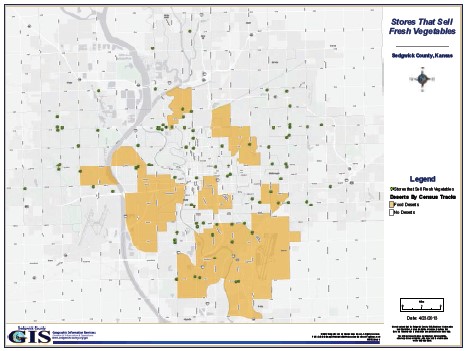
  • The number of places to buy fresh produce in various neighborhoods.
  • The percentage of motor vehicle accidents and traffic stops involving alcohol.
  • The number of adolescents giving birth in the community in the past year, compared to those in other similar communities, in the state or province (or country) as a whole, and/or in past years.

Before you start, take careful stock of your resources -- people, money, skills, time -- to be sure you can do all you plan to. An assessment can be conducted with volunteers and lots of (free) legwork, or it can require statistical and other expertise, professional consultation, and many paid hours. Don't plan an assessment that you don't have the resources to carry out.

Decide what methods you'll use for gathering information

Much of the rest of this chapter is devoted to methods of gathering assessment data.  Some general descriptions:

Each community is different, and so you might use any one or any combination of these and other methods detailed in this chapter, depending on what you're looking for and who can help.

  • Using existing data. This is the research you might do to unearth the information in census and other public records, or to find information that's been gathered by others.
  • Listening sessions and public forums. Listening sessions are forums you can use to learn about the community's perspectives on local issues and options. They are generally fairly small, with specific questions asked of participants. They can help you get a sense of what community members know and feel about the issue, as well as resources, barriers, and possible solutions. Public forums tend to be both larger in number of participants and broader in scope than listening sessions. They are gatherings where citizens discuss important issues at a well-publicized location and time. They give people of diverse backgrounds a chance to express their views, and are also a first step toward understanding the community's needs and resources. A good public forum informs the group of where the community is and where the members would like to go.
  • Interviews and focus groups. These are less formal than forums, and are conducted with either individuals or small groups (usually fewer than ten, and often as few as two or three.)  They generally include specific questions, but allow room for moving in different directions, depending on what the interviewees want to discuss. Open-ended questions (those which demand something more than a yes or no or other simple answer), follow-ups to interesting points, and a relaxed atmosphere that encourages people to open up are all part of most assessment interviews. A focus group is a specialized group interview in which group members are not told exactly what the interviewer wants to know, so that they will be more likely to give answers that aren't influenced by what they think is wanted.
  • Direct, and sometimes participant, observation. Direct observation involves seeing for yourself.  Do you want to know how people use the neighborhood park on weekends? Spend a few weekends there, watching and talking to people. If you regularly join a volleyball game or jog through the park with others, you're a participant observer, becoming part of the culture you want to learn about.
  • Surveys. There are several different kinds of surveys, any or all of which could be used as part of a community assessment. Written surveys may be sent to people in the mail, given out at community events or meetings, distributed in school, or handed to people on the street. People may also be surveyed by phone or in person, with someone else writing down their spoken answers to a list of questions. Many kinds of surveys often have a low return rate, and so may not be the best way to get information, but sometimes they're the only way, or can be given in situations where most people complete them.
  • Asset Mapping. Asset mapping focuses on the strengths of the community rather than the areas that need improvement. Focusing on assets gives the power back to the community members that directly experience the problem and already have the resources to change the status quo. If the changes are made by the community and for the community, it builds a sense of cohesiveness and commitment that makes initiatives easier to sustain.

Decide whom you'll gather information from

For the same reason that you've put together a planning group that represents all the different sectors of the community concerned or involved with the assessment, you should try to get information from as broad a range of people and groups as possible. The greater the variety of people that supply your data, the better perspective you'll have on the real nature, needs, and resources of the community.

Who the people concerned with your particular assessment are, however, depends on your particular focus and purposes. If you're concerned with domestic violence, you'd certainly want to include those directly or indirectly exposed to it, as well as emergency room personnel and police, in your data gathering.  If you're concerned with preserving open space, you might look to include both environmentalists and developers. That doesn't mean you wouldn't want the opinions of a variety of others, but simply that you'd try to make sure that the people with the most interest and knowledge -- and often the most to gain or lose -- could have their say.  You wouldn't want to miss valuable information, regardless of the opinions of the informant.

This brings up an important point.  Your plan should make sure that the assessment includes the opportunity for all points of view to be aired. You may not like what some people have to say, but if you don't know that there are people with differing opinions, you only have half of the information you need.

Decide who will collect data

Will you use a participatory research process, whereby community members gather data themselves or in collaboration with professionals? Will you hire an individual or a group to gather information? If you choose neither of these, then who will do the work of interviewing, surveying, or carrying out whatever other strategies you've chosen to find information?

These are important questions, because their answers can affect the quality and quantity of information you get. Individuals in the community may be more willing to be interviewed and/or to give honest and detailed answers to people they know or can identify with, i.e., other community members. Participatory researchers may need training to be able to do a good job. You may need an experienced researcher to put together a survey that gets at the issues you're most concerned with. A combination of several types of data gatherers may work best.  It's worth spending some time on this issue, so that you can assemble the crew that's right for your community and your plan.

Decide how you'll reach your informants

In order to get information from people, you'll have to contact them. There are many ways to do that, and you'll probably want to use several of them. In general, the more personal the approach, the more effective it will be. Some of the most common:

  • Posting requests on one or more local websites or on social media sites (Facebook, Twitter, etc.)
  • Choosing people at random (e.g., from the phone book) to receive written or telephone surveys.
  • Mailing or emailing surveys to one or more lists.  Many organizations are willing to share lists of members or participants for purposes like this.  Some will mail or email surveys under their own names, so that people receive them from an organization they're familiar with, and might be more willing to complete and return them than if they apparently came to them randomly.
  • Stopping people in a public place to ask them to fill out or, more commonly, give verbal answers to a short survey.  You may have had the experience of being asked your opinion in a shopping area or on a busy sidewalk.  People are somewhat more willing to answer questions in this way than to fill out and return a mailed or emailed survey.
  • Putting up posters and distributing flyers in public places (supermarkets, laundromats, bus stops, etc.) and/or sending them to specific organizations and businesses.
  • Using the media. This can involve holding press conferences and sending out press releases, placing PSA's (public service announcements) and stories in various media, or paying for media advertising.
  • Direct appeal to existing community groups. Either a member of the planning team or a leader or member of the group in question might make an appeal at a club meeting, a religious gathering, or a sports event for volunteers to participate in a survey, an interview or focus group, or a larger meeting.
  • Personal approach. Members of the planning group might recruit friends, colleagues, neighbors, family members, etc. by phone or in person. They might also ask the people they recruit to ask others, so that a few people can start a chain of requests that ends up with a large number.

Decide who will analyze the data and how they'll do it

Once you've collected the information, you have to analyze it to see what it means. That means identifying the main themes from interviews and forums, sorting out the concerns of the many from those of the insistent few, understanding what your indicators seem to show, comparing community members' concerns with the statistics and indicators, and perhaps a number of other analytical operations as well. Some of these might involve a knowledge of statistics and higher math, while others may require only common sense and the ability to group information in logical ways.

If you've engaged in a participatory research process, the community researchers should also be involved in analyzing the material they've found. They might do this in collaboration with professionals from local organizations, with consulting academic researchers, or with a paid consultant. If you've decided to hire an individual or group to conduct the assessment, then they'll probably conduct the analysis as well.

In either case, the methods used will probably depend on such considerations as how "hard" you want the data to be -- whether you want to know the statistical significance of particular findings, for example, or whether you'll use people's stories as evidence -- how much you think you need to know in order to create an action plan, and what kinds of data you collect. Chapter 37, although its title concerns evaluation, is actually about research methods, and contains a lot of good information about how to approach the choice of methods.

Plan whatever training is needed

We've already discussed the possible need for training. Now is the time to decide what, if any, training is needed, who should be involved, and who will conduct it. In order to keep members of the planning group on an equal footing, it might make sense to offer the training to everyone, rather than just to those who are obviously not highly educated or articulate. It is probably important as well that the training be conducted by people who are not members of the planning group, even if some of them have the skills to do so. The group will function best if everyone feels that everyone else is a colleague, even though members have different backgrounds and different sets of skills and knowledge.

Decide how you'll record the results of the assessment and present them to the community

Depending on your goals and what's likely to come out of the assessment, "the community" here may mean the whole community or the community of stakeholders that is represented on the planning committee. In either case, you'll want to be able to explain clearly what the assessment found, and perhaps to engage people in strategizing about how to deal with it. That means you'll want to set out the results clearly, in simple, everyday language accompanied by easy-to-understand charts, pictures, and/or graphs. Your report doesn't have to be complicated or to use technical language in order to be compelling. In fact, the more you can use the words of the community members who contributed their concerns and experiences, the more powerful your report will be.

How will you communicate the results to the community? With the availability of PowerPoint and similar programs, you have the opportunity to create a professional-looking presentation that you can use in a number of ways. It could be presented as a slide show in one or more public meetings or smaller gatherings, posted along with a narrative on one or more social media sites (Facebook, YouTube, etc.) and/or on your website, run as a loop in a public place, such as a local library, or even broadcast on community access TV.  Furthermore, it could be used by a number of people without each having to fetch and carry large and cumbersome equipment or signboards and the like.

Decide who will perform what assessment tasks

The group should make sure everyone has a role that fits her skills, talents, and, to the extent possible, preferences.  It should also make sure that all necessary tasks are covered.  If more people need to be recruited -- as data gatherers, survey mailers, phone callers, etc. -- that recruitment should be part of the plan. The point of having a plan is to try to anticipate everything that's needed -- as well as everything that might go wrong -- and make sure that it has been arranged for. Assigning tasks appropriately is perhaps the most important part of that anticipation.

Create a timeline

Work out what should happen by when. How long will you spend on preparing for the assessment -- contacting people, training interviewers and/or group facilitators, preparing and printing surveys? How long will you gather information? How long will you take to analyze the data and write up a report? Each phase of the assessment should have a deadline. That creates benchmarks -- checkpoints along the way that tell you you're moving in the right direction and have gotten far enough along so that you'll finish the assessment on time with the information you need.

Present the plan, get feedback, and adjust it to make it more workable

 Once the plan is done, it should be presented to at least a sample of those who will be asked for information and those who will have responsibilities for parts of the assessment.  This will allow them to consider whether the plan takes the culture of the community into account, and is likely to make data collection and analysis as easy as possible.  As a result of their feedback, you can adjust parts of the plan to make them more acceptable to the community or more workable for the assessment team.

Now you can celebrate the completion of the plan, but it's not an occasion for resting on your laurels

There's a lot of work ahead as you conduct the assessment, analyze the data you get from it, and make and implement action plans based on that analysis. It's important to have benchmarks built into the assessment plan and the action plans that follow, so you can keep track of your progress.  But it's also important to hold your long-term vision in view, and to keep moving toward it until the community becomes what all its members want it to be.

In Summary

Needs and resources are really two sides of the same coin. In order to get a comprehensive view of your community, it is important to look at what you have and what you need. With these things in mind, you can have a positive impact on the problem you wish to address. Understanding the community's needs and assets will also help your organization clarify where it would like to go and how it can get there.

Contributor

Catie Heaven

Resources

Online Resources

The Action Catalogue is an online decision support tool that is intended to enable researchers, policy-makers and others wanting to conduct inclusive research, to find the method best suited for their specific project needs.

Best Practices for Community Health Needs Assessment and Implementation Strategy Development: A Review of Scientific Methods, Current Practices, and Future Potential is a report of proceedings from a public forum and interviews of experts convened by the CDC.

County Health Rankings & Roadmaps. Ranking the health of nearly every county in the nation, the County Health Rankings help us see how where we live, learn, work, and play influences how healthy we are and how long we live. The Rankings & Roadmaps show us what is making residents sick, where we need to improve, and what steps communities are taking to solve their problems. The health of a community depends on many different factors – ranging from individual health behaviors, education and jobs, to quality of health care, to the environment, therefore we all have a stake in creating a healthier community. Using the County Health Rankings & Roadmaps, leaders and advocates from public health and health care, business, education, government, and the community can work together to create programs and policies to improve people's health, reduce health care costs, and increase productivity.

Community Assessment Tools. A companion piece to Communities in Action: A Guide to Effective Service Projects.  Publication by Rotary International.

Community Assessment Toolkit: Nutrition and Physical Activity. A Tool kit to help with community assessment on a specific topic from the Vermont Dept. of Health Fit & Healthy Vermonters program.

An Introduction to Community Health Needs Assessment (CHNA) provides helpful tips and resources for those first learning about addressing Community Health Needs as well as those looking for more resources and support to address needs in their area.

Community Needs Assessment - participant workbook from the CDC.

Conducting a Community Needs Assessment - Strengthening Nonprofits: A Capacity Builder's Resource Library.

Doing Fieldwork in a Pandemic - This crowd-sourced document was initially directed at ways for how to turn fieldwork that was initially planned as using face-to-face methods into a more ‘hands-off’ mode. It provides an alternative source of social research materials if researchers decide to go down that path.

HealthEquityGuide.org is a website with a set of strategic practices that health departments can apply to more meaningfully and comprehensively advance health equity.

Improving Health Equity Through Improving Data in Community Health Needs Assessments from Community Psychology.

Preparing for a Collaborative Community Assessment. From the Iowa State University Extension.

Road to the Community Plan shows a collaboration between the Macalester-Groveland Community Council (MGCC) and the City of Saint Paul to create a road map that illustrates key steps as a guide for communities to reference as they embark on their community plan process. This document is a tool intended to offer best practices and insights to guide the conversation between district councils and their respective communities as they develop their own unique approaches to the community plan.

Strategic Prevention Framework (SPF) Workbook: Needs Assessment from the Maryland Department of Health and Mental Hygiene, Behavioral Health Administration.

Using Data as an Equity Tool is an Urban Institute resource which provides strategies and key practices which place-based organizations can use to build local data capacity with their partners, improve service provision and day-to-day operations, and amplify community voices.

Grounding Youth Well-Being In Community Context is an action guide that helps local coalitions assess community needs and strengths by centering resident voices alongside data and evidence.

Print Resources

Fawcett, S., et al. (1980). Concerns report handbook: Planning for community health. Lawrence, KS: Work Group on Health Promotion and Community Development, University of Kansas.

Fawcett, S., et al. (1992). Preventing adolescent pregnancy: An action planning guide for community-based initiatives. Lawrence, KS: Work Group for Health Promotion and Community Development, University of Kansas.

Foster, D. (1994). Community assessment. Amherst, MA: AHEC/Community Partners.

Healthcare Forum Leadership Center, National Civic League (1994). Healthier communities action kit. San Francisco, CA: Healthcare Forum.

Michigan Community Health Assessment. (1994). Forum I handbook: Defining and organizing the community. Lansing, MI: Author.

Minkler, M. (1997). Community organizing and community building for health. New Brunswick, NJ: Rutgers.

Moore, M. (1994). Community capacity assessment. Albuquerque, N. M.: Children, Youth and Families Department.

Murphy, Frederick. (Ed.) (2013). Community Engagement, Organization, and Development for Public Health Practice. New York: Springer.

Wikin, B., Altschuld, J. (1995). Planning and conducting needs assessments: A practical guide. Thousands Oaks, CA: Sage Publications.


Checklist
mloewenstein Mon, 12/10/2012 - 15:44

What do we mean by needs and resources?

___Needs can be defined as the gap between what is and what should be

___Resources, or assets, can include anyone or anything that can be used to improve the quality of life

Why develop a plan for assessing local needs and resources?

___It will help you gain a deeper understanding of the community

___An assessment will encourage community members to consider the community's assets and how to use them, as well as the community's needs and how to address them

___It will help you make decisions about priorities for program or system improvement

___It goes a long way toward eliminating unpleasant surprises down the road

___It allows you to involve community members from the very beginning of the process

___An assessment is a great opportunity to use community-based participatory research, further involving community members and increasing community capacity

___A good plan will provide an easy-to-follow road map for conducting an accurate assessment

___A planning process will give community members the opportunity to voice their opinions, hopes, and fears about the community

Who should be involved in developing a plan for assessing local needs and resources?

___Those experiencing needs that should be addressed

___Health and human service providers

___Government officials

___Community leaders

___People whose jobs or lives could be affected by the eventual actions taken as a result of the assessment

___Community activists

___Businesses, especially those that employ people from populations of concern

When should you assess needs and assets?

___Prior to planning the initiative

___During implementation of an initiative

___On an ongoing basis

How do you develop a plan to assess local needs and resources?

___Recruit a planning group that represents all stakeholders and mirrors the diversity of the community

___Design an evaluation process for the assessment, including the development of the plan

___Decide why you want to conduct the assessment

___Determine what data is already available

__ Figure out what other information you need

___Decide what methods you'll use for gathering information

  • Using existing data
  • Listening sessions and public forums
  • Interviews and focus groups
  • Direct, and sometimes participant, observation
  • Surveys
  • Asset mapping

___Decide whom you'll gather information from

___Decide who will collect data

___Decide how you will reach informants

___Decide who will analyze the data and how they'll do it

___Plan whatever training is needed

___Decide how you'll record the results of the assessment and present them to the community

___Decide who will perform what assessment tasks

___Create a timeline

___Present the plan, get feedback, and adjust it to make it more workable

Contributor

Catie Heaven

Examples
pschneider Thu, 04/09/2015 - 09:05

Example 1: Road to the Community Plan

In the summer of 2013, the Macalester-Groveland Community Council (MGCC) initiated their Community Plan process. Their primary goal was to effectively engage the community and accurately reflect their interests in the plan. The leaders of the Community Council recognized that they needed to be strategic about their engagement and provide opportunities for underrepresented groups to be engaged.

Additionally, the City of Saint Paul was interested in assisting district councils to understand the elements of the plan, to make the review and approval process more efficient, and to derive a plan that the community can use to steward future development.

Thus, this project is a collaboration between MGCC and the City of Saint Paul to create a road map that illustrates key steps as a guide for communities to reference as they embark on their community plan process.

The information on the ‘Road Map’ and this ‘Companion Guide’ is a result of research conducted through a literature review of community planning best practices and plan elements, focus group interviews of district council staff, individual interviews of community organizations and personal observations of MGCC leadership meetings. This Companion Guide also includes documentation of the aforementioned process and will be of particular interest to district councils and community members seeking additional information.

This document is intended to offer best practices and insights to guide the conversation between district councils and their respective communities as they develop their own unique approaches to the community plan. Users are encouraged to interpret and utilize these tools as they see fit.

Author: Andrew Tran

Sponsor: Conducted on behalf of Macalester-Groveland Community Council and the City of Saint Paul Supported by the Kris Nelson Community-Based Research Program, a program of the Center for Urban and Regional Affairs (CURA) at the University of Minnesota.
 

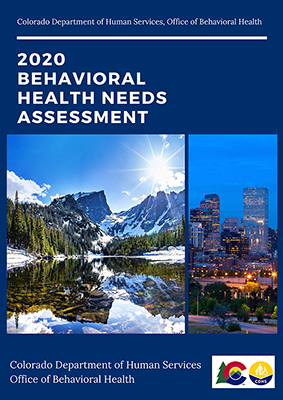
Example 2: 2020 Behavioral Health Needs Assessment

Cover of the 2020 Behavioral Health Needs Assessment


The Colorado Department of Human Services (CDHS), Office of Behavioral Health (OBH) partnered with Health Management Associates, Inc. (HMA) to conduct a statewide behavioral health needs assessment. 

The purpose of the assessment is to be responsive to the requirements of the state’s Substance Abuse and Mental Health Services Administration (SAMHSA) block grants and to inform a long-term strategic plan for addressing the current and projected behavioral health needs of Coloradans. Read more.

The 2020 needs assessment comprises several documents:

  • The Snapshot Report, which provides quick takeaways from the study; 
  • The Main Summary, which reviews findings in more detail;  
  • The State of the State Report, which covers behavioral health demand in Colorado and outlines strengths and weaknesses of our current system;
  • Priority Population Briefs, which break down specific needs and considerations for 13 groups that have historically faced barriers to behavioral health care, including Coloradans of Color, individuals with developmental disabilities, LGBTQ+ Coloradans and many more; and
  • Regional Profiles, which map out the state’s behavioral health landscape across seven areas.


PowerPoint
Anonymous (not verified) Mon, 12/10/2012 - 15:44

A PowerPoint presentation summarizing the major points in the section.

Section 2. Understanding and Describing the Community
mloewenstein Mon, 12/10/2012 - 15:46
Main Section
mloewenstein Mon, 12/10/2012 - 15:47
  • What is a community?

  • What do we mean by understanding and describing the community?

  • Why make the effort to understand and describe your community?

  • Whom should you contact to gather information?

  • How do you go about understanding and describing the community?


Photo of cartoon houses


For those of us who work in community health and development, it's important to understand community -- what a community is, and the specific nature of the communities in which we work. Anything we do in a community requires us to be familiar with its people, its issues, and its history. Carrying out an intervention or building a coalition are far more likely to be successful if they are informed by the culture of the community and an understanding of the relationships among individuals and groups within it.

Taking the time and effort to understand your community well before embarking on a community effort will pay off in the long term. A good way to accomplish that is to create a community description -- a record of your exploration and findings. It's a good way to gain a comprehensive overview of the community -- what it is now, what it's been in the past, and what it could be in the future. In this section, we'll discuss how you might approach examining the community in some detail and setting down your findings in a community description.

What is a community?

While we traditionally think of a community as the people in a given geographical location, the word can really refer to any group sharing something in common -- place (such as a city, neighborhood, or school district), experience (such as shared experience of racism), or interest (e.g., a community's concern about poverty or violence prevention).

These various communities often overlap. A Black art teacher, for example, might see herself (or be seen by others) as a member of the Black, arts, and/or education communities, as well as of a particular faith community. Whichever community defines your work, you will want to get to know it well.

What do we mean by understanding and describing the community?

Understanding the community entails understanding it in a number of ways. Whether or not the community is defined geographically, it still has a geographic context -- a setting that it exists in. Getting a clear sense of this setting may be key to a full understanding of it. At the same time, it's important to understand the specific community you're concerned with. You have to get to know its people -- their culture, their concerns, and relationships -- and to develop your own relationships with them as well.

  • Physical aspects. Every community has a physical presence of some sort, even if only one building. Most have a geographic area or areas they are either defined by or attached to. It's important to know the community's size and the look and feel of its buildings, its topography (the lay of the land -- the hills, valleys, rivers, roads, and other features you'd find on a map), and each of its neighborhoods. Also important are how various areas of the community differ from one another, and whether your impression is one of clean, well-maintained houses and streets, or one of shabbiness, dirt, and neglect.

    If the community is one defined by its population, then its physical properties are also defined by the population: where they live, where they gather, the places that are important to them. The characteristics of those places can tell you a great deal about the people who make up the community. Their self-image, many of their attitudes, and their aspirations are often reflected in the places where they choose -- or are forced by circumstance or discrimination -- to live, work, gather, and play.

  • Infrastructure. Roads, bridges, transportation (local public transportation, airports, train lines), electricity, landline and mobile telephone service, broadband service, and similar "basics" make up the infrastructure of the community, without which it couldn't function.
  • Patterns of settlement, commerce, and industry. Where are those physical spaces we've been discussing? Communities reveal their character by where and how they create living and working spaces. Where there are areas with severely inadequate housing and limited services --  substandard housing in areas with few or no services that are the only options for people with lower incomes -- the value the larger community places on those residents seems clear. Are heavy industries located next to residential neighborhoods? If so, who lives in those neighborhoods? Are some parts of the community dangerous, either because of high crime and violence or because of unsafe conditions in the built or natural environment?
  • Demographics.  It's vital to understand who makes up the community.  Age, gender, race and ethnicity, marital status, education, number of people in household, first language -- these and other statistics make up the demographic profile of the population. When you put them together (e.g.,  the education level of black women ages 18-24), it gives you a clear picture of who community residents are.
  • History. The long-term history of the community can tell you about community traditions, what the community is, or has been, proud of, and what residents would prefer not to talk about. Recent history can afford valuable information about conflicts and factions within the community, important issues, past and current relationships among key people and groups -- many of the factors that can trip up any effort before it starts if you don't know about and address them.
  • Community leaders, formal and informal. Some community leaders are elected or appointed -- mayors, city councilors, directors of public works. Others are considered leaders because of their activities or their positions in the community -- community activists, corporate CEO's, college presidents, doctors, clergy.  Still others are recognized as leaders because, they are trusted for their proven integrity, courage, and/or care for others and the good of the community.
  • Community culture, formal and informal. This covers the spoken and unspoken rules and traditions by which the community lives. It can include everything from community events and slogans -- the blessing of the fishing fleet, the "Artichoke Capital of the World" -- to norms of behavior -- turning a blind eye to alcohol use disorder or domestic violence -- to patterns of discrimination and exercise of power. Understanding the culture and how it developed can be crucial, especially if that's what you're attempting to change.
  • Existing groups.  Most communities have an array of groups and organizations of different kinds -- service clubs (Lions, Rotary, etc.), faith groups, youth organizations, sports teams and clubs, groups formed around shared interests, the boards of community-wide organizations (the YMCA, the symphony, United Way), as well as groups devoted to self-help, advocacy, and activism.  Knowing of the existence and importance of each of these groups can pave the way for alliances or for understanding opposition.
  • Existing institutions. Every community has institutions that are important to it, and that have more or less credibility with residents. Colleges and universities, libraries, religious institutions, hospitals -- all of these and many others can occupy important places in the community. It's important to know what they are, who represents them, and what influence they wield.
  • Economics.  Who are the major employers in the community?  What, if any, business or industry is the community's base? Who, if anyone, exercises economic power? How is wealth distributed? Would you characterize the community as poor, working, class, middle class, or affluent?  What are the economic prospects of the population in general and/or the population you're concerned with?
  • Government/Politics. Understanding the structure of community government is obviously important. Some communities may have strong mayors and weak city councils, others the opposite. Still other communities may have no mayor at all, but only a town manager, or may have a different form of government entirely.  Whatever the government structure, where does political power lie? Understanding where the real power is can be the difference between a successful effort and a vain one.
  • Social structure. Many aspects of social structure are integrated into other areas -- relationships, politics, economics -- but there are also the questions of how people in the community relate to one another on a daily basis, how problems are (or aren't) resolved, who socializes or does business with whom, etc. This area also includes perceptions and symbols of status and respect, and whether status carries entitlement or responsibility (or both).
  • Attitudes and values. Again, much of this area may be covered by investigation into others, particularly culture. What does the community care about, and what does it ignore? What are residents' assumptions about the proper way to behave, to dress, to do business, to treat others? Is there widely accepted discrimination against one or more groups by the majority or by those in power? What are the norms for interaction among those who with different opinions or different backgrounds?

We'll discuss all of these aspects of community in greater detail later in the section.

There are obviously many more aspects of community that can be explored, such as health or education.  The assumption here is that as part of an assessment, you'll aim for a general understanding of the community, as described in this section, and also assess, with a narrower focus, the specific aspects you're interested in.

Once you've explored the relevant areas of the community, you'll have the information to create a community description. Depending on your needs and information, this description might be anything from a two-or three-page outline to an in-depth portrait of the community that extends to tens of pages and includes charts, graphs, photographs, and other elements. The point of doing it is to have a picture of the community at a particular point in time that you can use to provide a context for your community assessment and to see the results of whatever actions you take to bring about change.

A community description can be as creative as you're capable of making it.  It can be written as a story, can incorporate photos and commentary from community residents (see Photovoice), can be done online and include audio and video, etc. The more interesting the description is, the more people are likely to actually read it.

Why make the effort to understand and describe your community?

You may at this point be thinking, "Can't I work effectively within this community without gathering all this information?" Perhaps, if it's a community you're already familiar with, and really know it well. If you're new to the community, or an outsider, however, it's a different story. Not having the proper background information on your community may not seem like a big deal until you unintentionally find yourself on one side of a bitter divide, or get involved in an issue without knowing about its long and tangled history.

Some advantages to taking the time to understand the community and create a community description include:

  • Gaining a general idea, even before an assessment, of the community's strengths and the challenges it faces.
  • Capturing unspoken, influential rules and norms. For example, if people are divided and angry about a particular issue, your information might show you an event in the community's history that explains their strong emotions on that subject.
  • Getting a feel for the attitudes and opinions of the community when you're starting work on an initiative.
  • Ensuring the security of your organization's staff and participants.  There may be neighborhoods where staff members or participants should be accompanied by others in order to be safe, at least at night. Knowing the character of various areas and the invisible borders that exist among various groups and neighborhoods can be extremely important for the physical safety of those working and living in the community.
  • Having enough familiarity with the community to allow you to converse intelligently with residents about community issues, personalities and geography. Knowing that you've taken the time and effort to get to know them and their environment can help you to establish trust with community members.  That can make both a community assessment and any actions and activities that result from it easier to conduct.
  • Being able to talk convincingly with the media about the community.
  • Being able to share information with other organizations or coalitions that work in the community so that you can collaborate or so that everyone's work can benefit.
  • Providing background and justification for grant proposals.
  • Knowing the context of the community so that you can tailor interventions and programs to its norms and culture, and increase chances of success.

When should you make an effort to understand and describe the community?

  • When you're about to launch a community assessment. The first step is to get a clear sense of the community, before more specifically assessing the area(s) you're interested in.
  • When you're new to a community and want to be well informed before beginning your work. If you've just started working in a community -- even if it's work you've been doing for years -- you will probably find that taking the time to write a community description enriches your work.
  • When you've been working in a community for any length of time and want to take stock. Communities are complex, constantly-changing entities. By periodically stopping to write a detailed description of your community, you can assess what approaches have worked and what haven't; new needs that have developed over time and old concerns that no longer require your effort and energy; and other information to help you better do your work.
  • When you're feeling like you're stuck in a rut and need a fresh perspective. Organizations have to remain dynamic in order to keep moving forward. Reexamining the community -- or perhaps examining it carefully for the first time -- can infuse an organization with new ideas and new purpose.
  • When you're considering introducing a new initiative or program and want to assess its possible success.Aside from when you first come to a community, this is probably the most vital time to do a community description.
  • When a funder asks you to, often as part of a funding proposal.

While researching and writing a community description can take time, your work can almost always benefit from the information you gather.

Whom should you contact to gather information?

Much of your best and most interesting information may come from community members with no particular credentials except that they're part of the community. It's especially important to get the perspective of underrepresented community members -- people with lower incomes, immigrants, and others who are often kept out of the community discussion. In addition, however, there are some specific people that it might be important to talk to. They're the individuals in key positions, or those who are trusted by a large part of the community or by a particular population. In a typical community, they might include:

  • Elected officials
  • Community planners and development officers
  • Chiefs of police
  • School superintendents, principals, and teachers
  • Directors or staff of health and human service organizations
  • Health professionals
  • Clergy
  • Community activists
  • Housing advocates
  • Presidents or chairs of civic or service clubs -- Chamber of Commerce, veterans' organizations, Lions, Rotary, etc.
  • People without titles, but identified by others as "community leaders"
  • Business owners

How do you go about understanding and describing the community?

General Guidelines

To begin, let's look at some basic principles to keep in mind.

  • Be prepared to learn from the community. Assume that you have a lot to learn, and approach the process with an open mind. Listen to what people have to say. Observe carefully. Take notes -- you can use them later to generate new questions or to help answer old ones.
  • Be aware that people's speech, thoughts, and actions are not always rational. Their attitudes and behavior  are often best understood in the context of their history, social relations, and culture. Race relations in the U.S., for example, can't be understood without knowing some of the historical context -- the history of slavery, Jim Crow laws, and the work of Martin Luther King and the Civil Rights Movement.
  • Don't assume that the information people give you is necessarily accurate. There are a number of reasons why informants may tell you things that are inaccurate. People's perceptions don't always reflect reality, but are colored instead by what they think or what they think they know.  In addition, some may intentionally exaggerate or downplay particular conditions or issues for their own purposes or for what they see as the greater good. (The Chamber of Commerce or local government officials might try to make economic conditions look better than they are in the hopes of attracting new business to the community, for instance.)  Others may simply be mistaken about what they tell you  -- the geographical boundaries of a particular neighborhood, for example, or the year of an important event. Get information, particularly on issues, conditions, and relationships from many sources if you can. As time goes on, you'll learn who the always-reliable sources are.
  • Beware of activities that may change people's behavior. It's well known that people (and animals as well) can change their normal behavior as a result of knowing they're being studied.  Neighborhood residents may clean up their yards if they're aware that someone is taking the measure of the neighborhood. Community members may try to appear as they wish to be seen, rather than as they really are, if they know you're watching. To the extent that you can, try not to do anything that will change the way people go about their daily business or express themselves. That usually means being as unobtrusive as possible -- not being obvious about taking pictures or making notes, for instance. In some circumstances, it could mean trying to gain trust and insight through participant observation.

Participant observation is a technique that anthropologists use.  It entails becoming part of another culture, both to keep people in it from being influenced by your presence and to understand it from the inside.  Some researchers believe it addresses the problem of changing the culture by studying it, and others believe that it makes the problem worse.

  • Take advantage of the information and facilities that help shape the world of those who have lived in the community for a long time. Read the local newspaper (and the alternative paper, too, if there is one), listen to local radio, watch local TV, listen to conversation in cafes and bars, in barbershops and beauty shops.  You can learn a great deal about a community by immersing yourself in its internal communication. The Chamber of Commerce will usually have a list of area businesses and organizations, along with their contact people, which should give you both points of contact and a sense of who the people are that you might want to get in touch with. Go to the library -- local librarians are often treasure troves of information, and their professional goal is to spread it around. Check out bulletin boards at supermarkets and laundromats.  Even graffiti can be a valuable source of information about community issues.
  • Network, network, network.  Every contact you make in the community has the potential to lead you to more contacts. Whether you're talking to official or unofficial community leaders or to people you just met on the street, always ask who else they would recommend that you talk to and whether you can use their names when you contact those people. Establishing relationships with a variety of community members is probably the most important thing you can do to ensure that you'll be able to get the information you need, and that you'll have support for working in the community when you finish your assessment and begin your effort.

Gathering information

To find out about various aspects of the community, you'll need a number of different methods of gathering information. We've already discussed some of them, and many of the remaining sections of this chapter deal with them, because they're the same methods you'll use in doing a full community assessment. Here, we'll simply list them, with short explanations and links to sections where you can get more information about each.

  • Public records and archives. These include local, state, and federal government statistics and records, newspaper archives, and the records of other organizations that they're willing to share. Many of the public documents are available at public and/or university libraries and on line at government websites. Most communities have their own websites, which often contain valuable information as well.
  • Individual and group interviews. Interviews can range from casual conversations in a cafe to structured formal interviews in which the interviewer asks the same specific questions of a number of carefully chosen key informants. They can be conducted with individuals or groups, in all kinds of different places and circumstances. They're often the best sources of information, but they're also time-consuming and involve finding the right people and convincing them to consent to be interviewed, as well as finding (and sometimes training) good interviewers.

Interviews may include enlisting as sources of information others who've spent time learning about the community.  University researchers, staff and administrators of health and human service organizations, and activists may all have done considerable work to understand the character and inner workings of the community.  Take advantage of their findings if you can.  It may save you many hours of effort.

  • Surveys. There are various types of surveys. They can be written or oral, conducted with a selected small group -- usually a randomized sample that represents a larger population -- or with as many community members as possible. They can be sent through the mail, administered over the phone or in person, or given to specific groups (school classes, faith congregations, the Rotary Club). They're often fairly short, and ask for answers that are either yes-no, or that rate the survey-taker's opinion of a number of possibilities (typically on a scale that represents "agree strongly" to "disagree strongly" or "very favorable" to "very unfavorable.")  Surveys can, however, be much more comprehensive, with many questions, and can ask for more complex answers.
  • Direct or participant observation.  Often the best way to find out about the community is simply to observe. You can observe physical features, conditions in various areas, the interactions of people in different neighborhoods and circumstances, the amount of traffic, commercial activity, how people use various facilities and spaces, or the evidence of previous events or decisions. Participant observation means becoming part of the group or scene you're observing, so that you can see it from the inside.

Observation can take many forms.  In addition to simply going to a place and taking notes on what you see, you might use other techniques -- Photovoice, video, audio, simple photographs, drawings, etc.  Don't limit the ways in which you can record your observations and impressions.

Understanding the Community

Now let's consider what you might examine to understand and describe the community. You won't necessarily look for this information in the order given here, although it's a good idea to start with the first two.

The community's physical characteristics.

Get a map of the community and drive and/or walk around. (If the community isn't defined by geography, note and observe the areas where its members live, work, and gather.) Observe both the built and the natural environment. In the built environment, some things to pay attention to are:

  • The age, architecture, and condition of housing and other buildings. Some shabby or poorly-maintained housing may occupy good buildings that could be fixed up, for example -- that's important to know. Is there substandard housing in the community? Look for new construction, and new developments, and take note of where they are, and whether they're replacing existing housing or businesses or adding to it. (You might want to find out more about these. Are they controversial? Was there opposition to them, and how was it resolved? Does the community offer incentives to developers, and, if so, for what?)  Is housing separated by income or other factors, so that all residents with lower incomes, for instance, or all North African immigrants seem to live in one area away from others? Are buildings generally in good condition, or are they dirty and run-down? Are there buildings that look like they might have historic significance, and are they kept up? Are most buildings accessible to people with disabilities?
  • Commercial areas.  Are there stores and other businesses in walking distance of residential areas or of public transportation for most members of the community? Do commercial buildings present windows and displays or blank walls to pedestrians? Is there foot traffic and activity in commercial areas, or do they seem deserted? Is there a good mix of local businesses, or nothing but chain stores? Are there theaters, places to hear music, a variety of restaurants, and other types of entertainment? Do many buildings include public spaces -- indoor or outdoor plazas where people can sit, for example? In general, are commercial areas and buildings attractive and well-maintained?
  • The types and location of industrial facilities. What kind of industry exists in the community? Does it seem to have a lot of environmental impact -- noise, air or water pollution, smells, heavy traffic? Is it located close to residential areas, and, if so, who lives there? Is there some effort to make industrial facilities attractive -- landscaping, murals or imaginative color schemes on the outside, etc?
  • Infrastructure.  What condition are streets in?  Do most streets, at least in residential and commercial areas, have sidewalks? Bike lanes? Are pedestrians shielded from traffic by trees, grass strips, and/or plantings? Are roads adequate for the traffic they bear? Are there foot bridges across busy highways and railroad tracks, or do they separate areas of the community and pose dangers for pedestrians? Is there adequate public transportation, with facilities for people with physical disabilities? Does it reach all areas of the community? Can most people gain access to the Internet if they have the equipment (i.e., computers or properly equipped cell phones)?

This is a topic that is ripe for examination. In many rural areas, particularly in low- and middle-income countries, but often in the developed world as well, there is very little infrastructure.  Roads and bridges may be impassable at certain (or most) times of year, phone service and TV reception nonexistent, Internet access a distant dream. Public transportation in many places, if it exists at all, may take the form of a pickup truck or 20-year-old van that takes as many passengers as can squeeze into or onto the bed, passenger compartment, and roof. Is any of this on the government's or anyone else's radar as a situation that needs to be addressed? What is the general policy about services to rural and/or populations experiencing poverty?  Answers to these and similar questions may both explain the situation (and the attitudes of the local population) and highlight a number of possible courses of action.

In the category of natural features, we can include both areas that have been largely left to nature, and "natural" spaces created by human intervention.

  • Topography. An area's topography is the shape of its landscape. Is the community largely hilly, largely flat, or does it incorporate areas of both? Is water -- rivers, creeks, lakes and ponds, canals, seashore -- a noticeable or important part of the physical character of the community? Who lives in what areas of the community?
  • Open space and greenery. Is there open space scattered throughout the community, or is it limited to one or a few areas? How much open space is there? Is it mostly man-made (parks, commons, campuses, sports fields), or is there wilderness or semi-wilderness? Does the community give the impression  of being green and leafy, with lots of trees and grass, or is it mostly concrete or dirt?
  • Air and water. Is the air reasonably clear and clean, or is there a blanket of smog? Does the air generally smell fresh, or are there industrial or other unpleasant odors? Do rivers, lakes, or other bodies of water appear clean? Do they seem to be used for recreation (boating, swimming, fishing)?

There is an overlap between the community's physical and social characteristics. Does the lay of the land make it difficult to get from one part of the community to another? (Biking, or in some cases even walking, is difficult in San Francisco, for example, because of the length and steepness of the hills.)  Are there clear social divisions that mirror the landscape -- all the fancy houses in the hills, all the low-income housing in the flats, for instance?

Studying the physical layout of the community will serve you not only as information, but as a guide for finding your way around, knowing what people are talking about when they refer to various areas and neighborhoods, and gaining a sense of the living conditions of any populations you're concerned with.

Community demographics.

Demographics are the facts about the population that you can find from census data and other similar statistical information. Some things you might like to know, besides the number of people in the community:

  • Gender
  • Racial and ethnic background
  • Age.  Numbers and percentages of the population in various age groups
  • Marital status
  • Family size
  • Education
  • Income
  • Employment - Both the numbers of people employed full and part-time, and the numbers of people in various types of work
  • Location - Knowing which groups live in which neighborhoods or areas can help to recruit participants in a potential effort or to decide where to target activities

In the U.S., most of this and other demographic information is available from the U.S. Census, from state and local government websites, or from other government agencies.  Depending on what issues and countries you're concerned with, some sources of information might be the U.S. Centers for Disease Control, the U.S. Department of Health and Human Services, similar websites in other countries, and the various agencies of the United Nations.

On many of these websites, notably the U.S. Census, various categories can be combined, so that you can, for example, find out the income levels in your community for African American women aged 25-34 with a high school education. If the website won't do it for you, it's fairly easy to trace the patterns yourself, thus giving you a much clearer picture of who community residents are and what their lives might be like.

Another extremely useful resource is County Health Rankings & Roadmaps, which provides rankings for nearly every county in the nation. The County Health Rankings model includes four types of health factors: health behaviors, clinical care, social and economic, and the physical environment. The County Health Rankings illustrate what we know when it comes to what’s making people sick or healthy, and the new County Health Roadmaps show what we can do to create healthier places to live, learn, work and play. These reports can help community leaders see that our environment influences how healthy we are and how long we live, and even what parts of our environment are most influential.

Community history.

This can be a complex topic. The "standard" history -- when the community was founded and by whom, how long it has existed, how people lived there in the past, its major sources of work, etc. -- can often be found in the local library or newspaper archives, or even in books or articles written for a larger audience. The less comfortable parts of that history, especially recent history -- discrimination, conflict, economic and/or political domination by a small group -- are may not be included, and are more likely to be found by talking to activists, journalists, and others who are concerned with those issues. You might also gain information by reading between the lines of old newspaper articles and tracking down people who were part of past conflicts or events.

If this all sounds a lot like investigative reporting, that's because it is.  You may not have the time or skills to do much of it, but talking to activists and journalists about recent history can be crucial.  Stepping into a community with an intervention or initiative without understanding the dynamics of community history can be a recipe for failure.

Community government and politics.

There are a number of ways to learn about the structure and operation of local government:

  • Go to open meetings of the city council, town boards, board of selectmen, or other bodies, as well as to public forums on proposed actions, laws, and regulations.  Such meetings will be announced in the local paper.

In most of the U.S., these meetings are public by state law, and must be announced in specific ways at least two days ahead.

  • Community bylaws and regulations are often available at the public library.
  • Make an appointment to talk to one or more local government officials.  Many hold regular office hours, and might actually take pleasure in explaining the workings of the local government.
  • Talk to community activists for a view of how the government actually operates, as opposed to how it's supposed to operate.
  • Read the local newspaper every day.

Reading the newspaper every day is a good idea in general if you're trying to learn about the community.  It will not only have stories about how the community operates, but will give you a sense of what's important to its readers, what kinds of activities the community engages in and views as significant, what the police do -- a picture of a large part of community life. Real estate ads will tell you about property values and the demand for housing, ads for services can help you identify the major businesses in town, and the ages and education levels of the people in the marriage and birth announcements can speak volumes about community values.  Newspaper archives can also reveal the stories that help you understand the emotions still surrounding events and issues that don't seem current.  The newspaper is an enormous reservoir of both direct and between-the-lines information.

As we all know, government isn't only about the rules and structures that hold it together. It's about people and their interactions...politics, in other words. The political climate, culture, and assumptions in a particular community often depend more on who elected and appointed officials are than on the limits or duties of their offices.

The politics of many communities embody the ideal of government working for the public good. In other communities, politics takes a back seat to economics, and politicians listen largely to those with economic power -- the CEO's, owners, and directors of large businesses and institutions.  In still others, the emphasis is on power itself, so that political decisions are made specifically to keep a particular party, group, or individual in control.

Obviously, only in the first case is the public well served. In the other situations, fairness and equity tend to go out the window and decisions favor the powerful. Understanding the politics of the community -- who has power, who the power brokers are, who actually influences the setting of policy, how decisions are made and by whom, how much difference public opinion makes -- is fundamental to an understanding of the community as a whole.

There's no formal way to get this information. Government officials may have very different interpretations of the political scene than activists or other community members. You'll have to talk to a variety of people, take a good look at recent political controversies and decisions (here's where newspaper archives can come in handy), and juggle some contradicting stories to get at the reality.

Institutions.

Community institutions, unless they are dysfunctional, can generally be viewed as assets. Finding them should be easy: as mentioned above, the Chamber of Commerce will probably have a list of them, the library will probably have one as well, the local newspaper will often list them, and they'll be in the phone book. 

They cover the spectrum of community life, including:

  • Offices of local, state, and federal government agencies (Public Assistance Services, Dept. of Agriculture, Office of Immigration, etc.)
  • Public libraries.
  • Religious institutions. Churches, synagogues, mosques.
  • Cultural institutions.  Museums, theaters, concert halls, etc. and the companies they support.  These may also encompass community theater and music companies run and staffed by community volunteer boards and performers.
  • Community centers.  Community centers may provide athletic, cultural, social, and other (yoga, support groups) activities for a variety of ages.
  • YMCA's and similar institutions.
  • Senior centers.
  • Hospitals and public health services.
  • Colleges and universities.
  • Public and private schools.
  • Public sports facilities. These might be both facilities for the direct use of the public -- community pools and athletic fields, for example -- or stadiums and arena where school, college, or professional teams play as entertainment.

Groups and organizations.

The groups and organizations that exist in the community, and their relative prestige and importance in community life, can convey valuable clues to the community's assumptions and attitudes. To some extent, you can find them in the same ways that you can find institutions, but the less formal ones you may be more likely to learn about through interviews and conversations. 

These groups can fall into a number of categories:

  • Health and human service organizations.  Known on the world stage as NGO's (Non-Governmental Organizations), these are the organizations that work largely with people with lower incomes and populations experiencing increased risk. They encompass free or sliding-scale health clinics, family planning programs, mental health centers, food pantries, shelters serving people experiencing homelessness, teen parent programs, youth outreach organizations, violence prevention programs, etc.
  • Advocacy organizations. These may also provide services, but generally in the form of legal help or advocacy with agencies to protect the rights of specific groups or to push for the provision of specific services. By and large, they advocate for recognition and services for populations with particular characteristics, or for more attention to be paid to particular issues.
  • Service clubs. Lions, Rotary, Kiwanis, Elks, Masons, etc.
  • Veterans' organizations. In the U.S., the American Legion and the Veterans of Foreign Wars are the major veterans' organizations, but many communities may have others as well.
  • Chamber of Commerce and other business organizations. Some of these may be oriented toward specific types of businesses, while others, like the Chamber, are more general.
  • Groups connected to institutions. Church youth or Bible study groups, school clubs, university student groups (e.g., International Students' Association, community service groups).
  • Trade unions. These may be local, or branches of national or international unions.
  • Sports clubs or leagues. Enthusiasts of many sports organize local leagues that hold regular competitions, and that may compete as well with teams from other communities. In many rural areas, Fish and Game clubs may function as informal community centers.
  • Informal groups. Book clubs, garden clubs, parents' groups, etc.

Economics/employment.

Some of the information about economic issues can be found in public records, but some will come from interviews or conversations with business people, government officials, and activists, and some from observation. It's fairly easy to notice if one huge industrial plant dominates a community, for example, or if every third building appears to be a construction company. There are a number of questions you might ask yourself and others to help you understand the community's economic base and situation: What is the anchor of the community's tax base? Who are the major employers? Does the community have a particular business or business/industry category that underlies most of the jobs? Are there lots of locally-owned businesses and industries, or are most parts of larger corporations headquartered elsewhere?  Are there corporate headquarters in the community? Is there a good deal of office space, and is it empty or occupied?  Is there new development, and is the community attracting new business? What is the unemployment rate?

Social structure.

This may be the most difficult aspect of the community to understand, since it incorporates most of the others we've discussed, and is usually unspoken. People's answers to questions about it may ignore important points, either because they seem obvious to those who've lived with them for all or most of their lives, or because those things "just aren't talked about." Distrust or actual discrimination aimed at particular groups -- based on race, class, economics, or all three -- may be glossed over or never mentioned. The question of who wields the real power in the community is another that may rarely be answered, or at least not answered in the same way by a majority of community members. It's likely that it will take a number of conversations, some careful observation and some intuition as well to gain a real sense of the community's social structure.

Describing the Community

Once you've gathered the information you need, the next step is describing the community. This is not really separate from understanding the community: in the process of organizing and writing down your information, you'll be able to see better how it fits together, and can gain greater understanding.

There are many ways you can create a description of the community. The most obvious is simply to organize, record, and comment on your information by category:  physical description, government, institutions, etc. You can comment about what has changed in the community over time, what has stayed the same, and where you think the community might be going. You might also include an analysis of how the various categories interact, and how that all comes together to form the community that exists. That will give you and anyone else interested a reasonably clear and objective description of the community, as well as a sense of how you see it.

For a fuller picture, you could add photographs of some of the locations, people, conditions, or interactions you describe (perhaps as a Photovoice project), as well as charts or graphs of demographic or statistical information. For even more detail, you might compose a portrait in words of the community, using quotes from interviews and stories of community history to bring the description to life.

Given the availability of technology, you don't have to limit yourself to any specific format. Computers allow you to easily combine various media -- photos, graphics, animation, text, and audio, for example. The description could  add in or take the form of a video that includes a tour of the community, statements from and/or interviews with various community members (with their permission, of course), an audio voice-over, maps, etc.  A video or a more text-based description -- or both -- could then be posted to a website where it would be available to anyone interested.

Once you have a description put together, you might want to show it to some of the community members you talked to in the course of exploring the community. They can suggest other things you might include, correct errors of fact, and react to what they consider the accuracy or inaccuracy of your portrait and analysis of their community. With this feedback, you can then create a final version to use and to show to anyone interested. The point is to get as informative and accurate a picture of the community as possible that will serve as a basis for community assessment and any effort that grows out of it.

The last word here is that this shouldn't be the last community description you'll ever do. Communities reinvent themselves constantly, as new buildings and developments are put up and old ones torn down, as businesses move in and out, as populations shift -- both within the community and as people and groups move in and out -- and as economic, social, and political conditions change. You have to keep up with those changes, and that means updating your community description regularly.  As with most of the rest of the community building work described in the Community Tool Box, the work of understanding and describing the community is ongoing, for as long as you remain committed to the community itself.

In Summary

Understanding a community is crucial to being able to work in it. Failing to understand it will deny you credibility and make it difficult for you both to connect with community members and to negotiate the twists and turns of starting and implementing a community initiative or intervention. An extremely important part of any community assessment, therefore, is to start by finding out as much about the community as you can -- its physical and geographical characteristics, its culture, its government, and its assumptions. By combing through existing data, observing, and learning from community members, you can gain an overview of the community that will serve you well. Recording your findings and your analysis of them in a community description that you can refer to and update as needed will keep your understanding fresh and help others in your organization or with whom you collaborate.

Contributor

Chris Hampton

Catie Heaven

Resources

Online Resources

A community description of Nashua, New Hampshire.

County Health Rankings & Roadmaps. Ranking the health of nearly every county in the nation, the County Health Rankings help us see how where we live, learn, work, and play influences how healthy we are and how long we live. The Rankings & Roadmaps show us what is making residents sick, where we need to improve, and what steps communities are taking to solve their problems. The health of a community depends on many different factors – ranging from individual health behaviors, education and jobs, to quality of health care, to the environment, therefore we all have a stake in creating a healthier community. Using the County Health Rankings & Roadmaps, leaders and advocates from public health and health care, business, education, government, and the community can work together to create programs and policies to improve people's health, reduce health care costs, and increase productivity.

Describing the Community, from a WHO (World Health Organization) manual: Emergency Preparedness: A Manual for Managers and Policy Makers.  WHO, 1999.

The Distressed Communities Index (DCI) is a customized dataset created by EIG examining economic distress throughout the country and made up of interactive maps, infographics, and a report. It captures data from more than 25,000 zip codes (those with populations over 500 people). In all, it covers 99 percent — 312 million — of Americans.

Ericae.net is a clearinghouse for information on evaluation, assessment, and research information.

This Human Development Index Map is a valuable tool from Measure of America: A Project of the Social Science Research Council. It combines indicators in three fundamental areas - health, knowledge, and standard of living - into a single number that falls on a scale from 0 to 10, and is presented on an easy-to-navigate interactive map of the United States.

The Institute of Medicine advances scientific knowledge to improve health and provides information and advice concerning health policy.

The National Institute for Literacy provides information about research and initiatives to expand the community of literacy practitioners, students, and policymakers.

Sustainable Measures provides a searchable database of indicators by broad topics (health, housing) and keywords (AIDS, access to care, birth weight, etc.) for communities, organizations and government agencies at all levels.

U.S. Department of Health and Human Services, the principal agency for protecting the health of U.S. citizens, is comprised of 12 agencies that provide information on their specific domains, such as the Administration on Aging. Others cross health boundaries, such as the Centers for Disease Control, which maintains national health statistics. The "WONDER" system is an access point to a wide variety of CDC reports, guidelines, and public health data to assist in research, decision-making, priority setting, and resource allocation.

The U.S. National Institute of Mental Health provides statistics and educational information for the public as well as information for researchers.

Print Resources

Jones, B. (1979). Defining your neighborhood. In Neighborhood Planning: A Guide for Citizens and Planners. Chicago, IL: Planners Press, pp. 8-11.

Scheie, D. (1991). August-September). Tools for taking stock. The Neighborhood Works. Chicago, IL: Center for Neighborhood Technology, pp. 16-17.

Spradley, J. P. (1980). Locating a social situation. In Participant Observation. Fort Worth, TX: Harcourt Brace Jovanovich, pp. 45-52.

Warren, R.B., Warren, D.I. (1977). The Neighborhood Organizer's Handbook. Notre Dame, IN: University of Notre Dame Press, pp.167-196.


Checklist
mloewenstein Mon, 12/10/2012 - 15:47

What is a community?

___A community can be any group sharing something in common

What do we mean by understanding and describing the community?

___You must understand the community's physical and geographic contexts -- the setting in which the community exists

___You must understand the community's people, culture, and web of relationships

___Explore all dimensions of the community -- physical/geographical,  demographic, social, cultural, political, and economic

___A community description puts together the information you've gathered in a form that creates a picture of the community that you can use to provide a context for your community assessment and to see the results of whatever actions you take to bring about change

Why make the effort to understand and describe your community?

___It will give you a general idea, even before an assessment, of the community's strengths and the challenges it faces

___It will capture unspoken, influential rules and norms

___It will give you a feel for the attitudes and opinions of the community when you're starting work on an initiative

___It will help to ensure the security of your organization's staff and participants

___It will give you enough familiarity with the community to allow you to converse intelligently with residents about community issues, personalities and geography

___It will enable you to talk convincingly with the media about the community

___It will allow you to share information with other organizations or coalitions that work in the community so that you can collaborate or so that everyone's work can benefit

___It will provide background and justification for grant proposals

___It will give you insight into the context of the community so that you can tailor interventions and programs to its norms and culture, and increase your chances of success

When should you make an effort to understand and describe the community?

___When you're new to a community and want to be well informed before beginning your work

___When you've been working in a community for any length of time and want to take stock

___When you're feeling like you're stuck in a rut and need a fresh perspective

___When you're considering introducing a new initiative or program and want to assess its possible success

___When a funder asks you to, often as part of a funding proposal

Whom should you contact to gather information?

___Elected officials

___Community planners and development officers

___Chiefs of police

___School superintendents, principals, and teachers

___Directors or staff of health and human service organizations

___Health professionals

___Clergy

___Community activists

___Real estate agents, housing advocates, and others knowledgeable about the real estate situation in the community

___Presidents or chairs of civic or service clubs -- Chamber of Commerce, veterans' organizations, Lions, Rotary, etc.

___People without titles, but identified by others as "community leaders" or "natural helpers"

___Owners or CEO's of large businesses (these may be local or may be large corporations with local branches)

How do you go about understanding and describing the community?

___Be prepared to learn from the community

___Be aware that people's speech, thoughts, and actions are not always rational

___Don't assume that the information people give you is necessarily accurate

___Beware of activities that may change people's behavior

___Take advantage of the information and facilities that help shape the world of those who have lived in the community for a long time

___Network, network, network

___Gather information using:

  • Public and other records and archives
  • Individual and group interviews and conversations
  • Surveys
  • Direct and participant observation

___Examine:

  • The community's physical and geographical characteristics, including infrastructure
  • Community demographics
  • Community history
  • Community government and politics
  • Community institutions
  • Community groups and organizations
  • Economics and employment
  • Social structure

___Create a community description that you can use as a reference.

___The description can take a number of forms, and can include, drawings, photos, maps, charts, video, audio, animation, or any other feature that you're capable of including and that helps paint an accurate and compelling picture of the community.

___Continue over time to gather information and update your community description as the community changes and develops.

Contributor

Chris Hampton

Catie Heaven

Tools
mloewenstein Tue, 12/18/2012 - 13:20

Tool 1: Community Description Worksheet

Use the information gathered in your interviews and other background work to fill out the following questionnaire. Remember -- the description you write is for you to use, so don't hesitate to adapt or alter these questions to more aptly fit your community. This worksheet is adapted from the work of David Scheie.

General Information:

Name of the organization/community: _________________________________________

Date this form was completed: _______________________________________________

What are the geographical boundaries for this community? __________________________

Approximate size, in numbers, of this community's population: ________________________

Who is actively involved in this community or organization?

People who regularly attend meetings/events: ________________________________

People you consider to be "members": _____________________________________

How do you define a "member"? ____________________________________

People you consider to be "leaders": _______________________________________

How do you define a "leader"? ______________________________________

Demographic Information:

Fill out blanks using approximate percentages:

  Residents Group Members Group Leaders
Asian      
Black      
Hispanic/Latino/Latina      
Indigenous American      
White      
Other      
Male      
Female      
Low Income      
Moderate Income       
Upper Income      


Issues, Goals, and Strategies:

Describe the three most major areas of concern for this organization in the coming year. For each issue, list the primary goal and the strategy that is being used or will be used to approach it.

Issue: _______________________________________________________________

Primary goal: ____________________________________________________

Strategy: _______________________________________________________

Issue: _______________________________________________________________

Primary goal: ____________________________________________________

Strategy: ________________________________________________________

Issue: _______________________________________________________________

Primary goal: ____________________________________________________

Strategy: ________________________________________________________

Tool 2: Guidelines for Individual Interviews

Once you have decided whom to interview, take a look at the following tips on conducting interviews.

  • Dress accordingly -- you'll probably want to wear something much different for a cup of coffee with a homeowner than an interview with the president of the bank.  Would a teenager be more comfortable if you wore jeans or a suit? Would a local politician be offended if you show up in shorts? Think carefully about this; how you dress and act can have a huge impact on what you hear.
  • Take a few minutes to make small talk and make your interviewee comfortable. If you are doing the interview on your home turf (your office, for example), or even a neutral site, ask about his physical comfort. Offer him a drink; explain where the bathroom is. Showing you are concerned about their comfort can be the first step towards a trusting relationship.
  • Explain why you have asked for the interview. Be very clear with what will be done with the results of your interview -- is this just for your own personal reference, or could it going to end up in a formal report or the local newspaper? Give the interviewee a chance to ask any questions he or she might have about your presence.
  • Ask the individual for his or her definition of the community. Some people only see their community as a narrowly defined location; still others will view it in broader, more abstract terms. This might be a good time to pull out your unmarked map, let the interviewee point out key locations in the area, and give you his or her view on where the physical boundaries of the community lie.
  • Ask questions to follow up on any leads that come out of what the interviewee has said so far. Start directing the conversation a bit more, but base your questions on statements that the interviewee has made.

Example: Possible interview questions

  • How long have you been a member of the community?
  • How do you feel about the community?
  • What do you feel are some of this community's strengths?
  • What are some ways in which improvements in the community could be made?
  • What makes you proud of your community?
  • What can you tell me about the history of the community?
  • What do you think lies in the future for this community?
  • Try asking things in different ways. If you're having difficulty getting the interviewee to understand any of your questions, you can use your own experience to illustrate situations you're concerned with. For example, "When my father was injured at work several years ago, our neighbors really helped my family out by bringing meals to us, driving my dad to his medical appointments when my mom had to work, that kind of thing. Do you think people in this community would do the same kind of thing for one another? Why or why not?"
  • Another technique you may want to use to get more information from the interviewee is to bring up hypothetical situations -- the "what if?" questions. For example, "What if a needle exchange program were started downtown to cut down on HIV infection? Do you think community leaders would support it or be opposed to it?" The interviewee will often respond with examples of how similar things have occurred in the neighborhood.
  • Let the interviewee end the interview. Once you've gathered all the information you need, ask the interviewee what he or she wants to know from you. The interviewee will feel validated by the opportunity to express his or her questions, and the questions may reveal more useful information to you.
  • This is a good time for you to start getting to know people and building real relationships with them. Folks will generally be impressed that you care enough about the community to be doing all this research, so be sure to take the time to set aside your notepad or audio recorder and just talk a bit with your contacts.
  • Thank the interviewee for his or her time. Following up with a short thank-you note isn't just good manners --it helps your contacts remember who you are, and leaves them with a positive impression. That way, they're more willing to work with you in the future.
  • Consider finding a local teammate for the entire process. Having someone to bounce ideas off of, especially someone who is intimately acquainted with the community, is very effective.
PowerPoint
Anonymous (not verified) Mon, 12/10/2012 - 15:48

A PowerPoint presentation summarizing the major points in the section.

Section 3. Conducting Public Forums and Listening Sessions
mloewenstein Mon, 12/10/2012 - 15:49
Main Section
mloewenstein Mon, 12/10/2012 - 15:50


This video illustrates how community input was gathered during public meetings to inform development of the 11th Street Park development project.


Public forums and listening sessions are a valuable resource in upholding open lines of communication with the public. Community participation in community projects can help identify and solve problems. This section explains how community leaders can implement public forums and listening sessions into community building and use the results to shape their projects.

What are public forums?

In the "public forum" or public problem-identification and problem-solving session, community members discuss important issues such as health problems. In this well-publicized meeting, the facilitators lead a discussion of various aspects of the issue like the community's strengths and potential problems. A transcript of their ideas about the dimensions of the issue--and what can be done to solve problems and preserve strengths--provides a basis for subsequent planning.

Public forums:

  • Give people of diverse backgrounds a chance to express their views
  • Are a first step toward understanding the community's needs and resources

Why conduct them?

  • They can offer your group valuable insights into the community
  • They can provide a database for guiding and explaining actions
  • They can help link your group with people who are able and willing to help
  • They can provide the group with feedback

Public forums, also referred to as town meetings, are open to everyone in the community. These public meetings offer people from diverse backgrounds a chance to express their views about key issues of concern to you and what can be done about them.

What do you need to conduct a public forum?

  • Meeting place
  • Community members
  • Easel/newsprint /markers
  • Facilitator
  • Recorder
  • Willingness to listen carefully

Issues and Concerns

  • What are the problems?
  • What are the consequences?
  • Who is affected?
  • How are they affected?
  • Are there related issues of concern?
  • Are these issues of widespread concern?

Barriers

  • Who or what might oppose efforts to prevent or solve the problem?
  • Can they be involved effectively?
  • What are the other limits on effective prevention/treatment?
  • How can the barriers and resistance be overcome?

Resources for Change

  • What resources are needed?
  • What local people or groups could contribute?
  • What monies and materials are needed?
  • Where might they be obtained?

Alternatives and Solutions

  • What are alternatives for addressing the problem, given the anticipated barriers?

How should you organize a public forum?

  • Hold meetings at different sites to get real representation.
  • Schedule the forum at an easy-to-find, public location which is accessible and comfortable - for example, a library, school or place of worship.
  • If possible, hold the forum in the evening to avoid time conflicts with work and school.
  • Publicize the forum as widely as possible. Fliers, advertisements, public service announcements and press releases can all be used. Make sure the date, time, location and purpose of the meeting are included.
  • Personally recruit community leaders and diverse community members to attend the meetings. Ask them to recruit others as well.
  • Provide transportation to the meeting if necessary.
  • Serve light refreshments if possible. They encourage mingling and set a friendly tone.

How should you conduct a public forum?

  • Designate a discussion leader or group facilitator who is known and respected, who is neutral on the topic, who has good listening and group process skills, and who can keep things moving and on track.
  • Introduce the leader of the community initiative and the discussion leader. If time and group size allow, let all participants introduce themselves.
  • Agree upon an ending time, and keep to it.
    • Try to keep working groups to smaller than 30-40 participants.
    • If over that number, divide into smaller groups.
    • Designate a recorder for each group.
  • Provide information about your own organization, if appropriate. You can also pass around a sign-up sheet to get on a mailing list or to help out in other ways.
  • Consider allowing some time for addressing each of the following topics: issues and concerns; barriers and resistance to addressing the issues and concerns; community resources for change; recommended alternatives and solutions.
  • Use newsprint to record the discussion on each of the topics.
  • Conclude with a summary of what was achieved and a preliminary plan of action. Announce the next meeting if possible.
  • Prepare a written summary of brainstorming ideas and mail to all participants, with thanks, and with mention of opportunities for further involvement.

Contributor

Vince Francisco

Jerry Schultz

Resources

Online Resources

Community Listening Forum Toolkit: Taking Action to Support Recovery in Your Community, by Faces & Voices of Recovery, has all of the information that one needs to organize a community-listening forum in your community, especially relating to issues concerning recovery from alcoholism or substance use. It was developed using Faces & Voices of Recovery’s experiences hosting four statewide Community Listening Forums with recovery community organizations in 2010 and 2011.

Tips for Hosting a Candidate Forum on Affordable Housing by the National Low Income Housing Coalition

Print Resources

Berkowitz, W. (1982). Community impact. Cambridge, MA: Schenkman Publishing Company, Inc.

Delbecq, A., et al. (1975). Group techniques for program planning. Glenview, IL: Scott, Foresman.

Fawcett, S., et al. (1993). Preventing adolescent pregnancy: an action planning guide for community-based initiatives. Lawrence, KS: Work Group on Health Promotion and Community Development.

Fawcett, S., et al. (1993). Preventing adolescent substance abuse: an action planning guide for community-based initiatives. Lawrence, KS: Work Group on Health Promotion and Community Development.

Fawcett, S., et al. (1994). Preventing youth violence: an action planning guide for community-based initiatives. Lawrence, KS: Work Group in Health Promotion and Community Development.

Hawkins, J.,& Catalano, R. Risk Factor publications from CSAP.

Murrell, S. (1977). Utilization of needs assessment for community decision-making. American Journal of Community Psychology.

Sanders, I. (1985). The social reconnaissance method of community study (Chavis and Felix articles)

Wollf, T., &  Kaye, G. (1994). From the ground up: a workbook on coalition building and community development.

Checklist
mloewenstein Mon, 12/10/2012 - 15:51

You understand that public forums:

___Give people of diverse backgrounds a chance to express their views

___Are a first step toward understanding the community's needs and resources

You have gathered the following things you need to conduct a public forum:

___Meeting place

___Community members

___Easel/newsprint /markers

___Facilitator

___Recorder

___Willingness to listen carefully

Issues and Concerns

You have asked yourself the following questions:

___What are the problems?

___What are the consequences?

___Who is affected?

___How are they affected?

___Are there related issues of concern?

___Are these issues of widespread concern?

Barriers 

You have asked yourself the following questions:

___Who or what might oppose efforts to prevent or solve the problem?

___Can they be involved effectively?

___What are the other limits on effective prevention/treatment?

___How can the barriers and resistance be overcome?

Resources for Change

You have asked yourself the following questions:

___What resources are needed?

___What local people or groups could contribute?

___What monies and materials are needed?

___Where might they be obtained?

Alternatives and Solutions

You have asked yourself the following question:

___What are alternatives for addressing the problem, given the anticipated barriers?

Organizing a public forum

You have taken the following steps:

___Holding meetings at different sites to get real representation.

___Scheduling the forum at an easy-to-find, public location which is accessible and comfortable

___If possible, holding the forum in the evening to avoid time conflicts with work and school.

___Publicized the forum as widely possible.

___Personally recruited community leaders and diverse community members to attend the meetings, and asked them to recruit others as well.

___Provided transportation to the meeting if necessary.

___Served light refreshments if possible.

Conducting a public forum

You have taken the following steps:

___Designated a discussion leader or group facilitator

___Introduced the leader of the community initiative and the discussion leader, and, if time and group size allowed, let all participants introduce themselves.

___Agreed upon an ending time, and kept to it.

___Kept working groups to smaller than 30-40 participants, or, if over that number, divided into smaller groups.

___Designated a recorder for each group.

___Provided information about your own organization, if appropriate.

___Considered allowing some time for addressing such topics as issues and concerns; barriers and resistance to addressing the issues and concerns; community resources for change; recommended alternatives and solutions.

___Used newsprint to record the discussion on each of the topics.

___Concluded with a summary of what was achieved and a preliminary plan of action.

___Announced the next meeting if possible.

___Prepared a written summary of brainstorming ideas and mail to all participants, with thanks, and with mention of opportunities for further involvement.

Contributor

Vince Francisco

Jerry Schultz

Examples
mloewenstein Mon, 12/10/2012 - 15:51

Example 1: Ideas resulting from a public forum on adolescent substance use

Issues and Concerns Surrounding Adolescent Substance Use

Low or diminished self-esteem

Parental abdication of responsibility

  • Availability of drugs
  • Lack of merchant accountability (sale of cigarettes)
  • Tolerance for alcohol abuse - community permissiveness
  • Teenage alcoholism and prolonged health problems
  • Gangs and increased juvenile crime
  • Lack of supervised activities after school
  • Lack of communication among students, teachers, and parents
  • Lack of jobs

Barriers and Resistance to Addressing Adolescent Substance Use

  • Apathy
  • Family issues
    • TV
    • financial stress
    • lack of quality time
    • lack of extended family support
    • both parents work
  • Combatting media, advertising
  • Tolerance for social drugs
  • Lack of treatment services

Community Strengths and Resources for Change

  • Churches - Ministers
  • Local businesses
  • Youth organizations
  • People in neighborhoods whom kids and parents respect

Recommended Alternatives and Solutions

  • More reporting of substance use issues in media
  • Schools become more full-service organizations/community centers
  • Increased presence of parents in school
  • Business mentoring programs to increase job opportunities for teens
  • Closed lunch at high schools

Example 2: Ideas resulting from a public forum regarding whether health insurance is available and affordable to all people in the community

Discussion of the problem

  • More people cannot afford insurance than can afford insurance
  • Even the best insurance in town is not absolute. It does not cover everything it should or could
  • Insurance plans are not broadly available
  • Some people remain on welfare rather than get a low paying job because of the medical benefits
  • There is too much red tape in the health care system
  • Insurance is too expensive
  • Coverage for a spouse is more expensive than coverage for many kids

Discussion of Solutions:

  • One option may be to purchase insurance through a broker to get less expensive health insurance
  • Develop a group plan for the medically indigent
  • Some Independent Living Centers have these group plans. Explore this option
  • Get someone in the community to sponsor insurance for someone else
  • Monitor insurance companies to regulate prices
  • Have the state subsidize doctors who treat low-income people

Example 3: A narrative account of a town meeting

"Giving Voice to the Community: Holding Our First Town Meeting"

We held our first town meeting at dusk on a Tuesday night. It was dark and it looked like it might rain when I entered the community building. The building, located in the heart of the community, was situated across the street from the town's central park and within view of the gazebo located at its center. As I entered the large meeting room, I saw only a few familiar faces. Several members of the steering committee were present, as well as one or two faces that I recognized, but could not place. I worried that the meeting would be a bust. I was only ten minutes early and feared that no one else would show up.

Within five minutes after the starting time, however, I was pleasantly surprised to find that we had to search for extra chairs. I realized then that the flyers posted around town and the announcements on the local radio station advertising our meeting had helped to fill the room to capacity.

At the appointed time, I introduced myself as the Director of Project STOP, and then introduced those steering committee members present. Everyone else in turn introduced themselves. I asked all of the participants to give us a little background about themselves, and why they were interested in the project's mission. Their responses varied greatly. Some came because of professional interests, while others wanted to be involved because they had children and were concerned about the how the problem might affect their family. Because of the many different viewpoints and the wide variety of suggestions for alternatives and solutions to the problem, I saw this as a perfect opportunity to recruit members for our action committees and for the coalition in general. Although I knew few of these people personally, I tried to determine how they might fit into the initiative and what they had to offer, as well as how they might benefit from being involved.

We provided coffee, cake, soda and cookies for refreshments. People who attended wore everything from suits to sweats, from gold chains to nose rings. The diverse personal style indicated to me that people from all walks of life had an interest in this issue. Despite the differences in appearance, everyone still dropped a few crumbs in his or her lap.

Unfortunately, those who attended did not reflect the ethnic layout of the community. I decided that I would have to hold other town meetings in areas that would draw stronger attendance from underrepresented groups. The fact that I had been unable to personally invite more than a handful of people may have affected the diversity of the group.

After everyone had filled up on goodies, we followed the standard procedures for running the meeting. We designated a facilitator, provided plenty of newsprint, set time limits, and summarized what was discussed. The group numbered about 35 so we did not break into two groups. The brainstorming session generated many different remarks. While some of the topics resulted in a variety of responses, others produced only one or two ideas. The atmosphere was generally easy-going, but it became tense when a representative of a group favoring an unpopular view expressed her opinion. Her suggestions roused the ire of several other participants who angrily responded with criticisms. I quickly reminded the participants that all suggestions had to be accepted with an open mind so that everyone's idea could be put on the table for later discussion.

The main goal at this meeting was to give community members a chance to share their thoughts and ideas about this issue. Although I had to speak directly and diplomatically to one participant to remind her of the importance of letting each participant talk, I think everyone felt comfortable expressing his or her ideas. In addition, I limited participant input to short, easily recorded suggestions and limited each person to one minute, so that everyone could present his or her opinions. Everyone's suggestions were recorded. Later, I summarized the important points, distributed them to committee members, and mailed them to all attendees.

The meeting ended after I reviewed the key issues and gained general agreement from everyone about the nature of our discussion. I handed out information on Project STOP and asked everyone to become a member, suggesting how they might be the most valuable to the coalition. The group dispersed quickly, although several people stayed to talk with me. Others lingered to continue their debates. At least one hungry looking young man helped clean up the left-over cookies by stashing most of them in his pockets.

This meeting was one of several we held to assess the concerns of community members. We attempted to be as inclusive as possible by providing transportation and holding meetings in diverse areas of the community. We tried to locate the best site in each part of town, but sometimes we just used what was available--a community building, a church basement, and even a senior citizens' building game room. We sought the widest participation possible, and tried to create an atmosphere where a variety of participants felt comfortable expressing their thoughts, feelings, and concerns.

Example 4: Bridging the Divides in Our Communities and in Our Nation

Image of a Kentucky public forum.

The Hands Across the Hills experience initiated in the small community of Leverett, Massachusetts, with Letcher County Kentucky was powerful and positive. They listened to each other, learned from each other, and actually left loving each other. It gave them hope that the divisions in this country can be overcome.

EXAMPLE 5: Building Trust in the Community by Hosting Community Conversations

Thrive Allen County is a rural nonprofit in Allen County, Kansas, that started small and has brought over $28 million into the county for a wide variety of projects, including public transportation, grocery stores, hiking trails, and much more. It has been important to partner with the communities in the county to learn about their wishes for change and improvement, and how they would like investments in the community to be utilized.

“One way that Thrive Allen County has built trust over the years is by hosting ‘community conversations,’ in which Thrive team members visit every community in Allen County and learn what each community wants and needs. ‘They tell us what they think is going well, and they tell us what's not,’ Regehr said. ‘They tell us where they really need help and to be empowered and where they need resources.’

Thrive Allen County has a community engagement director and a community engagement coordinator who follow up with communities after these conversations. In 2023, Thrive Allen County held 9 community conversations. Mildred, a town of 17 people, had 16 people attend the community conversation event.

Along with building trust, Thrive Allen County has learned to communicate with community partners about different projects. Regehr remembers a community member who thought Thrive Allen County was spending too much time on hiking trails and not enough time on other health issues. Regehr's boss at the time reminded her that this community member's opinion was valid and that ‘it's not either-or. It's both-and. And we just need to be able to talk with them about how it's both-and. And just because we work on this one thing doesn't mean we won't also address these other things.’”

To read more about the success of Thrive Allen County, you can click this link to the full article on the Rural Health Information Hub website.

Tools
mgrove Fri, 10/03/2025 - 09:18

Tool: Candidate Forum Toolkit

The Candidate Forum Toolkit from the National Low Income Housing Coalition provides organizers with clear guidance and easy-to-use tools for hosting open, nonpartisan events about affordable housing. It makes planning simpler and helps more people get involved, so advocates can bring attention to housing justice, encourage voter participation, and hold leaders accountable. You can use this toolkit to organize your own candidate forum and make a difference in your community.


PowerPoint
Anonymous (not verified) Mon, 12/10/2012 - 15:52

A PowerPoint presentation summarizing the major points in the section.

Section 4. Collecting Information about the Problem
mloewenstein Mon, 12/10/2012 - 15:54
Main Section
mloewenstein Mon, 12/10/2012 - 15:54

A camera lens on an out of focus yellow background with multicolored crayons

Quantitative information is crucial to building awareness and gathering support for community issues. Hard data analysis provides a concrete approach for assessing, planning, and implementing community projects. It can be a valuable tool in comparing community problems across geographic regions and across periods of time. This section discusses how to gather data through focus groups, public forums, and surveys, and how and when to implement the information into community planning.

Why should you collect information about the problem?

Many of us hate doing research. Perhaps you, too, have found yourself staring at pages of figures and equations and decided it was a really good day for a root canal. The advantages of having this information at your fingertips, however, are enormous. We think it's really a worthwhile task, for many reasons. Some of the best include:

  • Knowledge. Reality talks. Knowing the facts is a stark way of determining the size of the gap between your vision of a healthy community and the reality in which you live. Gathering information from the time period before your organization got started (also known as baseline data) is an excellent way to show the magnitude of the problem.
  • Credibility counts. If you are able to talk easily in a casual conversation about the exact numbers of people affected by the issue you are involved in, you come across as knowledgeable, serious, and well organized. Writing down those same figures (in greater detail, of course) as part of a grant application or project summary for potential funders and evaluators says that you are a well-run group who can get the job done.
  • Awareness leads to change. You can use the statistics you have found to raise community awareness of a number of things: how serious the problem is, how well (or how poorly) your community is doing in relation to other communities or to the nation as a whole, and last but not least: how well your coalition is attacking the problem at hand.

How do you collect this information?

So, how do you go about finding this information? There are two ways to go about it: you can use information that's already out there (after all, there's no sense in reinventing the wheel); or, if what you are looking for just doesn't seem to exist, you can collect new information yourself. Either way, there are ten steps you will want to go through, to help make your information collecting as efficient and as painless as possible.

Ten steps in information collection

1. Agree on the value and purpose of the information that you will collect

As we have said, we think there are a lot of excellent, general reasons to have the facts about your issue at your fingertips. But why, exactly, does your group need this information? How will you use it? Will it be shown only to members of your organization, or do you want to make it public? For example, the AIDS project in a small community might come up against large amounts of prejudice trying to discuss the percentage of young people who practice safe sex. The staff of the project may decide that information is useful for planning purposes, but may decide to publicly discuss a different topic, such as the number of infants born with HIV.

2. Determine when you want to use this data

Another important decision you need to make is when is this data important. This is really two decisions:

  • For what time period do you want to find information? Often, it's helpful to look for information either right now, or from the time when your coalition first got started. This latter information, sometimes known as baseline data, tells the scope of the problem before you started work. Later on in the lifespan of your coalition, you can track how things have changed, and determine how effective you have been.

Additionally, many organizations find it a good idea to collect information on a regular basis, such as once a year. This helps you to keep on top of the latest information (always helpful for grantmakers, as well as for your constituents), as well as to determine your effectiveness, as we mentioned above. This also lets you examine the trends important to your group as they change from year to year.

  • When do you want to make this information public? Often, you want to make the information known right away. Other times, however, you might want to wait a bit. Maybe you would like to announce it in conjunction with a national/international event that is happening, in hopes of gathering even more media coverage.

For example, you might want to announce the dramatic rise in the number of people in your city who are HIV-positive on December 1st, which is International AIDS Day. Alternatively, an important local event, such as a symposium on youth violence, can be an excellent time to get the message out.

3. Determine exactly what you want to know

What, exactly, do you want to know? Are you just looking for statistics, or do you want to collect some qualitative information (life stories, local heroes, etc.) as well? Do you want to determine incidence rate, or prevalence rate, or both (see the example at the end of this chapter for information on these rates)? And on which issues? The more precise you are in your thinking at the beginning, the easier you will find your search.

4. Determine who will find the information

Will it be you? A staff member? A volunteer? Do you want one person to focus on collecting the data, or do you want to have several people working on it? Brainstorm who in your organization has experience in collecting data, and also who might be interested in doing so. And do they have enough time to do the job?

5. Identify possible sources of information

There are a lot of different places where you can find relevant information, depending on your topic. Some of them include:

  • The state or county health department can help you determine health indicators on a variety of issues.
  • The state human service department should be able to tell you the number of recipients of Medicaid, and SNAP participants.
  • Hospital admission and exit records exist and can give you information on adolescent fertility, causes of death, etc. Depending on where you live, some of the data may not be part of the public record, but it may be possible to purchase some of it, or arrange to use it in some form.
  • Census data: Demographic information is available for your community and the United States as a whole. This information can be found on Bureau of Census. Many states have similar information on their own web sites as well.
  • County Health Rankings & Roadmaps: This website provides health rankings for nearly every county in the nation. The County Health Rankings model includes four types of health factors: health behaviors, clinical care, social and economic, and the physical environment. The County Health Rankings illustrate what we know when it comes to what’s making people sick or healthy, and can help community leaders see that our environment influences how healthy we are and how long we live, and even what parts of our environment are most influential.
  • Police records can tell you crime rates and the incidence of problems such as domestic violence or motor vehicle accidents.
  • Chamber of Commerce data discusses job growth, the unemployment rate, etc.
  • Nonprofit service agencies, such as the United Way or Planned Parenthood, generally have records on a variety of different issues. Often, these agencies have already conducted surveys and found the information you need.
  • School districts can tell you graduation rates, test scores, and truancy rates for your school and others. For comparative figures across school districts, check with your state department of education.
  • Centers for Disease Control reportable disease files can give you national information on the rates of many diseases, such as AIDS.
  • Your reference librarian is often a very helpful person.
  • Other professional contacts you have can lead you to sources of information particular to your interest.
  • Statistical Abstract of the United States is a good general source in print for national information. It's done annually, and is available in most local libraries.
  • Specialized local, statewide, or national organizations may help. For example, if you were interested in Alzheimer's disease, or tree planting, or lead poisoning, you would want to track down and consult with an organization specializing in that field. (Gale's Encyclopedia of Associations is a good national source). Many such organizations have good web sites of their own, too.

6. Set limits as to how much information you want to collect

Too much information will be just as much of a problem as not enough. Decide on the limits of what you are going to collect, or you will just get lost among the stacks of data that have piled up on your desk.

7. Collect the data

If you have done all of the preparatory work up to this point, this is the easy part. List the sources of data you have found, both in order of those you think are best and those you think are easiest to find (see the Tools section for an example). Start with those, and then get to work.

8. Identify gaps in your knowledge

After you have finished collecting, it's time to take a hard look at the information you have found. Were you able to determine everything you were looking for, or did you not find some important data? Perhaps the information that you have found has made you realize there is other helpful information that you didn't originally research.

For example, when you were researching the rate of people who have HIV in your community, maybe you realized that many of these people have at least one other sexually transmitted infection (STI) as well. So then, you decide you would like to broaden your information gathering to include how many people with other STIs have contracted AIDS. Alternatively, you might decide that having another STI is a risk factor for HIV-positive.

9. Redo the process to try to fill those gaps -- or collect your own data

Now that you have identified what information you still need to find, you have two choices. You might have simply missed a good information source the first time, so brainstorm with others in your group to see if you can think of any places you missed. However, it's also possible, that the information you want to find just isn't out there, in which case it's up to you to collect it. See the following heading, Collecting new information, to learn how to do this.

10. If possible, you might want to compare data for your community with that of other communities, or that of the nation as a whole or to trend out your own community's data over time.

It's good to put the information you have found in context, either positive or negative. Saying, "The level of violent crime in our community is twice the national average," helps put the magnitude of the problem you are facing in the proper perspective for the rest of the community. And on the other hand, if you can say, "The rate of students who graduate from high school in our city is 10% above the national average," it's a great way to celebrate your community's strengths.

Collecting new information

Usually, when you are trying to determine facts about the problem, the information is already out there, in one form or another. If you've looked, though, and are absolutely sure that the information you need just isn't there, it's time to create it yourself. To do so, you'll still need to go through the ten steps listed above, except for number five; but in addition, you will want to do the following:

1. Identify the method of collecting information that is best suited to your purpose.  Different methods that are often used include:

  • Surveys are one of the best ways to find the quantitative information that your organization may want to know. They can be written, face to face, or done by telephone.
  • Focus groups, public forums, and listening sessions are all good ways to find information as well. However, these approaches are better suited to finding qualitative information than to determining quantified facts.

2. Decide if you want to inform the public of what you are doing.

And if you decide that it is tactically wise, then let people know what you are doing from the start. (You will probably want to update them during and after the process as well.) You might consider writing a press release to do so. Include key facts that you have gathered from earlier data. For example, you might say, "In 1990, the adolescent pregnancy rate in Godnaw County was 26 girls out of every 1000, or 2.6%. The Godnaw County Teen Pregnancy Prevention Program is in the process of finding out how this figure has changed in the last eight years."

Remember, though, that when you tell people what you are doing, they will usually have questions. So be prepared with a clear process for responding to any queries or concerns that might arise.

3. Train the people who will be collecting the information.

Sending poorly trained staff members or volunteers to collect new information can cause serious problems and lead to results that are unhelpful at best. At worst, this can invalidate all of the time and effort you spent trying to determine the information. The manner in which questions are asked, who is asked, and even when they are asked can have a huge impact on the results you receive. So train your information collectors before you start.

4. Collect and tabulate your data.

Although this can take a while, as mentioned before, if you have done all the steps leading up to this, you're once again at the easy part. Good luck!

5. Report (and use) your findings.

Even if you decided during the planning process to wait to go public with your findings, you will still probably discuss them with members of your group right away. You might ask everyone at a staff meeting to talk about how this new information will change their individual projects, or work together to rewrite the project plan.

In any case, be sure to use the information you have found, don't just file it away somewhere!

6. Continue to review and collect information on a regular basis.

Unless you're planning to conduct a short intervention or initiative and then leave town, you'll need to update the information you have. Communities and conditions change, and you can't assume that what's true today will still be true in six months or a year. If the data you have is more than a year old, it's simply not reliable. You have to plan to keep collecting data for the long term.

What are the limitations of using this information?

Of course, knowing the incidence and prevalence of a problem is certainly not a cure-all for solving all of your coalition's woes, nor is it the only information worth collecting. In the worst case, the information can actually mislead people who are trying to understand the problem. As Mark Twain was fond of saying, "There are lies, damned lies, and statistics."

When you are collecting or speaking about your data, be sure to:

  • Obtain your data from enough people to make it worthwhile. Or, if you are using previously gathered information, find out how many people were studied. As a rule of thumb, don't determine a rate from a population of less than 30 people - and although that's the smallest number that can be used to generate most statistics, it's probably nowhere near enough to give an accurate picture. There just aren't enough people for your data to be credible. If you did a voluntary survey on drug use among high school students and only got 5 respondents, your results might vary widely from the truth.

For example, you may have had 5 students who don't use drugs at all, (There are no drugs in our schools!) or maybe four of the students were friends who all smoke marijuana regularly (80% of our students use drugs on a regular basis!) Probably neither of these statistics is close to the truth. The sample population simply wasn't large enough to get a true estimate.

  • When you are giving a rate, never forget to give it, as the definition states, in terms of another measured quantity.

For example, just saying, 43 students are smokers, doesn't give the listener enough information to really understand the problem. Is it 43 students out of 50? Or out of 5000? Always be sure to give your information in context. A confused listener is not someone who will be helpful to your cause.

  • As helpful as statistics can be, they don't ever tell the whole story. People relate to individual stories: the friendly neighborhood mechanic who died of lung cancer, the fourth grader who was killed in a drive by shooting. Just the facts might be good police work; but for your organizations work, never forget the people behind those statistics.

In Summary

There is a story about a group of birds who took a class to learn to fly. They all attended the class faithfully for weeks, and then, when it was over, they all tucked their diplomas under their wings and walked back home. So use the information you have found to further your cause, and fly with it. There's no question that changing our communities for the better is a tough battle. But by being able to determine the magnitude of the problem, you've made a powerful first step towards winning the war.

Contributor

Janette Nagy

Resources

Online Resources

Chapter 6: Research Methods in the "Introduction to Community Psychology" describes the ecological lens in community research, the role of ethics, the differences between qualitative and quantitative research, and mixed methods research.

CHNA.org is a free, web-based utility to assist hospitals, non-profit community-based organizations, state and local health departments, financial institutions, and engaged citizens in understanding the needs and assets of their communities. Key capabilities available include: a) an intuitive platform to guide you through the process of conducting community health needs assessments, b) the ability to create a community health needs assessment report, c) the ability to select area geography in different ways, d) the ability to identify and profile geographic areas with significant health disparities, e) Single-point access to thousands of public data sources, such as the U.S. Census Bureau and the Behavioral Risk Factor Surveillance System (BRFSS).

The Community Health Status Indicators site provides health assessment information at the local level through a Health Resources and Services Administration-funded collaboration.

County Health Rankings & Roadmaps. Ranking the health of nearly every county in the nation, the County Health Rankings help us see how where we live, learn, work, and play influences how healthy we are and how long we live. The Rankings & Roadmaps show us what is making residents sick, where we need to improve, and what steps communities are taking to solve their problems. The health of a community depends on many different factors – ranging from individual health behaviors, education and jobs, to quality of health care, to the environment, therefore we all have a stake in creating a healthier community. Using the County Health Rankings & Roadmaps, leaders and advocates from public health and health care, business, education, government, and the community can work together to create programs and policies to improve people's health, reduce health care costs, and increase productivity.

The Distressed Communities Index (DCI) is a customized dataset created by EIG examining economic distress throughout the country and made up of interactive maps, infographics, and a report. It captures data from more than 25,000 zip codes (those with populations over 500 people). In all, it covers 99 percent — 312 million — of Americans.

Eleven Proven Ways to Improve Data Collection from Americorps.

Google Dataset Search is a search engine tool that is useful in discovery of datasets.

Guidelines for Collecting Data by Dr. Michaela Zint, in Planning and Implementing and Environmental Education Evaluation, from the School of Education at the University of Michigan.

Methods of Collecting Data: interviews and questionnaires in practice. A slide presentation by Francesca Alby for the European Global Oral Health Indicators Development Project.

This Human Development Index Map is a valuable tool from Measure of America: A Project of the Social Science Research Council. It combines indicators in three fundamental areas - health, knowledge, and standard of living - into a single number that falls on a scale from 0 to 10, and is presented on an easy-to-navigate interactive map of the United States.

The United States Prosperity Index 2020 is from the Legatum Institute is a comprehensive set of indicators designed to help organizations and leaders set agendas for growth and development.

The U.S. EPA's Enviroatlas provides geospatial data, easy-to-use tools, and other resources related to ecosystem services, their stressors, and human health.

The U.S. National Institute of Mental Health provides statistics and educational information for the public as well as information for researchers.

The U.S. Department of Health and Human Services, the principal agency for protecting the health of U.S. citizens, is comprised of 12 agencies that provide information on their specific domains, such as the Administration on Aging. Others cross health boundaries, such as the Centers for Disease Control, which maintains national health statistics. The "WONDER" system is an access point to a wide variety of CDC reports, guidelines, and public health data to assist in research, decision-making, priority setting, and resource allocation.

The Wichita Community Food Assessment evaluated the food systems serving the city, and their capacity to provide access, in Wichita food deserts. Why we should care.

to healthy, affordable and culturally appropriate foods to all residents.

Print Resources

Aspen Reference Group. (1996). Community Health: Education and Promotion Material. Gaithersburg, MD: Author.

Fawcett, S.B., et al. (1993). Concerns Report Handbook: Planning for Community Health.

Feldman, J.G. (1981). Indices of Community Health. In D.W. Clark & B. MacMahon, (Eds.), Preventative and Community Medicine. (pp.37-57). Boston, MA: Little Brown and Co.

The Healthcare Forum Leadership Center's Healthier Communities Partnership (1993). Healthier Communities Action Kit: A Guide for Leaders Embracing Change. Oakland, CA: Author.

The Health Care Forum. (1996). Best Practices in Collaboration to Improve Health: Creating Community Jazz. San Francisco, CA: Author.

U.S. Department of Health and Human Services. (1994). Healthy people 2000 review 1993. Washington, DC: Public Health Service.

U.S. Department of Justice. (1993). Crime in the United States, 1992. Washington, DC: Author.


Checklist
mloewenstein Mon, 12/10/2012 - 15:55

You understand why it is important to collect information about the problem:

___To know the facts.

___To be seen as a credible, effective organization.

___Because awareness leads to change.

How do you collect this information?

___Agree on the value and purpose of the information that you will collect.

___Determine when you want to use this data.

___Determine exactly what you want to know.

___Determine who will find the information.

___Identify possible sources of information.

___Set limits as to how much data you want to collect.

___Collect the data.

___Identify gaps in your knowledge.

___Redo the process to try to fill those gaps, or collect your own data.

___Compare data for your community with that of others, or with national data.

Collecting new information:

___Follow the steps above.

___Identify the method that is best suited to your purposes.

___Decide if you want to inform the public of what you are doing.

___Train the people who will be collecting the data.

___Report and use your findings.

Understand the limitations of the information:

___Obtain your data from enough people to make your results worthwhile.

___Be sure your information is in context.

Examples
mloewenstein Mon, 12/10/2012 - 15:55


Example 1: Understanding the incidence and prevalence rate of public health concerns

Two important types of data you might want to collect include information on the incidence and prevalence on the problem. Example One explains these terms, then shows how you might graphically illustrate this data in tables.

The rate at which something occurs is simply a quantity measured in terms of another measured quantity. For example, the rate of rape in the United States in 1992 was 42.8 cases (first quantity) per 100,000 women (second quantity) (U.S. Department of Justice, 1993). The terms proportion and ratio are often used interchangeably for rate, and the information may be written as a percentage.

The incidence rate tells how many new cases of a problem arise in a specific period of time. And because you often can't talk about how many new cases of a problem there are today (you wouldn't usually say, for example, that 27 members of the community became alcoholics last Thursday), incidence rate is generally measured over a longer period of time, with one year being the average. For example, the Public Health Service has documented that each year (time period), 20,000 people (new cases) die from homicide. This is the incidence rate for homicide.

The prevalence rate, on the other hand, determines the likelihood that an individual will have a given problem at any particular moment in time. This helps determine the overall magnitude of the problem. An example of prevalence is: 26% of Americans have high blood pressure (U.S. Department of Health and Human Services, 1994). These may or may not be new cases. Some of these people probably had high blood pressure last year, some probably didn't. But when you are talking about cardiovascular disease, you can safely say that approximately a quarter of Americans currently have high blood pressure. This is the prevalence rate for high blood pressure.

As you can see, incidence and prevalence rates measure different things. Often, your organization will want to determine both in your research. You might find the prevalence rate valuable when you are talking about how widespread the problem you are dealing with is, and use the incidence rate to show your coalition has reduced the number of new cases, or the age of onset of the problem.

Another example of where you might want to measure both the incidence and prevalence rate of a problem is alcoholism. You can talk about the prevalence of alcoholism in your community, as well as the incidence of alcohol related deaths in the last year.

The following two tables are examples of the incidence of death (by particular causes) and the prevalence rate of selected risk factors for heart disease in one Kansas county. Note that in both cases, the information is put in a larger context. The incidence rate is compared to both state and national levels, and is clearly marked, out of every 100,000 people; the prevalence rate is given as a percentage, and is compared to that of the nation as a whole.

In the first table, the rank is given to show which was the leading cause of death in Wilson County, in Kansas, and in the United States. The viewer can then compare easily what causes a disproportionate number of deaths in their county. For example, the third leading cause of death in the county is unintentional injury. That's higher than in the rest of the state or in the country as a whole. (In both categories, it was the fifth leading cause of death). Community members might rightly decide, then, to try to reduce the number of unintentional injuries by starting a Safety First campaign.

Table 1: Incidence of death ranked by rate per 100,000

Cause of death Wilson County Kansas United States
  Rank Rate Rank Rate Rank Rate
Heart Disease 1 179 1 309 1 286
Cancer 2 106 2 204 2 206
Unintentional Injury 3 44 5 38 5 34
Chronic Obstructive Pulmonary Disease 4 33 4 45 4 39
Cerebrovasular Disease 5 29 3 69 3 58
Pneumonia/Influenza 6 20 6 37 6 31
Suicide 7 19 8 13 8 12
Diabetes Mellitus 8 12 7 20 7 21
Nephritis, Nephrotic Syndrome, and Nephrosis 9 7 9 13 9 10
Ulcer of the stomach and duodendum 10 2 -- -- -- --

Sources of information:

  • Death rate for county based on age-adjusted annual average for 1987-1991. (Kansas County Health Profile 1994: Wilson County, KDHE).
  • Death rate for state based on mortality data and population estimate. (Annual Summary of Vital Statistics, KDHE, 1993.)
  • Death rate for nation from estimates from National Center for Health Statistics and based on 10 percent sample. (Annual Summary of Vital Statistics, KDHE, 1993.)

In table 2, the percentage of people who have risk factors for heart disease have been ranked for the State of Kansas and the nation as a whole. For example, 26% of Kansans are obese, compared to 24% of people in the nation as a whole.

Table 2: Prevalence of selected risk factors for heart disease, 1992

  Kansas National
Obesity 26% 24%
Smoking 22% 23%
Hypertension 21% 21%
High Cholestrol 18% 18%

Source:

1992 Behavioral Risk Factor Surveillance System, KDHE


Example #2: This podcast underscores the need for up-to-date local data to inform efforts to address homelessness and housing:

Collective Impact Forum | Podcast on Spotify

The Collective Impact Forum's September 18th, 2023 podcast covers how complex issues such as homelessness can feel unsolvable or intractable, but that through a commitment to a collective approach and strategies, communities can end homelessness.

Speaking with Community Solutions' (a nonprofit that is dedicated to ending homelessness) president Rosanne Haggerty, the program Built for Zero is discussed, which is a program network of more than 100 cities and counties working to ensure that homelessness can be rare or brief in their regions.

Contributor

Janette Nagy

Tools
mloewenstein Tue, 12/18/2012 - 14:43

Tool: Determining the places to find information

In the first column of the table below, list all of the possible sources of information that you have brainstormed. In the next column, decide which you think is the best source of information, and put a one (1) beside it. Assign the second best a two (2), and so on, until you have ranked all of your sources. Do the same in the column labeled Number from easiest to most difficult, with one (1) being the source that will be easiest for you to find and use. Finally, in the last column, add up the numbers you have listed in each row. The source which has the lowest final value (lowest rank order) is the source you should start with, the source with the second lowest value should come second, and so on.

The first three rows give you an example of how to do this for an organization trying to preserve area wetlands. In this instance, the Environmental Protection Agency has the lowest value, so members might start there, and then move on to the local Greenpeace affiliate, and their reference librarian.

List Sources Best to Worst
(1 = Best)


Easiest to Most Difficult
(1 = Easiest)
  Final Value
Reference Librarian 3 + 2 = 5
Environmental Protection Agency Website 2 + 1 = 3
Area Chapter of Greenpeace 1   +    3    =   4


Contributor

Janette Nagy

PowerPoint
Anonymous (not verified) Mon, 12/10/2012 - 15:56
File Upload
A PowerPoint presentation summarizing the major points in the section.
Section 5. Analyzing Community Problems
mloewenstein Mon, 12/10/2012 - 15:57
Main Section
prichard Tue, 01/21/2025 - 10:17

Communities have problems, just like people

Problems are part of life. We all deal with individual problems, families have family issues, and communities have community problems. Communities must come together to solve their problems, just like families.

When communities try to solve problems, they start just like individuals do. They must reflect and analyze the issue to help come to a solution. But, before discussing solutions, problems must be identified.

So, after discussing a little bit about what problems look like, this section will explain what analyzing community problems is about, why it can be helpful, and then how to do it.

What is a community problem?

Problems can arise in any part of a community and come from any aspect of community life. There's a long list of nominees, and you probably know some of the main contenders. Can you name the leading problems in your community? Chances are you can at least start the list.

Below are examples of community problems:

Example Community Problems: Adolescent pregnancy, access to clean drinking water, child abuse and neglect, crime, domestic violence, drug use, pollution, mismanagement of resources, lack of funding for schools and services, ethnic conflict, health disparities, HIV/ AIDS, hunger, inadequate emergency services, inequality, jobs, lack of affordable housing, poverty,  transportation, violence, racism and police brutality.

What others would you add?

Rather than aim for a complete problem list, here are some criteria you may consider when identifying community problems:

  • The problem occurs too frequently (frequency)
  • The problem has lasted for a while (duration)
  • The problem affects many people (scope, or range)
  • The problem is disrupting to personal or community life, and possibly intense (severity)
  • The problem deprives people of legal or moral rights (equity)
  • The issue is perceived as a problem (perception)

This last criterion, perception, is an important one, and can also help indicate readiness for addressing the issue within the community.

What is seen as a problem can vary from place to place and group to group in the same community. Although there's no official definition of a community problem, the above examples and criteria above should help you begin to name and analyze community problems.

Why should I analyze a community problem?

Analyzing community problems is a way of thinking carefully about a problem or issue before acting on a solution. It first involves identifying reasons a problem exists and then, identifying possible solutions and a plan for improvement.

Example: The downtown area of a community is declining. Stores are closing, and moving out; no new stores are moving in. We want to revitalize that downtown. How should we do it?

Our thinking here is simple:

  • We should start by analyzing why the decline is taking place, that is, why the problem is occurring. Without knowing causes, we cannot fix the problem. Jumping in and trying to fix it without analysis can cause a bigger problem and waste resources.
  • An in-depth analysis will lead to better long-run solutions.

Starting with an analysis can help…

To better identify what the problem or issue is.

Children gather on the street. Sometimes they drink, and sometimes, they get rowdy. What is the problem here? The drinking, the rowdiness, the gathering itself? Or, is it possible that children have nowhere else to go and few positive alternatives for engagement? Before looking for solutions, you would want to clarify just what is the problem (or problems) here. Unless you are clear, it's hard to move forward.

Problems are usually symptoms of something else. What is that something? We should find out.

To determine the barriers and resources associated with addressing the problem.

It's good practice and planning to anticipate barriers and obstacles before they might arise. By doing so, you can mitigate them. Analyzing community problems can also help you understand the resources you need. The better equipped you are with the right resources and support, the higher your chances of success.

To develop the best action steps for addressing the problem.

Having a plan of action is always better than taking a few random shots at the problem. If you know where you are going, you are more likely to get there.

Having a deeper understanding of a problem before you start trying to solve it helps you cover all of your bases. There's nothing worse for member involvement and morale than beginning to work on a problem, and running up against lots of obstacles, especially when they are avoidable.

When you take a little time to examine a problem first, you can anticipate some of these obstacles before they come up, and give yourself and your members better odds of coming up with a successful solution.

When should I analyze a community problem?

Every community problem benefits from analysis. The only possible exception is when the problem is an immediate crisis that requires action at this very moment. And even then, reviews should be conducted after to help plan for the next crisis.

However, there are conditions when an analysis is especially critical:

  • When the community problem is not defined clearly
  • When little is known about the community problem or its possible consequences
  • When you want to find causes that may improve the chance of successfully addressing the problem
  • When people are jumping to conclusions and solutions much too soon
  • When you need to find collaborative partners to help take action.

How should I analyze a community problem?

The ultimate goal is to understand the problem better and to deal with it more effectively, so the method you choose should accomplish that goal. We'll offer some step-by-step guidelines here and go over a couple of specific ways to determine the causes of the problem.

1. Justify the choice of the problem.

Apply the criteria we’ve listed above – frequency, duration, range, severity, equity, perception – as well as asking yourself whether your organization or another can address it effectively, in order to decide whether the problem is one that you should focus on.

Let’s take the problem we used as an example earlier: The percentage of children with overweight or obesity in the community has been steadily increasing, and now approaches 25%. Since we know that childhood obesity tends to lead to adult obesity, and that obesity and being overweight are linked to chronic conditions – diabetes, heart disease, stroke – this is a problem that needs to be addressed now. Our organization has the will and the ability to do it.

2. Frame the problem.

State the problem without implying a solution or blaming anyone, so that you can analyze it without any assumptions and build consensus around whatever solution you arrive at.  One way is to state it in terms of a lack of a positive behavior, condition, or other factor, or  the presence or size of a negative behavior, condition, or other factor.

There are too many children in the community whose weight falls within the overweight or obesity range. The problem is particularly serious among families facing economic barriers.

3. Identify whose behavior and/or what and how environmental factors need to change for the problem to begin to be solved.

This can be as straightforward as individuals changing their behavior from smoking to not smoking, or as complex as persuading legislators to change laws and policies (e.g., non-smoking ordinances) in order to change others’ behavior (smokers don’t smoke in buildings or enclosed spaces used by the public) in order to benefit yet another group by changing the environment (children are protected from secondhand smoke in public.)

All, and particularly children from families with lower incomes should have the opportunity and the motivation to eat more healthily and exercise more. Parents may need to change their children’s – and perhaps their own – diets, and schools may need to adjust their lunch programs and exercise schedules. In low-income neighborhoods, there needs to be greater access to healthy food and more safe places for children to play or participate in sports, both outdoors and indoors.

4. Analyze the root causes of the problem.

The real cause of a problem may not be immediately apparent.  It may be a function of a social or political system, or may be rooted in a behavior or situation that may at first glance seem unrelated to it. In order to find the underlying cause, you may have to use one or more analytical methods, including critical thinking and the “But Why?” technique.

Very briefly, the latter consists of stating the problem as you perceive it and asking “But why?” The next step is to answer that question as well as you can and then asking again, “But why?” By continuing this process until you get an answer that can’t be reduced further, you can often get to the underlying cause of the problem, which will tell you where to direct your efforts to solve it.

The difference between recognizing a problem and finding its root cause is similar to the difference between a doctor’s treating the symptoms of a disease and actually curing the disease. Once a disease is understood well enough to cure, it is often also understood well enough to prevent or eliminate. Similarly, once you understand the root causes of a community problem, you may be able not only to solve it, but to establish systems or policies that prevent its return.

There are too many children in the community whose weight falls within the overweight or obesity range. The problem is particularly serious among families facing economic barriers. (But why?)

Because many children from families with lower incomes don’t eat a healthy diet and don’t exercise enough. (But why?)

Because their parents, in many cases, don’t have the knowledge of what a healthy diet consists of, and because, even if they did, they lack access in their neighborhoods to healthy foods – no supermarkets, produce markets, farmers’ markets, or restaurants serving healthy food – and therefore shop at convenience stores and eat out at fast food places. Children don’t play outside because it’s too dangerous – gang activity and drug dealing make the street no place for children. (But why?)

Parents may never have been exposed to information about healthy food – they simply don’t have the knowledge. Market owners view neighborhoods with limited economic resources as unprofitable and dangerous places to do business. The streets are dangerous because there are few job opportunities in the community, and some young men may turn to informal or illegal ways of earning money.

By this point, you should have a fair understanding of why children don’t eat healthily or get enough exercise. As you continue to question, you may begin to think about advocacy with local officials for incentives to bring supermarkets to neighborhoods with limited economic resources, or for after-school programs that involve physical exercise, or for parent nutrition education or for anti-gang programs…or for all of these and other efforts besides. Or continued questioning may reveal deeper causes that you feel your organization can tackle.

5. Identify the restraining and driving forces that affect the problem.

This is called a force field analysis. It means looking at the restraining forces that act to keep the problem from changing (social structures, cultural traditions, ideology, politics, lack of knowledge, lack of access to healthy conditions, etc.) and the driving forces that push it toward change (dissatisfaction with the way things are, public opinion, policy change, ongoing public education efforts, existing alternatives to unhealthy or unacceptable activity or conditions, etc.) Consider how you can use your understanding of these forces in devising solutions to the problem.

Forces restraining change here include:

  • The desirability and availability of junk food – children like it because it tastes good (we’re programmed as a species to like fat, salt, and sugar), and you can get it on every corner in practically any neighborhood.
  • The reluctance of supermarket chains to open stores in low-income neighborhoods.
  • The domination of the streets by gangs and drug dealers.

Some forces driving change might be:

  • Parents’ concern about their children’s weight.
  • Children’s desire to participate in sports or simply to be outdoors.
  • Media stories about the problem of childhood obesity and its consequences for children, both now and in their later lives.

A full force field analysis probably would include many more forces in each category.

6. Find any relationships that exist among the problem you’re concerned with and others in the community.

In analyzing root causes, you may have already completed this step. It may be that other problems stem from the same root cause, and that there are other organizations with whom you could partner. Understanding the relationships among community issues can be an important step toward resolving them.

We’ve already seen connections to lack of education, unemployment, lack of after-school programs, and gang violence and crime, among other issues. Other organizations may be working on one or more of these, and a collaboration might help both of you to reach your goals.

7. Identify personal factors that may contribute to the problem.

Whether the problem involves individual behavior or community conditions, each individual affected by it brings a whole collection of knowledge (some perhaps accurate, some perhaps not), beliefs, skills, education, background, experience, culture, and assumptions about the world and others, as well as biological and genetic traits. Any or all of these might contribute to the problem or to its solution…or both.

A few examples:

  • Genetic predisposition for diabetes and other conditions.
  • Lack of knowledge about healthy nutrition.
  • Lack of knowledge/ skills for preparing healthy foods.

8. Identify environmental factors that may contribute to the problem.

Just as there are factors relating to individuals that may contribute to or help to solve the problem you’re concerned with, there are also factors within the community environment that may do the same. These might include the availability or lack of services, information, and other support; the degree of accessibility and barriers to, and opportunities for services, information, and other support; the social, financial, and other costs and benefits of change; and such overarching factors as poverty, living conditions, official policy, and economic conditions.

Sample environmental factors:

  • Poverty
  • Lack of employment and hope for young men in low-income neighborhoods
  • Lack of availability of healthy food in low-income neighborhoods
  • General availability – at school as well as elsewhere – of snack foods high in salt, sugar, and fat
  • Constant media bombardment of advertising of unhealthy snacks, drinks, and fast food

9. Identify targets and agents of change for addressing the problem.

Whom should you focus your efforts on, and who has the power to improve the situation?  Often, these may be the same people. The best solution to a particular problem may be policy change of some sort, for instance, and the best route to that may be to mount an advocacy effort aimed at officials who can make it happen. People who are suffering from lack of skills or services may be the ones who can do the most to change their situation. In other cases, your targets may be people whose behavior or circumstances need to change, and you may want to recruit agents of change to work with you in your effort. The point of this step is to understand where and how to direct your work most effectively.

Targets of change might include:

Parents of children in low-income neighborhoods (or all parents in the community) for education purposes
The children themselves
Elementary and middle school teachers
School officials responsible for school food programs
Executives and Public Relations officers of supermarket chains
Gang members and youth experiencing increased risk of becoming gang members

A short list of potential agents of change:

Parents of children in low-income neighborhoods (or all parents in the community) as controllers of their children’s diets
The Superintendent of Schools, School Committee, and school administrators, as well as those directly responsible for school food programs
Local public officials who could create incentives for markets to move into neighborhoods with limited access to resources and services
Community Recreation Commissions, school officials, YMCAs, and other entities that might create safe outdoor and indoor physical activity programs for children
Community hospitals, clinics, and private medical practices
Public relations offices of national or regional fast food restaurant chains

With your analysis complete, you can develop a strategic plan that speaks to the real causes of the problem and focuses on those targets and/or agents of change that are most likely to contribute to improving the situation.

Going beyond the basics -- does analysis really work?

Try this analysis out with a current problem in your own community setting.

What do you conclude? We hope you'll find some value in analysis. We do know that when we have tried this method with real problems in our own communities, we have drawn some additional conclusions of our own, going beyond the basics:

  • Analyzing community problems can be hard work. It takes real mental effort. We're not used to sitting down and thinking deeply about a problem. (We're too busy!)
  • Real community problems are likely to be complex. Economic development may depend on the global economy, a force you can't have much effect on. You may have opposition, either from within the community itself, or from powerful forces trying to protect their own interests.
  • When you go looking for reasons and underlying causes for significant problems, you are likely to find more than one. Several different reasons may be influencing the problem, in different amounts, all at the same time. It may not be an easy task to untangle all the reasons and their relative strengths, but it may be necessary in order to reach a solution.
  • The problem may not only have more than one reason; it may have more than one solution too. Problems often call for multi-pronged solutions. That is, difficult problems often must be approached from more than one direction. So in revitalizing the downtown, you might want to (a) beautify the streets; (b) expand the staff of the chamber of commerce; (c) run sidewalk sales; (d) look for outside loans; and (e) recruit new businesses. These are all parts of the solution. Many different types of actions might be necessary for revitalization.

When analyzing real community problems, the analysis may show multiple reasons behind the problem. The analysis may not always be easy. The solution may be more difficult still.

But that's why problems are problems. Community problems exist precisely because they often resist clear analysis and solution. They persist despite our efforts. They can be real challenges.

Yet this doesn't mean we are helpless. Analysis, including the analytic methods we have described, can take you a long way. With good analysis, some resources, and enough determination, we believe even the most troublesome problems can be addressed, and ultimately, solved.

Contributor

Bill Berkowitz

Resources

Online Resources

Assessment Primer: Analyzing the Community, Identifying Problems and Setting Goals is provided by the Community Anti-Drug Coalitions of America and the National Community Anti-Drug Coalition Institute. This helpful primer is designed to provide clear guidelines for anti-drug coalitions in defining their communities and assessing the real needs within them.

Best Practices to Address Community Gang Problems from HealthyPeople.gov is a report that provides guidance to communities that are considering how to address a youth gang problem.

Framing the Issue, by Trudy Rice, Cheryl Burkhart-Kriesel and Karla Trautman, is a useful resource that explains how to analyze community problems and access community data. It includes a detailed step-by-step presentation.

Print Resources

Avery, M., Auvine, B., Streibel, B., & Weiss, L. (1981). Building united judgement: A handbook for consensus decision making. Madison, WI: Center for Conflict Resolution. (Available from the Center at P.O. Box 2156, Madison, WI 53701 -2156).

Cox, F. (1995). Community problem solving: A guide to practice with comments. In Rothman, J., Erlich, J., & Tropman, J. (eds.), Strategies of community intervention (5th ed., pp. 146-162). Itasca, IL: F. E. Peacock.

Dale, D., & Mitiguy, N. (1978). Planning for a change: A citizen's guide to creative planning and program development. Amherst, MA: University of Massachusetts, Citizen Involvement Training Project.

Johnson, D., & Johnson, F. (1997). Joining together: Group theory and group skills (6th ed.) Boston: Allyn and Bacon.

Lawson, L., Donant, F., & Lawson, J. (1982). Lead on! The complete handbook for group leaders. San Luis Obispo, CA: Impact Publishers.

Mondross, J., & Wilson, S. (1994). Organizing for power and empowerment. New York, NY: Columbia University Press.


Checklist
mloewenstein Mon, 12/10/2012 - 15:58

I understand that:

___Communities, like people, try to solve their problems

___Analyzing those problems helps in their solution

I have taken into consideration the following criteria for analyzing the problem:

___Frequency of the problem

___Duration of the problem

___Scope or range of the problem

___Severity of the problem

___Legality of the problem

___Perception of the problem

I understand the reasons to analyze the problem:

___To better identify what the problem or issue is

___To understand what is at the heart of a problem

___To determine the barriers and resources associated with addressing the problem

___To develop the best action plan for addressing the problem

I understand how to analyze a community problem:

___State the problem, in general terms

___Give some specific examples of the problem

___Think of some possible reasons or causes

___Find the most probable reason

___Identify some possible solutions

___Choose the best solution

___Implement that solution

___Evaluate the solution

I understand the value of analyzing community problems:

___Analyzing community problems can be hard work

___Real community problems are likely to be complex and hard to solve

___When I look for reasons and underlying causes for significant problems, I'm likely to find more than one

___The problem may not only have more than one reason; it may have more than one solution too

I have taken into consideration the following common criteria for the best possible solution:

___Cost

___Time

___People

___Obstacles

___Impact

I have asked the following questions to measure impact of the problem and its potential solution:

___How many people will be affected/ will benefit?

___For how long will they benefit? How long will the solution last?

___How intensely will they benefit -- what is the extent of impact on their lives?

___Are there any possible unanticipated consequences or side effects?

___What is the community's preference?

___What is the likelihood of success?

I have asked the following questions about the likelihood of success:

___What is the best evidence that this solution is going to work?

___Where has this solution been tried before, and what has been the outcome?

___What does expert opinion say on the probability of this solution being successful?

___Have there been research studies showing that this solution works, or is likely to work?

___Does my situation match others where this solution has been successful?

___Do I have personal direct experience using this kind of solution?

Contributor

Bill Berkowitz

PowerPoint
Anonymous (not verified) Mon, 12/10/2012 - 15:58

A PowerPoint presentation summarizing the major points in the section.

Section 6. Conducting Focus Groups
mloewenstein Mon, 12/10/2012 - 15:59
Main Section
mloewenstein Mon, 12/10/2012 - 16:00

Three diverse women conducting a focus group.

What is a focus group?

A focus group is a small-group discussion guided by a trained leader. It is used to learn about opinions on a designated topic, and to guide future action.

Examples:

  • A focus group of parents of preschoolers meets to discuss childcare needs. Parents share their views on local childcare programs, and on what could be done to improve them.
  • A focus group of older adults meets at the new senior center. What do they think of the programs being offered? What are their own suggestions and ideas?
  • An agency wants to open a group home for adults with developmental disabilities in a quiet residential area. It convenes a group of prospective neighbors. What are their concerns? Can this work?

How are focus groups different from regular "groups"?

A focus group is different in three basic ways:

  • The main difference is the group has a specific, focused discussion topic.
  • The group has a trained leader, or facilitator.
  • The group's composition and the group discussion are carefully planned to create a nonthreatening environment in which people are free to talk openly. Members are actively encouraged to express their opinions.

Because focus groups are structured and directed, but also expressive, they can yield a lot of information in a relatively short time.

Why are focus groups used?

Focus groups help people learn more about group or community opinions and needs. In this respect, they are similar to needs assessment surveys.

But needs assessment surveys typically have written, closed-ended, relatively narrow questions which are quantitatively scored. The person being surveyed often responds with a numerical rating, rather than with a verbal statement. Such surveys can be very useful; but they usually can't capture all that a person is thinking or feeling.

Responses in a focus group, on the other hand, are typically spoken, open-ended, relatively broad, and qualitative. They have more depth, nuance, and variety. Nonverbal communications and group interactions can also be observed. Focus groups can therefore get closer to what people are really thinking and feeling, even though their responses may be harder -- or impossible -- to score on a scale.

Which is better? Both of these methods are useful. And both can be used together, to complement each other. Which should you use in a specific situation? That depends upon your own needs and purposes, and the resources available to you.

When should you use a focus group?

  • When you are considering the introduction of a new program or service.
  • When you want to ask questions that can't easily be asked or answered on a written survey.
  • When you want to supplement the knowledge you can gain from written surveys.
  • When you know, or can find someone, who is an experienced and skilled group leader.
  • When you have the time, knowledge, and resources to recruit a willing group of focus group participants.

Try this exercise:

Here are several situations when you might want to know more about community opinions before taking action. How useful would a focus group be in each case?

  • A new strain of flu is going around. Half the town seems to be catching it. What should be done about it?
  • A wave of break-ins has hit a nearby neighborhood. How can this be stopped?
  • A new playground is being planned. What features should go into it?

Our viewpoints:

  • Controlling the flu is not a matter of citizen opinion, but rather of medical facts, and of public health prevention and treatment. A focus group is probably not helpful here.
  • Increased police presence may help; but a structured discussion among neighbors might hit upon other useful solutions. A focus group could be quite worthwhile.
  • Community input is definitely called for here. A focus group could be an ideal way for finding it out.

A focus group is not for every social situation. But it can be useful in many situations where action should be guided by public opinion.

The Pros and Cons of Groups

Should you collect your opinions from groups, or from individuals? The focus groups are, of course, groups. Most surveys, though, cover one person at a time.

One advantage of focus groups is depth and complexity of response, as mentioned before. And group members can often stimulate new thoughts for each other, which might not have otherwise occurred.

But there are some downsides, too.

For example, focus groups usually take more time per respondent than individual surveys -- because the group has to be recruited, and because the group itself takes time. Some group members might feel hesitant about speaking openly. And the focus group leader may sometimes need to be paid.

Of course, it's also possible to combine the advantages of both methods, and interview one person at a time in depth. But this can be time-consuming, and take more resources than you have on hand.

Consider your own situation. How do these factors trade off? What is the best solution for you?

How do you run a focus group?

Before you begin

A focus group is a small-group discussion guided by a trained leader. It is used to learn more about opinions on a designated topic, and then to guide future action. The group's composition and the group discussion should be carefully planned to create a nonthreatening environment, so that participants feel free to talk openly and give honest opinions. Since participants are actively encouraged to not only express their own opinions, but also respond to other members and questions posed by the leader, focus groups offer a depth, nuance, and variety to the discussion that would not be available through surveys. Additionally, because focus groups are structured and directed, but also expressive, they can yield a lot of information in a relatively short time. In short, focus groups are a good way to gather in-depth information about a community’s thoughts and opinions on a topic.

Recheck your goals. Ask:

  • "Why do I want to conduct a focus group?"
  • "Why am I doing this?"
  • "What do I hope to learn?"

Consider other methods.

Are you planning to use other methods for learning about opinions as well?

In other words, so far: Think before you start, look before you leap.

  • If yes, which ones, and why?
  • If no, is this the single best method to use to find out what you want?

Find a good leader.

This is not a casual matter: Your leader will determine the success of your group. What kind of leader do you want? Probably someone who:

Take a careful look around. Perhaps you can find the right leader within your own organization. It's possible you can do the job yourself (but don't overestimate [or underestimate] your own abilities.) Depending on the situation, you might consider looking for someone outside your organization, someone that specializes in facilitating these kinds of groups.

  • Has experience facilitating groups
  • Knows something about the topic
  • Will relate well to the focus group participants
  • Will work together with you to give you the outcomes you want

Find a recorder.

A small but important point, often neglected. You want to make sure people's ideas don't get lost. Someone should be writing down what is said, in the same way as taking minutes at a meeting. Arrange for this in advance. (Alternatively, you can audio-record, with the group's permission. This will take more time -- to transcribe the audio, and interpret the transcription-- but you will have a more complete, accurate, and permanent record.)

Decide who should be invited.

Ideally, those invited should be a representative sample of those whose opinions you are concerned about.

Suppose you're concerned about the opinions of public housing tenants. You would then want to spread your invitations across the different public housing facilities in your community -- not just the best, or the worst, or the most vocal.

Or suppose you are concerned about the opinions of Main Street shopkeepers. Get a complete list. Select a representative group, for example by size, type, or whether they have local or outside ownership. You probably want to hear from all kinds of businesses; so make sure you do.

You could even pull the names out of a hat. (This approaches a "random sample.") Or, better yet, if you had time, you could run several different groups, to include more people, and more different kinds of people.

Decide about incentives.

That is, should you offer an incentive for people to participate? Maybe not. In that case, why should people come? What's in it for them?

Possibly people will come just because they want to help. Or because they think they will meet other interesting people, or learn something, or just have fun. Maybe the novelty of the experience itself will be a motivator. And maybe all these reasons are true. (Or at least people believe them.)

But maybe those reasons aren't enough, and some other incentive is called for. Money is one; sometimes focus group members get paid, even a small amount. (Focus group leaders may get paid, too.) If you can afford this, consider it. If you can't, then think about other possible incentives: food and drink (more than chips and soda?); public recognition; something to take home; a later training opportunity. What will do the job?

Decide on the meeting particulars.

Specifically:

Pin these down before you start signing people up.

  • What day?
  • What place?
  • What time?
  • How long?
  • How many groups?

Prepare your questions.

Go in prepared. Write out in advance a list of topics and questions you want to ask. This will serve as your guide.

Below are some examples of general questions. These apply largely to groups discussing a current program or service, but they can be adjusted for planned programs, as well as for groups dealing with other concerns. The precise language and order of presentation will depend on your topic and group, but some of these questions may be adapted to your own needs.

  • "What are some of your thoughts about what's going on now?"
  • "Would you say you are satisfied with the current situation, with the way things are going on?"
  • (If so) "What are you satisfied about? Why is that?" (Or, "What's going well...?")
  • "Are there things you are dissatisfied with, that you would like to see changed?" (Or, "What's not going well...?")
  • (If so) "What are they? Why is that? How should they change? What kinds of things would you like to see happen?"
  • "How about this particular aspect (of the topic). What do you think about that?"
  • Repeat for different aspects of the topic, with variations in style. For example, if the main focus group topic was "community policing," some key aspects to cover might be visibility, sensitivity, interaction, respect, etc.
  • "Some people have said that one way to improve X is to do Y.
  • Do you agree with this?' (Or, "How do you feel about that?")
  • "Are there other recommendations that you have, or suggestions you would like to make?"
  • "Are there other things you would like to say before we wind up?"
  • Some "probes" or follow-ups" designed to get more information on a given question:
    • "Can you say more about that?"
    • "Can you give an example?"
    • "Jane says X. How about others of you. What do you think?"
    • "How about you, Joe. [Or, "you folks in the corner over there...."] Do you have some thoughts on this?"
    • "Does anyone else have some thoughts on that?"

Recruit your members.

Call them up. Email them. Or find them.

Remember:

  • Other things equal, personal contact works best.
  • Stress your benefits. Why should people come?

Double-check.

Review the arrangements. Is everything ready to go?


When the group meets

Conduct the group

A common sequence of events for many focus groups goes something like this: (The leader usually takes responsibility for carrying them out.)

  • Thank people for coming.
  • Review the purpose of the group, and the goals of the meeting. Set the stage.
  • Go over the flow of the meeting -- how it will proceed, and how the members can contribute. Lay out the ground rules. Encourage open participation.
  • Set the tone. This is important, because probably few of your members will have been in a focus group before.
  • Ask an opening question. This could be a very general question ("What are your general thoughts about X?"), or something more specific. Both choices are justifiable; and both types of questions might be asked before the group ends.
  • Make sure that all opinions on that question get a chance to be heard. How do you do this?

Some common techniques

  • Summarize what you think you have heard, and ask if the group agrees
  • Phrase the same question in a different way
  • Ask if anyone else has any comments on that question
  • Ask a follow-up question
  • Look around the room, and make brief eye contact, especially with those who may not have spoken

Reminder #1: Be sure to record. If the group is not being audio-recorded, someone should be writing the key points down.

Reminder #2: Of course, the leader's job is to elicit opinion, and not judge it. All opinions should be respected.

  • Ask your next question -- and proceed with other questions in the same general manner. The phrasing of the questions, the follow-ups, the ordering of the questions, and how much time to spend on each one are points that the leader will have to decide -- sometimes on the spot. An experienced leader will be able to do this. This is why you have spent time looking for one!
  • When all your questions have been asked, and before the group ends, ask if anyone has any other comments to make. This can be an effective way of gathering other opinions that have not yet been voiced.
  • Tell the members about any next steps that will occur, and what they can expect to happen now.
  • Don't forget to thank the group for coming!

After the meeting

Look at the data

If you have audio-recorded, make a transcript. If not, make a written summary from the group notes. But in any case, look closely at the information you have collected.

In some cases, you can devise and use a coding system to "score" the data and count the number of times a particular theme is expressed. Experience helps here. But whether you do this or not, try to have more than one person review the results independently. (Because even the best of us have our biases.) Then come together to compare your interpretations and conclusions.

  • What patterns emerge?
  • What are the common themes?
  • What new questions arise?
  • What conclusions seem true?

Share results with the group.

They gave you their time. The least you can do is to give them some feedback -- it's an obligation that you have. This can be done by mail, phone, or email if you'd like. Sometimes it's even possible to bring the group back for a second session, to review results, verify their accuracy, and/or explore other themes.

And note: Perhaps members have now become more interested in the issue, and would like to get more involved. Consider offering them an opportunity to do so. A focus group, indirectly, can be a recruiting tool.

Use the results.

Collecting useful information was the reason you wanted to do a focus group in the first place. Now you have the opportunity, and perhaps also the responsibility, to put it to use. You can improve the situation that originally motivated you, and made you think about a focus group at the very beginning.

In Summary

A focus group is a small-group discussion guided by a trained leader. It is used to learn more about opinions on a designated topic, and then to guide future action. The group's composition and the group discussion should be carefully planned to create a nonthreatening environment, so that participants feel free to talk openly and give honest opinions. Since participants are actively encouraged to not only express their own opinions, but also respond to other members and questions posed by the leader, focus groups offer a depth, nuance, and variety to the discussion that would not be available through surveys. Additionally, because focus groups are structured and directed, but also expressive, they can yield a lot of information in a relatively short time. In short, focus groups are a good way to gather in-depth information about a community’s thoughts and opinions on a topic.

Contributor

Bill Berkowitz

Resources

Online Resources

Designing and Conducting Focus Group Interviews, by Richard A. Krueger, is concise resource with specific steps and tips on conducting group interviews.

Guidelines for Conducting a Focus Group is provided by Eliot & Associates. In this guide you will find checklists and samples of items such as focus group questions, recruitment flyer, invitee tracking form, introductory remarks, sample consent form, data analysis format, and synthesized report format. This is another excellent and detailed example.

Introduction to Conducting Focus Groups, by NOAA Coastal Services Center, is a comprehensive introduction to key elements and practices that will increase the success of a focus group effort. Topics covered in this publication include focus group basics, preparing for the focus group, developing effective questions, planning the focus group session and analyzing the data.

Living Room Conversations works to heal society by connecting people across divides - politics, age, gender, race, nationality, and more – through guided conversations proven to build understanding and transform communities.

Toolkit for Conducting Focus Groups, provided by Omni, is a great resource intended to assist in conducting focus groups and enhance one’s facilitation skills. It contains two sections: Research Basics and Focus Groups. The manual begins with a brief introduction to this research project, contact information for technical assistance, and information deemed essential for carrying out quality research. The second part contains information on how to facilitate focus groups, including how to plan for and conduct focus groups, how to handle difficult situations, and guidelines for effective facilitation and note-taking. In addition, it provides the appropriate focus group forms, including a verbal consent script, which will also act as a sign-in sheet for the focus groups.

Using Focus Groups in Extension Evaluation is blog post from the American Evaluation Association that shares best practices for using focus groups in evaluation and research.

Print Resources

Avery, M., Auvine, B., Streibel, B., & Weiss, L. (1981). Building united judgement: A handbook for consensus decision making. Madison, WI: Center for Conflict Resolution. (Available from the Center at P.O. Box 2156, Madison, WI 53701-2156).

Cox, F. (1995). "Community problem solving: A guide to practice with comments." In Rothman, J., Erlich, J. L., & Tropman, J. E. (eds.), Strategies of community intervention (5th ed., pp. 146-162). Itasca, IL: F. E. Peacock.

Dale, D., & Mitiguy, N. (1978). Planning for a change: A citizen's guide to creative planning and program development. Amherst, MA: University of Massachusetts, Citizen Involvement Training Project.

Johnson, D., & Johnson, F. (1997). Joining together: Group theory and group skills (6th ed.) Boston: Allyn and Bacon.

Lawson, L. G., Donant, F., & Lawson, J. (1982). Lead on! The complete handbook for group leaders. San Luis Obispo, CA: Impact Publishers.

Mondross, J., & Wilson, S. (1994). Organizing for power and empowerment. New York, NY: Columbia University Press.


Checklist
mloewenstein Mon, 12/10/2012 - 16:01

Do you need to use a focus group?

___You're considering the introduction of a new program or service

___Your main concern is with depth or shading of opinion, rather than simply with whether people agree

___You want to ask questions that can't be easily asked or answered on a written survey

___You want to supplement the knowledge you have gotten from written surveys

___You know or can find someone who is an experienced and skilled group leader

___You have the time, knowledge, and resources to recruit a willing group of focus group participants

Before you begin:

___Recheck your goals

___Consider other methods

___Find a good leader

___Find a recorder

___Decide who should be invited

___Decide about incentives

___Decide on meeting particulars (day, place, time, length of meeting, how many groups)

___Prepare your questions

___Recruit your members

___Double-check the arrangements

When the group meets:

___Thank people for coming

___Review the purpose of the group and goals of the meeting

___Explain how the meeting will proceed and how members can contribute

___Set ground rules

___Encourage open participation

___Set the tone by asking an opening question and making sure all opinions on that question are heard

___Ask further questions in the same general manner

___When all your questions have been asked, ask if anyone has any other comments to make

___Tell the group about any next steps that will occur and what they can expect to happen now

___Thank the group for coming!

After the meeting:

___Make a transcript or written summary of the meeting

___Examine the data for patterns, themes, new questions, and conclusions

___Share the results with the group

___Use the results

Contributor

Bill Berkowitz

Examples
mloewenstein Mon, 12/10/2012 - 16:00

Example 1: The focus group disaster

This focus group was supposed to talk about health needs in the community. There were supposed to be eight of them, one for each ward in the city. The city council representatives, one per ward, were supposed to help get their constituents out. But only two meetings actually got off the ground, which tells you that community health needs were not exactly a council priority.

The meeting I went to was held in a function room at a popular local restaurant, on one of the coldest nights of the year, as it turned out. I'd say 20 or so souls wandered in. The room was very big and dark. People scattered themselves around -- you could hardly see some of them. The local city council rep did show up, and a couple of other familiar faces. And a lot of them were talkers, so for the few citizens that happened to be there, you could see that they were not going to get into a talking contest with the city council reps, so they gravitated to dark corners and kept quiet. I don't think they really knew much of what was going on anyway.

The meeting was sponsored by the local hospital, though they brought in an outside facilitator. But in this community, the reputation of the hospital was not the greatest (which, to the hospital's credit, was why these groups were occurring in the first place.) But people didn't seem very trusting of what was going on. They didn't talk easily. At least a couple of them looked intimidated; they weren't going to stand up and tell the hospital what to do.

The facilitator did a pretty good job, but probably worked harder than he should have had to. The members in this focus group weren't exactly forthcoming. To get ideas and opinions out of them wasn't quite like pulling teeth, but close. A couple of ideas did leak out. You couldn't say the meeting was really bad, yet it wasn't exactly warm and cozy. You can't overcome all the history and distrust in a single meeting....

Comments:

Where there is previous adverse history to overcome, the sponsors need to take extra steps to overcome it -- for example, by personal invitations ahead of time, personal welcomes at the door, personal thank-yous and follow-ups. The group itself might have been well led, but this kind of personal attention to detail would probably have encouraged people to speak more freely, and strengthened the overall outcome.

The setting of the meeting is also very important. It's usually best to seat people in a circle, or semi-circle, where they can see each other and which reinforces a sense of equality. Whatever you do, no hiding in dark corners!

Example #2: The successful focus group

We put together a focus group to talk about how to improve housing for people living with HIV and AIDS. All the group members were HIV-positive themselves; some had an AIDS diagnosis. Of course, we didn't call it a "focus group." That would have scared people off. We just called it a "group discussion," something like that.

We invited about a dozen people who had been working to improve local policy and improve local AIDS services. We knew them ahead of time. They knew us, which was good. And we offered to pay them, $10.00 for coming to a one-hour meeting -- not all that much, but mainly a gesture of respect -- not that they couldn't use the money.

Well, they came. I think out of about a dozen we asked, 11 showed up. And, believe me, we didn't have to work very hard to get them to speak up. You say, "What do you think...?" and start writing. We hardly had to ask another question for the whole next hour.

These focus group members, "consumers," with poor education, low incomes, lots of drug and jail histories, were very passionate, very articulate, and generally right on target on housing issues. Should I have been surprised? No, but I was anyway, a little. They didn't need any prompting from me, and hardly any guidance, except to serve up a new question at the right moment, and maybe to steer them back to the question every once in a while, because some of them tended to get so heated up they would swerve off the road.

I didn't have a recorder with me. So I took notes myself, which was probably a mistake, since it's always hard to write and lead at the same time. But I think I got the main points down. I sat down to fill out the notes soon after the meeting, so I wouldn't forget.

The group had a long list of good ideas. We were able to put one or two of them into practice locally. Is that a good batting average? No. Why wasn't it higher? Because people with HIV and AIDS don't have political power. And because the social service bureaucracy, even the AIDS bureaucracy, is slow to change. But I still think the experience was worthwhile....

Comments:

This seemed like a useful focus group. How could it have been more useful? Maybe by running it for more than an hour, and paying more attention to recording and writing out the results. But especially by working harder to implement those results. Using the results is a crucial part of the overall process. As in needs assessment surveys, thinking about how to use the possible results needs to take place at the very beginning.)

Are there other ways you would have conducted either of these groups differently?

Contributor

Bill Berkowitz

PowerPoint
Anonymous (not verified) Mon, 12/10/2012 - 16:01

A PowerPoint presentation summarizing the major points in the section.

Section 7. Conducting Needs Assessment Surveys
mloewenstein Mon, 12/10/2012 - 16:02
Main Section
mloewenstein Mon, 12/10/2012 - 16:03

five pencils on a white background

You want to do something. You've got a bunch of people together. And you're just about ready to go out and act. Then someone comes along and says, "Wait a minute. Have you done a needs assessment survey?"

A needs assessment survey? Should you ignore that person, or tell him (politely) to get lost? Or should you listen to what that person has to say, and maybe even follow his advice?

This section will help you become clearer on what a needs assessment survey is, and on whether and when you want to do one and then, if you do, what to do next.

What is a needs assessment survey?

Very briefly, it's a way of asking group or community members what they see as the most important needs of that group or community. The results of the survey then guide future action. Generally, the needs that are rated most important are the ones that get addressed.

Depending on your resources (time, money, and people) a needs assessment survey may take many different forms. It can be as informal as asking around with people you know in your community: your postal carrier, the people you work with, the woman at the corner gas station. Or, it could take the form of a professionally-written survey that is mailed to hundreds of people. In general, however, true needs assessment surveys have some common characteristics:

  • They have a pre-set list of questions to be answered
  • They have a pre-determined sample of the number and types of people to answer these questions chosen in advance
  • They are done by personal interview, phone, or by written response (e.g., a mail-in survey)
  • The results of the survey are tabulated, summarized, distributed, discussed, and (last, but not least) used

What is a need?

In most needs assessment surveys, a need means something that specifically relates to a particular group or community. It's not usually a universal need, such as the need for food or affection. But it's more than an individual need, as in I need a new couch for the living room, or I really need a vacation. Those may truly be needs, but they are not generally the types of needs that are assessed in needs assessment surveys.

Instead, such a survey usually asks about needs that concern your particular community or group. This could include hundreds of possibilities, ranging from trash on the streets to vandalism, or from stores moving out of downtown to ethnic or racial conflict. These are examples of needs that might be perceived as a group or community issue or problem.

Note that some surveys are very broad, and ask about any and all kinds of needs. Others are narrow, and limit themselves to learning more about one or two. Both kinds of surveys are common and helpful. Which to choose depends on what you want to find out.

Why should you do a needs assessment survey?

Try out these reasons. Do they make sense for you?

  • To learn more about what your group or community needs are. A good survey can supplement your own sharp-eyed observations and experiences. It can give you detailed information from a larger and more representative group of people than you could get from observation alone.
  • To get a more honest and objective description of needs than people might tell you publicly.
  • To become aware of possible needs that you never saw as particularly important or that you never even knew existed.
  • To document your needs, as is required in many applications for funding, and as is almost always helpful in advocating or lobbying for your cause.
  • To make sure any actions you eventually take or join in are in line with needs that are expressed by the community.

And also for two more reasons, which are less commonly understood:

  • To get more group and community support for the actions you will soon undertake. That's because if people have stated a need for a particular course of action, they are more likely to support it. And, for the same reason....
  • To get more people actually involved in the subsequent action itself.

You may agree with some or all of these reasons. But you may still have concerns or objections. That's perfectly fine. Let's get them out on the table and deal with them as honestly as we can.

Objections and Concerns

  • I already know what the needs in the community are.
    • Maybe you do. Maybe everyone knows what the community needs are, and there's no doubt about it. In other words, if the building is burning, put out the fire. You don't need a needs assessment to tell you that. If your community's crime rate has doubled, you know you need to do something about crime. And hopefully soon. Leave your surveys at home.
    • But a lot of the time, the needs are not quite so clear. You (and everyone else) have opinions and biases, but does everyone feel the same way? Wouldn't it be worth checking what other people think, just to clarify whether others share your point of view? You might or might not revise your opinions a little, but it's worth it to find out.
  • We're busy people. We want to get going.
    • Fine...but you wouldn't usually want to get involved in something that most of the community doesn't really care about. If you do a needs assessment, you will feel more comfortable knowing that what you want to do meets a real community need. Otherwise, you might be wasting your time.
  • We don't have the time to do a survey.
    • You probably do have enough time. The actual amount of time you need can vary a great deal. If you really wanted to do a full-scale scientific survey, you could spend a year or more collecting, tabulating, and writing up the data. But we're not normally talking about that kind of time investment. You can collect useful data in hours, or even less. You can go to a meeting where your key audience is, and ask them a few questions, either verbally or with a printed questionnaire. All the forms come back to you in ten minutes. In about ten minutes more, you can get results that will be helpful. If you have a choice, you may want to survey more people, with different questions, in different ways. There are many different degrees of comprehensiveness. But any surveying is almost always better than no surveying at all. It's likely that whatever time you can afford will be worth it.
    • Look at it this way: If you care about effective action, do you have the time not to find out about community needs?
  • We don't know how to do it.
    • It's not that hard. Just about anybody can write useful survey questions, with a little bit of guidance. You don't have to be an expert. The survey doesn't have to be perfect. And there may already be an existing survey that you can borrow from, or simply repeat.
    • In any case, others can help you. You can get professional advice (from a local university, for example). And you can test out the survey on a sample group, to work out the kinks (which are almost always present, even in surveys designed by experts).
  • People are already surveyed to death. They'll resent you for asking them yet again.
    • More often, the opposite is true. In fact, most people are rarely asked about what they think about community needs or projects. Usually, these projects seem to get going, or not get going, independent of collective opinion in the community.
    • When was the last time a group asked your opinion about community needs, as part of a formal survey? And if they did ask, did you resent them for it?
    • It's a myth that most people are assessed to death. The real problems are not assessing enough and not acting on the basis of assessment results.

Your concerns are valid. But we hope our answers make sense, too. So let's move on.

When should you do a needs assessment survey?

Some good times to do a survey include:

  • When your group is just starting out
  • When there is doubt as to what the most important needs are
  • When your group members disagree on this point among themselves
  • When you need to convince outside funders or supporters that you are addressing the most important community problems (Sometimes, these assessments are required.)
  • When the community asks you to do it
  • When you want to be sure that you will have community support for whatever you choose to do.

And are there times when you shouldn't?

There are. A needs assessment is not necessary before every action, and especially:

  • When there is absolutely no doubt what the most important needs in the group or community are
  • When it is urgent to act right now, without delay
  • When a recent assessment has already been done, and it is clear that the needs have not changed
  • When you feel the community would see an assessment as redundant or wasteful, and that it would be harmful to your cause

How do these factors bear upon your own situation now? Do you think things would work better if you had some needs assessment data to guide you?

And please note: There are other ways to learn about community needs. You can do interviews with community members, or conduct observations, or study community records. And certainly, you should always check about surveys that might have been conducted in the past, and use them as best you can. You don't have to reinvent the wheel.

How do you carry out a needs assessment survey?

A step by step approach

Here's an important point to consider: Most effective community actions start with thought that takes place not in the community, but inside the thinker's head. Needs assessment surveys are no exception. So if you choose to do a survey here are some internal steps you should take, and decisions you should make, before any information is collected at all:

Helpful hint: An assessment can be conducted by one person, acting alone, but generally speaking, a needs assessment survey will be more effective and more useful if it is designed and carried out by a group. This is especially true when no one has special experience in this field. In most needs assessment cases, many heads will usually be better than one. So start by assembling a small group of interested people to help you answer the questions below, make decisions, and carry out the job.

Ask yourself: What are our reasons for choosing to do this survey?

Why are we getting involved in this? The answers may be immediately clear to you. They may also include many of the reasons previously listed. But perhaps your reasons are not entirely clear. Asking these questions gives you the chance to become clearer.

Ask yourself: What are our goals in doing this survey?

What do we want to get out of it? How will the results be used? Again, your goals (and uses) may be very apparent; they may also relate to your reasons above. But you ought to be able to state them before you begin.

Ask yourself: Are we ready to conduct this survey?

Are we prepared to do the work that needs to be done, with high-quality effort? Before you begin, make sure your answer is Yes.

Decide how much time you have to do the survey, from start to finish.

How much time can you allow? Your answer will depend upon what is already known; upon the size of your priority group; upon the importance involved; and upon the resources you have at your disposal. (How many people can help? How much money is available to spend?)

If nothing is known, the community is large, resources are low, and importance is high, your survey may take considerable time, several months or even more. But if the reverse is true, you could complete a good survey in a month or less.

These figures are approximations. We would like to be more specific, but there is no one universal answer to how much time a survey should take. A minimum standard might be this:

Collect enough reliable information from a representative group so that you are sufficiently confident in using that information to guide future action.

Apply this standard to your own situation. How much time do you think might be involved?

Decide how many people are going to be asked.

If you are surveying the needs of a small or even medium-sized group, you can (and should) include every single person. But if you have a neighborhood of 5,000 people, or a larger community, you probably will not be able to ask everyone directly.

When the group is larger, you can make your survey available to everyone who wants to answer it. But a more objective technique, which will usually give you more reliable information, is to construct a sample -- a pre-determined percentage of the total group -- and to ask each member of the sample for their input.

Decide what kinds of people will be asked.

For a smaller group, where you are asking everybody, this question will not arise. But with a larger group, when you are using a sample of the total population, you may want to be sure that certain parts of that population are included.

For example, are you assessing community childcare needs? You'd then want to be sure to include parents of young children, and you might also survey or interview that group separately.

Decide what questions will be asked.

These questions will depend upon the scope of the assessment. If you are asking about all possible needs in the community, then phrase your questions accordingly, and allow for a wide range of possible answers. On the other hand, if you are asking only about certain types of needs -- transportation, or violence prevention, for example -- then your questions will naturally be geared to them.

Either way, you have a choice between asking more quantitative, or closed-ended questions, and more qualitative, or open-ended questions. Closed-ended questions involve a choice among fixed alternatives -- you might state your degree of agreement with certain questions, or place your preferences in rank order. Open-ended questions allow more freedom; they give those answering the chance to say anything they want, even though the answers may be less precise. In many cases, your survey can include both types of questions.

Decide who will ask the questions.

If you do interviews, the more people asking, the more ground you can cover. However, you'll also have to train more interviewers, both in general interviewing skills and in using a standard procedure, so that results don't vary just because the interviewers operated differently. If you use written surveys, this question is less relevant, but those who give out and collect the surveys should be thoroughly and uniformly instructed.

And remember: If you can, bring together a group to help you design the actual questions. Your group members will almost always think of good questions and ideas you wouldn't come up with alone.

Create a draft of the full survey.

Include the instructions; this is an often-neglected part of survey work, but don't forget it. Your instructions will set the tone for those who will be responding.

Try out the survey on a test group.

The test group should ideally be composed of the same kinds of people who will be taking the full survey. A test group will let you know if your instructions are clear and if your questions make sense. Even if your survey is perfectly clear to you, it may not be clear to them. You need to find this out before the full survey gets dispersed. Don't bypass this step: your test group is like a trial run, or dress rehearsal, which will help you get rid of the rough spots before you hit the big time.

Revise the survey on the basis of your test group feedback.

Sometimes this test-and-revision process may need to be repeated more than once.

Administer the survey to the people you have chosen (once you are satisfied that all necessary revisions have been made).

Tabulate your results.

For closed-ended questions, this can be a matter of simple addition. For open-ended questions, you can code the results into categories. Get some feedback from others about what categories to use, because the ones you decide on will shape how you interpret the data -- the next step.

Interpret your results.

Interpretation goes beyond simple tabulation. It asks the questions: What is the meaning of the results? What are the main patterns that occur? What possible actions do the results point to? It's helpful if a group of people -- perhaps the same people who carried out the assessment -- review the results and share their own interpretations. Because the same numbers can mean different things to different people, it may take a fair amount of discussion here to clarify the most nearly accurate interpretation of the information you have.

Plan future actions.

Now comes the main payoff of your needs assessment survey, and your main reason for having done all this work. Bring the results and interpretations to your full group, and decide what to do next. A good answer may once again take thought and discussion, but you can now plan and implement future actions with greater confidence that those actions are based upon the real needs of the people you want to serve.

There are added benefits here, too.

  • The actions you take are more likely to be supported by your group or community.
  • Because they are supported, they are more likely to be successful.
  • And let's not forget a basic principle of community work -- success attracts resources to your cause. Directly or indirectly, success can lead to more (and more favorable) publicity, to more members, to more dollars coming your way, to a variety of unexpected happy opportunities.

And many of those benefits might be traced back to your assessment. Aren't you glad you listened to that stranger who asked whether you had done a needs assessment survey?

Implement your actions.

Which of course is the reason we do these surveys in the first place. The results are there to be used for action; and your group should have already agreed to use them, going back to the beginning.

Now you really are ready to act. But this is a topic for another section.

We're not quite through yet, however.  Very few aspects of community work are ever really finished, and conducting a needs assessment survey is no exception.

Repeat your assessment at regular intervals.

Just as it makes sense to see a doctor once a year or so for a checkup, even if you're young and healthy, it makes sense to revisit community needs as well. Community needs can change; you want to be sure you know if, when, how, and why they do. For needs assessment is really an ongoing process just like community action itself.

Community needs or community assets?

We've taken some time to talk about community needs, since knowing them is fundamental for good community development work. But despite their importance, needs are just part of the picture. The other part, at least as basic, is community assets -- the skills, interests, capacities, and other resources that can be found in any community. Those assets ought to be identified, just as thoroughly as needs

Contributor

Bill Berkowitz

Jenette Nagy

Resources

Online Resources

Community Needs Assessment Survey Guide (pdf), by Stanley M. Guy, Utah State University Extension, is helpful when a survey is conducted by the community government.

Comprehensive Needs Assessment, created by the Office of Migrant Education, makes use of a three-phase model of needs assessment, together with many diagrams and a step-by-step process conducting each of the phases. It also includes several helpful group activities throughout the use of the model.

Improving Health Equity Through Improving Data in Community Health Needs Assessments from Community Psychology.

Methods for Conducting an Educational Needs Assessment: Guidelines for Cooperative Extension System Professionals, by Paul F. McCrawley, explains the objective, target audience, and six steps for a needs assessment. It provides considerable detail on survey design and construction.  Additionally, it elaborates on the four different data-collecting methods while doing needs assessment within the community.

Needs Assessment Guidelines. Examples of needs assessment surveys from North Dakota schools.

Need Training? Conducting An Effective Needs Assessment is a short article by Tracey L. Cekada for The American Society of Safety Engineers. It focuses on needs assessments in training programs.

Print Resources

Berkowitz, W. (1982). Community impact: Creating grassroots change in hard times. Cambridge, MA: Schenkman Publishing.

Cox, F., et al., (Eds). (1987). Strategies of Community Organization. (4th ed.). Itasca, IL: Peacock Publishing.

Fawcett, S., et al. (1994). Preventing adolescent pregnancy: An action planning guide for community based initiatives. Lawrence, KS: University of Kansas.

Neuber, K., et al. (1980). Needs assessment: A model for community planning. Beverly Hills. CA: Sage Publications.

Checklist
mloewenstein Mon, 12/10/2012 - 16:04

What is a needs assessment survey?

___It has a pre-set list of questions to be answered

___It has a pre-determined sample

___It is conducted by interview, phone, or written response

___Its results are tabulated, summarized, distributed, discussed, and used

Why should you do a needs assessment survey?

___To learn more about what your group or community needs are

___To get a more honest and objective description of needs than people might tell you publicly

___To become aware of possible needs you never knew about

___To document your needs

___To make sure your future actions are in line with expressed community needs

___To garner greater support

___To involve more people in the subsequent action

When should you do a needs assessment survey?

___When your group is just starting out

___When there is doubt as to what the most important needs are

___When group members disagree on this point themselves

___When you need to convince outside funders or supporters that you are addressing the most important community problems

___When you want to ensure community support

When should you not do a needs assessment survey?

___When there is absolutely no doubt as to what needs to be done

___When it is urgent to act right now

___When an assessment has been done recently

___When you feel the community would see an assessment as redundant or wasteful

How do you carry out a needs assessment survey?

___Identify reasons for choosing to do this survey

___Identify goals for the survey

___Make sure you are ready to conduct the survey

___Decide how much time you have to do the survey

___Decide how many people you are going to question

___Decide who will be asked

___Decide what questions will be asked

___Decide who will ask the questions

___Create a draft of the survey

___Try out the survey on a test group

___Revise the survey

___Administer the survey

___Tabulate the results

___Interpret the results

___Plan future actions

___Implement the actions

___Repeat the assessment

Contributor

Bill Berkowitz

Examples
mloewenstein Mon, 12/10/2012 - 16:03

Example #1: Kewanna Healthcare Assessment

The Kewanna Healthcare Assessment was developed in May 2008 for the town council and citizens of Kewanna, Indiana, USA.  The town council had been researching possibilities of establishing a Rural Healthcare Clinic in this community for about a year and needed a way to assess the opinions and needs of the residents. Along with the town council, I have been working with the Regenstrief Center for Healthcare Engineering in Discovery Park of Purdue University to complete this project.

When I took on this project, the first thing that we thought of doing was finding out what the citizens felt was most appropriate and needed in their community.  I did some research and found other surveys and assessments that were related to health needs. After compiling a list of topics from these that I found to be most relevant to the community, I started developing questions to fit the Kewanna assessment.  The town council and I went through the questions and decided which would be most useful in the assessment.  Once the questions were selected, I developed the current document. 

The assessment was sent out to all citizens that lived within the zip code surrounding the area.  Included with the assessment was an informational page about the survey, a page to fill out if residents were interested in further information on the project, and an envelope with paid postage to return the assessment.  About 60% of the population responded.  I have been compiling the responses to display the community's view.  This will help us learn how the clinic will be supported financially, who is most likely to use the clinic, which hospitals (and possible clinic providers) are most trusted and used by the community, and what the overall feel of a clinic coming into town would be.

This assessment will help the project in a variety of ways.  First, the answers will provide quantitative facts about how the community feels.  This is important when dealing with an incoming business and healthcare practice.  Next, it educates the community about what is or may be happening.  This way, they know about and understand the developing plans in their town.  And finally, the assessment is a great chance to reach out and spark interest.  On the additional interests page, many supplied their opinions or requested more information.  These responses will help establish the health clinic before it even opens. 

While I am still analyzing the responses, the overall view of the potential new clinic is positive and the assessment has been and will continue to be very beneficial. 

Example #2: International Physical Activity Questionnaire

The public health burden of a sedentary lifestyle has been recognized globally, but until recently, the prevalence and impact of the problem has not been studied in a uniform and systematic fashion.  The questionnaire is the most feasible instrument for measuring physical activity in large groups or populations.  However, many of the existing instruments are not comparable in the type of activities surveyed (i.e., leisure-time activities only) and format for data collection.

The purpose of the International Physical Activity Questionnaires (IPAQ) is to provide a set of well-developed instruments that can be used internationally to obtain comparable estimates of physical activity. There are two versions of the questionnaire.  The short version is suitable for use in national and regional surveillance systems and the long version provide more detailed information often required in research work or for evaluation purposes.

Online Resources

Guidelines for Data Processing and Analysis of the International Physical Activity Questionnaire (IPAQ) (pdf)

IPAQ Questionnaire (pdf)

IPAQ Questionnaire (Long, Self-administered)

IPAQ reliability article: International physical activity questionnaire: 12-country reliability and validity

IPAQ validity article: Validity of the international physical activity questionnaire short form (IPAQ-SF): A systematic review

Contributor

Lindsay Morgeson

PowerPoint
Anonymous (not verified) Mon, 12/10/2012 - 16:04
File Upload
A PowerPoint presentation summarizing the major points in the section.
Section 8. Identifying Community Assets and Resources
mloewenstein Mon, 12/10/2012 - 16:05
Main Section
mloewenstein Mon, 12/10/2012 - 16:06

John McKnight video image.


Many community organizations focus on the needs or deficits of the community. Every community has needs and deficits that ought to be attended to.

But it is also possible to focus on assets and strengths -- emphasizing what the community does have, not what it doesn't. Those assets and strengths can be used to meet those same community needs; they can improve community life.

To draw upon a community's assets, we first have to find out what they are. So in this section, we will focus on identifying community assets and resources. We'll also show how they can be harnessed to meet community needs and to strengthen the community as a whole.

What is a community asset?

Our definition is broad. A community asset (or community resource, a very similar term) is anything that can be used to improve the quality of community life. And this means:

  • It can be a person -- Residents can be empowered to realize and use their abilities to build and transform the community. The stay-at-home parent who organizes a playgroup. The informal neighborhood leader. The firefighter who risks their life to keep the community safe. These are all community assets.
  • It can be a physical structure or place -- a school, hospital, place of worship, library, recreation center, social club. It could be a town landmark or symbol. It might also be an unused building that could house a community hospice, or a second floor room ideal for community meetings. Or it might be a public place that already belongs to the community -- a park, a wetland, or other open space.
  • It can be a community service that makes life better for some or all community members - public transportation, early childhood education center, community recycling facilities, cultural organization.
  • It can be a business that provides jobs and supports the local economy.
  • You and everyone else in the community are potential community assets. Everyone has some skills or talents, and everyone can provide knowledge about the community, connections to the people they know, and the kind of support that every effort needs - making phone calls, stuffing envelopes, giving people information, moving equipment or supplies - whatever needs doing. This suggests that everyone in the community can be a force for community improvement if only we knew what their assets were, and could put them to use.

One student of communities, John McKnight, has noted:
"Every single person has capacities, abilities and gifts. Living a good life depends on whether those capacities can be used, abilities expressed and gifts given."

Why should you identify community assets?

  • They can be used as a foundation for community improvement.
  • External resources (e.g., federal and state money) or grants may not be available. Therefore, the resources for change must come from within each community.
  • Identifying and mobilizing community assets enables community residents to gain control over their lives. 
  • Improvement efforts are more effective, and longer-lasting, when community members dedicate their time and talents to changes they desire.
  • You can't fully understand the community without identifying its assets. Knowing the community's strengths makes it easier to understand what kinds of programs or initiatives might be possible to address the community's needs.
  • When efforts are planned on the strengths of the community, people are likely to feel more positive about them, and to believe they can succeed. It's a lot easier to gain community support for an effort that emphasizes the positive - "We have the resources within our community to deal with this, and we can do it!" - than one that stresses how large a problem is and how difficult it is to solve.

Who should identify community assets?

Community members of all stripes and from all sectors should be involved in identifying assets. One reason here is the commitment to participatory process that you'll find in most Community Tool Box sections. An even more important one, however, is that community members from a broad range of groups and populations are far more likely to identify assets that may not be apparent to everyone. The community's perception of what constitutes an asset or a resource is at least as legitimate as the "standard" list of institutions and people with specific skills.

A number of garbage-strewn, overgrown empty lots in a neighborhood can be seen as an eyesore and a neighborhood shame. But those lots can also be seen as open space that can be turned into playgrounds, pocket parks, and farmers' markets with volunteer labor that in itself provides a neighborhood community-building opportunity. Community perception is crucial, because seeing something as an asset can make it possible to use it as one.

When should we identify community assets?

Every day. But here are some situations when it's especially desirable to do so:

  • When you are conducting a community assessment and need to find assets to mobilize to address community needs.
  • When the community includes talented and experienced community members whose skills are valuable but underutilized.
  • When you can't provide traditional services, even if you wanted to, and are looking for other ways to build up the community.
  • When you want to encourage residents to take pride in and responsibility for local concerns and improvements.
  • When you want to strengthen existing relationships and build new ones that will promote successful community development in the future.

How do you identify community assets?

The techniques for identifying community assets aren't very hard. You don't need a lot of special training or expertise to do the job well.

Before you begin, though, you do need to answer some important questions. You can do this yourself, in the privacy of your own home. But we recommend strongly do so before you start. Here they are:

What is the size of the community you're concerned with?

An entire county? Town? Neighborhood? Housing development?

The bigger the community, the more work is involved - and you might need and probably different study methods for a large community than for a small one.

What people are available to do the work?

An individual? A small group of people? A larger organization? If you're starting out alone, it makes sense to reach out to others, get them excited about the project, and recruit them to work with you. (Unless your community is very small, identifying all or most of its assets is a big job for one person).

How much time do you have for the task or how much time can you allow?

Tonight? A week? A month? As much time as it takes?

The more time you have, the more assets you will be able to uncover.

What financial resources, if any, can you count on to support the work?

If available, resources for copying or printing and to support human resources (time) can be helpful.

What do you want to do with the results?

Will they be posted in an online directory? Contacted about an opportunity to take action? If so, what action, and how?

What comes next?

There are different approaches to identifying community assets. Each can be valid and useful. Which approach is right for you? The answer will depend in large part on your answers to the starting questions above. So, once again, answer them before you start.

But below are two basic approaches you could use in your own community. They complement each other. One of them focuses on the assets of groups -- specifically, associations, organizations, and institutions. The other focuses on individual people.

Identifying the assets of groups

The central task here is to take an inventory of all the groups (associations, organizations, and institutions) that exist in your community. You want to make a list. But how do you figure out what goes on the list in the first place? Some suggestions follow:

Start the list with what you know. Write down anything that comes to mind. You can always correct your list later.

You can do this work by yourself; but it might be more useful and fun to work with others. Are there other people who could join you and make this a group project?

This is a great project for students or interns.

Use other sources of information to add to your list.

These can include:

  • United Way's 211 Information and Referral System contains information on non-profit organizations for many communities.
  • Community websites. Many cities and towns have their own websites, as do other community agencies. These can not only give you information about community resources, but also give you the names of people you can contact who might know a great deal more.
  • The yellow pages
  • Town directories, published for your community alone.
  • Lists of businesses, probably available from the chamber of commerce.
  • Lists of organizations and institutions that are not generally published. For example, your local newspaper may have its own unpublished list that it could make available to you.
  • Bulletin boards. Physical or virtual bulletin boards, and community-calendar type listings.
  • Your friends and colleagues. They may know about other lists available. And even if they don't, they may know of groups, organizations, and community assets that are not on anybody else's lists.

Refine and revise your list.

You can also break your list down in several different ways: alphabetically, geographically, by function, etc.

You now have an inventory of groups and group assets in your community -- the associations, organizations, and institutions that are a fundamental part of community life and that can be used for community improvement. That's an important step.

But what do you do now?

  • It's possible to put these assets on a map. For more information on how to do this, see the heading on Mapping Community Assets, coming up.
  • It's now desirable to think about how your list (or map) of assets could be used. See the heading on Using Community Assets, toward the end of this section.

Identifying the assets of individuals

Compiling a list of key groups is one approach for identifying community assets. Another approach is to compile the assets of individuals. This can be challenging, because:

  • There are many more people than groups. To survey large numbers of people will take a lot of time.
  • We often don't know people's assets unless we ask them. Their abilities and talents are often unknown. When listing organizations, you often immediately know what that group is about. But we probably won't know what individuals' talents and skills are until we ask them. That takes more time.

For both these reasons, identifying individual assets often takes place over a smaller community area such as a neighborhood.

But many of the above suggestions still apply. Here's how identifying individual community assets could be done in practice:

Answer the 5 "starting questions" previously given.

This step is the same as for studying the assets of groups.

Decide on the geographic area you want to cover.

Do you want to focus on a specific neighborhood or community? Or do you want a broad sampling of the community? Keep in mind the time and resources you have available as you make your decision.

Decide on how many people you are going to ask within that area.

Everyone? A certain fixed percentage? As many as you can find? Resolve this question in advance.

Draft some questions you want to ask that will get you the information you need.

Are you interested in skills, ("I can play the piano"), or interests ("I'd love to learn")?

If it is skills, what kind of skills -- academic, artistic, athletic, interpersonal, manual, office, organizing, parenting, vocational...? Human beings have many talents, and you probably want to narrow down your search, at least a little.

If interests, what kind as well? These too come in many and varied types.

Keep in mind:

  • Why am I collecting this information?
  • What do I want to use it for?

Design a method by which these questions can be asked.

For example:

  • Will you mail out a survey?
  • Will you (more simply) have a survey available to pick up?
  • Will you go door to door?
  • Will you call people on the phone?
  • Will you have scheduled interviews?
  • Will you meet people in groups?

Each method has its pros and cons.

Try out your questions on a sample group.

Based on their answers and their suggestions, you will probably want to make revisions. That's a good idea, and a natural part of the process. Professional surveyors do the same thing, many times over.

Collect your data.

You've now got a territory to cover, some good questions that meet your needs, and a method for getting the answers. Good work. Now it's time to put your plan into practice and collect your data.

An added bonus: When you ask people about their talents and abilities, that can also help encourage people to share them with others. So your survey may not only be identifying assets, but also promoting their use.

Mapping community assets

Once you have collected asset information, it's often especially helpful to put it on a map. Maps are good visual aids: seeing the data right in front of you often increases your insight and understanding. There are several ways to go about this:

One mapping method is to find a large street map of your community, with few other markings. (Your local Planning Department may help here, or you can probably print one out from Google Maps or some other similar site.) Then just mark with a dot, tag, or push-pin (maybe color-coded by type) the geographic location of the groups and organizations you have found. The patterns that emerge may surprise you. You may see, for example, that certain locations have different numbers or types of associations. Those areas where few associations exist may be good targets for community development later on.

This type of mapping can also be done by computer. Software programs are available to help you do this. These programs are more flexible and sophisticated than paper-and-pushpin mapping, for with them you can create "overlays," visually placing one category of map over another, and changing these visual patterns with the push of a button.

It's also possible to diagram your resources on a non-literal map, but one which can more clearly show the linkages among different categories of assets.

There are a number of ways of making a non-literal map. One common one is to start with an inner circle that lists physical spaces - buildings, parks, lakes, plazas - that can be used by the community or provide community services and functions. The next circle out lists community institutions - hospitals, schools and universities, libraries, etc. A circle around that second circle might include organizations connected to those institutions or doing related work. (An adult literacy program might be formally or informally tied to educational institutions, to the library, or to major employers, for example.) The next circle out might list services, the next informal groups, and the last individuals (either specific people or the types of skills and interests you are fairly sure you’ll find in the community.) Lines might be drawn between these assets to show how they’re connected, or to show how they’re connected to the group or individuals making the map.

Other non-literal map methods might involve pictures, a photographic record, even small models of buildings and public spaces. The method really doesn’t matter as much as the goal of plotting the community’s assets in a way that makes it clear how they might interconnect, and how they can be combined to meet needs or enhance community life.

Using the community assets you have identified

Whether or not you map your assets, the next and most important step is to make sure the assets you have identified get used. There is value just in expanding your own personal awareness of what exists in your community, but by sharing your results, you can also expand the awareness of others.

The real value and payoff of identifying assets is in actions that will improve your community. You want to put your assets to work for you. If you have personal assets, such as savings, you probably don't want to hide them under a mattress. The same applies to the assets in your community. How can we maximize their return?

We'll itemize just a few possibilities below. Think about which might fit best for you, and what your own next steps might be:

  • Community assets can be the basis for asset-based planning. Planning for community development and interventions can be based on what the community has to work with, and can include strengthening current assets and developing new ones as well as addressing problems. (John McKnight and John "Jody" Kretzmann, known as the founders of the asset-based planning movement, are also the founders and co-Directors of the Asset-Based Community Development Institute at Northwestern University, one of the Chicago area's community assets.)
  • You can publish the assets identified - on a town or separate website, in a community newsletter, in a community service section in the local newspaper, to name just three possibilities - and make them available to all community members. In doing so, you will stimulate public asset knowledge and use.
  • You can target a particular neighborhood or other area for development, on the basis of the asset patterns you have found.
  • You can use your knowledge of assets to tackle a new community project -- because now you may have more resources to work on that project than you originally thought.
  • You can find new ways to bring groups and organizations together, to learn about each other's assets -- and perhaps to work collaboratively on projects such as the one above.
  • You can publicize these assets, and attract new businesses and other opportunities to your community. In both this example and the ones just above, you are using existing assets to create new ones. (This is what makes community work exciting!)
  • You can create a school curriculum to teach local students about these assets, thus enriching their knowledge of the community and building community pride.
  • You can consider creating a "community coordinator," (or some other title), someone who would deal with assets every day. The coordinator's new job would be to find the right assets in the community to respond to any request or community concern. Would this position pay for itself?
  • You (or the new coordinator) can keep records how assets are used in the community, and use those records to generate ideas for improving asset exchange.
  • You can set up structured programs for asset exchange, which can range from individual skill swaps to institutional cost-sharing.
  • Community assets keep getting reviewed, perhaps on a regular basis. New assets are always coming on the scene; it's good to keep up to date on them. By so doing, the whole asset-identification process can become a regular part of community life.

Community assets should be reviewed on a regular basis. Asset identification should be a regular part of community life, so that community assets can be taken advantage of when they're needed.

Contributor

Bill Berkowitz

Eric Wadud

Resources

Online Resources

PowerPoint presentation by S. Rengasamy: Adopting Asset Mapping in an Urban Ward in Madurai City. (Tamil Nadu, India).

Assets-Oriented Community Assessment. Patricia A. Sharpe, Mary R. Greaney, Peter L. Lee, Sherer W. Royce. Public Health Reports, March/April and May/June, 2000; vol. 115.

The Asset-Based Community Development Institute. John McKnight and Jody Kretzmann’s base at Northwestern University’s School of Education and Social Policy. The wellspring of asset-based community development.

Community Asset Mapping and Mobilizing Communities (for The Idaho Governor’s 6th Annual Roundtable Coeur d’Alene, Idaho June 6, 2005) includes many good examples of actual community skills and assets inventories.

Creating Collaborative Solutions With Communities Using ‘Gifts Explosion’ and ‘See It My Way’ from Stanford Social Intervention Review. Here are two techniques for using a person-centered model that offers a better way to craft truly collaborative solutions.

Essential Tools: Improving Secondary Education and Transition for Youth with Disabilities, prepared by Kelli Crane and Marianne Mooney. Another excellent resource that makes use of community resource mapping, devoting much attention to the process of asset identification, as well as to technique.

Identifying, Mapping and Mobilizing Our Assets. (Prepared by Boyd Rossing, Professor, Interdisciplinary Studies, School of Human Ecology, University of Wisconsin-Madison, 2000. An outline for community mapping from University Community Partnerships, U. of California, San Francisco.

The Neighborhood Movement from SoCe Neighborhood in Wichita, Kansas, nurtures authentic, gifts-focused connections to foster neighbor-centered leadership.

Trabian Shorters – A Cognitive Skill to Magnify Humanity is an Apple Podcast episode of "On Being with Krista Tippett." Trabian Shorters discusses Asset Framing in this episode.

Print Resources

McKnight, J. (1992). "Building community." AHEC Community Partners Annual Conference, Keynote address. Northwestern University: Center for Urban Affairs and Policy Research.

McKnight, J. (1992). Mapping community capacity. Chicago, IL: Northwestern University: Center for Urban Affairs and Policy Research.

Moore, M. (1994). Community capacity assessment: A guide for developing an inventory of community-level assets and resources. Santa Fe, NM: New Mexico Children, Youth and Families Department.

Checklist
mloewenstein Mon, 12/10/2012 - 16:07

You understand that a community asset can be:

___A physical structure or place

___A business

___You

___Everyone living in the community

You understand why you should identify community assets:

___Because external resources aren't always available

___To enable residents to gain control over their lives

___For more effective and longer-lasting improvement efforts

You understand when you should identify community assets:

___When you don't know what those assets are

___When community member's talents are underutilized

___When you are unable to provide traditional services

___When you want to encourage pride and ownership among community members

___When you want to strengthen existing relationships and build new ones

You know how to identify community assets:

___You know the size of the community

___You know who is available to do the work

___You know how much time you have for the task

___You know how much money is at your disposal

___You have decided what you want to do with the results

You understand how to identify the assets of groups:

___You have written what you know

___You have added other sources of information to your list

___You have refined and revised your list

You understand how to identify the assets of individuals:

___You have answered the "starting questions"

___You have decided on the geographic area you want to cover

___You have decided how many people you will ask

___You have drafted some questions you want to ask

___You have designed a method by which these questions can be asked

___You have tried out questions on a sample group

___You have collected your data

___You understand how to map community assets

You understand how you can use the assets you have identified:

___Target a particular area for development

___Tackle a new project

___Find new ways to bring groups together

___Publicize the assets

___Create a school curriculum

___Consider creating a "community coordinator"

___Keep records

___Set up a structured program for asset exchange

___Establish a review process for assets

Examples
mloewenstein Mon, 12/10/2012 - 16:07

Introduction to Community Asset Mapping: A Presentation

Tools
mloewenstein Wed, 12/19/2012 - 09:40

Tool 1: Community capacity inventory

Here's a preliminary inventory of community capacities as described by local yellow pages, city/county planning departments, the chamber of commerce, and volunteer placement agencies. In this example, assets are organized by sector. List the name, address, and phone number of a contact person who can give you more information on who and what you find.

Grassroots or citizens' associations

  • All local neighborhood organizations
  • Community centers
  • Seniors' groups
  • Local officials, politicians, and leaders

Institutions

  • Local public schools, universities, and community colleges
  • Public hospitals or clinics
  • Any publicly funded or private educational institution
  • State or federal agencies
  • Municipal libraries
  • Police officers and other emergency personnel
  • Parks and municipal pools or golf courses

Community-based organizations

  • Housing organizations
  • Food kitchens and emergency housing shelters
  • Halfway houses, substance use homes, domestic violence shelters
  • Churches
  • Clinics and counseling centers
  • Advocacy groups for environment, safety, drug abuse reduction, et cetera

Private sector

  • Banks
  • Chamber of commerce
  • Businessmen's/businesswomen's associations
  • Local businesses

Labeled populations

  • Senior citizens
  • Local musicians
  • Local artists
  • Immigrant populations
  • Those receiving public assistance, food stamps, Medicaid or Medicare
  • Youth
  • College students

Tool 2: Questions to ask while capacity mapping

Conducting interviews during community capacity mapping will help you collect information about the different associations, organizations, and relationships that exist in the community. What follows is a sample of the questions you can find out more about community assets.

Name:

Occupation:

Address:

Telephone Number:

Name of Organization:

Description:

Resources:

  1. How many people are part of your organization?
    • Staff
    • Volunteers
    • Members or contributors
    • Board members
    • Clients
  2. How often do your members gather? Do you gather outside of regular meetings?
  3. What kind of funding does your organization have? Where else do you get support?
  4. Where does your organization meet? What other spaces does your organization have access to?
  5. What kind of equipment does your organization have access to?
    • Office?
    • Computer?
    • Audio-visual or video?
    • Computers?
    • Mechanical?
    • Other?
  6. What kind of written media materials/newsletters does your organization have?
  7. How does your organization keep its members up to date on activities and staff changes?
  8. Which of your organization's resources would you be willing to make accessible to other community members?
  9. What kinds of services does your organization provide to the community? How do you make these services known to the public? What kinds of projects are your organization involved in now? What has your organization accomplished thus far?
  10. How many of your staff members live in the community served by your organization?
  11. Where do you purchase your supplies and equipment, go for repair services, etc.?
  12. What are your organization's most valuable resources and strongest assets?
  13. What other organizations do you work with, personally? What other organizations does your group sponsor events with? Share information with? Share resources or equipment with?
  14. Who else does work or provides similar services to the community as those provided by your organization?
  15. Does your group belong to any other associations? What kinds of special events does your organization take part in?
  16. What kind of associations or relationship does your organization have with local businesses and banks?
  17. What other groups or sub-populations does your organization support or advocate for?
  18. What kind of new projects would your organization be interested in taking on, directly related to your mission? Indirectly or outside of your mission?
  19. What other projects or movements are you involved in that serve youth, the elderly, people with disabilities, the fine arts community, people receiving public assistance, immigrant or minority populations?
  20. How feasible is it for your organization to get involved in more projects, more community development/health promotion efforts?
  21. What kind of changes would you like to see in the community in the next five years? How would you effect these changes?

Contributor

Bill Berkowitz

Eric Wadud

PowerPoint
Anonymous (not verified) Mon, 12/10/2012 - 16:08

A PowerPoint presentation summarizing the major points in the section.

Section 9. Developing Baseline Measures
mloewenstein Mon, 12/10/2012 - 16:09
Main Section
mloewenstein Mon, 12/10/2012 - 16:09


Image of thumb icons pointing up, down, and sideways on a brick wall.


So you've set out to identify the problems that exist in your community and you've started collecting information about a particular problem. How will you get started attacking the problem unless you first have some idea of its extent and intensity? Once the intervention is in place, how will you know how effective it is unless you know how bad the problem was before it started? This is where baseline measures come in to play.

What is a baseline?

To make a change in your community, one of the first things you'll need to do is figure out how much the different factors and trends you're examining are happening in the first place. Try to find out how prevalent any problems and positive tendencies are, how often things happen, the duration and intensity of most incidents, etc. The things you keep track of in order to obtain this sort of information are called baseline measures. In other words, the baseline is the standard against which you will measure all subsequent changes implemented by your program. We call them baselines because they're usually shown as lines in graph form to easily show changes over time.

Here's how baseline measures work. Suppose you've observed a high rate of adolescent pregnancy in your community, and your organization decides to do something about it. So you gather statistics over a one-year period about the number of reported adolescent pregnancies, and then you measure again, comparing the new figure against your baseline. Depending on whether the numbers have gone up, gone down, or stayed about the same, you'll know whether or not your intervention is working.

Let's look at some other examples of baseline measures from everyday life.

Examples: Baseline measures in everyday life

  • A mother hears her baby crying. She knows from past experience how and when her baby usually cries -- that's her baseline. Because of that, she can tell this time around whether the baby is crying just because he's fussy, or whether there might be something to worry about.
  • Rafael gets up in the morning and doesn't feel well. He makes that judgment based on knowing how he usually feels when he gets up. That usual feeling, based on past experiences, is his baseline. He uses it to help decide whether he should get up and go to work, or call in sick and get some rest.
  • Your friend Marisol tells you you're looking good. She knows how you usually look-- that's a baseline for her. If you're looking particularly rested, or tanned, or fashionable, or bright-eyed this morning, Marisol notices and comments.

All of these simple everyday examples involve baselines. Sometimes people may call them other names: reference points, adaptation levels, anchors, or norms, for example. But whatever we call them, we all have them and we all use them. In a way, they are essential for all of us in making judgments about people and things. Without baselines, it would be much harder to navigate our way through the world.

Most everyday baselines are casual and informal. We may not even notice them; we certainly don't measure them. In making decisions about community actions, and about public policies in general, however, we sometimes take baselines a lot more seriously. For example, every month, the Consumer Price Index is released by the Bureau of Labor Statistics. The numerical value of that index, which tells us whether the cost of living is going up or down, relies on a baseline. Likewise, many other indices, including stock indices (e.g., the Dow Jones), local quality of life indicators, et cetera, rely on baseline measures.

Interpretations against a baseline are the way most policy decisions get made. If a new law has raised the penalties for drunk driving, has drunk driving decreased? What kinds of activities will draw visitors to local parks, based on data we already have on park use? Good decisions in these cases and countless examples more will depend on good collection and utilization of baseline data. Comparison to a baseline is the standard against which policy success is judged.

Experts generally consider determining baseline measures of behavior to be the first phase in any sort of behavior modification program, followed by implementation of the program and finally a follow-up phase in which the results are measured and analyzed.

Why use baseline measures?

Baseline measures can tell you whether your efforts are working.

To plan a truly effective program, you have to know how much of an effect your efforts are having. You need to have an idea of the level of the problem without your efforts being a factor to know whether you're really making a difference at all. Recording baseline measures, which you can then compare with whatever the numbers are after your intervention has started, will help you figure that out.

A baseline can help you make sense about something that might be too massive and complicated to understand otherwise.

A question like How well are our schools working? might be overwhelming to try to answer. However, keeping track of baselines, such as standardized test scores or high school graduation rates, can help you better understand the bigger picture.

A baseline can help you decide whether this is a good time to start an intervention or whether a particular intervention is appropriate.

Say you're working to decrease fatal car accidents in your county. One of the ways you're thinking about doing this is to start a program to encourage seat belt use. Getting some idea of how many people in your county are consistently using their seat belts will help you decide whether you should spend any time and resources on such a project. The rate of seat belt use will be your baseline measure. If 98% of local residents are already using their seat belts most of the time, you may want to explore other possible interventions.

Baseline measures can sometimes tell you if an intervention isn't necessary at all.

For example, community leaders may be crying out about an increase in gang-related activities among youth and demanding programs to discourage it, but a good, accurate baseline measure of youth offense rates could show you that there really isn't a problem at all.

Baseline measures can help you tell if you're using methods that aren't working.

If there is no change in the behavior compared to the baseline, you can stop wasting your time with an ineffective method.

For example, let's say you're working to increase the numbers of people who are pregnant in your city getting prenatal check-ups, and you've decided to use a series of public service announcements to do this. By comparing the number of people receiving prenatal check-ups after a given period (such as a month or six weeks) to your baseline measure the number of people receiving prenatal check-ups just before the public service announcements started running you can decide whether the numbers have improved enough to warrant continuing with the public service announcements. Maybe the numbers are increasing and you'll decide to continue running the public service announcements, or they may be remaining steady or even decreasing, in which case you might want to consider trying another method.

Keep in mind, however, that your method or intervention may take some time to produce the desired effect. Behavior change may not show up immediately. Be sure to wait a while before concluding that a method or an intervention isn't working. It could be that it just needs more time.

How do you develop a baseline?

Pick an indicator or indicators that best reflect the behaviors that are most important to you.

An indicator is anything that is measurable that can be used to identify a change in trends. An indicator can be the number of alcohol-related car accidents per county per month throughout your state, the number of people requesting a particular pamphlet that your organization distributes, or the number of pregnancies among teenagers in your community in a year.

The indicator needs to be relevant: it should tell you what you need to know.

Ask yourself these questions:

  • Does this represent what's most important and pertinent to our community?
  • Does this show some facet of the long-term well-being of our community?
  • Is this measure showing what it's supposed to measure and not some by-product?
  • Can this measure be compared to progress in similar communities on this issue?

Below is an example of a group selecting a baseline measure to use in tracking the effectiveness in one of its programs.

Example: An anti-gang project for urban high school students

Some indicators that you might want to consider using as your baseline measures could be rates of:

  • Students involved in extracurricular activities and faith-based groups
  • Drug and alcohol use
  • Students wearing gang colors
  • Students in counseling programs
  • Students in conflict resolution programs
  • After-school and weekend employment

If one of the things your group is planning is an after-school discussion group, then the first indicator would probably be a good one for you to use as a baseline measure, because it should give you a good idea of the numbers of students who might be likely to participate in an after-school activity.

Find measurements on those indicators.

Once you've chosen indicators, decide exactly what you're going to measure, and for how long.

For example, will you measure violent gang-related incidents on school property during the school year? Will you measure the number of alcohol-related automobile fatalities over a four-week period? It's possible that someone else has already measured these things; if so, then you'll just need to verify (and, if necessary, update) the information. Otherwise, you or someone else will need to go out there and measure them.

Some things to consider if you're doing the measures yourself:

  • What characteristics of behavior should be measured? Some of those characteristics include frequency of behavior, rate of behavior, percentage of occasions the behavior occurs, and duration of behavior.
  • Under what conditions should you collect data?
  • Will you observe continuously or do sampling? If sampling, how often to do so?
  • Will you collect data for given periods of time, or by intervals? If for given periods of time, how long will those periods be? If by intervals, how long will the intervals be?

Remember that a good baseline will include information gathered at several points over a period of time, rather than simply a snapshot of information gathered over, say, a single weekend.

How do you interpret changes from the baseline?

Let's say that you now have data for your baseline measure, as well as data collected at a handful of different times afterwards. How do you make sense of this information? First, you should know a bit about the different types of baseline data patterns.

When you present your baseline measures in graph form, you can learn a lot about how bad a problem is in your community and whether now is a good time to introduce any sort of intervention to change it.

Example: Baseline data patterns

Image entitled, “Example Baseline data patterns,” with the following four graphs depicting different patterns: “Stable; Ascending; Descending; Variable.”

Stable baselines

With a stable baseline, there's no evidence of upward or downward trends; things may fluctuate a little over time but for the most part the data points fall into a pretty tight range.

A stable baseline is the best basis for starting your project. If rates of whatever it is you're measuring have stayed pretty stable over a long period of time before you start, you can be more certain that changes after your intervention begins are really a result of your efforts.

Ascending and descending baselines

As you might guess from the names, an ascending baseline means that whatever is being measured has steadily increased over time, and a descending baseline means it has decreased.

Unstable or variable baselines

When the data points range all over the place and there are no clear trends, you have an unstable or variable baseline. With a variable baseline, it's usually not a good idea to introduce any sort of intervention, because the variations in the baseline make it too hard to tell whether any changes will be a direct result of the intervention.

When you have a more complex baseline, you need to give some serious consideration whether the health problem is increasing or decreasing.

Say, for example, that the baseline measure you're graphing stands for the rate of smoking among adolescents in your county. If the baseline is descending, indicating that fewer and fewer adolescents are smoking, then you may want to hold off on conducting any sort of intervention. However, if the baseline is ascending, showing that smoking among adolescents is on the rise, then conducting some sort of intervention is probably the right thing to do. It may not be as easy to tell what the effect of your intervention is as it would be with a stable baseline, but knowing that the problem is increasing is plenty of reason to take action!

How do you use baseline data to develop an intervention?

Decide which problem(s) to address

Based on the data, decide what problem(s) should most be addressed by your group or coalition. What looks like it most needs to be dealt with? Is it something you can reasonably expect to be able to change?

Identify priority groups for the intervention

This means deciding who your intervention will be aimed at. A given group of people? An institution? Decide how their behavior helps produce and maintain the problem. Figure out what your research results suggest about relationships between the problem(s) and the behaviors of the priority group.

Develop an action plan

  • Set a behavioral goal for the intervention
  • Study what knowledge and information you already have about the community and the problem to decide what procedures to use.
  • Decide who will be in charge of making the behavior change(s).
  • Determine how to involve those affected by the problem(s) in the solution.
  • Study other models of change. What existing methods for dealing with the behaviors have been successful in similar communities?
  • Decide how you will go about explaining the intervention to the public.

Get going! With the knowledge you've gained from checking your baseline measures, you will have a much better chance of making real changes in your community, and you can use those measures to monitor your success.

In Summary

Using your baseline measures to figure out how prevalent any problems and positive tendencies are in your community can be very effective in helping you to monitor how the effect your efforts are having. By giving you one way to measure the success of your programs, baseline measures can be enormously helpful to your efforts.

Contributor

Chris Hampton

Bill Berkowitz

Kate Nagy

Resources

Online Resource

The Behavioral Risk Factor Surveillance System (BRFSS) from the U.S. Centers for Disease Control and Prevention is a system of health-related telephone surveys that collect state data about U.S. residents regarding their health-related risk behaviors, chronic health conditions, and use of preventive services.

The CDC Behavioral Risk Factor Surveillance System (BRFSS) uses Behavioral Risk Factor Surveillance System (BRFSS) data from all 50 states and the District of Columbia.

CHNA.org is a free, web-based utility to assist hospitals, non-profit community-based organizations, state and local health departments, financial institutions, and engaged citizens in understanding the needs and assets of their communities. Key capabilities available include: a) an intuitive platform to guide you through the process of conducting community health needs assessments, b) the ability to create a community health needs assessment report, c) the ability to select area geography in different ways, d) the ability to identify and profile geographic areas with significant health disparities, e) Single-point access to thousands of public data sources, such as the U.S. Census Bureau and the Behavioral Risk Factor Surveillance System (BRFSS).

This Human Development Index Map is a valuable tool from Measure of America: A Project of the Social Science Research Council. It combines indicators in three fundamental areas - health, knowledge, and standard of living - into a single number that falls on a scale from 0 to 10, and is presented on an easy-to-navigate interactive map of the United States.

The United States Prosperity Index 2020 is from the Legatum Institute is a comprehensive set of indicators designed to help organizations and leaders set agendas for growth and development.

Print Resources

Cooper, J., Heron, T., & Heward, W. (1987). Applied behavior analysis. New York, NY: Macmillan Publishing Company.

Martin, G. & Pear, J. (1992). Behavior modification: What it is and how to do it. Eaglewood Cliffs, NJ.: Prentice-Hall.

Sulzer,B., & Mayer, G. (1986). Achieving educational excellence using behavioral strategies. New York, NY: CBS College Publishing.

Sundel, M. & Sundel, S. (1975). Behavior modification in the human services: A systematic introduction to concepts and applications. New York, NY: John Wiley & Sons.

Tyler Norris Associates, Redefining Progress, and Sustainable Seattle. (1997). The community indicators handbook: Measuring progress toward healthy and sustainable communities. Boulder, CO: Tyler Norris Associates.

Checklist
mloewenstein Mon, 12/10/2012 - 16:10

____You understand what a baseline is.

____ You understand that baseline measures can tell you whether your efforts are working.

____ You understand that a baseline can help you make sense about something that might be too massive and complicated to understand otherwise.

____ You understand that a baseline can help you decide whether this is a good time to start an intervention or whether a particular intervention is appropriate.

____ You understand that baseline measures can sometimes tell you if an intervention isn't necessary at all.

____ You understand that baseline measures can help you tell if you're using methods that aren't working.

____ You understand that your method or intervention may take some time to produce the desired effect.

Developing your baseline:

____ You have picked an indicator or indicators that best reflect the behaviors that are most important to you.

____You have found measurements on those indicators.

____You understand the different types of baseline data patterns.

____You understand how to interpret those patterns.

____You have decided what problem or problems to address.

____You have identified primary targets of the intervention.

____You have developed an action plan.

____You have begun your intervention.

PowerPoint
Anonymous (not verified) Mon, 12/10/2012 - 16:11

A PowerPoint presentation summarizing the major points in the section.

Section 10. Conducting Concerns Surveys
mloewenstein Mon, 12/10/2012 - 16:12
Main Section
mloewenstein Mon, 12/10/2012 - 16:17

Colored pencils all pointing toward the word "survey."


It's important to get input from members of the community when working on plans to address health problems or concerns. Actively soliciting the involvement of community members in the process as it begins and continuing to approach them for their input will help them become more interested in your work and more likely to become actively involved. In addition to helping you recruit people for your cause, soliciting community input gives you valuable insight. One effective method for gathering this information is conducting a concerns survey.

What is a concerns survey?

Concerns surveys are a form of community assessment in which people are asked to help identify what they see as the most important issues facing their community. The results can be used to help form strategies to deal with problems and maintain the things that are working well. You can also use the results to rally the community around your cause. It's a great tool for building consensus in the community.

For example, if you've done a concerns survey and concluded that 85% of the community members in your town think there aren't enough services for older adults community members, you can then go public with this statistic to drum up support, increase community awareness, and get people involved in planning for increased services for older adults community members. Finally, the results can help set the agenda for community work that reflects people's concerns.

Concerns surveys can be used in community needs assessments to identify its unique strengths and needs.

Why conduct a concerns survey?

Inform your efforts to be sure pressing concerns are addressed. Additionally:

  • It involves community members in the decision-making process early on, which increases their likelihood of getting and staying involved.
  • It asks community members to define what they see as most important -- not just service providers and professionals.
  • It is a systematic way to tap into information and help build consensus.
  • It helps coalition members and community members realize how they view their community.
  • It provides a useful source of information and direction for initiatives, funders, and participants.
  • It helps set the agenda for community work.

Who should you survey?

The survey should be given to as many local people as possible, especially those affected by the issues. 

How should you prepare your concerns survey?

Give some thought before you begin to know how many surveys you'll distribute, and what sort of resources and supplies you'll need.

For example, you may want to consider:

  • If you will use an online survey mechanism to collect responses,
  • How many hard copies will be distributed, and what partners may be able to support distribution,
  • Who will be able to help distribute surveys, collect responses, and tabulate the results

Put together a working group to design the survey

Since this is a community survey, it is important that community members decide what issues are most important to ask about. We suggest you select 8 to 12 representatives from the community. If you're doing a statewide survey, you might want to assemble a somewhat larger group that represents different public agencies, geographic areas, and interests.

The working group will choose items for the survey. To help ensure that relevant survey items are selected, working group members should be similar to, and representative of, those being surveyed.

For example, if you are interested in general concerns across a community, you will want your working group to look something like the community demographically. On the other hand, if you are only interested in the issues related to a specific system or organization (e.g., a hospital), you will include a representative group associated with it (e.g., nurses, doctors, patients, relatives). Characteristics in working group members that should line up with the community at large include concerns, race and ethnicity, income, sex, age, educational background, employment, and living conditions.

To recruit working group participants, ask advocates, the local health planning council, or people who work for health and human service agencies if they know anyone who might be interested.

Once you've selected working group members, hold a meeting to brainstorm items to include in the survey. You may wish to send them the list of possible categories of questions (see the Tools at the end of this section) in advance so they can think about it ahead of time. If you do this, however, be sure to remind them that the final survey should be limited to about 30 items.

Invite selected decision makers to submit additional survey items

At this point, you may wish to invite key decision makers in your community to suggest additional survey items - probably not more than five total. People you may want to approach to do this include the director of the local health department, administrators of local social service agencies, elected or appointed city or county officials, business leaders, and representatives of the boards that make decisions about local funds such as United Way or the Community Development Block Grant Advisory Board.

You'll need to describe to them the process and the intent of the survey. Explain the survey process and why the survey is being done. Ask the decision maker if they have any particular topics or concerns they would like to have appear on the survey. If you can, adapt what's been suggested to what you've already got in the survey so as not to add any new survey items if at all possible.

Let the decisionmakers know when you expect the survey to be completed, and that you'll send them a copy of the final report. 

Prepare your survey

There should be two types of questions for every selected issue: how important the issue is, and how much satisfaction they have with the community's efforts on the issue. Items should be written as statements, not questions - for example, "Drug use is a problem in our schools'" rather than "Do you feel drug use is a problem in our schools?" You might want to have both questions listed side-by-side, as in the example below.

Example Questions Importance Satisfaction
  Not               Very Not           Very
Affordable pre-natal care for all people who are pregnant in our county. 0    1    2    3    4 0    1    2    3    4
After-school recreation programs for adolescents in our schools. 0    1    2    3    4 0    1    2    3    4
Free transportation services for all community members with disabilities in our county. 0    1    2    3    4 0    1    2    3    4


Make up a list of questions. Things to ask about:

  • Specific conditions: For example, air quality
  • Services: Accessibility and affordability
  • Skills: For example, whether people have the skills needed to obtain employment
  • Programs: For example, quality early-childhood education programs

To make it easier to develop a survey, indices of properly worded items that can be included in the survey have been developed.

Here are links to several such indices that might give you some ideas as to how survey items should be worded and what sort of areas to cover:

  • Basic Needs and Vital Services Index
  • Community Health Concerns Index
  • Neighborhood Concerns Index
  • Concerns Survey - sample template

Now narrow the questions down. Try to keep the survey as short as possible - the longer and more complicated the survey is, the fewer returns you'll get. As a rule of thumb, you should have about 30 items, not including demographic information (which should be about 8 to 10 questions). A 30-item survey takes the average person about 15 minutes to fill out.

Decide what type of demographic information (age, sex, race, number of children, income, level of education, type of job, etc.) is important to include in your survey. You may want to put the demographic questions on a separate sheet from the other part of the survey.

How should you distribute your concerns survey?

There are several strategies for distributing surveys. You may want to use a combination of methods.

  • Go to where people are: Where are the people you are trying to reach already gathering? Where are they receiving services? Make the surveys available in waiting rooms in public places. Volunteers can help people complete surveys at community events. Set up a booth or table at your local library. This also provides some exposure for your organization.
  • Mailings: You can directly mail the survey to people whose addresses are known. Good resources might be the public health department or relevant United Way agencies.
  • Drop boxes: Agencies that have relatively frequent contact with clients - such as once a month - you may find that setting up a drop box in their offices are a good source point for distributing surveys. If you use this method of distributing surveys, use at least one other method of distribution, because this only surveys those who are already accessing services.
  • Media distribution: For general distribution, publishing a link to a survey in the local paper or attaching a survey to your newsletter might be a good idea.

Examples of gatherings where you might want to distribute your concerns survey would include: immunization clinics, food pantries or commodity food distribution sites, health fairs, and meal sites for older adults. If you want to give your survey out at some sort of group meeting or gathering, get the group's director to put you on the agenda. At the meeting, introduce yourself and explain the purpose of the survey. Then distribute the survey, answer any questions, collect completed surveys, and thank everyone for their participation.

  • Door-to-door canvassing: For those who have difficulty reading or using printed materials and can't come to the agency, going to their homes might be the most appropriate thing for you to do in order to get them to respond to your concerns survey. If your organization is in an area with a high percentage of clients with limited literacy , for example, door-to-door canvassing would be a good way to make sure those clients' concerns are included in your survey.

Collecting the surveys

Here are the steps you should take to collect your surveys:

  • Gather incoming surveys collected at participating sites. A representative of your organization should collect incoming surveys as they arrive in the mail or your drop box. Call or stop by collection sites from time to time to pick up any surveys that have been dropped off.
  • Review returned surveys. Check for incomplete surveys. If any surveys were returned for having an improper mailing address, try to find the correct address and mail it out again, if you can.
  • Promote the survey on social media.
  • Consider hanging flyers with QR code links to the survey in public places, like the library, coffee shops, and grocery stores.
  • Send a reminder to people.
  • Contact the local newspaper and request an article on the survey, submit a letter to the editor about it, or publish an announcement about the survey.
  • Contact radio stations to run announcements inviting people to take part in the survey.
  • Invite community members to participate in the survey through announcements online, in local agency newsletters, consumer group meetings, and public community events.

How do you analyze and compile the results of your concerns survey?

Once you've gathered the completed surveys, you'll need to average the importance and satisfaction reported for each item.

Let's say this question from the last example appeared on your concerns survey: How important is this issue to you? How satisfied are you with the community's efforts in this area?
  Not               Very Not               Very
Affordable pre-natal care for all people who are pregnant in our county. 0      1      2      3      4 0      1      2      3      4
15 people answered this question. Here are the number of responses for each rating (e.g., in the first column, 1 person answered with a rating of 0, 3 people answered with a rating of 1, and so on) 1      3      2      5      4 2      6      4      2      1
Now, multiply the number of people who responded with each rating by the value of that rating (e.g., in the first column, 1 person answered 0, so that would be 1 x 0; 3 people answered 1, so that would be 3 x 1, and so on) 1 x 0 = 0
3 x 1 = 3
2 x 2 = 4
5 x 3 = 15
4 x 4 = 16
2 x 0 = 0
6 x 1 = 6
4 x 2 = 8
2 x 3 = 6
1 x 4 = 4
Add these figures up for each question. As you see, the numbers are 38 and 24. The overall possible score for each question is 60 (15 people responding x the total highest possible value of each question, which is 4). 0 + 3 + 4 + 15 + 16 = 38 (out of 60 possible) 0 + 6 + 8 + 6 + 4 = 24
(out of 60 possible)
Divide the total for each question by the total possible for each question, and this gives you your percentages. 38/60 = .63333, or 63.3 % 24/60 = .4, or 40%


What do these numbers mean? Well, you will need to look at the overall survey to see how each percentage rates relative to the others. Generally, you'll want to rank items according to the ones that have the highest percentages of importance. Then, for each of those, look at how high the percentage of satisfaction with community efforts in those areas. Strengths are items that have high ratings in both importance and satisfaction, while problems are rated high in importance but low in terms of satisfaction.

The next step is to write up a brief report - one page is sufficient - summarizing the strengths and problems as well as an overall approval rating for the community based on the average satisfaction score for all items (an example of this sort of report appears with the other examples at the end of this section). In your report, identify five to ten strengths and five to ten problems in your community. Look for any patterns by geographic area and sociodemographic breakdowns.

Ask yourself some of these questions in writing this report:

  • Does your community have its core needs met?
  • Do your available resources match your community's problems?
  • Are there deficits in your community's resources?
  • How can your community's existing services be better utilized to improve and promote the health and well-being of community members?
  • What are the most important or pressing concerns? How should they be prioritized?

Share the above information with partners. Get their feedback and discuss whether any further surveying needs to be done before completing. Compare the demographics of the people who responded to the survey to the demographics of the community as a whole to see who didn't respond - you may decide you need to distribute more surveys. 

What do you do next with the results of your concerns survey?

Doing a concerns survey is just one part of the concerns report method for community needs assessment. To fully use the concerns report method, you will also conduct a public meeting to share results, come up with some plan of action for addressing strengths and issues, and write a concerns report.

Conduct a public meeting

Set up a public meeting and invite members of the community to discuss the results of the concerns survey and suggest alternatives for preserving the main strengths and addressing the main problems that were identified.

At the meeting, review main strengths and problems that you compiled from the concerns survey. Being sure to take detailed notes, lead a separate discussion on the details of each important issue, focusing the discussion on these aspects:

  • The dimensions of the issue
  • Potential barriers to solving the problem or issue
  • The alternatives that might be used to enhance the strengths or alleviate the problems
  • Available resources

After the meeting, write up a one-page narrative for each issue discussed by the group. This narrative will make up part of the final concerns report.

Prepare a concerns report

A concerns report should be made up of a set of community concerns that can be used to set an agenda or guide action plans.

Your concerns report should consist of the following:

  • Executive memo: one or two pages summarizing main strengths, problems, and ideas for improvements from the perspective of community members with concerns.
  • Brief report: one-page data report summarizing the importance and satisfaction ratings for the main strengths and problems and including a graphic display of the overall approval rating of the community. This will basically be the same as the preliminary report that you made up upon finishing the surveys.
  • Data table: a table displaying the ranking of all items by average satisfaction.
  • Problem-solving discussion report: Summary in outline form of the discussion that took place in the public meeting. Each idea or issue that was discussed is summarized separately.
  • Demographic data and other displays: Shows who has responded to the survey.
  • Suggestions on how to use the report in the planning process

Contributor

Chris Hampton

Resources

Print Resources

Fawcett, S., & associates (1980). Concerns report handbook: Planning for community health. Lawrence, KS: Schiefelbusch Life Span Institute, University of Kansas.

Fawcett, S., Muiu, C., Seekins, T., Whang, P., Fletcher, R., & Hannah,  T. (1982). A systematic method for identifying consumers' concerns about mental health institutions. Mental health and Mental Retardation Quarterly Digest, Volume1, No. 4. 1-4.

Fawcett, S., Suarez de Balcazar, Y., Whang-Ramos, P., Seekins, T., Bradford, B., & Mathews, R. (1988). The concerns report: Involving consumers in planning for rehabilitation and independent living services. American Rehabilitation, July-August-September. 17-19.

Fawcett, S., Seekins, T., Whang, P., Muiu, C., & Suarez de Balcazar, Y. (1982). Involving consumers in decision-making. Social Policy, Vol. 13, No. 2. 36 -41.

Kansas Department of Health And Environment, Kansas Hospital Association, and Kansas Association of Local Health Departments (1995). Kansas Community Health Assessment Process Workbook. Topeka, KS: Kansas Department of Health and Environment.

Schriner, K., & Fawcett, S. (1988). Development and validation of a community concerns report method. Journal of Community Psychology, Vol. 16. 306-316.

Seekins, T., & Fawcett, S. (1987). Effects of a poverty-clients' agenda on resource allocations by community decision makers. American Journal of Community Psychology, Vol. 15, No. 3. 305-320.

Suarez de Balcazar, Y., Bradford, B., & Fawcett, S. (1988). Common concerns of disabled Americans: Issues and options. Social Policy, Vol. 19, No. 2. 29-35.

Checklist
mloewenstein Mon, 12/10/2012 - 16:18

___You understand what a concerns survey is

___You understand how a concerns survey is part of the concerns report method

___You understand the reasons why you might want to conduct a concerns survey

___You understand that a concerns survey should usually be done with a broad cross-section of the community as a whole

___You have considered the budget and decided what sort of resources and supplies you'll need to complete the survey

___You have put together a working group to develop the survey

___You have met with your working group to come up with survey items

___Invite selected decision makers to submit additional survey items

___You have prepared your survey questions, using two types of questions for every selected issue: how important the issue is to citizens and how much satisfaction citizens have with the community's efforts on the issue

___You have narrowed your list of survey items down to approximately 30

___You have decided what demographic information to ask for in the survey

___You have gathered the items you'll need to do a direct mailing

___You have completed the cover letter

___You have made enough copies of the survey, demographic sheet, and cover letter for each survey recipient

___You have prepared and stamped the two business-size envelopes for each person

___You have stuffed the envelopes that have the recipient's mailing address with all the survey material

___ If you want to track the surveys in any way, you have coded your envelopes

___You have mailed your surveys out, by bulk mail if possible

___You have considered whether to employ any other methods of distributing or collecting surveys

___You have gathered incoming surveys collected at participating site

___You have reviewed returned surveys, checking for incomplete surveys or those returned for having an improper mailing address

___You have secured a larger return, if necessary

___You have figured out the results by averaging the importance and satisfaction reported for each item or issue

___You have written a brief report summarizing the strengths and problems as well as an overall approval rating for the community based on the average satisfaction score for all items and identifying five to ten strengths and five to ten problems in terms of health risks, services, and public perceptions of health

___You have shared this information with your staff, gotten their feedback, and discussed whether any further surveying needs to be done before completing

___You have conducted a public meeting to discuss the results and brainstorm for solutions

___You have written a one-page narrative for each issue discussed by the group

___You have written a concerns report consisting of an executive memo, brief report, data table, the problem-solving discussion report, demographic data and other displays, and suggestions on how to use the report in the planning process

Contributor

Chris Hampton

Examples
mloewenstein Mon, 12/10/2012 - 16:18

Example 1: Douglas County Community Health Concerns Survey

This survey was conducted in partnership with the Lawrence-Douglas County Health Department, the Douglas County Community Health Improvement Partnership, and the University of Kansas Center for Community Health and Development.

The purpose of the concerns survey was to obtain community members’ feedback about the importance of — and their satisfaction with — various community health issues. A 40-item survey was developed by members of the Community Health Assessment Steering Committee that consisted of a number of statements that described community issues. Participants were asked to rate the importance of each issue and their personal satisfaction with how well that issue was being addressed. Surveys were administered via paper collection and online. Outreach was conducted to promote completion of the survey (paper or online), at such sites as WellCommons, public libraries, Health Care Access, local faith organizations, schools and businesses. The results will be used to make recommendations to bring about improvements in community health.

Surveys were completed by 1,355 Douglas County residents, The graphs below reflect the demographic characteristics of participants:

The image displays four pie charts labeled Figure 2 through Figure 5, each representing demographic distributions.   Figure 2: Distribution by Community of Residence Baldwin (2%), Eudora (2%), Lawrence (1%), Lecompton (3%), Other areas (89%).   Figure 3: Distribution by Gender Female (69%), Male (31%).   Figure 4: Distribution by Race/Ethnicity White (86%), African American (5%), American Indian or Alaskan Native (<1%), Asian American (<1%), Native Hawaiian or Pacific Islander (<1%), Latino or Hispanic (<1%).   Figure 5: Distribution by Age Category Ages 18–44 (44%), Ages 45–64 (43%), Ages 65 and older (13%).

The image displays three pie charts labeled Figure 6 through Figure 8, each representing socioeconomic and health-related distributions.   Figure 6: Distribution by Employment Status Employed (67%), Out of work (8%), Homemaker (5%), Student (6%), Retired (11%), Unable to work (3%).   Figure 7: Distribution by Income Category Less than $25,000 (32%), $25,000–$49,999 (20%), $50,000 and higher (48%).   Figure 8: Distribution by Health Insurance Status Insured (77%), Uninsured (23%).

It should be noted that the sample of Douglas County residents who completed the concerns survey was similar to the population of Douglas County residents for many demographic characteristics, including racial and ethnic distribution, educational attainment and income categorization. The sample’s distribution by gender and age did not reflect the general population (e.g., the percentage of women completing the survey was about 69% while only 50.7% of Douglas County residents are women; youth were excluded from participation).

Additional analysis was conducted to examine how responses from men and women were different. Issues that were identified as top problems by women also appeared on the top problems list for men, but the order in which they appeared did vary. For example, when listed in order, the indicator “Healthy foods are available and affordable for all” was listed third on the list of top problems for women and fourth on the list of top problems for men. Generally, the lists of top strengths for women and men included the same indicators in different orders, although women ranked, “Home-based and hospice services are available in the county” as a top strength, while men did not.

Responses from the survey about perceptions of importance and satisfaction with the issues were used to determine the relative strengths and problems. When an issue was rated as very important and people indicated satisfaction with the community’s efforts to address the issue, that issue was identified as a relative strength. Conversely, when an issue was rated as very important and people were unsatisfied with the community’s efforts to address the issue, the issue was identified as a relative problem. The lists below reflect the top strengths and problems identified by community members.

Relative Strengths (Higher importance and higher satisfaction)

Please note the order reflects the ranking based on responses.

  1. Victims of rape and sexual assault get the help they need.
  2. Quality education is available for all.
  3. Children and youth have access to basic medical services.
  4. Pregnant women access early prentatal care.
  5. Our youth graduate from high school.
  6. An adequate number of health professionals are available to serve the county.
  7. Pregnant women and new mothers adopt healthy behaviors (e.g., breastfeeding, avoid smoking or using alcohol or drugs, eat healthy foods).
  8. Local air, water, and soil are free from pollutants.

Relative Problems (Higher importance and lower satisfaction)

Please note the order reflects the ranking based on responses. The text below reflects how the indicator was stated in the concerns survey. All indicators were framed positively and to reflect that, the indicators are perceived to be problems text (in brackets) was added.

  1. Health insurance is [not] available for all.
  2. Health care is [not] available for all.
  3. Children and youth are [not] free from abuse.
  4. Healthy foods are [not] available and affordable for all.
  5. People do not drink alcohol and drive. [The problem is that people do drink and drive.]
  6. Safe and affordable housing is [not] available.
  7. Dental care and preventative screenings are [not] available for all.
  8. Mental health problems are [not] recognized and treated in our community.

Although these problems were included in the list of top problems across Douglas County residents, other indicators did appear as top concerns for some sub-groups (e.g., low-income, seniors, uninsured, residents of one of the smaller towns in the county), including:

  • Individuals are free from physical or verbal abuse from their spouses or partners. [Indicated by low-income residents, respondents between 18-44, Eudora residents and uninsured respondents]. Eudora residents also rated, “Children and adults do not engage in aggressive or threatening behavior” as a top problem.
  • Adults in our community have the necessary life skills to be successful. [Indicated by low-income residents and uninsured respondents]. Additionally, the uninsured respondents rated, “People have opportunities to receive education or skills training” as a top problem.
  • Youth and adults do not binge drink (four or more drinks in about two hours). [Indicated by respondents between age 45 and older and insured respondents].
  • Children, youth and adults maintain healthy weights and active lifestyles. [Indicated by Eudora and Lecompton residents and uninsured respondents].
  • Individuals are aware of and know how to access health care services. [Indicated by Lecompton residents].

​View the Douglas County Community Health Assessment Report.


Example 2: Sample concerns survey cover letter

Fredville Community Health Coalition

9876 Maple St., Fredville, CO 12345

Fredville needs your help!

Your opinion about the health concerns here in Fredville is important, so we're asking for your help. The information you can give us will be used to develop laws and policies and improve services that can benefit you. Please take a few minutes of your time right now to complete and return the enclosed survey.

This survey identifies community health issues that may be important to people in your community. If you need help reading or completing the survey, please ask a friend or a family member to assist you. You don't have to complete this survey to receive any services or benefits you get. It is completely voluntary on your part, and your answers will be kept confidential.

Instructions: In the first column, circle the number that shows how important each issue is to you. In the second column, circle the number that shows how satisfied you are with your community's efforts to address the issue.

  How important is this issue to you? How satisfied are you with the
community's efforts in this area?
  Not                                            Very Not                                            Very
1. Free childcare is available for all low-income
parents with children under 6 years of age
0           1           2           3           4 0           1           2           3           4

 In the example, if free child care for low-income kids was really very important to you and you are unhappy with the community's efforts in providing that child care, you would circle 4 on the first part of the question and 0 on the second part.

Please read each of the items in this survey, and circle the numbers to indicate the importance of each issue and your satisfaction with the community's efforts. The last part of the survey asks for information about you. This information will be kept confidential; it just helps us know what sort of concerns are most important to different groups of people. Please return the completed survey to us in the enclosed postpaid envelope.

Thank you for taking the time to complete the survey. We hope to use this information to improve the health of citizens of Fredville. We appreciate your help.


Sincerely,

(Name)

(Title)


Example 3: Sample brief report of community health strengths and problems

Health Concerns Survey, Fredville, Colorado

Concerns Brief Report: Top Strengths and Top Problems

Survey Question Average Importance Average Satisfaction
Relative strengths    
Vaccinations are available and affordable 91% 81%
The City of Fredville sponsors free public health fairs offering cholesterol and blood pressure checks 89% 83%
Emergency medical services are adequate in the City of Fredville 92% 73%
Older adults in Fredville can remain in their own homes if they wish 88% 69%
Basic health care services (such as regular check-ups) are available and affordable 89% 67%
Relative problems    
Kids do not have access to drugs or alcohol in Fredville 90% 35%
Health insurance is available and affordable to all people in Fredville 87% 39%
Parents know how to talk to their kids about drugs and alcohol 86% 53%
Financial help is available for people with chronic health issues 86% 53%
In Fredville, toxic wastes are disposed of safely 70% 49%


Example 4: interview with Dr. Glen White on his experience with concerns surveys

Dr. Glen White wears many hats at the University of Kansas. In addition to his position as an Associate Professor in the Department of Human Development and Family Life, he is Co-Director of the Research and Training Center on Independent Living. Dr. White has worked extensively with the concerns report method and we asked him to relate some of his experiences.

CTB: I wondered if maybe you could relate any experiences you've had with how a community initiative or coalition has used concerns surveys to advance their work.

Dr. White: I worked on one recently constructed concerns survey that's the beauty of this method; it's so easy to modify. A lot of people don't understand it, they think it's too simple... but it's a very effective tool. I worked on one looking at health issues for all of Osage County, an area that's pretty much rural. And we did a lot of structured interviews. Consumers did most of the surveys to help us find out what their needs were. In addition, we conducted structured interviews with key agencies in or around that county: Meals on Wheels, nursing homes, community centers, business associations, the area agency on aging, organizations like that. Just to get a composite kind of a mosaic, if you will picture of what the needs were. So it wasn't a formal coalition-building going on with that case, but it was just one part of that mosaic that really helped us. The results were accredited in a national report.

CTB: Really!

Dr. White: So I did surveys with three sites, one in Puyallup, Washington; one in a place called Polson, Montana; and then the area of Osage County. Then we came up with a number of different needs assessments, which were corroborated with the kind of concerns report that was sent out. We went to an independent living center in Osage City, where there's a food distribution point. People can receive their Cheerios or whatever the government is providing that week. They had people fill out surveys when they came in. So we had about 125 surveys from that center alone.

Another application with the concerns report method was in Atlanta, Georgia, looking at people with head injury, brain injury survivors.

Another thing we've used concerns reports for is health promotion for women with disabilities, because a lot of these women that want to be healthy find there are a lot of barriers that prevent them from being healthy. We paid for transportation for them to come in to have a pretty representative group. Our survey return rate wasn't as high as we wanted it to be but we thought that it was pretty good. The survey responders identified a number of health issues and physical barriers, attitudinal barriers that women encountered. Trying to stay healthy, several noted that health fitness clubs and centers are not accessible. One of the issues that women brought up in the group that's not something that I would have known anything about without their input is the issue of spandex! Not everybody looks like a Barbie doll. For some women with disabilities, especially if they don't have any muscle tone in their legs, how they looked in exercise wear was really a big barrier for them in terms of physical activity. You know, all of those other Barbies jumping around in spandex can be very intimidating.

CTB: I would think there probably isn't a lot of exercise wear designed for people with disabilities.

Dr. White: Right in addition to the spandex issue, women identified the lack of available equipment. Also, restrooms and showers are often not accessible. We sent out the survey broadly to places like community centers, vocational and rehabilitative organizations and disability groups like the MS society or whatever. And we received a moderate amount of responses.

But then we convened a group of women about 50 of them - at the Holidome over in Topeka. We talked about issues, broke up into groups and came up with certain solutions or thoughts involving actions about how to resolve their concerns. So that was a very positive experience.

CTB: Have you ever had the results of a concerns survey really surprise you?

Dr. White: One I remember in particular was kind of interesting, one we did with Kansans with developmental disabilities. We wanted to do a concerns survey with people with developmental disabilities, people with psychiatric disabilities, and people with traumatic brain injury, three populations of people we were really very interested in learning more about. We didn't want to set our own agenda for doing what they were doing. So we wanted to have them determine the direction.

At any rate there was a national survey done by the President's council or the ARC, and what they had set were certain priorities that were quite different than what was articulated from the Kansans. One thing that I thought was really interesting, especially for people with developmental disabilities, was a big interest in adaptive equipment or assistive technology. So we broke up into the sessions where we talked about the issues. We had the consumers, the people with developmental disabilities, talk about the results themselves, and then we had support providers like personal attendants and family members going to another group, so they wouldn't exert undue influence on the consumers with intellectual disability. Then we had each group process what were the issues and concerns, and they were a little bit different. Some of the main issues were addressed in both groups, but the priorities of the issues were different. And that was kind of a neat thing. That's one reason that it's so important what we're doing with the Community Tool Box the idea of a empowerment.

CTB: Definitely.

Dr. White: We have one concerns survey we're starting on right now we just received a big grant in which one of the first things we're going to be doing is looking at dissemination and utilization of research information. There's a lot of research out there right now on disability issues that isn't understandable for consumers with disabilities its written for professional consumption. So we're going to develop and send out a concerns report. We'll send it out broadly at the national level and find out from consumers their concerns are regarding accessing disability research information that would be valuable to them. As far as how it is assessed, how it's delivered to them. What type of research information are they interested in, how can they best utilize it. So I think that's going to be really exciting and it will help us set our research agenda for the next five years.

Contributor

Chris Hampton

Tools
mloewenstein Wed, 12/19/2012 - 11:00

Tool 1: Community Health Concerns Survey - Sample Template

This modifiable concerns survey template can be adapted and implemented to help you better understand the community health concerns of community members.

File Upload
Concerns Survey - sample template (.doc)
PowerPoint
Anonymous (not verified) Mon, 12/10/2012 - 16:19

A PowerPoint presentation summarizing the major points in the section.

Section 11. Determining Service Utilization
mloewenstein Mon, 12/10/2012 - 16:20
Main Section
mloewenstein Mon, 12/10/2012 - 16:21

Focused Asian businesswoman writing on sticky notes on glass
 

What is service utilization?

When we talk about service utilization (sometimes also referred to as "rates under treatment" or "rates under direct service"), we are referring to the extent to which people are making use of whatever services are already available in the community or at your organization. There are many related things you may wish to find out -- knowledge about services, effectiveness of services, need for services -- but this section of the Community Tool Box is just about determining the USE of services. Service utilization is usually determined through surveying community members, service providers, or both.

By "service," we mean just about anything your organization provides.

For example, you may wish to determine how many people are attending your organization's adult literacy classes, or how many families in need are served by your annual clothing drive, or how many people are using your organization's domestic violence hotline.

When determining service utilization, you can either restrict your assessment to your own organization's services or attempt to determine the overall utilization of the same types of services across the community. For example, if your AIDS outreach and awareness program is one of three in the community, you can either work with other organizations to determine overall use, or assess such usage on your own.

Why is it useful to determine service utilization?

There are several good reasons to determine the extent to which your organization's services are being used.

Knowing which of your organization's services are and are not being used will help you decide which services need to be bolstered, which need to be better communicated to your priority audience, and which should probably be dropped altogether. This will help your organization plan future activities and use its resources most effectively.

For example, what if you find that no one is coming to your carefully-prepared adult literacy classes? This is an important (if painful) thing to discover, because it tells you very clearly that your organization needs to make some changes. Further investigation may show that your promotional campaign is inappropriate for your priority audience, or that the classes are being held when most of your priority audience is at work, or even that your community's adult-literacy needs are being met by the organization across town.

On the other hand, you may find that your classes are so popular that they've become overcrowded, and because of this the quality of the instruction is in danger of being compromised. You need to expand your services. In either case, determining the level of use is an important first step for your organization toward knowing what it needs to do to best serve the community.

Knowing what services are being offered in the community can help your organization identify needs and gaps community-wide.

For example, if you run a women's shelter that is considering setting up a domestic violence hotline, it's probably a good idea to take a look at existing hotlines -- if there are any -- and their level of use. If there's already a very well-known and frequently used hotline in existence, it may make the most sense to find another way to use your organization's resources to combat domestic violence. But if you find that that hotline is underused by women among your city's large Laotian community -- well, you may have found your niche! (Of course, you'll first want to determine what domestic violence resources the Laotian community actually needs.)

People connected with your organization will want to know how it's doing. If your services are frequently used, it will make your staff feel good to know it, and if the services aren't used enough, your staff will certainly want to make necessary changes. Your funders, too, will want to know that their contributions are making a difference.

Some advantages of determining service utilization:

  • Service utilization can be monitored over time to follow any changes or trends.
  • It can involve other professionals in the community and help develop working relationships with them.
  • It's generally inexpensive to do.

Of course, everything has a drawback or two. Give some consideration to disadvantages when deciding whether you should try to determine service utilization:

What are the disadvantages of determining service utilization?

  • It can be a time-consuming process. Be sure you have enough time and staff to take this on before you do it.
  • Some of the records you'll need to access may not be available to you. This lack of complete data can be frustrating and may result in your having an incomplete picture of how frequently your services are really used. Records from private doctors and other service providers (hospitals, clinics, community agencies) are often difficult or impossible to get. Public agencies are the most likely to share information with you.

How do you determine service utilization?

Decide what sort of services you're going to survey.

Your survey will most likely be limited to just your agency, if that's all you're interested in (e.g., "How many people use our after-school teen program, and how many need it but don't use it?"). However, you may also want to find out about the use of a variety of community-wide services. In that case, your service inventory could cover a wide variety of service organizations.

These could include:

  • Housing assistance services
  • Preschool programs and childcare resource and referral services
  • Parenting support services
  • Primary health care clinics and clinicians
  • Food and nutrition services
  • Youth recreation services
  • Employment and training services
  • Adolescent parenting programs
  • Child abuse prevention programs and child welfare services
  • Services for special populations, including mental health and developmental disability services; health care services for individuals with special health care needs; and services for people experiencing homelessness
  • Domestic violence and sexual assault care centers
  • Infant and toddler programs, including assessment services for identifying developmental delays
  • Crime prevention and neighborhood watch programs
  • Transportation services
  • Substance use treatment programs
  • Family support programs and centers

Something you may or may not decide to measure is service coordination -- the extent to which different agencies and services in your community work with one another to meet all the needs of your constituents. This isn't necessary if you're just starting up your agency or organization. Many people make use of more than one service provider within the community, so it only makes sense for those providers to try to gain information about how they can best work with each other to serve their clients or participants.

Compile a basic inventory of services.

If you are assessing service utilization across the community, you'll want to make up a list of the services that are available in your area and who provides them. Possible sources to use in compiling this list:

  • Directories of established organizations and professional services already compiled by social service agencies, mental health centers, local YWCAs or YMCAs, United Ways, public libraries, cooperative extension offices, schools, police departments, or juvenile services agencies.
  • Surveys of current providers of service and institutions that control community resources, including schools and public health, human service, and law enforcement agencies.
  • Surveys of other community-based organizations likely to be attuned to the current service array in a community, including community action agencies, YMCAs and YWCAs, cooperative extension service offices, and churches.
  • Compilations of specific services produced at the state level, particularly when they list information on regional services. These may include services available to a community but not located within a community. For example, a grant-funded educational outreach program run by the state university may serve several cities, not just the city in which the university is located.
  • Telephone directories and yellow pages, which list community organizations and associations, such as churches, preschool programs, and health providers.

Decide what information you want to gather about these services.

If you're addressing service utilization in your own organization, list all related services.

For example, if you run an English as a second language program, you'll want to list the number of people who come to your classes, the number of people who sign up for tutoring, the number of people who borrow your language-acquisition resources, and so on.

If you're including other agencies and organizations in your survey, you'll want to know, of course, what services they provide and how much they're used. In addition to finding out what services the agency provides and how much those services are used, an inventory of services might include the following:

  • Name address, and phone number of the agency or organization
  • Number of clients seen annually
  • Days and hours of operation
  • Number of sites and locations
  • Proportion of clients served who reside in the community
  • Eligibility requirements

If you're only assessing service utilization in your own organization, you'll want to remain aware of all of these items, as they may help you with your analysis.

Gather data on how much the services are being used.

If you're gathering data on your own organization, this should be easy. You know how many hot meals your "meals on wheels" program distributes each day. You know how many people experiencing homelessness are staying in your shelter each night. You know how many individuals are coming in each day for confidential HIV counseling. And if you don't, you should. We strongly recommend keeping careful records of how many people use your services.

If you're trying to assess service utilization across several organizations in the community, we recommend doing this with a public questionnaire. This can be done by direct mail. If your town performs an annual census, you might be able to get permission to have your questionnaire enclosed with it.

Another method you can try is to survey each agency, either with a paper survey or by telephone or personal interviews.

Analyze your results.

This may be the most important step of all, because it's here that you'll determine what your next steps should be. There are a number of barriers that can keep people from using a service at all, or from using it as effectively as they should be able to.

  • Restrictions on eligibility. Should you consider loosening restrictions on who receives your services?

For example, a program that offers free flu shots for people whose income is under a certain amount a year may leave out people whose incomes are just slightly above that area but have no health insurance coverage.

  • Restrictions on availability.

For example, if the local soup kitchen for people experiencing homelessness is unable to solicit enough food donations to have enough meals available for those who need them

  • Location. Is your agency in a place where people will use it?

For example, if your agency serves youth with lower incomes and your office is located in an affluent suburb, you will probably have a great deal of trouble reaching your potential participants or clients.

  • Hours of operation -- is your office open enough hours for your clients or participants to reach you?

For example, if you serve a lot of working-class folks, your office should be open after regular working hours to better accommodate their schedules.

  • Mode of delivering services can hinder accessibility.

for example, if the local senior services agency doesn't make all correspondence and newsletters from the be available in large print, that could hinder accessibility.

If you're looking at service utilization across several organizations, you'll want to consider whether each organization serves a particular niche in the community. This could be as simple as observing that Organization A is primarily used by people on the north side of town while Organization B is the organization of choice on the south side, but it's a good way to identify gaps in service. Also, you'll want to compare the types of services offered by each organization, and make note of the services' overall use. For instance, you may be comparing three local crisis pregnancy centers and find that only one center provides free transportation for the women to their doctors' offices -- and they're overwhelmed. Knowing this, your organization may wish to consider adding transportation to the services you provide.

Write a report of your results.

Things to include in your report:

  • Demographic information. Give a breakdown of demographic information on the people who are using your services -- zip codes (maybe), household by age composition, household size, average number of members per household.
  • Use of services -- break down by age and household info, if possible.
  • Use of multiple services -- Try to learn the extent to which agencies share clientele. Are any groups with limited access to resources and services?

If your report is internal, share it with staff, your Board of Directors, and your funders. You may even use the results in promoting or marketing your services, or in applying for new funding.

For example, being able to say something you learned about service utilization, like "Every day, Compassionate Citizens of Bay County delivers over 800 hot meals to people experiencing homelessness," can be used to impress a potential funder.

If your report describes service utilization in several organizations across the community, share it with other organizations. The organizations can then use the report to better coordinate services and, if necessary, avoid duplication of services.

In Summary

No matter what you find out, it's important to assess the level of use of the services you provide. What you find out could help verify that you're on the right track, or it could lead your organization in whole new directions. Either way, determining service utilization is an important way to ensure that you're continuing to serve the people who need you.

Contributor

Chris Hampton

Kate Nagy

Resources

Print Resources

Barkley, T., Glenwick, D., Wilson, M., & Corliss, C. (1989). Issues in conducting culturally sensitive human services needs assessments. New York, NY: Fordham University.

Barsook, H., Bergmann, A., Forgey, M., Halpern, R. & Phear, B. (December, 1978). Human service needs assessment: Lexington, 1978. Chestnut Hill, MA: Boston College Graduate School of Social Work.

Bruner, C., Bell, K., Brindis, C., Chang, H., & Scarbrough, W. (1993). "Collecting Baseline Information." In Charting a course: Assessing a community's strengths and needs. Des Moines, IA: National Center for Service Integration.

Jones, E., & the Chatham Human Services Committee. (July, 1992). Third annual report on the use of health and human services in Chatham: Responses to the voluntary questionnaire mailed with town census. Chatham, MA: The Chatham Human Services Committee.

Williams, R. (April, 1978). A model for identifying community education needs related to mental health, developmental disabilities, and alcohol and other drug abuse. Madison, WI: University of Wisconsin.

Checklist
mloewenstein Mon, 12/10/2012 - 16:22

___You understand what it is to determine service utilization

___You understand the advantages and disadvantages of determining service utilization

___You have decided what sort of services you're going to survey

___You have also decided whether to measure service coordination

___You have compiled a basic inventory of services

___You have decided what information you want to gather about these services

___You have gathered data on how much the services are being used

___You have analyzed your results

___You have written a report of your results

___If your report is internal, you have shared it with staff, your Board of Directors, and your funders

___If your report describes service utilization in several organizations across the community, you have shared it with other organizations

Contributor

Chris Hampton

Kate Nagy

Examples
mloewenstein Mon, 12/10/2012 - 16:21

Example 1: Use of services questionnaire

Type of Service I'm using this type of service now I've used it in the past 3 years, but not now I've used it in the past, more than 3 years ago, but not now I've never used this type of service Don't know
Alcoholism Services          
Domestic violence services          
Children's services          
Legal services          
Services for low-income families          
Transportation services          
Veteran's services          
Elderly services          


Example 2: Report displaying utilization and satisfaction 

Dillytown preschool recreation report

Area of service: Total # of households needing service Used and Satisfied Used and Dissatisfied Needed and Not Used
Recreation for preschool 1000 758 165 77
Individual agencies providing this service        
Dillytown Recreation Department   542 73 77
Albert Memorial Library   327 18 77
The James Center   168 21 77


Example 3: Headquarters Counseling Center's service utilization methods

Headquarters is a crisis counseling and referral service that provides free, 24-hour counseling, support, and information to residents of Douglas County, Kansas. A staff of 60 to 90 volunteers work as counselors are supervised and supported by a small paid staff and a Board of Directors.

Marcia Epstein, the organization's director, spoke with us about how Headquarters tracks use of its services.

CTB: How does Headquarters determine how much its services are being utilized?

Epstein: When I talk about what services we provide, I break it into three different areas. I'm going to start with the easiest one, which is the training of Counseling Center volunteers. So, in terms of tracking numbers of that that's really simple in terms of the number of people who complete during the course of the calendar year. The next check would be educational programs that are in the community. And what we do to check the numbers of those is we keep records of each speaking request and then about how many participants were there and then we have a calendar year total of those. With the main services -- the counseling information services -- what we do is track the number of times that people come in or call in to use services. But because we don't ask for identity or any kind of demographic information, we don't know the number of people that are represented in that usage. So the numbers that we have are the number of actual times that we provide services in the counseling information area, and then the breakdowns are related to the types of issues that people are dealing with.

CTB: How do you track those contacts?

Epstein: Narratives are written about every client interaction and then each month we produce a summary of the types of issues and the numbers of issues using a standard set of classifications. But it's just the quantities of concerns, it's not again any way of tracking the number of individuals who are using the services.

CTB: Do you find that the information you gather in tracking how Headquarters' services are being utilized helps you? Do you ever use that information to adapt the services?

Epstein: Absolutely. And the biggest thing that we're looking at is what are we really dealing with and are we prepared to handle that adequately. Are there needs we need to find out about in terms of other resources and helping those get developed or adding resources or training? We use that a lot.

CTB: Can you give me an example of a time that some sort of change was implemented as a result of what was learned by tracking service utilization?

Epstein: A real easy example would be the issue of AIDS and HIV infection. In 1969 (the year Headquarters began), that wasn't an issue. But then by probably the early 80's it was really clear that nationally that was an issue. So we started getting some calls related to AIDS and HIV and we started doing some things to develop resource information on these issues.

Our thanks to Marcia Epstein for participating in the interview.

Contributor

Chris Hampton

Kate Nagy

Marcia Epstein

PowerPoint
Anonymous (not verified) Mon, 12/10/2012 - 16:22

A PowerPoint presentation summarizing the major points in the section.

Section 12. Conducting Interviews
mloewenstein Mon, 12/10/2012 - 16:23
Main Section
mloewenstein Mon, 12/10/2012 - 16:24

Indian applicant and Caucasian HR manager communication during job interview
 

What is an interview?

When you're watching the news at night or reading the paper in the morning, you'll notice that all the stories have a point in common: They all contain interviews. No matter what subject is being tackled, there'll always be people willing to be interviewed about it. And that's great, because that way we can get a sample of what people think and feel about different issues.

Interviews are usually defined as a conversation with a purpose. They can be very helpful to your organization when you need information about assumptions and perceptions of activities in your community. They're also great if you're looking for in-depth information on a particular topic from an expert. (If what you really need is numerical data--how much and how many--a written questionnaire may better serve your purposes.)

Interviewing has been described as an art, rather than a skill or science. In other cases, it has been described as game in which the interviewee gets some sort of reward, or simply as a technical skill you can learn. But, no matter how you look at it, interviewing is a process that can be mastered by practice. This chapter will show you how.

Why should you conduct interviews?

Using an interview is the best way to have an accurate and thorough communication of ideas between you and the person from whom you're gathering information. You have control of the question order, and you can make sure that all the questions will be answered.

In addition, you may benefit from the spontaneity of the interview process. Interviewees don't always have the luxury of going away and thinking about their responses or, even to some degree, censoring their responses. You may find that interviewees will blurt things out that they would never commit to on paper in a questionnaire.

When interviews are not the best option:

Interviews are not the only way of gathering information and depending on the case, they may not even be appropriate or efficient. For example, large-scale phone interviews can be time-consuming and expensive. Mailed questionnaires may be the best option in cases where you need information form a large number of people. Interviews aren't efficient either when all you need is collecting straight numeric data. Asking your respondents to fill out a form may be more appropriate.

Interviews will not be suitable if respondents will be unwillingly to cooperate. If your interviewees have something against you or your organization, they will not give you the answers you want and may even mess up your results. When people don't want to talk, setting up an interview is a waste of time and resources. You should, then, look for a less direct way of gathering the information you need.

Problems with interviews:

You must also be well prepared for traps that might arise from interviews. For example, your interviewee may have a personal agenda and he or she will try to push the interview in a way to benefit their own interests. The best solution is to become aware of your interviewee's inclinations before arranging the interview.

Sometimes, the interviewee exercises his or her control even after the interview is done, asking to change or edit the final copy. That should be a right of the interviewer only. If the subject you're addressing involves technical information, you may have the interviewee check the final result for you, just for accuracy.

Whom should you interview?

Your choice of interviewees will, obviously, be influenced by the nature of the information you need. For example, if you're trying to set up a volunteer program for your organization, you may want to interview the volunteer coordinator at one or two other successful agencies for ideas for your program.

On the other hand, if you're taking a look at the community's response to an ad campaign you've been running, you'll want to identify members of the priority audience to interview. In this case, a focus group can be extremely useful.

If you're reluctant to contact a stranger for an interview, remember that most people enjoy talking about what they know and are especially eager to share their knowledge with those who are interested. Demonstrate interest and your chances of getting good interviews will improve.

How should you conduct interviews?

Sometimes, being a good interviewer is described as an innate ability or quality possessed by only some people and not by others. Certainly, interviewing may come more easily to some people than to others, but anybody can learn the basic strategies and procedures of interviewing. We're here to show you how.

Interview structure:

First you should decide how structured you want your interview to be. Interviews can be formally structured, loosely structured, or not structured at all. The style of interviewing you will adopt will depend on the kind of result you're looking for.

In a highly structured interview, you simply ask subjects to answer a list of questions. To get a valid result, you should ask all subjects identical questions. In an interview without a rigid structure, you can create and ask questions appropriate the situations that arise and to the central purpose of the interview. There's no predetermined list of questions to ask. Finally, in a semi-structured setting, there is a list of predetermined questions, but interviewees are allowed to digress.

Types of interviews:

Now that you've decided how structured you want the interview to be, it's time to decide how you want to conduct it. Can you do it through the phone, or do you need to it face-to-face? Would a focus group be most appropriate? Let's look at each of these interview types in depth.

Face-to-face interviews

Face-to-face interviews are a great way to gather information. Whether you decide to interview face-to-face depends on the amount of time and resources you have available at your disposal. Some advantages of interviewing in person are:

  • You have more flexibility. You can probe for more specific answers, repeat questions, and use discretion as to the particular questions you ask.
  • You are able to watch nonverbal behavior.
  • You have control over the physical environment.
  • You can record spontaneous answers.
  • You know exactly who is answering.
  • You can make sure the interview is complete and all questions have been asked.
  • You can use a more complex questionnaire.

However, if face-to-face interviews prove to be too expensive, too time-consuming, or too inconvenient to be conducted, you should consider some other way of interviewing. For example, if the information you're collecting is of a sensitive and confidential nature, your respondents may prefer the comfort of anonymity, and an anonymous questionnaire would probably be more appropriate.

Telephone interviews

Telephone interviews are also a good way of getting information.

They're particularly useful when the person you want to speak to lives far away and setting up a face-to-face interview is impractical. Many of the same advantages and disadvantages of face-to-face interviewing apply here; the exception being, of course, that you won't be able to watch nonverbal behavior.

Here are some tips to make your phone interview successful:

  • Keep phone interviews to no more than about ten minutes--exceptions to this rule may be made depending on the type of interview you're conducting and on the arrangements you've made with the interviewee.
  • If you need your interviewee to refer to any materials, provide them in advance.
  • Be extra motivating on the phone, because people tend to be less willing to become engaged in conversation over the phone.
  • Identify yourself and offer your credentials. Some respondents may be distrustful, thinking they're being played a prank.
  • If audio-recording the conversation, ask for authorization to do so.
  • Write down the information as you hear it; don't trust your memory to write the information down later.
  • Speak loud, clear and with pitch variation -- don't make it another boring phone call.
  • Don't call too early in the morning or too late at night, unless arranged in advance.
  • Finish the conversation cordially, and thank the interviewee.

With the increasing use of computers as a means of communication, interviews via e-mail have become popular. E-mail is an inexpensive option for interviewing. The advantages and drawbacks of e-mail interviews are similar to phone interviews. E-mails are far less intrusive than the phone. You are able to contact your interviewee, send your questions, and follow up the received answers with a thank-you message. You may never meet or talk to your respondent.

However, through e-mail your chances for probing are very limited, unless you keep sending messages back and forth to clarify answers. That's why you need to be very clear about what you need when you first contact your interviewee. Some people may also resent the impersonal nature of e-mail interaction, while others may feel more comfortable having time to think about their answers.

Focus groups

A focus group, led by a trained facilitator, is a particular type of "group interview" that may be very useful to you. Focus groups consisting of groups of people whose opinions you would like to know may be somewhat less structured; however, the input you get is very valuable. Focus groups are perhaps the most flexible tool for gathering information because you can focus in on getting the opinions of a group of people while asking open-ended questions that the whole group is free to answer and discuss. This often sparks debate and conversation, yielding lots of great information about the group's opinion.

During the focus group, the facilitator is also able to observe the nonverbal communication of the participants. Although the sample size is generally smaller than some other forms of information gathering, the free exchange of opinions brought on by the group interaction is an invaluable tool.

Prepare for the interview

So you've chosen your interviewees, set up the interview, and started to think about interview questions. You're ready to roll, right?

Not quite. First, you need to make sure you have as much information as possible about your interview topic. You don't need to be an expert -- after all, that's why you're interviewing people! -- but you do want to be fairly knowledgeable. Having a solid understanding of the topic at hand will make you feel more comfortable as an interviewer, enhance the quality of the questions you ask, and make your interviewee more comfortable as well.

In addition, it's important to understand your interviewee's culture and background before you conduct your interview. This understanding will be reflected on the way you phrase your questions, your choice of words, your ice-breakers, the way you'll dress, which the material you'll avoid so that the questions remain inoffensive to your interviewee.

Conduct the interview

Now that you're prepared, it's time to conduct the interview. Whether calling or meeting someone, be sure to be on time -- your interviewee is doing you a favor, and you don't want to keep him or her waiting.

When interviewing someone, start with some small talk to build rapport. Don't just plunge into your questions -- make your interviewee as comfortable as possible.

Points to remember:

  • Practice -- prepare a list of interview questions in advance. Rehearse, try lines, mock-interview friends. Memorize your questions. Plan ahead the location and ways to make the ambient more comfortable.
  • Small-talk -- never begin an interview cold. Try to put your interviewee at ease and establish rapport.
  • Be natural -- even if you rehearsed your interview time and time again and have all your questions memorized, make it sound and feel like you're coming up with them right there.
  • Look sharp -- dress appropriately to the ambient you're in and to the kind of person you're interviewing. Generally you're safe with business attire, but adapt to your audience. Arrive on time if you are conducting the interview in person.
  • Listen -- present yourself aware and interested. If your interviewee says something funny, smile. If it's something sad, look sad. React to what you hear.
  • Keep your goals in mind -- remember that what you want is to obtain information. Keep the interview on track, don't digress too much. Keep the conversation focused on your questions. Be considerate of your interviewee's limited time.
  • Don't take "yes/no" answers -- monosyllabic answers don't offer much information. Ask for an elaboration, probe, ask why. Silence may also yield information. Ask the interviewee to clarify anything you do not understand
  • Respect -- make interviewees feel like their answers are very important to you (they are supposed to be!) and be respectful for the time they're donating to help you.

Questions:

Questions are such a fundamental part of an interview that's worth taking a minute to look at the subject in depth. Questions can relate to the central focus of your interview, with to-the-point, specific answers; they can be used to check the reliability of other answers; they can be used just to create a comfortable relationship between you and the interviewee; and they can probe for more complete answers.

It's very important that you ask your questions in a way to motivate the interviewee to answer as completely and honestly as possible. Avoid inflammatory questions ("Do you always discriminate against women and people from underrepresented groups, or just some of the time?"), and try to stay polite. And remember to express clearly what you want to know. Just because interviewer and interviewee speak the same language, it doesn't mean they'll necessarily understand each other.

There are some problems that can arise from the way you ask a question. Here are several of the most common pitfalls:

  • Questions that put the interviewee in the defensive -- These questions bring up emotional responses, usually negative. To ask, "Why did you do such a bad thing?" will feel like you are confronting your interviewee, and he or she will get defensive. Try to ask things in a more relaxed manner.
  • The two-in-one question -- These are questions that ask for two answers in one question. For instance, "Does your company have special recruitment policy for women and people from underrepresented racial and ethnic groups?" may cause hesitation and indecision in the interviewee. A "yes" would mean both, and a "no" would be for neither. Separate the issues into two separate questions.
  • The complex question -- Questions that are too long, too involved, or too intricate will intimidate or confuse your interviewee. The subject may not even understand the questions in its entirety. The solution is to break down the question and make brief and concise.
  • In addition, pay attention to the order in which you ask your questions. The arrangement or ordering of your question may significantly affect the results of your interview. Try to start the interview with mild and easy questions to develop a rapport with the interviewee. As the interview proceeds, move to more sensitive and complex questions.

Final thoughts

Remember to take good notes, if you're taking notes. Put quotation marks around the person's actual words, and don't embellish their quotes. You may record the conversation, but make sure your audio recorder is working well, or hours of work can go down the drain. If you're going to record your interview, make sure you obtain the interviewee's permission beforehand and on the recording.

Finally, it's important to time your interview so that it won't last for hours. Some people may refuse to (or may be too busy to) engage on an interview they know will last for two or more hours. Others may lose interest during a long interview. So, try to be concise. A good rule of thumb is to make your interview long enough that you get useful information from it and short enough that you don't tire your interviewee. If you know you'll need to spend a lot of time interviewing somebody, consider dividing your interviews in two or more sessions.

Interviewing in a nutshell -- summary:

  • Determine what you want to know.
  • Discuss the kinds of questions you want to ask (open ended: How do you feel about...) or (close ended: Which do you like better: A or B?).
  • Draft your interview questions.
  • Determine who you'd like to interview (samples) Train your interviewers so they will all ask the same questions the same way.
  • Contact the people you want to interview.
  • Make appointments and follow up on them unless you are soliciting people on the street or in a mall, for instance.
  • Collect and analyze the data.

In Summary

So, your interview is done and it you've got the information you needed. It's time to thank you interviewee for his or her kind cooperation. Send them a thank you note soon after the interview. Be cordial and appreciative. You never know when you may need or want to interview this person again!

Contributor

Marcelo Vilela

Resources

Print Resources

Bailey, K. (1994). Methods of social research. New York, NY: The Free Press.

Berg, B.(1998). Qualitative research methods for the social sciences. Boston: Allyn and Bacon.

Checklist
mloewenstein Mon, 12/10/2012 - 16:25

___You know what an interview is

___You understand why you should conduct interviews

___You know when interviews are not the best option

___You understand the problems that may arise from interviews

___You know whom you should interview

___You know how you should conduct interviews

___You know the types of interviews

___You understand how questions can create problems

___You are aware of all the tips to start, conduct and end an interview

Examples
mloewenstein Mon, 12/10/2012 - 16:24

Example 1: A sample interview

This is an example of an interview conducted by staff at the Community Tool Box. The objective of this interview, conducted by phone, was to find out what funders want when conducting an evaluation. Even though this is based on an actual interview, it's been edited and the names of the interviewer and interviewee have been omitted because they are not relevant to the example.

Interviewer: Good morning. [Greeting] I'm calling from the Community Tool Box [Identification and purpose], a website on health promotion and community development. We're writing a section on funders interests on conducting evaluations. Can you talk to me right now? [Make sure it's an appropriate time to call]

Interviewee: Sure.

Interviewer: Do you mind if I record our conversation? [Permission to record ]

Interviewee: Go ahead, by all means.

Interviewer: Thanks! First of all, what, as a funder, are your interests when you conduct an evaluation? [Straight to the point ]

Interviewee: Well, we want to change, we want to make a behavior change or community change and so we destine probably 10 to 20 percent of the overall budget to evaluation.

Interviewer: I see. [Shows interviewer is paying attention]

Interviewee: And the evaluation, of course, will be, oftentimes both qualitative and quantitative in nature. We want to see the outcomes, whatever it might be; if it's teenage pregnancy, we'd like to see reductions of teenage pregnancies. We contract with people that have expertise in that particular area to conduct the evaluation.

Interviewer: Uh-huh. And what do you do when the outcomes come to you? [Scheduled question ]

Interviewee: If it doesn't appear that the initiative is working, we clearly start losing interest in continuing the project in that manner. Oftentimes the evaluation portion of it is after the fact; the initiative is already over, for the most part. If it comes back and it looks like the initiative was successful and the outcomes were going in the direction that we anticipated, then we may do another round of that initiative.

Interviewer: Which problems do you face working with evaluators? [Scheduled question]

Interviewee: We don't seem to have much of a problem when working with evaluators, at least we don't hear a lot of problems. I mean, we have seen some problems in some evaluators when they begin the evaluation. [Interviewee trying to avoid question

Interviewer: Which kind of problems? [Probe]

Interviewee: We may get some evaluations back that are measuring process rather than outcomes, and we clearly want to see outcomes. We want to see set outcomes that are related to a particular initiative, so we specifically ask to see some of those outcomes. Now, if it comes back later through the process that those aren't occurring, then clearly there's a problem there.

Interviewer: OK. How often do you use evaluations? [Breaking down complex question] Do you only use them when needed or is this a periodic process?

Interviewee: We have an agreement that all initiatives will allow us to perform site visits, to have a third party come in, or ourselves, and audit both their financial books and how the program is going at least once a year.

Interviewer: OK. May I sum up that your main interest is change? [Leading question]

Interviewee: Yeah, of course we want to see behavior change, systems change, changes in culture centered around the health and well being of communities and individuals in communities.

Interviewer: Ok, well, thank you very much for your time. May I call you again if we need clarification in any of the points we talked about today? [Keeping door openfor further interaction]

Interviewee: Oh, sure.

Interviewer: Alright, thanks a lot. Have a good day.

Interviewee: You too.

Interviewer: Good-bye.

Example 2: Probing

A probe is a follow-up question. Its objective is to lead the interviewee to answer more fully or accurately. Here is an example of how to probe to achieve a complete and clear answer. This example was adapted from Kenneth Bailey's Methods of Social Research.

Consider the question:

What do you think are the most important problems that we have in our association today?

Possible answers:

  • "High fees." Answer is adequate but incomplete; you need more problems.
    • Probe: Pause, wait for respondent to continue. Indicating understanding saying "yes." Repeat question, emphasizing problems (plural). Say that you need more problems.
  • "Managing problems." Answer is too vague.
    • Probe: "I'm not quite sure I know what you mean. What kind of managing problems? Could you be more specific?"
  • "There are a lot of important problems."
    • Probe: "List the five most important."
  • "There are more problems than there used to be and there will be even more in the future."
    • Probe: "List the five that are the most important now."
  • "Things are getting worse all the time."
    • Probe: "List the five that are the worst at the present time."

Contributor

Marcelo Vilela

PowerPoint
Anonymous (not verified) Mon, 12/10/2012 - 16:25

A PowerPoint presentation summarizing the major points in the section.

Section 13. Conducting Surveys
mloewenstein Mon, 12/10/2012 - 16:26
Main Section
mloewenstein Mon, 12/10/2012 - 16:26
  • What are surveys?

  • Why should you conduct a survey?

  • When should you conduct a survey?

  • How do you prepare a survey?

  • How do you distribute your survey?

  • How do you analyze and compile the results of your survey?

When you want somebody's opinion, you ask for it. Right? That's easy enough when you're just dealing with one or a few people. But what if you want to know the opinion of an entire town or an entire population? Getting an answer out of everyone in your town or every member of a particular group is nearly impossible. So how do you get an idea of what these folks think? You use a survey.

Conducting surveys can be done very simply, or it can be very complicated, depending on how much you want to ask on the survey and the number of people to whom it is administered. This section will mainly focus on doing surveys on a fairly small local scale, and we will give you some ideas about where to find information should you need to do a survey on a larger scale.

What are surveys?

A survey is a way of collecting information that you hope represents the views of the whole community or group in which you are interested.

There are three main ways of going about this:

  1. Case study surveys, which collect information from a part of a group or community, without trying to choose them for overall representation of the larger population. You may need to conduct several of these before you get a sense of how the larger community would respond to your survey. Case study surveys only provide specific information about the community studied.
  2. Sampled surveys, which are the type we'll be focusing on in this section, ask a sample portion of a group to answer your questions. If done well, the results for the sample will reflect the results you would have gotten by surveying the entire group. For example, let's say you want to know what percentage of people in your county would make use of an adult literacy program. Getting every person in a county with 10,000 people to fill out a survey would be a huge task. Instead you decide to survey a sample of 500 people and find out what they think. For the sample to accurately represent the larger group, it must be carefully chosen. We'll speak to that later in this section.
  3. Census surveys, in which you give your survey questionnaire to every member of the population you want to learn about. This will give you the most accurate information about the group, but it may not be very practical for large groups. A census is best done with smaller groups -- all of the clients of a particular agency, for example, as opposed to all of the residents of a city.

Surveys are usually written, although sometimes the surveyor reads the questions aloud and writes down the answers for another person; they can be distributed by mail, fax, e-mail, through a web page, or the questions can be asked over the phone or in person.

Surveys collect information in as uniform a manner as possible -- asking each respondent the same questions in the same way so as to insure that the answers are most influenced by the respondents' experiences, not due to how the interviewer words the questions.

Why should you conduct a survey?

You can collect information about the behaviors, needs, and opinions using surveys. Surveys can be used to find out attitudes and reactions, to measure client satisfaction, to gauge opinions about various issues, and to add credibility to your research. Surveys are a primary source of information -- that is, you directly ask someone for a response to a question, rather than using any secondary sources like written records.

You can use surveys to measure ideas or opinions about community issues related to your initiative. For example, you may want to know how many people use your services, what users think about your services, what new users expect from your services, and whether users are satisfied with what you provide.

Deciding whether to conduct a survey

There are advantages in doing surveys, but you should consider whether a survey will be the best way of obtaining the information you need. Even though surveys are a useful method of gathering information, they are not the only way. You will need to decide whether a survey will produce the information you need. The information you need may be obtained through other means, such as informal unstructured conversation that takes place in the course of another activity; census figures; meeting with people in the community; interviews; or observation.

When should you conduct a survey?

A survey may be your best choice when:

  • You need a quick and efficient way of getting information
  • You need to reach a large number of people
  • You need statistically valid information about a large number of people
  • The information you need isn't readily available through other means

Written surveys: Pros and Cons

Advantages of written surveys:

  • Large numbers of people can give their input
  • Low cost
  • People can respond at their convenience
  • Avoids interviewer bias
  • Provides a written record
  • Easy to list or tabulate responses
  • Wide range of respondents
  • No training needed as with interviewing

Disadvantages of written surveys:

  • Often has low return rate
  • Limited alternative expression of respondent's reaction
  • Depends on the selected sample
  • May not truly represent of the whole group
  • Respondent may skip sections

If you have decided that what you need is a large-scale, formal survey, hiring someone to do it for you or working with local colleagues or a nearby university may be your best bet. If you're going to do it on your own, keep in mind that some people you present your report to may not give much credit to a survey you did on your own.

How do you prepare a survey?

Decide on the purpose of the survey.

If you have decided to do a survey, you must first be sure exactly why you're doing it. What questions do you want to answer? Is it to get a general idea of the demographics of your area? To find out what people think about a particular issue or idea? Or is there another reason you're considering a survey?

In any case, you will need to keep the purpose of the survey in mind throughout the process, as it will influence the choice of questions, the survey population, and even the way the survey is delivered (e.g., a computer-savvy population can be surveyed over the Internet; a population with limited literacy shouldn't be asked to take a written survey, and so forth).

Example: 1997 Youth Risk Behavioral Survey purpose

The Youth Risk Behavioral Survey (or YRBS) is done annually by the Centers for Disease Control to identify behaviors that pose health risks among young people in America. We will be using the 1997 and 1999 YRBS for examples in this section.

The CDC decided its purpose in this survey was to track the health risk behaviors that cause the most deaths among youth. Also, many of those behaviors are included in the survey because they begin in youth and continue into adulthood, having significant impact on adult health later on. Here are some of the behaviors the YRBS attempts to measure:

  • Behaviors that contribute to unintentional and intentional injuries (like not using a safety belt when driving)
  • Tobacco use
  • Alcohol and other drug use
  • Sexual behaviors that contribute to unintended pregnancy and sexually transmitted infections (STIs), including HIV
  • Unhealthy dietary behaviors
  • Physical inactivity

Decide whom you will survey.

The next step is finding out who has the answers to your question or questions. In other words, it's time for you to determine your audience -- the people who can best answer the questions your initiative needs to ask. Who will you survey? Is it the general public? The current program beneficiaries? People in a specific neighborhood or segment of the community? Potential members?

Sampling

Almost all surveys rely on sampling -- that is, identifying a section of your population that satisfies the characteristics you're trying to survey, rather than trying to do a census.

To have a truly representative sample, you must be sure that every member of the group you want to survey has an equal chance of being in the sample, and/or you must have a fairly large sample. It's important to make sure that the sample size you choose is adequate and not excessively large or small. If too large, it may be impossible to survey everybody effectively and within your budget; if too small, your credibility may suffer. A general rule to keep in mind is that the larger the sample size, the more accurate a reflection of the whole it will be.

You can figure out how big your sample should be by using a sample size calculator, such as:

  • The Survey System's Sample Size Calculator allows you to decide whether you want to calculate for 95% or 99% confidence level (the statistical term for the amount of certainty you have about the accuracy of your results).
  • UCLA's Sample Size Calculator from the online statistics textbook is a bit more advanced.

Sample Design Issues

You might also need to give some thought to the design of your sample, especially if you are hoping to get representative responses from two or more groups. For example, let's say you are doing a survey on youth violence and you want to get responses from youth, parents, and educators; this means that you'll need to come up with separate population counts for each of these groups and then select a sample from each. The samples should be large enough to represent the group it is drawn from, but the sample sizes should be proportional to the groups they represent.

For example, you might design a sample that comes out like this:

  Youth Parents Educators
Population 650 200 500
Sample 65 20 50

Sampling can be a complex topic; before you start, you might want to learn some of the basic terminology and concepts from resources such as Sampling Terminology and Survey Sample Sizes and Margins of Error.

Potential pitfalls

Sampling is a challenge to conducting good surveys, but there are other pitfalls. For example, when people volunteer to respond to a survey, we say they are self-selected. These people may have a special interest in answering your survey, so their answers may not be truly representative of the group you're interested in. There are ways of dealing with self-selected audiences, such as only using a random selection of their surveys when only self-selection is involved.

For example, if you get back 300 completed surveys, you might decide to only use every third one in order to randomize the results.

Decide what method you will use to collect your survey data.

Will your survey be written or oral? Is there going to be a number where people can call to register their results? Are you going to have a post office box to which completed surveys should be mailed? You need to decide whether it's going to be administered by people known to the audience and whether it will be done in person, by phone, or by mail. Remember that the more personal you make it, the higher the return rate will be. Surveys that are delivered cold have a return rate of only two to three percent, unless they're on a very hot topic for the community you're surveying.

Keep in mind whom you want to survey. Does your public feel more comfortable writing or speaking? Will it be efficient to leave surveys somewhere for people to pick up at their will, or should you do something to make sure they get one? If your survey is to be administered orally, will people feel honored or annoyed about being asked for their opinions?

Mailed questionnaires are a very useful tool in your information-gathering bag of tools. It's a much cheaper alternative to other types of information gathering and it allows you to get information from many people across long distances without paying extremely high phone bills. If you're considering doing a mailed survey, be sure to check with your local post office for information on mailing regulations, bulk mail rates, and so on.

Some advantages of mailed questionnaires are:

  • The respondent can fill out the survey at his or her convenience -- it can be filled out whenever the respondent has time.
  • You can make it anonymous, which is much more comfortable for some respondents.
  • All respondents will have read the same questions, eliminating any interviewer bias.
  • The respondent will have time to check his or her records before answering -- if he or she needs to verify information, he or she will have the chance to be accurate.

Some disadvantages of mailed questionnaires are:

  • They're not very flexible; there is no interviewer present to probe for answers, so you can only read what the respondent has written, with no opportunity to look at facial expressions or body language.
  • The return rate is generally low
  • Respondents may leave answers blank
  • You can't control when respondents will send the survey back
  • You may not be able to tell the difference between those who simply didn't return the survey and those for whom you had an incorrect address.

How long should your survey be?

When determining the length of your survey, remember that less is more. The longer it is, the less likely it is that people will take the time to do it. People get bored with long surveys, and usually won't even bother to look at a survey that is more than a page and a half long. Also, requiring long answers may lose your audience. Through editing and condensing, you should try to keep your survey down to one page.

What it is you want to know and the method of survey (e.g., phone survey, mailed survey) will also influence the length of your survey. Phone surveys, for example, can take a little longer to complete.

Once you've decided on your method, you can go on to write your questions. We'll talk in more detail about distributing your survey later on.

Example: 1997 Youth Risk Behavioral Survey sampling

The 1997 YRBS used a type of sampling called cluster sampling. In cluster sampling, the entire population is divided into groups, or clusters, and a random sample of these clusters are selected. For example, age group or geographical location determined the YRBS's clusters. All observations in the selected clusters are included in the sample. This technique is used in large-scale surveys where it may be more convenient to sample clusters than to do a pure random sample.

Write your questions.

When preparing the questions, bear in mind that they can take many forms. Questions might be:

  • Open-ended: Designed to prompt the respondent to provide you with more than just one or two word responses. These are often "how" or "why" questions.

For example: "Why is it important to use condoms?" These questions are used when you want to find out what leads people to specific behaviors, what their attitudes are towards different things, or how much they know about a given topic; they provide good anecdotal evidence. The drawback to using open-ended questions is that it's hard to compile their results.

  • Closed-ended (also sometimes referred to as forced choice questions): Specific questions that prompt yes or no answers.

For example: "Do you use condoms?" These are used when the information you need is fairly clear-cut, i.e., if you need to know whether people use a particular service or have ever heard of a specific local resource.

  • Multiple choice: Allow the respondent to select one answer from a few possible choices.

For example: "When I have sex, I use condoms... a) every time, b) most times, c) sometimes, d) rarely, e) never." These allow you to find out more detailed information than closed-ended questions, and the results can be compiled more easily than open-ended questions.

  • Likert scale: Each respondent is asked to rate items on a response scale. For instance, they could rate each item on a 1-to-5 response scale where:

1 = strongly disagree

2 = disagree

3 = undecided

4 = agree

5 = strongly agree

If you want to weed out neutral and undecided responses you can use an even-numbered scale with no middle "neutral" or "undecided" choice. In this situation, the respondent is forced to decide whether he or she leans more towards the "agree" or "disagree" end of the scale for each item. The final score for the respondent on the scale might be the sum of his or her ratings for all of the items.

Example: Using the Likert scale

Here are a few sample survey questions in Likert scale format, done without a neutral category:

Please check the answer indicating your reaction to the questions listed below.

  • Strongly Disagree
  • Disagree
  • Agree
  • Strongly Agree
  • Violent crime is a significant problem in my neighborhood
  • The police have done enough to prevent crime in my neighborhood.
  • If a neighborhood watch program were implemented in my neighborhood, I would participate in it.
  • I would be supportive of organized activities for youth in my neighborhood.

The questions you ask depend on the audience you're trying to reach and the information you're trying to obtain.

For example, for demographic information (e.g., questions that determine where people are from, their ages, and their incomes), you should make the survey all check-offs, yes/no questions, and fill-in-the-blank questions so that it?s as easy as possible to complete.

Creating surveys people will answer with the Total Design Method

Low response rates are a major problem with surveys; it's common for the response rate to be as low as 30%. One way of avoiding low response rate is to use the Total Design Method, which was developed by Don Dillman of Washington State University. Dillman's method has been shown to yield an average return rate of 73%.

  • Mailed questionnaires should be printed on standard letter paper (8.5 x 11"), then folded in half into a booklet. This size of envelope is less likely to be viewed as advertisement or "junk" mail by the recipient, so more people will open your survey.
  • There should be no questions on the front or back of the folded booklet.
  • The first question should be directly related to the overall topic of the survey, and it should be something that is easy to answer. Any questions that may be threatening to the reader should appear later in the survey, but not grouped together. Demographic questions should come towards the end; having them at the beginning often puts people off and prevents them from completing the survey at all, but they will be more likely to complete them if they are asked after responding to other questions.
  • In layout, avoid cramming too much type onto a single page. It's better to use more pages with a good amount of white space than to try to save on paper by crowding the pages, because overly-dense type is intimidating to a potential survey participant. You should also make sure you don't break any questions up over a page break -- the entire question and its possible answers should appear on the same page.
  • Your questionnaire should be no more than 125 questions or 12 pages long -- anything longer is going to reduce your response rate.
  • Including a well-written cover letter is extremely important. It needs to be clear about what you're looking for, why you're looking for it, what member of the household should complete the survey, and what will be done with the results. For instance, if you're doing a literacy program survey, you may want to explain that the answers will help determine whether the community might need an adult education program and what kind of program it might need, and that the results of the survey will be presented to possible funders. Your cover letter should be individually typed or laser printed and signed personally with a blue ballpoint pen (survey participants pay more attention to real letters with real signatures).
  • Typing the recipient's name directly on the envelope, instead of using mailing labels, will bring a higher response rate. Using first class postage -- especially commemorative, colorful stamps -- will increase your response rate even more.
  • Follow up with those who haven't responded after a week with a postcard, politely reminding them about the survey. After the second week, send a new cover letter and questionnaire to those who have not yet responded. After the fourth week, send yet another questionnaire, this time by certified mail, along with a letter reminding the recipient that you haven't yet received his or her survey and that his or her response is very important.

Questions should be worded carefully in order to yield exactly the information you're looking for.

To make sure your survey works the way you want it to, try it out on a few members of the population you're aiming at before you actually distribute it.

Guidelines for writing your survey questions:

  • Place easier questions first
  • Address sensitive issues as discreetly and sensitively as possible
  • Avoid words that provoke bias or emotional responses
  • Use a logical order and place similar questions together

Example: 1999 Youth Risk Behavioral Survey questions

Here are a few examples of questions from the 1999 YRBS.

  • During the past 30 days, how many times did you ride in a car or other vehicle driven by someone who had been drinking alcohol?

A. 0 times
B. 1 time
C. 2 or 3 times
D. 4 or 5 times
E. 6 or more times

  • During the past 12 months, did you ever seriously consider attempting suicide?

A. Yes
B. No

  • How old were you when you smoked a whole cigarette for the first time?

A. I have never smoked a whole cigarette
B. 8 years old or younger
C. 9 or 10 years old
D. 11 or 12 years old
E. 13 or 14 years old
F. 15 or 16 years old
G. 17 years old or older

  • During your life, how many times have you sniffed glue, breathed the contents of aerosol spray cans, or inhaled any paints or sprays to get high?

A. 0 times
B. 1 or 2 times
C. 3 to 9 times
D. 10 to 19 times
E. 20 to 39 times
F. 40 or more times

  • During your life, with how many people have you had sexual intercourse?

A. I have never had sexual intercourse
B. 1 person
C. 2 people
D. 3 people
E. 4 people
F. 5 people
G. 6 or more people

How do you distribute your survey?

There are several strategies for distributing surveys. We'll talk about the most common one -- direct mail -- in the most detail, but there are many methods to choose from and there is no one perfect method. You may want to use a combination of methods.

Here are a few thoughts to help you decide on your method:

  • Self-administered questionnaires are better than interviews when you're dealing with respondents who can read and write and the questions you're asking don't require any visual aids like charts, graphs, etc. that might need explanation.
  • Phone surveys work well in the place of self-administered questionnaires if at least 80% of the population you're working with have phones in their homes. They also work better if the questions are of a nature that respondents might be uncomfortable or embarrassed to give their answers to an interviewer.

For example, if you are doing a survey on sexual risk behaviors, people may be uneasy telling an interviewer how many partners they've had or other such details.

  • Drop boxes work best if you have limited human resources or if you are in a place where the mail and phone systems aren't adequate.

Direct mail

Direct mailing your survey to people whose addresses are known is the most common strategy. Distributing a survey by mail has a high percentage of non-responders (you're lucky if 30% respond, although it tends to be higher in small communities), but it's a lot easier than many other methods and takes less staff hours.

  • Gather the items you'll need to do a direct mailing:
    • Mailing labels or a mailing list: If you're mailing the survey to everyone in town, the city's billing lists for water bills might be a good source of a mailing list. The mailing list of relevant agencies can also be useful. Good resources might be the public health department, the Salvation Army, relevant United Way agencies, emergency medical services, or companies that develop phone books. If you're using an agency's mailing list, be sure to get permission from the agency's director before doing the mailing. Give the director a sample survey and a copy of the cover letter to review and invite him or her to suggest any changes that might further protect his or her clients.
    • Two business envelopes and two stamps for each participant: One set to send the survey to the participant and one for it to be returned in. The return envelope should be pre-stamped and pre-addressed.
    • One copy of the survey, demographics sheet, and cover letter for each participant.
  • Complete the cover letter. A sample cover letter you may want to use as a guide appears in the Examples section.
  • Make enough copies of the survey, demographic sheet, and cover letter for each survey recipient.
  • Prepare the two business-size envelopes for each person. One should have the agency's return address and a mailing label for the survey participant; the other should have the agency's address listed as both the mailing and the return addresses. Stamp both envelopes.
  • Stuff the envelopes that have the recipient's mailing address with all the survey materials -- the survey, the demographic sheet, the cover letter, and the return envelope.
  • If you want to track the surveys in any way -- trying to see what sort of answers you get from different parts of town, for example -- you may wish to code the envelopes in some way. One way you can do this is by numbering each return envelope and keeping a copy of the mailing list with matching numbers -- for example, if John Doe at 123 Main Street is assigned number 007, then the number 007 will also be on his return envelope. Another option is to color code the surveys by zip code.
  • Mail them out! Try to get a bulk rate to reduce costs.
  • If less than 10% of the distributed surveys are returned, try one or more of the following strategies:
    • Send a reminder to all or a random sample of people on the mailing list.
    • Contact the local newspaper and request an article on the survey, submit a letter to the editor about it, or publish an announcement about the survey. This is something you should do before you send out the survey.
    • Contact radio stations to run announcements inviting people to take part in the survey.
    • Invite community members to participate in the survey through announcements in local agency newsletters, consumer group meetings, and public community events.
    • Post announcements of the survey in public places, like the library or grocery stores.

Interviews and phone surveys

For those who have difficulty reading or using printed materials, or for surveys that require more in-depth answers, interviews might be the most appropriate thing for you to do. Phone surveys work similarly to face-to-face interviews, so we've grouped these two methods together.

  • Put together a team of interviewers. The people you choose should be able to answer any questions respondents might have, and if necessary they should be people who can handle meeting diverse respondents. People who work in the social sciences often have interviewing experience.
  • Train the interviewers to act as a team. They should all be given the same information about the survey, its purpose, and your organization or initiative to make sure that the information they pass on to respondents is uniform.
  • For a phone survey, your sample can be as simple as every fifth phone number in the white pages of your local phone book, or you may need to work with a survey consultant to get a phone list of a more specific sample group.
  • Phone interviewers should be polite, call during reasonable hours (not at meal time and not too late at night or early in the morning, etc.), and they should all be consistently asking the same questions.

Drop boxes

Agencies that have relatively frequent contact with clients -- such as once a month -- you may find that setting up a drop box in their offices are a good source point for distributing surveys. This may also be a good option for agencies that have an incomplete mailing list. It can also be a good way to contact clients of other agencies who have little contact with your group or agency. However, if you use this method of distributing surveys, consider using it along with at least one other method of distribution, because only those already using the services can respond.

Media distribution

For general distribution, publishing a survey in the local paper or attaching a survey to your newsletter might be a good idea.

Convenience sampling

Taking surveys in a public place -- setting up a booth or table in the parking lot at a local discount store, on the sidewalk in the shopping district, etc. -- provides an opportunity to get some exposure for your organization.

Group administration

If your group or organization tends to have large group gatherings, providing surveys to everyone who attends a particular gathering might be a really efficient way for you to gather information. Examples of gatherings where you might want to distribute your survey would include: immunization clinics, commodity food distribution sites, health fairs, and meal sites for older adults. If you want to give your survey out at some sort of group meeting or gathering, get the group's director to put you on the agenda. At the meeting, introduce yourself and explain the purpose of the survey. Then distribute the survey, answer any questions, and collect completed surveys. Don't forget to thank everyone for their participation!

Using multiple methods of distribution

You can combine or adapt two or more of the above methods to suit your own purposes, if you'd like. If more than one method is used, each survey should include instructions that each community member should complete only one survey. So, for example, if you're having people complete surveys at a booth at the county fair, they should not complete the survey if they've already completed one that came in the mail to their homes.

Collecting the surveys

Soon after the surveys are distributed, some of them will begin to arrive at the sponsoring organization. Here are the steps you should take to collect your surveys:

  • Gather incoming surveys collected at participating sites. A representative of your organization should collect incoming surveys as they arrive in the mail or your drop box. He or she should also call or stop by collection sites from time to time to pick up any surveys that have been dropped off.
  • Review returned surveys, checking for any that are incomplete. If any surveys were returned for having an improper mailing address, try to find the correct address and mail it out again, if you can.
  • Secure a larger return, if necessary. This may mean distributing surveys again or expanding your sample size.

Example: Administering and collecting the 1997 Youth Risk Behavioral Survey

The CDC wanted to do everything it could to protect the students' privacy and insure that questions would be answered honestly while completing the YRBS. In order for the survey to be administered voluntarily and anonymously, it was done in a self -administered written questionnaire containing 84 multiple-choice questions. Before the surveys were administered, parental permission was obtained through whatever methods those local schools used. Students recorded their responses to the questionnaires on computer-scannable answer sheets, further allowing for anonymity.

How do you analyze and compile the results of your survey?

Now that you've gathered the completed surveys, you'll need to figure out the results. Sometimes all you have to do is tabulate the results -- that is, add them up and display in a table.

For instance, if 100 questionnaires were returned in a survey about problems in the neighborhood, you just need to count the answers. Let's say that there was a question asking what people felt was the biggest challenge facing the neighborhood; 70 people mentioned law enforcement, 10 cited transportation, 15 marked potholes, and 5 said noise. The result in cases like this is clear.

However, analysis can be far more complicated than that. If you're looking,

for instance, at how people feel about a service or problem, you may end up with a lot of answers to open-ended questions that are apparently unrelated. In this case, you will need to try to find patterns.

Once you've done that, what do these numbers mean? Well, you will need to look at the overall survey to see how each percentage compares to the others.

For example, what questions had the highest proportions of similar responses?

We suggest that you write up a brief report -- one page is sufficient -- summarizing the results of the survey. In your report, look for any patterns -- do people in a particular part of town feel more strongly about a particular issue than those in other areas?

Share this information with your staff. Get their feedback and discuss whether any further surveying needs to be done before completing.

Now that you've figured out what the results mean, you need to decide what to do with them. To whom are you going to communicate them, and how? In case of a community initiative, the results should be made public as soon as possible so that members in the community and community leaders can be made aware of a problem or potential problem and start working to solve it. If other similar surveys have done in the same area, you may want to compare your results with the other surveys' results.

An organization conducting a survey about its' services might want to use results to provide a better service or to change a current policy to a more efficient one. In a situation where funding is at stake, the results would need to go to the funder to convince the funder of the need for new or continued support. The results could also be used by the organization itself to determine where and what kinds of services are needed.

The 2003 Youth Risk Behavior Survey results will give you an idea of what a survey result report looks like.

In Summary

A well-executed survey can provide your initiative with a wealth of information about your constituents and their needs. We hope this section has given you the tools you need to conduct surveys that are effective and that give you the information you need to serve your constituents better!

Contributor

Chris Hampton

Marcelo Vilela

Resources

Online Resources

Kalsbeek, B. (1995). How to Collect Survey Data.

Kalsbeek, B. (1995). How to Plan a Survey.

Hassett, Nancy. (1997). Sample design issues. In FOCUS: An information newsletter for health care professionals, Winner 1997.

de Leeuw, J. (1997). Sample Size Calculator.

Niles, R. (1999). Statistics Every Writer Should Know.

Easton, V.J., and McColl, J.H. (1999). Statistics Glossary, v.1.1.

Print Resources

Bailey, K. (1978). Methods of social research. New York, NY: Free Press.

Berg, B. (1995). Qualitative research methods for the social sciences. Boston: Allyn and Bacon.

Fink, A. (1985). How to conduct surveys: A step-by-step guide. Beverly Hills: Sage Publications.

Checklist
mloewenstein Mon, 12/10/2012 - 16:27

___You understand that a survey is a way of collecting information that you hope represents the views of the whole community or group in which you are interested

___You understand what case study surveys are and why you might choose to use them

___You understand what sampled surveys are and why you might choose to use them

___You understand what census surveys are and why you might choose to use them

___You understand and have considered the reasons why you might want to conduct a survey

___You have determined whether this is a good time to conduct a survey

___You have weighed the pros and cons of doing a written survey

___You have decided on the purpose of your survey

___You have decided whom you will survey

___You have decided whether you will use sampling and, if so, what kind of sampling you will use

___You have given thought to any other potential pitfalls

___You have decided what method you will use to collect your survey data

___You have determined how long your survey should be

___You understand the differences between open-ended, closed-ended, have written your questions, multiple choice, and Likert scale questions

___You understand the Total Design Method

___You have written your survey

___You have made sure your survey works the way you want it to by trying it out on a few members of the population you're aiming at

___You understand the different ways of distributing a survey, and you are familiar with the advantages and disadvantages of each method

___You have chosen a method to distribute your survey

___You have distributed your survey, following the steps given for whatever method of distribution you chose

___You have gathered incoming surveys collected at participating sites

___You have reviewed returned surveys, checking for any that are incomplete

___You secured a larger return, if necessary

___You have figured out the results of your survey and written up a report on the outcome

___You have shared this information with your staff and gotten their feedback

___You have decided what to do with your results

Examples
mloewenstein Mon, 12/10/2012 - 16:27

February 22, 2000

Mei Lin
West Davisville Community Access Project
1234 Any Old Street
West Davisville, OR 12345


Bob Respondent
4321 Some Other Old Street
West Davisville, OR 12345


Dear Mr. Respondent:

While a great deal of attention has been paid in recent years to the harmful effects of illegal drugs on our community and its' citizens' health, less discussion has taken place about the impact of legal substances like tobacco, alcohol, and prescription drugs on the citizens of West Davisville. To get an idea of what our city's residents' habits and opinions are with regard to these substances, the West Davisville Community Access Project has designed a questionnaire which is being sent to a randomly-selected sample of 2,500 city residents of all ages and backgrounds. The results of this survey will be used to decide whether a significant problem exists in our community with regard to these types of substances and what, if any, sort of action should be taken.

Enclosed with this letter you'll find a copy of the questionnaire along with instructions on how to complete it and a postage paid envelope to send it back in. The questionnaire takes about 10 to 15 minutes to complete. Please take a few minutes to complete this questionnaire and send it back to us; all responses are confidential, and while there is some demographic information on the questionnaire to help us identify any particular groups that need specific services, your responses are completely anonymous.

Getting a realistic picture of the impact that alcohol, tobacco, and prescription drugs are having on our community will help the West Davisville Community Access Project know what sort of services we can implement to better serve our city. Thank you for being part of making West Davisville a healthier place for our children and ourselves.


Sincerely,


Mei Lin
Survey Coordinator

PowerPoint
Anonymous (not verified) Mon, 12/10/2012 - 16:28

A PowerPoint presentation summarizing the major points in the section.

Section 14. SWOT Analysis: Strengths, Weaknesses, Opportunities, and Threats
mloewenstein Mon, 12/10/2012 - 16:28
Main Section
mloewenstein Mon, 12/10/2012 - 16:29

Photo of SWOT words over map

Change is an inevitable part of community organizing. If you know how to take stock of the strengths, weaknesses, opportunities, and threats, you are more likely to plan and act effectively.

SWOT provides a tool to explore both internal and external factors that may influence your work.

What is a SWOT analysis and why should you use one?

SWOT stands for: Strength, Weakness, Opportunity, Threat. A SWOT analysis guides you to identify your organization’s strengths and weaknesses (S-W), as well as broader opportunities and threats (O-T). Developing a fuller awareness of the situation helps with both strategic planning and decision-making.

The SWOT method was originally developed for business and industry, but it is equally useful in the work of community health and development, education, and even for personal growth.

SWOT is not the only assessment technique you can use. Compare it with other assessment tools in the Community Tool Box to determine if this is the right approach for your situation. The strengths of this method are its simplicity and application to a variety of levels of operation.

When do you use SWOT?

A SWOT analysis can offer helpful perspectives at any stage of an effort. You might use it to:

  • Explore possibilities for new efforts or solutions to problems.
  • Make decisions about the best path for your initiative. Identifying your opportunities for success in context of threats to success can clarify directions and choices.
  • Determine where change is possible. If you are at a juncture or turning point, an inventory of your strengths and weaknesses can reveal priorities as well as possibilities.
  • Adjust and refine plans mid-course. A new opportunity might open wider avenues, while a new threat could close a path that once existed.

SWOT also offers a simple way of communicating about your initiative or program and an excellent way to organize information you've gathered from studies or surveys.

What are the elements of a SWOT analysis?

A SWOT analysis focuses on Strengths, Weaknesses, Opportunities, and Threats. 

Remember that the purpose of performing a SWOT is to reveal positive forces that work together and potential problems that need to be recognized and possibly addressed. 

We will discuss the process of creating the analysis below, but first here are a few sample layouts for your SWOT analysis.

Ask participants to answer these simple questions: what are the strengths and weaknesses of your group, community, or effort, and what are the opportunities and threats facing it?

Internal External
Strengths Weaknesses Opportunities Threats


If a looser structure helps you brainstorm, you can group positives and negatives to think broadly about your organization and its external environment.

Positives Negatives
  • Strengths
  • Assets
  • Resources
  • Opportunities
  • Prospects
  • Weaknesses
  • Limitations
  • Restrictions
  • Threats
  • Challenges


Below is a third option for structuring your SWOT analysis, which may be appropriate for a larger initiative that requires detailed planning. This "TOWS Matrix" is adapted from Fred David's Strategic Management text. 

  STRENGTHS
1.
2.
3.
4.
WEAKNESSES
1.
2.
3.
4.
OPPORTUNITIES
1.
2.
3.
4.
Opportunity-Strength (OS) Strategies
Use the strengths to take advantage of opportunities
1.
2.
Opportunity-Weakness (OW) Strategies
Overcome weaknesses by taking advantage of opportunities
1.
2.
THREATS
1.
2.
3.
4.
Threat-Strength (TS) Strategies
Use strengths to avoid threats
1.
2.
Threat-Weakness (TW) Strategies
Minimize weaknesses and avoid threats
1.
2.


David gives an example for Campbell Soup Company that stresses financial goals, but it also illustrates how you can pair the items within a SWOT grid to develop strategies. (This version of the chart is abbreviated.)


STRENGTHS

  • Current profit ratio increased
  • Employee morale high
  • Market share has increased

WEAKNESSES

  • Legal suits not resolved
  • Plant capacity has fallen
  • Lack of strategic management system

OPPORTUNITIES

  • Western European unification
  • Rising health consciousness in selecting foods
  • Demand for soups increasing annually

Opportunity-Strength (OS) Strategies

  • Acquire food company in Europe (S1, S3, O1)
  • Develop new healthy soups (S2, O2)

Opportunity-Weakness (OW) Strategies

  • Develop new Pepperidge Farm products (W1, O2, O3)

THREATS

  • Low value of dollar
  • Tin cans are not biodegradable

Threat-Strength (TS) Strategies

  • Develop new biodegradable soup containers (S1, T2)

Threat-Weakness (TW) Strategies

  • Close unprofitable European operations (W3, T1)


This example also illustrates how threats can become opportunities (and vice versa). The limitation of tin cans (which aren't biodegradable) creates an opportunity for leadership in developing biodegradable containers. There are several formats you can use to do a SWOT analysis, including a basic SWOT form that you can use to prompt analysis, but whatever format you use, don't be surprised if your strengths and weaknesses don't precisely match up to your opportunities and threats. You might need to refine, or you might need to simply look at the facts longer, or from a different angle. Your chart, list or table will certainly reveal patterns.

Listing Your Internal Factors: Strengths and Weaknesses (S, W)

Internal factors include your resources and experiences. General areas to consider:

  • Human resources - staff, volunteers, board members, priority population
  • Physical resources - your location, building, equipment
  • Financial - grants, funding agencies, other sources of income
  • Activities and processes - programs you run, systems you employ
  • Past experiences - building blocks for learning and success, your reputation in the community

Don't be too modest when listing your strengths. If you're having difficulty naming them, start by simply listing your characteristics (e.g.., we're small, we're connected to the neighborhood). Some of these will probably be strengths.

Although the strengths and weakness of your organization are your internal qualities, don't overlook the perspective of people outside your group. Identify strengths and weaknesses from both your own point of view and that of others, including those you serve or deal with. Do others see problems--or assets--that you don't?

How do you get information about how outsiders perceive your strengths and weaknesses? You may know already if you've listened to those you serve. If not, this might be the time to gather that type of information. See related sections for ideas on conducting focus groups, user surveys, and listening sessions.

Listing External Factors: Opportunities and Threats (O, T)

Cast a wide net for the external part of the assessment. No organization, group, program, or neighborhood is immune to outside events and forces. Consider your connectedness, for better and worse, as you compile this part of your SWOT list.

Forces and facts that your group does not control include:

  • Future trends in your field or the culture
  • The economy - local, national, or international
  • Funding sources - foundations, donors, legislatures
  • Demographics - changes in the age, race, gender, culture of those you serve or in your area
  • The physical environment (Is your building in a growing part of town? Is the bus company cutting routes?)
  • Legislation (Do new federal requirements make your job harder...or easier?)
  • Local, national or international events

How do you create a SWOT analysis?

Who develops the SWOT?

The most common users of a SWOT analysis are team members and project managers who are responsible for decision-making and strategic planning.

But don't overlook anyone in the creation stage!

An individual or small group can develop a SWOT analysis, but it will be more effective if you take advantage of many stakeholders. Each person or group offers a different perspective on the strengths and weaknesses of your program and has different experiences of both.

Likewise, one staff member, or volunteer or stakeholder may have information about an opportunity or threat that is essential to understanding your position and determining your future.

When and where do you develop a SWOT analysis?

A SWOT analysis is often created during a retreat or planning session that allows several hours for brainstorming and analysis. The best results come when the process is collaborative and inclusive.

When creating the analysis, people are asked to pool their individual and shared knowledge and experience. The more relaxed, friendly and constructive the setting, the more truthful, comprehensive, insightful, and useful your analysis will be.

How do you develop a SWOT analysis?

Steps for conducting a SWOT analysis:

  • Designate a leader or group facilitator who has good listening and group process skills, and who can keep things moving and on track.
  • Designate a recorder to back up the leader if your group is large. Use newsprint on a flip chart or a large board to record the analysis and discussion points. You can record later in a more polished fashion to share with stakeholders and to update.
  • Introduce the SWOT method and its purpose in your organization. This can be as simple as asking, "Where are we, where can we go?" If you have time, you could run through a quick example based on a shared experience or well-known public issue.
  • Depending on the nature of your group and the time available, let all participants introduce themselves. Then divide your stakeholders into smaller groups. If your retreat or meeting draws several groups of stakeholders together, make sure you mix the small groups to get a range of perspectives, and give them a chance to introduce themselves.
    • The size of these depends on the size of your entire group – breakout groups can range from three to ten. If the size gets much larger, some members may not participate.
  • Have each group designate a recorder, and provide each with newsprint or dry -erase board. Direct them to create a SWOT analysis in the format you choose-a chart, columns, a matrix, or even a page for each quality.
    • Give the groups 20-30 minutes to brainstorm and fill out their own strengths, weakness, opportunities and threats chart for your program, initiative or effort. Encourage them not to rule out any ideas at this stage, or the next.
    • Remind groups that the way to have a good idea is to have lots of ideas. Refinement can come later. In this way, the SWOT analysis also supports valuable discussion within your group or organization as you honestly assess.
    • It helps to generate lots of comments about your organization and your program, and even to put them in multiple categories if that provokes thought.
    • Once a list has been generated, it helps to refine it to the best 10 or fewer points so that the analysis can be truly helpful.
  • Reconvene the group at the agreed-upon time to share results. Gather information from the groups, recording on the flip-chart or board. Collect and organize the differing groups' ideas and perceptions.
    • Proceed in S-W-O-T order, recording strengths first, weaknesses second, etc.
    • Or you can begin by calling for the top priorities in each category -the strongest strength, most dangerous weakness, biggest opportunity, worst threat--and continue to work across each category.
    • Ask one group at a time to report ("Group A, what do you see as strengths?") You can vary which group begins the report so a certain group isn't always left "bringing up the end" and repeating points made by others. ("Group B, let's start with you for weaknesses.")
    • Or, you can open the floor to all groups ("What strengths have you noted?") for each category until all have contributed what they think is needed.
  • Discuss and record the results. Depending on your time frame and purpose:
    • Come to some consensus about the most important items in each category
    • Relate the analysis to your vision, mission, and goals
    • Translate the analysis to action plans and strategies
  • If appropriate, prepare a written summary of the SWOT analysis to share with participants for continued use in planning and implementation.

More ideas on conducting successful meetings can be found in Community Tool Box resources on conducting public forums and listening sessions, conducting focus groups, and organizing a retreat.

How do you use your SWOT analysis?

Better understanding the factors affecting your initiative put you in a better position for action. This understanding helps as you:

  • Identify the issues or problems you intend to change
  • Set or reaffirm goals
  • Create an action plan

As you consider your analysis, be open to the possibilities that exist within a weakness or threat. Likewise, recognize that an opportunity can become a threat if everyone else sees the opportunity and plans to take advantage of it as well, thereby increasing your competition.

Finally, during your assessment and planning, you might keep an image in mind to help you make the most of a SWOT analysis: Look for a "stretch," not just a "fit." As Radha Balamuralikrishna and John C. Dugger of Iowa State University point out, SWOT usually reflects your current position or situation. Therefore one drawback is that it might not encourage openness to new possibilities. You can use SWOT to justify a course that has already been decided upon, but if your goal is to grow or improve, you will want to keep this in mind.

In Summary

A realistic recognition of the weaknesses and threats that exist for your effort is the first step to countering them with a robust set of strategies that build upon strengths and opportunities. A SWOT analysis identifies your strengths, weaknesses, opportunities and threats to assist you in making strategic plans and decisions.

Contributor

Val Renault

Resources

Online Resources

Coalition Vision, Mission, and Goals defines SWOT Analysis, coalition vision and mission statements, and goals and strategies.

The Essential Guide to SWOT Analysis from Jackson Hille, content associate for FormSwift, a SF-based startup that helps organizations, entrepreneurs, and businesses go paperless.

Mind Tools: SWOT Analysis provides a quick overview of SWOT

Print Resources

David, F. (1993). Strategic Management, 4th Ed. New York, NY: Macmillan Publishing Company. 

Jones, B. (1990). Neighborhood Planning: A Guide for Citizens and Planners. Chicago and Washington, DC: Planners Press, American Planning Association.

Checklist
mloewenstein Mon, 12/10/2012 - 16:30

Developing and Using a SWOT Analysis

___Your group or organization has determined, based on its strengths and characteristics, to use a SWOT analysis to help develop strategies for change

___You have designed your retreat or meeting as well as the form of the SWOT analysis you will conduct

___You have involved a diverse group of stakeholders in creating the SWOT assessment

___You conducted the SWOT analysis meeting and generated a list of internal strengths and weaknesses and external opportunities and threats

___You considered the SWOT factors from others' points of views as well as your own

___You have used your SWOT analysis as a tool to discover or confirm areas for action and improvement

___You have used your SWOT analysis to develop strategies for change

Conducting a SWOT Analysis

___ At your meeting or retreat, designate a leader or group facilitator

___ Designate a recorder if your group is large. Use newsprint on a flip chart or a large board to record the analysis and discussion points

___Introduce the SWOT method and its purpose in your organization

___Divide your stakeholders into smaller groups (of three to 10, depending on your size). Mix the small groups to get a range of perspectives, and give people a chance to introduce themselves

___Direct each group to designate a recorder, and provide each with newsprint or dry-erase board. Instruct them to create a SWOT analysis in the format you choose -a chart, columns, a matrix, or even a page for each quality

___Give the groups 20-30 minutes to brainstorm and fill out their own strengths , weakness, opportunities and threats chart for your program, initiative or effort

___Reconvene the group to share results, recording on the flip-chart or board. Collect and organize the differing groups' ideas and perceptions by asking for results from one group at a time or by opening the floor to all groups. Use one of the following orders to record results:

  • S-W-O-T order, recording strengths first, weaknesses second, etc.
  • Top priority order for each category -the strongest strength, most dangerous weakness, biggest opportunity, worst threat

___Discuss insights, repeated items, and cross connections between categories -"This strength plays into that opportunity"

___Use the results to support your purpose for the meeting:

  • Come to some consensus about most important items in each category
  • Relate the analysis to your vision, mission, and goals
  • Translate the analysis to action plans and strategies

___If appropriate, prepare a written summary of the SWOT analysis for participants to use in planning and implementing your effort

Examples
mloewenstein Mon, 12/10/2012 - 16:29

Example 1: Using SWOT for a Neighborhood Development Project

A neighborhood group in Chicago developed combined lists for their SWOT analysis, one for positives and one for negatives. They agreed upon these internal and external factors:

Some Strengths and Opportunities (Positives)

  • Trust among partners
  • Intellectual capacity
  • People who are committed to the work
  • Neighborhood with a proud history
  • Right people at the table
  • Ability to influence policy
  • History of collaboration
  • Experience in community development
  • Attention of internal and external investors

Some Limitations and Challenges (Negatives)

  • Violence and gangs among youth
  • People in the community need to define success
  • Not enough people doing the work
  • Funders need to become genuine partners
  • Difficulty balancing service delivery and advocacy
  • Partnering takes time; more resources needed
  • Regional planning that harms community

While the terms are general, the analysis still offered direction to the participants in their planning. The group identified one of their strengths as people who are committed to the work, while one of their weaknesses was difficulty balancing service delivery and advocacy. They needed to be aware of both internal qualities as they formed strategies for community change.

When they looked to their external and internal opportunities, the group realized they had the attention of funders. They could capitalize on this opportunity for grant money, but they needed to define projects with an awareness of an internal weakness: people in the community need to define success. If the group accepts a grant to carry out a project that the community does not consider important (i.e., has not defined as success), their future effectiveness could be compromised.

More specifically, the neighborhood group knew they want to make improvements in certain goal areas, so they used the SWOT analysis to guide planning.

One goal area was economic development and job creation. Knowing they possessed certain strengths, they developed a plan that addressed some of their weaknesses:

Strength and Opportunity Weakness and Limitation
  • Experience in community development
  • Attention of internal and external investors
  • Neighborhood with a proud history
  • Funders need to become genuine partners
  • Violence and gangs among youth

Based on these facts, they devised an economic development strategy:

To create a community revolving loan fund to support start-up of small businesses.

This would bring the neighborhood's investors into a partnership with the neighbors (matching opportunity with limitation) and the creation of jobs could offer other opportunities to youth who were tempted to join gangs (addressing a weakness).

The neighborhood group also concluded that certain strengths equipped them to take on another threat. Here's another example minus the box.

  • Based on these facts about their group's assets:
    • Ability to influence policy
    • Right people at the table
    • History of collaboration
  • The members developed two broad strategies to address this liability:
    • Regional planning that harms the community
  • The strategies they formed were:
    • To promote citizen involvement in key policy issues that affect the neighborhoods (e.g., fair housing, welfare reform, public safety).
    • To enhance participation, involvement, and influence of neighborhood leaders and organizations on broader policy issues.

In this way, even a very simple SWOT analysis can be a basis for brainstorming and concrete planning, within the context of the vision, mission, and purpose an organization has already established.

After the SWOT analysis, of course, the neighborhood group moved on to the next step--developing action plans to implement its strategies. Information from the SWOT was useful in that context as well, helping to clarify strengths and weaknesses in resources and experience.

Contributor

Val Renault

Tools
mloewenstein Wed, 12/19/2012 - 13:56

Tool: Performing a SWOT Analysis

Here are some general questions in each SWOT category to prompt analysis of your organization, community, or effort.

  Positives Negatives

Internal

  • Human resources
  • Physical resources
  • Financial resources
  • Activities and processes
  • Past experiences
Strengths
What are your own advantages, in terms of people, physical resources, finances?
What do you do well? What activities or processes have met with success?
Weaknesses
What could be improved in your organization in terms of staffing, physical resources, funding?
What activities and processes lack effectiveness or are poorly done?

External

  • Future trends - in your field or the culture
  • The economy
  • Funding sources (foundations, donors, legislatures)
  • Demographics
  • The physical environment
  • Legislation
  • Local, national, or international events
Opportunities
What possibilities exist to support or help your effort - in the environment, the people you serve, or the people who conduct your work?
What local, national, or international trends draw interest to your program?
Is a social change or demographic pattern favorable to your goal?
Is a new funding source available?
Have changes in policies made something easier?
Do changes in technology hold new promise?
Threats
What obstacles do you face that hinder the effort - in the environment, the people you serve, or the people who conduct your work?
What local, national, or international trends favor interest in other or competing programs?
Is a social change or demographic pattern harmful to your goal?
Is the financial situation of a funder changing?
Have changes in policies made something more difficult?
Is changing technology threatening your effectiveness?


Download a Microsoft Word version of this table here.


Contributor

Val Renault

PowerPoint
Anonymous (not verified) Mon, 12/10/2012 - 16:30

A PowerPoint presentation summarizing the major points in the section.

Section 15. Qualitative Methods to Assess Community Issues
mloewenstein Mon, 12/10/2012 - 16:34
Main Section
mloewenstein Mon, 12/10/2012 - 16:34
  • What are qualitative methods of assessment?

  • Why use qualitative methods of assessment?

  • When would you use qualitative methods of assessment?

  • How do you use qualitative methods of assessment?

Using qualitative assessment methods rather than purely data-based information is crucial to understanding many community issues and needs. Numbers work well to show comparisons, progress, an statistics of community efforts, but they cannot express motives, opinions, feelings, or relationships. This section discusses how to use qualitative assessment methods and when to implement them into communtiy planning.

What are qualitative methods of assessment?

Qualitative methods of assessment are ways of gathering information that yield results that can’t easily be measured by or translated into numbers. They are often used when you need the subtleties behind the numbers – the feelings, small actions, or pieces of community history that affect the current situation. They acknowledge the fact that experience is subjective – that it is filtered through the perceptions and world views of the people undergoing it – and that it’s important to understand those perceptions and world views.

There are two major scientific ways of gathering information: quantitative methods and qualitative methods. Quantitative methods are those that express their results in numbers. They tend to answer questions like “How many?” or “How much?” or “How often?” When they’re used to compare things – the results of community programs, the effects of an economic development effort, or attitudes about a community issue – they do it by subjecting all of the things or people they’re comparing to exactly the same tests or to the same questions whose answers can be translated into numbers. That way, they can compare apples to apples – everything or everyone is measured by the same standard. Quantitative measures are often demanded by policy makers; they are considered trustworthy because their results can be measured against one another, and because they leave less room for bias.

Qualitative methods don’t yield numerical results in themselves. They may involve asking people for “essay” answers about often-complex issues, or observing interactions in complex situations. When you ask a lot of people for their reactions to or explanations of a community issue, you’re likely to get a lot of different answers. When you observe a complex situation, you may see a number of different aspects of it, and a number of ways in which it could be interpreted. You’re not only not comparing apples to apples, you may be comparing apples to bulldozers or waterfalls. As a result, researchers and policymakers sometimes see qualitative methods as less accurate and less legitimate than quantitative ones. That can be true, but, as we’ll see, if qualitative methods are used with care, they can also yield reliable information.

Qualitative and quantitative methods are, in fact, complementary. Each has strengths and weaknesses that the other doesn’t, and together, they can present a clearer picture of the situation than either would alone. Often, the most accurate information is obtained when several varieties of each method are used. That’s not always possible, but when it is, it can yield the best results.

There are a number of qualitative methods that can be used in assessment of issues or community needs. We’ll list the major ones here, and look at them in more detail later in the section.

They include:

  • Individual interviews. These may be structured interviews, where the questions are determined beforehand, or unstructured conversations that are allowed to range wherever the interviewee wants to go in relation to the general topic. Even in structured interviews, there may be room for both interviewers and interviewees to pursue topics that don’t relate directly to answering the original questions. The difference, however, is that in a structured interview, all those questions are formally asked, and the interviewer does her best to make sure they’re answered.
  • Group interviews. These are similar to individual interviews, but involve two or more interviewees at a time, rather than one. (Sometimes, these are unexpected – the interviewee’s mother and sister are present, and insist on being part of the conversation.) Group interviews have some advantages, in that interviewees can act as a check on one another (I remember that happening in a different way…), and stimulate one another’s thinking. At the same time, the interviewer has to be somewhat of a facilitator, making sure that no one person dominates, and that everyone gets a reasonable chance to speak.

A special case of group interviewing is a focus group. This is a group of about 6-10 people, led by a trained facilitator, assembled to answer a specific question or questions. An effort is sometimes made to make sure that group members don’t know one another, so that social pressures won’t influence them. If trained facilitators are available, focus groups can be a good way to get accurate information about an issue.

  • Observation. Here, someone actually goes and looks at a place or event, watches situations or interactions, or takes part in the life of the community or a population while recording what he finds as a result.
  • Community or other large meetings. These meetings allow a range of people a chance to express their opinions and react to others’. They can draw on a large pool of opinions and knowledge at one time, and uncover disagreements or differences that can then be discussed.
  • Interpretation of records, transcripts, etc. This can range from qualitative analysis of quantitative data (like the assumption of the researcher in the introduction to this section that people who are doing well won’t be interested in an adult education program), to using quantitative data as a jumping-off point for qualitative assessment, to case studies (detailed examinations of individual cases). The last are not always useful in assessing community issues or needs, but they can be very effective in convincing policymakers or funders of the importance of those issues and needs.

Many types of qualitative information are turned into numerical results, although not always accurately. The transformation may miss important details, or the information may simply be too complex to fit easily into numerical constraints, unless you can create a computer model or similar number-based framework that has the capacity to take in an enormous amount of variety. There are many software programs – NVivo and Atlas.ti are fairly well-known, but there are many others, including some freeware – that are intended expressly for analyzing qualitative data.

Since qualitative methods give you results that are not always easy to compare, or even to check for accuracy, people who want hard and fast evidence often see them as suspect. In fact, both quantitative and qualitative measures are important and necessary, depending on the situation. When you’re assessing community issues, as we’ve discussed, you’ll often get closest to the complete picture by using both. The problem is convincing those who need to be convinced – policymakers, funders, etc. – that your qualitative measures are reliable.

There is a debate in the research community about how to judge qualitative methods. Some say they should be evaluated by the same standards as quantitative methods. Others maintain that, because they are intrinsically different from quantitative methods, qualitative methods need a set of standards that take into account their philosophical base and the kind of information they yield.

The British government, for instance, has developed a framework for demonstrating qualitative reliability, which includes a set of 18 questions that a qualitative assessment or study should be subjected to (see Tool #1).

Guidelines that can help you argue for the reliability of your qualitative assessment include:

  • Report accurately and completely. Whether you’re interviewing, observing, or engaging in some other technique, you should faithfully record such details as the time and place of your activity, who was involved, what the situation was, etc. In that way, you can see similarities and differences, and make comparisons where they’re appropriate. The recording of interviews, observations, and other information should be as accurate and nearly complete as possible (e.g., word-for-word for interviews).
  • Frame the right questions, and direct them appropriately. Occasionally, it works to go fishing for information, i.e. to start without any idea of what you want to find out In most instances, however, you should know what the important questions are, and where you need to look for answers. The clearer you can be – and the clearer it is that the questions you’re asking will lead to real understanding and effective action – the more credibility your inquiry will have.
  • Use qualitative methods specifically to gain information you can’t easily get from quantitative methods. You can quantify how many members of a specific underrepresented group live in a particular neighborhood. It’s much harder to quantify a clear understanding of how well they get along with their neighbors, and why.
  • Use the method(s) that can best help you answer the questions you’re asking. If you want to know the state of vacant lots in a city, you’re less likely to determine it by asking people than you are by going and looking at the lots themselves. On the other hand, you usually can gain more information about people’s opinions through talking to them than you can from observation.
  • Sort out your own and others’ subjective feelings and comments from objective reality, and try to make sure that your findings are objective. It’s easy to get caught up in the passion of interviewees’ opinions, or in your own response to particular conditions. If you want your findings to be reliable, you have to screen out as much of the subjective as possible from what you find and record. (One way to approach this issue is to have more than one person record and analyze each interview or observation, and then to check on how well they agree, both in their recording of the data and in their interpretation.)

Something that’s objective – an observation, statement, opinion, research finding, etc. – is based on reality as it actually is. Scientists, for instance, aim to be objective, and to understand the way things really are, rather than the way the scientists or others want them to be, or think they might be. A subjective observation, statement, opinion, or research finding, on the other hand, is based on the thoughts and assumptions of the person issuing it. A researcher may be so appalled by the conditions in neighborhoods where violence is rampant that she may begin to feel that violence is in fact the only rational response, and slant her research in that direction.

Especially in community assessment, objectivity is vitally important. Objectivity in looking at the community will help you understand how to most effectively address issues, maximize and use assets, and solve problems. Understanding your own subjective reactions – to difficult conditions, to particular individuals, to cultural practices – will help you to screen them out, thereby increasing the reliability of your findings.

Why use qualitative methods of assessment?

The basic reason to use qualitative methods is that there are some kinds of questions and some dimensions of community assessment that can be better addressed by them than by quantitative methods. The methods you use should be determined by the questions you’re asking. Since it may be hard to convince policymakers and others that qualitative methods are useful, however, why bother to use them at all? Some of the major reasons:

  • They answer some questions that quantitative measures can’t. Quantitative methods may tell you how many people do a certain thing, but they’re unlikely to tell you how or why they do it. Qualitative methods can better answer the how and why questions, and also provide other information in the process.
  • They connect directly with the population and the community with which you’re concerned. In assessment, the best sources of information are those closest to what’s being assessed: they experience it more than anyone else. Qualitative methods generally go directly to those sources with more complex questions than quantitative methods.
  • They can get at certain underlying realities of the situation. Once again, quantitative methods often don’t answer “why?” questions, while qualitative methods can tell you about the history of the community or issue, who the significant supporters and people who hold differing perspectives on various ideas are, whom people in the community listen to, etc. In an assessment situation, these can be crucial pieces of information.
  • They can involve the population of interest, or the community at large, in helping to assess the issues and needs of the community. This participation fosters a sense of ownership and support for the efforts.
  • They often allow for a deeper examination of the situation or the community than quantitative methods do. Quantitative methods, although helpful, can tend to put people or events in specific categories, ask for yes-no or multiple-choice answers, often eliminating complexity. Qualitative methods allow for following promising directions (“Why do you say that?”), and can lead to the discovery of important information that quantitative results wouldn’t have touched on.
  • They allow for the human factor. While the information obtained through qualitative methods is often subjective, it is also often identified as such, and can be analyzed accordingly.

When would you use qualitative methods of assessment?

Clearly, there are times when quantitative research will give you the information you need. So when do you use qualitative methods? It depends to a great extent on the question you’re asking. (The first four situations below are based on a USAID guide to using rapid appraisal methods, Performance Monitoring and Evaluation Tips.)

  • When what you need is qualitative, descriptive information. Particularly in an assessment situation, what you’re often looking for is descriptive or analytical information that has little to do with quantitative measures. The type of information provided by qualitative methods is often exactly what you’re looking for in community assessment to decide on next steps.
  • When you’re trying to understand the reasons and motivations for people’s behavior, or how they operate in particular situations. Why don’t people take advantage of human service programs for which they’re eligible? What are the differences in the ways people of different cultural backgrounds respond to services? These are the kinds of questions you’re likely to want to answer in a community assessment, and they often can’t be answered quantitatively.
  • When you’re analyzing quantitative data. As mentioned above, much quantitative data can be analyzed using qualitative methods.

An odd set of numbers – a community that’s decidedly with lower incomes, but where a vast majority of people own their own homes, for instance – might be the springboard for a qualitative examination of why this is so. A number of reasons are possible:

  • The community is largely older adults, and people are living in long-since-paid-for houses they bought 40 or more years ago, when their income was higher and housing was less expensive.
  • One or more local banks have made it a priority to help people buy houses, and provide low-interest mortgages and other subsidy programs to further that goal.
  • While they may be with lower incomes, the members of the community nonetheless scrimp on everything else in order to put away money for a house. This is often the case among immigrants from some cultural backgrounds, where people are willing to live very simply for many years in order to save for property and education.
  • The community has been “written off” because of its substandard housing, dangerous streets, and lack of services, and houses as a result are ridiculously cheap.
  • A combination of factors, some of which may not be listed here.

By and large, quantitative methods won’t easily tell you the reasons for this unusual situation, but qualitative methods will.

  • When you’re trying to develop suggestions and recommendations. Again, this is often the primary purpose of community assessment. How should you design a program or initiative to accomplish a major community goal or deal with an issue? What will people respond to? Qualitative data may give the best information here, or may be used in addition to qualitative information to provide a complete picture on which to base your strategy.
  • When you want to involve the community in assessment as directly as possible. Involving community members directly leads to ownership and support of initiatives, and is also likely to generate the best and most effective solutions. Qualitative assessment methods, for the most part, collect information directly from community members themselves, and allow them to fill in the details as much as they can. By and large, being interviewed is more likely to leave someone feeling like part of the process than filling out a survey.
  • When you’re doing community-based participatory research (i.e., involving the community directly in planning and implementing assessment). Community-based participatory research often relies greatly on qualitative assessment methods.
  • When quantitative data are unavailable or unobtainable.
  • When you don’t have the capacity to use quantitative methods. You may not have the proper training, the software or hardware that will make quantitative assessment useful for you, or the time to use quantitative methods properly.

How do you use qualitative methods of assessment?

Now that you’re convinced of the importance of using qualitative methods of assessment, how are you going to do it? There’s seldom one right way to do anything, but we’ll offer some steps to take in using qualitative methods, including some guidelines for doing interviews and observations, the two most common methods. (Most of these guidelines hold equally for using quantitative methods as well.)

Start by deciding what it is you want to know.

You may remember that this is also one of the guidelines for qualitative reliability. It may seem elementary, but it doesn’t happen anywhere near as often as it ought to. The importance of deciding what you want to know is that it determines the character of your assessment – what kinds of questions you ask, whom you ask them of, how you’ll go about it, etc. Without that minimal amount of structure, you’re likely to wind up with a confused and unorganized mass of information.

There are many ways to approach a community assessment, and, consequently, many questions you might choose to start your assessment with. You might even use more than one, but it’s important to be clear about exactly what you’re looking for.

Some possibilities:

  • What is the most serious issue – either general or specific – the community faces (i.e., what should we turn our attention to?
  • What services are most needed in the community? Who most needs them?
  • Are people taking advantage of services that currently exist?
  • What are the community’s significant assets? How can they be strengthened?
  • Are there forces working against the good of the community that should be opposed? (You probably wouldn’t be asking this question unless you thought there were, and had some idea who or what they might be.)
  • Who ought to be involved in a prospective coalition or initiative?

Choose the method best suited to finding the information you’re looking for.

If you want to learn about people’s public behavior, you would probably use direct observation. Observing mothers and children in a clinic waiting room, for example, might give you information about the mothers’ anxiety levels or child-rearing practices.

If you want to know people’s opinions or how they feel about issues, some type of interview would be appropriate.

Once you’ve chosen the right method, it’s important to carry it out properly. Be aware of what you can do with the resources you have. You can’t conduct thousands of interviews in a large city, for instance, without considerable money. If you’re a cash-strapped nonprofit, you might look for a grant to fund your interviews, or you might confine your assessment to one neighborhood. Perhaps you’d mobilize volunteers to conduct interviews, or interview groups rather than individuals. It’s better to do a limited community assessment well than a large one badly.

In choosing your method, be aware also that, in some cases, quantitative methods may be more appropriate and more likely to tell you what you want to know.

Choose the people who will gather the information, and, if necessary, train them.

With qualitative methods, where contact is often personal, the question of who carries them out can be very important. Academics or others who are perceived by community members as “the other,” whether because of their behavior, their speech, or simply because they’re outsiders, may find it hard to gather accurate and complete information from a population that’s very conscious of class or cultural differences. Often, it makes more sense to train members of the population or others who are known and trusted by – or at least familiar to, in their behavior, dress, and speech –those who are being asked to contribute their opinions and observations.

Data collectors should be fluent in the language and culture of those they are interviewing. If you’re assessing commercial activity in a neighborhood with a large Hispanic/Latino population, you’ll miss most of what’s really happening unless you understand both the Spanish language and the normal ways in which Hispanic (or Dominican or Mexican or Puerto Rican) customers and merchants relate to one another.

If you recruit members of the community or of a specific population to do qualitative information gathering – because they relate to the population better, because they speak the language, because you’re engaged in a participatory effort, or simply because you think they’ll be good at it – you should provide them with training to make sure that the results they come up with are reliable. Depending on what kinds of methods they’ll be using, some of the elements of a training might be:

  • What to record and how: It may not be obvious how important it is to record the time, place, details, and circumstances of an interview, observation, focus group, or larger meeting It may also be necessary, depending on a trainee’s experience, to learn to use a recorder or video camera, and/or to learn how to take efficient notes without losing the thread of the conversation or missing important points in an observation.
  • Interview techniques, as well as exactly what purpose an interview serves, and how it fits into the larger assessment picture. The more clearly an interviewer understands not just what to do and how, but why she’s doing it, the better she’s likely to be at drawing out the information she’s seeking.
  • Observation techniques: As with an interview, an observation will be far more useful if the observer understands not just what to do and how to do it, but exactly why he’s doing it, and how it will be used.
  • Training in other methods: Focus groups, for instance, require specific skills and techniques.
  • Training in how to think of themselves as researchers: Like those engaged in community-based participatory research, information gatherers should understand how researchers operate. Objectivity, attention to detail, curiosity, and the continuous processing of information in order to generate the next question or observation are all part of the investigative mindset, which they should be encouraged to develop.

Determine from whom or from where you need to gather information.

It may be that you want to hear from all sectors of the community, but some issues or circumstances demand more specific informants. Some possible interview subjects may be public officials, members of a specific population or cultural group, people from a particular geographic area, or people with certain characteristics (parents of young children, individuals with disabilities, men ages 18-24, people with high blood pressure).

Knowing whom you need to ask extends to any method in which you talk directly to people – focus groups, large community meetings, etc. Focus groups used by marketers are chosen extremely carefully, for example, with age, gender, income, place of residence, and even such factors as favored leisure activities considered.

Observation may or may not involve people. If it does, the question may not be whom you want to observe, but rather what activity or situation you want to observe. If it’s general – what kinds of street activity take place in various neighborhoods, how people use a public park – it’s not necessary to focus on a particular population, but rather on the place. If it’s more specific – back to commercial activity in that neighborhood with a large Hispanic/Latino population – you’ll need to be in the right place at the right time.

Gather the information.

Now it’s time for you or the people you’ve chosen to go out and collect the qualitative information you need.

Interviews

As mentioned above, interviews can be structured or unstructured. In a strictly structured interview, the same questions in the same order are asked of everyone, with relatively little room for wandering off the specific topic. Semi-structured interviews may also be based on a list of specific questions, but – while trying to make sure that the interviewee answers all of them – the interviewer may pursue interesting avenues, or encourage the interviewee to talk about other related issues. An unstructured interview is likely to be more relaxed – more like a conversation than a formal interview.

There are advantages and disadvantages to each approach. A structured interview may make the interviewee focus in on the questions and the interview process, take it more seriously, and thus provide excellent information. Because everyone is interviewed in the same way, a structured interview may be – or at least may look – reliable. It may also make an interviewee nervous, emphasize the differences between him and the interviewer, and lead to incomplete or less-than-truthful answers.

A semi- or unstructured interview may allow the interviewee to be more relaxed, and thus more forthcoming. It also leaves room for pursuing a topic that’s not directly related to the formal list of questions, but that might be important or even crucial. At the same time, because it can be far-ranging, a semi- or unstructured interview – particularly one that doesn’t start with a list of questions – is, or appears, less reliable than a structured one. It also, in the hands of an inexperienced or indecisive interviewer, may allow an interviewee to get sidetracked and never get back to the original questions.

What kind of interview you use depends on the nature of the information you’re looking for, the needs of the people you’re interviewing (e.g., whether comfort is more important than structure), and your own comfort. The author has conducted all three types of interviews, and has found that semi-structured interviews – having clear questions and goals for the interview, but conducting it in an informal way, with room for pursuing tangents and some simple friendly conversation – is generally productive. The following guidelines for interviewing reflect that view.

  • Ask the interviewee to choose the space. You might give him a range of suggestions – his home or workplace, the office of a human service agency, a neutral space, such as a café or a park – and go with his choice. The more comfortable he is, the better and more informative the interview is likely to be.
  • Choose your clothes for the comfort of the interviewee. In general, your clothes and hers should be similar: if she’s in jeans and a t-shirt, you shouldn’t be in a suit; if you’re interviewing a business executive at her office, you should be wearing a suit. Clothes send powerful messages, and the message you should be sending here is “We’re from the same planet; you can talk to me.”
  • Talk beforehand with the interviewee if you’re planning to record or photograph the interview. Get permission before you show up with equipment It’s common courtesy, and it’s less likely to start the interview off awkwardly.

If the results of the interview are likely to be published, even if the interviewee will be anonymous, you might want to get a signed “informed consent” form, indicating that the interviewee understands the purpose of the interview, and gives permission for the material to be published or used in other ways.

  • Record carefully the time, place, circumstances, and details of the interview. This includes a description of the location (the neighborhood as well as the space, if you’re interviewing a community member), other people present, any distractions (children, pets, TV), other factors influencing the interview or the situation. Include a general description of the interviewee (married Hispanic/Latina woman, age 25, three children aged 6, 4, and 1).
  • Think out and frame your questions carefully, and ask directly for the information you’re seeking. Memorize your basic questions (not necessarily word-for-word, but know what they are), so that you refer to notes as little as possible. Make your questions clear and unambiguous, so that questions aren’t vague or difficult to understand.
  • Ask open-ended questions. These are questions that require an "essay" answer, rather than a yes-no response. For example, instead of asking "Did you enjoy being in the program?" you might ask "What was participating in the program like?" Try to give people the chance to answer as fully and thoughtfully as possible.
  • Probe. Ask follow-up questions to get at what people are really saying, or to keep them talking about a topic. ("Why did you like it when the teacher asked your opinion?") Don't be afraid to pursue what may seem to be a sidetrack. Sometimes the best or most important information lies off the beaten path.

Some interviewees can manage one-word answers to nearly any question. They might answer "What was participating in the program like?" with “Good.” Don’t be afraid to probe these answers. “What does that mean?” or “How was it good?” might get you a flood of information. If it gets you another one-word answer, keep probing, unless you sense that the person is getting angry or frustrated. Then it’s probably time to move on to the next question, and hope that there’ll be an opportunity to return to this one for a fuller explanation. But be aware that some people are simply quieter – or less reflective – than others. You may never get much more than one-word answers from them.

  • Don't cut people off too quickly. Their stories, or what you can read between the lines, may give you information as important as what they tell you directly.

At the same time, be aware when they’ve strayed too far from the topic. There’s a Mark Twain story that consists of the voice of a man telling an anecdote about a three-legged dog. Every other word reminds him of something else – another story – and he gets continually sidetracked, never finishing the story of the dog, or any of the others, either. Beware the Curse of the Three-Legged Dog: gently but firmly direct people back to the topic if they get too far afield.

  • Confirm what you're told by checking with others to the extent that you can. Remember that you're getting people's perceptions, which aren't always the same as objective reality. In Rashomon, a film by the great Japanese director Akira Kurosawa, an incident is described from the perspectives of four participants, each of whom sees it totally differently. In fact, the phenomenon of Rashomon lurks everywhere; get everyone's side of the story.

Group interviews are both similar to and different from individual ones. The basic guidelines – being clear what you’re asking, open-ended questions, probing, etc. – still hold, but the group brings its own dynamic to the situation. The interview becomes more of a group discussion, and the interviewer’s concerns must extend to making sure that everyone gets heard, reining in individuals who dominate the discussion, and keeping the focus on ideas and information, rather than personalities.

As with other methods, group interviews have advantages and disadvantages. The former include using the energy of the group to generate more information than might otherwise be forthcoming. Members may stimulate one another to come up with more and more useful material, as their thinking is prodded by the memories and conclusions of others. They can also act as a check on the accuracy of the information provided. In addition, the presence of other, often familiar, interviewees may help to break down shyness or nervousness, and create a relaxed atmosphere in which everyone feels comfortable talking. (The skills of the interviewer at making people comfortable – at least partially by being comfortable herself – are important here.)

With these potential positives come the possible negatives of conflict, antagonism, or dislike among group members, as well as other negative feelings or history that can disrupt or twist discussion and make an interview all but useless. There are also problems that can arise from members of the group being too friendly: they may spend too much time in chit-chat, and have trouble focusing on the questions at hand.

Group interviews may be useful when resources – and, as a result, interviewers – are limited, or when there are a large number of people who should be, or would like to be, interviewed. Groups probably shouldn’t be much larger than five or six, and interviewers should have, or be trained in, basic group facilitation skills.

Observation

What do we mean by “observation?” For our purposes, there are essentially two kinds: direct and participant observation.

Direct observation is the practice of examining or watching places, people, or activity without interfering or taking part in what’s going on. The observer is the proverbial fly on the wall, often unidentified, who does nothing but watch and record what she sees and/or hears. A direct observation to see how people use a public park, for instance, might consist of one or more observers simply sitting in one place or walking around the park for several hours, or even several days. Observers might come back at different times of day, on different days, or at different times of year, in order to understand as much as possible of what goes on in the park. They might occasionally ask questions of people using the park, but in as low-key and unobtrusive a way as possible, not identifying themselves as researchers.

Some kinds of direct observation – those where people are observed in situations they think are private – have the potential of violating privacy. In these instances, ethics generally demands that the observer obtain the permission of those being observed.

In laboratory schools, for instance, where teachers are trained and new educational ideas tested, classes are often observed from behind one-way mirrors. In such cases, both the teachers and the parents of the students are generally informed that such observation may happen, and are asked to sign consent forms. They don’t know exactly when observation is taking place, but they understand that it’s part of the laboratory school environment, and are willing to allow it in order both to improve individual teachers’ skills and to foster the development of better educational methods.

Participant observation involves becoming to some extent part of the life of the people you’re observing – learning and taking part in their culture, their celebrations and rituals, and their everyday activities. A participant observer in the park above might introduce himself into the activities he observes – a regular volleyball game, winter cross-country skiing, dog walking, in-line skating – and get to know well the people who engage in those activities. He would also monitor his own feelings and reactions to using the park, in order to better understand how its users feel about it. He would probably ask lots of questions, and might well identify himself as a researcher.

An effective participant observer may take a long time (in some cases, years) to establish himself in this way. There are exceptions to this rule, of course. Some marketing firms and corporations employ trend-spotters as participant observers. Young, hip, and stylish themselves, these observers are able to identify and mingle with adolescent and young adult trend-setters in brief interactions, and determine what products, styles, and behaviors are likely to catch on soon with young people in general. You may able to do something similar, but it helps greatly if you’re already part of the group that you’re interested in observing, or if the group, like public park users, can include anyone.

Both direct and participant observation can be useful in community assessment. A participant observer in that situation is likely to be a member of the group being observed, because of the length of time it can take to establish an outsider as a participant observer. Direct observation is probably more common as an assessment tool.

Regardless of its type, your observation should be conducted so as to be reliable.

Some guidelines for reaching that goal:

  • Think carefully about the questions you want your observation to answer. You may be looking at people’s behavior or interactions in a given place or situation, or the nature of social, physical, or environmental conditions in a particular place or circumstance. If you’re clear about what you want to find out, you can structure your observation to get the best information.
  • Where and whom should you observe to answer these questions? You wouldn’t normally look for evidence of homelessness in the wealthiest neighborhood in town, nor would you observe the residents of an Asian neighborhood to find out something about the Hispanic/Latino population.
  • When and for how long should observation take place? Observing commercial activity downtown on Sunday morning won’t get you a very accurate picture of what it’s actually like. You’d need to observe at both busy and slow times, and over a period of time, to get a real idea of the amount, intensity, and character of commercial activity.

What should you observe and record? That depends on the questions you’re trying to answer, but some basics include:

  • The physical characteristics of the setting(s), including weather, if outdoors.
  • The time of day, week, and year.
  • A description (age, race/ethnicity, gender, clothing style, etc.) of any people involved.

    Clothing reflects the way people choose to present themselves to the world. A mohawk haircut, piercings, and black clothes represent an attitude and, to some extent, a world view, not just a fashion statement. The same is true for an expensive suit, or for an outfit of jeans, wool shirt, and hiking boots. Paying attention to such details can increase both your understanding and the reliability of your observation.

  • The activities, events, and/or places or circumstances observed, and a description of each.
  • The nature of interactions among people.
  • People’s apparent attitudes toward a place, situation, activity, or event – positive or negative, happy, confused, angry, disappointed, etc.
  • The physical and social (unobserved, detached, participant, etc.) position of the observer.

    At a neighborhood festival, for instance, an observer could be watching from a window high above the street, from a position just at the edge of the crowd, from within the crowd and the festival goings-on, as a participant in a festival activity, or even as a festival volunteer or organizer. What she would see and hear, what she would experience, and the information she would obtain would be different from each of these viewpoints.

  • The observer’s own responses and attitudes, including the physical and psychological comfort of the observation. This should be separate from the recording of the observation itself, and, in the ideal, should not influence the objective recording of what was observed.

How do you record observations? That depends on the nature of the observation and on your resources. Video recording, unless it’s done from a concealed spot, or in a situation where such recording is expected (a tourist site, or that street festival, for example), can change people’s behavior or put the observer under some suspicion. Audio recording is much less obvious, but also provides less information, unless it’s specifically sound information that you’re seeking. In most cases, recording would be done with a notebook and pencil or with a laptop computer. If recording during the observation would be disruptive or out of place, you’d probably wait till after you had left the situation – but as soon after as possible, so as not to forget or confuse details.

Analyze the information.

Once you’ve gathered information by whatever qualitative method, you have to figure out what it tells you. Some of that will be obvious: if you’ve been interested in who uses that public park we were talking about earlier, and your observation tells you that it’s mostly young people, you have an answer to your initial question. Your next questions may be why other groups don’t use the park as much, and whether the fact that it’s largely used by young people keeps others away. When you’ve answered those questions, you may have generated others, or you may have a basis for planning a campaign to get more people using the park.

Make and carry out a plan to address the issue or problem you’ve identified or were concerned with.

The final step here is to use the information and analysis that came from your use of qualitative methods to change the community for the better. All the assessment in the world is useless if it doesn’t lead to some action that’s meant to create positive change.

In Summary

Qualitative methods of gathering information – methods such as interviews, observation, focus groups, and community meetings that don’t always yield results that can be reduced to numbers, or that are used to capture a level of information difficult to get with quantitative methods – are often extremely useful in community assessment, especially when used together with quantitative methods, which do give numerical results. Qualitative methods can get at the things that numbers don’t, such as the reasons for people’s actions, or community history. They can help to identify community issues and needs, and provide a basis for planning community efforts that lead to long-term change.

Contributor

Phil Rabinowitz

Resources

Online Resources

The Action Catalogue is an online decision support tool that is intended to enable researchers, policy-makers and others wanting to conduct inclusive research, to find the method best suited for their specific project needs.

Chapter 6: Research Methods in the "Introduction to Community Psychology" describes the ecological lens in community research, the role of ethics, the differences between qualitative and quantitative research, and mixed methods research.

Harnessing Qualitative Data to Advance Health Equity is a presentation on how data has the potential to both paint an accurate picture of what sexual and intimate partner violence prevention practitioners and advocates know is happening on the ground and convey that reality to policymakers.

Qualitative assessment of the Washington State Department of Social and Health Services goals provides a summary of the results of focus groups conducted to explore the public's perception of relevant issues. This is a summary, but you can also download a PDF of the full report.

Qualitative Methods provides brief descriptions of four standard qualitative research methods: participant observation, direct observation, unstructured interviews, and case studies.

Qualitative Research Methods is a compendium of sites with papers, links, etc. to qualitative research methods.

Print Resources

Berg, B. (2007), Qualitative Research Methods for the Social Sciences (6th edn.) Boston: Allyn and Bacon.

Berkowitz, W. (1982). Community impact. Cambridge, MA: Schenkman Publishing Company, Inc.


Checklist
mloewenstein Mon, 12/10/2012 - 16:34

What are qualitative methods of assessment?

___Qualitative methods of assessment yield information that can’t be expressed in numbers

___Qualitative methods include:

  • Individual and group interviews
  • Observation
  • Focus groups
  • Community meetings
  • Interpretation of records, transcripts, and other quantitative data

In order to make your qualitative results as reliable as possible:

___Report accurately and completely

___Frame the right questions and direct them appropriately

___Use the method that can best help you answer the questions you’re asking

___Sort out your own and others’ subjective feelings and comments from objective reality, and try to make sure that your findings are objective

Why use qualitative methods of assessment?

___They answer questions that quantitative measures can’t

___They connect directly with the population and the community you’re concerned with

___They can get at the underlying realities of the situation

___They involve the population of interest, or the community at large, in helping to assess the issues and needs of the community

___They often allow for a broader examination of the situation or the community than quantitative methods do

___They allow for the human factor

When would you use qualitative methods of assessment?

___When what you need is qualitative, descriptive information

___When you’re trying to understand the reasons and motivations for people’s behavior, or how they operate in particular situations

___When you’re analyzing quantitative data

___When you’re trying to develop suggestions and recommendations

___When you want to involve the community in assessment as directly as possible

___When you’re doing community-based participatory research (i.e., involving the community directly in planning and implementing assessment)

How do you use qualitative methods of assessment?

___Decide what it is you want to know

___Choose the method best suited to finding that information

___Choose the people who will gather the information, and, if necessary, train them

___Determine from whom and from where you need to gather the information

___Gather the information

For interviews:

___Let the interviewee(s) choose the space

___Dress for the comfort of the interviewee(s)

___Get permission beforehand to record or photograph the interview

___Record carefully the time, place, circumstances, and details of the interview

___Think out and frame your questions carefully, and ask directly for the information you’re seeking

___Ask open-ended questions

___Probe

___Don't cut people off too quickly

___Confirm what you're told by checking with others to the extent that you can

___In group interviews, facilitate by encouraging everyone to participate, preventing any one person from dominating, and keeping the focus on issues and opinions rather than personalities

For observation:

___Think carefully about the questions you want your observation to answer

___Determine where and whom to observe to answer these questions

___Determine when and for how long observation should take place

___Determine what you should observe and record

___Record your observations

___Analyze the information

___Make and carry out a plan to address the issue or problem you’ve identified

Contributor

Phil Rabinowitz

Tools
mloewenstein Wed, 12/19/2012 - 14:08

Tool 1: Framework for Evaluating Qualitative Studies

The Cabinet Office of the British government developed a framework for evaluating qualitative studies.  The framework suggests 18 questions that can be applied to any piece of qualitative research to check its reliability.  Not all 18 have to be answered positively, but the more that can be, the more likely the research is to be actually reliable, and accepted as such…at least according to the Cabinet Office.  Here’s the list:

  1. How credible are the findings?
  2. How has knowledge or understanding been extended by the research?
  3. How well does the evaluation address its original aims and purpose?
  4. How well is the scope for drawing wider inference explained?
  5. How clear is the basis of evaluative appraisal?
  6. How defensible is the research design?
  7. How well defended are the sample design/target selection of cases/documents?
  8. How well is the eventual sample composition and coverage described?
  9. How well was the data collection carried out?
  10. How well has the approach to and formulation of analysis been conveyed?
  11. How well are the contexts of data sources retained and portrayed?
  12. How well has diversity of perspective and content been explored?
  13. How well has detail, depth and complexity (i.e. richness) of the data been conveyed?
  14. How clear are the links between data, interpretation and conclusions - i.e., how well can the route to any conclusions be seen?
  15. How clear and coherent is the reporting?
  16. How clear are the assumptions/theoretical perspectives/values that have shaped the form and output of the evaluation?
  17. What evidence is there of attention to ethical issues?
  18. How adequately has the research process been documented?

Tool 2: The National Sexual Violence Resource Center's Qualitative Evaluation

The National Sexual Violence Resource Center's (NSVPRC) self-study guide, Qualitative Evaluation (Intermediate), focuses on enhancing knowledge and skills related to qualitative methods, such as focus groups, interviews, and other non-numerical data collection and evaluation forms. Using this guide, learners will understand the benefits and challenges of collecting qualitative data for program evaluation, the varied methods for gathering observational data, and the basic tools for collecting and analyzing qualitative information. Additionally, the Self-Study Worksheet  provides further reflection on the qualitative evaluation guide.

Contributor

Phil Rabinowitz

PowerPoint
Anonymous (not verified) Mon, 12/10/2012 - 16:35

A PowerPoint presentation summarizing the major points in the section.

Section 16. Geographic Information Systems: Tools for Community Mapping
mloewenstein Mon, 12/10/2012 - 16:38
Main Section
mloewenstein Mon, 12/10/2012 - 16:39

Often, community problems require a geographic examination. Maps that contain detailed information about social, economic, and political trends can be a valuable resource in community problem solving. These maps can be constructed using GIS (Geographic Information Systems), a digital mapping system. This section describes GIS, how to use it, and when it could advance community projects and building.

What is GIS?

GIS is a method of digital mapping that links data to its geographic location.

Let's look briefly at how GIS works. A GIS computer program creates maps from data that’s fed into it, displaying layers of geographic information for the geographic area you’re interested in. This can be done with all kinds of information, as long as it has a geographic reference (i.e., as long as you can specify its location).  In order to function, however, GIS systems have basic needs:

  • Hardware with enough power to run the GIS software
  • GIS software with the capabilities you need
  • Accurate data, in a form that can be fed into the software program
  • People trained to use the GIS system

GIS is often extremely useful in health and community services. It can track the spread or incidence of diseases, or of medical or social conditions.  It can show you where people with particular characteristics – age, ethnicity, income level, education level, etc. – cluster, where certain things happen or are likely to happen, the pace and direction of development, the spread of pollution, buying patterns, traffic patterns, the location of current and former buried utility and water lines -- in short, just about anything you’d need for assessment, planning, or evaluation purposes, as long as it had a geographic component and was accurately recorded.

The best way to understand exactly how GIS works, and how it can work for you, is to get a demonstration from someone who’s good at using it.  You may be able to do this at a local educational institution (many colleges and universities offer GIS courses, or have their own GIS capability), or a GIS professional or retailer may be willing to give you a demonstration in hopes of selling his or her services or products.

If you need it often, you might want to buy appropriate GIS software for your organization, learn to use it, and create your own GIS maps whenever it’s necessary.  If you only need GIS occasionally, it might make more sense to have a GIS professional do the work for you.  It’s sometimes possible to get GIS services free, either as a public service, or because someone – often a university or government agency – is paid to provide it to nonprofits and community groups.  When that’s not available, you may be able to find affordable services from a firm or agency that uses or specializes in GIS.

We’ll look at all of this more closely in the remainder of this section. To understand the concept fully, let’s start with regular maps, the ones we all use.

Everyday, spatial mapping

We all know what a map is. In its simplest form, it’s a picture of a place, usually seen from above. A map can picture an area as small as a tiny printed circuit, or as large as the solar system, but most of the maps we use in our daily lives cover a country or a state or a town.

These maps give us spatial information: they tell us where things are. They include such physical features – actual places you can experience in reality – as towns and cities, main roads, and bodies of water. If the map is more complex, it may also locate mountain ranges and peaks, railroads, elevations (height above sea level, indicated either by shading or by contour lines), or other elements of the landscape.

Our maps also include political features – imaginary lines imposed on the landscape by people. These include the boundaries of towns, states, countries, national and state parks, historic districts, watershed areas, conservation land, and other areas that are political units or that have been set aside by government or others for a particular purpose.

Finally, the maps we use every day include the names of important physical and political features. The names, like political boundaries, are artificial and invisible, but they are tremendously important in making a map useful. They locate us in our world, and tell us where we are in relation to other places whose names we know.

GIS mapping

There are other maps that many of us are exposed to. In newspapers and news magazines, on some TV shows, and especially in places like the National Geographic magazine and website we may see maps that show more than just the normal physical and political information. (Perhaps the most familiar of these are the weather maps that TV weather persons refer to.)

Some of these maps may simply show more detailed spatial information. They point the way to particular kinds of places, or tell more about the landscape than an average map might. 

Some examples of the physical information on such a map might include:

  • Water mains, phone lines, or other buried networks.
  • Areas of coastal erosion.
  • Sites of historical interest.
  • The location of different types of vegetation – hardwood forest, evergreen forest, grasslands, meadows and overgrown fields, alpine vegetation, etc.
  • Commercial and residential areas

Although beyond what’s shown on most highway maps, all of this information can be found by going to the place in question and looking around. There is much information that isn’t visible in this way, however. A good example is the location of traffic accidents.That’s information that is tied to specific places, but you wouldn’t know that just from going there. Unlike spatial information, it’s more than a picture of the landscape: it tells you what happened there as well.

In addition to showing you what happened where, a map can tell you about the lives of the people who live there, the geology or soil chemistry of the area, the ranges of its endangered species, the spread of disease in its human or animal populations, or the rate of its development. By using different colors or patterns, just as they often do to distinguish between states or countries, maps can show many kinds of differences:

  • Levels of population density in different parts of a city
  • Where different ethnic or racial groups are concentrated
  • Income levels in different areas
  • Increases in housing starts for various areas
  • Current ranges of endangered species
  • The frequency of particular diseases or conditions in various regions, towns, neighborhoods, or even city blocks
  • The proportion of children under 18 in different school districts

These are the kinds of maps that can be created using GIS software and the appropriate data.

Two kinds of data are necessary:

  • The desired physical and political features of the map you want. Depending on the software and the nature of the data available, this might be scanned in, programmed in, or downloaded from the Internet or from a CD.
  • The location information about the other features you’re interested in. Like the spatial information, this has to come from somewhere. It might be downloaded from a database, the Internet, or a CD, or entered by hand from information you’ve gathered yourself, but the data have to exist to begin with, and they have to be accurate if your analysis is to mean anything.

Let’s say you’re concerned with the effects of spreading industrial development on the health of people in the area where it’s taking place.

 Some of the data that you might want to enter into a GIS system could include:

  • A map of the area with which you’re concerned – a county, a rural area, a city, a specific part of a city
  • The current industrial and residential sections of that area
  • Locations where residential and industrial development have taken place in the past two years, or five, or ten, or all of these
  • Projected industrial and residential development within the area you’re studying
  • Population density
  • Prevailing wind and drainage patterns
  • Incidence of particular medical problems in the area – specific diseases, birth defects, etc.
  • Location of drinking water sources, identifying those that have tested safe and those that have not

Each of these pieces of information would be a GIS map layer.  Whichever of the layers you chose, or all of them, could be laid one over another, so that many different pieces of information could be viewed at the same time. In that way, you can examine just how particular factors overlap or interact with one another.

Components of GIS

There are, as we’ve mentioned, four requirements for using GIS effectively:

  • The appropriate hardware. You need a computer with enough memory, video capacity, and storage space to run the GIS program you want to use. As we’ll see when we discuss software, just how much computing capacity is necessary depends on what kind of software you choose, and on whether you make your own GIS maps or only need the capacity to view those that are created by someone else.
  • The appropriate software. GIS software ranges from simple viewers, which allow you to view, but not create, maps, to map-creation software that can display a small number of layers, to powerful applications that can handle and display enormous amounts of data. Some software can create and display GIS maps from a website, making them accessible to large numbers of users at a time. Other types of software can embed GIS capacity into non-GIS applications, so that non-GIS software programs can use the data stored in them to create GIS maps. The software you need depends on what you want to do with GIS, how much you intend to use it, and how important it is to the overall functioning of your organization or project.

    Good GIS map-creation software, regardless of how powerful it is, should include:

    • The ability to enter and work with geographic and location information – street names, political or other boundaries, etc..
    • A database management system, to organize and manage information.
    • A map creator that makes maps that are easily viewed, rational, and simple to interpret and analyze.
    • A simple and usable graphical user interface (GUI).

    The graphical user interface is what you see on the screen when you run a computer application. It contains the various toolbars and controls for the software, and shows you the results of what you’re doing. How the GUI is set up has a lot to do with how easy a program is to use. If the commands and buttons are intuitive – that is, if they correspond to what most people would naturally do – then the program will usually run smoothly. If the commands are unnecessarily complicated or odd, most people will have some trouble learning and using the program.

    GIS software can be complex, since it involves both graphics and large amounts of data. For that reason alone, a simple and easy-to-use GUI is crucial in making the software available to anyone who needs it.

  • The necessary data. GIS software can’t create a map unless it has the information to do so.This comes from the data that the software has to use. There are two kinds of data necessary:
    • Spatial data.This is information that specifies features that actually exist or are imposed by people on the ground in the area you’re interested in. These might include roads, rivers, political boundaries, towns, coastlines, etc. Spatial data can also locate objects – buildings, open spaces, forest, etc.
    • Attribute data. These are data that give you information about the area you’re interested in and the people and features that exist there. Some possible data here are who lives where (and how many of them per square mile or kilometer), where different kinds of businesses are concentrated, how land is used, aspects of the population (languages, race, the incidence of particular medical conditions, income, education, crime rates), trends and changes over time (tracing the conversion of farmland to housing developments over 10 or 20 years, for instance), transportation routes, recent development – anything that provides you with useful information.
  • People trained to use the system. Software, no matter how good, is only useful if it’s used properly, and if all its abilities are taken advantage of. In order for that to happen, the people using it have to be familiar with all its possibilities, and have to know how to get the most out of it. Some simple GIS software may be easily learned from a manual by anyone who’s reasonably comfortable with computers and maps. More complicated software may require something more – a tutorial program, help from others who’ve used it, or even a full-fledged training or a college or university course. Whatever software you choose, make sure that you have the necessary understanding to use it well.

    Using the system includes not only using the software, but understanding what you’re looking at and interpreting the patterns that appear on the maps you’ve created. The maps give you information, but you have to interpret that information in ways that lead to some better understanding or some action that will address that with which you’re concerned.

    Only if you analyze the data correctly will it help you in understanding trends, managing needs, addressing and improving current conditions, and planning for the future.

Why would you use GIS?

Clearly, the use of GIS requires some expense and preparation. Why would you go to the trouble?  There are actually a number of good reasons. GIS is a powerful tool that can be used for analysis and assessment of the community or of an issue, and the planning, implementation, and evaluation of an intervention or initiative.

Some of the advantages of using GIS:

  • It can help you determine how seriously an issue affects an area or the community as a whole. The layering of several factors on a map can give you a clearer picture of, or new insight into, the nature, extent, and distribution of a condition, and make it easier to compare it with other issues in the same area.
  • It can clarify the relationships among several factors, populations, or issues. Often, being able to see a picture of the interaction of various factors makes it much easier to understand how they influence one another.  Relationships jump out at you from a map in a way that they don’t from a column of numbers.
  • It can demonstrate how differently an issue affects different populations or geographical areas.This can be important information for a number of reasons.  It can pinpoint problem areas or populations, give clues to the origin or cause of a condition, and suggest means of addressing the problem.
  • It can show you exactly where to concentrate your efforts. If you’re concerned with HIV prevention, for example, GIS can help to identify areas where the population experiences the highest risk, and where outreach, clinics, needle exchange, or other preventive measures would do the most good.
  • It can help you better understand the area or community in which you’re working. A GIS map can show a large amount of information all at once.  It may, for instance, illustrate for a targeted neighborhood abandoned buildings, population density, and the age, income, ethnicity, and education level of the population.  The ability to see all these factors together can be a powerful tool for assessment and planning.  It can also confirm or negate impressions or unsupported assumptions about an area, giving you a clearer and more objective view upon which to base conclusions.
  • It can allow you to isolate and examine individual aspects of the situation or area. By choosing layers to display, you can look at the interaction of various pairs of factors, or just look at the geographic spread of specific ones.
  • It can provide a picture of the community’s or area’s assets and weaknesses. Seeing these graphically can make clear just how many positive aspects there are to the community, and how much already exists that can be mobilized to address problems.  At the same time, it shows where assets are lacking, and can suggest ways to deal with that.
  • It can help in designing, implementing, and evaluating interventions. GIS provides the evidence on which to base planning and implementation decisions, as well as a basis on which to justify those decisions to funders and policy makers.
  • It can show you change over time. Comparing two maps, one showing the incidence of a condition two years ago and the other current, can help you understand where and how your efforts are succeeding and where and how they’re not. By the same token, by using GIS maps you can compare your work to that of others, and consult with others if they seem more successful.
  • GIS is by far the quickest and most efficient method of creating maps and similar graphics that provide a picture of not only the geographic, but of the social, demographic, environmental, political, and other aspects of an area as well. GIS systems can gather and present information graphically in a variety of ways, change it at command with just a few mouse clicks or keystrokes, reorganize it, and manipulate it, creating each time a graphic representation that clarifies conditions and relationships. If you need this kind of information (and not everyone does), GIS is the best way to produce it.
  • GIS maps make powerful presentation tools. For most people, visual representations are easier to grasp than columns of figures or oral presentations. GIS maps can provide simple, understandable explanations of sometimes complex situations and issues, and make strong arguments for courses of action.
  • Perhaps most important, GIS maps can help influence policy. Policy makers, particularly elected officials, often know relatively little about the issues their decisions affect.  Because they are so powerful at representing conditions in an area, GIS maps can help policy makers understand issues more clearly, and lead to policies that address reality in rational ways.

When would you use GIS?

In general terms, there are three times in the life of a project, intervention, or initiative when GIS can be most useful: before you begin, to help with community assessment and understanding the issues; during the planning phase; and while you’re evaluating and refining your work. 

More specifically, GIS can be used:

  • When you’re determining what the most important issues are. GIS maps can show the extent and intensity of issues or conditions in the community, and sometimes give clues as to how to address them.
  • When you’re taking stock of the community’s assets and challenges. GIS can demonstrate the extent of the assets the community already has to address its problems, and where those assets are located in relation to where they might be needed.
  • When you want to locate, or determine the existence of, a particular constellation of factors in a population or an issue. Sometimes, often because of a funder’s priorities, it’s necessary to determine whether there’s a need for specific services in your area. You might need to know the numbers of certain people – Hispanic/Latino students who did not complete high school, employed Asian women with limited English proficiency – or information about certain conditions – unemployment among people with no college background, high blood pressure among men over 40, etc.
  • When you want to understand the scope of an issue. A GIS map may make it clear that a particular issue is too big for your organization to tackle wholesale, and persuade you to choose to narrow your focus to a specific neighborhood or population, or to take on a different issue that’s more manageable.
  • When you’re deciding where, and on whom, to concentrate your efforts. Unless you’re a very large organization with significant resources, it’s likely that you have to consider carefully what you can do with the funding and personnel you have. GIS, by providing hard evidence, can be a very effective planning tool to identify the location(s) and population(s) where you can do the most good within your capacity.
  • When you’re looking at changes that have taken place over time. There are really three reasons you might want to do this:
    • To track the course of an issue or condition from some time in the past until the present, to determine in which direction it’s moving.  Is homelessness in the community increasing or decreasing?  Is a particular medical condition more or less common than in the past?
    • To identify changes in demographic and other factors that may influence how you work in the community. Has there been a shift, for instance, in the major ethnic groups in the community?  Has population density changed, or has the median income grown?
    • To determine whether your work has had the desired effect. Has there been a significant decrease in pregnancies among adolescents in the area you work in (compared to neighboring areas) since you started your pregnancies among adolescents prevention effort?  Has there been an increase in the number of teens who have received education about birth control and the responsibilities of parenthood?
  • When you’re trying to influence policy.  At legislative hearings, in private meetings with policy makers, or in the media, GIS maps can show, often much more simply and clearly than an oral or written explanation, what conditions really are in an area or community. They can not only influence policy makers’ decisions directly, but can help mobilize public opinion as well.

Who should use GIS?

In order to use GIS effectively, as we’ve discussed, you need software, the proper training or people who’ve had that training, and access to data.  Any or all of these may be a problem for small community-based or grass roots groups.  Many colleges and universities, however, offer GIS courses, and may welcome the opportunity for students to solve practical problems by conducting GIS studies for community groups and organizations, or may offer GIS mapping as a community service.  Some local, state, and federal government agencies may also offer services to the public or to nonprofits either free of charge, or for a small fee.  There are also numerous private firms that offer GIS services; while their fees are higher, their services are often more wide-ranging than those available from public sources, and some may offer pro bono (i.e., free) services to nonprofits or community groups.

The lesson is that you don’t necessarily have to have your own GIS capability in order to take advantage of the technology.  Depending on your finances, you may have a number of providers to choose from.  Especially if your need is likely to be one-time-only, farming out your GIS needs may be your best course of action.

At the same time, be aware of whether you actually need GIS to find out or demonstrate what you want.  If the amount of data needed is relatively small, and not exclusively tied to one place, GIS may be unnecessary.  If you can come up with the same information by using available data – Census tables, for instance – in an afternoon, it’s probably not worth it to employ GIS.  Your results will be less dramatic if they’re simply numbers on paper, but they’ll be just as accurate, and won’t take you any longer to get.

The bottom line here is the bottom line.  Consider your resources.  Even if you can afford a GIS software package, and you have the hardware to run it, do you have the staff time available for someone to learn the program (which may involve a college course, or a several-week training) and run it?  Remember that the person who does that will be taking time away from some other job in the organization as well as spending time on GIS.  It may be cheaper in the long run to contract for GIS when you need it.

The list of those who might benefit from the use of GIS mapping is long. In fact, news organizations and think tanks use it all the time, as do weather forecasters, space scientists, and the intelligence community. 

For the purposes of Community Tool Box users, a logical short list might be:

  • Researchers and participatory research teams
  • Community coalitions
  • Health and human service organizations and agencies
  • Environmental organizations
  • Educators
  • Policy makers
  • Advocates (i.e., those who want to influence policy makers)
  • Community activists
  • Watchdog organizations
  • Community developers and community development agencies
  • Local officials and community planners

How do you use GIS?

GIS is a visual, graphic process.  As we’ve mentioned, a good way to understand it better is to actually observe it under the eye of someone who can show you what it can do. If the material is hard to visualize, you may want to visit a site that demonstrates or explains the process, and gives visual examples. Two of the best are Geographic Information Systems and Introduction to Data Analysis Using Geographic Information Systems.

Whether you do your own GIS mapping or hire someone else to help you, you still have to understand how to use the system to find out what you need to know. The steps sound simple: frame your question, collect the data, integrate it, make your maps, and analyze the results. Let’s look at each step individually.

Much of the following material is adapted and/or based on Introduction to Data Analysis Using Geographic Information Systems, by Daniel L. Falbo, Lloyd P. Queen, and Charles R. Blinn, on the website of the University of Minnesota Extension Service.

Frame the question (decide what it is you want to find out).

GIS is tied to geography: that’s the point. The questions you might want to answer will therefore have to do with place. What are, were, or will be the conditions, or what’s happening, has happened, or is going to happen in a specific place, and what does that mean?  There are, fundamentally, five types of questions that GIS can help you answer – and you may be asking all five at the same time.

  • What actually exists at a particular location?  Here, you’re not necessarily looking for reasons, but simply for what’s there. A land trust might ask where all the undeveloped land in its community is, for instance.  A homeless shelter might want to look at all the affordable housing in a neighborhood.
  • Where is the best place (or worst place) to put something or someone?  A school district may look at the pattern of Hispanic residence in a community to see which schools might need bilingual or ESOL (English as a Second or Other Language) programs.  Gang territories or locations of youth violence might help an organization decide where to place street outreach workers. A geological map can help community planners decide where to dig town wells, or where it’s safe to allow a factory that releases certain chemicals into the soil.
  • What changes have there been in a specific period of time?  You might ask this question as part of a community assessment or an advocacy campaign (Has an issue become more or less serious in the past two years?), as part of a planning process (Has the population changed over time, so that you should use an approach other than the “standard” one?), or as part of an evaluation (Has our work had the desired effect on the community?).
  • What patterns can we find in the geographic data?  Are certain health conditions concentrated in particular areas, for instance, and what else do those areas have in common?  Where do populations with lower incomes live, and how close are those areas to public transportation?

John Snow, a London physician, famously mapped the locations of cholera cases during a 19th century epidemic.  From his map, he determined that a particular water pump, which brought polluted water from the Thames River, was part of the cause of the problem.  When the pump handle was removed, the epidemic eased; Snow had found a pattern in the geographic data that made it possible to change conditions and save lives.

  • What can we predict if we change pieces of data?  What might be the effect on groundwater of building industrial plants in different places?  Would changing traffic patterns or controls make traffic flow more smoothly?  What bus routes would reach the most potential riders? By plugging in different information, you can look at the effects of different scenarios, and use the possibilities to help make decisions that affect the quality of life in the community.

As you decide on which, or which combination, of these questions you’re interested in, consider this:  Maps are fun for many of us.  They’re almost always interesting, and often beautiful.  You might easily be tempted to try to fit as much information as possible into a GIS map project.

In some cases, this isn’t a bad idea.  As we’ve mentioned, a GIS map can often offer new insight into a problem or its solution, and that insight may come from an unexpected direction.  The more information the map can show, the more likely it is that hidden relationships – if there are any – will come to light.

On the other hand, data may be difficult to find, or may have to be entered into the system by hand at the cost of many hours of labor. You may be paying a consultant or firm to make the maps for you.  If the data is easily available and easily fed into the system (and you can afford the expense if someone else is doing the work), then, by all means, examine the situation from as many different angles as you can.  But if data gathering, data entry, or the cost of the process strains your resources, it makes more sense to keep it simple.

Gather the data.

“Garbage in, garbage out” was an early expression attached to computer operations. GIS, like any other computer application, is only as good as the data it has to work with. If your data is out of date, incomplete, or inaccurate, you won’t get a current, complete, and accurate picture of the area and issue you’re examining.  For that reason, it’s important to consider the source of any data that you get from outside your organization, and to pay attention to the reliability of any information you’ve collected yourself.

There are, as explained above, two types of data: spatial, or map data, which locate geographic areas and objects, including political and other boundaries; and attribute data, which tell you about those areas and objects. The data needed, then, include the actual map information for the whole area you want to look at, broken down in the ways that will give you the information you want (e.g., into counties, census tracts, neighborhoods, city blocks, towns, etc.); and the information that describes and differentiates the people, environment, or activities in that area.

Some of the most common types of data that might be of use to Tool Box users are demographic, those that identify people in an area by different categories or levels of categories.

Typical examples include:

  • Race or ethnicity
  • Income levels
  • Education levels
  • Voter registration (either registered vs. unregistered, or registration by political party)
  • Age
  • Health insurance

Another common type of data concerns the location and frequency of particular events or conditions:

  • Traffic accidents (can also be differentiated by whether or not injury or death occurred)
  • Incidents of violence crime (by number of incidents, or by type of crime)
  • Cases of a particular disease or medical condition
  • Location of housing identified as substandard
  • Gypsy moth infestations
  • Polluted groundwater

The list could go on. There are as many possibilities for data that might be entered into a GIS system as there are possibilities for a condition, an event, a population, or a situation to be connected with a place.  Various groups use GIS data to study consumer buying patterns, the spread of weapons around the globe, oil exploration possibilities, endangered species protection – practically anything you can think of.

Data sets take a variety of forms. They may be in the form of tables or lists; pictures, charts, or other graphics (including maps); or 3-D images. They may be in print, slides, computer files (spreadsheets, databases, graphics files, etc.), or files downloaded from websites. Much is free, but some you may have to pay for, especially if you get it on CD.

Your data can also come from a variety of sources. The most easily accessible is data you have collected yourself. In some cases, depending on how it’s stored (in a common data base, such as Microsoft Access, for instance) and the nature of your software, you may be able to load it directly into the GIS system.  If it’s on paper or in a word-processor file, you may have to type it in.  Similar data may be available from other organizations, or from local officials or agencies.

For the U.S., much state and federal data are available on line. A great deal of demographic data, for instance, is available from the Census Bureau where you can also find TIGER (Topologically Integrated Geographic Encoding and Referencing system) maps and products. There are many other places on the Internet from which data can be downloaded.  Many municipalities and government agencies have their own websites, or websites for specific programs or initiatives, that may contain data you need, and there are numerous commercial data sources easily findable on the Internet as well.

At Geographic Information Systems you can find links to a large number of data sources, both free and commercial. The University of Arkansas offers links to many GIS data sources from each of the 50 states. Stanford University offers even more, including international data. The U.S. Geological Survey is another source, as is the U.S. Fish and Wildlife Service for environmental data.

Integrate the data into the GIS system.

This means entering the data in a format recognized by the software. It may involve typing in a table, loading data off a CD, downloading from the Internet, or importing data from a computer file. Not all software will necessarily accept data in all of these ways, and so you may have to change the format before you can enter what you have.

A few words about software.  As we’ve discussed briefly, GIS software can range from the very simple – a viewer that allows you to see and manipulate GIS maps, but not to create them – to powerful programs that allow the creation of a very large number of layers, that will file and work with enormous amounts of data, and that will store as much map information as you’ll ever need.  If you buy software at all, rather than farming out your GIS function, it’s important, as with any purchase, to determine your current and future needs, decide what you can afford, and get some advice about what works well.

One consideration is how much extra work you’ll have to do to enter data.  Map information, for instance, may need to be converted to a digital format, if you don’t have access to maps that are already digital.  The process is fairly time-consuming, and may require extra hardware and/or software.

Other data – tables, charts, graphs, lists, statistics, etc. – have to be entered as well.  Will the software accept data from other applications, such as Access?  Can data be easily entered from the keyboard, or does it have to be translated in some way first?

What kinds of math functions will the software perform? Most will perform at least simple math functions, and will calculate such things as population density, if they have data that they can translate to both the population and the size (in square miles, for instance) of a particular place.  Some will do a lot more, both separating and integrating many levels of maps.

How does the software make its maps?  There are two kinds of mapping: vector, which constructs maps through a series of points and lines; and raster, which uses polygons (many-sided geometric figures).  Each is better for certain applications.  Some software incorporates both, and some does not.  Most software contains methods of integrating the two.  The technical differences are too complicated to explain here, but the software companies, colleagues familiar with GIS, or the Internet can help you understand the distinction and decide what your needs are.

There are four major software producers.  (This doesn’t necessarily mean that their products are the best or the cheapest, but simply that they are the largest and most widely used brands.)  They are ESRI, which sells the Arc line of products; Intergraph, whose GIS software goes under the name GeoMedia; Pitney Bowes; and Autodesk, with basic GIS software called Map3D.  There are also public-domain GIS programs available free on the Internet, and smaller software manufacturers whose products or support may be best for you.

Make your maps.

Once the previous three steps have been completed, actually making maps is the business of the software. The difficulty comes in deciding exactly what area to map – you may have to look at neighboring, or even far-away areas that have some effect or influence on your area or on the issues you’re concerned with – and what you want your map layers to be.

Suppose you’re looking for patterns in the frequency of a health condition. You’ll want to know the basic information:

  • Is the condition more common in some parts of your community or region than in others?
  • Are there places where it’s extremely widespread, compared to the rest of the area, or places where it’s practically nonexistent?
  • How does the frequency and distribution of the condition in your area compare to the same statistics in other areas?  Is it “normal,” or unusual?

Then, assuming there are patterns, you’ll want the layers that might help to explain them:

  • Income. Is the condition related to poverty or to relative income?
  • Race/ethnicity. Might there be a genetic connection?
  • Culture/language. Could it be connected to lifestyle or diet? Might it have to do with not being familiar with some basic protective action (e.g., vaccination)?
  • Type and location of industry in the area. Could there be an environmental aspect?
  • Local wind patterns. Where does the air these people breathe come from, and what’s located there?
  • Housing conditions. Another environmental possibility
  • Former sites of industry or industrial dumping
  • Source of drinking water

These are by no means exhaustive lists. The actual situation, especially with an understanding of the context – the history of the condition in the area, for instance – could suggest many more layers.  Deciding what the necessary layers are – particularly if you’re limited by your software or by resources – is a crucial part of using a GIS system.

Analyze the results. Once everything you’ve specified has been mapped, you can combine different factors to see how they’re related. Here’s where relationships can jump out at you from the map. If, for instance, all the areas where the medical condition used as an example above is most common are areas occupied largely by a particular ethnic group, the overlap will be immediately apparent.  If there are certain kinds of industrial plants nearby, that also will be clearly visible.

These connections could also be made by studying several paper maps, or, more likely, creating your own map – either actual or mental – from written information. That task would take a great deal more time, however, and the results would probably be a lot less obvious. The point of using GIS technology is to create a picture of the situation quickly and accurately, and then to be able to manipulate that picture in different ways.

In this case, for example, if you wanted to go farther, you could add other layers to what you have. Sources of drinking water might give valuable information; wind patterns might be helpful as well.  (You might not want to superimpose all of these on one another, because the resulting map could end up as a puddle of unidentifiable color. Combining two or three layers into one, and then comparing that with another is one possibility; another is simply viewing only two or three layers at a time, but in a number of combinations in order to see the relationships among them.)

Although GIS can be a great help in identifying patterns and relationships, it won’t do your thinking for you. The more creative you are, the better you understand your community, the more people you involve in analysis, the more history and context you are aware of, the more useful and accurate your analysis will be.

Looking at our medical condition example again, you might notice that we haven’t asked whether there are other areas occupied by the same ethnic group where the condition is not common, or whether other ethnic groups who live in the same relationship as this one to industrial plants seem to avoid similar medical problems. If either of these situations holds, then the question becomes “What, if anything, is unique about this group at this place?”  You have to respond not only to what you see, but also to what you don’t see to make full use of your GIS-generated information.

An important rule when analyzing GIS maps is to keep an open mind. You may believe you know the answers to your questions before you start, but don’t assume that whatever the maps show confirms your belief. Even if your initial impression is that you were right, do some digging: you may strike gold, in the form of a new insight, or another interpretation of what the map shows. Again, notice what you don’t see.

GIS can be a great tool for assessing community needs and assets, for setting or influencing policy, for planning an initiative or intervention, and for evaluating and refocusing your work. It is only a tool, however, and it’s only as accurate as the data it works with, and only as smart as the people who use it.

Use your map analysis to assist and improve your work and your community.

Doing a GIS analysis won’t do you any good unless you use it for something. The information it gives you should help you in planning and implementing interventions and community programs, in adjusting and improving your work, in deciding which community trends need attention (and providing that attention), and in improving the quality of life in your community.

In Summary

GIS (Geographic Information System) capability can change the way you and others look at your work and your community.  GIS – a method of digital mapping that allows you to add and subtract information from the maps you make in order to see spatial information more clearly, and to compare various factors and to understand relationships among them – can lead to new insights about an issue or place. It can be helpful in understanding causes, in detecting potential problems, and in predicting scenarios, among other uses.

The main uses to which members of the Tool Box community are likely to put GIS are community assessment, strategic and action planning, evaluation, and advocacy or other efforts to influence policy. GIS shows you relationships in an instant that might not be apparent from a table of figures holding the same information. For that reason, it’s a powerful method of presentation, especially for policy purposes.

The effectiveness and power of a GIS system depends on the nature of the hardware and software being used, the reliability and scale of the data fed into it, and the expertise of the people who run it and interpret its results. The advent of GIS has made it possible literally to look at the community in a new way, and to use that to guide your work.

Contributor

Phil Rabinowitz

Resources

Online Resources

CHNA.org is a free, web-based utility to assist hospitals, non-profit community-based organizations, state and local health departments, financial institutions, and engaged citizens in understanding the needs and assets of their communities. It is provided by Community Commons, which offers over 7000 GIS data layers at state, county, zip code, block group, tract, and point-levels, contextualized mapping, visualization, analytic, impact and communication tools and apps, and searchable profiles of hundreds of place-based community initiatives. CHNA.org expands on the capabilities of Community Commons, offering not only comprehensive GIS mapping, but also analytic and reporting tools to facilitate the assessment of community health needs and assets that are critical to shaping and investing in the health and well-being of our communities.

The Distressed Communities Index (DCI) is a customized dataset created by EIG examining economic distress throughout the country and made up of interactive maps, infographics, and a report. It captures data from more than 25,000 zip codes (those with populations over 500 people). In all, it covers 99 percent — 312 million — of Americans.

GeoCommunity, a site offering information and free data downloads.

Geographic Information Systems. Lots of information, links, and explanations.

International Geospatial and Attribute Links. Links to data sources from all 50 states, from the University of Arkansas.

“Introduction to Data Analysis Using Geographic Information Systems,” by Daniel L. Falbo, Lloyd P. Queen, and Charles R. Blinn, on the website of the University of Minnesota Extension Service.

National Park Service data clearinghouse.

National Renewable Energy Laboratory. Maps of renewable energy sources in the U.S.

National Spatial Database. GIS data on various issues from the Center for Advanced Spatial Technology (CAST) at the University of Arkansas.

The Theory-to-Practice Brief By Liz DiLuzio 

The U.S. Census. An enormous amount of information, as well as TIGER maps and products.

The U.S. EPA's Enviroatlas provides geospatial data, easy-to-use tools, and other resources related to ecosystem services, their stressors, and human health.

The U.S. Fish and Wildlife Service. Environmental data.

The U.S. Geological Survey, with its store of map data.

Working With GIS data? Librarians Can Help With That, School of Information Studies, Syracuse University. This resource defines geographic information systems, offers a glossary list of GIS terms and lists 20 free, open-source software resources for building GIS maps. In addition, it offers five unique examples of GIS maps - heat, category, quantity, bubble and dot density.

Software companies:

Autodesk (Map3D software)

ESRI (Arc line of GIS software)

Intergraph (GeoMedia software)

Pitney Bowes (MapInfo software)

The Wichita Community Food Assessment evaluated the food systems serving the city, and their capacity to provide access, in Wichita food deserts. Why we should care.

Examples
mloewenstein Mon, 12/10/2012 - 16:39

Example #1: Wichita food deserts. Why we should care.

Wichita food desert study map image.

The Wichita Community Food Assessment evaluated the food systems serving the city and their capacity to provide access to healthy, affordable and culturally appropriate foods to all residents. The assessment, entitled Wichita Food Deserts. Why We Should Care., created an inventory of local food resources and identified gaps. The goal of the assessment was to produce recommendations to inform decision-making and new policy to improve community food security.

The first step required developing a description of the community, its food needs and the food systems that serve it. Team members created an inventory of retail food resources within the city limits that includes the prices and availability of certain staple food items.

This report, commissioned by the Health and Wellness Coalition of Wichita, looks at availability as well as financial and geographical access to healthy foods.


Example #2: Mobilizing to Overcome the ‘Geography of Inequality’ in St. Louis: For the Sake of All

For the Sake of All logo.

In St. Louis, being born in zip code 63105 or zip code 63106 can make all the difference in the path your life takes, including how long you live. That was one of the main findings from the For Sake of All project report released in May 2014. What it highlights is deep structural and systemic changes that need to happen. And that is why Dr. Purnell and his team are looking beyond just health outcomes, but to broader measures like education, poverty, and employment, that can impact life outcomes. Now in its second phase, the project is seeking to mobilize multi-disciplinary teams of business leaders, policy makers, and communities to support the report’s six areas of recommendation for change in St. Louis. Read more.


Example #3: ‘X’ Marks the Spot: Officials Map a Route Out of the Pandemic

As Covid-19 cases rise, governments and organizations around the world are starting to use geospatial data and digital mapping tools to guide their vaccination campaigns. By brandishing brightly colored maps, they are able to pinpoint the exact neighborhoods where cases are rising or where testing rates are lagging. County and city officials are prioritizing neighborhoods with higher levels of social vulnerability and lower vaccination rates, implementing more vaccination sites there and starting community programs to inform people of these high risk areas about the vaccine and dispel any misinformation. Health organizations want their work to include all sorts of essential services, even outside the pandemic, to ensure citizens’ health needs are all being met. Read more.


PowerPoint
Anonymous (not verified) Mon, 12/10/2012 - 16:40

A PowerPoint presentation summarizing the major points in the section.

Section 17. Leading a Community Dialogue on Building a Healthy Community
mloewenstein Mon, 12/10/2012 - 16:41
Main Section
mloewenstein Mon, 12/10/2012 - 16:43

Group Of People Socializing After Meeting In Community Center


Growing a healthy community is a lifelong process -- one that requires constant nurturing and persistence. Everyone has a role to play in building a healthier, more vibrant community. The choices we make at home, work, school, play, and worship determine most what creates personal health and community vitality. To a great extent it's about how we spend our time, dollars, and talents. But it's also about how we create the settings in our communities that help bring positive change.

Healthy communities call for inspired leadership and action from every corner of our communities. Today, there's often a gulf between the conversations people have around the kitchen table and the conversations we have with our leaders. We see turf battles and fragmentation of efforts with more resources getting spent on the symptoms of deeper problems, and less on what generates health in the first place.

This section is about bringing together the voices and talents of communities. The information is intended to help generate ideas and relationships across lines that divide us. It is for community leaders of all types -- anyone who can start a conversation -- and offers a flexible approach that can be adapted to any group's objectives.

What is a "dialogue" and why should your community host one?

A "dialogue" is a community conversation that can take many forms. It can involve five people around a kitchen table, five hundred people in a large civic setting, or anything in between.

A community dialogue can help:

  • Expand the base of constituencies and voices (i.e. youth, business, the faith community, grassroots leaders)
  • Reach common ground -- integrate the workings of more formal institutions and partnerships with the leadership from neighborhoods and grassroots groups
  • Common issues and the resources to address them -- help identify barriers to positive change and uncover innovative ideas
  • Sustained ongoing community discussion between the many groups and partnerships in a community
  • Build the capacity of your group to act on its ideas
  • Launch new initiatives and strengthen the impact of existing community improvement partnerships
  • Focus  corporate and organizational investment towards community benefit -- align communities' policies and resource allocation with what creates health
  • Break through community "turf wars" and connect fragmented resources -- build the public consensus and commitment necessary to generate action for better outcomes
  • Stimulate action and track progress for accountability
  • Generate local media attention
  • Help leaders of all sectors to see their roles in building healthy, sustainable communities
  • Be a part -- vocal and visible -- of the nationwide healthy communities movement

Where can a dialogue occur?

  • At school
  • At kitchen tables
  • In the workplace
  • At community centers
  • In neighborhoods
  • In places of worship
  • At service club meetings (i.e. Rotary, Lions, Junior League, sororities and fraternities)
  • In meetings of existing partnerships
  • In board rooms
  • In the halls of government

Who can participate or host the dialogue?

Every community member has a role to play in building community and creating health. The vitality of our communities and democracy relies upon the active participation of every person. Anyone can participate in a dialogue. Seek diversity! Reach across lines of race, culture, class, and locale to gather participants.

Anyone can convene and host a "healthy community" conversation:

  • Neighborhood leaders
  • Youth
  • Business people
  • Public health and medical care professionals
  • Faith leaders
  • Older Adults
  • Homemakers
  • Educators
  • Community organizers

What makes healthy people and a healthy community?

What makes healthy people? Health is more than the absence of disease. It is an optimum state of well-being: mental, physical, emotional, and spiritual. Health is wholeness. It includes a sense of belonging to community and experiencing control over your life.

Optimal health is a by-product of people realizing their potential and living in a community that works. "Community" can be everything from a neighborhood to a metropolitan region. It can be the workplace or a group of shared interests and faith. In the end, our "community" is where we are and who we are with.

What makes a healthy community? It's a place that is continually creating and improving its physical and social environments, and expanding the community resources that enable people to support each other in performing all the functions of life and in developing themselves to their maximum potential.

A healthy community is not a perfect place, but it's a dynamic state of renewal and improvement. It builds a culture that supports healthy life choices and a high quality of life. It aligns its practices, policies, and resource allocation to sustain:

  • Engaged community members
  • Diversity
  • Ethical behavior
  • Courage
  • Quality education systems
  • Childhood development
  • Vibrant economy
  • Support networks
  • Livable wages
  • Voluntarism
  • Adequate and affordable housing
  • Accessible transportation
  • Openness to change
  • Responsiveness
  • Innovation
  • Patience
  • Governance
  • Dynamic faith
  • Recreation
  • Communities
  • Culture
  • Clean air
  • Safe Water
  • Continuous improvement
  • Strong families
  • Safe neighborhoods

How do you host a dialogue?

There is no one best way to host a dialogue. It depends upon what you want to accomplish. Tailor an approach that works best for your objectives, setting, participants, time, and capacity.

The following six scenarios are examples of the some types of dialogues.

Scenario 1 -- Mature partnership or coalition

This group's goal may be to focus and deepen their current work on health and quality -of-life issues. Or it may be to attract new and more diverse participants. They may want to reflect on and highlight learning or bring media attention to their efforts.

Scenario 2 -- Mobilizing youth

A youth group at school or in a club setting. This group might want to make sense of their community dynamics or address the pressures and support they find in the community. They may want to identify key issues and become active on something important to them and their future.

Scenario 3 -- Faith group

A church, mosque, or synagogue group. Faith leaders may want to engage the congregation in service to the neighborhood on a key issue. They may want to increase membership by taking action in the community.

Scenario 4 -- Your kitchen table

You might just want to invite a few neighbors over to enhance neighborhood cohesion or talk about a few rough issues. It could help build bridges across lines of race and class to work on something collaborative.

Scenario 5 -- Community organization

A membership organization or service club (i.e. Chamber of Commerce, United Way, Lions, Rotary, neighborhood association, civil rights organization). An intact organization or group may want to identify opportunities for stimulating positive change in the community at a regularly scheduled meeting. Maybe it's time to consider what's making leadership difficult on a key issue facing the community.

Scenario 6 -- On campus

At the college or university. Students, faculty, administrators, staff, and community residents get together to listen and learn from each other and discover some possible ways to work together.

Preparation will assist you in making your dialogue count. In the end it can help your group develop, focus, and act on the issues that are identified. It can take from two to five weeks to prepare for and complete a dialogue. A dialogue can last from one to three hours with anywhere from five to 500 people. It depends upon you scope and capacity. The following steps will help you prepare for your community dialogue. Of course, you should feel free to modify the steps to fit your purpose, group, and circumstances.

Access resources

  • Check Related Topics on the Community Tool Box at the end of this section.

Prepare for your dialogue

  • Build a Dialogue Team to host the event. A team approach to convening a dialogue will help to build ownership and spread the tasks involved. The team can help you to define goals for the project. Identify a few people that you have worked with before and have credibility with -- and invite them to the dialogue.
  • Determine your own goals for the dialogue. Your community may have some specific goals for the dialogue itself and the information received from it. The design of the dialogue session should reflect this. Your community might want to deepen existing work in the community or reflect on lessons learned. Your community may also want to start a new group to address community issues. Be creative in your design to ensure an unobtrusive blending with other local activity.
  • Determine the group of participants. Who would you like to bring together to share ideas and opinions? To minimize the effort required for recruitment, you may find it easiest to partner with an existing group. This will allow you to use their network. You may also wish to bring in new voices to your group. Dialogue groups may be as small as five people or as large as 500 - it's just a matter of how your dialogue is designed, what you want to accomplish, and how much time you have. Most groups will include from 12 to 30 participants and last an hour and a half.
  • Select and prepare your facilitator. Good facilitation is critical to a successful dialogue. You should enlist an experienced facilitator or someone who is a good listener and can inspire conversation while remaining neutral. Attributes of a good facilitator can be found on our website. It is important for the facilitator to get comfortable with the Dialogue questions and determine how to best design the conversation.
  • Set a place, date, and time for your dialogue. Choose a spot that is comfortable and accessible. Dialogues can be conveniently held in someone's home, a community center, place of worship, library, or private dining room of a local restaurant. Hospitals, schools, and businesses often have conference rooms or cafeterias where groups can meet. Keeping sites convenient to the participants is key. Determine the time period (from 1-3 hours). Be sure to give a minimum of two weeks' notice of your dialogue meeting. A reminder call 2 days before the event will help to increase attendance.
  • Create an inviting environment. Seating arrangements are important in a smaller group. To assure strong interaction, place seats in a circle or in a "U" formation. Refreshments (or food for a breakfast or lunch meeting) are a welcome and appropriate sign of appreciation but are not absolutely necessary. Many times, local businesses are willing to donate refreshments for community meetings.

Invite participants

People are naturally attracted to people who speak from commitment and possibility. Trust yourself! People want to talk about what's possible in their communities. This is not like pulling teeth. Determine how to access your desired participants. Contact friends, co-workers, or specific community groups. Personal contact makes the difference! A telephone call with a follow-up letter or flier with the details is usually very effective. Don't worry if someone says no.

Remember, if you wish to have a specific number of people in your group, you may need to recruit 1 1/2 to 2 times as many. If you want a large group that involves many community constituencies, it may be wise to advertise the dialogue in newsletters or fliers placed where people gather: in coffee shops, grocery stores, gyms, childcare centers, places of worship, community centers, or libraries.

Plan to record your dialogue

Designate a person the Dialogue Team to take notes and summarize important points. The recorder doesn't need to keep a word-by-word account of the conversation, but should summarize the group's views during their interaction. It's just as important to note areas of disagreement as consensus. Obtaining quotations and stories from participants is essential. The facilitator should plan to sit down with the recorder immediately after the dialogue to review the notes and prepare a summary.

Conducting the dialogue

  • Greet participants. It is important for the facilitator to greet participants as they arrive to develop rapport prior to the dialogue. This will help put guests at ease and encourage them to speak up.
  • Introduction. The facilitator should introduce herself or himself and thank the participants for attending. A brief introduction, stating the purpose of the dialogue and the importance of asking the community for their opinions should follow. If the group is small, the facilitator may ask each participant to introduce herself or himself.
  • Initiate the dialogue. These seven primary questions with a series of sub-questions are ideas to stimulate and guide the group 's conversation. Not all sub-questions need to be asked. You should tailor the dialogue to your community's needs. Each question has been researched to determine its reliability; however, slight adjustments may be needed. If the group is large, the facilitator may wish to project the questions on overhead transparencies for all to see.
  • Engage the media and document the event. Some groups will want to have local media present to report on the dialogue and its findings. You may also want to take a few photos or video clips of the event.

Concluding the dialogue and next steps

At the end of the dialogue, the facilitator can remind the group that simply taking the time to share ideas and personal values with fellow community members is important. The group may consider some possible next steps but should not feel obliged to do something together. The group recorder may verbally summarize the dialogue and should then plan to send the notes to the participants.

For groups that want to do something more, here are a few possible next steps:

  • The group may be excited about a particular idea it would like to take action on and agree to meet again to develop some action plans.
  • The group may decide to have a more in-depth conversation and involve some underrepresented voices and perspectives from their neighborhood (or to involve their elected representatives and the local newspaper).
  • The group may decide to have additional dialogues on other subjects of importance to them.
  • The group may share information about existing community efforts that could benefit from volunteers and additional leadership.
  • Facilitators may wish to direct interested members to learn about other successful community efforts around the nation.

How do you make your dialogue count?

To make your findings count, record them and use them locally. Ensure that the results of your conversations advance local action by getting the results out to participants and relevant organizations within ten days of the dialogue. Follow up with the group on its interests. Ask each participant to share what has been learned and to keep the conversation going. Remember that each of us contributes to community well being simply by participating in civic dialogue.

In Summary

Growing a healthy community is a lifelong process requiring constant nurturing and persistence. Everyone has a role to play in building a healthier, more vibrant community. A healthy community is an imperfect place in an ever-changing state that builds a culture supporting healthy life choices and a high quality of life. Leadership and action should come from every corner of our communities to lessen the gulf between conversations we have at the kitchen table and those we have with our leaders.

A community dialogue is aimed at bringing together the many voices and talents in our communities. A dialogue can take place in many kinds of places and forms from a group of five people in a home to five hundred in a public setting. Tailor your community dialogue so that it works for your objectives, setting, participants, time, and capacity. Make your findings count by recording and using them. Ensure that the results of your conversations advance local action by getting them out to participants and organizations within ten days of the dialogue. Follow up by asking participants to share what they learned -- this will keep the conversation going.

Resources

Online Resources

Living Room Conversations works to heal society by connecting people across divides - politics, age, gender, race, nationality, and more – through guided conversations proven to build understanding and transform communities.


Print Resources

David, D., & Larson C. (1994). Collaborative Leadership: How Citizens and Civic Leaders Can Make a Difference.

Gadner, W., & Simon, S. (1993). On Leadership. 

Kellerman, B., & Matusak L. (1999). Cutting Edge: Leadership 2000 Editors. The Academy of Leadership Press at The University of Maryland.

Norris, T., & Howell, L. (1999). Healthy people in healthy communities: A dialogue guide. Chicago, IL: Coalition for Healthier Cities and Communities.

Ronald A. (1994). Leadership With No Easy Answers, Belknap Press of Harvard University Press.

Checklist
mloewenstein Mon, 12/10/2012 - 16:44

Preparing for a Community Dialogue:

___You focus your issue (e.g., safe water, living wages, diversity)

___You build a dialogue team to host the event

___You determine your goals for the dialogue (e.g., to reach common ground, launch new initiatives, generate media coverage, etc.) and design the session to support them

___You decide who will participate

___You select and prepare your facilitator

___You set a place, date and time for your dialogue

___You designate someone to record the dialogue

___You create an inviting environment

___You invite participants

Conducting the Dialogue:

___You greet participants and introduce the facilitator

___You establish ground rules for the dialogue as well as a relaxed atmosphere

___You use the seven questions to foster dialogue

___You monitor the group process

___You allow time for closing dialogue and any follow-up steps

___You engage the media and document the event if consistent with your goals

Making Your Dialogue Count:

___You record your findings and get results to participants and relevant organizations within ten days

___You follow up with the group on its interests

___You keep the conversation going

Examples
pschneider Tue, 11/07/2017 - 12:12

Example: Bridging the Divides in Our Communities and in Our Nation

Image of a Kentucky public forum.


The Hands Across the Hills experience initiated in the small community of Leverett, Massachusetts, with Letcher County Kentucky was powerful and positive. They listened to each other, learned from each other, and actually left loving each other. It gave them hope that the divisions in this country can be overcome.

Tools
mloewenstein Wed, 12/19/2012 - 14:49

Tool 1: Helpful Guidelines for the Dialogue Facilitator

Establish ground rules for the group.

Your conversation will proceed more smoothly if you and the participants agree on clear ground rules.

  • Listen respectfully
  • One person talks at a time
  • Be tough on ideas, not on people -- no personal attacks
  • Everyone has an opportunity to speak
  • Making the dialogue successful is the responsibility of all participants

Make sure the dialogue is relaxed.

Ensure that all feel comfortable giving their opinions.

You do not have to be an expert.

Don't feel as though you must be an expert on any of the issues. Before the dialogue, read the various materials that have been provided. Stay neutral and ask the group if you're stuck.

Be flexible in your questioning.

Each of the questions offered in Tool 2: The Dialogue Questions has been tested. However, you may want to make some adjustments based on your objectives. Be cautious not to bias responses by asking questions that lead the participants to a socially acceptable answer. Also, questions that may be answered with a "yes" or "no" response tend to stifle conversation.

Monitor the group process.

Pay attention to who has already spoken, whether everyone has spoken, and whether a few people are dominating the conversation. You will want to refresh your skills on effective facilitation in advance. There are plenty of resources to support the facilitator.

Foster dialogue.

When conversations start to drift, summarize the relevant points already mentioned and ask for other ideas. Help participants find common ground by asking them about advantages and disadvantages of different points of view. Draw out quiet people. Build off of other comments.

Ask participants applicable key questions.

Sometimes you may need to prod the participants to get their complete opinion or to clarify a point. You may also need to inspire dialogue about a point that the group believes merits additional discussion, sometimes finding a measure of common ground in diverging viewpoints. Don't worry about achieving consensus. Some useful questions for fostering dialogue are:

  • What is the key point or idea?
  • Does anyone wish to support or challenge this point?
  • What is it about that opinion that you just cannot live with?
  • Can you give an example to illustrate the point?
  • Are there points on which most of us agree?

Allow time for closing dialogue and any follow-up steps.

Be sure to leave some time at the end of the dialogue for closing thoughts and summaries.

  • Ask participants to share last comments and encourage them to keep the dialogue going after they return home, engaging others in discussions about their community.
  • Thank everyone for participating.

Tool 2: The Dialogue Questions

These seven questions may for the backbone of your dialogue. This ensures that the perspectives of your group can be included in the process. Sub-questions are offered as prompts to assist you in deepening the dialogue. You should decide which questions to spend more time on. It is not necessary to get consensus, but do seek focus.

What do you believe are the 2-3 most important characteristics of a healthy community?

When you picture a healthy community, what stands out?

What makes you most proud of our community?

What are some specific examples of people or groups working together to improve the health and quality of life of our community?

(Listen for and record compelling statements and stories.)

  • How did these come about? Who was involved? How did they access needed resources? What was accomplished?
  • How do you think some of these efforts could be expanded?
  • What are the most important lessons you have learned from both successful and unsuccessful community efforts?

What do you believe are the 2-3 most important issues that must be addressed to improve the health and quality of life in our community?

  • If you could improve one thing in your community right now, what would it be?
  • What are the 2-3 most important challenges we will face in the next 5-10 years?

What do you believe is keeping our community from doing what needs to be done to improve health and quality of life?

  • What do you believe are the underlying causes or reasons for these barriers?
  • What is our community currently doing to address these issues?
  • What makes leadership difficult on these issues?

What action, policy, or funding priorities would you support to build a healthier community?

  • Would you support the priorities if they meant an increase in taxes? (At what level -- federal, state, local?)
  • What changes in how our community spends its time and resources would make our community better (at work, school, worship, recreation, in civic life?)
  • What is the responsibility of community members in building a healthy community?

What would excite you enough to become involved (or more involved) in improving our community?

  • What is the best way to engage other community members?
  • What is the best way to get youth, parents, organizations, businesses, the faith community, schools, and media involved?
  • How can we best build upon the assets and strengths of our community?
  • How could learning from this conversation apply to your current activities?
  • Are there any obvious next steps?

Tool 3: Healthy Community Principles

Communities across the nation are using a variety of change models and planning processes to work together to achieve their visions of improved health. Regardless of the approaches taken to meet their challenges, the following principles are guiding the most successful initiatives.

A broad definition of "health"

Health is not the absence of disease. Health is defined broadly to include the full range of quality-of-life issues. It recognizes that most of what creates health is lifestyle- and behavior-related. Other major factors are genetic endowment and the socio-economic, cultural, and physical environments. Health is a by-product of a wide array of choices and factors -- not simply the result of a medical care intervention.

A broad definition of "community"

By using as broad a definition as possible of what makes up a community, individuals and partnerships can address their shared issues in the most fruitful way possible. Communities can be based on faith, perspective, land, and profession, as well as being determined by geographic lines.

Address quality of life for everyone

Healthy communities strive to ensure that the basic emotional, physical, and spiritual needs of everyone in the community are attended to.

Diverse citizen participation and widespread community ownership

In healthy communities, all people take active and ongoing responsibility for themselves, their families, their property, and their community. A leader's work is to find common ground among participants so that everyone is empowered to take direct action for health and influence community directions.

Focus on "systems change"

This is about changing the way people live and work together. It is about how community services are delivered, how information is shared, how local government operates, and how business is conducted. It is about resource allocation and decision making, not just "nice" projects.

Build capacity using local assets and resources

This means starting from existing community strengths and successes and then investing in the enhancement of a community's "civic infrastructure." By developing an infrastructure that encourages health, fewer resources will need to be spent on "back end" services that attempt to fix the problems resulting from a weak infrastructure.

Benchmark and measure progress and outcomes

Healthy communities use performance measures and community indicators to help expand the flow of information and accountability to all citizens, as well as to reveal whether residents are heading toward or away from their stated goals. Time, accurate, information is vital to sustaining long-term community improvement.

Contributor

Tim Brownlee

PowerPoint
Anonymous (not verified) Mon, 12/10/2012 - 16:46

A PowerPoint presentation summarizing the major points in the section.

Section 18. Creating and Using Community Report Cards
mloewenstein Mon, 12/10/2012 - 16:47
Main Section
mloewenstein Mon, 12/10/2012 - 16:48
  • What is a community report card?

  • Why might you create a community report card?

  • What are the common elements of community report card?

  • How do you create a community report card?

  • How do you use a community report card?

The residents of River City were concerned about their children. For some – particularly the parents of children experiencing difficulties or failing in school – the concern was very personal. Others – educators and human service professionals – were involved through their work. But regardless of their connection, they were united by a common purpose: to improve conditions for River City’s children and youth.

Some of the professionals were worried about a recent drop in the rate of immunizations. Working parents fretted about finding high-quality, affordable childcare. And professionals and parents alike knew that adolescents needed more safe places to gather and more things to do.

How could the residents of River City express their separate but related concerns in a way that would prompt positive action toward solving some of these problems?  As members of various groups began to come together and recognize their common goals, they decided they needed two things: a report on where things stood at the present moment, and a way to frame the agenda for action.

Communities often need to call attention to a growing problem or issue, or simply to monitor their efforts to improve their quality of life.  Preparing a report on the current situation and setting goals for improvement are steps that can be taken to alert community members to the fact that an issue exists, and to gain support for action.  This section explains what community report cards are, and how they can be used to create community change.

What is a community report card?

Like its model, the academic report card, a community report card is a tool for reporting progress – or lack of progress – toward a community goal. We’ve all had experience with report cards, so we know this news sent home from school can mean a time for rejoicing or one for dismay. Academic report cards can prompt celebration or a new resolve to work harder and smarter. Similarly, the community report card can be an effective tool for both taking stock and prompting action.

In addition to the information contained in the report card, it is also an important act of communication between sender and receiver. Whatever the news, there is bound to be a response if the recipient is truly involved. This is the main value of report cards, in both the school and community contexts.

Even a straight-A student needs encouragement and new challenges. For students (or communities) whose grades are less than stellar, a constructive response is most needed, one that moves beyond blame or upset to a search for ways to improve the next report card – and, of course, to increase learning, not just grades. As a parent in this situation, you might work with your child to set goals, devise a plan to improve her study skills, and increase communication with her teacher. As a community member, you could undertake or encourage the same type of problem-solving responses.

The second purpose of the report card, beyond providing information, is to direct the progress of continued problem-solving efforts toward a goal. We generally know what is involved in the curriculum that a child in public school is expected to master; for a community report card, however, the goals must be defined and clearly stated.

A community might be working on any number of “subjects,” so its report card should evaluate areas and goals that residents agree are important and desirable. These might include, for example, more affordable housing, safer neighborhoods, and expanded employment opportunities for adolescents.

The process of preparing a report card can actually help community members identify their priorities and objectives. In River City, the goals that were eventually set as standards for the report card included 100% immunization by age four, increased childcare options, and a new recreation center for adolescents.

Finally, it is important to remember that the report card is only the messenger. The people on the giving and, ideally, those on the receiving end of a community report card must be the agents of change. If you’re reading this, you are most likely in the first category – taking on the role of community grader, evaluator, or reporter. Therefore we emphasize throughout this section a question you and your collaborators should answer before you create a community report card:  What is your purpose?

Why might you create a community report card?

For a community report card to be useful, you must first understand its purpose. What do you want to accomplish with a report card? What will you grade, and why? To whom will you communicate the grades, and why?

Of course we hope that all community members will respond constructively to an undesirable report card grade. But if you’re part of the group that is sending that report card “home” to the public or some specific audience, chances are good that you are also the one who must, in some way, drive the response to the report card.

These are some of the common (and usually related) reasons and occasions for creating a report card. Your effort might have others.

  • To communicate the facts of a situation – to your own group or a wider audience
  • To interpret the facts
  • To raise awareness of an issue in the general public or more specific audiences
  • To define goals
  • To prompt action
  • To influence policy
  • To help make a case for a new initiative
  • To be accountable to those you serve
  • To hold others accountable

A one-time or occasional report card might help call attention to your issue, for better or worse. If you aren’t sure exactly where you’re headed, a report card could even be used as an organizing tool, helping you discover what the community’s greatest needs are. But if you intend to use the report card to track change and progress over an extended period of time (months at least, and usually years), make sure you consider the extensive data gathering that is required before you begin.

If you integrate the report card into your mission, strategic plan, and objectives, however, it will not necessarily create more work, and may offer the advantage of a clear reporting format.

The Partnership for Children Report Card on the Status of Children in Metro Kansas City, Missouri

From 1992 to 2006, the Partnership for Children in Kansas City, Missouri produced an annual Report Card on the Status of Children in Metro Kansas City.

Jim Caccamo, Executive Director, stressed the importance of the first step: clarifying the purpose of your report card. The Partnership’s report card was intended to encourage community actions to improve children's lives and to raise new voices on behalf of children. It was also used as a public relations tool to demonstrate to the community that their hard work was beginning to make a difference for children.

Other communities, Caccamo notes, may want something more like a Children Count data book, which presents research of a more academic type. Either way, it is crucial to determine what you want to accomplish at the beginning.

The Partnership's Report Card focuses on five categories to summarize the well being of children and youth:

  • Safety and Security
  • Health
  • Early Education
  • Education
  • Teen Years

The Report Card states: “Our goal is that the report card will provide the Greater Kansas City community with information on the well-being of our children and youth in each of the benchmarks examined.  With such information, community members, policymakers, civic leaders, and philanthropists can be more fully educated about the needs of children and youth in order to take appropriate actions on their behalf.

The 2006 Report Card & Data Briefing is a great example of a community report card; their graphic presentation communicates clearly, but also raises additional questions. For those who want to understand more fully the measurements behind the grades – and the needs of children and youth in the area – the Partnership provides additional levels of detail and information, including:

  • Explanation of benchmark choices (items “widely regarded as good measures of children's well being”)
  • Explanation of trend analysis
  • Explanation of how grades are assigned
  • Information about 2010 goals
  • A full data appendix

To make sure communication is clear even on the simpler issues, it also defines the letter grades (A = Excellent, B = Good, C = Needs improvement, etc.).

Additionally, each annual Report Card featured an “Honor Roll” to recognize individuals, businesses, and organizations that made significant contributions toward improving conditions for children and youth in Kansas City.

Each year when the report card was completed, the Partnership for Children sent print copies to change agents, including social service agencies, school superintendents, early education practitioners and advocates, health care providers, policymakers, influential community members, and grant funders. The coalition also held a press conference to announce the grades for the year and the implications for work needed, and published the full report on its website.

It makes sense for schools to use a report card, but why should your group or effort use this type of communication instead of some other reporting method? The community report card format has several advantages:

  • People understand it. Most of us have experience with report cards, and therefore the language of grades communicates to a broad base of people.
  • Selection of a few key issues or categories helps focus attention for problem-solving.
  • Report cards effectively communicate a general message, yet allow for more specific levels of detail to be expressed.

What are the common elements of a community report card?

Your purpose will dictate the information included in your report card. The essential questions about purpose come into play again here: What does your group or coalition want to accomplish by grading the community? To whom will it communicate, and for what reason?

That said, most report cards include the following:

  • A statement of purpose, possibly with a call to action
  • The report card itself
  • Explanations of chosen indicators and benchmarks (discussed below)
  • An objective measuring system that can show progress toward stated goals

The essentials, of course, are the grades and the “subjects.” For a community report card, those subjects, major categories, or areas of concern are usually called indicators.

While people might agree that child health is an important indicator for the health of their community, they might not agree upon or even understand the details and complexity of that indicator. Child health might mean immunization to one person, while to another it refers to dietary habits.

So a report card also needs to include an explanation of its indicators – an outline, essentially, of the main points involved in this “subject.” These are usually called the benchmarks for an indicator – the specific areas you are measuring and evaluating to produce a grade. (In the academic model, you might think of these as the individual quizzes, papers, and exams that comprise a final course grade.) A community report card should at the least name and itemize these indicators. Many report cards go further to include detailed explanations of how the indicators were measured, the context for the data gathered, and the grading methods used.

The following example illustrates the scope and depth that a community report card project can entail:

Pathways 2020 Cowlitz County Community Report Card 2010

Since 2000, Pathways 2020, a nonprofit organization dedicated to improving quality of life in Cowlitz County, Washington, has been issuing Community Report Cards. According to their website, Community Report Cards “serve as a guide for local government and agencies in developing responses to public health disparities in the county. It [is] vital for Pathways 2020 and others to focus on a few key issues in order to maximize successful outcomes.” Pathways 2020 concentrates on promoting healthy life styles, enhancing education opportunities, and supporting families as their target areas.

The initial Cowlitz County Community Report Cards used the guidelines of Healthy People 2010, and the release of Healthy People 2020 prompted a review of Pathways 2020’s goals. Healthy People 2020 goals are often a 10% or 20% improvement over the current rate, and Pathways 2020 feels that this approach provides realistic, achievable goals that encourage action, and revised their goals similarly.

Grades for each indicator were determined based on three factors: trend over the years, comparison to Washington State, and progress towards the revised Pathways 2020 goals and, if applicable, the national Healthy People 2020 goals.

The Cowlitz County 2010 Community Report Card has 6 main areas that it concentrates on, with several individual indicators for each.

Healthy Lifestyles:

  • Healthy Weight
  • Life Expectancy
  • Mortality Rates
  • Smoking During Pregnancy
  • Childhood Immunizations
  • Suicide Rates
  • Sexually Transmitted Infections
  • Adult Smoking Rate
  • Economy

Housing Wage

  • Median Household Income
  • Unemployed Workforce
  • Affordable Housing

Education

Early Childhood Education
High School Non-Completion
Education Beyond High School
 

Families

  • Domestic Violence
  • Child Abuse and Neglect
  • Families Experiencing Poverty
  • Adolescent Pregnancy
  • Adults With Health Insurance
  • Fatal Falls Among Older Adults
     

Community

  • Alcohol and Drug Related Deaths
  • Crime Rates
  • Registered Voters Who Voted

Environment

  • Recycling
  • Foodborne Illness
  • Asthma

For each of the indicators, they include a grade A, B, C, D, or F, as well as graphs and a brief write-up detailing the circumstances in Cowlitz County for each issue.

For each of the broad categories, the Report also includes a “Call to Action” section, with suggestions for action at the individual, community, and policy-making levels. Additionally, they feature “Making an Impact” box inserts for selected topics, detailing recent improvements in that area in Cowlitz County.

The Cowlitz County Community Report Cards are an excellent example of a thorough assessment of community indicators, written in accessible language, with helpful, specific actions for individuals, the community, and policy makers to take to improve current conditions.

How do you create a community report card?

All of the steps involved in producing a report card have a “who” component, which we’ll discuss as they arise.

The most important and perhaps most difficult step is the first one, which should be repeated throughout the process.

Decide what your purpose is in producing a report card.

Form a working group to determine what you want to communicate, to whom, and for what reason.  Take the time to agree upon your purpose for producing a report card, and keep this purpose in mind throughout the effort. Would a research report accomplish your goal as well, or even better? Why is the grading format the best way to communicate your message and motivate action?

All major partners in an effort should be involved in this decision. If the report card is right for you, the process of discussion will also yield the general plan for the project.

To understand your purpose, consider the major elements of the report card.

  • What do we want to grade? Why?
  • Who needs to know these results? To whom will we communicate, for what reason?
  • What do we hope our audience will do, say, or think as a result of this information?

As discussed above, the Partnership for Children used its report cards as a public relations tool to demonstrate to community members how their hard work is made a difference for children and also to highlight areas where more work was needed. While the Partnership knew that policymakers, school superintendents and other professionals would be interested in their report card, another goal was to reach new groups and raise new voices on behalf of children.

Population Connection’s Kid-Friendly Cities 2004 Report Card provided information on 239 cities in the U.S. with a population of more than 100,000, grading them on population, health, education, public safety, economics, environment, and community life. Its producers say the report card “is not a relocation guide. Rather, it is a tool for change, providing information that concerned community members can use to identify conditions that need improvement in their communities.”

Review existing models before you begin. Kansas Action for Children, Inc., based in Topeka, Kansas, adopted the grading system used by its neighbor in Kansas City, Missouri, the Partnership for Children. If a good thing has been developed and tested, borrow it!

Set a timeline for your project that relates to your goals.

For a report card to be most meaningful – both as a report and a call to action – it needs to track change over a significant amount of time.

A timeline is usually integral to defining your benchmarks. While a particular group might use a one-time report card to call attention to its issue, for most a meaningful amount of time will mean years. A report card project will likely require long-term commitment and planning.

Determine the essential actors and actions.

Once you know why you want to produce a report card, the questions of who and what will unfold together. We’ll elaborate on these items in the specifics steps that follow.

  • Who will be involved in and responsible for the producing the report card?
  • Who will fund the effort?
  • Who will determine the benchmarks or indicators for grading?
  • Who will develop the measurement system?
  • Who will collect the data?
  • Who will determine the grading system and assign the grades?
  • Who will interpret the grades and data for the public?
  • Who will write the text and key messages that accompany the grades?
  • Who will produce the print and electronic versions?
  • Who will publicize the report card, to whom?
  • Who will follow up with the resulting plans and actions?

Most report cards are produced and funded by coalitions that organize around a common issue. If you can join forces with other groups that share your concerns, you will probably have greater resources in terms of staff and volunteer capacity and funds.

A collaborative effort not only widens your perspective, but also usually gives you access to more information and research, better funding options, and a larger potential audience.

Identify indicators related to your goals.

Knowing your purpose will help you decide what to measure. Are there certain indicators or goals that everyone in the community agrees are important? Generally, all members of the initiative and community representatives should be involved in this stage of a comprehensive effort. Consult local experts as well. Find consensus on the indicators that truly indicate your issues of concern and the impacts you seek to have.

Choose data points that people care about, and resist the temptation or pressure to choose too many. You can’t measure everything. Members of your initiative should decide what the significant items are, and make a realistic assessment about your ability to collect the relevant data.

If you grade the community on more than five or six indicators, your message may be diffused. (Remember the school model – even the best students study only a handful of subjects at time. There are exceptions, of course, and good reasons to rank more categories, as the American Society of Engineers do in their infrastructure report card.

Start with a few key indicators. Don’t overextend. You can branch or subdivide later. Phrase your major categories in simple language that people can easily understand.

Selecting Indicators: Some Ideas from Existing Programs

The Partnership for Children, as illustrated above, chose to grade five broad categories that influence the well-being of children: Safety and Security, Health, Early Education, Education, and Teen Years.

What do your report card users want? The Kid-Friendly Cities Report Card determines its indicators in part by responses from readers. Radhika Sarin, the principal researcher, says: “In the past, we received many comments about the importance of ‘intangibles.’ Is there a feeling of community in a city? Are the people friendly? How diverse is that city? What about culture? Intangibles, as one youngster said, reflect ‘how much fun I have!’” That led to a new Community Life category.

Like academic report cards, most community report cards grade only a handful of subjects. The Government Performance Project grades four main areas in its Grading the States report cards: financial management, human resources, information technology, and capital management.

In contrast, some projects that are titled report cards are really more similar to annual reports. Compare the different perspective on the city of Philadelphia presented in the Federal Reserve Bank’s 2011 Greater Philadelphia Chamber of Commerce Economic Outlook Survey.  This report does not issue grades, but does provide extensive charts, graphs and other data to explore the factors behind the relatively slow job growth in the region.

If you want to use a report card, take advantage of the common language and experience most people have with grades to communicate your message.

Identify benchmarks for each indicator that are meaningful and measurable.

It will probably be fairly easy for your group to agree on broad areas or goals for your indicators, such as a healthy environment for all children. Agreeing on the individual benchmarks within each broad category, however, might be more difficult. Many specific items contribute to the health of children, including immunization, smoke-free environments, and prenatal care.

Keep your purpose in sight. You can’t please all parties, so don’t be surprised – and be ready to hold your ground – if constituents or advocates for a particular issue pressure you to include different or additional measures. You need to draw the line somewhere on benchmarks, and need to determine which are most applicable to your category.

For example, local high school principals might not be happy with the use of ACT scores to grade their school’s performance, but parents consider them meaningful. Again, consider your purpose in weighing options. Choosing benchmarks often means choosing between audiences. If you have decided to use a particular benchmark for certain reasons, don’t feel obligated to substitute or add those suggested by specialists in a particular field.

Equally important, make sure you choose benchmarks that can be measured in some definable way. And even if measurement is theoretically possible, make sure it is actually possible. Do you have the resources or ability to measure or access data on the benchmarks?

It is important for your benchmark data to be reliable in order for your report card to be credible.

Selecting Measurable Benchmarks

For each of its major indicators, the Partnership for Children included at least three benchmarks that are “widely regarded as good measures of children's well being.” Data is collected for each of these benchmarks, then the data is calculated according to a set formula to produce the score for each category. The five major indicators are listed in bold face, with measurable benchmarks listed below each:

Safety & Security       

  • Violent Crime
  • Child Abuse & Neglect
  • Childhood Injuries
  • Free/Reduced Lunch

Health

  • Prenatal Care
  • Low Birth Weight
  • Infant Mortality
  • Immunizations

Early Education

  • Quality
  • Workforce Development
  • Workforce Stability
  • Access to Services

Education

  • School Readiness
  • Achievement Scores
  • High School Completion

Teen Years

  • Births Among Adolescents
  • Alcohol & Drug Use
  • Homicides Among Adolescents

For each indicator, there are probably a dozen other possibilities. Lead poisoning, obesity, and suicide are all important factors in the health of children, but the Partnership selected benchmarks that it felt best indicated general health.

Over the lifetime of a report card project, be careful to keep the same major categories or data points. If you need ideas on significant and measurable categories, the National Directory of Community Health Report Cards contains an appendix with sample indicator sets from communities around the U.S.

Determine your grading scale and system.

It’s important to use a grading scale people understand, and to devise a system that is sensitive to small movements so the grades can change. You want to be able to show small gains.

The Partnership for Children adopted a 4.0 scale for its 2001 report card (A=4.0, B=3.0, C=2.0, D=1.0), after using a percentage scale on previous report cards (90-80-70-60). Donna Peck, Vice President of Communications, explained the change: “After meeting with our Data Advisory committee, we decided to switch to a 4.0 scale because that is what’s used in most area high schools and universities. It's a small change, but we are finding that people like it better and it needs less explanation.”

The Partnership also simplified its formula for calculating grades so people who were interested in looking at the expanded data would have an easier time understanding how the grades were figured. A committee of data experts developed the formula.

The Partnership provides a full data appendix, along with explanatory text for each benchmark. For example, in the health category, this detail is provided:

Benchmark: Low Birth Weight

In Greater Kansas City, 7.4% of babies born during 1999 weighed less than 5.5 pounds, which means they are at greater risk for medical problems. That percentage was down slightly from the previous year and was just below the national figure of 7.6%. Year 2010 Goal: Decrease low birth weight rate to no more than 5% of all live births

Compile the data for your indicators and benchmarks, then translate into a grade based on your predetermined system.

The nature of your organization or coalition, your funding, and other factors about your effort itself will determine who gathers the data.  For complex report cards, this is usually a designated person inside the effort or someone who is hired for this specific purpose. That person or persons should be familiar with relevant data sources (local, state, national or even international, depending on your project).

If possible, it’s best to use an independent or third party data collector because an objective person has no vested interest in making your effort look good. A third party collector confirms the objectivity of your effort and protects you from charges of “cooking the books.”

If you can’t afford a consultant, volunteers could help in this step. Perhaps a member of your board has expertise working with statistics. Maybe a local marketing firm will donate its services to compile results of a community survey, or perhaps one of your volunteers can conduct research at the local health department. The main point is to be consistent in collecting accurate, reliable data.

Some things are difficult if not impossible to measure, but once benchmarks are chosen, you can define the category in some measurable way. Its new Community Life category seemed difficult to measure, but Kid-Friendly Cities decided to collect information on two important aspects of children’s lives: libraries and parks. Their note here points out that data collection can be a tedious process: “Although this data was difficult to obtain (the only way we could find out about parks was by making, literally, hundreds of phone calls), we felt it was important for understanding children’s lives outside of home and school.”

Be prepared to encounter and explain problems with limited data. Here’s another example from the Kid-Friendly Cities Report Card:

“For nearly a decade now, we've been pointing out the lack of environmental monitoring under regulated standards and procedures. Water monitoring is one example. The Safe Drinking Water Act (SDWA) requires all public water systems to monitor water quality for coliform bacteria, contaminant levels, and water treatment chemical byproducts. Unfortunately, SDWA violations are self-reported, and not all cities monitor and report violations with equal frequency. It is difficult, therefore, to make accurate comparisons between cities' water quality because some cities either fail to examine water quality or fail to report violations.”

Produce the report card.

Create print and, if desired, electronic versions, communicating clearly with text, design, and graphics.

Easier said than done, of course. This includes:

  • Writing explanatory and interpretive text, including the talking points for publicity
  • Designing and producing print and (if possible) Internet report cards

The text that accompanies your data offers your group a chance to interpret the grades and statistics and frame the agenda for continued action. This is where you can focus your message. Emphasize the areas of greatest progress and those that need most work.

This is also where you can explain your grading system – what it means and how you calculated the grades. Does an A equal 90% and above, or 80%? How does the formula for compiling data translate to grades? It’s easiest to work with common assumptions, so unless you have a good reason to do otherwise, stick with the accepted definitions, such as: A – Excellent, B – Very Good, C – Average or Fair, D – Needs Improvement, F - Failing.

Whatever you do, spell it out clearly, and make sure your text clarifies your graphics.  Visuals such as graphs and charts are effective ways of presenting the big picture, while your text can add detail, explain, and answer questions. If you’re measuring your community against other cities or neighborhood districts, a chart will illustrate the results, while your text will explain what these grades mean in terms of your goals.

Whether or not you can afford a designer, make sure your graphic design communicates as clearly as your words. In both areas, make decisions that don’t overwhelm or confuse the reader. The value of a report card (especially if it’s a public relations tool) is partially in its simplicity.

In your print and web page design, clear communication means avoiding the “Everything but the Kitchen Sink” temptation – i.e., refrain from overusing images, clip art, and multiple fonts simply because they’re available. If you’re using a professional designer, these issues may not be pertinent, but sometimes designers de-emphasize important text in pursuit of a graphic look. So be attuned to your readers’ perspective when you review and approve design as well as text.

How do you use a community report card?

Here’s the key point again: Your use of the report card is embedded in your purpose for creating it. Why do you want the report card results?

In most cases, a community report card is intended to be a catalyst for action and further improvement. If you are measuring yourself against yourself, your next steps will be fairly clear. If you want to know how your group or initiative measures up against others, you’ll need to discuss the meaning of comparison in the early stages.

The report card speaks for itself, but you should also focus and craft the message you want to emphasize about the results. Sometimes a dismal grade makes your agenda very clear. This was the case in Kansas, when a grade of D for Childcare on the 2001 Kansas Action for Children report card made it clear where effort was needed.

Publicize and distribute the report card.

News releases, a press conference, direct mailings, personal visits – use every method you can to get your report card in front of the specific people and groups who should see it, as well as the general public.

The Partnership for Children publicized its report cards every fall with a press conference. Donna Peck notes that TV stations often produce 45-second stories, so the Partnership recognized this and offered segments to fit that format – usually a reaction to one of the grades. And the Partnership representatives came to the press conference knowing what they want to emphasize: typically one big improvement and one negative grade where work is still needed.

Tell people what they can do.

Your purpose is key here once again.

The Cowlitz County Community Report Card includes a “Call to Action” section, with suggestions for action at the individual, community, and policy-making levels. Additionally, they feature “Making an Impact” box inserts for selected topics, detailing recent improvements in that area in Cowlitz County, and how to expand on those efforts.

Kansas Action for Children (KAC) works to advance alternatives by developing state policy that is family and child friendly. Its report card is a major tool in its complementary strategy to paint the picture of children in Kansas by gathering and publicizing information on child well being.

While KAC uses the report card to advance policy, it also addresses the average community member and offers simple advice for how every adult can improve the lives of children. A briefing book that accompanies the report card offers action tips in each category, under the heading “It Just Takes You to.…” For example, in the Teen category, it suggests:

“It Just Takes You to.…”

  • Really listen
  • Attend their concerts, games, and school events
  • Listen to their favorite music with them
  • Get to know their friends

The American Society of Civil Engineers’ report card on America’s infrastructure is meant to help people around the U.S. identify ways to encourage maintenance and repair of the infrastructure. The website urges people to help resolve the situation where they live in these ways:

“You can send a letter to your elected officials supporting infrastructure investment. On the ballot—vote YES on bond issues for schools, roads, and other infrastructure. Send a letter to the editor of your local newspaper about infrastructure concerns. It’s especially effective if you refer to a recent article written about your local infrastructure. Invite legislators to forums such as this one to talk about the concerns you have about your local infrastructure. These are just a few things you can do to make a difference. Help America’s civil engineers deliver a shining report card the next time around.”

Follow up

Continue to call attention to the important grades and the actions you want them to prompt.  Are you providing results to the taxpayers or a funder to whom you are accountable? Or are you compiling data for the general public to use as they need? Posting your report card on a website works well if your purpose is primarily one of accountability and people will come looking for you.

In 2007, The Philadelphia Inquirer publishes an online Report Card on the Schools that is a searchable database containing demographics, financial statistics and test results for the region’s school districts, public high schools, and private, charter, and technical schools. Users can get information on class sizes, SAT scores, teacher salaries, and other data.

Evaluation of the data, however, is left to the user.

If your purpose is more assertive, continue to publicize your report card with releases that tie in to current events or reports. For instance, if a case of child abuse is reported in the local paper, you can call a reporter’s attention to the report card as a source of background material. Use e-mail lists, conferences, and other networks to make people aware of your report card.

Update the report card

This long-term process of collecting and reporting data might also require you to change practices, develop new systems, and consider larger issues of coordination with other agencies or initiatives. Changes like these could be part of the report card’s value to your effort and those whom it means to benefit.

In Summary

Community report cards measure the status of the health or well being of a community by grading a limited number of indicators, or key areas of concern to a community. Report cards are effective public relation tools for informing people about problems and success in certain areas, and are commonly used to prompt action.

Measurable benchmarks are selected for each indicator and data is compiled on each to produce a category grade. If your purpose in creating a report card is to focus problem-solving efforts, you should also summarize and explain the results.

A report card project should cover a meaningful period of time in order for significant progress or change to be measured. For the residents of River City, our example from the beginning of this section, this could mean one report card project folds when the original goals to improve the lives of children are met, while another report card project begins to help assess and improve living conditions for older adults in River City.

Contributor

Val Renault

Resources

Online Resources

The Annie E. Casey Foundation provides KIDS COUNT 2015 Data Book Online allows you to generate custom graphs, maps, ranked lists, and state-by-state profiles.

The Behavioral Risk Factor Surveillance System (BRFSS) from the U.S. Centers for Disease Control and Prevention is a system of health-related telephone surveys that collect state data about U.S. residents regarding their health-related risk behaviors, chronic health conditions, and use of preventive services.

The CDC Behavioral Risk Factor Surveillance System (BRFSS) Widget uses Behavioral Risk Factor Surveillance System (BRFSS) data from 2011 to 2014 for all 50 states and the District of Columbia.  Visit this site to obtain code to embed badges and widgets in websites, social networking sites, and blogs.

Competitive Cities Report Card, from Reason Public Policy Institute, grades U.S. cities for services, transit, parks and recreation, police, libraries, and other areas.

Under the Local Health Reports section on the Cowlitz County Health Department website, you can view Community Report Cards for several years.

The Government Performance Project provides report cards for all 50 states.

The State of Ohio Department of Education publishes Interactive Local Report Cards by district and for the state.

The Partnership for Children in greater Kansas City, MO, issued annual report cards from 1992 - 2006.

New Jersey School Report Cards provide statistical profiles of public schools using information from the State Dept. of Education.

Print Resources

Berk, E. (1996). Infants, Children, and Adolescents. Boston: Allyn and Bacon.

Health Research and Educational Trust. (1988). National Directory of Community Health Report Cards. Chicago, IL. Available from American Hospital Association, catalog number 169300, telephone orders 1-800-AHA-2626.

Checklist
mloewenstein Mon, 12/10/2012 - 16:49

What is a community report card?

___A community report card is a tool for reporting progress – or lack of progress – toward a community goal

___A community report card can serve to document and direct the progress toward that goal

___A community report card only brings a message.  The people who issue and receive it must be the actual agents of change

Why might you create a community report card?

___People understand it

___Selection of a few key issues or categories helps focus attention for problem solving

___Report cards effectively communicate a general message, yet allow for more specific levels of detail

You might create a community report card:

___To communicate the facts of a situation – to your own group or a wider audience

___To interpret the facts

___To raise awareness of an issue in the general public or more specific audiences

___To define goals

___To prompt action

___To influence policy

___To help make a case for a new initiative

___To be accountable to those you serve

___To hold others accountable

What are the common elements of community report card?

___A statement of purpose, possibly with a call to action

___The report card itself

___Explanations of chosen indicators and benchmarks

___An objective measuring system that can show progress toward stated

How do you create a community report card?

___Decide what your purpose is in producing a report card. Form a working group to determine what you want to communicate, to whom, and for what reason

___Set a timeline for your project that relates to your goals

___Determine the essential actors and actions

___Identify indicators related to your goals

___Identify benchmarks for each indicator that are meaningful and measurable

___Determine your grading scale and system

___Compile the data for your indicators and benchmarks, then translate into a grade based on your predetermined system

___Produce the report card (print and/or electronic)

How do you use a community report card?

___Publicize and distribute the report card

___Tell people what they can do

___Continue to call attention to the important grades and the actions you want them to prompt

___Update the report card

Examples
mloewenstein Mon, 12/10/2012 - 16:49

Example 1: American Society of Civil Engineers

On a national level, the American Society of Civil Engineers produces a report card on America’s infrastructure to promote action, involvement and policy development. This guide to the condition of roads, bridges, drinking water, aviation, etc., is intended to help people around the U.S. identify ways to encourage maintenance and repair of the infrastructure by helping them “recognize the critical need to invest in the design of new systems” where they live.

Example 2: Report Cards on Education

The report card is a common (and logical) reporting format for educational groups in the U.S.  The Nation’s Report Card is a national assessment of reading, writing, mathematics and science achievement in which large samples of 9-, 13- and 17- year olds are tested every four years. The results are made available to all citizens through extremely detailed charts and graphs, as in the Nation's Report Card: Reading 2005.

Individual school districts and entire states issue report cards on the performance of their schools in accordance with the goals set by the Educate America Act, which resulted from a national education summit in 1989. For example, the State of Ohio publishes report cards by district and for the state.

Example 3: Oxfam Global

The Human Rights Research and Advocacy Consortium publishes a report card on the progress of compulsory education through the 9th grade in Afghanistan.

Example 4: Rating Communities Using Scorecards

Example image of a scorecard.

“Everyone loves a little healthy competition, and nothing works better than a scorecard to see how one community stacks up against another.

The British Columbia Council for International Cooperation and the Global Empowerment Coalition of the Central Okanagan initiated a SDG Scorecards project to show how communities in the province are progressing toward SDG targets.

The Scorecards provide a snapshot of progress, helping communities and citizens identify areas where they excel and where improvement is needed. The comparison with other local municipalities also allows communities and groups to share knowledge with each other about how to achieve results. The ratings are also a way to encourage participation by governments, local residents and organizations.”

Source: http://www.iisd.org/blog/four-ways-cities-are-localizing-sdgs

PowerPoint
Anonymous (not verified) Mon, 12/10/2012 - 16:50

A PowerPoint presentation summarizing the major points in the section.

Section 19. Using Public Records and Archival Data
mloewenstein Mon, 12/10/2012 - 16:50
Main Section
mloewenstein Mon, 12/10/2012 - 16:51

Suppose you were conducting a community housing assessment, and wanted to know how many units of affordable housing actually existed in your community. Or suppose you were concerned with adolescent pregnancy, and wanted to know how the percentage of births to adolescents in your community compared to that in other similar communities in the state. Suppose you needed to know how many veterans lived in the community, or how many children lived in families below the poverty line. How would you find the answers to these questions?

You could simply ask everyone - go from house to house, for instance, asking the value of the property, the amount of the mortgage or rent, whether the rent was subsidized, and how difficult it was for the owner or renter to keep up the monthly payments that allowed her to stay there. You might find, however that people weren't thrilled about answering your questions. You'd also find, especially if your community is a large city, that it would simply take too long and require too many people to find the answer that way.

Fortunately, someone else has already done it for you. Various government agencies - the Census Bureau, the Department of Housing and Urban Development, the local housing authority - collect information on affordable housing and housing values, and make it available to the public. You can answer all of the questions above, and countless others, by exploring the records or archives of government or other agencies, institutions, and organizations that collect information and provide it to the general public.

The backbone of a truly useful community assessment is accurate information, especially when collecting that information involves questioning overwhelming numbers of people or comparing large blocks of data. You're likely to find yourself searching for answers in the records and archives of those entities - particularly government agencies and departments - that have resources large enough for the task. This section will help you understand what might be in those records and archives, and how to find and use the ones you need.

What are public records and archival data?

Public records

Public records are any records of a public body that are open to community members by law. In the U.S., these include most records of branches and agencies of government at the federal, state, and local levels. Some exceptions are:

  • Records that relate to national security. These are the classified documents that the government may refuse to produce in court cases or for Congressional hearings. They might embrace such topics as military plans and diplomatic strategy.
  • Records whose contents, if made public, could invade the privacy of an individual who has broken no laws (personnel files, for instance, or income tax records).
  • Police and other records that relate to the investigation of a yet-unsolved crime.

In addition, records not covered by open information laws need not be accessible to the public. The specifics of these laws vary somewhat from state to state. The Freedom of Information Act (see box below) covers the Administration, but not Congress, so that body has a great deal of discretion in what it chooses to make public.

Government agencies and departments sometimes resist supplying records that are, in fact, legally available to the public. The Freedom of Information Act (FOIA), which covers the federal Executive branch of government (i.e., the President, the President’s cabinet, and federal agencies that fall under cabinet departments), makes it possible to obtain these records (although it may take a long time). In addition to the federal statute, most states also have laws modeled on FOIA.

The contents of public records may surprise you. They include census data and, of course, all laws and regulations at the federal, state, and local levels, but they also include a vast store of other information, such as corporate filings (annual reports and other information), the results of environmental compliance audits and reports, and records of licenses and permits.

Each level of government, and each state, may have different regulations about what kinds of reports have to be filed, and about whether and how those reports are made public. All individuals and corporations, however, are subject to the federal regulations that apply to them.

A colleague of the author has recently been engaged in research about their own hometown. He reports that it was easy to obtain at least the following information about current residents:

  • The name, address, age, and occupation of every resident of the town. (In his state, such a listing is in fact required annually by state law, and is freely available at the local library).
  • How long each resident has lived at their current address.
  • Listed phone numbers, together with names, for any street address in the town.
  • A list of legal owners of all property in the town.
  • Detailed information about the specific features of each property, including last previous sale and current assessed value.
  • A list of all registered voters in the town.
  • A similar list of all voters who voted in any particular recent election (this list indicates that they voted, but not how they voted).
  • Maps of each block, with property line detail; historical street maps; zoning maps; maps by street showing specific demographic characteristics; topographical maps; floodplain maps.
  • Contributors to statewide and federal electoral campaigns (donations of roughly $100 and up).
  • Whether a given resident owns a dog, or is a veteran.

All of this information - and more - exists as public records, and may typically be obtained free of charge (or at minimum cost) and with relative ease.

All of this demonstrates that a careful and persistent search of public records is likely to find you something that is at least close to what you are looking for.

Records may be legally available, but that doesn't mean they have to be free. Many government bodies at all levels charge fees for granting access to records, or charge for supplying copies. In some cases, the law actually specifies that they must charge fees in order to recover the cost of printing and sending the documents or of digitizing them so they can be available on line. Fees are generally reasonable, and allow most community members to see the records they wish to.

Archives and archival data

Archives and archival data may or may not have started out as public records. Most public records are kept only for a certain period of time in print form: their volume is so great that storing paper copies of all records indefinitely would soon crowd people out of their offices. Historically, they have been converted to microfilm or microfiche, which require special magnifying readers. Storing them electronically, as computer files, means that someone has to type or scan them into a computer, unless they were created as electronic files to begin with (only common starting in the 1990's). Older records of current agencies and organizations, therefore, and records that go back far enough to be thought of as historical documents, are often stored in a formal or informal archive.

An archive is a storehouse - actual and/or electronic - of records, papers, reports, photographs, audio-visual data (audio recordings, film, etc.), and/or other materials that have been kept in order to preserve the history of the body or place they relate to. Some archives contain only the most historically significant materials, or only those that have been intentionally or accidentally preserved; others may contain virtually everything the entity has ever produced or received.

Most countries have national archives that preserve the documents and other material that detail their history. Some of these materials are famous for their crucial roles in that history. The U.S. National Archives, for instance, displays original copies of the Declaration of Independence and the Constitution. The U.K. National Archives has a more-than-900-year-old original copy of the Domesday Book, a combined census and record of landholdings and other property for everyone in England, commissioned by William the Conqueror for tax purposes in 1086.

In the U.S. and numerous other countries, states and many counties and municipalities also keep archives - some going back hundreds of years - often found in libraries or local public museums,. In addition, there are publicly accessible archives kept by non-public institutions such as newspapers, local historical societies, and religious organizations. (Perhaps the largest collection of genealogical records anywhere, for instance, is kept by the Church of Jesus Christ of Latter-day Saints.)

As with any other information, the fact that something is a public record doesn't guarantee that it's accurate. There may be gaps in information, or some parts of records may be impossible to read or decipher. It may have been recorded incorrectly, transcribed wrong, or even falsified for some reason, although that's far less likely. Be aware that mistakes can exist, although they're apt to be few.

Why use public records or archival data?

There are a number of reasons to use this material, some obvious, some less so.

They're relatively easy for most people to gain access to.

Many public records and archived materials can be read on line, and most others can be found and copies ordered, at a reasonable cost, from the agencies or institutions that hold them. Most of this information can also be found in libraries, or at the agencies or institutions that collect it.

The information you're most likely to want is from state and local sources. State and local government agencies are used to research requests, and have systems set up to help you find or order what you need. Except in large states, where the distance to the capital may present a barrier, most people can visit the agency that holds the material they're looking for.

The National Archives are another matter. Much of their material is not on line at present, and you may have to visit either the National Archives building in Washington, DC, or one of the branches - San Francisco and Laguna Niguel, CA; Denver, CO; Kansas City, MO; Ft. Worth, TX; Chicago, IL; Atlanta, GA; Philadelphia, PA; or Pittsfield and Waltham, MA - to find what you need. Obviously, that may only be worth it if the information is absolutely crucial for your assessment.

They can give you information about the history or status of the community that it would be difficult to get elsewhere.

Hard numbers about income or housing stock or demographics, oral histories, immigration information, who owns what land - these and countless other bits of information can be gleaned, usually on line, from public documents and archives. Finding most of these same bits of information yourself would take huge amounts of time and effort.

They often enable you to compare your community with others.

This can make it easier to determine which of the issues in your community are most important, or to give you ideas about finding resources to address issues.

They help you use your time more efficiently, and free you from the need to spend time collecting data yourself.

You may get more and better information, particularly when it comes to hard numbers, from spending a few hours with public records than from spending weeks trying to get the same information directly from the community.

This is not to say that interviews, observation, and other similar methods of gathering information aren't extremely valuable. On the contrary, they're absolutely necessary. Interviews, for instance, will tell you the story behind the success or failure of past attempts to deal with a problem, or exactly how people experience the effects of a particular issue. They're less good, however, at tracing the economic history of the community over the past 50 years, or comparing the community's adolescent pregnancy rate to those of similar communities around the state or around the country. The point here is simply that it makes sense to use the method that's best for gathering the particular type of information you need.

Their information may keep you from making important mistakes.

You may be advocating for saving a piece of open land that's "always been wild," for instance, when a look at the town archives would tell you that it was an industrial site a hundred years ago. People who hold differing perspectives can jump on this kind of error...not to mention that you may find that you're advocating for the wrong thing.

They're part of a larger information package.

Together with the other assessment strategies, information sources, and tools you use, they'll give you the most accurate and most nearly complete picture of the aspects of the community - now and in the past - that you're concerned with.

Who should use public records and archival data, and when?

There are times when certain people might find the use of public records and archival data particularly helpful.

  • Any group or individual involved in community assessment, for all the reasons listed above.
  • Community activists, in order to understand their issue better and support their arguments with accurate facts and figures.
  • Community historians and other researchers, who can get a picture not only of the objective history of the community - what groups settled when, what industries have been important, what important historical events took place there - but also of the human history. Records and oral histories can tell who the people in the community actually were, and what they thought and felt. That in turn may help to explain the origin of current policies or situations, and lead to ways to improve them.
  • Health and human service organizations and institutions. Information is available about the history and current state and extent of conditions and diseases in the community, and often information as well about what's been done to address them. When prevention is the issue, or when there's a crisis or a problem in the community itself, or in other places that might start to show up in the community, it's important to have this information.
    • Sometimes, ideas about how to deal with health or human service issues can be found in records from decades past. Many good ideas have been abandoned because of lack of funding or swings of the political pendulum. These may be documented and could be revived.
  • Public officials and other policy makers, whether engaged in community assessment or in trying to determine what's the best policy on a particular issue. Having good information is crucial in both these situations.

How do you use public records and archival data?

Once you've set out to obtain publicly available information, how do you go about it? In this part of the section, we'll set out some steps for getting what you need.

Even before you start thinking about what kind of information you want, you should spend some time making sure you know why you want it and what you're going to use it for. Are you assessing the community to determine what kind of interventions or programs are needed? To attract funding for an existing service? To identify community assets in order to strengthen them? To influence policy or public opinion? To energize volunteers and community activists?

This short list only begins to explore the possibilities, and each requires looking at information-gathering in a different way. If you're going to spend time with public records or archival data, make your search as efficient as you can by defining the reasons you're doing it. Then follow the guidelines below.

Determine what type(s) of information you need

There are many kinds of information available. Before you approach the vast storehouse of public records and archives, it's important to know what you're looking for, or you'll easily get lost. In a community assessment, some of the many types of publicly available information you might be interested in include:

Historical

This category might include anything from what happened six months ago, or the history of relationships among people still involved in a particular community issue, to decades- or centuries-old industrial patterns. Among the kinds of information you might look for are:

  • Other attempts at dealing with current issues, and their results.
  • Population factors - growth, racial/ethnic composition, geographical shifts, changing neighborhoods, etc.
  • People, groups, and institutions that have been connected with addressing your issue or with community building in the past.
  • Architectural history - the age of housing stock, historic buildings, the condition of older buildings, original uses, buildings that could be restored.
  • Economic history. What were the major industries and employers in the community in the past, and what happened to them?

Demographic

This is the basic information that tells you who people in the community are - by race and ethnicity, age, gender, income, employment status, family size, education level, etc. - and where they live. Knowing these essential facts can help you understand planning issues (where affordable housing is most needed, for example, or why some economic development plans may have profoundly negative effects on certain neighborhoods), identify groups that need services, and direct resources where they're most needed.

Health

Once again, health-related information can help identify the groups that most need services, pinpoint the most important health issues in the community, spot growing trends and threats, mobilize assets, and drive health and prevention planning that aims squarely at the real needs of the community. Some information that can aid this process:

  • The incidence of various health conditions in the community.
  • The populations most affected by various health conditions.
  • The geographic areas most affected by various health conditions.
    • "Health conditions" include such things as chronic diseases and high blood pressure, of course, but they also encompass some things that we may not normally think of as specifically health-related. Pollution, which is usually lumped under environmental concerns, is obviously a health concern as well. Drug use and violence are often seen by community members as health issues, both because they often cause chronic health problems, and because they affect the health of the community in other ways. People subject to the constant threat of violence, for instance, can experience severe psychological symptoms - anxiety, depression, dissociation from human feeling - that significantly affect their lives and the life of the community.
  • Adolescent pregnancy and adolescent parenting statistics.
  • The birth and death rates for various populations, including infant mortality.
  • The number and distribution of uninsured people.
  • The availability of health care in the community.

Housing

Knowledge of the availability, affordability, and condition of the community's housing is a vital assessment tool. It can help in planning the amount and location of affordable housing, and in deciding whether such housing needs to be built from scratch, or whether existing vacant and run-down buildings can be restored. It can also target landlords who are failing to keep buildings up to code, and thereby placing their (usually low-income) renters at risk, or who are discriminatory in renting or selling property.

Economic

What businesses and industries exist in the community and surrounding area? Are they sound? Will they stay? How many people do they employ? Are there other businesses currently planning to locate in the community? Does the community have a solid tax base? Does it provide tax incentives to businesses, and do these accomplish their purpose? What's the unemployment rate, and how does it compare to past history and to that of similar communities elsewhere in the state? The answers to these and related questions can inform economic planning, and help the community think about what kind of economic development it wants and needs, and how to attract it.

Open space, development, and land use

Understanding clearly what kind of development is possible under the zoning laws, and what's currently and potentially taking place, is necessary to plan a balance among controlled population growth, industrial development, and maintenance of open space and recreational opportunities. Some of the areas you might examine:

  • Existing local, state, and federal laws and regulations governing development.
  • Current development projects.
  • The location and amount of existing open space.
  • The use of existing open space.
  • Pending permits for development or construction.
  • The nature of development under way - residential or commercial (heavy industry, light industry, small business, service/office), cluster or sprawl, recreational, cultural, etc.

Find the records or archives that contain the information you need

Once you've determined what you're looking for, you have to find out where to get it. As we've discussed, there is a vast store of records and archives, and it isn't always obvious which agency or institution - or even which level of government - has the right information. There are two obvious places to begin your search.

The first is the Internet. Virtually every government agency and department, every archive, and every legislator has a website, and those websites almost always explain what kind of data that particular body or individual can provide.

The other great source of help in searching is your public or university library. As we've often stated in the Community Tool Box, reference librarians are, in general, knowledgeable and eager to help, and many take difficult searches as a challenge. The advantage of using a library is that librarians may be able to find you sources not referred to on the Internet, or may steer you to documents or collections that are not public or archived records, but are still accessible to the public.

The gap between libraries and the Internet is far narrower than it used to be. Many public and university libraries have put their catalogues on line, where they can either be consulted by everyone, or where users can pay or register to use them. Many libraries are putting large parts of their collections on line as well. In addition, libraries and librarians often have access to large databases that may contain or direct you to the information you need. (The author, for instance, gained access to the state library system's collection of public records as well as historical, biographical, and scientific databases simply by requesting and receiving a password and log-in number from his local public library.)

Only some of the records themselves can be found on line or in libraries, but websites and librarians can confirm that such records exist, and help you find them. If it's physically possible, a trip to the appropriate agency, archive, or institution can find you what you're looking for. Someone there will know exactly where the material is, and may well lead you to other useful information as well. Another advantage to a personal visit is that, if you have to purchase materials, you can do it on the spot, without having to wait for delivery.

If a visit is not possible - the travel distance too great, for instance - you can phone, write, or e-mail to find out whether you can obtain what you want by mail or e-mail and what it might cost. In many cases, you can find and order materials directly from an entity's website.

Other possible places to find materials are museums, particularly for old photographs and paintings that might show community sites as they were in the past. City or other local museums might also have old non-governmental documents, as might associations or clubs.

Finding the particular documents or other material won't necessarily end your search. One document may lead to another and still another, or to a search for something entirely different, and you may find yourself again trying to determine where you can find what you need. That's the nature of research.

The places you're likely to find your information are many and varied. What follows is an outline of where you might look, but is no means complete. The list of federal government departments and agencies, for instance, merely scratches the surface. But it will give you some idea of what's available, and what you might find where.

Public records

The Census Bureau

Some of the most useful public records in the U.S. are those produced by the Census Bureau. Every ten years, the Bureau, a federal agency, conducts a census of the entire U.S., gaining basic information from and about every household in the country, and more detailed information from approximately one household out of six. The results of the census, including maps of census tracts, block groups, and blocks, combinations of various types of data (education levels for the whole population of a state, for just women, for just Hispanics, for just Hispanic women, etc.), and some analysis are made available to the public.

Census tracts, block groups, and blocks are the areas into which the Census Bureau divides the country for the purpose of collecting information. As of 2000, a census tract contains between 1,500 and 8,000 people. In a densely populated area, a census tract may encompass only a few buildings; in a rural area, it may extend for many miles.

A census block is the smallest area for which the Census Bureau collects information (there may be several census blocks in a single census tract), and a block group is just that - a group of census blocks considered as a unit. In a large city, a census block may cover a city block or less.

Each tract, block group, and block is assigned a number, and census data refers to those numbers. The Census Bureau website includes maps of census tracts and blocks covering the entire United States, so that you can find the census tracts that cover your community, and even the specific parts of your community that you're concerned with.

Most census data is available on the Internet on the Census Bureau Home Page. There is a vast amount to be found, all broken out by census block, block group, and tract, community, county, state, region, and the country as a whole. Some of the most commonly sought information includes:

  • Demographics: The age, gender, race, ethnicity, etc. of the population by census tract, community, county, state, region, and the whole country.
  • Education levels of the various segments of the population.
  • Economics: Income (by individual and household), employment status, type of work, length of commute, and other statistics related to economic conditions of families and communities.
  • Housing: Value and type of housing (one-family, multi-family, mobile home, etc.), size and condition of housing, household size, amenities (indoor plumbing, full kitchen, etc.)

Other federal records

As explained above, most government records are legally open to the public. Federal department and agency regulations, rulings, and reports are among those that can be obtained on the Internet, in libraries, or from the government bodies themselves. Departments and agencies whose records might pertain to community assessment include (but certainly aren't limited to):

  • HUD, the Department of Housing and Urban Development, which funds and oversees affordable housing programs, Community Development Block Grants, and other programs intended to improve the quality of life for community members with low-incomes.
  • HHS, the Department of Health and Human Services, which oversees public assistance and the public health system.
  • CDC, the Centers for Disease Control and Prevention, and NIH (the National Institutes of Health), both agencies of HHS, which fund and conduct medical research and intervention and monitor health issues
  • DOL, the Department of Labor, which concerns itself with employment, labor relations, and other similar matters.
  • OSHA, the Occupational Safety and Health Administration of DOL, which oversees working conditions in business and industry.
  • EPA, the Environmental Protection Agency, which monitors pollution and industry compliance with environmental regulations, among many other tasks.
  • The Department of Education, which administers federal education programs, education grants to states, research, etc.

Another source of information from federal records is the filings that corporations are required to make by various federal bodies and laws. A few of these:

  • The SEC, the Securities and Exchange Commission, oversees stock trading and is intended to safeguard the interests of shareholders. It requires publicly traded businesses to file annual reports and monthly updates, encompassing sales, earnings or losses, names of directors and officers, etc.
  • Filings under the rules of the UCC, the Uniform Commercial Code, with links to state laws that follow the guidelines of the UCC.
  • Filings under the Campaign Finance Reform Act (overseen by the Federal Election Commission.) These can also be found at the website of the Center for Responsive Politics. They tell you the 20 biggest business contributors to each member of the House and Senate, and also rank the types of businesses that contributed to each lawmaker.
  • Environmental reports and statements filed under EPA regulations.

Other federal records include:

  • The proceedings of the House and Senate (in the Congressional Record, published daily by the Government Printing Office and available online, with an index going back to 1983, and earlier editions available through Federal Depository Libraries, which include many public and university libraries in all states)
  • Voting records of all members of the House and Senate (a good source for these is Project Vote Smart), as well as what they choose to disclose of their financial situations.
  • Federal court records, including those of all Federal Courts of Appeals and the Supreme Court (available on the Internet at Public Access to Court Electronic Records for a fee.) The Supreme Court has its own website, where opinions, dissents, and other information from recent sessions (past three years) are available at no charge. The Villanova Law School Library maintains an index of federal court records.
  • The Federal Register. Published by the Office of the Federal Register, National Archives and Records Administration (NARA), the Federal Register is the official daily publication for rules, proposed rules, and notices of Federal agencies and organizations, as well as executive orders and other presidential documents.

State records

States, in addition to keeping vital statistics (births, deaths, marriages, etc.), also keep a large store of other records, virtually all available to the public. In fact, state records are likely to be far more valuable for a community assessment than federal records (with the exception of census data), because they contain more specific information about the community.

Most state websites include information on state records. You may have to cast around a bit to find it - it's often buried in the link to a particular agency - but it's likely to be there. Global Computing provides links to all 50 state websites.

Another way to find state records, or indexes to them, on the Web is to use a search engine. If you search "public records" or, better yet, the type of public records you're looking for, along with the name of the state, you'll probably find what you're looking for without too much trouble.

Regulations, laws, filing requirements, etc. vary from state to state. All states must follow certain federal laws, but may make their own decisions in the cases of others. Thus, some state regulations and requirements for records may be stricter than federal laws, while others may be more lenient. States may also establish their own regulations in areas that aren't governed by federal laws.

Some state records you might be interested in:

  • All state laws
  • State department and agency regulations, rulings, and reports. State agencies issue these just as federal agencies do

Most states have departments and agencies similar to those of the federal government, although their names vary from state to state, and sometimes change. In Massachusetts, for instance, the Executive Office of Health and Human Services and the Department of Environmental Protection are separate, while in Colorado, the Department of Public Health and Environment combines many elements of these two functions. Some other states organize their departments and agencies differently from either of these.

  • Licensure. Licenses for professionals and tradespeople - social workers, psychologists, lawyers, plumbers, contractors, etc. - as well as licenses for businesses of certain types - stores, restaurants, and bars that sell liquor, for instance
  • Articles of incorporation
  • Corporate filings. Corporations doing business in a state must file annual reports and other information; the requirements vary from state to state
  • Information on state demographics, economics, and other census-like data. Some states collect their own data in many of the same areas that the census does. It may be collected more often than census data - annually, for instance - so that it's more up-to-date than the federal figures, most of which are based on the 10-year census
  • Court records. Most state court systems include special-jurisdiction courts (Probate Court, Housing Court, Traffic Court, etc.), District Courts (general trial courts), an Appeals Court, and a Supreme Court
  • Wills that have gone through probate - i.e., that have been administered by the Probate Court - are public documents as part of the state's court records
  • Motor vehicle registration

Like states, most counties and municipalities have websites which often give information about public records. The websites can easily be found by searching the name of the county or municipality and the state on an Internet search engine. You can also find records at your City or Town Hall, at the County Courthouse or County Offices (in all cases, the Clerk's Office is a good place to start), or at the public library.

Some public records that are kept by counties and municipalities:

  • Local licenses and permits. Building permits, zoning variances, etc.
  • Assessors' records, which include property value and tax information.
  • Property transfers, foreclosures, permits, and other information relating to real estate.
  • Deeds.
  • Police activity. Many local newspapers publish the whole of each day's police log (the record of all calls to the police, and of all the actions officers take in the course of a day).
  • Town and county annual reports. These generally contain information on such things as housing starts, business activity, crime, town and county budgets, and other relevant areas.
  • Maps of all kinds, often including GIS maps.
  • A town or county calendar of meetings and events, as well as records and minutes of meetings of local boards and governing bodies.

Archives and archival data

Federal Archives

The U. S. National Archives include material that dates from before the founding of the country. Some documents and other materials were, in fact, carefully set aside in their own time, because someone knew they were important. Others, however, just happened to be stored and forgotten, only to be found years later. Still others may have been purchased by the Archives or donated to them by collectors or the families of their original owners, who had carefully preserved them. The Archives estimates that about 1-3% of federal records and other materials are preserved because of their historic interest. The rest are thrown away or otherwise lost.

Preserving records means more than just storing them. Paper breaks down over time, and must be treated with chemicals and/or kept in a carefully controlled environment so that it won't crumble into dust in a hundred years or so. Other materials - film, magnetic tape, glass photo negatives - also must be properly treated and stored, and handled with great care. Most archives of any size employ conservators - experts in restoring and preserving these materials - to keep their collections in good condition.

There is another element to preservation, which has only surfaced as computer use has become nearly universal in developed countries. Records may reside in an obsolete format, and will no longer be readable unless they're constantly transferred to the latest medium. How many of us have the capacity to listen to Edison-era wax cylinder recordings, for instance? More to the point, how many of us have drives that can read 51/4 -inch floppies? 3.5-inch floppies will be in the same category before long, and CDs and DVDs will undoubtedly soon follow on the road to oblivion.

Not all archived materials are well known historical documents. Among those stored in the U.S. National Archives, for instance, are records, and sometimes original copies, of:

  • Laws and regulations from the earliest days of the country to the present
  • Proceedings of the Congress for much of the country's history
  • Treasury records
  • Census data from the first U.S. Census to the present
  • Immigration and naturalization records
  • American Indian and Alaska Native affairs documents
  • Customs and shipping
  • History and historical documents (famous and not-so-famous)
  • Military and veterans' information
  • 150 years of photographs
  • Survey and other maps
  • Audio recordings of Presidents' inaugural speeches
  • Historically significant personal documents

In addition to the collections of the National Archives, some government agencies have archives of their own, also open to the public. An enormous source of archival material in the U.S. is the Library of Congress, which includes, among other treasures, recorded oral histories of thousands of people from the 1930's and '40's on audiotape and vinyl, as well as in transcripts.

Most national governments have archives, although whether or not they are open to public examination depends on the government. Some that are public, and that have websites, include:

  • UK national Archives
  • Canadian National Archives
  • Australian National Archives
  • The National Archives of India
  • The National Archives of Ireland

State archives

Not only U.S. states, but the states and provinces of other countries as well, usually have their own archives. These are similar to the federal archives (and may even contain some of the same or similar material), but largely dedicated to the history of the state or province, rather than of the country as a whole. Holdings differ widely from state to state, partially because of the differences in their establishment dates, at least in the U.S. Some records - often dating back to the state's beginnings - a state archive might contain include:

  • Laws and regulations dating back to the founding of the state
  • Legislative proceedings
  • Election information
  • Vital statistics (births, deaths, marriages, etc.)
  • Property transactions
  • Deeds
  • Wills and other probate-related material
  • Photographs, particularly of the early days of the state, or old photos of well-known state community members and places
  • Maps
  • Archeological surveys
  • Audio tape, film, and videotape of press conferences, speeches, and other historically or politically significant events
  • Paintings or other artwork by state-based artists or referring to the state (Massachusetts, for example, has a series of paintings of "The Birds of Massachusetts.")

As with public records, a quick search under "archives" and the name of the state should get you a website. Many state archives will also be part of or linked to their states' websites.

County and municipal archives

These are likely to contain material similar to state and municipal archives, but relating instead to county or town history. In most cases, official archives exist only for large towns and cities (and not for all of those), which have the resources to support them.

The situation varies from town to town, and you should check to find out whether there's a local archive or not. Smaller towns may store records, but they often aren't catalogued, so that specific material is difficult, if not impossible, to find. In many cases, small-town records aren't stored at all because there's no place to put them, or are stored in cardboard boxes in someone's attic or garage and forgotten, or lost to mildew and vermin. Without some sort of fundamental conservation, paper records seldom survive past 50 years or so.

In the small New England town where the author lives, town records - some nearly 200 years old - have been stored in two enormous safes in the Selectmen's office and in the notoriously damp basement of the 19th-Century town hall. Recently, the town obtained a grant to catalogue them - a task largely carried out by volunteers - and to store them in better boxes. What's been done, however, is far from real conservation, and the town still has no official place to store its records.

Other useful archives

Not all archives - even those containing public documents - are official and government-sponsored. Some private organizations and institutions keep their own, usually relating to the history of the entity; and some are unofficial, though generally related to the work of the entities that maintain them. Some of the most common:

  • Newspaper archives. Most newspapers keep files - paper, microfilm, or electronic - of every paper they've published (or at least all they can retrieve) since their founding. These are often available through public or academic libraries as well, and some are even available on line for free.
  • Magazines keep similar archives.
  • Audio, video, and movie collections, some kept by studios and broadcast networks, some in private hands, and some maintained by some of the institutions listed below
    • Video collections are particularly fragile, especially early films and the kinescopes of early TV shows. The celluloid on which they're recorded deteriorates over time, a process hastened by their exposure to various temperature extremes and particular substances. In many cases, playing them contributes to their destruction. Unless transferred to a longer-lasting medium - generally by digitizing, and storing them as DVD's or computer files - classic examples of early movies, TV shows, and other performances can be lost forever.
  • Private photo archives. The best known of these is probably the Bettmann Archive, keeper of millions of images, which sells rights to print individual images.
  • Museum collections. Museums often buy whole sets of records, photographs, maps, and other material from collectors or others, and carefully catalogue them. Many make these materials available for research.
  • Public libraries. Libraries are publicly funded, but are not archives in and of themselves. They almost always have large collections of archival material, however, often locally oriented.
  • University libraries.
  • Archives of organizations and institutions. Many organizations keep archives of their own history and proceedings in order to maintain an institutional memory. Among those who might have such records are health and human service organizations (including hospitals), colleges and universities, and private clubs or associations.
    • These archives may contain both historical material and objects - old surgical instruments, refectory benches from 18th century dining halls - and records and minutes of the business of the entity - membership lists, board meetings, grant applications, study results, etc.
  • Items not specifically meant for historic or research purposes. A group looking for the original use of a piece of land it wants to preserve as open space, for example, might find that information in a painting on someone's living room wall or a photo in a great-grandmother's scrap book.

In addition to the governmental archives listed above, here are some archived survey data resources that may be helpful (contributed by Danielle MacCartney, Ph.D., Webster University):

  • ICPSR – Inter-University Consortium for Political and Social Research, which offers more than 500,000 digital files containing social science research data. Disciplines represented include political science, sociology, demography, economics, history, gerontology, criminal justice, public health, foreign policy, terrorism, health and medical care, early education, education, racially and ethnically minoritized populations, psychology, law, substance use and mental health, and more.
  • General Social Survey contains a standard ‘core’ of demographic and attitudinal questions, plus topics of special interest. Many of the core questions have remain unchanged since 1972 to facilitate time trend studies as well as replication of earlier findings.The GSS takes the pulse of America, and is a unique and valuable resource. It is the only survey that has tracked the opinions of Americans over an extended period of time.
  • Centers for Disease Control and Prevention Data & Statistics provides statistics on various topics (such as aging, alcohol, births, genomics, HIV, reproductive health, physical activity, weight and obesity, smoking, STIs and others).
  • Public-Use Microdata Files from Social Security
  • Public Use Files from the National Bureau of Economic Research
  • National Longitudinal Surveys from the Bureau of Labor Statistics
  • U.S. Energy Information Administration
  • The American Presidency Project contains the most comprehensive collection of resources pertaining to the study of the President of the United States.
  • Surveillance Epidemiology and End Results (SEER) includes SEER incidence and population data associated by age, sex, race, year of diagnosis, and geographic areas (including SEER registry and county). A signed Limited-Use Data Agreement is required to access these data. Use of these data for publication purposes should contain a citation which includes submission and release dates.
  • National Practitioner Healthcare Integrity and Protection Data Bank contains selected variables from medical malpractice payment and adverse licensure, clinical privileges, professional society membership, and Drug Enforcement Administration (DEA) reports (adverse actions) received by the NPDB concerning physicians, dentists, and other licensed health care professionals. It also includes reports of Medicare and Medicaid exclusion actions taken by the Department of HHS Office of Inspector General. Malpractice payers, state licensing agencies, hospitals, other entities, and professional societies are required to report this data to the National Practitioner Data Bank under the provisions of Title IV of P.L. 99-660, Health Care Quality Improvement Act of 1986, as amended. This file does not include any information that identifies individual practitioners or reporting entities. The file is designed to provide data for statistical analysis only.
  • HEDIS Public Use Files provides annual Medicare Health Plan Employer Data and Information Set (HEDIS) performance measures.
  • The National Center for Education Statistics (NCES) is the primary federal entity for collecting and analyzing data related to education.
  • The Add Health Data study collects data to use in exploring the influences of both the individual attributes of respondents and the attributes of their various environments on health and health-related behavior.
  • National Science Foundation
  • HINTS: Health Information National Trends Survey collects nationally representative data routinely about the American public's use of cancer-related information..
  • The Substance Abuse and Mental Health Services Administration (U.S. Department of Health and Human Services) provides information on Data, Outcomes, and Quality and Quick Data Tables on Substance Abuse & Conduct Your Own Analysis
  • Analysis of the Effect of Regulation on the Quality of Care in Board and Care
  • Cornell Institute for Social and Economic Research provides a list of links to internet data for Social Scientists

Use public records and archives to gain information that will inform your assessment

Once you find the materials you're looking for, you have to know how to use them. What census data will actually be useful? What do particular statistics actually mean in relation to your community assessment? Which communities can and should you compare yours to? You have to think carefully about these and other research questions.

Here are some suggestions for approaching public records and archival data:

  • Don't swamp yourself with information. In general, it's better to know more rather than less, but there's so much data available that you could find yourself lost in it. Try to narrow your search to material that's truly relevant to your goals.
  • Use community-level indicators to tell you more about the reality of the community's circumstances. Briefly, community-level indicators are measures that reflect the actions or situations of the whole population or the whole community, rather than of individuals. The number of single-car nighttime crashes may tell you something about the community's rate of alcohol abuse, for instance, as may the number of adolescents arrested for impaired driving.
  • Examining the social determinants of issues - the social factors that influence and/or cause those issues - is important in helping you devise strategies that will actually work to solve problems and improve the quality of community life.
  • Use comparisons with similar communities to understand whether the issues in your community are exceptional. It may be easier to obtain funding to address an issue if you can show that it's more serious in your community than in others. By the same token, if it's serious in several communities, some or all of them may want to partner to address it.

A "similar" community is not simply one that's the same size as yours, but rather one that's similar in a number of ways: size, income level and distribution, class, racial/ethnic composition, age, etc.

Think about the different ways you can find out what you want to know. Historic land use patterns might be available in documents, but they might be more easily - or only - found in old photographs, for example. The census not only catalogs the frequency of different types of jobs held by members of a particular community, but how far they must commute to get to those jobs, numbers that could give you important information about the community's economic situation. Careful and thoughtful information-gathering and analysis will go a long way toward helping you conduct a community assessment that will point to long-term community improvement for everyone.

Suppression of Statistics

An issue that you should be aware of and prepared to encounter during your research is suppression of statistics.  When research deals with small populations or data pools, in order to protect the privacy of individuals, it is sometimes necessary to suppress data. In other words, when the number of cases in a category - i.e., women in Wyandotte County who died from lung cancer in 2004 - is small enough that disclosing the data might allow a specific individual to be identified, steps are taken to protect the privacy of individuals.

The most common method of preventing the identification of specific individuals is through cell suppression. This means not providing counts in individual cells where doing so would potentially allow identification of a specific person. Cell suppression can also be done by combining cells from different small groups to create larger groupings that reduce the risk of identifying individuals.

The table below, from the Kansas Department of Health and Environment's Bureau of Epidemiology and Public Health Informatics, shows a break-down by race of deaths due to chronic liver disease and cirrhosis in Wyandotte County, KS in 2010. Because the numbers Black and Other people are small enough that it might be possible to identify individuals from those statistics, the data is suppressed, as indicated by the #.

Death Statistics for Chronic liver disease & cirrhosis for Wyandotte County, 2010
White Black Other All races  
14 # # 20  
# Indicates numbers below 6

The National Association of County and City Health Officials (NACCHO) has a useful tip sheet that explores this and other challenges of data collection and analysis in jurisdictions with small populations and provides useful information for overcoming these challenges.

In addition to the question of confidentiality, low numbers in a given category can also be an issue when considering the stability of data. In other words, when there are low numbers or incidences in the data you are researching, it is more difficult to accurately calculate rates and it can give an inaccurate picture of the categories you are researching.  For instance, if the number of lung cancer deaths in 2004 was 20, and in 2005 it was 30, statistically that is a 50% rise over one year, which is quite a substantial fluctuation; however, it may be that it is simply a normal variation in reporting. Because the numbers reported are so small, even minor changes can seem substantial, and this can result in unreliable or unstable data. The table below, from the Kansas Department of Health and Environment's Bureau of Epidemiology and Public Health Informatics, shows a break-down by race of deaths due to breast cancer in 2010 in Wyandotte County, KS. Because the numbers available for White, Blac, and Other are too small to allow for an accurate, reliable calculation of the rates for that year, the information is suppressed, indicated by the @.@ symbols.

Death statistics for malignant neoplasms of breast, Wyandotte County, 2010
  White Black Other All Races
Number 15 6 # 23
Rate @.@ @.@ @.@ 15.5
@.@ indicates numerator too small for rate calculation
# indicates numbers below 6

However, there are a couple of strategies that can be used to help avoid or address these problems of instability.

One way to increase the reliability of data where you are dealing with small data sets is to combine multi-year data (for instance, results of cancer deaths in a community for three years instead of one).  A drawback to this option is that looking at multi-year data limits the ability to monitor program interventions and identify new trends.  Rolling year averages (e.g., looking at data for 1997-2000 one year, and 1998-2001 the following year) may overcome this drawback and should is an option that should be considered.

Another way to decrease the possibility of statistical instability is to expand the geographic area you are investigating by looking at regional health assessments conducted by collaborating neighboring jurisdictions, or in the example above, expanding from county to state.  A drawback to this option is that you may then be examining results for a geographical area that does not necessarily apply to your assessment.   Analyzing data at the regional level may also mask interesting local variations in the data.

In Summary

Public records and archival data represent a huge storehouse of information that can be helpful, or even crucial, in a community assessment. Federal, state, and local government departments and agencies keep both records and, often, archives, most of which are available to the public by law. In addition, the archives of newspapers and broadcast media, museums, universities, private archives (such as the Bettmann photo archive), and other institutions and organizations are also often available to the public for research, either free or for a fee.

Most of these entities, many indexes to materials, and some of the records and archival materials themselves, are available on the Internet or in public or other libraries. The U.S. Census publishes almost all of its data on line, and most libraries have copies as well. All of the public records and archived information are available at the source - federal, state, or local government agency or department offices, federal and state archives, town halls, etc. Much of what isn't accessible on the Web or in libraries can be ordered, generally at a reasonable cost.

Using these materials well involves narrowing your search to what you actually need, so you don't drown in information; looking at community-level indicators and social determinants of issues to flesh out your assessment; comparing your community to other similar ones, both to further your own understanding of the issues and to marshal arguments for eventual funding and support; and carefully and critically analyzing the information you get, so that your eventual strategy will truly address the community's needs.

Contributor

Phil Rabinowitz

Resources

Online Resources

Australian National Archives

The Behavioral Risk Factor Surveillance System (BRFSS) from the U.S. Centers for Disease Control and Prevention is a system of health-related telephone surveys that collect state data about U.S. residents regarding their health-related risk behaviors, chronic health conditions, and use of preventive services.

CHNA.org is a free, web-based utility to assist hospitals, non-profit community-based organizations, state and local health departments, financial institutions, and engaged citizens in understanding the needs and assets of their communities. CHNA.org provides single-point access to thousands of public data sources, such as the U.S. Census Bureau and the Behavioral Risk Factor Surveillance System Key (BRFSS), with the aim of reducing duplication of efforts in information-gathering. Additional capabilities include: a) an intuitive platform to guide you through the process of conducting community health needs assessments, b) the ability to create a community health needs assessment report, c) the ability to select area geography in different ways, and d) the ability to identify and profile geographic areas with significant health disparities.

Canadian National Archives.

The Congressional Record, which records the proceedings of the U.S. House of Representatives and Senate, with an index going back to 1983.

In "Data Action: Using Data for Public Good," Sarah Williams explores how data can be leveraged to empower communities rather than used as a tool of oppression.

The Distressed Communities Index (DCI) is a customized dataset created by EIG examining economic distress throughout the country and made up of interactive maps, infographics, and a report. It captures data from more than 25,000 zip codes (those with populations over 500 people). In all, it covers 99 percent — 312 million — of Americans.

The Federal Election Commission (oversees the Campaign Finance Reform Act).

Text of the Freedom of Information Act.

The Freedom of Information Center at the University of Missouri, providing more information on the Freedom of Information Act, as well as links to the state laws on freedom of information.

Google Dataset Search is a search engine tool that is useful in discovery of datasets.

The National Archives of India

The National Archives of Ireland

The Occupational Safety and Health Administration of the Department of Labor.

Links to the 50 official U.S. state websites.

Open Secrets. Filings under the Campaign Finance Reform Act - records of corporate political contributions, and who got them.

PACER (Public Access to Court Electronic Records). Federal court records, available directly from the federal court system for a reasonable fee.

Project Vote Smart. Voting records of all members of the U.S. Congress.

The website of the industry magazine Search Engine Watch. Tips on searching the web, explanations of how search engines work, and other information.

Search Systems, a collection of links to free (and some not-free) public records and other material, including federal court records (some free) and state records in a variety of areas.

UK National Archives

U.S. National Archives and Records Administration.

The website of the U.S. Census Bureau. Census data, maps, and reports..

The U.S. Department of Health and Human Services

The U.S. Department of Health and Human Services, the principal agency for protecting the health of U.S. citizens, is comprised of 12 agencies that provide information on their specific domains, such as the Administration on Aging. Others cross health boundaries, such as the Centers for Disease Control, which maintains national health statistics. The "WONDER" system is an access point to a wide variety of CDC reports, guidelines, and public health data to assist in research, decision-making, priority setting, and resource allocation

The U.S. Department of Housing and Urban Development.

The U.S. Department of Education.

The U.S. Department of Labor.

The U.S. Environmental Protection Agency. The U.S. EPA's Enviroatlas provides geospatial data, easy-to-use tools, and other resources related to ecosystem services, their stressors, and human health.

The U.S. National Institute of Health.

The U.S. National Institute of Mental Health provides statistics and educational information for the public as well as information for researchers.

The U.S. Securities and Exchange Commission, which oversees stock and bond trading and corporate activities.

The website of the U.S. Supreme Court: opinions, dissents, and other information from recent sessions (past three years) are available at no charge.

Text of the U.S. Uniform Commercial Code (UCC), with links to state laws that follow the guidelines of the UCC.

Villanova Law School Library index of federal court records on the Web.

Print resources

Berg, B. (2007). Qualitative Research Methods for the Social Sciences (6th edn). Boston: Allyn and Bacon. Contains a chapter on using public and private archives.

Hock, R. (2004). The Extreme Searcher's Internet Handbook: A Guide for the Serious Searcher. Medford, NJ: CyberAge Books.

Lane, C. (2002). Naked in Cyberspace: How to Find Personal Information Online (2nd edn). Medford, NJ: CyberAge Books. Contains helpful general search information.

Checklist
mloewenstein Mon, 12/10/2012 - 16:51

What are public records and archival data?

___Public records are any records of a public entity (i.e., branch or office of government at any level) that are available to the public by law

___An archive is a storehouse - literal and/or electronic - of print and other material that has been kept in order to preserve the history of the body or place they relate to

Why use public records and archival data?

___They're relatively easy for most people to gain access to

___They can give you information about the history or status of the community that it would be difficult to get elsewhere

___They often make comparisons of your community with others

___They help you use your time efficiently

___Their information may keep you from making important mistakes

___They're part of an information package that, together with the other assessment strategies and tools you use, will give you the most accurate and most nearly complete picture of the aspects of the community - now and in the past - that you're concerned with

Who should use public records and archival data, and when?

___Any group or individual when they're involved in community assessment

___Community activists, when they want to understand their issue better and support their arguments with accurate facts and figures

___Community historians, when they need a picture not only of the "objective" history of the community - what groups settled when, what industries have been important, what important historical events took place there - but also of the human history

___Health and human service organizations and institutions, when prevention is the issue, or when there's a crisis or a problem in the community, it's important to have information about the current state of the community, its past history with particular issues, and previous prevention efforts or solutions

___Public officials and other policy makers, when engaged in community assessment or in trying to determine what's the best policy on a particular issue

PowerPoint
Anonymous (not verified) Mon, 12/10/2012 - 16:52

A PowerPoint presentation summarizing the major points in the section.

Section 20. Implementing Photovoice in Your Community
prichard Thu, 04/24/2025 - 09:21
Main Section
mloewenstein Mon, 12/10/2012 - 16:54

Image of a vintage still camera over a solid green background.


Using creative tools such as Photovoice can help changemakers understand the lived experiences of communities experiencing systemic barriers and give a voice to individuals experiencing systemic barriers. This section describes the Photovoice process, the populations that it might benefit most, and how it can be used to help people make their voices heard and change their situations.

What is Photovoice?

Photovoice is a process in which people – usually those with limited power due to poverty, language barriers, race, class, ethnicity, gender, culture, or other circumstances – use video and/or photo images to capture aspects of their environment and experiences and share them with others. The pictures can then be used, usually with captions composed by the photographers, to bring the realities of the photographers’ lives home to the public and policy makers and to spur change.

The concept has existed for many years, but much of the theoretical background of current programs comes from the work of Caroline Wang. In 1992, Wang and Mary Ann Burris developed Photovoice based on a combination of Paulo Freire’s notion of “critical consciousness” (a deep understanding of the way the world works and how society, politics, and power relationships affect one’s own situation); feminist theory, which emphasizes the importance of voice; and documentary photography, which is often used to help bring about social change.

Wang and Burris gave cameras to a group of rural village women in Yunnan Province in China, who documented their lives and environment for an entire year. Groups of women gathered at regular intervals to view and discuss the pictures they took. At the end of the project, the group hosted an exhibition of their photographs, and used it to raise the consciousness of the general public and of policy makers about their needs. The women had gained a voice, greater self-respect, and a sense of increased control over their lives. Wang, now a professor at the University of Michigan, became a founding mother of Photovoice.

Wang defines five key concepts for Photovoice in Photovoice: A Participatory Action Research Strategy Applied to Women’s Health, a 1999 article in the Journal of Women’s Health.

These five concepts include:

  • Images teach
  • Pictures can influence policy
  • Community members ought to participate in creating and defining the images that shape healthful public policy
  • The process requires that from the outset planners bring policy makers and other influential people to the table to serve as an audience
  • Photovoice emphasizes individual and community action

The Photovoice technique has been used in many countries with people including youth in difficult circumstances, people with disabilities and particular medical conditions (e.g., tuberculosis, HIV), people experiencing poverty, groups subject to violence, and with many others whose experiences are unknown or seemingly ignored by the community and by those in power.

A well-known example of the use of Photovoice can be seen in the film “Born into Brothels,” which won an Academy Award for best documentary in 2005. Photographer Zana Briski, in the course of documenting the lives of sex workers and their children in the red light district of Calcutta, decided to give several of the children cameras and ask them to document their world. Their sensitive and often striking photos, and the film that resulted from them, gave rise to Kids With Cameras and Kids With Destiny which continues Briski’s work, and has opened the doors to a new life for many of the children involved.

Photovoice has three main goals:

  • To help those who are often unheard gain a voice, enabling them to record and reflect on their experiences and their communities’ conditions, both positive and negative.
  • To encourage critical consciousness. Through choosing, discussing, and reflecting on the subjects of their photographs, the photographers can come to a clearer understanding of their circumstances and the economic, social, psychological, and political forces that shape them.
  • To bring about change that will improve conditions and enhance lives by reaching and influencing policy makers.

The term “critical consciousness” comes from the work of the Brazilian educator Paulo Freire. Freire’s use of the term refers to the process of those who are oppressed using critical thinking about their own situations. Analyzing the forces shaping their circumstances is a first step toward bringing about change.

In order to achieve these goals, it’s important to understand that Photovoice entails much more than just handing people cameras and sending them out to take pictures or video. The photographers start by learning the basics of camera use and discussing safe and ethical documentary practices. In most cases, they meet regularly in a facilitated group (often jointly led by a photographer and a counselor or other human service worker) to show and discuss the images they’ve taken, and to be able to state opinions and feelings in a safe and supportive environment. Other possible elements of a Photovoice program are discussed in the how-to part of this section. A Photovoice project or program can be an inexpensive and powerful tool for both life change and social change, but it needs to be planned and executed with a good deal of thought.

Since Photovoice is essentially a type of participatory action research, it can also be used as a qualitative research method, as an assessment tool, as a way of gathering data, and as an evaluation tool. A Photovoice project can be freestanding, but is more often – and probably more effectively – run in collaboration with an existing group or coalition.

Why should you use Photovoice?

There are a number of reasons why Photovoice can be a particularly powerful way to approach empowerment and advocacy.

  • The rewards of taking photographs are immediate. A camera, especially a digital one, produces nearly instant results, thereby encouraging participants to continue.
  • Photography is fun and creative. Often, survival is the main focus of people living in difficult circumstances. The opportunity to create art can be a powerful and fulfilling experience, and can lead to viewing oneself in a different and more positive light. In addition, for many people, it opens the door to talent they didn’t know they had.
  • Taking photographs or videos of familiar scenes and people can change participants’ perceptions about their social and physical environment. When they’re forced to think about how they want to picture the scenes they’re recording, participants themselves may start to see those scenes differently and to think about alternatives in new ways.
  • Basic photography is easy to learn and accessible to almost everyone. Anyone who can see and hold a camera, from children as young as four or five, to people with disabilities, to older adults, can take pictures. They may not be artistically excellent, but they will tell a story. Even those who can’t see or hold a camera can participate with the help of someone who can, by indicating what they want pictured.
  • “A picture is worth a thousand words.” Seeing what someone else sees is more powerful than being told about it. Effective advocacy conveys a need for change, and photos or videos can almost always make a far better case than words alone.
  • Images can be understood regardless of language, culture, or other factors.
  • Policy makers can’t deny reality when it’s staring them in the face. It is often easy for policy makers to assume – or to claim – that anyone with a need or problem is exaggerating it. When faced with photos or videos of actual conditions, they have to acknowledge reality.

For instance, the article Photovoice in the Workplace: A Participatory Method to Give Voice to Workers to Identify Health and Safety Hazards and Promote Workplace Change, details how Photovoice was used in a workplace with extremely high injury and incidents rates. The project was used to promote improved conditions and reduced hazards for university custodians.

The custodians participated in a Photovoice project to identify, categorize, and prioritize occupational hazards and to discuss and propose solutions to these problems. Results were presented to management and to all custodians for further discussion. The effort was led by a worker-based union-sponsored participatory evaluation team in partnership with a university researcher.

Visual depiction of hazardous tasks and exposures focused primarily on improper or unsafe equipment, awkward postures, lifting hazards, and electrical hazards. The process of taking and presenting pictures created an ongoing discussion among workers and management regarding the need for improvements, and resulted in greater interest and activity regarding occupational health among the workers. In a follow-up evaluation 1-year later, a number of hazards identified through Photovoice had been corrected. Injury rates for custodians had decreased from 39% to 26%.

  • Pictures can be used to hold policy makers and others accountable by creating a clear record of what exists at a particular point in time.
  • Photography and video provide a means for empowerment without requiring people to stand up and speak in public.

Who should use Photovoice?

The main goal of Photovoice is to help people whose needs – and sometimes whose very existence – are often ignored gain some sense of control over their lives. We’ll list some examples of both population groups and organizations that might be able to use Photovoice to their advantage. (Neither list is meant to be complete.)

People whom Photovoice can help to empower:

  • Children and youth in difficult circumstances. These might include orphans and people experiencing homelessness, children forced to work rather than go to school, children and youth living under the threat of violence because of war or crime, those who are being or have been abused, or simply those who see a problem – destruction of the natural environment, for example – that they want to help to solve.
  • Adults and families experiencing homelessness.
  • People with physical, intellectual, or developmental disabilities or mental health issues.
  • People with chronic diseases or medical conditions – tuberculosis, diabetes, heart disease.
  • Members of underrepresented racial, ethnic, linguistic, religious, or cultural groups. Members of these groups may be discriminated against, or they may simply want to share elements of their culture and lives with the majority.
  • People whose way of life is threatened. The Southern West Virginia Photovoice Project involves women documenting their communities, their way of life, and what’s happened to them as a result of mountaintop removal coal mining.
  • People who are discriminated against because of class, caste, way of life (as in “Born Into Brothels”), or poverty.
  • People experiencing poverty in rural communities, whose concerns and strengths are often different from those of the larger society, particularly in developed or fast-developing countries, such as China and Brazil.

Types of organizations that could benefit from using Photovoice with participants:

  • Schools and other organizations that work with children and youth.
  • Orphanages, group houses, homeless shelters, and other living situations for those who need care.
  • Organizations that work with people whose needs and humanity are commonly ignored.
  • Community health centers and similar health providers.
  • Organizations that serve people with physical, intellectual, or developmental disabilities or mental health issues.
  • Advocacy organizations or health and human service organizations that include advocacy in their mission.
  • International aid and refugee organizations.

When might you use Photovoice?

  • When Photovoice can change people’s opinions about themselves and their environment. Participants may or may not be able to influence policy makers, but they can begin to see themselves as acting rather than acted upon. When the participants are members of a population that has traditionally been powerless – rural villagers in some developing countries, people experiencing socioeconomic disadvantage – the Photovoice experience can change their perspectives and goals in ways that make it possible for them to improve their lives with or without policy change.
    • Although Photovoice might be used at any time to help people form and express their opinions, better understand their situations, and develop their sense of self-worth, it serves these ends best when it is meant to lead to action and change. Thus, the best times to conduct a Photovoice project are those when it is likely to have a real impact on the issues that participants highlight in their pictures or videos.
  • When a group’s situation needs to be publicized. Groups here might range from people in refugee camps in war-torn regions of the developing world to homeless adults on the streets of New York. Photovoice might be particularly relevant in the case of people whose plight is largely unknown outside the local area.
  • When a problem needs to be publicized. The pollution of a once-pristine river, trash littering a neighborhood because of erratic garbage collection, substandard housing – these are all problems that can be highlighted by photos taken by those who live with them.
  • When change is necessary, and Photovoice can help inform policy makers. Pictures taken by children of their crumbling or nonexistent school buildings (classes being held under a tent or in a field, with no books, pencils, or blackboards) may be more effective in reaching policy makers than the entreaties of their parents for adequate schools.
  • When a community assessment is needed or in progress. Community members participating in a Photovoice project know their community and its needs and assets far better than outsiders. Their photos or videos can document community conditions and play a major role in conducting an assessment that speaks to the local assets and needs of the population.
  • When you need to document the process of or gather data for an evaluation of an intervention or program. Photovoice participants can picture results, record interviews, demonstrate their own opinions about the intervention, etc.
  • When you need to hold policy makers or others accountable. A dated photograph showing the cracked and broken street that a politician promised to have fixed a year ago, the substandard housing that a court ordered the landlord to bring up to code by a long-missed deadline, or the illegally cramped and unventilated workshop in which children work at difficult jobs for 12 or more hours a day can help to hold the people in charge responsible and to instigate change.
  • When you need to document a site, an event, or a way of life that is threatened or about to disappear.

Hutong to Highrise is a Photovoice project that documents the resistance of hutong dwellers in Beijing to the destruction of their neighborhoods. Hutongs are the narrow lanes bordered by courtyard houses which make up neighborhoods that are essentially villages within the city. Some families of hutong dwellers have lived in their houses for many generations. Being relocated to highrise apartment buildings where they know no other tenants leaves them without the social networks and supports that have enriched their lives. They have documented their way of life and their surroundings, as well as the demolition of the neighborhoods they cherished.

How do you use Photovoice?

A note about video:

We’ve mentioned several times that a Photovoice project might involve video. Because that requires greater resources and raises more complex questions than a photography-based project, we’ve chosen here to deal primarily with photography. Most of what’s in this section applies to photo as well as video, but there are exceptions. Video is often shot in teams, and requires differences in training, discussion, and execution. Editing becomes much more important with video, and a video camera may also raise even more safety questions – safety of the equipment as well as safety of the photographer. In general, however, the how-to guide below is one that could be followed for a video as well as a photography project.

Photovoice projects can take many different forms and work with people from many different backgrounds and circumstances.

Some general guidelines can help make these projects a success.

  • Photovoice should be a participatory, collaborative process from the beginning. That means that participants – the community photographers – should be part of the planning as well as the planning and implementation of the project.
  • Participants and staff need training. Depending on the population from which they come, participants in some projects might never have used a camera before, while those in others might be quite comfortable with one. In either case, they should be trained in the basic techniques of documentary photography and the use of the equipment. They should also receive some grounding in photographic ethics and in keeping themselves safe while photographing. At the same time, the staff of the sponsoring organization needs training in the same areas as the participants, and in anticipating and handling situations that might arise from the process. Photographs can have an emotional as well as a documentary and aesthetic content, both for those who take them and for others in the group. In addition, photographers might be threatened or faced with arrest or physical danger, or might tread on ethically questionable ground. Staff must be prepared to deal with all of these possibilities to protect both the emotional and physical health of participants and the integrity of the project.
  • Participants need support. Participants must have the chance to show and discuss their photos. They need a safe and supportive environment in which they can learn a new skill and gain confidence in their ability to express opinions and ideas.
  • The project should result in some action. Action can mean a number of things, from a show of photos within the organization, to the making of a theatrical film like “Born into Brothels,” to participants’ visits to policy makers, to the start of an initiative to deal with the conditions documented by the photos or videos from the project. Participants should have the chance to see their photos used in a positive and significant way.

Putting together a Photovoice project

So…how might you put together a Photovoice project? A typical project might develop along these lines:

Recruit participants, at least one mentor/facilitator, and staff/volunteers

If you’re starting with an existing group – a classroom, a youth group, a micro-loan borrowers’ support group, etc. – recruitment may simply be a matter of presenting the possibility and discussing it with the group. It is important that group members should have the option of declining participation.

If there’s not a formal, existing group, recruitment may be one-by-one, and may depend on outreach or street workers, agency or NGO staff members, or on word of mouth by early recruits and/or a few influential individuals – clergy, teachers, health workers, or community activists. It might involve community meetings, gatherings in people’s homes, or visits to meetings of other existing groups.

It’s important at the time of participant recruitment to explain the purpose of the project and to make clear, if it’s true, that there will be an exhibition of photos at the end. (See “Exhibit,” below.) It may be appropriate to ask participants to sign a release stating that they keep the copyrights to any photos they take, and that they understand the conditions of the project, will return cameras, and will allow their photos to be part of an exhibition with the option of remaining anonymous.

While a mentor/facilitator is not a given (nor is the fact that the mentor and facilitator must be the same person), the presence of someone with both technical expertise and a desire to address the concerns of the population in question can be extremely helpful. In the case of a school program, this role might be taken by a classroom teacher with an interest in photography; in an NGO, it may be assumed by a staff member. In many cases, the mentor role might be filled by a volunteer professional (or serious amateur) photographer.

The mentor/facilitator’s role is to work with participants on technical issues, to help them learn how to express themselves on film, and to facilitate groups where pictures are shown and discussed. This person may also provide emotional support, as well as information about photography in general and encouragement and further instruction for those who want it. In some projects, one or more staff members may assume this role, share it as co-facilitator with a professional photographer, or refer to a photographer as a consultant/advisor or occasional guest.

Staff members or volunteers of an organization, agency, or institution may act as facilitators, as resources, or may actually conduct most aspects of the project. It’s important that, regardless of whether these people are volunteers or professionals, they have the necessary skills –interpersonal, technical, administrative, etc. – as well as a belief in and desire to be involved with the Photovoice process.

Plan the project with the community or group you’re working with

A planning group should include at least some of the participants you’ve recruited. If the participant group is relatively small, and the number of staff or volunteers is as well, it might include everyone involved. If it’s large, and there are several staff members and/or volunteers involved, the planning group should include the mentor/facilitator (or both mentor and facilitator if they’re different people), representation from the participant group, staff and volunteers who’ll work on the project, and at least one person (perhaps already included among those mentioned) who has knowledge of the organization’s budget and real or potential resources for the project.

It is often difficult to say whether recruitment or planning comes first. A project can be planned with representatives of the group or community from which participants will come, with the understanding that some or all of these people may want to participate along with others recruited later. The same is true for staff and volunteers. Probably the one exception here is the mentor/facilitator, who should be involved from the very beginning.

The ideal is probably that recruitment should come first, so that the participatory planning process is just that. This isn’t always possible, however, and how it actually works out in a given situation will often depend on such factors as the availability of funding and the time schedule of a volunteer mentor. In any case, the planning process should be as participatory as possible so that it will be owned by the participants, staff, and volunteers who take part in the project.

Another consideration here is whether to involve community officials or policy makers in the project from the beginning, perhaps as sponsors or even in a more active role. In such a case, consider carefully whether the advantages outweigh potential disadvantages.

Train participants, staff, and/or volunteers

Training for participants:

  • Technical training. This should include use of the camera equipment and the techniques of photography. This may include operating the camera, composition, how to adjust for light conditions using film and shutter speed and other techniques, the use of a flash, editing (digitally or otherwise), how to shoot moving subjects, etc. This training would probably be conducted by either the mentor/facilitator or another person with a good knowledge of photography.
  • Training in ethical and safe photography in various situations. Shooting on the street or throughout a city or other area, as is the case with many projects, participants may find themselves in situations where they may be catching subjects in private, embarrassing, or illegal behavior. When is it ethical to take such photos? How do you ask permission to take a photo? Should you ask subjects to sign a release form? Should you offer them a copy of the picture? How do you react if the subject refuses? Furthermore, how do you protect yourself in dangerous situations, where people may be engaged in illegal activity or may be aggressive? Just carrying a camera may be enough to put a participant in danger. Again, this training is best conducted by the mentor/facilitator or someone else experienced in the field.

A full discussion of ethics and safety is beyond the scope of this section. Some useful resources in this area are a chapter on Photovoice in a guidebook from the Innovation Center, which also includes an outline of a Photovoice project and forms for various elements of it, including a subject release form; and the Photovoice UK statement of ethical practice.

  • Group-building and training in working in a group. If you’re working with children or youth or with others with little experience in meetings and groups, it will make the project go more smoothly if you offer support in that area. Setting ground rules, making clear why ground rules are necessary, emphasizing the collaborative nature of group activity, structuring the group as a mutually supportive team, teaching listening skills, and engaging in group-building exercises can all serve to make working in a group easier for those with little experience with it.

Training for staff and/or volunteers:

  • A project involving 10 or 12 children in a classroom might be effectively run by one teacher with an interest in photography. A larger project may need a number of professional and/or volunteer staff, depending on project funding and the nature of the sponsoring organization or institution. Unless they’re already well versed in photography, group leadership, and counseling, they’ll need some basic training in all of those areas, as well as a version of the training in ethics and safety. If there’s a photographer involved, staff members may not need more technical skills than participants. Staff members should have some skills that allow them to handle emotional reactions that arise for participants as a result of the photos and discussion of them, or as a result of incidents that occur in the course of the project.
  • Perhaps most important, staff members, whether professional or volunteer, should understand the structure and the aims of the project. For a Photovoice project to be successful in helping participants gain a voice, participants have to do both the documentary and the emotional work themselves. That means that staff members must be able to encourage and support participants throughout their involvement without doing things for them.

Get out and take pictures

The best way to learn photography is to practice it and get feedback. Once participants have the basic knowledge they need, the next step is for them to begin to take pictures of whatever seems to them to explain or reflect the chosen topic(s).

Two important considerations that should be worked out during planning are time and equipment. The photography phase of a Photovoice project can last as little as a week or two or as long as a year or more. (Caroline Wang’s original project with the farm women in Yunnan was a year long.) Deciding on a length of time may depend on resources, on the situation of the participants, on other needs of the organization, etc.

The equipment question is partially a financial one. Disposable cameras, complete with film processing (most disposable cameras still use film), are inexpensive, but they only allow a limited number of pictures – generally fewer than 30. Low-end digital cameras, while relatively inexpensive, nonetheless are about five times the cost of a disposable camera. On the other hand, they have the capacity to take an infinite number of pictures, because pictures taken can be deleted, either because they’re unsatisfactory, or because they have been downloaded to a computer or storage device. Furthermore, if the project is to last a long time, the expense might come out even, or even be cheaper with digital cameras.

Disposable cameras are cheaper, but digital cameras are more flexible and forgiving. However, there is something to be said for limiting the number of shots beginning photographers can take, which requires them to be thoughtful about every shot.

These days, there are relatively low-cost devices, such as flip-cams, that capture high-definition video. These point-and-shoot devices are easy to use and can be a great way to capture and easily share footage.

Discuss/reflect/choose

During the photography phase, participants should meet regularly with a facilitator in a small group. This group might be composed of all participants if the project is small (a dozen or fewer participants), or with a subset of the participants if the project is larger.

In these groups, participants show their photographs and explain why they took them. They might discuss such topics as whether the scene evoked particular feelings for them, and how they think the pictures might be viewed by others. They can receive feedback from others in the group about how the pictures strike them, whether they bring up ideas or feelings, and whether a photo seems to make its point well.

The groups help participants reflect on what they and others have done, on the aesthetic and intellectual decisions they’ve made, and reach a new understanding that then becomes their base for the next round of photography (or for their next experience, if the photography phase is over). Reflection is often the most important part of both intellectual and personal development, and the opportunity for reflection is absolutely critical.

The group discussion is also an opportunity for each participant, with help from the group, to choose the pictures of hers that can best be used to influence policy makers and the public. If the pictures from the project are meant to bring about change, they have to have a strong effect on those who see them. The group and facilitator can supportively help each participant understand which of her pictures are most likely to do that and why. As the project progresses and participants gain self-confidence and skill, some previously chosen photos may be discarded in favor of ones that do the job better. The goal is to have, at the end of the photography phase, a group of photographs that can be used to make a powerful statement about the chosen issues or conditions.

Part of this choosing process might be writing captions for the selected photos. The photographers, depending on their age and level of sophistication, might explain why they chose the subject, the context in which they shot it, the intent of the picture, how it made them feel, its strong connection to the issue, etc. The captions are important for the next phase of the project.

Exhibit

As mentioned briefly above, at the end of the project (or the end of the involvement of a particular group of participants, if the project is ongoing) there should be an exhibition of photographs. The participants have produced a body of work: if it’s never seen by anyone else, they have only tapped one part of its potential. An exhibition will accomplish several purposes:

  • It will demonstrate that their work is valuable enough to show
  • It will provide a window in to conditions, lives, or issues for people
  • It can raise public consciousness about the issue, and can lead to change and improvement
  • It functions as a celebration of the achievements, learning, and increased consciousness and self-respect of the participants

In order to avoid hurt feelings and to acknowledge the work of all participants, each should have the same number of photographs displayed. Each participant’s work might be displayed separately, or another organizing principle, such as theme, might be used. Participants should have the option of remaining anonymous, especially if they fear that they might be attacked – physically or otherwise – because of their work.

Whether or not they’ve been informed or involved before, it’s generally a good idea to engage officials, policy makers, and the press as well as the general public in the exhibition. You may want to stage a grand opening, announced by a press release, public service announcement (PSA), and/or press conference, to which you specifically invite officials and media outlets. The media may do a story on the exhibit or on the project and participants, so it’s a good idea to have participants who agree to be interviewed or profiled prepared for this beforehand.

You can also create your own media by using the Web to get the word out about the exhibit. Both the organization’s website and social media (Facebook, Twitter, etc.) can be used to attract people. In addition, the photos or videos can be posted online on websites or on sharing sites like Flickr and YouTube.

It may also make sense to have a pre-opening just for participants and their families and friends, so that they can celebrate their accomplishment with one another and those they care about.

Take action

As mentioned above, the exhibit may be just the beginning. Some possibilities for other forms of action:

  • Creation of an action plan involving PhotoVoice participants and others who care in the community.
  • Meetings with legislators, commissioners, ministers, bureaucrats, CEOs, or other policy makers about the issue in question.
  • A letter-writing campaign (perhaps including copies of some or all of the photos.)
  • A media campaign, featuring some of the participants and their stories, as well as their photographs.
  • The founding of an initiative to change the conditions that the project focused on.
  • Participants might become active in other causes or in existing organizations that work for change.
  • Some sort of direct action – a demonstration, a boycott, a picket line, etc.
  • Some participants might be involved as mentors in the next round of the project.

Films – like “Born Into Brothels” – or touring exhibits can be very effective at introducing the issue and participants to a larger public, but they also require resources that are beyond the reach of most organizations. A much more feasible option is posting photos to a Flickr page or YouTube video. There are many Flickr pages and videos of Photovoice projects, some very powerful, some viewed by thousands of people.

Follow up

Depending on its resources, the organization might continue to work with participants, helping them to build on the technical and personal skills they have developed to change direction in their lives. That might mean anything from career counseling to ongoing involvement in photography to help getting a scholarship or loan to continue with schooling.

Additionally, following up with an action phase and carrying through plans developed after the Photovoice part of the initiative is critical to obtaining lasting change and improvement.

Evaluate

As with any project, it’s crucial to monitor and evaluate both the process and the results of the Photovoice experience. For that to be done properly, evaluation questions should be clearly identified. Some of the many possible evaluation questions might include:

  • What is the most effective recruitment method for participants? For staff and volunteers?
  • Did participants gain new skills?
  • Was the training adequate and effective?
  • Did the work of participants contribute to a better understanding of the issue for the organization and/or the community?
  • Did the project lead to continued action on the chosen issue?
  • Did the project lead to changes in conditions in the community?
  • Were policy makers influenced to bring about change?
  • Was the project sustained over time?

Participants should be part of the evaluation team, and should be encouraged to contribute to development of the evaluation questions, as well as to reflect upon the evaluation questions to guide their efforts throughout the project. The evaluation then becomes, as it should, part of the project itself. Evaluation results can be used to improve the way the organization uses Photovoice, as well as the way project results can be used to bring about change.

Do it again

If there is energy around the project and more work to be done, the group may consider whether it may be helpful to sustain the Photovoice project, involving new generations of participants.

In Summary

Photovoice is a technique by which the taking of photographs or videos – usually by people who are disadvantaged, ignored, and/or discriminated against – becomes a means of both self-expression and personal and intellectual growth. In addition, participants essentially function as participatory action researchers, documenting conditions and problems in ways that can be used for community assessment and as a spur to policy makers and other officials to institute community change.

Contributor

Phil Rabinowitz

Resources

Online Resources

The Case for Photovoice to Measure School Climate

"The Case for Photovoice to Measure School Climate" by Vo Ram Yoon explores the value of using this participatory evaluation method with students to assess school climate. 

Read the full blog post for tips on using photovoice with students.

Dexter Coalition to Reduce Underage Drinking and Pinckney Coalition to Reduce Underage Drinking are Photovoice presentations facilitated by the Dexter Coalition to Reduce Underage Drinking, a community coalition in Washtenaw, Michigan. They also provide the preparatory documents for the project, which include a Recruitment Flyer, Group Agreement, Introduction to Photovoice, Photovoice Ethics, Consent Table, Youth Assent Form, Parent Consent Form, Photo Consent Form, Agenda, Timeline, and Exhibit Agenda/Discussion Questions.

Josh Schachter Photography Teaching Resources has a wide variety of useful resources for those looking to begin a Photovoice or other media-centered project in their community. It offers an extensive list of Community-Based Media and Storytelling Organizations that have conducted projects all across the globe.

Kids with Cameras / Kids with Destiny is an organization founded by Zana Briski, the photographer involved in the film “Born Into Brothels.” It works with street children in Calcutta.

Let Me Show You What Keeps Me From Being Healthy from NPR shows community residents taking photos of their individual perspectives on the topic of barriers to heart health.

The National Sexual Violence Resource Center Podcast in July 2023 discusses photovoice and how to apply it to preventing sexual violence.

Photovoice provides an explanation of the process, from the Photovoice website prepared by Caroline Wang.

Photovoice Activity is a guide for using Photovoice in a specific way. (KLCC is the Kellogg Foundation’s Kellogg Leadership for Community Change initiative.)

Photovoice and empowerment: evaluating the transformative potential of a participatory action research project from BMC Public Health.

Photovoice articles available from Sage Journals

PhotovoiceKit is a complete web-based toolkit for carrying out a Photovoice project that combines photography, dialogue, photo exhibits, and social action to address the
community issues you care about.

Photovoice: A Participatory Action Research Strategy Applied to Women's Health. Caroline Wang. Journal of Women’s Health, vol. 8. no.2, pp. 185-192, 1999.

Photovoice: Picturing Our Places is an example of a Photovoice project from an elementary school in Toronto, Canada.

The Photovoice Process – The Photovoice Hamilton (Ont.) Youth Project

Photovoice Project from University of Michigan shows teens documenting their public health concerns.

Photovoice UK provides resources on conducting a Photovoice process, including a Statement of Ethical Practice and Photovoice Slideshows.

Planning for Photovoice: Power, Consent, and Safety addresses four major questions related to Photovoice and provides best practices related to power, consent, safety, and ethical collection and topic selection.

South Park Photovoice on flickr. From the South Park branch of the Seattle, Washington Public Library.

Southern West Virgina Photovoice Project shows women documenting their communities, their way of life, and what’s happened to them as a result of mountaintop removal coal mining.

School Community Food Assessment: A Step-by-Step Toolkit to Achieve Consensus Among School Staff, Students and Parents for Healthful Food & Beverages at School aims to assist school communities and the families they serve to improve awareness about healthful food and provide programs that empower adults and children to prepare snacks and meals using fresh ingredients. Part Three of the toolkit is an in-depth description of how to effectively use Photovoice to get the buy-in of staff, students, and parents in order to make new policies a reality.
Using Photovoice to Understand Cardiovascular Health Awareness in Asian Elders. Annette L. Fitzpatrick, Lesley E. Steinman, Shin-Ping Tu, Kiet A. Ly, Thanh G. N. Ton, Mei-Po Yip, and Mo-Kyung Sin.

Participants of Chinese, Vietnamese, and Korean ethnicity were provided disposable cameras to photograph their perceptions of scenes promoting or acting as barriers to cardiovascular health. Photovoice provided insight into perceptions of cardiovascular health that is vital for developing health promotion and education interventions in limited-English-speaking communities.

Witness is a nonprofit founded by musician and activist Peter Gabriel. It trains activists and human rights organizations to video evidence of human rights abuses and uses the videos to bring perpetrators to light and to justice and to empower people to tell their stories.

YAC Photovoice on flickr.

Youth-led Participatory Action Research is an innovative approach to positive youth and community development based in social justice principles in which young people are trained to conduct systematic research to improve their lives, their communities, and the institutions intended to serve them.
 

Checklist
mloewenstein Mon, 12/10/2012 - 16:55

What is photovoice?

___Photovoice is a type of participatory action research in which people – usually those with little power – use photographs and/or video to picture their environment and experiences and to express their thoughts about them

The goals of photovoice:

___To provide a voice for those who have none

___To instill critical consciousness

___To influence policy

Why should you use photovoice?

___The rewards of taking photographs are immediate

___Photography is both fun and creative

___Taking photographs or videos of familiar scenes and people can change participants’ perceptions about their social and physical environment

___Basic photography is easy to learn and accessible to almost everyone

___“A picture is worth a thousand words” 

___Images can be understood regardless of language, culture, or other factors

___Policy makers can’t deny reality when it’s staring them in the face

___Pictures, by creating a clear record of what exists at a particular point in time, can be used to hold policy makers and others accountable

___Photography and video provide a means for empowerment without requiring people to stand up and speak in public

Who should use photovoice?

___People who lack a voice in the community or society

___Children and youth in difficult circumstances

___Homeless adults and families

___People with physical and mental disabilities or mental health issues

___People with chronic diseases or medical conditions – tuberculosis, diabetes, heart disease, etc.

___Members of racial, ethnic, linguistic, religious or cultural minorities

___People whose way of life is threatened

___People who are discriminated against because of class, caste, way of life, or poverty

___The rural poor

___People who live in difficult or unacceptable conditions and want to change them

Some types of organizations that could benefit by using photovoice with participants: 

___Schools and other organizations that work with children and youth

___Orphanages, group houses, homeless shelters, and other living situations for those who need care

___Organizations that work with people whose needs and humanity are commonly ignored

___Community health centers and similar health providers

___Organizations that serve people with physical and mental disabilities or mental health issues

___Advocacy organizations or health and human service organizations that include advocacy in their mission

___International aid and refugee organizations

When might you use photovoice?

___When photovoice can change people’s opinions about themselves and their environment

___When a group’s situation needs to be publicized

___When a problem needs to be publicized

___When change is necessary, and photovoice can help sway policy makers

___When a community assessment is needed or in progress

___When you need to document the process of or gather data for an evaluation of an intervention or program

___When you need to hold policy makers or others accountable

___When you need to document a site, an event, or a way of life that is threatened or about to disappear

How do you use photovoice?

___Photovoice should be a participatory, collaborative process from the beginning

___Participants and staff need training

___Participants need support

___The project should result in some action

Putting together a photovoice project:

___Recruit participants, a mentor/facilitator, and staff/volunteers

___Plan the project with the community or group you’re working with

___Train participants:

  • Technical training
  • Training in ethical and safe photography in various situations.
  • Group-building and training in working in a group.

___Train staff and/or volunteers:

  • Technical training.
  • Group facilitation.
  • Basic counseling skills.
  • Structure and aims of the project.

___Get out and take pictures

___Work regularly in small groups to discuss and reflect on the experience and the pictures, and to choose each participant’s best photographs or video sequences

___Stage an exhibit of participants’ photographs or videos

___Take action

___Follow up

___Evaluate

___Do it again

Examples
mloewenstein Mon, 12/10/2012 - 16:55

Example #1: Southern West Virginia Photovoice Project

In September of 2008, the Southern West Virginia Photovoice Project gave digital cameras to 40 women from five different communities in Southern West Virginia and asked them to take pictures to “tell the story” of their communities, including the strengths and assets of their communities, the unique character of life in the region, and the problems and issues of concern in their areas. The communities that participated are: Big Coal River Area of Boone County, Pond Fork Area of Boone County, Lenore Area of Mingo County, Harts Area of Lincoln County, Upper Kanawha Valley of Kanawha County. The purpose of this project was to increase civic engagement in rural coalfield communities and give voice to residents’ concerns and ideas for change.


Example #2: Photovoice - Kaiser Permanente Community Health Initiatives

Kaiser Permanente’s Community Health Initiatives Photovoice project encouraged community residents to document the barriers to healthy eating and active living in their own communities. By creating a visual record of the environmental conditions in their neighborhoods, residents identified opportunities for community change, set priorities, and acted as advocates for change with city officials, policy makers, and legislators. The project was implemented in at least 18 communities across six states. Photovoice was implemented in Kaiser Permanente communities to lift up residents' voices and create change.


Example #3: The Photovoice Process

This video details the process used by the Photovoice Hamilton Youth Project in Hamilton, Ontario. The video examines the thoughts and reflections of students who participated and those who helped facilitate the project.


Example #4: Young Care-giving in Western Kenya - A Photovoice Project by WVP Kenya

WVP Kenya is a small non-profit organization operating in Nyanza and Western Provinces of Kenya. For this project, 48 children between the ages 11-17, who were caring for their sick parents or elderly guardians, were equipped with disposable cameras to capture and reflect upon their circumstances. This video shares their photos and reflections about them in their own words.


Example #5: Use of Photovoice by the Roma Community in Seville, Spain

Daniela Miranda from the Universidad de Sevilla shares about the use of Photovoice among a disenfranchised, marginalized group of Roma neighbors in Seville, Spain. The Roma community comprises the largest ethnic minority in Spain and Europe. They experience disproportionate social marginalization and discrimination manifested in high unemployment rates and poor health outcomes. The Roma neighbors used photos as a tool for action to help them communicate poor living conditions.


Example #6: Use of Photovoice by Ch'orti' Maya Women in Guatemala

A group of Ch'orti' Maya women in Guatemala used digital cameras to document health and environmental problems in their hamlets, and as a result, Engineers Without Borders is working on a water purifications solution for the community. Associate professor at the University of Kansas, Brent Metz, and former environmental engineering graduate student, Jody Gentry worked together to train Ch’orti’ women on using digital cameras and document conditions in their homes and neighborhoods. An article recently published in the journal Human Organization details their work in distributing the cameras to the Ch'orti' women and the conditions the women documented with the photos.


Example #7: Using Photovoice as a Community-Building Tool

Dumpsters in a back alley.

Photovoice increased the level of psychological sense of community and the wish for future participation in a group of teenagers who live in a vulnerable, multicultural neighborhood in southern Spain. Read more.


Example #8: Helping Housing First Clients Navigate Difficulties Conducting Community-Based Participatory Research

Sign in the woods saying "No Dumping Allowed."

Not every issue is photographable, and some issues may be harder to capture through photography than others. This issue may be especially relevant for vulnerable community researchers who often find themselves at the intersection of multiple complex social issues. In fact, the more clients explored the complexity of stigma, the harder it was to photograph it. Read more.


Example #9: Participatory Action Research: An example from the Stand Up to Bullying Project

Graphic with the word "Bully" in it.

Middle school students conducted a Photovoice project generating between five and 30 photos, selecting two, and writing a paragraph describing why the image was meaningful to them in terms of bullying at their school. Read more.


Example #10: Prevention Gets Visual: A conversation about Photovoice

Graphic with "Podcast Episode" as text in it.

On this podcast, Sally Laskey, Evaluation Coordinator at NSVRC, interviews partners from PhotoVoice Worldwide and local preventionists in Ohio who collaborated with the Ohio Alliance to End Sexual Violence to create a culturally responsive, anti-violence-focused toolkit for using Photovoice in sexual violence prevention efforts. 

Example #11: AjA project: empowering youth through visual narratives

. AjA Project students receiving flowers and awards.

The AjA Project is a nonprofit organization based in City Heights, San Diego—the most diverse part of the city. The Mission of the AjA Project is “a compassionate space for young people, activists, visual artists, and educators to engage critically with issues that affect our community and realize our collective liberation through participatory storytelling and the documentary arts.” They work with immigrants, refugees, the transfronterizo community, incarcerated youth, and people going through the process of transformation. At the heart of their programs is participatory photography. They believe that by working with youth to help them create their own images and tell their own stories, they can play a role in fostering their sense of imagination and possibility, for themselves and their communities. With their many partners, they are moving toward collective liberation and a more just world.


Example #12: Barefoot workshops: cultivating creativity and storytelling

A person sculpting clay.

Barefoot Workshops is a New York City-based organization that teaches individuals and organizations how to use digital video, new media, and the arts to transform their communities and themselves.

Each year, they teach traditional Documentary Workshops in the Mississippi Delta; Marfa, Texas, and Cape Town, South Africa, which are open to individuals with beginner through advanced levels of training.

Barefoot Workshops also leads NGO workshops in partnership with government and nongovernmental organizations. Together, they build the capacity of organizations worldwide to achieve program goals in areas such as health (HIV/AIDS), conflict resolution, youth empowerment, civil rights, and democracy building.


Example #13: storycenter: using personal narratives for healing, connection, and social change

A group of people holding signs.
 

StoryCenter is an Oakland, California-based organization dedicated to empowering individuals and communities through digital storytelling and personal narrative. Rooted in the 1970s-80s cultural movement to make art accessible beyond professionals, StoryCenter utilizes media to amplify the voices of those often marginalized, fostering equity, wellness, and social action.

They offer workshops worldwide that guide people of all backgrounds in crafting and sharing personal stories using digital tools. Since its founding in 1994, StoryCenter has trained over 15,000 people and partnered with nearly 1,000 organizations to harness storytelling as a tool for reflection, connection, and creativity.

They also provide online certificate courses, podcast intensives, and much more to deepen personal and community narratives. 


Example #14: conversations with the earth: engaging indigenous communities in environmental storytelling and action

A person standing in the mountains.

Conversations with the Earth is an Indigenous-led multimedia project that amplifies the voices and perspectives of Indigenous peoples within the global conversation on climate change. CWE showcases the unique knowledge, lived experiences, and leadership of Indigenous communities as vital to addressing today’s climate crisis.

Through photo essays, storytelling, and partnerships, CWE documents the diverse ways Indigenous peoples around the world–from Papua New Guinea fishermen to the Skolt Sámi of northern Europe and the Altai herders of Siberia–are confronting and adapting to the impacts of a changing climate.

Working alongside communities and initiatives such as the United Nations University’s Traditional Knowledge Initiative, CWE elevates Indigenous solutions and resilience strategies as essential contributions to sustainable global climate action.


Example #15: creative narrations: empowering voices through storytelling


A group of people sitting around a table.

Creative Narrations is an organization that empowers individuals and organizations to capture, share, and amplify voices of change by combining narrative and technology. Creative Narrations is built on the belief that storytelling is a democratic act and an essential tool for civic engagement and social change.

Through multimedia training and consulting, they help communities develop the skills to document, produce, and share their own stories. Their services include hands-on digital storytelling workshops, PhotoVoice projects, and strategic support to help different organizations take action.

Grounded in the value of accessibility, Creative Narrations has worked with diverse communities locally and globally to ensure that people directly affected by critical issues can own and share their stories to inspire connection and meaningful action. 


example #16: critical exposure: amplifying youth voices through visual storytelling

A group of kids celebrating with confetti.

Critical Exposure is a Washington, DC–based organization that empowers Black and Brown youth to transform their schools and communities through documentary photography, storytelling, and youth organizing. By combining creative expression with grassroots action, Critical Exposure supports young people in advocating for equity, safety, and resources in public education.

Through programs like Stories for Action, the Youth Organizing Collective, and School and Summer Partner Programs, Critical Exposure trains students to document their lives, challenge dominant narratives, and lead campaigns for real change. 


Example #17: the educational video center: empowering youth through filmmaking and media literacy

Students taking photos.

The Educational Video Center is a New York City-based nonprofit that empowers youth to create documentary videos that drive social change. By teaching young people the craft of documentary filmmaking, EVC helps students build creativity, critical thinking, and real-world job skills, while inspiring civic engagement and leadership.

Through projects like the Youth Documentary Workshop, Media Arts Apprenticeship, Professional Development Programs, and the We Are All Connected urban-rural exchange, students learn to film, edit, and produce powerful documentaries and multimedia projects that amplify voices and tackle pressing social justice issues. Youth gain access to internships, paid work, and mentorships that prepare them for future careers.
 

example #18: focus on mentoring: inspiring youth through photojournalism and community collaboration

A group of women looking at a camera.
Focus on Mentoring is a unique photojournalism program for Public Housing Authorities that engages and inspires students through digital media, mentoring, and community partnerships. By connecting youth with professional photographers, educators, and local media, the program uses photojournalism as an energetic tool to motivate learning and foster community involvement.


Supported by the Tampa Housing Authority and funded through local energy conservation savings, Focus on Mentoring trains residents on photojournalism, helping participants build skills that promote self-sufficiency and economic opportunity in a field that favors freelance work. Through hands-on training and local partnerships, the program combines education, career pathways, and community-building to help students and families advance beyond dependency and toward sustainable futures.


example #19: fotokids: developing youth leaders in central america through trainingA group of kids holding certificates.

Fotokids is a Central America-based program that inspires and empowers young people from communities affected by poverty and gang violence. By providing training in media, photography, creative writing, and IT arts—alongside traditional educational scholarships—Fotokids equips students with practical skills that open doors to new opportunities and help them compete in the job market.
Through intensive, long-term mentoring and creative projects, Fotokids supports youth in using photography and digital tools to explore and express their lives, families, and communities. 


example #20: image magica: teaching documentary photography to youth and communities across brazil

A group of kids smiling for a photo.

ImageMagica is a São Paulo-based organization that promotes social transformation through documentary photography and visual storytelling across Brazil. For over 30 years, ImageMagica has developed sociocultural projects in public institutions such as schools and hospitals, using photography as a universal language to break barriers, spark curiosity, and engage communities.


Through programs like PhotoPower, PhotoBoat, and PhotoTruck, ImageMagica trains young people and community members to use photography as a tool for self-expression, cultural connection, and social change. By combining creative workshops with a unique educational approach, ImageMagica helps participants build socio-emotional skills and reimagine their futures with new perspectives.


Example #21: In our village: empowering Tanzanian youth to share their stories through books and film

Kids looking at a camera.

What Kids Can Do is a U.S.-based nonprofit organization that partners with youth in Kambi ya Simba, a rural village in Tanzania near Mt. Kilimanjaro and the Serengeti, to document and share their daily lives through photography, storytelling, and video. In a community where 5,000 residents live as farmers across 40 square kilometers, students at Awet Secondary School use digital cameras and tape recorders to capture the realities of village life.


Through projects like In Our Village: Kambi ya Simba Through the Eyes of Its Youth, What Kids Can Do amplifies the voices of young people, providing them with tools to tell their own stories and invite the world to see their village through their eyes. 


example #22: in-sight photography project: providing brattleboro youth with tools to express themselves through visual storytelling

A group of kids holding photos they took.

The In-Sight Photography Project, based in Brattleboro, Vermont, provides youth with a creative space to explore photography as a visual language for self-expression and connection. Since 1992, In-Sight has offered a wide range of hands-on classes and experiences, from Film & Alternative Processes, Intro to Digital, and Videography to unique workshops like Sky to Sea, Night Photography, and Harnessing the Sun: Pinhole, Solargraphy & Cyanotype.


In addition to its classes, In-Sight runs programs like the Youth Photo Team, a Whale Watching Excursion, and Youth Internships that give students opportunities to deepen their skills and explore real-world photography projects. Through community events like the Youth Pride Photo Contest, Youth Photo Contest & Fair, and public exhibitions, In-Sight empowers young people to share their stories, build confidence, and connect with their communities through the art of photography.


example #23: photovoices international: training communities worldwide to document culture, environment, and social issues through photography

Two people looking at cameras.
Photovoices International is an Indonesian nonprofit that empowers underrepresented communities–especially women and youth–to use photography and storytelling to influence decisions that impact their lives. Their mission is to “engage with and train community members to use visuals and storytelling to influence people and policies, and advocate for positive change.” PVI helps participants document environmental changes, cultural traditions, and social challenges in their communities.

Examples of their work include training community members to map natural resources for sustainable management, supporting indigenous groups to share their perspectives on land rights, and facilitating youth-led photo exhibits that highlight gender equality and climate change. 


example #24: silence speaks: creating safe spaces for untold stories through photovoice
Two people celebrating LGBTQIA+ voices in India.

Silence Speaks is a global digital storytelling project that creates safe spaces by using hands-on workshops for people to share personal stories often left unheard. Through programs like Rainbow Dialogues (LGBTQIA+ voices in India), Voices to End Female Genital Mutilation/Cutting, and Stories of Home (supporting refugees and immigrants in the U.S.), Silence Speaks amplifies marginalized voices facing stigma and violence.


example #25: stories for change: a hub of digital storytelling resources and inspiring personal narratives
A man in a city of Tucson truck.

Stories for Change is an online platform that offers a collection of digital storytelling resources and a diverse archive of personal narratives. Through videos and photos, Stories for Change shares moments of struggle, resilience, and transformation—like the efforts of NAMI volunteers supporting family mental health during COVID-19 shutdowns and a teacher’s reflections on isolation and growth while far from home in Peru. These stories highlight how unexpected experiences can teach us new perspectives and inspire change.


example #26: through the eyes of children: empowering orphaned youth in rwanda to share their stories through photography

Many children holding up cameras to take a photo.
Through the Eyes of Children is a nonprofit that teaches vulnerable children–especially orphans of the 1994 Rwandan Genocide–to express themselves through photography. Founded in 2000 at the Imbabazi Orphanage, the project began with 19 children known as the “Camera Kids” who documented their lives and communities over 11 years.
Their powerful images have been exhibited worldwide, helping raise funds for their education and inspiring many to pursue college and careers in photography. Today, former Camera Kids lead workshops internationally, teaching photography to other vulnerable youth and continuing TTEC’s mission to amplify young voices through visual storytelling.
 

example #27: video volunteers: amplifying marginalized communities worldwide through photovoice

Many people sitting around a camera.

Video Volunteers is an international social media network empowering marginalized and underserved communities in India to create and share media addressing local issues and driving social change. Through IndiaUnheard, Video Volunteers trains community members living below the poverty line to produce authentic news from rural districts, giving voice to those often ignored by mainstream media.
With over 4,000 videos produced, nearly 250 active participants, and engagement from 180,000 community members, Video Volunteers amplifies grassroots stories that inspire action, resulting in positive government responses and support for social movements.


Example #28: born into brothels - a photovoice project by zana briski

Children standing in front of the title Born Into Brothels.


Born Into Brothels is a documentary about children living in poverty in Calcutta’s red-light district who discover hope through photography. Filmmaker and photographer Zana Briski, who taught the children to use cameras to tell their stories, created a non-profit called Kids with Cameras to support their education and empower marginalized youth worldwide through photography.


example #29: using photovoice to explore barriers to heart health in lenoir county, north carolina

Sales of snack foods.

In Lenoir County, North Carolina, teens and adults used photography to capture what hinders heart health in their community. The photos revealed key barriers like stress from racial prejudice and limited access to healthy food. These images sparked meaningful discussions, helping participants better understand community challenges related to heart health. Attached below is the research publication. At the bottom are some photos that were taken. 


example #30: photovoice and empowerment - exploring personal change among women in villaverde

Group of women smiling at a camera.

This study explored the personal experiences of women who participated in a previous Photovoice project in Villaverde, a low-income district in Madrid, Spain. Through interviews and field notes, researchers analyzed changes in empowerment. The findings showed that participants gained critical awareness of their community, experienced improved self-esteem through social recognition, and expanded their social networks. The study concludes that Photovoice can be a powerful tool for individual empowerment. 


example #31: lens of a child - exploring environment through photovoice

This documentary shows a Photovoice project at an elementary school in Toronto, Canada, where young students used disposable cameras to capture their view of their environment. The children took the photos themselves and were interviewed to share their reflections, offering insight into their perspectives and daily experiences. 


example #32: empowering teens to document and discuss public health

A Photovoice project from the University of Michigan’s School of Public Health involved teens from Detroit using photography to document public health concerns in their communities. Through this initiative, the teens captured images that reflect the challenges they observe in their surroundings. This offers a youth-driven perspective on community health and encourages dialogue for change.


example #33: south park photovoice - visual stories strengthening community

 A kid jumping on a bed.

South Park PhotoVoice, a program run by Youth in Focus in Seattle, uses photography and writing to showcase the daily lives and needs of community members. The project aims to build community connections and spark conversations about local issues. 


example #34: a photovoice project on coal mining in west virginia

Trash by a body of water.

The Southern West Virginia Photovoice Project empowered women in coal-mining communities to document their lives and the impacts of coal mining through photography and personal narratives. Using Photovoice, participants raised awareness and advocated for change. It led to real community improvements, such as addressing water contamination.


example #35: using photovoice to understand cardiovascular health awareness in asian elders

This Photovoice study by the University of Washington explored perceptions of cardiovascular health among Chinese, Vietnamese, and Korean adults. Participants used disposable cameras to capture images of factors they felt hindered heart health. They expressed how cultural practices, diet, physical activity, and more affected their health. 


example #36: witness - empowering human rights through video

Witness logo.
Witness is a nonprofit that trains activists and human rights groups to use video to document human rights abuses. By capturing and sharing these stories, Witness aims to expose perpetrators, seek justice, and empower communities to share their own experiences. 


PowerPoint
Anonymous (not verified) Mon, 12/10/2012 - 16:55

A PowerPoint presentation summarizing the major points in the section.

Section 21. Windshield and Walking Surveys
mloewenstein Mon, 12/10/2012 - 16:57
Main Section
mloewenstein Mon, 12/10/2012 - 16:57
  • What are windshield and walking surveys?
  • Why would you conduct windshield and walking surveys?
  • When should you conduct windshield and walking surveys?
  • Who should conduct windshield and walking surveys?
  • How do you conduct windshield and walking surveys?

One way to get a sense of a community is to drive or walk around it, observing and taking note of its characteristics. These windshield and walking surveys can be an important part of a community assessment. In this section, we’ll describe them in more detail, and discuss how to conduct one successfully.

What are windshield and walking surveys?

Windshield surveys are systematic observations made from a moving vehicle. Walking surveys are systematic observations made on foot. Either or both can help you better understand either the community in general or a specific condition or aspect of it.

Windshield surveys are particularly useful when the area you want to observe is large, and the aspects you’re interested in can be seen from the road. A walking survey might be a better choice when you’re seeking to understand things that are harder to see from a moving vehicle.

Windshield and walking surveys can be used to assess general community needs – to estimate the poverty level, for example – or to examine more specific facets of the community’s physical, social, or economic character. Some possibilities:

  • The age, nature, and condition of the community’s available housing
  • Infrastructure needs – roads, bridges, streetlights, etc.
  • The presence or absence of functioning businesses and industrial facilities
  • The location, condition, and use of public spaces
  • The amount of activity on the streets at various times of the day, week, or year
  • The noise level in various parts of the community
  • The amount and movement of traffic at various times of day
  • The location and condition of public buildings – the city or town hall, courthouse, etc.

Why would you conduct windshield and walking surveys?

  • Windshield or walking surveys can be structured to provide an objective view of the community.
  • They can be adapted to community-based participatory research, inviting community participation.
  • They can be the easiest and quickest way to get an overview of the entire community.
  • They allow clear comparisons among different parts of the community, and can help to determine where to focus your efforts.
  • They can be very useful in understanding specific aspects of a community.
    • If your concern is with the community’s relationship to the environment, the nature of street life, traffic, or with any other particular element of community life or functioning, a windshield or walking survey that concentrates on that element can provide you with an overview and help you decide where to go next for more information.
  • They give you a “feel” for the community.

When should you conduct windshield and walking surveys?

Often in the Community Tool Box, the answer to the “When…?” question is that there are times when performing an action is politically, socially, or logistically more appropriate than others. Here, that’s not the case: windshield or walking surveys can be conducted whenever they’re needed. However, if you want to understand how people use the community, you’ll need to conduct your survey at a time – perhaps a number of different times – when they’re likely to be engaged in activity you can see. To get the best picture of the community, you may have to do a number of surveys at different times of the day, week, and/or year.

Who should conduct windshield and walking surveys?

The answer to this question depends on a number of factors. How large is the area to be surveyed? How many times will surveys be conducted? Is this a participatory research project? Will you be conducting surveys in teams or as individuals?

A small neighborhood or rural village might be adequately surveyed in one day by a single person, whereas a large city might require several days with several teams of observers. If you’re engaged in participatory research, you might organize observers in teams, each of which has representatives of different ages, cultures, ethnicities, income levels, community sectors (business, government, health and community services), etc.

One important issue is safety. If there is hostility between races or ethnic groups, it may not be safe for some people to survey particular neighborhoods. Even if there is no real danger, but only a perception of danger, the resulting anxiety can affect the accuracy and completeness of a survey.

Another difficulty with conducting a windshield or walking survey as a participatory research project is that community members might already have set ideas about many of the questions that need to be asked. On the other hand, a windshield or walking survey can also serve to open community members’ eyes to the realities of their environment.

How do you conduct windshield and walking surveys?

Windshield and walking surveys are similar in many ways, but there are some important differences. Here, we’ll give some guidelines that relate to both, and then look at each in turn.

General guidelines for both windshield and walking surveys

Determine who will conduct the survey

The reason this guideline is first is that you’re likely to get the best results if those who will be conducting the survey are involved in its planning. Their observations will be sharper if they understand what they’re looking for, which is most likely if they help to develop the survey.

The ideal, whether you’re driving or walking, is to use a team or teams if you have the resources to do so. The variety of perspectives will enrich the survey, and each team member can focus on a particular task – observation, recording, etc. – making for a more efficient survey.

Decide on the questions you want your survey to answer

The questions you choose will determine the scope and structure of your survey. If your basic survey question is something like “What is the nature of the community?” then there will be a number of secondary questions to ask that will help you answer that first one. If your focus is much narrower, you may need only one question, such as, “Do most streets in the community have sidewalks?” or perhaps one question with more than one part: “How, by whom, and how much are public playgrounds used?”

Decide on the areas you’ll include in your survey

If your work is in a large city – New York, Tokyo, Cairo, etc. – you’re probably only concerned with a small section, or with a particular segment of the population. But you might want to survey other parts of the city as well, to get a sense of the city as a whole and fit that neighborhood or population in its context.

Your choices will help shape your understanding of the community, so you should make them thoughtfully.What areas will best reflect the aspects of the community you want to know about? Which locations best relate to the work you want to do?

Decide when you’ll conduct your survey

Consider how the time of day, week day versus weekend, and the season will affect your survey. You may want to repeat your survey more than once in order to capture the differences between community conditions or activities at different times.

Train the people who are going to conduct the survey

Training here is fairly simple, but there are some important points to be covered:

  • Get well acquainted with your questions, the purpose of the survey, and what you’re looking for.
  • Make and use a checklist to ensure that you address all of your questions, and observe all the areas you want to.
  • Try to be unobtrusive. Not only do people act differently when they know they’re being observed, but they may also become suspicious or hostile.
  • Carry identification.
  • Take notes as you go along. You may also want to shoot photos or videos with a camera or cell phone, in order to both remember and illustrate what you’ve seen. If you wait to take notes until after the survey is done, you may not remember everything clearly, or you may ignore important details.
  • If you’re working in teams, assign roles. A team should have at least one observer and at least one recorder.
  • Discuss your findings as you go.
  • Pay attention to safety. Be aware of the neighborhood and situation you’re in, especially if you’re walking. If you feel threatened, leave.

What to examine in a general community assessment survey

  • Housing. What is the age and condition of housing in the neighborhoods you’re surveying? Are houses and apartment buildings kept up, or are they run-down and in need of repair? Are yards neat or overgrown?
  • Other buildings. Are the buildings mostly or fully occupied? Do public and commercial buildings seem accessible to people with disabilities – ramped, street level entries, etc.?
  • Public spaces. Are there public spaces where people can gather? Are they well kept up? Do they have seating areas, trees and plants, attractive design, cafes or food vendors, or other features meant to encourage people to use the space? Who uses these spaces? Is there diversity?
  • Parks. Are parks used by a variety of people?? Are they well kept up? Are there sports facilities – basketball courts, soccer pitches, baseball fields, cricket pitches, etc.? Are they used at night?
  • Culture and entertainment. Are there museums, libraries, theaters, restaurants, clubs, sports stadiums, historic sites, etc.? Are they accessible to all parts of the community (centrally located, reachable by public transportation)? Do they reflect the cultures of community members?
  • Streetscape. The streetscape is the environment created by streets and the sidewalks, buildings, trees, etc. that line them. Are there trees and/or plants? Are there sidewalks? Are building facades and storefronts attractive and welcoming? Are the streets and sidewalks relatively clean? Are there trash cans? Is there outdoor seating?
  • Street use. Are there people on the streets at most times of day? In the evening? How late? Do they interact with one another? Are streets and sidewalks well lit at night?
  • Commercial activity. What kinds of businesses are there? Are there boarded-up or vacant storefronts? Is there a mix of large and small businesses? Are there grocery stores and supermarkets, pharmacies, and other stores that provide necessities in all parts of the community?
  • Signs. What languages are business signs in? Are traffic signs informative? Are there signs directing people to various parts of the community (downtown, museums, highways, etc.)?
  • Industry. What kinds of industry exist in the community? Does it seem to be causing pollution?
  • Land use. How much open space is there? How are residential, commercial, and industrial areas distributed? Do major roads or railroad tracks divide neighborhoods, or are they on the edges of the community?
  • Infrastructure. What is the condition of roads, bridges, sidewalks, etc.? Are there differences in these conditions from one area of the community to another? Do all parts of the community seem to be equally served by electricity, water, phone, fiber optic, wastewater treatment, waste disposal, and other infrastructure services?
  • Public transportation. Is there a functioning public transportation system? Is it well used? By whom? Does it allow relatively easy access to all parts of the community? How easy is it to navigate and use? How much does it cost? Are its vehicles energy-efficient?
  • Traffic. How heavy is traffic in the community? Is it mostly commercial and industrial – vans, trucks, etc. – or mostly private cars? Is there ever gridlock? Is there much bicycle traffic? Are there bike lanes? Are there bike racks in many places?
  • Environmental quality. How much usable green space is there, and is it scattered throughout the community? Is there smog or haze? Does the air smell of smoke, garbage, car exhaust, chemicals, industrial waste, etc.? Does the water in streams, ponds, lakes, etc. seem reasonably clear?
  • Race/ethnicity. Who lives in the community? Are there identifiable racial and ethnic groups? Do particular groups seem to live in particular areas?
  • Faith communities. What kinds of religious institutions are there? Do the institutions of one particular religion or sect dominate? Are there separate houses of worship for people of different ethnicities or races, even if they share the same faith?
  • Health services. How many hospitals and clinics are there in the community? Where are they located? How big are they? How easy are they to get to?
  • Community and public services. Are there identifiable community service providers and organizations in the community – mental health centers, food banks, homeless shelters, public assistance offices, etc.? Are they concentrated in a particular area? Are they easy to reach by public transportation?
  • Community safety. Where are police and fire stations located? Are they in good repair? Is the community well-lit at night?
  • Public schools. Are schools in different neighborhoods in noticeably different states of repair? Are schools well maintained? Or in some developing countries, are there schools in the community at all?
  • Higher education. Are there two- and four-year colleges and/or universities in the community? Where are they located? Do they seem open to the community, or do they seem self-contained and isolated?
  • Political activity. Are there signs or other indications of political activity? Is it clear that political activity is allowed and/or encouraged? Are there protests or demonstrations?
  • Community organizations. What evidence is there of organizations in the community? Are there service clubs – Lions, Elks, Masons, etc.? Are there other organizations – centered around community issues, the environment, sports or leisure pursuits, socialization, etc.?
  • Media. Are there local media outlets – radio and TV stations, newspapers, Internet sites devoted to local issues? Are they independent, or are they sponsored or run by government or corporations? Where are their facilities?
  • Differences among neighborhoods or areas of the community. What are the differences among different parts of the community? Are schools, stores, public and other buildings, streets, etc. in different areas in different condition? Do some areas seem neglected, while others are clearly maintained?
  • The “feel” of the community. What is your overall impression of the community?

Guidelines for a windshield survey

  • Use a map. Google Maps or similar services are an excellent resource
  • If you can, try to use a team of at least two. That way, one person can concentrate on driving while the other navigates and records observations. It’s difficult to observe closely and drive safely at the same time.
  • Drive at a moderate speed, and avoid unexpected actions
  • Drive both on major and minor streets, particularly in residential neighborhoods. You’ll want to get a sense of different parts of neighborhoods and different streets.
  • Pull over at regular intervals to make and compare notes
  • Try to be inconspicuous

Guidelines for a walking survey

  • Study a map beforehand, or do a drive-through so you’ll know where you’re going
  • Try to work in teams. Teams should probably not be larger than two or three, unless you’re splitting up. Two or three people walking together is a normal group, but five or six is a crowd, and stands out.
  • If you want to experience the community, take part in everyday activities. Take public transportation, eat in a local restaurant, buy something in a drugstore or supermarket or discount store. This will give you a chance to listen to people’s conversations and to get a sense of how they interact.
  • Go inside public buildings and cultural institutions
  • Sit down in a quiet place to take notes

In Summary

Sometimes, the best survey can be a combination of walking and driving. You might survey the whole city or area in a vehicle, then use a walking survey to look closely at the area you’re most interested in. Or you might send out walking and driving teams to survey different aspects of a community or neighborhood. You’ll see different things and more detail on foot; you’ll cover more ground and get a broader perspective from a vehicle.

But even once your survey is finished, your job isn’t done yet. You have to analyze what you’ve seen and decide how to use it.

Some general questions you might want to consider:

  • What are the community’s outstanding assets?
  • What seem to be the community’s biggest challenges?
  • What is the most striking thing about the community?
  • What is the most unexpected?
  • Are you struck by the aesthetic quality of the community, either positively or negatively – i.e., is it particularly beautiful or particularly ugly?

Whether you’re starting an all-encompassing campaign to eliminate poverty in your community, or simply looking for good places to paint murals to stimulate community pride, a windshield or walking survey can be a good way to begin your effort. It will give you a view of the community that you can use to help you decide how to take your next steps effectively in order to address real needs and improve the quality of community life.

Contributor

Phil Rabinowtiz

Checklist
mloewenstein Mon, 12/10/2012 - 16:58

What are windshield and walking surveys?

___Windshield surveys are systematic observations made from a moving vehicle

___Walking surveys are systematic observations made on foot

Why would you conduct windshield or walking surveys?

___Windshield or walking surveys give an objective view of the community

___They can be adapted to community-based participatory research, inviting community participation

___They may allow you to see assets that community members take for granted or don’t see

___They can be the easiest and quickest way to get an overview of the entire community

___They allow clear comparisons among different parts of a community

___They can be very useful in understanding specific aspects of a community

___They give you a “feel” for the community

When should you conduct windshield or walking surveys?

___When you conduct a survey depends on your purpose in doing so

___If the information you’re gathering is geographic or physical – where things are located, what housing is like – then the survey can be conducted any time

___If you want to understand how people use the community, you have to conduct your survey at times – perhaps a number of different times – when they’re likely to be engaged in the activities you’re interested in

___You may have to do a number of surveys at different times of the day, week, and/or year to find out what you want to know

Who should conduct windshield and walking surveys?

___A small urban neighborhood or rural village might be adequately surveyed in one day by a single person

___A large city might require several days by several teams of observers

___If you’re engaged in participatory research, you might organize observers in teams, each of which has representatives of different ages, cultures, ethnicities, income levels, community sectors (business, government, health and community services), etc.

___Consider safety when assigning particular people to particular neighborhoods, and when deciding whether individuals or teams should conduct the survey

How do you conduct windshield and walking surveys?

General guidelines for both windshield and walking surveys

___Determine who will conduct the survey

___Decide on the questions you want your survey to answer

___Decide on the areas you’ll include in your survey

___Decide when you’ll conduct your survey

___Train the people who are going to conduct the survey in the following strategies:  

  • Get well acquainted with your questions, the purpose of the survey, and what you’re looking for
  • Make and use a checklist to ensure that you address all of your questions, and observe all the areas you want to
  • Try to be unobtrusive
  • Carry identification
  • Take notes as you go along
  • If you’re working in teams, assign roles  
  • Discuss your findings as you go  
  • Pay attention to safety  

___What to examine in a general community assessment survey:

  • Housing
  • Other buildings
  • Public spaces
  • Parks
  • Culture and entertainment
  • Streetscape
  • Street use
  • Commercial activity
  • Signs
  • Industry
  • Land use
  • Infrastructure
  • Public transportation
  • Traffic
  • Environmental quality
  • Race/ethnicity
  • Faith communities
  • Health services
  • Community and public services
  • Community safety
  • Public schools
  • Higher education
  • Political activity
  • Community organizations
  • Media
  • Differences among neighborhoods or areas of the community
  • The “feel” of the community

Guidelines for a windshield survey

___Use a map

___If you can, try to use a team of at least two

___Drive at a moderate speed, and avoid unexpected actions

___Drive both on major and minor streets, particularly in residential neighborhoods

___Pull over at regular intervals to make and compare notes

___Try to be inconspicuous

Guidelines for a walking survey

___Study a map beforehand, or do a drive-through so you’ll know where you’re going

___Again, it can be helpful to work in teams

___If you want to experience the community, take part in everyday activities

___Go inside public buildings and cultural institutions

___Sit down in a quiet place to take notes

___Sometimes, the best survey can be a combination of walking and driving

___Analyze what you’ve seen and decide how to use the information

Examples
mloewenstein Mon, 12/10/2012 - 16:58

Example 1: A Windshield Tour to Assess Physical Activity Resources in Kansas City

The Latino Health for All Coalition works in Kansas City, Kansas, to address cardiovascular disease and diabetes by promoting healthy behaviors, including physical activity. Members of the coalition conducted a windshield tour in a key neighborhood (approximately 1 x 1.5 miles) to identify and assess seven types of physical activity resources, including parks, community centers, and walking trails. Before starting the windshield tour, the coalition conducted an internet search to identify physical activity resources in the community. This search involved a review of many websites such as the Yellow Pages and the County Parks and Recreation Department. The windshield tour enabled the coalition to: a) confirm the presence of physical activity resources found with the internet search, b) examine the condition of each resource and c) identify resources that were not found with the internet search.

Following the internet search, the coalition used free online mapping tools to review the neighborhood and establish the boundaries of the windshield tour. Maps were printed, and every road within the community was explored. This exploration involved mainly driving, with plenty of starting, stopping, pulling over, and driving certain streets more than once (especially busy streets). One member of the coalition used a digital voice recorder and camera to document features of each physical activity resource that were found.

While this was primarily a windshield tour, representatives from the coalition got out of the car to examine physical activity resources more closely. The windshield tour included walking part of a trail that was covered with graffiti and in poor condition. It also involved speaking with members of the community, such as Community Center staff, to learn more about physical activity resources. Finally, the windshield tour provided the opportunity to discover informal physical activity resources. For example, a soccer goal set up in an empty lot was found that had not been identified in the initial internet search.

The windshield tour took about 15 hours to conduct. After it was complete, the coalition developed a list of physical activity resources within the community. Key stakeholders of Latino health (i.e., local parents) rated the frequency with which they used each physical activity resource, and described their experiences using these resources. This permitted the coalition to consider the community’s perspective on the resources, and helped inform the Latino Health for All Coalition’s efforts to promote physical activity and health.

Example 2: Walking-Audit Tool Kit Promotes Civic Empowerment

The storefront Dotte Agency was established in 2015 to bring the power of architecture and design to bear on some of the problems, mainly around health, that confront underserved communities in Wyandotte County and Kansas City, Kansas.

Now the Dotte Agency has taken grant funding from the Health Forward Foundation and others and created a “walking audit” tool that is being used to facilitate communication between citizens and leaders about desired improvements to the built environment.

Shannon Criss, University of Kansas associate professor of architecture, said the walking audit tool kit grew out of conversations she and the other agency principals (fellow ArcD Professor Nils Gore and doctoral student Matt Kleinmann) had recently had with representatives of the Historic Northeast Midtown Association. HNMA is a Neighborhood Business Revitalization organization – a nonprofit entity that contracts with the city/county government to provide services to specific areas.

Dotte Agency and ArcD students have worked with the group before on other projects. HNMA obtained funding from Communities Creating Opportunities to help fund the walk audits.

“The neighborhood leaders identified their No. 1 issue as the negligence and/or lack of sidewalks, safety and streetlights,” Criss said. “They are frustrated with the city’s lack of capacity to address these needs and to engage residents.”

The connection to health is that walking is perhaps the most universal form of exercise and that barriers to it should be eliminated wherever possible.

So the participants began to think about how to help at least facilitate conversations between unified city/county government leaders and residents about the problems.

They came up with a tool kit that consists of a clipboard with maps, stickers and markers that can be used to create a standardized audit of the streetscapes in the neighborhood. Then they engaged not only adult members of the neighborhood association but also area middle school students to undertake block-by-block surveys that noted the condition of streets, sidewalks and lighting.

“This tool kit has enabled many conversations in the community to address the issues with those that live there and know their neighborhoods better than anyone else,” Criss said.

She said community members understand that city/county government may not have the money to fix every problem they document, but they hope their audits will help leaders to prioritize possible fixes.

After completing surveys in the neighborhood, Criss said, “We go back to the neighborhood association meetings and lead sessions where residents prioritize.”

“So the community says, ‘Well, this is where the School for the Blind is, and this is the most traveled space, so let's fix these sidewalks.’ We follow up and work with the city to try to help connect federal grants, such as the Safe Routes to Schools program, to support the neighborhood’s priority choices.”

The Dotte Agency leaders, she said, have contributed their expertise on identifying the potential costs of sidewalk improvements, based on city policies in place. This helps educate residents about their options as they make priority choices.

Having worked with city/county leaders on various projects in the past, Criss said, “We can serve to connect the neighborhood folks with civic leaders.” Further, she said, city planners and public works officials “appreciate it because they don't have the staffing capacity to do all this detail work.”

Ultimately, however, it is up to members of the city/county governing board to decide whether and how to improve the built environment.

Criss said the walk-audit process has been completed in five neighborhoods in northeast Kansas City, Kansas. The next step, she said, will be to bring the information to the attention of civic leaders and hope they respond appropriately.

And of course, the walk-audit procedures and tools can be replicated throughout the city, as desired.

She said some of the organizational partners, the HNMA and the Community Health Council, “have an IOBY campaign to raise funds for walk audits in other neighborhoods, and they're getting more youth involved. It just feels like it's empowering more people. They've seen this as a mechanism to get people behind this.”

Contributor

Daniel J. Schober

PowerPoint
Anonymous (not verified) Mon, 12/10/2012 - 17:04

A PowerPoint presentation summarizing the major points in the section.

Section 22. Using Small Area Analysis to Uncover Disparities
pschneider Tue, 05/13/2014 - 11:27
Main Section
pschneider Tue, 05/13/2014 - 12:11
  • What do we mean by small area analysis?

  • Why conduct small area analysis?

  • When should you conduct small area analysis?

  • Who should be involved in conducting small area analysis?

  • How do you conduct small area analysis?

Community assessments of various kinds often require us to use statistics and other information relating to a certain area. Usually, that area is a city, a county, or even a state or province. That kind of information doesn’t always tell us what we need to know, however.

Suppose, for instance, you’re examining health disparities in a large city. You might have citywide statistics telling you about such things as the frequency of various diseases and medical conditions, emergency room visits, and health costs per resident. What these statistics won’t tell you is the differences among neighborhoods or groups within the city’s population.

What population(s) bear a disproportionate burden of health problems? Is there a neighborhood where disparities are particularly prevalent? Without answers to these kinds of questions, you can’t focus prevention and care where they’re needed or identify environmental factors that may lead to disparities in health among different groups within the population of the city as a whole. The same is true for issues other than health as well – violence, access to goods and services, traffic flow, and numerous others. If you don’t have information pinpointing where problems – and assets – exist, you can’t address or use them properly.

This section deals with just that issue. By using small area analysis, you can understand where the real needs are, tailor problem solutions to the areas where they’re really needed, and divide resources so that they will be as effective as possible. We’ll examine what small area analysis is, when it’s appropriate, and how to conduct it.

What do we mean by small area analysis?

The definition of a small area depends on your needs. It may be a geographic area, a political or administrative district, or even a particular group of people.

The point of small area analysis is to focus on specific areas or populations so that you can see differences among small areas within a larger statistical pattern. If, for instance, the smallest unit for which statistics exist is a county, there may be great differences among different towns or areas within that county when it comes to a particular issue, say the percentage of children with asthma. The statistics for the county as a whole may be average, but one or two small towns may account for the majority of the cases, with the rest of the county experiencing almost no childhood asthma. Clearly, the focus ought to be on those towns where asthma is the most serious.

The difficulties in conducting small area analysis come in defining the areas you’re concerned with and in finding ways to obtain information for those areas. We’ll discuss both these issues – defining small areas and gathering information – in more detail in the how-to part of this section.

As with most efforts described in the Community Tool Box, small area analysis can often work best when it’s possible to involve the community in planning the assessment. Those who live in the community and are affected by the issues that the assessment reveals may have good ideas about how to divide the larger community into small areas (i.e., towns, neighborhoods, housing developments, etc.), and about what to look for.

Why conduct small area analysis?

  • Small area analysis can identify disparities in health and services. This can uncover lack of access, underserved areas, and populations disproportionately affected by adverse health, economic, and social conditions.
  • It can uncover issues you wouldn’t otherwise see. A city or province may look problem-free, but small area analysis can identify geographic or population pockets within the larger area where problems are serious.
  • It helps with deciding where to allocate resources. If you know where problems are most serious, you can target scarce resources appropriately.
  • Small area analysis clarifies what problems, issues, and assets exist where.
  • Small area analysis can help identify causes or contributing factors to a condition. By comparing the statistics and situations of a number of areas, you may be able to see why a condition exists in one area and not in another. A nearby industrial facility may be the difference between an area of high childhood asthma rates and one where the rates are low, for example.

The classic example of this is from 19th Century London. The physician John Snow, by mapping individual cases, traced the spread of a cholera epidemic to a particular public water pump. When the pump was shut down, the epidemic subsided.

When should you conduct small area analysis?

  • When small areas are what you’re responsible for. If you’re part of a coalition representing a number of neighborhoods or several small rural towns, for instance, or if you’re part of or working with a public health agency, you’ll have to consider the needs of several small areas within a larger region.
  • When you have to allocate limited resources. Small area analysis can inform your decisions about where and how to use your funding, personnel, and other resources most effectively and most efficiently.
  • When overall statistics don’t seem to be telling the story. You’re aware of a large and apparently growing number of diabetes cases in an inner-city clinic, but the statistics for the city as a whole don’t seem to reflect this. Small area analysis can help you understand the reality.
  • When you’re trying to pinpoint sources or causes of conditions. Where do most instances of youth violence take place, for example? Particular blocks or housing projects?

Who should conduct small area analysis?

  • Community members concerned with or affected by conditions that create disparities among groups in different areas or with different characteristics.
  • Public health agencies, officials, and coalitions
  • Other public agencies that provide services (e.g., public assistance, children’s services)
  • NGOs (non-governmental organizations) and community-based human service organizations
  • Community activists
  • Police and fire departments, and municipal service departments
  • Hospitals
  • Community developers
  • Community and regional planners

How do you conduct small area analysis?

Assessing and analyzing the needs and assets of small areas is no different from doing the same for larger areas, with one exception: data about small areas may be much harder to come by. The availability of information depends on a number of factors: who is gathering it (the state, federal government, county, etc.), what it’s meant to be used for, and how well-defined the areas are for which it’s collected. Choosing small areas for analysis may be a matter not only of what you want to learn, but also of which areas you can gather data for, where you’ll get it, and what you’ll do with it.

1. Ensure community participation. Involve community members at the very beginning of the process. They can help with all the steps that lead to a comprehensive assessment, they’re likely to know the small areas well, they are the ones likely to be most affected by your effort, and their involvement can provide information you otherwise might not have access to.

Enlist those you know to help you find the people and groups that should be involved. If you don’t have direct contact with key informants, leaders, or others with deep connections in the community, you might start with community meetings, notices sent home with children from school, and other public information strategies to assemble a core group. That group can then help to identify and recruit others whose participation is important to your effort.

2. Identify the outcomes you hope will result from small area analysis. What exactly are you trying to accomplish?

  • Find and eliminate disparities among areas or populations.
  • Address issues in places or among populations where they are most serious.
  • Identify the potential environmental or social factors that may be responsible for the disparities or conditions you’re concerned with, and plan how your effort will address them.
  • Figure out how to most effectively allocate resources in order to have the greatest impact.

3. Define the small areas you’ll examine. In some cases, your choices might be obvious. If you’re responsible for a county, for instance, you might want to divide up the area by town.

In other cases, defining small areas may not be so simple. The real question is often whether it’s possible to get information on the areas you’re interested in. Government departments and agencies, municipalities, businesses, and nonprofit organizations all may collect information in different ways and for different geographic and demographic units. Some data may be available for zip codes or other postal districts; some may refer to particular populations; some may only describe large areas, such as counties or provinces. A few examples of small areas you might want to examine:

  • City or town
  • Neighborhood
  • Rural village or group of villages
  • City block
  • Public housing complex or other specific housing development
  • Favela or similar unincorporated living area
  • Specific racial, ethnic, cultural, or faith group
  • People with a particular health condition
  • Public health or other government agency service area
  • Service area of a hospital, human service organization, etc.
  • County
  • Water district
  • Census tract

Defining small areas, therefore, may be a matter of balancing the availability of useful data with your areas of concern.

4. Choose the information you’ll look for. What you’re seeking should tell you something about the issues you’re concerned with, and help you understand and address disparities among areas and population groups. There are several possibilities here, any or all of which may be important to your work.

  • Demographics. This category includes:
    • Population size
    • Age
    • Income
    • Education
    • Race/ethnicity
    • Country of birth/citizenship
    • Employment
    • Marital status
    • Family size
    • Home ownership
  • Environmental conditions that affect issues of concern. Some examples:
    • Land use policies
    • Location of industrial plants
    • Density of fast food and alcohol retailers
    • Access to services by location or public transportation
    • Access to safe areas to walk, jog, bicycle, etc.
  • Social determinants related to disparities. These can include:
    • Income inequality
    • Racial or ethnic prejudice
    • Access to health care and health insurance
    • Behavioral norms held by social groups, cultures, religions, etc.
    • Social capital. This is the web of social connections, trust, credits, and obligations that people accumulate in their everyday contact with others. The less social capital people have, the more experiencing increased risk they may be for health and other problems.     
    • Food insecurity
  • Context. This refers to the setting in which the small area and its residents live and function.
    • Area history. Are there groups with a history of working together on common issues or goals?
    • Relationships among groups and key individuals.
    • Is there new or expanded leadership, or a loss of/change in leadership?
    • Is there political commitment to change conditions?

5. Identify potential data sources for the small area(s) you’re concerned with. Some possibilities:

  • The census in the U.S. and other countries, in addition to counting people, gathers basic information on everyone and detailed information on a smaller number of individuals and families. Data on education, income, living conditions, employment, and numerous other categories are often available. You can search the census in a number of ways:
    • By state or province, county, sub-county, city or town, parish, etc. Some census data are broken out by administrative districts, such as states or counties, and/or by community.
    • Census tract. In the U.S. Census, all areas of the country are divided into census tracts. To the extent possible, all the households in a tract are similar in terms of demographics, economic status, and living conditions. A census tract has between 1,500 and 8,000 people, with the average at about 4,000.
    •  Census block. Census tracts are further broken down into blocks, smaller population units that may cover large geographic areas with few or no people, or – in metropolitan areas – may contain a single apartment house that is home to several hundred people.
  • Survey records. 
    • BRFSS (Behavior Risk Factor Surveillance System)—State/County-level data, with rare oversampling to represent adults in particular smaller areas
    • YRBS (Youth Risk Behavior Survey) data representing school-aged youth in the school district, with potential sub-analyses by high school catchment area
  • Organizational and institutional files often contain valuable information about health, living conditions, income, etc. for very specific small areas and populations. Some organizations and institutions that might be helpful include:
    • Hospitals
    • Health and mental health clinics
    • Human service organizations
    • Schools and colleges
    • Economic development organizations

Most of these protect the privacy of individuals, but may have figures for the areas or populations they serve.

  • Municipal records – the records kept by cities and towns and their departments and boards – can often be helpful. Among these might be:
    • Police records
    • Planning department files (city/town/county)
    • GIS and other maps
    • Vital statistics (births, marriages, deaths)
    • Municipal boards (Board of Health, Zoning Board, etc.)
  • State and federal government agency files may be public records or may be available – again, with individual identities protected – for research purposes. Some that could prove useful:
    • CMS databases
    • Department of Education
    • PRAMS (CDC Pregnancy Risk Assessment Monitoring System)
  • Direct, hands-on information gathering can be effective when the areas you’re concerned with are small enough and you have the people – often volunteers – willing to go out and get the data. Some methods of direct data gathering:
    • Surveys, oral or written.
    • Individual and group interviews
    • Observation – watching or participating in the activities of people, places, conditions, etc. where they exist.

Be aware that if you decide to gather your own data, volunteers or staff members will probably need some training, especially if they have no real experience of asking people for information or of research. How to find survey and interview subjects, how and when to make observations, effective recording techniques, the use of any special equipment – all of these and more may be part of a training for data collectors.

6. Determine how you’ll analyze the information once you have it. This is where “analysis” comes in. How will you extract what you need from the data you have? That depends on at least three factors:

  • The quality of the information. Where did it come from, how was it gathered, and how accurate is it?
  • The timeliness of the information. As we’ve mentioned, data that is a year or more out of date may not reflect current reality. The problem is that sometimes nothing more current is available. If there are sets of data from each of several recent years, even if they’re somewhat out of date, they may indicate trends that you can use in your assessment. If there is only one set of out-of-date data, however, it doesn’t necessarily give you useful information about what is happening now.

If there is no up-to-date information, you have some choices as to how to proceed:

  • You can simply use the data you have, and assume that it is still reasonably accurate. In many instances, this will work fine.
  • You can look for trends in the data (see below), and estimate what the current numbers should be, based on past increases or decreases.
  • You can compare small areas with the larger area, and estimate disparities similar to those in the existing data.

None of these is a perfect solution, but they at least give you something reasonable to base your planning on.

  • The geographic and demographic areas the information describes. The ideal, of course, is finding information that relates specifically to the areas you’re concerned with – urban neighborhoods, rural farming villages, townships, housing projects, pockets of particular populations. You may be able to get this information using other geographic or demographic units – postal districts, for instance. On the other hand, you may not be able to get information specific to the areas you want, and have to settle for information relating to somewhat larger or geographically different areas.

Using childhood asthma as an example, we’ll list some questions to consider as you analyze the data:

  • Do one or more neighborhoods within a city have a higher rate of asthma among children than the city as a whole?
  • What are the differences in the rates of childhood asthma between the neighborhoods?
  • Do children of different racial or ethnic groups in a particular neighborhood or housing project seem to have different rates of asthma?
  • Are there factors in the physical environment that might contribute to or explain differences? In the case of our example, these might include industrial facilities, nearby busy roads, rodents, indoor chemicals, or dumps that could be responsible for pollution or particles in the air that might contribute to asthma. Volatile organic compounds, or VOCs, for instance, are found in many paints, solvents, glues, and other substances used in indoor and outdoor construction processes or materials. Many people, particularly those with asthma or other similar conditions, find that VOCs affect their breathing.
  • Are there social, political, and/or economic factors (social determinants of health or SDOH) that might contribute to or explain differences? Poverty, for instance, or racial or ethnic discrimination might force people to live in polluted areas or substandard housing.
  • Are there cultural differences among the residents that account for different social norms for health behaviors?
  • Are there trends that show the issue increasing or decreasing in particular small areas or among particular population groups?
  • Are numbers dependent on when measurements were taken?
  • Do you know something the numbers don’t? The recent start of a new initiative or program, a recent shift in population, new or lost leadership, new funding – any of these and numerous other factors can have a positive or negative impact on the conditions you’re examining. If you’re aware of events or conditions that have arisen since your information was collected, you should take them into account.

7. Evaluate your small area analysis effort. Small area analysis is often ongoing. Even if your effort is not, the chances are that you’ll want to do a small area analysis again. It’s important to know what worked well, what kind of information was most valuable, whether your understanding of causes and identification of trends were accurate, and whether the information you gathered was in fact instrumental in your being able to address the issues and disparities you were concerned with.

If you collect and analyze the data carefully, small area analysis can help you to a better assessment of the larger community, and allow you to direct your effort where it will do the most good.

In Summary

Small area analysis is the practice of separating out the data for small geographic areas and/or populations – neighborhoods, rural villages, housing projects, etc. – in order to identify and understand disparities among them and between them and the larger statistical area. This makes it possible to concentrate efforts and resources where they are most needed and where they will bring the greatest return.

Conducting small area analysis is a process that includes:

  • Encouraging community participation
  • Identifying the outcomes you hope to gain from conducting small area analysis
  • Defining the small areas you’ll examine
  • Choosing the information you’ll look for
  • Determining where to find the information
  • Deciding how to analyze the information once you have it
  • Evaluating your small area analysis effort

Small area analysis can be tremendously helpful in understanding the real needs and assets of your community, and in directing efforts and resources accordingly.

We encourage the reproduction of this material, but ask that you credit the Community Tool Box: /.

Contributor

Stephen Fawcett

Christina Holt

Jerry Schultz

Phil Rabinowitz

Resources

Online Resources

Alameda County Health Status Report, Chapter 1: Demographic and Social Profile, and Chapter 2: Health Inequities. Alameda County Health Department. (2006).

Analysis of health and disease in small areas. Health Knowledge, UK.

Are We Closing the Disparities Gap? Small-Area Analysis of Asthma in Chicago. Edward T. Naureckas, MD; and Sandra Thomas, MD, MSc, American College of Chest Physicians (Chest Journal), 2007.

Assessing Community Health Status: Establishing Geographic Areas for Small Area Analysis in Utah. Utah's Health: An Annual Review, Vol V., 1997-1998. Salt Lake City, UT: University of Utah, The Governor Scott M. Matheson Center for

Diversity and Disparity: GIS and Small-Area Analysis in Six Chicago Neighborhoods. Steven Whitman,1,2,3 Abigail Silva,1 Ami Shah,1 and David Ansell1,2. Journal of Medical Systems, Vol. 28, No. 4, August 2004.Health Care Studies. Utah Department of Health: Haggard, L., Shah, G., and Rolfs, R. T. (1998.)

Google Dataset Search is a search engine tool that is useful in discovery of datasets.

Healthcare Hotspotting's toolkit and video offer a data-driven process for the timely identification of extreme patterns in a defined region of the healthcare system.

Health Inequities in the Bay Area from Bay Area Regional Health Inequities Initiative. (2008).

The Hot Spotters: Can we lower medical costs by giving the neediest patients better care? from The New Yorker. Gawande, Atul. (2011).

Hotspotting: The Driver Behind the Camden Coalition's Innovations from the Camden Coalition of Healthcare Providers (CCHP) works to improve the health of Camden, New Jersey residents through innovative approaches to increase quality, capacity, and accessibility within the city’s health care system.

Monitoring Small Area Growth with GIS: An Application to the City of Los Angeles. Simon Choi, Ping Wang, Elizabeth Delgado, Sung Ho Ryu from the Southern California Association of Governments; and Kyuyoung Cho, Department of Urban Information Engineering, Anyang University, South Korea.

Small-Area Analysis, pages 898-901, in Paul Demeny and Geoffrey McNicoll (eds.), Encyclopedia of Population. Farmington Hills, MI: Macmillan Reference, 2003.

Small-Area Analysis: Targeting High-Risk Areas For Adolescent Pregnancy Prevention Programs. Jeffrey B. Gould, Beate Herrchen, Tanya Pham, Stephan Bera, and Claire Brindis. Family Planning Perspectives, vol. 30, No. 4, July/August, 1998.

Print Resources

Association for Community Health Improvement. Step 2: Determine the Purpose and Scope of the Community Health Needs Assessment. Community Health Assessment Toolkit.

Catholic Health Association. (March 2011 Draft). CHNA Step 2: Determine the Purpose and Scope of the Community Health Needs Assessment. Assessing and Addressing Community Health Needs.

Fawcett, S., Holt, C., & Schultz, J., (2011)  Report to the U.S. Centers for Disease Control and Prevention: Some Recommended Practice Areas for Enhancing Community Health Improvement.

National Association of County and City Health Officials. (2001.) MAPP Framework—All Phases: Phase 1: Organize for Success / Partnership Development; Phase 2: Visioning; Phase 3: Four MAPP Assessments; Phase 4: Identifying Strategic Issues; Phase 5: Formulating Goals and Strategies; Phase 6: Action Cycle. Mobilizing for Action through Planning and Partnerships: Web-based Framework Tool. Washington, DC: National Association of County and City Health Officials.

National Association of County & City Health Officials. (2008). Task 4: Define the Goals of the Assessment. Protocol for Assessing Community Excellence in Environmental Health.

Substance Abuse & Mental Health Services Administration. Step 1: Identify the Goals of the Needs Assessment. Community Needs Assessment Guide. U.S. Department of Health and Human Services.

Checklist
pschneider Tue, 05/13/2014 - 15:03

What do we mean by small area analysis?

__ Small area analysis is an assessment procedure that focuses on small specific geographic areas or populations in order to point up disparities or differences among them and between them and a larger statistical pattern.

__ It is usually important to involve the community in conducting small area analysis.

Why conduct small area analysis?

__ Small area analysis can identify disparities in health and services.

__ It can show you issues you wouldn’t otherwise see.

__ It helps you decide where to allocate resources.

__ Small area analysis clarifies what problems, issues, and assets exist where.

__ It can show what kind of effort is likely to be most effective in a particular place or with a particular population.

__ Small area analysis can help to identify causes or contributing factors to a condition.

When should you conduct small area analysis?

__ When small areas are what you’re responsible for.

__ When you have to allocate limited resources among a large number of areas.

__ When statistics don’t add up.

__ When you’re trying to pinpoint sources or causes of conditions.

Who should be involved in conducting small area analysis?

A short list of those who might conduct or contribute to small area analysis:

__ Citizens concerned with or affected by conditions that create disparities among groups in different areas or with different characteristics.

__ Public health agencies, officials, and coalitions.

__ Other public agencies that provide services (e.g., welfare, children’s services).

__ NGOs (non-governmental organizations) and community-based human service organizations.

__ Community activists.

__ Police and fire departments.

__ Hospitals, clinics, and health professionals.

__ Community developers.

__ Community and regional planners.

__ Municipal service departments, such as water, sewer, traffic, and public works.

__ Foresters, wildlife biologists, and others concerned with the natural environment and unbuilt areas.

How do you conduct small area analysis?

__ Encourage community participation.

__ Identify the outcomes you hope will result from small area analysis.

__ Define the small areas you’ll examine.

__ Choose the information you’ll look for, including:

  • Demographics
  • Environmental factors that might contribute to disparities
  • Social determinants related to disparities
  • Context

__ Decide where you’ll seek information.

  • The census
  • Organizational and institutional files
  • Municipal records
  • State and federal government agency files
  • Direct, hands-on information gathering

__ Determine how you’ll analyze the information.

  • Consider the timeliness of the information.
  • Consider the quality of the information.
  • Consider the geographic and demographic areas the information describes.
  • Ask yourself questions that will help to identify and explain differences among small areas and between them and the larger community or statistical area.
    • Are there disparities between small and larger areas?
    • Are there disparities among small areas?
    • Are there disparities within small areas?
    • Are there factors in the physical environment that might contribute to or explain differences?
    • Are there social, political, and/or economic factors (social determinants of health or SDOH) that might contribute to or explain differences?
    • Are there cultural differences among the residents of small areas that contribute to the differences?
    • Are there trends that show the issue increasing or decreasing in particular small areas or among particular population groups?
    • Are numbers dependent on when measurements were taken?
    • Do you know something the numbers don’t?

__ Evaluate your small area analysis effort.

Examples
pschneider Fri, 05/16/2014 - 13:51

Example #1: The Hot Spotters – Camden, New Jersey

In this article in The New Yorker, Atul Gawande shares the story of a local physician using data to map/ locate and help the neediest patients or “super-users” of the medical system. Ultimately, using targeted intervention, he is able to help them stabilize and improve their health and reduce health care costs.


Example #2: Small Area Analysis – Lawrence, Kansas

As part of a comprehensive community health assessment, small area analysis was used to provide data about areas in Douglas County, Kansas, experiencing disparities in socio-demographic and health care outcomes (see p. 27-30 of report).


Example #3: We Are Wyandotte: Interactive Story Maps - Wyandotte County, Kansas

The following maps look at opportunity areas in Wyandotte County and show, on a neighborhood level, areas of opportunity and where those areas overlap.

Contributor

Christina Holt

PowerPoint
Anonymous (not verified) Wed, 05/14/2014 - 14:31

A PowerPoint presentation summarizing the major points in the section.

Section 23. Developing and Using Criteria and Processes to Set Priorities
pschneider Tue, 02/10/2015 - 10:22
Main Section
pschneider Tue, 02/10/2015 - 10:30

Image of a tiled floor with the quote: The role of leadership is to transform the complex situation into small pieces and prioritize them.
 
  • What do we mean by developing and using criteria and processes to set priorities?

  • Why develop and use criteria and processes to set priorities?

  • Who should be involved in developing and using criteria and processes to set priorities?

  • When should you develop and use criteria and processes to set priorities?

  • How do you develop and use criteria and processes to set priorities?

A community needs assessment is meant to bring to light issues in the community that need to be addressed. However, it’s unlikely that all those issues can be dealt with at the same time. You have to make choices about what’s most important and timely to deal with…but how do you decide what “important” means? Who gets to choose, and how? And once those choices have been made, how do you decide on the ways to address the issues you’ve identified as most urgent?

If you make those decisions well, your eventual action plan will effectively target the real needs of the community. In this section, we’ll discuss how you might go about choosing criteria for deciding which issues are most important to address and for deciding on the best strategies for addressing them. We’ll also look at how to develop processes for doing the choosing that are likely to result in good decisions and community support for your effort.

What do we mean by developing and using criteria and processes to set priorities?

First, let’s define some terms:

Criteria are standards for making a judgment. They provide guidelines for making decisions. They aren’t set in stone: the criteria you use for examining a particular set of issues may be different from those you us for another set, depending on the community you’re aiming at, the conditions that are in place at the time of the decision, the needs and concerns of the people making the decision, and other factors.

Priority is the order of importance in which one thing falls in relation to another. Like a set of criteria, priorities may change with changes in the community, or with changes in people’s concerns or knowledge.

When a community assessment has uncovered a number of issues – perhaps issues in different areas, such as health, economics, and racial attitudes – developing a set of criteria for deciding how important each one is to address is crucial to effective action. Without considering what its standards are beforehand, a planning group may be reduced to each member’s intuition or particular pet issue, and descend into argument and eventual chaos. That’s a worst-case scenario, but any level of confusion or aimless flailing can be avoided by establishing some agreed-upon criteria for determining what to tackle when.

There are two sets of criteria needed here. One will provide the guidelines for choosing one or more issues to work on. The second will help you determine what strategies and approaches are likely to be most effective in addressing the issues you’ve chosen. We’ll suggest some examples of each in the “how-to” part of the section.

The other necessary ingredient for cooking up a successful intervention or initiative is a decision-making process that will allow a planning group to choose criteria and approaches rationally and wisely.

In general, the ideal process is participatory and inclusive, involving all stakeholders – those affected by or concerned with the issues at hand – and the community at large. It’s best if it includes both people with technical expertise in the relevant fields – health, social policy, employment, etc. – and people grounded in the community. With that mix, criteria are likely to reflect best practices and good theory as well as real community needs, wishes, and norms.

To ensure community support, the fact that there is an inclusive process, developed at least in part by input from the participants in it, may be as important as the actual form of the process.

Why develop and use criteria and processes to set priorities?

  • It creates a structure that makes setting priorities more systematic and more likely to reflect the realities of the community.
  • It helps ensure the most important issues for your community are addressed. Using a set of criteria and a good decision-making process makes it much more probable that you’ll get the priorities right.
  • It provides an opportunity to involve the community in the effort and to get community buy-in. Any effort is far more likely to succeed if the community feels ownership of it and supports it.
  • An inclusive criteria-setting process makes sure you don’t miss anything that only stakeholders know. Community members, especially those most affected by issues, may have a clearer understanding of what’s important to the community and of which issues actually have the greatest impact on people’s lives.
  • Establishing criteria in a structured and inclusive way ensures that the process is an open one, and that any concerns are raised. It is essential to include those who are most affected by the problem.
  • The process of selecting criteria allows an opportunity to educate stakeholders who may not have had this kind of experience before about how to make informed, systematic decisions.

Who should be involved in developing and using criteria and processes to set priorities?

We’ve discussed involving all stakeholders…but just who are the stakeholders? There are several categories to be considered.

  • Those most affected by community issues and/or inequities. This category may include anyone, but most often involves groups with less power and influence.
    • People with lower incomes
    • Diverse people and ethnicities, including immigrants
    • Youth
    • Older adults
    • People with disabilities
    • People living in substandard housing
    • Those experiencing increased risk from or affected by particular health, economic, or social conditions
    • Those most seriously affected by negative environmental conditions
  • Organizations and institutions that serve or otherwise deal with those groups, including:
    • Health and human service providers, such as hospitals, public assistance agencies, homeless shelters, and other community-based organizations
    • Faith communities
    • The business community, which needs access to a healthy and educated workforce
    • Schools and post-secondary institutions
    • Community coalitions
  • Those charged with carrying out or otherwise implementing proposed interventions, changes in policies or regulation, or preventative measures. These might include:
    • Staff of health and human service providers
    • School personnel
    • Public officials
  • Those whose jobs or lives will be affected by interventions, policy changes, or preventive measures. Some examples:
    • Police, who may have to respond to more calls
    • Landlords, who may be required to address substandard housing issues
    • Medical professionals, teachers, or others
  • Community members concerned with the issue(s) at hand, including activists, academics, and professionals in fields related to the issues or populations of concern.
  • Local and other funders, such as United Way, state agencies, and foundations.

When should you develop and use criteria and processes to set priorities?

It is ideal to start creating a process to develop criteria for prioritizing issues as soon as you decide to conduct a community assessment. The process will go more smoothly if you’ve discussed and agreed upon criteria beforehand. Having an effective participatory decision-making process agreed to by community stakeholders as early in the process as possible is essential.

How do you develop and use criteria and processes to set priorities?

Assemble a participatory group representative of all stakeholders. The first step is to ensure participation and buy-in from the community by inviting stakeholders and other interested individuals and groups to constitute a planning group. Check with group members to make sure that there aren’t others who should be at the table. Make sure particularly that those most affected by community issues are represented, since their voices are the ones most often ignored. If only “leaders” – directors of organizations, CEOs, public officials, etc. – are part of the group, it’s likely that the community won’t feel ownership of the effort, and that the plan and intervention that result may not speak to the real needs of the people at whom they’re aimed.

Involving people who may not be used to being included in planning and implementing efforts can be time-consuming. They may need training and support before they’re comfortable speaking up in meetings and realizing that they bring a valuable perspective. They may also feel uncomfortable about not knowing the “rules” that pertain in meetings, and thus not participate for fear of getting it wrong. With support, however, these people can become the most valuable members of a planning group because of their knowledge of the populations they belong to. The time spent to orient and support them is more than worth it.

For this reason, as well as for the smooth running of the group, it would be wise to find a facilitator who can relate to people of diverse backgrounds and who has experience with groups and with planning processes. A skilled facilitator’s presence and expertise at guiding decision-making can render the group’s tasks both shorter and more effective.

Identify the interests of various stakeholder groups in relation to the process of setting priorities and using them to plan the implementation of an intervention or initiative. Depending on their perspective – as health or human service providers, as part of the population affected by community issues, as public officials, etc. – their interests might have to do with:

  • The openness and fairness of the process
  • The use of a democratic process
  • The creation of a forum where all voices can be heard
  • The feasibility of the plan and of affecting the targeted issues
  • The costs of the plan
  • The use of proven practices
  • Whether individual or organizational certification can be obtained or enhanced by taking part in the effort
  • The involvement of particular organizations or groups
  • The need for funding or matching funds
  • The necessity of a plan that will address stakeholders’ specific areas of concern
  • The necessity of addressing social determinants
  • The importance of being respectful of all and of their concerns, even when there’s disagreement

Establish clear criteria for setting priorities for community issues to be addressed. Through discussion, brainstorming, or another method of generating ideas, the group should be able to agree on a number of criteria. Some possible examples, depending on the issues involved and the needs of the community:

  • The seriousness of the issue – the death of a person experiencing homelessness due to extreme temperatures, child hunger, etc.
  • The frequency of the issue – rare, affecting a majority of the community, confined to a single area, targeting a single population group.
  • The cost of the issue to the community – in dollars, in time spent dealing with it, in social costs (people afraid to leave their houses after dark, lost productivity from illness, etc.)
  • The feasibility of affecting the issue.
  • The resources needed to address the issue adequately.
  • The community’s perception of the issue’s importance.
  • The readiness of the community to recognize and address the issue.
  • The long-term impact of the issue.
  • The long-term benefit of your effort.
  • The fit of addressing the issue with your organization’s vision and mission.
  • The possibility of an intervention causing unintended negative consequences.

Establish a process for engaging stakeholders and the broader community in setting priorities for issues to address. Once you have a list of criteria, you’ll have to decide how to apply them in determining the priority order of the issues you’ve identified in your community assessment. Creating a process for doing so will make for smoother and more effective decision-making.

  • Review the criteria and ensure that everyone understands and continues to agree on them.
  • Discuss the issues in question, again making sure that everyone understands them and their implications. Some issues may in fact be eliminated as potential targets as a result of this discussion.
  • For each issue, discuss whether an issue is strategic or not – i.e., whether addressing it is feasible, whether it has larger implications, whether it ties into other efforts, whether addressing it will bring other benefits, etc.
  • Individually or in small groups, rate each issue in terms of its importance and the feasibility of affecting it.
  • Discuss the ratings as a group, examining whether some issues can be consolidated – i.e., considered as a single issue, or as two or more issues that could be addressed by a single intervention.
  • Using the criteria the group agreed upon, rank order the issues and select the highest three to five.​

There are a number of ways to do this. One is, after the discussions described above, to simply list the issues and have the group vote to identify the top choices. This can be done by a show of hands, or by asking people to write down their selections and tabulating the results. A common method is to give each person paper dots – often color-coded for first choice, second choice, etc. – to stick on the list of issues. The number and colors of the dots then serve to record the vote and to identify the issues group members thought most important.

There are a number of more formal prioritizing methods as well. See Tool #1 for descriptions of five of the most common.

  • From the top choices, vote on the issue or issues that you’ll address.

Establish criteria for selecting an approach to address each of your priority issues. Possible criteria might include:

  • Cost-benefit
  • Feasibility of carrying out the approach
  • The likelihood that the approach will resolve the issue
  • The fit of the approach with the effort’s/organization’s/institution’s vision and mission
  • The fit of the approach with community standards
  • The compatibility of the approach with efforts already ongoing
  • Whether the approach is a best or promising practice tried successfully elsewhere
  • The availability of people with the expertise to carry out the approach or to train others to do so
  • The availability of community assets that can be used in this approach
  • The availability of adequate resources to be effective
  • The possibility of collaboration or shared workload

Establish a process for selecting approaches. Once again, you have choices to make. The basic process here is likely to be very similar to the one you used to choose the issue(s) to work on.

  • Review the criteria for selecting approaches that you agreed on, and make sure that everyone understands them clearly and still agrees.
  • Discuss the possible approaches in terms of their history of success, their fit with the community context and standards, their appropriateness in relation to your mission, etc.
  • Individually or in small groups, rate the possibilities by how well they’re likely to work and how feasible they would be to implement.
  • Discuss the ratings as a group, considering whether one or more approaches might be consolidated or combined.
  • Rank order and select priorities, using the same method as that used for prioritizing issues.
  • From the top choices, vote on which approach(es) to use.

Finalize your choices. Make sure you’ve considered such factors as what else is going on in the community, where your resources are likely to come from, who might best implement the effort, and whether people will have to be hired for the purpose.

Make sure as well that your final decisions are truly agreed-upon and participatory. As we’ve discussed, there are likely to be people in the group who have little experience with this kind of process, and who may be reluctant to speak up, especially if they disagree with the majority. Yet they may have information or emotional reactions that are extremely important because of their grounding in the community. It’s essential that the planning group’s facilitator makes sure to draw them out and that the group supports them in speaking out, regardless of the substance of their comments.

If you are working with more than one issue, try to identify factors that relate to all of them. You may find that, rather than approaching issues directly, you can be more effective by directing efforts toward social determinants or root causes that affect issues “upstream.” Looking at health issues, for example, a focus on environmental changes to enhance access to healthy food for all can help reduce cardiovascular disease and health disparities.

Look for ways in which your issue and approach might mesh with other community efforts. Look for overlap or ways to share work or collaborate with other efforts. If parts of your approach or initiatives aimed at your target are already in place and successful, make sure you’re working together rather than at cross purposes, and that you’re not trying to reinvent the wheel. The more collaborative your approach, the more likely that everyone in the community will be positively affected.

Be prepared to monitor your effort and change priorities as conditions change. Communities continue to develop and change, and your effort should change as well if it’s no longer addressing the needs that are most urgent and most important to community members. You can use your criteria and your processes whenever you think you might need to change direction.

In Summary

Establishing criteria – standards – and processes for deciding on what are the most important issues to tackle and how to tackle them makes those decisions much easier. It also allows for a participatory planning process from the very beginning of an effort, thus helping to obtain community support and ownership of the plan for addressing issues. Furthermore, it supplies a tool that the community can use both to adjust the implementation of the effort in response to changes in conditions in the community or in future endeavors.

Contributor

Phil Rabinowitz

Resources

Online Resources

The Guide to Prioritization Techniques is from the National Association of County & City Health Officials and provides five widely used options for prioritization, including guidance on which technique best fits the needs of your agency, step-by-step instructions for implementation, and practical examples.

BMC Health Services Research. Setting priorities in health care organizations: criteria, processes, and parameters of success. Jennifer L. Gibson, Douglas K. Martin, Peter A. Singer. Biomed Central, Ltd, 2004.

Strategic Issues - Overview, also from the National Association of County & City Health Officials, offers five steps for how to identify stragetgic issues.

Print Resources

Fawcett, S., Holt C., & Schultz J., Some Recommended Practice Areas for Enhancing Community Health Improvement. Work Group for Community Health and Development / World Health Organization Collaborating Centre, University of Kansas.

Checklist
pschneider Tue, 02/10/2015 - 11:17

What do we mean by developing and using criteria and processes to set priorities?

__ Criteria are standards for making a judgment.

­­__ Priority is the order of importance in which one thing falls in relation to another.

__ Criteria are needed both to choose the issues that are most important to work on, and to decide on the best approach to use with each issue.

__ Inclusive and participatory processes involving all stakeholder groups are needed for choosing both types of criteria in order to ensure community support and buy-in.

Why develop and use criteria and processes to set priorities?

__ It creates a structure that makes setting priorities both more rational and more likely to reflect the realities of the community.

__ It ensures that you address the most important issues for your community.

__ It gives you a chance to involve the community in the effort and to get community buy-in.      

__ An inclusive criteria-setting process makes sure you don’t miss anything that only stakeholders know.

__ Establishing criteria in a structured and inclusive way ensures that the process is fair and that everyone’s concerns are aired.

__ The process of selecting criteria allows an opportunity to educate stakeholders who may not have had this kind of experience before about how to make informed, fair, and reasoned decisions.

Who should be involved in developing and using criteria and processes to set priorities?

__ Those most affected by community issues and/or inequities.

__ Organizations and institutions that serve or otherwise deal with those groups.

__ Those charged with carrying out or otherwise implementing proposed interventions, changes in policies or regulation, or preventative measures.

__ Those whose jobs or lives will be affected by interventions, policy changes, or preventive measures.

__ Citizens concerned with the issue(s) at hand.

__ Local and other funders.

When should you develop and use criteria and processes to set priorities?

__ At the very beginning of the effort, before you start the assessment if possible.

How do you develop and use criteria and processes to set priorities?

__ Assemble a participatory group representative of all stakeholders.

__ Train and support people who might not have the experience or self-confidence to contribute what they have to offer.

__ Identify the interests of various stakeholder groups in relation to the process of setting priorities

__ Establish clear criteria for setting priorities for community issues to be addressed.

__ Establish a process for engaging stakeholders and the broader community in setting priorities for issues to address.

__ Establish criteria for selecting an approach to address each of your priority issues.

__ Establish a participatory process for selecting approaches.

__ Finalize your choices

__ Look for ways in which your issue and approach might mesh with other community efforts.

__ Be prepared to monitor your effort and change priorities as conditions change.

Contributor

Phil Rabinowitz

Tools
pschneider Tue, 02/10/2015 - 11:14

Tool #1: Some Decision-Making Processes

From a PowerPoint by Melissa Biel of Biel Consulting.

1. Relative worth. Each participant receives a fixed number of points (for example, 100 points). These points can be distributed among the items to be prioritized in whatever way the participant desires. Participants can distribute points in a number of ways:

  • Give all points to a single, very important item.
  • Distribute points evenly among all items (if none is more important than another).
  • Distribute some points to some items, no points to other items.
  • In the tabulation, items are given priority ranking according to the total points the group assigns.

2. Forced ranking.

  • Needs are ranked separately on a scale.
  • For example, if there are ten items, the most important item is assigned a "1," the second most important item is assigned a "2," and so on down to the least important item, which receives a "10.“
  • In the tabulation, the item that receives the lowest number of points is assigned highest priority, the item that receives the second lowest number of points receives second priority, and so on.

3. Delphi method.

  • The coordinating group assembles participants with knowledge and experience in the issue to be addressed.
  • Needs are identified and presented to participants for feedback. A deadline for returning responses is given.
  • The coordinating group records all responses and distributes them to participants.
  • Participants are asked to review the responses and add additional ideas or delete ones considered not important or not feasible. Participants then choose the three or five most important ideas and rank these in descending order of importance.
  • Results of the rankings are collated and analyzed.
  • Findings are returned to participants who are again asked to rank the top three or five preliminary priorities. Additional rounds may be implemented if necessary.
  • Results are collated and categorized. An overall ranking is determined.

Delphi enables participants to examine group responses with each succeeding round, and to alter their views or to provide a rationale for sustaining a divergent opinion.

4. Hanlon method. There are three central features of the method:

  • Focuses on identifying explicit criteria to be considered in setting priorities.
  • Ability to organize factors into groups that are weighted relative to each other.
  • Allows for modification and individual scoring of factors.

Criteria for scoring of factors and subsequent priority setting include:

  • Size of the problem
  • Seriousness of the problem
  • Estimated effectiveness of intervention(s) under consideration
  • PEARL (i.e., propriety, economic feasibility, acceptability, resource availability, and legality)
    • P = propriety: is an intervention suitable?
    • E = economics: does it make economic sense to address the problem?
    • A = acceptability: will this community accept an emphasis on this problem and will they accept the proposed intervention?
    • R = resources: are resources available?
    • L = legality: do the current laws allow the intervention to be implemented?

5. Delbeq method.

  • The Delbeq "Two Step" method involves the use of a nominal group process to develop a detailed set of priority issues, and the subsequent sharing of issues and development of a consolidated list of priorities.
  • The term "nominal group" is used to underline the highly controlled dimension of the process.
  • In the first stage, participants are asked to privately record their major concerns on a sheet of paper.
  • Facilitators then go around the group to elicit their priority concerns. This is usually done anonymously, by asking for a limited list (2 or 3) of priority concerns to be handed in to facilitators. These are recorded on a white board.
  • An alternative is to hold a "round robin" where priority concerns are elicited from participants one at a time. No comment is permitted during this stage.
  • In the second stage, facilitators take participants through a controlled discussion; first to clarify priority concerns, and then to consolidate common issues.
  • Finally, for health planning efforts where large lists of priority concerns are typically generated, participants may go through a ranking process to limit the number of potential options.

Contributor

Phil Rabinowitz

PowerPoint
pschneider Tue, 02/10/2015 - 10:37
File Upload
A PowerPoint presentation summarizing the major points in the section.
Section 24. Arranging Assessments That Span Jurisdictions
pschneider Fri, 07/17/2015 - 10:16
Main Section
pschneider Fri, 07/17/2015 - 10:18
  • What do we mean by assessments that span jurisdictions?

  • Why arrange assessments that span jurisdictions?

  • Who should be involved in assessments that span jurisdictions?

  • When should you arrange assessments that span jurisdictions?

  • How do you arrange assessments that span jurisdictions?

Assessing community needs can be complicated when existing data are cut up to reflect diferent political and other juristdictions. For instance, the geographic lines of a community may not match across school districts, county lines, legistlative districts, or other governmental entities. These divisions can complicate planning for addressing community needs. This section discusses how these situations can affect community assessments and how to overcome the difficulties that complicate assessing community needs across jurisdictions.
 

What do we mean by arranging assessments that span jurisdictions?

In simplest terms, a jurisdiction is the area that a particular agency, branch of government, organization, educational institution, or other entity – or a particular office of one of these entities – is responsible for serving. Some examples of jurisdictions include:

  • Public health service areas
  • School districts
  • Water districts
  • Hospital, clinic, or other health provider service areas
  • Townships
  • Counties
  • Areas served by particular offices of such (U.S. federal and state) government departments and agencies as public assistance, Social Security, child protection, the Department of Agriculture , the Environmental Protection Agency, etc.
  • Municipal and state police jurisdictions
  • Court districts
  • Legislative districts
  • State or national borders

Jurisdictions can overlap in several ways:

  • Similar entities (hospitals, community colleges) can have overlapping jurisdictions.
  • The jurisdictions of different offices of a single entity – regional offices of the same state agency, for example, or legislative districts – can each include a different part of a region or community that is and/or sees itself as a unit, with coherent demographics, economics, politics, and social culture, as well as a coherent set of challenges, assets, and needs. In this case, the community overlaps the jurisdictions, rather than the other way around.
  • As with the North Quabbin region above, services and government could be provided by multiple counties, school districts, offices of agencies, etc., so that there’s no rational system by which the whole community or area is served as a unit.
  • In addition to coping with overlapping jurisdictions, you may want to compare – or to serve – communities that are legitimately separate, both administratively and otherwise, or to address a condition that seems to affect two or more such communities.

The key word in arranging assessments that span jurisdictions is “arranging.” When there are a number of players to deal with, many of whom may be protective of their “turf” – the area they’re responsible for and the funding that goes with it – it’s necessary to consult with everyone involved and ensure collaboration. Otherwise, you may find yourself unable to obtain information from some entities, or – worse – caught in the middle of a rivalry between two or more agencies or organizations, or even between offices of a single entity.

In other words, arranging assessments – or anything else – across jurisdictions can involve not only the logistics of getting and integrating data from many different sources, but tact and diplomacy as well. We’ll discuss both in the how-to part of the section.

Why arrange assessments that span jurisdictions?

The primary reason for conducting an assessment across jurisdictions is that it gives a clearer and more nearly complete picture of the assets, needs, and issues of an area that is divided administratively. There are, however, a number of other compelling reasons to conduct such an assessment:

  • It gives more information to those serving the area. This, in turn, if used properly, will result in more effective use of resources, leading to better service delivery and better services for those who need them.
  • It affords the opportunity to look at problems and issues as a whole, rather than focusing on a narrow geographical area. Many issues have causes and effects that extend across jurisdictional boundaries. Since these boundaries are artificial, constructed for the convenience of agencies, governments, etc. – it makes sense to cross them in trying to reach and address the root causes of conditions that need to be changed.
  • It encourages agencies, institutions, and organizations to look at the area comprehensively, and to work together to serve it effectively. Again, this results in better allocation of resources and better services for the area.
  • It can change the norms for how the area is assessed and served. By recognizing the area as a coherent whole that should be served in a coherent way, a cross-jurisdiction assessment can lead to the redefinition of administrative boundaries and a more rational pattern of service.
  • It recognizes that administrative boundaries should follow community boundaries, rather than the other way around. In general, administrative boundaries exist for the convenience of the government agency, community-based organization, or institution that establishes them. In some cases, this can ignore the most reasonable way to provide services – the reason that the entity exists in the first place. This kind of assessment acknowledges the importance of the experience and circumstances that communities hold in common. That acknowledgment can lead to changes in policy by government and other entities to construct jurisdictions in ways that take the reality of communities into account.
  • It encourages people in the area to view it as a unit, and to see themselves as members of a coherent community. That can improve relations among groups within the area, and help them work together to improve their community.
  • It can bring out data that wouldn’t otherwise be visible. An assessment across jurisdictions can put together pieces of information that might not otherwise be shared or seen by more than one agency. This type of information can hold clues to the causes of issues or to unseen problems that can be tremendously important in understanding area needs.

Who should be involved in arranging assessments that span jurisdictions?

As in all the sections in this chapter, a priority here is including all sectors of the community in the assessment, and the resulting effort, from the very beginning. This may be especially important in assessments that span jurisdictions, because it emphasizes – for governmental and non-governmental agencies, organizations, and institutions – the need to consider local needs without regard for administrative boundaries. Some examples of groups that might be involved:

  • Those directly affected by the issue(s) under consideration. These people may understand whom the issue affects and how, as well as the community’s actual boundaries and its context. These might in turn include youth, representatives of specific racial, ethnic, cultural, or socio-economic groups, and older adults, as well as other concerned community members.
  • Local elected and appointed officials – mayors, municipal boards (health, recreation, and planning, etc.), city or town councils.
  • Local government departments – public works, water, sewer, etc.
  • Representatives of state and federal government and government agencies – state legislators, the Departments of Public Health, Public Assistance, Employment, Youth Services, Environmental Protection, etc.
  • Non-governmental and community-based nonprofit human service and charitable organizations that operate in the community.
  • Administrators and staff of hospitals, clinics, and other private and public nonprofit and for-profit health providers.
  • School superintendents and other public and private school personnel.
  • Local colleges and university administrators and faculty.
  • The business community.
  • Local and state police.
  • The court system.
  • Youth workers.
  • Clergy and other representatives of faith communities.
  • Community activists.
  • Service clubs.
  • Ethnic organizations.

When should you arrange assessments that span jurisdictions?

There are several times when cross-jurisdiction assessment is the best strategy.

When you’re serving a cohesive area that falls into several jurisdictions. When the area that you serve is in turn served in fragments by several others, you’ll have to work across jurisdictions to conduct a comprehensive – and accurate – community assessment.

When issues span jurisdictions. This can occur in at least two ways:

  • A particular issue – the pollution of a river, for instance, or a health condition – or a particular population that an issue affects extends across a fairly wide region. In order to understand the seriousness of the issue, determine its cause, and address it, it’s necessary to collaborate with the various entities that serve the entire region. That may mean crossing municipal, county, or state boundaries, or collaborating with other agencies that do the same work in different geographical areas.
  • The cause of an issue arises in a different area from the effects you’re concerned with. Youth in a rural area, for example, may be using heroin that they get in a city 20 or 30 miles away. In order to deal with the rural drug problem, it’s important to deal with the supply issue as well…and that means looking at the city as well as the urban area.

When you’re organizing a major initiative to address an issue. Few issues are confined to a single administrative jurisdiction. Risk and protective factors cross boundaries, and assessments must do the same if those factors are to be addressed. A cross-jurisdiction assessment of a shared issue can identify risk and protective factors that exist across a two or more areas, and lead to cross-jurisdiction strategies for dealing with them.

When you’re setting out to address social determinants or other root causes that are larger than any one jurisdiction. Poverty, discrimination, inequalities in education or economic opportunity – any of these is too big to tackle on a small scale.

When funders or laws mandate it. Nonprofit hospitals in the U.S., for example, are required to conduct a Community Health Needs Assessment (CHNA) as part of maintaining their tax-exempt status. The areas such hospitals most serve cross many jurisdictional boundaries.

How do you arrange assessments that span jurisdictions?

As we indicated earlier in the section, it may take a certain amount of “arranging” – working with various agencies, branches of government, organizations, and institutions – to set up and conduct a cross-jurisdiction assessment. While vitally important, that’s only one – often the first, or among the first – of many steps that lead to a successful effort.

We’ll lay out a series of steps here, with the understanding that a community may change the order or the form of some to meet its own needs.

1. Engage the community and the entities whose jurisdictions are in question. Regardless of other concerns, this is almost always the first step in the process. The community and the entities whose jurisdictions are included in the assessment have to be involved from the very beginning, and should remain involved throughout the assessment, planning, implementation, evaluation, and maintenance phases of an effort to increase its chances of success.

“The community” here refers to all the kinds of individuals and groups identified in the “Who should be involved…?” part of the section – those affected by the issue(s) at hand, various community sectors, those responsible for addressing that issue, policy makers, those with the power to change conditions, those whose jurisdictions cover the area of concern, etc. A variety of strategies may be needed to engage a wide range of participants.

  • ​For those most at risk of being affected by the issue – often, but not always, populations with lower incomes or experiencing systemic barriers – community outreach is usually the most effective method. These people may be best reached through social and religious organizations, health and human service providers, and word of mouth. Establishing relationships with respected members of the community who can introduce you to individuals and groups will help greatly here, especially when the population you want to reach is distrustful of outsiders.
  • Members of the business community and community leaders can usually be reached through contacts you may already have with local officials and organizations. They can be contacted through the Chamber of Commerce, the local hospital, service clubs, educational institutions, a community coalition, etc. The likelihood here is that you have to be able to explain clearly what you want to do and why, and to define their role in the process to the extent possible.

Community members can be especially helpful in defining the community. They can also fill in the context – history, relationships, needs, etc. – that can be crucial to both the logistics of the assessment and your understanding of the community. 

  • Agencies, organizations, and institutions that work with the issue also need to be brought into the effort at the beginning. These include both those whose jurisdictions are in question and others for whom jurisdiction is simply not an issue (volunteer groups, for instance.)
  • Entities whose jurisdictions overlap may need to be brought together to develop trust and to hash out how the assessment will be carried out. You or a neutral facilitator may have to help negotiate agreements about what each group will provide, do, or consent to. These agreements should also include clear guidelines for how the groups will work together and how they will settle any disagreements or conflicts that arise among them.

All of this is made easier by the existence of a community coalition of some sort. In some communities, the best strategy may be to start by putting together a coalition around the issue in question. Then, all the players are at the table to begin with.

2. Identify the intended uses of the data and the implications for jurisdictions that those uses imply. Why are you conducting this assessment? Some possibilities:

  • Investigate the extent, seriousness, etc. of a particular condition in order to address it.
  • Assess community needs in general or relating to a specific broad issue – health, violence, homelessness, etc.
  • Identify social determinants of health.
  • Comply with a law, regulation or funder’s requirement (as with the previously mentioned Community Health Needs Assessment required of tax-exempt hospitals).
  • Rationalize service delivery and jurisdictional boundaries.

It’s important to understand and to be straightforward about what might happen as a result of your assessment. Depending on what the data will be used for, there could be effects on the various entities whose jurisdictions are involved. If they understand the possibilities and agree on them to begin with, the whole process will not only be easier, but whatever changes need to be made will go smoothly, rather than leading to conflict and potential long-term feuding. Some possible implications for entities and jurisdictions include:

  • Memoranda of agreement among entities about how they will work together to address an issue or serve the area, and/or about how they will participate (and collaborate) in the assessment.
  • Greater collaboration in general across jurisdictional boundaries.
  • Changes in focus from dealing with specific issues to larger ones, such as social determinants of health or other conditions (or vice-versa).
  • Redefinition of the area as a community or unit.
  • Redefinition or renegotiation of jurisdictional boundaries.

3. Specify the geographic areas served by key stakeholders and the overlap among them. Because administrative boundaries are often different for different entities, the geographic areas served by various stakeholders can overlap and interlock in complex ways. Some of the obvious ways that they can be defined are by county, town, township, city neighborhood, or rural village or collection of villages. However, some other, less obvious ways, include:

  • Distance from a central point. A hospital may define its service area as anywhere within 30 miles (50 kilometers), for instance, and that may intersect with the service areas of other hospitals.
  • Watershed or ecosystem. This type of definition is often used for environmental protection or oversight.
  • Area where a specific population lives. This may include parts of several city neighborhoods, a portion of a county or several counties, or, particularly in the developing world, a number of rural villages that may be grouped in a coherent area, or may be scattered widely among other villages that are not included in the jurisdiction.
  • A public health, school, water, or other service district. These often conform to town, county, or similar boundaries, but in some places may be determined by geographical features, such as a river valley or mountainous area, or by the location of a regional office.

As we’ve described, overlap among jurisdictions can occur in a number of ways:

  • Similar entities serving the same area.
  • The area split among offices of a single entity.
  • A coherent area served by different administrative districts of a variety of different entities – different counties, public health services, legislative districts, school districts, etc. – in ways that can make assessment and service delivery harder.
  • Similar entities serving distinct areas, all of which are being targeted for a single assessment.

This overlap can also cause geographic complications, with a town or region divided not only among a number of different services, but among different offices of the agencies providing those services. It might be useful, if possible, to create a GIS (Geographic Information Systems) map of the area, with an overlay of a different color for each jurisdiction. The overlays in some sections might be five or more deep. These multiple-jurisdiction sections are the ones likely to require the most careful negotiation, to make sure all the stakeholders involved agree on how to work together.

4. Identify potential data sources and the geographic areas they represent. As with small area analysis, the geographic issues connected to cross-jurisdictional assessment can make data collection difficult. Some jurisdictions may be covered by a single data source for some types of information, but span multiple sources for others. Much of the following information on data sources is taken from Small Area Analysis.

  • The census in the U.S. and other countries, in addition to counting people, gathers basic information on everyone and detailed information on a smaller number of individuals and families. Data on education, income, living conditions, employment, and numerous other categories are often available. You can search the census in a number of ways.
    • By state or province, county, sub-county, city or town, parish, etc. Some census data are broken out by administrative districts, such as states or counties, and/or by community.
    • Census tract. In the U.S. Census, all areas of the country are divided into census tracts. To the extent possible, all the households in a tract are similar in terms of demographics, economic status, and living conditions. A census tract has between 1,500 and 8,000 people, with the average at about 4,000.
    • Census block. Census tracts are further broken down into blocks, smaller population units that may cover large geographic areas with few or no people, or – in metropolitan areas – may contain a single apartment house that is home to several hundred people.
  • Organizational and institutional files often contain valuable information about health, living conditions, income, etc. The geographic areas they cover depend on where they draw their participants from. Some organizations and institutions that might be helpful include:
    • Hospitals
    • Health and mental health clinics
    • Human service organizations
    • Schools and colleges
    • Faith communities
    • Environmental organizations
    • Foundations
    • Economic development organizations
    • Employers

Most of these in the U.S. protect the privacy of individuals, but may have general figures for the areas or populations they serve.

  • Municipal records – the records kept by cities and towns and their departments and boards – can often be helpful. These obviously cover the specific municipality – town, city, metro area – they refer to. Among these might be:
    • Police and court records
    • Planning department files
    • GIS and other maps
    • Vital statistics (births, marriages, deaths)
    • Municipal boards (Board of Health, Zoning Board, etc.)
    • Water department
    • Department of Public Works
  • State and federal government agency files may be public records or may be available – again, with individual identities protected – for research purposes. They usually provide state- or province-wide figures, but may also include multi-state or national numbers, or may break down their statistics by county or town. Some that could prove useful:
    • Public Assistance records
    • BRFSS (Behavior Risk Factor Survey System – occasionally available for small areas
    • YRBS (Youth Risk Behavior Survey), often broken out by school system or regional school district area
    • The child protective system
    • Public health data, both federal and state or provincial
    • Environmental agencies or ministries
    • Department of Transportation
    • Employment/Unemployment agencies
    • Agriculture departments or ministries
  • Direct, hands-on information gathering can be effective when the areas you’re concerned with are small enough and you have the people – often volunteers – willing to go out and get the data. Some methods of direct data gathering:
    • Surveys, oral or written
    • Focus groups and interviews
    • Observation, such as through windshield and walking surveys – watching or participating in the activities of people, places, conditions, etc. where they exist.

Be aware that if you decide to gather your own data, volunteers or staff members will probably need some training, especially if they have no real experience of asking people for information or of research. How to find survey and interview subjects, how and when to make observations, effective recording techniques, the use of any special equipment – all of these and more may be part of a training for data collectors.

5. Identify potential community goals and priority populations and how those affect the definition of the region covered in this assessment. Your goals may require stepping across geographic and administrative boundaries in order to conduct an accurate assessment. Some examples:

  • If the assessment is aimed at exploring the extent to which HIV is spread through intravenous drug use in a rural area, nearby urban areas, where people buy (and often inject) their drugs, must be assessed also.
  • Assessing the health and economic consequences of pollution in a river may mean examining areas far up- and downstream as well as those close by.
  • Understanding broad social determinants – poverty, unemployment, racial discrimination – often means looking at causes that play out over a broad geographic area. Unemployment in a small town, for example, may have to be seen in terms of the county employment picture.

6. Describe features of the defined community and the broader context that affect the issue and efforts to improve it. What are the elements that define the community that you’ve lined out for assessment. They might include:

  • Demographics: population size, age, gender, race/ethnicity, socio-economic status, education, employment, housing, crime, etc.
  • Social determinants that intensify or moderate issues: income inequality, racial/ethnic discrimination, food security, access to health care and health information, social capital, physical safety.
  • Nature and capacity of the community. This refers to community history – both in relation to the issue at hand and in general – relationships that encourage or discourage groups working together over the long term to change conditions, community leadership, community assets, and the ability of those in authority to actually effect change (i.e., the political and social clout to make things happen.)

7. Determine how well the available data fit with the geographic area you’ve defined. Data on demographics, health, crime, transportation, environmental issues, and other statistics are usually compiled by jurisdictions of some sort. When you’re crossing jurisdictions – especially when you’re considering only parts of two or more jurisdictions – it can be difficult to obtain figures for the specific area you’re concerned with. You may have to estimate some numbers, based on data you have, or put together numbers from several different sets of data in order to get information you can use.

The first step here is to decide on the indicators you want to use to assess the situation. Some may be obvious: if you’re concerned with pregnancies among adolescents, then the number of pregnancies among adolescents in your defined area will clearly be an indicator you’ll want to use. Other indicators may be less obvious, and more difficult to track across jurisdictions. The best course, if there is no information that matches the area of concern, is to try to extract statistics for parts of the jurisdictions you’re dealing with that match the total area in terms of demographics, geography, and other significant characteristics.

If you simply can’t get the data you need on particular indicators, you have some choices. You can find other indicators for which you can collect data that will give you the same or equivalent information; you can estimate baseline indicator numbers from the data you do have; or, if you have the time and resources, you can try to collect the data directly from the community. Whatever method you use, you’ll probably want to compare your data to statewide or other statistics so that you can determine the level of the needs and assets of your area of concern.

8. Maintain cross-jurisdictional alliances and collaboration, so that you can continue to monitor the area in the future. If, as is likely, your assessment results in an effort to create positive change, you’ll have to continue to work across jurisdictions. Maintaining the agreements and collaborative arrangements among all the stakeholders that you engineered in order to conduct the assessment will make your effort possible, and greatly increase the likelihood that it will have some permanent effect.

In Summary

Sometimes, it’s necessary to conduct a community assessment that crosses administrative and jurisdictional boundaries. That can occur when a coherent community is split among several jurisdictions or when an issue transcends jurisdictions. In either case, it’s important to help all the stakeholders come to agreement about their parts ion the assessment, how they will collaborate, and what will happen when the assessment is done. In order for that to happen, there may need to be some negotiation, facilitated by a neutral party, leading to memoranda of agreement that define relationships among the stakeholders and lay out what each agrees to do. It’s also important to think out and discuss the possible consequences to these entities of operating across jurisdictions, since it could lead to the redrawing of administrative boundaries, or to new agreements about how a region is served.

In addition to those organizations, agencies, and institutions whose jurisdictions are in question, it’s important to involve all segments of the community, particularly those most affected by the issue at hand, in planning and carrying out the assessment and any subsequent action.

Cross-jurisdiction assessments can be particularly useful when the goal is to understand and address social determinants of health or other conditions. The difficulty, however, may be in gathering data, since only parts of various administrative districts may be involved. There may be a need to pull data from a variety of sources and make some educated guesses about how the information fits together.

A final step in the process is to maintain relationships among the entities involved, so that cross-jurisdictional collaboration either becomes standard operating procedure, or can be revived whenever needed.


We encourage the reproduction of this material, but ask that you credit the Community Tool Box: /.

Contributor

Phil Rabinowitz

Resources

Online Resources

Some recommended practice areas for community health improvement is a report to the CDC, Office of Prevention Through Healthcare from 2011, by the Center for Community Health and Development, University of Kansas.

Print Resources

Association for Community Health Improvement. Step 2: Determine the Purpose and Scope of the Community Health Needs Assessment. Community Health Assessment Toolkit.

National Association of County and City Health Officials. (2001.) Phase 3: Four MAPP Assessments, Community Health Status. Mobilizing for Action through Planning and Partnerships: Web-based Framework Tool. Washington, DC: National Association of County and City Health Officials.

Association for Community Health Improvement. Step 2: Defining the Purpose and Scope. Community Health Assessment Toolkit.

National Association of County and City Health Officials. (2008). Task 4: Define the Goals of the Assessment. Protocol for Assessing Community Excellence in Environmental Health.

Substance Abuse and Mental Health Services Administration. Step 1: Identify the goals of the needs assessment. Community Needs Assessment Guide. U.S. Department of Health and Human Services.

Checklist
pschneider Fri, 07/17/2015 - 11:42

What do we mean by assessments that span jurisdictions?

__ A jurisdiction is the area that a particular agency, branch of government, organization, educational institution, or other entity – or a particular office of one of these entities – is responsible for serving.

__ Arranging assessments across jurisdictions can involve not only the logistics of getting and integrating data from many different sources, but also facilitating agreements among the stakeholders about what they’ll agree to provide, do, or consent to.

Why arrange assessments that span jurisdictions?

__ It gives more information to those serving the area.

__ It affords the opportunity to look at problems and issues as a whole, rather than focusing on a narrow geographical area.

__ It encourages agencies, institutions, and organizations to look at the area comprehensively, and to work together to serve it effectively.

__ It can change the norms for how the area is assessed and served.

__ It recognizes that administrative boundaries should follow community boundaries, rather than the other way around

__ It encourages people in the area to view it as a unit, and to see themselves as members of a coherent community.

__ It can bring out data that wouldn’t otherwise be visible.

Who should be involved in assessments that span jurisdictions?

__ Those directly affected by the issue(s) of concern.

__ All those entities whose jurisdictions are involved in the assessment.

__ All sectors of the community.

When should you arrange assessments that span jurisdictions?

__ When you’re serving a cohesive area that falls into several jurisdictions.            

__ When issues span jurisdictions.

__ When you’re organizing a major initiative to address an issue.

__ When you’re setting out to address social determinants or other root causes that are larger than any one jurisdiction.

__ When funders or laws mandate it.

How do you arrange assessments that span jurisdictions?

__ Engage the community and the entities whose jurisdictions are in question.

__ Identify the intended uses of the data and the implications for jurisdictions that those uses imply.

__ Specify the geographic areas served by key stakeholders and the overlap among them.

__ Identify potential data sources and the geographic areas they represent.

__ Identify potential community goals and target populations and how those affect the definition of the region covered in this assessment.

__ Describe features of the defined community and the broader context that affect the issue and efforts to improve it.

__ Determine how well the available data fit with the geographic area you’ve defined.

__ Maintain cross-jurisdictional alliances and collaboration, so that you can continue to monitor the area in the future.

Examples
pschneider Tue, 07/21/2015 - 12:45

Example 1: Health District of Northern Larimer County – Fort Collins, Colorado

Every three years since 1995, the Health District of Northern Larimer County has worked with local partners to conduct a robust community health assessment to identify the area’s highest priority health needs. However, the Health District is a geographical subdivision of the state of Colorado that only covers the northern two-thirds of Larimer County. Through changing the jurisdiction of their assessment, the Health District has been able to also meet the needs of the broader county. Dr. Bruce Cooper, the Health District’s Medical Director, noted that collaboration with several different partners, such as Larimer County Health and Human Services, United Way, the Larimer County Hospital, and the Centers for Disease Control and Prevention (CDC) enabled the assessment to be administered at the full county level.

The Health District uses multiple assessment methods, including focus groups, interviews, and surveys. In the past, survey administration was designed to reach a representative sample of the Health District’s adults. By obtaining supplemental resources from partners, Larimer Health District was able to administer additional surveys in order to also provide a representative sample for the southern part of the county.

For the most recent health assessment conducted in 2010, Larimer County also worked closely in a unique partnership with the Vector-Borne Disease division of the CDC. Sue Hewitt, Health District of Northern Larimer County Coordinator of Research and Evaluation, notes that this collaboration was cost-effective for both organizations. A couple of CDC questions regarding West Nile virus were incorporated into the Larimer County health assessment survey, and combining the resources allowed the surveys to be disseminated to a wider geographical area than either would have been able to reach separately.

Dr. Cooper noted that this year, the health district has been working closely with the hospital in planning the next survey, and given the hospital’s broader geographical boundaries, there is the possibility of combining the Larimer County survey with a similar survey from an adjoining county to establish an even broader geographic representation for the next assessment, due to take place in 2013.


Example 2: All Together for Health

“On a map, 24 contiguous municipalities just northwest of St. Louis resemble nothing more than a crazy quilt. And for decades, their governance and services were a patchwork, too. Each municipality—from the tiny, two-street Village of Glen Echo Park, population 160, to the neighborhood-sized City of Normandy, population 5,008—has its own government. That’s two dozen mayors and city councils and almost as many police departments in an area that spans almost 11 square miles, is home to 36,250 people, and is served by one school district.

More than half a decade ago, city leaders rose above their individual municipal identities and city charters, embracing an “all-for-one” approach. Calling themselves “24:1,” they first came together in the midst of the nationwide mortgage foreclosure crisis that threatened the health of individuals, families, neighborhoods, and entire communities. Today, the 24:1 municipalities strive to realize a unified vision: strong communities, engaged families, and successful children.” Read more about how these contiguous municipalities have spanned jurisdictions to determine community needs and take action.

PowerPoint
pschneider Fri, 07/17/2015 - 13:46
File Upload
A PowerPoint presentation summarizing the major points in the section.
https://ctb.ku.edu/en/table-of-contents/assessment/assessing-community-needs-and-resources
CC BY-NC-SA 4.0
© 1994-2026 The University of Kansas. All Rights Reserved.