Community Tool Box Community Tool Box

Chapter 1. Our Model for Community Change and Improvement | Community Tool Box

Chapter 1. Our Model for Community Change and Improvement
admin Mon, 12/10/2012 - 00:09
Section 1. A Community Tool Box Overview and Gateway to the Tools
admin Mon, 12/10/2012 - 00:09
Main Section
admin Mon, 12/10/2012 - 00:11

Building healthier cities and communities involves local people working together to transform the conditions and outcomes that matter to them. That work demands an array of competencies, such as community assessment, planning, mobilization, intervention, advocacy, evaluation, and marketing successful efforts. Supporting this local and global work requires widespread access to skills-building resources. This section describes a free, online resource for building healthier communities called the Community Tool Box.

What is the Community Tool Box?

Background

Our mission is to promote community health and development by connecting people, ideas, and resources.

We began this work in 1994, focused on developing practical information for community building that both professionals and ordinary citizens could use in everyday practice -- for example, leadership skills, program evaluation, and writing a grant application. The emphasis was on these core competencies of community building, transcending more categorical issues and concerns, such as promoting child health, reducing violence, or creating job opportunities.

We developed a broad and evolving Table of Contents and started writing, one section at a time. Today, there are more than 340 sections online and more than 7,000 pages of text -- available in English, Spanish, and partially in Arabic and Farsi.

Audience

The audiences for this site include:

  • People doing the work of community change and improvement (community leaders and members)
  • People supporting it (intermediary organizations such as public agencies or university-based centers)
  • People funding it (governmental institutions, foundations, and others).

Attributes

Building healthier communities is hard work, requiring frequent adjustments to emerging opportunities and barriers. To be a resource for community work, a "tool box" would exemplify the following attributes:

  • Its content needs to be comprehensive. Since effective community members and practitioners need a variety of skills, sections of the Tool Box would have to reflect a broad array of core competencies (e.g., skills in conducting listening sessions, organizing focus groups, leading meetings, group facilitation, and recording).
  • The information needs to be easily available on demand, and in particular readable, printable, and downloadable from one location.
  • The information must be useful, providing step-by-step guidance that the reader can apply directly in practice.
  • The tone of the material should be friendly and supportive of users who may lack sufficient knowledge or feel uncertain about what to do.
  • Forums or exchange mechanisms should be available to connect people who have relevant experience that can help facilitate applications and adjustments in diverse contexts and situations.
  • An on-line resource should help reduce inequalities, or certainly not increase them. By being (nearly) universally available and free through the World Wide Web, our tools may help reduce inequities in local capacity for community change and improvement.
  • Since there is such high turnover among people and projects, the tools should help build capacity for continuous learning among old, new, and emerging generations of those doing the work.

Conceptual framework for the core content

A conceptual framework or model for building healthier communities guides choices for core content in the Community Tool Box. Based on earlier conceptual models, this framework outlines a dynamic and iterative process with six phases, and related competencies, associated with facilitating community change and improvement:

  • Understanding Community Context (e.g., assessing community assets and needs)
  • Collaborative Planning (e.g., developing a vision, mission, objectives, strategies, and action plans)
  • Developing Leadership and Enhancing Participation (e.g., building relationships, recruiting participants)
  • Community Action and Intervention (e.g., designing interventions, advocacy)
  • Evaluating Community Initiatives (e.g., program evaluation, documentation of community and system change)
  • Promoting and Sustaining the Initiative (e.g., social marketing, obtaining grants).

Both science-based practice and experiential knowledge inform choices for content development for the Community Tool Box. Ongoing research by members of the Tool Box team, and many others throughout the world, suggests key factors or components of successful efforts to bring about community change and improvement (e.g., leadership, having a targeted mission, and action planning).

Promising practices from this emerging science base, and ongoing input from community leaders and practitioners, are used to focus content development on core competencies (e.g., building leadership skills, creating a vision and mission, and developing an action plan). Similarly, research and practice in behavioral instruction helped identify structural elements of the how-to sections or learning modules (i.e., what, why, how-to steps, etc.).

Framework for Building Healthier Communities: A Gateway to Illustrative Tools

Understanding Community Context

  • Understanding and Describing the Community
  • Developing a Plan for Assesing Local Needs and Resources
  • Collecting Information About the Problem
  • Analyzing Community Problem
  • Analyzing Root Causes of Problems: The "But Why?" Technique

Collaborative Planning

  • VMOSA (Vision, Mission, Objectives, Strategies, Action Plans): An overview
  • Proclaiming Your Dream: Developing Vision and Mission Statements
  • Creating Objectives
  • Developing Successful Strategies: Planning to Win
  • Developing an Action Plan
  • Identifying Strategies and Tactics for Reducing Risks
  • Promoting Coordination, Cooperative Agreements, and Collaborative Agreements Among Agencies
  • Developing Multi-sector Collaborations

Developing Leadership and Enhancing Participation

  • Developing a Plan for Building Leadership
  • Servant Leadership: Accepting and Maintaining the Call of Service
  • Developing a Plan for Increasing Participation in Community Action
  • Promoting Participation Among Diverse Groups
  • Methods of Contacting Potential Participants
  • Developing a Plan for Staff Hiring and Training
  • Developing a Plan for Involving Volunteers
  • Providing Supervision for Staff and Volunteers
  • Conducting Effective Meetings

Community Action and Intervention

  • Strategies for Community Change and Improvement: An Overview
  • Designing Community Interventions
  • Adapting Community Interventions for Different Cultures and Communities
  • Developing a Plan for Advocacy
  • Organizing Study Circles
  • Registering Voters
  • Organizing Public Demonstrations

Evaluating Community Initiatives

  • Our Evaluation Model: Evaluating Comprehensive Community Initiatives
  • A Framework for Program Evaluation: A Gateway to Tools
  • Developing an Evaluation Plan
  • Measuring Success: Evaluating Comprehensive Community Initiatives
  • Gathering and Using Community-Level Indicators

Promoting and Sustaining the Initiative

  • Understanding Social Marketing: Encouraging Adoption and Use of Valued Products and Practices
  • Working with the Media
  • Making Community Presentations
  • Using Principles of Persuasion
  • Creating a Website
  • Achieving and Maintaining Quality Performance
  • Developing a Plan for Financial Sustainability
  • Strategies for Sustaining the Initiative
  • Applying for a Grant: The General Approach

How do you get around the Tool Box?

Upon arrival at any desired section, the reader will find this list of choices:

Main Section -- the text of the section with these components: What (a clear description of the skill), Why (rationales or descriptions of consequences for using or not using the skill), When (the conditions under which the skills should or should not be used), and How (descriptions of the discrete behaviors that constitute desired performance). The Main Section also contains a Resources list that details sources of information, contacts, and related websites.

Examples -- specific illustrations of real-world illustrations or stories of using the skill that reflects varied issues or concerns (e.g., substance use, child and youth development, urban community development) and places or contexts (e.g., urban, rural; specific ethnic or cultural communities)

Tools & Checklists -- Tools provide training and technical assistance materials such as exercises and handouts; Checklists provide prompts or brief phrases to help you remember important considerations and steps.

PowerPoint -- ready-to-use summaries of the section useful in providing training and technical assistance.

In addition, we use customized gateways to maximize efficient access to valued tools. One type of gateway uses promising models or frameworks (e.g., Community Health Improvement Process, A Framework for Program Evaluation, or Writing a Grant Proposal) to guide the reader to core competencies related to each phase and operation of the framework (e.g., forming a coalition, identifying stakeholders, documenting the problem). These frameworks help orient the community practitioner to recommended activities -- and related how-to information -- that can help support the local effort.

Another valued gateway is the Troubleshooting Guide. This access point starts with a list of 14 commonly faced problems in the work of community change and improvement.

By clicking on a particular problem situation (e.g., "There is not enough action to promote change."), the reader calls up a list of clarifying questions (e.g., "Does the group know the specific changes we want to see made?" or "Do we have enough members to carry out our actions?") Should the answer to any question be "No," the user may drill down to retrieve related how-to information (e.g., "Developing an Action Plan," "Recruiting Members," "Recognizing Allies"). Since we may be more open to learning new skills when facing a challenge, the Troubleshooting Guide provides valued user-tailored access to the tools.

Ways to Use the Community Tool Box

The Community Tool Box has been used for several specific purposes:

  • For training and technical assistance. For example, many support organizations, including our University of Kansas Center for Community Health and Development, have used the tools in periodic workshops and ongoing consultation. They have been used to support a variety of community-based initiatives including those addressing categorical issues such as adolescent pregnancy, or substance use, and broader issues such as child/youth development, public health, or urban community development.
  • As textbook readings for both traditional and distance learning courses. For example, a University of Kansas distance learning course on "building healthy communities" used compressed video (i.e., television) and CTB materials to create distributed learning communities among teams of both traditional students and community members and practitioners in regional sites throughout Kansas.
  • To help build capacity of community-building initiatives. These resources support competency-building among large numbers of community members and practitioners engaged in this work. These tools are being used to support community work of a great variety of people in diverse contexts throughout the world.

Entries in the Guestbook suggest that users span ages, roles, communities, countries, and continents. They include community members, leaders and professionals working in such domains and disciplines as public health, child and youth development, environmental justice, education, mental health, social welfare, self-help, international development, policy advocacy, rural development, and urban community development.

Challenges, Strengths, and Future Prospects

Several prominent challenges must be addressed to enhance the utility of the Tool Box:

We need to continue to extend the breadth, depth, and generality of core content.

By partnering with others with technical and experiential knowledge, we hope to enhance the breadth of content topics, the depth of how-to information, examples, stories, and tools, & the generality of application with different issues (e.g., child health, violence), cultures (e.g., Africa, Middle East), languages (e.g., Portuguese, French), and contexts (e.g., urban, rural, global)

We need to enhance the interactivity of the Community Tool Box.

We plan to make greater use of online forum capabilities to connect those with complementary knowledge and experience.

We seek widespread adoption and use of the tools and competencies in community practice.

Social marketing efforts include links to related sites, brochures, direct electronic mailing to current and prospective users, and partnering with state, national and global initiatives for community health and development.

The Community Tool Box is becoming an extraordinary resource for teaching and learning:

  • It offers massive amounts of information for supporting development of core competencies in building healthier communities.
  • It allows input from the field about promising practices for community work. By linking with a growing local (and global) community of change agents, the Community Tool Box can help filter and communicate innovations emerging from the diverse (but related) work of community change and improvement.
  • The Community Tool Box provides a powerful engine for diffusion of practical information for supporting community work. By partnering (and linking) with state, national and global networks, we can promote widespread adoption, adaptation, and use of tools for community transformation.

There are several future prospects for using communications technologies to help create a civic ecology -- an environment in which local people routinely work together to effect the conditions and outcomes that matter to them.

  • This will demand a support infrastructure for "going to scale"--for making civic work easier and more rewarding for large numbers of people in many different communities. New communication technologies -- such as the Community Tool Box -- can be used to help build capacity for effecting community change in the millions of local contexts that might benefit.
  • Imagine a grand exchange network that connects a diverse community of people engaged in transformational work. For example, online forums might join people addressing different categorical issues (e.g., stopping violence, improving childhood outcomes), perhaps helping reveal the underlying social determinants of related concerns. Forums could be used to connect people with diverse experience -- for example, novices and veterans in the work or those with histories of discrimination and those with power. It could also help join those who work in different places (e.g., urban neighborhoods and rural communities) and cultural contexts (e.g., Black, Latinx, Eastern European).
  • New communications technologies can help connect people -- both locally (e.g., across ethnic neighborhoods in the same city) and globally (e.g., across communities in different states, provinces, or nations).

In summary

Building healthier cities and communities fits with global trends of self-determination and democracy building. The widespread and growing availability of Internet-based resources, such as the Community Tool Box, offer flexible and efficient means to give voice to local concerns and innovations, connect people in common purpose, and diffuse tools for amplifying local work. Such innovations transcend distance in promoting democratic social relations across communities of place and interest.

Imagine: universal, affordable access to tools for community building and transformation in local libraries, faith communities, cafes, and public buildings. In this new civic ecology, we join together in common purpose across space and time -- furthering the work of democracy and reducing the inequities that hinder our pursuit of justice.

Contributor

Stephen B. Fawcett

Vincent T. Francisco

Jerry A. Shultz

Genevieve Nagy

Bill Berkowitz

Thomas J. Wolff

Resources

Print Resources

Holt, C.M., Fawcett, S.B., Schultz, J.A., Jones, J.,Berkowitz, B., Wolff, T., Francisco, V.T., Rabinowitz, P., (2013): Disseminating Online Tools for Building Capacity Among Community Practitioners, Journal of Prevention & Intervention in the Community, 41:3, 201-211. http://www.tandfonline.com/doi/abs/10.1080/10852352.2013.788349

Holt, C. M., Fawcett, S.B., Schultz, J. A., Berkowitz, B., Wolff, T. J., Francisco, V. T. (2013). Building Community Practice Competencies 
Globally through the Community Tool Box. Global Journal of Community Psychology Practice, 4(4), 1-8. Retrieved from http://www.gjcpp.org/.

Fawcett, S., Francisco, V., Hyra, D., Paine, A., Schultz, J., Russos, S., Fisher, J. & Evensen, P. (2000). Building healthy communities. In A.Tarlov (Ed.), Society and population health reader: State and community applications. New York, NY: The New Press.

Fawcett, S., Francisco, V., Paine, A., & Schultz, J. (2000). Working together for healthier communities: A research-based memorandum of collaboration. Public Health Reports, (115), 174-179.

Fawcett, S.B., Francisco, V.T., Schultz, J.A., Berkowitz, B., Wolff, T.J., & Nagy, G. (2000). The Community Tool Box: A Web-based resource for building healthier communities. Public Health Reports, 115(2&3), 274-278

Fawcett, S., Schultz, J., Carson, V., Renault, V., Francisco, F. (2002). Using internet based tools to build capacity for community based participatory research and other efforts to promote community health and development. In M. Minkler and N. Wallerstein (Eds.), Community based participatory research for health (pp. 155-178). San Francisco: Jossey-Bass.

Fawcett. S.B., Schultz, J.A., Francisco, V.T., Berkowitz, B., Wolff, T., Rabinowitz, R.W., and Wydeven Olverius, R. (2008). Using Internet Technology for Capacity Development in Communities: The Case of the Community Tool Box. In J. Rothman, et al. (Eds.), Strategies of Community Intervention (7th ed.), Eddie Bowers Publishing.

Checklist
mloewenstein Mon, 12/10/2012 - 12:28

I understand that the Community Tool Box is:

___an internet-based resource for community change and improvement

I have an understanding that the goal is to:

___promote community health and development by connecting people, ideas, and resources

I understand that the audience consists of:

___people doing work for community change

___people that support

___people that fund it

Contributor

Stephen B. Fawcett

Vincent T. Francisco

Jerry A. Shultz

Genevieve Nagy

Bill Berkowitz

Thomas J. Wolff

PowerPoint
Anonymous (not verified) Mon, 12/10/2012 - 00:12

A PowerPoint presentation summarizing the major points in the section.

Section 3. Our Model of Practice: Building Capacity for Community and System Change
mloewenstein Mon, 12/10/2012 - 12:52
Main Section
mloewenstein Mon, 12/10/2012 - 13:00

Multicolored hands reaching up, spelling out the word "change."


Most of us want the same things from our communities. We want them to be safe from violence and illness; we want neighborhoods that are alive and that work well. And we would all like to have people who care for us and whom we trust.

But how do we develop a community like that? Our belief is that communities are built when people work together on things that matter to them. In this section, we'll talk about what we mean by that, and explore our idea of how we can get there from here -- what might be called our "model of change" or "theory of practice."

We'll start this section with some definitions that will help ground the ideas we are trying to get across. Then, we'll look at the advantages of collaborative efforts: why we believe it makes sense for people to work together to solve problems they share.

Next, we'll look at key partners in community efforts, and then, we will describe the model of change that is the focus of this section. We'll supplement that model with principles and values that we believe should influence how community efforts unfold. Finally, we'll close with some broad recommendations for working together to help build healthier communities.

Definitions: Community, health, partnerships, capacity

By community, we mean a group of people who share a common place, experience, or interest. We often use this term for people who live in the same area: the same neighborhood, the same city or town, and even the same state or country.

People may also consider themselves part of a community with others who have had similar experiences. For example, people may see themselves as part of a:

  • Racial or ethnic community (for example, the Black community, the Hispanic community)
  • Religious community (for example, the Catholic community, the Hindu community, or the Muslim community)
  • Community of people with disabilities (those with visual impairments, developmental disabilities, or mental illness)

Finally, a community may be formed of people interested in the same things. For example, we may talk about the business community, the labor community, or the child advocacy community.

Community health refers to the well-being of everyone in a community. It asks the question, "How healthy are all of the members of our community? Our children and adolescents? Older adults? The people experiencing poverty?"

Collaborative partnerships are alliances to improve the health of a community. They encourage people to get together and make a difference. For example, an effort to improve education might involve school officials, youth, parents, teachers, business people, and non-profit staff and volunteers. Because these partnerships bring people together from all parts of the community, their efforts are more likely to be successful.

Community capacity refers to the ability of community members to make a difference over time and across different issues. Capacity isn't a one-time thing; like learning to ride a bike, it's not something that disappears once you've experienced it. And like riding a bike, we get better the more we practice.

For example, if a community that develops a successful collaboration for substance use decides later that rates of childhood immunization aren't high enough in their community, and they might also work effectively to improve those rates. By translating what they learned while developing the substance use coalition (for example, ways to recruit members or to work with the media) they should be able to do a good job and effectively improve the immunization rates. A community has demonstrated strong community capacity when it can bring about community changes over time and across concerns.

The power of collaborative partnerships

Collaborative partnerships are a powerful way to improve our communities. To improve our communities, we must all work together to solve problems.

One reason for this is that issues that matter to local people, such as child health, academic success, or substance use, don't fit into neat categories. The things that make one issue likely to become a problem usually affect other things as well. Defining our problems as being connected to other issues (and people) helps us to see the many ways in which we are linked together.

For example, take the case of a mother and father who both hold down several low-paying jobs. They don't have much time for their children, and they may smoke cigarettes to cope with all of their stress. Their children are exposed to second-hand smoke and other health hazards, such as cockroaches and lead paint in their poor housing.

What are the results? For the children, spending less time with their parents may hurt their early development. Exposure to hazards increases their risks for chronic disease such as asthma. As a whole, the situation makes it more difficult for the children to succeed at school. Finally, the probability of a good job is lowered dramatically for the parents, their children, and for their children's children.

Who should be involved?

It's important that the collaboration is as inclusive as possible. This means individuals from the different parts of the community for example, representatives from schools, business, and the government. It also means representatives from different levels for example, representatives from the neighborhood, the county, the state or province, and even the broader region or nation.

Key partners in a broad collaboration should include:

  • Those affected by the problem
  • Local members of existing community partnerships
  • Support organizations/ those who work closely with those affected by the problem
  • Local policymakers
  • Grantmakers
  • Governmental agencies

Let's look at each of these partners more closely.

State and community partnerships

The most obvious member in a collaborative effort will be the community or state partnerships themselves -- the groups of people who are working directly to change their communities. These groups, which are often nonprofit organizations, are found in almost any community. Examples include:

  • The Kansas City Partnership for Children
  • The Piscataway Substance Abuse Coalition
  • The Durham Teen Pregnancy Prevention Project
  • The Bronzeville Community Initiative

It's important to realize that while these organizations will be part of a larger collaboration with funders and support organizations, they are also collaborative arrangements in their own right. That's because collaborative partnerships link organizations drawn from different parts of the community. For example, a community partnership to promote child health might include representatives from:

  • The media
  • The business community
  • Area schools
  • Civic and community organizations
  • Youth organizations
  • Local government
  • Health organizations
  • The faith community
  • Financial institutions

People from each of these areas will be able to promote child health in important, unique ways. By working together, a strong partnership will exist in the community.

Support and intermediary organizations

The second partner in a broad collaborative partnership is support and intermediary organizations. Some local, regional, and statewide organizations can provide technical assistance for community partnerships. These intermediary organizations can help community partnerships build on the "core competencies" that are necessary for working on community issues. For example, a university research center might give advice on such topics as community assessment, strategic planning, advocacy, leadership development, and evaluation.

Intermediary organizations can also help assess what the partnerships need and provide them with that support. For example, state and county health departments can assist community groups by developing health data systems that provide county-level data (for example, the percentage of children without proper immunizations). They and other related support organizations can also offer other information useful for making decisions.

Grantmakers and governmental agencies

Finally, grantmakers and governmental agencies are also important members in these broad collaborative partnerships. That's because foundations and governmental agencies can help create the conditions for community partnerships to be successful. How do they do this? Certainly, by providing the financial resources needed by partnerships and intermediary organizations. This is the most obvious of the ways in which funders contribute. Many groups rely strongly (if not completely) on funding from grantmakers or the government to survive.

However, this important contribution is only one way in which grantmakers and governmental agencies can contribute to a collaborative partnership. They can also foster community work in the following ways:

  • By giving a group some funding, funders actually make additional funding more likely by adding to the group's credibility.
  • Grantmakers can use requests for proposals (RFPs) as a way to bring groups together around a common purpose. And, in doing so, they can forge ties among different people working in the same community.
  • Finally, grantmakers and governmental agencies can also help make outcomes matter by awarding additional funding if groups attain their objectives.

With an understanding of all of these parts, let's look at how these partners can work together to improve their communities.

How to build healthier communities: A model for community change

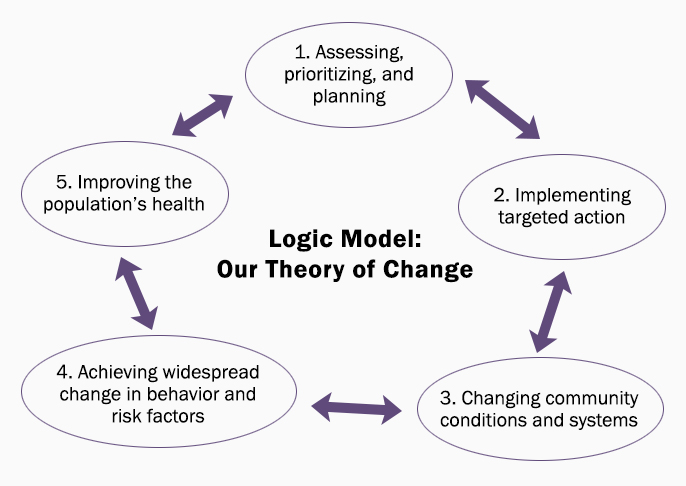
There are five basic parts to this model:

1) Community context and planning
2) Community action and intervention
3) Community and system change
4) Risk and protective factors and widespread behavior change
5) Improving more distant outcomes (the long-term goals)

Here are a couple of general ideas to keep in mind as we go through this model:

  • This model is meant to be fluid and interactive. For example, an understanding of the community context and planning should guide community action, which should affect community and system change, and so on.
  • This model is meant to be a continuous cycle. For example, improvement in more distant outcomes, such as reduced rates of violence, should lead to a renewed cycle of planning and action for these or other issues that matter to members of the community.

The bottom line? There isn't a day when community work ends. In a healthy community, working together for the good of the community is a constant part of everyone's lives.

With these ideas in mind, let's look at the individual parts of this logic model or theory of action.

Image of the Logic Model with the five steps outlined below, depicted in a continuous circle.

The Future of the Public's Health in the 21st Century. Institute of Medicine (US) Committee on Assuring the Health of the Public in the 21st Century. Washington (DC): National Academies Press (US); 2002.


1. Assessing, prioritizing, and planning

The first step is understanding the context, or the community conditions, in which people act. The context is influenced by many things, such as:

  • People's hopes and expectations--for example, the belief that things can change
  • Problems, especially poverty
  • Strong and deep leadership: a diverse team with vision, competence, and persistence
  • Adequate financial resources
  • Approval (or resistance) from the community (or from those in authority) when people attempt to change things
  • The broader political and social context

Within this context, people may come together to identify issues that matter to them, such as transportation, job opportunities, affordable housing, or substance use prevention, to give just a few examples. They may gather and review community-level indicators to help understand markers for important measures in the community. For example, records of assaults at school are one community-level indicator of violence in the community; nighttime single-vehicle car crashes can be used as an indicator for substance use in a community.

Later in the life of the community group, these can serve as benchmarks for detecting whether or not they are making progress on their goals. For example, they can look at the level of violence and see if it has decreased since implementation of prevention strategies.

With an understanding of the context, the group can move forward with planning. Collaborative planning is a critical and ongoing task that brings together people and organizations with different experiences and resources. Together, they clarify or develop a vision, mission, objectives, strategies, and action steps for bringing about changes in the community.

2. Implementing targeted action

The planning process should be followed by taking action to implement the plan.

How can a community organization overcome any potential opposition? View this Troubleshooting Guide for different responses a group might make, depending on its particular situation.

3. Changing community conditions and systems

The goal of the action plan is to bring about community and system changes. 

By community change, we mean developing a new program (or modifying an existing one), bringing about a change in policy, or adjusting a practice related to the group's mission.

Let's look at the following examples:

  • A "safe ride" program giving free rides so people don't need to travel alone in unsafe areas after dark (a new program)
  • Policy changes such as stronger penalties for people who commit crimes using a weapon (a change in policy)
  • New employment practices that allow workers flexible time to be with children after school (a change in practice)

System changes are similar to community changes, but take place on a broader level. For example, a business might implement its child-friendly practices throughout its operations nationally. 

Rockefeller Philanthropy Advisors defines systems change as, "a phrase used to explain an approach that targets the root causes of social issues instead of directly tackling the issue itself. It aims to alter or shift underlying structures such as policies, mindsets and power dynamics, which enable the system to function in a particular way." 

4. Achieving widespread change in behavior and risk factors

When these community and system changes occur, they should, taken together, change the environment in which a person behaves. This is sometimes referred to as increasing protective factors and/or decreasing the risk factors of community members.

What are risk and protective factors? They are aspects of a person's environment or personal features that make it more likely (risk factors) or less likely (protective factors ) that she will develop a given problem. Often, risk and protective factors can be considered flip sides of the same coin. For example, if drugs are readily available in your community, then easy accessibility is a risk factor. If they are very difficult to find, then that lack of drugs is a protective factor. The intended effect of environmental change is widespread behavior change of large numbers of people in the community.

5. Improving the population's health

Improvements in more distant outcomes, such as reducing violence or increasing employment rates and family incomes, are the ultimate goals of collaborative partnerships.

As we discussed earlier in this section, data on community-level indicators can help you determine just how much progress you have made towards your goals. Information to see if efforts are working in different areas can be organized together in an annual community "report card." This can let people throughout the community know how things are going, including information on community-level indicators, important community changes, and success stories.

Before we go on, it may be helpful to look again at this process as a whole. Remember, this process is an interactive and continuous cycle.

  • The community context affects the organization's planning
  • Guided by ongoing planning, the group generates community action and implements interventions
  • Community action brings about community and system changes
  • These community and system changes, taken together, decrease risk factors (and enhance protective factors)
  • This environmental change should affect the behavior of a large number of people in a positive manner
  • This widespread behavior change should effect community-level indicators of improvement

Factors affecting the work of community partnerships

In all the different parts of our lives, some things work, and others don't. Why is that? Think for a moment about a school. Students have the same framework to work in each grade has the same learning objectives, for example. Still, some students (and schools) succeed and others fail. What causes that difference?

It's probably a combination of things -- support at home, a good teacher, and good (or not so good) materials to use. Quite simply, within a framework that almost all students have, different events often mean the difference between success and failure.

In the last few paragraphs, you have seen what we believe to be a workable model for building healthier communities. But like that school, what you've read is just a framework. And different events that happen within the framework make it more or less likely that a community group will succeed.

For improving the health and development of a community, we have found seven features that seem to be very important in determining whether a community effort fails or succeeds. In our research, each of the following "factors" has been related to the rate of community change. We'll look at them one by one.

Targeted mission

Having a targeted mission is one of the most important factors in whether or not a community group is effective.

A mission statement is your organization's statement of purpose; it tells what the organization is going to do and why. 

For example, an organization's mission might be: "Our mission is to decrease adolescent pregnancy and sexually transmitted diseases in Dade County through a community-wide effort which will provide education and support to young people and their families."

Action planning

Action planning means identifying specific changes in the community or broader system, and action steps to bring them about. During action planning, community partnerships identify:

  • The community or system changes (new or altered programs, policies, and practices) to be sought
  • The actions that will bring about desired community or system changes
  • Who will take those actions
  • When they will be done
  • What resources are needed to get the job done

When partnerships develop a plan of action, they are more successful bringing about community change and improvement.

Changes in leadership

Involving competent leaders with a clear vision helps change to occur more rapidly. Such leaders see community partnerships as a way to mobilize the community, draw out people's strengths, and celebrate members' accomplishments. These leaders are likely to head effective collaborative partnerships.

The downside of this, of course, is that when such leaders leave an organization, groups accomplishments often suffer. Finding a way to ease transitions and develop leadership within the group is an important factor in having groups that have long, successful lives.

Resources for community mobilizers

One thing that is clear is the need for people who act as catalysts--community mobilizers who will really get things going in the community. They are the ones who will start the ball rolling on the actions that the group decides to do. By hiring or recruiting community mobilizers, groups consistently make more changes happen.

Documentation and feedback

To know whether a community group's efforts are making a difference, it is important that the group documents efforts and results. Such information about the group's accomplishments should be used to improve the group's ongoing efforts.

Documentation should occur for intermediate outcomes, such as community and system changes. Tracking these changes, as well as the groups' longer-term goals, can help the collaborative partnerships understand, celebrate, and improve their overall efforts.

Technical assistance

Good leaders work to attract competent people with skills that complement those of other people in the organization. By doing so, team members grow and become stronger in their work.

Outside help, which may take the form of technical assistance, can be a breath of fresh air for your organization. That's because the core competencies necessary for community organizations often transcend the variety of targeted missions and specialties people work in. For example, action planning will be important to community work on environmental advocacy, child abuse, mental health, or almost any other community issue.

The goal of technical assistance should always be the same: to build the community's ability to take care of the things that matter to its members. This website is an example of this kind of assistance. The Community Tool Box contains over 100 sections that can support technical assistance efforts.

Making outcomes matter

Finally, grantmakers and governmental agencies can help those they support by clearly stating and rewarding desired results. For example, a foundation in Kansas (U.S.A.) announced that continued funding would be based on evidence of progress. The result was that the amount of community change increased dramatically. This same grantmaker now uses bonus grants to encourage progress.

Possibilities for rewarding results include:

  • Providing bonus grants for groups that accomplish important objectives
  • Awarding outcome dividends -- that is, giving communities funds for re-investment that they have effectively saved by prevention efforts

Ten recommendations for promoting community health and development

Throughout this section, we have talked about the three groups who are the important players in collaborative partnerships: local members of state and community partnerships, support organizations, and grantmakers and governmental agencies.

Much of the decision-making and work must happen within the communities themselves. However, all of these groups can work together and help create conditions under which it is more likely that community efforts will be successful. Based on the model we discussed above, we propose ten specific recommendations to assist people who are trying to change their communities for the better.

1. Working with community partnerships, grantmakers and governmental agencies should develop a social marketing plan to promote involvement in community work.

  • The marketing plan should help convince community members that working together to solve public problems should become an important part of their daily lives.
  • The messages should contradict the idea that the community can't solve its own problems.
  • The plan should focus on encouraging community involvement.
  • Messages for different members of the community should be delivered in different ways. For example, messages to teenagers should be delivered differently than messages to older adults.
  • The plan should include a way to communicate the good things going on. Success stories and profiles of people who have done fantastic work should be shared with the community.
  • The social marketing campaign should use different methods of communication to reach the greatest number of people. For example, it might use posters, notes on the Internet, and editorials in the local newspaper, to give just a few examples.

2. Develop partnerships where people can work together to improve their community.

  • Grant funds should be directed towards broad community partnerships. By having a broad partnership, the community will have a structure that is strong enough to make a real impact on different community problems.
  • Partnerships should involve both people who have power and those most affected by the issue.
  • Many different ways in which people can be a part of the partnership should be provided.
  • Grantmakers should try to invest in the same place and permit work across the normal boundaries. For example, it's often the case that one group in the community will receive a grant to prevent substance use, another will receive a grant to improve education, and so on. We suggest grantmakers work together to offer larger grants to community partnerships that can work on several of these interrelated issues at the same time.

3. Provide information to help focus efforts on issues with the greatest effect on community health and development.

  • Collaborative partnerships should develop objectives based on two things: the level of community problems (i.e., the statistics) and what members of the community find important.
  • Support organizations should develop a model of change (such as the one outlined in this section) to help guide community work.

4. Support action planning to improve the community.

  • Planning should begin early and never stop. Annual action planning retreats can renew the group's efforts and be supplemented by regular adjustments.
  • When something works, its use should be widely promoted. For example, a "bag it" program that allows young people to call in orders for contraceptives and have them discretely wrapped in a paper bag might increase contraceptive use dramatically among at-risk youth in a small community. If that proves to be the case, that program should be promoted in newsletters and through word of mouth, so that similar organizations can do the same thing. It's important to remember, though, that programs often need to be adapted to fit local conditions.
  • The focus of action planning should be on transforming the environment to make behaviors than promote health and development more likely to occur.
  • By gathering pertinent information about risk and protective factors, partners in the collaborative effort can better focus their efforts on new programs, policies, or practices that will cause positive changes in the environment.
  • Some of the community changes should try to reach the whole community; others should be targeted at people who are at a higher risk.

5. Provide investments in collaborative partnerships that are large enough and last long enough to make a difference.

  • Fund community partnerships long enough to make a difference (for example, for 5 to 10 years).
  • Provide resources to hire community mobilizers to act as catalysts in the community.
  • Many larger system changes your organization will work for can take a long time to occur. Be sure to develop and celebrate "small wins" milestones that will regularly reward everyone's efforts. This will help keep spirits up as you work to reach your goals.
  • Promote the sustainability of successful community partnerships. Groups that have proved their worth should be rewarded with continuing efforts by funding partners.

6. Use a variety of methods to build capacity for doing community work.

  • Offer many opportunities for people involved in community work to meet and learn from each other.
  • Use distance education to give people the opportunity to learn with others doing similar work in different places.
  • Use the Internet to distribute "how-to" information for developing the core competencies of community work.
  • Link newer community partnerships with those more experienced, and connect established leaders with newer generations of leadership.

7. Document the process of community and system change to improve community work.

  • Leaders of initiatives should work with representatives from support organizations to develop meaningful ways to present and use data on community and system change.
  • Honor organizations and individuals that bring about significant changes in their communities.
  • Use data on community and system change to make adjustments in the group's action plan.
  • Researchers should examine trends in community and system change to identify the factors that might affect community change.
  • Use an annual state-of-the-partnership report to encourage accountability of members of community partnerships.

8. Make outcomes matter.

  • Establish and report on intermediate and more distant outcomes--such as high rates of important community and system changes for community-determined goals.
  • Make renewal of community investments (for example, the continuation of a grant) conditional on evidence of progress by the group.
  • Award bonus grants to encourage progress and outstanding accomplishments.
  • Award outcome dividends to reward improvements in the bottom line. For example, if a community has fewer teen pregnancies because of the efforts of a local coalition, give the coalition some of the money saved by the state by not having to pay for the teens' costs. For example, money has been saved in hospital bills the state would have paid for uninsured parents, as well as the costs of welfare for teen parents, and their children, and so on.

9. Develop collaborative partnerships to increase the support for people working to improve their communities.

  • Develop broad collaborative partnerships among diverse organizations that truly represent the entire community. Members of the partnership should share the risks, resources, and responsibilities for community improvement.
  • Employers should modify their structures to support involvement in public problem solving. For example, corporations might have a flextime policy that allows employees to volunteer in their community.
  • Community partnerships, intermediary and support organizations, and grantmakers and governmental agencies should act as catalysts for change. They can do this by:
    • Convening people around health and development concerns;
    • Forging relationships among people who can help address community issues; and
    • Helping get resources that few communities could access by themselves.

10. Future research should help understand and improve the factors that affect community health and development.

  • Examine whether and how lessening poverty and improving education affect community-level indicators of health and development.
  • Examine the conditions under which community and system change are associated with improvements in long-term goals.
  • Let people know what works--what are promising practices for building healthier communities. This can be done through a variety of different media (such as print and broadcast media, professional associations, and the Internet).

In Summary

A healthy community is a form of living democracy: people working together to address what matters to them. As citizens, we have a duty to shape the basic conditions that affect our lives with others in transforming communities, we are guided by shared values and principles that bind us in common purpose.

Building healthier communities blends the local and the universal, the particular and broader contexts. Such efforts are grounded locally: the family, the neighborhood, and other familiar communities. To be effective, however, we must also bring diverse groups of people and organizations together to transform the broader conditions that affect local work. This requires courage, doubt, and faith: the courage to trust those outside our immediate experience, the doubt to question what is, and the faith to believe that together, we will make a difference.

The work of building healthier communities takes time: our time, that of our children, and that of our children's children. A Jewish proverb counsels: "You are not bound to finish the work, but neither are you free to give it up." In our emerging ties across place and time, we join others in an attempt to create environments worthy of all our children.

Contributor

Stephen B. Fawcett

Resources

Online Resources

Building Healthy Communities (article*)

Building Multisectoral Partnerships for Population Health and Health Equity (article*)

Emerging Action Principles for Designing and Planning Community Change is from Community Science and shares what science and practice have taught us about strengthening community.

A Framework for Community Mobilization to Promote Healthy Youth Development (article*)

The Future of the Public's Health in the 21st Century from the Institute of Medicine (US) Committee on Assuring the Health of the Public in the 21st Century. Washington (DC): National Academies Press (US); 2002.

An Introduction to Policy, Systems, and Environmental (PSE) Change is an article from Community Commons that explains how PSE change strategies aim to make healthier choices more practical and accessible for all community members by transforming the environments where people live, work, worship, learn, and play. 

The Journey of Changing Systems by Co-Impact is an interactive learning platform designed to guide organizations through the complex process of systems change.

The Lead Local organization focuses on building community power to drive structural changes and promote health equity, providing research, resources, and practical strategies to support communities in transforming local systems and conditions. Their Leading Locally: A Community Power-Building Approach to Structural Change report (pdf) explores how community power-building efforts across 16 diverse places in the United States can drive structural changes to advance equity, emphasizing strategies like grassroots organizing, policy advocacy, and coalition building to transform local conditions and systems. Their Story of Place: Community Power and Healthy Communities report (pdf) discusses how building community power can transform systems to advance health equity, emphasizing the role of local context, structural reforms, and inclusive decision-making to shape healthier communities.

The Power of Collaborative Solutions - Six Principles and Effective Tools for Building Healthy Communities, by Tom Wolff

The Water of Systems Change, created by FSG, helps organizations and funders look closely at the underlying issues that keep social problems in place. This framework supports changemakers as they work to improve systems both inside and outside their organizations, aiming to create greater equity and impact.

Why Community Power is Fundamental to Advancing Racial and Health Equity is the first commentary in a three-part series from Lead Local that explores how community power building can drive health and racial equity more effectively than traditional engagement. It details practical examples of power-building campaigns and emphasizes the crucial role of external actors (e.g. researchers) in supporting these movements.

Why the future belongs to community research is a video from TedX Talks, featuring Ronald Harvey. In his speech, he describes the role of community psychology in treating addiction.

Work Group on Health Promotion and Community Development. (March, 1998). Community Tool Box, Chapter 8: Developing a Strategic Plan

* For more publications from the Center for Community Health and Development, please visit our Publications page.

Print Resources

This Community Tool Box section is an edited version of the following invited paper (and book chapter):

Fawcett, S. B., Francisco, V. T., Hyra,  S., Paine-Andrews, A., Schultz, J., Russos, S., Fisher, J., & Evensen, P. (1998). Building Healthy Communities. Invited Address to the Kansas Conference on Health and Its Determinants. Sponsored by the Kansas Health Institute and the Kansas Health Foundation. Wichita, KS.

To appear in:

Tarlov, A., &  Peter  R. St. (Eds.) Society and Population Health. New York, NY: New Press.

The references cited in the above paper are as follows:

References:

Aguirre, M. (1996). Community-based approaches for the prevention of alcohol,tobacco, and other drug use.  Annual Review of Public Health, 17, 337-358.

Altman, D., Balcazar, F., Fawcett, S., Seekins, T., & Young, J. (1994). Public health advocacy: Creating community change to improve health. Palo Alto, CA: Stanford Center for Research in Disease Prevention.

Tarlov, A., &  Peter, R. St. (Eds.) Society and Population Health. New York, NY: New Press.

Barker, R. (1968). Ecological psychology. Stanford, CA: Stanford University Press.

Bernstein, J., & Michel, L. (1997). Has income inequality stopped growing? Monthly Labor Review, 120 (12), 3-16.

Brofenbrenner, U., McClelland, P., Wethington, E., Moen, P., & Ceci, S. J. (1996). The state of Americans: This generation and the next. New York, NY: The Free Press.

Carroll, J. (1997). Neighborhoods and citizenship. Lecture at the Boston Public Library, Boston, Massachusetts. Broadcast by C-SPAN television network. November 15, 1997.

Citrin, T. (1998). Topics for our times: Public health--community or commodity? Reflections on Healthy Communities. American Journal of  Public Health, 88(3), 351-352.

Fawcett, S. B., Francisco, V. T., Hyra, D. S., Paine-Andrews, A., Schultz, J. A ., Russos, S., Fisher, J.L., & Evensen, P. (1998). Building Healthy Communities. Invited Address to the Kansas Conference on Health and Its Determinants. Sponsored by the Kansas Health Institute and the Kansas Health Foundation. Wichita, KS.

Fawcett, S.(1991). Some values guiding community research and action. Journal of Applied Behavior Analysis, 24, 621-636.

Fawcett, S. (1999). Some lessons on community organization and change. In Rothman, J. (Ed.), Reflections on community organization: Enduring themes and critical issues. (pp. 314-334). Itasca, IL:F.E. Peacock Publishers.

Fawcett, S., Paine, A., Francisco, V., Schultz, J., Richter, K ., Lewis, R., Williams, E., Harris, K., Berkley, J., Fisher, J., & Lopez, C. (1995 ). Using empowerment theory to support community initiatives for health and development. American Journal of Community Psychology, 23(5), 667-697.

Fawcett, S., Lewis, R., Paine, A., Francisco, V., Richter, K., Williams, E. , & Copple, B. (1997). Evaluating community coalitions for the prevention of substance abuse: The case of Project Freedom. Health Education and Behavior, 24(6), 812-828.

Fawcett, S., Paine, A., Francisco, V., Schultz, J., Richter, K., Berkley, J., Fisher, J., Lewis, R., Lopez, C., Russos, S., Williams, E., Harris, K., & Evenson, P. Evaluating community initiatives for health and development. In I. Rootman,  McQueen, D. etal. (Eds.) Evaluating health promotion approaches. Copenhagen, Denmark: Work Health Organization-- Europe.

Feinstein, J. (1993). The relationship between socioeconomic status and health: A review of the literature. Milbank Quarterly, 71, 279-322.

Francisco, V., Paine, A., & Fawcett, S. (1993). A methodology for monitoring and evaluating community coalitions. Health Education Research: Theory and Practice, 8(3), 403-416.

Fukuyama, F. (1995). Trust: The social virtues and the creation of prosperity. New York, NY: The Free Press.

Goodman, R., Speers, M., McLeroy, K., Fawcett, S., Kegler, M., Parker, E., Smith, S., Sterling, T., & Wallerstein, N. (1998). An initial attempt at identifying and defining the dimensions of community capacity to provide a basis for measurement. Health Education and Behavior.

Green, L., & Kreuter, M.  (1991). Health promotion planning: An educational and environmental approach, 2nd ed. Mountain View, CA: Mayfield.

Hawkins, D. & Catalano, R. (1992). Communities that care. San Francisco, CA: Jossey-Bass.

Herrnstein, R., & Murray, C. (1994). The bell curve: Intelligence and class in American life. New York, NY: Free Press.

Himmelman, A.T. (1992). Communities working collaboratively for a change. (Monograph available from the author, 1406 West Lake, Suite 209, Minneapolis, MN 55408).

Institute of Medicine. (1988). The future of public health. Washington, D.C.: National Academy Press.

Institute of Medicine. (1997). Committee on Using Performance Monitoring to Improve Community Health: Durch, J., Bailey, L., & Stoto, M. (Eds). Improving health in the community: A role for performance monitoring. Washington, DC: National Academy Press.

Kaplan, G., Pamuk, E., Lynch, J., Cohen, R., & Balfour, J. (1996). Income inequality and mortality in the United States. British Medical Journal, 312, 999-1003.

Kawachi, I., Kennedy, B., Lochner, K., & Prothrow-Stith, D. (1997). Social capital, income inequality, and mortality. American Journal of Public Health, 87(9), 1484-1490.

Kehrer, B., & Wolin, C. (1979). Impact of income maintenance on low birthweight: Evidence from the Gary experiment. Journal of Human Resources, 14 , 435-462.

Kretzman, J., & McKnight, J. (1993). Building communities from the inside out: A path toward finding and mobilizing a community's assets. Chicago: ACTA Publications.

Lappe, F., & DuBois, P. (1994). The quickening of America: Rebuilding our nation, remaking our lives. San Francisco, CA: Jossey-Bass.

Marmot, M., Smith, G., Stansfield, S., Patel, C., North, F., Head, J., White, I., Brunner, E., & Feeney, A. (1991). Health inequality among British civil servants: The Whitehall II study. The Lancet, 337 (8), 1387-1393.

Orfield, M. (1997). Metropolitics: A regional agenda for community and stability. Washington, DC: Brookings Institution Press.

Paine, A., Vincent, M. , Fawcett, S., Campuzano, M., Harris, K., Lewis, R., Williams, E., & Fisher, J. (1996). Replicating a community-based initiative for the prevention of adolescent pregnancy: From South Carolina to Kansas. Family and Community Health, 19(1), 14-30.

Putnam, R. (1995). Bowling alone: America's declining social capital. Journal of Democracy, 6(1), 64-78.

Putnam, R. (1993). Making democracy work. Princeton, NJ: Princeton University Press.

Raudenbusch, S. (1997). Toward a science of ecological assessment: A model for the systematic social observation of neighborhoods. Unpublished paper presented at the annual meeting of the American Society of Criminology, San Diego, November, 1997.

Rothman, J. (Ed.) (1999). Reflections on community organization: Enduring themes and critical issues. Itasca, IL: F.E. Peacock Publishers.

Ryan, W. (1971). Blaming the victim. New York, NY: Vintage Books.

Schorr, L. (1997). Common purpose: Strengthening families and neighborhoods to rebuild America. New York, NY: Anchor Books, Doubleday.

Sclove, R. (1995). Democracy and technology. New York, NY: Guilford Press.

Walzer, M. (1998). Pluralism and social democracy. Dissent, Winter issue, 47-53.

World Health Organization. (1987). Ottawa charter for health promotion. Health Promotion, 1-4, iii-v.

Wilson, W.  (1996). When work disappears: The world of the new urban poor. New York, NY: Knopf.

Wilkinson, R. (1996). Unhealthy societies: The afflictions of inequality. London, England: Routledge.

Yin, R.  (1988). Case study research: Design and methods. Newbury Park, CA: Sage.

Checklist
mloewenstein Thu, 12/13/2012 - 15:15

___You understand what constitutes a community.

___You understand what a collaborative partnership is and how powerful it can be.

___You know what community capacity is.

___You know that the key partners in a broad collaboration should include:

  • Local members of community partnerships  
  • Support organizations
  • Grantmakers and governmental agencies

___You understand the context in which people in the community act.

___You have decided to move forward with collaborative planning in order to bring people and organizations with different experiences and resources together.

___A mission statement that tells what your organization is going to do and why has been established.

___Through action planning, specific changes in the community have been identified and related action steps have been taken to bring them about.

___A strong leader for the organization is in place.

___You have community mobilizers who have started the ball rolling on actions that your group has decided to take.

___The groups efforts and results have been documented to know whether a difference is being made.

___You understand the ten recommendations for promoting community health and development.

Contributor

Phil Rabinowitz

Examples
mloewenstein Mon, 12/10/2012 - 13:06

Example 1: Healthy Communities: A Parable of Two Paths

In the early 1920's, the people of Prairie Center and Sunflower enjoyed a rich community life. There were strong ties among neighbors. People supported each other in many informal ways; through churches, in conversations at the local cafe, and on front porches. Adults cared for each other's children. When Billy or Maria did something wrong, their parents were sure to hear about it. People trusted each other to look out for them.

Gradually life changed in the two communities. Growth from nearby urban areas added people with limited ties to the community. Local zoning laws and regional planning separated the places where people worked from where they lived. Roads now cut through established neighborhoods, making it necessary to take the car to places people used to walk.

Individuals and families made new choices about how to use their time. Rather than visit neighbors, people stayed at home and watched television. Increasingly, both adults worked outside the home; often at several low-paying jobs to meet family needs. As a result, there were fewer adults to watch what kids were doing. All these individual choices and constraints added up: community folks had less contact with their neighbors, with their children, and with each other's children.

In Prairie Center, things changed gradually -- and so did the way local people addressed their problems. As drug use and violence increased in the 1980's and 1990's, the local media blamed on youth and their parents. Following advice from outside experts, the county jail was expanded at considerable cost. This left less public money for education and health. Those who could afford it sent their children to private schools. Those who could went out of town for health care. Poor people suffered the most; sharp cuts in public assistance could not be made up by local churches and charities.

People still cared deeply about their own children and family, but the sense was that each person and family should take care of themselves. Many people were increasingly distrustful of "them." "Them" was understood to mean everyone outside the family.

The people of Sunflower took a different approach. A tragedy in the late 1980's -- the deaths of two children in a drug-related incident really got people's attention. They began a process of community renewal. They started a dialogue about what really mattered in the community, and about what values they shared. They identified a common purpose: to create a caring place for all of the community's children.

The people of Sunflower began to work together in new ways. They formed action teams that cut across the usual boundaries. They included both the powerful and those people, such as youth and low-income families, who were seen by some as the problem. Now a diverse group of citizens, public officials, clergy, service providers, and business people joined hands. They worked to transform schools, businesses, health and service organizations, the faith community, and other valued assets. They established benchmarks for success:

  • All kids succeeding in school
  • Less drug and alcohol use
  • Fewer teen pregnancies
  • Fewer children living in poverty
  • Adults employed in decent jobs

They coordinated all of their efforts in what they called the "Sunflower Partnership."

Gradually, people started to notice a difference with the unfolding of community changes, both large and small, in Sunflower. Several major businesses allowed flextime for their employees so they could help children. The school district expanded the hours of neighborhood schools, creating safe places for children after school. The faith community collected donations to care for others. City government officials approved new guidelines for tax abatements that rewarded businesses for creating better paying jobs for the unemployed and working poor.

Taken together, all of these changes improved community life. Gradually, the differences could be seen. They also produced results: kids did better in school, fewer kids got in trouble, the neighborhoods were safer, and children and adults were more successful. There was more to be done, of course, but people could see that they were making progress. 

Contributor

Stephen B. Fawcett

Tools
mloewenstein Mon, 12/10/2012 - 13:08

Tool 1: Principles, assumptions, and values that guide the work of building healthy communities

  1. Community health improvement involves the population as a whole, not merely individuals at risk for specific physical, mental, or social conditions.
  2. Community health requires changes in both the behaviors of large numbers of individuals and the conditions or social determinants that affect health and development.
  3. A healthy community is a local product with priority issues and strategies best determined by those most affected by the concern.
  4. Freedom and justice require reducing income disparities to promote optimal health and development for all.
  5. Since health and development outcomes are caused by multiple factors, single interventions are likely to be insufficient.
  6. The conditions that affect a particular health or development concern are often interconnected with those affecting other concerns.
  7. Since the behaviors that affect health and development occur among a variety of people in an array of contexts, community improvement requires engagement of diverse groups through different parts of the community.
  8. Statewide and community partnerships, support organizations, and grantmakers are catalysts for change: they attempt to convene important parties, broker relationships, and leverage needed resources.
  9. The aim of support organizations is to build capacity to address what matters to people over time and across concerns.
  10. Community health and development involves interdependent relationships among multiple parties in which none can function fully without the cooperation of others.

Tool 2: Using this model of change--"Building capacity for community change"

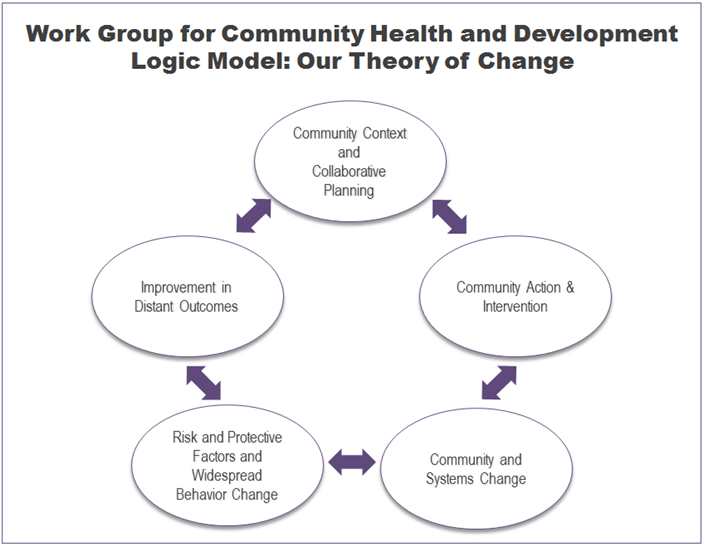
Work Group for Community Health and Development Logic Model: Our Theory of Change

1. Community Context and Planning

The first step in the process is understanding the context in which people act. By the context, we mean people's experiences, their dreams for a better life, and what makes them do what they do.

With an understanding of the context, the group can move forward with planning. Collaborative planning is a critical and ongoing task of a successful organization. It brings together people and organizations with different experiences and resources. Together, they clarify or develop the group's vision, mission, objectives, strategies, and action steps. In doing so, they can bring about changes in the community.

2. Community Action and Intervention

The planning process should be followed by action--going out and doing what was outlined. Sometimes, there is serious resistance to efforts that will need to be overcome.

3. Community and System Change

The goal of planning and action is to bring about community and system changes. Bringing about these changes is an important step towards achieving your organizational goals. By community change, we mean developing a new program (or modifying and existing one), bringing about a change in policy, or adjusting a practice related to the group's mission. system changes are similar to community changes, but take place on a broader level.

4. Risk and Protective Factors and Widespread Behavior Change

Our belief is that when these community and system changes occur, they should, taken together, change the environment in which a person behaves. This is sometimes referred to as increasing protective factors and/or decreasing the risk factors that community members face.

Risk and protective factors are aspects of a person's environment or personal features that make it more likely (risk factors) or less likely (protective factors) that she will develop a given problem. Often, risk and protective factors can be considered flip sides of the same coin. The intended effect of environmental change is widespread behavior change.

5. Improve More Distant Outcomes

Improvements in more distant outcomes, such as reducing violence or increasing employment rates and family incomes, are the ultimate goals of collaborative partnerships. By reducing the risk factors (and enhancing the protective factors) for the issue you are trying to address, you will affect the bottom line. Data on community-level indicators can help you determine just how much progress you have made towards your ultimate goals.

Contributor

Stephen B. Fawcett

File Upload
Our Theory of Change.png
PowerPoint
Anonymous (not verified) Mon, 12/10/2012 - 13:09

A PowerPoint presentation summarizing the major points in the section.

Section 5. Our Evaluation Model: Evaluating Comprehensive Community Initiatives
mloewenstein Mon, 12/10/2012 - 13:11
Main Section
mloewenstein Mon, 12/10/2012 - 13:12

Two gray pencils over a yellow background.

Throughout the world, people and organizations come together to address issues that matter to them. For example, some community partnerships have formed to reduce substance use disorders, pregnancies among adolescents, or violence. Other community-based efforts attempt to lower risks for HIV/AIDS, cardiovascular diseases, or injuries. Alliances among community people have also focused on promoting urban economic development, access to decent housing, and quality education.

These initiatives try to improve the quality of life for everyone in a community. Often, they do this in two ways. Initiatives use universal approaches -- that is, they try to reach everyone who could possibly be affected by the concern. They also use targeted approaches, which try to affect conditions for people who are at higher risk for the problem. Through these two approaches, initiatives try to change people's behavior, such as using illegal drugs, being physically active, or caring for children. They also might go deeper and try to change the conditions, such as the availability of drugs, or opportunity for drugs or daycare, under which these behaviors occur.

Community health promotion is a process that includes many things at many levels. For example, efforts use multiple strategies, such as providing information about the problem or improving people's access to assistance. They also operate at multiple levels, including individuals, families and organizations, and through a variety of community sectors, such as schools, businesses, and religious organizations. All of this works together to make small but widespread changes in the health of the community. The goal is to promote healthy behaviors by making them easier to do and more likely to meet with positive reinforcement.

There are a lot of different models that describe how to best promote community health and development. Some of the more popular models include the Healthy Cities/Healthy Communities Model, the PRECEDE/PROCEED model, and the Planned Approach to Community Health [PATCH]. Similarly, our University of Kansas (U.S.A.) Center for Community Health and Development's model of Building Capacity for Community Change is outlined elsewhere. While how things should be done differs in each model, the basic goal of these and other community approaches is the same. They aim to increase opportunities for community members to work together to improve their quality of life.

Unfortunately, only modest information on the effectiveness of community-based initiatives exists. That's because evaluation practice hasn't fully caught up with a recent shift towards community control of programs. Although there are models for studying community health efforts, community initiatives are often evaluated using research methods borrowed from clinical trials and other researcher-controlled techniques. While these methods work very well in the fields for which they were developed, they're not necessarily a "good fit" for evaluating community work. It's like trying to put a square peg into a round hole -- with a lot of work, you might be able to do it, but it will never be as smooth as you want.

New ideas about community evaluation have their roots in several different models and traditions. These include:

  • Action anthropology, which refers to the use of research to empower communities.
  • Qualitative research, which highlights the value of the experience as an important part of understanding the effort. That is, it looks at other things besides statistics as important.
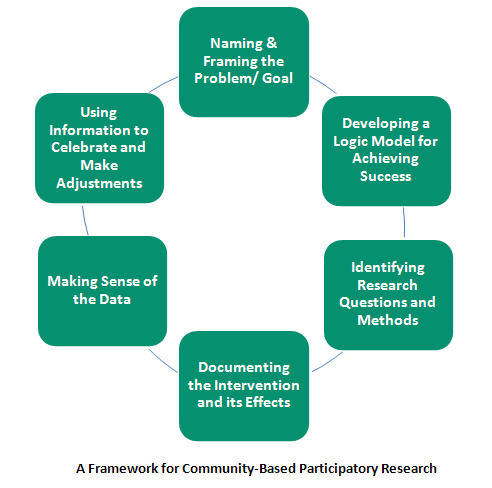
  • Community-based participatory research (CBPR), which uses dialogue among community and scientific partners to produce knowledge and guide the actions taken by a group or community.
  • Empowerment evaluation, which aims to assess the effort's worth while improving the community's desire and ability to take care of its own problems.

These and other types of research actively involve community members in designing and conducting the evaluation. They all have two primary goals: understanding what is going on, and empowering communities to take care of themselves. What is different between these methods is the various balances they strike between these two ends.

In this section, we'll look at models, methods, and applications of community evaluation in understanding and improving comprehensive community initiatives. We'll start with a look at some of the reasons why community groups should evaluate their efforts. Then, we'll describe some of the major challenges to evaluation. We'll also describe a model of community initiatives as catalysts for change. Then, we'll discuss some principles, assumptions, and values that guide community evaluation and outline a "logic model" for our KU Center for Community Health and Development's system of evaluation. We'll also make some specific recommendations to practitioners and policymakers about how these issues can be addressed. Finally, we'll end with a discussion examining some of the broad issues and opportunities in community evaluation.

Why evaluate?

There are many good reasons for a community group to evaluate its efforts. When done properly, evaluation can improve efforts to promote health and development at any level -- from a small local nonprofit group to a statewide or even national effort. Evaluation offers the following advantages for groups of almost any size:

  • Collecting information about how things are done and the results help us understand how community initiatives develop, offering lessons other groups can profit from.
  • Providing ongoing feedback can improve community work by encouraging continuous adjustments of programs, policies, and other interventions.
  • By involving community members, underrepresented community members may gain the opportunity to better understand and improve local efforts.
  • Finally, evaluation can help hold groups accountable to the community and to the grantmakers who provide funding. It can also help hold grantmakers accountable to the communities that they serve.

Challenges to community participatory evaluation

Although there are a lot of advantages to evaluating community efforts, that doesn't mean it's an easy thing to do. There are some serious challenges that make it difficult to do a meaningful evaluation of community work. They are:

  • The causes of a lot of community problems, such as substance use or violence, aren't very well understood. Without this better understanding of the causes, it's hard to decide what needs to be done and if the work has been successful.
  • Some of the more important things to evaluate, such as the ability of the group to successfully accomplish its goals or the quality of life of community members, can be very difficult to measure.
  • Community initiatives are very complex. They include doing a lot of things on many levels with a lot of different people. Because of this, it is daunting to describe what's been done thoroughly enough for another community to try to do the same thing.
  • For some community issues, such as child abuse or domestic violence, researchers haven't yet come up with valid ways to determine if efforts are working. Because of this, it's difficult to evaluate the effectiveness of efforts.
  • For many issues, it takes a long time to move the bottom line. For example, if a group is trying to reduce HIV/AIDS in the community, they won't know if they have really affected the number of people who contract HIV for years and years. Therefore, it's necessary to identify markers along the path -- measures of intermediate outcome, such as changes in the community or system, which give community members an idea of whether or not they are going in the right direction.
  • It's very hard to estimate how strong a community-driven intervention is -- will it make a large impact, or just a ripple? Evaluators will need to collect precise information on what happened, who it happened to, and for how long the intervention occurred.
  • Information collected on individuals can't always be generalized to come to a conclusion about the community as a whole.
  • Because there aren't always suitable experimental designs or fitting comparisons (for example, it's hard to say that two towns are exactly alike), it is not always possible to say that the results were really because of the community initiative, and not because of something else that was going on.
  • Because community initiatives change with time and circumstances, what they do gets modified as well. Since they are so malleable, it can be difficult to assess the generality of effects, and decide if a given program is good in general or just worked in one particular circumstance.
  • People see things differently. Evaluators, especially those in the field of participatory evaluation, must guard against potential confusion resulting from conflicting ways of looking at things when interviewing different people about the same event.
  • To evaluate a community initiative fully and well takes a lot of time and work. For an already overburdened organization, it may not be feasible to do all of this properly.
  • As we discussed above, there are two primary goals of evaluation: understanding what is going on and empowering communities to take care of themselves. It can be very difficult to try and attain both of these goals at the same time. Often, one seems to need to give.

Despite the challenges that evaluation poses, our belief is that it is a very worthwhile pursuit. In order to minimize these challenges, the KU Center for Community Health and Development has developed a model and some principles that may provide guidance for people trying to evaluate the work done in their community.

A model: Community initiatives as catalysts for change

Although different community groups have different missions, many of them use the same logic model or framework: that of a community initiative as a catalyst for change. This type of community initiative tries to transform specific parts of the community. They change programs, policies, and practices to make healthy behaviors more likely for large numbers of people.

Below, we offer a model of what occurs in a comprehensive community initiative and its results.

  • Supporting collaborative planning
  • Documenting community implementation, action, and change
  • Assessing community adaptation, institutionalization, and capacity
  • Evaluating more distal outcomes
  • Promoting dissemination

This model is nonlinear -- that is, community partnerships don't just do one thing at a time. Instead, they take part in many interrelated activities that occur simultaneously. A new initiative to reduce the risks for youth violence, for example, may be refining its action plan while pursuing relatively easy changes in the community, such as posting billboards that warn people of the results of gang-related violence.

The components of the model are also interrelated -- that is, they can't be taken separately. They are all part of the same puzzle. For example, collaborative planning should decide what needs to happen in the community. That, in turn, should guide community action and change. Important community actions may be adapted to fit local conditions, and then kept going through policy changes, public funding, or other means of institutionalization.

Also important in this model is the idea that success breeds success. If a community is able to successfully bring about changes, their capacity to create even more community changes related to the group's mission should improve. This, in turn, may affect more distal outcomes -- the long term goals the group is working for. Finally, successful comprehensive initiatives or their components (e.g. public awareness, changes, policies) may be picked up and adapted by other communities addressing similar concerns.

The goals and expectations of community initiatives vary. A community may have a single, narrowly defined mission, such as increasing children's immunizations against disease. It may also have much broader goals that involve several different objectives. For example, members of an initiative may wish to work on two problems, such as reducing child abuse and domestic violence, which share common risk and protective factors.

Some communities have a relatively free hand in deciding what to do. Other partnerships may be required by grantmakers to use "tried and true" strategies or interventions. Some initiatives try hybrid approaches that combine the use of these "tried and true" methods with the role of a catalyst. They do this by implementing core components, such as sexuality education and peer support for preventing adolescent pregnancy, along with developing new community changes, such as enhancing access to contraceptives, that are related to the group's desired outcomes.

Different initiatives will modify programs to make them work well in their community. For example, different groups might want to develop supervised alternative activities for teens to make their taking part in risky behavior, such as unsafe sex or substance use disorder, less likely. However, different communities may start any one of a variety of interventions, such as expanding recreational opportunities, offering summer jobs, or developing community gardens.

Adapting interventions to fit community needs has several advantages. First of all, it creates an approach that "belongs" to community members -- it's something they are proud of, that they feel they created -- it's really theirs . Second, because it has been modified to fit the community's needs, the program or policy is more likely to remain in existence. Finally, through changing interventions to fit local needs, community members improve their ability to take care of their own problems.

If a comprehensive community initiative (or a program or policy that is part of it) proves to be successful over a long period, it may be used as an example that other communities can follow. For example, comprehensive interventions for reducing risks for cardiovascular diseases, or specific parts of the intervention such as increasing access to lower fat foods, might be held up as examples for other groups. Leaders of nonprofit organizations need to know what works, what makes it work, and what doesn't work. That way, local efforts can learn from other community-based projects and demonstrations, and adopt some of what experience and research suggest are the "best practices" in the field.

Principles, assumptions, and values of community evaluation

When we look at the process of supporting and evaluating community initiatives, we need to look at what our ideas are based on. The following principles, assumptions, and values serve as the foundation for these processes. You'll notice that they reflect the challenges of addressing both of the major aims of evaluation: understanding community initiatives while empowering the community to address its concerns.

Principles, Assumptions, and Values of Community Evaluation

Community initiatives often function as catalysts for change in which community members and organizations work together to improve the quality of life.

Community initiatives are complex and ever-changing, and they must be analyzed on multiple levels.

Community initiatives help launch interventions that are planned and implemented by community members.

Community evaluation must understand and reflect the issue, and the context in which it is happening.

Community evaluation should involve people from throughout the community.

Community evaluation information should be linked to questions of importance to key stakeholders.

Community evaluation should better community member's ability to understand what's going on, improve practices, and increase self-determination.

Community evaluation should begin early and be ongoing.

Community evaluation results, if positive, should be used to help sustain and promote widespread adoption of the community initiative and/or its components.

Community evaluation should be coupled with technical assistance to provide total support.

Community initiatives engage community members and organizations as catalysts for change: they transform the community to have a better quality of life. Community evaluation is based on the premise that community initiatives are very complex. To be effective, they need many levels of intervention. Researchers try to understand the issue, the history of the initiative, and the community in which it operates. Ideally, local initiatives are planned and implemented with the involvement of many community members, including those from diverse backgrounds. Because of this, community evaluation is a participatory process involving a lot of collaboration and negotiation among many different people.

Evaluation should take place from the beginning of an initiative. That way, it can offer ongoing information and feedback to better understand and improve the initiative. Evaluation priorities (that is, what to evaluate) should be based on what's of most importance to community members, grantmakers, and the field.

If done properly, evaluation results should actually help sustain and renew the community initiative. The information gathered in evaluation can be used to obtain resources such as grant money, show how to improve, and offer an opportunity to celebrate accomplishments. If the initiative seems to be effective, information from community evaluation can be used to promote its widespread adoption. Finally, evaluation should be coupled with technical assistance to provide a complete support system for the initiative. Evaluation without support can actually hurt the initiative. It can be seen as criticism, and leave members of the group frustrated and unsure of what to do next.

Logic model for community evaluation

The figure below describes the logic model for the KU Center for Community Health and Development's Community Evaluation System. A logic model is simply a way of thinking about something in a rational order -- one thought naturally follows another, and you build on ideas as you go. It has its roots in the catalyst model we described above, and tries to show the ideal situation -- what might occur in a fully implemented community evaluation.

Image depicting the Community Initiative as a Catalyst for Change. This image includes the following phrases: “Promoting dissemination; Support collaborative planning; Document Community implementation, action, and change; Assess community adaptation, institutionalization, and capacity; Evaluating distal outcomes.”


Initiative phases and evaluation activities

Our ideas about evaluation and support for community initiatives are based on the model of community initiatives as catalysts for change we described earlier. The five parts are:

  1. Supporting collaborative planning
  2. Documenting community implementation, action, and change
  3. Assessing community adaptation, institutionalization, and capacity
  4. Evaluating more distal outcomes
  5. Promoting dissemination

Supporting collaborative planning

Agenda setting -- that is, deciding what issues and options should be acted upon--is one of the most important things a community initiative can do. Agendas shape the choice of which issues should be addressed. The topics for the agenda might be decided on by using assessment tools, such as gathering information about community concerns. Media advocacy--understanding how to use the media to effectively get the word out--may also assist agenda-building efforts.

Supporting collaborative planning, when done comprehensively, will include all of the following:

  • Involving many people in planning efforts, including those from diverse backgrounds
  • Clarifying the group's vision, mission, objectives, and strategies
  • Developing an action plan that identifies specific community changes to be sought (and later documented) throughout the community
  • Identify local concerns, and gather information about them
  • Identifying local resources that can help solve the problem

Documenting community implementation, action, and change

Community evaluation documents what gets done by community initiatives, and lets all of the members of the initiative know about these changes. That way, community members can improve on what they have done. This includes documentation of:

  • Local efforts and accomplishments
  • Community and system changes: Changes in programs, policies, and practices that are related to the mission
  • How things got done
  • How many changes occurred in the community and where they happened (This is also known as intermediate outcomes)

Assessing community adaptation, institutionalization, and capacity

Community evaluators also look at how the interventions get changed, and whether or not these adjustments to fit the community actually work. They also determine if efforts to sustain the initiative are effective. Finally, evaluators try to measure if efforts to improve the community's capacity to address current (and future) issues have been effective.

Evaluating more distal outcomes

Of course, the ultimate goal of most community initiatives is to move the bottom line--to have fewer people contract HIV/AIDS or be victims of violence, to give two examples. To see if this has happened, community evaluators use quantitative methods. One such method is the use of behavioral surveys. For example, an adolescent pregnancy prevention project might survey students about reported abstinence or unprotected sexual activity. Another quantitative method is finding archival records of outcomes. For example, the project above might use estimated rates of adolescent pregnancy from the health department.

They also use qualitative methods, such as interviews with participants, to better understand the meaning and value of efforts. Used together, quantitative and qualitative information weave a rich tapestry of understanding around the initiative's efforts, and offer a solid understanding of the community-level outcomes. They are much more powerful together than either could be alone.

Unfortunately, it usually takes so long to see if the initiative has really moved the bottom line that this information isn't useful for making the day-to-day improvements initiatives need. This is why we recommend documenting intermediate outcomes such as changes in the community or broader system. Measuring community changes--new or modified programs, policies, or practices -- assists in detecting patterns to see if the initiative is helping to create a healthier environment.

Promoting dissemination

Finally, evaluators help community initiatives spread the word about effectiveness to important audiences, such as community boards and grantmakers. Evaluators help provide and interpret data about what works, what makes it work, and what doesn't work. Ways to get the word out may include presentations, professional articles, workshops and training, handbooks, media reports and on the Internet.

So, how does all of this work together? To give a quick recap:

Identifying local concerns helps communities decide on and develop strategies and tactics. These, in turn, may guide implementation of interventions, actions, and changes. Important parts may be adapted to work better in the local community, and important changes may be sustained. This should improve the community's ability to address current (and future) issues. It may also help obtain the initiative's long-term goals, and at the same time improve researchers' understanding of how to get things done. This may help promote adoption of the entire initiative or its more effective components by other communities. All of these steps may influence each other and help decide what the community will do next.

Recommendations for practitioners and policymakers

Research and experience in the field provide us with recommendations for community evaluation. These 34 specific recommendations are grouped into categories that follow the five phases of the catalyst and logic models:

  • Supporting collaborative planning
  • Documenting community implementation, action, and change
  • Assessing community adaptation, institutionalization, and capacity
  • Evaluating more distal outcomes
  • Promoting dissemination

These recommendations are directed to a wide audience that includes both practitioners, especially members of community initiatives, and policymakers, including elected and appointed officials and grantmakers.

Recommendations for Supporting Collaborative Planning

  • Policymakers should support, and practitioners assist, community members in identifying local concerns and collecting information that documents these problems.
  • Policymakers should support, and practitioners assist, community members in strategic planning. This includes identifying a vision and developing a mission, objectives, strategies, and action steps.
  • Practitioners should develop and share information regarding factors that put people at risk for (or protect them against) local concerns.
  • Practitioners should use community members' knowledge of what's going on and build on this understanding by assisting with the interpretation and analysis of available information.
  • Practitioners and policymakers should involve community members in developing an evaluation plan for the initiative.
  • Practitioners should develop a "give and take" relationship with members of community initiatives. That is, they can provide providing technical assistance and resources for the initiative, and in turn ask for information and data.
  • Information should be shared among practitioners, community members, and other key stakeholders.

Recommendations for Documenting and Supporting Community Implementation, Action, and Change

  • Practitioners and policymakers should help community members choose interventions and prioritize goals using local and expert knowledge of what is important and what is feasible.
  • Practitioners and policymakers should encourage community initiatives to be a catalyst for change. They should focus their efforts on transforming the environment (i.e., by changing programs, policies, and practices), rather than focusing only on individual behavior.
  • Practitioners should highlight the products of planning, such as forming committees or completing grant applications, rather than the process it took to do it (e.g., how much time was spent, the number of meetings that took place).
  • Practitioners should provide technical support and constructive feedback to help the initiative understand (and do!) what works in their community.
  • Practitioners should evaluate progress made in moving the "bottom line," or indicators population-level outcomes.
  • Practitioners should also evaluate and share information about the process with community members. For example, they might look at and explain the amount of media coverage, number of community members and organizations participating, resources generated, and services provided.
  • Policymakers should request, and practitioners provide, a way to measure changes in the community such as knowing how many new or modified programs, policies, or practices that the group has brought about. These data on community (systems) change will help show how the environment is changing to improve community health and development.

Recommendations for Assessing and Supporting Community Adaptations, Institutionalization, and Capacity

  • Policymakers should allow, and practitioners support, the reinvention or adaptation of interventions to be more effective in the local community.
  • Practitioners should collect information on what happens and what makes it happen to see if the group's work is effective.
  • Policymakers should encourage community groups to look at things over the long haul. This means helping with long-range planning, providing training, and fading funding over time. For example, a grant may give the most money in the first year, less money in year two, and even less in year three. This might allow the initiative to have the initial support it needs, and then prompt the group to look for more sustainable funding. All of this should help to promote the institutionalization of the initiative.
  • Practitioners should conduct periodic assessments to see how many of the group's community or systems changes have been sustained. This helps determine the level of institutionalization of the initiative.
  • Practitioners should collect information on rates of community change over time and across concerns (that is, changes that occurred in the community for different missions, such as substance use and child abuse). High rates of change over time and across different areas of local concern provide an indication of "community capacity."
  • Practitioners should collect and share information on community members who become "community champions"--that is, who do great things for the initiative and the community as a whole.
  • Policymakers should request, and practitioners should provide, regular reports on what's happening.
  • Practitioners should provide feedback on how and where community changes have occurred to help understand and improve efforts to address community issues.
  • Policymakers should provide grant funding that improves the ability of a diverse team of leaders to successfully carry out the initiative. For example, they might provide training on grant writing or leadership development.

Recommendations for Evaluating and Influencing More Distal Outcomes

  • Practitioners should record what people say has happened related to risk and protective factors (for example, "I don't smoke") and statistical evidence that will back up or contradict what people are saying (for example, the number of cases of lung cancer).
  • Practitioners should study how "health promoting" the environment is and how it changes over time. This may include studying rates of community or systems changes and their relationship to changes in the bottom line.
  • Practitioners should develop consistent, practical methods for collecting information on relevant behavior and related outcomes in a comparison community. (A comparison community is one similar to that you are studying, but in which no systematic intervention occurs.) For example, if you are conducting a comprehensive initiative in an urban neighborhood, you might use another urban neighborhood that is nearby as a comparison.
  • Policymakers should encourage, and practitioners support, community members and outside experts to evaluate the importance of the initiative's achievements. This can help increase accountability to community members and other stakeholders.
  • Practitioners should use qualitative methods to improve understanding of what gets done and how it happens. These methods might include interviews with participants about barriers, resources, and lessons they have learned about the works.
  • Policymakers should provide funding that is based on showing positive results. For example, annual renewal of grants might be based on evidence of high rates of community or systems change; bonuses could be given for groups that have done outstanding work; and outcome dividends for those showing improvement in community-level outcomes.
  • Practitioners should share information on what has happened, why and how it happened, and the resulting changes in the community. This should be shared early and regularly to a broad cross section of people, including staff, community members, board members, and grantmakers.
  • Practitioners should collaborate with initiative members to develop meaningful ways to present evaluation data to key stakeholders.

Recommendations for Promoting Dissemination

  • Practitioners, community members, and staff should present data at local, state, national, and international venues to create a larger audience for their efforts.
  • Practitioners and policymakers should share information about effective programs, and encourage other communities to adopt them.
  • Policymakers and practitioners should use traditional methods such as the newspaper and storytelling, and modern methods such as the Internet, to get the word out about successful interventions, promising practices, and lessons they have learned.

In Summary

Community evaluation offers two overarching benefits. First, it helps us better understand the community initiative, and second, it improves the community's ability to address issues that matter to local people. This evaluation perspective joins the traditional research purpose of determining worth with ideas of empowerment.

In community evaluation, community members, grantmakers, and evaluators work together to pick the best strategies for the community. The specific mix chosen is determined by several things: the issue to be addressed, the interests and needs of those involved, the resources available for the evaluation, and what the initiative is doing. The evaluation is designed very carefully to answer the following: How well does this help us understand and contribute to our ability to improve our community?

For example, an injury prevention initiative might work with the local clinic to assess risk behavior with surveys and determine how many deaths and injuries occurred that were related to violence, motor vehicle crashes, or other causes. Evaluation might be very different for a child welfare initiative, however, which might find it too expensive to watch parents and children interact, or not be able to afford a behavioral survey. Instead, it might collect information on the number of children living below the poverty level or other measurements of children's well-being.

Ideally, community evaluation is an early and central part of the initiative's support system. At the beginning, it helps the group decide on goals and strategies. Later, the evaluation team can document the community's progress towards its goals.

Communities often have a local support system, which might include things such as financial resources or service networks, which help make it possible for the initiative to make a difference in the community. Community evaluation can help communities recognize their own abilities to bring about change, and then to act on that knowledge. The community is in a partnership with the evaluation team, with both working together to understand and improve the initiative.

Communities identify and mobilize existing resources to bring about changes, and members also help document them. By documenting these community or systems changes, community evaluation can prompt community members and leadership to discover where change is (and should be) occurring.

When communities are not making things happen, however, the role of the community evaluation team may shift to making the initiative accountable for its actions. When not much happens over a long period, for example, evaluation information can be used to encourage leaders of the initiative to change what's going on. In extreme cases, community initiatives may be encouraged to change the leadership of the initiative. Finally, renewal of funding -- and bonuses and dividends -- can be based on evidence of progress, with intermediate and longer-term outcomes.

Detecting community capacity -- the community's ability to improve things that matter to local people -- is a particularly important challenge for community evaluation. For example, an initiative trying to prevent substance use that causes many important community changes over a long period, and that then really moves the bottom line, might be said to have greater community capacity than a community whose changes didn't stick. If members of the same initiative later take on a new concern such as preventing youth violence and do so effectively, we might be further convinced of improved community capacity.

Successful community partnerships develop, adopt, or adapt interventions and promising practices that will work in their community. How interventions are adapted and implemented becomes almost as important for researchers as what happened as a result of the intervention.

Relationships between scientists and communities seem to be changing. This may reflect a minor revolution in traditional modes of science and practice. In the late 1980's, community-based grantmaking emerged as a new (or re-discovered) way to distribute resources. It awards grants to the communities to address their concerns themselves instead of to research scientists to design and implement interventions. This researcher-controlled earlier way of doing business didn't address the multiple goals of community initiatives -- improving understanding, capacity, and self-determination. Because of this, there was a lot of unhappiness with traditional research and evaluation. Challenges about their purposes helped bring about the new community-based approaches to evaluation that we have discussed in this section.

The community evaluation system described in this chapter gives a framework and a logic model for examining and improving community initiatives.The methods include providing support, documentation, and feedback. We believe that this approach to evaluation can help local people make a positive difference in their communities.

Contributor

Stephen B. Fawcett

Resources

Online Resource

Collie-Akers, V., Fawcett, S., Schultz, J., Carson, V., Cyprus, J., & Pierle, J.E. (2007). Analyzing a community-based coalition's efforts to reduce health disparities and the risk for chronic disease in Kansas City, Missouri. Preventing Chronic Disease.

Are You Ready to Evaluate Your Coalition? (PDF) prompts 15 questions to help the group decide whether your coalition is ready to evaluate itself and its work.

Chapter 10: Empowerment in the "Introduction to Community Psychology" addressed the different levels of empowerment, how to contribute to power redistribution, and ways to take action to make changes in communities.

The Community Schools Evaluation Toolkit is designed to help community schools evaluate their efforts so that they are able to learn from their successes, identify current challenges, and eventually allow them to plan for future efforts.

An Evaluation Toolkit for The Community Mapping Program (PDF) is part of the Place-based Education Evaluation Collaborative (PEEC), a unique partnership of organizations whose aim is to strengthen and deepen the practice and evaluation of place-based education initiatives. Prepared by Program Evaluation and Educational Research Associates.

Print Resources

This section is an edited version of the following article: Evaluating Community Initiatives for Health and Development, by Stephen B. Fawcett, Ph.D., Adrienne Paine-Andrews, Ph.D., Vincent T. Francisco, Ph.D., Jerry Schultz, Ph.D., Kimber P. Richter, M.P.H., Jannette Berkley Patton, M.A., Jacqueline L. Fisher, M.P.H., Rhonda K. Lewis, Ph.D., M.P.H., Christine M. Lopez, Stergios Russos, M.P.H., Ella L. Williams, M.Ed., Kari J. Harris, M.S., and Paul Evensen. In I. Rootman, D. McQueen, et al. (Eds.) (2001). Evaluation in health promotion: principles and perspectives. (Pp. 241-269). Copenhagen, Denmark: World Health Organization - Europe.

Ashton, J., Grey, P., &  Barnard, K. (1986). Healthy cities: WHO's new public health initiative. Health Promotion International, I, 55-60.

Baum, F. (1995). Researching public health: Behind the qualitative-quantitative debate. Social Science and Medicine, 55(4), 459-468.

Bracht, N., (Eds.). (1990). Health promotion at the community level. Newbury Park, CA: Sage Publications.

Connell, J., Kabisch, A., Schorr, L., & Weiss, C. (Eds.), (1995). New approaches to evaluating community initiatives. Washington, DC: The Aspen Institute.

Fawcett, S., Paine A., Francisco, F., Schultz, J., Richter, P., Berkley, L.,  Fisher, J., Lewis, R.,  Lopez, C.,  Russos, S., Williams, E.,  Harris, K., &  Evensen. P., Evaluating Community Initiatives for Health and Development. In I. Rootman, et al. (Eds.) (2001). Evaluation in health promotion: principles and perspectives. (Pp. 241-269). Copenhagen, Denmark: World Health Organization - Europe.

Fawcett, S., Boothroyd, R., & Schultz, J. (2004). Understanding and improving the work of community health and development. In J. Burgos and E. Ribes (Eds.), Theory, basic and applied research, and technological applications in behavioral science. Guadalajara, Mexico: Universidad de Guadalajara.

Fawcett, S., Lewis, R., Paine, A., Francisco, V., Richter, K., Williams, E., & Copple, B. (1997). Evaluating community coalitions for the prevention of substance abuse: The case of Project Freedom. Health Education & Behavior, 24 (6), 812-828.

Fawcett, S., Paine, A., Francisco, V., Schultz, J., Richter, K., Lewis, R., Williams, L. Harris, K., Berkley, J., Lopez, C., & Fisher, J.. (1996). Empowering community health initiatives through evaluation. In Fetterman,  M., Kafterian, S., & Wandersman, A. (Eds.), Empowerment evaluation: Knowledge and tools for self-assessment & accountability, 161-187. Thousand Oaks, CA: Sage Publications.

Fawcett, S., & Schultz, J. (2008). Using the Community Tool Box's online documentation system to support participatory evaluation of community health initiatives. In M. Minkler and N. Wallerstein (Eds.). Community-based participatory research for health. San Francisco: Jossey-Bass.

Fawcett, S., Schultz, J., Carson, V., Renault, V., & Francisco, V.. (2003). Using Internet-based tools to build capacity for community-based participatory research and other efforts to promote community health and development. In M. Minkiler and n. Wallerstein (Eds.), Community-based participatory research for health. (Pp. 155-178). San Francisco: Jossey-Bass.

Fawcett, S., Sterling, T., Paine, A., Harris, K., Francisco, V.., Richter, K., Lewis, R., & Schmid, T. (1995). Evaluating community efforts to prevent cardiovascular diseases. Atlanta, GA: Centers for Disease Control and Prevention, National Center for Chronic Disease Prevention and Health Promotion.

Fawcett, S., Suarez, Y., Balcazar, F., White, G., Paine, A., Blanchard, K., & Embree, M. (1994). Conducting intervention research: The design and development process. In  Rothma, J.,  Thomas, J. (Eds.), Intervention research : Design and development for human service, 25-54. New York, NY: Haworth.

Francisco, V., Paine, A., & Fawcett, S. (1993). A methodology for monitoring and evaluating community health coalitions. Health Education Research: Theory and Practice, 8, 403-416.

Green, L., & Kreuter, M. (1991). Health promotion planning: An educational and environmental approach, 2nd ed. Mountain View, CA: Mayfield.

Joint Commission on Standards for Educational Evaluation. (1994). The Program Evaluation Standards. Thousand Oaks: Sage.

Koepsell, T., Wagner, E., Cheadle, A., Patrick, D., Martin, D., Diehr, P., & Perrin, E. (1992). Selected methodological issues in evaluating community -based health promotion and disease prevention programs. Annual Review of Public Health, 13, 31-57.

Mittlemark, M., Hunt, M., Heath, G., & Schmid, T. (1993). Realistic outcomes : Lessons from community-based research and demonstration programs for the prevention of cardiovascular diseases. Journal of Public Policy, 14, 437-462.

Paine, A., Fisher, J., Berkely, J., Fawcett, S., Williams, E, Lewis, R., & Harris, K. (2002). Analyzing the contribution for community change to population health outcomes in an adolescent pregnancy prevention initiative. Health Education & Behavior, 29(2), 183-193.

Parcel, G., Perry, C., & Taylor, W. (1990). Beyond demonstration: Diffusion of health promotion innovations. In N. Bracht, (Ed.), Health Promotion at the Community Level. Newbury Park, CA: Sage Publications.

Rogers, E. (1995). Diffusion of innovations. New York, NY: Free Press.

Thompson, J., Fawcett S., & Schultz, J. (2008). A framework to promote community mobilization for health youth development. American Journal of Preventative Medicine, 34 (3S), S72-S81.

Windsor, R., Baranowski, T., Clark, N., & Cutter G. (1984). Evaluating program effectiveness. Evaluation of health promotion and education programs, 126-170. Palo Alto, CA: Mayfield Publishing Company.

World Health 2007 Jul.Organization. (1987). Ottawa charter for health promotion. Health Promotion, 1-4, iii-v.


Checklist
mloewenstein Thu, 12/13/2012 - 15:23

___You know the difference between universal approaches and targeted approaches to initiatives.

___You have incorporated multiple strategies, multiple levels, and multiple community sectors in your community effort.

___You understand that the goal of community health promotion is to increase opportunities for community members to collaborate to improve their quality of life.

___You have attempted to implement your evaluation at the same time as your initiative.

You know the two goals of an evaluation:

___To understand what is going on.

___To empower communities to take care of their own problems.

___You understand the advantages evaluations offer.

___You have analyzed the challenges your community and your initiative/evaluation may face.

___You have poised your community to function as a catalyst for change.

___You know the five steps of the comprehensive community initiative.

  • Collaborative planning
  • Community implementation, action, and change
  • Community adaptation, institutionalization, and capacity
  • More distal outcomes
  • Dissemination

You know what to incorporate in each of these steps:

___Supporting collaborative planning-you have set your agenda and included all of the following:

  • Ideas from people of diverse backgrounds
  • Clarification of your visions, missions, objectives, and strategies
  • Development an action plan
  • Identification of local resources to help you solve

___Documenting community implementation, action, and change you have documented:

  • Local efforts/accomplishments
  • Changes in programs/policies/practices
  • How things have been accomplished

___Assessing community adaptation, institutionalization, and capacity: you have:

  • Looked at how the intervention has been changed
  • Analyzed whether or not the efforts to sustain the initiative have been effective
  • Measured to see if your efforts to address the issue have been effective

___Evaluating more distal outcomes: you have:

  • Used both quantitative and qualitative methods to evaluate your successes
  • Documented the intermediate outcomes

___Promoting dissemination: you have worked to spread word about the effectiveness of your comprehensive community initiative.

___You have analyzed, understood, and applied the 34 recommendations for practitioners and policy makers.

Examples
mloewenstein Mon, 12/10/2012 - 13:13

Evaluating community health initiatives in Kansas (U.S.A.)

This example talks about a composite case study that draws on work with several community health initiatives in Kansas with which our Center for Community Health and Development at the University of Kansas had evaluation and support responsibilities. Their missions included preventing teen pregnancy, preventing teen substance use, reducing risks for cardiovascular diseases and some cancers, and promoting health in rural communities. All of the initiatives had the aim of improving community members' abilities to better their quality of life.

Background and context

A variety of communities participated in these initiatives with grant support from the Kansas Health Foundation. Initiatives were located in urban areas, communities with military bases and prisons, and rural communities.

In each community, the local partnership attempted to be a catalyst for change. The initiatives involved community members in deciding how to change programs, policies, and practices to address local concerns. Task forces and action committees developed the initiatives' action plans.

Who was involved?

Participants in these initiatives included community members, service providers, community leaders, youth, and parents. They involved people affected by the problem and community leaders who had the ability to bring about changes. Members included targets of change, such as youth or elected officials whose actions (or inaction) contributed to the problem, and agents of change, such as religious leaders or peers, who could contribute to the solution. Other players included members of the steering committees and staff of the initiatives; program officers representing the grantmaker; and evaluation and support staff of the Center for Community Health and Development at the University of Kansas.

Stakeholder interests for the evaluation included understanding whether the efforts were having an effect and using this information to improve the initiative and its projects. Major stakeholders posed several questions to be addressed by the community evaluation:

  1. Is the initiative making a difference?
  2. Is the initiative serving as a catalyst for change?
  3. How is the initiative distributing its efforts?
  4. What makes a difference in how well the initiative functions?

The evaluation system used different measurement tools to address these and other questions.

Implementation of the model

Here, we'll look at how the catalyst and logic models we described in the section played out in these communities in Kansas.

Supporting collaborative planning

In the rural health initiative, our KU Center for Community Health and Development collaborated with rural communities in using concerns surveys, listening sessions or town meetings, and statistical information relevant to local concerns.

First, the concerns survey allowed community members to rate the importance of different health issues, such as teen drug abuse or water quality, and to say how well they thought each of these issues was being addressed in their community. Data were summarized to highlight major strengths and relative problems in the community. The issues chosen by each community varied, and included promoting good health among older adults, preventing substance use, and preventing teen pregnancy.

Second, the KU Center for Community Health and Development helped community members conduct listening sessions. In these informal focus groups, members of the community came together to define issues, identify barriers and resources, and brainstorm solutions. Third, statistical information was obtained by the Center for Community Health and Development to determine if what community members perceived as problems were confirmed by statistical records.

The Center's supported action planning by community members. Staff helped each community initiative to form a vision, create a mission, set objectives, and develop strategies and action steps. It's important to recognize that achieving consensus on what to do in the face of many problems and without always having all of the necessary information (or resources) involves artistry. Conflicts may arise when what people care about isn't supported by available "hard" data. For example, community members may feel strongly about working to end child violence in the community, even if statistics show that many other problems occur more often.

People throughout the community were encouraged to participate so that changes could be brought about throughout the community. The Center developed practical guides to support action planning for teen substance use, teen pregnancy, youth violence, chronic disease, child abuse and neglect, and health promotion for older adults.

Documenting community implementation, action, and change

The KU Center for Community Health and Development worked with members of the initiatives to document the changes in the community that were facilitated by each community partnership. Ratings of importance and feasibility by community members and outside "experts" helped inform members of the initiative about the importance of discrete community changes. Graphs and regular reports of accomplishments were used to inform stakeholders about the progress on intermediate outcomes. The Center also helped develop ways to get the word out about the initiative's accomplishments, and provided information about how to incorporate such information in status reports and future grant applications.

Implementation of initiatives was also documented. For example, with the teen pregnancy prevention initiatives, sexuality education was tracked using teacher reports and records. The Center also worked with the initiatives to determine if particular changes brought about by the initiatives were effective in reducing risks for the problem. For example, researchers and members of one initiative studied whether adjustments in physical education requirements improved the physical fitness of school children.

Assessing community adaptation, institutionalization, and capacity

The KU Center for Community Health and Development helped make necessary adjustments to important parts of the initiative. For example, communities working to prevent teen pregnancy adapted specific elements of an approach first implemented in South Carolina. To provide support and education' communities implemented a variety of different programs, including male-to-male support groups, abstinence clubs, and social events. Institutionalization was examined by looking at whether new programs, policies, and practices were still in place some months after they began. Community capacity was studied by looking at the pattern of community changes over time.

Evaluating more distal outcomes

The KU Center for Community Health and Development obtained information from behavioral surveys and archival records to help determine if changes in the environment were associated with corresponding changes in the bottom line. For example, the initiatives working to prevent teen substance use used school surveys to determine youths' reported use of alcohol, tobacco, and other drugs. The Center also gathered data on outcomes such as the rate of teen pregnancy. Finally, staff examined possible relationships between rates of community change and changes in the bottom line to help determine if the initiative had a real impact on its long-term goals.

Promoting dissemination

Center for Community Health and Development staff used local and national presentations, journal articles, and book chapters to get the word out about what works, what makes things work, and what doesn't appear to work. Staff also prepared handbooks for guiding action planning and community evaluation, and conducted workshops and training sessions. Finally, the Center team helped develop this website -- The Community Tool Box -- to share information about promising practices for improving our communities. 

Contributor

Stephen B. Fawcett

Adrienne Paine-Andrews

Vincent T. Francisco

Jerry Schultz

Kimber P. Richter

Jannette Berkley Patton

Jacqueline L. Fisher

Rhonda K. Lewis

Christine M. Lopez

Stergios Russos

Ella L. Williams

Kari J. Harris

Paul Evensen

Tools
mloewenstein Mon, 12/10/2012 - 13:13

Tools: Logic Model - Evaluating Comprehensive Community Initiatives

Image depicting the Community Initiative as a Catalyst for Change. This image includes the following phrases: “Promoting dissemination; Support collaborative planning; Document Community implementation, action, and change; Assess community adaptation, institutionalization, and capacity; Evaluating distal outcomes.”


1. Supporting Collaborative Planning

Collaborative planning is a critical and ongoing task of a successful organization. It brings together people and organizations with different experiences and resources. Together, they clarify or develop the group's vision, mission, objectives, strategies, and action steps. In doing so, they can bring about changes in the community.

Support activities related to collaborative planning include the following:

A. Assess local concerns and assets

  • Conducting Public Forums and Listening Sessions
  • Analyzing Community Problems
  • Conducting Focus Groups
  • Conducting Needs Assessment Surveys
  • Identifying Community Assets and Resources
  • Conducting Concerns Surveys
  • Conducting Interviews
  • Rating Community Goals

B. Obtain data on behavior and community-level indicators

  • Collecting Information About the Problem
  • Developing Baseline Measures of Behavior
  • Gathering and Using Community-Level Indicators

C. Facilitate setting vision, mission, objectives, and strategies

  • Developing a Strategic Plan
  • Deciding Where to Start

D. Help develop the action plan

  • Developing a Strategic Plan

2. Documenting Community Implementation, Action, and Change

Community evaluation documents what gets done by community initiatives, and lets all of the members of the initiative know about these changes. That way, community members can improve on what they have done. Community implementation, action, and change include the following related documentation activities. After each activity, relevant Community Tool Box sections are listed.

A. Monitor and provide feedback on community action and change

  • Gathering Information: Monitoring your Progress
  • Providing Feedback to Improve the Initiative

B. Monitor and provide feedback on implementation of key components

  • Monitoring and Gathering Feedback from Your Mentoring Program
  • Youth Goal Setting

3. Assessing Community Adaptation, Institutionalization, and Capacity

Community evaluators also look at how the interventions are changed, and whether or not these adjustments fit the community actually work. They also determine if efforts to sustain the initiative are effective. Finally, evaluators try to measure if efforts to improve the community's capacity to address current (and future) issues have been effective. Related Community Tool Box sections include:

  • Adapting Community Interventions for Different Cultures and Communities
  • Planning for Long-Term Institutionalization
  • Our Model of Practice: Building Capacity for Community and System Change

4. Evaluating More Distal Outcomes

Of course, the ultimate goal of most community initiatives is to move the bottom line --to have fewer people contract HIV/AIDS or be victims of violence, to give two examples. To see if this has happened, community evaluators use quantitative methods. One such method is the use of behavioral surveys. For example, a teen pregnancy prevention project might survey students about reported abstinence or unprotected sexual activity. Another quantitative method is finding archival records of community-level indicators of outcomes. For example, the project above might use estimated rates of teen pregnancy for the city or county available from the health department.

They also use qualitative methods, such as interviews with participants, to better understand the meaning and value of efforts. Used together, quantitative and qualitative information weave a rich tapestry of understanding around the initiative's efforts. They are much more powerful together than either could be alone. Evaluating more distal outcomes include the following related activities. After each activity, relevant Community Tool Box sections are listed.

A. Assess community-level outcom

  • Reaching your Goals: The Goal Attainment Report
  • Behavioral Surveys
  • Gathering and Using Community-Level Indicators

B. Collect ongoing qualitative information

  • Obtaining Feedback from Constituents: What Changes are Important and Feasible
  • Rating Member Satisfaction
  • Constituent Survey of Outcomes: Ratings of Importance
  • Conducting Interviews with Key Participants to Analyze Critical Events

5. Promoting Dissemination

Finally, evaluators help community initiatives spread the word about effectiveness to important audiences, such as community boards and grantmakers. Evaluators help provide and interpret data about what works, what makes it work, and what doesn't work. Ways to get the word out may include presentations, professional articles, workshops and training, handbooks, media reports and on the Internet.

Information on the active dissemination of the initiative and its components can be found in the following related Community Tool Box sections:

  • Communications to Promote Interest
  • Providing Feedback to Improve the Initiative
  • Communicating Information to Funders for Support and Accountability
  • Planning for the Institutionalization of an Initiative
  • Promoting Adoption of the Initiative's Mission and Objectives
PowerPoint
Anonymous (not verified) Mon, 12/10/2012 - 13:14

A PowerPoint presentation summarizing the major points in the section.

Section 6. Some Core Principles, Assumptions, and Values to Guide the Work
mloewenstein Mon, 12/10/2012 - 13:17
Main Section
mloewenstein Mon, 12/10/2012 - 13:17
  • What do we mean by values, principles, and assumptions?
  • Core values of the Community Tool Box
  • Core principles of the Community Tool Box
  • Assumptions of the Community Tool Box

The work of community health and development is both science and art. On the one hand, it grows from the lessons of experience learned by community activists and professionals trying to create systems, programs, interventions, and policy that improve the lives and health of everyone in communities.  On the other hand, it stems from the passion for social justice, equity, and fairness that leads people to work to create healthy communities where all citizens, regardless of their backgrounds or circumstances, have what they need.

The commitment to community doesn’t arise out of nowhere.  It comes from and is guided by values, principles, and assumptions that spring from our backgrounds and cultures, from our experiences, and from our conscious decisions about what is right. These values, principles, and assumptions shape our vision of the world as it should be, and motivate us to try to make it so.

The purpose of this chapter is to provide a framework for the chapters that follow. 

What do we mean by values, principles, and assumptions?

The terms values, principles, and assumptions are sometimes used as if they all mean the same thing – the underlying truths on which we base our dealings with the world.  In fact, although they are all “truths” to some extent, they are different in meaning and substance. Although we realize how similar they are, we’ll try to consider each of the three.  Understanding the difference can help us sort out when we’re operating on facts or well-examined experience, when we’re applying moral or ethical rules or judgments, and when we’re responding to emotion or bias or unexamined “knowledge” that may not be accurate.

All of these  – facts and experience, morality, ethics, bias, emotion, “common knowledge” – can be legitimate reasons for action in some circumstances.  (It’s hardly logical to be non-violent in the face of racist police armed with clubs and vicious dogs; the moral imperative for those in the Civil Rights Movement was more important than facts and experience in that situation.) The importance of knowing the difference is understanding your own motivation, and acting accordingly.

Values

Values are our guidelines for living and behavior. Each of us has a set of deeply held beliefs about how the world should be. For some people, that set of beliefs is largely dictated by a religion, a culture, a peer group, or the society at large.  For others, it has been arrived at through careful thought and reflection on experience, and is unique. For most of us, it is probably a combination of the two. Values often concern the core issues of our lives: personal relationships, morality, gender and social roles, race, social class, and the organization of society, to name just a few.

Principles

Principles are the fundamental scientific, logical, or moral/ethical “truths” arising from experience, knowledge, and values on which we base our actions and thinking.  In the case of the Community Tool Box team, they are the underpinning of our understanding of community health and development, the truths that shape both our reasons for doing the work, and the work itself.

Scientific and logical principles are derived from experience and experiment, from knowledge (which itself comes from experience and experiment on the part of someone else), from logical analysis, and/or from theory.  They as are objective – as free of bias, untested assumptions, etc., and as firmly based on provable fact or reasoned analysis – as they can be, and are considered true until proven otherwise.  They include the physical and other laws by which the universe operates, and their extensions into the sphere of human action (If you run into a tree at 70 miles an hour, you’ll probably be seriously injured or killed.  If you drive your car when you’re drunk, you don’t have much judgment or control, making it much more likely that you’ll hit that tree at 70 miles an hour. Principle: Don’t drive drunk.)

Scientific and logical principles are typified by such statements as “For every action there is an equal and opposite reaction” (Newton’s Third Law of Motion). Such principles are either verifiable by observation – a cannonball shooting out of a cannon drives the cannon itself back in the opposite direction, consistent with Newton’s Third Law – or are supported by all the evidence available – thousands of dinosaur fossils, various chemical and geological dating systems – and are “theories” only in the sense that they can’t be fully proven because of the impossibility of traveling back in time or across interstellar space.

Moral and ethical principles are where values come in.  These principles grow out of deeply held beliefs and values, and are often the principles upon which community work is founded.  Devotion to democratic process, to equity and fair distribution of resources, to a reasonable quality of life for everyone, to the sacredness of life, to the obligation of people to help one another – these all come not from logic or scientific experiment, but from a value system that puts a premium on human dignity and relationships.

One of the clearest statements of moral/ethical principle is that of the American Declaration of Independence, written by Thomas Jefferson (with Benjamin Franklin’s help) in 1776: “We hold these truths to be self-evident: that all men are created equal; that they are endowed by their Creator with certain unalienable rights; that among these are life, liberty, and the pursuit of happiness…”

This statement is actually a good demonstration of how values and principles form a loop, with principles based on values. Jefferson and Franklin may have held these “truths” to be self-evident (i.e., so obvious that they don’t have to be explained or supported), but, the certainty of the American founding fathers had to do with their values, not with any scientific proof that they were right.

At the same time, people may hold the same principles, but interpret them through different value systems. Two individuals may both believe, for instance, that all humans are created equal.  For one, this may mean that she has a duty to try to gain equity for all.  For the other, it may mean that since everyone starts out equal, anyone who doesn’t achieve or do well is at fault for his failure, and therefore deserves no help or respect.

Even scientific principles are, in some sense, based on values.  The use of the scientific method, the adherence to empirical evidence (i.e., evidence actually observed or experienced), the willingness to believe the evidence even when it conflicts with religious or cultural assumptions – these are all characteristics of a value system that puts a high priority on logical and scientific thinking.

Some people subscribe to different values, which place much more importance on religious or cultural traditions than on the work of science.

Assumptions

Assumptions are the next level of truths, the ones we feel we can take for granted, given the principles we have accepted. If we accept, for instance, that life is an “unalienable right” – a right of every human being that cannot be taken away – then we will usually assume that killing another person is wrong, or at least that we don’t have the right to do it.

Assumptions are often unexamined. They are the facts or beliefs that we don’t question, because we “know” they’re accurate, even though they may not be.  Most of us have been in situations where we’ve had to face the consequences of our incorrect assumptions.

It is nevertheless true that we all bring assumptions to what we do, and the Community Tool Box team is no exception. We hope our assumptions are based on carefully thought out principles, however, and try to reevaluate them to make sure we aren’t operating on false premises.

What follows are some of the core values, principles and assumptions on which the Community Tool Box is based. The lists are not meant to be comprehensive, and are not necessarily in order of priority.

Core values of the Community Tool Box

We’ll start with values, because, as we’ve explained, they’re usually the basis for the work we do. Our values are a reflection of the way each of us sees and addresses the world.

Although values can and do change as people grow and learn, there are some basic values that most people hold: the need to protect and preserve human life, for instance, or the responsibility of adults to care for children.  These and a number of other values are held by the majority of people in most societies, and are often the foundation of laws and social norms.

Here are some of the values behind the Community Tool Box:

Everyone has a right to a decent quality of life. This is a core value for most people involved in community health and development. The Ottawa Charter for Health Promotion, a policy statement issued by the World Health Organization-sponsored First International Conference on Health Promotion (Ottawa, Canada, 1986), embodies this value.  It states that the prerequisites for health in a community are peace, shelter, enough food, adequate income to support individuals and families, a stable ecosystem, sustainable resources, social justice, and equity.

Everyone is worthy of respect and equal consideration. Treating people with respect and consideration doesn’t mean you can’t disagree with them, or even fight against what they’re trying to do. Rather it means that you should approach them as equals who think they’re right, rather than labeling or treating them as evil or stupid.

Any community work or research should have the ultimate aim of being useful in improving people’s lives, particularly the lives of those most in need and/or least powerful.  There’s no point to research or action in health and community work unless it contributes to the quality of life in the community and/or the world. Knowledge is hugely important, but it doesn’t matter much if you don’t do anything with it.

Due to inherent biases we all have, some understood and some we are aware of, it is essential for us to continually increase awareness of our biases and to ensure they do not contradict the higher order values previously discussed, such as ensuring all people are respected.

Fairness demands that everyone affected by research or by an issue – all stakeholders – should have the opportunity for either direct participation or representation in planning, implementing, and analyzing the resulting research or intervention.  Community work, in whatever field, should be about creating new situations with the people affected, not about doing things for or to them.

This work isn’t about power, but about the public good.  Therefore, power and leadership, to the extent that it doesn’t entirely compromise the purpose of the work, should be shared as much as possible.

Core principles of the Community Tool Box

Principles, as we’ve described, are the essential truths on which we base our work.  They’re different from values, in that values are a reflection of what we deeply believe and feel: principles are a reflection of what we think.  Although the reasoning behind them may – and usually does – grow out of our value system, they are generally practical, and aimed not at guiding our overall thinking and behavior, but at putting them – and our values – to work in the real world.

“Fair” doesn’t mean that everyone gets the same thing; it means that everyone gets what they need. This implies that equity involves making sure that those with less have enough for their needs, and aren’t ignored or exploited by those with more money or power.

Community work is far more likely to be successful if it involves all stakeholders from the very beginning. This is the principle that derives from the value concerning the fairness of involving everyone affected by an issue.  It’s stated as a principle because it is a practical statement: planning, intervention, and evaluation all simply go better if there is input and participation by everyone involved.  This participatory process results in more ideas, more widespread support, the possibility of avoiding errors because of ignorance of community history or past performance, and ownership of the resulting action by everyone affected.

Leadership from within the community should be encouraged and nurtured. Positive community change is more likely to occur, and more likely to continue, if it is built from within.  The leaders for this work should come from the community, because they know the community so well, because they have the credibility that community membership brings, and because they have so much interest in success. It is also a matter of fairness – it is only right that people should control their own fates. For outsiders to impose solutions and leadership may be effective in the short term, but it hinders the community’s ability to develop and evolve.

Community work takes careful planning at every stage of the process. Assessment and issue identification, strategic planning, implementation, evaluation, and maintenance of effort all have greater chances of success with collaborative planning.  This principle is reflected in the large number of sections that discuss planning.

Evaluation is absolutely necessary, and useful in many ways, although probably most useful as a tool for improving your effort. It can show where changes are needed, pinpoint problems and strengths, suggest additional action, and provide accountability.  A formative evaluation – one that carefully examines the process and content of your effort, compares it to what was supposed to occur, and analyzes the results of what you did in light of how you could improve on it – can tell you whether parts of the process or the goals need to be changed in order for the effort to become more effective. A summative evaluation – one that simply decides whether you did well or not, essentially focusing only on accountability – is far less helpful.  A summative evaluation can often stop an effort in its tracks, when all it needs to become successful is a relatively minor change in execution.

Outcomes matter. While fingerpointing and handwringing over failures to meet goals may not be particularly helpful, it’s important to remember the reason you’re doing this work in the first place. You should be constantly doing your best both to adapt your effort for greater effectiveness and to keep your ultimate goal in sight.

Time is of the essence.  Always allow enough time for things to happen, both in your planning and in your implementation. That means factoring in how long it actually takes to get an effort or program started:

  • Recruiting a participatory planning team
  • Developing a plan
  • Getting the people, the space, the equipment and materials, and whatever else is needed in place
  • Finding funding or other resources
  • Carrying out the actual work
  • Designing, implementing, and analyzing an evaluation
  • Making the changes suggested by the evaluation, and then doing it all again

Allowing enough time also means allowing time in your effort for the desired results to occur.  In some public health programs, for instance, it may take years to know whether a particular method of prevention has been truly successful.  Even in many programs that policy makers see as quick fixes, results may not be forthcoming as fast as they’d like. Programming in the time to get the job done can be frustrating, but it’s crucial to success.

Legislators may see an employment training program as a simple matter of unemployed people learning a particular skill – similar to taking a course for a set number of weeks.  But policy makers often don’t realize that not only do different people learn at different rates, but that some participants may never have held a job, and don’t understand the basics of getting along with supervisors and coworkers, or even of getting to work on time every day. Teaching all the basics in addition to the job skill in question may take a great deal longer than policy makers intend, but will be more effective in the long run.

Don’t bite off more than you can chew.  Aim high, but be honest with yourself and others about what you can actually do, and how much time it will take.

Make sure that your funding and other resources are adequate for what you’re trying to do. Trying to carry out a project without the resources you need is a recipe for failure.  It makes far more sense to scale back your intentions, or to allow more time to get what you need than to go into an effort ill-equipped to carry it off.

Community action should take place at the level and time to make it most effective. The level of community action refers to where the action is aimed. You may be planning action to benefit a particular group, but your effort might be more effective if aimed at policy makers, or at some other group or individual whose actions affect the group you’re concerned with.

By the same token, your effort should occur at the best time for it to have the desired effect. This may mean coordinating it with regular legislative procedures (the issuing of a state budget, for instance), with a particular season (timing a fundraising effort for families experiencing homelessness to coincide with the winter holidays), with a similar national or international effort (e.g., National Literacy Day), or with current events as they develop. (You’d want to campaign to save an open space when its possible development first came to light, so as to give your effort enough time to rally public opinion and get the facts out.

If you wait till the bulldozers are already pushing down trees, it’s too late.)

Community intervention should be replicable and sustainable. For an intervention to be “replicable,” it has to be able to be repeated successfully in other places and/or with other participants.  The basic elements of the intervention should be effective – perhaps with some adaptation to a different community or population – anywhere, and you should be able to explain exactly how it works, so that someone else can set it up and run it in another situation.  That means you have to understand the intervention’s elements clearly, and know what it is that makes it successful. Since the formula often involves a combination of theory, philosophy, interpersonal approaches, politics, and methods, you have to pay careful attention to and document and evaluate what you’re doing, if you want someone else to be able to do it as well.

For an intervention to be sustainable, you have to be able to continue to operate it for the long term. That includes not only carrying on the work effectively, but also finding the financial and other resources necessary to keep it going, building community support, providing ongoing training for both new and continuing staff, and constantly evaluating and trying to improve what you’re doing.

That leads to the next principle:

Community work is never done. Whatever your work involves – whether a community intervention, an advocacy campaign, a one-time community action to accomplish a particular goal, the founding of an organization, or the establishment of a self-sustaining community initiative – your task isn’t done when you’ve reached your initial goal.  If you don’t work to maintain what you’ve done, or assure that others are doing so, it will fall apart.  To really bring about change in a community, you have to keep at it indefinitely.

Don’t lose sight of your vision, your principles, and your values in the struggle to get things done. It’s often tempting to take any funding that’s available, or to change what you’re doing in order to be eligible for resources.  Sometimes, it might seem that altering your purpose will make it more palatable and less controversial, and will make your life easier.  When these possibilities arise, it’s crucial to review what your vision, mission, and ultimate goals are.  If these need to change because of changes in circumstances or community needs, then they should.  But if the motivation for change conflicts with your values or your vision – or the reason you’re doing the work in the first place – it has to be rejected.  The integrity of your cause and your organization is worth far more, and will contribute far more to your effort, than any short-term financial or public relations gain.

The real goal of community work is positive social change. The ideal, in most cases, is to improve the quality of life for a particular group, or for everyone, in the community. This often means changing some fundamental aspects of the way the community thinks or functions – its attitude toward domestic violence, for instance, its commitment to education or to environmental preservation, its consumption of alcohol or unhealthy food, or its concept of social justice. If you can help the community change its attitudes and behaviors in positive ways, it will become a better place for everyone to live.

Core assumptions of the Community Tool Box

As we’ve explained, assumptions are the ideas we take for granted. They’re not the same as values, because they often stem from logical – or what we believe is logical – reasoning, rather than from deeply held beliefs. They differ from principles in that they don’t usually form the basis of our thinking and action, but guide how we respond to our principles.

It’s almost impossible to list all our assumptions, simply because we’re not aware of many of them. They’re so deeply ingrained in our thinking, we don’t even realize that they’re assumptions: they seem like truths. With that in mind, we’ll try to list some of the most important assumptions behind the work of the Community Tool Box.

Just about everyone wants what’s best for the community. People may disagree both on the definition of what’s best, and on how to get there, but their goal is usually similar: to live in a community that’s as good as it can be in as many ways as possible. If we start with that assumption, it becomes easier to establish common ground, and to begin to work together.  Demonizing those we disagree with is easy and often satisfying, but it leads nowhere.  Assuming instead that others want many of the same things we do can lead to cooperation on some issues, and can at least start a dialogue on others.  That’s far better, both practically and otherwise, than two factions stuck in opposition, with no chance for movement.

Once people understand others’ circumstances, they’re usually willing to help. In the quest for equity in a community, we often come up against attitudes that seem mean and unfeeling.  In many cases, however, these attitudes are the result of people in different circumstances having little contact with one another.  If you have little experience with people receiving public assistance, it can be easy to make assumptions about their circumstances or willingness to work. Learning more about the realities people may face—including limited income, barriers to employment, lack of access to childcare, transportation challenges, or difficulty obtaining affordable health care—can provide a fuller understanding of their experiences and make it more difficult to view them through stereotypes.

If people are treated with respect, they usually respond the same way. Whether you’re dealing with participants in an intervention, with people who hold differing perspectives, or with allies, treat them as you’d wish to be treated.  The Golden Rule is generally a good guideline, not only morally and ethically, but practically.

Coalitions, partnerships, and collaborations are built one relationship at a time. It may be relatively easy to bring a number of people and groups together around an issue, but getting them to stay and work together is another matter. The relationships that they build with one another are the glue that can make that happen.

Tip O’Neill, former Speaker of the U.S. House of Representatives, used to say that all politics was local. What he really meant was that all politics was personal, that alliances are built relationship by relationship.  That’s as true for community activists as it is for Congressmen.

People have to believe something is possible before they’ll work to make it happen. This is the reason that a shared vision is so important in community work, but it also hold true on the individual level.  Students, for instance, have to believe they can learn before they’ll put in the concentration and effort needed to do so. If they become too discouraged, the task looks impossible, and it’s easier to give up than to risk continual failure.

An individual or community has to be able to imagine the future in order to make it happen. If there’s no belief in the possibility of change, there’s likely to be no change.

People working together are better off and more successful than people working alone.They’ll have more ideas, develop more capacity to get things done, and feed off one another’s energy in order to keep the effort moving.  If it’s possible, concerted action is almost always more effective in the long run than one person or organization going it alone.

The world isn’t perfect; this work is necessary to create positive social change and make it a better place for everyone.

In summary

Underlying every section of the Community Tool Box are the values, principles, and assumptions that the Tool Box team uses to guide its work. These have to do largely with the fundamental dignity and worth of all people; the ability of – and necessity for – communities to solve their own problems and produce their own leaders; the ethical and practical necessities of health and community work; and the need for positive social change.

This section is meant to help Tool Box users understand the perspective of the Community Tool Box, and perhaps make clearer some of what’s presented there.  It’s also meant to help users think about their own values, principles, and assumptions, to make them conscious, to examine them, and to continue to hold them up to scrutiny as they do this often difficult and incredibly important work.

Resources

Print Resource

Fawcett, S. Some Values Guiding Community Research and Action. Journal of Applied Behavior Analysis, 24, no.4 (1991), pp.624-636.

Checklist
mloewenstein Mon, 12/10/2012 - 13:18

What do we mean by values, principles, and assumptions?

___Values are the deeply held beliefs about how the world should be that provide our guidelines for living and behavior.

___Principles are the fundamental scientific, logical, or moral/ethical “truths,” arising from experience, knowledge, and (often) values, on which we base our actions and thinking.

___Assumptions are the next level of truths, the ones we feel we can take for granted, given the principles we have accepted.

Core values of the Community Tool Box

___Everyone in a community has a right to a decent quality of life.

___Everyone is worthy of respect and equal consideration.

___Any community work or research should have the ultimate aim of being useful in improving people’s lives, particularly the lives of those most in need and/or least powerful.

___Racism and bias – because of religion, class, gender, sexual orientation, ethnic background, disability, etc. – have no place in a civil society.

___Fairness demands that everyone affected by research or by an issue – all stakeholders – should have the opportunity for either direct participation or representation in planning, implementing, and analyzing the resulting research or intervention.

___This work isn’t about power or turf, but about the public good.

Core principles of the Community Tool Box

___“Fair” doesn’t mean that everyone gets the same thing; it means that everyone gets what she needs.

___Community work is far more likely to be successful if it involves all stakeholders from the very beginning.

___Leadership from within the community should be encouraged and nurtured.

___Community work takes careful planning at every stage of the process.

___Evaluation is absolutely necessary, and useful in many ways, although probably most useful as a tool for improving your effort.

___Outcomes matter.

___Time is of the essence.

___Don’t bite off more than you can chew.

___Make sure that your funding and other resources are adequate for what you’re trying to do.

___Community action should take place at the level and time to make it most effective.

___Community intervention should be replicable and sustainable.

___Community work is never done.

___Don’t lose sight of your vision, your principles, and your values in the struggle to get things done.

___The real goal of community work is positive social change.

Assumptions of the Community Tool Box

___Just about everyone wants what’s best for the community.

___Once people understand others’ circumstances, they’re usually willing to help.

___If people are treated with respect, they usually respond the same way.

___Coalitions, partnerships, and collaborations are built one relationship at a time.

___People have to believe something is possible before they’ll work to make it happen.

___People working together are better off and more successful than people working alone.

___The world isn’t perfect; this work is necessary to create positive social change and make it a better place for everyone.

Contributor

Phil Rabinowitz

PowerPoint
Anonymous (not verified) Mon, 12/10/2012 - 13:18

A PowerPoint presentation summarizing the major points in the section.

Section 7. Working Together for Healthier Communities: A Framework for Collaboration Among Community Partnerships, Support Organizations, and Funders
mloewenstein Mon, 12/10/2012 - 13:21
Main Section
mloewenstein Mon, 12/10/2012 - 13:22

To improve our communities -- to make them places where all people are healthy, safe, and cared for -- takes a lot of work. As community organizers, we know all too well that we can't do it alone. The ability to partner effectively with others is absolutely essential to doing what we like to call "the work" of building healthy communities.

However, these partnerships don't materialize out of thin air. And once they do occur, the players involved aren't always sure of their roles, or how those roles can come together in a manner meets everyone's needs and interests. In short, there's often a knowledge gap, even when everyone wants to work together for the same outcomes.

In this section, we'll try to address that gap. We outline a modest proposal for how three key groups -- community partnerships, support and intermediary organizations, and grantmakers -- might work together to make the most of everyone's investments in the work.

We'll start with a brief look at why we focus on community (and systems) change and what we believe are seven key elements in effective community work. This understanding, although laid out elsewhere in the Community Tool Box, forms the basis for later ideas in this section. Then, we will explain who the key players in community work are, and follow up with an understanding of how they can best work together to make the most of everyone's efforts.

Our hope is that, when adapted in local dialogue, this model "memorandum of collaboration" will help guide future community investments.

A focus on community (and systems) change

When we talk about building healthier communities, we mean the process of people working together to address what matters to them -- whether that is reducing violence, revitalizing an urban neighborhood, or promoting child health. Civic engagement is promoted among all of the members of the community. By community, we mean people who share a common place, such as a rural community or urban neighborhood, or experience, including being an adolescent or a member of an ethnic minority group.

To address what matters to community members, we need to change the conditions in which we live, with the hope that changing those conditions will change people's behavior and more distant outcomes. For example, a community organization might make it more difficult for teens to buy cigarettes, with the hope that those changes will result in fewer teens smoking, and fewer related deaths.

We believe that collaborative partnerships should focus on environmental changes -- bringing about those community and systems changes that modify local conditions. That's because we believe these changes are an intermediate outcome in the long process of community health improvement. Community and systems changes fall in to one of three categories, all of which should relate back to community-determined goals:

  • New or modified programs -- for example, after-school programs or prevention services
  • New or modified policies -- for example, higher fines for selling illegal products to minors or family-friendly policies in businesses
  • New or modified practices -- for example, improved access to health services or increased opportunities for academic responding in schools

What makes it work: Seven key factors in community change

Our research and experience -- and that of many others -- suggests that there are seven essential ingredients that contribute to community change.

  • Clear vision and mission -- those initiatives with a clear and specific focus, such as increasing rates of childhood immunization or lowering the rate of unemployment, bring about much higher rates of change than broad "healthy communities" efforts which lack a targeted mission and objectives. The vision and mission may reflect a continuum of outcomes, including:
    • Categorical issues (e.g., adolescent pregnancy),
    • Broader interrelated concerns (e.g., youth development), and/or
    • More fundamental social determinants of health and development (e.g., children living in poverty).
  • Action planning -- Identifying specific community changes (that is, new or modified programs, policies, and practices) to be sought may be the single most important practice that can be implemented. The action plan should be quite precise, specifying with whom, by whom, how, and by when each action step should be carried out.
  • Leadership -- A change in leadership can dramatically affect the rate of change brought about by a community group. The loss of strong leadership can be particularly difficult for an organization.
  • Resources for community mobilizers -- Hiring community mobilizers or organizers can aid in following up on action plans. It can be very difficult to maintain an organization without some paid staff. Paid organizers can help fan the flames and keep the level of excitement about the organization and its goals at a consistently high level.
  • Documentation and feedback on the changes brought about by the organization -- It's also very important that people keep a record of what they have done and how they have done it. Having this history can be an invaluable guide for the organization's work. Looking regularly (at least quarterly) at what the group has done, how quickly it has occurred, and outside events that affect the group's work has been shown to spur groups onto even greater heights.
  • Technical assistance -- Outside help with specific actions, such as action planning or securing resources, is also a way to support a group's efforts to transform its community.
  • Making outcomes matter -- Finally, grantmakers also have the ability to increase rates of community and systems change through offering incentives or disincentives to their grantees. For example, the annual renewal of multi-year awards or the offering of bonus grants could be based on evidence of progress or accomplishment by the community group.

Who is involved?

Transforming the conditions that affect community health and development requires a broad collaborative partnership among key players. Three distinct groups emerge as playing vital, interdependent roles:

  • State and community partnerships
  • Support and intermediary organizations
  • Grantmakers

State and community partnerships -- those doing the work of community and systems change -- link together people and organizations that have the same goals. For example, a community partnership for universal access to health care might bring together representatives from health care with representatives of groups who have traditionally not had access. Together, they might work to make changes throughout the community that would affect access for all. Specific changes might be made in local community-based organizations, health organizations, businesses, schools, the government, financial institutions, and the faith community -- all with the overall goal of access to health care for all.

Support and intermediary organizations -- such as university-based research centers and community-based organizations, help community partners develop the skills they need to be effective. Often, these groups concentrate on improving community members' understanding of the core competencies necessary to do this work. Examples of these competencies include community assessment, strategic planning, community action and advocacy, community evaluation, and securing resources to sustain the effort.

Grantmakers -- help create conditions for success by using requests for proposals to bring people together for a common purpose, such as reducing domestic violence or improving arts education for children. They can also broker connections among groups working in the same community or on the same issue. Finally, they can leverage funding and resources through relationships with other grantmakers and help make outcomes matter.

A proposed "Memorandum of Collaboration"

Our question in this section is, how can these three groups work together most effectively? What are the roles and responsibilities of each that, taken together, will help make our communities healthier places to live?

We'll look again at each of the seven key elements for effective community work that we discussed above, offering timelines and specific roles that partners can assume. These roles and responsibilities are summarized in a table under the Tools tab.

Refining and targeting the partnership's vision, mission, and objectives

How long? This step should take approximately four to six months.

  • Community partnership: The community partnership is responsible for selecting a workable (i.e., fairly modest) number of broad goals, such as improving nutrition among students, reducing crime and violence, or increasing the rate of immunization. By specifying these goals, the group can better define and focus their work.
  • Support organizations: Support organizations can assist the community partnerships in developing a broad-based vision, and then in framing their objectives in a manner that is both specific and workable. For example, if the community group is interested in education but does not have a specific idea about what should be done, a support organization might suggest the following goal statement:

By 20XX, the graduation rate for youth entering local high schools will increase by 40%. Support organizations will also work with the community partnership to identify community-level indicators that are most likely to give an accurate and sensitive picture of how effective the partnership's efforts have been.

  • Grantmakers: Grantmakers can help applicants find the funders who are most appropriate for their work. They can also offer longer-term grants (for example, at least several years) so that grantees can have the long-term support they need to really make a difference. Finally, grantmakers can offer investments that look holistically at the community and its situation.

Developing an action plan for bringing about community and systems change related to community-determined goals for health and development

How long? This step takes approximately six to eight months for the original development, and will then be ongoing through the life of the initiative.

  • Community partnership: Building on earlier efforts, collaborating partners should identify specific changes to be brought about. These changes in programs, policies, and practices will be sought throughout the community (for example, in schools, government, business, health and human service organizations, the faith community, and so on). Specific action plans that complement one another should be developed for each objective the community partnership has chosen.

It's very important that the planning process is inclusive, involving people who have significant influence in the community (for example, elected officials), as well as the people who are most affected by the concern (such as residents of low-income neighborhoods). Finally, it is often helpful to organize members in working committees for each specific objective, such as creating a Task Force on Substance Use. This coordinates and focuses efforts so they will have the greatest possible impact.

  • Support organizations: Support organizations can assist with action planning by suggesting possible actions, and making members of community partnerships aware of "best practices" (successful actions taken by other community groups) for each objective. They can also be very helpful in supporting the early stages of action planning. For example, they might organize and run planning retreats for the community group.
  • Grantmakers: Grantmakers can help community groups get in touch with other organizations with special expertise in specific goal areas. For example, if one of the goals a grantee has is to promote caring relationships for children, the grantmaker might get the group in touch with another of their grantees doing similar work in another community or state. Grantmakers can also assist in bringing about broader changes, such as implementing more effective grantmaking practices; or helping change regional planning policies that concentrate on poverty in a few urban neighborhoods. These "systems changes" can work to improve the conditions under which community improvement efforts occur.

Developing and supporting leadership within communities

How long? This is an ongoing task.

  • Community partnership: Members of the partnership can enhance and support existing leadership through mechanisms such as meetings and retreats. They will also seek to develop new generations of leadership by creating opportunities for new leadership to develop, through mentoring newer leaders, and by supporting local youth in leadership roles.
  • Support organizations: Support organizations can use direct personal assistance, support groups, and print and web-based resources to support local leadership in their efforts. They can also help to develop formal (e.g. courses) and informal learning communities (e.g., support networks).
  • Grantmakers: Grantmakers can support partners in acquiring additional resources for leadership development. Using traditional face-to-face gatherings and new communications technologies such as teleconferencing and online forums, grantmakers can help community partnerships connect leaders to each other across distance and topic area. They can also connect them to additional resources to support their work.

Documenting the process of community change and improvement, and using feedback to improve and celebrate efforts

How long? This is an ongoing task that should occur on a monthly basis.

  • Community partnership: Using a documentation and evaluation system, members of the partnership will gather information on changes facilitated by the partnership. They will also assist in obtaining other information to help understand and be accountable for their work, including success stories and community-level indicators related to their objectives.

Finally, they will review data on intermediate outcomes (community and systems change) at least quarterly, and data on more distant outcomes (community-level indicators) at least annually. This will help guide improvements and promote the celebration of accomplishments.

  • Support organizations: Support organizations can facilitate a conversation about what are important markers of success. They will establish and maintain a system for documenting community and systems changes. Finally, they will help local documenters in clarifying and interpreting information, and in communicating important news to funders and the broader community.
  • Grantmakers: Grantmakers can request and accept information on progress made by the community group for its grant status reports and grant applications. To maximize efficiency, they should work with other grantmakers and organizations to encourage acceptance of the same data for different reports the community group will be responsible for. If needed, they can help secure access to data on community-level indicators. Grantmakers can also help document their own contributions to local efforts (such as facilitating systems changes or brokering access to resources).

Securing and providing technical assistance for local groups' efforts

How long? This is an ongoing task.

  • Community partnership: Members of the partnership should look for help from organizations with specialized knowledge, such as those which specialize in an issue that the partnership is interested in (for example, HIV/AIDS prevention or child abuse and neglect). In addition, the partnerships should develop their own capacity to provide technical assistance, such as in action planning or documentation, for other communities working on similar issues.
  • Support organizations: Support organizations can provide technical assistance to community partnerships, in implementing and documenting their work. This might include providing training materials and/or workshops in skills such as community assessment, action planning, leadership development, and evaluation.
  • Grantmakers: Grantmakers can help fund support organizations, and they can also foster relationships between support organizations and the community partnerships that might benefit from their help.

Securing and providing financial resources for work in local communities

How long? We recommend an initial ten-year commitment that is potentially renewable; further, we suggest multi-year grants with their renewal based on evidence of progress.

  • Community partnership: As appropriate, partners will hire and support community organizers responsible for helping bring about the community and systems changes identified in the group's action plan. In applications for grant funding, the partners should provide evidence of the need for (and value of) community investment. This includes using quantitative information on community and systems change and improvement through community-level indicators, and qualitative information such as success stories.
  • Support organizations: Support organizations can assist local documenters in analyzing, interpreting, and communicating data for use in grant status reports and "progress to date" sections of grant applications. This and related qualitative information such as success stories can be used to help leverage resources as the community's accomplishments are marketed to prospective funders.
  • Grantmakers: Grantmakers can facilitate the development of grant proposals that support a long-term, comprehensive community change and improvement effort. Grantmakers can also help the community partnership make necessary connections with other funders to help generate the resources needed for the effort. This is particularly important because often, effective community work takes a substantial amount of money and other resources -- quite possibly, more than a single grantmaker is willing or able to invest.

Making outcome matter in working with local communities

How long? This is an ongoing task.

  • Community partnership: The partnership should agree to submit annual status reports that include information on evidence of community and systems change as well as progress towards affecting the bottom line. To be fully accountable, they should agree to share evidence of accomplishments (and needed changes) with funders and the broader community.
  • Support organizations: Support organizations should assist the community partnership in documenting, analyzing, and communicating data on the process of community change and improvement for grant status reports.
  • Grantmakers: Grantmakers can require annual grant status reports that include evidence of progress. To maximize accountability to the community and to grantmakers, grantmakers can try to "make outcomes matter" in three ways.

First, annual renewal of multi-year awards can be based on the evidence of progress. Initially, progress should be judged largely on community involvement and on the rate and kind of community and systems change facilitated by the community partnership. In later years, improvement on community-level indicators will serve as additional evidence of success.

Second, bonus grants (up to one-third of the grant award) may be earned for outstanding accomplishments, such as high rates of changes on issues that are important to community members. For example, the community might show a markedly decreased rate of teen pregnancy that can be traced back to the partnership's efforts.

Third, outcome dividends could be made available to enhance accountability for longer-term community-level outcomes, such as a lowered rate of substance use or improved school performance. The "outcome dividend" is a cash bonus that is calculated based on cost-benefit estimates associated with improvements. The outcome dividend will be deposited in a local "Community Trust Account" and reinvested by the community partnership for work on community-determined goals.

In summary

Community health -- the well being of the people who share a common place or experience -- requires changes in both the behaviors of large numbers of individuals and in the conditions that affect their health. Although community members are best positioned to determine their concerns and strategies, other partners can help with technical support, and in obtaining financial and other needed resources. In this section, we recommend adjusting the related roles and responsibilities of community partnerships, support organizations, and grantmakers. The aim is to build the capacity of community members to address what matters to them. Our hope is that these ideas for a new "social contract" will stimulate dialogue and enhance collaboration among those committed to building healthier communities.

Contributor

Stephen B.Fawcett

Vincent T. Francisco

Adrienne Paine-Andrews

Jerry Schultz

Resources

Online Resources

The Community Health Assessment and Group Evaluation (CHANGE) Tool is a community health assessment and planning resource that helps local organizations identify health priorities, collect data, and develop action plans to create healthier environments. It supports evidence-based improvements in areas such as nutrition, physical activity, chronic disease prevention, and tobacco control.

Emerging Action Principles for Designing and Planning Community Change is from Community Science and shares what science and practice have taught us about strengthening community.

The Healthy Community Checklist consists of a 40-item quick assessment of a community’s health environment related to promoting and supporting physical activity, healthy eating and weight, as well as tobacco-free lifestyles.

Independent Sector provides an excellent example of creating partnerships. It is a national coalition of foundations, corporate giving programs, and nonprofit organizations that joined together to strengthen the nonprofit sector. It sponsors initiatives and highlights research and policy news related to advancing the public good.

Tobacco-Related and Other Chronic Diseases Community Assessment is a Community Assessment tool designed for Healthy Community counties and their community health advisory councils. This process creates a foundation to guide the rest of the Healthy Communities process and identifies priorities for county work plans.

Print Resources

This Community Tool Box section is an adaptation of the following:

Fawcett, S., Francisco, V., Paine, A., & Schultz, J. (1999). Working Together for Healthier Communities: A Research-Based Memorandum of Collaboration. Public Health Reports, Supplement on Healthy Cities/Healthy Communities. Publisher: Place.

This report is based on lessons learned with an array of partners in communities, support organizations, and grantmaking institutions. For a summary of this work, see:

Fawcett, S. B., Francisco, V. T., Hyra, D., Paine-Andrews, A., Schultz, J. A., & Russos, S., et al. (2000). Building healthy communities. In A. Tarlov & R. St. Peter (Eds.), The society and population health reader: A state and community perspective (pp. 75-93). New York: New Press.

Fawcett, S., Lewis, R., Paine, A., Francisco, V.., Richter, K., Williams, E., & Copple, B. (1997). Evaluating community coalitions for the prevention of substance abuse: The case of Project Freedom. Health Education and Behavior, 24 (6), 812-828.

Fawcett, S.B., Paine-Andrews, A., Fancisco, V.T., Schultz, J.A., Richter, K.P, Berkley-Patton, J., Fisher, J., Lewis, R.K., Lopez, C.M., Russos, S., Williams, E.L., Harris, K.J., & Evensen, P. (2001). Evaluating community initiatives for health and development. In I. Rootman, D. McQueen, et al. (Eds.), Evaluating health promotion approaches. (pp. 241-277). Copenhagen, Denmark: World Health Organization - Europe.

Fawcett, S., Sterling, T., Paine, A., Harris, K., Francisco, V., Richter, K., Lewis, R., & Schmid, T. (1995). Evaluating community efforts to prevent cardiovascular diseases. Atlanta, GA: U. S. Centers for Disease Control and Prevention, National Center for Chronic Disease Prevention and Health Promotion.

Francisco, V., Paine, A., & Fawcett, S. (1993). A methodology for monitoring and evaluating community coalitions. Health Education Research: Theory and Practice, 8 (3), 403-416.


Checklist
mloewenstein Mon, 12/10/2012 - 13:22

___You know that building healthier communities means the process of people working together to address issues that matter to them.

___You understand the differences between the three types of community change.

___You can list the 7 key components of community change.

  1. Clear vision and mission
  2. Action planning
  3. Leadership
  4. Resources for community organizers
  5. Documentation and feedback
  6. Technical assistance
  7. Making outcomes matter

___You can distinguish between state and community partnerships, support and intermediary organizations, and funders using your knowledge of their characteristics and functions.

___You have developed a timeline based on the steps in collaboration.

Contributor

Stephen B.Fawcett

Vincent T.Francisco

Adrienne Paine-Andrews

Jerry Schultz

Tools
admin Thu, 12/13/2012 - 15:11

Tool #1: Working Together - Roles and Responsibilities in Community Work

Roles and Responsibilities in Community Work
Partner Task Community Parnership Support Organizations Funders
Develop the vision, mission and objectives

Develop a vision

Select broad purpose and goals

Frame their objectives; identify community-level indicators

Help applicants find appropriate funders

Offer long term support

Offer less categorical, and most holistic investments

Develop an action plan

Identify specific changes

Develop an inclusive planning process

Organize committees for each objective

Suggest action steps

Make partnerships aware of "promising practices"

Support early stages of action planning

Help community groups get in touch with others in the field

Assist in bringing about broader changes

Develop and support leadership

Enhance and support leadership

Develop new leaders

Skill training using personal assistance, support groups and resources Acquire resources for leadership development
Document and feedback

Gather information on changes

Obtain other information

Review data

Establish and maintain a system of documentation focused on tracking intermediate outcomes related to the mission

Request information on progress made

Work with other grantmakers to accept the same data

Document their own contributions

Secure and provide technical assistance

Look for help from organizations with specialized knowledge

Develop their own technical assistance capacity

Provide assistance in implementing and documenting their work

Provide training materials and/or workshops

Fund support organizations

Foster relationships between support organizations and community partnerships

Secure and provide financial resources Provide quantitative and qualitative information on community investments Assist documenters in analyzing, interpreting and communicating the data

Request long-term, comprehensive proposals

Broker connections with other funders

Make outcomes matter Submit to an annual status report Assist documenters in analyzing, interpreting, and communicating data

Renewal based on evidence of progress

Bonus grants

Outcome dividends

Tool #2: Strategic Partnership Development

Strategic Partnership Development: Achieving Collaborative Advantage in Public Health by the Kansas Health Institute. This toolkit helps public health leaders build strong partnerships by offering practical tools to overcome challenges and leverage the benefits of collaboration.

Contributor

Stephen B.Fawcett

Vincent T.Francisco

Adrienne Paine-Andrews

Jerry Schultz

PowerPoint
Anonymous (not verified) Mon, 12/10/2012 - 13:23

A PowerPoint presentation summarizing the major points in the section (pdf).

Section 8. Some Lessons Learned on Community Organization and Change
mloewenstein Mon, 12/10/2012 - 13:24
Main Section
mloewenstein Mon, 12/10/2012 - 13:29

Photo of a stack of old books on a table.


What is community organization?

Community organization is the process of people coming together to address issues that matter to them. Community members developing plans for how the city can be a place where all its children do well. Neighbors joining in protests to stop drugs and violence in their community. Members of faith communities working together to build affordable housing. These are all examples of community organization efforts.

What are the types of communities that organize?

Community organization can happen in the variety of contexts that define "community."

Shared place

People come together who share a common geographic place such as a neighborhood, city, or town. For example, local residents might come together to address neighborhood concerns such as safety, housing, or basic services. Problem solving through community-based organizations (CBOs), neighborhood associations, and tenants -- organizations are common forms of place-based practice.

Shared experience

Community organizing also occurs among people who share an experience, such as a shared workplace or shared experience with disabilities or health disparities. Those who share a common identity may organize around issues, such as discrimination, that are barriers to achieving common goals. 

Shared interest

Organizing frequently occurs among those who have concerns about the same issues such as jobs, housing, child well-being, or education.

What are some models of practice in community organization?

Should community organization be about collaboration among people sharing common interests or confrontation with those in power? This is a false dichotomy that ignores the context of the work. Several models of practice emerged in various contexts of community organization work (Rothman, 1995).

Social planning

Social planning uses information and analysis to address substantive community issues such as education, child development, or environmental health. For example, planning councils or task forces engage (usually) professionals in setting goals and objectives, coordinating efforts, and reviewing goal attainment.

Social planning might occur in a context of either consensus or conflict about goals and means. For example, information about high rates of adolescent pregnancy, and factors that contribute to it, may help communities focus on the goal of preventing pregnancies among adolescents, and even decisions about using controversial means such as sexuality education and enhanced access to contraceptives. Use of social planning helps build agreement on common results.

Social action

Social action involves efforts to increase the power and resources of people experiencing economic barriers or limited access to power. For example, advocacy organizations, such as those for disability rights or tobacco control, often use social action approaches. They might arrange disruptive events -- including lawsuits, sit-ins, or boycotts -- to draw attention and focus to their concerns by those in power.

Organizers create events, such as a protest or strike, that those in positions of power (such as employers) can avoid or stop by coming to an agreement. For example, people with disabilities might stop picketing a business when it modifies policies that discriminate against people with disabilities. Or, a tobacco company might avoid a lawsuit by tobacco control advocates by eliminating advertising directed at minors. Social action tactics are used in lots of situations involving conflicting interests and imbalance in power; they usually take place when conventional negotiations aren't working.

Locality development

Locality development is another way to get people to work together. It is the process of reaching group consensus about common concerns and collaborating in problem solving. For example, local residents in urban neighborhoods or rural communities may cooperate in defining local issues, such as access to job opportunities or better education, and in taking action to address the concerns.

Community partnerships or coalitions

There are many hybrid models that combine elements of the three approaches. For example, community partnerships or coalitions combine elements of social planning and locality development when people who share common concerns, such as child well -being or substance use, come together to address them. The goal of many coalitions is to change community conditions -- specific programs, policies, and practices -- that protect against or reduce risk for these concerns. These models, and their variations, may be implemented at local, state, regional, and even broader levels.

What are some lessons learned about community organization and change?

The following summaries come from lessons learned from various experiences with community organization practice. The lessons are organized by broad topics related to the work of community organization and change.

The lessons come through experience within:

  • Understanding (and affecting) community context
  • Community planning
  • Community action and mobilization
  • Understanding (and addressing) opposition and resistance
  • Intervention and maintenance of efforts
  • Promoting community change
  • Influencing systems (or broader) change
  • Achieving community-level improvements

Understanding (and affecting) community context

High profile commissions and reports create conditions for experimentation and optimism about public problem solving.

For example, during the 1960s, the U.S. President's Commission on Juvenile Delinquency helped spawn innovative efforts such as those of Mobilization for Youth in New York City. Similarly, in the early 1990s, a national level task force on infant mortality helped launch a multi-site demonstration program known as Healthy Start. High-profile studies such as this help set the public agenda by highlighting what should be addressed and how. Prominent reports frame the dominant explanations for societal problems. For example, a report could focus attention on poverty as a "root cause" of many societal problems or infant mortality as a pressing issue. It might also feature a promising alternative solution, such as equal access to health care or legal assistance, as an innovative way to address social problems.

You might need to use more than one model of community organization practice to fit the variety of contexts in which community work is done.

For example, social planning or locality development strategies may fit a context of consensus about common purpose such as working together to reduce violence. By contrast, the strategy of social action, with its disruptive activity and related conflict, may be more appropriate in a context of conflicting interests, such as organizing for decent wages or safe conditions in the workplace.

Crosscutting issues are good contexts for community organization practice.

Some community issues, for example, neighborhood safety or substance use, affect the majority of people who share a common place. They also offer a solid basis around which a critical mass of local people can work together. When community organization efforts involve people from diverse backgrounds of income and power -- such as educational or public health improvements that affect people across social class -- substantive change is a lot more likely to happen.

Community organization can't always be separated from politics or controversy.

Consider the case of people coming together in a rural community to address issues of toxic waste and environmental pollution. Public debate may focus on both the economic interests of affected businesses, and the health concerns of local residents. It's typical that when two parties are on opposite sides of an issue, neither will get everything they want. Inevitably, a resolution is going to involve politics: the art of reconciling or balancing competing interests.

People experiencing poverty can make substantial gains (or losses) during periods of tumultuous change, and related realignment of political parties.

Would there have been a Civil Rights Act of 1964 without rioting and a realignment of the Democratic Party? Political parties want to avoid mass protest or any unorganized behavior if it's at all possible, by changing (or appearing to change) policies, programs, and practices related to voiced concerns. Since mass protest is something those in power try to avoid, it's an important means by which people experiencing poverty -- with otherwise limited resources -- can achieve power and influence.

Strategies used in community organization should match the times.

In times of turmoil, organizing protests and strikes by the people affected by the issues can yield maximum gains. By contrast, in the long times between periods of disruptive actions, community organization might use less conflict-oriented approaches, such as locality development or collaborative partnerships, to define and pursue common purposes.

Mass protest and grassroots community organization can work together.

When public protests and other forms of disruption increase, so do the grassroots organizations that address prevailing issues. For example, protests regarding pro-life (anti-abortion) interests were associated with increases in local organizations supporting this and other related causes. When public concern declines, so does organizing at the grassroots. Although protest nourishes organization, the reverse does not hold. Organization doesn't produce protest -- it may even retard it (as when agencies may avoid controversy to protect their funding).

Community organizations form when people are ready to be organized.

Although organizations may exist to promote interest in an issue, such as child hunger, little will happen until a significant number of people care about the issue and feel that their actions can make a difference. A big challenge is figuring out when your issue matters to enough people who share a common place or experience, so they can be organized around the issue.

Institutions that want to avoid conflict and controversy may be a difficult base for community organization work.

Consider the case of a school-community initiative to prevent adolescent pregnancy or HIV/AIDS. Although schools are well positioned to deliver information and health services to youth, school officials often oppose providing sexuality education or enhanced access to contraceptives for those who choose to be sexually active. So, human service agencies and educational institutions that rely on public funding may be bad choices for lead agencies in community organization efforts that are likely to draw opposition.

Community planning

Societal and community problems are evidence that institutions are not functioning for people.

Much of the framing of societal problems in the 1980s and 1990s focused on the personal attributes of those immediately affected. For example, stated "causes" of high rates of youth crime may highlight the values and behavior of youth and their families such as "poor anger control" or "bad parenting." Such analyses rarely emphasize the contribution of broader environmental conditions, such as availability of jobs or chronic stresses associated with low income, and the institutions responsible for them. In addition to individual responsibility, public institutions -- such as schools, business, religious organizations, and government -- should be held accountable for widespread problems in living.

It's essential to set realistic goals for community organization efforts.

Community-based initiatives often overpromise, particularly with grantmakers. Setting unrealistic objectives -- for example, to reduce academic (school) failure by 50 percent in the next two years -- sets the group up for perceived failure. Organizations should carefully assess the feasibility of their proposed aims.

If we set only modest goals, we will probably achieve less.

Although goals ought to be achievable, they should also be challenging. Objectives can be overly modest. For example, an overly modest goal might be to reduce rates of school failure (now at 80 percent) by 10 percent within three years. Insufficiently challenging objectives may not bring forth the necessary effort, resources, and degree of change needed to address the community's concern.

Social planning can engage experts (and local people) in helping address societal problems, particularly when there is consensus on the issue.

We can advance locally valued purposes by engaging technical experts and local people in defining problems and solutions. Outside experts, such as university-based researchers or public officials, can assist local people in obtaining and interpreting data, facilitating the process of setting priorities, and identifying promising alternatives. But planning can go beyond the traditional roles of facilitating coordination and communication among agencies to identifying environmental conditions to be changed.

Locality development or self-help efforts can also assist in addressing community issues.

Local people have the experiential knowledge to come together to define local issues, such as neighborhood safety or jobs, and take action in addressing them. Such self -help efforts have their roots in the settlement house movement in urban neighborhoods. They are guided by respect for the autonomy of local people to decide (and act on ) what matters to them.

Local control can hinder collaboration at broader levels of planning.

Planning at higher levels than the neighborhood, city, or town may be necessary to address the broader conditions that affect community organization efforts. For example, the growing concentration of poverty in the urban core, a result of regional planning decisions and other broader policies, is a structural issue that affects community development efforts within inner-city neighborhoods. Although it's desirable for community building, strong local control may hinder the broader planning and coordination necessary to address local issues.

Community action and mobilization

Each individual has the capacity for self-determination, self-help, and improvement.

A basic assumption of community organization is that people most affected by local concerns, including those labeled as "clients" of agency services, can do something about them. This "strengths" perspective highlights people's assets and abilities, not their deficits and limitations. While it acknowledges personal and community competence, it also recognizes the importance of environmental supports and barriers that affect engagement in community life. For self-determination efforts to be successful, we must create opportunities for working together, and increase the positive consequences of community action.

You can't do it by yourself.

Addressing what matters to local people -- good health, education, and jobs, for example -- is beyond any one of us. The idea of "ecology" -- interactions among organisms and the environment -- helps us see community action as occurring within a web of relationships. Community life is enhanced when individual strengths are joined in common purpose -- an expression of the principle of interdependence. We are interconnected: each of us has a responsibility to make this a world good for all of us.

Strong leaders are present in even the most economically deprived communities.

Authentic leaders -- those who enable constituents to see higher possibilities, and pursue them together -- are among us. Yet, they may not always be acknowledged by those in authority. When doing community organizing in low-income public housing, I found that a simple question helped in "discovering" local leaders: "Who do children go to when they are hurt and an adult isn't home?" Such questions help us discover the "servant leaders" among us: those who "lead" by addressing the interests of their "followers."

Community practitioners should never get used to the terrible conditions they see in their community work.

Those doing community work, particularly in communities with limited economic resources, are exposed to horrible things: children in uncaring and unhealthy environments; adults without adequate food, clothing, and shelter; and other conditions essential for a decent life. Practitioners should avoid becoming desensitized about how they feel about what they see and hear. Disclosing experiences and feelings to colleagues is one way to help support each other. Community activists must also decide how to use those feelings -- such as anger about conditions in which some people live -- to energize and sustain their work.

People's beliefs and values enable them to stay committed.

To make a difference, those doing community work must be in it for the long haul. People's values, such as fairness or respect for the dignity of others, help sustain their efforts. For instance, a personal or family history of discrimination -- a common experience for many people from underrepresented racial and ethnic groups -- may incline us to embrace the value of social justice and to work for equality of opportunity.

The work of community organization is like that of a "secular church."

Faith communities and religious institutions help shape our beliefs about what is right and good, such as our responsibility to care for others. Community-based organizations, such as a coalition addressing homelessness or tenants-rights organization, call us to serve the common good -- things beyond ourselves. As such, they enable us to devote our lives to higher purposes, while working in this world.

Community practitioners have few opportunities to reflect on the work.

Those doing the work of community building are often consumed by its demands. For example, leaders and staff of community-based organizations rarely take time to consider the lessons learned about community action, barriers and resources, or other features of their work. Personal reflection journals and periodic group retreats help leaders and groups to reflect on and review the initial purposes and recent directions of their organizations. As such, they promote "praxis" -- the joining of understanding (theory) and action (practice).

Responding to events and opportunities to build community often takes us beyond what we know.

Community practice is largely an art form. Effective intervention is shaped more by trial and error than by tested general statements about the conditions under which specified interventions (the independent variable) effect desired behavior and outcome (the dependent variables). Yet, attention to the conditions that matter to local people -- crime, drug use, and poverty, for example -- cannot wait for the findings of research trials. We must be decisive in the face of uncertainty, even when the scientific evidence for a chosen course of action is inadequate.

Understanding (and addressing) opposition and resistance

Societal problems sometime serve the interests of those in power.

For example, a regulatory policy that permits environmental polluters to go unpunished serves the economic interests of businesses that pollute, and those elected and appointed officials who may benefit from campaign contributions or bribes. Similarly, the existence of drugs and violence may indirectly benefit elected officials since they often gain public support when they rant against perpetrators of drugs and violence. When those in authority oppose community action efforts (or ignore appeals for substantive intervention), there may be a disconnect between the public interest (common good) and the private interests of those with disproportionate influence.

Racial and ethnic tension and controversies have disrupted and destroyed many community organization efforts.

Race and ethnic differences matter in this work. For instance, most African Americans share a common history of discrimination based on race, such as being followed more closely in a store or being ignored by cabs in a city. When you are part of an underrepresented racial or ethnic group, people may assume they can think and speak for you, even if they have given no evidence that they care about you. Accordingly, understandable distrust of the "other" (the majority culture) may breed conflict that disrupts reciprocity and collaboration among people of different races and cultures.

Social action tactics, such as disruptive protest, have many detractors.

Participating in (or supporting) protest can be dangerous, especially for those who remain in the community. For example, following a school boycott launched by residents of a low-income public housing project, it was my friend Myrtle Carter, a mother receiving public assistance and visible leader, who was subjected to police harassment. She was arrested and jailed for a minor parking violation while we outside organizers who were also part of the effort experienced only small inconveniences. Activists using protest tactics should expect those in power to retaliate, even by establishing criminal penalties for particularly effective disruptive actions such as strikes.

Less in-your-face social action approaches can produce a strong political base from which to make change.

For example, the Industrial Areas Foundation (IAF) appeared to be relatively effective in attracting support (and avoiding opposition) for their causes. Consistent with the "I Ching" and other statements of Eastern philosophies, less direct or forceful actions may be less likely to beget opposition and adverse reaction.

Opposition and resistance may come in many forms.

An analysis of the advocacy literature suggests different ways in which change efforts might be blunted. These include deflecting attention from the issue, delaying a response, denying the problem or request, discounting the problem or the group, deceiving the public, dividing and conquering the organization, appeasing leadership with short-term gains, discrediting group members, or destroying the group with slur campaigns through the media. Skilled practitioners can help group members recognize (and avoid or counteract) sources and modes of opposition.

Community organizations may respond to opposition with appropriate counteractions.

Consider the case of local public assistance officials (the opposition) who discount claims of a disability rights group that people with disabilities are being denied assistance unfairly. To counteract this opposition, disability advocates might document the number and kinds of cases denied, and use media advocacy about the consequences of denying eligibility to arouse public concern. Depending on the nature and form of opposition, appropriate counteractions may include reframing the issues, turning negatives into positives, going public with people who hold differing perspectives tactics, concentrating the organization's strength against the people who hold differing perspectives weakness, and knowing when to negotiate.

Opposition to change may be like an onion.

Advocates should expect multiple layers of opposition and resistance to community and system change. For example, community organizations working for better schools may face resistance initially from school board officials; later, from local principals; and still later, from teachers. Peel off one layer, and another form of resistance or opposition may be there to protect vested interests.

Intervention and maintenance of efforts

The strategy of community organization should fit the situation.

The broad and specific means of intervention should match the ends, and the context. For example, social planning -- using technical information often with the guidance of outside experts -- may assist in defining goals when people share common interests. Similarly, locality development -- featuring self-help efforts of local people -- may be appropriate for reducing a particular problem, such as substance use or neighborhood safety, around which there is widespread agreement. In contrast, social action -- with its disruptive tactics and related conflict -- may be needed in contexts of opposing interests such as in reducing discrimination or disparities in income or power.

Using multiple strategies usually has an advantage over any single strategy.

Some initiatives -- for instance, a campaign for school reform -- get stuck using one preferred means of action, such as collaborative planning or disruptive tactics, even when the goals or conditions shift. By invoking only one strategy, the organization's actions may be easier to ignore and the benefits of complementary approaches may go untapped. For example, the threat of disruptive tactics (social action) may make support for self-help efforts (locality development) more likely. Flexibility in strategy, and use of multiple means, may enhance community efforts and outcomes.

Being in two cultures promotes creativity.

Some community practitioners operate in more than one system of influence. For example, those who combine research and practice must respect the influences of both academic disciplines and members of community-based organizations. Being open to different audiences helps integrate disparate ideas, discover novel solutions, and transform practice.

The work of community organization takes time, and follow-through.

Mobilizing people for action requires substantial time and effort. Making the calls and personal contacts to bring about a change in school policy, for example, cannot be done solely by volunteers. The stimulation and coordination of community work, like any other valued work, should be paid for. Without salaries for community mobilizers or organizers, follow-through on planned actions is rare.

External support may be both a necessity and a trap for community organizations.

Community organization efforts seldom are maintained without external resources.Yet, financial support usually has strings attached. For example, accepting money from foundations or the government may restrict advocacy efforts. Although often a necessity, outside resources may come at the price of compromising the group's goals or available means of action.

Community organizations often fade away.

When the issue that a community organization was formed around begins to fade, so may the organization. For example, a taxpayer rights organization may dissolve when its goal of blocking a particular public expenditure, such as a school bond issue, is resolved. Organizations that endure after the issue subsides may lose members unless they reinvent themselves to address other emerging issues.

Organizations need small wins.

"Small wins" are shorter-term, controllable opportunities that can make a tangible difference. For example, a good neighborhood organizer might work for improved trash pickup or more streetlights to provide (literally) visible benefits of group action. Without the small victories, community organizations won't retain current members -- or attract new ones.

Promoting community change

The central ideal of community organization practice is service.

Practitioners' interests should always be lower on the list than the interests of those of the people served. Yet, when disciplines, such as social welfare or public health, market training for "professionals" in the work of community organization, they risk creating professions in which the practitioners benefit more than the clients. Professions that certify people -- and not promising practices or demonstrably effective methods -- may emphasize the interests of professionals (or guild interests), and not those experiencing the problems.

Community organization must go beyond the process of bringing people together.

For some practitioners, dialogue among representatives of different groups is a sufficient "outcome" of community development efforts. Yet, local people who come together to address what matters to them are usually interested in going beyond talk, and on to action and achieving results. Community organization efforts should bring about tangible benefits such as community change, problem solving, and furthering social justice.

The primary need is not for individuals to adjust to their world, but for environments to change so people can attain their goals.

Much framing of societal problems focuses on the deficits of those most affected. For example, prominent labels for causes of academic failure might include "poor motivation" (of youth) or "poor monitoring" (by parents). Alternatively, analyses of academic failure might address such environmental conditions as "few opportunities to do academic work" (in schools) and "limited opportunities for employment" (following school). Community health and well being are private and public matters, calling for both individual and social responsibility.

Community-based organizations can function as catalysts for change.

Effective community organizations transform the environment: they alter programs, policies, and practices related to the group's mission. For example, a disability rights organization might modify policies regarding employment discrimination against people with disabilities or establish new job training programs that accommodate people with different disabilities. In their role as catalysts for change, community organizations convene others, broker relationships, and leverage resources for shared purposes.

Influencing systems (or broader) change

The level(s) of intervention should reflect the multiple levels that contribute to the problem.

Consider the typical interventions for most societal problems. For example, job training to address unemployment or drug awareness programs to counter substance use, is typical of initiatives trying to change the behavior of those with limited power who are closest to the "problem," for instance, adults with lower incomes (unemployment) or youth (substance use).

When used alone, service programs and targeted interventions, such as for so-called adults or youth experiencing increased risk, may deflect attention away from more root causes, such as poverty and the conditions of opportunity that affect behavior at a variety of levels. Resolution of many societal issues, such as crime or unemployment, requires changes in decisions made by corporate and political decisionmakers at levels higher than the local community.

Systems change does not occur simply by reporting felt needs to appointed or elected officials.

For those with higher economic or political status, simply expressing a concern may have influence on decisions that affect them. A variety of traditional means is available to such groups as a way of exerting influence; they include petitioning, lobbying, influencing the media, supporting political candidates, and voting in large numbers. These means are largely unavailable to those most affected by many societal problems, however, such as children and people experiencing poverty. Marginalized groups lack the resources to exert influence in conventional ways.

The great power of social movements is in communicating a different vision of the world.

Marginalized groups use the drama of protest -- and the conflict it provokes -- to display realities not widely regarded as important. For example, the media may cover a strike and related protests by farm workers or coal miners, and the violence it often evokes from owners, the police, or others in power. Media coverage helps convey the story of the conditions faced by the protesters, and the unfairness of the action (or inaction) of businesses or institutions that are targeted. The dramatic nature of protest and related conflict can help politicize voters who, through enhanced public support of the positions of marginalized groups, can exert influence on those in power.

Community organizations should seek changes within their power to manage.

Since ignoring is likely and retaliation is possible, small organizations with limited power should avoid seeking fundamental changes in the system. For example, a single grassroots organization in a low-income neighborhood may not be positioned to effect systems changes such as altering the priorities of grantmakers who support work in the community. But, small and scrappy organizations may succeed in bringing about community change when their bulkier counterparts do not.

Community and broader systems change can be brought about through collaboration.

Collaboration involves alliances among groups that share risks, resources, and responsibilities to achieve their common interests. For example, local community-based organizations interested in the well being of children can link with each other to create local programs (e.g., mentoring), policies (e.g., flextime to be with children after school) and practices (e.g., adults caring for children not their own).

Additionally, broader partnerships with grantmakers, government agencies, and business councils can affect the conditions in which change occurs at the community level. An example is altering grantmaking programs to support collaborative work or promoting child-friendly business policies through industrial revenue bonds or new corporate policies. Collaborative partnerships help bring about community and system change when they link local people to resources and institutions at the multiple levels in which change should occur to address common interests.

Achieving community-level improvements

Societal problems often reoccur.

Consider the problem of gang violence that occurred after World War II and reoccurred in the 1990s. Broad social conditions -- wide disparity of income, weak social ties, and related mistrust of others -- appear to affect the likelihood of societal problems such as increased death rates, infant mortality, and perhaps youth violence. Improvements achieved in one era may need to be reestablished by future generations that must again transform the environmental conditions that support the reoccurrence of societal problems.

Most community efforts "chip" away at the problem.

The majority of community interventions do not match the scale of the problem. For example, a community effort may prepare 10 unemployed people to compete for only one available job, or may create 100 jobs in a community with thousands of unemployed. We often make small changes in a context that remains unchanged.

Real change is rare.

Significant improvements in community-level outcomes are highly unusual -- such as cases of reducing rates of adolescent pregnancy or academic failure by 50 percent or more. Yet, in requests for grants, community-based organizations often promise (and grantmakers expect) statements of objectives that indicate significant improvements as a result of only modest investments over a short time. We should not perpetuate myths about what most interventions can actually accomplish.

Development of community leadership may be a positive byproduct of even a "failed" community effort.

Although an initiative may not produce statistically significant changes in community benchmarks or indicators, it may develop new leaders or build capacity to address new issues in the future. For instance, a public health initiative that produces only modest reductions in rates of adolescent pregnancy may develop the capacity to produce changes that matter, such as four years later when the group switches its efforts from adolescent pregnancy to child well-being.

Community documentation and evaluation must help us see what is actually achieved by community initiatives, including evidence of intermediate outcomes (e.g., community and system change) and other indicators of success or "failure" (i.e., community capacity over time and across issues).

Optimal health and development for all people may be beyond the capacity of what communities can achieve, but not beyond what they should seek.

Most community-based efforts, such as those to create healthy environments for all our children, will fall short of their objectives. Yet, justice requires that we create conditions in which all people can make the most of their inherently unequal endowments. Support for community initiatives should be guided by what we must do for current and future generations, not by what limited gains we have made in the past.

In Summary

The fundamental purpose of community organization -- to help discover and enable people's shared goals -- is informed by values, knowledge, and experience. This section outlined lessons learned from the experiences of an earlier generation of community organization practitioners (each with an average of over 40 years of experience). The insights were organized under broad themes of community organization practice.

Community organization often has a bottom-up or grassroots quality: people with relatively little power coming together at the local level to address issues that matter to them. For example, grassroots efforts may involve planning by members of a neighborhood association, protests by a tenants' organization, or self-help efforts of families facing economic barriers to build local housing.

Yet, community organization may also function as a top-down strategy, such as when elected or appointed officials -- or others in power -- join allies in advancing policies or resource allocations that serve their interests. Bottom-up and top-down approaches to community organization may work in conflict, such as when appointed officials conspire to make voter registration of emerging underrepresented groups more difficult. Top-down and bottom-up efforts may also work in concert, as when grassroots mobilization, such as letter writing or public demonstrations, help support policy changes advanced by cooperative elected or appointed officials working at broader levels.

Community organization strategies may be used to serve -- or hinder -- the values and aims of particular interest groups. Consider the issue of abortion: those organizing under the pro-choice banner may use protest tactics to advance policies and practices that further individual freedom (a woman's "right" to choose whether to have an abortion). Alternatively, those working on the pro-life side may organize to seek changes consistent with the value of security and survival (an unborn child's "right" to life). Depending on our values and interests, we may support or denounce the use of similar disruptive tactics by proponents or people who hold differing perspectives of the issue.

What is the relationship between personal values and qualities -- and the experiences and environments that shaped them -- and the work of community organization and change? Personal background, such as a basic spirituality or a history of discrimination associated with underrepresented racial or ethnic group status, can predispose a practitioner to support particular values, such as social justice or equality, consistent with the work of community organization.

What qualities and behaviors of community organizers, such as respect for others and willingness to listen, help bring people together? Many of these attributes and behaviors -- including clarity of vision, capacity to support and encourage, and tolerance of ambiguity -- are similar to those of other leaders.

How do we cultivate such natural leaders, and nurture and support their work in bringing people together? Further research may help clarify the relationship between personal qualities and behaviors, such as those of the "servant" or "servant leader ," the broader environment that nurtures or hinders them, and the outcomes of community organization efforts.

Finally, leadership in community work may begin with a few good questions:

  • What is desired now, in this place, by these people?
  • What is success?
  • Under what conditions is improvement possible?
  • How can we establish and sustain conditions for effective community problem solving? over time, and across concerns?
  • How would we know it?

Imagine a "living democracy" -- large numbers of people, in many different communities, engaged in dialogue about shared concerns and collective action toward improvement. Perhaps these lessons -- inspired by reflections of an earlier generation of community organization practitioners -- can help us better understand and improve the essential work of democracy: people coming together to address issues that matter to them.

Contributor

Stephen B. Fawcett

Resources

Resources

Online Resources

Chapter 5: Theories in the "Introduction to Community Psychology" explains the role of theory in Community Psychology, the main foundational theories in the field, and how community psychologists use theory in their work.

Chapter 15: Community Organizing, Partnerships, and Coalitions in the "Introduction to Community Psychology" describes how and why communities organize, bottom-up and top-down approaches to community organizing, and the cycle of organizing.

The Lead Local organization focuses on building community power to drive structural changes and promote health equity, providing research, resources, and practical strategies to support communities in transforming local systems and conditions. Their Leading Locally: A Community Power-Building Approach to Structural Change report (pdf) explores how community power-building efforts across 16 diverse places in the United States can drive structural changes to advance equity, emphasizing strategies like grassroots organizing, policy advocacy, and coalition building to transform local conditions and systems. Their Story of Place: Community Power and Healthy Communities report (pdf) discusses how building community power can transform systems to advance health equity, emphasizing the role of local context, structural reforms, and inclusive decision-making to shape healthier communities.

Theory In Community Organization: People Have the Power! is a downloadable PowerPoint presentation that elaborates about theory in community organization.

Why Community Power is Fundamental to Advancing Racial and Health Equity is the first commentary in a three-part series from Lead Local that explores how community power building can drive health and racial equity more effectively than traditional engagement. It details practical examples of power-building campaigns and emphasizes the crucial role of external actors (e.g. researchers) in supporting these movements.

Print Resources

Adler, M. (1981). Six great ideas: truth, goodness, beauty, liberty, equality, justice: ideas we judge by, ideas we act on. New York, NY: Macmillan.

Alinsky, S. (1969). Reveille for radicals. Chicago: University of Chicago Press.

Altman, D., Balcazar, F., Fawcett, S. B., Seekins, T., & Young, J. (1994 ). Public health advocacy: Creating community change to improve health. Palo Alto, CA: Stanford Center for Research in Disease Prevention.

Balcazar, F., Seekins, T., Fawcett, S., & Hopkins, B. (1990). Empowering people with physical disabilities through advocacy skills train. American Journal of Community Psychology, 18, 281-295.

Bracht, N. (Ed.) (1990). Health promotion at the community level. Newbury Park, CA: Sage Publications.

Brager, G. & Specht, H. (1973). Community organizing. New York, NY: Columbia University Press.

Branch, T. (1988). Parting the waters: America in the King years 1954-63. New York, NY: Simon and Schuster.

Brown, M. (2006). Building powerful community organizations: A personal guide to creating groups that can solve problems and change the world. Arlington, MA: Long Haul Press.

Cobb, R., & Elder, C. (1972). Participation in American politics: The dynamics of agenda-building. Baltimore: The Johns Hopkins University Press.

Cook, T. & Campbell, D.  (1979). Quasi-experimentation: Design and analysis issues for field settings. Chicago: Rand McNally.

Cox, F., Erlich, J., Rothman, J., & Tropman, J. (1987). Strategies of community organization: Macro practice. (4th ed.). Itasca, IL: F. E. Peacock Publishers, Inc.

Cuoto, R. (1990). Promoting health at the grass roots. Health Affairs, 9, 145-151.

Dass, R. & Gorman, P. (1985). How can I help? Stories and reflections on service. New York, NY: Alfred A. Knopf.

Dunham, A. (1963). Some principles of community development. International Review of Community Development, 11, 141-151.

Fawcett, S. (1991). Some values guiding community research and action. Journal of Applied Behavior Analysis, 24, 621-636.

Fawcett, S., Lewis, R., Paine, A., Francisco, V., Richter, K., Williams, E., & Copple, B. Evaluating community coalitions for the prevention of substance abuse: The case of Project Freedom. Health Education and Behavior.

Fawcett, S., Paine, A., Francisco, V., Vliet, M. (1993). Promoting health through community development. Promoting Health and Mental Health in Children, Youth, and Families (pp. 233-255). D. S. Glenwick & L. A. Jason (Eds.). New York, NY: Springer Publishing Company.

Fawcett, S., Paine, A., Francisco, V., Schultz, J., Richter, K., Lewis, R., Williams, E., Harris, K., Berkley, J., Fisher, J., & Lopez, C. (1995). Using empowerment theory in collaborative partnerships for community health and development. American Journal of Community Psychology, 23, 677 -697.

Fawcett, S., Paine, A., Francisco, V., Schultz, J., Richter, K., Berkley, J., Patton, J., Fisher, J., Lewis, R., Lopez, C., Russos, S., Williams, E., Harris, K., & Evensen, P. Evaluating community initiatives for health and development. In I. Rootman, D. McQueen, et al. (Eds.)  Evaluating health promotion approaches. Copenhagen, Denmark: World Health Organization - Europe.

Fawcett, S., Seekins, T., & Silber, L. (1988). Low-income voter registration: A small-scale evaluation of an agency-based registration strategy. American Journal of Community Psychology, 16, 751-758.

Fawcett, S. (1999). Some lessons on community organization and change. In J. Rothman (Ed.). Reflections on Community Organization: Enduring Themes and Critical Issues. Itasca, Illinois: F. E. Peacock Publishers.

Fisher, R. (1987). Community organizing in historical perspective: A typology. In F. M. Cox, J. L. Erlich, J. Rothman, and J. E. Tropman. (pp. 387-397). Strategies of Community Intervention: Macro Practice. (4th ed.). Itasca, IL: F. E. Peacock Publishers, Inc.

Gardner, J.  (1990) On leadership. New York, NY: Free Press.

Gaventa, J. (1980). Power and powerlessness: Quiescence and rebellion in an Appalachian valley. Chicago: University of Illinois Press.

Greenleaf, R. (1997). Servant leadership. New York, NY: Paulist Press.

Heifetz, R. (1994). Leadership without easy answers. Cambridge, MA: Belnap Press of Harvard University Press.

Himmelman, A.  (1992). Communities working collaboratively for a change. (Monograph available from the author, 1406 West Lake, Suite 209, Minneapolis, MN 55408)

Jargowsky, P. (1997). Poverty and place: Ghettos, barrios, and the American city. New York, NY: Russell Sage Foundation.

Kingdon, J. (1995). (2nd Ed.). Agendas, alternatives, and public policies. Boston: Little, Brown.

Lappe, F. & Dubois, P. (1994). The quickening of America. San Francisco: Jossey-Bass.

Mathews, R.. & Fawcett, S. (1984). Building the capacities of job candidates through behavioral instruction. Journal of Community Psychology, 12, 123 -129.

Morris, A.. (1984). The origins of the civil rights movement. New York, NY: The Free Press.

Newstetter, W. (1947). The social intergroup work process. In Proceedings of the National Conference of Social Work. (pp. 205-217). New York, NY: Columbia University Press.

Paine, A., Francisco, V., & Fawcett, S. (1994). Assessing community health concerns and implementing a microgrants program for self-help initiatives. American Journal of Public Health, 84(2), 316-318.

Paine, A., Fawcett, S., Richter, K., Berkley J., Williams, E., & Lopez, C. Community coalitions to prevent adolescent substance abuse: The case of the "Project Freedom" replication initiative. Journal of Prevention and Intervention in the Community.

Paine, A., Harris, K., Fawcett, S., Richter, K., Lewis, R., Francisco, V., Johnston, J., Coen, S. Evaluating a statewide partnership for reducing risks for chronic diseases. Journal of Community Health.

Paine, A., Vincent, M., Fawcett, S., Campuzano, M., Harris, K., Lewis, R., Williams, E., & Fisher, J. (1996). Replicating a community initiative for preventing adolescent pregnancy: From South Carolina to Kansas. Family and Community Health, 19(1), 14-30.

Perlman, R. & Gurin, A. (1972). Community organization and social planning. New York, NY: John Wiley.

Piven, F. & Cloward, R. (1977). Poor people's movements: Why they succeed, how they fail. New York, NY Random House.

Rappaport, J., Swift, C., & Hess, R. (Eds.). (1984). Studies in empowerment: Steps toward understanding and action. New York, NY: Haworth.

Ross, M. (1955). Community organization: Theory and principles. New York, NY: Harper and Brothers.

Rothman, J. (Ed.). (1999). Reflections on community organization: Enduring themes and critical issues. Itasca, Illinois: F.E. Peacock Publishers.

Rothman, J., & Tropman, J. (1987). Models of community organization and macro practice perspectives: Their mixing and phasing. In Cox, F., Erlich, J., Rothman, J., & Tropman, E. (Eds.), Strategies of community organization: Macro practice (4th ed.) (pp. 3-26). Itasca, IL: F.E. Peacock Publishers.

Schriner, K., Fawcett, S. (1988). A community concerns method for local agenda setting. Journal of the Community Development Society, 19, 108-118.

Seekins, T. & Fawcett, S. (1987). Effects of a poverty clients' agenda on resource allocations by community decisionmakers. American Journal of Community Psychology, 15, 305-320.

Seekins, T., Maynard, S., & Fawcett, S. (1987). Understanding the policy process: Preventing and coping with community problems. Prevention in Human Services, 5 (2), 65-89.

Stull, D., & Schensul, J. (1987). Collaborative research and social change: Applied anthropology in action. Boulder, CO: Westview.

Suarez de Balcazar, Y., Bradford, B., & Fawcett, S. (1988). Common concerns of disabled Americans: Issues and options. Social Policy, 19 (2), 29-35.

Tax, S. (1952). Action anthropology. American Indigena, 12, 103-106.

Watzlawick, P., Weakland, J. H., & Fisch, R. (1974). Change: Principles of problem formation and problem resolution. New York, NY: Norton.

Weick, K. E. (1984). Small wins: Redefining the scale of social problems. American Psychologist, 39, 40-49.

Wilkinson, R. G. (1996). Unhealthy societies: The afflictions of inequality. London: Routledge.

World Health Organization. (1986). The Ottawa charter for health promotion. Health Promotion, 1, iii-v.

Yin, R.  (1988). Case study research: Design and methods. Newbury Park, CA: Sage.

Zald, M.  (1987). Organizations: Organizations as polities: An analysis of community organization agencies. In Cox, F.,  Erlich, J., Rothman, J., & Tropman, E. (pp. 243-254). Strategies of community organization: Macro practice. (4th ed.). Itasca, IL: F. E. Peacock Publishers, Inc.
 

Examples
pschneider Fri, 01/13/2023 - 10:39

Example: Tireless 'Ms. Jessie' Cultivates Next Generation of Neighborhood Leaders

Photo of Jessie Jefferson.

Jessie Jefferson, 79, is developing a new generation of neighborhood leaders as a consultant and community organizer for a host of neighborhoods: Town Fork Creek, Oak Park, Vineyard, South Roundtop, Seven Oaks, Blue Valley, McCoy, Washington Wheatley, and Independence Plaza.

And she fights for them, arguing for commitments from city department heads and council members to carve out financial support for these neighborhood associations so they can do the work of preserving and growing community power. Read more.

Checklist
mloewenstein Mon, 12/10/2012 - 13:30

You understand that success in community organization comes through experience with:

___Understanding (and affecting) community context

Practitioners must be able to both understand and create the conditions under which community organization efforts have the best chance for success.

___Community planning

Community planners need to help people agree on common goals and means for addressing them.

___Community action and mobilization

Community leaders and members must commit to act with and learn from each other in this hard work.

___Understanding (and addressing) opposition and resistance

To be effective, community activists must be able to defeat and counteract the efforts of those with different interests.

___Intervention and maintenance of efforts

Community practitioners must be able to implement multiple strategies and sustain local efforts.

___Promoting community change

Community leaders and members must be able to change programs, policies, and practices related to shared goals.

___Influencing systems (or broader) change

To enhance chances of success, community practitioners try to change the conditions under which local communities seek improvement.

___Achieving community-level improvements

To make broader indicators of success, community members must build leadership and affect change that is large enough and long enough to make a difference.

You know the characteristics that can define a "community"

___Shared geographic location

___Similar experiences

___Shared goal

You know the types of community organizations that can work together

___Neighborhoods

___Union Workers

___Farmers

___Religious Groups

___Ethnic Groups

___Elderly

___Disabled

You know the key points for community organization

___Plan

___Set goals and objectives

___Get assistance from within the community

___Take action

___Always follow-up and maintain

Contributor

Stephen B. Fawcett

Tools
mloewenstein Thu, 12/13/2012 - 15:29

Tool #1 Supporting the Work of Community Organization and Change

Understanding (and affecting) community context

Practitioners must be able to both understand and create the conditions under which community organization efforts have the best chance for success.

See these related sections of the Community Tool Box:

  •  Assessing Community Needs and Resources
  •  Understanding the Issue

 Community planning

Community planners need to help people agree on common goals and means for addressing them.

See these related sections of the Community Tool Box:

  • Coalition Building
  • Developing a Strategic Plan
  • Developing an Organizational Structure, Staff, and Volunteers
  • Facilitating the Problem-solving Process
  • Participatory Approaches to Planning Community Interventions
  • Identifying Strategies and Tactics for Reducing Risks

Community action and mobilization

Community leaders and members must commit to act with and learn from each other in this hard work.

See these related sections of the Community Tool Box:

  • Understanding Broad Strategies for Improving Health and Community Development Issues
  • Training for Conflict Resolution
  • Promoting Coordination, Cooperative Agreements, and Collaborative Agreements Among Agencies
  • Recognizing Allies
  • Communicating Information to Funders for Support and Accountability

Understanding (and addressing) opposition and resistance

To be effective, community activists must be able to defeat and counteract the efforts of those with different interests.

See these related sections of the Community Tool Box:

  • Identifying Opponents
  • Encouraging Involvement of Potential Opponents as Well as Allies
  • Overview of Opposition Attacks
  • How to Respond to Opposition Attacks

Intervention and maintenance of efforts

Community practitioners must be able to implement multiple strategies and sustain local efforts.

See these related sections of the Community Tool Box:

  • Developing Multisector Collaborations
  • Some Methods for Evaluating Comprehensive Community Initiatives
  • Maintaining Quality Performance

Promoting community change

Community leaders and members must be able to change programs, policies, and practices related to shared goals.

See these related sections of the Community Tool Box:

Our Model of Change conceptual pieces

  • Communications to Promote Interest
  • Encouraging Involvement in Community Work
  • Understanding Social Marketing: Learning to Change People's Behavior
  • Conducting a Social Marketing Campaign

Influencing systems (or broader) change

To enhance chances of success, community practitioners try to change the conditions under which local communities seek improvement.

See these related sections of the Community Tool Box:

  • Conducting a Direct Action Campaign
  • Media Advocacy
  •  Providing Feedback to Improve a Community Initiative

Achieving community-level improvements

To make broader indicators of success, community members must build leadership and affect change that is large enough and long enough to make a difference.

See these related sections of the Community Tool Box:

  • Core Functions in Leadership
  • Managing Finances
  •  Getting Grants and Financial Resources
  • Achieving and Maintaining Quality Performance
  • Planning for Long-term Institutionalization

Contributor

Stephen B. Fawcett

PowerPoint
Anonymous (not verified) Mon, 12/10/2012 - 13:30

A PowerPoint presentation summarizing the major points in the section.

Section 9. Community Action Guide: Framework for Addressing Community Goals and Problems
mloewenstein Mon, 12/10/2012 - 13:32
Main Section
mloewenstein Mon, 12/10/2012 - 13:32
  • What is action planning?

  • How does action planning help a community?

  • Why is action planning important?

  • When should you create an action plan?

  • What are the components of an action plan framework?

Have you had the motivation to mobilize your community to address a problem that affects the local population, but just not known how to begin? You might wonder; “How do I investigate the problem?”, “Whom do I involve in the strategies to address the problem?”, “How do I successfully facilitate a group of diverse representatives from a community to reach consensus about a common vision and the actions that will turn ideas into results?”

This tool has the answers to these and other important questions. It will prepare you to lead your community in action planning.

What is action planning?

The overall goal of action planning is to increase your community’s ability to work together to affect conditions and outcomes that matter to its residents—and to do so both over time and across issues of interest.

As your community works towards a broad vision of health for all, creating supportive conditions for change requires comprehensive efforts among diverse sectors of the community. These include health organizations, faith communities, schools, and businesses. Representatives of each sector come together to form a community coalition. Your community coalition can strive to influence systems changes—programs, policies, and practices that can enhance the community’s capacity to be a healthy environment.

A community coalition initiates its work by generating an action plan.

An action plan outlines what should happen to achieve the vision for a healthy community. Desirable changes and proposed activities (action steps), timelines, and assignment of accountability provide a detailed road map for collaborators to follow.

How does action planning help a community?

Regardless of the complexity of the problem at hand within your community, action planning helps you:

  • Understand the community’s perception of both the issue at hand and its potential solutions
  • Assure inclusive and integrated participation across community sectors in the planning process
  • Build consensus on what can and should be done based on the community’s unique assets and needs
  • Specify concrete ways in which members of the community coalition can take action

The list above describes how an action plan helps a community’s sectors and residents within those sectors work together to achieve a common vision. This tool will address each item and provide guidance for your action planning work that lies ahead.

Why is action planning important?

Proper planning of any initiative is critical for yielding the best results or outcomes possible. An action plan, while a significant investment of time and energy, can be an effective tool that grounds all collaborators with a common purpose. Developing an action plan is a critical first step toward ensuring project success.

An action plan assures that:

  • No detail is overlooked
  • Proposed action steps are feasible and/or realistic
  • Collaborators follow through with their commitments
  • Measurable activities are documented and evaluated

Overall, action planning is important because it provides a reference point with a detailed time line and assignment of accountability for accomplishing tasks along the path to making a difference.

Research findings of the Center for Community Health and Development suggest that there are a number of factors that appear to have a positive effect on rates of community and system change—and one of those includes action planning:

  • Analyzing Information About the Problem, Goals, and Factors Affecting Them
  • Establishing Your Group's Vision and Mission
  • Defining Organizational Structure and Operating Mechanisms
  • Developing a Framework or Model of Change
  • Developing and Using Strategic and Action Plans
  • Arranging for Community Mobilizers
  • Developing Leadership
  • Implementing Effective Interventions
  • Assuring Technical Assistance
  • Documenting Progress and Using Feedback
  • Making Outcomes Matter
  • Sustaining the Work

When should you create an action plan?

Ideally, you should develop an action plan within the first six to twelve months of the start of an initiative or organization. Once an action plan is generated, it should be revisited frequently (e.g., as often as monthly but at least annually) so it can be modified to meet the changing needs of your community.

What are the components of an action plan framework?

While some issues may be universal (for example, mental health issues), each community will have different assets and barriers for improving conditions for its residents. Therefore, each community’s intervention strategy for influencing programs, policies, and practices will be unique. However, a series of steps—a framework—helps guide the process of community action and change within the context of a community’s unique needs.

If you approach the action planning process as a manageable series of steps, you can take charge and help your community coalition work through each one with confidence.

Determine what people and sectors of the community to involve

As you begin your action planning process, you will need to accomplish three things:

  • Document the problem or issue with information and statistics
  • Learn more about your community
  • Involve community members

How do you go about accomplishing these steps?

Listen to the community about issues and options. Conduct focus groups and public forums to obtain information about perceived issues and solutions within the community.

The key pieces of information you should gather in each listening session or focus group include:

  • The perceived problem or issue
  • Perceived barriers or resistance to addressing the issue
  • Resources for change
  • Recommend solutions and alternatives
  • Current and past initiatives to address the problem or issue

Gather data to document the problem. In addition to hearing the community perspective on problems or goals related to the issue at hand, it is important to document the issue using existing information sources.

  • "What are the issues related to the problem/topic in your community?"
  • "What are the consequences of these issues?"
  • "Who is affected?"
  • "How are they affected?"
  • "Are these issues of widespread concern?"

While the information that you collect can answer the questions above, remember that it will also play a key role in helping you determine how effective your group was in addressing the problem. You will use these baseline data—data that document the extent of the problem prior to implementation of your initiative—for comparison with data that document the extent of the problem after implementation of your initiative.

Listed below are helpful data sources that you may want to investigate. Keep in mind that not all of them will be relevant to your particular issue or problem.

  • State or county health department data
  • State social services department data
  • Hospital admissions and exit records
  • Police records
  • Chamber of commerce data
  • Nonprofit service agency data
  • School district data
  • Information from your local reference librarian
  • Data from specialized local, statewide, or national organizations

Also see federal websites such as:

  • The U.S. Centers for Disease Control and Prevention’s reportable disease files
  • The National Center for Health Statistics’ Statistical Abstract of the United States
  • Census data
  • Maternal and Child Health Bureau, HRSA, Title V Block Grant Information System

Become aware of local resources and past and current efforts: If current efforts targeting your issue exist, think of ways in which they can become more effective via support, advocacy or other means.  Consider the following:

  • Do current efforts have a parallel vision?
  • How many people are they serving?
  • Do the services and program meet local needs?

Particularly if pre-existing initiatives had a similiar mission and failed, seek to understand why and apply those lessons learned to your action planning.  You might gain valuable insight by talking with the agency or group with the failed initiative.

Involve key officials and grassroots leaders in a planning group: While you may easily identify key officials, service providers, or representatives from relevant agencies, extend the boundaries of your planning coalition to be as inclusive as possible. Remember that your planning group should reflect the diversity of the local community.

Your group might use interviews with both key officials and key grassroots leaders to answer the following questions:

  • Who can make things happen on this issue?
  • What individuals are in a position to create (or block!) change?
  • What contacts within the initiative would be most successful in getting those key officials to become involved?
  • What neighborhoods and ethnic and cultural communities are particularly affected by this issue?
  • What individuals and groups make things happen in these neighborhoods?
  • What contacts within the initiative would be most successful in involving members of these neighborhoods?

Convene a planning group

Once you identify and include interested participants for the planning group, publicize planning sessions to assure that they are open to all group members. As facilitator, you should extend additional courtesies to planning group members, such as starting and ending meetings on time, using an agenda, and covering items in as little time as possible. Other responsibilities that you might have as a facilitator include:

Managing conflict. The richness of diverse views represented within your planning group may also lead to conflict among members. group leaders may need to elevate discussions to a higher level on which there may be a basis for agreement. Leaders can also remind group members of the shared vision as a means of fostering discussion on a common gound.

The Centers for Disease Control and Prevention's (CDC) Planned Approach to Community Health (PATCH) documentation includes suggestions for reaching consensus in group meetings:

  • Avoid the “one best way” attitude, and opt for that which reflects the best collective judgment of the group
  • Avoid “either/or” thinking; often the best solution combines several approaches
  • A majority vote may not always be the best solution. When participants give and take, several viewpoints can be combined.
  • Healthy conflict may actually help participants reach a consensus; do not end conflict prematurely.
  • Problems are best solved when all participants try to communicate and listen.

Conflict resolution is the process of settling disagreements among group members. The CDC recommends trying one of four approaches to resolve conflicts about goals, plans, activities, or procedures:

  • Avoidance: While this can be a temporary solution, particularly if a conflict does not seem important enough to discuss, be sure to reassess the problem at a later date.
  • Accommodation: Use tact and discretion to ask participants to yield or conform to the positions of others.
  • Compromise: When a consensus cannot be reached, compromise may be the only solution. With compromise, everyone both wins and gives up something.
  • Collaboration: While this may be the best approach, reserve it for issues of greatest importance. Collaboration requires all group members to acknowledge the conflict, consider many possible solutions and the consequences of each, and select the alternatives that best meet the needs of the group.

Creating a supportive context for planning and action. Several aspects of your community group can influence the element of support in the planning environment. They are: leadership, size and structure, organization, and diversity and integration.

  • Leadership – Although a single person may accept overall responsibility, effective organizations usually have a number of leaders who work with constituents to fulfill the group’s mission. Leaders should have a clear vision and the capacity for listening and relating to others in the group.
  • Size and Structure – A maximum group size of 15 is recommended. If this seems prohibitive given the number of persons interested in participation, you can also structure smaller groups such as “task forces” for specific functions within the action plan.
  • Organization – If your planning group or surrounding community is particularly large, you may want to allocate work to subcommittees for each sector of the community to be involved (e.g., health organizations, businesses, schools). If your planning group or surrounding community is relatively small, the group might work as a whole to accomplish action planning.
  • Diversity and Integration – Include all types of participants: people in positions of authority, grassroots leaders, and local residents with experience.

Offering ongoing encouragement. Throughout the planning process, let group members know when they are doing a good job. Positive feedback is very important—especially when people are volunteering their time and energy.

If you find it challenging or intimidating to facilitate planning sessions in which diverse ideas and opinions are spoken, try applying some of the information below to your situation. Having a “plan” for effective facilitation will help you yield the most positive outcomes and best ideas from your planning meetings.

Tips for Group Facilitation

The Centers for Disease Control and Prevention’s (CDC) Planned Approach to Community Health (PATCH) documentation offers the following suggestions for facilitating meetings:

  • Create an environment conducive to communication by seating participants around small tables or in semicircles.
  • Make participation an expectation; ask questions frequently and use open-ended questions to encourage thought and participation.
  • Create opportunities for participants to work in teams.
  • Give small assignments in advance, and ask participants to come to meetings prepared to share their work.
  • Encourage participants to evaluate the group’s working dynamic and offer solutions to improving interaction if needed.
  • Talk with quiet participants during breaks, and help them express their ideas and share their thoughts with the group.
  • Use flip charts or presentation slides or shared digital displays to record comments, but face participants while writing or ask someone else to do it.
  • Suggest the “next step” if a meeting seems to be stagnating.
  • Walk around to gain attention, but look directly at participants.
  • Expect to make some mistakes! Acknowledge them, correct them, and move on.

Lead brainstorming sessions. Brainstorming is a problem-solving technique that encourages all members of a group to contribute ideas. You may find this technique of idea generation particularly helpful in the early phases of action planning. There are three common approaches to brainstorming:

  • Freewheeling: Participants randomly call out suggestions, which are then recorded on a flip chart. Some group members may dominate in this setting.
  • Round robin: Each member is called upon for a suggestion in turn, and ideas are recorded on a flip chart. This is a more organized approach and prevents domination of the session by only a few individuals.
  • Slip: Each member submits anonymous suggestions on a slip of paper, and ideas are then recorded on a flip chart.

CDC suggests that a group facilitator follow these guidelines for a brainstorming meeting:

  • Explain all rules at the beginning of the session. Those are:
    • No critical remarks allowed; evaluation comes later
    • Give the thought only; explanation comes later
    • Give only one idea at a time
    • Adding to or improving on someone else’s idea is appropriate
  • Give all participants a chance to share ideas.
  • Ask one or two people to record ideas.
  • Keep a lively tempo to the process.
  • Praise the quantity versus quality of ideas.

Convening and facilitating a planning group for a common vision, mission, or purpose can be challenging yet rewarding. Participation of diverse individuals can require skilled facilitation. However, you can successfully facilitate a group meeting by applying the guidelines presented above. The more meetings you lead throughout the action planning process, the more confident you will become!

Develop an action plan to address proposed changes

Your planning meetings, brainstorming sessions, and other group discussions will yield an extensive compilation of great ideas (and maybe some that are not so great!).

What do you do with all of that information? How do you sort through the pile of rocks to find the gems?

First, you will need to distill the many ideas and voices into a common vision and mission. Next, you will need to refine the relevant ideas into objectives with corresponding strategies and actions.

As you distill the large number of ideas into a common vision, the VMOSA process (vision, mission, objectives, strategies, and action) will help your planning group develop a blueprint for moving from dreams to actions to positive outcomes for your community. VMOSA gives both direction and structure to your initiative. The five components of VMOSA should be completed in the order in which they are presented here.

Vision

Your planning group needs a vision statement to serve as a unifying statement for your effort, help communicate you goals and attract participants, remind participants of the desired outcome, and guide important decisions. The vision statement should be a few short phrases or a sentence. Catchy phrases such as "Healthy teens," "Safe streets, safe neighborhoods" and "Education for all" illustrate the common characteristics of a vision statement.

Craft a vision statement that is:

  • Understood and shared by members of the community
  • Broad enough to include a diverse variety of perspectives
  • Inspiring and uplifting
  • Easy to communicate

Mission

Your planning group’s mission statement will be more specific than the vision. As the next step in the action planning process, it expresses the "what and how" of your effort, describing what your group is going to do to make your vision a reality. An example of a mission statement: "Our mission is to develop a safe and healthy neighborhood through collaborative planning, community action, and policy advocacy."

While your vision statement inspires people to dream, your mission statement should inspire them to action.

Create your mission statement to be:

  • Concise
  • Outcome-oriented
  • Inclusive

Objectives

Objectives are the specific, measurable steps that will help you achieve your mission. Develop objectives that are SMART+C: specific, measurable, achievable (eventually), relevant to your mission, and timed (with a date for completion). The +C reminds you to add another important quality to your goals: make them challenging!

Strategies

Strategies explain how your group will reach its objectives.

Broad strategies for change include:

  • Advocacy
  • Coalition building
  • Community development
  • Education
  • Networking
  • Policy or legislative change.

The big picture

Charting a logical pathway for community and system change: A key question to ask as your group formulates strategies is, “What combination of changes in programs, policies, and practices are necessary to make a difference with the mission of promoting health for all?” Your group will want to take inventory of potential community and system changes for addressing the problem or issue of interest. To do this, sort your “inventory” of ideas and objectives generated via the planning group into five specific strategy categories:

  • Providing information and enhancing skill
  • Altering incentives and disincentives
  • Modifying access, barriers, and opportunities
  • Enhancing services and support
  • Modifying policies and practices

To facilitate the process of thinking about how ideas fit most logically together, you may want to draft a one page flowchart that forms pathways leading logically to widespread behavior change and elimination or reduction of the problem to be addressed. You might want to think of this flow chart as a way to double check for any gaps that may remain despite your extensive planning and discussion up to this point. Furthermore, as you look at the pathways and linkages along the way to change, the visual representation may prompt you to think of potential resources and barriers for accomplishing objectives. These noted resources and barriers will be applied to the development of action steps—the last piece of your action plan (to be discussed in the next section).

Determining strategies within your community’s context

Once your planning group has a clear vision and mission and has chosen community and system changes to be sought, you will have the foundation for making informed decisions regarding types of strategies to implement. The information below is a guide to talking through the development of strategies as they relate to the priorities and desired changes in the context of your community.

When developing strategies to accompany your objectives, consider the following factors:

  • Population levels to be affected
  • Universal versus targeted outreach
  • Personal and environmental factors
  • Which community sectors can benefit from and contribute to efforts
  • Behavioral strategies to be used.

The levels to be targeted (individuals vs. families and kinship groups vs. organizations and sectors vs. broader systems).

Whether the strategy will be universal (e.g., include all of those who may be at risk or may benefit) or targeted (e.g., targets those who may be at greater risk for the problem):

  • Universal example: targeting all men ages 40 and over in the community regarding the importance of prostate cancer screening.
  • Targeted example: targeting all men ages 40 and over in the community with a family history of prostate cancer.

The personal and environmental factors to be addressed by the initiative:

  • Personal factors: knowledge, beliefs, skills, education and training, experience, cultural norms and practices, socioeconomic status, cognitive or physical abilities, gender, age.
  • Environmental factors: social support, available resources and services, barriers (including financial, physical, and communication), social approval, policies, environmental hazards, living conditions, poverty.

Individuals who can most benefit and contribute and how they can be reached or involved in the effort.

  • People or groups experiencing the issue - those who may at particular risk for the issue and those whose actions (or omission of actions) contribute to the problem.
  • People or groups who can contribute to change - those who may be in a position to (and have a responsibility to) contribute to the solution or initiative (includes people or groups experiencing the issue)
  • Community sectors through which people or groups who can contribute to change can be reached or involved

The behavior change strategies to be used. Approaches may include:

  • Providing information and enhancing skills - Delivery of information or training through media, courses, workshops, webinars or other modes.
  • Enhancing services and supports - Increasing, improving or expanding assistance or social or technical supports related to the identified goal(s). This could include expanding or changing components or offerings such as mental health or social services or expanding hours or to new locations.
  • Modifying access, barriers, and opportunities - Changes in the environment (e.g., changes in office hours, reduced entry fees, changes to the built environment such as trails or lighting) that reduce barriers and improve access.
  • Changing consequences - Changing the incentives or disincentives for outcomes. This might include public recognition or tax breaks. This might also take the form of implementation of policies that call for consequences to actions, such as a junk food tax.
  • Modifying policies and broader systems - Changing existing policies or regulations at the organizational or governmental level to promote desired behaviors/ outcomes. This might take the form of written regulations or organizational policies.

For each strategy, consider what programs, policies, and/or practices should be created or modified. Make a list, keeping in mind how they work together to address the problem or goal. And finally, review your planning group’s strategies for:

  • Consistency with the overall vision, mission, and objectives
  • Goodness of fit with the resources and opportunities available
  • Anticipated resistance and barriers and how they can be minimized
  • Whether those who are affected will actually be reached
  • Whether those who can contribute will be involved

Building consensus on proposed strategies for change
Once you think that the strategies are finalized and in place, you will want to build consensus on proposed changes within your planning group. Keeping in mind the fact that multiple sectors of the community are represented in the planning group, you should complete two types of review:

  • Review proposed changes for each sector
    • Taken together, do these proposed changes maximize this sector’s contribution to the mission
    • What other changes in programs, policies, or practices could or should be made in this sector
  • Review proposed changes for all sectors taken together
    • Would all changes, taken together, be sufficient to reduce the problem?
    • What other changes in programs, policies, or practices could or should be made within the community or system?
  • Furthermore, to help attract and preserve commitments on behalf of the sectors represented in your planning group, you should build consensus on the changes to be sought by asking:
    • “Is this proposed change important to the mission?”
    • “Is this proposed change feasible?”

You can even put these two questions into a survey format and create a table for planning group members to respond to. Before administering the survey, set criteria for which sought changes will be kept or eliminated with a ranking score system.

You can see below that a sample ranking system ranging from ‘1’ for “Not at All [Important or Feasible]” to ‘5’ for “Very [Important or Feasible]” has been used. We suggest that you set criteria of an average value of 3 or higher for a proposed change to be retained.

Proposed Change How important is it to... How feasible is it to...
  1 - 2 - 3 - 4 - 5 1 - 2 - 3 - 4 - 5
  1 - 2 - 3 - 4 - 5 1 - 2 - 3 - 4 - 5
  1 - 2 - 3 - 4 - 5 1 - 2 - 3 - 4 - 5

How do you calculate the average ranking score using a scale like the one in the table above?

Example:

For a proposed change, 20 planning group members select one of the score values in their response. Of those, you have:

  • 10 responding “3”
  • 4 responding “2”
  • 6 responding “4”

Given the suggested criteria of an average ranking of 3 or higher, will you keep or toss the proposed change?

Step 1. 10(3) + 4(2) + 6(4) = 62
Step 2. 62 / 20 responses = an average ranking of 3.1
Step 3. Based on the scoring criteria, you determine to keep the proposed change since the overall consensus via the survey is 3.1.

What is most important about the process demonstrated above is that each group member participates in the consensus vote on each proposed change. And when you are finished, your community will be armed with a targeted action plan that has the approval of all community sector representatives.

The Grande Finale – The Complete Action Plan!

By now, you have come a long way in your action planning process. You have gathered information, involved key community members, outlined a vision, mission, objectives, and developed appropriate strategies for your community. In this final step of action plan development, you will specify in detail who will do what, by when, to make what changes happen. The action plan will also note the resources needed, potential barriers or resistance, and collaborators or communication lines that need to be active. You can rely on this plan to know what actions you should take day by day.

Action Step Criteria

Your action plan will consist of numerous action steps needed to bring about change in the community. Each action step should outline:

  • What actions or changes will occur
  • Who will carry out those changes
  • By when the changes will take place, and for how long
  • What resources are needed to carry out proposed changes
  • Communication (who should know what?)

Drafting Action Steps

Action steps are similar to well-written objectives in their structure and content, but include some additional information. First, let’s start by looking at how to draft a strong objective. Then, we will take it one step further and write a comparable action step. You may already be working from objectives in a funded grant proposal. If that is the case, you have a time saving, solid foundation for your action steps.

The best action steps have several characteristics in common with well-written objectives. Those parallel characteristics are:

  • Specific. That is, they tell how much (e.g., 40 %) of what is to be achieved (e.g., what behavior of whom or what outcome) by when (e.g., by 2010)?
  • Measurable. Information concerning the objective can be collected, detected, or obtained from records (at least potentially).
  • Achievable. Not only are the objectives themselves possible, it is likely that your organization will be able to pull them off.
  • Relevant to the mission. Your organization has a clear understanding of how these objectives fit in with the overall vision and mission of the group.
  • Timed. Your organization has developed a timeline (a portion of which is made clear in the objectives) by which they will be achieved.
  • Challenging. They stretch the group to set its aims on significant improvements that are important to members of the community.

Example: Your community is working to establish on-site childcare for community health clinic clients by the year 2010. Based on the desired systems change, here is a sample action statement: “By June 2009, all necessary regulatory permits will be obtained.”

Now, let’s take this information and generate a complete action step. In addition to the criteria for well-written objectives, action steps address resources needed, anticipated barriers, and a communication plan. Now we will complete the five action step criteria (what, who, by when, what resources, and communication) using the sample, “By June 2009. . . “

Criteria 1: What actions or changes will occur?

    All necessary regulatory permits will be obtained [for the on site provision of childcare for health clinic clients.

Criteria 2: Who will carry out those changes?

    Danelda Jackson and Tom Glinn, staff of the community health clinic

Criteria 3: By when will the changes take place, and for how long?

    2009, in order to open in 2010. They will be renewed annually after that.

Criteria 4: What resources are needed to carry out the proposed changes? (For example, resources may be material, financial, or temporal).

Contractors

What potential barriers might affect this action step? Barriers to success might include:

  • Faltering commitment on behalf of collaborators
  • Key individuals or groups opposing efforts
  • Lack of sustained interest in the initiative at the community level
  • Simultaneous events such as economic downturn or parallel or competing initiatives
  • City staff may resist providing a permit because it may appear to intensify the use of the clinic site.

Criteria 5: Communication (who should be informed about these actions?)

    Clinic staff and patrons and community residents should be made aware of the availability of on site childcare at the clinic.

Note: You may find it most helpful to set up a template for a table in a word processing program so you can efficiently record each action step generated by your planning group. The table below has been filled in with the criteria and sample information listed above.

Action Step Action By Whom By When Resources/Support Needed Potential Barriers/Resistance Communication
By June 2009, all necessary regulatory permits will be obtained. All necessary regulatory permits will be obtained from childcare licensing agency, city government, etc. Danelda Jackson and Tom Glinn, clinic staff June 2009 in order to open in 2010 Contractors City staff may resist providing a permit because it may appear to intensify the use of the clinic site. Clinic staff and patrons and community residents should be made aware of the availability of on site childcare at the clinic.

Review your action plan for completeness

Once the planning process is complete, be sure to obtain review and approval of the final action plan from all group members.

Assess the action plan for:

  • Comprehensiveness
  • Clarity
  • Feasibility
  • Timeliness
  • Flexibility

Remember that the action plan will be revisited from time to time for modifications, as a community’s needs change. However, ultimately, this “blueprint for action” will be used over time, across sectors of the community, and across issues of interest. Therefore, strive to make it a powerful tool for community change.

Follow Through

Your completed action plan may contain many action steps. And while you will have mapped those out carefully along a timeline, you will probably have action steps that should occur simultaneously. Furthermore, you may sense a need to prioritize the order in which you execute action steps that are supposed to take place in the first six months of your initiative.

You may find it easier to determine that ordering or prioritization strategy if you ask the following questions:

  • Which changes are the most important or key to the initiative's objectives?
  • Which changes would inspire and encourage participants and build credibility within the community?
  • Which changes need to be completed before others can? For example, some changes may require other changes and relationships to be established.
  • Which changes are easier or quicker? Could completing them give the planning group’s members a sense of success?

Part of following through with proposed action steps will be the task of maintaining collaborator commitment and interest. An invaluable approach to fostering this working relationship is communication: communication about timelines, upcoming planning meetings, progress, results, intermediary feedback, etc.

Communicate progress

Communication is paramount to continued support and commitment within all sectors of the community. Continue to hold planning group meetings and additional public forum meetings, making sure to publicize these appropriately via local newspapers, email listservs, etc. Communicate with all relevant audiences, and let them know how their feedback was used to modify the action plan when relevant. You may want to refer back to the “communication” column of your action step table to make sure that you have corresponded with all people who need to know about the status of a particular action step.

It is best to include a communication plan in your action plan, and regularly share information about progress and outcomes relevant to the initiative. And the best means of having sound information to report is an evaluation plan.

Document progress

After you have worked so hard to plan and implement action steps, your community group will most certainly want a means of measuring progress towards the vision. It is important to evaluate your initiative toward that end.

The purpose of evaluation is to document and measure the completion or success of action steps. From your action planning group’s perspective:

  • Evaluation may help you clarify action steps so they are measurable.
  • Documentation and evaluation help you continually refine your program. Remember—an action plan is an ever-changing blueprint that can be modified according to community needs. If evaluation of action steps reveals successes, failures, or other lessons learned, that information should be applied to future planning cycles or revision of the overall action plan.
  • Evaluation data provide information about the relative costs and effort for tasks so activity and budget adjustments can be made as needed.

It is important to include evaluation components as you develop your action plan versus as you implement it. Be sure that your action plan details how information will be collected, analyzed, and communicated. Because the action plan will be implemented over a long period of time, you may want to document intermediary accomplishments on a monthly basis. Such cumulative records help you identify trends in rates of community and system change over a number of years

Celebrate progress and revisit/renew the action plan

Even the most effective initiatives can benefit from reflection on their accomplishments. Therefore, you should review your action plan as frequently as needed, but at least annually. Arrange for ongoing review and discussion of group progress and proposed changes in the action plan. And, when new and important changes occur (e.g., a long-awaited policy change by a major employer), celebrate them.

Overall, focus on “small wins” versus creating “the perfect program.” This approach will:

  • Reward outcomes versus actions
  • Provide multiple opportunities for celebration
  • Allow coalition partners to work together by asking each other to do their part while not demanding that everyone be locked into a single course of action
  • Provide a sensitive measure of progress that can be monitored periodically to support improvement and accountability

Throughout evaluation of progress, celebration of progress, and renewal of the action plan as the community environment changes over time, maintain this key perspective:

Your community coalition is a catalyst for change, helping to bring about a series of community and system changes related to the mission, rather than simply the delivery of a single program or service. While evaluation has its place in all initiatives, try to focus more on contribution rather than attribution as your community implements its action plan.

In summary

Action planning includes:

  • Convening a planning group in your community that consists of:
    • Key officials
    • Grassroots leaders
    • Representatives of key sectors
    • Representatives from all parts of the community, including diverse ethnic, cultural, and socioeconomic groups
  • Listening to the community
  • Documenting problems that affect healthy youth development
  • Identifying risk and protective factors
  • Developing a framework for action
  • Becoming aware of local resources and efforts
  • Refining your group's vision, mission, objections, and strategies
  • Refining your group's choice of targets and people or groups who can contribute to change
  • Determining what community sectors should be involved in the solution
  • Developing a tentative list of changes to be sought in each sector
  • Building consensus on proposed changes
  • Outlining action steps for proposed changes
  • Documenting progress on bringing about community and system changes
  • Renewing your group' s efforts along the way

When you complete these activities, celebrate (for now)  You have developed a blueprint for action.

Regardless of the complexity of the problem at hand within your community, action planning helps you:

  • Understand the community’s perception of both the issue at hand and its potential solutions.
  • Assure inclusive and integrated participation across community sectors in the planning process.
  • Build consensus on what can and should be done based on the community’s unique assets and needs.
  • Specify concrete ways in which members of the community coalition can take action.

Myles Horton, the late founder of the Highlander Center, talked about "making the road by walking." The work of transforming communities and systems to promote healthy youth development will be made by joining with local people who care enough to make needed changes. As we do this important work, we realize that we walk the path of those before us. And, eventually, with those who will carry on this cause after we are gone.

Contributor

Sarah Pfau

Resources

Online Resources

Concerns Report Handbook: Planning for Community Health

Preventing Adolescent Substance Abuse: An Action Planning Guide for Community-Based Initiatives

Preventing Adolescent Pregnancy: An Action Planning Guide for Community-Based Initiatives

Preventing Youth Violence: An Action Planning Guide for Community-Based Initiatives

Preventing Child Abuse and Neglect: An Action Planning Guide for Community-Based Initiatives

Promoting Child Well-Being: An Action Planning Guide for Community-Based Initiatives

Promoting Health for All: Improving Access and Eliminating Disparities in Community Health

Promoting Healthy Living and Preventing Chronic Disease: An Action Planning Guide for Communities

Promoting Urban Neighborhood Development: An Action Planning Guide for Improving Housing, Jobs, Education, Safety and Health, and Human Development

Reducing Risk for Chronic Disease: An Action Planning Guide for Community-Based Initiatives

Youth Development: An Action Planning Guide for Community-Based Initiatives

Print Resources

Fawcett, S., Carson, V., Collie, V., Bremby, R., & Raymer, K. (May 2000). Promoting Health for All: An Action Planning Guide for Improving Access and Eliminating Disparities in Community Health. KU Work Group on Health Promotion & Community Development, Lawrence, Kansas.

Francisco, V., Holt, C., Swenson, J., & Fawcett, S. (November 2002). Youth Development: An Action Planning Guide for Community-Based Initiatives. KU Work Group on Health Promotion & Community Development, Lawrence, Kansas.

Puddy, R., Fawcett, S., & Francisco, V. (July 2002). Promoting Child Well-Being: An Action Planning Guide for Community-Based Initiatives. KU Work Group on Health Promotion & Community Development, Lawrence, Kansas.

Tarlov, A., & St. Peter, R. (2000). The Society and Population Health Reader: A State and Community Perspective. New York: The New Press. Chapter Four: Fawcett, S., Francisco, V., Hyra, D., Paine-Andrews, A., Shultz, J., Russos, S., Fisher, J., & Evensen, P. Building Healthy Communities.

U.S. Department of Health and Human Services. Planned Approach to Community Health: Guide for the Local Coordinator. Atlanta, GA: U.S. Department of Health and Human Services, Centers for Disease Control and Prevention, National Center for Chronic Disease Prevention and Health Promotion.


Checklist
mloewenstein Mon, 12/10/2012 - 13:34

___You understand what action planning is.

___You understand why action planning is important, and how it can help your community address a health issue or problem.

___You have reviewed the eight broad components of an action plan.

___You have guidelines for facilitating group meetings, including: resolving conflict, offering encouragement, consensus building, and leading brainstorming sessions.

___You understand how to draft clear and effective vision, mission, objective, and strategy statements.

___You have reviewed guidelines for developing, categorizing, and prioritizing strategies within the context of your community.

___You have reviewed guidelines for developing action steps that address the “what”, “who”, “when”, “resources”, and “communication” aspects of action plan activities.

___You understand the importance and relevance of evaluation within the action planning process.

___You understand why it is important to view your community planning group’s role as that of a “catalyst for change” versus a means of creating the ‘perfect program’, and that small wins should be acknowledged and celebrated.

___You understand that the action planning process is a “blue print for action” that is ever changing, and therefore requires maintenance of collaborative working relationships via communication, feedback, and action plan renewal over time.

Contributor

Sarah Plau

Tools
mloewenstein Thu, 12/13/2012 - 16:13

Tool: Determine the importance of proposed changes

Proposed Change How important is it to... How feasible is it to ...
 
Not At All Very
Not At All Very
 
1 2 3 4 5
1 2 3 4 5
 
1 2 3 4 5
1 2 3 4 5
 
1 2 3 4 5
1 2 3 4 5


Tool: Determine action steps


Action Plan for [Community or Initiative Name]

Goal Area:____________________________________________________ 

Strategy: __________________________________________________________________________________________________


Action Steps

By Whom

By When

Resources and Support
Available/Needed

Communications

What needs to be done?

Who will take actions?

By what date will the action be done?

Resources Available

Resources Needed (financial, human, political, other)

Who should be informed about these actions?


Action Planning Form.doc

PowerPoint
Anonymous (not verified) Mon, 12/10/2012 - 13:34

A PowerPoint presentation summarizing the major points in the section.

Section 10. Using Internet-Based Tools to Promote Community Health and Development
mloewenstein Mon, 12/10/2012 - 13:36
Main Section
mloewenstein Mon, 12/10/2012 - 13:38

A diverse group of individuals sitting against a blue wall, engaged in conversation and using laptops

The Internet can function as an invaluable resource in community health and development. In this section, you will learn how to use the Internet to gather and distribute information, to effectively communicate with others, and to gain support and credibility in conducting community projects.

What do we mean by using Internet-based tools to promote community health and development?

The Internet is the largest and most comprehensive storehouse of information and knowledge ever assembled, and represents the largest communication network the world has ever known. With the click of a mouse, (or a Smartphone), you can update your Facebook status or send a Tweet and reach thousands of people all across the globe. You can also work collaboratively with someone you may never meet in person, read an article on most any subject, or scan the contents of the world's largest libraries.

You can also get a huge array of false information. It's important to be aware of the reliability of the source of any information you get online. If you have any question about it, check out the information with other sources before you assume that it's accurate. Even reliable sites - the New York Times or major universities, for instance - make mistakes from time to time. The difference is that they generally correct themselves as soon as they find the error, while less reliable sites may intentionally persist in error, or simply may not bother to change their information once it's posted.

Two websites that provide some guidelines for sorting out good information from bad are "Ten C's for Evaluating Internet Sources (pdf)," from the library of the University of Wisconsin at Eau Claire; and "Criteria to Evaluate the Credibility of WWW Resources."

There are different kinds of Internet-based tools you might use, and different purposes you might use them for:

 To learn how to do the work.  The Community Tool Box is an example, but there are many others that can provide guidance as you plan your work, start a coalition, raise money, gain participation, etc.

 To gather information .This obviously includes a broad range of possibilities - not only websites, but also chat and newsgroups, on-line publications, library catalogues, and other on-line resources. Some of the most common types of information you might be seeking:

  • Demographics (age, gender, race, ethnicity, income, etc.). The most common source of this data in the U.S. is the Census Bureau, but much may also be found on state, county, municipal, and federal and state government agency and department websites. The equivalent data for Canada can be found on the website of the Canadian Census, and on provincial and ministry sites.
  • Laws and regulations. Laws can be found on a number of websites for both the U.S. and Canada. These include U.S. state laws; Uniform Commercial Code, U.S. federal laws, and the General Laws of Canada. Regulations of municipal, county, state, and federal agencies can generally be found on the agency websites (Resources contains a partial listing of federal agencies).
  • Funders and funding opportunities. A well-defined web search will turn up the names of foundations that are interested in your issue, and their websites will tell you whether you're a good candidate for funding by them or not. State and other government agency websites will also give information about what they fund, how much is available, and usually include copies of current Requests for Proposals (RFPs). The websites of state and national coalitions and organizations may also have funding information or opportunities.
  • Best practices. Many U.S. and Canadian state/provincial and national government agencies (e.g., the U.S. National Institutes of Health) have on their websites lists and descriptions of successful programs and approaches (sometimes actually called "best practices," sometimes just identified as successes or effective programs.) Professional organizations, coalitions devoted to your issue, and organizations that run successful programs are all likely to have information on line about best practices.
  • New methods, ideas, theory, or research in the field. Academic papers and journal articles, chat or newsgroup discussions, and e-zines or electronic versions of newspapers, journals, and other media may all make this kind of information available on the Internet, or at least tell you where you can find print versions. Web pages containing this information may also include an e-mail address for the author or another expert, so that you can contact her personally to discuss the ideas more fully.
  • Information to use for education or other program purposes. Biographical data, historical facts, scientific principles or formulas, the text of important historical or government documents (the U.S. Constitution, for example).

 To communicate with others.  The Internet allows you to communicate with people from all over the world in a short time, through e-mail, Skype, Twitter, instant messaging, etc. Among the reasons you might want to do so are:

  • To share and discuss information and advice on your work, or on political or social factors affecting it, in newsgroups, chat rooms, forums, etc.
  • To communicate directly with colleagues, participants, funders, collaborators, and others. You might also use e-mail to ask members or supporters for contributions; to advertise programs or events; to discuss individual cases or situations with others involved; to ask questions of colleagues or experts; or to organize and engage in advocacy.
  • To use a website to get your message out, advertise your services, and post messages and other important material for participants, members, board members, staff, and others.

To distribute educational or informational material to participants . Many university courses use the Community Tool Box as text, for instance, or send students directly to the Community Tool Box site for course reading.

 To conduct business . Non-profit and grass roots organizations, like many individuals, use the Internet to find and contact suppliers; comparison shop; order materials, equipment, and supplies; pay bills; advertise positions; and sell or publicize services and products.

 To engage in advocacy . The Internet can be invaluable to an advocacy effort. E-mail, websites, listservs, and discussion groups allow an advocacy group to organize, mobilize members for action, contact policy makers, conduct advocacy research, and educate a constituency, as well as the general public, about an issue.

Why use Internet-based tools to promote community health and development?

First, the scope: the Internet is truly international, and knows no borders. Even in places where there is no electricity, there is the possibility of Internet access by satellite and with the use of solar powered computers. That means that virtually anyone can gain access to the vast store of information and potential in cyberspace, and can communicate with others in faraway places. Such power can be misused - terrorists take advantage of the Internet all the time, for example - but it can also create previously unimaginable opportunities for economic, social, political, intellectual, and human development.

There are, of course, some limitations here. One is the availability of hardware. Certainly, people experiencing poverty, especially in developing nations, are unlikely to own computers - a laptop represents considerably more than a year's income for a family in many countries - but they may have access to them through non-governmental organizations (NGOs), government projects, schools, or other channels. In general, the issue of access is a serious one for a good proportion of the world's population.

Perhaps an equally severe barrier is that of literacy. Probably a majority of the world's low-income population (perhaps even a majority of the world's total population) is either completely or functionally illiterate, and even many who are literate are not fluent in English or one of the other languages common to most Internet sites. Translation is one answer, but the sweep of available material is so vast - websites number in the billions, and increase daily - that it is difficult to imagine anything short of truly effective translation software addressing the problem. The literacy issue is even thornier, since much of the planet's illiterate population has very little opportunity for school, and very little support - governmental or otherwise - for changing their situation.

That said, there still remain billions of people who can benefit directly by use of the Internet, and billions more who can be helped by it as a result.

Second, by its very nature, the Internet is almost certainly the most democratic medium ever devised. Access to the vast majority of its sites is free. Its size and scope are such that anyone who can get online can learn nearly anything. No one is denied the right to say what she wishes, to contact whomever she wishes, or to go almost anywhere she wants electronically, at least by the restrictions of the Internet itself.

Furthermore, the nature of the medium makes it possible for a message to be transmitted to a recipient anywhere in the world, or for that same message to reach thousands, or even millions, of people in a very short time. The Internet eliminates not only the physical barriers of time and space, but social ones as well.  Anyone's words can be sent to anyone else, and judged solely by their content, rather than by the sender's appearance or apparent social standing.  Everyone is equal, at least in some respects, at the keyboard.

There are governments that monitor and limit Internet use for political reasons. It is difficult for them to stop every activity they'd like to, but the threat of being caught undoubtedly keeps many of their citizens from roaming freely. In some cases, these governments are able to cut off access to large parts of the system, but people continue to find ways around the barriers.

Given these two outstanding characteristics of the Internet - its huge size and its democratic nature - there are a number of reasons why Internet-based tools have enormous potential for health and community development.

  •  They give access to knowledge and information to everyone  - not just to those who can use libraries or universities, not just to those who enjoy a free and reliable press, not just to those who live in developed countries, not just to those who are educated or well-off. Thus, they build capacity for people to work out solutions to their concerns.
  • They make it possible for people to change their lives and communities themselves , without having to depend on others more educated or sophisticated to "save" them.
  • They help to distribute power and control more equitably throughout societies. If knowledge is power - and the one certainly has a lot to do with the other - then access to knowledge, accurate information, and the truth are all keys to power, keys that the Internet can provide.
  • They help to combat ignorance and misinformation, as well as disinformation  (the intentional lies that governments, corporations, institutions, and other entities sometimes tell in order to keep control or to protect their own self-interest).
  • They make it easier for people t o understand how they can effect social change , and therefore to be more willing to attempt it.
  • They give people models to follow. This is true in several senses: Internet-based tools can help people discover best practices and processes that are likely to work in their communities. They can, by exposing people to a range of possibilities, change their goals and sense of the possible. And they can present individual role models - either individuals with whom Internet users might establish direct contact, or simply profiles of other people like themselves who have been able to accomplish good things. Many websites of NGOs and development organizations - Oxfam America comes to mind - profile such people: farmers, factory workers, or other ordinary folks who have made a difference in their communities.
  • They put people concerned with health and community development in touch with one another, so they can act as mutual support, and can spread their own knowledge and experience farther.
  • They increase the ease and effectiveness of advocacy, particularly for underrepresented community members. As discussed above, Internet-based tools can mobilize and instruct people in action, provide information on issues, and facilitate strategic planning for policy change.
  • They can ease access to elected and appointed officials.  Most of these officials now have websites and e-mail, and can be contacted directly through them.
  • They can help to assure the accountability of those officials and of oversight bodies. Proceedings of governmental and legislative sessions and hearings, legislators' voting records, corporate political contributions, and a great deal of other information relating to official accountability is available on the Internet, as well as the details of the U.S. Freedom of Information Act, through which you can obtain even more.
  • They can shorten response time to community emergencies or to addressing community needs. The Internet and e-mail can mobilize volunteers, supplies, and funding to cope with disasters or to alert the community about and address community issues. The overwhelming international response to the December, 2004 tsunami in the Indian Ocean was largely due to the Internet.
  • They encourage and facilitate collaboration among individuals and organizations at all levels. The Internet makes it easier for individuals and organizations to work together, especially if they are geographically separated. A collaborative funding proposal, for instance, can be worked on by many different people at the same time.

Who might use Internet-based tools to do health and community work?

The short - and accurate - answer here is everyone. The internet is particularly useful for those who want to reach out to many people in a short time.

Some examples:

  • Professionals and professional organizations use newsgroups and websites to discuss issues, conduct advocacy, plan and organize conferences (including computer conferences that actually take place in cyberspace), and collaborate on research and other work.
  • Grass roots and community-based organizations use the Internet to inform the community about their services, to communicate with one another, to search for best practices, to seek and apply for funding, and to keep current on political situations that affect them.
  • Larger nonprofits and initiatives use the Internet to publicize their issues, highlight their challenges and successes, and to raise money.

Oxfam America, reacting quickly to the 2004 Tsunami in South Asia, constructed a website meant to raise $2.5 million over two months for the relief effort. They instead raised over $8 million in little more than two weeks - such is the reach and power of the Internet.

  • Community activists use the Internet for organizing and for researching their issues.
  • Political activists use the Internet to mobilize for or against candidates and issues they care about. (MoveOn.Org is an Internet-based organization that is able to marshal large numbers of people to contribute and sign petitions through the use of a website and an enormous e-mail list.)
  • Participants in and beneficiaries of health and community service organizations and initiatives use the Internet to communicate, to learn about political and social issues that affect their organizations, and to practice advocacy (sending e-mails to legislators, for instance).
  • Students in disciplines related to health and community services use sites like the Community Tool Box to learn about their fields, find practicum and job opportunities, and communicate with others with similar interests..
  • Ordinary citizens with an interest in a topic or issue, like the parents concerned about alcohol use among adolescents in the introduction of this section, can use the Internet to learn more about it and to make connections with others with similar interests.

When might you use Internet-based tools?

There are times when Internet-based tools are particularly helpful.

  • When you want to build the community's capacity to solve its own problems. A site like the Community Tool Box can help community activists, grass roots groups, and interested citizens gain the skills, knowledge, and confidence necessary to create homegrown solutions to community problems, and to do the long-term work of social change that leads to better lives for everyone.
  • When you're starting a program, initiative, or other effort with little information. The vast information resources of the World Wide Web can help you assess your community's needs, learn about your issue, find best practices, determine what's worked elsewhere, etc.
  • When you need to communicate with a large number of people (and decide or embark on an action) quickly. E-mail, a website, or a listserv makes it possible to communicate with and mobilize a large number of people quickly and easily.
  • When you need to learn about or understand laws or regulations. Whether it's a matter of checking on the amount of lobbying your tax-exempt organization may legally engage in, or on the environmental obligations of that smoke-belching factory on the edge of town, it's all available on the Internet.
  • When you need information for a grant proposal or other funding possibility. Statistics, the history of your issue, and what else this source has funded may all be helpful, and can all be found on the Web.
  • When you want to get your own message out, or set up a place where everyone involved in your organization or effort or issue can communicate. You can actually kill two birds with one stone here by setting up a website with a discussion feature. You, or someone else who's qualified, might serve as a moderator or expert in the field in order to answer questions and guide discussion in productive directions.

The logic behind the Community Tool Box as an Internet-based tool for the promotion of health and community development:

Since 1995, the University of Kansas Center for Community Health and Development has been building the Community Tool Box as a free, Internet-based resource for health and community development. In order to create as nearly complete a resource as possible, the Tool Box team first tried to understand the building blocks of health and community work. What do you have to know and do first, and where do you have to go from there, in health and community work, in order to foster change that will lead to an improvement in the quality of community members' lives?

We came up with a framework for health and community work that includes five components:

  1. Understanding the context of the work and collaborative planning
  2. Community action and intervention
  3. Community and system change
  4. Widespread behavior change and improvement in population-level outcomes
  5. Sustaining the effort

Each of these five components is in turn split into a number of core competencies (a total of 16 in all) that further define each component and divide the work into manageable elements. We'll look at each of the five components and its core competencies separately, but first, we'll call attention to three basic assumptions - guiding principles - that run through the Community Tool Box.

  • An organization's vision, mission, and philosophy should all be consistent with one another. Any effort - whether an intervention or service, a push for change in behavior or policy, an advocacy campaign, a protest against current or planned action - must have a clear vision, a mission that supports that vision, and a philosophical base that reflects the vision and mission. The vision, mission, and philosophy should guide every decision the organization makes, from what funding to pursue to how staff and participants are treated to relationships with other organizations and the community
  • Almost any effort will benefit from a participatory process. Such a process involves all stakeholders - particularly those who are the focus of your work - in the planning and implementation of anything that affects them. That often means educating them so they can make informed decisions, and providing the information they need to understand clearly the possibilities and limitations of the effort you're embarking on.

    There might be various levels of involvement, from consultation to full partnership.

    There are two excellent reasons for employing a participatory process:

    • It's respectful and fair. It's arrogant and disrespectful, as well as patently unfair, to make decisions for other people without consulting them, no matter how well-meaning those decisions may be.
    • It's more effective. You're far more likely to be successful if people buy into and feel ownership of a plan, a program, an initiative, an intervention, or a policy than if they feel it's been imposed on them.

There are, realistically, times when participatory process simply isn't possible. Time may be too much of the essence - people's lives may be at stake, as in an emergency relief effort or a military operation. Some of the people you want to involve may be so immovable that there's simply no point in trying to include them. (That's rarer than most people think, but it does happen: religious and ideological fundamentalists, particularly, may be unwilling to consider the possibility that others' ideas or positions might be legitimate.) In those circumstances, participatory process isn't the best idea.

Servant leadership and collaborative leadership both assume the leadership of a participatory process.

  • Ethics are important. This not only means adhering to the professional ethics of your field, if that's relevant, but behaving as you would have others behave to you. As an organization and as an individual, you should treat others with respect and fairness, and acknowledge their work and contributions. You should never abuse whatever power you have, and should instead use it to further your cause and your work. An ethical stance should carry over into your dealings with participants; collaborators and other organizations and institutions; staff, board, and others within your organization; funders, contributors, and members; policy makers; and the community.

The components of health and community development, and their respective core competencies

Understanding context and collaborative planning

The context of a health or community issue encompasses the history, culture, character, and economic, social, and political makeup of the community itself;  the nature of the issue and its relevance to and frequency in the community or population in question; the culture, size, attitudes, and other characteristics of the target population; and the personalities involved in all these areas, and their relationships to one another.

Six core competencies, or fundamental abilities, contribute to the work of understanding context and collaborative planning:

  1. Creating and maintaining coalitions and collaborative partnerships is a way to engage a variety of sectors, such as government agencies and faith communities, in a common purpose; to hear the concerns and needs of all sectors; and to gather a broad range of ideas and perspectives.
  2. Assessing community needs and resources, such as the need for more accessible health services or the presence of grass roots advocacy groups, grounds the work in what is locally important and available.
  3. Analyzing community-identified problems and goals with community partners helps pinpoint the personal and group factors - knowledge and skills, or history of care or discrimination - and environmental factors - access and barriers, support and resources, broader policies - that may affect the current problem and future prospects for goal attainment.
  4. Developing a framework or model of change helps define how the community intends to go from the current situation, such as low rates of childhood immunization, to sustained improvements in population-level outcomes.
  5. Developing strategic and action plans sets the blueprint for getting from a community's vision (Healthy Youth Program) to improvements in population-level outcomes (changes in pregnancies among adolescents rates or substance and alcohol use disorders).
  6. Building leadership helps ensure that the community itself can continue to generate a team of people to develop and sustain relationships and transform conditions necessary for community change.

Community action and intervention. Once you've engaged in community assessment and used the results to formulate a plan, you have to take action in order to effect change. Action plans should flow from the overall strategy you've come up with, and should be aimed at producing the outcomes that a collaborative planning process has identified as important. Your action should, to the extent possible, involve all sectors of the community, and encompass the diversity of the community. To these ends, three core competencies fall under this component of health and community development:

  • Developing an intervention involves selecting and using intervention components based on an analysis of contributing factors and available resources. For example, a comprehensive intervention to increase childhood immunization might include such elements as providing information and enhancing skills (educating parents about how vaccination works and what it protects children from); modifying access, barriers, and opportunities (expanded outreach, provision of transportation); and modifying policies (offering vaccinations as part of other clinic visits).
  • Increasing participation and membership brings in the voices of those who have the most experience of the issue (youth, people from underrepresented language groups), but who often resist involvement, as well as involving as many sectors of the community as possible.  All of this increases the sense of ownership of any action by those involved.
  • Enhancing cultural competency makes it possible for people of diverse backgrounds to work together, and to understand and respect one another's cultural beliefs and practices.  Such understanding and respect increases community coherence, and aids efforts to improve the quality of life for everyone in the community. Cultural competency, through improved communication and recognition of others' abilities also contributes to the attainment of such other competencies as building community leadership and developing strategic and action plans.

Community and system change. Bringing about permanent change in a community entails more than simply creating and running an intervention. The intervention may have an immediate effect on the issue you're concerned with, but that's rarely enough.  In order to bring about permanent change, you often have to change both the systems that affect it - e.g., policies, funding mechanisms, education, etc. - and the community itself - attitudes, social customs...the things that people take for granted.   In order to make these kinds of changes, you may have to take a multi-pronged approach, working with several sectors of the community at once. Three core competencies help in this endeavor:

  • Advocating for change. Advocacy can range from trying to convince a local merchant not to sell tobacco to minors to organizing a national campaign against a proposed military action. It may target individuals, corporations, institutions, legislators or other public officials, or be aimed directly at public opinion through use of the media. Effective advocacy takes an orchestrated effort that pulls in as many people as possible, takes into account and counters opposition, and uses a variety of strategies and tactics.
  • Influencing policy development.  Both formal and informal policies may need to be rethought in order to bring about long-term change.  Creating a safer environment for children, for instance, may involve a restructuring of drug laws (allowing for more prevention education, and more emphasis on treatment as opposed to imprisonment); a change in workplace policies (on-site or subsidized childcare, flexible schedules, etc.); expanded nutrition education and food programs; more structured activities for children and youth in the community; community policing strategies; etc. Changing those policies may require a combination of direct legislative advocacy working with the business community, conducting a media campaign, and negotiating with community agencies and officials.
  • Evaluating the initiative. Evaluation makes it possible to see (and enhance) the effects of your work over time, and to understand their impact on indirectly-related community indicators of change.  Not only does it enable you to make changes that reflect ongoing changes in the population and that respond to what you've learned, but it shows you to what extent you're addressing community and system change. Thus, an evaluation of an initiative to reduce smoking among people who are pregnant that showed a significant number of participants quitting during pregnancy might be related to a subsequent decrease in the expected number of low-birthweight babies.

Widespread behavior change and improvement in population-level outcomes. How do we affect the behavior of enough people in enough places to improve overall outcomes? Changing population-level outcomes requires changing the behaviors of large numbers of people. In order to accomplish this, states, communities, and organizations may employ social marketing efforts that include promotional messages, and that incorporate environmental changes that make the desired behaviors easier and more rewarding.  To increase civic engagement, a campaign might include media messages that emphasize the beneficial consequences of citizen involvement, easier access to voting (through simplified registration, more neighborhood polling places, free transportation to the polls, etc.), and the increased ability of citizens to propose legislation by petition, allowing for increased rewards from their engagement. One core competency supports this component:

  • Implementing a social marketing campaign. Social marketing applies the techniques of commercial marketing to social goals, "selling" behavior change in much the same way that manufacturers sell products.  Social marketing surveys potential "customers" - those whose behavior needs to change - segments the market (decides whom to appeal to and how), carefully crafts and places messages to speak to the intended audience, maximizes benefit and minimizes cost to the customer, supports change, and continually evaluates and readjusts the campaign to make it as effective as possible.

Sustaining the effort. As the Community Tool Box continually emphasizes, the work of health and community development is never really done. Once an intervention is launched, it has to be maintained over time for as long as it's needed. Real community change - change that involves system and attitude changes, policy change, etc. - may take years or decades.  Even once it's accomplished, it still needs to be maintained if you don't want to lose ground.  Both the work and the funding have to continue, or you'll never reach and your ultimate goal of an improvement in the lives of community members.  The final three core competencies are aimed at keeping it all going indefinitely, or for as long as is necessary.

  • Applying for grants. As much as we might wish things were otherwise, money is necessary for almost any health or community effort. Understanding where to look for both public and private funding, and how to write a successful grant proposal are essential skills for any organization that wants to do community work.
  • Improving organizational management and development.  If you're going to sustain your work over a long period, your organization has to be well-managed and structured for the long haul. There are different models you can choose from, but regardless of which you use, you have to be able to pay bills and staff on time, deliver services effectively, recruit participants, deal with internal and external problems, use your assets well, work with other organizations, and develop systems that make it easy to get things done. In short, you have to be able to manage work, staff, external relationships, and money as efficiently and gracefully as possible.
  • Sustaining the work or initiative. All too often, funding from a particular source is time-limited. People - founders and key staff members of organizations - come and go, creating shifts in organizational patterns and gaps in organizational memory. Communities change, requiring changes in services or goals. New research pushes the work in an unexpected direction. Despite these disruptions, the organization and its work have to continue if you want to effect real change. You have to find ways to keep going - to replace lost funding, to institutionalize your work in the community, to continue to hire people who'll do an excellent job, to respond to changes in the population or the community. Sustaining the effort becomes part of your work at a certain point, and will remain so throughout the life of the organization.

We believe that the Community Tool Box is the most comprehensive capacity-building tool available on the Internet, both in the breadth of its vision and in the sheer volume of the information it provides.  However, as we've discussed in this section, there are countless other tools of various types available in cyberspace, and most of them provide information or services that the Community Tool Box doesn't. Explore the CTB, but explore other options as well, especially if you're looking for specific information - census data, methods of doing your work, research results, etc.

The spirit in which the civilian Internet was created was one of cooperation and idealism. Its founders believed that it would be the most democratic communication medium in history, and that there would be opportunities for almost anyone to learn or teach almost anything.  In that spirit, our goal is not to compete with other websites, but rather to help your organization become the best and most effective practitioner of health and community development possible.  If we all work together, and use Internet-based tools well, we can help make the world a better place, one community at a time.

In summary

The Internet is a vast storehouse of information and expertise, where community builders can find instruction, data, links to others with similar concerns, funding possibilities, and just about anything else they need to engage in their work. Internet-based tools for health and community development - websites like the Community Tool Box that provide information and instruction; university sites; government sites; newspaper and other media sites; online encyclopedias and databases; listservs, and other sites that allow communication among community builders - can all contribute mightily toward doing the work. They're accessible to all, transcend geographical boundaries, and make it possible for communities to find their own answers to problems.

The Community Tool Box is an Internet-based tool that aims to build the capacity of community-based and grass roots groups and organizations to act effectively on health and community issues, and to bring about positive social change in their communities. To this end, we have identified five basic components of health and community work, each with its own core competencies, and have organized accordingly:

Understanding the context of the work and collaborative planning

  • Creating and maintaining coalitions
  • Assessing community resources
  • Analyzing community-identified problems and goals
  • Developing a framework or model of change
  • Developing strategic and action plans
  • Building leadership

Community action and intervention

  • Developing an intervention
  • Increasing participation and membership
  • Enhancing cultural competency

Community and system change

  • Advocating for change
  • Influencing policy development
  • Evaluating the initiative

Widespread behavior change and improvement in population-level outcomes

  • Implementing a social marketing campaign

Sustaining the effort

  • Applying for grants
  • Improving organizational management and development
  • Sustaining the work or initiative

The Community Tool Box is, we believe, the most comprehensive capacity-building tool on the internet, with thousands of pages of how-to information for health and community activists.  But it's not the only valuable or useful Internet-based tool.  There are thousands of sites that might be helpful, which provide additional information or expertise that Community Tool Box doesn't.  The Internet is the most powerful communication medium and information storehouse ever devised; if health and community builders take full advantage of it, we can change the world...for the better.

Contributor

Phil Rabinowitz

Resources

Online Resources

The list below, although fairly long, is hardly comprehensive. It's simply meant to give a taste of what's available. For every site listed, there are probably thousands more that could be found with similar or better information. For each U.S. government site, for instance, there is likely to be an equivalent site for most other western governments, at the very least. Use search engines, links, and your ingenuity, and there's almost no limit to what you can find.

The Canadian Encyclopedia - all about Canada, in French and English

Centers for Disease Control and Prevention - Information on a variety of topics related to disease and epidemiology, prevention techniques and programs, best practices, etc.

"Criteria to Evaluate the Credibility of WWW Resources"

Equal Employment Opportunity Commission - The agency of the United States Government that enforces the federal employment discrimination laws.

The General Laws of Canada

It's All About the Base: A Guide to Building a Grassroots Organizing Program

Legal Information Institute of Cornell Law School. Links to the statutes of all states, listed by topic and by state. You can find any US state law here - a tremendous resource.

The Library of Congress. An enormous reservoir of information, which contains the texts of pending and newly-passed bills and laws, as well as a great deal of other information useful to political activists. The LOC site also includes American Memory, which contains the full texts of the Constitution, the Declaration of Independence, and many other American historical documents.

The Medline Plus Medical Encyclopedia, from the U.S. National Library of Medicine and the National Institutes of Health.

The National Institutes of Health - The website often lists best practices or describes successful programs and efforts.

Oxfam America, an international development organization whose website often profiles "local heroes" - ordinary people who accomplish extraordinary things for their communities.

"Ten C's for Evaluating Internet Sources," from the library of the University of Wisconsin at Eau Claire.

The text of the Uniform Commercial Code, from the Legal Information Institute at Cornell.

Links to state statutes that correspond to the articles of the Uniform Commercial Code.

U.S. Bureau of Labor Statistics

U.S. Census Bureau - Census data for all areas of the U.S., including demographics, economic data, education, housing, etc.

The U.S. Department of Agriculture - Information on agriculture, rural development, food products, land use, the environment, etc.

U.S. Department of Health and Human Services

U.S. Department of Education - Information on government policy.

U.S Department of Energy

U.S. Department of Labor - Labor laws and regulations.

U.S. Department of Justice - Civil rights, immigration, the federal court system, etc.

U.S. Department of State - Foreign policy.

U.S. Environmental Protection Agency - Information on environmental topics, and on government environmental policy and initiatives, as well as EPA regulations.

U.S. Food and Drug Administration - Information on drugs and foods, warnings and safety alerts, FDA policy and regulations, etc.

U.S. government grant site - Information on grant availability, guidelines, applications and application procedures, etc.

U.S. House of Representatives - Connections to all Congresspersons and their websites, information on legislation, schedules, committees, links, and more.

U.S. Occupational Safety and Health Administration - Workplace safety regulations.

The text of the Uniform Commercial Code, from the Legal Information Institute at Cornell.

Links to state statutes that correspond to the articles of the Uniform Commercial Code.

The U.S. Senate - Senate rules, voting records and contact information for all Senators, glossary of terms, etc.

Wikipedia, a user-generated on-line encyclopedia.

Print Resources

Fawcett, S., Schultz, J., Carson L,, Renault, A,, Francisco, V. (2003) Using Internet Based Tools to Build Capacity for Community Based Participatory Research and Other Efforts to Promote Community Health and Development. In Minkler, M., N. Wallerstein (Eds), Community Based Participatory Research for Health, (pp. 155-178). San Francisco: Jossey-Bass.

Schlein, M. (2004) Find It Online: The complete guide to online research (4th ed.). Tempe, AZ: Facts on Demand Press. 

Checklist
mloewenstein Mon, 12/10/2012 - 13:39

What do we mean by using Internet-based tools to promote community health and development?

You use Internet based tools:

___To learn how to do the work.

___To gather information.

___To communicate with others.

___To distribute educational or other information to participants.

___To conduct business.

___To engage in advocacy.

Why use Internet-based tools to promote community health and development?

___They give access to knowledge and information to everyone.

___They make it possible for people to change their lives and communities themselves.

___They help to distribute power and control more equitably throughout societies.

___They help to combat ignorance and misinformation (as well as disinformation - the intentional lies that governments, corporations, institutions, and other entities sometimes tell in order to keep control or to protect their own self-interest).

___They make it easier for people to understand how they can effect social change, and therefore to be more willing to attempt it.

___They give people models to follow.

___They put people concerned with health and community development in touch with one another.

___They increase the ease and effectiveness of advocacy, particularly for those who might otherwise have no voice.

___They can ease access to elected and appointed officials.

___They can help to assure the accountability of those officials and of oversight bodies.

___They can shorten response time to community emergencies or to addressing community needs.

___They encourage and facilitate collaboration among individuals and organizations at all levels.

Who should use Internet-based tools to promote community health and development?

___Professionals and professional organizations.

___Grass roots and community-based organizations.

___Larger nonprofits and initiatives.

___Community activists.

___Political activists.

___Participants in and beneficiaries of health and community service organizations and initiatives.

___Students in disciplines related to health and community services.

When should you use Internet-based tools to promote community health and development?

___When you want to build the community's capacity to solve its own problems.

___When you're starting a program, initiative, or other effort with little  information.

___When you need to communicate with a large number of people (and decide or embark on an action) quickly.

___When you need to learn about or understand laws or regulations.

___When you need information for a grant proposal or other funding possibility.

___When you want to get your own message out, or set up a place where everyone involved in your organization or effort or issue can communicate.

The logic behind the Community Tool Box as an Internet-based tool for the promotion of health and community development.

Guiding principles:

___An organization's vision, mission, and philosophy should all be consistent with one another.

___Almost any effort will benefit from a participatory process.

___Ethics are important.

Components of health and community development, with their respective core competencies:

___Understanding the context of the work and collaborative planning

  • Creating and maintaining coalitions
  • Assessing community resources
  • Analyzing community-identified problems and goals
  • Developing a framework or model of change
  • Developing strategic and action plans
  • Building leadership

___Community action and intervention

  • Developing an intervention
  • Increasing participation and membership
  • Enhancing cultural competency

___Community and system change

  • Advocating for change
  • Influencing policy development
  • Evaluating the initiative

___Widespread behavior change and improvement in population-level outcomes

  • Implementing a social marketing campaign

___Sustaining the effort

  • Applying for grants
  • Improving organizational management and development

Contributor

Phil Rabinowitz

Examples
mloewenstein Mon, 12/10/2012 - 13:38

Katherine Fulton: You Are the Future of Philanthropy

In this 12 minute lecture, Katherine Fulton, president of the Monitor Institute, describes how philanthropy has evolved by utilizing the internet to grow, connect, and improve.


PowerPoint
Anonymous (not verified) Mon, 12/10/2012 - 13:39

A PowerPoint presentation summarizing the major points in the section.

Section 11. Participatory Evaluation
mloewenstein Mon, 12/10/2012 - 13:41
Main Section
mloewenstein Mon, 12/10/2012 - 13:41

Image of a group of multiracial hands working together on a chart.


Experienced community builders know that involving stakeholders - the people directly connected to and affected by their projects - in their work is tremendously important. It gives them the information they need to design, and to adjust or change, what they do to best meet the needs of the community and of the particular populations that an intervention or initiative is meant to benefit.  This is particularly true in relation to evaluation.

As we have previously discussed, community-based participatory research can be employed in describing the community, assessing community issues and needs, finding and choosing best practices, and/or evaluation. We consider the topic of participatory evaluation important enough to give it a section of its own, and to show how it fits into the larger participatory research picture.

It's a good idea to build stakeholder participation into a project from the beginning.  One of the best ways to choose the proper direction for your work is to involve stakeholders in identifying real community needs, and the ways in which a project will have the greatest impact.  One of the best ways to find out what kinds of effects your work is having on the people it's aimed at is to include those on the receiving end of information or services or advocacy on your evaluation team.

Often, you can see most clearly what's actually happening through the eyes of those directly involved in it - participants, staff, and others who are involved in taking part in and carrying out a program, initiative, or other project. Previously, we have discussed how you can involve those people in conducting research on the community and choosing issues to address and directions to go in.  This section is about how you can involve them in the whole scope of the project, including its evaluation, and how that's likely to benefit the project's final outcomes.

What is participatory evaluation?

When most people think of evaluation, they think of something that happens at the end of a project - that looks at the project after it's over and decides whether it was any good or not.  Evaluation actually needs to be an integral part of any project from the beginning.  Participatory evaluation involves all the stakeholders in a project - those directly affected by it or by carrying it out - in contributing to the understanding of it, and in applying that understanding to the improvement of the work.

Participatory evaluation, as we shall see, isn't simply a matter of asking stakeholders to take part.  Involving everyone affected changes the whole nature of a project from something done for a group of people or a community to a partnership between the beneficiaries and the project implementers. Rather than people with limited access to power who are acted on, beneficiaries become the copilots of a project, making sure that their real needs and those of the community are recognized and addressed. Professional evaluators, project staff, project beneficiaries or participants, and other community members all become colleagues in an effort to improve the community's quality of life.

This approach to planning and evaluation isn't possible without mutual trust and respect.  These have to develop over time, but that development is made more probable by starting out with an understanding of the local culture and customs - whether you're working in a developing country or in an American urban neighborhood.  Respecting individuals and the knowledge and skills they have will go a long way toward promoting long-term trust and involvement.

The other necessary aspect of any participatory process is appropriate training for everyone involved.  Some stakeholders may not even be aware that project research takes place; others may have no idea how to work alongside people from different backgrounds; and still others may not know what to do with evaluation results once they have them. We'll discuss all of these issues - stakeholder involvement, establishing trust, and training - as the section progresses.

The real purpose of an evaluation is not just to find out what happened, but to use the information to make the project better In order to accomplish this, evaluation should include examining at least two areas:

  • Process. The process of a project includes the planning and logistical activities needed to set up and run it.  Did we do a proper assessment beforehand so we would know what the real needs were?  Did we use the results of the assessment to identify and respond to those needs in the design of the project?  Did we set up and run the project within the timelines and other structures that we intended?  Did we involve the people we intended to?  Did we have or get the resources we expected?  Were staff and others trained and prepared to do the work?  Did we have the community support we expected?  Did we record what we did accurately and on time?  Did we monitor and evaluate as we intended?
  • Implementation. Project implementation is the actual work of running it.  Did we do what we intended?  Did we serve or affect the number of people we proposed to?  Did we use the methods we set out to use?  Was the level of our activity what we intended (e.g., did we provide the number of hours of service we intended to)?  Did we reach the population(s) we aimed at?  What exactly did we provide or do?  Did we make intentional or unintentional changes, and why?
  • Outcomes. The project's outcomes are its results - what actually happened as a consequence of the project's existence.  Did our work have the effects we hoped for?  Did it have other, unforeseen effects?  Were they positive or negative (or neither)?  Do we know why we got the results we did?  What can we change, and how, to make our work more effective?

Many who write about participatory evaluation combine the first two of these areas into process evaluation, and add a third - impact evaluation - in addition to outcome evaluation.  Impact evaluation looks at the long-term results of a project, whether the project continues, or does its work and ends.

Rural development projects in the developing world, for example, often exist simply to pass on specific skills to local people, who are expected to then both practice those skills and teach them to others.  Once people have learned the skills - perhaps particular cultivation techniques, or water purification - the project ends.  If in five or ten years, an impact evaluation shows that the skills the project taught are not only still being practiced, but have spread, then the project's impact was both long-term and positive.

In order for these areas to be covered properly, evaluation has to start at the very beginning of the project, with assessment and planning.  In a participatory evaluation, stakeholders should be involved in:

  • Naming and framing the problem or goal to be addressed
  • Developing a theory of practice (process, logic model) for how to achieve success
  • Identifying the questions to ask about the project and the best ways to ask them - these questions will identify what the project means to do, and therefore what should be evaluated

What's the real goal, for instance, of a program to introduce healthier foods in school lunches?  It could be simply to convince children to eat more fruits, vegetables, and whole grains.  It could be to get them to eat less junk food.  It could be to encourage weight loss in kids who are overweight or obese.  It could simply be to educate them about healthy eating, and to persuade them to be more adventurous eaters. The evaluation questions you ask both reflect and determine your goals for the program.  If you don't measure weight loss, for instance, then clearly that's not what you're aiming at.  If you only look at an increase in children's consumption of healthy foods, you're ignoring the fact that if they don't cut down on something else (junk food, for instance), they'll simply gain weight.  Is that still better than not eating the healthy foods?  You answer that question by what you choose to examine - if it is better, you may not care what else the children are eating; if it's not, then you will care.

  • Collecting information about the project
  • Making sense of that information
  • Deciding what to celebrate, and what to adjust or change, based on information from the evaluation

Why would (and why wouldn't) you use participatory evaluation?

Why would you use participatory evaluation?  The short answer is that it's often the most effective way to find out what you need to know, both at the beginning of and throughout the course of a project.  In addition, it carries benefits for both individual participants and the community that other methods don't.

Some of the major advantages of participatory evaluation:

  • It gives you a better perspective on both the initial needs of the project's beneficiaries, and on its ultimate effects. If stakeholders, including project beneficiaries, are involved from the beginning in determining what needs to be evaluated and why - not to mention what the focus of the project needs to be - you're much more likely to aim your work in the right direction, to correctly determine whether your project is effective or not, and to understand how to change it to make it moreso.
  • It can get you information you wouldn't get otherwise. When project direction and evaluation depend, at least in part, on information from people in the community, that information will often be more forthcoming if it's asked for by someone familiar. Community people interviewing their friends and neighbors may get information that an outside person wouldn't be offered.
  • It tells you what worked and what didn't from the perspective of those most directly involved - beneficiaries and staff.  Those implementing the project and those who are directly affected by it are most capable of sorting out the effective from the ineffective.


Image depicting a Framework for Community Based Participatory Research. This image includes the following phrases: “Naming and Framing the Problem/Goal; Developing a Logic Model for Achieving Success; Identifying Research Questions and Methods; Documenting the Intervention and its Effects; Making Sense of the Data; and Using Information to Celebrate and Make Adjustments.”

  • It can tell you why something does or doesn't work. Beneficiaries are often able to explain exactly why they didn't respond to a particular technique or approach, thus giving you a better chance to adjust it properly.
  • It results in a more effective project. For the reasons just described, you're much more apt to start out in the right direction, and to know when you need to change direction if you haven't.  The consequence is a project that addresses the appropriate issues in the appropriate way, and accomplishes what it sets out to do.
  • It empowers stakeholders. Participatory evaluation gives those who are often not consulted - line staff and beneficiaries particularly - the chance to be full partners in determining the direction and effectiveness of a project.
  • It can provide a voice for those who are often not heard. Project beneficiaries are often people with lower incomes with relatively low levels of education, who seldom have - and often don't think they have a right to - the chance to speak for themselves.  By involving them from the beginning in project evaluation, you assure that their voices are heard, and they learn that they have the ability and the right to speak for themselves.
  • It teaches skills that can be used in employment and other areas of life. In addition to the development of basic skills and specific research capabilities, participatory evaluation encourages critical thinking, collaboration, problem-solving, independent action, meeting deadlines...all skills valued by employers, and useful in family life, education, civic participation, and other areas.
  • It bolsters self-confidence and self-esteem in those who may have little of either. This category can include not only project beneficiaries, but also others who may, because of circumstance, have been given little reason to believe in their own competence or value to society.  The opportunity to engage in a meaningful and challenging activity, and to be treated as a colleague by professionals, can make a huge difference for folks who are seldom granted respect or given a chance to prove themselves.
  • It demonstrates to people ways in which they can take more control of their lives. Working with professionals and others to complete a complex task with real-world consequences can show people how they can take action to influence people and events.
  • It encourages stakeholder ownership of the project. If those involved feel the project is theirs, rather than something imposed on them by others, they'll work hard both in implementing it, and in conducting a thorough and informative evaluation in order to improve it.
  • It can spark creativity in everyone involved. For those who've never been involved in anything similar, a participatory evaluation can be a revelation, opening doors to a whole new way of thinking and looking at the world.  To those who have taken part in evaluation before, the opportunity to exchange ideas with people who may have new ways of looking at the familiar can lead to a fresh perspective on what may have seemed to be a settled issue.
  • It encourages working collaboratively. For participatory evaluation to work well, it has to be viewed by everyone involved as a collaboration, where each participant brings specific tools and skills to the effort, and everyone is valued for what she can contribute.  Collaboration of this sort not only leads to many of the advantages described above, but also fosters a more collaborative spirit for the future as well, leading to other successful community projects.
  • It fits into a larger participatory effort. When community assessment and the planning of a project have been a collaboration among project beneficiaries, staff, and community members, it only makes sense to include evaluation in the overall plan, and to approach it in the same way as the rest of the project.  In order to conduct a good evaluation, its planning should be part of the overall planning of the project.  Furthermore, participatory process generally matches well with the philosophy of community-based or grass roots groups or organizations.

With all these positive aspects, participatory evaluation carries some negative ones as well.  Whether its disadvantages outweigh its advantages depend on your circumstances, but whether you decide to engage in it or not, it's important to understand what kinds of drawbacks it might have.

The significant disadvantages of participatory evaluation include:

  • It takes more time than conventional process. Because there are so many people with different perspectives involved, a number of whom have never taken part in planning or evaluation before, everything takes longer than if a professional evaluator or a team familiar with evaluation simply set up and conducted everything.  Decision-making involves a great deal of discussion, gathering people together may be difficult, evaluators need to be trained, etc.
  • It takes the establishment of trust among all participants in the process. If you're starting something new (or, all too often, even if the project is ongoing), there are likely to be issues of class distinction, cultural differences, etc., dividing groups of stakeholders.  These can lead to snags and slowdowns until they're resolved, which won't happen  overnight.  It will take time and a good deal of conscious effort before all stakeholders feel comfortable and confident that their needs and culture are being addressed.
  • You have to make sure that everyone's involved, not just "leaders" of various groups. All too often, "participatory" means the participation of an already-existing power structure.  Most leaders are actually that - people who are most concerned with the best interests of the group, and whom others trust to represent them and steer them in the direction that best reflects those interests.  Sometimes, however, leaders are those who push their way to the front, and try to confirm their own importance by telling others what to do.

By involving only leaders of a population or community, you run the risk of losing - or never gaining - the confidence and perspective of the rest of the population, which may dislike and distrust a leader of the second type, or may simply see themselves shut out of the process..  They may see the participatory evaluation as a function of authority, and be uninterested in taking part in it.  Working to recruit "regular" people as well as, or instead of, leaders may be an important step for the credibility of the process.  But it's a lot of work and may be tough to sell.

  • You have to train people to understand evaluation and how the participatory process works, as well as teaching them basic research skills. There are really a number of potential disadvantages here.  The obvious one is that of time, which we've already raised - training takes time to prepare, time to implement, and time to sink in.  Another is the question of what kind of training participants will respond to.  Still another concerns recruitment - will people be willing to put in the time necessary to prepare them for the process, let alone the time for the process itself?
  • You have to get buy-in and commitment from participants. Given what evaluators will have to do, they need to be committed to the process, and to feel ownership of it.  You have to structure both the training and the process itself to bring about this commitment.
  • People's lives - illness, child care and relationship problems, getting the crops in, etc. - may cause delays or get in the way of the evaluation. Poor people everywhere live on the edge, which means they're engaged in a delicate balancing act.  The least tilt to one side or the other - a sick child, too many days of rain in a row - can cause a disruption that may result in an inability to participate on a given day, or at all.  If you're dealing with a rural village that's dependent on agriculture, for instance, an accident of weather can derail the whole process, either temporarily or permanently.
  • You may have to be creative about how you get, record, and report information. If some of the participants in an evaluation are people with limited literacy, or if participants speak a number of different languages (English, Spanish, and Lao, for instance), a way to record information will have to be found that everyone can understand, and that can, in turn, be understood by others outside the group.
  • Funders and policy makers may not understand or believe in participatory evaluation. At worst, this can lose you your funding, or the opportunity to apply for funding.  At best, you'll have to spend a good deal of time and effort convincing funders and policy makers that participatory evaluation is a good idea, and obtaining their support for your effort.

Some of these disadvantages could also be seen as advantages: the training people receive blends in with their development of new skills that can be transferred to other areas of life, for instance; coming up with creative ways to express ideas benefits everyone; once funders and policy makers are persuaded of the benefits of participatory process and participatory evaluation, they may encourage others to employ it as well.  Nonetheless, all of these potential negatives eat up time, which can be crucial.  If it's absolutely necessary that things happen quickly (which is true not nearly as often as most of us think it is), participatory evaluation is probably not the way to go.

When might you use participatory evaluation?

So when do you use participatory evaluation?  Some of the reasons you might decide it's the best choice for your purposes:

  • When you're already committed to a participatory process for your project. Evaluation planning can be included and collaboratively designed as part of the overall project plan.
  • When you have the time, or when results are more important than time.  As should be obvious from the last part of this section, one of the biggest drawbacks to participatory evaluation is the time it takes.  If time isn't what's most important, you can gain the advantages of a participatory evaluation without having to compensate for many of the disadvantages.
  • When you can convince funders that it's a good idea. Funders may specify that they want an outside evaluation, or they may simply be dubious about the value of participatory evaluation.  In either case, you may have some persuading to do in order to be able to use a participatory process.  If you can get their support, however, funders may like the fact that participatory evaluation is often less expensive, and that it has added value in the form of empowerment and transferable skills.
  • When there may be issues in the community or population that outside evaluators (or program providers, for that matter) aren't likely to be aware of. Political, social, and interpersonal factors in the community can skew the results of an evaluation, and without an understanding of those factors and their history, evaluators may have no idea that what they're finding out is colored in any way.  Evaluators who are part of the community can help sort out the influence of these factors, and thus end up with a more accurate evaluation.
  • When you need information that it will be difficult for anyone outside the community or population to get. When you know that members of the community or population in question are unwilling to speak freely to anyone from outside, participatory evaluation is a way to raise the chances that you'll get the information you need.
  • When part of the goal of the project is to empower participants and help them develop transferable skills. Here, the participatory evaluation, as it should in any case, becomes a part of the project itself and its goals.
  • When you want to bring the community or population together. In addition to fostering a collaborative spirit, as we've mentioned, a participatory evaluation can create opportunities for people who normally have little contact to work together and get to know one another.  This familiarity can then carry over into other aspects of community life, and even change the social character of the community over the long term.

Who should be involved in participatory evaluation?

We've referred continually to stakeholders - the people who are directly affected by the project being evaluated.  Who are the stakeholders?  That varies from project to project, depending on the focus, the funding, the intended outcomes, etc.  There are a number of groups that are generally involved, however:

  • Participants or beneficiaries. The people whom the project is meant to benefit. That may be a specific group (people with a certain medical condition, for instance), a particular population (recent Southeast Asian immigrants, residents of a particular area), or a whole community.  They may be actively receiving a service (e.g., employment training) or may simply stand to benefit from what the project is doing (violence prevention in a given neighborhood). These are usually the folks with the greatest stake in the project's success, and often the ones with the least experience of evaluation.
  • Project line staff and/or volunteers. The people who actually do the work of carrying out the project.  They may be professionals, people with specific skills, or community volunteers.  They may work directly with project beneficiaries as mentors, teachers, or health care providers; or they may advocate for immigrant rights, identify open space to be preserved, or answer the phone and stuff envelopes.  Whoever they are, they often know more about what they're doing than anyone else, and their lives can be affected by the project as much as those of participants or beneficiaries.
  • Administrators. The people who coordinate the project or specific aspects of it.  Like line staff and volunteers, they know a lot about what's going on, and they're intimately involved with the project every day.
  • Outside evaluators, if they're involved.  In many cases, outside evaluators are hired to run participatory evaluations.  The need for their involvement is obvious.
  • Community officials. You may need the support of community leaders, or you may simply want to give them and other participants the opportunity to get to know one another in a context that might lead to better understanding of community needs.
  • Others whose lives are affected by the project. The definition of this group varies greatly from project to project.  In general, it refers to people whose jobs or other aspects of their lives will be changed either by the functioning of the project itself, or by its outcomes.

An example would be landowners whose potential use of their land would be affected by an environmental initiative or a neighborhood plan.

How do you conduct a participatory evaluation?

Participatory evaluation encompasses elements of designing the project as well as evaluating it. What you evaluate depends on what you want to know and what you're trying to do.  Identifying the actual evaluation questions sets the course of the project just as surely as a standardized testing program guides teaching.  When these questions come out of an assessment in which stakeholders are involved, the evaluation is one phase of a community-based participatory research process.

A participatory evaluation really has two stages: One comprises finding and training stakeholders to act as participant evaluators. The second - some of which may take place before or during the first stage - encompasses the planning and implementation of the project and its evaluation, and includes six steps:

  • Naming and framing the issue
  • Developing a theory of practice to address it
  • Deciding what questions to ask, and how to ask them to get the information you need
  • Collecting information
  • Analyzing the information you've collected
  • Using the information to celebrate what worked, and to adjust and improve the project

We'll examine both of these stages in detail.

Finding and training stakeholders to act as participant evaluators

Unfortunately, this stage isn't simply a matter of announcing a participatory evaluation and then sitting back while people beat down the doors to be part of it.  In fact, it may be one of the more difficult aspects of conducting a participatory evaluation.

Here's where the trust building we discussed earlier comes into play. The population you're working with may be distrustful of outsiders, or may be used to promises of involvement that turn out to be hollow or simply ignored.  They may be used to being ignored in general, and/or offered services and programs that don't speak to their real needs. If you haven't already built a relationship to the point where people are willing to believe that you'll follow through on what you say, now is the time to do it.  It may take some time and effort - you may have to prove that you'll still be there in six months - but it's worth it.  You're much more likely to have a successful project, let alone a successful evaluation, if you have a relationship of mutual trust and respect.

But let's assume you have that step out of the way, and that you've established good relationships in the community and among the population you're working with, as well as with staff of the project.  Let's assume as well that these folks know very little, if anything, about participatory evaluation. That means they'll need training in order to be effective.

If, in fact, your evaluation is part of a larger participatory effort, the question arises as to whether to simply employ the same team that did assessments and/or planned the project, perhaps with some additions, as evaluators. That course of action has both pluses and minuses. The team is already assembled, has developed a method of working together, has some training in research methods, etc., so that they can hit the ground running - obviously a plus. 
The fact that they have a big stake in seeing the project be successful can work either way: they may interpret their findings in the best possible light, or even ignore negative information; or they may be eager to see exactly where and how to adjust the work to make it go better.

Another issue is burnout.  Evaluation will mean more time in addition to what an assessment and planning team has already put in. While some may be more than willing to continue, many may be ready for a break (or may be moving on to another phase of their lives).  If the possibility of assembling a new team exists, it will give those who've had enough the chance to gracefully withdraw.

How you handle this question will depend on the attitudes of those involved, how many people you actually have to draw on (if the recruitment of the initial team was really difficult, you may not have a lot of choices), and what people committed to.

Recruit participant evaluators

There are many ways to accomplish this.  In some situations, it makes the most sense to put out a general call for volunteers; in others, to approach specific individuals who are likely - because of their commitment to the project or to the population - to be willing. Alternatively, you might approach community leaders or stakeholders to suggest possible evaluators.

Some basic guidelines for recruitment include:

  • Use communication channels and styles that reach the people you're aiming at
  • Make your message as clear as possible
  • Use plain English and/or whatever other language(s) the population uses
  • Put your message where the audience is
  • Approach potential participants individually where possible - if you can find people they know to recruit them, all the better
  • Explain what people may gain from participation
  • Be clear that they're being asked because they already have the qualities that are necessary for participation
  • Encourage people, but also be honest about the amount and extent of what needs to be done
  • Work out with participants what they're willing and able to do
  • Try to arrange support - child care, for example - to make participation easier
  • Ask people you've recruited to recommend - or recruit - others

In general, it's important for potential participant evaluators - particularly those whose connection to the project isn't related to their employment - to understand the commitment involved.  An evaluation is likely to last a year, unless the project is considerably shorter than that, and while you might expect and plan for some dropouts, most of the team needs to be available for that long.

In order to make that commitment easier, discuss with participants what kinds of support they'll need in order to fulfill their commitment - child care and transportation, for instance - and try to find ways to provide it.  Arrange meetings at times and places that are easiest for them (and keep the number of meetings to a minimum).  For participants who are paid project staff, the evaluation should be considered part of their regular work, so that it isn't an extra, unpaid, burden that they feel they can't refuse.

Be careful to try to put together a team that's a cross-section of the stakeholder population.  As we've already discussed, if you recruit only "leaders" from among the beneficiary population, for instance, you may create resentment in the rest of the group, not get a true perspective of the thinking or perceptions of that group, and defeat the purpose of the participatory nature of the evaluation as well.  Even if the leaders are good representatives of the group, you may want to broaden your recruitment in the hopes of developing more community leadership, and empowering those who may not always be willing to speak out.

Train participant evaluators

Participants, depending on their backgrounds, may need training in a number of areas.  They may have very little experience in attending and taking part in meetings, for instance, and may need to start there.  They may benefit from an introduction to the idea of participatory evaluation, and how it works.  And they'll almost certainly need some training in data gathering and analysis.

How training gets carried out will vary with the needs and schedules of participants and the project.  It may take place in small chunks over a relatively long period of time - weeks or months - might happen all at once in the course of a weekend retreat, or might be some combination.  There's no right or wrong way here.  The first option will probably make it possible for more people to take part; the second allows for people to get to know one another and bond as a team, and a combination might allow for both.

By the same token, there are many training methods, any or all of which might be useful with a particular group.  Training in meeting skills - knowing when and how to contribute and respond, following discussion, etc. - may best be accomplished through mentoring, rather than instruction.  Interviewing skills may best be learned through roleplaying and other experiential techniques.  Some training - how to approach local people, for example - might best come from participants themselves.

Some of the areas in which training might be necessary:

  • The participatory evaluation process. How participatory evaluation works, its goals, the roles people may play in the process, what to expect.
  • Meeting skills. Following discussion, listening skills, handling disagreement or conflict, contributing and responding appropriately, general ground rules and etiquette, etc.
  • Interviewing. Putting people at ease, body language and tone of voice, asking open-ended and follow-up questions, recording what people say and other important information, handling interruptions and distractions, group interviews.
  • Observation. Direct vs. participant observation, choosing appropriate times and places to observe, relevant information to include, recording observations.
  • Recording information and reporting it to the group.  What interviewees and those observed say and do, the non-verbal messages they send, who they are (age, situation, etc.), what the conditions were, the date and time, any other factors that influenced the interview or observation.

For people for whom writing isn't comfortable, where writing isn't feasible, or where language is a barrier, there should be alternative recording and reporting methods.  Drawings, maps, diagrams, audio recording, videos, or other imaginative ways of remembering exactly what was said or observed can be substituted, depending on the situation.  In interviews, if audio or video recording is going to be used, it's important to get the interviewee's permission first - before the interviewer shows up with the equipment, so that there are no misunderstandings.

Planning and implementing the project and its evaluation. There's an assumption here that all phases of a project will be participatory, so that not only its evaluation, but its planning and the assessment that leads to it also involve stakeholders (not necessarily the same ones who act as evaluators).  If stakeholders haven't been involved from the beginning, they don't have the deep understanding of the purposes and structure of a project that they'd have of one they've helped form.  The evaluation that results, therefore, is likely to be less perceptive - and therefore less valuable - than one of a project they've been involved in from the start.

Naming and framing the problem or goal to be addressed. Identifying what you're evaluating defines what the project is meant to address and  accomplish. Community representatives and stakeholders, all those with something to gain or lose, work together to develop a shared vision and mission. By collecting information about community concerns and identifying available assets, communities can understand which issues to focus a project on.

Naming a problem or goal refers to identifying the issue that needs to be addressed.  Framing it has to do with the way we look at it.  If youth violence is conceived of as strictly a law enforcement problem, for instance, that framing implies specific ways of solving it: stricter laws, stricter enforcement, zero tolerance for violence, etc.  If it's framed as a combination of a number of issues - availability of hand guns, unemployment and drug use among youth, social issues that lead to the formation of gangs, alienation and hopelessness in particular populations, poverty, etc. - then solutions may include employment and recreation programs, mentoring, substance use treatment, etc., as well as law enforcement.  The more we know about a problem, and the more different perspectives we can include in our thinking about it, the more accurately we can frame it, and the more likely we are to come up with an effective solution.

Developing a theory of practice to address the problem. How do you conduct a community effort so that it has a good chance of solving the problem at hand?  Many communities and organizations answer this question by throwing uncoordinated programs at the problem, or by assuming a certain approach (law enforcement, as in our example, for instance) will take care of it.  In fact, you have to have a plan for creating, implementing, evaluating, adjusting, and maintaining a solution if you want it to work.

Whatever you call this plan - a theory of practice, a logic model, or simply an approach or process - it should be logical, consistent, consider all the areas that need to be coordinated in order for it to work, and give you an overall guideline and a  list of steps to follow in order to carry it out.

Once you've identified an issue, for instance, one possible theory of practice might be:

  • Form a coalition of organizations, agencies, and community members concerned with the problem.
  • Recruit and train a participatory research team which includes representatives of all stakeholder groups.
  • The team collects both statistical and qualitative, first-hand information about the problem, and identifies community assets that might help in addressing it.
  • Use the information you have to design a solution that takes into account the problem's complexity and context.

This might be a single program or initiative, or a coordinated, community-wide effort involving several organizations, the media, and individuals.  If it's closer to the latter, that's part of the complexity you have to take into account.  Coordination has to be part of your solution, as do ways to get around the bureaucratic roadblocks that might occur and methods to find the financial and personnel resources you need.

  • Implement the solution.
  • Carry out monitoring and evaluation that will give you ongoing feedback about how well you're meeting objectives, and what you should change to improve your solution.
  • Use the information from the evaluation to adjust and improve the solution.
  • Go back to # 2 and do as much of it again as you need to until the problem is solved, or - more likely, since many community problems never actually disappear - indefinitely in order to maintain and increase your gains.

Deciding what evaluation questions to ask, and how to ask them to get the information you need. As we've discussed, choosing the evaluation questions essentially guides the work.  What you're really choosing here is what you're going to pay attention to.  There could be significant results from your project that you're never aware of, because you didn't look for them - you didn't ask the questions to which those results would have been the answers.  That's why it's so important to select questions carefully: they'll determine what you find.

Framing the problem is one element here - putting it in context, looking at it from all sides, stepping back from your own assumptions and biases to get a clearer and broader view of it.  Another is envisioning the outcomes you want, and thinking about what needs to change, and how, in order to reach them.

Framing is important in this activity as well.  If you want simply to reduce youth violence, stricter laws and enforcement might seem like a reasonable solution, assuming you're willing to stick with them forever; if you want not only to reduce or eliminate youth violence, but to change the climate that fosters it (i.e., long term social change), the solution becomes much broader and requires, as we pointed out above, much more than law enforcement.  And a broader solution means more, and more complex, evaluation questions.
In the first case, evaluation questions might be limited to some variation of:  "Were there more arrests and convictions of youthful offenders for violent crimes in the time period studied, as compared to the last period for which there were records before the new solution was put in place?"  "Did youthful offenders receive harsher sentences than before?"  "Was there a reduction in violent incidents involving youth?"

Looking at the broader picture, in addition to some of those questions, there might be questions about counseling programs for youthful offenders to change their attitudes and to help ease their transition back to civil society, drug and alcohol treatment, control of handgun sales, changing community attitudes, etc.

Collecting information. This is the largest part, at least in time and effort, of implementing an evaluation. Various evaluators, depending on the information needed, may conduct any or all of the following:

  • Research into census or other public records, as well as news archives, library collections, the Internet, etc.
  • Individual and/or group interviews
  • Focus groups
  • Community information-sharing sessions
  • Surveys
  • Direct or participant observation

In some cases - particularly with populations with limited access to formal education in developing countries - evaluators may have to find creative ways to draw out information.  In some cultures, maps, drawings, representations ("If this rock is the headman's house..."), or even storytelling may be more revealing than the answers to straightforward questions.

Analyzing the information you've collected. Once you've collected all the information you need, the next step is to make sense of it.  What do the numbers mean?  What do people's stories and opinions tell you about the project?  Did you carry out the process you'd planned?  If not, did it make a difference, positive or negative?

In some cases, these questions are relatively easy to answer.  If there were particular objectives for serving people, or for beneficiaries' accomplishments, you can quickly find out whether they were met or not.  (We set out to serve 75 people, and we actually served 82. We anticipated that 50 would complete the program, and 61 actually completed.)

In other cases, it's much harder to tell what your information means.  What if approximately half of interviewees say the project was helpful to them, and the other half say the opposite?  A result like that may leave you doing some detective work.  (Is there any ethnic, racial, geographic, or cultural pattern as to who is positive and who is negative?  Whom did each group work with?  Where did they experience the project, and how? Did members of each group have specific things in common?)

While collecting the information requires the most work and time, analyzing it is perhaps the most important step in conducting an evaluation.  Your analysis tells you what you need to know in order to improve your project, and also gives you the evidence you need to make a case for continued funding and community support.  It's important that it be done well, and that it make sense of odd results like that directly above. Here's where good training and good guidance in using critical thinking and other techniques come in.

In general, information-gathering and analysis should cover the three areas we discussed early in the section: process, implementation, and outcomes.  The purpose here is both to provide information for improving the project and to provide accountability to funders and the community.

  • Process. This concerns the logistics of the project. Was there good coordination and communication?  Was the planning process participatory?  Was the original timeline for each stage of the project - outreach, assessment, planning, implementation, evaluation - realistic?  Were you able to find or hire the right people? Did you find adequate funding and other resources?  Was the space appropriate?  Did members of the planning and evaluation teams work well together?  Did the people responsible do what they were expected to do?  Did unexpected leaders emerge (in the planning group, for instance)?
  • Implementation. Did you do what you set out to do - reach the number of people you expected to, use the methods you intended, provide the amount and kind of service or activity that you planned for?  This part of the evaluation is not meant to assess effectiveness, but only whether the project was carried out as planned - i.e, what you actually did, rather than what you accomplished as a result.  That comes next.
  • Outcomes. What were the results of what you did?  Did what you hoped for take place?  If it did, how do you know it was a result of what you did, as opposed to some other factor(s)?  Were there unexpected results?  Were they negative or positive?  Why did this all happen?

Using the information to celebrate what worked, and to adjust and improve the project. While accountability is important - if the project has no effect at all, for example, it's just wasted effort - the real thrust of a good evaluation is formative. That means it's meant to provide information that can help to continue to form the project, reshape it to make it better. As a result, the overall questions when looking at process, implementation, and outcomes are: What worked well?  What didn't?  What changes would improve the project?

Answering these questions requires further analysis, but should allow you to improve the project considerably. In addition to dropping or changing and adjusting those elements of the project that didn't work well, don't neglect those that were successful.  Nothing's perfect; even effective approaches can be made better.

Don't forget to celebrate your successes. Celebration recognizes the hard work of everyone involved, and the value of your effort. It creates community support, and strengthens the commitment of those involved.  Perhaps most important, it makes clear that people working together can improve the quality of life in the community.

There's a final element to participatory research and evaluation that can't be ignored. Once you've started a project and made it successful, you have to maintain it. The participatory research and evaluation has to continue - perhaps not with the same team(s), but with teams representative of all stakeholders.  Conditions change, and projects have to adapt.  Research into those conditions and continued evaluation of your work will keep that work fresh and effective.

If your project is successful, you may think your work is done. Think again - community problems are only solved as long as the solutions are actively practiced. The moment you turn your back, the conditions you worked so hard to change can start to return to what existed before.  The work - supported by participatory research and evaluation - has to go on indefinitely to maintain and increase the gains you've made.

In Summary

Participatory evaluation is a part of participatory research. It involves stakeholders in a community project in setting evaluation criteria for it, collecting and analyzing data, and using the information gained to adjust and improve the project.

Participatory process brings in the all-important multiple perspectives of those most directly affected by the project, who are also most likely to be tied into community history and culture.  The information and insights they contribute can be crucial in a project's effectiveness. In addition, their involvement encourages community buy-in, and can result in important gains in skills, knowledge, and self-confidence and self-esteem for the researchers. All in all, participatory evaluation creates a win-win situation.

Conducting a participatory evaluation involves several steps:

  • Recruiting and training a stakeholder evaluation team
  • Naming and framing the problem
  • Developing a theory of practice to guide the process of the work
  • Asking the right evaluation questions
  • Collecting information
  • Analyzing information
  • Using the information to celebrate and adjust your work

The final step, as with so many of the community-building strategies and actions described in the Community Tool Box, is to keep at it. Participatory research in general, and participatory evaluation in particular, has to continue as long as the work continues, in order to keep track of community needs and conditions, and to keep adjusting the project to make it more responsive and effective.  And the work often has to continue indefinitely in order to maintain progress and avoid sliding back into the conditions or attitudes that made the project necessary in the first place.

Contributor

Phil Rabinowitz

Resources

Online Resources

Facilitator's Guide for Participatory Evaluation with Young People, by Barry Checkoway and Katie Richards-Schuster, is a publication from the Program for Youth and Community of the University of Michigan School of Social Work.

Guide to Project Evaluation: A Participatory Approach. From Health Canada, the Public Health Agency of Canada

Issue Topic: Democratic Evaluation from The Evaluation Exchange, vol. 1, No. 3/4, Fall, 1995, Harvard Family Research Project.

"Participatory Evaluation: How It Can Enhance Effectiveness and Credibility of Nonprofit Work" by Susan Saegert, Lymari Benitez, Efrat Eizenberg, Tsai-shiou Hsieh, and Mike Lamb, CUNY Graduate Center, from The Nonprofit Quarterly, 11, 1, Spring 2004.

A Participatory Evaluation Model for Healthier Communities: Developing Indicators for New Mexico. This model helps community coalitions to take an active role in developing evaluations of their programs.

Participatory Methods is a website that provides resources to generate ideas and action for inclusive development and social change.

Community-Based Public Health Policy & Practice Issue #5 explains and elaborates more in-depth information about Participatory Evaluation.

The Research for Organizing toolkit is designed for organizations and individuals that want to use participatory action research (PAR) to support their work towards social justice. PAR helps us to analyze and document the problems that we see in our communities; allows us to generate data and evidence that strengthens our social justice work and ensures that we are the experts about the issues that face our communities. In this toolkit you will find case studies, workshops, worksheets and templates that you can download and tailor to meet your needs

Useful Tools for Engaging Young People in Participatory Evaluation is a PDF toolkit from UNICEF.

Who Are the Question Makers? A Participatory Evaluation Handbook is a resource from the Office of Evaluation and Strategic Planning of the United Nations Development Programme.

Checklist
mloewenstein Mon, 12/10/2012 - 13:42

What is participatory evaluation?

___Participatory evaluation is an evaluation that involves all the stakeholders in a project - those directly affected by it or by carrying it out - in every phase of evaluating it, and in applying the results of that evaluation to the improvement of the work.

Why would (and why wouldn't) you use participatory evaluation?

Advantages:
___It gives you a better perspective on both the initial needs of the project's beneficiaries, and on its ultimate effects.

___It can get you information you wouldn't get otherwise.

___It tells you what worked and what didn't from the perspective of those most directly involved - beneficiaries and staff.

___It can tell you why something does or doesn't work.

___It results in a more effective project.

___It empowers stakeholders.

___It can provide a voice for those who are often not heard.

___It teaches skills that can be used in employment and other areas of life.

___It bolsters self-confidence and self-esteem in those who may have little of either.

___It demonstrates to people ways in which they can take more control of their lives.

___It encourages stakeholder ownership of the project.

___It can spark creativity in everyone involved.

___It encourages working collaboratively.

___It fits into a larger participatory effort.

Disadvantages:
___It takes more time than conventional process.

___It takes the establishment of trust among all participants in the process.

___You have to make sure that everyone's involved, not just "leaders" of various groups.

___You have to train people to understand evaluation and how the participatory process works, as well as teaching them basic research skills.

___You have to get buy-in and commitment from participants.

___People's lives - illness, child care and relationship problems, getting the crops in, etc. - may cause delays or get in the way oftheevaluation

___You may have to be creative about how you get, record, and report information.

___Funders and policy makers may not understand or believe in participatory evaluation.

When would you use participatory evaluation?

___When you're already committed to a participatory process for your project.

___When you have the time, or when results are more important than time.

___When you can convince funders that it's a good idea.

___When there may be issues in the community or population that outside evaluators (or program providers, for that matter) aren't likely to be aware of.

___When you need information that it will be difficult for anyone outside the community or population to get.

___When part of the goal of the project is to empower participants and help them develop transferable skills.

___When you want to bring the community or population together.

Who should be involved in participatory evaluation?

All stakeholders, including:

___Participants or beneficiaries.

___Project line staff and/or volunteers.

___Administrators.

___Outside evaluators, if they're involved. 

___Community officials.

___Others whose lives are affected by the project.

Tools
Anonymous (not verified) Wed, 04/02/2014 - 11:23

Tool: Team Data Collection - How to Do It Well

This is a summary of responses from e-listserves ARLIST-L (Action Research) and CBPR (Community-Based Participatory Research) to an inquiry posted by Michelle Garred in November 2007. We have included her initial e-mail, and then added the summarized reponses to each of her questions.

From: Michelle Garred
Subject: Team data collection: how to do it well?

Dear colleagues,

I am working on an action research project aimed at field-testing a new method for community-based peacebuilding, in cooperation with a partner agency in the Philippines. Within the agency, there is an established core team assigned to this project, and we collaborate in the research design, data collection, data analysis and dissemination of results. The project has two distinct outcomes: A) a practitioner-focused lessons learned publication to be published by the partner agency and B) my Ph.D. thesis.

Much of our data collection will be conducted by a team, rather than the more traditional approach of data collection by an individual researcher. I am wrestling with some questions about how to do this well.

Among the many questions are:

  • What are the methodological advantages of team data collection? What are the pitfalls that we should avoid?
  • How can we design the written question protocols, the note-taking templates, and the note-taking processes in ways that maximize the depth and consistency of data?
  • How can I encourage and assist my partners in note-taking, when written documentation is not their preferred or strongest skill?
  • In my Ph.D. thesis, what might be an acceptable proportion of data collected by team versus data collected directly by me?
  • How would you cite team interviews in a Ph.D. thesis?
  • What are the key resources I should review?

What are the methodological advantages of team data collection? What are the pitfalls that we should avoid?

Advantages:

  • Data collection - Interview more participants / increase sample size, thus presumably increasing reliability and validity of the data while reducing time and cost to do the study.
  • Data analysis - Diversity within the research team can enrich interpretation and lead to fresh perspectives.

Pitfalls:

  • More personalities and activities to coordinate means more opportunities for things to go wrong.
  • Quality assurance: possibility of inconsistencies in question interpretation; possibility of inadequate, erroneous, or extraneous data.
  • Team motivation may requirement payment and/or incentive, and full support of the team’s supervisor.

Pitfalls can be addressed through training:

  • Need for consistent, systematic training of data collectors.
  • Lead researcher conduct pilot interviews first, to get a handle on how to better train the team.
  • Conduct interviewing practice sessions before beginning actual interviews.
  • During practice, use some standardized interviewees for training purposes and set a high inter-rater reliability for interviewers to make sure they have demonstrated proper technique before you let them loose on your subject population.
  • Make sure all interviewers know how to ask delving follow-up questions to elicit clarity of meaning, depth, examples, etc.
  • Ensure interviewing ground rules are clear. For example, what follow-up comments may an interviewer add to help an interviewee understand the question? What words may be used and/or not used?
  • Demonstrated skills before graduation from training phase

And through regular team meetings:

  • Meet periodically throughout the data collection period. This will help to identify any difficulties, and refine your process as you go along.
  • Have regular – daily at first if necessary – debriefing, trouble-shooting meetings with all the data collectors, so all can learn from each others’ problems and solutions.
  • Regular quality assurance meetings. Since these are partners and not hired data collectors, you will have to train them in a collaborative and diplomatic way. Group review of the data collected each day or each week may help, serving both for QA and as a support group.
  • If not together on site, consider on-line conferencing.

How can we design the written question protocols, the note-taking templates, and the note-taking processes in ways that maximize the depth and consistency of data?

Keep in mind that we will have a team of 5 people conducting semi-structured interviews and we will probably not use audio recording.

  • Conduct some preliminary focus groups to clarify the questions and problems. Have the interviewers sit in and/or help with the focus groups as part of their training and debrief with them afterwards.
  • Use the focus group data to develop some checklists/checkboxes for anticipated responses so that you can have at least some quantitative data.
  • Develop the interview guide together with the interview team. It is possible to use a participatory process such as “card storming” to build team consensus on the questions to be asked.  Here's one example of a card storming.
  • If possible, use two-person data collector teams with the second person taking notes and listening/looking for any problems.

How can I encourage and assist my partners in note-taking, when written documentation is not their preferred or strongest skill?

Again, this can be addressed through team training and regular meetings . . .

  • Show the trainee interviewers how it’s done right, but also how it’s done badly. They need to see both the model behavior and also what mistakes to avoid.
  • Find a way to illustrate to them how faulty memories of interview material can be, and how difficult it is to analyze interview data when there is little depth of content.
  • Revisit this issue during regular team meetings during the data collection phase.

And through wise design of the note-taking protocols:

  • Ensure the written interview protocol has space for note-taking in answer to each question, and also for noting unprompted comments from the interviewee.
  • Additionally, you might have team members write up a brief summary within 24 hours of completing the interview.
  • Focus the note-taking on direct recall of interviewee’s words. Interviewers should strive not to conduct implicit analysis at this point. Reserve analysis for a separate follow-up step.

In my Ph.D. thesis, what might be an acceptable proportion of data collected by team versus data collected directly by me?

I understand that team data collection is common in action research, but less common in a Ph.D. thesis. It would help me to hear some different opinions on this issue.

  • For quantitative data, one might set a quota of random 10% of data reviewed for QA.
  • I would suggest doing as many as you possibly can, up to the average done by the team, so you can know what they’re experience really is.
  • As long as you are directing the study, I wouldn’t have a problem with a sharing of the data collection; however, you would need to be integrally involved in all aspects of the study, particularly coding and analysis.
  • Ortrun Zuber-Skerritt and Chad Perry suggest that you distinguish between the field research (where others are involved) and the thesis research, which is your reflection on the field research.
    • Zuber-Skerritt, Ortrun, and Perry, Chad (2002)  Action research within organisations and university thesis writing. The Learning Organization, 9(4), 171-179.

How would you cite team interviews in a Ph.D. thesis?

  • In table format within the document.
  • I assume the interview data and individual interviewer will be de-identified in the thesis itself, even if you know who said what in your field notes and quality assurance activities.
  • I think I would explain in the body of the text just how the study was carried out, including the qualifications of the team members. Since they are part of the Human as Instrument section, their backgrounds and experience as researchers would need to be shared to instill a sense of trust on the part of the reader for the qualifications of the data collectors.
  • When referencing, check APA, but I think it would involve citing interviews in the text by noting the date of the interview, then citing APA style in the bibliography.
  • Consider in advance whether you will use the participants' real names or pseudonyms.

Key resources

  • See Madeline Church's doctoral thesis, Creating an Uncompromised place to belong - why do I find myself in networks? from the living theory section of Action Research.
  • The following paper describes some of the advantages of using a particular form of team-based qualitative research interviews. You may find it useful: Driedger, S. Michelle; Gallois, Cindy; Sanders, Carrie; and Santesso, Nancy (2006).  "Finding common ground in team-based qualitative research using the convergent interviewing method." Qualitative Health Research, 16(8), 1145-1157.
    • There's a detailed critique in the following book chapter: Rao, Sally, and Perry, Chad (2006). Convergent interviewing: a starting methodology for enterprise research program. In Hine, Damian, and Carson, David, eds., Innovative methodologies in enterprise research, 86-99. Cheltenham, UK: Edward Elgar.
  • A good reference is Clifford Geertz's 1973 book, The Interpretation of Cultures. The questions you are asking are actually much deeper and more philosophical than the operational issues you asked about. You are basically working within anthropological practices and rules about fieldnotes and fieldwork rather than traditional interviews like we do in psychology.
PowerPoint
Anonymous (not verified) Mon, 12/10/2012 - 13:42

A PowerPoint presentation summarizing the major points in the section.

https://ctb.ku.edu/en/table-of-contents/overview/model-for-community-change-and-improvement
CC BY-NC-SA 4.0
© 1994-2026 The University of Kansas. All Rights Reserved.