Community Tool Box

Chapter 2. Other Models for Promoting Community Health and Development | Community Tool Box

Chapter 2. Other Models for Promoting Community Health and Development
admin Mon, 12/10/2012 - 00:16
Section 1. Developing a Logic Model or Theory of Change
mloewenstein Mon, 12/10/2012 - 13:46
Main Section
mloewenstein Mon, 12/10/2012 - 13:46

Photo of multicolored pencils on graph paper

What is a logic model?

A logic model presents a picture of how your effort or initiative is supposed to work. It explains why your strategy is a good solution to the problem at hand. Effective logic models make an explicit, often visual, statement of the activities that will bring about change and the results you expect to see for the community and its people. A logic model keeps participants in the effort moving in the same direction by providing a common language and point of reference.

More than an observer's tool, logic models become part of the work itself. They energize and rally support for an initiative by declaring precisely what you're trying to accomplish and how.

In this section, the term logic model is used as a generic label for the many ways of displaying how change unfolds.

Some other names include:

  • road map, conceptual map, or pathways map
  • mental model
  • blueprint for change
  • framework for action or program framework
  • program theory or program hypothesis
  • theoretical underpinning or rationale
  • causal chain or chain of causation
  • theory of change or model of change

Each mapping or modeling technique uses a slightly different approach, but they all rest on a foundation of logic - specifically, the logic of how change happens. By whatever name you call it, a logic model supports the work of health promotion and community development by charting the course of community transformation as it evolves.

A word about logic

The word "logic" has many definitions. As a branch of philosophy, scholars devote entire careers to its practice. As a structured method of reasoning, mathematicians depend on it for proofs. In the world of machines, the only language a computer understands is the logic of its programmer.

There is, however, another meaning that lies closer to heart of community change: the logic of how things work. Consider, for example, the logic to the motion of rush-hour traffic. No one plans it. No one controls it. Yet, through experience and awareness of recurrent patterns, we comprehend it, and, in many cases, can successfully avoid its problems (by carpooling, taking alternative routes, etc.).

Logic in this sense refers to "the relationship between elements and between an element and the whole." All of us have a great capacity to see patterns in complex phenomena. We see systems at work and find within them an inner logic, a set of rules or relationships that govern behavior. Working alone, we can usually discern the logic of a simple system. And by working in teams, persistently over time if necessary, there is hardly any system past or present whose logic we can't decipher.

On the flip side, we can also project logic into the future. With an understanding of context and knowledge about cause and effect, we can construct logical theories of change, hypotheses about how things will unfold either on their own or under the influence of planned interventions. Like all predictions, these hypotheses are only as good as their underlying logic. Magical assumptions, poor reasoning, and fuzzy thinking increase the chances that despite our efforts, the future will turn out differently than we expect or hope. On the other hand, some events that seem unexpected to the uninitiated will not be a surprise to long-time residents and careful observers.

The challenge for a logic modeler is to find and accurately represent the wisdom of those who know best how community change happens.

The logic in logic modeling

Like a road map, a logic model shows the route traveled (or steps taken) to reach a certain destination. A detailed model indicates precisely how each activity will lead to desired changes. Alternatively, a broader plan sketches out the chosen routes and how far you will go. This road map aspect of a logic model reveals what causes what, and in what order. At various points on the map, you may need to stop and review your progress and make any necessary adjustments.

A logic model also expresses the thinking behind an initiative's plan. It explains why the program ought to work, why it can succeed where other attempts have failed. This is the "program theory" or "rationale" aspect of a logic model. By defining the problem or opportunity and showing how intervention activities will respond to it, a logic model makes the program planners' assumptions explicit.

The form that a logic model takes is flexible and does not have to be linear (unless your program's logic is itself linear). Flow charts, maps, or tables are the most common formats. It is also possible to use a network, concept map, or web to describe the relationships among more complex program components. Models can even be built around cultural symbols that describe transformation, such as the Indigenous medicine wheel, if the stakeholders feel it is appropriate.

See the "Generic Model for Disease/Injury Control and Prevention" in the Examples section for an illustration of how the same information can be presented in a linear or nonlinear format.

Whatever form you choose, a logic model ought to provide direction and clarity by presenting the big picture of change along with certain important details. Let's illustrate the typical components of a logic model, using as an example a mentoring program in a community where the high-school dropout rate is very high. We'll call this program "On Track."

  • Purpose, or mission. What motivates the need for change? This can also be expressed as the problems or opportunities that the program is addressing. (For On Track, the community focused advocates on the mission of enhancing healthy youth development to improve the high-school dropout rate.)
  • Context, or conditions. What is the climate in which change will take place? (How will new policies and programs for On Track be aligned with existing ones? What trends compete with the effort to engage youth in positive activities? What is the political and economic climate for investing in youth development?)
  • Inputs, or resources or infrastructure. What raw materials will be used to conduct the effort or initiative? (In On Track, these materials are coordinator and volunteers in the mentoring program, agreements with participating school districts, and the endorsement of parent groups and community agencies.) Inputs can also include constraints on the program, such as regulations or funding gaps, which are barriers to your objectives.
  • Activities, or interventions. What will the initiative do with its resources to direct the course of change? (In our example, the program will train volunteer mentors and refer young people who might benefit from a mentor.) Your intervention, and thus your logic model, should be guided by a clear analysis of risk and protective factors.
  • Outputs. What evidence is there that the activities were performed as planned? (Indicators might include the number of mentors trained and youth referred, and the frequency, type, duration, and intensity of mentoring contacts.)
  • Effects, or results, consequences, outcomes, or impacts. What kinds of changes came about as a direct or indirect effect of the activities? (Two examples are bonding between adult mentors and youth and increased self-esteem among youth.)

Putting these elements together graphically gives the following basic structure for a logic model. The arrows between the boxes indicate that review and adjustment are an ongoing process - both in enacting the initiative and developing the model.
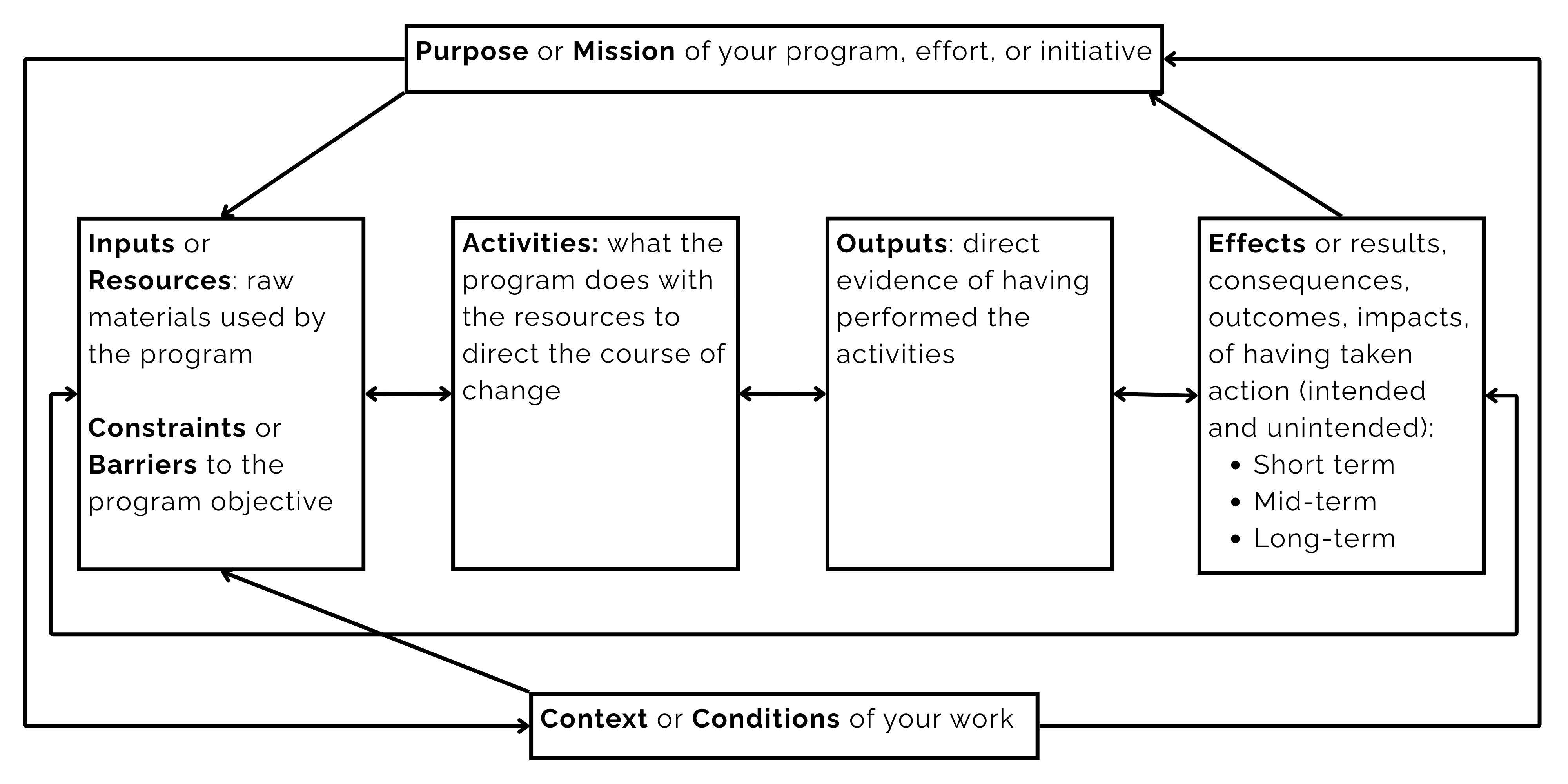
The diagram depicts a logic model with six key components based on the information above. The model is represented as labeled boxes connected by arrows to indicate flow and interconnections between Purpose, Context, Inputs and Constraints, Activities, Outputs, and Effects.

Using this generic model as a template, let's fill in the details with another example of a logic model, one that describes a community health effort to prevent tuberculosis.
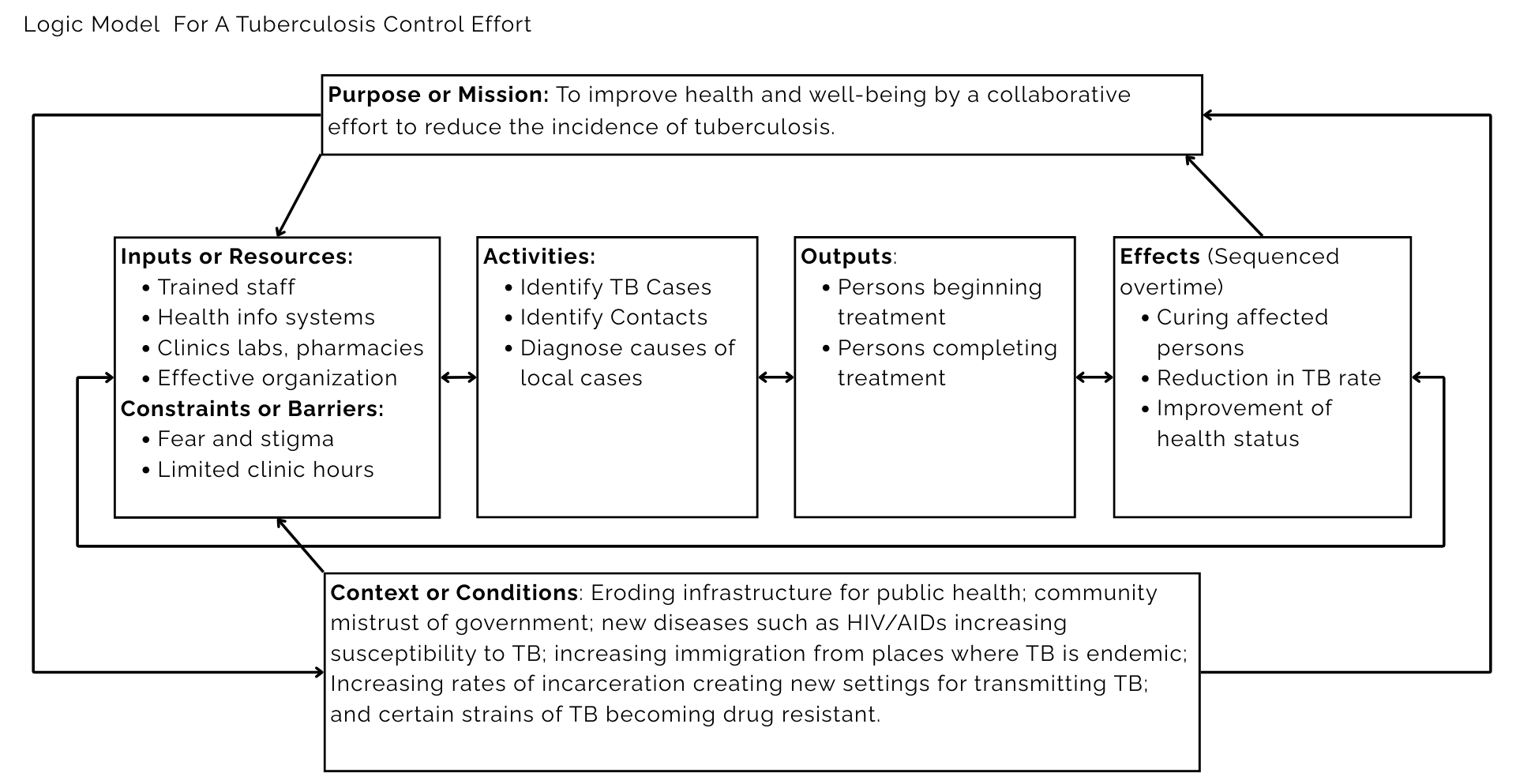
An example of a logic model for a tuberculosis control effort following the generic model outlined above. The model is represented as labeled boxes connected by arrows to indicate flow and interconnections between Purpose, Context, Inputs and Constraints, Activities, Outputs, and Effects

Remember, although this example uses boxes and arrows, you and your partners in change can use any format or imagery that communicates more effectively with your stakeholders.

As mentioned earlier, the generic model for Disease/Injury Control and Prevention in Examples depicts the same relationship of activities and effects in a linear and a nonlinear format. The two formats helped communicate with different groups of stakeholders and made different points.

The linear model better guided discussions of cause and effect and how far down the chain of effects a particular program was successful. The circular model more effectively depicted the interdependence of the components to produce the intended effects.

When exploring the results of an intervention, remember that there can be long delays between actions and their effects. Also, certain system changes can trigger feedback loops, which further complicate and delay our ability to see all the effects. (A definition from the System Dynamics Society, might help here: "Feedback refers to the situation of X affecting Y and Y in turn affecting X perhaps through a chain of causes and effects. One cannot study the link between X and Y and, independently, the link between Y and X and predict how the system will behave. Only the study of the whole system as a feedback system will lead to correct results.")

For these reasons, logic models indicate when to expect certain changes. Many planners like to use the following three categories of effects (illustrated in the models above), although you may choose to have more or fewer depending on your situation.

  • Short-term or immediate effects. (In the On Track example, this would be that young people who participate in mentoring improve their self-confidence and understand the importance of staying in school.)
  • Mid-term or intermediate effects. (Mentored students improve their grades and remain in school.)
  • Longer-term or ultimate effects. (High school graduation rates rise, thus giving graduates more employment opportunities, greater financial stability, and improved health status.)

Here are two important notes about constructing and refining logic models.

Outcome or Impact?

Clarify your language. In a collaborative project, it is wise to anticipate confusion over language. If you understand the basic elements of a logic model, any labels can be meaningful provided stakeholders agree to them. In the generic and TB models above, we called the effects short-, mid-, and long-term. It is also common to hear people talk about effects that are "upstream" or "proximal" (near to the activities) versus "downstream" or "distal" (distant from the activities). Because disciplines have their own jargon, stakeholders from two different fields might define the same word in different ways.

Some people are trained to call the earliest effects "outcomes" and the later ones "impacts." Other people are taught the reverse: "impacts" come first, followed by "outcomes." The idea of sequence is the same regardless of which terms you and your partners use. The main point is to clearly show connections between activities and effects over time, thus making explicit your initiative's assumptions about what kinds of change to expect and when. Try to define essential concepts at the design stage and then be consistent in your use of terms. The process of developing a logic model supports this important dialogue and will bring potential misunderstandings into the open.

For good or for ill?

Understand effects. While the starting point for logic modeling is to identify the effects that correspond to stated goals, your intended effect are not the only effects to watch for. Any intervention capable of changing problem behaviors or altering conditions in communities can also generate unintended effects. These are changes that no one plans and that might somehow make the problem worse.

Many times our efforts to solve a problem lead to surprising, counterintuitive results. There is always a risk that our "cure" could be worse than the "disease" if we're not careful. Part of the added value of logic modeling is that the process creates a forum for scrutinizing big leaps of faith, a way to searching for unintended effects. (See the discussion of simulation in "What makes a logic model effective" for some thoughts on how to do this in a disciplined manner.)

One of the greatest rewards for the extra effort is the ability to spot potential problems and redesign an initiative (and its logic model) before the unintended effects get out of hand, so that the model truly depicts activities that will plausibly produce the intended effects.

Choosing the right level of detail: the importance of utility and simplicity

It may help at this point to consider what a logic model is not. Although it captures the big picture, it is not an exact representation of everything that's going on. All models simplify reality; if they didn't, they wouldn't be of much use.

Even though it leaves out information, a good model represents those aspects of an initiative that, in the view of your stakeholders, are most important for understanding how the effort works. In most cases, the developers will go through several drafts before producing at a version that the stakeholders agree accurately reflects their story.

Should the information become overly complex, it is possible to create a family of related models, or nested models, each capturing a different level of detail. One model could sketch out the broad pathways of change, whereas others could elaborate on separate components, revealing detailed information about how the program operates on a deeper level. Individually, each model conveys only essential information, and together they provide a more complete overview of how the program or initiative functions. (See "How do you create a logic model?" for further details.)

Imagine "zooming-in" on the inner workings of a specific component and creating another, more detailed model just for that part. For a complex initiative, you may choose to develop an entire family of such related models that display how each part of the effort works, as well as how all the parts fit together. In the end, you may have some or all of the following family of models, each one differing in scope:

  • View from Outer Space. This overall road map shows the major pathways of change and the full spectrum of effects. This view answers questions such s: Do the activities follow a single pathway, or are there separate pathways that converge down the line? How far does the chain of effects go? How do our program activities align with those of other organizations? What other forces might influence the effects that we hope to see? Where can we anticipate feedback loops and in what direction will they travel? Are there significant time delays between any of the connections?
  • View from the Mountaintop. This closer view focuses on a specific component or set of components, yet it is still broad enough to describe the infrastructure, activities, and full sequence of effects. This view answers the same questions as the view from outer space, but with respect to just the selected component(s).
  • You Are Here. This view expands on a particular part of the sequence, such as the roles of different stakeholders, staff, or agencies in a coalition, and functions like a flow chart for someone's work plan. It is a specific model that outlines routine processes and anticipated effects. This is the view that you might need to understand quality control within the initiative.

Families, Nesting, and Zooming-In
In the Examples section, the idea of nested models is illustrated in the Tobacco Control family of models. It includes a global model that encompasses three intermediate outcomes in tobacco control - environments without tobacco smoke, reduced smoking initiation among youth, and increased cessation among youth and adults. Then a zoom-in model is elaborated for each one of these intermediate outcomes.

The Comprehensive Cancer model illustrates a generic logic model accompanied by a zoom-in on the activities to give program staff the specific details they need. Notably, the intended effects on the zoom-in are identical to those on the global model and all major categories of activities are also apparent. But the zoom in unpacks these activities into their detailed components and, more important, indicates that the activities achieve their effects by influencing intermediaries who then move gatekeepers to take action. This level of detail is necessary for program staff, but it may be too much for discussions with funders and stakeholders.

The Diabetes Control model is another good example of a family of models. In this case, the zoom in models are very similar to the global model in level of detail. They add value by translating the global model into a plan for specific actors (in this case a state diabetes control program) or for specific objectives (e..g., increasing timely foot exams).

When can a logic model be used?

Logic models are useful for both new and existing programs and initiatives. If your effort is being planned, a logic model can help get it off to a good start. Alternatively, if your program is already under way, a model can help you describe, modify or enhance it.

Planners, program managers, trainers, evaluators, advocates and other stakeholders can use a logic model in several ways throughout an initiative. One model may serve more than one purpose, or it may be necessary to create different versions tailored for different aims. Here are examples of the various times that a logic model could be used.

During planning to:

  • clarify program strategy
  • identify appropriate outcome targets (and avoid over-promising)
  • align your efforts with those of other organizations
  • write a grant proposal or a request for proposals
  • assess the potential effectiveness of an approach
  • set priorities for allocating resources
  • estimate timelines
  • identify necessary partnerships
  • negotiate roles and responsibilities
  • focus discussions and make planning time more efficient

During implementation to:

  • provide an inventory of what you have and what you need to operate the program or initiative
  • develop a management plan
  • incorporate findings from research and demonstration projects
  • make mid-course adjustments
  • reduce or avoid unintended effects

During staff and stakeholder orientation to:

  • explain how the overall program works
  • show how different people can work together
  • define what each person is expected to do
  • indicate how one would know if the program is working

During evaluation to:

  • document accomplishments
  • organize evidence about the program
  • identify differences between the ideal program and its real operation
  • determine which concepts will (and will not) be measured
  • frame questions about attribution (of cause and effect) and contribution (of initiative components to the outcomes)
  • specify the nature of questions being asked
  • prepare reports and other media
  • tell the story of the program or initiative

During advocacy to:

  • justify why the program will work
  • explain how resource investments will be used

How do you create a logic model?

There is no single way to create a logic model. Think of it as something to be used, its form and content governed by the users' needs.

Who creates the model? This depends on your situation. The same people who will use the model - planners, program managers, trainers, evaluators, advocates and other stakeholders - can help create it. For practical reasons, though, you will probably start with a core group, and then take the working draft to others for continued refinement.

Remember that your logic model is a living document, one that tells the story of your efforts in the community. As your strategy changes, so should the model. On the other hand, while developing the model you might see new pathways that are worth exploring in real life.

Two main development strategies are usually combined when constructing a logic model.

  • Moving forward from the activities (also known as forward logic). This approach explores the rationale for activities that are proposed or currently under way. It is driven by But why? questions or If-then thinking: But why should we focus on briefing Senate staffers? But why do we need them to better understand the issues affecting young people? But why would they create policies and programs to support mentoring? But why would new policies make a difference?... and so on. That same line of reasoning could also be uncovered using if-then statements: If we focus on briefing legislators, then they will better understand the issues affecting young people. If legislators understand, then they will enact new policies...
  • Moving backward from the effects (also known as reverse logic). This approach begins with the end in mind. It starts with a clearly identified value, a change that you and your colleagues would definitely like to see occur, and asks a series of "But how?" questions: But how do we overcome fear and stigma? But how can we ensure our services are culturally responsive? But how can we admit that we don't already know what we're doing?

At first, you may not agree with the answers that certain stakeholders give for these questions. Their logic may not seem convincing or even logical. But therein lies the power of logic modeling. By making each stakeholder's thinking visible on paper, you can decide as a group whether the logic driving your initiative seems reasonable. You can talk about it, clarify misinterpretations, ask for other opinions, check the assumptions, compare them with research findings, and in the end develop a solid system of program logic. This product then becomes a powerful tool for planning, implementation, orientation, evaluation, and advocacy, as described above.

By now you have probably guessed that there is not a rigid step-by-step process for developing a logic model. Like the rest of community work, logic modeling is an ongoing process. Nevertheless, there are a few tasks you should be sure to accomplish.

To illustrate these in action, we'll use another example for an initiative called "HOME: Home Ownership Mobilization Effort." HOME aims to increase home ownership in order to give neighborhood control to the people who live there, rather than to outside landlords with no stake in the community. It does this through a combination of educating community residents, organizing the neighborhood, and building relationships with partners such as businesses.

Steps for drafting a logic model

  • Find the logic in existing written materials to produce your first draft.
    • Available written materials often contain more than enough information to get started. Collect narrative descriptions, justifications, grant applications, or overview documents that explain the basic idea behind the intervention effort. If your venture involves a coalition of several organizations, be sure to get descriptions from each agency's point of view. For the HOME campaign, we collected documents from planners who proposed the idea, as well as mortgage companies, homeowner associations, and other neighborhood organizations.
    • Your job as a logic modeler is to decode these documents. Keep a piece of paper by your side and sketch out the logical links as you find them. (This work can be done in a group to save time and engage more people if you prefer.)
    • Read each document with an eye for the logical structure of the program. Sometimes that logic will be clearly spelled out (e.g., The information, counseling, and support services we provide to community residents will help them improve their credit rating, qualify for home loans, purchase homes in the community; over time, this program will change the proportion of owner-occupied housing in the neighborhood).
    • Other times the logic will be buried in vague language, with big leaps from actions to downstream effects (e.g., Ours is a comprehensive community-based program that will transform neighborhoods, making them controlled by people who live there and not outsiders with no stake in the community).
    • As you read each document, ask yourself the But why? and But how? questions. See if the writing provides an answer. Pay close attention to parts of speech. Verbs such as teach, inform, support, or refer are often connected to descriptions of program activities. Adjectives like reduced, improved, higher, or better are often used when describing expected effects.
  • Determine the appropriate scope of the model for its intended users and uses. Consider creating a family of models for multiple users.
    • The HOME initiative, for instance, created different models to address the unique needs of their financial partners, program managers, and community educators. Mortgage companies, grant makers, and other decision makers who decided whether to allocate resources for the effort found the global view from space most helpful for setting context. Program managers wanted the closer, yet still broad view from the mountaintop. And community educators benefited most from the you are here version. The important thing to remember is that these are not three different programs, but different ways of understanding how the same program works.
  • Check whether the model makes sense and is complete.
    • Logic models convey the story of community change. Working with the stakeholders, it's your responsibility to ensure that the story you've told in your draft makes sense (i.e., is logical) and is complete (has no loose ends). As you iteratively refine the model, ask yourself and others if it captures the full story.
    • Here are the plot points common in most community change initiatives, presented with their "storytelling" names.
      • The Promised Land (desired effects). Does the model show specific measurable results that you hope to achieve? Does it contain big leaps of faith or does it show change through a logical sequence of effects? Are crucial behavioral changes identified (e.g., more applications for home ownership, increased home buying, greater engagement in community and civic affairs, etc.)? And if those behavior changes are supposed to be sustained, does the model explain how community conditions will change to reinforce new behaviors (e.g., home owner support groups, tax cuts on owner-occupied housing, discounts at the local hardware store for customers who own property in the neighborhood, etc.)? In the HOME model, we specified the following sequence of effects:
        • Short-term - Potential home owners attain greater understanding of how credit ratings are calculated and more accurate information about the steps to improve a credit rating; mortgage companies create new policies and procedures allowing renters to buy their own homes; local businesses start incentive programs; and anti-discrimination lawsuits are filed against illegal lending practices.
        • Mid-term - The community's average credit rating improves; applications rise for home loans along with the approval rate; support services are established for first-time home buyers; neighborhood organizing gets stronger, and alliances expand to include businesses, health agencies, and elected officials.
        • Longer-term - The proportion of owner-occupied housing rises; economic revitalization takes off as businesses invest in the community; residents work together to create walking trails, crime patrols, and fire safety screenings; rates of obesity, crime, and injury fall dramatically.
      • An advantage of the graphic model is that it can display both the sequence and the interactions of effects. For example, in the HOME model, credit counseling leads to better understanding of credit ratings, while loan assistance leads to more loan submissions, but the two together (plus other activities such as more new buyer programs) are needed for increased home ownership.
  • Drama (activities, interventions). How will obstacles be overcome? Who is doing what? What kinds of conflict and cooperation are evident? What's being done to re-arrange the forces of change? What new services or conditions are being introduced? Your activities, based on a clear analysis of risk and protective factors, are the answers to these kinds of questions, Your interventions reveal the drama in your story of directed social change.

Dramatic actions in the HOME initiative include offering educational sessions and forming business alliances, homeowner support groups, and a neighborhood organizing council. At evaluation time, each of these actions is closely connected to output indicators that document whether the program is on track and how fast it is moving. These outputs could be the number of educational sessions held, their average attendance, the size of the business alliance, etc. (These outputs are not depicted in the global model, but that could be done if valuable for users.)

  • Raw Materials (inputs, resources, or infrastructure). The energy to create change can't come from nothing. Real resources must come into the system. Those resources may be financial, but they may also include people, space, information, technology, equipment, and other assets. The HOME campaign runs because of the input from volunteer educators, support from schools and faith institutions in the neighborhood, discounts provided by lenders and local businesses, revenue from neighborhood revitalization, and increasing social capital among community residents.
  • Setting (background, context and conditions). Really good stories convey facts, but they also have texture. There is a backdrop against which the main action takes place. Community change always takes place in the context of history, geography, politics, etc. Although it is impossible to represent all of those factors in a model, you can strive to include features that remind users those conditions exist and will affect how change unfolds.
    • Stakeholders working on the HOME campaign understood that they were challenging a history of racial discrimination and economic injustice. They saw gentrification occurring in nearby neighborhoods. They were aware of backlash from outside property owners who benefit from the status quo. None of these facts are included in the model per se, but a shaded box labeled History and Context was added to serve as a visual reminder that these things are in the background.
  • Attend to the nuts and bolts of drawing the model.
    • Draft the logic model using both sides of your brain and all the talents of your stakeholders. Use your artistic and your analytic abilities.
    • Arrange activities and intended effects in the expected time sequence. And don't forget to include important feedback loops - after all, most actions provoke a reaction.
    • Link components by drawing arrows or using other visual methods that communicate the order of activities and effects. (Remember - the model does not have to be linear or read from left to right, top to bottom. A circle may better express a repeating cycle.)
    • Allow yourself plenty of space to develop the model. Freely revise the picture to show the relationships better or to add components.
    • Neatness counts, so avoid overlapping lines and unnecessary clutter.
    • Color code regions of the model to help convey the main storyline.
    • Try to keep everything on one page. When the model get too crowded, either adjust its scope or build nested models.
    • Make sure it passes the "laugh test." That is, be sure that the image you create isn't so complex that it provokes an immediate laugh from stakeholders. Of course, different stakeholders will have different laugh thresholds.
    • Use PowerPoint or other computer software to animate the model, building it step-by-step so that when you present it to people in an audience, they can follow the logic behind every connection.
  • Revisit and be ready to revise the model as necessary.
    • Don't let your model become a tedious exercise that you did just to satisfy someone else. Don't let it sit in a drawer. Once you've gone through the effort of creating a model, the rewards are in its use. Revisit it often and be prepared to make changes. All programs evolve and change through time, if only to keep up with changing conditions in the community. Like a roadmap, a good model will help you to recognize new or reinterpret old territory.
    • Also, when things are changing rapidly, it's easy for collaborators to lose sight of their common goals. Having a well-developed logic model can keep stakeholders focused on achieving outcomes while remaining open to finding the best means for accomplishing the work. If you need to take a detour or make a longer stop, the model serves as a framework for incorporating the change.
    • As you improve, modify or realign your model, take stock of emerging activities and effects. You might need to do one or more of the following:
      • Clarify the path of activities to effects and outcomes
      • Elaborate links
      • Expand activities to reach your goals
      • Establish or revise mile markers
      • Redefine the boundary of your initiative or program
      • Reframe goals or desired outcomes

What makes a logic model effective?

You will know a model's effectiveness mainly by its usefulness to intended users. A good logic model usually:

  • Logically links activities and effects
  • Is visually engaging (simple, parsimonious) yet contains the appropriate degree of detail for the purpose (not too simple or too confusing)
  • Provokes thought, triggers questions
  • Includes forces known to influence the desired outcomes

The more complete your model, the better your chances of reaching "the promised land" of the story. In order to tell a complete story or present a complete picture in your model, make sure to consider all forces of change (root causes, trends, and system dynamics). Does your model reveal assumptions and hypotheses about the root causes and feedback loops that contribute to problems and their solutions?

In the HOME model, for instance, low home ownership persists when there is a vicious cycle of discrimination, bad credit, and hopelessness preventing neighborhood-wide organizing and social change. Three pathways of change were proposed to break that cycle: education; business reform; and neighborhood organizing. Building a model on one pathway to address only one force would limit the program's effectiveness.

You can discover forces of change in your situation using multiple assessment strategies, including forward logic and reverse logic as described above. When exploring forces of change, be sure to search for personal factors (knowledge, belief, skills) as well as environmental factors (barriers, opportunities, support, incentives) that keep the situation the same as well as ones that push for it to change.

Take time to simulate

After you've mapped out the structure of a program strategy, there is still another crucial step to take before taking action: some kind of simulation. As logical as the story you are telling seems to you, as a plan for intervention it runs the risk of failure if you haven't explored how things might turn out in the real world of feedback and resistance.

Simulation is one of the most practical ways to find out if a seemingly sensible plan will actually play out as you hope. Simulation is not the same as testing a model with stakeholders to see if it makes logical sense. The point of a simulation is to see how things will change - how the system will behave - through time and under different conditions.

Though simulation is a powerful tool, it can be conducted in ways ranging from the simple to the sophisticated.

  • Simulation can be as straightforward as an unstructured role-playing game, in which you talk the model through to its logical conclusions.
  • In a more structured simulation, you could develop a tabletop exercise in which you proceed step by step through a given scenario with pre-defined roles and responsibilities for the participants.
  • Ultimately, you could create a computer-based mathematical simulation by using any number of available software tools.

The key point to remember is that creating logical models and simulating how those models will behave involve two different sets of skills, both of which are essential for discovering which change strategies will be effective in your community.

What are the benefits and limitations of logic modeling?

You can probably envision a variety of ways in which you might use the logic model you've developed or that logic modeling would benefit your work.

Here are a few advantages that experienced modelers have discovered.

  • Logic models integrate planning, implementation, and evaluation. As a detailed description of your initiative, from resources to results, the logic model is equally important for planning, implementing, and evaluating the project. If you are a planner, the modeling process challenges you to think more like an evaluator. If your purpose is evaluation, the modeling prompts discussion of planning. And for those who implement, the modeling answers practical questions about how the work will be organized and managed.
  • Logic models prevent mismatches between activities and effects. Planners often summarize an effort by listing its vision, mission, objectives, strategies and action plans. Even with this information, it can be hard to tell how all the pieces fit together. By connecting activities and effects, a logic model helps avoid proposing activities with no intended effect, or anticipating effects with no supporting activities. The ability to spot such mismatches easily is perhaps the main reason why so many logic models use a flow chart format.
  • Logic models leverage the power of partnerships. As the W.K. Kellogg Foundation notes (see Internet Resources below), refining a logic model is an iterative or repeating process that allows participants to "make changes based on consensus-building and a logical process rather than on personalities, politics, or ideology. The clarity of thinking that occurs from the process of building the model becomes an important part of the overall success of the program." With a well-specified logic model, it is possible to note where the baton should be passed from one person or agency to another. This enhances collaboration and guards against things falling through the cracks.
  • Logic models enhance accountability by keeping stakeholders focused on outcomes. As Connie Schmitz and Beverly Parsons point out (see Internet Resources), a list of action steps usually function as a manager's guide for running a project, showing what staff or others need to do to--for example, "Hire an outreach worker for a TB clinic." With a logic model, however, it is also possible to illustrate the effects of those tasks--for example, "Hiring an outreach worker will result in a greater proportion of clients coming into the clinic for treatment." This short-term effect then connects to mid- and longer-term effects, such as "Satisfied clients refer others to the clinic" and "Improved screening and treatment coverage results in fewer deaths due to TB."

In a coalition or collaborative partnership, the logic model makes it clear which effects each partner creates and how all those effects converge to a common goal. The family or nesting approach works well in a collaborative partnership because a model can be developed for each objective along a sequence of effects, thereby showing layers of contributions and points of intersection.

  • Logic models help planners to set priorities for allocating resources. A comprehensive model will reveal where physical, financial, human, and other resources are needed. When planners are discussing options and setting priorities, a logic model can help them make resource-related decisions in light of how the program's activities and outcomes will be affected.
  • Logic models reveal data needs and provide a framework for interpreting results. It is possible to design a documentation system that includes only beginning and end measurements. This is a risky strategy with a good chance of yielding disappointing results. An alternative approach calls for tracking changes at each step along the planned sequence of effects. With a logic model, program planners can identify intermediate effects and define measurable indicators for them.
  • Logic models enhance learning by integrating research findings and practice wisdom. Most initiatives are founded on assumptions about the behaviors and conditions that need to change, and how they are subject to intervention. Frequently, there are different degrees of certainty about those assumptions. For example, some of the links in a logic model may have been tested and proved to be sound through previous research. Other linkages, by contrast, may never have been researched, indeed may never have been tried or thought of before. The explicit form of a logic model means that you can combine evidence-based practices from prior research with innovative ideas that veteran practitioners believe will make a difference. If you are armed with a logic model, it won't be easy for critics to claim that your work is not evidence-based.
  • Logic models define a shared language and shared vision for community change. The terms used in a model help to standardize the way people think and how they speak about community change. It gets everyone rowing in the same direction, and enhances communication with external audiences, such as the media or potential funders. Even stakeholders who are skeptical or antagonistic toward your work can be drawn into the discussion and development of a logic model. Once you've got them talking about the logical connections between activities and effects, they're no longer criticizing from the sidelines. They'll be engaged in problem-solving and they'll be doing so in an open forum, where everyone can see their resistance to change or lack of logic if that's the case.

Limitations

Any tool this powerful must not be approached lightly. When you undertake the task of developing a logic model, be aware of the following challenges and limitations.

First, no matter how logical your model seems, there is always a danger that it will not be correct. The world sometimes works in surprising, counter-intuitive ways, which means we may not comprehend the logic of change until after the fact. With this in mind, modelers will appreciate the fact that the real effects of intervention actions could differ from the intended effects. Certain actions might even make problems worse, so it's important to keep one eye on the plan and another focused on the real-life experiences of community members.

If nothing else, a logic model ought to be logical. Therein lies its strength and its weakness. Those who are trying to follow your logic will magnify any inconsistency or inaccuracy. This places a high burden on modelers to pay attention to detail and refine their own thinking to great degree. Of course, no model can be perfect. You'll have to decide on the basis of stakeholders' uses what level of precision is required.

Establishing the appropriate boundaries of a logic model can be a difficult challenge. In most cases, there is a tension between focusing on a specific program and situating that effort within its broader context. Many models seem to suggest that the only forces of change come from within the program in question, as if there is only one child in the sandbox.

At the other extreme, it would be ridiculous and unproductive to map all the simultaneous forces of change that affect health and community development. A modeler's challenge is to include enough depth so the organizational context is clear, without losing sight of the reasons for developing a logic model in the first place.

On a purely practical level, logic modeling can also be time consuming, requiring much energy in the beginning and continued attention throughout the life of an initiative. The process can demand a high degree of specificity; it risks oversimplifying complex relationships and relies on the skills of graphic artists to convey complex thought processes.

Indeed, logic models can be very difficult to create, but the process of creating them, as well as the product, will yield many benefits over the course of an initiative.

In Summary

A logic model is a story or picture of how an effort or initiative is supposed to work. The process of developing the model brings together stakeholders to articulate the goals of the program and the values that support it, and to identify strategies and desired outcomes of the initiative.

As a means to communicate a program visually, within your coalition or work group and to external audiences, a logic model provides a common language and reference point for everyone involved in the initiative.

A logic model is useful for planning, implementing and evaluating an initiative. It helps stakeholders agree on short-term as well as long-term objectives during the planning process, outline activities and actors, and establish clear criteria for evaluation during the effort. When the initiative ends, it provides a framework for assessing overall effectiveness of the initiative, as well as the activities, resources, and external factors that played a role in the outcome.

To develop a model, you will probably use both forward and reverse logic. Working backwards, you begin with the desired outcomes and then identify the strategies and resources that will accomplish them. Combining this with forward logic, you will choose certain steps to produce the desired effects.

You will probably revise the model periodically, and that is precisely one advantage to using a logic model. Because it relates program activities to their effect, it helps keep stakeholders focused on achieving outcomes, while it remains flexible and open to finding the best means to enact a unique story of change.
Contributor

Bobby Milstein

Tom Chapel

Resources

Online Resources

In this video series from CADCA’s Mid-year Training Institute, Paul Evensen introduces key concepts and provides an orientation to issue analysis and logic modeling. He explains classic representational logic models, explains the value of metaphor-based logic models for communicating cause and effect using familiar shapes or objects, and offers guidance on how to critique and strengthen logic models. The series also covers integrated issue logic modeling to help communities connect multiple factors and strategies into a cohesive framework. 

The Community Builder’s Approach to Theory of Change: A Practical Guide to Theory Development, from The Aspen Institute’s Roundtable on Community Change.

"Everything You Wanted to Know About Logic Models But Were Afraid to Ask" by Connie C. Schmitz and Beverly A. Parsons.

The CDC Evaluation Working Group provides a linked section on logic models in its resources for project evaluation.

The Evaluation Guidebook for Projects Funded by S.T.O.P. Formula Grants under the Violence Against Women Act includes a chapter on developing and using a logic model (Chapter 2), and additional examples of model in the "Introduction to the Resource Chapters."

A logic model from Harvard that uses a family/school partnership program.

The CDC Evaluation Working Group provides a linked section on logic models in its resources for project evaluation.

Excerpts from United Way's publication on Measuring Program Outcomes See especially "Program Outcome Model."

Tara Gregory on Using Storytelling to Help Organizations Develop Logic Models discusses techniques to facilitate creative discussion while still attending to the elements in a traditional logic model. These processes encourage participation by multiple staff, administrators and stakeholders and can use the organization’s vision or impact statement as the “happily ever after.”

Theory of Change: A Practical Tool for Action, Results and Learning, prepared by Organizational Research Services.

Theories of Change and Logic Models: Telling Them Apart is a helpful PowerPoint presentation saved as a PDF. It’s from the Aspen Institute Roundtable on Community Change.

University of Wisconsin’s Program Development and Evaluation provides a comprehensive template for a logic model and elaborates on creating and developing logic models.

The U.S. Centers for Disease Control Evaluation Group provides links to a variety of logic model resources.

The W.K. Kellogg Foundation Logic Model Development Guide is a comprehensive source for background information, examples and templates.

Print Resources

American Cancer Society (1998). Stating outcomes for American Cancer Society programs: a handbook for volunteers and staff. Atlanta, GA, American Cancer Society.

Julian, D. (1997). The utilization of the logic model as a system level planning and evaluation device. Evaluation and Program Planning 20(3): 251-257.

McEwan, K., &  Bigelow, A. (1997). Using a logic model to focus health services on population health goals. Canadian Journal of Program Evaluation 12(1): 167-174.

McLaughlin, J., & Jordan, B. (1999). Logic models: a tool for telling your program's performance story. Evaluation and Program Planning 22(1): 65-72.

Moyer, A., Verhovsek, et al. (1997). Facilitating the shift to population-based public health programs: innovation through the use of framework and logic model tools. Canadian Journal of Public Health 88(2): 95-98.

Rush, B. & Ogbourne, A. (1991). Program logic models: expanding their role and structure for program planning and evaluation. Canadian Journal of Program Evaluation 6: 95-106.

Taylor-Powell, E., Rossing, B., et al. (1998). Evaluating collaboratives: reaching the potential. Madison, WI, University of Wisconsin Cooperative Extension.

United Way of America (1996). Measuring program outcomes: a practical approach. Alexandria, VA, United Way of America.

Western Center for the Application of Prevention Technologies. (1999) Building a Successful Prevention Program. Reno, NV, Western Center for the Application of Prevention Technologies.

Wong-Reiger, D., & David, L. (1995). Using program logic models to plan and evaluate education and prevention programs. In  Love, A. Ed. Evaluation Methods Sourcebook II. Ottawa, Ontario, Canadian Evaluation Society.

Checklist
mloewenstein Mon, 12/10/2012 - 13:47

What is a logic model?

___You understand the purpose and elements of a logic model as a picture of why and how your effort is supposed to work

___You understand the utility of family, nested, or zoom in models for a complex initiative

___You have an initial plan for how and when to use your logic model

How do you create a logic model?

___Apply forward and/or reverse logic to your effort or initiative

___Create the first draft by finding the logic in existing written materials

___Adjust the model's scope to make it appropriate for intended users and uses

___Create multiple (family, nested, or zoom in) models if needed by users

___Check whether the model makes sense and is complete, including the common plot points

___Attend to the nuts and bolts of drawing the model

___Revisit and revise the model as necessary

Examples
mloewenstein Mon, 12/10/2012 - 13:47

These are examples of logic models that other people have found effective. Please note, however, that no other person's or group's logic model can serve as template for your own; even if your initiative is similar, the forces of change and other important details for each effort will differ.

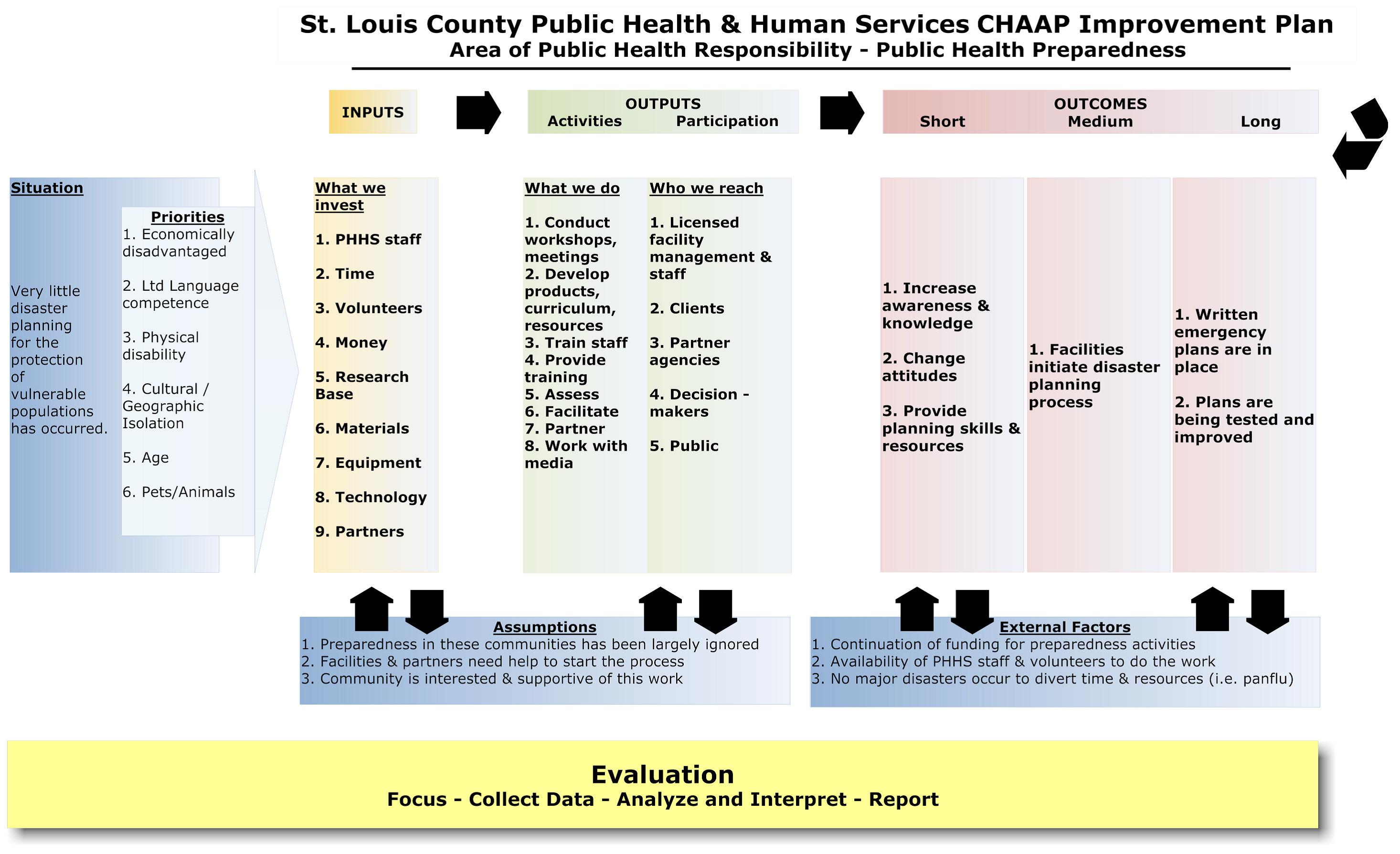
Example 1: Community Health Assessment and Action Planning (CHAAP) Process Improvement Plan in St. Louis County

This logic model lays out St. Louis County’s Department of Public Health and Human Services’ proposed improvement plan to overcome the challenges of protecting vulnerable populations in the event of a disaster.

Flowchart of St. Louis County Public Health CHAAP Improvement Plan showing inputs, activities, participation, and short-, medium-, and long-term outcomes for disaster preparedness

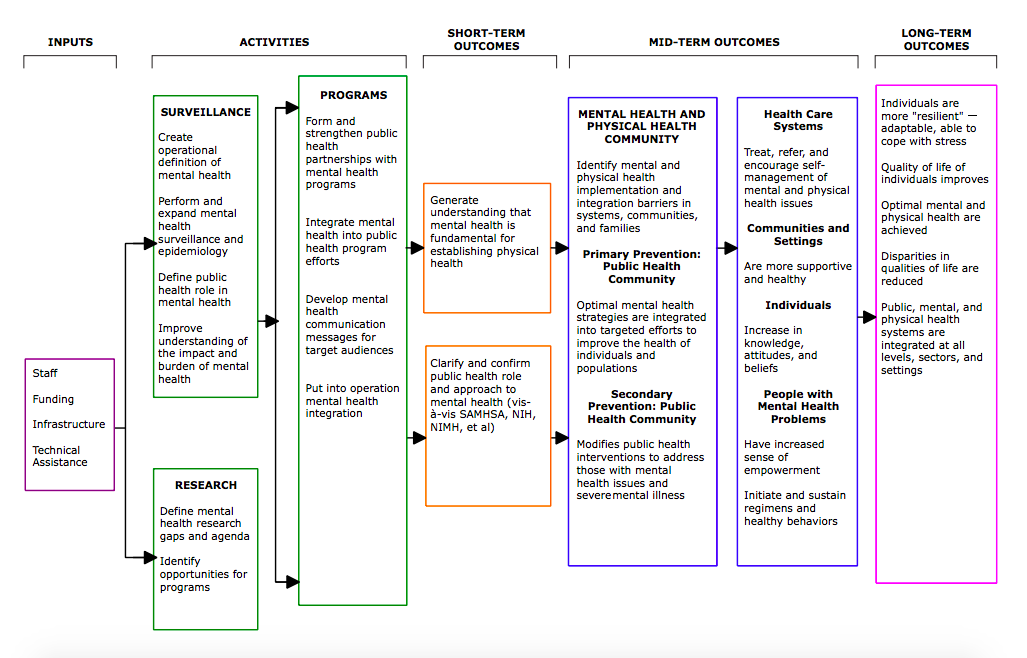
Example 2: Integration of Mental Health into Chronic Disease Prevention Strategies and Health Promotion Efforts

As mental health greatly affects an individual's capacity to participate in health promoting-behaviors, this logic model details possible steps to address mental health and its relationship with chronic disease prevention and health promotion.

mental health improvement plan showing inputs, activities (surveillance, research, programs), short-term outcomes (understanding mental health role), mid-term outcomes (community and health system integration), and long-term outcomes (resilience, improved quality of life, reduced disparities).

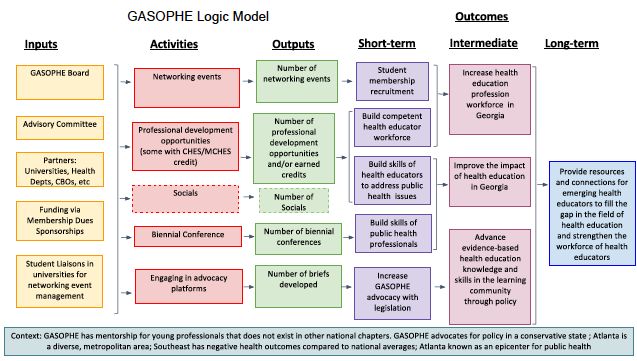
Example 3: Georgia Society for Public Health Education Logic Model

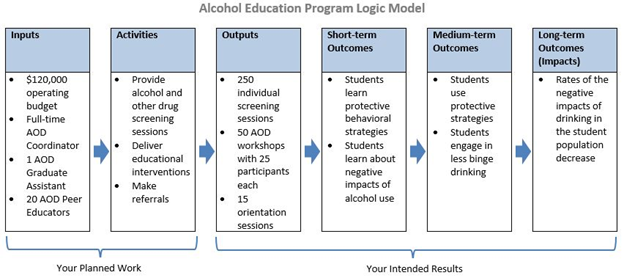
Example 4: Alcohol and Other Drugs (AOD) Education Program Logic Model

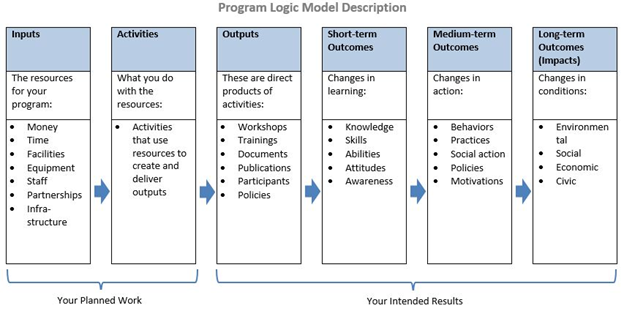
Program Logic Model showing inputs, activities, outputs, and short-, medium-, and long-term outcomes

Alcohol Education Logic Model showing inputs, activities, outputs, and short-, medium-, and long-term outcomes.


Example 5: National Endowment for the Arts - "Our Town" Logic Model

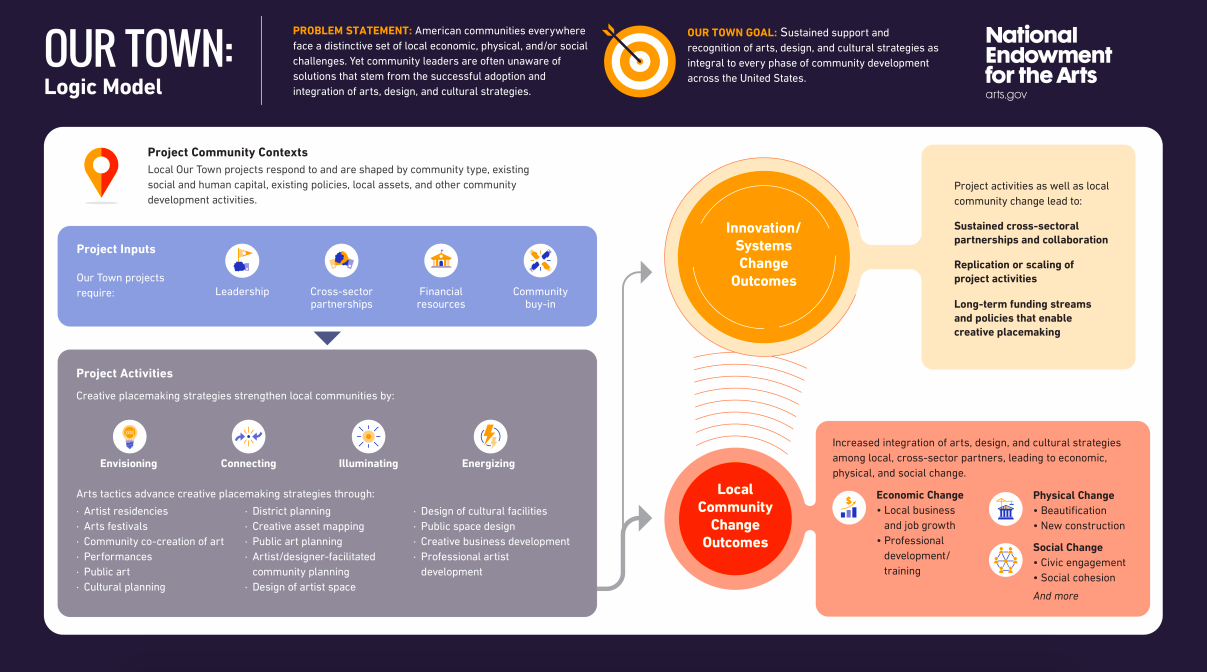
This logic model was developed by the National Endowment for the Arts for their Creative Placemaking Grants Program deemed "Our Town". The model promotes strengthening communities by advancing local physical, economic, and social outcomes.

Our Town Logic Model showing inputs, activities, and outcomes for arts-based community change and systems innovation.

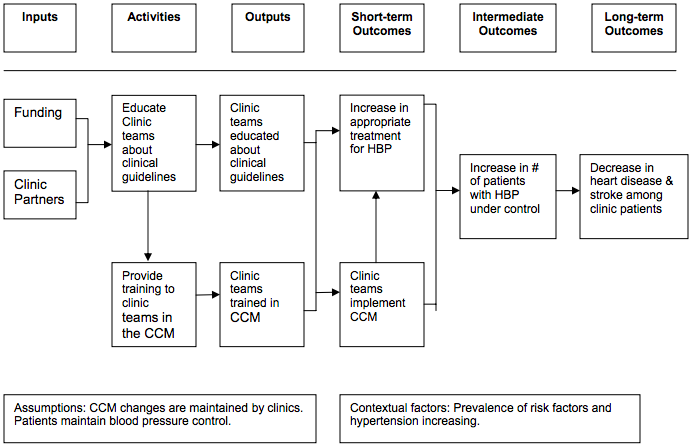
Example 6: CDC Cardiovascular Disease and Stroke Prevention Program Logic Model

Logic model showing inputs, activities, outputs, and outcomes for improving hypertension care in clinics.

Example 7: LHFA Logic Model / Framework

Logic model for Latino Health for All showing inputs, activities, outputs, and outcomes to reduce health disparities.

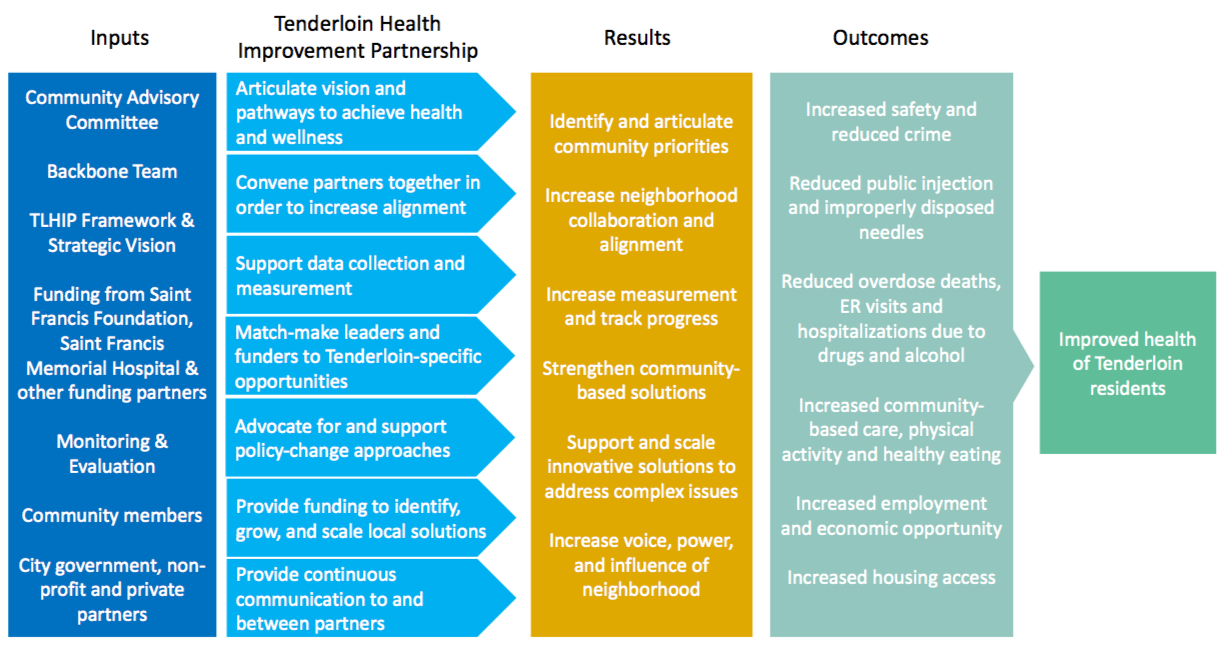
Example 8: Tenderloin Health Improvement Partnership Logic Model

This logic model helps visualize how TLHIP, an initiative led by the Saint Francis Foundation, works collectively with community partners and other stakeholders to improve the health of Tenderloin residents in downtown San Francisco.

Tenderloin Health Improvement Partnership logic model showing inputs, activities, results, and outcomes for community health.

Tools
mloewenstein Fri, 07/19/2013 - 03:55

Tool 1: Tearless Logic Model

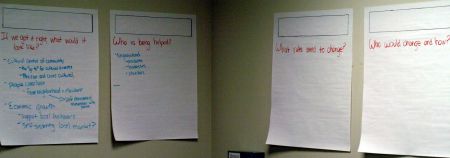
Image of tear sheets on a wall.


The Tearless Logic Model breaks down the logic model process into a series of manageable, jargon-free questions. Access the tool.

Tool 2: Logic Model to create a Framework or Model of Change

This logic model template (docx) provides a framework to help begin the process.

PowerPoint
Anonyme (not verified) Mon, 12/10/2012 - 13:48

A PowerPoint presentation summarizing the major points in the section.

Section 2. PRECEDE/PROCEED
mloewenstein Mon, 12/10/2012 - 14:25
Main Section
mloewenstein Mon, 12/10/2012 - 14:27

If you were a contractor setting out to build a wood-frame house, you wouldn’t just pick up whatever wood you found lying around and begin. You’d consult first with the owner, and start with an idea of the house she wanted – its size, its shape, its features. You’d want a picture of the finished house, and a floor plan as well, with some notes on measurements and materials. You’d plan the construction with her, and set out a process for getting it done. And you’d do all this before you ever picked up a tool, because otherwise the process would be hit-or-miss: she wouldn’t get the house she wanted, and your time would be wasted.

The same is true if you’re developing an intervention to address a health or community issue. It makes no sense to pick an issue at random, and to use whatever service happens to be available to try to address it. You have to consult with the community, understand and analyze community information, your own and others’ observation, and the context of the issue to create an intervention that will actually bring about the changes the community wants and needs.

In the first section of this chapter, we introduced the need for a process for doing health and community work. In this section, we’ll look at PRECEDE-PROCEED, the first of several specific models that may prove helpful to you in carrying out your own work. We’ll examine other models in subsequent sections of this chapter. Then in the last section, we’ll examine some ways in which elements of various models can be combined to respond to your particular situation.

What is PRECEDE-PROCEED?

Like most of the other models we’ll examine in this chapter, PRECEDE-PROCEED was developed for use in public health. Its basic principles, however, transfer to other community issues as well. As a result, we’ll treat it as a model not just for health intervention, but for community intervention in general. And in fact, PRECEDE/ PROCEED focuses on the community as the wellspring of health promotion.

In the latter half of the 20th Century, as medical advances eliminated many infectious diseases, the leading causes of disability and death in the developed world changed to chronic conditions – heart disease, stroke, cancer, diabetes. The focus of health maintenance, therefore, shifted from the treatment of disease to the prevention of these conditions, and, more recently, to the active promotion of behaviors and attitudes – proper diet, exercise, and reduction of stress, for instance – that in themselves do much to maintain health and improve the length and quality of life.

Behind PRECEDE-PROCEED lie some assumptions about the prevention of illness and promotion of health, and, by extension, about other community issues as well. These include:

  • Since the health-promoting behaviors and activities that individuals engage in are almost always voluntary, carrying out health promotion has to involve those whose behavior or actions you want to change. PRECEDE-PROCEED should be a participatory process, involving all stakeholders – those affected by the issue or condition in question – from the beginning.
  • Health is, by its very nature, a community issue. It is influenced by community attitudes, shaped by the community environment (physical, social, political, and economic), and colored by community history.
  • Health is an integral part of a larger context, probably most clearly defined as quality of life, and it’s within that context that it must be considered. It is only one of many factors that make life better or worse for individuals and the community as a whole. It therefore influences, and is influenced by, much more than seems directly connected to it.

AIDS has changed the way many people in the US view and practice sex, for instance. In some other countries, it has affected the whole social structure because of the number of orphans it has created, and its impact on the workforce. By the same token, youth violence changes the views and actions of many people who are at no risk of being its victims, and may put a community at an economic disadvantage by making it less attractive to new business or industry. Almost any other issue could serve equally well as an example of the broad reach of community problems (or assets, for that matter).

  • Finally, health is more than physical well-being, or than the absence of disease, illness, or injury. It is a constellation of factors – economic, social, political, ecological, and physical – that add up to healthy, high-quality lives for individuals and communities.

This broad perspective on health extends to other community issues. We can define the health of a community as its fitness in many areas, of which citizens’ physical health is only one. Indications of a community’s overall health include how well it:

  • Contributes to the stability of families
  • Nurtures and supports children
  • Fosters lifelong learning
  • Provides meaningful work for its citizens
  • Invites involvement in the democratic process
  • Cares for those who need help
  • Protects and sustains the natural environment
  • Encourages the arts
  • Values and encourages racial and cultural diversity
  • Works to promote and maintain safety and physical well-being for its members

PRECEDE and PROCEED are acronyms (words in which each letter is the first letter of a word). PRECEDE stands for Predisposing, Reinforcing, and Enabling Constructs in Educational/Environmental Diagnosis and Evaluation. As its name implies, it represents the process that precedes, or leads up to, an intervention.

PROCEED spells out Policy, Regulatory, and Organizational Constructs in Educational and Environmental Development, and, true to its name as well, describes how to proceed with the intervention itself.

PRECEDE has four phases, which we’ll explore in greater detail later in the section:

  • Phase 1: Identifying the ultimate desired result.
  • Phase 2: Identifying and setting priorities among health or community issues and their behavioral and environmental determinants that stand in the way of achieving that result, or conditions that have to be attained to achieve that result; and identifying the behaviors, lifestyles, and/or environmental factors that affect those issues or conditions.
  • Phase 3: Identifying the predisposing, enabling, and reinforcing factors that can affect the behaviors, attitudes, and environmental factors given priority in Phase 2.
  • Phase 4: Identifying the administrative and policy factors that influence what can be implemented.

Another premise behind PRECEDE-PROCEED is that a change process should focus initially on the outcome, not on the activity. (Many organizations set out to create community change without stopping to consider either what effect their actions are likely to have, or whether the change they’re aiming at is one the community wants and needs.) PRECEDE’s four phases, therefore, move logically backward from the desired result, to where and how you might intervene to bring about that result, to the administrative and policy issues that need to be addressed in order to mount that intervention successfully. All of these phases can be thought of as formative.

PROCEED has four phases (also to be discussed in more detail later) that cover the actual implementation of the intervention and the careful evaluation of it, working back to the original starting point – the ultimate desired outcome of the process.

  • Phase 5: Implementation – the design and actual conducting of the intervention.
  • Phase 6: Process evaluation. Are you actually doing the things you planned to do?
  • Phase 7: Impact evaluation. Is the intervention having the desired impact on the priority population?
  • Phase 8: Outcome evaluation. Is the intervention leading to the outcome (the desired result) that was envisioned in Phase 1?

A word about logic models: Although most formal models, like PRECEDE-PROCEED present themselves as the way to structure an intervention or other activity, the word “logic” implies that you should carefully consider your own situation as well as the model. If there are reasons why a particular part of a model might not work for you, it’s reasonable (logical) to change it. While PRECEDE-PROCEED presents a structure that could conceivably work well (and has worked well) in a variety of situations, it’s still important to think about whether all parts of it will work for you.

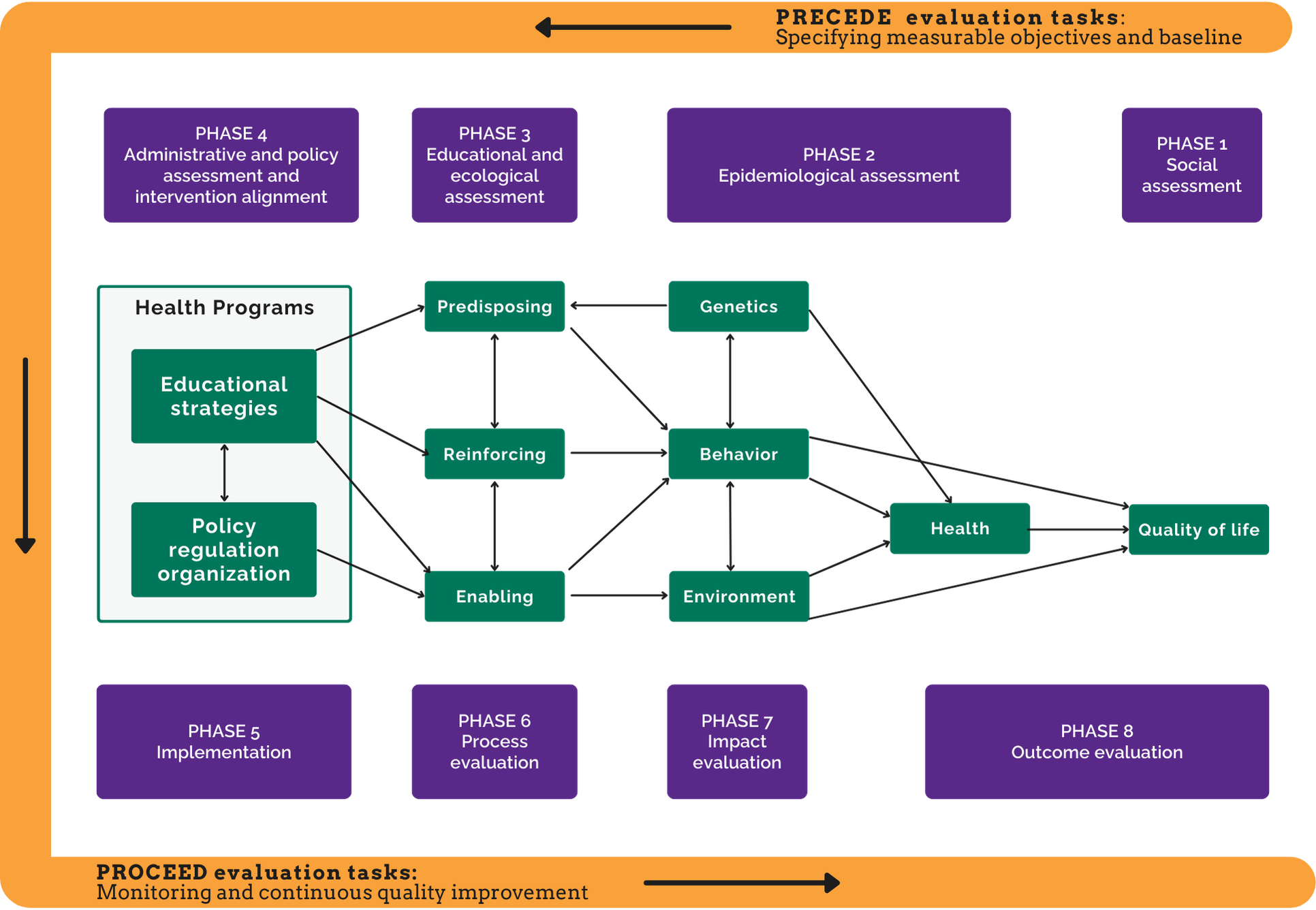
A flow chart of the model (see Fig. 1), developed by its originators, shows a circular process. It starts (on the upper right) with a community demographic and quality-of-life survey, and goes counterclockwise through PRECEDE’s four phases that explain how to conceive and plan an effective intervention. PROCEED then picks up with the intervention itself (described here as a health program), and works back through the first five phases, evaluating the success of the intervention at addressing each one (The process evaluation in Phase 6 looks at whether the intervention addressed the concerns of Phase 3 as planned. The impact evaluation of Phase 7 examines the impact of the intervention on the behaviors or environmental factors identified in Phase 2. And the Outcome evaluation of Phase 9 explores whether the intervention has had the desired quality of life outcome identified in Phases 1 and 2). Eventually, the process arrives back at the beginning, either having achieved the desired quality of life outcome, or to start over again, incorporating the lessons of the first try. The arrows in the flow chart demonstrate the effects of each phase’s issues on the next one to the right. Since you’re working backwards from the ultimate outcome, effects move to the right. If the chart was demonstrating the direction of analysis, the arrows would point in the opposite direction.

Image of Figure 1: Generic Representation of the PRECEDE-PROCEED Model. From L. Green and M. Kreuter. (2005). Health Promotion Planning: An Educational and Ecological Approach (4th Ed.) Mountain View, CA: Mayfield Publishers. This image includes text boxes and relational arrows with the following phrases: PRECEDE evaluation tasks: Specifying measurable objectives and baselines; (header) PHASE 4 – Administrative and policy assessment and intervention alignment; (header) PHASE 3 – Educational and ecological assessment; (header) PHASE 2 – Epidemiological assessment; (header) PHASE 1 – Social Assessment; HEALTH PROGRAM – Educational Strategies, Policy regulation organization; Predisposing; Genetics; Reinforcing; Behavior; Enabling; Environment; Health; Quality of Life; (header) PHASE 5 – Implementation; PHASE 6 – Process evaluation; PHASE 7 – Impact evaluation; PHASE 8 – Outcome evaluation. PROCEED evaluation tasks: Monitoring and Continuous Quality Improvement.

Figure 1. Generic representation of the Precede-Proceed Model. From L. Green and M. Kreuter. (2005). Health Promotion Planning: An Educational and Ecological Approach (4 th Ed.). Mountain View , CA : Mayfield Publishers.


  • The PRECEDE-PROCEED model applies a medical perspective to public health, even though its focus is health promotion, rather than treatment of disease. Just as a medical diagnosis precedes treatment, the model assumes that a far-reaching diagnosis should precede a public health intervention. A diagnosis suggests a treatment (an intervention), which is closely monitored for process (Is the patient getting the treatment prescribed?), impact (Is the treatment having the hoped-for impact on the symptoms?), and outcome (Does the treatment cure the patient, or have the desired effect on her overall health?). A premise of the model is that a diagnosis should start with the desired end result and work backwards to determine what needs to be done to bring about that result.
  • Another basic premise of the model is that the purpose of a health program – and by extension, the purpose of any proactive type of community intervention – is to improve the quality of life for individuals and their community, and that the two are largely inseparable. Thus, any intervention should be community-based, and should look at the needs of the community, even if the intervention is aimed at a more specific priority group.
  • A final premise of any community-based model for intervention is that planning and implementing a community intervention calls for a joint effort among (health and other) professionals and organizations, policy makers, community officials, community leaders, and community members at large, including members of the priority population. In order to ensure accurate information and community support, all elements of the community should be involved in the process from the beginning.

Why use PRECEDE-PROCEED?

First, there are good reasons for using some kind of logic model or theoretical framework for any intervention:

  • It provides a structure within which to plan your work, so that you’re not simply grasping at straws. As a result, you’re more likely to develop a coherent plan that addresses the necessary issues.
  • Most models give you either a guide or a foundation for critical analysis of the issues at hand. That doesn’t guarantee that your analysis will be complete or accurate, but it significantly increases the chances. (See Analyzing Community Problems and Solutions, for more on logical analysis.)

This is not to say that you have to use a logic model. There are other ways to approach developing an intervention, many of them outlined in the Community Tool Box. The advantage of PRECEDE-PROCEED and similar models is that they tell you exactly what to do: you follow directions, and you have a procedure for developing an intervention. The disadvantage of these models is that they tell you exactly what to do: if some part of the model isn’t appropriate for your setting or your circumstances, you’ll have to realize that, and change it to fit, or risk a problem. PRECEDE-PROCEED now offers a flow chart or algorithm to facilitate decisions for skipping some steps or phases, thereby tailoring the model to different local situations.

Usually, the originators of the model will tell you that you have to follow it exactly. In fact, that’s rarely the case. If you like the model, you can be sure to include all its elements, but you can still change some of them, change the timing, even change the order to better match the needs of your community. You might also find yourself taking some pieces of one model and grafting them on to another, or reinterpreting a model in light of a particular theoretical framework.

Over and above the use of logic models in general, there are some good reasons for using PRECEDE-PROCEED specifically:

  • PRECEDE-PROCEED provides a template for the process of conceiving, planning, implementing, and evaluating a community intervention.
  • PRECEDE-PROCEED is structured as a participatory model, to incorporate the ideas and help of the community. That means that its use will provide you with more, and more accurate, information about the issues in question, and with a better understanding of their history and context in the community.
  • Community involvement is also a means of building community ownership of the intervention, leading to more community support and a greater chance of success.
  • PRECEDE-PROCEED considers the ways in which administrative and policy guidelines can limit or shape an intervention, an area of planning too often ignored.
  • PRECEDE-PROCEED incorporates evaluation of the process, the intervention itself, and the final outcome. That allows the intervention to be monitored and adjusted to respond to community needs and changes in the situation, and checks that its accomplishments actually lead to the projected goal.
  • Although PRECEDE-PROCEED sets out a strict process, it says much less about content. It leaves plenty of leeway for adapting your intervention’s design and methods to the situation, the needs of the community, etc.

Although these are good reasons to use PRECEDE-PROCEED, they are also good reasons to use some of the other models in this chapter. This is the reason we are presenting several – so that you can decide which among them, if any, makes the most sense to you, and would be best for your circumstances and community. PRECEDE-PROCEED’s greatest strength may be its comprehensive and rigorous structure – it covers all the bases.

How do you use PRECEDE-PROCEED?

Logic models don’t really mean much unless you actually use them in the community. Once you’ve decided that PRECEDE-PROCEED provides a good model for your intervention, how do you translate it into action? We’ll look at each of the nine phases of the model with that question in mind.

PRECEDE: Doing the groundwork. PRECEDE starts by determining the desired outcome for the community, and then works back to what has to be done to obtain that outcome. Each phase moves one step closer to the actual intervention.

Our presentation of the model assumes that, although it was developed for use in public health, it can be used by activists or organizations concerned with any issues that affect the quality of life in a community, as seen in some of the 950 published applications.

Phase 1: Defining the ultimate outcome. The focus here is on what the community wants and needs, which may seem unrelated to the issue you plan to focus on. What outcome does the community find most important? Eliminating or reducing a particular problem (homelessness)? Addressing an issue (race)? >Improving or maintaining certain aspects of the quality of life (environmental protection?) Improving the quality of life in general (increasing or creating recreational and cultural opportunities)?

This phase starts with the collection of demographic data, which is then presented to the community to help citizens decide on priorities. The way to determine what citizens want for their community is to ask them. There are a number of options here, which can be used individually or in combination, including:

  • Community surveys
  • Focus groups
  • Phone interviews
  • Face-to-face interviews
  • Questionnaires in public places

Rather than just asking them for their opinions about what would improve the community, it’s far more powerful to involve community members in the whole process from the beginning, including them in all phases of the PRECEDE-PROCEED model. While actual applications of the model often tend to be top-down, it is likely to work better if the community has significant input and decision-making power from the beginning.

Phase 2: Identifying the issue. In Phase 2 of PRECEDE, you look for the issues and factors that might cause or influence the outcome you’ve identified in Phase 1 (including supports for and barriers to achieving it), and select those that are most important, and that can be influenced by an intervention. (One of the causes of community poverty, for instance, may be the global economy, a factor you probably can’t have much effect on. As important as the global economy might be, you’d have to change conditions locally to have any real impact.)

It’s important to analyze these issues carefully, and to make sure that you’ve chosen the right ones. What would the elimination of a particular factor make possible, for instance, that isn’t possible already? How does a particular issue create a barrier to the desired outcome? What else do these issues affect, besides the desired outcome?

Which are the issues with the most drastic effects? And how do you define “the most drastic effects?” Are they economic? Social? Physical?

An industry responsible for pollution that actually or potentially causes health problems may also be the local economic mainstay. Even if the industry has the best of intentions, it may be unable to afford to clean up its operation. The town may be faced with the choice of either losing the jobs and tax base that the industry provides, or continuing to live with a health hazard. What’s more important here, and how do you decide what to focus on? (And is there an answer that isn’t either-or ?)

This kind of situation is by no means universal...but it isn’t particularly unusual, either.

In some cases, the issues you choose to focus on may be directly related to the outcome you’re seeking – building more affordable housing as a way to address homelessness, for instance. In others, you may be trying to affect factors that have just as great an impact on the outcome, but seem further removed from it – e.g., addressing safe streets by providing parenting courses and other services for families experiencing increased risk.

Once again, involving stakeholders and other community members here is likely to get you the best information possible about which issues to emphasize, and to keep you from making mistakes based on ignorance of the community’s history or of the relationships among community members.

Phases 1 and 2 are where you develop the long-term goals for your intervention. They tell you what your ultimate desired outcome should be, and what the issue(s) or associated factors may be that influence it. Those are the things you’re ultimately aiming to change.

Most of the factors influencing the issues or outcomes can be classified as behavioral, lifestyle, or environmental.

The behavior referred to here is a specific, observable, often measurable – and usually customary – action. Some behaviors put people or communities at more or less risk for health or other problems.

  • Needle-sharing is a behavior that puts people who use heroin at high risk for hepatitis and AIDS.
  • Consistent studying usually lessens the risk of school failure for a student.
  • If littering is a common individual behavior, it may have community consequences that range from the aesthetic (piles of trash creating an unattractive scene) to health (breeding of mosquitoes in garbage-strewn lots, water pollution, etc.) to the economic (businesses unwilling to locate in the community because of its physical condition). It may also have social consequences, with neighborhood conditions affecting residents’ self-image, and leading eventually to a breakdown of civic responsibility.

A lifestyle is a collection of related behaviors that go together to form a pattern of living. Some lifestyles may put people and communities at risk of health and other problems.

  • An example of a high-risk lifestyle that is often mentioned in the popular media is one that includes very little exercise, a diet high in calories and saturated fats, and lots of stress. Such a lifestyle can lead to heart attack, stroke, cardiovascular disease, and other problems associated with obesity, including diabetes.
  • A lifestyle that involves gang membership and regular participation in violent acts has both individual consequences (the constant risk of serious injury or death, an arrest record, detachment from others’ humanity) and consequences for the community (people afraid to use the streets, reduced economic activity, scarce resources spent on extra law enforcement, etc).

The environment of a particular issue or problem can refer to the natural, physical environment – the character and condition of the water, air, open space, plants, and wildlife, as well as the design and condition of built-up areas. But it can also refer to the social environment (influence of family and peers; community attitudes about gender roles, race, childrearing, work, etc.), the political environment (policies and laws, such as anti-smoking ordinances, that regulate behavior or lifestyle; the attitudes of those in power toward certain groups or issues), and the economic environment (the availability of decent-wage jobs, affordable housing, and health insurance; the community tax base; global economic conditions).

In general, behaviors, lifestyles, and environmental factors are what an intervention sets out to change. The changes in these areas in turn affect the crucial issues, and lead to the achievement of the final outcome that was identified in Phase 1 of the model.

So how do you choose which behaviors, lifestyles, or environmental factors to focus on? That’s where analysis comes in. What are people doing – or what are the factors in the environment – that lead to, maintain, or prevent the issue or condition you want to change? Using critical thinking and the “But why?” technique, you should be able to narrow it down to a handful. The criteria for choosing a particular target for your intervention are: (a) Is the potential target an important enough factor to have a real effect on the issue, and thus on the quality of life in the community? and (b) Is it likely that the potential target can actually be changed by an intervention that you have the resources to mount?

A classic example of community change through behavior change is that of reducing the incidence of lung cancer and heart disease in a community by convincing smokers to change their behavior – i.e. quit. Fewer smokers mean less secondhand smoke, less time lost from work because of smoke breaks and smoking-related illnesses, fewer low-birth-weight babies, fewer children with asthma and other respiratory ailments, and lower health insurance costs. Altogether, changing smokers’ behavior adds up to an improvement in the overall quality of life for the community.

Changing smokers’ behavior fits both criteria described above. It has a profound effect on the issue and on the general quality of life; and it is often responsive to change, because of many smokers’ desire to quit, general knowledge about the dangers of smoking, the cost of tobacco products, community support, and already-existing strategies and smoking-cessation groups that can be incorporated relatively cheaply into an intervention.

Phase 3: Examining the factors that influence behavior, lifestyle, and responses to environment. Here, you identify the factors that will create the behavior and environmental changes you’ve decided on in Phase 2.

The terms “healthful behavior” and “risky behavior” below refer not only to physical health, but to any behavior that’s advantageous or harmful to the individual and/or the community, and is likely to have a significant effect on their quality of life.

Predisposing factors are intellectual and emotional “givens” that tend to make individuals more or less likely to adopt healthful or risky behaviors or lifestyles or to approve of or accept particular environmental conditions. Some of these factors can often be influenced by educational interventions. They include:

  • Knowledge. You’re more likely, for instance, to avoid sunburn if you know it can lead to skin cancer than if you don’t.
  • Attitudes. People who have spent their youth as athletes often come to see regular exercise as an integral part of life, as necessary and obvious as regular meals.
  • Beliefs. These can be mistaken understandings – believing that anything low in fat is also low in calories – or closely held beliefs based on religion or culture – as the old saying goes, “Spare the rod and spoil the child,” so it’s important to physically punish your children for mistakes or misdeeds.
  • Values. A value system that renounces violence would make a parent less likely to beat a child, or to be physically abusive to a spouse or other family member.
  • Confidence. Many people fail to change risky behavior simply because they don’t feel capable of doing so.

Enabling factors are those internal and external conditions directly related to the issue that help people adopt and maintain healthy or unhealthy behaviors and lifestyles, or to embrace or reject particular environmental conditions. Among them are:

  • Availability of resources. People experiencing mental health challenges, for instance, are much more likely to get help if services are readily available.
  • Accessibility of services. Services do no good if they have waiting lists that run into years, or aren’t physically accessible to those who need them.
  • Community and/or government laws, policies, priority, and commitment to the issue. Government laws and policies can both force changes in behavior or environment, and underline the importance of those changes.
  • Issue-related skills. People who start out with a work ethic and an understanding of the workplace, for instance, are apt to benefit from job placement programs.

Reinforcing factors, are the people and community attitudes that support or make difficult adopting healthy behaviors or fostering healthy environmental conditions. These are largely the attitudes of influential people: family, peers, teachers, employers, health or human service providers, the media, community leaders, and politicians and other decision makers. An intervention might aim at these people and groups – because of their influence – in order to most effectively reach the real priority group.

Phases 2 and 3 comprise the part of the model where the real planning of an intervention has to take place. What are you trying to change, and what are the factors that will help to bring that change about? Answering these questions should bring you to an understanding of whom and what an intervention should target, who best might conduct the intervention, and what it should look like in order to hit its targets effectively.

Phase 4: Identifying “best practices” and other sources of guidance for intervention design, as well as administrative, regulation, and policy issues that can influence the implementation of the program or intervention. Phase 4 helps you look at organizational issues that might have an impact on your actual intervention. It factors in the effects on the intervention of your internal administrative structure and policies, as well as external policies and regulations (from funders, public agencies, and others).

Design issues: “Matching, mapping, pooling, and patching.” or “Selecting, designing, blending, and supporting interventions.”

The discussion of the ways in which organizational issues, particularly internal ones, interact with a proposed intervention is one that all too often never takes place. For that reason, Phase 4 is particularly important. Such a discussion can avoid mismatches between an organization and its proposed intervention (a strictly hierarchical organization attempting to implement an intervention meant to empower a underrepresented community members, for instance), or to alert an organization to an internal or external regulation or policy that needs to be changed or circumvented for an intervention to proceed as planned.

Administrative issues include organizational structure, procedures, and culture; and the availability of resources necessary for the intervention.

  • The organizational structure may be hierarchical, democratic, collaborative, or some combination, and may be more or less rigid or flexible within each of those categories. It should be appropriate to the design of the intervention (e.g., allowing for staff decisions in the field in a gang outreach program), and flexible enough to make adjustments when necessary.
  • Organizational procedures are the ways in which the organization actually carries out its work. In order for an intervention to be successful, those procedures have to focus on its goals, rather than on internal convenience or traditional methods. An intake procedure, for instance, should be designed to be as easy and un-embarrassing for participants as possible – otherwise it can be a barrier to participation.
  • The organizational culture. Organizations are social groups that develop cultures of their own. Those cultures often dictate, among other things, how staff members interact with one another, how program participants are treated, and how the organization views its work and its mission. (Is it just a job, or is it God’s work?) They also usually determine the fit between an organization and an intervention.
  • The resources available for the intervention include not only money – although that’s certainly important – but time, personnel, skills, and space. Now is the time to pinpoint any gaps in resources beforehand, and work to close them. Thus, finding funding and/or the right staff people may be a good part of this phase.

Policy and regulatory issues have to do with the rules and restrictions – both internal and external – that can affect an intervention, and their levels of flexibility and enforcement.

Internal policies:

  • Staff members. Organizational policy may treat staff as employees who take orders, as colleagues who contribute to the work of the organization, or as collaborators who jointly own it. The amount of freedom they have to exercise their creativity and to take initiative probably depends on that policy, which may be unstated.
  • Participants. Does organizational policy see participants as “clients” that the organization is doing something to or for, or as partners in a change effort? Does it treat participants respectfully, as equals, or does it condescend or act authoritative?

How does the organization treat relationships among participants and staff? In some organizations, they may be friendly; in others, strictly professional. (Romantic or sexual relationships raise some ethical questions, and probably need to be considered separately. See “Professional ethics” below.)

  • Specific practices, methods, or programs. Many organizations maintain policies that suggest or mandate certain ways of carrying out their work.
  • Collaboration. Some non-profits make it a point of policy to collaborate as much as possible, while others rarely, if ever, work with other organizations.
  • Professional ethics. Many organizations expect staff members to adhere to a code of professional ethics – either an internal one, or one set out by a professional association – that governs confidentiality, inappropriate relationships, abuse of position, reporting (or non-reporting) of specific kinds of illegal behavior, etc. There may be organizational regulations about these areas as well.

External policies and regulations that might affect an intervention can come in a variety of forms:

  • Funders’ requirements. These may apply to the intervention itself, or they may place restrictions on anything the organization can do, even those areas – such as, perhaps, this intervention – that aren’t funded directly by the funder in question.
  • Oversight agency regulations. The organization may be subject to the authority of a state or federal agency whose regulations affect the intervention.
  • State or federal laws, or local ordinances
  • Unstated community policies. Certain actions may simply be unacceptable to the majority of the community, to coalition partners, etc.

PROCEED: Implementing and evaluating the intervention .

Phase 5: Implementation. At this point, you’ve devised an intervention (largely in Phases 3 and 4), based on your analysis. Now, you have to carry it out. This phase Involves doing just that – setting up and implementing the intervention you’ve planned.

The final three phases take place as the intervention continues, and serve to help you monitor and adjust your work to make it as effective as possible.

Phase 6: Process Evaluation. This phase isn’t about results, but about procedure. The evaluation here is of whether you’re actually doing what you planned. If, for instance, you proposed to offer mental health services three days a week in a rural area, are you in fact offering those services?

Phase 7: Impact Evaluation. Here, you begin evaluating the initial success of your efforts. Is the intervention having the desired effect on the behavioral or environmental factors that it aimed at changing – i.e., is it actually doing what you expected?

Phase 8: Outcome Evaluation. Is your intervention really working to bring about the outcome the community identified in Phase 1? It may be completely successful in every other way – the process is exactly what you planned, and the expected changes made – but its results may have no effect on the larger issue. In that case, you may have to start the process again, to see why the factors you focused on aren’t the right ones, and to identify others that might work.

Some outcomes may not be apparent for years or decades. Lifestyle changes made by young people to stave off heart disease and stroke, for instance, usually won’t reveal their health benefits until those people are well into middle age. If you know that an outcome may not show itself for a long time, you may just have to be patient and continue to monitor the process and impact of your intervention, with the belief that the eventual outcome will become apparent in time.

Phases 6-8 call for formal evaluations of each phase, with controlled studies and detailed findings, but most Community Tool Box users probably don’t have the resources for that, and shouldn’t expect to do it. That doesn’t mean you shouldn’t evaluate, however.

It’s a relatively simple matter, for instance, to keep records and to examine them to find out whether your process was carried out as planned, or simply to look at what you are doing to see whether it matches what you intended to do. The same is true for the other stages of evaluation. Don’t worry if you can’t do a formal study...but don’t let evaluation go, either. It’s an important part of the process.

Remember also that evaluation is ongoing throughout the work. It takes place while the intervention is being implemented, not afterwards. The whole point of evaluation of each phase of the model is to adjust or change what you’re doing in that phase, if necessary, to make it more effective.

At any point in the PROCEED continuum, you should be prepared to revisit your analysis. If you find a gap between your planning and reality, or if you realize that your intervention isn’t achieving the results you aimed at, you should go back to the PRECEDE part of the model, try to determine what needs to be changed, and adjust what you’re doing accordingly. The point of evaluation is not to see whether you pass some kind of test – it’s to make sure that your intervention brings about the outcome that the community wanted or needed in the first place.

In Summary

PRECEDE-PROCEED provides a logic model that can serve as the basis for an individual, one-time intervention or a decades-long community development program or project. Although designed for health programs, it’s adaptable to other community issues as well. As with many models, it’s meant to be a guide, not a prescription.

PRECEDE-PROCEED is community-based and participatory, founded on the premise that changes promoting health (and other community issues) are largely voluntary, and therefore need the participation of those needing to change and others who might influence them or be influenced by them.

A major reason to use PRECEDE-PROCEED is that it is a logic model. As a result, it will provide a structure within which to plan your work, and organize both your thinking and your actions, so that your intervention will be a carefully-planned, coherent whole, rather than cobbled together. As a logic model, it also provides a guide for analyzing the issues involved, and choosing both the most likely areas to address and the most likely avenues to address them.

There are also reasons to use PRECEDE-PROCEED specifically. First, it’s a participatory model. By involving the community, it will both bring more and better ideas about issues and resolving them, and build community ownership of the intervention. Second, since it includes multi-level (ecological) planning and evaluation, PRECEDE-PROCEED builds in monitoring of the intervention, allowing for adjustment and greater effectiveness. And finally, the model allows the freedom to adapt the structure to whatever content and methods meet the needs of your community.

PRECEDE is the diagnostic portion of the model. It starts with the idea that the focus of change must be on its desired outcome, and works backward from that outcome to construct an intervention that will bring it about. It has four phases:

Phase 1: Social diagnosis – determine what the community wants and needs to improve its quality of life.

Phase 2: Epidemiological diagnosis – determine the health problems or other issues that affect the community’s quality of life. Include also the behavioral and environmental factors that must change in order to address these problems or issues. Behavioral factors include patterns of behavior that constitute lifestyles. In considering environmental factors, you should include the physical, social, political, and economic environments.

Phases 1 and 2 identify the goals of the intervention.

Phase 3: Educational and organizational diagnosis – determine what to do in order to change the behavioral and environmental factors in Phase 3, taking into account predisposing factors (knowledge, attitudes, beliefs, values, and confidence); enabling factors (availability of resources, accessibility of services, government laws and policies, issue-related skills), and reinforcing factors (largely the influence of significant others in the social environment).

Phase 4: Designing programs or interventions and the support for them through administrative and policy diagnosis – determine (and address) the internal administrative and internal and external policy factors that can affect the success of your intervention. The former include organizational structure, procedures, culture, and resources; the latter encompass both internal policies and funders’ requirements, oversight agency regulations, state or federal laws, or local ordinances, and unstated community policies.

Phases 3 and 4 set the structure and targets for the planning and design of the intervention.

PROCEED is, in medical terms, the treatment portion of the model, and comprises the implementation and evaluation of the intervention. It consists of four phases:

Phase 5: Implementation – conduct the intervention.

Phase 6: Process evaluation – determine whether the intervention is actually taking the actions intended.

Phase 7: Impact evaluation – determine whether the intervention is having the intended effects on behaviors and/or environment.

Phase 8: Outcome evaluation – determine whether the intervention ultimately brings about the improvements in quality of life identified by the community as its desired outcome.

An unstated but important part of the model is that, at any point, your plan or intervention can and should be revisited and revised, based on continued analysis and the results of the various evaluations.

Resources

Online Resources

A Framework for Planning and Evaluation: Precede-Proceed Evolution and Application of the Model by Lawrence W. Green and Judith M. Ottoson of Montreal, Quebec.

An explanation of the PRECEDE-PROCEED model from the Interdisciplinary Student Community-Oriented Prevention.

The website of Lawrence Green, originator of the PRECEDE-PROCEED model and co-author of the main text describing it. Includes a description of and ordering information for EMPOWER software, developed as a teaching tool for the model

Using the Precede-Proceed Model is a short resource with visual examples of program planning as well as case studies.

Phase 1: Defining the ultimate outcome.

The first phase is to involve the community in prioritizing the issues on which they want to focus. This involves collecting demographic data in the form of interviews, questionnaires, and focus groups. The entire community can then be involved in using those data to prioritize their outcomes.

Community Tool Box links related to Phase 1:

  • Assessing Community Needs and Resources
  • Conducting Public Forums and Listening Sessions
  • Conducting Focus Groups
  • Conducting Needs Assessment Surveys
  • Conducting Concerns Surveys
  • Conducting Interviews
  • Conducting Surveys
  • Creating and Using Community Report Cards
  • Developing a Plan for Identifying Local Needs and Resources
  • Leading a Community Dialogue on Building a Healthy Community
  • Qualitative Methods to Assess Community Issues
  • Understanding and Describing the Community

Phase 2: Identifying the issue.

In this phase, the community must involve all stakeholders in the process of identifying issues related to the outcome and determining what to influence. It must be decided what could prevent the desired outcome or aid in achieving it, which factors are the most significant, and which can be influenced by intervention.

Community Tool Box links related to Phase 2:

  • Analyzing Community Problems
  • Assessing Community Needs and Resources
  • Collecting Information About the Problem
  • Conducting Focus Groups
  • Conducting Interviews
  • Conducting Needs Assessment Surveys
  • Conducting Public Forums and Listening Sessions
  • Conducting Surveys
  • Developing a Plan for Identifying Local Needs and Resources
  • Leading a Community Dialogue on Building a Healthy Community
  • Understanding and Describing the Community

Phase 3: Examining the factors that influence behavior, lifestyle, and responses to environment.

Phase three involves deciding what factors to manipulate in order to create the changes agreed upon in Phase 2. This requires analysis of the predisposing, enabling, and reinforcing factors including the knowledge, beliefs and values of members of the community, availability and accessibility of resources, and the attitudes of influential people.

Community Tool Box links related to Phase 3:

  • Analyzing Community Problems
  • Assessing Community Needs and Resources
  • Collecting Information About the Problem
  • Conducting Focus Groups
  • Conducting Interviews
  • Conducting Surveys
  • Developing a Plan for Identifying Local Needs and Resource
  • Developing Baseline Measures of Behavior
  • Determining Service Utilization
  • Identifying Community Assets and Resources
  • Qualitative Methods to Assess Community Issues
  • SWOT Analysis: Strengths, Weaknesses, Opportunities, and Threats

Phase 4: Identifying "best practices" and other sources of guides to intervention design and the administrative regulation, and policy issues that can influence the implementation of the intervention.

In Phase four, an organization must consider its own structure, policies and history in order to ensure that there are no internal factors that might act as barriers when trying to implement changes. Issues that must be considered include the group's organizational structures, procedures, culture and resources as well as policies regarding staff members, participants, specific practices, community laws, and issues related skills.

Community Tool Box links related to Phase 4:

  • Assessing Community Needs and Resources
  • SWOT Analysis: Strengths, Weaknesses, Opportunities, and Threats

Administrative Issues

  • Creating and Gathering a Group to Guide Your Initiative
  • Developing an Organizational Structure for the Initiative
  • Developing a Plan for Staff Hiring, Orientation, and Trainin
  • Developing Multisector Task Forces or Action Committees for the Initiative
  • Developing an Ongoing Board of Directors
  • Developing Personnel Policies
  • Hiring and Training Key Staff of Community Organizations
  • Maintaining a Board of Directors
  • Maintaining Ethical Leadership
  • Managing Finances
  • Orienting Ideas in Leadership
  • Organizational Structure: An Overview
  • Planning and Writing an Annual Budget
  • Understanding and Writing Contracts and Memoranda of Agreement
  • Welcoming and Training New Members to a Board of Directors
  • Writing Bylaws

External Policies and Regulations

  • Adapting Community Interventions for Different Cultures and Communities
  • Analyzing Community Problems and Solutions
  • Choosing and Adapting Community Interventions
  • Criteria for Choosing Promising Practices and Community Interventions
  • Deciding Where to Start
  • Defining and Analyzing the Problem
  • Designing Community Interventions
  • Ethical Issues in Community Interventions
  • Generating and Choosing Solutions
  • Identifying Strategies and Tactics for Reducing Risks
  • Identifying Targets and Agents of Change: Who Can Benefit and Who can Help
  • An Introduction to the Problem Solving Process
  • Participatory Approaches to Planning Community Interventions
  • Putting Your Solution into Practice
  • Thinking Critically
  • Understanding Risk and Protective Factors: Their Use in Selecting Potential Targets and Promising Strategies for Interventions
  • Using Community Sectors to Reach Targets and Agents of Change

Phase 5: Implementing and evaluating the intervention

At this point, the interventions devised must be carried out. This phase involved setting up and implementing the intervention as planned.

Community Tool Box links related to Phase 5:

  • Acting as a Watchdog
  • Advocacy Over and For the Long Term
  • Conducting Advocacy Research
  • Conducting a Direct Action Campaign
  • Conducting a Petition Drive
  • Conducting a Public Hearing
  • Conducting Research to Influence Policy
  • Conducting Studies of the Issue
  • Changing the Media's Perspective on Community Issues
  • Creating News Stories the Media Wants
  • Criticizing Unfavorable Action
  • Demonstrating Economic Benefit or Harm
  • Developing and Maintaining Ongoing Relationships with Legislators and Their Aides
  • Developing a Plan for Advocacy
  • Developing a Proposal for Change
  • Documenting Complaints
  • Electronic Advocacy
  • Encouraging Involvement of Potential Opponents as well as Allies
  • Establishing Formal Communications and Requesting Participation
  • Establishing Lines of Communication within the Opposition's Traditional Allies
  • Filing a Complaint
  • Gathering Data on Public Opinion
  • General Rules for Organizing for Legislative Advocacy
  • How to Conduct Research: An Overview
  • How to Respond to Opposition Tactics
  • Identifying Opponents
  • Initiating Legal Action
  • Lobbying Decisionmakers
  • Making Friends with the Media
  • Meeting the Media
  • Media Advocacy
  • Overview Getting an Advocacy Campaign Off the Ground
  • Organizing Audits of Consumer Services
  • Organizing a Boycott
  • Organizing a Strike
  • Organizing Public Demonstrations
  • Organizing Study Circles
  • Overview of Opposition Tactics: Recognizing the Ten D's
  • Principles of Advocacy
  • Providing Encouragement and Education
  • Providing Corrective Feedback
  • Recognizing Allies
  • Registering Voters
  • Recognizing Allies
  • Reframing the Issue
  • Responding to Counterattack
  • Requesting Accountability
  • Seeking Enforcement of Existing Laws or Policies
  • Seeking a Negotiator, Mediator, or Fact-Finder
  • Studying the Opposition
  • Survival Skills for Advocates
  • Understanding the Issue
  • Using Paid Advertising
  • Using Personal Testimony
  • Working with the Media
  • Writing Letters to Elected Officials
  • Writing Letters to the Editor

Phase 6: Process evaluation

In phase six, the organization must review the interventions underway to determine if the procedures are being carried out as planned. It must be determined if the specific tasks within the interventions are being carried out as intended.

Phase 7: Impact evaluation

In phase seven the effects of the interventions are reviewed. A basic analysis must be conducted to ensure that the interventions are having the desired effect.

Phase 8: Outcome evaluation

Even in you are implementing everything you planned, you may still not be having an impact on the larger issues. In phase eight the outcomes are examined to see if the direct effects of the interventions being made are effecting the bottom line, or if a focus on different factors is needed.

Community Tool Box links related to Phase 6, Phase 7, and Phase 8

  • Behavioral Surveys
  • Communicating Information to Funders for Support and Accountability
  • Community-Level Indicators: Some Examples
  • Collecting and Analyzing Data
  • Collecting and Using Archival Data
  • Conducting Interviews with Key Participants to Analyze Critical Events
  • Choosing Evaluators
  • Constituent Survey of Outcomes: Ratings of Importance
  • Designing an Observational System
  • Developing an Evaluation Plan
  • Developing and Testing a Prototype Intervention
  • A Framework for Program Evaluation: A Gateway to Tools
  • Gathering Information: Monitoring Your Progress
  • Information Gathering and Synthesis
  • Introduction to Evaluation
  • Intervention Research with Communities: A Gateway to Tools
  • Measuring Success: Evaluating Comprehensive Community Health Initiatives
  • Providing Feedback to Improve the Initiative
  • Rating Community Goals
  • Rating Member Satisfaction
  • Reaching Your Goals: The Goal Attainment Report
  • Some Operations in Evaluating Community Interventions
  • Selecting an Appropriate Experimental Design
  • Some Methods for Evaluating Comprehensive Community Initiatives
  • Understanding Community Leadership, Evaluators, and Funders: What Are Their Interests?
  • Using Evaluation to Understand and Improve the Initiative

Print Resources

Gielen, A. C., & Eileen M. M. (1996).  The PRECEDE-PROCEED Planning Model. In Health Behavior and Health Education , edited by  Glanz, K, Lewis, F., & Rimer, K. B. San Francisco : Jossey-Bass.

Green, Lawrence W., & Marshall W. Kreuter. Health Promotion and Planning: An Educational and Environmental Approach. (1999) (4th edition). Mountain View , CA : Mayfield Publishing Co.

Checklist
mloewenstein Mon, 12/10/2012 - 14:28

What is PRECEDE-PROCEED?

___PRECEDE-PROCEED is a community-oriented, participatory model for creating successful community health promotion interventions.

PRECEDE has four phases:

___Phase 1: Social diagnosis

___Phase 2: Epidemiological diagnosis, including behavioral and environmental diagnosis

___Phase 3: Educational and organizational diagnosis

___Phase 4: Administrative and policy diagnosis

PROCEED has four phases:

___Phase 5: Implementation

___Phase 6: Process evaluation

___Phase 7: Impact evaluation

___Phase 8: Outcome evaluation

PRECEDE-PROCEED rests on the following premises:

___Since behavior change is by and large voluntary, health promotion (and, by extension, the promotion of other community benefits) is more likely to be effective if it's participatory.

___Health and other issues must be looked at in the context of the community.

___Health and other issues are essentially quality-of-life issues.

___Health is itself a constellation of factors that add up to a healthy life for individuals and communities.

Why use PRECEDE-PROCEED?

You use PRECEDE-PROCEED because:
___A logic model provides a procedural structure for constructing an intervention.

___A logic model provides a framework for critical analysis.

___PRECEDE-PROCEED is participatory, thus assuring community involvement.

___Community involvement leads to community buy-in.

___PRECEDE-PROCEED incorporates a multi-level evaluation, which means you have the chance to constantly monitor and adjust your evaluation.

___The model allows leeway to adapt the content and methods of the intervention to your particular needs and circumstances.

How do you use PRECEDE-PROCEED?

___In Phase 1, you ask the community what it wants and needs to improve its quality of life.

___In Phase 2, you identify the health behaviors and lifestyles and/or environmental factors that most clearly influence the outcome the community seeks that must be changed to affect the issues, and determine which of them are most likely to be changeable.

___In Phases 1 and 2, you create the objectives for your intervention.

___In Phase 3, you identify the predisposing, enabling, and reinforcing factors that act as supports for or barriers to changing the behaviors and environmental factors you identified in Phase 2.

___In Phases 3 and 4, you plan the intervention.

___In Phase 4, you identify (and adjust where necessary) the internal administrative issues and internal and external policy issues that can affect the successful conduct of the intervention.

___Those administrative and policy concerns include generating the funding and other resources for the intervention.

___In Phase 5, you carry out the intervention.

___In Phase 6, you evaluate the process of the intervention - i.e., you determine whether the intervention is proceeding according to plan, and adjust accordingly.

___In Phase 7, you evaluate whether the intervention is having the intended impact on the behavioral and environmental factors it's aimed at, and adjust accordingly.

PowerPoint
Anonyme (not verified) Mon, 12/10/2012 - 14:28

A PowerPoint presentation summarizing the major points in the section.

Section 3. Healthy Cities/Healthy Communities
mloewenstein Mon, 12/10/2012 - 14:30
Main Section
mloewenstein Mon, 12/10/2012 - 14:31
  • What is Healthy Cities/Healthy Communities?
  • Why use Healthy Cities/Healthy Communities?
  • Who should participate in Healthy Cities/Healthy Communities?
  • How do you use Healthy Cities/Healthy Communities?


Image depicting Healthy Cities/Heathy Communities that includes the following phases in an elliptical graph: “Assemble a diverse and inclusive group; Generate a vision; Assess assets and resources and barriers; Prioritize issues; Develop a community-wide strategy; Implement the plan; Monitor and adjust your effort; Establish new systems to maintain/build on your gains, Celebrate benchmarks and successes; Tackle the next issue(s).”

In this video, Tyler Norris, Vice President of Kaiser Permanente Center for Total Health, discusses the meaning and impacts of community health. "What is a healthy community? What is healthy, and what is a community?" He asks. In this section, we will explore the concepts of defining, creating, and promoting healthy communities.

What is Healthy Cities/Healthy Communities?

Healthy Cities/Healthy Communities is a theoretical framework for a participatory process by which citizens can create healthy communities. In 1985, at a conference in Toronto organized by Trevor Hancock, Len Duhl spoke about his long-held conviction that health issues could only be effectively addressed through an inclusive, community-wide approach. Ilona Kickbusch, a World Health Organization (WHO) official who was attending the conference, brought the idea back to her superiors at the WHO European office in Copenhagen. Within a matter of weeks, Duhl and Hancock had been hired as consultants to help WHO and Kickbusch start a Healthy Cities movement in Europe. A year later, the attendees of a WHO conference in Ottawa drafted the Ottawa Charter, the “Constitution” of Healthy Cities/Healthy Communities. In the years since that first conference, the concept has spread to hundreds of large and medium-sized cities on all continents, and has also been used in smaller municipalities and rural communities in both the developing and the developed world. It is now the standard way in which the WHO addresses community health, and it encompasses other community issues as well.

A healthy community, as we discussed above, is one in which all systems work well (and work together), and in which all citizens enjoy a good quality of life. This means that the health of the community is affected by the social determinants of health and development – the factors that influence individual and community health and development.

So, what does the Healthy Cities/Healthy Communities model look like? Unlike PRECEDE/PROCEED, it has no flow chart or diagram, largely because its process may be totally different in different communities.It’s a loosely-defined strategy that asks citizens and officials to make becoming a healthy community a priority, and to pursue that end by involving all community members in identifying and addressing the issues most important to them.

We have created an informal logic model in order to connect you to your Community Tool Box resources that can support your effort to implement Healthy Cities/Healthy Communities.

Healthy Cities/Healthy Communities rests on two basic premises:

A comprehensive view of health. As we’ve been discussing, a comprehensive view of health takes in all the elements of a community’s life, since they affect both individual health and the health of the community itself. The Ottawa Charter lays out the prerequisites for health in communities:

Peace. This can be interpreted to cover both freedom from warfare, and freedom from fear of physical harm.

During the Vietnam War, young Black men on the streets of their home neighborhoods in the U.S. were statistically more likely to be killed by gunfire than were young black soldiers in combat. Those home neighborhoods weren’t at peace, by anyone’s definition.

Shelter. Shelter adequate to the climate, to the needs of the occupants, and to withstand extremes of weather.

Education. Education for children (and often adults as well, as in the case of adult literacy) that is free, adequate to equip them for a productive and comfortable life in their society, and available and accessible to all.

Food. Not just food, but enough of it, and of adequate nutritional value, to assure continued health and vigor for adults, and proper development for children.

Income. Employment that provides an income adequate for a reasonable quality of life, and public support for those who are unable to work or find jobs.

A stable ecosystem. Clean air, clean water, and protection of the natural environment.

Sustainable resources. These might include water, farmland, minerals, industrial resources, power sources (sun, wind, water, biomass), plants, animals, etc.

Social justice. Where there is social justice, no one is mistreated or exploited by those more powerful. No one is discriminated against. No one suffers needlessly because she’s experiencing poverty or ill or disabled. All are treated equally and fairly under the law, and everyone has a voice in how the community and the society are run.

Equity. Equity is not exactly the same thing as equality. It doesn’t mean that everyone gets the same things, but that everyone gets, or has access to, what he needs.

If all of these factors are considered, then health must extend far beyond medical treatment to all aspects of community life.

A commitment to health promotion. Health promotion differs from the more familiar medical models of treatment and prevention. Both of these look at health from a negative point of view: there’s something wrong or potentially wrong, and the medical expert will step in to fix it or head it off. Health promotion looks at it from a positive point of view: you can take positive steps to improve and sustain your well-being.

Health promotion – and we’ll use the term here to mean the promotion of healthy communities as well as healthy individuals – is a key both to the thinking behind the Healthy Cities/Healthy Communities concept, and to actually developing healthy communities. It calls for a commitment on the part of all sectors of the community, particularly government, to promote community health by:

Building healthy public policy. Communities can establish policies that foster the health of the community. According to the Ottawa Charter, such policies are “coordinated action that leads to health, income, and social policies that foster greater equity.” Thus, smoking bans in restaurants, local tax policies that encourage businesses to create jobs, training for police and youth workers to help them communicate with youth and curb youth violence, and strong environmental ordinances might all be seen as healthy public policy. Community support of such policy produces an atmosphere that makes it easier for policy makers to make the right choices, because they know the public is behind them.

Like all elements of a Healthy Cities/Healthy Communities strategy, healthy public policy is about a great deal more than simply fostering individual health – it’s about public policy that fosters a healthy society. That means equity, health for all, and attention to such things as supportive environments (see below).

Len Duhl talks about the fact that most public policy doesn’t deal with real needs, but rather with concerns of economics and power.  For public policy to be healthy, it has to reflect reality, rather than what policy makers want to see, or what will get them elected. Objectivity leads to public policy that benefits everyone, not just the influential few.

Creating supportive environments. Community environments run the gamut from the physical to the social to the economic to the political. Some supportive environments can be created by laws or regulations, some by community effort, and some only by changes in attitude (which may or may not be influenced by social and other pressures). Some examples:

The natural environment. Laws and regulations that restore and/or preserve clean air and water; preservation and creation of open space, natural beauty, and wilderness; restrictions on the use and disposal of toxic substances; conservation of natural resources, including plants and animals. All of these can enhance health and reduce stress, provide an aesthetic experience, and affect community life for the better.

The Peak to Peak Healthy Communities Project, based in Nederland, CO, is working on renovating parks and creating a transportation link from downtown to trails and natural areas outside the city.

The built environment. People-friendly design of buildings and spaces (human scale, with pedestrian passageways, gathering places, views, attractiveness, etc.); accessible access / accessibility for people with disabilities; preservation of historic and cultural heritage; cleanliness; safety (lighting, building and bridge design, long views, traffic patterns, bans on the use of toxic materials); good public transportation; traffic-free paths to encourage walking, jogging, and bicycling.

For example, a city that builds or designates traffic-free walking and bike paths will probably see more of its citizens walk and bicycle to work and on errands than one where walking and biking are difficult and dangerous.  Davis, California, for instance, has encouraged bicycling since 1960, when it became the first city in the US to paint bike lanes on its streets.  It has been able to discontinue its school bus service, because it’s so easy for children to bike, walk, or skate to school on its miles of car-free bike paths.

The economic environment. A healthy economic environment is one where there is work for everyone capable of working, where workers are treated as assets (see directly below) and are paid a living wage, where there is equal economic opportunity for all, where those who can’t work are supported, and where money doesn’t buy political power or immunity from the law.

Bethel New Life, a faith-based, grass roots initiative in the Garfield Park neighborhood of Chicago, started out to rehabilitate derelict housing in the area, using “sweat equity” – i.e., the labor of local residents, who could then exchange their work for part of the cost of the home they had rebuilt.  Now, Bethel employs more than 300, mostly local residents, in housing, employment training and job placement, economic development, cultural, family support, and community development programs.  Its board is drawn almost wholly from the community, and its programs are responses to voiced community need. Bethel continues to try to build assets and bring greater economic stability to the West Side of Chicago.

The work environment. The work environment should be a source of stimulation, rather than stress. Respect for employees, good safety precautions and procedures, firm rules forbidding harassment or abuse, adequate pay and/or other compensation, humane and fair production expectations and treatment – all contribute to work environments that nurture creativity and enthusiasm, and improve, rather than detract from, both production and workers’ quality of life.

The leisure environment. The work and home environments can provide time for leisure. The community can provide recreational and cultural opportunities to use in that leisure time: museums, parks and beaches, cultural and sports events, libraries, etc.

The social environment. A healthy community encourages social networks, provides gathering places where people from all parts of the community may mingle, nurtures families and children, offers universal education and other services, strives to forster non-violent an healthy behavior, invites familiartity and interaction among the various groups that make up the community, and treats all groups and individuals with respect.

The North Quabbin Community Coalition, in north central Massachusetts, was concerned, among other things, with the high incidence of child physical and sexual abuse in the area.  A task force on the issue eventually developed into Valuing Our Children, a parent education and family life program, that has trained large numbers of area parents as “parent educators,” and that provides services to area families.

The political environment. In a healthy community, all citizens have a say in how and by whom their community is governed, and have easy access to the information necessary to understand political situations and to make informed political decisions. Political decisions, opinions, and speech are protected. Citizens feel they have the power in the community – that they own it, and can and should control its direction.

Strengthening community action. Communities can encourage and strengthen community action in at least three ways: The first involves encouraging and fostering grass roots planning and action. When issues are identified and addressed by the people affected by them, as well as by others concerned, two things happen: the issues are more likely to be resolved successfully, and the people involved learn how to use their own resources to take charge of their lives and their communities. A second way of strengthening community action is through a commitment from government, community leaders, and other decision makers to encourage action by passing legislation conducive to it, lending public support to it through the media and other communication channels, and including members of all segments of the community in the conception, planning, and implementation of any community initiative. The third is by decision makers and the media ensuring a free and accurate flow of necessary information about the community and community initiatives to all citizens, and providing everyone in the community with learning opportunities about issues and about the quality of life in general.

The latter two of these methods are really top-down conceptions where government and others in power “let” citizens share in the decision-making process. While community members – particularly those with less experience in planning and running projects, or with less education – often need support to learn some necessary skills, the drive for change can and should come from them to begin with. There is a big difference between officials organizing an initiative and inviting citizens to join, and officials approaching citizens with a request to participate in envisioning and organizing an initiative.

Developing personal skills. Healthy communities aid their citizens in gaining the skills necessary to address health and community issues, by providing education and information in school, home (through the media and other sources), work, and community settings. Courses, workshops, billboards and posters, TV and radio ads, newspaper articles, mailings, fliers, community meetings, presentations in social clubs and churches, the use of electronic technology – all might serve to help citizens understand an issue, and make decisions about it.

The education referred to here doesn’t relate only to health and wellness issues and life skills (e.g., parenting).  In fact, it could, and does, apply to all learning that touches on topics related to the life of the community – political, social, environmental, and economic issues, for instance.  Furthermore, the encouragement and accessibility of lifelong learning is a mark of a healthy community.

Reorienting services. To be useful to a Healthy Cities/Healthy Communities strategy, health and other human and municipal services have to change from an individual- and treatment-centered point of view to one that is community-centered and focuses on the promotion of a healthy community.

It’s not only a matter of reorienting health services, but one of reorienting all services to work together toward the goal of a healthy community.  Any community issue has to be viewed through the lenses of both the individual and the community.  It takes a village not only to raise a child, but to pull families out of poverty, to create employment, to improve mental health, to stop violence, to safeguard the natural environment, and to create a just and equitable society.

Why use Healthy Cities/Healthy Communities?

There are a number of reasons to consider using the Healthy Cities/Healthy Communities framework in planning and implementing community action:

  • Community perspective. Virtually all health and community issues are affected by (or are the direct result of) economic, social, political, and/or environmental factors that operate at the community level. If you don’t deal with those factors, the chances are slim that you’ll be able to resolve the issue you’re concerned with.
  • Participatory planning and community ownership. Planning that includes those who will be directly affected by or benefit from any community initiative is more likely to reflect the real needs of the community than planning done only by one group. Furthermore, the participatory nature of the Healthy Cities/Healthy Communities framework means that citizens themselves create initiatives and goals for the community. Those initiatives and goals are theirs – not imposed by those in power or by outside “experts”. As a result, their commitment to the process and to the goals makes them far more likely to support and work for the outcomes they’ve chosen.
  • Range of ideas. Citizen participation leads to the presentation and consideration of a greater range of ideas and possibilities, and is therefore more likely to hit upon effective goals and actions.
  • Knowledge of the community. Citizen participation taps the community’s wisdom about its own history, relationships, and conflicts, and can thus steer initiatives around potentially fatal pitfalls.
  • Community-wide ties. Involving all segments of the community encourages interaction across social, economic, and political lines. Those ties strengthen the community as a whole, change people’s perspectives for the better, increase community-wide cooperation, and can positively transform how the community works.
  • Achievable and measurable goals. Although Healthy Cities/Healthy Communities’ ultimate goals are wide and long-term, each goal is achievable in a manageable amount of time, and its successful achievement can be demonstrated. Each success sets the stage for enthusiasm for the next initiative.
  • Identification and use of community assets and resources. A Healthy Cities/Healthy Communities initiative depends to a large extent on human, institutional, organizational, environmental, and other assets and resources already available within the community. Through identifying and using these, communities learn that they can create their own positive change, and reshape themselves in the ways they want to.
  • Community commitment to the long-term process. Because of the participatory nature of the process, and because it requires recruiting more people at each new phase, it builds an ever-expanding  core of people with varied skills, talents, and experience committed to the ideal of building a healthy community and improving the quality of life for everyone. That’s important for sustaining the work indefinitely.
  • Community self-image. Through the use of the Healthy Cities/Healthy Communities process, the community comes to think of itself as a healthy community, and is concerned with maintaining that image through addressing issues as they come up. Perhaps more important, it is brought to look at the larger picture as well. Holding out an ultimate goal of a totally healthy community, whether attainable or not, keeps everyone working toward it, and means that planning goes on as a matter of course.  The healthy community ideal becomes embedded in the self-image of the community, and people understand that they can take their fate in their own hands and work to improve it. The process itself thus becomes an important element in the definition of a healthy community – one in which citizens work together to identify and solve problems, create and consolidate assets, generate improvements, and raise the quality of life for all.

Who should participate in Healthy Cities/Healthy Communities?

The easy answer to this question is everyone in the community, and that’s in fact the ideal. In a perfect world, everyone everywhere would participate in some way in creating a healthy community. In the real world, while it’s important to try to involve all sectors of the community, you have to work to involve some particular people and groups if your effort is to be successful. Crucial participants include:

  • Elected and appointed officials. Although a Healthy Cities/Healthy Communities initiative should not be top-down, it needs the commitment and backing of those with the power to make things happen. Officials can use the media to publicize the effort, pass laws and regulations (and enforce those already existing) that reinforce it, and throw the weight and resources of government behind it. Without official support, a community-wide effort is more likely to fail.
  • Those most affected by the issue. A sure recipe for failure is to try to impose an intervention or initiative on a population “for their own good.” All too often, “experts” – often people who have no real knowledge of the group or its issues – formulate plans that might make perfect sense on paper, but make no sense at all in the actual situation for which they’re proposed. The participation of those affected in identifying the issues to address, developing action plans for addressing them, and implementing and overseeing those plans is absolutely crucial to the success of a Healthy Communities initiative. (This is equally true when the group concerned is the whole community.)

There are, unfortunately, many instances of a group resisting and short-circuiting well-meaning changes because they weren’t part of the planning.  The author experienced one as a teacher in Philadelphia, which had, at the time, an innovative and progressive school superintendent.  He tried to institute reforms that probably would have improved the lives of teachers students in the system, but he did it without conferring with them.  As a result, the teachers simply ignored directives from the central office, the reforms failed, and the superintendent was gone within three years.

  • The people who will actually administer and carry out the initiative, or whose jobs or lives will be affected by it. It is both unfair and unwise to expect organization staff, community employees (police, firefighters, Department of Public Works personnel, etc.), business people, and others to throw themselves into carrying out an initiative they had no part in devising. It may have elements that ignore the realities of their jobs or their lives, or that make things harder than necessary for them, and they may be the only people who have the information to understand that. In addition, they may regard it as just another foolish imposition to be gotten around, and do as little as possible to make it effective.
  • All the agencies and groups that will need to cooperate and to coordinate their activities in order to implement a community-wide effort. Both the ways in which these groups will work together, and which of them will have responsibility for what have to be part of the planning for any community-wide initiative. Without their full participation, there’s no guarantee that they’ll work together at all, let alone that the methods for their doing so will be simple and efficient.
  • Community opinion leaders. These are the people whose opinions others trust, and who lead the community by adopting new ideas and pulling others with them. They are seen as level-headed, smart, and serving the best interests of the community. Some may be current or former members of the groups already listed, and others may be clergy, credible institutional or business people (college presidents or faculty, CEO’s), or just average citizens who are known for their integrity and common sense.

If you can gain the participation of members of all these groups, it is more likely that everyone else will follow. If you can’t get people from all these groups to buy in at the outset, an alternative is educating them about the process and persuading them to join it, while you continue to recruit other participants. Ultimately, the combination of education and your momentum will bring in those who were initially reluctant. That may take time and patience, but it’s worth the effort – it can easily mean the difference between a successful long-term Healthy Community movement and a dead-on-arrival, failed attempt at one.

How do you use Healthy Cities/Healthy Communities?

Because the Healthy Cities/Healthy Communities framework is just that – an intellectual framework, rather than a prescription – there is no step-by-step instruction for employing it. It is meant to be adapted to the different needs of different communities. There are, however, necessary components of any Healthy Cities/Healthy Communities initiative:

  • Create a compelling vision based on shared values. As with virtually any process that involves planning – and particularly participatory planning – the first step is to create a vision that defines the effort to be made. That vision may be broad (“A community that is truly just and equitable”) or more specific (“A community where every potential worker in the community can find employment that offers a living wage and acceptable working conditions”). Whatever the case, the vision must be compelling – one that motivates people to work for its realization. It must be founded in those values that they hold in common, and must be widely shared and recognized as legitimate and desirable.( Proclaiming Your Dream: Developing Vision and Mission Statements.)

In Orlando, Florida, the Healthy Community Initiative began with meetings of a few influential people. As they learned about healthy communities, the convened a group of about 160, representing all sectors of the city’s population – citizens of all races and economic levels, organizations and institutions, city government, other groups – to hash out a vision. That group, in turn, conducted citizen focus groups and public meetings to hear and understand citizens’ concerns. Ultimately, they drafted a vision, based on their own discussions and the input of hundreds of others from all walks of life, that contained 14 statements about what Orlando should be. That vision became the foundation of the initiative.

  • Embrace a broad definition of health and well-being. Health must be seen as not merely the physical health of individuals, but the creation and nurturing of those factors leading to health named in the Ottawa Charter (peace, shelter, education, income, food, a stable ecosystem, sustainable resources, social justice, and equity). A truly healthy community encompasses – or works toward – all those elements and more.
  • Address quality of life for everyone. The key word here is “everyone.” A Healthy Cities/Healthy Communities initiative should be aimed at improving the quality of life for all groups and individuals in the community, not just those in a particular priority group or those who began the initiative.
  • Engage diverse citizen participation and be citizen-driven. Initiatives should be originated, planned, and implemented with the full participation of citizens from all racial, ethnic, and socio-economic groups and all walks of life. Citizens themselves, rather than a government agency or experts of some sort, should be the force behind both the direction and the implementation of any community initiative.
  • Seek multi-sectoral membership and widespread community ownership. All sectors of the community – government, the business and non-profit communities, health care, education, faith communities, cultural institutions and the arts, priority populations, and ordinary citizens – should be represented in an initiative, and the community should feel that it created the initiative and owns it.

In many places in this and other sections of the Community Tool Box, we refer to “ownership” of an initiative or intervention or organization. In most cases, what we mean is that those who take part in creating and/or running such an endeavor feel that it belongs to them. It was their idea, and they therefore see themselves as not only supportive of it, but responsible for it.

True ownership can rarely, if ever, be attached to actions or ideas that are imposed, by others who “know better” or have more power. It comes from within, from the feeling that you’ve made a choice based on your best judgment. That’s why the inclusion of people from all sectors of the community is so important to a successful Healthy Cities/ Healthy Communities process. At the end, perhaps after a lot of argument and soul-searching, participants feel that they’ve had a hand in creating something important that will result in better lives for everyone in the community.  There’s no substitute for that feeling to ensure their doing all they can to make their creation work.

  • Acknowledge the social determinants of health and the interrelationship of health with other issues (housing, education, peace, equity, social justice). The research on the social determinants of health points to three overarching factors:
    • Socioeconomic equity.  For developed countries, the economic and social equality within the society or a given community is a greater determinant of death rates and average lifespan than the country’s position with regard to others. The size of the income gap between the most and least affluent segments of the society or community is tremendously important, and determines to a large extent whether people get what they need.
    • Social connectedness. Many studies indicate that “belonging” – whether to a large extended family, a network of friends, a social or volunteer organization, or a faith community – is related to longer life and better health, as well as to community participation.
    • Sense of personal efficacy. This refers to people’s sense of control over their lives. People with a higher sense of efficacy tend to live longer, maintain better health, and participate more vigorously in community affairs and politics.

Like the Ottawa Charter, the World Health Organization, in its publication The Solid Facts, recognizes the need to break these factors down into more manageable pieces. It lists ten factors that affect health and life expectancy, and advocates addressing each within a coherent program that looks at all of them within a society. These ten factors are:

  • The social gradient (equity)
  • Stress
  • Early life
  • Social exclusion (the opposite of social connectedness)
  • Work
  • Unemployment
  • Social support
  • Addiction
  • Food
  • Transport
  • Address issues through collaborative problem-solving. Given a diverse group, there are bound to be disagreements and conflicts. These should be viewed as opportunities, rather than roadblocks, and people should be encouraged and helped to work together to reach creative solutions.
  • Focus on systems change. To be successful, a Healthy Cities/Healthy Communities initiative has to be active, rather than reactive. It’s not enough to “fix” a problem: your goal is to eliminate the causes of that and other problems and improve the long-term quality of life in the community in the process.

In order to address causes, you have to concentrate not on individual problems, but on improving and changing systems – the ways in which the community operates, and the attitudes, assumptions, and policies behind them. That includes identifying, using, and strengthening the assets the community already possesses, as well as changing the systems that pose problem

  • Build capacity using local assets and resources. All communities, no matter how troubled, have great real and potential strengths. These vary from community to community, but could include:

Individuals with the talents, skills, leadership, and passion to work to change the community for the better.

Individuals, businesses, and foundations that can provide material resources – money, space, etc. – to a community effort.

  • Institutions – libraries, schools, hospitals, houses of worship – that have the capacity to act as both resources for and agents of change.
  • Community-based and other organizations whose mission is to work for the betterment of the whole community.
  • Governments and individual government officials that can add both official support and legal and regulatory power to an initiative.
  • Human resources – the skills and work ethic of the community’s work force, for example.
  • Natural and other environmental resources – open space, clean air and water, wilderness, fisheries, historic sites or buildings, housing stock.
  • Perhaps most important, the potential for all these individuals, groups, and resources to be joined in a coordinated pursuit of a common vision.
  • At least some of these and other assets already exist in virtually every community – usually to a far greater extent than most citizens realize until they start looking for them. They must be identified and included in a Healthy Cities/Healthy Communities effort.
  • Measure and benchmark progress and outcomes. Whatever you’re doing, whether it’s a PR campaign or a complex behavioral intervention, you have to monitor and evaluate it in order to be sure that it’s effective. That means setting objectives – benchmarks – to indicate your progress along the road to your goal, and defining clearly the outcome you’re aiming for. Regularly monitoring what you’re doing is crucial, because it allows you to spot problems or inadequacies in goals, methods, procedures, communication, etc. and correct them before they derail your initiative entirely. Even more important, regular monitoring allows you to change what you’re doing to respond to changes in circumstances and community needs, so that you’re always addressing current reality. Communities are dynamic: they develop and change, sometimes in short periods. Your initiative has to be dynamic, too, especially if you expect it to continue for the long term.

Implementing a Healthy Communities strategy

How do you actually put these components together to create a healthy community? There’s no one way to do that – it depends on your community, the issues you want to address, and the ideas and capacities of the groups and individuals that participate in the Healthy Cities/Healthy Communities process. There are, however, some basic procedures that, at least in outline, should be common to any Healthy Cities/Healthy Communities initiative.

  • Assemble a diverse and inclusive group. To begin a Healthy Cities/Healthy Communities initiative, people from all parts of the community have to come together to hammer out a vision. That group, as we’ve been saying throughout this section, should be representative of everyone in the community, so that whatever it decides will be seen as legitimate by just about everyone, and will be owned by the community.

Someone has to start the process. That may be a charismatic or persistent individual, an organization, a coalition, or a government office or agency. Whoever it is should be simply a convener, and not necessarily expect to lead over the long term. Leaders should be chosen by the group itself as it forms, and they should be collaborative ( Collaborative Leadership.)

This is not to say that a Healthy Communities effort doesn’t need leadership.  Quite the contrary – leadership and structure are necessary for any successful effort.  But leadership should be collaborative and arise from the community.  The leader may be an individual, or two, or a larger group.  Whatever the situation, the leadership should be one of an equal among equals, and decision-making should be the province of the whole group.  That’s how a participatory process works.

It is assumed that all the other steps listed here will also be carried out by an inclusive group, and that all sectors of the community – including those affected and individual citizens – will be represented and have decision-making power. The group may change from step to step or over time, but should remain inclusive and participatory.

  • Generate a vision. A vision of how the community should be, based not on a single issue, but on values shared among all participants and on a high quality of life for everyone in the community, is needed to motivate and inspire participants and to guide the initiative over the long term. Generating such a vision may take time and a great deal of discussion, but it’s absolutely necessary for a successful effort.
  • Assess the assets and resources in the community that can help you realize your vision, and the issues that act as barriers to it. Placing assets first is not just an accident here. A Healthy Cities/Healthy Communities initiative is best served by looking at the community through a positive lens, and asking first what’s right with it, rather than what’s wrong with it. The initiative then becomes an exercise in community health promotion, instead of the treatment of a diseased community. Taking a positive perspective affects for the better the attitudes of everyone involved, the community’s self-image, and the perception of whether or not realizing your vision is possible. By the same token, it’s important to be honest and clear-eyed about issues and problems in the community. Once they’ve been identified, they have to be acknowledged and understood, so they can be addressed at some point in the process.
  • Choose a first issue to focus on. The best way to sink a long-term initiative is to try to accomplish all your goals at once. It’s vital to choose one issue – or in some cases, perhaps, two or three – to attack, and to make it one that can be resolved, so that your first effort leads to success.

What the issue is doesn’t matter, except in that it must be one chosen by citizens as important to them, and must be one that is specific enough to be resolvable.  Len Duhl talks about the process in a 1993 interview by Joe Flower in Healthcare Forum Journal.

The first thing that happens when the Healthy Cities program develops in a new place is that some persons assume the responsibility of bringing together all segments of the community to deal with the issues: the business community, the government, the voluntary sector and the citizens themselves. ...

Then there are "vision workshops" in which people are asked, "What kind of city do you really want?" My personal surprise is that the clearer I am about what a Healthy City program is, the less likely a community is to develop it. The fuzzier I am in what a Healthy City is, "A Healthy City is what you want to make it," the greater the odds are that they will start.

The various participants define the program. All I say is that you have to start someplace. You have to begin to look at it in an ecological and systemic way. You have to involve people. You have to start thinking of values of equity and participation. Beyond that, you can start wherever you want.

Some cities start on the environment, on pollution, on smoking, seat belts and the quality of life index. Some have government operations, some have newspapers, big organizations, housing. Barcelona linked it to the Olympics. Glasgow linked it to developing itself as the cultural capital of Europe. It is being done every way.

  • Develop a community-wide strategy, incorporating as many organizations, levels, and sectors as possible. Here’s where Healthy Cities/Healthy Communities differs most from many logic models and other methods that are clear on exactly how to go about planning and carrying out an initiative. Rather than offering a step-by-step process, HC might use any participatory planning process that incorporates a community-wide approach and that looks at all the possible areas that might affect the issue chosen. Thus, you might use VMOSA, PRECEDE/PROCEED, or some variant, or a less structured process – whatever seems appropriate and works for your community.

It is important, however, that your plan result in a community-wide, multi-pronged approach. If your focus is on youth violence, for instance, it should involve some sort of action or supportive function by local government, parents and parent advocates, schools, law enforcement, the court system, welfare, agencies that deal with youth and families, physical and mental health services, Family Planning, the media, adult literacy (people who left school before graduating), and potentially or formerly violent youth and their victims. All of these groups and individuals should be working together as a team, each referring youth to other appropriate services or agencies among them, and all coordinated and collaborating in their operation. The focus should be on changing the systems that make a problem possible, or that present barriers to the ideal the community is working toward.

  • Implement the plan. Once again, this should involve a community-wide effort. Any oversight of the implementation should include a broad range of individuals and groups, representing a cross-section of the community.
  • Monitor and adjust your initiative or intervention. Once you’ve implemented your plan, it’s crucial to evaluate the effectiveness of both your process (Are you doing what you set out to do?) and your results (Are you reaching your benchmarks? Are you having the planned effect on the issue?) If an evaluation gives unsatisfactory answers to any of these questions, you can revisit the issue, determine the reasons your plan isn’t working well, and change it accordingly.
  • Establish new systems that will maintain and build on the gains you’ve made. Once you’ve reduced youth violence, for example, you still have to do whatever is necessary to make sure it doesn’t rise again, and that it continues to decline. (What’s the ultimate goal here? Is there an acceptable level of youth violence?) That may mean setting up new organizations or programs, working to change or cement changes in community attitudes and procedures, redesigning school curricula, working regularly with the media – whatever it takes to sustain progress.
  • Celebrate benchmarks and successes. Public celebration of achievements not only energizes those who have been working toward them, but informs the community that the drive toward a healthy community is moving forward successfully. It helps to establish the idea of a healthy community in the public mind, and to build a foundation for the continuation of the initiative.
  • Tackle the next issue(s). The ultimate goal here is the development of a truly healthy community, which translates to improving the quality of life for everyone in the community. After your first success, it’s time to use your momentum to address another (or more than one other) issue. That may be the removal of a barrier to a healthy community, or it may be the creation of a necessary element of a healthy community. In either case, it means sustaining citizens’ commitment to an ongoing and long-term process, the end result of which is a community controlled by its residents, where all systems work toward the public good.

In Summary

The health of a community, like that of an individual, depends on far more than freedom from pain or disease. Health, or its lack, for a community is the result of a large number of factors, often intertwined, that span the social, economic, political, physical, and environmental spheres. Virtually any community issue has an effect on, and is affected by, the overall health of the community as a whole, and therefore should be approached in a community context. Healthy Cities/Healthy Communities provides a philosophical framework for an inclusive, participatory process aimed at raising the quality of life for everyone, and creating a truly healthy community.

Two basic premises underlying the Healthy Cities/Healthy Communities concept are a comprehensive view of health and community issues, covering a broad range of factors that contribute to a healthy community; and a commitment to the active promotion of a healthy community, rather than the “treatment” of problems. By addressing the social and other determinants of health and community issues (including the Ottawa Charter’s list of peace, shelter, education, food, income, a stable ecosystem, sustainable resources, social justice, and equity), and by creating appropriate policy and environments, encouraging social action, providing personal skills, and reorienting services to a more wide-ranging approach, communities can foster citizen empowerment and equity.

Reasons for adopting the Healthy Cities/Healthy Communities approach include:

  • Its community perspective, leading to a more effective approach to issues.
  • Community ownership of any effort, resulting from community participation in its development and implementation.
  • The broad range of ideas gained from a participatory process.
  • Its access to citizens’ knowledge of the community, helping to avoid pitfalls caused by ignorance of community history and relationships.
  • The forging of community-wide and ties that cross economic, social, racial, and other lines.
  • Participatory planning leading to solutions that reflect the community’s real needs.
  • The adoption of achievable goals, leading to success.
  • The identification and use of community assets and resources which both take advantage of what already exists, and teach the community what it can do with its own considerable resources.
  • The fostering of community commitment to the process of building a healthy community.
  • The creation of a healthy community self-image.

While a Healthy Cities/Healthy Communities process should involve everyone, some particularly important participants include local government and officials; those affected by the issue(s); those who will actually administer and implement the initiative, or whose lives or jobs will be affected by it; any organizations that will be expected to work together; and opinion leaders.

There are 10 important components of a Healthy Cities/Healthy Communities process:

  1. Create a compelling vision based on shared values.
  2. Embrace a broad definition of health and well-being.
  3. Address quality of life for everyone.
  4. Engage diverse citizen participation and be citizen-driven.
  5. Multi-sectoral membership and widespread community ownership.
  6. Acknowledge the social determinants of health and the interrelationship of health with other issues (housing, education, peace, equity, social justice).
  7. Address issues through collaborative problem-solving.
  8. Focus on systems change.
  9. Build capacity using local assets and resources.
  10. Measure and benchmark progress and outcomes.

Although there is no one step-by-step procedure for a Healthy Cities/Healthy Communities initiative – both the content and the structure of the process depend upon your community’s needs, and, particularly on community decisions – there is, given the ten components above, a reasonable way to approach it in most cases.

  • Assemble a diverse and inclusive group.
  • Generate a vision.
  • Assess the assets and resources in the community that can help you realize your vision, and the issues that act as barriers to it.
  • Choose a first issue to focus on.
  • Develop a community-wide strategy, incorporating as many organizations, levels, and sectors as possible.
  • Implement the plan.
  • Monitor and adjust your initiative or intervention.
  • Establish new systems that will maintain and build on the gains you’ve made.
  • Celebrate benchmarks and successes.
  • Tackle the next issue.

Resources

Online Resources

(The goal in choosing sites here has been to offer a few that give background or general information on Healthy Cities/Healthy Communities, and a few that are the sites of specific programs.  Nearly every Healthy Cities site seems to have its own web page, and these can easily be found by searching “healthy cities” and/or “healthy communities.”)

Bethel New Life, a grass roots, church-based urban development effort in the Garfield Park neighborhood of Chicago.  A bottom-up initiative that grew organically over many years, responding to the voiced needs of the community.  Most staff and board members are community residents.

Mesa County, CO:  A case study of community transformation. A grass roots effort that involved the whole community and grew into the Civic Forum; and a more top-down community health assessment.

Community Partners, Inc., an organization deeply involved in the Healthy Communities movement.

Greater Orlando Healthy Communities Initiative. A very top-down effort, started by current and former Junior League presidents, the newspaper editor, the mayor, and other prominent citizens.  They involved the community with the help of a consultant.

The Healthy Communities Program in Aiken, South Carolina.  A “model” program, focused on infant mortality.  A top-down effort, it nonetheless involves the community in planning and input, and has been highly successful not only at reducing infant mortality, but at providing other needed services, many not directly related to health.

Healthy Cities information from WHO Denmark, the godfather of the Healthy Cities/Healthy Communities movement.

The Healthy Cities initiative of Illawarra, Australia.

Healthy People in Healthy Communities, a guide from the US Dept. of Health and Human Services.

The International Healthy Cities Foundation.

Links to numerous articles on Healthy Cities/Healthy Communities from the Change Project.  Includes interviews with Len Duhl and Ilona Kickbusch by Joe Flower from the Healthcare Forum Journal.

The Ottawa Charter.

The Peak to Peak Healthy Communities Project, Gilpin County, Colorado.

The Twenty-Fifth Anniversary of Healthy Communities

WHO information on Healthy Cities

Print Resources

Norris, T. (2002).  America’s Best Kept Secret: The Healthy Communities Movement.  (Reprint by Healthy Communities Massachusetts from the National Civic Review, introduction, Spring, 1997.) Pan American Health Organization. Healthy Municipalities and Communities: Mayors’ Guide for Promoting Quality of Life. Washington, DC.

Public Health, Vol. 115, Nos. 2 and 3 (March/April & May/June, 2000): Focus on Healthy Communities., Vol. 115.

Wilkinson, R., & Michael M. (1998) eds. The Solid Facts: Social Determinants of Health. World Health Organization: Copenhagen.


Checklist
mloewenstein Mon, 12/10/2012 - 14:32

What is Healthy Cities/Healthy Communities?

___Healthy Cities/Healthy Communities provides an intellectual and philosophical framework for an inclusive, participatory process of developing a healthy community.

The two basic premises upon which Healthy Cities/Healthy Communities rests are:

___A comprehensive view of health.

___A commitment to health promotion.

Why use Healthy Cities/Healthy Communities?

You use Healthy Cities/Healthy Communities because:

___It takes a community perspective on issues and health promotion.

___It brings a sense of community ownership to any initiative.

___It provides a broader range of ideas.

___It gives access to citizens’ knowledge of the community.

___It encourages community-wide ties.

___It assumes participatory planning.

___It sets achievable goals.

___It asks for the identification and use of community assets and resources.

___It establishes a community commitment to the process over the long term.

___It creates a healthy community self-image.

Who should participate in Healthy Cities/Healthy Communities?

___You try to engage everyone in the community.

You make particular efforts to engage:

___Local officials.

___Target populations.

___Anyone who implements or administers, or whose life or job will be changed or affected by, the initiative.

___All the agencies, organizations, and institutions that will need to cooperate or collaborate in order to realize goals.

___Local opinion leaders.

How do you use Healthy Cities/Healthy Communities?

You include the necessary components of a successful Healthy Cities/Healthy Communities initiative by encouraging the community to:

___Create a compelling vision based on shared values.

___Embrace a broad definition of health and well-being.

___Address quality of life for everyone.

___Engage diverse citizen participation and be citizen-driven.

___Encourage multisectoral membership and widespread community ownership.

___Acknowledge the social determinants of health and the interrelationship of health with other issues (housing, education, peace, equity, social justice).

___Address issues through collaborative problem-solving.

___Focus on systems change.

___Build capacity using local assets and resources.

___Measure and benchmark progress and outcomes.

To approach a Healthy Cities/Healthy Communities process, you:

___Assemble a diverse and inclusive group.

___Generate a vision.

___Assess the assets and resources in the community that can help you realize your vision, and the issues that act as barriers to it.

___Choose a first issue to focus on.

___Develop a community-wide strategy, incorporating as many organizations, levels, and sectors as possible.

___Implement the plan.

___Monitor and adjust your initiative or intervention.

___Establish new systems that will maintain and build on the gains you’ve made.

___Celebrate benchmarks and successes

Examples
pschneider Mon, 10/20/2014 - 14:49

Example 1: The Mayor’s Guide for Promoting the Quality of Life, produced by Maria Teresa Cerqueira, Marilyn Rice, and their colleagues at the Unit on Healthy Settings, the Area of Sustainable Development, Pan-American Health Organization (PAHO)

PAHO is the Americas’ regional arm of the World Health Organization (WHO). In the Mayor’s Guide, it presents an alternative to the top-down model of health care and maintenance, and an example of the ways in which PAHO encourages the building of healthy communities. Rather than setting out a prescription for creating healthy communities, the Guide offers some basic principles and a framework within which municipalities and communities can work to plan and carry out initiatives that meet their unique needs.

While PAHO serves all of the Americas, the Guide is – rightly – oriented toward the countries in the region with the greatest needs and most difficult health situations. Its emphasis on shoring up the “infrastructure” of health – the physical, political, economic, and social conditions whose presence promotes, and whose absence prevents, healthy living and a good quality of life – is likely to benefit most the less developed nations where that infrastructure is weakest. At the same time, its encouragement of participatory process and decision-making speaks to all the countries in the hemisphere.

Rather than simply describing it, we’re including an edited version of the Mayor’s Guide here, as an example of a Healthy Communities framework. Also included are links to relevant Community Tool Box sections and tool kits.

Guide for Mayors and Other Local Authorities

Key Concepts related to the Healthy Municipalities and Communities (HMC) Strategy

This guide is intended to strengthen the implementation of health promotion activities at the local level, placing health promotion on the political agenda of mayors and other local authorities… [I]t is hoped that efforts will be made to ensure healthy public policies, the maintenance of healthy environments, and the promotion of healthy lifestyle.

What is the Importance of Having a Kit for Mayors and Other Local Authorities?

…PAHO offers a basic set of tools with which mayors and other local authorities can begin to implement the HMC strategy…[T]his material does not by any means pretend to be a “prescription for, or key to, success”…Successful experiences have shown that there is no single best way to deal with problems that arise.

[L]ocal government is closest to the people and can use its resources to achieve major improvements in health and the quality of life. As the community’s representative, the municipal government is in the best position to involve politicians, administrators from other sectors, and the community itself in coordinating joint projects. Finally, at the local level it is possible to mobilize the collective will…

What is the Healthy Municipalities and Communities Strategy?

The mission of the Healthy Municipalities and Communities Strategy consists of improving the implementation of health promotion and protection activities at the local level and ensuring that such activities are accorded the highest political priority, thereby encouraging the participation of government authorities and the active participation of the community…[Its] objective is to promote health together with people and communities, in settings where they study, work, play, love, and live.

A municipality begins the process of becoming healthy when its political leaders, local organizations and citizens commit themselves to, and initiate, the process of continuously and consistently improving the health and quality of life of all its inhabitants…It uses local planning as a basic tool, including social participation in management, evaluation, and decision-making. A municipality becomes healthy with sustained long-term improvement in social conditions with a view to ensuring the health and quality of life of all those who live within that particular environment.

What Do We Mean by a Comprehensive Vision of Health?

…WHO regards health as a fundamental human right and defines it as “a state of complete physical, mental and social well-being, and not the mere absence of disease or infirmity.” Several factors have been identified that affect, and often determine, the health of individuals and communities, including:

  • Living and working conditions (income, education employment, physical environment, public policies);
  • Psychosocial factors (care groups and/or support networks; sense of belonging to a community; the environment in which children develop; social support of family and friends; support for older adults, adolescents, pregnant women, and other vulnerable populations);
  • Individual behaviors (lifestyles and behaviors: physical exercise, diet, tobacco use, alcohol and drug abuse); and
  • Genetic factors.

Research indicates that living and working conditions have the greatest influence on health. Therefore, health is as much the result of our physical and social environment…as it is a product of the health-care system and social services. [See Chapter 17, Section 5, Addressing Social Determinants of Health and Development.]

What Do We Mean by Health Promotion?

The Ottawa Charter for Health Promotion (1986) defines health promotion as “the process of enabling people to increase control over, and to improve, their health”… Health promotion goes beyond the health-care sector alone, emphasizing that health should be part of the political agenda of all sectors and at all levels of government. Furthermore, the participation of the population/community is essential if health promotion actions are to be sustained.

[F]ive priority action areas are recommended:

  • Build healthy public policy;
  • Create supportive environments;
  • Strengthen community action;
  • Develop personal skills; and
  • Reorient health services.

What Do We Mean by Community Participation?

…Members of a community may or may not reside in the same geographical area. What is important is that they consider themselves to be a community. An organized community is not necessarily a participatory community. To facilitate participation, the community should be given the right and opportunity to make effective decisions regarding issues affecting the lives of its members.

Steps in Developing Community Participation:

  1. Become familiar with the community…This step permits technical personnel and local government to comprehend how the community understands and explains the world, whether through its beliefs, folklore, or other ways of looking at life, and to know its assets. [See Chapter 3, Sections 1, Developing a Plan for Identifying Local Needs and Resources, 2, Understanding and Describing the Community, and 8, Identifying Community Assets and Resources.]
  2. Build a common vision. [See Chapter 8, Section 2, Proclaiming Your Dream: Developing Vision and Mission Statements.]
  3. Utilize language and communication resources appropriate to the cultural context of the community. [See Chapter 6, Sections 1, Developing a Plan for Communication, and 19, Handling Crises in Communication; Chapter 27, Section 1, Understanding Culture and Diversity in Building Communities; and Chapter 45, Section 5, Promoting Awareness and Interest Through Communication.]
  4. Keep the community informed and ensure that it takes part in decision-making throughout the process. [See Chapter 18, Section 2, Participatory Approaches to Planning Community Interventions.]
  5. As the community members perceive and establish a relationship between the HMC goals and their personal lives, their health, education, housing, and other conditions, they are also able to set personal goals and feel a sense of responsibility, not just for a community initiative but for their lives in general.

What Do We Mean by Creating Effective Strategic Alliances?

Strategic alliances are relationships and agreements between different stake-holding sectors, organizations, and actors in order to achieve a desired goal. The most common strategic alliances are carried out with government agencies; health institutions and other related sectors such as education, judicial, transportation and agriculture; nongovernmental organizations (NGOs); schools and universities; the mass media; religious groups and public and private organizations. [See the CTB Toolkit 1: Creating and Maintaining Partnerships, as well as Chapter 5, Sections 5, Coalition Building I: Starting a Coalition, and 6, Coalition Building II: Maintaining a Coalition; Chapter 7, Encouraging Involvement in Community Work; and Chapter 9, Section 3, Developing Multisector Task Forces or Action Committees for the Initiative.]

What Do We Mean by Healthy Public Policies?

Healthy public policies are those that have a significant positive influence on people’s health status through their influence in the areas of education, housing, food, human resources, employment, mental health, and sustainable development. [They are] characterized by an explicit concern for health and equity…[,and] the recognition and effective exercise of the rights of the people, based on equality, with no restrictions imposed on access to, or use of services provided by different social sectors.

Healthy public policies should be translated into legislation that safeguards the conditions necessary for developing healthy lifestyles…:guaranteeing the human rights and fundamental liberties of members of the community; protecting communities, families, and individuals from risk factors; and promoting conditions that ensure that the healthiest options are those that are most accessible and most easily attainable.

Why Has the HMC Strategy Been So Successful and Appealing in the Region of the Americas?

[It] has helped to support and focus the decentralization process that many countries have been undergoing, and in light of the democratization of local decision-making, it has provided a platform on which all local stakeholders can participate in defining priorities and key interventions in a collaborative manner…Health promotion programs are more cost-effective than treatment…By coordinating the efforts of different sectors and actors, resources can be maximized and duplications eliminated.

What are the Essential Elements of a Healthy Municipality and Community?

  • Building public commitment by the mayor and municipal council, local government (key sectors), nongovernmental and private sectors and the community (leaders and representatives of organizations and social groups) to the process of improving the quality of life through the HMC strategy. [See Chapter 7, Section 6, Involving Influential People in the Initiative.]
  • Ensuring and continuously strengthening community participation during the planning, implementation, and evaluation phases. The HMC Strategy calls for strong community involvement and action and offers a genuine chance to strengthen and consolidate democratic processes at the regional level, especially through the participation of civil society in making decisions about priorities, activities, and the use of resources. [See Chapter 7, Encouraging Involvement in Community Work; Chapter 13, Sections 5, Developing a Community Leadership Corps, and 11, Collaborative Leadership; and Chapter 18, Section 2, Participatory Approaches to Planning Community Interventions.]
  • Developing a strategic plan to overcome obstacles and threats to developing and maintaining a healthy municipality or community. This plan highlights the need to mobilize internal and external resources, provide adequate support and technical cooperation, and create healthy spaces. The participatory, multi-sectoral development process encourages decentralization and should enhance the ability of local communities to make decisions and control resources. [See the CTB Toolkit 5: Developing Strategic and Action Plans, as well as Chapter 8, Developing a Strategic Plan.]
  • Building consensus and forming partnerships through various networks and projects comprised of a wide range of institutions and organizations, both within the health sector itself and with other sectors. Efforts are made to reach consensus among participants with opposing views. The strategy strongly supports the inclusion of local governmental representatives, NGOs and the private sector. “A partnership for health promotion is a voluntary agreement between two or more partners to work cooperatively toward a set of shared health outcomes.” [See the CTB Toolkit 1: Creating and Maintaining Partnerships, as well as Chapter 1, Section 7, Working Together for Healthier Communities: A Framework for Collaboration Among Community Partnerships, Support Organizations, and Funders.]
  • Encouraging leadership and the participation of all social sectors including the health sector, as many strategies and activities extend beyond the capacity of the health sector alone. At the same time, reorienting health services to include health promotion and illness prevention is both a major challenge and a fundamental opportunity that should be pursued. Care should be taken to guard against excessive control by the health sector. [See the CTB Toolkit 6: Building Leadership, as well as Chapter 13, Section 5, Developing a Community Leadership Corps, and Section 11, Collaborative Leadership.]
  • Formulating healthy public policies at the local, regional, and national levels. This process enables capacity building of those involved in a more democratic form of governance; it gives people the opportunity to participate in public decision-making that affects them, their families, and their communities. [See the CTB Toolkit 11: Influencing Policy Development, as well as Chapter 25, Sections 1, Changing Policies: An Overview, and 10, Modifying Policies to Enhance the Quality of Services.]
  • Conducting ongoing monitoring and evaluation to track and assess progress of the initiative, and to identify the intended and the unintended results. It is critical that information and surveillance systems are strengthened and are used to rethink and revise the activities of the initiative. [See the CTB Toolkit 12: Evaluating the Initiative, as well as Chapter 36, Introduction to Evaluation and Chapter 38, Some Methods for Evaluating Comprehensive Community Initiatives.]

Sustainability: How to Guarantee the Continuity of a Healthy Municipality and Community Initiative

Lessons learned from previous experiences have shown that initiatives that are initiated and/or motivated from outside the community often fail to sustain themselves or continue over time. …Experience shows that in communities where social participation and community organization are high, there is greater opportunity to ensure the continuity of the HMC Strategy and for social organizations and new authorities to negotiate its continuation. The key then is to motivate all community actors sufficiently so that they become involved in and make a commitment to a medium- and long-term process. …Securing the support of the municipal council or legislature is essential in guaranteeing a regulatory framework for the sustainability of HMC because it helps to ensure that the HMC initiative will remain effective and operational regardless of any institutional changes that may occur in the local authority. [See the CTB Toolkit 16: Sustaining the Work or Initiative as well as Chapter 45, Social Marketing of Successful Components of the Initiative, and Chapter 46, Planning for Long-Term Institutionalization.]

Establishing HMC Networks

At the Second Latin American Congress on Healthy Municipalities and Communities held in Boca del Rio, Mexico, in 1997, 18 nations signed an agreement to create the Latin American Network of Healthy Municipalities and Communities to build and strengthen their national networks and ensure their sustainability. Networks make it easier to share information about successes and challenges and facilitate addressing the needs of other groups and at different levels, such as the private sector, government, and international organizations, and can play a major role in the development of new experiences. … In some countries of the region, such as Mexico, Costa Rica, Chile, and Cuba, national networks have already been established and have been working for a number of years with good results.

Why Are Evaluation and Monitoring Important?

Evaluation and monitoring play a fundamental role in the health promotion and protection process because they empower individuals and communities to make informed decisions, justify the expenditures and the contributions of donors, improve the initiatives, and contribute to the health promotion knowledge-base. Making informed decisions contributes to empowerment – one of the basic concepts of the health promotion strategy – which means achieving the power to make decisions concerning individual or collective actions, with a view to improving the quality of life and social justice. In monitoring it is particularly important to strengthen the information and surveillance systems at the community level in order to collect data and information, and make sure that it is reviewed appropriately by all involved groups, including the community. Evaluation examines how an undertaking meets the standards and objectives of a project, whereas monitoring is concerned with the “continuous overseeing of the implementation of an activity to make sure that inputs, schedules, targets, and other actions required are proceeding according to plan.”

It is through monitoring that a thorough understanding of a project can be grasped, and all impacts planned and unplanned can be observed. Policy monitoring allows decision-makers and community members to have a thorough grasp of the policies that are being implemented, and how they are affecting the community in order to adjust, modify, or change actions to best serve their own local needs. Evaluation is important because it enables members participating in initiatives to reflect on the work being carried out in terms of its limitations and achievements, determine whether municipalities and communities are indeed adhering to initial proposals, and refine actions or activities in keeping with their needs. It is an important feedback mechanism for all participants in the process, and can also increase the legitimacy of health promotion activities.

Phases of the Healthy Municipalities and Communities Strategy

Initial and Organizational Phase (1 to 3 Months)
Expected Outcome:
An approved proposed HMC strategic plan

Suggested Strategies:

  • Conduct a participatory assessment with the community to ascertain the health and quality of life situation of the municipality or community by identifying needs, enabling conditions, obstacles and resources. [See the CTB Toolkit 2: Assessing Community Needs and Resources, as well as Chapter 3, Assessing Community Needs and Resources, and Chapter 18, Section 2, Participatory Approaches to Planning Community Interventions.]
  • Create an intersectoral and municipal committee to carry out a consultation with the community and together define a common vision and mission. Also, it is important to designate a focal point on the municipal council for the HMC Strategy. [See Chapter 5, Sections 5, Coalition Building I: Starting a Coalition, and 6, Coalition Building II: Maintaining a Coalition; and Chapter 9, Section 3, Developing Multisectoral Task Forces or Action Committees for the Initiative.]
  • Develop a proposed strategic plan through a participatory and intersectoral process – which should include local authorities, community (including men and women of all ages and ethnic groups) and other organizations – that defines objectives, goals, expected results, and targets. [See Chapter 8, Developing a Strategic Plan.]
  • Gain approval and assign resources for the plan by the Municipal Council. [See Chapter 7, Section 6, Involving Influential People in the Initiative.]
  • Present, discuss, and disseminate the approved plan through a public forum. [See Chapter 3, Section 3, Conducting Public Forums and Listening Sessions.]

Planning Phase (4 to 6 Months)
Expected Outcome:

A work group and detailed work plan

Suggested Strategies:

  • Designate members of the intersectoral municipal committee to be part of a working group for activity implementation and monitoring.
  • Develop a detailed work plan based on the community assessment (Initial Phase) with activities, assigned responsibilities and resources, a timeline, and indicators for monitoring and evaluation. [See the CTB Toolkit 7: Developing an Intervention, as well as Chapter 19, Choosing and Adapting Community Interventions.]
  • Identify strategies to encourage sustained participation and partnerships for the implementation of the plan and resource mobilization.

    [See the CTB Toolkit 5: Developing Strategic and Action Plans and Chapter 8, Developing a Strategic Plan.]

Action Phase (2/3 years and beyond…):
Expected Outcome:

A Healthy Municipality and Community

Suggested Strategies:

  • Promote local healthy public and institutional policies and intersectoral actions.
  • Develop a policy framework and infrastructure to support and sustain the implementation of the Healthy Municipalities and Communities Strategy. [See the CTB Toolkit 11: Influencing Policy Development, as well as Chapter 25, Changing Policies.]
  • Create a range of healthy spaces.
  • Encourage politicians and other decision-makers to commit themselves to community capacity-building, strengthening the HMC Strategy and ensuring its sustainability and intersectoriality. [See Chapter 33, Sections 10, General Rules for Organizing for Legislative Advocacy, and 11, Developing and Maintaining Ongoing Relationships with Legislators and Their Aides.]

Expected Outcome:
Community Participation

Suggested Strategies:

  • Involve the community (including women and men of all ages and ethnic groups) in the entire process, from initial assessment of the situation, to actions to identify resources and possible solutions, to implementation, monitoring, and evaluation.
  • Identify strategies to mobilize the community effectively while respecting the cultural and social values of each specific population.

    [See Chapter 7, Encouraging Involvement in Community Work; Chapter 18, Section 2, Participatory Approaches to Planning Community Interventions; and Chapter 27, Sections 1, Understanding Culture and Diversity in Building Communities, and 8, Multicultural Collaboration. See also the CTB Toolkit 9: Enhancing Cultural Competency.]

Expected Outcome:
Communications

Suggested Strategies:

  • Use all forms of communication available in the community (mass media, interpersonal discussions, organized groups and all forms of cultural expression including events, songs, dances, story telling, etc.) [See Chapter 6, Communications to Promote Interest.]
  • Ensure that messages and information are shared with the community on a continuous basis.
  • Adapt health promotion messages (addressing action throughout the life cycle) to specific target audiences, taking into account reaching vulnerable population groups.
  • Promote the messages of the HMC Strategy, utilizing existing positive examples and influential personalities. [For more information on how to carry out this and the previous strategy, see Chapter 45, Social Marketing of Successful Components of the Initiative, as well as the CTB Toolkit 13: Implementing a Social Marketing Effort.]

Expected Outcome:
Capacity-Building

Suggested Strategies:

  • Use multiple channels to offer capacity-building (i.e., courses, Internet meetings, etc.)
  • Include orientation and skill development for each aspect of HMC development.

Expected Outcome:
Monitoring and Evaluation

Suggested Strategies:

Cover process, outcome, and impact, including quantitative and qualitative indicators. Make it participatory and interactive. [See the CTB Toolkit 12: Evaluating the Initiative.]

Guidelines for Evaluating Healthy Municipalities and Communities

[PAHO considers evaluation so important that it devotes a separate part of the Mayor’s Guide to it. The Guide explains that, since “[e]valuation should be a continuous cycle of ongoing feedback,” monitoring is an ongoing activity, and that the term “evaluation” includes it. Evaluation is not something that only takes place once a year or at the end of a project, but an ongoing part of the HMC Strategy. The Community Tool Box supports relevant to all of these guidelines for evaluating a healthy municipalities initiative are the Toolkit 12: Evaluating the Initiative and Chapters 36, Introduction to Evaluation; 38, Some Methods for Evaluating Comprehensive Community Initiatives; and 39, Using Evaluation to Understand and Improve the Initiative.]

Why and What to Evaluate

Evaluation of healthy municipalities and communities is very important for many reasons, including:

  • Providing the stakeholders the opportunity to reflect on the HMC initiative.
  • Designing the best HMC initiative in the context of the community health resources and needs.
  • Creating accountability, or determining/gauging if the healthy municipality is doing what was proposed, and redirecting efforts when needed.
  • Contributing to general knowledge development; sharing what works and what doesn’t work with other communities.
  • Sustaining the work of HMC over time.
  • Creating opportunities for intersectoral multidisciplinary dialogue, and strengthening participatory efforts within the municipalities.
  • Developing networks, links, and contacts between different community processes.
  • Convincing decision-makers and policy-makers that HMC is a beneficial strategy.

… Because of the participatory nature of healthy municipality initiatives, it is suggested that participatory evaluation play an important role in the evaluation of healthy municipality initiatives. …[I]t is a collaborative approach that builds on strengths and values the contribution of everyone involved.

[A PAHO] working group on healthy municipality evaluation in the Americas…recommended different areas that should be taken into account when evaluating HMC initiatives, such as context, planning and implementation of the evaluation, and evaluation methodologies:

Context

  • Evaluation must factor in the different political, economic, social, and cultural contexts of the country, municipalities, and communities involved in the evaluation. It is important to consider the influence of the following:
    • Socioeconomic and political situation (national and local)
    • Local and national policies
    • Local health situation
    • Administrative structures and management styles, both national and local
    • Geographical, ecological, and demographic characteristics
    • Stage in the development process of the healthy municipality
    • Sociocultural aspects

Considerations for Planning and Implementing Evaluations

  • The conception and development of the evaluation as a formative process originating from the municipalities and the stakeholders. This implies adopting the rigor and complexity required by the topic and the collective definition of the variables and indicators to be used.
  • The definition of work processes that ensures: a) a broad and diverse commitment that reflects a consensus of joint evaluation objectives, and b) clearly identified ways to disseminate this work to other relevant groups.
  • The relationships between health and well-being and between health and development.
  • The conceptual definitions of what “healthy” means in the context of the psychosocial and physical aspects of the environment, health promotion, human and social development, and equity.

Evaluation Methodologies

  • Utilize an evaluation methodology that integrates qualitative and quantitative approaches.
  • Develop qualitative indicators constructed with the actors involved in the process itself – this requires intersectoral and participatory work. [See Chapter 3, Section 15, Qualitative Methods to Assess Community Issues.]
  • Aim for an evaluation that covers structures, processes, and outcomes.
  • Take advantage of the information available in each municipality, strengthening the existing databases with qualitative data (and creating databases where they do not exist).
  • Conduct the evaluation recognizing the influence of the various levels (international, national, and local, and, at the local level, institutional/government and community forces or social groups) and contexts (geographical, demographic, political/administrative, economic-environmental, social, and cultural). [See Chapter 36, Section 2, Community-Based Participatory Research.]

Areas for Evaluation

The following areas have been identified as key in the evaluation of healthy municipalities:

  • Public Policies
  • Social Participation
  • The Intersectoral Approach
  • Sustainability
  • Development Process Undergone by the HMC Initiative

Evaluating the Process

…[I]t is wise to think about evaluation from the very beginning…Good evaluation goes hand in hand with planning. A planning approach that works well with for participatory evaluation is one in which evaluation, implementation, and planning activities interact with each other at any point in the life of the endeavor.

[E]valuation should review the various steps of the process itself: its successes, difficulties, strengths, and weaknesses. It should not simply register, describe, or quantify attainments and products.

Evaluating Results

Results in health promotion are dynamic and diverse in nature, and measuring these results can include information from the following areas:

  • Health education
  • Influence and social action
  • Healthy public policies and organizational practices
  • Healthy living conditions and lifestyles
  • Effectiveness of health services
  • Healthy environment and spaces
  • Social results
  • Health outcomes
  • Capacity-building and development

[The following] is a list of suggested guidelines [for evaluating healthy municipalities initiatives] but it is not comprehensive; it is recommended that each HMC advisory group or committee review, adapt and augment the guidelines based on the evaluation needs and particular context.

Describe the context

  • Clearly define the vision of the healthy municipality initiative. What does the community understand by the phrase “healthy municipalities”? What do the various sectors involved understand by the phrase? What activities are being carried out in order to achieve this goal? How will people know when those objectives have been met? [See Chapter 8, Section 2, Proclaiming Your Dream: Developing Vision and Mission Statements.]
  • Use the logical framework method to illustrate the steps involved in the process as well as the expected results. [See the CTB Toolkit 4: Developing a Framework or Model of Change, as well as Chapter 2, Section 1, Developing a Logic Model or Theory of Change.]
  • Establish an intersectoral group comprised of community representatives to coordinate and perform the evaluation. [See Chapter 36, Section 4, Choosing Evaluators.]
  • When will the evaluation be carried out? Within what timeframe?

Indicate causes for concern

  • What is the purpose of the evaluation? What are the main concerns of the various parties involved?
  • How will the results of the evaluation be used?
  • What are the specific questions that need to be addressed by the evaluation within the context of the healthy municipalities initiative?
  • Are public policy, the intersectoral approach, social participation, and sustainability addressed in the questions and the objectives?
  • Do the evaluation’s questions and objectives address the basic principles of the HMC movement (the concern for equity, the intersectoral approach, social participation, and strengthening local capacities)?

Organize the data-collection process

  • What methodologies will be used? (This will depend on the responses to the questions above.) Have a range of qualitative methods been considered?
  • Are the methods appropriate to the local context? Have both process and results been taken into account?
  • Is the methodology understandable to those involved?
  • Have pilot studies been conducted, using the same tools that will be used in the evaluation?
  • Have the tools to be used in the evaluation been validated?
  • How will broad participation be achieved?
  • Is care being taken to include marginalized groups or individuals (both from among those who are the object of the evaluation and those in charge of conducting it) in the proposed evaluation? [See Chapter 36, Section 2, Community-Based Participatory Research.]

Compile the data

  • This task should be carried out using the methods established in the previous steps.
  • This task should be monitored to ensure that the data compiled are of good quality.

Describe, analyze, and evaluate the data

  • What was learned through the evaluation?
  • How different are the results from what was expected?
  • Were the qualitative and quantitative methods complementary?
  • How can discrepancies be addressed and resolved?
  • Consider the possibility of using other qualitative methods in order to provide more information about unexpected results.
  • Promote the participation of interested parties in the interpretation of the results.
     
    [See Chapter 17, Analyzing Community Problems and Solutions.]

Make recommendations

  • What are the short- and long-term implications of the conclusions?
  • What changes might be made to address negative results? Analyze recommended changes, taking their costs and benefits into account.

Disseminate conclusions

  • Communicate conclusions, recommendations, and anticipated actions to donors, all interested parties, networks, etc.
  • Use the Internet to share experiences wherever appropriate.

Make changes based on the results of the evaluation

  • Obtain feedback from all evaluation participants.
  • Adapt initiatives wherever necessary.
  • Continue to monitor evaluations.
     
    [See Chapter 39, Using Evaluation to Understand and Improve the Initiative.]

The steps listed might also be presented as a continuous cycle.

Other principles for evaluation [agreed upon at a 2001 conference by the Working Group on the Evaluation of Healthy Municipalities and Communities Initiatives in the Americas]

Value

The evaluation process must reveal any theoretical, ideological, or political assumptions and explicitly indicate any power relationships (including those in which the evaluator is involved). The evaluation should also respect and value experience and local knowledge, recognizing the people as the principal health resource. The evaluation should embody a spirit of hope, happiness, love, and fun, while never forgetting equity, social justice, and solidarity.

Empowerment

Evaluation of Healthy Municipalities initiatives should:

  • be based on the community’s strong points;
  • support local problem-solving;
  • ensure equity by allowing all voices to be heard, including the voices of the most vulnerable and least powerful; and
  • make it possible for information about the evaluation to be used by those concerned to lobby for and promote Healthy Municipalities.

Usefulness

Evaluation of Healthy Municipalities initiatives is useful when:

  • it answers the questions of who, why, and how;
  • it is integrated into the planning process and oriented toward action and change;
  • it contributes to the creation of resources in the community;
  • it has practical and political relevance;
  • it helps define the healthy municipality as an investment; and
  • it recognizes the need for a range of dissemination methods and feedback mechanisms.

Learning

Evaluation of Healthy Municipalities initiatives should:

  • promote a joint learning process;
  • promote dialogue and reflection, and encourage all means of developing knowledge by those affected and influenced by the process, including any external evaluators;
  • recognize that learning is the key to the community and to increasing the capacity for local organization; and
  • lead to action and change.
PowerPoint
Anonyme (not verified) Mon, 12/10/2012 - 14:33
File Upload
A PowerPoint presentation summarizing the major points in the section.
Section 4. Asset Development
mloewenstein Mon, 12/10/2012 - 14:34
Main Section
mloewenstein Mon, 12/10/2012 - 14:34

Image depicting Asset Development that includes the following phrases in five columns: “(header) RESOURCES; Schools; Homes/Families; Community Representatives and Opinion Leaders; Business Community; Other Community Members; (header) ACTIVITIES; Establish strong youth-oriented relationships; Create Positive Atmosphere; Expand Youth Opportunities in Community; Explore youth Contributions and Strengths; Community Evaluation of Youth and Youth Expectations; (header) OUTPUT; Family support and positive family communication; Caring Neighborhoods; Caring School Environment; Youth Service Programs; Creative Activities; Youth sports, clubs and Organizations; Religious Activities; Youth as Community Resources; Youth as Peer Influences; Youth Personal/Interpersonal Skill Development; Youth Independence, Self-Esteem Building; Future Planning for Youth; Establish Boundaries and Expectations for Youth; (header) SHORT-TERM OUTCOMES; Increased external support; Adolescent empowerment; Develop a positive value system; Constructive use of time; Personal commitment to learning; Strong social competencies; Positive identity and self-esteem; Respect to established boundaries and expectations; (header) LONG-TERM OUTCOMES; Increased success and leadership, Valuing diversity; Increased social behavior and helping others; Overcoming adversity; Reduced substance use/abuse; Reduced violence and increased resistance to danger.”


Adolescence is a time of experimentation. Teenagers test themselves physically, intellectually, socially, and emotionally, all in the service of learning what it means to be an adult. A majority of children/young people make it through their teen years without serious problems. They may have some close calls, and have their hearts broken once or twice, but, by and large, they survive. They go on to college or to work, and to raise families and make reasonable lives for themselves.

Then there are the children/young people that everyone worries about. They’re the ones who chain-smoke, drink to excess, use every drug they can get their hands on, engage in random violence, get in trouble with the law, become parents at 15 or 16, and perhaps even die – frequently by suicide or in a drunk-driving accident.

We often view the children/young people who have difficulty in a negative way: they have “problems,” or are at fault because they’ve never developed some basic traits – intelligence, self-control, empathy, or persistence, for instance. There’s another way to consider the issue, however: perhaps these teens simply haven’t had enough of the factors in their lives that adolescents need in order to grow into successful, caring, productive adults.

A child needs caring parents, of course, but she’s also helped by having positive parental lessons and values reinforced by what she sees and hears from other adults in the community, and by the behavior of the society as a whole. It really does take a village to raise a child.

Chapter 2 of the Community Tool Box is about models of community change – ways to introduce changes that will continue improving the quality of life for everyone in the community indefinitely. In this section, we’ll discuss using a model of community change that focuses on youth. It assumes that the fostering of those internal and external assets that contribute to the healthy development of children and adolescents is the task not only of parents, but of the whole community, and proposes that communities be organized to accomplish it. And it assumes that improving life for the community’s children will also improve it for the community as a whole.

What is asset development?

Developmental assets are those positive characteristics and factors that form the foundation of the healthy development of children and adolescents. A community engaged in asset development for youth is committed to identifying the needed developmental assets that children and adolescents in the community are lacking, and to work to provide those assets. The Search Institute (SI) of Minneapolis, Minnesota has surveyed over a million 6th-to-12th graders from more than 600 communities since 1993, and has found what it believes are 40 crucial developmental assets for adolescents (the 40 assets are listed and explained in greater detail later in the section).

SI’s studies show that the more of these assets an adolescent has in his life, the less likely he is to engage in risky behavior or experience situations that put him at risk.  The risky behaviors and situations in question are:

  • Substance use/abuse (alcohol, drugs, tobacco).
  • Sex. Being sexually active, although it’s common teen (and even pre-teen) behavior in many communities, can take an emotional and physical toll on adolescents. That toll is compounded when their sexual activity is indiscriminate or they have multiple sexual partners unprotected.
  • Violence. This can mean anything from being a victim of bullying and abuse to carrying and using a gun.
  • Anti-social behavior, acting out. The range here extends from defying teachers to serious trouble with the law.
  • Depression/suicide. Not all depression leads to suicide, of course, and not all depressed teens consider suicide. But teens do commit suicide in alarmingly large numbers, and adolescent depression is much more widespread than is commonly realized.
  • School problems. Academic difficulties, truancy, absence, etc.
  • Driving and alcohol. A mixture that can lead to arrest, destruction of the driver’s and others’ property, and the deaths of the driver and others.
  • Gambling. In addition to the possibility of losing large sums of money, gambling can put teens and their parents in harm’s way if they can’t pay their debts.  Loan sharks and bookies are notoriously unforgiving when they don’t get their money.

Thriving indicators are the traits or conditions that indicate positive development. Search Institute studies also show that the more developmental assets an adolescent can claim, the more thriving indicators she is likely to have. The thriving indicators measured:

  • School success. Good grades, mostly A’s or A’s and B’s.
  • Helping others. Spending at least one hour a week helping others not in your own family.
  • Valuing diversity. Having friends from different ethnic and racial groups, and interest in their experiences and cultures.
  • Good health. Engaging in behavior – exercise, adequate sleep, good nutrition, regular medical and dental attention – that promotes and maintains good physical health.
  • Leadership. Taking a leadership position at school, in extracurricular activities, or in the community.
  • Resistance to danger. The ability to resist both your own impulses and the pressure of peers in order to avoid dangerous behavior and situations.
  • Delaying gratification. The ability to save for a future (large) purchase, or to otherwise put off immediate pleasure in favor of a larger or more important gain later.
  • Overcoming adversity. The capacity to keep going after a failure, or to continue a task or effort in the face of difficulty.

The original list of developmental assets SI compiled numbered 30, but it was increased to 40 as a result of the information received in the first 350,000 or so surveys. The list was derived both empirically – i.e., as a result of information gathered directly by the Search Institute itself – and from the theories and research of others.

While SI’s studies seem to show that the ideal number of assets for adolescent success on the educational, social, and personal development fronts is 31 or more, fewer than 10% of adolescents actually have that many. The average number that teens in most communities have – regardless of such other factors as the community’s socio-economic status or level of education – is only 18-20, and over 60% of youth surveyed report 20 or fewer. (The 600+ communities surveyed were largely white – about 80 percent – but varied in economic status, education, types of employment, urban/suburban/rural characteristics, etc.)

The survey itself consists of 156 items, each meant to elicit information about a specific asset, risk behavior, or thriving indicator. It is meant to be administered only to students (or non-students, in some cases) in grades 6-12. While SI estimates the average completion time at 50 minutes, it emphasizes that allowances should be made for age/grade level, reading skill, fluency in English, and any other factors that might argue for a longer administration time. The point is not to finish in a particular amount of time, but to provide accurate information, and participants should be allowed as much time as necessary to do so.

Half of the 40 assets are labeled external, provided directly by parents, teachers, the community, or environmental factors. The rest are considered internal, coming from within the adolescent herself. In reality, however, the distinction is less clear. Internal assets are often specifically taught by parents and other significant adults, for instance, or are fostered by community norms and attitudes. External assets may have much to do with the child’s or adolescent’s effect on others, or with her natural tendencies.

External assets are further divided into four categories:

  • Support. People significant to the adolescent encourage, help, and respect her.
  • Empowerment. The adolescent has the opportunity to exercise responsibility, and to feel in control of important parts of his own life.
  • Boundaries and expectations. The adolescent is expected to adhere to clear rules and meet high standards.
  • Constructive use of time. The adolescent has opportunities to engage in meaningful and productive activity.

Internal assets are also divided into four categories:

  • Commitment to learning. The adolescent understands the value of learning and education, and can apply herself in school and other areas of learning.
  • Positive values. The adolescent has developed and internalized a positive value system.
  • Social competencies. The adolescent possesses the personal and interpersonal skills to conduct his own life and to engage in positive relationships with others.
  • Positive identity. The adolescent sees herself in a positive light, and has good self-esteem.

What are the characteristics of an asset development program?

The Search Institute’s participation in asset development is limited. A community organizes to conduct the SI survey (usually through the schools), purchases (from SI) and administers the survey, sends it off to be analyzed by the Search Institute, and receives a written report of the analysis. SI’s involvement ends with the analysis, and it’s up to the community to figure out how to meet its own needs. Many communities use their initial organization to mount a participatory effort to act on the analysis.

Communities that have surveyed their students have placed their resulting plans on the Internet. Among these are Benton County, Oregon and Wayne County, OH.

Once a community (or, more likely, a school system, community-based organization, parents’ group, or community official or governing body) has decided to try to establish an asset development approach, what should that approach look like? There are some specific characteristics that are common to a careful asset development effort.

  • The effort demands a commitment from the whole community. The Search Institute believes that, to resolve youth problems, it isn’t enough to focus on individual teens at risk. A community must make a commitment to developing the 40 assets for all its youth. In broadest terms, that commitment includes
    • A commitment to administering either the Search Institute survey, or to a similar study that questions children and teens themselves – and, in some cases, the adults important in their lives and in the community – about the assets they believe they possess.
    • A commitment by community leaders – elected and appointed officials, school personnel, the business community, opinion leaders, etc. – to support an asset development effort, both with their voices and their resources.
    • The acceptance by the community of the idea that asset development is a community-wide activity that demands a commitment from all adults, whether they are parents or not.
  • The effort should be participatory. As with most types of community efforts, asset development works best if it is conceived, planned, and implemented through a process that involves all sectors of the community, particularly those most directly affected (youth, in this case). A participatory process often involves the formation of a coalition or other leadership body that includes representation from all sectors of the community, including youth, to plan, coordinate, monitor, and oversee asset development efforts.
  • The effort should be based on what’s actually needed in the particular community. The SI survey or some other assessment should be conducted to determine which assets the community already provides for most of its youth, and which are lacking. Then strategies can be devised to develop those assets that are missing, while maintaining those that are already strong.
  • The effort should focus on the positive. Like the other health and community development models we’ve discussed so far in this chapter, asset development has a proactive, positive thrust. It is based on building assets, rather than fixing deficits. An asset-developing community is engaged in positive actions that are meant to become an integral part of the life of the community, and to affect the quality of that life for generations to come.

At the same time, it must be understood that needed assets may reflect deficits – uncontrolled youth violence, poor school performance, adolescent substance use, etc. Asset-building may be accompanied by, or expressed through, strategies that seek to correct problems as well as keep them from recurring. While appropriate assets may drastically cut the incidence of youth violence over time, for instance, it’s also important to control it now, so that more young people don’t die in the meantime. You can keep a positive and future-oriented spin on the overall effort and still deal with immediate concerns. Don’t let ideology steer you away from reality.

  • Asset development demands a coordinated, community-wide effort. This means something slightly different from community commitment, although that commitment is probably necessary for a community-wide effort to be mounted. An asset development effort needs to be carefully coordinated so that all sectors of the community – concerned youth and adults, health and human service and other community-based and nonprofit organizations, community officials and agencies, businesses, etc. – are working together toward the same goals and sending the same messages.

A community-wide effort also implies that everyone in the community is taking responsibility for asset development, and, by extension, for the community’s children. It means adults speaking up in some way – either directly, or calling a teen’s parents or the police, for example – when they see a youth doing something likely to get him in trouble. It may also mean parents and non-parents alike volunteering time with adolescents or younger children as coaches, supervisors of after-school activities, community-service mentors, etc.

In the working-class urban neighborhood where the author grew up, for instance, the adults knew all the children/young people, and wouldn’t hesitate to yell at you or call your mother if they caught you doing something wrong. While that made childhood mischief a problem, it also meant that children felt fairly safe. They knew that adults would intervene to keep them from getting hurt, and they also knew that the rules would be enforced equally throughout the neighborhood. In that environment, virtually all the adults felt responsible for the children, even if they themselves weren’t parents at all.

What are the developmental assets that children/young people need?

The following list of the 40 developmental assets, divided into their categories, with their brief descriptions, comes directly from the Search Institute (1997).

External Assets

  • Support
    • Family Support – Family life provides high levels of love and support.
    • Positive Family Communication – Young person and her or his parent(s) communicate positively, and young person is willing to seek advice and counsel from parents.
    • Other Adult Relationships – Young person receives support from three or more nonparent adults.
    • Caring Neighborhood – Young person experiences caring neighbors.
    • Caring School Climate – School provides a caring, encouraging environment.
    • Parent Involvement in Schooling – Parent(s) are actively involved in helping the young person succeed in school.
  • Empowerment
    • Community Values Youth – Young person perceives that adults in the community value youth.
    • Youth as Resources – Young people are given useful roles in the community.
    • Service to Others – Young person serves in the community one hour or more per week.
    • Safety – Young person feels safe at home, in school, and in the neighborhood.
  • Boundaries and Expectations
    • Family Boundaries – Family has clear rules and consequences and monitors the young person’s whereabouts.
    • School Boundaries – School provides clear rules and consequences.
    • Neighborhood Boundaries – Neighbors take responsibilities for monitoring young person’s behavior.
    • Adult Role Models – Parent(s) and other adults model positive, responsible behavior.
    • Positive Peer Influence – Young person’s best friends model responsible behavior.
    • High Expectations – Both parent(s) and teachers encourage the young person to do well.
  • Constructive Use of Time
    • Creative Activities – Young person spends three or more hours per week in lessons or practice in music, theater, or other arts.
    • Youth Programs – Young person spends three or more hours per week in sports, clubs, or organizations at school and/or in the community.
    • Religious Community – Young person spends one or more hours per week in activities in a religious institution.
    • Time at Home – Young person is out with friends “with nothing special to do” two or fewer nights per week.
    • Internal Assets
  • Commitment to Learning
    • Achievement Motivation – Young person is motivated to do well in school.
    • School Engagement – Young person is actively engaged in learning.
    • Homework – Young person reports doing at least one hour of homework every school day.
    • Bonding to School – Young person cares about her or his school.
    • Reading for Pleasure – Young person reads for pleasure three or more hours per week.
  •  Positive Values
    • Caring – Young person places high value on helping other people.
    • Equality and Social Justice – Young person places high value on promoting equality and reducing hunger and poverty.
    • Integrity – Young person acts on convictions and stands up for her or his beliefs.
    • Honesty – Young person “tells the truth even when it is not easy.”
    • Responsibility – Young person accepts and takes personal responsibility.
    • Restraint – Young person believes it is important not to be sexually active or to use alcohol or other drugs.
  • Social Competencies
    • Planning and Decision Making – Young person knows how to plan ahead and make choices.
    • Interpersonal Competence – Young person has empathy, sensitivity, and friendship skills.
    • Cultural Competence – Young person has knowledge of and comfort with people of different cultural/racial/ethnic backgrounds.
    • Resistance Skills – Young person can resist negative peer pressure and dangerous situations.
    • Peaceful Conflict Resolution – Young person seeks to resolve conflict nonviolently.
  • Positive Identity
    • Personal Power – Young person feels he or she has control over “things that happen to me.”
    • Self-Esteem – Young person reports having a high self-esteem.
    • Sense of Purpose – Young person reports that “my life has a purpose.”
    • Positive View of Personal Future – Young person is optimistic about her or his personal future.

Why would you (and why would you not) use an asset development approach?

Advantages to the asset development approach

  • It’s based on extensive research. The asset development concept, as well as the contents of the asset list, are the result of research conducted on over a million adolescents, as well as the latest research and theory by others in the field.

As mentioned above, SI has given its survey to over a million adolescents. It has found that most have far fewer than the 31 or more assets estimated to be necessary for optimal development. It has also found connections between the number of assets an adolescent possesses and both high-risk behavior and thriving assets.

While the average number of assets seems to be fairly steady across communities, the particular assets present or lacking for most of the youth in a given community is a function of the nature of that community. Thus, although the teens in five surveyed communities chosen at random may all possess an average of 19 of the 40 developmental assets, the actual assets in question are likely to be significantly different for each community. By the same token, teens in each community may exhibit different risky behaviors, and different thriving indicators as well. The survey will allow each community to understand exactly which assets, risky behaviors, and thriving indicators are common among its youth.

What the research doesn’t seem to explain is which assets are connected to which risky behaviors and which thriving indicators, although common sense can probably point a community toward at least some logical connections.

  • Its participatory approach to planning and implementing the effort encourages community buy-in, and puts many minds to work. The emphasis on an inclusive and widespread process increases the chances that the community will see the effort as its own, and thus work as hard as possible to make it succeed.  Including all sectors of the community, particularly youth, in planning and implementation affords a broad range of knowledge and ideas to work with, and increases the ultimate effectiveness of any action.

Including youth, and especially those at risk, reduces the probability that the effort will be seen by those youth as just another ineffective attempt by adults who may lack understanding of youths’ experiences to reach youth experiencing increased risk who already distrust adults and other teens who don’t share their culture. If they’re involved from the beginning, and if they’re treated with respect and their opinions are valued, they’re more likely to respond.

  • Placing the accent on positive asset development makes tackling youth issues seem more possible. Often, a community faced with rampant youth violence, drug use, or pregnancy sees no clear solution to the problem. If the issues are multiple, they seem even more difficult to address. A positive approach – the active building of assets and the engagement of adolescents by adults – allows the community to exercise some control over the situation, and to feel that there are positive steps it can take to effect change.
  • Each community develops its own scheme for asset development, based on the assets it needs, and other factors unique to it. Rather than taking a cookie-cutter approach, asset development encourages the examination of each community as a unique entity. Each community examines its own situation, and comes up with asset-building strategies designed specifically for its own needs.
  • Data can be analyzed in numerous ways. It may be that a particular school draws students whose asset needs are greater than those from other schools in the community. It may be that students from a particular neighborhood or population have different needs than others. SI can break down survey data to bring out these differences, allowing a community to strategize accordingly.
  • Asset development aims at long-term social change. With its focus on the next generation, and on a change of attitudes and behavior on the part of all community members, an asset development approach can have long-term and lasting positive effects.
  • Asset development can address a broad range of issues. School failure, the dropout rate, youth crime, adolescent substance use, teen pregnancy – all of these and more can be positively affected by the current and ongoing provision of more assets for youth, and by the resulting changes in community attitudes and behavior.
  • Asset development can increase community cohesiveness. Because it concentrates on continuity and on preparing the next generation, an asset development approach can pull in virtually the whole community to work toward preparing for its future. That not only heightens the awareness of the meaning of a community among those involved, but creates a sense of purpose as well. People aren’t just solving a problem – they’re moving forward into the future as a community.
  • Healthy Youth helps to foster a Healthy Community. SI calls its asset development approach Healthy Community/Healthy Youth. If you focus on the ideal development of all youth in the community, you’re focusing on the ideal development of the community as well. A healthy community is one where all children and adolescents get what they need. If that happens, the chances are that equity is being nurtured in other spheres as well.

Despite these excellent reasons to pursue asset development, there are also some cautions before proceeding with it.

Potential disadvantages to the asset development approach

  • The data that assets are based on are limited to a largely white population of only youth. The fact that the over 1,000,000 SI survey participants are almost 80% white is hardly representative of a country whose “racially and ethnically minoritized” populations is fast approaching 50%. Furthermore, surveying only youth creates a number of problems:
    • First, although the survey attempts to correct for intentionally false answers, it can’t necessarily correct for false perceptions. An adolescent’s view of her own life and situation may not necessarily mirror objective reality, or may at least be enough at odds with others’ perceptions to raise questions.
    • Second, the fact that most of those surveyed seem to be in-school youth, when youth who are no longer enrolled in school are likely to be the children/young people with the fewest assets and the greatest needs, raises a red flag. Are youth who are no longer enrolled in school – who may account for a large percentage of youth 16 and over in some urban school systems – simply to be ignored?
    • Finally, do adult perceptions count for nothing? CADY (see #3 below) also surveys the adults who are significant in most adolescents’ lives, and thus may receive a more balanced view of the situation in a community.
  • There’s no real guidance as to how to develop assets. While the ability of each community to plan for its own unique needs is definitely an advantage, having no guidance to best practices or other how-to information is definitely not. If you use the Search Institute survey, all you get is the analysis. There’s no follow-up or consultation about how to proceed from there, and no advice about how to develop the specific assets you’ve chosen to concentrate on.
  • The community is dependent on SI (or another entity, if you use a different system – see box below) to analyze the surveys. That means paying fees, which may be a problem for some communities, and waiting as much as three months before survey results are available. The larger the community – or the more detailed analysis it needs – the greater the cost.

CADY (Community Asset Development for Youth), a Michigan State University program, attempts to address some of these issues. It focuses more narrowly, concerning itself specifically with reducing substance use and violence and bullying among youth.

CADY has identified a number of assets, fewer than but similar to those named by SI, but joins them with 11 deficits that communities might seek to correct. Its survey pinpoints deficits, and links them to the assets that seem to correct them.

It surveys school personnel, parents, community leaders, and community members as well as youth, and promises technical assistance for the life of the asset development project. Furthermore, it posts its survey analysis on line, and provides one-click access to such information as which assets seem to affect which deficits, and best practices for developing particular assets.

At the same time, CADY’s model, unlike SI’s, leaves out any input by youth in the planning or coordination of an asset development program, and is generally top-down. Leadership comes from the schools and/or agencies, officials, and organizations, not the community as a whole. And, like SI, CADY requires a financial investment from the community, which may make it an unrealistic choice for some. (Information about CADY) The program doesn’t seem to have its own website, but another possibility is to contact its designer, Prof. William Donohue, donohue@msu.edu.)

  • Small communities or small schools may not have large enough populations to identify assets and gaps accurately. Statistics demand a certain number of participants in order to come up with a reliable analysis. SI warns that analyses of groups of under 100 will probably have gaps in them, and won’t analyze surveys from groups of fewer than 50. Rural communities, particularly, may have to join with others in order to produce enough surveys to be analyzed. The problem with this, of course, is that a small community or school may only be able to obtain reliable information about the whole group, and not about itself alone.
  • There is no guarantee that asset development will address current problems. Asset development is largely a future-oriented approach. The children/young people who are currently experiencing difficulties – or causing them – may not be reached by it, although it may have great effects on younger children, and therefore on the community’s future.
    • When is it too late in an adolescent’s life for the addition of assets to mean anything? Can seniors in high school benefit? 20-year-olds? At what point have the results of asset deprivation simply become part of someone’s personality? In other words, there’s probably a point when asset development has become irrelevant for particular adolescents, and is unlikely to affect their attitudes or behavior.
  • Most adolescents do all right despite the fact that they don’t have the ideal number of assets. Even though only about 8% of all adolescents have the 30 or more assets that SI sees as necessary for optimal development, that certainly doesn’t mean that the other 92% are experiencing significant challenges or at risk (or that that fortunate 8% are necessarily all happy and doing well). Are these 40 developmental assets really the key to success in life, or do they simply show that most of those with fewer than 30 assets may have a tougher adolescence, but ultimately turn out OK as adults?

The SI picture of an adolescent with all the desired assets often seems like one of an ideal kid from an adult’s point of view (good grades, likes school, helps others, doesn’t experiment with anything potentially harmful). Sometimes we lose sight of the fact that teens need to rebel, to question, to flounder – that that’s the job of adolescence, and is necessary for building identity. The ideal is to provide a way for them to do that safely...but not all adolescents are willing to do it safely, assets or not.

Then there are the poets, the dreamers, the rule-breakers who refuse to be bound by convention. They may spend their adolescence in torture, often because they don’t have support for who they are from either their families or society. Some of them grow up to frustration and failed lives – and others of them literally change the world. They may not fit the ideal asset profile, but they may be developing internal assets that point them toward great achievement and influence later.

There is no question that children and adolescents need and benefit by these 40 developmental assets, particularly the support of caring adults. But the internal assets that SI sees as so important may simply develop later, as older adolescents test themselves against the adult world. The fact that they don’t yet seem to have them may be a function of that testing, and may be a necessary part of many children/young people's adolescence. It’s not entirely clear that the asset development approach addresses the adolescent need for rebellion and testing – and occasional failure – that creates an adult identity.

  • When they are considered together, the advantages listed here seem to outweigh the potential disadvantages. Perhaps an overriding reason to consider asset development as a means of community building is that the raising of the next generation is one of the most important functions of a community. An argument can be made that an inclusive, participatory community effort to provide youth with support and internal ideals and self-discipline will sharpen citizens’ focus on what a community is and does. The result should improve the quality of life, not only for youth, but for the whole community.

How do you use an asset development approach?

A note about asset development approaches:

This section examines a specific logic model – that of addressing the 40 developmental assets necessary for adolescents’ growth and success – proposed by the Search Institute. SI’s conception of that model includes engaging its services by purchasing the necessary number of copies of its survey and purchasing as well the analysis and reports of the results of administering the survey. The problem here is that not all communities have the resources – or the desire – to approach asset development in so formal a way.

There are ways around this. One – perhaps the best (and the most common, judging by the number of community websites that seem to reflect it)  – is to focus on developing and/or strengthening all developmental assets. Another is to focus on a particular area that you know represents a gap for your community – recruiting youth to participate in town government and community service (empowerment), for instance, or creating or strengthening mentoring programs for parents and teens (support). Still a third is to develop your own method of identifying assets and gaps – more likely if you have the help of a university, but not beyond the bounds of possibility for a community with the right resources.

A fourth possibility is that you can employ asset development as part of a larger healthy community initiative. You may want to take SI’s 40 fundamental assets into account, but not use them as the foundation for your effort.

Much of what follows assumes you’ll use SI’s methods, and perhaps its services as well. It’s important to realize, however, that that’s not necessarily the only way to address developmental assets in your community.

Once you’ve decided to employ an asset development approach in your community, how do you go about it? Because a successful effort has to involve the whole community, it’s not just a matter of starting and picking up support as you go along.

Someone has to take the initiative. Whether or not you plan to use SI’s survey, the community has to be educated about developmental assets and prepared to focus on them. Existing efforts seem most often to be spearheaded by the schools, but one could be led by other entities as well:

  • A pre-existing coalition
  • Civic officials or a civic agency – the mayor or the police department, for instance
  • A parents’ group
  • A community-based or other non-profit organization, particularly one that works with, or is concerned with, youth
  • A community-wide non-profit, such as United Way
  • A faith-based organization or clergy association
  • A business or a business group, such as the Chamber of Commerce

Form a coalition or other group to introduce asset development (and the idea of the survey/asset assessment) to the community. The group should contain people from all sectors of the community, including youth, and should be participatory, involving everyone in decision-making.

Whoever takes the initial lead should expect to be a collaborative leader, and allow for the possibility of sharing leadership with or relinquishing leadership to a community member or group.

Good communication by this group – in speaking, in writing, and through the media – is crucial to the success of an asset development effort, especially if the SI survey is to be part of it. (Please see Communicating Information about Health and Community Issues and Promoting Awareness and Interest Through Communication) People are often suspicious of surveys, and question what will be done with their results. In order to dispel any suspicion, the coalition or group here has to make sure that it provides all the information people need, that it’s absolutely candid and straightforward in answering questions, and that it tries to anticipate and answer most questions before they’re asked. Some questions people in most communities might have include:

  • Who’s behind the survey? What is the Search Institute, what are their credentials, where are they from?
  • What other communities have used the survey, and what did they do with it?
  • Is the survey anonymous and confidential?  What will happen to the results after they’re tabulated? Can children/young people, or their parents, opt out?

This last question, if not carefully considered, can cause huge problems. Assuming that you go through the schools, the school system may have its own rules regarding parental permission, and/or research on human subjects, and may also be subject to laws regarding the process. Will parents be asked to take some positive action to allow their children to participate, such as signing a permission form (active permission)? Or will they be informed that their children will participate unless they formally request otherwise (passive permission)? This may seem like a minor issue, but it’s just the kind of thing that can stall or even prevent a community effort if it’s not handled well.

  • What will this cost the community and how does that translate to the tax rate?
  • Who will be responsible for setting up the survey and transmitting, receiving, and publicizing the results?

Once the community agrees to pursue use the survey, its logistics have to be worked out. Will the survey be carried out in school? Will all youth be surveyed, or just those in certain schools or at certain grade levels (SI’s survey is valid for students in grades 6-12 only), or just a random sample?  Remember that you need a certain number of surveys (a minimum of 100 for any one group about which you want information – e.g., a particular school or neighborhood) in order for the results to be statistically accurate and complete. SI won’t prepare a report at all for a block of fewer than 50 surveys.

  • If the school system isn’t able or willing to actually administer the survey, it could perhaps be done in school by a local organization, members of the coordinating coalition, or some other group. SI strongly urges that a single coordinator be chosen to act as administrator and contact person for the survey process.

Implement the survey. The survey now has to be administered, collected, and sent off for scoring. If you’re using the SI survey, you’ll almost undoubtedly need at least the cooperation, if not the leadership, of the school system. Although you may want to administer surveys in other ways as well – to contact youth who are no longer enrolled in school and home schoolers, for instance, or those in private and parochial schools – going through the public schools is by far the easiest way to reach most children and adolescents in a community.

Analyze the report of the survey results. SI, within ten weeks of receiving all surveys from a community, returns an 80-page report for each group requested.  This details not only which assets are available and which are lacking to how many youth, but also the incidence of 24 risk-taking behaviors, 10 high-risk behavior patterns, and 8 thriving indicators, and how they interact with different asset levels. Results are reported by gender and grade, as well as for the total group. SI also includes an executive summary, a bibliography, and other information and suggestions.

  • It’s now up to your community to analyze the report. While CADY provides some consultation and technical assistance with and after the submission of its report, the Search Institute doesn’t, except as contained in its report. It provides some pre-survey help, and also offers – separately, at a cost – various workshops and trainings to help organizations and communities prepare for and respond to the survey. It also includes with survey reports a list of its resources. Information on all of this can be obtained on the SI website.

By this point, more people may want to be part of your coordinating or planning group. It’s probably a good idea to keep the group open to new membership in some way, although a group that’s too big can become unwieldy. The formation and use of subcommittees or task forces may be one way to keep the planning group to a reasonable size and still accommodate nearly everyone who wants to help.

Depending on how and whether you split up the population surveyed for reporting purposes, an examination of the report can tell you:

  • Which assets are most often lacking for youth in your community.
  • Which risk factors are greatest for youth in your community.
  • Which groups of youth (by socioeconomic status, neighborhood, school, age, gender, etc.) are at greatest risk in which areas.
  • Which thriving indicators are most often found, and among whom.

Communicate your findings to the community. If this is to be a community-wide effort, the community has to have as much information as possible. The coordinating group or individual should communicate the results of the survey through the media, through public meetings, through gatherings in citizens’ living rooms, through handouts in the supermarket – by whatever means will get the information to as many people as possible. The goal here is to prepare members of the community to take part in planning the next steps if they so choose, and to think about their eventual participation in an asset development program.

Plan your next steps. The character of your plan will depend on which developmental assets your community decides to address, but there are some general steps that can be helpful in any planning process.

  • Convene a diverse, inclusive, and participatory planning group (or, as mentioned above, a number of task forces or committees, perhaps one for each related group of assets you plan to address), representing all sectors of the community, including youth. It might be the same group that has guided the process so far, that group with members added, or an entirely different group. Some people may be invited to join because of their skills or influence; others may volunteer solely out of interest and dedication to the community.
  • Determine what assets you’ll focus on. A community with considerable resources – money, people, space, available expertise, etc. – might decide to tackle all the assets, or all of the assets most of its youth seem to be lacking. Another with fewer resources might choose to focus initially on only one area – support, for instance – and/or on only a portion of the youth population.

Many communities feel that the appropriate focus here is all adolescents and/or children in the community. A “community,” however, could be a relatively homogeneous neighborhood as well as a diverse city or a whole rural county. How the community is defined may have a great deal to do with where its focus lies.

  • Do your research. Find out what other communities have done, and how. Look at best practices, and at the research on the areas you’re addressing. Enlist faculty and students at local colleges and universities to help.

CADY, as part of its technical assistance, connects communities with information on best practices and other research. Links to research in various areas of asset and child/adolescent development are also available on the Search Institute’s website. In addition, there is a great deal of information in various SI publications, also available on the website.

  • Develop a strategic plan for building assets. The strategic plan is long-range, and should serve as a guide to what may be a decades-long process of community change.  This is your conception of how you’ll build and maintain developmental assets in your community over time, including which you’ll approach first, how you’ll keep the community involved, how you’ll measure your success, etc. It should include a timeline, with benchmarks to check your progress against.
  • Design an action plan. In general, each benchmark will require some kind of action – often an effort or program designed to address a particular developmental asset or group of assets. Each of these actions will need its own action plan, describing exactly what you’re going to do and how. Issues to consider here are cultural differences in the community and the actual practice of promoting the development of various assets. The Community Tool Box, deals with the specifics of interventions and initiatives in a number of different areas, many focused specifically on youth.

Strategic and action plans can be devised regardless of whether you choose to use SI’s survey or not. Developing and strengthening all 40 assets should be seen as a goal even if many or most are already strong among the community’s youth. They won’t stay strong unless you continue to support parents and adolescents, teachers and other adults significant in children/young people's lives, and community members in general, in focusing on the needs and futures of youth in the community.

Present the plan to the community. Communication is again the key here. Citizens should have a chance to digest, discuss, and react to the plan. Their feedback should then be incorporated into a final version.

Implement your initial action plan. Once you’ve finalized how you’re going to approach developing assets, it’s time to get to work. The first phase of your plan may, as we’ve discussed, involve only one small group of assets, or it may address changing your community in many ways.

Continue to monitor, evaluate, and adjust your action plan. As with any type of intervention or action, it’s vital to make sure that you’re doing what you planned, and that it’s having the results you aimed for. If either of these is not the case, or if circumstances in the community change, you may need to alter what you’re doing, or even rethink it completely. Even if it’s working well, careful monitoring and evaluation can often show you ways to make it better.

Continue to form, implement, monitor, and adjust new action plans, and to maintain the gains you’ve made. As you make progress in asset development, remember that the goal is to transform the community over the long term. Once assets have been made available to most adolescents and children in the community, that availability has to be maintained indefinitely. The work of making your community a place where all children are valued and successful has no end.

In Summary

Asset development is the fostering of the developmental assets that children and adolescents need to become healthy, caring, productive, successful adults. The Search Institute of Minneapolis has identified 40 assets that are necessary for proper adolescent development, and linked the presence or absence of these assets to both high-risk behavior and “thriving indicators” in surveys of more than a million 6th to 12th graders over 15 years.

Assets are divided into eight categories. Four are external (support, empowerment, boundaries and expectations, and constructive use of time), and four are internal (commitment to learning, positive values, social competencies, and positive identity).

While the Search Institute’s research indicates that the ideal number of assets for an adolescent is 31 or more, fewer than 10% of adolescents actually have that many.  The average number is between 18 and 20 in most communities, and more than 60% of all youth surveyed report 20 or fewer.

Asset development is a community enterprise that demands commitment from everyone in the community, from school and civic officials to businesses, institutions, and organizations to private citizens to youth themselves. An asset development effort, because it has to be seen as the responsibility of everyone in the community, should be inclusive and participatory, to foster community ownership. It should be focused on the actual needs of the particular community (asset needs are different in different places, even if the average number of assets available to youth is similar), and emphasize the positive – the proactive building of assets as opposed to the reactive fixing of a problem. The effort should also be community-wide, so that it takes in everyone.

Advantages of an asset-building approach:
  • A strong base in both empirical research and theory.
  • Community ownership and diverse, broad-ranging input stemming from a participatory process.
  • An accent on positive asset development making youth issues seem more resolvable.
  • The ability of each community to design its own asset-building solutions.
  • The ability to analyze data in numerous ways and by different populations.
  • An emphasis on long-term social change.
  • The capacity to address a broad range of issues.
  • The possibility of increasing community cohesiveness.
  • The emphasis on what’s best for youth leading to what’s best for the community.

Disadvantages to the asset development approach:

  • A data base that’s 80% white and all youth for the Search Institute’s 40 assets.
  • No real guidance as to how to develop assets.
  • Community dependence on the Search Institute or CADY to analyze the surveys.
  • Statistical limitations that may make accurate analysis difficult for small communities or schools.
  • The lack of any guarantee that asset development will address current problems.
  • The question of how necessary assets actually are for eventual success for most youth.

In sum, the advantages of focusing on youth seem to far outweigh the disadvantages, but the disadvantages still shouldn’t be ignored.

Although each community’s approach to asset development will be different, based on the needs and resources of the community, there are some basic steps that can be used to structure the process. (These steps are based on the assumption that a community will use either the Search Institute or the CADY survey.)

  • Someone has to take the initiative.
  • Form a coalition or other group to introduce asset development (and the idea of the survey/asset assessment) to the community.
  • Once the community agrees to pursue asset development, work out the logistics of the survey.
  • Implement the survey.
  • Analyze the report of the survey results.
  • Communicate your findings to the community.
  • Plan your next steps.
    • Convene a diverse, inclusive, and participatory planning group (or, as mentioned above, a number of task forces or committees, perhaps one for each related group of assets you plan to address), representing all sectors of the community, including youth.
    • Determine what assets you’ll focus on.
    • Do your research.
    • Develop a strategic plan for building assets.
    • Design an action plan.
  • Present the plan to the community.
  • Implement your initial action plan.
  • Continue to monitor, evaluate, and adjust your action plan.
  • Continue to form and implement new action plans, and to maintain the gains you’ve made.

Resources

Online Resources

Asset-Based Community Development is an excellent guide provided by the Indianapolis Neighborhood Resource Center that includes useful examples, sample worksheets, and real-life scenarios as well as tips.

An Asset-Based Approach to Skills-Banking within Respond! Communities. A research working paper prepared by Respond!

Building from Strength: Asset-Based Community Development is an article by John E. Walker from the Northeast Assets Leadership Project.

Chapter 10: Empowerment in the "Introduction to Community Psychology" addressed the different levels of empowerment, how to contribute to power redistribution, and ways to take action to make changes in communities.

The Family Leadership Connection, and organization started in California, based on both SI’s 40 Developmental Assets and on the asset-based community development work of John McKnight and others at Northwestern University.  FLC offers both parent training and training in becoming a parent trainer.

Community Asset Development for Youth (CADY); A report to the Michigan Department of Education and the Michigan Office of Drug Control Policy on the Genesee County Pilot Test.

The Search Institute: information on asset development, the 40 developmental assets, links, resources, etc.


Checklist
mloewenstein Mon, 12/10/2012 - 14:35

What is asset development?

___You work to build the 40 developmental assets that will support and enhance the healthy development of children and adolescents in your community.

___You seek to develop assets that will help youth guard against high-risk behaviors and patterns.

___You seek to enhance the assets that encourage thriving indicators in youth:

What are the characteristics of an asset development program?

___You seek commitment from the whole community.

___You create an inclusive, participatory effort.

___You base your effort on what’s needed in the community.

___You focus on the positive.

___You seek a comprehensive, community-wide effort.

What are the developmental assets kids need?

___You are familiar with the 40 developmental assets listed in the section.

Why (and why not) should you use an asset development approach?

___You are familiar with the advantages of an asset-building approach:

  • A strong base in both empirical research and theory.
  • Community ownership and diverse, broad-ranging input stemming from a participatory process.
  • An accent on positive asset development, making youth issues seem more resolvable.
  • The ability of each community to design its own asset-building solutions.
  • The ability to analyze data in numerous ways and by different populations.
  • An emphasis on long-term social change.
  • The capacity to address a broad range of issues.
  • The possibility of increasing community cohesiveness.
  • The emphasis on what’s best for youth leading to what’s best for the community.

___You know the potential disadvantages to the asset development approach:

  • A data base that’s 80% white and all youth for the Search Institute’s 40 assets.
  • No real guidance as to how to develop assets.
  • Community dependence on the Search Institute or CADY to analyze the surveys.
  • Statistical limitations that may make accurate analysis difficult for small communities or schools.
  • The lack of any guarantee that asset development will address current problems.
  • The question of how necessary assets actually are for eventual success for most youth.

How do you use asset development?

___You find someone to take the initiative (or do it yourself).

___You form an inclusive, participatory group to introduce the asset development concept and the idea of the survey of developmental assets to the community.

___You work out the logistics of administering the survey.

___You implement the survey.

___You analyze the survey results.

___You communicate the survey results and analysis to the community.

___You plan your next steps.

___You develop an initial action plan.

___You implement your action plan.

___You monitor, evaluate, and adjust your plan.

___You continue to develop, implement, monitor, and adjust action plans, and to maintain the gains you’ve made.

PowerPoint
Anonyme (not verified) Mon, 12/10/2012 - 14:38

A PowerPoint presentation summarizing the major points in the section.

Section 5. Collective Impact
pschneider Tue, 10/28/2014 - 13:46
Main Section
pschneider Tue, 10/28/2014 - 13:48

Cover Image of Collective Insights on Collective Impact, linking to the full document.


Many funders and health and human service organizations aim to make progress on large and complex social problems – such as improving educational outcomes for all children, reducing homelessness, or improving community health outcomes.  This has proved challenging for all of us.

This community-level work goes by different names and associated models—including collaborative action, community mobilization, and comprehensive initiatives. One version of this approach is known as “collective impact.” Collective impact refers to the commitment of a group of important actors from different sectors to a common agenda for solving a specific social problem at scale. Like other models in Chapter 2 of the Community Tool Box, this section aims to provide an overview of this approach and links to resources for its implementation.


WHY USE A COLLECTIVE IMPACT APPROACH?

A premise of the collective impact approach is that not all problems are created equal – some are simple, some are more complicated, and some are truly complex.  Each type requires a somewhat different approach to solving them.

  • An example of a simple problem is baking a cake – the right “recipe” is essential, but once you’ve discovered it, replication will get you almost the same result every time.
  • An example of a complicated problem is sending a rocket to the moon – the right “protocols and formulas” are needed, as are high levels of expertise and training.  Experience is built over time to get to the right result, which can be repeated over time with the expectation of success.
  • An example of a complex problem is raising a child - there are no “right” recipes or protocols that work in every situation. There are many outside factors that influence the situation, and every situation is unique. Experience helps, but in no way guarantees success.

A single service program may be quite appropriate to addressing problems that are simple or only somewhat complicated. Collective impact, however, is an approach to solving complex social problems.

Taking a collective impact approach requires moving away from the traditional, more isolated ways that service organizations attempt to solve problems. Traditional, isolated approaches to making an impact on outcomes often look like this:

  • Funders select individual grantees
  • Organizations seeking to implement change work separately and often compete against each for funding
  • Evaluation is structured to isolate a particular organization’s impact to show progress
  • Large-scale change is assumed to depend upon scaling individual organizations or interventions
  • Corporate and public sectors are not heavily involved in the process

Like other approaches to collaborative action, the collective impact approach engages multiple players in working together to solve complex social problems:

  • Funders and implementers understand that social problems – and their solutions – arise from the interaction of many organizations within a larger system
  • Organizations actively coordinate their actions and share lessons learned
  • Progress depends on working toward the same goal and measuring the same things
  • Large-scale change depends on increasing cross-sector alignment and learning among many organizations
  • Corporate and public sectors are essential partners

​What Is Collective Impact?

As noted above, collective impact is the commitment of a group of important actors from different sectors to a common agenda for solving a specific social problem at scale.

Organizations have been implementing collective impact for a long time. These successful collective impact initiatives often assure five conditions that are associated with their relative success:

  • Common Agenda
    • All participants share a vision for change that includes a common understanding of the problem and a joint approach to solving the problem through agreed-upon actions.
  • Shared Measurement
    • All participating organizations agree on the ways success will be measured and reported, with a short list of common indicators identified and used for learning and improvement.
  • Mutually Reinforcing Activities
    • A diverse set of stakeholders, typically across sectors, coordinate a set of differentiated activities through a mutually reinforcing plan of action.
  • Continuous Communication
    • All players engage in frequent and structured open communication to build trust, assure mutual objectives, and create common motivation.
  • Backbone Support
    • An independent, funded staff dedicated to the initiative provides ongoing support by guiding the initiative’s vision and strategy, supporting aligned activities, establishing shared measurement practices, building public will, advancing policy, and mobilizing resources.

Below is a select list of Community Tool Box resources supporting implementation of a collective impact approach.

Common Agenda

  • Toolkit 3: Analyzing Problems and Goals
  • Toolkit 7: Developing an Intervention
  • Chapter 2, Section 9: Community Readiness
  • Chapter 2, Section 13: MAPP: Mobilizing for Action through Planning and Partnerships
  • Toolkit 5: Developing Strategic and Action Plans
  • Chapter 8, Section 1: An Overview of Strategic Planning or “VMOSA” (Vision, Mission, Objectives, Strategies, and Action Plans)
  • Chapter 8, Section 2: Proclaiming Your Dream: Developing Vision and Mission Statements

Shared Measurement

  • Chapter 3, Section 9: Developing Baseline Measures of Behavior
  • Chapter 3, Section 18: Creating and Using Community Report Cards
  • Chapter 3, Section 19: Using Public Records and Archival Data
  • Chapter 8, Section 3: Creating Objectives

Mutually Reinforcing Activities

  • Chapter 1, Section 7: Working Together for Healthier Communities: A Framework for Collaboration Among Community Partnerships, Support Organizations, and Funders
  • Chapter 1, Section 8: Some Lessons Learned on Community Organization and Change

Continuous Communication

  • Chapter 6, Section 1: Developing a Plan for Communication
  • Chapter 6, Section 2: Using Principles of Persuasion
  • Chapter 6, Section 3: Preparing Press Releases
  • Chapter 6, Section 4: Arranging News and Feature Stories
  • Chapter 6, Section 6: Preparing Guest Columns and Editorials
  • Chapter 6, Section 7: Preparing Public Service Announcements
  • Chapter 6, Section 8: Arranging a Press Conference
  • Chapter 6, Section 9: Using Paid Advertising
  • Chapter 6, Section 10: Creating Newsletters
  • Chapter 6, Section 11: Creating Posters and Flyers
  • Chapter 6, Section 12: Developing Creative Promotions
  • Chapter 6, Section 13: Creating Brochures
  • Chapter 6, Section 15: Creating Fact Sheets on Local Issues
  • Chapter 6, Section 16: Creating a Website
  • Chapter 6, Section 17: Using Email Lists
  • Chapter 6, Section 18: Using Direct Mail
  • Chapter 6, Section 19: Handling Crises in Communication
  • Chapter 4, Section 5: Making Community Presentations
  • Toolkit 13: Implementing a Social Marketing Effort
  • Chapter 4, Section 2: Communicating Information about Community Health and Development Issues

Backbone Support

  • Toolkit 1: Creating and Maintaining Partnerships

The term “collective impact” was first referenced in a 2011 article in the Stanford Social Innovation Review. 

Momentum around collective impact is building. Collective impact initiatives continue to pursue social change in a variety of areas and momentum around the approach continues to grow. Some examples of collective impact in different fields or domains can be seen below:

In education

  • Strive
  • CCER

In public health

  • Shape Up Somerville
  • LiveWell Colorado
  • Global Alliance to Improve Nutrition (GAIN)
  • Tackling Youth Substance Abuse

In addressing homelessness

  • Calgary
  • Home Again 

In youth development

  • NYJJ
  • Project U-Turn
  • Communities That Care

In economic/urban development

  • Fund for our Economic Future
  • Memphis Fast Forward
  • Living Cities Integration Initiative

In community development

  • Magnolia Place

In addressing environmental issues

  • Elizabeth River Project

When Is a Collective Impact Approach Appropriate?

You can use the following readiness assessment to determine if a collective impact approach is appropriate for your situation. This assessment is most valuable when completed by a group of stakeholders committed to addressing a specific social or environmental issue, and the results and implications are discussed together.

  • Is a collective impact approach appropriate for pursuing your goals?
    • There are many forms of collaboration, each suited to address different types of social and environmental issues. Consider whether you are addressing complex, large-scale social and environmental issues at scale. Do you have the time and resources required?
  • Do the pre-conditions exist for the potential success of a collective impact approach?
    • Do you have present: influential champions, sufficient resources to support the planning process and infrastructure, and the urgency to address the issue in new and different ways.
  • Are the nuts and bolts for a collective impact approach already in place?
    • If your group has determined that this collaborative approach is appropriate to use, and the pre-conditions are in place, we suggest using the following in-depth readiness assessment to take stock of the extent to which the nuts and bolts are in place to begin your work.

Collective impact is not right for every problem. The process can take a long time and requires significant resources to sustain – resources from partners making new investments and changing their practices, as well as from supporting the underlying backbone infrastructure.

How Do You Implement a Collective Impact Approach?

Before implementation of this approach can begin, the organizations and individuals involved must embrace the logic of collaborative, adaptive and servant leadership.

  • Pay attention to adaptive work, not just technical solutions: The group has to move away from thinking about technical solutions, which are best suited for simple and complicated problems, and begin to think about adaptive solutions to problems which require continuous learning.
  • Look for silver buckshot instead of the silver bullet:  Achieving population-level change, the ultimate goal for collective impact initiatives, requires all stakeholders to abandon the search for a single silver bullet solution. Instead, they must shift their mindset and recognize that success comes from the combination of many interventions.
  • Sharing credit is as important as taking credit: Seeking to take direct credit is extremely difficult in large-scale collaborations where change is being created by many actors simultaneously.  Organizations should think about their decisions in the context of others, and share credit with the group to encourage greater collaboration and cohesion.

PHASES OF A COLLECTIVE IMPACT APPROACH

Collaborative action of this type can generally be categorized by levels of maturity, or phases. (Every initiative is unique, however, and should be rooted in the local context and readiness of stakeholders.) Some generalizations about phases:

  • Phase  1: Assess Readiness
    • Conduct a readiness and landscape assessment (assess complexity and urgency of problem, assess history of collaboration, identify existing local collaborations, identify potential champions, determine resources)
  • Phase 2: Initiate Action
    • Kick off steering committee
    • Begin community outreach
    • Create baseline landscape and data mapping
    • Secondary research on other collaboratives
  • Phase 3: Organize for Impact
    • Create common agenda: clear  problem definition, common vision, population level goal, basic theory of change
    • Develop high level population goal
    • Solicit and incorporate community perspectives and input
  • Phase 4: Begin Implementation
    • Determine shared measurement and aligned strategies to create mutually reinforcing activities
    • Develop working groups to implement strategies (note we’ll talk more about who is on working groups in the next section)
    • Select backbone organization
    • Introduce the initiative to the broader community; share what you are trying to accomplish
    • Create/select a backbone organization to sustain the work moving forward
  • Phase 5: Sustain Action and Impact
    • Begin implementing strategies and measuring indicators
    • Collect and use data to learn and refine strategies, and identify quick wins
    • Evolve steering committee and working group composition to match adaptive strategies
    • Continue ongoing activities to share initiative progress and gain community input

Who Should Be Engaged By Your Collective Impact Effort?

Cover image of Understanding the Value of Backbone Organizations in Collective Impact, linking to the full document.

As we noted earlier in this chapter, one of the common features of a collective impact is that it is cross-sector. Complex problems can be solved only by cross-sector coalitions that engage those outside the nonprofit sector (or any other single sector).

However, it isn’t just who you bring together, but how you bring them together. The structures that collaborative efforts create enable people to come together regularly to look at data and learn from one another, to understand what is working and what is not.  The main key structural components of a collective impact approach are the steering committee, working groups, backbone support, and community engagement.

 The Constellation Model of Collaborative Social Change, by Tonya Surman and Mark Surman, 2008.”

Steering Committee

Collaborative action almost always begins with the establishment of an oversight group, often called a steering committee or executive committee. The key responsibilities of the steering committee are to:

  • Provide long term strategic direction to the initiative
  • Oversee the work of the backbone
  • Determine staff and resource needs to ensure sustainability, in coordination with the Executive Team,
  • Monitoring progress against common agenda goals and indicators to ensure continued advancement and to uncover any obstacles
  • Review data and using it to inform changes in stakeholder engagement, working group composition, or strategies
  • Provide guidance to working groups’ efforts
  • Champion the effort broadly in the community

The composition of the steering committee is vital to the success of the initiative, as they will set the initiative’s strategic direction. There are a few key characteristics to look for when selecting steering committee members:

  • Decision Makers: Members should be at the CEO/President Level and able to drive systems change relevant to effort
  • Representative: Geographic coverage of effort (counties and subregional steering committees) as well as sector
  • Influential Champions: Command respect of broader set of stakeholders (and perceived so). Can bring stakeholders to the table and keep them there. Can champion the strategy with the broader community
  • Content Expertise/Practitioners: Familiar with subject matter to contribute substantively
  • Passion and Urgency: Passionate about issue and feel real urgency for the need to change
  • Focused on the Greater Interest: Represent needs of their own organizations but able to think and act in the greater interest of the community
  • Commitment: Willing and able to commit time and energy to attend meetings and get work done
  • Lived Experience: Residents or community members with lived experience on the issue being addressed by the initiative

The highest functioning steering committees tend to have two co-chairs, each from a different agency/organization; meet at least quarterly (often monthly at first); have diverse, cross-sectoral membership drawn and rotational leadership; coordinate activity with working groups and other coalitions via the backbone leadership and working group chairs; communicate regularly within the Steering Committee based on agreed upon schedule and methods; and report processes, findings, and concerns to stakeholders.

Working Groups

Once the strategic action framework is agreed upon, different working groups—also known as action committees—are formed around each of its primary leverage points or strategies. The key responsibilities of the working groups are to:

  • Identify effective strategies to support achievement of goals:
    • Collect research on effective evidence-informed strategies
    • Use data to inform identification of strategies
    • Suggest refinement of indicators based on strategy development (as needed)
    • Identify funding sources and local  agencies to support strategies
  • Community engagement:
    • Convene relevant stakeholder dialogues and other forms of community engagement
    • Coordinate communications messages and strategy with other working groups
  • Implementation:
    • Coordinate activities among working group member agencies and others in the community to implement strategies
    • Dedicate time to tactics of planning events, identifying volunteers, and other tasks

The highest functioning working groups tend to have at least two co-chairs, each from a different agency; meet at least monthly, sometimes more often at first; have diverse, cross-sectoral membership and rotational leadership; coordinate activity with other working groups via the backbone leadership and other working group chairs; communicate regularly within working groups based on agreed upon schedule and methods; and report processes, findings and concerns to the steering committee.

Backbone Support

Backbone support is provided by an independent funded staff and dedicated to the collective impact initiative. Backbones provide ongoing support in the following six areas:

  • Guide Vision and Strategy:
    • Build a common understanding of the problem that needs to be addressed
    • Provide strategic guidance to develop a common agenda; serve as a thought leader / standard bearer for the initiative
  • Support Aligned Activities:
    • Ensure mutually reinforcing activities take place, i.e.,
      • Coordinate and facilitate partners’ continuous communication and collaboration Convene partners and key external stakeholders
      • Catalyze or incubate new initiatives or collaborations
      • Provide technical assistance to build management and administrative capacity (e.g., coaching and mentoring, providing training and fundraising support)
      • Create paths for, and recruit, new partners so they become involved
      • Seek out opportunities for alignment with other efforts
  • Establish Shared Measurement Practices:
    • Collect, analyze, interpret, and report data
    • Catalyze or develop shared measurement systems
    • Provide technical assistance for building partners’ data capacity
  • Build Public Will:
    • Build public will, consensus and commitment:
      • Frame the problem to create a sense of urgency and articulate a call to action
      • Support community member engagement activities
      • Produce and manage communications (e.g., news releases, reports)
  • Advance Policy:
    • Advocate for an aligned policy agenda
  • Mobilize Resources:
    • Mobilize and align public and private resources to support initiative’s goals

It is vitally important that a backbone is viewed as neutral by the stakeholders on the steering committee and in the wider community.  However, when understanding backbones, it is just as important to understand what backbones are not. Backbones do not set the agenda for the group, do not drive all the solutions, do not receive all the funding, cannot be self-appointed rather than selected by the community, and is not “business as usual” in terms of staffing, time, and resources. They are a facilitative support team who can plan, manage, and support the initiative through ongoing facilitation, technology and communications support, data collection and reporting, and handling the myriad logistical and administrative details needed for the initiative to function smoothly.

There is no one model of backbone support. We’ve identified five potential models, although this is not necessarily an exhaustive list:

  • Funder-Based: One funder initiates a collective impact strategy as planner, financier, and convener
  • New Nonprofit: New entity is created, often by private funding, to serve as backbone
  • Existing Nonprofit: Established nonprofit takes the lead in coordinating strategy
  • Government: Government entity, either at local or state level, drives the effort
  • Shared Across Multiple Organizations: Numerous organizations take ownership of the wins

Community Engagement

Cover image of Collective Impact, Stanford Social Innovation Review, Winter 2011, linking to the full document.

In collaborative action, it is vitally important to include multiple organizations or sectors – business, nonprofit, government, and philanthropy. However, it is equally important to engage the community. Effective community engagement is a critical factor in the long-term success of collective impact initiatives.

When considering community engagement, it is important to do both broad based community engagement – which seeks to reach a large and varied set of stakeholders within a community, including the general public rather than a targeted group of experts, leaders, or special interest groups – and targeted community engagement – which seeks to engage a particular group, often one that is under-represented or otherwise not engaging in an initiative without such a specialized effort.

How the community is engaged depends upon the goals of the initiative and how the community can best plug into those goals. A few of the ways a community can be engaged, based on thinking from Tamarack Institute, are shown below:

  • Understand pressing systemic community challenges
    • Begin a process of understanding the issue
    • Clarify questions that arise during the process
  • Co-create solutions
    • Spark innovative problem-solving rooted in the “lived-experience” of the community
    • Identify and spread unique solutions that exist within the community
  • Verify the direction
    • Get feedback on specific strategies and indicators from selected communities
  • Expand the reach of involvement
    • Expand the reach of adoption of initiative strategies
    • Evoke and sustain the will to take aligned action
  • Build community capacity to lead and sustain change
    • Train stakeholders in skills of effective collaboration and strategy execution (e.g., shared measurement)
    • Share resources, and learning across the community to support scaling best practices

Shared Measurement

Creating and using shared measures is a key component of a rigorous collaborative effort. Shared measurement means identifying a targeted set of indicators that everyone signs onto and pursues and then using that data both to track progress and also to improve efforts over time. This is different from the traditional paradigm of evaluation that the social sector (and other sectors) are used to, which typically focuses on isolating the impact of a single organization or grant, rather than assessing multiple organizations working together to solve a common problem.

Clearly there are many common challenges to shared measurement:

  • Competing priorities among organizations when establishing common measures
  • Capacity for data collection and analysis within organizations involved
  • Willingness to invest the time, and sometimes money, in developing a shared measurement system
  • Ability to create a culture shift from using data to prove to using data to improve, which requires overcoming the fear that organizations will be compared negatively. 

There are some simple keys to success when it comes to overcoming these challenges and successfully implementing shared measurement:

  • Effective relationship with funders - Successfully implementation of shared measures requires not only a commitment from collaborators, but also from their funders to re-align funding requirements to reflect those of the initiative; this means: strong leadership and substantial funding (multi-year) and independence from funders in devising indicators, managing system
  • Broad and Open Engagement – There needs to be broad engagement (with voluntary participation open to all organizations) during the shared measurement design process with clear expectations about confidentiality/transparency
  • Infrastructure for Deployment – Infrastructure means technological and human infrastructure – there both needs to be effective use of web-based technology, but also ongoing staffing to train people to use the measures, facilitate the shared measurement process, and make sure the data is accurate.
  • Pathways for Learning and Improvement – The power of shared measurement comes from testing and continuously improving through constant feedback; this requires a facilitated process for participants to share data and results, learn, and better coordinate efforts

For organizations that choose to take the leap and embrace shared measurement, the benefits far outweigh the costs, and they include:

  • Improved data quality
  • Greater alignment across organizations
  • The ability to track progress toward a shared goal
  • More collaborative problem-solving
  • Learning that benefits all organizations looking to solve a problem, and allows for course corrections that lead to better results

Evaluating Collective Impact

Evaluating the overall impact of an initiative is an important part of the process for all parties. Practitioners seek timely, high-quality data that enables reflection and informs strategic and tactical decision making. Funders and other supporters require an approach to performance measurement and evaluation that can offer evidence of progress toward the initiative’s goals at different points along the collective impact journey.

The change process typically involves three stages of development, each of which requires a different approach to performance measurement and evaluation:

The initiative’s early years are typically focused on understanding context and designing and implementing the initiative. This includes establishing the five core conditions of collective impact, as well as the coordinated implementation of multiple programs, activities, and campaigns, according to the initiative’s overarching strategy or theory of change.

  • Recommended approach to performance measurement: Partners should agree on a set of early performance indicators to track their progress in establishing key elements of the initiative’s infrastructure.
  • Recommended approach to evaluation: Developmental evaluation, aimed at helping partners understand their initiative’s context and learn more about how the initiative is developing.

The work of evaluating a comprehensive initiative’s context and carefully assessing the quality of its design and implementation in its early years is critically important and should not be dismissed as mere focus on process. The successful reorganization and alignment of the system of actors that are addressing a problem is itself an important outcome of the change process.

The initiative’s middle years, in which partners should expect to achieve some significant changes in patterns of behavior (e.g., changes in professional practice, changes in individual behavior) and in the way systems operate (e.g., changes in cultural norms, funding flows, public policy). These changes serve as the gateway to the initiative’s ultimate, population-level outcomes and are thus an important area of focus for both performance measurement and evaluation.

  • Recommended approach to performance measurement: Partners should use data from their initiative’s shared measurement system to determine if, where, and for whom the initiative is making progress.
  • Recommended approach to evaluation: Formative evaluation to help partners refine, improve, and fine-tune this work, as well as developmental evaluation to explore newer aspects of the initiative.

The initiative’s later years, in which CI partners should expect to achieve meaningful, measurable change with regard to the initiative’s ultimate goal(s). At this time, the initiative may be ready for a summative evaluation to assess its impact, merit, value, or significance.

In Summary

Collective impact—like other models in Chapter 2 of the Community Tool Box—offers a  promising approach to addressing complex social problems at scale.

Contributor

This section was contributed by Jennifer Splansky Juster, Director of the Collective Impact Forum, FSG. Visit the CI Forum.

Resources

Online Resources

Advancing the Practice of Collective Impact from the Collective Impact Forum consists of a previous article by Tom Wolff, on how collective impact can lead to better results particularly for those whom collaborative efforts seek to serve, and a response written from the Forum in order to create a productive conversation.

Aligning Collective Impact Initiatives explores how to align multiple coalitions into a system collective impact initiative.

Bringing Soul to the Work of Collective Impact is an article by Michael McAfee, from the Stanford Social Innovation Review.

Channeling Change: Making Collective Impact Work is a follow-up to FSG's 2011 Stanford Social Innovation Review article. It explores new examples of collective impact initiatives and provides "how to" guidance for those who seek to initiate and lead collective impact initiatives.

Committing to Collective Impact: From Vision to Implementation addresses what happens after the vision is agreed upon and how an infastructure is created that can make progress toward achieving the common agenda.

The Community Engagement Toolkit from the Collective Impact Forum shares a series of tools for planning community engagement to be more purposeful, equitable, transparent, and strategic so that community members are true partners for achieving impact.

Collective Impact is the original FSG article describing collective impact, published in the Winter 2011 Stanford Social Innovation Review. The article highlights how large-scale social change requires broad cross-sector coordination, and explains how substantially greater progress could be made in alleviating many of our most serious and complex social and environmental problems if nonprofits, governments, businesses, and the public were brought together around a common agenda to create collective impact.

Collective Insights on Collective Impact shares cutting-edge thinking from 22 practitioners, funders, community organizers, and thought-leaders.

Download the Collective Impact Readiness Assessment Tool (PDF) from the Collective Impact Forum.

The Collective Impact Table follows a framework that determines what part(s) of collective impact have been achieved and what part(s) still need to be achieved and/or improved.

Essential Mindset Shifts for Collective Impact is part of a compilation of nine new articles about collective impact.

The Guide to Evaluating Collective Impact from the Collective Impact Forum offers practical guidance for planning and implementing evaluations of collective impact initiatives.

How Do You Successfully Put Collective Impact into Action? features the Collective Impact Principles of Practice and originally appeared on the Collective Impact Forum's website.

How Public Policy Can Support Collective Impact provides examples and recommendations of public policies that use funding streams, regulations, reporting and auditing practices, and interdepartmental collaboration to enable communities to apply the collective impact approach to tackling complex social problems.

Interview: Bringing an Anti-Racist Approach to Collective Impact from the Stanford Social Innovation Review. Two collective impact leaders, Zea Malawa of Expecting Justice, and Miya Cain of FSG, discuss using the framework to achieve social change and how to put anti-racism at the center of cross-sector collaborations.

This readiness assessment is designed for a group considering using the collective impact approach to determine if collective impact is the right approach for the social issue, and the extent to which the conditions for success are in place for the initiative to succeed.

Steering Committee and Work Group Roles is a memo that summarizes key responsibilities and was developed through FSG's work with the Health and Wellness Alliance for Children collective impact initiative.

Ten Places Where Collective Impact Gets It Wrong is an article by Tom Wolff in the Global Journal of Community Psychology Practice, where he articulates ten important issues and concerns which Collective Impact fails to adequately acknowledge, understand, and address.

Tools for Working Groups -- this toolkit includes a number of tools for Working Groups as they form, determine strategic direction, develop implementation plans, and identify measurement indicators.

The Value of Backbone Organizations in Collective Impact, originally published as a 4-part blog series on the Stanford Social Innovation Review website, shares FSG's and GCF's experience of working with a cohort of six backbone organizations in Cincinnati to help funders and practitioners understand what it takes to be a backbone and what the value of this necessary, though often behind the scenes, role is in collective impact.

What is Collective Impact? from the Collective Impact Forum.

Print Resources

(2013). Collective Impact Cast Study: Shape Up Summerville. FSG consulting firm.

Collie-Akers, V., Landry, S., Ehule, N.J. et al. Enhancing the Capacity of Local Health Departments to Address Birth Equity: The Institute for Equity in Birth Outcomes. Matern Child Health J 25, 1010–1018 (2021). https://doi.org/10.1007/s10995-021-03135-1

Landry, S., Collie-Akers, V., Foster, K. et al. Assessing the Development of Collective Impact Initiatives Addressing Maternal and Child Health. Matern Child Health J 24, 405–411 (2020). https://doi.org/10.1007/s10995-020-02894-7

Westley, F., Patton, Q.M., & Zimmerman. B. (2006) Getting to Maybe: How the World Is Changed. Toronto: Random House Canada.

Checklist
pschneider Tue, 12/16/2014 - 13:32

Collective Impact – Progress Assessment

Is There a Common Agenda?

_____ Do we have all of the necessary stakeholders at the table?

_____ Does the group have an explicit definition of the problem in agreed-upon language to refer to?

_____ Has the group agreed upon the scope of the landscape it is focusing on? (i.e., Which stakeholders need/do not need to be involved?)

_____ Has the group written a vision and mission statement?

_____ Does the group have agreed upon goals, and measurable targets related to those goals?

Does Backbone Support Exist?

_____ Has a structure for the backbone been clearly decided (e.g., existing organization, new organization, hybrid)?

_____ Is there a funder willing to fund the creation of backbone infrastructure over several years?

_____ Is the backbone actively supporting aligned activities through convening partners, providing technical assistance, and recruiting new partners?

_____ Has the backbone organization begun to build public will with consensus and commitment through communications management, articulating the call to action, and supporting community member engagement activities?

Is a Shared Measurement System in Place?

_____ Is ongoing staffing assigned and funding allocated to develop and implement a shared measurement strategy?

_____ Have we decided what metrics and benchmarks to use to gauge our progress?

_____ Have we established processes to ensure that measurement remains aligned to hold all organizations accountable? Is this data accessible enough so that organizations can easily course-correct?

_____ Have we established a web-based technology tool for bringing shared measurement to scale?

_____ Is that web-based tool easily accessible to stakeholders, customizable, and inexpensive?

_____ Are stakeholders sharing results and learning from each other using the tools and processes we’ve created?

Have Mutually Reinforcing Activities Been Established?

_____ Is there an up-to-date map of the players, strategies and work underway?

_____ Is it clear who is responsible for the different strategic elements of the initiative?

_____ Has overlap and redundancy between organizations been identified and minimized?

_____ Have sub-groups been established by locality and type of activity?

_____ Has a list of prioritized activities and next steps been written so that the different groups are coordinated around common agenda?

Is There Continuous Communication?

_____ Have meeting schedules been established for activity-focused sub-groups? Will these meetings occur yearly? Monthly? Weekly?

_____ Have meeting schedules been established for community-focused sub-groups? Will these meetings occur yearly? Monthly? Weekly?

_____ Have vertical and horizontal reporting processes been established? (i.e., How will sub-groups report out to the steering committee? How will groups report to each other?)

_____ Have decision-making processes been established?

Collective Impact – Readiness Assessment

Use the following gauges to determine “readiness” for Collective Impact by identifying which preconditions the group is well prepared for or will need further investment in:

Progress Gauges:

Significant Investment Needed – The group does not currently have these elements/processes in place. There is an incomplete or unclear plan to accomplish this goal and/or significant time and resources will need to be allocated to either begin or complete this process.

Some Investment Needed – While these elements/processes are not fully in place, significant thought and planning has gone into these elements. Time and resources have been allocated and clear progress is being made.

Current Situation Strong – These elements/processes are either fully in place or sufficient progress has been made in them so that they are operationally functional in the context of the initiative.


Image of document.

Download a Microsoft Word version of this assessment here.

Examples
pschneider Fri, 12/12/2014 - 15:59

Example #1: Early Wins in Early Childhood - A Case Study in Seeding Systems Change

Cover of "Early Wins in Early Childhood - A Case Study in Seeding Systems Change."

Southeast Virginia has long been home to numerous early care and education programs. However, operating traditionally in silos, these programs were not seeing the results they desired.

In 2016, Hampton Roads Community Foundation initiated a region-wide process involving nearly 100 stakeholders to scope and plan Minus 9 to 5, an initiative designed to unite previously disparate programs and people together for greater impact through systems change. This case study details the opportunities, highlights, and lessons learned in the first two years of the initiative. Read more from FSG Reimagining Social Change.

Example #2: Collective impact in different fields or domains:

In education

  • Strive
  • CCER
  • Ready by 21

In public health

  • Shape Up Somerville
  • LiveWell Colorado
  • Global Alliance to Improve Nutrition (GAIN)
  • Tackling Youth Substance Use

In addressing homelessness

  • Calgary 
  • Home Again 

In youth development

  • NYJJ
  • Project U-Turn

In economic/urban development

  • Memphis Fast Forward

In community development

  • Magnolia Place

In addressing environmental issues

  • Elizabeth River Project

Example #3: How collective impact is being used to solve homelessness:

Collective Impact Forum | Podcast on Spotify

The Collective Impact Forum's September 18th, 2023 podcast covers how complex issues such as homelessness can feel unsolvable or intractable, but that through a commitment to a collective approach and strategies, communities can end homelessness.

Speaking with Community Solutions' (a nonprofit that is dedicated to ending homelessness) president Rosanne Haggerty, the program Built for Zero is discussed, which is a program network of more than 100 cities and counties working to ensure that homelessness can be rare or brief in their regions.

PowerPoint
pschneider Tue, 12/16/2014 - 12:48
File Upload
A PowerPoint presentation summarizing the major points in the section.
Section 6. The Institute of Medicine's Community Health Improvement Process (CHIP)
mloewenstein Mon, 12/10/2012 - 14:39
Main Section
mloewenstein Mon, 12/10/2012 - 14:40

The Institute of Medicine (IOM) is an independent, non-profit research and public information organization that’s a component of the National Academy of Sciences. IOM would like you to think about something. Suppose you mount a community effort to deal with an important local issue – let’s say domestic violence. You put together a group to spearhead your effort, study the issue in the community, and come up with a plan.

You realize that domestic violence has many dimensions. It’s not just the result of someone losing his temper once in a while, but rather part of a recurring pattern. In addition, it has ties to substance use, unemployment and other economic circumstances, and a social climate that makes it acceptable, at least up to a point.

So your group sets out to address all the aspects of the problem. Police may have to be trained, and they and the courts may have to change their attitudes toward domestic violence. Safe havens have to be established for family members who’ve been violently abused or attacked. Families – including the abusers, people experiencing abuse, and witnesses to the abuse – need counseling. Substance use has to be addressed and treated. In addition, attention has to be paid to job training, not to mention the overall economic situation of the community. Finally, there has to be a public education campaign to convince the community that domestic violence is not a normal part of a relationship.

Each element of your plan requires an action, and each action requires someone to carry it out. Furthermore, you’ll need someone or some group in the coalition to coordinate and oversee the whole process. A complex plan won’t work unless everyone does what is expected.  That’s a major concern of the IOM. It believes that accountability is often overlooked in community health and development planning, and is a crucial ingredient in creating a healthy community.

This section will describe CHIP (Community Health Improvement Process), the IOM model, which is similar to others in this chapter in many ways – it’s participatory; takes a community perspective; embodies a broad view of health; calls for community assessment, strategic planning, and evaluation in intervention, etc. – but features an accountability component. IOM believes that performance monitoring – starting off with a clear statement of everyone’s responsibilities, and then checking regularly, using quantitative measures of performance, to make sure that those responsibilities have been carried out and have been effective – can make the difference between success and failure in a drive to build a healthy community.

What is a CHIP?

CHIP is a framework for a process for building community health. As explained above, it has a performance monitoring element built in. It is specific about process – the way you go about creating a community health effort – but not about content – the issues you might tackle or the methods you might use to tackle them. Content is left up to individual communities.

You could read the words “Community Health Improvement” in two ways: (1) the improvement of the overall physical health of the individuals who make up a community; or (2) the improvement of the health of the community itself. IOM largely concerns itself with the first possibility, but we’ll concentrate on the second, in keeping with the fact that the Community Tool Box is concerned with all aspects of community functioning. Striving for a healthy community, instead of community health, doesn’t change the CHIP framework at all, but gives us the leeway to address various aspects of community life, rather than health alone.

The diagram below describes the CHIP model using graphics. The text that follows explains the components of the model and how they relate to one another.

Diagram depicting the CHIP model with phrases in circles and their correlating arrows. From top to bottom: Large circle with text inside it, saying “Problem Identification and Prioritization Cycle.” Outer circles: Form community coalition, Prepare and analyze community profile; Identify critical issues. Large circle with text inside it, saying: “Analysis and Implementation Cycle.” Outer circles: Analyze issue; Inventory resources; Develop Strategy; Identify Strategy, Identify accountability, Develop indicator set; Implement strategy; Monitor process and outcomes.

From J.S. Durch, L.A. Bailey, and M.A. Stoto, eds. Improving Health in the Community, Washington, DC: National Academy Press, 1997.

As the model diagram shows, a CHIP has two cycles – cycles because each is seen as a sequence that can and should be repeated over the course of time. A cycle can be initiated in any of its phases, although the implication of the diagram seems to be that there is a “most logical” sequence that most communities will use, and that we’ll use here.

The problem identification and prioritization cycle

In this cycle, you start with an area of concern – health in the original IOM conception, but as we’ve discussed, it could as easily be the overall quality of community life – assess the situation, identify areas that the community needs to work on, and decide where you’ll put your energies.

  • Form a community coalition to address community health/quality of life. There has to be some coordinating body for such an effort. A coalition satisfies the demands of the IOM model for inclusiveness and broad participation. It implies a relationship of equals working toward a common goal, and makes it easier to bring people and organizations together than would a more hierarchical structure.
  • Prepare and analyze community profiles. This is the process of examining the various factors that could influence community well-being. Looking at the results of your analysis should highlight the problem areas that most need to be addressed. IOM suggests five areas to examine:
    • Sociodemographics. Age, geographic distribution, race/ethnicity, income, employment, housing, etc.
    • Status of the issue. The frequency and seriousness of issues in the community, whom they affect, related issues and their effects and frequency. Frequency and seriousness are both important. A very large number of cases of small, easily cured skin cancers may be a matter of concern, for instance, but not as much concern as a somewhat smaller number of cases of lung cancer, many or most of which prove fatal.
    • Risk and protective factors. The factors already existing in the community that make people more or less likely to be affected by particular issues. The absence of laws prohibiting children and teens from purchasing cigarettes may be a risk factor for that lung cancer epidemic; enforced no-smoking laws in restaurants and public buildings may be a protective factor.
    • Resource consumption on issues. The community resources (services, funding, etc.) already devoted to particular issues.
    • How people view the issues with respect to themselves. To what extent do they report being affected by them? If people don’t see an issue as a problem that affects them in some way, or as something important, it’s difficult to involve the community in action on that issue.
    • This profile will help you decide what issues to work on, and will be useful to the community in examining itself in many ways, and in continuing the work of the CHIP after the initial effort has been completed.
  • Identify the critical issues (the problem). What are the most critical needs in the community? What issues motivate – or could motivate – citizens to work on them?  What does the community have the resources to do? On what issues can you actually make a difference? These are the questions to ask in deciding what issues you’ll address.

The “problem” here is assumed to be an aspect of a larger concern (specifically health, in the original IOM conception). It may be an actual specific problem – pregnancies among adolescents, people experiencing homelessness, tuberculosis, violence, the school dropout rate – but could also be a community asset that needs to be developed – youth leadership, an empty historic building – or the creation of something new that contributes to the health and well-being of the community – a community arts center, a well-baby program.

  • Once you’ve identified the issues you plan to work on, you move on to the next cycle, that of analysis and implementation. The diagram above describes the second cycle of the process for one issue. If the CHIP has identified and means to address several issues – domestic violence, gang activity, and child sexual assault, for example – then it will go through an analysis and implementation cycle for each of them.

The analysis and implementation cycle.

Here, you work out both a long-term strategy and an action plan to effectively resolve the issue at hand, assign responsibility for each element of the plan, put it into effect, and then monitor your results to determine whether everything is working properly, and whether all partners are fulfilling their responsibilities.

  • Analyze the issue. Using the information it has gathered, its knowledge of the community, reports of best practices, and the available research, the coalition analyzes the issue. IOM’s model, like PRECEDE/PROCEED. Healthy Communities, and others, emphasizes that both individual and community health are greatly influenced by a combination of social, physical, and genetic environmental factors, as well as by economic and political conditions. Thus, the natural environment, the gap between the top and bottom of the community economic ladder, the racial or ethnic groups in the community, the employment situation, and the attitudes of those in power toward the role of government may all have a profound effect on a particular issue or on the general quality of community life.
  • The goal here is to understand the particular factors that cause or lead to the issue you’re concerned with, how they play out in the community, and how they can best be approached. You should be careful to consider all possible factors, not just those that are obviously related to the issue.
  • Inventory your resources. What do the coalition and the community have available to address issues?
    • Local assets. Organizations and institutions, local foundations and other funders, expertise, current services, etc
    • Protective factors within the community. Family, social, and faith networks; community norms and values, physical environment, community activities, etc.
    • Human resources. “Natural helpers,” academic researchers, links to particular groups in the community, people with skills in relevant areas.
    • Resources from outside the community. Nation- and statewide public and private funding sources, for instance, or sources of technical assistance.
  • Develop a strategy. Understanding the issue and having a clear sense of available resources will help you to come up not only with a short-term plan for addressing the specific issue you’re currently focusing on, but also with a strategy for promoting and maintaining community well-being over the long term. Your strategy should be geared to your community, and should be arrived at through an inclusive, participatory process.
  • Identify accountability. Your coalition or partnership – with the input and collaboration of those who will be carrying out the plan (if all has gone well, they’ll be involved already) – determines who will be responsible for which elements of the plan.  You should identify who will oversee each part of the process, who is responsible for carrying out the actual work of a particular intervention or piece of an intervention, who will evaluate and provide feedback, etc. There are some important considerations as you agree on accountability:
    • It should be realistic. Before individuals or groups take on responsibility for a part of the process, you should make sure that they have the resources, capacity, and support to accomplish what they’re attempting. To assign accountability to someone who can’t succeed is both unfair and counterproductive.
    • It should be voluntary. If accountability is to mean anything – and if it is to lead to results – it must be taken on willingly. Individuals or groups that accept accountability for an element of the strategy are also agreeing to think carefully about what they do, to be willing to change course if their efforts aren’t working or if community needs change, to accept constructive criticism without defensiveness, and to see themselves as integral parts of a larger effort. If they accept accountability under pressure, or disagree with the accountability process, they’re unlikely to agree to any of that, and their supposed accountability won’t make much difference.
    • It should involve clear and observable responsibilities. Both the accountable individuals/organizations and the coalition should understand exactly what they’re agreeing to, and how they’ll determine whether and how responsibilities have been met. Clarity makes performance itself and its monitoring easier, confirms that you’re operating with a coherent and understandable plan, and – because everyone knows exactly what he’s supposed to do – increases the chances of success.

No matter how carefully you plan, you can’t anticipate everything that might or will happen, and you should expect surprises. If you plan carefully, however, and try to be as clear as possible, there will be fewer of them, and they’ll breed less bad feeling among those who find themselves surprised. As long as everyone agrees at the beginning that the responsibilities they’re taking on are reasonable and achievable, unexpected events and circumstances can be weathered.

  • Develop a set of performance indicators in order to be able to monitor the process, outcomes, and performance. Accountability should be measurable, and should be based on what needs to be accomplished. Its point is not to single out or punish those who don’t reach their intended goals, but rather to:
    • Help those who are having difficulty improve their performance. This might be through better support, redefining goals, changing methods or techniques, switching staff around, focusing on a different group of participants, changing to a more realistic timeline – whatever it takes to make sure that what they do has the desired effect.
    • Identify problems in the system. It may be that performance is ineffective because the reasons for it are simply invalid, or because you conceived of the issue in the wrong way to begin with. Performance problems can often shed light, not on the failures of those responsible, but on the inadequacy of the system within which they are working.
    • Help everyone learn and improve both action plans and the overall strategy.

IOM specifically suggests that indicators should be quantitative – i.e. tied to numbers, such as the number of people served, or the average time participants spend in a program – but there are other ways to assure that accountability is measurable. Qualitative measures such as observation, participants’ own reports, and community impressions may also provide accurate and important information relating to accountability. Numbers don’t always tell the whole story.

The point of accountability here is not to make it easier to assign blame if something doesn’t get done or go as planned. Rather, it is to make it possible to improve your strategy and actions so that they become more effective. If there’s a failure in the system, clear accountability enables you to figure out where it happened and why. Then you can take action to correct it, whether that’s providing better support to whoever’s responsible, or rethinking your strategy entirely.

  • Implement your strategy. Do whatever you’ve decided is necessary – intervention, program, community education initiative, etc.
  • Monitor the process and outcomes. As with other models (PRECEDE/PROCEED, for example), the concern here is both with process and outcomes.
    • Process: Did you do what you set out to do (e.g., deliver a specific service to a specific number of people in a specified time frame)? If not, why not?
    • Outcomes: What effect did your actions have? Was it the desired effect, or at least positive? If not, why not?

If the process broke down, or the outcomes weren’t satisfactory, you should be able to analyze the situation, and pinpoint what went wrong and how by using the performance indicators that you developed in phase 5. Then you can choose from a number of possible courses of action to correct mistakes or misconceptions, bolster the performance of an organization that wasn’t able to accomplish what it expected to, etc. Among the possibilities:

  • Change your strategy or action plan.
  • Shift responsibility elsewhere.
  • Provide more support and/or resources to those accountable.
  • Eliminate a particular action or element of strategy.
  • Start the cycle again, with another issue or group of issues. What you’ve done so far may have resolved some issues, or may have only made clear how complex they are. Whatever the result, you’re not done: the ultimate aim here is long-term, fundamental change that improves life in the community. Whether you’re moving up to a larger concern, or merely addressing a different issue, there will always be a next step in the process.

Why use a CHIP?

Why would you employ the CHIP model as opposed to another? There are a number of reasons why this model might be a good one for many communities.

  •  It takes a community perspective. CHIP asks you to consider the whole community when you address an issue. That broad perspective is most likely to encompass the real causes – and best resolutions – of issues that need to be addressed.
  • It’s inclusive and participatory. The CHIP model not only considers but involves the whole community in generating strategy and carrying it out. That means that a wide range of opinions, viewpoints, and ideas go into a strategy, and that the community owns the eventual effort. Community ownership in turn leads to enthusiastic community support, and a willingness to work for the effort and see it through.
  • It demands a comprehensive view of health. Again, like many of the other models in this chapter, CHIP sees health as not only the absence of disease or a chronic condition. Community health is health in all senses – social, economic, political, ecological, etc. (The Evans and Stoddart field model illustrated earlier provides an example of this comprehensive view.) This view allows you to consider all community issues when addressing community health, making it far more likely that they will be resolved.
  • It sees equity as a key. Equity – the condition of everyone in a community getting what she needs for a decent quality of life – has been shown to be a prime factor in both individual and community health by the World Health Organization. The fostering of equity is crucial to the creation of a healthy community, and to the establishment of social justice in a community or a society.
  •  It’s flexible. The model leaves the community to determine the structure and content of its strategic and action plans, based on its own analysis and knowledge of its own needs.
  • It builds in accountability. As discussed above, that makes it possible to structure an effort clearly, and to identify gaps in it as they appear.
  • It builds in performance monitoring. Not only does performance monitoring make accountability a reality, but it allows pinpoint course correction as it identifies problem areas in strategy or in the implementation of an effort.
  • It can incorporate or fit in with other models. CHIP can be used as the framework for a healthy community effort, for instance. Its flexibility in form and content makes it adaptable to a wide range of circumstances.
  • It sees the process as ongoing and long-term. Real change is not a one-shot affair. It takes place over time, and as a result of constant, steady effort. CHIP recognizes that, and its cyclical model is one that is meant to be used over the long term.

Perhaps the model’s biggest drawback is that, while it advocates inclusiveness and participatory planning, it’s essentially top-down. It assumes that the initial planning and spearheading of the effort will be done by “experts” of some sort – public health officials, medical administrators, legislators, etc. Although others are invited to join, the group that does the inviting will have already formed, and will undoubtedly have its own ideas about how things should go. This is different from gathering a large number of participants from diverse backgrounds at the very beginning, and hashing out where to start and how to proceed.

Who should be part of a CHIP?

A CHIP should involve all stakeholders, i.e. those who are in any way affected by or involved in a community health or development effort. These include:

  • Those who are directly affected by the issue at hand. They may, for example, be perpetrators or survivors of violence, subject to a particular disease or physical condition, unemployed because of community economic circumstances, homeless, etc.
  • Those whose lives or jobs will be affected by the CHIP effort. In addition to those at whom any intervention or program is directly aimed, this group includes anyone who is involved in carrying out the effort (health and human service staff, police, teachers, etc.), and anyone who is indirectly affected (landlords, property owners, public agencies, employers, etc.)
  • Change agents. Those with the power and authority to create change: public officials, lawmakers, potential funders, and opinion leaders.
  • Influential people. The business community, clergy, leaders of various groups, ordinary citizens who have the respect of the community.
  • Community members at large. Since the process demands commitment by and accountability to the community, it makes sense to involve community members in it.

How do you implement a CHIP?

IOM guidelines

As we’ve discussed, the CHIP model, by design, offers no specific methods or techniques, so that a community can design a strategy that fits its needs. IOM does, however, recommend some basic guidelines for successfully implementing a CHIP.

The following is from J.S. Durch, L.A. Bailey, and M.A. Stoto, eds., Improving Health in the Community. Washington, DC: National Academy Press, 1997.

  • Communities should base a health improvement process on a broad definition of health and a comprehensive conceptual model of how health is produced within the community.
  • A CHIP should develop its own set of specific, quantitative [i.e., number-based] performance measures, linking accountable entities to the performance of specific activities expected to lead to the production of desired health outcomes in the community.
  • A CHIP should seek a balance between strategic opportunities for long-term health improvement and goals that are achievable in the short term.
  • Community coalitions guiding CHIPs should strive for strategic inclusiveness, incorporating individuals, groups, and organizations that have an interest in health outcomes, can take actions necessary to improve community health, or can contribute data and analytic capabilities necessary for performance monitoring.
  • A CHIP should be centered in a community health coalition or similar entity.
  • State and local public health agencies should assure that a community health improvement process is in place in all communities. These agencies should at a minimum participate in CHIP activities, and, in some communities, should provide its leadership and/or organizational home.
  • In support of community-level health improvement processes, state health agencies, in cooperation and collaboration with local health departments, should assure the availability of community-level data needed for health profiles.
  • States and the federal government, through health departments or other appropriate channels, should require that health plans, indemnity insurers, and other private entities report standard data on the characteristics and health status of their enrolled populations, on services provided, and on outcomes of those services, as necessary for performance monitoring in the community health improvement process.

The last four of these guidelines demonstrate the top-down nature of the IOM concept, and the last would seem to question the voluntary nature of accountability discussed earlier. If yours is a grass roots or community-generated effort, an inclusive coalition – either one that already exists, or one that forms to address community need – could provide collaborative leadership for a CHIP-type process. Data, both for community assessments and performance monitoring, can be gathered by participants from the Internet, organizational and community records, and other public documents, without the intervention of government agencies. In other words, a community-change process modeled on CHIP could easily be conducted collaboratively by the community, rather than under the oversight and leadership of a public health or other similar agency.

Steps those guidelines imply for implementing a CHIP

  • Assemble a broad-based, inclusive, participatory coalition or coordinating council to guide the CHIP process, if one does not already exist.
  • Do your research. Depending on the circumstances, that research will probably include examination of some or all of the following:
    • Census data, for demographic information.
    • Information on the issue(s) in the community. Some of this may be available from census data, some from public records of various sorts, some from the records of community-based and other non-profit organizations, some from interviews and surveys of the community, some from academic or other studies, etc. It should include the interaction of demographic information and the issue(s). (What’s the relationship of race, for instance, or gender to the frequency of the issue? Is it experienced more by the old than the young, or more by people in specific geographic areas? Is it evenly spread throughout the community?  Is it related to employment, economic status, education, genetics, living conditions, etc.?)
    • Community attitudes about the issue(s). You’ll learn about these from a community survey, from group or individual interviews, from focus groups, and/or from reliable community informants (people in the community whom you trust to give you an accurate reading of what you’re looking for).
    • The trends and realities of the issue(s). Are things getting better or worse? How do particular issues affect the lives of real people? How are the details of the issue likely to change in the foreseeable future (a move from cocaine toward heroin among people who use high-risk substances, for instance)? Most of this information will probably come from organizations that deal with the issue, and from people affected by it (substance use treatment programs and people who use drugs, for example, in the case of drug use trends).
    • The theories and formal research results of those who have studied the issue(s) (commonly called “the literature” – the information that’s been published about the issues).
  • Identify the issue(s) you’re going to work on, if you haven’t started with a specific issue in mind.
  • Analyze the issue(s) carefully. That means looking at their possible root causes, the consequences – intended and unintended – of addressing and not addressing them, how they might be approached, etc. In order to conduct an accurate analysis, you’ll need to consider all the factors that impinge on health and other issues:
    • The social determinants of health. In broad terms, these fall into three categories: socio-economic equity, social connectedness, and sense of personal efficacy.
    • The nine factors – subsets of the broader social determinants listed above – that determine community health, as set out in the Ottawa Charter, the “Constitution” of the Healthy Communities movement: peace, shelter, food, education, income, a stable ecosystem, sustainable resources, social justice, and equity.
    • Factors that are fixed in one way or another: genetics, geography, demographic information, population patterns, etc.

An understanding of these factors and their interactions with one another and with the issue as it plays out in the community will help you carry out your analysis, and will also shed light on another important consideration: Are you in fact addressing the right issue(s) to create the changes you’re aiming for? It’s sometimes the case that an issue that seems self-contained is in fact a small part of a larger issue. That usually means that you won’t resolve your issue without tackling the larger one.

In doing an analysis of this sort, it’s often helpful to remember the story of the blind men and the elephant. Several blind men are introduced to an elephant and asked to describe it. The one who grasps the elephant’s trunk exclaims that the elephant is like snake. Another feels its leg and says that the elephant is like a tree. The man at the elephant’s tail says the animal is like a rope. And the one who feels its side says the elephant is like a wall. All of their analyses are correct as far as they go...but none of them go far enough. Make sure that you go beyond your first impression: don’t assume you’ve seen all there is to see about the issue.

  • Take stock of potential resources, particularly those already available in the community. There are really three courses of action you should be taking here:
    • Start with a positive, proactive stance, and assume that the community already possesses many of the resources necessary to address its own issues and improve its quality of life. Then find and enlist the community assets – people, organizations and institutions, funding, etc. – that can contribute to your effort.
    • Decide whether more resources will be needed, and strategize about how – and from where – to get them.
    • Approach potential funders, and draw them into your CHIP process as participants, if you haven’t already.
  • Develop a strategic plan and action plans to carry it out.The strategic plan should be devised by a group representing all sectors of the community, so that it will both respond to the realities of the community situation and be seen as belonging to the community.

There are really two plans needed:

  • A long-term strategic plan to address systemic change in the community. Carrying out this plan will lead not only to the permanent resolution of your issue, but to lasting improvement in the well-being of the community. At the same time, it may cover a decade or more, which is a long time for people to wait for results.
  • Shorter-term strategic goals that allow for some reasonably quick success. These are necessary not only to address immediate problems, but to keep people enthusiastic about the long term, and to benchmark your progress toward your eventual outcomes.

This is where the IOM guideline about striking a balance between long-term and short-term achievable goals becomes relevant.

  • Agree on who will be accountable for which parts of the plan. As discussed above, accountability should be voluntary, involve realistic expectations, and be based on clearly defined and observable responsibilities.

Accountability doesn’t always mean that those accountable are responsible for doing what needs to be done, but rather that they are responsible for seeing that it gets done. Thus, an organization may take on accountability for something not in its area of expertise with the understanding that it will find and recruit the appropriate provider or practitioner to see that it gets done.

  • Work out how accountability will be monitored. Here’s where you develop performance indicators to monitor the process and outcomes of your effort, and to see whether everyone did what they agreed to, and accomplished what they expected to. While IOM demands quantitative measures, it’s actually probably more informative and more accurate to use both quantitative and qualitative measures. Qualitative measures such as observation and participant self-reports often give information that the numbers either hide or fail to pick up entirely.
  • Implement your strategy. By this point, you should have both a long-term strategy and an immediate action plan. It’s the action plan (or the first of your action plans, depending on what your overall strategy looks like) you’ll start out with, and it should include clear goals, a process, a clear statement of who’s accountable for what, and ways of measuring both performance and the success of your plan.
  • Monitor both the process and the outcomes of your effort. Monitoring has two purposes: to make sure everyone’s doing what they’ve agreed to do and that it’s working (performance monitoring); and to see whether your overall plan is effective (outcome monitoring).

The point of performance monitoring, as mentioned earlier, is not to find someone to blame for not doing his job, but rather to find weak points in the system and strengthen them. If some organization, for instance, isn’t playing its part in the process, it may need more resources, technical assistance, or some other support. If the process is going as planned (everyone’s doing just what they’re supposed to do) and there are still no results, then someone might need to change methods, or address another facet of the issue.

Performance monitoring will tell you what you need to know about accountability and about whether the process is working. Outcome monitoring will tell you whether you need to adjust and refine – or rethink – your strategy and action plans. You may have misread the needs or attitudes of the community, banked on techniques that simply don’t work, or failed to respond to a change in the situation. Whatever the issue, if there’s no evidence of your hoped-for outcomes, it’s time to alter your approach.

Even if things are going well, there’s always room for improvement. Monitoring may also show you ways that you can tweak your effort to make things work better: improved communication and coordination, for instance, or increased concentration on a particular area might make success quicker and easier for everyone.

  • Maintain your gains. No matter how successful an action plan is, it won’t amount to much if its successes aren’t maintained. The job isn’t over once an issue is resolved – it has to stay resolved, and that takes ongoing effort. Once you’ve accomplished something, you have to work indefinitely to keep it accomplished, even as you tackle the next task.

Maintenance is best accomplished through system change. The ideal solution is to put a new system in place, or change the community climate so a new behavior or condition is sustained automatically.  If that’s not possible – and it may not be, especially early in a long-term effort – then you simply have to keep paying attention to it, or you’ll lose what you’ve gained.

  • Start the cycle again, with another issue. As we made clear at the beginning of this section, a CHIP isn’t a one-shot deal.  It’s meant to be an ongoing, long-term effort to change the community in fundamental ways. The cycles continue, tackling different issues, changing systems, and working to improve well-being and the quality of life for everyone in the community.

In Summary

The Institute of Medicine’s Community Health Improvement Process (CHIP) is a framework for promoting community health which may be used also as a model for creating healthy communities. It is similar to many of the other models in this chapter in that it takes a comprehensive, community-based view of health and starts with an inclusive, participatory, community-based coalition or coordinating group. In the first cycle of the (two-cycle) process, that group assesses and analyzes the community to identify the critical issues that impact the health of the community as a whole.

In the second cycle – a cycle duplicated for each issue that the CHIP addresses – the coordinating group analyzes the issue, inventories the resources available to address it, develops long-term and short-term strategy, identifies accountability for carrying out the strategic plan, develops measurable indicators for measuring both the performance of those accountable and the plan’s overall success, implements the strategy, monitors its process and outcomes, makes whatever adjustments and changes are necessary, and then repeats the cycle, with the same or another issue.

A CHIP has a number of advantages. It takes a community-based and comprehensive perspective on health, allowing it to consider any factor that is relevant as a contributor or barrier to the building of a healthy community. It’s inclusive and participatory, and sees equity as a key factor in community health, thus involving and paying attention to all the voices and interests in the community. It’s flexible, encouraging communities to create solutions that reflect the real needs and circumstances of individual communities.  It builds in accountability and monitors performance to assure that accountability is honored. It can incorporate or fit in with other models. And perhaps most important, it sees the process as ongoing and long-term, one that aims to change systems and attitudes in the community in fundamental ways.

A CHIP’s biggest drawback from the point of view of the Community Tool Box is that, although it incorporates people from all sectors, it sees the process as being initiated and led by health or public health professionals. However, a community doesn’t necessarily have to accept that particular aspect of the model, and can choose to establish a more collaborative process. Indeed, a CHIP should involve all stakeholders, from those who are most affected by the issues, to those who will be indirectly affected by an intervention, to those who control policy and/or have influence in the community, to citizens who are interested simply out of concern for the public good.

Implementing a CHIP is different for each community, but IOM provides some guidelines:

  • Communities should base a health improvement process on a broad definition of health and a comprehensive conceptual model of how health is produced within the community.
  • A CHIP should develop its own set of specific, quantitative performance measures, linking accountable entities to the performance of specific activities expected to lead to the production of desired health outcomes in the community.
  • A CHIP should seek a balance between strategic opportunities for long-term health improvement and goals that are achievable in the short term.
  • Community coalitions guiding CHIPs should strive for strategic inclusiveness, incorporating all individuals, groups, and organizations that are either stakeholders or can contribute to the process.
  • A CHIP should be centered in a community health coalition or similar entity.
  • State and local public health agencies should assure that a community health improvement process is in place in all communities.
  • State health agencies, in cooperation and collaboration with local health departments, should assure the availability of community-level data needed for health profiles.
  • States and the federal government should require that appropriate private entities report standard data on their enrolled populations, to facilitate the CHIP.

In addition, using the CHIP model, the steps to implementation might be:

  • Assemble a broad-based, inclusive, participatory coalition or coordinating council to guide the CHIP process, if one does not already exist.
  • Do your research.
  • Identify the issue(s) you’re going to work on, if you haven’t started with a specific issue in mind.
  • Analyze the issue(s) carefully.
  • Take stock of potential resources, particularly those already available in the community.
  • Develop a strategic plan and action plans to carry it out.
  • Agree on who will be accountable for which parts of the plan.
  • Work out how accountability will be monitored.
  • Implement your strategy.
  • Monitor both the process and the outcomes of your effort.
  • Maintain your gains.
  • Start the cycle again, with another issue.

Resources

Online Resources

CHIP Index Page
Wisconsin Department of Health Services provides examples of local CHIP plans.

CHIP Action Planning Model
Simple graphic outline of CHIP process from the University of Calgary, Canada.

Douglas County Community Health Improvement Partnership
Douglas County, Kansas CHIP home page.

Healthy Montgomery - Montgomery County CHIP 
Outline of the CHIP plan for Montgomery County, Maryland.

The Institute of Medicine
The homepage for the Institute of Medicine.

Oconto County Community Health Improvement Process - General Information

Oconto County CHIP home page, briefly describing the process and including links to the county plan and the statistics it was based on.

Public Health Performance Management Centers for Excellence - Community Health Improvement Planning Process

Washington state Department of Health on CHIP.

Ready, Set, REFUND CHIP! 

A guide for preparing for and defending CHIP.

Print Resource

Durch, J. S., Bailey,A.L., & Stoto, A. M. (1997) eds.  The Committee on Using Performance Monitoring to Improve Community Health. Improving Health in the Community: A Role for Performance Monitoring. Washington, DC: National Academy Press.


Checklist
mloewenstein Mon, 12/10/2012 - 14:41

What is a CHIP?

___A CHIP is a Community Health Improvement Process that can also be used for building a healthy community.

___CHIP is slightly different from other similar processes in that it incorporates accountability into the planning, implementation, and evaluation of the community health efforts it fosters.

Why use a CHIP?

___It takes a community perspective.

___It’s inclusive and participatory.

___It demands a comprehensive view of health.

___It sees equity as key.

___It’s flexible.

___It builds in accountability.

___It builds in performance monitoring.

___It can incorporate or fit in with other models.

___It sees the process as ongoing and long-term.

Who should be part of a CHIP?

___Those who are directly affected by the issue at hand.

___Those whose lives or jobs will be affected by the CHIP effort.

___Change agents.

___Influential people.

___Community members at large.

How do you implement a CHIP?

___Incorporate IOM’s general guidelines.

  • Define health broadly.
  • Develop specific quantitative measures and hold responsible groups accountable to them.
  • Balance long- and short-term goals.
  • Include all stakeholders and other potential contributors to the work in assessment, planning, and implementation.
  • A CHIP should be centered in a community health coalition or similar entity.
  • State and local public health agencies should assure that a community health improvement process is in place in all communities.
  • State health agencies, in cooperation and collaboration with local health departments, should assure the availability of community-level data needed for health profiles.
  • States and the federal government should require that appropriate private entities report standard data on their enrolled populations, to facilitate the CHIP.

___Form an inclusive, participatory coalition or coordinating group, or tie into one that already exists.

___Do your research.

___Identify the issue(s) you’re going to work on.

___Analyze the issue(s) carefully.

___Take stock of potential resources, particularly those already available in the community.

___Develop a strategic plan and action plans to carry it out.

___Agree on who will be accountable for which parts of the plan.

___Work out how accountability will be monitored.

___Implement your strategy.

___Monitor both the process and the outcomes of your effort.

___Maintain your gains.

___Start the cycle again, with another issue.

PowerPoint
Anonyme (not verified) Mon, 12/10/2012 - 14:42

A PowerPoint presentation summarizing the major points in the section.

Section 7. Ten Essential Public Health Services
mloewenstein Mon, 12/10/2012 - 14:44
Main Section
mloewenstein Mon, 12/10/2012 - 14:56

Graphic color wheel depicting the Ten Essential Public Health Services. Outside the wheel is an arrow circling around it with three phrases embedded: “Assessment; Policy Development; Assurance.” Nine of the wheel segments intersect in the center with Research being the tenth segment. The other nine feeding it are: “Monitor Health; Diagnose and Investigate; Inform, Educate, and Empower; Mobilize Community Partnerships; Develop Policies; Enforce Laws; Link to/Provide Care; Assure Competent Workforce; Evaluate.”

Before you read this section's information about the Ten Essential Services, we invite you to take a quiz. Answers are provided at the bottom of this page. See how well YOU do!

As you read the front page of the local paper, you notice an alarming article about an outbreak of “disease X” in your community. You read on to learn about the scientifically established cause of “disease X”, and precautionary measures for avoiding exposure.

This valuable information was published as a front-page story because:

  • The local football team lost its game last night
  • The front-page columnist is on vacation
  • State and local health officials and their staff have worked for weeks to gather data, conduct laboratory and statistical tests, generate hypotheses, and collaborate with the media to alert and educate the public about “disease X” as effectively as possible.

On your way into the local grocery store, you notice a flier advertising a toll-free hotline number for enrolling uninsured children in a federally funded health insurance program.

This insurance program is being offered because:

  • The federal government has a budget surplus and is looking for a way to spend it
  • A leading telephone company offered the state health department a great deal on 1-800 numbers
  • Public health professionals have documented the numbers of uninsured children in their states, and worked with federal and state policymakers to institute outreach and “wrap around services” that assure the universal provision of health care.

While shopping in the local mall, you come across a group of nurses offering free blood pressure and cholesterol screenings.

The nurses are offering these screenings because:

  • They need to moonlight
  • They enjoy people watching at the mall
  • They are public health nurses dedicated to community health promotion, including the prevention of heart disease

You and your sweetheart share a romantic dinner at your favorite restaurant. Not only is the meal delicious – you do not get food poisoning!

This enjoyable experience has been brought to you by:

  • The restaurant management
  • Your local health department
  • A joint effort of the restaurant management and your local health department

In an urban area, prevalent liquor stores are slowly being replaced by grocery stores. The mass transit system has been re-routed to guarantee store access to urban residents without vehicles.

This change in the community’s planning and development is probably a result of:

  • The Department of Transportation needing to increase revenue
  • The liquor storeowners deciding that they weren’t doing enough business and moving elsewhere.
  • A collaborative effort of citizens, public health professionals, city planners, and local government officials who share

the common goal of preventing substance use and alcohol use disorder among members of their urban community.

Answers: 1. c; 2. c; 3. c; 4. c; 5. c

What, besides the same answer, do the quiz scenarios above have in common? They are real life, everyday examples of some of the Ten Essential Public Health Services that public health professionals strive to deliver in the counties and states that they serve.

This Tool Box section will teach you what the Ten Essential Public Health Services are, and illustrate the function of those Services in public health. When you have completed the tool, you will be able to identify under which Essential Service public health activities in your community are implemented. More importantly, we hope that you will understand how the synergy of efforts within all ten Essential Service areas can contribute to the health of your community’s populations.

To help you get started with identifying how the Ten Essential Public Health Services are reflected in day-to-day public health activities, Table 1 below matches five of the Ten Essential Public Health Services with their corresponding quiz scenarios.

Table 1: Examples of How Essential Services Are Reflected in Day-to-Day Public Health Activities

Quiz Scenario
Essential Public Health Service Implemented
Informing the public about an epidemiological outbreak investigation in the community
“Investigate, diagnose, and address health hazards and root causes”
Promoting enrollment in a federally subsidized health insurance program
“Enable equitable access”
Health education and health promotion to prevent heart disease
“Communicate effectively to inform and educate”
Maintenance of a sanitary restaurant environment for public well-being
“Utilize legal and regulatory actions”
Shaping health policy, city planning, and transportation routes to create an environment that fosters positive health behavior
“Create, champion, and implement policies, plans, and laws”

We hope that you want to read on and learn more. But before we discuss each of the Essential Services, we will visit the broader concept of defining the purpose and function of public health.

What is public health?

As you probably concluded from the quiz scenarios, public health is everywhere – it is a part of the infrastructure that keeps our communities safe and healthy.

Depending on which resource you read, you will find varying definitions of the mission of public health.  However, the most current and widely accepted mission definition is:

“Promote physical and mental health, and prevent disease, injury, and disability.”

Public health services may go unnoticed within a community because they are often (but not always) preventive versus reactive.  For example, which community service are you more likely to notice - an environmental health specialist inspecting the safety of a local university’s food service establishments, or a fire truck speeding down the street with its lights and sirens on?

Despite having a relatively ‘low profile’ status, public health services play a key role in assuring the health and well being of communities.  Throughout the 1900s, the average lifespan of persons in the United States increased by more than 30 years.  According to an article by Bunker, Frazier, and Mosteller (1994), 25 years of this are attributable to advances in public health.

Who is the typical public health professional?

There really is no “typical” public health professional. The public health workforce in the United States consists of approximately 500,000 individuals with diverse professional training and experience.

  • Some are nurses, physicians, or laboratory technicians by training.
  • Some are educators, nutritionists, or social workers by training.
  • Some are biostatisticians or epidemiologists.
  • Others are economists or lawyers.
  • Community-based or “grassroots” workers might include concerned parents, grandparents, or civic leaders who volunteer their time.

How do all of these people with a unified purpose but different skills work together successfully to carry out the mission of public health? They have a logic model to consult: the Ten Essential Services of Public Health.

The Ten Essential Services of Public Health differ in some ways from other logic models presented in Chapter 2 of the Tool Box. Other logic models discussed incorporate prescribed processes (e.g., from planning to implementation to evaluation) diagrammed in a flow chart that can then be applied to one priority goal like prevention of pregnancies among adolescents. In contrast, there is no prescribed order of implementation for the Ten Essential Services—no flow chart, and no one specific outcome that results from implementing all ten Essential Services. Rather, the Ten Essential Services have the potential to create a comprehensive infrastructure that can provide a supportive context for any public health priority in a community.

Although the more prescriptive logic models may be narrow in scope once applied to one goal, they can also undertake a comprehensive approach within a community.  For example, a planning phase might involve stakeholders from non-public health sectors of the community, in an effort to foster the most supportive context for change. This is not unlike the impact of the Ten Essential Services.
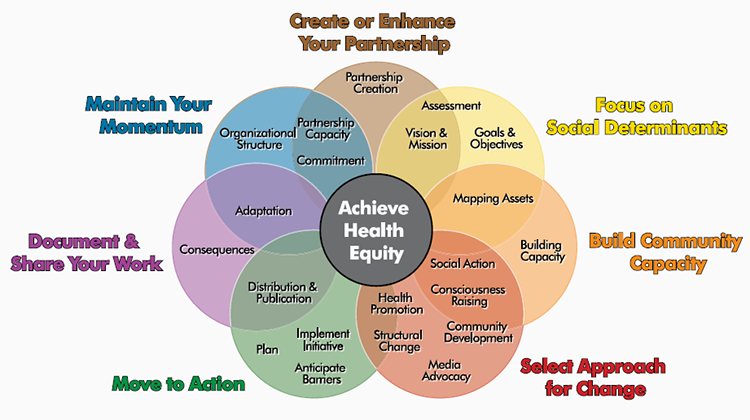
You may be wondering,

“Why do people need a logic model for direction if they are already working towards the same mission?”

Because of their diverse backgrounds, some professionals have been trained to follow different paradigms (models) in their specialties.  One example is the “medical model” versus the “public health model.”  The most significant difference between the two models is that public health activities focus on entire populations, while clinical activities focus on individual patients.  Table 2 below summarizes key differences between the paradigms that are typically used to train clinical and public health professionals.

Table 2:  Public Health versus Medical Models of Professional Training


Public Health Model

Medical Model
Primary focus on population Primary focus on the individual
Public service ethic, tempered by concerns for the individual Personal service ethic, conditioned by awareness of social responsibilities
Emphasis on prevention and health promotion for the whole community Emphasis on diagnosis, treatment, and care for the whole patient
Paradigm employs a spectrum of interventions aimed at the environment, human behavior and lifestyle, and medical care Paradigm places predominant emphasis on medical care

The Ten Essential Public Health Services provide a common ground for professionals trained in either paradigm, as well as grassroots workers and non-public health civic leaders, so they can work collaboratively towards fulfilling the public health mission:

“To promote physical and mental health, and prevent disease, injury, and disability.”

Now that you have a better understanding of public health, let’s talk about the origin, purpose, and function of the Ten Essential Public Health Services.

What are the Ten Essential Public Health Services?

From 1988 to the early 1990s, the recognized “core functions” of public health were:

  • Assessment
  • Policy development
  • Assurance

In 1993, with a new presidential administration and federal and state attempts to reform the health care system in the United States, public health leaders decided to set forth a more detailed and utilitarian consensus statement that would “speak with one voice” to public health professionals, the general population, and the policymakers who would shape health care reform.

Public health leaders worked to define a more detailed logic model of core public health functions.  The end result was a consensus statement that included the Ten Essential Public Health Services, adopted in 1994.

Why is it important to implement and monitor the Ten Essential Public Health Services?

The Ten Essential Public Health Services are really about actualizing the public health paradigm that we presented in Table 2.  Let’s review the key principles involved:

  • A primary focus on the population
  • A public service ethic, tempered by concerns for the individual
  • An emphasis on prevention and health promotion for the whole community
  • The paradigm employs a spectrum of interventions aimed at the environment, human behavior and lifestyle, and medical care

The theme of prevention is the most powerful element in the implementation of the Ten Essential Public Health Services.

  • Through prevention, countless injuries, illnesses, and even chronic diseases can be avoided.
  • Through prevention, lives can be saved.
  • Through prevention, health care cost can be contained.
  • Through prevention, individuals, their families, and their communities can benefit from the population-based reach of the Ten Essential Public Health Services.

It is important to not only implement but also monitor—or track, assess, and modify, as needed—the Ten Essential Public Health Services.  With data or other information about the Services’ costs or expenditures, implementation, and impact, monitoring can contribute to informed policy decisions about public health program development and funding at local, state, and national levels.

How are the Ten Essential Services used in community practice?

On the pages that follow, each Essential Service is discussed in order from 1 to 10.  Each discussion includes a definition of the Service and some examples of national or community practice.  Keep in mind that the Services do not necessarily need to be implemented in the “1 – 10” sequence, or even independently.

The Ten Essential Services are independent yet complementary goals for communities to work toward.  You should actually strive to implement the services simultaneously in your community as a means of carrying out the mission of public health.  However, you may find that you identify with only one or two in terms of your role in your community’s public health initiatives as you read through this section.

Essential Service #1:  Assess and monitor population health.

Public health surveillance—the ongoing, systematic collection, analysis, and interpretation of health related data—is at the core of this Essential Service.

Essential Service #1 encompasses public health activities such as:

  • Identification of threats to health and assessment of health service needs;
  • Timely collection, analysis, and publication of information on access, utilization, costs, and outcomes of personal health services;
  • Attention to the vital statistics and health status of specific groups that are at higher risk than the total population; and
  • Collaboration to manage integrated information systems with private providers and health benefit plans.

National level, population-based surveillance systems administered by the Centers for Disease Control and Prevention (CDC) include:

  • The Behavioral Risk Factor Surveillance System;
  • National Vital Statistics System;
  • National Health Interview Survey; and
  • Cancer registries;

You can access CDC data electronically at the Centers for Disease Control and Prevention website. You may not immediately think to use national level data when working at the community level.  However, national level surveillance data can provide trend data to use as a benchmark as you assess health status measures (e.g., the number of children immunized prior to entering preschool) in your community. Prior to investing resources and time in a program, it is often necessary to conduct a needs assessment.  Community data collected via a needs assessment can be compared to existing data at the national level.  If you discover that your community actually has an excellent rate for a health status measure as compared to 75% of the states in the country, you may shift your prevention program priorities to a different measure or priority population!

If you do not have the time or resources to conduct your own needs assessment, you can search for community level data in resources including:

  • State-level ‘report cards’ on maternal and child health indicators (see the federal Title V Information System with data for all U.S. states and territories).
  • School health reports; and
  • Law enforcement agency surveillance, such as the number of DUI arrests

Essential Service #2:  Investigate, diagnose, and address health hazards and root causes.

Essential Service #2 encompasses public health activities such as:

  • Epidemiologic identification of emerging health threats;
  • Public health laboratory capability using modern technology to conduct rapid screening and high volume testing;
  • Active infectious disease epidemiology programs; and
  • Technical capacity for epidemiologic investigation of disease outbreaks and patterns of chronic disease and injury.

At the national level, the United States Department of Health and Human Services oversees the Agency for Toxic Substances and Disease Registry (ATSDR).  The Agency’s overall function is to “serve the public by using the best science, taking responsive public health actions, and providing trusted health information to prevent harmful exposures and disease related to toxic substances.”

Via grants and cooperative agreements, ATSDR provides funding and technical assistance for states to identify and evaluate environmental health threats to communities, as well as educate the communities about health risk or other findings.

At the local level, public health laboratories provide diagnostic testing, disease surveillance, applied research, laboratory training and other essential services to the communities they serve.  Laboratory work is diverse, yet accomplished by highly trained and skilled professionals.

Public health laboratory professionals and epidemiologists are the ones working behind the scenes on the issues that you hear about in the news.  These include:  newborn screening; Lyme disease; West Nile virus; food borne illness outbreak investigations; and bio-terrorism threats. The Association of Public Health Laboratories was founded by state and territorial public health laboratory directors serving communities across the United States.  You may want to visit this website to learn more about the public health laboratory expertise and services available in your own community.

Essential Service #3:  Communicate effectively to inform and educate.

You have probably come across—and even participated in— health promotion and social marketing efforts in your community.

Essential Service #3 encompasses public health activities such as:

  • Social marketing and targeted media public communication (e.g., Toll-free information lines);
  • Providing accessible health information resources at community levels (e.g., free, mobile health screening initiatives);
  • Active collaboration with personal health care providers to reinforce health promotion messages and programs; and
  • Joint health education programs with schools, churches, and worksites (e.g., stress reduction seminars; parenting support groups for enhancing mental health; and health fairs).

You may have noticed national media campaign advertisements on television, billboards, or even posters or fliers in your doctor’s office.  Some examples include the “Back to Sleep” campaign to prevent Sudden Infant Death Syndrome, or the anti-substance use campaign, “Just Say No.”

Many national awareness weeks also relate directly to public health efforts.  The American Public Health Association, headquartered in Washington, D.C., actually sponsors a “National Public Health Week” each spring.  You can find additional information, and links to free tools and resources for National Public Health Week.  You may decide to sponsor an event such as a fun run or health fair to raise public health awareness in your own community!

Essential Service #4:  Strengthen, support, and mobilize communities and partnerships.

These activities represent a comprehensive approach to community health, in which professionals and even entire sectors of a community collaborate to plan, implement, monitor, evaluate, and subsequently modify activities, and repeat the process as needed.

Essential Service #4 encompasses public health activities such as:

  • Convening and facilitating community groups and associations, including those not typically considered to be health-related, to undertake defined preventive, screening, rehabilitation, and support programs; and
  • Skilled coalition-building ability in order to draw upon the full range of potential human and material resources in the cause of community health.

This is not unlike the PATCH logic model – the Planned Approach to Community Health

Included in the PATCH strategy are five elements that are fundamental to the success of any community health promotion process:

  • Community members participate in the process.
  • Data guide the development of programs.
  • Participants develop a comprehensive health promotion strategy.
  • Evaluation emphasizes feedback and program improvement.
  • The community capacity for health promotion is increased.

You can read about a similar process for mobilizing community partnerships to identify and solve health problems in the Community Tool Box's Community Action Guide: A Framework for Addressing Community Goals and Problems.

The overall goal of action planning is to increase your community’s ability to work together to affect conditions and outcomes that matter to its residents—and to do so both over time and across issues of interest.

As your community works towards a broad vision of health for all, creating supportive conditions for change requires comprehensive efforts among diverse sectors of the community.  These include health organizations, faith communities, schools, and businesses.  Representatives of each sector come together to form a community coalition.  Your community coalition can strive to influence systems changes—programs, policies, and practices that can enhance or detract from the community’s capacity to be a supportive environment for healthy living.

Essential Service #5:  Create, champion, and implement policies, plans, and laws.

Because state and local public health programs are often funded at least in part with Federal dollars, accountability is often a key issue.  Public health programs therefore document progress towards positive change in health behavior or health status indicators.  For example, the Federal Maternal and Child Health Services Block Grant, which imposes a $3 state match for every $4, requires annual reporting of “performance measures.”  Some of those are state-negotiated to allow for flexibility in tracking health behavior or health status indicators that are unique to a state’s populations. Data such as these can be presented to policymakers to document the value or effectiveness of a program. Those data can also be used for continued program planning and modification.

Essential Service #5 encompasses public health activities such as:

  • Leadership development at all levels of public health;
  • Systematic community-level and state-level planning for health improvement in all jurisdictions;
  • Development and tracking of measurable health objectives as a part of continuous quality improvement strategies;
  • Joint evaluation with the medical health care system to define consistent policy regarding prevention and treatment services; and
  • Development of codes, regulations, and legislation to guide the practice of public health.

Active Living by Design is a national program of The Robert Wood Johnson Foundation, and is a part of the University of North Carolina at Chapel Hill School of Public Health.  The program establishes and evaluates innovative approaches to increase physical activity through community design, public policies, and communications strategies.  The program funds community partnerships to develop, implement and sustain collaboration among a variety of organizations in public health and other disciplines, such as city planning, transportation, architecture, recreation, crime prevention, traffic safety and education, and key advocacy groups.  Collaborators focus on land use, public transit, non-motorized travel, public spaces, parks, trails, and architectural practices that advance physical activity.

One example of an Active Living by Design initiative is:  “Obesity and The Built Environment:  Improving Public Health through Community Design.”  You can learn more about this and other initiatives by visiting Active Living by Design.

Essential Service #6:  Utilize legal and regulatory actions.

While you may not always be conscious of how public health regulations have influenced your community environment, think about some of the things that you see or experience when you visit restaurants.  You may have noticed a framed certificate hanging on the wall, with “Sanitation Grade A.”  This certificate is a result of local health department inspections to assure that the restaurant is in compliance with food storage, handling, and preparation regulations.

While at that same restaurant, you may also notice a sign that says, “No smoking.”  This may be a direct result of a statewide law that was designed to improve the environmental health conditions in your community.

If you have school-aged children and have had to prepare them for entrance into the public school system, you know that the full series of immunizations is required.  Immunizations are required for school-aged children in the United States because when widespread immunizations are in place, we all benefit from what is referred to as “herd immunity.”  When a group of people (e.g., an entire community, state, or nation) is immunized against an infectious disease, it makes it more difficult for the disease to spread and cause an epidemic.

Essential Service #6 encompasses public health activities such as:

  • Full enforcement of sanitary codes, especially in the food industry;
  • Full protection of drinking water supplies;
  • Enforcement of clean air standards;
  • Timely follow-up of hazards, preventable injuries, and exposure-related diseases identified in occupational and community settings;
  • Monitoring quality of medical services (e.g., laboratory, nursing homes, and home health care); and
  • Timely review of new drug, biologic, and medical device application.

Essential Service #6 may be implemented in your community as a result of either state or federal legislation.  Not only can you take on a leadership role in your community to assure that public health regulations are enforced; you can be a catalyst for change by identifying and prioritizing new issues, and sponsoring new regulations through public health advocacy.

Essential Service #7:  Enable equitable access.

Essential Service #7 encompasses public health activities such as:

  • Assuring effective entry for people experiencing social and economic disadvantage into a coordinated system of clinical care;
  • Culturally and linguistically appropriate materials and staff to assure linkage to services for populations with specific needs;
  • Ongoing “care management;”
  • Transportation services;
  • Targeted health information to populations experiencing increased risk; and
  • Technical assistance for effective worksite health promotion/disease prevention programs.

The implementation of this Essential Service is inherently linked to the social, economic, and political climate in communities, states, and the nation.  To assure the provision of health care when it is otherwise unavailable, the United States federal government funds two “safety net” programs: Medicaid and the State Children’s Health Insurance Program (SCHIP).

Medicaid is the largest source of funding for medical and health-related services for people and families with low incomes and resources.  This program became law in 1965, and is jointly funded by the federal and state governments (including the District of Columbia and the Territories) to assist states in providing medical long-term care assistance to people who meet certain eligibility criteria.

The Balanced Budget Act of 1997 created a new children's health insurance program called the State Children's Health Insurance Program (SCHIP).  SCHIP is a state administered program, and each state sets its own guidelines regarding eligibility and services for children up to age 19 who are uninsured. Families who earn too much to qualify for Medicaid may still be able to qualify for SCHIP.

To learn more about the Medicaid and SCHIP programs and how they can benefit members of your community, please visit: Centers for Medicare and Medicaid Services.

The availability of programs like Medicaid and SCHIP is not sufficient.  Public health professionals also have to provide outreach services to the populations in need of these programs.  Outreach might include:

  • Consumer education about the existence of a program;
  • Assistance with applying for a program;
  • Linking enrollees to related health programs (for example, people who are pregnant, infants, and children under the age of 5 enrolled in Medicaid also qualify for the Federal Supplemental Food Program for Women, Infants, and Children—WIC, and vice versa);
  • Physically transporting clients to the medical services that they need.

Culturally and linguistically appropriate materials are a critical component of outreach efforts in a country in which many immigrant languages are spoken.  Public health professionals can use decennial census data or community level needs assessments to determine how many and which languages are spoken in a geographic region.  To provide outreach and other services in a culturally responsive manner, public health professionals can apply guidelines developed by the National Center for Cultural Competence.  The Center produces publications that teach people how to adapt health promotion materials already developed and written in English.

Essential Service #8:  Build a diverse and skilled workforce.

Essential Service #8 encompasses public health activities such as:

  • Education and training for personnel to meet the needs for public and personal health service;
  • Efficient processes for licensure of professionals and certification of facilities with regular verification and inspection follow-up;
  • Adoption of continuous quality improvement and life-long learning within all licensure and certification programs;
  • Active partnerships with professional training programs to assure community-relevant learning experiences for all students; and
  • Continuing education in management and leadership development programs for those charged with administrative / executive roles.

There are many opportunities for certified education, training, and continuing education in public health. The Association of Schools of Public Health is a membership organization of the 27 accredited schools of public health that prepare people for a public health profession. The accrediting body, an independent agency recognized by the United States Department of Education, is the Council on Education for Public Health.

Continuing education opportunities abound at professional conferences and in professional journals.  Furthermore, the advent of the Internet has brought new access to continuing education through the availability of online certificate and other training programs. These distance-based programs—particularly the ones offered through accredited schools of public health—offer an invaluable alternative to the sometimes-prohibitive costs and time commitment of travel for state and local public health professionals.

The Centers for Disease Control and Prevention sponsors many training and continuing education opportunities on site and in the accredited schools of public health across the country.  One example is Academic Centers for Public Health Preparedness (A-CPHP). These centers work together to improve the capacity of the front line public health and health care workers to quickly respond to bioterrorism, infectious disease outbreaks, and other public health threats and emergencies.The network of Centers represents a unique partnership between the schools of public health, the Association of Schools of Public Health, the Centers for Disease Control and Prevention, and representatives from state and local public health agencies, and the Association of State and Territorial Health Officials (ASTHO) and National Association of County and City Health Officials (NACCHO).

Other programs meet the education and training needs of rising public health professionals while simultaneously enhancing workforce capacity in the field.  One example is the Federal Maternal and Child Health Bureau’s Graduate Student Internship Program, which places Maternal and Child Health graduate students in state health departments for summer internships via a competitive process for both health departments and students.

Essential Service #9:  Improve and innovate through evaluation, research, and quality improvement.

Evaluation helps public health professionals continually refine or revise program approaches in future years of funding.  Furthermore, evaluation data provide information about the relative costs and effort for tasks so activity and budget adjustments can be made.

Essential Service #9 encompasses public health activities such as:

  • Ongoing evaluation of health programs based on analysis of health status and service utilization data, to assess program effectiveness and to provide information necessary for allocating resources and reshaping programs.

The process of evaluation helps public health professionals and their collaborators assess the success of community health initiatives. Evaluation normally requires that data be collected and analyzed. Surveillance data from Essential Service #1 can be used for this purpose. For example, because surveillance efforts are often (but not always) annual, your community could access retrospective and current or “baseline” data before planning a public health initiative.This baseline data could then also be used to document the health behavior or health status outcome measure(s) of interest both before and after implementation of the initiative.

Evaluation plans and concepts are addressed in several chapters and sections of the Community Tool Box. These include:

Chapter 36-39, all of which fall under the broad topic,“Evaluating Community Programs and Initiatives”

Essential Service #10:  Build and maintain a strong organizational infrastructure for public health.

In order to implement the 10th Essential Service, state and local health department staff might carry out health services research via many different efforts including:

  • Continuous linkage with appropriate institutes of higher learning and research;
  • An internal capacity to mount timely epidemiologic (e.g., outbreak investigations) and economic analyses (e.g., cost-benefit studies); and
  • An internal capacity to conduct needed health services research (e.g., survey design; conducting interviews and facilitating focus groups; conducting clinical trials; and accessing and using public records).

This list of research activities further illustrates the need for skills-specific training and education prescribed in Essential Service number 8. For example, anyone can create a survey and interview a group of people.  However, there are prescribed methods for creating an “instrument” that collects information that can be summarized into a coherent and even statistically significant conclusion about a population of interest.  Local health department staff may have had formal academic or on-the-job training in questionnaire design, survey methodology, or biostatistics.  Some staff may even be “specialists” who can be called upon to complete complex data analyses for research purposes. However, both generalists and specialists in the local health departments contribute to the base of knowledge and experience that are critical to maintaining an internal capacity to conduct needed health services research.

Even when local health department staff have adequate training, a strain on staffing capacity or limited resources may prompt collaboration with other “specialists.”  Within the public health community, it is not difficult to find examples of health departments working with neighboring universities to conduct research and identify solutions. One example is the Association of Schools of Public Health’s Academic Health Departments (AHD) grant program.  The AHD program fosters collaboration among local health departments across the country and 14 neighboring universities that house accredited schools of public health.  The exchange of student and other resources can enhance the capacity of local health agencies to function as “learning organizations,” thereby enhancing the success of community health efforts.

Another example of linkages with institutes of higher learning is the Council on Linkages Between Academia and Public Health Practice. Housed within the non-profit Public Health Foundation in Washington, D.C., the Council has a mission to “Improve public health practice and education by fostering, coordinating, and monitoring links between academia and the public health and healthcare community, developing and advancing innovative strategies to build and strengthen public health infrastructure, and creating a process for continuing public health education throughout one’s career.”

Research for new insights and innovative solutions to health problems can be accomplished many different ways. One way is via economic analyses to assess the “cost benefit” or the “cost effectiveness” of a program.

A cost-benefit evaluation assesses only one program, and focuses on the cost-to-outcome ratio, with the “outcome” having a dollar amount attached to it.  Example:  For a program that invests in prevention, the amount spent per client on prevention would be compared to the amount saved in averted health care costs per client (e.g., “For every $2 that we spend on diabetes management education, we save $4 in hospitalization costs.”).

A cost-effectiveness analysis can be used with one or multiple programs with the same objectives, to relate the cost of a program approach to specific measures of a program’s objectives.  Those measures may or may not have a monetary value attached to them (e.g., an outcome measure for an education program may be standardized test scores).

Resources

Online Resources

  • American Public Health Association
  • Association of Schools of Public Health
  • Association of State and Territorial Health Officials
  • Environmental Council of the States
  • Essential Public Health Services. Public Health Foundation (2002)
  • The Essential Services of Public Health. American Public Health Association (2003)
  • National Association of County and City Health Officials
  • National Association of State Alcohol and Drug Abuse Directors
  • National Association of State Mental Health Program Directors
  • Programs in Brief Centers for Disease Control and Prevention (2003)
  • Public Health Code of Ethics (Issue Brief) American Public Health Association
  • Public Health Foundation
  • Publich Health Quality Improvement Exchange (PHQIX) allows people to submit short explanations of their initiatives and observations/lessons-learned.
  • United States Public Health Service
  • What is Public Health? Association of Schools of Public Health (2003)

Guide for Enhancing Core Functions and Essential Services for Public Health Improvement

1. Assess and monitor population health.

  • Analyzing Community Problems
  • Assessing Community Needs and Resources
  • Collecting Information About the Problem
  • Conducting Concerns Surveys
  • Conducting Focus Groups
  • Conducting Interviews
  • Conducting Needs Assessment Surveys
  • Conducting Public Forums and Listening Sessions
  • Conducting Surveys
  • Determining Service Utilization
  • Developing a Plan for Assessing Local Needs and Resources
  • Developing Baseline Measures of Behavior
  • Identifying Community Assets and Resources
  • Understanding and Describing the Community

2. Investigate, diagnose, and address health hazards and root causes.

  • Adapting Community Interventions for Different Cultures and Communities
  • Analyzing Community Problems
  • Analyzing Problems and Goals
  • Analyzing Root Causes of Problems: The "But Why?" Technique
  • Collecting Information About the Problem
  • Conducting Interviews
  • Defining and Analyzing the Problem
  • Designing Community Interventions
  • Developing an Intervention
  • Ethical Issues in Community Interventions
  • Identifying Targets and Agents of Change: Who Can Benefit and Who Can Help
  • Identifying Strategies and Tactics for Reducing Risk
  • An Introduction to the Problem Solving Process
  • Understanding Risk and Protective Factors: Their Use in Selecting Potential Targets and Promising Strategies for Interventions

3. Communicate effectively to inform and educate.

  • Arranging a Press Conference
  • Arranging News and Features Stories
  • Communicating Information about Community Health and Development Issues
  • Creating Brochures
  • Creating Fact Sheets on Local Issues
  • Creating Newsletters
  • Creating Posters and Fliers
  • Creating a Website
  • Conducting a Social marketing Campaign
  • Developing a Plan for Communication
  • Developing Creative Promotions
  • Handling Crises in Communication
  • Implementing a Social Marketing Effort
  • Making Community Presentations
  • Our Model of Practice: Building Capacity for Community and System Change
  • Preparing Press Releases
  • Preparing Guest Columns and Editorials
  • Preparing Public Service Announcements
  • Reframing the Issue
  • Some Lessons Learned on Community Organization and Change
  • Talking About Risk and Protective Factors Related to Community Issues
  • Using Paid Advertising
  • Using E-mail Lists

4. Strengthen, support, and mobilize communities and partnerships.

  • Attracting Support for Specific Programs
  • Changing Policies to Increase Funding for Community Health and Development Initiatives
  • Community (Locality) Development
  • Creating Objectives
  • Developing an Action Plan
  • Our Model of Practice: Building Capacity for Community and System Change
  • Our Evaluation Model: Evaluating Comprehensive Community Initiatives
  • Working Together for Healthier Communities: A Framework for Collaboration Among Community Partnerships, Support Organizations, and Funders
  • Developing a Plan for Getting Community Health and Development Issues on the Local Agenda
  • Developing an Ongoing Board of Directors
  • Developing Strategic and Action Plans
  • Developing Successful Strategies: Planning to Win
  • Identifying Action Steps in Bringing About Community and System Change
  • Maintaining a Board of Directors
  • Marketing the Initiative to Secure Financial Support
  • Obtaining Feedback from Constituents: What Changes Are Important and Feasible?
  • Organizational Structure: An Overview
  • An Overview of Strategic Planning or VMOSA (Vision, Mission, Objectives, Strategies, Action Plan)
  • Proclaiming Your Dream: Developing Vision and Mission Statements
  • Promoting Adoption of the Initiative's Mission and Objectives
  • Promoting Coordination, Cooperative Agreements, and Collaborative Agreements Among Agencies
  • Social Action
  • Sustaining the Work or Initiative
  • Strategies for the Long-Term Institutionalization of an Initiative: An Overview
  • Strategies for Sustaining the Initiative
  • Welcoming and Training New Members to a Board of Directors

5. Create, champion, and implement policies, plans, and laws.

  • Advocating for a Change
  • Conducting a Petition Drive
  • Conducting a Public Hearing
  • Developing a Plan for Advocacy
  • Encouraging Involvement of Potential Opponents as well as Allies
  • Filing a Complaint
  • General Rules for Organizing for Legislative Advocacy
  • Identifying Opponents
  • Lobbying Decisionmakers
  • Overview: Getting an Advocacy Campaign Off the Ground
  • Recognizing Allies
  • Survival Skills for Advocates
  • Understanding the Issue
  • Using Personal Testimony
  • Writing Letters to Elected Officials
  • Writing Letters to the Editor

6. Utilize legal and regulatory actions.

  • Adapting Community Interventions for Different Cultures and Communities
  • Building Leadership
  • Capturing What People Say: Tips for Recording a Meeting
  • Coalition Building I: Starting a Coalition
  • Conducting Effective Meetings
  • Creating and Maintaining Coalitions and Partnerships
  • Developing a Plan for Building Leadership
  • Developing a Plan for Involving Volunteers
  • Strategies for Community Change and Improvement: An Overview
  • Social Action
  • Using Principles of Persuasion
  • Designing Community Interventions
  • Developing a Community Leadership Corps: A Model for Service-Learning
  • Developing a Plan for Increasing Participation in Community Action
  • Developing Facilitation Skills
  • Developing Training Programs for Volunteers
  • Developing Volunteer Orientation Programs
  • Establishing Micro-grant Programs
  • Ethical Issues in Community Interventions
  • Identifying Strategies and Tactics for Reducing Risks
  • Identifying Targets and Agents of Change: Who Can Benefit and Who Can Help
  • Involving Key Influentials in the Initiative
  • Involving People Most Affected by the Problem
  • Making Personal Contact with Potential Participants
  • Methods of Contacting Potential Participants
  • Promoting Neighborhood Action
  • Promoting Participation Among Diverse Groups
  • Recruiting Volunteers
  • Servant Leadership: Accepting and Maintaining the Call of Service
  • Training for Conflict Resolution
  • Understanding Risk and Protective Factors: Their Use in Selecting Potential Targets and Promising Strategies for Interventions
  • Writing Letters to Potential Participants

7. Enable equitable access.

  • Developing Multisector Collaborations
  • Identifying Opponents
  • Increasing Participation and Membership
  • Overview: Getting an Advocacy Campaign Off the Ground
  • Promoting Coordination, Cooperative Agreements, and Collaborative Agreements Among Agencies
  • Recognizing Allies
  • Survival Skills for Advocates
  • Understanding and Describing the Community
  • Understanding the Issue
  • Applying for Grants

8. Build a diverse and skilled workforce.

  • Building Leadership
  • Building and Sustaining Commitment
  • Building and Sustaining Relationships
  • Building Relationships with People from Different Cultures
  • Capturing What People Say: Tips for Recording a Meeting
  • Conducting a Workshop
  • Conducting Effective Meetings
  • Collecting Information About the Problem
  • Conducting Needs Assessment Surveys
  • Conducting Surveys
  • Designing a Training Session
  • Delivering a Training Session
  • Defining and Analyzing the Problem
  • Developing a Community Leadership Corps: A Model for Service-Learning
  • Developing and Communicating a Vision
  • Developing a Management Plan
  • Developing a Plan for Staff Hiring and Training
  • Developing a Plan for Building Leadership
  • Developing Facilitation Skills
  • Discovering and Creating Possibilities
  • Enhancing Cultural Competence
  • Generating and Choosing Solutions
  • Healing from the Effects of Internalized Oppression
  • Influencing People
  • An Introduction to the Problem Solving Process
  • Learning From and Contributing to Constituents
  • Learning How to Be a Community Leader
  • Making Decisions
  • Multicultural Collaboration
  • Promoting Coordination, Cooperative Agreements, and Collaborative Agreements Among Agencies
  • Providing Supervision for Staff and Volunteers
  • Providing Support for Staff and Volunteers
  • Putting Your Solutions into Practice
  • Servant Leadership: Accepting and Maintaining the Call of Service
  • Transforming Conflicts in Diverse Communities
  • Understanding Culture and Diversity in Building Communities
  • Understanding People’s Needs

9. Improve and innovate through evaluation, research, and quality improvement.

  • Behavioral Surveys
  • Choosing Evaluators
  • Communicating Information to Funders for Support and Accountability
  • Conducting Interviews with Key Participants to Analyze Critical Events
  • Constituent Survey of Outcomes: Ratings of Importance
  • Developing an Evaluation Plan
  • Establishing Formal Communication and Requesting Participation
  • Evaluating the Initiative
  • A Framework for Program Evaluation:  A Gateway to Tools
  • Gathering Data on Public Opinion
  • Gathering Information: Monitoring Your Progress
  • Gathering and Using Community-Level Indicators
  • How to Conduct Research: An Overview
  • Measuring Success: Evaluating Comprehensive Community Initiative
  • Our Evaluation Model: Evaluating Comprehensive Community Initiatives
  • Providing Feedback to Improve the Initiative
  • Rating Community Goals
  • Rating Member Satisfaction
  • Reaching Your Goals: The Goal Attainment Report
  • Understanding Community Leadership, Evaluators, and Funders:  What Are Their Interests?

10. Build and maintain a strong organizational infrastructure for public health.

  • Adapting Community Interventions for Different Cultures and Communities
  • Assessing Community Needs and Resources
  • Conducting Public Forums and Listening Sessions
  • Collecting Information About the Problem
  • Designing Community Interventions
  • Developing a Plan for Assessing Local Needs and Resources
  • Developing Multisector Collaborations
  • Identifying Targets and Agents of Change: Who Can Benefit and Who Can Help
  • Identifying Strategies and Tactics for Reducing Risks
  • Understanding and Describing the Community
  • Understanding Risk and Protective Factors: Their Use in Selecting Potential Targets and Promising Strategies for Interventions
  • Promoting Coordination, Cooperative Agreements, and Collaborative Agreements Among Agencies

Print Resources

American Public Health Association (June 2003). The Guide to Implementing Model Standards. This resource includes discussion of PATCH implementation along with other model standards for community health development, such as the Assessment Protocol for Excellence in Public Health.

Association of Schools of Public Health (2003). The Population Approach to Public Health.

Centers for Disease Control and Prevention (1999). Ten Great Public Health Achievements—United States, 1900 – 1999. Morbidity and Mortality Weekly Report, April 02, 1999: 48(12); 241-243.

The remaining nine links will take you to the web pages of organizations that served on the Public Health Functions Steering Committee, which adopted the Ten Essential Public Health Services in 1994.

United States Department of Health and Human Services (1989). Making Health Communication Programs Work: A Planner’s Guide. Bethesda, MD: United States Department of Health and Human Services, Public Health Service, National Institutes of Health, Office of Cancer Communications, National Cancer Institute.

Wholey, J., Hatry, H., & Newcomer, K. (Eds.) (1994). Handbook of Practical Program Evaluation. San Francisco: Jossey-Bass.


Checklist
mloewenstein Mon, 12/10/2012 - 14:58

What is public health?

___Public health is the part of the civic infrastructure that keeps communities safe and healthy.

___The current generally accepted mission of public health is: “Promote physical and mental health, and prevent disease, injury, and disability.”

Who are public health professionals?

___Nurses

___Physicians

___Laboratory technicians

___Educators

___Nutritionists

___Social workers

___Biostatisticians

___Epidemiologists

___Economists

___Lawyers

___Community-based or “grassroots” workers might include concerned parents, grandparents, or civic leaders who volunteer their time.

What are the Ten Essential Public Health Services?

___The Ten Essential Public Health Services fall into three categories that define thecore functions of public health:

  • Assessment
  • Policy Development
  • Assurance                                                                                                

Assessment:

___1. Monitor health status to identify community health problems.

___2. Diagnose and investigate health problems and health hazards in the community.

Policy Development:

___3. Inform, educate, and empower people about health issues.

___4. Mobilize community partnerships to identify and solve health problems.

___5. Develop policies and plans that support individual and community health efforts.

Assurance:

___6. Enforce laws and regulations that protect health and ensure safety.

___7. Link people to needed personal health services and assure the provision of health care when otherwise unavailable.

___8. Assure a competent public health and personal health care workforce.

___9. Evaluate effectiveness, accessibility, and quality of personal and population-based health services.

___10. Research for new insights and innovative solutions to health problems.

How do you use the Ten Essential Public Health Services in Community Practice?

1.  Monitor health status to identify community problems.

___This service comprises the ongoing, systematic collection, analysis, and interpretation of health related data, including:

  • Identification of threats to health and assessment of health service needs;
  • Timely collection, analysis, and publication of information on access, utilization, costs, and outcomes of personal health services;
  • Attention to the vital statistics and health status of specific groups that are at higher risk than the total population; and
  • Collaboration to manage integrated information systems with private providers and health benefit plans.

___To monitor community health status, you can use federal, state, and community-level information, such as:

  • Census data
  • Centers for Disease Control (CDC) data, including the National Vital Statistics System, the Behavioral Risk Factor Surveillance System, the National Health Interview Survey, and the Cancer Registries.
  • State-level “report cards” on maternal and child health and other areas, as well as reports and statistics from the state public health agency.
  • School health reports.
  • Community surveys.
  • Information about community-level indicators, such as drunk driving arrests, fett of store shelf space devoted to healthy products, and heart-related emergency room visits.

2.  Diagnose and investigate health hazards in the community.

___This service encompasses public health activities such as:

  • Epidemiologic identification of emerging health threats;
  • Public health laboratory capability using modern technology to conduct rapid screening and high volume testing;
  • Active infectious disease epidemiology programs; and
  • Technical capacity for epidemiologic investigation of disease outbreaks and patterns of chronic disease and injury.

3.  Inform, educate, and empower people about  health issues.

___Social marketing and targeted media public communication (e.g., Toll-free information lines).

___Providing accessible health information resources at community levels (e.g., free, mobile health screening initiatives).

___Active collaboration with personal health care providers to reinforce health promotion messages and programs.

___Joint health education programs with schools, churches, and worksites (e.g., stress reduction seminars; parenting support groups for enhancing mental health; and health fairs).

4.  Mobilize community partnerships to identify and solve health problems.

___Convene and facilitate community groups and associations, including those not typically considered to be health-related, to undertake defined preventive, screening, rehabilitation, and support programs.

___Build multi-sector community coalitions in order to draw upon the full range of potential human and material resources in the cause of community health.

5.  Develop policies and plans that support individual and community health efforts.

___Leadership development at all levels of public health.

___Systematic community-level and state-level planning for health improvement in all jurisdictions.

___Development and tracking of measurable health objectives as a part of continuous quality improvement strategies.

___Joint evaluation with the medical health care system to define consistent policy regarding prevention and treatment services.

___Development of codes, regulations, and legislation to guide the practice of public health.

6.  Enforce laws and regulations that protect health and ensure safety.

___Full enforcement of sanitary codes, especially in the food industry.

___Full protection of drinking water supplies.

___Enforcement of clean air standards.

___Timely follow-up of hazards, preventable injuries, and exposure-related diseases identified in occupational and community settings.

___Monitoring quality of medical services (e.g., laboratory, nursing homes, and home health care).

___Timely review of new drug, biologic, and medical device application.

___Advocacy for needed new health and safety laws and regulations.

7.  Link people to needed personal health services and assure the provision of health care when otherwise unavailable.

___Effective entry for socially disadvantaged people into a coordinated system of clinical care.

___Culturally and linguistically appropriate materials and staff to assure linkage to services for special population groups.

___Ongoing “care management.”

___Transportation services.

___Targeted health information to high risk population groups.

___Technical assistance for effective worksite health promotion/disease prevention programs.

___Outreach and support to populations in need of government services.

8.  Assure a competent public health and personal care workforce.

___Education and training for personnel to meet the needs for public and personal health service.

___Efficient processes for licensure of professionals and certification of facilities, with regular verification and inspection follow-up.

___Adoption of continuous quality improvement and life-long learning within all licensure and certification programs.

___Active partnerships with professional training programs to assure community-relevant learning experiences for all students.

___Continuing education in management and leadership development programs for those charged with administrative / executive roles.

9.  Evaluate effectiveness, accessibility, and quality of personal and population-based health services.

___Evaluation helps public health professionals continually refine or revise program approaches in future years of funding.

___Evaluation data provide information about the relative costs and effort for tasks so activity and budget adjustments can be made.

___To ensure useful results that lead to more effective services, it is necessary to conduct ongoing evaluations of health programs based on analysis of health status and service utilization data, to assess program effectiveness and to provide information necessary for allocating resources and reshaping programs.

10.  Research for new insights and innovative solutions to health problems.

___Link with appropriate institutes of higher learning and research.

___Mount timely epidemiologic (e.g., outbreak investigations) and economic analyses (e.g., cost-benefit studies).

___Conduct needed health services research (e.g., survey design; conducting interviews and facilitating focus groups; conducting clinical trials; and accessing and using public records).

___Engage in collaborative research with other programs, and publicize your results.

___Seek funding for both individual and collaborative research into health problems.

___Publicize research results so others can use and build on them.

PowerPoint
Anonyme (not verified) Mon, 12/10/2012 - 14:59

A PowerPoint presentation summarizing the major points in the section.

Section 8. Communities That Care
mloewenstein Mon, 12/10/2012 - 15:02
Main Section
mloewenstein Mon, 12/10/2012 - 15:03

In Chapter 2, we’ve looked at a variety of different models for building healthy communities, including one -- asset development -- that focused on building the advantages that young people need in order to develop into healthy, successful adults. That model approaches adolescent health and growth from a positive angle, assuming that if you can provide youth with the proper support and opportunities, development will proceed in the right direction.

But there are negative as well as positive influences at work in families, schools, and communities. If no one in an adolescent’s family has graduated from high school, that adolescent may see quitting school at 16 as normal and desirable. Young people may find it harder to avoid drug use if drugs are readily available in school and on the street. If the community fosters a culture of violence, youth are likely to be caught up in that culture.

In this section, we’ll look at a model that acknowledges both the positive (protective) and negative (risk) factors that work on adolescents, with the goal of enhancing the former and reducing the latter.  The model has a narrower focus than some we’ve profiled, but its purpose is the same – to enhance the healthy development of youth, and thus to create a healthier community.

Like most other models, Communities That Care takes a community-wide perspective, and calls for broad community participation. Similarly to PRECEDE/PROCEED, it identifies problems and resources, devises solutions aimed directly at the identified problem, and integrates evaluation into the implementation of the solution.

Communities That Care resembles the Search Institute’s asset development model in its emphasis on youth and the protective and risk factors affecting them. Where asset development looks at the overall development of children and adolescents, however, Communities That Care, as we shall see, focuses specifically on problem behaviors and their prevention or reversal.

What is Communities That Care?

Communities That Care (CTC) is based on the Social Development Strategy formulated by J. David Hawkins and Richard Catalano at the University of Washington. Rather than a program, CTC is an “operating system” that provides the structure, but not the content, of a community effort to address youth issues.  It focuses on risk and protective factors, which are approached through a community-wide process that involves training at each step.

CTC is a copyrighted, structured process. The Channing-Bete Corporation charges a fee for administering a comprehensive community effort that includes training, materials, and help with assessment, planning, and the choice, implementation, and evaluation of specific interventions designed to address risk and protective factors for youth.

CTC is specifically aimed at addressing five problem behaviors among youth:

  • Substance use
  • Delinquency
  • Teen pregnancy
  • School dropout
  • Violence

Risk factors

Risk factors are those elements in the environment or the inner makeup of people that make them more susceptible to particular behaviors or conditions. Research has identified 19 risk factors associated with one or more of the problem  behaviors identified above.  An assumption behind the CTC model, which it shares with the other models described in this chapter, is that such elements as risk and protective factors span all areas of community life.  With that assumption in mind, the 19 risk factors are divided into four groups related, respectively, to community, family, school, and individual/peer contexts.

Community risk factors. These have to do with both conditions within the community and its attitudes and structure.

  • Availability of drugs. The availability of drugs is, not surprisingly, a significant risk factor for both drug use and violence. Availability is such an important factor that the drug use rate was found to be higher even in communities where drugs were perceived to be readily available, but actually were not.
  • Availability of firearms.Statistics show that the more available firearms are in a community, the higher the violent crime rates tend to be, and, conversely, fewer firearms in a community is correlated with lower violent crime rates.
  • Community laws and norms favorable to drug use, firearms, and crime. High taxes on alcohol and cigarettes, as well as bans on their use in various circumstances, can control their use and send a message about the community’s attitude toward them.

Lack of clarity in laws and practices can also raise problems for youth. If alcohol is customarily served at community festivals, if the drinking age isn’t enforced, or if drinking to excess among both adults and adolescents isn’t seen as a problem, the chances are that young adolescents won’t see any reason for avoiding these behaviors.

  • Media portrayals of violence. There is evidence that young people who watch large amounts of media violence become numb to its impact and are more likely to behave violently themselves.
  • Transitions and mobility. Transitions (from one school to another, for example, or from middle to high school) are always difficult for adolescents. Unusual community transitions (integration of socioeconomic groups through school busing, for instance, or widespread job losses), may compound the problem for teens. Transitions and/or a high level of transience – families moving frequently – can put kids at risk for substance use, delinquency, and school drop-out.
  • Low neighborhood attachment and community disorganization. When people feel that they have little control over their lives, the results are all too often low community participation and voting levels, lack of community surveillance of public areas, vandalism, and decay of the physical and social structure of the neighborhood. These conditions can lead adolescents into substance use, violence, and delinquency.
  •  Extreme economic deprivation. Poverty puts youth at higher risk for all problem behaviors.

Family. As might be expected, a child’s family’s attitudes and conditions have a huge effect on his present and future behavior. All five problem behaviors are subject to family-related risk factors.

  • Family history of problem behavior. If their father spent time in jail, if their mother was only 15 when her first child was born, if a parent dropped out of high school, if someone in the family regularly drinks large amounts of alcohol, if physical violence is a family norm, then adolescents in the family risk repeating the same behavior, and engaging in other problem behaviors as well.
  • Family management problems. Family management comprises the methods and procedures parents use to regulate relationships and raise their children. Some family management problems are obvious: no controls on children’s activity and whereabouts, or child abuse used as discipline.  Other less visible, but equally harmful, problems include lack of clear expectations for behavior and character, inconsistent demands, and unclear definitions of the boundaries between parents and children. All of these act as risk factors for all five problem behaviors.
  • Family conflict. Whether the conflict is between parents, between parents and children, among siblings or step-siblings, or among other members of the household, a high level of conflict figures into adolescent susceptibility to all problem behaviors.
  • Parental attitudes toward, or involvement in, substance use, crime, and violence. If parents approve of or accept these behaviors, or engage in them themselves, their children are much more likely to be involved in them as well.  This is especially true when parents involve the children directly in their own problem behaviors – heroin addicts taking their children along on drug buys, for instance (a situation the author has encountered often), or parents sending their children to buy cigarettes for them.

School. School represents not just a place to learn reading or algebra. It is a social center, and a miniature of society as a whole.The identity an adolescent assumes or that influences her in school is the identity that she and others expect she will assume as an adult.  School-related risk factors affect all the problem behaviors.

  •  Early and persistent antisocial behavior. A child who’s a terror in kindergarten, but learns to stay out of trouble in school most of the time, is probably doing fine. If the antisocial behavior is still present at 12, he’s at serious risk.
  • Academic failure in elementary school. In addition to being a source of frustration for both child and teacher, academic failure is self-perpetuating – the child can’t understand the material, and as a result, she pays little attention, misses even more, and falls further and further behind. Academic failure also distances the child from education as a tool for life, making it seem irrelevant and “not for me.” Finally, it encourages a self-image fueled in equal parts by anger and despair: “slow,” not very competent at anything related to the intellect, an outsider, etc. All of this leads the child away from the mainstream and toward the subcultures of problem behaviors.

In some cases, the subculture of a whole group of children may see academic success as suspect or wrong. Among some Black urban teens, for instance, doing well in school is viewed as trying to be white. Some working class cultures have looked down on academic success as class betrayal. If a child heeds these voices of culture, he’s limiting his adolescent options, and laying himself open for problem behaviors.

  • Lack of commitment to school. This may be a result of academic difficulty, or simply of a lack of interest in school, and a feeling that school, or education in general, are unimportant.

Individual/peer. This last set of risk factors concerns personal characteristics and attitudes that are either inherent in the individual, or are influenced by close peer relationships – or, in some cases, both.

  •  Alienation and rebelliousness.The Regional Preventive Center of the Flint Hills (Kansas) describes alienated and rebellious youth as those who “feel they are not part of society, are not bound by rules, don’t believe in trying to be successful or responsible, or who take an active rebellious stance toward society.”
  • Friends who engage in problem behaviors. Because of the importance of peer approval to adolescents, friends’ attitudes and actions can be a powerful factor in teens’ behavior.  This risk factor is one of the most consistent predictors of the presence of problem behaviors.  In other words, your mother was right – you shouldn’t be hanging around with those bums.
  • Favorable attitudes toward the problem behavior. If a youth’s friends – or parents, for that matter – binge drink, commit crimes, or drop out of school, she’s more likely to be positive about those behaviors.  Developing favorable attitudes toward problem behaviors obviously puts kids at greater risk of engaging in them.
  • Early initiation of the problem behavior. The earlier you start drinking, for instance, the more of a “normal” behavior it becomes.  If you’ve been getting drunk for nearly half your life by the time you’re 17, you aren’t apt to see anything wrong with it.
  • Constitutional factors. These are internal factors that may be either in-born (genetic, neurological, or biological) or environmental, but that are, in any case, very much a part of who an individual is.  These can include lack of impulse control, sensation-seeking, and low risk avoidance.

Protective factors

Just as there are risk factors that put adolescents in harm’s way, there are protective factors that tend to shield them from engaging in problem behaviors. These fall into three categories:

Individual characteristics.

  • Gender. Conventional wisdom is right on this one – girls get into less trouble than boys do. Whether it’s testosterone or social conditioning, boys are at greater risk for all of the problem behaviors except teen pregnancy.
  • Resilient temperament. Some children and adolescents simply seem to be better able to weather difficulties than others. They can experience numerous risk factors without losing their ability to cope reasonably with whatever comes up.
  • Positive orientation. Children who are optimistic and cheerful, enjoy other people, and are themselves well-liked are at reduced risk for all the problem behaviors.
  • Intelligence.Intelligence is a defense against delinquency and school drop-out, but not against substance use.

Everyone can cite examples of brilliant scientists or poets who were substance users. The real question is why others – often with similar pain in their lives – were not. Perhaps the necessary type of intelligence here is not intellect, but emotional intelligence – the ability to understand yourself and others, to be honest with yourself about your motivations, and to consider what you’re doing before you act.

Bonding. Many birds and other animals are programmed to recognize and bond with the first large creature they encounter after birth as their mother. Children and adolescents also bond – they establish strong connections to parents and other individuals and groups. When kids are bonded in this way, they tend to act in the ways expected by the individual or group they feel connected to, so as not to threaten the relationship.

CTC presents bonding as an unalloyed protective factor, but it is worth noting that these bonds are not always to individuals or groups that will prevent problem behaviors. If teens bond to a violent gang, that connection isn’t likely to act as a protective factor. Protective bonds are those where the relationship is with an individual or group that holds pro-social values that oppose the problem behaviors.

These might include:

  • Parents and families
  • Other significant adults – relatives, neighbors, counselors and mentors, etc.
  • Teachers
  • Peer groups
  • School
  • Organizations – Scouts, church groups, social clubs, workplaces, etc.
  • Sports teams
  • Community – service groups, cultural organizations, etc.

Healthy beliefs and clear standards. Significant adults and groups create a community environment that communicates a positive value system, and lets teens know what’s expected of them

Families, other adults, schools, and the community at large should all clearly state and practice values that oppose problem behaviors.  In addition to holding positive beliefs, families, schools, and the community should all have plainly stated high expectations and standards for children’s and adolescents’ behavior and achievement.

In other words, adults in the community should both preach and practice an admirable value system, and expect youth to do the same.

The ideal here – the one that CTC hopes to create in communities if it doesn’t already exist – is one where the community speaks with one voice about values and standards. In practice, that’s a difficult goal to achieve. However, if significant adults – parents, teachers, and coaches particularly – clearly communicate reasonable value systems as well as the standards that adolescents are expected to meet, most adolescents will get the message.

How protective factors work to counter high-risk environments: the Social Development Strategy

Hawkins and Catalano’s Social Development Strategy explains how protective factors operate.

Individual characteristics provide a foundation for healthy behavior. Gender, resilient temperament, positive orientation, and intelligence don’t, by themselves, necessarily lead kids in the right direction.  The possession of one or more of them does, however, give an adolescent a starting place from which she can move in that direction.  Having access to a piano doesn’t assure that you’ll learn to play, but it affords you the opportunity.  Without that access, you surely won’t learn.

While individual characteristics can act as protective factors, the lack of any of these individual protective traits doesn’t mean that a youth is doomed. Other protective factors can be reinforced to compensate, or, in some cases, the missing protective traits can be developed. Attitudes, and even personality, can change with positive changes in circumstances, or with appropriate counseling or psychotherapy. Even intelligence can be increased with the proper stimulation and circumstances.

  • To develop or enhance individual characteristics, children and adolescents should be given a chance to contribute to their families, schools, and communities.  In order to contribute and reap the protective benefits, kids need three things:
    • Skills. These include both the social skills to work with others and the specific competencies (basic skills, reasoning, specialized knowledge, and/or physical abilities) that will make their contributions valuable.
    • The opportunity to contribute. Kids need to be given responsibilities that fit their age and abilities, and come with appropriately high expectations.  They should have the chance to make a significant contribution, not just a token.

Depending on the child’s age and ability, contributions can vary from simple household chores to running a youth organization or serving on a community board. The range can include such activities as in-school tutoring of younger children or school-based peer mediation; responsibilities in social clubs, Scouts, or faith-based groups; membership in a band or orchestra; or taking care of younger siblings.

  • Recognition for their contribution. Like anyone else, kids need to know that their work is valued, and that someone noticed that they did a good job.  Recognition also helps cement their feeling as though they are part of the group, whether it’s a family, a school, an organization, or a group whose only other member is a caring adult.

Contribution leads to bonding. Providing real help to an individual, group, organization, or the community helps youth to identify with that entity and its ideals and values.  That identification makes adolescents less likely to engage in problem behaviors, both for fear of alienating the individual or group they’re attached to and because their image of themselves includes acting in ways consistent with the values of the bonded individual or group.

For a bonded child or adolescent, the provision of healthy beliefs and clear standards furnish the structure and corrective feedback needed for positive development.Adolescents get clear messages about the goals they should be striving for, and are held accountable for reaching those goals by adults and groups significant in their lives.

Ultimately, this progression leads to healthy behavior.The work of protective factors is demonstrated in the following diagram illustrating the Social Development Strategy:

Image depicting the Social Development Strategy diagram with directional arrows between the following phases, building from the bottom up: “Individual Characteristics; Opportunities; Skills; Recognition; Bonding Attachment Commitment; Healthy Beliefs and Standards; Healthy Behaviors.”

Why would you want (or not want) to adopt the Communities That Care approach?

As with all the models discussed in this chapter, there are both advantages and disadvantages to using CTC. Many of the advantages can also be viewed as disadvantages, depending upon your point of view.  The advantages listed below largely mirror CTC’s own claims for effectiveness, while the disadvantages present, in many cases, an alternative way of looking at those claims.

Advantages

  • CTC is grounded in theory and practice.The ideas underlying CTC – the concepts of risk and protective factors, for instance, and the studies that indicate their influence –come from prevention theory.  CTC’s list of “best practices” includes methods and programs that have been cited as effective, and can be reproduced in other settings.
  • CTC is inclusive and participatory.The conceptualization and planning process involves people from all sectors of the community in discussion and decision-making.  A community board oversees the implementation and evaluation of the program.

There are real advantages to being inclusive – involving people from all sectors of the community, including youth and others directly affected by any intervention – and participatory – engaging everyone, not just leaders, in decision-making. First, it taps a broad range of ideas and knowledge, particularly about the history and character of the community and its youth. Second, it assures that all decisions are carefully discussed, and that nothing is hastily adopted. Perhaps most important, it means that, because everyone in the community has been represented, the final plan and implementation will be “owned” by the community. Since the plan came from the people, rather than being imposed on them by someone else, they’re likely to support it, and work to make it successful.

  • CTC takes a community perspective. Adopting an outlook similar to that of the other models reviewed in this chapter, CTC looks at the prevention of problem behaviors and the healthy development of youth as a community-wide responsibility that demands a community-wide effort.  Whether the community in question is a rural village or a city as large as Seattle,Washington (which, led by the school system, has adopted the model), CTC assumes that only by engaging the whole community can a prevention program be truly effective.
  • CTC involves training at every step. Rather than simply presenting a model or helping with assessment, CTC provides training and assistance at each point in the process.  Such crucial phases as community assessment and strategic planning are thus undertaken by groups that have the background to proceed competently.
  • CTC provides a menu of best practices to choose from. Instead of having to engage in lengthy research or plan their own interventions from scratch, CTC participants choose the interventions most appropriate to their community from a list of “best practice” methods and programs that have been proven effective. Furthermore, CTC encourages communities to choose multiple approaches, aimed at a range of the risk factor areas.

“Best practices” are those whose effectiveness is documented in studies by funders (often government agencies) or academics (who publish the results in journals and other publications).

  • CTC is adapted to its own needs by each community. Rather than employing a “cookie-cutter” approach, CTC encourages communities to mix and match best practices to build a prevention program that speaks specifically to local needs and character.  Because training and a community assessment are part of the system, each community builds the knowledge and skills to analyze its needs and make wise choices.
  • CTC includes evaluation and adjustment as an integral part of any effort. No program or method, best practice or not, is perfect for every community, and no implementation of a program or method is perfect, either. Regular evaluation and readjustment of programs goes a long way toward assuring effectiveness.
  • CTC seems to work for most problem behaviors. Communities, by their own reports, seem to have good results in reducing the incidence of problem behaviors, with the exception of substance use.

Disadvantages

  • The CTC approach is only inclusive and participatory for certain people. While it claims to involve the whole community, the formal CTC approach is actually top-down, starting with a small number of “key community leaders.”  These leaders who may or may not be representative of the whole community in terms of race, socioeconomic class, or interests – then “invite” other participants “from all sectors” to make up a community board of 30.  The reality is that they’ll usually invite people they know, who are apt to be much like them and may not represent the true diversity of the community..

Especially in a large community, it takes research to know whom to include, and 30 may be too small a number to be truly representative of all sectors. Furthermore, some sectors – youth themselves, for instance, or single parents receiving public assistance – are unlikely to be included unless specifically targeted by the process.  And if the “key community leaders” see themselves as leading the process, its participatory nature can go out the window.

  • CTC allows the choice of only a finite number of approaches. CTC’s claim of allowing communities the freedom to devise their own solutions is only partially accurate. Communities can create combinations of interventions that speak to their needs, but only from a limited pool of choices.

The fact that CTC offers a menu of best practices is a double-edged sword. On the one hand, it presents a community with a number of programs and interventions that have worked in other places, and the security of set curricula for implementing them. On the other, it can limit the possibilities for creativity and the use of local wisdom that might arise if there were more freedom of choice and the chance for the community to craft its own program.

  • Choosing from among best practices may encourage communities merely to follow directions, rather than throwing heart and soul into the effort. Though it simplifies the process, an intervention that’s laid out for the community, rather than built from the ground up, may lead people to believe that if they implement it “right,” they’ll automatically get results.  If the results aren’t forthcoming, the community may be tempted to try harder to hone its implementation, rather than carefully analyzing the situation.
  • CTC is narrowly focused. CTC focuses specifically on youth, and more specifically on the five problem behaviors – substance use, delinquency, teen pregnancy, school dropout, and violence.  This emphasis has both positive and negative aspects. On the one hand, it means not trying to do too many things at once, and setting manageable goals.  On the other, it implies taking a small-picture view of community health and development, and not necessarily planning for the long term or for the whole community.

If the ultimate goals are as narrow as reducing one or more of the problem behaviors, they can give the impression that reaching those goals “fixes” the problem and the community. If the goal is the end of the process, there’s no community commitment to long-term social change. And long-term social change is usually needed to fully solve community problems.
  • CTC is, to a certain extent, based on assumptions. While the theory behind it and the best practices have been subject to a fair amount of research, the program has only been shown to be effective in the short- to mid-term range. Long-term data have not yet been collected.
  • CTC has a service to sell.  In most cases, CTC is sold as a package that includes literature, training, and support. While there are some obvious advantages to this, it also means that there can be less flexibility in the model than might be desirable, and that the provider benefits from selling all parts of the package, whether they’re the most appropriate or effective possibilities for the community or not.  The fact that this is a commercial venture doesn’t make conflict of interest inevitable, but it raises the possibility of it.

Some of these disadvantages are serious, but none are insurmountable if you adapt the program to your community’s own needs. You may define “key community leaders” a bit more broadly, for instance, although you might want to include at least some of those that meet CTC’s criteria in an initial group. You can include teens, parents, and a cross section of people from the community as well, so that the initiative for the effort is community-wide, rather than top-down. You may be creative with programming ideas, or use some of the best practice programs and devise others of your own. No model is sacrosanct, and no model works equally well in all communities.

Who should be involved in Communities That Care?

As we’ve just discussed, CTC should be as broad-based as possible.  Community leaders – elected officials, respected business figures, etc. – are important, but you need all the stakeholders if you expect the whole community to buy into the effort.

Stakeholders include all who have a vested interest in an initiative: supporters, beneficiaries, planners, implementers, etc. Some possibilities include:

  • People directly affected by the problem behaviors.They can bring to the discussion experience and a deep understanding of the behaviors and their effects.
    • Youth themselves, especially those who’ve been there – former gang members, people in recovery from substance use disorders, teen parents, dropouts. They can offer not only the insight of personal knowledge, but also credibility with other youth.They speak from experience, not from an adult position of moral rectitude.
    • Families, significant others, and friends of those involved in the problem behaviors. Their experience is often just as intense as, and more painful than, that of the adolescents themselves.
    • Victims of delinquency or youth violence.
  • People affected indirectly by the problem behaviors. This group might comprise people with a number of different interests.
    • Teachers, counselors, coaches, and other school staff.
    • Those who work in non-school organizations that serve youth – caseworkers, street workers, gang liaisons, mentors, coaches, youth group leaders, etc.
    • Those who deal with the consequences of youths’ actions – police, medical professionals and other health workers, judges, probation officers.
    • Merchants and others who believe that their businesses or property values are reduced by teens loitering and/or getting drunk or high outside, or by streets made unsafe by youth violence.
  • Community leaders and decision-makers.There are really two kinds of community leaders here: official and unofficial.
    • Official leaders. These are largely present and former elected and appointed officials.
    • Unofficial leaders. This is a larger group, made up of opinion leaders, well-known business, institutional, and civic figures, community activists, spokespersons for particular groups (underrepresented language groups, labor unions or tradespeople, neighborhoods), clergy, and ordinary citizens whom others respect and listen to.
  • Those with a community interest. These are people who may not be directly involved or affected, but care about kids and the community.
    • Parents and others who want the best possible environment and support for youth.
    • Business people, community developers, etc., who want to be able to present the community as a desirable place to settle, raise children, or start a business.
    •  Community volunteers and other concerned citizens.
  • The media. Involving representatives of the media from the beginning – as individuals and parents, rather than just in their professional capacities – is the best way to assure that the community gets the information it needs about CTC and its activities in your community.

How do you employ the Communities That Care approach?

In 2000, Hawkins and Catalano went into partnership with Channing-Bete Company of South Deerfield, MA, to market a trademarked “Communities That Careâ” package to communities. The package includes an overall strategy, training of community participants at several junctures, help with choosing and implementing effective interventions, evaluation tools, and technical assistance throughout the process.

To implement a formal CTC program, you have to make arrangements with Channing-Bete. Visit the CTC section of their website.

The description of the phases of prevention below outlines the CTC process (i.e., describes what would happen if you hired Channing-Bete to help your community run a CTC program. There is, understandably, a lack of detail here, since the CTC folks couldn’t sell their program if they gave all the details away for free.

According to CTC, an effective community prevention process has seven phases, the first two of which are preliminary, and may or may not be necessary in a given community:

Awareness.

The first step in the process is to assess community readiness to address adolescent problem behaviors. Citizens from all sectors have to be aware that adolescents are engaging in problem behaviors in the community, and to see it as an important issue. Only when the community reaches that point is it ready for the next phase.

Education.

 Once people understand that there are problem behaviors to be addressed, they need information about them, to better understand them and to see why addressing them is important.  Community education presents citizens with what they need to know to begin to approach the issue – what the problem behaviors are, their nature and effects, evidence that some or all of them are a problem in the community, etc.

These two phases reflect the first two stages of readiness for change recognized by social marketers. Community Tool Box Understanding Social Marketing: Encouraging Adoption and Use of Valued Products and Practices, describes the “continuum of understanding” that accompanies behavior change:

  • Knowledge about the problem.
  • Belief that the problem is important.
  • Desire to change.
  • Belief that change is possible.
  • Action.
  • Maintenance of action.

The awareness and education phases of the CTC process address the first two stages on this continuum, and, ideally, lead to the third. The latter three stages are dealt with as part of the presentation, adoption, and implementation of CTC as a community effort.

An important aspect of the theory behind the continuum is that a person’s level of understanding of a problem is crucial in persuading her to change. You have to approach her at her current stage and try, with arguments or information that address that current stage of understanding, to move her to the next. Thus, it’s important, before starting an initiative like CTC or any of the others modeled in this chapter, to take the pulse of community understanding of the issues you want to address. No matter how good your process or your proposed intervention, if the community hasn’t gotten to the point where it’s ready to support the effort, it will probably fail. You have to do the groundwork of bringing the community to that point (ideally, through the community’s own participation) before you can start to take action.

Community mobilization.

Once the community sees and understands the problem and the need for correction and prevention, community mobilization begins with the recruitment of a small number of  “key community leaders.”  These are the decision makers and opinion leaders whose support is needed for things to happen in the community – top elected officials, business and labor leaders, heads of institutions and agencies, the Superintendent of Schools, etc.

This core group receives an orientation to CTC and commits to the process.  They then invite 30 people from all sectors of the community to form a community board to oversee the CTC process. The community board, in turn, receives a two-day orientation and training about the theory behind CTC and how the process should work.

As discussed briefly above, this part of the process leaves something to be desired if you want a diverse group that sees itself as owning the process from the beginning. The Orlando Healthy Community initiative started with a self-selected group of key community leaders – the mayor, the heads of two hospitals, bankers, several present and former Junior League officers, etc. Their attempt at assembling a community board to oversee their effort was mediated by a facilitator. When the group drafted an “inclusive” list of people to invite as participants, the facilitator pointed out to them that virtually everyone on it was white, aged 35-65, and middle class.

To the group’s credit, they went back to square one, researched the community, made contact with many people they’d never met, and ultimately came up with a truly inclusive list...of 160, almost all of whom signed on. The number of community board participants again raises the other issue addressed in the previous discussion of inclusiveness and participation: whether 30 is a large enough number for a truly representative board.

In a small, relatively homogeneous community or a neighborhood, 30 might be fine. But in even a moderate-sized city, there might be more than 30 racial and ethnic groups, each of which might need to be represented. In addition, there might be powerful reasons to include representation by geography, age, and class, as well as by people from specific organizations and professions. And all of these are over and above the original key community leaders, others who need to be included for political reasons, and people from the other various community subgroups (business, large institutions, public employees, the schools, academia, community volunteers, etc.).

The community board, once trained by a CTC facilitator, holds public meetings to introduce CTC to the community, and to involve the community in developing a shared vision to guide the planning and implementation process.

Community assessment.

The community assessment phase of CTC revolves not only around pinpointing weaknesses and needs, but also around identifying strengths and resources already present in the community. The community board employs a number of strategies to examine the nature of community needs:

  • Youth survey. A survey given to youth in the schools is part of the CTC package. It is meant to identify risk and protective factors, and to help the community board understand where and what the prevention needs are.
  • Census and accompanying GIS (Geographic Information Systems) data. Examining these and comparing them with those from the previous census can highlight trends, changes, and possible problems or new assets in the community. GIS maps can also show concentrations of particular racial or racial and ethnic groups, underrepresented language groups, socioeconomic groups, employment patterns, and other information that might be useful.
  • Archival records. The records of the school system, the police, the newspapers, and various government agencies can yield valuable information about what’s been done in the past, what the problems have been over time, whether there have been previous efforts and whether they have been successful, and much more.
  • Direct contact with youth and other citizens. Through focus groups, community forums, individual interviews and conversations, and informal meetings with groups, the community board can obtain direct information from those who experience the problem behaviors and risk and protective factors and their effects every day.

Using these avenues, the board determines the nature of risk and protective factors in the community, and chooses two to five risk factors to focus on. Any action on these risk factors will be specific to the need in the particular community – that is, geared to areas and populations where the survey and other data show that the need for reducing risk and enhancing protection is greatest.

The board then receives a one-day training in identifying community strengths and resources, which it uses to find resources to support the CTC effort:

  • Money, in the form of local funders or other sources.
  • Expertise, from academics versed in theory, or from community groups or individuals experienced in working with youth.
  • People – often both paid and volunteer – to provide the front-line and support tasks to make the effort work.
  • Avenues to reach youth – schools, libraries, media outlets, sports facilities, street outreach, direct contact with parents, etc.

Prevention plan development.

Here, the community decides where to put its efforts, develops goals and ways of measuring them, and chooses from among a number of proven programs that address its issues.  This phase begins with community planning training, then launches into a strategic planning process.

The community board looks carefully at the risk and protective factors it has chosen to address in the last phase, and at the geographic, social, or demographic groups that show the greatest need.  Using this information, the board determines clear outcomes for protection enhancement, risk reduction, and behavior change.  It sets timelines and assigns accountability for carrying out a plan.

The next step is a two-day “effective prevention strategies” workshop that introduces the board to proven practices, and helps it select one or more appropriate to the community and its planning goals.  Rather than concentrating in one area, the board is urged to select strategies that address family, school, and community factors.

Program implementation.

The board creates an implementation task force, composed of members of the board itself, those who will actually run or work in the program, beneficiaries of the program, and other community members. CTC provides guidance and help in setting up the implementation, replicating the chosen programs, etc.

With CTC, as with any model, the keys to good implementation are thorough and inclusive planning, a carefully structured implementation process (i.e., everyone knows what comes when and who is responsible for doing what), and good communication among all parties to make sure that the process works the way it’s designed to. If these elements are present, the chances are that implementation of the plan will go smoothly.

That doesn’t guarantee that it will be effective, however. Effectiveness depends on whether you’ve chosen an intervention that properly addresses the issues at hand, and on how well the people doing the direct work of implementation do their jobs, relate to the population being served, and work together.

Outcomes evaluation.

The program is evaluated against the outcome and accountability criteria developed earlier. CTC provides evaluation instruments and assists with the process.  The evaluation is meant to show the board where the intervention has been successful and where it hasn’t, and thus to provide them with the information they need to adjust the program where necessary.

Evaluation and adjustment is an integral part of the process, and should continue throughout the life of the effort. An initiative doesn’t end when the community sees positive results. If the results are indeed positive, then the program should continue in order to maintain them.  If results are less positive than you hoped, then you have to keep adjusting the process and the content of the intervention until you get the results you’re aiming for.

Even if results are overwhelmingly positive, it’s not time to rest on your laurels.  As soon as you turn your back, your positive changes can disappear.  You have to maintain your effort indefinitely – by continuing to evaluate, adapt, and implement interventions, and to identify and address needs – to create a better, healthier future for youth and your community.

In Summary

Communities That Careâ (CTC) is a trademarked process that grew out of the work of J. David Hawkins and Richard Catalano at the University of Washington.  Based on prevention science, their Social Development Strategy looks at the ways in which risk and protective factors push adolescents away from and toward healthy development.

CTC focuses on five problem behaviors: substance use, delinquency, teen pregnancy, school drop-out, and violence.  It aims to reduce the 19 research-identified risk factors – divided into individual/peer, family, school, and community categories – that may encourage these behaviors, and to strengthen the three protective factors – individual characteristics, bonding, and healthy beliefs and clear standards – that deflect adolescents from them.

Advantages of the process include:

  • CTC is grounded in theory and practice.
  • CTC is inclusive and participatory.
  • CTC takes a community perspective.
  • CTC involves training at every step.
  • CTC provides a menu of best practices to choose from.
  • CTC is adapted to the needs of each community.
  • CTC includes evaluation and adjustment as an integral part of any effort.
  • CTC seems to work for most problem behaviors.

Along with these advantages, CTC also has a number of potential drawbacks:

  • The CTC approach is only inclusive and participatory for certain people.
  • CTC allows the choice of only a finite number of approaches.
  • Choosing from among best practices may encourage communities merely to follow directions, rather than throwing heart and soul into the effort.
  • CTC is narrowly focused on youth and specific behaviors.
  • CTC is, to a certain extent, based on assumptions.
  • CTC has a service to sell.

Because broad-based participation is necessary for a successful effort, CTC should involve all stakeholders and all sectors of the community. This includes those directly affected by the problem behaviors and the proposed intervention, those indirectly affected; those who deal with the consequences of the behavior; concerned citizens; and members of the media.

CTC is presented to a community as a package that includes an overall structure, several trainings, literature, survey and evaluation instruments, guidance throughout, and technical assistance. The process starts with analysis of whether the community is aware of the issues, and ready to support action on them. If not, it needs to be brought to that point.  Next, the community needs to be educated about the problem behaviors – their characteristics, their severity, their frequency in the community, who is at risk, etc. Then the process starts in earnest.

First, a small number of key community leaders is recruited, receives an orientation, and agrees to sponsor the effort. They in turn recruit 30 people from a variety of community sectors to constitute a community board. The board, after training, presents CTC to the community, and generates, with community input, a shared vision.

After more training, the board engages in community assessment to identify the important risk factors and the populations most in need, as well as the resources available to fund and support the program. A planning process, also accompanied by training, arrives at a strategy, and interventions are chosen – ideally in all the crucial areas of family, school, and community factors – from among a number of best practices that have been shown to be effective and replicable.

An implementation task force, which includes those who’ll do the work of the intervention, then takes over to oversee the implementation of the effort. They set timelines, determine accountability and outcomes, and design the actual work.  Regular evaluation is an integral part of the process, and is meant to point out successes, which need to be continued, and problems, which need to be corrected.  The intervention should be constantly adjusted and improved based on this evaluation.

Finally, the process and the interventions need to be maintained in order for gains to continue, and not to fade away from neglect.

Resources

Online Resources

Channing-Bete, the contractor for providing CTC programs.  Information on CTC, background, success stories, publications, etc.

Intensive Aftercare for High-Risk Juveniles: A Community Care Model by Office of Juvenile Justice and Delinquency prevention.

Investing in Your Community’s Youth: An Introduction to The Communities That Care System is a guide that provides an overview for helping communities build positive, healthy futures for their youth.

Lower Dauphin School District (PA). Example of one school district that has adopted a CTC approach.  Pennsylvania has recommended adoption to districts statewide, and many Pennsylvania districts have accepted the recommendation.

Information on CTC from the Regional Prevention Center of the Flint Hills (KS).

Southern York County (PA) School District. Another Pennsylvania school district that has adopted CTC.  The site includes a history of the development of the process in the district.

Print Resources

Communities That Care Delinquency Prevention Model: A Study in Florida. Research report #72, Florida Dept. of Juvenile Justice. A study trying to determine the effects of risk factors on problem behaviors, and the role of race in those effects.

Hawkins, J., Catalano, R., & Michael W. (2002). Promoting science-based intervention in communities. Addictive Behaviors, vol. 27. pp. 951-976.

Hawkins, J., & Catalano, R. (1992). Communities That Care: Action for Drug Abuse Prevention. San Francisco: Jossey-Bass. 

Paglin C. An article on the Portland, OR CTC program from the Winter (1998) issue of Northwest Education Magazine, Communities That Care a quarterly publication of the Northwest Regional Educational Laboratory.


Checklist
mloewenstein Mon, 12/10/2012 - 15:04

What is Communities That Care?

___Your community focuses on one or more of the five youth problem behaviors:

  • Substance use
  • Delinquency
  • Teen pregnancy
  • School drop-out
  • Violence

___You attend to all four domains in which risk factors occur:

  • Individual/peer
  • Family
  • School
  • Community

___You encourage the three protective factors:

  • Individual characteristics
  • Bonding
  • Healthy beliefs and clear standards

Why would you want (and not want) to adopt the Communities That Care approach?

You use CTC because

___CTC is grounded in theory and practice.

___CTC is inclusive and participatory.

___CTC takes a community perspective.

___CTC involves training at every step.

___CTC provides a menu of best practices to choose from.

___CTC is adapted to the needs of each community.

___CTC includes evaluation and adjustment as an integral part of any effort.

___CTC seems to work for most problem behaviors.

You see disadvantages to CTC in that:

___The CTC approach is only inclusive and participatory for certain people.

___CTC allows the choice of only a finite number of approaches.

___Choosing from among best practices may encourage communities merely to follow directions, rather than throwing heart and soul into the effort.

___CTC is narrowly focused on youth and specific behaviors.

___CTC is, to a certain extent, based on assumptions.

___CTC has a service to sell.

Who should be involved in Communities That Care?

You strive to involve:

___Those most directly affected by the problem behavior(s).

___Those indirectly affected by the problem behavior(s).

___Those who deal with the consequences of the problem behaviors in the community.

___Concerned citizens.

___The media.

How do you employ the Communities That Care approach?

___You gauge the awareness of the community.

___You provide community education about the problem behaviors.

___You mobilize the community, starting with key leaders (or a more inclusive group) and a community board.

___You conduct an assessment of community needs and resources.

___You create a strategic plan for the initiative, choosing from among best practices in the areas of family, school, and community.

___You implement your plan.

___You evaluate the process and outcomes of your intervention, and adjust it accordingly.

___You maintain your gains, and continue your efforts over time.

PowerPoint
Anonyme (not verified) Mon, 12/10/2012 - 15:04

A PowerPoint presentation summarizing the major points in the section.

Section 9. Community Readiness
mloewenstein Mon, 12/10/2012 - 15:06
Main Section
mloewenstein Mon, 12/10/2012 - 15:08

Image depicting the Stages of Community Readiness, built from the bottom to the top with arrows pointing up next to each of the following phases: “No Awareness; Denial/Resistance; Vague Awareness; Preplanning; Preparation; Initiation; Stabilization; Confirmation; Expansion; Professionalization.”


Often, community members are expected to respond immediately to new projects and community change without adequate time to adjust to new ideas of the knowledge to fully understand them. This section is about how to understand and measure exactly how ready a community is to address a particular issue, and how to use that knowledge to stimulate community change.

What is community readiness?

Community readiness is the degree to which a community is ready to take action on an issue. That readiness can range from none at all (the community has never even heard of the issue in question – think of AIDS in 1982) to already having successful programs in place and making headway. Community readiness has some specific characteristics that are important for community builders to understand:

  • Community readiness is issue-specific. A community can be more than ready to address one issue, while being at the very earliest stages of readiness in relation to another. It’s measurable. It’s measurable across multiple dimensions. Not only can you get an accurate assessment of community readiness, you can accurately measure where the community is on various elements of readiness. (We’ll discuss the dimensions of community readiness in the next part of this section.)
  • Community readiness can vary across dimensions. A community may be more ready to address an issue in some ways than in others. It may know a great deal about the issue and realize it’s a problem, for instance, but be unable to conceive of implementing a particular solution.
  • Community readiness can vary across different segments of the community. Some groups – those directly affected by the issue, for example – may be far more ready to deal with it than others. However, as we’ll see, there are some ways to help move communities toward higher levels of readiness.
  • Understanding community readiness is essential knowledge for addressing an issue. You can easily doom an effort by trying to push a community into something it’s not ready for. People will only support what they see as reasonable, logical, and doable. You may be proposing something that’s all of those, but if the community’s perception is otherwise, the effort is unlikely to be successful.

An understanding of community readiness allows you to tailor an intervention or strategy to what the community is willing to accept and support. By taking small steps forward – by setting goals that necessitate a stretch for people, but not so great a stretch as to be beyond their current ability and understanding of the issue – you can make steady progress.

What is the community readiness model?

The Tri-Ethnic Center for Prevention Research at Colorado State University has developed a model that identifies dimensions and levels of community readiness. The model also comprises an instrument for determining community readiness that can be easily used and scored by community members. We’ll include the instrument and instructions for scoring it in the “How to” part of this section.

Dimensions of community readiness

Dimensions of readiness are key factors that influence your community’s preparedness to take action on an issue.  Six dimensions identified by the model are:

  • Community efforts.To what extent are there existing efforts, programs, and policies that address the issue?
  • Community knowledge of the efforts. To what extent do community members know about existing local efforts and their effectiveness? Are the efforts accessible to all segments of the community?
  • Leadership.To what extent are appointed leaders and influential community members supportive of the issue?
  • Community Climate. What is the prevailing attitude of the community toward the issue?  Is it one of helplessness or one of responsibility and empowerment?
  • Community knowledge about the issue. To what extent do community members know about the causes of the problem, consequences, and how it impacts your community?
  • Resources related to the issue. To what extent are local resources – people, time, money, space, etc. – available to support efforts?

Your community’s status with respect to each of the dimensions forms the basis of the overall level of community readiness. Remember that readiness can vary – sometimes widely – across dimensions, so that, for example, levels of community efforts and resources may be very different. The levels of readiness describe just how prepared your community is to tackle the issue in question.  The community’s level for the issue you’re concerned with doesn’t necessarily correspond to its level on other issues (remember that community readiness is issue-specific). 

Community readiness can be described by nine different levels:

  • No awareness. The issue is not generally recognized by the community or leaders as a problem.
  • Denial/ resistance. At least some community members recognize that it is a concern, but there is little recognition that it might be occurring locally.
  • Vague awareness. Most feel that there is a local concern, but there is no immediate motivation to do anything about it.
  • Preplanning. There is clear recognition that something must be done, and there may even be a group addressing it. However, efforts are not focused or detailed.
  • Preparation. Active leaders begin planning in earnest. The community offers modest support of their efforts.
  • Initiation. Enough information is available to justify efforts. Activities are underway.
  • Stabilization. Activities are supported by administrators or community decision-makers. Staff are trained and experienced.
  • Confirmation/ expansion. Efforts are in place. Community members feel comfortable using services, and they support expansions. Local data are regularly obtained.
  • High level of community ownership. Detailed and sophisticated knowledge exists about prevalence, causes, and consequences. Effective evaluation guides new directions. The model is applied to other issues.

Once you know your community’s level of readiness, you can plan your effort to start at that level and move the community to the next, and to continue to move the community, one level at a time.

Why use the community readiness model?

  • It conserves valuable resources (time, money, people) by guiding the selection of strategies that are most likely to be successful. Rather than spinning your wheels trying to get the community to do something it’s not ready for, you – and the community – can get up to speed quickly by starting in the right place.
  • It is an efficient, inexpensive, and easy-to-use tool. It doesn’t take professional expertise to administer or score, it’s free, and it works.
  • It promotes community recognition and ownership of the issue. Because it can be used by community members, and because it recognizes the needs and assumptions of the community, the model makes it easier for community members to see the issue and understand its effects.
  • Because of strong community ownership, it helps to assure that strategies are culturally congruent and sustainable.
  • It encourages the use of local experts and resources instead of reliance on outside experts and resources. Those local experts may not be “experts” in the professional sense, but rather community members who understand what’s going on and know the community.
  • The process of community change can be complex and challenging, but the model breaks down the process into a series of manageable steps. Moving from no readiness to the highest level is a long step.  Moving from the lowest level to the next one up is manageable and easy to understand.
  • It creates a community vision for healthy change. The levels of readiness mirror the levels of community competency, and describe, to some extent, how a healthy community handles issues.

When should you use the community readiness model?

The nature of the model makes it useful in virtually any situation where an issue needs to be addressed, but there are some times when it can be particularly useful.

  • In the course of an ongoing effort. If your effort is successful, the community will be moving forward, not only in dealing with the issue, but in readiness.  In order to make sure that it continues to work on tasks and goals that most members can accept and accomplish – and to move forward – it’s important to monitor readiness, and adjust your strategy accordingly.
  • Each time you tackle a new issue. Because community readiness is issue-specific, it’s important to know where the community falls on each issue you address.  Successful work on one issue may leave the community better prepared and more willing to address others, or it may leave community members complacent, and feeling that there’s not much more to be done.  In either case, a campaign will have to respond to where the community is currently.
  • When several different communities, or different segments of the community, are involved. As we’ve discussed, groups within the community may be in very different places on the readiness scale. You may need a unique strategy for each in order to mount a successful effort.
  • When you’re planning an effort that involves a participatory process. What level of participation can you expect to begin with?  Where do you have to start in order to have a reasonable possibility of success? Applying the model will help to answer these and similar questions.
  • When you’re engaged in a community or neighborhood planning effort. Many such efforts start with the assumption that everyone is at the same readiness level, but provide very little encouragement to move. A close look at where the community or neighborhood is actually starting from might both speed up the process and broaden involvement and subsequent satisfaction with the results.

Who should be involved in using the community readiness model?

In any use of the model, there are really two groups of people whose involvement is crucial: those who should apply and administer the model and assessment, and those who should be surveyed when the assessment is conducted.

  • Who should consider using the model and/or administering the assessment?
    • Policymakers and planners. These are the folks who usually have the most power to get things done, but often fail to think about such factors as community readiness when they devise what seem like solutions to community problems. Community activists. Many activists and organizers recognize the importance of community readiness – it’s a cornerstone of the organizing philosophy of Saul Alinsky, the grandfather of community organizing in America – but without an assessment, community activists may have only intuition to determine where a community is starting from. Health and human service organizations. These organizations are often the initiators of community efforts toward change or toward addressing issues such as hunger, homelessness, AIDS, and substance use. Knowing where to start such efforts is essential to their success. Coalitions. Understanding community readiness in relation to their issue can help coalitions plan and organize to address it.
    • Anyone else interested in community or social change. Simply understanding the concept may prove valuable in any community work that citizens engage in.
  • Who should be surveyed when the model is being applied? To some extent, the answer to this question depends on the nature of the issue. If it concerns youth, for instance (youth violence, pregnancies among adolescents), youth should be among those consulted. Likewise for other groups – seniors living alone, Latinos, people with particular medical conditions, etc. Some general possibilities, with the character of the community in mind:
    • Schools/Universities
    • Municipal/county/tribal government
    • Law enforcement
    • Health & medical professions
    • Social services
    • Mental health & treatment services
    • Clergy or spiritual community
    • Community at large
    • Youth
    • People on limited fixed incomes (Social Security, disability, etc.)

How do you use the community readiness model?

The model relies on the Community Readiness Assessment.

The Community Readiness Assessment

The instrument itself is an interview that takes 30-60 minutes. Composed of 36 questions, it is broken down into sections, each of which addresses one (or in the case of dimensions A and B, two) of the dimensions of readiness. Questions in bold are required for scoring. Others may be eliminated or revised as needed (see the box on revision below).

Community Readiness Assessment Interview Questions

A. Community efforts (programs, activities, policies, etc.)

B. Community knowledge of efforts.

  • Using a scale from 1-10, how much of a concern is this issue in your community (with 1 being “not at all” and 10 being “a very great concern”)? Please explain. (Note to interviewers: this figure between one and ten is NOT figured into your scoring of this dimension in any way – it is only to provide a reference point.)
  • Please describe the efforts that are available in your community to address this issue. (A)
  • How long have these efforts been going on in your community? (A)
  • Using a scale from 1-10, how aware are people in your community of these efforts (with 1 being "no awareness" and 10 being "very aware")? Please explain. (Note: this figure between one and ten is NOT figured into your scoring of this dimension in any way – it is only to provide a reference point.) (B)
  • What does the community know about these efforts or activities? (B)
  • What are the strengths of these efforts? (B)
  • What are the weaknesses of these efforts? (B)
  • Who do these programs serve? (Prompt: For example, individuals of a certain age group, ethnicity, etc.) (A)
  • Would there be any segments of the community for which these efforts/services may appear inaccessible? (Prompt: For example, individuals of a certain age group, ethnicity, income level, geographic region, etc.) (A)
  • Is there a need to expand these efforts/services? If not, why not? (A)
  • Is there any planning for efforts/services going on in your community surrounding this issue?  If yes, please explain. (A)
  • What formal or informal policies, practices and laws related to this issue are in place in your community, and for how long? (Prompt: An example of “formal” would be established policies of schools, police, or courts. An example of “informal” would be similar to the police not responding to calls from a particular part of town, etc.) (A)
  • Are there segments of the community for which these policies, practices and laws may not apply? (Prompt: For example, due to socioeconomic status, ethnicity, age, etc.) (A)
  • Is there a need to expand these policies, practices and laws? If so, are there plans to expand them? Please explain. (A)
  • How does the community view these policies, practices and laws? (A)

C. Leadership.

  • Who are the "leaders" specific to this issue in your community?
  • Using a scale from 1 to 10, how much of a concern is this issue to the leadership in your community (with 1 being “not at all” and 10 being “of great concern”)? Please explain.(Note to interviewers: this figure between one and ten is not figured into your scoring of this dimension in any way – it is only to provide a reference point.)
  • How are these leaders involved in efforts regarding this issue? Please explain. (For example: Are they involved in a committee, task force, etc.? How often do they meet?)
  • Would the leadership support additional efforts? Please explain.

D. Community climate.

  • Describe the community.
  • Are there ever any circumstances in which members of your community might think that this issue should be tolerated? Please explain.
  • How does the community support the efforts to address this issue?
  • What are the primary obstacles to efforts addressing this issue in your community?
  • Based on the answers that you have provided so far, what do you think is the overall feeling among community members regarding this issue?

E. Knowledge about the issue.

  • How knowledgeable are community members about this issue? Please explain. (Prompt: For example, dynamics, signs, symptoms, local statistics, effects on family and friends, etc.)
  • What type of information is available in your community regarding this issue?
  • What local data are available on this issue in your community?
  • How do people obtain this information in your community?

F. Resources for prevention efforts (time, money, people, space, etc.)

  • To whom would an individual affected by this issue turn to first for help in your community? Why?
  • On a scale from 1 to 10, what is the level of expertise and training among those working on this issue (with 1 being “very low” and 10 being “very high”)? Please explain. (Note to interviewers: this figure between one and ten is not figured into your scoring of this dimension in any way – it is only to provide a reference point.)
  • Do efforts that address this issue have a broad base of volunteers?
  • What is the community’s and/or local business’ attitude about supporting efforts to address this issue, with people volunteering time, making financial donations, and/or providing space?
  • How are current efforts funded? Please explain.
  • Are you aware of any proposals or action plans that have been submitted for funding that address this issue in your community? If yes, please explain.
  • Do you know if there is any evaluation of efforts that are in place to address this issue? If yes, on a scale of 1 to 10, how sophisticated is the evaluation effort (with 1 being “not at all” and 10 being “very sophisticated?”)? (Note to interviewers: this figure between one and ten is not figured into your scoring of this dimension in any way – it is only to provide a reference point.)
  • Are the evaluation results being used to make changes in programs, activities, or policies or to start new ones?

There are two questions to be answered here:

  • How do you administer and score the Community Readiness Assessment?
  • How do you use community readiness information? We’ll look at each of these questions separately. How do you administer and score the Community Readiness Assessment?
    • Choose and train interviewers. You’ll probably do best with people who are good interviewers or who are members of the community and are trusted by those they’ll be interviewing. The ideal is to find interviewers who fit both criteria, if possible. These folks don’t have to be experts or professionals, but they should be comfortable with others, be able to think on their feet, and have a good understanding of how to put people at ease and get information from them. In addition, even if they’re trained in interviewing skills, interviewers should be familiar with the community readiness model, so they understand the kinds of answers to probe for.
    • Choose and train scorers. Since the scoring of the assessment is quite specific, scorers need both to be trained to score it correctly (see the details on the scoring procedure and training of scorers below), and to have a good understanding of the community readiness model in general
  • Revise the assessment tool, if necessary, to reflect the issue you’re concerned with. You may need to alter or eliminate some questions in order to get important information about your specific issue.

Community Readiness: A Handbook for Successful Change has this to say about revision:

Read through the questions...and apply as needed depending on your issue. The questions we provide here are generic and you may need to tailor the questions to your issue. When applying questions, keep the following in mind: The questions are closely tied to the scoring process, so applying them must be done carefully so that the core meaning of the question is retained. In most cases, you can substitute your issue for “this issue.”

For example, if your issue is domestic violence, Question 2 would be revised to read “What efforts are present in your community to address domestic violence?”

However, if a question is clearly irrelevant to your issue, you may need to drop the question unless it is in bold print. Those questions in bold print are essential for scoring. You may also want to add other questions that are more specific to your issue. If you want to add questions, add them to the end to avoid confusion when scoring.

Have two people apply the questions to your topic independently and then meet to arrive at consensus on the revision. You will note that Dimensions A & B are combined. This is to improve the “flow” of the questions. We have also found the information to score these Dimensions seems to be related and it is beneficial to read items from both Dimensions A & B to get a comprehensive score for each Dimension.If translating questions from English into another language, ask a person who is very familiar with the language and culture to translate. Then, have the translated version “back-translated” into English by another person to ensure that the original content of the questions was captured.

Pilot test your revised questions to make sure they are easy to understand and that they elicit the necessary information for scoring each dimension.

  • Select four to ten people to interview. They should be people who know the community well, and they should be chosen to reflect the perceptions of a number of segments of the community, particularly of those directly or indirectly affected by the issue.
  • Contact the people you have identified and see if they would be willing to discuss the issue. Each interview should take 30-60 minutes.
  • Conduct your interviews. Avoid discussion with interviewees, but ask for clarification when needed and use prompts as designated.  Record or write responses as they are given. Try not to add your own interpretation or to second guess what the interviewee meant.
  • Score the interviews. Determine dimension and overall readiness scores.

Scoring the instrument

Scoring is an easy step-by-step process that gives you the readiness stages for each of the six dimensions. The following provides the process for scoring.

(You’ll find a scoring worksheet and anchored rating scales in Tool #1 below.)

Ideally, two people should participate in the scoring process in order to ensure valid results on this type of qualitative data. Here are step-by-step instructions:

  • Working independently, both scorers should read through each interview in its entirety before scoring any of the dimensions in order to get a general feeling and impression from the interview. Although questions are arranged in the interview to pertain to specific dimensions, other interview sections may have some responses that will help provide richer information and insights that may be helpful in scoring other dimensions.
  • Again, working independently, the scorers should read the anchored rating scale for the dimension being scored. Always start with the first anchored rating statement. Go through each dimension separately and highlight or underline statements that refer to the anchored rating statements. If the community exceeds the first statement, proceed to the next statement. In order to receive a score at a certain stage, all previous levels must have been met up to and including the statement which the scorer believes best reflects what isstated in the interview. In other words, a community cannot be at stage 7 and not have achieved what is reflected in the statements for stages 1 through 6.
  • On the scoring sheet, each scorer puts his or her independent scores in the table labeled INDIVIDUAL SCORES using the scores for each dimension of each of the interviews. The table provides spaces for up to six key respondent interviews.
  • When the independent scoring is complete, the two scorers then meet to discuss the scores. The goal is to reach consensus on the scores by discussing items or statements that might have been missed by one scorer and which may affect the combined or final score assigned. Remember: Different people can have slightly different impressions, and it is important to seek explanation for the decisions made. Once consensus is reached, fill in the table labeled COMBINED SCORES on one of the scoring sheets. Add across each row to yield a total for each dimension.
  • To find the CALCULATED SCORES for each dimension, take the total for that dimension and divide it by the number of interviews. For example: If two scorers have the following combined scores for their interviews:

Interviews #1 #2 #3 #4 #5 #6 TOTAL

Dimension A  3.5  5.0  4.25  4.75  5.5  3.75  26.75

TOTAL Dimension A 26.75 ÷ # of interviews 6 = 4.46

Repeat for all dimensions, and then total the scores.

  • To find the overall stage of readiness OVERALL STAGE OF READINESS, take the total of all calculated scores and divide by the number of dimensions (6). For example:
    • Dimension A: 4.46
    • Dimension B: 5.67
    • Dimension C: 2.54 Dimension
    • D: 3.29 Dimension
    • E: 6.43 Dimension F: 4.07

                                                           26.46  26.46 ÷ 6 = 4.41

  • The result will be the overall stage of readiness of the community.

The scores correspond with the numbered stages and are “rounded down” rather than up, so a score between a 1.0 and a 1.99 would be the first stage, a score of 2.0 to 2.99 would be the second and so forth. In the above example, the average 4.41 represents the fourth stage or Preplanning.

Finally, under comments, write down any impressions about the community, any unique outcomes, and any qualifying statements that may relate to the score of your community.

How do you use community readiness information? With the information you’ve gained about dimensions and overall readiness, you’re now ready to develop strategies that will be appropriate for your community.The ideal here is to do this through a participatory planning process, perhaps involving some or all of the people you interviewed, as well as others representing various sectors of the community or various groups affected by the issue. The first thing to do is look at the distribution of scores across the dimensions.  Are they all about the same? Are some lower than others?

To move ahead, readiness on all dimensions must be at about the same level.

If you have one or more dimensions with lower scores than the others, focus your efforts on strategies that will increase the community’s readiness on that dimension or those dimensions first. Make certain the intensity level of the intervention or strategy is consistent with, or lower than, the stage score for that dimension.

To be successful, any effort toward making change within a community must begin with strategies appropriate to that community’s stage of readiness.

Goals and General Strategies Appropriate for Each Stage

  • No Awareness. Here, your goal is to raise awareness that the issue exists.
    • Make one-on-one contacts with community leaders/members.
    • Visit existing and established small groups to inform them of the issue.
    • Make one-on-one phone calls to friends and potential supporters.
    • Place items in the media that explain or call attention to the issue.
  • Denial / Resistance. To address this level, you have to raise awareness that the problem or issue exists in this community.
    • Continue one-on-one visits and encourage those you’ve talked with to assist.
    • Discuss descriptive local incidents related to the issue.
    • Approach and engage local educational/health outreach programs to assist in the effort with flyers, posters, or brochures.
    • Begin to point out media articles that describe local critical incidents.
    • Place your own items in the media about the issue’s local effects.
    • Prepare and submit articles for church bulletins, local newsletters, club newsletters, etc.
    • Present information to local related community groups.
  • Vague Awareness. Now that people recognize the problem, they have to be aware that the community can do something about it.
    • Get on the agendas and present information at local community events and to unrelated community groups.
    • Post flyers, posters, and billboards.
    • Begin to initiate your own events (potlucks, etc.) and use those opportunities to present information on the issue.
    • Conduct informal local surveys and interviews with community people by phone or door-to-door.
    • Publish newspaper editorials and articles with general information and local implications.
  • Preplanning. At this level, people are ready to start thinking about how to address the issue.
    • Introduce information about the issue through presentations and media.
    • Visit and invest community leaders in the cause.
    • Review existing efforts in the community (curriculum, programs, activities, etc.) to determine who the target populations are and consider the degree of success of the efforts.
    • Conduct local focus groups to discuss issues and develop strategies.
    • Increase media exposure through radio and television public service announcements.
  • Preparation. Here, the goal is information-gathering to lay the groundwork for planning community strategies to deal with the issue.
    • Conduct school drug and alcohol surveys.
    • Conduct community surveys.
    • Sponsor a community picnic to kick off the effort.
    • Conduct public forums to develop strategies from the grassroots level.
    • Utilize key leaders and influential people to speak to groups and participate in local radio and television shows.
    • Plan how to evaluate the success of your efforts.
  • Initiation. As a more serious community effort gets under way, you’ll need to provide community-specific information to support existing programs and initiatives.
    • Conduct in-service training on community readiness for professionals and paraprofessionals.
    • Plan publicity efforts associated with start-up of activity or efforts.
    • Attend meetings to provide updates on progress of the effort.
    • Conduct consumer interviews to identify service gaps, improve existing services and identify key places to post information.
    • Begin searches for additional resources and potential funding.
    • Begin some basic evaluation efforts.
  • Stabilization. Now that efforts and programs are in place, it’s necessary to stabilize them so as to maintain the overall community effort.
    • Plan community events to maintain support for the issue.
    • Conduct training for community professionals.
    • Conduct training for community members.Introduce your program evaluation through training and newspaper articles.
    • Conduct quarterly meetings to review progress, modify strategies.
    • Hold recognition events for local supporters or volunteers.
    • Prepare and submit newspaper articles detailing progress and future plans.
    • Begin networking among service providers and community systems.
  • Confirmation / Expansion. Once services are stabilized, the task is to expand and enhance them.
    • Formalize the networking with qualified service agreements.
    • Prepare a community risk assessment profile.
    • Publish a localized program services directory.
    • Maintain a comprehensive database available to the public.
    • Develop a local speaker’s bureau.Initiate policy change through support of local city officials.
    • Conduct media outreach on specific data trends related to the issue.
    • Utilize evaluation data to modify efforts.
  • High Level of Community Ownership. Once the community reaches the highest level, the trick is to maintain the momentum and continue growth. You’re not done – the effort has to be sustained. At this level, community members have ownership of the efforts and will invest themselves in maintaining the efforts.
    • Maintain local business community support and solicit financial support from them.
    • Diversify funding resources.
    • Continue more advanced training of professionals and paraprofessionals.
    • Continue re-assessment of issue and progress made.
    • Utilize external evaluation and use feedback for program modification.
    • Track outcome data for use with future grant requests.
    • Continue progress reports for benefit of community leaders and local sponsorship. 

In Summary

Understanding community readiness – how ready a community is to address a particular issue – is an important tool for anyone concerned with health and community development. A community can’t be convinced to approach an issue until it realizes that the issue exists, and furthermore, that it affects the community. A community can’t be forced into action it is not ready for, or that goes against what most of its members believe.

The Tri-Ethnic Center’s community readiness model analyzes community readiness in a way that makes it possible to pinpoint a community’s level of readiness. Community builders can then use that readiness information to devise strategies for addressing the issue at hand that the community will support, and that will at the same time help the community reach the next level of readiness.

The community readiness model provides an accessible and relatively fast way of assessing a community’s level of readiness on a given issue. Its assessment tool can be used and scored by community members with a minimum of training, allowing the community both to save the funds often spent on outside experts and to take responsibility for solving its own problems, using its own expertise and assets. With that responsibility comes a sense of ownership and pride that, along with steady progress up the readiness ladder, is likely to make community efforts successful.

Community readiness can be described by nine different levels:

1. No Awareness. The issue is not generally recognized by the community or leaders as a problem (or it may truly not be an issue).

  • Assessing Community Needs and Resources                           
  • Assessing Community Needs & Resources
  • Developing a Plan for Identifying Local Needs and Resources
  • Understanding and Describing the Community
  • Collecting Information About the Problem
  • Analyzing Community Problems

2. Denial/Resistance. At least some community members recognize that it is a concern, but there is little recognition that it might be occurring locally

  • Analyzing Problems and Goals
  • Analyzing Community Problems and Solutions
  • Defining and Analyzing the Problem
  • Analyzing Root Causes of Problems: The "But Why?" Technique
  • Responding to Counterattacks
  • How to Respond to Opposition Tactics
  • Getting Issues on Public Agenda
  • Communicating Information about Community Health and Development Issues

3. Vague Awareness. Most feel that there is a local concern, but there is no immediate motivation to do anything about it.

  • Increasing Participation and Membership
  • Encouraging Involvement in Community Work
  • Developing a Plan for Increasing Participation in Community Action
  • Promoting Participation Among Diverse Groups
  • Involving Key Influentials in the Initiative
  • Involving People Most Affected by the Problem
  • Recruiting and Training Volunteers
  • Developing a Plan for Involving Volunteers
  • Core Functions in Leadership
  • Building and Sustaining Commitment
  • Deciding Where to Start
  • Identifying Targets and Agents of Change: who Can Benefit and Who Can Help

4. Preplanning. There is clear recognition that something must be done, and there may even be a group addressing it. However, efforts are not focused or detailed

  • Developing a Framework or Model of Change
  • Developing a Strategic Plan
  • Proclaiming Your Dream: Developing Vision and Mission Statements
  • Creating Objectives
  • Developing Successful Strategies: Planning to Win
  • Analyzing Community Problems and Solutions
  • Generating and Choosing Solutions
  • Choosing and Adapting Community Interventions
  • Understanding Risk and Protective Factors: Their Use in Selecting Potential Targets and Promising Strategies for Interventions
  • Introduction to Evaluation
  • A Framework for Program Evaluation: A Gateway for Tools
  • Choosing Evaluators
  • Developing an Evaluation Plan
  • Some Methods for Evaluating Comprehensive Community Initiatives
  • Behavioral Surveys
  • Gathering and Using Community-Level Indicators

5. Preparation. Active leaders begin planning in earnest. The community offers modest support of their efforts.

  • Developing Strategic and Action Plans
  • Analyzing Problems and Goals
  • Developing a Framework or Model of Change
  • Developing an Intervention
  • Our Model for Community Change and Improvement
  • Our Model of Practice: Building Capacity for Community and System Change
  • Getting Issues on Public Agenda
  • Gaining Public Support for Addressing Community Health and Development Issues
  • Choosing Strategies to Promote Community Health and Development
  • Strategies for Community Change and Improvement: An Overview
  • Encouraging Involvement in Community Work
  • Involving Key Influentials in the Initiative
  • Developing a Strategic Plan
  • Creating Objectives
  • Developing Successful Strategies: Planning to Win
  • Developing an Action Plan
  • Identifying Action Steps in Bringing About Community and System Change
  • Deciding Where to Start
  • Designing Community Interventions

6. Initiation.  Enough information is available to justify efforts. Activities are underway.

  • Increasing Participation and Membership
  • Enhancing Cultural Competence
  • Advocating for Change
  • Influencing Policy Development Toolkit: Implementing a Social Marketing Effort
  • Our Model for Community Change and Improvement
  • Some Lessons Learned on Community Organization and Change
  • Choosing Strategies to Promote Community Health and Development
  • Systems Advocacy and Community Organizing
  • Coalition Building I: Starting a Coalition
  • Developing a Strategic Plan
  • Developing an Action Plan
  • Developing an Organizational Structure for the Initiative
  • Creating and Gathering a Group to Guide Your Initiative
  • Hiring & Training Key Staff of Community Organizations
  • Developing a Plan for Staff Hiring and Training
  • Developing Training Programs for Staff
  • Recruiting & Training Volunteers
  • Developing a Plan for Involving Volunteers
  • Recruiting Volunteers
  • Developing Training Programs for Volunteers
  • Providing Training and Technical Assistance
  • Designing a Training Session
  • Orienting Ideas in Leadership
  • Developing a Plan for Building Leadership
  • Core Functions in Leadership
  • Learning How to be a Community Leader
  • Discovering and Creating Possibilities
  • Understanding People’s Needs
  • Building and Sustaining Commitment
  • Influencing People
  • Building and Sustaining Relationships
  • Becoming an Effective Manager
  • Developing a Management Plan
  • Analyzing Community Problems and Solutions
  • Putting Your Solution into Practice
  • Working Together for Racial Justice and Inclusion
  • Building Relationships with People from Different Cultures
  • Principles of Advocacy
  • Recognizing Allies
  • Encouraging Involvement of Potential Opponents as well as Allies
  • Getting Grants and Financial Resources
  • Developing a Plan for Financial Sustainability
  • Social Marketing of Successful Components of the Initiative
  • Conducting a Social Marketing Campaign
  • Promoting Awareness and Interest Through Communication

7. Stabilization.  Activities are supported by administrators or community decision-makers. Staff are trained and experienced.

  • Increasing Participation and Membership Toolkit: Enhancing Cultural Competence
  • Influencing Policy Development Toolkit: Evaluating the InitiativeChapter12
  • Providing Training and Technical Assistance
  • Delivering a Training Session
  • Conducting a Workshop
  • Providing Information and Enhancing Skills
  • Training for Conflict Resolution
  • Establishing Youth Organizations
  • Developing a Speaker's Bureau
  • Enhancing Support, Incentives, and Resources
  • Creating and Facilitating Peer Support Groups
  • Improving Services
  • Promoting Coordination, Cooperative Agreements, and Collaborative Agreements Among Agencies
  • Developing Multisector Collaborations
  • Developing and Increasing Access to Health and Community Services
  • Changing Policies
  • Changing Policies: An Overview
  • Using Tax Incentives to Support Community Health and Development
  • Changing Policies to Increase Funding for Community Health and Development Initiatives
  • Changing the Physical and Social Environment
  • Promoting Neighborhood Action
  • Working Together for Racial Justice and Inclusion
  • Learning to be an Ally for People from Diverse Groups and Backgrounds
  • Creating Opportunities for Members of Groups to Identify Their Similarities, Differences, and Assets
  • Building Culturally Competent Organizations
  • Transforming Conflicts in Diverse Communities
  • Working with the Media
  • Creating News Stories the Media Wants
  • Changing the Media's Perspective on Community Issues
  • Responding to Counterattacks
  • Overview of Opposition Tactics: Recognizing the Ten D's
  • How to Respond to Opposition Tactics

8. Confirmation/Expansion. Efforts are in place. Community members feel comfortable using services, and they support expansions. Local data are regularly obtained.

  • Evaluating the Initiative
  • Applying for Grants
  • Improving Organizational Management and Development
  • Sustaining the Work or Initiative
  • Getting Issues on Public Agenda
  • Talking About Risk and Protective Factors Related to Community Issues
  • Introduction to Evaluation
  • A Framework for Program Evaluation: A Gateway for Tools
  • Choosing Evaluators
  • Developing an Evaluation Plan
  • Some Methods for Evaluating Comprehensive Community Initiatives
  • Measuring Success: Evaluating Comprehensive Community Health Initiatives
  • Rating Member Satisfaction
  • Constituent Survey of Outcomes: Ratings of Importance
  • Reaching Your Goals: The Goal Attainment Report
  • Conducting Interviews with Key Participants to Analyze Critical Events
  • Gathering and Using Community-Level Indicators
  • Using Evaluation to Understand and Improve the Initiative
  • Providing Feedback to Improve the Initiative
  • Communicating Information to Funders for Support and Accountability

9. High Level of Community Ownership

Detailed and sophisticated knowledge exists about prevalence, causes, and consequences. Effective evaluation guides new directions. The model is applied to other issues.

  • Sustaining the Work or Initiative
  • Improving Organizational Management and Development
  • Applying for Grants
  • Developing a Strategic Plan
  • Developing Successful Strategies: Planning to Win
  • Maintaining Quality Performance
  • Achieving and Maintaining Quality Performance
  • Obtaining and Using Feedback from Participants
  • Rewarding Accomplishments
  • Arranging Celebrations
  • Providing Incentives for Staff and Volunteers
  • Getting Grants and Financial Resources
  • Developing a Plan for Financial Sustainability
  • Creating a Business Plan
  • Applying for a Grant: The General Approach
  • Writing a Grant
  • Managing Finances
  • Planning and Writing an Annual Budget
  • Investing in Community Resources
  • Establishing Micro-grant Programs
  • Planning for Long-Term Institutionalization
  • Planning for the Institutionalization of an Initiative
  • Strategies for Sustaining the Initiative

Resources

Online Resources

Assessing Community Needs and Readiness is a toolkit for working with communities on ATOD (alcohol, tobacco and other drug prevention).

Chapter 11: Community Interventions in the "Introduction to Community Psychology" explains professionally-led versus grassroots interventions, what it means for a community intervention to be effective, why a community needs to be ready for an intervention, and the steps to implementing community interventions.

Community Readiness, from the Tri-Ethnic Center for Prevention Research, is a worksheet primer consisting of interview questions that serve as a handbook for using the Community Readiness Model.

Community Readiness: A Handbook for Successful Change (PDF)

Community Readiness Manual: Assessing Community Readiness for Change; Increasing Community Capacity for HIV/AIDS Prevention; Creating a climate that makes healthy change possible.

The Community Readiness Model: Research to Practice by Ruth W. Edwards, Pamela Jumper-Thurman, Barbara A. Plested, E.R. Oetting, and Louis Swanson (2000).  Journal of Community Psychology, 28(3), 291-307.

The Tri-Ethnic Center for Prevention Research, Colorado State University.

Print Resource

"Community Readiness: A Promising Model for Community Healing.”

A Native American Topic-Specific Monograph from the Center on Child Abuse and Neglect at the University of Oklahoma Health Science Center.

Checklist
mloewenstein Mon, 12/10/2012 - 15:09

What is community readiness?

___Community readiness is the degree to which a community is ready to take action on an issue.

Community readiness is:

___Issue-specific.

___Measurable.

___Measurable across multiple dimensions.

___Variable across dimensions.

___Variable across different segments of the community.

___Able to be increased successfully.

___Is essential knowledge for addressing an issue.

What is the community readiness model?

___The community readiness model has six dimensions and nine levels.

Dimensions of community readiness:

___Community efforts.

___Community knowledge of the efforts.

___Leadership.

___Community climate.

___Community knowledge about the issue.

___Resources related to the issue.

Levels of community readiness:

___No awareness.

___Denial/Resistance.

___Vague awareness.

___Pre-planning.

___Preparation.

___Initiation.

___Stabilization.

___Confirmation/Expansion.

___High level of community ownership.

Why use the community readiness model?

___It conserves valuable resources (time, money, people) by guiding the selection of strategies that are most likely to be successful.

___It is an efficient, inexpensive, and easy-to-use tool.

___It promotes community recognition and ownership of the issue.

___Because of strong community ownership, it helps to assure that strategies are culturally congruent and sustainable.

___It encourages the use of local experts and resources instead of reliance on outside experts and resources.

___The process of community change can be complex and challenging, but the model breaks down the process into a series of manageable steps.

___It creates a community vision for healthy change

When should you use the community readiness model?

___In the course of an ongoing effort.

___Each time you tackle a new issue.

___When several different communities, or different segments of the community, are involved.

___When you’re planning an effort that involves a participatory process.

___When you’re engaged in a community or neighborhood planning effort.

Who should be involved in using the community readiness model?

___Who should consider using the model and/or administering the assessment?

  • Policymakers and planners.
  • Community activists.
  • Health and human service organizations.
  • Coalitions.
  • Anyone else interested in community or social change.

___Who should be surveyed when the model is being applied?

  • Schools/Universities
  • Municipal/county/tribal government
  • Law enforcement
  • Health & medical professions
  • Social services
  • Mental health & treatment services
  • Clergy or spiritual community
  • Community at large
  • Youth
  • People on fixed incomes

How do you use the community readiness model?

Administering and scoring the community readiness assessment:

___Choose and train interviewers.

___Choose and train scorers.

___Revise the assessment tool, if necessary, to reflect the issue you’re concerned with.

___Select four to ten people to interview.

___Contact the people you have identified and see if they would be willing to discuss the issue.

___Conduct your interviews.

___Score the interviews.

Using community readiness information:

___Initiate a participatory planning process, if possible.

___To move ahead, readiness on all dimensions must be at about the same level.

___Begin with strategies appropriate to the community’s stage of readiness.

___Stick to it – the job’s never really done.

Examples
mloewenstein Mon, 12/10/2012 - 15:08

Example #1 - Preventing Suicide in Native Alaskan Communities

After hearing about the model at a conference, a Native Alaskan woman came to the Center seeking help. In her village of 600 people, there had been 18 suicides in the previous six months. She requested that the team go to her community and help them to use the Community Readiness Model. Because of the urgency of the situation, and with the financial support of the Colorado Injury Control Research Center at Colorado State University, Tri-Ethnic Center staff members traveled to the remote village. The staff were expecting no more than 15-20 people from the village to attend, but were very moved when they were greeted by almost 100 Native people, young and old, from six different villages. Many people had overcome great challenges to come to the meeting. Between villages, there are no roads, and the only way in is by flying in small airplanes or by barging down the river if it isn’t frozen. Once visitors arrive, there are no hotels, so visitors must find a family that is willing to take them in. Despite these difficulties, people found a way to be there.

Initially, community members spoke of their grief and helplessness in the face of the pain of their losses. The model was presented, and participants divided into village groups. The members of each group used the model to assess their village’s stage of readiness and to identify their strengths and resources. An outsider might think that these small villages had very little in the way of resources (no clinics, shelters, etc.). But the village groups recognized many resources – human resources to cultural resources. They later talked about how grateful they were to rediscover those strengths because they had forgotten them in their grief, or because they hadn’t really recognized them as strengths.

Community members offered their time, their creativity, and their knowledge of the culture. The youth formed their own group to develop strategies to offer support to friends in school. Elders lined the outer walls of the community center. Most couldn’t hear what was going on and some were blind, yet they stayed from eight in the morning until eleven at night to offer their support. At the conclusion, the groups from each village summarized the strategies they had developed. Finally, the entire group formed a circle and again, using the model, worked together to brainstorm an action plan to maintain inter-village communication and support.

They indicated that for the first time in a long time, the communities felt hope and empowerment. A woman from the state office who had attended the gathering was so impressed by the efforts that she offered each of the six villages $2,000 to begin working on their strategies. Another woman donated her 80 acres of allotment land for a treatment center. The group was so motivated that they were able to move from a lower to a higher stage of readiness in only two days. The villages continue to work toward their goals, and their strategies have been remarkably successful. From having experienced 18 suicides in a six-month period before the training, they did not lose a single person to suicide in the three years following the training and the suicide rate has continued to be very low.

Example #2 - Tai Chi in the Parks

This section was developed by combining portions of participatory evaluation materials provided by the Area of Sustainable Development and Environmental Health of the Pan American Health Organization.

Background

The “Tai Chi in the Parks” initiative was implemented in the 1990s as a public health strategy in the municipality of Miraflores in Lima, Peru. Today, the “Tai Chi in the Parks” Association is responsible for the maintenance, improvement and advancement of the initiative along with Tai Chi Clubs and more than 20,000 elderly people who practice Tai Chi in the municipality.

The mission of the “Tai Chi in the Parks” program was to transform Miraflores into the municipality with the healthiest and most active elderly population in Peru, thereby, promoting healthy aging of the population.

The initiative’s main objectives were to:

  • Incorporate the practice of Tai Chi and its philosophy as a daily, voluntary and accessible habit in the life of Miraflores’ elderly population.
  • Achieve physical, psychological, social and spiritual development of Miraflores’ elderly population through the practice of Tai Chi.

To reach its objectives, the program aimed to achieve the following goals:

  •  Increase the number of elders practicing Tai Chi up to 25,000.
  • Multiply the effects of the initiative in other parks and share the experience with other municipalities.
  • Maintain support by the Ministry of Health and the Peruvian Sports Institute.
  • Secure financing to expand the program to Lima’s underserved communities.
  • Disseminate program results among health workers to improve collaboration in the construction of a primary care system for the elderly based on health promotion.

Activities of the Tai Chi in the Parks initiative include:

  • Tai Chi classes offered weekdays in various parks in Miraflores.
  • Support the formation of Tai Chi clubs, which are informal Tai Chi groups, and the development of a “Tai Chi in the Parks” network.
  • Organize gatherings such as the “Tai Chi Convention” organized by the Peruvian Sports Institute.
  • Promote community activities such as festivals, Tai Chi championships, conferences, etc., jointly organized by the Miraflores municipality and the Peruvian Sports Institute.
  • Train community elderly to become Tai Chi instructors and therefore increase human resources necessary to expand the program.
  • Hold capacity-building workshops with other municipalities to share the experience.
  • Prepare and publish promotional material.

Preparation

After years of implementing the Tai Chi in the Parks Initiative, partners decided it was time to engage in a participatory evaluation process. An Evaluation Subcommittee was formed with 15 members that represented the following sectors and institutions

  • Tai Chi in the Parks Association
  • Tai Chi in the Parks Network
  • Peruvian Federation of Kung Fu
  • Peruvian Sports Institute
  • Miraflores’ Health Department
  • Local universities
  • Mayor’s office
  • Miraflores’ Elderly Program
  • Ministry of Health and Ministry of Women and Social Development
  • NGO EsSalud
  • Tai Chi Clubs formed by elderly who practice Tai Chi
  • PAHO/WHO
  • Network of groups working on elderly health in Miraflores

By engaging in the preparation process, the group was able to identify potential problems for their joint work, as well as facilitating factors.

Potential barriers included:

  •     Different interests and agendas from each of the institutions and sectors represented.
  •     Lack of coordination of sectors and activities
  •     Lack of public policies geared toward the elderly

Among the factors facilitating the group’s work, the following were identified:

  •     Existence of a “House of the Elderly” that belongs to the municipality and that offered its premises for the meetings of the group.
  •     The presence of representatives from the program’s users.
  •     Commitment to community participation by local authorities.
  •     Presence of Tai Chi instructors that enjoyed great acceptability by the community.

Defining Evaluation Questions in Miraflores

The main interest of the Evaluation Subcommittee was to understand what influence the initiative had on the wellbeing of Miraflores’ elderly population.  This interest was based on the fact that the Tai Chi in the Parks Program had a positive unexpected outcome: it had become one of the most popular physical exercise and social interaction programs in the municipality and, as a result, it had been implemented in another 15 municipalities through the Peruvian Sports Institute. After discussion, the Evaluation Subcommittee came up with the following evaluation questions:

  •  What has been the contribution of each stakeholder sector
  •   What factors have facilitated or hindered the participation of each sector (i.e. competing interests; creation of Tai Chi clubs managed by program users, etc.)?
  •   What is the impact of the Tai Chi in the Parks program on:
  •   Promoting social integration of the elderly?
  •   Improving the health of the elderly population?

Evaluation Questions selected in Miraflores

The Miraflores’ Evaluation Subcommittee decided to focus its efforts on answering the following evaluation questions:

What is the impact of the Tai Chi in the Parks program on:

  •     Promoting social integration of the elderly?
  •     Improving the health of the elderly population?

Documenting Information

To document health improvements among those participating in the Tai Chi in the Parks program, the Evaluation Subcommittee will use various sources of information.  For example, it will interview participants (participants are the source of this information) and review program attendance sheets (sheets are the source of information).

  • Qualitative information helps to understand the meaning of an initiative and its effects from the community’s standpoint (i.e. the community feels that the initiative is improving its quality of life).
  • Qualitative information can provide rich descriptions about activities, context and behaviors and are usually collected by reviewing documents, observations, and interviews.
  • It can also be expressed in numbers or quantified.  For example, interview responses can be added up to report how many people responded in a certain way, for example, how many participants reported feeling healthier after enrolling in the Tai Chi program.
  • Similarly, an observer can report how many people out of a group engaged in a particular behavior, for example, how many people who were present at the Tai Chi classes actually performed the exercises as opposed to just observing his or her classmates doing the exercises.
  • Quantitative information is measured and expressed with amounts or quantities (i.e. attendance records of elderly participating in Tai Chi classes, number of participants who were trained to be Tai Chi instructors, etc.)

Interpret Results

The Evaluation Subcommittee wanted to know if the elderly population of Miraflores had been empowered through participation in the Tai Chi in the Parks Program. In order to find out, they interviewed program participants, their family members, Tai Chi instructors, and members of the municipality’s Elderly Program.  They also observed the Tai Chi classes and meetings of the Miraflores Elderly Program.

The results showed that:

  • A large number of elderly people, who had a low level of physical activity before the program, reported they are now exercising and are physically active.
  • Many are actively involved in Tai Chi clubs and are in training to become Tai Chi instructors themselves.
  • Family members report the elderly are more assertive and less dependent on them to care for their daily needs.
  • Some program participants have joined committees that implement programs for the elderly in Miraflores.
  • However, even though they are physically present at the meetings of the Miraflores Elderly Program they rarely participate or express their opinions.

Questions Asked Based on Results

  • What do these results mean?
  • How can the Evaluation Subcommittee interpret this data?
  • What do these results say about goal of ‘empowering elderly people’ through the practice of Tai Chi?

Defining Audiences

The Evaluation Subcommittee decided that the results demonstrating the benefits of the Tai Chi in the Parks Program should be disseminated to various groups in order to encourage more elderly to join the Program and bring new partners into the process.  Audiences included the elderly, with a focus on men and low-income groups; their family members, neighbourhood networks and associations; Tai Chi instructors; health professionals; municipal staff; NGOs and funders.

Defining key messages to target audiences

One of the target audiences for the evaluation results was the elderly population of Miraflores. The goal of sharing the evaluation results with this group was to promote the idea of Tai Chi as a health promotion strategy and to encourage more people to participate in the program, particularly men and those with low-income.

Some of the key messages developed for this communication strategy included:

  • Tai Chi is the exercise most practiced by Lima’s elderly population.
  • The practice of Tai Chi can help you better manage your blood pressure, prevent depression and improve your health in general.
  • (for men) Tai Chi is closely related to martial arts and is a very popular sport among Asian men.
  • (for low-income populations) Tai Chi can be practiced by everyone since it does not require special equipment and it does not cost anything.

The results of the evaluation were presented, and the focus was put on the evaluation committee collaboration: what it achieved, how it worked, what were the constraints and the possibilities of such strategy, etc.

Action Based on Evaluation Results

Evaluation question:  What is the impact of the Tai Chi in the Parks Program in improving the health of Miraflores’ elderly population?

Information collected: The information collected shows that the practice of Tai Chi could improve health:  participants showed lower blood pressure and decreased levels of depression after one year of practice.  However, the majority of the participants were women from mid to high income levels.

Interpretation: The initiative was successful in improving health in the elderly population, however it reached more women and those in the mid to higher-income sections of the population.

Recommendation: Expand the initiative but review efforts to encourage men and low-income people to join the program. Action:

  • Schedule a meeting of the evaluation committee and organizations working in low-income areas of the municipality to discuss how to better promote the initiative.
  • Incorporate Kung Fu and other martial arts demonstrations into presentations given by the Tai Chi clubs to encourage more men to join the program.
  • Prepare and distribute a report to health centers, NGOs and institutions working on issues related to elderly health.
Tools
mloewenstein Thu, 07/18/2013 - 23:31

Tool 1: IPFS Tri-Ethnic Community Readiness Assessment Process

The Tri-Ethnic Community Readiness Assessment (.docx), developed by the Van Buren County Safe Coalition, is a meticulously structured process designed to evaluate a community's preparedness to tackle specific issues, particularly underage and binge drinking among youth. The primary objective is to align interventions with the community's current level of readiness, ensuring their effectiveness.

This assessment utilizes survey interviews conducted with at least six individuals, each representing diverse community sectors such as education, law enforcement, healthcare, clergy, and youth. This comprehensive approach guarantees that a variety of perspectives are taken into account.

The survey comprises questions that span six dimensions: Knowledge of the Issue, Community Efforts, Community Knowledge of Efforts, Leadership, Community Climate, and Resources for Prevention. The scores from the interviews and dimensions are averaged to ascertain the community's overall readiness stage, which ranges from 1 (No Awareness) to 9 (High Level of Community Ownership).

PowerPoint
Anonyme (not verified) Mon, 12/10/2012 - 15:09

A PowerPoint presentation summarizing the major points in the section.

Section 10. The Strategic Prevention Framework
mloewenstein Mon, 12/10/2012 - 15:10
Main Section
mloewenstein Mon, 12/10/2012 - 15:11

Nearly every community – large or small, urban, suburban, or rural – must cope, to some extent, with the substance use disorder of alcohol, tobacco, and other drugs. Most communities try to combat this problem, and some are reasonably successful. Others find themselves doing everything they can think of, and barely staying even, or – worse – losing ground.

The difference is sometimes in the way they approach the problem.Those that are most successful often try to prevent the problem from starting. They focus on the community as a whole, and try to devise ways to help the community members who are experiencing increased risk – typically youth – to avoid the behaviors or situations that would put them in harm’s way. Although they don’t ignore law enforcement, medical treatment, policy decisions, public education, or other actions necessary to address the problem as it already exists, these successful communities try to reduce substance use permanently by taking a long-term perspective.

Most of the models we’ve described in this chapter look to both the present – addressing a current issue – and the future. In this section, we examine another that does the same – the Strategic Prevention Framework developed by CSAP, the Center for Substance Abuse Prevention, part of the Substance Abuse and Mental Health Services Administration (SAMHSA) of the U.S. Department of Health and Human Services.

What is the Strategic Prevention Framework?

The Strategic Prevention Framework is represented by five overlapping circles of different colors, with "Sustainability and Cultural Competence" at the center. The five phases are: Assessment, Capacity, Planning, Implementation, and Evaluation.

The Strategic Prevention Framework (SPF) outlines a process that an organization, initiative, community, or state can follow in order to prevent and reduce the substance use disorder of alcohol, tobacco, and drugs.

This framework can also be applied to other community issues, such as violence, health-related problems (obesity, heart health, diabetes, HIV), homelessness, or racial tensions and discrimination. By the same token, while SPF focuses primarily on youth, there is no reason that the model can’t be adapted to any population group.

The framework addresses both risk and protective factors. Risk factors are those elements within an individual or her environment that make her more susceptible to particular negative behaviors or conditions. Protective factors are the opposite – those elements within an individual or his environment that make him less susceptible to those negative behaviors or conditions.

Risk and protective factors vary, depending on the issues they relate to. Some examples of risk factors for alcohol use disorder, for instance, include:

  • The availability of alcohol in the community (number of liquor stores, willingness of adults to buy alcohol for teens).
  • Community norms that tolerate and expect alcohol use among youth and adults.

Acceptance of alcohol use disorder may include such elements as the acceptance of binge drinking on weekends as a “stress reliever;” parties where large quantities of alcohol is consumed as a norm; and alcohol availability at public events – festivals, concerts, etc. This kind of tolerance is not confined to low-income or working-class communities. In many upper-class communities, at least until 20 or so years ago, large amounts of alcohol were consumed at dinners, weddings, etc., with the assumption that guests – many of them underage, and most at least slightly drunk – would then drive themselves home.

  • Poverty and lack of economic opportunity for young people.
  • A family history of alcohol use disorder.
  • An early start – preteen or young teen – in alcohol use.

Some examples of protective factors for the same behavior:

  • Close family ties.
  • Good communication between children and parents.
  • Peer support for avoiding alcohol use disorder.
  • Being female.
  • Consistent community and family values that oppose alcohol use disorder.

The Strategic Protection Framework addresses risk and protective factors with a five-phase process. 

The Community Tool Box has hundreds of how-to resources that can be used to help implement the Strategic Prevention Framework in your community. Some links to related toolkits are provided beneath each of the SPF phases below. 

Assessment

To begin, a working group is assembled that includes representatives of all stakeholders (those who will be affected, directly or indirectly, by the prevention effort) to survey the community and decide on the most pressing issue that can be successfully addressed with the resources available. Assessment consists of three elements:

  • Identifying and understanding the population’s needs.
  • Determining necessary resources and their availability.
  • Assessing community readiness.

Related Toolkits:

2. Assessing Community Needs and Resources

3. Analyzing Problems and Goals

Capacity development

Developing the community’s capacity to engage in a prevention effort involves mobilizing the human, organizational, and financial resources necessary, and then providing the appropriate training and technical assistance so that the community has the knowledge and skills to plan and do the work.

Related Toolkits:

1. Creating and Maintaining Partnerships

6. Building Leadership

8. Increasing Participation and Membership

15. Improving Organizational Management a Development

Planning

In this phase, a diverse group of stakeholders creates a plan with goals, objectives, and action strategies aimed at meeting the needs of the community. In the course of planning, the group adopts a logic model or framework for action; chooses from among a number of possible evidence-based “best practices;” and determines the costs and other resources that will be needed to implement the plan successfully.

Related Toolkits:

4. Developing a Framework or Model of Change

5. Developing Strategic and Action Plans

Implementation

The plan is carried out.

Related Toolkits:

7. Developing an Intervention

10. Advocating for Change

11. Influencing Policy Development

13. Implementing a Social Marketing Effort

Evaluation

Although listed as the last phase, this actually goes on throughout the process. The program is evaluated in terms of process (Did you actually carry out what you planned to do in the way and time period you planned?), impact (Did your program have the intended effect on the targeted risk and protective factors?), and outcome (Did the program achieve its overall community-change goals?). The results of the evaluation are then used to adjust the program to make it more effective, and the cycle begins again.

Related Toolkits:

12. Evaluating the Initiative

Sustainability and Cultural Competence. 

At the heart of the model.

Related Toolkits:

16. Sustaining the Work or Initiative

14. Writing a Grant Application for Funding

9. Enhancing Cultural Competence

Why use the Strategic Prevention Framework?

Given that there are a large number of models available, what are the advantages of using SPF?

  • SPF is inclusive and participatory. The framework involves the representation of all stakeholders in the process from the very beginning, including the group the effort is aimed at. This leads to community ownership of the prevention program, which in turn leads to community participation and support, both major factors in its potential for success.
  • SPF emphasizes the role of the community in prevention. A cornerstone of the framework’s philosophical base is that prevention only works when the whole community supports it, and when the real needs of the community are taken into account. This agrees with the WHO/Healthy Communities conception that health is a community issue, regardless of who is affected by a particular condition, and that successful health promotion efforts must take a community perspective.
  • SPF is open-ended, and encourages communities to find their own solutions. SPF doesn’t advocate a set program to approach prevention, only a general process. It provides a broad range of proven options to choose from, and encourages communities to develop their own variations where appropriate, thus empowering them to solve their own problems and develop their own assets for the future.
  • SPF aims to create long-term social change by focusing on risk and protective factors that can be influenced by short- or medium-term prevention efforts. The emphasis on risk and protective factors both makes prevention manageable and makes it seem more manageable. The fact that it doesn’t seem overwhelming makes communities more likely to keep at it and be successful.
  • SPF provides communities with proven, evidence-based models to choose from. Rather than prescribe a particular program, SPF provides resources to help communities find best practices that suit their own needs.
  • SPF has associated technical assistance and links to other practitioners and programs. Through its website, CSAP links communities and prevention programs to a great number of online resources from a variety of sources. In particular, we refer you to the Community Tool Box supports for Strategic Prevention Framework founding in Tool #1 of this section. Other resources include the CSAP Prevention Platform, a set of program development, implementation, and evaluation tools, the CSAP and SAMSHA websites and other best practices.
  • SPF’s focus on risk and protective factors can improve the long-term well-being of the community. Over and above their influence on the issue at hand, most risk and protective factors are general as well. Such protective factors for youth, for instance, as parent-child communication, attachment to the community, self-respect, and high expectations are likely to lead not only to a reduction in dangerous and self-destructive behavior, but to young people themselves developing into better parents and citizens, and becoming role models for the next generation.

There is a fine line between prevention of a negative condition (e.g., substance use) and promotion of a positive one (e.g., a healthy lifestyle.) A well-run prevention program that focuses on eliminating risk factors and strengthening protective factors can turn into a promotion program that encourages citizens to take positive steps to make their lives as healthy and fulfilling as possible.

Potential disadvantages to using SPF

  • Limited resources. It should be noted that, while CSAP makes grants to states and communities, those grants are relatively few. States distribute much of their funding to communities, but grants are competitive, and it may be difficult, particularly for communities with few resources, to obtain the funds that might increase those resources. Those who are interested in implementing SPF on their own can expect a certain amount of technical assistance and guidance from the CSAP and SAMHSA websites, but little else. For those that lack resources, this may not be enough to make it possible to use the framework.

SAMHSA/CSAP awards grants to states under the SIG (State Initiative Grant) program; to community coalitions under the Drug Free Communities Support Program; and to community organizations to prevent the spread of methamphetamine use. In addition, SAMHSA awards grants to a variety of organizations, institutions, and agencies for the prevention and treatment of substance use for those with HIV/AIDS. While the total amount of these grants is relatively large, the number of recipients is still quite small, and most are large organizations and institutions. States may distribute their SIG’s to smaller organizations in communities, but the amount of money available is still relatively modest, and not all states have these grants.

  • Insistence on the faithful implementation of evidence-based programs. While it certainly makes sense to use proven practices, rather than trying to reinvent the wheel, it is also important to understand that even the best programs don’t necessarily work everywhere, and that all parts of a given program may not be appropriate in a particular situation. An insistence on following program implementation guidelines exactly can ignore the knowledge of the community that may be a local organization’s greatest asset.
  • A large administrative load. Reporting requirements on CSAP and SAMHSA grants are considerable, and cover every aspect of the development, implementation, and evaluation of the prevention effort. For many small community-based organizations with limited staff, this requirement may make it impossible to compete for grants.

These disadvantages largely apply to those who seek CSAP grants to implement SPF, either through state funds, or directly from CSAP. For those who simply want to use the framework, CSAP does provide access to a large amount of information, and can make it possible to put together an effective prevention program using local resources. In that case, having to contend with the potential problems raised by points 2 and 3 is not an issue.

When should you use the Strategic Prevention Framework?

Prevention, in the ideal, means just that. The best time to start a prevention program is before there’s a serious problem. In fact, with its emphasis on risk and protective factors, particularly for youth, the framework could act as prevention for nearly any undesirable issue, as well as promotion of healthy behaviors and environments. In that respect, it’s similar to asset development.

The reality in most communities, however, is that given the problems that already exist, most issues don’t get addressed until they reach crisis proportions, or at least become cemented in the public consciousness. Thus, the best time to embark on a strategic prevention initiative may be when the community is ready to turn its attention in that direction.

You can often hurry this process along by assessing where the community is at, and beginning a campaign to raise that readiness to the next step, or whatever step is necessary for the community to get on board with a prevention plan. The first part of a prevention initiative may in fact be an effort to increase community readiness. You may not begin to devise and implement a prevention program for a while, but the readiness development is all part of the same effort.

With that said, there are times when SPF might be particularly appropriate and possible:

  • When resources are available. Some of those resources may come from CSAP, in the form of grants and technical assistance. Others may come from the community itself, and consist of people with successful prevention experience, local sponsorship for prevention efforts, funding from community foundations or municipal agencies, media support, etc.
  • When a community problem has entered the public consciousness, but before it has reached crisis stage. The ideal time to begin a prevention effort is before the problem has become so large that prevention may take a back seat to dealing with its immediate effects, but after people have become aware that it could get considerably worse without some intervention. It’s a good time to persuade the community that a prevention program can help to create a future where the issue at hand simply isn’t an issue at all.
  • When a community problem has reached the crisis stage. In this situation, prevention, as implied above, may be harder to sell. If prevention isn’t part of the solution, however, the problem will persist. It’s important to convince the community that a prevention effort is vital to its long-term health.
  • When there’s public focus on a population experiencing increased risk, particularly youth. The best way to reduce the risk for any population, and particularly for youth, who are still unformed in many ways, is to keep them from embarking on high-risk behavior. Working with young children and their families, for instance, can have its effects not only when those children become adolescents, but – more profoundly – when they become parents themselves. If the public understands that, prevention can become the mode of choice when addressing a population’s risk and protective factors.
  • When there’s a community economic development effort under way, and people are looking at the community’s quality of life. Because SPF has the potential to influence substance use over the long term, it’s an ideal way to approach quality-of-life issues. An ongoing, successful prevention program is a community asset that can be used to attract businesses and their employees to a community.
  • When a grassroots movement for community improvement has arisen, and is looking for a way to address community issues. Many groups of this sort are concerned with long-term social change. A prevention effort can be an ideal vehicle to address such change, because it can deal with both the current situation and the next generation. An ongoing substance use prevention program can affect what happens next year, but can have even more serious effects on what happens in 20 years.

Who should use the Strategic Prevention Framework?

As with many of the “Who...?” questions in the Community Tool Box, this one not only has more than one answer, but is, in reality, more than one question.

  • Who might implement SPF? The multiple answers here stem both from the way CSAP grants are made and from the fact that SPF is intended to be inclusive and participatory.

CSAP awards several kinds of grants that focus on or include prevention, as mentioned earlier:

  • State Incentive Grants (SIGs), which go to states to fund statewide assessments and to be distributed among communities for state-monitored local prevention programs.
  • Drug Free Community Support Program grants, which go directly to local community coalitions.
  • Grants to state and local organizations, institutions, and agencies to address methamphetamine use.
  • Grants to state and local organizations, institutions, and agencies to address substance use among those with HIV/AIDS.

The first answer, then, is that SPF should be implemented by those who administer these grants at the state and local levels. They might be state and local health and human service officials, coalition coordinators, human service providers, universities, hospital and clinic administrators, etc. But, because of the nature of the grants, these folks are only the beginning. They are required to involve all stakeholders from the beginning, and that implies a much broader range of people.

If you take a community perspective on prevention, then stakeholders comprise all sectors of the community, and should be represented in planning, implementing, and evaluating the framework. These include:

  • Members of the population(s) experiencing increased risk.
  • Medical professionals, particularly those who work directly with populations experiencing increased risk.
  • Human service workers.
  • Alcohol- and drug-treatment professionals, as well as researchers in the field.
  • Law enforcement officials.
  • Educators.
  • Elected and appointed public officials and policy makers at the appropriate level.
  • Parents.
  • Youth.
  • Older Adults.
  • The business community.
  • Interested community members.

All or most of these groups would probably be part of the Epidemiological Working Group mandated under the various grants, but should also be part of any SPF effort. As stated constantly in the Community Tool Box, we believe that, in most cases, participatory planning and implementation of programs leads to efforts that both meet real community needs and assure community support.

In addition, there are those who might run SPF programs that aren’t funded by CSAP, but that simply use the framework to structure their work. They are likely to be community-based health or human service organizations, community coalitions, local health departments, or similar groups that engage in prevention efforts either to respond to community needs or as part of a larger local initiative.

  • Whom should SPF efforts serve? This question asks both how those efforts should be aimed and who the targets should be. CSAP identifies three kinds of programs: universal, selective, and indicated. Universal programs are geared toward a whole community or part of a community, even though everyone they reach is not necessarily at risk for substance use. Selective programs are intended to reach populations experiencing increased risk: particular populations, neighborhoods, age groups, or cultures. Indicated programs serve referred individuals who have been identified as at high risk for substance use.

A typical universal program might involve community education efforts through the media, schools, and organizations. It might try to explain the effects of alcohol and various other drugs, conduct prevention classes in middle or elementary school, identify risk and protective factors, let people know where they can get more information, and generally raise community consciousness and concern about the issue. It might be aimed at a neighborhood, at the community as a whole, or even at a whole county or state. Who would be served in this case would be everyone the program could reach, in the hope of establishing community norms that work toward prevention, and alerting the community to existing risk factors.

Populations at risk that might be the subjects of a selective program vary from one community to another. Some of the most common:

  • Youth, particularly those of middle- and high-school age. This is often the population at highest risk for substance use, for a number of reasons. Adolescents are risk-takers by nature; they tend not to think carefully about the consequences of their actions; and most will do almost anything when encouraged by peers. Adolescence, or just before, is also the typical age for people to start using alcohol, tobacco, and other drugs. If they can be persuaded not to start at all, or to delay until they’re mature enough to understand what they’re doing and what the results might be, the chances of their using and abusing these substances are greatly reduced.

This is not to imply that all adolescents who use alcohol or drugs will become people with substance use disorders. In the U.S., large numbers of adolescents drink – often to excess – and somewhat smaller, but still significant, numbers smoke marijuana. Only a small percentage of these become dependent on these or other substances. That doesn’t change the number of non-dependent teens killed or injured in alcohol- and drug-related motor vehicle or other accidents, or the amount of emotional and property damage they may cause or suffer while under the influence. If all a prevention program does is to convince young people to think for a second before they act, it will have performed an enormous community service.

  • Pregnant women. Current medical practice warns pregnant women not to drink at all during pregnancy. Excessive drinking during pregnancy can lead to fetal alcohol syndrome, which produces babies with a number of serious developmental problems, almost always including brain damage and abnormal facial features, and often including growth problems and developmental disabilities. Smoking during pregnancy can be responsible for low birth weight and other problems for the baby, over and above its effects on the mother herself. Although the effects have not been as carefully studied as those of alcohol and tobacco, drug use – particularly of heroin and amphetamines – appears to pose dangers to fetal development as well. An effective prevention program can eliminate a lifetime of difficulty for both mother and child.
  • Older Adults. Older people who live alone, far from family and often isolated, may be at risk for alcohol use disorder. As metabolisms change with age, older adults may react differently to medications. They may be overmedicated, or their medications may interact with one another or with alcohol to produce apparent dementia or other symptoms. The amount of alcohol they once drank without problems may now be too much. Worst of all, these issues are seldom raised by health professionals, social workers, and others who work with older people, and may go unrecognized. Prevention programs can raise and address them, and lead to a longer and more productive and satisfying later life.
  • People experiencing homelessness. Many people who are homeless struggle with substance use disorders of various kinds. Their substance use is often one of the reasons that they are homeless, and contributes to their difficulty in changing their status. Substance use disorders in people experiencing homelessness population is also often tied to physical and mental health issues leading to the misuse of various medications prescribed for physical and psychological conditions, or self-medication with alcohol or narcotics to dull the emotional or physical pain of mental or physical illness.

Indicated programs focus not on probabilities (populations likely to be at risk, for example), but on specific individuals who are known to be already involved in substance use. Depending on the program, these individuals could be identified and referred by school personnel, parents, the court system, law enforcement, social workers, therapists, or others who have contact with them. In such cases, it would be not only the participants, but those who referred them who are the users of SPF.

How do you use the Strategic Prevention Framework?

As described above, the SPF has five phases. We’ll examine those in more detail here to see how they guide the use of the framework.

SAMHSA/CSAP provides information, instruction, and technical support. There you can find a template for planning your effort; information on such topics as risk and protective factors; and links taking you to lists and descriptions of evidence-based programs and to numerous other helpful sites, including the Community Tool Box.

Phase 1: Assessment. In the assessment phase, you determine community needs and resources, and identify existing risk and protective factors.

  • Form an epidemiological workgroup. This group will do the work of assessment. Since the prevention effort takes a community perspective, the workgroup should involve all sectors of the community. Those represented should include:
    • Law Enforcement
    • Education
    • Youth
    • Criminal Justice
    • Civic Organizations
    • Parents
    • Faith-Based Organizations
    • Elderly
    • Business
    • Human Service Providers
    • Health Care
    • Military
    • Colleges and Universities
    • Ethnic Groups
    • Government Agencies
    • Elected and Appointed Officials
    • Child Care Providers

One of the ironies of a prevention effort is that those most affected and damaged by the issue – people with substance use disorders – are those least likely to want to be involved. Perhaps the best way around this, in addition to recruiting workgroup members from the population(s) experiencing increased risk, is to include those recovering from alcohol and drug dependency. They understand the substance use culture from the inside, while being clear on the need to prevent people from joining that culture.

  • Assess community needs and assets. The ideal here is to conduct a full community assessment. If the sponsor of the assessment is the municipality (the Mayor’s office, for example), a large institution or organization (a university or a large-city United Way), or a state agency, it will probably have the resources to do that. If it’s a small, community-based organization, or a coalition of such organizations, it may well have to rely on volunteers and on inexpensive techniques, and to focus more narrowly, unless members of the workgroup are able to provide financial and other resources.

In general, some of the questions you might try to answer through a community assessment include:

  • How great are the substance use disorders of alcohol, tobacco, and/or other drugs in the community?
  • What substances seem to be most available? Most used?
  • What are the trends in community substance use and availability?
  • Which populations are experiencing increased risk?
  • Where (geographically) is the problem most serious?
  • Are some substances particularly favored by particular populations, and others by others? Is the same true for geographic areas?
  • How early do most users of particular substances begin their use?
  • What kinds of prevention efforts and treatment services already exist? How successful are they? How many people can they serve?
  • What substances or aspects of substance use pose the biggest problem for the community?

A community assessment of substance use can be conducted using some or all of a number of methods. In general, the more methods of collecting information you use, the better picture you’ll get of the issue in your community. Some basic ways of finding out about community needs and resources:

  • Surveys. These may be conducted in person, by phone, by mail, or by e-mail. They can be given to groups or individuals, at random or by selection (population, geographic area, age, etc.) If they’re well-conducted, they can cover various topics, and yield a broad range of answers.
  • Interviews. Interviews may be individual or group, structured, semi-structured, or unstructured. They may be conducted in person (usually considered more reliable) or by phone (which may make a larger number possible.)
  • Focus groups. A focus group is a specific kind of guided discussion intended to get information on a particular topic from a group. It can be used effectively for assessment, but requires a trained facilitator to draw out the participants and keep them on the topic.

In surveys, and particularly in talking to community members, there may be some people you specifically want to reach. These might be:

  • Community leaders – those people from various walks of life whom others look to for leadership and guidance. They may hold leadership official leadership positions in government or institutions, be respected for their professional status or social leadership, or they may simply be known as people of integrity and wisdom.
  • The population of interest, or the one experiencing increased risk. Generally, these are the same, although they may not be. You might focus on youth, for instance, even though the worst problems are among adults, in the hope of curbing substance use in the future.
  • Those who deal with the population of interest – health and human service workers, teachers, police, youth outreach workers, etc.
  • Those affiliated with the population of interest. Parents, extended families, AA and AlAnon groups.
  • Policy makers. Legislators and others who determine laws and regulations regarding substance use, as well as those opinion leaders in the community who help to determine attitudes toward it.
  • People who’ve done research on the issue in the community. These may be academics, or may be health and human service providers.
  • Observation. There are different ways that observation might be used in this kind of community assessment. It could mean walking the streets and noting conditions, watching to see whether young people approach adults to buy alcohol for them outside of liquor stores, noting obvious crack houses, or simply watching interactions in various neighborhoods and parks. Participant observation could mean riding or walking a beat with a police officer, getting to know drug dealers or runners, or actually making a buy. The range really depends on what you’re looking for, and what you and others involved in the assessment are capable of.
  • Public records. Much of your work may have been done for you by various federal, state, and local agencies. In the U.S., the Census, conducted in full every ten years, is a treasure trove of demographic and other information. Local agencies, the National Institutes of Health (of which CSAP is a part), the Department of Health and Human Services, state youth service departments – all may have collected information on substance use in your community that’s just waiting for you to look up.
  • Assess community readiness. Community readiness is the degree to which a community is ready to take action on an issue. Once you understand your community’s level of readiness, you can plan your effort to start at that level and move the community to the next, and to continue to move the community, a level at a time.

Understanding where the community is and starting from there is incredibly important. People simply won’t do what they’re not ready to. Until community members are aware of the problem and believe it is important, it’s unlikely that you’ll get much of the support needed for a successful prevention effort. Your first tasks in that case may be to get the community to that point, and to involve it in planning. Once community members understand the concept of prevention and see the need for it locally, it’s more than likely they’ll support and participate in your effort.

Tools that identify the dimensions and levels of community readiness have been developed. An instrument for determining community readiness that can be easily applied and scored by community members can be found in Community Readiness, and related Community Tool Box sections that support improving readiness.

  • Determine the most pressing need that a prevention effort can influence. There may be many possible areas where prevention is needed – among teens, among older adults, among people experiencing poverty, etc. The questions are where your effort can have an impact, and what you have the resources to do. The substance use problem among a particular population may be more than you have the ability to take on at the beginning. You may want to focus on a more manageable population, or a different issue – alcohol use as opposed to crack, for example – that you can be successful with, and thereby build your capacity to take on something more formidable.

Phase 2: Capacity.

Not only does the community have to be ready to take on a prevention effort, but it has to have the capacity to do so. This includes awareness and knowledge of community substance use disorders; an understanding of how to create, implement, and maintain a prevention program; other community resources that can serve (are serving) to address the issue; widespread community support and participation; and the will to sustain the effort for the long term.

This doesn’t mean that everyone in the community has to understand, support, and be willing to participate in a prevention program, although this may be an ideal. Rather, it implies that there has to be a critical mass of support and knowledge in order to run an effective program.

To build community capacity:

  • Start with your core group. The group that conducted the community assessment and others that have been interested in the prevention effort from the beginning constitute a core group. Many or most of them may be willing to remain active in continuing to plan and implement the program. Even if they’re not, they may help to recruit others to participate in the next phases.
  • Choose or develop a logic model or theory of practice to guide your effort. A logic model will expand the SPF framework to help you map out exactly how you’ll approach.
  • Use what you know about the community’s level of readiness to publicize the issue and encourage participation. Depending on what people in the community are aware of, you may want to draw attention to the issue of substance use, and emphasize its existence and nature in the community. Using the stories of community members recovering from substance use, especially if they’re willing to tell those stories themselves, is a powerful way to emphasize the need for prevention. It’s important to enlist and work with the media here as well.

If the community is already well aware of the problem – you may be able to concentrate on gathering support and volunteers to start planning your program. You may want to form a community advisory board or similar group to represent the effort.

  • Expand the network of community members interested in preventing substance use. As the community grows more knowledgeable about substance use, it should be easier to recruit people to help with the prevention effort. You can reach community members through the media, through brochures and bulletin board messages in appropriate places, and – most effectively – through personal contact.

Seek out individuals for either their skills or their enthusiasm, and ask them to do things they’re good at and/or find interesting. You may be able to find volunteers who are experienced in curriculum development, public relations, youth work, filmmaking, and other areas that might benefit the effort. People whose only apparent skill is a willingness to help can network, provide logistical support (stuffing envelopes, scheduling meetings, making phone calls), and help to recruit still others, as well as developing leadership capacity over the long term.

Phase 3: Planning.

The planning phase is at least as important as any other for two reasons: first, it plays out the participatory nature of the effort, thereby gaining both a variety of thinking and community buy-in, if it’s done well; and second, it creates the structure, organization, and content of the actual prevention program, by which that program will rise or fall. As a result, it’s important to go about planning carefully. More time spent on this phase can mean less trouble and greater success over the long run.

  • Assemble a planning team. This team might be the same as the assessment team, might include some members of the assessment team and some others, or might be entirely different. It might include members of – or be – the advisory board, if you have one. Whatever the overlap or lack of overlap, team members should represent all sectors of the community. The team’s composition should be as diverse and inclusive as possible, crossing racial, ethnic, class age, gender, and other dividing lines, so that everyone in the community feels that her point of view can be heard.
  • Train the planning team. If the planning team is truly inclusive, at least some members of it may never have had experience in meetings or in group problem-solving, let alone in planning a community intervention. Most may have relatively little knowledge about substance use or its prevention, beyond understanding that it’s a local problem that they wish to address. The more training you can provide, the better job the team is likely to do. Some areas where training might be useful include:
    • Generating ground rules for meetings. Respecting everyone, making clear that everyone’s opinions are equally valued, drawing in those whose thoughts haven’t been heard, dealing with ideas rather than personalities, listening carefully to everyone without interruption, keeping an open mind, being willing to compromise, not allowing anyone to dominate, reaching consensus, etc.
    • Problem-solving. Methods of approaching problems in a group, including such techniques as brainstorming, small-group discussions, and role plays.
    • Substance use in the community. This might mean information on the effects and health implications of various widely-abused substances, which substances present the greatest problems, which populations are experiencing increased risk, etc. The results of the community assessment, as well as statistics from various sources, can provide team members with a profile of community substance use, and some ideas about which directions to move in.
    • Risk and protective factors. What they are, how they work, how they can be used in the context of a prevention program, and some examples.
    • Consideration of resources. Many team members might not have thought about figuring the cost of a prevention program into their plans, or that program resources include not only funding, but also volunteer time, community knowledge about the issue, community and media support, local expertise (from professionals, organizations, and institutions), and the willingness of local officials and the community to change bylaws and policy to favor prevention.
    • Evidence-based programs. What constitutes an evidence-based program, how to sort out those that can be reproduced from those that are specific to the situations in which they operate, and how to tinker with such programs to make them more appropriate for a particular community.
  • Analyze local risk and protective factors. CSAP recommends hiring a consultant – The KU Center for Community Health and Development or a similar organization – to work with the community on this step, but the reality is that many organizations or communities won’t have the resources for that. Help may be available from a local college or university, or from one or more local organizations or individuals. At least some risk and protective factors may also have been identified in the course of the community assessment, and in evaluating community readiness.

Some organizations place risk factors for adolescent substance use (and other undesirable behaviors as well) in four categories: community, family, school, and individual/peer. CSAP (see Tool # 2) adds a societal domain to these four, encompassing the roles of the national media, the Internet, and the wider culture in forming community and adolescent attitudes and behavior.

Protective factors for CTC reside in individual characteristics, in bonding (with family, particularly, but also with mentors and other significant adults), and in the healthy beliefs and clear standards imposed on adolescents by families and the community.

Developmental assets (similar to protective factors) for children and adolescents can also be divided into external and internal.

External assets are further divided into four categories:

  • Support. People significant to the adolescent encourage, help, and respect her.
  • Empowerment. The adolescent has the opportunity to exercise responsibility, and to feel in control of important parts of his own life.
  • Boundaries and expectations. The adolescent is expected to adhere to clear rules and meet high standards.
  • Constructive use of time. The adolescent has opportunities to engage in meaningful and productive activity.

Internal assets are also divided into four categories:

  • Commitment to learning. The adolescent understands the value of learning and education, and can apply herself in school and other areas of learning.
  • Positive values. The adolescent has developed and internalized a positive value system.
  • Social competencies. The adolescent possesses the personal and interpersonal skills to conduct his own life and to engage in positive relationships with others.
  • Positive identity. The adolescent sees herself in a positive light, and has good self-esteem.

The goal here is to understand how these factors operate in your community – which are important and which less so, which are most likely to influence substance use among populations at risk.

  • Choose the factors you’ll concentrate on. You should select a manageable number of factors – you can’t address everything at once: that will almost undoubtedly doom you to failure by overextending your capabilities and resources and diluting your efforts in any one direction. You should also select factors that you can truly influence, and in a reasonable period of time.

Trying to limit the availability of drugs, for instance, is not just a matter of changing enforcement and/or attitudes in your community. Drugs may be equally available in the next community or neighborhood, or through sources other than those you crack down on. Furthermore, the new sources may be more dangerous to users than the old, both in terms of the drugs they offer and in their potential for violence. You might be able to rid your own neighborhood or community of drugs, but that doesn’t mean you’ve eliminated, or even reduced, their availability.

  • Research and choose an evidence-based approach that can be used with the risk and protective factors you’ve settled on. Evidence-based programs are those that have been formally studied using carefully-structured research designs, and have been found to be effective in preventing substance use with the populations they served. Some may have been tested and found to work in different circumstances and with different groups; others may be specific to a given population or situation – a program targeting rural older adults, for instance, or one aimed at urban teens.

Programs you find may also take different forms. We’ve already discussed universal (aimed at the whole community), selective (aimed at a particular populations experiencing increased risk), and indicated (aimed at identified at-risk or substance-involved individuals) programs.  Another way to look at programs is as either individual or environmental.

Individual programs are aimed at helping individuals to develop the knowledge, attitudes, and skills they need to change their undesirable behavior, or to maintain healthy behaviors. Some examples here might be school courses on the chemical and biological effects of alcohol and/or various drugs; parenting programs; smoking cessation groups; and various 12-step and similar programs.

Environmental programs seek to alter the environment to make it easier for people to change or maintain their behavior. These might include policy change (particularly as it relates to regulation of substances and enforcement of laws and regulations regarding substance use disorders); media and other efforts to educate the community about the dangers of substance use (Surgeon General’s warnings on cigarette packs, anti-drunk-driving campaigns); and attempts to change community attitudes and norms.

Effective prevention strategies often include both individual and environmental elements.

CSAP encourages communities to find programs that work specifically for them. At the same time, for programs it funds directly or indirectly, it requires that, once they choose an evidence-based model to implement, they copy that model exactly. There are obvious reasons for this: once a model has been proven to work, it makes a certain amount of sense to try to reproduce it perfectly, since any change in it might affect its success. If the program you’ve chosen speaks directly to your community and your population, there is no real reason not to implement it just as its creators did.

In some cases, however – because communities and populations often differ in subtle and not-so-subtle ways – even the program that comes closest to addressing your situation may have elements that are unlikely to work in your community, or lack elements that would improve its effectiveness. In these cases, it’s important to acknowledge your experience and understanding of the community and its history.

If you’re funded by CSAP, you might try to negotiate appropriate changes in the implementation of the evidence-based model you’ve selected. If you’re not funded by CSAP, but are simply using SPF as a framework for a community prevention program, you can make your own adjustments as you plan your program. You can borrow some strategies from another evidence-based program that you’ve examined, for example, or devise some strategies of your own to add on to the program you’ve chosen.

It makes sense to start with an evidence-based program. Reinventing the wheel is unnecessary, especially if you already know that the wheel works quite well. Improving the wheel is not impossible, however, and if you have the opportunity and the ideas to do so, you might come up with a prevention program that works faster or more smoothly, and that avoids the particular potholes presented by the peculiarities of your community.

  • Create an overall plan for the effort. Strategy includes not just what the program itself will look like, but a number of other elements as well. These include:
    • Vision and mission statements for the effort.
    • How you’ll gather the resources you need. How much funding will you need and where will it come from? How will you recruit staff and/or community volunteers?
    • The timeline and implementation process for the effort. What will you do by when?  Who will take responsibility for what?
    • What results you hope to see in both the short and long terms.
    • How you’ll evaluate the effort.

Your plan should be detailed enough that it could still be followed even if everyone involved in the planning suddenly decided to retire to a tropical island and left no forwarding address.

  • Present the plan to the community and gather support. The assumption here is that a prevention effort, to be successful, must be aimed at and involve the whole community. The greater the community ownership of the plan, the more likely it is that the plan will be carried out across the board.

Phase 4: Implementation.

Now it’s time to put your prevention program into practice. This phase isn’t easy, but it will be a lot easier if you’ve done a good job planning and have the support of the community. Paying attention at the beginning of and throughout the implementation phase to some specific aspects of it will also make the task easier.

  • Hire staff and/or recruit volunteers. Whether your program uses paid staff or volunteers – or a combination of both – it’s important to find the right people to work in it.
  • Stick to your plan for the implementation process. While timelines can often be affected by external factors – how long it takes to hire staff, a contractor’s work on space, etc. – the implementation of your plan will go much more smoothly if you stick to the process you’ve outlined. It’s often easy to skip steps or to ignore the plan, but those almost always lose you time, cost you extra money, or simply make getting the program off the ground much more difficult. You’ve made a plan for a reason – you’ll generally do better by following it.

The same is true for the methods, content, and structure of the program itself. You’ve chosen an evidence-based model because it has proven itself and because it seems to fit your community, your population, and the issues they’re dealing with. It makes sense to stay as close to the model as possible, at least for an initial period, to see if it works as well for you as it did for others that tried it.

  • Continue to pay attention to resources. You may have obtained the resources you need for the moment, but that doesn’t mean you should relax. As we’ll see, your program, to maintain its success, will need to continue. Almost all funding is time-limited (often to a year, or even less), so the need for new or continuing sources never really ends. You don’t have to, and shouldn’t, spend every minute in pursuit of funds and other resources. You should, however, be aware of the program’s needs, take advantage of opportunities that arise, seek new and maintain good relations with current funding sources, and always be preparing documentation and other materials for funding and other requests. Just as the best treatment for substance use is to prevent it in the first place, the best remedy for a crisis over resources is to prevent it from arising.
  • Keep the community informed. Through placing news articles and press releases, presentations to groups, maintaining a presence at community events, and other actions, you can broadcast the program’s successes and continue to generate community interest and support.

Phase 5: Evaluation.

Only by monitoring and evaluating your effort can you tell just how successful it is, and know what parts of it you need to change or strengthen. Evaluation should be ongoing throughout the life of the prevention program, and should cover at least three areas:

  • Evaluate the process. Did you do what you set out to do? Did you meet timelines, reach the number of people and the population you planned to, provide the kinds of service or activities you intended in the way you intended? If not, why not? Were there barriers that you didn’t expect?
  • Evaluate the impact of the program. Is the program having the desired effect on the risk and protective factors you’re aiming at? You may be doing exactly what you planned, but it may have little or no effect on your chosen risk and protective factors, or it may be having effects you didn’t count on. You’ll have to find another way to affect those factors, or determine whether you were simply not implementing the program properly.
  • Evaluate the outcomes. Has the effort led to the desired outcomes – lower rates of drug and alcohol use, fewer drunken driving deaths, better services for older adults? Again, your program may be affecting the chosen risk and protective factors in the ways you anticipated, but that may not have led to the outcomes you were aiming at. In that case, you’ll have to decide whether you were addressing the wrong risk and protective factors (and which ones you should address), or whether there’s another way to reach your goals.

The results of your evaluation should be reassessed on a regular basis (typically once a year), and used to adjust your program to respond to changing community needs or to change or improve areas of it that aren’t working as well as they could. That’s the whole point of evaluation – to make your program better. Finding ways to make the effort stronger isn’t an admission of failure, but rather a way of keeping your work dynamic.  No program is perfect – there are always some actions you can take to improve it.  Programs that never change generally go downhill over the long run: change revitalizes staff and participants, and leaves room for experimentation that leads to new discoveries.

When you make major changes, tell the community about them, and ask for help if you need it. Adjustments may require more volunteers, more funding, a different method of reaching people, or some other change that the community can assist with. The opportunity to provide real aid leads to community ownership and support of the program.

The Community Tool Box considers evaluation such a valuable part of any intervention or initiative that it devotes four chapters – 36 through 39 – to it. You can find information about almost any aspect of evaluation in the more than 30 sections that comprise these chapters.

SAMHSA/CSAP doesn’t include a sixth phase of the prevention process, but we’ll suggest one here. It will be familiar to regular users of the Tool Box: keep at it indefinitely. You’re actually attempting to create long-term social change, and that takes time. You may see the changes you desire, but that doesn’t mean they’re permanent, or part of the community culture...or that they’ll remain part of that culture without being nurtured. Changes have to be maintained, and that means continuing at least some of the major elements of your prevention program for as long as substance use remains a problem in society.

In Summary

CSAP’s Strategic Prevention Framework is intended as a structure for substance use prevention programs, although, because of its generality, it could easily be used for other prevention programs as well. The components of its process – assessment, capacity building, planning, implementation, and evaluation – are similar to those of the other logic models and frameworks described in this chapter.

The Strategic Prevention Framework, like several of the Other Models for Promoting Community Health and Development. focuses on risk and protective factors. Risk factors are those elements in the individual, family, peer group, or society that make it easier or more likely for someone to fall into substance use. Protective factors, on the other hand, are those elements in the individual or his environment that make it easier or more likely for him to avoid substance use.The assumption is that if you can reduce or weaken risk factors and strengthen protective factors in a population or community, its members are less likely to experience substance use problems.

CSAP provides funding for prevention both through states and directly to organizations.  More important for the majority of prevention programs not funded by CSAP grants, the agency also provides web-based tools and information to help with each phase of development and implementation. CSAP’s website also provides links to evidence-based programs that can be used in the implementation phase with at least some degree of confidence that they’ll work.

Contributor

Phil Rabinowitz

Resources

Online Resources

Chapter 12: Prevention and Promotion in the "Introduction to Community Psychology" describes historical perspectives on prevention and promotion, the different types of prevention, examples of risk and protective factors, and various aspects of prevention programs and evaluation.

CSAP’s Western Center for the Application of Prevention Technologies. A step-by-step how-to on developing and implementing a prevention program.

Day for Prevention Video 1 - Community Partnerships and Coalition Building. This features a coalition that includes youth in decision-making – critical for an initiative meant to benefit youth.

Information on creating, maintaining, and strengthening effective youth programs.

Michigan’s Approach to A Strategic Prevention Framework, from the Michigan Department of Community Health. This is useful information outside the state of Michigan as well.

NIDA, the National Institute on Drug Abuse, part of the National Institutes of Health.

Prevention information from NIDA.

The Prevention Platform from SAMHSA (Substance Abuse and Mental Health Services Administration)/CSAP’s (Center for Substance Abuse Prevention, a subsidiary of SAMHSA). Technical assistance, funding information, valuable links, tools, etc. The all-purpose build-your-own-prevention-program website. Extremely valuable information.

Strategic Prevention Framework (SPF): Key Elements for Use in Prevention Work.


Checklist
mloewenstein Mon, 12/10/2012 - 15:13

What is the Strategic Prevention Framework?

___The Strategic Prevention Framework (SPF) outlines a process that an organization, initiative, community, or state can follow in order to prevent and reduce the use and abuse of alcohol, tobacco, and drugs.

___SPF concentrates on eliminating risk factors and strengthening protective factors.

___Risk factors are those elements within an individual or her environment that make her more susceptible to particular negative behaviors or conditions.

___Protective factors are the opposite – those elements within an individual or his environment that make him less susceptible to those negative behaviors or conditions.

___SPF has five phases:

  • Assessment
  • Capacity
  • Planning
  • Implementation
  • Evaluation

Why use the Strategic Prevention Framework?

___SPF is inclusive and participatory.

___SPF emphasizes the role of the community in prevention.

___SPF is open-ended, and encourages communities to find their own solutions.

___SPF aims to create long-term social change by focusing on risk and protective factors that can be influenced by short- or medium-term prevention efforts.

___SPF provides communities with proven, evidence-based models to choose from.

___SPF provides technical assistance and links to other practitioners and programs.

___SPF’s focus on risk and protective factors can improve the long-term well-being of the community.

Possible Disadvantages to Using SPF

___Limited resources.

___Insistence on the faithful implementation of evidence-based programs.

___Administrative load.

When should you use the Strategic Prevention Framework?

___Before there’s a serious problem.

___When resources are available.

___When a community problem has entered the public consciousness, but before it has reached crisis stage.

___When a community problem has reached the crisis stage.

___When there’s public focus on an at-risk population, particularly youth.

___When there’s a community economic development effort underway and people are looking at the community’s quality of life.

___When a grassroots movement for community improvement has arisen, and is looking for a way to address community issues.

Who should use the Strategic Prevention Framework?

___Members of the population(s) most at risk.

___Medical professionals, particularly those who work directly with at-risk populations.

___Human service workers.

___Alcohol- and drug-treatment professionals, as well as researchers in the field.

___Law enforcement officials.

___Educators.

___Elected and appointed public officials and policy makers at the appropriate level.

___Parents.

___Youth.

___Elders.

___The business community.

___Interested community members.

How do you use the Strategic Prevention Framework?

Phase 1: Assessment

___Form an epidemiological workgroup.

___Assess community needs and assets.

___Assess community readiness.

___Determine the most pressing need that a prevention effort can influence.

Phase 2: Capacity. 

___Start with your core group.

___Choose or develop a logic model or theory of practice to guide your effort.

___Use what you know about the community’s level of readiness to publicize the issue and encourage participation.

___Expand the network of community members interested in preventing substance use.

Phase 3: Planning.

___Assemble a planning team.

___Train the planning team.

___Analyze local risk and protective factors.

___Choose the factors you’ll concentrate on.

___Research and choose an evidence-based approach that can be used with the risk and protective factors you’ve settled on.

___Create an overall plan for the effort.

___Present the plan to the community and gather support.

Phase 4: Implementation.

___Hire staff and/or recruit volunteers.

___Stick to your plan for the implementation process.

___Continue to pay attention to resources.

___Keep the community informed.

Phase 5: Evaluation.

___Evaluate the process.

___Evaluate the impact of the program.

___Evaluate the outcomes.

___Use the evaluation results to adjust the program to be more effective.

___Keep at it indefinitely.

Tools
mloewenstein Fri, 07/19/2013 - 03:07

Tool #1: Supports for the Strategic Prevention Framework

Assessment

Toolkit 2: Assessing Community Needs and Resources

Toolkit 3: Analyzing Problems and Goals

Assessing Community Needs and Resources

Analyzing Community Problems and Solutions

An Introduction to the Problem-Solving Process 

Thinking Critically

Defining and Analyzing the Problem

Analying Root Causes of Problems: The "But Why?" Techinique

Information Gathering and Synthesis

Capacity Building

Toolkit 1: Creating and Maintaining Coalitions and Partnerships

Toolkit 6: Building Leadership

Toolkit 8: Increasing Participation and Membership

Toolkit 15: Improving Organizational Management and Development

Our Model of Practice: Building Capacity for Community and System Change

Using Internet-Based Tools to Promote Community Health and Development

Getting Issues on the Public Agenda, especially:

  •  Communicating Information about Community Health and Development Issues      
  •  Gaining Public Support for Addressing Community Health and Development Issues
  •  Talking About Risk and Protective Factors Related to Community Issues

Choosing Strategies to Promote Community Health and Development

  •  Coalition Building I: Starting a Coalition
  •  Coalition Building II: Maintaining a Coalition

Communications to Promote Interest

Encouraging Involvement in Community Work, especially:

  • Developing a Plan for Increasing Participation in Community Action
  • Promoting Participation Among Diverse Groups
  • Involving Key Influentials in the Initiative
  • Involving People Most Affected by the Problem

Developing an Organizational Structure for the Initiative

Hiring and Training Key Staff of Community Organizations

Recruiting and Training Volunteers

Providing Training and Technical Assistance

Orienting Ideas in Leadership, especially:

  • Developing a Plan for Building Leadership
  • Styles of Leadership
  • Developing a Community Leadership Corps: A Model for Service Learning
  • Collaborative Leadership

Core Functions in Leadership

Becoming an Effective Manager

Group Facilitation and Problem Solving

Working Together for Racial Justice and Inclusion, especially:

  • Building Relationships with People from Different Cultures
  • Creating Opportunities for Members of Groups to Identify Their Similarities, Differences, and Assets
  • Understanding Culture, Social Organization, and Leadership to Enhance Engagement
  •  Building Inclusive Communities

Planning/Implementation

Toolkit 4: Developing a Framework or Model of Change

Toolkit 5: Developing Strategic and Action Plans

Toolkit 7: Developing an Intervention

Toolkit 8: Increasing Participation and Membership

Toolkit 10: Advocating for Change

Developing a Logic Model or Theory of Change

Developing a Strategic Plan

Generating and Choosing Solutions

Putting Your Solution into Practice

Deciding Where to Start

Choosing and Adapting Community Interventions, especially

  • Criteria for Choosing Promising Practices and Community Interventions
  • Understanding Risk and Protective Factors: Their Use in Selecting Potential Targets and Promising  Strategies for Interventions   
  • Identifying Strategies and Tactics for Reducing Risks
  • Adapting Community Interventions for Different Cultures and Communities

Providing Information and Enhancing Skills, especially:

  •  Helping Parents Practice Prevention with Their Children and Teens
  •  Establishing Youth Organizations

Enhancing Support, Incentives, and Resources, especially:

Youth Mentoring Programs

Modifying Access, Barriers, and Opportunities, especially:

Improving Services, especially:

  • Overview of Tactics for Improving Services
  • Establishing a Peer Education Program

Chapter 25: Changing Policies, especially:

  • Changing Policies: An Overview
  • Using Tax Incentives for Support Community Health and Development
  • Supporting Local Ordinances to Modify Access to Unhealthy Products and Practices

Building Culturally Competent Organizations

Conducting a Direct Action Campaign

Media Advocacy

Responding to Counterattacks

Toolkit 12: Evaluating the Initiative

Our Evaluation Model: Evaluating Comprehensive Community Initiatives

Participatory Evaluation

Introduction to Evaluation

Some Operations in Evaluating Community Intervention

Some Methods for Evaluating Comprehensive Community Initiatives

Using Evaluation to Understand and Improve the Initiative

Maintaining Quality Performance

Rewarding Accomplishments

Sustainability and Cultural Competence

Toolkit 7: Developing an Intervention

Toolkit 9: Enhancing Cultural Competence

Toolkit 16: Sustaining the Work or Initiative

Promoting Participation Among Diverse Groups

Adapting Community Interventions for Different Cultures and Communities

Working Together for Racial Justice and Inclusion

Social Marketing of Successful Components of the Initiative

Planning for Long-Term Institutionalization

Tool #2: CSAP’s Principles of Substance Use Prevention

The principles are divided into six domains: Individual, Family, Peer, School, Community, and Society/Environmental.

Individual Domain

1. Build social and personal skills.

2. Design culturally-sensitive interventions.

3. Cite immediate consequences.

4. Combine information dissemination and media campaigns with other interventions.

5. Provide positive alternatives to help youth in high-risk environments develop personal and social skills in a natural and effective way.

6. Recognize that relationships exist between substance use and a variety of other adolescent health problems.

7. Incorporate problem identification and referral into prevention programs.

8. Provide transportation to prevention programs.

Family Domain

1. Target the entire family.

2. Help develop bonds among parents in programs; provide meals, transportation, and small gifts; sponsor family outings; and ensure cultural sensitivity.

3. Help minority families respond to cultural and racial issues.

4. Develop parenting skills.

5. Emphasize family bonding.

6. Offer sessions where parents and youth learn and practice skills.

7. Train parents to both listen and interact.

8. Train parents to use positive and consistent discipline techniques.

9. Promote new skills in family communication through interactive techniques.

10. Employ strategies to overcome parental resistance to family-based programs.

11. Improve parenting skills and child behavior with intensive support.

12. Improve family functioning through family therapy when indicated.

13. Explore alternative community sponsors and sites for schools.

14. Videotape training and education.

Peer Domain

1. Structure alternative activities and supervise alternative events.

2. Incorporate social and personal skills-building opportunities.

3. Design intensive alternative programs that include a variety of approaches and substantial time commitment.

4. Communicate peer norms against use of alcohol and illicit drugs.

5. Involve youth in the development of alternative programs.

6. Involve youth in peer-led interventions or interventions with peer-led components.

7. Counter the effects of deviant norms and behaviors by creating an environment for youth with behavior problems to interact with other nonproblematic youth.

School Domain

1. Avoid relying solely on knowledge-oriented interventions designed to supply information about negative consequences.

2. Correct misconceptions about the prevalence of use in conjunction with other education approaches.

3. Involve youth in peer-led interventions or interventions with peer-led components.

4. Give students opportunities to practice newly acquired skills through interactive approaches.

5. Help youth retain skills through booster sessions.

6. Involve parents in school-based approaches.

7. Communicate a commitment to substance use prevention in school policies.

Community Domain

1. Develop integrated, comprehensive prevention strategies rather than one-time community-based events.

2. Control the environment around schools and other areas where youth gather.

3. Provide structured time with adults through mentoring.

4. Increase positive attitudes through community service.

5. Achieve greater results with highly involved mentors.

6. Emphasize the costs to employers of workers’ substance use and abuse.

7. Communicate a clear company policy on substance use.

8. Include representatives from every organization that plays a role in fulfilling coalition objectives.

9. Retain active coalition members by providing meaningful rewards.

10. Define specific goals and assign specific responsibility for their achievement to subcommittees and task forces.

11. Ensure planning and clear understanding for coalition effectiveness.

12. Set outcome-based objectives.

13. Support a large number of prevention activities.

14. Organize at the neighborhood level.

15. Assess progress from an outcome-based perspective and make adjustments to the plan of action to meet goals.

16. Involve paid coalition staff as resource providers and facilitators rather than as direct community organizers.

Society/Environmental Domain

1. Develop community awareness and media efforts.

2. Use mass media appropriately.

3. Provide structured time with adults through mentoring.

4. Avoid the use of authority figures.

5. Broadcast messages frequently over an extended period of time.

6. Broadcast messages through multiple channels when the target audience is likely to be viewing or listening.

7. Disseminate information about the hazards of a product or industry that promotes it.

8. Promote replacement of more conspicuous labels.

9. Promote restrictions on tobacco use in public places and private workplaces.

10. Promote clean indoor air laws.

11. Combine beverage server training with law enforcement.

12. Combine beverage servers’ legal liability.

13. Increase the price of alcohol and tobacco through excise taxes.

14. Increase minimum purchase age for alcohol to 21.

15. Limit the location and density of retail alcohol outlets.

16. Employ neighborhood antidrug strategies.

17. Enforce minimum purchase age laws using undercover buying operations.

18. Use community groups to provide positive and negative feedback to merchants.

19. Employ more frequent enforcement operations.

20. Implement “use and lose” laws.

21. Enact deterrence laws and policies for impaired driving.

22. Enforce impaired-driving laws.

23. Combine sobriety checkpoints with positive passive breath sensors.

24. Revoke licenses for impaired driving.

25. Immobilize or impound the vehicles of those convicted of impaired driving.

26. Target underage drivers.

Examples
mloewenstein Mon, 12/10/2012 - 15:13

Example: Evidence-Based Environmental Strategies to Prevent Underage Drinking Using the Strategic Prevention Framework.

Preventing Underage Drinking: Using Getting To Outcomes™ with the SAMHSA Strategic Prevention Framework to Achieve Results describes 10 environmental strategies for reducing underage drinking that have the strongest evidence base. Each example includes a brief research summary and additional text that describes issues related to planning, implementing, and evaluating the strategy. The examples also include samples of tools, worksheets, or ordinances to facilitate the community’s work.The ten strategies are briefly described below.

  • Responsible beverage service is a merchant education program designed to reduce sales to minors and intoxicated adults. It involves media advocacy to promote policy changes, manager training, and server/seller training.
  • Alcohol compliance checks are thought to be most effective when they are frequent and well publicized, solicit community support, and involve penalties for the licensed establishment rather than just the server.
  • Happy hour restrictions eliminate one of the environments most conducive to overconsumption of alcohol.
  • Controls on alcohol outlet location and density reduce the accessibility of alcohol to young people by making it less prevalent in their immediate environment.
  • Sobriety/traffic-safety checkpoints, which are very effective in reducing alcohol-related traffi c accidents, injuries, and deaths, are even more effective when combined with a vigorous public awareness campaign.
  • Graduated drivers’ licensing laws, which entail clearly specified learner, intermediate, and full license phases, are effective in reducing crashes among teen drivers, but they need to be adequately enforced.
  • Social-host liability laws state that adults providing alcohol to minors or those who are obviously intoxicated are legally liable if the person is killed or injured, or kills or injures another person.
  • Keg registration is intended to prevent friends or relatives of legal drinking age from buying beer kegs for teen parties. Registration can be achieved in a number of ways, for example, permanent markings on each keg that identify where and when it was purchased or a requirement that keg delivery requests be made in person at the store.
  • Restricting sales of alcohol at public events controls the availability of alcohol at gatherings such as concerts, street fairs, and sporting events.
  • Increasing taxes on the sale of alcohol leads to reductions in the levels and frequency of drinking and, especially, heavy drinking among youth, as well as lower traffic accident fatality rates and reduced incidence of some types of crime. Several surveys indicate that most Americans support increased alcohol taxes.

For more in-depth information on these evidence-based environmental strategies to prevent underage drinking, please see the full manual Preventing Underage Drinking: Using Getting To Outcomes™ with the SAMHSA Strategic Prevention Framework to Achieve Results. Imm P, Chinman M, Wandersman A, Rosenbloom D, Guckenburg S, Leis R. (2007). Preventing Underage Drinking: Using Getting to Outcomes with the SAMHSA Strategic Prevention Framework to Achieve Results, RAND, TR-403-SAMHSA. Santa Monica, CA: RAND Corporation.

PowerPoint
Anonyme (not verified) Mon, 12/10/2012 - 15:14

A PowerPoint presentation summarizing the major points in the section.

Section 11. Health Impact Assessment
mloewenstein Mon, 12/10/2012 - 15:15
Main Section
mloewenstein Mon, 12/10/2012 - 15:16

The Health Impact Assessment (HIA) is a tool that helps community leaders, legislators, and changemakers find out what health and safety impacts their proposed projects may have on area residents and community members. The HIA can be a valuable resource in anticipating the health effects of a projects, a long-term plan, or a new party. This section explores how to effectively conduct an HIA and use the results to improve community projects and planning.

What is a Health Impact Assessment?

A consensus of those at a meeting of the World Health organization (WHO) held in Gothenburg, Sweden in 1999 defines HIA as “a combination of procedures, methods, and tools by which a policy, program [a series of projects over time], or project may be judged as to its potential effects on the health of a population, and the distribution of those effects within that population.” In simpler language, it’s a way of finding out whether and how a proposed action or policy will affect the health of people who are in some way exposed to it.

While there is obviously a difference between a single project and a series of projects, for the purposes of this section, we’ll lump the two together under the term “project.” We’ll consider a project as an activity that has clear physical consequences, as opposed to a policy, which may set guidelines for future action in any number of areas or sectors.

An HIA is intended not to determine, but to support decision-making. It helps decision-makers choose among options by predicting the health consequences of each option. Rather than having a set structure, HIAs are individually designed to match the needs and conditions of different locations and circumstances. They can be, and have been, used at the local, regional, national, and international levels, and have been applied to projects and policies in such sectors as agriculture, residential development, transportation, mining, industry, and recreation. HIAs can be helpful in making decisions in such areas as tax and foreign policy, employment strategies, and urban planning.

The actual practice of an HIA involves one or more practitioners – ideally both trained and experienced in conducting HIAs – studying the existing research on potential issues, and gathering background evidence from the people who are expert in the subject of the project or policy (agriculture, transportation, etc.), residents and other community members, officials from sectors involved, health professionals, etc.. In addition, the HIA practitioner might attend and/or conduct meetings among the various sectors, involve the community in meetings with developers or officials, and otherwise oversee the process, in order to collect as much information as possible about potential health effects and potential areas of health promotion associated with the proposed project or policy. Ultimately, the HIA practitioners prepare a report that should be presented to all involved, including the community. Decision-makers for the project or policy can then use the report – which includes recommendations for various options – to inform their decision.

An HIA may be commissioned by the government oversight agencies or policy makers concerned with the proposed project or policy; by the contractor(s) carrying out a project; by the local, regional, or national government; or by citizens or a citizen group, depending upon the circumstances. It generally carries the most weight when it has the authority of government behind it, regardless of who commissions it.

HIAs are generally conducted in one of three ways, depending on the time, resources, and personnel available.

  • Desktop. As the name implies, this HIA is essentially a sit-down process, focusing mostly on existing research and on phone contact with some stakeholders. It would probably be carried out by one or two people, and might take two to six weeks.
  • Rapid. A rapid HIA uses both existing research and rapid assessment techniques, thus including some fieldwork as well as literature research. Although it could be carried out by one or two researchers, it might also involve more, and might take about three months.
  • Comprehensive. A comprehensive HIA seeks to ferret out as much evidence as possible, using an extensive search of the literature and other existing evidence, in-depth interviews and community surveys, some original research if appropriate, and a good deal of contact with experts and agencies from the sectors involved in the project or policy under study. This type of HIA can take 6 months or more, and can require a team to conduct it.

The ideal HIA is planned through a participatory process that involves all stakeholders, and is carried out with the help of cooperation among all parties involved. In practice, that can mean encouraging various agencies--government agencies particularly--to work together and share information. It can also mean changing the culture of professionals to accept and welcome community participation.

Also in the ideal, HIAs are prospective – i.e., they look forward. An HIA, to be most useful, should be conducted before a project or policy is implemented (even better, before it’s fully planned), so that any health impacts, whether positive or negative, can be factored into the final design. In reality, HIAs are sometimes concurrent – running as the project or policy is being implemented – or retrospective – after completion. Concurrent or retrospective HIAs are better than nothing, and can result in adjustments that address health impacts. It’s more difficult, however, to change something that’s already built or in force than to adapt the plans for it. Where possible, HIAs should be conducted well before projects or policies are implemented.

HIAs are guided by four basic values:

  • Democracy. Wherever possible, all stakeholders affected by or taking part in a proposed action or policy should have a voice through an HIA and in its planning and development, and should understand its possible consequences.
  • Equity. HIAs should assess health impacts on the whole population, treating all fairly and equitably, with particular attention paid to the needs of the most vulnerable populations (children, older adults, people with lower incomes, etc.).
  • Sustainable development. Attention should be paid to both short and long-term impacts of a proposed action or policy, both obvious and not-so-obvious. That means that a major project or policy should be examined not only in light of current health impacts, but of possible impacts in the future as well.

We can look at this both as a health issue – Will the safeguards to health that we put in place today still be adequate in 10 or 20 or 100 years? – and as a larger societal issue related not only to individual health, but to the long-term health of the society. Do we develop an irrigation system that helps farmers now, but that will cause an aquifer to run dry in ten years? Do we build housing with construction techniques and materials that use renewable resources, allow it to stand indefinitely, and provide a healthy environment for inhabitants?

  • Ethical use of evidence. Research in the course of an HIA should be objective, and should deal in the reality, rather than seek and use research results to confirm a position already held. That means including all the legitimate information you find, whether or not it supports your position for or against a particular part of the proposed action or policy.

The ethical use of evidence concerns not only ethics, but also the effectiveness of an HIA. In general, there are four levels of HIA effectiveness:

  • Direct effectiveness: A project or policy is modified or cancelled as a result of an HIA.
  • General effectiveness: An HIA is properly conducted and adequately considered, but doesn’t result in any changes in original decision – either because changes are not necessary, or because the evidence was complete and weighed carefully, and the final decision was that any potential health impact was less important to community, regional, or national well-being than the potential results of the original proposal.
  • Opportunistic effectiveness: The HIA is used only to confirm or support the original proposal. This may result in evidence being slanted or suppressed, or in a legitimate HIA which is being conducted only for the wrong purposes.
  • Ineffectiveness: An HIA is conducted but ignored, or is conducted so poorly that it’s no help at all.

In order for an HIA to fall into either of the first two categories – the categories of real effectiveness – all the evidence has to be considered and presented, so that it paints as nearly complete a picture as possible of the situation. Only then can decision-makers make a truly informed decision. An opportunistic result, on the other hand, is an example of the unethical use of evidence – not mentioning information that conflicts with decision-makers’ assumptions, or actually changing statistics or other information to conform to the decision that those in authority want to see.

It should be noted that, while we usually think of unethical behavior as being indulged in by people in power to confirm their status, or by those who stand to gain financially from it, it can also be a product of ideology. It’s probably less common, but it’s not impossible that health advocates might ignore data that would contradict their objections to a project. No one is immune to trying to make sure that his philosophy prevails.

Like most of the other models we discuss in this chapter, HIA looks at health from a community perspective. It considers the social, economic, and political, as well as the physical determinants of health when examining the potential health effects of a proposal.

The WHO includes in these:

  • Biological factors (body type, other genetic factors).
  • Individual lifestyle factors (smoking, exercise, diet).
  • Social and community networks (family, friendship groups, clubs and associations, faith communities).
  • Living and working conditions (education, work environment, water and sanitation, housing).
  • General socioeconomic, cultural, and environmental conditions (income, physical environment, access to open space, status by gender or caste, etc.)

These factors may act alone, act in combination, or interact to determine the overall health and well-being of individuals, communities, and even whole nations.

This list of determinants matches up well with both the ten social determinants of health set out in “The Solid Facts,” a WHO publication by Richard Wilkinson and Michael Marmet, as well as with the nine necessary elements of a healthy community presented in the Ottawa Charter, a statement that emerged from a 1986 WHO conference in Ottawa, Canada.

From “The Solid Facts”:

  • The social gradient (Equity: the extent of the difference in wealth and opportunity between those with the most and those with the least.)
  • Stress
  • Early life experience
  • Social exclusion (the opposite of social connectedness)
  • Work
  • Unemployment
  • Social support
  • Addiction
  • Food
  • Transport

From the Ottawa Charter:

  • Peace
  • Shelter
  • Education
  • Food
  • Income
  • A stable ecosystem
  • Sustainable resources
  • Social justice
  • Equity

The attention paid to social determinants greatly increases the breadth of what we might consider health impacts. While impacts on health are often seen in direct, medical terms – chemicals from an industrial plant or from farm run-off can poison water supplies, for example, causing specific types of cancer – they can also be indirect and far less visible.

Noise from increased traffic as a result of a faraway commercial development might disturb the sleep of residents in a community, and affect their immune systems...even though the development itself has no direct impact on their lives. Subsidies to industry or currency fluctuations on another continent might cause loss of income and severe stress to workers in a North American factory town, leading to substance use and a major public health problem.

That’s why an HIA can be so important. In the best case, it can directly prevent negative health consequences. Even where it can’t – a local project or policy can’t control the global economy – by predicting them, it can perhaps help to stave off their worst effects. At the very least, it can make policy makers and others in authority aware of the issue, and motivate them to consider ways to address it. For more information about Health Impact Assessment, see the National Research Council's report on Improving Health in the United States: The Role of Health Impact Assessment.

A note here: At this writing (2008), HIAs are still, on a world scale, not widely used.

The European Union has made a legal commitment to factoring in the health impacts of new projects, programs, and policies, but leaves it up to individual members – which, in turn, often leave it up to provinces or municipalities – to decide how this is to be done. The result is that there are places where stand-alone HIAs are regularly employed, others where HIAs are incorporated into environmental impact assessments (EIAs), and still others where there is precious little formal assessment at all.

The rest of the world is less committed to the HIA concept. HIAs have been used to some extent in Canada and Australia and in various parts of the developing world, but mostly in the context of projects that could have an obvious impact on health – water systems, dams, surface mining, and the like. In the U.S., the use of HIAs is still in its infancy, most often occurs within the confines of an environmental impact assessment, and may examine only obvious possible health problems (increase in asthma from increased traffic, for instance), rather than more subtle, long-term implications or the possibility of health promotion.

Why would you conduct a Health Impact Assessment?

HIAs, if done well, are painstaking and time-consuming. Why should you spend the time, money, and effort on them? There are a variety of answers to this question.

  • HIAs make for better decisions. An HIA provides decision-makers with as much of the best available information about the project or policy they’re about to embark on as possible. That means fewer, if any, surprises in the course of the work, and a lot fewer mistakes to fix afterward.
  • HIAs promote cross-sectoral cooperation. Government agencies and other institutions or organizations that represent particular sectors – health, agriculture, industry, education, transportation, housing, recreation, human services, etc. – seldom work together on planning and implementing projects, especially when those projects seem to be the province of only one of them. An HIA for a transportation project might bring together all or some combination of highway engineers, public health officials, environmental groups, citizens living near the current and proposed roads affected, water department officials, electricity providers, farmers with abutting property, landscape architects, trucking companies, and others to examine all aspects of the project. At least some of the intersectoral relationships developed are likely to carry over long after the HIA is finished, and have a positive effect on numerous other projects and policies as well.
  • HIAs raise the profile of health and health issues, and make it more likely that they’ll be considered in all circumstances. By bringing health impacts to the attention of government officials, developers, industry, and the public, HIAs increase general knowledge and establish health as an important factor to be considered whether or not an HIA is required in a particular situation.
  • HIA champions a participatory approach that values, includes, and empowers the community. This allows those affected by a project or policy to be consulted and listened to, or – even better – to participate in the planning and implementation of the HIA and, through it, of the policy or project itself. Such an approach increases the amount of knowledge and creativity brought to bear on solving problems and handling challenges, empowers and gives a voice to community members, increases community trust in the process, and encourages community support of the final result.
  • HIAs bring the community together. By emphasizing the importance of health impacts on all segments of the community, and by involving all segments in the HIA process, HIAs can unite communities and establish relationships among people who might otherwise have little contact with one another.

Through the participatory process, an HIA can also bring together community leaders and activists with government agencies, developers, and others to work out differences and build personal ties that will lead to collaboration in the planning and implementation of other projects and policies.

  • HIAs promote equity. One of the governing values of HIA concerns the promotion of equity and the particular consideration of health impacts on vulnerable populations. This promotes the fair treatment of everyone involved, with the needs of the most vulnerable addressed, and balanced against the needs of the general population. HIAs also give voice to community concerns, and thus promote equity in participation as well.
  • HIAs promote healthy behaviors and practices.The point of an HIA is not only to understand and prevent the negative, but to stimulate the potential positive health impacts of a project or policy. A new housing development, for example, can not only be built without volatile organic compounds (VOCs) – chemicals often contained in glues and solvents used in construction that can cause health problems in many people – but can include walking and bike paths and other features that encourage exercise and promote heart health. Thus HIAs can promote health both by forestalling possible hazards and by advancing healthy practices.
  • HIAs can be used in numerous and varied situations. HIAs can be, and are meant to be, adapted for use in individual local, regional, or national projects; long-term multi-project plans; and policy decisions that can cover anything from local economic development to national foreign policy. In addition, they can be designed individually for projects and policies in all sectors and in all different types of local, regional, or national circumstances. Because of the flexibility of the concept, HIAs can be a valuable tool for decision-making at any level.
  • Prospective HIAs provide information before the fact, leaving time to make adjustments in plans. HIA is meant to be prospective, and to give information that can guide decisions about how to implement projects and policies. This can eliminate problems down the road, deal with complaints or concerns, stave off potential legal battles and other conflicts, and generally make things go more smoothly. Even when an HIA is concurrent or retrospective, it can make it possible to correct problems or add features that promote health.
  • HIAs can promote sustainable development and environmental responsibility. Because sustainable development and concern for the environment are inextricably linked with the health of communities and populations (and are, in fact, specifically identified as determinants of health), HIA recommendations often link to them. Preservation of open space, alternative energy sources, environmental cleanup, non-toxic construction materials, curbs on pollution and noise, organic fertilizers and farming techniques – all of these may be elements of addressing health impacts, while addressing sustainability and environmental stewardship as well.
  • HIA is adaptable to the needs of many different groups. Local, regional, and state governments can employ HIAs to ensure that any projects or policies they undertake have the desired results without any unexpected negative side effects to health. Contractors and developers can make decisions about construction and other large projects that will avoid future problems and satisfy government requirements. Communities and community organizations can make sure that the health of the community is a major consideration in decision-making about projects and policies that affect them. Advocates for people experiencing disadvantage or other vulnerable groups – children, people with disabilities, older adults – can see to it that the needs of those groups are carefully considered when decisions are made.
  • HIA assists policy development. HIAs ensure that health is a concern when policies are considered, and that the potential health impacts of a policy are understood before it is implemented. This makes for better and more comprehensive policies, and helps to eliminate unintended consequences.
  • HIA helps the EU and some other policy makers address policy making requirements. In places where local, regional, national, or international laws and regulations dictate what must be included or considered when policies are developed and implemented, HIAs can provide decision-makers with the information they need in order to meet the requirements.
  • HIA recognizes that other factors besides health guide decisions. HIA can help decision-makers weigh all the factors that go into designing a project or developing policy. If there is a potential of adverse health effects for a very small number of people, versus a huge economic benefit for a very large number – many of whom may be lifted out of poverty – an HIA might serve to sway the decision away from making the health impact a priority...and that may be appropriate.
  • HIA is a proactive process that improves positive outcomes and decreases negative outcomes. An HIA affords decision-makers the opportunity to actively take steps to improve the health and well-being of the population in the course of accomplishing necessary and desirable projects or developing policy that enhances the community, the region, or the nation. Decision-makers can create a win-win situation in which everyone reaps the benefits.

When should you conduct a Health Impact Assessment?

As we discussed earlier, the timing of an HIA can take place before the project or policy is implemented (prospective), during the implementation (concurrent), or after the project is complete or the policy has become established (retrospective.) While any of the three can be valuable, it seems clear that the ideal is a prospective HIA. Getting all the facts and information before you start a project or implement a policy makes it much more likely that you’ll get it right, and not have to clean up a mess later. Some proponents of HIA feel that concurrent or retrospective HIAs aren’t really HIAs at all, but are simply monitoring or evaluating the project or policy.

The best time, therefore, to initiate an HIA is during the planning process, well before activity is scheduled to begin or policy put in place. A later HIA, whether concurrent or retrospective, can be useful, and can lead to correcting mistakes that are being or were made in the course of the activity. It’s much harder, however, to change a project or revamp a policy once it’s under way or – worse – completed than it would be to change plans beforehand. Furthermore, by the time a concurrent or retrospective HIA identifies a potential negative health impact, there’s a good chance that there will already be community or other groups calling attention to and perhaps protesting it. Considering impacts before the fact not only makes addressing them easier, but also avoids unnecessary conflict and distrust.

Who should be involved in conducting a Health Impact Assessment?

There are actually two ways to answer to this question. The first is a discussion of who needs to be included in a participatory HIA process and how. The second is a consideration of who should actually lead the process and conduct the assessment – a large amount of work, as we shall see, is involved; some of it is technical, and all of it requires a variety of skills. We’ll look at the second of these in the how-to part of the section, and limit the discussion here to who should be included in the process.

A truly participatory process is one in which all stakeholders are represented, and in which their role is significant, rather than just symbolic. That means that they actually take part in the planning and monitoring of the HIA, as well as in helping to formulate recommendations.

Stakeholders include:

  • Those who are directly affected by the proposed actions or policies. These folks might fall into several categories.
    • Members of the population at whom changes are aimed, where applicable.
    • Members of the population in closest physical proximity to proposed actions, and who will be directly affected by work to be done or other actions being carried out. Some examples are those living next to a proposed development site or irrigation project; those on a route between a major population center and an area to be developed; and those downwind or downstream of a proposed industrial development that could pollute their area, even if they’re relatively far away. (Heavy industry in the UK, Germany, and Poland is responsible for much of the acid rain in Norway, for example.)
    • Members of the most vulnerable populations that could be affected – children, older adults, people with disabilities, people from underrepresented language or other groups, groups with lower incomes.
    • Residents and officials of the communities or areas in which proposed projects or programs will take place (including neighborhood associations and the like.)
    • Residents and officials of communities that will be affected by the proposed actions or policies (e.g., communities subjected to heavier road traffic because of tourism development).
  • Those who are involved in carrying out the proposed actions or policies. These are the people responsible for actually doing the work of a project or implementing the details of a policy. Some possibilities:
    • Private developers and construction firms.
    • Local, regional, and national government agencies and officials.
    • Planners.
    • Police, firefighters, health workers, and other public service providers
  • Nonprofit and non-governmental organizations (NGOs) concerned with the issues and/or the populations affected. In many countries, particularly the U.S., these are often the groups that actually do the work of carrying out health and health-related policies, serving those with physical and mental health conditions, and addressing violence prevention, environmental issues, and various other community challenges. They often see themselves as representing vulnerable populations, and may understand the needs of those populations more clearly than the government agencies that oversee them or the policy makers that decide their fates. It makes sense to involve them both for this understanding and because they are themselves affected by projects and policies.
  • Advocacy groups. Whether the subject of their advocacy is a cause or a population, these groups should be included in the HIA process from the beginning. If they’re included, they can be helpful in some of the same ways as NGOs. If they’re excluded, they’ll be (rightly) suspicious of the process, and can create problems for both the HIA and the project or policy it’s analyzing. With a seat at the table, they can work out any problems as they arise, and the process will go much more smoothly.
  • The decision-makers themselves. These are the people – government agencies, developers, architects, planners, local officials – who actually control the design and implementation of projects or policies. It goes without saying that they should be represented in the HIA process. First of all, they know the particulars of budget, time limits, and other factors that make a given option feasible or impossible. Just as important, the weight of the decision sits on their shoulders. It’s to their advantage – and to the advantage of a good decision – that they understand the true character of the evidence and its implications.
  • Government agencies that have responsibility for the issues and/or populations in question. It’s often up to agencies in the various sectors to carry out a project or policy. Not only should they be included for that reason, but because the better they understand the reasons for a project or policy being conducted in a certain way, the more likely they are to make that happen.
  • Representatives of other sectors that are affected by the proposal. An agriculture project, for example, may directly or indirectly affect water supply, transportation, the environment, and employment, to name but a few of the possibilities. Including the agencies or departments responsible for these areas will furnish better and more nearly complete information, foster inter-sectoral cooperation and communication, and keep all relevant sectors in the loop.
  • Health workers at local, national or international levels. These folks are the ones who are best situated to make judgments about health impacts and risks, and can add immeasurably to the usefulness of an HIA.
  • Employers and unions. As the people who will be responsible for and do the actual physical labor of a project, these groups can predict the feasibility of various options, and are affected by the choices of decision-makers. They may also have internal rules or contract conditions that dictate what can and cannot be done in the course of a project.
  • The commissioner(s) of the HIA – those who set it in motion (and pay for it, in many cases.) That could be a private developer – just as they often pay for environmental impact assessments as part of their permitting process – a municipality, the national government, an organization, etc.
  • Those who actually conduct the HIA. It goes without saying that the people who conduct the HIA are involved in its planning and implementation. That’s their job.

How do you conduct a Health Impact Assessment?

An HIA has both political and practical aspects, and they can’t really be separated. The political aspects have to do with the motivation and support for conducting an HIA, as well as its financing. The practical has to do with the mechanics and logistics of gathering the appropriate participants, putting together and implementing a plan, and coming up with information and potential courses of action. We’ll examine both of these – the political first, because at least some of the political elements have to be in place for an HIA to happen at all.

Political aspects of conducting an HIA

  • In order for HIA to become common, and particularly for it to be institutionalized, politicians and government agencies have to at least be willing to entertain some basic concepts:
    • That health is important enough to be integral to any project or policy that can have an impact on it.
    • That health is not an individual issue, but has to be viewed in a larger – community, regional, national, or international – context, depending on the scope of the project or policy proposed.
    • That health is more than the alleviation, elimination, or prevention of disease, injury, or medical conditions, but also includes the promotion, psychological implications, and other aspects of health.
    • That the social and other determinants of health are both real and crucially important to creating a healthy community and society.
    • That health transcends any one department or ministry – i.e., that more than public health agencies need to be involved in examining the health impacts of a project or policy, and that interdepartmental and inter-sectoral collaboration is necessary in order to fully understand the health impacts of projects or policies.
    • That they need the best, most accurate, most nearly complete information possible in order to make good decisions that take health impacts into account.
  • HIAs won’t happen with any regularity or quality control unless they’re institutionalized by a legal basis of some sort – a law, an agency regulation, a clear policy, permit requirements, etc.. This legal basis has to set out clear standards for what an HIA needs to include and who should be involved, at whatever level it takes place. (A recent EU regulation, for example, requiring that any new project or relevant policy conduct an SEA – Strategic Environmental Assessment – specifies that population and health must be assessed alongside other factors.)
  • HIAs have to be paid for. Written into the governing legislation or regulations should be some consistent mechanism for financing them, or they won’t get done. This might be government funding out of a specific budget item, or out of the budget of the appropriate department or ministry. (A specific budget item makes more sense, since it eliminates the possibility of departments or agencies arguing over whose responsibility it is to pay for an HIA in an area where both have some oversight.)

Another possible financing method, at least for projects that are initiated by private firms, is to have the developer, corporation, or contractor pay for the HIA as part of the permit process, as they do in the U.S. for EIAs (Environmental Impact Assessments). Some combination of public and private funding might also be an option, at least in some cases. Although there are situations where citizens, an advocacy group, or an NGO might commission an HIA in order to protect a population experiencing increased risk, funding, in general, should not have to depend on the people affected, but should be a government responsibility in some sense, as American EIAs are. (In that situation, the law specifies who pays for the EIA.)

  • Government agencies have to collaborate for an HIA to be of high quality. It usually takes the department or ministry of health, the governing agency of the sector the project or policy is directly related to, and often several other related ones as well to look at all the aspects of the proposal and to tease out all the potential implications for health embedded in them. A commercial development, for instance, might involve the departments of health, environment (air quality, noise, open space preservation, etc.), transportation (traffic patterns, new or improved roads), employment (economic factors), agriculture (effects on nearby cropland), and housing (displacement by the development), among others.

Government bureaucracies are often used to being competitive and secretive, rather than open and collaborative. For HIAs to work well, they have to understand that working together actually benefits all of them and makes their jobs easier.

  • Government has to be willing to involve, listen to (and heed) the concerns and advice of those who will be affected. Bureaucracies are often even more resistant to working with citizens than with other bureaucrats. The culture of government departments and agencies may need to change in order for that to happen. As with the necessity for collaboration among bureaucracies, bureaucrats need to see the advantages of public involvement (citizen buy-in, more trust in officials’ decisions, less aversion, reductions in post-project or -policy protests or lawsuits, etc.) before they’ll commit to it fully.

Practical aspects of conducting an HIA

There is no prescribed way to conduct an HIA. By definition, each is adapted to its context – the proposed policy’s location, sectors, and character, the amount of controversy it generates, the levels of government involved, etc. There is, however, a general, five-stage form to any HIA, and a set of logical, if not set-in-stone, guidelines that go with the stages that can help you conduct an HIA effectively.

The first step in the process is to choose assessors to conduct the HIA. The general, though not universal, consensus among HIA proponents is that people charged with this responsibility should be trained and/or experienced in HIA, regardless of what particular background – public health, social science research, public administration, or something else entirely – from which they come. Although not discussed widely, training probably should include a grounding in public health issues and in determinants of health, as well as in the broader perspective of health as a community (or wider) issue. Training should also encompass the mechanics of conducting an HIA – involving the community, including and conferring with all relevant agencies and organizations, generating options, etc., and perhaps some instruction/practice in reconciling opposing viewpoints, convincing sectors to work together, conflict resolution, and facilitation of discussion.

John Kemm, a leading HIA theorist and supporter, believes that training is less necessary than a general background in dealing with people and some ability to conduct research. He feels that HIA is so necessary that it’s more important to spread it widely as quickly as possible than to wait until a large number of people are expert at leading the process. Others feel that you’re setting yourself up for failure if you embark on the process without specific training and experience in conducting an HIA.

The author falls somewhere in between, as the next paragraph indicates. It seems reasonable to assume that a number of people have the skills – and personal characteristics – necessary to conduct a successful HIA as a result of the training and experience they already have. Training health impact assessors is certainly a good idea, but in a field as new as HIA, much of the expertise that’s needed will undoubtedly come through experience in any case. The best training may well be to understudy with someone who’s conducted successful HIAs in the past.

So who are the conductors of an HIA likely to be? Given the skills they need – the less training necessary, the more quickly they’ll be ready to undertake the task – they’d probably come out of one of the fields mentioned above, or perhaps others such as community psychology or the NGO world, where many of those skills are regularly needed and practiced. Other possible sources are universities, think tanks, and government. Wherever they come from, those who conduct HIAs should be able to relate to and communicate effectively and amicably with a broad range of people, be comfortable dealing with conflict and apparent contradictions, know how to navigate and negotiate government and other bureaucracies, understand research, and maintain their calm in the face of whatever comes their way.

There are political aspects to this choice as well. The most objective HIAs will obviously be conducted by people with no stake in the outcome and no connection to the agencies or other parties involved. Governments and other entities are often tempted, however, to have activities like HIAs conducted by people who are likely to favor their preferred course of action. There should be some guard against the employment of HIA practitioners who have particular biases, or who have obligations to those who commission the HIA. Both the need for the ethical use of evidence and the uselessness of an opportunistic HIA make the choice of practitioners an important one, and one that shouldn’t be dictated by politics.

HIA consists of five stages:

  • Screening
  • Scoping
  • Assessment
  • Reporting
  • Evaluation

We’ll look at each of these separately, and lay out some general guidelines within each to provide both a broader understanding of the HIA process and a series of steps you might take to conduct that process.

  • Screening. Each project or policy needs to be examined to determine whether an HIA is needed. There are at least two reasons why an HIA might not be needed. One is that the project or policy simply doesn’t have an impact on any area that affects health.

The second reason is that the project or policy already specifically takes health into account. This might be illustrated by a development that was designed to the LEED (Leadership in Energy and Environmental Design) gold standard – the highest rating from the U.S. Green Building Council – and used no toxic materials, in addition to setting aside several acres of its site for open space and recreation, creating bike and walking paths, and using a design that encouraged social interaction and group activity among residents.

Screening is the first – and sometimes the last – task in the conduct of an HIA. The identity of the screener can pose a problem. If you hire an individual or team to be the HIA assessor, he or they will have the knowledge and experience to judge whether an HIA would be valuable in a given circumstance. Unfortunately, he or they will also have a conflict of interest: if they decide an HIA is unnecessary, they’re out of a job. Leaving the task to the commissioner of the HIA can present a similar problem – HIAs are time-consuming, and involve dealing with the community and other sectors, neither of which the commissioner may be eager to do – as well as the danger that something important will be missed. A good option might be to hire someone with knowledge and expertise specifically to do the screening, and then to hire someone else to conduct the HIA if it’s needed.

  • Scoping. Scoping is the actual planning of the HIA. In this stage, you initially identify ways in which the decision in question could potentially affect health (positively or negatively) – the people who might be affected, how impacts should be assessed, whose expert opinion you need to get the full picture, what resources are needed to conduct the HIA, what kinds of evidence should be gathered, etc. At the end of the scoping process, you should have a complete plan for how to conduct the assessment.

As we’ve discussed, there’s no one way to conduct an HIA. It depends on the individual circumstances of each situation and place. What follows is one logical way to structure a scoping process, but should not be taken as the only way.

  • Using logic, prior knowledge, and the concerns of the community, make an educated guess about the possible health impacts of the proposed project or policy.
  • Determine the sectors, populations, groups, and individuals that need to be consulted and/or drawn into the process.
  • Assemble a team from among them to plan and do the groundwork for the HIA. This team should comprise representatives of as many stakeholders as possible, including those directly affected and those from or representing vulnerable populations.

The composition of this group may depend on time. If the timeline is short, it may not make sense to try to include the community on the planning team, although they do need to be consulted and kept informed. It is necessary to make sure that all relevant government agencies are included, or at least in the loop, both to avoid missing something important and to make sure that turf issues don’t interfere with the process.

An inclusive, participatory team is the ideal. Many HIA commissioners hire a consultant or a firm to conduct the HIA, and that individual or group may or may not make sure that all voices are heard. A short timeline makes it less probable that the process will actually be inclusive and participatory, but it should aim at those goals to the extent possible.

One point of using a team approach is that it gives everyone a chance to establish cross-sectoral personal relationships. These relationships not only make working together easier in the context of the HIA, but also improve relations among sectors for the future. HIAs, after all, aren’t the only processes that can benefit from various state agencies cooperating, or from collaboration between the government and the community.

  • Become familiar with the current state of the project or policy, and with the decisions that can and/or must be made. Can any or all aspects of the project or policy be cancelled or changed, and if so, which ones? Are there other projects or policies dependent on this one, or vice versa, and what are they? What is the project or policy meant to accomplish? What are its benefits expected to be, and to whom? Does it affect any vulnerable populations or groups?
  • Determine what evidence is needed. Different HIAs will need different types of evidence. Some may rely to a large extent on local first-hand accounts and interviews. Others may require monitoring of such things as water pollution or traffic flow. Still others may rely in part on epidemiological studies (broad-based examinations of health problems from many angles). Almost all will need some combination of evidence types. Types of evidence that might need to be sought out include:
  • Existing evidence. Studies of the issue that are relevant to the current situation, studies of the population(s) and geographical area(s) to be affected, statistics, etc.. These may be available from the various agencies involved, or from consultants, or may need to be found in professional journals, in libraries, or on the Internet.

Proponents of HIA emphasize that it’s important to search both the existing literature – i.e., published research – and “gray literature,” evidence that’s been gathered but not published. This may be statistical data that’s been gathered for funders; physical evidence, such as soil samples, that’s been taken and kept for other purposes (checking on the best places to plant a particular crop); interviews done in the course of undergraduate courses; etc.. Often, studies and evaluations conducted internally by NGOs or government agencies fall into this category as well: they’re meant not for publication, but merely to guide the work of the organization or agency.

  • Evidence that needs to be gathered. There are several types of evidence that can be useful here. One is conditions on the ground – the physical state of the geographic area, logistics (transportation, power, water, etc.), proximity to residences and frequented areas (schools, churches, parks, commercial districts), and the situation of the affected population. (Once again, agencies might be helpful here, as will experts in the field.) Another type of evidence lies in information from key informants and the community at large – community leaders or spokespersons, advocacy groups, people with an understanding of the area’s history, and people affected by the project or policy under scrutiny. A final type of evidence consists of studies or statistics that need to be conducted or gathered by the HIA, particularly on vulnerable populations. This work may be done by consultants or, where appropriate, by assessors or other members of the team.
  • Assign responsibilities for all parts of the HIA. Everyone should understand clearly just what her role is – planning and oversight, accomplishing specific tasks, attending meetings, contacting or interviewing people, etc. – and the time frame it entails. The assessors are generally responsible for overseeing the whole process, in addition to whatever other specific tasks they take on, and making sure that team members fulfill their commitments and meet deadlines.
  • Assessment. Up to this point, you’ve been planning. Now it’s time to perform the actual assessment – gather and study the evidence, and identify the nature, size, and targets of potential impacts under different options. The steps here aren’t really steps, in that most can be undertaken at the same time, if there are a number of people involved in the assessment.
    • Review existing evidence. This is largely a matter of tracking down and reading through studies and statistical reports, both published and unpublished. It might be assigned to one experienced researcher while others work on other tasks. (It may involve digging in university libraries and in the files of government agencies and departments – that’s where good relationships with people from many sectors come in handy.) The reviewer carries the responsibility to determine the reliability of studies and other existing evidence. Not every study is constructed or conducted well, and not all conclusions drawn are necessarily logical or accurate. It is the task of the reviewer to decide whether the study was constructed so that it would actually measure what it proposed to, and whether the researcher’s interpretation of the results bears up under scrutiny. If not, the evidence shouldn’t be used, or should be presented with the explanation that it’s suspect in some way.

Key steps in undertaking an objective and methodical review are:

  • Using a standard approach to guide the process.
  • Being systematic.
  • Focusing on a specific question.
  • Assessing the quality of the studies included in the review.
  • Analyzing and combining findings.
  • Presenting clear conclusions and recommendations

Following these steps will result in an unbiased consideration of findings, and will bolster one of the key values behind HIA: the ethical use of evidence.

  • Familiarize yourself with the proposed project or policy. Visit worksites, natural areas, factories, mines, farmlands, roads, etc., that the proposed (or current, if that’s the case) project or policy affects and learn all you can about it. Obtain and study blueprints, maps, proposed routes, and the like. Get to know the neighborhood, region, etc., which the project or policy will affect, what the residents’ circumstances are, what the geographic and social boundaries of the project or policy are, what connections they have to other neighboring or farther-away geographic and social areas. Understand the intentions of the decision-makers – their assumptions about the costs and benefits of the project or policy, its intended effects, etc. Be clear on the differences between the proposed project or policy and what currently exists. Research all the relevant laws and regulations. Understand what, if anything, would have to change if the project or policy were implemented. Know what areas the proposed project or policy might affect in addition to the particular one it concerns.
  • Learn what the range of options is. Some projects or policies may be open to cancellation, or to any changes that need to be made in them in order to address health impacts (we don’t need this road so badly that we’ll risk adverse health effects to build it.). Others may be modified only in certain ways (the road has to be built – the question is where to put it.). Still others may be severely limited in the changes they can absorb (the road has to go through here, but we want to soften the health effects of its construction and use on the local population.). If there are defined options – the road can go here, here, or here (Options 1, 2, or 3) – be aware of what they are, and of whether they are the only options possible, or whether others could be considered if they were practical.
  • Conduct individual and group interviews, hold meetings, administer surveys, etc., to gather other evidence and obtain community input.

The community or population should be kept informed throughout the process. Whether or not there’s a participatory planning group, the community should know that HIA exists, who is involved, and who they represent. The HIA should be described to them at the beginning, and they should be kept current on its progress. This will help to keep citizens from feeling that the government or big business or the government-corporate conspiracy is simply doing whatever it wants under a cloak of secrecy, and will find and decide whatever it pleases (and will also keep it from doing just that.)

  • Gather or compile statistics and other evidence currently unavailable which is necessary for a full picture of the situation. In some cases, when time and resources permit, that may involve conducting a study specifically for the HIA.
  • Gather information available from the various agencies, NGOs, think tanks, businesses, institutions, and other groups whose responsibilities or concerns are directly or indirectly relevant to the HIA or the issue, sector, geographic area, or population potentially affected. Evidence here may include such things as SES (socio-economic status) data, health and demographic statistics, scientific information, etc.
  • Assess the impacts of the proposed project or policy on the health of populations affected. This is, in some sense, the meat of the HIA. Once the evidence has been gathered and studied, it needs to be analyzed to understand possible health impacts. This can be a complex exercise, involving not only immediate effects on health in medical terms – air pollution that can cause or aggravate respiratory illnesses, for example – but also social determinants of health.

A development or policy that displaces people from a neighborhood and thereby disrupts families and social networks may have as much of an effect on their health as air pollution or the dumping of carcinogens. An industrial development may impact air pollution many hundreds of kilometers away, either through actual emissions, or in the form of increased truck traffic. It may also upset the economic balance of an area, throwing people on the financial edge into poverty, or lifting them out. The latter circumstance creates a dilemma, since it leaves the decision-makers weighing the positive health impact of economic security against the negative of increased medical risks.

But this is the purpose of an HIA. It isn’t meant to tell decision-makers what to do, but rather to give them the whole picture so they can make an informed decision. If that decision is difficult, and involves contradicting factors, it is even more important that they make it with their eyes open, and are able to explain the reasoning behind it.

It should be noted that HIAs can also serve to guide policy or projects outright in a positive direction. Karen Lock, in a BMJ online article (see Resources), cites a regional development plan that was designed around an HIA conducted to determine what kind of development would provide the strongest positive (and, one assumes, the weakest negative) impact on the health of the area’s population.

  • Determine the impacts that come with different options. Again, this can be complex, and isn’t guaranteed to be 100% accurate. How accurate it is depends on the expertise and experience of those conducting the HIA, as well as how much they consult with others in related fields to make sure they know all they can about the possible consequences of various courses of action. It also depends on whether options are predetermined or whether they can be generated by the HIA team, based on the evidence.

There are some basic questions that you can ask to help think about options and their impacts. If a negative health impact comes with the plan of the project or policy as it exists, how could it be eliminated? Are alternatives practical? Are they affordable? Who will they benefit? Who will the plan benefit if it is left as it is? Is there an option that turns the negative into a positive? (Creating a pedestrian-only space in a development may both eliminate the threat of injury and illness to children playing outside, and create an area where people can create social bonds and exercise as well, thus promoting healthy practices.)

Asking these kinds of questions and weighing the answers should give you a base for providing options and making recommendations, the next stage in the process.

  • Reporting and recommendations. Once the evidence has been analyzed and the assessment completed, the HIA team delivers a report to the commissioners of the process, the community, and the various agencies, organizations, and institutions involved. The report has two parts: The first describes the proposed project or policy, the HIA process, the evidence gathered, the conclusions drawn, and the options considered. The second consists of recommendations to minimize negative and enhance positive consequences for each option. Where it’s appropriate, recommendations should either present predetermined options in priority order or suggest other options (also prioritized) based on their analysis of the situation.

The recommendations should be generated based on the evidence. This means being non-political and objective, using all the relevant and reliable evidence, analyzing it scientifically where possible, and trying to understand and reconcile (or explain) conflicting conclusions where they exist. It also means weighing all the factors involved, not only health. While an HIA is meant to assess health impacts, one of the assumptions behind the process is that there may be several conflicting purposes – often all positive – and that in some cases, you can’t have your cake and eat it, too. The decision-makers may have tough choices, and the HIA process can help them.

The report should be framed so that everyone involved can understand it. If there are complex scientific, engineering, or other considerations, they should be included in the full report, but there should be a summary that’s understandable for the average person that explains the evidence and the conclusions drawn from it. It’s particularly important that those affected by the project or policy have a clear understanding of what was reviewed, what the conclusions and recommendations were, and to what extent their concerns were addressed. If they trust the process, they’ll be much more apt to support the final decision.

The report should be presented directly to decision-makers, and conclusions and recommendations explained at length and in person by those who conducted the HIA. It’s crucial that decision-makers understand the report completely, so they can use the information in it to best advantage.

The report should also be available to all stakeholders, and not just as a public record that they can find at the town hall or in the national archives. It should be easily accessible – sent to all affected households, if that’s a manageable number, for instance, and/or published in the newspaper or distributed to public libraries. It could also be sent to organizations that serve the affected population, or presented at public meetings. However it’s done, efforts should be made to ensure that the community knows that an HIA has been conducted, and what it’s found.

It’s also important that everyone – from decision-makers to the general public –understand that HIA is not a directive, but a tool to help decision-makers reason out the best course of action. They may choose not to take all or any HIA recommendations, but they should be able to explain why, and to defend their decisions with counterarguments.

  • Evaluation of the HIA’s effectiveness. As we’ve discussed, HIAs can be directly effective (the HIA resulted in changes to the original project, plan, or policy); generally effective (the HIA was conducted and considered, but didn’t result in any changes); opportunistically effective (the HIA was used only to confirm or support the original proposal); or ineffective (the HIA was ignored, or so poorly conducted as to be useless.) The HIA process, its results and conclusions, its recommendations, and its effect on decision-makers all need to be considered in an evaluation, in order to understand whether it was effective, and why or why not.

The process can be evaluated along several lines. How well did it reflect HIA’s guiding values of democracy, equity, sustainability and ethical use of evidence? How participatory and inclusive was it, and how well did it do at convincing stakeholders to participate? How successful was it at encouraging inter-sector cooperation? How well were responsibilities divided (if there was more than one person involved in conducting the HIA)?

Did the conclusions consider all the evidence? Did they accurately reflect the information contained in that evidence? Did they take into account all the determinants of health involved? Did they consider the feelings, fears, and opinions of the people affected? Did they acknowledge and describe conflicting health concerns (air quality vs. financial security, for example)?

Did the recommendations follow from the conclusions? Were they reasonable, considering such factors as expense, bureaucracy, logistics, hardship to citizens, etc.? Were the impacts on vulnerable populations given serious consideration and priority?

Were recommendations followed? If not, why not? If so, how were they implemented (e.g., was there a law passed, were actions modified, different materials substituted, a different route chosen, etc.)? How helpful was the HIA to decision-makers from their point of view?

The outcomes of the project or policy might be considered as well, but would be more likely to fall under an evaluation of the project or policy itself. That evaluation would be ongoing, and, ideally, would involve revisiting and perhaps revising some of the original recommendations of the HIA, as well as providing feedback on the effectiveness of the HIA process.

Conditions, populations, and economic circumstances change, and health impacts may change with them. New information surfaces and some new health threats appear, while former ones disappear. When that happens, there should be adjustments that reflect the changes and work to continue to support healthy communities. HIAs, and paying continuing attention to their conclusions and recommendations, can help projects and policies to remain dynamic, and to respond to the real health needs of the community, region, or nation they’re meant to benefit.

In summary

Health Impact Assessment (HIA) is a process that attempts to understand and make recommendations about the possible health impacts of local, regional, national, and international projects, plans, and policies. It involves all the players – government agencies in several sectors, contractors and developers, local officials, civic institutions, people affected by the proposed action or policy, etc. – to at least some extent in the planning and carrying out of the HIA, and is meant to inform them of its results as well.

An HIA is not meant as a directive for what decision-makers should do, but rather as a tool to give them the best and most accurate information possible to work with. They aren’t bound to its recommendations, but can use them to weigh competing interests and goals, and to make decisions that seem to carry the most overall public benefit, and the least potential for conflict.

HIAs are guided by the values of democracy, equity, sustainability, and the ethical use of evidence. If these values are practiced, a well-conducted HIA that is carefully considered by decision-makers can result in not only a well-planned and well-executed project or effective and equitable policy, but in community buy-in and support, and in a project or policy that truly protects and enhances public health and contributes to the creation of a healthy society.

Resources

Online Resources

APHA's Health Impact Assessment Fact Sheet. A tool to ensure that health and equity are considered in transportation policy and systems.

Health Impact Project offers a full page of assessment case studies from around the United States.

The Chronicles of Health Impact Assessment (CHIA) is an open access online journal. This peer-reviewed periodical has been created with the intent to serve the public health profession and encourage health in all policies. The journal strives to give expression to health impact assessment research and scholarship to serve public health and planning professionals.

Growing the Field of Health Impact Assessment in the United States: An Agenda for Research and Practice. (U. of California, Berkeley, School of Public Health). Andrew L. Dannenberg, MD, MPH, Rajiv Bhatia, MD, MPH, Brian L. Cole, DrPH, Carlos Dora, PhD, Jonathan E. Fielding, MD, MPH, Katherine Kraft, PhD, Diane McClymont-Peace, MS, Jennifer Mindell, MBBS, PhD, FFPH, Chinwe Onyekere, MPH, James A. Roberts, PhD, CEP, Catherine L. Ross, PhD, Candace D. Rutt, PhD, Alex Scott-Samuel, MB, CHB, MCommH & Hugh H. Tilson, MD, DrPH. From the American Journal of Public Health, February 2006, Vol 96, No. 2, pp. 262-270.

A Guide for Health Impact Assessment by the California Department of Public Health.

Health Impact Assessment (HIA) is a key strategy that supports organizations and governments to identify and integrate health-promoting policies and practices so that health becomes a key component in all community decision-making.

The Health Equity Impact Assessment from the Lawrence-Douglas County Health Department is an assessment tool used to identify unintended impacts of an existing policy on equity issues. The pdf version can be accessed here.

Health Impact Assessment and Housing: Guidance for health and housing professionals is a set of issue briefs that highlight ways to integrate the consideration of health into housing policy and projects through the use of HIAs.

Health Impact in the United States. This website offers an interactive map of Health Impact Assessments in several sectors that have been implemented all over the United States.

Health Impact Project.

Health Impact Project's Toolkits and Guides.

Health Inequalities Impact Assessment - An approach to fair and effective policy making: Guidance, tools and templates contains a guidance document (HIIA: An approach to fair and effective policy making), information about legislative requirements, a workbook for workshop participants and a summary version of the workbook, guidance for workshop facilitators and a document with key issues to consider, a process workplanner and templates for the scoping workshop scribe, and the workshop report and the final report, from NHS Health Scotland, a national Health Board working with public, private and third sectors to reduce health inequalities and improve health.

Improving Health in the United States: The Role of Health Impact Assessment. This book from the National Research Council and Committee on Health Impact Assessment, available for free online, offers guidance to officials in the public and private sectors on conducting Health Impact Assessments.

The report presents a six-step framework for conducting Health Impact Assessment of proposed policies, programs, plans, and projects at federal, state, tribal, and local levels, including within the private sector. In addition, the report identifies several challenges to the successful use of Health Impact Assessment, such as balancing the need to provide timely information with the realities of varying data quality, producing quantitative estimates of health effects, and engaging stakeholders. In addition to the guidance on evaluating public health consequences of proposed decisions -- such as those to build a major roadway, plan a city's growth, or develop national agricultural policies -- the report also suggests actions that could minimize adverse health impacts and optimize beneficial ones.

Is Health Impact Assessment Effective in Bringing Community Perspectives to Public Decision-Making? from the PEW Charitable Trusts. Lessons from 4 case studies in California

While geared toward its own region, the Mid-Michigan Health Impact Assessment Tool Kit is available to professional planners and the public and includes documentation that allows users within the region to download, replicate, and adapt HIA as a practice in their communities.

New Guides Help Bring Health Considerations Into Industrial Projects from the PEW Charitable Trusts. Tools can boost community health and businesses’ bottom lines.

UCLA Health Impact Assessment Clearinghouse. UCLA offers several completed HIAs for transportation policies.

U.S. Centers for Disease Control HIA page, with a number of references.

The U.S. Environmental Protection Agency offers case studies, tools, and policies related to Health Impact Assessments.

Wikipedia article on HIA, including a number of references.

The World Health Organization website on HIA.

Print Resources

Wilkinson, Richard & Marmot, Michael (2003). Social determinants of health: the solid facts, 2nd ed. World Health Organization. Regional Office for Europe. https://iris.who.int/handle/10665/326568 

Wismar, M., Blau, J.,  Ernst K., & Figueras, J. (eds.). The Effectiveness of Health Impact Assessment: Scope and limitations of supporting decision-making in Europe. World Health Organization 2007, on behalf of the European Observatory on Health Systems and Policies.

Checklist
mloewenstein Mon, 12/10/2012 - 15:17

What is a Health Impact Assessment?

___A Health Impact Assessment is a combination of procedures, methods, and tools by which a policy, program [a series of projects over time], or project may be judged as to its potential effects on the health of a population, and the distribution of those effects within that population.

___An HIA is intended not to determine, but to support decision-making.

___An HIA may be conducted as a desktop, rapid, or comprehensive process.

___An HIA may be prospective, concurrent, or retrospective.

___HIA’s guiding values are democracy, equity, sustainability, and the ethical use of evidence.

___HIA takes a community or broader perspective on health, and considers the social, psychological, economic, environmental, and political determinants of health as important as specific health issues in assessing health impacts.

Why conduct a Health Impact Assessment?

___HIAs make for better decisions.

___HIAs promote cross-sectoral cooperation.

___HIAs raise the profile of health and health issues, and make it more likely that they’ll be considered in all circumstances.

___HIA champions a participatory approach that values, includes, and empowers the community.

___HIAs bring the community together.

___HIAs promote equity.

___HIAs promote healthy behaviors and practices.

___HIAs can be used in numerous and varied situations.

___Prospective HIAs provide information before the fact, leaving time to make adjustments in plans.

___HIAs can promote sustainable development and environmental responsibility.

___HIA is adaptable to the needs of many different groups.

___HIA policy makers address policy making requirements.

___HIA recognizes that other factors besides health guide decisions.

___HIA is a proactive process that improves positive outcomes and decreases negative outcomes.

When should you conduct a Health Impact Assessment?

___If possible, HIAs should be conducted before the proposed project or policy is fully planned or implemented, so that it can take advantage of the information the HIA provides.

Who should be involved in conducting a Health Impact Assessment?

___HIAs should involve representatives of all stakeholders.

These include:

___Those who are directly affected by the proposed actions or policies.

___Those who are involved in carrying out the proposed actions or policies.

___Nonprofit and non-governmental organizations (NGOs) concerned with the issues and/or the populations affected.

___Advocacy groups.

___The decision-makers themselves.

___Government agencies that have responsibility for the issues and/or populations in question.

___Representatives of other sectors that are affected by the proposal.

___Health workers at local, national or international levels.

___Employers and unions.

___The commissioner(s) of the HIA – those who set it in motion (and pay for it, in many cases.)

___Those who actually conduct the HIA.

How do you conduct a Health Impact Assessment?

Political aspects of conducting an HIA

___In order for HIA to become common, and particularly for it to be institutionalized, politicians and government agencies have to understand:

  • That health is important enough to be integral to any project or policy that can have an impact on it.
  • That health is not simply an individual issue, but has to be viewed in a larger – community, regional, national, or international – context, depending on the scope of the project or policy proposed.
  • That health is more than the alleviation, elimination, or prevention of disease, injury, or medical conditions, but also includes the promotion, psychological implications, and other aspects of health.
  • That the social and other determinants of health are both real and crucially important to creating a healthy community and society.
  • That health transcends any one department or ministry – i.e., that more than public health agencies need to be involved in examining the health impacts of a project or policy, and that interdepartmental and inter-sectoral collaboration is necessary in order to fully understand the health impacts of projects or policies.
  • That they need the best, most accurate, most nearly complete information possible in order to make good decisions that take health impacts into account.                          

___HIAs won’t happen with any regularity or quality control unless they’re institutionalized by a legal basis of some sort – a law, an agency regulation, a clear policy, permit requirements, etc..

___HIAs have to be paid for.

___Government agencies have to collaborate for an HIA to be of high quality.

___Government has to be willing to involve, and listen to (and heed) the concerns and advice of those who will be affected.

Practical aspects of conducting an HIA

___Choose people to conduct the HIA.

___HIA practitioners ideally are trained and experienced, or, at the very least, have the professional, interpersonal, and organizational skills needed to conduct an HIA successfully.

___HIA consists of five stages:

  • Screening
  • Scoping
  • Assessment
  • Reporting
  • Evaluation.

___Screening is the examination of the project or policy to see if an HIA is needed.

___Scoping is the actual planning of the HIA – identifying ways in which the decision in question could potentially affect health (positively or negatively) – the people who might be affected, how impacts should be assessed, whose expert opinion you need to get the full picture, what resources are needed to conduct the HIA, what kinds of evidence should be gathered, etc..

___A general guideline for developing a plan might take these steps:

  • Using logic, prior knowledge, and the concerns of the community, make an educated guess about the possible health impacts of the proposed project or policy.
  • Determine the sectors, populations, groups, and individuals that need to be consulted and/or drawn into the process.
  • Assemble a team from among them, representing all stakeholders, to plan and do the groundwork for the HIA.
  • Become familiar with the current state of the project or policy, possible alternatives to current options, and the decisions that can and/or must be made.
  • Assign responsibilities for all parts of the HIA.

___Perform the actual assessment.

  • Review existing evidence.
  • Familiarize yourself with the proposed project or policy.
  • Learn what the range of options is.                                   
  • Conduct individual and group interviews, hold meetings, administer surveys, etc., to gather other evidence and obtain community input.
  • Gather or compile statistics and other evidence currently unavailable which is necessary for a full picture of the situation.
  • Gather information available from the various agencies, NGOs, think tanks, businesses, institutions, and other groups whose responsibilities or concerns are directly or indirectly relevant to the HIA or the issue, sector, geographic area, or population potentially affected.
  • Assess the impacts of the proposed project or policy on the health of populations affected.
  • Determine the impacts that come with different options.

___Compose and deliver an understandable two-part report to all stakeholders and the public, describing the HIA process and conclusions, and making recommendations for maximizing the positive health impacts and minimizing the negative health impacts of the project or policy.

___Evaluate the HIA’s effectiveness.

___Continue to use the HIA conclusions and recommendations to guide the implementation of the project or policy, making adjustments and revisions as necessary to reflect changing conditions or new information.

Examples
mloewenstein Mon, 12/10/2012 - 15:16

Example 1: American Public Health Association

The American Public Health Association has collected a variety of case studies that demonstrate how communities of all types and sizes are addressing the intersection of public health and transportation. These Health Impact Assessments offered decision-makers an opportunity to ensure that health and equity were considered when shaping transportation policy and systems.  Here are several examples of HIAs conducted to evaluate transportation projects:

Example 2: Health Impact Assessment of a Freeway in San Francisco (California)

PODER (People Organizing to Demand Environmental & Economic Rights) is leading a community-based effort to improve environmental health in the Excelsior neighborhood of San Francisco. Concerns about disproportionate, adverse traffic-related health exposures, including air pollution, traffic noise, and safety hazards led PODER to work with researchers in the San Francisco Department of Public Health’s (SFPDH) Program on Health, Equity and Sustainability and the UC Berkeley School of Public Health (UCB). Together they conducted a community-based health impact assessment (HIA) of traffic and the transportation system in this neighborhood which has led to local governmental action to re-assess truck routes and transportation system design in the neighborhood.

Example 3: Atlanta (Georgia) Beltline Health Impact Assessment

In Atlanta, authorities used a health impact assessment (HIA) to guide plans for a major redevelopment along the city’s beltline. The results of the study encouraged city officials to fund design elements such as improved transit services, access to green space and healthy foods, new opportunities for physical activity, and affordable housing, in response to health considerations.

Example 4: Non-Motorized Transportation Pilot Program (NMTPP)

The Federal Highway Administration (FHWA) funded four communities across the U.S. in an effort to demonstrate the benefits from improved walking and bicycling networks. Some of the outcomes that are tracked include changes in 1) vehicle and transit use; 2) rates of walking and bicycling; and 3) health and environmental measures. The four communities are listed below; additional information is available by clicking the links:

  • Marin County, California: Walk Bike Marin
  • Minneapolis, Minnesota: Bike Walk Twin Cities
  • Sheboygan County, Wisconsin: Non-Motorized Transportation Pilot Project

Example 5: Safe Routes for Seniors (New York)

In 2003, The NYC Department of Transportation partnered with Transportation Alternatives to create the Safe Routes for Seniors campaign, aiming to address the disproportionately high rate of senior pedestrian fatalities in NYC, and encourage senior citizens to walk more. Their recommendations focused on taking into account the sensory and physical changes that occur with age when designing streets and included installing medians and high-visibility crosswalks, repairing and extending curbs and pedestrian ramps, keeping streets as flat as possible, and increasing the time allowed for pedestrians to cross the street. Since the implementation of this program, pedestrian fatalities and crashes in all areas included in the campaign have decreased by 9% to 60%.

Example 6: Bicycle Transportation Alliance (Oregon)

The Bicycle Transportation Alliance strives to create healthy and sustainable communities by promoting the use of bicycles as a mode of transportation, with the idea that this shift will benefit the environment, livability, and community health. The Alliance works through both advocacy and education to achieve this goal. BTA offers biking safety courses in 4th through 7th grade classrooms and pedestrian safety courses made available to both adults and youth. Through these courses students are able to learn about traffic rules, bikes and helmets, and develop informed expectations regarding pedestrian and vehicle behavior in school and pedestrian zones. BTA is also active in promoting Oregon’s Bike + Walk to School Program, which reaches out to children and their families through school districts in an attempt to encourage the safe use of active transportation to and from school.

Example 7: Urban Street Design Guidelines (North Carolina)

Charlotte, NC, has worked to integrate its Urban Street Design Guidelines (USDG) into zoning and subdivision codes, which would require developers to follow them, ensuring a well-connected network of complete streets. USDG allows for flexibility in the implementation of complete streets in order to ensure that each street is completed in the most useful and efficient way possible. At the end of 2009, Charlotte had completed 16 complete streets projects and was in the middle of 18 more. Successes so far include 11 modified intersections (with 10 more planned), 15 new sidewalks (40 more planned), and over 50 miles of bike lanes.

Example 8: PLACE: Policies for Livable, Active Communities and Environments (California)

The PLACE Program was developed by Los Angeles County Public Health Department in 2006  in response to the growing prevalence of chronic conditions associated with the built environment—such as obesity, respiratory illness and diabetes—among LA residents. The program works to initiate policy change that will reduce the number of individuals and communities subject to poor air quality, physical inactivity, and poor nutrition by improving the built environment. In order to do so, PLACE has provided grants to five separate city government and non-profit agencies to help them pursue development projects in their own communities. Previous successes include the creation of a Bicycle and Pedestrian Master Plan as part of a health and wellness component of one city’s General Plan.

Example 9: Health Impact Assessments in the United States

The Health Impact Project offers an interactive map of Health Impact Assessments that have been implemented throughout the United States. You can choose a region of the map and see what projects are occurring in that area, or customize the map by filtering the projects by status, organization type, decision-making level, and sector.

Example 10: Caño Martin Peña Health Impact Assessment (San Juan, Puerto Rico)

The Icahn School of Medicine at Mount Sinai’s Pediatric Environmental Health Specialty Unit in New York City conducted an HIA to inform Puerto Rican policy makers on their decision to fund a comprehensive development plan for improving sanitation infrastructure, as well as dredging and removing heavily polluted sludge from a two-mile stretch of the Caño Martin Peña. The assessment’s purpose is to ensure that public health information and community health concerns are considered in the decision-making process.

Example 11: Madison Heights Health Impact Assessment (Arizona)

This Health Impact Assessment was conducted on the redevelopment of Madison Heights, a public housing unit near Phoenix, Arizona. It examines the potential health effects of the development proposal through access to transportation, access to recreation, youth engagement, crime, and safety.

Example 12: Health Impact Assessment on Liquor License Expansion (Kansas)

The Kansas Health Institute conducted an assessment examining the potential positive and negative health effects of proposed legislation that expands liquor licenses to grocery and convenience stores in Kansas. The study analyzed eight health issues related to this bill including alcohol consumption; alcohol consumption in youth; Driving Under the Influence (DUI) arrests; alcohol-related traffic accidents; alcohol-related traffic deaths; alcohol-related traffic deaths in youth; crime, and Sexually Transmitted Diseases (STDs).

Example 13: The Ohio Housing Finance Agency’s Health Impact Assessment report on affordable housing

This HIA will inform the revision of compliance rules and policies for housing inspections, both within OHFA's state-level compliance standards, and at the federal level. It will also guide decisions on a proposal to improve interagency coordination and streamline the current system for housing inspections on affordable housing units.

Example 14: Shared-use Roosevelt: Unlocking Opportunities

Through this community-oriented project called Shared-use Roosevelt, made possible through a Health Impact Assessment, we see how a neighborhood benefits when diverse partners work together on a common goal: making school district properties accessible to the community. By opening up a vacant lot, a wellness center, and a greenhouse to the public, neighbors are able to come together, families can access healthier food and recreation opportunities, and a neighborhood can build itself up.

Example 15: Kern County’s Land-Use & Transportation Plan

Kern County, California is a central to America’s agriculture industry, but it’s also home to high rates of poverty and poor health outcomes. Rural areas like Lamont face especially high rates of asthma, obesity, cardiovascular disease, and cancer. With support from the Health Impact Project and The California Endowment, the community conducted a health impact assessment (HIA) to inform land use and transportation decisions at the county level.

Example 16: Health Impact Assessment Helps Families Replace Unsafe Manufactured Housing

In Curry County, along Oregon’s southern coast, numerous families live in poverty, and over thirty percent of county residents live in manufactured homes that have exceeded their intended lifespan. Forty percent of the manufactured homes are substandard and didn’t qualify for improvement services provided by the U.S. Department of Housing and Urban Development and the state of Oregon.

County officials recognized that families living in older manufactured homes were suffering more frequently from injuries like falls and from respiratory conditions such as asthma; they decided to launch a health impact assessment to inform a proposed pilot project called the Housing Stock Upgrade Initiative. The initiative would provide lower-cost loans or other funds to make repairing or replacing a manufactured home more affordable to Curry County residents.

Contributed by Lia Thompson, University of Kansas, Community Tool Box Intern.

Example 17: Health Impact Assessment Community Commons Space and Resources

The Community Commons Space is a content library powered by the Community Commons Knowledgebase and hosted by the Institute for People, Place, and Possibility (IP3) aiming to support communities, agencies, and other organizations in taking action to improve public health. While conducting a formal HIA can be costly, the Space seeks to simplify the process of researching existing HIAs so policymakers and community organizers can maximize resources. By building on others’ work and applying previously conducted HIA's results, policies, programs, plans, and projects can move more quickly into implementation.

Housing approximately 400 HIA's (which are searchable and filterable by criteria and geographic location), as well as hundreds of guides, reports, and datasets for the field, the Space seeks to help users consider health, well-being, and equity in all policies and investments, and make good decisions regarding matters that impact people’s health.


PowerPoint
Anonyme (not verified) Mon, 12/10/2012 - 15:17

A PowerPoint presentation summarizing the major points in the section.

Section 12. Documenting Health Promotion Initiatives Using the PAHO Guide
mloewenstein Mon, 12/10/2012 - 15:19
Main Section
mloewenstein Mon, 12/10/2012 - 15:20

Introduction: What is Health Promotion?

Health promotion is defined by the World Health Organization (WHO) as “a process of enabling people to increase control over their health.”  This idea is put into practice using participatory approaches; individuals, organizations, communities, and institutions working together to create conditions that assure health and well-being for all.

In its simplest terms, health promotion fosters changes in the environment that help promote and protect health. These include changes in communities and systems—for instance, programs that assure access to health services or policies that arrange for public parks for physical activity and spending time with others.

Health promotion involves a particular way of working together. It is:

  • Population-based: Health promotion considers health in terms of the whole population; that is, all the people who share the place, such as a municipality or region, or experience such as being young or poor or at risk for a particular outcome.
  • Participatory: Health promotion involves the collaboration of all community stakeholders in the selection, planning, implementation, evaluation, and maintenance of health-promoting interventions, policies, and conditions.
  • Intersectoral: Health promotion engages all sectors or parts of the community – individual citizens, business, governmental institutions, faith communities, and non-governmental organizations such as health and human service organizations, social and cultural organizations, etc. – in making health-promoting changes in their programs, policies, and practices.
  • Sensitive to Context: Health promotion takes into account all relevant aspects of the place and time; including the history, demographics, past experience, geography, culture, politics, economics, social structure, and other important factors.
  • Multi-level: Health promotion operates at many different levels – individual and relationship, organizational, community, and broader system – to achieve population-health goals.

The ultimate goal of health promotion is the continued improvement of health-related conditions and status in the entire population, with a particular emphasis on the needs of the most marginalized or excluded members of the community.

Social Determinants of Health—Ottawa Charter and the WHO Commission on Social Determinants of Health

A WHO conference in Ottawa, Canada in 1986 adopted the Ottawa Charter, a document that recognizes that health is not the product simply of medical or other conditions directly related to health, but that it is a comprehensive issue, determined by a complex of social and environmental factors. The Ottawa Charter spelled out these social determinants of health:

  • Peace
  • Shelter
  •  Education
  •  Food
  •  Income
  •  A stable ecosystem
  •  Sustainable resources
  •  Social justice
  •  Equity

In its final report in 2008, the WHO Commission on Social Determinants of Health focused attention on several key social determinants that lead to inequities or unfair and avoidable differences in health outcomes:

  • Unequal distribution of power, income, goods and services: Some groups of people—for instance, the poor, women, and others of lower social status—have unequal exposures to stressors and health-damaging experiences.
  • Social exclusion or marginalization: Some groups of people—for example, indigenous peoples or those experiencing discrimination—have unequal access to social and material support to buffer the effects of stressful conditions.

To promote health equity, the WHO Commission recommends:

  • Improving daily living conditions: This involves assuring early childhood education and schooling, including for girls and others denied access. It also involves reducing exposures to harsh conditions, such as environmental toxins and the daily stressors of poor housing, violence, and other living conditions.
  • Assuring mechanisms of social protection: This requires that governments adopt policies and build systems that allow a healthy standard of living for everyone.
  • Health promotion works on the principle that population health is a product not only of addressing specific health needs, such as assuring primary health care, but also of addressing these broader social determinants. This principle underlies the concept of health promotion, the Guide, and the work of PAHO and other regional offices of the World Health Organization.

What is evidence of health promotion's effectiveness?

In this context, “evidence” refers to an indication that efforts to promote health are working. Establishing an evidence base for health promotion can be a particular challenge:

  • Health promotion initiatives are difficult to document: Health promotion engages multiple partners at multiple levels in changing the programs, policies and practices that affect health. It can be challenging to document what is being done to improve health.
  • Their complexity makes it hard to see causes and effects: Since multiple factors affect multiple and interrelated outcomes, it is challenging to establish what aspects of a particular initiative resulted in particular outcomes. In this context, evidence may take the form of showing the contribution of multiple environmental changes—such as new programs policies, and practices—on related population-health outcomes.
  • Much promising work in developing countries/communities is never documented: The research literature consists largely of reports of work in more affluent countries by researchers who have greater access to resources for research.Thus, many promising health promotion efforts in lower-income communities/ countries are not publicly available.

Global Programme on Health Promotion Effectiveness (GPHPE)

With support from the World Health Organization, the International Union for Health Promotion and Education (IUHPE) launched the GPHPE in 2001. This project has engaged teams throughout the world—including the Working Group of the PAHO Regional Initiative to Evaluate the Effectiveness of Health Promotion—in developing and implementing methods to extend the evidence base. This PAHO Guide for documenting health promotion initiatives is one of the tools resulting from that effort.

What is the PAHO Guide for Documenting Health Promotion Initiatives?

The PAHO Documentation Guide's primary purpose is to create a simple, standard format to help support documentation of health promotion initiatives. Use of the PAHO Guide will expand available indications about whether and how efforts are working to create conditions that promote health and health equity.

The PAHO Documentation Guide is in the form of a seven-part questionnaire, asking for information about the health promotion effort.  (For a copy of the PAHO Documentation Guide, please see Tool #1.)

Much promising health promotion work in the Americas is not documented and the effects of such efforts are not analyzed. The aim of the PAHO Guide is to expand available information on how they are working, including in parts of the world with limited resources for research. Use of the Guide will assist in: (a) describing the health promotion efforts taking place in the Americas and other WHO regions; and (b) analyzing the processes used to promote health that can then be shared with others around the world.

The Guide should also be of benefit to those using it. Systematic reflection on practice can lead to the refinement of methods and new ideas for improving the initiative. Engaging community partners as participants in the documentation can contribute to better understanding of what happened, as well as enhanced efficacy or influence among those giving meaning to the effort. Establishing a clear record of what happened, and with what results, can make it more likely that others will help sustain valuable efforts.

Answering the questions posed in the Guide might take some time and thought, but it will be time and thought well spent.  Ultimately, the widespread documentation should contribute to understanding of health promotion initiatives among funders and policy makers, the experience using the Guide should help organizations improve their efforts as well as gain recognition and funding, and documented examples will serve as practical examples which can inform similar initiatives in other countries.

Why should you use the Guide?

Answering the questions in the PAHO Documentation Guide will take time for those involved in the initiative, including interviews with stakeholders who have a perspective on the effort. You are busy enough already trying to support this and other activities, so why take the time to create this record of your health promotion initiative?

There are, in fact, a number of good reasons to use the Guide, including:

  • Using the Guide will contribute to an evidence base that will help advance the field of health promotion. Improved policies and practice based on this knowledge could help make life better for millions of people throughout the world.
  • Using the Guide will contribute to better understanding about what is successful in Latin America and expose the rest of the world to significant health promotion practices in Latin America.
  • Contributing information through use of the guide will allow you to connect with others in the field, both in your own and other countries.
  • By involving community partners through participatory action research, you can empower participants in your initiative, and engage them in learning new skills.
  • Use of the Guide will result in a careful analysis of your effort, help you to better understand your strengths and pinpoint areas to improve, and thereby make your work more effective.
  • Documentation will make it possible to communicate what you have accomplished to others, perhaps through websites or journal reports.  As a result, you have a chance to gain international recognition and credibility.
  • Describing the accomplishments of your effort can raise your group’s profile.That, in turn, could increase your possibilities for funding and other support.

Who should use the Guide?

The PAHO Health Promotion Documentation Guide is intended for use by any group conducting an initiative aimed at assuring conditions that promote health and health equity. Some documented efforts may be relatively small programs involving a few organizations in local municipalities, while others might cover whole states or provinces, or even whole nations.  Some efforts might target very specific cultural, racial, or ethnic groups, or groups at risk for particular health conditions, such as childhood immunization programs or efforts to promote physical activity or healthy nutrition to reduce risk for diabetes or cardiovascular diseases.

Some of the individuals, organizations, or institutions that might be conducting health promotion initiatives that would be appropriate for inclusion in the Guide include:

  • NGOs (non-governmental organizations) or CBOs (community-based organizations) engaged in health and/or human service work.
  • Local, state or provincial, or national health or human service agencies.
  • Ministers or Secretaries and ministries or departments of health at all levels.
  • Community health activists.
  • Healthy community, healthy school, and healthy workplace initiatives.
  • Faith based communities and or organizations.
  • Health Impact Assessment teams.
  • Environmental groups.
  • Individuals or organizations concerned with providing affordable housing for marginalized individuals and families, including those who are homeless or living in informal settlements.
  • Individuals or organizations working to improve health equity and to improve health and quality of life for marginalized individuals or families.
  • Those working to change living conditions; for instance, by assuring access to clean drinking water, decent housing, or sanitation

Who in the initiative organization should actually participate in the documentation? It depends. If the work of health promotion initiatives was distributed among many different people – doing different tasks in different sectors of the community – then these key leaders should be involved in documenting and giving meaning to the effort. The dialogue may be facilitated by one or two people close to the effort. The reporter who completes the Guide may simply be an administrator or a good writer who gathers all the documentation from others and puts it in the appropriate form.  In a smaller organization or in a program or effort where one person has her finger on the pulse of the work, it may make the most sense for that person to complete the documentation.  In many cases, a combination of these methods might be used, with different people completing the parts of the documentation with which they are most familiar.

How do you use the Guide?

As explained earlier, the PAHO Documentation Guide takes the form of a questionnaire, rather than a manual. By answering the questions, and adding whatever material is necessary to fully describe and analyze your effort, you’ll create the documentation that will make it possible to demonstrate the effectiveness of your work. This will also allow others to reproduce what you did in their situation. In addition, it will help you to understand what you are doing well, and what you need to change to improve community health.

In this section, we’ll look at the questions the Guide asks to help you describe and document your work. The focus is on how to best answer the questions to pass on the information others might need to replicate (reproduce) it, and to get the most out of the process for your organization.

The Guide is divided into seven parts to obtain information on various aspects of the Health Promotion initiative. We’ll look at each of these parts separately.

CONTACT INFORMATION

This section focuses on documenting the sources of information.

  • Submission date: Date on which the questionnaire is being completed/submitted
  • Your contact information: Contact information of the person completing the questionnaire
  • Lead organization: Contact information for the organization that has primary responsibility for the initiative
  • Other partners: Contact information for other organizations, institutions, businesses, etc., involved in or supporting the initiative. The form facilitates five (5) responses. For additional information attach a separate sheet.

PROGRAMME/PROJECT/INITIATIVE SUMMARY

This section gathers basic information on the project and provides an overview of the initiative.

  • Title/Name of Initiative: By what name is the initiative known?
  • Purpose(s) or objective(s): What the initiative sets out to do, its main focus. For instance, this might be to increase access to physical activity opportunities, improve access to clean drinking water, reduce exposure to environmental toxins, to reduce highway injuries, increase participation in primary education, etc.
  •  Expected outcomes/results: What are the expected outcomes/results of the initiative (both the process and the product of the effort) as appropriate to the initiative.
  • Time frame for the initiative: Start date and end date are inserted using the calendar menu which comes up when each field is selected. If the initiative is ongoing and continuous enter the start date and check the ongoing/continuous box. There is a comment box for you to provide an explanation for the responses checked if necessary. This is optional.
  • Stage of implementation: Indicate what stage/phase of the initiative is being documented - start up, in progress, or completed.
  • Geographic coverage: Select the country in which the initiative is/has been implemented from the drop down field. Check each appropriate geographic division – province/state/region, etc. in which the programme is being implemented and insert in the text field the name(s) of the geographic division.
  • Setting: This might include school, community, workplace, etc. where the initiative is being/was conducted. Using the check boxes, check the appropriate setting, check more than one if applicable and state additional setting(s) if appropriate option is not available.
  • Brief description: In narrative form, describe the initiative in not more than 300 words (space limited to one page). This is meant to be a summary of the initiative.

GENERAL CONTEXT

Characteristics of the setting:

  • This question is divided into section A which aims to capture information on the characteristics of the setting before the implementation of the initiative/programme; and section B which aims to capture information about the setting at this current moment which can be during implementation, or after implementation if completed.

Specific information requested includes:

  •  Demography – population characteristics. Here, the demographics of the general population – gender, age, marital status, urban/rural, income level, race/ethnicity, etc. – are called for.  Who are the people you’re working or have worked with?  How do their demographic characteristics (e.g., age, gender, education, income, social status) compare to those of the general population of the community?  How are those characteristics related to the reason you’ve chosen to work with this group?
  • Population health profile - life expectancy, infant mortality, diseases or health conditions especially common in the community or society, the threat of epidemics, sanitation, nutrition, unusual positive aspects of population health (exceptional longevity, lack of common medical conditions – hypertension or cardiovascular disease, for example – remarkable lung capacity, etc.), exposure to both human-caused and natural environmental health risks (pollution, parasites). What are the positive and negative aspects of the health of the population you’re concerned with? Are there particular threats to community health or the health of the specific population (e.g., infants and children from disadvantaged communities)? Is the incidence of one or more diseases or conditions particularly high or particularly low? Are there local conditions that present barriers to health promotion (e.g., lack of sanitation, extreme poverty, local customs that support unhealthy practices)? Are there conditions that work in favor of health promotion (e.g., clean environment, sustainable farming practices, good universal health care, and healthy diet)?
  • Political context – The nature of the national government, government support for health promotion, political factions in the community or society, or political priorities may all be important to the success of your effort.  What is the character of the local government?  Is health a political priority? Do elected officials ask of a policy option: Is it good for the people’s health? What are the relationships among your population and various others in the community?  What is the history of those relationships? Do they affect the delivery of health services or the possibility of health-promoting conditions for particular groups? Will (does) the political environment affect your effort or decisions about how to conduct it?  If so, how? These and other similar broad political factors might be discussed here.
  • Socio economic conditions - The state of the economy, employment and the labor market, economic divisions in the society, economic migration (people moving from rural areas to cities in search of jobs and income, for example, or large numbers of migrants or displaced persons), government support for the poor (food subsidies, housing, income subsidies, etc.), and government involvement in the economy in general.
  • Sociocultural – What is the education level, cultural and religious background, norms, and values of the population you’re working with? How do they compare with the community as a whole?  Are there sociocultural factors that make reaching this population difficult?  Are there sociocultural factors that socially exclude or isolate this population, or specifically affect their health and well-being?  Will you (did you) have to change attitudes or social norms in order to make health promotion a priority for this group?
  • Citizenship - level of participation – overview of level of participation in community initiatives of the average citizen in the specific area. In the larger context, this might refer to the willingness of stakeholders (those who care about the initiative) to be involved in anything that might draw attention to them. For instance, is the government repressive or likely to be threatened by what it sees as the mobilization of independent groups? It might also refer to stakeholders’ familiarity with the issues and their willingness or their perception of their ability to participate fully. Were all stakeholders involved in the various phases of your effort (or the phase you’re documenting)? If not all, were any stakeholders involved?  Which groups?  What was the mechanism by which stakeholders were involved? Were there barriers to stakeholder involvement, and how were they (or were they not) overcome?

These factors may have a profound effect on how you conduct your effort and how it is received by the population. Because the context can have so much influence on any health promotion initiative, it’s important to describe it carefully, so that others can determine whether a similar initiative might (or might not) work in their situations.

  • Why was this initiative started: What influenced the start of the initiative/intervention? Check the appropriate option(s) from the choices given and explain in the text field. If an appropriate option is not available check “other” and explain in the text field.
    • In response to an unmet need. There might, for instance, have been little or no health information available to a particular population or that population may not have access to clean drinking water or healthy food.
    •  In response to a crisis. An accident such as the 1986 meltdown of the nuclear reactor at Chernobyl in Ukraine might demand an effort to address possible health consequences.  The same might be true for a natural disaster, such as the virtual destruction of New Orleans by Hurricane Katrina in 2005, where several feet of polluted water raised enormous health concerns for those (many low-income African Americans) still in the city.
    • In response to an opportunity. A grant became available to address a health issue of importance to the community; for example, a community group might mobilize to address the issue of violence.
    • In response to a political request. A public official, responding to demands of constituents, might obtain political support for a health promotion effort in a particular neighborhood or city. An effort to address community safety, for instance, might be started as an attempt to gain votes just before an election. A particular issue might be raised by publication of an influential report, media coverage of the issue, or public pressure brought to address it.
    • In response to citizen/community action. An individual or group of persons who organized themselves to address a public health issue - e.g., a group of parents who organize a school traffic safety patrol, a community concerned about crime in the neighborhood who organize a community policing group, etc.
    • In response to a funding opportunity. Funds were made available to or through a group to address a health or community issue.
    • Initiated by an individual on behalf of an organization. An individual mobilized a community to pursue an initiative being promoted by a particular organization.
  •  Strategies/models or frameworks used in the design of this initiative: Check yes or no if the initiative was guided by any strategies, models or frameworks e.g., Healthy Communities and Municipalities (HMC), Healthy Markets (HM), Health Promoting Schools (HPS). If yes is checked, identify which strategies, models or frameworks and describe briefly, stating which aspects and how the concepts and principles of health promotion informed the initiative.

FINANCING

These questions attempt to determine the investment, source of funds and other resources necessary for the implementation of the initiative. For information on financial resources, please see: Generating, Managing, and Sustaining Financial Resources.

  • Budget – Some initiatives will have had a specific budget, others will not. However, try to put a value of what has been invested/spent on the initiative to start it, on an annual basis to maintain its activities, and total amount spent if the initiative is completed.
  • Source of funds – Select source(s) of funding and state “other” if option is not available. If received from a donor through project funding, grant or other, please state source and amount received.
  • Non financial resources – Resources necessary for the successful implementation of HP initiatives go beyond financial and include non financial resources such as human resources with technical/ training skills etc., and community assets - material, infrastructure, transportation volunteers, in-kind contributions, space, media coverage, etc. Please list what was made available to support the implementation of the selected initiative.
  • Adequacy of financial resources – Is (was) your budget adequate to accomplish your goals? If no, please explain the challenges and shortcomings.
  • Adequacy of non financial resources – Were the resources that were made available, including community assets, adequate to accomplish the goals of the initiative? If no, please explain the challenges and shortcomings.

PROCESS/ PARTNERSHIPS

The next three questions focus on partnerships

  • Key partners and their roles and responsibilities: List the names of all partners that have been/are involved in the initiative, and for each one state the main roles and responsibilities.
  • Evolution of partnerships and roles and responsibilities: Indicate whether the partnerships changed over time and if they did describe how they changed over time.
  • New partnerships: Indicate whether new partnerships were developed during the implementation of the initiative, and indicate who the new partners were (not the ones involved initially, those that were incorporated for one reason or another during the intervention).

STRATEGIES

These questions aim to capture the strategies used to facilitate the implementation of the initiative. The strategies are primarily the key health promotion strategies outlined in the Ottawa, Caribbean, and Bangkok charters for health promotion:

  • Strategies that have/are being used. Select each strategy that was used in implementing the selected initiative. For each selected strategy an additional set of questions needs to be answered to elaborate on the selected strategy. This section will be particularly useful to technical officers implementing HP initiatives as it elaborates on the details associated with each strategy.
    • Participation – Focuses on involving stakeholders/target audience and other partners in decision making, to support implementation, possibly mobilize resources, etc. This is about establishing ‘ownership’ of the initiative by the people in the respective setting.  What did you do to enable people to participate in your project/intervention?
    • Partnerships/collaboration/intersectoral action – How working relationships were forged among various community sectors – government, businesses, organizations, institutions, NGOs, key individuals, faith communities, etc. in order to implement the specific initiative.  What did you do to encourage collaboration?
    • Empowerment/Capacity Building - How did the initiative help people gain more control over the forces that have an impact on their lives? How were people trained or skills built (e.g., cancer detection through self examination, budgeting or life skills shared and knowledge transferred to the persons)?  How were those involved able to get things done and follow through implementing the initiative to bring about the desired outcomes?
    • Public policy – Changing formal policies (laws, regulations, stated policies and procedures) and informal policies (decrees, etc.) that affect the way things are done and thus the development of the people in respect to specific issue being addressed by the initiative. What did you do to change policies or advocate for policy and legislative change?
    • Communications and public relations – Providing information, increasing awareness, obtaining information from target populations and keeping them informed. Also speaks to communication among stakeholders and implementing partners.
    • Advocacy – Refers to ways used to ‘sell’ the ideas of the initiative, convince people to support and provide resources, present information/evidence to inform policy changes, bring about other changes e.g., the way services are provided, physical changes to a structure or physical environment, etc.
    • Building leadership – How were the people who were responsible for implementing the initiative organized?  What formal/informal structures for decision making did you set up? What was your leadership strategy and who was involved in it?  How did you train and bring in new leaders?
    • Creating supportive environments – What did you do to support the community change you wanted to see? What cultural norms did you try to influence and how did you do that? How did you change access to goods and services in order to support individual behaviour changes?
    • Improved access to resources/services -- What policies did you change to enable community members to have greater access to resources and services? What did you do to make community programs easier for people to get to? What did you do to make services more affordable?
  • Challenges that the initiative faced – Describe any challenges that the initiative encountered that were not covered under Question 24. Please also include a discussion about what was done to overcome them.
  • Actions/strategies that the initiative used – Describe any strategies or actions the initiative used that were not covered under Question 24. Please also include a discussion about how these actions/strategies contributed to the initiative (negatively or positively).

OUTCOMES

  • Notable achievements/results/outcomes: List and or describe the main achievements/results and outcomes of the initiative.
  • Millennium Development Goals plus: How did (or will) the effort help to achieve the Millennium Development Goals (MDGs)?  Which goal(s) does it address? Select all relevant goals and explain briefly how this was done. The MDG Plus is included and you are asked to select this one if applicable. Since it covers a number of diseases and more importantly risk factors, these are listed and you are requested to check as many as relevant to the initiative.

The Millennium Development Goals.  In 2000, the United Nations Development Programme set out to achieve the eight Millennium Development Goals (MDGs) adopted at the U.N. Millennium Summit in September of that year. These goals, targeted to be achieved by 2015, were agreed on by 189 countries and officially adopted by 147. They are meant to stimulate and coordinate efforts to improve outcomes for the world’s poorest people, those trying to live in conditions of extreme poverty. Although some countries/communities have made great strides toward meeting them, there are few well documented efforts to achieve the MDGs.

The eight Millennium Development Goals (MDGs) are (by 2015) to:

  • Eradicate extreme poverty and hunger.  Cut in half the number of people living on less than $1 a day.
  • Achieve universal primary education.
  • Promote gender equality and empower women.
  • Reduce child mortality.  Cut by two-thirds the mortality rate for children under five.
  • Improve maternal health.  Reduce the death rate of women in childbirth by three-quarters, and achieve universal access to reproductive health.
  • Combat HIV/AIDS, malaria, and other diseases.  Halt and begin to reverse the spread of HIV/AIDS, provide universal access to HIV treatment by 2010.
  • Ensure environmental sustainability.  Spread principles of environmental sustainability, foster biodiversity, reduce by half the percentage of people without safe drinking water.
  • Develop a global partnership for development.  Establish systems and partnerships that recognize and attend to the needs of developing countries – particularly the poorest – increase development assistance, manage debt, encourage trade, provide access to affordable essential drugs in developing countries, make technology – phones, cell phones, Internet – available.

 MDGs Plus. In recognition of related challenges, many of those working on the MDGs are inclined to add some other important health-related MDGs. The “Plus”was added in recognition of the fact that some countries may have particular needs or problems (violence, chronic diseases, environmental issues) that must be addressed in order to achieve the MDGs, or because of their particular importance to communities.

PAHO’s Efforts to Address the MDGs: The Faces, Voices, and Places initiative. The Pan American Health Organization (WHO/PAHO) has implemented a regional effort to address the health-related MDGs. Known as the Faces, Voices and Places initiative, this was adopted by PAHO in 2006.  As noted in the PAHO Documentation Guide: “This is an effort to build political will at the highest level while at the same time providing technical assistance to address the social and economic determinants of health at the local level. It advocates for the most vulnerable and helps build citizenship with a focus on shared rights and responsibilities. This is achieved through intersectoral and interagency collaboration that unites efforts and commitment toward the achievement of the Millennium Development Goals.”

According to PAHO, the purpose of Faces, Voices and Places is to:

  • Respond to the needs of the poorest and most vulnerable communities from the perspective of the social determinants of health.
  • Elevate the values of equality and Pan Americanism.
  • Synchronize efforts and unify actions and the will to achieve the MDGs.
  • Promote the objectives of public health among people and territories.
  • Emphasize rights and responsibilities, to ensure sustainable development.
  • Consolidate the power of advocacy for the most vulnerable.
  • Transition from a focus on poor countries to a focus on people living in poverty.

With its Faces initiative, PAHO aims to encourage “a model of sustainable development that calls for a multiplicity of factors and players at different levels to successfully address the social determinants of health” and the many causes of poverty.

  • Changes arising from the initiative: At what level did the initiative bring about change? E.g., behavior or attitudes of individuals? Of groups (e.g., health care providers, policy makers)?  Organizations or institutions? The community? The society? Select as relevant and describe the changes made.
    • Changes at individual level. Increases in the ability of individuals to solve their own problems and meet their own needs. These might include the development of a skilled workforce, the emergence of leadership from within the community, a gain in organizational skills, or individual attitude or behavioural change.
    • Changes in communities. These may include a shift in community attitudes (about alcohol abuse or domestic violence, for instance) or increases in community awareness (about the need for particular services, or the frequency of particular behaviors or events). It may also involve enhanced capacity for community advocacy or mobilization (coalitions, communication networks, community organizing) or democratization (more people involved directly in decision-making, greater participation, emergence of leaders from the community). It may also take the form of new community resources or assets created (health clinics, schools, organizations, clean-water wells, etc.) or community commitment to improvement in the quality of life for everyone.
    • Changes in policy at local, regional, state/province, and national levels.This might include improvement in the infrastructure (roads, utilities, and communication), and changes in organizational policies.
    • Changes at organizational or institutional level.This might include improvements and changes in organizations and institutions (public and private) working at the community level or that are part of the initiative. Examples of such changes could be an increased allocation of resources to issues related to the initiative, the establishment of a new unit responsible for health promotion, assignment of personnel to work on the initiative, institutionalization of participatory methods into work plans, etc.
  • Which change was most important and why: Indicate which of the changes made and identified in Question 29 were most important and indicate why.
  • Sustainability:  Is the initiative one that requires sustainability (not a project intervention that is specifically time bound)? If it is an initiative to be sustained, indicate whether it has been or not. If not, explain why not; if yes, explain what was done to enable the initiative to be sustained/integrated/ mainstreamed into other activities/processes.
  • Evaluation process: Describe how the initiative was evaluated.  How did you gain an understanding of what worked?  How did you find out what needed to be changed?   What information helped you better organize the process, set the timeline, and manage the logistics?  How did you measure your success?  (What outcome measures were used?)  How did you use the evaluation to adjust and improve the effort?
  • Main lessons learned: What have you learned, both for the effort as a whole and for each phase (planning, implementation, evaluation, sustainability) – about the efficiency and effectiveness of the processes, methods, and systems you used? What have you learned about the accuracy of your expectations? About the effectiveness of your work in obtaining the desired outcomes? About whether the desired outcomes had the desired results (i.e., were you on the right track?). What have you learned about how you might have conducted the effort better?  Is this effort applicable to other circumstances, or would it only work in your community or one very similar to it, and why?
  • Recommendations: What would you recommend to improve this and similar initiatives in the future?
    • Revising the intervention. How would you change the intervention to make it more effective and efficient?  What would you do differently next time?
    • Implications for participatory research. How would you draw more stakeholders and participants into all phases of the process?  Would that be feasible in all phases, given the nature of the effort? Would any of them need training or mentoring, and how would you provide it?
    • Implications for practice. What have you found that would seem to be a best practice, or would help others in trying to achieve outcomes similar to yours?  It is as important to describe here what didn’t work as what did, since eliminating particular methods or approaches can be as helpful as suggesting ones to be used.
  • Communication materials, tools, manuals, protocols, etc.: Since one purpose of this exercise is to share experiences and so facilitate the advancement of health promotion initiatives, you are requested to share the material, tools, documents, etc. developed to support this initiative. This will particularly be useful to practitioners as they attempt similar initiatives in their respective countries.
  • Photographs: List and attach in a separate file any photographs that tell the story of the initiative implemented.

In Summary

The PAHO Documentation Guide is meant to help you create a record of the whole of your health promotion effort – the process of planning, designing, implementing, evaluating, and sustaining it. It focuses on the context, as well as your methods, results, and the lessons learned.  If you answer the questions in the Guide, you will have a complete picture of what you’ve done, how you’ve done it, and what’s important about it. That documentation will make it possible to pass on what you’ve learned, and to help others create healthy communities.

Contributor

Contributed by the Working Group of the PAHO (Pan American Health Organization) Regional Initiative to Evaluate the Effectiveness of Health Promotion. The Working Group includes World Health Organization (WHO)/PAHO Collaborating Centers: Center for Chronic Non-Communicable Disease Policy (Public Health Agency of Canada); Work Group for Community Health and Development (University of Kansas, USA); Center for Evaluation, Training, and Advocacy in Health Promotion (CEDETES, Center for Development and Evaluation of Public Health Policies and Technologies, University of Valle, Cali, Colombia); Center for Health Promotion Research (Center for Community Health Promotion Research, University of Victoria, Canada); Center for Health Promotion (University of Toronto, Canada); Center for Healthy Cities (Indiana University, USA); Center for Healthy Cities and Health Promotion (CEPEDOC – Center for Study, Research, and Documentation in Healthy Cities, University of Sao Paulo, Brazil); the United States Centers for Disease Control (National Center for Chronic Disease Prevention and Health Promotion); and representatives from the Areas of Sustainable Development and Environmental Health and Health Surveillance, Disease Prevention and Control of PAHO.

Resources

Online Resources

Guidelines for Using PAHO Guide to Document Health Promotion Initiatives.

Faces, Voices, and Places. The PAHO web page for Faces, Voices and Places.

PAHO. The Pan American Health Organization (PAHO), the arm of the World Health Organization in the Americas.

United Nations Development Programme. The United Nations Development Programme web page on the Millennium Development Goals.

Social Determinants of Health. The WHO Commission on the Social Determinants of Health.

Work Group for Community Health and Development. The Work Group for Community Health and Development at the University of Kansas, the developer of the Community Tool Box and a collaborator on the PAHO Guide. The Work Group is a World Health Organization Collaborating Center.

World Health Organization. The World Health Organization (WHO), the health promotion agency of the United Nations.

Print Resource

Health Promotion Effectiveness Working Group. (2008). Guide for Documenting Health Promotion Initiatives. Pan American Health Organization.

Poland, Blake, Krupa, Gene, McCall, Douglas. (2009). Settings for Health Promotion: An Analytic Framework to Guide Intervention Design and Implemenation. Health Promotion Practice.

Checklist
mloewenstein Mon, 12/10/2012 - 15:21

Introduction: What is health promotion?
___Health promotion is “a process of enabling people to increase control over their health.”

___Health promotion is a way of thinking and working that considers the continual advancement and maintenance of individual and population health to be integral to the functioning of a community.

___Health promotion focuses on the social determinants of health as well as on specific health issues.

___Health promotion is

  • Population based
  • Participatory
  • Intersectoral
  • Context-sensitive
  • Multi-level

What is the PAHO Guide for Documenting Health Promotion Initiatives?

___The Guide is a seven-part questionnaire, asking for information about your effort.

___The Guide’s purpose is to create a mechanism for the documentation of health promotion initiatives

Why should you use the Guide?

___Using the Guide will contribute to a data base that will advance the field of health promotion.

___Contributing information through use of the guide will allow you to connect with others in the field, both in your own and other countries.

___By involving participants in data collection through participatory action research, you can empower participants in your initiative, and engage them in learning new skills.

__ Use of the Guide will result in a careful analysis of your effort, help you to better understand your strengths and pinpoint areas to improve, and thereby make your work more effective.

___Using the Guide can help you get a new perspective on your effort, and come up with new ideas.

___By documenting your effort through the Guide, you’ll get your work published on the PAHO website, and perhaps in an international journal as well.

___Using the PAHO Guide will enable you to describe the accomplishments of your effort and raise your profile in the community and with funders and other supporters.

___By participating in the use of the Guide and documenting your work, you can help to ensure that health promotion and the healthy community concept become integral to the idea of community health.

Who should use the Guide?

___The Guide is intended for use by any individual, group, or institution conducting an initiative, intervention, or program aimed at the promotion of health or healthy communities in the Americas, including:

  • NGOs (non-governmental organizations) or CBOs (community-based organizations) engaged in health and/or human service work
  • Local, state or provincial, or national health or human service agencies
  • Ministers or Secretaries and ministries or departments of public health at all levels
  • Community health activists
  • Healthy community initiatives
  • Faith communities
  • Health Impact Assessment teams
  • Environmental groups
  • Individuals or organizations concerned with providing affordable housing for marginalized individuals and families, including those who are homeless
  • Those working to change environmental conditions (provide or help people gain access to clean drinking water, for instance) in order to eradicate disease

How do you use the Guide?

___Answer all the questions and fill out the charts, thinking carefully about each one.

___Use the resulting description to:

  • Submit to PAHO, in order to contribute to the documentation of health promotion efforts in the Americas.
  • Gain recognition and credibility in the field.
  • Inform the community or region about your work.
  • Analyze your program, determining where changes need to be made, what areas should be emphasized and strengthened, and where additional resources are needed.
  • Pass on what you have learned – about both what works and what doesn’t – to others who can then replicate (reproduce) your work.
  • Present a successful effort as an example of a best practice or best process.
  • Convince funders of the effectiveness or potential of your work.
Examples
mloewenstein Mon, 12/10/2012 - 15:20

Example #1: Collaborative Action for Community Change and Risk Reduction for Chronic Disease and Health Disparities in Kansas City, Missouri (USA)

Authors: Jerry Schultz, Steve Fawcett, Vicki Collie-Akers

The Kansas City-Chronic Disease Coalition began in 2000 in Kansas City, Missouri, in response to two events: 1) the Centers for Disease Control and Prevention (CDC) request for proposals for the Racial and Ethnic Approaches to Community Health (REACH) 2010, and 2) minority health status assessments released by two organizations that highlighted significant health disparities among Black and Latino residents of Kansas City.

This urban area was characterized by high rates of poverty and few opportunities to engage in healthy behaviors. The Coalition is comprised of health, community and neighborhood organizations; faith communities, business, as well as residents of Kansas City. Over time, the Coalition included Native Americans as one of its target populations; however efforts to reach that population never came to fruition.

The Coalition’s mission is to improve health outcomes for diabetes and cardiovascular diseases (CVD) by promoting access to quality care, healthy environments, and lifestyles through integrated, affordable, culturally sensitive, and accountable community-based health care and prevention services.

It proposes five interrelated phases:

  • Collaborative planning and capacity building.
  • Targeted action and intervention.
  • Community and system changes.
  • Widespread behavior change.
  • Improving community health outcomes

The Coalition developed a comprehensive action plan that proposed 86 community changes. Through its “Pick Six” program it also provided resources to key partners to support the implementation of six action plan items (e.g., six new or modified programs, policies or practices). Resources included grants, technical support, and program materials.
The Coalition facilitated about 675 community changes between 2001 and 2007. Some examples include: modified clinic operating hours to increase access, adoption of clinical care guidelines, inclusion of health information in neighborhood newsletters, use of church facilities for physical activity, and the development of walking clubs or paths. Findings from the participatory evaluation suggest that the Coalition was an effective catalyst for environmental changes to reduce health disparities related to CVD and diabetes.

Some of the Coalition’s important assets were the wide social network of the first project manager and the development of relationships with a large number of community organizations. However, challenges in implementing mini-grants, including complicated government requirements and internal fiscal management, stressed the relationships that had been established with these organizations. Limited involvement and participation from Latinos (one of the target populations) was also a barrier.

Between 2001 and 2007, the Coalition received large grants as part of the CDC’s REACH 2010 Initiative. A new five-year grant received in 2008 allows for the continuation of this successful initiative and may permit more sustained efforts to address health disparities, with the main adjustment to be made being to develop an effective strategy to engage the Latino community in the initiative.

Example 2: Home Help for the Elderly Program in St. Vincent & the Grenadines

We would like to thank the following individuals who assisted in the preparation of this case study: Carrie Mathews, Juno Lawrence, Patsy Wyllie, Rosita Alexander-Snagg

The Home Help for the Elderly Program, an initiative of the government of St. Vincent & the Grenadines implemented by the Ministry of Social Development, began in August 2002 to improve care and support to elderly population. The initiative intended to benefit persons 60 years and over, those who were isolated and shut in homes, and those with special needs. It included 92 homecare helpers, 2 supervisors, and 1 case worker and it received support from a local church.

The initiative’s mission was to create a supportive environment and a sense of belonging for the elderly while also raising their self-esteem and attending to their basic health and social/emotional needs. It proposed a holistic approach, in which the elderly were assisted with health care and other needs, while the providers were taught about the elderly way of life and how to care for them. The services were provided at no cost to the recipient.

St. Vincent & the Grenadines’ Red Cross provided training in first aid for home helpers. Nurses provided general nursing care and supervised the trainees during their internship. The Ministry of Health provided officers to assist with the training program. Due to the involvement and support of the Ministries, all areas of the country are covered.

Currently, 450 elderly are benefitting from the Initiative, and it is considered to be a cost cutting measure for the government, since it would be more costly if the government were to provide institutional care for this population. Social indicators have changed; community and family response to the elderly has also improved. The elderly reported feeling a sense of comfort and security, and their family members felt comforted knowing that they were being taken care of.
There has been a greater utilization of the health care facilities within districts. The elderly have begun paying more attention to diet and nutrition. Policymakers have gained a better understanding of the profile of the elderly in their society. The training programs have also been a source of employment for the caregivers.

However, there was a lack of male involvement in the project (as home helpers), limited financial and human resources, limited equipment and material, and lack of support from the private sector. Ensuring that the true beneficiaries had access to the program has been a continuous challenge, as well as, ensuring that political interference was kept to a minimum. The Initiative also had no formal documentation and evaluation system.

The initiative contributed to positive changes for the elderly population in St. Vincent & the Grenadines. As the initiative is in the implementation and maintenance stage, evaluation must be considered and this must be an ongoing process. A source to sustain the initiative must also be considered as reliance has been solely on the government.

Example 3: National Wellness Program in St. Vincent & the Grenadines

We would like to thank the following individuals who assisted in the preparation of this case study: Carrie Mathews, Juno Lawrence, Patsy Wyllie, Rosita Alexander-Snagg

Starting in 2006, the Department of Physical Education and Sports in the Ministry of Social Development of St. Vincent & the Grenadines launched the National Wellness Program which was implemented through community groups and institutions. Other participating organizations/institutions included the Ministry of Health & the Environment, Homes for the Aged (Thompson Home, Golden Age Homes), Her Majesty’s Prison, and other community groups in various districts. The initiative was meant to benefit the general population; specifically, individuals who were involved with the participating organizations/institutions.

As chronic non-communicable diseases are a pressing and major problem in St. Vincent & the Grenadines, accounting for 80% of deaths in the country, the initiative’s mission was to sensitize participants about healthy lifestyles and the benefits of participating in regular physical activity. One of the primary aims of this initiative was to change the belief that health is only important when individuals are not well and to make people be more proactive when it comes to their health.

Even though there was no formal monitoring or evaluation system in place, the expansion of the program to other communities has been a positive indication that changes are coming about. Communities reported a heightened awareness about physical activity and expressed an interest in getting involved with the program. There was greater utilization of community resources (e.g. the community centers and recreational sites) and health care facilities within the districts. Positive behavior change was demonstrated by the population’s increased level of physical activity.

The case study reported some challenges such as a lack of male involvement in the project, limited financial and human resources, limited equipment and material, and lack of support from the private sector. In addition, the change in the location for some of the activities has hindered the involvement of some participants. Adequate funding will need to be acquired from other sources.

Example 4: Inuit Tutarvingat (Inuit Centre at NAHO) in Ottawa, Ontario, Canada

We would like to thank the following individuals who assisted in the preparation of this case study: Katherine Minich, Suzanne Jackson

The Inuit Tutarvingat Initiative began in 2000 in response to the Royal Commission on Aboriginal Peoples (RCAP). Participating organizations and institutions included the Metis Centre, First Nations Centre, and the Communications Unit. The Initiative is intended to benefit the Inuit population, which has the poorest health status in the country of Canada. Policy makers, government workers, and the general public are the target audiences for the Initiative.
The main focus of the Initiative is to promote practices that will restore a healthy Inuit lifestyle and improve the health status of the Inuit population through research and dissemination of research results, education and awareness raising, human resource development and sharing information on Inuit-specific health policies and practices. The Initiative seeks these changes at the level of individuals, organizations, community and society.

The Initiative has 5 objectives:

  • Improve and promote Inuit health through knowledge-based activities.
  • Promote understanding of health issues affecting the Inuit population.
  • Facilitate and promote research and develop research partnerships.
  • Foster participation of the Inuit population in the delivery of healthcare.
  • Affirm and protect Inuit traditional healing practices.

Change in the Inuit community has been difficult to capture as the population is greatly dispersed. Also, because no formal monitoring or evaluation system is in place yet, it is difficult to measure change and results. Very little ethnic data is collected so it is hard to tell how Inuits in general are benefitting. Some products and resources target specialized audiences but the uptake and impact of those resources are not known. Organizational level changes have, however, made going for smaller grants easier for staff.

Some challenges faced by the Initiative include difficulty in the retention of Inuit workers, long upstream population health challenges, and changing governments leading to questions regarding the continuity of funding.

Although evidence of effectiveness has yet to be determined due to a lack of formal monitoring and evaluation the Initiative seems to be headed in the right direction. According to the Initiative, communications have been reaching the target audience, the Centre has gained visibility, and resources/partnerships have been established. However, the Initiative needs to focus on fewer issues with longer and more comprehensive projects and to strengthen partnerships with health and education sectors and to develop target materials. Performance monitoring and evaluation must also be developed and improved.

Example 5: Health-Promoting Schools Initiative in Guyana

We would like to thank the following individuals who assisted in the preparation of this case study: Anthony Hunte, Dionne Broone, Juno Lawrence, Lucy Anderson, Lydia Indira Badal, Preeta Sajwack, Guyana Ministry of Health and Ministry of Education

The Health Promoting Schools Initiative began in 2002 in Guyana to address the growing health and social problems that are related to lifestyles and behavior in the country. Lead organizations included the Guyana Ministry of Health, Guyana Ministry of Education, and the Pan American Health Organization (Guyana). Participating organizations included the Caribbean Council for the Blind, the Ministry of Human Services & Social Security, the Cheddie Jagan Dental Clinic, the Ptolemy Reid Rehabilitation Center, Money Gram, the Ministry of Agriculture, the Ministry of Culture and Youth and Sport, Voluntary Service Organizations (VSO), the Linden Economic Advancement Program (LEAP), the Peace Corps, the Guyana Red Cross, Women Across Difference, the World Bank, and the St. Sidwells Anglican Church.

The Initiative was implemented in nurseries, primary and secondary schools along with the respective communities in which the schools were located. Target groups included Parent-Teacher Associations, Community Improvement Advisory Committees, and school-age children of all levels.

The Initiative aims to create supportive environments that encourage positive change through education and skills training among the various target groups. The mission is ‘to create and maintain the capacity of school communities to build health into all aspects of life at the school and improve the health of children, teachers, parents, guardians and other members of the school community. The Initiative is facilitating primary health services and schools to work together, improving their ability to detect and offer assistance to children and young people in a timely fashion, detaining and preventing the adoption of risky behaviors, such as smoking, consumption of alcoholic beverages, substance use, early and risky sexual practices, and early unwanted pregnancy. Technical support was provided by PAHO and the MOH. The PTA provided the human resources and several international agencies provided financial resources.

According to the Initiative, achievements and results of the Health-Promoting Schools Initiative cannot be described due to the lack of formal monitoring or evaluation systems in place to routinely collect the data that would be needed to substantiate any claims. However, the communities involved have reported some behavioral changes among parents and children.

Challenges varied in the different stages of the Initiative. In the planning stage, there were a lack of formal agreements among relevant stakeholders, a lack of adequate funding, and a lack of skilled human resources. During the implementation stage, there was a lack of formal monitoring systems to track progress and a lack of effective communication strategies to communicate to the public about the initiative and to ensure effective communication among stakeholders.

The effort will continue to be sustained through the School Health Units within the Ministries of Health and Education. Both of these units are responsible for coordinating the activities within each ministry and sharing that information with the other ministry through a small committee.

Example 6: Crooked Creek Quality of Life Initiative (CC QOLI): A Community Development Experience in Indianapolis, Indiana, USA

Authors: Alicia Chadwick with Crooked Creek Northwest Community Development Corporation, Helen W. Lands with Fay Biccard Glick Neighborhood Center at Crooked Creek, Mary Beth Riner with Indiana University School of Nursing, and Marty Rugh with St. Vincent Health.

The purpose of this initiative was to improve the quality of life of residents of a geographically defined neighborhood in an urban mid-western city in the United States. An advisory board provided oversight for a comprehensive assessment conducted by nursing students and that was used for developing a proposal that funded an advisory group appointed by the mayor of the city. Using the PAHO Healthy Municipalities, Cities and Communities model, diverse sectors of the community collaborated to address the conditions responsible for health and well-being. Organizations involved included a hospital, social service agency, housing development agency and university.

The goals of the CC QOLI were to improve the quality of life of Crooked Creek residents through: revitalization of built environments (commercial and community buildings, housing, roads, sidewalks, etc.); new collaborations among health, education and social service organizations; and resident engagement in community improvement. Among the initiatives implemented to achieve these goals were: investments in a housing program for low and moderate income residents; construction of a Family Pavilion to address the civic, social, intergenerational, cultural, and recreational needs of Crooked Creek individuals and families; and a School Health Program for area students.

The Fay Biccard Glick Family Pavilion at Crooked Creek was constructed and now provides a wonderful space for community gatherings, youth and family activities, recreation and an affordable venue for wedding receptions, family reunions, graduation ceremonies, open houses and religious services. The School Health Program moved healthcare delivery beyond traditional hospital walls, and is now part of a broader vision to build healthier communities. School corporations have adopted healthier school policies and are able to address chronic issues of asthma, obesity and absenteeism. Investments in Housing have resulted in completion of three congregate living homes for 12 disabled residents—the most recent using “green” building practices, costly repairs to the homes of 33 elderly homeowners, education of 60 potential homebuyers about the home buying process, and down payment assistance for 12 first-time buyers who purchased homes in Crooked Creek.

The Family Pavilion project experienced some difficulties such as having the contractor walked off the job midway through the project resulting in an eight month delay and cost overruns. Another contractor had to be hired and additional funds were raised in order to complete the project. The School Health Program became more complex when partners realized that the unique nature of each school required interventions to be tailored for each particular school’s student population. The Investments in Housing program found the cost of projects were sustainable only to the degree that the organization continued to successfully compete for public and private funds to underwrite projects.

Some of the lessons learned across initiatives included:

  • Collaboration makes individual organizations stronger—a new organization without a track record benefits from partnering with an established organization, which gives others “permission” to be supportive. Established organizations benefit from the energy and entrepreneurial aspects of start-ups.
  • Having a good plan based on good data is crucial to securing funding and support.
  • Program operators need to ensure senior that leaders (senior executives and board members) stay informed and engaged over time in order to sustain initiatives over the long-term, otherwise they risk being replaced by the next new (and not necessarily better) thing.

Example 7: Health through Participation: the experience of Guarulhos in São Paulo, Brazil

Authors: Rosilda Mendes, Paulo Fernando Capucci, Douglas Brandalise, Emilia Broide. We would also like to thank Jonas Diaz for his help in preparing this case study.

The initiative is taking place in Guarulhos, Sao Paulo, as one of the strategies to deal with problems related to health and living conditions with the aims of promoting and enhancing popular participation and establishing a channel of communication for including popular demands into the development of health policies. The priority project Health Through Participation works through promoting local Forums that are open to the public and that are held every two years. Between 2005 and 2007, a total of 37 Forums were held, bringing together 5,700 representatives of local communities, health professionals, health managers, NGO´s, churches, etc.

The initiative’s main objective is to increase the population’s control over health care and management of public policies related to health, as well as to assist in determining the state of health in specific areas at the lowest possible level of division of local urban space. It began in 2005 with the Health Through Participation Forums held in twenty-two areas of the city in conjunction with the Participatory Budget Forums. In 2007, the Health through Participation Plenary Sessions were held in each of the Health Districts which had been organized as the basis for health management. Since the first Plenary Sessions, approximately 1300 representatives have been elected to comprise local Health Councils for the 65 Basic Health Units, hospitals, and specialized health centres in the municipality. By the end of 2009 14 Forums will be held.

The local Health Councils have broadened their scope of action from acting on local health issues to broader social issues. Action, therefore, has become geared to local day-to-day issues affecting the communities. The Project has led to a change in health policy and related areas of municipal administration. The resulting focus of the discussions on public health policy has been publicly credited to the initiative. Improvements were registered at Basic Health Units with regards to the quality of the care given. In addition, there has been a significant advance in identifying more specific health demands on the part of the population. The fact that the public has taken control of health issues has generated a new trend within the population, with popular complaints giving way to specific proposals for change and greater support from the health sector. The public now understands, for example, the logic of investing in primary care through the Basic Health Units rather than in a greater number of large hospitals. There have been positive changes related to the establishment of mechanisms for participation involving many local actors. However, the Councils have tended to have a certain cliquishness which has hindered fuller social participation.

Among the lessons learned from this experience is the need to guarantee support from local government in order to successfully increase social participation and to improve the planning of activities in order to ensure that the project’s sustainability can be maintained. Budgeting is central to supporting the permanent activities required for the Project, as it is fairly complex and involves many players. What is most important for the Project is that it should not stand apart from local activities and politics. It therefore needs to be open-ended.

Example 8: Healthy Schools Initiative in the Departments of Asunción, Central, Misiones, Itapúa y Cordillera in Paraguay

Authors: Health Promotion Directorate–Ministry of Public Health and Social Wellbeing

The Healthy Schools Initiative started in Paraguay in the decade of 1990, spearheaded by the Ministry of Health with the support of the Pan American Health Organization. The objective was to promote health in the school setting and the integral development of boys and girls within the educational community.

In 2000, a pilot project was implemented in 17 schools distributed throughout urban, peri-urban and rural areas of the Departments of Central, Cordillera y Misiones. At each selected school a Management Committee comprised of school authorities, parents, students, local authorities and representatives of organizations and local institutions was formed. The 17 schools focused their action on four areas: primary health care, infrastructure, training, and participatory projects. Although this effort started with great impetus, it was not possible to sustain it overtime. However, it created a fertile ground that allowed some initiatives to be maintained within the framework of Healthy Schools and at times it catalyzed the beginning of new processes.

In October 2008, the authorities of the new government re-launched the Healthy Schools initiative, in a joint project between the Ministries of Health and Education. A data assessment was conducted to jointly analyze and generate a consensus on the criteria for accreditation. Strategic partnerships were established with organizations such as the program VIDA (cardiovascular disease prevention), and with international agencies such as UNICEF, UNDP and UNFPA. Actions undertaken at this stage have emphasized a strong and consistent interest of all stakeholders. It should be pointed out that the Ministry of Education and Culture has modified the “Technical High School Education in Health” curriculum, reorienting it toward health promotion, and thereby contributing to the process of implementing the Healthy Schools Initiatives.

One of the challenges of this initiative has been that numerous experiences in school health describe themselves as a Healthy Schools or `Health-promoting Schools` yet there are no uniform criteria established for its designation. These experiences are promoted by different sectors: the municipality, health districts, local government, and the education community. The current objective is to unify the Strategy by developing criteria for accreditation that guides institutions in the development of lines of action, complemented by a monitoring system. The current goal is to develop a unified strategy at 40 selected schools in 5 Regions. A baseline will be developed, along with a system for continuous and systematic data collection and analysis.

Some difficulties included (1) limited resources and the dispersion of efforts of the Health Promotion Directorate, which made it difficult to carry out a sustained process and (2) the lack of coordination within the Ministry of Health’s programs that hindered integrated action based on common objectives.

Lessons learned included the need for systematic data collection and analysis, dissemination of information among the main stakeholders so that results are assessed, and the need for community empowerment (local governments and other social actors) in order to avoid processes to remain inconclusive.

To facilitate the collective construction of Healthy Schools will help social actors to identify protective factors and stimulate effective responses. Responsibility should be assumed mainly by governmental institutions, linking efforts with other institutions working in this area. The Healthy Schools Strategy creates an opportunity for the school setting to be transformed into a space that fosters the social production of health.

Example 9: Promotion of Healthy Settings and Lifestyles at Primary Schools of Four Mexican States

Authors: Luz Arenas Monreal, Pastor Bonilla Fernández, Cristina Caballero García, Elba Abril, Héctor Hernández P., Sofía Cuevas B.

In 2006 the National Institute of Public Health (INSP) of Mexico initiated the project Promotion of Healthy Settings in Primary Schools in four Mexican States, in collaboration with the Health Services of the States of Guerrero and Jalisco, the Center for Research on Food and Development, and public schools of the states of Morelos, Jalisco, Guerrero, and Sonora. This project was financed by the National Science and Technology Board. It used an integrated approach to improve physical, emotional and social environment for school-aged children and addressed problems affecting this population such as overweight, obesity, addictions, environmental degradation, and family and social violence.

Initially, focus groups were conducted with teachers of the four States to help identify health determinants (living, work, and education conditions; physical environment; psychosocial factors; social and family support networks; etc.) that affected the populations in the areas where the initiative would take place. The main characteristics found among the families of the schoolchildren were: low social class, low educational level among parents, poverty, and migration to the United States. In the first phase, baseline measurement data were collected: weight/age, weight/height, age/height, prevalence of caries and smoking with the following results: coexistence of malnutrition and overweight or obesity among children of all participating schools, high prevalence of cavities, and a significant percentage of children who currently smoke and/or consume alcoholic beverages.

In the second phase, educational interventions were carried out in topics such as: self-esteem and the culture of peace, environmental protection and care, smoking prevention, and nutrition and hygiene. As a result, increases were observed in knowledge related to healthy food and hygiene as well as improvements in skills related to waste separation and care of natural resources. Teachers reported a decrease in violence and an increase in the use of more peaceful ways of resolving conflicts among schoolchildren. Two health committees were formed: one of children and another of parents. Links were established between the schools and local health centers to facilitate the children’s access to services.

The children had difficulty in applying outside of the school setting what they had learned through the initiative, which highlighted the limitations of school-centered initiatives that do not include the community as a whole. There were also difficulties in influencing agencies responsible for the development of public policies (sale of healthy food in schools and its vicinity) in the States of Guerrero and Morelos. In the States of Jalisco and Sonora, where regulations of food sale within the schools were already in place, the initiative managed to raise awareness of families about healthy food consumption.
This project contributed to the inclusion of more integrated health promotion approaches to initiatives taken by the INSP, such as promoting the establishment of a research group on Promotion of Healthy Lifestyles.

Example 10: The Community Mental Health Movement of Bom Jardim, Fortaleza, Brazil

We would like to thank Maria Gabriela Curubeto Godoy for her assistance in preparing this case study.

The Community Mental Health Movement of Bom Jardim, in Fortaleza, Brazil aims to provide services to people with various types of mental illnesses in order to improve their integration into the community and promote individual, group and social empowerment. It is implemented in 22 community centers of 5 neighborhoods located in the “Greater Bom Jardim” area of the municipality of Fortaleza. The initiative focuses on vulnerable, at-risk families, living in extreme poverty. This population is characterized by a low level of education, unemployment, lack of opportunities and low self-esteem.

The initiative started when local church leadership and missionaries working in the region formed a volunteer group to provide shelter and counseling to the population that at that time did not have any access to mental health services. Initially, efforts to include the local government were fruitless. However, with a change of government in 2005, the initiative gained more recognition and momentum, which resulted in the establishments of alliances and an increased flow of resources to expand actions and services. Some of the stakeholders currently involved in the initiative include local and state health departments, indigenous populations, local universities, the private sector, NGOs working with delinquent youth and the PETI Program (Program to Eradicate Child Labor).

The initiative incorporated various strategies to achieve its goals. Community therapy groups were established, as well as other groups aimed at facilitating personal therapeutic processes within collective actions (bio-dance, therapy through art, self-esteem support groups, etc.). Massotherapy, reiki, breathing and relaxation workshops and sessions were offered. Theater and music events were scheduled in public places as a way to the community to take ownership of places that had been dominated by drug trafficking and violence. Various cultural and arts activities were offered, free of charge, to all community members (music, language, painting and theater classes). A community garden and pharmacy were established and professional training was offered to young people. Lastly, efforts were put in place to integrate people with mental illnesses into these activities in order to support a process to decrease stigma attached to mental health problems and to support de-institutionalization of these patients.

Positive outcomes have been reported from this initiative. The general community attitude towards dealing with underserved populations has shifted from a personal to a collective and social perspective. The community’s identity has improved, with those living in Bom Jardim showing pride in their neighborhood, when prior to the initiative they would describe it as ugly and violent. A network has been established to help community members to take better care of themselves. New links have been established with other stakeholders working in the community and with the private sector. Community youth have reported greater motivation to attain a higher education level and stigma related to psychological problems has decreased. The initiative has also received national recognition and various national and regional awards.

Some of the challenges included changes in government that created delays and uncertainty about the initiative’s continuity, difficulty to maintain and increase resources as the initiative expanded, and resistance from other institutions to collaborate with the initiative’s activities.

There is considerable social stigma attached mental illnesses, especially when it is related to underserved and poor populations. This experience demonstrated the viability of empowering, improving social capital and expanding therapeutic and educational activities for these populations. It also promoted a new ways of viewing mental health issues that was inclusive and transformative.

Example 11: Faces, Voices and Places initiative in the municipality of Corredores, Costa Rica

We would like to thank the following individuals and organizations who assisted in the preparation of this case study: Gerardo Galvis, Idalí Ledesman, Sandra Murillo, Xinia Bustamante, the local health team of the city of Neilly, Corredores Food Security Council.

The Faces, Voices and Places (FVP) initiative in Corredores, Costa Rica, started in 2006 as part of a larger initiative that was launched in 1998 to improve food security and nutrition in the region. In Corredores, the initiative also focused on water and sanitation. It involved the Ministry of Health, municipal government, local schools, Paso Canoas market, the Association of Rural Aqueducts, INCAP/PAHO, local health services, community groups, and the local Food Security Committee. A FVP office was established in the municipality to facilitate coordination, implementation and follow-up of activities. The community organization in place allowed for a greater commitment from all those involved to work collaboratively.

The Initiative worked with women, indigenous populations and children in various projects such as food cultivation and bread-making. Schoolchildren were involved in the design and implementation of recycling programs within schools. A community garden was established in two indigenous communities with food production aimed at providing for the population and for sale. Training and resources were offered to those working with solid waste disposal (gloves, appropriate attire) and a local committee of solid waste disposal workers was establish to improve capacity and give more dignity to this important job that contributed to local development and environmental sustainability.

The initiative promoted greater awareness of issues related to food security and nutrition, not only at a household level but also at community level. Infant mortality rates have decreased in Corredores since the beginning of this initiative, which was attributed to increased population awareness and education. All mothers now receive prenatal care regardless of their social situation. A higher level of community empowerment was also observed, with members demonstrating more confidence to identify problems and jointly discuss solutions. Health professionals also reported feeling more motivated to work with the community.

Working within the framework of the FVP initiative helped to attract national attention to this region of the country, resulting in higher commitment and resources available to work with these vulnerable communities and populations. Working with issues related to food security, water and sanitation also helped to identify and have an influence on other issues important to the community, such as environmental degradation and intra-family violence. As a result, the initiative shifted towards a focus on the determinants of health, bringing together various institutions and sectors and highlighting their roles in community wellbeing.

Lack of good management at the national level and among some of the institutions involved was highlighted as a significant challenge. Lack of follow-up from technical personnel at the national level, mostly caused by the remote location of the municipality caused some difficulties. The high level of children dropping out of school to work in the fields also hindered the success of the initiative although there were some efforts by school directors to keep children in schools.
By addressing various determinants of health, this initiative successfully improved the community’s quality of life by empowering women to be more independent and to play a more proactive role at the individual, family and community level; improving access to and the quality of food; and improving family income. It helped to strengthen social cohesion and the community’s capacity to organize itself and be involved in the solutions to their own problems. This experience highlights the importance of going beyond identifying the problems affecting a community, to also understanding their roots and the population’s capacity to make decisions and act individually and collectively.

Example 12: Early Detection of Breast Cancer through Mobile Mammography Services in Uruguay

We would like to thank the following individuals who assisted in the preparation of this case study: Adriana Serra, Elena Garcia Martinez, Maria Isabel Ressio Charvet, Mariana Perera, Mario Gonzalez, Rosana Díaz Rus

The Mobile Mammography Services, which is part of the Early Detection of Breast Cancer Program coordinated by the Honorary Commission to Fight Cancer, was launched in 2003 in four municipalities of the state of Colonia, Uruguay (Juan Lacaze, Colonia Valdense, Nueva Helvencia, and Rosario). It aimed at improving early detection of malignant tumors, as well at improving self-care and self breast exams among women in these municipalities. Mammography services were not available to women living in this remote area of the country prior to this initiative, which required them to travel to the state’s capital for services. This disproportionately affected women from poorer sectors of the community.

Various local stakeholders were involved in the planning stage of the initiative through the establishment of a Local Committee in each of the municipalities selected. This Local Committee raised money to cover the costs of bringing the mobile clinic to the communities and to pay for the health professionals that were staffing it. Community members also offered to transport women who could not get to the mobile clinic on their own, either due to the distance or to having physical disabilities. Due to the limited availability of the mobile services in each community, the emphasis was primarily on women who were 40 years or older, who lived in poorer neighborhoods, and who did not have regular access to health services.

Of the approximately 10,500 women over 40 years old living in these municipalities, the initiative managed to conduct a mammogram on 5,392, which was around 51% of this population group. Demand for services was high. Even though 100% of the appointments available were scheduled, each municipality still had a long waiting list of users who would have liked to have been seen. As a result, two permanent mammogram machines were installed in two of the localities included in this initiative. Even though these services are now only available in private clinics, it came about as a result of the population’s demands for services.

The initiative initially encountered some resistance. Some women were not well acquainted with mammography, which led them to be fearful and anxious of undergoing the examination. It was important to explain to them the science behind the exam and make sure they understood how beneficial it was to undergo. As a result, an informational campaign was created and delivered by local leaders through the media to address the main concerns of the population in regards to mammogram exams.

The initiative also successfully raised awareness of breast cancer through a continuous campaign aimed at improving women’s knowledge about their bodies and their rights. Although this improved women’s self care and awareness about breast cancer, it also created some challenges for the initiative to respond to the demand for services generated by this increased knowledge.

The municipalities included in this initiative had a high level of organization and community participation, which greatly contributed to the successful implementation and planning of the activities. Nevertheless, there were important rivalries among these sites, which created difficulties to establishing networks and collaborative links.

The initiative also resulted in the development of two important policies, one that allows women to take one day off per year to have a mammogram, and another one that offers free mammograms for women aged 40-59 every two years.

Example 13: Azucarlito “Free of Tobacco Smoke Workplace” Initiative in Uruguay

We would like to thank the following individuals who assisted in the preparation of this case study: Adriana Serra, Elena Garcia Martinez, Maria Isabel Ressio Charvet, Mariana Perera, Mario Gonzalez, Rosana Díaz Rus

The Azucarlito “Smoke-free Building” was launched in 2002 as an initiative to maintain a smoke-free work environment in a sugar factory in Paysandú, Uruguay. It started in response to an interest expressed by the factory management and a group of employees to work in a free of tobacco smoke setting. An initial baseline determined that 10% of the factory’s workers were smokers. Smoking cessation programs previously put in place to help staff quit the habit had not been effective.

Initially, activities aimed at improving knowledge about the negative consequences of smoking and the positive benefits of keeping spaces free of tobacco smoke. Also discussed were the distinctions between “active smokers” and “passive smokers.” Groups were set up to discuss individual and collective responsibilities for everyone’s health, which were facilitated by a doctor and a health promotion specialist. Smoking cessation support groups were established. Finally, a policy was implemented from the top management level declaring Azucarlito a “Smoke-free Workplace”, and outlining sanctions that would be applied to those who did not abide by the new rules.

The initiative resulted in many staff members quitting smoking while others significantly reduced the number of cigarettes smoked per day. The initiative gained media attention, which promoted Azucarlito as the “First Free of Tobacco Smoke Workplace” in the country and motivated other organizations to launch their own “Free of Tobacco Smoke Workplace” initiatives.

Leadership and coordination from a community organizer from the Honorary Commission to Fight Cancer was central to the success of the Initiative along with broad participation and support from all levels within the company. The Azucarlito Company had an expressed commitment to protect its workers’ health, which generated support from high levels of management within the company. Leadership from one manager in particular, who was an ex-smoker and who suffered serious health consequences as a result of his habit, was also highlighted as a crucial factor for the success of the experience. Workers also actively participated in all phases of the initiative. Some of the challenges included resistance to participating in the initiative’s activities and programs from smokers within the company, particularly those in higher levels of management.

The Azucarlito “Smoke-Free” initiative established an important and innovative model for health promotion programs and policies in Uruguay. The experience received national recognition and was replicated in various institutions. It also served as a model for the development of the National Decree 268/05, which prohibits smoking in all enclosed spaces in the country as part of the National “100% Spaces Free of Tobacco Smoke” initiative.

Example 14: Making the Rivera Town Council a Free of Tobacco Smoke Workplace in Uruguay

We would like to thank the following individuals who assisted in the preparation of this case study: Adriana Serra, Elena Garcia Martinez, Maria Isabel Ressio Charvet, Mariana Perera, Mario Gonzalez, Rosana Díaz Rus

The “Rivera Town Council Free of Tobacco Smoke” Initiative was launched in 2004 with the aim of transforming the main building of the municipality of Rivera’s Town Council into a workplace free of tobacco smoke. The initiative was designed and implemented by the Town Council’s staff and a coordinator from the Honorary Commission to Fight Cancer. Collaboration also took place with the radio program “Entre Todos” (“Among all of us”), which helped to disseminate information about the initiative and its results to the general population.

Initially, a working group named “Grupo Pro Calidad de Vida” (Group of Quality of Life), comprised of staff and managers from various departments of the Town Council was formed. They were given an office space with access to telephone, computer, printers and the Internet. The working group met regularly to discuss decisions and activities related to the Initiative. In the course of the Project, this group changed in line with the needs of the initiative’s various tasks and phases. The group’s diversity and the high level of commitment and participation from its members were highlighted as one of the main factors affecting the success of the initiative.

One of the main contributions from this group was the drafting of an internal policy regarding smoking in the workplace. This policy, once approved, led to the creation of areas designated for smoking and it transformed the Rivera Town Council into the first Town Council 100% Free of Tobacco Smoke in Uruguay. Smoking cessation programs were also implemented and made available to all staff. The initiative was officially recognized by the Mayor’s office and the city’s legislature approved a change in the municipal statute to support it. Involvement of the mayor in the activities increased during the course of the initiative. Local labor unions also supported the efforts.

An awareness campaign was developed to share information about the magnitude of the problem and the risks of first and second hand smoking to those working in the building. This was done through presentations and workshops with an oncologist and university professors, posters, stickers and other promotional materials such as mouse pads. Ashtrays were also placed in strategic places with reminders for people to deposit their cigarettes before entering the premises.

One of the initial challenges was the fact that tobacco smoke contamination at the workplace was not seen as a problem by staff, management and even health services. As awareness increased due to the Initiative’s efforts, the issue began to be perceived as a problem that needed to be addressed. A positive effect was also noticed on the perception by the local health services staff about how tobacco smoke affected the population’s health as a result of the Initiative. This led to the support of the health services to the initiative’s activities and greater promotion of local public policies to combat tobacco smoke contamination in the workplace.

One important factor hindering the success of this Initiative was the lack of will by some staff members to discontinue smoking at work. The policy aimed at making smokers either quit their tobacco usage or limit their tobacco consumption to non-work related areas. However, it required intense and constant enforcement in order to significantly curtail the tobacco smoke contamination in the workplace.

The Initiative has been sustainable and it managed to maintain a good level of participation in order to secure the results obtained. The level of tobacco smoke contamination in the building has decreased along with the number of smokers among the staff. The non-smoking policy in the workplace is well established and respected. Currently, the working group is focusing on documenting the experience in order to better disseminate its results and lessons learned to the community and health professionals.

Example 15: Community Promotion, Prevention and Education for Cardiovascular Health in Tala, Uruguay

We would like to thank the following individuals who assisted in the preparation of this case study: Adriana Serra, Elena Garcia Martinez, Maria Isabel Ressio Charvet, Mariana Perera, Mario Gonzalez, Rosana Díaz Rus

This community-based initiative, implemented since 2002 in the municipality of Tala, Canelones, aimed at promoting a better understanding of a holistic concept of health and to promoting the adoption of healthy lifestyles. It involved the local government, community organizations, public and private health services, rural and urban schools, local churches, the Honorary Commission for Cardiovascular Health, academia, sports organizations, health professionals, community health workers and community leaders. Initially, a baseline was taken to assess the population’s profile and the major problems affecting it. It demonstrated an aging population that suffered from a high prevalence of preventable conditions. These were mainly caused by changes in eating habits, sedentary lifestyle, alcoholism, smoking, high consumption of psychoactive drugs, and deterioration of social, economic and environmental conditions affecting cardiovascular health. Unemployment was particularly high, especially among the rural population. Health services focused almost exclusively on providing treatment, with very little promotion, prevention and education activities.

Activities included various activities such as a broad media campaign about the importance of healthy lifestyles, the incorporation of health teams in schools, the establishment of community groups and capacity-building activities. A series of projects sprung up from this initial effort (proper waste disposal, vector control, prevention of STDs, substance use and domestic violence, etc.), all under the same strategic line of action and with a focus on the most vulnerable population groups and those with specific cardiovascular risks (obesity, diabetes, addictions, etc.).

Some of the results observed included: increased awareness among health professionals regarding the importance of promoting healthy lifestyles and better understanding of health promotion strategies and mechanisms; greater acceptance of efforts conducted in a participatory manner and with the community; increased knowledge and healthy habits among adolescents and the elderly; greater participation and less isolation of the elderly population; better understanding of issues related to school health with the implementation of a more efficient follow-up and referral system; and the establishment of community health groups such as “Adultos en Movimiento“ (“Adults in Movement”) that works to prevent domestic violence.

One important factor supporting the Initiative was a change in the national government that took place in 2005. This led to an increase in technological developments and a greater emphasis on health issues in the media. It also led to a structural change in the health system, which now geared itself more towards health promotion and education, and strengthened primary health care strategies. This led to the inclusion of various social actors at the local level in the decision-making process, which greatly facilitated the planning and implementation of the initiative. This, in turn, generated greater interest and commitment on the part of the community with the Initiative.

Tools
mloewenstein Fri, 07/19/2013 - 03:40

Tool # 1: PAHO Guide for Documenting Health Promotion Initiatives

The PAHO Documentation Guide is a seven -part questionnaire that asks for information about your health promotion effort. The PAHO Documentation Guide’s primary purpose is to create a simple, standard format to help support documentation of health promotion initiatives. Use of the PAHO Guide will expand available indications about whether and how efforts are working to create conditions that promote health and health equity.

File Upload
Guidelines: Guide to Document Health Promotion Initiatives
Template for Documenting Health Promotion Initiatives
PowerPoint
Anonyme (not verified) Mon, 12/10/2012 - 15:22

A PowerPoint presentation summarizing the major points in the section.

Section 13. MAPP: Mobilizing for Action through Planning and Partnerships
mloewenstein Mon, 12/10/2012 - 15:23
Main Section
mloewenstein Mon, 12/10/2012 - 15:24

Introduction

Mobilizing for Action through Planning and Partnerships (MAPP) is a framework for community health assessment and improvement planning developed by the National Association of County and City Health Officials (NACCHO) and the Centers for Disease Control and Prevention (CDC). MAPP outlines a three-phase process for communities to assess their public health needs and resources through a community health assessment (CHA), prioritize issues for improvement, and develop a collective community health improvement plan (CHIP) to address priorities and achieve health equity. The goal of MAPP is to achieve health equity, defined as “the assurance of the conditions for optimal health for all people (Jones, 2014).”  MAPP has tools to examine the root causes of health inequities and social determinants of health to understand what is behind health inequities. It requires cross-sector collaboration among organizations to address these drivers, and broad engagement of community members for a community-owned process.

How to Access MAPP 2.0

MAPP 2.0 includes the following materials which are available for free download at Mobilizing for Action through Planning and Partnerships (MAPP) - NACCHO

  1. MAPP 2.0 User’s Handbook
  2. Starting Point Assessment
  3. Community Partner Assessment
  4. Community Status Assessment
  5. Community Context Assessment
  6. Power Primer
  7. Supplemental Tools: A downloadable folder of editable documents to use throughout MAPP

What is MAPP 2.0?

Mobilizing for Action through Planning and Partnerships (MAPP) is a framework for community health assessment and improvement planning. Through a three-phase process with unique tools and assessments, MAPP helps communities assess their public health needs and resources, prioritize issues for improvement, and develop collaborative community-wide strategies to achieve health equity.

History Of MAPP

MAPP was originally developed in 2001 by the National Association of County and City Health Officials (NACCHO) with support from the Centers for Disease Control and Prevention (CDC) as a framework for assessing and addressing community health needs with active community involvement. After a national evaluation of MAPP in 2019 and feedback from MAPP users, MAPP was updated to “MAPP 2.0” in 2023. MAPP 2.0 is grounded in a set of foundational principles promoting health equity and community engagement throughout the entire MAPP process. Read more about the history of MAPP in the MAPP Blueprint Executive Summary (PDF) (NACCHO, 2020), which outlines the history of MAPP and the original recommendations for MAPP’s redesign.

Why is MAPP Used?

MAPP is used to systematically identify what the most pressing issues are affecting population health at the community level and to make an actionable, realistic plan for how those issues can be addressed through the collective efforts of organizations and agencies across the entire community. 

Addressing Health Equity through MAPP

The goal of MAPP is to achieve health equity, which is “the assurance of the conditions for optimal health for all people (Jones, 2014).” To achieve health equity, communities need to explore what root causes are driving health inequities — “differences in the distribution of disease, illness, and death that are systematic and unjust, actionable, and associated with imbalances in political power.  (Whitehead, 1992).” MAPP helps communities explore what factors and conditions contribute to these unjust differences in health outcomes.
MAPP includes a reference tool, the Health Equity Action Spectrum, to explain the different kinds of factors that contribute to poor health outcomes: 

  • Health outcomes and behaviors (right): These can be measured to understand a community's current health status. This includes rates of illness, disease, and death, as well as the prevalence of healthy and unhealthy behaviors, such as exercising regularly or smoking tobacco.
  • Social determinants of health (middle): These are living and working conditions in the community that contribute to the health outcomes and behaviors on the right. In this model, social determinants of health include service conditions, physical conditions, social conditions, and economic conditions. See examples in the graphic below.
  • Root causes (left): The root causes of inequity are the many underlying factors, such as a society’s norms and values, culture, institutions, narratives, etc., that perpetuate discriminatory belief systems and ideologies.


Health Equity Action Spectrum from NACCHO. It shows the relationship between root causes, social determinants of health (SDOH), and individual outcomes. The left side features a circle labeled "Root Causes," including elements like white supremacy, capitalism, and patriarchy, leading to mechanisms of power such as racism and sexism. The middle section depicts SDOH in a circular diagram with categories like physical environment, economic stability, social context, healthcare access & quality, and education access & quality. These root causes and SDOH affect the "Individual" level, which includes behaviors, health outcomes, and mortality.
 

Example: Redlining

Redlining can be defined as “a discriminatory practice that consists of the systematic denial of services such as mortgages, insurance loans, and other financial services to residents of certain areas, based on their race or ethnicity (Cornell Law School Legal Information Institute, n.d.).”  This housing policy “blocked Black households and other communities of color from accessing home mortgages – and as a result homeownership – for decades (Gerken et al., 2023).” This was during a time of suburbanization, so Black households were left to stay in central cities while the population declined and investment in public services declined. In this example, this institution represents a “mechanism of power” influenced by, and perpetuating, racism. This, in turn, leads to residents of color experiencing poorer housing quality, healthcare access, and/or economic stability (the social determinants of health), resulting in inequitable health outcomes among those racial and ethnic groups who were discriminated against.  
 

These root causes of inequity must be confronted, understood, and resolved. MAPP helps communities assess the health status of their community and take action to address the underlying factors to see positive change in population health. 

The Foundational Principles of MAPP

The Foundational Principles were developed during the redesign of MAPP to MAPP 2.0 as the guiding values for all updates to the framework. Each step and tool of MAPP 2.0, the current version of MAPP, is grounded in these foundational principles: 

  • Equity: Encourages shared exploration of and community action to address the social injustices that create and maintain inequities. 
  • Flexible: Meets the needs of diverse MAPP communities through an adaptable framework. 
  • Continuous: Promotes continuous learning and improvement through multiple cycles of community assessment, planning, action, and evaluation. 
  • Community Power: Builds community power to ensure those most impacted by inequities are those who guide the process.
  • Inclusion: Fosters belonging by identifying and removing barriers to community participation. 
  • Trusted Relationships: Builds connection and trust by honoring the knowledge, expertise, and voice of community members and stakeholders. 
  • Data and Community Informed Action: Identifies priorities, strategies, and action plans based in data of community needs.
  • Strategic Collaboration and Alignment: Creates a strategy to improve community health that aligns the missions, goals, resources, and reach of partners across sectors.
  • Full Spectrum Actions: Encourages community improvement through approaches addressing root cause, social determinants of health, and health outcomes that enable health and well-being for all.  

Read the full definitions of the Foundational Principles in the MAPP 2.0 Handbook (PDF), available at Mobilizing for Action through Planning and Partnerships (MAPP) - NACCHO

When Should You Use MAPP?

MAPP is an appropriate framework to use for projects designed to assess health needs of a community and develop an actionable plan to address them with collaboration of agencies, organizations, groups, and individuals across the community.

There are certain circumstances that may indicate that a community health improvement process using MAPP would be beneficial:

  1. When there is an interest in exploring root causes of inequity. More sectors are continually becoming interested in understanding how social and systemic factors influence the well-being of the public. This can be seen in public health, education, healthcare, economic development, food security, and more. If shared root causes are coming to the attention of multiple sectors in the community, it may be helpful to explore them together.
  2. When there’s been an issue or crisis that resulted in lessons learned. When an epidemic, pandemic, community-wide infectious disease outbreak, or natural disaster occurs, the community may be interested in evaluating its public health system as it strives toward a healthy community.
  3. When it is mandated. Some municipalities or organizations may be required by the local, state, or federal government, or another authorizing body, to complete health improvement activities. These scenarios might prompt an organization to consider MAPP.
  4. When there’s money available for public health improvement. State, federal, and international agencies, as well as private foundations, may sometimes offer grants to conduct a process such as MAPP.  Note that, with full community participation, a MAPP process could be conducted without outside funding.
    • See the Tool Box section on Chapter 42, Section 4. Applying for a Grant and Chapter 42. Section 5. Writing a Grant
  5. When strategic planning across the community is needed for a specific public health priority. Although MAPP is intended to assess community health broadly, it can be adapted to guide a community-wide strategic planning process for a specific health priority. Current MAPP supplements can help guide this process to adapt MAPP for promoting healthy aging (pdf) and brain health (pdf). 

MAPP is an adaptable framework, meaning that the guidance, assessments, and tools can be modified to fit the specific needs of a community. For example, one community might use MAPP assessment tools for their entire community health assessment, while another may use the quantitative Community Status Assessment and the qualitative Community Context Assessment as written, but develop their own survey tool to use in place of the Community Partner Assessment (a mixed-methods tool that engages members of the local public health system to identify how well they are working together to achieve health equity). MAPP is used by cities and counties, regions (e.g., multiple counties working together on one CHI process), states, and Tribes.

Who is Involved?

MAPP is implemented by the entire local public health system, which includes all organizations, agencies, and groups that contribute to population health including those in education, transportation, urban planning, agriculture, and more. The social determinants of health and root causes of inequity, which drive differences in health behaviors and outcomes, cut across many aspects of our lives and require investment of many sectors to be improved. The “Local Public Health System Jellybean Diagram” below depicts this diverse network. The community at the center illustrates that public health is about the community’s health and not the work of any one organization. 

Local Public Health System Jellybean Diagram: The central node is labeled the community, connected to various nodes representing different organizations and groups. These include Schools, Neighborhood Organizations, Civic Groups, Faith Institutions, Non-Profit Organizations, Community Centers, Nursing Homes, Home Health, Mental Health, Fire, Transit, Tribal Health, Laboratories, Law Enforcement, Public Health Agencies, Doctors, Hospitals, EMS, Community Health Centers (CHCs), Employers, Corrections, and Elected Officials.


The following groups might be involved in MAPP to widely represent the community and the factors that contribute to community health:

  • Community members: Remember that “the community” is at the center of the local public health system. The purpose of a CHIP process is to improve community health, so MAPP should actively involve community members to contribute their perspectives on how MAPP is implemented, their top health priorities, and the factors that contribute to and hinder community members’ opportunity for optimal health.
  • Members of the local public health system:
    • Local, state, or Tribal health department: The local health department, in line with recommendations from Public Health 3.0, can act as a convenor of partners across the community to collaboratively address challenges. Local health departments are frequently leaders of MAPP processes, although it could be led by others.
    • Community-based organizations (CBOs): CBOs who offer health and non-health related services to the community should be involved in the MAPP process because of their proximity to community members and understanding of needs of specific populations. Residents may have more trust in CBOs than in government agencies or healthcare entities, so they provide a critical connection to community members, particularly those most negatively impacted by health inequities.
    • Health centers, including federally qualified health centers (FQHCs): Health centers provide valuable services to community members and increase access to care for many. They can provide valuable information about community needs and may offer insightful data about the region they serve. Health centers complete needs assessments every three years and may be interested in collaborating with other agencies through MAPP to complete their assessment.
    • Nonprofit hospitals: Nonprofit hospitals invest their profits into their community and offer a variety of services for free. They are important partners in MAPP due to their broad community reach, understanding of community needs through their community health needs assessment data, and potential ability to support future programming because of the CHIP.
    • Organizations who contribute to the social determinants of health include the following. See NACCHO’s toolkit, Using Healthy People 2030 to Develop Multisector Partnerships, for information about partnerships across the SDOH and how to use Healthy People 2030 objectives to address community issues:
      • Health care access and quality (e.g., social services organizations, public insurance)
      • Food security (e.g., food banks, supplemental nutrition programs (WIC))
      • Neighborhood and built environment (e.g., parks and recreation, transportation)
      • Education (e.g., department of education, community colleges)
      • Economic stability (e.g., housing agencies, unemployment support)
  • Community power-building organizations: These groups are sometimes called “grassroots” organizations, “community organizers,” or “base-building groups.” They advocate for the needs of the community and needed changes, including those outside of government (Lead Local, n.d.).
  • Resource contributors: Philanthropies, local foundations, grantors, or local businesses who can contribute resources such as funding to support staff time and purchasing of materials.

Different Agencies can use MAPP to Meet Accreditation Requirements and Organizational Standards

Multiple different types of organizations within healthcare and public health are required to complete some version of a community health assessment to maintain their organizational status, and MAPP can be used to meet those requirements:

  • Health departments (local, state, Tribal) complete a community/state/Tribal health assessment and develop a community/state/Tribal health improvement plan every five years for accreditation or reaccreditation (The Public Health Accreditation Board is the national accrediting body for public health in the U.S.) See the MAPP 2.0 and PHAB Version 2022 Crosswalk (PDF) for information on how MAPP can be used to meet the most updated PHAB accreditation standards and measures.
  • Health centers complete or update a needs assessment of their service area every three years (Requiring body: Bureau of Primary Health Care (BPHC) within the Health Resources and Services Administration (HRSA)), requirements).
  • Nonprofit hospitals complete a community health needs assessment (CHNA) and develop a plan to address the needs every three years to maintain their 501(c)(3) nonprofit status (Authority: Internal Revenue Service (IRS)), requirements. 

Who Is Involved?

Engaging Community Members

The purpose of MAPP is to improve the health of residents within a community, so residents should be engaged in MAPP from the very beginning. Community members do contribute to MAPP by engaging in the assessments and highlighting health needs and resources available to address them, but they also contribute to implementing the process itself. Community members should be made aware of MAPP as a process that they can become involved in, whether it be in a leadership position to set the direction for the process, help design the assessments, or contribute to selecting priorities for the community health improvement plan. MAPP begins with a “Stakeholder and Power Analysis” to assess who in the community should be involved in MAPP based on whether the process will impact them (e.g., through a new program or initiative to address inequities resulting from the CHIP), and their knowledge of community needs.

Engaging partners across sectors

Organizations, agencies, people, and groups across the local public health system should be actively involved in MAPP. No one agency or sector can improve population health alone – it requires the investment of many different people across all sectors within the community who can provide insight on what gets in the way of health, what resources can be used or acquired to improve health, and what actions can be taken to improve conditions that contribute to health and serve the community. Partners become engaged in all areas and steps of MAPP, including serving on the leadership committees, on the Assessment Design Team that implements the community health assessment process, or the Priority Issue Sub-committees that carry out the actions of the community health improvement plan.

Conducting a community health assessment (CHA) of needs and resources

Conducting the community health assessment involves determining what the assessment will measure, how the tools will gather that information, and how the data will be analyzed to uncover community health priorities. The community health assessment brings together qualitative data in the form of direct interactions with community members through interviews, focus groups, town halls, or other methods; quantitative data, or information that can be counted, from existing (secondary) sources or by gathering new (primary) data; and an assessment of the local public health system itself to identify opportunities to better work together to achieve health equity. The leadership committees, partners, and community members are all involved in this process.

Developing a community health improvement plan (CHIP) to address needs

After conducting the community health assessment, partners and community members analyze the data of the three assessments through “data triangulation” and use a set of criteria to uncover the community health issues and determine which will be included in the community health improvement plan (the “priority issues”). Those included in the CHIP will be the focus of future actions, initiatives, or programs to work toward improvement. Developing the CHIP involves creating a set of goals and objectives for each priority issue to outline what progress is expected within the next 3–5 (or more) years and working with organizations across the community to determine what actions will be taken by those organizations to make improvements. This might involve starting up new programs, improving existing programs, collecting new data about services, or reallocating resources from one initiative to another.

Continuous Quality Improvement

MAPP involves principles and activities of continuous quality improvement to enhance how the MAPP process itself is implemented and to improve effectiveness of the community health programs that are implemented because of MAPP. 

The Three-Phased Process

MAPP outlines a three-phase process with steps and tools grounded in the Foundational Principles to complete these activities, described in the sections below.

  1. Phase I: Build the Community Health Improvement Foundation
  2. Phase II: Tell the Community Story
  3. Phase III: Continuously Improve the Community

MAPP, and community health improvement, is a cyclical process. When Phase III of one cycle is finished, Phase I of the next cycle begins to revisit community and partnership engagement, evaluate what could be improved in the process from the last cycle, and prepare for an updated assessment.

A diagram of the cyclical process of MAPP 2.0. Moving clockwise, Phase 1: Building Community Health Improvement Foundation, Phase 2: The Community Story with three sub-components: Community Partner Assessment, Community Status Assessment, Community Context Assessment, and Phase 3: Continuously Improve the Community

How do you MAPP?

Phase I - Build the Community Health Improvement Foundation


Phase I includes activities that build commitment and ownership among a wide variety of participants to set the stage for the rest of MAPP. This phase includes building relationships with community members and organizations, so the people involved in MAPP represent the entire community.


The goals of Phase I are to: 

  • Involve community members who represent populations experiencing inequities to guide and participate in MAPP planning ​
  • Build strategic relationships with new and existing partners to engage throughout MAPP
  • Establish the MAPP Core Group and Steering Committee that represent the community ​
  • Develop a shared understanding of MAPP and the community’s vision for the future ​
  • Evaluate what resources are available and needed to achieve MAPP’s goals effectively ​
  • Create workgroups to build the infrastructure for CHI

There are seven steps within Phase I, described below.


Step 1: Do a Stakeholder and Power Analysis. MAPP begins with a Stakeholder and Power Analysis to create a list of potential people and groups to involve in MAPP based on an understanding of who could be affected by MAPP and who could have an impact on its success. The resulting list of groups and individuals is referenced throughout the rest of MAPP when opportunities arise to engage more people, and helps the community engage a wide array of community groups, community members, organizations, and agencies.

Example: City of Milwaukee’s Stakeholder and Power Analysis


The City of Milwaukee Health Department implemented the Stakeholder and Power Analysis as part of their 2023-2028 MKE Elevate community health improvement planning process. They utilized the MAPP planning spreadsheet and created an interview guide to conduct three interviews with community leaders. The interviews helped to uncover how the stakeholders might impact or be impacted by the MAPP process, deepened relationships with those stakeholders, and resulted in two of the three joining the MKE Elevate Steering Committee. This activity also resulted in a list of additional key stakeholders and a power analysis to help prioritize who to engage in the CHIP process. After priority issues were selected, the power analysis was repeated to inform specific strategies.
 

Step 2: Establish or Revisit CHIP Leadership Structures. Using the results of the Stakeholder and Power Analysis, convene the two committees who facilitate MAPP:

  • Core Group: This is a small group of 2-3 individuals who manage the daily administration of MAPP (e.g., managing timelines, partner roles, funding, etc.)
  • Steering Committee: A larger group of 10-20 individuals who include organizations across the local public health system and community members who provide direction to the MAPP process, similar to a board of directors.


Step 3: Engage and Orient the Steering Committee. The Steering Committee should be introduced or re-introduced to the MAPP process with each new MAPP cycle. Their orientation includes an overview of the MAPP process, opportunities for their participation, and health equity concepts. The Steering Committee develops a mission statement for their work together and values to guide how that work is done.


For example, a Steering Committee’s mission statement might be, "To better the health of county residents by building relationships, promoting healthy living, and advocating for lasting improvements across the community.”


Step 4: Establish Administrative Structures for MAPP. The community decides how the MAPP process will be administered, including how the logistics, funding, and partners are managed. For example, the Steering Committee could remain an informal coalition of partners, or they could become a formalized nonprofit organization with 501(c)(3) status to open more opportunities to receive funding. Guidance for arranging the administration, with insights on pros and cons of the various models, is included.


Step 5: Develop the Community Vision. The community vision is the long-term (10-15 year), aspirational goal for the community’s health. The vision is established through a facilitated, collaborative workshop among partners and community members. The vision statement depicts what the community is working toward through iterative MAPP cycles. The vision should be shared widely and recognized at each MAPP event.
For example, the community vision might be, “Our vision for a healthy future is a community in which every person can thrive physically, mentally, spiritually.”


Step 6: Do the Starting Point Assessment. The Starting Point Assessment (SPA) is a tool for continuous quality improvement. The SPA is used to assess performance in past MAPP cycles and set goals for improvement in the current cycle. The SPA explores six domains of a MAPP process: community engagement, partnerships, data and assessments, community health improvement plan priorities, leadership support for health equity, and resources and skills available. The Steering Committee uses the assessment questions and suggested metrics to assess those activities from their last MAPP cycle and set goals for improvement in the current cycle.


Step 7: Identify CHI Infrastructure Priorities and Develop Workgroups. The Steering Committee reviews the results of the Starting Point Assessment and prioritizes 2-5 continuous quality improvement goals for sub-committees called CHI Infrastructure Workgroups to address in the current cycle. For example, the community might create two CHI Infrastructure workgroups, with one dedicated to improving how community members are engaged throughout MAPP, and the other working to identify sustainable funding opportunities for the community health improvement work.


Step 8: Develop the Workplan and Budget. At this stage, the leadership committees have been formed, the vision for MAPP is set, and priorities to improve the current cycle are identified. The Steering Committee and Core Group can now build the workplan of key activities and budget to support them for the remaining two Phases of MAPP. 
 

Phase II - Tell the Community Story

Phase II is all about collecting data to tell the story of the community’s health and well-being. Guidance and activities within this phase support communities in conducting a community health (needs) assessment (CH[N]A) by exploring health outcomes and behaviors, social determinants of health (SDOH), and root causes among all sub-populations within the community.
The goals of Phase II are to:

  • Engage the community in developing a comprehensive and timely CH[N]A
  • Identify the top population health priorities and health inequities in the community, including their root causes

There are six steps within Phase II, described below.


Step 1: Form the Assessment Design Team. Phase II begins with forming the Assessment Design Team (ADT), which is a diverse team representative of the community that brings various areas of expertise and resources to coordinating the design, implementation, and interpretation of the three MAPP assessments. Having one team that is responsible for, and can participate in, all aspects of Phase II, ensures communities can easily find connections through the spectrum of indicators (from downstream to upstream) and use these connections to describe the extent of the health issues in their communities.


Step 2: Design the Assessment Process. Once the ADT is formed, they will identify guiding questions that the community is looking to answer through the CH[N]A. These guiding questions will inform the assessments and help the community understand what “big picture” information to collect. Once the guiding questions are chosen, the ADT will determine how data answers these guiding questions, identify current resources and activities that can be leveraged to help the community collect data, and refine the CHI workplan to note which order the assessments will be completed in.


Step 3: Do the Three Assessments. The three MAPP assessments are an essential component of Phase II, as they support communities in gathering data and information from several perspectives including qualitative and quantitative sources to deepen their understanding of health inequities. This involves examining a range of indicators, including health outcomes and behaviors, SDOH, and root causes of health, or systems of power, privilege, and oppression. The ADT works with a broad network of sectors and partners to guide their community through an analysis of historical and structural factors that reveal the root causes of inequity, while also ensuring that rich views and strengths-based data from lived experience is included.
The three MAPP assessments are described briefly below, but more detailed information regarding each assessment can be found in the below sections. Click the title of the assessment to jump to the detailed assessment overview.
The Community Partner Assessment (CPA) is used to understand partners’ individual systems, processes and capacities, and the collective capacity as a network to address health inequities.
The Community Status Assessment (CSA) collects quantitative data on demographics, health status, and health inequities and highlights inequities related to health outcomes and behaviors, SDOH, and systems of power, privilege, and oppression.
The Community Context Assessment (CCA) collects qualitative data on the insights, expertise, and views of people negatively impacted by inequities to understand the community’s strengths, assets, and culture.


Step 4: Triangulate Data, Identify Themes, and Develop Issue Statements. After the three MAPP assessments are conducted, the ADT will work with key influencers, partners, and community members to identify cross-cutting themes that are supported by the assessment findings through a data triangulation process. Issue statements will be developed for each, cross-cutting them to identify and summarize why and how the issue occurs, how serious it is, and its outcomes and impacts. 


Step 5: Develop Issue Profiles through Root Cause Analysis. Issue profiles are 1–2-page documents for each cross-cutting theme, or issue, that connect the status of the community’s health and well-being to potential strategies. They are used in the community’s full CH[N]A report to highlight key aspects of community health revealed by the data, when prioritizing which issues the CHIP will focus on, and when creating community partner profiles for the chosen priority issues in Phase III. Conducting a root-cause analysis, such as a Fishbone Diagram or 5 Whys, of each issue will help build out the components of an issue profile, as a root-cause analysis can help reveal the systems of power, privilege, and oppression that might be impacting health outcomes in a community.

Example from the Field: Johnson County Public Health in Johnson County, Iowa (Healthy JoCo) involved many key influencers, partners, and community members in their data triangulation process, which resulted in 13 issue profiles. They hosted a “Theme Matching Day” where key influencers, partners, and community members were asked to review data collected from the three assessments to develop themes that aligned with the following categories: health behaviors and health outcomes; social determinants of health; systems of power, privilege, and oppression; and community strengths and organizational capacity. Participants were able to visually see and organize the data along these categories and it allowed the group to identify gaps in the data. Healthy JoCo also conducted a community-wide survey to involve the broader community in this theming process in which participants were able to review the data and create their own themes within these categories. From the in person “Theme Matching Day” and the community-wide thematic survey, JoCo created 13 issue profiles that included the definition and summary, issue statement, prevalence and trends, equity, contributing factors, and community input and thoughts for all identified issues. JoCo used an online platform to share these issue profiles with their community. Visit the HealthyJoCo webpage for more information.

Step 6: Share CH[N]A Findings. Many communities will develop a written CH[N]A report, which allows them to include sections that align with assessment requirements for different requiring bodies such as PHAB, IRS, and HRSA. In addition to sharing a written report, communities should also consider sharing methods and platforms that can be updated annually and easily understood by community members. This includes online data dashboards, online summary reports, community presentations, or an interactive website.

The Three Assessments

Below are detailed overviews of the three assessment tools that make up the MAPP 2.0 community health assessment. These are conducted earlier in Phase II. 
 

Community Partner Assessment

The Community Partner Assessment (CPA) is designed to assess both the individual and collective capacities of community partners to improve health equity and strengthen the local public health system. In this assessment, organizations examine how they contribute to, or inhibit, progress toward health equity through a survey of each organization in the local public health system and a series of discussion meetings to consider opportunities for improvement in addressing systemic health inequities.
The CPA has five goals:

  • Describe why community partnerships are critical to community health improvement (CHI) and how to build or strengthen relationships with community partners and organizations
  • Name the specific roles of each community partner to support the local public health system (LPHS) and engage communities experiencing inequities produced by systems
  • Assess each MAPP partner’s capacities, skills, and strengths to improve community health, health equity, and advance MAPP goals
  • Document the landscape of MAPP community partners, including grassroots and community power-building organizations, to summarize collective strengths and opportunities for improvement
  • Identify whom else to involve in MAPP and ways to improve community partnerships, engagement, and power-building

To achieve these goals, the CPA includes guidance to facilitate an orientation meeting for partners, a survey to gather information about the local public health system, and a series of discussion meetings to reflect on the findings and identify opportunities for improvement. 

  • Orientation Meetings: The process begins with two orientation meetings for members of the local public health system who are invited to participate in the CPA. The meetings create a foundation for collaboration by introducing the purpose of the CPA and fostering trust among partners. These sessions clarify how different organizations contribute to public health, build consensus on shared values, and ensure that all voices are heard before moving into data collection and analysis.
  • CPA Survey: The survey gathers data about organizational capacities, roles, and relationships between members of the local public health system to assess the strengths and gaps of the system. The survey is distributed to all participating organizations. The CPA findings are summarized into accessible and actionable results that provide a strong foundation for partner discussions and decision-making. Organize findings into “What’s working,” “What needs improvement,” and “Who else should be involved?” If qualitative responses are included, pull powerful quotes to highlight key insights
  • Partner discussion meetings: Following the survey, the partners are engaged in facilitated conversations and activities to process survey findings, explore systemic challenges, and foster a collaborative approach to health equity. These conversations further build trust, challenge existing power dynamics among partners, and strengthen their commitment to advancing health equity. The discussions build a deeper understanding of how community partners can work together and lead to actionable strategies for improving public health systems.

Tips to Encourage Survey Participation

Surveys can feel like a burden to busy partners. Use these tips to increase participation:
•    Frame participation as a benefit and highlight how the data will be used 
•    Ensure survey questions are concise and relevant  
•    Offer multiple ways to complete the survey (online, paper, or interviews)
•    Set clear deadlines, but allow room for flexibility if needed
•    Send personal reminders to complete the survey

Results of the CPA survey and discussion meetings are summarized in a final report of key findings and themes (e.g., LPHS strengths, capacities, and challenges advancing equity), and recommendations to guide public health decision-making. A draft of the report should be shared with partners for feedback and revisions, published as part of the comprehensive community health assessment. 

Community Status Assessment

The Community Status Assessment (CSA) is a quantitative tool used to collect data about the demographics, health status, and health inequities of a community. It helps a community move upstream and identify inequities beyond health outcomes and behaviors, including their association with the SDOH and systems of power, privilege, and oppression.


The CSA helps a community answer the following questions:

  • What does the status of your community look like, including health, socioeconomic, environmental, and quality-of-life outcomes?
  • What populations experience inequities across health, socioeconomic, environmental, and quality-of-life outcomes?
  • How do systems influence outcomes?

To answer these questions, the CSA encourages communities to identify and select indicators across levels of influence: individual, family, organizational, community, policy, and systems. Indicators are measures that describe community conditions (e.g., poverty rate, insecure housing rate, food insecurity, life expectancy at birth, heart disease mortality rate) now and over time. Identifying indicators that represent health status, behaviors, and outcomes; SDOH; and systems of power, privilege, and oppression will help tell the full story of the community, including the root causes of inequities impacting the community.

Example Indicators

These are some examples of indicators across the Health Equity Action Spectrum:

  • Health status: Life expectancy, poor mental health days, unhealthy physical days, self-reported fair/poor health
  • Disease/injury: Heart disease prevalence, diabetes prevalence, STI infection rate, nonfatal injury
  • Health behaviors: Physical inactivity, teen births, alcohol use, smoking and tobacco use
  • Mortality: Infant mortality rate, maternal mortality rate, drug overdose deaths
    Social Determinants of Health:
    • Neighborhood and Built Environment: Air quality, walkability index
    • Economic stability: Children in poverty, living wage, unemployment
    • Social and community context: Social associations, violent crime
    • Healthcare access and quality: Access to primary care, uninsured
    • Education access and quality: High-school students who left school before graduating, preschool enrollment
  • Systems of power, privilege, and oppression: Residential segregation, eviction rate, voter turnout, police officers, employment-population ratio

For more examples of these indicators, see the CSA Indicator Matrix within the CSA tool.

Communities are encouraged to identify and collect two types of data on their chosen indicators:

  •  Primary data – Data collected by the researcher (e.g., community-wide survey)
  • Secondary data – Existing data or data collected by someone else (e.g., Census Data)


This allows for an opportunity for communities to identify data that they and their partners have already collected (secondary data) on the chosen indicators and then create a data collection plan to collect primary data to fill in any data gaps that are left after identifying available secondary data. 
As the CSA is a community-driven assessment, it is important that community members are involved in all aspects to ensure that this assessment reflects them and the community’s unique characteristics. Community members should be involved in determining the purpose of the CSA; identifying indicators to inform the CSA; data collection, organization, analysis, and interpretation; and presenting and sharing the results of the CSA.

Example from the Field: A Tribal community in the Great Plains offers an example of a community-centered approach to data collection in a rural, reservation-based context. Tribal health administrators worked with an external institute to collect data on adoption programs in the Tribal community. They traveled to communities within the reservation and talked to birth mothers who had placed children for adoption. Before each visit, they promoted the project and shared when they would be there through flyers, radio, and local newspapers. They centered local voices by working with a student who lived on the reservation and helped interview birth mothers. They brought a meal to the community during visits. This respectful strategy led to successful data collection.
 

Community Context Assessment

The Community Context Assessment (CCA) is a qualitative tool to gather community members’ perspectives on the factors that contribute to their health. The CCA explores three domains:

  • Community Strengths and Assets: Skills, abilities, and gifts within community members that contribute to the community’s health. For example, creativity and art, education and support of others’ education, communication skills, and healing practices.
  • Built Environment: Human-made, physical aspects of the community that contribute to, or hinder, health. For example, housing, green space, public art, bike lanes, public bathrooms, and public transportation.
  • Forces of Change: Events that have happened in the past are happening now, or could happen in the future that impact the community’s health. They include trends over time (an aging population or climate change), factors specific to the community (rurality, presence of immigration detention centers), or events (a major employer leaving or coming to the community, a natural disaster).
     

The CCA employs qualitative methods to gather community insights on these domains. Qualitative methods gather non-numerical data and may include focus groups, key informant interviews, windshield or walking surveys, community dialogues, town halls, archival research and analysis, policy analysis, or photovoice.


The CCA is aimed at gathering insights from community members who are most directly, negatively impacted by health inequities so that they can provide insight into what may be contributing to those inequities. This will help the community prioritize the most pressing issues for community members who are most impacted by inequities, and identify solutions to those issues that are relevant to them.
 

Phase III - Continuously Improve the Community

Overview

Phase III is the culmination of the MAPP 2.0 process, where the strategic groundwork established in earlier phases is transformed into actionable efforts. This phase focuses on developing and implementing a Community Health Improvement Plan (CHIP), a three-to-five-year roadmap to address key public health priorities. The CHIP emphasizes equity by targeting the root causes of health disparities and leveraging social determinants of health (SDOH) to create sustainable change. With community collaboration at its core, Phase III ensures that public health improvement efforts are inclusive, data-driven, and continuously refined through methods like continuous quality improvement (CQI) and rapid cycle improvement.


By emphasizing shared goals and partnerships, this phase sets the stage for collective action and accountability. Communities examine where they are, where they want to be, and how they will achieve their vision. Transformational approaches are prioritized to shift systemic inequities, and strategies are tailored to maximize impact and sustainability. Throughout this process, Phase III keeps equity at the forefront by involving diverse stakeholders and ensuring that resources and actions align with the needs of those most affected by health disparities.


Step 1: Prioritize Issues for the CHIP: The first step in Phase III is prioritizing the strategic issues identified during Phase II. Communities select three to five critical issues that reflect their vision and address the most pressing health challenges. Prioritization is guided by a facilitated process (e.g., multi-voting, prioritization matrices) and criteria such as the issue’s relevance to community members, its magnitude and urgency, the availability of solutions, and the potential for upstream interventions to address root causes. This step ensures resources are directed toward manageable goals, maximizing the potential for meaningful change.
 

Example from the Field: Lawrence-Douglas County Public Health, KS had 14 issues from their CHA. From this number, they prioritized 6 issues for their 2024-2028 CHIP. This included two sustaining issues—safe and affordable housing and behavioral health— from past cycles and 4 new emerging issues: Access to Health Services, Birth Outcomes, Food Security and Jobs, living wage, poverty.

Step 2: Conduct Power Analysis on Each Issue. Once priorities are established, a power analysis is conducted to identify the systems, organizations, and individuals influencing each issue. This analysis helps uncover the factors perpetuating problems, as well as opportunities to build influence among those most impacted. Stakeholders are categorized based on their level of power and support for addressing the issue, creating a strategic map for engagement.


For instance, when addressing housing insecurity, a power analysis might reveal that local policymakers and housing developers hold significant influence over zoning and resource allocation. At the same time, community-based organizations may be strong allies but lack decision-making power. Engaging high-power supporters, shifting power to underrepresented community members, and finding common ground with people who hold differing perspectives will be important for making progress. The Stakeholder and Power Analysis from Phase I can be referenced here, and a power mapping exercise is used to visualize these relationships and guide targeted outreach and collaboration.


Step 3: Form Priority Issue Subcommittees. Effective implementation of the CHIP relies on forming subcommittees dedicated to each priority issue. These groups consist of community members, partners, and stakeholders who bring diverse expertise and lived experiences. Subcommittees develop goals, strategies, and action plans while fostering accountability throughout the process.
Membership selection is informed by the Stakeholder and Power Analysis in Phase I, as well as power mapping from Phase III, Step 2. For example, a subcommittee addressing mental health disparities might include public health officials, mental health providers, advocacy groups, and residents from communities with limited access to resources and services. Each subcommittee is guided by a chair who facilitates meetings, tracks progress and ensures alignment with the overall CHIP. By involving those directly impacted by the issues, subcommittees build trust, strengthen partnerships, and ensure the CHIP reflects community priorities.


Step 4: Create Community Partner Profiles. To achieve health equity and ensure the success of the CHIP, Phase III emphasizes the strategic alignment of community partners. Partners are critical for implementing the CHIP effectively. This step involves creating comprehensive profiles for each partner, capturing their values, mission, resources, and programmatic efforts related to the identified priority issues. The profiles provide a structured way to understand how each organization’s work aligns with the goals and priorities of the CHIP. Information collected includes organizational missions, resources available to support CHIP activities (e.g., funding for community engagement, meeting spaces, data-sharing capacities, or technical expertise), current programs (e.g. current advocacy efforts), and the populations they serve. 


Step 5: Develop Shared Goals and Long-Term Measures. Subcommittees work collaboratively to establish broad, long-term goals for each priority issue, supported by shared measures that track progress. Goals should be transformational, aiming to address systemic inequities and achieve the community’s vision. For example, a goal to improve access to healthcare might focus on reducing transportation barriers and increasing provider availability in rural areas.
Shared measures provide a framework for accountability and collective impact. These metrics, such as the percentage of uninsured residents or the availability of public transit options, are agreed upon by all partners to ensure alignment and transparency. Subcommittees use assessment data, issue profiles, and community strengths to inform their decisions, ensuring goals are achievable and grounded in evidence.
 

Transactional vs Transformational Goals

As you form goals, it is important to think about whether your approach is transactional or transformational. Transactional goals address immediate needs but don’t change the conditions that created the problem. Transformational goals shift policies, systems, and power structures to create lasting change.

An example of this goal shift, related to diabetes is: 

  •  Transactional: Increase access to diabetes management program.
  • Transformational: Change food policies to make fresh, healthy food affordable, and accessible in every neighborhood

This shift focuses on moving from short-term, individual interventions, like increasing access to programs, to addressing root causes through systemic changes, such as altering policies to make healthy food accessible for all.
 

Step 6: Select CHIP Strategies. Strategies are the actions communities take to achieve their goals. These may include policy changes, programmatic interventions, or system-level reforms. Communities prioritize strategies based on their feasibility, impact, and alignment with equity principles. For instance, addressing food insecurity might involve creating a local food hub, advocating for policy changes to support urban agriculture, or expanding food assistance programs.


To ensure success, communities use tools like rapid cycle improvement (Plan-Do-Study-Act) to test and refine strategies. Evidence-based practices and community-driven solutions are prioritized to ensure relevance and effectiveness. Subcommittees also consider the barriers to implementation, such as resource constraints or opposition, and develop plans to address them.

Example from the Field: County of San Luis Obispo Public Health Department, CA implemented a health equity-centered SDOH-level strategy to address farm workers’ health. During the COVID-19 pandemic, they convened a task force of representatives who serve the Latinx/Mixteco communities to advise the LHD on its response and to share information with the community about COVID-19 testing, vaccines, and recovery. This task force, which has simultaneous Spanish and English interpretation, continues to meet monthly and has expanded its scope to share resources and include other topics of interest to the farm worker, Latinx, and Mixteco communities including a focus on other diseases including MPX, Valley Fever, and Heat Stroke/Exhaustion, and issues such as mental health resources, especially for youth; housing, and unemployment benefits.


Step 7: Develop CQI Action Plans. Action planning is a cornerstone of Phase III, translating goals and strategies into detailed steps that guide implementation. Plans include specific objectives, timelines, and responsibilities, ensuring all participants are accountable. Continuous quality improvement (CQI) cycles are embedded in this process to allow for regular evaluation and adaptation.
For example, an action plan to reduce childhood obesity might include objectives like increasing physical activity in schools, launching community education campaigns, and expanding access to healthy foods. Each objective is tied to measurable outcomes, such as the percentage of children meeting physical activity guidelines. CQI cycles help track progress, identify challenges, and refine interventions to maximize impact.


Step 8: Monitor and Evaluate the CHIP. The final component of Phase III is monitoring and sustaining the CHIP. Regular evaluations ensure strategies are implemented as intended and are achieving their desired outcomes. Communities track process metrics, such as the number of participants in a new program, and outcome metrics, like changes in health indicators.
This step emphasizes transparency and community involvement. Sharing progress through dashboards, reports, or public meetings keeps stakeholders informed and engaged. For instance, a community might host quarterly forums to update residents on CHIP activities and gather feedback. By continuously monitoring and adapting the CHIP, communities ensure their efforts remain responsive to changing needs and priorities.


Conclusion

Phase III represents the culmination of the MAPP process, where planning becomes action. By prioritizing equity, fostering collaboration, and using data-driven approaches, communities create sustainable systems of health improvement. This phase empowers local health departments and their partners to address root causes, uplift marginalized voices, and achieve their shared vision of a healthier future.

A Cyclical Process

MAPP, and community health improvement, is a cyclical process. As the community health improvement plan is being implemented, the community will look toward starting up their next Phase I to prepare for an updated community health assessment. Each cycle of MAPP should build upon the last, incorporating lessons learned about how to facilitate the process, who to engage and how, and how to ground the process and vision in equity.

Power Primer

The Power Primer is an optional supplemental tool to MAPP. The Power Primer explains why and how to address power dynamics within MAPP, acknowledge societal power imbalances as a root cause of health inequities, and support building community power throughout MAPP and community health improvement. It is intended for communities who have an established understanding of health equity and how to assess and address health inequities. These communities can use the Power Primer to confront power dynamics within their own MAPP process, to better support building the power of community members as they are involved in MAPP. 
The Power Primer is based on the Power Framework, which presents a cycle of seven Power Practices for the Steering Committee and key partners in MAPP to complete:

  1. Process: Unpack personal and organizational power and privilege by reflecting on experiences of power, privilege, and oppression as individuals, and to name power dynamics within the organization(s).
  2. Form: Build a container for your work to challenge existing group dynamics and prioritize relationships, trust, and authenticity in your work with each other to unpack and understand power.
  3. Study: Learn about the community’s histories to understand why and how inequities came to be.
  4. Build: Grow relationships with communities and new partners.
  5. Share: Practice power sharing with partners and communities, letting go of historic or status quo practices that have maintained power and advantage for some.
  6. Strategize and Act: Implement, amplify, and invest in community-identified priorities and solutions.
  7. Evolve: Reflect on process, outcomes, accountability, and sustainability of the MAPP and CHI process, and implementation of these power practices.
     

The Power Primer includes suggested activities for each of the seven Power Practices to be used throughout MAPP. Download the Power Primer (PDF) via the NACCHO Toolbox.

In Summary

Mobilizing for Action through Planning and Partnerships (MAPP) is an effective process for community health improvement that has been tested and informed by public health practitioners nationwide for over twenty years. The most updated version, MAPP 2.0, centers principles of health equity and community engagement. MAPP engages individuals, organizations, agencies, and groups across the community to identify their top health priorities and address them through a collective action plan. It can be used any time there is a pressing health priority that requires broad community investment or a desire from partners across sectors to address shared, underlying root causes of inequities. 

Additional Resources

The following resources may be helpful to communities implementing MAPP:

  • NACCHO’s MAPP Webpage includes links to the following:
    • Downloadable MAPP materials: Access the MAPP 2.0 Handbook and all supplemental tools to the framework mentioned above
    • Training information: Details about in-person trainings that walk through the entire MAPP 2.0 process
    • Technical assistance: Guidance to request technical assistance from NACCHO’s MAPP team
    • Supplemental resources: Tools that provide information about how to integrate MAPP with specific public health focus areas (e.g., this guide to Explore Healthy Aging Data through Community Health Improvement (PDF), developed with Trust for America’s Health), or align MAPP with other public health frameworks, (e.g., this MAPP 2.0 and PHAB Version 2022 Crosswalk (PDF) that aligns MAPP 2.0 with public health accreditation standards and measures)
  • MAPP Network Virtual Community: The MAPP Network is a virtual community for individuals and organizations who are interested in the MAPP framework for community health improvement. It offers:
    • Tool Repository: Reference materials and templates for your CHI process
    • Discussions: Open forum discussion boards
    • Strategy Bank: Community health improvement plan activities from local health departments and their communities
    • Example CHIPs: Example MAPP community health improvement plan.
    • CHI Webinar Warehouse: Recommended CHI and MAPP 2.0 virtual recorded sessions
      • Asynchronous Trainings: Eleven (11) pre-recorded overviews of each phase and tool of MAPP 2.0
    • Examples from the Field: Story Bank of MAPP communities’ experiences using the framework
  • Email mapp@naccho.org with questions and to request technical assistance 
     

Resources

Online Resources

Cornell Law School Legal Information Institute article on Redlining. 

Achieving Healthier Communities through MAPP: A User’s Handbook (PDF) by the National Association of County & City Health Officials.

Assessing the legacies of historical redlining: Correlations with measures of modern housing instability (PDF). Investigate how historical redlining patterns are linked to current housing instability risks.

Atlantic County Community Health Improvement Plan (PDF). This information may also be useful outside of Atlantic County, New Jersey.

Lead Local's Glossary provides definitions and resources on the topics related to community organizing, advocacy, and research.

The MAPP section of the website of NACCHO, the National Association of County and City Health Officials, co-developer with the U.S. Centers for Disease Control and Prevention, of the MAPP model. The website includes numerous tools for communities engaged in MAPP, many of them specific to individual MAPP phases and activities. Among these tools are illustrated guides that can be used to provide information to the community and participants in the process.

A Strategic Approach to Community Health Improvement (PDF) is an especially good field guide.

Print Resources

Jones CP. Systems of power, axes of inequity: parallels, intersections, braiding the strands [published correction appears in Med Care. 2014 Dec;52(12):1068]. Med Care. 2014;52(10 Suppl 3):S71-S75. doi:10.1097/MLR.0000000000000216

Jones CP. Systems of power, axes of inequity: parallels, intersections, braiding the strands [published correction appears in Med Care. 2014 Dec;52(12):1068]. Med Care. 2014;52(10 Suppl 3):S71-S75. doi:10.1097/MLR.0000000000000216

Whitehead M. The concepts and principles of equity and health. Int J Health Serv. 1992;22(3):429-445. doi:10.2190/986L-LHQ6-2VTE-YRRN
 

Checklist
mloewenstein Mon, 12/10/2012 - 15:24

___What is MAPP 2.0? 

  • Mobilizing for Action through Planning and Partnerships (MAPP) is a framework for community health assessment and improvement planning to achieve health equity. 
  • MAPP 2.0 was developed as an update to MAPP 1.0 in 2023 in response to a national evaluation. It centers principles of health equity and community engagement and offers a more streamlined process to community health improvement. 

___MAPP’s foundational principles are: 

  • Equity: Encourages shared exploration of and community action to address the social injustices that create and maintain inequities.   
  • Flexible: Meets the needs of diverse MAPP communities through an adaptable framework.   
  • Continuous: Promotes continuous learning and improvement through multiple cycles of community assessment, planning, action, and evaluation.   
  • Community Power: Builds community power to ensure those most impacted by inequities are those who guide the process.  
  • Inclusion: Fosters belonging by identifying and removing barriers to community participation.   
  • Trusted Relationships: Builds connection and trust by honoring the knowledge, expertise, and voice of community members and stakeholders.   
  • Data and Community Informed Action: Identifies priorities, strategies, and action plans based in data of community needs.  
  • Strategic Collaboration and Alignment: Creates a strategy to improve community health that aligns the missions, goals, resources, and reach of partners across sectors. 
  • Full Spectrum Actions: Encourages community improvement through approaches addressing root cause, social determinants of health, and health outcomes that enable health and well-being for all.    

___MAPP’s three phases are: 

  • Phase I: Build the Community Health Improvement Foundation
  • Phase II: Tell the Community Story
  • Phase III: Continuously Improve the Community 

Why use MAPP? 

___MAPP is used to systematically identify what the most pressing issues are affecting population health at the community level and to make an actionable, realistic plan for how those issues can be addressed through the collective efforts of organizations and agencies across the entire community.  

___The goal of MAPP is to achieve health equity, which is “the assurance of the conditions for optimal health for all people”2. MAPP helps communities explore what factors and conditions contribute to unjust differences in health outcomes 

Who should take part in and use the MAPP process? 

  • MAPP is implemented by community members and the entire local public health system including: 

    ___Local, state, or Tribal health department 

    ___Community based organizations (CBOs) 

    ___Health centers, including federally qualified health centers 

    ___Non-profit hospitals 

    ___Organizations who contribute to the social determinants of health including: 

    ___Health care access and quality (e.g., social services organizations, public insurance) 

    ___Food security (e.g., food banks, supplemental nutrition programs (WIC)) 

    ___Neighborhood and built environment (e.g. parks and recreation, transportation) 

    ___Education (e.g., department of education, community colleges) 

    ___Economic stability (e.g., housing agencies, unemployment support) 

    ___Community power building organizations 

    ___Resource contributors 

When might you employ a MAPP process? 

___MAPP is best suited for guiding a broad strategic planning process that engages organizations and groups across the community, or in the following scenarios: 

___When there is an interest in exploring root causes of inequity 

___When there’s been an issue or crisis that resulted in lessons learned 

___When it is mandated for the municipality (e.g, by the state for the county) or for the organization (e.g., non-profit hospital) 

___ When there’s money available for public health improvement 

___When strategic planning across the community is needed for a specific public health priority 

How do you conduct a MAPP process? 

  • Phase I: Build the Community Health Improvement Foundation 

    ___Do a Stakeholder and Power Analysis 

    ___Establish or Revisit CHI Leadership Structures 

    ___Engage and Orient the Steering Committee 

    ___Establish Administrative Structures for MAPP 

    ___Develop the Community Vision 

    ___Do the Starting Point Assessment 

    ___Identify CHI Infrastructure Priorities and Develop Workgroups 

    ___Develop the Workplan and Budget 

  • Phase II: Tell the Community Story 

    ___Form the Assessment Design Team 

    ___Design the Assessment Process 

    ___Do the Three Assessments 

    ___Implement the Community Partner Assessment (CPA)  

    ___Implement the Community Status Assessment (CSA) 

    ___Implement the Community Context Assessment (CCA) 

    ___Triangulate Data, Identify Themes, and Develop Issue Statements.  

    ___Develop Issue Profiles through Root Cause Analysis 

    ___Share CH[N]A Findings 

  • Phase III: Continuously Improve the Community 

    ___Prioritize Issues for the CHIP 

    ___Conduct Power Analysis on Each Issue 

    ___Form Priority Issue Subcommittees. 

    ___Create Community Partner Profiles 

    ___Develop Shared Goals and Long-Term Measures 

    ___Select CHIP Strategies 

    ___Develop CQI Action Plans 

    ___Monitor and Evaluate the CHIP 

  • (Optional) Implement the Power Primer supplement that explains why and how to address power dynamics within MAPP, acknowledge societal power imbalances as a root cause of health inequities, and support building community power throughout MAPP and community health improvement 


Examples
mloewenstein Mon, 12/10/2012 - 15:24

Example #1: Multnomah County Health Department

This is an example from the National Association of County and City Health Officials (NACCHO) website.

People with disabilities make up 16% of the total population of Multnomah County, Oregon. The Multnomah County Health Department (MCHD) and its community partners were interested in promoting health and well-being for these 115,000 county residents with disabilities. Working with the National Association of City and County Health Officials (NACCHO), the partners conducted the MAPP process to begin working toward this community goal.

Phase 1, Organize:

The Multnomah County Health Department (MCHD) partnered with several community organizations with funding from NACCHO.

Some of the community partners included:

  • Oregon Health & Science University's Center of Excellence in Women's Health.
  • Vocational Rehabilitation.
  • Multnomah County Aging & Disability Services.
  • City of Portland.
  • State Independent Living Center.
  • CareOregon.
  • Center on Community Accessibility.
  • Portland State University.
  • AMHSA Advisory Council Member.
  • Disability Arts and Cultural Program.
  • Office of Emergency Management.
  • Department of Human Services: Seniors & People with Disabilities, Arthritis Program, Oregon Asthma Program, & Tobacco Prevention Education

Phase 2, Vision:

The partnership worked together to brainstorm and decide upon a common vision: health and wellbeing for those with disabilities in Multnomah County.

They decided that their purpose was to "help the Health Department begin to address the health promotion needs of people with disabilities in their clinics and community.”

Phase 3, Assessments:

The Multnomah County Health Department (MCHD) Community Capacitation Center (CCC) created a Steering Committee that was divided into three subcommittees. With support from the MCHD Assessment and Evaluation Unit, the first subcommittee conducted a sample survey of health department clients with disabilities.

These surveys were based on stakeholder feedback and the existing literature on health promotion programming for people with disabilities. They were conducted in the waiting rooms of six primary care clinics operated by the Multnomah County Health Department. Survey staff (Health Department staff and public health/nursing students) approached all adult clients after they checked in and asked whether they would be interested in completing the survey. Surveys in Spanish were available at all locations, and Spanish-speaking staff were available at some locations to facilitate. The surveys were self-administered when possible and read to participants when wanted or needed.

Because survey takers were self-selected (not a random sample), findings cannot be generalized to the larger population of primary care clients seeking care at the Health Department and prevalence rates of disabilities cannot be determined from the survey results. The findings do speak for the group of clients responding, however, and can be used to inform future planning steps.

Of the total 144 surveys completed by individuals seeking health care in one of the Health Department's primary care clinics, 69 identified themselves as having a disability based on inclusion criteria.

The following findings are for these 69 respondents:

  • 64% reported having a condition that greatly limits basic physical activities, such as walking, climbing, reaching, lifting, or carrying.
  • 62% reported having a condition that results in difficulties with learning, remembering, or concentrating.
  • 61% reported having a condition resulting in difficulties with working at a job or business.
  • 58% reported a recurring condition that limits their ability to conduct basic daily activities.
  • 41% reported difficulties with going outside the home alone to shop or visit a doctor’s office.
  • 38% reported a mental health condition that limits basic daily activities.
  • 33% reported a disability that limits functions such as learning, understanding or processing information.
  • 32% reported difficulties with dressing, bathing, or getting around the houses.
  • 25% reported deafness or a severe hearing loss.
  • 92% wanted to know about health promotion activities, information, and support when these become available.
  • 65% were interested in sharing their opinions and thoughts and/or becoming involved with future planning of health promotion activities for people with disabilities.

These summaries were made from the findings:

  • Respondents wanted more information from their health care providers about treatments for specific conditions and about prevention and general health.
  • Respondents were interested in a wide array of health promotion activities and supports, including help with stress reduction, cooking classes, help finding employment, and resource information.
  • Lack of money was the most commonly cited barrier to taking care of one’s health.
  • The majority of respondents were satisfied with the information and treatment they are currently receiving, but would like to get even more from their doctors, social services, and case managers.
  • Respondents reported being eager to participate in future planning activities and to get together with other people to participate in health promotion activities.

Phase 4, Strategic Issues:

The results of the survey were incorporated into the health promotion summit, the product of the second subcommittee. The summit focused on the notion that people with disabilities constitute a community, and that public health professionals should relate to them as a community.

Possible strategic issues:

  • How can people with disabilities become more involved in the health promotion of their own community?
  • How can those people working in public health, health providers, and people with disabilities work together to develop health promotion efforts?
  • How can people with disabilities receive more information from their health care providers about prevention and general health?
  • How can the lack of money be overcome as a barrier to taking care of health issues?

Phase 5, Goals/Strategies:

The committees decided on these strategies:

  • Identify and survey health department clients with disabilities to support the planning and implementation of health promotion programming for this community.
  • Develop a voluntary registry of people with disabilities in order to be able to provide appropriate services in the event of an emergency.
  • Convene a summit for people with disabilities and providers of services for people with disabilities to establish a long-term agenda for health promotion programming.

Phase 6, Action Cycle:

The third subcommittee is working to develop a voluntary registry to alert emergency response workers to community members with disabilities. The success of this project is dependent on approaching health promotion in the disability community in the same way it approaches health promotion in other communities, by working in partnership with leaders and members of the disability community and focusing on the underlying social determinants of health.

The Multnomah County Health Department used the MAPP tool to find out what issues were being faced by those with disabilities within the community and what the community could do about the issues. They developed a vision and mission, assessed the community, identified problems and potential strategies, and created an action plan. The partnership members are currently still working on the action cycle phase of the process but have made progress in providing health services and health promotion programming for community members with disabilities.

Please see the Multnomah County Health Department for further information.

Example #2: Richland County Public Health Department

In 2007, the Richland County Public Health Department decided to engage the Richland County community in the Mobilizing Action through Partnership and Planning (MAPP) process.

Organize for Success/Partnership Development

A partnership was formed between the Richland County Public Health Department, the Communities in Action Steering Committee and staff, and many other interested and active organizations, agencies, coalitions, and individuals in Richland County.  One especially important partner was the AmeriCorps*VISTA program.  Much of the information collection was done by AmeriCorps*VISTA members along with volunteers from the Richland County community.

Visioning

Richland County wishes to “cultivate individual and community involvement in all aspects of our health, safety, and wellness by empowering people to capitalize on available resources to achieve our highest quality of life.” Their goal is to begin a community building process to make Richland County into the healthiest community possible, where the definition of healthy community includes social circumstances, environmental conditions, economic development, and country/cities growth policies.

Assessment (links to assessments and results following each explanation)

First, demographic and other statistical information was collected about the physical health of the Richland County residents: Community Health Assessment.

  • A County Windshield Survey was also conducted.  AmeriCore*VISTA members were taken on car tours of each town in Richland County guided by two residents from each town. Discussion topics included health, environment, youth, seniors, local business, housing, protection, transportation/road conditions, and safety. City of Sidney Windshield Survey.
  • Several methods were used approaches were taken to learn about the broad array of issues that matter to people in the community.
  • A County Telephone Survey was conducted by the University of Montana’s Bureau of Business and Economic Research, which contacted a random sampling of residents. The topics chosen by area groups for this survey included local housing, business, volunteerism, and the importance of a local school system to their community. Richland County Telephone Survey.
  • To assess the views of youth, the young people of the community were given a chance to voice their opinions on what they liked and what they would change about their communities. They used a methodology called PhotoVoice. Youth were given disposable cameras and asked to take photos of the positive areas of their community and the areas that needed improvement: Richland County PhotoVoice slideshow. For more information on Photovoice.
  • The views of the elderly were also assessed.  Focus groups were formed to address senior citizens’ accessibility to physical activity. Seniors were asked to comment on what forms of exercise were currently available to them, what barriers existed that prevented physical activity, and what changes and programs they would like implemented in the future. Richland County Senior Focus Group.
  • Written surveys were given out to Richland County residents inquiring about their views on various environmental health topics. The top concerns that surfaced from this survey were: illegal drugs and alcohol use, road safety and unsafe drivers, crime and domestic violence, oil/gas development, water and air quality, and the quality of medical facilities. Environmental Health in Richland County.
  • Finally, a Local Public Health System Assessment was conducted using the Local Public Health System Performance Assessment Instrument. This instrument evaluated the performance and implementation of ten essential services that the community should do: monitor health status; diagnose and investigate health problems; inform, educate and empower people; develop policies and plans; link people to needed personal health services; assure a competent workforce; evaluate effectiveness, accessibility, and quality of services; and research for new insights and innovative solutions. These ten essential services are guidelines for the optimal performance of the public health system. Richland County Local Public Health System Assessment. For more information on the Ten Essential Services.
  • In an effort to look to the future, a Forces of Change assessment was performed by members of the organization in charge of this effort, the Communities In Action Steering Committee. This was a brainstorming activity that looked at potential forces of change in the community and the potential threats and opportunities created from each change. Some examples of these factors include political or legislative changes, demographic shifts, or changes in availability of natural resources. Richland County Forces of Change Assessment.

Strategic Issues, Goals/Strategies, Action Cycle

The Richland County Health Department and its partners have not yet completed these steps. The Health Department reports, “With the list of concerns now compiled, community members must next identify strategic issues to determine which issues are the most critical for Richland County to address.  Once these critical issues have been identified, community members will help to formulate goals and strategies to address these identified issues.  After this is completed, the necessary steps to reach our goals can be put into motion.

Example #3: Chicago Partnership

This is an example from the National Association of County and City Health Officials (NACCHO) website.

The Chicago Partnership was created in orderto improve the Chicago Department of Public Health. The Partnership engaged many different stakeholders in its efforts, from health department workers and medical providers to religious leaders and philanthropists.

  • Phase 1, Organize: First, an advisory committee with representation from the health department, the business community, the board of health, and a health policy/advocacy organization was formed. This committee was in charge of identifying stakeholders and deciding who should be included as members of the partnership. They appointed members from the public hospital, community health centers, governmental agencies with ties to public health, the religious and business communities, health advocacy organizations, philanthropy, and academia.
  • Link to Chicago Partnership MAPP Phase 1 on NACCHO website
  • Phase 2, Vision: To develop a vision, members were asked to describe what they thought would be important components of the ideal public health system for Chicago. They were asked to consider:
    • Past public health successes in Chicago.
    • Their organization's capability to contribute to public health.
    • Health conditions facing Chicago residents.
    • Guiding principles and assumptions adopted for the planning process.

The members' input was categorized into three areas:

  • Who would the system serve.
  • What would the system do?
  • How would the system function?

At the next meeting, the partnership members discussed these questions and decided on their vision for local public health:

"A responsive, sustainable public health system that, through cooperative efforts, planning and policy development, a broad focus on health promotion and disease prevention, and shared leadership and accountability, is positioned to respond to current and future public health challenges, and protects and promotes the health and well-being of all Chicago communities, residents, and visitors, particularly the most disadvantaged."

During this visioning process, input by the department of public health was limited, which helped expand the role of nongovernmental partners. In the end, the process resulted in a vision that could be embraced by all partners. The group agreed to periodically review and potentially revise this vision to align it with the progress and development of the overall assessment and intervention process.

Link to Chicago Partnership MAPP Phase 2 on NACCHO website

Phase 3, Assessments:

  • Community Health Status Assessment: The Chicago Partnership compiled the Chicago Health Profile, which included data pertaining to:
    • Demographic and socioeconomic indicators.
    • Health status indicators.
    • Health perceptions and health-related behaviors.
    • Social and environmental factors.
    • Healthcare delivery and access to care.
  • This information was collected from the U.S. Census, vital records and reportable diseases records (maintained by the Public Health Department), hospital discharge data, adult and youth behavior risk factor surveys, violent crimes records from the police department, and a recently completed broad-scale survey of Chicagoans.
  • Based on these data, the staff wrote up a narrative report that was reviewed and discussed at the next Partnership meeting. Members were encouraged to voice their opinions and recommend changes. The staff then condensed the findings of the Chicago Health Profile into a seven-page summary and presented it at the September 1999 meeting.

  Some important findings:

  • Significant health status disparities exist by race/ethnicity and by gender.
  • The city experienced a 12 percent decrease in available jobs from 1992 to 1997, with a slow growth in new jobs from 1997 to 1999.
  • Mortality rates overall were declining, but hospitalizations for related conditions were up.
  • Infant mortality rates continued to decline, despite no decreases in low weight births.
  • Despite significant progress in recent years, incidence of most types of sexually transmitted infections had increased in the past year.
  • Most Chicagoans had some source of regular medical care; most of the insured, however, were not covered for wellness services.
  • At the meeting, the partnership discussed the data found in the assessment and what it meant. It was decided that the decreasing mortality rates (including infant deaths) and rise in hospitalizations, along with the lack of improvement in low birth weight, suggested that while advances were being made in medical intervention, more work was needed in the area of primary prevention.

Link to Chicago Partnership MAPP Phase 3a on NACCHO website

Community Themes and Strengths Assessment: Since much of the Chicago Partnership's focus was on the systems and policy level, it was deemed important to engage partners at the community level to develop a strengthened public health system. The partnership contracted with four existing community-based partnerships that each focused on a specific region of Chicago. These organizations already had the experience and expertise for engaging the resources and assets of their respective communities. The local partnerships each conducted a series of three community forums. The first forum set focused on providing information, and the second and third forums gathered input on strategic issues and Partnership strategies.

During the first set of forums, community members discussed their perceptions about:

  • Priority health and public health issues.
  • Barriers to the delivery of local public health services.
  • Elements for successful community-based health improvement efforts
  • .Systems-level changes needed to support local public health improvement efforts

The local community-based partnerships reported the results back to the Chicago Partnership. Forum participants identified pressing health problems, including substance use, violence, cancer, hypertension, diabetes, and asthma. Some of the identified barriers to health were poor transportation access, language or other cultural barriers, and poor healthcare coverage. Resources identified included parks, community diversity, and relationships with neighbors. The community members made suggestions for system improvements, including greater community involvement in local planning, more free or affordable housing and health care services, better communication, greater collaboration, increased police presence, increased trust within the community, greater numbers of community resource centers for information sharing, and stronger public health leadership.

These findings, consistent with the partnership's vision, were presented and discussed at the next Chicago Partnership meeting.

Link to Chicago Partnership MAPP Phase 3b on NACCHO website

  • Forces of Change assessment: Members of the Partnership each completed a worksheet identifying forces and trends in public health as well as possible threats and opportunities resulting from those forces and trends. When the worksheets were analyzed, over 75 forces and trends had been identified. Partnership staff consolidated the submissions into one worksheet, without changing the writers' wordings. The input was grouped into 11 broad categories, allowing the partnership to identify which forces were concerning to the most members.
  • The Chicago Partnership debated the forces and trends identified in the document, offering additions and challenging assumptions. After much deliberation, including an extra three-hour meeting scheduled just for that purpose, the forces and trends identified were consolidated into eight main categories:
    • Lack of public health constituency Shifting funding streams and focus.
    • Governmental role in public health.
    • Health status disparities.
    • Healthcare system changes.
    • Emerging public health issues.The aging population.Economic development

Once the group had reached consensus on the content and organization of the worksheet document, a narrative was drafted to reflect the details of the discussion process. When the narrative had been reviewed and revised, it was included in the final public health systems improvement plan.

Link to Chicago Partnership MAPP Phase 3c on NACCHO website

  • Local Public Health System Assessment: A committee was formed to assess the extent to which Chicago organizations contributed to public health, specifically by providing the Ten Essential Public Health Services (CDC). and see Ten Essential Public Health Services. The Systems Assessment Committee considered public health and related government agencies, community health centers, hospitals, policy and advocacy organizations, coalitions, educational institutions, social service providers, philanthropy organizations, businesses, and religious communities, and made a list of specific providers from each of these areas.
  •  The next step was to formulate a survey to determine which of the 10 essential services the agencies were providing and to collect examples of the ways they delivered those services. This survey was distributed to more than 150 agencies. Forty-eight responses were received. Partnership staff organized the responses by arena and service provided. Then it was noted how many and which of the 10 essential services were provided in which areas of the city.
  •  It was found that almost all of the essential services were provided in almost all areas of the city. This led to the conclusion that while Chicago has many resources, the issue may be how those resources are being used. Furthermore, some public health services were being provided deliberately and others were being provided incidentally. These incidentally provided services would be improved by being better incorporated into the systemas this would strengthen the direction of their efforts and make them more accessible to the community.
  • The committee members agreed that a more refined analytic framework would be needed to better understand the contributions being made to the development of the public health system, but for the time being, the information from the surveys would be useful in characterizing the existing system.

In addition to this survey, an extensive review was conducted of public health mandates in the City Municipal Code.

The review showed that the municipal code played three roles:

  • Laid out the administrative structure for governmental public health.
  • Empowered the Department of Public Health and its board to establish standards for public health protection.
  • Authorized the department to actively enforce the rules and regulations designed to assure those standards

These mandates were then compared with and incorporated into the essential public health services. Most fell under diagnosis and investigation of health problems, enforcement of laws and regulations, and policy and plan development.

The third and final component of the public health system assessment involved mapping the geographic locations of existing community-based health improvement partnerships onto a map of Chicago. This revealed that 16 of Chicago's 77 formally designated community areas are served by seven existing partnerships. The other 61 community areas are not served.

Link to Chicago Partnership MAPP Phase 3d on NACCHO website 

Phase 4, Identifying Strategic Issues: The Chicago Partnership needed to come up with a list of possible strategic issues to achieve the vision for public health in Chicago. First, the partnership reminded members of five key points that had surfaced from the work completed so far that should be kept in mind for the strategizing portion:

  • Vision for Chicago's Public Health System.
  • Health Profile.
  • Community Forums.
  • Analysis of Trends and Forces.
  • Public Health System Assessment

Members were asked to consider the findings individually and discuss them in groups in an effort to identify the big and reoccurring issues. Six possible strategic issues were considered and critiqued. Each of the six issues were debated and questioned as to how well it fit with the partnership's vision and captured the findings of the assessments that had been conducted.

Some major changes and new wordings were adopted to better link the strategies to the vision and assessment findings, and these final strategic issues were adopted:

  • How can governmental public health agencies demonstrate more effective leadership in areas of policy development, assessment, and assurance?
  • How can the Partnership strengthen coordination among public health partners?
  • How can Chicago's public health community and its partners eliminate racial/ethnic, gender, and social class disparities in health status?
  • How can the public health community ensure that the general public has access to personal healthcare services?
  • How can the partnership foster the development of sustainable community-based partnerships to increase the community's voice in systems planning, program development, policy, and advocacy
  • How can the public health community most effectively:
    • Foster the sharing of data and other information between agencies,
    • Group information and resources in the most useful manner, and
    • Disseminate information to the public and other users?

Link to Chicago Partnership MAPP Phase 4 on NACCHO website

Phase 5, Goals/Strategies: This involved developing broad areas of action to address the identified strategic issues. The partnership brainstormed and identified strategies with the PEARL criteria that would address the identified strategic issues. (See below for more information about the PEARL criteria.)

Each member was given six blank index cards and asked to write down what they viewed as the most important strategies. Then, using a round-robin approach, members took turns reading their priority strategies and staff then taped the cards to the wall. During this process, members were allowed only to raise issues of clarification.

Once all of the suggested strategies had been placed on the wall, members discussed, consolidated, and then organized the strategies into logical clusters. When the two groups had each completed this exercise, the larger partnership reconvened and considered all of the strategies together. At this point, further consolidation occurred.

Throughout the strategy development process, members were asked to consider their proposed strategies against the following set of PEARL criteria:

  • Propriety: Does the strategy address the issues identified? Is it technically workable?
  • Economical: Is the strategy cost-effective? Does it make financial sense?
  • Acceptability: Is the strategy acceptable to the community and other stakeholders?
  • Resources: Are there resources to implement the strategy?
  • Legality/Legitimacy: Does the group have the legal authority to implement the strategy? Is it a legitimate function of the proposed implementers and consistent with their mission?

At the meeting's conclusion, the partnership had identified a set of 20 strategies and organized them into the following seven action areas:

  • Creating the public health system through partnership development.
  • Setting Chicago's public health policy agenda.
  • Building community capacity and constituency.
  • Strengthening the public health workforce.
  • Strengthening the system through information.
  • Advancing the public health agenda through research.
  • Getting the word out: marketing public health messages

The strategies in these areas served as the basis for the partnership's priority-setting and more specific action-planning activities.

Link to Chicago Partnership Phase 5 on NACCHO website

Phase 6, Action Cycle: Out of the 20 total strategies developed, two fundamental strategies were chosen to focus on first:

1) the development of a network of community-based coalitions, and 2) the creation of a coordinated citywide policy agenda for public health in Chicago.

The strategy of developing a network of community-based coalitions was chosen because of Chicago’s large and diverse nature. The Chicago Partnership could not possibly represent all of the city's communities, but the partnership believed that additional community participation was essential. To ensure that the need for community participation was met, an organized structure was needed. The partnership submitted a funding request to the Kellogg Foundation to initiate work on this strategy.

The second strategy – to develop a coordinated citywide public policy agenda -- was chosen because policy was an area in which most of the partners had a stake and the partnership already had resources needed to take action.

The Committee on Community Partnerships and the Policy Committee were created to address these strategies. At each committee's first meeting, members talked about additional organizations and/or individuals who would be important to involve in the effort.

For example, citywide and other large agencies with resources in multiple communities (such as the city's workforce development office and the community health ministry) were invited to serve on the Committee on Community Partnerships. Policy representatives from a range of agencies, including labor and adolescent health, were invited to serve on the Policy Committee. With membership expanded, the efforts of each committee focused on the development of more specific action plans, including committee member assignments and timelines.

A third committee, the Implementation Committee, comprised solely of formal partnership members, was convened to consider the feasibility of the 18 remaining strategies to be addressed. At the initial meetings, members rated the strategies on levels of need and feasibility and are in the process of making recommendations to the partnership as to where effort should be placed next.

Two additional committees would be formed by the end of the year. A Coordinating Committee would consider the operations of the partnership, including membership issues and the work of the various committees. A working group would also be formed to promote the partnership and its strategic plan.

The project planner at the Department of Public Health staffs the committees. Additional in-kind staff support is provided to the Policy Committee by the department's director of policy and legislative affairs.

Evaluation activities consisted of monitoring implementation of strategies. It was anticipated that evaluation plans would need to be developed separately as each strategy was addressed. However, the Chicago Partnership has not yet reported on the methods of evaluation they have used so far.

Link to Chicago Partnership MAPP Phase 6 on NACCHO website

Through a comprehensive MAPP Process, the Chicago Partnership was able to engage diverse community stakeholders in identifying community needs, creating a partnership, prioritizing issues to address, creating action plans, taking action, and evaluating their efforts.

For a thorough report of the work done by the Chicago Partnership, please see the pdf file: Chicago Plan for Public Health System Improvement 2006-2011 (Aug. 2006)

Tools
mloewenstein Fri, 07/19/2013 - 12:08

Tool #1: Tip Sheet—The Visioning Process

This tool is an example of the tools available on the NACCHO/MAPP website.

The following is a useful method for structuring community visioning. A similar approach can be used with a committee visioning process. The process details the development of a shared vision, as well as common values.

Preparations

Select a site that can readily accommodate 40-100 persons. Set up the room with participants seated in a circle. This encourages participation by all persons in attendance. Invitations should be clear and be sent in a timely manner to avoid confusion. Care should be taken to ensure that the time and place facilitate broad attendance. Carefully consider the venue and schedule and how it will accommodate participants with differing schedules or lifestyles.

Key individuals to support the visioning process include: 1) a facilitator who can effectively manage the large group process in a neutral way (see Tip Sheet — Facilitation within the MAPP Process); and 2) one or two note-takers to record the discussion. Recording is a task that should not be assigned or undertaken lightly. The recorder(s) should be skillful at organizing and synthesizing material and should strive to capture the exact wording — to the extent possible — used by participants. You may also want to designate some individuals to act as observers; these individuals can assure everything is on track and can provide suggestions to the facilitator if needed.

Welcome/Introduction

Set the tone of the visioning session by greeting participants when they arrive, arranging for clear signage, and offering light refreshments. Helping people feel comfortable upon arrival and communicating to participants the importance of their presence can go a long way toward building trust and commitment.

The facilitator or a MAPP Committee representative should open the meeting with an explanation of MAPP and why a visioning process is important. The list of benefits cited in the MAPP Visioning guidance can be a useful reference. Be sure to emphasize that the goal is to create a shared vision for the community and not a vision for any one organization.

Building Rapport/Icebreaker

After the introduction, a small amount of time should be dedicated to building rapport among the participants. Everyone in the room should be given a chance to introduce themselves. Consider having participants engage in icebreaker exercises; these can help to ease tension in the room and get everyone comfortable. Icebreaker activities might include the following.

  • As people introduce themselves, ask them to state their expectation for the meeting. They can also be asked to state a "fun fact" about themselves, to help ease the tension.
  • Since all of the participants may not know each other well, participants can be divided into groups of 2-4 to "chat" for 10 minutes, then return to the larger group to introduce each other.

Vision Brainstorming and Development

Once participants are comfortable with the topic and with each other, the dialogue should be moved toward discussing a vision for the community. Questions should be formulated beforehand to drive this discussion.

Useful visioning questions might include:

  • What does a healthy Anywhere County mean to you?
  • What are important characteristics of a healthy community for all who live, work, and play here? and
  • How do you envision the local public health system in the next five or ten years?

Responses to these questions should focus on broad concepts; not details. Responses can be collected through brainstorming activities or by writing ideas down and then sharing them. The group can be organized to gather information through small group processes, or the questions can be addressed by the group as a whole.

Possible approaches for brainstorming include:

  •  Ask each person to write down what they believe about healthy communities. Then ask participants to pair up, share their thoughts, and develop a joint list. Participants should clarify each other's ideas and discuss any conflicting information. Then each pair can join another pair and repeat the process. The process is repeated until the entire group is back together.
  • Ask each participant to write down their ideas. Then, in round-robin fashion, go around the room, posting all ideas on a flip chart (this can be shortened by limiting the number of ideas offered). After all ideas are shared, the group discusses and organizes them.
  • Distribute small pieces of paper and ask participants to write down their ideas — one idea on each piece of paper. Then have participants tape their ideas to a wall. A small group then moves the ideas around until common ideas are grouped together. List and discuss the common ideas.

Values Brainstorming and Development

Once many ideas have been gathered and there is consensus about the concepts contained in a community vision, the group can move on to identifying common values (this may be done in the second part of the first session, or during a second session). It is strongly recommended that the actual drafting of the vision statement be done by a small task force or staff group.

The values brainstorming process should be similar and can use the same brainstorming techniques.

Questions to elicit thoughts on common values include:

  • Taking into consideration the shared vision that has been developed, what are the key behaviors that will be required of the local public health system partners, the community, and others in the next five to ten years to achieve the vision?
  • What type of working environment or climate is necessary to support participants in performing the above behaviors and in achieving the vision?

Closing the Session /Check-out

At the end of each session, the facilitator should ensure that everyone is comfortable with the results of the session. Give participants a chance to make final comments or express concerns about the results or the process. This helps to ensure that participants leave the session without feeling frustrated and may also improve future group processes. Close the meeting with a discussion of next steps. Discuss the need for and timing of future meetings. Make sure everyone understands the next steps and how follow-up will occur.

Follow-up to the Session

After the visioning session, a small group should compile the results and draft statements for the shared vision and common values. The draft statements should be presented to the visioning group participants (through a follow-up session or through other mechanisms). Participants should be given a chance to make minor adjustments.

Once everyone is satisfied with the vision and values, each should be formally adopted. The statements should then be kept alive through the remainder of the MAPP process. All MAPP materials, such as brochures, leaflets, and reports, should include the statements. References to vision and values statements should be made at the beginning of each MAPP committee meeting.
return to top

Tool # 2: Matrix of Organized Participation and Roles within Each Phase of MAPP


PowerPoint
Anonyme (not verified) Mon, 12/10/2012 - 15:25

A PowerPoint presentation summarizing the major points in the section.

Section 14. MAP-IT: A Model for Implementing Healthy People 2020
mloewenstein Mon, 12/10/2012 - 15:30
Main Section
mloewenstein Mon, 12/10/2012 - 15:31


Image depicting a map of the United States, featuring a photo collage of people and families from all ages and walks of life. The Healthy People 2000 logo is at the bottom.


MAP-IT (Moblize, Assess, Plan, Implement, Track) is a step-by-step method for creating healthy communities. Using MAP-IT can help public health professionals and communtiy changemakers implement a plan that is tailored to a communtiy's needs and assets. This section describes the MAP-IT framework and provides a basis for how to implement it into plans for improving communtiy health.

What is MAP-IT?

MAP-IT (Mobilize, Assess, Plan, Implement, Track) is a framework that can be used to plan and evaluate public health interventions in a community. Both seasoned and new public health professionals can utilize the steps in MAP-IT to create a healthy community. This process involves time, effort, and a series of steps to ‘map out’ the path toward the desired change in a community. Keep in mind that there is no “right” way to follow this approach, and some of the steps will need to be taken multiple times. Using MAP-IT, a step-by-step, structured plan can be developed by a coalition that is tailored to a specific community’s needs.

  • Mobilize individuals and organizations that care about the health of your community into a coalition.
  • Assess the areas of greatest need in your community, as well as the resources and other strengths that you can tap into to address those areas.
  • Plan your approach: start with a vision of where you want to be as a community; then add strategies and action steps to help you achieve that vision.
  • Implement your plan using concrete action steps that can be monitored and will make a difference.
  • Track your progress over time.

Image depicting a horizontal bar with the five steps of the MAP-IT approach: “Mobilize; Assess; Plan; Implement; Track.”

Why Use the MAP-IT approach?

  • It involves all stakeholders, making for a widely-supported and community-owned effort.
  • It assesses assets as well as needs, and looks for ways to use them.
  • Assessment means that the effort will start from the reality of the community, rather than from some preconceived idea of what’s necessary or what resources are available.
  • It produces a comprehensive and specific plan, with reasonable timelines, assigned responsibility, clear objectives, and well-defined action steps related to an overall strategy.
  • It incorporates evaluation from the beginning, allowing adjustment when necessary.

How do you use the MAP-IT approach?

Step 1: Mobilize

The first step in the MAP-IT process is to mobilize key individuals and organizations into a coalition.  Look for partners who have a stake in creating healthy communities and who will contribute to the process. Aim for broad representation.

Most communities already have health departments and other governmental agencies that are responsible for public health services. Many communities also have coalitions of key individuals and organizations that have come together to address specific issues, such as neighborhood watch groups. These groups often represent diverse interests and resources for addressing issues that are vital to building and maintaining the health of an entire community. A coalition will often work with the health department and other health organizations in the community. However, it can also help mobilize a wider range of resources to address health issues.

It is typically easier to engage potential coalition members around issues that are already of special concern to the community. Successful community coalitions have been built around issues such as:

  • Substance use
  • HIV/AIDS
  • Teen pregnancy
  • Maternal and child health
  • Environmental health
  • Domestic violence
  • Neighborhood crime

Once coalition members have been identified, roles for partners should be defined and responsibilities assigned. This will help keep partners invested in the coalition. Partners can help facilitate community input through meetings, events, or advisory groups. They can also develop and present education and training programs, lead fundraising and policy initiatives, and provide technical assistance in planning or evaluation. At this stage, plan to identify:

  • The vision and mission of the coalition.
  • The reason for bringing people together.
  • The individuals who should be represented.
  • Potential partners in the community, such as organizations and businesses.

One of the biggest challenges in creating a healthy community coalition is to sustain members’ involvement in the process. This challenge can be overcome in part by agreeing as early as possible on a vision for the community.

Creating a vision: The vision should originate from the community’s most important needs, values, and goals. It should be a description of the coalition’s ideal direction for the community, and should reflect the goals of the coalition members. Creating a vision early on allows all members of the coalition to feel committed to the long-term process, and will allow the group to enter into the next stage of the process with a common mission.

Organizing a Coalition (PDF): Before you begin contacting potential partners, it is important to know exactly what you are asking of them. Here are a few questions to consider beforehand.

  • How many members do you want, and what type of skills do they need to have?
  • What is the expected time commitment? (How many hours per month for how long?)
  • Will the members be expected to represent their agencies, communities, or constituencies?
  • Which population groups should be represented?
  • Where, when, and how often will you meet?
  • Will the meetings be open or closed?
  • Who will be the coalition leader(s)? Will they be appointed or elected?
  • Who are your strongest allies?
  • How will you reward great efforts?

Brainstorm Potential Partners: Who are likely stakeholders? You’ll want as broad a group as possible, representing everyone in the community with an interest either in the issue itself or in building a healthy community. It’s generally an advantage to involve as many different groups and community sectors as possible. The more participation you have in planning for and addressing the issue, the more ideas that will surface, and the more community support the effort will have.

Some obvious possibilities include:

  • Those directly affected by the issue.
  • Health and human service organizations that work directly with the issue or serve those affected by it.
  • People whose jobs or lives may be affected by an effort directed at the issue – police or teachers, for example, in the case of an initiative aimed at youth violence.
  • The business community or specific businesses that have an interest.
  • The media.

Mobilization Example:
Minnesota formed the Minnesota Health Improvement Partnership, a group of individuals representing a broad sector of both public and private organizations, including members from local departments of health. This group was charged with the responsibility to develop Healthy Minnesotans: Public Health Improvement Goals for 2004.

Step 2: Assess

The next step in the MAP-IT approach is to assess both community needs and assets (resources). This will identify what the real needs are (as opposed to what most people may think the needs are), and provide a sense of what can realistically be done, versus the ideal of what people would like to see done. Plan to address the questions of who is affected and how, what resources are available, and what resources are needed. When coalition members work together to set priorities and allocate resources for those priorities, they are far more likely to continue to participate in the process and achieve measurable results.

The coalition should set priorities by identifying what community members and key stakeholders see as the most important issues. Consider feasibility, effectiveness, and measurability in determining priorities. The Healthy People 2020 objectives (PDF) can serve as a starting point by providing a wide array of health and community safety issues facing the nation. Setting priorities is a matter of consensus: all coalition members should agree on which issues need to be addressed immediately and which can be put off until a specified later date.

This may be a good time to start a discussion of the determinants of health. These are factors in the individual, the community and the society that influence the individual’s and the community’s health and quality of life, sometimes directly and sometimes subtly. One or more is often the root cause of a health or quality of life issue. Healthy People 2020 sees as them as falling into five broad categories:

Policy making
Social factors
Health services
Individual behavior
Biology and genetics

Within each of these categories, there may be several determinants – particularly social determinants, such as discrimination, education, availability of healthy food and places to exercise, and socially-created environmental conditions (industrial pollution, lack of open space) – that influence health in your community.

Research has shown that most health issues are governed by a constellation of these determinants, rather than just one, and that the most effective community health programs address a number of them.

Are these important factors in the health of your community, and, if so, in what ways? Are there ways in which your coalition can address them?

Whenever possible, gather and evaluate available information about the major health issues in a community. When no data are available, the coalition may need to begin collecting State and local data to paint a realistic picture of community needs. The data collected during the assessment phase will serve as baseline data, which provide information prior to the start of a new program or intervention. Baseline data will also allow tracking of progress to determine how successful the coalition’s actions have been by comparing them with data collected later, after the community’s effort has run for a while. Documentation of progress can be a strong tool for enhancing the coalition’s actions.

There are a number of data sources that might be available. The U.S. Census collects vast amounts of information on Americans every ten years, breaking it down in almost every way possible, both geographically (by state, county, city or town, census tract, etc.) and demographically (by age, gender, race, income, education, etc.) Most states, and many counties and municipalities collect data on a range of conditions and topics as well, most of which is accessible on line. The Centers for Disease Control, the National Institutes of Health, the Department of Health and Human Services, and various other government agencies compile data (again, most available on line) by state, by county, and – sometimes – by municipality. In addition, many local organizations and institutions – hospitals, human service programs, school districts, police departments – compile data as well, and may be willing to share it for assessment purposes.

Evaluators from a university or government agency may be able to help with data analysis and measurement.

While it certainly would be helpful to have an external evaluator, not all communities may have the necessary resources for it – a nearby university, money to hire a consultant, a public health agency with the personnel, etc.  The coalition might also conduct its own evaluation.

Resources: Once a community’s needs have been assessed, develop a list of strengths and resources within that community. Resources go beyond financial—every community has a wealth of non-monetary resources that can be used to address areas of concern, including:

  • Technology
  • Communication
  • Infrastructure, such as supermarkets, roads, parks, bus lines, housing, and office space
  • Professional expertise
  • Data
  • Community-based organizations, such as local businesses, service organizations, faith-based communities, and community leaders
  • Community institutions – schools, colleges and universities, libraries, arts institutions, sports and exercise facilities

The value of working with strong community-based organizations should not be underestimated. These groups can be vital to the success of community efforts, because of both their knowledge of the community and key people in it.

Assessment Example:

Kansas determined priority health issues through its Healthy Kansas 2000 Steering Committee, which evaluated health data, sought expert opinions, invited public comments, and conducted an opinion survey of residents. Kansas used a consensus method to limit the scope of its objectives to 7 priority health areas and 4 disease risk factors. The 7 priority health areas included alcohol and other substance use disorders, cancer, heart disease, HIV and other sexually transmitted infections (STIs), infectious diseases and immunizations, injuries and violence, and maternal and infant health. The focal risk factors were lack of access to preventive care, tobacco use, poor nutrition, and lack of physical activity.

Step 3: Plan

Once priorities have been set and data have been gathered, an action plan is needed with concrete steps and deadlines. For helpful tips, visit Toolkit 4: Developing a Framework or Model of Change. In the planning phase, use the vision as a guide and include clear objectives in order to achieve them in the plan. Objectives should be specific to each issue or community, and should address the goal of the program, what is needed in order to reach the goal, and a way of measuring progress in order to know when the goal has been reached. A plan of action should include:

  • Action steps.
  • Assignment of responsibility.
  • Information collection.
  • A feasible timeline.

When setting objectives, remember to state exactly what is to be achieved: what is expected to change, by how much, and by when. The objectives should be challenging, yet realistic. Remember to include a target, which is the desired amount of change within a given amount of time (reflected by a number or percentage). Healthy People 2020 has a timeframe of one decade, but smaller increments may be more appropriate for the coalition’s community.

Remember that every target needs a baseline (where you are now—the first data point). Address strategies for how each objective will be reached. Action steps may be developed independently or as part of an overall strategy. Start by searching for best practices and evidence-based interventions, and engage coalition members in a strategy brainstorm. Strategies can serve as umbrellas under which all coalition members can contribute in some way to a given target. Remember to include ongoing data collection (monitoring) in the action plan.

The action plan also needs to indicate who will be responsible for overseeing and following up on specific action steps. Assigning specific individuals to well-defined and agreed-upon roles will facilitate the action plan. It will also help coalition members feel like important members of the team, with responsibility to fulfill their roles and help realize the overall vision for the community.

Finally, be realistic when planning the timeline. Consider how much time will be necessary to complete each part of the plan, as well as the schedules of coalition members.

Planning Example:

To achieve its year 2000 objectives, the Rhode Island Department of Health initiated the Worksite Wellness Council of Rhode Island. Rhode Island focused on increasing health promotion and disease prevention activities in work sites, where most adults spend the majority of their time. The State Wellness Council entered into an agreement with the Wellness Council of America (WELCOA) to make Rhode Island the first Well State in the United States. Through this agreement, Rhode Island aims to have 20 percent of its workforce in WELCOA-certified Work Well Sites.

Step 4: Implement

Once the action plan is established, coalition members can begin to implement the strategies and action steps identified in the plan. Coalition members should work on completing the tasks that have been assigned to them according to the set timeframe. Monitoring or routine tracking of events is key to implementation. For example, if the action plan calls for weekly reports on a certain topic, monitoring will demonstrate whether this is occurring as planned.

Remember that monitoring is most effective when it is planned before an initiative has begun, so that it can take place throughout the life of the effort.  In order to monitor your progress properly, you’ll need to identify appropriate indicators – the things that you’ll measure to check your process, performance, and outcomes.  These will show you (indicate) whether you’re doing what you planned, and how well it’s working.  Paying attention to the indicators will also help you understand why something may not be successful, and give you the information to make changes that will improve the effectiveness of your initiative.

Consider identifying a single point of contact to manage the process and ensure that things get done. Be sure to share responsibilities across coalition members. Plan to periodically bring in new partners for a boost of energy and fresh ideas, and check in regularly with existing partners to see if they have suggestions or concerns. Communication among partners and any staff that are involved is one of the keys to effective implementation.

And don’t neglect the value of publicity for your effort in the community. Get the word out by developing a communication plan, and convene kick-off events, activities, and community meetings to showcase your accomplishments (and partners).  (Healthy People offers a simple guideline for a communication plan.

Be aware that the implementation of most action plans to improve the health of a community may take longer than expected. Patience and a positive outlook can help coalition members stay invested throughout the process.

Implementation Example:

North Carolina has established an Office of Healthy Carolinians that is responsible for keeping their Healthy People initiative on track. Staff are available to North Carolina counties for support and training, particularly coalition building. There is also a governor’s task force that certifies counties in the Healthy Carolinians project. The counties do an assessment and then implement an action plan.

Step 5: Track

In the last phase of the MAP-IT process, plan regular evaluations to measure and track your progress over time. Tracking is a two-part step that involves analyzing the data and reporting on progress. Make sure to note to what extent the plan was followed, any changes that were made, and whether the goal was reached.

Evaluation and tracking are vital to the long-term success of the coalition’s efforts. Consider partnering with a local university or State center for health statistics to help with data tracking. Some things to think about when you are evaluating data over time:

  • Data Quality: Be sure to check for standardization of data collection, analysis, and structure of questions.
  • Limitations of Self-Reported Data: When you are relying on self-reported data (such as exercise frequency or income), be aware of self-reporting bias.
  • Data Validity and Reliability: Watch out for revisions of survey questions and/or the development of new data collection systems. This could affect the validity of your responses over time. (Enlist a statistician to help with validity and reliability testing.)
  • Data Availability: Data collection efforts are not always performed on a regular basis.

Remember to share your progress and successes with your community. If you see a positive trend in data, issue a press release or announcement. Make sure to involve the media so that you’ll be able to put the word out when you need to.

Tracking Example:

For its 1996 and 1999 updates to the State’s year 2000 objectives, New Jersey’s statistical and program staff assessed progress and analyzed trends. Based on their trend analysis, staff categorized each objective and subobjective as “likely to be achieved,” “unlikely to be achieved,” or “uncertain.”

In Summary

The Healthy People 2020 MAP-IT framework is designed to help communities develop local health initiatives.  Its phases of Mobilize-Assess-Plan-Implement-Track provide a logical structure for communities to address and resolve local health problems and to build healthy communities.

Resources

Online Resources

Brainstorm: Community Assets (PDF): A checklist to assist you in determining community assets that are available.

Coalition Self-Assessment (PDF): An anonymous coalition self-assessment that allows members to rate the group and its staff, leaders, and members on a variety of factors important to the effective functioning of a coalition

Communication Plan Template (PDF): A template to assist you in creating an effective communication plan for your effort.

Defining Terms (PDF): Provides clear definitions of many of the terms – vision, baseline data, etc. – you might use in discussing your plan.

Healthy People 2020, a joint effort between the U.S. Department of Health and Human Services, along with representatives from the Departments of Agriculture, Education, Housing and Urban Development, Justice, Interior, and Veterans’ Affairs, as well as the Environmental Protection Agency, works to set objectives for the health of the nation. They provide the MAP-IT framework for Implementation, as well as many other useful pages.

Measuring Progress (PDF): Helpful formulas for quantitatively measuring your progress.

Organizing a Coalition (PDF): Provides a list of important questions to consider before organizing a coalition, in a printable format that allows you to fill out answers to the questions and/or distribute them to a planning group.

Potential Health Measures (PDF): Possible indicators to consider measuring to track your initiative's progress.

Prioritizing Issues (PDF): An exercise that will assist you in determining which issues it is most important for your effort to undertake.

Setting Targets for Objectives (PDF): A page providing national and state standards and other helpful guidelines to assist you in setting reasonable goals for your initiative.


Checklist
mloewenstein Mon, 12/10/2012 - 15:32

What is MAP-IT?

___MAP-IT is a framework that can be used to plan and evaluate public health interventions in a community.

___MAP-IT has five steps:

  • Mobilize individuals and organizations that care about the health of your community into a coalition.
  • Assess the areas of greatest need in your community, as well as the resources and other strengths that you can tap into to address those areas.
  • Plan your approach: start with a vision of where you want to be as a community; then add strategies and action steps to help you achieve that vision.
  • Implement your plan using concrete action steps that can be monitored and will make a difference.
  • Track your progress over time.

Why use MAP-IT?

___It involves all stakeholders, making for a widely-supported and community-owned effort.

___It assesses assets as well as needs, and looks for ways to use them.

___Assessment means that the effort will start from the reality of the community, rather than from some preconceived idea of what’s necessary or what resources are available.

___It produces a comprehensive and specific plan, with reasonable timelines, assigned responsibility, clear objectives, and well-defined action steps related to an overall strategy.

___It incorporates evaluation from the beginning, allowing adjustment when necessary.

How do you use MAP-IT?

Mobilize

___Consider what you want coalition partners to do and how the coalition might be organized.

___Brainstorm potential partners.

___Recruit coalition members.

___Create a vision for the coalition.

Assess

___Collect locally available data about resources and needs.

___Collect information from public and archival sources.

___Determine what issues are most important to community residents and key stakeholders.

___Identify community assets, including people, skills, capacity and capacity building, space, organizations and institutions, knowledge, funds, etc.

___Based on  data and community priorities, prioritize needs by consensus.

___Establish baseline data

Plan

___Choose the issue(s) the initiative will work on.

___Set clear objectives.

___For each objective, develop an action plan that includes:

  • A strategy and tactics
  • A timeline with reasonable time targets for each phase of the strategy
  • The responsible parties and their roles and tasks
  • Indicators and/or other measures of progress

Implement

___Identify an individual or organization to serve as the coordinating point for the implementation of the initiative.

___Make sure that everyone involved knows what’s going on and what everyone else is doing.

___Use the media and other channels to inform the community about the work of the initiative.

Track

___Start your evaluation and monitoring at the very beginning of your initiative, if possible.

___Set up a system for gathering data.

___Consider:

  • Data Quality
  • Limitations of self-reported data
  • Data validity and reliability
  • Data availability

___Organize and analyze data on a regular basis, so that you can make appropriate adjustments in your work as time goes on.

___Share progress and successes with the community.

Examples
mloewenstein Mon, 12/10/2012 - 15:31

Example 1: MAP-IT in Action: A Local School Board Addresses Underage Drinking

Mobilize

Mrs. King, the head of the school board, has been answering phone calls nonstop for the past 2 days. Parents of high school students have been calling to ask what the school board is going to do about a number of underage drinking incidents at school events. The incidents were recently written up in the local paper. Mrs. King calls the other school board members, and they all agree to hold an emergency meeting.

Before the meeting, Mrs. King contacts school board members in surrounding towns to find out how they have addressed underage drinking in their schools.

After a long, sometimes heated discussion, the school board agrees to add a unit on alcohol abuse to the school’s curriculum. They decide that Mrs. King and Mr. Brown, another school board member, will lead the process of selecting, implementing, and evaluating a new unit on alcohol use.

Assess

Mrs. King and Mr. Brown decide that first they need to gather local, county, and State data to better understand the scope of the problem. They look at the Healthy People 2020 website and find the Substance Abuse topic area objective SA-13.1 Reduce the proportion of adolescents reporting use of alcohol or any illicit drugs during the past 30 days. The national measure for that objective comes from the National Household Survey on Drug Abuse (NHSDA). The national data stated that 18.3 percent of adolescents ages 12 to 17 reported use of alcohol or illicit drug in the past 30 days in 2008. The national goal is to reduce that number to 16.5 percent. Mrs. King and Mr. Brown are able to review the NHSDA data for their State and find that the State’s baseline is 15 percent.. It is clear to them that underage drinking is a public health priority.

Mrs. King and Mr. Brown also decide that the school board should hold meetings with students, parents, police, and local business owners to determine the causes of underage alcohol use, especially binge drinking. From these meetings, they find that peer pressure, easy access to alcohol, and perceived lack of consequences are reported by each group. After gathering this information, the school board requests curricula for review that address the causes of underage alcohol use. The school board makes a point to only request curricula that are evidence and science based.

Plan

Mrs. King and Mr. Brown present the school board with 3 curricula that address the causes of alcohol abuse in their community. The school board discusses the pros and cons of each and selects one that best meets their learning objectives as well as time and budget requirements. They pick 2 teachers who are well liked by the students and certified in health education to teach the course. Working with the teachers and administrators, the school board finds time in the school schedule for the course. Mrs. King and Mr. Brown work with another school board member with evaluation experience to create an evaluation plan. They decide that a pre- and post-test should be given to students. The evaluations will be collected and entered by a teacher’s aide familiar with data entry software. The same school board member who created the evaluation plan will analyze the data.
Implement

The school board sends the 2 teachers to training on the new curriculum, and they start teaching the course when the new semester begins. A volunteer student advisory group is formed to give the teachers additional feedback on the curriculum. The group meets periodically during the semester to discuss ways to make the course more relevant to their peers. The teachers give out a pre-test on the first day of class and a post-test on the last day of the curriculum.

Track

Mrs. King and Mr. Brown collect attendance records for the course, review the student evaluation data, and monitor local police reports for alcohol-related incidents. The first group of students to complete the course reports binge drinking less often on their post-test.

They also collect informal data, such as teachers’ perceptions of students’ attitudes toward alcohol use and students’ requests for more alcohol-free school-sponsored events.

Mrs. King and Mr. Brown contact the director of the State Bureau of Substance Abuse to inform her of the community’s efforts. The State health official agrees to stay in touch and to alert them to possible funding opportunities in the future. They also brainstorm other potential funding sources, such as fundraising and partnering with local businesses.

The entire school board knows that it will be a challenge to keep momentum for this program going, especially if the issue is not in the news and budgets are cut. They hope that because students, parents, and other community members were involved in the assessment process, they will remain committed to offering alcohol abuse prevention education at the high school.

Example 2: MAP-IT in Action: Employees Organize to Improve Workplace Wellness

Mobilize 

Linda recently had a mild heart attack and was out of work for 3 months. She returns to work and discusses her experience with a few coworkers. They are all surprised to learn that heart disease is the leading cause of death in both men and women. Linda shares information with them about the simple changes she’s making to help prevent another heart attack, such as going for walks during lunch and using less salt when she cooks.

Linda and her coworkers believe that other company employees need to know about their risk of heart disease and how to prevent it. They contact the company’s human resources (HR) department for a meeting to talk about ways to share health information with other employees. At the meeting, they all decide to form a workplace wellness committee, which will look into programs for improving employees’ well-being.

Assess

The workplace wellness committee first conducts an environmental scan to see what information exists and what, if any, wellness programs are available to employees. They find a few prepackaged programs from their health insurance company, but they require someone at their workplace to manage them. The group then meets and reviews data on sick days and short-term disability leave. They decide that they need more company-specific information on why employees are missing work and what types of wellness programs would help them.

They create an anonymous, brief online survey and send it out to the entire company. Out of 175 employees, they receive over 80 responses. Seventy-five percent of employees respond that they exercise sometimes or never. The main reason they stay home is because they (or their children) have a cold or flu. Nearly all of the employees selected “stress” as the top health issue they want the committee to address. With this and other information the committee receives from the survey, they are able to prioritize the top 3 issues for the program to address: exercise, cold and flu prevention, and stress.

Plan

Although Linda and her coworkers wanted to focus on heart disease, they come to the agreement that the committee should address the top issues from the survey results. The workplace wellness committee decides that they will try increasing employees’ physical activity during this quarter, which is directly linked with decreasing heart disease risk. Based on the success of that program, the workplace wellness committee will address a different priority topic each quarter.

Through their health insurance provider, they find a “small steps” program that they think would work in their company. The program encourages adults to get the recommended 30 minutes of daily physical activity by incorporating 10 minutes of movement 3 times throughout the day. They develop communication, implementation, and evaluation plans. Each plan has a specific timeline and person responsible for ensuring the completion of each activity.

To gain support from the company’s management, the committee puts together a report highlighting the Healthy People 2020 objectives related to workplace wellness. They find Physical Activity topic area developmental objective 12: Increase the proportion of employed adults who have access to and participate in employer-based exercise facilities and exercise programs. The committee also finds two relevant developmental objectives from Educational and Community-Based Programs: objective 8: Increase the proportion of worksites that offer an employee health promotion program to their employees, and objective 9: Increase the proportion of employees who participate in employer-sponsored health promotion activities. Although developmental objectives do not yet have national baseline data, they do have a confirmed, nationally representative data source that the committee could use to inform their own data collection.

Management is enthusiastic about the prospect of being “ahead of the curve” in the area of workplace wellness, and the marketing department is interested in using the potential positive public relations angle to attract clients and new employees.

Implement

The workplace wellness committee implements the “small steps” program, which encourages employees to take 10-minute breaks throughout the day to do physical activity. The program encourages simple, inexpensive activities like taking the stairs instead of the elevator and starting walking clubs during the lunch break. Linda posts flyers on the elevators to encourage coworkers to use the stairs and in the stairwells to congratulate employees on their small steps. The walking clubs are led by a different workplace wellness committee member each day, and employees are reminded about the walks on their time sheets and over the announcement system.

Track

At the end of the quarter, the workplace wellness committee sends a follow-up survey to see if employees participated in lunchtime walks or report using the stairs more often. The survey also asks questions about the tone and style of the committee’s “small steps” messages in addition to the same questions about health from the first survey. This time they have more than 100 responses. All employees report knowing about the campaign, and most have a positive opinion about it. Fifty percent of employees report going on at least 1 lunchtime walk, and 35 percent report going on 5 or more lunchtime walks. There was not a significant change in the number of employees who reported they sometime or never exercise, but the committee hopes to ask the questions each quarter to see if they can track small improvements over time.

The workplace wellness committee knows that they will need to stay focused and active for the program to continue. Even with the support of management and HR, it will take leaders from the committee to continue to advocate for corporate support of wellness programs.

Example 3: MAP-IT in Action: A County Health Department Addresses Lead Poisoning

Mobilize

Rob works for the Springfield County Health Department and was recently put in charge of their Lead Poisoning Prevention Program (LPPP). After looking at trend data, Rob sees that rates have not decreased in Springfield County as quickly as the rest of the State. He also reviews national data in Healthy People 2020 and finds that the county’s rates are higher than the national baseline and target measures. Rob contacts his State’s Healthy People Coordinator to learn more about statewide efforts to meet the environmental health objectives in Healthy People 2020. Rob then does a brief environmental scan to see what the best practices are for lead poisoning prevention and what actions similar communities have taken to address the problem.

After his initial research, Rob decides that the LPPP needs to take a new approach and brings together key stakeholders in the county to help develop a plan. He invites county representatives from housing, environmental health, and education and local public health commissioners to form the Springfield County Lead Poisoning Prevention Task Force.

Assess

Rob and the task force hold a day-long strategic planning meeting. The first half of the day is dedicated to going through data. They review data sources identified in the Environmental Health Healthy People 2020 section. There they find objective 8: Eliminate elevated blood lead levels in children. After reviewing the data for their State, they find that their county has the highest rates of childhood lead poisoning in the State; out of all children under age 6 who are tested, 5.2 percent have elevated blood lead levels. The national average is 4.4 percent, while the State average is 2.1 percent, with some counties reporting no cases of elevated blood lead levels.

While doing their assessment, the task force also finds that the county’s childhood asthma rates are 4 percent higher than the State average. They think that the lead prevention plan they develop may be able to also address some environmental causes and triggers of asthma.

The new public health commissioner from Franklin identified his city as having the most cases of elevated blood lead levels in the county, most of which are concentrated in 1 area with a number of large public housing units. Best practices in lead poisoning prevention suggest that the county health department should focus on high-rate areas, particularly public housing units and economically disadvantaged neighborhoods with houses built before 1978 (the year lead was removed from paint).

Plan

During the afternoon of the strategic planning meeting, the task force agrees that they need to address elevated blood lead levels by improving the physical environment of the housing units. They also agree to include evidence-based interventions that will reduce rates of asthma.

Rob contacts a community-based organization (CBO) that has a long history of working with the public housing units and asks them to help develop a plan for the project. Rob works with other members of the county health department and Franklin city government to develop a proposal for the U.S. Department of Housing and Urban Development (HUD). The CBO signs a letter of support agreeing to collaborate on the project if funding is awarded.

They propose a pilot program that would remove lead paint and install air filters in the public housing units. The pilot program would also train some of the unemployed residents to assist in the renovations. They are able to link their proposal directly to national and State Healthy People 2020 objectives in both Respiratory Diseases and Environmental Health topic areas.

In addition to tracking blood lead levels, they decide to also monitor childhood asthma rates to see if they decline as a result of their focus on reducing dust and improving air quality.

HUD awards them funding for the project and notes their use of supporting data as a reason they were funded.

Implement

The CBO is excited about the project and is responsible for communicating with residents about the improvements, responding to any concerns they may have, and supervising the training and employment component of the project.

Rob is responsible for overseeing the entire project and works closely with contractors to ensure the work is completed correctly. Lead paint is removed, and air filters are installed throughout the public housing units over a 2-year period.

Track

Rob carefully tracks the project’s progress and collects formal and informal data to measure the project’s impact. Elevated blood lead levels reported to the county health department are 0.75 percent lower after the project than before the improvements were made. Residents self-report feeling sick less often and having fewer asthma attacks. As a result of the project, residents also report high levels of satisfaction with the condition of their housing unit and the management of the public housing complex overall.

Rob hopes that by carefully tracking and evaluating the project, the county health department will receive funding to expand the project to all public housing units in the county. He expects that it may be difficult to continue funding the program through public grants, so he also contacts local and national businesses and private foundations that may be able to provide funding.

Rob works hard to keep the CBO and the local residents involved in the project, establishing “train-the-trainer” programs with residents in nearby public housing units and hosting ongoing community meetings and events.

Tools
prichard Thu, 04/24/2025 - 08:52

Tool # 1 - Organizing a Coalition (PDF)

Healthy People 2020 provides a list of important questions to consider before organizing a coalition, in a printable format that allows you to fill out answers to the questions and/or distribute them to a planning group.

Tool # 2 - Brainstorm: Potential Partners (PDF)

A checklist from Healthy People 2020 that will help you think of all possibilities for potential partners for your effort.

Tool # 3 - Prioritizing Issues (PDF)

Healthy People 2020 provides an exercise that will assist you in determining which issues it is most important for your effort to undertake.

Tool # 4 - Brainstorm: Community Assets (PDF)

A checklist from Healthy People 2020 to assist you in determining community assets that are available.

Tool # 5 - Setting Targets for Objectives (PDF)

Healthy People 2020 provides national and state standards and other helpful guidelines to assist you in setting reasonable goals for your initiative.

Tool # 6 - Defining Terms (PDF)

This page from Healthy People 2020 provides clear definitions of many of the terms – vision, baseline data, etc. – you might use in discussing your plan.

Tool # 7 - Potential Health Measures (PDF)

Healthy People 2020 provides a list of some possible indicators to consider measuring to track your initiative's progress.

Tool # 8 - Coalition Self-Assessment (PDF)

This anonymous coalition self-assessment from Healthy People 2020 allows members to rate the group and its staff, leaders, and members on a variety of factors important to the effective functioning of a coalition

Tool # 9 - Communication Plan Template (PDF)

A template from Healthy People 2020 to assist you in creating an effective communication plan for your effort.

Tool # 10 - Measuring Progress (PDF)

Healthy People 2020 provides helpful formulas for quantitatively measuring your progress.

PowerPoint
Anonyme (not verified) Mon, 12/10/2012 - 15:32

A PowerPoint presentation summarizing the major points in the section.

Section 15. The County Health Rankings & Roadmaps Take Action Cycle
mloewenstein Mon, 12/10/2012 - 15:34
Main Section
mloewenstein Mon, 12/10/2012 - 15:35
  • What is the Take Action Cycle?

  • Why use the Take Action Cycle?

  • When should you use the Take Action Cycle?

  • Who should use the Take Action Cycle?

  • How do you use the Take Action Cycle?

What is the Take Action Cycle?

The health of a community depends on many different factors – ranging from individual health behaviors, education, and jobs, to the quality of health care and the environment. The County Health Rankings, published by the University of Wisconsin Population Health Institute and the Robert Wood Johnson Foundation, demonstrate that where we live matters to our health. Ranking the health of nearly every county in the United States, the County Health Rankings are based on the latest data publicly available and are unique in their ability to measure the overall health of a county on the multiple factors that influence health. The Rankings include a variety of measures, such as the rate of people dying before age 75, high school graduation rates, access to healthy foods, air pollution levels, income, and rates of smoking, obesity, and teen births.

But knowing your county’s ranking is just one component of improving your community’s health – the County Health Roadmaps show how to put that knowledge into action to create healthier places to live, learn, work, and play. The Roadmaps to Health Action Center provides tools such as the Take Action Cycle to help groups work together to create healthier communities.

The Take Action Cycle has six steps – Work Together, Assess Needs & Resources, Focus on What’s Important, Choose Effective Policies & Programs, Act on What’s Important, and Evaluate Actions.

Why use the Take Action Cycle?

The Take Action Cycle is designed with the understanding that each community has its own unique set of resources and capacities, and as a result, community health improvement efforts can start at any point in the cycle. Each component of the action cycle offers tailored guidance and tools for groups undertaking health improvement efforts. Improving community health requires people from multiple sectors to work collaboratively on a variety of activities, and the Take Action Cycle provides information on how to encourage diverse stakeholders to work towards the same goal, as well where to start if all stakeholders are already dedicated to the effort.

When should you use the Take Action Cycle?

Use the Take Action Cycle to start, build, or improve your community health improvement initiative. Each step of the Take Action Cycle includes comprehensive guidance with links to specific tools. The Roadmaps to Health Action Center also includes Data Drilldown and Funding guides.

Who should use the Take Action Cycle?

People from business, healthcare, public health, education, government, elected boards, advocacy, faith-based and/or not-for-profit organizations, foundations or other investors, and anyone who cares about or is affected by the many factors that influence community health.

How do you use the Take Action Cycle?

The Take Action Cycle is a guide to transforming your vision of a healthy community into a reality, providing you with ways to use the information and resources you have to spur action and change, and guide your community health improvement initiative. The Take Action Cycle is located in the Roadmaps to Health Action Center, and you can click on various components of the cycle for tailored tools and guidance. If you’re not sure where to begin, simply click on Getting Started, and answer some basic questions about your initiative to find the best place to start and the most relevant tools. Below is an overview of the six phases of the Take Action Cycle.


Image depicting the six phases of the Take Action cycle. They form a circle flowing continuously from one phase to the next: “As


Work Together

Everyone has a role to play in improving the health of communities. As you move from data to action, it’s critical to engage diverse stakeholders from multiple sectors. Working together can yield better results than working alone.

Target your outreach to those who have an investment in seeing improved health. Build a contact list to help you consider people from multiple sectors that you know, or that are in your extended network, who might be interested in working with you. Consider their unique needs and motivations; how will improving community health benefit them? The Sphere of Influence asks who you know who might have influence on the key decision-makers; your answers can help to build advocacy for the change you desire.

Your multi-sector team should include people most affected by the problem, who will have a valuable perspective to offer, and an interest in the outcome of your work. It’s also important to think about cultural and racial diversity. The Leveraging Diversity and Building Power guide can help you build cultural responsiveness, and understand that when differences are acknowledged, appreciated, and engaged productively, the resulting relationship and enriched thinking can lead to better outcomes than might otherwise be possible.

As you build your team and recruit people, ask them to help recruit others. Recruitment is an ongoing process; you should always be asking, “Who else should we be talking to?” Use the Coalition Membership Checklist to consider who you want to engage in your efforts. Using the checklist, you can rank different sectors and organizations by the importance of their work to your team, the feasibility of getting them involved, and if they already participate, the level of their involvement. While the Checklist helps you think about who else should be at your table, the Potential Member Grid (PDF) helps you assess the activities, accomplishments, contributions, self-interests, and potential conflicts of current organizational partners. Finally, use the Identifying and Analyzing Stakeholders and their Interests Checklist throughout your work to ensure that you are continuing to recruit and keep stakeholders meaningfully involved.

Once you have recruited a diverse group of people who are all interested in working to improve the health of your community, it is important to build a common knowledge base. A good place to start is by exploring the County Health Rankings model, learning about policy and systems change approaches, and discussing why a multi-sector approach is valuable. You can view webinars on the County Health Rankings website to learn more about the Rankings and Roadmaps, and hear stories about others working together to create policy changes that improve health.

When developing your group’s vision and mission statements, it is important to make sure that the brainstorming process is participatory, and gives everyone a chance to voice their ideas.

Once you have engaged core partners and established your team’s vision and mission statements, it is time to consider the structure and leadership of your organization. Organizational Structure: An Overview: Choosing Your Organization's Structure provides criteria for how to decide which type of structure is best for your situation. Questions to consider when planning the leadership of your organization might include: How will decisions be made? How will leadership be structured (e.g. executive director, steering team, executive committee)? Decide who will serve in leadership positions, and whether the same people will be responsible for overseeing each step of the improvement process. Draft and adopt the rules, or bylaws, by which the organization will operate. To get started, see Writing Bylaws including the tools and checklists.

Assess Needs & Resources

Once you have assembled a group of people who are interested in working towards community health improvement, and have explored how best to work together, the next step is to take stock of your community's needs, resources, strengths, and assets.

The County Health Rankings provide a snapshot of a community’s health and an excellent starting point for investigating and discussing ways to improve health.  To find your county snapshot, go to the County Health Rankings website and select your state from the map, then your county (or enter your county name in the Search box). From your snapshot, you’ll be able to review data used to calculate your county’s current Rankings, and the County Health Rankings Data Drilldown Guide will help you interpret the data included in your snapshot and think about additional questions and sources of data.

Your community can be defined geographically (e.g., state, county, etc.) or by a population of interest (e.g., families facing economic barriers, older adults). Before you begin your efforts, it is important to define your community in a way that is most relevant and useful for your goals. Developing a Plan for Identifying Local Needs and Resources describes what community needs and resources are and why, when and how to identify them. And Understanding and Describing the Community provides additional guidance about how community may be defined and the type of information you might pull together to better understand your community. The County Health Rankings model provides a useful framework for thinking about additional information you might want to gather about your community.

It’s important to assess your community’s strengths and assets as well as your needs. As you work through the Take Action Cycle, you may want to focus your efforts on policies and programs that build on your community’s existing assets and resources. The Community Assets Brainstorm exercise from Healthy People 2020 is a two-page guide for brainstorming your community’s strengths.

Another tool that might be useful as you begin assessing your community is Mobilizing for Action through Planning and Partnerships (MAPP), a community-driven strategic planning tool developed by the National Association of County & City Health Officials for improving community health.

Once you have figured out what you want to know about your community, you can start to identify the specific measures or categories of measures that will answer those questions, as well as existing sources of data for those measures. As you select your indicators, consider whether they are available, accurate, possible to collect, and relevant to the initiative.

Some common places to find useful data include:

  • Federal government statistics, such as census and public health data.
  • Assessments or studies conducted by local or state government agencies.
  • Assessments or studies conducted by other organizations. Hospitals, human service providers, Chambers of Commerce, and charitable organizations such as United Way may all conduct community assessments for their own purposes, and may be willing – or even eager – to share their results.
  • Studies conducted by researchers connected to local universities.

However, you may not be able to answer all of your questions with existing data, and your team may need to collect its own data. There are a variety of ways to collect qualitative and quantitative data, and a combination of methods may give the best picture of your community.

If members of your multi-sector team are planning to use your assessment effort to meet requirements related to Community Benefits or Public Health Accreditation, you may want to review additional resources. Following are two resources intended specifically for Community Benefits and Public Health Accreditation.

Community Benefits: As a result of passage of the new Patient Protection and Affordable Care Act (PPACA), not for profit hospitals are now required to conduct a community health needs assessment at least once every three years, using public data, engaging community stakeholders, and resulting in an implementation plan that articulates both how current needs will be met and explanations of ongoing gaps.

The National Center for Rural Health Works has developed a template for the process of completing a Community Health Needs Assessment. Assessing and Addressing Community Health Needs, developed by the Catholic Hospital Association, is a comprehensive guide to community health assessments that incorporates requirements from both the PPACA and the Internal Revenue Services.

Public Health Accreditation uses standards and measures developed after a thorough process of study, vetting, and testing. The governmental entity that has the primary statutory or legal responsibility for public health in a Tribe, state, territory, or at the local level is eligible to apply for accreditation. Domain 1 (pp. 10-48) of the Public Health Accreditation Board’s Standards & Measures document discusses the accreditation requirements related to assessment.


Once you’ve collected and analyzed your data, you can communicate your results in a variety of ways – community presentations or forums, publishing and distributing fact sheets, via a web or social media site, and/or through the local media. Sharing your results will raise community awareness, influence public opinion, and mobilize support.

Focus on What’s Important

Once you’ve accounted for your community’s needs and resources, you will need to decide which problem(s) to tackle. It is important to take time to set priorities to ensure that you direct your community’s valuable and limited resources to the most important issues to achieve the greatest impact on health.

Working with a multi-sector team brings a variety of perspectives to the work, and while this makes your team stronger, it can also make choosing a focus difficult. A skilled, neutral facilitator can help guide your team through a priority-setting process, ensuring all voices are heard. Effective facilitators are objective, but that doesn’t mean they have to come from outside the organization or team; it simply means that for the purposes of the decision-making process, the facilitator will take a neutral stance.

As you begin your priority-setting process, it may be helpful to focus your team on a guiding question. Reviewing your vision and mission statement can provide a helpful starting point. Key words or values in these statements will help you create your guiding question. Frame your guiding question to reflect the most important elements of your vision and mission.

Once you have a guiding question, have a quick brainstorming session to begin the process. Ask participants what they see as the top two or three issues based on that question and the data they’ve reviewed. Brainstorming is an effective and simple way to come up with ideas in a group, and will get a good set of issues for your group to consider. But keep in mind when you are brainstorming that you will be most effective in your efforts if you are trying to improve the root cause of a problem, rather than just a symptom of the problem.

The number of priorities you select will depend on your resources and ongoing efforts in your community. It may be helpful to prepare a summary or overview of the information gathered from your assessment of community needs and resources to guide the priority-setting process. Matching the number of priorities with your team’s capacity to take action is most important. It is better to pick fewer priorities and succeed than to choose too many priorities and find you can’t be effective in any of them.

There are a variety of processes for selecting priorities, but before you dive into a process, it’s helpful to agree on a set of criteria by which you will judge potential issues. Criteria express the values, standards, and basic ideas your team will consider when making choices and deciding priorities.

The Prioritization section from APEXPH in Practice and Priority Setting: Four Methods for Getting to What’s Important describe several common priority-setting methods and the strengths and weaknesses of each.
In addition to a formal process, you might consider soliciting input from the public on potential priority issues. This could include holding community forums, making presentations to community organizations, and conducting community surveys.

Once your group has brainstormed possible priorities, solicited input from the community, and reviewed whether the issues fit with your criteria and the results from your community assessment, it is time to finalize your prioritized issues. You can do this informally by using your criteria as a general guide and voting on the top issues or follow a more structured process of rating each potential priority issue.

As a team, review your resulting list of priorities. Does it make sense? Does it resonate with your multi-sector members? Will these priorities resonate with the community? If you haven’t sought public input, this is the opportunity to do so. Hold final decisions until you have evidence of community support for your chosen priorities.

To ensure that your team and community can successfully act on the priorities you’ve selected, it’s important to communicate your decisions with decision makers and those who influence them.

Choose Effective Policies & Programs

Once you have decided what priority issues you are going to address in your community, it is important to choose effective policies and programs that will maximize your chances of success.

You may have already explored some options for policies and programs to address your priority issues, but it’s important to dig a little deeper to find and choose effective strategies that best suit your community. Rather than just choosing a program because other communities are using it, it is important to consider if there is evidence that the program is effective and if it will fit within the context of your community. You also have the possibility of creating a new program or policy. Choosing whether to invent your own approach or adopt one that has been shown to work will depend largely on the time and resources your community has to spend, and on the availability of evidence-informed policies and programs that could address your community’s priorities. As you begin to invent or adopt your approach, you will want to be sure to consider evidence of effectiveness.

As you research potential policies and programs to address your community’s health priorities, you will likely find a continuum of evidence, including systematic reviews, peer-reviewed studies, and expert recommendations. You may also find strategies labeled promising practices, best practices, or model programs from a variety of organizations. Each organization has its own criteria and labels based on its definition of evidence. As you discuss how your team will structure its research, decide what evidence means to you and what types of evidence your community will accept.

Additionally, the Roadmaps to Health Action Center now includes What Works for Health, a searchable database of policies and programs that can improve health. You can choose a health factor of interest (i.e. tobacco use, employment, access to health care, environmental quality) and browse through the evidence ratings for particular programs, policies, or system changes that address the particular health factor of interest. The database systematically assesses, summarizes, and rates the evidence for the policies and programs, with attention to the following questions:

  • How strong is the demonstrated effect?
  • Have results been replicated?
  • Is it clear that the policy or program caused the reported changes?

In addition to searching databases, it is helpful to think about how policies and programs have been implemented in communities. As you hone in on the most likely candidate for implementation, you will want to evaluate what is known about its effectiveness.

In addition to evidence of effectiveness, it’s also important to consider your community context as you research policies and programs. Consider the following questions:

  • Are there any political or legal constraints that might make a strategy more or less successful?
  • What is your community’s readiness for the policies or programs you’re considering?
    • The Tri-Ethnic Center for Prevention Research at Colorado State University has developed a Community Readiness Model that assesses how ready a community is to address an issue.
  • Does your community have resources to successfully implement and evaluate a policy or program?
    • Can you leverage existing resources and assets to ensure effective implementation?
    • Will you have to pursue funding to implement your policy or program?
    • The County Health Rankings & Roadmaps Guide to Funding Your Community Health Initiative includes a short readiness assessment tool that outlines the critical elements that should be in place before you write a funding proposal.

It’s important to recognize that policies and programs may need to be adjusted to fit your community. If it's true that no two communities are exactly alike, it should be equally true that interventions that work for them won't be exactly alike, either, though they may have many common elements.

As you make your selection, you may want to consider a balance of strategies. Choose manageable short-term strategies for early success, while also laying the groundwork to implement more complex, long-term strategies. It might also be helpful to use some of the voting or decision making procedures you used to select your priority issues to reach a consensus about the best policies and programs for your community.

To help you choose the best policy or program for your community, consider the following questions:

  • Does the policy or program meet all of the criteria set by your search?
  • Some programs can be complicated, which means an organization that can support the effort is needed. Are there organizations in your community that can support the effort? If not, can you create such an organization?
  • What is the evidence that the policy or program will have some impact?
  • Will you be able to replicate the practice? If not, how will you modify it for your community?
  • What resources do you have or will you be able to generate to support the policy or program? Will a pared back version satisfy your needs?
  • Is the policy or program compatible with your community's beliefs, attitudes and values (e.g., will your community support condom distribution)?
  • How will this policy or program work for you? What would make it a success for your community?

Act on What’s Important

Once you’ve decided what policy or program is most effective for your community, the next step is implementation.  When implementing a program, it is important to build on inherent strengths, capitalize on available resources, and respond to unique needs.

One of the first steps should be to define exactly what you want to achieve with this program or policy, and why you want to achieve it. Taking time to do this will help you communicate about and advocate for the solution you are proposing.

You may want to choose a visual tool to describe what your selected policy or program is, and how a focus on this will link to long-term results in your community:

  • Logic models can help you think through what you want to achieve and why
  • A theory of change defines all the building blocks required to bring about a long-term goal
  • Strategy maps link broad strategic objectives in cause and effect relationships

Some changes may not require an advocacy campaign because people are already on board and funding is assured. But, in most cases, there will need to be a campaign to secure the desired policy or program. If so, after you’ve identified what you want and why you want it, the next step is to ask, “Which organizations or individuals have the power to give you what you want?” Developing a plan for influencing decision-makers and getting the right people to join you is key to success.

Who do you want to influence?

The Simple Power Map, Sphere of Influence, Pathways of Influence, and The Policy Faces Book are all tools to help you identify who has the power on a policy or system change and how you can influence targeted decision-makers.

Who are your allies?

Using an Ally Power Grid and the Coalition Mapping Worksheet can help identify potential allies and organizations interested in your policy or program. Use these tools to identify those who care about your issue enough to help you as well as those with the specific expertise necessary for getting your proposed policy or program implemented.

Who are the people who hold differing perspectives?

Identifying people who hold differing perspectives will help you understand who may “lose” or perceive they’ll lose if the solution goes through, what they will do or spend to oppose you, and what power they have over the decision-maker.

To build support for your policy change or program adoption, keep your key stakeholders and the public involved and active. Communicating continuously is important. Developing a Plan for Communication provides information on how to establish effective communication, including this eight-step process:

  • Identify the purpose of your communication.
  • Identify your audience.
  • Plan and design your message.
  • Consider your resources.
  • Plan for obstacles and emergencies.
  • Strategize how you’ll connect with the media and others who can help you spread your message.
  • Create an action plan.
  • Decide how you’ll evaluate your plan and adjust it, based on the results of carrying it out.

Connecting with the media is especially important and can seem daunting—especially if you have never worked with the media before. Media Advocacy and Developing your persuasive message: The 27-9-3 Rule worksheet will help you plan and implement your media advocacy strategy. Prevention Speaks and the Center for Digital Storytelling provide guidance for how to tell powerful stories.

Social media, such as Facebook, Twitter, YouTube, and other sharing sites can be used for outreach and engagement, communications, event management, advocacy, and/or fundraising.

Next, create a specific action plan for implementing your program or policy. Action plans describe how you’re going to accomplish your policy or program goals by identifying specific tactics, accountable leaders or teams, timelines, and budgets.

As you begin your action planning process, build on the broad goal you identified and move to specific, measurable, achievable, realistic, time-determined (SMART) objectives, and then even more specific tactics or action steps. All effective action plans will require some level of advocacy planning to think through how to influence the key decision makers. The Advocacy Institute’s Nine Questions: A Strategy Planning Tool for Advocacy Campaigns identifies this entire planning process.

An important part of implementing your plan is creating a thorough budget to map out what resources you have and how they will be allocated. Planning and Writing an Annual Budget has in-depth guidance on how to create a budget. If your budget shows that you don’t have the resources available for all the goals you want to accomplish, it might be a good idea to create a fundraising plan to support your program implementation.

The County Health Rankings & Roadmaps Guide to Funding your Community Health Initiative includes a how-to guide on identifying and accessing funding opportunities. Here are some key tips on accessing funds for your community health initiative:

  • Plan ahead and know your specific needs.
  • Identify what resources are already available to your effort.
  • If you are applying to an external funding source:
    • Clearly understand the funder’s goals and guidelines.
    • Communicate a clear picture of success with measurable outcomes.
    • Outline your plan for sustainability.

The Potential Donors Worksheet assists you in identifying corporations and organizations, individuals, foundations, and governmental bodies that share your mission and values, care about the issues you care about, and might help fund the campaign.

Once you have an action plan and a budget to guide your effort, it is time to begin working together to implement your plan. As you work, continue to evaluate whether you need to add anyone else to your mix of partners to ensure that your policy or program moves forward. Think about who might oppose your approach and why; try to understand their concerns and reframe your message in a way that respects their perspective.

Some resources to help you engage policy makers include Coalitions & Advocacy: Working with your legislators, Legislative Heroes’ To-Do List/Contact Chart, and Administrative Heroes’ To-Do List/Contact List. But it is important to be aware of rules related to lobbying. This can be especially important if you have public employees and/or legislative aides on your coalition committees and email lists. Influencing Public Policy in the Digital Age is a publication created to address the many questions organizations have about advocacy in the new environment of dynamic digital communication and includes guidelines for public employee communications.

As you continue your work, make sure to celebrate successes along the way, and also capture lessons being learned.  After every major activity, build in time to reflect on what went well and why. Be sure to recognize the efforts of all those who are contributing to success, and be as specific as possible with praise and encouragement.

Monitor the policy or program implementation process using the measures you developed with your goals and action plans, so that you can communicate ongoing progress to key stakeholders and the public.  Communicating Information to Funders for Support and Accountability has information on why it is important to communicate your progress to others, and the different forms of communication that might be useful for different audiences.

Share your unfolding story with other communities. Document your methods and strategies—including the ups and downs—so that others can be inspired and learn from your experience. The County Health Rankings and Roadmaps has a section where you can Submit a Story to share your experiences; this includes not only “success stories” but also lessons learned from challenges and setbacks you have faced. Also consider using multi-media strategies such as Photovoice to highlight your progress.

To assure that your changes are sustained, develop a long-term accountability plan that addresses policies, partnerships, organizational strategies, communications plans, and funding. As you move forward in long-term planning, consider whether putting a separate infrastructure in place with skilled staff and resources that will stay solely focused on maintaining and improving the policy or program is necessary or beneficial to your initiative. Your decisions about staffing and infrastructure will influence your ongoing funding needs. And finally, decide whether the measures you are monitoring are helping you learn about what’s working to improve health. If they aren’t, adjust or change them. Document how you are adapting as you learn, so that you can incorporate these lessons into future activities.


Evaluate Actions

Evaluating your efforts is an important step in the community health improvement process. Evaluation allows you to be sure that what you are doing is working in the way you intended and that your efforts are as effective and efficient as possible. Accountability also increases the likelihood that funders will continue to invest in your efforts.

The Take Action Cycle shows evaluation at the end of the cycle, but in reality evaluation should be incorporated throughout your community health improvement process.

  • As you move through the Take Action Cycle, your evaluation will take on different purposes.
  • As you Work Together you’ll want to continuously evaluate your team
  • As you Assess Needs & Resources, you will want to consider what measures are available to monitor progress over time.
  • As you Choose Effective Policies & Programs, you may use evaluation tools to gain insight into how your community should address priority issues.
  • As you Act on What’s Important, you may use evaluation tools to improve a policy or program. Once your selected solution has been implemented, you will want to evaluate its impacts.

There are several ways that you can use evaluation:

  • To gain insight (formative evaluation).
    • Assess the level of community interest in a desired policy or program, and use that information to plan how to implement it.
    • Identify challenges to and opportunities for a desired policy or program, and use that information to advocate for it.
  •     To improve a policy or program (process evaluation).
    • Monitor the implementation of your selected policy or program, and use the results to enhance components of the policy or program.
    • Survey your priority audience, and use that information to improve the content and delivery of your communication, policy, or program.
  • To evaluate program effects (impact, results or outcome evaluation):
    • Measure the extent to which your outcome indicators are being met, and use the results to improve your policy or program and be accountable to your funders.
    • Use information about which priority populations benefited most from your policy or program to target future efforts more effectively.
    • Use outcomes to be accountable to your community and to your policy decision makers.
  • As you decide how and when evaluation will be used, consider:
    •  What do stakeholders want to know? How will they use the data?
    • What does your community need and want to know?
    • What do funders require?

You will also want to determine who will do the evaluation. Evaluation is best thought of as a team effort, and you should assemble an evaluation team to develop and guide the process. You may also consider hiring an outside evaluator to work with your evaluation team.

Just as with your community health improvement process, it is important to engage stakeholders to develop and gain consensus around your evaluation plan. Each stakeholder will have a different perspective on your policy or program as well as what they want to learn from the evaluation.

The work you’ve done in implementing your program should shape your evaluation plan. Ask questions such as: What did you set out to accomplish? What was the logic that drove selection of your policy or program? What have you done to accomplish your goals? Do you need to evaluate all of the goals you’ve set?

If you haven’t developed a logic model or grounded your actions in a theory of change, you may want to take time to clearly define your strategy – what you want to achieve, and why. It is especially important to think about setting short-, medium-, and long-term goals. If you only focus on long-term goals (such as reducing obesity), you will not be able to demonstrate progress and your initiative will likely lose momentum. But if you focus on short- or medium-term goals (such as increasing physical activity by passing a policy to include sidewalks and bicycle lanes in street construction projects), you will be able to demonstrate progress throughout your initiative.

Once you’ve decided which goals you will evaluate and the evaluation questions you need to answer, you’ll next want to think about indicators (i.e., specific process or impact measures) and sources of data. For each evaluation question you pose, you will need indicators to answer that question.

Process measures are activities that take place during the initiative that help you determine how well things are going.

Examples includes:

  • Participation: number of participants, frequency of participation.
  • Communication: number of media stories, letters to the editor, or op-eds about your efforts, number of people on your email or mailing list, number of messages sent using email or mailing list.
  • Activities: number of meetings with policymakers, number of classes or workshops held.
  •  Enforcement: number of citations issued for violating policies or breaking laws.

Impact measures explain the overall impact that occurs as a result of your actions. Outcome measures highlight the changes that happen in the community as a result of the work done by your initiative.

Examples include:

  • Participant-level indicators such as changes in knowledge, behavior, or perceptions of an issue.
  • Community-level indicators relevant to your priority-issue such as changes in environments, laws, health status indicators.

As you select your indicators, consider whether they are available, accurate, possible to collect, and relevant to the initiative.

As you decide what indicators to use, consider where will you get the data. Sources of data include people, documents, observations, or existing data sources. Consider the data you collected in the Assess Needs and Resources step. Would collecting from these same sources help answer some of your evaluation questions? As an example, see Assessing Community Needs and Resources Possible Community Health Indicators. Strong evaluations will use both qualitative and quantitative sources, and use a large enough sample of data that the results are reliable, while still keeping the time and effort necessary for data collection at a practical level. Assessing Community Needs and Resources is devoted to different methods for collecting information; each section provides an in-depth description of what the method is and why, when, and how you should use it.

Before collecting data, you should decide on the expected effects of the policy or program on each indicator. This “goal” for each indicator, your benchmark for success, is often based on an expected change from a known baseline. Benchmarks should be achievable, but challenging, and should consider how far along the policy or program is in implementation, your logic model, and your stakeholders’ expectations. For step-by-step guidance, examples, tools, and checklists for data collection, see Some Methods for Evaluating Comprehensive Community Initiatives.

Some tips to make the data collection process go smoothly:

  • Train people how to collect the data.
  • Schedule data collection activities, including pilots so the data collection process can be improved.
  • Track and organize the data as you go, both to keep the evaluation in progress and to protect confidentiality of the data.
  • Collect only data that will be used and use all data collected.
  • Check in throughout the data collection process to reflect on what’s working, what could be improved, and whether you have answered your original evaluation questions.
  • Throughout the data collection process, also periodically stop to review the quality of the data you’re gathering.
    • Do the data reflect the people who live in the community? The demographics of respondents should match the demographics of the priority population.
    • Do the data reflect the behavior of the priority population? Are you measuring short- and medium-term outcomes of behavior change?
    • Are the data plausible? Sometimes sampling strategies don’t detect what is actually happening, and other methods may be needed.
  • Develop a system for analyzing the data: What will be reviewed and how often?
  • Develop a system for sharing information with stakeholders.

Using the data collection and analysis system you established, monitor progress toward your short-, medium- and long-term goals. You can use your evaluation results to make recommendations for continuing, expanding, redesigning or abandoning your policy or program. Go back to your initial assessment and problem definition and determine whether your efforts are impacting the problem you set out to address.

Sharing your results is an important part of your evaluation, but you may consider different reporting strategies depending on your purpose and audience. An evaluation report can be used for several different purposes, such as to guide decisions about future policy and program implementation, to tell the “story” of your efforts and demonstrate the impact of the policy or program, to advocate for your efforts with potential funders, to help other communities learn from your experiences, to contribute to the knowledge base about what works and what doesn’t work, and to show that policy or system change can effectively impact individual behaviors and health outcomes.

In Summary

The County Health Rankings rank the health of nearly every county in the nation. The County Health Roadmaps’ Take Action Cycle offers a way to transform the knowledge from your county’s ranking into action that can improve the health of your community. The Take Action Cycle offers comprehensive guidance on how to work with key partners, gather information about your community’s needs and resources, set priorities, find the most effective approaches to address priorities, act on what’s important, and evaluate those actions along the way. In each section, you will find links to relevant tools and checklists to help you through each step as you work for a healthier community.

Resources

Online Resources

Board Development Profile (PDF) provides questions for recruiting additional board members and a template for identifying the assets they bring.

Checklist for Ensuring Effective Evaluation Reports (PDF from the CDC’s Program Evaluation Framework) includes format and content considerations for developing your evaluation report.

Checklist for Sharing Positions and Other Resources (from the Community Tool Box) can help you evaluate how to share resources, including people, time, technology, facilities, training, technical assistance, and money.

Capture Attention! Inspire Action! (from the Wisconsin Clearinghouse for Prevention Resources) provides tips for giving a presentation or talking to someone you need to persuade.

Channeling Change: Making Collective Impact Work (from the Stanford Social Innovation Review) is a follow up to the popular Collective Impact article by the same authors. Its focus is on answering commonly asked questions: How do we begin? How do we create alignment? How do we sustain the initiative?

Collaboration Multiplier (from Prevention Institute) can help you identify where you need additional expertise and resources.

Collective Impact (from the Stanford Social Innovation Review) discusses the five conditions for communities’ collective success.

Community Assessment Tools (PDF from Rotary International) provides detailed descriptions, planning tips and, in some cases, samples for several types of assessment.

Community Commons is a website designed for communities to learn and share from and with each other.

Community Health Status Assessment answers the following questions: How healthy are our residents? What does the health status of our community look like?

Community Themes and Strengths Assessment answers the following questions: What is important to our community? How is quality of life perceived in our community? And what assets do we have that can be used to improve community health?

Community Health Partnerships: Tools and Information for Development and Support (PDF from the National Business Coalition on Health and the Community Coalitions Health Institute) provides specific suggestions for talking with potential partners from the business sector (p. 20).

County Health Rankings & Roadmaps Searching the Evidence

Developing Effective Coalitions: An Eight Step Guide provides a helpful framework establishing the structure for your coalition.

Developing Facilitation Skills (from the Community Tool Box) can help you understand how to conduct meetings so that everyone stays on task and engaged.

Gathering Credible Evidence (from the CDC’s Program Evaluation Framework) explains the role of this step in the evaluation process and provides guidance on related activities.

Governance is Governance (PDF from Independent Sector) describes the functions, roles, responsibilities, and leadership dynamics between a board of directors and executive director.

Forces of Change Assessment answers the following questions: What is occurring or might occur that affects the health of our community or the local public health system? What specific threats or opportunities are generated by these 

A Handbook for Participatory Community Assessments (PDF from the Alameda County Public Health Department) walks through the process the department undertook with two neighborhood groups to conduct participatory community assessments. The handbook includes detailed information about developing partners and preparing for an assessment, pp. 1-27.

Inclusivity Checklist (from the Community Tool Box) can help you look at the issues of inclusivity and diversity across a wide range of collaboration activities.

Local Public Health System Assessment answers the following questions: What are the components, activities, competencies and capacities of our local public health system? How are the essential services being provided to our community?

occurrences?

The Nonprofit Social Media Decision Guide (from Idealware) describes how to best use social media to achieve your goals. (Complete a free online registration at bottom of page to access the guide.)

Point-K: Tell Me More! (from Innovation Network) is a free searchable resource database focused on resources for evaluation and capacity building. More than 300 reports, articles, tip sheets, and how-tos. (You will need to register first.)

Program Development & Evaluation Logic Models (from University of Wisconsin-Extension) includes tools for drafting logic models, and examples like Reducing Underage Drinking.

Program Manager’s Guide to Evaluation from the Department of Health and Human Services. Chapter 2: What is Program Evaluation lays out the advantages and disadvantages for different types of evaluation teams. Chapter 3: Who Should Conduct Your Evaluation? provides an overview of program evaluation including the basic questions answered by an evaluation and what is involved in conducting an evaluation. Chapter 4: How Do You Hire and Manage an Outside Evaluator? provides guidance for the logistics of finding and managing an outside evaluator.

Prioritizing Issues Exercise (from Healthy People 2020) is a two-page exercise designed to help the group decide on which issue(s) to focus.

Priority Setting Process Checklist (from The Health Communication Unit) presents a priority-setting checklist that can be used as you prepare for a priority-setting process, or as a reflection tool, after you’ve determined your priorities. The checklist considers data gathering, meaningful stakeholder participation, time, resources, and decision making.

Priority Setting Exercise (PDF example adapted from Thurston County Public Health and Social Services, Washington) worksheet follows a customized version of the Criteria Weighting Method. It is a useful exercise to adapt after assessing community needs and resources.

Roles and Job Descriptions (PDF from Coalitions Work) includes sample descriptions, duties and responsibilities, and qualifications that can be adapted for staff, volunteer leaders and members.

Tools and Checklists for Conducting Effective Meetings (from the Community Tool Box) provides a number of checklists for facilitating, documenting and evaluating meetings.

Theory of Change: A Practical Tool for Action, Results and Learning (from Organizational Research Services) describes a process for developing a theory of change for a community, pp. 18-24.

Strategic Issues Overview (from the National Association of County & City Health Officials) is an overview of the phase of the Mobilizing for Action through Planning and Partnerships (MAPP) process, during which participants develop an ordered list of the most important issues facing the community. This step-by-step overview will help users prepare for and begin distilling the data they’ve gathered into priorities.

A Sustainability Planning Guide for Healthy Communities (from CDC) helps public and community health professionals develop a sustainability plan and learn key sustainability approaches.

Your Board and Fundraising: An Introductory Course (from Alliance for Nonprofit Management) provides a one-hour recorded webinar aimed at helping you think through the process of getting your board involved with fundraising.

What Drives Health (from the Robert Wood Johnson Foundation) discusses how social factors like education, income, work, and housing can affect health directly and indirectly.

Checklist
mloewenstein Mon, 12/10/2012 - 15:36

What is the Take Action Cycle?

___The Take Action cycle provides a way to transform information from County Health Rankings about your county’s status into action to improve your area’s health.

___The Take Action cycle has six steps

  • Work Together
  • Assess Needs & Resources
  • Focus on What’s Important
  • Choose Effective Policies & Programs
  • Act on What’s Important
  • Evaluate Actions

Why use the Take Action Cycle?

___Each component of the Take Action Cycle offers tailored guidance and tools for groups undertaking health improvement efforts

___The Take Action Cycle is designed with the knowledge that each community has different resources and a unique situation, and thus encourages starting at whatever point in the cycle is most relevant for your community

___The Take Action Cycle provides information on how to encourage diverse stakeholders to work towards the same goal

When should you use the Take Action Cycle?

___When you are starting an initiative

___When you are expanding an initiative

___When you are trying to improve an initiative

___Each step of the Take Action Cycle includes comprehensive guidance and links to specific tools, making it adaptable to your initiative’s needs at every stage

Who should use the Take Action Cycle?

___Stakeholders from a wide variety of sectors, including:

  • Business
  • Health care
  • Public health
  • Education
  • Government
  • Advocacy
  • Faith-based organizations
  • Non-profit organizations

___Anyone who cares about or is affected by the many factors that influence community health

How do you use the Take Action Cycle?

___The Take Action Cycle is a guide to transforming your vision of a healthy community into a reality, providing you with ways to use the information and resources you have to spur action and change

___Visit the Roadmaps to Health Action Center, and click on various components of the cycle for tailored tools and guidance.

___If you’re not sure where to begin, click on Getting Started, and answer some basic questions about your initiative to find the best place to start and the most relevant tools

___There are six phases of the Take Action Cycle

  • Work Together
    • Visit the Work Together section to determine how to engage people from diverse sectors who have an interest in community health
    • Develop vision and mission statements to guide your work
  • Assess Needs & Resources
    • Visit the Assess Needs & Resources section to determine where to direct your efforts
    • Get your County Snapshot by selecting your state and then your county from the Health Rankings section of the site
    • Review the County Health Rankings model for additional information you might want to gather about your community
    • Brainstorm community assets, resources, and needs
    • Identify specific measures, or community-level indicators, that will answer your questions and help you determine a baseline to measure your progress against
  • Focus on What’s Important
    • Visit the Focus on What’s Important section for guidance on selecting priority issues to focus on
    • Have your group brainstorm priority issues
    • Solicit feedback from the community
    • Determine whether the issues you have selected fit with your criteria and the results of your community assessment
    • Come to a consensus on the priority issues that your initiative will address
  • Choose Effective Policies & Programs
    • Visit the Choose Effective Policies & Programs section to determine how best to address your priority issues
    • Research different programs and policies to determine which ones have been demonstrated to work in situations similar to yours
    • Visit What Works for Health to browse through a database of evidence-based programs and policies
    • Consider your community’s context and readiness for implementing specific programs or policies
  • Act on What’s Important
    • Visit the Act on What’s Important section for guidance on implementing your chosen program or policy
    • Define exactly what you want to achieve using a logic model, theory of change, strategy map, or similar tool
    • Determine who you want to influence, who your allies are, and who your opponents are
    • Use social media and other communication channels to spread your message
    • Create a specific action plan for implementing your program or policy
    • Make sure your goals are Specific, Measureable, Achievable, Realistic, Time-determined (SMART)
    • Create a thorough budget
    • Implement your program, continuing to monitor the process using the community-level indicators you chose previously
    • Communicate your progress to stakeholders, funders, and the community
    • Document your methods and strategies
    • Develop a long-term sustainability plan that addresses policies, partnerships, organizational strategies, communications plans, and funding
  • Evaluate actions
    • Visit the Evaluate Actions sections for guidance on using evaluation to improve your initiative
    • Evaluation should be conducted throughout the program, not just at the end
    • Evaluation can have several purposes
      • To gain insight (formative evaluation)
      • To improve a policy or program (process evaluation)
      • To evaluate program effects (impact, results, or outcome evaluation)
    • Determine who will do the evaluation
    • Using your initial plan, determine what goals you will evaluate and what indicators/measures you will use
      • Process measures are activities that take place during the initiative that help you determine how well things are going
      • Impact measures explain the overall impact that occurs as a result of your actions
      • Outcome measures highlight the changes that happen in the community as a result of the work done by your initiative
    • Once you have determined the indicators/measures you will use, choose where/how you will collect this data
    • Monitor progress toward your short-, medium- and long-term goals.
    • You can use your evaluation results to make recommendations for continuing, expanding, redesigning or abandoning your policy or program. Go back to your initial assessment and problem definition and determine whether your efforts are impacting the problem you set out to address.
Examples
mloewenstein Mon, 12/10/2012 - 15:35

Numerous counties across the nation are already sharing stories of how the County Health Rankings have spurred cross-sector collaboration to improve community health. Below are a few of the stories from the County Health Rankings website, and you can view more or contribute your own.

Example 1: Never Giving Up: Addressing Drug Addiction in Scott County, Indiana

Carolyn King, Scott County Health Outcomes Task Chair for the Scott County Partnership Scott, Indiana - Snapshot

What would you do if the county you’d lived in and loved for many decades was ranked the least healthy county in your state for three years running? What if just days after this year’s Rankings release Reuter News Service began investigating why your county has the highest rate of prescription drug deaths in a six county area? This is the situation faced by the people of Scott County, Indiana. It would be understandable if their response was to give up in frustration, but that’s far from the reality.

Located in the beautiful rolling hills of southeastern Indiana, Scott County has suffered from decades of generational poverty with all its associated problems: isolation, depression, poor diet, tobacco use, colorectal cancer, child abuse, teen pregnancy. According to the 2012 County Health Rankings the rate of premature death in Scott County is much higher than the state average. “We die too young here and people don’t feel well,” says Carolyn King, Scott County Health Outcomes Task Chair for the Scott County Partnership. But a passionate group of people from every sector has been working together to turn things around and they’re in it for the long haul. According to Ms. King, “People care deeply here. The level of partnership and collaboration is exceptional.”

Today, besides the Scott County Partnership, a 40 member coalition called CEASe (Coalition to Eliminate Abuse of Substances of Scott County), a local coordinating council for drug prevention, which includes law enforcement, healthcare, education, community leaders, and others, is addressing the prescription drug abuse problem. CEASe worked with the local hospital and doctors to change prescribing practices. Formerly, people coming to the emergency room could get 10 day prescriptions for pain medication. Now, narcotic prescriptions are only written for 3 days at a time, and doctors are committed to blood level checks and reviewing patients’ prescription use history. Ms. King says, “We’re all on board together around this."

Much has been accomplished in spite of limited state and local funding. To promote positive health, the Health Outcomes Task Force started a Facebook site and published “Feeling Good Scott County” describing their numerous health initiatives, including colorectal cancer screening, a community garden, enhancements to the local Farmer’s Market, and replacing deep fat fryers at local schools with healthy options.

CEASe is addressing strategies around tobacco prevention, underage drinking and the new narcotic prescription policies at the local ER. For example, a local faith-based leader began “New Creation Addiction Ministry” to help former addicts find employment and stay sober. Fortunately, because there is so much activity around these and other issues, some funds are beginning to flow into the community. For example, a local not-for-profit recently received a large grant to address health and educational issues for pregnant and parenting teens. “Because we’re stirring the pot,” says Ms. King, “many agencies are getting grants.” It isn’t going far enough yet, but in the meantime, much has been accomplished simply through the power of people working together on a common vision of a healthier community. “We have much to do to address health disparity due to high poverty, but we are willing to tackle all issues in a creative fashion,” affirms Ms. King. Though change takes time and the annual Rankings results don’t reflect results quickly, Ms. King and the others on her team are encouraged by the way the community is pulling together around health in a positive way.


Example 2: In San Bernardino, CA, County Health Department Takes Lead to Improve Area's Poor Health Ranking

Evelyn Trevino, program coordinator for San Bernardino County Healthy Communities | San Bernardino, California - Snapshot

The 2011 County Health Rankings ranked San Bernardino County—which spans more than 20,000 square miles and a population of more than 2 million—50th out of 56 California counties in health factors like physical environment, social and economic factors, health behaviors and clinical care. The city of San Bernardino alone faces significant public health challenges, with a lower life expectancy, a higher homicide rate, and fewer parks and healthy food options than the rest of the state. Many other communities throughout the county share similar challenges associated with the county’s high poverty and unemployment levels, and its vast geography makes it difficult for many residents to reach centralized services.

But initial disappointment over its low ranking didn’t prevent the San Bernardino County Health Department from seeing the County Health Rankings as an opportunity to strengthen its current health improvement initiatives and persuade policymakers of the need for change. In fact, by clearly showing where the county ranks on various health measures, the Rankings have helped inform the health department’s six-year drive to get every community in the county to launch a Healthy Communities initiative aimed at ensuring that all residents have the opportunity to live a healthy life.

“The County Health Rankings are a terrific tool for us to take to policymakers because we can show that the status quo isn’t sufficient,” said Evelyn Trevino, program coordinator for San Bernardino County Healthy Communities. “It motivates support and action. We use it to get the message out.”

To date, 17 of the county’s 24 jurisdictions are at some stage of implementing a Healthy City initiative locally. Three partner cities have updated their general plans to include health as a guiding principle. Others have enacted healthy city resolutions; changed zoning policies to allow community gardens and farmers markets to flourish; improved safe routes to schools and campus vending machine standards; and established after-school programs, walking clubs and cooking classes for local residents.

The health department jump starts this engagement by offering $100,000 annually in seed grants to communities that want to join the effort. Among this year’s four grant recipients is a small group of unincorporated mountain towns that applied together through a local non-profit to create new and more attractive places for walking, biking and playing. Although many children ride buses to school, getting safely to and from bus stops is an issue. A Safe Routes to School program addressing the unique needs in these mountain communities could greatly impact the safety of children and drivers.

“City and county leaders have accepted the challenge to improve the county’s health ranking,” Trevino said. “The movement in San Bernardino County for cities to become partners in community health is amazing and inspiring. Thanks to the tremendous political will for creating healthier environments and choices for our residents, I am very hopeful that we will see our ranking improve.”

Example 3: Detroit, MI: Joy-Southfield Neighborhood Unites to Tackle Chronic Disease, Poverty, and Other Barriers to Health

Dr. David Law, executive director of the Joy-Southfield Community Development Corporation | Wayne, Michigan - Snapshot

Detroit, MI, is one of the most racially segregated cities in the country, with high crime, poverty and unemployment; poor public transportation; and vast food deserts that prevent residents from easily accessing healthy foods. In 2011, the County Health Rankings ranked Wayne County—where Detroit is located—81 out of 82 counties in Michigan for health outcomes and dead last for health factors.

But Detroit is also a very resilient city, where people know how to tackle complex challenges. For example, residents of the Joy-Southfield neighborhood have drawn upon the Rankings to help transform their corner of Detroit into a hub of activities aimed at improving community health.

“Once I got over the shock and anger of the County Health Rankings, I said ‘thank you’ because now we have a rational argument for obtaining grants and resources for addressing the root causes of poor health,” said Dr. David Law, executive director of the Joy-Southfield Community Development Corporation.

The Joy-Southfield Community Development Corporation (JSCDC) has operated in the neighborhood since 2001, initially offering sorely needed healthcare services to low-income, uninsured residents. However, after treating a number of common medical problems stemming from high rates of chronic disease, like diabetes and high blood pressure, the organization decided to expand its work to include more programs aimed at preventing community members from getting sick in the first place.

“Poor health in this country isn’t for lack of resources; it’s about investing in prevention,” Law said. “If we do a better job of preventing disease, health system reform will pay for itself. And preventing disease requires more than providing universal access to healthcare - we also need to address social and environmental factors that limit healthy options.”

The JSCDC has developed what Law calls an “ecological approach to promoting health equity,” that addresses each of the four factors measured by the County Health Rankings: health behaviors, clinical care, social and economic factors and physical environment. For example, several community groups and funders have already collaborated to empower youth through mentoring and community garden projects; renovate vacant properties to attract new businesses; improve community safety; provide job training and foreclosure prevention services; and educate the community about prevention and chronic disease management.

Law says the County Health Rankings data allows JSCDC and their numerous collaborators to focus their resources and engage local residents. Since 2010, JSCDC has used the County Health Rankings to leverage more than $500,000 in grant support, while also acquiring more strategic partners.

“Detroiters are not naïve about the complexity and depth of the challenges they face,” Law said. “At the same time, Detroit residents are extremely resilient and resourceful. Systematic and incremental transformation of this community is underway. It may take time, but when it comes to the Rankings, we’ll be ‘movin’ on up.’”

Example 4: PedNet Coalition Works to Improve Health Through Public Transit

Michelle Windmoeller, assistant director of the PedNet Coalition and Roadmaps Grant manager | Boone, Missouri - Snapshot

Home to the University of Missouri, Columbia is considered one of the state’s most livable cities, with a number of educational, economic and cultural opportunities available. It is also the seat of Boone County, which ranked well according to the 2011 County Health Rankings—10th out of 114 counties in Missouri for health outcomes and 2nd for health factors.

But with an eye toward further improvement, a local coalition has started to tackle one of Columbia’s greatest obstacles to health: reliable public transportation. Recent budget cuts have forced the city to raise bus fares and reduce routes, making it harder for many low-income residents to get to work and school, to grocery stores selling healthy foods and to health clinics located across town.

Education, employment, and access to healthy foods and health care services are all important determinants of health. That’s why PedNet—a coalition of community members, business representatives, schools and agencies seeking to increase active living in Columbia—and its partners, including the Central Missouri Community Action and the Columbia/Boone County Department of Public Health and Human Services, are using a Roadmaps to Health Community Grant from the Robert Wood Johnson Foundation to raise public awareness about the economic and health tolls of cutting bus services.

In addition to supporting a campaign that has engaged local university students to advocate for better transportation options, the partnership will use a tool called a health impact assessment to demonstrate to decision makers the connection between expanded public transit options, employment and health. The long-term goal is to create a transit authority with a dedicated tax base that ultimately triples public transportation services in Columbia by 2014, helping all residents lead healthier lives.

“A reliable, efficient public transportation system makes it easier for low-income workers to obtain and keep employment,” said Michelle Windmoeller, assistant director of the PedNet Coalition and Roadmaps Grant manager. “Studies have shown that improvement in employment and economic factors has a positive impact on health.”

Example 5: Rockingham County, North Carolina establishes task force to identify the root causes of its poor health rankings, develops recommendations

Rockingham, North Carolina - Snapshot

Rockingham County, dubbed as North Carolina’s North Star, is nestled at the tip of the Northern Piedmont Triad region and cradled by the foothills of the Blue Ridge Mountains. Though Rockingham County is mostly rural (county size – 572 square miles with a population of approximately 93,063), its communities still offer small-town living balanced with 21st century amenities.

The 2010 County Health Rankings revealed that Rockingham County ranked in the lower half of the state except for the area of physical environment where it ranked 48th out of 100 counties. Rockingham County ranked 71st out of 100 North Carolina counties in health outcomes and 85th out of 100 counties in the area of health factors.

In response to the 2010 County Health Rankings, the Rockingham County Department of Public Health in North Carolina immediately began to identify ways that the community could mobilize to address the issues facing their citizens. On April 26, 2010, the Rockingham County Board of County Commissioners officially appointed members to the Rockingham County Community Health Task Force, including community leaders from education, business, health, human services, as well as elected city and county officials.

The charge to the Health Task Force was to examine the 2010 County Health Rankings, identify the root causes of the poor health rankings, and develop recommendations for community action directed at improving health outcomes and health factors affecting Rockingham County residents.

The Task Force identified several common themes for action: health behaviors, education, jobs, and access to health care. The Task Force then developed recommendations related to these themes to improve the health of Rockingham County and presented a summary report to the Board of County Commissioners. In their report they state that, “the health status of Rockingham County residents is directly impacted by individual behavior, education and economic status, the physical and social environment, and access to quality healthcare. It is the position of the Rockingham County Community Health Task Force that positive improvements in these critical areas will result in the improved health status of county residents.”

Rockingham County is working hard to improve the health of county residents.

A great deal of effort has taken place to respond to the themes and actions recommended. These efforts include but are not limited to the following activities:

  • Introduction of new health department website – Rockingham County, North Carolina Department of Public Health: Not only is the new website more user-friendly and aesthetically appealing, it provides a wealth of up-to-date health information and resources. Through the aid of social media, health and wellness information is right at the resident’s fingertips.
  • Creation of the Rockingham County Healthcare Alliance: Funding pursuit for a new Federally Qualified Health Center.
  • Recipient of the Project Connect -- Communities Supporting Young Families Grant: Increase access to health care for uninsured pregnant or parenting females between the ages of 13-24.
  • Recipient of the Susan G. Komen for the Cure Community Grant: Eliminate breast cancer and medical isolation encountered by women who live in rural counties. Increase breast cancer awareness and education for African American women and increase visibility of free services for women who are medically-underserved.
  • Rockingham County Healthy Carolinians Partnership: Working with the Cooperative Extension, WIC/Nutrition Program and the Local Food Coalition by providing a farmer’s market located at the health department during the days WIC vouchers are distributed (providing access to local fresh fruits and vegetables for WIC clients); collaborating with the Rockingham County School System to reduce childhood obesity through the In-School Prevention of Obesity & Disease program; working with the Rockingham County Public Libraries by providing county-wide presentations to promote and raise the awareness of healthy lifestyles and behaviors; and offering Zumba fitness sessions to county employees and family members to increase structured weekly physical activity.
  • Recently conducted competitiveness survey: Provided through collaboration between Rockingham County Partnership for Economic & Tourism Development and UNC-Kenan-Flagler Business School to evaluate Rockingham County’s ability to compete in the new economy by assessing the strengths, weaknesses, opportunities, and threats inherent in its existing stock of polity, financial, physical, human, cultural, and social capital.
  • Community Health Assessment: Rockingham County Department of Public Health is preparing to conduct a Community Health Assessment which will provide a wealth of county health, education, employment and overall needs/resource information.

According to Glenn L. Martin, Rockingham County Health Director, "The County Health Rankings allowed Rockingham County leaders the ability to clearly see and understand the connection between the population’s level of education, economic status and their health status. We learned that while the challenges facing our county were inter-related, so were the solutions."

Tools
mloewenstein Fri, 07/19/2013 - 12:47

Tool # 1: County Health Rankings Webinars

County Health Rankings offers numerous webinars on a variety of topics, including “Rankings 101,” “Putting County Health Rankings Into Action,” “Rankings Methodology and New Measures,” “County Health Rankings – Special In-depth Topics,” “County Health Roadmaps,” and “Take Action Cycle Webinar Series.”

Tool # 2: County Health Rankings and Roadmaps What Works for Health

What Works for Health is an easy-to-use, searchable menu of policies and programs focusing on factors that make communities healthier places to live, learn, work and play. You can choose a health factor of interest (i.e. tobacco use, employment, access to health care, environmental quality) and browse through the evidence ratings for particular programs, policies, or system changes that address the particular health factor of interest.

Together, the County Health Rankings & Roadmaps and the new What Works for Health give you a profile of your county’s health, guidance to take action, and information on evidence-informed strategies that can make your community a healthier place.

PowerPoint
Anonyme (not verified) Mon, 12/10/2012 - 15:37

A PowerPoint presentation summarizing the major points in the section.


Section 16. Building Compassionate Communities
pschneider Fri, 01/16/2015 - 15:40
Main Section
pschneider Fri, 01/16/2015 - 15:49


“A compassionate city is an uncomfortable city!  A city that is uncomfortable when anyone is homeless or hungry.  Uncomfortable if every child isn’t loved and given rich opportunities to grow and thrive.  Uncomfortable when as a community we don’t treat our neighbors as we would wish to be treated.”

 ― Karen Armstrong, Founder of the global movement, The Charter for Compassion


A GLOBAL MOVEMENT FOR COMPASSION

What Difference Can Compassion Make?

Motivated by the ancient and universal “golden rule” to treat others as you would like to be treated, communities of people across the globe have recently committed to making compassion a driving force with a measurable impact on community life and on the well-being of all members of a community. The concern of people in these communities is driven by the idea that beneath the conflict, inequity, and indifference of our world societies, there runs a deep river of compassion, a vast aquifer of loving kindness waiting to be tapped, yearning to be released into action that will alleviate suffering wherever it exists. In addition, scientific evidence has mounted in the 21st century indicating that compassion is an essential ingredient in building and maintaining thriving, healthy, resilient, and innovative enterprises, institutions, and communities.

Since Karen Armstrong received the TED prize in 2008 and worked with other influential scholars and leaders to develop the Charter for Compassion, the document has become central to a global movement and an organization, The Charter for Compassion.  Since the launch, the Charter has been building a worldwide network of individuals, partners, and communities of every size who share a kinship inspired by the idea that compassionate actions—the actions that are the result of our deep concern for our world and all its inhabitants—are not only possible but crucial to the well-being of our species, our environment, and the planet.

The Charter for Compassion envisions a richly diverse “network of networks,” with people from every sector—business, healthcare, education, government, faith and interfaith, peace and non-violence, the arts, and those working to preserve the environment—who will bring compassion to everything they do, and who will take responsibility for igniting the compassion of the general community to care for each other and for the well-being of all members of the community from birth through childhood, adolescence, and adulthood to old age and death.

What Is a Compassionate Community?

Human beings are social animals.  We live and work and socialize together in communities that exist in diverse cultures and climates throughout the Earth. Within each of these communities, from Mongolia to Mogadishu to Managua to Minnesota, human beings experience compassion for others, relieving pain and suffering for their families, for their neighbors, for their communities.  But the structure of modern society—of nation states and mega-cities and a world population that has grown to over seven billion—often thwarts and distorts this natural desire to be compassionate. The sense of disconnection is so pervasive that unkindness, indifference, and selfishness may appear as the norm; compassion, kindness, and caring are the outliers.

In a Compassionate Community, the needs of all the inhabitants of that community are recognized and met, the well-being of the entire community is a priority, and all people and living things are treated with respect.  More simply, in a Compassionate Community, people are motivated by compassion to take responsibility for and care for each other.  A community where compassion is fully alive is a thriving, resilient community whose members are moved by empathy to take compassionate action, are able to confront crises with innovative solutions, are confident in navigating changes in the economy and the environment, and are resilient enough to bounce back readily from natural and man-made disasters.

Although the early work of the Charter was focused on building a network of cities, it soon became evident that communities both larger and smaller than cities wanted to join the global movement in which compassion is at the heart of a community’s activities.  The Charter’s growing network of Compassionate Communities now includes cities, towns, townships, shires, hamlets, villages, neighborhoods, islands, states,  provinces, counties, republics, and countries.

No single community in the world is a Compassionate Community in any abstract or formal sense, just as no community is devoid of compassion.  Each community will find its own path to establishing compassion as a driving and motivating force, and each will conduct its own evaluation of what is “uncomfortable” in that community’s unique culture—that is, those issues that cause pain and suffering to members of the community.  For one community that discomfort may be youth violence or an epidemic of teen suicide.  Another community may discover that a portion of their community—perhaps immigrants, people experiencing homelessness, or an LGBTQ group--has been marginalized, harassed, or even physically threatened.  Yet another community, as in Botswana for example, the major discomforts may have to do with the needs of large numbers of street children orphaned by the tragedy of the AIDS epidemic.

The Charter’s Compassionate Communities program is not a certificate program that offers a seal of approval, nor does it subscribe to a single definition of a Compassionate Community.  Instead, the Charter invites communities of all sizes to bring compassion to life in practical, specific ways through compassion-driven actions—in neighborhoods, businesses, schools and colleges, healthcare, the arts, local government, peace groups, environmental advocacy groups, and faith congregations.

What Are the Steps for Creating a Compassionate Community?

Any individual, group, or organization that recognizes the need for greater compassion in a community is encouraged to begin the process for creating a Compassionate Community.  While the Charter does not prescribe any one path, it does recommend that the process be designed and carried out by a diverse and inclusive coalition of people so that all voices within the community are heard, and the significant issues are addressed.

The cities and communities that sign on to become Compassionate Cities and Communities have often begun their work by identifying the issues that are troubling the community and need to be addressed through compassionate action. For example, a community may discover a significant issue related to social justice-- for women, for immigrants, or for some other marginalized group. Other communities may want to address issues of drug use, gang violence, the lack of equitable healthcare, or the effects of environmental racism. Others may decide to work to provide empowerment to youth or to educate their communities about the need for compassion in addressing environmental issues.

A FRAMEWORK FOR GETTING STARTED

The Charter for Compassion has developed a four-part model or framework for building a Compassionate Community. In many ways, the model is similar to other models for organizing a community-building effort. The objectives of various efforts are usually related to the well-being of the community, e.g., improved healthcare, decreased crime, increased assets for youth, economic improvement, and increased resilience. The Charter, too, is interested in the well-being of communities and applauds all of these efforts since many of them do indeed address pain and suffering within the community. The difference in the Charter’s model may be understood as a difference in breadth of perspective and intention. Those working to create Compassionate Communities are moved through empathy to compassionate action—a desire to address pain and suffering wherever it occurs--not only in their own communities but in all communities and for all living beings everywhere. That perspective is perhaps best articulated by his Holiness, The Dalai Lama:

“When we are motivated by compassion and wisdom, the results of our actions benefit everyone, not just our individual selves or some immediate convenience. When we are able to recognize and forgive ignorant actions of the past, we gain strength to constructively solve the problems of the present.”

― Dalai Lama XIV

Grounded in the concepts of the Charter for Compassion, this model is intended to guide your process, and to provide a place to begin. It can and should be adapted to the unique circumstances of any community that seeks to become a Compassionate Community. Each of the four broad phases (noted below) includes more specific steps along with stories and examples that you may find helpful and even inspiring. Depending on the community, its particular issues, and available resources, this process may take from one or more years from “discover” to “launch.”

The four phases are:

  1. Discover and Assess
  2. Focus and Commit
  3. Build and Launch
  4. Evaluate and Sustain

Image depicting the Charter For Compassion's four phases of building a compassionate community. These phases are: "Discover and Asses; Focus and Commit; Build and Launch; Evaluate and Sustain."

PHASE 1: DISCOVER and ASSESS

The first phase involves discovery and assessment. What is the current situation related to compassion, and what assets can we draw on as we work toward a more compassionate community?

Step 1: Identify “discomforts” in your community—those issues that are causing pain and suffering to individuals or groups or the entire community—which can be addressed and relieved through compassionate action.

Perhaps you are part of your community’s local government, or you may work in social services or healthcare, and you have wished that something more could be done to resolve the difficulties facing people in your community—for example, people experiencing homelessness, the isolated and depressed older adults, an immigrant population, or youth who are pressured to be part of a gang culture.

Maybe you work with the community’s youth as an educator, a counselor, or in recreational services, and you have recognized both the promise of youth as well as the difficulties they face in our rapidly changing world. Or, you may be a citizen who has deep concerns about the safety, the health, or the emotional well-being of other groups of community members—people with disabilities, orphaned or abandoned children, people with mental health conditions, or racial or ethnic groups who are confronted by discrimination.

You may be concerned about the transport of hazardous materials through your area, or about the increasing air pollution or the lack of clean water in your community. Or you may be an observer who has recognized other issues that cause suffering in your community. Perhaps you have been motivated by your concern to identify possible ways to relieve suffering—quality, affordable childcare; anti-bullying programs in schools; or compassionate care for veterans in your city or town or neighborhood.

All of these issues are what author Karen Armstrong means when she talks about those issues that are “uncomfortable” for a community and therefore in need of compassionate action in order to provide for the well-being of all community members.

Some Examples of Issues in Compassionate Communities

  • When Rev. Shayna Lester, a volunteer chaplain at the CA Institution for Women, women’s prison heard about the Compassion Games, she knew she had to bring it to the incarcerated people. Immediately the women responded and self-organized. They appointed leadership, created “games,” and agreed on how they would account for their points. They agreed to play in housing units and identified their teams by color. They coined the term “Compassionistas” and came up with games like: walk away from gossip; do a kind deed for another; let another go ahead of you in line; share magazines, food, personal items.
  • The Forgiveness Project (a Partner of the Charter for Compassion) is a UK-based charity that uses storytelling “to explore how ideas around forgiveness, reconciliation, and conflict resolution can be used to impact positively on people’s lives, through the personal testimonies of both victims and perpetrators of crime and violence. Our aim is to provide tools that facilitate conflict resolution and promote behavioural change. Central to the work is our commitment to work with formerly incarcerated people and victims of crime as a way of modeling a restorative process.”

One useful tool for beginning an evaluation in your community is the Compassionate Community Assessment. Other helpful resources from the Community Tool Box are listed below, at the end of Phase One.

Step 2: Find out what is already being done, or has been done, to address issues in your community, learn what has worked and not worked, and, recognize and acknowledge those successes.

Even if you, as an individual, have already identified the major challenges and “discomforts” of your community, your initiative will benefit from some investigative work alongside others who care about the community. Discover who else is working to improve your community, and working to provide a place of well-being. Recognize and acknowledge that work, and invite those people to join you in creating a Compassionate Community.

The Dutch Compassion Movement in The Netherlands provides a wonderful example and model related to this step:

In the Dutch Compassion Movement, city and community initiatives and partners are all organized under one charity trust, Handvest voor Compassie. In 2013, the organization decided to design a project to find out how various groups in the greater Amsterdam area were going about handling complex social issues. They wanted to produce a book to showcase how local problems were continually being handled and could result in providing the impetus for other groups to follow suit, locally and throughout the country. A similar project had been done the preceding year in another Dutch town, Gorinchem. They believed that this initial step would help identify issues that would eventually be part of a compassionate city campaign.

In early 2014, The Amsterdam project resulted in the publication of De Ander (meaning "The Other"), a book that recorded over 50 stories about how several social services organizations were dealing with complex issues, many of them arising from misunderstandings between Amsterdam natives and newly arrived immigrants. Like many European countries, the Dutch have received large influxes of refugees from Eastern Europe and war-torn countries in Africa. In addition, in the 1960s, large numbers of Turks made The Netherlands their new home.

Today a myriad of organizations and committees have sprung up to deal with problems that were not previously found in the country.

De Ander presents heart-warming stories of resolved conflict between families, neighbors and among ethnic groups. For example, it showcases the story of a group of medical students who are working to reform healthcare delivery processes, an education organization working to teach mediation skills to young people, ethnic groups dedicated to teaching children of immigrants the customs and language of their ethnic group and helping them function as being "in between" cultures.

Step 3: Invite people to join you in assessing your community. Include community leaders as well as those informal leaders of other community constituencies that can give voice to the needs of the community.

During Phase One of creating a Compassionate Community, it may be helpful to bring together community leaders and influencers to discover, assess, and evaluate the community’s existing strengths as well as those challenges that need to be addressed. You may find people in formal leadership positions—for example, in local government or healthcare or education—who can make valuable contributions to your initiative or may already be addressing the issues you have identified. You may also invite more informal leaders, for example--those people who have influence in their neighborhoods, faith groups, or ethnic groups.

Together, you can discuss what it means for a community to take care of all community members—and to relieve pain and suffering wherever it exists in your community. You may find it useful to provide presentations that inform people about the community’s current opportunities and challenges. In a collaborative and inclusive discussion, you will gain a clearer picture of what is good about your community and where compassionate action is working—those will be strengths to build on and together you can discover the issues that are causing pain and suffering to some individuals or groups—those are the places where the community is vulnerable and in need of compassionate action.

Each community will find its own way to explore how compassion can bring well-being to all community members. As one example, in 2008, a young Pakistani journalist, Naween Mangi, started the Ali Hasan Mangi Memorial Trust in memory of her grandfather, whom she describes as “compulsively compassionate.” She explains:

The aim was to create a model village in his ancestral hometown of Khairo Dero, a village in southern Pakistan. A model that could be replicated elsewhere in turning places experiencing poverty and forgotten rural hamlets into habitable places; complete with access to clean water, a sanitation network, housing for all, education, income-generating opportunities, and health-care services.

As we began the process of engaging the community of 3,700 people in their own development, something felt sorely amiss. While projects were doing well and impact was visible, the work seemed somehow to be standing in isolation. Then, I came across the Charter for Compassion, became a signatory, and started thinking about how we could bring compassion into village life, creating a binding force that would weave our work and our community together.

When we opened a community center and park in 2011, we documented our symbolic commitment to practicing compassion by displaying the Charter in our Community Hall. We then started by teaching our trust’s employees and volunteers about compassion and seeking their views on how we can implement this approach in our daily lives.

Since we wanted to make compassion real, a part of village life, and a practice rather than a notion, we began holding regular activities exploring how to live compassionately. Some of the events we routinely host are:

  • Readings from the Charter for Compassion and group discussions.
  • Readings from Karen Armstrong’s Letter to Pakistan and Twelve Steps to a Compassionate Life.
  • Short plays developed and performed by village children on the theme of compassion.
  • Drawing competitions about compassion.
  • Compassion Counter: We maintain a journal at the Community Center where adults and children can come and record their acts of compassion. We’ve crossed 700 acts and are aiming to hit 1,000 by the summer. Two examples: a schoolboy took a few extra moments to clear away stones from the road so passengers wouldn’t be hurt and on a chilly January morning, and a teacher brought in one of her favorite sweaters for a domestic worker who didn’t have any warm clothes.
  • Compassionate Living Day: We celebrate this without schedule and as often as our community feels we need to center ourselves and come back to the mindful practice of compassion. The day is marked by cultural performances, plays and speeches on how we can treat fellow villagers as we would ourselves would like to be treated.”
  • Khairo Dero Compassion Revolution.​

RESOURCES

Compassionate Communities Assessment

Many of the partners and members of the Charter for Compassion have worked together to develop this assessment tool. The Compassionate Communities Assessment includes 18 topics with related questions that any community may use to reflect on and discuss. The questions will be helpful in making an initial evaluation and identifying issues that may be addressed through compassionate action. The list and the questions may not be exhaustive, but we hope that they will give you a good place to begin. The Compassionate Communities Assessment will help you:

  • Discover the community’s strengths—which can be celebrated and serve as a foundation for further building a Compassionate Community
  • Discover the “discomforts and fears”--those challenges and issues that bring pain and suffering to individuals or groups in the community
  • Assist in understanding the big picture in your community so your initiative can focus on the most significant issues for compassionate action

Community Tool Box Resources -- for Discover and Assess

Toolkit 2: Assessing Community Needs and Resources

Chapter 3: Assessing Community Needs and Resources

  • Section 1. Developing a Plan for Assessing Local Needs and Resources
  • Section 2. Understanding and Describing the Community
  • Section 3. Conducting Public Forums and Listening Sessions
  • Section 4. Collecting Information About the Problem
  • Section 6: Conducting Focus Groups
  • Section 8: Identifying Community Assets and Resources
  • Section 10: Conducting Concerns Surveys
  • Section 12: Conducting Interviews
  • Section 20: Implementing Photovoice In Your Community

Troubleshooting Guide

  • We need to understand the community or situation better.
  • We don’t understand the problem or goal.

Community Tool Box Coalition-Building Resources

  • Toolkit: Creating and Maintaining Partnerships
  • Chapter 7, Section 2: Promoting Participation Among Diverse Groups
  • Chapter 7, Section 6: Involving Key Influentials in the Initiative
  • Chapter 7, Section 8: Identifying and Analyzing Stakeholders and Their Interests
  • Chapter 18, Section 3: Identifying Targets and Agents of Change: Who Can Benefit and Who Can Help
  • Chapter 7, Section 7: Involving People Most Affected by the Problem

PHASE 2: FOCUS and COMMIT

After a period of discovery and assessment, it is necessary to focus efforts and ensure commitment.

Step 4: Analyze challenges and opportunities from information gathered during “Discover and Assess” phase. Then choose an initial focus, perhaps one to four of the most significant areas that are of importance to the community and that could benefit by being addressed through compassionate action.

Your group may easily agree on the significant challenges facing your community. But just as likely, you may find some disagreement about what issues you should focus on first. If you have an inclusive group, and if you’ve done your homework in Phase One – perhaps using the Compassionate Community Assessment – your group will have a pretty clear picture of what is going on in your community. You should know not only what the problems are but also what is currently being done to address those problems. Take the time to consider and evaluate the impact of each challenge on the community and to develop information that will help you to prioritize action plans.

Group discussion may include questions about where and how your group can make the most positive impact (alleviating pain and suffering) given your current resources. For example, once the group has a list of what it believes to be significant issues, it might ask the following questions about each of the issues, to help the group decide on what is most important now, and in order to plan and prioritize next steps.

  • What is the most significant challenge facing our community?
  • How do we know this is a significant challenge?
  • Who is suffering as long as this issue is not resolved?
  • Who is currently helping to alleviate this issue?
  • What do we know about the causes of this issue?
  • What can we learn from other communities who have faced this challenge?
  • How might we engage others who have been working with this issue to help inform our own work?
  • What resources—time, people, funding, partnerships--would we need to address this challenge?
  • How can we ensure that our intentions and actions are driven by compassion?
  • What difference can we make?
  • What impact will our actions have on our broader community?

Step 5: Based upon prioritized choices, create a plan to move forward including specific short-term and long-term objectives, action plans, and anticipated outcomes. Plan purposeful, measurable actions toward fulfilling your objectives with designated responsibilities and appropriate time frames.

Below, in the Resources section, you will find some useful ideas and guidelines for planning and for deciding on what to do next. These guidelines will help you decide, for example, whether to work through existing channels to affect policy, work to gain wide community awareness and support, focus on funding to enhance current programs, and/or create and launch a new initiative on your own.

Your group may decide to lend its support to an existing group that is addressing some aspect of a particular problem instead of creating a new program. For example, if homelessness is viewed as a significant challenge and an interfaith group or an NGO currently provides meals to this population on a regular basis, your group may want to help enlist volunteers, increase food donations, or begin a community garden to assist this group in their efforts. Or you may choose to work with the existing group by providing some related benefit—job counseling, clothing, childcare, mental health counseling, or shelter for the population of people experiencing homelessness.

Step 6: Register your campaign with The Charter for Compassion. Participate in the global movement by making use of the Charter’s resources: conference calls, newsletters, other website resources such as toolboxes, stories, readings, and bibliographies.

When you are motivated by compassion—a heartfelt empathy for those who are suffering that moves you to care about and take action for the well-being of all members of your community--you become part of the growing global compassion movement. As an individual, you can sign the Charter to add your support to this movement. As a group of individuals concerned for your community, you are encouraged to register your campaign with the Charter for Compassion (link). Whether as an individual or a group organized to create a Compassionate Community, you will become part of a complex “network of networks” that includes like-minded individuals, partner organizations, and cities and communities all over the world. In addition, you can choose to become a supporting Member of the Charter—lending either just your moral support or contributing on an annual basis if that is something you want to do.

Step 7: Encourage Partners in your community to sign on to the Charter and to join in the community efforts by sharing information resources, funding support, and in-kind services.

As your compassionate action group grows, you may want to seek the support of organizations in your community who also care about the well-being of the community. By encouraging groups and organizations to become Partners of the Charter, you will expand and strengthen your initiative, extend ownership, increase perspective, and gain support for your work to bring an attitude of compassion to all community activities. The Charter for Compassion encourages groups and organizations to become Partners by identifying with one or more of the following sectors:

  • Arts
  • Business
  • Education
  • Environment
  • Faith/Interfaith
  • Healthcare
  • Peace and Non-Violence
  • Restorative Justice
  • Science and Research
  • Social Services

The Charter for Compassion provides extensive information, resources, and opportunities to connect and learn from others. All Members and Partners become part of the “network of networks” through:

  • Newsletters
  • Web announcements and news about events and efforts in compassionate communities around the world
  • Social media postings that provide connection, inspiration, and information
  • Regular telephone conferences and webinars that help us connect and educate those interested in bringing compassionate action to all they do

Step 8: Make a formal and public commitment to the concepts contained in the Charter for Compassion by proclamation, resolution, or a completed action plan.

The Charter for Compassion does not prescribe what your group should do and how to do it. It does not provide any oversight, seal of approval, or certification. Instead, it serves to provide encouragement, information, and resources that will help you connect to the global movement for compassion. When your group has completed an assessment and created an action plan, it is time to make a more formal commitment. For example, your community may make a proclamation or a resolution within your local government. Then share your commitment with The Charter for Compassion so that other communities around the globe can learn from and share with you.

RESOURCES

Community Tool Box Resources -- for Focus and Commit

  • Toolkit 3: Analyzing Problems and Goals
  • Toolkit 5: Developing Strategic and Action Plans
  • Chapter 8: Developing a Strategic Plan
  • Toolkit 7: Developing an Intervention
  • Toolkit 8: Increasing Participation and Membership

PHASE 3: BUILD and LAUNCH

After establishing a focus and commitment, the next phase involves building and launching a series of compassionate action steps to create a more compassionate community.

Step 9: Build momentum by involving other community members, linking to community events, and inviting nearby communities to participate. Educate the broader community about what it means to become a Compassionate Community, and acknowledge the acts of compassion that are already working within your community.

By now, you have established a core leadership team that is diverse and inclusive. You have assessed your community’s strengths and vulnerabilities in order to determine what challenges need to be addressed first. You have made a plan for putting compassion into action, focusing on one or more issues that are causing pain or suffering to some group of people within your community. Now it’s time to bring in as many community members as possible—let them know your plan, gain their support, and build momentum toward the well-being of the entire community. Celebrate and communicate the compassion that is the wellspring of your plans!

Step 10: Plan and launch a kickoff event to widely publicize your plans.

Depending on the size and resources of your community, you will discover various channels for communicating your plan and enthusiasm to the community. For example, you might use social media and/or local print publications to announce a kickoff event—which might be combined with some other community activity such as a festival or concert or some other celebration.

You could contact leaders in various sectors of your community, or those in nearby communities to build a base of support. Offer to provide presentations for community organizations and groups who may be interested in joining in to address the issue that you have identified. If your plan includes the need for funds, this is the time to gain the support of local businesses, community organizations, faith groups, and fund-granting foundations as well as individuals who recognize the need for action.

Step 11: Begin implementation of action plans around focus areas.

And then it’s time to get to work, to put your plans into action. It will be helpful at times to “pilot” a particular activity on a small scale to understand if you are meeting your objectives. Setting both short-term and long-term objectives—and constantly monitoring to evaluate them—will also be helpful, as that will allow you to make adjustments, remain flexible, and create new strategies when necessary.

RESOURCES

Examples from Charter of launches or kickoff events can be found on the Compassionate Community Highlights page of the Charter. From Appleton, WI and Atlanta, GA to the Australian Parliament and from Seattle, WA and St. Augustine, FL to Winston-Salem, NC, information about initiatives, media stories, proclamations and links to the community websites are available.

Community Tool Box Resources -- for Build and Launch

  • Toolkit 8: Increasing Participation and Membership
  • Chapter 4: Getting Issues on the Public Agenda
  • Chapter 6: Promoting Interest in Community Issues
  • Chapter 42, Section 1: Developing a Plan for Financial Sustainability
  • Chapter 42, Section 3: Developing a Committee to Help with Financial Sustainability
  • Chapter 46: Planning for Long-Term Institutionalization

PHASE 4: EVALUATE and SUSTAIN

As the movement unfolds, it will be important to evaluate what is happening in the community as a result and to plan for adjustments. It is also critical to plan for sustainability—a compassionate community is not built in a day.

Step 12: Monitor and measure your progress, and continue planning. Celebrate successes; learn from unsuccessful efforts and adjust subsequent actions accordingly. Then share your experiences and your stories with the Charter community – for example, by posting on the Charter’s website.

Remember that the Charter website includes many valuable resources to assist you—stories of other communities efforts and successes, toolkits to suggest resolutions to obstacles, readings about compassionate action that can inspire and motivate, and connections to other communities and agencies that will lend support to your efforts. It also provides tools to help you measure and evaluate your progress—an essential and ongoing aspect of your work.

In addition, in the Resources section below, you will find several ideas for developing an evaluation tool and for evaluating your initiative, which can be found in the Community Tool Box.

Step 13: Communicate within the community on a regular basis—via meetings, emails, articles, social media, and whatever other means—to keep people informed and energized.

Maintaining enthusiasm and energy is also important to the success and sustainability of your project. Regular meetings, emails, articles in local media, postings on social media, and whatever other means you have to communicate your actions to the community will help you sustain the work and also bring further support to your compassionate actions. Be sure to report your activities to the Charter so that other communities can learn from what you have accomplished.

Step 14: Reach out to share globally—for example, by partnering with a community in another country.

Karen Armstrong—who is the founder of the Charter for Compassion and a world-renowned author—has spoken of her vision for the next steps toward a truly compassionate world.

“I think the [Compassionate Cities and Communities] program could help us to break down the divisions in our polarized world. I hope that we can "twin" the Compassionate Cities, so that a city in the Middle East could link up with a city in the USA, so that people can form electronic friendships, universities and colleges link up together across the divide, and the twinned cities share news and problems.”

At some point, your community will be ready to reach out its hands with compassion to another community—perhaps a city or town or neighborhood that is not far from you that has similar challenges and could benefit from a partnership with you. Or you may be inspired to reach across the planet to the people living in a city or town or neighborhood in another country on a distant continent to find a mutually beneficial partnership founded on the concept of compassion for everyone, everywhere in the world.

For example, Compassionate St. Augustine (in Florida, USA) has reached out to the city government of Cartagena, Colombia, requesting that they work simultaneously to be compassionate sister cities along with Aviles, Spain. These three geographically distant communities will work together to confront difficult issues, and share partner resources that will eventually result in good works, problem solving, and a deeper, more meaningful exchange of resources and cooperation.

Step 15: Sustain efforts to build a Compassionate Community.

At this point, you and those who have collaborated with you have made a positive difference in your community. You have worked hard to develop a spirit of compassion within the community, and you have established processes or programs to relieve the suffering of some group or groups within your population. You have done an evaluation to learn how effective your work has been, and you have adjusted and expanded your plans to keep working toward your vision of a Compassionate Community. Perhaps you have even reached out to share your experiences with other communities who want to become Compassionate Communities. Congratulations!

Now you will need to take some time to think about how to sustain the spirit of compassion that has stirred your community to take action, as well as many of the actions themselves. Your aim here should be to ensure that your work will continue to be helpful to other individuals and groups. You may decide that a pilot program that was so successful should be expanded and carried forward. And often, you may wish to find or create a local structure – a more permanent group or organization – so that the substance of your work can continue.

For example, you may have established a program to provide quality, affordable childcare for families who would not otherwise have access to such care. Your evaluation and analysis have shown that both children and their families have benefited. You develop a plan to expand the program. So that may mean that you have to seek greater funding—from individuals, government, foundations, or other organizations. It may happen that your childcare program becomes a program of an existing funding source—such as the educational system.

In addition to financial stability, you may also want to consider how to best communicate the outcomes of your work—providing data and statistics but also giving voice to gratitude and the sense of “elevation” that is felt by both those who are the recipients of compassionate action and those who have been moved to perform compassionate acts. And finally, you will know that the work you have done and that you continue to do is not an isolated act, but rather a flowing stream which flows into the ever increasing rivers of compassion, which in turn become a sea of compassion—for all living things and for our planet.

RESOURCES

Community Tool Box Resources -- for Evaluation

  • Choosing Questions and Planning the Evaluation
  • Developing a Framework or Model of Change
  • Developing an Evaluation Plan
  • Evaluating the Initiative
  • Some Methods for Evaluating Comprehensive Community Initiatives

Community Tool Box Resources -- for Communication

  • Developing a Plan for Communication
  • Promoting Interest in Community Issues
  • Preparing Press Releases
  • Preparing Guest Columns and Editorials

Community Tool Box Resources -- for Sustainability

  • Developing a Plan for Financial Sustainability
  • Developing a Committee to Help with Financial Sustainability
  • Not enough money to sustain the program or initiative.
  • Planning for Long-Term Institutionalization
  • Sustaining the Work or Initiative

Contributor

Barbara A. Kerr

Resources

Online Resources

Berger, Rony. Building a Resilient and Compassionate Community.

Chapter 13: Stress and Coping in the "Introduction to Community Psychology" details stress, its different forms, coping, coping strategies and styles, and how individuals and communities become resilient.

Doty, James R. Science and Compassion.

Print Resources

Barber, B. R., (2014). If Mayors Ruled the World: Dysfunctional Nations, Rising Cities. 

Bullard, R. D., (2007). Growing Smarter: Achieving Livable Communities, Environmental Justice and Regional Equity (The MIT Press). 

Glaeser, E., ( 2012). Triumph of the City.

Gyatso, T., (2003). His Holiness the Dalai Lama. The Compassionate Life. Somerville, MA: Wisdom Publications. 

Hanleybrown, Fy, John K., & Mark K., (January 26 2012) .Channeling Change: Making Collective Impact Work, Stanford Social Innovation, #20.

Keltner, D., Jason M.,  & Jeremy A.,S. (2010). The Compassionate Instinct: The Science of Human Goodness (W.W. Norton and Company).

Minkler, M. (1997). Community Organizing (Rutgers University Press, 1 edition).

Staples, L. (2004).  Roots to Power: A Manual for Grassroots Organizing (Praeger, 2 edition).

Szakos, K. L., (2007). We Make Change: Community Organizers Talk About What They Do and Why (Vanderbilt University Press).

TED Books. (2013). City 2.1: The Habitat of the Future and How to Get There.

Section 17. Addressing Social Determinants of Health in Your Community
pschneider Fri, 10/02/2015 - 13:23
Main Section
pschneider Fri, 10/02/2015 - 13:25


What broader factors determine whether people in a community are healthy? What accounts for differences in health outcomes among people in different groups, communities, and countries?

The health of a community – and its people – is dependent on a number of social, political, economic, and environmental conditions.

Social determinants of health refer to access to power, money, and resources and the conditions of daily life that affect health and well being for groups of people (Solar, Irwin, WHO 2010). These conditions support or limit the health of a community or a population. Health disparities or inequalities occur when there are differences in conditions—where people are born, live, work, and play—across different groups. For instance, racial and ethnic minority groups experience poorer health when they are more:

  • exposed to hazards through inadequate housing and working conditions
  • vulnerable due to poor education and limited resources
  • likely to have adverse consequences due to lack of adequate services


In 2008, the Commission on Social Determinants of Health published its final report, Closing the Gap: Health Equity Through Action on the Social Determinants of Health. The report reminds us: “Social justice is a matter of life and death. It affects the way people live, their consequent chance of illness, and their risk of premature death… Achieving health equity within a generation is achievable, it is the right thing to do, and now is the right time to do it.”

Throughout the world, there are efforts to address social determinants of health. For instance, in the United States, the health objectives for the nation include the goal of create social and physical environments that promote good health for all by addressing social determinants of health (Healthy People, 2020). Globally, the Rio Political Declaration on Social Determinants (2011) reaffirmed the global commitment to take action on social determinants of health. Key action areas include improving governance, community participation, attention to health inequities, and monitoring progress.

To achieve this vision will require a whole community approach in which different sectors—health, education, housing, labor, justice, transportation, agriculture, and the environment—all work together to assure conditions for health. To be successful, this approach requires changes at the levels of individuals, relationships, communities, and broader systems. It requires environmental, economic, and policy strategies along with individual behavioral change and health services. The approach also requires developing partnerships among different groups including public health, community organizations, education, government, business, and civil society.

Health equity and health disparities. A basic principle of public health is that all people have a right to health. Health disparities refer to differences in the existence and frequency of health conditions and health status among groups. Most health disparities affect groups that have been marginalized or excluded because of socioeconomic status, race/ethnicity, sexual orientation, gender, disability status, geographic location, or some combination of these. People in such groups not only experience worse health but also tend to have less access to the social determinants or conditions that support health and well being; for instance, healthy food, good housing, good education, safe neighborhoods, and freedom from racism and other forms of discrimination. Health disparities are referred to as health inequities when they are the result of the systematic and unjust distribution of these critical conditions.

Health inequities are “avoidable inequalities in health between groups of people within countries and between countries” (World Health Organization, 2010). Health equity, then, is when everyone has the opportunity to “attain their full health potential” and no one is “disadvantaged from achieving this potential because of their social position or other socially determined circumstance.” Or, as the Collective Impact Forum states, adapted from Urban Strategies Council, "Equity is fairness and justice achieved through systematically assessing disparities in opportunities, outcomes, and representation and redressing [those] disparities through targeted actions."

Logo image for The Lazy Person's Guide to Saving the World


Overwhelmed by the scale of the Sustainable Development Goals? Check out the United Nations’ Lazy Person’s Guide to Saving the World for some doable steps you can take to make an impact.

What do we mean by developing an initiative to address social determinants of health?

Many communities embark on initiatives aimed at improving the health of citizens. Generally, they are intended to change individual behavior by offering opportunities and information that make it easier for people to quit smoking, get more exercise, eat healthier foods, or obtain health screenings for various diseases. Although these efforts can certainly lead to good outcomes, they often don’t address the social determinants that are at least partially responsible for positive or negative health conditions.

In this section, we’re presenting ideas from a report of the U.S. Centers for Disease Control and Prevention on how to assess and address important social determinants of health in your community. The model promotes inclusiveness, community participation, careful assessment and planning, implementation, evaluation, and maintenance of effort. In other words, it is in many ways similar to the other models for community health and development in this chapter. The major difference is that it suggests how to influence health and health-related issues by addressing their social determinants.

This model also aims to promote health equity, since that is the ultimate goal. In most communities and most societies, some people have better access to health care and health resources and live in healthier environments than others. As a result, they are generally healthier and longer-lived than those with fewer advantages. In many cases, these differences are caused, at least partially, by social conditions – income, education, discrimination, politics, and geography – rather than by genes or luck.

When conditions for health are unequal, these are health inequalities. When these conditions are unjustly distributed, the result is health inequity. By effectively addressing the social determinants of health, we can create a healthier community, and improve the quality of life for all.

Why develop a social determinants of health initiative in your community?

  • Such initiatives use a participatory process that involves all sectors of the community. Involvement by individuals, groups, and organizations from all backgrounds and sectors of the community leads to community ownership. When affected groups are involved in the planning, implementation, and evaluation, the effort can best meet the needs of the community.
  • Aiming at social determinants gets at the root causes of inequity. Social determinants, such as income inequality, underlie many different problems in health and development. You can address their results, but unless you address the determinants directly, your effort isn’t likely to have long-term effects.
  • A social determinants effort addresses social change through the development of greater equity. Greater equity in societies has been shown to lead to longer life expectancy for everyone, and makes for greater peace and stability by lessening resentment and strengthening social ties.
  • It helps create community partnerships that can endure, and be directed to other issues as well. The base of community collaboration and leadership that’s built through this effort can carry over to build community resources and address other concerns.
  • A social determinants effort uses the knowledge of those most affected, as well as that of others in the community. It takes advantage of the accumulated wisdom of the community.
  • Such an effort educates the community about health inequity and its consequences. Many citizens, even some in the partnership that coordinate the effort, may not be aware of the level and consequences of health inequity in the community. By drawing attention to and explaining these issues, the initiative can help the community to understand and deal with them whenever and in whatever forms they arise.
  • As a result, a social determinants initiative can help to create a fairer, more equitable community that deals with discrimination and other equity issues. Once the community understands social determinants and the results of inequity, and sees how dealing with these factors can improve the quality of life, it may be more willing to address persistent barriers to equity, such as discrimination, that it has been unable of or unwilling to address before.
  • A participatory effort can build new community leadership. By including in the partnership people who might not normally be in such a position, the effort can encourage new leadership, and prepare the community to continue efforts into the next generation.


How to take action to address social determinants of health

The link between social determinants of health -- including social, economic, and environmental conditions -- and health outcomes is widely recognized in public health. It is increasingly understood that inequitable distribution of these conditions across various populations is a significant contributor to widespread and persistent health disparities.

So... you understand social determinants of health (SDOH) and their relationship to health outcomes and health equity. And you see ways that social determinants can be changed in your community to improve health and the quality of life for everyone. How do you go about making those changes?

What follows is step-by-step guidance for implementing an initiative to do just that. Be aware that these steps are only a guideline. All communities are different, and what works well in one might not work in another. Although these steps are arranged in the order they might logically be taken, in some cases it might make more sense to change the order, or to act on more than one step at a time.

Some parts of the guideline are important in all cases, however. The formation of a partnership that incorporates people from all sectors of the community – particularly those who experience inequity in health and other areas – is crucial if the process is to lead to long-term social change. Focusing on SDOH, as well as careful planning and evaluation are also necessary.

Perhaps most important is maintaining and building on successes. Too many initiatives founder after their initial success because everyone thinks the problem is solved, and that the changes will ride on their own momentum indefinitely. A neglected house will eventually fall down, and a neglected initiative will do the same, only much more quickly. With that caution in mind, let’s get to work.

The Figure below (from the CDC Report) outlines seven phases and related steps in addressing social determinants of health in your community. By clicking on the phase, you can skip to ideas and resources for implementing related steps.


Figure: CDC Phases of a Social Determinants of Health Initiative

CDC Phases of a Social Determinants of Health Initiative chart


Phase 1: Create or Enhance Your Partnership

The foundation for a successful initiative is the development of a multi-sector partnership. This alliance is responsible for conceiving, planning, implementing, evaluating, and maintaining the effort over time. A partnership is an intentional relationship between two or more parties (individuals, groups, or organizations) committed to pursuing an agenda or goal of mutual benefit. It is essential to build partnerships to address social determinants of health because no one group, whether health care providers, public health practitioners, community organizations, or community members, can accomplish the many tasks required for changing social, economic, and environmental conditions that affects health. Partnerships are necessary to:

  • Increase understanding of a community’s needs and assets.
  • Improve public policies and health systems.
  • Engage new issues without having sole responsibility for addressing them.
  • Develop widespread public support for issues or actions.
  • Share or develop the necessary resources for taking action and problem solving.
  • Minimize duplication of effort and services.
  • Recruit participants from diverse backgrounds and with diverse experiences.
  • Promote community-wide change through multiple approaches.
  • Gaining community members’ trust in a broad-based coalition of partners.

The first step toward creating a successful partnership is to assemble a group of interested community members and organizations to discuss ideas and concerns for the community. You may choose to work within existing partnerships that have helpful knowledge and experience. Existing groups, however, may not address the social determinants of health or include people or organizations from the community who can inform initiatives to address social determinants. Therefore, you might wish to invite others to join your efforts, particularly those who have insight into or experience harm from the political, social, economic, and environmental conditions in your community.

Listening to the voices of people and organizations in the community who experience inequitable distribution of resources can help to build a strong partnership to address social determinants. This can be strengthened by ties to diverse groups in your community and involvement of relevant sectors of your community (e.g., government, education, business, public services, faith, funding agencies). To identify who should be involved, it helps to consider how your community is defined.

Define your community. A community is essentially a group of people who have something in common and who see themselves, or are seen by others, as part of that group. It’s most often thought of as a geographic area – a neighborhood, a town, a city, or a village, for example. Shared experience can also define a community including:

  • Socio-economic status or class. This affects people’s efficacy or ability to have influence in their environment.
  • Employment, trade or profession. Some jobs may expose workers to unhealthy conditions that lead to community health issues.
  • Ethnicity or race. Patterns of discrimination are often directed toward particular groups.
  • Culture. This may be related to geography, racial or ethnic heritage, or religion. It involves a particular way of seeing the world, and, often, particular practices that go with that view.
  • Particular groups, such as women, who may be socially excluded from equal access to resources and opportunity.

Once you’ve clarified the physical and/or social boundaries of the community you’re working with, it will be easier to determine who from that community needs to be involved.

Determine who should be included in the partnership. Start with those who are obvious and/or who have the largest networks, and ask them to help you identify others. Be sure that your initial group is diverse enough, and that you have enough knowledge of the community, so that no one will be left out and resentful. Some people you ask may choose not to participate, and some groups may go unrepresented no matter how hard you try, but it’s important to make a serious and sincere effort to involve everyone.

Those who might be included, depending on the initiative, are:

  • Those directly affected by health disparities and inequity and its social determinants.
  • Local government officials, including those concerned with health and well being.
  • Health workers and organizations (e.g., those in hospitals, clinics).
  • Human service organizations, especially those that serve the population of concern.
  • The business community.
  • Environmental groups or agencies.
  • Community advocates and advocacy organizations.
  • Educators at all levels.
  • Faith communities.
  • Funding agencies and foundations.
  • Interested individuals, particularly those who might have needed experience, skills, or relationships.

The people and groups identified should reflect the diversity of the community, including gender, race, ethnicity, age, income, sexual orientation, and other dimensions of social exclusion.

Contact potential partners and convince them to participate. Once you’ve identified some of the individuals and groups needed to make up the partnership, you have to recruit them. In general, the best way to do this is personally, face to face. For individuals, that may mean sharing a meal together or meeting with several people in a group. For larger groups and organizations, talking to a regular gathering of the board and/or staff might be the best approach, perhaps after meeting with the director or board chair. As you bring people on board, you can ask them to recruit others that they know.

In general, people are more likely to respond to those whom they know and trust. If you can engage a few particularly respected individuals, others will become interested because they trust those people’s judgment. Once you’ve signed up a core group, it’s more likely that the rest of the members will fall into place.

Choose a facilitator. Your partnership will need someone to run meetings, help to resolve conflicts, and generally hold things together. This could be a partnership member or, if the partnership has the resources and the need, someone hired from outside the community. In either case, it should probably be someone who is seen as neutral (having no bias toward or against one group or another), fair, ethical, open to new ideas, and flexible. The facilitator might be only that, or might be seen, both within and outside the partnership, as the leader of the initiative. If so, that person should be collaborative, encouraging and safeguarding the partnership’s participatory process, and facilitating problem solving.

Establish guiding principles for the partnership. What are the principles the partnership is firmly committed to, regardless of what the initiative chooses to address and how it chooses to address it? A collaborative process? Treating every person and idea respectfully, even when there’s disagreement? A focus on social determinants? The basic principles, if they’re worked out and recorded at the beginning, will make the work easier down the road. They’ll provide the foundation for the vision and mission statements that come later, and they’ll also provide the framework within which the partnership will operate, reminding members what they’re there for, and structuring how they treat one another. Guiding principles provide security for partnership members: the principles show that they’re all on the same track, and that no one will be abused or disadvantaged by the process. (See Tool #1 below for examples of guiding principles.)

Phase 2: Focus Your Partnership on Social Determinants

This step is about assessing community resources and challenges. If the purpose of an assessment is to identify a particular health condition and treat it, the assessment will take a different shape than it will if its focus is to identify the social determinants underlying that condition. An assessment that emphasizes social determinants will prepare the partnership to make changes that aim at the root causes of the condition, and thereby diminish or eliminate it.

Assess social determinants. Your first decision here is to consider what you want to assess. You have a choice in how to approach your assessment:

  • You may start with disparities in health, such as high rates of infant mortality among some groups, and try to determine what social determinants influence them.
  • You may start with major social determinants, such as income inequality or education levels, and consider how they affect health.

Remember that social determinants can have either positive or negative effects on health. Discrimination and poverty generally have negative effects; by contrast, a healthy environment and good educational opportunities usually have a positive influence. You may choose to address social determinants by eliminating (moderating) negative factors or by increasing (strengthening) positive factors.

Identifying social determinants is an exercise in critical thinking. What are the real conditions or issues that influence health in the community? Are there of environmental health threats, and, if so, whom do they most affect? Why? Are the adverse affects concentrated in geographic areas, and, if so, how did that come to happen? (Are more people with low incomes exposed to environmental health threats because polluting industries are intentionally located in low-income communities, for example?) Are there economic and political factors that influence those conditions or issues? (E.g., Does a polluting industry – a coal mine, a paper mill – also provide many of the jobs in the community?)

There is rarely a simple casual relationship between particular social determinants, such as inequality and social exclusion, and particular health issues. It can take some detective work and very careful analysis to determine the multiple and inter-related contributors to a health or social problem.


  • Survey community partners and others to determine concerns, needs and resources in the community. If you’ve assembled a truly representative group, partnership members and the networks they’re connected to should be the best sources of information about the real concerns of the community. They may interpret health much more broadly than public health officials or medical professionals do; for instance, as related to poor economic conditions and housing. They may also have knowledge of assets and resources that aren’t immediately apparent to those from outside the community or neighborhood.
  • Think about the types of information that will be useful for understanding your community. A combination of the many available information sources may provide the most nearly complete perspective of the community. In general, it is useful to consider sources in the scientific literature as well as local, state, and national Web-based data systems. The following existing sources of information may be of use:
    • Morbidity/mortality. To the extent possible, it may be useful to examine community-level indicators (e.g., infant mortality, injuries) data by race, income, or other characteristics to better understand how social determinants could be influencing health disparities in your community. Some examples: the National Health and Nutrition Examination Survey data (NHANES), National Health Interview Survey data (NHIS), and National Vital Statistics System data (NVSS).
    • Behavioral factors. Various groups in your community might have different rates of health-related risk behaviors. Even if you wish to focus on the social determinants of health, it may be useful to have information about health-related behaviors among different groups in your community. These data may be important in understanding the extent to which social determinants influence health behaviors and health outcomes. For example, you can visit the Behavioral Risk Factor Surveillance System (BRFSS).
    • Social indicator data. A number of sources can give information on various social, economic, and environmental conditions in your community, including employment, education, housing, transportation, and parks and recreation. It may be useful to have a researcher or other partner familiar with how to access and work with such data (through Web sites or other sources). The benefit of these data is that they provide information about places or communities on a wide variety of indicators. For example, these data sources may provide information on employment (e.g., job growth, discrimination, affirmative action policies), housing (e.g., residential patterns, costs, mortgage lending practices), environmental hazards (e.g., air quality, hazardous waste), and education (e.g., graduation rates, high school noncompletion rates, literacy rates) as well as individual-level information (e.g., percent of families living below poverty in your area). Multiple useful resources are available on the Web; for instance, Data Set Directory of Social Determinants of Health at the Local Level, as well as through the U.S. Census.

Each of the data sources described above may be helpful for determining the best starting point to understand how social determinants contribute to health disparities in your community. By reflecting on them together, you may gain a better sense of the specific social determinants you want to address. For example, your community may have high rates of morbidity and mortality associated with cardiovascular diseases and diabetes (and obesity) and lower rates of fruit and vegetable consumption in areas with fewer grocery stores. These findings might lead your partners to consider developing farmer’ markets and access to fresh fruits and vegetables through community markets.

  • Determine what information you need to collect to better understand your community.
    • Review of existing data sources. Public records and archival data – census figures, data from public health and other research studies, community reports, housing authority data, public assistance records, employment records, etc. This category also includes information related to laws, regulations, local bylaws, budget data, and other such information.
    • Surveys and results of previous surveys.
    • Brainstorming with the partnership and community groups.
    • Qualitative interviews and focus groups. Individual and group interviews with community residents, giving their subjective answers to a series of carefully thought out, open-ended questions about the community.
    • PhotoVoice. An audio and photographic view of the community by members of the population of concern.
    • Community observations and audits. Observing various aspects or areas of the community is a way to understand community members’ lives and the circumstances in which they live them, as well as how they interact with one another. Community audits are formal observations of how well various services are working and how responsive government and other sectors are to community needs.
    • Concept mapping. This is a general method that can be used to help individuals or groups to describe their ideas about a topic in a pictorial form.
    • Health Impact Assessment. A Health Impact Assessment (HIA) is a study of the impact on community health of a planned project, development, or action on the part of government or some other party that conducts operations on a large scale – a major corporation, real estate developer, transportation company, etc.
    • Appreciative inquiry. Appreciative inquiry (AI) is a change strategy that identifies existing strengths (rather than problems) in a community, group, or system and then actively builds on these strengths to envision and plan for a desired outcome.

Surveys, interviews, focus groups and other methods give you insight into community members’ perceptions and what they know and think about various conditions and issues. Existing data sources, such as archival records and observation, provide a portrait of the community in its current condition.

  • Develop a work plan for the assessment that identifies tasks to accomplish, partner roles and responsibilities, and a time frame for completion. A work plan should encompass:
    • The information to be collected and the questions you want to answer.
    • Your data-gathering resources. That includes people, expertise and skills, funds (at least some of those people may have to be paid, equipment and supplies may have to be bought), computer time, etc. You may be able to expand your ability to gather data by using help from outside the partnership.
    • How you’ll find the answers to your questions (data sources and data-gathering methods.)
    • Who will examine what data sources.
    • A flexible timeline for reporting back to the partnership.
  • Collect and organize information so it can be shared with all partners, community organizations, and community members. Focus on the data that are most useful to your partnership, and try to organize information in relevant ways – by question, by population, by geographic area, by particular conditions – and present it in appropriate forms – written reports, charts, slide shows – so that it can be understood by everyone, no matter how they learn best. You might want to compare your data and reports with those of other communities.
  • With information gathered and summarized, partners can prioritize issues to address. Deciding on priorities should involve all partners, so that everyone’s concerns are addressed. Some questions to consider:
    • Which social determinants, such as exposure to hazards and stress through inadequate housing, affect the most people or have the greatest influence in the community? Why?
    • Which determinants seem to influence which conditions? Which affect the largest number of health conditions and social issues?
    • Which have the greatest effect on equity?
    • Which are feasible to address with the resources available? Perhaps you can’t address climate change on a global scale, but you may be able to affect local air pollution or surface temperature, for example.
  • There are four basic principles or lessons learned that others who have conducted community assessments have found helpful in guiding this process:
    • Be clear about the purposes of the assessment. Make choices about the methods you will use, what information will be shared, who the information will be shared with, and how it will be communicated.
    • No matter how much time is available to the partnership, there will never be enough time to examine everything.
    • Make intentional and open choices about what to assess and what not to assess.
    • Be sure the assessment promotes the interests of the community members and that findings are not used against them.
  • Once you have conducted your community assessment, this information can be helpful in determining priority areas to focus on, setting goals and objectives for your program or intervention, and determining a baseline to assess the progress you are making toward achieving your desired outcomes.

Develop a vision and mission. Clear vision and mission statements are crucial to the success of any initiative. It is particularly important for them to be developed through a participatory process, and that you take whatever time is necessary to craft wording that everyone can support. The time taken for this process will be well worth it for its contribution to the cohesion and focus of the partnership.

Your partnership’s vision -- such as “health for all” or “safe and caring communities” -- is what you want the community to look like when everything you hope to accomplish has been achieved.

Your partnership’s mission statement includes the essential “why” (e.g., “Achieving health for all…” and essential “what” (e.g., through policy advocacy and collaborative action”). It is focuses the effort to realize the vision. In simplest terms, your mission statement describes the essential work of your initiative.

Your vision and mission statements should be as short and to the point as possible. They should fit together: carrying out the mission should lead to fulfillment of the vision. (See Chapter 8, Section 2, Proclaiming Your Dream: Developing Vision and Mission Statements.)

Identify and prioritize goals and objectives. An initiative planning model can be very useful as you identify your goals, objectives, and action steps. This model can be used to inform your planning process by guiding your community to understand current needs and to plan for the future. To develop an initiative planning model, outline your overall long-term goal and a series of objectives that will help move you toward achieving this ultimate goal. These objectives can be used to identify the specific action steps necessary to create change and benchmarks to determine your progress. In developing this model, be sure to include who will be responsible for each action step and the time frame for the steps’ completion.

Combined into a model or framework, these goals, objectives, and action steps provide the sequence of necessary actions. From this information, you and your partners can prioritize activities according to the timeline laid out in the plan. For example, community awareness and support may be needed before you can secure resources to create structural changes. In addressing social determinants of health, you may decide to focus on one specific determinant (e.g., housing, racism) within an initiative or specific health outcomes, such as asthma or heart disease, and the social determinants that influence them.

Your goal is the long-term outcome your partnership is striving toward. Objectives are the stops along the road that lead toward that goal. If, for instance, your goal is providing access to healthy food for everyone, an objective might be to persuade at least one merchant in each neighborhood to devote a certain amount more shelf space to affordable fruits and vegetables within the next six months.

In identifying and prioritizing objectives, an important consideration is to set up your partnership for success at the beginning. Early objectives should be challenging enough so that meeting them takes work, but reachable enough so that the chances of success are great. If the first objectives are met, later setbacks won’t feel too difficult to overcome. If the partnership starts off with failure, partners may get discouraged, and the effort could wither.

Phase 3: Build Community Capacity to Address Social Determinants

“Community capacity” refers to the resources, infrastructures, relationships, and operations that enable a community to create change and improvement.

Assess community capacity. Assessing community capacity involves identifying existing community strengths that can be mobilized to address social determinants; those economic and environmental conditions affecting health equity. In general, you should look at the places (e.g., parks, libraries) and organizations where assets are found. These will likely be located in different sectors of the community: education, health care, business, housing, transport, faith-based groups, social services, civic/volunteer groups, local government, and non-governmental organizations. It is also important to identify the nature of the relationships across these sectors (e.g., norms, values), with the community (e.g., civic participation), and among various subgroups within the community (e.g., distribution of power, trust).

Build community capacity. Once people and organizations in the community have a common understanding of social determinants, they can work to improve the conditions that affect the health of all its members. Much of the work to increase community capacity relies on processes that you will develop working in and with your community. The following recommendations provide some guidance for developing these processes.

  • Encourage broad community participation in planning, organizing and implementing community health efforts. One way to do this is to start with existing social groups such as those in schools, workplaces, service organizations, volunteer organizations, and places of worship. Individuals within these groups often share a sense of belonging with other group members and have some trust in the processes that the group uses to reach its goals. These are critical to the meaningful participation of individuals in group projects. Participation of these groups can enhance current and future collaboration.
  • Identify existing social ties and relationships and use them to assure participation of people and organizations. Share information and work to build unity and solidarity among community members most affected and social groups.
  • Identify useful assets of people and organizations in the community. These assets may include experience with the issue and its consequences or the ability to facilitate meetings or mobilize people and efforts. It may involve the ability to provide funding, space, and other necessities for carrying out the project. These may also involve spiritual assets such as compassion.
  • Conduct regular conversations to share information with community members and engage them in making decisions through consensus-based and collaborative processes. Build on existing social networks such as the social ties already found in workplaces, schools, place of worship, cultural organizations. Keep all community voices involved by attempting to address everyone’s interests and needs.

Ensure that your group’s leaders are representative of the community and that they understand its assets and needs. They need to be able to engage all community representatives in identifying problems and devising solutions that will have broad support. You should also establish mechanisms to ensure that leadership roles and responsibilities are widely shared. These may include mentoring new leaders or creating bylaws that require periodic changes in leadership. Attempt to understand how the beliefs, perspectives, and histories of people and organizations in the community influence their willingness to participate in efforts to change community conditions and encourage them to consider alternative ways of thinking.

Phase 4: Select Your Approach to Create Change

Now it’s time to develop interventions to address social determinants of health. These may include programs or policy initiatives intended to move your community closer to your vision. There are a number of approaches you might use. In general, they are complementary; using them in some combination increases the likelihood that changes will lead to the desired goal.

This step describes six approaches or strategies for changing community conditions that others have found useful: consciousness raising, community development, social action, health promotion, media advocacy, and policy change. The best approach depends on your situation, what your partnership wants to accomplish, and how well the strategies fit your situation. In some cases, the decision to incorporate certain approaches may be partially determined by funding guidelines or other restrictions based on work already occurring in your community or organization.

Consciousness raising. Consciousness raising is a process through which people come together to discuss the relationship between individual or group experiences or concerns and the social or structural factors that influence them. It can be useful in creating a partnership to increase community-wide support for addressing specific health inequities and their root causes.

This approach is useful for ensuring that both “insiders” and “outsiders” develop a common understanding of issues and concerns, stimulating discussion and motivating partners to address the issues and concerns. Consciousness raising is a good approach when some people in a group do not see or understand how social and structural factors influence health inequities. It also helps individuals and groups identify specific social determinants or structural factors to develop goals and objectives for change. In addition, this approach can help the partnership frame issues in ways that bring groups together for action rather than creating factions (e.g., among different ethnic groups) that lessen the ability to create change.

Methods used to raise consciousness typically generate discussion by asking individuals to share their experiences. This can be done in listening sessions presenting hypothetical vignettes or situations. This can be done by having the group discuss responses to a picture or photograph, or reading a story or poem. Encourage critical reflection by asking individuals to describe what they saw or heard as the major issue, followed by asking “but why does this happen?” or “why is this the situation?”

Community (locality) development. Community development is a set of processes or efforts to create community change at the local level. It involves strengthening social ties, increasing awareness of issues affecting the community, and enhancing community member participation in addressing these issues.

This involves bringing together individuals affected by a particular health inequity so they can cultivate a shared group identity and develop a specific set of processes for addressing their common purpose. Though all work in this field should be participatory, community development is unique in that those who experience the problem are the leaders in addressing it. Those most affected by health inequity and the social determinants that lead to it are in control of changing the situation. This approach is in accordance with the Ottawa Charter, a 1986 document drafted by the World Health Organization at a meeting in Ottawa, Canada, that lays out the basis for a SDOH approach.

Community development seeks to enhance or establish a group of individuals who work together to create changes in health or the social determinants of health. In community development approaches, capacity building is paramount: the goal is to use the community’s capabilities and strengths to increase community control. As this suggests, the process of community problem solving is seen as the process of health promotion. Building and using existing capacities for problem solving can improve health equity, both directly and indirectly.

This approach may sound similar to community capacity building. But, community development specifically seeks to establish and enhance the power of those most affected by inequity, rather than just creating enhanced community capacity for planning or program implementation.

Community development may be useful when you first develop a partnership or later when the partnership has accomplished other goals. The process encourages partners to develop a shared group identity that relies on understanding, trust, acceptance of differences, and cohesive relationships. This goes beyond other partnership-building activities described earlier, such as inviting stakeholders, identifying social and health inequities in the community, deciding on a shared vision and mission. This approach may be particularly useful when an existing partnership decides to use a more participatory approach, as opposed to one that relies on public health or other experts taking the lead.

In community development efforts, community members lead the initiative. Others, such as public health practitioners, researchers, and community organizers, can assist community members by supporting group processes for problem solving and consensus building. It is important to ensure that the models and processes suggested by outsiders can be modified by community members as needed. It also could be helpful to engage community members in consciousness-raising processes before, or as part of, community development efforts to increase their awareness of the social determinants of health.

In addition to representatives from the community, partnerships should include community agencies or organizations that will be asked to help implement change. Organizations are more likely to take part in changing social determinants of health if they have been included in the discussions and have worked with the community from the start, rather than just being asked to implement a solution designed by others.

Social action. Social action is an approach that focuses on altering social relationships and/or resources available to address health inequities. This strategy spotlights how social factors can affect people’s health and how inequities in the social determinants of health can be influenced. Social action often includes activities that explicitly highlight an issue. For example, a group of community members might join together to light a candle for each person in their community injured by an alcohol-impaired driver in the past five years as a way to encourage the enforcement of laws that prohibit driving while under the influence of alcohol.

Social action may use a continuum of direct action tactics from requesting accountability to public demonstrations.

Social action can be used to help raise awareness of issues and to increase community participation in efforts to address them. For instance, it can be especially useful at the beginning of change efforts since media attention can help get people’s attention when other approaches have failed. Although this strategy can help define and bring attention to a problem, it does not necessarily identify effective solutions.

Practitioners can take part in social action in a variety of ways. For example, they can provide current, relevant information and data to help develop the messages conveyed through social action activities. They can also help identify appropriate audiences for a particular message (e.g., an elected official, the public at large). Practitioners can assist the partnership in determining how to convey the message from the data to the audience in a way that will capture its attention. This is usually a public action involving a large number of people. Because the intent of social action is to influence public opinion, it is often useful to organize media coverage of the event and ensure that public officials are aware of it.

Health promotion. Health promotion refers to the process of people working together to create conditions that improve health and well being for all members of the community or prevent illness through changes in environments, lifestyle, and behavior. It includes efforts to reach individuals or families, activities in the workplace to reach employees, and community initiatives focused on larger populations. Traditionally, health promotion in the United States has focused on changing individual knowledge, attitudes, and skills to encourage particular behaviors. Health promotion efforts may also include organizational, policy, or environmental changes that facilitate positive health outcomes. These health promotion efforts are more likely to address social determinants of health, such as increased access to quality fruits and vegetables through development of community gardens or reduced exposure to environmental toxins through policies supporting improved air quality.

In the Global South where many people live in extreme poverty, health promotion efforts often focus on social determinants. For instance, they may work to assure access to primary education, the availability of clean water, and sanitation, or social protection for people experiencing poverty.

Within community settings, it is not unusual for organizations and individuals to want to focus on the behavioral determinants of health such as healthy nutrition or physical activity. However, even when the effort focuses on a particular health or risk behavior, it is useful to incorporate program elements that address social determinants. For example, educating people about the health benefits of eating fruits and vegetables is important. However, people must have access to affordable produce if they are to incorporate it into their diets. Thus, increasing access to affordable food (the social determinant), in conjunction with knowledge and skill development, is more likely to create the desired change in behavior and thus the improvement in health outcomes.

Health promotion efforts may attempt to improve health by creating change at the level of individuals, relationships, organizations, community, or society. For example, an intervention aimed at altering individuals’ knowledge, skills, attitudes, or behaviors might include educating community members on the benefits of physical activity. Because the costs of exercise facilities might constitute a barrier for many people, your health promotion effort might address social determinants by working with a local recreational facility to lower fees for those who cannot afford them. Similarly, your efforts to improve healthy nutrition might work with local with local government officials to increase access to healthy food options through tax and zoning policies that encourage the development of full-service grocery stores in neighborhoods where they are lacking.

When working to incorporate changes in social determinants into health promotion programs, it is important to:

  • Consider the amount and quality of the existing social ties among individuals and organizations and how new social ties or relationships can be created and supported.
  • Consider the physical or built environment, including:
    • The availability of safe neighborhoods and sidewalks in good repair for walking.
    • Access to affordable recreational facilities such as gyms and soccer fields.
    • Access to grocery stores with affordable fresh fruits and vegetables.
  • Consider the availability of resources (e.g., transportation, jobs, housing, and schools).
  • Work with partner organizations to provide opportunities for economic development, including healthy jobs with livable wages.
  • Enhance cultural competency among health educators and increase access to interpretive services.
  • Use participatory approaches to work with community members and different sectors of the community to create these changes in the environment.

Media advocacy. Media advocacy refers to the strategic use of print, broadcast, and social media to encourage social, economic, or environmental change. It is an excellent way to reach large populations and capture the attention of decision makers who influence policy. Mass media campaigns reach people through newspapers, radio, television, and other means (e.g., Facebook, Twitter, billboards, posters, brochures). Historically, mass media campaigns in public health have focused on encouraging individual behavior change such as reducing tobacco use or underage drinking. Alternatively, media advocacy can be designed to influence change in norms, policies, and collective responses by the community to inequities.

Mass media campaigns have been used to increase public understanding of specific health issues, such as how individuals can change their own or their loved ones’ behavior to improve health outcomes. To address social determinants of health, it is important to shift the focus to also address broader social, economic, and environmental conditions. This type of media advocacy helps to reframe public health concerns as the result of community rather than individual causes. This can help initiate collective community responses to create change. Media campaigns are most useful when high visibility is desired and public debate or discussion is useful in reframing the issue to focus on broader social change.

Begin planning a media campaign by referring to your partnership’s vision and mission. Decide on the goals and objectives of your media campaign and identify the main audience for the message such as the general public or elected and appointed officials.

Once you have chosen your audience, invite media representatives to become involved with the planning, implementation, and evaluation of your media campaign. In addition, consider the most appropriate media outlet – given your audience – for delivering your message and make sure that a representative of that medium is included in your partnership. Media outlets may include television (PSAs, news, public affairs, popular culture, paid advertising), newspapers (editorials), radio, billboards, interactive media (chat rooms, bulletin boards, Web sites), or public information forums (news releases, special events, town meetings).

In addition to discrete media spots, the message must be part of an ongoing community dialogue to be effective. This can be done through letters to the editor, editorials, and public hearings or community meetings.

Next, plan your message. Identify the community health problem and offer solutions. Consider how to frame the problem and the solution to attract the interest of your audience and ensure the message is culturally sensitive. For example, if your objective is to increase access to health care and screenings, you may want to direct your media campaign toward local decision makers, health planners, and other influential individuals or organizations in the community. Messages may emphasize increased funding for health screenings, expansion of existing transportation or service routes, improved hours of operation, or other changes assure access to health services in the community.

Be sure to frame your message in a way that moves the focus for change away from individual behavior and toward social, economic, or environmental conditions. Work with local media representatives to learn how to develop a marketable story, create sound bites, and determine who will be the public spokesperson. Additional points to keep in mind:

  • Messages should be simple and clear. State the issue and why the intended audience should be concerned. Provide potential solutions, be powerful and compelling, and speak directly to your audience.
  • Be sure your data are accurate, up-to-date, and easy to understand.
  • Develop a media list and become familiar with local media. Find out which reporters cover which issues. Think about the audience each media outlet (e.g., newspaper, radio station) reaches.
  • Work with media specialists so that your message is in the proper format for the media outlets you have chosen.
  • Piggyback onto breaking news by highlighting local stories related to health and social issues.

(See Tool #2 for an outline of how to run a media campaign and references to more detailed Tool Box information.)

Policy and environmental change. Achieving community-level improvement in health and health equity typically requires changes in policies and environmental conditions. This requires active participation of people and organizations in the community and key decision makers from different sectors. Local decision makers include elected and appointed officials, institutional or organizational leaders, and other individuals or groups involved in policy making in your community. Your partnership may focus on changes in policy (e.g., zoning regulations, tax policies, and worksite or school policies) and other conditions that affect health (e.g., equal access to education, employment, recreation facilities, and healthy food).

A policy is a plan or course of action intended to influence and determine decisions, actions, and rules or regulations that govern our collective daily life. Policies can be created and enforced by organizations, businesses and corporations, communities, or the government at local, state, or federal levels. One purpose of creating new or changing existing policies is to change the social determinants that influence health equity (e.g., tax incentives for the food service industry to provide healthy foods, or combining state taxes for education and distributing them across districts to assure fair access to public education).

The environment includes physical facilities (e.g., roads, sanitation, schools, parks) and structural and cultural amenities (e.g., benches, streetlights, recycling bins, public art). It also includes the social environment – economic and social conditions. Changing the environment requires informed decision making about urban design, land use, transportation, and political and social systems and their relationships to health outcomes.

Changing policy and/or the environment is useful when you want to promote health and health equity. People and organizations in the community may consider using policy change to affect whole groups of people. Policy changes can be designed to regulate the behavior of individuals (e.g., smoking bans), organizations (e.g., flex-time policies in workplaces), or communities (e.g., housing codes for minimizing exposure to hazards). Policy changes can also affect the built environment, such as zoning related to new grocery stores or fast food restaurants, maintenance of sidewalks and streetscapes, or architectural design features such as public plazas with signage communicating the history and culture of the community.

Your partners can be active players in the policy-making process by educating decision makers about how changes to policy or the environment can promote health equity. For example, they can provide current data on health and social determinants, information about existing policies, or examples of policies that have worked well in other communities. They can also help by identifying key decision makers to contact based on their interest in the issue or their position on certain decision-making bodies (e.g., committees, boards).

Your partnership may also consider engaging in policy change by connecting to larger organizations that can help define concerns and develop potential solutions. A well-structured, well-positioned organization can support policy change by defining a problem that affects many individuals or communities (e.g., consumer legislation, air quality). It can help unit voices and actions to create change, and assist local organizations in finding resources and support for their work. Some groups may work directly on health-related topics (e.g., land-use policies to increase parks and greenways), whereas others may work on policies that influence the social determinants of health even if they are not explicitly focused on health (e.g., housing, early childhood development).

If you’re a tax-exempt U.S. organization receiving government funds, you may be legally constrained from certain kinds of lobbying or political activity. Be sure to find out. You can also get more information from the CDC.

Selecting your approach. Which approach or combination of approaches to addressing social determinants is right for your effort? Here are some factors to consider as you make that decision:

  • The experience and expertise of your partners.
  • The nature of the social determinants you plan to address.
  • The availability of financial and other resources.
  • Funding restrictions or guidelines for the initiative.
  • The existence of policies that are not being enforced.
  • Whether you are working to create change at community or organizational levels.
  • The political and social buy-in of the community.
  • The relative success or failure of similar approaches in the past.

Mold your approach to your situation – your resources, knowledge and experience of partners, community history, etc. Don’t be afraid to modify an approach, or to try something new if you have good reason to think it might work. If you settle on a combination of approaches, think about the advantages and disadvantages of using them at the same time or in sequence – resources needed, one approach paving the way for the next, etc. The important thing is that the group agrees on the best way to proceed.

Document your decision-making process to help develop support for the selected approach. Remember to consider new partners who can support your use of different approaches. Be willing to modify your approach as you track your successes and challenges. This is the learning-from-doing model.

Phase 5: Move to Action

Now it’s time to get moving, by creating and carrying out a plan to reach your goals.

Assemble a planning team. This may include members of the partnership, as well as others recruited for their experience, perspective, special skills, or expertise. Be sure to include people from the groups most affected by the social determinants addressed by the initiative. After the planning group has been organized, it should meet to determine what action steps are necessary. Once these steps have been developed, agree on specific roles and responsibilities for partners and devise a timeline for all action steps. (See Chapter 18, Section 2, Participatory Approaches to Planning Community Intervention.)

Develop your action plan. An action plan describes the specific steps necessary to meet clearly defined goals and objectives. Begin to develop an action plan as soon as your partnership’s vision, goals, objectives, and approaches have been determined. An action plan will help keep you on track toward achieving your goals and tell the community that you’re making progress. Keep in mind, however, that you may need to modify your action plan to meet changing conditions in your community over time. To be effective, an action plan should include the following key elements:

  • Your partnership’s goals and objectives.
  • Who is responsible for which activities.
  • The time frame for completion of activities.
  • How you will assess progress.
  • How you will assess impacts and outcomes.

A good action plan:

  • Describes each action step clearly and specifically. The plan should be easy to understand and in a format useful to all partners.
  • Assigns responsibilities (who will do what) for each action step.
  • Provides a timeline and deadlines for completion of the action steps.
  • Outlines what resources – both existing and needed – will be necessary to successfully implement each action step, including finances, staff, space, and equipment.
  • Includes a list of other community members who may be potential collaborators and involves them in your project as necessary. This may also help increase community awareness of your project.

Implement your plan. This is it – the point where you actually put all your planning into effect. Some helpful guidelines include:

  • Secure any needed resources. Be sure that your group has a backup plan in case promised resources are not provided or in case additional resources become necessary.
  • Be sure everyone is familiar with the whole plan and with his or her own role and the deadlines to meet.
  • Take time to celebrate what has been accomplished and to publicly recognize what people have contributed.

Coordination is crucial for successful implementation. You can’t do something as complicated as running an initiative without a person or small group keeping track of everything and making sure that the appropriate things get done at the appropriate times.

  • Anticipate challenges; consider how to address them before they happen. Challenges might include:
    • Maintaining effective communication. The effort must assure that partners and other group members are communicating effectively with one another and the community, and that everyone gets both general information about the effort and whatever specific information he or she needs. Because your partnership will likely include groups that do not normally work together, clear and respectful communication is essential. (See Chapter 15, Section 4, Promoting Internal Communication for more on communication.)
    • Dealing with conflict among partnership members – turf issues, jealousy, disputes over funding, differences of opinion about strategy, perceived or real power imbalances, etc. Conflict and power imbalances, if handled well, can lead to enhanced collaboration and understanding about how differences in power can influence health.
    • Adhering to partnership principles. If this is a problem, review each principle and determine challenges to adherence. Post the principles at each partnership meeting and review and revise them as needed.
    • Addressing partners’ unrealistic expectations about the amount of their time the initiative will consume, the timing and magnitude of results, funding that they expect will come their way, etc. (Setting numerous achievable short-term goals can help task-oriented partners deal with the inefficiencies of process related to collaborative action.)
    • Resolving conflicts between partners’ roles in the effort and their obligations to their own organizations – time conflicts, competition for funding or positions, etc.

You can help prevent conflicts from damaging the partnership by encouraging members to openly discuss actual or potential conflicts, modifying the action plan if necessary and feasible, and ensuring that community members help define the actions most appropriate for their communities. Other problems your partnership may need to address include members’ perception that the partnership threatens their autonomy, disagreement about community needs, and conflicts over funding decisions. Other potential challenges include lack of consensus about membership criteria or coalition structure, lack of leadership, competing interests, and failure to include relevant constituencies. To overcome these problems, the members of the partnership must work together to identify expected challenges, prepare for unexpected challenges, agree to disagree, and create strategies to overcome both expected and unexpected challenges. If challenges prohibit progress of the partnership, it may be useful to seek assistance from an outside consultant or mediator.

Phase 6: Document and Share Your Work

From the beginning of your effort, you should also be evaluating your work, both to document it for your partnership, your community, and others who might want to try something similar, and to find out where you need to make changes in order to be as effective as possible. That means you have to keep careful records of everything you do, and of all that happens as part of the initiative.

There are three areas to evaluate:

  • Process. Your initiative most likely used key processes to advance its effort—for instance, assessing community assets and needs, collaborative planning, and implementation of the activities. What did you do to form and run the effort? Did everything go as planned? Were there unintended or unforeseen actions or consequences, and how did they affect the effort?
  • Impact. What did you actually do: that is, how close did you come to meeting your objectives? (Did you serve or have an effect on the number of people you planned for? Did you do what you intended to do – conduct the proposed number of actions, arrange the planned number of media events, make contact with the intended policy makers?)
  • Outcomes. What were the ultimate results of what you did? Did the social determinants you aimed at change in the ways you’d hoped? Did your work bring the community closer to your vision of a healthy community for all?

Evaluate your efforts. Your evaluation should be organized at the very beginning of the initiative, so that you’ll record information about the formation of the partnership and the first stages of planning as they happen. The first step is to formulate evaluation questions that reflect what you want the evaluation to tell you. Then, you should structure the evaluation, using the form, tools, and methods that will best answer the questions you have chosen. An important element is the participatory nature of the evaluation, as well as of the rest of the process. To the extent possible, partners should be involved in formulating evaluation questions, choosing methods, taking part in the evaluation, analyzing the results, determining adjustments to be made, and presenting what you’ve learned to the community.

Some evaluation questions you might want to answer:

  • How well is your partnership working? This is about process. How did you put the partnership together? Were you able to get all the key people, groups, and sectors involved? How well have partners worked together? How good was your communication? What about the partnership has worked well? What were major challenges? Were they overcome, and how? If not, what were the results? How would you deal with them in the future?
  • How has the partnership related to the community? What resources have been helpful? What is still needed?
  • How well has your action plan worked? Did you do what you initially planned? If you made changes along the way, what were they and why did you make them? If there were unintended changes, what caused them? (Common causes are delays in funding or hiring, difficulties in obtaining space, and emergencies that make it difficult or impossible to carry out certain parts of the plan, such as a key person falling ill.)
  • Are your partners making progress toward their goals (outcome evaluation) and objectives (impact evaluation)? Review records, meeting minutes, etc. to document what people actually did to make things happen.
  • If you were starting this whole process over, what would you do differently?
  • What were the intended consequences of your actions?
  • What were the unintended consequences (positive or negative)?

Link your evaluation to your community assessment and action plan. This may seem obvious, but it is sometimes difficult to remember that all of these elements of the initiative should fit together. Your action plan should address issues and their social determinants identified by your community assessment, and your evaluation should tell you how well it did so. Formulate objectives as milestones along the road to achieving long-term goals, and help partners and community members understand that realizing the overall vision is a long process. Their expectations have to be aimed at attaining milestones, rather than quickly reaching the end of the journey.

Carefully record what you do. This will enable others to reproduce what works in the initiative and know what to expect if they take the same actions you’ve taken.

Share your work. Your initiative should communicate the findings and lessons learned to others in the field. You should share general information with others – for instance, about what was effective and what wasn’t, how your process worked, ways to increase participation, the outcomes, and how long things take to accomplish. Some communication methods you can use include:

  • Newsletters
  • Presentations to the community at large and to various organizations
  • Internet sites, listservs
  • Social media (Facebook, Twitter)
  • Media stories and press conferences
  • Presentations at conferences
  • Informal networks, word of mouth
  • Flyers/brochures

Phase 7: Maintain Momentum

No matter how successful your initial efforts have been, you’re not done yet. To effect real social change, which is, after all, what changing social determinants is about, you have to keep at it for the long term.

Remain flexible and dynamic. Dynamic organizations continually change, both in response to changes in the environment and to incorporate new and better methods and approaches. Organizations, initiatives, and movements that aren’t dynamic are dead. No matter how good your work is, it can always be better. Never be afraid to test out new ideas or to abandon old truths and traditions if they don’t work anymore. It’s the best way to keep your work fresh, and to make sure that everyone maintains enthusiasm for it. A willingness to adapt (e.g., to abandon strategies that don’t work and to try new unconventional strategies) will help your group sustain its work over time and ultimately accomplish its goals. Some ways to keep flexible and dynamic:

  • Continue to monitor changes in the community and broader environment such as changes in population, political trends, health information and possibilities, etc., and adjust accordingly.
  • Continue to monitor and evaluate your work, and adjust as needed.
  • Add new partners as old ones leave for other jobs or localities or retire; add new partners as circumstances change (new organizations that should be involved, for example, or individuals with valuable skills).
  • Change methods, approaches, and process as you gain more insight into what you’re doing.

Change is often difficult for people. To keep from losing valuable partners during periods of transition, you may need to make a special effort to convince them of both the importance of modifying the group’s focus and their continued value to the group, rather than allowing them to feel they are being replaced. It can also be helpful to create subcommittees through which some members of your group engage in new ventures while others continue to carry out ongoing activities and to focus on building and maintaining relationships during group meetings. The latter is particularly important as new members join the group.

Combat fatigue and burnout. Social change is hard work. It often involves dealing with injustice and human tragedy on a daily basis, and its results may be slow in coming. People and organizations get tired, and the temptation to quit can grow strong. It’s important to recognize the possibility of fatigue and burnout, and to make sure to address them in various ways.

  • Be aware of community history. Some partners and community members may have made several past attempts to create changes in community health or in social, economic, and environmental conditions, and may feel that their energy and efforts were in vain.
  • Continue to strive for maximum participation and diversity.
  • Celebrate successes. Hold regular social gatherings, and commemorate anniversaries and other important milestones.
  • Honor partners for their work, or for simply persisting – you don’t need a specific occasion. Be liberal with praise and with recognition of the effort that people put into their work. Honor people and organizations both publicly and privately.

Barbara Corey, the longtime former coordinator of the North Quabbin Community Coalition in Massachusetts (USA), constantly sent postcards to Coalition and task force members, thanking them for their work. Whenever she had a spare moment, she’d write a note to someone she’d met with, or who had played an important (or even not so important) role in a community effort. The result was that people kept volunteering and remained connected, both to the Coalition itself and to its goals and ideals.

Sustain the partnership and the work. The work of addressing social determinants can be a long process. Funders get tired just as partners do, and the community may also lose interest in the partnership. If you’re going to realize your vision, you have to find ways to keep the work going. Some important ideas for sustainability:

  • Develop a formal organizational structure when the group is ready. Two possibilities:
    • A government-sanctioned organization. Structuring your partnership as an organization that has been authorized by executive or legislative action of state or local government might increase your group’s credibility in the community. This could give it the legal authority and fiscal status to conduct certain activities.
    • A community network or coalition. This form of organizational structure may allow you to more accurately identify community needs and to gain greater community support for your group’s activities. In addition, structuring your group in this way could allow you the flexibility to engage in a variety of activities without being restricted by any one organization’s rules and regulations. If your group is organized in this fashion, it might be useful to have a memorandum of understanding that outlines the expectations of each partner. It can also be helpful to establish bylaws for more formal partner interactions.
  • Create local awareness of and support for the partnership.
  • Bring in new partners.
  • Ensure that all members are participating in partnership activities.
  • Encourage shared leadership and decision making, and foster new community leadership.
  • Develop a strong sense of group identity.
  • Increase community awareness and understanding of the initiative.
  • Help partners develop the skills and resources necessary to carry out the initiative.
  • Build the initiative on existing efforts when possible.
  • Identify potential funding opportunities, such as grants from government agencies or foundations. If you are part of a non-incorporated coalition, you may need to find a fiscal agent or partner that will permit you to access these funding streams.
  • Reflect on mission, goals, and objectives to determine necessary changes.
  • Revisit your partnership principles often and revise them as necessary.
  • Change strategies as necessary and appropriate.

It’s easy, once routines are established, to let things slide. In fact, for a community change effort to be successful, it has to maintain its momentum indefinitely. It must be sustained for as long as it takes for the ideas, processes, and practices to be integrated into the community. There was a time when fire departments, police departments, and public libraries were new and radical ideas. Now, their presence is the norm in many parts of the world. Until social and health equity become the norm, until all of us are healthy, our job is not done.

In Summary

Addressing social determinants is an important strategy for working toward healthier and more just communities. This cross-cutting approach is more comprehensive than narrower efforts to address particular categorical health issues such as preventing violence, diabetes, or infant mortality. By working together to modify the differential exposures, vulnerabilities, and consequences that produce disparities, we can help to assure conditions for health and well being for all.


We encourage the reproduction of this material, but ask that you credit the Community Tool Box: /.

Adapted from **Promoting Health Equity: A Resource to Help Communities Address Social Determinants of Health, Social Determinants of Health Workgroup at the Centers for Disease Control, U.S. Department of Health and Human Services.

Contributor

Laura K. Brennan Ramirez, PhD, MPH

Elizabeth A. Baker, PhD, MPH

Marilyn Metzler, RN

Stephen Fawcett, Edits/additional contributions

Phil Rabinowitz, Edits/additional contributions

Resources

Online Resources

Action: SDH: an electronic discussion platform, which aims to stimulate debate and share experiences of improving health equity through addressing the social determinants of health.

Actively Addressing Systemic Racism Using a Behavioral Community Approach - a journal article from Behavior and Social Issues.

Advancing Health Equity: A Guide to Language, Narrative and Concepts is a free pdf guide from the American Medical Association.

Assessing Meaningful Community Engagement is a 2022 article appearing on the National Academy of Medicine website

California Mortality and the Healthy Places Index is a 2024 Healthy Places Index study that highlights that improving community conditions such as housing, transportation, and environmental quality could prevent up to 24% of deaths annually in California, including 72% of COVID-19 fatalities. The findings underscore the need to address systemic inequities and integrate social determinants of health into public health strategies.

Can Hospitals Heal America's Communities? from Democracy Collaborative illuminates the possibilities of hospitals and health systems healing America’s communities and explores how “all in for mission” is the emerging healthcare model.

CDC's Health Equity Page features a number of articles, while the CDC's Health Equity Library and Research Guide provides further resources for researching health equity.

Chapter 16: Behavioral Community Approaches in the "Introduction to Community Psychology" outlines how large, complicated problems can be broken down into smaller ones, the importance of studying and bringing about change in observable behaviors, and how behavioral approaches are used in Community Psychology.

City of Baltimore Health Commissioner, Leana Wen - In this video, APHA TV sits down with the City of Baltimore Health Commissioner, Leana Wen, to discuss how the city is improving community health by addressing the underlying social determinants of health.

The Community Engagement Framework is a resource by the New York City Department of Health and Mental Hygiene. The simple flexible framework offers a way to standardize and refine community engagement efforts across organizations. 

DETERMINE: An EU Consortium for Action on the Socio-Economic Determinants of Health. This Portal is a tool to promote health equity amongst different socio-economic groups. Here, you can find information on policies and interventions to promote health equity within and between countries via the socio-economic determinants of health.

Equity, social determinants, and public health programmes edited by Erik Blas and Anand Sivasankara Kurup. World Health Organization Department of Ethics, Equity, Trade and Human Rights and Priority Public Health Conditions Knowledge Network of the Commission on Social Determinants of Health.

Essentials of SDH Online Course. Open to all audiences, this 10-hour fully automated, self-directed online course is offered in both English and Spanish, and includes a Portable Offline Version.

BALLE's field guide, The Future of Health is Local, gives health care providers actionable tools and examples on how to align the non-clinical assets of their organizations – such as procurement, employment, and investment – with local economic development strategies to improve human health and revitalize local communities.

Getting to Equity in Obesity Prevention Toolkit - This toolkit from the Council on Black Health addresses the need to include an equity component in the planning and implementation of policy, systems, and environmental change approaches (PSE) undertaken to curb adverse trends in obesity and related health consequences.

HealthEquityGuide.org is a website with a set of strategic practices that health departments can apply to more meaningfully and comprehensively advance health equity.

Health Equity Animated: Equity vs. Equality from the Center for Prevention in Minnesota explores the difference between the needs of various communities, and how addressing those specific needs requires specific solutions.

Healthy Neighborhoods Study, based in Boston, is the largest resident-driven, participatory action research project in the US about neighborhood change processes, like gentrification and climate change, and their impact on health.

Healthy People, 2020. Social determinants of health.

This ColorCode “Housing Is Health Care” podcast delves into how housing — and today’s housing crisis — intersects with health. It also explores how racial discrimination has played a part in causing this crisis, as well as present-day housing segregation on Long Island.

Infographic: The ABC of SDH is a free poster-size infographic for all audiences.

The Lazy Person's Guide to Saving the World is from the United Nations and features 17 sustainable development goals to transform our world.

This Local Health Department Organization Self-Assessment for Addressing Health Inequities Toolkit and Guide to Implementation from the Bay Area Regional Heath Inequities Initiative

This downloadable National Sexual Violence Resource Center pdf covers the history of the movement to end sexual violence

No Justice, No Peace of Mind and Body: The Health Impacts of Housing Insecurity for Black Women from The Nonprofit Quarterly.

Pew Charitable Trusts provides an article about holistic approaches made by partnerships to promote healthy birth outcomes.

PrevenTN, a project of the Tennessee Coalition to End Domestic and Sexual Violence, provides several resources and toolkits for those looking to work to end domestic and sexual violence

Promoting Health Equity: A Resource to Help Communities Address Social Determinants of Health by Laura K. Brennan Ramirez, PhD, MPH; Elizabeth A. Baker, PhD, MPH; Marilyn Metzler, RN. Social Determinants of Health Workgroup at the Centers for Disease Control, U.S. Department of Health and Human Services.

The Research Methods Knowledge Base is a wide-ranging compendium of information on research methods.

Rio Political Declaration on Social Determinants of Health (2011).

SDH-Net Virtual Learning Platform is open to all audiences but especially helpful to researchers. This platform offers online and classroom-based courses, methodological documents, repository, infographic, and guides.

SDH Repository of Resources contains over 250 SDH resources including audio, video, pictures, and documents in English, Spanish, and Portuguese.

Seven Vital Conditions for Health and Well-Being is a useful framework for conceptualizing holistic well-being and the conditions that give rise to it, as well as identifying levers for community change and improvement.

Social Determinants of Health is a video from the World Health Organization (WHO).

Social Determinants of Health (SDOH) Training Plan from the TRAIN Learning Network provides over a dozen hours of training over the foundational concepts and their applications to various issues.

Social Determinants of Health and Older Adults covers new resources made available by health.gov specifically focusing on the health of older adults.

Social Determinants of Health in Rural Communities Toolkit by the Rural Health Information Hub organizes evidence-based models and resources to support the implementation of programs that address the social determinants of health (SDOH) in rural communities across the United States.

The Sustainable Development Goals Guide is a preliminary guide on how to "get started" with implementing the Sustainable Development Goals.

Targeted Universalism by the Othering & Belonging Institute at UC Berkeley explores a policy framework that sets universal goals for social well-being while implementing targeted strategies to address disparities among different groups.

Transformational Community Engagement to Advance Health Equity is a report with case studies from the Robert Wood Johnson Foundation.

What is Healthy Equity? This three-minute motion graphic video explains how social, economic, and environmental conditions can create health inequities and how these inequities can affect health disparities.

What is Privilege? A video from BFMP at Buzzfeed.

Why Community Power Is Fundamental to Advancing Racial and Health Equity from the National Academy of Medicine.

Working Upstream: Skills for Social Change - a resource guide for developing a course on advocacy for public health.

Print Resources

Commission on Social Determinants of Health. Closing the Gap: Health Equity Through Action on the Social Determinants of Health, Final Report of the Commission on Social Determinants of health. Geneva, World Health Organization, 2008.

Metzler, Marilyn, Mary Amuyunzu-Nyamongo, Alok Mukhopadhyay, and Ligia de Salazar. (2007.) “Community Interventions on Social Determinants of Health: Focusing the Evidence.” In McQueen, D and C. Jones C, editors. Global Perspectives on Health Promotion Effectiveness. New York: Springer.

Poland, Blake, Koch, Andrew, Graham, Heather, Syed, Saddaf. (2008). Addressing the Determinants of Health Together: A Resource Guide for Hospital-Community Collaboration. Dalla Lana School of Public Health, University of Toronto.

Poland, Blake, Krupa, Gene, McCall, Douglas. (2009). Settings for Health Promotion: An Analytic Framework to Guide Intervention Design and Implemenation. Health Promotion Practice.

Ramirez, Laura K. Brennan, PhD, Baker, Elizabeth A., MPH, PhD, Metzler, Marilyn, RN. Promoting Health Equity: A Resource to Help Communities Address Social Determinants of Health. Social Determinants of Health Workgroup at the Centers for Disease Control and Prevention. Department of Health and Human Services.

Solar, Orielle, Irwin, Alec. (2010). A conceptual framework for action on the social determinants of health. Social Determinants of health Discussion Paper 2 (Policy and Practice). World Health Organization: Geneva.

Checklist
pschneider Wed, 10/07/2015 - 16:34

What are social determinants of health and health equity?

__ The social determinants of health are the factors in the society that support or act as barriers to the health of an individual, population, or community.

__ Health equity is when everyone has the opportunity to “attain their full health potential” and no one is “disadvantaged from achieving this potential because of their social position or other socially determined circumstance.”

What do we mean by developing a social determinants of health initiative in your community?

__ By addressing social determinants of health, rather than (or in addition to) focusing on specific health problems or issues, you can get at the root causes of the problem and create long-term change.

Why develop a social determinants of health initiative in your community?

__ A social determinants of health initiative demands a participatory process that involves all sectors of the community.

__ Aiming at social determinants helps to get at the root causes of inequity.

__ A social determinants effort addresses social change through the development of greater equity.

__ A social determinants initiative creates community partnerships that can endure, and be directed to other issues as well.

__ A social determinants effort uses the knowledge of those most affected, as well as others in the community.

__ Such an effort educates the community about health inequity and inequity in general.

__ As a result, a social determinants initiative can help to create a fairer, more equitable community that deals with discrimination and other equity issues.

__ A participatory social determinants effort can create new community leaders.

How do you develop a social determinants of health initiative?

Step 1: Assemble your partnership

__ Define your community.

__ Determine who should be included in the partnership.

__ Contact potential partners and convince them to participate.

__ Choose a facilitator.

__ Establish guiding principles for the partnership.

Step 2: Focus your partnership on social determinants of health

__ Assess social determinants.

__ Develop a vision and mission.

__ Identify and prioritize goals and objectives.

Step 3: Building capacity to address social determinants of health

__ “Community capacity” refers to the resources, infrastructures, relationships, and operations that enable a community to create change – community assets, in other words.

__ Assess community capacity.

__ Build community capacity.           

  • Develop a shared language and common understanding among partners and community members of how social determinants influence health.
  • Involve as many people, organizations, and sectors as possible in the planning and implementation of your initiative.
  • Identify and use existing social networks and relationships to inform more people and involve them in the initiative.
  • Identify useful assets that community members and organizations can bring to the effort.
  • Share information with the community about social determinants, the results of your assessments, and the vision and mission of your initiative.       

Step 4: Selecting your approach to create change

__ Consciousness raising.

__ Community (locality) development.

__ Social action.

__ Health promotion.

__ Media advocacy.

__ Policy and environmental change.

Step 5: Planning for action

__ Assemble a planning team.

__ Develop your action plan.

__ Implement your plan.

Step 6: Assessing your progress

__ Evaluate process.

__ Evaluate impact.

__ Evaluate outcomes.

__ Evaluate your efforts.

  • Formulate evaluation question
  • Structure the evaluation.
  • Make the evaluation as participatory as possible.

__ Link your evaluation to your community assessment and action plan.

__ Share your work.

Step 7: Maintain momentum

__ Remain flexible and dynamic.

__ Combat fatigue and burnout.

__ Sustain the partnership and the work.

__ Keep at it indefinitely.

Examples
pschneider Wed, 10/07/2015 - 16:53

Example #1: Creating Healthy Child Development at the Mitumba Informal Settlement, Nairobi, Kenya

Mary Amuyunzu- Nyamongo, African Institute for Health and Development

Urban informal settlements, more commonly referred to as “slums,” are home to almost one billion people globally, including one-third of those living in cities in developing regions. Such settlements provide some of the harshest conditions found in any collective living arrangement due to overcrowding, poor sanitation, and minimal access to essential resources. These conditions also result in stigmatization, social isolation, and discrimination. In Africa, people in urban settlements experience more morbidity and mortality than rural residents and have less access to health services. Children are hit hardest by these conditions, with under-five mortality 35% higher among children in Nairobi settlements than among children in rural Kenya.

Mitumba, a Kiswahili term meaning “second hand” or “used,” is a Nairobi settlement of approximately 18,000 people established in 1992. Mitumba is smaller than other Nairobi settlements and consequently has received little attention or support from governmental or other organizations. In 2006, the African Institute for Health & Development (AIHD), with support from the U.S. Centers for Disease Control and Prevention, established a partnership with residents of Mitumba to undertake a pilot project to promote healthy child development. AIHD is a Nairobi-based non-governmental organization (NGO) with multidisciplinary staff including anthropologists, sociologists, economists, and education specialists established in 2004 to conduct research, training, and advocacy on health and development issues.

The goal of the Mitumba project is to facilitate empowerment processes with mothers of under-five children to improve health; these include increased access to health information, safety, and early child development opportunities. The project follows general principles of community-based participatory research (CBPR), fully engaging mothers of under-five children, community health workers, and community leaders throughout the entire project period. CBPR goes beyond simply educating people, which usually involves interventions imposed on communities by outsiders, to an approach inspired by the Brazilian community organizer Paulo Freire. In his 1968 work, Pedagogy of the Oppressed, Freire describes a process which actively involves community members and organizations in developing the capacity to improve their own political and economic circumstances, as well as their health and well-being. Communities are encouraged to take control of their situations and to collectively improve them through cycles of planning, action, and evaluative reflection. The rationale here is that the beneficiaries must drive the improvement and promotion of their own health with effective and sustainable strategies if significant long-term change is to take place.

To help all residents and AIHD gain clarity about living conditions in Mitumba, a 10-day social mapping project was conducted with youth and adults to understand community resources and boundaries. Mothers took part in surveys and focus group discussions to identify community conditions and norms affecting maternal and child health. In interviews, key informants provided insight into community issues and challenges. Participatory processes informed the design of the questionnaires as well as efforts to assure respondents of confidentiality.

The findings revealed that Mitumba has three narrow roads passable by car during non-rainy seasons, six narrow paths for foot traffic, four churches, one school, and no health facilities. Housing structures are small and crowded: in 68% of the households, 3 to 5 people share a single 10' _ 10' room for both cooking and sleeping; only occasionally does the living space include a toilet. Most houses are made of metal sheeting and plastic, and have dirt floors. Water, available from community taps, is purchased at high prices and is mostly unclean because the vendors who supply the water use low quality pipes. Toilets, constructed by landlords, are shared by large numbers of people, poorly maintained, and often full. Children are not allowed to use them because of these conditions and because the holes are too big, creating safety concerns. Consequently, most children eliminate their waste on the open ground, causing serious sanitation problems. The sole community school in Mitumba has six classrooms, none of which has doors, windows, desks or books. The nearby city council school does not accept children from settlements. Some children attend private schools but most families cannot afford the fees.

Some 65% of the mothers in Mitumba have received primary education and 35% a secondary education. Most residents engage in casual labor in industrial areas or construction sites. Women work in nearby wealthy households, although more than half were unemployed at the time of the baseline study. Poor economic conditions limit access to safe, affordable child care when mothers work or run errands. Young children (0–3 years) are usually left with neighbors who are not obligated to feed or clean them; older children (3–5 years) are usually left outside of the locked house. Children are often seen looking for food, loitering around neighboring houses, or sleeping on the ground when their mothers are away. Mothers reported that the major concerns facing young children include lack of food (20%) and diseases (42%), including malaria, respiratory infections, and diarrhea and vomiting. Due to lack of access to health services and limited economic resources, mothers stated that when their children are sick they frequently rely on chemists (pharmacies) and drug vendors who often sell inadequate or inappropriate remedies. Thus, 20% of households reported at least one child having died.

With this information, organizers held a consensus-building forum with mothers to identify and prioritize their needs and to enable them to think of homegrown, practical approaches they could adopt and implement without stretching their scarce resources. The community decided upon three initiatives: establishing a day care center (the core project), soliciting support for the community school, and working with youth to enhance their ongoing activities and to open new horizons for them. Together, these initiatives support the overall goal of improved child health while also increasing skills and capacities among various groups in the community.

For example, the mothers stated that they wanted their children nurtured in a home environment staffed by older mothers with experience and training in child care and development. They identified two such mothers from the community, potential locations, and determined how much they could afford per child. The community members and AIHD jointly planned the intervention. They included a signed memorandum of understanding that defined roles and responsibilities for each group, in order to develop commitment and to safeguard against potential misunderstandings. They constructed the day care by refurbishing and expanding an existing facility.

The floors were cemented, fences added, and walls painted with bright colors and murals of story book characters. Fifteen mothers attended a training session to learn how to make toys and other items needed for the center. Additional sessions focused on nutrition, developmental needs and health and safety issues. Within a few weeks, the day care center reached full capacity, with 20 children, and the partnership began discussing the development of additional centers.

Additional Activities

Community members also stressed the importance of education for the growth of individuals, communities, and the nation at large. Current educational conditions in Mitumba make it difficult for the children to learn and thus fully participate in the world. During meetings with community members, the school chairman, and teachers, the partnership identified the need to: construct a fence around the school to ensure safety; obtain access to desks, textbooks, and writing materials; secure windows and doors; and pipe water in for personal hygiene and food preparation. The group developed a proposal to seek city council sponsorship.

Another serious problem in Mitumba is the lack of employment for youth which contributes to alcoholism, drug abuse, prostitution, and single parenthood. Using an approach similar to that adopted by the mothers, a partnership was established with

Tuff Gong, a community youth group in existence since 2004 that has been involved in environmental cleanliness, HIV and AIDS education, and football activities. Members started monthly cleanups but no longer have the equipment necessary to continue, and the partnership is seeking funds to support their activities. Evaluation activities for the pilot phase of the Mitumba project include review of the registers used to record implementation activities, before and after photography, periodic informal discussions with the community members, and end-of-project surveys.


(Lightly edited from “Community Interventions on Social Determinants of Health: Focusing the Evidence,” by Marilyn Metzler, Mary Amuyunzu-Nyamongo, Alok Mukhopadhyay, and Ligia de Salazar. In McQueen, D and C. Jones C, editors. Global Perspectives on Health Promotion Effectiveness. New York: Springer, 2007.)

Example #2: Addressing Social Determinants of Health in Baltimore

Baltimore Health Commissioner Leana Wen tells how the city is improving community health by addressing the underlying social determinants of health.


Example #3: Rolling Hills Apartments: Weaving Together Opportunities for Healthier Lives for a Diverse Immigrant Community

Photo of Rolling Hills Apartments

Twin Cities LISC, a local community development financial institution, has partnered with local organizations and city agencies to create quality affordable housing with improved healthcare access, including constructing a Federally Qualified Health Center. LISC also employed community health advocates to weave together the isolated health-related efforts in the neighborhood of focus into a cohesive health agenda. More specifically, they connect and help support existing efforts, identify and help address gaps, and facilitate the conversations and activities that sustain collaboration.

Learn how social determinants of health are being addressed to build healthier lives for immigrants in St. Paul, Minnesota in this Community Close-Up from the Building Healthy Places Network.

Contributed by Lia Thompson, University of Kansas, Community Tool Box Intern.


Example #4: Community Development 2.0—Collective Impact Focuses a Neighborhood Strategy for Health

The East Bay Asian Local Development Corporation (EBALDC) has built health into its strategic plan, and in the neighborhood revitalization work of The San Pablo Collaborative (SPARC), convened by EBALDC, health is the first priority. The San Pablo Area Revitalization Corridor neighborhood that stretches between downtown Oakland and Emeryville is considered to be one of the poorest and most disadvantaged areas of Oakland, California. Life expectancy in this area is up to 20 years lower than the neighboring area, Oakland Hills. SPARC works tirelessly to address the physical, social and economic factors-“social determinants”- that shape residents’ health in the San Pablo Avenue Corridor. SPARC partners work collectively in order to create an overall healthier environment for residents throughout the neighborhood. The California Hotel has been successfully preserved as affordable housing and a grocery store has been brought to this long abandoned neighborhood.

Learn how social determinants of health are being addressed to build healthier lives for the most disadvantaged areas of Oakland, California in this Community Close-Up from the Building Healthy Places Network.

Contributed by Lia Thompson, University of Kansas, Community Tool Box Intern.


Example #5: Community Health and Literacy Center, South Philadelphia, PA: A Hospital Partners with a City to Develop a Health, Literacy and Recreation Hub

Photo of South Philly Community Health and Literacy Center

Learn how social determinants of health are being addressed to build healthier lives by building a new, shared facility that would better serve the diverse residents of South Philly in this Community Close-Up from the Building Healthy Places Network.


Example #6: Columbia Parc at the Bayou District-New Orleans, LA: Holistic Redevelopment to Bring Lasting Change to a Distressed Neighborhood

Image of Columbia Park at the Bayou.

Learn how social determinants of health are being addressed to build healthier lives, where mixed income housing, new schools, and a sustaining economic anchor completely transformed a once-struggling neighborhood in post-Katrina New Orleans in this Community Close-Up from the Building Healthy Places Network.


Example #7: Mobilizing to Overcome the ‘Geography of Inequality’ in St. Louis: For the Sake of All

In St. Louis, being born in zip code 63105 or zip code 63106 can make all the difference in the path your life takes, including how long you live. That was one of the main findings from the For Sake of All project report released in May 2014. What it highlights is deep structural and systemic changes that need to happen. Learn more about this initiative, and view GIS maps they created to better understand and communicate disparities in place here.

For the Sake of It All logo.


Example #8: The Brandywine Center: In Pennsylvania, Wealthy County’s Poorer Residents Get A Healthy Place To Live

Although Chester County, Pennsylvania, has been considered one of the richest counties in the country, seven percent of its half-million residents live in poverty. Coatesville, a city of 13,000 people, is one such low-income pocket. To combat this problem, the Brandywine Health Foundation (BHF) constructed the Brandywine Center, a community hub. The four-story building houses health and dental services on the first floor, behavioral care on the fourth, and 24 units of affordable senior housing on the two middle floors. The BHF is committed to working toward both improved neighborhood conditions and improved health in this low-income community.

Photo of Brandywine Center.

Contributed by Lia Thompson, University of Kansas, Community Tool Box Intern.


Example #9: Community Health And Literacy Center: A Health, Literacy & Recreation Hub

The Community Health and Literacy Center, formed out of a collaboration between the Children’s Hospital of Philadelphia (CHOP) and the City as unexpected partners, worked together to bring a neglected neighborhood both improved access to health care and health, promoting recreation and literacy opportunities.

The center, which opened in the spring of 2016, is a first-of-its-kind hospital-city partnership. The project includes a CHOP pediatric clinic; a full-service community health center run by the city’s department of public health; a branch of the Free Library of Philadelphia; and a modern recreation center with a playground and green space, run by the city’s Department of Parks and Recreation. It offers welcoming outdoor space for the neighborhood and an indoor community meeting space. The location has excellent public transit access, with a subway stop on site. CHOP and the city are working to integrate services and programming as a way to have more of an impact on improving population health.


Photo of proposed community center.

Contributed by Lia Thompson, University of Kansas, Community Tool Box Intern.


Example #10: Vita Health & Wellness District: Health at the Center of a Neighborhood Transformation

The Vita Health & Wellness District project was established through a partnership between the Stamford housing authority and Stamford hospital to revitalize an impoverished inner city area, in Stamford Connecticut, into a mixed-income community with expanded neighborhood services centered around a sustainable urban farm. Addressing the social determinants of health provide a framework for managing the neighborhood transformation in ways that would support and strengthen the existing community.

The Vita project is a great example of how a hospital can fulfill the Affordable Care Act’s mandate to engage its community by partnering to address the social determinants of health. The project also demonstrates how a forward-thinking community development organization can effectively partner with the health sector to pursue comprehensive community revitalization that could not have been achieved otherwise. These are still early days in what promises to be a fruitful and long-lasting partnership.

Image of the community gardening.

Read more about the Vita Health & Wellness District project on the Building Healthy Places Network blog.

Contributed by Lia Thompson, University of Kansas, Community Tool Box Intern.


Example #11: Revitalizing People and Place with a Healthy Food Hub Origin

Photo of woman in grocery store.

Following the devastation of Hurricane Katrina in New Orleans, the founders of what became Broad Community Connections (BCC) began to attend community meetings, and investigate with their fellow community members how to rebuild a city in disarray. These discussions highlighted many of the problems that many central New Orleans resident had faced even before the storm, including but not limited to economic disadvantage, community disinvestment, health disparities, and lack of access to many needed goods and services. BCC was designed to revitalize Broad Street, a commercial thoroughfare running through the heart of the city and to connect several of the central city neighborhoods.

Founded in 2008, BCC set its sights on improving health and improving economic vitality in the area. Ultimately, the ReFresh project provided a high-quality grocery store to a low-income food desert and created a multi-faceted hub to improve healthy food access and local food systems, foster community connectivity, support youth development, and anchor economic development.

Read more about the ReFresh project in New Orleans on the Building Healthy Places Network blog.

Contributed by Lia Thompson, University of Kansas, Community Tool Box Intern.


Example #12: Under One Roof: Health Care and Social Services in the Same Place

The Chicanos Por La Causa (CPLC) is the largest community development corporation based in Arizona. CPLC is committed to building stronger, healthier communities as a lead advocate, coalition builder, and direct service provider. CPLC helps more than 200,000 people through programs in four areas–housing, economic development, education, and health and human services. CPLC recognizes that the needs of the families it serves are complex as a family rarely approaches the CDC with only one need. As a result, CPLC sought to establish cross-sector partnerships that would more effectively and holistically meet the needs of families.

Read more about CPLC on Rooflines - The Shelterforce Blog, from the National Housing Institute.

Contributed by Lia Thompson, University of Kansas, Community Tool Box Intern.


Example #13: Boston Children’s Hospital Community Asthma Initiative

The Community Asthma Initiative (CAI), an initiative of Boston Children’s Hospital, began addressing health disparities in Boston neighborhoods impacted by asthma in 2005. CAI provides an enhanced model of care, which includes asthma education and home visits for families with children ages 2–18 living in the Greater Boston area that were previously treated in the Emergency Department (ED) or hospitalized as a result of asthma. CAI works with partners and coalitions to address asthma health disparities by implementing changes in policies at the local and state levels. As of June 2014 there were reductions in the number of children with ED visits, hospitalizations, missed school days, and missed work days for parents.

Read more about the Community Asthma Initiative from the National Forum on Hospitals, Health Systems & Population Health.

Contributed by Lia Thompson, University of Kansas, Community Tool Box Intern.


Example #14: Columbia Gorge Hears From Everyone on Health: A Deeper Look

The Columbia Gorge is a vast rural area characterized by extremes. Near the coffeehouses and boutiques of affluent neighborhoods are remote towns in which residents live in poverty and the nearest doctor’s office may be an hour away. To combat these disparities, the governor of Oregon signed into law a new system for managing federal dollars for the medical needs of low-income residents by dividing and creating action plans for each of the 16 divisions of Oregon, ultimately shaping policy and improving health.

Contributed by Lia Thompson, University of Kansas, Community Tool Box Intern.


Example #15: Louisville’s Focus on Health Equity: A Deeper Look

In Louisville generational disparities are caused by many other systemic issues besides proximity to health care services including education, employment, air quality, housing, access to healthy food and various resources, etc. The city’s efforts in aiming to right historical wrongs and improve the lives of many Louisville families led the Louisville to be recognized as an RWJF Culture of Health Prize winner. Members from all of Louisville’s sectors including but not limited to the arts, business, health, education, law enforcement and social service have come together to lessen health disparities and neighborhood violence and to make the city’s health resources accessible to everyone.

Contributed by Lia Thompson, University of Kansas, Community Tool Box Intern.


Example #16: Manchester’s Weaving Health into the Community’s Fabric: A Deeper Look

Manchester’s community leaders are facing a very tough challenge: Restoring health and well-being throughout Manchester’s neighborhoods, which are plagued by poverty, violence, homelessness and the effects of the opioid epidemic that has brought negative attention to Manchester and other nearby cities. Manchester’s health promotion efforts focus on the creation and restoration of communities with an emphasis on strong support networks.

Contributed by Lia Thompson, University of Kansas, Community Tool Box Intern.


Example #17: Miami’s Goal of Health for All: A Deeper Look

Miami is facing pressing social and health risks, as 20% of Dade County’s residents live below the federal poverty line, including 1 in 3 children. Over 30% of the population is uninsured, 60% of adults are overweight or obese, and many neighborhoods lack access to affordable healthy food or safe parks. In 2003 the Consortium for a Healthier Miami-Dade County was formed to improve the overall health of the county. The consortium partnered with 160 organizations to focus on and target factors that impact health.

Contributed by Lia Thompson, University of Kansas, Community Tool Box Intern.


Example #18: Use of Photovoice by the Roma Community in Seville, Spain

In this interview with Daniela Miranda, doctoral student at the Universidad de Sevilla, we learn about the use of Photovoice among a disenfranchised, marginalized group of Roma neighbors in Seville, Spain. The Roma community comprises the largest ethnic minority in Spain and Europe. The Roma community experiences disproportionate social marginalization and discrimination manifested in high unemployment rates and poor health outcomes. The Roma neighbors used photos as a tool for action to help them communicate poor living conditions.


Example #19: H.E.A.T. Report Solutions: NBC Community Development Corporation - Wyandotte County, Kansas


Example #20: It’s Not Just About the Buildings: How Community Development Organizations are Promoting Residents’ Mental Health

Around the country, housing and community development groups are increasingly stepping up to partner with residents to improve community well-being by proactively strengthening residents’ emotional and mental health. Read more.

Example #21: How communities are addressing the social determinant of access to housing:

Collective Impact Forum | Podcast on Spotify

The Collective Impact Forum's September 18th, 2023 podcast covers how complex issues such as homelessness can feel unsolvable or intractable, but that through a commitment to a collective approach and strategies, communities can end homelessness.

Speaking with Community Solutions' (a nonprofit that is dedicated to ending homelessness) president Rosanne Haggerty, the program Built for Zero is discussed, which is a program network of more than 100 cities and counties working to ensure that homelessness can be rare or brief in their regions.

Example #22: Pilot Project Directs Healthcare Resources to Rural Missouri

Medical Cross on a gradient blue and green background with other decorative medical symbols

A pilot project has been announced that plans to improve health outcomes in rural Missouri communities. It’s a collaborative effort between the Missouri Department of Social Services and the MO HealthNet Division.

The Transformation of Rural Community Health (ToRCH) project focuses on addressing social care challenges that impact residents’ ability to maintain their health and manage chronic conditions.

“(It’s) a groundbreaking initiative that empowers and encourages rural communities to collaborate to address healthcare-related social needs among their Medicaid population, with a focus on driving better health outcomes,” said Robert Knodell, Missouri Department of Social Services Director.

One key focus of the project is to tackle social determinants of health that influence overall wellbeing – safe housing, transportation, access to healthy foods, and physical activity opportunities. The U.S. Department of Health and Human Services explained that these needs influence the conditions where people are born, grow, learn, work, play, worship, and age.

“For too long, our payment systems have failed to reward hospitals for efforts to address some of the root causes of poor health,” said Kirk Mathews, MHD Chief Transformation Officer, “The ToRCH program allows hospitals to receive payment for proactively addressing issues that contribute to poor health outcomes. Under this model, hospitals are empowered to truly be in the ‘healthcare’ business in addition to the ‘sick care’ business.”

Six rural hospitals were selected last June as part of the pilot project, in Salem, Clinton, Sedalia, Rolla, Bolivar, and Richmond. The funding allows them to act as community hubs.

Click here to read the full article at the MissouriNet website.

Tools
pschneider Wed, 10/07/2015 - 16:41

Tool #1: Sample Partnership Principles

Within our partnership, we have decided that partners must agree to adhere to the principles outlined below. These principles are based on the premise that all members seek, as a partnership, to create initiatives that build on the unique strengths and assets of the local community. To do so, all partners agree to respect the beliefs and cultural norms of others and to build trust and mutual respect to ensure that programs will be maintained and enhanced over time. The principles that guide our work are as follows:

We are committed to equity, collective decisions, and collective action.

  • Knowledge originates and resides in all members of a group.
  • All partners are encouraged to participate in all phases of the process.
  • Information is shared among all partners.
  • Differences in interpretation are addressed with respect for all partners.
  • Efforts are made to ensure that the language used is heard and understood by all partners.
  • Partners will recognize and honor that each partner brings different assets and different needs to the partnership.

We are committed to high-quality, ethical initiatives.

  • We are committed to ensuring that no harm, including emotional and physical harm, is done to anyone affected by the initiative.
  • We are committed to full and total disclosure of all information related to risk.
  • Informed consent protects the initiative partners and participants as well as the affected community.
  • Confidentiality will be maintained.
  • Partners agree to act in a manner that is respectful to other partners, to the community, and to the organizations they represent.
  • Partners will obtain appropriate human subjects review or approval prior to the collection of qualitative or quantitative data.
  • Partners will obtain approval from the partnership to use data or publish findings.

We are committed to addressing social inequities that affect health, including those that constrain the meaningful participation of individuals and communities in the decision-making process.

  • We are committed to processes that foster inclusion and will work against all forms of exclusion, such as racism, sexism, or homophobia.
  • We are committed to ensuring all partners have an opportunity to participate in local governance, such as membership on city councils or school boards.

We will maximize opportunities for learning within the local community and associated organizations.

  • We encourage shared leadership (i.e., decision making, meeting facilitation, direction and management of the partnership).
  • We encourage shared input into the development, implementation, evaluation, and dissemination of partnership initiatives.
  • We will actively seek financial and other resources that can benefit the community. This includes working with local partners to develop applications for funding.

Tool #2: The Basics of Media Advocacy

The Tool Box includes a whole chapter (Chapter 34) on this topic. The essential strategies of media advocacy include:

  • Understand how to work with the media for mutual benefit.
  • Get to know and involve media representatives.
  • Create your own news stories that the media will want to cover – write them, suggest them, structure events and situations to make them.
  • Use advertising to best advantage.
  • Understand what to expect, and how to speak, behave, and convey information effectively when you’re being interviewed or otherwise questioned, especially if you’re on camera.
  • Inform the media about your issue.

The basic steps of a media campaign:

  • Decide on goals of your media campaign. Some possibilities might be public education, generating resources for your initiative, or creating public pressure for policy change.
  • Identify your audience. This might be people at risk of certain conditions, potential volunteers, members of a particular community, the general public, etc.
  • Involve the media, if they’re not already part of your partnership (they should be), in planning your media campaign.
  • Plan your message. It should identify the problem, offer solutions, and tell the public what you want. It might simply convey information, ask for money or other resources, or call for action (votes; attendance at public events, calls, emails, or visits to legislators). The message should be easily understandable by everyone – in simple English and/or other appropriate languages, clear and straightforward.
  • Pick your channel(s) carefully. Concentrate on putting your message where it will reach your intended audience. Think about the medium itself –newspapers and other print, radio, TV, Internet (Within the Internet, you can use e-mail, websites, social media –Facebook, MySpace, Twitter, Flickr, etc.) Then target the area of the medium where you’re likely to find your audience – a Hispanic radio station, local-access cable channel, community newsletter, laundromat bulletin board, word-of-mouth from bartenders, hairdressers, etc.

    Tool #3: Priority Populations Framework

    Community Commons shares an Introduction to the Priority Populations Framework. This framework supports communities in identifying and prioritizing groups that are disproportionately impacted by inequities. It is organized into five key domains: race and ethnicity; gender and orientation; age and life stage; socioeconomic and legal status; and health, mental health, disability, and neurodiversity. By offering a structured approach to understanding disparities, the framework helps communities engage those most affected and design strategies that promote equity.

Section 18. PACE EH: Protocol for Assessing Community Excellence in Environmental Health
pschneider Thu, 02/15/2018 - 11:33
Main Section
pschneider Thu, 02/15/2018 - 11:35
  • What is PACE EH?

  • Why use PACE EH?

  • Who should be involved in using PACE EH?

  • When should you use PACE EH?

  • How do you use PACE EH?


At one point or another, nearly every person whose work centers on serving community needs is introduced to a small, but insightful, morality play known as the “tragedy of the commons.” The allegory relates the consequences of uninformed individual consumption of community-held resources. In the tale, a group of herdsmen bring their livestock to a parcel of communally held land at different times throughout the year. Because each herder is selfishly concerned only about the welfare of his livestock, none takes responsibility for the well-being of the land itself. Overgrazing results in the eventual death of all the herders’ livestock. Had the herdsmen worked together and jointly accepted the responsibility for the upkeep of the land, all would have prospered…

The true “tragedy of the commons” has always been how easily such hardship could have, and should have, been avoided. Contemporary environmental health risks, mirroring the subtle yet predictable loss of land in the fable, have the potential to grow destructive through inattention and inaction. Application of the PACE EH methodology is a step towards ensuring that the “tragedy of the commons” remains an instructive fable rather than a glimpse of the future within the field of environmental health.

From PACE EH in Practice: A Compendium of Ten Pilot Communities. NACCHO, 2002.

Community health is more than simple freedom from disease for most individuals in the community. It encompasses the community’s involvement in the promotion of healthy behavior and conditions, in the prevention of disease and injury, and in the provision of health care for all. The World Health Organization (WHO) defines health as “a state of complete physical, mental and social well-being and not merely the absence of disease or infirmity.”

Given this wide-ranging view of health, communities can’t ignore the environments in which their residents live, work, and play. These environments must of course include the natural world, with its geographic features, its climate, and its plants and animals. But they also include the built environment – buildings, roads, and all the other human-created aspects of the modern world that surround us – and the social, political, and economic environments that we, as communities and societies, construct for ourselves.

When you consider health from an environmental perspective, it becomes clear that the issues raised go far beyond the standard concerns of most health providers, and can extend into such areas as community planning, environmental law, ecology, human rights, equity, economic development, construction techniques, climate change…the list can go on and on. Just about any community has a number of environmental concerns of various kinds. How can a community, and/or its health department or public health agency, decide what’s most important to tackle, and what can actually be accomplished?

In this section, we’ll profile the PACE EH process, which can help communities build partnerships to make good decisions about environmental health issues. We’ll explain the process and how it works, when and by whom it can be used, and how a community can use it to plan and implement an environmental health strategy.

What is PACE EH?

PACE EH (Protocol for Assessing Community Excellence in Environmental Health) is a process for assessing and analyzing the environmental health of communities and for creating plans to address threats and create improvements. The process and the partnerships it creates in the community then become the basis for regular reassessment of and attention to environmental health.

PACE EH was developed in partnership by the National Association of City and County Health Officials (NACCHO) and the National Center for Environmental Health (NCEH) of the U.S. Centers for Disease Control (CDC), along with representatives of state, local, and federal environmental and health agencies and institutions. Before the PACE EH Guidebook was written (available free as a pdf file or for a price as a print document), ten communities piloted the process, and their experience was used to inform its current version. Much of the material in this section comes, either directly or indirectly, from the guidebook.

While the Guidebook provides a variety of tools and suggestions – many of them included in the Tools for this section – for making the process go smoothly, it emphasizes that these are intended as just those: tools and suggestions. They are meant to be used if they’re helpful, but to be changed or tossed aside in favor of more locally appropriate means when that’s necessary.

PACE EH is based on four underlying principles:

  • A community-based environmental health assessment supports the core functions of public health.

The Ten Essential Public Health Services, adopted as part of a consensus statement of public health services and priorities by U.S. public health leaders and agencies in 1994:

  1. Monitor health status to identify community health problems.
  2. Diagnose and investigate health problems and health hazards in the community.
  3. Inform, educate, and empower people about health issues.
  4. Mobilize community partnerships to identify and solve health problems.
  5. Develop policies and plans that support individual and community health efforts.
  6. Enforce laws and regulations that protect health and ensure safety.
  7. Link people to needed personal health services and ensure the provision of health care when otherwise unavailable.
  8. Assure a competent public health and personal healthcare workforce.
  9. Evaluate effectiveness, accessibility, and quality of personal and population-based health services.
  10. Research for new insights and innovative solutions to health problems.
  • Strengthening leadership abilities in the field of environmental health will make local health officials more effective in ensuring the health of the community.
  • Community collaboration is the cornerstone of a useful environmental health assessment process and of effective community planning.
  • Principles of environmental justice, whether explicit or implicit, underlie the practice of sound local public health and environmental health.

PACE EH is designed to help communities explore and find the answers to a number of questions about their own environmental health:

  • What are the connections between the environment — where people live, work, learn, and play — and human health and wellbeing?
  • Are certain groups in the community currently experiencing, or likely to experience, an increased risk or disproportionate share of adverse health effects from environmental hazards?
  • What can be done to protect human health and the environment?
  • How appropriate and effective are current environmental health protection measures in the community?
  • What are some of the key environmental resources in communities that should be preserved or protected?

The process intentionally says little about how to address specific environmental health issues, leaving that to each community. This is in keeping with a basic principle underlying PACE EH: that community members know their community best, and must be involved in the assessment of environmental health issues and in planning the actions designed to address them. The PACE EH process is meant to be inclusive and participatory from the beginning, involving both individuals from the community and organizations and agencies from all sectors.

The assumption is that the lead in assembling a coordinating body will be taken by the local or state public health department or board. While that certainly makes sense, there may be occasions where the process is started by concerned citizens, or by another agency. The goal in either case is to form a partnership among a wide range of individuals (including individuals often left out of such discussions: residents with low incomes and residents from racial and ethnic minority groups, people who speak languages other than English, youth), organizations, and institutions.

PACE EH was developed for use in the U.S. by an American government agency and an American NGO. There is no reason, however, why the process can’t be used, with appropriate adaptation where necessary, in other societies. Environmental health is a concern everywhere, and this is a process that doesn’t specifically rely on American resources, laws, or values. In some places, people may need more education and discussion about the meaning of environmental health than in others, but that doesn’t mean that they can’t understand or participate fully in the process.

PACE EH is constructed around 13 tasks

  1. Determine Community Capacity to Undertake the Assessment
  2. Define and Characterize the Community
  3. Assemble Community Environmental Health Assessment Team
  4. Define the Goals of the Assessment
  5. Generate the Environmental Health Issue List
  6. Analyze Issues with a Systems Framework
  7. Develop Appropriate Community Environmental Health Indicators
  8. Select Standards
  9. Create Environmental Health Issue Profiles
  10. Rank the Environmental Health Issues
  11. Set Priorities for Action
  12. Develop an Action Plan
  13. Evaluate Progress and Plan for the Future

We’ll discuss each of these tasks in more detail in the “how-to” part of this section.

While these tasks are laid out as a sequence, the guidebook emphasizes that each community is different, and that, in some cases, a community may work on more than one task at a time, or switch the order of some. Flexibility, which allows PACE EH to be adapted to the needs and concerns of each community that uses it, is an important element of the protocol.

Why use PACE EH?

  • PACE EH is a participatory process. It seeks to involve all stakeholders in the community as much as possible. Participation of this kind is not only fair to those who will be affected by decisions the Community Environmental Health Assessment (CEHA) team makes, but it also has two other great advantages: First, it draws on the experience and knowledge of a broad range of community members, so that the final plan is likely to address the real needs of community members in a way that reflects their concerns. Second, it encourages ownership of the plan, because it was created by a group that represented the whole community and used residents’ ideas and concerns in the process. If community members feel ownership, they’ll support the plan and work to make it successful.
  • The process brings together numerous people and organizations from various sectors, many of whom may not usually have contact. This lays the foundation for future collaboration in many areas, and makes coordination of services and efforts much easier.
  • PACE EH takes a community perspective on health. The WHO, the CDC, and others have long realized that developing a healthy community depends on looking at the community as a whole. The availability and quality of medical care is only one of many factors that contribute to that development. The PACE EH perspective deals with as many of those factors as possible.

As early as 1985, WHO, in what has come to be called the Ottawa Charter, stated that a truly healthy community provides residents with peace, shelter, education, food, income, a stable ecosystem, sustainable resources, social justice, and equity.

  • PACE EH is flexible. The process not only allows, but requires the community to set its own agenda, decide what it wants to work on, and plan how to reach its goals. The assumption of the process is that communities are different and that each needs to consider its unique character and needs in order to make real and lasting changes.
  • The process helps empower communities to identify and use their own resources. It puts communities in control by helping them to understand how many assets they have and can use to address environmental health and other issues. Furthermore, by bringing together so many organizations, individuals, agencies, and institutions, it creates a resource – an interconnected and collaborative network – that can be activated again and again to maintain changes and address a variety of other community concerns as well.
  • PACE EH looks at the environment in an inclusive way. It allows the community to define the environment as broadly as it needs to in order to get at the real context of community health issues. Thus, environmental health can include such issues as violence and drugs, which can create health problems directly, or the lack of transportation, which can hinder social connectedness, a proven health benefit.
  • PACE EH raises the profile of the environment as the foundation and context of community health. Those involved in the PACE EH process, especially those whose experience has been in narrowly defined areas, can come to view both the term “environment” and the community environment itself in a different way. By the same token, the activities spawned by PACE EH can help to educate the community about the importance of the environment to health and about the concept of environmental health.
  • Through the CEHA team and associated work groups, PACE EH builds leadership and connections for other initiatives and issues, health-related or not.
  • The process is structured to keep all participants focused on the community and its concerns, rather than their own. It specifically provides suggestions to keep one-issue proponents from pushing their agenda at the expense of issues that are equally or more important to the community.
  • PACE EH examines environmental issues in a systems framework. By looking at all the factors involved in an issue and analyzing how they interact, the CEHA team is more likely to get at real causes and effectively deal with problems or make improvements. The systems perspective helps communities find and target the pressure points of the system – the places where the whole system can be changed, sometimes by a relatively simple action – rather than simply treating the symptoms of a problem.
  • Because of its structure, the PACE EH process is likely to have a real impact on community health. With its participatory nature, its whole-community and systems perspectives, and its view of the environment as the context of a healthy community, PACE EH is more likely than a more narrowly-focused process to lead to significant improvements in community environmental health.

Who should be involved in PACE EH?

An environmental health assessment is meant to benefit everyone in the community, however community is defined. Depending on the circumstances, the PACE EH process may be aimed at the whole community, at a particular area or neighborhood, at a particular population…there are many possibilities. Whatever the case, all stakeholders should be part of the process in some way – represented on the CEHA team, among workgroups or subcommittees, or consulted as part of data gathering and choosing issues.

Stakeholders include individuals who are or may be directly or indirectly affected by environmental health issues, those who provide services to or depend upon those people, those who might be asked to carry out actions to address environmental issues, concerned community activists and advocates, and policy makers and other officials who have the power to make changes in laws and regulations that can have an effect – positive or negative – on environmental health. Some examples:

People affected by environmental health issues

  • Populations experiencing increased risk, particularly those who might be subject to environmental discrimination (tenants of low-income public housing that has been built in an industrial neighborhood, for example)
  • People with respiratory diseases or other environmentally-influenced health conditions
  • Workers in dangerous or unhealthy jobs

In reality, everyone is affected by environmental health issues. Some populations, however, generally because of poverty or discrimination, have less control over their exposure to hazards and fewer opportunities for health-promoting activities and behaviors. Low-income communities and communities with large racial and ethnic minority populations are often the last to receive services, and both physical and social environmental issues in those neighborhoods may be ignored. People with asthma and other respiratory diseases are at the mercy of air quality, which may be bad everywhere, not just in their immediate area. Workers in some industries or facilities may be forced to endure unhealthy or dangerous conditions for fear of losing their jobs. These and other groups experiencing increased risk may gain a voice and some control over their situations by participating in a PACE EH process.

People indirectly affected by environmental health issues

  • Landlords who might be responsible for removing environmental hazards, such as lead paint, from buildings or land
  • Business owners who may have to change their use of products or methods

Individuals and organizations that provide services to affected populations

  • Health professionals and institutions
  • Human service organizations
  • Educators and schools
  • Public services – police, fire, EMS

Government

  • Federal/state/local environmental agencies and officials, including Department of Public Works and similar functions
  • Public health agencies – state/federal/county DPH, local boards of health

Advocacy and community groups

  • Environmental organizations
  • Community activists
  • Faith communities

Others with a vested interest

  • Business and industry
  • Labor
  • People with expertise in relevant areas – scientists, university professors, researchers, students, professionals

This is not a complete list, and the implication is not that all of these groups necessarily have to be involved in any given PACE EH process. It depends on the community, on the circumstances, on the issues, and on the population affected. An advantage of PACE EH is that it allows each community to determine who needs to be involved and how.

When should you use PACE EH?

PACE EH is a model that can and should be used at any time. There are, however, some specific situations when it would be particularly appropriate.

  • When the community is experiencing rapid growth. Rapid development can have consequences to air and water quality, wildlife habitat, land use, food production, open space, housing cost and availability, the local economy, and many other areas that can affect environmental health. A PACE EH process can help to lessen the impact of fast growth and can lead to the encouragement of healthier building and land use.
  • When a new commercial or residential development is being proposed. PACE EH can help the community understand current issues, assess how they will be affected by the proposed development, and help the developer find ways to make the project environmentally friendly.
  • When a new industry is moving in. Most industry, even if it’s low-impact, carries environmental consequences. It may create pressure on housing or services by bringing more people into the community, or build in well-used open space. Agriculture can be responsible for major amounts of water pollution, caused by fertilizer runoff from fields and from manure piles and tanks. PACE EH can aid the community in understanding and anticipating possible impacts on environmental health and in planning to counteract them.
  • When changes are proposed that will affect the natural environment. The new developments or industry mentioned above may fall into this category, but so do road building and road improvement, lumber operations, mining, dams, and even “green” installations, such as wind farms and solar power arrays.
  • When there’s an upsurge in what might be environmentally-caused illness, or when community health seems to be deteriorating. Environmental factors involved in health changes might include the ability of the area to attract medical professionals, economic conditions, pollution, the introduction of new diseases or new vectors, changes in diet, or a host of other factors. PACE EH can help to identify and prioritize causes and lead to action to improve community health.

Vectors are living creatures that spread disease. Mosquitoes are a vector for malaria, for instance, because they can be infected with the parasite that actually causes the disease.

How do you use PACE EH?

Most of this part of the section comes from the PACE EH Guidebook for Local Health Officials, first published in 2000 and revised in 2008. The Guidebook is available as a pdf file (free) or in print (not free) from the NACCHO website.

The 13 tasks that make up the substance of PACE EH lay out the process. We’ll look at each of them in turn, but first, there are two pre-process considerations: initiating the process and dealing with long-standing distrust or bad feeling.

Initiating the process

One of the core assumptions behind PACE EH, as we’ve discussed, is that the local or state public health agency must be the convener, and that may usually be true. There may, however, be circumstances where the public health agency is unable or unwilling to take the lead. The agency may be hampered by lack of funding, over-commitment, or under-staffing. Public health officials may be unwilling to give up control to the community, may not see environmental health as a priority, or may feel that an environmental health assessment would be too controversial, and might hurt other necessary programs. Public health policy and actions are also sometimes driven by political or economic pressure, which may push against an assessment.

In any of these circumstances, another convener may have to step forward. This might be a community-based organization or coalition, a community health provider (a free clinic, an independent hospital), an environmental group, or even a determined and knowledgeable individual, to name just a few of many possibilities. The only requirements are a commitment to environmental health and the underlying philosophy of PACE EH and the ability to bring together all the necessary stakeholders to participate in the process…which leads us to the second pre-process issue.

Dealing with long-standing distrust or bad feeling

What if there is distrust of the logical convener – the public health agency – or general distrust or bad feeling among some of the organizations and/or individuals who need to be involved? When this is the case, a community PACE EH process is not likely to succeed without a fair amount of groundwork. Relationships need to be established or mended, trust needs to be built. It is far more difficult to convince organizations or individuals that have had a bad history to work together than it is to convince those who don’t know one another at all.

Once a convener has begun the process and has managed, if necessary, to create a climate where collaboration among the stakeholders is possible, work on the 13 tasks can begin.

A question: what should the first task be? The guidebook lists it as determining community capacity, but it seems that it could be instead assembling an inclusive planning team or at least an oversight body for the environmental health assessment process. It would no doubt be more efficient to have the public health agency conduct the first two tasks before starting to assemble a team, but community ownership and trust might be much greater, and therefore make the rest of the process easier, if the community were clearly involved from the onset. That said, we’ll examine the tasks in the order in which they appear in the Guidebook.

Task 1: Determine community capacity to undertake the assessment

The first order of business is to determine what resources are needed in order to carry out the assessment, and whether the community has and/or can reasonably expect to assemble those resources.

Specify the resources, skills, and capacities needed for assessment. The essential resources for any community undertaking are generally money, people, time, and technical skills of various kinds. The amount of funding, the number of people and the kinds of technical skills will vary with the needs of each community. Time refers both to the total amount of time an assessment will take, which may be as much as a year or two; and the amount of time the organizations and individuals involved can give to developing and implementing a plan to improve environmental health.

According to the guidebook, the essential skills and capacities needed include:

  • community mobilization
  • qualitative data management
  • coalition building
  • leadership
  • communication
  • public outreach
  • strategic planning
  • time management/project management
  • survey methodology
  • data collection and analysis
  • group process
  • epidemiology
  • access to technical support
  • public relations/marketing
  • political savvy

Specify the available resources, skills, and capacities. The convener or lead agency, whether the public health agency or another, must have the internal capacity to coordinate and manage the assessment, a willingness to give up control, and the external relationships with other organizations and the community that give it the ability to assemble an inclusive planning group. In addition, community resources should be identified. Buildings, organizations and institutions, people, facilities, media – there are probably assets in all of these and other areas in practically any community. Finding and using them, through asset mapping or other means, is vital.

Review possibilities for collaboration. The next question to ask is whether the lead agency has or can develop the relationships necessary for a true community collaboration. Efforts should be made to understand and address rifts among organizations or within the community, so that a collaborative effort has a good chance of success.

Determine ability to carry out the assessment. At this point, it should be apparent whether or not there exist the local resources to carry out the PACE EH process. If not, engaging in the process can perhaps help to increase and strengthen them, although, in this circumstance, the effort will probably take longer.

Task 2: Define and characterize the community

The next step is to take a close look at the community you’ll be assessing.

Define the community. Community has many meanings. It most often refers to a geographic area with specific boundaries – a city, a town, a neighborhood, a distinct rural area – but it can also refer to any group of people with something important and identifiable in common – culture, race, ethnicity, class, language, occupation, or even ecosystem or watershed. Whom will the PACE EH assessment serve? You have to decide exactly where the borders – geographic, social, economic, and/or political – of your community are, and what and whom they include.

Describe the community’s characteristics, composition, organization and leadership. A community description includes demographics (age, gender, race, etc.), health data, socio-economic statistics, physical characteristics (built and natural), educational status, language, culture, religion, major employers, and the like. Other key information concerns the history and current state of the community, its formal and informal leaders, its conflicts, and who influences its decision-making and how.

Refine the definition of the community as needed. As conditions change, and as time goes on, you should revisit your definition of community and make sure that it still represents the reality and doesn't define the effort either too broadly or too narrowly.

Task 3: Assemble a Community-based Environmental Health Assessment Team

The information you’ve gathered in the first two tasks should tell you who needs to be part of the CEHA Team.

Clarify expectations of team members. The roles, responsibilities, and rights of team members should be carefully framed. Clarity will help individuals and organizations decide whether to join the team, and will eliminate misunderstandings later.

Identify and invite individuals to help design and carry out the assessment. The team should represent various sectors. (See the “Who…?” part of this section above for examples of individuals and groups that might be included.) Its composition should also reflect the diversity and composition of the community, including, to the extent possible, youth; seniors; women; members of racial, ethnic, cultural, and language minorities; people from all socio-economic levels; etc.

Determine a governing structure, decision-making structure, and ground rules. How will the team operate? The best answer to this question is usually developed by the team itself at the very beginning of the process. Whether there will be a chair and who it will be, how the work will be done and who will do it, meeting schedules and agenda-setting, whether there will be subcommittees and how they’ll be filled and structured, where resources will come from and who will be responsible for pursuing them, the ground rules for the work of the team (e.g., participate actively, deal with ideas rather than people, use conflict constructively, listen actively, respect others’ opinions, etc.) – all of these and more are questions that should be addressed at the very beginning by the team, so that work can proceed in an atmosphere of clear expectations and trust.

Task 4: Define the goals, objectives, and scope of the assessment

Involving the community in this task will help cement support for the process.

Establish goals and objectives for the assessment. Goals describe what you hope to ultimately accomplish. Objectives describe what you have to do to achieve your goals, and may often include a deadline.

Describe the vision that will guide the process. To get community ownership, the community should be engaged in helping to define the vision for the process. That may mean being kept up to date while a representative group drafts a vision statement, or it may mean that the community is directly involved (through public meetings, surveys, or other means) in creating the vision or in refining a statement that the CEHA team presents to them.

Describe the scope of issues to be addressed by the assessment. This is the process of deciding what will and won’t be included in “environmental health” for your community. The Guidebook provides a useful diagram to help the group think about this issue:


Continuum of Possible Issues chart.

The size and position of the circle should vary – often greatly – from community to community, depending on how each sees its environmental problems and needs. A rural community may be very concerned with preserving open space and the ecology of the community, while an urban community might be more concerned with specific point sources of pollution or reducing the triggers for asthma. The scope of issues depends on the community’s circumstances, the resources available, and the way the community chooses to define environmental health.

Define key terms. “Health,” “environment,” and “environmental health” may mean different things to different communities. It’s necessary that CEHA team members (and the community) agree on the definitions of these and other relevant terms, not only to mark out the scope of the environmental health assessment, but to proceed in the future to address environmental health needs. The definitions may change as the community and its priorities change, and should probably be revisited at least annually.

Task 5: Generate a list of environmental health issues

With this task, the work starts to become more specific: what is the community actually concerned with, and what will the effort work on?

Evaluate and select data-gathering method(s). In the words of the Guidebook, “Community assessments are simultaneously research projects and efforts to engage the community around environmental health issues. Therefore, the process of gathering information on the community’s concerns needs to do more than build on the existing base of knowledge and gather additional community-specific information. It should also foster the community’s understanding of the project and provide opportunities for community engagement.”

The logical extension of this statement is the creation of a participatory action research project, where some or most of the data is not only supplied, but gathered, by members of the community. There are a number of advantages to this approach, including community participation and ownership; the greater openness of people when approached by those whom they know or can identify with; and the knowledge of community members about the reliability of informants, the community’s history, and the issues that affect the community most deeply.

There are a number of ways to gather data: written or oral surveys, formal or informal individual and/or group interviews, community forums, focus groups, and even direct observation. Data gathering can be structured and formal, or more informal, can focus on quantitative or qualitative methods, or can combine different techniques. What you choose will depend on your resources (formal randomized surveys are usually conducted by consultants, and can be very expensive), the nature of your community, and the preferences of the CEHA team.

Collect data on community concerns. Use the methods and researchers you’ve chosen to gather data about what the community sees as environmental health issues.

Collect data on community knowledge, attitudes, behaviors, and perceptions. To understand community concerns, it’s important to also understand what community members know, don’t know, and would like to know about environmental health conditions; their attitudes about environmental health and health risks; behaviors they engage in that can put them or others at risk for or protect them from environmental health threats; and how they perceive the risk posed by various environmental health issues.

Risk perception is often based on factors that have little to do with actual risk. People often respond to sensational media reports or to spectacular events more strongly than to day-to-day occurrences. Thus, citizens may feel that they are at increased risk of being crime victims, even when crime is dramatically decreasing, because of the way violent crime is reported, or because of an acquaintance’s experiences or fears.

Create a manageable list of issues. Any community might have a host of potential environmental health issues. In order to whittle the list down to a reasonable number, the Guidebook suggests asking some pointed questions of each possibility:

  • Does the issue fall within the intended scope of the assessment?
  • Does the issue represent a relationship between the environment and human health?
  • Is it a local concern?
  • Was this an issue identified by a significant majority of the public?
  • Can other information from the community support the inclusion of this issue?

Task 6: Analyze the Issues with a Systems Framework.

Systems theory assumes that no issue exists in a vacuum. Each is both caused and structured by a much larger system that includes the context – physical, geographic, social, etc. – in which it exists and the factors and conditions – climate, behaviors and policies that increase or decrease its effects, people who are harmed and benefited by it, community attitudes about it, the science that makes it possible or that can change it, to name just a few – that contribute to it. “In the framework, environmental health status is described by linking contributing factors – public policy decisions and personal behaviors – with exposure factors that describe how and where affected populations are exposed to environmental agents/conditions and the public health protection factors that are implemented by individuals or communities and reflect the collective capacity to address environmental health issues” (Guidebook, p.29):

Name of Issue

Name of Issue chart


Understand the framework. In order to use this framework effectively, it’s important to understand what the elements of it refer to, and how they fit together and affect one another. From the Guidebook:

  • Contributing factors are the activities, practices, or behaviors of society or individuals that affect environmental conditions or that place individuals at potential health risk.
  • Environmental agents and conditions are chemicals, biologic agents, radiation, and other physical conditions in the built or natural environment that may be connected to human health, environmental quality, or quality of life.
  • Exposure factors describe how and where people are exposed to potentially hazardous environmental agents or conditions. These include the place of exposure, activities that can lead to exposure, and route of exposure.
  • Affected populations are groups who may be at risk of exposure. They are any segment of the community that is likely to experience the health state of interest or to be affected by the environmental condition.
  • Public health protection factors are the personal protection factors (individual behaviors, such as wearing protective gear and getting immunizations) and community protection factors (community actions or systems – pollution control regulations, mosquito control) that can either modify or prevent an environmental health concern, or maintain an area of environmental health quality in the community.
  • Environmental health status can be described in terms of an acute or chronic health condition or quality of life concern that is known or suspected to be environmentally related. Issues may reflect existing concerns or potential future concerns if preventive measures are not maintained or initiated.

Identify the connections among health status, affected populations, exposure factors, environmental agents/conditions, contributing factors and behaviors, and public health protection factors for selected environmental health issues. To use the framework, pick a topic, consider why it is a community concern, and plug topic and concerns into the diagram, filling in the various boxes and examining the connecting lines among them. This will give you a graphic description of the system that supports the issue. Tool #1 has an example of a filled-in framework diagram.

Task 7: Develop Locally Appropriate Indicators

The goal here is to take the connections that you mapped in the last task and turn them in to quantitative (i.e., expressed in numbers) indicators (measures) that will make it possible for you to track changes in various contributing factors, in individual issues, and in overall environmental health.

Develop a list of potential indicators. Begin by taking each factor you filled in on the framework diagram and translating it into a measure. If wearing protective gear in a particular job was a contributing factor, for instance, the indicator for it might be the percentage of workers wearing protective gear on the job. Tool #2 has an example of a filled-out framework map translated into indicators.

Depending on the complexity of the issue, you may have a large number of potential indicators. How will you decide which you’ll use?

Identify key indicators based on selected criteria. The indicators you choose should make sense in terms of local conditions, and should meet some other basic criteria. They should be simple, each clearly measuring just one thing. They should be understandable to the team and the public, and should reflect team agreement. Each should be acceptable to the community and address its concerns. Indicators should be measurable – able to be expressed in numbers and to be compared. And finally, indicators should be defensible, clearly showing a relationship between contributing factors and environmental health status.

Another description of good indicators can be found in Creating Objectives. It’s abbreviated SMART + C: Specific, Measurable, Achievable, Relevant, Timed (with a date for completion), and Challenging.

Task 8: Select Standards Against Which Local Status Can be Compared

While indicators allow you to see whether there are changes in the chosen issues over time, the question remains as to what is an acceptable or “good” level to reach for. There are few generally accepted standards that apply to environmental health, but some possibilities exist, and others can be generated locally.

Identify externally driven standards. The Guidebook gives some possible sets of standards, but none was developed later than 1996. The environmental health objectives of Healthy People 2020 might be helpful. Another possibility is to use for comparison state or federal levels or percentages of people affected by the issue, where such measures are available.

Agree upon locally appropriate standards. There may be current data available to provide a starting point (the number of children with unacceptable lead levels in their blood, for example, or the percentage of people in the community who suffer from respiratory illnesses). If a goal is to eliminate lead paint and other lead contamination, for instance, it might be reasonable to set a standard of no new cases of children with elevated blood lead levels after a certain date. A more difficult issue – e.g., respiratory illness tied to air quality – might have less ambitious goals, since the community may have less control over its environmental causes. Factories hundreds of miles away or thousands of cars a day traveling on interstate highways that run through the community may be major factors in determining air quality, and are probably beyond the ability of the local PACE EH effort to influence significantly.

Task 9: Create Issue Profiles

The point of this task is to describe all issues in similar terms, so that it will be easier to compare them when prioritizing them as part of the next task.

Adopt a standardized format for organizing information. The Guidebook provides a sample format that organizes each issue around the aspects of it the team has already explored: its scope, its background (local conditions and community input), the external and local standards the team has chosen, its community-specific indicators (including environmental health status, affected populations, exposure factors, environmental agents/conditions, contributing factors and behaviors, and public health protection factors, all from the issue map), sources of data about it, and the team’s analysis of it.

Gather information. Much of the information necessary may already have been gathered. Try to get similar types of information for each issue, so they can be easily compared. Federal, state, and community-by-community statistics; scientific background supplied by members of the team or a local university; local history of the issue related by key informants – all of these and many more types of information may go into the overall package.

Collect data for locally developed indicators. Here again, many sources will probably be needed, and a lot more of them will rely on the team’s own data-gathering. Both archival – federal, state, and local statistics, census data, etc. – and original sources are necessary, so team members may be interviewing and surveying community members, conducting forums and focus groups, and tracking down local organizational and institutional data (police and hospital records, numbers of local people using SNAP benefits, participation in various human service programs) in order to flesh out various issues and develop profiles.

Develop a summary statement. Finally, prepare a description of each issue explaining it and summarizing the data you’ve collected in each category. You’ll use these statements in the next task.

Task 10: Rank issues

Now, it’s time to rank the issues: how do the issues the team has identified stack up in terms of their importance to the health of the community?

Determine the purpose of ranking. What are you trying to accomplish in your ranking? Is it more important that the rankings reflect the perceptions of the community, that they identify the issues associated with the most immediate health problems, that they pinpoint the issues that most seriously affect particular populations (children, people experiencing poverty, people from underrepresented racial and ethnic groups)? Each of these intentions calls for a different emphasis when ranking issues.

Decide on ranking criteria. It’s important, if you’re hoping to rank issues rationally, to compare them according to the same criteria. Tool #3 shows the Guidebook's worksheet to get started, but more discussion and more or different categories are likely to be needed in many communities. Some common criteria might include:

  • The importance of the issue to the community
  • The seriousness of the issue (Are people likely to die if it isn’t addressed immediately, for instance?)
  • Whether it affects a geographically or ecologically sensitive area
  • Whether it affects a particularly vulnerable population
  • How much real data is available or can be obtained about it
  • Whether there are policies in place that relate to it or regulate it
  • How well the community at large understands the issue, and how strongly it will support addressing it

Select a method for ranking. This is really an extension of the first two parts of this task. Once you have a set of criteria, you have to decide how you’ll use them. Will you score each with a number, with a value (e.g., 1-5, with 1 being unimportant, 5 being very important; or 1 for a yes, 0 for a no), or simply rank issues in order after considering their positions on each criterion? Will one criterion be worth more than another because of your purpose in ranking? (For example, should the score for importance to the community be multiplied by 2 if you’ve decided that community perception is a deciding factor?)

Rank the issues. Will the team as a group score issues, or should each member score them individually, with the results added or averaged afterwards? In addition to scoring, ranking may require a good deal of discussion and back-and-forth on the part of the team. Ultimately, ranking is a matter of opinion – there are generally no pure right answers – so the process will benefit from team members explaining their reasons for ranking as they do, and factoring those reasons into the final result.

Task 11: Set priorities for action.

Priorities are different from ranking in that they will identify the issues the team will actually adopt to work on. The process is similar to that for ranking.

Determine local priority-setting criteria. The criteria in this case are meant to be practical as well as based on the rank of the issue. They include such categories as political and public support for the issue, the likelihood that the community can have an effect on it, the legal implications of tackling it, the consequences of not addressing it, and the community’s perception of the risk it poses. Tool #4 from the Guidebook provides a worksheet as a starting point.

Select a method for prioritizing. As for the previous task, this is a matter of how the team will score categories, what weight it will give to each, and how it will determine an overall score for each issue.

Determine priorities. Finally, the team will come up with a list of the issues it intends to work on. Again, there have to be decisions about how this will be done – solely by scores, whether averages or totals; through discussion of the scores and the issues; by some agreed-upon voting procedure; etc. How many issues are on this final list depends upon the team and community resources and the ease with which it seems issues can be resolved. The number might be relatively large if the plan is to work on one, then the next, until all have been addressed, with the understanding that such a plan may take several years – even a decade or more – to carry out. If the time line is shorter, the list of issues should be shorter as well – probably no more than two or three.

Task 12: Develop an action plan.

Once the issues to address have been chosen, the CEHA team must plan how that can be done. We’ll look briefly at the Guidebook steps in that process. (See also Chapter 8, Developing a Strategic Plan.)

Develop goals and objectives. For each issue, long-term goals (final outcomes) and shorter-term objectives (what has to be done to accomplish the goals) have to be determined. It’s often helpful to institute a participatory process for this, either by including more community people on various subcommittees or by asking for ideas and opinions from the community and acting on what they say.

Identify contributing factors. The team has already done this in Task 7.

Identify possible interventions and prevention activities. How will you go about changing the situation? Which factors can be affected by what interventions? What can be done with the resources available to the community?

Identify community assets. What institutions, organizations, people, facilities, and skills already exist in the community that can contribute to the effort?

Identify potential barriers. What are the legal, logistical, geographic, social, physical, political, and economic factors that might make addressing a particular issue difficult, and how can they be countered?

Select an intervention(s)/activity(ies). Decide what the team will actually do.

Determine resource needs. What are the funding, personnel, skills, and time needs to carry out the proposed interventions, and where will they come from?

Identify potential partners. Identify and bring in the organizations, individuals, institutions, businesses, and government officials and agencies that are needed or can help the team reach its goals.

Provide training. Determine what training is needed, and for whom, in order to turn the plan into reality, and arrange for that training to take place.

Develop timeframe. This is not just an overall timeframe, although that’s part of it (e.g., the effort will take a total of three years.) There should be a target for each phase of the plan – recruiting of partners, hiring (if necessary), completion of training (if necessary), determination of baseline data for evaluation, start of implementation, etc.

Determine measures of success. What are the specific measures the team will aim at? (By x date, x number of children will receive immunizations. By x date, the prevalence of the issue in the community will have been reduced by 15%.)

The Tool Box would add here the development of an evaluation of the implementation of whatever interventions or other activities are part of the action plan. Monitoring and evaluation of the process, impact, and outcomes of the implementation are an important part of taking action, and they should start at the very beginning of any implementation. They allow you to see where you need to adjust, add, change, or scrap elements of what you’re doing in order to improve effectiveness. Chapters 36, 37, 38, and 39 have more on evaluation.

Task 13: Evaluate progress and plan for the future

As with any process or initiative, it’s crucial to evaluate what you do.

The Community Tool Box would suggest that your evaluation plan be one of the first things you tackle in setting up the PACE EH effort, so that you can monitor your activities and progress from the very beginning.

Agree on the questions to be answered by the evaluation. What do you want to know about the assessment effort? Will you examine the process (the degree of involvement and collaboration among the stakeholder groups and individuals, how well timelines were observed, how work was distributed, how efficient the process was, etc.); the impact (what you actually did – e.g., conducting a certain number of interviews, distributing and receiving back a certain number of surveys); and/or the outcomes of the assessment (how close the effort came to meeting its goals, progress on implementation, other results that are important to the community, such as improved collaboration among various sectors or agreement to continue the assessment effort indefinitely)?

Evaluate the success of the assessment process. How well has the assessment process served the community by making possible the addressing of important environmental health issues? Have structures been created that will help the community continue to improve environmental health? Did the assessment process raise the profile of environmental health in the community and among the organizations, agencies, and officials that make up the public health system?

Begin preparations for ongoing community-based environmental health assessment activities. This is the PACE EH version of advice you’ll see everywhere in the Community Tool Box: keep at it indefinitely. Conditions change, formerly unknown environmental health issues surface, populations shift. Communities have to keep up with these changes, and to continue to plan and to alter their current activities and interventions to match emerging needs. The PACE EH process can and should be conducted on an agreed-upon regular basis, as should monitoring the community’s environmental health status, demographics, and other environmental-health related areas. In that way, communities can see issues developing, and address them before they become problems. Continuing the process can help make yours a healthy community.

In Summary

PACE EH provides a structure for assessing a community’s environmental health and identifying current or emerging issues in that area. Because of its emphasis on collaboration and community involvement, it creates a climate for community problem-solving, not only in relation to environmental issues, but for community issues in general. PACE EH also sets the stage for regular assessments, so that environmental health remains in the community’s consciousness, and doesn’t have to be approached as if it’s new every time there’s an environmental health issue to address. Overall, the use of PACE EH can be a vital part of creating and maintaining a healthy community.


We encourage the reproduction of this material, but ask that you credit the Community Tool Box: /.

Contributor

Phil Rabinowitz

Andrea Glinn, Editor

Resources

Online Resources

Generation tree: Meet the UK’s original green activists from Trees for Life: Breathing Life into Your Neighborhood.

Healthy People 2030. The CDC's objectives.

NACCHO (National Association of County & City Health Officials).

PACE EH on the CDC (Centers for Disease Control) website.

PACE EH Community Environment Health Assessment (CEHA).

PACE EH in Practice: A Compendium of Ten Pilot Communities. NACCHO, 2002. Results of the original ten PACE EH pilot studies. Also available as either a free pdf download or as a for-a-fee hard copy.

PACE EH: Protocol for Assessing Community Excellence in Environmental Health – a Guidebook for Local Health Officials. NACCHO (National Association of County and City Health Officials) and CDC (Centers for Disease Control and Prevention), 2000, reprinted 2008. Available, in English or Spanish, free as a pdf file or for a price as a print document at the NACCHO website.

The Power of PACE EH, a slide and video presentation of a PACE EH process in Wabasso, Florida. Narrated by Julianne Price, the Florida Environmental Health official who oversaw the project.

Print Resources

PACE EH Post Project Assessment of Quality of Life Changes in a Florida Community Related to Infrastructure Improvements. Laurel Harduar-Morano, M.P.H., Julianne R. Price, R.S., Daniel Parker, M.S.P., Carina Blackmore, D.V.M., Ph.D. Journal of Environmental Health, vol.70, #10, June 2008, pp. 40-47. An article about Wabasso.

Checklist
pschneider Mon, 02/26/2018 - 14:29

What is PACE EH?

__ PACE EH is a process for assessing and analyzing the environmental health of communities and for creating plans to address threats and create improvements.

__ It is constructed around 13 tasks:

  • Task 1: Determine Community Capacity to Undertake the Assessment
  • Task 2: Define and Characterize the Community
  • Task 3: Assemble Community Environmental Health Assessment Team
  • Task 4: Define the Goals of the Assessment
  • Task 5: Generate the Environmental Health Issue List
  • Task 6: Analyze Issues with a Systems Framework
  • Task 7: Develop Appropriate Community Environmental Health Indicators
  • Task 8: Select Standards
  • Task 9: Create Environmental Health Issue Profiles
  • Task 10: Rank the Environmental Health Issues
  • Task 11: Set Priorities for Action
  • Task 12: Develop an Action Plan
  • Task 13: Evaluate Progress and Plan for the Future

Why use PACE EH?

__ PACE EH is a participatory process.

__ The process brings together numerous people and organizations from various sectors, many of whom may not normally have contact.

__ PACE EH takes a community perspective on health.

__ PACE EH is flexible.

__ The process helps empower communities to identify and use their own resources.

__ PACE EH looks at the environment in an inclusive way

__ PACE EH raises the profile of the environment as the foundation and context of community health.

__ Through the CEHA team and associated work groups, PACE EH builds leadership and connections for other initiatives and issues, health-related or not.

__ The process is structured to keep all participants focused on the community and its concerns, rather than their own.

__ PACE EH examines environmental issues in a systems framework.

__ Because of its structure, the PACE EH process is likely to have a real impact on community health.

Who should be involved in using PACE EH?

__ People affected by environmental health issues, including:

  • Vulnerable populations
  • People with environmentally-influenced health conditions
  • Workers in dangerous or unhealthy jobs

__ People indirectly affected by environmental health issues, including:

  • Landlords who might be responsible for removing environmental hazards
  • Business owners who may have to change their use of products or methods

__ Individuals and organizations that provide services to affected populations, such as:

  • Health professionals and institutions
  • Human service organizations
  • Educators and schools
  • Public services – police, fire, EMS

__ Government

  • Federal/state/local environmental agencies and officials
  • Public health agencies – state/federal/county DPH, local boards of health

__ Advocacy and community groups

  • Environmental organizations
  • Community activists
  • Faith communities

__ Others with a vested interest, such as:

  • Business and industry
  • Labor
  • People with relevant expertise – scientists, researchers, professionals, etc.

When should you use PACE EH?

__ When the community is experiencing rapid growth.

__ When a new commercial or residential development is being proposed.

__ When a new industry is moving in.

__ When changes are proposed that will affect the natural environment.

__ When there’s an upsurge in what might be environmentally-caused illness, or when community health seems to be deteriorating.

How do you use PACE EH?

__ Choose a convener, whether a public health agency or official or some other trusted entity.

__ Deal with longstanding mistrust, turf issues, and factionalism.

__ Task 1: Determine community capacity to undertake the assessment.

  • Specify the resources, skills, and capacities needed for the assessment.
  • Specify the available resources, skills, and capacities.
  • Review possibilities for collaboration.
  • Determine ability to carry out the assessment.

__ Task 2: Define and characterize the community.

  • Define the community.
  • Describe the community’s characteristics, composition, organization and leadership.
  • Refine the definition of the community as needed.

__ Task 3: Assemble a Community-based Environmental Health Assessment Team.

  • Clarify expectations of team members.
  • Identify and invite individuals to help design and carry out the assessment.
  • Determine a governing structure, decision-making structure, and ground rules.

__ Task 4: Define the goals, objectives, and scope of the assessment.

  • Establish goals and objectives for the assessment
  • Describe the vision that will guide the process.
  • Describe the scope of issues to be addressed by the assessment.
  • Define key terms.

__ Task 5: Generate a list of environmental health issues.

Evaluate and select data-gathering method(s).

  • Collect data on community concerns.
  • Collect data on community knowledge, attitudes, behaviors, and perceptions.
  • Create a manageable list of issues.

__ Task 6: Analyze the Issues with a Systems Framework.

  • Understand the framework.
  • Identify the connections among health status, affected populations, exposure factors, environmental agents/conditions, contributing factors and behaviors, and public health protection factors for selected environmental health issues.

__ Task 7: Develop Locally Appropriate Indicators.

  • Develop a list of potential indicators.
  • Identify key indicators based on selected criteria.

__ Task 8: Select Standards Against Which Local Status Can be Compared.

  • Identify externally driven standards.
  • Agree upon locally appropriate standards.

__ Task 9: Create Issue Profiles.

  • Adopt a standardized format for organizing information.
  • Gather information.
  • Collect data for locally developed indicators.
  • Develop a summary statement.

__ Task 10: Rank issues.

  • Determine the purpose of ranking.
  • Decide on ranking criteria.
  • Select a method for ranking.
  • Rank the issues.

__ Task 11: Set priorities for action.

  • Determine local priority-setting criteria.
  • Select a method for prioritizing.
  • Determine priorities.

__ Task 12: Develop an action plan.

  • Develop goals and objectives.
  • Identify contributing factors.
  • Identify possible interventions and prevention activities.
  • Identify community assets.
  • Identify potential barriers.
  • Select an intervention(s)/activity(ies).
  • Determine resource needs.
  • Identify potential partners.
  • Provide training.
  • Develop timeframe.
  • Determine measures of success.

__ Task 13: Evaluate progress and plan for the future.

  • Agree on the questions to be answered by the evaluation.
  • Evaluate the success of the assessment process.
  • Begin preparations for ongoing community-based environmental health assessment activities.


Examples
pschneider Mon, 02/26/2018 - 16:44

Example: Julianne Price, West Wabasso, FL

In 2004, Julianne Price took a job administering a new grant for the Environmental Health division of the Indian River County Department of Health in Florida. The grant, from the Centers for Disease Control, was for a PACE EH project in West Wabasso, a small community a couple of miles away. West Wabasso is a suburb of Vero Beach, a city that occupies one of the most affluent zip codes in the state. Price drove the short distance north through acres of golf courses and past the manicured lawns of million-dollar houses. When she came to West Wabasso, however, she found herself in a different world.

“It was like something out of a developing country. There were tiny houses, most – but not all – with electricity, but many without running water. The streets were dirt, there were no sidewalks. There was a park, but it wasn’t in great shape. There was just nothing there…and we were a mile from a wealthy neighborhood of huge homes.”

West Wabasso was a traditionally Black community that had essentially remained unchanged from the days of legal segregation in the 1960’s. There were no city services, no public transportation, no sewage system. Water for most houses came from hand-dug wells or from an antiquated water system that produced brown water…not discolored, not with traces of iron in it, but brown. Septic systems were hand-made tanks (and totally illegal – they had no bottoms.) Price, then in her late 20’s, had never seen anything like it. She set out to get to know the community.

“It was really hard to get people to open up; no one wanted to talk to me. The Health Department had been there before, and had made promises that were never kept. They’d taken information, and then used it to get funding for other projects. People were justifiably suspicious. They just didn’t trust government to do anything to help their situation. Besides, they were afraid I was there to get them in trouble. In their experience, when the government came around, you wanted to be somewhere else, or you’d be cited for something.

“The key was face-to-face time. I just went there every day and talked to people, anyone who’d talk to me. I talked to community leaders and to people out in front of their houses. I went to the churches, to the school, to community events. I was just there all the time, building relationships one person at a time. Eventually, they got the idea I wasn’t going to go away like the others had, and they started telling me what they needed.”

What they needed was what Price wanted to find out, so that she could start putting together a CEHA (Community Environmental Health Assessment) team. It took several months, but she eventually managed to get on the agenda at a meeting of the West Wabasso Civic Progressive League to introduce the PACE EH project and ask for help.

“I stood up to talk, and people just started yelling. They weren’t really yelling at me, but they had so much anger and frustration about the way they’d been treated in the past that they just had to get it out.”

At that first meeting, however, Price did manage to survey the crowd, and found that the number one item on their wish list was streetlights. It stunned her: why streetlights, when they had no clean water and no effective sewage disposal? In talking to people, she found the answer to her question: there were abandoned buildings in town that had been turned into crack houses, and a notorious drug lord lived in the community as well. Residents, many of them elderly, were afraid to go out at night in their own community.

Besides the survey, there were two major consequences of that first meeting: “The Civic League invited me to take over their meetings for several months, to work on the PACE process. And we grabbed the low-hanging fruit: we got the street lights, which was fairly easy. Within seven months, streetlights were in place, and the people were involved in the process. They started believing that something might really happen.”

About five months after coming to West Wabasso, Price was able to put together a Steering Committee (the CEHA team). She emphasizes that it’s important to identify issues before assembling a team, so that you’ll know who you need. “It was obvious that water was an issue, so I got the Director of the County Utilities Department involved. I brought him to a meeting at a church where a man stood up and talked about how embarrassed he was that he and his family had to wash in brown water, how it gave them sores and stained their clothes so that they couldn’t look respectable no matter what they did. The Utilities guy was practically in tears, and I knew we’d get a water system.”

It took time to get to that point, however. From the beginning, Price started calling various county and state agencies, trying to get them involved. “I’d call and explain the situation, and then I wouldn’t ever get called back. I knew how the folks in Wabasso felt.”

Price used the media to help get agencies involved. “I contacted a reporter who came to Wabasso and saw the situation. The issues were so apparent, he latched right on, and wrote a bunch of stories about how the community was ignored. Agencies started coming around at that point.” Price also cultivated personal relationships with people at agencies she worked with. People are much more likely to return phone calls when they know the person on the other end of the line as a human being, rather than as a proverbial faceless bureaucrat.

In addition, the community was becoming empowered. They were learning how to contact their legislators to pressure agency administrators, and how to find their way through the labyrinth of county bureaucracy to reach someone who could get them results.

As agencies became involved, Price conducted tours of West Wabasso for adminstrators that included interviews with residents, demonstrations of the water that came out of their taps, and drives by notorious crack houses. Bringing legislators or their aides along markedly improved attendance by agency administrators.

With the multi-pronged demonstration of need, help was soon forthcoming. West Wabasso, in addition to streetlights and a water system, got sidewalks, park improvements (including a walking trail), and grants for septic system upgrades and home improvements. For a $30,000.00 investment in the PACE EH project by the Health Department, the community received about $1.3 million in services and improvements.

Another positive result of the process was that those crack houses that made residents hesitant to leave their houses at night were knocked down, and three new houses built (each in one day, for residents who had lost homes to weather or decay) with volunteer labor by contractors and donations of building materials by local businesses. Both the knockdowns and the construction were coordinated by the sheriff, who himself had grown up and still lived in West Wabasso. During the first construction day, a man came up to him and said that he had seen the positive changes in the community and wanted to do something to help. It turned out that he was one of the drug lord’s henchmen. He went undercover and helped the sheriff take down his boss, who is now in jail for the next 20 years or so. Thus, an unexpected result of the PACE EH process was that 15 abandoned houses were demolished and hauled away, and a serious crime problem was eliminated.

Julianne Price mentions that 90% of PACE communities around the state have identified substandard and abandoned houses as a serious issue. West Wabasso was clearly not alone in its concerns.

Price is convinced that PACE really does what it’s intended to do. It makes possible developing relationships with community leaders, and facilitates collaboration among agencies. Most important, it makes government an ally, rather than an adversary, of communities in need. “We as government need a vehicle for getting things done in communities that the communities want and need. Without PACE, you have to use enforcement to get things changed. If you cite poor people for illegal septic systems, it doesn’t change anything – they don’t have the money to fix the problem, and the Health Department can’t force anyone… But with PACE, the community can show the problems, and enlist government to help.”

Furthermore, involvement in PACE both taught community members political skills – learning to use the system, establishing relationships with legislators and agency administrators – and developed their administrative and planning capacity as well. PACE funding is long gone from Wabasso, but the West Wabasso Civic Progressive League has taken over its function: it has a five-year development plan, and the community is sustaining its improvements and moving forward without help from the Health Department.

Price still administers local PACE projects directly – three at the moment – but she’s also now the state coordinator for PACE, overseeing more than 45 projects statewide. She’s acutely aware of the need to quantify PACE’s results, and states with pride that the total of $800,000.00 invested in PACE has brought a return of $21 million worth of improvements to Florida communities. That’s about a 2,300% return on investment – somewhat better than Wall St. can promise.

For Julianne Price, the personal rewards of her involvement have been great as well. She still spends time in West Wabasso, because she has people to see there. The minister from one of the churches that helped in the PACE process officiated at her wedding, and she describes the sheriff as her best friend. When a tree fell on her house during a hurricane, five men from West Wabasso were there the next morning with chain saws to repair the damage. It’s clear that the West Wabasso community regards her as family. For someone who cares about community building, it doesn’t get much better than that.

Tools
pschneider Mon, 02/26/2018 - 14:38

Tool #1: A filled-out framework


Surface Water Quality chart


Tool #2: A framework map translated into indicators


Surface Water Quality chart


Tool #3: Environmental Health Issue Ranking Worksheet

Environmental Health Issue Raking Worksheet chart


Tool #4: Priority-Setting Worksheet: Environmental Health Issue

Priority-setting Worksheet chart


PowerPoint
pschneider Tue, 02/27/2018 - 10:34
File Upload
A PowerPoint presentation summarizing the major points in the section.
https://ctb.ku.edu/en/table-of-contents/overview/models-for-community-health-and-development
CC BY-NC-SA 4.0
© 1994-2026 The University of Kansas. All Rights Reserved.